THE JOURNAL OF THE NATIONAL TRACTION ENGINE CLUB
Vol. 16 No. 4
AUGUST 1973
• t.
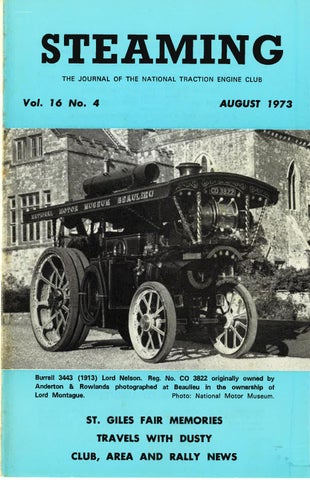
Burrell 3443 (1913) Lord Nelson. Reg. No. CO 3822 originally owned by Anderton & Rowlands photographed at Beaulieu in the ownership of Lord Montague. Photo: National Motor Museum.
ST. GILES FAIR MEMORIES TRAVELS WITH DUSTY CLUB, AREA AND RALLY NEWS
NATIONAL TRACTION ENGINE CLUB OFFICERS President S. J. Wharton, Esq., Southern Down, Minster Lovell, Oxford Vice-President J. T. Beeby, Esq., Wymeswold Road, Rempstone, Loughborough, Leics Chairman Anthony Heal, Esq., Baylins Farm, Knotty Green, Beaconsfield, Bucks Vice-Chairman J. Crawley, Esq., Field House, Turvey, Bedford General Secretary G. F. Beck, Esq., 127 Greensted Road, Loughton, Essex Treasurer J. H. Hobbs, Esq., 6 Esher Close, Basingstoke, Hants Editor Ran Hawthorne, Esq., 19 Bridle Path, Woodcote, Reading, RG8 OSE, Berkshire Chairman, Rally Sub-Committee M. Harmsworth, Esq., Elm Cottage, Ockwells Road, Maidenhead, Berks Membership Secretary C. C. Ayes, Esq., 15 Milking Pen Lane, Old Basing, Basingstoke, Hants Sales Officer V. H. Burrough, Esq., 94 Harvist Road, Kensal Rise, London, NW6 6HL. Technical Services and Spares Officer Brian Oram, Esq., Bourne House, St. Mary Bourne, Andover, Hants (Tel: St. Mary Bourne 260) Public Relations Officer Jonathan Minns, Esq., la Hollywood Road, London SW10 Publicity and Press Officer Patrick Coxall, Esq., Smokey Cottage, Lion Lane, Haslemere, Surrey
STEAMING Steaming is published by the National Traction Engine Club quarterly. Copies are posted to all paid-up members. The best way to be sure you are a paid-up member is to use a bankers order. The current subscription is £1.50. From September 1st 1973 the subscription will be £2.00. All correspondence re subscriptions, delivery (or non delivery) of Steaming, change of address and bankers orders to:
C. C. Ayes, Esq., 15 Milking Pen Lane, Old Basing, Basingstoke, Hampshire. A renewal delay may lead to non-delivery of your next Steaming.
ACKNOWLEDGEMENTS We would like to acknowledge the help given in the preparation of this edition by: Club and area correspondents, Viv Kirk, Chris Edmonds, Peter Fagg, Rob Gebhard, David Hallam, C. Wright, Ted Wyatt and many more. 190
STEAMING THE JOURNAL OF THE NATIONAL TRACTION ENGINE CLUB EDITOR: RAN HAWTHORNE, 19 BRIDLE PATH, WOODCOTE, READING, RG8 OSE. VOLUME 16 No. 4
AUGUST 1973
FROM THE EDITOR'S CHAIR Here we are again, right in the middle of the rally season. Busy with engines, busy with Steaming. We have a mixed bag for you this time. The next Steaming, we hope, will be a landmark in the club magazine's history for we confidently expect to be able to present a full colour picture on the front cover. We have some excellent cover pictures in hand but we will need more in due course. So if you have high quality colour prints made from negatives we would be glad to hear from you. Colour prints made from 35mm. transparencies arc generally not suitable for reproduction. The next edition of Steaming will appear towards the end of November. Reports of N.T.E.C. approved events, Club and area notes, photographs, (we still need good black and white glossy prints) articles, "Chuffs", adverts etc. for this edition should reach me by October 10th. Small adverts and small news items received after this day may find space.
" BLOW OFF " Steaming's Opinion Column In this edition there is an account of a steam boat rally at Exeter. Steam boating rose and fell at much the same time and in similar extent to Traction Engines. At one time of day people on the Thames complained of the "large number" of steam boats on the river. Like Traction Engines they never went completely out and like Traction Engines Steam Boats now enjoy great popularity. The Steam Boat Association organises rallies from Beaulieu to Windermere. While they give the public a chance to see their boats they organise their events primarily for their own boat-owning and enthusiast members. We wonder if perhaps the Traction Engine movement has taken the wrong road by jumping headlong into commercial events (often carrying a "charity" label). How about a "members only" rally, have one "public day" to help pay some of the expenses if you like but surely we could have a few engine get-togethers up and down the country without the thousands and thousands of people we now have to suffer. An event open to N.T.E.C. and affiliated Club Members only could put us on the right road again. 191
N.T.E.C. SOCIAL MEETINGS at the "Cock Tavern", Great. Portland Street, London WI
Wednesday 21st October at 8. p.m. Members' slides, Bring your best efforts along. In order to allow as many members as possible to show slides each member will be restricted to a maximum of 20. Wednesday 28111 November at 8 p.m. "The Basingstoke Canal". A look at another form of preservation. Guest speaker Mr. John Dodwell of Surrey and Hampshire Canal Society. L.M.
CHRISTMAS CARDS The N.T.E.C. Christmas card for 1973 is now available. The size and layout are similar to last year but with a different drawing. .K Grayshon Lumby of Pudsey, Yorks, has produced a most excellent design with a well known Berkshire engine driving a well known Yorkshire enthusiast's saw bench, with the owner supervising the operation. The village church in background reminds us what Christmas is all about. The words Christmas Greetings are on the front with suitable wording inside.. Supplies of the card, together with envelopes, will be on sale- on club stands at rallies. Supplies through the post can be obtained from: N.T.E.C. Sales Officer V. H. Burrough, Esq., 33 Holland Road, Harlesden, London NW10 5AH. Ten cards and envelopes 66p incl. VAT; 20 cards and envelopes £1.10p incl. VAT. Post free to members. Non members please add 5p on 10 cards or 8p on 20 cards, postage. Cheques and P.O. payable to N.T.E.C. please.
ONE-DAY COURSE The Langstree Further Education Centre. Woodcote. near Reading, is holding another one-day course on steam. Following the very successful course "Heyday to Rally", reported in Vol. 16. No. 3. this winter's course will be held on Saturday November 3rd at Langtree School. The title is "Steam on the Fairground"; the chief speaker will be Ran Hawthorne, Editor of Steaming, assisted by other well known speakers. Following "popular request" at the last course, this year's course will include an engine "in steam". The course will assemble about 1 p.m., during the afternoon the Fowler Showman's Engine "Renown" will arrive and will be used to illustrate points from the lectures. The course will close about 6 p.m. but the engine will probably be going on to a bonfire party in the village. Any members of the course being welcome to stay on to sec the engine running light after dark — an impressive sight. This is the only notice regarding this course. Those interested should write for full details and booking form to P. J. R. Trout, Esq., Langtree Further Education Centre, Woodcote, Reading, Berks.
•
192
Robert Hodgon and family of East Hanney, Berks, have recently bought a 20 h.p. double cylinder Marshall portable No. 53360 from a brickworks near Northampton. She will be a stable mate for their Fowler plough engine.
INCREASED SPARKS RISK COVER The remarkable rise in the value of property, and particularly of thatched houses, in recent years has caused some members to be concerned about the inadequacy of cover for sparks risks afforded by the club's insurance policy. We have been in negotiation recently with our Insurance Brokers, Messrs. Tennant Budd & Roderic Pratt Limited, and as a result of this this we are pleased to advise that the Brokers have been successful in obtaining a simplified package deal Policy for the benefit of Members. The indemnity provided by the Sparks and Ashes section has been increased from 0.000 to £20,000 and the former extensions relating to agricultural use, Road Rolling (by insured only) and Towing Living Van or Caravan will now be included. Total premium for the revised Policy will be £10 and it has been deemed advisable for all new Policies to be put on this basis and the risks already insured altered to the new basis as from renewal date. Due to the fact that Insurers have agreed to make certain premium concessions in indicating the premium for the new package deal, reference to the bonus clause, will now be deleted, and this will save in administrative costs. This amendment to cover has undoubtedly had the effect of enabling Insurers to give a more extensive overall cover at a more economical premium. In agreeing these amendments to cover, the Club and Insurance Brokers have of course endeavoured to act in the members best interest. A.S.H.
A. W. CHESHER'S LAST BOW The exhibition held in April at the Portal Gallery is expected to be the last one-man-show of Mr. A. W. Chesher, the well known Bedfordshire painter of traction engines and their historical use in agriculture and on the fairground, whose work we have reviewed in Steaming on several occasions. It is some 12 years since he first showed at the Portal Gallery in Grafton Street, WI. and his work attracted the attention of steam enthusiasts end collectors alike. Now at the age of 74 he has been reltintantly compelled by failing health to give up painting, a pastime that he first took up at an age when many men are think about retirement. This small fina l exhibition maintains the high standard of his work, the gay colouring, the deep texture of stubble and ploughed fields, the comment on social and industrial change. Two farmyard scenes show first a steam tractor busily driving a thrashing drum and the second a new internal combustion machine taking over the same job whilst the steam engine stands discarded and derelict. The two figures examining it may be scrap dealers or N.T.E.C. members with preservation in mind. An interesting picture shows a Fowler engine and windlass ploughing by the roundabout system and a companion piece illustrates the two engine system. Two portable engines, a Clayton & Shuttleworth and a Hornsby, are seen driving a thrashing drum and a shaff-cutter in a farmyard. Not all Mr. Chesher's paintings are of agricultural scenes, he is just as much at home with the Robey tractor pulling a gaily painted furniture removal van to a country house or with the large Fowler road locomotive hauling a massive boiler along a suburban street. To steam engine enthusiasts his pictures are a delight. The depict, with great accuracy, the now vanished scenes when steam was supreme in agriculture and road haulage. But Mr. Chesher's aficionados extends far beyond the ranks of "Steam Men". His pictures are to be found in several private collections and if their five fold increase in price in 10 years is any criterion, they should prove to be a good investment. A.S.H.
193
Marshall 78329 (1929) "Sijmen" restored in Holland 1973. Stoomwalsenclub, Nederland.
The Ruston Proctor engine that has been purchased and brought home from France to Lincoln. 194
CHARLES RICKARDS
It is with deep regret that we record the death of the President of the Fairford and District Steam Club, Charles Rickards. Charles served an apprenticeship with a heavy engineering firm dealing mainly with steam. Most of his working life was spent in partnership with a Mr. Briggs. Briggs and Rickards being steam contractors engaged mainly in threshing in parts of the counties of Wilts, Glos, Berks, and Oxon, their headquarters being at Kempsford near Cirencester. Mr. Briggs died some years ago. Steam survived till the combines took over. The Traction Engines seemed to be redundant. Charles devoted most of his energy to farming. Some engines were sold to farmers for occasional use or for timber work but Charles' love of steam would not let him sever his connection and one engine Allchin compound No. 1652 (1914) which he had purchased in the Fens in 1929 was kept. He attended a number of the early rallies and in the 60's he had a new firebox fitted. Charles was an early member of the Thames Valley T.E. Club and as the preservation movement gained momentum he was of great assistance and encouragement to many of the young men in his area who became known as the "Swindon boys". Later on the "Swindon boys" formed their own affiliated club known as the Fairford and District Steam Club. Charles was their unanimous choice for President. He stabled engines at his farm, held threshing parties and was generally the guiding light and ever ready with kindly help. Charles farmed till well over 70. The doctors told him to give up his engine but he would have none of it. With Colin West to help him with the heavy work he quietly pottered and attended rallies with his engine. He was far from well in recent years but he continued his life in steam, in fact it is probably true to say that, contrary to the doctor's opinion steam kept him alive and bright to the end. Almost everyone I have met since his death has referred to Charles Rickards as "a grand old gentleman". Rest you well Charles, gentleman of steam" — editor. Jack Wharton, Minster Lovell, Witney, Oxon, is looking after the sale of Allchin 1652. She will be in steam at Fairford Rally August 18/19th. Offers should be made in writing by the end of September. 195
" DANDY JIM " AN 1873 AVELING by Charles E. Hooker, Kent Marty of our friends that are interested in the Traction Engines, will have heard of or seen the old Aveling single speed now at the Science Museum, South Kensington, London. I believe this to be the only remaining engine of this type, and possibly I am the only driver now alive to have had years of experience with this type of engine. Ours was a 6 h.p. and left the works new in 1873. Single cylinder, with a single speed, the gear of which was kept in place by a leather strap. working pressure 110 lbs., safety valves loaded by Salter spring balances, and one of those valves had to be removed to fill the boiler with water. The engine known as "Dandy Jim" had no compensating gear, so when running Light the driving pin of one wheel would be left out, when hauling a load pins would have to be in to get a good grip of the road, so to round a sharp bend in the road, to prevent a eontinous strain on the rear axle. we would over steer, then straighten up, again over steer, so there was two strains but of short duration. I first drove this engine at the age of 15 (1899) — I pulled a Church Army van from Egerton to Smarden, Kent. (I thought it looked rather comic, a van covered with religous texts being towed by an engine.) Even with only one speed there was no difficulty in exceeding the speed limit of 4 m.p.h.. yet the engine was quite easy to manoeuvre in a restricted area, such as a stack yard. Injectors were almost unknown in those days before 1900. A water feed pump only, this would give trouble at speed if there was excessive lift to valves, however, this engine was used mostly for threshing and it was unwise to tow the machine at more than 3 m.p.h, on the roads of those days. (Even the main roads would have bad squats and were dusty in summer and thick mud in winter.) The fuel and water consumption was slightly heavy owing to the excessive cylinder head clearance. (It might interest you to know that I used this engine with truck as my wedding conveyance — Easter 1906. There were 40 persons in the truck, which was gaily decorated for the occasion.) This old Aveling, now around 30 years old, had no difficulty in driving a 54in. drum with trusser and knock out some 80 qrts. of wheat or 110 of Oats. This was before the first world war when we had a gang of men that Followed the set around. Yes, we did have mishaps. One day at a farm at Bethersden, short of away. 111011 I was driving and fetching water from a pond some 80 yards Whilst at the pond the governor belt came off. Dropping the buckets I ran as fast as possible. threw the reverse over at full steam. but too late to save the machine. Wood splinters and sparks were coming out of the top of the machine like a miniature volcano. Because of the high speed the drum was hitting the concave, this tore the beater plates off, which then chopped the woodwork to pieces. If the feeder had thought to put extra sheaves in the machine it would have prevented the engine racing and saved this damage. Instead he stood with his hands in the air apparently in a state of shock. One day whilst descending a hill the driving pin broke (only one in at the time) and away we went, Happily there was a wide and long grass verge at hand, steering on to this, the soft ground soon stopped us — exciting while it lasted! On another occasion the base of the chimney was badly corroded and it fell off. To get the engine home we managed by wiring hedge stakes around the chimney. We also had the rear axle break. With another engine and truck we loaded the drive wheels and axle into the truck then, using a spare truck axle and wheels for the disabled engine, we towed "Dandy Jim" home. One morning after getting up steam I was indoors having my breakfast. when I heard a roar of 196
escaping steam. Throwing out the fire, I found a hole at the bottom of the front plate caused by corrosion below a mud cover. We owned "Dandy Jim" from 1904-1910. My father, a brother and myself have, over the years, owned a large number of traction engines, rollers and tractors; also a number of steam wagons and, when busy, have hired others and used them for heavy haulage, rolling and threshing, and from the age of 12 when I left school in 1896, I have driven most of them, so I have had a great deal of experience at all sorts of work in all types of weather.
A. & P. -Dandy Jim" 1019 (1873) on the occasion of Charles Hooker's wedding '1906. Driver Charles Hooker Snr.
Photo courtesy Charles E. Hooker.
THOSE WERE THE DAYS . . Member Tommy Woods of Sherbourne St. John, well known in the area as the man in charge of the Messrs. Wallis & Steevens Ltd. fleet of steam rollers, sends an interesting booklet published by Scammell & Nephew, Spitalfields, London in 1931. 13esides detailing and illustrating
the repair work they offered, prices are included. We include a few referring to steam wagons: Tubes. DG 6 or Super supplying and fitting, each 7s. 6d. Stay tubes 8s. Retubing complete. DC 6, Super, 6 ton £14 10s. and only "one day" was required for the job. Overtype wagons. Supply and fitting new firebox, tubes, ferrules and fusible plug £54 10s, — "10 days" were required for this job. Injectors, any type reconditioning 5s. Pressure gauges any type reconditioning 15s. "One to three day required" but "l❑an parts available while repairs in progress". Inside the back cover there is a slip entitling the customer to 21% discount on his next order!
197
REMINISCENCES OF ST. GILES' FAIR By VIV KIRK
During 1936 the Gloucester Green lorry and car park, where I had so often seen the engines and loads of Jacob Studt pulled in for the night, closed as a heavy vehicle park, with the car park remaining, the part used as the heavy vehicle park, near the entrance to the green becoming the Oxford Bus Station which it still is to this day. The heavy vehicle park being moved to the Oxpens, close to the Oxford Cattle Market, which showmen en route through Oxford could still pull in. without going too far off their route, although not quite as convenient as Gloucester Green. Paine's Field, Ferry Hinskey Road, where Tom Clark's two Burrells "King George" No. 3272, and "Queen Mary" No. 3273 with the switchback loads used to pull in before St. Giles Fair during the late 1920's, was also used by Showmen passing through Oxford, I remember one summer evening during 1934- or 35 seeing Jacob Studt's Burrell No. 3967 "Morning Star" with the car trucks of the Scenic arrive in Botley Road, afterwards pulling on to Paine's Field. If there had been any rain, this used to get very soft, and muddy. which meant the Showman had to uncouple the trucks and rope them round, using the engine's wire rope, until they reached the hard ground made up with ashes near the entrance gates, afterwards coupling up the loads, ready for an early start in the morning. 1936 saw fewer steam vehicles passing through Oxford, most by now contractors steam rollers, going to and from road tarring work, with sometimes an agricultural traction engine on thrashing duty passing through, the 1914-18 War solid tyred lorries used by many haulage firms, by now like the steam wagons had disappeared. I used to like to see these lorries going about their work, they nearly always seemed to be overloaded, and with their slow speed they appeared quite attractive, two such vehicles I knew quite well, being owned by Johnson's timber merchants, whose yard in Worcester Place, off Walton Street was quite close to my home, one being a solid tyred disc type heavy wheel Halford, the other the more familiar four-wheel drive solid tyred lorry, both being replaced later by Morris Commercials. About the last 1914-18 veteran I remember was the one used on contract work to Lucy's iron foundry in Walton Well Road, being used to cart the moulding sand from the railway goods yard to the foundry. I never could see any makers name on this lorry, recently I saw a photo in the Old Motor magazine of a very early Leyland, which resembled the lorry, especially the front radiator, being before the R.A.F. type Leyland's of the 1914-18 War. The early summer of 1936 brought the annual Band Contests in the recreation ground at Botley Road, with R. Edward's amusements attending. I had seen this Showman's engines and rides once before when they opened at Tuckwell's Meadow, Abingdon Road, Oxford, some two years previous, on that occasion they opened with the Gallopers and Dodgems, using three Burrells for haulage, and driving the Dodgems, lights on the Gallopers, one of the Burrells was at that time not fitted with a dynamo. I believe this was No. 3836 "Starlight", the other two Burrells being No. 3651 "Earl Kitchener" and No. 3950 "Progress", the Gallopers had now been replaced by a new Noah's Ark, the engines looked very smart, with fine lining and paintwork, their twisted brass canopy supports being chrome plated. 1 was present on the Thursday, when the engines and loads arrived. During the early evening, work started on building up the machines. 198
Neville Rainsley's "Smallest Show on Earth" pictured at Eynsham Carnival 10th July 1925. Mr. Rainsley Snr. centre, Neville Rainsley, standing. R. Edward's Burrell 3651 "Earl Kitchener" in the background.
Reproduced by permission. Here, too, that year I met a fellow enthusiast a year older than myself Victor King, who at that time lived in St. Michael's Street, off George Street, near the centre of Oxford, and had built a fine model of a Noah's Ark, followed by a Mont Blanc two years later, both models building up from centre trucks, as in full size machines, complete with flat and box packing trucks. The Band Contests used to take place on the Saturday, with the fair opening Friday evening, I was present both these days, R. Edwards' three Burrells being in position side by side near the stream, which ran on the West side of the ground. Bordering on the opposite side of the stream were the backs of terrace houses of Helen Road. Instead of using the water from the stream, as other Showmen had always done, R. Edward's had a rubber hose pipe, across the stream to the back garden of one of the houses in Helen Road, and through the side entrance to the water hydrant outside in the road, with the engines of this firm kept in such spick and span condition, I was not surprised with the extra trouble taken over a supply of clean water for them. "Blossom" Trinder with the chain drive Tasker "Little Giant" of J. Curtis and Sons, Botley, Oxford, 1 would often meet in the Botley Road, and other parts of Oxford during that summer, hauling loads of timber. that used to look somehow too large for the engine to manage at that time, although I knew "Blossom" by sight I had never met him to talk to, as when 1 used to see him, he was always on his way from, or returning to the Botley Yard, some fourteen years later, however, "Blossom" was to become a great friend of mine, when I purchased my Burrell Showman's engine No. 3833 "Queen Mary". The annual Great Western Floral Fete and Show in August of that year saw C. Thurston's amusements attending with the Dodgems, Swirl, Ark, and Burrells No. 3200 "Unity", No. 3075 "Alexandra" and instead of No. 3827 "Victory" C. Thurston's other Burrell No. 2780 "King Edward VII" who at times I have seen at St. Giles' Fair, also for a number of years two Tilling-Stevens former buses were used by this 199
firm, one with a tongue and groove box body, this vehicle being attached to "Ark" and used to carry the panel front, hand rails of the machine, the other Tilling being fitted with a frame body was with either the Swirl or the Dodgems, carrying some of parts of these machines and like this firm's engines, were always kept in first class condition. This popular Flower Show, which used to have very large entries for the various flower and vegetable sections, finally, like other shows of this type, closed clown after the 1939-45 War, only continuing for some three years of the post war period. After the Floral Fete, with St. Giles' Fair following some three weeks to a month later. I would think of what changes there would be, not what new ride would appear, but what of the old that would be missing, with the advent of Jacob Studt's Scammell of the previous year, would there be less engines, perhaps one less, which would be bad enough, somehow you could not imagine some Showmen ever going over to diesels amongst these being F. Wilsons. C. and J. Thurston's and W. Wilson's, in any case what I had seen of Studt's Scammell is appeared only capable of hauling two trucks, against the Showman's engines three. Thursday of the week before St. Giles' Fair saw the arrival of F. Wilson's Burrells No. 3272 "King George" and No. 3273 "Quen Maryin the Botley Road with the Ark and Dodgem loads, after filling their tanks, as in previous years from the roadside stream, they pulled on to Paine's Field, Ferry Hinskey Road, this would be the last time they would do this, a day later, steam was raised in the Burrell "King George" and "Queen Mary" and they pulled out with the loads, afterwards drawing on to the Oxpens transport park Holly Bush Row, near the Oxford cattle market. Jacob Studt's Burrell No. 3967 "Morning Star" with the Chariot Racers loads and the Fowler No. 13408 "Mans Star" with the Mont Blanc loads pulled on the G.W.R. goods yard, Becket Street, Friday evening as in previous years. Writing from memory the last mentioned rides and
Jacob Studt's engines at Fairford in the 30s. L. to R.: Fowler 9501 "Queen Alexandra", Fowler 11845 "Progress II", Burrell 3967 "Morning Star". Fowler 13408 "Mons Star", Burrell 3642 "General French". Photo reproduced by permission. 200
engines of Jacob Studt's together with the Scammell tractor, were the only two machines, and engines, of this firm's six engines and four machines travelling, attending St. Giles Fair during the last years of that pre-war period, it is possible Burrell No. 3642 "General French" attended in place of Fowler No. 13408 "Mons Star" during one of the years. Saturday morning found me early, as in other years, down at Becket Street, near the Station, waiting the arrive' of A. Bird's Steam Yachts, H. P. Studt's engine and loads, with C. and J. Thurston's three Burrells later during the morning at the L.M.S. Station. H. P. Studt's Burrell No. 3371 "Lord George" was the first to arrive, coming from the Reading area, they came into Oxford Park end Street via Carfax and High Street afterwards stopping for a while in Holly Bush Row, the loads being a new machine built by R. L Lakin, and had been on show at Olympia, London, earlier in the year, called the
Loch Ness Monster. There had been changes to Burrell "Lord George", she had been fitted with balloon tyred front wheels, the only 8 h.p. Showman engine I have ever seen so fitted. I did not like the look of these wheels, "Blossom" told me years later, they were low loader wheels, the only wheels that size available at that time, she always looked low in the front. The driver that year of "Lord George" was a coloured man, the only one I ever saw driving a Showman's engine, I remember seeing him, rubbing down her side belly water tanks with some cotton waste, while waiting in Holly Bush Row before moving on up on to the G.W.R. goods yard railway slope at the top end of Becket Street, later on during the morning A. Bird's steam Yachts pulled in, I was sorry to see the two boats being moved about by two Dennis former buses of 1928-29 vintage, with the bus bodies removed, and what looked like the two top halves of
the former trucks fitted with the boat cradle placed on the Dennis chassis. This was then to be one ride hauled by motors, I was to miss the old Fowler that year up in St. Giles during the fair, I wondered how A. Bird's were going to raise the Yachts off the trucks on to the overhead swing crank, when building up on Monday morning, this work formerly being done by the aid of two pulleys, and the Fowlers "Progress" No. 9817 wire rope. One of the Dennis's was fitted with a dynamo for lighting the Yachts during the evening. C. and J. Thurston's three Burrells No. 3200 "Unity", No. 3075 "Alexandra" and either No. 3827 "Victory", or No. 2780 "King Edward", who attended some years, with the Ark, Swirl and Dodgem loads, pulled on to the L.M.S. Station forecourt, and nearby goods yard. This always used to be interesting to watch, as the approach to the Station forecourt where two of the engines used to stand, involvedThurston's drivers having to take their engines and three trucks through a gateway which, although it was quite wide, but due to the position facing partly Park End Street, and the more narrow part leading into Hythe Bridge Street, at that time a public convenience stood forming an island between the Royal Oxford Hotel and the road leading past the L.M.S. Station into Hythe Bridge Street, which was the street the engines and loads used to arrive in from Bicester, where Thurston's had been open the previous weekend. The way Thurston's drivers used to negotiate this awkward gateway with their engines and loads, was a joy to behold, I think the secret was the very slow speed, hardly moving at times they approached the entrance gates after taking a wide sweep out into Park End Street before turning right hand, bringing the engines and loads into line with the gates. Saturday evening at 6.0 p.m. found, as in other years, large crowds of people in St. Giles to watch the engines arrival with the machine centres, among these being Victor King, who I had on the Thursday met at Paine's Field when F. Wilson's two Burrells "King George" and "Queen Mary had pulled in. V. King being a very observant person with an eye for detail, I remember him pointing to one of F. Wilson's wooden wheeled rubber tyred flat trucks with the toad of Dodgem plates, and saying that trucks underworks were built from the parts of the very popular 1914-18 War F.W.D. lorries, which on examining more closely, I found he was right, 201—
and the chassis were clearly F.W.D. Jack Proctor again attended with the Airways, the centre of this machine arrived in St. Giles that evening behind William Wilson's Burrell No. 3938 "Quo Vadis", W. Wilson being I understand, a relation of J. Proctor, using "Quo Vadis" for some months of that year for hauling his machine and driving. John Flanagan's Gallopers together with A. Bird's steam Yachts pulling in Monday were again the only steam driven rides at the Fair that year, W. Nichol's also still starting from scratch Monday morning with his two machines the Ark and Dodgems. Later, during the Saturday evening of those days. i would walk down to the Station goods yard to have one last look. that day of the engines and loads of Thurston's at the L.M.S. yards and Studt's at the nearby G.W.R., there were always many sightseers here, parents with their children who would spend quite some time looking at the engines, no one seemed to be in any hurry. Sunday known as "Fair Sunday", how pleasant it used to be, up in St. Giles the sheeted up centre trucks, with such large crowds of people about there, which never seemed to get less throughout the day, a walk down again to the Station goods yards at about 8.0 p.m. you would find the engines fires had been lit, Thurston's Burrells having had steam raised and dampered down for the night, the same with F. Wilson's two Burrells "King George V" and "Queen Mary" down at the Oxpcns. Those Sunday evenings on the eve of the Monday 5.0 a.m. draw in. had some sort of aura, like the approach of Christmas, or other great events, after all were there not eleven Showman's engines with their machine loads in Oxford that Sunday evening, not as many as other years. all ready for the 5.0 a.m. draw in. Monday morning, as in other years. I was at the St. Giles end of Beaumont Street, always a half hour before 5.0 a.m., which added, I always thought, to the occasion, was that you could have a talk in the dim light from the street lamps to friends. Here too was a sort of expectation, I think today known as keyed up like feeling in the atmosphere. As in most years F. Wilson's two Burrells were about the first engines and loads to appear in Beaumont Street, still plenty of sparks shooting up into the darkness as the drivers opened their regulators, no time being wasted in stopping, as they had hardly slowed down when turning into St. Giles. from Beaumont Street. By now as in most main roads and streets of Oxford, tall electric lamp standards had replaced the picturesque gas lamps, a help to the showmen that year in St. Giles, casting a little light. Engines attending, as far as I can remember, being W. Nichol's Burrell No. 3949, "Princess Mary" and No. 2562 "Empress of the South", W. Wilson's Burrell No. 393$ "Quo Vadis", F. Wilson's Burrell No. 3272 "King George V" and No. 3273 "Queen Mary", Jacob Studt's Burrell No. 3967 "Morning Star" and Fowler No. 13408 "Mons Star", C. and J. Thurston's Burrell No. 3200 "Unity", No. 3075 "Alexandra" and No. 3827 "Victory" or No. 2780 "King Edward VII", John Flanagan's Foster No. 14502 "Victory" or No. 12538 "Surprise", the last engine on the east side of St. Giles, on the west side, H. P. Studt's Burrell No. 3371 "Lord George" driving the new ride Lock Ness Monster. Rides that year apart from the two steam driven ones mentioned earlier, were four Arks, being, W. Nichol's, F. Wilson's, C. Thurston's and the Chariot Racers of Jacob Studt's, two Mont Blanes, Jacob Studt's and J. Proctor's. three Dodgems, being W. Nicholl's F. Wilson's and J. Thurston's. I was particularly interested in how A. Birds were going to raise their two boats off the trucks, when building up the Steam Yachts, without the use of the Fowler, "Progress". This turned out to be quite simple, they used a set of chain block lifting tackle, lifting the Boats off the trucks, a lot slower than previous years, when they had the Fowler. The new ride of H. P. Studt's when built up was similar to the Mont Blanc, except the passengers rode sat astride a continuous type of car, which was a lot lower than the Mont Blanc. ►with a carved figure of the Loch Ness Monster at its head, the outwards appearance of the machine being similar to the the Noah's Ark with a panel scenic front, 202
as in previous years. Writing from memory, Jacob Studt's Chariot Racers stood next to this machine at the corner of Pusey Street. I assume, as Jacob Studt and H. P. Studt were brothers, one travelling from South Wales and the other from the Middlesex area. They must have arranged to have Jacob Studt's machine on Harry Studt's ground that year, Harry Studt always used to have ground for two machines, and I believe Jacob Studt just one. As far as I can remember when the fair was in full swing H. P. Studt's Burrell No. 3371 "Lord George" drove the Loch Ness Monster, Jacob Studt's Scammell driving the Chariot Racers standing alongside. That evening up at the fair I missed the old Fowler "Progress" of A. Bird's, as there was a convenient stone step leading up to the front door of one of the buildings facing the Fowler, here I could sit passing a pleasant hour, watching "Progress' after darkness driving the lights. Although I liked watching the centre engine of the Yachts that year, it was not quite the same without the Fowler. The former Dennis bus now doing her work, was boiling well at the radiator while driving the lights. Both days of the fair used to pass all too quickly, the only reminder being some days later, the tell tale little drops of oil, where
the engines had stood in St. Giles, and a cutting from our evening paper, the Oxford Mail, showing a view of St. Giles Fair taken from the Tower Slip or Helter Skelter with J. Flanagan's Steam Gallopers on the left, and the outline of the other rides in the distance. J. Flanagan's Gallopers always seemed to look right somehow. I always used to cut out their photo for my scrap book, which 1 have to this day. As I had left school at the start of the school holidays that year, a few weeks following the fair I started work in the projection room of the old
Electric cinema, Union owned in Queen Street, now converted into a large store, duties being rewinding the film spools, this being the first of many jobs, until I got a more lasting one a few years later. to be continued.
F
Wel!brook, Peterchurch, Herefordshire By direction, of S. Philp Esq.
F. H. SUNDERLAND AND CO., have been instructed to offer for sale on the premises on SATURDAY, 8th SEPTEMBER, 1973 The Whole of the Farm Implements and Machinery including the under-mentioned FISHER HUMPHRIES 54" all steel THRESHING MACHINE. FOSTER 7 n.h.p. Single cylinder TRACTOR ENGINE, 1909. AVELING & PORTER 12 ton single cylinder STEAM ROLLER, 1923. MARSHALL 54" THRESHING MACHINE fitted Murch Reed Comber. DRIVING BELTS. MASSEY HARRIS THRUSSER adopted for tying wheat reed. 1948 FIELD MARSHAL TRACTOR, Series II, fitted winch. RANSOMES STATIONARY WIRE BALER. 1942 STANDARD FORDSON TRACTOR. FOSTER 54" THRESHING MACHINE fitted Hornsby Trusser. Also many other items of machinery, together with some 500 sheep. Sale to commence at 12 noon. No catalogues. Further enquiries should be made to the Auctioneers:F. H. SUNDERLAND AND CO., OFFA HOUSE, ST. PETERS SQUARE, HEREFORD. (Tel: 56161).
203
"CHUFFS" FROM HOLLAND The rollers "Pieter Hans" (Schwarstzkopf(, No. 8885, built 1927) and "Zoef Zoef" (Ruthemeyer, No. 76. built 1907) will participate in Expo Steam this year on the East or England Showground, south of Stamford. The Dutch party, headed by Rob Gcbhard, will arrive in Harwich on the 24th August in the early morning hours. The same ferry which will bring the Dutch party back to Holland. • will bring from Britain the "Iron Maiden" on John Antell's lowloader. The arrival of all the engines in Hook of Holland will certainly be covered by Dutch TV. The short visit of the "Iron Maiden" to Holland will bring the • engine to the organ museum "Van Speeldoos tot Pierement" in Utrecht. During a small party fur the British guests it will generate power for the famous "Lange Gavioli" organ. That is on Saturday 1st September. Next day the "Iron Maiden" will ride on its own power from Utrecht to Huizen along a most scenic route along the river Vecht. This event too will be covered by TV. Both the "Iron Maiden" and the "Lange Gavioli" will be present in Papendrecht (south cast of Rotterdam) on the 5th September. There will be too five rollers and the portable engine "Sturdy" with our Maisha11 threshing drum. Doing real threshing, of course! The 5th September this year is an extra holiday, as Queen Juliana celebrates her 25th anniversary as Queen of Holland, Because of other appointments the British guests have to leave with the night ferry that day, Al the moment these lines are typed it is not sure yet, if there will • be on the 5th September a small steam rally too in the city of Helmond; and one on the 15th of that month in Almelo. because of the opening of the new Town Hall. t• Other things are really for sure: the "rebirth" of some engines. The little Marshall (convertible) Roller No. 78329, built in 1929, showed un in Maarssen during a rain-soaked rally and in Leiden at the end of May with our new Minister for Transport as guests during the opening of a new motorway. More engine news: rebuilding was finished for the Burrell Roller No. • 3351. built 1924; and on the oldest steam roller in Holland, the Aveling & Porter No. 4711, built 1901. And still there are some more to come! If good photographs are available Steaming will publish them. Speaking about photographs — coloured ones were used for the first • series of postcards showing Dutch owned rollers. Not an easy task to decide which engines should be used to make postcards from. These are shown on the first series: "Pieter Hans" (the Schwarstzopff); "Zoef Zoef" (the Ruthemeyer from 1907); "De Gebroeders" (Garrett No. 34185, 1922): "Dollie Mina" (Wallis & Steevens Advance No. 7909. 1926); "Pluisje" (Aveling & Porter No. 11016. 1924) and "Sturdy" (Ransomes S. & J. No. 684025, 1C.'48) with the Marshall threshing drum built in 1908. To avoid "remittance costs" the sale of said nostcards in Britain will be centralised by the N.T.E.C.. Details will be announced. Well known steam roller "Pluisje" took the ferry to Britain to partici• pate in the Camerton Traction Engine Rally (Somerset) and other events in that region. Stoomwalsenclub Nederland read with interest "Blow Off" Steaming's • opinion column in Vol. 16, No. 3. With more and more contacts between Britain and Holland originating, some kind of "centralised organisation" would certainly be appreciated and will be to the benefit of all concerned.
•
204
OUR TRAVELS WITH DUSTY by Peter Fagg When we first moved to Wiltshire with "Dusty" and the wagons in July 1972, we thought, being fewer Rallies in the area, would have an easier rally season in 1972 than we used to have touring the South East Rallies. How very wrong we were. For the information of members who may not have heard of "Dusty", she is a 1914 Clayton & Shuttleworth agricultural engine No. 46823. Unsprung, single cylinder 7 n.h.p. on cleats, and averaging approx. four miles per hour. The wagons are one old Kent County Council living wagon, built by Avelings. This is a general water and coal shed, carrying everything but the kitchen sink. I built a couple of bunks into this wagon, and under one of the bunks fitted two 45 gallon oil drums for reserve water. The second wagon is a 1925 showman's, built by Southerns of Brighouse. This is more luxurious and is our "portable home" while at rallies and on the road. It is very well made with mahogany and cut glass, and what is more, I wouldn't dare put coal, wood or any engine requisites in it!! At the beginning of the season, the entry forms rolled in. Some we applied for and some just turned up. We filled in and sent off entry forms in all directions, (some we had to turn down), not even knowing the dates of some events. With the result that we ended up at one point of the season with four rallies in four weekends running. We overcame this by having a fortnight's holiday, and doing one very early morning run. With the usual paint and polish done, after the winter lay-up, (with the help of our friend Peter Potter, who crewed with us for most of the summer), and the boiler man well satisfied this year, we had our usual Easter Weekend steam up to the local pub. Well, you have to see if they go all right after being in hibernation all winter, don't you. Our very first "do" of any kind was an 18-mile trip to Crofton Beam Engines for their weekend in Steam. The journey which for the main part was along the A4, was uneventful, except that, as we approached the ancient monument of Silbury, who should we see sitting on top of it waving the white flag (actually it was a hanky we found out later) were the well known Thames Valley engine owners Fred Simmons and John Alsbury. They told us afterwards, that they had watched us for miles. We stopped at the River Kennet, running alongside Silbury, to pick up water. The Hullavington Engine organiser Ernie Clayton caught up with us at this point, after following our tracks, and no sooner had he arrived than along came John and Fred, puffing and panting after their climb, just in time for coffee and refreshments. They then all accompanied us on to Crofton, stopping on route at Marlborough for liquid refreshments. Going through Marlborough was fantastic. We have never before seen so many people photographing our 'Wagon Train'. They came from shops, cars and coaches. In fact we jolly nearly stopped the traffic. After leaving Marlborough, we went through the Savernake forest. It was very beautiful through the forest and it seemed a shame to leave it. The sun was shining through the trees and it looked lovely. We stayed long enough to collect up a tender full of dead wood, and off we set again. And so on to Crofton. We were there with Alf Baker and his model as an added attraction to the Beam Engines. Not that they needed any really, they are a great attraction in themselves. The two Beam Engines were installed in 1812 and 1845 respectively, to pump water from a natural reservoir up to the Kennet and Avon Canal. Steam is produced from a Cornish Boiler, working pressure 20 p.s.i. Both engines are now fully restored and arc run alternately. During the changeover, both
205
engines are running together for about ten minutes, and we were fortunate enough to he up there with the beams during this operation. It was an unforgettable sight and the whole building seemed to shake nearly to bits. We were also taken underneath all the works (an honour indeed) and were able to look up at the machinery. It's a funny sensation when you think of all those tons of machinery up above you. Well they treat you very well at Crofton (cooked meal and all) and we had a very enjoyable weekend. Thoroughly recommended as a day out to anyone not yet fortunate to have seen these lovely machines. Our next outing was to Battersea, and here we cheated and were lowloaded. But you do miss the wagons, and we decided that in future if we couldn't steam we wouldn't go. Whether or not we stick to our convictions remains to be seen, but we still mean it so far. What a sight it must have been for the Londoners, all those engines in Battersea Park for Expo '72. There were so many that you couldn't take them in. not all in one go. But it was very impressive. On the Friday evening we bumped into Tom Varley and his mates. (just down from Gisburn with the Yorkshire and Fowler wagons), who were about to attack the dolphin in the fairground (for fish and chips). Apparently, they had not eaten and could find no food, so decided in the end to go "up town" for some Chinese nosh. Never did Lind out if they found any or not. After Battersea, Dusty was duly returned to Crofton to join the wagons. While we had a couple of weeks to spare, we decided to repaint the old Kent County Council wagon. After this major operation, we were ready for our next outing which was an eight mile journey to Hsingerford. And do you know what? There was not a refreshments house on the whole journey. The only journey recorded without a mid-day stop for a thirst quencher. This rally was, unfortunately a very wet one (rather made up for our dry journey). But it was here that, after hearing such a lot about him, we actually met Arthur Napper. We were holding the Arthur Napper trophy at the time, presented to us by the N.T.E.C. From Hungerford we had a 36 miles trip to Hullavington. This was a very cold and exceedingly wet journey. It rained practically all day long. We stopped for lunch at the Wagon and Horses Beckhnmpton. where Michael Woodroffe, owner of Fowler "Edna" found us. He then braved the elements and drove the engine on to Caine to give me a chance to thaw out a bit. What a day. There was much scalding hot coffee consumed on that journey, I can tell you. The site for the Hullavington rally was a brilliant one. We steamed on to the field the weekend before the rally, after a day of torrential rain, and with no trouble at all got right across to the other side of the field, to the engine park. Even the rollers got across without marking the field. The surface was beautifully hard. The weekend of the rally was lovely sunshine. A great reward for a lot of hard work. A word here for engineman Ernie Clayton, who, as far as we know, saw every one of the engines on to the field. whether it was early morning, the middle of the clay, or late at night. I think I am right in saying that he turned out on one occasion at II p.m. at night to welcome in one engine. It is always very nice, after a long hard journey (or even a short one) to be welcomed by a smiliing face and someone to tell you exactly where to go. (Not literally, of course)! There is nothing worse than getting your wagons all set. only to find that hours later, someone discovers that you are in the wrong place. The committee managed to obtain Patrick Coxall for the lob of commentator for this rally, and as he is (we think anyway) brilliant at his job, we had a very entertaining weekend. On the Saturday evening we took Dusty along with Aveling & Portcr "Hercules" (driven by owner Colin Hembry and crew) and also in tow Mr. Fry's Garrett tractor, with Reg in charge, up to the Star Inn. This is Hullavington's local pub, and we raised the roof, much to the pleasure of 'Mac' the landlord, with a singsong. This was our usual Saturday night activity at the South East Rallies, so it was quite like old times for us. 206
'The whole outfit passing through Hullavington village."
By courtesy, Peter Fogg.
After Hullavington we set ❑tt on a 20 mile journey to Seend. This is in our own home territory, and just for once, we wanted the engine standing outside our cottage. Colin Hembry and "Hercules" joined us for this trip. We made our lunch time stop at our cottage which is conveniently two doors from a pub) and sat on our grass verge alongside the wagons, eating sandwiches and drinking beer. That lunchtime pinta still tasted the best of all. Still can't make out if we gained or lost more friends that day, but the majority of our neighbours were tickled pink with the whole thing. On arrival at Seend Rally field, we were greeted by organiser Jack Holloway waving his red flag. This was a very memorable rally for us for two reasons. One was the fact that we had friends Smokey Shepherd and Edwards Woods from Kent, and Jonathan Minns from London, to make the rally like our old 'uns. The rally fell on my birthday, so we had the inevitable sing-song at the local pub and afterwards a party in front of the wagon. Food and drinks was a plenty and a good time was had by all. There was much hilarity when Smokey's chair collapsed and left him in a heap on the floor. And all he was worried about was spilling his beer. We then pulled his leg about the engine he had for the rally. The ex Jack Field's model "Fury". Sat perched on this, he had an overlap all round! The second reason for remembering it so well was the timber loading we had the honour of once again tackling. To all compound drivers bet at the vital time may I say it really isn't so easy with a single. she will reward you with stopping dead centre. What a gal!! ►vent up a treat, but on All went well on the Saturday, and the logs Sunday it was a different matter. The logs weighed approximately four tons each. There were three ❑f them altogether. We were loading by winch and had the wheels of the engine very well blocked by chocks cut by Ron Torr on his sa►v bench. Well the first two logs ►vent on beautifully, but came the third and that a was a different tale. It had a huge knot that wedged itself under the second log on. Before the timber .nen signalled 'stop', the winch still pulling, found it was getting nowhere so started spinning the drive wheel on the engine. In actual fact, the load was too great for the winch so it drove back through the differential to the wheel. Only one trouble here. Friend Jonathan was sitting on the wheel. and catapulted off like a shot out of a gun. Shirley was sitting on the running board at the time, and all she saw was a set of arms and legs go flying past her and land somewhere in the region of the front wheel. She leapt off the engine, found Jon picking himself up and they belted round the other side of the engine only to find that "Dusty" was perched right on top ❑f Ron's lovely chocks. All this was related to me after the event, as at the time I was far too busy wondering how to get the old girl down off the chocks as gently as possible. We had another go at the winching, but to no avail, so Jonathan fetched his engine and anchored it on to the front of Dutsy and we got it up that way. All very good for the crowd so I understand. This problem could have been overcome by a snatch block, but our method was far more crowd amusing, and we were working to a time schedule as all rallies try to do. On the Thursday before Seend rally we decided to wash out the boiler. This proved to be rather complicated. The engine was over on the far side of the field, a good half mile away from the hydrant. So towing material had to be found. After unsuccessful attempts at towing Dusty ❑ut by a tractor, "Fowler Jack" organised an E.R.F. Showtractor to do the job. But this couldn't manage it either. So the two were coupled together, and both revving away merrily, off she went. And eventually, with a nice clean inside, was returned to her parking lot. From Seend we had a 34 mile trip to Fairford. This was a Saturday trip, because, much to the amusement of some people I would not travel on the 13th (Sunday being the 13th). So down to Seend we went on the Friday evening to get ready for an early start on Saturday morning. We did in fact leave the field at 6 a.m. We had a lovely day for the journey, and during the course of the day Malcolm Howard and 208
Charles Rickards of the Fairford club both came out to have a look at us 'on the road'. We made very good time, actually arriving in Fairford at 5 p.m. The rally was a good one, having good weather on Saturday but a little overcast at times on Sunday. In fact we got a bit worried about getting off the grass if it really turned wet, so we pulled right over to the edge of the field alongside the fair. What a sad mistake that was, as we were kept awake all night by the showmen dismantling their rides. So when we left there at 6 a.m. we gave a nice long blast on the whistle to let them know we were about. But at the next rally Jimmy Williams informed us that they hadn't even heard us go. So here we were on the Monday after the Fairford Rally, chuffing away on our journey to Stoneleigh Abbey, and we were on our annual fortnight's holiday would you believe. We had a two day, 60 odd mile journey in front of us. Which means a lot of shovelling, hissing gurgling and shaking, etc.!! We made for Morton-in-Marsh for the first night's stop, during which we had a long stretch from Burford to Stow-on-the-Wold, a total of nine miles in all, without a water pick-up. And to make matters worse, it was along a very hilly stretch over the Cotswolds. Quite a feat for the old Clayton, her being a single and pulling a heavy load. In fact we did draw on our reserve water, only to pull round the corner and find a hydrant staring us in the face. (This caused quite a chuckle between ourselves). We arrived at Morton-in-Marsh at 5 p.m. and while we were getting washed up and a meal ready, Peter Shadbolt of Shipton-on-Stour came out to us, with his car loaded up with lighting-up wood for the morning. This was very sociable of Peter, because he would have gone to any amount of trouble to fetch us anything we may have been short of. But we had everything we needed, so he left us to get a good night's kip. Peter, by the way, has a very nicely restored Brown & May portable that was pictured in the December Steaming. On the Tuesday morning, we letf our 'camp' at 7 a.m. — destination Stoneleigh Abbey. We arrived in very good time at 3.30 p.m. and were greeted very warmiy by Tom Brown (organiser) and Trevor Daw. In fact we had a wonderful three days on the show ground, prior to the rally, cleaning up the engine and doing a bit of sight-seeing. It was our first time ever into Warwickshire, so we had plenty to sec. Even managed a trip to see Coventry Cathedral. And so on to the rally itself. Sunday was the best day for us, because we had a whole day threshing. We didn't finish until 7.30 p.m. and we returned to the parking lot very tired, only to find everyone had gone home. It was deserted. So once again early to bed. The best attraction here, I think, were the steam boats giving rides up and down the river, of course, not forgetting a commentary given by Trevor Daw and Doug Smith up in a hot air balloon. Although spread out rather, this was a good rally, marred only by a very cold wind. What a lovely surprise to find our old chums Patrick and Clare Coxall had journeyed up from PlazIemere for the weekend. Well worth a mention is the beautifully restored Aveling & Barford roller belonging to Dick Blenkinsop. Immaculate down to the last detail which must be the red carpet on the floor. An absolute Rolls Royce of the Steam world, and we had the privilege of "having a go" on her. Shirley had great fun driving round on an engine she called "her size". Thank you Dick very much for trusting us with your lovely engine. We had quite a big spread in the local papers, on the Friday prior to the rally. We were photographed on the road and getting the engine and wagon ready for the rally. Four photographs altogether plus an article. We never had it so good! Anyway it all helps to fill in the old scrap book. We spent the Monday after the rally cleaning and polishing the engine and wagons ready for another two days on the road. This time we were off on a 55 mile journey to Marsh Gibbon in Oxfordshire. On the first day Dick Blenkinsop turned out with his camera to photograph us going through Leamington Spa. On the whole it was a good run — 209
until we got to Banbury that is. Here it was rather chaotic going through the town, with all the people and traffic. And by the time we had got five miles further on than Banbury, it was 5 p.m. and we were literally forced off the road by all the traffic. So we abandoned all at the first lay-by that we came to. This was very unfortunate because the heavy lorries continued to use this road (the A41) all night long, and the lay-by was one of those narrow ones that really only just gets you off the road. So one can imagine the amount of sleep we got that night, with every lorry that passed rocking the wagons like mad. Anyway, the outcome being that we were up very early the next morning and away in very good time. The second day we ran into water trouble yet again. We knew it would be dodgy because, as is usual when we are going to undertake a journey we do not know, we had already been over the route in the car, and checked for water pick ups. Although we carry the 80 gallons in the old wagon, we like to keep this strictly for emergencies. Anyway, two villages away from Marsh Gibbon we thought it would be an emergency, but decided, instead of by-passing the village as planned, we would go round through it for water. To the amazement of the locals, we pulled up in this tiny village, unhitched the wagons, reversed the engine down this narrow lane, picked up our water, back to the wagons, hitched, and away. There were a couple of 'old 'uns' watching our antics, and 1 should think by the looks on their faces that they could well remember "steam" days themselves. Anyway they waved us off with very broad grins, as once again, with Dusty's thirst quenched we were on our way. By the time we arrived at the village before Marsh Gibbon, it was lunch time, and we spent a very enjoyable lunch break at the local pub there. As usual, we were very lucky and were made very welcome by the landlord and landlady. Both of which enthused over the engine and showman's wagon. Anyway we eventually prised ourselves away from the friendly warm atmosphere and once again got those wagons rolling. We arrived at Marsh Gibbon rally field at 2.30 p.m. on Wednesday. Roy Herring (one of the rally organising brothers) met us on the road, donned overalls, hopped up on Dusty and left Shirley his car. He steered to the rally field entrance were brother Robert took over (again leaving Shirley the car) and did a good job of steerng the whole outfit through the gates, up the drive and across the field to our parking place. These boys arc very enthusiastic and I do hope they realise their ambition of owning their own engine one day. After cleaning up the engine on Thursday. we thought we would have a day of rest on Friday. But those boys thought otherwise. Had a lovely job of collecting up logs for the timber loading lined up for us. Trouble was the logs were spread out over two or three fields. Had to fetch one nearly half a mile, — through cow grazing fields — then load them on to a timber tug. So Dusty got dirty once again. And you try getting a lot of cow pancakes out of the wheels and spud holes. Not that I minded, I thoroughly enjoyed myself, and so did Kent man John Brice who helped. He was at the rally with his stationary engines. but he now has a Ruston roller of his own. It took us from 8.30 a.m. right up until 2.30 p.m, getting this load of logs and when we got back to the rally field the boys said: "Oh good, you've got them, would you like to go back for another load? The reply is unprintable!!! Later on that evening, after the boys had finally got everything ready for the rally, we all found our way to the local pub. There was a tidy hustle of us, so Shirl got her piano accordion going and with all the hard work behind them everyone really let their hair down. Talk about raise the roof, they certainly like a sing-song up in Oxon. But in all fairness, those boys really did a good job, because the rally was first class. We had several different jobs over the weekend. A big job was driving this great big stone crusher weighing twenty-seven tons. But it made poor old Dusty chuff rather much running slowly backwards, so we gracefully withdrew and handed the job over to the big McLaren 210
"Boadicea". We then thought we would set up to a thresher, but the only belt available was a tractor belt and it was too short. So we abandoned that also and retired for the remainder of the day. But on the Sunday it was a different tale. We were kept very busy on a saw bench and the wood we were cutting was sold off as table tops, etc. faster than we could keep cutting it. A very interesting object they managed to obtain was a Boeing biplane. This is a very powerful nine cylinder radial engine. In fact Shirley was so taken with it (it actually flew and did some very fine aerial acrobatics) she tried to swap the Clayton for it. Just imagine trying to tow the living wagons behind that. Moving out from Marsh Gibbon proved very hazardous indeed. We had intended an overnight run to Towersey which fell the weekend after Marsh Gibbon. We had used up all our holiday by now so couldn't have a day off for the journey. In fact it poured so hard we actually had an early morning start. Leaving the field at 6 a.m. and arriving on the road at seven. We got off the field O.K. but the driveway was so slippery that we had, unfortunately, to use the paddles. There is quite a drop on one side of the drive and at one time, in the pouring rain, the engine came very close to going overboard. But fortunately she bit into some hard ground which saved the day. At this point we must apologise to the Herring brothers for any damage done, but I believe the tractors using the drive smoothed things out. Anyway, we won't be churning anything up again, but more of that later on. It was, I think, very fortunate we didn't pull out during the night, as we would never have negotiated the drive without engine lights. We did actually wait all night for the torrential rain to ease up, and got ourselves mobile as soon as it did. Consequently we arrived at Towersey after a 15 mile trip, tired and cold with an absolutely plastered engine to clean. But how nice it was on arrival, to find the engine men had an enclosure all to themselves for wagons, tents, etc., and complete with a beer tent. This was laid out directly behind the Engine Park. Good thought here on behalf of the organisers. A good event at this rally was a very funny few minutes watching a blindfolded Ran find his Engine by picking out its whistle and then steer an obstacle course still blindfolded. Very good team work. The Saturday following Towersey we journeyed on, a matter of 36 miles to Fred Simmons little "do" at Englefield Park. Here Fred and his mates have been very busy restoring a Cornish boiler and two horizontal steam engines at a sawmill. Hence the absence of his Fowler "Volunteer" at the rallies this year. He does assure me however that he will be out once again with his engine this season. It was here at Englefield, after thinking about it all summer, we eventually decided to put Dusty on tractor tyre rubbers. A lot may be said about this spoiling the look of an engine, but we now know why it is so widely done in this area. The ride is much more comfortable and faster. A great improvement. This is the reason why we won't be churning up any more ground. Now we were ready for the journey back to Dusty's winter quarters and it was typical of us to pick the coldest, windiest weekend of the year. Without fail, it is always bitterly cold and blowing a gale when we make our journey home after the summer season. It was the same back in Kent. Anyway, home she had to go, bitterly cold or not. So with Shirley in her three sweaters, jerkin, my socks, two pairs of trousers, gloves, anorak and a duffle coat big enough to fit me twice (and I promise you1 am not joking) — off we set. We had a very good day and a half journey, over 40 miles, with very good speed (for a G.P. that is). And I have no regrets about fitting those tyres. We had in fact intended to set off from Englefield at 12 noon. But owing to a stop at the Threshermens Arms with Fred Simmons and John Aisbury in tow with John's engine, we didn't in fact get going until around 3 p.m. In fact Fred actually lowered himself to drive the Clayton. (There's nothing quite like a Fowler according to Fred). We have now put Dusty to bed for the winter, for a very well earned 211
John Alsbury on his 5 h.p. Marshall and Peter Fagg by Dusty at Englefield 1972. rest, and as usual at this time of the year, our spare bedroom is littered with the chimney, smoke box door and engine brass. and what's more Shirley can't complain because the brass fittings off her wagon are there as well. Well. we have steamed a long way in 1972. a total of approximately 324 miles, in fact. We saw a lot of lovely countryside (couldn't really miss it at four miles an hour could we) and travelled through some very beautiful villages. We met a lot of wonderful people and made some good friends. We now have a very impressive rally board. absolutely full of very interesting plaques, so we shall have to start a new board for the 1973 season. But I don't think we shall be doing quite so many rallies next season. An engine will always get the better of you, and our old girl jolly nearly got the better of us once or twice last season. We still have the annual paint up to do and get her all back together again. Then there's the boiler Inspector to please, etc.. etc. Did anyone say an engine man's work is never done???
CHUFFS •
•
212
13.11.0. Radio Oxford has re-started its popular series "In Steam". This programme can be picked up on 95 V.H.F. and 202 metres medium wave within varying distances of Oxford. Times: Tuesdays 12.45 p.m. repeated at 6.30 p.m. on Fridays. All types of steam power will be featured — not least Traction Engines. These fifteen minute programmes will continue through to September and will be produced by John Simpson. The Rivet Supply Co., Power Road, Chiswick, London, W.4, have been of good service to a member in the supply of rivets for boiler and smoke box fitting. This information is passed on in good faith but with the usual disclaimer that neither the member, the N.T.E.C. or Steaming can be held responsible for any arrangements.
A BOY AND A STEAM ROLLER by DAVID HALLAM, Publicity Officer & Recreation Centre Warden North Staffs & Cheshire T.E. Club. As a boy I was always fascinated by the English country mechanism scene. During the threshing season I would walk three miles every morning to be with my father, who was a farm labourer, to where Drakelow 'C' Power Station now stands. "The Warren Farm", this was a period near the end of the World War II. Everyone going about their task with a seeming urgency, a smile here, a nod there, all happy men (and women), never slacking at their particular duty. A fifteen minute break in mid morning was most welcome, so was the piece of bread and cheese that was available as extra ration especially for threshing, and swilled down by a good cup of tea brewed in an enamel bucket and drunk from enmalled mugs. The break gave the engine man and mate time to unbelt the engine from the drum, drive round to the farm pit-hole and replenish the tank with water, lubricate the engine while the engine sucked water, return to the stack-yard, set engine to drum, lubricate drum and baler, check belts, pulleys, etc., and re-start the machinery with a sound that to me a thousand pop singers could never excel. The engine would bark out just for the first half minute or so then slacken to a nice steady chuff, chuff, chuff, chuff, the drum started with a gentle hum and as it gathered speed would sound something like whum - whum - whum - whum - whum, the baler sounded thus droink - clunk - droink - clunk - droink - clunk, an entire three piece mechanical orchestra in operation. After which engine driver and crew would go for their tea and bread and cheese. The driver would always be back within three minutes with mug of tea in one hand and bread in the other holding the cheese to bread with dirty black swarthy thumb. He always took stance in front of the rear engine wheel to the windward side leaning hard to wheel enjoying tea, bread and cheese, and movement of the engine as it rocked to and fro gently to belt. When the mug was empty, and the last crumb of bread gone, he would stand back and survey the whole scene with the pleasure only a true engine man can derive from his set of machinery. Upon being satisfied everything was going to order he looked towards the helpers, upon seeing me beckoned with index finger "Take this cup to the house, me old duck," he would say, "and don't break it, then come back here." I raced to the house gave up the cup for washing and raced back, for I knew what the old chap wanted, as soon as I was back to the engine. He would pick me up and put me on the footplate, "Mind the hot pipes lad, we've no bandages. Pull that chain and chuck some coal in the fire". This I duly did making me feel like the most important person in the world. What a marvellous feeling of power it gave to a boy between four and five standing on the footplate of this giant traction engine only just able to peer into the motion, and just watching the smoke rise from the chimney gave me a thrill. The final days threshing was looked forward to by the workers, but to myself was looked upon with very mixed feelings. Sad to think this was going to be the last day that I was going to be able to watch listen and enjoy this steam working, and glad it was going just so that I could have a ride on this mighty machine. The train of tackle would be assembled in the farm drive-way with the aid of a push-pole being attached to the rear end of the drum first, drawing it on the front of the engine from the stack-yard, then pushing it into the drive with two or three men steering the thing by its drawbar. Next the baler would, by the same procedure be assembled immediately behind the drum, then right behind this would follow the chopper again assembled by the same method, finally the trusser was usually manhandled into its position at the rear of the chain. When bikes had been fastened on to the side drum or baler the engine coupled to the front of this train of vehicles men who were part of the 213
permanent team of threshermen would clamber aboard, and the driver put me in the coal bunker amongst the coal then with two or three big chuffs and quite a cloud of black smoke this magnificent procession would slowly start to move towards its next job, perhaps to the neighbouring farm, or perhaps to a farm some six miles hence. This particular instance in question the complete set had to travel past the home where 1 lived. How proud I was to arrive home on that day riding on a traction engine. My face was beaming like the midday sun as my mother came to the gate to collect me from the engine. "You've a good young engine man there Mrs," he bade my mother. then waved his hand and off he moved. I watched for a full twenty minutes
until the whole lot of tackle disappeared except for the occasional puff of smoke over the hill. In the years that followed, whenever the threshing machine was in the vicinity I was usually at school and sure to try and play truant only to get sent right back to school. Tho 1947-1948 threshing season was the last that Mr. Beard of Cadley Hill did any steam threshing in Drakelow. That particular year I rushed home from school and by the time I reached the stack-yard all the men had gone home. The whole area was strangely hushed the only sounds coming from the still un-threshed stacks of corn as rats squeaked and rustled among the straw, and the occasional crackle from the engine. As dusk gathered in this quiet yard an aroma met my nostrils that I still crave for even to this day and only part of it can be provided at modern day steam rallies, a mixture of sulphur from the damped down engine, coupled with warm lubricating oil and newly threshed straw. The following year threshing was carried out with an internal combustion engined tractor so losing a big part of the smell which we have not lost to this day. Now although our local traction engines had fallen into disuse some steam operated vehicles still remained very much with us. These, of course, being the wider known steam roller. A length of road at Drakelow two miles in length was resurfaced late in 1948. This process in 1948 was a major operation, the steam roller, living van and water cart were the first things to arrive, these were parked on the ground right next door to our garden. The driver and his mate had travelled all the way from Somerset to this point of South Derbyshire on contract for Derbyshire County Council it had taken them five days. So as soon as the roller had been wiped down. lid placed on chimney, a bucket of hot water collected from under the injector at the rear of the engine, which both men wallowed in just like a couple of birds in a bird bath, lifted their bikes down from the water cart, and enquired of us which way the nearest pub was, in a very strange accent to us. We informed them that it would be "The Crown" at Stapenhill some 11-2 miles away, so off they went in search of a pint of beer. Whilst they were away quite a congregation of locals gathered on the scene just as they would have done with the threshing tackle, admiring the roller and turn out noticing different points. "Smells like the threshing engine,' said one, "Looks better, nice and clean without the chaff and dust," another. A young dog jumped, turned to face the engine, when a spot or two of condensation dropped from a slightly worn gland, on to the hot boiler with a loud crack. The most prominent thing to me as a boy was the scrolled brass plate with Fowler across it. On their return the two men put a match to the already laid stove fire, lit a pressure paraffin lamp in the quickly gathering dusk, and sat by the fire talking and smoking. The smoke from the stovepipe curled lazily upwards in this still, but slightly chilly evening. When the kettle had boiled the mate mashed tea, which they really enjoyed. then retired to their bunks for a well earned night's sleep. Early next morning we were awakened by chopping sounds from the direction of roller and living van, the mate was chopping wood which he had been and gathered from the hedgerow by the roadside, sorting small pieces which he passed to the driver, so that he could light the living van fire. Both roller and van fires were soon burning brightly, and whilst the driver tended to the warming engine, the mate got the frying pan on, bacon was soon 214
crackling, at least half a dozen eggs were dropped in along with a big horse mushroom that had been picked from the grass verge at the time of wood gathering. The fry created a smell not encountered every day day of one's life. After breakfast the mate started to wash up pots and clean and tidy the van. The driver moved the roller and set off to meet the council gang and loads of tarmac which those days only numbered about five per day. These scenes became most familiar as most of our summer holiday was spent with this road laying gang that year, tarmac was laid with hot rakes and forks, heated up in a big brazier. If fifty yards were laid in one day things were going well. 1 rode miles on the old Fowler roller up and down fetching water twice a day. "1 can't run over yer on here m'lad," the old driver would say. School days returned too quickly, "But Mam, old lack wants my help," I insisted. "We've only got half a mile to do now," but Mother would not give way and I finished up back at school, thoroughly hating every minute. Twenty-four years have now passed. I no longer have to go to school, and I am pleased to say that I am the owner of a fine old Fowler steam road roller which at the moment is undergoing restoration, and this year have managed to acquire an old tar boiler to preserve. Perhaps next year a set of equipment similar to that which parked just over our garden hedge under the old oak tree will turn out of our yard and visit rallies in the Midlands.
"LIGHTS OUT AND LIGHTING UP" by C. C. 0. WRIGHT, North Statts & Cheshire T.E.C. The trials and difficulties experienced during last year's Coal Strike are already an unpleasant memory that is almost forgotten. Yet is was in those trying days that the early forward planning of the 1972 rally at Stafford took place — at least part of one of our meetings was plunged into sudden darkness, and was concluded in the flickering light of candles. Oddly, it seemed so appropriate. In the advanced technological age in which we live we tend to forget the blackcloth against which our now preserved engines worked, the conditions which their drivers and crew encountered and the pace of living then prevailing. I was brought up in a small village on the outskirts of Stafford, where agriculture was the sole occupation, and the principal talking point in the "local". This was the age of the Shire horse, for the tractor was still an expensive and somewhat untried novelty. Probably one of the most sophisticated pieces of machinery then was the reaping machine, or binder as we better knew it, drawn by a team of three horses. It was customary to use the scythe to open the way into the fi eld of standing corn to allow a path for horses and the following machine. The way cleared, the horses and binder followed the boundaries of the field, around and around until at last only a narrow strip of standing corn remained. This was the time when all the local guns were ready for the rabbits which invariably fled from their fast diminishing cover and the roar of the oncoming machinery. Soon above the fresh stubble stood the regimented rows of stooks, groups of six corn sheaves reared against each other but open at each end to allow the passage of drying wind. We then held our breath. hoping against hope that the weather would hold until the crop was safely loaded on to the wagons and drawn home to the Dutch barns. Back at the farm, the elevator was raised a little after each successive load had been stowed away and the stack grew under the arching roof of the barn. Another field was cut as the first stood drying, one was carried, another cut. And all at once it was over, the final bay of the barn was full. Harvest Festival had come — and gone. 215
Almost imperceptibly the days grew colder and logs by the fireside ready to throw a cheering glow were the order of the day. The coal man had called at the farm and had left a somewhat incongruous stack of coal in the rickyard, old churns had been rolled out from the dark corner of the cartshed and a hosepipe snaked its way down the back of the building — from the Dairy. We lads knew the signs, and our cars strained impatiently as the last minutes of the final lesson dragged on in school. At last the prayer. and out we streamed, glancing keenly down the road towards the plume of smoke and steam that heralded the rumbling arrival of the "Thresher". Most of the "setting up" or positioning of the drum (threshing box) and trusser was completed before night fall. The engine was drawn well clear of the stacks, the chimney covered and the motion and footplate sheeted over securely. Then Ossy would lift down his bicycle, fight his lamps and pedal home in the gathering darkness. We would linger for a while savouring the smell of soot and warm cylinder oil, listening to the mysterious cracklings and poppings from the dormant fire and catching a glimpse of glowing cinders from the crack of the ashpan damper. It was an early rising next morning and great was the competition for a ride on the footplate to the nearby ford for the "first fill" of the clay. Down with the water lift pipe "Under the bridge young feller where the water's clear and deep", then "coil 'er up" and back to "set up to the box". This was an operation carried out with dexterity seldom seen on the rally field today. It was born of long experience and no doubt, originally, the same trial and error we so often experience now. Threshing day, in hindsight was something of a festival, while at the same time it had that spirit of team work and comradeship which has to a large extent disappeared with advances in agriculture and the diminishing dependence on volume of manpower in the industry. The labour force was drawn from neighbouring farms on a reciprocal basis, for men were required to pitch from the stack, to feed on the box, to bag, weigh, and cart away the corn and to prepare for and build the stack of straw relentlessly disgorged by the trusser. Ossy on the footplate was ever mindful of his fire, his working pressure and the level of the water in his gauge glasses. Churns were emptied and replenished, more coal was thrown up into the bunker, and always the oil can was applied where needed. The straw stack grew. the corn stack diminished. Soon we were nearing ground level, what a lift up on to the box, and now — where are the dogs? Shovels at the ready, the rats will be out in a minute. We were there when threshing was over when the box and trusser were sheeted, and the items of the train were re-assembled on the road for the next farm. The bike was tied on and they were on their way again. I was privileged to live in these years, before first the tractor and the Combine Harvester ousted the steam threshing set from the village scene for ever. Like many dedicated enthusiasts attending Traction Engine Rallies — engine owners, and nostalgia seekers I mourned the passing. It has been my good fortune almost thirty years later to find the opportunity to savour again my boyhood recollections and to take an active part in the preservation and restoration these fine engines.
CHUFF •
216
This years Three Counties Show at Malvern included a display of rural bygones. The main exhibits were Fowler Road Loco 19338 "Monty"; Foden Tractor (ex 6 ton wagon) 11788 "Matilda"; Aveling & Porter Compound Roller 8550 "Councillor Billy"; Aveling & Porter Compound Tractor 9225; R., S. & J. Single Cylinder Tractor 26952 driving a Fisher Humphries thresher; a Thornycroft lorry (1918); and Austin tractor (1920); a Fordson and a couple of barn engines.
BARTLETTS FAIR by Ted Wyatt "All the fun 'o' the fair". "Try you luck, sir" was the cry that was heard over 50 years ago as you entered the Bartictts fairground, one of the fairs that travelled "From Forclingbridge in Hampshire" and covered the southern towns and villages from 1840 until 1939. As you entered the tober, you were confronted by the striker capped by the fleur-de-lys 40ft. to 50ft. above, this was manned by one of the Conelley family. Over on the left the coconut shy — "Come on sir. Only the best coconuts. Four balls-a-penny". The naptha lamps flickering in the wind with their train of smoke whispering off into the night air. On to the side shows — Bunty-pull-a-string, Pick-a-straw. I believe between these there was a toffee apple stall of Mrs. Manley's (50 odd years is a long time ago), then a set of six swing boats. Around the top end, the gem of the fair. Bartletts famous set of gallopers and chariots, with its glass cased trumpet organ, barrel converted to book, with its Tidman engine giving power to this "New Forest stud". The beautiful ornate roundings, with its excellent carvings and artistic hunting scenes, the arc lamps glowing white, and old Dick a shovelling the coal into the hungry firebox. I've seen the old set doing more than her 8 r.p.m. after Dick had had a few pints and before calling "Hurry up for the last ride tonight". Dick, at the ripe old age, had his last ride a couple of years ago, is missed by many. A character to be remembered with his old broken clay pipe always in his mouth. Down the other side the shooting saloon. At one time the water balls and moving animal targets here were propelled by a boiler and steam pump at the side, Darts, rings, skittles, Aunt Sally's, and fortune telling van followed. Through the centre the hoopla, roll-a-penny and the spinner with the centre pole supporting an airship with a propeller drawing it round and round on a long arm. Above all this was the crazy smell of coal, steam and hot oil which was a lure for any steam engine devote. Alf Bartlett, James his father and his brothers before him had the following engines at one time or another: Burrell No. 1470 (1890) "Pride of the South" 7 h.p. single cylinder engine; Burrell No. 1909 (1896) "Majestic" 8 h.p. S.C.C. reg. MO 5638; Burrell No. 1433 reg. HO 5639 "The Rambler" 7 h.p. single cylinder; Burrell No. 3413 reg. CR 5826 "Philadelphia" 6 h.p. compound (this engine is still in existence); Burrell No. 3906 reg. CR 5830 "Earl Beatty 5 h.p. compound; Fowler No. 14862 reg. DW 2235 "Excelsior" (now owned in preservation by Monty Thackray and named "Evening Star"); and Burrell No. 3621, reg. BP 6133 (this was a conversion from a general purpose engine, it was originally called "Execelsior"). Abraham Conelley had Fowler No. 9971 a class D2 5 h.p. engine reg. HO 5655 and Tasker B2 Tractor No. 13261 "Little Giant" reg. AA 113, whose front wheels used to pop off the ground if the hand on the regulator was too heavy. With these boyhood memories of "Barnette Fair" over 50 years ago, I decided to build the fairground as it was then to a scale of Ifin. = 1ft. The centre truck the Tidman centre engine is well underway, but more specific data is required. Any information relating to the fair in general will help my research and construction. Any photographs would be treated with great care and if permitted a copy taken and the original would be returned in 21 days. I understand that about some time between 1956-1959 the roundabouts were bought and built up by Doubledays at the Kursal, Southend-on-Sea. I feel sure many detailed photographs of this famous set must have been taken. If you have one, and have found this article interesting, please don't forget fellow member Ted Wyatt, 56 Newtown Road, Eastleigh, Hants. It is by this kind of fellowship in our N.T.E.C. that enables and encourages us to press on and achieve an accurate model of this grand old machine. 217
Bartlett's Burrell 1909 (1896) S.C.C. "Majestic". Driver Jack Percy.
Bartlett's Fowler 14862 "Excelsior". Driver Jim Davis and mate. 14862 is now named "Evening Star" and owned by M. D. Thackray, Both photos copyright E. Whyatt. Malton, Yorks. 218
Bartlett's steam gallopers. Fowler "Excelsior" on left. Photo copyright E. Whyatt.
STEAM THRESHING MACHINE Contributed by Arthur Hall.
This poem was written in 1883 by Stephen Midgley, Overseer of the Poor at Everingham, East Riding of Yorkshire. It is recorded in the "Poor Book" of that parish. STEAM THRESHING MACHINE The good old days have passed away, And now there is something new, Hechanick's now have all the sway Fresh ways they bring to new. Instead of threshing all the day With a-swinging round the frail Steam power it will do the play, Nor will it ever fail. So farmers ,now cheer up again Any why then look so sad? Steam power it is to your gain Of machines the best you have had. So unto Clayton - Shuttleworth & Co., Good luck may it unto them bring, And may prosperity with them go For inventing steam threshing machine.
219
Single cylinder Fowler No. 7382 (1895) 10 tons. Owners John Allen and Sons, Cowley, Oxon. Working at Warsop, Notts. 1916. Photo F. H. Gillford.
5 ton Foden No. 10076 Reg. MA 3823. Photographed in the ownership of the Great Northern Railway at their goods depot, Nottingham in 1926 by F. H. Gillford. 220
County of Salop Steam Engine Society
TRACTION ENGINE RALLY Supported by ALL TYPES OF VINTAGE AND VETERAN VEHICLES STEAM RIDES AND ORGANS DISPLAYS AND EXHIBITIONS FULL AFTERNOON'S RING EVENTS
FREE CAR PARK
BISHOPS CASTLE (SHROPSHIRE) SUNDAY & MONDAL 26th & 27th AUGUST 1973
THE REAL ENTHUSIASTS RALLY
EAST ANGLIAN TRACTION ENGINE CLUB presents a
TRACTION ENGINE RALLY at
HALL FARM, UGLEY, ESSEX. on the main All road on
29th/30th SEPTEMBER E.C. Engines Organs Old Tractors
Vintage Cars
CHILCOMPTON TRACTION ENGINE RALLY CHILCOMPTON, Nr. BATH, SOMERSET, 25, 26 & 27 AUGUST (Bank Holiday) SHOWMAN'S PLOUGHING, & PORTABLE ENGINES ROLLERS AND WAGONS WORKING STEAM DISPLAYS — FAIR ORGANS FULL RING EVENTS DAILY — VINTAGE CARS FUNFAIR
NT EC.
SOMERSET TRACTION ENGINE CLUB & CHILCOMPTON VILLAGE HALL COMMITTEE
A DATE FOR YOUR DIARY! The 1973 Bedford Steam Engine Preservation Society
ROXTON PARK RALLY ROXTON, NEAR BEDFORD (on A428 and less than 1 mile from A1)
15th and 16th SEPTEMBER IN EXCESS OF 50 ENGINES EXPECTED STEAM PLOUGHING — BOTH DAYS LARGE SELECTION OF ORGANS STEAM OPERATED FAIRGROUND RIDES LIVE STEAM MODEL RAILWAY NI.T.E.c.
FREE CAR PARKING GATES OPEN 10.00 a.m. ON EACH DAY
NATIONAL TRACTION ENGINE CLUB APPROVED EVENT
& COUNTRY FAIR East of England Agricultural Society Showground (to miles south of Stamford on the Al, 5 miles west of Peterborough on the A605. Nearest railway station Peterborough)
25th, 26th, 27th AUGUST The following engines are expected to appear: Aveling "Samson" Burrell "Earl Haigh" Burrell "Dragon" Burrell "Bailie" Foster "Admiral Beatty" Fowler "Supreme' Fowler "Carry On" Fowler "Iron Maiden" Foden "Prospector"
Suffolk Punch, Ploughing Mann Tractor, Ploughing Ransomes Tractor, Ploughing Single & Compound Fowlers, Ploughing Saunderson Tractor, Ploughing 4 Threshing Sets 2 Rack Benches Fair Organs
Ruthemyer Steam Roller Schwarstzkopff Steam Roller (both from Holland) First public apperance of Tom Paisley's restored single cylinder ROBINSON & AUDEN TRACTION ENGINE Trade and Preservation Society Stands, Ox Roast, Helicopters, Hot Air Balloon, Speedway Racing at 11 o'clock on the Monday.
Expo Secretary: John Crawley, Field House, Turvey, Beds.
To keep up-to-date with the Preservation movement you need
THE WORLD'S FAIR "In Steam" all the year round.
ONLY 5p. EVERY WEEK. Order NOW from your local newsagent.
In case of difficulty (or for a free specimen copy) write to: THE WORLD'S FAIR LTD.,
Dept. S,
Times Buildings, Union Street, Oldham, Lancs.
.
-...1
'-...
d :r..-
i .. ..Mir -,
. . -
-..1 . 711100 P.
-f4.1.-A11/4"et,
_,
• •
•
•
•
•
•
Threshing in the Diseworth area of Leicestershire in the 1890s. Driver William Howe (I), tackie owned by T. P. Saddington of Pno[o, courtesy Thomas Howe (II). Diseworth. Single cylinder Marshall engine with Salter safety valves.
.
- i t.
\
l
tN
-
.•
109.
" -
• :"C! 14. .• • r
.• . ‘111".:'
Threshing at Castle Donnington, Nr. Derby in early 1900s. Driver Thomas Howe (I). Marshall engine, believed to be No. 30165 (1898) and an old Marshall drum owned by T. P. Saddington. Note man third from right with straw rope for tying the straw. Photo, courtesy Thomas Howe (II).
is
Q.
Marshall No. 57153 having just been unloaded at Castle Donnington station when new for T. P. Saddington in 1911. Driver Thomas Photo, courtesy Thomas Howe (II). Howe (I).
Fowler No. 14973 Reg. HO 5974 (a "Russian" engine), Foster drum and Davies baler, owner Geo. Sharpe, Shardlow, at Sawley, Derbys, September 1939. Driver Thomas Howe (II) (on engine). 47,
The same set of tackle pictured at Shardlow, Derbyshire, in October 1940. Driver Thomas Howe (II). 224
Fowler No. 14973 (the horizontal winding drum under the boiler can be seen) setting backwards to a rack bench (only a short belt was available) at Harlow Bros., Long Whatton, Leics. July 1940. Driver Thomas Howe (II) on wheel, two of Harlow's men and a Mr. Harlow on left. Engine owner Geo. Sharpe.
Ransomes, Sims and Jefferies compound road locomotive Reg. AY 9630 at Shardlow, October 1924. Owner Geo. Sharpe. Engine was cut up August 1939. 225
WALLIS & STEEVENS "ADVANCE" ROAD ROLLER No. 7979 by N. Herridge, Bexhill-on-Sea This engine was new in 1928 to Messrs. W. Turner (Aldwich) Ltd., 127-129 Fairfield Road, Manchester, and at a later date was sold to Messrs. Davies Bros, Barmouth. I purchased the engine from Mr. R. Daniel of Bodmin. He had fitted a new firebox crown and retubed her. He also renewed the piston rings and piston valves and most of the bearings.
N. Herridge and friend working on 7979.
When I purchased the engine in January of this year I completely stripped it. The work I have done so far is as follows: Two new coal bunkers were flanged in kin plate and then riveted; a new chimney has been made in 3/32in, plate as well as a new ring. Also the chimney base was completely broken so a steel ring with a new flange welded on top was let in to the broken base and then built up to shape with "Metolux!' cold casting iron. A new ashpan with all its levers, etc. was made, as was the new covers for the valve gear. The steerage quadrant was repaired, this was done by cutting it in half and welding the unworn ends together so making them the middle, the other teeth were built up with weld. I also made a new steering bevel pinion. We are also riveting the back rolls with fin. dia. rivets and when the job is finished we will have used almost a 120 rivets. I have made a lot of wooden patterns and had castings made from these. They include a large brass hub cap, tool box doors and surrounds, and all the makers and owners name plates. We have been building up with weld any rotted parts of the engine. Added to this we have just made new cylinder laging. The engine is being painted brown and will have had 7 coats of paint when finished, which I hope will be some time this year. Thanks must go to my father who has helped me with the restoration, to Mr. G. E. Wilson of Wallis & Steevens and to John Antell who did the low loading. 226
ON SATURDAY NEXT A cautionary tale by CHRIS EDMONDS. In days of yore (which means a long time ago) the village engine driver was a much respected member of the community. He was usually a man with a heart of gold beating beneath a somewhat granite faced exterior, and it would be a bold adventurer indeed who dared to make any detrimental comment about the machinery in his charge. In our youth we would sit for hours watching the local Aveling at work, and went home well satisfied if the driver had even acknowledged the fact that our interest had been noticed. Today, alas, things are very different, and the awe that was once engendered by the profession of "engine driver" has all but gone. Perhaps over the years it has been melted down by the endless procession of small boys, all with the same "Mister, can we have a ride?" and I suppose at some point in time an idiot must have agreed to this request, as from then on the barbarians began to trample us under foot. The National Traction Engine Club was promptly formed to save the last vestiges of our dignity, and to stop us making complete fools of ourselves whenever we appeared in public. The rules are quite explicit for the conduct of Rallies. Static Displays, Agricultural Shows and even Steam Parties, but not a word on Fetes. The wise old owls up in London knew what they were about. and decided that any engine owner rash enough to be seen dead at a fete must be either very brave or mad! Long years of experience told the committee that to take an engine to fete is like going up the Amazon without a map — anything can happen, and usually does. A tap on your door is usually the first sign of trouble, and this will reveal the Vicar on your doorstep, wearing what he hopes to be a disarming smile, and ready with the opening gambit:"Ah, my dear Mr. Crownstay, on Saturday next (that's dog-collar for next Saturday) the parish of Little Wedlock is holding its annual Fete". . . Here he will pause to let the solemnity of that statement sink in. and the Committee would be most frightfully pleased if you would bring your lovely fire engine along for the children, as we thought it would be a pleasant diversion for them". Yes, no doubt it would for them, but certainly not for you. However, as the conversation develops you begin to get the message that you are trapped. "After all, you do live in the village, and it was you that sucked the village pond dry, and remember all that horrid smoke which made the church choir look like trainee chimney sweeps a few weeks ago". Don't you worry, the Vicar is armed to the teeth with little tales of your engine driving expertise, and he will usually clinch the argument with something like . . . "well provided you'll come, I am sure we can forget that little business about the village hall roof". That, by the way, was when the tree you were roping fell a little too much to the left! So duly "on Saturday next" and purely out of support for your village, you arrive at the scene of battle wearing your best "serious engineering" expression. And just as the London boys would have told you — a battle it turns out to be! These rural jollifications arc usually held "at the Colonel's" or the premises of some othe retired combatant, and ten to one the first acquaintance you will make with his client is a stentorian "Good heavens, man, what the deuce d'you think you're doing with my damned gatepost!" Anyhow, you're in, and in more ways than one as you are soon to discover. Scores of kids with malice aforethought written all over their faces will besiege you on every side, and no amount of "Don't touch because it's hot" from you will stop them grabbing the main feed pipe to prove 227
the fact. Hysterical mothers will implore you not to move an inch until they've extricated the boy who has his head stuck under the ashpan, while others will make ill concealed threats to send you all their cleaning bills for a month. "I do wish that wretched Mr. Crownstay had left the beastly thing at home — it's ruined my dress, and I haven't another thing to wear — no, not a thing". Offering no conjecture as to whether any improvement would result, you will continue stoically repeating to your admirers "About eight miles an hour". "18 tons" and "1910" until they have all learned that your engine is very slow, very heavy and very old. Perhaps by this stage in the proceedings some less hostile member of the Committee may have noticed you are looking a trifle seedy, and will attempt to cheer you up with some jolly banter, "I say, you look frozen stiff up there (gales of laughter), I was wondering if you'd care to come across and have something to drink?" Now that sounds promising, and with a pint uppermost in your mind you are led, like a sheep to the slaughter, straight into the tea tent! Once inside, all conversation will stop, and after uneasy nods all round you will find that all the chairs with four legs have been taken. The Vicar may come to your rescue with "I wonder if we can find a seat for our engine driver" and the Secretary will say "Oh, so this is the engine driver, we are terribly sorry we thought is was the gas man'. This will put everyone in a good humour and from then on you are really for it, as half the village has secretly wanted to get you at close quarters to find out what, if anything, makes you behave as you do. Invariably the one to watch is, "And what does your wife think about it all"? This is a sly way of determining the fact that you must be to some extent human, that any woman could possibly exist under such circumstances. Having analysed you as best they can, some of the men may adopt a technical angle "I say, old man, that's a darned fine old bus you've got there — how about a few coloured lights, eh"? This may well make you sick, or alternatively be the one excuse you have been waiting for to turn showman. Others may use a more stealthy approach and consider that perhaps the weird piece of machinery you are so much in love with might have its uses after all. "Ladies and gentlemen, I am sure that if we asked Mr. Crownstay very nicely we might get him to agree to roll our village green for us". The thought of what your B.B. Fowler would do to their wretched village green may wet! be the only good laugh you have that day. After a couple of hours of explaining that "Yes, it's run by steam" and "No, I'm not scared of it blowing up", you return to the engine and find to your horror that your mate has just "backed her tip across the grass (the Colonel's front lawn) t❑ get a drop of water" (the Colonel's gold-fish pond and that a blast on the whistle has proved the Colonel has a very likely Derby winner in the adjoining paddock. There may at this point be a noticeable change in the general atmosphere,and the point of your departure may well he brought forward. However, it's no earthly good trying to remember N.T.E.0 codes of practice as you arc on your own here, and anyway the Colonel (now a nice shade of Burrell maroon) would be far more likely to do business with the police. The only thing for it is to take your leave with as much dignity as you can muster, and promise yourself you will never, ever, go to another wretched fete. But then again, you muse, as you rumble slowly home, no one mentioned that gland that wants packing, and quite half a dozen people said it was the finest engine they had ever seen, and not a whisper about the welding on the side of the box, or the red oxide on the tender — in fact they (apart from the Colonel) thought it was all rather marvellous and exciting — and the look on that small boy's face as you nonchalantly twirled the steering wheel in just the same olThand way as that roller driver all those years ago "Ah, my dear Mr. Crownstay — on Saturday next . . " Perish the thought, but this time you've got a whole year in which to do it! 228
BASINGSTOKE The Lions Club of Basingstoke staged their second Traction Engine Rally and May 29th and 20th. The profits from the event went towards a swimming pool for handicapped children. Messrs. Wallis & Steevens of Basingstoke, well known steam engine builders who still produce road rollers, supported the rally by bringing their duce preserved steam rollers — an "Advance", a "Simplicity" (that's the little 3 tonner with the sloping boiler), and a compound of conventional layout. The entry of engines was nicely varied. The ground was rather spongy so events were undertaken by the tractions, tractors and the rollers. The three showman's engines and a conversion were generating for organs. The fairground had only two or three items of old-time interest, James Williams' steam gallopers standing out. Main items of interest: Burrell S.E. 3443 (1913) "Lord Nelson" Lord Montagu; Fowler S.E. 15653 (1920) "Renown" A. & R. Hawthorne & Sons; Fowler S.E. 15319 (1919) "Queen Mary" A. D. Fowler & Sons; Garrett 34545 (1919) "Pride of Surrey" E. J. North; Burrell Tr. 3807 (1919) "Nubby" A. D. Fowler & Sons; A. & P. Tr. 11486 (1926) "Morning Star" K. T. Cook & Son; Foden Tr. 12852 (1927) "Early Bird" R. G. Gale; Allchin T.E. Adnams; Foden Tr. 13484 (1928) "Talisman" E. 669 (1890) "Bess" C. C. Russell; Allchin T.E. 3251 (1925) "Royal Chester" C.C. Russell; Marshall T.E. 55437 (1910) "Elizabeth" J. Alsbury; Fowler T.E. 13140 (1913) "Volunteer' F. Simmons; Marshall T.E. 54587 (1910) "Pride of the Road" F. I. Darnell; Ransomes Sims & Head T.E. (1870-80) R. Hirst & Sons; Sentinel Waggon (1934) S4 A, Price; Sentinel Waggon 5509 (1924) Burberry. Lawrence & Reason; Sentinel Waggon 8393 (1928) "The Sultan" H. M. S. Sultan; W. & S. Roller 7788 (1924) "Advance" type Wallis & Steevens Ltd.; W. & S. Roller 7980 (1928) "Simplicity" type Wallis & Steevens Ltd.; W. & S. Roller 7730 (1922) 8 ton Compound Wallis & Steevens Ltd.; Ruston Proctor 38591 (1509) 5 ton D. Marder; A. & P. 10168 (1921) 10 ton P. J. Narraway and D. S. Shearwood; A. & P. 12081 (1929) 10 ton J. Field; Fowler 15970 (1923) 8 ton D. Brant Ltd.; Savage Steam Gallopers James Williams; Thresher and Elevator F. I. Darnell; Racksaw F. Simmons.
a
WELFORD STEAM ENGINE RALLY Husbands Bosworth Airfield, May 27-28 1973 The Welland Valley Vintage Traction Club and the Coventry Gliding Club joined forces to present their 4th Annual Rally. The weather was mainly warm and sunny and enjoyed by a record crowd of 16,500. In addition to the rally the National Gliding Championships were in progress and there was an International Rally of vintage gliders. The "Blue Eagles" Army helicopter display team thrilled the crowds on the Sunday and a balloon ascent added to the attractions on the following day. The 29 engines appearing came from 10 different counties including a visitor from Yorkshire and these were supported by vintage tractors, stationary engines, fire appliances and a display of old military vehicles. Ashley steam gallopers again supported the event. Messrs. Vaughan Bros. Burrell "Perseverance" was kept fully employed driving the rack sawbench, with a vintage tractor alongside driving the push bench to cut the smaller timber. A threshing demonstration was also given each day with the Allchin powering the threshing drum. Copies of the 28 page illustrated programme can be obtained by sending a tOin. x 7in. 4p S.A.E. to Mr. R. E. West, 4 Adam and Eve Street, Market Harborough, Leics. 229
List of engines present: Burrell T.E. 3262 (1910) Vaughan Bros.; Allchin T.E. 2146 (1922) A. R. Stoney; Fowler P.E. 15182 (1918) M. 0. Davies and R. Griffin; Marshall T.E. 29922 (1897) Peter Court; Marshall Conversion 78667 P. J. ❑ickens; Foster T.E. 14637 (1936) P. J. Dickens; Fowler 10 ton Compound Roller 16614 (1926) P. J. Dickens; Clayton & Shuttleworth T.E. 48215 (1919) E. James; A, & P. 10 ton Roller 14179 (1934) Harry Wooding; Marshall T.E. 52367 (1909) P. Ives; R., S. & J. Compound Tractor 39088 (1928) G. Main; Marshall Conversion 76963 (1923) Dr. P. M. McCormick; Sentinel Timber Tractor 9097 (1935) Cliff James; A. & P. 12 ton S.C. Roller 2957 (1892) Road Rollers Ltd.; Armstrong Whitworth 10 ton Roller EORZ (1923) M. A. George; A. & P. 8 ton type DD Roller 12467 (1929) Carr and Mettam; R., S. & J. T.E. 42036 (1932) A. E. Sage; R., S. & J. T.E. 42035 (1932) J. Vernon; Foster T.E. 14593 (1927) Rev. E. Boston; A. & P. 10 ton S.C. Roller 7856 (1912) P. R. Wood; Fowler ME. 12761 (1911) Mrs. E. Sansome; Fowler 10 ton S.C. Roller t5854 (1923) D. J. Barlett; A. & P. 10 ton "F" Roller 12342 (1929) Mr. and Mrs. K. Gays; A. & P. 12 ton Compound Roller 9027 (1818) D. Labram; Foden 6 ton Wagon 13120 (1928) Gardner, Wilson & Morris, A. & P. 5 ton Tractor 12152 (1928) D. Crawley
W. & S. 3 h.p. Tractor 7640 (1920) J. Crawley.
LEVENS HALL RALLY — JUNE 9th and 10th Morecambe Bay Traction Engine Club held their second annual rally at Levens Hall, the home of Mr. 0. R. Bagot, the club President, and his wife. The rally was opened by Mrs. Bagot in quite good weather which improved as the rally went on. The club experimented a little by putting on an evening show on the Saturday as well as the two daytime ones, so many people seemed to want to come but couldn't in the day due to business commitments, etc. Whether it was a success or not is doubtful, but ideas have to be tried. Twenty-five engines in all took part, together with 12 tractors, a large selection of barn engines, vintage cars and motorcycles. Bill Dorman's steam gallopers were on the fairground and five organs kept the music side going. Fowler Showman's R.L. No. 15116 "Bertha" 1920 Mr. and Mrs. 0. R. Bagot. Burrell Showman's R.L. No. 3526 "Lightning II" 1913 Mr. R. Preston. Aveling & Porter No. AD14068 "Hunslet" 1930 Mr. R. Oliver. Aveling & Porter Tractor No. 11839 "Oberon" 1927 Mr. J. Crowther. Burrell No. 3862 "Harvester" 1921 Mr. J. Johnson. Burrell No. 3808 "Forester" 1919 Mr. G. Howard. Fowler No. 18640 "Enterprise" 1930 Mr. H. Bagot. Garrett Tractor No. 35225 "Popeye" 1929 Mr. N. Moores. Clayton & Shuttleworth T.E. No. 46059 1913 Mr. G. Coles. McLaren T.E. No. 787 "Loughrigg" 1903 Mr. E. Myers. Marshall T.E. No. 54492 1910 Mr. J. Ostle. Burrell T.E. No. 2626 S.C.C. "Spitfire" 1903 Mr. J. Armer. Burrell T.E. No. 3695 "Lord Derby" S.C.C. 1915 Mr. P. Kelly. Burrell T.E. No. 3398 D.C.C. 1912 Messrs. J. F. & R. N. Preston. Marshall Roller No. 77201 8 ton 1924 Messrs. J. F. & R. N: Preston. Aveling & Porter Roller No. 10915 "Sooty" S.C.P.V. 1924 Mr. G. Oldroyd. Aveling & Porter Roller No. 5636 "Old Joe" S.C.S.V. 6 ton 1905 Mr. J. Armer. Aveling & Porter Roller No. 4505 "Fusilier" S.C.S.V. 10 ton 1.000 Mr. H. Carr. Garrett Roller No. 28408 "Elizabeth" 1c09 Mr. A. Chalmers. Wallis & Steevens Roller No. 7867 Advance type 6 ton 1926 Mr. T. King. Fowler Roller No. 7446 "Elizabeth" S.C. 10 ton 1895 Messrs. T. Croft & Sons. Burrell Roller No. 3484 "Lancashire Witch" S.C. 10 ton 1913 Messrs. J. Morris & R. Kitchen. Yorkshire 3 ion Wagon "Pendle Queen" 1917 No. 940 Mr. T. Varley. Sentinel Waggon No. 1465 1921 Mr. R. rearnley. Foden 6 ton 3 way Tipper No. 11892 1926 Mr. H. Bagot.
230
WEST COUNTRY STEAM BOAT REGATTA by our own correspondent The Steam Boat Association of Great Britain was formed some two of three years ago. Members are interested in, and many of them own, steam boats from l2ft. up to 52ft. Some are old boats with old machinery, some are the latest moulded plastic with modern engines and boilers and some are a mixture of old and new. S.B.A. has an affinity to N.T.E.C. in as much as our interests lie in steam of a size that we can handle the machinery ourselves or with the help of family and friends. it was therefore with great interest that was invited to attend the S.B.A.'s Regatta at Exeter as correspondent for Steaming. First of all the boats taking part:— "Puffin". 5211. ex R.N. Harbour Service Launch owned by R. Partis of Ipswich. "Puffin" was built in 1919. Her Scotch boiler is 61t. dia., supplies steam at 120 p.s.i. to her 8"x16"x8" Plenty of Newbury compound engine driving a aft. 10in. propellor. She was steamed from Suffolk to Exeter in a travelling time of 45 hours using 2 tons of "best Welsh" in the process. A boat of great character. "Hero". John Player & Sons of Nottingham have restored this 35ft. Edwardian river launch to steam and to her original condition. Her modern oil-fired boiler supplies a vintage Lifu engine having compound cylinders 24"x1i"x31" stroke. "Hero", it is believed, was built for Eton College and is certainly a fine example of an elegant Thames river launch. "Vixen" is a 26ft. ex Naval Cutter of pre 1914 vintage, of the type carried by warships in those days. She has been restored to steam using a 1939-46 Merryweather boiler and an interesting 1896 quadruple expansion engine. "Vixen" had the misfortune to blow a tube while being lit up. Tubes that blow are no respecters of parsons for "Vixen" is owned by the Association's President Lord Strathcona. "Firequeen". The Chairman, Nicholas Knight, trailed his 14ft. dinghy down from Kent. "Firequeen" has a vertical boiler and Stuart-Turner engine. "Langley". Built by owner W. Lowe also of Kent this 14ft. dinghy is in G.R.P., has a coal fired vertical boiler and a Stuart Turner No. 3 compound engine. "Wee Kate" is of similar size, was built as a prototype steamer for trailing behind a small car. Her three drum, coal fired boiler supplies a Stuart Turner 5A single cylinder engine 24" bore by 2" stroke. She is owned by J. Taylor & S.B.A. Secretary Peter Hollins of Hampshire. "Firmest" was built entirely in 1972. She is in fact a miniature paddle steamer of 14ft. length being especially designed for canal cruising in the midlands where she "lives". Her tiny coal fired boiler supplies steam to the diagonal compound engine which drives the side paddles as in full scale practice. On Saturday the above (except "Vixen") took part in a Grand Steam Past, Tug-of-War, String Tows. Naval Manoeuvres (much the same as in and out of the oil drums) and various other rally type events much the same as we play with our engines. "The ring" was in fact a stretch of the river Exe at Exeter where much of the Onedin Line was filmed. the famed quay from the series being on the east and the quay on which the Maritime Museum stands being on the west. Crowds of people lined both sides as the events were carried out. In between events and during many of them. Dennis Chapel's Mortier organ played most delightfully. Someone having gone to the trouble of selecting appropriate music: Anchors Aweigh; Cruising down the River, etc. The Mayor was brought to the site by "Hero". He came aboard "Puffin" (I had a grandstand view of the afternoon's proceedings from her decks) and presented attendance tankards and awards to boat owners as they came alongside. 231
The boats all returned to the basin at the other side of the Maritime Museum, there to join "S.T. Canute" a Danish built steam tug that last worked at Fowey harbour. She was in Steam with triple expansion engines turning over. Also "Bertha" the Brunel designed Bridgewater canal dredger that worked till two or three years ago. Having been built in the 1840's she is the oldest vessel still in steam. Bertha's horizontal boiler was in steam for only the second time since coming to Exeter. The diagonal cylinder turns a crank-shaft which carries a huge fly-wheel, perhaps 8 or 9ft. diameter, a chain drum can be clutched in or out of gear. What a delightful experience to sit and watch this massive fly-wheel turn ever so gently and at the same time listen to the sweet tones of the Mortier organ. "St. Canute" and "Bertha" are only two of the many boats and exhibits in the Maritime Museum, which of course can be visited anytime. A barbecue of pork and lamb chops, sausages, new potatoes, various green and rice salads with all the trimmings, fresh fruit salad, ice cream, coffee & wine was enjoyed aboard various boats, or on the quay, by the members and guests. The organ having been moved round from the regatta site, not having to compete with any other noise it was heard to perfection. On the Sunday the boats made a leisurely way down stream, the larger boats taking the "boatless", for a picnic in a quiet meadow. All too soon it was time to steam back, the smaller boats to "haul out" and "Puffin" to prepare for her sea journey back to Suffolk. The Steam Boat Association have had regattas and rallies before but this was the first one open to the public. It was a success, being enjoyed by the steam boat men perhaps most of all. The atmosphere reminded me of some of my first engine rallies in the late 50's and early 60's. If you are interested in the Steam Boat Association write to the secretary, Peter Hollins, 30 Ranvilles Lane, Fareham, Hants.
READERS WRITE *
*
*
*
232
Martin R. Pearson, writing from Southbrook, Rangiora, New Zealand, states, "I received this day Steaming on the cover of which is a photo of Sandy Calder's McLaren New Zealand. This I was pleased to see as he is a top steam man having spent a lifetime with steam and his father before him. The driver is his son Goven, he has three sons with Traction tickets. They own a total of four Traction Engines. Wishing you all the best at a wonderful job being done for steam". W. E. Simpkins of Chisbury. Marlborough, Wilts., is a new member. He writes "I am the owner of Aveling & Porter Roller 9260 Compound slide valve year Oct/1920, weight 10 tons. New to Edisons and sold around 1925 to Morris Kings of Bishop Lydiard, Somerset. I am steadily restoring this engine and have received valuable help with spares from two of your members, Mr. lack Wharton and Mr. Fred Simmonds. I am a member of the Thames Valley T.E.C. and so have met some very helpful people from the N.T.E.C.". Our honorary member and former President, Major Rev. Philip A. Wright, of Roxwell Essex, writes: "I only recently learned a very interesting thing,. One of the bells at Tattingstone Church (nr. Ipswich) is marked thus "Ransomes & Sims made me in 1853". I understand from them that this is the only bell to have been cast there. The firm long since has been Ransomes, Sims & Jefferies as you know and big builders of engines and drums." J. P. Bland, a new member from Harpenden, owns a half-share in a Wallis & Steevens 6 ton Advance Roller 7863 (1925) and an Aveling & Porter 10 ton AC Type Roller 14113 (1931).
CLUB & AREA NOTES MORECAMBE BAY T.E. CLUB
The winter months have seen a lot of work on various engines owned by club members, plus a few heartaches. Garrett compound 8 ton Roller No. 28408 "Elizabeth" 1909 owned by Tony Chalmers of Warton passed its boiler inspection and then had the misfortune to blow a tube on its steam test. This tube and another were soon replaced, however, and the steam test passed. All three of the Levens Hall engines are back on
display at weekends, there are 1920 Fowler Compound Showman's No. 15116 "Bertha" belonging to our President and his wife, Mr. and Mrs. 0. R. Bagot; 1930 Fowler S.C. Tractor conversion No. 18640 "Enterprise"; and 1926 Foden 6 ton 3-way Tipper No. 11892 both owned by Hal Bacot. The Fatten has now been fitted With a new high-sided body and working tipping gear. Stuart Stainton of Kendal is plodding on with his Marshall 10 ton Compound Roller, No. 75332, and has patched up and painted the tender. Still in Westmorland, Zeke Myers of Little Langdale near Ambleside, has had a new chimney base cast for his 1903 McLaren 7 h.p. S.C. T.E. No. 787 "Loughrigg", after the old one was smashed in an accident. Over in Torver near Coniston, Dick Ransome is steadily rebuilding his Marshall 10 ton Compound Roller No. 65822 of 1914. Dick works on his own in between spells on the Lakeside Railway. Coming down into Lancashire as far as Cokerham and the Armer depot, there are six engines regularly stabled here. John Arrner's 1905 S.C.S.V. 6 ton Roller No. 5636 "Old Joe" and his 1903 Burrell S.C.C. 5 h.p. T.E. No. 2626. The latter engine has just been rebuilt after lying derelict since the later 1940s and one of its first jobs was to move Bill Ormrod's 1922 Burrell S.C. 8 ton Roller No. 3946 "Billy Boy" from Cockerham to Hambleton, a distance of some 15 miles. Bill's roller was bought at Hirsts sale and after it had been stripped down at John's, Bill found a place for it near home! John's Burrell has now been
christened "Spitfire". Also at John's is 1924 Aveling & Porter S.C.P.V. 10 ton Roller No. 10915 "Sooty" belonging to Granville Oldroyd of Heysham. Granville has retubed his engine this winter and Alf Lamb has fitted it with a flywheel brake. Geoff Hey of Morecambe has his 1923 Marshall Compound 8 ton Roller No. 76831 there, awaiting firebox repairs. The big 8 h.p. Foster S.C. T.E. No. 12438 of 1909 owned by Herbert Shepherd is slowly being reboxed. quite a few of the stays are now fitted but there's still a long way to go. The last of the Cockerham engines is Harry Carr's 1900 Aveling & Porter S.C. 10 ton Roller which has had the canopy reroofed, relagged and "rebearinged", and if the paint hadn't run out half way it would have been repainted! Up at Bentham, Tommy King has rebuilt the front end of his 1926 Wallis & Steevens 6 ton "Advance" Roller and now
has his engine back in its usual smart condition. Freeman and Norman Preston of Cabus have had their 1912 Burrell D.C.C. 5 h.p. T.E. No. 3398 lined and lettered, and A. J. Stewart of Langton has had his 1914 Aveling & Porter S.C. 10 ton Roller No. 7673 retubcd and tested and is now ready for the road. Tom Varley of Gisburn opened a steam museum at Tadber Farm during the winter. He had so many folks wanting to see his collection of unique steam wagons and engines, that he decided he might as well have a museum. This is open every weekend and is well worth a visit. HARRY CARR,
27 Norfolk Avenue, Morecambe 233
THE NORTH STAFFORDSHIRE & CHESHIRE T.E. CLUB
A questionaire requiring 14 answers went out with the January edition of the Newsletter. The ❑bject being to help with the affairs and activities of the club and a good response of 70% of all the forms being returned. The first meeting of next winter series will he the first Friday in September and will be held at the Conservative arid Unionist Club. Riddulph at 8. p.m. The main item of the evening will be a Forum Evening when all club members will have a chance to put questions to
the committee. One or two facts were learned from the returned forms, these being: Engines (all steam varieties) in the ownership of club members totalled 36; vintage agricultural tractors added up to 34; and some other types of machinery were mentioned and these it was hoped to list. Most members favoured keeping the club meeting with the theme as in the past, to be that of steam. The A.G.M. was held on on Friday 2nd March at the Conservative and Unionist Club, Biddulph, with the room being filled almost to capacity. The officers and committee for 1973/74 were elected thus: Hon. President Dr. J. R. Hollick; Chairman (made Life President at this meeting) R. D. Howle, J.P.; Joint Vice-Chairmen J. P. Swindlehurst and R. Lee; Hon. Secretary S. L. Wedgwood, Holcombe House, 173 Congleton Road, Biddulph, Stoke-onTrent, Tel. S-o-T 513390; Hon. Treasurer J. S. Podmore; Membership Secretary D. W. Holmes, 17 Sandon Street, Leek, Staffs; Social Secretary, Newsletter and Steaming Distribution J. Dakin; Newsletter Editor, Recreation Centre Warden, Klondyke Mill, Publicity Officer David Hallan, The Firs, Draycott-in-the-Clay, Sudbury, Derbys DE6 5GX; Engine Secretary P. Cavley; Rally Organiser David Vernon, 2 Woodlands Road, Stafford; Management Committee E. Durose, C. Groves (vintage tractor and agricultural machinery section), W. Allman, J. Lowe, C. R. Smith. With Newsletter No. 5 1973 members were given a list of paid up members to April. These were shown to total 151 with 29 of these being junior members. Members in the Malpas area held a spring ploughing match and had by all accounts a great weekend, with all the vintage agricultural tractors and trailer ploughs out. Although I was unable to attend myself I would very much have liked to have been there, if only to watch Jim Dakin's "Cannonball" performing. As he was the only tractor with a cab is sudden downpour of rain stopped everyone else, forcing them to shelter (and it can't half rain in Cheshire). Other activities in the Cheshire area have been corn cleaning for seed again with Jim Dakin's threshing box and driven by William Deakin's tractor which he informs me he is going on the mammoth journey to the Great Missenden Rally as he did last year. Also one ❑r two engines have appeared at the Cheshire Agricultural Show. "Winnie" was one of these. A lot of publicity material was distributed at this time for the Festival of Steam to be held at the County Showground. Stafford in July. Engine activities in the southern end of club region has been very high with engines in the Derby area attending lots of function like A Wheelbarrow Race at Mickleover, Anne's Steam Party. where they were joined by the club's engine the "Admiral" for it's first outing for the year. An auction sale was held for fund raising at the Klondyke Mill Recreation Centre (A515 road Sudbury - Lichfield) two miles from Sudbury, Derbys, on Saturday April 14th 1973. Interest from all over the country was shown and the profit will pay for rent and rates for the year, Great thanks to Mr. John Knott (who always commentates at Aster Park Rally) for his assistance, for without his help and advice the sale would not have been able to take place. Improvements to Klondyke Mill Centre proceed as and when time permits. Services of electricity and water have been extended to the office cum clubroom cum canteen cum general dog house, etc. DAVID HALLAM, The Firs, Draycott-in-the-Clay, Sudbury, Derbys
234
LANCASHIRE Easter saw the start of the 1973 Steam Season when the annual Easter Steam Party took place at Banks, near Southport. An excellent turnout of 13 engines attended and were the Burrell Showman and Garrett tractor of Tom Alberts, Pat Kelly's Burrell agric., R. Cooper's Davy Paxman, Jack Johnson's Burrell tractor, George Howard's Burrell tractor. Nigel Moore's Garrett tractor. John Webster's Burrell roller, Ron Kitchen's Burrell roller, T. Croft's Fowler roller, Tom Varley's Sentinel wagon, D. Brandt's Foden wagon and A. Oliver's Aveling & Porter engine. Tyldesley, near Leigh, provided the first rally on May 12th and 13th which was supported by six engines: Eric Marshall's 1923 Ransomes, Sims & Jelieries No. 35247 and Aveling & Porter roller, George Coles' and Tom Alberts' Burrell Showman and Garrett tractor. On the same weekend four engines attended the Dunham Massey Rose Queen Festival. They were the 1904 Foden wagon of W. & J. Briggs, Peter Harper's Burrell Showman, Alan Porter's 1S08 Aveling & Porter roller and Tom Barlow's Foden traction. Two weeks later nine engines attended Moore Rugby Club Steam Engine Rally on May 26th and 27th. a new event in the area and one enjoyed by all who came. George Coles on his 1913 Clayton & Shuttleworth traction led the Grand Parade followed by Fred Fields (Aveling & Porter roller), Walter Fitter (Foden traction). Peter Harper (Burrell Showman), Alan Porter (Aveling & Porter roller). Peter Walton (Burrell roller). Phil Priestner (Aveling & Porter roller), Peter Froud (Burrell road loco) and Eric Marshall (Ransomes traction). News of engines in the area first comes from Jack Johnson of Banks, where have arrived Nigel Moore's second steamer, a Sentinel S4 wagon (No. 9002 or 9004) bought from Jack Wakefield and requiring considerable restoration; a very old 1VIcLaren single cylinder traction of 1887 vintage (number unknown) in a terrible state of dereliction and Foster tractor No. 14514 of 1922 for a general overhaul and repaint, both engines owned by Dennis Brandt of London; and finally the remains of a once fine Clayton & Shuttleworth compound traction, bought by Jack himself as a challenge. Jack has also put in working condition an Aveling & Porter roller No. 7673 (reg. JH 2739) for her owner Alec Stewart of Longton. Finally comes word of a roller doing a useful job of work, when Peter Walton began rolling, during May, the large yard at the rear of his garage in Stretton, with his 8 ton compound Burrell roller No. 4067 "Hero". A. R. PORTER, 96 Greenway Road, Timperley, Altrincham
FAIRFORD AND DISTRICT STEAM CLUB The club has just payed a visit to Bressingham Hall Steam Museum. A coach load of over 35 saw "The Royal Scot" giving rides and there was three narrow gauge engines in steam on the nursery line and woodland lines, they came from North Wales Slate Quarrys. On the lakeside railway were two German built engines working very hard. The museum was open with the "Duchess of Sutherland" being restored. Outside was a set of steam gallopers working and over by the house was three traction engines in steam. They were a Burrell road loco, Garrett tractor and Burrell 8 ton roller. This place is worth a visit by all, and we had a good day of steam. Fairford Rally is taking shape with over 30 engine entries. D. West's Burrell roller is almost ready for the road, being completely rebuilt and painted. Road Rollers Ltd. have now a yard in Swindon and their very old Aveling & Porter is working around from there. Jo Powell is completely rctubing his Garrett Tractor No. 33738 (1919) and named "Lord Raglan". MALCOLM HOWARD, Purton, Wilts. 235
ULSTER
Undoubtedly, the biggest event of recent months was the appearance of two rollers and three Traction Engines at the annual show of the Royal Ulster Agricultural Society at Balmoral, Belfast, where this four-day event drew a record crowd. Following an invitation from the Society to the Ulster Traction Engine Club, the engines stood on display for the four days ,also making regular appearances in the show-rings for threshing demonstrations and a few rally-type events. Making its debut was "Strangford Belle", a Marshall roller No. 77550 (reg. 110 6292) which is now owned by Strangford Ltd., machinery distributors, who are still, after many years without steam, Marshall distributors. Originally owned by Hampshire County Council, the roller passed to Glovers of Moneymore who sold it to Strangeford in April 1972 since when it has been retubed and relagged. fitted with a new roof and new chimney and given an immaculate coat of paint, all under the supervision of Stanley Coates, who drove the engine during the show. Others attending were Trevor Wasson's Ransomes No. 33156; J. Stevenson & Co.'s Marshall No. 85556; Norman Andrews' Ransomes No. 26687; and Sam Crawford's and Bob Dorman's Marshall roller No. 78563. Lord O'Neill has purchased Showman's type conversion McLaren No. 1713 (reg. HN 3998) "General French" from W. A. and F. Marriott of Co. Durham. This engine was the only known example, in the British Isles, of a McLaren crane road locomotive. She worked with Northampton Corporation until well into the 1950s. "General French" is now at Shane's Castle awaiting a general overhaul, following which we look forward to its appearance at the Chane's Castle Rally, H.W.C.
DERBY
Anne's Steam Party was held at the Greyhound Inn at Findern on April 28-29th. Sunny weather held out for both days at this waterside pub near Derby. Five engines attended the event: Marshall Roller "Anne" owned by Dennis Waters. Derby; Marshall Roller "Blodwen" owned by S. K. Durance & Co., Derby; Wallis & Steevens Roller "Caroline" owned by A. G. Baker & Sons, Derby; Aveling & Porter Roller "Annette" owned by Messrs. Bull & Renton. Derby; Burrell T.E. "The Admiral" owned by North Staffs T.E. Club. Three local steam rollers attended a Scouts' Fete at Normanton, Derby at May 12th: Marshall Roller "Anne"; Marshall Roller "Blodwen"; and Wallis & Steevens Roller "Caroline". Aveling & Porter Roller No. 9103 "Annette" recently acquired engine owned by Messrs. Bull & Renton has had a good restoration done to her and she is very nice on the road. This is her first rally season. Aveling & Porter Roller No. 10235 "Ely" owned by Messrs. Bartram and Waters is being prepared for complete retubing and new smokebox. This engine, identical to "Annette" and acquired at the same time, is a piston valve roller built in 192.2 and worked at Clacton-on-Sea, Essex. John Bosworth's Marshall Roller No. 82842 "Old Goolie" at Smalley, Derbyshire, is having a good restoration and will be a big surprise to all at the rallies. The same owner's Foster T.E. "Sprig" is to be retubed in the near future and repairs to the smokebox are to be carried out (Engine No. 14410). My own engine. Marshall No. 81427 "Anne", is all set for the season again with engagements at County Show, Elvaston; Long Eaton Carnival and Rally; Melbourne Steam Party; Burton upon Trent Steam Party; Midlands Festival of Steam, Stafford; Cromford Rally; Crich Transport Extravaganza; and Anne's Steam Party. Marshall. Roller No. 57168 "Blodwen" has had major repairs to smokebox, having new rivets fitted. Much hard work has been done on this engine and is a pleasant sight on the road. Wallis & Steevens Roller No. 2524 "Caroline" has had expert repairs done but is on the road again. Garrett T.E. No. 29764 "Olive" is having attention to her wheels, including the fitting of rubbers. She belongs to A. G. Bakers of Derby. D. W. WATERS, 19 Beecher Street, Derby 236
LEICESTERSHIRE On both the Easter and Spring Bank Holidays John Beeby of Rempstone, Notts, was instrumental in providing two road engines for the open days of the Main Line Steam Trust, Loughborough, Leics. At Easter his Marshall Roller No. 82517 (RR 7519) and Ken Hubbard of Hathern, Leics, with his Marshall Roller No. 76796 (FU 1326) made quite a contrast when seen alongside Norwegian State Railway 2-6-0 No. 377 "King Harkon VII"; Southern 4-6-2 No. 34039 "Boscastle"; L.M.S. 4-6-0 No. 5231. Five industrial tank engines by Peckett; Bagnall; Hunslet; Robert Stephenson & Hawthorn; and Hawthorn Leslie. On the Spring Bank Holiday the mixture was the same as at Easter except that John Beeby gave his Clayton & Shuttleworth Traction No. 44103 (AY 9348) an airing. It was grand to see how the "flanged" steam and "road" steam enthusiasts and drivers got on well together proving we all have the same interest at heart — steam!
NOTTINGHAMSHIRE Foster Traction No. 13031 (FE 1456) the property of Tony Parker of Lincoln has had a complete rebuild at the hands of John Beeby of Kempstone. Notts. It is hoped to have their engine in steam at the Rempstone Rally this year. John has really surpassed himself on this engine. Jesse Swinger of West 13ridgford, Notts, has made a wonderful job in rebuilding Foster No. 12509 (UX 6727) from a roller to a showman's tractor rejoicing in the name of "Maid Marion". Editor's note: We print the above exactly as received. We have stated clearly in the past and once again reiterate; we are strongly against the conversion of engines to something they never were.
Jesse has sold his Ruston & Hornsby Traction No. 115100 (DO 2953) to his great friend Jud Stubbs of Bunney Hill, Notts. Jim Proctor of East Bridgford. Notts, has sold his Aveling & Porter Roller No. 10571 (NU 1916) to Steve Neville of Saffron Walden, Essex, I am informed.
SURREY Another Surrey Burrell has re-emerged on to the rally field. This is No. 2921 (NO 44)) a single crank compound Traction Engine of 1S07. owned by E. J. North of Tilford, which has been overhaul since its last appearance in 1968. Making its debut at Basingstoke in May — where it suffered injector trouble — it went on to the Surrey County Show on the Spring Bank Holiday Monday, powering a thresher on the stand of The Ben Turner Social Club with other agricultural equipment. The engine was once owned by R. Swan of Puckeridge. Herts, carries a plate on the tender reading "Sold through C. Thurlow & Sons Ltd., Stowmarket". Patrick and Clare Coxall of Haslemere Aquired their roller from Mr. C. C. Russell of Borden in October 1972. It is a Wallis No. 7333 (1912) reg. HO 6341, a single cylinder engine (see Steaming vol. 16 page 172). K. BROTHWELL, 23a Bowes Road, Walton-on-Thames, Surrey KT12 3HT
CHUFF •
Mr. D. Hardings' Marshall T.E. No. 84562 (KP 6969), along with two engines from Mr. Eastwood's collection at Horsmonden. Fowler 9456 (KK 3634) of 1902 and Burrell 3941 (BP 9547) of 1923. both being road locomotives. were present at the "Pageant of Motoring" at Penshurst. Kent in May. 237
HAMPSHIRE M. P. Loader is making good progress on his Fowler Showman's Engine No. 12255 FX 7170 5 n.h.p. (1910) "Princess". New lagging has been fitted and a new canopy is in the process of being made. Many other smaller jobs have been attended to including the fitting of a dynamo to return the engine back to its original form as a Showman's Engine when owned by Townshends of Weymouth. J. Kimpton of Bournemouth has purchase Fowler Compound 10 ton Roller No. 16272 "Jock" for the Southampton area. M. A. Loader has nearly finished work on his Wallis & Steevens Tractor No. 7881 (1927) "Morning Star" 5 n.h.p. Compound. A new canopy has been fitted and repairs to the gearing are completed. At the moment governors are being fitted. It is hoped to take the engine to the Isle of Wight Rally in July. G. Hunt of Christchurch has been out on several occasions with his Marshall Compound 3 speed Road Locomotive No. 57034 reg. TM 4430 (1911). The engine has been repainted in its original livery and now looks very smart indeed.
THE ALBANY STEAM MUSEUM ISLE OF WIGHT by the Editor Having a spare day of Easter leave in hand we decided on a day trip to the isle of Wight with the Albany Steam and Industrial Museum as the main objective. We had no trouble finding a parking space near Southampton's Royal Pier and inside 10 minutes we were aboard one of the Red Funnel Steamers (alas not steam) making her way down Southampton Water. passing docks and oil refineries on our way to Cowes. When you land at Cowes it is only two minutes walk to the bus terminus. Take any service which is going to Newport and ask to be put off at St. Mary's Hospital corner. Cross the main Newport-Cowes road and you are in Forrest Road. It is a quarter of a mile to the museum. You will soon see the big Ruston portable standing by the road side and as you enter the yard a Sentinel S4 and a Leyland fire engine are stood in front of the large purpose built hall which houses the bulk of this facinating collection. The main exhibits inside are the 1909 Marshall T.E. which was the first of the short boilered Marshalls built for use in areas where narrow lanes and gateways called for a short wheelbased engine — Marshall's equivalent ❑ f the "Devonshire" by Charles Burrell. All sorts of rural bygones mingle with a glorious 1912 Renault. motor cycles, a gipsy caravan. printing presses, hand tools. name plates, etc. A modern boiler in a separate engine house supplies steal to a horizontal mill engine of 1893 and a "grasshopper" beam engine of 1845. Two marvellous exhibits. For 20p, lop for children. you can browse in a delight of mechanical bygones for many an hour. They are open from 10 a.m. to 6 p.m. to the end of October and by arrangement in winter. Well worth a visit. RAN. 238
REVIEWS RUSTON PROCTOR AND TO LINCOLN A reproduction for original catalogues and official photographs, of Lincolnshire Life, obtainable from published by the Muse the curator M. of L.L., Old Barracks, Burton Road, Lincoln. 50p post free. Postcards of engine 10p each. Elsewhere in this edition we include a photo of the Ruston Proctor Traction Engine that has been purchased in France and transported back to Lincoln for restoration, display at the Museum of Lincolnshire Life and to attend steam rallies. To help finance this project which they initiated, a group known as the "Friends of the Museum" have recently published a facimile reproduction of an original catalogue, or to be more precise the reproduction is from a number of catalogues published over a period of time. In addition to the engravings of different types of Portable and Traction Engines five full page photos of great interest are included. This is the first reproduction of Ruston Proctor literature. Anyone buying a copy will not only get their money's worth but will be helping in the preservation of another fine engine.. Postcard size prints of the picture of the engine on page 194 can also be obtained from the Curator at 10p each. This reprint can also be had from our Sales Officer or from the Club Stand at rallies.
BRITISH CARS OF THE EARLY THIRTIES - 1930-34 BRITISH CARS OF THE LATE THIRTIES - 1935-39 compiled by the Olyslager Organisation published by Warne at £1.80 each They two companion volumes are the latest additions to the Olyslager Auto Library series. The decade covered by these volumes saw the motor car firmly established as a possession within reach of almost every family. We can read about the Ford 8, Austin 7. Morris Minor, the now gone (but not forgotten) .lowett as well as the glorious Bentley. Frazer-Nash and many more in between. Each volume has about 250 illustrations and will prove invaluable to both enthusiast and historian alike.
RAILWAYS REVIVED by P. J. G. Ransom. Faber & Faber, £2.95 Preserved railways, or to be more precise and use Mr. Ransom's word "revived" railways have become part of the established scene. The growth in both passengers and interest in revived railways has far outstripped the early enthusiast's wildest dreams. In this delightful book Mr. Ransom deals fully with the revival of 10 railways; has a chapter on three lines originally industrial now passenger carrying; another on The Lochy Private Railway in Scotland. A chapter entitled "Plans and prosperity" tells of developments on railways recently revived, or in the process. All the way through he has been frank, not glossing over mistakes or eruptions in committee and giving costs and figures for costs, maintenance and profit. One thing stands out, and Mr. Ransome makes it quite clear, these are STEAM RAILWAYS and it is STEAM coupled with enthusiasm which has brought about this revival. The book is well illustrated with steam locomotives as the subject in most of them. It is a historical record and as such valuable but it will be even greater value to anyone visiting the railways described, as half an hour's reading before a visit to a line will give one an insight into its running and make the visit that much more rewarding. Recommended. 239
PACKS OF PICTURES (a) G.W.R. (b) Southern, Oxford Illustrated Press, 60p each The first printed literature was the broadsheet, bound books soon followed and their efficiency in presenting information has been long established. Books, however„ are expensive and one cannot readily rearrange the material or use it for other purposes so in recent years "information packs" — sheets of pictures, photos or text — have been published, mainly for school use. Now these packs are being adopted for other interests and the Oxford Illustrated Press is to be commended on its recent publication of packs dealing with the G.W. and Southern Railways. Eighteen cards approximately 6in. x gin. each with a photograph of an engine and descriptive text are enclosed in a strong plastic wallet. At 60p these are excellent value. They can be used as a book, used for display, pinned on a wall or mounted in an album. Ideal for boys of all ages.
THE KENNING COLLECTION compiled by A. Vaughan, Oxford Publishing Co., £1.60 This book consists of a remarkable collection of photographs of Southern engines taken in 1913-14 and of Midland, Great Northern and Great Western engines from 1920. Bill Kenning started photographing engines at the age of 14 and one of the fascinating aspects of this collection, recently compiled by A. Vaughan, is the vantage points Kenning sought out and utilised for his picture taking. In his introduction the compiler sets the scene for the pictures that follow. He pays tribute to the men of the railway of the period under review mentioning that with -inefficient" signalling, "inefficient" locomotives and on tracks laid and maintained entirely by hand they managed to run railways twice or three times as busy as todays. Here is an album that truly puts accross the spirit of the steam railway at its zenith.
MORE OF MY LIFE IN STEAM by K. Judkins, Oakwood Press, £1.20 Books and articles dealing with the hey-day of steam and containing first-hand accounts of incidents described by those who took part in them arc among the most popular reading matter for the enginemen of today. Ken Judkins had a wide variety of experience with steam. In this his second book we ride with him as he delivers Foden wagons as far north as Aberdeen; we climb up into Sentinel rail steamers with him as he demonstrates these angular but efficient engines to users; we can smell the cylinder oil and limestone dust as Mr. Judkins takes over a 150 h.p. Garrett stationary engine at a quarry. The final chapter puts the record straight on costs of steam wagons in working days; tells how the author discovered his old Staffs C.C. Roller "Big Bertha", having believed she had gone for scrap; and some details of a French portable now in preservation in England. Every page brings steam alive in one way or another. It comes to an end all too soon.
READERS WRITE * Tom Boothman writes from Sowerby Bridge, Yorks. "I would like information on Mann 1229 and Allchin 1025 as these were owned by my father, also Foster drum No. 4355," 240
APPROVED RALLY LIST REMAINDER OF 1973 The information given in this list is correct at the time of going to press. The N.T.E.C. cannot be held responsible for any subsequent variations made by organisers. To avoid disappointment arrangements should be confirmed with the organisers concerned. The Copyright of this list is held by the National Traction Engine Club. It must not be reproduced in any way without written permission. AUGUST 18/19 18/19 18/19
Caenby Corner, Junction A15-A631, Lincolnshire. G. Taylor, 27 Addison Drive, Lincoln LN2 4LG. Fairford Traction Engine Rally & Show. A. J. R. New, 9 The Plies, Fairford, Glos. West of England Steam Engine Society, near Redruth. W. L. F. Came, 87 Roskear Road, Camborne, Cornwall.
Market Bosworth Traction Engine Rally. Mrs. J. A. Lees, 14 St. Catherines Avenue, Market Bosworth, Nuneaton. Egham & Thorpe Royal Agricultural & Horticultural Show. 25 Miss V. L. Bayley, 3 Braywood Avenue, Egham, Surrey, TW20 9LY. 25/26/27 Chilcompton Traction Engine Rally, Somerset. E. F. Alford, 12 Stanley Street, Swindon, Wilts. & Country Festival, Stoneleigh, Warwickshire. Town 25/26/27 T. R. Daw, R.A.S.E., Stoneleigh, Kenilworth, Warwickshire, CV8 2LG. 25/26/27 Expo Steam '73, on the Al just south of Stamford. J. Crawley, Field House, Turvey, Beds. 25/26/27 Gaddesdon Row, Hemel Hempstead, Herts. Mrs. B. Mayes, 23 Nunnery Lane, Luton, Beds. 25/26/27 Harewood Traction Engine Rally, Harewood House, nr. Leeds. L. Fearnley, 27 Whitehouse Drive, Great Preston, Woodlesford, Leeds LS26 8BP. Bishops Castle (Salop) Traction Engine & Vintage Vehicle 26/27 Rally, Bishops Castle Showground. D. W. Smith, 44 Sandford Ave, Church Stretton, Salop. Show, Hurst, Nr. Reading. Hurst 27 R. Hawthorne, 19 Bridle Path, Woodcote, Reading.
18/19
SEPTEMBER 1/2 1/2 8/9 8/9 8/9
Devon Traction Engine Club's Rally, near Barnstaple. F. G. Burt, 17 Toronto Road, Exeter EX4 6LE. Marsh Gibbon Vintage & Veteran Working Rally, nr. Bicester. R. T. Herring, Thame, Churchill Road, Bicester, Oxon. Horsham Steam-in, Slinfold, near Horsham. B. Johnson, 24 Sheridan Road, Worthing, Sussex. Organ & Oyde Tyme Fayre Festival, Hemel Hempstead. Mrs. B. Mayes, 23 Nunnery Lane, Luton, Beds. Cornish Traction Preservation Club, Liskeard. L. C. Baker, 15 Pengover Green, Pengover, Liskeard, Cornwall 241
8/9
15/16 15/16
Selwood Steam & Country Fayre, Longhedge Farm, Corsley, Wiltshire. J. Forward. Longhedge Farm, Corsley, Wilts. B.C.S.S. Steaming Weekend, Marsh Lane, Taplow, Bucks, R. Elliott, 102 Stomp Road. Burnham, Bucks. Roxton Park Traction Engine Rally, near Bedford. C. J. Norman, 16 Rye Crescent, Cople, Bedford.
21/22/23 Stourpaine Bushes, near Blandford, Dorset. M. F. Oliver, Dairy Mead, Child Okeford, nr. Blandford, Dorset 29/30 29/30 29/30 29/30 30
Ugley Hall Farm, Ugley, Essex. A. J. Carter, 28 Currants Farm Road, Braintree ,Essex. Tonbridge Steam Engine Rally, Paddock Wood, Kent. M. G. Adams, 73 Hadlow Road, Tonbridge, Kent. Dorking Steam Engine Rally, Lower Boxhill Farm. J. Lowther, Brookside, Wineham, Henfield, Sussex. Autumn Steam Weekend, Castle Ashby, Northants. B. Wych, 19 Cambridge Street, Wellingborough. "V.V. 73 Booker", Wycombe Air Park, Nr. Marlow, Bucks. J. Burtt-Smith, 11 Bedwell Gardens, Hayes, Mx. OCTOBER
5/6/7 6
21
Steam Happening, Beaulieu. M. E. Ware, National Motor Museum, Beaulieu, Hants. Henley Show — Thames Valley T.E.C. Ploughing Match — Steam Working, Goring Heath, near Reading. R. Hawthorne, 19 Bridle Path, Woodcote, Reading RG8 OSE.
Sittingboume & Kemsley Light Railway 'Last' Open Day. D. W. Russell, 134 Chaucer Road, Gillingham, Kent.
SET OF SIX COLOUR CARDS published by Stoomwalsenclub, Nederland.
From our friends in Holland comes this very attractive and very well produced set of cards depicting a typical selection of their engines. First is the Schwarzkopff 8885 of 1927 "Pieter Hans" which we saw over here at Battersea Park in 1972. She is followed by Ruthemeyer 76 built 1907 named "Zoef Zoef". She has a distinct "Aveling" look but single crank compound cylinders giving her a Thetford touch, next is Garrett 34185 of 1922 named "De Gebroeders" a big workmanlike engine with full length canopy. Wallis & Steevens 7909 (1926) "Dolle Mina" is painted a light blue with red rolls, her side motion covers have been replaced by 2" square wire mesh in a frame of the same size as the original covers. She is minus canopy but still carries her brass blow-otf pipes. The familiar "prancing horse" leaves us in no doubt about "Pluisje", A & P 11016 (1924), The first engine in preservation in Holland, currently on a visit to England. Finally Ransome, Sims & Jefferies portable 684025 (1948) shown belted to a restored threshing machine with a load of corn waiting to be threshed. In every instance the colours have reproduced excellently. All the engines have been photographed on the road or in some of the spacious squares where the Stoomwalsenclub rallies are held. This really first class set of pictures will be available in this country through our sales officer Vie Burrough. At the time of writing prices are uncertain but if we do know before filially going to press an advert in the small advertisement section will give prices.
242
LETTERS 28 Hart Close, Rugby, Warwickshire To the Editor, Steaming
9.6,73 Dear Mr. Hawthorne. With reference to the letter from D. A. Rayner dated 24.1.73 on page 178 of the current issue of Steaming, I agree entirely with the remarks in his last paragraph concerning safety but do not agree with his statement that a 2fin. dia. rope is necessary to pull of load of 40 tons. Although the problem of determining the pull in the rope is complicated by the presence of several unknowns. it is basically the simple one of hauling a load up an inclined plane, allowing for frictional and track deformation forces and also for the extra force needed initially to start movement. The equation for this is: "Total pull in rope = force to sustain + force to overcome friction and deformation of track + force to accelerate." Assuming that the slope up which the load was moved was not unduly steep, say I in 20, a simple triangle of forces tells us that the force to sustain, i.e. prevents the load from running back. is 2 tons. The second term is in effect the rolling resistance of the load and for a dry grass field I would put this at about 150 lbs. a ton but for good measure will allow 200 lbs a ton, which gives 8,000 lbs.. say 4 tons. The third term is the force needed to start the load moving and is the most difficult to assess, as so many unknown factors are involved, but for an operation of this nature. the Marshall would doubtless be in the charge of a very experienced man and 2 tons would propably be about right, giving a total pull in the rope of 8 tons initially, which would decrease to 6 tons after starting. A check is provided if we consider the power involved. The load would be travelling very slowly, say at I ft. per second, less than one mile per hour, and with a steady pull of 6 tons, this gives the horse power at the rope as approximately 25; the engine would thus have a few horse power in hand on this reckoning. In the absence of details such as the gear ratio, rope drum measurements and so on, this last calculation is of necessity very approximate only and is intended to show that the assumptions made earlier are not widely out. If my figuring is anywhere nearly correct, 8 tons is more than a little too near Mr. Rayner's 124 tons breaking load for comfort and is about three times the recommended safe load for a tin. dia. rope, assuming that this was its size. With a reasonable safely factor of S to 1, a rope having a breaking load of 40 tons would be sufficient and this would necessitate a diameter of 1 to 1iin.. which would be too large for bending round the ordinary drum of a traction engine. In fairness to the people who carried out the demonstration, however, I have a feeling that they had a pretty good idea regarding the load their rope could take. Please do not think I am supporting the carrying out of irresponsible practices with traction engines or other machinery; most of my working life was concerned with the design of engines and heavy equipment in which safety was of primary importance. I am merely trying to say that I do not think things were quite so bad as Mr. Rayner's remarks would appear to imply. Yours sincerely, GEORGE W. COX, B.Sc., C.Eng., M.I.MechE. (Membership No. 3274) 243
The Editor, Steaming Dear Mr. Hawthorne, I would like to reply to the letter by Mr. Rayner, page 178, Vol. 16 No. 3 concerning the winching of a 40 ton load. Whilst I agree wholeheartedly with Mr. Rayner's comments on the necessity for inspection and general safety during winching operations, I feel that his suggestion that a 24in. dia. rope would be ideal for a 40 ton load just a little extreme. Providing the load is on wheels (I assume the load at Redruth had wheels!) and is on reasonably level ground, then a simple exercise, say pushing you car, proves that the effort required to move a load is between 10 and 20 times less than the load. If Mr. Rayner were hauling this load up a precipice on a single rope then I would agree with his choice. I would like to finish with a question. If it is desirable to have boiler inspection and insurance (I think we are unanimous that it is) would it not be desirable for similar arrangements for engines planned to use the rope for exhibition purpose? Yours faithfully, CHRIS GREATLEY
Dear Mr. Hawthorne,
From the Revd. R. C. Stebbing, Little Maplestead, Essex.
Steaming Vol. 16 No. 3 I am sending you some comments arising from the most interesting contents of this number. Page 141: The Fowler P.E.s in Budapest Museum are Class Z7, as shown by the cylinder blocks. Page 146: The unusual valve gear described is probably a copy from Fowler's Firth's Gear, used on their superheated piston valve engines. This, like the Marshall, is basically Hackworth, the difference being that the die in Firth gear moves in a link of some 21t. radius while that of the Marshall moves in a straight line. Page 178. I am perplexed by Mr. Rayner's letter. I find no reference on page 25 of Vol. 16 No. 1 of winching ❑ r ropes. The Marshall 8 n.h.p. engine is quoted in their catalogue as 66 Y.N.P. (single cylinder) capable of hauling a 45 ton load on a good road (speed not specified) and having a slow speed of about 2 m.p.h. Based on this horsepower and speed, I find the drawbar pull to be about 6 tons, actually, of course. much less because I have worked on Indicated power. Yours, R. C. STEBBING. 40 Cross Street, Camborne, Cornwall. To the Editor Dear Sir, I would like to clear up a misunderstanding which reveals itself in Mr. Rayner's letter in Vol. 16 No. 3. This 40 ton load mentioned in my report was hauled from the engines drawbar and not via the winch; and, with respect, a 40 ton load does not require a 40 ton pull to move it, unless it is being moved vertically. Yours faithfully, CHARLES DANIEL.
READERS WRITE * The Boobroo Rally was held in South Australia in April. Member G. W. Tomlinson tells us he was driving an 1899 Fowler plough engine at the event. She was supported by a 6 h.p. Barrows portable that was previously used for sheep shearing, a 1919 Yorkshire wagon fitted with an omnibus body and a number of stationary steam engines and pumps as well as over 20 vintage I.C. tractors of period 1910-27 and numerous corn crushes. sheep shearers, horse gear and a variable-pitch windmill. 244
ADVERTISEMENTS Members small advertisements free, Affiliated Club members 1p per word. Advertisements should be typed or in BLOCK CAPITALS and should be on separate sheets of paper. Subject to acceptance. Details of display advertisement rates from the Editor.
Autographed Books — The Sentinel £5.95; A Century of Traction Engines, £2.95 (paper cover £1.25); Steam on Common Roads (Fletcher), £3.50; Modern Steam Road Wagons (Norris, 1906), £2.95: Traction Engines Worth Modelling, £2.95; Fowler Steam Road Vehicles, £1.75; all post free. — W. J. Hughes. 32 Orme Crescent, Macclesfield, Cheshire, SK10 2HS. N.T.E.C. Christmas Cards and envelopes. 10 for 66p, 20 for £1.10 incl. VAT. Post free to members, non-members please add 5p on 10 or 8p on 20. Cheques, P.O. payable N.T.E.C., V. H. Burrough (Sales Officer), 94 Harvist Road, Kensal Rise, NW6 6HL. Traction Engine Spares — dia. rear axle keys, lueking pins, washers. Rear wheel locking pin 11in. long 2in, dia. 1 12in. boiler door ring. 3 16in. boiler door rings. 1 pressure gauge, 2lin. dia. brass, reads to 200 lb./sq. in., with long connection mounting. 1 new check valve, }in. gas, overall length 2lin, brass. 2 water, cast steel gland cocks, 1lin. x 2lin. long, cleaned. 5 water gauge tube glasses, 12in. x lin. dia. x fin. bore. 1 ash pan rake, 64in. long. 1 as new brass shut off cock with ;in. dia. hole and 38in. dia. flange with lin. dia. mounting holes drilled in flange. 9 firebars as new, 24lin. long 1 tin. wide to maximum depth of 3in. 9 firebars as new, 294in. long. Enquiries please to — Mr. M. T. Howard, 4 Glevum Close, Purton, Wiltshire. For Sale — A limited number of genuine Salvage Catalogues of engines and roundabouts, dating from the early years of this century. £5.50 each from the N.T.E.C., V. H. Burrough (Sales Officer), 94 Harvist Road, Kensal Rise, NW6 6HL. Special Purchase — 12in. longplay record — "Traction Engines" by the B.B.C. Featuring Arthur Napper, Jack Wharton, and many more, with the sounds of their engines. To N.T.E.C. members 77p post free; to non-members 110p post free, both including VAT. — N.T.E.C. Sales Officer.
Steam Preservation—The happy, light hearted review published by the East Anglian Club. 24 pages comprising news and plenty of unusual items. Send 20p (plus 5p P.P.) for trial copy to — Mrs. M. Lyon, 3 Church Lane, Ford End, Chelmsford, Essex. Wanted — Left hand clack valve for restoration of W. & S. Roller 7738 (1924) 8 tonner. — T. Mansky, 13 Beechcroft, Hampstead Norris, nr. Newbury, Berks. Wanted — Rear Roll for Wallis & Steevens 7738, axle dia. 4in. Roll dia. 58in. Width 15,'-in. or similar, but 601in. dia. — T. Mansky, Jnr., 13 Beechcroft, Hampstead Norris, Newbury, Berks. Wanted — Steaming back numbers. I have a few back numbers available. Please enclose SAE. — Ran Hawthorne, editor. Is Your Pressure Gauge Accurate? — Bring your gauge and test it on my "Budenberg Master Hydraulic Testing Machine", accuracy guaranteed. All pressures from 5 p.s.i. to 6,000 p.s.i. Tel: Berkhamsted 5801 for an appointment. Fee 50p. — Claypole-Smith, "Rose Cottage", Bank Mill, Berkamstead, Herts. Wanted — Somewhat urgently. Chronicles of a Country Works by R. H. Clark. — Fifield, Unity Cottage, Pishill Bank, Henley-onThames, Oxon. Wanted — Photos of Yorkshire Steam Waggons. Period 1903-1907. Undertype waggon required to assist in restoration 1903 vehicle. Also water pump suitable for Yorkshire 1903 6 ton waggon. — Details to G. W. Tomlinson, Box 190, G.P.O., Adelaide, South Australia. Wanted — Left-hand rear wheel bush for A. & P. 8 ton Steam Roller. 10in. long, 5,4in. o/d., 4lin. i/d. — W. Dowthwaite, Skelton, Penrith, CA11 9TS. Wanted — Back numbers of "Light Steam Power". Also books, literature, photographs relating to Steam Launches, River Steamers, Paddle Steamers, etc. — Box SL, c/o Ran Hawthorne, editor. 245
For Sale — Five Wier Pumps, various sizes, £5, £10, £15. Ideal for beginner in steam. 27in. firehars £1 each. Plate glass gauge glass guards, various sizes, £2 per set. Various pressure gauges. Steam valve discs fin. to tin. — J. Taylor, 20 Rusper Road, Horsham, Sussex. Tel. Horsham 2739. For Sale — One rectangular Fowler plate, brass. Suit 8 ton roller head stock, size 14in. x 41in. Offers — C. Greatley, Dhustone, Lamplugh, Workington, Cumbs. Tel. Lamplugh 324. Wanted — Steaming Vols. 1, 2, 3 and 4. Either complete or separate issues. — Write to M. B. M. Williams, 27 Bolton Gardens, London SW5. For Sale — Set of four Ruston and Proctor Steel Wagon Wheels complete with hub bearings and on stub axles. Also various pieces of wagon ironmongery £10 o.n.o., purchaser to collect — Gray, 31 Coppice Avenue, Great Shelford, Cambridge. For Sale — 150 gal. Water Cart. Cast iron wheels with steel rim. Completely restored, painted and lined in Aveling & Porter colours. New wooden seat fitted complete with Inns and King nameplate. £45 o.n.o. — Gray, 31 Coppice Avenue, Great Shelford, Cambridge. For Sale — French Portable — unique. By Breloux of Nevers. Single cylinder, cross driven pump, round stayless firebox, wooden front axle. Made in 1929. Good boiler and firebox. — L. E. Middlemiss, 25 West Street, Godmanchester, Huntingdon. Tel. Huntingdon 52905. For Sale — 2 h.p. Lister petrol engine in rally condition, £10 o.n.o. Smith, Rose Cottage, Bank Mill, Berkhamstead, Herts, Tel. 5801. Wanted — For 1931 MasseyHarris 12-20 Tractor. Front wheels or complete set of steel wheels, also purchase/loan, instruction book, photos., spares etc. Also want model of High-type Fordson Major Tractor built by Chadd Valley Toys about 1948 — B. R. E. Baker, 1 Wyre Close, Haddenham, near Aylesbury, Bucks HP17 8AU. Wanted — Steaming. All issues of 1957 and April and October 1958. — K. Brothwell, 23a Bowes Road, Walton-on-Thames, Surrey KT12 3HT. 246
Wanted — Memories and any details of engines etc., that worked in Surrey, especially in Esher, Walton and Weybridge areas — K. Brothwell, 23a Bowes Road, Walton-on-Thames, Surrey KT12 3HT. Crofton Pumps — Steaming dates for 1973. August 25-26-27, October 20-21. Times 10.30 a.m. 6 p.m. Location, between Hungerford, Berks and Marlborough, Wilts, 2 miles off A4. Books by Phillip Wright. Traction Engines (Black) £2.25; Old Farm Implements (Black) £1.25; Old Farm Tractors (David & Charles) £2.25; and Salute the Carthorse (Ian Allan) £1.50, from booksellers; or autographed copies from Author (add postage). Roxwell Vicarage, nr. Chelmsford, Essex. Books for Sale — Pre-decimal money stock at bargain prices, all post paid, while stocks last, T.E. Prints (Beaumont) 45p. Rally T.E.s. (Beaumont) 50p. T.Es. at Work (Oakwood) 40p. Plough Engines at Work 30p. Steam up 30p. T.E. Pictures (Beaumont) 20p. Bioscope Shows and Engines 50p. Steam lorry 40p. — G. R. Hawthorne, 19 Bridle Path, Woodcote, Reading. Steam Cars — and other road vehicles, steamboats, locomotives, and small stationary power described. Modern, vintage and veteran. Magazine and colour brochure 43p ($1 U.S.A. and Canada). — "Light Steam Power", Kirk Michael, Isle of Man, Britain. For Sale: New Books — Burrell Showman's Road Locomotives; Ploughing by Steam £3.10; A Century of T.Es. £2.60; T.E. Worth Modelling £1.60; Waterloo Ironworks (Taskers) £2.40; Our Agricultural Heritage £1.90; T.E. and Steam Vehicles in pictures £2.40; T.E. in Review £2.40; Landscape with Machines — Rolt (autobiography) £3.40; Building and Running of Steam T.E. and Roller Models £3.10. — G. R. Hawthorne, 19 Bridle Path, Woodcote, Reading Wanted — Any information on Marshall portable in playground, St. Stephens Street, Birmingham. Number on safety valve mounting appears to be 21216. — Please advise J. T. Rhead, c/o Tompkins & Co., Church Green East, Redditch.
Wanted — Rally Programmes; Steaming Vol. 3 No. 2; Newletters 1-7; "The Arbroath Affair". — D. Roseaman, 6 Rowlands Close, North Hill, London N6 4BX. For Sale — 4 genuine wooden wheels from centre-truck (from Tidman Gallopers). Require repair. Offers — Dr. J. L. Middleniss, 25, West Street, Godmanchester, Huntingdon. Wanted — for Field Marshall series II tractor, badge "Diesel" for front engine cover, also the baton badge for centre bonnet cover. Or information. Paul R. Griffiths, "Granville" Middlewich Road, Woolstanwood, Crewe. CW2 8SD. Catalogues for Sale — Steam Wagon & Rollers. Very good condition. Stamp for list. — Haining, Walnut Tree House, Tredunnock, Nr. Usk, Mon. Wanted — Crankshaft gears for Aveling & Porter Roller, 10 ton, three shaft, single crank, Engine No. 4660, or would be interested in the full set. — B. Harrison, Burgh-byNurseries, Monkhill Sands, Carlisle, Cumberland. For Sale — A set of Fowler 12 Ploughing Engines. One in working order and the other in need of repairs. — Apply in first instance to Box C, c/o Ran Hawthorne, Editor. For Sale — A rare engine. 5 n.h.p. Humphris Portable. 1895. Fully restored. Only one other like it in existence. Owner selling because of lack of time for shows. In rally condition, ready to steam. £750. — Tel. Cropredy 236 (evenings).
Wanted — Please mention condition and price: Clark — Chronicles of a Country Works; Fletcher — A Chapter in the History of the Traction Engine; Meyrick-Jones — Steam Road Vehicles; Phoenix — Burrell 2704; R.L.S. — Some Ploughing Engines; Redstone — The Suffolk Garretts; Savages Ltd. — 100, Not Out; Steam Lorry Album; T.V.T.E.C. — Steam Fair 1964. — K. Brothwell, 23a Bowes Road, Walton-on-Thames, Surrey KT12 3HT. Wanted — Pair of cylinder drain taps for 1925 Marshall (79260) 12 ton P.V. single cylinder Roller. Also boiler transfer. — A. Taylor, 1 Park View, Boyatt Lane, Otterbourne, Nr. Winchester, Hants. SO 21 2HU. Telephone Chandlers Ford 2145 evenings. For Sale — 5 only, genuine 1872 F. Savage cast iron engine plaques from gate, 4" square, wt. nibs. Clean, perfect, offers. (As cover English 'Development picture Traction Engine'). — A. Beaumont 'Waynefleet', South Wootton, King's Lynn. PE 30 3HR. For Sale. — Collection Sentinel model 'S' parts ideal to commence reconstruction of S4 wagon. Or would split for spares. Pair of 'S4' chassis members. Two 'S' type front axles and wheels. One 'S' type firebox. (with spare tubes). Pair of engine camshafts (steam and exhaust). Complete '5' cab, needs rebuilding or good for pattern. Various smaller spares. For appointment to view contact R Parkinson, 8 Russell Terrace, Exeter, Devon, EX4 4HX,
AN IMPORTANT NEW BOOK
"THE SENTINEL" by W. J. Hughes and Joseph L. Thomas A History of Alley & MacLellan and the Sentinel Waggon Works Volume One: 1875 - 1930.
Approx. 314pp.,
119 illus.
Copies autographed by both authors available at £5.95 post paid from either: W. J. Hughes, 32 Orme Crescent, Macclesfield, Cheshire or J. L. Thomas, 5 Minett Avenue, Rushwick, Worcester 247
INSURANCE for STEAM VEHICLES All Steam Vehicle Insurance Renewals and Accounts are now being dealt with by Mrs. V. M. Jessup, 41 Combe End, Crowborough, Sussex. Telephone: Crowborough 5902 (during business hours only, please).
SPECIAL TERMS FOR CLUB MEMBERS
Tennant, Budd & Roderic Pratt Ltd. (Incorporating Choisy & Simson Ltd.) 92 FENCHURCH STREET, LONDON, E.C.3.
STEAM ENTHUSIASTS will want a copy of the
"LIGHT RAILWAY GUIDE AND TIMETABLES, 1973" 25p (35p including post)
from:TRANS-RAIL PUBLICATIONS, (Postal Sales Department)
7 Farmcombe Close, Tunbridge Wells, Kent.
248
Foden Steam Wagon No. 13716 1930. Print size 171" x 11/". Price 40p. This is just one of the many superb reproductions in our range of collectors fine prints. To order or for further details contact Ted Dewar on 01-804-4903. We are also wishing to appoint additional agents to represent us at Steam Shows throughout the country. If you are interested then drop us a line.
DAVID JAMES PUBLICATIONS LTD., ADEN ROAD, PONDERS END, ENFIELD, MIDDLSEX.
CITY of BIRMINGHAM
MUSEUM of SCIENCE and INDUSTRY Newhall Street 3 (city centre) AEROPLANES LOCOMOTIVES ROAD TRANSPORT STEAM & I.C. ENGINES MACHINE TOOLS REPLICA WORKSHOPS SMALL ARMS APPLIED SCIENCE Open until 21 00 hrs on first Wednesday of each month. Hours of Opening: Monday to Friday 10.00 hrs. to 17.00 hrs 17.30 hrs. Sunday 14.00 hrs to 17.30 hrs.
Saturday 10 00 hrs. to ADMISSION FREE
249
bi INDUSTRIAL A MECHANICAL MISCELLANY COLLECTED BY THE TAYLOR FAMILY
Come and see the machines and craftsmanship of YESTERYEAR . . . . many items seen in ACTION ! ! STEAM, PETROL, GAS & OIL ENGINES. HAND TOOLS, WORKSHOP, HOUSEHOLD & AGRICULTURAL MISCELLANEA INCLUDING
MARSHALL STEAM TRACTION ENGINE 1909 GRASSHOPPER TYPE STEAM BEAM ENGINE circa 1845 MECHANICAL lEOLIAN ORCHESTRELLE ORGAN RUSTON PROCTOR PORTABLE ENGINE SENTINEL STEAM LORRY RENAULT 25 H.P. TOURER 1912 HORIZONTAL STEAM MILL ENGINE '1893 ROMANY CARAVAN STREET PIANO - BARREL OPERATED LEYLAND FIRE ENGINE FIELD MARSHALL TRACTOR Situated on the main Newport-Yarmouth road A3054 approximately mile from the main Cowes-Newport road A3020. Bus stop. St. Mary's Hospital.
ADULTS 20p
CHILDREN 10p
OPEN 10 a.m. - 6 p.m. to end of October WINTER MONTHS BY ARRANGEMENT 250
RADOM HOUSE OE
AUGUST
RALLY Bank Holiday & Old Time Fair Weekend )
ierzth tt"
106 4411:71 6,1
7.7710661441 ,1.
1 11 .:IftAka,:driric;)0447 .4 71 163eakau,.
25.20.27 at 2pm daily, gates open 11am Car Parking Free ADULTS 35p CHILDREN 20p
presented by THE LEEDS and DISTRICT TRACTION ENGINE CLUB
251
N.T.E.C. SALES "STEAMING" PUBLICATIONS f p 1.00 1.00 .30 .20 1.26
Showman's Special Edition Traction Engine Special Edition More Engines at Work Steam Wagons and Tractors 'Cordex' Binders for Steaming ORIGINAL CATALOGUES Savage Catalogue of engines and roundabouts dating from early 1900s (limited supply)
5.50
BOOKS AND REPRINTS A Century of T.E.s — Hughes (paperback) Aveling & Porter Reprint Catalogue Burrell Reprint Catalogue (1881) Burrell Reprint Catalogue (1909) Mann Reprint Catalogue Fowler Reprint Catalogue Fowler Reprint Supplement Ruston-Proctor Reprint
1.25 1.00 .75 1.25 .85 1.35 .85 .50
BADGES AND TIES N.T.E.C. Lapel Badges (roller, wagon, steam tractor, P.E., T.E. or S.E. Please state choice) each .33 N.T.E.C. Car Badge (bar or grill fixing) 2.75 N.T.E.C. Ties (blue or green) 1.37 VAT, where applicable, is included. All items post free to members N.T.E.C. Please quote membership number. Non members please add 5p per book. Cheques, Postal Orders, etc. payable to N.T.E.C.
V. H. Burrough (N.T.E.C. Sales Officer), 94 Harvist Road, Kensal Rise, London, NW6 6HL. Printed by Chiltern Printers (Slough) Ltd., Kelpatrick Road, Slough, Bucks.