I-
STEAMING THE JOURNAL OF THE NATIONAL TRACTION ENGINE CLUB
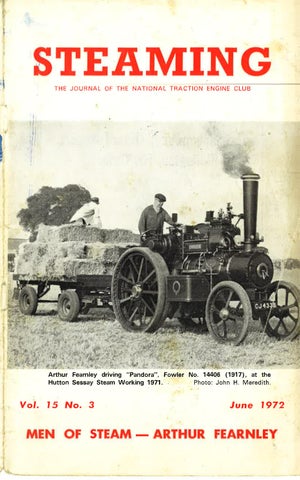
Arthur Fearnley driving "Pandora", Fowler No. 14406 (1917), at the Hutton Sessay Steam Working 1971. Photo: John H. Meredith.
Vol. 15 No. 3
June 1972
MEN OF STEAM ARTHUR FEARNLEY
BANBURY STEAM SOCIETY 1972
STEAM ENGINE FAIR on JUNE 24th & 25th at
The Showground, Oxford Airport, Kidlington, Nr. Oxford.
ROUSHAM PARK STEAM RALLY Midway between Oxford and Banbury just off A.423.
AUGUST 5th & 6th ADMISSION: Adults 30p. Children 10p. FREE CAR PARK
138
Woodcote Veteran Transport Rally SATURDAY, JULY 29th, WOODCOTE, on B479 8 miles north of Reading 20 miles south of Oxford
TRACTION ENGINES MANY INTERESTING EXAMPLES HEAVY HORSES, COMMERCIALS, TRACTORS, ETC. VETERAN LAND TRANSPORT OF ALL TYPES
OLD TIME FAIR with Williams' Steam Gallopers & The Fowler "Renown" ADULTS 25p CHILDREN 10p CAR PARK FREE
R. Hawthorne (Steam Secretary), 19 Bridle Path, Woodcote, Reading.
LIPHOOK STEAM & TRANSPORT RALLY will be held at
RAKE (Near Liphook) HAMPSHIRE, fronting main A.3 Road, on
SATURDAY & SUNDAY 19th & 20th AUGUST 1972
Rally Secretary — G. Moss, 44 Headley Road, Liphook, Hampshire. 139
NATIONAL TRACTION ENGINE CLUB OFFICERS President: S. J. Wharton, Esq., Southern Down, Minster Lovell, Oxford. Vice-President: J. T. Beeby, Esq., Wymeswold Road, Rempstone, Loughborough, Leics. Chairman: Anthony Heal, Esq., Baylins Farm, Knotty Green, Beaconsfield, Bucks. Vice-Chairman: J. Crawley, Esq., Field House, Turvey, Bedford. General Secretary: G. F. Beck, Esq., 127 Greensted Road, Loughton, Essex. Treasurer: J. H. Hobbs, Esq., 6 Esher Close, Basingstoke, Hants. Editor: Ran Hawthorne, Esq., 19 Bridle Path, Woodcote, Reading, RG8 OSE, Berkshire. Chairman, Rally Sub-Committee: M. Harmsworth, Esq., Elm Cottage, Ockwells Road, Maidenhead, Berks. Membership Secretary: C. C. Ayes, Esq., 15 Milking Pen Lane, Old Basing, Basingstoke, Hants. Club Ties, Etc. F. G. Upton, Esq., 30 Windsor Road, Maidenhead, Berks. Technical Services and Spares Officer: Brian Oram, Esq., Bourne House, St. Mary Bourne, Andover, Hants. (Tel: St. Mary Bourne 260). Publicity and Public Relations Officer: Jonathan Minns, Esq., la Hollywood Road, London, S.W.10.
INSURANCE for STEAM VEHICLES All Steam Vehicle Insurance Renewals and Accounts are now being dealt with by Mrs. V. M. Jessup, 41 Combe End, Crowborough, Sussex. Telephone: Crowborough 5902 (during business hours only, please).
SPECIAL TERMS FOR CLUB MEMBERS
Tennant, Budd & Roderic Pratt Ltd. (Incorporating Choisy & Simson Ltd.) 92 FENCHURCH STREET, LONDON, E.C.3. 140
STEAMING (Incorporating the " Newsletter ")
THE JOURNAL OF THE NATIONAL TRACTION ENGINE CLUB VOL. 15 No. 3
JUNE 1972
STEAMING SUB-COMMITTEE J. H. Hobbs, Esq., Ran Hawthorne, Esq., E. A. Fillmore, Esq., 34 Northwick Park Road, F.A.C.C.A. 19 Bridle Path, 6 Esher Close, Harrow, Woodcote, Basingstoke, Hants. Reading, RG8 OSE. Middlesex.
FROM THE EDITOR'S CHAIR We would like to thank all those who wrote complimenting us on the last edition of "Steaming". Your kind letters, as well as the few we had putting us right on one or two points, are much appreciated. A special edition dealing with engines in a specific area seems to be extremely popular and already we have decided that the next special, which will appear in early Spring 1973, will take a similar form. This will be on, "Steam in Cumbria", Cumberland and parts of adjoining counties. The August edition of "Steaming" will close for press about July 14th, we can accept adverts and perhaps small items up to that date but articles and reports should reach me by not later than June 30th.
" BLOW-OFF " Every year, more and faster traffic appears on the roads. We often, amongst drivers meet the attitude "well we were here first" and the Steam Roller owner glories in the thought "well we built the roads." Yes, these sentiments are all very well but ultimately they are not to the benefit of the Traction Engine preservation movement. If we are to keep our engines "on the road" in these crowded islands, we must all do our utmost to create as little nuisance as possible to other road users. So, as the rally season gets into full swing we appeal to everyone taking an engine on the highway "Please be considerate of other road users".
A NEW " STEAMING " PUBLICATION Following the success of "Engines at work" and "More Engines at Work" which were produced largely with the enthusiast in mind, we have now produced a booklet which is intended for the interested rally visitor as well as the enthusiast. The title is "Steam Wagons and Tractors", it consists of an introduction and pictures which have appeared in "Steaming" together with a few previously unpublished photographs. Copies can be purchased on the Club Stands, or from Mr. Ayes at 20p post free to members of N.T.E.C. Non-members please add 21p postage.
ACKNOWLEDGEMENTS We would like to thank area correspondents Derek Rayner and Arthur Fearnley, Billy Coates, Trevor Daw, Bob Gunn, Peter Mathieson, Nevil Miller. 141
N.T.E.C. SALES ORGANISATION Over the past four or five years our Club Stands have visited a good many rallies. The appearance of these stands is appreciated by rally organisers. They have become valuable to members as meeting points as well as for the payment of subscriptions and the purchase of books and badges, etc. With the increasing number of rallies and the increase in number of items for sale the committee are anxious to recruit a few more people for this interesting work. If you like rallies and meeting people, here is a chance to help the Engine preservation movement and to be involved in N.T.E.C. activities. Please write to E. A. Fillmore. 34 Northwick Park Road, Harrow, Middlesex. or speak to someone on a Club Stand at rallies.
PERSONAL Mr. W. Turner of New South Wales, Australia, is in Engand until later this year, he has been a member of N.T.E.C. for a good many years and has been actively engaged in Traction Engine and Maritime Steam preservation. He hopes to attend a number of Rallies and meet as many members as possible. Mr. Turner is President of a Maritime Museum at Port Jackson which owns three steam vessels, S.Y. "Lady Hopetoun" built 1902 at Dartmouth, 77ft. long she is the former Vice-Regal Steam Yacht; S.T. "Waratah" built in England in the late 19th Century reassembled in Australia, 1902, length 102ft. 4in., coal fired, was used for general tug work; Pilot Vessel "John Oxley" built in 1927 at Paisley and steamed out to Australia. converted to oil firing 1946. 544 tons gross, 168ft. long. This vessel is being restored as a self-moving maritime museum and will travel round the major coastal towns. S.Y. "Lady Hopetoun" and S.T. "Waratah" are maintained and used by members of the museum. Dorothy and Derek (D.A.R.) Rayner of Leeds announce the safe arrival of Denise Jayne, weight 81bs. 2ozs. on February 17th, 1972.
ROLL OF HONOUR It is with sorrow that we report the deaths of: Mrs. E. M. Hackett
of Bridstow, Ross-on-Wye. a well known enthusiast and mother of Derek Hackett. the owner of a number of engines; Also Nelson Smith the I4ertfordshire showman, who was highly respected in the Traction Engine world, and operated a set of Steam Gallopers. As we go to press we learn of the death on April 17th, of Francis Grover of Amersham at the age of 77. A steam man all his life Francis is pictured on page 87 of the last edition of "Steaming". He was told to give up engine driving some years ago; he sold the traction engine and bought a steam tractor! When he had restored this one he bought another and restored that. Our deepest sympathy to all relatives and friends.
RUBBER TYRES As the supply of existing rubber tyres has almost completely dried up our President, S. J. Wharton of Minster Lovell. Witney. Oxford. has made arrangements with a large rubber manufacturer to have sections of solid rubber 6in. wide with 21in. rubber on a fin. plate in Mt. lengths and curved to suit a 6ft. 6in. wheel made. As these sections are made in batches and it is obviously best that the batches be as large as possible, would anyone interested in purchasing such sections please contact Jack direct. Garrett Patterns. Brian Oram of St. Mary Bourne, Andover, Hants., is in charge of the Club's Stock of Garrett patterns. All enquiries for these and Technical enquiries to Brian direct, please. 142
MEN OF STEAM ARTHUR FEARNLEY By DEREK A. RAYNER. To the traction engine enthusiast in the North of England, one name crops up in the engine owners lists at Rallies more than any other and has done so far many years. This is that of the Fearnley family, of Castleford, Yorks. and it is the head of the family, Arthur Fearnley, who is the present subject of our Men of Steam feature. Arthur's introduction to the world at the turn of the century was to a family with a background of steam engineering even then. His grandfather had been an engineer for a mill at Gildersome, Leeds, where he had charge of a beam engine until the mill had unfortunately burnt down. Then, finding jobs were scarce, he emigrated to Canada and took a job as an engineer on the Canadian Pacific Railroad. Arthur's father had started, at the age of 16, a heavy haulage business with a traction engine in the late 1890's and so it was, with the advent of the petrol motor car that naturally he was called upon to service such vehicles and thus the heavy haulage business diversified to passenger carrying vehicles. Although his grandparents came from the Gildersome area, it was towards the Castleford area that his father had turned his attentions, for it was whilst on a job moving Testo's fair to Brotherton that Arthur's father met his future wife in this little coaching village on the A.1. They settled in the Castleford area and Arthur came into a world of Traction Engines, Steam Wagons, Steam Cars and the very early petrol cars. One of his very early memories is of a steel-wheeled Yorkshire wagon which was used in the family business at Norma Mon for haulage. By the time war was declared in 1914, the business was running two threshing sets powered by Fowler engines and also two Yorkshire wagons
A Yorkshire wagon involved in an accident at Worsborough, near Barnsley, Arthur's uncle was involved. His father drove the wagon at one time.
143
on regular work. The threshing sets were commandeered by the Government during the war for essential food production and Arthur's father was excused call up and put in charge. surprisingly enough, of a specified local area which had to be cultivated using Titan tractors. He was able to do this satisfactorily as he could cope with any form of engine, but this 'mistake' was later discovered and he was switched from petrol machines back to his proper position, in charge of a steam threshing set.
About this time, a big single cylindered Aveling & Porter road locomotive was acquired and this was put into the threshing circuit. Since it was riot fitted with governors and none were available due to shortages of everything during the hostilities, Arthur, being the eldest in the family, was excused school and was sent to look after the Aveling whilst she was on the belt. This engine and the set travelled extensively in the Pontefract and Castleford areas on essential food production. The most important part ❑f an engine driver's equipment in those days was transport to and from wherever the engine happened to be at the time. At some farms, it was possible to catch an early train from Normanton arid be dropped off some distance away from the farm and have to walk the rest but Arthur had his own transport in the form of a motorcycle. He had had this since he was eleven years old and had held a motorcycle driving licence as soon as he could obtain one — at fourteen years of age. The Council at Normanton had a 15 ton Aveling & Porter Steam Roller with a 3 tine scarifier. Their driver left to take a similar appointment at Rothwell and the Council asked the Fearnley's if they could drive the roller as required. This they did, in between threshing jobs and it usually fell to Arthur, as he had his motorcycle as transport, to go to Normanton for this purpose. Here he learned the skill of making water bound roads and derived much enjoyment from this creative task.
When threshing was slack, `light relief' was provided in the form of a Mann wagon which his father had bought and which, on odd occasions, was driven by Arthur. Heavy haulage jobs were also still undertaken and one job in particular was well remembeted when a local boiler firm, Hepworth's, had a Lancashire boiler ready for delivery but no stall' available to undertake this. The Fearnley's were persuaded to take the boiler, which they did, using the firm's own McLaren engine to haul it and finished the job off by erecting a water storage tank on a 20ft. high pedestal. Life had still to be lived in this country whilst the carnage continued overseas and another form of 'relaxation' was helping out a Showman who had not, at that time, any means of transport of his own. After a day's threshing at Pontefract with the big Aveling, Arthur and his tattler travelled tcit Johnson's three-abreast gallopers from Normanton
to Featherstone during the evening and the engine was back again threshing at Pontefract the next day. Mention of Kit Johnson reminded Arthur of the engine which his father eventually sold to Kit. This is one which happily is still in existence, in the ownership of the Leeds & District Traction Engine Club's President, Mr. W. Chilvers. Fowler Road Locomotive No. 9381, "Lady Betty". she is now registered WR6770 and attends many local rallies. Arthur rode on this engine when it was with its first owners, John Smith's Magnet Brewery. Tadcastcr. After the First World War, the business became more of a motor dealers and some White Steam Cars were acquired from William Nuttall
of Doncaster (Nuttall's Mintoes) who used them for private transport. One of these was subsequently sold to the Cole family at Leeds and is occasionally seen at rallies and in veteran car runs. Also after the war, many petrol lorries came onto the market, having been disposed of by the Army at very low prices. Some were acquired by Fearnley's and renovated. 1t was then Arthur's job to go with a lorry to its new owners and ensure they knew how to drive and maintain it. Wishing to gain more experience in this field, Arthur went to work for a bus company at Normanton and by 18 years of age, was foreman fitter of Walter Heald's who ran some 14 buses, some A.E.C.'s, some Halley's, on a service from Normanton to Leeds. Arthur enjoyed this period of his life, while it lasted, for Healds were soon taken over by 144
Bullock & Sons (B. & S. Ltd.) who eventually ran extensive services in the area. While Arthur was at Heald's, his father sold a Mann's Steam Wagon to some Public Works Contractors at Castleford and Arthur was delegated in his spare time, to go with it and instruct them how to use it. This he did and he so liked what he found at the firm, Rodgers & Sons Ltd., that he joined them and became their mechanical chief. There, he had not only steam engines on cranes within his sphere of maintenance, but also steam pumps, centrifugal pumps, air compressors and all the other wide range of machinery in use in the Civil Engineering industry at that time. I4e was very interested in excavator development and. through Rodgers, was responsible for some important re-designing work on Priestman Excavators, as a result of which, he was offered an agency in Buenos Aires, which he declined. Arthur was instrumental in ❑ne of the first big low-loader jobs involving an excavator when he persuaded a Drighlington firm to transport one from Kent to Castleford by road, overnight. This machine was working on a drainage job in Kent one morning and was back at work on a sewage works, in Castleford the next morning. Normally, by rail, this would have taken at least Cour days. In 1931, Arthur and Mrs. Fearnley, were living with their first son, Lister, in a bungalow in Kent whilst Arthur was supervising several jobs for Rodgers in the London area. He remembers a fine Yorkshire W.G. type steam wagon passing their house each morning and night. This was owned by L. Terry & Co. Ltd., Offham, West Malting, who held quarry rights thereabouts, He left Rodgers in 1934 and started up on his own account in the Motor and General Engineering field in Castleford. This, during World War Two, was a protected establishment and during the period ❑f the war. a Yorkshire Steam Wagon was purchased from Cole Brothers in Leeds and Arthur, in his spare time, converted it to pneumatic tyres and modified the brakes to give a much better performance. This was one of the last steam jobs undertaken commercially by the firm. Arthur's father, meanwhile, had still been dealing in traction engines and had, at one time, a Fowler Showman's Engine, "Jubilee", ex Will Starr; a Robey tractor, a Mann's steam wagon and two Yorkshire wagons standing in his yard at Normanton. The scrap drive during and alter the war, shortages, etc. took their toll and these engines drifted away. A Burrell showman's, "His Lordship", ex Green's of Preston, also belonged to Arthur's father, but this too, disappeared. With the advent of the modern motor car and its easily changed spares and components. Arthur lost interest in the automobile side of the business and the premises were transferred from underneath the arches, down Methley Road, to a larger site adjacent to the canal in Savill Road, Castleford, and attention was concentrated on the General Engineering side of the business. The old cars still interested Arthur and he attended a rally at Rempstone in the 1954/5 period with a vintage car. There were also Traction Engines at this rally. His father's health was deteriorating at this time and in 1956 he died of cancer. He had, before he died, seen how closely the early Traction Engine Rallies were linked to charitable efforts and almost on his death bed had said, very prophetically to Arthur, "Steam is coming back. We've had a lifetime with the engines — now we have none". In assuring his dying father that he would get some, Arthur and his family set out on a path which has taken them and the name of Fearnley to many parts of the country in pursuit of their hobby. It has by now become a way of life and raised many thousands of pounds for charity — some of which has undoubtedly gone — as Arthur would have wished, to Cancer Research to try and prevent ❑theis dying in the same way as his father. One of his brother's had married a girl from Banff, Aberdeenshire, and he knew of Arthur's search for a steam vehicle. He found out about an 'S' model Sentinel, No. 9086, standing at William Robertson's Gordon Granaries, Banff, and told Arthur. This was inspected and eventually bought by Arthur in August, 1956, just before his father died. It was intended to overhaul it during the following winter and fetch 145
it home in the spring. However, the Suez crisis intervened and Robertson's wrote asking if they could buy it back in view of the petrol rationing. This also affected Fearnley's who were running a 5 ton Bedford. It was therefore decided not to resell the Sentinel and, having made this decision, it was thought prudent to remove her forthwith. She was steamed home some 385 miles through ice, frost and snow, a fortnight before Christmas, 1956. This was the first of several engines to bear the now well known legend of "Fearnley's Engineers Castleford". The first Rally attended with the `S4' was Rempstone in 1957 followed by Kegworth and later, Woburn. Arthur's brother Walter also wanted a Steam Wagon to fulfil his father's wish and so it was, they got to hear of a Foden wagon belonging to Scientific Roads (Western) Ltd., Queensferry, North Wales. Arthur went to inspect this on Walter's behalf and on coming to the depot, found the wagon in a big dark shed, no lighting and no windows. It was possible to see the Foden, No. 13120, as it was in the doorway but over in the corner was something else. It was necessary to go back into the town to buy a torch so that this other thing could be inspected more closely. It proved worth the extra journey and expense for it turned ❑ut to be a Super Sentinel, No. 1465, in grey primer, no body, no tar tank — just as bought from Sentinel's who had converted it for works use during the war. It had never been
Sentinel No. 1465 at Templenewsam, Leeds, 1958. used by the firm. Negotiations continued at the Head Office at Shipley, Yorks., where it turned out, another of the same batch of five reconditioned Supers was in store, after having been used for tar spraying. So, in addition to Walter buying the Foden, Arthur purchased the North Wales Super to save it from the scrap man and Walter the Shipley one. They were towed home to Castleford by the 'S' model which made two long trips to North Wales for the purpose, the journey for the Foden being completed within 24 hours. Subsequently, Walter sold the Sentinel to Cole's and it then passed to Jim Hutchens in Dorset. Arthur's Super was renovated and his son Ron now drives this. The The Foden was also restored and appeared at Hannington Rally in 1959 with a further Fearnley machine on its flat bed. This was Arthur's Fowler Tiger Tractor, "Pandora" which has now become recognised as `Arthur's engine'. Early in 1959, he had decided to buy a Tiger Tractor 146
and on a trip to see Dick Wooley of the tar spraying firm of R. Wooley, 13ucknell, Shropshire, whom Arthur had come to know as the firm still used Sentinels for that purpose, he called in at Jackson's at Wistaston, Crewe where, it turned out, there was a Tiger in process of restoration. This was Fowler No. 15293 but it was not for sale as it belonged to the late Captain Hewitt of Anglesey. Later Arthur visited Captain Hewitt to see the engine after restoration work had been completed. However, the visit to Crewe was fruitful for it put Arthur in touch with Bishop Brothers of Burley, near Craven Arms and there was, at their yard, a Fowler Tiger belonging to Smith Brothers, for sale. This was on strakes with a cab and No. 14406. Arthur bought her and after some preliminary work, the S4 made another long journey but this time to act as accompanying vehicle on the return journey since "Pandora", as she became, was steamed home from Burley. "Pandora" attended the Rally at Castle Howard in 1959, still on strakes and also Woburn, from whence she was steamed home in some 30 hours, including an overnight stop. Long distances were still being covered by the wagons. The Super went to the Royal Show at Windsor in 1961 where Arthur and Mrs. Fearnlcy were presented to the Duke of Edinburgh who expressed great interest in the wagon, remembering those which operated in London some years earlier with no smell and little noise. He even went to the extent of getting down underneath to examine the engine and valve arrangements. The rally plaques awarded to the enginemen who were present at the Show with their engines were in the form of the Royal Coat of Arms and Arthur now has his mounted on "Pandora" as a reminder of a very pleasant event, attended some ten years ago. A short while after Woburn Rally, 1962, John Crawley rang Arthur, a film was being made called "The Iron Maiden" and would Arthur bring the Super down to Woburn as they were short of a wagon for the rally shots. John asked for an immediate straight answer. "Yes or No". Arthur, without any hesitation replied "Yes". To which John said "Tomorrow". And much to John Crawley's amazement, at 9.30 the following morning, the Super arrived on location at Woburn for the filming which lasted a full week, from July 17th to 23rd, 1962. Arthur was rather disappointed after the efforts put into the wagon's appearance at Woburn, in not having greater prominence in the film when he eventually saw it, but he has picked the wagon out in the short sequence in which it appears. However, he was satisfied in being able to appear and it gave him great pleasure in being able to do so, in a film which has done the Traction Engine Movement a great deal of good. There were thus now three vehicles under Arthur's wing and more to come. Other engines were purchased some of which were retained, others sold. Aveling & Porter tractor No. 9228 was one which passed through. This now belongs to Wilf Payne. Bawtry, Yorks. Another was an `S4' Sentinel, No. 9075 which was bought incomplete from Dick Wooley. This was one of some which had been bought by Dick from Castle Fire Brick Co., Buckley, North Wales, for spares, when they had sold their fleet, but it was considered too good to break up. It was still in North Wales when Arthur bought it and this meant another journey for the `S' model to bring it back. It was eventually sold to a trio of enthusiasts from Holmfirth, Yorks., and is now restored in orange livery and is a well known long distance traveller. A further wagon which passed through was a `DG4' Sentinel, No. 8694 which was purchased from W. & J. Glossop, Hipperholme, Yorks.. and had been used by them for road processing. This was sold to Ted Ashton, Brotherton. and is another regular rally attender. A Fowler 'Big Lion' Road Locomotive, No. 12226 which Arthur had known for many years, was eventually sold by Spurinman's, a Wakefield boiler firm, to a local scrap dealer. Arthur bought it from the scrap men and it was steamed home from Wakefield in 1962. This journey was not without incident as the wheels were fitted with wooden blocks, some of which where shed during the journey. Unfortunately this engine has not yet had chance to receive the Fearnlcy treatment. We can only look forward to the day when we shall see her out on the road again. 147
Mr 4111111111111P1
Arthur receiving the Fowler Trophy for the Best Tractor, from Alf Pepper who died later that year, 1964. Another engine which is also in the yard is an ex-West Riding County Council Steam Roller, Fowler No. 19353, which was bought from a contractor, Mr. Walker, at Dewsbury, and was pushed home by the Super in 1964. Shc has attended but one Rally since, that at Ryhill in 1965. She has, however, provided Arthur with several days of enjoyable work as, on occasions, she has been hired out in the district to local firms and building contractors. The road outside his son Lister's new home at Great Preston was rolled by the Fowler, with Arthur in charge, on hire to the builders — a far cry from the boy driving the Aveling at Normanton during and after the First World War. One of Arthur's favourite sayings is "If a job's worth doing, it's worth doing properly" and this is probably why the Big Fowler has had to wait so long for the restoration she so justly deserves. Much time has had to be spent keeping "Pandora" and the wagons in fine trim. They are out almost every weekend in summer, leaving little time for essential maintenance and, of course, the business must continue. All these vehicles have travelled several thousands of miles in attending rallies and raising money for many charities. As time went by. Arthur became well aware of the difficulties in travelling engines in modern traffic. With steam wagons, it was not too bad, they could match most heavy lorries for speed. With "Pandora", however, it was a different proposition. At 10-15 m.p.h. on the road, with a trailer and caravan, one has all the time in the world to see what is happening, both front and rear and Arthur realised, after two near misses on the Great North Road, that motorists of the sixties 148
N Fowler Bi g Lion o. 12225 in the
n
purinma
hip of S
owners
!!1
1 1117111 I;717
;11 I
ill
heels. block w
were just not prepared for such a slow moving vehicle. So Arthur resolved to find an alternative means of transport for "Pandy". The obvious answer was a low loader but for a driver of advancing years, with only his wife, in some cases to assist with the timbers, jacks, ramps and wheels, this was not the complete answer. After much deliberation, an ex-Reading Corporation Crossley bus was purchased, the body of which was removed and a turntable with a 20° swivel fitted in its place. This had elevating ramps and was at first hand operated, then electrically driven from the vehicle's batteries. The result is a unique experimental transporter and a fine piece of engineering which always creates much interest wherever it goes. It has come to be known, somewhat unkindly perhaps, as "Pandy's Pram", but it is now a relatively simple procedure for Arthur and Mrs. Fearnley to load and unload "Pandora" by themselves. It also enables them to travel far greater distances in more comfort. This is illustrated by the long run to the Dorking Rally in late 1971 which was accomplished satisfactorily, albeit with some strain in driving the bus through fog and the West London traffic, but nevertheless a journey which would not even have been contemplated with the engine under her own steam. Arthur was a very early member of both the Road Locomotive Society and the N.T.E.C. and when the idea of forming a local club in Leeds was put to him, he agreed to help, He thus became one of the founder members of the Leeds and District Traction Engine Club in 1961 However, time was precious and with a business to attend to, he didn't feel able to take a committee position. It was at this juncture that Lister decided to carry on and he became Organiser of the Leeds' Club Rally at Harewood House, eventually taking over the running of the `S' model Sentinel which had stood for some years. The three sons have joined their father in the business and Arthur's younger son, Maurice, who has grown up with the rally movement has deviated slightly and is now keenly interested in live steam model locomotives as well as Traction Engines. Most weekends during the summer months, most members of the Rallying Fearnley's are away, although not always at the same Rally. The Northern enthusiasts have much to thank them for as they are always willing to assist and give advice when required. It has given the writer great pleasure in chronicling these events and talking to one who has had a lifetime in the REAL age of steam, whose hobby is his work and vice versa and who is still instrumental in keeping these vehicles of a bygone age in such wonderful condition — a real man of steam — Arthur Fearnley.
N.T.E.C. CHRISTMAS CARDS This year we have our own Christmas Card. The design has been specially produced for N.T.E.C. by H. Grayshon Lumby of Leeds, and is in the form of a drawing which incorporates a set of threshing tackle, snow and a church (so many Christmas cards seem to overlook the fact that Christmas is the celebration of the birth of Christ). The words Christmas Greetings are on the front in red and suitable wording is carried inside. Supplies of the card, together with envelopes, will be on sale on the Club's Stand at various rallies during the summer. Supplies through the post can be obtained from the Editor, 19 Bridle Path, Woodcote, Reading, at the following rates:5 Cards and Envelopes 35p post paid. 10 Cards and Envelopes 60p post paid. 20 Cards and Envelopes £1 post paid. Please make cheques/postal orders payable to N.T.E.C. PLEASE ORDER EARLY. • 150
STEAM WHISTLES or an early case of Industrial Espionage? By W. L. Ford. Although it is uncertain by whom the first steam operated cup whistle was made, it is believed that one William Stephens, a workman at the Dowlais Ironworks in South Wales invented it, as it was in use on a stationary installation at Dowlais in 1833 (Fig. 1).
FIG. 2 FIG. 1
FIG. 3
The steam whistle, in the form of the sportsman's whistle or trumpet was, in fact, in use elsewhere about the same time, having been 'invented' by suggestion, following an accident. The well known Railway Historian, Clement E. Stretton, attributes this to Mr. Ashlen Bagster, Manager of Leicester & Swannington Railway. In 1833, an incident occurred when the Company's Locomotive No. 3, 'Samson', ran into a horse and cart loaded with eggs and butter for the Leicester Market as it was crossing the line at the Stag & Castle Inn, Thornton. Mr. Bagster, when he reported the accident to George Stephenson, the line's Engineer, asked after discussion about warning devices, whether it would not be possible to have a whistle fitted on the engine which could be blown by the steam. He was instructed by George Stephenson to go and have one made and so it was that a local musical instrument maker manufactured one which was fitted to the locomotive (Fig. 2). The Board of Directors of the Company approved this safety device and ordered more trumpets to be made and fitted to the Company's other locomotives. But to revert to the South Wales affair, a workman from the Manchester firm of Sharp, Roberts & Co. (later to become Sharp Stewart & Co. Ltd.) was sent to Dowlais to put up some line shafting. This gentleman saw and no doubt heard the whistle in the Ironworks and he took back with him, to Manchester, a sectional drawing of Stephens' whistle. The then Locomotive Superintendent of the Liverpool & Manchester Railway, Mr. Fyfe, was shown the drawing by the foreman of Sharp Roberts and, after deciding it was suitable, he immediately implemented it on his Company's locomotives (Fig. 3). Its use in this cup form, with the eventual incorporation of a remote control (cord/chain) spring operated valve, became general on railway locomotives as a warning and communication device and was successfully applied to traction engines and similar vehicles in clue course. 151
ULSTER MUSEUM MILL ENGINES By H. W. COATES (A member of the engine builder's family) Anyone who has been involved with preservation of machinery will be well aware of the difficulties frequently presented by the size of the ❑bjects in question. It is no doubt for this reason that so many of the huge stationary steam engines which powered this nation's industry before the introduction of public electricity supplies have passed away unrecorded. Several examples of voluntary effort, notably the pumping engines at Crofton, Wiltshire (see "Steaming" Vol. 14. No. 2) and at Ryhope, Co. Durham, have been widely acclaimed, but it is encouraging t❑ hear of a public museum entering this much neglected section of industrial archaeology. The Department of Technology of the Ulster Museum have obtained three mill engines ►vhich have been on exhibition since October 1971. when the specially built machinery hall was opened. All three engines were donated by their previous owners over the past number of years arid were stored until they could be built into the new museum extension. The Inst engine to be seen is a single cylinder horizontal condensing engine from a woollen mill at Crumlin, Co. Antrim. where it ran until after the last war. It was built by I. Rowan & Sons in 1876 and features a system of drop valves worked by bevel gearing from the main shaft and controlled by a Watt governor. The 24in. diameter x 36in. stroke cylinder could produce 50 b.h.p. when the engine worked at 70 r.p.m. The 15ft. diameter flywheel is fitted with a two-rope drive, which is no►v connected to an electric motor which is used to demonstrate the engine's motion for about an hour each day.
A 100 h.p. horizontal single cylinder steam engine by Victor Coates & Co. Ltd., built in Belfast in 1895 and exhibited and used at the Belfast Art and Industrial Exhibition of that year, held in the White Linen Hall. For over 60 years it drove power looms in a factory at Drapersfield, near Cookstown, in County Tyrone, being brought to the Ulster Museum in 1969 and subsequently reassembled in the new Engineering Hall, along with the associated boiler installation. Driven by electric motor, the engine now turns at approximately 20 r.p.m. 152
Around the corner is a 400 b.h.p. vertical twin cylinder compound engine, built in 1898 by Victor Coates, which until 1964 powered 600 looms at the Falls Flax Spinning Company. It is of a similar pattern to a marine steam engine (from which, incidentally, the modern marine diesel has been evolved) and is complete with a separate barring motor for use during maintenance, etc., and with a condenser pump driven by a rocker arm from the high pressure cylinder. The cylinders are (Sin. and 32in. diameter x 36in. stroke, and are fitted with Coriiss valves. Provided with steam at 100 p.s.i. the speed was 100 r.p.m. The 10 ton, 12ft.
A twin cylinder marine-type compound condensing engine by Victor Coates & Co. Ltd., of Belfast, installed in the power-loom factory of the Falls Flax Spinning Co., in the city, in 1898. The engine drove 600 power looms and was removed by the Ulster Museum in the summer of 1964, immediately after it had ceased working. With cylinder diameters of 18 and 32ins., a running speed of around 100 r.p.m., a 12ft. fly-wheel weighing 10 tons and a power output of c. 400 h.p., this engine is a most impressive testimony to the skill and craftsmanship of 19th century Belfast engineering. 153
diameter flywheel has 10 grooves for a manila rope drive, although ropes are not fitted at present. The third engine, also by Victor Coates, was built in 1895 and was used that year to generate electricity at an industrial exhibition in Belfast. It was then moved to Drapersfield, Co. Tyrone, where it worked until after the last war driving power looms, A 100 h.p. horizontal engine which worked at 100 ps.i., this engine features a 9ft. diameter, 7-rope flywheel and a 15in. diameter x 24in. stroke cylinder fitted with Corliss valves. This engine, too, is now driven by an electric motor. The front of a Lancashire boiler, built by Victor Coates and also from Drapersfield, has been mounted in the wall beside it to promote the appearance of an engine house. With the addition in the future of a Beam Engine and Graphic Displays, it is expected that the mill engine collection will be complete. Thanks are due to Dr. W. A. McCutcheon of the Ulster Museum for the information used in this article. The photographs have been kindly provided by the Ulster Museum, who hold the copyright.
" CHUFFS " •
•
• •
•
•
•
• •
154
The Steam Plough Club Annual General Meeting learned that the club now have over 100 fully paid up members. The club is engaged in making a 16mm. documentary film on the work of ploughing engines. The Secretary is Harold Bennett, Esq.. 3 Ridge Side. Haw Lane, Bledlow Ridge, High Wycombe. Tom Storey of Reading, visited the Forest Museum, near Duncan. Victoria Island, Vancouver, British Columbia, last summer. The main exhibit is a mile long narrow gauge railway hauled by steam logging locomotives. Numerous other items include steam donkey engines. waterwheels, an American Traction Engine. Ruquit & Proctor SC Roller No. 44194 and Mann Steam Cart No. 751. The rally at Bath on September 9th/10th has been cancelled as there are so many events in the area (please delete this from your approved rally list). Herefordshire County Council have in their depot at Redhill. near Hereford. Aveling & Porter Road Roller. Works No. 11788, 10-ton. with steel roof, othenvise the Roller is unsheeted, open to all weather, has not steamed for quite a few years. They have one more Steam Roller which is in every day use on road works. I am not sure of the make, but 1 think the same as the first one. "The Steam Centre" open May 15th — September 30th — many exhibits — Clayton & Shuttleworth Traction Engine and Marshall Threshing Machine being restored — modern Steam Car chassis — 23ft. Steamboat being built — operating Model Railway — various Stationary Engines — many pictures — refreshments. At Kirk Michael, Isle of Man, Britain. Two engines attended the Open Day at the Eastleigh Diesel Depot on March 26th. These were the cx-Eddison Aveling/Porter, Roller No. 10632, owned by P. J. and T. M. Abbott, Lyndhurst, and the Fowler conversion No. 21221 "Forest Queen" belonging to R. F. Giddings of Bartley. During the power crisis earlier this year, a furniture factory near High Wycombe brought a 70 year old steam engine back into use after it had lain idle for about 17 years. The engine which was driving a generator took steam from a boiler which burns off-cuts of timber and normally supplies the heating for the factory. Len Crane of Wolverhampton, has purchased Fowler No. 17212, Reg. RF6082, a 13.6 Crane Engine from John Thompson boiler works. Thompson's name plates are being retained. A Baugley Steam Loco No. 2007 (1921) believed to be the only surviving example has been brought back from India. It is to be re-assembled on the Leighton Buzzard Light Railway by owner Mr. M. G. Satow.
COUNTRYMAN AT LARGE or Hockley Heath to Bloxham and back by steam. by D.P.K., C.R.W. & T.R.D. Early in the year Jack Marshall, of Hockley Heath, Near Birmingham, received an invitation to take THE COUNTRYMAN, Ransome, Sims & Jefferies 6 n.p.h. Traction Engine to Bloxham Rally at the end of June. It was soon decided that if the engine went at all it would have to go under its own steam as lowloading would be far too expensive. With this in mind the 41 mile route was carefully surveyed to determine such vital points as availability of water, traffic hazards, etc. Once it had been decided to proceed three engine crews were chosen to cover the whole trip so that the load would be spread over a number of people during the five or six days that the engine would be in steam. Trevor Daw and Douglas Kempton were to take the engine down on the weekend before the rally, taking two days over the journey and stopping overnight at Tredington, half-way to Bloxham. During the following weekend Douglas Kempton and Peter Daglish would man the engine at the rally and prepare it for a one-day return trip in the hands of Trevor Daw and Rodney Weaver. Subsequently Malcolm Thompson joined the third crew as trainee steersman, thus enabling a car to accompany the engine home and permitting a filmed record of the journey to be made.
Ransome, Sims & Jefferies No. 15012 (1903) backing to the trailer.
(Photo: T. R. Daw) The Outward Run
On 19th June the weather looked good, dry and warm with a little cloud and slight breeze. COUNTRYMAN was lit up at 8.45 a.m. and while steam was being raised we stowed our tackle on the newly built four-wheeled trailer, including 11 cwt. of coal and a 300 gallon supplementary water tank. As soon as the wheels would turn the engine was coupled on and final wipes and oil cans applied where necessary. We pulled out of the field at 10.20 with a light load, having refrained from filling our second water tank until we knew how the trailer would behave, not ►viishing to push our luck too much down Lapworth and
Liveridge Hills on the A.34. 155
Soon after starting we had to stop again as the pump relief valve was blowing water into the air and soaking the driver, to which he seemed to object. In addition the big-end lubricator was working loose. After attending to these two annoyances the journey continued until we stopped just outside Henley-in-Arden to take water from a hydrant. Here we filled the tender and a put a full 300 gallons into the reserve tank, a move we were later to regret. At Henley Garage we stopped again, partly to check the trailer tyre pressures and partly to see if we could stop the water in the tank from surging. With something over 26 cwt. of water sloshing backwards and forwards the trailer was now proving rather uncomfortable to tow. Once we had overcome the slight anxiety at the prospect of driving someone else's engine into foreign territory the trip settled down to a very pleasant and steady run. Steering an engine on a busy road demands a good deal of concentration, especially when pulling a trailer, as the total length of the "train" was about 30 feet. To prevent the steersman from becoming stale we made it a rule to change places every hour. This proved to be a very good idea as it meant that we both became more experienced in handling the engine under a variety of road and traffic conditions. As we progressed we transferred water from the trailer to the engine and as we reduced the load in the tank so the riding of the trailer improved. From this experience we decided that until baffles were fitted in the tank we would not put more than 150 gallons of water in it. Soon after passing through Stratford the water gauge started to dribble a little from the bottom gland. As the journey progressed this became worst until at Alderminster the leak was such that the driver was being scalded whenever he opened the firedoor. For the remainder of the trip to Tredington the gauge was turned off except for periodic checks of the water level. (This isn't as dangerous as it sounds — for many years steam engines worked without water gauges at all and relied on try-cocks). Tredington was reached at 5.40 p.m., the engine wiped down and sheeted up by 6 p.m., whereupon a very welcome cup of tea was consumed. Whereas Saturday had been a day of events Sunday was to prove a day of personalities. An early start was made on dismantling the troublesome water gauge and repacking the leaking gland. Once the job was re-assembled the engine was steamed slowly to test the new packing and. to our relief, the gland stayed as dry as a bone. We were back on the road by 10.30 a.m. in light drizzle and a strong wind. Lunch was taken at the pub in Long Compton in company with members leio Club who were nth nn their littnhury run f t he Nn...nge Mot.. o that morning. It was a wonderful sight to see COUNTRYMAN simmering in the car park among a dozen or so gleaming old bikes. It was a most convivial hour! Soon after leaving the pub we were stopped by a large Bentley and passed the time of day with our vice-Chairman, Arthur Smith. Turning off the A.361 by Neville Melhuish's garage a traction engine could be seen under sheets next to his roller; we were obviously not the first engine to have started out for Bloxham. Three miles from our destination we stopped to transfer water for the last time and were greeted by Dick Izard who offered to ring Tredington and ask for our transport to be sent out for us in an hour's time. We arrived at the rally field at 4.30 and by 5.30 had cleaned down, sheeted up and were on our way home for yet another well-earned cup of tea. The Great Spectacle As usual the Banbury Society were blessed with bright, sunny weather for the start of their rally at Bloxham this year. The crew for the two days of the rally comprised Doug Kempton and Peter Daglish with guest appearances by Rod Weaver and Doug Smith. In the time between parking the engine the weekend before and the following Saturday morning an amazing amount of gear had appeared around our spot. Indeed, having raised steam we had to ask our neighbours to move their tent so that we could get out! First stop was the coal pile where we made the acquaintance of the water cart driver, one of the 156
most important men on the field. We then located our peg and hove to for a think, and to wait for a job. We were due to take a turn on the threshing drum sometime later so we decided to inspect the show while we had chance. The emphasis of the rally was on working demonstrations, there being no ring events apart from a Grand Parade. A fantastic amount and variety of machinery was present with 40 odd steam engines on the field. As we reached the meal tent it began to pour with rain and kept this up for half an hour. This severe wetting of the field prevented the Grand Parade from taking place and provided COUNTRYMAN with some sport pulling rollers back on to hard standing. Sunday again started warm and dry but this time stayed dry throughout the day. Having had a spell on the threshing drum and paraded round the ring we decided at about 3 p.m. to coal up ready for the trip home. When we got to the coal bins we found to our dismay that there were only five half-hundredweight bags left. These were loaded up without delay, for we had an empty tender and 41 miles to go — the reserve supply at Tredington would be needed. We then took the engine back into the engine park to couple up the trailer and got everything ready for an early start on the morrow. We had met some very interesting people and renewed old friendships over the two days, but I still feel that the true spirit of a rally is felt in the hours before steam is raised and after the crowds have gone home, when even the engines seem to put their feet up and take it easy. Wash Out More Flags Doug and Trevor turned up at Bloxham very early next morning to light up, so that when Rodney and Malcolm arrived at 7 a.m. with the reserve coal supply the engine was almost ready to start. It was yet another fine morning and we wondered just what the clay had in store for us. Things went quite smoothly at first, and once the experienced pair had negotiated South Newington Malcolm took his first turn at the wheel. He soon mastered the technique of steering, which left Rodney free to take a filmed record of the journey. First stop was at Neville Melhuish's garage, where one or two engines had spent the previous night. One of these, a four ton Garrett tractor, set off while we were transferring water and its sprightly acceleration showed us what a road engine could do. Leaving Neville's forecourt Trevor was a little perturbed when the trailer attempted to overtake on the nearside. The trailer has Ackermann steering and the clamp holding the drawbar to the trackrod had slackened off. During a brief stop to correct this Trevor drew attention to his red and 4reen flags for use in emergency — he had rolled them up and put them in the standpipe. The hills between here and Long Compton were taken in our stride, the engine having no difficulty in climbing the worst of them in top gear and making steam against the injector. What had appeared a challenge fizzled out. We stopped next at Little Wolford to check round and oil the motion and to fill the tender from a convenient hydrant. Then we were off again through Shipston to our scheduled lunch stop at Tredington. Malcolm now seemed quite at home on the engine and took Shipston in masterful fashion. Our arrival at the transport cafe just beyond Tredington Island caused much interest among other patrons, while we received a flying visit from Doug and Peter Daglish, who had, we suspect, come out merely to see where we had got stuck. Transferring water again we set off for Alderminster where we intended to fill up the trailer tank. But once again our progress was interrupted by "Damp Driver Trouble", this time because of a torrential downpour which caused a hasty stop while waterproof clothing was dug out of the trailer. The rain continued for some time and was still coming down when we stopped for water. As we were filling the reserve tank it was necessary to use the standpipe, so while Trevor attended to this Rodney (who was driving at this stage) attended to the fire and various other chores. Trevor complained about the low water pressure at the hydrant and put it down to heavy demand. However, when he eventually turned off the water and unscrewed the standpipe the real reason became em157
barrassingly evident as two tightly rolled and very wet flags slid gracefully out of the standpipe The next stop was for tea, kindly provided by Peter Shadbolt. During this stop a Stratford & Moreton Tramway stone sleeper was rescued for preservation. Off again we enjoyed an almost non-stop run through Stratford to our penultimate water transfer just short of Bishopton From here another clear run brought COUNTRYMAN into Henley-inArden just after opening time, so a final stop was made outside the Black Swan to refill the tender and the crew. If Trevor hoped for a trouble-free run to Hockley Heath he was disappointed, for a mile further on Rodney caught the last two words of a comment which happened to be "left now" and turned sharp left into the Tanworth road! A little hand shunting was needed to sort this out. Eventually we turned into the field at Hockley Heath just before 9 p.m., having covered the 41 miles in a little under fourteen hours. It had been an enjoyable if tiring day and we felt that we had achieved something in doing such a long journey' (for an agricultural engine) with a relatively inexperienced crew. The old boys who did this sort of thing for a living on engines with strakes instead of rubbers really earned their money! It is a more rewarding way of working an engine than just sitting in the middle of a rally field wafting for somebody to think of something for you to do. Would we do it again? Well, we are not saying that we would, but some temptations are hard to resist Finally, we would all like to thank Jack Marshall for allowing us the privilege of using his Engine, for this most challenging trip to Bioxham, and to the Hockley Heath Steam Engine Rally Association for loan of their excellent trailer. Since this trip took place, Jack Marshall has been "off the road with tube trouble". On behalf of all the readers of Steaming we send him our best wishes for a speedy recovery, after his serious illness. We look forward to seeing him back on the Rally fields in 1972.
THE `BUCKSHEE' STEAM ROLLER OR
FOUND IN THE DESERT By Nevil Miller Part of my service in the Royai Engineers was speed lu wilet was India attached to the Military Engineer Services, always known as the M.E.S. Although often reviled or ridiculed it did a great amount of good work in a vast country. The organisation was mainly composed of Indian civilians with British and Indian commissioned officers and a proportion of British warrant officers and staff-sergeants. There were senior technical civilians equivalent in rank to a warrant-officer, they were known as Sub-Divisional Officers followed by their designation in brackets. Thus an S.D.O. (E. & M.) was a sub-divisional officer, electrical and mechanical. When I was Garrison Engineer, Karachi, (now in Pakistan) during the latter part of 1943 my S.D.O. (E. & M.) was a certain Mr. Pereira. who hailed from the late Portuguese Colony of Goa. He was competent and reliable as most Goanese I met were. One day Mr. Pereira, who looked after Malir a large army encampment some seven miles out of Karachi, came to see me in my office and a dialogue something on these lines ensued:"I am wanting to tell your Honour that since long I have been seeing some steam-roller standing in the desert outside the camp at Malir". "Whose steam-roller is it, Mr. Pereira?" "That 1 am not knowing and the local engineer staff they are not knowing also". "Has it no name or registration plate on it?" "No, it has no any markings on it at all". "What sort of condition is it in?" 158
Im
A Marshall compound 10 ton steam roller under repair at Karachi 1943. Photo by Nevil Miller.
"It seems to be in good order except for the chimney and two brass lubricators which have been stolen away from it". I instructed Mr. Pereira to make more enquiries at Malir and to have a watch kept on the roller but no more information could be obtained so a notice was posted on it and published in the local newspapers in English and Urdu for 3 weeks but no claimant was forthcoming. The roller was therefore towed into the G.E's yard at Karachi and quotations invited for its repair. An Indian engineering firm from somewhere down the Bunder Road area quoted 200 rupees (about £15). This extravagant price was accepted and 2 weeks later the roller was given an M.E.S. number and went out to play its part in helping to win the War! I would think that the acquisition of a steam roller by finding is unique. The only explanation I can offer is that it was used by a contractor when Malir was under construction and when the works force moved away perhaps many hundreds of miles the roller was either not wanted or inadvertently left behind. To make the position regular it was taken on the strength by means of a Certificate Receipt Voucher, Army Form, G.1033 (Modified for India) and the source of supply entered as "FOUND". Unfortunately I didn't take a photograph of the 'found' roller which I think was an Aveling & Porter but it's difficult to remember after 27 years. The one illustrated is a Marshall, 10 ton compound that was under repair at that time. The plate on the characteristic Marshall 'hump' RN 42, may indicate that it belonged to the dockyard at Keamari and was under repair by the C.R.E. Sind District, for the Royal Navy, otherwise it should have carried an M.E.S. number. The bracket on the smoke stack with a funnel suspended from one end would normally carry a bucket on the other end where both would be in the driver's view and difficult to get at, otherwise if suspended from the more usual position aft rapid disappearance would be likely! I apologise for the blanking out of much of the engine in the photograph by uniformed and civilian female staff from the C.R.E.'s office but with the shortage of films during the War one had to take "dual purpose" pictures where possible. This one might be captioned "Beauty and the Beast". The girls in uniform are members of the Women's Army Auxiliary Corps (India) affectionately known as Wackies'. 159
"THE FARMER'S FRIEND" James and Frederick Howard's Ploughing Engine BY P. A. MATHIESON.
Howards steam cultivating tackle in particular "The Farmer's Friend" engines were built with the object of importance of strength without unnecessary weight, not only for the home market but for export to the colonial and foreign agriculturalists, built of wrought iron and steel so that breakages, which would involve serious loss, especially where repairs were difficult to execute. They were designed to take to pieces for packing in the smallest compass for export, and so designed that the unskilled had no difficulty in putting them together and working them. "A Farmer's Friend" engine with set of steam tackle weighed when packed 20 tons and a pair of "Farmer's Friend" engines and set of steam tackle 30 tons. Messrs. J. & F. Howard undertook to do the entire work of shipment and charge purchasers the actual cost only. "The Farmer's Friend" engines were the winners of many awards not only of the Royal Agricultural Society of England and the International Exhibition, London, in 1862, but many other International Shows, Exhibitions and Steam Plough Trials, at the German 1863, French 1864, and Swedish 1868, Grand Gold Medals and First Prizes. While J. & F. Howard won many premier awards at these steam ploughing trials they much preferred to test their engines and implements on their own farms as they were not only manufacturers but agriculturalists as well, having large farms in Bedfordshire, also for the judgement and opinion of the engine drivers and men working their tackle. The technical details of "The Farmer's Friend" engine are described in "Steaming" No. 4 Vol. 14 on page 154 in "The Men of Steam" Jack Wharton article. The photograph and other details are from a catalogue dated 1887, which I own of James and Frederick Howard, Britannia Iron Works, Bedford.
A "Farmer's Friend" plough engine. Block from Howard's catalogue by courtesy of P. A. Mathieson, Esq. 160
O
•
Fowler 8473 (1900) "Jesmond" spring mounted. Compound cylinders 64" x 11+" x 12", Registered NL1559. Owner Wm. Bland & Son, Gosforth, Northumberland, hauling 0-4-0 Peckett "Charlaw". (By courtesy L. Burberry).
HARDLY ONE FOR THE ROAD By R. I. GUNN. That a steam enthusiast in Cornwall, a stronghold of road steam preservation, should acquire a traction engine is not surprising, and having teamed up with two colleagues to buy a 16 n.h.p. McLaren ploughing engine, I found myself heavily involved in West country steam activities. One ploughing engine alone, whose partner had been cut up many years before, could not do much ploughing, so on my own accotuit I acquired Fowler BBI No. 15195, McLarens being more than scarce. This engine came from Milton, Stratford-on-Avon in 1967, and had been idle for sonic years. Hard usage, dereliction, and brass thieves had taken their toll but in eighteen months the engine was brought into running order. It attended Redruth rally in August 1968, the day after being steamed for the first time in seven years. Among many who helped in the restoration was Derek Hattam who became steersman. A further year's work brought the engine into better condition though still not fully restored. At about the time of the 1969 Redruth tally I decided to move to North Wales and, of course, it was imeprative that "Anne Hathaway", as 15195 had become known, came too. In truth both Derek and I came up with the idea of steaming her up there by road. Main attractions were cost and principally because we wanted to have a go at something hardly any one of our generation could say they had done. With the necessary legislation through petticoat parliament we set about a further programme of repairs and maintenance, this included re-bushing the steering barrel bearings which proved relevant later. The trip was set for May 1970, as being at a time of year to give sufficient daylight and not too much holiday traffic and hot tarmac, though the last proved not to be the case. A route was carefully surveyed keeping off trunk roads and giving sufficient water. It was decided to camp on the way as being both practical and cheap. Reg Lawes, a relative agreed to come as chief cook and bottle washer, and Derek arranged the necessary time off work. Departure was to be the 16th May. On the way down from Towyn, my new home town in Wales, an event set a pattern which was to become more apparent as the venture proceeded. Driving my Landrover round a bend near Abergavenny early 1:' Ull the Thtosday, eanie upon a large lorry p•• s across my path. A large oilslick on the road put the seal on a nasty situation and the Landrover became a "write off", though I was only slightly damaged. I managed to acquire a replacement Landrover of sorts, and reached Cornwall by lunchtime Friday. A final job was to put in new second shaft bushes and replace the shaft, this was completed with the help of friends by midday Saturday. By way of digressing. I would mention a minor occurrence in North Wales which now has a bearing. I was fortunate, now that 15195 had no McLaren to partner, to acquire the other engine of the pair. 15194 (now named "Will Shakespear"), which became available early that year. "Will" was delivered to Towyn by lowloader early in May, in a derelict condition. One of the helpers at the unloading climbed onto the footplate and tried the controls. The regulator lever mounting, which includes the backhead steam turret, came adrift in his hands. Just another restoration job to renew the studs, I thought. However, when steam began to leak from the same mounting on "Anne Hathaway", we thought of the wasted studs on the other engine, We proceeded rather nervously on the Saturday evening to a point outside Newqttay, and on Sunday morning took nuts off the mounting studs. When the turret was lifted the studs came with it as they were all but wasted through. We had been riding on a bomb. Renewing the studs on the roadside took us well into Monday morning, and having raised steam again, we continued to St. Columb. In three days we had covered twenty miles out of three 162
Fowler B.B.I. No. 15195 "Anne Hathaway" at Redruth Photo: C. H. B. Owen. hundred and fifty. In addition, the coal I had bought in bulk seemed very poor, though "Anne Hathaway" had seemed easily pleased in such matters before. On Tuesday, apart from poor steaming, we made better time to Canworthy Water, on the border to Devon. Here we camped for the first time, having previously stayed at the Hattams', having made so little progress. We pitched by Mr. Weeks engineering works where he keeps his Aveling & Porter traction. Next morning, the Wednesday, both engines were in steam, the Fowler for the road, and the Aveling for the boiler inspector. We set off accompanied by a whistle blast from Mr. Weeks, but soon came on a road making team and made a detour of four miles to avoid a Barber-Greene and several acres of soft new tarmac. We crossed the border into Devon and "Anne Hathaway" bid goodbye to Cornwall after her two year stay. Very soon we came onto more fresh tar and had to give up till the cool of evening to avoid damaging the surface. This was aggravated by scorching hot weather. That evening we pulled into North Tamerton and, while shunting into a lay-by, a piece of the double high-pressure valve spring stuck under the seat and made the engine very awkward to handle as the low pressure cylinder was getting steam all the time. Fortunately there was an old engineman among the onlookers who diagnosed the trouble, and it was easily rectified. Derek at this time expressed the view that, as we were having so much trouble, we would do well to give up, but I was set on going on and would have none of it. Whilst waiting on Wednesday for evening we had acquired a load of very expensive coal in Holsworthy, but it proved a good buy as the engine steamed very well on Thursday, and at last things seemed to go well. Negotiating the milk lorry fleet from Taddiport diary was fairly painless and the hill into Torrington was ascended, though using both driving pins cut the road a little on the bends. From Torrington we followed a route across fairly flat country towards Umberleigh. On this stretch the whistle fell off, literally. The connecting nipple broke off and, there being no stop valve, we had to get the fire out, repair, and raise steam again, which lost an hour or so. It seemed that the old engine just did not want to go on, and would try any trick to hold back. We were now about to descend into the Taw valley and the hill I had selected, Kingford Hill, was long but not outstandingly steep except 163
for a short stretch of about 1 in 8 near the top, small beer by West country standards. We had once descended a 1 in 6 hill on one driving pin, albeit with the pin for the other wheel at the ready in the hole and a man walking alongside to push it in, but the hole never came into line before the bottom was reached. On the basis of this and the effect on the hill at Torrington with two pins, I made the terrible decision to go down Kingford with one pin. On the steep part the pinned wheel began to slip and in a flash we were off on a dreadful slide. Trying all sorts of juggling with the reverse and regulator, and the flattening of the hill had no effect as we accelerated rapidly. A following motorist put our eventual speed at thirty miles an hour, though it felt many times higher to us. Derek managed, incredibly, to keep the engine on the road, though the steering still had a stiff spot from the new bushes. We approached a sharp bend and I had a clear mental picture of an oncoming green saloon car full of people, which we must mow down, but Derek brought the engine round the bend and it was not there. Now the locked rear wheels slid sideways and the front offside wheel climbed the high bank lifting the offside of the engine higher and higher. Derek dropped off the steering platform and suffered a blow in the chest. The engine, slightly slowed by the bank tilted until it fell on its side in the road and rolled almost upside down. I was thrown into the verge on the opposite side of the road, collecting a twisted ankle. Had "Anne Hathaway" continued her roll, I should have been underneath, but she fell back onto her side and lay diagonally across the road, belching steam and boiling water amid a litter of debris, tools, fire irons and coal. Having collected ourselves and found no serious injuries, my first thought was where on earth I would get enough gas to cut the engine up to clear the road. The steam was flying from the safety valve, which had been flattened by the engine's roll. While the motorist first on the scene went to fetch the police, I drew out the fire and Derek with Reg, who had not been far behind, stopped traffic. A blow with the poker shut the damaged safety valve rather to our surprise, and a terrible calm descended. There followed a wretched couple of hours filling police forms, phoning home from a kind nearby resident's home, answering questions and so on. The police were a great help, and they and the inhabitants of North Devon seemed to take someone depositing twenty tons of iron in one of their roads very well. After a large garage had declined to send their heavy breakdown truck, the police arranged a smaller concern to send their six wheel Scammel winch truck. This arrived at ten p.m. driven by the proprietor accompanied by a bunch of the local lads. When his helpers expressed dismay at the task, he said, "Don't worry boys. 1 have dealt with heaps of these before — What the hell is it?" Throughout the night we struggled, winching, setting out ropes, fixing chains and blocks, and eventually the engine came upright and was placed at the side of the road. A quick tidy round the site and the road was re-opened at 5 a.m. Police, breakdown and engine crews left the scene. We adjourned to the camp site Reg had prepared for a few hours sleep, and then Derek and I went to Barnstaple Hospital to be checked for damage, and for me to have the stitches from the Landrover incident taken out. A further tidy up on Kingford Hill and removal of all valuables left us ready to disperse. Shortly afterwards Reg's son Richard and I helped load "Anne Hathaway" onto a lowloader from a lay-by where the same breakdown truck had towed her ready, and next clay she reached Towyn at last. The journey ended ignominiously, but the towing from Kingford Hill to the main road had impressed me how well the engine had survived. The flywheel was smashed and the crankshaft bent and various other parts such as drum spindle, front axle kingpin, smokebox door, stack base bent or damaged, but it all seemed repairable. Work on sorting this out is now in hand. The crankshaft is straightened and a flywheel has been acquired. Various smaller items have been repaired, and 164
another year of limited time and money may see the job completed. All this has set back "Will Shakespeare's" restoration, though by making some jobs 'two off' there will result some progress. Any inquest must record a gross error of judgement on my part, but apart from this all the other circumstances and events indicate that the journey in itself was ill conceived. An aged machine in modern traffic and road conditions with an inexperienced crew is a dangerous combination. It was observed that the surface of the hill was very slippery as there had been no rain for some time and rubber and oil had filmed it. Certainly once slipping had started the acceleration was phenomenal. The driver of a 6 n.h.p. Burrel which had come to grief on the same spot, who still lives nearby, is of the opinion that wax or grease from the bud casings of the many overhanging trees make the road slippery at that time of year. Perhaps he was just being kind, I do not know. I do know, however, that we were especially lucky not to injure ourselves or others seriously, and in that the police and the Filleigh Garage breakdown crew were so helpful
STEAM IS WHERE YOU FIND IT SWISS STEAM '72 In late summer 1970 I made a visit to Switzerland to explore some of the steam railways and paddle steamers. It is expensive, and one has to be everywhere on a Sunday, so to speak, if you want to do the lot, but it's worth it. I doubt if I can afford it this year but for those who can I gleaned the following from PSPS sources, Miss Lotti Kfinz (founder member of "Ahtion pro Raddampfer") the Light Railway Transport League magazine "Modern Tramway" and the Ian Allan monthly "Modern Railways". On Lake Geneva the five steam paddlers "Helvetic", "Rhone", "Simplon", "La Suisse" and "Savoie" have all been rebuilt and reboiled, partly, the company has stated, "because we like them". However, the "Helvetic" and "Rhone" have spray-lubricated triple-expansion uniflow engines which are thus fully enclosed and not visible to passengers unlike the engines of other Swiss (and British) paddle steamers. They may be expected to all be in service on Sundays, daily in August, some daily all summer. They have five companions converted to diesel electric. By Montreux is the preserved Blonay-Chamby line running steam trains Saturdays and Sundays. South of Berne the Sensetalbahn will run steam trains between Flamatt and Giimmenen on Sundays from May to October. South of Basel the Waidenhurgerbahn will operate steam trips every third Sunday from May to October. The immaculate paddler steamer "Lotschberg" may be expected to connect Interlaken with the all-steam Brienzer Rothorn rack railway daily in August and all fine Sundays. The railway runs daily: it has diesels on order to replace all but three steam locos and the "Lotschberg" is under long-term threat of withdrawal; meanwhile surely this must be Europe's finest steam excursion? Two of Lake Lucerne's paddle steamers will be preserved when the replacement programme is completed in 1986. They take their steamers very seriously here: withdrawal of the P.S. "Wilhelm Tell" in September 1970, resulted in a 6,000-signature petition and a 2,000-strong protest march! Five remain: "Uri" and "Unterwalden" have the most fantastic saloon panelling imaginable, worth going all that way to see. "Gallia" is very fast: standing passengers and curtains sway as the fore-and-aft motion of the heavy low-pressure piston causes the steamer to surge. "Stadt Lfizern" has enclosed engines. "Schiller" is the fifth — all are usually in action on Sundays, and daily in August, some daily all summer. At Vitznau the paddlers connect with the Rigi railway whose steam specials run on Wednesdays and Saturdays from May 31st to Sept. 27th. 165
Also on Wednesdays, and on Sunday afternoons, from mid-July to mid-August, steam trains will run on the Sihltalbahn from Zurich. On the ZUrichsee the P.S. "Stadt ZUrich" should be in service on Sundays. Her sister the "Stadt Rapperswill' is being rebuilt for a further ten years service as the result of successful campaigning by Aktion pro Raddampfer" (Campaign for the Paddle Steamer"). In 1970, Lotti Ktinz told me. there were still two stationary engines at work in Zurich: one wonders how many others there might be (and is the steam loco still shunting wagons at the Rheinfelden Brewery?) There is one active steam launch on Lake Zilrich, and the disused saloon steam launch "LtItzelau" may still rest in the Wollishofen ship yard. Lotti has also sent me a photo of a singlecrank compound steam roller still in use around Aarau (between Basel and Luzern) in September 1971. Unfortunately I have yet to receive details of manufacture, dimensions. etc. Again, one wonders how many more there are in Switzerland. Finally, the Furka-Oberalp Railway runs a public steam excursion on October ist and several other lines may run such trips for groups: no doubt the Swiss National Tourist Office in London will provide information. Do not hesitate to ask at relevant ticket offices when a particular paddle steamer or train is running and where to:- they seem very pleased to help the enthusiast. I pass on the above information in good faith and accept no responsibility for errors and omissions. ANDREW PATRICK, Hon. Nat. Press Officer, Paddle Steamer Preservation Society.
STATIONARY ENGINES RESTORED
On Saturday, April 15th two stationary steam engines at Englefield, Berks., were in steam on the occasion of their first "Open Day" since restoration. The engines are, Clayton & Shuttleworth No. 5197 (1863) with a single cylinder Sin. x 14in., and Ransome, Sims & Jelferies No. 12885, single cylinder 12in. x 24in. this engine carries a plate; "Supplied by John Wilder & Sons, Engineers. Reading, Jan. 1900". Both engines take steam from a Cornish boiler which also carries the "Wilder" legend but was probably made by some other firm. The boiler and engines are in the positions where they worked for many years. The Ransome, which replaced a smaller engine, worked till about 1945. The Clayton had not been used for some years prior to 1945. Both drove saws and woothvorking machinery, the boiler being firm largely on offcuts. During this past winter a team led by Fred Simmons has restored these interesting engines and the boiler. Fred Simmons and John Alsbury have been responsible for the boiler (Fred and John form the crew of Fred's Fowler Traction No. 13140 "Volunteer"), Mick Perry, co-owner of Ruston Hornsby Roller No. 122338 and Sam Scutter, owner of Marshall Roller No. 74450 "At Last" have restored the Clayton & Shuttleworth, while Roy Ashfield and Tom Manski have dealt with the Ransome. The team were joined on occasions by two boys from nearby Bradfield College. The engines show little sign of their years of idleness and neglect. The only slight noise from the big Ransome was from the mechanically driven governors and the eccentric driven boiler feed pump. The Clayton was. if anything, quieter with just a "whur" from the flywheel and a tiny noise From the cylinder which is not surprising since the piston was seized solid when restoration started. The boiler was being fired entirely on offcuts, and had no trouble in maintaining steam to keep both engines running all day. The "Englefield" Shand Mason Fire Engine, at present in the care of the Berkshire and Reading Fire Brigade. and Mr. Frank Hall's Fowler Road Locomotive No. 19338 were both kept within 50 yards of these engines till circa 1945. It would be nice on some future Open Day to see the quartet united. 166
AREA NEWS CORNWALL Two engines have changed hands since my last report. John Jones has sold his Aveling & Porter Roller No. 5683 to Brian Saunders of Penryn, who has already started work replacing the tubes. The journey from Camborne to Penryn was quite eventful, in Redruth the engine ignited some escaping gas that was accumulating in a cable duct. The roller was lifted off the ground but no serious damage was done, although a letter box was demolished. A few minutes before the explosion a gentleman on a bicycle was asked to put out his pipe! Further up the county Douglas Knight has sold his Aveling & Porter Roller No. 5853 to Mr. Lee of Lanreath, near Looe. Douglas has replaced the Aveling with a very late Marshall S type roller, I believe it was built in the early 1950's and has been in Jim Hutchens' ownership for a few years. The sale of the Hirst collection resulted in two more engines coming to the county. Joe Warren of Redruth has purchased Foden Wagon No. 11208, and Steve Veal of Callington bought Fowler No. 18070. Some work has already been done on the Fowler and first reports show that the firebox and boiler, apart from the tubes, are in good order; but about everything detachable has been removed from the engine during its years of dereliction. Nearby at Stoke Climsland, Messrs. R. Dingle & Sons Ltd. have taken their last derelict roller under their wing and the work of rebuilding has started. The roller is a compound Marshal S type, the registration number is DAF499. From the same area Mike Hynd has moved to Bovey Tracey in Devon taking his Aveling & Porter convertible No. 4255 with him, but I expect we shall see the engine at rallies in Cornwall. Turning to mid-Cornwall, Dick Wood is busy working on his Burrell Showman's Road Loco., No. 2651, the firebox has been replaced and the front tubeplate straightened and rebuilding goes on apace, the engine stands on her wheels and the tanks are fitted. Near Bodmin the Daniel Brothers are spending weekends on a partial repaint and general tidy up of McLaren ploughing engine No. 1552. Very recently I have been told that repairs are being carried out on the Burrell single crank compound No. 3755 "Westward Ho", the work I believe includes retubing and some boiler repairs. In West Cornwall there seems to be less activity than usual, John Pengelly's fine Marshall roller No. 88096 has been doing some rolling at Falmouth Docks recently. At Mawla Well, David Soloman has replaced one of the pinions on his Clayton & Shuttleworth compound No. 48279. He originally fitted a much less worn one from another engine, but it seems that the shafts run slightly out of line, and with this different pinion a terrific vibration was being set up, it is hoped that replacing the original pinion will stop some of the noise. Also at Mawla, Messrs. Leath & Pearce are soon to retube their Aveling & Porter roller No. 10187. Just to the west of Camborne, retubing is under way on Betty Rule's Garrett tractor No. 34789. Recently I totalled the number of engines in the county, at December 31st, there were eighty engines, rollers, and wagons. Of these eighty, I estimate that about thirty that are not in working order, not including those undergoing winter refits. Three major rallies are planned in Cornwall this year; on July 15th and 16th the Cornish Traction Preservation Club are holding a rally at Treddinick, near Wadebridge; on August 19th and 20th the West of England Steam Engine Society hold their Annual Rally at Sims Barton, near Redruth. September 2nd and 3rd sees the second Cornish Traction Club Rally, this time near Liskeard at Pengover. C.F.D. 167
DEVON I will begin by mentioning the second rally we had in Devon last year. Held over the August Bank Holiday weekend, run in conjunction with the local Rotary Club, the event proved quite successful in spite of the weather, and ended up with a useful profit for both the organisers and the club. Fifteen engines turned up, and included two lirst timers, — Kenneth Stenner's 1903 Ransomes S.C. Traction No. 15127 (TA1935) which passed its boiler inspection only two weeks previously and appeared lagged but otherwise unrestored, looking much as she must have done 30 or more years ago when still at work — a point which invoked some nostalgic and appreciative comment from older engine men during the rally. Coupled up with the club's unrestored Traction Wagon the outfit looked a complete "period piece". The other newcomer was Sam Payne's beautifully restored 10 ton S.C. Burrell Roller No. 3986 (AF9293), brought up from south Devon by low-loader. Sam has painstakingly overhauled and rebuilt this roller over the past five years for she was in a very derelict and incomplete state when acquired from Messrs. Dingles of Stokeclimsland. Now expertly painted and lined out in Burrell colours and with the addition of a full cab. Sam's engine is undoubtedly the best restored example of a Burrell Roller we have so far seen in the West — a great credit to him indeed. Devon County Council supported the event and Sent duce of their six surviving rollers — two Class 'S' compound Marshalls Nos. 85106 (DV4005) and 78153 gri 855), and the solitary Green's No. 1968 (TA2431). Jim and Dennis Muxworthy brought along their 1914 Burrell Road Loco No. 3593 (KE3865) and little blue Fowler compound roller No. 16157 (DD5490), the remainder of the entrants being the same as at Newton Abbot rally in June. During the remaining months of the. season several engines were steamed to local events and carnivals, and included MorelonhaMpstead in July when Alan Bennett drove from Torquay with his 10 ton Fowler single roller No. 19570 (AAF704), and Eric Sims took along his 8 ton Wallis Advance No. 7878 (1106482) from Newton Abbot. On July 11 a small gathering of old tractors and other vintage machinery assembled at John Vinnicombe's farm near Ottery St. Mary and was attended by Derek Marriot with his 8 ton Aveling single No. 9074 (FX7061) and John Lee with his Burrell Tractor No. 3689 (BP5927). This was quite a successful get together and may well be held again this year. About the last of the 1971 steam parties took place on Saturday, November 6th, with a well attended informal get together down at ..,..:.1 Devon where the large forecourt Emd urrounding, Eggesforcl area of the "Fox and Hounds" country hotel was made available through the enthusiastic co-operation of the licensee after approaches were made by our members Dave Dicker anrd Ken Stemmer. Four engines were available, being the Ransomes No. 15127, Brown and May S C portable No. 8262, Wallis Expansion T.E. No. 7294 and Fowler compound roller No. 18873, and in addition a 1917 Saunderson tractor, an unrestored Samson tractor, the only known Swiss built Hurlemann diesel tractor in this country and a Petter oil engine were on show to add to the interest. The Brown and May was positioned alongside the woodshed in a lower yard and powered a sawbench for a while and the Wallis was used to haul out some timber from an adjoining copse. Excellent refreshment facilities were laid on in the bar and the day's proceedings were rounded off by an evening of slides and films on varying stibjecis in the congenial atmosphere of the lounge, during which we had a preview of the 1971 Newton Abbot rally film. Over 80 persons were counted during, the afternoon, proving that although the steam-up was at modest first attempt, it was obviously such a success that the unanimous opinion afterwards was for another such party in 1972, with a few more engines and allied interests. The above occasion was a rather special one for Mr. Frank Retter, of West Hill, now in his 70's, who was able to be present to drive once again the engine he owned and worked years ago, the Ransomes No. 15127, now preserved by Kenneth Stenner. Mr. Retter last used the engine
168
in 1947 then laid it up in favour of a Field Marshall diesel tractor which he still has. Over the years the Ransomes became derelict and was eventually acquired by Kenneth's father, Fred Stenner, in August 1962. who, sadly, did not live to see the engine steam again. Re-tubing and other repairs have been carried out by Kenneth in recent years and, as mentioned earlier, the engine has now attended its first rally. This was only the second occasion that Mr. Rater had seen his old Ransomes in steam since 1947, so the Eggesford steam-up was the ideal opportunity for him to re-live days gone by — as he remarked to the writer on the way home "a day 1 wouldn't have missed for anything". As a prelude to the foregoing, the previous Saturday the writer's Burrell Roller No. 4018 was steamed for a final outing before laying up
for the winter. Several friends joined me for a very pleasant run in the afternoon sunshine through the lanes to West Hill, culminating in a visit to Mr. Retter's farm, which lays somewhat off the beaten track, where he was delightfully surprised to see a steam roller coming along his driveway! As a result of the Burrell's visit we were able to take him to Eggesford the following weekend. On November 20th John Lee's Burrell Tractor No. 3687 was steamed from Exmouth to Derek Marriot's home, also at West Hill, for the purpose of winching out a number of apple trees and a row of large fir trees. This operation took several weekends because of bad weather, but eventually the job was completed and the Burrell returned home on December 14th. Three days later, December 17th, was the big day for Mr. Ian Norman at Hatherleigh, for this was the first steaming and trial run out with his magnificently restored 1913 Foster Tractor No. 13088 (FE1125) — the succesful climax of four years enthusiastic labour. Everything went off according to plan, with only a slight weep from one tube which soon vanished and the short run through the adjacent car park proved the engine to be in first class order, with only a few minor adjustments necessary. Mr. Norman is to be congratulated on having resisted the temptation to convert the engine into "show tractor" guise during its rebuild from a convertible roller, a fact 1 am sure many will appreciate. Rather too frequently over the last Few years one has seen, regrettably, the results or "conversions" of engines in varying
degrees of absurdibity, culminating in the ghastly abortion which many readers must have seen on the front cover of "Model Engineer" in November last year — the unfortunate Aveling roller with earth mover wheels, presumably the engine our Editor referred to as having "turned up" at the 1971 Harewood Rally (ironically bearing the entry No. 1311! As one who holds strong views on conversions of engines, other than those originally constructed as convertibles, the writer would like to see much stricter vetting of engine entries by rally organisers in order to discourage, or even exclude the attendance and exhibition of hybrids — after all, the public, and in particular steam enthusiasts, pay entrance to rallies and expect to see genuine engines. Over the past six months or so there have been some notable changes of ownership of engines and several new arrivals in the county. Two well worn old timers, have, quite independently, come to rest in the same area within a couple of miles of each other. The first to arrive in Buckfastleigh was the old Wallis 6 h.p. Expansion Traction Engine No. 2918 (Registration untraceable) that has been mentioned in Steaming on odd occasions over the years as being in "preservation" at Kingsbridge. Apart from freeing off the motionwork little else had been undertaken by the previous owner and the engine remained a derelict until it was acquired in the late summer by Mr. S. Dance, one of the partners in the Buckfastleigh Farm Museum project. The Wallis was towed back from Kingsbridge by two tractors to their farm, where, surprisingly, they were able to steam it at low pressure, before the engine was dismantled for a complete overhaul. A new tubeplate. smokebox and front ring have since been made and much of the topworks, cylinder block, axle and front wheels, etc. have all been cleaned down and undercoated, whilst many fittings have been checked and repainted in the 169
workshop. The boiler shell and firebox are quite sound and have already been passed as satisfactory by the inspector. Other renewals will include a completely new tender and footplate, and a new chimney. The other Buckfastleigh engine is a Burrell single crank compound Traction Engine No. 2662 (AF3531) that will probably be better remembered by many people in the ownership of Charles Gregory of Cambourne, with whom she carried the name "Attraction". She became well known at the early West of England rallies, retiring from the scene in the early 1960's when the firebox showed sign of advancing years. After a number of years in store, she passed to Mr. D. Hattam of Redruth in 1971 for repair and restoration, but unfortunately this was not to be achieved, and the completely dismantled Burrell was acquired by Mr. Dove, and a partner, of the Mount Pleasant Garage in Buckfastleigh, where it arrived in September as a great heap of parts. Mr. Dove has since had the boiler shell repaired at a Dartmouth ship yard, where a new firebox and tubeplate were also made and fitted. A completely new tender is now under construction and then the job of re-assembling will commence. The wheels, flywheel, chimney and numerous other parts and fittings had already been cleaned down and repainted during Mr. Hattam's ownership, which should considerably help in the rebuild. We look forward to seeing both these engines emerge from Buckfastleigh in due time. Another single crank compound Burrell, this time a 10 ton roller, returned to its native county on October 30th. The engine is No. 3411 (TA2142), new in 1912 to Fred Payne of Redball, near Burlescombe, and sold in 1926 to W. J. King of Bishops Lydeard, Somerset. Its new owner is Alan Huxtable, of Swimbridge, near Barnstaple, who purchased it at ihe Hirst sale at Andover on October 23rd. Fitted with Burrell•Rutty scarifier, stove-pipe chimney and full length awning, the engine was fairly rusty but largely complete in spite of many years of disuse in King's ownership. Single crank compound Burrells are rather uncommon in the South and West, so we are fortunate in having an example of both traction and roller versions we hope to see restored eventually. Another interesting arrival in the county during December was the Aveling convertible compound traction with overhead slide valves No. 4255 (TA1063), named "Victoria", owned by Mr. M. S. Hynd, who has moved from Gunnislake. Cornwall to Bovey Tracey. near Newton Abbot. This is quite an old engine, being built in 1895, and being a convertible, carries the extension bracket above the srnokebox for the fitment of front rolls. This engine was probably the last traction engine to work a West country sawmill, Mr. Hynd obtaining it in 1970 from Mr. W. Barrett of Albaston Sawmill, Gunnislake, where it stood in his yard for many years coupled to a rackbench, well protected from the elements by a full length cab roof extending beyond the chimney and side sheets all round that extended to almost ground level. She is also the only top slide valve Aveling T.E. in the West, the only other example of the type is No, 4837 (TA6120), a roller owned by the Devon County Council. Mr. Hynd steamed the Aveling from Gunnislake to Bovey Tracey in 3i days with wooden living van on tow, and near Ashburton, they passed another interesting veteran being towed in the opposite direction, this being no less, an 1884/5 Marshall 42in. threshing drum, No. 8813, which Mr. Dance had located in the Ashburton area, and which will eventually be restored for his farm museum. The drum is complete and quite sound, and still retains its original iron-shod wooden wheels and horse drawn shafts — a unique find indeed. Our member Geof Horrell from Stoke Canon, near Exeter, has acquired an unusual piece of machinery in the shape of a 1937 Stothert & Pitt steam crane, used until a few years ago on the quayside at Truro in Cornwall. The crane was low-loaded to his farm last September since when renovation has been in progress. although it was steamable and in working order when purchased. The boiler is at present stripped 170
for inspection and the cabin is being rebuilt from its previous rather battered condition. Arthur Burge of Crediton, has made good progress on the restoration of his 10 ton Fowler single roller No. 16003 (AF6190), which was towed from Upton Pyne to Shobrooke on December 12th, where it is now housed under cover and the final fitting up can be completed in better conditions than hitherto. David Courtier of Haytor, sold his Super Sentinel No. 5104 (CA6395) last year to a buyer in the Bath area, and has now got another Sentinel, the S6 Flat Waggon registered UlT333, from Jim Hutchens of Fcrndown. As readers can gather from the foregoing notes and news, several restored engines should be making their appearances during the coming season, and we look forward to seeing them, their owners, and our many friends and fellow enthusiasts at firstly, the club's Newton Abbot rally over the weekend of June 10th/1 Ith. being held again on the Racecourse site, as last year, and second rally has been planned for the northern part of the county at Chappleton, near Barnstaple, over the August Bank Holiday weekend, 26th/28th. Several steam parties and get-togethers are being talked about in different areas, so engine and vehicle owners should be able to enjoy themselves at intervals throughout the season — weather and the price of coal permitting!! As I conclude these notes. news has just reached me that plans for a rally, with more an emphasis on the sieam working side, are well advanced for the weekend of August 12th/13th on a 30 acre site at Clyst St. Mary, about three miles out from Exeter on the main A3052 Exeter-Sidmouth road. This being organised by Exeter Round Table with assistance from other Tables' and will be an N.T.E.C. approved rally. A.G.C.
KENT Activity during the winter months has been mainly confined to several owners carrying out various tasks to ensure that their engines arc ready for the coming season. Alan Jones of Erith renewed the rear axle of his Fowler single cylinder Traction Engine No. 13600, after the original had broken en route to Clapham Railway Museum. Mr. Jack Clark of Rainham, had a new set of firebars made for his Aveling & Porter Tractor No. 11840. the original bars were uneven and caused them to become choked up. Steady progress has been carried out by Les Birch of Sellindge on his German built roller Zetermeyer No. 553. which he had purchased from France last year and with his Aveling & Porter single cyl ; nri r g ton roller No. 8752 formerly of Tlevnn rolintv romicil. Vic Roberts of Sidcup, likewise has progressed with his Aveling & Porter compound 10 ton roller No. 10271, which he purchased last year. One engine which will not be available for rallies is Fowler Road Locomotive No. 14754 owned by Richard and William Pierce of Borough Green. which is being completely stripped down and re-assembled. Changes of ownership include the surprise sale by Tom Tilbury of Dartford, of his well known Wallis & Steevens "Advance" Roller No. 7962 "Smokey" to Bob Ansel' of Wisborough Green, Sussex, but at the same time purchased Aveling & Porter compound No. 11423 from the Wingham Engineering Company. This roller has been completely stripped down and re-assembled by Smokey Shepherd and Roy Price, and is well known because of the Allen conversion with the front roll. After attending rallies this year it is intended to convert the roller to a tractor. Another change includes the purchase by Mr. George Marsh of Acrise, of Wantage, single cylinder Traction Engine No. 1522. from the widow of the late Mr. J. Shipwash of Ash, near Sandwich. This engine, one of two only known to exist, was rescued from Edwards yard at Swindon in 1968 in derelict condition after standing in the yard for 28 years. The general opinion of many would-be purchasers was that the engine was 'past it' but Mr. Shipwash deserves much credit to have restored the engine to roadworthy condition although a considerable amount of restoration work was still required when purchased by Mr. Marsh. It is with much regret I mention the passing on 22nd December, 1971, 171
of Mrs. C. Hooker, wife of Mr. Charles Hooker of Ditton, near Maidstone, aged 86 years after 65 years of marriage. Mr. Charles Hooker, also 86 years of age, is the oldest living steam man in Kent and also the oldest to have driven an Ellis steam wagon. At their wedding in 1906 at Egerton, near Ashford, an old single speed, single cylinder Aveling & Porter traction engine was used to haul the wedding conveyance, an Aveling wagon, to the ceremony. F.J.B.
SURREY Marshall T.E. No. 54587 (1910) "Pride of the Road" — that was owned jointly by I. and R. Logan and R. Townsend of Kingston-uponThames, has been sold to Mr. J. Darnell of Tunworth, near Basingstoke, Hampshire, last year. Rose's Pleasure Parks Foster Showman's Road Locomotive "Maud" (No. 3642 — see Steaming, Vol. 14/1 p.17), has made its first public appearance in steam. This was at charity football match at Chcrtsey. The Wallis & Steevens "Advance" Roller No. 8066 — Surrey's only commercially employed engine — has been in use in the Woking and Woodham areas during the winter, by its owners B. Graham (Tarspraying) Ltd., Woking, Surrey. Mr. A. Turk of East Horsley, is now in South Africa, working with the steam locomotives of the South African Railways. While he is away, his compound Aveling Roller No. 5156 is on loan to the Sittingbourne & Kernsley Light Railway at Kemsley Down, near Sittingbourne, in Kent. The Foden Wagon No. 13848 Reg. No. 3525, that attended last year's Horsham Rally, is jointly owned by W. Rivett of Leatherhead, and J. Butler of Tonbridge, Kent. The yellow chassis and red bodywork are to be lined out and lettered "Charrington's Transport Ltd." (Mr. Rivett is the Fleet Engineer of Charringtons). It is an unusual wagon in that the front axle is supported on two coil springs. Mr. J. Avery, of Alford. near Cranleigh, has been the owner of Wallis and Steevens single cylinder Traction Engine No. 7625 of 1917, Reg. No. BL 8283 since 1965. The engine is restored to ex-works condition, and is painted green with red road wheels. Mr. Avery's other engine (Aveling Roller No. 14147 — an 8 ton compound of 1932) has been sold to Mr. R. D. Martino of Farcham, Hants., in whose ownership it was rallied last season. Aveling & Porter Roller No. 3430 of 1894, last mentioned in Steaming Vol. 14/3 page 139, has just had its sixth coat of paint applied' During restoration, Mr. A. Overington of Banstead, has renewed the tender, chimney, smokebox and tubes, and expects the engine to attend its first rally this season. Another 'new' roller on the rally fields this season will be Aveling & Porter No. 4602 of 1900. This single cylinder 10 ton roller is the property of A. Bowman of Swalford, near Guildford. The engine was bought from Mr. W. Lees of Godalming (the owner of the compound Aveling Roller No. 8974) in 1970. Mr. Bowman has fitted a new firebox and overhauled the engine. Mr. F. Saxby of Normandy (Surrey), is the owner of another roller; this time Aveling & Porter P.V./S.C. No. 12103, Reg. No. SM7013, which Was supplied new in April. 1928 to Dumfries C.C. Mr. Saxby bought it from Luggs of Blllinghurst in 1967, during which year it was retubed and driven to the Horsham Rally, since when it has been undergoing restoration. By the time this appears it should have been steamed to Normandy for repairs to be continued at Mr. Saxby's home. Fowler Traction No. 13135, owned by B. J. and M. J. Langford of Guildford, is still. undergoing restoration. The tender has been extensively rebuilt and has been fitted back to the engine. Having finished the smokebox and boiler, the last major job, is the overhauling of the shafts and gearing. The roller by the Guildford By-pass (Fowler 19194) is fast deteriorating. Since the last report — Steaming 14/3p.139 — it has lost its chimney 172
and boiler manhole cover. Nearly all fittings have gone, and most surfaces are pitted or holed. The footplate has nearly wasted away, and the bunker floor has been covered in concrete, presumably to fill in some more holes! Corrections to Steaming Vol. 15/1 : Mr. Hardwick of Ewell has three unrestored (i.e. derelict) rollers in his yard, and Mr. A. Mills' Burrell Tractor is No. 3545 not 3542. My apologies to all concerned for these mistakes. K.B.
SOMERSETSHIRE A few new faces have appeared in the county over the past few months with hardly any losses, bringing the engine population up to an even higher level. Two of the ex W. J. King engines which travelled to Hampshire for Messrs. Hirst's auction last October couldn't stand "foreign parts" and returned to Somerset. An Aveling & Porter roller was purchased by M. Lawrence of Edilhmead, near Highbridge, and a Foden wagon went to Messrs. Higgins of Langport. They also persuaded "Sir John Fowler". the Fowler Class A5 Showman's Road Loco No. 9384 that Somerset cider is good, and Roger Penny and Stan Easton bought her (or is it him'?) to keep company with his Ransomes agricultural. Gerald Peacock who owns Marshall Convertible No. 74962 cx Somerset C.C. has purchased a S.CIP.V. 5 n.p.h. S Type Marshall portable with `Britannia' circular stayless firebox from Mr. Anse11 of Wisborough Green. Sussex, and it appeared at last year's Cheddar Rally driving Mike Lawrence's Jones 'Tiger' Baling Press. The Marshall's number is 87866 and was new in 1935. Messrs. Uphill of Chewton Mendip, who arc agricultural engineers have purchased a 10 ton S.C. Class D5 Fowler roller No. 16100 from Messrs. Woodroffe & Howard of Swindon, and is at present in their yard. Yet another newcomer is Wallis & Steevens "Advance" roller No. 7962, named "Smokcy" which D. Cole of Glastonbury has purchased from T. Tilbury. Mr. Coles has renamed her "Old Smokey". Elsewhere, work on restoration or maintenance progresses. At Failand, near Bristol, Colin Wait carries on with the restoration of Fowler 13.8.1. plougher No. 15222. It should look very smart indeed when it is finished, Alec Chambers of Fitzhead, near Taunton. has to retube his Marshall Roller No. 74744 cx Devon C.C. and in the same village John Coc has put his Class D2 Fowler Road Loco No. 12899 on rubbers and also fitted a canopy. The solid rubbers were too curved to fit the wheels of the Fowler when they were purchased, so they were laid out in the village sileei and wiled uui tiy AleL, and the Marshall ioiiCr. The fit was perfect. After the Cheddar Rally last year Keith Vigus took his Garrett portable No. 33007, his Ransomes clover huller and Ogle titelifr minor elevator to Wells and it was squeezed over the drawbridge and into the gardens of the Bishops Palace for the Mendip '71' exhibition as a static exhibit. Apart from this, news is rather unspectacular and sparse since the end of last year, but with the coming of spring, the steam man's fancy turns to what his wife has been dreading all the winter — so things will begin to hot up once again! K.M.V.
ULSTER TRACTION ENGINE CLUB At the A.G.M. of the Ulster Branch of the Irish Steam Preservation Society, it was decided to change the name to "The Ulster Traction Engine Club". It was agreed to hold the annual rally during the "Twelfth" holiday week, on Friday and Saturday, the 14th and 15th July, at Shane's Castle Estate, Antrim. Special attractions hoped for this year include Leyland's steam lawn mower, a steam car from Scotland and perhaps a ploughing engine from Eire. Meetings are reasonably well attended and films of rallies and threshing demonstrations are regularly shown by members. Just recently a new 173
engine owner arrived to join, and actually brought his engine with him! This was a 1zin. scale model Burrell S.C.C. T.E. A new chapter in the history of engine preservation in Ulster began on Wednesday night, January 20th, in County Down, when a small hand of steam enthusiasts met in Ballygrainey Orange Hall, Six Road Ends, and formed The County Down Branch of the Ulster Traction Engine Club. Their first chairman is Norman Andrews and their vice-chairman is John Magowan. It is indeed fitting that a branch club should be formed in this county, for nowhere are there more enthusiasts, or greater engine potential. In the Bangor area we have two fine engines, Norman Andrews' Wallis & Steevens T.E. No. 7830, and Bod Edwards' rubber shod Aveling & Porter Tractor No. 9405. This versatile little engine created a modern-day sensation in making the 200-mile journey to the Eire rally at Stradbally under its own steam. At Comber, Wilmer Bryce has acquired Wallis & Steevens T.E. No. 7008 in an exchange deal with Billy Wilson of Carntall, for Wilmer's agricultural Fowler No. 11114. The Fowler requires some firebox repairs, which Billy is attending to in his spare time. Quite a few Co. Down engines are in the process of restoration and fuller details of these should be available later in the year. Near Newtownards we have a fine big Ransomes agricultural engine owned by a Mr. Patterson, and nearby, an Aveling & Porter Roller being restored by Sam Gamble. Over in Killinchy, Hans Rooney is busy on a Tasker "Little Giant" compound tractor, while down in
Warrenpoint, two Showman's tractors are nearing completion. These are a Foster "Wellington", owned by Hugh Heatley, and a Garrett owned by Mr. McGivern, a Showman. Mr. McGivern has the proud distinction of owning the last Showman's engine to work commercially. This was Fowler No. 14425, a Class B.6. "Big Lion", built in 1916 as a Road Locomotive but converted to Showman's type in the early 1920s. Appropriately enough, she was
called "Carry On", and was bought by Mr. McGivern after the war from Frankie Codona, the Scottish Showman. We are pleased to hear that this en4ine is still "carrying ❑n" in England, having been restored to her pristine glory by a Hertfordshire enthusiast. Syd Statham, and it is to his great credit that he still retains the inscription "McGivern's Gigantic Pleasure Fairs" on the canopy. Up Ballycastle way, Jack Wallace is busy converting his Robey Tractor, No. 4338, to a Showman's Tractor. Progress is good, but he is finding some difficulty in obtaining twisted brass awning supports. Could any of our English friends help? (Robey's never made a Showman's Tractor. Have second thoughts Mr. Wallace "PRESERVE" it in its original form. —Ed i tor). Our Club Chairman, Robert Patterson. has got a new front tube plate for his Burrell 5 n.h.p. S.C.C. No. 3092 of 1909. This dandy little agricultural engine was referred to in Burrel records as a "Special Irish Type" and apparently was the only one of its type ever produced. Brought from Eirc for preservation, this little engine spent its working life in the famous Vale of Avoca. The fine spell of weather in the autumn was very favourable for threshing; notably Billy Wilson was very active around the Belfast area with his Wallis & Steevens outfit. Billy, a red-hot enthusiast, is not deterred by time nor distance when putting on a steam demonstration. In County Derry, Hughie Kennedy was also hard at it with his recently purchased Ransomes outfit. This engine, a 7 n.h.p. D.C.C. No. 43033. and 54in. mill on iron wheels were formerly owned by Harold Condell of Ballymoney. Hughie has spent much time and energy in cleaning, polishing and touching up the entire outfit. It really sparkled in the bright autumn sunlight and was greatly admired by the big crowd that turned up to watch it at the various demonstrations in the Kilrea district. Some of these were men who had worked with steam in their early
days and the musical hum of the mill and the quiet exhaust beat of the engine must have brought back nostalgic memories to these old timers. J.H.McI. & H.W.C.
174
NOTTINGHAMSHIRE Michael Ward of Oxton, Notts., informs me that he has made a swap with Fred Jackson of Fenworth, Doncaster, over their respective engines. Mr. Ward, well known to Midland Rallies made a remarkable job of rebuilding Garrett 4 n.h.p. compound Tractor No. 29781 of 1911, Reg. No. CT7826. This is now in the capable hands of Fred Jackson. Who for years has owned Burrell 7 n.p.h. 3 Speed Road Engine No. 3257, Reg. No. AI-15317 "Clinker". Mr. Ward with the aid of John Blagg of Worksop, and Michael Beeby, took delivery of the Burrell recently and feels the larger engine will be a benefit moving his large caravan and water cart from Rally to Rally. I am informed that Mr. Ward will not have too much work to do on his engine though it has not moved for several years, which speaks well of the fine work done by Mr. Jackson when
he originally purchased it.
D.A.C.
YORKSHIRE The main news at this time is the sale, by Walter Fearnley of his Foden Wagon. No. 13120, Reg. No. VM4536, to a transport syndicate in the Notts/Derby area. This wagon has been owned by Walter ever since she was purchased for preservation in 1957. and it must have been a hard decision to sell the engine. However, Waiter says he feels unable to run two wagons and we now wait with increasing interest for the emergence. later this year, of the unique (in this country) Yorkshire 'WG' wagon on which Walter is still working. The other, almost identical Foclen Wagon from Castieford. No. 12364, Reg. No. TW4207. owned by Harry Parkin is to be retubed shortly and Harry's son David is busy working on a Veteran Tractor to be used as towing vehicle, just in case of a mishap with the Foden. This, as Walter's had, has a habit of blowing smokebox hand-hole joints in inconvenient places, a small fault which• could prove to be a great ernbarras-
ment Another wagon which has been receiving attention recently is the S4 Sentinel of Ted Ashton. This is No. 9308, Reg. No. DDC838. Ted has built a new, modern cab on her and hopes to replace the peculiar living accommodation he had put on the back by a tank, if a suitable one can be found. On the 18th December, the week before Christmas, the Carr Brothers steamed their jointly owned Aveling & Porter Steam Roller No. 12467, Reg. No. RF6457, from Mudds at Doncaster to their home at Sheffield. She had been having attention by Mudds, the boiler people, to some in the •.,n of 1.11. Thn id n,itnjellriley elAil Relmothing like 71 hours and on the way, they had to contend With the crowds coming out from the football match at Brammail Lane, Sheffield. (Or was it vice-versa7). ❑n their journey, they passed the home of Irvin BarracIough at Thryberg, Rotherham, outside which can be seen a Fowler Roller No. 16175, built in 1924 and a big 'Russian' Fowler Traction Engine, No.
14893, unusually with a 'D' registration — HNN818D. Also on the 18th December, an engine was active in West Yorkshire, when Ken Ellwood, with his Burrell S.C.C. No. 3918, Reg. No. PU578, "Deborah", took part in a procession which accompanied Father Christmas into Ski pton. An engine which has just come to my notice is a Burrell Roller which has been in Yorkshire for about 12 months. It originated from Devon and is now located at the home of Mr. Alderson. Girsby. Unfortunately, no further details are available at present. In the same area, John Henderson of Romanby, has been working with his Aveling & Porter Steam Roller, No. 11956. He has done one or two jobs in the vicinity but the coal shortage has meant a cessation of work until further supplies are available. He has a week or two's rolling still to complete. John restored the Burrell No. 1428, Reg. No. A16705. "Old Faithful", which belonged to Mr. P. C. W. Rhodes of Boroughbridgc and recently, whilst working on her, with the crankshaft out, the crankshaft slipped and what could have been a nasty accident
175
was narrowly avoided, John luckily escaped with a cut on the head, but it does bring to one's notice. how important it is to pay attention to detail when lifting or lowering heavy items and. if one is working alone, as John was, to ensure someone knows one is there and will come looking in the event of a non appearance after certain time. A Steam Roller which has been standing for some time is Fowler No. 15813, Reg. No. WR8965, "Elsie", which belongs to Keith Collins. Who rallied her for a short period until he went to work in South Africa about six years ago. She has been standing near Pontefract, in good care, and is awaiting the return of her owner so that she can be put back into action again. At the end of January, Jack Hardy and his son took their Aveling & Porter Tractor No. 9183, Reg. No. KE18, "The Pirate", from their home at Sherbourn-in-Elmet to Wilberfoss. near York, and brought back a threshing machine they had bought. The round trip of some 45 miles took about six hours. They have done some threshing already with the machine but Jack needs some governors to complete the set up. D.A.R.
THE LINCOLNSHIRE STEAM ENGINE PRESERVATION SOCIETY In late November we were shocked and saddened to learn of the passing of one of our Society's oldest members, Mr. W. Croft of Lincoln. "Bill" as he was known to most of us, has spent nearly the whole of his working life with Messrs. Robey & Co. Ltd. and for a number of years had been closely concerned with Robey's steam wagons and tractors, both in the construction stage, and also on demonstration work with them. His experiences amongst this type of machinery were great, and he had many interesting stories and anecdotes to tell, both serious and amusing. Most of us will remember him. for the years which he spent as our Chairman, and many times our Meetings have dissolved into laughter following an account of some particular steam experience of his. A keen member of St. John Ambulance Brigade, he could often be seen at a public gathering in this capacity, and for the last few years he had been a Committee Member of the Caenby Corner Rally. He was returning home from a Social Evening of this Rally. when he suffered an heart attack, and collapsed. His passing has left a place which can never be filled, and our sincere sympathy goes to Mrs. Croft, and family. A number of events have taken place in the last few months in which Society Members have taken part. October was a very active month, with an exceptionally good display of Model Engineering, and a Film Show and Social Eventng to follow. This took place on October 9th. at Spilsby, and our Hosts were Mr. and Mrs. J. H. Smith. On October 10th. Messrs. Crawford's of Frithville held an Open Day, and visitors were able to enjoy a leisurely browse around the premises for there is much of interest to be seen. Engines in steam on this occasion were Fowler's 14402, (Showman's tractor conversion) 14765. (6 h.p. compound T.E.); 14933, ("Russian" type T.E.2.); and Burrell 4074, (6 h.p. compound Crane Engine). October 16/17th saw a Ploughing Party at Mr. R. E. Dale's farm at Hawerby Park. The engines involved here were Fowler's 15441/2, and they were at work with a three furrow "deep" plough, on some of the strongest land on the Wolds. The going was extremely hard, but the result was quite successful. Society monthly Meetings re-commenced in October, and during this current series, on October 27th, Mr. E. Gibbard gave a Lecture on his experiences as a Field Engineer amongst Steam, in India, Turkey and East Africa. November 27th saw an Organ Party at Messrs. Epton's at New Bolingbroke, with their Marenghi as the centrepiece. Also in play, was a most attractive electronic Organ owned by Mr. R. Hicks. Three engines were in steam, these being Messrs. Epton's Foster tractor 14639, and 176
Messrs. J. H. Rundle & Sons' Brown & May S.R.L. 8742 and Savage centre engine 894. On New Year's Night, Messrs. Epton's again entertained us, this time to a show of films, which was most enjoyable. At this event, we were able to take a good look at the 2in, scale model of Foster T.E. 14625. This superb job has been done by Mr. R. Heugh of Boston, and a few days later, we were glad to learn that he had shown it in London, with great success. Our Annual Dinner was held again at The Rodney Hotel, Horncastle, on January 22nd, and our Guests for the evening were Mr. and Mrs. G. R. Hawthorne and Mr. K. Lee. The Dinner was followed with
entertainment by Mr. R. Hicks with his Organ, who provided the music for an informal dance. F.S.
ESSEX Mr. C. H. Cole of West Tilbury. has preserved a late Burrell Agricultural Traction Engine of 6 or 7 n.h.p. this is No. 4051 (1926) named "Betty". Reg. CF7108. The same gentleman also has two Fowler ploughers rotting away in his yard. These are No. 15453 (1919?) Rd. Reg. TW1803 and is a Class 13.13.1. The second is No. 15454 Rd. Reg. TW1802. This second engine is a puzzle, theoretically it should be a B.B.1. also, but although it has sin*le slide bars it has no support rod and tad pipe. on
the low pressure piston and cylinder. The cylinder block looks like a B.B. item. Mr. A. V. E. Manton of Chelmsford, owns an 8 ton 5 n.p.h. Burrell D.C.C. Roller which he bought in Norfolk about two years ago No. 4073 (1927) Reg. VF5265, name "Victor".
DERBYSHIRE Heanor Gate School Fete, October 2nd. Engines present: Garrett Traction, Nu. 29764 (1911) Reg. No. AC9326 "Olive" (A. G. Baker, Derby); Marshall `S' type Roller, No. 82842 (1928) "Old Ghoulie" (A. G. Baker, Derby); Aveling & Porter Roller, No. 11308 (1925) (P. Baker, Horsley Woodhouse); Robey Threshing Drum, No. 5288 (1907). Driven by the Garrett Tractor. Mr. D. Water's Marshall 'S' type Roller, No. 81427 built 1926 rejoices in the new canopy and repaint just completed. Mr. S. K. Durrance of Derby, is the owner of Marshall Compound Slide Valve Roller No. 57168 Reg. No. NN950 10 tons weight. Mr. Durrance purchased this roller in February from Connisborough. Yorks., in a very rough state. She was new to the Borough of East Retiord, Notts., August 24th, 1911. Up to date Mr. Durrance has rebuilt the coal bunker and water tank, and a new chimney has been fitted. This winter retubing is planned and fitting of new smoke box. Messrs. Gardner, Wilson & Morris of Derby, have purchased Foden Wagon No. 13120 of 1928, Reg. No. BM4536. This engine for many years has been a popular frontispiece at Rallies in the Midlands, Lincolnshire and Yorkshire in the capable hands of Walter Fearnley of Castleford, Yorks. Walter's present pride and joy is a Yorkshire Wagon which if it gets the usual Fearnley treatment should be a sight to see
when fully restored.
D.A.C.
ISLE OF WIGHT Regarding the isle of Wight steam activities during the past year. it was a much as usual season for the local engines. Erny Taylor brought to a successful conclusion the restoration work on his 1933 Sentinel Waggon, Registration No. VJ2225, Engine No. 8827, and she made her debut at Newport Carnival. A fine sight she looked too in her crimson livery. Fred Winter's engine "The Haven Street Queen" made her usual round of the charity fetes and carnivals, She has now become very well known in this respect. 177
The writers Ransome engine "Sister Wendy" No. 42013 went farther afield in 1971, for as well as her usual threshing exhibition at the Isle of Wight County Show, she hauled her threshing gear to Haven Street Railway Station where the Wight Locomotive Society held their August Bank Holiday steam show for two days. Also present here was Erny Taylor's Marshall Engine. "Faithfull" No. 52121 and his Sentinel Waggon. "Sister Wendy" went on from Haven Street to Ryde where she hauled her complete threshing set around the carnival route with the procession negotiating the steep hills of the town with ease. The Tasker portable engine at Calbourne Mill had a fresh paint-up before the 1971 season, She is now Green and Black, looking very attractive. Twice per week she is steamed as a tourist attraction for the benefit of the many visitors who flock to the Mill each summer. Mr. Weeks, her owner, tells me that she is running well. Next season a change is expected to be seen in two of the Island engines for it is 'on the cards' that both "The Haven Street Queen", and "Sister Wendy" are to be fitted with solid rubbers. The writer is looking forward to less teeth chattering when travelling on the hard metalled roads of the Island! F.E.H.
LANCASHIRE T.E. CLUB Main news concerns the annual and eagerly awaited end-of-season steam-up which takes place at The Holly Bush, Little Leigh, near Northwich, Cheshire. Once again the 1971 event took the form of a Steam Threshing Party with organisers Walter Fitter and Peter Froud creating a bigger and better-than-ever show. Walter, with Sid Green and Albert Cowap, organised the cutting and binding of nearly 5 acres of oats, which Albert made into a superb stack. Meanwhile Peter had been quietly gathering support. No less than nine engines and a host of old tractors and vintage cars and an organ were present. Consequently no one was surprised when hundreds of onlookers turned up on both days! Already parked-up at The Holly Bush were three engines; Walter's 7 n.p.h. compound Foden Agricultural No. 2312 "Elizabeth"; Alan Porter's 1908 Aveling & Porter roller No. 6544 "Little Wonder" and George Coles' 1913 Clayton & Shuttleworth Agricultural No. 46059; and while steam was raised on the Saturday morning final preparations were hurriedly being made. Peter Froud arrived mid-morning with Burrell Road Loco No. 3098 along with "Pride of Edwin", the 1916 Foden Wagon No. 6368 owned by Fodens of Sandbach. By lunchtime Walter's engine was in position, belted up to the threshing machine, also Foster No. 7471 and the R. S. & J. baler No. 4037 both owned by Arthur Edgeley of Antrobus. Just before threshing commenced Peter Walton arrived with his 1927 Burrell Roller No. 4047 "Hero" to be quickly followed by Phil Priestner and Phil Robinson in their Foden Wagon No. 13764. In brilliant sunshine the threshing began and, after minor troubles with the sieves and belts were cured, the threshing continued at a steady pace. Then another engine steamed into view. This was Dennis Priestner's 1923 compound Fowler Roller No. 16007, which was manoeuvred alongside the other two rollers in the yard. Around half past four a change in engines was decided on, and so George Coles' 7 n.h.p. Clayton & Shuttleworth single was belted to the box and worked for the last hour or so. Then came the arrival of the ninth engine. Fred Hackney's 1918 Fowler conversion No. 14588 "Enterprise". which was quickly manoeuvred into position in order to generate for the organ. Sunday followed much the same pattern, with the threshing continuing all afternoon, while on display in an adjacent field were Albert Cowap's 1939 Fordson tractor coupled to the binder. Sid Green's 1941 Fordson, John Walton's partly restored 1935 Fordson, Peter Froud's 1942 Field Marshall, the Snape Bros. Fordson Major and two vintage Morris cars. Midway through the threshing a second threshing box was brought into 178
use — a Creighton made in Turiff and now owned by John Dryers of Scarisbrick. Lancs. — which was powered by John's own 1939 Farman tractor. By tea-time all was finished, resulting in a total of 15 sacks of wheat and 60 sacks of oats being threshed. The organ and several engines then started out for home leaving behind an impressive line of five engines in Albert's yard. The following weekend two of the engines, George Coles' Clayton & Shuttleworth and Alan Porter's Aveling & Porter roller, left The Holly Bush for their respective homes, each having an enjoyable mishap-free journey. The others remained to take part in the steam party organised by Phil Priestner at The Millstone, a pub two miles down the road from The Holly Bush, the following weekend, I6th and 17th October. Joining Walter Fitter's Foden, Peter Walton's Burrell roller and Dennis Priestner's Fowler roller were Peter Froud with the Burrell R.L. No. 3098 and Phil himself with his Foden wagon. Guy Fawkes Night provided the next outdoor event. and club member Jack Johnson again organised his usual super fireworks display. Additional attractions included Tom Albert's Marenghi organ and a local Brass Band to provide the music, Jack's large collection of old farm implements and several engines in steam. Engine news comes from neighbouring North Cheshire as well as Lancashire, beginning with Dennis Priestners second engine, Fowler B.B.I. plougher No. 15148 of 1918. Since being moved to Walter Fitter's yard in May work progressed slowly but steadily, so that by mid-October the bare shell was able to be taken to the boilermaker, Barlow's of Warrington and by the middle of November the old firebox was out. Another engine to undergo major firebox repairs is Burrell Roller No. 2642 "Ethel" of 1904. owned by John Webster of Tarleton, near Preston, which has had the wrapper plate replaced. Work has progressed steadily on the repair and by the time the notes are read "Ethel" should be out and about once more. At the sale of the Hirst Collection in October, attended by many enthusiasts from this area, Andrew Corfield of Altrincham purchased his first engine — the S.C. S.V. Aveling & Porter Roller No. 8920, which was new to Bomford & Evershed in 1918, then went to Eddisons in 1919 and was used by W. J. King & Sons Ltd., from 1928 until 1952. Like most of the engines at this sale the motion is completely rusted up while the missing pieces include safety valves, injector clack valve. gauge glass fittings. A new smokebox will be required while the firebox and rphPrInte depend nn the hnilcr inspector. Low loading took place in mid-November when the roller was taken to Peter Frond's yard at Preston Brook where it joined Peter's two other engines — Fowler Roller No. 20122 and Aveling & Porter Roller No. 7838 — and F. Field's 1903 Aveling Roller No. 5199. Peter has also been engine buying, together with his wife Shirley and Mr. and Mrs. John Rathbone of Formby. A trip to Antrim, N. Ireland resulted in the purchase of Sentinel D.G.4 Waggon No. 8714 (KG1123) from Mr. Wallace of Ballycastle. The wagon, new to The Cardiff Gas Light & Coke Company in 1932 had several owners including a peat merchant in Tipperary, before going to N. Ireland. More information has come to light about the massive 15 ton Aveling compound roller owned by Mike Johnson of Thelwell. The roller carries works No. 6090 and was supplied new to Beverley R.D.C. in September 1906, worked for them until 1930 and was then sold to East Riding C.C. who kept her until 1961. She was then sold to H. 0. Andrews of Leeds and used on the Wirral, Cheshire, for Iwo years, but was found too heavy for the work and scrapped. The A.G.M. of the Club was held on 7th November 1971 at the club's regular meeting place, The Courts Hotel, Church Street, Leigh. In his address the Chairman, Mr. F. Westall, said that the 1971 Burtonwood Rally was the best rally ever staged by the club. Unfortunately the same site would not be available for 1972 due to Motorway construction, but it was hoped to secure Haydock Park Racecourse or 179
another suitable site, news of which would be given as soon as possible. Officers elected were: Chairman, F. Westall; Secretary, N. Carey, 2 Catterall Crescent, Bradshaw, Bolton; Treasurer, S. Cleaver; Social Secretary, G. Coles Press Officer, A. R. Porter; Committee members, P. Bennett, J. Johnson, R. Prescitt, G. Cranfield and K. Shorrock. On Saturday afternoon 18th March, a set of threshing tackle was in action again at the Holly Bush Inn. Little Leigh, near Northwich, scene of the annual Threshing Party every October. On this occasion the tackle in use was a Creighton threshing box powered by a 1940 International Farman. both owned and restored by John Brycrs of Scarisbrick, near Southport. With help from a few enhusiasts including Holly Bush landlord Albert Cowap, John and his friends were able to dress a fair amount of oats during the afternoon. The following week, Saturday 25th March, saw two engines in steam at Broadheath, Altrincham, Cheshire, the event being a 'Railway Fantasia' organised by the Altrincham Railway Preservation Society. First to arrive was Alan Porter with his 1908 12 ton Aveling & Porter Roller No. 6544 "Little Wonder" followed shortly after by Dennis Priestner's 1923 Fowler D.C.C. Roller No. 16007, which was delayed by gauge glass trouble en route. Both rollers had travelled the two miles from Dennis's farm at Durham Massey and created a great deal of interest throughout the afternoon. Live steam models were presented by a 3/4' freelance model traction engine recently acquired by Eddie Hadfield of Little Leigh, who also took along his model Limmonaire organ. On Easter Monday a group of enthusiasts with their engines gathered at the Ring O'Bells, in Daresbury, near Stretton, for a natter and a noggin during the afternoon before moving down to the Spastics Hospital, where they joined a host of model railway engines being steamed by their owners, members of the Warrington & District Model Engineering Society. Oldest of the road engines was Walter Fitter's beautiful 7 n.h.p. Foden agricultural engine No. 2312 "Elizabeth", built in 1910, while two rollers were present. the S.C. Aveling & Porter Roller No. 8764, owned by Phil l'riestner of Moore, and the immaculate little Burrell Roller No. 4067 "Hero" owned by Peter Walton of Stretton. A fourth engine was the single cylinder, single speed freelance model traction engine owned by Eddie Hadfield. Also over the Easter weekend Jack Johnson held another of his very successful Steam Parties at Banks, near Southport, on this occasion in aid of the local Spastics Society. On display were ten engines, a fairground organ and old farm implements. Joining the four resident engines at Banks — Jack's Burrell Tractor No. 3862, George Howard's 13urrell Tractor No. 3808, Nigel Moore's Garrett Tractor No. 35225 and John Webster's Burrell Roller No. 2642 — was a varied selection of engines. From Gisburn came Tom Varley's immaculate Yorkshire Steam Wagon No. 940 and from Preston Thomas Croft & Son Ltd. sent their very old Fowler Roller No. 7446, now complete with canopy and painted blue. Pat Kelly's Burrell Agricultural No. 3695 had travelled from Adlington, the Burrell S.C. Roller No. 3484 owned by R. Morris and R. Kitchen. came from Lytham and to complete the line up Tom Albert's two engines, Burrell Showman No. 344 "His Lordship" and Garrett Tractor No. 30959 were steamed from Bolton. After weeks of uncertainty a suitable site has been found for this year's rally, at Burtonwood Airfield! But not the same site as last year, this time the rally is to be staged on the other side of the airfield on a part so far prohibited to the public. The dates are Saturday and Sunday. 8th and 9th July. and even at this early stage over 30 engines are expected together with many other types of vintage transport. And the hard standing ensures that the rally will take place regardless of weather.
THE NORTH STAFFORDSHIRE & CHESHIRE T.E.C. At the A.G.M. of the Club held at The Unionist Club, Biddulpb, on March 3rd, 1972, all officers except one were re-elected en-bloc, the exception being Mr. Brian Nicholson, who for a number of years has been Membership Secretary, and has done a lot of good committee work 180
in the past. Unfortunately Mr. Nicholson decided to stand down. Mr. D. Holmes, 17 Sandon Street, Leek. Staffs., was elected Membership Secretary. The well attended meeting heard Mr. S. L. Wedgwood, Secretary, in his report give details of the vintage tractor and agricultural machinery section which has now been formed within The North Staffs & Cheshire Traction Engine Club. He went on to say how the Club had the lease of 24 acres of land with buildings which used to be a plaster and cement works at Draycott-in-the-Clay, Klondyke Mill, situated on the A.515 Sudbury - Lichfield road is to be made the Club's recreation centre. On completion of official business Mr. D. Bradbury gave an excellent slide show taken at last year's rallies. The Annual Dinner was held at the Old Vicarage Restaurant, Holmeschapel, Cheshire, on March 19th. This event was arranged by Mr. J. Dakin and rated as one of the best ever held. Future events include the Midland Festival of Steam at Staffordshire County Showground, Stafford, July 15th/16th, Steam Party at Klondyke Mill, Draycott-in-the-Clay, July 29th/30th. List of Officers and Committee: Hon. President, Dr. R. J. Hollick; Chairman, R. D. Howie, Esq., J.P.; Vice Chairman, J. P. Swindlehurst,
Esq.; Hon. Secretary, S. L. Wedgwood, Esq., 175 Congleton Road, Biddulph, Stoke-on-Trent, STS 6QW.; Hon. Treasurer, J. S. Podmore, Esq.; Membership Secretary, D. W. Holmes, Esq.; Festival Organiser (Midland Festival of Steam), D. J. Bradbury, Esq.; Rally Organiser (Cheshire), J. Dakin, Esq.; Festival Committee Reports. R. Lee, Esq.; Press Officer, D. Hallam, Esq.; Rally Paddock Master. D. Vernon, Esq.; Management Committee: E. Clarke, Esq., (Newsletter Editor), P. Cauley, Esq., E. Durose, Esq., G. Groves, Esq., (Rep. Vintage Tractors Section), A. R. Williamson, Esq., R. Wood, Esq.
CUMBERLAND Engine news in Cumberland is rather difficult to obtain because if my reckoning is correct there are only twelve road engines in the county. Even so we do try to keep the 'Steam Flag' flying. The Garrett roller "Madge" No. 33636/19 owned by Suttons' has been working for the Borough of Whitehaven from July to October on mainly surface dressing. The Borough driver Dave McKitten was in charge of "Madge" and he thorough jok rrequently r otting nn 1 in 7 gradients. cc.rtainly did a v and he also brought the engine back looking very clean and tidy. Following the 'Steam Party' in June Chris Greatley drove his Fowler Roller No. 18507 to his new home at Lamplugh. The Garrett No. 4 C.D. Tractor (Suttons') No. 33953/20 has had a nice run on two or three occasions, one being to Leascale where it took the lead in a Gala Parade, another being to Egremont old time 'Crab Fair' where it stood ticking over, and was greatly admired, the canopy being lit up by a showman's modern generator, it was a lovely evening in early September and all the rides and side stalls were doing good business. I am pleased to relate that I was able to organise quite large parties by coach to the Flarewood House, Birtley, and Croft Rallies, and in particular would like to say how much three friends and myself enjoyed our day at Gisburn, many thanks to Mr. Tom Varley. his sons. and all who helped to put on a grand show. By the time this is in print we will all be thinking of the 1972 Rallies and Steam Parties. may I say that a cordial invitation is extended to any members or friends to our Steam Party held on the first Saturday in June. May I conclude by saying that my small committee and all the helpers of the 1970 Steam Party had a very enjoyable evening in October at the Boonwood Hotel, Gosforth, there was a Buffet Supper, and slides were shown by Edward Robinson, a vote of thanks to Mr. Robinson was proposed by Zeke Myers. S.S. 181
"" CHUFFS " •
• • • •
• • •
"Invincible", the Hawthorn Leslie 0-4-0 saddle tank which worked till 1968 at the Royal Aircraft Establishment, Farnborough, has been in steam at Haven Street, Isle of Wight, where she is on loan to the Wight Locomotive Society. Mr. Bert Dibben of Martin, is at present retubing his 1936 Wallis "Advance" No. 8105 6-ton ex-Royal Engineers. Mr. Geoffrey Fincham of Shillingstone, who owns Aveling & Porter Roller No. 8344 - FX7034, is at present replacing all the fire box stays as well as a complete overhaul. Mr. Stephen Pettifer of Motcombe, owner of Garrett No. 33373, who last year purchased a Ruston & Proctor portable engine No. 13606 (1888) from G. Fincham. Repairs are in hand. The last sea-going paddle steamer, P.S. WAVERLEY, is having a refit this winter and will remain in service for another four or five years. It had been the intention of her owners, the Caledonian Steam Packet Co., to withdraw her from service at the end of the 1971 season. The change of attitude has been brought about largely by the efforts of preservationists. The Pennine Mechanical Preservation Society has been formed under the Chairmanship of Tom Varley of Gisburn. Bill Hazel of Dulverton, Somerset, has purchased Burrell Road Locomotive No. 3593, a 6 N.H.P. compound that was new in 1914 from, F. J. Muxworthy of South Molton, Devon. Following the purchase of the Burrell, Mr. Hazel has sold his 5 h.p. Marshall single cylinder Traction Engine No. 55437 (1910), back in Berkshire where Mr. Hazel lived until recently. "Elizabeth", as the Marshall is named is now owned by Mr. John Alsbury of Burnt Hill, Yattendon, near Newbury, Berks.
BRASS NAMEPLATES by TECHNICIAN "C" There is no doubt that when an engine is restored it is the detail as well as the overall effect that is noticed. One such detail is the nameplates, not only the engine nameplate but also the owner's plate. When engines were in commercial use the plates that adorned them were of a very high standard. Almost always the plates were of cast brass with raised letters and a rim. Due to the activities of brass thieves and souvenir hunters many of these plates vanished long before the engines came into the hands of their preservation owners. Restorations have been carried out most thoroughly and sometimes owners have gone to no end of trouble to see that their engines are correctly painted and lined out but all too often we find the little detail of the nameplate has been neglected. We see polished oak blocks with the name painted on. We see a piece of sheet brass engraved. We have even seen plastic letters out of W 's screwed on a board! Cast brass plates are not as difficult to produce as may be expected. They can be made, with the assistance of a brass founder, by anyone capable of the average D.I.Y. job. First of all send to London Industrial Art Ltd., 51 Lisson Grove, London, N.W.1., for their catalogue of Graforel display cork lettering, which will be sent free. Some twenty different type faces are available, but the one named "ALTRA" will be found to be nearest to the type face used in the Traction Engine era. Next choose the size, I 9/16in. or 2in. being most likely, depending on length of the engine name and the space available for the plate, Order the letters required and use them to make a pattern for the founder. Hardboard is suitable for the base of the pattern. Strips of balsa wood, the same thickness as the cork letters, can be bought for a few pence at model shops, these can be cut to form the rim of the pattern. Space the letters out on the hardboard and lay the rim in position to Continued opposite 182
RO B EY STORY Continued by PAUL ANTELL. Until recently I was not certain whether my engine was a 6 or 7 h.p. Mr. Blackwell called it a 7 h.p., information gleaned from Mr. Yarnell's Robey ledger and the cylinder bore measurements proves it to be a 7 h.p. engine. I am now wondering if this is the only one left in the country. To continue the story as the wheels were on the low loader they were taken to Poole to be shot blasted and zinc coated. Having made arrangements with Michael Lugg to make a new fire-box and front tube plate, all the units were taken to Billingshurst for pattern—after a short white the new box etc. were collected, wasted back plate was cut out below fire hole door and a new one welded in. My father, in his spare time, has been welding flanges to pump casting, made new plunger and gland and overhauled reversing lever. Messrs. Hursts telephoned to tell me they had just bought a Robey steam raising boiler for scrap and would any parts be suitable. The trip to Andover proved successful and 1 obtained mud hole doors, boiler manhole door, water fittings, injector, smoke-box door with wheel and handle. I have made another trip to Lincolnshire and visited Mr. Yarnell, returning with white metalled rear axle bearings complete, a fire-box blow down valve, boiler clack and various lubricators and Robey's original patterns for to be continued. smoke-box door name plates.
The Robey boiler with only the cylinder block attached, awaiting the new front tube plate. make sure that the spacing is correct when you arc satisfied with the size. layout and spacing. Chamfer the sides of the wood rim so that the face is a little narrower than the base and glue the cork letters and balsa rim in position. Fill any space around the rim and smooth off with line glass paper. When dry, give the whole pattern two or three coats of primer/surfacer paint. Take the pattern to a brass founder and ask to have the plate cast in "candlestick brass". This is also known as yellow brass and has the advantage that it polishes well. Continued overleaf 183
You will receive a plate that may not, at first, look very attractive. Lay the plate on a bench and use a small electric drill fitted with a
sander attachment to take off the "skin" from the face of the letters and the rim. This "skin" is the rough surface left when the molten brass met the sand mould formed by the pattern. Having got rid of all the pits a small chisel may be required to remove any burrs on the sides of the letters. Next, rub down by hand using progressively finer papers. Polish with metal polish and then drill the plate for fixing to the engine, a bolt just inside the rim in each corner, with an addtional pair in the centre if necessary, will look neat. Now give the space between and around the letters four or five coats primer/surfacer paint. Finish off with undercoat and finishing coat in pillarbox or signal RED. An owner's name and address plate can be made in the same way. but a lin. letter of "OPTRA" type face may be considered more suitable. "OPTRA" is a plain letter which will cast better especially in the smaller sizes. Although the owner's plate was usually bolted direct on to the engine, on the tool box or the coal bunker, the engine's nameplate was normally mounted on a plinth of wood on the nearside motion cover on road engines. On agricultural engines the plate was mounted on a similar piece of wood, the back of which was shaped to fit the curve of the lagging sheets to which the wood plinth and the plate were bolted. The plate being fixed about eight inches below the cylinder block on the nearside.
Plates made in the above manner can be seen on James Williams' Gallopers centre engine, "PATRINA"; J. & B. Newton's Burrell Road
Locomotive, "JOHN OF GAUNT" and the owner's plate "A. & R. HAWTHORNE & SONS" on our editor's Fowler "Renown".
REVIEWS "CHARLES BURRELL & SONS" and "COULSON & WEAR" Catalogue reprint, published by the Road Locomotive Society at 50p and 10p.
These facsimile reproductions are of tremendous interest. The Coulson
& Wear's brochure is a reproduction of the only known catalogue of this firm, the three engravings have reproduced very well and illustrate a Road Locomotive, a Traction and a Portable of about 1870. Coulson & Wear's operated from Rock Iron Works, Stamford, Lincs.
The name Charles Burrell & Sons is, of course, well known to our readers. This reproduction of their 1876 catalogue gives us valuable
insight into their activities at that time. Latter day writers have inferred that Charles Burrell & Sons were self sufficient and would hardly think or speak the word "Leeds", and the name "Fowler" was completely unmentionable!, not a bit of it. Six pages are devoted to "Fowler's Patent Steam Ploughing and Cultivating Machines", which were made under licence, four pages suffice to cover Burrell's own self-moving engines. At this time Burrells were making Fowler ploughing and cultivating machinery on both the single engine and windlass, and the double engine system. This arrangement had been in being for "several years". Charles Burrell & Sons had the greatest respect for John Fowler & Co. Again the engravings have reproduced extremely well and illustrate not only their Road Engines, the R. W. Thompson Road Steamer, (very like a Suffolk Punch!), Portables, but a wide range of Threshers, Elevators,
Corn Mills and Saws. Three inserts give prices of the Fowler tackle in 1875, an "Improved Patent Agricultural Locomotive with spur gearing" and a complete price list dated January 1st, 1877. These reprints will be available on the N.T.E.C. Stand at many rallies. 184
"STEAM ON COMMON ROADS" by William Fletcher with a new introduction by W. J. Hughes. Being a reprint of "The History and Development of Steam Locomotion on Common Roads", first published in 1891. Reprint published 1972 by David Charles at £3.50. Of all the books, both old and new, on "our" subject there is little doubt that one of the most sought after is Fletcher's "Steam on Common Roads". Fletcher's life was spent largely on engine design. He was apprenticed at Marshalls, was designer at Basingstoke where he was responsible for the first Wallis & Steevens T.E. He was shop manager at Thetford from 1877-80 when he returned to Marshalls as chief draughtsman. In 1888 he moved t❑ Ransomes and stayed for nine years moving back to Lincolnshire to Clayton & Shuttleworth's where he re-designed their range of Traction Engines. From 1906 till his death at 69 years of age in 1916 he was with Davey Paxman & Co. at Colchester. Fletcher was a prolific writer, and as well as a number of books he wrote numerous articles for technical journals. "Stearn on Common Roads" was his greatest work, it runs to 288 pages and has 108 illustrations. The six chapters are: "Period of Speculation" 1300-1769, "Period of Experiment" 1770-1831, "Period of Successful Application" 183I-1867, "The Modern Period" 1868.1891, "Practical Notes on the design and construction of Road Locomotives" and "Traction Engine Law". The first part deals thoroughly with many names which are well remembered as well as many now forgotten. The latter chapters, of course, have more Traction Engine "meat". When we reflect on Fletcher's work, the work of others of his time and later, we cannot but dream of the vehicles that would have been charging up the M1 today or transporting our modern day bus and motor car passengers without the filthy pollution they have to endure had not he had to write his last chapter on Traction Engine Law. This is a great book. A book that in more than one sense we can rightly call a "Classic". "OUR AGRICULTURAL HERITAGE — a selection of farm machinery restored" Text by Emma Wood with illustrations by Peter Hawke. Published by Queen Anne Press at £1.75. Obtainable from bookshops or Queen Anne Press, 8 Shepherdess Walk, London, N.1. ThiQ honk moncnrec 1(111 v 71 5mm (near 1 /in v ) hag LIR pnaec is fully bound with a full colour illustration of Michael Lugg's "William II" on the front. The main body of the book is in 10 sections, each section consisting of a full page colour drawing, (two pages for plough engine and plough), specification, text and photographs. The subjects are: Foster Portable No. 201 (1870) "Gt. Tew"; Barn Machinery 1840-1920; Burrell Traction No. 4048 (1926) "William II"; Ploughs 1860-1920; Fowler Plough Engine No. 14727 (1918) "Peace" and 5 furrow plough; Ransomes Thresher No. 59112 (1935); Glasgow Tractor No. 110 (1918); Tasker boat wagon (1901); Garrett Suffolk Punch No. 33180 (1919) "The Joker" and Titan Tractor No. TU7988 (1916). Michael Oliver and Jonathan Minns were editorial consultants and Barry Finch supplied some of the photographs. The book has been sponsored by Esso, which no doubt accounts for the very modest price for such a quality publication. "Advertising" is confined to the Esso emblem :kin. by *in. on the cover. Here is a book which will delight a wide selection of people; countrymen who live in the country and those thousands of "countrymen" who live in towns and cities, but escape to Traction Engine Rallies and Steam Workings at every chance. The enthusiasts will enjoy the personality stories of the men behind the machines, while those new to rural machinery preservation will learn how motive power developed on the land, from man, through horse to steam and internal combustion. Heartily recommended. 185
"LANDSCAPE WITH MACHINES" by L. T. C. Rolt. Published by Longmans.
This is an autobiography and one which will appeal to "Steaming" readers. The period covered by the book, approximately 1910-40, saw perhaps more change than any previous three decades. In the field of
transport change was as evident as anywhere. "Tom" Rolt was brought up in rural surroundings, as a boy he became familiar with branch line railways. He vividly describes "Katie" an 1890 0-4-0 15in. gauge loco on the Duke of Westminster's three mile line from Eaton Hail to Balderton on the main Shrewsbury-Chester fine. In 1922 while still a boy he visited the Glynn Valley Tramway and it was here he first heard those magical words from the driver, "Come on up then!"
Steam made its impression and when Tom left school he went as a pupil to Bomfords at Pitchill, where they had four sets of Fowlers and one McLaren set of ploughers with a further Fowler set (singles) that were used solely on the farm, a Ransomes traction, a Sentinel waggon and Marshal! portable that drove the workshop. What a grounding, in both engineering and life?
The next step was to Kerr-Stewart the Loco builders in the black country. The firm folded up due to some very unfortunate circumstances, and the plant is long since closed, but we are taken back in such a way that the reader can feel the heat from the forge, hear the noise of the steam hammer and smell the peculiar foundry smells. A couple of years at Listers of Dursley followed the Kerr-Stewarls failure, then two spells of employment with small rural engineering concerns before he went into partnership in a small garage business specialising in what is now termed "vintage sports cars". Inland waterways crop tip and we get a tremendous view of conflicts in life; conflicts that arose between the author's love ❑f unspoilt country and his love ❑f machines that often spoil country. If you enjoy a biography you'll enjoy this. SET OF SIX COLOUR POSTCARDS published by Lithopress Weymouth. Colour photography by Colin L. Caddy. 21p per set, post free from Dorset Transport Circle, 22 Coronation Road, Weymouth, Dorset. This set of colour cards produced by the Dorset Transport Circle is strongly recommended. The cards depict; Sentinel Timber Tractor No. 8777, Foden Wagon No. 1742, one of the oldest in existence photographed at Bristol Rally 1971; Fowler Showman's No. 15653, photographed generating by Hat►vell's Gallopers at Appieford; Burrell Scenic Type Showman's No. 3886; Tasker Showman's Tractor No. 1822, in front of the house at Beaulieu and Garrett No. 33305, pictured at Stourpaine. We feel sure this set of cards will be appreciated by enthusiasts and casual rally visitors alike. Genera! purpose engines ploughers and rollers have not been included, perhaps they will feature in another set in due course. "LIGHT RAILWAY & VINTAGE TRANSPORT GUIDE 1972" Edited by Geoffrey Body, published by David & Charles, 20p. This year's Guide is very comprehensive. It contains 28 pages of text, 16 pages of Timetables and over 30 pages of adverts, all of which are appertaining to steam, railway, or vintage transport. The 1972 edition is the 10th under Mr. Body's editorship and shows a considerable broadening of coverage. We find details of Light and Narrow Gauge Railways, Miniature Railways, Societies, Transport Museums, covering all types of vehicle, a list of events for 1972 which includes a number of Traction Engine events, Timetable of some 27 Light or Narrow Gauge Railways and a photo Round-up which includes three Traction Engine pictures. What a pity that one of these depicts a recent conversion. The Guide, at 20p, is excellent value, ideal for planning a day out
or for prior information when arranging a holiday. 186
A must for every steam enthusiast
OUR AGRICULTURAL HERITAGE A Selection of Farm Machinery Etored Full colour prints, technical data and personality stories of the men behind the machines, including Michael Lugg's 1926 prize-winning Burrell General Purpose Traction Engine, "William II", and "The Joker", Jim Hutchins's 1919 Garrett Suffolk Punch Agrimotor, together with old ploughs, tractors and barn machinery all now restored to perfect working order Published by Queen Anne Press £1.75
Tom Gascoigne's Foster Portable, "Great Tew", 1870 Obtainable from your local bookshop or from Queen Anne Press Ltd., Paulton House, 8 Shepherdess Walk, London N1 copy/copies of Our Agricultural Heritage Please send me I enclose cheque/postal order for Name Address
L 187
"THE OBSERVER'S BOOK OF COMMERCIAL VEHICLES" Compiled by the Olyslager Organisation. Published by Fredk. Warne & Co. Ltd., at 45p. The series of pocket books under the title "The Observer's Books" is already very well known and covers a wide range of interests. This title has been completely revised by the Olyslager Organisation with the aid of over 400 illustrations it describes models from 111 companies in 17 countries. The first part deals with commercial road transport from Cugnot's steamer of 1769 up to Gas Turbine trucks of the 70s. The main section of the book runs to 258 pages and devotes at least one page to each manufacturer. Firms with Road Steam associations now producing commercial road vehicles include, Allen's of Cowley (mobile cranes), Atkinson, Aveling-Barford (dump trucks), E.R.F., Foden, Leyland, Reynolds Boughton and Thornycroft. This is the road equivalent of a railway spotters book it will be invaluable to boys from 9 - 90 who are interested in commercial road vehicles. BRITISH STEAM RAILCARS. R. W. Rush. Oakwood Press. £1.50. This latest in the Oakwood Press series of Locomotion Papers, No. 53, covers a topic hitherto only sparsely dealt with by railway historians. Apart from a paper to the Institution of Mechanical Engineers in 1906 by Tom Hurry Riches of the Taff Vale Railway and R. W. Kidner's book in 1939 entitled "The Railcar, 1847-1939", very little else appears in print about this interesting sideline of many Railway Company's history. This is perhaps because most Companies ran Steam Railcars but not all were successful. They tended, therefore, to gloss over the unsuccessful spheres of early operations. Mr. Rush, however, covers the subject extensively, explaining just how much a hybrid vehicle the Steam Railcar was, and listing all such vehicles which ran on the railways of Great Britain from 1847 until the last one was withdrawn in 1948. Of particular interest to Steaming readers are the references to Road Steam Vehicle Builders such as Sentinel's, who built a large number of cars for service not only in this country but also for overseas use, Clayton Wagons of Lincoln, who built a similar type of car and, rather surprisingly, a little known Traction Engine Builder, Alfred Dodman & Sons, Kings Lynn, builder of an unusual Steam Cab called "Gazelle" in 1893, which happily is still in existence. Perhaps the most unusual railcar, from a railway point of view, was that of the Taff Vale Railway. This was built in 1903 and employed a boiler designed by their Engineer, Mr. Riches. This boiler would appear to be a copy of the Yorkshire Patent Steam Wagon boiler, designed by George Mann in 1901. Its method of operation was identical — central firebox, two short boiler barrels to the left and right, mounted across the vehicle, twin smokeboxes and twin return flues. Whether there were any lawsuits involved with these two designs, so closely were they related, is not stated but it would appear to be a blatant infringement of patent rights. Whilst agreeing with the author that it is a pity that no conventional, complete vehicles have been preserved, it is surprising that reference has not been made t❑ the Sentinel railcar body which, for years, served as a pavilion for the British Railways Staff Association Sports Ground at Geneva Yard, Darlington and which could be seen from the main railway line until recently, or indeed to the body of the G.W.R. car, sold to Bradford Corporation for the Nidd Valley Light Railway, which is still extant in a scrapyard in Leeds. On the whole, a well written book, most painstakingly researched with a good selection of photographs and line diagrams of most of the Railcars mentioned, In the review copy, many ❑f the diagrams and tables were positioned facing left instead of the more conventional right. This was rather annoying and it is hoped that this fault will be corrected on the production run, as after a while, one did not know which way to turn. D.A.R. 188
"A HISTORY OF THE WHITBY & PICKERING RAILWAY" by G. W. T. Potter. Republished from the 1906 edition by S.R. Publishers at £1.50, with a new introduction by K. Hoole and a postscript by G. D. Calvert. The Whitby and Pickering Railway was surveyed and built by George Stephenson and was opened in 1836. It passed through some of the most magnificent scenery, included many curves and gradients one of which was a rope-worked incline. In 1845 the line passed to the York and North Midland that was under the chairmanship of the celebrated George Hudson. Steam Locomotives were first used in 1847. In 1854 an amalgamation brought the North Eastern Railway into being, the W. & P. Railway becoming a part of this great railway. A fatal accident on the incline in 1864 led to a deviation line, this came into use in 1865. From then on things altered little, the line provided a service to a number of rural communities and because of the scenic characteristics of the line, its engineering and the considerable stretch of 1 in 49 between Grosmont and Goathland it became one of the very first railways to interest "enthusiasts", as we now call ourselves. It is doubtful if it ever paid and Dr. Beeching soon had his eye on it. In 1967 a group was formed to re-open part of the line and as I write it seems possible that during the coming summer they will achieve their first objective; public service using steam over the six and a half miles from Grosmont to Eller Beck. The book, being written in 1906, has no thoughts of the dreaded doctor and his axe. It gives us a tremendous insight into railways as they were. This present volume is nicely produced between bound covers with an original illustration on the dust jacket, at £1.50 it is moderately priced but the original price itself is now something of the past "halfa-crown". To the few out-and-out Traction engine men this may be "just another railway book" but most of our readers have wider interests. Here is steam, here is engineering, here is the personal aspect with many glimpses of life eighty years ago. Above all here is the railway as it served an area.
LES CHAPELONS — ADIEU by P. J. Coster. The Stephenson Locomotive Society, 30p. Obtainable from R. M. Stevens, 13 Alnwick Road, Newton Hall, Co. Durham. 35p post paid. The title and cover are perhaps unfortunate choices for the British market for this book which contains a wonderful record of the work of Monsieur Andre Chapelon and his improvements to the locomotives of the French Railways. The achievements in performance of locomotives after rebuilding under Chapelon's direction are quite incredible. He produced a class of locomotive which was far superior to anything else in the western hemisphere by careful design of valves, steam passages. exhaust layout and use of compounding and high superheat. One wishes that Andre Chapelon could have applied his genius to traction engines ❑r even combined with a contemporary such as Abner Doble to produce a steam wagon which, on terms of performance, would undoubtedly have left all other comparable vehicles standing. The book is a reproduction from the pages of the Journal of the Stephenson Locomotive Society and consequently the photographs have lost some of their clarity in the copying process, but this is more than adequately compensated for by the accomplishments described in the text. At 30p, it is very good value for money. D.A.R. 189
RALLY CANCELLED The Appleford Rally, previously announced to be held ❑n July 15th and 16th at Appleford, near Abingdon, Berks., is now CANCELLED. The chairman of the organising committee has been out of the country
for some weeks, due to his absence at the planning stage and other circumstances it has been felt best not to proceed with an event this year.
PHOTO COMPETITION 1972 On similar lines to last year "Steaming" is running a black and white photographic competition. Prints submitted should be at least quarter plate, preferably half plate size and should be on glossy paper. Engine details and photographer's name and address should be included. Prizes: 1st, £2.50; 2nd, £1; runners-up 50p. Last date for receipt of prints will be Saturday, September 30th. The winning entries will be published in the November/December "Steaming".
ADVERTISEMENTS Members small advertisements free, Affiliated Club members 1p per word Advertisements should be typed or in BLOCK CAPITALS and should be on separate sheets of paper. Subject to acceptance. Details of display advertisement rates from the Editor.
New Books — Burrell Showman's Road Locomotives £3.75. Our Agricultural Heritage £1.85. Ploughing by Steam £3. All post free. — G. R. Hawthorne, 19 Bridle Path, Woodcote, Reading. For Sale — Vintage bicycle, with oil lamps, £3 to clear. — G. R. Hawthorne, 19 Bridle Path, Woodcote, Reading.
For Sale — 27ft. living trailer, separate galley, calor cooking and fridge and lighting throughout, wired for mains, saloon, courtier stove, separate bedroom, pneumatics. £400.00. — Russel, HoveTo, Noads Way, Dibden-Purlieu, Soton. Phone evenings Hythe 3132. For Sale — Quantity of secondhand 2in. o.d. boiler tubes, 6ft. lengths. Sound, 50p each. Early Lister stationary engine 21 h.p. Dismantled but complete, £10. 12 sound firebars 29in. 50p each. Two industrial steam pressure gauges, 7in. dia. 200-3001b. Reconditioned, £5 each. — Fred Simmons, Lambden's Bottom, Ashamstead, Nr. Reading, Berks. For Sale — Traction Engine Photographs. Postcard size 5p each. Send s.a.e. for list and sample. Also surplus and seconds 50p for 25 different. — M. J. Farmer, 146 Netherton Road, Worksop, Notts. 190
Offers — For Clayton and Shuttleworth 60in. threshing machhine on iron wheels, has five straw shakers, an unusual example. Made in 1898. — G. A. Keeling, Pond Farm, Crays Hill, Billericay, Essex. For Sale — 1948 Fordson T.V.O. Tractor in excellent working order, good tyres and appearance. — A. J. Ward & Sons Ltd., Thorpe Lea Engineering Works, 19/20 Pond Road, Egham, Surrey. For Sale — Aveling & Porter Steam Roller. First class condition throughout. Fully insured, boiler certificate. — Apply N. Bywater, Water Lane, Steeple Aston, Oxford. For Sale — L.M.S. Dray No. 29446. Built Wolverton 1941. To carry 3 tons. Markings ST. 87. Suston Station 5/11/1941. Tare 1-2-0. No shafts. Lying Chasewater (R.P.S. site), off A5 at Brownhills, Staffs. May be renovated or broken up for spares. Price £20. Buyer to collect and remove from site. Steam Spares and Hydraulic Spares — Lying Chasewater, (R.P.S. site), off A5 at Brownhills, Staffs. Offer for the whole or part of the items and quantities listed, to: Treasurer Railway Preservation Society, 27 Second Ave., Brownhills, Walsall, Staffs. (All items unused and surplus to requirements).
Asbestos Rope (100ft. coils): 14in. 300ft.; nin. 300ft.; 1in. 94ft.; *in. 400ft. Joints, Boiler Door Graphited: 141in. x 12in. x x *in. No. 4; 14÷in. 1iin. x x *in. No. 1; 141-in. x 1'1-in. x No. 42; 13in. x 10in. x 1'-,in. x No. 16. Packing, Flaxo "H". 1iin. 120ft. Packing, Greasy Hemp: 2tin. 10ft.; 1in. 8ft.; 11in. 20ft.; 11in. 90ft.; *in. 6ft. Leeds Steam - Would the enthusiast from Sawtry, Huntingdon, who forwarded 2 x 3p stamps to Mr. Rayner at Woodlesford, Leeds, for a copy of "Leeds Steam", and who has not received this, please send Mr. Rayner his address and a copy of "Leeds Steam" will be sent to him.
For Sale - To suit Wallis Stecvens 7 h.p. single. New regulator and valve spindles with forged ends. Also new crank and connecting rod brasses, gibs and taper cotters. Final drive pinion 12 teeth. Wanted - The whereabouts of Fowler Works Plate No. 9177. M H Riga, Malcolm House, Batsford, Moreton-in-Marsh, Glos. For Sale -
Fowler Steam Plough Van on sound steel wheels, needing little repair. - A. J. Ward & Sons Ltd., Thorpe Lea Engineering Works 19/20 Pond Road, Egham, Surrey, TW20 8BQ.
For Sale - Rare Aveling & Porter Plough Living Van. 11:41-.ensions: 14ft. 10in. long x 7ft. wide. Name cast on wheels hubs. Needs restoring. No reasonable offer refused. C. Flack, Fishers Lane, Orwell, Cambs. Tel. Arrington 260. For Sale - Boiler Tubes. New 2in. seamless tubes, any length up to 15ft. available. Price 25p per ft. Apply: Mr. A. Lamb, 47 Bulk Road, Lancaster, Lancashire.
a spark arrester, domed or inverted conical shape to fit Burrell roller chimney top. Any information on the firm of Sharpe's of Blandford, Dorset. Date of closing down, and disposal of remaining steam rollers, in particular Burrell double crank compound No. 4017 and whereabouts of sister engine No. 4018 between 1945-1953. - A. G. Coombes, "Nutwells", Aylesbeare, Exeter, Devon.
Wanted - To complete a library run. Steaming Vol. 7 No. 3 (1963) and Vol. 13 No. 4 (1969). Replies to Editor please. Wanted - For Burrell Traction Engine No. 2662, owned and being restored by Mrs. Delisle Gray and Mr. Paulet H. Dove, at Mount Pleasant Garage, Buckfastleigh, S. Devon. (Tel. 3310 or 3331). - 8 middle firebars, 28in. long. Water lift body, Burrel Spare Parts List No. 147. Gears: differential bevel wheel (30 teeth) and main pinion (14 teeth), Burrell Spare Parts List T.26/30. Main spur pinion, (14 teeth), Burrell Spare Parts list T.2631. More information on request. Wanted - Catalogues of firms; Crosskill & Beverley Cart & Wagon Co. Ltd.; Beverley Cart & Iron Co. Ltd.; Collison & Co. Ltd., Beverley; East Yorkshire Cart & Wagon Co. ANY catalogues of Yorkshire Cart & Wagon Companies. Please state price. - D. A. Waddinatnn. 4R Pudding Gate. Bishop Beverley, C. Yorks.
Burton,
Wanted - Parts for Sentinel 'Super'. Front axle and hubs, control levers, steering box and column. W.H.Y. Back numbers of "Steaming" and R.L.S. Journal required. - T. Varley, Todber Caravan Park, Gisburn, Nr. Clitheroe, Lancs. Tel. Gisburn 322.
bars, one side bar 32in. long. All new. Offers to - W. Dowthwaite, Skelton, Penrith, Cumb.
Wanted - A pair of Ruston Hornsby R.H. plates (aluminium), as fitted to their shunting locomotives. - D. A. Martin, 7 Montrose Avenue, Redland, Bristol.
Wanted - For 6 ton Foden Wagon. Water pump drive chain. Bottom and second gear pinion assembly. - H. J. Gilbert, Old Park Farm, Pinhoe, Exeter.
Wanted - Klinger gauge glass fitting to suit 6 ton Foden. Also brass flywheel cap. - R. Greenaway, The Beeches, Stoke Row, Henley-on-Thames.
Wanted - Loan of, or would purchase if price reasonable, *in. x 10 T.P.I. stay tap. Also required,
Wanted - The "Sentinel Register" wishes to purchase for record purposes. Copies of any
For Sale - Twelve Burrell fire
191
"Sentinel" literature or "Sentinel Transport News". They would also like to contact anyone having Sentinel brass makers plates with a view to copying same. Please contact: "The Sentinel Register", 5 Minett Avenue, Rushwick, Worcester. Tel. Worcester 28252.
Wanted — Full working drawings for 1in. Fowler or Burrell Showman's Locomotive. Please send details of Drawing and Price — D. H. Bancroft, 159 West Terrace, Burley-in-Wharfedale, Nr. Ilkley, Yorkshire. Wanted — To purchase or exchange copies of "Sentinel Transport News". Volumes 4, 5, 13, 14, 15, 16, 17, 18, 20, 21, 22, 23, wanted. Top prices paid by author writing history of the company. — J. L. Thomas, 5 Minett Avenue, Rushwick, Worcester. Tel. 28252. Wanted — Steam Roller or Traction Engine. — Tel. 01-857 3586. S.E. London. Wanted — Oval boiler side transfer for J. & H. McLaren Traction Engine or any information as to where one could be obtained. — W. Dowthwaite, Hutton Grange, Skeyton, Penrith, Cumb. Wanted — The following copies of Steaming: All of Vol. 1; All of Vol. 2; Vol. 3, Nos. 1 and 4; Vol. 4, Nos. 3 and 4 and Vol. 9, No. 1. — K. Brothwell, 23a Bowes Road, Walton-on-Thames, Surrey. Wanted — To know the whereabouts and owners of the following, for record purposes: Allchin 1546 (Rd. L); Aveling/P.. 7056 (R.R.), 8653 (T.E.), 10028 (R.R.), 10647 (R.R.), 107722 (R.R.), Barrows/Stewart, 2420 (Port); Burrell 3064 (T.E.); Foster 14046 (R.R.); Fowell 98 (T.E.); Fowler 21629 (R.R.); Marshall 87866 (Port); McLaren 429 (T.E.): Sen-
Wallis/ (Wgn.); tinel 6079 Steevens 7572 (R.R.), 7732 (T.R.) 7752 (T.K.), 7947 (R.R.), 7948 (R.R.). — K. Brothwell, 23a Bowes Road, Walton-on-Thames, Surrey.
Wanted — The following publications: 'Chronicle of a Country Works'; 'A Chapter in the History of the Traction Engine - Fletcher'; 'Development of the English Traction Engine - Clark'; 'Steam Road Vehicles - L. M. Meyrick-Jones'; 'Burrell 2704 - Phoenix'; 'Some 192
Horsmonden Engines - R.L.S.'; 'Some Ploughing Engines - R.L.S.'; 'The Suffolk Garretts - Redstone'; '100 Not Out - Savages'; 'Steam Lorry Album - Kidner'; 'Modern Steam Road Waggons - Dorris'; 'The Bressingham Book'; 'The Steam Fair, 1904 - R. Hawthorne of T.V.T.E.C.' and any other items, catalogues, programmes, newsletters, etc. — K. Brothwell, 23a Bowes Road, Walton-on-Thames, Surrey. (Please state price).
Wanted — Any information about engines or steam engines that worked in Surrey; especially in the Walton, Weybridge, Esher area. — K. Brothwell, 23a Bowes Road, Walton-on-Thames, Surrey. Wanted — Rubber tyres approx. 6ft. x 3in. x 18ft. — Wm. Dowthwaite, Hutton Grange, Skelton, Penrith. Wanted — Steamings 1957/8, Vol. 3, No. 2; Vol. 4, No. 2 and 4; Vol. 5, No. 2. Wish to exchange few spare rally programmes and news of unrallied engines. — D. Roseaman, 6 Rowland's Close, North Hill, London N6 4BX. Wanted — Catalogues and photographs of German Ploughing Engines, particularly "Kemna" and "Borsig" — David E. Waterhouse, 46 Scott Lane West, Riddlesden, Keighley, Yorks. Wanted — Good price paid for "Steaming" by disabled ex-steam man: Vol. 3, No. 2; Vol. 4, No. 4; Vol. 5, No. 2; Vol. 6, No. 3; Vol. 7, No. 3; Vol. 9, No. 4; Vol. 10, No. 2. — W. Parcell, 15 Henley Road, Bramley, Leeds, LS13 3AJ.
Wanted — Sentinel DG type instruction book or parts manual. Also photographs of Sentinel DDG6P 8590 (GT2827) when owned by Cement Marketing Co. or latterly as Tarsprayer for Bitumous Road 4Products and Glossops — J. Hutchings, 6 Park Close, Moffats Lane, Brookmans Park, Herts. For Sale — Worthington-Simpson Duplev Steam Pump, 3in. x 2*in. x 4in. with lubricator, fully restored. £35. 18in. Organ Pipe Steam Whistle with valve £6. *in. Injector £6. Displacement lubricator £2.50. — P. S. M. Carter, 435 Penistone Road, Shelley, Huddersfield. Tel. Kirkburton 2360.
WE'RE IN STEAM AGAIN !
CROFTON BEAM ENGINES (Near Great Bedwyn, Wilts•)
1812 Boulton & Watt. 1845 Harveys of Hayle. Lancashire double flue boiler. Open every Sun. 10-6 p.m. W/ends "in steam" 10-1 p.m. 2-6 p.m. 1972 Steaming dates: May 13/14; June 17/18; August 26/27/28; Sept. 30/Oct 1; Nov. 4/5. Info: N. F. Reynolds, 11 The Vineyard, Richmond, Surrey. * 0/S Sheet 167, Ref. 26/62.
REMPSTONE (Near Loughborough)
STEAM ENGINE RALLY SATURDAY & SUNDAY, 1st & 2nd JULY, 1972 PARADE AND EVENTS COMMENCE 2 p.m. Admission 20p (Children half price) Free car Park Licensed Bar both Days Full Catering and Buffet SCREETON'S GALLOPERS — STEAM FAIR ORGAN — STEAM PLOUGHING ENGINE DEMONSTRATION — WORKING MODEL EXHIBITION — FAIRGROUND — OLD TYME FARM IMPLEMENTS A DAY OUT FOR THE WHOLE FAMILY Rally Site one mile west of Rempstone Crossroads A60, A6006, 85324
KEGWORTH CARNIVAL AND 19th TRACTION ENGINE RALLY also FESTIVAL OF FAIR ORGANS JULY 29th & 30th, 1972 EXTRA ATTRACTIONS EACH DAY Kegworth is on the A6 midway Loughborough - Derby and only one mile from M1 access point No. 24.
Collector's Piece — T. Green & Son, Leeds, 10 T., SC., Roller No. 2007 (1920). Restored. Rally condition. Boiler passed for original w.p. (160 p.s.i.) last inspection. Photograph in Steaming Vol. 14, No. 2, p.79. Realistic offers for purchase invited after Harewood Rally — R. K. Drury, 37 Almsford Avenue, Harrogate, Yorks. For Sale — 1 New check valve, 1in. gas. overall length 2iin. Brass.
2 Water cast steel gland cock 1iin. x nin. long, cleaned up. 5 Water gauge tube glasses, 12in. x dia. x tin. bore. 1 Ash pan rake, 64in. long. 1 as new, brass shutoff cock with ;in. die hole and 34in. dia. flanged with +in. dia. mounting holes drilled in flange. Also wanted: Whistle to fit 8 ton Fowler Roller. — Enquiries please to: Mr. M. T. Howard, 4 Glevum Close, Purton, Wilts. 193
OLDE TYME FAIR 1st — 8th JULY, 1972 EATON HALL PARK, CONGLETON. TIMES OF OPENING: Saturdays 12 noon to 10.00 p.m. 10.00 a.m. to 10.00 p.m. Sunday Weekdays 4.00 p.m. to 10.00 p.m.
ROLL UP! ROLL UP!! ALL THE FUN OF THE FAIR together with exhibitions and demonstrations of OLDE TYME CRAFTS. ADMITTANCE: Cars with occupants 25p.
Pedestrians 10p.
NORTHERN STEAM Announce their 1972 programme of STEAM AMUSEMENT SPECTACULARS: June 3rd/4th: Tynedale Park Steam Up, Corbridge, neat Hexham, Northumberland. A "damn good do" in the Lovely Tyne Valley, many engines never seen at a rally before! July 1st/2nd: CROFT, at the Autodrome, Near Darlington, North Yorkshire. The all action event. July 14th-23rd (inclusive): THE STATELEY STEAM UP of '72 at Knebworth House, Near Stevenage, Herts. "The Best on Test", come and see it! Sept. 2nd/3rd: Gerrards Cross, Near Uxbridge, Middlesex. The South's good Steam Up! Full details from:
John "Newcastle" Brown, 70 Northdene, Birtley, Co. Durham. Tel: Birtley 2480.
194
STEAM '72 A QUART IN A PINT POT ? In producing the fifth official Year Book and Steam Preservation Guide for the Association of Railway Preservation Societies — a year which saw a "Return to Steam" on British Rail — we have: • • • • •
Almost doubled the number of pages. Commissioned a cover illustration which as won awards at London and in the Midlands. Included essential reports, and selected dozens of top quality photographs, maps and drawings. Given the locations at which all steam locomotives can be found. AND ABOVE ALL we have held the retail price at 65p (post free).
But, HURRY, copies are going fast . . . from booksellers, preservation societies or direct from: "RAILWAY FORUM — STEAM", 31 Old Croft Road, Walton-on-the-Hill, Stafford. P.S.: Why not order a copy of our journal, too? It's only 15p.
STAMFORD TRACTION ENGINE RALLY GRANGE FARM, RYHALL, STAMFORD
24th & 25th June 1972 FULL RING EVENTS FOR ENGINES ON BOTH DAYS PLUS A GOOD SELECTION OF FAIRGROUND ORGANS
Rally Secretary: JOHN CRAWLEY, Field House, Turvey, Beds.
195
County of Salop Steam Engine Society
TRACTION ENGINE RALLY Supported by
ALL TYPES OF VINTAGE AND VETERAN VEHICLES FULL AFTERNOON RING EVENTS Numerous Other Attractions
BISHOPS CASTLE (SALOP) SUNDAY & MONDAY, 27th & 28th AUGUST 1972 A Mobile Museum of Industrial and Engineering History — THE REAL ENTHUSIASTS RALLY —
The Arkwright Steam Rally Committee (CROMFORD, DERBYSHIRE)
present their
SECOND GRAND STEAM RALLY ON
CROMFORD MEADOWS, AUGUST 5th & 6th 196
(1KI.T.E.C.-
MASHAM STEAM ENGINE & FAIR ORGAN RALLY 15th & 16th JULY 1972 STEAM ENGINES, FAIR ORGANS, VETERAN & VINTAGE VEHICLES & TRACTORS VINTAGE MOTOR CYCLES & CYCLES VARIOUS DISPLAYS & ENTERTAINMENTS ADMISSION: SATURDAY ADULT 20p CHILD 10p ADULT 25p CHILD 10p SUNDAY Organiser: W. A. Wise, 8 Leyburn Road, Masham.
POLEGATE STEAM ENGINE RALLY July 22nd & 23rd (MAIN A27, LEWES ROAD, POLEGATE, SUSSEX)
"OLD-TYME" FAIR - ENGINES - ORGANS MODELS - DISPLAYS, ETC. Entry forms from Rally Organiser,
Mr. A. H. HANMORE, "Woodcote", Wannock Road, Polegate. Tel: 2464. (S.A.E. please, and state type of entry). 197
GREAT BATH & WEST STEAM FAIR & EXHIBITION Permanent Show Ground, Shepton Mallet, Somerset FRIDAY, SATURDAY AND SUNDAY, 30th JUNE, 1st and 2nd JULY, 1972.
A MUST FOR ENTHUSIASTS
Details available from The Exhibition Offices, Bath & West Steam Fair, 3 Pierrepont Street, Bath. BA1 1LD (Tel: Bath 3010 & 61465).
NATIONAL TOWN AND COUNTRY FESTIVAL & STONELEIGH TRANSPORT CARNIVAL
SAT. & SUN., 26th - 27th AUGUST, 1972. 10.30 a.m. — 6 p.m. at the
NATIONAL AGRICULTURAL CENTRE, KENILWORTH, WARWICKSHIRE
STEAM RALLY MODEL EXHIBITION, VINTAGE TRACTORS, MOTOR CYCLES, CARS, Etc. AIRCRAFT, RADIO DISPLAY, FARMING DEMONSTRATION UNITS AND MANY OTHER FEATURES. ADMISSION: 40p Adults. 20p Children.
::
Car Parking Free.
Organised by Royal Agricultural Society and Hockley Heath Steam Engine Rally Association.
KNOWL KILL AUGUST 12 th & 13th HIGH WYCOMBE
MARLOW 'HENLEY on
THAME
ENHEAD
KNOWL
2n 4 to LONDON
EADING
0 NGHAM
STEAM RALLY & DUE TYME nun STEAMING BARN DANCE Saturday 7pm till Midnight Finest assembly of Showmans Engines in the SouthEast The two Oldest Ploughing Engines in theWorld SteamWood Sawing and Threshing 30 other Steam Engines and more Veteran Vehicles JimmyWilliams Steam driven Galloping Horses Seven Fairground Organs Display by the Benson Veteran Cycle Club Blacksmith,Thatcher, Potter, and Olde Tyme Signwriter and Gilder at work Country Street Market SUNDAY II am till 7pm OPEN SATURDAY Ilam till MINIM ADMISSION Adults 30p Children !Op AMPLE FREE CAR PARK
To keep up-to-date with the Preservation movement you need
THE WORLD'S FAIR "In Steam" all the year round.
ONLY 5p. EVERY WEEK. Order NOW from your local newsagent.
In case of difficulty (or for a free specimen copy) write to: THE WORLD'S FAIR LTD., Dept. S, Times Buildings, Union Street, Oldham, Lancs.
Printed by Chiltern Printers (Slough) Ltd., Kelpatrick Road, Slough, Bucks.