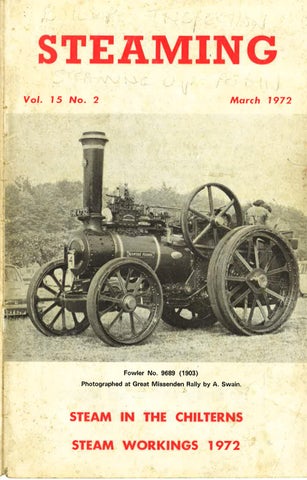
STEAMING Vol. 15 No. 2
March
Fowler No. 9689 (1903) Photographed at Great Missenden Rally by A. Swain.
STEAM IN THE CHILTERNS STEAM WORKINGS 1972
1972
NATIONAL TRACTION ENGINE CLUB OFFICERS President: S. J. Wharton, Esq., Southern Down, Minster Lovell, Oxford. Vice-President: J. T. Beeby, Esq., Wymeswold Road, Rempstone, Loughborough, Leics. Chairman: Anthony Heal, Esq., Baylins Farm, Knotty Green, Beaconsfield, Bucks. Vice-Chairman: J. Crawley, Esq., Field House, Turvey, Bedford. General Secretary: G. F. Beck, Esq., 127 Greensted Road, Loughton, Essex. Treasurer: J. H. Hobbs, Esq., 6 Esher Close, Basingstoke, Hants. Editor: Ran Hawthorne, Esq., 19 Bridle Path, Woodcote, Reading, RG8 OSE, Berkshire. Chairman, Rally Sub-Committee: M. Harmsworth, Esq., Elm Cottage, Ockwells Road, Maidenhead, Berks. Membership Secretary: C. C. Ayes, Esq., Milking Pen Lane, Old Basing, Basingstoke, Hants. Club Ties, Etc. F. G. Upton, Esq., 30 Windsor Road, Maidenhead, Berks. Technical Services and Spares Officer: Brian Oram, Esq., Bourne House, St. Mary Bourne, Andover. Hants. (Tel: St. Mary Bourne 260). Publicity and Public Relations Officer: Jonathan Minns, Esq., la Hollywood Road, London, S.W.10.
Important Preliminary Announcement BANBURY STEAM SOCIETY 1972
STEAM ENGINE FAIR on JUNE 24th & 25th at
The Showground, Oxford Airport, Kidlington, Nr. Oxford. 74
BATTERSEA PARK, LONDON
FRI •SAT•SUN•12.13.14 MAY
IT IS HOPED TO HAVE PRESENT
- 1 0 0TRACTION ENGINES, ROLLERS, WAGONS, PLOUGHING AND SHOWMAN'S ENGINES AT
THE FIRST INTERNATIONAL STEAM EVENT IN ENGLAND 1927 SCHWARZKOPFF STEAM ROLLER 1930 RUTHEMEYER STEAM ROLLER FROM THE STOOMWALSENCLUB HOLLAND. THE N.T.E.C. WILL HAVE A PRIVATE MARQUEE FOR THE EXCLUSIVE USE OF MEMBERS. Entry only by Membership Card. TRADE STANDS, PRESERVATION SOCIETIES, REFRESHMENTS, FAIR GROUND ORGANS, MODELS & LICENSED BARS PLUS ALL THE FUN OF THE FAIR Expo Secretary: John Crawley, Field House, Turvey, Bedfordshire.
E.C.
75
GREAT BATH & WEST STEAM FAIR & EXHIBITION Permanent Show Ground, Shepton Mallet, Somerset FRIDAY, SATURDAY AND SUNDAY, 30th JUNE, 1st and 2nd JULY, 1972.
A MUST FOR ENTHUSIASTS
Details available from The Exhibition Offices, Bath & West Steam Fair, 3 Pierrepont Street, Bath. BA1 1LD. (Tel: Bath 3010 & 61465).
NATIONAL TOWN AND COUNTRY FESTIVAL & STONELEIGH TRANSPORT CARNIVAL
SAT. & SUN., 26th - 27th AUGUST, 1972. 10.30 a.m. — 6 p.m. at the
NATIONAL AGRICULTURAL CENTRE, KENILWORTH, WARWICKSHIRE
STEAM RALLY MODEL EXHIBITION, VINTAGE TRACTORS, MOTOR CYCLES, CARS, Etc. AIRCRAFT, RADIO DISPLAY, FARMING DEMONSTRATION UNITS AND MANY. OTHER FEATURES. ADMISSION: 40p Adults. 20p Children.
Car Parking Free.
Organised by Royal Agricultural Society and Hockley Heath Steam Engine Rally Association.
76
STEAMING (Incorporating the " Newsletter ")
THE JOURNAL OF THE NATIONAL TRACTION ENGINE CLUB VOL. 15 No 2.
MARCH 1972
STEAMING SUB-COMMITTEE J. H. Hobbs, Esq., Ran Hawthorne, Esq., E. A. Fillmore, Esq., 34 Northwick Park Road, F.A.C.C.A. 19 Bridle Path, 6 Esher Close, Harrow, Woodcote, Basingstoke, Hants. Middlesex. Reading, RG8 OSE.
FROM THE EDITOR'S CHAIR With this edition we introduce our new printers; Chiltern Printers Ltd. who are situated much nearer to both the editorial and distribution points. Features, news items, etc. will continue to be set in 8 point Times Roman, which has proved a popular type face over the years. By way of variation small advertisements and notices will be in Galaxy, a new type face. We thank Stonebridge Printers Ltd. for their services over many years and look forward to a happy association with Chiltern Printers Ltd. When we considered special editions it was felt that the various types of engine had already been well covered and so an edition with the emphasis on steam in one particular area was agreed. We have not, however, devoted the whole of this issue to the special feature. The last "Steaming" was an enlarged edition due to there being so many rally reports, even so the "Steam Workings" reports had to be held over until this issue. The June edition of "Steaming" will go to press about the end of April. We would appreciate club news, articles, photos and advertisements as early as possible and certainly by April 14th.
" BLOW OFF " Steam Workings are "in," there is now no doubt about that. Most of the "workings" that have been held have been first class events and the entrance-fee-paying public have come to expect just that. Just as some organisers used big letters to bill "Steam Fairs" and then only provided the odd engine and a lot of modern fairground tackle, so we have seen "Steam Workings" which have not been worthy of the name. Last autumn we travelled seventy miles to an event that consisted of one engine driving a thresher, two or three unrestored farm tractors and very little else. The term "steam working" means something, let's all do our best to see it stops that way.
ACKNOWLEDGEMENTS In the preparation of this edition we are pleased to acknowledge the help and assistance of the officers and committee of the Chiltern T.E.C., T. D. W. Petty, T. T. Boughton & Sons Ltd., C. C. Edmonds, B. Fielding, G. P. Barnes, H. W. Hearn, A. Swain, R. M. Woodruff, the R.L.S., R. Gebhard of Stoomwalsenclub, Netherlands, L. T. C. Rolt. and many others. 77
The late T. T. Boughton standing in front of his Aveling & Porter Road Locomotive "Midnight", so named because of the time she regularly arrived back at the yard.
Threshing in the early years of this century. The engine is believed to be an Al!chin owned by F. Dwight. Photos by courtesy of T. D. W. Petty. 78
STEAM IN THE CHILTERNS - AN INTRODUCTION The Chiltern Hills is a very well known and beautiful range of hills that runs south-west to north-east between the Thames and the A.5 and lies approximately thirty miles north-west of London across parts of Oxfordshire, Buckinghamshire and Hertfordshire. The hills are steep if not high. The soil varies from clay to chalk and is "rich" in flints. Perhaps the most distinctive feature, and a very pleasant one is the beech trees which grow extremely well in the area. All types of engines were used in the Chilterns and it may well be that this area was one of the most thickly populated (with engines that is). Threshing contractors covered the adjoining low lands as well as the hills, and their "off" season was kept busy with timber work of which there always seemed to be plenty. Steam ploughing and cultivating was a widespread activity, Ileitis are reasonably large and the hillsides made it heavy work for horses. One or two large farmers had their own tackle, hut the bulk of the work was carried out by contractors. As elsewhere Steam Rollers were at work, the last Bucks County Council Aveling worked till 3965 or 66. T. T. Boughton's Rollers, engines and wagons covered a lot of adjoining areas as well as the hills. Few showmen had their headquarters in the Chilterns. but well known families such as Beach, Irvin and Pettigrove spent a lot of time in the district which is handy for both London and the "Oxford back-end run" of fairs. A combination of reasonably short moves, comparatively long stays and steep hills meant that showman's engines survived at work in the Chilterns later than in other areas. There is little doubt that more engines were to be found on timber work in the Chilterns than in any other area of comparable size. It is quite impossible to guess how many engines were engaged in this work as few of them came new to the lob, many were converted wagons and many were owned by very small family concerns often operating within a small area. Most makes and types were used with Aveling & Porter, Garrett Foden (D types and converted S and 6 ton wagons), Sentinel and Tasker Tractors being favourites in the smaller sixes and Fowler road locomotives for the really big stuff.
PRESERVATION The very first Traction Engine "event" was held at Appleford, Berkshire in 1950. The second "race" in 1951 was held in the Chilterns at Nettlebed, Oxon. Albeit between two men who both lived outside "the hills". Chiltern men of steam came to see this event and also the subsequent Appleford rallies. It wasn't long before the names, Ian Woolett, Francis Grover and T. T. Boughton Ltd. started to appear in the programmes of the few rallies that were held in the 1950s. In 1961 the Buckinghamshire T.E. Club was formed (soon to be changed to the Chiltern T.E. Club). Prominent in the early activities were Bill Utton, Chris Edmonds, Mrs. Margery Edmonds, Messrs, Vaughan, Geof Gilbert, Teddy Reed, Robin Brazil and Francis Grover. From then on things really moved, in 1962 the first club rally was held at Chartridge, the first of a number on the site. Ill luck hit the club in the form of a number of very wet rallies. On more than one occasion a good bank balance vanished over a weekend. Things kept moving however, and more and more engines came into preservation. The Chiltern Club rally is a good homely Traction Engine event with the emphasis on the engines. It's big enough to be enjoyable but. thankfully, not too big to be impersonal. As well as the main club rally members support numerous fetes, shows, charity parades as well as neighbouring rallies. Steam worked faithfully in these hills, now it's a hobby and just as firmly established as it was seventy years ago. 79
Coaling single cylinder Fowler P.E. No. 3173 (1877) Spencer Farm, Bucks. Owned by Dickens of Chesham, 1906.
Fowler Compound No. 13887 Class A.A. (1917) Reg. NK1160. Owned by Lord Brownlow, Ashridge Estate. 1924 to Oliver, Wandon End. Photos by courtesy of T. D. W. Petty. 80
SHOWMAN'S STEAM IN THE HILLS By Chris Edmonds, technical data by B. Fielding. Although 1 have owned a showman's engine, and know a great number of the showmen who operate around the Chiltern Hills. I have never, in fact, seen one actually at work. I just wasn't around in the days when they were working! If one visits the bi-annual Risborough Fair, which is my local fair, and happen to get in conversation with one of the older residents, the name of Mrs. Katherine Bird is bound to crop up. Even today, she is somewhat of a legend, although she died in 1925 at the age of 961 She ran three engines, two Fosters Nos. 12538 "Surprise" and 14502 "Victory", now owned by the Millward Bras, of Halesowen. Her first engine was a Wallis and Steevens No. 2087 called "Surprise" which she ran from 1898 to 1910. At her death, the firm was carried on by John Flanagan, and he had two Foster tractors Nos. 14380 and 14584 which they ran up till about 1949. It is interesting that Mrs. Bird's Foster "Victory" and Thomas Pettigroves "Victorious" are sister engines Nos. 14502 and 14501 respectively. Mrs. Bird's famous Gallopers are the set which Bill Dorman now travels. Messrs. Pettigrove still retain their Foster in store at their yard. Apart from this they also ran three Burrells Nos. 1352 'Princess Mary", No. 1736 and No. 3423 "Star" which is in store at their London yard. The two firms above mentioned, travelled extensively in north Bucks and in the adjoining counties, and the tale is told of how Mrs. Bird and her entourage used to stop in Risborough High Street to load the engines with coal when she passed through. The writer remembers being told to "move on" in the same High Street, when he stopped to oil a big end! How times must have changed! The two big names in the south of Bucks were Messrs. Beach and Irvin. Mr. George Irvin Snr. has recently died, and the business is now carried on by his sons. His two most famous engines were, of course, the two "custom built" Fosters — The "Marvel" No. 12499 and the "Marvellous" No. 14057. One of these was fitted with a gear driven dynamo. They also had two Burrells No. 1636 "Pride of Bucks" and No. 1655 "William the Conqueror". They ran these in the early part of the century. In the twenties we find them possessing Fowlers Nos. 7954, "Pride of North Wales" and No. 9293 "Swift". About 1922 they had another Foster No. 13210 "Bold Venture" and re-named "The Fairfax Goodall". That is the full complement of Irvins "heavy" engines, but they also from time to time possessed a number of 5 ton tractors. They had three Garretts after the First War. First, No. 27917 of which no name is recorded, and No. 33325 "Nippy" and its sister No. 33326 "Olympic". They also had an Aveling and Porter tractor called "Crucian" after the famous brand of Epsom salts! Many a hilarious tale is told of its exploits, and it is reputed to have been fitted with a gas engine flywheel, which fell off one day, and disappeared into a cornfield! They also had an interesting little chain drive Tasker tractor No. 1756 "Little Giant" which was on the road until 1944, and was the last of not many Taskers in showland use. For a few years in the 30s Irvins formed a partnership with R. Hewitt. This partnership had two Fowlers, No. 14595, registered HO 5644 that does not appear to have been named and 15324 "Renown". It seems probable that Hewitt brought these two engines when he entered the partnership, and took them with him when it was dissolved. The Gallopers are still travelling today in the ownership of Mr. Benny Irvin, the machine boasts one of the finest Marenghi organs. 81
Another firm in the south Chilterns, and still going strong are Messrs. Beach. Two members of this large family still travel Gallopers with organs, Miss Sally Beach. now over 90 years old, and her cousin, Mr. Torn Beach. During the earlier part of the century they had quite a host of engines. Mr. Albert Beach of Ashford, had two 5 ton tractors. A Burrell No. 3458 "King Edward" renamed "Defiance" and now owned by that doyen of the movement, Peter Barker of Hurst. This engine was only used for haulage. The second was a Foster tractor No. 14088. Mr. Charles Beach of Yiewsley, had Burrell 3642 "General French" on the road till 1946, and he also owned the tractor 3458 "Defiance" and a Wallis and Steevens oil bath No. 7237. He ran "Defiance" as late as 1950. At Kew Bridge there was Mr. George Beach, who ran an amusement park there for many years, and he travelled Burrell No. 1999 "Victoria" as well as a Foden waggon No. 11383 and a Wallis tractor No. 2328 "Bluebeat d". Mr. John Beach of Sunbury, had a whole host of engines. At different periods he had five Burrells. They were No. 2759 "Sir Collin Campbell", No. 3266 "Nippy" (5 ton tractor). No. 1741 "Dreadnought", No. 3542 "The Sunny South" and No. 3786 "Sunny South" (5 ton tractor). He had two Fowlers: No. 11444 "Evening Star" and a Tiger tractor No. 11661. It is rare to find no less than three Fodens (tractors) amongst his collection. They were No. 360 "Pride of Hants", No. 363 "Flying Dutchman" and No. 767 "Morning Star". Finally he had two Wallis and Steevens' No. 7237 and a tractor 7489. At Maidenhead Mrs. J. Beach travelled with Fowler No. 15116 "Bertha", which attended the Great Steam Fair at Shottesbrooke and is now at Kendal. There is a story told to me by one of it's ex drivers, that during a journey from Maidenhead to Hurst Flower show the smokebox parted company with the boiler, which must have made life rather trying! Mrs. Beach also ran a Foden tractor No. 2462 "Excelsior". Mr. S. Beach of Ashford had a Burrell No. 2057. and Mr. Tom Beach of Sunbury had a Wallis and Steevens No. 7731 "Progress". Mr. William Beach of Southall founded the business with the purchase of Burrell No. 2116 "Conqueror" in 1898 and at various times ran five other Burrell engines. There was No. 3019 "Iron Duke", No. 3103 "Queen Alexandra", a tractor No. 3497 "May Queen", No. 3694 "Lord Fisher", which was two speed, and No. 2075 "Flying Dutchman". He also ran Foden No. 593 and two Garretts No. 32122 "Greyhound" which is under restoration in Berkshire and No. 32962 "Nippy". William Beach died in 1938 and the business was carried on, as it is today, by his daughter Miss Sally Beach. She continued to travel the Chilterns with Burrell No. 3694 "Lord Fisher" until about 1949 when the firebox had given out, and she acquired Burrell No. 2894 which was similarly christened "Lord Fisher". The nameplate of this engine is now on the firm's F.W.D. tractor. This engine was the last to travel in the south of England and the second last in the history of Showland. It was retired and sold in 1953. It is now in preservation in Havant, Hampshire. Miss Beach also ran the Burrell tractor "May Queen" No. 3497 until the early fifties, and the nameplate is still to be seen on the Gallopers. This engine is now being restored in Berkshire. Miss Beach's brother-in-law Mr. Frank Turner ran a very pretty Aveling and Porter tractor No. 7414 "The Rising Sun" on which he was unfortunately killed, by a bullet from an adjoining shooting Gallery. His widow, Mrs. Jessie Turner still retains the engine. Another firm which still travels with a set of Gallopers are Messrs. Pelham from Hurst. They used two tractors to haul their equipment and these were Burrell No. 3786 "Sunny South" purchased from John Beach of Sunbury and a Wallis No. 7394. The Chiltern Hills extend from Buckinghamshire down to the Thames in Oxfordshire, and there were a number of Oxfordshire showmen who used steam as a motive power. Leslie Boswell had an interesting little Brown and May tractor No. 8437. There were only a couple or three of this make ever to work on the fairgrounds. 82
George Irvin's Foster No. 12499 "Marvell". Owner on fore tanks, two of his sons on wheel.
Hewitt & Irvins Fowler No. 14595 (1917) Class A8 Compound, registered No. H05644. Photographed about 1936. 83
Messrs. Busby of Bicester ran Burrell No. 2625 "Lady Pride of England" which was converted to and from, a showman's engine no less than three times in the course of its working life. It has been very nicely restored in the ownership of Frank Lobb. Out at Burford, which is really the gateway to the Cotswolds, Mr. Edward Forrest ran a Wallis and Steevens between 1910 and 1914. This was No. 7056 "Victor" and was often seen in the Chilterns. In the City of Oxford we find Messrs. Holmfields had a Wallis and Steevens tractor No. 7641 in the twenties and this is the "The Anton Belle". This engine is now at Portslade in Sussex. Another Wallis was owned by Messrs. Owen No. 2900 "Doris". This was also a tractor. Messrs. Phipps of Eynsham ran two Burrell tractors Nos. 3562 and 3624 arid these were named "Handy Boy" and "Flying Fox", They also had a Wallis tractor No. 7077. Messrs. Sheppherd of Oxford ran two unusual tractors. These were Garrett No. 37160 "Cotswold Queen" which is now preserved by Charles Durrant in Essex and called the "Crimson Lady". They also ran one of the few Taskers to be seen in Showland and this was a tractor No. 1420. Another real rarity was Spurretts Brown and May tractor No. 8685 and called "Little Wonder". Finally Thomas Taylor of Banbury travelled with three Burrells. Two of these were tractors. They were No. 3308 "Chaser" and "King Edward VII' which only had the half length cab. No number is recorded for this engine. His big engine was No. 3874 also called "The Chaser'', all these were visitors to the Chilterns. A name that is well known in rally circles these days is Messrs. I-latwell Bross. of Oxford. They still travel a lovely Walker set of Gallopers with centre engine and organ. Before the war they used an unusual little Clayton and Shuttleworth tractor to haul the famous shooting Gallery which they still possess. The engine was No. 40101 and was called "Surprise". I should imagine that there isn't an area today where one finds so many of the old street fairs left intact. Buckinghamshire can boast of five still surviving, perhaps the most famous being Beaconsfield, held annually on May the tenth. I was told, by an old resident, that before the war the showmen were not allowed to pull on before midnight preceding the Fair Day. So the engines and their loads would be quietly waiting outside the perimeter ❑f the town until the church clock struck midnight. Then the silence would be shattered as from all points of the compass engines were let out full throttle to secure a pitch in the town centre. Furious arguments, and even fights resulted when two poles crossed that had been thrown to secure a piece of ground. Things are organised a little better today! Oxfordshire can boast of no less than seven street fairs. The most famous, and one of England's great Fairs, is Oxford St. Giles. As many as twenty engines could be seen at work here, and five or six sets of Gallopers, all steam driven. From a little analysis of the foregoing, it will be seen that there were no less than sixty-one engines at work for Showland in Buckinghamshire and part of Middlesex, and yet only seven based in Oxfordshire. Of this total there were 32 Burrells, 7 Fowlers, 7 Fosters, 13 Wallis and Steevens, 6 Garretts, 6 Fodens, 2 Taskers, 2 Avelings, 1 Clayton and 2 Brown and Mays. Perhaps the saddest part of this tale is that of 78 engines at work around the Chilterns before the war, only 19 are known to exist today. What a terrible massacre must have taken place. A showman was discussing this very point some time ago, and he said that in his opinion a great deal of really fine equipment was lost and cut up and finer engines than are left today. It is up to us to preserve what is left. 84
Wallis & Steevens No. 7237, members of Beach family and staff 1943.
Burrell No. 2894, the second "Lord Fisher". In the ownership of Miss Sally Beach about 1951. 85
GEORGE & TIM By T. D. W. Petty "If you'd had to work with 'em you'd not be so bloody keen on the filthy things", this remark was made to me during a mid-day break in the early weeks of 1952 while I was working near Sawbridgeworth. I had been timber hauling for about three months and this work brought me into contact with men who had spent a lifetime in the business. Many of them had been used to steam tractors until the late 1930's. The farm where we were working was being steam ploughed by one of the late John Patten's sets and it was my interest in this pair of fine engines which caused my workmate George to make the opening remark. Subsequent friendship with George brought forth the information that he had for several years worked for a contractor who operated steam timber hauling tackle. This contractor had in all, three engines, a Foster "Wellington" tractor, a Wallis & Steevens' oil bath tractor and a Tasker class "C". Of all these engines only one was capable of taking a load from Ashridge Park to the saw mills at High Wycombe and back in one day. Admittedly the day was a long one of from 4 a.m. until nearly midnight! The Foster and the Wallis both displayed an unfortunate tendency to break down if sent far from home and it was therefore the Tasker with its two trailers which was selected for this particular run. No doubt the condition of the engines left a lot to be desired. The trailers were homemade as was usually the case and although rough, proved adequate for most work. However the braking system bore only a superficial resemblance to such a mechanism and was apparently more for decoration than use. This point was proved when, the Tasker with one loaded and one empty trailer attempted to go down Poultridge Hill between Little Gaddesden and Nettlebed. The road descends between high banks on which grow some large beech trees. George told me that he was steering, keeping well in to the side. While watching the steel shod driving wheels he suddenly realised they were going round backwards and the train was still travelling forwards at an increasing speed down the hill. He shouted to Tim, the driver, that he was going to jump off and onto the bank. Tim replied "Stick to it, we'll get down O.K." George was no hero and as speed continued to increase alarmingly, he jumped, clawing for hold among the tree roots in the bank. Something landed beside him. grabbing at him for support: it was Tim. Together they sat and watched the old girl career down the hill, at the bottom of which is a sharpish bend to the left. Luckily there was not much traffic on the roads in the early thirties and nothing was met. Naturally the engine failed to turn the corner and up the bank she reared, all but turning over. The carriages jack-knifed behind the engine and the whole outfit lay there for the best part of a day until assistance could be brought. This came in the form of the Wallis which had to return from delivering a load of timber to Luton. So much for relying on the reversing lever as the only form of braking, Essential items of equipment for the crew were their cycles for travelling to and from their homes at Gaddesden. The bikes were always caried on the tackle, either on the trailer or on the rear canopy supports of the engines. One day having arrived at the wood from which they were to fetch timber, George lifted his bike down and stood it against a nearby bush. He then went back into the road to help Tim get the outfit through the gateway. The redeeming feature of iron shod trailer wheels was that a properly placed block would cause them to slide sideways, thereby facilitating passage through narrow entrances. It was while this dodge was being carried out that the tackle came to a halt. The Tasker had passed through the gateway and bellows of laughter came from Tim. This caused George to enquire "What the b hell's up?" "Best come an' see for yourself', was the reply. George saw his bike or rather what was left of it entangled with the engine offside driving wheel, George could never see the funny side of anything least of all now. 86
Francis Grover, pictured here driving his Tasker chain drive tractor No. 1928 (built 1928), was for many years a haulage contractor in the Chiltern's using a similar tractor.
Garrett tractor No. 33364 ex W.D. Reg. BH7010 in the ownership of J. Walker & Sons, Lonwick, at work in the Chiltern's in 1920's. By courtesy of T. D. W. Petty. 87
Tim was still convulsed with mirth and George remained rattled for some time. Presently it was decided to take the engine and trailer further into the wood. Tim drove forward for a distance and then shut the regulator suddenly, his eyes bulging. There was another bike mangled up around the nearside driving wheel. He'd seen those rusty chromed handlebars before and the fact that one grip was missing quickly confirmed his worst fears that his own bike had just been run over. Now it was Tim's turn not to see the joke as his language soon hell had his bike got from its place made obvious. How the b on the back of the engine to where he now saw it. George called out, "Why stop here, the timber we want is further down the wood". the timber, look at my b . . . bike,- was the irate reply. "B George grinned. "Funny", he remarked. "But it looks like we'll both have to walk home, don't it mate?" Tim's reply was well laced with what some call 'Basic English' and included the violent repetition of various four letter words. Eventually harmony was restored and much later that day our two heroes, both tired and weary trudged home four miles to Gaddesden. George explained that their 'Governor' was always on a shoe string budget and to get replacements was a work of art if not downright impossible. Scrounging was therefore the order of the day. Once they were working in a wood which was divided into two by a public road passing through it. George's 'Governor' had the timber to haul from one half and another local firm had the other. This other concern had well equipped tackle with a Clayton Tractor. Five tons of coal had been delivered to the site for them and they had a living van even though home was but live miles away. The Tasker had only about 10 yards of rope on the winding drum which was not of the slip pattern. This lead to lot of hard work, constantly scotching up for the necessarily short pulls. The crews of two outfits working practically alongside each other were hound to scrutinise each other's tackle. George and Tim soon noticed that the Clayton was well fitted out all round and had a spare coil of rope under the living van. Early starts were the order of the day for all outdoor workers and our two heroes were no exception. The opportunity of "borrowing" the Clayton's spare rope was too good to miss and one morning before it was light the rope mysteriously crossed over the road into the Tasker camp. It was quickly stowed away where one would least expect it to be hidden — on the winding drum. During the following days the Clayton crew paid sundry visits to George and Tim, carefully inspecting every conceivable hiding place but all to no purpose. For many years George was careful to whom he told this tale as he subsequently found employment with the owners of the Clayton. It occurred to him that the manager might have had thoughts of dismissal even after a period of 20 years had elapsed. All owners and users of steam engines ran the risk of trouble with the law, which was particularly harsh on these vehicles. In the area of Bagnall and Eddlesborough was a very strict constable who has in recent years confirmed this yarn in every detail. George and Tim had drawn a load of timber from the Hudnall area and stopped to pick up water from a roadside pond near the "Red Lion" in Dagnall. Then along came P.C. Dickens the terror of all the steam men on the district. Dismounting from his bicycle, he glanced at the engine and trailer, then walked up one side of the outfit and back down the other. On reaching the engine he enquired of Tim the registration number. Perhaps the day was hot or things had not gone quite right but Tim was somewhat on edge. To make matters worse he had recently acquired a new set of false teeth which did not fit too well! His reply did nothing to soothe the policeman, "It's writ on in three b . . . . places, can't yer read?" This remark, together with the fact that Tim's new `gnashers' almost flew out, George could not help laughing. This had a most unfortunate effect on P.C. Dickens. "Perhaps I'd better have a look round this lot and see what else I can find. You seem to have a different number on the trailer to what you have on the engine," he continued. To George and Tim the penny dropped. They had the Foster's trailer 88
which bore that engine's registration number. Meanwhile the law started at the engine front coupling and worked his way to the back of the carriage. He returned to where the two somewhat hushed men stood. "Well," he said, "The best thing you can do is stay where you are and I will fetch your governor to sort things out". "We got to get this load into Brown's at Luton," said George aggressively. "What do you do on this outfit?" asked the constable. "I steers 'er", said George. "Right, let's see your licence", replies Dickens. "Ha! Don't need one", said George, "It's only drivers as has to have 'em". "Now we'll have to see about that", thundered the law. "That makes 21 summonses I'll be taking out against the firm and yourselves, so stay here and don't move until I fetch Mr. Richards". The nearby pub was now open, so the ashpan damper was closed, the cap put on the chimney and the two men entered the bar. Three hours later the pub shut and the only thing left to do seemed to be to carry on to Luton. The liquid refreshment had given George and Tim a certain amount of Dutch courage. Returning empty they reached the "Plough". There stood P.C. Dickens, notebook in hand, ready to record the 21 offences all over again, making a grand total of 42 in one day. Eventually the cases began to be heard in court but were never finished. The firm packed up and legal proceedings ground to a halt. George related how there was only once when the law was pleased to see them, and that was at the Dunstable cross roads. In the days before traffic lights there was a policeman on duty here and it was usual to give passage to any heavy vehicle coming up the slight incline from Luton. One day as the Tasker rattled up to the cross roads the policeman gave them right of way. Suddenly round the corner shot a zippy sports car, completely disobeying the constable's signals. It ran straight into the forecarriage of the engine which was hardly marked, although the front of the car was badly crumpled in. "We know where to find you lot", said the policeman to George and Tim, "So off you go for now. You'll be needed in court when the case comes up. Thanks for stopping the car!"
PENN FAIR MEMORIES by G. P. Barnes. It was in 1930 that, as a pupil at the school opposite the village green, I saw for the first time a spectacle which was subsequently to become an annual highlight through all my years at the school — the pulling on of the annual Penn Fair. This was no haphazard straggling on of odd vehicles over a period of several days, but a majestic advance on the village green from three sides, with some half-a-dozen showmen's engines, each hauling its quota of gaily painted trucks and caravans, followed closely by the lorries. Tilling Stevens buses and horse-drawn caravans of the smaller showmen. Pulling on took place at 4 p.m. on September 15, the eve of the two-day Fair, and although little interest was taken in lessons that day were were all on our best behaviour, for even the briefest period "kept in" would have meant missing the annual spectacle. Nearly everyone found it necessary to "be excused" several times during the day, since the route to the little brick building across the yard afforded a glimpse of the fair-ground loads which had been assembling on the roads from early morning. At last afternoon school was over and everyone rushed outside, where the village bobby was standing at the road junction, watch in hand and whistle at the ready. A blast on the whistle, a beckoning movement of the arm, and the advance commenced . The early arrivals had, of course, all been visited during the dinner hour. There were the Harvey family's trucks and lorries, together with a few of the Beach family's loads, in the meadow alongside "The Queen's Head"; William Beach's boat truck and a couple of other vehicles outside "The Red Lion"; and other loads which had parked 89
overnight in the yard of the village bakery. Alongside the Beaconsfield Road the road trains waited, the engines hissing gently. Of all the engines William Beach's Burrell "Lord Fisher", No. 3694, was probably the favourite as far as we were concerned. Usually driven by either Billy Stevens or by "Long Wag" Beach. this, the first of two engines owned by the Beach family to bear that name, was always highly polished and usually made a double journey, arriving perhaps a couple of days before the fair with the centre truck and top of the Switchback, a very popular attraction with the youngsters. William Beach's other big engine with the Switchback and swings, was the Burrell "Conqueror", a considerably older one than "Lord Fisher". "Conqueror", No. 2116, had been new to William Beach shortly before the turn of the century. Also accompanying the Beach family's amusements was Mrs. Turner's Aveling and Porter "The Rising Sun", No. 7414, still in her ownership in 1972 but definitely NOT for sale! "The Rising Sun" hauled some of the small stuff, and always looked very clean and smart, with brasswork gleaming. Irvin's two big Fosters, "Marvel", No. 12499 and "Marvellous", No. 14057, used to haul their Gallopers and Hewitt and Irvin's Dodgems. Their deep canopies, distinctive chimney tops and the five-legged stars on their motion covers made them easily recognisable even from a distance. Another Irvin engine, the Tasker "Little Giant" hauled the Marenghi organ of the Gallopers and some of the living wagons. Both William Beach's Switchback and George Irvin's Gallopers were, of course, driven directly by steam. It is hoped to mount a working centre engine in the Gallopers again in the fairly near future. The Switchback, sadly, was broken up some years ago. Both these rides had very fine organs, still in existence and both playing, while the third regular organ at Penn Fair in pre-war days was Harvey's (now Freddy Sanders's) 46-key Chiappa in a juvenile roundabout which builds up on its own four-wheeled centre truck just like the big machines. Whenever a dry Summer left the level of the village pond lower than usual there were rumours that the Fair would not be coming as there wasn't enough water for the engines, but someone was always found who had sufficient water in his well to fill the barrels and cisterns which served the boilers during the two days of the Fair. From the turn of the century, when the Squire used to send one of his men with a cart to take fresh spring water and vegetables for the use of the showmen, it was a tradition that the first ride at the Fair was free for the youngsters from the school opposite the green. The Squire was a school governor, so there was a half-holiday to enable everyone to claim their free rides. This custom continued to be observed until comparatively recent years when a fresh headmaster from another part of the country did away with the holiday. with the result that the first ride was over while the youngsters were still in school. We only saw the showmen once a year at Penn when I was at school, though on one occasion members of the Harvey family, having a few days to spare between their regular Fairs, presented a little fair for the youngsters in "The Queen's Head" meadow. On another occasion false hopes were aroused when Pettigrove's Foster "Victorious", with their Galloper loads, stopped to take on water at the village pond, but they were only passing through. The water was very low, and the nozzle of the hose had to be pushed across the muddy shallows on a shovel to reach deeper water. I remember that someone got a wet foot in the process, but the remarks made, though they delighted us kids at the time, have long been forgotten. Nowadays everything is hauled by diesels, of course, and although some of the tractors are still beautifully painted the plating and testing regulations have made the showmen change their lorries more frequently, so that few of them now bother with much in the way of decoration. The Irvin family's Gallopers, which used to have mermaids, dragons, ostriches and peacocks among the horses, no longer attend Penn Fair, 90
but Miss Sally Beach always brings her Gallopers, complete with the centre engine "May Queen", its flywheel revolving as it transmits the electric drive from the motor, and a pleasing 89-key Gavioli organ.
GREAT MISSENDEN RALLY 1971 The Chiltern Club's Rally was again held on the first weekend in July. The event enjoyed good weather and was successful in every respect. In line with present day trends Steam Threshing was staged by D. W. Davis using his 1914 Burrell tractor No. 3554 "King George V". R. McLellan's Ransome portable "Little Ben" powered a wood saw operated by Derek Petty. Many logs were cut for fuel. Nearby, Francis Grover used his Tasker No. 1928 to show how long timber is loaded on to a carriage. The Fensoms with Marshall No. 43560 "Winifred" were also at work here. Robey conversion No. 41492 (1923) was running lights and Jack Beale's "Pride of Penn' Garrett Tractor 33296 (1918) was giving trailer rides. A "first time out" exhibit was Boughton's Burrell Roller No. 4069 ex Dingle. Engines taking part, in addition to those already mentioned were: Anthony Heal's 1919 McLaren road locomotive "Boadicea" No. 1652; R. B. Green's 1927 Fowler roller, No. 17501; Robin Brazil's 1928 Sentinel Wagon "The Chiltern Hundreds"; Robin Brazil's 1903 Fowler traction engine "Farmers Friend", No. 9689; David Philpot's 1917 Clayton and Shuttleworth traction engine, No. 48154; T. T. Boughton and Sons Ltd.'s 1927 Fowler roller, No. 17502; R. G. Green's 1924 Aveling and Porter roller "Master George", No. 11085; Jim Sarney's 1908 Burrell road locomotive "Lord Roberts", No. 3057; S. Hatfield and D. J. Hall's 1913 Marshall traction engine, No. 61970. D. J. Newton's 1946 Aveling Barford roller, No. A6785; D. J. Newton's 1913 Aveling and Porter roller "NulIi Secundus", No. 8064; D. J. Newton's 1922 Aveling and Porter roller "John Hampden", No. 10399; J. B. Fletcher's 1906 Garrett traction engine "Rufus'', No. 26046; Francis H. Grover's 1920 Aveling and Porter tractor "Shamrock", No. 9170; D. L. Carter's 1931 Sentinel Wagon, No. 85901 Bunnie Smith's 1921 Marshall roller "Maid Marian", No. 76116. T. T. Boughton and Sons Ltd.'s 1897 Fowler traction engine "Black Jack", No. 7788; T. T. Boughton and Sons Ltd.'s 1928 Fowler roller "Margaret", No. 17483; T. T. Boughton and Sons Ltd.'s 1928 Fowler roller "Ruffle", No. 17234; D. Harding's 1919 Aveling and Porter roller "George", No. 9008; R. Nixon's 1931 Sentinel tractor, No. 8413; B. R. Skegg's 1921 Green's economiser engine, No. 648. Awards of merit were as follows: The George Evans Plaque for the best engine owned by a club member: J. B. Fletcher's 1906 Garrett "Rufus". The Black Jack Trophy for the engine restored nearest to its original condition: Francis Grover's Tasker "Little Giant". The F. Saunders Memorial Shield for the most workmanlike agricultural traction engine: T. C. Fensom's Marshall "Winifred".
THRESHING IN THE CHILTERNS IN 1946 An annual report of the National T.E. and Traction Association list the following contractors; T. T. Boughton & Sons, The Burnham Treshing Co., G. Evans, Great Missenden, N. Gomm, Chesham, and F. Saunders, Swan Bottom, as operating in Buckinghamshire. Rates were: Engine and threshing machine £3 16 0 per day Extra for straw trusser 12 0 per day Extra for chaff cutter £1 12 0 per day Extra for elevator 10 0 per day Extra for baler £2 0 0 per day Drivers and feeders £1 0 0 per day Casual labour 10 0 per day 91
Fowler No. 17234 "Ruffie", new 1928.
Garrett No. 26046 (1906) "Rufus" in the hands of owner/driver J. B. Fletcher. Photos at Gt. Missenden 1971 by A. Swain. 92
MEN OF STEAM - HAROLD HEARN BY RAN HAWTHORNE To many readers the name Harold Hearn is associated with Boughton's six-ton Foden Wagon No. 13138 of 1929. We shall come back to her later on because this story starts long before 13138 first came to Amersham. Harold's father was known as "Shoot" and was employed all his life as a steam driver. He was driving a plough engine for Boughton's until just a few months before his death in 1944. In earlier days he had driven a new double cylinder Foden Traction Engine from Sandbach to Wendover for his employer Walter Stevens. It was in the tender of one of the Stevens' engines that Harold first experienced steam. He was about three years old and still "in petticoats." By the time Harold was eight or nine "Shoot" Hearn was driving Boughton's Fowler "Pincher" a 6 N.H.P. Single Cylinder engine that had been new to Lord Chesham. On Saturdays and in the school holidays Harold fired the engine while father fed the drum and woe betide the youngster if steam was not maintained. The first world war came in 1914 and brought a shortage of skilled men. Harold was hardly a "skilled man" but aged twelve he was a "useful lad" and so he was employed by Mr. T. T. Boughton on Saturdays and the school holidays. Having the ability to get-up in a morning and being keen he was usually the first lad in the yard, the prize for being early was to look after the 3 N.H.P. Wallis & Steevens portable that drove the machine shop. Harold left school on June 9th, 1917, his thirteenth birthday. At that time one could leave school at thirteen if you had a job to go to, Harold had had his job lined up for some months! And so he started full time for Mr. T. T. Boughton. Soon afterwards he was "loaned" to Francis Grover who had recently acquired a steel tyred Aveling & Porter steam wagon to set himself up in business as a haulage contractor. Francis still recalls the days when Harold was; "the first mate I ever had." Harold, of course, acted as fireman and helped with all the loading and unloading. Back in the Amersham Common Yard one day Mr. Boughton said "Do you think you could drive a ploughing engine?" "I'll have a try," said Harold. This was to be his answer to many similar T. T. Boughton questions in the years that lay ahead. So, at the age of thirteen Harold Hearn found himself in the field by the Golf Links at Chalfont St. Giles driving a single cylinder, tank storage Fowler plougher with his foreman George Ruff (father of Bernard) better known as "Ruffle" on the opposite engine. Later Harold had a 8 H.P. single cylinder Fowler known as "Wilder" out on a timber sawing contract. On another job he drove a big 10 H.P. Brown & May portable named "Boanerges". He also had a very old single speed, single cylinder Aveling Traction for some months. She was known as "Primrose," her road gear pinion was held in or out of work by means of a leather strap that fitted on the shaft, this strap carried four metal splines. When he was fifteen Harold again said he would "have a try" when asked to go up to the White City and take charge of a big Aveling & Porter road locomotive "Comp" the driver of which had "jacked up" (refused to go on) having run a bearing. Harold cycled to London, put his bike in one of the three trucks, got steam up, organised the men turned the train round and got it back to Amersham. The next engine Harold encountered was the little Foster "Pedrail". This had been built with the "Elephant's feet" of the Pedrail system but had been converted in the Boughton works to a roller. Harold was acting as "flagman" assisting the driver to South Merton. They got to the site Sunday lunch time after a difficult journey, (they NEVER worked on Sundays but they knew they had to be there for 93
Harold Hearn (left) aged 13 driving a single cylinder Fowler plough engine No. 2051 for T. T. Boughton.
Harold driving the Foster "Pedrail" No. 2942, Reg. No. BH8578 on the Merton Park job, 1921. 94
Monday morning). The driver went home for the remainder of the week-end but did not turn up on the Monday so Harold took charge and was on the job for some months. Boughtons had a portable on this job driven by an old man who had a large white beard. He had never been away from home before and Harold had to hold his hand to get him on a train to get him home at week-ends. For some weeks on this job Harold had a 12 ton Aveling Roller known as "the Aveling with the bad regulator" as well as Pedrail with one or the other and sometimes both in steam, the Aveling being used for base rolling and "Pedrail" for the asphalt surfacing. "Pedrail" had twin cylinders (not compound) and was very good for rolling and shunting. When coupling up to a van Harold used to set her in reverse, slowly, jump down off the engine, pick up the drawbar, drop the pin as the couplings met, jump back up, put her into forward gear
and away. Shortly after the Merton job Harold and the "Pedrail" had the long journey back home, then all through Chiltern country to a job at Crowmarsh, near Wallingford. While there the van and roller parked in Walter Wilder's yard. Walter Wilder's were steam engineers and made castings for Allen's of Oxford including those beautiful cast iron flared chimneys. This firm is not to be confused with R. J. & H. Wilder of nearby Wallingford who were mainly engaged in steam ploughing and threshing. On the journey to Crowmarsh Harold got to the village of Ewelme badly in need of water. "Pedrail's" tank held only eighteen buckets of water when full and this was dry hilly country. At Ewelme then, as now, there were some watercress beds and a stream but on a tree by the stream a big notice that said: ENGINE DRIVERS MUST NOT TAKE WATER FROM THIS STREAM." Harold no sooner dropped his pipe into the stream and got water lifting when an old gent came on the scene. "Can't you see the notice." "What notice?" said Harold. "That one," said the old gent pointing. "What's that about then?" said Harold. The old man read it out with one or two more interruptions from Harold who then said, "Oh, alright then I won't." He turned off his steam and coiled his pipe, little "Pcdrail's" tank being full to the top! The Crowmarsh job lasted some months. Harold used to get home one week-end in three and this meant a hard push-bike journey both ways with an early start on a Monday morning to be sure of having steam up for 8 a.m. The next big job was the construction of the famous Western Avenue where T. T. Boughton had numerous Rollers, portables, Tractions and Steam wagons at work. Amongst the steam tackle on site Harold saw a
steam driven concrete mixer, a massive machine by Stotthert and Pitt. It ran on two rails at one side of the roadway and one rail at the other side. The concrete was mixed, then the skip was sent across the gantry over the road. As soon as the skip was stopped it emptied its load. On one occasion the driver was ill, Harold was asked if he would drive it, "I'll have a try," said Harold. Looking back on this incident Harold says '1 had that job for three days and never did manage to drop the concrete where it was wanted." It was in 1925 while working on the Western Avenue job that Harold married. The wedding took place on the Saturday of the Whit week-end, the rest of the week-end was the honeymoon. Harold had to lose the Saturday. and the Bank Holiday was not a paid holiday in those days. Wages were fifty-five shillings a week less 1/2d. stamp and no overtime pay. Harold travelled to work on a motorcycle and had £1 travelling expenses for the 240 miles he did each week. The first steam wagon that Harold had regular was a 3 speed Mann. A 3 ton wagon that carried 8 ton loads of granite from the railway to the Western Avenue contract. The body was mounted on rails and had to be hand wound along these rails till it tipped.
95
The five ton Foden No. 5658, Reg. KX5003. Converted to a timber tractor and fitted with the first Boughton winch in 1929.
Six ton Foden wagon (Reg. UR5319) converted to a timber tractor in 1932. 96
Very often when the body tipped the chassis tipped as well lifting the front end of the wagon ten feet off the ground. This sent the crew scrambling up an to the smoke box to get her down before the tubes got hot and caused leaking. To prevent the body tipping a substantial block of wood just long enough to fit under the rear coupling was carried. This Mann wagon had a loco' boiler with driver's platform, controls and fire hole on the offside and a mate's platform on the nearside. Harold was asked to teach a man to drive on this wagon but the driving lessons came to an end when the pupil put her through a hedge and a ditch, Harold sitting on the mate's side being powerless to stop the wagon. For some months Harold used the Mann leading sand and gravel from Cassionbury Bridge pits to Watford carting nine loads every day. A 5 ton Garrett piston valve overtype wagon was the next one Harold had. She had been new to Teddington Council, had two speeds and tipping mechanism actuated by belt driven from a pulley on the crank shaft. During the three or four years that Harold had the Garrett he was mainly carrying sand, gravel, bricks or tarmac, but on one occasion he was asked to go to Lewis's Yard at Reading and fetch a very old Traction Engine that had been built by the Reading Ironworks. This was converted to a roller in Boughton's workshops but was not very successful. It had no differential and did not easily go in other than a straight line! Another Boughton conversion of 1923 was the 3 ton Aveling & Porter Tractor No. 5541 registered PP851, which was converted to a Roller and was known as "Handy Boy." "Handy Boy" is now in preservation in Cornwall named "Bo-Peep." Harold drove "Handy Boy" on occasions, but the regular driver was one "Niney" whose chief claim to fame is that when he was using "Handy Boy" to roll some circular sewage filter beds he tied the steering wheel in the required position and left "Handy Boy" to get on with it while he went blackberrying! In the late 1920s Boughtons had eight Traction Engines on one job all driving water pumps, pumping water from holes in which pylons were to bo set. Harold was one of the drivers doing seven, 12-hour shifts a week at the rate of 12/- per shift. In 1929 the firm purchased a 5 ton Foden wagon converted it to a Tractor, fitted it with a ►winch of their own manufacture that was driven by a vertical Sin. bore, double cylinder, launch engine. This winch was the first made by Boughtons, the forerunner of thousands that have been made since and are still being made today. For over a year Harold was carting timber into Woolwich Arsenal mainly from Surrey. One Christmas Eve he and his mate found themselves arriving at the Arsenal with a load of timber at 7 p.m. "No one here," said the man on the gate. They knew where it had to go and they wanted to get back to Amersham so they got a pole and started to push off the one big "stick" that comprised the load. One end went down but the other end would not shift, so a pulley block was chained to the railway lines and the Foden hung on but the only result was that the lines moved so the last desperate effort was to take the Foden over the lines and rope the stick off. This accomplished they were soon on the road to Amersham stopping briefly at Goldhawk Road Market, Shepherds Bush to buy oranges and nuts for the family. About 1930/31 Mr. T. T. Boughton took Harold to Watford to fetch home a 6 ton Foden wagon. This was converted for timber work and Harold used it on the Woolwich Arsenal work, brother Alf taking over the 5 tonner. The tanks on this 6 ton Tractor were such that Harold could fill up at Woolwich, run home to Amersham for the night and continue to Winchester next morning without a re-fill. About 1933 the manager of Wrights, timber merchants of nearby Chesham came to ask Harold if he would go and drive their Sentinel timber tractor for them. Harold had been with Boughtons for twenty years, his father was there and he had never considered leaving but if 97
Sentinel timber tractor No. 6816, Registered PP7610. New 1927 to Wrights of Chesham.
Harold Hearn driving Fowler No. 7788 "Black Jack" in 1958. Photo by courtesy of J. P. Mullett, Esq. 98
he went to Wright's every day's work would finish in the yard, no more living away from home and Harold had a family growing up by this time, so with encouragement from his wife Harold left Boughton's and went to Wright's. The Sentinel, No. 6816 had been delivered new to Wright's. She had a superheated boiler producing steam at 275 lbs. p.s.i., she had two road speeds and as the winch was driven off the rear axle two winching speeds. Harold describes her as "the most powerful engine I ever drove." For two years Harold was carting timber from Windsor Great Park to Chesham. Brother Alf was on much the same run driving a Foden Speed Six No. 14044 that had been fitted with a Sentinel boiler and converted to a tractor. One day as he was returning home, Harold got to Duke's Hill at Gerrards Cross. There was Alf stranded short of steam, so Harold set the Sentinel to the back and pushed Alf and load up the hill. Such was the power of the Sentinel that Harold did not need to leave his own load behind. In the late 30s the Sentinel gave way to a 4 wheel drive, 4 wheel steer Latil tractor. In 1949 this was replaced by a 4 wheel drive Douglas tractor. By the early 50s the timber trade was undergoing changes and Harold returned to Boughton's with whom he was on the best of terms. He became a turner in the machine shop. Rallies and preservation activities got under way. Harold was soon suggesting that one or other of the many engines that stood in the yard should be restored. His eye was taken by a 6 ton Foden wagon but she had been promised to a buyer in Scotland, so a start was made on a Fowler traction. Then the Suez Crisis came along and Harold was one of the team rebuilding the 6 ton Foden for the use of a High Wycombe firm for taking furniture to London. The rebuild was completed — the day the crisis was over! And so it was in 1957 that Harold drove Foden 13138 to her first rally at Appleford. They were awarded the N.T.E.C. Dacre Lacey Cup the highest award for restoration. From then on the entry "Foden 13138 (1929) owned by T. T. Boughton & Sons Ltd. and driven by H. Hearn" became known throughout England. The "turnout" of this wagon and the way it was driven has been an example and inspiration and in fact it set a standard which it is impossible to better because the wagon was "just right." Harold and the Foden went to the Driver of the Year competition at Ruislip, to rallies in Devon, Doncaster, Suffolk, Cheshire, and many more in between. The 200 miles to Doncaster were covered by 5 p.m. When in Cheshire a visit to Foden's works was inevitable, Harold left at 10.30 a.m. and had covered the 180 miles back to Amersham by 7.30 p.m. Boughton's restored a pair of Fowler plough engines and used them to cultivate land that they farmed at Little Chalfont. Needless to say Harold was involved with both the restoration and driving. The ploughers also did demonstrations at shows and ploughing matches. Two Fowler rollers were restored and Harold had some two or three weeks' work
in the yard rolling hardcore. All this, of course, was in between taking the Foden far and wide. Twice Harold had been awarded the "Best Steam Vehicle Cup" on the London to Brighton run and he was looking forward to making it a hat trick but on November 13th, 1967, at the age of 63, Harold suffered injury to his legs in a motorcycle accident. Arthritis, which had been a nuisance, now made it very difficult for him to get about, but Harold and the Foden did take part in the 1968 London - Brighton and once again the cup did come back to Amersham. The Doctor said "No more driving" and in 1970 Harold retired, but he has not finished with steam. He has his models, a nice little workshop and access to Boughton's machine shop. Since Steam Workings have come along those of us who are privileged to know Harold find him sat in the tender of David Davies' engine maintaining pressure and water-level while the engine powers a thresher. A full circle from the days when he fired "Pincher" for Dad on a Saturday. Sixty years have rolled by. Now, as then, Harold is still, very much, a "Man of Steam."
99
Harold driving Fowler No. 15203 B,B.1 Compound at Little Chalfont 1964.
Foden No. 13138 (1929) Registered AN9568 on the London-Brighton run 1968. The third occasion on which Harold and Foden won the "Best Steam Vehicle Cup". 100
The Second Great BRISTOL
Steam Traction Engine & Fair Organ Festival FRIDAY, SATURDAY & SUNDAY, MAY 5th, 6th, & 7th, 1972 at
WHITCHURCH, BRISTOL Secretary: R. A. Lacy, 13 Frederick Place, Clifton, Bristol, BS8 1AS. Tel: 0272 35839.
DEVON TRACTION ENGINE, VETERAN & VINTAGE CAR CLUB
TRACTION ENGINE RALLY SATURDAY & SUNDAY, 3rd & 4th JUNE, 1972
at NEWTON ABBOTT RACECOURSE on Main Exeter - Torquay Road (A380) STEAM ENGINES, FAIRGROUND ORGANS, VETERAN & VINTAGE CARS, ALF WHITELEGGS GALLOPING HORSES, MODEL & MUSEUM ROOM, REFRESHMENT ROOM & LICENSED BAR. FIRST CLASS TOILET FACILITIES. GATES OPEN 11 A.M. BOTH DAYS. ADMISSION 30p, OAP's & CHILDREN 10p. CAR PARK FREE.
N.T.E.C. Secretary, F. Burt, 17 Toronto Road, Exeter, EX4 6LE. Tel: Exe 79067.
101
SECRETARIES PLEASE NOTE.
Let us tender for the mobile ice cream service at your event this season. You will be pleased with our service and terms.
WINDSOR CREAMERIES, Pendine, Carmarthenshire. Tel: PENDINE 233. Evening 613.
102
NATIONAL TRACTION ENGINE CLUB
APPROVED RALLY LIST 1972 To ensure a high standard of entertainment and maximum regard for the safety of the public, the organisers of Approved Rallies have undertaken to adhere to the N.T.E.C. Code of Practice. The information given in this list is correct at the time of publication. The N.T.E.C. cannot be held responsible for any subsequent variations made by organisers. To avoid any inconvenience or disappointment arrangements should be confirmed with the organiser concerned. Copyright: This list is the property of the National Traction Engine Club and may not be reproduced whole, or in part, without prior sanction. CLASSIFICATION OF EVENTS In order to give some guide as to the type and size of event, the following letters and numbers have been used. A. Predominantly Traction Engine Rally. B. Traction Engine Rally and other Veteran Vehicles. C. Traction Engine working event. D. Steam Fair. E. Display (Static or Parade). 1. Under 15 Engines. 2. 15 - 29 Engines. 3. 30 - 45 Engines. 4. Over 45 Engines. APRIL 14/15/16
Olde Tyme Festival & Steam Fayre, Cardiff. A,D.1
Western Promotions & Amusements, 371 Longford Lane, Gloucester, GL2 9EL. MAY 5/6/7
Bristol Steam Traction Engine & Fair Organ Festival, Bristol. A.3.
7
Grand Open Day — Sittingboure & Kemsley Light Railway. E.1.
R. A. Lacey, 13 Frederick Place, Clifton, Bristol, BS8 1AS. D. W. Russell, 134 Chaucer Road, Gillingham, Kent. 12/13/14
'Expo Steam', Battersea Park, London. E.4.
20/21
Basingstoke Lions Club Traction Engine Rally, Hants. A.3.
20/21 20/21
Medway Festival of Steam, Gillingham, Kent. A.2. Veteran Cavalcade 1972, Palace Grounds, Hamilton, Lanarkshire. B.2.
J. Crawley, Field House, Turvey, Beds. B. B. Harrington, 6 Foyle Park, Basingstoke.
Wm. McK. Steven, 20 Geils, Quadrant, Dumbarton, Scotland. 27/28/29
Pirton Steam Engine Rally, Nr. Hitchin, Herts. A.3.
Mrs. B. Mayes, 23 Nunnery Lane, Luton, Beds. 28/29
Welford Steam Engine Rally, Husbands Bosworth, Leics. A.2.
R. E. West, 4 Adam & Eve Street, Market Harborough, Leics. 28/29
Beaulieu Steam Festival, Montagu Motor Museum, Hants. A.2.
B. Johnson, 24 Sheridan Road, Worthing, Sussex. 28/29
Burton Constable Steam Fair, Burton Constable, Hull. A,D.2.
J. Chichester-Constable, Burton Constable Hall, Hull. 28/29
West Wycombe Steam Rally, West Wycombe, Bucks. A.1.
B. M. Fawkes, 4 Latchmoor Way, Gerrards Cross, Bucks. JUNE 3/4
Andover Traction Engine Rally, Longparish. B.2.
J. Field, 2 Landsdown Road, Andover. 103
3/4
Devon Traction Engine Club Rally, The Racecourse, Newton Abbot. A,C.2.
3/4
Tynedale Steam Spectacular, Corbridge, Nr. Hexham. A.2.
F. G. Burt, 17 Toronto Road, Exeter, EX4 6LE.
10/11 10/11 10/11
10/11
J. Arnott-Brown, 70 Northdene, Birtley, Co. Durham. Fosseway Steam Engine Rally, Newark, Notts. A.3. H. L. Spindley, 23 Westwood Drive, Swanpool, Lincoln. Camerton Steam Traction Rally, Timsbury, Nr. Bath, Som. B.2. D. Cleaves, 60 North Road, Midsomer Norton. Bath. Hungerford Olde Tyme Fayre & Steam Engine Rally, New Common. A,D.2
J. L Newton, Oak Lodge, 8 Salisbury Road, Hungerford, Berks. Steam Engine Rally, Levens Hall, Nr. Kendal, Westmorland. A.2.
Mrs. F. M. Carr, 27 Nor folk Avenue, Morecambe, Lancs. 16/17/18 Second Age of Steam, Syon Park, Brentford, Middx. B.2. P. Coxall, Smokey Cottage, Lion Lane, Hasiemere, Surrey. Steam Traction Engine & Fair Organ Rally, Ryhill. A. 2. 17/18 W. L. Thorpe, 19 Cemetery Road, Ryhill, Wakefield, WF4 2D P. Stamford Traction Engine Rally, Ryhall. A.3. 24/25 J. Crawley, Field House, Turvey, Beds. Banbury Steam Engine Fair, Oxford Airport, Kidlington. A.3. 24/25 W. Upton, 19a Crouch Street, Banbury, Oxon. Midsummer Rally. B.3. 24/25 Mrs. B. Mayes, 23 Nunnery Lane, Luton. Beds. June 30, Great Bath & West Steam Fair and Exhibition, Show Ground, July 1/2 Shepton Mallet, Somerset. D.2. Major the Lord Darling, Bath & West & Southern Counties Society, 3 Peirrepant Street, Bath.
1/2 1/2 1/2 1/2
JULY Rempstone Traction Engine Rally, Nr. Loughborough. A.3. J. T. Beeby, Wymeswold Road, Rempstone, Nr. Loughborough. The Ardingly Steam & Historic Transport Rally, Nr. Haywards Heath, Sussex. B.2. B. Johnson, 24 Sheridan, Road, Worthing, Sussex.
Totton & Netley Marsh Steam Engine & Vintage Vehicle Rally. B.2.
Mrs. L. J. Cully, Hazel Farm, Calmore, Southampton. Great North of England Steam Amusement Spectacular, Croft, Nr. Darlington. A.2.
J. Arnott-Brown, 70 Northdene, Birtley, Co. Durham. 1/2 8/9 8/9
Chiltern Traction Engine Rally, Great Missenden. A.3.
K. Petipher, 50 Green Lane, Radnage, High Wycombe, Bucks. Derby Steam Rally, Mickleover, Derby. B.2.
D. W. Trueman, 48 Haydn Road, Chaddesden, Derby. Burtonwood Rally, Nr. Warrington, Lancs. B.3.
Mr. N. Carney, 2 Catterall Cres., Bradshaw, Bolton.
14/15
Shanes Castle Demesne, Antrim, N. Ireland. B.2.
15/16
Cornish Traction Preservation Club, Tredinnick, Wadebridge. A.2.
J. Mcllfatrick, Drumsara, Kilrea, Coleraine, Co. Londonderry. G. Proctor, Armadale, Trevanion Road, Wadebridge, Cornwall.
15/16
Midland Festival of Steam, County Show Ground, Stafford. A.3.
D. J. Bradbury, 12 High Street, Colton, Rugeley, Staffs.
15/16
104
Appleford Rally, Abingdon, Berks. A.2.
Mrs. Hall, Garden Cottage, Billingbeare, Binfield, Bracknell, Berks.
15/16
15/16
15/16
Masham Steam Engine & Fair Organ Rally, Masham, Yorks, A.3. W. A. Wise, 8 Leyburn Road, Masham, Ripon, Yorks. Clay Cross & District Steam Spectacular, Grassmoor, Nr. Chesterfield. A.2. J. A. Chapman, 26 Chapel Road, Grassmoor, Nr, Chesterfield. Stately Steam Up of 72, Knobworth, House, Stevenage,
& 22/23 Herts. A.3. J. Arnott-Brown, 70 Northdene, Birtley, Co. Durham. Polegate Steam Engine Rally, Wilmington, Polegate, Sussex. 22/23 28/29/30
A.2. A. H. Hanmore, Woodcote, Wannock Road, Polegate, Sussex. Westergate County Fayre, Fontwell Park, Chichester, Sussex. B.1.
Mrs. M. D. Hynclinan, Friars Oak, Walberton Grccn, Arundel.
29 29/20 29/30
Woodcote Veteran Transport Rally, Nr. Reading. B.2. G. R. Hawthorne, 19 Bridle Path, Woodcote, Reading, RG8 OSE. Kegworth Carnival & Steam Engine Rally, Nr. Derby. B.2.
P. G. Haywood, 49 Nottingham Road, Kegworth. Nr. Derby. Seend Traction Engine Rally, Seend. A.2.
H. J. Holloway, 20 The Lye, Seend, Melksham, Wilts. AUGUST
5/6/7 5/6 5/6 5/6 12/13 12/13 12/13
Irish Steam Preservation Society Rally, Stradbally, Eire. 13.3. W. F. Walsh Kemmis, Garrans, Stradbally, Co. Lois. Acrise Steam Rally, Swingfield, Nr. Folkestone, Kent. A.2. G. A, Marsh, School Garage, School Road, Acrise, Folkestone. Arkright Traction Engine Rally. A.3. N. C. Howard, Market Place, Cromford, Nr. Matlock, Derby's. Rousham Park, Nr. Banbury, Oxon. A.3. N. Bywater, Water Lane, Steeple Aston, Nr. Banbury, Oxon. Knowl Hill Steam Rally, Knowl Hill, Reading. B.3. Mrs. M. Cook, Greenacres, Bottle Green, Littlewick, Nr. Maidenhead, Berks. Pagans Hill Steam Festival, Chew Stoke, Bristol. A.2.
Mrs. J. M. Kemp, Pagans Hill Farm, Chew Stoke, Bristol. Astle Park, Chelford, Cheshire. A.2.
J. A. Barber, The Cottage, Chelford, Macclesfield, Cheshire.
19/20
Caenby Corner, Lincoln, Lincs. A.2.
19/20
Market Bosworth Traction Engine Rally. A.2. Mrs. J. A. Lees, 14 St. Catherines Ave., Market Bosworth,
19/20
Liphook Steam & Vintage Transport Rally, Sussex. B.3. G. Moss. 44 Headley Road, Liphook, Hants. West of England Steam Engine Society, Sinns Barton, Redruth. B.3.
G. Taylor, 27 Addison Drive, Lincoln, Lincs. Nuneaton. 19/20
W. L. F. Carne, 87 Roskear Road, Camborne, Cornwall.
19/20
Fairford, Glos. A.2.
A. J. New, 9 The Plies, Fairford, Glos. 26/27/28 26/27/28
Gaddesden Row Traction Engine Rally, Nr. Hemel Hempstead, Htrs. A.3. Barbara Mayes, 23 Nunnery Lane, Luton. The Cheddar Rally, Cheddar, Somersetshire. B.2.
K. M. Vigus, Perkham Field, Barton, Winscombe, Somerset. 26/27/28
Harewood House Traction Engine Rally, Harewood, Nr. Leeds. A.3.
L. Fearnley, 27 Whitehouse Drive, Great Preston, Woodlesford, Leeds, LS26 8BP. 26/27
Stoneleigh Transport Carnival, Kenilworth. B.3.
Rev. Peter Buckler, R.A.S.E., National Agricultural Centre, Kenilworth. Warwicks, CV8 2LG.
27/28
Devon Traction Engine Rally, Chapleton, Nr, Barnstaple. A.2.
F. G. Burt, 17 Toronto Road, Exeter, Devon. 105
27/28
County of Salop Steam Engine Society Rally, Bishops Castle. A.2. D. W. Smith, 44 Sandford Ave., Church Stretton, Salop. SEPTEMBER
Hinckley Steam Engine Display, Burbage, Hinckley, Leics. A.3. 1/2/3 J. Cooper, 1 Cedar Road, Earl Shilton, Leics. Gerrards Cross Steam Up, Nr. Uxbridge, Middlesex. A.2. 2/3 W. J. Arnott-Brown, 70 Northdene, Birtley, Co. Durham. Cornish Traction Preservation Club, Liskeard. A2. 2/3 A. T. Hooper, Trevecca Saw Mills, Liskeard, Cornwall. Marsh Gibbon Veteran & Vintage Working Rally, Bicester. 2/3 C.2. R. T. Herring, Thame, Churchill Road, Bicester, Oxon. Fair Organ Festival & Olde Tyme Fayre, Eaton Bray. D.1. 9/10 Barbara Mayes, 23 Nunnery Lane, Luton, Beds. GRAND REUNION of Burrell's Steam Engines, Chelmsford. 9/10 E.2. S. W. Neville, 6 Gold Street, Saffron Walden, Essex. Bath Steam Traction Engine Rally, Bath, Somerset. A.2. 9/10 R. A. Lacy, 13 Frederick Place, Clifton, Bristol, BS8 1AS. Thame & Towersey Steam Working Rally, Towersey, Oxon. 9/10 A.C.2. D. A. Vickers, 2 Elm Trees, Long Crendon. 9/10 Horsham Steam-in, Slinfold, Sussex. C.3. B. Johnson, 24 Sheridan Road, Worthing, Sussex. 16/17 Roxton Park Traction Engine Rally, Roxton, Nr. Bedford. A.4. C. J. Norman, 16 Rye Crescent, Cople, Bedford. 22/23/24 Great Working of Steam Engines, Nr. Blandford. C.4. M. F. Oliver, Dairy Mead, Child Okeford, Nr. Blandford, Dorset. Sept. 30/ Paddock Wood Rally, Beltring, Tonbridge, Kent. A.2. Oct. 1 A. Hanmore, Woodcote, Wannock Road, Polegate, Sussex. Sept. 30/ Dorking Rally, Dorking. A.2. Oct. 1 J. Lowther, Brookside, Wineham, Henfield, Sussex. Sept. 30/ Autumn Steam Weekend, Castle Ashby, Northampton. A.2. Oct. 1 J. Fanshawe, 87 John Grey Road, Great Doddington. OCTOBER 7
6/7/8 22
106
WATLINGTON STEAM WORKING. C.2. G. R. Hawthorne, 19 Bridle Path, Woodcote, Reading, RG8 OSE. Beaulieu 'Steam Happening,' Beaulieu, Brockenhurst. C.1. M. E. Ware, National Motor Museum, Beaulieu, Brockenhurst. Grand Closing Day, Sittingbourne & Kemsley Light Railway, E.1. D. W. Russell, 134 Chaucer Road, Gillingham, Kent.
More people will come to your RALLY if they can go in comfort.
HIRE MOBILE TOILETS (Mains and No-Mains), also Mobile Offices from
LANDSMAN'S (Co-ownership) LTD., Buckden, Huntingdon. Tel: 287.
STEAM '72 A QUART IN A PINT POT ? In producing the fifth official Year Book and Steam Preservation Guide for the Association of Railway Preservation Societies — a year which saw a "Return to Steam" on British Rail — we have: • • • • •
Almost doubled the number of pages. Commissioned a cover illustration which as won awards at London and in the Midlands. Included essential reports, and selected dozens of top quality photographs, maps and drawings. Given the locations at which all steam locomotives can be found. AND ABOVE ALL we have held the retail price at 65p (post free).
But, HURRY, copies are going fast . . . from booksellers, preservation societies or direct from: "RAILWAY FORUM — STEAM", 31 Old Croft Road, Walton-on-the-Hill, Stafford. P.S.: Why not order a copy of our journal, too? It's only 15p.
BRITANNIA LOCOMOTIVE SOCIETY STEAM & FAIR ORGAN RECORDS. All L.Ps sent to you POST FREE. Please send foolscap S.A.E. for list to:
MR. C. J. RICHELL (B.L.S.), 96 GRENOBLE GARDENS, LONDON, N13 6JH. 107
INSURANCE for STEAM VEHICLES All Steam Vehicle Insurance Renewals and Accounts are now being dealt with by Mrs. V. M. Jessup, 41 Combe End, Crowborough, Sussex. Telephone: Crowborough 5902 (during business hours only, please).
SEPCIAL TERMS FOR CLUB MEMBERS
Tennant, Budd & Roderic Pratt Ltd. (Incorporating Choisy & Simson Ltd.) 92 FENCHURCH STREET, LONDON, E.C.3.
WESTERN PROMOTIONS AND AMUSEMENTS present their calendar of events for 1972. "WELSH OLDE TYME FESTIVAL AND STEAM FAYRE" CARDIFF, APRIL 14th, 15th, 16th N.T.E.C. approved.
"OLDE TYME FESTIVAL AND STEAM FAYRE" CHRISTCHURCH (BOURNEMOUTH) AUGUST 4th, 5th, 6th, 7th.
"OLDE TYME FESTIVAL AND STEAM FAYRE" NEWPORT (MON.) SEPTEMBER 1st, 2nd, 3rd. Entries welcome for: Engines; Veteran and Vintage Cars; Static Equipment; Mechanical Organs (25% of Appearance Money paid in advance.) OLDE TYME FAYRE AMUSEMENTS; TRADE STANDS, Etc. Early application would be appreciated. (GUILD AND NON GUILD MEMBERS WELCOME) Enquiries to: The Secretary, Western Promotions and Amusements, 371 Longford Lane, Gloucester GL2 9EL. Tel: Gloucester 29891.
108
Trade enquiries to: Premier Exhibitions, Premier House, Daisy Bank Road, Cheltenham. Tel: Chelt. 56738.
A GREAT COLLECTOR With the death of Mr. A. B. Fuller of Taskers on October 15th last the Traction Engine world lost an endearing personality and a great enthusiast. A. B. Fuller served his apprenticeship with Messrs. Stothert & Pitt at Bath. A keen motor cyclist and trials rider in his youth, he was for some time in charge of the service and repair department at Douglas Motors before joining his father at Taskers of Andover in 1927. When he became Managing Director in 1932 at the height of the great slump, the fortunes of the firm that, in happier days had built the famous 'Little Giant', were at their lowest ebb. The total number of staff and employees had shrunk to 25 and both the plant and its products were out of date. He was undaunted by this depressing state of affairs, however, and the subsequent revival of the firm was entirely due to his initiative. Taskers had an experience of trailer building dating back to steam days and, with remarkable foresight, A. B. Fuller pinned his faith in the articulated trailer as the commercial road carrier of the future and the vehicle best calculated to revive the fortunes of his company. Subsequent history amply proved the correctness of his judgment for, during the war, the Anna Valley Works produced a total of nearly 4,000 of their famous 'Queen Mary' aircraft recovery trailers for the R.A.F. Although A. B. Fuller was mainly responsible for steering Taskers in this new and rewarding direction, he was not one of those business men who regard the past as something to be swept under the carpet and forgotten about. On the contrary, he took a deep and affectionate interest in the long history of the firm and its products which found practical expression after the war when he began to collect bygone Tasker products from all over Britain. The result was the Tasker Collection, probably one of the finest "one-make" collections in existence. Its individual items range in date over a period of 150 years and include many examples of the firm's steam engines; stationary, semi-portable and traction, not forgetting the Tasker Steam Wagon believed to be the only example in existence. The bulk of this collection is now in storage at Chilcomb House, Winchester, where it will eventually form part of the Hampshire County Council's Museum of Hampshire Rural Life. It wilt thus constitute a permanent reminder, not only of Tasker steam, but of the collector himself. When A. B. Fuller asked me to write a history of his Company I soon came to know and admire him and to share the infectious enthusiasm of this courteous and kindly man whose passing has left us so much the poorer. L.T.C.R. 109
BLACK JACK
• Photo by R. M. Woodruff 1971. In 1897 T. T. Boughton founded his business when his father, a farmer, bought him a threshing round from a Mr. Clark of Chalfont St. Giles. With the goodwill of the round there came, a threshing machine in good order, and a very old Aveling & Porter Traction Engine that was life expired. Before the threshing season started Mr. Boughton, Senior, told his son to go to the Royal Counties Show at Reading, to take the best professional advice, select the best engine to replace the old Aveling. and he would buy it for him. We do not know what advice T. T. Boughton took, but his choice was a single cylinder Fowler carrying the works number 7788. She was painted black and was not lined out. She was later registered BH6971. 1897 was Queen Victoria's Jubilee Year, it was a year of carnivals, "treats" and parades. Immediately after the show the organisers arranged for a huge parade of all the mobile show exhibits through the town. The organisers selected this same Fowler to lead the procession. After the flag waving "Black Jack," as the engine came to be known, went to Amersham Common and when harvest time came she set out on her first season's contract threshing. T. T. Boughton's business prospered, engines and men came and went. For a good many years "Black Jack" was driven by G. Ruff, known as "Ruffle" and father of Bernard. For fifty years "Black Jack" threshed in the area. From then on being used only occasionally as the threshers had been almost superseded. One of the last occasions on which she was used commercially is illustrated in the Harold Hearn article in this edition. Throughout the whole of her working life no major repairs were required. In 1965167 she was rebuilt by T. T. Boughton & Sons, with the assistance of Cowers of Bedford. She was given a new boiler barrel tube plate, smoke box, fire box, fire hole plate and tender. She was overhauled and rebuilt by Bernard Ruff and since then has appeared at many events in preservation throughout the south of England. 110
Fowler No. 7788 (1897) "Black Jack" leading the Jubilee Parade after the Royal Counties Show at Reading in 1897 Photo by courtesy of T. T. Boughton & Sons Ltd.
STEAM WORKINGS THE GREAT STEAM WORKING, STOURPAINE, DORSET Just as Hoover created a name for carpet sweepers, so the Dorset club has created a new name, a "Steam Working" and their own surely has justified its full title, "A Great Steam Working". A list will be given at the end but somehow at Stourpaine the exact details of any engine seemed to be of little importance. It was there. It was doing a job. The thresher it was driving or the job that was being done was the thing, the engines, as they should, just blended into the scene. Perhaps the success of Stourpaine is due to the "steam spirit". Without it the tackle would never have got there in the first place. It would never have been operated and it would never have been taken home again. A lot of people did a lot of work for our enjoyment, these people being led by Michael Oliver, "the Dorset Dynamo", as he has been called. A whole day could have been spent in rural crafts area, here one could see almost every facet of country life, thatching, pottery, stick dressing, blacksmithing, gate and hurdle making. A wheel-Wright was at work and some of the inner secrets of cider making were revealed. The opposite side of this paddock was filled with horse-drawn wagons and rural bygones of every description. Nearby stood rows and rows of barn engines, many with ancilliary equipment. Veteran farm tractors were too numerous to count, many were away on the hillside ploughing or cultivating. The threshing and wood sawing areas were just fine with reed combers. clover hullers. balers, chaff-cutters and saw benches, all "a going". At the far end the steam rollers were quietly at their appointed task, giving that road such a foundation as would turn any county surveyor green with envy. The ploughing area had two pairs of compounds and those two grand old ladies from Leicester—Jack Beeby's singles—all pulling ploughs. Just a pity one pair did not have a cultivator, but then you can't have everything. The Garrett, "Suffolk Punch", was busy with a riding plough, as was a Clayton & Shutticworth LC. Crawler of 1918. The Fair was pretty well in the centre of things and in some respects it formed a barrier between the various aspects. There were three grand old steam rides, but as we have seen so many times already this season, they were overwhelmed by double that number of modern or semi-modern rides and hosts of side shows. When the public come to a "Working" or "Steam Fair" they do not want to be faced with one-armed bandits and rides they can see on the local common. It was after dark that the Fairground's finest spectacle was presented. Ten showmen's engines in a line and one more in the middle of the Fair, ail generating. What a sight, and every one was a genuine article with a showland history (two conversions were also present but they tucked themselves away over by the refreshment tent). Visitors were present from all over the country. Also a party from the Stoomwalsenclub, Netherlands, Rob Gebhard and Ge Van der Pol were fascinated by all they saw. They rode on the Gallopers, they rode on the Steam Yachts, they met engine drivers and they did not need telling twice when the drivers said, "come on up". Rob shot fifteen reels of film, so no doubt Stourpaine will get well shown in Holland. Mention cannot be made of everything as there was all this and a lot more. In short, a fantastic show. May we echo the last line in the programme—"Here's to the next time". 112
Engines and Steam rides attending The Great Steam Working at Stourpaine. Burrell Showman's No. 3938 (1922) "Quo Vadis", E. C. Hine. Burrell Showman's No. 3888 (1921) "General Gough", J. Miller. Burrell Showman's No. 3887 (1921) "The Prince of Wales", L. J. Searle & Sons. Burrell Showman's No. 3886 (1921) "Lord Lascelles", S. W. Neville. Burrell Showman's No. 3483 (1913) "Perseverance tile Second", J. N. Gilbey & Sons. Burrell Showman's No. 4000 (1924) "Ex-Mayor" W. H. McAlpine. Burrell Showman's No. 3090 (1909) "Fermoy", Miles family. Fowler Showman's No. 20223 (1934) "Supreme", S. J. Wharton. Fowler Showman's No. 15657 (1920) "The Iron Maiden", W. G. Hawkins. Fowler Showman's No. 11799 (1909) "Victory", W. Druce. McLaren Showman's No. 1623 (1919) "Goliath", Rev. F. coley. Fowler Conversion No. 21221 (1937) "Forest Queen", R. F. Giddings. Garrett Conversion No. 31193 "Henrietta", H. Fry & Sons. Fowler G.P. No. 11491 (1908) "Dreadnought", J. Antell. Burrell G. P. No. 4048 (1926) "William II", M. Lugg. Burrell G.P. No. 1840 (1894) R. Wilcox and C. Trott. Wallis & Steevens G.P. No. 7102 (1909) B, C. Dibben. Burrell R.L. 3824 (1920) "Lord Fisher of Lambeth", L. J. Coseby. Fowler G.P. No. 11698 (1909) "Edna", M. 1. Woodroffe. Garrett G.P. No. 28758 (1910) "The Earl of Eldon", M. Loader. Marshall Portable No. 86949 (1933), R. F. Giddings. Garrett Tractor No. 33305 (1918), P. Wallis. Wallis & Steevens G.P. No. 7685 (1919), "Nellie", S. W. Hubbuck. Marshall G.P. No. 45872 (1906), J. H. Sharman and T. M. Winslade. Garrett Tractor No. 33373 (1918), S. W. Pettifer. Sentinel Tractor No. 8777 (1933) "Old Bill", J. G. Hutchins. Burrell R.L. No. 3057 (1908) "Lord Roberts", J. Sarney. Fowler P.E. No. 15210 (1918) "Hengist", R. H. Say. Fowler P.E. No. 15211 (1918) "Horsa", R. H. Say. Fowler P.E. No. 15218 (1918) "Patience", R. Hobbs. Fowler P.E. No. 15436 (1919) "Princess Mary", K. Hobbs. Fowler P.E. No. 2698 (1886), Beeby Bros. Fowler P.E. No. 2479 (1886), Beeby Bros. Garrett Suffolk Punch No. 33180 (1919) "The Joker", J. G. Hutchins. Fowler Roller No. 18625 (1929) "Fippenny Queen", A. Field. Aveling & Porter Roller No. 8581 (1915), "Pride of the Valleys", S. Cox. Wallis & Steevens Roller No. 8100 (1934) "Pride of the Hills", D. Antell. Aveling & Porter Roller No. 8361 (1914) "Lady-Lucy", D. Cully and A. Sellwood. Aveling & Porter Convertible No. 5800 (1905), P. J. and T. M. Abbott. Marshall G.P. No. 36037 (1901) "Hayden Princess", J. G. W. Miles. Wallis & Steevens Tractor "Goliath", G. J. Romanes. Ransomes, Sims & Jefferies Tractor No. 39127, R. F. Giddings. Fowler R.L. No. 12899 (1912), J. Coe. Sentinel S4 Waggon No. 9032 (1934), J. and V. Goold. Sentinel Waggon No. 5104 (1923), D. Courtier. Foden Wagon No. 13716 (1930), J Hampshire. Sentinel Waggon No. 8393 (1928), H. M. S. Sultan. Sentinel S4 Waggon No. 9277 (1937), R. Bailey. Shand Mason Fire Engine No. 1812 (1908), W. Turner. Savage Steam Yachts (1903), Harry Lee. Savage Steam Gallopers (C'1882) W. Dorman & Sons. Savage Steam Gallopers (C'1902), James Williams. • 113
MARSH GIBBON, BICESTER On September 4th and 5th a crowd of over 30,000 invaded the village of Marsh Gibbon, near Bicester for the first even of this type in-the-area. The organisers called it a working rally and this was an accurate description for the ring was used for parades and then the entries went off to their various jobs. The organisation was in the hands of a committee endeavouring to raise money for a new Village Hall. The Herring brothers, Robert and Roy, looked after steam, veteran tractors, fair and workings. Some 200 acres plus was available for this working event. Making a clockwise circuit of the fields one came first to David Davis using his 5 ton Burrell Tractor, "King George V" and a thresher to thresh a stack of wheat. The straw was being tied, then stacked by an elevator powered by a restored Blackstone engine. Veteran Harold Hearn was in charge of the engine. Almost opposite was the old time fair, with Jim Williams' Steam Gallopers and Hawthornes' Fowler, "Renown" generating alongside forming the centrepiece. Through the gate into the stubble and here was the steam ploughing. No fuss or bother, two good engines, a good crew and the job went like clockwork. Out of that field and into the next where a 1935 Allis-Chalmers tractor was cutting corn with a binder, and horses were ploughing alongside veteran tractors. Back into the big field and first we see the Clayton & Shuttleworth, "Dusty", looking just that, with owner Peter Fagg in charge she was driving the thresher that dealt with stack number two. Close by an unusual 1936 Lanz "Bulldog" Crawler was powering a stationary baler. A little further round Fred Simmons' Fowler, "Volunteer", was belted to a rack saw. What a treat it was to hear her govern as the logs came up to the blade. Further up that end Fensom's Marshal, "Winifred" pulled up some scrub trees but they soon got their job done and came back to the middle. Back to the entrance side of the field and here stood Ted Freeman's Fowler, "Enterprise" driving a Clayton & Shuttleworth Thresher, threshing stack number three. One of the entrance roads had been reserved for the rollers, they each had their turn and then went for a tour of the field. In the centre one could see an ox being roasted, listen to the local Silver Band, wander round the cars, rural crafts or the many interesting stalls. This was a most enjoyable event. Enjoyable on all sides, the public loved it, the enginemen were agreeably surprised. "Best rally I've been to this year", said one. A wonderful spirit existed with everybody doing what they could for the success of the show. Well done Marsh Gibbon! • Engine entries: Fowler Class R.3 S.E., No. 15653 (Reg. No. CU978), "Renown" (1920), A. & R. Hawthorne & Sons. Fowler Class B.B.1. P.E., No. 15336 (Reg. No. D01927) (1919), A. & D. Ibbott. Fowler Class B.B. P.E., No. 14383 (Reg. No. NM1284) (1916), R. W. Ruff. Burrell Tr., No. 3554 (Reg. No. AH0181), "King George V" (1914), D. W. Davis. Marshall T.E., No. 43560 (Reg. No. BD5414), "Winifred" (1905), A. J. Fensom. Fowler T.E., No. 13140 (Reg. No. Y9955), "Volunteer- (1913), F. Simmons. Aveling & Porter Rollers— No. 11085 (Reg. No. DL3782), "Master George", R. G. Green. No. 12081 (Reg. No. RF5715) (1929), D. Smith. No. 12442 (Reg. No. MY102), "Cantankerous" (1929), B. Wallington. Fowler 8 ton Roller, No. 17951 (Reg. No. EGP359) (1929), E. Freeman. Clayton & Shuttleworth T.E., No. 46823 (1914), P. Fagg. Fowler T.E., No. 11554, "Enterprise" (1908), E. Freeman. Savage Steam Gallopers, James Williams. 114
NETTLEBED, OXON. The Henley-on-Thames Agricultural Show has lost a lot of its "agricultural flavour" in recent years, so in 1970 they staged a ploughing match and invited the Thames Valley T.E.C. to provide four or live engines and a few veteran tractors. The event proved to be satisfactory from every side and plans were immediately laid to stage a joint venture in 1971, and so the idea of a "Ploughing Match - Steam Working" was born. The rural aspect was kept in mind and every exhibit that was invited was at work. The highlight was the first "working", at a major event, of two of the oldest traction engines in the world, the single cylinder Fowler Ploughers, "Margaret" and "Noreen", owned by E. Fillmore and W. Tame. What an experience to see and hear these two grand old engines at work. The heavy cultivator really makes them "talk". Another "first-time" was Fred Simmons' 1914 Denning rack saw bench which was powered by Fred's Fowler, No. 13140, "Volunteer" (1913). This engine is fitted with Fowler governors which are sometimes dismissed as being "no good", but "Volunteer" reacts to their bidding most beautifully and the delightful changes of exhaust note from her single cylinder is the finest "music" one could wish for. Another single cylinder engine. Bill Manning's 8 n.h.p., No. 7588, "Sue" (1920), made light work of driving Sam Love's Ransome Thresher and Lanz low density Baler which were hard at work threshing wheat. A compact old time fair as may have been seen in the local villages forty years ago was centred round Jim Williams' Savage Steam Gallopers and West's Chairoplanes. The only music being supplied by the organ on the Gallopers. A. & R. Hawthorne and Sons' Fowler, No, 15653, "Renown" (1920), was generating alongside. Mike Harmsworth with Willey Tractor, No. 37657, "The Guv'nor" (1918). was kept busy hauling water for the other engines. Bob Adnams and family assisted by veteran Fred Thompson. had the Foden 'ILY type Tractor. No. 12852. "Early Bird" (1927), hitched to their Foden trailer and gave a great deal of pleasure by providing transport around the site. Fresh from a 224 mild round trip to Dorset can►e Jim Sarney with the Burrell Road Locomotive, No. 3057, "Lord Roberts" (1908). Jim did some winching for the saw bench and then went off to the far end of the estate to haul some more logs to the bench. Steam railway rides were given on the famous "Chiltern Shuttle" provided by C. V. Ruff. The Veteran Tractor ploughing class included two "Titans", three riding ploughs, a Caterpillar and Lanz Crawlers. A fire engine "stood by" and pumped for the water carts. Two veteran lorries brought hardcore but unfortunately no steam roller was available on the day. Numerous barn engines, a few models, "steam" trade stands and a refreshment tent provided the background to this event where everything worked.
WORKING OF STEAM PLOUGHS, WESTON Some 3,500 people turned out to see four ploughing engines at work at Weston. The working was organised by Steam Plough Club. Alec Ibbott's righthand B.B.1. Engine, No. 15336, and Ron Ruff's lefthand B.B., No. 14383, "Prince", worked a four furrow "deep" plough brought by Mr. Ruff. Hollows in the field provided a spectacle of the rope stretched some twenty feet above ground level. In another part of the field Bill Colebrook's A.A., No. 13880, was working opposite Charles Roads' B.B.1., No. 15451, "Victory", using a cultivator. The first time over "double-high" was required on some of the steeper slopes of this extremely hard ground. The exhaust note being something to remember. The second time over showed the versatility of the ultimate in Traction Engines, the Fowler Compound, when the cultivator was moving across the field at 7 m.p.h. 115
HUTTON SESSAY, THIRSK The first "Steam Working" to be held in the North took place on the weekend of October 2nd and 3rd at Burtree Farm, Hutton Sessay, Thirsk. A full programme of work was featured and all engines and tractors were kept hard at work from 2 p.m. until 5 p.m. each day. Engines and machines present were as follows:Mike Middlewoods Fowler B.B.1 ploughing engines numbers 15154 and 15155. These were cultivating, having come straight from work on their owners farm at Kelk, Near Bridlington. Marshall S.C. 6 h.p. "Surprise" No. 87003 (TL 3612) owned by A. C. Rockliffe of Shipton which was driving the same owners Marshall Thresher of 1902, the grain from this machine being ground in a stone mill belonging to the farmer, Philip Ogden and driven by F. J. and P. Harrison's Marshall S.C. 6 h.p. No. 32092 (PV 5827). The straw from this machine was baled by the Ransome 6 h.p. compound No. 24585 (J 6719) of H. Wakefield, driving Ben Staffords well restored Jones Baler of 1941 from Houghton-le-Spring, Co. Durham. Philip Ogden's Burrell 7 h.p. S.C. No. 4032 (PW 6287) was threshing and wire baling using A. C. Rockliffe's steel frame Marshall machine and Dick Preston's restored Powell baler. Fowler 8 h.p. No. 9381 (WR 6770) owned by Mr. W. Chilvers of Selby drove Robinsons' steel frame Marshall thresher and Doug Stables' fully restored Innes straw chopper. Jack Whitwell's McLaren 7 h.p. S.C. No. 1038 (CT 4212) powered Doug Stables' beautifully restored Clayton machine, new on 2nd October 1928, exactly 43 years ago on the first day of the event. Jack's other engine Clayton & Shuttleworth No. 48385 6 h.p. compound (BP 5463) was driving a 4ft. rack sawbench, making pit props. Also sawing was the old Marshall 8 h.p. S.C. No. 17134 (PY 298) owned by Mr. Robinson of East Cowton which was driving Dick Preston's restored and re-painted 4ft. 6in. rack sawbench, making fencing posts and rails with Dick in charge of operations. Fowler compound No. 11111 belonging to E. M. Meadowcroft and Sons was subsoiling by direct traction using a subsoiler built by the late Ted Meadowcroft and their other engine Marshall 7 h,p, S.C. No. 49725 was driving a Baxter stone crusher, the stone from which was being put into a road which had been scarified by J. Henderson's Aveling 8 ton Piston Valve roller No. 11956 (UP 327) and rolled down by the recently restored Aveling 12 ton compuond No. 6573 (CA 6333) owned by J. T. A. Smith of Dalton, near Thirsk and the 12 ton compound Marshall No. 76890 (PY 272) owned jointly by the same John Smith and Colin West of Helperby, who was occasionally assisted by Philip Ogden's Aveling Barford DX single cylinder oil engined roller ex Eddisons. Water was supplied to all the engines by Jack Hardy of Ulleskelf using his Aveling tractor No. 9183 (K.E. 18). The well known tractors of A. Fearnley and "Duke" Brewer, Fowler 14406 (CJ 43383) and Robey "Village Queen" No. 33957 (FE 5043) were doing the children's rides round the site and occasionally carting straw bales. Coal was distributed round the engines as required by Dennis Bainbridge of Loftus using his Wallis oilbath tractor No. 7479 (AA 5413). Also present but not at work was the Fowler R 3 Road loco No. 15649 (CT 3940) of B. M. Stafford, Houghton-le-Springs, Co. Durham. As most fairground proprietors were at Nottingham for the Goose Fair the following week, there was only a small fairground, highlighted by the steam driven Gallopers of Screeton Bros. and including George Palmley's famous Gavioli powered by the equally famous Burrell of Dick Preston's, "Lighting II' No. 3526 (AO 6302) and the Bursens 46 key Dutch Organ owned by L. V. Brooksbank of Hedon, near Hull, and driven by the same owner's D. type Foden No. 12782 (DF 4055). There was a good selection of stationary oil engines, some driving machinery and all the tractors present were at work on the land except ;two John Deeres, a 1938 Model AR and a 1939 Model BR, newly restored 116
Fowler Compound No. 15436 (1919) "Princess Mary", owned by K. Hobbs, at Stourpaine 1971. Photo John Coleman.
Marshall No. 17134 (1889) at Hutton Sessay 1971. Dick Preston in centre. Photo D. A. Rayner. 117
by Philip Ogden. John Derres were also well represented by the Model B of John Smith of Dalton and the Model A of his brother Derek. Mrs. Vivienne Ogden, the Secretary, used her husband's 1939 Model D for personal transport round the fields as required. The standard Fordsons of Mr. Denton, Mr. Corner and Mr. Harland were constantly at work ploughing and cultivating as also was a Massey Harris "Junior". Many more tractors, particularly Marshalls, which were not entered in the programme turned up On Sunday, the most interesting of these being the 1919 2 speed Overtime and three furrow riding plough owned by Mr. E. Bainbridge of Stokesley, who spent whole afternoon ploughing up a hilly field. General fetching and carrying was done by Philip Ogden using his 1955 Marshall Series 3 A and trailer. The well known engine owner Jack Wakefield and his partner Don Proudlock had their American Steam Railroad present and one of the main attractions was a team of four horses which were ploughing all afternoon, on both days, drawing a two furrow John Deere riding plough imported from America a few years ago. These horses belong to Mr. Morton, a farmer from Holme-on-Spalding, near Beverley, who farms entirely by horses and will not have a tractor on the farm. Well, I think this covers our "Steam Working" except to say that everyone present seemed to enjoy themselves working their engines and machinery instead of charging through the barrels in a ring — the only snag is that from the organisers point of view a lot more work is involved than putting on a normal Rally. P.H.O.
MAWTHORPE WORKING RALLY This was the last Rally to take place in Lincolnshire, and unfortunately the weather was none too kind, and whilst the amount of actual rain was small, it certainly had a deterrent effect on the number of spectators, Even so, it was a most enjoyable little affair, and thanks are due to our Chairman, Mr. Eric Riggall, on whose land it was held, and his crew of helpers who so ably assisted him. Three rollers were in steam, these being Fowler 18867 owned by the Louth Borough Council, and still in regular use, another Fowler, 18651 and a newcomer to the district recently bought by our Treasurer, Mr. C. A. Parker. The third in the trio was Mr. Riggall's Marshall 76797, all three machines being ten ton single cylinder types. In the threshing area three engine driven sets could be seen working, all three engines being Marshall singles. Mr. J. H. Selby's Marshall 79441 running a Foster machine, Mr. H. H. Smith's Marshall 45689 also with a Foster machine, and Mr. A. E. Dowlman's Marshall 78085 with Foster drum and Rundle elevator. Other machinery in use was a baler on the belt to Mr. J. W. Hebden's Clayton engine, No. 48162, and Messrs. Maddison Bros. Ransomes engine 26475 running an Innes chaff cutter. Sheaves of wheat for threshing were loaded on a number of farm waggons of vintage type, and our Chairman's Agricultural Museum was open to the public, with his full set of Foster tackle running as part of the exhibit, this comprises of Foster portable engine 14737, Foster machine and a Hayes pattern elevator. In the ploughing area, two Fowler ploughers were at work. These were owned by Mr. C. Roades and were the A.A.7 engine 15256 paired with B.B.I. engine 15207. The land under the plough was fairly heavy going, but they coped with it in good style. Two veteran tractors were also to be seen in this area, an International 10/20, with a two furrow plough, and art Allis Chalmers Model 'U' also with a two furrow type. Music for the event was provided by Mr. Barlow of Retford, who brought his Chiappa Organ, and the Catering department was in the care of the Ladies of the party. F.S. 118
STEAM IS WHERE YOU FIND IT A FURROW EIGHT FEET DEEP by Rob Gebhard Steam is where you find it . . . . and we did find it, in the northwestern part of Germany, where steam ploughing in the peat areas proved to be one of the most sensational jobs done by steam on the continent these days. The work is done only in the summer months and is executed by a German company called Ottomeyer, "Tiefpflug and Planieriingsunternehmen" (deep ploughing and levelling business). Its offices and premises situated in Pyrmont am Bahnhof (middle Germany), during the ploughing season an encampment is set up in the peat area, complete with living vans, etc. The traction engines used for the ploughing are four black "giants", each weighing about 25 tons. They were built in 1953 by the company Ottomeyer itself. The two cylinder high pressure engines work with t steam of 300 lbs. p si The big engines work in two pairs; the front ones both being named "Thuringen", the back ones both being named "Magdeburg 18". Usually the pairs of engines stand about I mile apart. To give them a better grip on the peat soil the width of the wheels is doubled by mounting special wheel sections to it. The pulling of the great plough is done by means of cables with a diameter of 1 inch. The plough with two enormous shares and one very big wheel is a construction very well worth seeing. On top of it is a small diesel engine to drive the hydraulic system used for "steering" the plough. When the engines start pulling the plough the spectator will see and hear two grumbling giants at work. With chimneys just belching fire ...I Their appetite for coal and their thirst for water is very great and constantly supplies arc brought along. Slowly the plough bites its way through the peat soil, leaving a furrow eight feet deep and eight feet wide Because of financial reasons — (the work is financed by the "provincial" authorities) — it seemed that this steam work had to be given up. Not so in 1972, as we heard that a contract was signed for ploughing another quite a number of acres; this time in the area not far from the Dutch/ German border near Coevorden in north-east Holland. The Stoomwalsenclub Nederland is planning an excursion to the work on a weekday in April or May next. They hope British friends will join the party. If you are interested please contact Ran Hawthorne, who by the time this issue of "Steaming" is arriving in your home will gladly give you further details. At the time of going to press we hear that the proposed visit is LIKELY to be in the week and May 22nd. Anyone who would like details as they come to hand please write to the editor or ring him at CHECKENDON 484. 119
One pair of engines ploughing in the Peat Area in North West Germany.
The plough. The diesel engine drives the hydraulic system for steering. 120
Rearview of two of the 25 ton engines. Note the extension wheel rims.
Details of winding drum and drive. Photos, Ron de Jongh, Stoomwalsenclub, Nederland. 12?
BOILER INSPECTION As a result of arrangements originally negotiated by Mr. John Simson. members have for many years enjoyed rather favourable charges for traction engine boiler inspection, but rising costs have made the service uneconomical and the company concerned has declined to continue it. on its present terms. Our insurance brokers, Tennant Budd & Roderic Pratt Ltd., have, however, successfully negotiated with the General Accident Assurance Corporation to continue to provide annual boiler inspection for members engines at the same rates as before. The technical service will be provided by the Scottish Boiler & General Insurance Co. Ltd., the specialist company of the group. The current charges are set out below: (a) Thorough examination of Boiler including issue of report and Fee £8.60 supplementary examination "Under Steam" Fee £5.00 (b) Hydraulic Test following completion (c) Examination following completion of repairs and issue of Fee £5.50 statutory report form 55 stating Boiler suitable for use (d) Supervision of repairs as recommended in thorough examination Fee £16.80 report, Hydraulic Test and issue of statutory form 55 Arrangements to be made through Tennant, Budd & Roderic Pratt Ltd. with as much notice as possible. The preparation of the Engine would be the responsibility of the Member and examinations would be completed during the normal week. Saturday or Sunday Inspections would be subject to prior agreement, if Surveyor available, and to higher charges as agreed. To enable this service to be provided at minimum cost, it is important that members should co-operate with the inspectors and do everything possible to facilitate their work. Failure to do this will inevitably lead to higher charges. Having arranged an appointment with the inspector through Tennant. Budd & Roderic Pratt Ltd., the engine should be made ready before the appointed day. If the engine has not been previously inspected the inspector may ask for the lagging to be removed and a hydraulic test applied. But for annual inspections it will usually only be necessary to remove the ashpan and the fire bars to provide access to the interior of the firebox. Both firebox and smokebox should be cleaned out and the tubes brushed. The boiler man-hole cover, the mud-hole doors and screw plugs should be removed and the boiler washed out. A sheet for the Inspector to lie on while he is working underneath the engine should be provided and a torch or inspection lamp will also be needed. If a hydraulic test is necessary, special preparations will be necessary which should be discussed with the inspector beforehand. Boiler inspection in mid-winter — particularly if the engine is standing in the open — can be a very cold and messy job. It is but civil to provide washing facilities after the job is done and even something warm to drink can be very welcome. By having everything ready for the boiler inspector and by enabling him to complete his work as quickly and as easily as possible we will help the company to maintain their present rates.
THE PERCY HIRONS MEMORIAL TROPHY This trophy is a Silver Rose Bowl which was awarded to Percy Hirons for the Champion beast at Charlbury Fatstock Show in 1922. Shortly before his death in 1971 Percy Hirons asked his son John to arrange for the cup to be presented to the N.T.E.C. and to be awarded annually for some achievement connected with agricultural type engines. At the Clapham "Steam In" last November the Trophy was presented to the first traction engine holder Ted Freeman of Deddington, Oxon, in recognition of the fine restoration he has carried out on his Fowler "Enterprise". 122
INSURANCE DISCS
Discs indicating that boiler insurance is in force are supplied to those through Tennant, Budd & Roderic Pratt. Members who insure with with other companies can obtain their discs from John S. Hirons, "Croft Close," 98 Hailey Road, Witney, Oxon. In the following notes John sets out the procedure for obtaining discs from him:Having had one year issuing the pink insurance disc on behalf of the N.T.E.C. I have been able to assess which is the best way of applying for them. Unfortunately a large number of applicants do not look at the paperwork they send me, and say to themselves "Can he see from this that the engine has been Inspected, Passed and is currently insured against boiler explosion risk." I had just about everything from a scrap of paper with please send a disc for my so and so engine, to a complete policy, inspection reports, renewal notices, receipts the lot. Some will send just the renewal notice. Cover Notes, or receipts. These do not tell me what the cover is or sometimes does not even tell me if it is a steam engine. There is no doubt the simplest way is to get your insurance company to write a short letter saying that the engine has been inspected, passed, and is currently covered for boiler explosion risks. giving the expiry date. So long as this is signed by a responsible employee of the company. this is all that is needed and would make my task so much easier, as well as speeding up the returning of the disc. Of those that sent me all the details of their insurance, the one thing that stood out was the great variations in insurance cover, they varied from £2,000 to £250,000. Whilst it is no concern of mine or the N.T.E.C. I would suggest that everyone looks at their policy to see just what their coverage is and get advice if they are not sure. From advice that I have been given a figure of £100,000 should be a minimum, after all it doesn't cost much extra, and after going to all the trouble of having the boiler examined it seems rather short sighted not to have adequate cover. J. S. HIRONS.
CROFTON BEAM ENGINES Crofton Pumping Station on the Kennett & Avon Canal near Great Bedwyn (on the Wiltshire. Berkshire border, near Hungerford) houses two early 19th century beam engines. The 1812 Boulton & Watt engine has been restored and is in steam from time to time. Restoration of the 1845 engine is in progress. The pump house is open every Sunday from 10 a.m. to 6 p.m. Steaming dates for 1972: April 1 5/ 1 6, May 13/14, June 17/18, August 26/27/28, September 30/October 1, and November 4/5. Opening times: 10 a.m. to 1 p.m. and 2 p.m. to 6 p.m. Admission 20p. Further details from the Restoration Committee, 11 The Vineyard, Richmond, Surrey. (See also "Steaming" Vol. 14, No. 2).
EXPO STEAM Our Vice-Chairman John Crawley, has an ambition to stage a 100 engine event. When he organised the famous Woburn Rallies he almost achieved his "century." In those days restored engines were not quite as numerous as today and the highest total was in the region of 90. On Friday, 12th to Sunday, 14th of May, John is organising "Expo Steam" at Battersea Park, London, Already he has an excellent entry of engines of all types including two German built Steam Rollers from our friends Stoomwalsenclub, Holland. A marquee has been arranged for the exclusive use of N.T.E.C. members. Entry will be by membership card only. "Expo Steam" will be a truly International event with Engines on parade and display. Let's hope John gets his "century." 123
GETTING GOING FOR THE SEASON By Technician "B". Before starting to reassemble the engine for the next season, take off clack boxes. Many owners will be amazed how little metal there is between the face of the boiler and fitting. Having checked the studs ensure that the jointing is not hard or brittle. Renew if it is. This is easily done by taking a suitable piece of jointing and gently tapping round the face with the jointing held secure on the fitting. ❑rill or punch holes. Before closing up ensure that all faces are clean and even. Put high melting point grease each side or the jointing. This eventually chars and ensures a sound joint as well as allowing it to be burnt into the studs, forming a scale which seals the metal. After the Annual Inspection fill the boiler about 1+ inches above the normal level mark, check for leaks and start the fire. Allow the whole engine to become warm as slowly as possible so that expansion is generally even throughout the whole boiler and fittings. Whilst steam is being raised check all fittings with the cylinder drain cocks open. The extra water will ensure that if there is trouble with injectors or pump there is some time to remedy the trouble, and allow the engine to blow off with a lowered fire. Often troubles do not show themselves until full pressure is reached. Whilst steam is being raised some consideration must be given to the motion. The flywheel should be turned frequently to ease the packings, and heat cylinder oil and probably also the bearing oil which will have congealed through non-use during the Winter months. When half working pressure is reached slow turning of the motion should be allowed but no racing, it being assumed that normal oiling up has been done during the period of firing initially. When the whole engine is hot go round all boiler fittings and secure fully. Usually one can get about half a turn without too much weight on the spanner.
STEAM BALL The National Traction Engine Club made history on November 13th, 1971 by staging the first ever "Steam Ball" at Clapham. This venture attracted no less than 750 members and friends from all over the country. As well as the exhibits, model engines, showman's engines, and fair organ we had dancing girls, The Joe Allan Road Show, and the Temperance Seven rounded off the evening in their inimitable style. The buffet style supper was excellent. Dress varied from a splendid gentleman attired in kilt and wings (The Flying Scotsman!) to hot pants, boiler suits, full evening dress and even hob-nail boots! Chairman Anthony Heal welcomed everyone and introduced Lady Montagu as guest of honour and then she presented the club trophies. The Jack Holloway Bowl, Mr. J. Britten; The Percy Hirons Memorial Trophy, Mr. Ted Freeman; The Edney Trophy, Mr. Tom Varley; The Curtis Trophy, Mr. Pat Westgate; The Arthur Napper Cup, Mr. Peter Fagg; The Choisy and Simpson Cup, Mr. C. Philp; The John Crawley Trophy, Mr. George Cushing; The Golden Film Shield, Mr. Jim Sarney; The Arthur Napper Cup, Mr. Tom Gascoigne; The Dacre Lacy Cup, Mr. Jack Johnson. After the presentation bouquets were presented to Lady Montagu in appreciation of her attendance at the Ball, to Joy Plummer for helping to organise the event, and to Betty Neil who was retiring from the National Traction Engine Club as Minutes Secretary. The event was most enjoyable — hard work for the organisers — who went through agonies of suspense whilst wondering whether it would be a success or not, but was generally judged to be a fantastic triumph. It is hoped to have a similar event in 1972. 124
ANNUAL GENERAL MEETING The A.G.M. was held at the Great Western Hotel, London, on Saturday. December 4th. From the Chairman's review of the year and the various reports we learned that we now have a record membership of 2,242 and that the Club is in a strong financial position. the subscription to remain the same for another year. It was pointed out that great savings in time and money could be effected if members would renew their subscriptions promptly. Another plea was to notify change of address to the Membership Secretary and to pay by bankers order whenever possible. The Chairman mentioned the importance of "Steaming" as a link between all members and expressed the view that "Steaming" was, "the most important journal in this field". He congratulated John Crawley on the production of "More Engines at Work". The work of the Historic Vehicles Joint Committee was referred to by Mr. Heal. Three representatives of the Committee had recently lunched with Mr. Heseltine of the Ministry of the Environment, and as a result it seems that the government now acknowledge and accept the problems of early vehicles on the roads and give them due consideration when new legislation is being drafted. The H.V.I.C. are also watching very closely our interests with regard to possible changes due to the Common Market (early vehicles in certain European countries do not enjoy the same freedom as they do here). Thanks were expressed to all officers and particularly those who were retiring from office. The Rally Sub-committee had an increasing volume of work. Sixty-two Rallies were approved in 1971 and already 76 had been notified for 1972. This year approval would hinge on the safety aspect. As regards "time and distance" between events this is up to the organisers to sort out between themselves according to local conditions but the Subcommittee will of course, act in an advisory capacity in this matter. Thanks were expressed to the Social Committee for their work especially in connection with the Great Steam Ball, while this had lost money it was considered a success. Arthur Napper having come to the end of his three year term as President proposed the election of Jack Wharton as President, this was unanimously approved with acclamation as Arthur placed the Presidential jewel on Jack's shoulders, with similar acclamation the meeting agreed the nomination of Jack Beeby as Vice-President. It was announced that Past President Rev. Philip Wright had accepted honorary life membership, again this news was greeted with acclamation. All officers were re-elected. Three vacancies on the Executive Committee were filled by the unanimous election of Messrs. L. Mitcham, L. Ball and M. Lane. Under any other business a member raised the matter of the Disco' at the Steam Ball. He felt the disco' was not "in keeping" with the club. These sentiments found general approval and were "noted" by the Social Committee. After a break for refreshments we were entertained to an incomparable film show by Jack Barnden. A wide variety of films were shown mainly Traction Engines, but with light relief here and there in the form of a Veteran Cycle Rally and a Ski Carnival film from Europe taken by a
friend of Jack's.
MARRIAGE Congratulations to N.T.E.C. Publicity Officer Jonathan Minns, who on December 11th married Miss Vanessa Clarke at St. Luke's Church, Matfield, Kent. Jonathan drove to the church on his Foster traction engine "The Little Gem". After the ceremony the bride took the steering wheel and with Jonathan driving they steamed to the bride's home for the reception. The honeymoon was spent in Cornwall. Our best wishes to them both. 125
NEW STEAM LOCOMOTIVE Towards the end of 1971 the Hunslet Engine Company of Leeds completed a 2ft. 6in. gauge 0.4-2 saddle tank locomotive for the Indonesia Forestry Commission. The cylinders are 9in. x 15in., the coupled wheels 2ft. Gin. and the pony truck wheels lft. fin. diameter. The locomotive is based on a 1919 design but is equipped with electric lighting powered by a steam driven generator. She is designed to burn waste wood on a grate of 5.4 square feet. The company repair and rebuild steam locomotives (both road and rail) having undertaken work on "The Flying Scotsman" and many of the preserved line locomotives.
BRITANNIA The famous locomotive No. 70000 has now arrived at the Severn
Valley Railway, Bridgnorth, where she will be restored. She is owned by The Steam Locomotives Preservation Co. Ltd. The Britannia Locomotive Society is the supporting body to the company. £10 shares in the company are available, if more could be sold then Britannia would be in steam that much sooner. In 1971 the Society made £800 profit through sales at traction engine rallies and they are very grateful to organisers. This £800 is being used toward paying off a debt on the £4,100 purchase price of the locomotive. Members can hasten the restoration of Britannia by purchasing records and books from the extensive list which is advertised in this edition. The Society send all L.P.s and books post free at all times.
REG COULNUTT During the autumn the Isle of Wight lost one of its leading steam enthusiasts in the passing of Mr. Reg Coulnutt. All his life Reg had been connected with steam engines of one sort and another, and having lived to the age of 69, his experience went well hack to the working days of steam. During his lifetime he worked with showman's engines, steam rollers, and agricultural engines. His experience in this field was unsurpassed in the County. Four years ago Reg retired, but he continued to work on a part-time basis for Mr. Fred Winter at Haven Street Garage, near Ryde. Here he was in his element, as he attended to the needs of the "Haven Street Queen". The Allchin Agricultural Engine No. 1415 owned by the proprietor. During these years he restored to rally condition three steam rollers at the Haven Street Garage. These were: Aveling & Porter No. 12502, Aveling & Porter No. 10626 and a Wallis "Advance" roller No. 7935. In spite of this extensive restoration work Reg always had time to give an attentive ear to the problems of other enthusiasts in the Island, and the wetter owes a great debt of gratitude to him in this respect. It could safely be said that Reg's whole life centred- on steam and he was never happier than when he was exhibiting the "Haven Street Queen" at an Island event. He had just carried out some repairs on this engine when he died very suddenly in the workshop at Haven Street, during the last week of October. His ready help and his active presence at steam events will be greatly missed in the Isle of Wight during the coming season, and all who have an interest in the preservation movement in this district will mourn his passing. F.E.H. 126
HIRST'S SALE ST. MARY BOURNE, ANDOVER, HANTS, OCT. 23rd 1971. Well over 5,000 people attended this important sale. An extremely wide variety of vintage transport and equipment maintained the interest of buyers throughout the day. Local country auctioneers Austin & Wyatt with Mr. D. A. Gauntlet' on the rostrum, did an excellent job, many of the lots being extremely difficult to value. After the sale Mr. Gauntlett said how much he had enjoyed conducting such an interesting sale. The star attraction was Fowler Showman's type No. 9394 (1902) "Sir John Fowler". This two speed engine had been new to a furniture removal firm (she is said to be very fast on the road) and was used on the fairgrounds by Noyce's. She has been in store ever since. "Sir John Fowler" was knocked down to Mr. Penny at £3,000. Foden wagon No. 12018 (1925) fitted with tar tank went for £1,250 to R. Greenaway of Stoke Row, near Henley-on-Thames. Foden No. 13752 "Reliance" made £1,200. Foden No. 11208 went to Cornwall for £650. Super Sentinel No. 6680 to Mr. Harrison for £1,450. Sentinel No. 8846 S4 tipper, £725. An 1882 C. & S. portable No. 34986 made £600, while No. 50004 a larger model of about 1926 made £380. ROLLERS Burrell No. 3411 (1912) £370. Fowler No. 18070 (1929) to S. Verde, Cornwall, £300. A. & P. No. 7962 (1913) to Mr. Chesney, £230. A. & P. No. 9260, £250. A. & P. No. 6970, £190. A. & P. No. 8920, £200. Wallis & Steevens "Advance" No. 7932 to Mr. Clements, £360. Marshall No. 78150 (1924) in steam. ex Devon CC., £725. Burrell No. 3946, Mr. Ormroyd, £285. Burrell No. 3942 (1922) to D. West, £450. Burrell No. 4062 "Lorna Doone" to Mr. Clements, £740. Burrell No. 4004 (1925) "Pride of Somerset" to Tom Varley, Gisburn, £330. Burrell No. 4044 (1926) to M. Lugg, Billinghurst, £320. A 1938 Fire Engine made £550, a 1913 Humberette car £1,300, a 1924 Ford "T" £560, a 1918 Fordson tractor £218, Fordsons of 1938 - 44 made £38 and £40, a Lana "Bulldog" crawler went for £60 to Mr. J. N. Gilbey, and a wartime M-M made £170. As visitors left the sale ground they paused to examine Ransomes. Sims and Head traction engine and Wallis & Steevens 3-ton roller. that are preserved in tip-top order by Mr. Hirst and son David. The Ransome had been brought back from Ireland in a dreadful state but its immaculate condition must have given encouragement to those who had bought engines that had stood derelict for many years prior to the sale.
WORLD PLOUGHING MATCH NYNE HEAD, SOMERSET. As well as the ploughing contests with competitors from all over the world the organisers provided horse ploughing and demonstrations of vintage farm and countryside machinery. There is no doubt that the vintage items created tremendous interest. Ground conditions were extremely hard and a good many competitors with modern tackle gave up. The steam men were able to stick out their chests with pride as the two 1918 Fowlers No. 15258, R. Hobbs and No. 15436 "Princess Mary" owned by K. Hobbs majestically went about their work and did an excellent job without fuss. Numerous tractors from a 1916 "Titan" were at work ploughing, cultivating, threshing, wood sawing and haling, etc. Bill Dorman's steam driven Savage Gallopers were kept busy and they were accompanied by Mr. E. C. Hine's immaculate Burrell 'Quo Vadis". 127
REVIEWS "SALUTE THE CARTHORSE" by Revd. Philip A. Wright. Published by Ian Allan at £1.50. During the years that saw the establishment of the Traction Engine preservation movement we were blessed by the presence of Philip Wright in the N.T.E.C. chair. The benefit of the work he did for the movement will be felt for a long time to come. Philip Wright came of farming stock and has maintained his connection with agriculture all through his ministry. He has a deep interest in rural antiquities of all kinds. His books "Traction Engines", "Old Farm implements" and "Old Farm Tractors" is now joined by a most delightful book "Salute the Carthorse". The author deals with the four breeds of heavy horse (Suffolk Punch, Shire, Clydesdale and Percheron); Stable Care; The Day's Work; Training and Welfare; Reminiscences and finally some so called cures. We learn that in 1909 Bostock and Wombwell bought the Olympia championship winning team of Geldings. These were used for haulage alongside the famous Burrells "Rajah" and "Nero", and that Ransomes, Sims and Jefferies had a team of Suffolks till 1950. As you may have guessed steam engines come into the story, we are told that the term horse-power referred to the number of horses it took to move a portable. In early engines the N.H.P. was always 4, 6, 8 or 10. One of the author's pen and ink sketches illustrate two horses pulling a single cylinder Garrett portable. A photo of the author driving the horse "Snip" that his father provided to pull the council's water cart when the steam roller was in the area revives memories of the days of water bound roads. Men who love the steam engine as a simple uncomplicated machine which worked so closely with the heavy horse, will enjoy this book. They will return again and again to browse through "Salute the Carthorse". The stories and the wonderful pictures bring to life memories that have grown all too dim. P.S.: a revised edition of Rev. Wright's "Traction Engines", the first comprehensive book on Traction Engines, has recently been produced by Messrs. A. & C. Black. A reprint of "Old Farm Tractors", the only historical book on the farm tractor is expected in the early summer. Autographed copies of Rev. Wright's books can be had from him at Roxwell Vicarage, Near Chelmsford, Essex. " STEAM '72" The official A.R.P.S. Year Book and Steam Guide. 65p. The Association of Railway Preservation Societies (A.R.P.S.) was formed some years ago to bring together and co-ordinate the efforts of the different societies preserving railways or rolling stock. This is their fifth Official Year Book and Steam Preservation Guide. Altogether there are some 274 entries dealing with societies, preserved lines, lines still in commercial operation (Vale ❑f Rheidol. Snowdon, etc.). collections of steam railway locos in private ownership and in museums. preservation sites where stock is being preserved with a view to use and groups owning stock which is kept on another society's premises. Details of all locomotives and stock are given and in many cases times and days of opening. Timetables are not given but it is clear when and where a passenger service is provided. "Steam '72" is, well illustrated and nicely produced on good paper. it has been almost doubled in size but the price has been held at 65p. and at this modest figure it is extremely good value. Traction engines and steam rollers got the add mention: e.g. Rev. "Teddy" Boston's Cadeby Light Railway entry. Let us hope that "Steam '73" will be enlarged to give details of Traction Engine rallies approved by N.T.E.C. 128
"BURRELL SHOWMAN'S ROAD LOCOMOTIVES" by Michael R. Lane. Published by Model & Allied Publications Ltd. £3.75p. The author starts by describing the advent of steam in the Fairground. Chapter two describes the "First Generation" which includes the early engines that were used solely for haulage on the fairgrounds, the single cylinder engines, the single crank compounds, the early double crank compounds and the first engines fitted with dynamo brackets and dynamos. Chapter three covers the 10 h.p. and 8 h.p., D.C.C. engines including the "Contractors"-type engines. Chapter four covers the five, six and seven horse power engines, chapter five the scenic engines, and six, Steam Tractors and Waggons. Each chapter deals with the different types, gives dimensions and then gives a history of the engines from the time they were built right through to the end of their days, or up to date for those that are in preservation. Generally preservation owners are not named but in most eases the area in which the engine is kept is mentioned. The final chapter, "The contemporary scene" covers many interesting aspects that serve to enrich the main chapters. Finally, the appendices; A, numerical lists of Engines and Showland owners; B, list of showmen and details of their Burrell engines; C. Analysis of by type of Burrell engines with service in Showland; D, table of leading dimensions, and E. Bibliography, will be found most useful to historian, preservationist and modeller alike. The book runs to 319 pages and inside the back cover we have a pull-out side elevation drawing of a 8 N.H.P. Scenic. The 144 illustrations in text are good and a generous size, many of them have not previously been published. In such a comprehensive work it is inevitable that a few mistakes should occur, most of them are of little consequence, but it was rather a surprise to read; "Britannia (No. 2668) had the distinction of being the oldest showman's type engine at the Great Shottcsbrooke Park Steam Fair in 1964." She was not even present on that historic occasion! The author is proud of his chosen subject but has not been afraid to examine faithfully questions which lead to debate when enginemen discuss the pros and cons of various makes. This book will give great pleasure and will be a constant point of reference. It will be recognised as a "standard work" on the subject. THE SOMERSET & DORSET 2-8-0's. by David Milton. Published by S. & D. Railway Circle, 20p. This 32p. booklet has been produced by the Circle to give details of these well loved, characterful engines. Technical data, interesting stories and pictures, the details of operations and dates re-boilering, etc. are included. Profits go towards restoration of S. & D.J.R. No. 88, which is now at Radstock, "THE WORLDS FAIR," published every Saturday, 5p. Trade papers always have a fascination, by reading them we learn something of the inner workings of the trade, profession or business. "The Worlds Fair" is of course the trade paper of showmen, market traders and the amusement business in general. For over fifty years it has been read by engine men throughout the country, especially those interested in the Fairground. In January a "new book" "Worlds Fair" appeared. It is much the same in layout and character but printed by a more modern process which allows for the greater use of photographs, which are of much higher quality reproduction than previously. "The Worlds Fair" is particularly valuable to those of us engaged in preservation activities. We find notices of meetings and events, and sometimes cancellations which prevent wasted journeys. Rally reports in summer and meeting reports in winter keep up in touch through our special feature "Preservation Page". 129
"THE MAKING OF A RAILWAY," by L. T. C. Rolt. Photographs by S. W. A. Newton. £3.75.
The Great Central Railway built its Nottingham to Maryelbone line between 1894-99 (the last main line to be constructed). Throughout the period a young Leicester photographer, S. W. A. Newton recorded the operations, the way and works, the plant, the men and much besides. L. T. C. Rolt has taken these photos, added a descriptive background that provides a perfect complement to the photographs so that they combine to form a unique documentary of the building of a main line railway. Many of the photographs include steam in the form of rail locomotives, steam cranes, excavators, pumps, pile drivers, portables and a nice little vertical steam engine but Traction Engines seem to have escaped Mr. Newton's attention. (It is believed that numerous Traction Engines were used). Nevertheless this is a book of tremendous interest to Traction Engine men. It is of particular topical interest to compare the making of this railway with the making of motorways seventy-five years later. An excellent book, well produced. "FARMS & FARMING" by John Vince published by Ian Allan Ltd. £3.30.
This is a very large subject and as the author says in the last chapter he has only, "Scratched the surface of a wide and largely ignored subject". The chapters include: The farm, The farmhouse, The farm buildings, Ploughing (largely devoted to steam ploughs and diggers), Haytime, Harvest, Carts, Waggons, and the industrial farmer (wind and watermills, etc.). Covering so much ground the treatment is, of necessity, somewhat sketchy but this is made up for by an abundance of illustrations which are of a generous size. In some of the captions the author's imagination has rather run away with him. One could not help but smile at the suggestion of an outraged bull being transported in the light horse drawn pig float depicted on page 118. The ploughing chapter has some excellent pictures of Fowler engines, ploughs and cultivator, etc. but no mention is made of the contribution of John Fowler to the development of steam ploughing. Few will agree with the author when he says that steam ploughing was "a practical proposition in 1833" and "steam ploughing reached its zenith in 1860.70." 1918-19 being generally accepted as the peak ploughing engine years. The book is well produced and in spite of the above criticism will provide useful background knowledge to many thousands who were not privileged to see these things at first hand. "SCALE MODEL TRACTION ENGINE BUILDING" by L. C. Mason, published by Model & Allied Publications Ltd. £2.50. This book describes in 200 pages the building of the lin, scale model traction engine "Minnie" which was the subject of a series of recent articles in the Model Engineer magazine. Minnie is an attractive well detailed general purpose engine which can
be built in a modest workshop with only a 31in. lathe. The book contains complete dimensioned drawings of all parts and numerous photographs showing construction. Adequate text descriptions are backed up by more photographs showing methods of marking out and machining awkward parts on the lathe, which should be very useful to anyone making this their first model traction engine. With so much attention to detail it is perhaps a pity that the model is freelance, never the less a very good book and an excellent model. 130
THE 1972 FOSSEWAY STEAM RALLY AT NEWARK SHOWGROUND, NEWARK, NOTTS. (junction Al & A46 trunk roads)
ON 10th & 11th JUNE
Gates Open at 11 a.m.
Official Opening 2.30 p.m.
Organised by and in aid of The Guide Dogs for the Blind.
AN EVENT FOR ALL THE FAMILY
MORECAMBE BAY TRACTION ENGINE CLUB
STEAM ENGINE RALLY TO BE HELD AT
LEVENS HALL, KENDAL, WESTMORLAND.
SATURDAY & SUNDAY, 10th & 11th JUNE, 1972 VINTAGE CARS, STEAM CARS, FAIRGROUND ORGANS, LEVENS HALL STEAM COLLECTION, GARDENS, HOUSE OPEN TO THE PUBLIC, REFRESHMENTS AND BAR and many other exciting attractions.
131
ADVERTISEMENTS Members small advertisements free, Affiliated Club members 1p per word. Advertisements should by typed or in BLOCK CAPITALS and should be on separate sheets of paper. Subject to acceptance. Details of display advertisement rates for the Editor-
Wanted-Seed Huller and Straw Pitcher. State order and price please. - D. R. Wooderson, 2 George Hill, Stanton, Bury St. Edmonds, Suffolk. Wanted-Scaryfier Tines. - G. R. Hawthorne, 19 Bridle Path, Woodcote, Reading, RG8 OSE. Wanted-Rear wheels for Fowler Traction Engine, 5ft. Gins. to 6ft. dia. Anything considered. I. J. Race, 286 Ribbleton Lane, Preston, Lancs. Tel: Preston 53540. Wanted-Official programme of the 1970 Burton Constable Steam Rally. Also Harewood House T.E. Rally 1963-1966 and Pudsey T.E. Rally 1967. Information to M. L. Clark, 4 Wedgewood Grove, Leeds, LS8 1EG. Wanted-Spoked flywheel 36in.42in. dia. also cast chimney base suitable for small portable engine. - H. R. Wyeld, Brookview, Bawburgh, Norwich, NOR 46X. Wanted - In good condition "Steaming" Vol. 12. Nos. 3 & 4. Vol. 13. Nos. 2, 3 & 4. State price required, to V. H. Burrough, 33 Holland Road, Harlesden, London, NW10 5AH. For Sale - Foster Threshing Machine Self Feeder and Blower, built approx. 1945. Also 4 Vintage Threshing Machines by Edward Humphries, Pershore. All are stored under cover. Situated in Herefordshire. Apply to: S. Pettifer, Frog Lane Farm, Motcombe, Shaftesbury, Dorset. Tel: Shaftesbury 2076. For Sale-4÷in. Scale Model Burrell Tractor for sale. New. All insurance certificates. Road taxed. Magnificent model. Offers around £2,500 to: M. Hudson, Ivy House, Main Street, Asselby, Goole, Yorkshire, DN14 7HB. Tel: Hemingbrough 464. STD 783 464. After 6 p.m. weekends anytime. For Sale-Robey 6 h.p. Single Cyl. TE No. 28094 (1908). Very rare engine. A. & P. 10 ton Single Cyl. P.U. No. 11496 (1926). Fitted with rope drum, diff. and 2 type scarifier. Almost completely restored. Offers to: S. Sutton, Station House, Beckermet, Cumb. Tel: Beckermet, 258. 132
For Sale - 1 Drum, 45 Galls. Shell Fiona Steam Cylinder Oil. £10. - R. A. Clutterbuck, 75 West Hill Avenue, Epsom. Tel: 21855. For Sale-1935 Threshing Machine, 40in. Drum on iron wheels. Kept under cover. Make: Cricton (Scottish). Good condition. Also a small Portable Steam Engine, copper boiler, suit a boy from 12 to 15 years of age. Heated with methylated spirit.-W. G. Roberts, Delfryn, Castlemorris, Haverfordwest, Pembrokeshire. For Sale-A quantity of Ruston Roller spares, front fork, shafts, gears, flywheel, etc. - H. R. Wyeld, Brookview Bawburgh, Norwich, NOR 46X. For Sale-Small Cast Iron Combustion Stove. Good condition. Suit small living van. Foot operated bellows. Good condition. Working order. Suit small forge.D. R. Smith, 67 Suffolk Road, Maidenhead, Berks. For Sale-B.S.P. 30 cwt. Double Drum 6in. x 8in. Winch, Type D.B.F.T. 6in. Bore x 8in. Stroke. Working pressure: 100 p.s.i. Working capacity: 30 cwt. To supply Drop Hammer of 1 Ton. Serial No. 305. Date of manufacture: 1919. Apply: R. H. Wykes, Howard Farrow Construction Ltd., Plant Depot, Colindeep Lane, London, N.W.9. Tel. 01-458 3232. For Sale-Set of 3 TE or Roller Oil Lamps. Side mountings. Excellent condition and complete. Manufactured by Eli Griffiths, Birmingham. Offers to: C. J. Greatley. Also: Morrison Two Tyne Reversible Scarifier, complete. - C. J. Greatley, Dhustone, Lamplugh, Workington, Cumb. New Books-Burrell Showman's Road Locomotives by Michael R. Lane, £3.75. Traction Engines & Steam Road Vehicles, Beaumont, £2.25. A Rally of Traction Engines, Finch, £2.25. Traction Engines in Review, Finch, £2.25. Ploughing by Steam, Haining & Tyler, £3. The Overtype Steam Waggon, Kelly £4. - G. R. Hawthorne, 19 Bridle Path, Woodcote, Reading, RG8 OSE.
For Sale—Small collection of "Sentinel" Waggon photos, also some Foden. Sentinel 'DG' Instruction Book, Garrett Undertype Parts Manual, and several recent Steam Books. Send S.A.E. with your "Wants." Also: "Engineering Wonders of the World," 3 vols., published 1907. Features ploughing engines, railways and much of interest. Good clean set. Any offers? (Prefer buyer collect). Wanted — Photos of M/S Wynns' Fowler R.L. No. 15463 (B. & W. and Colour), also copies of any views featuring M/S Wynns' or Pickfords Fowlers at work. Contact: Richard Collis, "Sunbeams," Roman Road, Dibden Purlie, Southampton, SO4 5PR. For Sale-54in. Threshing Drum by Ransomes Sims & Jefferies. Not a contractors machine. One of the last drums built by this firm and spent whole working life on one farm. Good and complete with S/Feeder and Tilt. Best offer over £100 secures. — D. R. Wooderson, 2 George Hill ,Stanton, Bury St. Edmonds, Suffolk. For Sale—Living van, ex Steam Plough set. Approx. 15ft. x 7ft.; modernised interior; rebuilt where necessary and in excellent order with original tool box, iron wheels and drawbar. £350. — E. A. Warth, Ellington, Huntingdon. Tel: Woolley 232. For Sale-14 off only, tank wheels in new condition 20" Internal Diameter, 5" wide, 2" thick, £6.50 each. Very suitable for tractors. — J. B. Fletcher, Willow Lodge, Chenies Avenue, Little Chalfont, Amersham, Bucks.
For Sale-110v. D.C. Dynamo. 2÷KW. 600 r.p.m. Compound. Perfect condition. Suit small Showman's Engine. Also meter, etc. Lying at Andover. Tel: Coads Green 285. For Sale—For Robey 'Tandem' Roller; Chimney 7÷in. and 10in. dia. x 4ft. 0in. long. Cast bottom ring for same. Cast chimney base with exhaust flanges. Blast pipe. Also set of big end brasses for Aveling, 20in. crank pin dia. x 2fin. wide. All above are unused maker's spares. — R. T. Pearson, 137 Pilkington Avenue, Wylde Green, Sutton Coldfield, Warwicks. For Sale-1+in. Sentinel stay tube tap, in very good condition, £16. 1925 Foden overtype water tank, needs some repair, £8. — Geoffrey B. King, Primrose Farm, Vole Road, Mark, Highbridge, Somerset. Tel: Brent Knoll 309. "Leeds Steam "—The story of the City's engine builders in words and over 80 glorius pictures, some in full colour. Leeds & District T.E.C. "Evening Post" special publication, price ep (2 x 3p stamps) per copy, post free — From D. A. Rayner, "Invicta," 17 Rutland Close, Woodlesford, Leeds, L526 8LL. Postal Orders for over 3 copies, please. For Sale—One cylinder block rebored 40 thous. oversize, with pistons and rings. For Field-Marshall, Mark II Series II, Tractor. — W. Dowthwaite, Skelton, Penrith, Cumberland. For Sale—All brass acetylene headlamp, 9in. face. 28in. Wheel safety bicycle, with oil lamps. Coborn stationary engine. — G. R. Hawthorne, 19 Bridle Path, Woodcote, Reading, RG8 6SE.
ENGINES AT WORK Thames Valley T.E.C. member Fred Simmons had his single cylinder Fowler No. 13140 (1913) "Volunteer" and 1910 Dennings of Chard saw bench at work just after Christmas sawing oak trees into gate posts. John Henderson of Northallerton, Yorks. has had his 8 ton Aveling & Porter No. 11956, registered UP 327 at work recently and has another three weeks' job lined up. Arthur Field of Dorset has had his Fowler Roller No. 18652 "Fippenny Queen" at work. Shortly after the Great Steam Working at Stourpaine she moved to nearby Downend Farm and rolled 130 tons of llin. scalpings into a watcrbound road. About a week later 30 tons of tarmac was rolled near the pig unit. Jim Sarney of Flackwell Heath, Bucks. has been out on timber work with his Burrell road loco' No. 3057 "Lord Roberts" deputising for a failed diesel winch tractor.
133
STEAM IN SUSSEX TWO GREAT EVENTS FOR 1972 The Worthing Group's 10th Birthday Event ARDINGLY, Near HAYWARDS HEATH, JULY 1st & 2nd AND
The Sussex Steam Working HORSHAM, SEPTEMBER 9th & 10th. Please write for full details of entry: WORTHING & SOUTHERN COUNTIES HISTORIC VEHICLE GROUP Rally Secretary, Brian Johnson, 24 Sheridan Road, Worthing.
MARSH GIBBON WORKING STEAM RALLY 2nd & 3rd Sept. 1972 WE LOOK FORWARD TO WELCOMING FRIENDS OLD AND NEW TO OUR SECOND BIGGER AND BETTER RALLY. ENQUIRIES TO: ROBERT HERRING, CHURCHILL ROAD, BICESTER, OXON. IN AID OF A NEW VILLAGE HALL
134
SPEND A DAY IN RURAL ENGLAND
at HUNGERFORD'S 3rd OLDE TYME FAYRE & STEAM ENGINE RALLY TO BE HELD ON THE TOWN'S FAMOUS COMMON ON SATURDAY & SUNDAY, 10th & 11th JUNE, 1972 Hungerford, Berkshire on the A4 Just off the M4, (Interchange No. 14), Not Just an Olde Tyme Fayre — Not just a Steam Engine Rally But a true happening, where the Past joins hands with the Present. Proceeds in aid of Charity — Gates open 10a.m. FREE PARKING. ADMISSION — 30p. CHILDREN & OAP's — 10p.
\
June 17 & 18 Daily from 11 a.m. Admission 50p. Children 25p. Syon Park, Brentford, Middlesex. Further information from Patrick Coxall, 'Smokey Cottage', Lion Lane, Haslemere, Surrey.
135
To keep up-to-date with the Preservation movement you need
THE WORLD'S FAIR "In Steam" all the year round.
ONLY 5p. EVERY WEEK. Order NOW from your local newsagent.
In case of difficulty (or for a free specimen copy) write to: THE WORLD'S FAIR LTD., Dept. S, Times Buildings, Union Street, Oldham, Lancs.
Printed by Chiltern Printers (Slough) Ltd., Kelpatrick Road. Slough, Bucks.