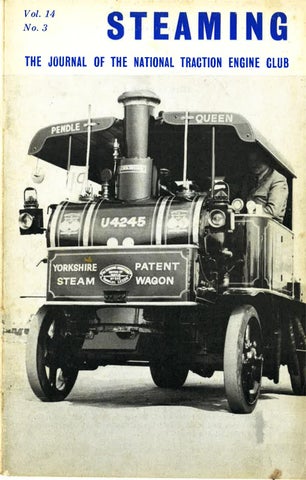
Vol. 14 No. 3
STEAMING
THE JOURNAL OF THE NATIONAL TRACTION ENGINE CLUB
STEAMING
NATIONAL TRACTION ENGINE CLUB
OFFICERS FOR 1971 President: ARTHUR NAPPER, ESQ., Meadow House, Appleford„ Abingdon, Berkshire. Vice-President: S. J. WHAR FON, ESQ., Southern Down, Minster Lovell, Oxford. Chairman ANTHONY HEAL, ESQ., Baylins Farm, Knotty Green, Beaconsfield, Bucks. Vice-Chairman: J. CRAWLEY, ESQ., Field House, Turvey, Bedford. General Secretary: G. F. BECK, ESQ., 127 Greensted Road, Loughton, Essex. Treasurer : J. H. HOBBS, ESQ., 6 Esher Close, Basingstoke, Hants. Editor : RAN HAWTHORNE, ESQ., 19 Bridle Path, Woodcote, Reading, RG8 OSE, Berks. Membership Secretary : C. C. AYES, ESQ., 15 Milking Pen Lane, Old Basing, Basingstoke, Hampshire. Club Ties and Badges Officer : F. G. UPTON, ESQ., 30 Windsor Road, Maidenhead, Berks. Chairman, Rally Sub-Committee :
J. R. BONSER, ESQ., 6 Rokeby Gardens, Woodford Green, Essex. Technical Services and Spares Officer: BRIAN ORAM, ESQ., Bourne House, St. Mary Bourne, Andover, Hants. (Tel.: St. Mary Bourne 260).
ACKNOWLEDGMENTS We are pleased to acknowledge the help of Affiliated Club and area correspondents, Leyland Motors Ltd., Maurice A. Smith, Derek A. Rayner, Tom Varley, Paul Antell, Harold Lumby, Charles Daniel, Alan Thomas, Colin Tyler and Alan Duke.
STEAMING (incorporating the "Newsletter")
THE JOURNAL OF THE NATIONAL TRACTION ENGINE CLUB
STEAMING SUB-COMMITTEE
E. A. FILLMORE, ESQ. 34 Northwick Park Road Harrow, Middx. RAN HAWTHORNE, ESQ. 19 Bridle Path Woodcote Reading, RG8 OSE J. H. HOBBS, ESQ. F.A.C.C.A. 6 Esher Close Basingstoke Hants. Correspondence regarding the content of Steaming—articles, notes, photographs, etc. for publication and classified adverts to Mr. Hawthorne. Correspondence regarding display adverts or inserts to Mr. Hobbs. Correspondence regarding Club Membership, change of address, delivery of Steaming to Mr. C. C. Ayes, Esq. Milking Pen Lane Old Basing, Basingstoke Hampshire Steaming is published by the National Traction Engine Club for private circulation. Copyright held by N.T.E.C. or contributors.
From the Editor's Chair The last issue of " Steaming " was severely delayed by the " copy " being " lost " between Reading and the printers throughout the postal strike. I am grateful to the printer for producing that edition in record time and also to Mr. and Mrs. Charles Ayes for getting the copies out to members within hours of receiving them from the printer. What a wonderful experience it must have been for members of the West of England Steam Engine Society when they had twenty-four of their engines in the recent Richard Trevithick parade. Perhaps it was not inappropriate that one engine " dropped a plug " for this valuable device is attributed to Trevithick. Surely the " Cornish Giant " must have beamed with pride as he looked down on the 1971 Cornish Steam men. The next edition of " Steaming " will, we hope, be through your letter box around mid August. Would contributors send their copy or articles within the next few days please. We would also be glad to have reports of early season rallies ; reports should include a list of engines and, if possible, three or four glossy photos of engines attending. Last day for Rally Reports, Engine News, Articles and Members' Adverts (which are inserted free) is June 18th. As the Rally season gets under way, we would draw the attention of all engine owners to the note on page 100 regarding the coverage, or lack of it, of boiler insurance at rallies. RAN HAWTHORNE.
100
STEAMING
ENGINE INSURANCE AT RALLIES The Club's Insurance Brokers, Messrs. Tennant, Budd & Roderic Pratt Ltd., have recently been able to clarify the position of engine owners who have their engines covered by a N.T.E.C. policy. The policy sets out that purposes of use include " Steam Rallies and similar functions organised by the N.T.E.C. or other recognised Clubs governed by the Code of Practice drawn up by the N.T.E.C." It has been ruled that if an engine is taken to a Rally NOT so organised, the N.T.E.C. policy will be inoperative. The insurers have agreed however, that if an insured wishes to attend a rally outside the N.T.E.C. Approved scheme they would, under certain circumstances extend cover on payment of an additional premium. Furthermore they have ruled that if an engine is taken to a local Village Fete, Charity event or similar, not governed by the N.T.E.C. Code of Practice, the policy would be operative provided the engine was used for display or exhibition only, and not in any kind of competitive event with other steam engines. Simply ; if your engine is covered by a N.T.E.C. policy you are covered at " Approved Rallies " and small events where ring events are not held, but you are NOT COVERED at Rallies or events which have not been approved by the N.T.E.C.
CLUB A.G.M. & DINNER At a recent Executive Committee Meeting it was agreed to hold these two important events on separate occasions. The social sub-committee are making arrangements for a private club visit to Clapham Museum, including an informal meal on Saturday, 13th November. The A.G.M. will be held on Saturday, 4th December, 1971—full details later,
PHOTOGRAPH COMPETITION We have many photographers within the membership of the N.T.E.C, and to enable ilium to show Lheir woik. we aie offering plices of if 111SL prize, with 50p for runners-up, for black and white prints of any type of engine covered by club interest—rally, posed or working. Prints should be " glossy ", at least post card size, but preferably halfplate. The name and address of photographer should be on the back, together with details of the engine, Works No., etc., where taken and any other relevant information. Open to members and members of affiliated clubs. All photographs remain the copyright of the photographer. N.T.E.C. have the right to use any of the photographs submitted, in " Steaming " or elsewhere. Photographs can be returned if a suitable S.A.E. is enclosed. Closing date for entry is Saturday, 18th September. Prize-winning photographs will be in the December issue of " Steaming ".
BEST EVER RALLY RESULT Since 1956 Traction Engine Rallies have been held annually at Rempstone, Leics. Year by year the rally has supported the Royal Midland Institute for the Blind. The profit on the 1970 Rally was £725, added to previous donations this makes a total of £4,474 that has been passed on to the Institute. The Rally Secretary is J. T. Beehy of Rempstone. The 1971 Rally is being held on July 3rd and 4th.
STEAMING
101
SPLIT BEARINGS by "TECHNICIAN" A few years back, I was asked to refit the big end on an Aveling single cylinder roller which " knocked a little ". On stripping it, everything that could be wrong was wrong, including the front and back half brasses being interchanged. There was a gap of early I" between the brasses when held tight on the journal, and the brasses were very slack in the strap. Having since this time talked to quite a few engine owners, and found that many people think there should be a gap, perhaps a few notes might be a help. The first thing to remember it that the tapered cotter is the means of pushing the two half brasses together. If the bearing is slack with the brasses touching, then the mating edges are slightly reduced and the cotter driven home to again bring them into contact. When correctly fitted, the cotter should be hard home, and the journal free in the bearing. After all, you wouldn't leave the big-end bolts slack on a car engine ! (or a Foden). The other important point on big ends is that the brasses should be a tight push fit in the strap. Beware on this, as most straps are made to spring inwards, and the fit of the brasses needs to be correct when the strap is fitted over the connecting rod. If the brasses arc slack in the strap, but otherwise sound, it is worth soldering strip brass on them and refitting to the strap. Of course, if the crankpin itself is rough, this must be corrected before fitting brasses ; it may sound crude, but careful use of fine files and calipers, and a final clean up with emery cloth tape can restore a pretty horrible pin to a very serviceable condition. Once the pin is right, scraping of the brasses with " raddle" or engineers' blue is a straightforward, if tedious job. They should be checked whilst fitted to the strap, and held up with the cotter. The same remarks apply to two piece main bearings, except that the set bolt is used to hold the brasses horizontally, and the cap vertically. The type where the splits are offset are more awkward if badly worn ; the best remedy is new brasses, but to refit worn bearings, the landing faces which fit in the bracket need to be built up and refitted so that the bearing surfaces form a true circle. The outside appearance after this will be a bit cockeyed ; if you are a purist you can file the edges to restore the original shape, only a bit smaller. Three piece bearings, which have a separate horizontal part brass are fitted as with big ends. with the loose part adjusted via the set bolt, and the whole bearing clamped solid with the cap. Many of these have been run loose in the bracket at some time, evidenced by the "morocco leather" effect on the landing faces. This needs to be cleaned up, and built up if necessary, so that the brasses are held tightly in the bracket. The only exception to this gospel of tightly fitting brasses is on some small ends, where there is a loose tongue adjusted by a wedge. In this case, the loose piece is adjusted to give just a working clearance on the pin. Since the thrust is along the line on the conecting rod, and the bearing only oscillates, it is reasonably satisfactory ; without redesigning the whole issue. we have to make the best of it. Finally on lubrication ; particularly on big ends and eccentric straps, a "tacky" oil will be found to give excellent results without excessive consumption. I have used Esso Cantona 150 and Shell Nassa J78 ; doubtless other oil companies produce equivalents, but the difference between this type of oil and a normal one is well worth the slight extra cost. For DISPLAY ADVERTISING SPACE in the next edition of "STEAMING"
contact J. H. HOBBS, ESQ. 6 ESHER CLOSE, BASINGSTOKE, HAMPSHIRE Telephone Basingstoke 4422 (day) Rates : Full Page, £10 ; Half Page, £6 ; Quarter Page, £3,
102
STEAMING
MEN OF STEAM - TOM VARLEY, GISBURN by RAN HAWTHORNE
As always seems to be the case in these stories, steam made its first impression on Tom Varley at an early age. It was during the last war, Tom was laid in bed suffering from measles when into the farm yard below his bedroom window came a set of threshing tackle. For three days they threshed, moved to another stack, threshed and so on. Tom was fascinated. A few years later at fourteen, Tom left school and went to " farm service " on a small farm in the Pennines, living in with the family. Here he had to turn his hand to anything and everything. Horses provided the power on these small hill farms. Tom's willingness to have-a-go, which we know so well from recent years, showed itself on the farm. He saw a gap in a stone wall and decided to mend it. As he put the last stone in place, it all fell down ! " Never mind " said the farmer, " you can rebuild it again tomorrow." Tom did just that and within a year or two became proficient in the art of stonewalling. Tom married and took a job as a shepherd. Included in his work of looking after the sheep was the job of looking after the stone walls that divided the fields and moors. Tom's ability as a stonewaller progressed and it wasn't long before he was persuaded to enter stonewalling competitions. He worked his way through various competitions and agricultural shows until in 1961 he went to the Royal Show at Newcastle where in open competition he won the championship against Wailers from Scotland and Wales as well as from England. One of the highlights of the show was being presented to the Queen Mother. Another was when walking round the show in the evening, Tom came across a Fowler Showman's Engine named " Excelsior ", No. 14862 (now named " Evening Star "). He hadn't seen one of these engines since he was three or four and the memory of a show engine pulling loads through the village so long before was recalled. Later the same year Tom gave up shepherding, bought a cottage at Stainforth, near Settle and set up in business as a stonewaller. The business prospered and within five years, fourteen men were employed, contracts being undertaken over the whole of the North and down to the Midlands as far as Staffordshire. Travellers along the Al can appreciate some of the work, for Torn was responsible tor the stretch of walling from Ferrybridge to Wetherby. In 1966 Tom bought Little Todber Farm, Gisburn, a small hill farm complete with a herd of Jersey cows. The same year he acquired and renovated a very rare vintage car, a M.S.L. that had been made in France in 1911. Tom had been to one or two rallies. In 1967 he visited Caenby Corner and met the Fearnley family. He made enquiries about an engine. The magnetism of steam was becoming stronger. No-one could help. Shortly after, Tom telephoned a man at Chorley for information on the M.S.L., when in the course of conversation he learned of a Sentinel Wagon that had been stripped for repair and was for sale. Tom bought the wagon, an S4, No. 9003 (1934), got it home and started rebuilding. Whenever he came to a part that he could not see where it had to go he made the journey to Ted Ashton at Knottingley to see his Sentinels and seek his advice. By February, 1968, Tom had rebuilt the wagon to steaming stage when one day Nicholas Jackson, a garage proprietor from Barrowford, near Nelson, called to photograph the Sentinel. Nicholas did more than photograph the Sentinel, he joined the team. Nicholas's knowledge of coach building has been a great help to Tom and with his help the wagon was completed, painted, named " Pendle Lady " and steamed to the Burton Constable Rally in May the same year.
Left to right, Nicholas Jackson, David, Terrance and Tom Varley with " Pendle Queen" soon after 1970 London - Brighton run.
DNIINIVU IS
104
STEAMING
At the Harewood House Rally later that year Walter Fearnley told Tom about the remains of two steam wagons that had laid derelict in Robinson and Birdsall's yard, Leeds, for many years and had been cut up in 1961. Tom's interest was aroused and he took Walter with him to see. Partly covered by 400 tons of non-ferrous metal, Tom saw the remnants of a Fowler Steam Wagon, No. 19007 (1931), the chassis cut through in several places, the front wheels cut off just behind the stub axles. the front axles missing, springs missing, cylinders missing, the boiler separate from the rest, hits all over the place, some may belong, some may not. The other was, or had been, a Yorkshire wagon. This had stood just as long and had been cut up just the same. Even Walter Fearnley who at one time had been with the Yorkshire Patent Steam Wagon Co. and who had driven a Yorkshire as recently as 1946 had a job to recognise much of it All the gearing was missing as was the body and cab and the crankshaft had been cut in half. That area of the yard was about to be cleared and so a quick decision had to be taken. Tom bought the lot, everything that was thought to be part of either the Fowler or the Yorkshire was brought away—at £20 a ton. So, numerous bits and pieces arrived at Gisburn. The situation was assessed. The Fowler was short of cylinders. The Yorkshire was short of gearing so she was tackled first. The boiler was repaired at home. A new chassis was made, the hack and front axles were rebuilt, the crankshaft was repaired, the gearing was made. Tom had sold the Jerseys, gone into partnership with his stone wallers, Tom looking after the contracts, the drawing and the costing, and at the same time was establishing a holiday and touring Caravan Park at Little Todber. Roads were needed in the Park so in January, 1969, Tom and
Nicholas jointly purchased an AVeling & Porter Roller as she finished work with the Walton-le-Dale Council. She was very " tired", but the roads were rolled and she then went to the workshop where she is now being rebuilt. Work continued on the Yorkshire. The boiler was built into the chassis and so Yorkshire Patent Wagon, No. 940, that had been new in 1917 began to come back to life. Tom nearly despaired of ever finding a driving chain but eventually a chain of the correct pitch, 21", from an Aveling-Barford roller was obtained. Numerous parts and fittings came from enthusiasts who had heard of the rebuild. Tom and Nicholas built a new body and cab. Steam trials and painting went on in the hope of being ready to take part in the 1970 H.C.V.C. London Brighton run. The valve gear had to be set. The Fearnley family came to give a hand and then on what was to be the the final steam up before setting off for London, the second shaft seized solid. They did not give up, the shaft was removed, bearing made good, replaced and away to London having had only a few hours' sleep in the past forty-eight hours. The Yorkshire had only done a few miles on the road and was not " run-in " but Tom and his crew set out from London and after covering some seven or eight miles " Pendle Queen " was put back on her transporter for the remainder of the journey to Brighton where she was in the final parade and attracted great attention. Throughout the rest of the summer a good deal of attention was given to getting the valve gear, timing and many other details " just right ". Tom and Nicholas had been joined by another garage owner, Charlie White of Earby. As Tom says. " It's a team effort."
" Pendle Queen", as the Yorkshire had been named, took part in the gruelling H.C.V.C.'s Trans-Pennine run from Manchester to Harrogate. She covered the sixty-three miles in ten hours. She has been in great demand at Rallies being, it is believed, the only three-ton Yorkshire in Greal Britain. At Tom's 1969 late season Steam Party, Jack Whitehouse was one of the visitors. Jack joined the team and was with the Yorkshire on the 1970 London-Brighton run. Later that year, Jack got married and Tom and the Yorkshire were on hand to take the bride and groom from the church at Burnley to the reception at Colne.
STEAMING
105
T YOF DEPARTM
-•
Fowler Gully Emptier, No. 19007. New 24/3/1931 for City of Leeds Cleansing Department. At work 1933.
Work continued on the Aveling roller and a pair of 90° inclined cylinders for the Fowler were located so a new chassis was built for her. The boiler that had laid on the ground in Leeds since 1961 was examined and found to be generally sound except the outer wrapper, which was wasted. So the boiler was sent away to have the outer plate renewed A suitable piece of metal was obtained, the stub axles welded on to form the new front axle, springs have been obtained, spring hangers made and the whole assembly fitted. The rear axle appeared to be more or less complete but the main cliff' wheel in the back axle was found to be shattered. Tom found a similar part, adapted it to fit, to overcome yet one more difficulty. A number of parts of the engine will have to be made and the whole assembly fitted in the chassis. A body and cab has to be built as well as many other incidental items. As if this was not enough Tom has recently purchased the remains of a 1931 Sentinel DG6 that was built on pneumatics. She has stood out minus body or cab for many years, her chassis having been cut through " amidships ". The story of Tom Varley is by no means told. Much of it is still to come. We look forward to the Fowler wagon, to the Aveling roller, to the DC6 and who knows what else 7 The state of tackle when Tom starts and the quality of the finished product leave us in no doubt at all when we say " Here is a man of steam ".
106
STEAMING
LETTERS TO THE EDITOR Dear Ran, Here is a small snippet of engine news from the past, which perhaps other members may know of or add to. Yesterday I went to see an uncle (a veteran of the Great War), recently bedridden. He very distinctly remembers a Fowler Ploughing Engine on " W " beach at Gallipoli. It was engaged in moving artillery and heavy stores over the beach and on the cliff road. He said it had a half-length canopy. He can only remember seeing the one engine. As the beach was eventually evacuated and most of the stores destroyed, perhaps someone somewhere can trace the history of this engine further ? Perhaps she still lies somewhere on " W " beach rusting away ! Yours sincerely, ARTHUR HALL, Binfield, Berks. Dear Sir, AVELING & PORTER STEAM ROLLER No. 8796 We were naturally interested to read of the request for information regarding the above under heading " Lincolnshire " in your October News Letter No. 15 and to confirm we are always ready to give what information we can to any owner or steam enthusiast interested in modelling or restoring any of these fine old Aveling & Porter machines. In this case our records indicate No. 8796 is a 5 h.p., 12 ton Road Roller, supplied in March 1917 to Hunts County Council being a 2 speed BS and weighing 14 tons 3 cwts. She has a Uwe of 8 inches X 10 inches stroke and slide valve, test No. 8034. She is fitted with 32 tubes, 4 ft. 2+ inches long X 11 inches diameter and 1 stay tube, also Penberthy BB injector and R6-60 C pump feed. She was fitted with a 5 inch diameter gauge with red line at 125 lbs. per sq. in. and was fitted with a 3-tine scarifier, water elevator and hose, water sprinkler system and Dew rance valves. We are particularly pleased to know of this machine in our own County and like to keep a record of these grand old machines still " alive ". Yours faithfully, AVELING-BARFORD LTD. (Signed) F. I. W. CARROTT, Public Relations Dept.,
Invicta Works, Grantham, Lincs.
PADDLE STEAMERS The Paddle Steamer Preservation Society send details of cruises arranged for 1971. On 23rd May a cruise on Loch Lomond on " Maid of the Loch " has been arranged. This paddle steamer is one of the very few that is still in regular operation. On 15th August the coal fired paddle steamer, " Lincoln Castle " will steam on a Spurn Head tour from Hull Pier. On Saturday, 25th September, the last sea-going paddle steamer in the world will steam from Gourock at 0900 hours and around the Isle of Arran Further details of these, other cruises and the Society can be had from C. J. M. Phillips, 5 Chestnut Road, Brockenhurst, Hants., SQ4 7RF.
New July 1923 to H. & G. Simonds, Reading. Yorkshire Patent Steam Wagon, No. 2019 (Reg. No. DP4975), 6 tormer.
OtslI NVU IS
108
STEAMING
ONE THAT SURVIVED THE CRAIGIEVAR EXPRESS STEAMS AGAIN by MAURICE A. SMITH, A.F.C. Reprinted by kind permission of " Autocar" Grotesque though it may look in 1970, this tricart probably appeared attractive through the eyes of postman Andrew Lawson, its creator. He conceived it at a rime when every horseless carriage was weird and wonderful, and he built it as one of several outlets for his inventive urge. Even the little that has been written about the Lawson tricycle during its 75 years seems to have been padded out by imagination. Thanks are owed to the late Master of Sempill for its preservation for many years at Craigievar Castle, from whence it derives its name. Thanks also go to George Oliver who has provided many of the historical details from his own records and recent on-the-spot investigations, which include talks in 1966 with Andrew Lawson's son James. Dyce airport looked gentle and inviting in the showery sunshine 2,000 ft. below after I had flown much of the way from Gatwick in cloud. It seemed appropriate to be going north in a small aircraft to visit Craigievar Castle, the ancestral home before his death, of Lord Sempill, A.r.c. I had known him as an ardent supporter of light aviation between the wars. His outstanding flight was made solo to Australia in a Puss Moth. Yet in contrast, one of his treasured possessions was a remote ancestor of the estate car, the Craigievar Express, which I was to inspect and later purchase. It came my way as the result of a casual question at a party, and a re-introduction by Lord Hayter, followed by an exchange of letters with Lady Sempill who wished Lawson's Express, insured then for 1.1,50e, to find a good home in Great Britain. A couple of months passed before the 1895 Express was finally roped on to a car trailer at Craigievar. John Bullock of Rootes, as the name was then, co-drove with me through the night and his Singer Vogue brought us back to Surrey by noon next day. Now an inspection in depth could begin. But first, what of Lawson ? Andrew "Postie" Lawson was born in 1854 and although he was trained as. a joiner he did not follow this trade for long. When he was 20 he (ear-'-g 13a. a :week), and far the next 10 ye.=, jumed the pl,4tal until his retirement in January, 1914, he operated from the post office at Whitehouse, between Alford and Insch, about 30 miles inland from Aberdeen. At first Lawson travelled his long and hilly round on pony-back ; later he built a chapel-cart and for wet weather use, a van. At times, according to his son James Lawson, he varied his routine by hazarding life, limb and Queen Victoria's mails on a penny-farthing. Incidentally, the maintenance of the pony had to be paid for out of the Postie's earnings, which rose to little more than £2 a week during his long service. It is possible, of course, that Andrew Lawson had other sources of income. He was a keen and competent photographer and among the out-buildings at his croft his studio was prominent. Early on he built for himself a wellequipped workshop. Sometime in his eighties he acquired a dynamo, which he connected to his water wheel and used it to light the house. After the death of his father, when the family croft became his own, he designed and built a threshing mill that lasted until after his death in 1938— and would be in existence still, no doubt, had it not been destroyed in a barn fire. Another great interest concerned steam. After Lawson became a postman he was in daily contact with the railway, at Whitehouse station, and there can be little doubt that he took every opportunity there to further his knowledge of the " silent force".
" Postie" Andrew Lawson driving the express.
o VZ
NI NI D
VgI
S
110
STEAMING
Apart from direct contact of this kind Postie kept as up to date as he could by daily reading of a surprising variety of periodicals. By arrangement with the newspapers (the Aberdeen Free Press and The Journal) and with the permission of his employers he collected bundles each weekday from Whitehouse Station and delivered individual copies while on his postal round. For this service he was rewarded with a free copy of each journal daily ! From them he would keep in touch with national and international news in a general sort of way and from his regular reading of Exchange & Mart, Work, The English Mechanic and the Amateur Photographer (to all of which he subscribed). It is more than likely that he was prompted to build his own " horseless " as a result of reading about the activities of other pioneers. At any rate Andrew Lawson began work on his one and only self-propelled road vehicle in 1895 and although his son James was then only 15 or 16 he can still remember helping in its construction. Steam as the motive force seemed obvious, as long as the necessary parts could be obtained inexpensively. For a time-served joiner who lived in a district not short of timber, wood was the material for as much of the vehicle as was practically possible. It is unlikely that Lawson had had the opportunity to examine a motor-car. To build the " hull " presented no particular problems and the only work put out at this stage was the making of the steel tyres for the wheels, which was the task of the local blacksmith. An engine was found in Aberdeen, where it had been in use driving a saw bench in the premises of a firewood merchant. It seemed that little or nothing had to be done to it before it was installed. The boiler was another matter and before it was ready for use Lawson had nearly gone to law because of the unsatisfactory nature of the work carried out on it by an Aberdeen engineer who tried to get away with the fitting of worn-out gauges, whistle and safety valve. His son remembers that the bare boiler was bought through Exchange & Mart and he is almost certain that it came from an English source. James Lawson was at that time travelling into Aberdeen to school each day and his father asked him to keep an eye on the progress of the boiler. This was done somewhat surreptitiously because Mrs. Lawson took a poor view of the project as a whole. James recalls that after his first inspection he returned to Craigievar, had his evening meal and settled down to his homework, in the presence of his parents. Eventually his mother went off to bed, in the adjacent bedroom, and his father slid a note across the table. " What like is the boiler ?" was written on it. " Looks like a good sound job." James scribbled in reply, but there was no talk of the matter until father and son were certain that Mrs. Lawson was soundly asleep. The Express was never used as a mail- and postman-carrier, nor was it ever intended for such a purpose—which spoils the still-popular local story that letters and parcels carried in it were often undeliverable because the addresses had been obscured by smoke, soot or water. Once, it was driven over to Whitehouse from Craigievar, to prove to scoffers there that it was able to travel under its own power, and thus it did set out on its creator's postal round. According to James Lawson, however, the route taken was not the usual hilly one but a much flatter and easier one. Andrew Lawson retired at the age limit of 60, in January, 1914, and the Imperial Service Medal that he then received is now a cherished relic on view in Whitehouse Post Office. After his death the Express was sold to a Mr. James Smith of Aberdeen, from whom it was bought back almost immediately ; thereafter it passed into the possession of the late Lord Sempill, the laird at Craigievar. The present owner believes in the theory that with ancient vehicles it is a mistake to disturb anything that seems to be sound and in working order. But steam has to be an exception because one needs to have a full inspection
STEAMING
111
for a boiler certificate to be issued. This involves opening it up, probing and measuring, and filially giving it an hydraulic test to 11 times the maximum working pressure. The plumbing is similarly checked and recent regulations require extra steam valves to be inserted to guard high pressure pipes where they leave the boiler. Finally, there must be a second means of getting water into the boiler to supplement the small mechanical pump originally fitted. This led to the fitting of a / in. injector. Eventually, W. B. Seed, engineer surveyor of the Cornhill Insurance Company, was able to put a first signature to the test certificate, followed later, when in steam, by one from Mr. Egan. Written in a few sentences this all sounds quite straight-forward, but in fact it involved cutting out the old corroded fire tubes and welding in new ones, replacing the centre-stay, building tip the crown of the fire box and some other welding repairs. There was also the plumbing and the fitting of a different safety valve—in all costing several hundred pounds, and more than a year of to-ing and fro-ing and waiting. All this work was done by Gordon Lugg and his son, Michael, of Billinghurst. So as to have an authentic vehicle at the finish, replacement work was kept to a minimum and only a few essentials were altered or strengthened. It would have been all too easy to hack the structure about and make new parts, so finishing up with a near-replica of little real value or interest to anyone. A tedious task on the pine frame was the careful cutting out of areas that were burned or rotted, and the glucing and screwing in of replacement pieces of seasoned Scotch pine like the original. The floor boards round the boiler and two oak sub-frames under the boiler itself, were similarly replaced. Remounting the engine and cross-shafts was quite a performance because the wooden structure had all moved fractionally. The split bearings—mainly of wood—had to be packed and adjusted to get acceptable alignment and engagement of gear teeth. The small, horizontal, single-cylinder engine on the port side drives a frail looking overhung crank. This carries two small gears on the left and a drum and flywheel on the right. The drum drives the water pump via a short belt, pulley and crank. All this is at or just above floor level. Below is another cross-shaft with two large gears which move left or right to engage above and give one or other of the two ratios. One gear has an ordinary dog engagement on its shaft, the other has two pegs which register in a collar—a matter of what Postie Lawson could lay his hands on, no doubt. Both shafts were out of true ; the upper one was plain bent. Once the boiler had been reinstalled and a new ashpan made beneath it, by Mr. Lugg, the suspension springs could be checked with their correct load applied and the meshing of the final drive gears adjusted. The awful thing about the Lawson transmission is that the small driving gear is sprung and the larger one unsprung. The two shafts lie up about horizontally so that the limited spring movements more or less roll the small gear around the larger one. Even so, the teeth take a bashing on rough roads. To add to the problems, the teeth on the big gear are of wood, each one separate, slotted and pinned into position. Yet they work. The rear springs are a la carte with stiff coil helpers at mid point over the axle bearing blocks. At the front ends the springs are attached to sliding wood blocks with about in. of movement. At the rear they bolt loosely to the extremities of a transverse leaf spring, with rubber blocks separating the respective ends. Perhaps the most surprising 1895 mechanical design feature is the bevel differential built into the large driving gear. Not many amateurs of that time would have thought of such a refinement. By comparison the steering mechanism is crude, though no more so than that of some contemporary vehicles. A long, fore-and-aft wooden lever moves a sliding block back and forth and this in turn operates a lever bolted to the front forks. It is all rather heavy and abrupt, and the angle of the
112
STEAMING
forks does not make for stability. Fortunately, the steering lock is limited, so there is less risk of toppling over than one might imagine when sitting up on the driver's box. Having no owner's manual we have had to learn everything by trial and error. The process is still going on. Steam engines do not need high revs to produce torque and this Express runs more sweetly in top gear than low. It is very hard to start without a small shove, but less difficult than we had thought until we learned more about handling the steam-valve-cum-regulator. If you give the Ilywehel a push round and feed in just enough steam, you can get away jerkily. Too litle steam and you stop ; too much and a dreadful rocking may be set up, the mechanical implications of which do not bear contemplation. With no control of the slide valve (and no reverse), it is possible to get the piston making partial in-and-out motions without the crank turning past the centres. The small driving gear winds itself round the wooden teeth, extending the springs on the left side, then runs down again rolling the whole body to time with the piston. The power of this small engine is quite remarkable on such (happily infrequent) occasions. One easy way round the trouble if there is no one about to give a shove is for the driver to push it himself. A few paces is plenty, and both steering lever and steam valve can be reached while standing beside the Express. There is also a step to get you on to the box when the vehicle is under way. Incidentally, the seat really is a box. The lid opens to load the coal, which can then be shovelled out of a slot at floor level. Like all steam engines, this one idles beautifully in neutral at no more than 50-61) r.p.m. It will turn with only 20 p.s.i. on the gauge and just move the vehicle at about 50 p.s.i. Normally it runs at 90-95 p.s.i. We are now learning to recognise the steam sounds which indicate light and full throttle or over-run. The Express feels every up-gradient and would charge off down quite gentle slopes if you did not back-off on the steam. The ancients iii the Craigievar arca estimated the top speed at 5-6 m.p.h., but in fact it has proved to be twice this figure. There is just enough engine braking to be handy if you need more, the transmission brake works surprisingly well. This is no more than a wooden lever carrying a strip of Ferodo which presses on the flywheel. In reserve is the parking brake which winds two cart-type shoes (lined wooden blocks) on to the main wheels with the aid of chains, a lever and a swinging crossbar. These two brake systems measured with an official torque meter, passed the MOT test with something to spare. A vehicle such as this must achieve at least 0.3g. It was a long-winded business getting a test certificate for a new licence. Gentlemen from the Ministry had to be consulted on how the Express was to be classified. Weighing just over 10 cwts. it is too heavy to be a half-rate tricycle. Not being kept on a farm it could not be a tractor. In the end it had to be a private car at the full £25 rate and with nearly all the latest basic test requirements. Surrey's Senior Vehicle Examiner kindly attended personally and the Norfolk Garage at Holmwood issued the certificate. 1 am very grateful to Mr. Low, Taxation Officer in Aberdeen, who found and arranged to re-issue the appropriate registration number of SA 16. The first tong journey was the S miles from near Epsom to the Great Bookham Traction Engine Rally held this year on the bypass between Dorking and Reigate. It took If hours. At first, with the Express in top gear, the fire stayed dull and we quickly ran out of steam. As we pulled into a lay-by to avoid delaying the heavy weekend traffic the mechanics in the following car raced round as if it were a pit stop at Le Mans. Oil for the bearings and gears, steam oil for the cylinder, water in the tank, more coal, a wave out into the road and we were away again. The next mile was up hill so we started off in the rather grinding low gear and this gave more exhaust blast to draw the fire. Steam pressure built up well on the next down slope, then, after having to stop at a roundabout, and taking the opportunity to select high gear (you cannot change in motion), we could use the water pump to top up the boiler and dropped the pressure, but now the fire was really bright and the paint was blistering on the chimney.
STEAMING
113
As far as we could tell the Express was willing to chuff on for miles, pausing only to take on water and accept a shovel or two of coal. The steering is so abrupt and unstable at speed that you must concentrate on it. No chance of stoking or oiling in motion. Going downhill with the transmission brake on and the steam almost off, the tricycle is a little more stable, presumably because the rear wheels are holding back. The wind-on brake shoes also stop the tricycle, but now that hard rubber tyres have had to be fitted, they cause some shudder.
First steam after rebuild. Obviously we have a lot to learn yet about keeping fire, steam, water and regulator valve just right. If you get them wrong you are either short of steam when you want it or the water level is too low and you have to use the steam to inject or the fire looks black and will not draw up. Just now the concentration and responsibility of a day's steaming leaves us exhausted (us being number I driver now writing and number 2 driver Chris Sykes). Having no canopy, scalding drops of water and oil and small cinders descend on us, leaving bare forearms, shirt and regulation blue cap spotted pink and black. We now know why the engine drivers get so thirsty Amateurs who restore old vehicles always need help. My wife and I are very grateful to those who helped us. Among them were Turners and Kennedy Batcheller in Sussex who found me the seasoned Scotchpine I needed. Permali Ltd of Gloucester made the drawings of the main driving gear teeth
114
S T EA M'I N G
and B. R. Kemeys, their assistant chief engineer, supplied 48 of them in their densified wood. They have worked well. Jack Brabham's Peter Davey balanced the crankshaft and flywheel between work on racing engine shafts. I think he was secretly rather horrified to handle something looking like parts of a mangle. Ferguson Research at Coventry did the copper and brass water tank very nicely and Thomas Tingley of Walworth near the Elephant and Castle (120 years in the business) trued up the wheels and fitted the solid rubber tyres now demanded if you want to go out on the roads. Finally, Willcox's of Southwark still supply all manner of things for steam, including fittings, asbestos yarn and steam oil. Foster Blackett and James of Hebburn, Durham, do primer and final paints for boilers and hot parts. A local farmer once said to Andrew Lawson, "Aye, Andra, you were born ower early." "Na, na," replied the Postie, " just richt, ye ken : just richt." Thank goodness I was not ower late for Andra's Express.
The Express from above.
STEAMING
115
AUTOMATIC HALF-BARRIER .LE VEL CROSSINGS Following the large amount of publicity given to the "Nixon " disaster in which an express passenger train ploughed into a large transformer stuck on a level crossing of this nature, with subsequent loss of life, there have been several modifications carried out to these crossings to make them safer. Of special interest to Members of this Club are certain of the rules which
now apply to this type of crossing concerning Large or Slow vehicles. But first a description of what an auto half-barrier crossing is. These crossings are designed to speed the flow of traffic and if used properly, they arc safe. They consist of red and white barriers, pivoted on posts at the side of the road and which are lowered across the left hand of the road. A road sign which states " Automatic Barriers STOP when lights show " under a gate in a red triangle is usually the first indication of this type of crossing. The road on each side of the crossing is double white lined and in the immediate area of the crossing is " yellow boxed ". On the approach of a train, the amber lights show and the pedestrian warning bells sound. The amber lights go out and the red lights begin to flash. The barriers then start to lower. The train can then be at the crossing in as little as 32 seconds. If the barriers stay down and the red lights continue to flash after the train has gone, a sign lights up saying " Another
train coming " and only after the barriers are up and the lights are out, is it safe to cross. Certain drivers, such as some of our own Club members, if driving their vehicles, are required to stop in advance of the crossing, by a blue traffic sign where a free telephone is installed. These drivers arc required to telephone the signalman to advise him of the intention to cross the line. This applies to drivers of vehicles which including load and trailer(s) may be either more than 55 ft, long, or more than 9 ft. 6 ins. wide or more than 32 tons total weight, or arc unable or unlikely to cross at more than 5 m.p.h. After permission has been granted and the crossing has been made, the driver must again stop at the similar telephone on the other side to inform the signalman that the vehicle is safely across. This rule therefore applies to drivers of all steel wheeled vehicles such as traction engines, steam rollers and the like, which are limited by law to 5 m.p.h. and also similar vehicles towing caravans and trailers, if the total
length exceeds 55 ft. In addition, certain parts of the country have electrified lines using overhead conductors and a safe height may also be stated. If engines on lowloaders exceed the height stated, they must not attempt to cross. The voltage is usually 25,000 volts.
In the event of a breakdown on the crossing, get everyone out of the way and telephone the signalman immediately. If the lights start to flash and the barriers come down while the vehicle is stuck on the crossing, get well away from the tracks—the train cannot stop . . . If any further information is required regarding this type of crossing and the use thereof, this can be obtained from your local police station or Railway Area Manager. D.A.R. PLOUGH ENGINE QUERIES In October a member went through Aberdovey Junction by train. Between the main line and the B.R. Camping coaches stood a couple of Fowler Compound Plough Engines. It appears as if one was being dismantled to repair
the other. Can anyone supply details ? In October a Fowler plough engine converted to diesel power was noted on a low loader in a Reading lorry park. Next morning it was gone. News of this engine would be appreciated. Was it going for work or preservation ?
116
STEAMING
r1. RICHARD TRIvITHICK 1771 1833
"The Gladiator" leads the parade through Trelowarren St., Camborne, followed by the Clayton & Shuttleworth, No, 48779,
McLaren, No. 547, at the assembly point, Tehidy, Camborne.
STEAMING
117
RICHARD TREVITHICK CELEBRATIONS PARADE 1971 by CHARLES DANIEL April I3th, 1971 was the two hundredth anniversary of the birth of Richard Trevithick. On the nearest Saturday, April 10th, a parade of steam road vehicles was to take place in Camborne, Cornwall. By eleven o'clock that morning engines were approaching Camborne from many directions, nine engines had departed from Mr. Morse's yard alone and by two thirty no fewer than twenty-four engines were parked in a line in Tehidy Road, Camborne. It was a brilliant day, as hot as many summer days are, crowds of people were flowing into Camborne and press and television reporters were in abundance. Almost precisely at three o'clock Camborne Town Band started the procession followed closely by Burrell Showman's Road Locomotive, "The Gladiator ", which carried a large placard, "Richard Trevithick 1771-1833 ". At the statue of Richard Trevithick a simple laurel wreath was laid by his great grandson, Captain Richard E. Trevithick, who took the salute as the engines passed. The engines then proceeded along Centenary Street to travel through the main street, Trelowarren Street, in a westerly direction. The procession disbanded near the recreation ground about an hour after it had begun. The second engine in the parade was the magnificantly restored Clayton & Shuttleworth, No. 48279, owned by Mr. D. Soloman. Only the previous weekend this engine had made its first run on the road after five years of restoration work, a real credit to her owner, for before he purchased her all valuables had been cut off the engine and the remains dumped in a stream. Aveling & Porter Convertible, No. 4255, owned by Mr. S. Hynd, was the engine which travelled the farthest under its own power to attend, she had covered some seventy miles complete with living van and water cart. The only engine to attend from outside Cornwall was Mr. Courtier's Sentinel, No. 5104, which arrived behind a Scammel tractor. Recently repainted and behind an engine for the first time in its new ownership was the traction engine truck now owned by the West of England Steam Engine Society. Coal for the engines in the parade was carried in the truck behind Messrs. Leath and Pearce's Marshall, No. 69303. The oldest engine present and to many people one of the most satisfying to look at was McLaren, No. 547, of 1894, owned by Mr. C. P. Gregory, our President. Only one casualty during the afternoon, Fowler, No. 12693, owned by Mr. F. W. Alford, lost the fusible plug due to a faulty gauge glass reading. Surely this is a day that will be remembered for a long while, a day when twenty four road engines took over Camborne in memory of a great man and a great engineer—Richard Trevithick. On the actual day of the 200th anniversary of his birth, April 13th, a Service of Commemoration was held in Truro Cathedral and for more than a week an exhibition of items connected with Trevithick and his work was held at the Camborne School of Mines. ENGINES TAKING PART IN THE PARADE
Aveling & Porter : No. 4255, Convertible, as Traction Engine, owned by Mr. M. S. Hynd. No. 5541, Roller, owned by Mrs. P. E. D. Pettitt. No. 5683, Roller, owned by Mr. J. C. W. Jones. No. 6093, Showman's Tractor, 4 n.h.p., owned by Mrs. G. L. Sleeman. No. 8301, Roller, owned by Mr. B. W. True. No. 10187, Roller, owned by Messrs. Leath and Pearce. No. 10190, Roller, owned by Mr. R. W. Haynes.
118
STEAMING
Marshall, No. 69303, with the W.E.S.E.S. Weeks Traction Wagon that carried the coal. Tehidy Road.
Fowler, No. 12693, "Brunel", gets into position in the line-up in Tehidy Road.
STEAMING
119
Wallis & Steevens, No. 7979, arriving at Tehidy Road, Cam borne.
Armstrong Whitworth : No. 10R19, Roller, owned by Mr. G. Ingelby-Oddy. Burrell : No. 3121, Traction Engine, 8 n.h.p., owned by Mr. G. Alford. No. 3159, Showman's Road Locomotive, 7 n.h.p., owned by The Gladiator Club. Clayton & Shuttleworth : No. 48279, Traction Engine, owned by Mr. D. C. Soloman. Fowler : No. 12693, Road Locomotive, 5 n.h.p., owned by Mr. F. W. Alford. Garrett : No. 33353, Showman's Tractor, owned by Mr. B. H. Broad. No. 34789, Tractor, owned by Mr. A. J. and Miss E. M. Rule. Marshall : No. 43345, Traction Engine, 6 n.h.p., owned by Mr. R. H. Jennings. No. 62121, Traction Engine, 7 n.h.p., owned by Mr. J. H. Trounson. No. 69303, Traction Engine, 8 n.h.p., owned by Messrs. Leath and Pearce. No. 88096, Roller, owned by Mr. J. H. Pengclly. McLaren No. 547, Traction Engine, 6 n.h.p., owned by Mr. C. P. Gregory. No, 1552, Ploughing Engine, 16 n.h.p., owned by Messrs. C. F. & R. A. Daniel and R. I. Gunn. Sentinel : No. 5104, Super Wagon, owned by Mr. D. Courtier. Wallis & Steevens : No. 7979, Roller, Advance, owned by Messrs. R. A. Daniel and R. D. Welsby. No. 8030, Roller, Advance, owned by Mr. W. D. I. Gunn. No. 8095, Roller, Advance, owned by Messrs. R. Dingle & Sons Ltd.
120
STEAMING
Garrett, No. 34789, near Tehidy Road.
CONFERENCES Earlier in the year the N.T.E.C. held its annual Spring Conferences for, in the morning, Affiliated Clubs and in the afternoon, for Rally Organi sers. The Club's conference is perhaps most valuable as a means of exchange of information and ideas while the Rally Organisers conference spends quite a lot of time trying to avoid rally dates clashing. With the number now held this is not always easy. " Pirate" rallies were mentioned and instances given where after promises of good rates of expenses and a successful rally, engine owners were left high and dry. It was emphasised that the rally in this instance was not an N.T.E.C. approved event. The moral does not need repetition. If members are in doubt about attending any event, it is advisable to consult Mr. Bonser of the Rally Sub-Committee or the secretary of your nearest affiliated club. Towards the end of the conference, Jack Holloway of Seend, Wilts., presented a handsome silver trophy to the club for the restoration of Portable Steam Engines. This is to be awarded annually. All forms of portables including centre engines and horse-drawn fire engines to be eligible. The trophy was received by Anthony Heal who thanked Jack Holloway tor the magnificent trophy. Jack made two further presentations-7a plaque in memory of the late Jim Lewis, which was received by the Vice-President. lack Wharton, and a ceramic beaker with steam locomotive design which was presented to the Chairman as a moment() of the occasion.
STEAMING
121
DEVON C. C. ROLLERS In the 1950's and 60's, there is no doubt, Devon County Council operated the largest fleet of steam road vehicles in Great Britain. This picture is a typical example of both engine and driver. It was taken on the A30 a few miles west of Exeter in March, 1961. The roller is Aveling & Porter, No. 4986, a 10 ton Single Cylinder Slide Valve Engine that was new in 1902 to Eddisons of Dorchester. She was given the fleet No. 110. One morning about a year after she was new, her driver had a tin of oil warming on the top of the firebox, the engine was ticking over. As he reached for the tin his sleeve was caught and he was pulled into the motion and killed. Ever after that she was known as "mankiller ". By 1921 she was in the ownership of Devon County Council, was No. 1 in their fleet and carried the registration number TA2658.
No. 4986 and Jack Parsons at work on A30, March, 1961.
The driver pictured here, Jack Parsons, had been with her for many years. He said that although she was described as a 10-tonner she was nearly 14 tons. He considered steam rollers much more suitable than the diesels because of the hills they had to work and travel on and the big stone they had to roll. Later in 1961 No. l's firebox was found to be life expired so she was scrapped. The canopy, steering chains and other parts went towards the rebuilding of another engine and the prancing horse found a good home with a local enthusiast.
STEAMING
122
THE SENTINEL STEAM ROADLESS TRACTOR In the 1920's Sentinels of Shrewsbury, the well-known builders of undertype steam wagons, produced a very interesting tracklaying "Super Sentinel " steam tractor. The original illustrations of this vehicle are not suitable for reproduction so Harold Lumby has kindly re-drawn the vehicle to illustrate the layout and detail. The tractor had steel wheels at the front mounted on stub axles for Ackerman steering, the front axle was mounted via a transverse leaf spring giving three point chassis suspension. Front axle movement was constrained to a vertical plane by hornplates. Steering was by worm and nut all enclosed in a casing partly filled with oil. The drop arm ball joints were spring loaded. Steering was described as " relatively light " and it was claimed that the tractor could be steered without the more usual expedient of providing variable speed to each track separately for steering. The tracks were of steel link chain with hardened pin and bush joints and were shod with ruhher. The main track passed round a front track wheel and was kept in contact with the ground by two rubber covered idler wheels no matter what contour was encountered. The track was designed to give a ground pressire of 10 lbs. per square inch. It was claimed that the tractor could work over " fairly loose ground without sinking in ". It was further claimed that the track gave " a progressive smoothing of the ground." The boiler was of normal Sentinel type with a working pressure of 230 lbs. p.s.i. A superheater heated the steam to 1500F above saturation temperature. The engine was designed to give 60-65 b.h.p. It consisted of a two-cylinder double-acting, totally enclosed crankcase-cylinder unit horizontally disposed. The two high pressure cylinders were 61" diameter by 9" stroke, the pistons had two stuffing boxes each and cylindrical crossheads. The two throw crankshaft had cranks at right angles to avoid dead centres. The crankshaft incorporated a differential gear system for accommodating the varying torques of the two tracks. A pair of friction clutches prevented the differential from functioning until there was a difference of 10 to 15 per cent between the torques on the two ends of the crankshaft. Steam
finake;nrb and
F. vhauct was enntrollerl by pop/lett valvec, operated
off two camshafts that had three cams which gave two forward speeds with cut-offs of about 37 per cent and 75 per cent and one reverse speed. A neutral position on the camshafts kept both inlet and exhaust open at the same time enabling cylinder condensed water to be drained. Cylinder lubrication was by a positive feed pump while a splash system looked after the crankshaft, connecting rod and cam shaft bearings. The boiler feed pump was driven off the intermediate gear (which drove the cam shafts). The crankshaft differential stub-shafts had small chain sprockets on their outer ends. Drive was transmitted by roller chain from these small sprockets to two larger sprocket-wheels which were free to revolve on the intermediary stationary jack shaft which is located at the rear of the chassis. The second small pinions attached to these larger sprockets transmitted the drive through heavier chains on to a chain drum bolted to the main driving sprocket of the track. The jack shaft was adjustable in both directions to enable chain wear to be taken up. The braking system consisted of large Ferodo lined brakes which acted on drums formed integrally with the main track driving sprockets. The engine could also be used as an additional braking system. The tractor was soundly constructed and had a good water capacity enabling it to be in use away from a water supply for long periods.
STEAMING
123
The tractor was claimed to be " very satisfactory" for road haulage work, for haulage over rough country, through fords, streams and over ditches, for ploughing and other purposes. In connection with ploughing it is stated that undue compression of the soil is avoided, due to the light load intensity, the tractor could be hitched direct to the plough. The tractor was recommended for " mining and similar excavation work". No mention is made of timber work. A winch does not seem to have been fitted. It is not known how many of these tracklayers were built, but if numbers surviving is anything to go by then the Sentinel timber tractor fitted with winch was obviously a much more successful vehicle.
124
STEAMING
THE ROBEY STORY by
PAUL ANTELL
Since preservation began we have heard many stories of Robey's, some good and some not so good. This one began at the Gloucestershire Agricultural Show at Cheltenham in 1910. On the Robey Stand was a 6 h.p. Single Cylinder General Purpose Engine, No. 29333, and a Robey Threshing Drum. These two items were bought by a Mr. T. Wright of Moreton-in-theMarsh. In 1914 Engine and Thresher were bought by Mr. Blackwell of Farmington. Mr. Blackwell and his son Wally worked the neighbourhood threshing and timber hauling, etc., until 1949. 29333 was registered AD9899. In 1952 Wally drove the engine to Vines Yard at Hardwick when it was sold for scrap, complete with sheet, tools, firing irons, etc. for £20.
Rob.oy, No. 29333, when new. At a later date Vines sold it to Edwards where it joined the many others at Fairford, Gloustershire—during its stay there, brass thieves carefully removed (with a sledge I) all saleable items including main and second shaft bearings.
Around 1966 Messrs. Edwards brought the remains back to their yard at Swindon. The four wheels, front axle and perch were sold to an unknown buyer to convert a Marshall Roller. In December, 1969, Paul Antell, aged 18, looking for an engine to suit his pocket, paid a visit to Edwards yard where many engines had been bought for preservation, but practically everything restorable had gone. The remains of the Robey sitting in the water minus smoke box, chimney base, gear case, etc., etc. This he decided to purchase, with the rear wheels, front wheels, axle and perch from a compound Fowler which was being cut up. The rear wheels were put on the axle, the front wheels and perch chained
to the boiler barrel, which was then winched on his brother's low loader and brought back to Shillingstone. (To be continued)
STEAMING
125
Robev, No. 29333, with Rohey Thresher in the Cotswolds (thou' 1930.
ENCOUNTER by W. L. FORD It is dark. Very dark. Everyone now has gone. From across the field comes the chuff, chuff, chuff of a single. The crew's voices carry over the deserted arena. Only hours before these same spacious acres had been filled with several thousand excited, happy people, revelling in the bright sunshine. But now it is dark, deserted and devoid of activity but for one solitary engine moving intermittently in the dark. I move forward towards the sound to investigate. Chuff, chuff, chuff. Again it stops, near the tent at the end of the arena. A pencil beam of light stabs the air. They are working by torchlight. Hiss-ss-woosh-sh-gurgle, and then the injector sings. I see it now, obviously a roller but the canopy looks odd, extended somehow. And why are they ur on the roof ? Dangerous in the dark. I see now, they are taking down the sign above the Members' Enclosure The extensions to the canopy are the notices on stakes which had earlier served to warn people of the dangers of these beasts in the arena, parading. But now this is a beast of burden. Notices, on the roof, in the bunker, in the tool box, at all angles, like swords in the dying animal after a bull fight. But this beast is not dead. On the front, the horse dances, prances in the flame as a cigarette is lit. Off they go again, the harsh bark again coming as they ascend the rise and a softer " woof " echoing back from the trees. The single beam of light from the torch perched on the tail lamp bracket, points an eerie finger across the dampening grass. A glow now, reflected off the canopy, off their faces, as more coal goes into the fire and a shower of sparks fly high into the sky as the dust is carried through and up the chimney. They disappear between the trees, a gloomy form going into—blackness. I return from whence I came. The noise diminishes. Ceases. All is quiet. Peace again descends. The light goes out. It is dark. Another Rally is over
126
STEAMING
AFFILIATED CLUB NEWS LANCASHIRE TRACTION ENGINE CLUB During the winter " lay off " engine restoration activity has been curtailed. However, Jack Johnson at Banks, with his helpers had no sooner finished reboxing and repainting George Howard's little Burrell Tractor, No. 3808, " Forester ", than in came another Burrell for attention. This was the 1898 Single Cylinder Agricultural Engine, No. 2112, " Old Lytham ", owned by Jack Clegg of Warburton, Cheshire. Eric Marshall of Glazebury has also been busy and has fitted a new smokebox door and repainted the front rolls on his 1927 Aveling & Porter Roller, No. 11837. Easter weekend, however, was a very active time with several " steam-ups ". By far the largest was that at Banks, where Jack Johnson held a very successful Steam Party, and raised well over £1,500 in aid of the Voluntary Children's Homes in Southport. Tom Alberts of Bolton had his Burrell Showman's Engine, No. 3444, " His Lordship " driving his recently acquired and very popular Juvenile Roundabout which his magnificent 98 key Marenghi Organ played in the background. Another visitor was Tom Varley of Gisburn with his immaculate Sentinel S4 Wagon, No. 9003, " Pendle Lady ". Also in steam were George Howard's beautifully restored Burrell Tractor, Jack Johnson's Burrell Tractor, No. 3862, and John Webster's Burrell Roller, No. 2642. " Old Lytham " was also in steam, but only just, as she passed the hydraulic test only days before, after work on several stays and the smokebox. A fortnight before this event Jack and his engineer friends raised over £300 for the Voluntary Children's Homes in Southport when they organised an organ recital in front of Southport Town Hall. With the
Manenghi organ occupying centre position, " His Lordship " generating and four more engines in steam grouped around, they really caught the attention of the passing public. At the Holly Bush Inn, Walter Fitter steamed his 1910 Foden Agricultural, No. 2312, "Elizabeth" on Easter Saturday. He was joined by Peter Froud in the afternoon, driving the ex Robert Bridston Burrell Road Locomotive,
No. 3098. Also at the Holly Bush are two pre-war Fordson tractors under restoration. One is owned by Albert Cowap, while the second is owned by Sid Green, Walter's engine mate. When restoration is completed on these tractors they will indeed be fine machines. At the farm of Dennis Priestener at Dunham Massey, Cheshire, the 1908 Single Cylinder Aveling & Porter Roller, No. 6544, owned by Alan Porter of Altrincham, was successfully steamed on Easter Monday after two days' hard work by the owner and his mate, Andy Corfield, refitting the many bits and pieces removed for the winter, many of which had been cleaned and painted. Moves are ahead to have the firebox replaced on Dennis's 1918 Fowler Plougher, No. 15148, and by the time these notes are in print it is hoped that the engine will have been towed to Walter Fitter's yard at Sankey and work will have started. Other news comes from Chorley, where Andrew and Keith Shorrock are now working flat out on restoring their two Field Marshall tractors while continuing with the restoration of the 1929 Fowler Roller, No. 1749$, "Defiers". Club member Peter Walton of Stretton, Cheshire, has purchased the 1927 Burrell Roller, No. 4037, "Hero", from John Wykes of Hale, Cheshire. George Cole's Clayton & Shuttleworth Agricultural Engine, No. 46059, returned to her shed at Swinton, Lanes. during March after having a sonic test and hydraulic test on the firebox at Walter Fitter's yard. Both tests gave the engine an excellent bill of health. John Cooper hopes to have his Burrell Tractor, No. 3245, ready in time for the Club's Rally at Burtonwood on July 10th and 11th, after completing major repairs to the boiler barrel and fitting a new firebox. A.R.P.
STEAMING
127
LINCOLNSHIRE Since our last notes in this Journal, our members have been saddened to learn of the passing of three of our colleagues. These were Mr. W. Ranshaw of Alford, Mr. A. Toyne of North Hykeham and Mr. H. N. Sanderson of Boston. Mr. Ranshaw had been in the steam trade all his life, amongst threshing and road rolling, but will best be remembered as the driver of the List Lindsey County Council's steam rollers, Fowler, No. 16%7, a 10 ton single cylinder machine. After this roller was retired from work, it was bought by Mr. R. Drakes of Humberstone, and Mr. Ranshaw was often to be seen at rallies assisting with it. Mr. Toyne was one of the senior members of this Society, and for many years acted as our Treasurer. He remained an active Committee Member until quite a recent date. As a young man he had been actively employed amongst ploughing tackle, but with the passing of steam he turned to motor engineering, but sold his business some years ago, and at the time of his death was living in retirement. Mr. Sanderson was far many years an employee of Messrs. Fowler's of Leeds, and travelled to many parts of the world to erect engines and instruct drivers on their behalf. In retirement he was often to he seen with engines in preservation, particularly at local rallies, and was always ready with practical help or advice for those with less experience than himself. We should like to express our sympathy to the bereaved relatives of our late friends. The Society activities have carried on throughout the winter months, with a New Year Party held at Messrs. H. Eotoil & Sons at New Bolingbroke. when we were entertained by the Marenghi Organ. The Society Dinner was held at The Rodney Hotel in Horriscastle UR January 23rd, and we were afterwards entertained by Mr. R. Hicks on his newly acquired organ. Mr. & Mrs. J. H. Smith gave a Social Evening at Spilsby Town Hall on behalf of the Society, on March 6th, to which a large crowd attended. The entertainment in this case being a show of coloured slides and films by Messrs. A. G. Richardson. Monthly meetings have continued on the fourth Friday of each month. Recently we have been entertained by Mr. J. Aldrich with a lecture on Steam Dredging, as practised by Messrs. Mornement & Ray, and on another her Mr, lionnett , a hailer inepertar with helphil hint% on holler care and maintenance. News from the engine side seems to be a little scarce just at the moment, but one newcomer to the area is a Marshall Portable, No. 78227, which is a single cylinder, piston valve machine. This has recently been bought by Mr. D. Baxter of Barton on Humber. At a trial steam up last autumn, it was not found to be possible to free the motion work at all, but the new owner hopes to have it in running order as soon as possible. It has been reported that an Al[chin Portable and a lone Fowler 13.13.1. have come into the Kesteven area, and any confirmation of this would be very much appreciated. The Wallis & Steevens 10 ton Roller, No. 2394 (Reg. No. BE 9345), has been sold by Mr. C. Nicholson of Willoughton, to Mr. R. Dowlman of Willoughby, near Alford. At the present time this machine is completely stripped for overhaul at Mawthorpe. One of the major jobs involved being the fabrication of a new tender. Another roller tt, change hands is the Aveling & Porter 12 ton Single, No. 8796 (Rcg. No. EW2237). which passed from Mr. F. A. Arden of Owmby Cliffe to Mr. H. H. (Jurnhill of Saxilby, and is currently offered for sale. Finally, we should like to congratulate Mr. P. J. Auger of Lincoln, on the occasion of his marriage last September to Miss Susan Melton, and wish them every success and happiness in their future life together. I apologise for being late with this item, but our last notes for this Journal were already despatched and it was too late to amend them.
F.S.
128
STEAMING
IRISH STEAM PRESERVATION SOCIETY (ULSTER BRANCH) Mr. James Mcllfatrick of Drumsara, Kilrea has taken on the job of Honorary Secretary. He has the necessary enthusiasm and skill to match that of his predecessors ; long may he continue do to so. Due to various difficulties the N.T.E.C. was not informed of the date of our rally, which we will be holding on the 16th and 17th July at Shane's Castle, Antrim, where we will be the guests of Lord O'Neill, who since recently has been operating a narrow-gauge steam railway on his estate, a feature which will complement our own engines. It is understood at the time of writing that application has been made to have N.T.E.C. approval granted. This year is the fiftieth anniversary of the establishment of Northern Ireland and as part of the celebrations we will be making a special effort to make our rally better than ever, bringing several engines from farther afield, for which purpose we have received very generous help from the Committee running the celebrations. Besides this, several members will be showing their engines in some of the many local events planned to mark the anniversary. We have elected Mr. Robert Patterson and Mr. James Wallace to be our new President and Treasurer respectively. Both have admirable records of service to the Society, especially at our past rallies to which they have both contributed considerable effort. Mr. W. Law of Lisburn has purchased Marshall Single Cylinder Portable, No. 71123, from a Cloghmills sawmills where it was installed about 1925. It has a patent stayless firebox and is believed to have been originally used for scutching flax. Mr. F. Forrest has purchased an Aveling & Porter Roller (number not to hand) which was built as a tractor and converted for use as a tar-spraying roller, in which form it passed through several owners. It is understood that Mr. Forrest intends to restore it to its original tractor form. Mr. N. Andrews has bought a 4-foot Marshall mill about 60 years old and is now heard to have his eye on a traction engine. NORTH OF ENGLAND STEAM TRACTION ENGINE SOCIETY The Society meets on the first Wednesday in every month at the " Black Horses " Inn, Chester le Street, Co. Durham. Rally and other business is discussed, followed by refreshment and often by some form of entertainment —a film show, slide show or talk. There is a regular attendance of between 35 and 40—about half the membership strength. Three rallies are planned for 1971 : Chester le Street on 10th/ 1 lth July; South Shields (in connection with the Civic Flower Show) on 6th/7th/8th August ; and Wynyard (near Teesside) on 4th/5th September. In addition we have in preparation visits to various places of interest to members, though details are not fixed as yet. Now ❑ne or two items of engine news : What is believed by the company to be the only remaining Aveling-llarford ' W ' type compound roller in this country has been acquired by Don Proudlock of Wingate, wh❑ already owns Aveling & Porter 8 ton P.V. Compound, No. 11145. This AvelingBarford has a most unconventional valve arrangement in that both valves operate in the same valve chest, in line. Though an Aveling-Barford design,
the engine was built by Ruston's, and has Ruston-pattern oilers and chimneycap. The number is AC607. B.L.
THAMES VALLEY The club holds its monthly meetings at the Market Club, Reading, on the 2nd Monday of each month. From September till May we present some form of entertainment such as slide or film shows. Quite a few Club members are not engine owners but are keen photographers so there is no shortage of material available for showing. This season at the September meeting David Fowler presented his 46 key organ, so we had music with our refreshments.
STEAMING
129
For October Len Pease showed slides mostly of our member James Williams' Savage Gallopers. Len followed the gallopers around the rallies and fairs during 1970 and took a series of excellent slides. More slides were shown by Bill and John Clarke at the November meeting, mainly of local engines. For the December meeting we went back to the nineteen fifties when Dick Jolly presented his old lantern slides, many in monochrome, depicting engines in Hardwick's Yard at Ewell and Jessie Vines in Gloucester. Many of the engines shown are now in preservation but some have disappeared altogether. Jell' Bach, the local owner of a set of vintage overboats, gave a show of films and slides at the January meeting. One film, showing the erection of Percy Coles' " Venetian Gondolas", emphasised the work involved and number of men required to completely assemble a scenic ride with all the rounding boards, etc. The Annual General Meeting of the Club was held at the February meeting. The present committee were re.elected en bloc to serve another year. It was announced that this year's Appleford Rally would be run by the Club, with the help from the previous committee, headed by our President. Arthur Napper. The Club are to purchase various " traction engine " toots for loaning out to Club members, to assist them with restoring their engines. The Annual Dinner was held at Caversham during November and turned out to be a very successful event. Around MO members and guests attended. the guest speaker being Jack Wharton, Chairman of the Banbury Club and owner of "Supreme". R.W.
ONE N.H.P. by " PLOUGH-BOY " Traction engines and light weight horses never did go together, and even nowadays when Traction Engine Rallies cum Horse Shows have been tried they have not worked. The heavy horse however has fitted in well with engines. For most of the ploughing engine era the heavy horse carted the water to keep the engines' tanks full. In fact, except where engines worked adjacent to a good supply of water it can be said that they all depended on the heavy horse tu k..p thCm gums. In almost every sphere where our engines worked there was the heavy horse working alongside. Heavy horses carted the local deliveries near breweries while steam wagons and tractors dealt with the longer journeys. Horses moved a lot of the stone, and the water for the rollers as well as for the water bound roads. In threshing, horses and steam worked closely, either fetching the water or taking away the corn, and of course in portable days both the engine and thresher were moved by horses. Perhaps it should be whispered here, but in many instances on smaller farms and in many breweries the heavy horse has survived steam and even today he can still earn his oats and hay. Many members take an interest in heavy horses at work. They will be glad to hear of the formation of the Southern Counties Horse Ploughing Association (Hon. Secretary, Mrs. M. E. Dash, " Robertsby ", Rowly Drive, Cranleigh, Surrey) who will be gladly send details. One of their aims is " To foster interest in the heavy horse and its work ". In March the Association held its first " horses only " Ploughing Match near Guildford. Twelve pairs were at work with another horse pulling a farm wagon giving children rides. At the rallies in the south and west one of the most popular exhibits to be seen is the horse drawn Shand-Mason Fire Engine. With the advent of steam workings there is no doubt we shall see more of these faithful old servants, the heavy horses, exerting their one Nominal Horse Power.
130
STEAMING
MAN POWER VERSUS HORSE POWER 1864 by COLIN R. TYLER Co-Author of "Ploughing by Steam" In 1864 the " Farmers Calendar " included the following paragraph : " The cost of labour and its inefficiency on clay soils when conducted by horse power has been hitherto the great drawback to the cultivation of the clays so now that cheaper, more efficient power of steam has been successfully applied we may expect to see them take that precedence in value and productiveness which agricultural improvements hitherto have given to The sands and lighter loams." Cost of thrashing, ploughing, chaff cutting and other farm processes was a matter of prime importance then as it is in the present day operations in their modern farms.
Ruston, Proctor & Co's Twin Cylinder Portable of 1877.
By the early 1860's the portable had become a reasonably reliable source of power. It was the only independent form of power available, also having the advantage of being mobile. However, the initial cost (or hire) and running expenses of the engine and equipment was an argument used against their introduction of the new fangled mechanical monsters. The breath of their smoke and steam was seen by not a few as a spectre designed to force the manual worker off the farm, starvation being the only alternative for him. Farmers were loth to disturb the happy, slow routines established over so many years, with their simple accountancy, including bargaining, barter, exchange in kind, rent free accommodation, etc.
131
STEAMING
Comparisons were inevitably made between man, horse and steam engine. " The mere force of a man, then at a cost of say 3d. an hour as equal to a lift of 250 lbs. to 500 lbs. per minute. But now compare this even in its best case with the duty of the steamengine, namely the lift of 33,000 lbs. 1 foot high per minute for 3d. or even less per hour ; and compare it with the actual average performance of the horse, 16,000 to 19,000 lbs. lifted 1 foot per minute for 5d. an hour. In order at the best rate named to do the work of the steam-engine, 66 men would be required, at a cost of not 5d. but of more than 15s. per hour ; and in order to do the work of the horse 32 men would be needed at a cost of 8s. instead of 5d. an hour. It is plain that if we can take much of the mere labour of the farm out of the hands of the labourer, and put it into the hands of steam power for its performance, there is an enormous amount of saving to be made in the cost of agricultural production. It is plainly folly in the labourer to think that as regards the mere labour of the land he can compete with either steam power or horse power. It is in the cultivation not so much of mere strength of body as skill and intelligence that the safety of the labourer lies, and in his capability of education he is perfectly secure. The various expenses with which a farmer considering mechanisation was faced are illustrated in the following extracts from the " Farmers Calendar ", comparing the cost of running his farm by already established methods. " It is by the moveable steam engine and threshing machine, turned out in immense numbers by all our implement makers, that the great bulk of corn in this country is now threshed." Note the present tense. s. d. £ s. d. Hire of 8-horse-engine and machine, with engineer ... and feeder ... Cost of coals, say Cost of water (one man and horse half his time) ... 2 men and 2 lads unloading rick, and pitching to ... ... ... feeder, and opening sheaves ... ... ... 1 man attending to sacks ... ... ... 1 man and horse removing corn ... Labour of removing straw and chaff, and building ... ... ... me former, equal To 6 men
1 15 0 0 0
8 0 2 6
0 0 0
6 0 2 0 5 0
3 12 0
0 10 6
1
5 0
£3 10 6
About forty quarters of grain could be threshed for this sum, giving a cost of 1/6 to 2/- per quarter. Fixed engines were being installed in specially constructed outbuildings which were becoming to an increasing extent an item included in the layout of an up to date farm. The hire charges were less than for a portable, but as more labour was required, the cost per quarter was comparable. Occasionally hire was negotiated as a charge per quarter thrashed, about 114 for wheat and 10d. for oats or barley. These charges included an engineer and feeder for the thresher, but extra expenses included coal and labour, amounting to about 32/6 per day or 9d. per quarter making this method somewhat more expensive. Another considerable cost was the cider or beer consumed by the labourers which could amount to 5/- or 6/- per day, representing many gallons of refreshment. The sheer hard work which was the lot of the agricultural labourer was at last showing signs of easing with the coming of the steam engine.
132
STEAMING
AFFILIATED CLUBS WITH NAME AND ADDRESS OF SECRETARIES Banbury Steam Society Mr. W. Upton, 19a Crouch Street, Banbury, Oxon. Bedford Steam Engine Preservation Society Mr. J. Crawley, Field House, Turvey, Bedford. Chiltern Traction Engine Club Mr. K. Petipher, " Shepherds Hay ", Green Lane, Radnage, High Wycombe, Bucks. Cornish Traction Preservation Club Mr. G. Proctor, 20 Queens Park, Wadebridge, Cornwall. County of Salop Steam Engine Society Mr. and Mrs. W. Ashley, 46 Sandford Avenue, Church Stretton, Salop. Devon Traction Engine & Veteran Car Club Mr. F. G. Burt, 17 Toronto Road, Exeter, Devon. Dorset Steam & Historic Vehicle Club Mr. J. Cluett, 9 Waterlake, Stalbridge, Sturminster Newton, Dorset. Fairford and District Steam Club Mr. A. J, R. New, 9 The Plies, London Road, Fairford, Glos. The Fair-Ground Society Mr. D. Taylor, Oakleigh, Peaches Close, Cheam, Surrey. Hertfordshire Steam Preservation Society Mrs. B. Mayes, 23 Nunnery Lane, Luton, Beds. Hinkley Steam Appreciation Society Mr. J. Cooper, 1 Cedar Road, Earl Shilton, Leicester. Irish Steam Preservation Society Mr. W. F. Walsh-Kemmis, Ballykilcaven, Stradbally, Co. Laois, Irish Republic. Irish Steam Preservation Society (Ulster Branch) Mr. B. Boyd, Ballywindland, Ballymoney. Lancashire Traction Engine Club Mr. N. Carney, 2 Catterall Crescent, Bradshaw, Bolton, BL2 4AD. Lincolnshire Steam Engine Preservation Society Mr. M. G. Dawson, Pansy Villa, Fulstow, Louth, Lincs. Masham Traction Engine Club Mr. C. Holliday, Deepdale, Market Place, Masham, Ripon, Yorks. Morecambe Bay Traction Engine Club Mrs. F. M. Carr, 27 Norfolk Avenue, Morecambe, Lanes. North of England Steam Traction Engine Society Mr. B. Land, 20 Church Street, Seaham, Co. Durham. North Staffordshire & Cheshire Traction Engine Club Mr. S. L. Wedgwood, Holcombe House, 173 Congleton Road, Biddulph, Stoke-on-Trent, Staffs., ST8 6QW. " Old Steamers " Traction Engine Club Mr. C. Raworth, 17 Union Street, Oxford. Scottish Tractino Engine Society Mr. W. McK. Steven, 20 Geils Quadrant, Dumbarton, Dumbartonshire. Seend Steam Preservation Club Mr. J. H. Holloway, 29 The Lye, Seend, Melksham, Wilts. Sketchley Steam Club Mrs. E. Sansome, Appletree Cottage, Sketchley Hall Estate, Burbage, Hinckley, Leics. Somerset Traction Engine Club Mr. K. Vigus (Chairman), Perkham Field, Barton Road, Winscombe, Somerset.
STEAMING
133
South Yorkshire Traction Engine Club Mr. G. H. Harding, 17a Spa Lane, Woodhouse, Sheffield, SI3 7PG. Thames Valley Traction Engine Club Mr. G. R. Hawthorne, 19 Bridle Path, Woodcote, Reading, Berks. Three Counties Steam Preservation Society Mr. E. A. Upfold, Oak View, Beech Hill, Headley, Bordon, Hants. Warwickshire Steam Engine Society Mr. T. H. Charman, 7 Highland Road, Lillington, Leamington Spa, Warwickshire. Welland Valley Vintage Traction Club Mr. R. E. West, 4 Adam and Eve Street, Market Harborough, Leics. West of England Steam Engine Society Mr. W. L. F. Came, 87 Roskear Road, Camborne, Cornwall. Worthing and Southern Counties Historic Vehicle Group Mr. B. Johnson (Chairman), 24 Sheridan Road, Worthing, Sussex.
ENGINE NOTES WEST RIDING The Fowler Steam Roller, No. 15752 (Reg. No. WR7508), has been in the news recently. This engine was presented to Pudsey by Sir Walter Ward in 1959 and was set in concrete in Pudsey Park for the local children to play on. It is believed to have been called " Majestic" and is understood at one time to have been in the ownership of the Yorkshire Hennebigne Contracting Co. A new road is planned through the park where the roller is now standing and if these plans am passed, it is possible that she will have to be moved. Another roller which has been receiving attention recently is that of Mitchell's of Hatlifax, Aveling & Porter, Na. 11467 (Reg. No. CP4694), " Viatect ", which has been retained from its contracting days. Mr. Mitchell's grandson is now working on her and it is hoped that she will be steamed from time to time. A further Aveling Roller which should be moving shortly is that belonging to Barry Wood. This is No. 5308 (Reg. No. HD1573), " Withernsea ". The uard in which she is at present located is being cleared out and Barry has been given a date by which she must be moved. Attention has been given to the top works and a new smokebox is being fitted. She will have to be re-tubed before she can be steamed, but it is hoped to steam her out of the yard before the final date. One of the writer's erstwhile partners in steam on the White Rose Steam Traction Company, Lyndon R. Shearman, has just returned from Australia. He emigrated some 18 months previously but did not settle out there. Whilst there he made the acquaintance of many steam men and visited the rally at Lake Goldsmith. Not long before leaving Australia, he married and we are very pleased to welcome him back to the English Rally scene and to extend a very warm welcome to his wife, Barbara. We sincerely hope they will be happy together. Tom Varley has purchased a Sentinel `13G6 ' wagon to add to his collection at Gisburn. This is No. 8562, ex Hardwicke's of West Ewell. It joins a Sentinel ' 84 ', a Yorkshire and a Fowler waggon, also an Aveling & Porter Roller. Tom's Steam Party has been brought forward this year to May 1st & 2nd and recently Tom offered to swap his ' S4 ' for a fairground organ. This deal would undoubtedly ensure the attendance of at least one organ at the event. Ernest Whitehead has sold his Marshall Roller, No. 87884, ex N. Boyes, to Willie Roberts, Castle Morris, Fishguard. She was steamed onto the low-loader and departed to the South West at the end ❑f January. We are sorry to see such a nicely restored engine leave the area.
134
STEAMING
The Carr Brothers of Sheffield, David and John, have purchased a Ransomes, Simms & JelTeries Traction Engine, No. 28576, from a farmer at Wickersley. This engine has stood for several years without much attention but it looks substantially good and will make a welcome addition to our rallying engines. As a result of this purchase, their big Aveling & Porter Single Cylinder Roller, No. 7856 (Reg. No. MD5902), is now being offered for sale. Their other Aveling Roller, No. 12467 (Reg. No, RF6437), which the brothers own in partnership with Bernard Mettam, is being re-tyred in Dewsbury and is also receiving attention to the back axle and wheel bearings whilst the wheels arc off. A recent article in the ' Evening Post' newspaper featured Arthur Fearnley and the Fowler " Big Lion" Road Locomotive, No. 12225 (Reg. No. HL930). This fine engine was obtained from the scrap dealer who got her from Spurr Inman's, the Wakefield Boiler Makers. Arthur has had her now for about 9 years and the article said that, time permitting, it was hoped to have her on the road later this year. D.A.R. SOMERSETSHIRE The County of Somerset is fairly large and, consequently, as one might be led to expect, there is a fair bit of interest to report. Gerald Peacock, who lives in Bristol and is the owner of a beautiful little Marshall Convertable Roller, No. 74962, has acquired a Marshall Portable with circular "Britannia" firebox from R. Ansell of Wisborough Green. Over the river Avon just inside the county from Bristol at Failand, Mr. C. Wait has acquired a Fowler Ploughing Engine from Bamford & Eversheds and nearby Mr. Priddis has acquired a very old Aveling Roller from Leicestershire. This roller was encountered one glorious summer's day in 1970 crossing the Cumberland Flyover by the docks in Bristol under her own steam—and what a lovely sight she looked. At Banwell, Jim Emmerson holds recitals on his 87 Key Limonairc Organ, and while Showman's Engine, No. 2342, " Vanguard ", the oldest restored Burrell showman's in existence is also regularly steamed as well. Organ and engine made the trip to the Bath and West Show last year under steam and apparently it was a very good trip. Across the Lox-Yeu valley at Barton, a hamlet near Winscombe, the writer's collection of threshing equipment grows. Additions in the last twelve months have been a Ransomes 54" Thresher and Ransomes Baler, an Ogle Elevator, Class Trusser-press, Hornsby Trusser—on the high iron wheels they were turned out on, and a Foster Chaff-cutter. Restoration of the 48" Ransomes Clover Huller is now finished and she appeared at the Great Working of Steam Engines at Stourpaine last autumn. Over at Cheddar, Bob Say has bought a set of drags for his Fowler ploughers and a Clayton Chaff-cutter has also been acquired. North again. over Mendip to Winford where, at the Redding Works the huge Marshall compound semi-portable—number unknown—which has been out of use for some years has been purchased for preservation by some enthusiasts in Bristol. However, as it is in a shed—and as it is so large, it will present a few problems. Not far away at Temple Cloud Messrs. Osmonds Saw Mills closed down last year. Here was a rather fine Ruston Proctor Single, No. 51421, ex Colyton Saw Mills, Devonshire. This engine had stood, seized, for a year or two but was sold for preservation to an enthusiast. South now down the road to Wells where last autumn Stewart Barnes of nearby Coxley interested the old cathedral town by taking, and passing his driving test on his ex W.W. Buncombe of Highbridge Aveling Roller, No. 5467. This roller has been very nicely restored by Stewart and his helpers. Further east at Holcombe, near Radstock, Marcus Bartow has purchased a Ransomes Single from South Wales in very good order. Over now to Pilton, near Shepton Mallet, where Mr. 1. Palmer has purchased the large 1909 Robey Portable from Chapelton Saw Mills, Umberleigh, Devon. This engine now keeps Mr. Palmer's Foster Traction No. 3710 company.
STEAMING
135
At Bridgewater Don Betty has been doing some repairs to his Wallis Roller No. 7382, "Simplicity ". He hopes to add a canopy at some future date. South to West Buckland, near Taunton, where Dennis Chappell has sold the Burrell Showman, No. 3711, "King of the Belgians " to Mr. C. J. Lee of the Sandy Bay Holiday Camp, near Exmouth, Devon. Thus a showman's engine returns to the country she lived and worked in during her showland life with T. Whitelegs & Sons of Plymouth & Exeter. It was a great surprise indeed to hear that Kings of Bishops Lydeard had sold up their rollers and wagons. This firm was one of the last to use steam commercially in Somerset, and had held on to a lot of their old rollers and wagons over the years. Their roller fleet was composed mainly of Burrells, but there was the odd Fowler, Wallis and Aveling. It has been reported that the entire collection has gone to Messrs. Hirst of St. Mary Bourne, near Andover. I should have mentioned that Mr. Thomas of West Buckland, owner of Aveling Roller, No. 14009, has purchased a Clayton & Shuttleworth Single, No. 48225, from R. Ansell of Wisborough Green. James Gilbey of Compton Pauncefoot, near Yeovil, has acquired a Burrell Scenic Crane Pole to go with his Burrell Special Scenic, No. 3483, " Perseverance II ". It was on show at the 1970 Bath & West Show, and James has reported that the weight of the wretched thing counterbalances in some ways the advantage of possession ! And so we enter 1971, some good rallies are planned for the county ; at Ashton Park, Bristol, in aid of the S.S. Great Britain at present undergoing restoration in Bristol Docks, on May 1st and 2nd ; Camerton in June ; and Cheddar over August Bank Holiday. One thing that can be depended on is enjoyment by the men of steam. K.M.V.
THAMES VALLEY Many engines this winter are undergoing minor repairs, ready for this seasons events. Several agricultural engines are having tractor tyres fitted to their straked wheels. There will be few " new " engines out this season. Peter Naraway and Dave Sheanvood hope to have their Aveling & Porter Roller, No. 10168 (Reg. No. TA2027), on the road very shortly. This 10 ton piston valve roller, ex Devon C.C. was minus number plate and other brass plates when purchased, but, thanks to a Devon enthusiast, these have been restored to the roller. It is now painted green, lined red and yellow and looks very smart. Wallis & Steevens Oil Bath Roller, No. 7731 (Reg. No. H06037), has gone to a new owner near Chippenham, Wiltshire. In its place, Dick Woodruff and Dave Bailey have acquired a Garrett Showman's Tractor from Surrey. This is No. 32122 (Reg. No. B118900), " The Greyhound ", built in 1914 and used by William Beach Senior and Junior for many years, finally being pensioned off around 1945. Since then it has stood outside, unsheeted, and so is in very poor condition and will need a complete rebuild, several years work. Another well known showman's tractor that was owned by John Beach, Burrell, No. 3497 (Reg. No. H05993), " May Queen ", has reappeared in the area. Last autumn it was observed parked on the A30 and later arrived at Winkfield Plain, near Ascot. It was converted to front wheel pneumatics during its showland use, but now stands unsheeted and looks rather tired. A portable engine is expected in the area shortly. It has been purchased by our Vice-Chairman Arthur Hall, and he hopes to get it home to Binfield very shortly. It is Robey, No. 37403 (1919), Class " A ". Last autumn Ted Gale of Binfield purchased Tom Hall's Foden Tractor, No. 13484 (Reg. No. LG8784), " Talisman ". R.W.
136
STEAMING
FOWLER ENGINES IMPORTED INTO NEW ZEALAND "Steam Traction", the journal of the Steam Traction Society inc., New Zealand, in its volume two No. 3 edition, gives details of the 180 Fowler engines imported by William Wood and Co. Limited, Christchurch. Ninety nine were single cylinder engines, eighty-one were compounds
Nine were imported before dates were first recorded in 1886. Of these nine, the first, 3030 was a 6 h.p. plough engine, 4919 was a compound class B general purpose, the others, all class A singles. 7271 was invoiced in February. 1894, and was a class Ti single cylinder, ploughing engine. One wonders if these, the only two ploughing engines (3030 and 7271) were direct traction ploughing engines. Thirty-six engines were imported in 1890-91-92, fourteen in 1903 and thirteen in 1904. Before 1900 class B and class A engines predominated, after 1900 the class B still held the majority, but class A R and D are prominent. 14288 (1914) class D Roller and 14516 (1916), a single cylinder B 6 were imported in 1914-18 war years and only two rollers were imported after that date clearly illustrating the demise of the general purpose engine at that period. Only 6 rollers were imported, 9027 (1901) 12 ton, 10957 (1907) 10 ton, 12899 (1912) 10 ton, 14288 (1914) 10 ton and 16773 (1926) 10 ton were all class D compounds. 18641 (1930) was a class T. Of the one hundred and eighty at least eight are known to exist in preservation. They are, 6649 (1892) class B general purpose single cylinder, C. F. Long, Ashburton; 9167 (1901) class B5 general purpose single cylinder, J. Chambers ; 9890 (1903) class A6 general purpose compound, C. C. Stevenson, Tokomaru ; 10320 (1905) class B5 general purpose compound, L. Long, Southbridge; 12810 (1912) class R general purpose compound, B. J. Milne, Springston ; 12921 (1911) class R general purpose compound, W. Johnson, Irwell ; 16773 (1926) class D compound 10 ton roller, Hassell Bros.; 18641 (1930) now converted to a tractor, Freeman, Belfast, N.Z.; 6767 (1892) a class B3 single exists semi-derelict at Winton in Southland. The remains of several others are still to be found. We are indebted to R. B. Alexander of " Steam Traction " and members of the Steam Traction Society inc. (N.Z.) for this information and hope we shall hear more traction engine news from " down under ".
LAKE GOLDSMITH RALLY, VICTORIA, AUSTRALIA, 1970 TRACTION ENGINES : Aveling " Tiny ", No. 11084 (1926) converted from a roller. Fowler 8 h.p. traction, No. 16107, Compound. Aveling tandem roller, No. 11453 (1926). Kelly traction, No. 2061 (1906). Fowler 8 h.p. traction, No. 8841 (1900), S.C. Foden 8 h.p. traction, No. 2262 (1908), Compound. Aveling roller, No. 11149 (1826), Compound. Fowler traction, 8 h.p. Compound. Fowler traction, 7 h.p., " Victorious ", No. 9836, Compound. Ruston Proctor traction, 8 h.p., No. 48113 (1912), Compound. PORTABLES : Brown & May, No. 7382 (1910). Ruston Proctor, No. 42478. Marshall, 16 h.p., No. 52650. Ransomes, Sims & Jefferies. Marshall, 8 h.p., No. 59980 (1913). Marshall, 6 h.p., No. 58824. Marshall, 5 h.p., No. 60831. Marthall. Marshall. 8 h.p., No. 50240, S.C. Case (1923).
STEAMING
137
This 1918 Leyland Steam Wagon was awarded the Supreme Challenge Cup for being the best engine at the Lancashire T.E. Club's 1970 Rally. Left to right, Stephen Lynch, an apprentice with Leyland Motors Ltd., and Mr. W. L. Smith, the driver and supervisor of the wagon's re-build. Photograph—Leyland Motors Ltd.
138
STEAMING
ENGINE NOTES Gerry Cosgrove of the Worthing & Southern Counties Group has been getting on well with the restoration of his Aveling & Porter Single Cylinder, No. 8097 (1913). This roller was new to Eddisons and has been in the hands of Turnbridge Wells Council, Chris [Ambers and R. ❑. Wickham of
Brenchley before coming to Gerry. Messrs. A. Drewitt and D. E. Wallis have acquired Aveling & Porter 10 ton P.V. Compound Roller, No. 10369. This was new to Sutton U.D.C. in 1922. This became Sutton & Cheam Borough in 1934. From 1957-67 she was used for flattening car body sections or kept in a scrap yard. She was bought for preservatiin and is now kept at the Bluebell Railway in Sussex. G. M. Mileham noted three steam rollers, apparently in preservation, near Solbadhall Station, east of Innsbruck, Germany. W. G. Roberts of Castle Morris, Haverfordwert has purchased Marshall Single Cylinder Roller, No. 87884 (Reg. No. FW8035), built in 1936, from E. F. Whitehead of Pudsey, Yorks. Robbie Jardine of the Worthing Group has acquired a 7 n.h.p. Davey Paxman Agricultural Traction Engine, No. 19412 (Reg. No. KE2700), built in 1916. The engine was bought in Kent and was rallied a few years back but now requires a bit of work although it was steamed on arrival at its new home. The Boiler Inspector is now awaited.
DORSET Steven Pettifer of Motcombe, owner of 4 h.p. Garrett Tractor, No. 33373, built in 1918, has removed the crankshaft, the flywheel has been bushed and the crank built up. He has recently purchased from G. Fincham of Shillingstone, the Ruston Proctor Portable 8 h.p. Engine, No. 13606, built in 1888 in a partly restored condition. Geoffrey Fincham has purchased from Derry Thompson an Aveling & Porter Roller, No. 8394, built in 1914, new to Perryman Bros. of Chagford, Devon, then the Devon CC., then Edisons. The Reg. No. is FX7034. Nichol Fincham is working on a complete rebuild of 1919 Wallis & Steevens oil bath Tractor, Reg. No. H02621, this was converted to a roller in 1923 and is now being converted back to a tractor. Jack Miles of Charminster has had an hydraulic test on his Burrell Showman's Engine, No. 3090, " Fermoy ", purchased from Mrs. Woolley of Bucknell, Shropshire, by the late Kenneth Miles. Rubber tyres have fitted. The 7 h.p. Marshall, No. 36033, built 1901, has also passed boiler inspection and hydraulic test. Steven Cox has purchased an Aveling & Porter Roller, built in 1915. At one time owned by Barnes Bros. of Southwick, Nr. Trowbridge, Wilts., bought in 1962 by Mr. Whatmore of Owermoigne, Dorset, who used it for sterilising greenhouses. Bert Dibben, owner of Wallis & Steevens 7 h.p. G.P. Engine is now overhauling his Burrell Roller, No. 4025 (Reg. No. PR6641 " Pride of Dorset ", new to Sharps Contractors of Blandford, Dorset. Tom Sampson, who is well known for his horse-drawn Fire Engine display, is overhauling his 8 ton Wallis "Advance " engine. P.A.
STEAMING
139
SURREY A. Turk of East Horsley purchased an Aveling-Porter Compound Roller, No. 5156, last July. It was new to Northwich C., Cheshire, in December, 1902. Another Aveling Roller—No. 3430 (Reg. No. P139801), 10 ton Compound— which belongs to A. W. Overington of Banstead has been entirely dismantled and had all faulty or missing parts repaired or replaced. At the moment, Mr. Overington is about to start rebuilding. This engine was new to a contractor in Surbiton in 1894. In 1932 it was sold to W. C. French of Backhurst Hill in Essex and was used until 1956. Sold for scrap to J. W. Hardwick of Ewell in 1957, who resold it 1968 to W. Lees of Godalming. Mr. Lees sold it to the present owner in June, 1970 in a very derelict state. The roller has a canopy and is unusual in having the feed pump on the nearside of the engine. The roller that lies derelict at the side of the Guildford by-pass, is owned by R. J. Hewitt Ltd. Considering its state, I was surprised when I received the following notes from the owners : " This roller was first registered in October, 1932, and was purchased by Mr. Thomas White of Warren Road, Guildford. hi November, 1957, it was bought by Mr. Baker of Curt, and in January. 1960. we purchased it for maintenance of farm roads. The roller is in working order and from time to time is fired. With regard to the future, we have agreed to lend it to an enthusiast who proposes to use it for shows, etc." Perhaps the new driver could let us have details of its state and its works' number ? It is a Fowler, Reg. No. PJ87G3. [Class T3A, No. 19194 (1932) —Editor]. We have one engine that is still working commercially in the county. This is Wallis & Steevens " Advance " Roller, No. 8066 (Reg. No. 0U6305), belinging to the Woking firm of B. Graham. It has been working at Woking, Cobham, Dorking and Shepperton recently. It was bought by the present owners from Soton C.C. in 1962. Two Ploughing engines dredged two lakes in Great Bookham last autumn. They were Fowlers, Nos. 13481 (Reg. No. N0796), and 13482 (Reg. No. NO797). They are of "BB" Type. Mr. A. Morris's Fowler Ploughing Engines, Nos. 15344 (Reg. No. NM429), and 0345 (Reg. No. Nivi43O), from Sussex, are busy dredging me two lakes on Earlswood Common, near Reigate. K.B.
BOOK REVIEW " THE GREAT WESTERN SCENE" by Maurice Early. Oxford Publishing Co., price £1.50. Almost without exception N.T.E.C. members are interested in steam railway locomotives. We may not know the grate area of a certain class or size of another engine's cylinders but generally we enjoy, or did enjoy, the sight of a steam railway locomotive at work. " The Great Western Scene " contains over 90 pictures of G.W.R. scene from the 1920's to 1960's, all from the camera of Maurice Early. The photographs can be described as traditional ; classic shots of classic locomotive, mostly three-quarter views of engines on trains but interspersed with the odd picture of a roundhouse, a slip coach or a name plate. To say they are Maurice Early pictures is enough ; they are excellent. Here is a book to delight the steam enthusiast, especially if he has a soft spot for the G.W.R. Copies of the book can be had, post free (£1.50), from the Oxford Publishing Company, 116 Fernhill Road, Cowley, Oxford.
140
STEAMING
RALLY ROUNDABOUT BIG BALLOON ASCENT & VINTAGE VEHICLE RALLY, JUNE 5th & 6th The event is one of the major items in an attempt to raise £14,000 by January 1st, 1972. The most important thing to you is that all 20 engines that will make up the Steam Engine Section are giving their services quite free of charge. Naturally we shall provide the owners with coal and meals, but the local owners have certainly shown that, in this day and age when material gain is the first thought, they are more than generous when it conies to a cause genuinely in need. Owners concerned include : The Reverend Teddy Boston of Cadeby, J.
Beeby of Rempstone, P. Van Houten of Hathern, D. J. Bartlett of Nuneaton, D. Labram of Nuneaton, K. Gays ❑f Leicester, D. and J. Walker of Sutton Coldfield, The Reverend F. Coley of Redditch, J. Holman of Burton Orrery, .1. Vernon of Newbold Verdon, R. Etherington of Woodville, A. Tingay of Shackerstone, I. Daysh of Streeton-under-Fosse and J. Robins of Leicester. The Balloon Ascent and Vintage Vehicle Rally is due to take place on a magnikent 21 acre showground in Elemsthorpe, midway between Leicester and Coventry and 9 miles from eNit 21 on the MI. The route will be signposted by the R.A.C. Secretary: John Cooper, 1 Cedar Road, Earl Shilton, Leicester.
DEVON Venue, The Racecourse, Kingsteignton Road, Newton Abbot, which is adjacent to the A380, which is the main road from Exeter to Torbay. There is good access to the site and public transport passes the entrance, the railway station is about one mile away, but buses again pass the site to and from the station. Plenty of free car parking in the site is available, and the admission charges are 25p for adults, 10p for children and old age pensioners. We usually have a good display of stationary engines and we hope to put on Threshing demonstrations and possibly a Rack saw bench. The dates of the Rally are Saturday, 5th and Sunday, 6th June, 1971. The Secretary is F. G. Burt, 17 Toronto Road, Exeter, EX4 6LE.
THE FOSSEWAY STEAM RALLY This rally is the successor to the Hykeham Steam Rallies. The organisation for the new event has been taken over by the Guide Dogs for the Blind Association, Lincoln Branch. The rally is to be held on the second weekend in June (12th & 13th) and the venue is to be the Newark and Nottinghamshire Agricultural Showground. This site has excellent facilities available to both the public and the organisers. There will be a lounge set aside in the pavilion for N.T.E.C. members where they may meet for a chat and watch the ring events. The Newark Showground is situated 2 miles north of Newark, adjacent to the A46 and Al roads. The routes will be signposted. The nearest railway stations are Newark Northgate, on the London to York mais line (1 mile from the rally site), and Newark Castle on the Derby, Nittingham, Lincoln line. A short walk from both of these stations to the A46 will bring people to a bus route to the rally. It is hoped buses will run from Newark Bus Station to the rally site at regular intervals, otherwise service 7 to Lincoln should be used. The Rally Secretary is H. L. Spindley, Esq., 23 Westwood Drive, Lincoln.
STEAMING
141
HUNGERFORD, BERKS, JUNE 12th & 13th Arrangements are almost complete for the second Olde Tyme Fayre & Steam Engine Rally to be held on Hungerford's beautiful Common over the weekend of 12th and 13th June, 1971. Steam Engines of many types and makes will be on parade along with vintage motor cycles, cars, fire-engines and farm tractors and equipment, also horse-drawn items. The Olde Tyme Fayre will feature Dorman's steam driven Gallopers, Keith Emmetts' Chairoplanes, Armroyd Lane's newly restored Scenic Speedway and Harry Lee and his Steam Yachts, also Boxing and a Ghost Train, etc. " Angharad " and "Shaharazad" along with a Dutch Street Organ will be playing tunes old and new. A Rural Crafts Exhibition will include displays by a Silversmith, Blacksmith, Thatcher, Woodcarver, Hurdle maker and Straw-Dolly maker. For the children there will be donkey rides, Punch & Judy shows and a passenger-carrying miniature steam-driven train. Full catering facilities will be provided and car parking is ample, free and near the Showground. Gates open 10.00 a.m. and arena events commence at 2.00 p.m. each day. SUNDAY ONLY—Daring display by Red Knight Free-Fall Parachute Team
CORNISH TRACTION PRESERVATION CLUB The Cornish Traction Preservation Club have two events planned for the coming season. The main event is to be held on the Royal Cornwall Showground site at Whitecross, Nr. Wadebridge, on Saturday and Sunday, I9th and 20th June. The showground is served by public transport (limited service) from the main G.W.R. station at Bodmin Road. Besides the usual entries of Engines, Cars, Motor Cycles, Tractors, Stationary Engines and Fairground Organs we hope to include a working Saw Bench. We also have a line Museum of exhibits and working models and we look forward to the return of the Cornish Mu77le Loaders Society, this has caused great interest in the past as members of the public are invited in lire three finp niri weRrnnc A second Rally is planned for the 4th and 5th September at the old Royal Cornwall Show site at Pengover, Liskeard, a site well sign posted and accessible from the A390. This area was chosen to cater for our many friends and members in the East Cornwall and Plymouth area. Of special note for this event it is hoped to put on a steam ploughing demonstration and other agricultural activities. Further details of either of these events can be obtained from Hon. Secretary, G. Proctor, 20 Queens Park, Wadebridge, Cornwall.
ACRISE STEAM ENGINE RALLY 3rd & 4th JULY, 1971 This event is being held on Swingfield Village Hall Ground at Swingfield, near Folkestone (on Main A260 road). No. 16 East Kent from Folkestone or Canterbury passes field. Open 12 o'clock each day. Free Car Park. On show for first time 72 Key Carl Frei Dutch Street Organ, "De Moriaan", and recently restored a 6 ton Aveling & Porter Roller, No. 9903. Engine Events each day and good supporting programme. The David Bartow Mortier Organ will be in attendance. Secretary : Mrs. G. Marsh, School Garage, Acrise, Nr. Folkestone, Kent.
STEAMING
142
THE FOSSEWAY STEAM RALLY FORMERLY HYKEHAM RALLY
Organised by :
THE GUIDE DOGS FOR THE BLIND ASSOCIATION LINCOLN BRANCH AT NEWARK SHOWGROUND, NEWARK, NOTTS. (Junction of A46 and Al)
12TH & 13TH JUNE, 1971 VINTAGE VEHICLES
STEAM ENGINES
OLD TIME FAIR Official Opening, Saturday, 2.30 p.m. Engines under steam and on view from 11 a.m.
NORTHERN STEAM PROMOTIONS LTD. " Prof." Bill Weeks and John " Newcastle " Brown announce two fantastic Steam Extravaganzas
SATURDAY, 31st JULY & SUNDAY, 1st AUGUST, 1971 The North of England Steam Amusement Extravaganza AT
CROFT AUTODROME, CROFT, near DARLINGTON AND
SATURDAY, 4th & SUNDAY, 5th SEPTEMBER, 1971 AT
UXBRIDGE, MIDDLESEX Entries invited from Engine, Organ and other suitable old mechanical tackle owners. Space still available for Fairground Equipment and approved Trade Stalls. Both events approved by the N.T.E.C. and run in accordance with their well tested and tried
Code of Practice. First class family entertainment ! Details from : J. ARNOTT-BROWN, 70 Northdene, Birtley, Co. Durham. Telephone Birtley 2480. (S.A.E. please).
STEAMING
143
ARDINGLY STEAM & HISTORIC VEHICLE RALLY, JULY 3rd & 4th, For the second year this rally will be held on the spacious grounds of the Southern Counties Showground near Haywards Heath, Sussex. The rally is not part of the annual Agricultural Show and has an entry in excess of 250 items including, besides a good selection of steam engines, many veteran vehicles, both cars and commercials, farm tractors and barn machines. models and a small fairground with organs, etc. Arena events are held on both afternoons for the larger vehicles, the smaller items being judged for the best on show. The Showground has concrete access roads and full toilet facilities as well as huge car parks, so there is no bother for the visitor with his own transport. Public transport from Haywards Heath is not so good, the service running on Saturdays only. The Showground is situated just north of Ardingly village on the B2028 road, O.S. Reference TQ 3431. Enquiries to: B. Johnson, 24 Sheridan Road, Worthing, Sussex. Telephone 200435.
THE LANCASHIRE TRACTION ENGINE CLUB STEAM ENGINE RALLY The Lancashire Traction Engine Club Steam Engine Rally is to be held on Saturday and Sunday, July 10th and 11th, at Burtonwood Aerodrome, near Warrington. Access is by road only ; from a northerly direction easiest access is to head for the M6-A580-A49 interchange at Golborne where rally direction signs will he in position ; from a southerly direction, head for Warrington on A49 or A56 roads and again follow signs. Public transport is available from Warrington, by Warrington Corporation bus, but the Burtonwood terminus is about a mile from the rally entrance. Apart from some 25 engines there will be a comprehensive display of vintage vehicles including farm tractors, fairground, working models, fair organs, miniature steam railway and trade stands. Facilities will include a full restaurant service, bee and bars. Secretary is N. Carney, 2 Catterall Crescent, Bradshaw, Bolton, BL2 4AD.
APPLEFORD RALLY, JULY 17th & 18th On July 17th and 18th the 22nd annual event will be held at Bridge Farm, Appleford in North Berkshire. This historic rally (the first Traction Engine Race was held at Bridge Farm in 1950) is now being run by the Thames Valley Traction Engine Club. Appleford is about 3 miles south-east of Abingdon and about 9 miles south of Oxford. The field adjoins the B4016 and is best approached via the A415. Trains from Paddington and Oxford stop at Appleford Halt, about mile from the field. For times enquire at your local B.R. Office. Appleford has always been noted for an excellent variety of engines—the 1971 entry will not disappoint anyone. The grand parade will be led by the Marshall engine " Old Timer", the engine that more than any other established Traction Engine preservation. There will be newcomers that have not been to Appleford before as well as old favourites with nearly as many attendances as "Old Timer". Additional attractions include Veteran Farm Tractors, Barn Engines and a small, select Old Time Fair. General Secretary : R. Jolly, 68 Normandy Crescent, Cowley, Oxford. Entries Secretary : R. Hawthorne, 19 Bridle Path, Woodcote, Reading.
144
STEAMING
WORKING OF STEAM PLOUGHS AT WESTON, HERTS. JULY 17th & 18th The Steam Plough Club will present a display of steam plough engines at work. The site will be New Field Hill on Darnall's Hall Farm, which adjoins the A507 about two miles east of Baldock. There will be one pair of engines working a plough and another pair will be using a cultivator ; all on the same 30 acre hillside field of clover stubble. This will be practical steam cultivation work for all to see and enjoy. Plough engines, additional to the working pairs, will also be on show. The public will be admitted and the usual refreshment facilities will be provided. Secretary: Harold Batmen, 3 Ridge Side, Haw Lane, Bledlow Ridge, High Wycombe, Bucks., Telephone Bledlow Ridge 395.
1971 SEEND TRACTION ENGINE RALLY Over twenty steam engines have already been promised for the July Rally. " Dusty ", a Clayton & Shutticworth Agricultural engine, is expected to steam from West Mailing in Kent to Wiltshire and take four days for the journey. The rally will be held on Saturday & Sunday, 24th & 25th July, on the Craysmarsh Farm site, half-way between Melksham and Devises, by kind permission of Messrs. E. J. Cottle & Sons. This two-day event will be organised and run entirely by Seend villagers who have still to raise around £3000 for repayment of loans and for development of their playing field, acquired in 1968. This year's Secretary is Mr. D. Brand, White House, Martinslade, Seend, Melksham, Wiltshire.
WOODCOTE, READING, AUGUST 7th The eighth annual Rally will be held at Woodcote, eight miles north of Reading, twenty miles south of Oxford on B479, on Saturday, 7th August (one day only). An infrequent bus service from Blagrave Street (near station), Reading to near Rally site is run by Chiltern Queens bus service. The special feature of Woodcote is that all forms of veteran land transport is included: Traction Engines, Cars, Commercials, Bicycles, Tractors, Horses, etc. An old-time Fair will feature Jinn Williams' Steam Gallopers, Shaw's Chairoplanes, two Juveniles with organs and the engines "Renown" and " Kathleen ". General Secretary: R. Munn, " Cwmgwyn", Hill Bottom, Whitchurch Hill, Reading, RG8 7p-r. Steam Secretary: R. Hawthorne, 19 Bridle Path, Woodcote, Reading, RG8 OSE.
CAENBY CORNER The largest old-time fun fair• ever staged at any North Lincolnshire Traction Engine Rally is planned for• this year's Caenby Corner Steam Spectacular. For their fifth annual event, the organisers are planning to bring together about 25 steam engines and half-a-dozen organs from a wide area. Proceeds from the event go towards the upkeep of a residential centre for Spastics at Scunthorpe. Mr. George Taylor, of 27 Addison Drive, Lincoln, is the secretary for the show which takes place on Saturday, August 14th and Sunday, August 15th on a prominent site at the junction of the A15 and the A631.
STEAMING
145
THE SECOND KNOWL HILL STEAM AND VETERAN VEHICLE RALLY This event will be held on August 14th and 15th in Bottle Meadow, adjoining the A4 between Maidenhead and Reading. Half-hourly bus services run from both towns. About 30 engines are expected to attend. Entries so far received include the Fowler Showmen's Engines, "Supreme " and "Renown", a pair of 100 year old Fowler Ploughing Engines and "Suffolk Punch", Tate & Lyle's Foden Wagon and several First World War Tractors, there will be Steam Threshing and Corn Grinding on both days.
On Saturday evening the engines and organs will join the Fun Fair, and a " Grand Barn Dance " complete with Hill-Billy Band and " Caller " will take place
W.E.S.E.S. ANNUAL RALLY AT REDRUTH The Annual Rally of the West of England Steam Engine Society will be held again at Sinns Barton, near Redruth, on Saturday, 21st August and Sunday, 22nd August. The gates arc opened at 10 o'clock on both days, events beginning at 2 o'clock on the Saturday and 2.30 p.m. on the Sunday.
The route to the large free car parks will he signposted by official signs from the A30 and other roads near Redruth. A free bus service will be run from Alma Place, Redruth, near he railway station and bus terminal, to and from the rally site. Secretary: W. L. F. Carne, Esq., 87 Roskear Road, Camborne, Cornwall.
MARKET BOS WORTH RALLY The Rev. E. R. Boston is once more arranging for the ninth annual Market Bosworth Traction Engine Rally to be held this year on August 21st and 2211d on our resident site, Cadeby Lana, Market Bosworth, which is one mile west of A447, Hinckley to Ibstock road. Midland Red and Gibson Bros. buses to within walking distance of the rally. Engines are being invited to make up a representative selection of all types. We plan to include several steam and old time rides in our fair this year. The hand of the Scaforth Highlanders Pipes and Drums will be playing during the Sunday afternoon and other attractions will be arranged for the Saturday to make a good family day out. The National Vintage Tractor riot, will he pravirlinu a display of vintage tractors. We hope to have an interesting collection of miniature steam engines and a miniature railway. The Secretary, Mrs. J. A. Lees, 14 St. Catherines Avenue, Market Bosworth, Nuneaton, will he pleased to accept applications for space from traders,
preservation societies, etc.—terms on application.
HORSHAM RALLY & STEAM WORKING SEPTEMBER 11th & 12th The annual Horsham Rally is the oldest steam event in Sussex and always well supported. The attraction of some working exhibits last year was obvious so in 1971 a more ambitious programme is planned with steam ploughing, cultivating, threshing and sawing, as well as steam roundabouts and organs. Also at work will be many `infernal' combustion engined machines with ❑ld tractors showing their paces and stationary engines put to tasks. Other attractions include veteran vehicles, moor-cycles, models, etc. and a "fly-in" of some vintage aeroplanes is planned by the owner of the rally field who
is an enthusiast of these machines. The rally field is a new site on the A264 road between Horsham and Five Oaks and may be easily reached by road or from Horsham Station by bus. O.S. Reference TQ 1430. Enquiries to: B. Johnson, 24 Sheridan Road, Worthing, Sussex.
146
STEAMING
HENSTRIDGE STEAM RALLY JULY, 17th & 18th, 1971
IN SOMERSET (Site on A30 between Shaftesbury and Yeovil)
N.T. E.C.
Secretary : R. A. LACY, ESQ. 13 FREDERICK PLACE, CLIFTON, BRISTOL, BS8 lAS.
INSURANCE for Steam Vehicles ALL STEAM VEHICLE INSURANCE Renewals and Accounts are now being dealt with by MRS. V. M. JESSUP, 41 Combe End, Crowborough, Sussex. Telephone : Crowborough 5902 (during business hours only, please).
Speoial Terms for Club Members
TENNANT, BUDD & RODERIC PRATT LTD. (Incorporating Choisy & Simson Ltd.) 92 Fenchurch Street, London, E.C.3
1131113§C§records1 New release cr. TON EN atilt h. •tso‘
Available June 25 REB 10714 This record captures the sounds of many different types of traction engines and includes the voices of some of the enthusiasts who own arid drive them.
I g7
BOOKS FOR STEAM ENTHUSIASTS British Steam Since 1900 W. A. TUPLIN
£2.50
A Century of Traction Engines (Third Impression) W. J. HUGHES
£2.50
Coming 15 July
4 - 8 - 0 Tender Locomotives David Er Charles Locomotive Studies D. ROCK CARLING
£2.97
L. M. S. Steam O. S. NOCK L. N. E. R. Steam
£3.15
0. S. NOCK
£3.15
Textile Mill Engine
Volume 1 Library of Textile History
GEORGE WATKINS Volume 2 coming 15th July
£3 £3.50
The Stationary Steam Engine GEORGE WATKINS
£2.25
Thomas Newcomen: The Pre-History of the Steam Engine L. T. C. ROLT
£1.50
Traction Engines and Steam Vehicles in Pictures ANTHONY BEAUMONT
£2.25
Traction Engines Worth Modelling and How to Model Them W. J. HUGHES
£2.50,
Coming 17 June
The Chronicles of Boulton's Siding ALFRED ROSLING BENNETT David Er Charles Reprints
£3
Fowler Steam Road Vehicles Catalogue and Working Instructions
£1.75
A Treatise on the Steam Engine: Volume 1 Historical Practical and Descriptive (1827) David 8- Charles Reprints JOHN FAREY
£8.40
David & Charles Newton Abbot STONEBR1DGES PRINTERS LTD., BRERETON ROAD, BEDFORD
Devon