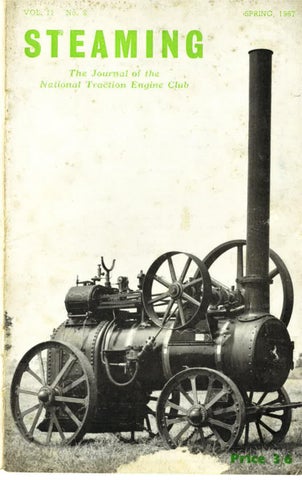
•SPRING, 1967
STEAMING Thu iottzmil
thc
N:,_3itiort411 Tractitiql Etiffirre
.1;
STEAMING
NATIONAL TRACTION ENGINE CLUB
OFFICERS FOR 1967 President . REVD. PHILIP WRIGT, M.B.E., Hon.C.F.,
Roxwell Vicarage, Near Chelmsford. Essex. Tel.: Roxwell 644, Vice-President : ARTHUR NAPPER, ESQ. Chairman : ANTHONY HEAL, ESQ., Baylins Farm, Knotty Green, Beaconsfield. Vice-Chairman and Editor :
J. CRAWLEY, ESQ., Field House, Turvey, Bedford. General Secretary:
E. A. FILLMORE, EsQ., 34 Northwick Park Road, Harrow, Middx. Membership Secretary (including ties and badges):
J. R. BONSER, ESQ., 6 Rokeby Gardens, Woodford Green, Essex. Treasurer • J. II. IIonBs, ESQ., 6 Eshcr Close, Basingstoke, Hants. TECHNICAL SERVICES AND SPARES SECTION BRIAN ORAM, ESQ., Bourne House, St. Mary Bourne, Andover, Hants.
(Tel.: St. Mary Bourne 260).
ACKNOWLEDGMENTS REVD. PHILIP WRIGHT, M.B.E., HON. C.F. ENGINEERING IMPLEMENT & MACHINERY REVIEW THE LATE SIDNEY HARRISON P. HEDGINBOTHAM
83
STEAMING
INSURANCE 1967 DETAILS OF THE N.T.E.C. SCHEME Quite a lot has been heard in Traction Engine circles recently about Boiler Insurance and, in particular, about boiler inspection. All this discussion has been sparked off by the National Club's decision to approve only those rallies where the organisers require evidence that the boilers of engines attending have been properly inspected. The club's committee decided to make this requirement after very careful consideration of all the factors involved, and the purpose of this article is to explain the reasons governing the committee's decision. The legal position, as advised by the club's solicitors, is that there is no compulsion on the owner of a traction engine to have any form of regular inspection. Indeed, it is not even legally required that the boiler be insured. Owners of boilers which are fixed in position, such as those in factories, arc compelled to have them insured and, further, to have them inspected by a qualified Board of Trade inspector at intervals of not less than fourteen months.
-1.,0 10N \,
E A,
'v
*Ott..
A ,.
yss_SJUpgrA-O-P--/EW
O
.1%
Cl
N,4095. make BURRE1-IL 0 Reg. No.
lac*
1968 Expiring 3C / 21
0p
‘)4417'
a oi LE?.
The traction engine or portable is thus in a specially privileged position, boiler insurance not being necessary at all whilst the engine remains on private property. The position changes however, as soon as the engine is driven on the public highway. As everyone knows, the Road Traffic Acts make Third Party Insurance compulsory and, in fact, it is impossible to obtain third party cover from any reputable company unless the boiler has been insured against explosion. Note however that sufficient boiler insurance to satisfy the Road Traffic Acts can still be obtained without any form of boiler inspecion and that in these days of " cut price " insurance, an unscrupulous or even careless firm might possibly issue a Road Traffic insurance policy without checking on the boiler cover. It would thus be possible for an engine, totally uninsured against boiler explosion to be taken to a rally on a low-loader, without breaking the letter . of the law. It is for this reason that, in the past, rally organisers have obtained undertakings from engine entrants .that their engines are properly insured against boiler explosion.
84
STEAMING
This is obviously a prudent step and one which has been recommended by the National Club ; but it is not by any means sufficient in itself. This is because, firstly to make such an undertaking effective the rally organiser must examine written evidence that the necessary insurance is in force at the date of his rally, and that the insurance cover is sufficient to meet any likely claim. This would involve organisers in a great deal of paper work, and in any case they will, all too often. be inexperienced in interpreting Lie terms of the policy fully as this requires considerable technical knowledge. Consequently, as most engine owners will have found frequently no attempt has been made to check the insurance cover of engines attending rallies. Secondly, in the past a large number of engines have been insured through Messrs. Tennent, Budd and Simson's policy without inspection. This gave adequate cover but only subject to the boiler being " regularly inspected by a competent person ". The policy was framed many years ago to meet the u.:eds of the old National Traction Engine Owners' and Users' Association, which was as its name implies an association of business-men who got their living from steam haulage. Doubtless, these firms employed the necessary " competent person" and made arrangements for regular inspections which were properly recorded. Few such firms still exist however, and many engines are today in the hands of enthusiastic, but relatively inexperienced, owners. It is not impossible to imagine a serious claim arising where the underwriters might be faced with a bill for many thousands, and the engine being owned by a man who had not employed a qualified boiler inspector and whose experience covered only one day or two. The insurers might not meet this claim as the engine had not been inspected by a "competent person " and the financial liability would then fall on the unfortunate owner or even upon the rally organisers. Perhaps, even more important than the purely financial consideration involved is the danger to the public and to the engine owner from an explosion of the boiler or the associated feed piping. As our engines get older, the likelihood of such an occurrence must increase and this can be prevented only by adequate inspection and maintenance. One accident could create a public outcry against the operation of these old boilers and result in legislation against them ; and it is certain that if the particular boiler had not been properly inspected, not only the owner of the engine (if he was still available for questioning!), but the organisers of the event, and also the National Club would have a great deal to answer for. The General Committee of the Club has decided, bearing all these facts in mind, that the club should takc positive action to forestall such a disaster and that all engines attending rallies which have the club's approval must be insured and inspected by a " competent person ". The only competent persons who are both recognised by law and have the necessary financial backing are the Board of Trade certificated Boiler Inspectors employed by the Engineering Insurance Companies, and it is with this in mind that Messrs. 'ferment, Budd and Simson are now offering their N.T.E.C. policy with inspection by the Cornhill Insurance Company. It is open to the engine owner to insure under the N.T.E.C. policy, or to insure with any of the Engineering Insurance Companies. All approved rally organisers will require is evidence that the boiler is insured with inspection by a Board of Trade inspector. This evidence can be instantly provided by production of an N.T.E.C. insurance disc, details of which are given elsewhere in this issue. It is to be hoped that all rallies will come into line with the new requirements by 1968, This year over two-thirds of organisers intend to operate the new scheme and the N.T.E.C. published lists of approved rallies will only include the names of those organisers. All spectators and engine entrants should remember that if they attend unapproved rallies they are likely to be in company with uninspected engines.
STEAMING
85
Your committee are convinced that the N.T.E.C. must take this firm action to ensure the maximum standard of safety, and are confident that they will have the full support of all members whether they be engine owners, cornpetitors or spectators.
THE LATE SIDNEY HARRISON Sidney Harrison was born in Thetford on March 24th, 1885, and his recent death is a sad blow to all steam engine enthusiasts as he was a mine of information, always willing to be of help to anyone. His father, Thos. H. Harrison, was managing clerk and buyer for Charles Burrell & Sons Ltd., at St. Nicholas works. The works manager being a Mr. Burall at that time. He was educated at Thetford Grammar
School from 1896-1900, where he was by no means brilliant. (His own words.) In September, 1900, Sidney started work as an apprentice at the St. Nicholas works, going first into the cast iron foundry to be followed by a spell in the brass foundry. After ten months of this he spent four months in the blacksmiths shop and two months in the boiler shop. From there he spent twelve months in machine shops or training on lathes, boring, drilling and planing machines. This was followed by a further twelve months in the toolmaking and maintenance shop, after which he finished his practical engineering in the erecting shop on the construciton of new engines, and overhauling those engines sent in by customers for repair. At this time he was engaged on the first steaming of engines for valve settings, road tests and brake tests. On occasions he was sent out as assistant to Herbert Drew, who at that
period was Burrell's most experienced outside engineer. One of the biggest jobs with Drew was at the depot of Messrs. Meissner
& ❑ietline (Burrell's German Agents), where a new single crank compound cylinder had to be fitted to a ploughing engine as a result of frost damage. The foot of the cylinder had to be hand-chipped to fit the boiler barrel! and it had to be lifted on and off during this process by sheer-legs and chain-block tackle. This job had to be as perfect as possible as in those days the only jointing used was red lead and asbestos string. Both Sidney and Herbert Drew had queer feelings when the engine was steamed for the first time. In 1905 he went into the drawing office where he remained until 1910,
when it was decided to try him out as a salesman, to relieve Mr. Wilberforce Burrell. His first assignment was a Mr. Smith, Threshing Contractor and Seed Merchant of Mid Calder, who he was told before leaving the works, was a certain buyer, and securing the order would be dead easy. Sidney set forth
to Edinburgh on the train and spent the night in an unpretentious hotel before setting off for Mid Calder. Unfortunately Mr. Smith took him for what he was, a greenhorn, he quibbled about the price which he knew I could
not alter, he also wanted thicker firebox plates, etc. as well as many other requirements outside the normal specification. To get away and collect his wits Sidney left him several times ostensively to get in touch with the firm by telephone which he knew was, a well-nigh' impossible effort in those days.
86
STEAMING
Shortly before the last train left for Edinburgh, he signed the order, and Sidney then had a half-mile run to the station. In the train he sat and reflected, if this was selling engines to certain buyers it was not a very- desirable occupation, but he learnt certain lessons which he never forgot and which were to stand him in good stead in the future. During the winter of 1910-11 he became very friendly with Billy Barker, of the Barker and Thurston family, who at that time wintered at Thetford. Billy used to hire the Oddfellows Hall for two days per week for the winter period to operate moving pictures which he hired together with the projector from a firm called Cinema Halls Ltd. He used his traction engine at the rear of the hall to generate electricity, and of course in those days there were no fire risks to take care of. These two nights proved very popular, so much so that a local builder, W. Boughton, came along with a suggestion to build a proper cinema on the site of some old cottages he had, this was completed during the summer of 1913. Sidney had an oil engine made for him by a local firm in Brandon which was installed for the electricity supply and a good start was made, but unfortunately the 1914 war effectively put a spanner in the works. The cinema, 1 believe, still stands. Around this time Sidney was off to Seascale in Cumberland to see a Mr. Emerson as the firm had received an enquiry for a new showman's engine. He duly arrived on the Friday night, only to find him knee deep in trouble with his single cylirvier F^wlor traction .ngine wly,se tubes were leaking as fast as they could. His driver had run off and the poor owner was singlehandedly driving the Gallopers, taking money, putting oatmeal in the boiler feed water apart from looking after firing the engine. He apologised for not being able to discuss business with him for the reason which was readily apparent. Sidney therefore offered to drive his centre engine, which left him free to take money and to attend to the old Fowler. The next morning he left for Thetford with his order for a new Burrell showman's engine in his pocket " Lightning II". Not long after this a rather embarrassing experience came his way with a first class firm of furnishers with whose managing director he had an appointment. On arrival at the shop he noticed outside some commercial travellers skips on a barrow but iii the somewhat dim light he failed to notice anyone. He handed his card to a clerk who came out of an office and awaited his call. Someone then said to him, "If you knew the rules of the road you would off ". As he did not reply, the man in question walked up to him and in a very menacing manner threatened him with dire consequences. During his works training Sidney had been taught to use his hands for other purposes than pushing a file, and he had no qualms as to his capabilities also his vocabulary was not lacking. However, due to the commotion in what was normally a sedate place of business, a gentleman who later proved to be the Managing Director came out of his office and in a very calm way told the traveller that he was not at all interested and turned on his heel back into his office. He thought that the traveller would have an apoplectic fit, he swore and cursed as he collected all the carpet patterns which he had spread around for inspection. Whilst this was going on, Sidney was called into the office to meet the managing director and his engineer, where he had a most pleasant interview. At the end of the meeting the managing director said he was pained by ,the profane language which he had heard and proceeded to give him a talk on " Christian living ", and as a climax suggested to his engineer that a few words of prayer were obviously needed, whereupon they both went down on their knees at their chairs and offered impromptu prayers for Sidney and for guidance on their business decision, which was of course the purchase of a steam wagon from him. His biggest dread was that they would call upon him, but he said they had obviously weighed him up.
STEAMING
87
Messrs. Charles Burrell's had a very nice letter subsequently thanking them for his services and saying that due to the nearness of the Foden works they had decided to order that make. During late 1913 he sold a Burrell steam wagon to a Mr. J. Crowther, which was delivered just after war was declared. They were so anxious to get it they would not wait for a man from the works to unload and deliver it. They proceeded to unload it themselves in the " black-out". In the conditions existing they failed to give it sufficient lubrication, and on the way to the fairground an eccentric strap seized and resulted in the breaking of the slide spindle bracket. Sidney was delegated the job of fitting a new bracket which, like the cylinder job in Germany, was a matter of fitting to the round boiler. In this case he was helped by Harry Foulger, who at that time was Burrell's chief out-working engineer.
Sidney Harrison as a young man on J. Cottrell's Burrell Showman's Engine No.
3088 "A Tryer".
Having been rejected for military service due to a defective left leg, he continued to travel for Burrell's until mid-1915, when the works were taken over for war work, chiefly the making of 18-pounder shrapnell shell bodies and fuse parts. He was put in charge of the final works inspection department, subject to the overall control of a resident government inspector, who was a well-meaning soul but it was obvious very early on that he was not a practical man. He would reject certain items, but when the same item was re-submitted at a later date he passed it without any alterations having been made to it. Various reasons were advanced—unofficially of course, the chief reason being suggested that it was because he had been in private life a quack dentist.
88
STEAMING
When a start was made on traction engine production on the conclusion of hostilities, orders came in thick and fast, but due to the dislocation of material supplies deliveries were badly held up and quite a number of orders were in fact never completed. In 1919 he got to know W. J. King of Bishop's Lydeard, Taunton, in Somerset, also William Elworthy of Tiverton. As time went on he developed a personal friendship with " Billy King " which lasted until his death. He sold him several Burrell steamrollers, but the chief point of interest surrounds his early visits to him. He frequently asked Sidney to drive him around the county and although curious he never asked Billy King the reason for his picking up bits of granite from numbers of fields at which they stopped. Later it turned out that with a few exceptions all the granite needed for tarmac was coming from Leicestershire as local material was not considered suitable. filly w not prepared to believe that somewhere in the county a suitable material could not be found. All the stone samples he picked up from where he thought likely material might be found he had analysed, and if he received a favourable report, he either bought or secured a lease on a suitable plot. When he eventually set up a tarmac plant, which was seen to be profitable, competitors found that he had to a major extent forestalled them. He was a very faithful friend right up until his death a few years ago, and he always stuck to Sidney for rollers in the same way he stuck to " Bill Beach " of Foden's for his wagons. The formation of Agricultural & General Engineers Ltd., known as A.G.E., sounded the death knell of Messrs. Burrell. It was a very ill-starred venture from the start. The moving light who shall remain nameless (for obvious reasons) was a bombastic individual, and how he managed to pull the wool over the eyes of certain hard-headed directors of the constituent companies will for ever remain a mystery. Nevertheless, he did. The buying of materials and the whole of the sales organisation was centralised in London. The country was divided into areas. Sidney was at first delegated to an area in the South East of England, which he would not accept. Eventually he was given the Manchester area, but he made no attempt to go and live there. One very good friend he made there was the late Norman E. Box, the heavy haulage contractor, who remained a very good friend until his death a few years back. In the Manchester area Sidney was supposed to sell Aveling rollers, Garrett steam wagons and of course Burrell traction engines. What a hope! The bombastic Mr. X expected sales of these products to be made like selling groceries. Most of the representatives were completely in the dark about the products of the other companies in A.G.E. Ltd., yet they were supposed to handle all the products of the group in their appointed area. Sidney could not lay claim to either selling an Aveling roller or a Garrett tractor, but he did manage to take over the handling of the whole of Messrs. Burrell's showman's business and remained living at Bury St. Edmunds, and his visits to the Manchester office grew less and less. During the early twenties Harold Livesey, who had been Works Manager of Messrs. John Fowler & Co. (Leeds) Ltd. for a number of years, left them due to some disagreement with Mr. Charles Fowler, and this resulted in him taking the post of General Manager of Messrs. Chas. Burrell & Sons Ltd. A very friendly attachment grew up between him and Sidney, but his appreciation of A.G.E. methods became less and less as the months went by and after a few months he left and returned to Fowler's. Early in 1928 Sidney followed him and joined Messrs. John Fowler. Harold Livesey's knowledge of the Burrell product and its popularity with showmen, together with the ready collaboration of the late Alf Pepper with whom he had been very friendly for some years, enabled several modifications to be made to the Fowler B.6 and Sidney was successful in selling the last four showman's engines to be made by Fowler's, namely " Lion," " Onward," " King Carnival II" and " Supreme ".
STEAMING
89
Mention must be made of the special diesel-engined showman's tractor which was built at Sidney's request and which he eventually sold to Hibble & Mellor (named "Jubilee "). Jimmy Hibble was in fact one of his earliest friends in show business. He came to Thetford around the autumn of 1906 with his uncle's (Jimmy Creighton) engine in need of a new firebox. Sidney went along the Mundiford road to meet the engine and pilot it to the works. It had to be ready for King's Lynn Mart the following February 14th. Their friendship grew steadily and for several years Sidney used to spend a clay or so with him at his uncle's cine show at Norwich Tombland Fair. In November, 1927, The Commercial Motor tried to stimulate interest in the steam wagon. This was a well-deserved effort to foster, and if possible, increase the interest amongst haulage contractors, by proving the efficiency of the steam wagon in comparison with the internal combustion engined vehicles. It would appear that insufficient forethought was given to the, scheme as it would appear that none of the manufacturers were consulted or their opinions sought. Twelve different makes of steam wagons were entered, some like the Garrett Undertype and the Sentinel could travel at 15 m.p.h. or more and carry enough water for at least twenty miles. whereas others like the Mann could not equal this performance at all. Unfortunately none of the various representatives from the firms had been briefed and little if any useful information had been obtained from the respective manufacturers. The test was poorly organised as drivers found that coal which had been arranged for the start of the run was thereafter their own responsibility. No thought had been given to picking up water en route and this turned out to be quite a problem for the drivers with small tank capacity wagons in an area of Lancashire where chemically saturated canals abound. One wagon did in fact have serious trouble on this account. As the itinerary had been arranged with specific times of arrival so that various Mayors could greet the convoy on arrival, it was decided that a number of towns would have to be cut out and in several other cases only the fastest vehicles managed to arrive anywhere near the appointed hour. In order to help matters two representatives were detailed to go ahead and site the various places where water could be obtained, and in certain large towns arrange for a water engineer to be present with a stand pipe. One of the many faulty arrangements was that in Huddersfield it was planned for the wagons to park the night in one of the bus depots. Hands went up in horror to see steam wagons appearing and various odd places had to be found for them which was not conducive to an efficient start the next morning. However, with wonderful co-operation on the part of the various drivers, all the wagons duly arrived at Olympia. London, on November 17th. 1927, for the final inspection when the usual bouquets were handed out, but to Sidney it all spelt only one thing, and that was the end of the steam wagon in the face of ever mounting competition from the petrol and diesel engine. The outbreak of war in 1939 once again put a stop to steam engine sales and Sidney was employed on war work, one appliance being the "flail ", which was a mine exploding attachment for tanks, at the first trial of which he was present. From his experience he knew that steam was on its way out, and after the war he knew that the showmen would be in the market for a lot of new tackle. Early in 1946 he approached Messrs. Scammell and the Scammell Showtrac was the result, but of course that's another story just as it was another way of life for so many people.
90
STEAMING
PREPARING FOR A BOILER INSPECTION -A FEW HINTS & TIPS As our hobby develops over the years, and attracts the admiration and appreciation of an ever-expanding public, most engine owners must feel at least a little proud to think that the machine upon which they have lavished so much care and hard work is looked upon with great interest by so many others when it is finally exhibited on a rally field, It must, of course, be admitted that there are still a few amongst us who dislike this publicity, and whilst we must admire their modesty, it would certainly appear that the traction engine rally has grown into nothing short of a show for all to come and see, and the older concept of the rally as a social event for participants only has now taken a very definite second place.
This development has brought about a number of changes—engines have become valuable, and there is little doubt that they will never again change hands generally for a few pounds above scrap price, as they did a decade ago. No longer is there scope for the heroes amongst us who spent all our spare time and money in snatching them from the scrapman's torch, and let us not forget that nowadays it is most unlikely that anyone under voting age will have any clear recollections of traction engines at work. 'I he whole scene is changing from a basis of sentiment to a new foundation of pure interest coupled with perhaps a little showmanship, and in another decade
there is small doubt that the change will be complete. The question of insurance is one aspect of this change, and past controversy is but an indication of a general realisation of the new responsibilities that have to be faced when a large paying public is involved. We all knew that sooner or later the boiler inspection would have to come, and whilst over the formulative years we have clung on to our straws of legal exemption in an effort to prevent our less firm survivors being put down, the increased values of our engines have now assured their protection, and no longer need we take these formidable risks upon our own heads or the heads of those around us. The first round of the challenge is over, and we now start the second, which opens with the problems associated with the actual boiler inspection, which whether we like it or not, is here, and here to stay.
As mentioned earlier, there must be many owners who by virtue of their age or profession have never had need to call upon the services of a qualified boiler inspector, and quite naturally they must heed his coming in an aura of fear that he, in one fell swoop, will destroy the results of hours of delicate labour of love. Let us not forget that the boiler inspector himself may be equally apprehensive, since he, and his company in turn have never in the whole of their existence been called upon to inspect and insure steam boilers by the hundred which are owned and operated in many cases by inexperienced people, who steam them in the midst of a throng of thousands of spectators! Quite obviously, a situation such as this is likely to lead to gentle conflict unless reason is forced to prevail, and the first advice to owners is identical to that given to inspectors by their companies. That advice is to be reasonable, compromising and tactful at all times. To act in any other way will not achieve results of any kind, whereas a sound and amicable relationship between the inspector and the owner can only lead to a strengthening of the whole of our hobby. What, then, does an owner do to see the job through smoothly, and what practical steps can he take to help the inspector ? Perhaps the following hints may help: 1. Find out from the inspector before he comes, as to whether he is likely to require an hydraulic test as part of his survey. If he does, ask him whether he wants the test before or after his internal examination.
STEAMING
91
2. If he does not want an hydraulic test, prepare the boiler as follows: Remove ashpan, firebars, all mud-lids and manhole doors. Brush out soot from smoke box, firebox and tubes, and wash out loose scale from boiler. Provide boards or sacks under firebox for inspector's convenience. 3. If he wants an hydraulic test after his internal examination, prepare boiler according to 2, and set up for testing according to 5. 4. If he wants an hydraulic test before his internal examination, carry out procedure as per 2, but leave mud-lids and manhole doors in position, and leave the water in the boiler. Continue as per 5. 5. Preparation for hydraulic test may be carried out as follows: (a) Make sure that all clack-boxes, etc. are sound, and if possible, turn them off by use of the built-in plug-cock where fitted. Better still. take them off the boiler altogether, and blank off the holes by means of prepared plates. (b) Turn off water-guage fittings. (c) Replace all lids and doors if previously removed, using new joint rings where possible. (d) Remove safety valves, and place a piece of thin rubber sheet between the regulator valve and its face. This stops leakage of water into the cylinder block. (e) Make up a steel blanking plate to fit over safety valve mounting studs. This plate should be at least in. thick, and can incorporate a ¢ in. BSP fitting to connect up to the test pump. Fill boiler with water right up to the level of the safety-valve opening and fit blanking-off plate. A joint made from sheet rubber is best for a cold water test since ti accommodates irregularities more readily, and does not have to withstand any heat. if possible a test-pump should be obtained and a dummy-run made prior to the inspector's visit, but on no account should the normal working pressure of the boiler be exceeded during such unsupervised tests. (1) Fusible plugs and boiler lagging should not be disturbed prior to the inspector's visit. It might be, however, that he will require these items to be wholly or partially removed during the course of the survey. In the case of an engine with a known history of inspection, it is very unlikely that the lagging will need to be disturbed, and very often an engine with no known inspection history but in obviously good general condition would not need to have its lagging moved in the event of the hydraulic test being satisfactory. This is left entirely to the discretion of the inspector, and no doubt may be influenced to some extent by private discussion between the owner and the inspector. It is, however, more likely that fusible plugs may have to be replaced, and since in any case it is advisable to remove these annually, it would be just as well to provide facility for removing the plug if required. A long tube-spanner with a tommybar which can be swung clear of the foundation ring will usually shift a stubborn plug. If this does not do the trick, a sharp upward bump with a medium weight hammer will loosen the threads. If all else fails, a cook in an oxy-acetylene flame will break down the last resistance. As consolation, you may depend that if this last resort is used, the firebox crown is pretty healthy! 6. After the inspection, the inspector will tell the owner there and then if he thinks the boiler is satisfactory, and it' so, the engine may be re-assembled in anticipation of a confirmatory report from the company. It may be that repairs will be required before such a report could be issued, and generally speaking there is no finer consultant as to how to overcome repairs as the inspector himself. He can invariably recommend commercial companies who are capable of carrying out the repairs, and in many instances he can advise
92
STEAMING
the owner as to the best do-it-yourself techniques. In any case. the boiler should not be steamed until repairs as recommended have been completed to the inspector's satisfaction, and no insurance company would accept liability for an accident that occurred with a boiler that had been recommended for repairs and which had not been attended to. 7. On completion of re-assembly, and subject to all required repairs having been passed, the boiler should be steam tested, and when all is well, the inspector should be notified that the engine is ready for inspection under steam. This inspection is very brief, but is a statutory part of an insurance survey. Very often it is carried out on a rally field, since, believe it or not, some boiler inspectors enjoy the rallies as much as we enthusiasts do—and what better than mixing a little business and pleasure. This, of course, is the time that we have all been waiting for, and what better peace of mind than exhibiting the engine with the knowledge that everything has been done that can be done, and even if anything did go wrong, nobody would question the integrity of the owner—they couldn't, and that, after all, is what insurance is for. All this is but a brief guide to the very wide aspect of boiler insurance, and we, in the National Traction Engine Club, realise that life is not without its complications. Rightly or wrongly, the committee has undertaken a tremendous amount of work in thrashing out every concept of this difficult subject. We now feel that a fair deal has been arranged for the engine owner, but in the event of there being, any difficulty with inspections, we ask as
forcefully as we can, that any dispute between inspector and owner is brought to ❑ur notice, when we will do all we can to bring about a fair compromise. Remember that the first inspection is the most stringent, and that hydraulic tests are not normally required every year—some companies allow as long as seven years between hydraulic tests as long as no heavy repairs have been necessary. The thorny question of lagging has yet to resolve itself, which
it no doubt will, but be careful here, because if the inspector has been prevented from seeing the barrel, he will say so on the final report, and if an explosion was traced down to that defective barrel by the little man from the Board ❑f Trade who by law would have to scratch through the wreckage, that same report would be very useful evidence for the insurance company! You've got to pay your premium, so you may as well have your money's worth—it's up to you.
THE NATIONAL TRACTION ENGINE CLUB Please note that subscription renewals (30/- per annum) should be sent, now, to D. B. Ehlen, Esq., Assistant Membership Secretary, 2 Abbot Close, Basingstoke, Hants. New members should still make application to J. R. Bonser, Esq., Membership Secretary, 6 Rokeby Gardens, Woodford Green, Essex.
Ties and Badges at the following revised prices may be obtained from F. G. Upton, Esq., Sales Secretary, 24 Windsor Road, Maidenhead, Berks. 50/-- each Car Badges (one type only)
... 18/6 each ... ... ... Ties (blue and green) Lapel Badges, six different types (Showmen's, Plough, Tractor, General Purpose, Wagon, ... ... ... ... ... ... Roller)
6/— each
STEAMING
93
THE MAIDSTONE BOILER EXPLOSION As reported in the issue of Engineering dated December 31st, 1880. (We appreciate that the cause of this mishap was the result of screwing down the Safety Valves, but we reprint the article in full as it gives a very good idea of what is involved at the official inquiry which follows.) As we recorded briefly in a " Note'' last week, the adjourned inquest on the man killed by the recent explosion of a traction engine boiler at Maidstone was resumed on Wednesday the 22nd inst. and was brought to a conclusion late in the evening of the following day, the coroner, Mr. J. B. Stephens having the valuable assistance of Mr. T. J. Richards, of the Marine Department of the Board of Trade, an assessor. During the inquiry—which was a most painstaking one throughout—the owners of the engine, Messrs. Jesse Ellis and Co., were represented by Mr. Stenning, of Maidstone, while Mr. Prall, of Rochester, was present on behalf of the engine builders, Messrs. Aveling and Porter. The latter firm, we should add, gave most valuable assistance to the inquiry by supplying drawings, photographs, and models of the exploded boiler for the use of the court, as well as by having a series of tests made of sample pieces cut from the plates of the boiler which exploded, and corresponding samples of new plates of the same qualities as those used in the construction of the boiler. These tests were made by Professor Alex. B. W. Kennedy, at the laboratory at University College, London. Messrs. Aveling and Porter likewise supplied a model showing the manner in which the safety valves were mounted in the exploded boiler, and also examples of spring balances, and a specimen of the direct spring loaded safety valves with which they are now fitting their engines. As we remarked on a previous occasion, this explosion is likely to have an important bearing, not only upon local regulations for the control of traction engines, but also nrobably on future legislation relating to the employment of steam power on highways, and for this reason it is necessary that we should lay a complete statement of the facts of the case before our readers. This is the more desirable as the inquiry revealed the existence of some habits of traction engine management which, to say the least of them, require immediate modification. The traction engine of which the boiler exploded was one constructed by Messrs. Aveling and Porter. between three and four years ago, and was rated by the makers as an 8-horse. It had a single 9 in. cylinder, with 12 in. stroke, the driving wheels, which were 5 ft. 6 in. in diameter, being geared to the crankshaft in the ratio of I to 16 for the fast speed, and I to 25 for the slow speed. In the slow speed gear the engine could thus exert (less, of course, the reduction due to friction of the gear) a pull of 368 lb. at the circumference of the driving wheels for each pound of effective pressure per square inch in the cylinder. Thus with a mean effective pressure of 70 lb. per square inch on the piston, the pull exerted at the circumference of the driving wheels would amount to 25,760 lbs., or about 114 tons, less the internal frictional resistances of the engine. We mention this fact because from circumstances to which we shall allude hereafter, it appears to us to have a decided bearing on certain aspects of the case. The boiler was of the usual locomotive type. The barrel was 2 ft. 10 in. in diameter outside, and was composed of plates nominally a in. thick, but in reality slightly thicker. The smokebox tube plate was e in. thick, the back and front plates of the firebox casing were f in. thick, while the side plates of the firebox casing (which also formed the horn plates carrying the bearings of the various shafts) were in. thick. The barrel was made up in two rings united by a butt joint and outside welt strip ti in. thick, each ring being made
94
STEAMING
up of two plates. In the case of the ring next the firebox the upper plate extended rearwards and formed the crown of the firebox casing. The flanged plates—namely, the smokebox tube plate and the front and back plates of the firebox casing—were of "Tudhoe best best" iron, while the under plate of the ring of the barrel next firebox was of " Monkbridgc best," and the rest of the shell of " Tudhoe crown " iron. The transverse joints were single rivetted with rivets 14 in. diameter placed at 1 in. pitch, while the longitudinal joints were double rivetted with rivets of the same size placed at 21 in. pitch. The inside firebox was of Lowmoor iron througohut, the plates being I in. thick, with the exception of the tube plate, which was k in. The firebox stays were of a special quality of Tudhoe scrap made expressly for such purposes. The firebox stays were in., and the longitudinal stays I in. in diameter ; the upper longitudinal stays were secured at the rear ends to stiff T-irons by a in. pins passing through forked eyes. 'the boiler contained 33 tubes 21 in. in diameter outside, the heating surface of these tubes being 115.6 square feet, while that of the firebox was 29.75 square feet, making a total of 145.35 square feet. The grate area was 5.9 square feet. The boiler was altogether well-proportioned and it is stated to have had excellent steaming power. The cylinder was mounted on the boiler and fixed by eight bolts I in. in diameter passing through the base, these bolts being a tight fit through the boiler shell, and having large square heads inside. Also, two nipples each 31 in. in diameter were screwed through the barrel plate and cylinder• base, these nipples connecting the steam space of the boiler with the cylinder jacket, this jacket also forming the steam dome, and the steam being drawn from it for the use of the engine. On the top of the cylinder jacket were provided two safety valves, each 21 in. in diameter, these valves being loaded by ordinary levers and spring balances, and the latter being provided with ferrules. According to Messrs. Aveling and Porter's book of rules issued for the use of the engine drivers of their traction engines, the proper working pressure for the boiler we arc describing was 100 lb. per square inch, and as was shown by the evidence, the spring balances on leaving Messrs. Aveling and Porter's works were ferruled so that they could not he screwed down to give a pressure exceeding 110 lb. per square inch. The highest pressure to which the spring balances were graduated was 120 lb. per square inch. When the spring balances were found after the explosion, however, it was ascertained that the ferrules had been shortened so as to permit of a higher pressure being attained, while it appeared that the springs of the spring balances had at some time been found to be light, and had been adjusted by the insertion of a washer, the effect being that the balances would only draw out ill in. beyond the point on the scale corresponding to a pressure of 120 lb. The safety valve levers were both fractured by the explosion. but on a new lever being adjusted so that its centres exactly agreed with the old levers, and the spring balance being put in place, it was found that the shortening of the ferrules on the balances was such as to permit or the safety valves being dead locked. At the time of the explosion—about 3 a.m. on December 3rd—the engine was engaged in hauling two wagons laden with manure. It had passed through the town and had reached a point in Mill Street where there are some builder's workshops on one side of the road, and a churchyard with St. Anne's Church on the other. Here it had been stopped for three or four minutes to relight a lamp which had gone out, and it was just as it was starting again that the explosion occurred. The engine was in the charge of the driver Moses Martin, while the steersman was Frank Underwood, who was killed by the explosion ; in front, carrying the red flag was Harry Reader, who together with the driver Martin was injured by the fragments. We show engravings of the remains of the engine prepared from photographs taken by Messrs. Clarke and Co.. of Maidstone, who obtained an excellent series of views of the wreck early on the morning of the explosion before the pieces had been disturbed. The view on page 95 (upper) shows the front ring of the barrel with the cylinder attached, while the lower illustration
STEAMING
The front ring of the boiler barrel with the cylinder attached. (FIG. 1).
A general view showing the positions in which the main parts were found subsequent to the explosion. (FIG. 2).
95
96
STEAMING
is a general view and shows clearly the positions in which the main parts were found subsequent to the explosion. Other fragments, including a large piece of the barrel of the boiler, were driven off to considerable distances, a good deal of damage being done to the wall of the churchyard, to some of the gravestones, and to the stained glass window of the church. Fortunately, however, owing to the early hour in the morning, no persons were in the immediate neighbourhood, so that the personal injuries were confined to the men accompanying the engine. We have already stated that Messrs. Aveling and Porter had prepared for the use of the court a model of the boiler, and on this model had been carefully marked in red the lines of fracture. From this model we have been enabled by the courtesy of Messrs Aveling to prepare the two perspective views which we give opposite, the views serving to explain the manner in which the boiler shell parted. We also give on page 99 (Fig. 1) a view of the left-hand side plate of the firebox, to which we shall refer presently, and also a view looking down into the inverted firebox and showing the general character of the collapse. (Fig. 2). An examination of the remains of the boiler, which we were able to make on the 15th inst., showed that the plates were in good order, there being no signs of furrowing or corrosion, nor, as far as the shell was concerned, any signs of local weakness. In the case of the firebox, however, the remains showed that there had been a serious crack in the left-hand side plate, and that this crack instead of having been cut out and repaired by a patch, had been merely plugged by copper studs, of which no less than nine had been screwed in. The position of these studs appeared to indicate either that there had originally been two cracks which had eventually joined into one, or that the crack had had a V form. On page 99 (Fig. 1), which is a view of the cracked plate, the copper plugs are marked A A, while at B B B B, are shown the positions of the firebox stays. the middle vertical row of these stays being directly on the line of the chief part of the crack. When the explosion occurred the rupture extended completely to the top and bottom of the plate as shown, the plate being at the same time bulged inwards, as indicated. From this latter view it will be seen that the right-hand side plate was also bulged inwards but not to so great an extent. The remaining plates of the firebox were not ruptured, but they were considerably distorted, the tube plate being bulged outwards or towards the water space, it apparently having been drawn into that form by the pull of the tubes before they left their holes, most of the tubes remaining fixed in the smokebox tube plate. The crown plate was dished deeply downwards, but the roof stays had bent without fracture, and none of the bolts securing the crown to these stays had failed. The major part of the back plate of the firebox casing remained attached to the back plate of the firebox by the firehole ring and by the stays ; six of these stays, however, apparently having been fractured at some lime prior to the explosion. The hack plate of the firebox was bulged inward about w in. between the stays, which remained sound. There was a crack, apparently of old date, at the ring at the right hand lower corner of the firebox, but this crack was not of importance. A clear idea of the manner in which the shell was ripped un will be gained by an examination of the illustrations opposite better than from any verbal description. It will be seen that the back plate of the firebox casing parted around the root of the flange for nearly its entire circumference, the side plates and crown plates attached to it anparently turning on the line of fracture as on a hinge. The firebox stays for the most part remained in the side plates of the firebox casing, being mostly drawn from the firebox plates. The fractures in the side plates are clearly indicated, as are also those on the front plate of the firebox casing. In this latter case it will be noticed that there is a rip right round the root of the flange which meets the barrel of the boiler, this rip also extending down the root of the vertical flange on the right-hand side and through the line of rivet holes of the bottom ring. In the barrel there is a longitudinal rip along the line of rivets on each side of the ring next the firebox, and a circumferential rip through one line of rivets of the welt ring. In front of this the rip took a spiral course through
STEAMING
97
Fla 1.
0 0 cl'ozmy:0 o 0 o o o 0 o
0000000 0 0 00000. 0 o o o 0 0 0 0
FIG. 2.
o
o
o
0
0
0
0
0
0
o
o
0
0
o
o
0
0 0 o 0 0
0 00000J00000
The two perspective views serving to explain the manner in which the boiler shell parted.
the front ring of plates, crossing one of the longitudinal scams as shown in Fig. I, page 97., and ultimately terminating in the line of rivets by which the smokebox tube plate was fixed. The general appearance of this front ring of plates after the explosion is shown by the perspective view which is published on page 95 (Fig. 1). We have said that sample pieces were cut from the exploded boiler and sent for testing to Professor Alex. B. W. Kennedy, at the University College Laboratory. Two of these pieces were cut from the lower plate of the barrel next the firebox casing, this plate being found to bear the Monkbridge brand. From the results of the test it would seem that the pieces stood a good tensile strain, but had apparently had their ductility somewhat reduced by the treatment they had received, the plate from which they were cut having been
98
STEAMING
flattened by the explosion. Two other samples were also cut from the crown plate of the firebox casing. This plate was of Tudhoe crown iron, and one of the samples (that having the reference letter C) was annealed after being cut from the plate. The effect of this annealing appears to have been to reduce the tensile strength without affecting the ductility appreciably. Messrs. Aveling and Porter use Tudhoe crown, Tudhoe bust best (for flanged plates) and Monkbridge best iron for their boiler shells, to the exclusion of all other brands, and for the purpose of comparison with the samples cut from the exploded boiler they had pieces cut from new plates in stock and forwarded to Professor Kennedy for testing. The results of these tests show the plates to be of excellent quality for boiler shells, the laminated appearance of some of the fractures not being such as to indicate a want of tensile strength, although it shows a structure which might give trouble from blistering in the case of furnace plates. Altogether it was evident that the quality of material of which the boiler was made was in no way in fault, and had nothing whatever to do with causing the failure of the boiler. We must now proceed with the inquiry into the cause of the explosion and its results. As we have already stated, the inquest on Frank Underwood who was killed by the explosion, was opened by the borough coroner, Mr. J. B. Stephens, on the 3rd instant, but little evidence being however taken on that occasion, beyond that necessary to identify the body, and point out the general circumstances under which Underwood had met his death. In the course of the examination of George Raley (the foreman to Messrs. Jesse Ellis and Co., by whom the body of Underwood was identified), however, it was stated that the pressure gauge when found indicated a pressure of 250 lb. Raley also stated that the spring balances were light, and that they were screwed down to a pressure of 120 lb.; they were, however, not screwed home, and he could have screwed them down another 10 lb. On the 15th instant the proceedings were resumed, but immediately adjourned to the 22nd instant for the attendance of a representative of the Board of Trade, no evidence being taken. As far as the scientific inquiry is concerned therefore the proceedings may be said to have commenced last Wednesday week, the 22nd instant, when Mr. Stephens had, as we have already mentioned, the benefit of Mr. T. .1, Richards' valuable aid as assessor. For the reasons already stated, we deem it important to lay before our readers as complete information as possible respecting the Maidstone explosion, and we, therefore. propose to give a very full report of the evidence brought before the coroner. On the 22nd instant when the proceedings were opened, the coroner explained that he proposed merely to put to each witness such questions as would introduce him to the jury, leaving any examination as to the explosion to be conducted by Mr. T. J. Richards, an arrangement which was round to work well throughout the inquiry, The coroner then read over the evidence given by Thomas Roarer at the first meeting of coroner's court, and the other men in the employ of Messrs. Jesse Ellis and Co., whom it was proposed to call as witnesses having been excluded from the court, Thomas Roarer was then re-called for further examination by Mr. Richards. His evidence was as follows: He had been a driver eleven years, and before that, a labourer. He was driver to the engine which had exploded, and had had charge of it about ten months ; altogether he had been in the employment of Messrs. Jesse Ellis and Co. about three years. He was not driving the engine at the time of the accident, having hurt his arm the night before. Tie usually worked the boiler at 100 lb. pressure, but sometimes exceeded this when he had to take loads up-hill ; at such times he had as much pressure as he wanted. The highest pressure he had used was 125 lb.; he had not required more than that for any hill or load with which he had had to deal. He had been told by his foreman that the proper working pressure was 100 lb., and that he was not to exceed this unless he required it. No limit was mentioned. He had told his foreman and Mr. Ellis that he had loads which required more than 100 lb. pressure to draw, and he was told not to load too heavily. He had a heavy
STEAMING
99
• BOILER TURES
I Qb I4 • 0 6 TAY
co tRIMBAULT
FIG. 1.
FIG. 2.
14U
100
STEAMING
load on lhe last day he worked the engine—I4 cubic yards of stone—and he could manage this load except on hills where extra pressure was wanted. When he took charge of the engine, the safety valve ferrules were in the same condition as at the time of the explosion. He never took ferrules off. and he knew that if the ferrules were taken off valves could be screwed down. He never reduced the ferrules, and did not know that any one had done so ; did not always keep the levers screwed down to ferrules, but generally kept spring balances so that the valve blew off at 100 lb. He knew that when the spring balances were screwed down to ferrules the valves could not blow off freely, but he never so screwed them down. He thought he could lift levers in. when they were screwed down to the ferrules, but the distance about might be less ; he had never tried it. He had never screwed spring balances in.; the steam would then blow off at 100 lb. He nearer to ferrules than acknowledged, however, that he screwed them down further to get 125 lb., but maintained that he did not screw them home. Stated that he left space equal to the thickness of a penny ; in that position of the spring balances the steam blew off at 125 lb. Had compared blowing off pressure as shown by spring balances with indications of the steam gauge and found that the spring balances were weak, and that there was a difference of pressure between them and the gauge of about 15 lb.; he had mentioned this to the foreman, who had not done anything to the spring balances. The steam gauge was new and had been on about two months, it had not been examined since. He gave up charge of the engine to Martin on the evening before the accident. The spring balances were then screwed down to within about in. of ferrules ; he gave Martin no special instructions about the engine, neither did he mention how the safety valves had been left. He did not know what Martin was going to do ; he was told later on that he was going to work at night hauling manure. He had seen cracked firebox plate first about six months ago, the copper studs were then put in ; he discovered the crack himself. and all the nine copper studs were put in at the same time, and no repairs were done subsequently. The crack started leaking round one of the studs, he believed about the centre of the crack ; nothing was done as the leak sometimes stopped. Copper studs were put in instead of putting on a patch. He thought these plugs strengthened the plate ; he could not say if this was the proper way of dealing with the crack, but it stopped the leak, and was often done. On the day prior to the accident there was no more leakage than during the previous month ; he knew of another firebox repaired by-studs at Messrs. Ellis and Co.'s works. He thought that the crack in that case was about 4 in. long ; he had never complained of the manner in which the firebox of the exploded boiler was repaired ; he had told Mr. Ellis and the foreman that it leaked. The boiler never leaked anywhere else. Examined by Mr. Stenning: He stated that he had a book of Messrs. Aveling and P'orter's rules, and also a copy of the rules of Messrs. Jesse Ellis and Co. In the latter it was stated that he would be fined one shilling if he allowed the pressure to exceed 125 lb. He had been in the employ of another traction engine owner, Mr. Bowles, who mended leaks in fireboxes the same way. He knew that that mode of mending leaks was adopted by other owners of traction engines. Examined by Coroner: He had never been fined, and did not know of any man who had ; he had been cautioned against blowing off steam along the road, and also against carrying steam at more thn 100 lb. pressure. Examined by Jury: During the ten months he had had charge of the engine the boiler had been washed out, but had had no other examination. The next witness examined was Moses Martin, the driver who was in charge of the engine at the time of the explosion, and who had not yet perfectly recovered from the injuries received by him on that occasion. Before his examination commenced he was informed by the coroner that he was not bound to answer any questions which would criminate himself. His evidence was as follows: He was an engine driver in the employ of Messrs. J. Ellis and Co., and drove the engine which had exploded. He had been a driver rather over nine
STEAMING
101
years, and previously a cook boy to men in charge of steam ploughing tackle. He took charge of the exploded engine from F. Boarer the night before the explosion ; he had no instructions from Boarer, and had never had charge of this engine before. Engine had steam at about 25 lb. when he took charge of it, he got up the pressure to 75 lb., and there was then no blowing off. He did not alter the spring balances when he took over the engine ; it was then dark. He did not look at the safety valve or spring balances when he took charge, or at any other time prior to the explosion. He did not touch the nuts of the balances, and when the explosion occurred the latter were in the same condition as when he took charge of the engine. Was reversing the engine to start at the time of the explosion ; he had been stopped three to five minutes—but previously to that the engine had been working since about half-past eleven o'clock except when they stopped to take water. Previously to last stoppage the engine had been working for about half an hour continuously. At the time of the explosion, he had only stopped to light a lamp which had gone out, and he was certain the stoppage was not more than five minutes. The safety valves did not blow off when he stopped. The steam jet was not in use. He had seen the safety valves blow off strongly coming up from Mr. Monckton's mill. Just before the explosion the pressure was 120 lb., and it might have been 125 lb. when steam blew off as above stated ; the engine was " blowing off terrific ". He could see the steam gauge perfectly well, as he had a hand lama, and he looked at the gauge every few minutes, same as if it had been daylight. Steam also blew off at Wharf Lane. He did not think it possible for any one to alter the valves without his seeing it. Underwood (the deceased) was the steersman and Reader was the man in advance. Had an excellent clear fire at time of explosion as he had Stone Street before him, and this was a hill, though not a steep one. Last took in water three-quarters of an hour before explosion. He had no opinion as to the cause of the explosion except that the safety valves might have got set, which they frequently did. He thought it possible that they might have set fast between leaving Mr. Monckton's mill and the time of the explosion. He had a load of two wagons with about five tons of manure in each, and he had no difficulty in taking this load up any of the hills. He did not remember engine making any particular noise on the night of the explosion. If the steam got too high he could blow it back into the tender ; he never did this on the night of the explosion. He was in the act of starting the engine when the explosion occurred, and the engine made about one revolution when the boiler burst. He did not remember anything more. The water was up to the top of the gauge glass at the time. He last stopped prior to the explosion opposite Mr. Garrett's foundry to change into slow speed gear. By Mr. Stenning: He had been working in company with Boarer the day before the explosion. Started from Stockbury between two and three in the afternoon, prior to the explosion, he was on one engine and Boarer was on the other (that which afterwards exploded). He and Boarer were together about 1+ hours, and his (Martin's) engine then failed owing to leakage in firebox. He did not know at what pressure Boarer was working. On the night of the explosion the engine nrimed after taking water at the town wharf, when going up the hill near the bridge, where the road had been newly laid with stones. Having water too high caused the mud to boil up and get into the cylinder and safety valves. By priming he meant the presence of water in. the cylinder. He heard this priming, but it did not pull engine up. He did not know about the spring balances being light, but knew of the crack in the firebox, as he heard it hiss. He knew the method of mending cracks in fireboxes by copper studs ; he had seen this plan followed in nearly every county in England. It was the ordinary way of mending such a crack. He did not consider that there was any danger from the crack. By valves being " set " he meant valves being fixed by dirt. He had often known this to happen in valves similar to those on the boiler which exploded. By Mr. Richards: He had seen the leakages in the engine he was working the previous day ; there was a crack. That firebox had been repaired same way as that of the boiler which had exploded. He did not know how many copper studs were in it ; he believed that the crack was about 5 in. long, it
-102
STEAMING
was leaking badly, and that caused the stoppage ; he stopped before he arrived at the end of the journey because he would not run any risk. He ran the engine into the field. He could not keep up the water, and the leak damped his fire so that he could not keep up steam. After the engine broke down, he came home on Boarer's engine, but did not observe the pressure gauge or safety valve. Examined by Mr. Prall : Began working at thirteen years of age, and drove an engine when he was fifteen ; he had sole charge of an engine in his sixteenth year. This was in Essex, where he was engaged in steam ploughing. The highest pressure at which he had worked any engine was 125 ib. He had known an engine worked at higher pressures on two occasions, one at Coggeshall, where one of Messrs. Fowler's steam ploughing engines exploded in the field in which he was at work. He had seen pressure gauges showing more than 125 lb.; this arose from their being light. He never shortened a ferrule or knew of one being shortened, and never, as far as he was aware, had he driven an engine without a ferrule, or with one that had been shortened. He could not say whether the engine which exploded had a ferrule on the spring balances or not. By the Jury: He stated that he started from Mr. Moncklon's mill with a good supply of water ; at the time of the explosion he was on the tender, and the firedoor was partly open. The damper had been closed all the way going up High Street. By Mr. Stenning: He had been furnished with a copy of MOSSI'S. Aveling and Porter's rules, and he had also received a copy of those of Messrs. Ellis and Co. before he started working with the latter firm. The next witness was George Batey, whose evidence was as follows: We wac wnrking fnreman to Messrc Jesse Mc and Cr,
He had cerved
his time as engine smith, and had worked at all branches of engine work for 25 years, and had had to do with all kinds of engine and boiler repairs. He had been foreman to Messrs. J. Ellis and Co. 18 months, and had been previously with Messrs. Chippenden and Knight, who were also traction engine owners. He had been with Messrs. Aveling and Porter eight years, and part of the time was foreman of the smiths ; he was also foreman of the boilermakers about three years. He examined Messrs. Ellis and Co.'s engines and boilers as far as possible both internally and externally. He usually examined them at intervals of seven to eight months, when opportunity offered. He had no fixed period of examination, and no other engineer examined them. He did not consider himself responsible for the condition of the boilers, but only for what he did himself, and what was done to them under his supervision. He could not say who was responsible for the engines. He generally consulted Mr. Ellis as to repairs. He had given no definite orders to Boarer regarding steam pressure ; he had generally warned the drivers not to get pressure too high. He might have said that it was unnecessary to get more than 125 lb. pressure when they got into bad places. They could not always do with one set pressure ; about 125 lb. was the highest pressure he had known to be used, and he did not think that pressure would hurt the boiler which had exploded. He considered that 125 lb. might be employed occasionally, but he would not advise its continually being used. Could not say that drivers had ever exceeded 125 lb., but could not, on the other hand, say they' had not. He could not say that the ferrules of the spring balances on the engine which had exploded had been reduced ; he had never reduced any ferrules. The latter were soldered on to the spring balances to prevent their removal. He did not know of any way in which the safety valves would be overloaded when steam was up, except by placing weights on the levers. Did not know that, with the ferrules as they were in case of the exploded boilers, levers could be loaded to more than 125 lb. He did not think it would be possible to set the valves fast with the ferrules in place. Could not say when he last gave Boarer any special instructions respecting the engine which exploded. Did not see Bearer on the night of December 2nd, but gave Martin directions to take the engine. Boarer had told him that it had been necessary to have 125 lb. pressure, in consequence of the roads being in a
STEAMING
103
heavy state. Spoke to Marlin on the night before the explosion, and he (Martin) said that " if they can't do the work with 120 lb. steam, they must have more". To the best of his recollection, Martin said, that it 120 lb. will not do " they " must have 180 lb. He (Batey) then remarked that if he had the power, he would discharge any engine driver that got 180 lb. Nothing more was said. He did not think it necessary to examine valves of the engine Martin was going to take out, to see if the ferrules were all right. He did not know why Martin made the remark about the steam pressure, but the roads were in a very heavy state. Estimated the load which Martin was drawing at the time of the explosion at about 11 or 12 tons. This would be about the ordinary load. He could not say what inducement there could be for a driver to exceed 125 lb.; the drivers were told not to draw unduly heavy loads ; they sometimes got into a hole, but they could get out again without exceeding a pressure of 125 lb. He did not in any way examine the boiler on the day prior to the explosion. He last examined the engine at harvest time, when the engine was going out thrashing. He did not then specially examine the ferrules, but believed they were all right. He had not satisfied himself whether the safety valves were or were not free to act at the time of explosion. He believed the latter was caused by excessive pressure. Did not think the boiler would have exploded at 125 lb., the pressure must have been something more. He could not form any opinion about the excessive pressure and how it was attained. He considered that the safety valves could not have been free to act ; he could not state cause. Did not know whether they were set fast by dirt, or had been screwed down. The sketches exhibited fairly showed the condition of the firebox of exploded boiler ; the firebox was repaired by one of his men under his orders: any one could put in copper studs. The studs had been put in at different times, as the crack had extended. Could not give the dates when studs were put in ; he had simply sent a man to do what was necessary, he did not see the work done himself. If they had found that the crack required so many studs at once, most likely a patch would have been put on. Putting in plugs was a common practice. The crack would be apt to permit a stay in it to draw, and the plugs would not prevent this. He did not consider the insertion of copper studs the safest way of repairing a crack, neither did he think, however, that this mode of repairing was the cause of the boiler having given way. When at Messrs. Aveling and P'orter's works, he would not have been allowed to repair a firebox in that way, and if the engine had been at the works, he would have preferred putting a patch on. Sometimes an engine came in late at night, and had to go out in the morning. He did not remember that he had ever expressed a wish to repair this firebox by patching. Messrs. J. Ellis and Co. had one other firebox with copper studs in it, the crack in that case was, he believed, about 4 in. or 5 in. long. He did not think this a safe way of repairing a firebox worked at 125 lb. He had told Mr. Ellis that in such cases he would prefer patching, and in some cases when there was time, this was done. In other cases studs had been put in. They were not allowed to haul manure through the town of Maidstone during the day. As a rule their men were not sent out at night except when hauling manure, but sometimes they worked on into the night for special jobs. He considered that it was a great inconvenience to work an engine at night, it was dangerous, and might lead to serious accident. There was a bye-law to the effect that engines should not blow off steam in traversing the streets. This he considered a bad law, as it led to the men getting up to tap the valves to keep the steam from blowing off. If the steam was kept in, the pressure rose fast, and was likely to explode the boiler. If the men let the steam blow off they were lined, and if they let the steam down and make smoke in getting it up again, they were liable to prosecution. Only last week one of their men had been threatened with a fine for allowing the steam to blow off through the valves. The man had asked him (Batey) what to do, and he replied that he did not know exactly. They could direct the steam into the tender through the waste steam cock, but he did not think this gave sufficient relief. Moreover, they had sometimes no water in the tender to condense the steam. At this point the court adjourned for a short interval, and on its reassembling Batey was examined by Mr. Stenning, the solicitor for Messrs. Jesse
104
STEAMING
Ellis and Co., when, as will be seen, he modified his previous statement of opinion as to the crack in his firebox not being efficiently repaired. By Mr. Stenning: Since he had been connected with engineering it had been the custom to mend cracks in fireboxes with copper studs ; he had never known any accident to result from this. He had been in the employment of eminent engineers ; he had been assistant-foreman to Messrs. Eastons and Anderson for eight months ; and also (as had been stated) he had been with Messrs. Aveling and Porter, and the remainder of the time with traction engine proprietors : two and a half years with Messrs. Chippenham and Knight, who had about 35 to 40 engines. and for seven years with Mr. Thomas Wood. who possessed 18 or 20 engines. All the engine owners with whom he had worked, except Mr. Aveling, made it a practice to mend cracks in fireboxes with copper studs, provided that the cracks were not too long. He did not have any boilers to repair when at Messrs. Eastons and Anderson's. and could not speak as to their practice. He did not think it dangerous to mend cracks in the manner adopted in the exploded boiler, provided that too many studs were not put in : and he did not think the repair of the exploded firebox had been dangerous. The studs would not weaken the firebox : if there was a crack the studs would stop the water from coming out. but would not strengthen the plate. He considered the crack in the exploded boiler was not conducive to, neither had it anything to do with, the explosion.
The effect of the crack was to allow water to put the fire out. The cracked plate would probably go hest, and put out the fire. He considered this not a safe way of repairing cracks of this description: if so repaired it might leak again in a week or so. What he meant by improper repair was inserting the studs loosely, Was of the opinion that the utmost harm that could happen to the engine by reason of such crack, or from being improperly mended with copper studs, would be to allow steam and water to escape into the fire box and put the fire out. This was exactly what he meant. There was nothing more dangerous in inserting plugs than by mending by patching the word " safe" he used as meaning the power of holding the cracked plate
together. By Mr. Prall : Considered it more dangerous to work engines by night than by day, as lamps went out and they could not get on well ; it was more difficult to start and to manage loads in the dark.: would not consider 125 lb. pressure dangerous. When at Messrs. Aveling and Porter's all boilers of this class were tested to 200 lb.; it was the regular practice to so test boilers before they left the works. It would be easy to reduce the loads on bad road, and thus avoid any necessity for the excessive pressure alluded to by Martin. The men were supposed to limit the load to that which a pressure of 125 lb. would enable the engine to draw. The load on the night of the explosion was not excessive, even with the roads in bad condition. He only spoke, of the load from having looked at the wagons ; the latter were loaded in usual way, but he had not made inquiries as to weight, and had no actual knowledge as to the amount of the load. An 8-horse power engine would draw 14 or 15 tons. By the Jury: He did not inspect all repairs at the time they were executed, and he did not inspect the insertion of every copper stud. The next witness was John Lcadbetter, who was examined by the coroner, and gave evidence as follows: He was a lance-corporal in the Army Hospital Corps, stationed at Maidstone. Recollected being in the Dragoon beerhouse, in the Sandling Road, on the evening of December 2nd, between 7 and 8 o'clock. He was at the bar, and besides the landlord there were four other persons there, a man he knew by the name of Bill Webb, also George Tolhurst, and a man called " Moey " (whom he identified in court as Moses Martin, driver of the exploded engine). There was one other man there called Springett. Conversation was going on between Martin and Springett, and he (Leadbetter) heard Martin tell Springett that he had been speaking to Mr. Ellis about the engine, and that he had to go with it on the morrow, and he (Martin) further said, " either by certain time in the " I will have 200 lb. steam into the
STEAMING
105
morning, or by the time he arrived at a certain place, he (Leadbetter) could not say which. Martin then ordered half a gallon of beer. By the Jury: He (witness) was sober, and the men did not appear to be drunk. In reply to the statements of Leadbetter, James Springett was then called. He stated: He was engine driver in the employ of Messrs. Ellis and Co. and recollected having been in the Dragoon beerhouse on the night before the explosion ; he was in the front of the bar with Martin, no other person working for Messrs. Ellis being present. He never heard Martin say anything until he (Springett) began to chaff him about nightwork. Martin said he would get him a job next night. Martin never made any bet with him. He and Martin went in together, and left after having two pints of beer. Nothing was said about the steam engine. Another of Messrs. Jesse Ellis and Co.'s men, George Tolhurst, was then called. He stated that he was in the Dragoon beerhouse the evening before the explosion, and he generally confirmed the evidence of Springett, and stated that he had not heard Martin make the observation attributed to him by Leadbetter. He further affirmed that he had had no conversation with Springett with reference to the explosion. The next witness was Harry Reader, whose evidence was as follows: He was a labourer, but had done some driving. He worked for Messrs. Ellis and Co. as driver of steam ploughing engines. He was at the time of the explosion in front of the engine acting as flag-man. He went on duty between 11 and 12 o'clock. He was acquainted with the construction of traction engines, and knew the safety valves perfectly well. He did not see them screwed down after he came on duty, and he did not touch them himself. He did not notice pressure at the time when he came on duty. Heard safety valves blowing off near Mr. Monck ton's mill, and also afterwards along the Sandling Road. There was nothing unusual in the blowing off to attract attention. The last time he heard it, it was about an hour before the explosion, and during that time they had to work up a heavy hill, coming up from the Fair Meadow to the new bridge. This was not the worst piece of ground passed over during the trip. During the last hour he did not see any one touch the nuts of the spring balances ; to the best of his knowledge, the engine worked as usual. Had no conversation with Martin respecting the steam, and did not see the man who was killed screw down the valves. He did not observe ferrules. He had worked with that engine about a week, but never noticed that the safety valves were screwed down. It was the practice only to unscrew the safety valves at night, and he could not say when they were last screwed down. He did not recollect any special conversation between Martin and Boarer, when the former took charge, and he did not hear any during the trip as to steam pressure not being high. Martin did not express any annoyance about being put to nightwork. The engine had been standing three or four minutes and had started about one revolution when the explosion occurred. He saw no steam blowing off. He thought explosion must have been caused by valves sticking, and believed that they might have stuck since they last blew off. Only heard the exhaust louder than usual on one occasion, and that was near the bridge. He observed no flame or sparks from the chimney. They started on their trip with the engine in fast gear and changed to slow speed opposite Messrs. Garrett's foundry because they had not steam enough. They changed because the engine had not power enough to draw the load up the incline which is there. By Mr. Stenning : He had Messrs. Aveling and Porter's book of rules, and had a copy of those of Messrs. J. Ellis and Co. By Mr. Prall : They had only a moderate load, but he did not know exact weight ; would not be more than 10 tons ; could not say what pressure of steam the engine had when they changed gear. By the Jury: Did not go to public-house with Martin. Believed the latter to be perfectly sober.
106
STEAMING
Mr. William Hunt, the son of the landlady of the Dragoon beerhouse, was next called, and his evidence, as far as it went, confirmed that of Springett. l-le stated, however, that he was only at the bar part of the time that Martin and the others were there. The next witness was police constable John Edgar
Little, who deposed to having seen the traction engine pass through Maidstone just prior to the explosion. His evidence had little bearing upon the engineering aspect of the case except that he stated that the engine made a most unusual noise on going up the High Street. and that some facts he mentioned corroborated the evidence of Martin as to the short duration of the stoppage made just prior to the explosion. The court then adjourned until the next day (Thursday, the 23rd inst.), when on proceedings being resumed the first witness examined was Mr. Jesse Ellis, of the firm of Messrs. Jesse Ellis and Co., the owners of the engine. His evidence was as follows:
He was a traction engine proprietor ; said that he had bought the exploded engine from Messrs. Aveling and Porter, from whom he received at the time a book of instructions, in which it was stated that the working pressure was 100 lb. The book did not say this pressure was not to be exceeded, [On the book being produced, however, it was found to give the maximum pressure as being 100 lb.] He gave instructions to his drivers not to exceed 100 lb.
pressure except when in difficulties. By difficulties he meant having to go account whatever were they to exceed 125 lb. If they had an extra heavy account whatever were they toexceed 125 lb, If they had an extra heavy load they could always take up one truck at a time. He could not say
whether when he received the engine from Messrs. Aveling and Porter the ferrules were adjust to 100 lb., but had no knowledge of the ferrules being
since reduced. Could not say what had been done, but told Batey to arrange ferrules were adjusted to 100 lb., but had no knowledge of the ferrules being say whether valves could be locked down or not. The boiler was not to his knowledge inspected by any independent engineer. The pressure gauge on the boiler was not the one supplied by Messrs. Aveling and Porter ; it had been on the boiler about five months. Gauges got out of order, and did not go back to zero. He had heard nothing from Batey on the matter except what had been said in court. Had never known a safety valve to be overloaded. The cylinder of the exploded engine. with the safety valves, had been brought into court, and the spring balances had been re-attached and connected to levers made to correspond exactly with levers in use at the time of the explosion. At this point in his evidence, Mr. Jesse Ellis was asked to examine these valves, &c., and to say whether or not the length of ferrule
on the spring balances was such as to permit of the valve being absolutely locked. After some hesitation, he admitted that this was the case, and his examination was then resumed as follows:
!latex, had not told him that repairs to fireboxes should not be done in the way adopted iaa this ease. When the cracks were too long, it was his habit to put on a patch, but he did not think it necessary in this case to do so. He did not consider this a serious crack ; he had a longer crack in another firebox—say about five or six inches—and that he considered a serious crack. When a crack goes from stay to stay, they put on a patch ; and if they had had the engine which exploded at home, they would have put a patch on its firebox. The crack was repaired with one or two studs about six months ago, then one stud had been put in one day, and another another, up to the present condition. He considered the firebox safe, although the crack extended so as to necessitate additional plugs. Did not know of his having an engine with a crack 8 in. or 9 in. long. Besides the crack he knew of no other fault
in the engine which had exploded, and he could only consider the explosion as having been caused by the valves having set fast. He considered nightwork dangerous, and it was against his wish to work at night, as the men were not capable of seeing what they were doing, or where they were going, properly. 1-fe considered that the bye-law, imposing a fine of 101- for blowing off steam in the streets, was a bad one, for the men did not know what to do if the steam pressure got too high. The waste cock for blowing steam into the tender had not sufficient power to relieve the boiler. As regarded the fine
STEAMING
107
mentioned in his rules for taking off ferrules, he said that it was never imposed. The fine might be heavier, and now thought it was not sufficient to deter the men from interfering with the valves. By Mr. Stenning: He had had the engine which exploded about three years, and he drove it home when it was first delivered. The steam then blew off, but he did not know at what pressure. He had never shortened the ferrules or known them to be shortened. The load consisting of two trucks of manure would not be excessive, the weight would be 11 to 12 tons. This was rather a light lad. He was only allowed to haul manure through Maidstone between midnight and 6 a.m. They had received announcement to this effect from the clerk to the Local Board. He and his foreman Batey were in the habit of being on the road inspecting the working of the engines. He himself was always travelling to get work and looking after the drivers. The latter did not know when to expect him. He limited drivers to 125 lb. pressure ; but considered the engines to be safe to 150 lb. He could not say of his own knowledge whether valves had set or not. Priming would cause valves to set. He considered the repair of cracks such as that in the firebox of exploded boiler a slight repair. The driver would not put a copper stud in, a man would be sent from the works to do the job. He should not put in a patch for two or three studs, but should have put a patch on the engine as soon as an opportunity offered. The crack was not conducive to the explosion. If it had been the weak place, the leak would have put the fire out. By Mr. Prall: Batey soldered the ferrules to spring balances because he had seen this done at other places. By the Jury: He considered that his other engine with the crack which had been repaired with copper studs was perfectly safe ; had heard of an explosion through the valves sticking. He saw Martin about eight o'clock on the night before the explosion. Martin was sober, and he believed him to be a sober man. It was a practice to wash out boilers every two or three weeks. By Mr. Richards: Had no character with Martin, but put him on a week's trial ; he, however, sent a message to Mr. Wood, who said that Martin was a good driver, though somewhat abusive on the road. Martin had been with Mr. Wood about twelve months. By the Jury: The boiler had last been washed out about nine days before the explosion. By the Coroner: Martin had 5s. a day when out with an engine, and 4s. when at work in the yard. He was expected to work from six to twelve hours, averaging about ten. By Mr. Richards: Martin started work on the 2nd inst., about 7 o'clock, and worked until between 1 p.m. and 2 p.m., when his engine broke down. I-fe went on again at 6 till 6.30., and his duty was to go on again about 12. He (witness) kept no man for nightwork, but the men as a rule do not exceed 11 hours' work. It would not be dangerous to work them longer ; he did not consider that a man would be less alert if they worked longer hours. He had no time sheet of work, and did not know the actual details of the men's time. Mr. George Batey was here recalled and stated: Marlin came on about six in the morning of the 2nd. There was no regular time for men to work, but he believed ten to eleven hours per day to be their average. He could not say positively whether they ever worked fifteen hours.
Cases like Martin's only occur when they work at night and when they had not another man to put on the engine. He did not know that it had occurred before. Martin was supposed to start at six a.m. on the 2nd, and he had returned home with Boarer between six and seven o'clock. He ought to have been again on duty about twelve o'clock and would have remained on till eight ❑'clock next morning, if the explosion had not occurred. They had never had nightwork until they undertook hauling manure, about a fortnight before the explosion. Since the accident there had been no man engaged both clay and night. He had examined the safety valves with levers and spring balances attached, as they were arranged in court, and found that the valves were locked.
108
STEAMING
By Mr. Stenning: Drivers were supposed to go home when an engine failed, and report. Mr. Thomas Aveling was next called and examined by Mr. Prall. His evidence was as follows: He was a member of the Institution of Civil Engineers, and partner in the firm of Messrs. Aveling and Porter. He was the inventor of agricultural locomotives, one of which he exhibited first at Canterbury in 1860. He had had to grapple with the difficulty of meeting the requirements of the law as to the working of these engines, and he had been consulted in each case when Acts of Parliament controlling the use of such engines had been framed to protect the public. He was of- the opinion that if the directions issued with his engines were complied with, there would be no difficulty in fulfilling the requirements of the Act of Parliament. In no town in which he had had experience, had the regulations been more liberal than in Maidstone. His firm had made and sold between 1,600 and 1,700 engines, which were now in use in all parts of the world. It was his practice, as far as possible, to call the attention of purchasers to any breach of the regulations. Every safety valve leaving his works was arranged for a working of 100 lb. per square inch ; but to prevent the men from being inconvenienced by a few pounds increase of pressure, the spring balances were all ferruled at 110 lb. There was no exception to this rule, and the engines were all passed by three foremen. He estimated the bursting pressure of the boiler which had exploded at 500 lb. to 600 lb.; but it would fail with smaller pressure if applied continuously fur a long period. He had tested one of these boilers to 300 lb. by hydraulic pressure ; it was perfectly impossible to lock the safety valves if the ferrules were left in a proper state. After the explosion he found the safety valves of the boiler which had burst, his foreman, Metcalf, Mr. Batey, and Mr. Drake [one of the jury] of Maidstone, being present at the time. The ferrules were now in thc same condition as when found, and he called attention to their condition at the time. He knew at once when he saw the ferrules that they had been cut down, and were certainly not in the condition in which they left his works. The spring balances when found were taken up by his foreman of engine drivers to Messrs. Drake and Muirhead's to be locked in their safe. Mr. Batey could not then say whether the ferrules were shortened. He was sorry to state that the practice of removing the ferrules was a very general one with engine drivers, and he had known a previous explosion of one of his engines from this cause. In that case the ferrules had been taken away altogether. The removal of the ferrules was so much the practice, that he sent a circular to every customer calling attention to that explosion. He did not now use the same arrangement of safety valves as that on the exploded boiler. He had tried lock-up valves, but gave them up because they found the lock tampered with arid the valves overloaded. He had now adopted a new arrangement of direct spring loaded valve, an example of which he exhibited and explained. On the 15th instant, after examining the remains of the exploded boiler, he came across an engine passing the place, both valves of which were locked. This engine belonged to Mr. Bailey, of Cranbrook, and he applied for a summons against him, but the town clerk declined to grant it. He had reported the locking of the valves to the owner, and the valves were now altered. He considered that the men overloaded valves from a desire to do all the work possible ; they were not aware of the risk they ran. The whole root of the evil was that no attention was paid to the state of the roads in adjusting the loads. Using a high pressure of steam certainly saved trouble in difficult places. It was not correct to state that an engine could not be kept from blowing off ; if the smokebox door and firedoor were open, and the damper closed, the waste pipe to the tender would relieve the boiler fully. The waste pipe was I in. in diameter. He would, however, like to see the law respecting the blowing off of steam on public roads altered, as it might cause danger with engines in the hands of ignorant men. He had seen a man on an engine who could not read the steam gauge, and when asked to mark 135 lb. pointed to 60 lb. This had led him (Mr. Aveling) to put a red mark on all his gauges at the working pressure. He knew that ignorant men were frequently placed in charge of these engines, and that
STEAMING
N.T.E.C.
Traction Engine Rally
Saturday, 10th June, 1967
Brettenharn Park, Suffolk (Between Stowmarket and Lavenham) GATES OPEN 12 noon PROCEEDS TO RESTORATION OF PARISH CHURCH
HAVE YOU BEEN TO
HYKEHAM RALLY ? WHETHER YOU HAVE OR NOT, BOOK THE DATE!
JUNE, 10th and 11th, 1967 4 miles from Lincoln, on the A46
ALL TYPES OF ENGINES, ORGANS, VINTAGE & VETERAN VEHICLES Hon. Secretary— H. L. SPINDLEY, 23 Westwood Drive, Lincoln
STEAMING
KODAK
Cameras
ILFORD
Projectors Tape Recorders
AGFA
Hire Service
POLAROID
Photographic Suppliers to Traction Engine Club Rallies
CASH DISCOUNTS to all Club Members Let us quote for your requirements send orders and enquiries to
LORELL PHOTOGRAPHICS LTD. 180 Dunstable Road, Luton, Beds.
::
Tel. 25797
NTE.C. I/
Masham Traction Engine & Fair Organ Rally MASHAM (near RIPON), YORKS
22nd & 23rd JULY, 1967 11.30 a.m. - 6 p.m. VETERAN AND VINTAGE VEHICLES MODEL ENGINEERING EXHIBITION SCREETON BROS. GOLDEN GALLOPERS, ETC. Rally Organiser— ARTHUR NUNN, 6 Westholme Road, Masham, Ripon, Yorks.
STEAMING
GEORGE THURLOW & SONS LIMITED
STOWMARKET • SUFFOLK 'Phone :
STOWMARKET 3185 (3 lines)
Solicit enquiries for items they can supply for Steam Engines, amongst same are :— BOILER TUBES CHIMNEYS WITH OR WITHOUT BRASS OR COPPER TOPS INJECTORS, GAUGES, ETC. PACKINGS PAINTS SUCTION HOSE ENGINE AND CYLINDER OILS All enquiries will receive prompt and careful attention
INSURANCE for Steam Vehicles Speoial Terms for Club Members Write to :
TENNANT, BUDD & SIMSON LTD. 92 Fenchurch Street, London, E.C.3
STEAMING
The Irish Steam Preservation Society presents the
STRADBALLY Traction Engine Rally on
Sunday and Monday 6th and 7th August, 1967 (Leave Dublin on the T5 Highway, 60 miles)
Gates open 10.30. Engines in steam regardless of weather.
GUINNESS 2 ft. NARROW GAUGE STEAM LOCOMOTIVE AND TRAIN GIVING RIDES.
Licensed Bar and Refreshments. MONDAY NIGHT ONLY Come along to the DRIVERS' DANCE and join in the fun. Dance to Ireland's Leading Show Band. Over 50 veteran cars will be taking part in trials in their own separate ring. THIS YEAR VISIT IRELAND FOR YOUR HOLIDAY. This is a National Traction Engine Club Approved Rally.
STEAMING
WILLIAM ELLIOTT & SONS (1964) LTD. Engineers and Boilermakers Agents for
RUSTON & HORNSBY LIMITED
Complete Boiler Installations High Class Repairs to boilers of all types
Heavy Welding Repairs Mobile Plants for site work Complete Boiler Spares Service • ESTABLISHED OVER 100 YEARS
CROCUS STREET :: NOTTM. Telephone 84106 & 84030 Emergency 231308
STEAMING
WE'VE CHANGED A FEW DETAILS
Over the past one hundred years or so, we have changed a few details on Marshall-Fowler agricultural machines. But our up-tothe-minute crawlers do have two fundamental characteristics in common with all our earlier machines: they're simple and solidly built. The 55bhp Track-Marshall crawler illustrated can easily outpull any comparably powered machine. Experience does pay handsome dividends! If you'd like details of our modern agricultural or industrial crawlers or road rollers, write for brochures to:
THE MARSHALL-FOWLER ORGANISATION GAINSBOROUGH LINCOLNSHIRE TELEPHONE GAINSBOROUGH 2301
STEAMING
STAMFORD Traction Engine 86 Organ
RALLY at
GRANGE FARM, RYHALL STAMFORD on the
24th and 25th JUNE, 1967
Organs and Showman's Engines will be working on both days. Rally Events Sunday only.
Rally Secretary: John Crawley, Field House, Turvey, Beds.
STEAMING
TRACTION ENGINE ENTERPRISES Specialists in Street and Fairground Organ and Railway Records and Pre-recorded tapes and Traction Engine, Railway, Canal and all enthusiasts books. (Send 6d. for full lists.) We also stock the full range of Oakwood Press, Vestal Press and " Light Steam Power " Publications. Traction Engine Enterprises have now commenced publication of a new monthly magazine—
VINTAGE STEAM " for Traction Engine, Street and Fairground Organ, Fairground and Canal enthusiasts. * Full colour front cover photographs * Available at all major rallies or direct from
" Vintage Steam," Traction Engine Enterprises, 52 Eden Road, Walthamstow, London, E.17. "Vintage Steam," price 4s. Od. + 6d. postage.
STEAMING BACK-NUMBERS Available from the Editor at Field House, Turvey, Beds. VOL. 2 No. 4 OCTOBER 1958 1/6 VoL. 3 No. 2 APRIL 1959 2/— Voi. 3 No. 3 JULY 1959 2/— VOL. 3 No. 4 OCTOBER 1959 2/— VOL. 4 No. 1 JANUARY 1960 4/— SHOWMANS' ISSUE VOL. 4 No. 2 APRIL 1960 2/— VOL. 5 No. 1 JANUARY 1961 WAGON ISSUE VOL. 5 No. 2 APRIL 1961 2/— VOL. 5 No. 3 JULY 1961 2/— VOL. 5 No. 4 OCTOBER 1961 2/— VOL. 6 No. 1 JANUARY 1962 4/— TRACTION ISSUE VOL. 6 No. 2 APRIL 1962 2/— Vou 6 No. 3 JULY 1962 2/— VOL. 7 No. 1 JANUARY 1963 5/6 ROLLER ISSUE VOL. 7 No. 2 APRIL 1963 3/— VoL. 7 No. 3 JULY 1963 3/— VOL. 7 No. 4 OCTOBER 3/— 1963 VOL. 8 No. 1 WINTER 1964 5/6 TRACTOR ISSUE VOL. 8 No. 2 SPRING 1964 3/— VOL. 8 No. 3 SUMMER 1964 3/— VoL. 8 No. 4 AUTUMN 1964 3/— VoL. 9 No. 1 WINTER 1965 10/6 JOHN FOWLER ISSUE VOL. 9 No. 2 SPRING 1965 3/— VoL. 9 No. 3 SUMMER 1965 3/— VOL. 10 No. 1 WINTER 1966 11/— HEAVY HAULAGE ISSUE VOL. 10 No. 3 SUMMER 4/— 1966 VoL. 10 No. 4 AUTUMN 1966 4/— VOL. 11 No. 1 WINTER 1967 11/— PORTABLES' ISSUE
4/—
STEAMING
109
public safety was in danger in consequence. He considered that drivers should have certificates, and should not be allowed to pass through populous places without this license, which should be givento the men who prove their efficiency ❑n examination by competent authorities. The license should be always carried, and suspended on proof of misconduct. Engines should never be allowed to work at night except under exceptional circumstances, as the difficulties are increased, and they are more dangerous to horstz. Men working these engines often have to travel over unknown districts without trustworthy information as to inclines, sources of water supply. &c., and hence the necessity of a superior class of drivers. The method of repair adopted for the firebox of the exploded boiler was a bad one. He did not think that the owner would have adopted it had the engine been at home. It tended to weaken instead of strengthen the plate. The remains of the exploded firebox showed that it had failed in the direct line of the crack ; if another plate had failed his remarks would perhaps not have applied, but after seeing the firebox of the exploded boiler the point did not require to be argued. There was, he thought, only one case when studding was to any extent justifiable, namely, when the engine was a long way from home, and it was necessary to work it back. It should then be taken back at a low pressure, and the crack patched as soon as the engine arrived at the works. The hold of the stay in the plate was much weakened by the crack, and there was danger of the stay being drawn through. Plugs would not tighten the hold of the stays on a plate there could be no two opinions on that point. There was no proof that either Mr. Ellis or his foreman knew of the extent of this crack, or they would probably have had it patched. Serious and fatal explosions had been caused through the breakage or the drawing through of firebox stays. He considered that the explosion was caused by the valves being locked, and there being consequently excessive pressure. Boilers like that of the exploded engine generate steam very rapidly, especially at high pressures, and when the engines are running at low speeds. He was sure that the top of firebox had been forced down gradually by high pressure prior to the explosion ; he judged this from the state of the firebox crown and some broken stay bolts. He was not certain that the explosion occurred in consequence of the condition of the firebox, but thought that if the firebox plate had given way under ordinary pressure, the shell generally would not have been fractured as it was. He regarded the crack in firebox as dangerous, and knew of no good firm of engineers who would have allowed such a system of repair as that which had been adopted. A load of ten to eleven tons of manure was a heavy load at this time of the year, as the wagons would weigh about six tons, making a total of seventeen to eighteen tons. He did not consider that that load could be drawn at a pressure of 100 lb. per square inch in the present state of the road. Soft roads constituted the difficulty, and the roads were now in that bad condition. By Mr. Stenning: The public could see the pressure indicated by the gauge, the latter being plaCed high for this purpose. He did not think it necessary to register engines, they were all right, it was the drivers who required to be registered. There need be no fear of the effect of 125 lb. on the boiler if the spring balances were properly adjusted, but it would be dangerous to use this pressure with the ?resent spring balances. The boiler would not have exploded if the spring balances had not been locked. So far as he was aware, the direct spring-loaded valves he was now putting on could not be locked, but possibly some ingenious persons might devise means of locking them. If this was done, then they must try something else. A man would not put a piece of metal on a valve under the bearing point of the lever to keep the steam from blowing off when passing through a town, but he would do so to obtain more pressure. He was strongly of opinion that the working pressure of 100 lb. per square inch should not be exceeded, considering the bad water which these engines frequently had to use, and the consequent danger of injury to the pistons and valves by priming, combined with the action of high-presstrre steam. He had not seer► ignorant men driving Messrs. Ellis & Co.'s engines. Had not known any other fireboxes repaired with studs to the same extent as that which had exploded. The
110
STEAMING
engine was quite new when Messrs. Ellis and Co. bought it. He himself would not use studs at all except at firebox corners. By the Jury: There was no objection to engines being under periodical inspection; on the contrary, he recommended it. He believed that the boiler gave way altogether. By Mr. Stenning: From the great damage done to the church and wall on the right-hand side of the road. and the smaller amount on the other side, he was of opinion that the greater force of the explosion was on the righthand side of the engine. The crack in her firebox was on the left-hand side, The next witness examined was Mr. William H. Maw, who stated that he was familiar with the construction of Messrs. Aveling and Porter's boilers, and that he had, on the 15th inst., examined the remains of the boiler which exploded. He then proceeded to describe, by the aid of the models and diagrams, the results of his examination, the particulars being such as we have already given in the early portion of this article, and which we need not therefore repeat here. In reply to questions put by Mr. Richards, Mr. Maw then gave evidence as follows; He had examined the safety valves and spring balances found, and also the remains of the levers, and had satisfied himself that the ferrules were of such length that the valves could be completely locked. The arrangement of valves was one which offered facilities for wilful overloading. The direct spring valves now fitted by Messrs. Aveling and Porter were much safer. If tested by a steadily increasing hydraulic pressure, he should expect a new boiler of the same construction as that which exploded to fail as follows: At a pressure of about 250 lb. the firebox crown would probably commence to take a permanent set, and its deflection would go on increasing with the increase of pressure, until it assumed a form in which its resistance was equal to that of the sides of the firebox. At a pressure of between 500 lb. and 550 lb. the sides of the firebox would probably show signs of failure and give trouble by leakage around the stay-heads ; while if the pumping power available was sufficient to overpower this leakage and continue the increase of pressure, he should expect the boiler shell to fail at about 640 lb. per square inch. It was, however, possible that some of the firebox stays might draw from the plate before this. A much smaller pressure than would be required to burst the boiler in the above way would, however, suffice to cause failure if applied continuously for a considerable period of time, and especially so if the pressure was varied. It was to meet this, and also to allow for the effects of wear and tear, that the working pressure was made so much less than the bursting pressure. He considered that 100 lb. to 110 lb. was a very safe working pressure for the boiler which exploded when in good repair, but he considered that the latter pressure should not be exceeded in the hands of the men who have charge of these engines. The firebox of the exploded boiler was certainly not in good order, and the manner of repairing it was decidedly defective. He entirely agreed with Mr. Aveling's evidence on this point, and considered that the plan of repairing a crack by copper plugs was a dangerous one. The cracked piece of plate should have been cut out and a patch put on and secured by screwed studs or by riveting if it was possible to get in rivets. The stays should come through the new piece of plate. The patch should be of good size, as small patches never stood well. He considered that in the course of working at the ordinary pressure the crack in the firebox of the exploded boiler would have extended either quickly or slowly, and if quickly an accident possibly of a serious nature would have happened. Excepting this crack, and excepting also five stays which appeared to have been broken prior to the explosion, the boiler was in good condition. He had seen an engine of the same class as that which exploded draw a load of twice its own weight up the Star Hill, at Rochester, but that was with the road in good condition ; judging, however, from the evidence which had been given, and what had been said respecting the state of the roads, he was or opinion that the engine which exploded had too great a load behind it at the time of the accident, He had witnessed the testing of some of the samples cut from the plates of the exploded boiler, and had come to the conclusion that the iron was of thoroughly good quality ; it appeared, however, to have
STEAMING
111
been somewhat hardened by the sudden manner in which the plates had been flattened nut. He considered that excessive steam pressure was the immediate cause of the explosion, and that this pressure was attained through the valves having been fastened down. He had formed a very strong opinion that the rupture commenced at the crack in the left-hand plate of the firebox ; that this crack extended, releasing the centre vertical row of stays, and that the extra strain thus thrown upon the stays in the adjacent rows on each side caused them to fail in succession. The flat side plate of the firebox casing being thus deprived of the support of the firebox stays, the rupture of the shell would then commence, and the various plates give way in succession, the rips being of the irregular character so very generally found in cases of this kind. He did not consider that a pressure at all approaching 640 lb. per square inch was necessary to cause the explosion owing to the condition of the firebox ; but from the manner in which the back plate of the firebox had been bulged at points where the stays held, and from other indications, he considered that there must have been at the time of the explosion, or at some time previous, a pressure of over 250 lb. or, possibly, 300 lb. in the boiler. Examined by Mr. Stenning: He thought that the boiler might in time have exploded at a pressure of 125 lb., considering the condition of the firebox. He had never known a case in which copper studs were used for repairing a crack to such an extent. He had made an independent examination of the boiler. By Mr. Browe11 (a memher of the jury): In his opinion there was no spheroidal action. The explosion had occurred simply from the boiler being worked at a higher pressure than it was fitted to bear. By Mr. Richards: So far as his experience went boiler explosions arose almost invariably from simple causes which could be ascertained on investigation. There was no mystery about them. The last witness examined was Mr. William Weeks, of Maidstone, who had examined the remains of the boiler by the instructions of the coroner, and under whose supervision the safety valves had been reinstated in the manner already explained. Mr. Weeks's evidence was as follows: H was a millwright and engineer at Maidstone. Had examined safety valves and wreck of exploded boiler. The explosion was caused by over pressure of steam. He found that the safety valves were capable of being locked down. He considered the boiler, if in good condition, was fit for 100 lb. pressure, and was also safe even for 125 lb. He agreed with Mr. Maw's evidence respecting the cause of the explosion. By Mr. Stenning: He had seen copper studs used; he did not consider it would require 500 lb. to burst the boiler when new. At the conclusion of the evidence the court adjourned for an hour, and on its reassembling the coroner proceeded to sum up, placing clearly before the jury the salient facts of the case, and explaining the legal responsibility of the men working the engine. He also remarked on the straightforward manner in which the witness John Leadbetter had given his evidence, and stated that he would leave it to the jury to decide whether the evidence of Springett, Tolhurst, and Hunt was equally trustworthy. He also recommended that the jury should express their views on Mr. Aveling's proposal that the drivers of traction engines should be licensed, and also on the working of such engines at night, and on the rule against the blowing off of steam in the streets. The jury retired about half-past six, and after an absence of about two hours they returned to court with the following verdict: 1. We find that the deceased, Frank Underwood, met with his death by the explosion of the boiler of a traction engine belonging to Messrs. Jesse Ellis and Co., which explosion was caused by an excessive pressure of steam, and that the excessive pressure could not have been obtained unless the ferrules of the spring balances had been altered. We also find that the ferrules had been altered by the orders of Mr. Jesse Ellis, so that the men might be enabled to gain more steam. 2.
We find that Martin is guilty of culpable negligence in not examining
112
STEAMING
the engine when he took charge of it, and that the safety valves were locked between Wharf Lane and All Saints' Church by being screwed down, but by whom there is no evidence to show. 3. We find that the crack in the firebox was not properly repaired, and that Mr. Ellis is guilty of great negligence in allowing the engine to leave his works in such condition. 4. It is the opinion of the jury that the drivers of traction engines should pass an examination as to their capabilities, and that they should be provided with certificates 01' qualification, which they should be compelled to produce when asked to do so. 5. The jury recommended the compulsory use of safety valves that are the least likely to be tampered with. 6. The jury are of opinion that the bye-laws respecting the removal of manure need not be altered. 7. The jury wish to express their approval of and belief in the evidence given by the witness Leadbetter. This verdict was one of manslaughter against the driver Moses Martin, who was forthwith committed by the coroner on this charge. Alter the verdict had been returned the coroner was thanked by the jury for the manner in which he had conducted the inquiry, and he in his turn accorded his testimony to the valuable assistance he had received from the assessor, Mr. Richards, who promised to submit to the Board of Trade the remarks of the jury. Altogether the inquiry into the Maidstone explosion has been most satisfactorily conducted, and we believe that the verdict that has been arrived at will do much good, whatever may be the result of Martin's trial. The owners of the engine, Messrs. Jesse Ellis and Co.. may congratulate themselves on their escape from more serious consequences, and we have no doubt that they and other engine owners will take the lesson to heart. Judging from the evidence which was given during the inquiry there appears to be at present amongst those engaged in the management of traction engines a great want of knowledge of the danger of improper boiler repairs. The fact was not referred to during the inquent. but it may be pointed out here that the danger of a crack in a firebox is by no means dependent wholly upon its length, but is materially affected by its position. For instance, a crack which affects the holding power of firebox stays is much more dangerous than one occurring midway between lines of stays, while a crack on a line of stays is more dangerous near the centre of a plate than near the corner of the firebox. It is the difference in position which has much to do with the different results which arise from the failure of cracked plates, some yielding quietly and others leading to violent explosions, as in the case of the boiler at Maidstone. In that case the crack occupied almost the worst possible position. It is. however, to be borne in mind that cracks even in comparatively safe positions are very treacherous things, liable to extend suddenly without warning and uncertain as to the direction in which such extension may take place. We have seen a crack in an iron firebox extend suddenly over 8 in. on an adjacent stay being tapped with a hammer ; this happened when no steam was in the boiler. 'raking these facts into account a crack should never be repaired by the use of copper plugs except as a temporary measure, and then, as Mr. Aveling pointed out, the engine should be worked at a considerably reduced pressure until it can be got to a place where a proper repair can be made. Another point on which we may say a few words before concluding this lengthy notice is the question of loads for traction engines. At the recent inquiry at Maidstone no absolutely trustworthy information was forthcoming as to the weight of the load which the engine was hauling at the time of the explosion, but the estimate of Mr. Aveling appears most likely to be fairly accurate. It was pointed out by Mr. Aveling that the state of the roads has a most important effect upon the hauling capabilities of a traction engine, and all who have been present at trials of such engines well know this to be the case. There is, however, another way in which the hauling power of a
STEAMING
113
traction engine is affected, which was not alluded to during the inquiry, and that is the state of repair of the engine itself. We have given in the early part of this article figures showing the enormous tractive power which the engine that exploded was capable of exerting with a moderate mean effective pressure in the cylinder, but it will readily be understood how greatly this power would be reduced by shafts being out of position through worn bearings, gearing in bad order, or similar defects. We are not now referring specially to the engine which failed at Maidstone, for no evidence is available as to the conditions of its working gear generally, but we mention the point, as we have reason to believe that having to work engines in bad condition is a fruitful cause of safety valves being overloaded by drivers. What we should like to impress on owners is that by allowing their engines to get into defective order, whether as regards their boilers or working gear, they are becoming their own worst enemies, and arc involving themselves not only in serious risk, but in absolutely certain monetary loss. There are other points suggested by the Maidstone inquiry—and especially Mr. Aveling's excellent suggestion that the drivers should be licensed—concerning which we should like to say a few words, but the length to which this notice has already extended forbids our doing so this week. We shall, however, take an early opportunity of returning to the subject.
Garrett Tractor No. 32653, built 8/2/1915. Correct Reg. No. BJ2408. Scrapped in 1929. Seen in London after breaking the rear axle.
114
STEAMING
THE N.T.E.C. SPRING CONFERENCE The National Traction Engine Club held its Spring Conference for Organ-
isers of Traction Engine Rallies at the Great Western Royal Hotel, Paddington. on Saturday, 18th March. Thirty-three representatives of twenty-two traction engine clubs and other organisations attended. Some of those present came from as far afield as Cornwall, Yorkshire, Shropshire and Lincoln. Mr. Anthony Heal, Chairman of the N.T.E.C., presided and the Hon. Secretary, Mr. Eric Fillmore, presented a provisional list of rallies to be held during 1967. The club proposes to publish a list of those events whose organisers have undertaken to run them in accordance with the N.T.E.C. Code of Practice which particularly requires all engines taking part to have valid boiler inspection certificates and insurance cover. Thirty-two rally organisers had already signified their intention to comply with these requirements. In the absence of Mr. Peter G. C. Barber, Chairman of the N.T.E.C. Rally
Sub-Committee (who was unable to be present at the meeting). Mr. S. W. Neville presented the revised Code of Practice which had been produced as a general guide to organisers. Singe 1966 some of the provisions of the Code had been improved, on advice from the club's solicitors, with the object of providing greater protection for organising clubs in the event of a claim for damages resulting from an accident. Other amendments had been made in the light of experience gained in the operation of the Code last season. Some discussion followed and further explanations were given in answer to various questions put by the rally organisers present. The Chairman suggested that another Conference should be held after the Rally season and it was agreed that it should•take place on Saturday, 7th October. Shortly before the Conference a short meeting was held to which all traction engine clubs affiliated to the N.T.E.C. had been invited to send representatives. The Chairman said that the N.T.E.C. had given thought to the future development and organisation of the traction engine movement and the relationship between the N.T.E.C. and its affiliated clubs. Suggestions for joint meetings of the N.T.E.C. with affiliated clubs on a national and regional basis were discussed and organisational and financial problems were considered. The Chairman said that the suggestions put forward would be reported to the N.T.E.C. Committee and given careful consideration.
3in Afientorimn THE LATE LESLIE DRAGE We regret the passing of another man of steam in the person of Leslie Drage, who died on the 13th February at his home New Buildings Farm, Great Chishill, on the Essex-Herts. border. As a lad of eight years old Leslie was taken by pony trap with his father to see the result of the boiler explosion at Catley Park, Linton, Cambs. Readers of Steaming will recall that in this accident the driver of the water-cart was killed. At the court of inquiry afterwarls Leslie told me the theory was that the owners of the engines, Messrs. Pamplin Brothers of Cherryhinton, had only bought them two years previously from the Isle of Sheppey, and the " brackish " water there had caused deterioration of the. boiler. In those. days, said Leslie, insurance of any port was considered a fad! Leslie was well known as a farmer and contractor, was an excellent shot and very keen on steam.
STEAMING
115
BOOK REVIEW "A MODERN MANUAL FOR DRIVERS OF STEAM ROAD VEHICLES " (M.A.P., 21/-). As time goes by those who can look back on practical experience of driving road engines under commercial conditions get fewer and fewer. Meanwhile a whole generation of new drivers have arisen who have had to learn as best they may the essentials of driving on the road or rally field. The fortunate ones have had direct instruction from professionals ; others have had to do the best they can, often learning the hard way by trial and error, to the detriment of themselves and, More important. their engines. Nothing can replace the daily practice and experience which the old hands had of necessity, but the need for a practical book t❑ guide the novice has existed for some time. The Committee of the Road Locomotive Society therefore instructed one of their officers to interview as many experienced men as he could, to take notice of their differing opinions, and to edit the material so obtained into a coherent book. This was no easy task, for drivers vary enormously in their methods and arc drawn from all walks ❑f life. Nevertheless many gave ►willingly of their help, despite the often unaccustomed presence of a tape recorder, and a whole page of acknowledgements does not by any means include them all. Naturally Mr. Salmon could not be expected to have had personal experience of all types of engine and wagon. and so where necessary he sought and obtained permission from owners to ride on, and later to drive, examples of types with which he was not previously familiar. Thus, above all else, the book is practical. It does not preach perfection but is tempered to recommend what is within the capabilities of an ordinary man. Chapters are devoted to each of the principal types, traction engines, road engines, overtype and undertvpe wagons and rollers. Where conflicting views have been found to exist an indication has been given of the conditions under which each is likely to be right. Lubrication is given a chapter to itself, as are boiler feeds, and practical tips on laying an engine up for the winter and driving in modern traffic are particularly relevant to present-day conditions. Owing to the great diversity of the engines which have survived no owner can expect to find detailed diagrams or minute instructions for his particular engine. That would really require a separate book for each make or type, or at least a vast and very expensive tome. In this " Manual " however the principles are described and their application to any particular engine should not be at all difficult. The book has 136 pages of text liberally illustrated with sketches and drawings, besides eight pages of plates. It is strongly bound in Balacron with the title blocked on the spine and has a finc photographic dust cover showing two engines on the road in modern traffic. Although primarily intended for the amateur driver and owner it is a book to please anyone interested in steam. It is worth buying, and being so well produced makes a most acceptable and attractive present. Copies may be had from the Society at " Wentlea," Capel St. Mary, Ipswich, 22/6 post free.
ADVERTISEMENT RATES Whole page—£10 Os. Od.
Half Page—.E6 Os. Od.
Small advertisments under FOR SALE OR WANTED columns free to members of the N.T.E.C. 3d. per word to non-members — minimum 12 words
115
STEAMING
Bayerische Dampfpflug Genossenschaft e G.m.b.H, Emmerarrisplatz 7, Regensburg. 23rd December, 1966. E. A. Fillmore, Esq., National Traction Engine Club, 34 Northwick Park Road, Harrow, Middlesex. Dear Sirs, Through your good offices many enquiries from England have been received regarding purchase of our Fowler ploughing engines. We thank you very much for your publicity and assistance. Unfortunately the cost of transport to England was so high that it did not seem possible to the enquirers to make the purchase. Nevertheless we would like to thank those gentlemen who took such a great interest and gave consideration to purchasing. We cannot write to all those who were interested, some of whom enquired by telephone and we have not their exact addresses. Perhaps you would be good enough to inform them through your club journal that all the ploughing sets have been sold in Germany and are to be preserved as examples of olden times. Should any of those interested be coming to Germany at any time the ploughing sets can be seen as follows: 1. Heucke Ploughing Engines, built 1928, with 5 furrow kemma plough: Agricultural Machine Collection at the Institut filr Landtechnik, Stuttgart-Hohenheim. 2. Heucke Ploughing Engines, built 1911, with 5 furrow kemma plough: Schiinbrunn Agricultural Engineering School of the Lower Bavarian Agricultural Colleges at Schonbrunn, near Landshut, Lower Bavaria. 3.(a) Fowler Ploughing Engine No. 12137, built 1909, with 4 furrow kemma plough and combined " grubber " with disc harrow (made by Heucke of Gatersleben, near Magdeburg, 1926): In the grounds of the agricultural engineering factory of Messrs. Rau at Weilheim a.d. Teck (near Stuttgart). (6) Fowler Ploughing Engine No. 12136, built 1909: In front of the Max Eyth School, Kircheim a.d. Teck (near Stuttgart). We send greetings to you and all those in England who have shown interest and we wish you all a healthy happy and successful year in 1967. With renewed thanks. Bayerische Dampfpflug Genossenschaft Regensburg e G.m.b.E. (in liquidation) (Signed) KURT RONNEBERGER.
TORQUAY CORPORATION
Disposal of Steam Roller The Corporation has available for disposal a Wallis & Steevens " ADVANCE" Compound Steam Roller, Serial No. 7878, of 1926. The machine, which is of 10 tons capacity, is available for inspection at the Corporation's Central Depot, Westhill Avenue, To rq nay. Offers should be submitted to the Borough Engineer in a plain envelope endorsed "Disposal of Steam Roller " by Monday, 5th June, 1967. Contact the Depot Manager at the Central Depot to make an appointment to inspect (Tel.: Torquay 39225). L. WOMERSLEY, TOWN HALL, TORQUAY. Acting Town Clerk.
STEAMING
117
Fowler Ploughing Engine No. 12137 in the grounds of the Agricultural Engineering Factou of Messrs. Rat,. (SCe letter on opposite page).
Hall & Co. Ltd. Fleet of Allchin Wagons. Left to right: No. 696 of 1918, No. 1051 of 1919, and No. 1094 of 1919,
118
STEAMING
BOILER EXPLOSION Near Craven Arms, Shropshire Reprinted from the Implement and Machinery Review, dated June 1st, 1907. With the view of emphasising the necessity for periodical boiler inspection, attention may usefully be called to the main facts of a boiler explosion which took place on a farm near Craven Arms, Shropshire, last October, and which has recently been the subject of a Board of Trade inquiry under the Boiler Explosions Acts. It was a vertical boiler of iron, 5 ft. 11 ins. high and 2 ft. 9 ins. in diameter, fitted with the usual mountings, including a safety valve graduated to 70 lbs. pressure, although the usual working pressure was only 40 or 45 lbs. It was purchased in 1883 and was set up in a shed and worked successfully for 14 years. It then had a holiday for 3 or 4 years, was cleaned, and resumed work again. After that it was cleaned annually for a further period of 4 years, but until then it did not require repairs, so that it may be said to have answered very well. Towards the end of 1905, after a career of 22 years, it was found that one of the tubes was leaking, and it was repaired and overhauled, re-tubed and returned to the farm. All went well for a further period of about twelve months, when in October, 1906, 23 years from the start, an explosion occurred by which the attendant and another man were severely scalded, the explosion being due, it was afterwards found, to the fire-box being very badly corroded. We entirely agree with Mr. Butterworth, engineer-surveyor to the Board of Trade, in considering that boilers used for agricultural purposes ought to be examined every twelve months ; although, if new, perhaps a longer period might be allowed. The Commissioners found that the cause of the explosion was the corrosion of the fire-box on the fire side of the plates, which had been brought about by the leakage of the tubes, the result being that the plates were reduced to the extremely attenuated state of only one sixty-fourth of an inch in thickness. Under such circumstances no wonder there was an explosion ; the marvel would have been if there had not been one. Mr. Commissioner Longstaffe assuredly hits the right nail on the head when he declares that it cannot be too widely known that it is incumbent upon persons using these labour-saving appliances (which are doubtless highly dangerous unless proper care is taken by anyone who happens to be in their neighbourhood) to take the utmost precautions against any injury or damage being caused by their use. Periodical examinations and tests, he went on quite correctly to say (which should, he considered, include the removal of the boiler from its seat), are certainly absolutely necessary. Moreover, insurance, whilst it may not under some circumstances completely absolve the owner of a boiler from all consequences of explosions, will assuredly, he points out, be a factor to • be favourably considered by any Court formed under the Boiler Explosions Acts when called upon to distribute blame in respect of any such explosion. It has to be remembered that no insurance company will issue or keep alive any policy without inspecting a boiler, and " the risk of an explosion should certainly be materially reduced by the inspections which insurance companies insist upon". This case ought to be a warning to any of our readers who may have old and doubtful steam-raising plant on their premises. Such plant should be looked to and its safety verified with thoroughness and without delay, for in regard to matters of this sort the old saying is especially applicable, " Delays are dangerous".
Does it now seem silly for the N.T.E.C. to insist on boiler inspections and adequate insurance for all engines attending rallies ? It has not happened yet, but that does not mean it cannot or will not—PLAY SAFE.
STEAMING
119
AREA NEWS BEDFORDSHIRE This time last year T commented on the speed with which the winter season had passed in the steam world in this district. This year the winter period has seemed shorter still The mild weather has allowed a late finish and an early start to steam activity. Having drained the engines for the winter it did not seem very long until February when on several consecutive Saturdays it was possible for our members and anyone else who was interested to go to Pavenham near Bedford and see some steam threshing. The engine was the 1892 8 n.h.p. McLaren Single Cylinder Agricultural Engine No. 127. belonging to our club secretary John Crawley, and the drum a Foster 54 in. on steel wheels, built shortly before World War II, owned by the farmer Mr. T. H. Saunders of Home Farm, Cople, Nr. Bedford. The engine was driven by Paddy Paddison of Stevington, Beds. and the drum feeding mainly in the hands of Alec lbbott. The engine ran very well and the threshing gave town dwellers like myself an insight into what agricultural contracting must have been like in the " good old days". Since the last area news some of our members have acquired engines. Claude Sideway of Bedford has bought an Aveling & Porter Roller No. 4877 from the Bletchley area. It is a 10112 ton dating from about the turn of the ceniury. The flywheel is inside the horn plate and on the near side end of the crankshaft outside the horn plate is a small drum with a band brake acting upon it. I understand that extensive repairs will be necessary to make this roller active once more. One of our younger members, Peter Johnson of Bedford, has acquired a large Marshall Portable Engine which was bought on his behalf by Paddy Paddison from Earl Spencer on whose Aiihorp estate it worked at the sawmills, Harleston Heath. It is a Marshall No. 60222 of 1915 and has two non-compound slide valve cylinders of 7 n.h.p. each. It has a conventional firebox, not corregated and Pickering governors. It was re-boxed in 1935 and re-tubed in 1960. The portable now stands at Paddy's home at Stevington beside his Marshall Portable No. 89249. Also present is Fowler Ploughing Engine No. 14384 of 1916 (Reg. No. NM1283). This is the late John Patten's " Princess", sister to " Prince " No. 14383 (Reg. No. NM1284). which also resides in Bedfordshire, being owned by W. Ruff of Wilden. " Princess" has passed through several owners' hands, more recently including John Crawley of Turvey, Beds. and W. McAlpine of Henley, but Paddy has at last negotiated its purchase and although fairly extensive repairs arc required he hopes eventually to restore it. Now that engines are becoming very scarce some ol' our members arc turning their attention to preserving threshing tackle. Ted Pentlow and his son Robert, blacksmiths from Riseley, Beds., have both bought Marshall drums. Ted has an all steel 51 in. on steel ►wheels, whilst Robert has an earlier traditional type 54 in. with self-feeder on wooden wheels. I think this is a very commendable effort as although threshing tackle is an essential part of the steam scene it has not the ownership appeal that an engine has. I understand that Fowell No. 93 of 1905 (Reg. No. CE7894), belonging to Ivan Pottle, who has carried out quite a lot of restoration work on it, will be absent from the rally scene certainly for the first part of the season. It is being fitted by the owner with a new smokebox, but we look forward to the return of this fairly rare engine to local engine rally fields, D.P. THE CHILTERNS The sixth Annual General Meeting was held on the evening of Friday. December 2nd. 1966, in the new Scouts Hall. Rectory Road, Amersham, and was attended by over 100 members. The balance sheet for the year ending 31st October was presented as showing a satisfactory credit balance which has been added to the accumulated fund. This fund now stands at over £600.
120
STEAMING
In the election of officers and committee, Mr. Reed and Mr. Symonds did not seek re-election and a third vacancy was caused by the death of Percy Turner. The remaining committee members were re-elected and joined by Messrs. Claypole Smith, W. Saunders, D. Saunders and Maurice Hare. Following the meeting there were some very good refreshments which took some time to consume, after which there was a particularly interesting film show. During October, the Bucks. County Council Aveling roller was seen at work near Aylesbury. This is engine No. 11804 (Reg. No. PP7833) and a piston valve compound. Derek Petty had his Aveling roller at work in Berkhamsted during October. He was called in to roll down hardcore in the yard of Alsford's sawmill. All went well until Derek rolled over where a trench had previously been dug out. Nobody had mentioned this soft arca beneath the bricks and rubble, so it was not until the roller sank in up to the tank that Derek knew it was there. Luckily he was able to fetch his Bedford 4-wheel drive winch lorry and rope the roller out. As would be expected a hefty pull was required and it proved necessary to use a snatch block and return rope. The committee decided to try out a monthly get-together for members, and this has proved to be very popular. The first meeting was held at the " Pineapple" in Amersham on 25th January. Two further meetings have since taken place and been well supported. Our Chairman's Wallis & Steevens Roller No. 2636 has been undergoing a minor overhaul during the winter months. New big-end bearings are being fitted and the distance-pieces to the gear levers have been built up. The lagging has also received attention, a feature which let down the appearance of the engine last year. Ted Reed's Garrett Showman's Tractor " Margaret is coming along well. All the wheels have been re-rubbered and are on again. A new smokebox, chimney and chimney base have been fitted and the boiler has been re-tubed. The motion has been re-assembled with new valve spindles and throttle rod. The dynamo is in place and the canopy supports and ribs have been erected. G.F.A.G. DEVON Since the last area news, there appears to have been quite a revival of the steam preservation spirit in the county, more particularly in the southern half, and it is pleasing to be able to report eight new engine arrivals in recent months, a welcome reversal from the regrettable pattern of departures over the last year or so. One sincerely hopes that the " tide has turned ", so to speak, and that the trend will continue in this direction towards further preservation. Renovation in varying degrees is necessary on most of these engines, but it is to be hoped that next year will see some welcome re-appearances in restored condition. One engine that should appear by the time these words are read is in fact no newcomer to Devon, being a very aged resident and a very interesting one. I refer to the little 6 h.p. single cylinder slide valve Brown & May Portable No. 8262, built circa 1906. which has been saved by Mr. Kenneth Stenner after spending nearly fifty years on a North Devon farm, the last twenty or so half buried beneath bales of straw and sacks of feedstuffs in a barn, where it drove various items of indoor machinery during its last working years. The smokebox bottom had rotted away completely, due to rain coming down the chimney, and the remainder was so badly wasted that it had to be taken off before the engine could be towed away. After some hours removing the surrounding " effects" and lowering the chimney down through the roof beams without damaging the cast Haired top and spark arrester cage, the engine was manoeuvred through the doorway and out into the daylight at long last (one could almost perceive it blinking with eye-strain!). The journey home was uneventful behind a tractor, and after a good clean-up and oil round the portable showed something of her former glory.
STEAMING
121
A new smokebox and chimney were made, and temporarily fitted for a trial steaming at low pressure on February 5th, and sufficient steam was made to enable the engine to run in spite of several tube leaks. Everything " on the top" proved to be in tine order and ran very sweet. Since then the engine has been completely dismantled and upturned for replacement of a section of the firebox crown, plus several other small jobs, and re-tubing is taking place at the time of writing, so that if all goes well, she should be re-assembled and in full working order again in time for the rally season
opening. As is well known, very few Brown & May portables survive today, and it is indeed fortunate that this unique example from the Devizes works has remain intact throughout its years of disuse. It is reputed to have been exhibited when new at an agricultural or industrial show in Brussels and
was lavishly " brassed up" compared with the usual run of steam portable engines, being fitted with brass boiler bands, wheel hub caps, etc., and most taps have neat wooden handles. The early history of No. 8262 is very obscure due to the scarcity of known details of Brown & May's production, and if anyone who has interesting records or information about the Brussels exhibition (1900/10 period) and the date it was held on, the writer would much appreciate hearing from them so as to be able to try and date the engine more accurately. It seems possible that the engine was returned to Devizes unsold, and later sold to a farmer in North Devon, where it has remained ever since. Keeping company with the Brown & May is the writer's Burrell 8 ton Compound Roller No. 4018 (Reg. No. PR4449) which, since the beginning of spring, has been undergoing repairs to the srnokebox, tube plate, bunker and footplate, and re-tubing, plus many minor little jobs associated with a number of years in semi-derelict condition, and it is hoped that the engine will be steamable again by early summer. 'fhe roller was acquired about three years ago from a remote Dorset farm and has been in store since, while refurbishing of my late 10 ton Marshall S.C. Roller No. 75826 (Reg. No. AF6015) was taking place—this engine departed for its native county
later last year in time to participate in the excellent Redruth Rally during August. Once the Burrell is well under way, it is hoped to carry on with the completion of restoration work started some time ago on the 10 h.p. Marshall S.C. S.V. Portable No. 70948, the last of a number of Devon County Council portables, which was saved from scrap during 1961, and was in fact one of the first engines to be bought for preservation in the Exeter district. Messrs. W. W. Buncombe, the well-known rolling contractors, of Highbridge, Somerset, still have quite a few good steam rollers in store and from time to time engines continue to be sold for preservation purposes. Two Avelings have recently come into Devon—a Mr. Redwood of Holcombe Rogus (on the Devon/Somerset border) has acquired a small 6 ton single cylinder piston valve Aveling No. 10460 (Reg. No. H06161), and Mr. D. Courtier of Havtor, near Newton Abbott. has purchased a 12 ton P.V. Compound Aveling No. 10625 (Reg. No. YA5592). Both engines appear to he in good order, as is usually the case with stack from Buncombe's, and should restore well in due course. Incidentally. Mr.
Courtier may be interested to know that identical sister engine No. 10626 (Reg. No. DL3128) still survives intact and is stored on the Isle of Wight. The I.O.W. rarely gets a mention in Steaming, although there is a thriving " I.O.W. Vintage Machinery Club ", but readers will be interested to hear that the two Suner Sentinel Wagons, No. 5509 (Reg. No. PD1701) and No. 6887 (Reg. No. DL5478), ex Westmore's of Newport, that have stood derelict in Jolliffe's scrapyard at Somerton, near Cowes, for many years, were secured by mainland enthusiasts during the winter, and their eventual re-appearance in steam will be looked forward to. Mr. Taylor of Newport has almost completed a total rebuild and restoration of his 6 h.p. S.C./S.V. Marshall Traction No. 52121, which has a shorter boiler than standard, being specially built as such for its oriignal island owner, Mr. Faithful of Ryde, after whom the engine was named "Faithful ". When seen in December this engine
122
STEAMING
was in undercover winter storage but the magnitude of the work involved over the last four or five years has to be seen to be believed, and great credit for the enthusiasm, patience and first-class job of rebuilding this one-time very derelict engine must be extended to Mr. Taylor. Readers may recall mention of a derelict Wallis "Expansion " type engine several years ago, as being abandoned in a quarry at Arreton, latterly owned by the Westridge Construction Co. of Ryde. She was saved from scrap some little white ago by Mr. J. Golding (Secretary of the LO.W.V.M.C.) and although very rusty and robbed of a number of fittings after many years of exposure to the elements and vandals alike. it is hoped that she may one day steam again if the necessary parts can be obtained, as the boiler and firebox are very good. In the meantime she remains in static retirement. Back to Devon again, and our North Devon " engine restorers ". Jim and Dennis Muxworthy of South Molton have acquired a line example of a Burrell Road Locomotive No. 3593 (Reg. No. KE3865), built in 1914, and latterly owned by Stockley's Motor Works of Yeovil, Somerset. West Country enthusiasts will probably remember this engine at one or two Taunton rallies in pa6t years, but it hasn't been seen in public for some time now, and her re-appearance in restored condition will be eagerly awaited in the coming months. The early history of this engine too is somewhat obscure when she worked around the S.E. corner of England. though it is known that she worked for C. J. Croucher of Rainham, Kent. before passing into R. L. White's ownership at Guildford, later coming to Yeovil under her own steam. If anyone who remembers this engine during its Kent and Surrey journeyings and has fuller details of its pre-war career until 1939, the present owners would be more than pleased to hear from them. I understand that as a result of a forthcoming move from Rapscott Farm, the engine stock will perforce have to he reduced and three of the other restored engines arc to be sold at the farm sale in June, and as the 1894 6 h.p. S.C. Marshall Traction No. 23368 (Reg. No. TA2758) will be one of them it is earnestly hoped that a buyer will come forward to preserve the engine within the county, and thus prevent repetition of the unnecessary sale of Marshall No. 74489 (Reg. No. FX8007) as mentioned in the last area news. I hope I can report favourably on the future of No. 23368 in the next issue, and indeed on the other two engines also. (I understand these are 12 ton P.V. Compound Aveling Roller No. 6165 (Reg. No. MD4411) and 6 ton S.C./S.V. Babcock & Willcox Roller No. 95/4011 (Reg. No. YB7978), both in first class order.) At Seaton, in E. Devon, a 10 ton S.C. Piston Valve Aveling Roller No. 10574 (Reg. No. PR205) has appeared in the grounds of "The Grove", a former private residence but now understood to be a social club. Whether the engine is for preservation statically or eventual restoration is not clear at the moment, though it is complete and presumably in working order. its somewhat drab, dark green paint unmistakably points to it being of Eddison ownership at one time and the remains of cut-off cab supports and plain stove-pipe chimney are further clues. A colleague tells me that he saw this engine at work in Exeter in the early 1950's and further scant information seems to suggest that it was one of two engines (the other being a Wallis & Steevens traction ?) that were sold at a farm sale in Dorset some years ago. Can any Dorset enthusiast add further details, and what happened to the traction engine ? The roller's present appearance certainly seems to indicate a period of existence on a farm somewhere in either Dorset, or E. Devon or Somerset border area. Yet another 10 ton S.C. Burrell roller has been sold from R. Dingle & Sons, Stokeclimsland yard, and I understand the new owner, Mr. Sam Payne of Chudleigh, has started on overhaul and re-tubing, necessary after years of dereliction. The engine concerned is No. 3986 (Reg. No. AF9293) and is the sister engine, from the same source, to Mr. "Nat" Clifford's No. 3987 (Reg. No. AF9294) at Doccombe, which is also being steadily worked on. Both these engines have a further companion in No. 3985 (Reg. No. RK2907) which also still exists though many miles away in Hampshire.
STEAMING
123
The latest Arrivals in the county ha►e travelled quite some distance to join us, and all steam enthusiasts will I am sure join with the writer in extending a warm welcome to Mr. H. Gilbert, formerly associated with the Herts. Steam Preservation Society, who has recently moved from Bushey. Herts., to Pinhoc village, near Exeter, with his well-known Burrell S ton Tractor No. 3689 (Reg. No. BP5827) "Sunrise" and a Wallis "Advance" and an Aveling S.C./P.V. roller. With quite a considerable percentage of engines in preservation or undergoing renovation in the Exeter and South Devon area, a properly organised steam and vintage vehicle event should be a distinct possibility in the not too distant future, allowing many steam and LC. vehicle owners a welcome chance to display their charges at such a gathering, which has hitherto always been confined to the rather inaccessible North Devon area of the county. There has not been much steam in evidence on roadworks during the winter months, but Devon County Council's sole Wallis " Advance" No. 7904 (Keg. No. 01'3167) has been quite active on a big road re-elignment job near Okehampton, and 10 ton Compound Aveling No. 6889 (Reg. No. TA3522) has alSo been used in the early stages. A former Devon C.C. roller, 10 ton Aveling Single No. 7641 (Reg. No. FX6996). owned by Messrs. Sims and Snell of Newton Abbott, made one of its first journeys, since being re-painted. to Totnes Carnival on September 3rd last. Torquay Corporation's Wallis - Advance" Roller No. 7878 (Reg. No. H06482) has not been seen in service for some time, but was noted during February still intact in their works yard though obviously withdrawn from use. A.G.C.
EIRE Garrett Tractor No. 33899 (Reg. No. BJ5333), ex D. Anderson of Belfast, was recently purchased by Kevin McGivern of Warrenpoint. Co. Down. This engine lay in the open for the last 10-12 years and the new owner, after fitting a new set of tubes, had her in steam a few weeks ago. It may be of interest to note that Mr. McGivern was one-time owner of the Fowler Showman's Engine " Carry On " before she went to England for preservation. At the same auction Marshall Road Engine, no number to be found (Ref!. No. 119240), ex D. Anderson of Belfast, was bought by Mr. Patk. Skelton of Dublin who already has a Garrett tractor. G.D.
HERTFORDSHIRE The winter season has been a very active one in Hertfordshire. 'f'he Herts. Steam Preservation Society's Annual General Meeting followed by a social evening and dance was held at the Village Hall. Redbourne, on Saturday. October 22nd. Our monthly meetings on the third Wednesday in the month continue to be well supported, so much so that we were quite literally forced out of our original room at the " Red Lion." Redbourne and now, since January 18th, meet at a larger room at "The Bull " about 150 yards further south down the A5 which forms Redbourne's High Street. However, our committee still meets on the preceding Wednesdays at the " Red Lion," so we have not broken all ties with our club's birthplace. Since our moving to " The Bull " several well-received film shows have been staged during club meetings as the larger room makes film and slide projections a practical proposition. In addition, two party nights have been held at the " Potters Bar Hotel " on January 6th and March 24th, when enjoyable evenings were had by all concerned. Our " Steam Letter" has appeared twice during the winter, and is promised to reappear as soon as the rally season is over. Looking over information regarding engine acquisition in this area it seems that engines are still finding their way to this part of the country in surprising
124
STEAMING
Agelbw & Porter Ploughing Engine boiler explosion at Rayharn Farm, on the Isle of Sheppey, in
1905.
STEAMING
125
Aveling & Porter Ploughing Engine boiler explosion at Rayham Farm, on the Isle of Sheppey, in 1905.
126
STEAMING
numbers. Albert Deans of Baldock, Herts., has purchased Clayton & Shuttleworth Single Cylinder Traction Engine No. 46059 of 1913 (Reg. No. CE7943) from the Biggleswade area, and has restored it, including new smokebox, spud pan, lagging and bunker down to the water tank. It is now painted and awaits lining. Tommy Redbourn of Enfield has bought Fowler Showman's No. 15658, Class R3, " Pride of the Shannon " over in Ireland. As is fairly well known in the steam world, this engine stood for a long time derelict in a market square in the Emerald Isle and has lost a lot of parts as a result. Tommy is determined to bring it home and restore it even if, as he thinks, it will take him at least five years. From Mr. I. Jones of Cardiff has come Wallis & Steevens Advance Roller No. 8080 (Reg. No. GU7354). It has been bought by Laurie Brooks of St. Albans who is new to steam ownership. On arrival it bore the words Maberly Parker Ltd. on its canopy so they were presumably its last commercial owners. One engine has changed hands within the club, it is 1924 Foden No. 11892 (Reg. No. lost), left hand drive three-way tipper mounted on solids. Bought and fetched from Ireland in autumn, 1964 by Tommy Redburn, it was this winter sold to Tom Halls of North Mymms, Herts. This wagon, which is still in an unrestored condition, had been used as a stationary power unit in an Irish quarry and prior to that was owned by an Irish County Council. It makes a companion for Tom Halls' Foden Tractor No. 13484 of 1930 (Reg. No. LG8784), which is fitted with axle-mounted winch and Pickering governors. Peter Bland of Harpenden and John Wood have bought an Aveling & Porter 10 Ton Roller No. 14113 (Reg. No. TM8871), Type AC, Single Cylinder Slide Valve, built 1931, from G. Allen & Co., Contractors, of Stotfold, Beds. This roller, which is thought to have been the last working roller in Bedfordshire, had belonged to the Bedford Corporation till 1956 and Howard's, Contractors till 1958, when it was bought by Allen's. Another addition to Albert Dean's collection at Baldock is Aveling & Porter 4 n.h.p. Compound Piston Valve Tractor No. 11486 (Reg. No. K M7100) of 1926. This engine was bought last autumn from Mr. Boutwood of Silsoe, Beds., and used to be kept at Barton, Beds., from 1958, where it had come from the Wingham Engineering Co. in Kent. It had attended rallies in this district but has not been out for some years. Sentinel DG6 No. 8590 of 1931 (Reg. No. GT2827) has been bought by one of our younger members, David Carter of Arkly, Nr. Barnet, Herts.. from Mr. R. J. Heugh of Boston, Lines. It has had its first outing in David's hands to a small static show at East Hyde on the I3eds. and Herts. border between Luton and Harpenden on April 1st. D.P. LINCOLNSHIRE On September 24th and 25th the Society held a Week-end Party at the home of Mr. Herbert Warner of Welby Pastures, near Grantham. Mr. Warner has for many years past been a great supporter or steam cultivation and owns a pair of Fowler BB Ploughers, Nos. 15154/5 (Reg. Nos. FX6823/4). The two Fowlers were new to Edison's of Dorchester and were sold at their sale to Messrs. Ward & Dale of Sleaford, and together with another pair of Fowlers, full sets of tackle, vans and water carts, were driven by road to Sleaford from Dorchester, a long journey indeed. At the Ward & Dale disposal sale in 1939, Nos. 15154/5 went to Mr. H. C. Burgess of Withamon-the-Hill, thence to Mr. H. H. Gurnhill of Saxilby, and finally to their present home at Welby, where they arc in regular seasonal cultivating work. The two drivers, Messrs. John and Sid Storer, are well known in steam circles for their preservation work on many engines and rollers. During the week-end the Fowlers were at work on ploughing and dragging, whilst near by a Mann's Tractor No. 1425 (Reg. No. 07075), owned by Mr. Frank A. Smith of Kirton Holme, was working on direct traction ploughing.
STEAMING
127
There was also a thrashing demonstration by Richard Boddy's Robey Traction No. 42675 (Reg. No. JU8198), belted to a Foster machine kindly loaned by Mr. Dawson of Bicker. A static engine display was on view in the paddock, also a veteran Garner tractor and two heavy stationary oil engines, and the Dawson-owned 46 key Chiappa organ was in play. Mr. Bill Dorman was present with his newly restored steam driven gallopers and fine organ, and the " Atlantic " railway was a source of interest to many visitors. The event was very well supported, and our Society feels greatly indebted to Mr. and Mrs. Warner and family and the Storer Bros. for their help and hospitality in making our week-end such a success. The following week-end, October 1st, another Steam Party was held at Mawthorpe, near Alford, at the home of Mr. and Mrs. E. Riggall. Steam thrashing was the theme, and three sets were at work in the paddock, and several other thrashing machines were on static display, along with a number of engines, rollers and veteran tractors. Machines at work were: E. Riggall's Foster Portable No. 14737 driving a Foster machine and Hayes elevator, Jim Hebden's Clayton & Shuttleworth G.P.T. No. 48162 (Reg. No. CT8260) driving another Foster machine and Reffold baler, and J. Swingler's Ruston & Hornsby G.P.T. No. 115100 belted to a R nsomes machine and Tnnes chaff cutter Messrs. Epton's had the Marenghi organ in play, powered by the Foster Showman's Tractor No. 14639 (Reg. No. BWV338). The party was well attended and Mr. and Mrs. Riggall and helpers are to be congratulated on a very successful event. At the time of writing engine news is somewhat scarce, but several engines are being re-tubed. These include Don Robinson's S.R.L. No. 3334 (Reg. No. GA2168) and Jim Hebren's C. & S. No. 48162. Mr. F. N. Smith's Clayton & Shuttleworth Compound No. 47048 (Reg. No. CE7685) has just returned to Kirton Holme after a repaint at the Madison Bros. works at Fustow, and Eric Riggall's Fowler 8 ton Roller is at the moment at Mr. H. H. Smith's works at Old Leake being converted to a tractor. This is No. 18640 (Reg. No. WX7697), whilst I understand that its sister No. 18635 (Reg. No. WX7696) has been sold to Mr. Dale of Wold Newton. It is also rumoured that a Fowler tractor from West Yorkshire has arrived at Wold Newton, but no confirmation of this is yet to hand. On the social side, the Society held a successful Dinner and Film Show at Newark on Saturday, March 4th. About a hundred members, wives and friends attended this event. A week later, on Saturday, March 1 1 th, the Carrington Rally Committee held an Evening Social and Film Show, which was also well attended, and the Epton's again provided music by Marenghi organ, powered of course by the Foster. Mr. Mason of Burnham Market exhibited the Film Show. F.S. SOUTH YORKSHIRE The major event during the winter months has been the working of two Fowler ploughing engines owned by Messrs. Construction & Excavation (Tettenhall) Ltd., these being Nos. 13481/2, formerly owned by T. Waspe of Essex, which have been dredging two pools for the Sheffield Corporation Parks Dept., and during the dark nights have often been working on Saturdays and Sundays, to keep up to schedule, thereby giving enthusiasts the chance to see them at work. Another Fowler, No. 14100 (Reg. No. .J6673 " Empress ", was out during the autumn, doing its usual threshing duties for its owner Mr. J. W. Cuthbert of Ecclesfield.
128
STEAMING
The Foster which had been stood for some years, and was then purchased and reconditioned by its owner, Mr. M. Burr of Killamarsh, was also recently in the news, when it did threshing duty in its first full scale trial, and came through with flying colours. It still requires painting and lining out, but now that all the heavy work is done, its completion should be hastened in time for the rally season. This is Foster No. 2775. Another engine which has been rescued for preservation is the Ransomes, Sims & Jefferies Single Cylinder which has been used for soil sterilising at Perkins' Nurseries, Wingerworth, Chesterfield, for some years. Further details arc awaited. Several social events have been held during the winter months, and the two highlights were the film show given by Mr. Brookes of Doncaster and the visit to Mr. Hunt's Foundry at Oldbury. The film show consisted of a complete film of the 1966 Wilsic Hall Rally, followed by two railway films, showing engines being constructed and repaired at the Doncaster Works, and a film of the locally preserved L.N.E.R. engine No. 4472 " The Flying Scotsman ", which is owned by Mr. A. Pegler of Blyth. The quality of these films was superb, all being shot on 16 m/m. film and really well presentel. The visit to the Griffin Foundry in March was really enjoyable, the music from the magnificent Marenghi organ blowing away the winter blues, followed by a tour of the works to see the three Burrell showman's engines " Wait and See," " The Griffin " and " The Rover," the latter in process of gear overhaul, and the Foster " The Leader". Mr. Hunt then gave us a film show, great interest being taken in the first which was a film of the Great Steam Fair at White Waltham, followed by refreshments. Mr. P. Screeton, Chairman of the S.Y.T.E.C., then thanked Mr. Hunt and presented him with a club life membership card and club badges. G.K.B. THAMES VALLEY Jim Perkins and Mr. Meek have purchased Sentinel No. 9163, Type S4, of 1936, ex F. Rivers of Beenham. Ran Hawthorne successfully tendered for the living van that travelled for many years behind his Fowler Roller No. 14674 " Busy Bee". In September, Sam Love used his Wallis & Steevens No. 7248, 8 h.p., built 1914, and 54 in. drum of the same make to thresh a stack of wheat at Model Farm, Borkham. A second stack from the same field was threshed in February. At least four Fowler engines are at present under rebuild in our area. No. 7459, a Class A4 General Purpose, by A. Hall and V. Reddings at Brackwell. No. 13140 (Reg. No. Y9955) by F. Simmonds at Bucklebury. No. 15653 (Reg. No. CU978) " Renown ". Class R3 Showman's, type, by Ran Hawthorne and his " staff " at Woodcotc. No. 16100, a 10 ton Single Cylinder Roller, by M. Howard and M. Woodroffe at Swindon. In March, David Adridge of Didcot, a B.R. " fireman " who spends a lot of his off duty time helping to rebuild " Renown ", was selected to fire " Pendennis Castle " on what was billed as the final steam run on the Western Region. The train left Leamington Spa twenty-three minutes late, but Didcot was reached " on time ". At the A.G.M. officers re-elected were : President, A. Napper ; ViceChairman, A. Martin ; Hon. Secretary, R. Hawthorne ; Hon. Treasurer, D. Fowler ; Membership Secretary, R. Green ; and Badge Secretary, R. Belts P. G. C. Barber was elected Chairman in succession to R. Adnams. W. Dell was elected to the vacant place on the committee. Subscriptions remain the same-10/- for members and 5/- for family members. The dinner we had arranged for March had to be postponed owing to lack of support. This has now been re-arranged for the autumn. At the March social meeting at Appleford the club trophies were presented by the immediate Past Chairman, R. Adnams, The Harold Lines Cup,
STEAMING
129
awarded in connection with Appleford Rally, went to Sam Love. The Golden Gallopers Cup for the preservation of a showman's type went to Peter Barber and the John Fowler Shield for the preservation of Fowler engines went R.H. to Arthur Napper. \VALES & BORDER COUNTIES The few remaining rollers continue to be re3ularly at work. Those seen in recent months are Fowler 12 ton Compound No. 21698 (Reg. No. FF4910). owned by Mcrioneth C.C. This roller was seen on the road from Dolgellan to Corris on major road works. Messrs. Llyd-Jones Bros. at Llanfair D.C., Ruthin, have been fitting new firebox stays in the 8 ton Fowler No. 21628 (Reg. No. FF4912), and in all probability she is back at work by now together with their Marshall 12 ton Single No. 77017 (Reg. No. MB3604). The Borough of Rhondda have had both their Aveling Barford's at work recently on large surfacing contracts. These are both 8 ton Singles Nos. AH365 and AH412. The Fowler 7 h.p. Single No. 11814 (Reg. No, M02910), owned by Glyn S. John of Porthcawl, Glam., has now had its boiler repairs completed, the front tube plate has been rebuilt to what must be virtually a new one by Mog Thomas of Llantwit Major, also she has been given a new set of tubes and a smokebox, repairs to the motion, etc., and all this means that she should be ready for steam before tou lung. The Aveling 10 ton Compound Roller owned also by Mr. John is receiving attention, this is having a new section of barrel plate and a new tube plate is being supplied from the " stores " at St. Mellons. Ransomes Portable No. 27413, a 5 h.p. Single, has been brought home to St. Mellons from Anglesey and has been donated to the Welsh Folk Museum at St. Fagan's, Nr. Cardiff, where it will be fully restored and used to drive the Clayton drum also in their collection. A Merryweather " Valiant" Fire Pump and Boiler has also found a home at St. Mellons, and has been on display at several functions in the area. Messrs. D. J. Hall of Newport and I. Jones of St. Mellons have each purchased a living van from Messrs. Eddison, these are in good order and originated from the fleet of H. Richards & Co. of Newport. A move has been made by several in this area to start a club going and the response to this has been good. It is hoped to call a meeting in the near future about this. In Brecon at the Eddison Depot three rollers still stand mournfully in the yard awaiting their fate, let's hone it will be a happy one. They are 6 ton S.C. S.V. No. 8794 (Reg. No. FX87 i6), 8 ton S.C. P.V. No. 10393 (Reg. No. FX158?) and 8 ton S.C. P.V. No. 10240 (Reg. No. FX8716). Not far away at Penderyn, at the foot of the " Beacons ", is Mr Richard Evans' 10 ton Aveling Roller S.C. S.V. No. 8548 (Reg. No. AF4442). Mr. Evans has spent the winter doing the 101 little jobs that need doing to get her ready for the coming season. An interesting item on this roller is the " home-made " whistle which is very effective. I took a run up to Llanirhangel Cnuconney the other day to see Mr. Knight and his 5 ton Mann Tractor. This engine " lives " very snuggedly in a shed nicely greased up. Mr. Knight is at present building himself a bungalow which takes up most of his time. He tells me he cannot wait to make a start on the tractor again the minute the bungalow is finished. Stan Hatfield and myself have purchased a living van to go behind " Sally ", our 10 ton Aveling Roller No. 10126 (Reg. No. FX865I). Our 7 h.p. Marshall is also progressing well. The " new " front end is on, and work is now concentrated on the back half! This is No. 61970 (Reg. No. I3J5934) of 1913. Response for membership in the proposed South Wales Traction Engine C'tub has been very good. It is hoped to be able to announce the date of the first meeting in a few weeks' time.
130
STEAMING
WEST OF ENGLAND At. Mr. R. Morse's premises near Redruth, work continues on Mr. David Solomon's Clayton. The boiler has been re-tubed, many stays replaced, and replacements for the many missing motion parts obtained. A new trunk guide has been cast at Hayle and now awaits machining, so that what appeared to be a hopeless task a year ago, now shows that sheer determination can win in the end. Great credit is due to David and his helpers for undertaking such a colossal job without any of the usual facilities. Mrs. Mewton's Burrell " Millenium King " is also in Mr. Morse's yard, having been towed there from Mount Hawke by Mr. Dunstan's Marshall "Countess ". It is hoped that the Burrell will have a new firebox in due course. A third engine in the same yard is A. & P. No. 8301 belonging to Mr. B. W. True of St. Agnes. This developed strange noises in the gears and is undergoing treatment. After a very extensive and expensive overhaul at Plymouth, Mr. G. Alford's 8 n.h.p. Burrell No. 3121 is now ready for its journey to Mr. Alford's new home at Redruth. Mr. King of St. Austell is also making good progress with his Burrell No. 3201. The "Iron Maiden " has recently been re-tubed and will, no doubt, appear at the two Cornish rallies again this year—the C.T.P.C. Rally on June 24th and 25th and the West of England Rally on August 19th. The venue for the C.T.P.C. Rally will be the car parking fields adjoining the Royal Cornwall Showground, near Wadebridge, and the W. of E. Rally will be held at Sinns Barton, Redruth. Mr. Holman's Burrell Roller No. 4012 (Reg. No. RL1254) has been sold to Mr. J. Charnaud of Constantine, near Falmouth. Mr. J. Warren has bought the Wallis & Stecvens Oil-Bath Roller No. 7753 from Mr. G. J. Armstrong Evans and the latter has acquired an A. & P. roller from Chagford, Devon. C.P.G.
Preserve your ENGINE with the best pump in the world
MANZEL A 3 point lubricator will protect each port face and give a good oiling to the steam itself.
WM. COULTHARD & CO. LTD., DURRANHILL, CARLISLE
STEAMING
131
WORCESTERSHIRE I am indebted to Robert and Roy Millward for the first part of these notes from the end of August to the end of November. On Saturday, November 26th, Father Christmas arrived at a well-known store in the High Street of Worcester riding on the writer's trailer which had been vey well decorated by someone connected with the store and drawn by Mr. Crabtree's Foster Wellington Tractor No. 14608 "Ikanopit ". Following this engine and trailer came the Millward Bros. Garrett Showman's Tractor No. 32981 (Reg. No. BJ3282) " Rob Roy " also towing a trailer carrying a number of gaily dressed clowns. The large Saturday morning shopping crowds much appreciated this spectacle and photographs appeared in the local paper. Answering the door on Christmas Eve, I was most surprised to see Mr. Augustus Palmer, the Chairman of the Warwickshire Traction Engine Club. During the course of a long and most interesting conversation he asked me first of all—for the record—to say that he had in fact only purchased the old Ruston Hornsby Roller which has been near the writer's home for eight years on behalf of three younger members of his club. All four have spent a large number of Saturdays at Bransford getting the Roller No. 114059 (Reg. No. CJ4853) in a fit state to do the journey of thirty-five miles to Henley-in-Arden where more repairs can be carried out to the canopy and repainting, etc. After many months and several trial runs around the lanes in the Bransford area it was arranged that the roller should be driven to Henley-in-Arden on Saturday, February 28th. However, owing to an increase in the family of one of the owners and to the disappointment of locals, the trip was put off until the following Saturday, March 4th. Raising steam on the Friday night, they accepted the hospitality of the late owner (who is also mine host of "The Bear and Ragged Staff Inn," Bransford) for the night, and they were ready for " off " by 8 a.m. Mr. A. Maund, the late owner, steered the roller for the two miles into Worcester city. Work has been progressing during the winter on several of the engines which are kept at Hartlebury thanks to the kindness of Mr. Eric Middleton. Mr. David Walker's Burrell Showman's Engine No. 3847 " Princess Marina " is now completely rebuilt after all this long time and looks immaculate. Only the rear wheels need painting and she will then be ready for this season's rallies. Mr. Robert Millward's Ruston Proctor Tractor No. 52607 (Reg. No. 52607) "The Lincoln Imp ", 4 h.p., new in 1918, now has had her rear axle, rear wheels and bunker refitted after firebox repairs and we hope to see her al the rallies again this year. A visit to Mr. Duncan Price's home at Holloway Hill, Pershore, Worcs., found him and his men busy painting his Burrell Showman's 5 h.p. 1922 Tractor No. 3926 (Reg. No. NO4999) " Margaret" that he bought in 1966 from Mr. H. Darby of Sutton, Cambs. Also there was the Garrett Tractor No. 32969 (Reg. No. BJ3280) that he bought in 1966 from the Bishop Bros. of Burley, Salop. and is named " Countess ". In the collection are two fairground organs and two steam rollers. One is ex-Kent County Council and named "Councillor Billie" and the other " Tiny Tim ". These have been mentioned in Steaming before. I am informed that Mr. Price has recently purchased the two Ransomes' traction engines from Mr. Nash in Shropshire. These are 7 h.p. block singles No. 26475 (Reg. No. E5122) of 1914 and No. 27524 (Reg. No. E5123) of 1918. One has 12 in. and the other 14 in. rear wheels. J.L.T.
132
STEAMING
Hall & Co. Ltd. 3 ton Allchin Wagon No. 659 (Reg. No. NH1954). Built January, 1918.
.M. •••
i= i
t-
@
HALL & CO.,LTe:
1 BUILDERS MERCHANTS. SOIDliAliq G
Grnikvci-PrtS —. Scorpio' MITCHAM. R01001110.
'1 .7_ L
II ■
.,.....„... ..1r,.. l'V.
,tc :42.:i . ____ yes - I-, 1 1 i ,
t
n
Hall & Co. Ltd. Garrett Six-Wheeler No. 35367 (Reg. No. VB7961). Built March, 1930.
STEAMING
133
DIARY OF EVENTS Every effort is made to ensure the accuracy of these dates, but no responsibility can be accepted by the N.T.E.C. for alterations. In some cases, Rally Organisers have NOT stated that they will ensure that their rally is held in accordance wit lithe N.T.E.C. Code of Practice, which particularly requires proper boiler inspection and insurance cover. The dates of such rallies have been omitted from this list. Rallies vary considerably in size and scope ; details of any particular event can be obtained from the organising secretary with whom all correspondence should be conducted. Name and address given after the venue. * Static Shows at which no rally events as such are provided, but the engines will be in steam as exhibits with an occasional parade. MAY 27
UMBERLEIGH, BARNSTAPLE, DEVON.
28/29
BEAULIEU, BROCKENHURST, HAMPSHIRE.
28/29
STANFORD HALL, RUGBY.
Mr. H. C. Stenner, Jubilee House, South Molten Road, Umberleigh, Devon. Mr. J. Crawley, Field House, Turvey, Bedford.
Mrs. K. Middleton, The Cottage, Poplar Lane, Holcot, Northampton.
29
ELHAM, CANTERBURY, KENT.
10
BRETTENHAM PARK, STOWMARKET, SUFFOLK.
Mr. A. D. Campbell, Ariel Cottage, Elham, Canterbury. JUNE Hon. C. Buckmaster, Ryece Hall, Brettenham, Ipswich, Suffolk.
10
LIPHOOK, HANTS.
10/11
CAMERTON, BATH.
10/11
NORTH HYKEHAM, LINCOLN.
17
H. L. Spindley, 23 Westwood Drive, Swanpool, Lincoln. HUNTINGDON AGRICULTURAL SHOW (HINCHINGBROKE PARK,
Mr. G. Moss, 44 Headley Road, Liphook, Hampshire. Mr. A. R. Higgins, Dunkerton House, Tunley, Bath, Somerset.
HUNTINGDON).
Mr. T. B. Paisley, Manor Farm, Holywell, Huntingdon. 17/18 24/25
CASTLE HOWARD, MALTON, YORKSHIRE.
Mr. M. D. Thackray, Upyonda, Castle Howard Drive, Malton, Yorkshire. STAMFORD LINCS. (Events on 25th only). Mr. J. Crawley, Field House, Turvey, Bedford.
23/24/25 POLEGATE (EASTBOURNE), SUSSEX. Mr. A. H. Hanmore, Woodcote, Wannock Road, Polegate, Sussex. JULY 1/2
REMPSTONE, LOUGHBOROUGH, LEICS.
1/ 2
CROPREDY, BANBURY.
4/5/6/7 8
•ROYAL SHOW, STONELEIGH, WARWICKS. HORSHAM, SUSSEX.
8/9
DERBY CARNIVAL.
Mr. J. T. Beeby, Wymeswold Road, Rempstone, Loughborough, Leics. Mr. J. H. Russell, Coton Lodge, Chacombe, Banbury, Oxon. Mr. B. Johnson, 24 Sheridan Road, Worthing, Sussex. Mr. J. Stacey, 43 Falmouth Road, Alvaston, Derby,
STEAMING
134 8/9
BARWICK PARK, YEOVIL, SOMERSET.
K. M. Vigus, Perkham Field, Barton Road, Winscombe, Som. 1 5 / 16
APPLEFORD, ABINGDON.
Mr. A. Napper, Bridge Farm, Appleford, Abingdon, Berks. 15/16
BEL LAMOUR HALL, RUGELEY, STAFFS.
15/16
Mr. S. L. Wedgwood, Holcombe House, 173 Congleton Road, Biddulph, Stoke-on-Trent, Staffs. GRINGLEY, DONCASTER. Mr. F. B. Broughton, " Pantiles," Gringley-on-the-Hill, Doncaster, Yorks.
22/23
MASHAM, RIPON, YORKS.
6/7
Mr. A. Nunn, 6 Westholme Road, Masham, Ripon. Yorkshire. STRADBALLY, EIRE. Sunday arrival day. Events on the Monday. Col. C. Kidd, Maidenhead, Ballickmoyler, Carlow, Eire. AUGUST \ VOODCOTE, READING.
5
Mr. G. Rogers, Pen-y-Ghent, Beech Lane, Woodcote, Reading, Berks.
19
REDRUTH, CORNWALL.
19 / 20
CAENBY CORNER, LINCOLN.
Mr. G. Hawkins, Frederick House, St. Issey, Wadebridge, Cornwall. Mr. G. Taylor, 27 Addison Drive, Lincoln. 26 / 27 / 28 GADDESDEN Row, HERTS.
Mr. J. J. Mayes, 23 Nunnery Lane, Luton, Beds. 26/27/28 RUNNYMEDE, EGHAM, SURREY. Mr. M. Bennett, 5 Northcroft Gardens, Engletield Green, Egham, Surrey. 26/27/28 LEEDS AREA, YORKSHIRE. (Venue to be fixed). Mr. N. Boycs, 93 Woodside Road, Wyke, Bradford, Yorkshire. SEPTEMBER 9/10
ANDOVER, HANTS.
Mr. G. Howell, 5 The Crescent, Andover, Hants.
FOR SALE AND WANTED For Sale.—New book: " Modern Manual for Drivers of Steam Road Vehicles ". 21s. 8d. post free. S.A.E. for list of every T.E. book.—G. R. Hawthorne, 19 Bridle Path, Woodcote, Reading. For Sale,-Suitable for 7 h.p. Wallis & Steevens: Three tubes 5 ft. 74 in. by 24 in., swaged at one end ; one connecting rod (new) 3 ft. 31 in. long ; also ex Eddison living van.—G. R. Hawthorne, 19 Bridle Path, Woodcote, Reading. For Sale.—Two brand new solid rubber tyres on steel rims (Dunlop), size 160 x 720, approx. 6+ in. wide, for rims 481 in.—Hadfield, 36 Normandale Road, Sheffield, 6. Tel.: 24824. For Sale.—Set of four coloured prints, size 9+ in. x 51 in., plus a 2 in. border. These have ben specially printed for framing with special attention to the colour accuracy. The engines depicted are : Fowler Showman's Engine " Kitchener" (The Iron Maiden), Fowler Single Cylinder ploughing Engine at work, Thornycroft Steam Lorry, and Marshall Traction Engine at work on the drum. Each set supplied in envelope with cardboard stiffener. Price 15/- (post paid).—From J. Crawley, Field House, Turvey, Bedford. For Sale.—Engravings of old locomotives, printed on high quality art paper and ready for framing. These engravings arc from the pages of an engineering journal, published when steam was the last word in powcr. Comet (1835), Fulling Billy (1813), French Locomotive (1878). and Russian Locomotive (1870). 10 in. x 15 in., ready for framing at 5s. each, ❑ r the set of four for 15s. post paid.—"Trainprints," 37 Co-operative Street, Long Eaton, Nottingham.
STEAMING
135
For Sale.—Boiler tubes, ex B.R., used but in excellent condition, all sizes in. to 2+ in. Driving belt, all widths, light, medium, heavyweight, new and used. Stay bar, special quality, sizes up to 11 in. dia., ex B.R. Stay taps, all sizes and threads. Boiler caulking and beading tools, tube expanders, etc. Assorted boiler fittings, mechanical lubricators, steam whistles, etc.—I. Jones, " Fowler," 55 Meadvale Road, St. Mellons, Cardiff. For Sale.—Postcard size photographs of Showman's Engines, Ploughing Engines, Wagons, etc.—S.A.E. for detailed list to J. Crawley, Field House, Turvey, Bedford. For Sale.—One new Pemberthy injector, size No. AA21. Four tube brushes If in. dia., plus rod and adaptor, all in. thread. Four brass tank drain taps. —M. T. Howard, 73 Croft Road, Swindon, Wiltshire. Wanted.—For D.C.C. Clayton & Shuttleworth, three cylinder drain cocks, square shape, 2 stud, flange fitting.—D. Solomon, The Nook, Blackwater, Truro, Cornwall. Wanted.—For Burrell S.C.C. 6 n.h.p. Devonshire Engine, built 1907, No. 2950, a complete set of gearing. Good price paid. Please send details, diameter, pitch and number of teeth.—J. C. Dale, Glenfyne, Wagg Street, Congleton, Cheshire. For Sale.—" Saga of the Steam Plough." Christmas offer to N.T.E.C. members. Author's autographed copies, 38s. Od., post free.—Harold Bonnett, 3 Ridge Side, Haw Lane, Bledlow Ridge, Nr. High Wycombe, Bucks. For Sale.—Reproduction of Terence Cline° painting showing the restored Flying Scotsman 44721 crossing the Forth Bridge. Size 25 in. x 20 in. Suitable for framing. Price 22/-, including postage and packing.—From The Curator, The Museum of British Transport, Triangle Place, Clapham, S.W.4. For Sale.—Brass and copper chimney tops for Burrell, Fowler or any other type, and to any size, can now be obtained. Quotation given by makers before acceptance of order. Six to eight weeks' delivery.—Full particulars from J. A. Smith, 9 School Street, Roberttown, Livers'edge, Yorkshire. Wanted. Best prices offered for any catalogues, photographs or details of early ploughing engines.—Please contact C. R. Tyler, 13 Beechbrook Avenue, Yateley, Camberley, Surrey. For Sale.—Burrell patterns are available and moulding can be arranged of final drive gear rings and pinions for double drive engines of 6 11.-p. and larger.—Enquiries to J. Crowther, The Riddings, Long Preston, Nr. Skipton. For Sale.—Foster catalogue, £5 ; Fowler ploughing engine instructions, £1 ; Brass boiler banding, new, 2 in. wide, 13 ft. 6 in. long, £2 10s.; or offers.-R. Barratt, 25 Sackville Street, Thrapston, Nr. Kettering, Northants. For Sale.—Boiler for 6 ton Foden Wagon, £200 ; Aveling & Porter 15 ton Compound Steam Roller, £200.—Please contact Mr. P. Atherton, Willow Farm, Twyford Lane, Bold, Nr. Widnes, Lancs. Tel.: Widnes 2880. Wanted.—For Fowler D.E. Convertible being restored, either good pair of front wheels, or set of wheels, front axle, etc., to convert to traction.— Crowther, Long Preston, Nr. Skipton-in-Craven, Yorks. Wanted.—Foster Showman's Engine or Class LR 3-speed Foster Road Locomotive in any condition or incomplete.—Robert Millward, Lodgefield Farm, Halesowen, Worcs. Wanted.—Foster Traction catalogues, also photographs of Foster Showman's Locomotives and Anderton & Rowlands Locomotives and Rides.— Price and details to R. G. Hodges, No. 2 Slade Gate, Bullingham Lane, Hereford. Wanted.—Photographs and details of the Sentinel " DG(P)" Timber Tractors (i.e. as Sentinel No. 8777) ; photographs of these tractors at work or in preservation (preferably not rally photographs).—Offers of assistance to: R. M. Collis, 39 Lulworlh Drive, Roborough, Plymouth.
BY APPOINTMENT TO HER MAJESTY THE QUEEN SPECIALISTS IN WATER TREATMENTS ANO DESCALENTS
Consult :
HOUSEMAN & THOMPSON LTD. SPECIALISTS IN WATER TREATMENTS AND DESCAtENTS
THE PRIORY • BURNHAM • BUCKS. for
D.M. water treatment
Ransomes, Sims kJelleries Compound Portable Engine of 1947 fitted with slide valves. Whether he is ' nursing ' a boiler of an Ocean Liner, or a Power Station, for a living, or tending a traction engine for a hobby :
For longer life and greater efficiency Engineers all over the world recommend D.M. Water Treatment. If one is using hard or soft water, the scale or corrosion which results can only be prevented by efficient water treatment. Published by National Traction Engine Club for private circulation Printed by Stonebridgos Printers Ltd., 32 Brercton Road, Bedford • sq.