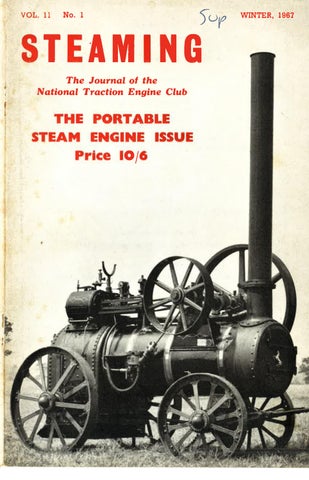
No. 1
5-or WINTER, 1967
STEAMING The Journal of the National Traction Engine Club
THE PORTABLE STEAM ENGINE ISSUE Price 10/6
STEAMING
2
NATIONAL TRACTION ENGINE CLUB
OFFICERS FOR 1967 President . REVD. PHILIP WRIGHT, M.B.E., Hon.C.F., Roxwell Vicarage, Near Chelmsford Essex. Tel.: Roxwell 644.
Vice-President ARTHUR NAPPER, ESQ,
Chairman. ANTHONY HEAL, ESQ.,
Baylins Farm, Knotty Green, Beaconsfield.
Vice-Chairman and Editor : J. CRAWLEY, ESQ., Field House, Turvey, Bedford.
General .Secretary . E. A. FILLMORE, ESQ., 34 Northwick Park Road, Harrow, Middx.
Membership Secretary (including ties and badges). J. R. BONSER, ESQ., 6 Rokeby Gardens, Woodford Green, Essex.
Treasurer • J. H. HOBBS, ESQ., 6 Esher Close, Basingstoke, Hants. TECHNICAL SERVICES AND SPARES SECTION BRIAN ORAM, ESQ.,
Bourne House, St. Mary Bourne, Andover, Hants. (Tel.: St. Mary Bourne 260).
STEAMING
3
THE PORTABLE ENGINE
The portable is without doubt the poor relation in the Steam Engine movement. Their very immobility precludes them from reaping the glamour of their mobile sisters and thus to the man in the street they are rather inanimate. To the student of engineering history, however, they present a very interesting subject for study. From the evolution of the portable the traction engine was born, and in this issue we have attempted to give as much comparative data as is possible with the limited number of pages available. Unfortunately it is not possible to give technical data relating to all makers, but we have attempted to include illustrations of most of the more important builders. It is sincerely hoped that this issue will inspire interest in the portable engines and encourage ownership whilst it is still possible to find interesting examples at a reasonable price. Our thanks are due to the Road Locomotive Society and members of our own club for their help in producing this issue. JOHN CRAWLEY. Field House, Turvey, Bedford.
4
STEAMING
ENGINES AT THE GREAT EXHIBITION AT HYDE PARK IN 1851 The manufacturers of agricultural steam engines have spared neither pains nor expense in endeavouring to produce a perfect portable engine. At the Great Exhibition in Hyde Park, there was quite an array of them ; nearly every engineer of eminence had produced one constructed upon the most approved and tried principles, and all were so good, though differing considerably from one another in design, that it a most difficult matter to decide which is actually the best, for, although one may have an advantage in some particular point, yet upon inquiry it will be generally found that it has been obtained at the sacrifice of some other, which its maker considered too important to be neglected. We need not, therefore, attempt to make comparisons where all are so good, but will give a short description of some of those which upon trial were found to answer thoroughly well, and received the commendations of the judges whose business it was to decide upon their respective merits. MESSRS. GARRETT'S ENGINE This eminent firm always make a great display of implements of every description, sparing neither pains nor expense to enable them to occupy the first place in the continually renewed struggles for pre-eminence as agricultural machinists ; and it but rarely happens that they are not the recipients of some of the prizes awarded for inventions. improvements, cheapness. or superior workmanship. Their portable engine, as may be expected, is ❑ne of the best constructed, having every modification or addition applied immediately its advantage was apparent. Recently this engine has been considerably lightened, and now only one pair of shafts is used instead of the arrangement shown in the cuts. It is fitted with governor, hair-belt jacket, steam and water gauges, and other necessary appendages, mounted on four strong carriage-wheels, with shafts, and may be easily transported from place to place by two horses. MESSRS. HORNSBY'S ENGINE This firm has brought the agricultural portable engine to the highest point of perfection in workmanship, and in economy of fuel in producing steam. The chief peculiarity in this engine is the placing the cylinder and pipes connected therewith inside the boiler, or steam chamber, so effectually protecting them from the atmosphere at all times. 'this improvement no doubt effects an immense saving of fuel, as it does away with all condensation in the cylinder ; and the less fuel is consumed, the less wear and tear there will be in the tubes and firebox, which are the most hard-wearing parts. This engine is exceedingly neat and compact in appearance. The cylinder (as we have before remarked) is placed in the steam chamber over the furnace, the piston rod working through a stuffing-box in the fore-side of it : and on the outer end of the piston rod is a short crosshead which works in two guides, which are neatly supported at the outer end by a ring, the lower part of which is screwed to the top of the barrel of the boiler, The connecting rod is attached to the head of the piston rod and crosshead and, as the piston rod passes in and out of the cylinder, the connecting rod has room to play in the ring in a manner similar to what it would in a trunk engine. The crankshaft is supported on two plummer blocks one on each side of the boiler, a convenient distance aft of the chimney or funnel. The plummer blocks are placed on carriages formed of three short fluted Doric columns, the abacus of each being the lower portion of the plummer block. The whole is placed upon a step projecting from the boiler. It is very handsome in appearance, and quite secure and steady when working. Above the guides for the piston rod crosshead is placed an exceedingly well-contrived governor, with an additional security for the heavy balls when the engine is travelling—two semi-spherical cups being placed so as to receive the balls and keep them at rest. as their weight is apt to injure their bearings by jolting on rough roads.
5
STEAMING
.5 [LI C
.., O
6 Z
I
4
Nominal horse power
The engine is fitted with metallic piston, steam cocks, gauge cocks, safety valves, and all other requisites for ensuring correct working and safety. Prizes have been awarded to Messrs. Hornsby at the Exeter and York meetings of the Royal Agricultural Society, and the great Prize Medal at the Exhibition of all Nations, as well as by a number of local societies. At the meeting of the Royal Agricultural Society at York, the judges say, " they awarded the prize to this engine because it was stronger, steadier, better fitted, got up the steam and worked with less fuel than any other engine exhibited. It worked in every way as the exhibitor described it. It had a good boiler to generate the steam, plenty of cylinder room to give it power. sufficient strength in all its parts to keep it steady, and an excellent governor to regulate its motion ". A more flattering report never was made nor better deserved. This engine is the result of repeated improvements and careful study of the peculiarities of engines required for agricultural purposes. Though highly scientific in its arrangement, it is nevertheless exceedingly simple: and the charge I hear repeatedly made against it. that it is difficult and expensive to repair (in consequence of the cylinder. etc.. being enclosed), I am assured by Mr. Hornsby is utterly without reason: they undertake to take to pieces and reconstruct their engine in the same time that any other can be so treated. Nor do I see any difficulties arise from the situation of the cylinder, there being a man-hole directly over it. At the trial of steam engines which took place under the direction of the executive committee at the Great Exhibition, the Messrs. Hornsby's engine, competing with others manufactured by various makers from all parts of England, beat them all in amount of duty, the consumption of fuel being only 61 lbs. of coal per horse power per hour ; or 3 cwt. 2 qrs. 13 lbs. of coal per day for a six-horse engine. At another trial (the power in both cases being proved with a dynamometer), at the North Lincolnshire Agricultural Society's meeting, held at Caistor, July, 1851, the first prize of £20 was awarded, the result being reported thus: Their engine was of seven-horse nominal power, and consumed 36 lbs. of coal, on getting up the steam 37 lbs. per hour, being 5.28 lbs. per hour per horse, and 3 cwt. 1 qr. 6 lbs. per day of ten hours, when working up to their nominal power the whole time. At another trial at the Yorkshire Agricultural Meeting, held at Bridlington, August, 1851, the prize was again awarded to this engine, the results being thus with four engines, from the hands of first-rate makers, Messrs. Hornsby's being No. 1:
'-'S "0
eu
0
.
'a6,.' 0 1-, .0 0
1-, 0 o
V CI'
0 4)) L ,p 1.4 0
oo
a;0,71 0 , t-, ,... 54
.0 , 0 0 T 0 4: 0 '—° 1-,S, '4....., ., cnO 0
to 741 o00 U *OA
o 040 'cl i o c'l U Q.
lbs.
lbs.
lbs,
cwt.qrs.lbs.
7
40
51+
7.35
4
44.0
al
°63. 3 ei.," '
,E4 4 7 › o co 4
(...) ,-c, 3 2. 2 11 7
7
41
591
8.50
5
1
6
48
641
10.70
5
2 26+
6
601
9611 6.12
8
2 151-
In this trial an inferior coal was used, which accounts for the increased consumption in doing the same amount of work. The engines of this firm have now stood the test of years, and I most confidently recommend them as being, if not superior, at least equal to anything of the kind manufactured by anyone.
6
STEAMING
MESSRS. BARRETT, EXALL & ANDREWES PORTABLE STEAM ENGINE. Constructed at the Katesgrove Iron-works, Reading. It is in every respect a most efficient one. Messrs. Barrett's ample stock of machine tools, etc., enable them to turn out everything of first-rate workmanship, of which their portable steam engine is a good example. It is constructed in the ordinary manner, with tubular boiler, etc., and the engravings will make it much more clearly understood than any written description. There is one particular point, however, that should be specially observed, and that is, the admirable manner in which the engine is arranged and secured to the boiler. It consists in the engine being complete on a metal frame, independently of its attachment to the boiler, which renders its removal easy, at any time it may be necessary, without affecting the boiler. The average consumption (but of course varying with the quality of the coal, coke, wood, etc., employed) is found to be about 7 lbs. per horse power per hour. The simple arrangement of the parts and all being exposed to the eye, renders this engine well adapted for agricultural purposes —as a smart agricultural labourer will, with a week's instruction, be better qualified to drive it than where the engine is out of sight or more complicated in construction.
1851 Portable Engine by Messrs. Barrett, Exall & Andrews of Reading. These makers are justly celebrated for the manufacture ❑f portable engines ; they are exceedingly simple, of excellent workmanship. moderate in cost. and consume a very small quantity of fuel : they arc well adapted for all the purposes for which steam is used as motive power—as threshing, grinding,
STEAMING
7
o o — to
" .5
4-1
U
71
6 4
e, iz
,,) 22
Coals used in getting up the steam
Coals burnt per hour
Coals burnt per horse power per hour
sawing, pumping, or any other purpose. With contractors for works of all kinds they are great favourites. They are manufactured of various powers, from three horses to ten ; in the latter case they are fitted with double cylinders ; they are fitted up and equal in workmanship the best locomotives ; the engine is well arranged and has an improved governor (which regulates the steam to the greatest nicety), starting lever, safety valves (which are acted upon by Salter's spring balance), water and gauge cocks, feed pump and steam whistle, all placed within reach of the driver, without his moving from his position in front of the boiler. The annexed tabular statement will show the results of a trial with eight portable engines, carried out by the judges' direction at the Royal Agricultural Society's meeting, held at Exeter, 1850, Messrs. Clayton & Shuttleworth's engine being No. 1.
1
mins. 43
7
lbs. 361
lbs. 54f
lbs. 7i-
2 3 4 5 6 7 8
40 105 85 39 81 90 34
4 4 6 9 7 6 6
521 60 64 42 491 44 34
411 112 83 68 74 661 62
9* 28 131 72 101 11 111
W
o
5)
0
Fo
The small three-horse engine, manufactured by this firm, is admirably adapted for small occupiers, and will thresh out, clean and satisfactorily, 20 quarters of wheat per day of ten hours (the crop being of a fair average yield) ; one horse is sufficient to remove it from place to place when on turnpike roads, and, from its extreme lightness, it may be taken over bad road and into situations that would not be accessible to engines of greater weight. The consumption of fuel for this engine is 3 cwt. for a day of ten hours ; and it will require to be supplied with 270 gals. of water. The seven-horse engine weighs 50 cwt., and consumes, in a day of ten hours, 5 cwt. of coals and 450 gals of water, and will thresh 35 quarters of mown wheat per day. The nine horse power engine weighs 75 cwt., and consumes 9 cwt. of coals and 800 gals. of water in the day of ten hours. The last engine is only adapted for farms of the largest description. I have just seen one of the engines of this firm employed in driving some heavy iron rollers for grinding clay (as heavy a duty as could be laid upon an engine), at the Pottery Works of E. Betts, Esq., on his estate, Preston Hall, Kent. The driver of the engine gave me a most satisfactory account of it, and seemed well pleased with it in every respect. MESSRS. TUXFORD'S PORTABLE STEAM ENGINES These are considered to be good and effective engines ; they are differently constructed to the generality of engines of this description, the ordinary plan being to place the cylinders and engine-work on the top, or nearly so,
S
STEAMING
of the boiler, horizontally, and setting the main shaft across. In Messrs. Tuxford's engine the cylinders are placed in the smokebox ; in this they are thoroughly housed up, and being kept always hot by the draught of hot air through the tubes and by the escape of the steam, a great economy of fuel should take place, as the steam cylinders are as well off in this case as in Messrs. Hornsby's with the advantage of being accessible at all times by merely opening the moveable plate which forms the back of the smokebox. The cylinders arc set in an upright position, sometimes fixed, and at others they are made to oscillate ; there are also peculiarities in the arrangement of the tubes. The fuel consumed is about 4 cwt. per day.
7AfLaFri..Xe,
A Vertical Portable Engine built in 1851 by Messrs. Tuxford & Sons of Boston, Lines. MESSRS. RANSOMES' PORTABLE STEAM ENGINE This portable is equal in workmanship and effectiveness to any made in England, the object of this firm being to make an engine that shall do the work of agriculturists in a satisfactory manner through a long series of years, instead of making an engine especially with a view to competition at an agricultural show, the results of which must not always be taken as the sole guide in the choice of an engine. The cylinder and the machinery are placed on the top of the boiler ; the engine is on the principle we have before alluded to as the trunk engine, the simplest form of engine that can be made, it is fitted with governor, regulator valve, and an efficient feed pump. The crankshaft and connecting rod are of wrought-iron, and the slide valve of brass, and of the most improved construction. The steam and escape pipes are of copper, and consequently not liable to injure the slide valve and metalic packing of the piston by any scales caused by corrosion of the metal coming off the pipes and being carried by the steam into
STEAMING
9
the working parts of the engines, as is frequently the case in common engines fitted with wrought-iron gas tubes (instead of copper) for steam pipes. The boiler is made on the same principle as the locomotive boilers and will work up to 80 lbs. pressure on the square inch, should there be any necessity for it. A wrought-iron ashpan is placed under the firebox containing water ; all hot cinders are immediately extinguished as soon as they fall, thus ensuring the greatest possible safety in working. Between the engine frame and the axles of the wheels are interposed springs for preserving the machinery from injurious shocks while passing over rough roads. The five-horse engine will thresh, with ease, 40 quarters of wheat (of average yield) per day. In the report of the Royal Agricultural Society's meeting at Bristol, 1842, I find that Messrs. Ransomes exhibited a portable disc engine (tried at Liverpool), but then set upon a carriage with four, instead of two wheels, and
having a platform of sufficient dimensions for the conveyance of a threshing machine from farm to farm. A further alteration had also been effected by anplying the power of the engine to give locomtion to the carriage instead of using horses : the engine travelled along a road at the rate of from four to six miles per hour, and was guided and manoeuvred so as to fix it in any particular spot with much ease : it turned also in a very small compass ; the engine proved itself sufficiently powerful to drive, at full speed, a three-horse threshing machine. The judges awarded a prize of £30 but considered it questionable whether the substitution of steam for horses, as the force employed to move portable agricultural engines from place to place, would be found either more convenient or economical ; they, however, highly commended the simplicity and effectiveness of the machinery applied by Messrs. Ransomes to accomplish the purpose. This was in every way a most interesting experiment ; but, as it is not now in use, I presume the makers did not find the disc engine adapted to their purpose.
Ransomes & May 4 n.h.p. Portable Engine of 1851.
10
STEAMING
THE PREFACE TO THE PORTABLE ENGINE BY W. D. WANSBROUGH (Lincoln, 1886)
The introduction of the portable steam engine in its present form, now more than a generation ago, at once furnished the solution of many industrial problems. Numerous attempts had previously been made to disencumber the steam engine of the inevitable complication, mass, and solidity necessary for the development of power from steam of low or atmospheric pressure. The master mind of James Watt. whose whole career was a series of brilliant discoveries, was vehemently opposed to the use of high-pressure steam, and it was not until the Cornish miner. Richard Trevithick. triumphantly exhibited his " puffer" or high-pressure engine in successful work that the prejudice gave way, and the first step towards the portable engine was accomplished. So essentially different were Trevithick's engines from anything that had preceded them that the following description of one of them, written at a time when Cornish engines were still working with boilers wholly or partially of stone, reads not very unlike the description of a modern double cylinder engine: "Chappell's engine had two cylinders and a double crank . . the the piston-rod crosshead worked in engines were fixed on the boiler . . guides fixed to the cylinder, connecting-rods went from the crossheads to the cranks. Steam was turned on and off by a four-way cock." This engine, it seems, was furnished with a blast-pipe, hut whether or not this was made use of to cause an artificial draught does not appear. At any rate it is described as puffing so loudly that it could be heard for miles. In the account of another of Trevithick's engines about the same period, however, it is explicitly stated that " the steam puffed up the chimney ". These were not, it will be understood, actually moveable engines upon wheels, but they were undoubtedly a considerable advance in the direction of portability upon the engines of Watt, Hornblower, and others, which were in most cases dependent upon the masonry and walls of the engine-house for the connection between the beam and the cylinder. Trevithick's engines above referred to were, moreover, direct-acting ; so that we have at this early date (about 1803) the essentials of a portable engine —high pressure, direct action, and forced draught. The boiler appears to have been of cast iron, cylindrical, with a single wrought-iron tube passing through it, and to have been quite independent of brickwork foundations and setting, and the engine was attached to the boiler. The pressure would seem to have been about 30 lbs. above the atmosphere. The next step in the history of the portable engine is represented by a machine designed by Messrs. Tuxford of Boston in 1839, the year of the establishment of the Royal Agricultural Society. This apparatus was a portable combination of engine and threshing machine upon the same frame, and was of 6 horse power. The first engine upon this plan appears to have been set to work in the autumn of 1842 with satisfactory results. Within a twelve-month from the trial of this engine Messrs. Tuxford turned out six machines of this class, and afterwards about twelve more of the same kind, after which they found it better to separate the engine rom the threshing machine. In 1841 the Royal Agricultural Society held their Show at Liverpool, when an engine upon wheels was exhibited for the first time, and with that engine the history of the modern portable engine may be said to commence. This was a rotary disc engine constructed by Messrs. Ransomes & Sims of Ipswich, under the patent of Mr. Henry Davies of Birmingham. The engine had a vertical boiler and was carried upon a single pair of wheels, and could be drawn by one horse. The crankshaft was provided with a universal joint, coupling it directly to the threshing machine. [Continued on page 13
STEAMING
11
ABOUT PORTABLES BY KEITH M. VIGUS The portable engine, the poor relation, some say, of the traction engine, has never received the attention and rewards due to it. It was a Clayton & Shuttleworth portable that Thomas Aveling adapted, by chain drive, into a self-moving engine, and this is generally credited as the first self-moving overtype road engine, and thus the door was thrown open for steam traction on the roads. And, whilst the glamour of the showman's road locomotive, the might of the ploughing engine, and the down-to-earth workmanship of the general purpose engine captured the imagination of the steam minded, the portable chugged away, comnaratively unnoticed, in fields, yards and sheds up and down the country, doing an enormous amount of invaluable work. It is only now that interest is beginning to quicken, albeit on a fairly small scale compared with the general engine movement, and, unfortunately, it is rather late in the day. The story of the portable is intimately tied up with the story of steam. It could not have been built until Trevithick had overcome the " high pressure " prejudice of the Watt school, and established the high pressure direct acting engine ; until Murdock had invented the slide valve, and until a device for converting reciprocating motion into circular motion had been brought out. By the beginning of the nineteenth century, all these features were established, and the stage was set for the advent of the portable engine. However, apart from a few abortive attempts, no real progress was made until Messrs. Tuxford of Boston, Lines., in 1839, designed and combined portable engine and threshing machine. The engine itself was curious, having a return flue boiler, a single oscillating cylinder, and with the flywheel at the end of the boiler, at 90° to the crankshaft, and driven by shaft and bevel gearing. At the same time, Howden, also of Boston, produced a vertical-cylindered engine. and Dean of Birmingham a portable with both cylinder and boiler vertical. Portable engine development from then on was slow, but certainly sure. Ransomes & May of Ipswich produced a light portable using a Davis rotating disc engine in 1841, and this was incidentally weakly self-moving by pitchchain, and in the same year, Clayton, Shuttleworth & Co. produced two engines. Still, even by 1844 only the aforementioned Dean, and Cambridge of Market Lavington, Wiltshire, were exhibiting portables at the Royal Agricultural Society's show. Ry the end of that decade Ogg of Northampton produced a doublecylindered engine, with feedwater heater, expansion valves, loco type boiler, etc., WI it was looked upon with a jaundiced eye by the R.A,S.E. " Too expensive " and " not necessary " were their comments! In 1851, trials were, carried out in Hyde Park, in conjunction with the Great Exhibition at the Crystal Palace where portables were being shown. Tuxford exhibited an engine in which the vertical cylinder was housed in a casing on the end of the boiler opposite the firebox. This actual engine is now on show in the Musee des Arts et Metiers in Paris. R. Hornsby of Grantham also exhibited a portable in which the cylinder was enclosed in an upward extension of the firebox shell. This was one of the first of the famous Class D portables of which there are still one or two existing today. Hornsby, incidentally, came out top in the Hyde Park trials. The Ransomes & May exhibit at this exhibition, a portable on springs, was still at work in 1911. From then on, in spite of some odd deviations from the general trend, the portable assumed the form we know today, and all the famous firms, as well as a welter of small country ironworks and workshops, were turning them out, all, it should be noted, with some feature which put the engine streets ahead of all its rivals. A facet of salesmanship which is, even today, well to the fore!
12
STEAMING
By the 1870's the portable engine had found its way into nearly every corner of agriculture and rural industries such as timber milling, brick making, quarrying, etc. They had already been discarded as the motive power for cable ploughing. their place being taken by the ploughing engine proper. In the rest of the farmstead, however, they were used For driving threshing drums, cider presses. saw benches, root pulpers, and various barn machinery. In the 1890's the showmen found electric light a desirable asset, and the Portable was adapted to drive a generator mounted on the same chassis—the box lighting engines. They were used on hioscone shows, often incorporated in the actual front structure of the booth. and also inside the larger rides together with the organ and centre truck. The Savage light engine owned by Mr. Middleton of Hartlebury, Worcestershire. was the engine which generated light for Percy Cole's famous Gondola Switchback. T. Green of Leeds also built lighting engines, as did Foster. and one of their engines was at work on the northern fairgrounds as late as the 1930's but, in general. these lighting engines were used for only a short time. their position being usurped by the showman's road locomotive which could pull the loads. as well as generate electricity. With the increased use of traction engines in agriculture, the portable gradually faded from the scene. but here and there odd examples were found threshing even up to the Second World War.. However, for other kinds of work they continued to be used in enormous numbers. In the quarries they drove stone crushers and mortar mills, drove saw benches, often several at a time via a pulley system in the saw mills, asphalt plants on the road, machinery in the brickworks and a host of other appliances from water pumps to flour mills. On the fairground they drove the Yorkshire Steam Swings, whilst their very near cousin. the centre engine, made chiefly by Savages of King's Lynn, Walkers of Tewkesbury, and Tidmans of Norwich, were driving switchbacks, gallopers and steam yachts for the thrills and delights or the populace. Development in the twentieth century was mainly slow. High sneed governors were adopted, and high pressure with piston valves was used by some manufacturers. Other enticements were designed and tried like sunerheating, etc. but sales fell off, so that by 1930 there were very few makers turning out portables and by 1940 only Rohm Marshall and Foster were making them, although a fair few were produced during World War II. The last• portable has now probably been built, and that was by Robey around 1962. Portable engine design was pretty static once established. The cylinders. which were either single, duplex (double high). or compound (Burrell did do some S.C.C. jobs), were almost always mounted over the firebox. whilst the crankshaft and flywheel were located at the smnkchnx end. A few firms, however, like Fowler, Greens, & Barrows and Stewart, did mount them the other way round, road-engine wise. Boilers were of the locomotive tyre, but a few firms tried out the circular stayless removable fireboxes, the most successful of which was probably Marshall with the "Britannia" box. One of these is preserved in Lincolnshire. The boiler was always fed by nump, but in addition injectors were occasionally fitted, and I have seen an illustration of a Fowler portable with what looks suspiciously like a Mumford type steam pump mounted on the side of the boiler. A few firms fitted dry-backed fireboxes to their very small Portables, and the " wet bottom " ho\ was also tried. The theory of this was that if the ashoan was filled with water, the steam produced by falling ashes passed up through the red hot coal generating " water gas ", a mixture of carbon monoxide and hydrogen. This further ignited in the firebox resulting in a saving of fuel. In spite of this it was never widely used. Colonial fireboxes for burning inferior fuels. feedwater heaters, and spark arrestors were used to a much larger extent on portables than on road engines, and a large range of governors were employed. Garrett produced a crankshaft governor on their " WS" series, and automatic expansion gear was fitted by several makers. Odd refinements such as jet condensers. super-
STEAMING
43
heaters (Garrett and Marshall), link reversing gear, and all enclosed motion were advertised and fitted by the maker if desired. Some firms would turn out portables with appliances attached like air compressors (Davey Paxman) or water pumps (Foster), and most firms would fit an engine up for straw burning with automatic feed, usually the Head & Schemioth or El!worthy apparatus for the export market. All these features were designed to give greater efficiency, economy, and consequently greater sales. As far as the makers of these engines were concerned, by the turn of the present century most of the small country works like Smith & Ashby and rtocford had either become defunct or ceased production, and the market was dominated by the big firms. They would all produce portables from about 2-12 h.p. as singles, from 12-20 h.p. as doublc•cylindered and 10-30 h.p. as compounds. Larger engines were built, Robey turning out a monster of 200 i.h.p. which was complete with catwalk. Portables were turned out in enormous quantities by Marshall, Clayton & Shuttleworth, Robey and others but some firms like Aveling & Porter, Fowler and McLaren turned out comparatively few, their other products satisfactorily occupying most attention. The Sentinel Waggon Works were late in the field and produced some vertical-boilered jobs, but most of these went abroad. Marshall's are probably the most common portable left today with both slide and piston valve (S type) examples to be found, alth❑ugh many other makes can, of course, be seen, including some rarities like Humphries of Pershore and some extremely old engines like a Lampitt of about 1860. There are very few railway locomotives, stationary engines, steam rollers, etc. now doing the job for which they were built as a commercial proposition. The humble portable will probably have the last laugh yet. A Vertical Portable Engine built in 1851 by Messrs. Tuxford & Sons Continued from page 10] The judges' report states concerning this engine: "The Society is indebted to Messrs. Ransomes of Ipswich for what may be termed the greatest novelty of the meeting, viz. the exhibition of a portable steam engine for the purposes of threshing corn.... The advantages of steam power for working fixed threshing mills have long been acknowledged in the northern parts of England and Scotland, but we believe this is the first attempt to render it portable so that it may be transported from one part of a farm to another as easily and expeditiously as the present machine with horse works. . . . By the peculiar construction of the boiler and method of disposing of the waste steam, danger of ignition from sparks seems to be avoided, and the judges confidently express their opinion that, with prudence, as great saety may be experienced in the use of this portable engine threshing engine in the stack-yard as is now found to be the case with a fixed engine in the barn." Notwithstanding this high commendation, however, much difficulty was experienced in persuading the farmers of that date that it was possible to work an engine of this kind with safety in their rickyards ; but two years later the judges' report states in connection with the Show at Derby in that year that " the manufacture and use of travelling steam engines has become a systematic business". Successive improvements were developed year by year in the construction of these engines, and in 1851, at a competition held in the grounds of the Great Exhibition in Hyde Park, Messrs. Hornsby of Grantham, were successful in carrying off the prize with heir 6 horse power portable engine, which is reported to have consumed about 6i lbs. of coal per horse power per hour. The history of the portable engine for the next ten or twelve years can be studied at length in the reports of the judges at the yearly trials of the Royal Agricultural Society. Glancing over these we do not find much variation in the form or type of engine exhibited, but it is interesting to note the continued increase in the number of engines sent for trial in successive years, and the regularly diminishing consumption of coal per horse power, ranging from 10,78 lbs. per hour in 1849 to 2.79 lbs. in the year 1872.
14
STEAMING
AVELING & PORTER
Aveling & Porter Single Cylinder Portable Engine of 1899 adapted for burning straw (R. & T. Elworthy's patent).
Aveling & Porter Compound Portable Engine of 1899.
15
STEAMING BROWN & MAY (1908)
BROWN & MAY SINGLE CYLINDER PORTABLE ENGINES 2
2+
3
3+
Brake horse power—working load ...
6
7+
9
101
Maximum load
Nominal horse power ...
...
...
.
7
9
10+
12
Diameter of cylinder in inches
...
4+
5f,
61
6+
8
8
9
9
200
180
150
150
...
36
42
48
48
Width of turned face on rim in inches
4
4
51
51
Weight on wheels, unpacked, in cwts.
33
39
48
48
...
Length of stroke in inches Speed in revolutions per minute Diameter of fly wheel in inches
STEAMING
16
BROWN & MAY (1908)
BROWN & MAY SINGLE CYLINDER PORTABLE ENGINES Nominal horse power ...
...
4
5
6
7
Brake horse power—working load
.
12
15
18
21
Maximum load
.„
..
14
171
21
241
Diameter of cylinder in inches
...
61
71
81
9
...
„.
...
10
12
12
14
Speed in revolutions per minute
,..
140
130
130
120
Diameter of fly wheel in inches
...
54
60
60
66
Length of stroke in inches
Width of turned face on rim in inches
54-
61
61
61
Weight on wheels, unpacked, in cwts.
60
73
81
96
S-TEA MING
17
BROWN & MAY (1908)
BROWN & MAY SINGLE CYLINDER PORTABLE ENGINES . Nominal horse power
„,
...
...
8
10
12
Brake horse power—working load
.
24
30
36
maximum load ... Diameter of cylinder in inches
...
Length of stroke in inches
...
...
28
35
42
10
11
12
14
14
14
Speed in revolutions per minute
120
120
120
Diameter of flywheel in inches
66
66
66
Width of turned face on rim in inches
62
8
8
Weight on wheels unpacked in cwts.
109
124
129
STEAMING
18
BROWN & MAY (1908)
BROWN & MAY DOUBLE CYLINDER PORTABLE ENGINES Nominal horse power ...
10
12
14
16
20
Brake horse power—working load
30
36
42
48
60
Maiimum load
.
35
42
49
56
70
Diameter of cylinder in inches . .
7i
81
9
10
11
Length of stroke in inches
11
12
14
14
14
Speed in revolutions per minute
120
120
120
120
120
Diameter of fly wheel in inches
60
60
66
66
66
Width of turned face on rim in inches . .
81
81
10
12
12
Weight on wheels, unpacked, in cwts ...
127
132
168
180
220
...
...
STEAMING
19
BROWN & MAY (1908)
BROWN & MAY COMPOUND PORTABLE ENGINES Nominal horse power Brake horse power— working load maximbm load Working steam...pressure in lbs. p.s.i. Diameter of high pressure cylinder in inches Diameter of low pressure cylinder ... ... ... in inches Length of stroke in inches ... Speed in revolutions per minute Diameter of flywheel in inches ... Width of turned face on rim in inches ... ... ... ... Weight on wheels unpacked in cwts. (approx.) ... ...
8
10
12
16
20
25
24 28 140
30 35 140
36 42 140
48 56 140
60 70 140
75 88 140
51
61
7
8
9
10
9+ 12 180 54
10+ 12 180 54
12 12 180 54
13 14 155 66
141 14 155 66
16 18 120 72
8
8
9
12
12
14
115
126
136
185
220
300
20
STEAMING
CHARLES BURRELL
Burrell Single Cylinder Portable Engine of 1873.
An early Burrell Portable Engine at work.
21
STEAMING
CLAYTON & SHUTTLEWORTH
3 ,
Clayton & Shuttleworth Single Cylinder Portable Engine of 1890.
lemr,•_. Li. 1
.
1 4
"
• CIMYSTI.CWW/T11. • 1.1 LLLL II • .61., LI 0
• -
• -. -.
Xiititykr , ., '. :"'r ',..--‘ ,P1.2r .....‘ 41.1.C• 0..S.......49 1P2'. "..342f2r62* 21P?: -:'441 1 : ' -'
•
-
- --e.--.‘-7t. 4,41r
Clayton & Shuttleworth Single Cylinder Portable Engine of 1890 (fly wheel side).
22
STEAMING CLAYTON & SHUTTLEWORTH
Clayton & Shuttleworth Compound Portable Engine of 1890 fitted with automatic expansion gear. This type of engine was available in sizes up to 20 n.h.p.
Clayton & Shuttleworth Compound Portable Engine of 1890 fitted with automatic expansion gear. Available in 25 or 30 n.h.p. sizes.
23
STEAMING
DAVEY PAXMAN (1889)
SINGLE CYLINDER Nominal Horse Power
Fly Wheel
Diameter of Cylinder
Stroke
ins,
ins.
Diameter
Width
ft. ins.
ins.
Revolutions per Minute
4
6+
12
4
6
5
125
5
7+
12
4 6
5
125
6
8+
12
5 0
6
125
8
9+
12
5 0
7
125
10
10+
14
5
6
8
115
12
12
14
5 6
9
115
STEAMING
24
DAVEY PAXMAN (1889)
DOUBLE CYLINDER Nominal Horse Power
Diameter of Cylinder
Stroke
ins,
Fly Wheel Diameter
Width
ins.
ft. ins.
ins.
Revolutions per Minute
8
61
12
5 0
7
125
10
71
12
5 0
8
125
12
8+
12
5 0
9
125
14
81
9
125
9+
_ 12 12
5 0
16
5
0
10
125
20
10+
14
5 6
11
115
25
12
14
5 6
12
115
30
13
16
6
14
105
0
25
STEAMING
DAVEY PAXMAN (1889)
DAV EY PAXMAN COMPOUND ENGINES Nominal Diameter of Cylinders Horse High re LOW Power Pressure
Stroke
ins.
ins.
ft. ins.
ins.
Width iteyolutiont Diameter of of per Fly Wheel Fly Wheel Minute ins.
8
51
9
14
5 0
7
155
10
6+
101
14
5 0
8
155
12
7
111
14
5
0
9
155
14
5 6
10
155
16
8
13
20
9
141
14
5 6
11
155
25
10
16
18
7
0
12
120
30
11
171
18
7
0
14
120
STEAMING
26
DAVEY PAXMAN (1889)
DAVEY PAXMAN IMPROVED HIGH PRESSURE PORTABLE STEAM ENGINE Double Cylinder
12
5
6
125
8
8+
12
5
7
125
10
91
12
5
8
125
ins.
ins.
ft.
ins.
10
6
12
5
8
125
12
64
12
5
9
125
Revolutions per M inute
6-f
Width
6
Diameter
ins.
Stroke
ft.
Diameter of Cylin der
Width
ins.
Nominal
Diameter
ins.
Revolutions per M inute
Stroke
Fly Wheel_
L Horse Power
.,...
Diameter of Cylin der
Nominal Horse Power
Single Cylinder
16
8+
12
5
10
125
20
94
12
5
11
125
STEAMING
27
FODEN
Foden Single Cylinder Portable Engine. cica 1895,
The above is an illustration of an improved Portable Steam Engine, in the construction of which particular attention is paid to the due proportion between the engine and the boiler. The engines are of suitable dimensions for developing more than double their nominal power while running at moderate speed, and the boilers have ample heating surface for generating steam in excess of the requirements of the engine, with moderate firing, and consequent economy of fuel. The boiler has all the necessary fittings, including steam gauge, glass water gauge and cocks, two safety valves (one under lock and key), blow-off cock, mud door, ashpan with adjustable lid, steam blast pipe and folding chimney. (From a Foden catalogue of 1895.)
STEAMING
28
JOHN FOWLER
FOWLER SINGLE CYLINDER HIGH PRESSURE PORTABLE ENGINES Class
B
C
TE
Z
...
22
30
38
45
55
Indicated horse power at 140 lbs. ... ,.. .,.
30
40
50
60
80
Best working horse power
21
28
35
42
56
Actual horse power
Diameter of fly wheel
... 48 ins.
54 ins.
60 ins.
60 ins.
60 ins.
Width of fly wheel
.,. 7 ins.
7 ins.
9 ins.
9 ins.
10 ins.
Revolutions per minute ...
150
150
150
150
150
Price (circa 1903) including complete outfit ... ...
£207
£241
£280
£324
f415
Extra for link motion and reversing gear ... ...
£12
£15
£18
£18
£20
Extra for large firebox
...
£8
£8
£10
£12
£15
Extra for injector ...
...
£7
£7
£7
£7
£8
29
STEAMING JOHN FOWLER
Fowler Single Cylinder Portable Engine of 1885 fitted with an adjustable patent centrifugal pump (Behar type).
FOWLER SINGLE CYLINDER HIGH PRESSURE PORTABLE PUMPING ENGINES—" BEHAR TYPE " Class
...
...
...
...
...
...
A
B
22 30 .. „. ... .... Actual horse power ... ... ... 6 ins. 8 ins. ... .„ Size of pump ... 600 1,000 Quantity of water, gallons per minute ... £260 £305 Price (circa 1903) of engine and pump Price of 3 pipes, 6 ft., including joint rings £11 and bolts £9 £8 Price of 3 pipes, 4 ft., including joint rings ... ... ... ... ... and bolts £5 £6 ... ... ... Price of 3 cast iron bends £9 £6 Price of 1 foot valve and strainer ... £810 0 ... £6 ... ... Price of 1 driving belt ... £348 ... £295 ... ... ... Total ... £13 £11 Packing for shipment
C 38 9 ins. 1,600 £355 £12 £10 £7 £12 £11 £407 £15
30
STEAMING
JOHN FOWLER
Fowler Portable Pumping Engine of 1866.
Fowler Double Cylinder Portable Engine No. 4670 of 1883. Specially adapted for straw burning.
4e
STEAMING
JOHN FOWLER
Fowler Portable engine of 1878 fitted with Church valves and a steam dome. The cylinder is in a steam jacket.
Fowler Two Cylinder Agricultural Engine No. 2666. Built in 1878.
31
32
STEAMING
JOHN FOWLER
Fowler 12 n.h.p. Portable Engine No. 5768.
Built in 1889,
Fowler 10 n h.p. Single Cylinder Portable Engine No. 5765. Built in 1889,
STEAMING
JOHN FOWLER
Fowler 5 in. Double Cylinder Vertical Portable Engine No. 7742 of 1896. Fitted with winding plant for Hampton Gold Fields Ltd.
Fowler 20 n.h.p. Compound Portable Engine No. 11505. Photographed on the 6th March. 1908, at Leeds.
33
12
15
5 18
6
, ) 2,
e§'
..... .m
1.)
0.,8
cd
Enlarged firebox
Ordinary firebox
Enlarged firebox
Ordinary firebox
...
...
•
34
40
36
43
40
46
—
52
47
60
55
56
51
64
59
73
66
85
78
24
8
82
715
94
87
85
78
97
90
50
150 150
21
7
... 344 39 39 42 42 50 50
9
4
Diameter of fly wheel (ft./ins.)
71
3
225 225 225 180 180 150
...
Indicated horse power ...
2+
Single Cylinder
GARRETT PORTABLE ENGINES
Speed (revolutions per minute)
...
...
Engine No.
Weight in cw ts. Unpacked
36
12 42
14 36
12
100
91
115
106
110
100
125
115
50 56
128
118
60
20
118 136
113
131
121
—
56
195
—
240
—
215 265
—
50 50 56
103
75
25
150 130 120
42
14
144 128 146
134
56
150 135 135 150
30
10
Double Cylinder
STEAMING
GARRETT
Garrett Single Cylinder Portable Engine of 1900 fitted with governor
of the Pickering type.
35
36
STEAMING
GARRETT
1900 Garrett Single Cylinder Portable Engine with screw brake fitted to both hind wheels.
STEAMING
GARRETT
Garrett Double Cylinder Engine of 1900 fitted with Pickering governor and funnel raiser.
37
12
12
14
16
16
18
81
101
111
13
141
16
172
7
71
9
9.4
104
111
OA
OB
OC
OD
OE
OF
12
ins.
6
Stroke
ins.
Low Pressur Dia.
High Pressure Dia.
O
Size
Cylinders
6
6 0
0
5 6
5 6
5 0
5 0
5 0
ft. ins.
Dia.
15
15
15
12
11
8
7
ins.
Width
Fly Wheel
110
120
130
130
150
150
150
Revs. per Min.
120
100
80
65
80 100
50
35
30
20
72
60
48
35
25
20
14
Effective H.P. EconoMax. mical Load
60
42
36
24
Indicated Horse Power
Power Developed with 140 lbs. Steam Pressure
GARRETT COMPOUND PORTABLE ENGINES
375
300
270
220
150
130
110
cwts.
Weight Unpacked
400
325
290
240
168
145
120
cwts.
Wei ht g Packed
1980
1520
1050
860
690
660
560
cubic ft.
Measure ments Packed
Approximate Weights, etc.
OC
O NIIIdgIS IIHIIIIV9
STEAMING
GARRETT
1900 Garrett Compound Portable Engine with Rider's automatic expansion gear. Available 60 indicated h.p. and upwards.
39
40
STEAMING
HEMPSTED
A Single Cylinder Portable Engine built by Hempstead & Company of Grantham in 1875.
Double Cylinder
Single Cylinder 2+ horse power ... „ ... „ 4 „ „ ... 5 ... „ , 6 „ ... „ 7 „ ... 8 „ „ .. , „ 10 „ „ ... 12
... ... ... ... ... ... ... ...
£125 £175 £190 £210 £225 £245 £280 £325
8 horse power ... „ 10 „ „ ... „ 12 „ ... 14 , „ ... „ 16 „ ... „ 18 „ ... , 20 „ „ ... 25 „ „ ... 30
... ... ... ... ... .. , ... ... ...
£275 £305 £355 £400 £440 £495 £530 £640 £755
STEAMING
DY APPOINTMENT TO HER MAJESTY THE QUEEN SPECIALISTS IN WATER TREATMENTS AND DESCALENTS
Consult :
HOUSEMAN & THOMPSON LTD. SPECIALISTS IN WATER TREATMENTS AND DESCALENTS
THE PRIORY • BURNHAM • BUCKS. for
D.M. water treatment
Ransomes, Sims & Jefferies Compound Portable Engine of 1947 fitted with slide valves.
Whether he is ' nursing ' a boiler of an Ocean Liner, or a Power Station, for a living, or tending a traction engine for a hobby :
For longer life and greater efficiency Engineers all over the world recommend D.M. Water Treatment. If one is using hard or soft water, the scale or corrosion which results can only be prevented by efficient water treatment.
STEAMING
INSURANCE for Steam Vehicles Speoial Terms for Club Members Write to :
TENNANT, BUDD & SIMSON LTD. 92 Fenchurch Street, London, E.C.3
GEORGE THURLOW & SONS LIMITED
STOWMARKET • SUFFOLK 'Phone
SIOWMARKEI 3185 (3 lilies)
Solicit enquiries for items they can supply for Steam Engines, amongst same are :— BOILER TUBES CHIMNEYS WITH OR WITHOUT BRASS OR COPPER TOPS INJECTORS, GAUGES, ETC. PACKINGS
PAINTS
SUCTION HOSE
ENGINE AND CYLINDER OILS All enquiries will receive prompt and careful attention
STEAMING
WE'VE CHANGED , A FEW I DETAILS
Over the past one hundred years or so, we have changed a few details on Marshall-Fowler agricultural machines. But our up-tothe-minute crawlers do have two fundamental characteristics in common with all our earlier machines: they're simple and solidly built. The 55 bhp Track-Marshall crawler illustrated can easily outpull any comparably powered machine. Experience does pay handsome dividends ! If you'd like details of our modern agricultural or industrial crawlers or road rollers, write for brochures to: THE MARSHALL-FOWLER ORGANISATION GAINSBOROUGH LINCOLNSHIRE TELEPHONE GAINSBOROUGH 2301
STEAMING
Woburn Park
RALLY at Woburn Abbey The Home of Their Grace the Duke and Duchess of Bedford
*
Saturday, 6th May Sunday, 7th May Gates open 10.30 a.m.
GRAND PARADE Commences 2 p.m. on each day Engines in steam regardless of weather conditions LICENSED BAR
REFRESHMENTS AVAILABLE
Rally Secretary : JOHN CRAWLEY, FIELD HOUSE, TURVEY, BEDFORD
STEAMING
FOR SALE AND WANTED For Sale.—" Saga of the Steam Plough." Christmas offer to N.T.E.C. members. Author's autographed copies, 38s. Od., post free.—Harold Bonnett, 3 Ridge Side, Haw Lane, Bledlow Ridge, Nr. High Wycombe, Bucks. Sale at Muxworthy's Rapscott, South Molton, Devon, on June 3rd, will include 1894 Marshall Traction Engine, 1907 Aveling Roller, and a 1926 Babcock Roller. For Sale.-25 boiler tube ferrules, 11 in. o/d x 10 wg. thick.—P. R. Barker, Hatch Gate Farm, Hurst, Berkshire (Tel.: Hurst 90). For Sale.—Set of four coloured prints, size 9/ in. x 51 in., plus a 2 in. border. These have ben specially printed for framing with special attention to the colour accuracy. The engines depicted are : Fowler Showman's Engine " Kitchener " (The Iron Maiden), Fowler Single Cylinder Ploughing Engine at work, Thornycroft Steam Lorry, and Marshall Traction Engine at work on the drum. Each set supplied in envelope with cardboard stiffener. Price 15/- (post paid).—From J. Crawley, Field House, Turvey, Bedford. For Sale.—Postcard size photographs of Showman's Engines, Ploughing Engines, Wagons, etc.—S.A.E. for detailed list to J. Crawley, Field House, Turvey, Bedford. For Sale.—Reproduction of Terence Cunco painting showing the restored Flying Scotsman 44721 crossing the Forth Bridge. Size 25 in. x 20 in. Suitable for framing. Price 22/-, including postage and packing.—From The Curator, The Museum of British Transport, Triangle Place, Clapham, S.W.4. For Sale.—Brass Horse and Invicta nameplate for Aveling & Porter. £8. Bracherlands, Hadlow Down, Sussex. Wanted.—Foster Showman's Engine or Class LR 3-speed Foster Road Locomotive in any condition or incomplete.—Robert Millward, Lodgefield Farm, Halesowen, Worcs. For Sale.—Available to genuine engine owners at modest prices: good 11 in. and 2 in. boiler tubes. Lying in England.—Salmon, Belgrave, Llandindrod Wells, Radnor. Wanted.—Foster Traction catalogues, also photographs of Foster Showman's Locomotives and Anderton & Rowlands Locomotives and Rides.— Price and details to R. G. Hodges, No. 2 Slade Gate, Bullingham Lane, Hereford. Wanted.—For Fowler D.E. Convertible being restored, either good pair of front wheels, or set of wheels, front axle, etc., to convert to traction.— Crowther, Long Preston, Nr. Skipton-in-Craven, Yorks. For Sale.—The " Super Sentinel " Steam Wagon instructions to drivers, February, 1927, very clean.—Best offers to Edward Wheaton, 6 Earith Road, Colne, Huntingdon. For Sale.—One driving belt, 60 ft. x 7 in. x 5 ply.—Offers to R. Fishenden, 1 South View Terrace, Goudhurst, Cranbrook, Kent. For Sale.—Steam Cars, Lorries, Railways, Boats, etc. Modern, high performance, push-button start, also veteran and vintage. Magazine and brochure, 6s.—" Light Steam Power," Kirk Michael 6, Isle of Man, U.K. For Sale.-25 boiler tube ferrules, if in. o.d. x 10 w.g. thick.—P. R. Barker, Hatch Gate Farm, Hurst, Berks. For Sale.-2-wheeled trailer used with " Pandora ", will take two 40-gallon drums low enough to fill from water-lift. Gift at £18. Also 21 spuds for Wallis & Steevens 6 h.p. Agricultural Engine. Anothep gift at £5.—J. Quick, Gas Works, Bampton, Oxford.
STEAMING
Preserve your ENGINE with the best pump in the world
MANZEL A 3 point lubricator will protect each port face and give a good oiling to the steam itself.
WM. COULTHARD & CO. LTD., DURRANHILL, CARLISLE
ADVERTISEMENT RATES Whole Page—E7 10s. Od. Half Page--£4 Os. Od. Small advertisments under FOR SALE OR WANTED columns free to members of the N.T.E.C. 3d. per word to non-members — minimum 12 words
THE NATIONAL TRACTION ENGINE CLUB Please note that subscription renewals (30/- per annum) should be sent, now, to D. B. Ehlen, Esq., Assistant Membership Secretary, 2 Abbot Close, Basingstoke, Hants. New members should still make application to J. R. Bonser, Esq., Membership Secretary, 6 Rokeby Gardens, Woodford Green, Essex. Ties and Badges at the following revised prices may be obtained from F. G. Upton, Esq., Sales Secretary, 24 Windsor Road, Maidenhead, Berks. Car Badges (one type only) ... 50/— each ... Ties (blue and green) ... 18/6 each ... ... ... Lapel Badges, six different types (Showmen's, Plough, Tractor, General Purpose, Wagon, 6/— each Roller) ... ... ... • ••
• o•
STEAMING
xt.4e..30.1L,%10
TRACTIO N OVINE SPRING HOLIDAY
SUNDAY and MONDAY 28th and 29th May, 1967 REFRESHMENT TENT GATES OPEN 10.30 A.M.
STEAMING
To raise funds for• the fabric of the Parish Church of Rowell, Essex Our President
THE REV. P. A. WRIGHT invites you to support his
Traction Engine Rally and Display AT BOYTON HALL FARM, ROXWELL SATURDAY & SUNDAY, 20th & 21st MAY, 1967 Gates open 12 noon The Rally Field is on the A.414 4 miles out of Chelmsford, on the Bishops Stortford road
Steam Enthusiasts must not miss
Old Motor's All-Stearn Issue Oin MOTOR, the world's leading old .vehicle magazine, makes head-
lines once again with an all-steam issue to he published on the 20th March. Destined to become a collector's Bent, this issue features the Sentinel-Doble steam waggon experiments by W. Michael Salmon ; showmen's engines in the London area by Philip Bradley ; tire Jesse Ellis story by Bob Whitehead; steam buses, including Yorkshire, Clarkson, Sentinel and Mann vehicles; Serpollet steam cars; racing White steamers; steam motorcycles and steam aircraft. All the great names of steaming are featured in this 48-page special number, which is illustrated with well over 100 rare photographs. At less than Id. a picture, OLD MOTOR is the finest value for money obtainable. Authoritative, yet eminently readable, it is written by enthusiasts for enthusiasts. Make sure of receiving your copy of this issue by placing a regular order today with your newsagent, Price 4/-. Subscription rates are : 12 issues £2 10 ; 36 issues O.
OLD MOTOR Magazine is published on the 20th of each month from 17 Air Street. London, W.1. Gerrard 8225
STEAMING
41
E. S. HINDLEY (Circa 1890)
"The Diagonal.' Two-wheel Portable built at Bourion, Dorset.
Nominal horse power
...
Price ... ... ... Diameter of cylinder ... Length of stroke ... ... Revolutions per minute ... Packing in closed case ...
11
2
3
£50
£62 4 in. 6 in. 240 40/-
£84 51 in.
3+ in. 5+ in. _ 270 30/-
8 in. 200 50/-
4 £100 61 in. 9 in. 160 60/-
This engine is adapted for use on rough and hilly roads, being mounted on two high wrought-iron wheels, so that all is above the axle and balances evenly, with no more weight than is desirable on the horse's back ; it therefore passes freely over obstructions which would prevent an ordinary portable engine from travelling. When required for work the shafts are raised as shown above which places the boiler in a diagonal position, the hinder part resting on two legs ; a third adjustable leg or stay is then let down from the fore part, and the whole stands perfectly steady.
42
STEAMING
HOLMES/H UMPHRIES
A Portable Engine built by Holmes of Norwich seen at work when owned by a Mr. Witham of Erpingham, Norfolk.
Two Cylinder Portable Engine, circa 1890, by Edward Humphries Ltd. of Pershore.
STEAMING
43
RICHARD HORNSBY
.00,111110111'
Moor
R. Hornsby & Sons Single Cylinder Portable Engine Class "D" of 1889 with full steam chamber up to the 7 h.p. size
CLASS D With the cylinder fitted inside the steam chamber Nominal Horse Power
Class D
Single Cylinder
)
21 3 4 5 6 7 8 9 10 12
Diameter of Cylinder ins, 5f 6 6$ 71 8+ 8+ 9:1 9?, 101 1If
Stroke ins. 10 10 12 12 12 12 14 14 14 14
Revolutions Diameter per of Minute Fly Wheel ins. 175 48 175 48 150 54 54 150 150 54 54 150 60 135 135 60 60 135 66 125
Width of Face ins. 5 5 51 6 6f 6-1 66J 6J 7
44
STEAMING
RICHARD HORNSBY
R,
Hornsby & Sons Single Cylinder Portable Engine Class "D" of 1889. 8, 9 and 10 h.p. sizes.
STEAMING
45
RICHARD HORNSBY
K Hornsby & Sons Double Cylinder Class " D " Portable Engine of 1889.
DOUBLE CYLINDER ENGINES—CLASS D
Double Cylinder
8 10 12 14 16 18 20 25
61 71 1 8+ ,i 9f 10 111
14 14 14 14 14 14 14 14
136 136 125 125 125 125 115 115
60 60 66 66 66 66 72 72
61 61 7 7 8 9 101 121
46
STEAMING
RICHARD HORNSBY
a o
EARtunAn viatiraele
R. Hornsby & Sons Single Cylinder Class " E" Portable Engine of 1889.
SINGLE CYLINDER ENGINES—CLASS E Nominal Horse Power
Diameter of Cylinder
Stroke
21 3 4 5 6 7 8 10 12
ins. 51 6 7 71 81 9 10 11 12
ins. 9+ 91 12 12 12 12 12 14 14
Revolutions Diameter per of Minute Fly Wheel
Width of Face
ft. ins. 3 8/ 3 81 4 7 4 7 5 1 5 1 5 1 5 1 5 6
ins. 5 5 51 54 6 6 7 8+ 8#
190 190 155 155 135 135 135 135 125
47
STEAMING
RICHARD HORNSBY
R. Hornsby & Sons Double Cylinder Class " F" Porlable Engine of 1889.
OUTSIDE DOUBLE CYLINDER ENGINES—CLASS F Nominal Horse Power
Diameter of Cylinder
Stroke
8 10 12 14 16 20 25
ins. 7 74 8+ 9 10 11 121
ins. 12 12 12 14 14 16 16
Revolutions Diameter of per Minute Fly Wheel
Width of Face
ft. ins. 5 I 5 1 5 1 5 6 5 6 6 0 6 0
ins. 7 8+ 81.9 9 11+ 15
135 135 135 125 125 100 100
STEAMING
48
RICHARD HORNSBY
COMPOUND ENGINES Nominal Horse Power 8 10 12 16 20
Diameter of Cylinders Stroke Small ins. 51647 8 9
Large ins. 9 10+ 11+ 121 14
ins. 12 14 14 16 16
Revolutions Diameter per of Minute Fly Wheel ft. ins. 158 4 4 5 1 155 5 6 155 6 0 135 135 6 0
Width of Fly Wheel ins. 7 8484 9 104
STEAMING
49
McLAREN
Alt-Laren Single Cylinder Portable Engine of 1889.
These engines are made in all sizes, and with single or double cylinders, as may be required. They are all fitted with large fire-boxes, so that they will make steam with peat, wood, or other indifferent fuel. For continental and colonial purposes the fire-boxes can be still further enlarged at a slight extra cost. They can also be fitted, when required, with an efficient straw-burning apparatus, link motion reversing gear, brakes for hilly countries, and injectors instead of feed pumps, or in addition thereto, they can also be furnished with improved automatic expansion gear, controlled by the governor, which not only adds greatly to the economy of their working, but also to the steadiness of running—the distribution of the steam being regulated with the utmost nicety, to suit the variations in the load. (Catalogue, 1889.)
ins. 4* 51 _ 61 71 81 91 101
Two 61 Two 71. Two 81
7f &Hi 81 & 13 91 & 141
LDF LDG LDJ
LCF LCG LCJ
Diameter(s)
LB LD LF LG U LL LN
Symbol
Cylinder
260 200 190 165 165 165 150
ft. ins. 2 8/ 3 6 3 8 4 4 4 4 4 4 4 8
Diameter ins. 5 51 71 8 8 91 10
Width
Fly Wheel
.I
165 165 165 4 4
a 4 4 4
9+ 12 13
12 12 12
165 165 165
4 4 4 4 4 4
91 12 13
COMPOUND CYLINDERS Working pressure 150 lbs. per square inch
12 12 12
32 40 52
30 39 50
7 9 14 19 25 31 39
40 50 64
38 49 62
10 13 19 26 33 40 50
Maximum Continuous
45 58 73
45 58 73
13 16 22 29 36 46 59
Maximum Momentary
Brake Horse Power
Economical
DOUBLE CYLINDERS Working pressure 150 lbs. per square inch
ins. 8 9 10 12 12 12 147
Stroke
Revolutions per minute
MARSHALL ENGINES—CLASS S (1925) SINGLE CYLINDER Working pressure 150 lbs. per square inch
O NI NIV3 IS
TIVHSIIV W
STEAMING
MARSHALL
A A4archall 2 n.h n. Portable Engine.
Marshall Class " S" Portable Engine of 1925.
51
ins. Q 5+ 61 81 94 10
71 819 9+ 10 12 13
Nominal Horse Power
10 12 14 16 20 25 30
12 12 12 12 13 16 16
ins. 8 9 10 12 12 13
Diameter of Cylinder
2+ 3 4 6 8 10
I
ooh o ... 0
A.4 o
ft. ins. 3 6 3 9 4 3 46 4 8 5 0 ft. ins. 8 6 9 0 9 10 10 6 11 3 12 6
.4 to ft. ins. 4 6 5 6 6 2 6 4 6 4 6 10
140 140 140 140 140 110 110 5 5 5 6 6 6 6 0 0 0 0 0 0 0 12 13 14 15 16 17 17 6 3 0 6 0 5 9
6 10 7 0 7 2 7 9 8 3 8 7 8 10
9 9 10 10 10 11 11
6 9 0 6 9 6 9
ft. ins. 6 3 6 9 8 3 8 6 90 9 6
Height to top of Fly Wheel
Approximate Extreme Dimensions
Width over Axles
DOUBLE CYLINDER ENGINES
200 185 165 140 140 140
'419
9., 0 E 7:; E cii 1-
Diameter of Fly Wheel
RANSOMES, SIMS & JEFFERIES LTD. (1886) SINGLE CYLINDER ENGINES We proximate ight Unpacked 114 124 134 160 182 220 250
cwts. 38 48 66 77 92 107
133 146 156 186 212 255 288
cwts. 47 59 79 92 108 125
Approximate Weight Packed
STEAMING
R ANSOMES
Ransomes, Sims & Jeff eries Portable of 1886 fitted with patent automatic governor• expansion gear and front platform, for driving electric light machinery.
An early Ransomes, Sims & Head Portable Engine driving the " Boomer" steam power press.
Ransomes, Sims & Jelleries Single Cylinder Portable Engine of 1886 driving a thrashing machine and straw elevator, showing the position of the workmen attending the machinery.
D x1iN v ais SaBIOSNIV II
STEAMING RANSOMES
Runsomes„Sims & Jefferies Single Cylinder Portable Engine of 1886.
Ransornes, Sims & feljeries Double Cylinder Portable Steam Engine of 1947 fitted with piston valves.
52 60 76
40
30 36 44 52 60 76 92 114
20 24 30 36
8 10 12 14 16 20 25 30
I
7 9 11 15 18 22 26 30 38 45 57
5 6 8 10 12 15 18 20 26 30 30
2 21 3 4 5 6 7 8 10 12 15
O
o
i t
5 g s'--
0 W
74 u -a•
Effective Horse Power
Num ber
' I 1
I
ins. 8 8 9 10 , 10 I 12 12 12 14 16 18
ez'
o I-.
0 -se 6 ft. ms. 3 0 3 4 3 6 4 0 I 4 6 4 10 4 10 4 10 5 3 5 6 6 0
0:
;.. 0
ins. 4 44 5 6 7 9 9 9 10 11 12
5g
4
Fly Wheel
200 200 180 160 160 140 140 140 130 120 110
g trI,E
...
0 CI) T '
. c o •-• .e.,2 75 ..c el c0 •-J ft. ins. 7 9 8 0 8 3 9 5 9 6 10 0 10 6 11 1 11 10 12 4 15 0
7 71 8+ 9 10 11 12 13
12 12 12 14 14 16 18 18 I 4 10 4 10 I 5 0 5 6 5 6 6 0 6 6 7 0
9 9 9 11 11 12 13 16
140 140 140 130 130 120 110 110
11 12 13 13 14 14 15 16
1 1 0 4 0 9 8 0
, 1 1 ,
5 11 6 2 6 5 6 5 7 3 8 2 8 4 8 6
ft. ins. 4 8 4 10 4 10 5 1 5 5 5 5 5 11 5 11 6 2 6 5 7 0
..7 get..1
•-• > o ..z -s4 ,
Space Required
DOUBLE CYLINDER ENGINES—CLASS A
41 51 6 7 71 r 81 9 10 11 12 13
1 .6
;.. 0 .....
Cylinder
ROBEY & CO. LTD. (1919) SINGLE CYLINDER ENGINES—CLASS A
118 150 170 180 212 250 290 342
cwts. 39 47 54 56 85 95 106 116 147 167 228
-o -se 0 ct0.
135 166 188 205 238 280 325 377
acwts. 43 51 60 77 94 108 120 132 166 192 252
_se. ,3
-o .
Approximate Weights
D NI NIva i s
STEAMING
ROBEY
Robe), Class " A " Double Cylinder• Portable Engine.
Robey Class " A " Single Cylinder Portable Engine.
57
50
64
80
96
19
24
28
33
38
48
60
72
Num ber
10
12
14
16
20
25
30
74
44
104
94-
84
71-
61
6
18
161
144
13
12+
114
101
91
ins.
5f
ins.
38
32
26
Economical
8
High Pressure Diameter
Cylinders
Stroke 18
18
16
16
16
14
14
12
ins.
0
7 0
6 6
6
5 6
5 6
5 0
4 10
4 10
ft. ins.
A
0.) g c .5
16
13
12
11
11
9
9
9
ins.
:b
Fly Wheel
133
133
150
150
150
172
172
200
Revolutions per minute
PORTABLE COMPOUND ENGINES
Low Pressure Diameter
Effective Horse Power
Maximum
ROBEY & CO. LTD. (1919)
Length 9
9
3
9
0
18 0
16
16
15 2
14 6
13
13
12
ft. ins.
Width over Wheel Caps 2
2
8 3
7 4
7 1
6 10
6 6
6
6
5 10
ft. ins.
Unpacked 350
290
265
224
194
163
140
118
cwts.
405
335
300
251
218
185
155
133
cwts.
Packed
STEAMING
59
ROBEY
Robey Class "D" Compound Portable Engine with automatic expansion gear.
1
Robey Portable Engine of the improved enclosed type.
12
12
12
14
16
41
51
61
7
7
71
81
91
10
11
12
Nominal Horse Power
2
2
3
31
4
5
6
7
8
10
12
12
12
10
10
9
8
inl .5
g m .) .0.5
4 .12 -:
m 0
6. .0 0 4
5 6
5 6
5 0
4 10
4 10
4 6
4 6
4 0
4 0
3 6
't. ins. 3 6
9
8
71
62
61
61
61
5
5
41
41
.1 -5 44.5
g m iZ
461
03 0
1... 0
•
3)
125
130
140
140
140
140
140
165
165
180
200
r4 0..5
0 1'5
9
7
5
159
40
147
125
137 32
96
85
77
70
56
52
44
38
108
104
93
84
76
62
58
49
42
118
24
21
18
15
12
101
LIJ
&) 8
o 0 0 P. 1' . 5 4. o) '''' 11 g
Approximate Weight Packed in cwts.
Fly Wheel Unpacked in cwts.
Cylinder
528
460
393
373
336
298
272
235
206
180
165
Cubic measurement in feet Packed 12 9
12 0
11 0
10 6
10 0
9 9
9 6
9 0
8 6
8 3
ft ins. 8 0
0
6 11
6 7
6 2
6 0
5 6
5 6
5 6
5 0
5 0
4 6
ft ins. 4 2
4 ;r:,-
9 6
9 3
90
8 6
8 3
8 0
7 10
7 0
7 0
6 6
ft. ins. 6 4
': °.7
g
.4es4 ' 'iii 0. ›.
5.
Outside Dimensions Unpacked
II
4
RUSTON PROCTOR (1904/5) PORTABLE SINGLE CYLINDER ENGINES—CLASS P.S.G.
ONI IAIVHI S
1101301IdNOISfill
STEAMING
RUSTON PROCTOR
Ruston Proctor Single Cylinder Portable Engine Class "P.S.G." of 1904.
61
62
STEAMING
RUSTON PROCTOR
Ruston Proctor Single Cylinder Portable Engine Class "P.S.G." of 1904 combined with dynamo for electric lighting.
STEAMING
63
RUSTON PROCTOR
Ruston Proctor Single Cylinder Portable Engine Class " P.S.G." of 1904 fitted with Head & Schemioth's patent straw burning apparatus.
Ruston Proctor Compound Portable Engine Class " P.C.N." of 1904 fitted with throttle valve to the high pressure cylinder.
15
16
74
81
9
10
101
11
12
13
131
14
10
12
14
16
18
20
25
30
35
40
20
18
18
18
14
14
12
12
12
7
8
4 I' 8 600 — cil.=
--...= gcd -2 A.5
el) 0
Nominal Horse Power
Cylinder
T. .1 CU 0
RUSTON PROCTOR (1904/5)
6 7
6 6
6 6
6 0
6 0
5 6
5 6
5 6
5 0
5 0
ft. ins. 4 10
asE a)
r >
1.4 el)
14
14
12
12
10
9
9
81
84
71
64
4.E
4 c.) 8• E
cm 0
Fly Wheel m r• ....
0 •-•
..,..
0 0 gly
105
110
110
110
120
120
125
125
140
140
140
120
105
90
75
60
54
48
42
36
30
24
g„ • E 3 g R.E WZ
=. —
,4 ..
s.. ;
442
393
350
305
258
227
206
195
158
137
118
•17 ,A ... -',4, 0 il.c
418
373
330
288
241
211
191
180
145
125
108
'') r,• .14 3 a0 .5
"0
Approximate Weight ,....
2005
1720
1440
1170
875
715
660
615
520
456
390
E•c -0 .52 .., tc 0 -,1 f:L'
6 '' ,15 CI CU
0
18
6
16 4
15 6
14 6
14
13 6
13 6
13 0
12 9
12 0
ft. ins. 11 0
6
8 10
8 9
8 9
8 7
8
8 6
7 6
7 2
6 11
6 7
ft. ins. 6 2
3
-c :15
11.
3
13
0
12 6
12 6
11 6
11
11 0
10 6
10 0
9 6
9 0
ft. ins. 8 9
..E`E 3 .59 c, , 'S IT.
.5.'.
Outside Dimensions Unpacked _d •" c
L)
PORTABLE DOUBLE CYLINDER ENGINES—CLASS P.D.N.
HOIDOIldMO LSf12~
STEAMING
RUSTON PROCTOR
Ruston Proctor Double Cylinder Portable Engine Class "P.D.N." of 1904.
65
D iameter H igh Pressure
14
16
8
9
10
11
16
20
25
30
17
121
11
7
12
101
18
18
16
16
14
12
12
6 6
6 3
6 0
5 9
5 6
5 1
5 0
Stoke of both
ins. ft. ins.
Cyl inders
9
Diameter
ins.
61
Nominal Horse Power
10
ins. 52
Cylinders
Diameter Low Pressure
Dimensions
14
12
10
9
8
7
7
ins.
u Fid•
Fly Wheel
120
120
135
135
155
170
170
Revs. per M inute
Economica l Load 77
68
50
41
30
24
18
90
78
60
48
35
29
21
Max imum Load
Effective Horse Power
365
328
259
224
165
154
131
—C -g a) ... u Et a,
. c.)3
En
0
345
310
244
210
153
142
120
cd u3 G5 g5
g .,... -d ...a)
Approximate Weight
RUSTON PROCTOR (1904/5) COMPOUND PORTABLE ENGINES—CLASS
1520
1200
860
710
663
599
550
c.).— a)0 :Jrz %6-. g O..5.
L =...,4 n -,d)
,,, 'a'
574
.4
..g .4 g
15 0
14 0
13 6
12 6
12 0
11 6
8 6
8 3
8 0
7 3
6 2
6 0
12 3
11 9
11 0
10 10
9 0
9 0
ft. ins. ft. ins. ft. ins. 5 10 8 10 11 0
no 'al
,4
Outside Dimensions Unpacked
uoisnx 1101,301Id
STEAMING
RUSTON PROCTOR
Ruston Proctor Compound Portable Engine Class "P.C.N." of 1904 fitted with automatic expansion gear to the high pressure cylinder.
67
68
STEAMING
SAVAGE
SAVAGE PORTABLE SINGLE CYLINDER ENGINES Nominal Diameter Length Horseof of Power Cylinder Stroke 5 6 7 8 10 12
7 '2 8 8 9i101 111
ins. 10 10 12 12 12 14
Revs. Extreme Extreme Extreme per Width Height Minute Length 140 140 140 120 120 110
ft. ins. 10 6 10 9 11 3 11 6 12 6 14 0
ft. ins. 5 0 5 2 5 3 5 8 6 0 6 6
ft. / 7 8 8 8 9
ins. 3 6 0 3 9 6
Approx. Weight Dead
Shipping
cwts. 70 72 86 90 106 125
cwts. 143 158 169 204 223 745
STEAMING
69
SMITH & ASHBY
Rr
Smith & Ashby's 21 horse Portable Engine.
For the purpose of driving chaff-cutters, corn crushers, two horse thrashing machines, oil cake mills, etc., where a large amount of power is not required. This very convenient steam engine is mounted on Smith & Ashby's wroughtiron wheels. It is simple in principle and easy to manage. Vessels for cooking by steam can be fitted to the boiler. Price £60.
70
STEAMING
STANFORD
A Portable Engine by Stanford & Co. of Colchester, circa 1900.
Price List 4 horse power 6 „ 7 8 10 „
...
£150 £180 £195 £210 £240
12 horse power 14 „ 16 20
•••
£280 £340 £375 £450
Enlarged fire boxes for burning wood £1 10s. Od. per horse power extra. Variable expansion valve £1 5s. Od. per horse power extra.
71
STEAMING
TASKER
Tasker Single Cylinder Portable Engine of 1898.
Prices of Single Cylinder Engines 24- horse power ... 3 • •4 ff 5 6 PS Pt
7 horse power
£115 £130 £150 £165 £180
• •
8
10 12 14
• • .• •
£195 £210 £240 £280 £315
Prices of Double Cylinder Engines 10 horse power ... 12 „
... ...
£265 £305
I I
16 horse power 20 ,.
£375 £450
72
STEAMING
WALLIS & STEEVENS Engines with one cylinder, fitted with extra large fireboxes Horsepower 3 4 5 6 7 8 9 10
Diameter Length of t.of, I Lrmers Stroke ,-,ypi ins. 51 61 7/ 8+ 9 91 10* 102
ins. 9 10 10 12 12 12 12 12
Revs. per Minute
Price
175 150 140 125 125 125 125 125
£12910 0 £156 0 0 £172 10 0 £189 0 0 £205 10 0 £222 0 0 £238 10 0 £255 0 0
Wallis & Steevens Single Cylinder Portable Engine of 1889. Fitted with their patent " annular space" water heater.
73
STEAMING
WALLIS & STEEVENS
Wallis & Sleevens Double Cylinder Portable Engine of 1889. with their patent " annular space" water heater.
Fitted
Engines with two cylinders, fitted with extra large fireboxes Horsepower
10 12 14
16 20 25 30
Diameter of Cylinders
Length of Stroke
ins. 7481 9 91 101 12 13
ins. 12 12 12 14 16 18 18
Revolutions per Minute
Approx. Weight
Price
cwts. 125 125 125 110 95 85 85
95 110 135 160 225 270 324
£280 0 0 £323 0 0 £361 0 0 £399 0 0 £480 0 0 £577 10 0 £685 0 0
74
STEAMING
WALLIS & STEEVENS
Wallis & Steevens Compound Portable Engine of 1889. their patent " annular space" water heater.
Fitted with
Compound engines with cylinders set side by side and boilers with extra large fireboxes Nominal Horsepower
Diameter of High Pressure Cylinder
Diameter of Low Pressure Cylinder
Length of Stroke
Approx. Weight cwts.
Price
8 12 16 20 25 30
ins, 5 6!71 8 91 10
ins. 9 111 121 14 16 In
12 14 14 16 18 18
90 110 160 225 270 324
£307 0 0 £378 0 0 £454 0 0 £535 0 0 £657 10 0 1 £765 0 0
VP'
hlw
-q9•
fle-Ot • CArvq254 II
110111TP-Salk . OM Rim MEI I ._
1.1V•1•,11.
This is one of the drawings supplied by M.A.P. Ltd. of 13/35 Bridge Street, Hemel Hempstead, from whom large scale prints are available together with a catalogue of similar drawings.
THE FARMER'S ENGINE Built in 1849 by E. B. Wilson & Co. of Leeds
D NINIVgIS
NOS1IM 'ff '3
76
STEAMING
BLACK MAGIC By JACK HAMPSHIRE Some people don't believe in witchcraft ; for that matter I don't, but most of the folk who lived in our village did. In fact, anything that could not be readily explained was laid at the door of ghosts, witchcraft, or black magic. Old " Mouse " Ayler, who had driven our 1896 Marshall 6 horse "single " portable engine for more years than his recording angel had kept the records, was an ardent believer in witchcraft. So much so, that when I had occasion to question him on certain happenings to the old Marshall, and couldn't see eye to eye with him over the answers he gave, he got quite irate. Mind you, Mouse, at the time at which I speak, was about 70, and I the tender age of 16. That may have had some bearing on the differences of opinion. Father had a small sawmill working on an estate at Graffham, near Petworth, in Sussex, the old Marshall supplying the power, with Mouse as her driver. The date of the following events was the middle of the first week in January, 1915. The mill had been working for about three months when Father received a telegram from the estate manager, informing him that the mill had stopped working. Although I was, at the time, a bound apprentice with a firm of engineers, Father asked me to take the day off and go to the mill on my motor-cycle to find out what had happened. Upon my arrival at the mill not a soul was to be found anywhere. I called loudly several times, but received no reply. Then I heard sounds of heavy breathing coming from a shelter made ❑f timber offcuts, close by the mill. 1 looked inside, and there I saw Mouse with the other tour members of the mill gang dead to the world. From the appalling stench pervading the hut, it was all too obvious that there had been a communal loss of control of natural functions, the cause of which I discovered later. When Mouse responded to my continual prodding with a stick and eventually moved, the aroma that wafted up from his was indescribable. I retreated hastily from their presence in the direction of the engine, and Mouse, a few minutes later came staggering along to join me. " What in the name of hell's been going on, Mouse ? " I enquired, pointing to the main driving belt lying on the ground, cut in two. Mouse, sagging at the knees, gripped the hind wheel or the portable to hold himself up. " Arh," he slurred in broad Sussex dialect, "you wou'n't un'erslan', young Jack. Twuz awful what they'd a do. Awful itwux." "What who did, Mouse ? " " I dursen't tell 'ee, fer fear an 'cm gettin' me," he whispered, wiping his brow with what was once a red handkerchief. " What are you talking about, you ** old fool ?" Even at the age of sixteen I had a wonderful selection of words suitable to the occasion! Mouse fumbled in his pocket and brought out his blackened old clay pipe. It smelt like attar of roses to the stink that emanated from him. It was while he was doing this that I noticed the governor belt hanging down from the crankshaft. As Mouse, swaying dangerously, applied a match to his pipe, I caught sight of the heavy iron poker hanging on the Salter safety valve arm. " What the flaming hell's that doing up there, Mouse ? " I enquired harshly. Mouse looked up, staggering back a couple of paces in doing so. "They put 'en up there," he murmured softly. This was getting ridiculous, so I adopted a quieter attitude with Mouse, finally coaxing from him something of what happened. Conjecture filled in the rest. "'Twuz new year's eve they'd a come," said Mouse. "Took a load o' slab wood wid 'em, they did, an' left us a four n' arf o' zider." By the state they were all in, it must have been high octane stuff at that, that " they" left. According to Mouse they had washed out the boiler on new year's day, after which they had apparently refreshed themselves copiously from the
STEAMING
77
cider barrel, and had then replaced the filler plug in the manhole cover. This, l found upon closer scrutiny, had been put back crossed, and only one and a half threads deep. Steam had been raised the next day, and at some period of the morning the governor belt had come off the pulley. The speed of the engine must have thrown off the driving belt, on the inside of the fly wheel, where it was cut in two. " But who stopped her, Mouse ? " I asked. " Arh," replied Mouse, "I shut 'er awf, then they pushed I arse over 'ead, an' I doan't 'member no mo'er, but they din' arf make a ** row when they flew awf." I examined the old portable more closely, and concluded that they had started work on new year's day, meanwhile making frequent visits to the barrel of cider to toast the arrival of the new year. When the driving belt had been accidently cut asunder, all five of them sought consolation in the cider and passed peacefully into oblivion. At some period of the day. " they ", or Mouse, had hung the poker on the safety valve arm. Not being able to blow off because of the poker holding down the valve, the steam pressure then reached a point that the misplaced filler plug could stand no longer, and finally blew out with a roar that must have been deafening. This, I assumed, was the "** row " Mouse, in his drunken stupor, heard when " they ' flew awf ". Under such circumstances the boiler would have quickly been empty of water, and with fire still in the firebox, the fusible plug went out soon after the filler plug. Since that memorable conversation with Mouse, I have given the whole matter considerable thought. There were one or two points old Mouse left unanswered. Why " they " should have need of timber offcuts, if " they " made the cider, and, since the filler plug could never be found after it blew out, did " they " take that as well ? But there, Old Mouse has been dead these many years, and my knowledge of witchcraft being what it is, I don't suppose I'll have a chance in hell of ever finding the answers now . . .
Sentinel "Lazarus 20/30 n.h.p. Portable Engine.
78
STEAMING
PORTABLES BY " WEE WAIF " " But I don't know anything about portables," I protested to the Man-withthe-Blue-Pencil. Then it dawned that centre engines are counted as portables these days, although they never were when we were using them, and there is a little tale about one of these. Things weren't easy. Ordinary folk were not allowed near most of the coast and anyway there was no transport to take them there, so " Holidays at Home " were officially encouraged. Public parks and other places normally absolutely barred were suddenly offered to showmen for " Holidays at Home Fairs " and under these war-time conditions there just were not enough rides to go round. Any old machine that could be patched up and made to labour round for a few weeks would take money. Munition workers who had been working very long hours and getting a lot of " double time " were not unduly critical. So the time was ripe for the poor old ride that had been mouldering away on its trucks in a yard " Somewhere in England " (as we used to say for security reasons) to be sold and brought out again. Naturally once it had been bought it was required somewhere else in England, and official encouragement did not extend to such dizzy heights as a little fuel or a few tyres, so we had to manage as best we could. The two elderly Burrells that used to travel the ride were no longer available, and had they been there would have been no coal. In a nearby wood, however, they. were on " essential work " tushing timber, and as nobody could say just how many miles or hours that entailed, a drop of spare fuel could be managed for the big Unipower. So, one or two evenings a week the big tractor slipped off to the old showman's yard and returned with one of the great high old-fashioned loads perched up on their wooden wheels. It took three of them to carry the loose parts of- the machine instead of the usual two, and the organ lived on its own inside a pantechnicon. Despite this we did not dare to arouse too much unwanted interest by bringing two at once, so it was a long job. Left until the last was the centre-truck. It was a Tidman, with the usual small centre engine across the back, the drum in the middle and the top-gearing and the centre pole all up in the air so that, like all of its kind, it was gloriously unstable and top-heavy. Its great high wooden -wheels were necessary in order to give the required height when the ride was built up, and grand old wheels they were except that one front one had stood for years in a wet place and the felloe had rotted. Very gently it was nursed along the country roads. To the crew sat up in the pneumatictyred Unipower it seemed they were scarcely moving, but every revolution of that poor old neglected wheel was a minor miracle. With an ordinary truck, with fairly low wheels and a reasonable wheelbase, the collapse of a wheel at a low speed is not usually all that disastrous. With this great high centre-truck, top-heavy, high-wheeled and so short in the wheel-base that the two wheels on one side nearly touched, it would have been a calamity. The whole outfit would have toppled over and must have been damaged beyond reasonable repair. About half-way home the creaking stopped, the tyre started to move violently sideways with every revolution and we all knew the wheel was near to collapse. Very gently the cripple was eased on to the grass verge and left for that night. When trees have to be removed completely for site clearance the roots are sometimes carted away on a low flat trolley onto which they can be rolled without a lot of trouble. Such a trolley was available, so as soon as the necessary fuel had been " saved " the Unipower returned to the abandoned centre with just the vehicle for the job. The front of the centre was supported on a long beam which was jacked up at each end. Both front wheels were removed and the trolley backed in under the front axle which was then securely chained down. With the displaced front wheels and all the packing loaded on the front of the trolley the strange procession set off for home.
STEAMING
79
The little pneumatic-tyred wheels of the trolley rolled along smoothly with the great wooden back wheels of the centre lumbering so close behind that it seemed that the trolley must behave as a skid-pan to them at any moment, but it all held together and in due time arrived home, although our hearts were in our mouths as it turned sharply, and steeply down-hill, into the yard. In due time the wheel was patched up a bit and we got the centre up onto its gantries with a hand-operated chain-block. We built up the ride, and then found that the centre-engine boiler would not hold water. It would take a little time to get that seen to, so we tested the ride with steam from an old Fowler traction. She was placed alongside with an ordinary screwed iron pipe (only about i in. as far as I can remember) from her dome, down to the ground, under the platform, and up to the steam-chest of the centre. Luckily a Tidman centre is so constructed that this was possible without having steam in the boiler. It needed 120 lbs. pressure In the traction to give us 50-60 lbs. on the Tidman's gauge, but this was adequate to test the ride. Slowly it revolved. The poor old horse-cranks and the top gears were so worn that a horse would lift you up, and then as soon as it went over top dead centre it would let you go, only to catch you again half-way down. The equivalent pause at bottom dead centre made you think you were being left behind, but was less damaging to the person. It was a belly-iron set, with rods jointed under the horses tummies passing between their front legs to quarterings mounted on the platform rods about eighteen inches above the platform. Hence the money-takers needed to be Olympic hurdlers, and I am sure that as you got tired in the evenings those quarterings used to climb higher up the rods for the express purpose of tripping you up. We had it open on borrowed steam several times in the yard, with the village kids coming for rides. We even had the ancient trumpet organ in its glass case wheezing away, but it was not such as to tempt the B.B.C. to record it. Eventually it was patched up enough to find a buyer and it went away in slightly more conventional and less illegal fashion than when it arrived. I did see it again, by chance and many years later on a permanent site at Southendon-Sea. It looked as if it really was on its last legs by then but clearly it had lasted to bark a few more money-takers shins. It was some time after that I discovered it had been a very famous set, and apparently I had helped with the later stages of a bit of fairground history. I am told they were not common, but next time you see a centre-truck go by don't assume it is a Tidman just because it happens to be an articulated six-wheeler--or even vice versa!
ls
Published by National Traction Engine Club for private circulation Printed by Stonebridges Printers Ltd., 32 Brereton Road, Bedford