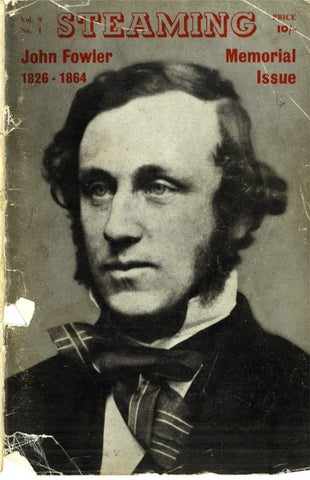
sr!. 9 No, 1
ohn Fowler 6 p 1864
itico.„
)41 Nan
Memorial Issue
To JOHN FOWLER 1826-1864
•
I.
FOREWORD
This issue of Steaming has been produced in memory of John Fowler, whose tragic death at the age of 38 took place on 4th December, 1864. We would like to place on record the help we received in the production of this book, especially from Mrs. A. J. MacLeod, the great granddaughter of John Fowler, the Directors of Messrs. John Fowler & Co. (Leeds) Ltd., the Reverend R. C. Stebbing, the late Alfred Pepper, The Road Locomotive Society, and last but not least, members of The National Traction Engine Club. JOHN CRAWLEY.
FIELD HOUSE, TURVEY, BEDFORD.
JOHN FOWLER
STEAMING
7
GLIMPSES OF THE MAN Reprinted from "John Fouler and the Business he Founded ." BY THEO DAVIS in the lifth decade of the nineteenth century agriculture was the principal industry of the country and the feeling was very strong in favour of the existing Coin Laws by which it was protected from foreign competition. Britain's harvests were consumed almost entirely al home. For some eighty years then past, great energy and much money had been expended in enlarging and improving the arable areas. Waste lands had been reclaimed and enclosed, new crops introduced and productiveness increased by draining, deeper ploughing and treatment of land with lime and bones. The cotton industry in Lancashire, however, which manufactured largely for export, was growing fast and its captains felt that expansion in this and other manufactures was impeded by dear bread and high wages. They organised in 1839 an agitation against the Corn Liws, and in favour ❑f free trade. Although Lord Melbourne's Ministry had been brought to an end in consequence of the efforts of these Free Traders, the country was unprepared in the general election of 1841 to hand the reins of government to them. Another Conservative Government pledged to maintain the Corn Laws was returned under the Premiership of Sir Robert Peel. Surprisingly, however, his Government nevertheless repealed the Corn Laws five years later in 1846 under pressure of circumstances and free trade arguments. The arguments we leave, but the circumstances were the wide-spread poverty of the " hungry forties ", especially a threatened revolution in the starving north in 1842 and the Irish potato famine in 1845 to 1847, when a million and a half of the people in Ireland " had disappeared, either starved to death, destroyed by pestilence or fled the country ". John Fowler was a boy of 16 in 1842 and in 1847 reached his majority. By the time he was 23 he had learned northern conditions by residence there and had visited Ireland. Have we here more than mere coincidence ? Again, he chose to exercise his engineering proclivities in aid of agriculture. With his Quaker upbringing, nothing seems more likely than that the highest ideals impelled his activities and brought to pass the devoting ❑f his fortune and his all to❑ short life to the cheapening of food production by the farmer. Thus he would aim to secure cheap bread for the workpeople and at the same time assist in maintaining against foreign attack the great industry which grew food at home. Between 1841 and 1850 steam had been applied on British farms by means of portable engines but their use was limited to driving machines for thrashing, root-cutting and other barn work. For long periods in the year they were idle. What to inventive minds had always been an attractive problem was now obtruding itself as an obvious and urgent one. It was, how to apply this engine or other form of steam unit to cultivaion of the land, putting the maximum possible of power generated into the actual tillage and at a cheaper cost than the same work performed by horses. When Fowler turned his mind to the task he was only one of many and a latecomer. His earliest public utterance—a paver read before the Society of Arts on January 30th. 1856, " On cultivation by steam ; its past history and probable prospects "—reveals his studious and penetrating mind. It commences, " The importance of the subject is now almost universally acknowledged ; it is a question affecting an expenditure of at least fifty millions sterling annually— the cost of horse labour in agriculture ; and its progress is anxiously watched by men who, even three years ago, would have been sceptical of its ever attaining any practical value. Not long since it was the common remark, among both engineers and agriculturalists, that, though steam cultivation was probably practicable, yet the cost of ploughing by horse-power was not sufficient to render it remunerative or likely to be generally adopted. But the experience of the last few years, and the advantages that have accrued from
8
STEAMING
the more rapid and perfect execution of barn work by steam-power, have tended to lead the agriculturalists to set a different value upon it ; and I believe that the body are now quite prepared to give a warm welcome to any means that will give them greater power over the material with which they have to deal, and that will enable them to cultivate the soil more expeditiously and thoroughly, even should there be but little economy over the present plans. In an uncertain climate like our own, time is more essentially money in dealing with the soils than in almost any other operation we can name ; and, if that axiom is found universally to hold good in its application to every other sphere of human industry, it must be doubly applicable to the cultivation of the soil, where the loss of a week is often a serious injury to a crop. Of course, economy would be a great desideratum, and I hope to be able to show that cultivation by steam-power may be performed at a little over half the cost of horse labour : but I do not think that this is absolutely essential to its extended adoption." He proceeds to trace the past history of me5utt cultivating efforts—" a history that bears an exact resemblance to that of all the great mechanical realities of our age—the steam-boat, the railway, and even the steam-engine itself ; except in the fact that the greater talents, means, and energies that have been devoted to those subjects, have succeeded in more rapidly developing them into great facts. To trace the resemblance would encourage us to look forward with perfect confidence to a similar reward to our labours in this direction, and one not less important than the best of them. The birth of steam cultivation was coeval with theirs, like them, 200 years ago, it commenced in the minds of those who are more poets than mechanics, who overleap all practical difficulties and to whom thoughts are realities ". " Every new mind gave greater tangibility In the crudeness of the first contention, until, in our own time, every Possible idea seems again and again to have been remodelled and served un with some new lights, but. unlike them, no master spirit has as yet taken this undigested mass and given tangible shape and practical value to their ideas." An appendix enumerates 55 patents commencing 1630. It includes James Watts' 1784, " who appears only to have specified to prevent piracy as he considered the boilers were unfit to bear the requisite pressure of steam ". All except one un to 1830 were engines for direct haulage. Afterwards come patents for steam ploughing by various other means and all had their ardent champions. Perusing these patents. one is struck with the truth of the old proverb, "There is nothing new under the sun ". Now. in 1950. we have grown familiar with the self-laying track and with improved methods of rotary cultivation, with air compression methods and the application of electricity in various ways. But, in 1856 and before, all the same ideas were in ferment. Zealous advocates of the respective theories were unable to apply them successfully to practical use. Illustrative diagrams provoke a smile. Their machinery is very simple and obvious—they illustrate the elementary principles admirably, but compared with modern successful applications how crude they appear! Most obviously of all, direct traction was the great desideratum, but the excessive weight of steam-engine necessary to develop the power required baffled all efforts to reconcile this method with good ploughing and economy of working. Now, a century later. largely owing to the perfecting of the internal combustion engine. the agrionituralist increasingly employs direct as distinguished from cable traction, with or without self-laving tacks, while rotary tillage, also combined with the same power unit, is coming more and more into favour. Those early experimenters saw engineering principles clearly. They knew well enough what they lacked but not how to get it. W. Bridges Adams, in his paper referred to below, saw steam as the new power for agriculture " till such time as a new motor shall be discovered, combining equal power with diminished weight of machine ". All the more striking becomes the practical sagacity and ingenuity of John Fowler who, unembarrassed by the wealth of theoretical possibilities, seized
STEAMING
9
and secured a comparatively fleeting opportunity for the benefit of his own and two succeeding generations. Moreover he expected that in time his methods would be superseded. It is interesting to pause and remember that at this meeting in 1856 Fowler was a young man not vet 30 years of age. While others were fascinated with theoretical ideas his mind discerned their practical limitations and was prepared to stake everything on what he himself saw. He gave his judgment ❑ n several principles then being canvassed and experimented with. As to rotary cultivators, for instance, he says. "I believe a little consideration would have spared them all much pains and experise. as, if there is one point more difficult than another from which to approach our subject, it is in this direction. The enormous weight of engines reouired in which an ordinary farm pressure of steam is used, and the weight necessary to give sufficient strength to the drums and Frames ; the difficulty of steering such a great Toad to the nicety required For field operations ; the vet unknown difficulties that may meet the rotary cultivator, though. at first sight, I confess it appears well adapted to the work. to say nothing of the Power wasted in moving such a weight over arable land. and un ever so slight an incline, might well deter the most sanguine from any attempt of this kind hut it seems, from the Records of the Patent Office, such a monomania at the present moment, that I do not think it will be a waste of time to endeavour
to direct the energies of my brother inventors to a different channel." Were he tackling this problem he enumerates certain defined steps by which he would approach solution. Then follows, " I consider the drawing an agricultural implement by employing a locomotive for direct traction, a still more roundabout and ridiculous plan ". Presumably he regarded the use of two separate units as less prac-
ticable than the combination of power unit and rotary or other implement on one chassis. Passing to rope-traction systems he traced earlier failures—"Heathcote in 1837, followed by Osborne and Lord Willoughby D'Eresby "—to the impossibility of finding a rope or rope substitute (chains, riveted steel bands, etc.) light and strong enough. He completes this review by criticising with great fairness his closest rivals, J. A. Williams of Bavdon, and William Smith of Woolston. The latter was actually exnerimenting on his own rope system
with one of Fowler's windlasses, " I believe either of the above three plans (Smith's, Fisken's and I.F.'s) is capable of solving the problem of the application ❑f steam to field operations, and Mr. Smith's experience would fully justify me in saying that it may be done at a saving of 40 per cent, over horse labour ". What might be accomplished meantime in the way of rotary cultivation he considered would be by means of an endless rope ; " should experience prove that a rope used in this way is sufficiently durable for the purpose, I should think most highly of this plan ". The naper draws to a conclusion with remarks on the possibility of using steam for harvest work and transport about the farm. Mr. Collinson Hall's use of high nressure steam and Boydell's wheels being favourably mentioned. Summing un, his advice was, "there are three directions in which, in my
judgment, it would he well to make some experiments ; 1st, in implements adapted to be worked with the steam windlasses ; 2nd, in a rotary cultivator. worked by a portable engine, with endless band ; 3rd, in a locomotive used for traction to do the cartage of a farm". There is a very significant finale. in the minor key of expense. Was it right to leave the carrying out of these experiments to chance ? In private hands many years might be required to arrive at any real results ; loss and disappointment would come to many of a deserving but unfortunate class of men ; would it not be wise to enlist the public ? A paper by W. Bridges Adams nearly half the length of Fowler's own was the first contribution to the discussion that followed. This and R. Garrett of Leiston's remarks were of the nature of advice to inventors and manufacturers with " more courage and means " and were not nearly so practical as Fowler's.
10
STEAMING
Others taking part showed the widespread interest, viz., Robert Roger, a Fisken advocate ; J. J. Mechi, a supporter of Usher. Atkins & Romaine (rotary) ; T. Atkins himself : John Bethel], inventor of a locomotive ?Mary plough ; J. A. Williams and William Smith already referred to. Mr. T. Scott. a practical agriculturalist, asked Mr. Fisher Hobbs, a member of the Council of the R.A.S.E. present, whether a national experimental farm to test rid report on such inventions would trench on the domain of the Society. He proceeded, " Mr. Atkins, who had made the nearest approach to realisation, said, he would go no deeper in the mire, having `spent his last penny'. Mr. Fowle-, too, said he had made up his mind how much further he would go, which need not create much uneasiness in the agricultural mind, as he was now within sight of the winning goal, havin" realised an article the value of which, as a commercial speculation. would now induce others to join him." Mr. John Bethel] rose to add that he was one of these " inventors who had snent his money for the benefit of the human race without deriving any himself " and what at first seemed very simple had cost three years' time and a great deal of money. Mr. Fisher Hobbs could only refer to the £500 prize offered by the R.A.S.E., but thought it well, if the Government would not take it 11P that a public fund should be raised. On Mr. Fowler's suggestion that the R.A.S.E. might take the initiative in raising such a fund of, say £15,000 to £20,000, Mr. Hobbs promised he would bring the matter before the Council. The Chairman, Mr. Alan Ransome, " was strongly inclined to believe that. following out the principle of the use of the present agricultural engine, and the system of rones and windlass, would lead with the least cost to the earliest develonment of a practical result. . . . He did not believe in any engineering difficulty, except the lack of funds, and that was the great difficulty in the present case ". The remarks from those "who had made considerable advance went to prove that the time sooner or later was sure to arrive when hope of profit faded, and natriotism was not strong enough (unless, like some of his friends on his left, they had the heart of a lion, and pocket deep as a well), to induce the further prosecution, always so costly, and sometimes so ruinous ". He moved a vote of thanks to Mr. Fowler, not only for his paper but " for his enterprise, assiduity and long devotion to the subiect. It had only been by the most unwearied exertion, zeal and talent that he had been enabled to bring his valuable invention to bear. He hoped and trusted he would receive that reward in full which he so well deserved . . . and perhaps be the first to prove that the extension of steam to general tillage was less remote than had been generally supposed ". Mr. T. Scott also earlier had said it apneared remarkable to him, and was creditable to the disinterestedness of Mr. Fowler, that he had touched so slightly on the merits of his own invention. althonoh there was little doubt but that it was the wonder of the day, and would in after years be considered the invention of the age in connection with agriculture. It appeared to him unquestionably to have given us the basis of steam cultivation ". Fowler also read a paper before the Institute of Mechanical Engineers in April, 1857. this time confining himself to his own practice, its means and results. Discussion of Wm. Waller's paper on the application of steam power to field implements read at the Tanuary meeting had been adiourned to give Fowler his onportunity and rotary advocates were there in force. Wren Hoskyns, Atkins and Wm. Waller each expressed his views afterwards as well as Smith of Woolston to back his own system. Fowler's work was dealt with in February, 1858 in a paper read before the Society of Arts by J. Algernon Clarke on the subject of steam cultivation, wherein he refers to Fowler's " ingenious anchorage " and to his triumph over existing difficulties by the use of grooved drums. Fowler in the discussion afterwards agreed that rotary cultivation in some shape or other would be ultimately brought to hear ; he even believed it would occupy a Prominent position in a few years. No Pains should be spared to bring this about. He suggested that land-owners should appropriate a small portion of their income from land to experiments in rotary cultivation. He maintained, however.
STEAMING
lI
that rotary cultivation would hardly do all that was required. He ventured to say that his own system was a step in the right direction, and added that as far as steam ploughing was concerned he considered his task was done. Were these last words an escape of pent-up feelings approaching desnair ? No doubt his lofty spirit received a blow in 1856, when a matter of 3d. or 6d. per acre deprived him of the R.A.S.E. prize and his 1857 Salisbury experiences sorely chafed him—he felt he did not get a fair trial. though others suffered too. For such a man, however, the honours were only postponed. All the while his mind in its own powers and in directing and inspiring his various collaborators, was triumphing over material laws in adjusting them to his requirements, obtaining more nower from the engine, reconciling weight and strength for a suitable rone, eliminatine friction by increasing the size and reducing the number of his pulleys and keening the rope taut during work, taking care that every improvement and simolification added its modicum of economy. Additionally, studying agricultural conditions and the implements needed for an endless variety of operation. and doing this so thoroughly as to be able to recommend to the farmer what was suitable for his particular land. The decision of judgment and consistent pursuit of his chosen objective were the first factor in his success, though there must have been a time when his friends called it ruinous obstinacy. From the beginning he favoured a special engine ; he was yet always ready to submit suggestions to the owners of portable engines for adapting or converting these. In the result. by maintaining his own judgment of the machinery required by agriculture for cheaper and better cultivation, he met the need during the sixty years that ensued. The consequences were of the greatest importance and value universally. The eeneral adontion or the internal combustion engine has now largely, not entirely, brought its vogue, not its usefulness, to an end. A second outstanding factor of success •vas his passion for simplicity in his nlough. This was natural to him, being bred in his bones and fostered by his personal beliefs and family connections, while Party farming contacts among his own relatives brought him the knowledge which enlisted his sympathy with the treds of the agricultural community. Those who see the steam plough in its Perfected form for the first time cannot, generally speaking, see much in it. Tt is so obvious and simple! But unknown to them are the early, sometimes agonising, struggles to overcome such difficulties as are indicated previously. Another imnortant contribution to his success was the practice and tra&Opp inherited by the linking up with Kitson & Hewitson. They renresented, as one says, who " came over " from them to join the new venture, " the highest locomotive practice of the day ; the very best material was used and the (Wines. pumps. etc. were made strong enough for the comparative high pressure of steam that was used. Casehardening and everything of that sort was first-class ". The force of this is s^en remembering that the portable engine makers started with " about 45 lbs. nressure ner square inch and crawled un from a low pattern, indifferen+ material and casehardening." with " sections light " so that " neither pumps nor anything else would stand. It took them twenty years at least to get out of their old groove and reach the point" at which Fowler began. Yet another element of success calls for remark. It was Fowler's nower to attract others to co-operation with him and himself to collaborate with those whose reputation was already made. His first technical helpers. David Greif! and Robert Burton, never left him or his business. and Max Eyth's avowed feelings towards him were no less than hero-worship. Those who may be called his consultants and advisers. Albert Fry, William Worby, Jeremiah Hear and Wm. Hewitson in this chronological order, and his suppliers. Ransomes & Sims : Clayton. Shuttleworth & Co.; and Geo. Stephenson & Co., each contributed to the success of his work. No breath of disagreement is detectable in the records. In his 1859 and 1850 catalogues he advertised the thrashing machines of Ransomes & Sims and Clayton &
12
STEAMING
Left to right : Wm. Worby of Ipswich, Robt. Burton of Leeds, David Greig of Leeds, and John Fowler, Jnr. of Leeds.
STEAMING
13
Shuttleworth. The former we know reciprocated by advertising his steam ploughs; it may be the others did the same. His ability to bring together these firms and Charles Burrell into a co-operative group, each making a large initial payment demonstrated at once Fowler's personal magnetism and his excelling business powers exercised in wise and fair dealing.
He had a way, too, with those early inventors, who were not perhaps so favourably situated as himself to persevere, for example, D. and T. R. H. Fisken, J. A,. Williams, and Collinson Hall. From them he acquired rights to use such of their ideas as seemed to him serviceable without curtailing, so far as can be traced, the rights and freedom of any of them to develop their respective inventions on their own lines. This leaves out of view the rallying of brothers and cousins to help in his earliest efforts, principally by money. Finally, he carefully considered the suggestions made by his customers, and in adopting those which improved the machinery, made further progress for the common good. His inventions not directly concerning his own steam plough and its operations are evidence of his ability and versatility of mind. He was granted patents in 1852 for improving machines for reaping and for the sowing of seed and depositing of manure ; as well as for applying his draining plough method to laying wires for electric telegraphs ; in 1856 for improving brick moulding presses and the manufacture of wire ropes ; in 1864 for the improvement of horsy shoes. In conjunction with Robert Burton
he took out patents in 1857 (the name of Thomas Clarke being added in this case) and 1858 for self-laying track and for the improvement of the Boydell steam horse. He had his " rotary " patent too. Altogether 32 patents were granted him from 1850 to 1864, eighteen in his sole name. In the life of Sir Robert N. Fowler, Bart., M.P., there is a record of that gentleman's visit to the Paris Exhibition of 1856 in company with his cousins John, Robert and Henry Fowler. Under date June 1 1 th Sir Robert's diary records, " John was very anxious to show his tile machine, but put it off till close upon five and just as it was beginning we were turned out of the yard ". June 16th. " With J. and a Shropshire gentleman to Versailles. Our companion much delighted with John's plough. They have been talking of the Emperor coming to see it. Dined with a party of those interested in forming a company for working the draining plough. Robert discouraged because they refused to go into the question of a surface plough ; still I hope good will come of it." With this meagre testimony. to the early co-operation of cousin and brothers we must be content, for the diary has no more to relate till the time of John Fowler's death. Fowler himself speaks of exhibiting at Paris in the spring of 1856 machinery " adapted to bring into use the ordinary portable engines at present employed on a farm for the purpose of ploughing, drilling and scarifying by steam ". The system was the same as that shown at Chelmsford in the same year and its success is narrated later. Max Eyth, whose letters to his parents are a classic for engineering students in German High Schools and Universities, was engaged by John Fowler in 1861 and recorded his impressions from time to time. When he presented his introduction from a Mr. Tyler, a Quaker friend of John Fowler's in London, Eyth says, " I found him in a stubble field before a broken implement of mysterious appearance, full of interest and zeal. The stubble field did not please me, but the man and the implement did". This was probably on the R.A.S.E. Exhibition trial field at Leeds, for referring to this Exhibition
later he writes, " I got to know John Fowler who stood by his steamplough in the midst of a circle of pleasantly animated farmers who were congratulating him on the prize of the A.S.E. just won. A splendid man of about 34 years old, big and stately, black-haired and affable, with a laugh that did good to all within a hundred yards of him. He read my letter, shook my hand, but could not use me. " Not yet—perhaps later." Most of them said that, but Fowler thought it also : one could see it in him. But Fowler was one of the
14
STEAMING
rare men to whom one takes a fancy when he wipes off the sweat with a handkerchief." He reproduces his letter oh engagement in the following paragraphs. "The letter was from John Fowler in Leeds, short and to the point as were all letters at Fowler. Their form and value I was, of course, to learn better later on. He wrote, ' Dear Mr. Eyth, My friend Tyler in London reminds me about you. If you are inclined to commence work in my factory, just recently started, you witi find a vice. As soon as opportunity offers, 1 will take care that you learn steamploughing. After that we must see. I believe in the future of the thing. To begin with 1 offer you thirty shillings a week ; with this you can live and for the present it should suffice. With kind regards, Yours truly, John Fowler, Jr.'.' Then come his early impressions of his new employment and the thrill of a proposed visit to Egypt. " Mr. Fowler my new lord and master is still young, gracious, a Quaker, owner of a newly founded efigine.:ring works, inventor of the Steamploughs which al the last Exhibitions of the K.A.S.E. in Warwick and Leeds took the first prizes, and a man in touch with the whole world.... Trips to Germany and France arc in prospect in Inc spring, and during the coining World Exhibition I am to be in London. 1 am not bound as to time it ever anything better turns up. The pay is not brilliant, but decent: better than I dared expect in the present time when there are so many uneindloyed draughtsmen, engineers and salesmen. On the other hand, I am responsible to make no use of the knowledge acquired with Mr. Fowler which would be to his disadvantage.... Mr. Fowler asked me at the start of our negotiations, possibly because of my imposing moustache, whether I was married, but when, with a scornful smile, fully conscious of my liberty, I assured him or the contrary, he said, 'Just as well—you have to travel a good deal '. Characteristically English also was the way in which my relation with Fowler was begun, and has reached this most desirable result. My faithful friend and patron—Mr. Tyler—wrote to Fowler as Quaker to Quaker, to give me a trial. ' He is open to conviction.' I will of course, have to allow myself to be converted to steamploughing, but whether 1 will be a Quaker, my dear Tyler, I rather doubt." From Hatham, Hertfordshire, two months later, where he was on field work and having trouble., As it so happened, the other morning my fine Mr. Fowler, unsuspecting and unexpected, came for a pleasant inspection of our progress, not to put his Quaker equanimity to the test, which is what happened. Naturally, since I am learning to plough, I had extremely dirty hands, when he held out his to me. This threw a favourable light on me and was worth to me a kindly eulogy as well as ten pounds of arrears or advance of wages : for the only item in the account clear to me was that I needed it. Then he explained to me that I deserved to be transferred to a held where ploughing presented greater difficulties and that he wished me to see fourteen days' work in the rain—' That is especially interesting', which l admitted." At the end of November, " A few days in London followed of exciting modern romance from which I have not yet recovered. Mr. Fowler, kind as always, asked me how things were going and continued as one would speak of a little trip to Wakefield, ' Good. Mr. Eyth, You can hold yourself ready to go off to Egypt in fourteen days. Would you like it ? ' It passed through my body and soul like an electric . Five steam ploughs with appertaining implements were to be shock. . shipped next week at Liverpool. The only question seemed to be whether I should go by sea with the tackles or overland by Trieste. The tackles belong to the uncle of the Khedive ; the estate where they have to work is at the foot of the Pyramids. . . . After two days the die was cast. I had lost. Mr. Fowler, most kindly, found it worth the trouble to expend a few words of comfort on me with which he sent me back to Leeds. For my technical interests it is perhaps a good thing that Egypt slipped away from me. Fowler thinks so and is probably right." Early in 1862 he describes his strenuous field work, 10 to 14 hours daily, mostly in the rain, and continues, " Fowler was usually with us and pleased me always, when he with a shovel in his hand, vied with his poorest labourer in the work, greased the wheels or moved the rope-porters. He " asked Mr. Fowler whether I might speak to him. Startled by my mysterious aspect, he asked me for the evening to his villa. There I laid before him my self-acting rope-porter and after two hours explanation and consideration the victory was won". Later, opposition
STEAMING
15
and a legal difficulty as to patenting arose ; also his suggestion had been improved. "As a result, I had the honour to be invited to tea by our Export Manager. Still more serious and important was an evening which 1 spent last Monday wttn Mr. Fowler himself, in order once more to discuss thoroughly inc porter question. Atter we had done this to our mutual satisfaction, tea followed, and when we were seated by the fire he said in his usual kind way, Well, Mr. Eyth' (in saying this he always lavished the English ' on our German name, not exactly embellishing it), ' the six months in London will be very wearisome to you.' (Thus I knew at last for certain that I was to be there during the Exhibition.) ' I am sorry but you have only six hours a day to be occupied, and after that you can consider the other matters. Afterwards, Mr. Eyth,' continued Mr. Fowler, ' we have enough for you to do. If the business with Austria develops, as 1 hope and plan, I intend to set up in Vienna or Pest a subsidiary workshop, which would have to take care of repairs to the engines in Germany. I would entrust you with the management of the establishment '." Eyth declined an offer of the disputant on legal grounds of his patent claim relatie to his rope-porter ideas but left it to Fowler to obtain for him his rights. "I would trust the man with my salvation." In April, 1862, he is at the International Exhibition, London, and records Fowler's almost daily visits and referring to Prof. !laugh's collection of Ploughs, for which room had been made on the Fowler stand, he adds that Fowler " was enchanted with the new acquisition ". At the close of that year he was clztailed to Egypt and records breakfasting on the 2nd January, 1863, with Mr. Fowler ; " the various great plans were thoroughly discussed". Then until he got the news in Egypt of Fowler's death his references naturally cease except for one remark in August, 1863, Fowler writes me delightful letters, which shower acknowledgements of my perseverance and skill and ability' . . . we have at least not miscalculated in one another ". On the I I th December, 1864, this appears: "The worst, however, was a letter from England. John Fowler is dead. At a fox hunt his horse fell ; as a consequence of this accident there dies one of the noblest, most talented and capable of men with whom I have ever become acquainted. It is really dreadful and a frightful blow for the Steam Plough Works . .. a nature full of vital power, inwardly and outwardly of the noblest build which, with a rare constancy makes its way through all the spiritual and material difficulties wherewith a great new idea has to struggle and in the moment when the hopeful fruits begin to ripen is inexorably snatched away—this is one of those bitter riddles which man will never solve." Nearly two years later referring to the cessation of Egyptian orders and the need of filling up the enlarged works at Leeds he still pays tribute to Fowlers memory. "If John Fowler were not dead, whose moral influence in the best circles of the English industrial and agricultural world was worth many thousands, not to speak of his actual technical importance as supreme head and captain of the whole business, there would be no question of any danger. Without him there might, of course, come critical times." The biographer of Sir Robert N. Fowler referred to previously supplies a precious tribute to the friendship and character of these two men, which we take the liberty of reproducing in full. "Two years afterwards he met that which, excepting what befell him within the circle of his own family, was the sorrow of his life—the death, from an accident in the hunting field, at his dearest friend, John Fowler, the inventor of the steam plough. " This friendship was amongst the most beautiful and touching incidents in Robert Fowler's life ; and there is, perhaps, nothing in his career more worthy of admiration. Here we see the finest qualities of his nature in full play—strong and deep affection ; loyal friendship; large-hearted, unselfish generosity. "John Fowler was a man of undoubted talent and prepossessing manners, ' a genious in a clever family'. For many years he had toiled incessantly at the production of a steam plough. He himself had the fullest confidence in its ultimate success ; and although some of his friends were less confident,
16
STEAMING
Robert, recognising the genius of his cousin from the first, supported him with all his heart. It would occupy too much space to tell the story of 'John's plough ' in these pages ;—its journeys to agricultural shows at home and in France ; the years of disappointment and loss ; the unfavourable opinions of friends ; the generous advances Fowler made to him regardless of the doubts of his relatives and the fears of his partners ; and, finally its complete success ;—but Fowler's pa.t in the transaction reflects as much credit on his judgment as it does honour to his character. " The early death of this beloved cousin, who was as strongly attached to Robert Fowler and his wife and children as they were to him, was intensified by the fact that the plough had only begun to pay when his friend was cut down. " A few remarks from the diary of this time may be quoted here: 3rd December, 1864. 'Told Granville Somerset (D.C.L., Q.C.) about John's state, and said he would be a great loss to me. Ile replied, " Your loss is nothing, but he will be a loss to the country": Dearest John is gone. Spasms came on, and he sank 5th December. yesterday. My loss is great. He was my best and dearest friend. one on whom I could depend. But what is my loss to that of others, especially his wi!'e and children ? May God preserve and protect them! An overwrought brain seemed to prevent his recovery. The plough has told on him. He seemed able to repose trustfully in his Saviour. which is a great mercy.' 9th December. ` Deeply affected at taking a last look (at the grave). Through life we have stood by each other, and life looks dreary without him. But he is with Jesus, and that is enough. It was a comfort, dear fellow. to feel that I had always stood his friend in his earlier troubles. Remembered Dizzy's lines on Bentinck, where he describes himself as "one who had stood by his side in an arduous and unequal struggle, who often shared his counsels, who sometimes, perchance, soothed his woes, who knew well the nobility of his nature, and esteemed his friendship as among the chief of earthly blessings " '." To gather all the wreaths of praise laid on the great young man's grave would be a heavy task, but there are some that add to our knowledge, both of his personal character, and of the light in which his contemporaries regarded him. Principal among them is the allusion at the Annual Meeting of the R.A.S.E.. four days alter his passing, of J. Chalmers Morton, the unfortunately it falls to eminent editor of the Agric'tltural Gazette, ' my lot, as happening to be the first of the general body of members who has risen to-day, to try to express the feeling of real distress, for it is nothing less, with which the members of this Society have heard and will hear of the sudden death of their late colleague and fellow-member—John Fowler. He has been taken away suddenly from the very midst of his busy and prosperous career jug as he was gaining that summit of success to which long years of persevering and most useful labour had given him so good a claim, and that surely is a fate which commands the sympathy and sorrow of any body of men. But it has a special claim on ours ; for we know of what usefulness in the agricultural world, and how serviceable to the great cause of agricultural progress his life has been—how large a share, in fact, of the usefulness of this Society has of late years been owing to the great ability, the untiring perseverance and exuberant energy of which we now deplore the loss." On 4th May, 1865, a paper on the application of steam power to cultivation prepared by " the late Mr. John Fowler and Mr. David Greig of Leeds " was read before the members of the Institution of Mechanical Engineers at Birmingham. In the subsequent discussion. Mr. T. B. Wright prefaced his remarks by expressing on behalf of the agricultural community in general the great admiration that was felt for the indomitable energy and unwearied exertions of the late Mr. Fowler in bringing steam cultivation into practical operation. This was one of the most important movements that had ever been originated and carried out in connection with agriculture, and at first the problem appeared so difficult that it seemed very doubtful whether it would ever be successfully solved.
STEAMING
17
On February 4th. 1865. a public meeting. under the presidency of Lord Feversham, was held at Si James's Hall. London, to appoint a committee for raising funds for a suitable memorial. A Committer of twelve was appointed including Lord Portman, Lord Feversham, Edward Holland, M.P. and H. S. Thompson, M.P. (afterwards Sir Barry Meysey Thompson). It has not been possible to trace the " Fowler Benevolent Institution" which that Meeting resolved should be formed. There was, however, opportunity for some who knew John Fowler best to speak their hearts. The Chairman explained that " it had been thought most consonant with the feelings of the family :of Mr. Fowler not to entertain the question of a statue, but to establish some kind of charitable institution ". The unanimous resolution was " That this meeting is of opinion that the application of steam power to the cultivation of the soil is the greatest improvement in modern agriculture, and consequently most valuable to the country generally. This meeting is also of opinion that to the late Mr. John Fowler, of Leeds, the credit is mainly due of inventing, adapting, and perfecting the machinery and implements by which that power has been brought so successfully to bear upon the various field operations. Therefore it is now proposed to form a committee for the purpose of raising a fund sufficient for some suitable memorial as an acknowledgement of his indomitable perseverance and untiring energy devoted to this object, which must eventually become a national benefit ". Mr. W. Saunders said, " It was well known to most gentlemen present that Mr. Fowler had devoted himself to the mechanical improvements with which his name was connected from a sincere desire to promote the advancement of agriculture. (Hear, hear.) His means were sufficient to supply all his wants if he had chosen to live in idleness ; but he disdained ignoble idleness and devoted himself carefully and energetically to the accomplishment of the object which he had in view. In carrying out that object he had to encounter many hindrances and difficulties, and it had been a great pleasure to him (Mr. Saunders) to witness the patience and pereseverance with which he had surmounted these difficulties. It was deeply to be regretted that Mr. Fowler did not live to realise that honour and wealth which would have resulted from the successful issue of his labours. At the moment his efforts were crowned with success he was taken away ". Mr. E. Ruck, who had known Mr. Fowler from boyhood, " could speak of hipa in the highest terms as an honourable and straightforward Englishman. He was a man whose word was his bond. Agriculture was More indebted to Mr. Fowler than to any man who had existed during the last century. He had devoted his fortune and his health to the promotion of the object which he had in view with a zeal that had seldom been equalled and never excelled ". Mr. J. A. Williams, an early competitor, declared " the loss which had been sustained was not an individual but a public one—a loss to the world at large (hear, hear). The result of steam cultivation in Egypt and in India had been most marvellous, and mother earth had been a great gainer from it ". Mr. C. Clay disclosed that "a short lime ago a movement was made with a view of presenting a testimonial to Mr. Fowler during his life-time ", a movement now put an end to. Lord Kinnaird, in a final tribute, said " he had come nearly 500 miles to he present on that interesting occasion, and having had the happiness of a long acquaintance with Mr. Fowler, he could confirm every word that had been stated in his commendation. Some years ago he met Mr. Fowler in Scotland, and the Highland Society did him the honour of awarding him the prize for steam cultivation. His health had been seriously affected by the anxiety which he felt in endeavouring to carry out his improvements. When he last saw Mr. Fowler at Newark he had succeeded in laying before the agriculturalists an implement which would confer upon them the greatest advantages. His anxiety of mind was then at an end and he (Lord Kinnaird) trusted that he would have been long spared to enjoy the honours which he had so justly earned. Having known Mr. Fowler in his domestic life he could safely assert that he never knew a more zealous, noble-hearted, true Christian man ".
18
STEAMING
A massive and magnificent allegorical group of child figures, one with sickle, others accompanying and drawing a rustic miniature cart bearing the harvest home, wrought in silver, for use as a flower-stand, was presented to Mrs. Fowler in 1867, bearing this inscription:— " Presented to Mrs. John Fowler by 231 friends of her late husband in testimony of their respect for his memory, their admiration of his character and their sense of his ability and perseverance displayed while perfecting his inventions in face of numerous and often apparently overwhelming difficulties. In testimony also of their gratitude for services rendered to all classes by his successful application of steam power to the cultivation of the soil-1867." A marble bust of John Fowler, the work of the sculptor Woolner, was supplementary to the same presentation. It is assumed that this was the form the above proposed memorial eventually took. If any reader can throw light on this subject a communication would be gratefully acknowledged. To Mrs. Fowler was presented an address from the Foremen and Workmen couched in the following terms:— " To Mrs. FOWLER. MADAM, We, the Foremen and Workmen employed at the ' Steam Plough Works', beg most respectfully to express our heartfelt sympathy with you, in the irreparable loss which you have recently sustained, in the death of MR. JOHN FOWLF.R. • We feel truly unable to express the deep feeling of attachment which we cherished towards him, both as a Master and a friend. Whilst the achievements of his great inventive genius, had won for him a world-wide renown, his gentlemanly bearing and courteous manners commanded the respect of all who knew him. It is not for us to attempt to estimate the value of those self-sacrificing labours, to which his untimely death may be indirectly attributed, but we feel assured, that when the results of those efforts shall have been fully developed, a greateful posterity will adequately appreciate them. If the fact, that every person in connexion with the ' Works' had learnt to esteem MR. FOWLER as a kind and generous Master, that those among them, who had the privilege of a closer intimacy entertained for him an affectionate regard, be at all calculated to infuse the least consolation into that overflowing cup of sorrow, with which an inscrutable Providence has seen fit to present you, then be assured, Madam, that such slight comfort is abundantly yours. We cannot conclude this address without offering the earnest prayer that, ' He who is too wise to err, and too good to be unkind ' may of His infinite mercy support you in this your ' time of need ', and that His richest blessings may rest upon your Family, consecrate your home, and strengthen your heart. We beg to remain, Madam, Yours most respectfully, THE FOREMEN & WORKMEN. Leeds, Decr. 29th, 1864." The only public monument to his memory was erected by the Pease family in the South Park, Darlington. Of red granite surmounted by a bronze model of a three-furrow balance plough, it bears the simple inscription, "John Fowler, C.E. 1856 ", the date being the year of the first public exhibition of the steam plough. We take the excerpt that follows from an obituary notice which appeared in the Leeds Mercury of Dec. 6th, 1864, written by the Rev. R. V. Taylor,
STEAMING
19
BA., " Mr. Fowler from the first bid fair to distance all competitors. But the race was not to be won in a single year. His own machine, although it received the highest prize, was not by any means perfect, and his competitors were men whose rivalry no one could afford to despise. Year after year each produced some improvement on his former system, so that probably the first machine of one year might, if not considerably altered, have been the last of the year following. Mr. Fowler, however, never lost his lead, and each year saw him gaining something further on those who were striving to outstrip him in the excellence of their work. For a series of years his magnificent machine was rather the wonder of the curious than the desire of the practical agriculturalist. But against such prejudices as these, against the caution of the prudent, the blindness of the ignorant, and the rivalry of able competitors, Mr. Fowler fought with a brave determination which secured him final triumph. " In Europe and America, no less than in our own country, he stood forth as the champion of his own inventions, and overthrew in fair fight every competitor who took the field against him. " By successive steps he brought it nearer and nearer to perfection and at length it seemed to have reached its highest point. All practical difficulties had been overcome. Its incontestable superiority over all rivals had been established. More than all, its excellence was beginning to break down the scepticism and prejudices of the farmer, and the appreciation in which it was held by the great agriculturalists was manifesting itself in the way at once most practical and most pleasing to an inventor whose strength had hitherto been devoted to the perfecting of his discoveries with only partial and honorary rewards. A noble prospect of fame and fortune seemed to be opening before the deep thinking and patient inventor, and it appeared as if he were about to reap the rich harvest which he had so diligently sown and so faithfully laboured. " But it was not to be. The great mental strain to which Mr. Fowler had been subjected had gradually told upon his health. His brain and nervous system were wrought into a state of undue activity and his medical men advised much active out-door exercise as the best cure. He accordingly left Leeds and went to reside at Ackworth, whence he rode to his business, a distance of more than twelve miles, nearly every day. This, however, was not sufficient, and his medical men advised him to take still more active exercise, especially in the hunting field. It was accordingly to this sport that he now devoted his spare time and energies. Three weeks before his death he was riding in the chase when he received a severe compound fracture of the arm by a fall from his horse. " The nature of the injuries was such as to cause some anxiety and the best medical advice was obtained. For a time all seemed to be going on well, all apparent cause for anxiety had departed and the fears of his friends were almost entirely dissipated, but, however, new and fatal symptoms made their appearance and at five o'clock this evening he died. "He was a man of great mechanical and inventive genius, of indomitable perseverance, and of frank, generous and lovable nature." In tracing what we can of his story, we have not been extolling the maker of a colossal fortune. lie spent a small one long before he won through ; there was a day when his best and dearest friends doubted whether he ever would. When at last the goal was reached his strength was exhausted. After his death his will was proved " under £20,000 ". And all the world his debtor! " None knew thee but to love thee, Nor named thee but to praise." HALLECK.
Kitson & Hewitson Slanting Shaft Ploughing Engine No. 106, a 10 n.h.p. Single Cylinder Clip Drum Engine built in 1862.
DNI NIV31 S
STEAMING
21
THE SLANTING SHAFT ENGINE BY R. C. STEBBING The slanting shaft engine is worthy of a fuller account than Alf Pepper was able to give it—particulars he sought reached him too late, alas, for him to use. This engine has two distinct claims to fame ; it was the first type of ploughing engine to be built ❑ n satisfactory lines and in quantity, while interest in a derelict example resulted in the preservation of data concerning the whole range of Fowler engines which would otherwise have been destroyed. This derelict came to the Forest of Dean to serve as a winding engine in a
coal level ; an engineer and skilful model maker, A. W. Trotter, took accurate measurements and began a model. Discussion over obscure details led the writer to visit M. H. Royston at the old Midland Works at Leeds. His interest was aroused and his researches produced the particulars of ploughing engines
which the present writer has tried to make available to posterity. Returning to the enaines themselves, in 1859 John Fowler linked up with Kitson, Thompson RE Hewitson, Airedale Foundry, Leeds, and designs were nrepared for 10 and 12 h.p. engines, the road motion being chain driven. The first 12 h.p. was delivered in January, 1860: the batch consisted of a dozen, but it is not certain if all of them were chain driven ; the six 10 h.p. were cancelled, and appeared with the slanting shaft. Although various modifications were made to succeeding batches, the general pattern followed the lines of the contemporary portable engine, though, being built by locomotive builders, a high standard was attained and steam pressures of 100 and 120 lbs. per sq. in. were employed. The boilers were the normal loco type with raised top firebox shells on which the cylinder block was placed, bolted to transverse angle cleats. Steam was taken through a cylindrical dome arranged vertically against the boiler front, the regulator loco
fashion within it, a Salter safety valve on top, and whistle on one side (pressure f! a u Res were an " extra " at that period). All slanting shaft engines were double cylinder and had Stenhenson reversing gear. The crankshaft was carried in cast iron brackets at the smokebox end (incidentally the smokebox formed part of the end ring of the boiler barrel). The common valve chest was between the cylinders and on its flat cover stood Watt governors. Plates bolted on angle cleats on the firebox shell sides were carried backwards to hold bearings for the hind axle and also a shallow tank whose top served as footplate and rudimentary coal bunker. In the case of the earlier engines a large semi-circular plate proiected in front of the smokebox and carried a long pin which served as fulcrum for a winding forward drum just in front of the smokebox door, and, below the plate, for the swivelling
of the front axle. No steerage was provided, shafts for a horse were fitted to the front axle in lieu. The first batches of these engines were intended for the three-pulley type of ploughing gear ; loose sheaves were fitted below the forecarriage on the fulcrum pin, and under the hind tank, with the double-grooved driving pulley ran on a stud under the boiler barrel. In due course the loose sheaves were taken off and a clip drum substituted for the middle pulley, while a winding drum superseded the clip drum when double engine working became the fashion. Such successive modifications were actually carried out, at least in Hart, on actual engines. An unright shaft, carried top and bottom in a large double bracket which also held the left hand crankshaft bearing, was driven by bevel gearing from the crankshaft to drive by spur pinion at its lower end an internal toothed ring of gear on the rase pulley or drum. A dog clutch was provided, with its lever by the footplate. The winding forward drum also derived motion from the upright shaft through a clutch, bevels, and horizontal shaft beside the smokebox. The flywheel was on the extreme right hand end of the crankshaft.
Kitson & Hewitson Slanting Shaft Clip Drum Ploughing Engine No. 24.
Built circa 1863.
O NI NIV RIS
STEAMING
23
Outside the left hand crankshaft bearing bevels drove the slanting shaft leading downwards and backwards to another pair of bevels, one on a stub shaft at the left angle of the boiler front. A spur pinion on the stub shaft meshed with a wheel on the hind axle. A clutch was fitted at the bottom of the slanting shaft. The left hind wheel may have been driven by a pin from the adjacent gear wheel ; the right hand wheel by means of a friction strap anchored to one spoke and tightened or slackened on a drum fast to the hind axle. In due course alterations were made cutting out the stub shaft and so driving the hand axle direct, fitting the road gear clutch at the top of the slanting shaft, and putting the winding forward drum on the hind axle. While the above description has been based on the 10 h.p. engine, the first 12 h.p. were generally similar. These 12 h.p. machines seem to have been selected for the first clip drums and also winding drums. In 1861 an improved design came on the market, the 14 h.p. The winding forward drum being on the hind axle, between the large bevel wheel driven directly from the slanting shaft and the left hand road wheel (pin driven), the crude extension in front of the smokebox was not required, and a cast iron forecarriage substituted. A bigger water tank and coal bunker with drag bar adorned the rear of the engine and steerage was fitted of the " tank " pattern used for so many years afterwards. The road gear clutch was at the top of the slanting shaft and friction drive provided for the right hand hind wheel. The 10 h.p. engine seems to have been discontinued by 1862 ; there is some slight evidence that 12 h.p. cylinders were fitted to engines having boilers of the 10 h.p. dimensions, the whole modified to resemble the 14 h.p. 14 h.p. engines continued to be supplied till 1866. One of this size was specified as having a Giffard's injector and Bourdon pressure gauge. In 1862 John Fowler patented a draining engine having two drums, a clip drum for ploughing and a geared down, slow speed winding drum for the harder work of pulling a mole plough. Only one new engine so built has been identified, a 12 h.p., but one of the first, chain driven, batch was rebuilt. A block of this engine appeared for many years in catalogues, and it has been (officially) described as an engine of 1860, a description really only applicable to the " top works ". Two " popular " errors relate to the slanting shaft engine. The official photo of the 14 h.p. shows a clip drum with another drum underneath. This drum was not a winding drum but carried spare lengths of rope, necessary with any endless rope system. Chas. Burrell exhibited a 12 h.p. Fowler engine at the 1862 Exhibition. This was Kitson's Works No. 934. They also used Fowler catalogue blocks. There is no evidence that any engines were built at Thetford for Fowler ; any that Burrell built were chain driven, and, except for the ploughing gear, according to his normal practice. Dimensions Cylinders (12" stroke) Boiler diameter
...
...
10 h.p.
12 h.p.
14 h.p.
7" & 7"
71" & 71"
8" & 8"
2' 81"
2' 111"
2' 111"
5' 51,,
Hind wheels (16" wide) ... Front wheels (16" wide) Wheel centres
..,
„.
5' 6"
...
4' 6"
4' 6"
4' 6"
...
12' 51"
13' 31"
13' 9"
Fowler Slanting Shaft Ploughing Engine No. 1021 of 20 n.h.p. Sold to America in 1866.
O NINIVUI S
STEAMING
Fowler's fire, 16th December, 1881.
Fowler's fire, 16th Decentber, 1881.
25
26
STEAMING
Clayton & Shuiileworth Engine (Fowler's Patent) with " Set of Gear" by Robert Stephenson & Co. to convert it to a Ploughing Engine, 1859.
Double Drum Windlass of 1871.
STEAMING
27
JOHN FOWLER By ALF PEPPER John Fowler, Jnr. Born 11th July, 1826. Died 4th December, 1864. In 1857 he married Elizabeth Pease, daughter of Joseph Pease, M.P. for Darlington, and had one son and two daughters. His death was the result of an accident at Ackworth and he was buried at Darlington. The question arises, what sort of a man was John Fowler ? He was the son of John Fowler, Snr., a wealthy Quaker merchant whose wife, Rebecca Hull, presented him with five sons and one daughter. John Fowler, inn, the subject of this article, was the third son, and was born at Melksham, Wiltshire, on 11 th July, 1826. After leaving school, he entered the business of a corn merchant in deference to his father's wishes, but it is obvious that a man of his calibre must have had a strong engineering and inventive bent from an early age. It is not surprising, therefore, that as soon as he came of age in 1847, Fowler broke away from parental shackles, turned his back on the corn business for ever, and joined the engineering firm of Gilkes, Wilson, Hopkins & Co., of Middlesborough. This firm were well known as general engineers in the North-East of England. They were makers of Locomotives, Blowing Engines, also Colliery Winding and Haulage Gear. Fowler might have made a reputation as an engineer in other fields had he remained with the Middlesborough firm, but on a visit to Ireland in 1849 he found himself amongst the bogs and marshes. His attention was drawn to the great expense of digging trenches and laying pipes for drainage, which determined him to devise means to cheapen this work by machinery. He had seen a sketch of a mole plough by Saul, of Garstang, and no difficulty appeared to him in drawing material in the hole it made. So experiments were made over a period of six months and all the tackle was found too weak to answer the purpose. This machinery had been made by the blacksmith at Melksham, but new machinery was made by Albert Fry, of Bristol, using hemp rope and chains for drawing the wood pipes after the mole. His first patents were taken out on 20th April, 1850, in Dublin ; he got Fry to make his patent mole drainer and pipe layer, and used iron wire rope. The apparatus was produced in time for the Exeter Meeting of the R.A.S.E. The apparatus was capable of laying wooden pipes 2 ft. 6 ins. deep, not in soft marshy land, but in clay land ; it is true that he broke the cogs of the wheels when horses were substituted for men in turning the capstan, but everything had been hastily prepared for the meeting, and at a greater cost than the price at which Fowler hoped to sell. The authorities, however, were impressed ; the performance was far better than had been anticipated, and a silver medal was awarded for the combination of the mole plough and windlass and the machine for making the wooden pipes. This combined apparatus was the subject of John Fowler's first patent. A second plough was designed and made. The windlass with the iron wire rope on a drum was mounted on wheels and so fitted that it could be lowered so that its base plate was resting on the ground and the whole apparatus anchored in one corner of the field. An anchored snatch block was fixed in successive positions along the same headland at the ends of the lines of drains required. A patent granted later covered these improvements. The sale price was £8 10s. Od. The new combination was exhibited in the Agricultural Implement Section of the First International Exhibition of 1851. Philip Pusey of the R.A.S.E. was in charge of this section and from his report the skilful impression of the draining operation is taken. "The crowd of spectators saw two horses at work by the side of the field, on a captan by which an invisible rope draws towards itself a low framework, leaving but the trace of a narrow slit on the surface. It you pass, however, to the other side of the field, which the framework has quitted, you perceive that it has been dragging after it a string of pipes, which, still following the plough's snout, that burrows all the while four feet below ground, twists itself like a gigantic worm into the earth, so that in a few minutes, when the framework has reached the capstan, the string is withdrawn from the necklace and you are assured that a drain has
28
STEAMING
been invisibly formed and tiled under your feet." The drains were opened and exposed from end to end ; the pipes were laid straight and perfectly joined, but the level was not completely satisfactory. The judge acknowledged the progress towards the idea since Exeter (1850) and awarded " Honourable Mention ". Many improvements were made and the new machine was sold for £150, an increased figure which is evidence of considerable strengthening and improvement. The capstan windlass was also used for tree felling in Hainault Forest, Essex, on contract work. A third draining plough was put in hand of still stouter construction. A wrought iron frame on wheels supported a cast iron block ; this in turn carried the coulter which was a solid forging. The windlass was driven by four horses. Anchorage was by plates and struts. On trial (at Gloucester R.A.S.E. Meeting, 1853) the pipes were laid to a depth of 3 ft. 6 ins. with the greatest precision and regularity. Again a Silver Medal was awarded. According to Fowler himself the principal contribution to further progress,
made by developments up to this point. was the exnerience in the use of wire ropes. As much as a quarter of a mile had °Tien been the distance over which the plough had been pulled, and such a length had proved quite manageable. The first ropes (1851) were of iron wire, but 200 acres of work was sufficient to wear them out. It was soon evident that they would not stand the strain and friction entailed, at least not at an economical cost. Increasing the weight was out of the question as this only meant increasing friction to the point where the available power was nearly all needed to overcome it. Fowler was pressing manufacturers to produce a steel rope hard enough to stand the wear of trailing on the ground and the friction which was caused by its passage over the numerous pulleys employed. It was not until 1857, after great exertions on Fowler's part, that two steel ropes were forthcoming which performed three times the work done by the first iron ropes. Further pressure by Fowler caused more careful experiments with steel ropes and more accurate testing, which eliminated early irregularities in quality and durability, until in 1864 he succeeded in obtaining a quality uniform in requisite strength, hard, vet with the required flexibility and toughness. (In textbooks of 1960 it is still listed as " plough " wire rope.) His efforts never relaxed to eliminate rone friction in his own machinery by reducing the number of bends to a minimum over large pulleys and by improving methods of keeping the rope tight so as to prevent its trailing on the land. These remarks inserted here will explain subsequent improvements in this direction and also the need in due time of coiling gear. In the latter part of this same year (1852) Fowler took out a patent for a
windlass, steam engine, and drain plough combined on one frame, the engine giving motion to a drum which coiled on itself a wire rope passed round a sheave fixed to an anchor placed at the opposite end of the drain and returned to the machine to be thereto secured. By this means the machine was hauled with coulter and mole lowered to form the drain. Pawls working into a ratchet on the gear wheels propelled the machine along the headland or from field to field. The weight made the apparatus unsuitable on hilly ground and it was not easy to control even ur.der favourable conditions. It was abandoned at an early stage. It was in 1852 that while on holiday at Brighton Fowler one July evening met William Worby, Manager and Implement Expert for Messrs. Ransome & Sims, of Ipswich. They discussed the possibility of ploughing by steam. Some years later Worby wrote an account of this and subsequent meetings (see below). As well as patenting improvements in machines for reaping and for the sowing of seed and depositing manure, as well as for using his draining plough method for laving underground wires for electric telegraphs, Fowler's indomitable energy led him to new experiments on the application of steam to draining machinery after discarding the combined apparatus described above. A portable engine together with a windlass driven from it by belt from the flywheel was fixed in one corner of the field. The windlass had two drums of differing diameters mounted on the same horizontal axle. An anchor at the head of the drain served three purposes: it held two pulleys, one for
STEAMING
29
the hauling rope and a smaller one for the return rope, and also provided a fixed point of attachment for the end of the hauling rope. This, after it had been unwound and passed round its appropriate pulley on the anchor, took a turn round the pulley at the front of the draining plough in position at the opposite end of the drain, and back to the anchor where it was secured. The return rope was unwound from the drum of the windlass, passed round the second pulley attached to the anchor, and there by way of a third fixed pulley at the opposite end of the line of drain brought round and fastened to the back of the drain plough. The coulter and mole were dropped into a hole dug for it, with the string of tiles attached as before. The enginb driving the windlass pulled the hauling rope drawing the plough to its own side of the field and the tiles with it into the hole made 3 ft. 6 ins. below ground level. Simultaneously the other drum of the windlass was paying out its rope attached to the back of the drainer, which having reached the end of its journey was drawn back by this tail rope to the opposite side of the field. The same process was repeated for the next line of drain and so on until the field was completely drained. Manual labour resetting the anchor and fixed nulleys at the ends of each line was, of course, involved. At the Gloncester Royal Show Fowler entered no fewer than ninety miscellaneous agricultural exhibits: as al ready mentioned he gained a Silver Medal fora drainer. hit his steam driven machinery did not appear. At the R.A.S.E. Trials at Lincoln in 1854 was Fowler's first exhibit of steam rower ar,nlied to an agricultural purpose. Fowler and Fry were the makers of the plough and windlass, etc., and Messrs. Clayton, Shuttleworth & Co. of Lincoln supplied the portable engine, the whole set costing between £400 and £500. The Judges granted an award on the adaptability of the combination to drain heavy land 3 ft. 6 ins. deep with facility. The Judges' approval was very high and expressed the hope that the usefulness of the implement would " soon be abundantly proved in every part of the country ". An intelligent farmer remarked, " If I stood by my drainers from morn till night I could not get a better job done." Quite nlainly it struck the Judges as revolutionary. " Surely," was their remark, " this power can be applied to more general nurpos•es on the land." The Judges closed their 1854 R.A.S.E. Report with these words, " The trial of these immense implements could not fail to waken much interest in our minds. A small 6 horse power engine with comparative ease performed the work of 50 horses, drawing so regularly that no oscillation was observable ; we earnestly commend this idea to our engineers." The R.A.S.E. for their 1855 Meeting at Carlisle offered a prize of £200 for the Steam Cultivator which shall in the most efficient manner turn over the soil and be an economical substitute for the plough or spade. Three competitors for this prize appeared, but none fulfilled the conditions. The three were Burrell's Bovdell steam horse (a direct traction machine), Usher's locomotive rotary cultivator, and the Fisken brothers' windlass and plough worked by an endless rope. John Fowler exhibited only his draining plough. Any presumption that Fowler not coming forward with steam ploughing apnaratus was due to his lack of interest or energy would be greatly mistaken. He was not the man to rush forward with untried machinery, and he was keenly aware of the difficulties to be overcome. Draining being a heavier and more difficult operation than ploughing, steam power might succeed in the former case on the score of cheapness as compared with horse labour, but fail in the easier and lighter operation. Draining had, in fact, necessitated still heavier and stronger machinery, making difficulties over the numerous pulleys needing frequent movement. The solution was an ordinary portable engine with a winding drum on a vertical axis under the boiler, driven by an intermediate shaft with bevel gearing from the crankshaft. This engine was wound along the headland by a drum and rope to the head of each drain, and wound the plough by a single rope attached direct to the plough without passing round any pulley. When the rope was wound up, it was pulled out again by a horse, and the windlass moved on to the next drain. Experiments in steam cultivation were, however, begun in the autumn of 1855. A portable engine placed in one corner of the field drove by belt a separate windlass having two drums on horizontal axis, with the winding
30
STEAMING
-
Original Balance Plough of 1856.
Fowler 14 n.h.p, Double Cylinder Horizontal Shaft Ploughing Engine of 1869,
116"1"..
- wAk 4 16 7.0
)0
t
"
91111 Uw
I
s
h. Ittr •11/
•
e,.• 0—
ve..tan Ps..
GENERAL RitliFIN6tErlENT
M''1 49 ' 54
E
wt y
(
Of 10 M . P. ENgiNL
Ima
RI 14, 0.4.• 6olGant.0 T. ,to
*P.
,ICOTIEte 0 1Y no IV 1)0 0=6410r1...0.. 1, 1,167M1r 7+ It
aims • • 1KIk IN 16 III Cum ' 15 I. 614 - F.fam On, Clmiti Usi '•cr t 5 rap14.1111.4,
ir
VA'
putoia t•O
Lomat PP SO 10 n.h,p. Slanting Shaft Ploughing Engine.
rALKINPL. Psiiat•iral.fnzwr p► 14 op EmcLnu
ns
866 ,)strq
DaRwiNario 363 DRAWER N° 50 14 n.h.p. Slanting Shaft Ploughing Engine.
,10 o N., ,11.11111111111011difilillr
1.(7.1•LIA,•- MLA I 1111011111111111111J111111111111,
ii-w5A-Ezarr-.1
vAll, o
ati I 0 MIIIIII
Fowler 14 n.h.p. Double Cylinder Horizontal Shaft Ploughing Engine of 1869.
-GENERAL AR R ANGEMEN T DRUM PLOUGHING
----- 8 HP DoURIA
ENGINES
CYLINJ)EI7
lZ STROKE -
LIST D. GEARING AR. PLOUGIIING A 1216 Dm. 19 Teeth 2. PItch I /114 • 27 •
•
C 1044 - 16 -
2h •
E.7%' • 14
216 -
F. 45% • 75 •
•
HOW) GEAR CI. 744 Dim 12 Teeth 2' Pitch 11.1269 • 20 66 • I. 5.•6'
J 3'.r • 58 K 3'•I0% • 53 L• 10% • It
26. • 244 •
Port ...Maw 41.6.4..../ doe /87/
STEAMING
31
ropes passing over three pulleys fixed to anchor boards. One pulley was near the windlass so as to lead off the rope from one drum diagonally across the field to the pulley at the far end of the field on the opposite side ; thence back along the line of the first furrow to the implement (lying therein) to which ii was fixed. The rope from the other drum was led without bending from the windlass along the headland, round the pulley at the end of it (and also of the furrow to he ploughed) till it could be attached to the other end of the implement. Work began, as it will have been observed, in the part of the field farthest from the engine and proceeded towards it. From the description it will be clear that as the engine set the windlass in motion the rope was wound all one drum and on to the other. causing the implement to move between the pulleys fixed at the ends of the first furrow. On reversing the motion of the drums the implement travelled in the opposite direction. In Fowler's first experiment he used a scarifier which worked perfectly. Filming at the headlands was accomplished with ease by attaching both ropes to the front of the scarifier and reversing the pull on the ropes. A method using almost a minimum of rope had thus been discovered. reducing friction greatly as compared with other methods. Later the labour of digging holes for the anchor boards was reduced by allowing the pulleys to slip along chains which were stretched along the headlands between more easily moved anchors. Possibly the first of Fowler's windlasses for cultivation was sold to William Smith of Woolston, Bucks., who later became a strong competitor. During draining operations in Essex, John Fowler met a local farmer, David Greig. who originated from Kincardineshire. Greig showed such interest that Fowler induced him to become his Technical Adviser, with promise of an eventual partnership, a step which proved of momentous importance. On 31st January, 1856, Fowler addressed the Royal Society of Arts on "Cultivation by Steam: its past history and present prospects". At this point it will be convenient to insert Wm. Worby's letter already mentioned (a letter said to be in the possession of Messrs. Ransomes, Sims & Jefferies. Ipswich). It was addressed to a partner in the firm of Fowler & Co., R. W. Eddison, Esq. Orwell Works, Ipswich. March, 1865. Dear Sir, In answer to yottr letter and enquiry on the 16th inst. respecting the early stages of steam ploughing with Mr. 5. Fowler our first conversation took place in July, 1852, on the beach at Brighton—it was a fine summer's evening. should think we were two hours very seriously talking and calculating on the subject and came to the conclusion of it being impracticable or that we could never do ploughing otherwise than by horses. However it was the leading topic of our conversation whenever we met—which was not infrequently at that time—and until about the middle of January, 1856, when Mr. Fowler came to me to talk over the manner in which the plough should be reversed at the ends of the furrows. My idea was to make it on the Kentish Turn-wrest principle ; Mr. Fowler said that he had got an idea from Mr. David Greig to make the plough a balance plough and I fully agreed with David's plan. and Mr. Fowler requested me to make experiments on that plan immediately as he was about to read a paper to the Society of Arts on the 31st of the same month. Consequently I lost no time. I made an experimental plough carrying three mouldboards at each end, made several trials with two hauling crabs placed on opposite headlands and I considered the trials satisfactory. Consequently I met Mr. Fowler with a favourable report at Adelphi Place on the 31st when Mr. Fowler read his paper to the Society, after which much discussion took nlace on the subject of steam culture by the gentlemen present and several papers read, which were sent by persons interested who could not be present. The room was also lined with diagrams and drawings of various plans which I conceived had been tried. Some of the above were by a gentleman who said he had lost much time and spent f2.000 in experiments. He also said he had come to the conclusion of its being useless to attempt steam culture with less than 40 h.p. Mr. Fowler and myself were sitting together at the time this remark was
Fowler 10 n.h.p. Clip Drum Ploughing Engine.
Built circa 1864.
' N I1A1V3.1. S
Fowler Double Drum Ploughing Engine No. 814 of 10 n.h.p. Built in 1867. Exhibited at The Royal Agricultural Society Show at Wolverhampton in 1871. Later sold overseas.
0N I INVa 1 S
Fowler 12 n.h.p. Double Cylinder Ploughing Engine No. 1272. Built 2nd February, 1870. Supplied new to Northumberland Steam Cultivating Company, their No. 5 Set.
STEAMING
35
made. He said, Wha do you think of the idea ? I replied, " My experiments lead me to think I could make one of our 6 h.p. engines plough on light land, nearly, if not quite one acre per hour." Mr. Fowler said, " If von believe this I will give you an order to take home with you to make a set of tackle at once." Mr. Fowler and myself slept at the Great Northern Hotel and next morning went to Hainault Forest to the draining done there. We breakfasted there together ; I then came home with an order to R. & S. to make a set of tackle. I made a four-furrow balance plough—stationary windlass—rope porters, etc. and set it to work on the 10th of April, 1856, nor a farm at Nacton, the property of Sir George Brokie (now Sir George Broke Middleton) in the occupation of Mr. Farrow, and we ploughed at the rate of one acre per hour. Mr. Fowler was highly satisfied with the trial, so was his father who came with him, Mr. J. A. Ransome was there, also Mr. Biddle of Playford who was pleased with the quickness it was turned at the end of the furrow. It was in this field that the first disc anchor was mei. Mr. Fowler took this first set of tackle to the forest, where he dispensed with ale outside frame and fixed the trailing wheels to the beam of the plough. 1 have written most of this from memory and it is to the best of my knowledge correct. Yours truly, (Signed) W. Worby. In 18 -, 5 the brothers David and Thomas Fiskcn had patented a doubleended plough to work both ways without turning ; it was balanced, but depended on a fairly complicated system of bell-cranks and levers. Fowler arranged with them the right to use their patent, but the plough patented by Greig and himself was far simpler. It was arranged somewhat like a see-saw balanced on two wheels at the middle, one end having right hand, the other left hand mouldboards ; the ends were dropped to bring into the ground each set of mouldboards in turn, according to the direction the plough was moving, all the furrows being turned one way. Instead of pulleys anchored at the furrow ends, these were mounted on anchor carriages fitted with disc wheels to resist the sideways pull of the rope. They were moved along the headlands so as to keep opposite the furrow end by means of ropes passing back to the windlass. The windlass drums were now mounted on vertical shafts so that the ropes could be led off at any angle without the use of guide pulleys: a saving of rope could be effected by leading them direct to the anchor carriages, thus making a kind of triangle instead of going round about the field. After the Nacton trials, Fowler took his ploughing tackle to Hainault Forest where he had a draining contract. Here he dispensed with the outer frame of the plough, fixing the skid wheels to the plough beam. With all the above modifications, in 1856 the tackle was exhibited both at Paris (Raining a Gold Medal) and at Chelmsford as machinery adapted to bring into use the ordinary portable engine employed on a farm for the purpose of ploughing. drilling. and scarifying by steam. The R.A,S.E. had increased their prize to £500: not satisfied with the trials at Chelmsford, a second trial was arranged at Boxted Lodge, near Colchester. The prize was not awarded, it being decided that the steam nloimh cost 7s. 21-d. per acre against 7s. 2d. for comparable horse work. Fowler's competitor (Smith of Woolston) was disqualified because he used a " grubber " which did not "turn over the soil". Fowler's patents during 1856 included improvements in brick moulding presses and the manufacture of wire rope, as well as one covering an engine with two winding drums capable of moving itself along a headland opposite a moving pulley on the other headland, with the alternative of employing two engines working opposite each other (in due course to be developed into the double engine system still in use). For the Salisbury Meeting of the R.A.S.E. in July, 1857, Ransomes & Sims built their ploughing engines Nos. 1 and 2, each having two winding drums under the boiler and spur gear drive to one hind wheel, so that the engines were self-moving. Fowler had intended to use one engine on each headland, but having seen the conditions, he preferred to demonstrate instead with a
Fowler 12 n.h.p. Double Cylinder Ploughing Engine No. 1225. Built 28th September, 1870, to the order of "The Allisons Steam Ploughing Company Limited". '
ONI IAIV 31S
STEAMING
37
isngle engine working opposite an anchor carriage. Engine and anchor were each provided with a winding forward drum, the ropes from them being led forward to an anchored snatchblock or to an anchor respectively. A ratchet gear on the engine drew in its own rope, the rope on the anchor carriage was pulled in by gearing from the pulley round which the plough rope passed. The R.A.S.E. still withheld the £500 prize, but in October Fowler with similar tackle was the sole exhibitor at Stewarthall Farm, near Stirling, and carried off the Highland Society's prize of £200. The Judges in their report stated, " The utmost pains were taken to make the premium known to implement makers in the hope of securing competition, and though for some time there was a prospect of this, eventually Mr. John Fowler, Jnr., of Cornhill, London, was the only party who appeared . . . the trial commenced on the 20th October on a grass field of a very stiff tenacious clay and under a very unfavourable state for ploughing." Though they considered the machinery might be improved " the work was very satisfactorily done". Afterwards further work, trench ploughing, was done in deep alluvoid soil. Finally. the Judges expressed their high gratification in witnessing these performances and their opinion that " Mr. Fowler had satisfactorily established that land of a certain description can be well and economically ploughed by steam ; and they think it does to him to say that he merits the approbation of the agricultural public for the ability, energy, and ingenuity brought by him to bear on the all-important question of turning over the soil ". One account of the trials says there was a pressure of 70 lbs. to the sq. in. on the boiler, a pressure which " would have frightened most of the spectators from the field had they known of it ". In April, 1857. John Fowler presented a paper to the Institute of Mechanical Engineers in which he described the stationary engine and windlass system as the best known means of applying an ordinary engine already in the farmer's hands to the purpose of ploughing. " This tackle, however, cannot be considered by any means as perfect ; two anchors, two snatch blocks, an engine and windlass, and an extravagant quantity of rope, all required to be moved from field to Field, and the windlass to be accurately set for the driving belt from the engine, which often has to be done on greasy clay ; shifting thus becomes an expensive operation, and the tackle is liable to more contingencies than would occur with a simpler plan, besides involving a larger amount of friction and wear and tear." In reply to questions he said that six ploughs were now at work, the first of which had been eight months in use. About forty were expected to be in regular work in the course of a month or two. He estimated that the cost of the apparatus complete for a 200 acre farm, with a 7 h.p. engine, capable of ploughing 4 to 5 acres per day, would be from £400 to £500 ; for a very large farm, £800 to £1,000. During this year Fowler severed his connection with Mr. Fry of Bristol, and became more closely linked with Ransomes & Sims of Ipswich. He also appointed as his Technical Assistant Richard Burton, whose name became associated with the Clip Drum used successfully for many other jobs than on the ploughing engine. (I saw a 5 furrow balance plough made by R. & S. at Liphook in 1963. It bore a Fowler nameplate and one of Ransomes & Sims with the date 1856. Old Kent mouldboards were fitted. A.P.) Fowler issued his first catalogue in 1858, showing the makers of his machinery as Ransomes & Sims together with Robert Stephenson & CO., Newcastle-on-Tyne. The latter firm were the builders of a new type windlass to the drawings of Jeremiah Head to whom Fowler had been introduced by his father-in-law, Joseph Pease. Fowler and Worby had patented a scheme using an " endless " rope (the actual rope ends were attached to the plough) which was driven by passing round and round two drums each with four grooves in which the rope lay. These drums were mounted in a frame carried on two wheels, the complete windlass being fixed to a portable engine in substitution for its own forecarriage. The drums were belt-driven, as was a winding forward drum. The engine-cum-windlass worked opposite a moving anchor carriage on the far headland. Eight of these windlasses were made. This type of tackle was exhibited at Chester in 1858 and at length Fowler
Fowler No. 2825 Single Cylinder Ploughing Engine. Built 8th November, 1876. New to T. Bishop, of Skelbrooke, Yorks.
DN ITAIV 3IS
STEAMING
39
received the £500 prize. The Judges found it " beyond question that Mr. Fowler's machine is able to turn over the soil in an efficient manner at a saving as compared with horse labour, on light land 20 to 25 per cent ; on heavy land 25 to 30 per cent and in trenching 80 to 85 per cent ; whilst the soil in all cases is left in a far more desirable condition and better adapted for all purposes of husbandry". Competing against Fowler were: Chas. Burrell & Son, of Thetford. with a traction engine invented by J. Boydell, of London, hauling a plciugh or cultivator. Thos. Ricketts, of Birmingham, with a rotary steam cultivator using a 10 h.p. engine of locomotive type with a horizontal shaft at the rear driven by a pitch chain from the crankshaft, and on this horizontal shaft tynes or spade-like blades for breaking up the soil. Wm. Crawley & Son, of Newport Pagnell, with a set of ploughs three each way. 1. & F. Howard, of Bedford, with a set of William Smith's, of Woolston, roundabout tackle working on a similar principle to Fowler's 1856 set. Fowler's second catalogue dated May. 1859, showed several alterations to his tackle. Portable engines built by Clayton. Shuttleworth & Co. were fitted with ploughing and self-moving gear by Robert Stephenson. The self-moving gear consisted of a drive by pitch chain from the crankshaft to one hind wheel. The ploughing gear included a multi-grooved pulley below the boiler and two free running sheaves, one at the front, the other at the back of the engine. The plough rope was passed from groove to groove of the middle, engine driven, pulley by going round one or other of the loose sheaves. Wear and tear on the rope was greatly diminished, but it was found that the vee-grooves wore unevenly and after a while wear on the rope increased again. The engine could move under its own steam from field to field, with only one or two horses in the shafts to steer it. The boiler pressure was advertised as 70 lbs. per sq. in., thus increasing the real power of the engine by one-third over those in ordinary use. Some engines were fitted with means of raising or lowering the hind axle so as to keep the boiler level when working on hilly ground. A new 4 disc anchor was shown, while the plough, now made with straight instead of curved beams, could be fitted with,scarifier irons by removing the plough bodies. By substituting short blunt mouldboards for the normal breasts the implement could make a better fallow than any other implement then known, doing work in one operation equivalent to that of scarifying twice over. Every part of the machinery was marked by a letter or number, and duplicates of all were kept in London and could be sent to any part of the country at a moment's notice. Also included in the catalogue was a windlass built by W. & S. Eddington this consisted of a wooden frame with the grooved pulleys as described above arranged to be driven by belt. A portable engine of 7 to 10 h.p. could be drawn up on to the frame (by one man) and the combination moved along the headland. No alteration to the engine was needed. At the Warwick R.A.S.E. Show, 1859, the £50 prize was-awarded to Fowler's 10 h.p. set with a 4 furrow balance plough with scarifier irons: an 8 h.p. set with a 3 furrow plough similarly fitted was Highly Commended. Messrs. Stephenson made in all twenty-four sets of gear. Endless rope sets were sold to Egypt and other foreign countries. In this year Fowler formed amorfg his relatives and friends the " Steam Plough Royalty Co. Ltd." which advanced him money against guaranteed payments of Royalties, It was one of the earliest Joint Stock Companies under the Act of 1855 and the array of signatures on its Memorandum of Association is impressive. In May of 1859 Mr. Collinson Hall, of Navestock, himself a pioneer in steam cultivation, wrote to John Fowler: "I am happy to inform you that I have succeeded in drawing my draining plough with your tackle through my strong marl-land 26 inches deep ; and I am determined to lay all my land on the flat. I have just completed 14 acres, I have made each drain 7 feet apart, and I have no doubt that we shall soon be able to do 5 to 7 acres
Fowler Ploughing Engine No. 3620, of 16 n.h.p., fitted with Church Valve. Built in January, 1879, for S. W. Taylor, of Marlborough.
C>
DNIINVa IS
STEAMING
41
per day at this distance. I am much pleased with your steam plough, and by taking off the breasts 1 scarified 40 acres for mangolds 10 inches deep, which I thought for thefirst time over would be sufficient. I quite congratulate you on the perfection you have made in the steam plough, rendering steam cultivation an accomplished and profitable fact, and which will be now readily admitted by practical men. P.S.—I have formerly drawn my draining plough with 24 bourses, 18 to 20 inches deep, and am delighted to dispense with their services in future." Still during 1859 John Fowler became acquainted with Messrs. Kitson, Thompson & Hewitson, of Airedale Foundry, Hunslet, Leeds. They were railway locomotive builders, and he made arrangements with them to produce engines with boilers for higher pressure; the first design of a 12 h.p. engine based on their locomotive practice was dated August, 1859, and the second, a 10 h.p., October. Henceforward, until the establishment of the Steam Plough Works, the name of K. T. & H. only appeared with that of Fowler himself in catalogues. The first recorded delivery of one of the new 12 h.p. engines was in January, 1860. This engine was generally on the lines of the ClaytonStephenson type, but before many had been built the chain drive to the road wheels was superseded by a shaft from the crankshaft to the hind axle, with bevel gears at either end. This was the well-known "Slanting Shaft " design, which remained in use for at least six years. All the Kitson engines were double cylinder, and fitted with reversing gear. To the 1860 Canterbury Show of the R.A.S.E. Fowler took a 12 h.p. set with a 4 furrow balance plough, fitted also with scarifier heart-shaped points and with improvements in working details commented on in general terms by the Judges, who proceeded to say, "The strength and finish of the exhibited and indeed of all parts of the apparatus, were worthy of every commendation ". They also pointed out that the nominal 12 h.p. of the engine was 40-60 h.p. actually. The set won the first prize of £90. Fowler was tending increasingly to draw away from the adaption of the ordinary portable engine and to concentrate on the manufacture of engines of his own design. In his catalogue he was recommending farmers who must at least buy an engine for threshing purposes to choose one cheaply convenable to a steam plough. He illustrated the kind of engine suitable for threshing which later by simple addition of exterior mechanism would become an efficient steam plough. He also said, " The great desideratum in field implements is the simplicity of construction, which will be at once visible in this machine, and it will also be readily apparent that it can be worked by the ordinary farm labourer, there being no part of it liable to get out of order, and very few parts that cannot be put in order by any blacksmith ". William Hewitson took a keen interest in steam cultivation and in conjunction with John Fowler established a small works at Leathley Road, Hunslet, adjoining Kitson's. Only a few men and a lathe were first employed on making spares and accessories. A Leeds gentleman, R. W. Eddison, joined Fowler as a partner and remained a director until his death in 1900. In January, 1859, a patent had been granted for what came to be known as the clip drum, but its use was not perfected till two years later. The action of the clip drum was that of an automatic hand, whose grip was tightened by the pull of the rope itself and in proportion to the pull. The grip was realised in proporiton also as the pull diminished until it ceased altogether. Sufficient bite was obtained with only one half-turn of the rope in such a manner as to cause no friction, crushing or surging whatever. Bends of the rope were reduced from five to two, a single bend at each end of the field. By reducing friction and wear, this contrivance, as Fowler said, " came to his aid ". In many cases the actual result has been that the portion of the rope which passes round the drum and has all the work to do of transmitting the hauling power, has lasted longer than the other portion which has no such work to do, but is simply exposed to the bend round the pulley on the opposite headland. Another problem to be overcome was the rope gear and waste of power caused by the rope trailing on the ground. Rope porters had been in use,
Fowler 16 n.h.p. Compound Ploughing Engine No. 4386. Built circa 1882 for shipment overseas.
STEAMING
43
usually twenty per tackle, since early days for keeping the rope clear of the soil, but if the rope became slack it sagged on the ground between the porters. The length of rope needed was continually varying with the varying distance between the opposite sides of the field. In 1861 Fowler introduced two methods of solving this problem. When two winding drums as on the independent windlass were concerned, the device was the compensating brake. Far the clip drum, the slack rope gear on the plough was employed. Both were self-acting and worked by means of differential gearing causing the rope to be drawn in until quite tight, a friction brake on the windlass in the first case coming into operation at this point, and in the second the pull of the rope was not transferred to the haulage of the plough until all the slack was taken up. At the Leeds Royal Show Fowler won the £100 prize with a 12 h.p. engine fitted with a clip drum, and £75 with a clip drum windlass driven by a shaft from the crankshaft of an 8 h.p. Clayton & Shuttleworth portable engine. During this year (1861) it became necessary to widen the source of financial support, and Fowler made an agreement with Clayton & Shuttleworth, Ransomes & Sims, and Chas. Burrell for the concurrent and co-operative working of his patents. In return for a licence each of these firms paid a very substantial sum to be worked off by Royalties as and when the patents were used by these three firms, who were the foremost makers of portable engines and agricultural implements. The corner had been turned. and it was possible to extend the factory and deal with increasing numbers of orders for steam tackle, including many from Egypt. Joining the firm at this time were Max Eyth, a German, and R. H. Shaw, who became head draughtsman. This year (1862) saw the Steam Plough Works take over the manufacture of all Fowler's machinery. He exhibited at the International Exhibition at Hyde Park and Battersea. There he had a new and larger engine of 14 h.p., a new independent windlass with two miner-imposed horizontal drums, an imnroved anchor, and a disc anchor windlass designed for working with an ordinary portable engine by a belt and capable of winding itself and the ermine along the headland to keep ❑pnosite the furrow ends. Non-competitive trials were held at Farningham, Kent, in June. (One of Messrs. Aveling's road locomotives was ready to take passengers up and downhill to the scene of action!) Eleven machines were at work from time to time, but the systems really on trial were those of Fowler and Howard, whose machines did the best work. With digging breasts Fowler accomplished about 51 acres in 5 hours. Extract from the " Leeds Intelligencer ". 30th August. 1962: " A trial of steam implements of a novel and interesting character has this week taken place near Barnsley. Mr. Fowler, of Leeds, the eminent inventor of steam cultivation, has made for the Pasha of Egypt, two engines and the requisite apparatus for introducing steam cultivation into that country. Mr. Fowler was desirous of testing their capabilities, and fur the purpose of making those interested in agriculture acquainted with the merits of steam cultivation, a trial was made in a large field at Carlton of about 18 acres. On Monday afternoon, the engines with the implements attached (having travelled from Leeds upwards of eighteen miles through Wakefield, where the novelty of two engines propelling themselves by steam caused some wonderment) commenced work in the presence of a large number of interested and astonished lookers-on, and continued working until evening, performing their duties in a most efficient and praiseworthy way. Next day an innovation was tried out: i.e. instead of one engine and anchor on the headlands as hitherto, two engines were used and the anchor discarded ; thus the modus operandi is much simplified without extra cost or waste of fuel, for as one engine is working the other stops. Other implements were tried and proved: a grubber working at the rate of 12+ acres per day often hours, this being much below the average, because of a large number of stones. Every person with any knowledge of farming admitted the difficulties the soil presented. From these experiments the advocates of steam cultivation''' now urge that it is a fallacy to say in a field however small or large or irregular in shape, steam cultivation may not he put into force to greater purpose than at present in use."
Fowler 16 n.h.p. Class Z Compound Ploughing Engine as shown at The Smithfield Show in 1882.
9N IINV3 I S
STEAMING
45
At this period Ismail Pasha introduced steam ploughs into Egypt, and a large sum of money was set apart by him for the purchase of tackles for the land of the Pharoahs. A patent was taken out for an engine having an ordinary clip drum and a geared down, slow speed winding drum so that one engine could be used both for ploughing and draining. One of the first Kitson engines was rebuilt with this gear and a new 12 h.p. also supplied. Two modifications were made to winding drums ; a brake to stop the drum over-running, and coiling gear to enable the rope to coil regularly (a patent for the latter was granted to Fowler, Greig, and Noddings). A. pair of 12 h.p. engines fitted with these improvements was sold in November to the Wakefield Steam Cultivation Company. It was noted that Fowler tackle was in use on the Prince Consort's farms at Windsor. Prices were quoted for an engine with clip drum and slanting shaft, front winding forward drum, self-moving anchor, grappling anchor, 800 yards of steel rope, headland ropes, 20 rope porters, snatchblock, 4 furrow plough with slack rope gear, scarifying and digging breasts: 10 h.p., £780; 12 h.p., £825 ; 14 h.p., £875. By now the total users of Fowler steam ploughs exceeded three hundred and orders were flowing in, particularly from Egypt, where Prince Halim's fleet grew to twenty-four sets and the Viceroy's to over one hundred, such was the demand to facilitate development of the cotton growing areas. Max Eyth spent a long time here instructing in the use of the tackle. Rapid and substantial expansion of the works was a necessity and during the year the site of the foundry and other property was purchased. R. H. Shaw was responsible for the lay-out of the works. The R.A.S.E. Trials in 1863 were held at Worcester, where a 12 h.p. double engine set with winding drums was shown. At last John Fowler had perfected a system he had advocated since 1857 against much adverse opinion. Although the Judges said " Steam power has now been fairly launched as part of the system of this country ", they were not enthusiastic about the double engine set. Ploughing tackle was exhibited at Hamburg (International Agricultural Society) and gained a first prize (£105) but no orders. Fowler succeeded in introducing the clip drum for haulage in mines, quarries, and on inclined planes (one was in use on a lift in Scarborough until about 1930). Patents were taken out for its use on overhead cranes and one was used in the works till 1903. William Hewitson died in May, 1863, and so the link with the neighbouring firm was broken. New and very different designs for small single cylinder engines were introduced in the latter part of the year. Fowler never relaxed on experiments with steel ropes, and this year brought forth steel ropes with a quality and durability which eliminated the early irregularities. At Newcastle he had two 7 h.p. clip drum engines working simultaneously on one rope. The set received the £100 prize, but they were not so satisfactory in ordinary work. The Judges had changed their minds since Worcester, for they said, "The double engine system appears now to be fairly started and likely for many purposes to supersede the anchor arrangement —nor must we forget that the club drum is the parent of this system, for with no other windlass used for steam cultivation could it have been possible ". A parnership deed between John Fowler and his brother Robert was drawn up in August, 1864. Up to this time, from 1850 onwards, thirty-two patents were granted to John Fowler, eighteen in his own name, including one for improvement in horse shoes. His health failed under strain and he retired for a rest to Ackworth. There he was thrown from his horse, and death followed on 4th December.
Fowler Ploughing Engine No. 6317 Class Z1, a 16 n.h.p. Compound built in 1890.
STEAMING
47
THE FOWLER STEAM PLOUGHING ENGINE BY R. C. STEBBING The Proceedings of the Institution of Mechanical Engineers contain two papers on Steam Cultivation presented by John Fowler, Junr., the first dated 1857, and the second (read, after the author's death, by David Greig) 1865. In both these papers the view is expressed that the ploughing engine should also be a good traction engine, available for general farm haulage. It can hardly be claimed that even the fine slanting shaft engines built by Kitson & Hewitson answered to this description, lacking, as they did, suitable steerage and draw gear. although their origin in locomotive works and design by William Hewitson, himself a locomotive engineer, lifted them well out of the class of agricultural portable engines they so closely resembled. By 1863. however, the building of this type of engine had been taken over by the Steam Plough Works, and the death of Hewitson involved a change of designer : here was the opportunity to produce the single cylinder traction engine in Fowler's mind. At Smithfield Show, then. 1863, appeared engines which were described as 10 h.p. traction engines with patent windlass combined ; an arrangement drawing shows a winding drum, while a clip drum is shown on a catalogue block. A complete break had been made from the former "portable engine" layout. The cylinder had been transferred to the smokebox end of the boiler with the crankshaft almost over the firebox. The double speed road gearing was a chain of spur gears with two intermediate stub shafts on the left hand side, while the ploughing gear and flywheel took up the right hand. very much in the later familiar manner, save that a massive casting on the boiler side held both crankshaft and the two upright shaft bearings. The crank was close up to the left hand bearing, with the valve gear on the boiler centre line and passing through a large cylindrical steam dome, arranged vertically with a spring balance safety valve in the " coffee pot " dome cover so characteristic of Fowler P.E.s for many years. Steerage seems to have been somewhat complicated ; a long spindle ran from the handwheel along the left of the boiler to universal joints on a shaft below the smokebox ; a pinion on this shaft geared into a wheel on a parallel shaft having a worm meshing with a toothed sector on the axle, the front wheels, apparently, swivelled on stub shafts. (This obscure description is taken from "The Engineer", wherein it was condemned as too positive and operated from the back instead of the front of the engine. The spur road gearing was also said to be inferior to chain drive!) The fate of these two engines is unknown. By May, 1864, four smaller, but generally similar engines were in building, a pair to be entered for the R.A.S.E. Newcastle Trials and a pair to go to New York. These were 7 h.p. clip drum engines, designed to work simultaneously on a common rope and implement ; this plan of working had been suggested by J. Algernon Clarke as an improvement on Collinson Hall's endless chain on polygonal drums, for which E. R. & F. Turner of Ipswich had built a pair of small engines the previous year. The chief modification from the 10 h.p. type was the combination of steam dome and valve chest, while the steerage reverted to the ball and socket forecarriage, vertical spindle with hand wheel on the side of the hind tank, pinion, spur wheel, and chain sprocket. The Newcastle engines made an excellent showing, save for the trifling incident of a flywheel flying off into a hedge. However, after Lord Vernon, one of the judges, had bought them and set them down to work the defects of the system became apparent, the chief being the difficulty the drivers found in synchronising their operations. Not ❑nly were delays caused, but in one case the engines. nulling against each other, dismounted one of them from its forecarriagc. They were returned to the works! The New York engines also do not appear to have been any more successful, for nothing has been recorded of them, in contrast to mentions of the larger tackles sent to U.S.A.
Fowler 10 n.h.p. Compound Ploughing Engine No. 6348.
Built 1891.
Sold overseas.
STEAMING
49
It has to be said that both the 10 and 7 h.p. engines suggest immature and experimental design. The road gearing was badly overhung, while stub shafts have their bad points ; the hind wheels were offset 88 in. and 51 in. respectively from the boiler centre line, with the front wheels a lesser amount. On the other hand it is clear that the locomotive standard of workmanship and detail design had been maintained, in particular at least 100 lbs. per sq. in. steam pressure, almost double that of the agricultural engine, was employed. Although it is doubtful if 1864 saw the sale of any more ploughing/traction engines, this year not only saw the untimely death of John Fowler, but tki4 birth of the first satisfactory type to be designed at the Steam Plough Works. Commonly known as the horizontal shaft engines, these were 1F1
effect traction engines with windlass gear added. The crankshaft was above the firebox, carried by cast brackets also holding bearings for the second motion shaft. Third motion and hind axle bearings were likewise combined, to form massive brackets bolted to the firebox shell sides carried backwards to support them and the hind tank with coal bunker. The road gearing
therefore was arranged as a full four-shaft traction engine. Two speeds were provided, about one or three miles per hour: the slow gearing was fitted between the left hand hearings and the crank, the second motion wheel sliding in or out of mesh through a horizontal lever, while the fast speed
pinion was on the right extremity of the crankshaft and locked in or out of mesh with the corresponding second motion spur wheel by means of a setscrew. Single cylinder engines had their steam chests within a cylindrical dome placed vertically and surmounted by a " coffee pot " cover and spring balance safety valve. The dome was on the centre line of the boiler with the working cylinder on the left. The Stephenson link motion was so arranged that when the lever was forward the link was up. The ploughing gear was the weak feature of this design compared with both earlier and later types. The upright shaft, carried in a bracket on the right hand side of the boiler near the cylinder, had to be driven by an inter-
mediate horizontal shaft by mitre wheels al the crankshaft end bevels at the other. thus adding the friction of two bearings and the mitre wheels. Single cylinder engines were clutched on the crankshaft, double cylinder engines on the horizontal shaft. (David Greig explained to the Mechanical Engineers that the difficulty of the dead centre on a single cylinder engine was overcome by getting the engine to run'slowly in the desired direction, then by a simultaneous movement engage the clutch and open the regulator). Steerage was the back hand tank pattern well known to the older generation of steam ploughmen, the chain being moved by a spur wheel and pinion under the hind tank, the pinion being at the bottom of a vertical spindle, the hand wheel at' the top. In the absence of compensating gear, each hind wheel, loose on the axle, had a broad spoke to which was anchored a friction strap passing round a drum keyed to the axle. To allow the wheel to turn slower than the axle, this strap could be slacked off. A few of the earlier engines differed in detail from the above description, one particular point being that seatings were rivetted to the boiler to which cylinders and brackets were bolted. The cylinder seating only seems to have been used for later engines. Horizontal shaft engines were built from 1864/5 to 1870 and appeared in the following sizes: Single cylinder-8 h.p. (81 in. X 12 in.) ; 10 h.p. (10 in. X 12 in.). Double cylinder-10 h.p. (71 in. and 71 in. X 12 in.) ; 12 h.p. (71 in. and 7+ in.) ; 14 h.p. (8 in. and 8 in. X 12 in.) ; 20 h.p. (?) ; 30 h.p. (11 in. and 11 in. X 14 in.). Boiler diameters are comparable. with " modern " engines ; the 8 h.p. being 2 ft. 6.1 in. (BB): 10, 12, 14 h.p., 2 ft. 91 in. (AA): 30 h.p., 3 ft. 7 in. The 30 h.p. engines (three pairs, two for R. Campbell of Buscot) were probably the largest engines ever built. Ove • 10 ft. wide with a wheelbase of 16 ft. 4 in., they weighed 27 tons, and had a pull on the rope of 7 tons. It is said, however, they were too big and clumsy to be successful. The defect in the ploughing gear of the horizontal shaft engines has been mentioned and by 1869 a new design obviating the defect had been introduced. By moving the crankshaft towards the smokebox so that it was no longer over the firebox, bevels could drive directly an upright shaft located
Fowler Ploughing Engine Class Ti No. 7004.
50 STEAMING
rn 00
CZ)
STEAMING
51
bottom close by the left hand corner of the firebox, while the pinion at the the ring of this shaft meshed with external teeth (instead of internal) on To of gear on the winding drum. The clutch was on the upright shaft. ion was enable the crankshaft to be moved to its new position a modificat motion required in the road gearing, the distance between crank and third was shaft being considerably increased. The spur wheel on the third shaft motion made much larger and mated with another larger wheel on the second was a shaft. This latter, an idle wheel when the fast speed was in use, motion. double wheel, combining rings of teeth for both fast and slow road outside The slow speed pinion, loose on the crankshaft, was close up to the ing of the right hand bearing. A dog clutch moved by a long lever overhang In the the road gearing was the means of giving rotation to the pinion. ; on field, the fast speed pinion reposed on a footboard alongside the boiler to the the road it was mounted in place of the clutch member. Final drive hind wheels was still by friction strap, and " tank " steerage was retained. along The regulator stood obliquely over the firebox with a long rod passing cylinder the boiler barrel on the left side to a rocking lever on the back of the case of block, the actual valve being on top. The cylinder itself was, in the side. single engines, on the left, bringing the crank up to the ploughing gear the Heavy cast brackets carried crank and second motion bearings (and axle upright shaft upper bearing on the left) while third motion and hind bearings were also combined in a pair of castings. From this description it will be clear that only detail alterations, obvious engines to the eye though they may be, have been made in Fowler ploughing in later years. the Very many engines of this type were built, the most familiar being these 12 and 14 h.p. singles (except for a deeper drum the differences between two has been lost). A few 10 and rather more 14 h.p. double cylinder. d the 20 and 25 h.p. double cylinder, with possibly a 20 h.p. single complete range of sizes. which Except for the 20 h.p. single and 25 h.p. double cylinder engines, had had a 14 in. stroke, the remainder all had a 12 in. stroke. The singles double cylinder bores of 101 in. (12 and 14 h.p.) and 13 in. (20 h.p.): the and 10 in. (20 h.p.). cylinders were 7f in. (10 h.p.), 8 in. (14 h.p.), 9 in. (20 23 in. The 12 h.p. had a 2 ft. 93 in. dia. boiler and an overall width of 8 ft. tons. Hind wheels were 5 ft. 6 in., front 4 ft. 6 in. dia. The weight was 14 were The 25 h.p. had a 3 ft. 3 in. boiler and was 9 ft. I in. wide. Wheels 6 ft. 6 in. and 5 ft. 0 in. In 1871 a pair of 12 h.p. engines with ropes cost £1,274. walkThe R.A.S.E. Trials at Wolverhampton in 1871 provided a complete over for Fowler tackle in all but the independent windlass class: although drum the clip drum survived for small single engine working, with a double with " tender first " engine as a rival, it was clear that the future rested more double engine working, with a tendency towards larger engines. No former men were required for a 20 h.p. set than for a 12 h.p., hence the clumsy were more economical for a contractor, while the latter were too for use as a general purpose traction engine. The next stage in the deevlopment was weight reduction and the elimination as far as possible of massive castings. Those attacked were the combined his crank and second motion bearings. Thomas Aveling simply extended l firebox shell sides upward and bolted his bearings to them, but the horizonta big distance between the crank and the hind axle forced the use of very iron plates. The Fowler method took the form of a rectangular wrought Iron box bolted on top of the firebox and boiler barrel. These " Wrought illustraEngines " were first described in the technical press in 1873. (The there tions showed ploughing gear and flywheel on the right hand side, but is evidence that no engine was built thus.) of the The crank and second motion bearings being bolted to the sides engines " box " were necessarily much lighter than the old type, the first wheel. indeed simply had a stub shaft to carry the second motion double for the The cylinder was now on the right side, bringing the crank (save for pump eccentric) up against the bearing on that side. Instead of a clutch in or out the ploughing gear, the bevel on the crankshaft was moved axially of mesh with that on top of the upright shaft, a long horizontal lever extending
Fowler Single Cylinder Class K5 Ploughing Engine No. 7225.
Built 1895.
Fowler Class B4 Side Drum Ploughing Engine. Built 1900.
DNINVR1S
FOwler Ploughing Engine Class B4 No. 10255. New in 1905 to Messrs. A. T. Oliver, o/ Wandon End. Luton.
O N I VH.1
STEAMING
55
back over the footplate. The weigh shaft was mounted on the cylinder block, with the link so close to the valve spindle gland that no guide was required. Later engines had their crossheads forged on the ends of the piston rods, the pins working in a plain bush (altered, eventually, by fitting a cotter for adjustment, the bush being split). The regulator gear was simplified, the rod going straight to the front of the cylinder block, while the long " monkey's tail " lever, projecting over the boiler front, moved vertically (too often, perhaps. as. being unbalanced, it tended to close the valve). Changes in the road gearing included a new arrangement of clutch lever. now within the width of the firebox, and moving a vee slide and fork carried in the right hand crankshaft bearing keep. (A later development on the " New 8" was the bell pinion: the slow pinion had dog clutch teeth on its outer side, the fast pinion, free to revolve on the crankshaft but in mesh with the double wheel, having mating teeth inside its bell-mouth into which the slow pinion could slide.) The final drive by friction strap was abandoned For pins. Three types of steerage found a place. The old " lank " pattern A modification kept the spindle and hand was retained on the " New 14 wheel, but substituted worm gear and chain barrel below the tank. while the 6. 8 and final 16 h.p. sizes had a chain barrel on the firebox with worm, spindle and hand wheel obliquely on the firebox side. Features confined to certain sues only included a flat-topped cylinder instead of the familiar dome on the 6 h.p. 6 and 8 h.p. engines were provided with additional perch brackets under the boiler barrel so that the drums could be removed and the front axles set back to facilitate use as traction engines. The 8 h.p. had a straight-spoked flywheel instead of the dished type normal on all other sizes. A circular slide valve, balanced, and intended to roll over the port faces, was used in many " New 8 " and later 16 h.p. engines (two types were employed, the more usual Church patent and the Achilles). The eccentric and tappet coiling gear. henceforward the standard pattern, was first used on these engines. Some dimensions of Wrought Iron engines are given below ; it should be noted that variations were made from the figures quoted. New 14 Late 8 6 Cylinder11 in. X 12 in. 9 in. X 12 in. 8 in. X 10 in. Boiler-2 ft. 111 in. X 7 ft. 9 in. 2 ft. 31 in. X 6 ft. 2 ft. 6i in. X 7 ft. Hind wheels5 ft. 6 in. X 20 in. 5 ft. 6 in. X 18 in. 5 ft. X 16 in Front. wheels4 ft. 6 in. X 16 in. 4 ft. X 12 in. , 3 ft. 6 in. X 12 in. Wheel centres11 ft. 11 in. in. 12 ft. 3 in. 12 ft. Width8 ft. 6+ in. 7 ft. 8+ in. ' 6 ft. 10 in. The "New 8" had 6 ft. hind wheels, and the 16 h.p. with Church valve 6 ft. 6 in. wheels. Some of the later 16 h.p. engines had I11 in. cylinders. Some 14/16 h.p. double cylinder engines were built, and also 20 h.p. singles. During the early 1880's a change came over the scene. Sales on the home market dried up, while the introduction of the compound engine in 1881 speedily brought the manufacture of the bigger singles and double cylinder engines to an end. More or less coinciding with the coming of compounding. the Wrought Iron types disappeared. The bell pinion, worm steerage, and a true clutch either on the crankshaft or on the upright shaft for the ploughing gear became standard. Firebox shell sides were extended upwards and supported one end of the brackets for crank and second motion bearings, the cylinder end being saddled on the boiler barrel. The cylinder block took on the form now familiar, the valve gear being arranged between cranks. There seems to have been some indecision over the nominal horsepower rating of the first big compounds, drawings being marked 14 h.p. while order hooks recorded 16. Such information as survives suggests that cylinders were 8 in. & 14 in. X 14 in. stroke, boilers 2 ft. 11 in. dia., road wheels 6 ft. 6 in. and 5 It., with an overall length about 23 ft.
56
STEAMING
Fowler Compound Ploughing Engine Nos. 11664/5, Class Z6. Built 1908. Double Speed Ploughing Gear. 700 yd. Ropes. Sold to America.
CA --.1
D NI WVH 1S
Fowler Compound •Dou ble Drum Ploughing Engine Class T1.
58 STEAM INC;
STEAMING
59
A 10 h.p. size followed in 1882, with cylinders probably 6+ in. & 11+ in. X 12 in., later increased to 7 in. & 12 in.with a rating of 12 h.p. Boilers were 2 ft. 91 in. dia. Some of these engines were fitted with double speed ploughing gear, originally consisting of two upright shafts on the plan of lathe back gearing : the drive could be taken directly through the shaft whose bevel wheel meshed with the crankshaft pinion, or through the spur gearing and second shaft at a slower speed. In 1883 a patent was taken out for two speeds on one shaft, two sets of bevel gearing at the top of the upright shaft being employed alternatively. About 1890 an attempt was made to substitute a letter classification for nominal h.p, rating for ploughing engines, a step taken some years previously for traction engines ; it is a great pity that only partial success was attained. Nominal rating depends solely on the bore of the cylinder. An engine with a 9 in. cylinder is 8 nominal h.p. whether it has a stroke of 10 in. or 14 in.. a speed of 50 or 300 r.p.m., or a working pressure of 20 or 200 lbs. per sq. in. Probably for sales reasons the n.h.p. when quoted, was steadily stepped up over the years. By the middle '90's the engines had attained almost their final design, a plate stay across the top of the boiler supporting the cylinder end of the crankshaft bearing brackets, and the weigh shaft being carried in the slide bar bracket. Only the flat back of the hind tank remained to be altered just before the 1914-18 war, together with the short smokebox and stay projecting in front to take the forecarriage, a feature which was abolished slightly earlier. Four sizes were being made: Class K (6 h.p.), B4 (8 h.p.), AA (12 h.p.) and Z (20 h.p.). Cylinders were, respectively, 6 in. & 101 in. X 12 in., 6+ in. & 11+ in, X 12 in., 7 in. & 12 in. X 12 in., and 8 in. & 14 in. X 14in. A new cylinder was fitted in 1906 to AA4 and Z4 engines. At the expense of some jacketing, it was made possible to get at the slide valves while the engine was in steam. The design was later abandoned. The German firm of Kemna began to compete with J. F. & Co. by using superheated double cylinder (not compound) engines and an answer was made by superheating Class Z engines. It has to be admitted that the smokebox type of superheater adopted was unsatisfactory, partly due to the necessary intermittent working. (Kemna could use Schmidt's patent smoke tube pattern.) At first ordinary slide valve cylinders were used, with a modified dome, provided with twin regulator valves. A chamber in this dome collected saturated steam from around the cylinder, and the first regulator valve admitted it to the superheater. A rocking lever on the back of the cylinder block, having one end on the rod of the first valve and the other on the rod moving the second valve, transferred motion to the latter, which admitted superheated steam to the high pressure chest. This arrangement, made starting very sluggish, as pressure had to build up through the superheater. The single valve used later on piston valve engines only shut off the superheater. and so the delayed action was transferred to stopping the engine. As well as the superheated Class Z engines, the slide valve engines were built with slight alteration to cylinder bores as KKS, BKS, B4S and ZAS. On entirely new engine was brought out in 1909, having cylinders 9 in. & 15 in. X 14 in., a modified Hackworth valve gear (Firth's) piston valves placed over and between cylinders on a horizontal axis, and a full Belpaire firebox with shell sides extended only to the rear, cross plates carrying crank and second motion shaft bearings. Only five sets were built with superheaters ; one pair, after a considerable period of time, apparently had its superheater removed, to be sold without it. This EE engine was superseded by the Z7S, having a similar cylinder, but otherwise of more normal design. Probably the best known type in this country, the BB, was introduced in 1913. With cylinders 6+ in. & 111 in. X 12 in. and double speed ploughing gear, the engines were known as 14 h.p. With single ploughing speed and cylinders 7 in. & 12 in., they were called 16 h.p. The superheated BBS had 7+ in. high pressure cylinders and Firth's valve gear. Boilers were similar to the B4, 2 ft. 6+ in. dia. Two very obvious modifications from previous designs were to be seen. Only one slide bar, with crosshead below, was fitted for each cylinder. The slow speed road pinion was combined with a
Fowler Ploughing Engine Class AA4 Compound No. 11654. Built 1909 for shipment overseas.
o'
D NIIN V3 IS
Fowler Compound Ploughing Engine Nos. 11856/7, Class EE. Built 1909.
DNI NIVTIS
62
STEAMING
STEAMING
63
long sleeve on which the fast pinion was free, but held axially by a cage attached to the crankshaft bearing. The sleeve was moved by a lever with the actuating fork outside the fast pinion. This modification of the bell pinion arrangement kept the crankshaft free from wear caused by the said pinion which, during ploughing, was kept from rotating by the double wheel with which it was in mesh (the bell pinion could be moved out of mesh by removing its retaining collar, but this was a nuisance when only a short job was in question.) The 16 h.p. version had the same indicated horse power as the AA, but a slightly higher rope speed (and reduced pull), making it especially suitable for the home market, where the cultivator rather than the plough was then the favoured implement. The boiler was smaller and the engines built for Government in 1918 had fireboxes 3 in. longer to give a grate area approximately equal to the AA. These BB1 engines are readily recognisable by the low pressure piston rod extension. Some difference can also be seen in the road gearing. Up to 1914 the AA with 7 in. & 12 in. cylinders, together with the ZA (or ZAA) with 7f in. & 13 in. ditto, and boilers 2 ft. 9+ in. remained the popular engine for export and many in hand at the outbreak of war were built up for home use, no modifications of consequence being made. The Ministry order specified the ZA cylinder, and these engines were called AA7. Retaining the double slide bars, they were fitted with L.P. tail rods and the new road gear clutch arrangement. Mention must be made of the ZHS, a very small class, but two of the sets did excellent work in Lincolnshire during the 1914-18 war. With AA boilers, cylinders 81 in. & 14 in. X 12 in., single slide bars, new road gear, Firth's valve gear and superheaters, together with 7 ft. hind wheels, they presented an imposing appearance. One pair of Z7 engines could have been seen (probably singly) in this country till about 1950, when they were sent to Tasmania. The most powerful pair used here (in Lincolnshire), 9 in. & 15 in. X 14 in., have left little trace. The AA (for heavy land) and BB were the most suited for home conditions, though the K, with a good pulling power where speed was not so desired, had a very good name. Hitherto not mentioned, a pair of superheated single cylinder engines came out in 1914 (one survives). They had Stephenson link motion with piston valves on the right hand side. The cylinder was 8 in. X 12 in. They were classed DDS. One of the last engines built was the compound DD, with 51 in. & 10 in. X 10 in. cylinders. By way of contrast, just prior to the little DD the huge " Superba " had been built for an Italian order. 'this was based on the Z7S, but this time a superheater within the smoke tubes and having headers only in tile smokebox was employed. Test figures showed considerable improvemept in performance over the earlier superheated types. Called 30 nominal h.p., at 300 r.p.m. the i.h.p. was 275 continuous rating. Overall dimensions were 25 ft. 61 in. length and 10 ft. width ; the weight being about 25 tons. This survey of the Fowler ploughing engine over a period of some seventy years has been intended to cover most of the standard types and sizes, even though it can only be termed sketchy. Surviving data is mainly derived from records and drawings which no longer exist, doubtful points cannot be checked. Engines omitted include those for special fuels such as straw or cane trash, engines running " tender first " with one or two drums, double drum engines, and side drum engines : they formed, however, only a small proportion of output. The two chief sources of information on which the writer of these notes has relied are first the data collected by the late M. H. Royston, whose life was spent with the two Leeds firms of John Fowler & Co. and J. & H. 114cLaren, and secondly Alan Duke's transcript of the Fowler order books.
Fowler Ploughing Engine Class DD Superheated No. 13910.
Built June, 1914.
Fowler Ploughing Engine Class BB. Built circa 1914 for shipment overseas.
Cs Vt
LLS
Built 26th March, 1918,
for John Sparks, of Yapton, Sussex.
Fowler Ploughing Engine Class BB1 No. 15142.
D NINI VglS
Fowler Plow thing Engines Vo. 15270 and 15271, Class K7, belonging to Joseph Griffin, of Bruern Grange, Oxon., to whom they were new in June, 1919.
D NI INV3I S
Fowler Ploughing Engines Nos. 15345 and 15344. in 1963.
Photographed in Northamptonshire
DN I1AIVI S
Fowler Ploughing Engine Class DD No. 18460. Sold overseas.
Built 30th September, 1929.
NI NVa lS
Fowler Ploughing Engine No. 15226 at work in Essex in 1960.
O NIW Vg IS
STEAMING
71
FORTY-SIX YEARS HARD LABOUR Ely MAJOR REVD. PHILIP WRIGHT, M.B.E. We arc all quite familiar with a situation where somebody stages some steam threshing, steam ploughing or cultivation, notifies the press and gets a crowd of enthusiasts to come and look with a deep sense of nostalgia as though they are only glimpsing a few hours of a past age. By way of a change, therefore, I want to write about the work on an Essex farm where the methods have not varied much for the past forti-six years and where' steam ploughing and autumn cultivations have bee;) the normal pattern— they are not considered a " stunt "—and where the engines and tackles have never left the farm, no not even for a rally. At Thurston's Farm, Stambourne (on the pretty road from Finchingfield to Great Yeldham), Mr. Harold Jackson has once more complete his autumn cultivations in three weeks, and with decent weather he does it year after year and is often ahead of his tractor-using neighbours, and the acreag:. is 270. It was on Armistice Day, l9i8, that a set of two Fowler ploughing engines plus plough, cultivator, mole plough, water cart and living wagon were delivered at Thurston's Farm. Appropriately enough the engines were named " Peace " and " Victory", the whole outfit costing a large sum. A large sum too in those days, f-5,250 in fact! Now, however, after forty-six years, Mr. Jackson claims that the two engines can be maintained for far less than it
costs to keep one crawler tractor at work doing a similar acreage. The most expensive replacement has been the 800 yards long steel cable on each engine, as these have cost £150 apiece. Throughout the whole of the life of the engines they have only needed one set of piston rings each, and these were fitted this year. I have tried to give facts and figures which leaves the reader to draw his own conclusions. Operations are speedy, the cultivator works well at 9 miles per hour. The 5 furrow reversible plough weighs 6 tons and can do 6 m.p.h. and average 1-1- acres per hour. The cultivator can do 2 acres per hour down to 18 ins. deep on a traditional heavy Essex clay. Mr. Jackson claims that he uses less fertilizer than do his neighbours. Fuel costs are of course high, but the figures are interesting. For the double operation of cross-cultivating the coal used comes to about £1 per acr3, but if (as this year) the ground is extremely hard then it can reach 30/per acre. For steam ploughing the coal costs about 10/- per acre. Labour costs are not low, of course, but Mr. Jackson's son Edward is very keen and they have a devoted staff. Four men are required for cultivating, one on each engine, one on the cultivator and somebody on the water cart of course. By today's labour standards one man to fifty acres is a high ratio, but in
this unique set-up Mr. Jackson has organised his labour for the whole year. The farm is virtually all cereal crops, sugar beet was dropped from the rotation, and all the corn crops are harvested with t're binder and subsequently stacked in a big Dutch barn 110 ft.- by 90 ft. This nrovides winter threshing by drum and Mr. Jackson considers this a sound nroposition. There is no hateful burning of the straw on his farm as has blotted the countryside this year. Intead, he makes good prices of this drum-threshed straw which he sells for £6 or £7 a ton, and good wheat straw for thatching commands nearly double that figure. Mr. Edward Jackson is the third generation to use the engines since his grandfather took over Thurston's Farm in the year 1910. Ploughing by contract used to be done but has been abandoned for some time now, in other words the tackle does not leave the farm nowadays. The hard work involved would not please everybody these days, but at least Mr. Jackson has proved that even in 1964 he has successfully fitted into his farming policy some well-tried methods of a passing age.
72
STEAMING
Fowler Ploughing Engine Class K7 No. 17768, specialy made for Reymoso ploughing, seen on test in 1929 prior to shipment to Java.
Fowler Class B4 Compound No. 12645.
Built 12th December, 1910.
John Fowler's Works circa 1911. Ploughing Engines Nos. 13291 and 13290, left and'right foreground respectively.
D NI IAIV3IS
Turning Harrow.
74 STEAMING
STEAMING
Anchor system used with Single Engine.
Mole Drainer.
75
76
STEAMING
9/10 Furrow Anti-Balance Paring Plough.
Heath Plough for Forest Cultivation.
STEAMING
Reversible Disc Harrows.
Turning Ridges.
77
78
STEAMING
Six-furrow Turn-round Plough.
Turn-round Disc Plough. Six 23 in. discs.
STEAMING
79
SOME PLOUGHING ENGINE DIMENSIONS Reliable figures for dimensions are hard to come by: some coming even from Leeds do not tally among themselves and are not confirmed by checking actual engines. Those given below are believed to be reasonably accurate. It has to be remembered that a ploughing engine is not simply a matter of horse power, it was designed to overcome the resistance of the implement at a specific depth in a specific soil at a suitable speed and specific length of field. Thus the following variables had to be adjusted, viz. pull ❑n rope, speed of rope, and boiler capacity. As an example, two classes had the same cylinder size 7 in. and 12 in.: one, the BB, primarily designed for this country before the 1914-18 war. has a higher speed with less pull and boiler capacity than the " export" AA. The BB was for use with a cultivator, the AA for the plough. The much smaller K had practically the same rope pull as the BB, though, of course, much slower.
Ploughing Gear—Number of Teeth K
BR
AA
/.
Crankshaft bevel wheel ...
...
20
18
18
18
Upright shaft bevel
...
...
34
34
34
34
Upright shaft pinion
..
13
16
13
15
90
95
82
82
Drum ring of gear
N.B.—Some AA5 and all later engines had pinion and ring of gear 15 and 95, practically the same ratio.
Boilers
BB1
K
AA
Z
2' 3+"
2' 61"
2' 91"
2' 111"
Between tube plates
...
7' 11"
7' 41"
7' approx.
8' approx.
Grate area (sq. ft.)
...
5.3
7.2
7.5
8
Heating surface (sq. ft.) ,..
166.75
212.5
220.5
238.9
Tubes
37-2"
45-2"
44-21"
50-21"
Diameter
...
...
...
...
...
N.B.—The K dimensions are for K5 ; later (K6?) 27-21 in. tubes were used with a slightly smaller grate area. Some AA7 engines have 36-21 in. tubes. The BB firebox is 3 in. shorter than the BB1.
Wheels
K7
BB1
AA7
Z
Hind
...
6' 6" X 20" 6' 6" X 22" 6' 6" X 24" 7' 0" X 26"
Front
.
4' 71" X 12"
5' Of" X 16"
5' Of" X 18'
5' 6" X 20"
Centres
...
13' 6i,"
13' lli"
14' 51"
15' 7f"
Overall D'sions Length
...
22' 1"
23' 2"
23' 51"
24' II"
Width
...
7' 6"
8' 2.1"
8' 91"
9' 6f"
N.B.—The width of wheels given seem to have been standard, but they
varied according to the area where the engines were to work. Widening rings could be supplied, either for fitting to normal width or other wheels. It will be clear that overall width depended on the width of hind wheels.
1
""
Slonehridges Printers Ltd., 32 lirereion Road, Bedford
•