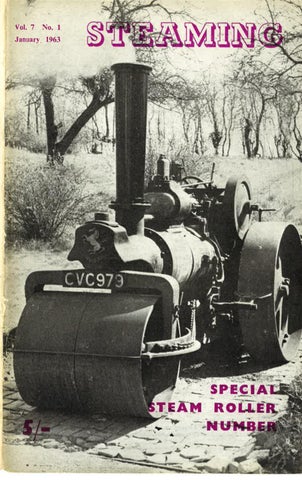
Vol. 7 No. 1 January 1963
SPECIA TEAM EI
2
STEAMING
NATIONAL TRACTION ENGINE CLUB
Chairman:
REVD. PHILIP WRIGHT, M.B.E., Hon.C.F., The Vicarage, Woodford Bridge, Essex. Vice-Chairman and Editor :
J. CRAWLEY, ESQ., Field House, Turvey, Bedford. General Secretary:
E. A. FILLMORE, ESQ., 34 Northwick Park Road, Harrow, Middx. Membership Secretary (including ties and badges):
J. G. HUTCHENS, ESQ., A.31 Cafe, Tricketts Cross, Ferndown, Wimborne, Dorset. Treasurer
H. ORR-EWING, ESQ., 8 Robert Close, Randolph Avenue, London, W.9.
STEAMING BACK NUMBER SERVICE Back numbers are available as listed below, the price including postage, from the Editor, Field House, Turvey, Bedford:— SPECIAL ISSUES: October, 1958-1s. 3s. each. April, 1959 ; July, 1959 ; October, January, 1961, Steam Wagon Issue : January, 1962, Traction Engine 1960 ; July, 1961 ; October, 1961 ; Issue-3s. 9d. each. July, 1962-1s. 9d. each.
ACKNOWLEDGMENTS J. P. MULLETT, ESQ. J. WILKINSON, ESQ. H. BONNETT, ESQ. PERCIVAL MARSHALL & CO. LTD. R. BURDGE, ESQ. M. J. PEARCE, ESQ.
WM. DOWTHWAITE, ESQ. J. ROBERTSON, ESQ. G. GLOVER, ESQ. WALLIS & STEEVENS LTD. M. LOADER, ESQ. C. BROWN, ESQ.
COVER PHOTOGRAPH—A veling Barford No. ,4C624.
STEAMING
3
EDITORIAL WE would like to take this opportunity of wishing all of our readers a happy and prosperous 1963. It is not my intention to spend time recalling events of last year except to say that in nearly all cases the attendance figures were up on the previous year despite more rallies than ever before. This surely indicates a growing interest in our hobby. More and more people are attending rallies and after a while begin to get more than just casually interested ; they then think they would like to join a club and so be able to talk and meet with fellow enthusiasts and before they know it they are looking around for an engine to meet their requirements.
This is the way that so many members join our club, and whilst this is a good thing I cannot help thinking that our membership as a National Club should be considerably increased as this would give us all many benefits. As I mentioned in the last issue, whilst the present Editor could not see his way clear to producing this journal more often than quarterly, he could and would considerably expand its size if we could increase our membership. So may I ask all of you to bear this very much in mind and make the enrolling of just one member your new year resolution for 1963. EDITOR.
FROM THE CHAIRMAN (Philip Wright's Column) MAY I thank the many members who sent me get well messages and Christmas greetings as well as those who telephoned my wife whilst I was in hospital for an operation. I was only discharged just before Christmas and was therefore very busy in the parish, and I do hope I did not overlook anything important. This naturally means that I have very little to write in the column this time. Looking back, I feel proud to be associated with a club which has encouraged the raising of vast sums for charities. There could hardly have been many weeks during the season of 1962 when some engine owners were not journeying somewhere with their engines to help some good cause. Our movement has a fine record in this respect, and as a non-owner I can pay just tribute to the members of our club and the many other clubs up and down the British Isles for what they have done. God bless you all in 1963 ! Last year I referred to the fine china ash-tray designed by Mr. John
Edwards of Norwich and depicting his unique 1897 Soame Steam Cart. He has followed this year with a delightful replica of an Aveling Traction Engine in green and gold on an ash-tray. The makers in each case are Messrs. Loose of Norwich, but the objects are produced privately and are not on the market. It was a happy idea to have our hobby commemorated in china. Coloured postcards and Christmas cards were quite common this year, and the former set are even on sale at Woodford Bridge post office! Time and again people write to me for lists of forthcoming events. I always tell them the best way to keep in touch with the movement is to join the club and read Steaming. I would endorse your editor's plea, however, for early and accurate dates for insertion. We do owe this accuracy to readers, for it is not very nice to travel to a non-existent rally, is it ?
4
STEAMING
FROM THE SECRETARY THESE notes are being written in the depth of winter with snow lying many inches deep over most of the country. Not traction engine weather by present-day standards. But spare a thought for the men of the age when steam was in regular commercial use on the roads and for agriculture who had to contend with conditions without the luxury of enclosed cabs and other modern accessories. They were tough and strong like the machines they handled ; this was fortunate since it has meant so many of both are still with us. In the April 1962 issue of Steaming I mentioned something of the fine trophies the club possesses. These are awarded annually and presented at the dinner in October. Much thought and discussion takes place before the recipients are agreed upon, but it is always the endeavour of the corr --;+*-- to select an outstanding example and a worthy winner . The " Curtis " Trophy has been awarded in recent years for support of rallies, particularly where this has involved a great effort to reach them.
Brian Pitts of Horley, this year's winner, is well known throughout the country and has appeared on most rally fields having travelled there under his own steam. The " Choisy and Simson " Cup is awarded for an
outstanding example of preservation and maintenance. Few better engines are to be found in the country
than the Marshall traction engine " Prince Andrew " of Messrs. Daw-
son of Bicker, Boston. This year we have a new trophy purchased by the club to perpetuate the name of our late esteemed treasurer, Mr. E. W. Edney. The " Edney " Trophy itself takes the form of a plaque in dark
polished wood with a traction engine medallion centrally mounted. This is surrounded by twelve small plates for the names of the winners. This is to be awarded annually for the pre-
servation of an engine with particular emphasis on an owner who has little " steam " background. The first joint
holders are our present treasurer and his wife, Hamish and Ann OrrEwing. Finally there are our two large
trophies each awarded for services to
the traction engine movement. The " Golden Film " Shield is awarded for support of the movement generally for long and varied service both
with engines and on the less attractive administrative side. What better recipient for this year than Arthur Clarke, Chairman of the East Anglian Traction Engine Club. The "John Crawley " Trophy. which takes the
form of a fine rose bowl, is awarded for service to the movement also, but here the emphasis is not on an engine owner as such. This year it was awarded to Gordon Howell for his
work in connection with the Andover Rallies. I think you will agree these are all
worthy holders of their respective trophies.
THE LATE SIR JOHN SAMUEL It was with the deepest regret that we learnt of the death of Sir John Samuel which occurred on 24th October after a long illness. The funeral service took place at St. Mary's Church, Oatlands. Cremation followed privately at Woking. He will be greatly missed by a very wide circle of friends. Sir John, it will be remembered, was the inspiring light behind the Grcywood Central Railway which he built in his garden, and which was one of the most elaborate and fully equipped privately owned model railways of its size in the world. He was a director of the Romney, Hythe and Dymchurch Railway and was never happier than when he was on the footplate, often acting as a relief driver on his spare week-ends. Many, too, will remember Sir John on his Garrett tractor " Joyce ", which he purchased from Bury, Lancashire, and steamed all the way to his home in Weybridge, and for his many appearances at Rallies. Sir John Samuel was a delightful companion who had many friends amongst us and he will be sadly missed by us all. P.R.B.
STEAMING
5
FOWLER 17077- A TALE THEREOF BY HAROLD BONNETT NOTHING seems to be stranger than that I, a steam plough fan, should have found myself the owner of a steam roller and in many ways liking it. The ploughing engine is magnificent, but it is expensive to buy, heavy to move around and its straked wheels are likely to land one in trouble with council engineers for
corner but useful as a source for odd bits of iron) just south of Godstone Green. The first eighteen months' renovation work was carried out in these pleasant surroundings—a very happy time altogether. Although she had been passed O.K. by the boiler inspector a month or so earlier, as soon as the engine came into my
Fowler No. 170711, Driver Joe Sharpe, approaching Abinger Hammer, June, 1962, en route to the Dennis Motors Rally at Guildford. cutting into their carpet surface macadam on a hot summer's clay. You can roll along, anyhow and almost everywhere on a jolly old roller. I got a roller quite suddenly when I heard from a friend that the Mechanical Tar Spraying and Grouting Co. of Reading had a 12 ton Fowler for sale at Godstone. She had stood for about a year after proving too heavy for the modern fine surfacing work of the East Surrey County Council. I acquired her as she stood nicely tucked away in a delightful silver birch tree shaded builders' merchants cum sand quarry cum town rubbish dump (round the
possession, the change of ownership presented the insurance company with an opportunity to ask for the boiler to be completely stripped down for a thorough inspection. This was a bit of a blow and seemed a biggish job for me as a beginner, but as in most mechanical matters it proved far easier to pull things off than to get them back where they belong. In the case of No. 17077 it was a bit different because she happened to be a 1927 built tarspraycr 4 n.h.p. type all fitted up with a belly tank, formerly used for hot tar. However, two or three Saturdays proved sufficient to get the snugly fixed tank, cladding
6
STEAMING
and oak lagging stripped away and English oak ripped out of intended the boiler plates displayed to view. fencing at a Surrey sawmill a few When the boiler inspector arrived one miles to the south. We made a mismorning by appointment, I had I take in lagging the boiler a uniform thought got all ready for him with depth all round because when we the safety valve assembly removed came to slinging the tank back it and the cover blanked off with a would not go into position. No special plate borrowed from Reading. amount of brute force with long iron regulator gland holes sealed off with bars, a 4 ton screw jack or bashing bolts washered up with asbestos in the wood and fibreglass lagging jointing, and the boiler filled tip-top would make it budge half an inch. to the point of overflowing before At the end of a long October afterbolting down the cover on the cylin- noon during which there had been der block. The round brass disc of some swearing and blaming the other the regulator valve was also pressed each time the belly tank slipped back home tightly with a set bolt provided the opposite side, we had to " call it in the false cover. Our first diffi- a day " as twilight came on. Subseculty was in finding an inlet to the quently, it was necessary to cut away boiler with pipe thread to match the the whole of the lagging on the coupling on the inspector's hydraulic bottom section to allow the tank to pump, We had a look around until go right up against the boiler barrel. we found the very plug made for the Hot tea and buttered toast in Mrs. job on the base of the cylinder Curd's cottage style tea rooms at casting. As soon, however, as pres- Godstone were always a welcome and sure was pumped up, water squirted refreshing finale to these renovation out of the manhole inspection joint, clays forty miles from home. out of the waste water cocks and When the boiler was all boxed up from sundry clackbox and pipe joints. again, we had a look at the motionIt was soon obvious that we should work. As the R.H. big end had a not get the boiler watertight without distinct " clump" at slow speed it nulling several things to pieces and had to come down for adjustment to beginning again, so the inspector the brasses, and it was while doing wisely suggested he should call again this it was noticed there was about another day. In order that I might in. " lost movement " on the piston make sure for next time, he very rod which we assumed indicated a kindly loaned me his hydraulic pump loose piston head. However, removal to prove at least the boiler was of the front cover showed that the securely sealed. It is a good thing trouble was rusty cylinder walls to he careful about making any joints against which the piston rings gripped tight against the 200-300 lb, pressure tightly and the movement on the rod the inspector wilt apply. In case you nothing more than side clearance do not already know, it is customary on the rings . While the rod was out for the hydraulic pressure to be about the opportunity was taken to have it twice that of the normal working skimmed parallel again in the lathe : pressure. Water is used simply be- a Perivale firm did this for me, as cause it is incompressible, so that if well as rebushing the brass glands at any parts of the boiler fail under " enthusiast's " price. Relining the test there is no subsequent " explo- hand brake, patching a small hole in sion " such as results from the ex- the smokebox and other sundry jobs pansion of power stored up intern- were accomplished in due course. ally in steam. The boiler on my In early December, after the first roller Droved to be sound and tight year's work, I stuck my neck out by at the inspector's next visit and I was making my first and untutored given a certificate for 200 lbs. al- attempt at driving the engine. I though he remarked, "It is quite a wanted to turn her chimney to face lot for you to be running about on the hillside, but the space was limited the roads with ". behind by a 10 ton heap of broken Relagging the boiler looked like York stone slabs recovered from being a fair task so I recruited the London pavements and a pile of aid of the former driver, Frank cherry tree trunks a few yards ahead. Seaton of Froghole. We chiselled and So frisky was the old girl after nearly sawed through several Saturday atter- two years of idleness that she bolted forward like a bull poked from benoons wet and fine, fitting the mix ture of softwood slats and some hind and before I could shut ofi
STEAMING steam and snatch the reversing lever back she hit the wood pile with such a smack that the shock sent the far side logs clean through the end of the yard foreman's wooden hut. Other beginners, please note! Fortunately, just after I bought the roller, I was able also to bargain for the old living van. Even though this was rather dilapidated, it was on pneumatics and of course contained tools as well as other odds and ends likely to be useful to me. There was also the further consideration that with any engine renovation out of doors it means sooner or later one finds oneself out in the rain or snow. This old van has been a godsend. On cold Saturdays, miles from home, a fire and means of making a cup of tea, or even heating odd bits of old iron before bending have been more than welcome. It is true the rain came in at several places in the roof
7
round the stove chimney, but a piece of sheet iron from the dump patched that up temporarily. When a starling pecked out a piece of the perished side boarding and made a nest in the double space, I let it be until the fledglings had flown. Meanwhile, the hen bird got very annoyed when I did a bit of hammering on the bench in the van whilst-she was sitting one Saturday afternoon in May. The adventures on the journey when Joe Sharpe of Godstone drove the roller, living van and coat cart from Godstone to Dennis Motors Rally at Guildford, and later homewards to West Drayton over the August Bank Holiday week-end are quite a separate story. If you happen to be wondering whether to become an engine owner, well perhaps you could do worse than begin with a roller.
REPORT OF THE SOUTH WICK ENGINEERING CO. SALE ON Wednesday, 19th December, 1962,
an auction of plant and machinery took place at the Southwick Engineering Works which was owned by the late Barnes Bros. of Southwick, near Trowbridge, Wiltshire. Among the 250 lots offered were nine steam rollers and a traction engine. The rollers, all Aveling & Porters, were beautifully kept, and all except one, were in working order. Aveling & Porter No. 5590 (Reg. No. CH3283) 10 ton S.C./S.V., made £160. Aveling & Porter No. 8581 (Reg. No. DW2166), 10 ton, S.C./S.V., made £140. Aveling & Porter No. 9375 (Reg. No. HR5705), 10 ton, S.C./S.V., made £180. Aveling & Porter No. 11659 (Reg. No. MR8277), 6 ton, D.C.C./S.V., made £250. Aveling & Porter No. 14000 (Reg. No. K R477), 8 ton, Type A.C., S.C./S.V., made £160. Aveling & Porter No. 14001 (Reg.
No. KR478), 8 ton, Type A.C., S.C./S.V., made £250. Aveling & Porter No. 14002 (Reg. No. KR479), 8 ton, Type A.C., S.C./S.V., made £170. Aveling & Porter No. 14003 (Reg. No. KR480), 10 ton, Type A.E., S.C./S.V., made £120. Aveling & Porter No. 14125 (Reg. No. KJ1871), 8 ton, Type A.C., S.C./S.V., made £250. No. 14003 was in a dismantled condition but had been retubed and was in quite good order. It was purchased by a Mr. Cheeseman who also purchased Nos. 14001 and 14125. No. 11659 was purchased by C. Dudman of Hemel Hempstead. The Garrett Traction Engine No. 289027 (Reg. No. HR3924) was a 4-shaft 2-speed S.C./S.V. engine and made the very high figure of £500. As far as is known all the steamers have been saved from scrapping, which is a relief, as it would have been a sad day to have seen engines which have obviously been very well cared for sold for cutting up. K. M.V.
8
STEAMING
GEORGE THURLOW & SONS LIMITED
STOWMARKET - SUFFOLK 'Phone : STOWMARKET 585 (3 lines)
*
Solicit enquiries for items they can supply for Steam Engines, amongst same are :— BOILER TUBES CHIMNEYS WITH OR WITHOUT BRASS OR COPPER TOPS INJECTORS, GAUGES, ETC. PACKINGS PAINTS SUCTION HOSE ENGINE AND CYLINDER OILS
All enquiries will receive prompt and careful attention
STEAMING
9
KEEPING AN ENGINE BY 26 OUR editor has asked me to write on this subject, so the blame will be his if it falls short of the standard Steaming requires. Really the task should have been given to somebody who has owned engines for many years. However, I will assume that I am writing for those to whom keeping an engine is a new pleasure ; I hope that some of the old hands will write to the editor to supplement (correct if necessary) my remarks and that he will publish their comments. In the first place, select a suitable snot to keep your engine. An allthe-year-round hard standing is very desirable, not just hard in summer and a quagmire in winter. Water supply for washing out and tank filling, together with sufficient drainage to take away boiler water when emptying for the winter, is advantageous. Unless the engine is in a building, a really good tilt should be provided and put on right side out! (The strips of a tilt are overlapped to let the rain run off on each side of the engine). The proper way to put on a tilt is first of all to fold it correctly ; lay it out on the ground with the inside uppermost, fold the strips inwards, each side alternately, then, when the width is reduced to one
strip, fold each end, again alternately, towards the middle to make a pack of convenient size. If one or two ropes have been left outside the folds, the pack can be tied up neatly. The tilt can now be lifted on top of the engine and unfolded in the reverse order. After a bit of practice the folding should always be done in the same order and the exact position for placing the pack on the engine remembered, saving the labour of pulling the tilt about on top of the engine, an operation to be avoided
to save tearing the tilt and damaging Pickering governors. Some owners fit hoops on their cylinders to avoid such damage, useful, though to my mind unsightly. If you apply your tilt while you still have steam, remember you can accidentally open the regulator in the process, so put the reversing lever in mid-notch. If the engine is to stand for some time,
sacking on safety valves, lever ends, and any sharp edges will keep the tilt
from chafing. The ropes should be fastened securely, but not strained tight. Whatever you put on the chimney should be heavy enough not to blow away and a bit o1 an old
tilt may well be tied on as well to keep rain out. There should be no need to remind drivers about sweeping boiler tubes when the engine is in use, but what happens, say, between rallies 7 The smokebox should be cleared of soot and the firebox of clinker and ash, which, if left touching the plates, speedily cause corrosion. If the engine is to stand for any length of time, the ashpan should come off. firebars removed, and the accumulation between bearers and plates
cleaned away. For the winter layingup, the inside of both firebox and smokehox should be " painted " with waste oil. Washing out should never be neglected ; many makers used to specify " after working 100 hours ". Of course, the water used has a bearing on this frequency, but it does, I think, save trouble in the long run not to let sludge accumulate and harden. Burrell's used to recommend blowing down about two inches of water every night. Every mud door should be removed for washing out, they were not fitted for ornament! Do not wash out a hot boiler with cold water! As the mud doors are not interchangeable they must be replaced in their own holes and right way up. Should one leak, the joint must be remade at the very first opportunity, neglect means corrosion. (A weeping joint may sometimes be cured by a smart tap with a hammer). Occasionally the fusible plug should be taken out and the top scraped free from scale. Failure to do this may not only make the plug inoperative, but also give trouble if, through mishap, you need to change a plug in a hurry. Make sure the water gauge is working: when the engine is running the water should be moving up and down in the glass. In any case, at intervals, and always before lighting a fire, close the top cock and open the bottom one. The glass should empty and water, hot or cold as the
case may be, run out steadily. This
10
STEAMING
shows that the bottom cock and water cock are both in order. Shut the water cock and open the top cock. Steam, if there is any, will blow out. Shut the bottom cock and open the water cock and the water should flow up the glass to its proper level. Be sure that the top cock is open before letting water into the glass, or a false reading will result. There are two ways of laying an engine up for a long period. Probably the most desirable is to fi11 the
for a Scotch marine boiler is to put in trays of quicklime to absorb moisture in the air left in the boiler, but I have not heard of this being done in the case of a traction engine. Apart from covering parts liable to rust with thick oil, I have no suggestions for care of the motion, though there may be more up-to-date rust preventers available now. A friend of mine for years kept his engines sprayed all over with waste oil.
Wallis & Steevens 8/10 Ton Compound Roller No. 7723, built 1921. Was supplied new to the High Commissioner, for the Union of South Africa. boiler absolutely full of water, but this involves lighting a small fire, not of course sufficient to raise steam, in
Before putting an engine into mothballs for the winter, it would be advantageous to strip any parts
frosty weather. Even in a building. frost precautions are necessary. The other way is to drain the boiler completely, give it a few days to dry out, and then replace the mud door or whatever was used for draining. The pressure gauge should be removed and its syphon pipe ; close the cock (and remember to open it again when you put the gauge back). Open the water gauge bottom cock, close the other two. Make sure that no water is trapped anywhere in the feed pump, injector. clacks. etc. The approved method
which require bench work, as this can often be done under cover. I never enjoyed scraping regulator ports when it was snowing! A note should be made of any work needed before the engine is to be steamed in the spring and any material such as gland packing and jointing obtained. There is no saving in just tightening up glands on worn, hard packing, it only scores the rods.
Incidentally, I never object to an occasional whiff of steam from a gland, it shows the driver has not been too heavy handed with his
STEAMING spanner. Oil cups need to be kept cleaned out and, the syphons renewed when necessary, the number of strands being adjusted, by the light of experience, so as to provide sufficient but not too much oil. A fourshaft engine will soon anoint the driver's face in gratitude for too generous a supply. I sometimes wonder if all the oiling points on the road gearing get enough attention ; cups are occasion-
it
the regulator will be much sweeter to operate if the glands are properly packed and the packing not allowed to get hard. I have avoided mentioning what in my day would have been fitter's jobs ; these notes are not for the experienced man, and some such person is really essential to help anyone lacking mechanical knowledge. I would add one point about driving on the road. If the traction
Garrett No. 33292 of 1918 (Reg. No. BJ1968). Rebuilt from Tractor and owned by John Allen & Sons Ltd., of Oxford. ally missing on an engine when bought, and, of course, the compensating gear is enclosed. A careful inspection should be made to ensure you are not missing any points ; since wear has already taken place a seizure is unlikely, but, of course, wear will continue far too fast. Too many engines are to be seen with almost dry steerage. The turntable, worm and wheel, and chain barrel bearings all want oil, and grease on the barrel does no harm to the chain. A drop of oil on the weighshaft bearings will make it easier to reverse the engine, which reminds me that
engine driver exercises proper courtesy, particularly in keeping a good lookout for overtaking traffic and giving it every opportunity to pass, he is no more obstruction than, say, a service bus. The engine moves so slowly that quite a short length of clear road allows overtaking ; the bus is slower than the normal traffic flow, yet a comparatively long clear stretch is needed for overtaking it. I myself generally drive the biggest engines on the road today, so I am not entirely without experience ; a mate is essential, for keeping an eye behind, and on occasion courtesy demands that we pull in to the side and stop.
12
STEAMING
AVELING & PORTER LTD. (Reproduced from an early catalogue)
Aveling & Porter's Patent Steam Road Roller. This Road Roller is an adaptation of Aveling & Porter's ordinary Road Locomotive to the purpose of road rolling, and in its design and construction every improvement suggested by long experience has been adopted. The engine is carried upon four rollers of equal widths, as shown in the engraving, the two in front acting as drivers, and the two hind ones fixed in a turntable so as to steer the engine and overlap the space left between the front and hind rollers and the compression is uniform. The machine can be turned round in little more than its own length, thus enabling it to roll steep hills without injury to the firebox, while retaining the manifold practical advantages of the horizontal over the vertical boiler
for locomotive purposes, among which may be enumerated nonliability to prime, great economy in fuel, and in wear and tear, and much lower centre of gravity. Steam Road Rollers are made : roll 6 ft. and weigh 8 tons. To roll 6 ft. and weigh 10 tons. To roll 6 ft. and weigh 15 tons. To roll 7 ft. and weigh 20 tons. To roll 8 ft. and weigh 25 tons. To roll 9 ft. and weigh 30 tons. Their speed varies from lf to 3 miles per hour, and the working expenses range from 15s. to 25s. per day according to the size of the roller ; this cost covers wages to driver and steersman and coke and oil. A saving of 50 per cent in the cost of road repairs is acknowledged to result from their use.
STEAMING
13
AVELING & PORTER LTD. (Reproduced from an early catalogue)
Aveling & Porter's New Patent Steam Road Roller. The object of this invention is to obtain a roller of lighter weight than is easily practicable with' the type of machine described on the preceding page. The illustration shows that while the general arrangement of an ordinary road locomotive engine is adhered to, the driving wheels are widened to form the side rollers ; and the space between them is covered
by a pair of steering rollers. The latter are made slightly conical in order that on the ground line they may run close together, while leaving space above their axle for the vertical shaft which connects them to the engine and which, at the same time, serves to support the forward part of the boiler.
...
Minimum Turning Circle (ft.) ...
...
Front Rollers, Diameter (ft./in.)
140
Working Pressure (lbs. per sq. in.)
...
55
...
...
9
Tank Capacity (gals.)
1
3
2
...
3
1
4 6
Front Rollers, Width (ft./in.)
...
...
...
Driving Rollers, Width (ft./in.) ... ...
...
2.26
Normal R.P.M. at Fast (m.p.h.)
Driving Rollers, Diameter (ft./in.)
1.39
33
Road Speeds at Slow (m.p.h.) .._ ...
9 1
...
Wheel Base (ft./in.)
...
5 4
...
..„.,
...
Width Rolled (ft./in.)
9 1
1
1
55
9
3
2
140
1
3
1
4 6
2.26
1.39
33
9
5 4
9
5 4
5 4
...
15 6
15 6
,..
...
Height to Top of Chimney (ft./in.)
... ...
...
...
7 0
6
6
..,
Width Overall (ft./in.)
Length Overall (ft./in.) ,..
Weight, Working Order (exclusive of extras) ... (tons /cwt). ... ... ... ...
1
6
1
1
55
9
3
3
140
3
2
4 6
2.26
1.39
33
9
5 6
9
:5
15 6
7 15
AV AV AV Light Med. Heavy
4
6
4
9
140
65
1 10+
3
1
4
2.38
1.18
34
9 6
5 10
9 4
5 10
16
8 10
AA
4
4
6
4
9
200
65
1 10+
3
1
4
2.38
1.18
34
9 6
5 10
9
5 10
16
37
5
2
7
2
7
85
0
9
5
140
2
3
1
5 0
2.42
1.39
10
6
9
6
17
5
AC
8 15 10
AB
37
5
2
7
2
7
35
0
9
5
0
200
2
3
1
5
2.42
1.39
10
6
9
6
17
10 10
AD
SPECIFICATIONS OF AVELING & PORTER ROLLERS
38
2
7
0
7
2
5
1
3
6
140
117
2
4
1
5 6
2.37
1.39
11
6
10
6
19
13
AE
AG
38
2
7
0
7
2
1
3
6
6
200
117
2
4
1
5
2.37
1.39
11
6
10
6
19
15
2
AH
3
2
3
140
130
2
4
8
5 6
2.39
1
7
2
1
2.39
1.4
39
3
2
3
8
200
130
2
4
1
5 6
11
7 1
2 10
1
1
39 1.4
11
7
10
7
19 4 19 4
13 12 14 12
AF
STEAMING
Aveling & Porter 10 ton Roller No. 1565, built in 1880.
Aveling & Porter 6 ton Compound Roller No. 7152, at Nottingham, in 1916.
15
16
STEAMING SPECIFICATIONS OF AVELING & PORTER ROLLERS Single Cylinder
Compound Cylinders
Type R
Type T
Type W
Type T
Type W
Approx. Weight Empty (tons/cwt.)
6 0
7 17
9 13
8 1
9 18
Approx. Weight in Working Order (without water ballast) (tons/cwt.)
6 12
8 11
10 10
8 15 10 15
Approx. Weight in Working Order (with water ballast) (tons/cwt.)
7 6
9 9 11 12
9 13 11 17
Diameter of Rear Rolls (ft./in.) ...
4 9
5 0
5 0
Width of Rear Rolls (in.)
5 3
5 3
.,.
14
18
16
18
Diameter of Front Roll (ft./in.) ...
3 0
3
3
3 6
3 3
3 6
Width of Front Roll (ft./in.)
3 4
3 7
3 11
3 7
3 11
5 4
5 11
6 7
5 11
6 7
2
2
2
2
2
Rolling Width (ft./in.)
...
...
Overlap of Rolls each side (in.) ... Wheel Base (ft./in.)
...
..
Turning Radius (ft./in.) ... Overall Length (ft./in.)
16
8 11 10 0 10 11 10 0 10 11 15 6 17 0 18 9 17 0 18 9
...
14 11
17 0 18 3 17 0 18 3
Overall Height to Top of Chimney (ft. /in.) ... ... ... ...
9 8
9 8
9 11
9 8
9 11
Engine Power, E.H.P. Cont.
...
12
15
22
17
24
Engine Power, R.P.M. (Normal)
250
250
250
250
250
Speeds, M.P.H. at Normal R.P.M. Fast ... ... ... ... Slow ... ... ...
21 1
21 1
21 1
21 1
21 1
...
ae.•• OF EIKOIC
COPYRIGHT PERCIVAL MARSHALL & C9 IT.It• 23 GREAT QUEEN ST, LONDON; krif t.7
DRAWN BY W. J.HLIGHES TO A SCALE Of OLIN& TO I FT., FROM OFFICIAL DRAWINGS, LOANED SY A.R- OMEN, ESQ. WE ABE INDEBTED TO mews AYELiNG - BARioRD, OF GRANTHAM, FOR KIND fERMISSION TO REasolauce.
AVELINGe PORTER TYPE F COMPOUND ROAD-ROLLER
o t.Inniv gis
18
STEAMING
Aveling & Porter Tandem Roller.
AVELING & PORTER TANDEM TYPE " QUICK REVERSE " ROLLERS These rollers were developed as the result of the demand for a special type of machine to roll hot and plastic material. A quick reverse was provided by an engine of special design. This engine has two cylinders, each of which received high pressure steam. It had a double-throw crankshaft, with the crank set at 90 degrees. A special valve gear, operated by a single lever, gave the immediate reverse which was so necessary when cross rolling. A steam steerage engine was provided for use as required, this permitted rapid manoeuvring of the roller, especially desirable when working on plastic material, and a special arrangement enables the steerage engine to be automatically cut off when the extreme limit of the
steering quadrant has been reached. A hand steerage arrangement is also supplied, as this is serviceable when rapid steerage is not required. The boiler is of the vertical tube type and can be steamed with coal or coke. The roller can be supplied in two sizes : 51 tons approx. with wheels of mild steel or 8 tons approx. with wheels made of cast iron. The leading characteristics of this roller are : Normal B.H.P.-14. Rolling Width-4 ft. 0 in. Driving Roller-3 ft. 6 in. Wheel Base-9 ft. 5 in. Turning Radius-19 ft. (outside). Steering Rollers, dia.-3 ft. 3 in.
...
...
... ...
Compounds Single Cylinder 14 16 8 10 12 6 8 10 12 14 16 181 7f 94 121 131 16 91 121 131 16 181 72 4 6 4 71 5 4 5 6 5 11 6 1 4 6 4 71 5 4 5 6 5 11 6 1 1 0 1 2 1 4 1 4 1 5 1 7 1 0 1 2 1 4 1 4 1 5 1 7 2 11 3 11 3 10+ 4 0 4 2 4 4 2 11 3 11 3 8 3 101 4 2 4 4 2 0 2 0 2 1 2 1 2 11 2 11 2 0 2 0 2 0 2 0 2 11 2 11 5 6/ 81 91 101 51 61 8+ 91 101 12 12 21 3+ 41 4151 24 31 41 41 51 61 61 5 9 6 1 6 7 6 7 6 81, 7 01 5 9 6 1 6 5 6 5 6 81 7 01 15 31 15 41 17 24- 17 21 19 7 19 8 15 3 15 41 16 8 16 8 19 1 19 2
4
4
4
4
The above weights are for Standard Road Rollers. If the engines are fitted with any of the following items the weights in the above table will be increased as follows: Governor (cwts.) ... .... ... 1 4 T 7 1 71 + I Water Lifter and Hose (cwts.) .., „. 1 1 1 .1 + 1 I T 4 Feed Water Heater (cwts.) ... ... -4 1 1 14 1 1 14 1+ 11 i f f Awning, Short (cwts.) ... ... 21 22 3+ 4 3 3 21 31 4 21 3 3 Awning, Long (cwts.) ... 3 3132 I 4 413 3 31 31 4 41 Compensating Gear (cwts.) ... ... 2+ 21 31 3131 31 21 21 31 31 31 31 Enlarged Firebox (cwts.) ... ... 1 1 1 1 1 1 1 1 I 1 Allen Scarifier, 3 Tine (cwts.) .... ... — 11 11 — 11 11 — 11 11 11 11 Allen Scarifier, 2 Tine (cwts.) ... 9 9 9 9 9 9 9 9 9 9 9 9
Nominal Weight Empty (tons) ... Weight in Working Order (tons) Diameter of Hind Rolls (ft./in.) Width of Hind Rolls (ft./in.) ... Diameter of Front Rolls (ft./in.) Width of Front Rolls (ft./in.) ... Weight on Hind Rolls (tons) ... Weight on Front Rolls (tons) ._. Width Rolled (ft./in.) ,.. ... Length of Engine (ft./in.) ...
CLAYTON & SHUTTLEWORTH STEAM ROLLER STANDARD WEIGHTS AND DIMENSIONS
20
STEAMING
Clayton & Stuttleworth 12 ton Roller No. 40102, at Sale of W. G. Smoothy & Son, Essex, in 1946.
Fowler Roller No. 6475 Class " D ". New in September, 1891, to Lanchester District Highway Board.
STEAMING
21
Fowler Roller No. 15854. Owned by Spenborough Corporation. Seen at work in August, 1961.
THE FOWLER STEAM ROAD ROLLERS The first Fowler Roller was put on the road in 1877 and had a steel boiler (introduced by Fowler's in this year) in place of the normal boiler of iron. The first Compound Roller•was introduced by Fowler's in 1885. The following details refer to the range of rollers that Fowler's were building in the mid-twenties.
Their standard range were available in sizes from 6 to 16 tons. The boilers were constructed for a working pressure of 180 lbs. and tested by hydraulic pressure to 300 lbs. per square inch. The usual working pressure for single cylinder rollers was 140 lbs. per square inch and 180 lbs. for the compounds,
Approximate Dimensions of Single or Compound Rollers Size of Standard Roller, Single or Compound
6 Ton
8 ton 10 Ton 12 Ton 14 Ton 16 Ton
Width Rolled (ft./in.) ... 5 5 Approx. Length (ft./in.) ... 15 4 3 0 Flywheel, Diameter (ft./in.) ... 3+ Flywheel, Width (in.)
7 0 5 8 6 0 6 4 6 8 15 7 17 0 17 2 17 7 17 10 4 0 4 0 4 0 4 0 3 0 5 5 3+ 4 5
...
...
...
...
...
— 1 9 1(1
...
16
42 0
... ...
1 16 6 1 — 9 6/
2 0
9 2 3
3 4 1 3
...
... ... ... ...
4*
3 3
—
1 9 10
16 21 9 111
—
16
9 61 43 0
9 61 42 6
5 —
6
2 1 2A
1 4 3 6
3 —
6
2 1 2i
3
1
5 0
3
9
3 4
41
41
1
5
0
71
18 11 10 81
—
11 31 45 0
6
2 11 21Fif
4
18 11 10 81
—
11 31 46 0
—
2 11 2kil 6 91
1 6 4 0
5 6
13 2 49 0 20 8 21 2 11 311
43 2 41 3ia 7 3 12 8
6 0 1 6
3;z
3
6
3
5
5
5i
51
30 180 35 2 140
6 200
4 0
25 180 28 2 105
200
12 32
34
22
21
250
51
10 31 3 6
51 & 91
5 9 6 & 10i
10 17
9 10
4 15
16CR 16 6
14CR 14 5
51
31
80
80
21
33
33 f-i-
20 200 33 1,1
250
250
11 80
3
25 180 28 2 205
5
5
5
81
9 21 2 81
9 21
9
21 2 81-
41 & 8
2
8
20 200
6 15
20 200
2
2 4 2 51 & 91 10 31 3 6 51 200
3
6
MR
12 5
4
10CR
10
3 9 44- & 8
8
9CR 9 4
2 16 41 & 8
5
8CR 8 4
...
... Turning Circle, Minimum Diameter (ft./in.) ... Extreme Length of Eagin.e, Short Firebox (ft./in.) Extreme Length of Engine, Long Firebox (ft./in.) Extreme Height to Top of Chimney (ft./in.) ...
... Diameter of Main Axle (Li) Diameter of Front Axle (in.) ... Diameter of Hind Roll (ft. tin.) Width of Face of Hind Rolls (ft./ in.) Diameter of Front Rolls (ft./in.) ... Width of Face of Front Rolls (ft. /in.) Overlap of Rolls in. ... ... ... Width Roiled (ft./ in.) ... ... Wheel Base, Short Firebox (ft./in,) ... Wheel Base, Long Firebox (ft./in.)
... ... ... ... Diameter of Cylinders (Li.) ... ... Length of Stroke of Pistons (in.) ... Diameter of Crankshart (in.) Diameter of Flywheel (ft./in.) ... ... ... Width of Fl wheel Face (in.) ... ... ... Revolutions per Minute (Governed) ... Economical B.U.P. when belt driving at above stated ... ... ... ... ... ... ... R.P.M. ... ... Boiler Pressure (lbs. per sq. in.) ... ... ... ... N umber of Tubes in Boiler ... Diameter of Tubes (in.) ... _ .. Capacity of Tender Water Tanks (gals-) ... ... ... ... Capacity of Coal Bunkers (cwt.)
Weight on Ground, Front Rolls (in Working Order) (tons jcwr)
Model ... Approx. Weight in Working Order (tons/cwt.) ... Weight on Ground, Hind Rolls (in Working Order)
MARSHALL COMPOUND CYLINDER CLASS " S " GENERAL DIMENSIONS
DNIYNI VaIS
STEAMING
Marshall "S" Type Piston Valve Roller (Reg. No. FG225), of A. Robertson & Co. Ltd., Dunfermline.
Marshall "S" Type Piston Valve Roller No. 78109 (Reg. No. TT1657), fitted with Radial Valve Gear. New to Ilfracombe U.D.C. in 1923.
23
Model ... „. Approx. Weight in Working Order (tons) ... Weight on Ground, Hind Rolls (in Working Order) ... _ .,. ,.. ... ... (tons/cwt.) ... Weight on Ground, Front Rolls (in Working Order) (tons/cwt.) ... ... ... ... ... ... ... Diameter of Cylinder (in.) ... ... ... ... .,. ... Length of Stroke of Piston (in.) .., ,.. ... ... Diameter of Crankshaft (in.) ... ... Diameter of Flywheel (fl/in.) ... Width of Face of Flywheel (in.) ... ... ... ... ... ... Revolutions per Minute (Governed) Economical B.U.P. when belt driving at above stated ... ... ... R.P.M. .. ... ... ... Boiler Pressure (lbs: per sq. in.) ... ••• ••• Number of Tubes in Boiler ,.. ... ... ... ... „. Diameter of Tubes (in.) ... ... Capacity of Tender Water Tanks (gals.) ... ... ... ... ... ... Capacity of Coal Bunkers (cwts.) ... Diameter of Main Axle (in.) ... ... ... .,. Diameter of Front Axle (in.) ... ... ... ... Diameter of Hind Roils (ft./in.) ... Width of Face of Hind Rolls (ft./in.) ... Diameter of Front Rolls (it./in.) .,. ... ... Width of Face of Front Rolls (ft./in.) ... ... ... Overlap of Rolls (in.) ... ... ... .., Wdth Rolled (/in.). ... ... ... Wheel Base, Short Firebox (ft./in.) ... „. Wheel Base, Long Firebox 01./fill _. _. _. —. Turning Circle, Minimum Diameter (ff./in.) Extreme Length of Engine, Short Firebox (ft./in.) ... Extreme Length of Engine, Long Firebox (ft./in.) ... Extreme Height to Top of Chimney (ft./in.) ... 4 13 2 7 51 9 21 2 6 41 250
4 3 2 2 51 9 21 2 6 41 250
6 13
6 0 3 0 61 9 21 2 81 5 250
5 6 2 14 61 9 21 2 8+ 5 250
3 7 61 9 25 2 81 5 250
10SR 10
9SR 9
8SR 8
20 15 20 20 15 180 I 180 180 180 180 33 29 29 33 33 11 11 11 11 11 80 70 70 80 80 21 2 2 21 21 41 4 4 45 41 3 3 3 21 25 5 0 4 6 4 6 4 9 4 9 1 4 1 0 1 1 1 2 1 3 3 0 3 6 3 0 3 3 3 3 2 1 2 1 1 10i 1 101 2 0 1 -ilf 1,`a 2A 2ilf 1 i'.. 6 5 5 6 5 8 6 1 6 3 — — — — — 8 10 8 10 9 61 9 61 9 61 40 0 40 0 42 0 42 6 43 0 — — — 15 2 15 2 16 1 16 1 16 21 9 5 9 5 9 10 9 10 9 112
7SR 7
6SR 61
4 13 8 10 31 3 6 51 200
4 0 8 10 31 3 6 51 200 1 25 25 150 150 28 1 28 2 2 105 105 31 35 51 51 3 3 5 6 5 6 1 5 1 6 4 0 4 0 2 11. 2 11 25R21i 6 71 6 91 — — 11 31 11 31 45 0 r 46 0 — 18 11 18 11 10 81 10 81
30 150 35 2 140 5 51 -lit 6 0 1 6 4 3 2 42 3 lig 7 3 13 3 13 9 49 0 21 3 21 9 11 31
5 7 81 12 31 4 0 6 200
10 13
9 7
8 0
i
16SR 16
12SR 12
14SR 14
MARSHALL SINGLE CYLINDER CLASS " S " GENERAL DIMENSIONS
STEAMING
25
THE MARSHALL SPUR GEARED TANDEM STEAM ROLLER The Marshall roller was designed on the tandem principle expressly for laying down road surfacings of tarmacadam, asphalt, bituminous and other compounds then in vogue for road construction. It could also be used effectively for patching roads, rolling gravel walks, racecourses, golf greens, lawns, tennis courts, cricket pitches, drill and sports grounds.
It was made in seven sizes, denominated as 4, 5, 6, 7, 8, 9 and 10 tons. The engine of the 4 and 5 ton sizes was capable of developing 12 brake horsepower. The engine of the five larger sizes developed 20 brake horsepower each when running at its standard speed of 250 revolutions per minute.
Table of Leading Dimensions and other Information 6
7
Size—Tons 8 9
10
Weight with Std. Rolls empty (tons)
61
7
8
9
10
Weight with Std. Rolls full (with coal and water) (tons) ... ...
7
71
81
91
101
Weight with Water Ballast Rolls, empty (tons) ... ... ...
61
7f
8
9
10
Weight with Water Ballast Rolls, full (tons) ... ... ...
71
81
81
91
101 12
Weight in working order with Ballast (tons) ... ... ...
81
91
10
11
Boiler Pressure (lbs. per sq. in.) ...
150
150
150
150
150
Driving Roll, diameter (ft./in.) . .
3
3
5
3
6
3 7
3
Driving Roll, width (ft./in.)
...
5
8
4 3
4
3
4 3
4 3
4 3
Steering Roll, diameter (ft./in.) ...
3
3
5
3 6
3 7
3 8
Steering Roll, width (2 each) (ft./in.)
2 01 2 01 2 01 2 01 2 Of
5
Water Tank (gals.) ...
...
...
Length Overall (ft./in.)
...
...
15 8 15 8 15 81 15 9 15 91-
Width Rolled (ft./in.)
...
...
4
Height to Top of Chimney (ft./in.)
10
115
3
115
4
3
115
4 3
115
4 3
115
4 3
01 10 Of 10 1 10 11 10
2
Road Clearance under Ashpan (in.)
71
71
81
81
91
Road Clearance under Frame (in.)
12
12
12?
13
131
Whilst the 4 and 5 ton engines followed closely on the general design and arrangement of the heavier engines of this class, certain modifications were made in the standard equipment. The roller wheels were built up
from steel plate instead of cast iron. Steam steering gear was not fitted, hand gear only was supplied. The boiler had duplicate feed by means of injector and feed pump. The leading dimensions of the two engines are on the following page.
26
STEAMING
MARSHALL TANDEM ROLLER
Marshall 4 :ton Tandem Roller with driver Fred Ford photographed at Grimsby in 1932. Size—Tons 4 5 Weight, empty (tons)
4-1
5
Weight in working order (with coal and water) (tons) ...
41
53
Weight (with water ballast rolls), empty (tons) ...
4f
5/
5
51
Weight (with water ballast rolls) in working order
...
Weight (with ballast) in working order (tons) ...
...
51
61
Boiler Pressure (lbs. per sq .in.) ...
...
150
150
3 0
3 1
Driving Roll, diameter (ft./in.)
...
...
...
Driving Roll, width (ft./in.) ..,
...
3 6
3 6
...
...
...
3 0
3 1
Steering Roll, width (2 each) (ft./in.)
...
...
1 8
1 8
Water Tank Capacity (gals.)
...
62
62
Steering Roll, diameter (ft./in.)
Length Overall (ft./in.)
...
...
...
...
Width Overall (ft./in.)
...
...
...
Height to Top of Chimney (ft./in.)
...
Road Clearance under Ashpan (in.)
...
...
Road Clearance under Frame (in.)
...
,..
... 13 21 13 21 ...
4 6
4 6
...
8 3+
8 4
...
71
81
101
111
A
STEAMING
27
THE ROBEY " LION " ROLLER
hkutJAN xtrAtrsfUNE6111ANWAT C.?
Robey "Lion" Type Roller when owned by The- East Anglian Roadstone & Transport Co. Ltd.
THE ROBEY LION STEAM ROLLER The Robey Lion road roller was a general purpose roller, suitable for a variety of duties such as for heavy foundation work, surfacing, and for working on bitumastic materials. The boiler was of the locomotive type, with a circular stayless firebox.
The engine was of the high speed compound type fitted with balanced piston valves. Two speeds were fitted giving alternative road speeds of 2 and 4 miles per hour.
Weights and Dimensions Overall Length, including Scarifier16 ft. 4 in. Overall Width-6 ft. 4 in. Overall Height, including Awning9 ft. 2 in. Diameter of Front Rolls-4 ft. 0 in. Width over two Front Rolls4 ft. 0 in. Diameter of Hind Rolls-5 ft. Din.
Width of Hind Rolls-1 ft. 6 in. Width Rolled-6 ft. 4 in. B.H.P. of Engine-35. Capacity of Fuel Bunker-3 cwt. Capacity of Water Tanks-130 gals. The average fuel consumption of a Robey Lion road roller was approximately cwts. per 8 hour working day.
n
28
STEAMING
THE ROBEY TANDEM ROLLER
Robey Piston Valve Tandem Roller No. 43394 (Reg. No. YW8199). New in June, 1928, to Metropolitan Borough of Stepney.
THE ROBEY TANDEM STEAM ROLLER This roller was available in sizes varying from 51 to 10 tons. The boiler was specially designed and had no stays. It was of the locomotive type with round-top firebox and
worked at 200 lbs. per square inch. The engine was of the compound type with steam-jacketed cylinders and piston valves.
GENERAL DIMENSIONS H.P. Cylinder Diameter-4 in. L.P. Cylinder Diameter-7; in. Stroke-7 in. Overall Length of Roller-13 ft. 9 in. Width-4 ft. 9in. Driving Roller, Diameter-3 ft. 7 in. Driving Roller, Width-3 ft. 8 in. Steering Rollers, Diameter-2 ft. 6 in. Steering Rollers, Total Width3 ft. 8 in. Total Width Rolled-3 ft. 8 in.
Flywheel, Diameter-2 ft. Flywheel, Width-31 in. Revolutions per Minute-430. B.H.P. at this Speed-25. Grate Area-3.14 sq. ft. Heating Surface-78.17 sq. ft. Number of Boiler Tubes-41. Diameter of Boiler Tubes-11 in. Tank Capacity-60 gals. Speed-4 m.p.h.
STEAMING
WHIT SUNDAY & MONDAY 2 & 3 JUNE, 1963 REFRESHMENT TENT LICENSED REFRESHMENT
29
30
STEAMING
RUSTON SINGLE CYLINDER ROLLERS CLASS " SR " Mark
R1
R2
T1
T2
W1
W2
10 0
11 0 12 0
Approx. weight in working order, no extras (tons/cwt.) ... ...
6
0
7
0
8 0
9 0
Width Rolled (ft./in.)
5 0
5
4
5 9
5 11 6
...
4
8
4 8
5 0
5 0
Hind Rollers (width) (ft./in.) ...
1
0
1
2 1
3
1
4 1
Front Rollers (dia.) (ft./in.)
3
0
3
0
3
3
3
3
3
Front Rollers (width) (ft./in.) ...
3
4
3
4
3
7
3
7
3 11
...
Hind Rollers (dia.) (ft./in.)
W3
3
6
5 6
7
5 3
5
3
5
3
4
1
5 1
6
6
3
6
3 6
3 11
3 11
RUSTON COMPOUND ROLLERS CLASS " SCR " Mark
T1
T2
WI
W2
Wl
X2
X4
X6
Approx. weight in working order, no extras (tons/ cwt.) ... ...
8
4
9 4
104 114 124 145 160 180
Width Rolled (ft./in.)
...
5
9
5 11
6
3
6
Hind Rollers (dia.) (ft./in.)
5
0
5 0
5
3
5 3
Hind Rollers (width) (ft./in.) 1
3
1
4
1 4
1
5 1
Front Rollers (dia.) (ft./in.)
3
3
3
3
3
3
6
Front Rollers (width) (ft./in.)
3
7
3
7
3 11
6
5 6
3 11
7 6 10 7
5 3
2
7 6
5
9
5
9
5
6
1
6
1
8
1 10
6
4
0
4
0
4
0
3 11
4
2
4
2
4
2
3
9
The particulars given above refer to Standard Rollers. If these engines are fitted with extras the weights will be increased as follows: Mark
RTW &X
Injector
I cwt. Awning
Mark ...
R ...
Governor
... + cwt. Differential Gear ...
Waterlift
...
i cwt. Scarifier
...
...
T
W
X
3 cwt. 4 cwt. 4 cwt.
5 cwt.
1 cwt. 2 cwt.
3 cwt.
—
2 cwt.
9 cwt. 10 cwt. 11 cwt.
STEAMING
Ruston & Hornsby Roller No. 143971 (Reg. No. WV9078), Type S.C.R. West Riding County Council No. 29.
Ruston & Hornsby Roller No, 52848 (Reg. No. BJ6603).
31
STEAMING
32
WALLIS & STEEVENS ADVANCE STEAM ROLLERS SUMMARISED DETAILS
Wallis & Steevens 8 ton " Advance" Roller.
Models Weight (approx.), Empty
...
Weight (approx.), Full
...
...
Additional Weight with Water Balanced Wheels ... ... ... Additional Weight of Scarifier
...
Rolling Width Wheelbase
...
SK6
S08
SSIO
6 tons
8+ tons
10+ tons
61 tons
91 tons
111 tons
1 ton + ton
11 tons
11 tons
+ ton
i ton
6 ft. 0 in.
6 ft. 6 in.
6 ft. 6 in.
8 ft. 10 in. 10 ft. 0 in. 10 ft. 0 in.
...
Hind Rolls, Diameter
...
4 ft. 0 in.
4 ft. 6 in.
4 ft. 6 in. 2 ft. 0 in.
Hind Rolls, Width ,.,
.„
...
1 ft. 11 in. 2 ft. 0 in.
Hind Roll Rims
...
...
...
Plate Steel Plate Steel Cast Iron
Front Roll, Diameter
...
3 ft. 6 in.
3 ft. 9 in.
3 ft. 9 in.
2 ft. 9 in.
3 ft. 0 in.
3 ft. 0 in.
Front Roll, Width
...
Front Roll Rims
...
...
Plate Steel Plate Steel
Cast Iron
Overall Width
...
...
6 ft. 2 in.
6 ft. 7 in.
.„
14 ft. 7 in. 16 ft. 0 in. 16 ft. 0 in.
Overall Length
...
Overall Height
...
...
Cylinder Bore
...
...
...
...
Stroke
...
8 ft. 4 in. ...
Boiler Pressure (lbs. per sq. in.) ... Water Tank Capacity Fuel Capacity
,..
...
6 ft. 7 in. 9 ft. 5 in.
9 ft. 5 in.
4+ in.
5 in.
5 in.
9 in.
10 in.
10 in.
140
140
140
„.
100 gals.
120 gals.
120 gals.
...
336 lbs.
392 lbs.
392 lbs.
STEAMING
33
AREA NEWS EAST ANGLIA As one might expect, there is very little to report at this time of year ; dampers are down, chimney covers in place and sheets tied securely in position. As a finale to the 1962 season the East Anglian lent its support to the two Rag Days which in recent years have featured steam engines— Cambridge and Chelmsford. At Chelmsford we mustered the two regulars, Jim White and his old Burrell Single and Jack Shuttlewood and the Burrell Showman's " Gladiator ", late of Hampstead Heath and the Vale of Health. Cambridge University's Poppy Rag Day saw no less than eight engines in steam and engaged in float haulage. These were Bob Pumfrey's Ruston—which made off at high speed at the end of the Proceedings in a northerly direction in order, so I am told, to have smokebox repairs carried out at Lack's of Cottenham—Jimmy Archer's Burrell Showman's, Ron Deamer's Aveling Tractor driven by George Desborough, Charles and Derek Rule's Marshall, Stan Hills' Burrell Tractor, Roy Swain's Burrell Road Engine. Gerald and Basil Beavis' Ransomes and John Mills' Fowell. The organisation of work, coal, water and victualling for this motley assembly of ironmongery and humanity was carried out by a number of club and university members, under the capable direction of Michael Thexton, himself the owner of a Burrell Tractor. As for club activities, the usual winter meetings are running their course. with slide shows and talks given by members and friends. The Annual Dinner is a February fixture which we are confident will have an attendance figure over the red line at a hundred, and the A.G.M. follows in early March. The committee has been tying itself in knots over the old hardy annual of appearance money without as yet reaching any firm conclusion one way or the other, and doubtless this matter will receive a thorough airing at the A.G.M. The current issue of Steam Preservation has eight pages of illustrations and includes a lengthy article by Mr. H. Nicholls on his apprenticeship at Burrell's in the early part of this century. Copies may be obtained, as always, from the Assistant Secretary, C. Easy, at 9 Hemingford Road,
Cambridge, price 3/6, or 14/- for a C.G.H. year's issues. BEDFORDSHIRE Apart from our monthly meetings which are still well patronised, our next event is our Annual Dinner which is at The Halfway House, Dunstable, on Saturday, 23rd March. The location is approximately half a mile to the west of the Ml at the Luton exit. Coming from the north you leave the M1 and pass under it, and The Halfway House is approximately half a mile on your right hand side. This event is open to all steam enthusiasts and members of other clubs. Our aim is a get-together and in this we have always succeeded in the past. Tickets may be obtained from the Secretary, at Field House, Turvey, Bedford. Price 25/- each. Phillip Bath of Roxton, Bedford, has recently purchased for preservation Aveling & Porter 8 ton Piston Valve Single Cylinder Roller No. 11527 (Reg. No. HJ5751). J.C. THE CHILTERNS On 27th November last the club was a year old and with membership just under eighty it certainly " puts the damper " on any fears we may have had at the start about sufficient interest. We held our Second Rally at Chartridge, near Chesham, on August Monday, in the most appalling weather, but nevertheless a good crowd turned up and fourteen engines were present. Several " new " engines were there, including Mr. Dudman with his Burrell Showman's " Lady Pride of England" (ex Busby's of Bicester) and Mr. Bidmead with his Fowler single which unfortunately came to grief before arrival owing to the chimney falling off and the iniector refusing to operate. Mr. Harding broueht his Aveling & Porter Roller No. 9008 (ex Wooburn R.D.C.) which he has recently completed. She anparently enjoyed herself so much she didn't want to " go home " after the Rally, owing to the very soft nature of the ground. In fact at one point she vented her rage by executing a neat sideways skid which baffled us all for a while I In spite of the weather, I feel we all
34
STEAMING
enjoyed ourselves and the club did not lose by the event and is in fact in a very favourable financial position. Mr. D. W. Davis's roller (A. & P. Compound 10 ton) which he sold to Douglas's Engineering Works of High Wycombe, has gone to Taplow after some bright spark lit her up with no water and to quote the source of my information "she back-fired! " I dare say our Thames Valley friends may know what has become of her. Our Chairman, Mr. de Fraine, has purchased a Wallis Expansion Traction Engine in very bad way from Mr. Evans of Wigginton, but it is receiving the "Chartridge " treatment and has been passed O.K. It should be making its debut at our Rally next year. Mr. Robin Brazil, having disposed of his Wallis Advance Roller, has purchased a Foden " cut down " Wagon No. 13128 of 1929 " Defiance " (Reg. No. UU111) (ex Lambe of Bromsgrove) from Mr. Reid of Amersham. He also has a 4 ton Wallis roller of 1899 which is being completely rebuilt. No two visits to our well-known member Mr. George Evans are ever the same as far as the engines are concerned. New arrivals include a Robey roller, a Clayton traction, an 8 n.h.p. Fowler P.E. (ex Lugg of Billingshurst), a Garrett traction, two Foden wagons and an old McLaren. He has disposed of his Davey Paxman S.C. traction " Davey Crockett ", and disposed of an Aveling roller (ex Bucks. C.C.) to an enthusiast in Kent. Mr. Reid of Amersham recently purchased a Garrett showman's tractor from Mr. Evans. This engine bears the name " Margaret ", and its registration number suggests it was at one time in Sussex. Three engines attended this year's High Wycombe Show on 1st September. They were Jim Sarney's Burrell S.C.C. 7 n.h.p. No. 2505 (Reg. No. CF3354), Chris. Edmonds' Burrell S.C.C. 6 n.h.p. No. 2426 (Reg. No. BL4843), and Sid Barlow's Aveling 10 ton Roller of 1893 recently purchased from Mr. de FraMe. After the show in the evening, Mr. Sarney's Burrell was travelling back to Flackwell Heath when he came across a coach propelled by some obscure and seemingly inefficient motive power blocking the main A40 with engine
trouble. With rousing cheers from the passengers the Burrell removed the offending vehicle to await further treatment. The club had two engines in Gt. Missenden Carnival and Fete : these were Mr. Grover's Aveling 5 ton Tractor No. 9170 of 1920 (Reg. No. KN9352) and Mr. Robin Brazil's Foden Tractor No. 13128 of 1929 (Reg. No. UU111). Also Mr. Jack Lawrence of Gt. Milton went to Thame Fete on August Monday with his Burrell Showman's Tractor " Kathleen ". I am glad to report we still have a steam roller at work in Bucks., this being the Bucks. C.C. P.V. Compound Aveling 8 ton No. 11804 (Reg. No. PP7833) of 1927. It has been completely overhauled, including new tubes, piston rings, and a complete re-paint. We held our A.G.M. at Amersham in October and had a very enjoyable evening, with refreshments and a magnificent film show in colour of our two Chartridge Rallies. After this we heard Mr. Reid's 46-key Marenghi fairground organ. Mr. Barlow recently moved his A. & P. Roller (Reg. No. DW357) of 1893 nearer home. She had to be assisted out of the yard by Mr. Sarney's Burrell, which by the way has had its bunker raised in " road loco " style and is looking very nice indeed. He hopes to get it on rubbers before too long, as being unsprung it doesn't do an engine all that much good to travel continuously on the modern highways. Recently I was in Mr. Green's yard at Haddenham where he has an 1898 Fowler convertible roller, fitted with the old Salter valves. His family has been with steam for years and had (mite a fleet of engines at one time. He still retains a number of spares, and hopes to convert his unique engine to a traction and to complete renovation. It was new to Wallis's of Eastbourne and it assisted in the building of Haddenham aerodrome. COTSWOLDS Mr. T. Tucker of Stonehouse has recently purchased from Mr. Vines of Hardwicke a Fowler 6 h.p. S.C. No. 9320 (Reg. No. NP3049). This is an orthodox engine but has the refinement of being sprung aft.
STEAMING Mr. Niblett of Brimscombe has also purchased an engine from Mr. Vines. This is an 8 ton S.C./P.V. Aveling & Porter Roller No. 11880. This is believed to be an ex Richards' of Newport engine. It is of interest in being fitted with a colonial firebox. Both the above are in sound running order, and are now being cleaned and painted, as far as the winter weather allows. Mr. R. Willcox of Whiteshill has recently acquired an engine from Mr. A. C. Canton of Sheepscombe. This is a 5 n.h.p. 3 speed D.C.C. Burrell No. 3917 " Triumph ", spring mounted, with belly tanks, threequarter canopy, disc flywheel, and is of interest in having three brakes fitted—flywheel brake, countershaft brake, and rim brakes on the rear wheel. This engine was fetched home by Mr. Willcox's other Burrell, a 6 h.p. S.C.C. No. 2003 (Reg. No. YA509) " Firefly ". As the gradient out of Sheepscombe is as steep as 1 in 4 in parts, all those present were treated to some good " engine music ", not to mention a good supply of hot cinders ! " Triumph " is at present being retubed, and should be in service next season, but not yet repainted. " Firefly " herself was only rendered serviceable after a major overhaul some days before the Northleach Rally, Repairs had included new smokehox, chimney and door, new tubes and ashpan, front wheel bushes and tyres, new valve spindles and piston rods, new rings on H.P. piston, and new big end brasses. Also considerable repairs to the tender and a complete repaint in the original colours. It is a change now to tackle an engine where one can count the jobs which do not want doing! John Plaister of Swindon has recently completed renovation of his 6 h.p. Marshall Compound No. 71837 (Reg. No. DD2006). The appearance of this engine is now certainly as good as new, quite one of the best restored engines I've seen, and having recently driven her, I can say she goes as well as she looks. She was recently taken from Swindon to the owner's uncle's farm near Offington for the winter. This engine was originally new to Henry Cole of Cirencester. Mr. Cole's other engine, an Allchin Corn-
35
pound (Reg. No. DD2007), has been featured of late in the County of Salop notes, it having unfortunately left the district. These two engines, incidentally, earned their former owner a summons, since he failed to register them according to the RC.J.W. Licensing Acts of 1920! E. DEVON AND SOMERSET Although activities have largely ceased for the winter months, the period has not been without interest for several of our Exeter and North Devon enthusiasts, as the interval has allowed one or two visits to other " engine haunts " and their owners on occasions between October and Christmas, and there have also been several changes of ownership in both Devon and Somerset. The sole Davey Paxman traction in the south-west (number not known) departed for A. G. Evans' establishment at Tring, Hertfordshire, on 16th November, after having been stored in the open for a number of years in Messrs. Dingles' yard at Stokeclimsland, for Mr. Ken Doney of Ilfracombe, who is now seeking a roller in addition to his recently acquired 6 h.p. S..0 Ransome's Portable No. 27441. 30th October witnessed the arrival at Upton Pyne of 12 ton S.C. Marshall Roller No. 75826 (Reg. No. AF6015) which the writer has obtained from Dingles' slowly diminishing collection. The engine was completed in July/August, 1922, and appears to have spent all its working life in the west country, finally becoming disused in 1955-56, but apart from renewal of the metal covering on the canopy roof and some of the boarding, it is in remarkably good condition, and on 17th November a small gathering on the field saw her successfully steamed once more, and later that day enjoyed an outing down to the main road near Cowley Bridge, Exeter. to bring back the Ransomes portable already mentioned. Several friends remained at the field and were able to chug around to their heart's content on Mr. G. W. Glover's veteran 1901 Marshall Traction No. 36093, also steamed specially for the occasion, until heavy rain brought the afternoon's outdoor proceedings to a muddy conclusion, whereupon most retired to the comforts of the ex !Edison living van to " talk steam " until darkness arrived!
36
STEAMING
Wallis & Steevens Roller No. 2816. Built as a 3 ton Motor and then converted to Roller. Supplied new to Penang in 1907.
Tandem Roller No. 1666, by T. Green & Son. New in August, 1907, to the York Corporation.
STEAMING Boxing Day dawned fine and very frosty, and as both the writer and Mr. Glover had successfully overcome the effects of the previous day's excessive eating, etc.! it was decided to raise steam in No. 75826 for the last time in 1962, and a most enjoyable run followed around the local lanes, after which the roller was drained and sheeted until the coming of warmer days. Elsewhere in Devon, there have been just a few movements amongst steamers. Gray, Conoley & Co.'s 10 ton S r. Marshall Roller No. 77474 (Reg. No. TC6642) arrived in the car park of the " Blue Ball " inn, Clyst St. Mary, just out of Exeter, around 13th October, in preparation for resurfacing Old Rydon Lane near by, but after only ten days of intermittent use, an Eddison diesel roller was noted in its place and the Marshall has been transferred further afield. W. & J. Glossop's old S.C. Aveling No. 4988 (Reg. No. FX6938) has received her " M.O.T. "! for 1963, and the Devon C.C. 10 ton S.C. Aveling No. 7641 (Reg. No. FX6996) which has been dormant at the Central Repair Depot, Pinhoe, since last June, is undergoing minor repairs and re-tubing. Their little 8 ton S.C. Aveling No. 8752 (Reg. No. TA2662) is now parked lot the winter near Ideford on the Newton Abbot road, after completion of her work on the newly opened Fidler's Elbow section of the A380. 10 ton S.C. Aveling No. 7095 (Reg. No. TA2661) was steamed back to Crediton depot 'list before Christmas after a long per;od of inactivity at Bow village. Also in the Crediton district, an unforgiv-able act of sacrilege took place early in December, when a 1900 Tasker Threshing Drum No. 832, in full working order and still retaining its original wooden bonded wheels, was wantonly burnt in a field, in snite of reneated efforts by our Crediton enthusiast, Mr. Glover, to purchase from the owner. The Teignmotith Quay Co.'s unique Sentinel Tractor No. 5644 " The Elephant " has been fitted with pneumatic tyres on Foden type wheels at the front, although the original wheels are being retained, and can be fitted again whenever necessary. Apparently the bad surface of the quay-
37
side has made the changeover desirable, as according to her driver, the engine has been wedged in ruts and between the rails on several previous occasions. The firm's other Sentinel, a standard S.4 Wagon No. 8850 (Reg. No. FJ9248) is awaiting boiler inspection. Over in Somerset, a small steam party was held on 20th October at Mr. Jack Chappell's farm, Wembdon, Bridgewater, where about thirty Somerset Club members and their friends gathered for a most enjoyable social afternoon. Engines present were Mr. Chappell's S.C.C. Burrell No. 2767 (Reg. No. YA1683), Mr. D. Emery's Burrell Showman No. 2877 " Her Majesty ", Foden Tractor No. 13444 (Reg. No. VX1440), the Garrett Portable No. 33007 belonging to Mr. K. Vigils, and Mr. D. Betty's little Wallis " Simplicity " Roller No. 7832 (Reg. No. H06472), which was running stationary, and very sweetly too. The restoration of this little roller is now well advanced. The highlight of the afternoon was the serving of refreshments in the big barn with Burrell No. 2767 simmering quietly in the corner! and obviously enjoying every minute of it. Messrs. Buncombe's of Highbridge have sold their ex Weston-super-Mare 12 ton compound Marshall Roller No. 76963 (Reg. No. YA8855) to a buyer in the North of England. Somerset County Council put out tenders for two of their rollers early in December. These were 8 ton compound Aveling No. 10072 (Reg. No. YA3738)—Fleet No. 50—at Bridgewater, and a Marshall converted Traction No. 53351 (Reg. No. Y9966)—Fleet No. 48—a rather interesting compound overhead slide valve engine. It is known that the Aveling was bought for preservation, but further details are still awaited. The Marshall has also been saved, having been acquired by three Devon enthusiasts, who will bring the engine to Upton Pyne in due course, to join the other engines kept there. A visit to W. J. King's quarry near St. Audries on 11th November revealed their Burrell S.C. 10 ton Roller No. 3942 (Reg. No. TA5563) parked out of use after its spell of work at Kilve. Also in the quarry are four derelict Aveling rollers, also a Fowler 8 ton S.C. Roller No 18070 (Reg. No. YC8375) in fair condition, the
38
STEAMING
remains of an S.4 Sentinel Wagon No. 8846 (Reg. No. YD8148), a D.G.6 chassis, two Foden 6-wheeler Tarsprayers (Nos. 13752 and 12018), and the last mortal remains of 4wheel Foden Wagon No. 11208 (Reg. Na. YA7652). On the same date, this firm's Taunton yard contained Wallis " Advance" No. 7932 (Reg. No. YB 9972) and Burrell No. 3946 (Reg. No. YA4521), an 8 ton S.C. roller with rear wheels removed and axle drawn, plus a second Burrell roller not identifiable. Finally, a note about the Wallis S.C. Traction No. 2918 owned by Mr. Heyward of Liddaton, near Launceston. On 29th December. during the course of a farewell rail trip from Plymouth to Launceston (the line was closed from that date) the Wallis was observed from the train, still standing derelict upon the bank, so the rumours of her being A.G.C. saved are thus incorrect. GLOUCESTERSHIRE The last steam roller owned by the County Council, Aveling & Porter 15 ton S.C./S.V. Roller No. 3675 (Reg. No. AD8725) of 1896, which has been residing at Cromhall depot for the last two years (see Steaming. April, 1962), has at last been sold. This has returned to the county of its birth, namely Kent, having been purchased by Messrs. Butler & Whitehead for preservation. In the scrapyard of Harry Buckland of Gloucester Road, Cheltenham, there rests a very far-gone steam fire engine, ex Cheltenham Fire Brigade, bearing the plate " Merryweather and Jakeman No. 2092 ". HAMPSHIRE A steamer man's Barbecue and Caravan gathering was held at Bourne House, St. Mary Bourne, Nr. Andover, on a Saturday late in November, 1962. The grounds of the house was made available by Mr. and Mrs. Brian Oram, who laid on the various refreshments, beer and a large bonfire. The engines began to arrive by 2 p.m. to be in position by 6 p.m. Mr. W. D. Sparrow, being the first to arrive, came up from Ferndown with his Foden tractor on the lorry which also pulled his caravan. Following this was Mr. R. Frampton with the
Austin Gypsy and another caravan. Ron will be remembered as the driver of Mr. Sparrow's steam wagon. Owing to the weather, it looked like snow, they decided to travel up in this way instead of steaming up. The Foden D type tractor, with Gordon Howell at the regulator and Alf Eggleton on the shovel, arrived by 3.30 p.m. with its four-wheel showman's living wagon from Andover. The gateway into the disused hard tennis court, where the barbecue was to be held, soon began to rut, making entry rather difficult, but in true engine-man's style all managed to get in. By now it was dark, and it was not long before we heard the whine of the gears on " Old Bill ", the Sentinel D.G. tractor from Ferndown, belonging to Mr. J. Hutchins, with Connie, his wife, on the shovel. Before long it came into view amid a shower of sparks and a cloud of steam, and soon blasted its way through the gateway to churn up the entrance still more. Now a much welcome cup of tea was brought round by our hosts, and by this time all the caravans and engines were lined up to form a " U " with the bonfire at the open end. The bonfire was now burning well, and all had gathered round to have a warm and partake in the meat pies, pasties and mince pies which were supplied, together with crates of beer and sausages by our worthy hosts. The main topic now was where was the Burrell Showman's Engine " Prince of Wales " and the Garrett Show Tractor. It became evident on the arrival of the " Prince of Wales " that trouble had been encountered by R. Bailey's Garrett tractor. It had been in trouble soon after leaving Amesbury and had once again broken an eccentric strap and rod, and it was found out later that Bob had spent the rest of the night getting the engine back home on one cylinder in a snowstorm. The Burrell found it hard going in the gateway, but with some assistance was got into position and soon had the belt on running lights to brighten up a rather nasty night, as by now it was raining hard. The ladies by now had all retired to Mrs. Sparrow's caravan, and no doubt a good deal of gossip was going on. The cab of Mr. Sparrow's Foden was full, and eating and drink-
39
STEAMING
Wallis & Steevens Convertible Roller No. 2335, when owned by Messrs. Mark Loader of Bournemouth.
.4veling & Porter Roller 10 ton S./C. No. 4907. November, 1901.
New to Fddicons in
40
STEAMING
ing was going on apace to the rhythm of the beat of the engine just turning over. Gordon Howell's living wagon had by now become somewhat of a beer parlour with at least eight of the guests, including L. J. Box and Barry Finch the photographer, enjoying their beer and telling tales as only engine-men can. Mr. Oram's own engine, a single cylinder Fowler, was in steam ticking over in the care of two youthful attendants who, although wet through, seemed to be enjoying themselves. In all there were about thirty people present although many more had been invited by Mr. Oram, the weather putting most of them off, even those who had a short distance to travel! In all there were five engines present with five caravans, and considering it was a first attempt and so late in the year, it shows great credit to the owners of engines coming out in such weather to keep the feather of steam frying, Our sincere thanks must also be given to both Mr. and Mrs. Oram for all the work that was put into the organising of the barbecue and for the good fare that was provided. G.H. IRELAND In August, 1962, E. Bothwell and myself went to Ballina, Co. Mayo, to see what was left of the Fowler Showman's Engine " Pride of the Shannon " which has been lying derelict in the market square for a number of years. She is a sorry sight, and the owner, a Mr. McMahon, will not sell her to anybody. On the journey home we inspected a Marshall Compound P.V. Steam Roller No. 77778 at the side of the road. It looked as if it had not been worked for some time, but generally was in good order. A plate on the coal bunker read : Supplied by W. Reynolds. Engineers, Bedford. Fowler Roller No. 17289, ex Meath C.C. and now owned by P. McGuinness of Dromiskin, Dundalk, Co. Louth, had a boiler test a few months ago and passed with full marks, and will shortly be at work rolling the owner's avenue. G.D. COUNTY OF SALOP On 7th December, the County of Salop Steam Engine Society held their
annual party in a local village hall, and included in the guests were local peope and non-club members who assisted at the August Rally. A really splendid buffet meal was laid on by lady members of the society and an enjoyable evening was concluded with the showing of the film " Genevieve ". Engine news at this time of year is somewhat lacking, but work progresses, weather permitting, around the county. Burley has seen a new arrival in the form of Ransome Single Cylinder Traction No. 26952, owned by Mr. Lawrence of Malvern. This engine is in for general overhaul and renovation. The arrival of the Ransome coincided with the departure of Mr. N. Marshall's fine Allchin Compound for the Isle of Wight. The Allchin was steamed up to off-load the Ransome and then was in its turn driven on to the low-loader belonging to society members Messrs. Lloyds of Buttington Road Rolling Co. who delivered it to the South coast. Mr. Marshall completed the move by steaming the engine onto the ferry and on arrival on the island drove her to his home. W. M. Salmon is busily engaged with his Foden wagon and is making quite remarkable progress. He has also completed the re-rubbering of his Fowler " Queen Mary " which was a task of some magnitude as anyone who has carried this heavy work out will no doubt agree. Burrell No. 2646 progresses slowly. the back axle having been replaced she is now awaiting the wheels which have to receive attention to the strakes, nearly all of which are loose. A word in nassing, if anyone ever reads the S.C.C. handbook it is advisable to take the phrase " and then slide out the axle " with a very large piece of salt! The local society are proceeding with plans for the next August Rally and are putting the Model Engineering Section on a much larger scale for this year's event. If any N.T.E.C. members can help in this direction, especially those with traction engine models, their co-operation will be very much appreciated. Information in first instance from D. W. Smith, 44 Sandford Avenue, Church Stretton. It is hoped to arrange as many engine demonstrations at the next rally that the limited space will permit. D.W.S.
STEAMING
SCOTLAND Since the July issue of Steaming, when the last news from Scotland appeared, there has been quite a deal of activity. Our Annual General Meeting was held in Edinburgh on 5th October, at which time membership had risen to the sixty mark. This was considered most encouraging, considering the society was then only eighteen months old, and the founder members were but fourteen in number. An important decision taken at the A.G.M. was to continue our happy affiliation
to. the N.T.E.C. A further encouragement is the fact that the society has been invited
to take part in the 1963 Royal Highland Show, at Ingliston, Edinburgh. Arrangements for this are as yet at a very early stage, but it is hoped to have at least six engines present, though there is every chance that a larger number will attend. Engines will be on display to the public on three days of the show, Wednesday, Thursday and Friday, the 19th to 21st June ; and, twice on the Wednesday
41
and Thursday, and once on the Friday they will give brief demonstrations in the arena. We have thus been given a first-class opportunity to bring our aims—and achievements—before the public eye, quite apart from the sentimental pleasure afforded by taking " steam" back to the " Highland ".
Engines we hope to have there include Burrell No. 1694, the oldest traction yet discovered in Scotland, which will thus celebrate her 70th anniversary of being one of her maker's exhibits at the Highland Show in 1893, Her owner, Robert
Smith of Edinburgh, is overseas most of the time at present, but, though he expects no prizes for elegance, he does hope to have her in good enough trim for the great day. Tom Holloway of Cambuslang hopes to have his 6 h.p. Ruston Hornsby compound traction there,
complete with mill and van, and I believe Harry Mackie of Kilsyth will be rolling up on his 8 ton Fowler. From Fife Sir James Morrison-Low and the Hon. Vere Cochrane who recently jointly purchased the
The Power Packed ( Manzel Cylinder Lubricator Ever thought of fitting a 3-point Lubricator giving a separate feed to each port face and a good oiling to the steam itself ? Consult British Manzel Oil Pump Co. Durranhill Eng. Works CARLISLE 21418/9
42
STEAMING
society's Fowler ploughing engine No. 15405 " Sam Hird ", hope to have him in fit condition to steam to Ingliston. It is hoped that the Barrack and McConachie families in the Aberdeen area will also turn out at least one engine each. At time of writing our Secretary awaits the replies to recently distributed circulars asking members to give details of what engines they can turn out, and till these are forthcoming nothing can be said of the many other engines which will very likely be there. It is also pleasing to be able to report that engines continue to be bought for preservation. Ayr County Council recently offered for sale their last steam roller, Fowler No. 21636 (Reg. No. CS7859), and in midNovember this was successfully tendered for by one of our members, Willie Kirkpatrick of Bonhill, Dunbartonshire. There is something heroic about this, for Willie unfortunately has very poor health, but, though the flesh may be weak, the spirit certainly is not. In winter months, when Willie is for the most part confined indoors, he is busy with model making, and no small amount of ingenuity he displays in their construction. His most recent efforts are large scale models of a Foden mill and of that rare bird, the deiselengined Foden tractor built on the lines of the " D " type steamer. One of these deisels still exists near his home, and Willie has used its measurements as his guide. Also lying around are some " bones " which look as if they were the basis of a baler, to complete the yoke. If I know Willie's methods it will be inadvisable to get caught up in any of these three mechanisms when completed, they will be sure to work! In future summer months the Fowler will be keeping him employed, and she has already been prepared for her journey home, whenever the weather improves sufficiently to permit a journey of this length to be attempted. First stop should be the writer's yard at Shilford, where she will rejoin her sister No. 21635 " Cavalier ", the writer's Fowler. Efforts by members of this society have thus resulted in three out of Avr County's last four steam rollers being saved. Another engine rescued even more recently is Aveling & Porter " V " type 6 ton single roller No. 12826
(Reg. No. FS1927), an unusual little machine. This was formerly owned by J. B. Cramond & Co. Ltd. of Edinburgh, for whom she had been working until very recently at East Kilbride. In late December it was heard at short notice that she was for sale, and, after a good look round Tom Holloway decided she was much too good for the scrap man. She is therefore now in his shed at Cambuslang along with the big Ruston, having been driven the five miles or so from East Kilbride on 29th December between blizzards . . . only just! The total number of steam vehicles owned in Scotland by persons interested in their preservation is now on the forty mark. It is the practice of our society to hold social meetings during the winter, and the first of this current season was held in the Queen's Hotel, Perth, on Saturday, 8th December, when two dozen members attended. This was fewer than at the first social of the previous winter, but the foul weather prevailing was no doubt the cause of this. Popular were the many slides and film shown which had been taken by those at our Steam Day at Tarland last summer, but the main selection of slides were those taken by an English friend of our Treasurer, at many rallies in England. These showed engines of almost every Woe, and the standard of photography was very good indeed. They afforded some valuable lessons as to some restorative " musts " . . . and also some " must nots ". It is hoped to hold another social meeting in the spring. Our society magazine Scottish Traction Engines continues to appear anarterly. and members are beginning to lose their initial bashfulness about bursting out in prose . . . and verse! No. 1 of Vol. 2 has graduated to a more serviceable cover, the two ends of which are quite comfortably separated. As yet it remains a dunlicated production. as we have still got tae watch the bawbees, ye ken, but by so economising we can afford to have much more between the covers, and that, we believe, is what members would rather have. We look forward to a successful 1963, and this would seem a suitable opportunity to wish our fellow locomotovists in England and elsewhere A Guid New Year. Lang may your T.W.M. lams reek!
STEAMING SOMERSET Aveling & Porter No. 9370 S.C. Slide Valve Roller (Reg. No. YA 1177), bearing the A.G.E. plate and belonging to Somerset Council Council, was on the side of the road at Langport during September. Apparently it was not at work at that time. Aveling & Porter No. 11833 (Reg. No. YC29), No. 62 of the Council fleet, a D.C.C. Piston Valve Engine, which was at the Flax Bourton depot earlier this year (see April Steaming), was steamed down to Bridgewater and has been at work in that district. This roller has taken the place of Roller No. 50 in the Bridgewater district of the County Council ; No. 50 being a D.C.C. Piston Valve Aveling & Porter, No. 10072 (Reg. No. YA 3783). The last time this roller worked was in the spring of 1962 between Bridgewater and Highbridge on the A38 ; since then it has been at the Bridgewater depot, and has, in this last week of November, been put up for sale. Another County Council roller which has been nut up for sale at the same time is Marshall No. 53351 (Reg. No. Y9936), a D.C.C. roller with overhead slide valves. This roller, which is at the Central Repair Depot, Underwood Quarry, Wells, has an excellent firebox and boiler. K.M.V. THAMES VALLEY Activities in this area continue well into the winter. On 3rd November we had seven engines in steam at Bridge Farm, Appleford. Arthur Napner had Marshall " Old Timer ", Fowler No. 15710 " Tommy " and Burrell Showman's Tractor No. 3497 " May Queen ". Jack Wharton's 1887 Marshall No. 15391 stood in the yard and was in steam preparatory to going home to Minster Lovell. Jack steamed Burrell No. 3489 " King George VI " over and spent the evening generating on the village green. Hamish and Ann Orr-Ewing were on their Marshall Traction Engine No. 73901 " Princess Mary ", and Dick Jolly had a final steam-un on his Wallis & Steevens oil bath Tractor No. 7872 (1930) " The Duke of Wellington " before going back to winter quarters nearer home in Oxford. We had a run to Sutton Courtenay and back, and then a not-too-successful attempt to play Irvin's fine fair
43
organ that was standing, along with the gallopers, at Bridge Farm. I understand the wiring up and not the organ or engine were at fault. Also in November, a party of members spent a very interesting day at Swindon. Before lunch we saw over B.R. workshops and yards. It was very sad to see so many fine engines going under the torch, but we were pleased to see dozens of steamers in for rebuilds. A visit to a railway workshop is strongly recommended to all steam enthusiasts, and the sooner the better! After lunch we went round the Great Western Museum, this is near the station and is run by the Borough of Swindon. Five locomotives are on view as well as a host of interesting items. This museum is open to the public from 10 a.m. to 5 p.m. on weekdays and 2 p.m. to 5 p.m. on Sundays. John Marrington of Reading has purchased Fowler Compound Roller No. 15988 (Reg. No. BW7057) of 1923. This engine was new to Witney R.D.C. In 1930 she went to Oxon C.C. and continued to work with the saute driver—Billy Taylor—who was the only driver this roller had from new till she was replaced by a diesel a year or two ago. E. Frost of Sunbury-on-Thames has recently acquired Wallis " Advance " Roller No. 8005 of about 1928. This one has been about a bit: during the war she was in the Orkney Isles making runways! Frank Upton is getting on well with the rebuilding of his famous Wallis & Steevens No. 7683 "Eileen". She has been in the shop for just over a year. Ran Hawthorne has had " Busy Bee " at work on a new road scheme in Woodcote. Nearly half a mile of road is being " made up ". The contractors spotted the engine in the yard and asked if it worked and whether they could hire it ? As their requirements were two days a week he jumped at the opportunity of becoming a steam roller driver in addition to his normal job. Most of the work was done in that nice spell of weather in October when it was dry and warm but not too hot, in fact ideal steaming weather. 20th October was a particularly nleasant afternoon, as members arrived to see the old Rid at work and to hear her bark. She
44
STEAMING
Maclaren Roller No. 957 at work in New Zealand, January, 1962.
3 shaft 10 ton Roller built by T. Green & Son in 1887. Seen here at Neii'stead Colliery, Notts., in 1925.
STEAMING weighs over twelve tons and when she is pushing herself over a good thick layer of stone she really talks? Bob Adnams and daughter Julie came on Foden No. 12852 " Early Bird "—looking exceptionally well in the sunshine. Barry Finch came over and clicked his shutter. The Press had been up in the morning and were " tickled pink " that our member " Brusher" Sparks, who had driven this roller for the last nine years of her working life and who now drives
a diesel half her weight, should turn out on a Saturday to drive his old
roller. How much more interesting is school nowadays ? Well over 140 pupils at Kendrick School, Reading, had an interesting lesson recently, when Bob Adnams took his Foden " Early Bird " along and had her gently ticking over as the 140 went through the cab. No doubt they had previously had the theory of a steam engine explained to them, but the practical demonstration made the
greater impact I am sure.
Every December Peter Barker on his Burrell No. 3458 " Defiance " braves the t IalTic and shopping crowds in Reading to help the Round Table Christmas Appeal for the old folks' Christmas hamper fund. This year he was joined by fellow member Peter Barber who brought the big 8 n.h.p. Burrell No. 3887 " Prince of Wales " over from Wiltshire. The evening was scent making light outside one of Hurst locals. Bill Tome has paid a few visits to the plough engines in Leicestershire. One was successfully steamed some five or six miles, but the other one blew a tube, fortunately while still in the yard. It is hoped that we shall have them in this area by the early spring. Our 1963 programme starts off with our A.G.M. on 25th January and a talk on the Festiniog Railway on 15th February at the Shire Hall Canteen,
Abbey Street, Reading.
G.R.H.
WEALD OF KENT The area has been remarkably dormant since the autumn and there is little activity to record. Neville (Nick) Nicholls of Maidstone has sold his Sentinel S.4 to Richard Nixon, a member of the Enfield Veteran Vehicle Club. Nick has since
45
(22nd December) got married but what connection the two events have,
if any, must be decided according to the reader's preferences. The wagon,
which is No. 9277 of 1937, was standing at Fred Pegden's yard at
Eltham with superheater trouble and after several attempts to remedy this using a secondhand coil, which developed persistent pin-holes, Richard compromised by cutting out the
offending length and using an abbreviated coil. The move was to be from Eltham to Edenbridge, sixty-five miles or thereabouts, and eventually was accomplished at an average of less than four miles an hour, the troubles including sticking valves, injector, pump, broken gauge glasses, and at the end of the day clinkering of the fire. The weary outfit arrived on the writer's doorstep at 1.30 a.m. on a November Sunday with about 50 lbs. on the clock and no water in the boiler worth mentioning, but a night's (or what was left of it) rest for wagon and crew made a great improvement and the rest of the journey next day went off reasonably well. Whilst on the subject of wagons it may be of interest to record that the boiler of Mann Wagon No. 1120, jointly owned by J. C. Butler and R. A. Whitehead, has arrived back at Tonbridge duly repaired and tested, after an absence of fourteen months in the boiler shop. The weather, however, has been so forbidding since it came back that very little work has
been done. As most of the work will have to be done in the open, it looks as if not much will get done till the longer days and, we hope, better weather arrive. After three years of
waiting John Butler has now got a new and unusued boiler for his Yorkshire from a scrapyard in Leeds, so the boiler situation for the Tonbridge wagons is quite rosy and the owners will have to look for fresh excuses for their not being finished. Extended reference is made elsewhere to the death of Malcolm Rostron and at the time of writing the fate of his eight engines has not been announced. It is known, however, that he has made suitable provision in his will to avert the somewhat undignified disposal that has happened to some other collections in similar unhappy circumstances. R.A.W.
46
STEAMING
WEST OF ENGLAND Exhaust steam has been seen on several occasions in Cornwall during the past quarter. Among the engines contributing was Mr. G. Hawking's big plougher, McLaren No. 1552, which returned to St. Issey from a lay-by near St. Columb. Mr. J. H. Trounson's " Whale " (Marshall No. 62121) having been re-tubed at Redruth after participation in that town's carnival, steamed back to her corner at Coombe early in December. Miss Rule's Garrett No. 34789 " Queenie " was seen touring the local lanes on a couple of evenings. " Prospector," Dr. Dyke's Foden provided lighting and interest and helped to raise funds for a village hall at Rilla Mill on Bonfire Night. Mr. H. P. Corin's Burrell roller had an outing on Christmas Eve and Mr. J. Warren's Sentinel gave its owner a nice warm ride at Redruth on a very chilly Boxing Day. Mr. G. Symons steamed his Ruston & Hornsby from Camborne to Cam Brea where she is now being re-tubed. Mr. R. Haynes has done some private rolling with " Joy," his A. & P. roller, and " Bo Peep " and the Aveling-Barford " Omega " have been used on roadways at Coombe. The Mac (No. 547) has also been steamed a few times, chiefly to move other engines to new positions. One of the exhibits promised for the next West of England Rally (Redruth, 6th July) is a 6 in. to the foot threshing machine, now being built by Mr. S. W. Pearse. It will be driven by his 6 in. model "Speciality'', and the combination will undoubtedly attract even more attention than his two fine models have in previous years when they were usually ticking over idly or else propelling themselves around the field with the fullsized engines. " Speciality " was coupled to a circular saw one year but it was found almost impossible to keep the crowd around at a safe distance, so great was the interest in this demonstration in miniature. The threshing machine will be a working model but as no local grower of Lilliputian grain can be found, the various holes and passages in the sieves and shakers will have to be over scale size, but externally this will not be evident. Mr. Pearse tells me that in order to make sum of getting the realistic sound associated with thresh-
ing, he made the hum first and is building the machine around it! Mr. Corin, owner of " Lord Nelson ", a roller and a wagon, has a great surprise in store for the next rally, so don't miss the next issue of Steaming. Progress continues on Messrs. Leath & Pearce's Marshall " Titan ". The tender has been cleaned, derusted, painted with primer and reattached to the engine, a new smokebox door has been made and fitted and now the wheels and their bearings are receiving attention. Many mechanical improvements have been made to Mr. Alford's Fowler No. 12693 near St. Just. This is destined to be ultimately equipped as a Showman's. At a sawmill near Liskeard, Mr. Hooper's S.C.C. Burrell No. 2417 has been fitted with rubber tyres and repainted. A canopy is to be fitted. Now another engine is due to arrive at the same address any day as Mr. Hooper has bought Aveling & Porter No. 9096, the 6 n.h.p. compound traction named " Jubilee " formerly owned by Messrs. R. Dingle & Sons of Stoke Climsland. We expect to see " Jubilee " and the Burrell at Redruth on 6th July, by which time the former will have a new coat of paint. Messrs. Dingles have also sold two rollers recently, A. & P. No. 8301 (Reg. No. FX7026), a 10 ton side valve single, Model E, and a singlecylindered Marshall. The Aveling is now at St. Agnes, having been bought by Mr. True, a builder who intends to preserve it. This roller is very shabby now although it was beautifully painted by Messrs. Dingle not many years ago. Exposure soon plays havoc, especially in Cornwall where we cannot be far from the salt-laden sea breezes. No doubt our contributor " A.G.C." who has covered Devon and Somerset news so well lately, will be able to say something about the Marshall as I understand that it has been bought by Mr. G. Glover of Crediton. A new arrival in Cornwall is the Wallis & Steevens oil-bath tractor bought by Mr. G. Hawkins (St. Issey) from Mr. J. Crawley (no address need be mentioned!). The Wallis and the reboxed boiler of "Firefly ", Mr. Hawkins' Fowler tractor, were transported from Bedford to St. Issey by
STEAMING Mr. W. I-I. Jonas, who is now giving his Burrell " Challenger " a major overhaul. Many of the older West Country engine owners will be sorry to learn of the untimely death of Mr. J. T. Benney early in December, as a result of his clothes being ignited while he was attending to a bonfire. Jack Benney was a threshing con-
tractor and a scrap merchant, and in
connection with the latter activity he bought and cut up a great number of steam engines. I was advised to consult Mr. Bonney when I was looking for an engine nearly twelve years ago as he was reputed to know of ail the
engines then in the county. He took me to about twenty engines and examined them for me, finally ad-
vising me to buy Burrell No. 2662, the engine now named " Attraction ". He would accept nothing for his services and since that time, when he realised that the old engines were becoming objects of interest, he discontinued scrapping them although opportunities were not lacking. Instead, he would pass information
about engines available to some of us whom he thought might he interested, and was always willing to give advice to those who sought it. C.P.G. WORCESTERSHIRE Readers of Steaming over the last
few years will have noticed that news from our area is sadly lacking in quantity and detail compared to that
which comes from all other areas. It is acknowledged that we are by far the largest group of engine
owners and enthusiasts in the whole country who have not yet formed themselves into a club. The formation of a club has been frequently mentioned for the Worcestershire, Warwickshire and Gloucestershire areas, and I know several
people who would be willing to help do so. The main gain would be the undoubted strengthening of the one thing we all want to see—the preservation of as many steam vehicles as is humanly possible ; then there is
47
As regards events, many of us would like to see our own traction engine rally run, an event similar to the wonderfully organised Northleach one and not the small, hardly worth attending effort which is attached to the City of Worcester Horticultural Show and Gymkhana. Even if eventually a club is formed for this West Midlands area, we know that no club could ever put on such interesting and highly successful " steam parties " as do our charming host and hostess Mr. Eric and Miss
Doris Middleton at Hartlebury, and it is not with the thought of interfering at all with any events run by Eric M. to whom we are all everlastingly indebted that the subject of a separate rally and the formation of a club are put forward. Whatever happens regarding the above I appeal in the strongest way I can by beseeching anyone interested in traction engines and steam wagons, whether owners or just enthusiasts, to please let me have any little scraps of news about repairs, renovations, reconditioning, repainting, sales, purchases, exchanges, etc. of engines that you hear about anywhere in Worcestershire, Warwickshire or Gloucestershire and surrounding districts, and this, of course, includes all Birmingham.
These small items of news, all put together, will then make up at least something worth presenting to our Editor. Mr. L. J. Lambe has recently purchased a Clayton & Shuttleworth
Overtype Wagon No. 48347 of 1917. This engine was used for eight years, stood in a shed for twenty years, and for the last ten years has been in the open. Elderberry trees were growing up through the 2-speed motion, the wooden feloes on the wheels, the cab
that " matey" atmosphere that prevails in the grouping together of a band of enthusiasts with the ex-
and the chimney have all rotted away. Mr. Lambe hopes to restore the wagon to its original condition and is anxious to obtain a drawing or catalogue of this wagon, and asks if anyone knows where he can obtain a reversing lever and quadrant, water injector and pressure gauge for her.
ing films taken during the summer months.
My address is : J. L. Thomas, 5 Minett Avenue, Rushwick, Worcestershire.
changing of helpful information and nossibly the showing of many interest-
48
STEAMING
THE LATE MALCOLM ROSTRON As briefly recorded in the last issue of Steaming the death occurred on 4th November in an air crash at Reading of Mr. Charles Malcolm Rostron. Mr. Rostron, who commonly used his second Christian name to avoid confusion with his father. was a popular and well-known member of the National Traction Engine Club and replied to the toast of " The Guests " at the Annual Dinner on 13th October. In traction engine circles Malcolm was perhaps best known as the owner of " Royal Chester," Allchin No. 3251, but he also owned Burrell Road Locomotive No. 3941 and six rollers, besides a share in the Armstrong-Whitworth Roller No. 10/R/35. Malcolm was educated at Clare House, Beckenham. He served for six years in the wartime Royal Air Force as a bomber pilot and as pathfinder reaching the rank of Squadron Leader, flying among other aircraft the " Wooden Wonder ", the Mosquito. He was decorated with the D.F.C. and bar for gallantry whilst engaged on this work, and left the Air Force with the substantive rank
of Flight Lieutenant. He continued his connection with flying as a member of the R.A.F.V.R. in which he was a Flying Officer and he was on the committee of the Royal Aero Club. At the time of his death he was acting as Chairman of the Weald of Kent Traction Engine Club, of which he was a founder, and the members of the club and his particular friends in the Tonbridge area feel keenly the tragedy of his loss. On another occasion one of the writers of this appreciation said of him that he was " brave, gay, witty, wise and the most constant of friends ", and no better summary of his character comes to mind. He was indeed the best of good fellows, a splendid companion, an untiring worker and a staunch counsellor, a friend to treasure and to be proud of. As far as the writers are concerned, and they are not alone in this, it is not to be expected that they will find another like him. J.C.B., R.A.W., J.E.W.
NEWS FLASHES G. Chapman writes from Hockley, Essex, to say that he has just recently purchased Aveling & Barford 11 ton D.C.C. Roller No. 14187 (Reg. No. FPH122) of 1937 from Pegden Bros. of Elam, Kent. J. Crowther writes from Long Preston, near Skipton, that Leyland County Council have condemned their 12 ton D.C.C. Burrell Roller No. 3535 to be stripped and placed on a children's playground. At Wimbourne, Dorset, Father Christmas arrived on a gaily decorated float drawn by J. Hutchens' Burrell Showman's Engine No. 2894 " Centuar ". With coloured lights ablaze, hundreds of spectators cheered
this fine sight, whilst a collection was made for local charities. H. Ridgway writes from Bridgwater to say that Burrell 8 ton Roller No. 4004 (Reg. No. YB2010), owned by W. J. King of Bishops Lydeard, Taunton, was at work in St. John's Street, Bridgwater, during December. Steady progress is being made on the McLaren No. 1160 at Bishops Sutton, near Alresford, Hants. It is hoped that she will be seen at rallies this year. On Saturday, 13th December, Mr. Sparrow and his two Fodens, accompanied by Mr. Harris and his Fowler Showman's Tractor, toured the Ferndown area in aid of local charities.
STEAMING
49
DO I KNOW ? BY JACK HAMPSHIRE Do I know anything about steam rollers ? Well! Without bragging, perhaps just a weeny bit. Apart from putting in new fire boxes, stays, tubes, plating front and hind rolls and repairs to top motion, I don't know a lot about 'em. We certainly had none at home in my father's business of steam haulage contractors, etc., and I did not meet up with them during my sea career, but quite a few were repaired for other people in our yard at Mold. However, that has nothing to do with this story. Having served some time afloat, I thought I could do better for myself in a shore job. So, packed in the sea and secured an appointment with a large firm of steam rolling contractors in Dorset as representativecum-engineer (much to the disgust of my people at home). A week or so was spent in their office getting the low-down on everything. Then I was turfed out to take up my duties outside ; my area of work being the Southern Counties. After a week or so of meeting surveyors, and viewing our rollers working in their area, I one day received a letter from head office asking me to go to Ham Street, Kent, there to meet Driver X off rail from Victoria ; take him to a farm some few miles out where lay a roller, van, and water cart ; arrange to load all on rail and consign to Redhill for work there. I had no difficulty in picking out my man at the station—a weedy looking fellow with a sack slung over his shoulder and a greasy case tied up with binder twine in his hand; his coat and trousers so saturated with oil of years, and so highly polished, that I thought he was wearing oilskins. " Are you Driver X ? " I enquired. " Yess'ir," said he. Then followed a speech I was utterly unable to translate and can only hope to spell phonetically. " Ahh, an' I d'know wat thee d' wan' I var tew. Thee'd wan I take on thick roller, don' ee ? 'er casn't be done 'snow. I d'zin 'er avoar. 'ers all done 'snow."
Not wishing to let him know that I hadn't understood a word of what he had said, I decided to ask no more questions, so bundled him into the car and drove off. After exhaustive enquiries we eventually found the farm and the roller—an Aveling & Porter 8 ton single cylinder—of great age. My first sight of her revealed a little of the meaning of the driver's first outburst. I put her down to be about 1890 vintage and, according to the farmer, she had been there eleven months or more, unsheeted and unattended. What the brass and copper hunters hadn't destroyed, the winter's severe frosts had. There was nothing for it but to notify the office and consign the whole lot back to the works for scrap. There is nothing outstanding in this part of the story, but a reminder to all owners to drain out everything before they lay up for the winter. The next epicnde in my career worthy of note (and there are a few), started by the receipt of a telegram from head office to go to the firm's yard at Kingston-on-Thames. There a letter awaited me giving instructions to see a roller loaded on rail and consigned to High Wickham. This turned out to be an Aveling & Porter 6 ton tandem roller, fitted with a vertical boiler. On this type the driving roll is in the front, under the coal bunker and water tank, the rear rolls being the steerage. The engine is a double high pressure cylinder type with no flywheel, but a heavy balanced crank fitted with radial valve gear for quick reversing. Also fitted is a steam steering unit with three cylinders set at 120 degrees. This engine drives through a worm gear to a quadrant fitted on top of the roll fork above the large swan-neck frame. The steering engine is controlled by a single-lever (steerage lever) at the driver's right hand, working on a plain quadrant by the side of the reverse lever. The reverse lever, of course, works on a notched quadrant in the usual manner. To operate the steering, the lever is pushed forward to turn left, and pulled back to turn right, In the centre position the engine is stationary.
50
STEAMING
In the hands of a capable driver it is a wonderful machine, but one must remember that when the desired amount of lock is obtained, the lever must be put back to central position to hold that lock. To change the lock, the lever is moved accordingly and return to centre. The driver must also remember that the further he pushes the lever from centre the faster will go the steerage engine. If he should do this, and forget to bring the lever to central position, the engine continues on until full lock is obtained. It then hits the safety catch which throws the steering lever in the opposite direction, thus obtaining full lock the other way. This cycle will continue until the unfortunate driver is able to catch the fast oscillating lever and hold it in the neutral position. Only then will this whirring mass of machinery come to a halt. All this is most disconcerting, especially if it happens on the highway, as I was destined to find out. The throttle of the main engine is a large wheel valve, situated within easy reach of the driver's left hand. By the time I arrived at the yard, the driver was already there, with a full head of steam, ready and waiting. After a brief discussion with the foreman fitter, I signalled the driver to take her out of the yard on to the road. He climbed into the driving seat with, I thought, a certain amount of trepidation. He then put the reverse lever into forward gear, opened up the throttle, and shot forward like a bullet from a gun. With a resounding " CRASH " he hit the roller standing some few yards ahead of him. Without closing the throttle, he pulled the reverse lever back, and shot backwards into a living van. Undaunted he pushed the reversing lever forward again, with throttle still open. Then, for some reason unknown to himself or anyone else, he touched the steering lever, that miraculously took him on to the right lock, and he charged forward in a graceful curve until stopped with an almighty boom by the 12 in. x 12 in. oak gatepost. At this juncture I deemed it expedient to stop the slaughter and, walking over, I asked him (quite politely), if this was his usual procedure to gain access to the highway. His reply was most fluent, but abso-
lutely unprintable. By knowing the language, I was able to translate it to mean that if I could do it any better had his full permission to do sol Catching the eye of the foreman fitter, who by now had been joined by two juniors plus the boilersmith— to say nothing of the onlookers outside—I thought I detected the flicker of a smile, meaning " Now we are going to see something ". Determined not to lose my prestige, or suffer damage to my ego, I climbed to the driving seat and whispered a silent prayer for guidance. Anyone more unlike a roller driver than me I cannot imagine ; wearing a bowler hat, white shirt and collar, spotted bow-tie, blue suit, black shoes with grey spats, and a blue raincoat which I handed to the fitter's mate, together with my silver-mounted walking stick and kid gloves. Taking my courage in both hands, I pulled the reversing lever back. Then, very very gently opened the throttle. To my utter amazement the engine turned quite slowly and back we rolled. Gaining confidence, I experimented with the steering, gently eased the lever back, and slowly the engine turned the fork to the required lock. At this point I felt quite capable of taking the roller on to the road outside. The gods were with me. I reached the road and turned the roller in the direction of Kingston station, then brought her to a halt for the purpose only of time to gain confidence. By this time quite a crowd had gathered to see the fun. Slowly I opened the throttle again and rolled away at about 12 miles per hour, followed by the foreman fitter and the mystified driver. I began to get quite brave, and onened up to about 4 miles per hour. All went well, until it became necessary to avoid a stationary baker's van. I pulled the steering lever back to turn out to the right but, alas, too far. The steering engine whizzed round to full lock, hit the safety catch, knocking the lever from my hand, and started up the full cycles referred to above. Frantically, I tried to catch the flying lever and, in my frenzy, I forgot to close the throttle. At this inopportune moment the " pop " type safety valve opened. Amid a cloud of steam, and still
STEAMING doing a good 4 miles per hour, but now in a series of graceful curves across the road and back, I continued. Yells of delight came from the kids following in the road behind me. At this point I must have regained my self-control and remembered to close the main steam valve. Slowly the roller came to a halt. The " pop " safety valve snapped shut and a deathly silence fell upon all. Only when the steam had cleared did I see that I had pulled up some few feet into the main Kingston to Ham road, to the great consternation of traffic using the downside, and for that matter the upside, road, too. Here and now do I thank the Lord for one understanding policeman on traffic control, for this very busy thoroughfare had to be crossed to gain access to the Kingston goods yard. Realising my difficulty, having
51
seen these juggernauts before, he held up all traffic and slowly, very slowly, I crossed. Reaching the sanctuary of the station approach, I breathed a sigh of relief. Mission safely accomplished: well, except for knocking down a white post in the middle of the main road with same sort of notice on it. We did eventually get the roller loaded on rail, but how I will never know. So, - if anyone should ask me, " Do T know anything about steam rollers ? " the answer is definitely " NO ". I'd rather be back at sea again—it's safer. By the way, the driver that should have been, asked me, " Have you ever driven one of these rollers before, sir ? " Truthfully, I replied, No." Neither have 1," said he, and walked off into the gloom.
Burrell Single Crank Compound Roller No. 2702, when owned by C. W. Lambert, Horsmonden, Kent.
52
STEAMING
MENDIP STAR BY RICHARD BURDGE THE title " Mendip Star " may be meaningless to those people not associated with the Somerset Traction Engine Club but probably connects with a certain well-known satellite, the current subject of interest in this modern age. To club members it is known as an interesting little 5 ton Aveling & Porter Steam Roller, 3 n.h.p., No. 8432 (1914), tucked away
the unmistakable outline of the engine against threshing equipment, etc. which together pictured happy memories of the past when the advent of a thresher to the village was looked upon as a great event for the young, almost as exciting as the passing of a showman's engine. The inevitable happened and before long a jovial band of men complete
E
Aveling & Porter 5 ton Roller No. 8432. in a corner of Somerset in the Mendips where people like the country life and respect anything to do with (he past—no doubt a reminder of the days of the mechanical revolution when the coal mines were the main source of income to the district and of a more leisurely age. Even more remarkable is the story of the appearance of "Mendip Star" at local traction engine rallies and the owner's first flush of enthusiasm in taking on the venture which has proved a thoroughly satisfactory experience. It all happened when passing a threshing contractor's yard and seeing
with low-loader appeared at Temple Cloud with the little engine which they demonstrated to the proud owner with useful reminders such as " Not to forget the block when out or gear, especially on the Mendip Hills ". It would be improper at this stage not to recall the assistance and help given by the owner's wife without which the arrival of the stranger to the backyard would have been greatly handicapped ; especial mention must be made of her fortitude and patience in regard to the smoke hazard which seemed to be quite normal to the owner and others who, after all, were
STEAMING dressed for the occasion and were quite oblivious to a line of washing just put out: It is only fair at this stage to warn those would-be-purchasers of steam rollers that all one requires is coal, water and an oil can—they should be warned to beware the deadly grip which embraces the true steam man. In plain language this means the more you wipe off the grime and reveal the past glory of the engine, the less you can stop working and like a snowball it grows and grows so unless the wife appears reasonably calm on the arrival of the engine you would be well advised to part with it immediately. Then follows the side which a practical steam man will appreciate ; taking off the lagging and removing the rust is typical of the fate which confronts would-berestorers and countless other exacting tasks which I suppose is what makes the hobby so enjoyable and challenging—that is, if you work in an office all day like the writer. No doubt pioneers of long ago found the same thrills when flying the oceans and exploring jungles as the new owners who set off for the first time on the road to a traction engine rally. When that great day arrives it would not be honest other than to admit that the owner's nerves were tranquilised by the presence of a steam roller expert who volunteered to assist. His shouts of encouragement and dubious threats of what calamities would befall the engine and passengers—some of which were literally on the attached water wagon—would not in normal circumstances be tolerated, but the owner being somewhat overawed by his 'medicament could not afford to argue. I think the worst moment
WAS when the chimney caught fire and
burnt a hole in the driver's hat and trousers. Even though the chimney was said to be due to fall off, it never did and I am happy to say that age has matured it firmly in its rightful place. You can believe it or not, but when our steam roller expert, the owner and his fireman collected their internal combustion vehicles after the rally, they all ran out of petrol late that night, which only goes to show that experts and others likewise arc apt to think only of steam engines really and water gauges! Since this has transpired the owner has progressed to the use of a lowloader to attend rallies ; the technique of loading and unloading the engine on one of these would perhaps merit another story, so suffice it to say that we successfully survived a forty mile journey to the Taunton Rally this year which seemed to attract a host of enthusiasts armed with cameras, the results being much appreciated at the Annual Dinner of the Somerset Club when the excellent films were shown in colour. To the relief of the owner and disappointment of the spectators i dui happy to say that this time the now battered veteran hat did not catch fire, presumably because all the soot had long since gone, but unfortunately the owner got wet through and broke the water gauge in the bargain. A quick change of clothing and back to the field with the confidence of one who hopes his boiler has enough water to last the performance of the next few events without either blowing up or priming. However, all went well, but how long it took the owner to fit a new water glass is too long to relate, being his first attempt, but he's still learning.
ADVERTISEMENT RATES Whole Page—£7 10s. Od.
53
Half-Page—£4 Os. Od.
Small advertisements under For Sale or Wanted columns free to members of The National Traction Engine Club. 3d. per word to non-members. Minimum 12 words.
54
STEAMING
STEAM ROLLER MEMORIES BY CYCLIST ONCE a common sight in most towns and on country roads, the steam roller is a rare sight nowadays. To my mind this is rather surprising see-
ing that roads carry more traffic than ever before, and also in view of the fact that new roads and motorways are being constructed. When I was
a small boy in the years before the First World War my ambition was to be a steam roller driver. All my spare time was occupied watching the local steam roller whenever possible. The majority of steam rollers were
built by the Aveling & Porter firm at
Rochester, and the brass casting of the prancing horse and " Invicta " trade-mark were very familiar. In
*hose days the colour scheme was invariably green for the engines turned out from the firm in Kent. Bradford's fleet of steam rollers usually left their depot in the morning with a four-wheel tool van and two-wheel water cart behind. The roads were made of granite chippings and what we used to call " muck " which seemed to bind them together. The water cart (horse drawn) would then do its work before the steam roller began its continual " backward and forward " routine. White lettering on the tool van denoted that the local steam roller belonged to Bradford City Council, and that it was "Steam
Roller No. 1—Great Horton District ". What a pity I never recorded
the maker's number of this veteran which was built before the turn of the century. But the Great Horton roller (which was based at the Ewart Street depot) ditlered from all others because its flywheel was painted brown—and also was beautifully lined, too. It was a single-cylinder engine, and when it got into difficulties pulling a scarifier in later years its exhaust was like music. When I hear the 1886 single-cylinder Fowler ploughing engines of Beeby's hard at it I am reminded of Bradford's veteran steam roller! The nearby suburb of Manningham had a much larger Aveling & Porter steam roller based at Drummond Road depot. It was Bradford's " No. 2 " steam roller
and had a copper band round its chimney ; also, it was equipped with a scarifier. There were several other
Aveling & Porter steam rollers owned by Bradford City Council, the smallest being a tandem based at Shearbridge depot, and the largest at Bolton depot. Over at Bierley was an Aveling & Porter with a spectacle plate, and based at Thornton was one built by Thomas Green of Leeds. Bradford also had one of Fowler's single-cylinder steam rollers bearing the maker's number 14130, but I believe the latest was one of Wallis & Steevens " Advance " models. Unfortunately I did not pay much attention to the steam rollers belonging to Leeds until fairly recent years. Most interesting was Tasker No. 1582 belonging to Leeds City Transport which I saw first in 1950 working at Hunslet. It was a compound with fore tanks, and observation revealed that at one time it was fitted with a wire rope. What a pity its driver could not remember its previous
owner—he said it used to belong to a showman! I do know that in 1935 I took a snapshot of one of Tasker's " little giant " steam tractors at Wadsley Bridge, Sheffield feast ; it was owned by John Pullen, of Rotherham, and was equipped with fulllength cab, dynamo bracket, twisted brasses and the usual fittings then seen on showmen's engines. Although I have taken upwards of 2,000 snapshots during the last thirty years most of the subjects are of showman's engines and roundabouts. I have, however, taken a few views of steam rollers, so perhaps a few notes on some of them may be of interest to members of the Traction Engine Club as I do know a few of them have survived the passing of the years. In May, 1936, I secured a snapshot of W. W. Bowman's single-cylinder McLaren No. 685 in
their quarry at Ackworth Moor Top ; it was fitted up as a traction engine and had cross-straked wheels, but the extension from the smokebox showed that it was convertible to a steam roller. Also in May, 1936, I took a snapshot of two Aveling & Porter steam rollers which had stopped to fill up with water whilst they were
engaged on the construction of the Penistone by-pass. They were numbered 3609 and 4312 and, I believe,
STEAMING belonged to the West Riding County Council. In May, 1937, I took a snapshot of S. Jackson & Sons' Burrell steam roller No. 3448 which was working at Tintwhistle, Cheshire, and in the following month I secured a view of West Riding County Council's Fowler No. 15750 working at Raven Hill. My first view of a Gainsborough-built steam roller was when I took a snapshot of Marshall
55
field, and although I was unable to get its maker's number I noted the road registration was WR7542. Perhaps the most unusual " scoop " was to come across a novel ArmstrongWhitworth tandem steam roller, making the market at Cross Lane, Salford, Manchester. This was owned by Wilson & Wilkinson, and the snap turned out very fair. In June, 1939, I took a snapshot of
Aveling & Porter Rollers Nos. 4312 and 3609 being filled up on the new Penistone by-pass, 28th May, 1936. No. 78696 belonging to Rawmarsh U.D.C. which was working at Stubbin. August, 1938, saw me in Scotland, and in the Annan Road depot of Dumfries County Council I took a snapshot of a 6 h.p. 2-speed Aveling & Porter No. 7499 called " Blenheim" which was being used with traction engine wheels by Thornhill District Committee. Conversation with the engineer-in-charge revealed that this engine was built in 1911 as a steam roller. On the desolate Shap Fells which I reached by way of Orton I came across a beautifully kept Burrell No. 2655 in September, 1938. This was a single crank compound and belonged to W. J. Wharton. In June, 1939, I secured a snap of a West Riding County Council steam roller of Green's in operation at Auster-
Aveling & Porter roller No. 14070 near Melmerby, and this belonged to the North Riding Council, while during the following month I secured a snap near York of W. & J. Glossop Ltd.'s Fowler No. 9703. Photographed also in July, 1939, was West Riding County Council's Fowler No. 21632 near Skipton-in-Craven, and this was followed by another West Riding Fowler (No. 15753) near High Green. In August, 1939, I secured a record number of snapshots comprising views of Isaac Ball & Sons' single crank compound Burrell No. 1105 at Altham ; S. T. Rosbotham Ltd.'s Burrell single crank compound Burrell No. 3880 " Admiral Beatty ", and another similar engine (no maker's number) called " Alderman ", both working near Southport ; Dum-
56
STEAMING
fries County Council's Fowler tarspraying roller No. 18507 and Aveling & Porter No. 3984 working on the lonely hills at Auchenbainzie ; and W. Turner (Ardwick) Ltd.'s Aveling & Porter No. 4418 at Banks, with a small-sized single cylinder Tommy Green near Doncaster (owner and maker's number not available) but with the road index HL1753. In September, 1941, I came across Dumfries County Council's Aveling & Porter No. 11515 " Mary" working at Glemmarlin, but was called up for the Army in the following year so the " engine snaps " came to an end. As a point of interest I saw a few steam rollers in Italy before being demobbed in 1946, and most were by the firm of Puricelli or some similar name. Coal was so hard to get hold of that they were very rarely used. In the summer of 1949 I spent a holiday in Scotland, and having taken my bicycle with me I was able to go out in search of steam. Once again Dumfries County Council provided several opportunities for photography, and on Annan High Road I secured views of Aveling & Porter steam rollers Nos. 6837, 7719 and 12103, while at the well-elevated Auchenbainzie I secured a snapshot of their Aveling & Porter No. 10607. On now to 1953, and Leeds Corporation Highways Department were using Green compounds "No. 41 " (U8431) and No. 2020 (U8705) which I photographed at Swinnow. During a trip to Sutton Coldfield in July, 1955, I came across a steam roller belonging to Staffs. C.C. (Lichfield R.D.C.) which was Marshall No. 82096 working at Alrewas. Also seen and photographed during 1955 were J. Dickenson's Aveling & Porter No. 3026 at Doncaster ; East Riding County Council's Aveling & Porter No. 9261 at Heslerton, an Eddison Plant Ltd.'s Aveling & Porter No. 10138 near Stokesley and Aveling-Barford No. AG-606 at Pickering. In 1958 I came across Guiseley U.D.C.'s Fowler No. 15964 rolling at Rawdon, and Spenborough U.D.C.'s single cylinder Fowler steam roller working near
Birkenshaw, but my most interesting snap that year was of Mitchell's Aveling & Porter steam roller No. 1[467 " ViaTect " working on a new housing estate near Bramley, Leeds. Still fewer steam rollers were to be seen in my travels during 1959, but I succeeded in taking snapshots of two Fowler steam Toners still in use by Westmorland County Council ; at Newbiggin-on-Lune was No. 16236 (EC5521), while on the main " A6 " between Kendal and Shap was No. 15748 (EC3388). In 1961 I travelled more than 20,000 miles, yet in all that distance I only saw one steam roller to photograph ; this was Fowler No. 15841 and a Foden tar-sprayer near Hawes, and they belonged to the David Wood firm of contractors at Yeadon, nr. Leeds. Last year-1962 —I came across only one steam roller still doing the work for which it was built, and it was an Aveling & Porter belonging to Northumberland County Council which I came across when en route to Hexham. This concludes a brief outline of some of the steam rollers which I have managed to photograph. I am afraid that very few of them have survived the passing of the years. Water seems to be somewhat of a problem these days, for the ultra-wide roads and extensive grass verges have closed the many filling-up places of yester-year. Coal, also, has risen in price to fantastic levels. And finally, there are not so many drivers wishing to tackle steam these days, despite a keen interest in traction engine rallies all over the country. The old-timers are now mostly at a ripe old age, but it must be remembered that entirely due to the care they took of the old engines is responsible for many of the products of the master builders still being intact. Quite a few steam rollers are to be seen at the engine rallies, yet despite their age many of them have a brand new appearance. To those who preserve the steam engines every credit is due, for were it not for them these old-timers would be now nothing but a memory.
STEAMING
Aveling & Porter 15 ton Compound Roller No. 6383 of 1907. East Riding County Council.
12 ton Roller No. 1376 built by T. Green & Son in 1892.
57
58
STEAMING
ROLLERS IN THE S.W. BY C. GREGORY THIS issue of Steaming being a Steam Roller Special, it might be of interest to some readers to know something about the steam rollers now existing in this South-Western tip of England. Several makers are represented but, of course, the products of Aveling & Porter predominate. One of the rarest specimens is the Armstrong-Whitworth No. 10R19, now the property of John Luxton, the youngest engine owner in the West. He is still a pupil at Truro School, but intends to devote as much time as possible to restoring his engine at St. Agnes during his holidays. This compound P.V. " ten tonner " is reputed to weigh nearly fifteen tons. The smallest A. & P. roller ;s No. 5541 " Bo Peep ", built in 1904 as a 2 ton 19 cwt. tractor and converted to roller in 1923 by Messrs. T. T. Boughton of Amersham. Now kept at Coombe, Camborne and owned by Mrs. Pettitt, " Bo Peep " has not changed owners but the owner has a new name, as she was formerly Phyllis Gregory. What must surely be one of the best-restored rollers in the country is " Highwayman ", A. & P. No. 10187, a 10 ton S.C. piston valve, Class E, which has been brought to its present state from a very dilapidated nearderelict by its present owners, M. F. T. Leath and M. Pearce. The whole of the work has been carried out in the open at Coombe and has occupied the spare time of the two heroes concerned for most of two years. A sister engine is " Gee Gee ", A. & P. No. 10291, owned and being restored by G. J. W. Grigg of Summercourt. Both this engine and " Highwayman " formerly formed part of Messrs. Eddison's huge fleet, and a third roller from the same source is " Joy ", A. & P. No. 10190, a S.C. P.V. 8 tonner owned by R. W. Haynes and kept at Tehidy, Camborne. This roller is now in excellent mechanical condition, Mr. Haynes being another perfectionist. When he purchased " Joy " in 1959 he drove her from Newton Abbott to Camborne in very difficult conditions and with little help from friends as very few knew anything about his exploit until it was over.
Still another ex Eddison roller is A. & P. No. 10045, a 10 tonner, now at St. Minver, Wadebridge, and the property of H. Lander. rom Messrs. R. Dingle & Sons another A. & P. (No. 8301), a 10 ton S.C./P.V., has recently been delivered to Mr. True of St. Agnes. Two Burrells, also ex Dingles, are Nos. 4012 and 4040. No. 4012 is named " Ventongimps " and is owned by N. T. Holman of Zelah, and used on the roads of his estate. No. 4040 is one of three engines now owned by H. P. Corin of Mylor, and kept just for fun. Both were present at the last rally looking very much better than they did when their present owners bought them. Fowler's are represented by three examples, Nos. 18873, 19205 and 21833. The first is a Class DNA compound (Reg. No. CV3579) owned and still occasionally used by Truro City Council. No. 19205, a 10 ton single, is owned by C. A. Glasson of Crowan, Camborne. He drives diesel rollers for Messrs. R. Dingle & Sons during the week and goes for short pleasure trips on his Fowler at weekends! No. 21833 was another of Dingle's rollers until recently when a wholesale fruit and vegetable firm at Redruth bought it for use on farm roads, and it is one of the last Fowler's built. It is a 12 ton compound and used to work chiefly in the Redruth area. The only Marshall roller still in use in Cornwall is No. 88056 " Hilda ", a very fine 12 ton P.V. compound with Marshall valve gear. Formerly one of Dingle's fleet, it is now owned by Gray, Conoley & Co. of Falmouth Docks. There are two Robeys at Wadebridge, Nos. 42129 and 48869. Both are 8+ ton tandems with quickreverse engines and stayless fireboxes and belong to J. Deacon, a garage proprietor. Neither has appeared in public lately but, judging by Mr. Deacon's ability to restore veteran motor-cycles, the Robeys should be well worth seeing when they do. At Stoke Climsland Messrs. R. Dingle & Sons still have several rollers, some being too far gone for restoration but others well worth investigation by potential buyers.
STEAMING
59
Avelin,q & Porter 12 ton Piston Valve Roller after accident in Main Street, St. Ives, Cornwall, early Summer, 1927.
Eddison Plant Roller 10 ton Aveling & Porter after bridge collapsed at Moor Row Station, on Monday afternoon, 30th July, 1951.
60
STEAMING
FOR SALE AND WANTED Wanted.—The Liveries Section of For Sale.—Set of four coloured The Road Locomotive Society are prints. Size 91 in. by 51 in., plus a most anxious to complete their col- 2 in. border. These have been spelection of makers' transfers for pos- cially printed for framing with special terity. Those still required are: attention being paid to the colour Foster, Garrett, McLaren, Hornsby, accuracy. The engines depicted are Ruston Hornsby, Ruston Proctor, Fowler Showman's Engine " KitchAllchin, Clayton, Greens, Savage, ener ", Fowler Single Cylinder Wantage, Barrows & Stewart, Davey Ploughing Engine at Work, ThornyTaxman, and Brown & May. Any- croft Lorry and Marshall Traction at body who can help with these or Work on the Drum. Each set in know of the whereabouts of such envelope with stiffener, 15/- post transfers should write to the Officer paid from J. Crawley, Field House, of this Section of the Society, R. C. J. Turvey, Bedford. Willcox, Plain House, Whiteshill, Nr. Wanted.—Chimney base casting for Stroud, Glos. 8 n.h.p. Burrell Showman's Engine.— For Sale.—Burrell Traction Engine No. 3164. S.C.C. Passed inspection J. M. Baldock, Hollycombe, Liphook. For Sale.—Traction Engine lamps. cold and under steam in October, One pair of front and one rear.— 1962. Fine mechanical condition and well preserved. Can be steamed by J. M. Gilbey, The Mill House, Compappointment for bonafide enquirers. ton Pauncefoot, Yeovil, Somerset. £400 o.n.o.—P. G. King, Rissington Wanted.—Any information regardHouse, Park Chase, Harleigh, Essex. ing early history of Burrell ShowWanted.—S.4 Sentinel, preferably man's Scenic Engine No. 3483 " Perin good running order. Also I have a severance II ". Also copper chimney good Sentinel 14 in. stay tube tap top, whistle, displacement oiler, 2 which I should like to exchange for water lift pipe and strainer in. and a 2 in.—G. B. King, Caneley, Temple various twisted brass and ends.— Cloud, Bristol. J. N. Gilbey, The Mill House, Wanted.—Steam Tractor on rub- Compton Pauncefo ot, Yeov il bers with good sound boiler.— Somerset. Walker, 20 Lady Edith's Avenue, Wanted.—Burrell Showman's EnNewby, Scarborough. Tel.: Scargine photographs. No. 3847 " Princess borough 4614. Mary ", No. 3480 "Lord Lascelles ", Wanted.—Front fork for Marshall No. 3555 " Busy Bee ", No. 2547 Class "S" 8 ton Roller, also steering worm and wheel. Alternatively com- " Endurance ", No. 2894 " King Edward VIII " when Arnold Bros., plete roller suitable to cannibalise.— J. M. Crowther, The Riddings, Long Southampton, and No. 3909 when Albert Hollands, Swadlincote.—J. L. Preston, Nr. Skipton. Tel.: Long Thomas, S Minett Avenue, Rushwick, Preston 231. Wanted.—Aveling " Invicta " plate, Worcester. new type preferred, as a result of Wanted.—Makers' catalogues of theft. Complete eccentric strap assem- Steam Wagons by Allchin and Claybly, min. dia. of sheave 6i in., max. ton & Shuttleworth.—Dr. J. L. 6+11 in., for cotter joint to rod 11 in. Middlemiss, Bellingham, Hexham. dia. Anything butcherable considered. For Sale.—Aveling & Porter Con—C. G. Hall, 55 Lichfield Road, vertible dressed as Traction Ermine. Cambridge. In Rood condition but needs painting. For Sale.—God Speed the Plow— —F. T. Arnold Ltd., Leechpool Lane, the coming of Steam Cultivation to Gt. Britain—Spence. 40/- post paid. Horsham, Sussex. Tel.: Horsham 5231. Callers ask for Mr. Peter. S.A.E. for full lists.—G. R. Hawthorne, 19 Bridle Path, Woodcote, For Sale.—Solid rubber tyres for Reading. sale or exchange. Send particulars of Wanted.—Engine makers' smokebox requirements or exchange. Offers.— door ring nameplates.—Anthony C. F. Smith, 11 Commercial Road, Beaumont, South Wootton, Kings Hereford, or telephone Hereford 4609 Lynn. Saturday evenings.
STEAMING For Sale.—Set of two coloured prints, size 4-1- in. by 34 in., plus a 14 in. border. Foster Showman's Tractor and Clayton Traction. Price 5s. 6d. including postage.—J. Crawley, Field House, Turvey, Bedford. For Sale.—Traction Engine Photographs. New list available shortly. s.a.e.—J. Crawley, Field House, Turvey, Bedford. For Sale.—Aveling & Porter 7 n.h.p. Compound Convertible No. 5800. In very sound condition. Works overhaul 1938. Fitted as Traction Engine. Offers.—B. A. Pitts, Old Cottage, Meath Green Lane, Horley, Surrey. For Sale.—Coil of wire hawser, brand new, still in maker's packings. Dimensions 72 ft. by 21 in. circumference by 6 by 37 s.i.p., galvanised eyes each end. Breaking strain 26+
61
tons, s.w.l. 111- tons. £15 on site or nearest offer.—Write to : J. E. Sandham, Bramshall Road, Uttoxeter, Staffs. Wanted.—Details of the whereabouts of Foden Traction Engine No. 9052 " Rob Roy ", together with any details of interest.—Box 2, c/o Field House, Turvey, Bedford. Wanted. Portable Engine in good condition.—Details and price to Box 1, cio Field House, Turvey, Bedford. Wanted. — Information regarding Fowler Class A Single Cylinder G.P. Traction. Number unknown. New March, 1899, to W. H. B. Hope, Esq., Eastwood Manor, East Harptrce, Bristol. Sold 1940 to a market gardener near Reading. Information to :
G. B. King, Blacknest Farm, Cameley, Temple Cloud, Bristol.
Would any members interested in having their copies of Steaming bound into suitable volumes, please write to the Editor, so that some indication of the demand can be had. Upon receipt of this information, quotations will be obtained and those members interested notified.
STEAMING
62
The National Traction Engine Club We invite all enthusiasts who are not members to join us. The annual subscription is 15/- per annum (to be increased to £1 in August), which includes the four quarterly issues of Steaming as published. The larger our membership the bigger our Steamings. Club badges and ties available.
Membership Secretary : J. G. HUTCHENS, ESQ. THE A31 CAFE, TRICKETTS CROSS FERNDOWN, WIMBOURNE, DORSET
63
STEAMING
DIARY OF EVENTS Any event of interest to our readers will be included free of charge upon official notification from the Organising Secretary.
FEBRUARY 28 Hill Top Inn, Connisborough, 7.30 p.m. Inaugural Meeting of Club to cater for enthusiasts in the Sheffield-Doncaster area. All welcome. MARCH
29 Chartridge Traction Engine Rally. Chartridge End Farm, Chartridge, Nr. Chesham, Bucks. Secretary : T. L. de Fraine, The Old Cottage, Chartridge, Nr. Chesham, Bucks. (Tel.: Chesham 261).
9 Rempstone Social Evening. Film -slides, bar and buffet. The Drill Hall, Leicester Road, Loughborough. Tickets 7s. 6d. Secretary, J. T. Beeby, Wymeswold Road, Rempstone, Nr. Loughborough. 23 Bedford Steam Engine Preservation Society Annual Dinner at Dunstable. Tickets 25/- each. J. Crawley, Field House, Turvey, Beds.
JULY
MAY 11 Andover Rally. Hon. Secretary Gordon Howell, 5 The Crescent, Andover. JUNE 2 (Whit Sunday). Beaulieu Rally. 3 (Whit Monday). Beaulieu Rally. Secretary: J. Crawley, Field House, Turvey, Beds. 3 (Whit Monday). Woodton Old Hall Rally. Secretary : C. R. Knights, Esq., Harleston, Norfolk. 15 Huntingdonshire County Show and Engine Display. Secretary: T. Paiseley, Manor Farm, Holywell, St. Ives, Hunts. 22 Cornish Rally (St. Eval). Hon. Secretary : G. Hawkins, Tredinnick House, St. Issey, Cornwall.
6 & 7 Rempstone Rally. Hon. Secretary : J. Beeby, Wymeswold Road, Rempstone, Nr. Loughborough. 6 West of England Rally, Nr. Redruth, Cornwall. Hon. Secretary : V. II. Carvcth, 9 Barncoose, Redruth, Cornwall. 20 Appleford Rally. Bridge Farm, Appleford, Berks. Joint Secretaries : Arthur Napper, Bridge. Farm, Appleford, and G. R. Hawthorne, 19 Bridle Path, Woodcote, Reading. AUGUST 3, 4 & 5 (Bank Holiday). Bedford Preservation Engine Steam Society Rally. Location to be announced. Hon. Secretary: J. Crawley, Field House, Turvey, Bedford. 17 Lymington Rally (N.T.E.C.), Hampshire. Secretary : E. A. Fillmore, 34 Northwick Park Road, Harrow, Middx.
Rally details, social meetings and events considered of interest to our readers will be included in the Diary of Events without charge upon receipt of official notification to the Editor.
D. IMI , water treatment
Wallis & Steevens Compound Roller No. 7797. New to Colwyn Bay U.D.C. in 1924. Whether he is nursing' a boiler of an Ocean Liner, or a Power Station, for a living, or tending a traction engine for a hobby :
For longer life and greater efficiency Engineers all over the world recommend D.M. Water Treatment. If one is using hard or soft water, the scale or corrosion which results can only be prevented by efficient water treatment.
***** 104
I
.I 41/4
Consult:
II' HOUSEMAN & THOMPSON LTD. THE O."'s P ♦
PRIORY
BURNHAM • BUCKS. Published by National Traction Engine Club for private circulation Printed by Stonebridges Printers Ltd., 32 Brereton Road, Bedford
SY APPOINTMENT TO N.M. THE QUEEN
SPECIALISTS IN ORGANIC WATER TREATMENT