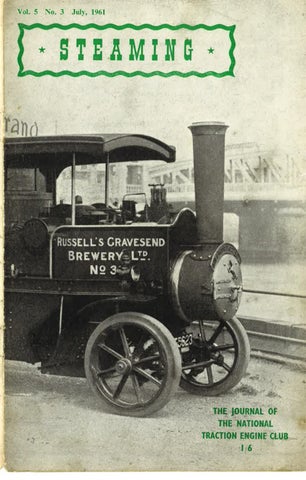
Vol. 5 No. 3 July, 1961
4
THE JOURNAL OF THE NATIONAL TRACTION ENGINE CLUB 16
70
STEAMING
NATIONAL TRACTION ENGINE CLUB
Chairman: THE REVD. PHILIP WRIGHT, M.B.E., Hon.C.F. The Vicarage, Woodford Bridge, Essex. Vice-Chairman and Editor: J. CRAWLEY, ESQ., Field House, Turvey, Beds Secretary E A. FILLMORE, ESQ., 34 Northwick Park Road, Harrow, Middlesex, Membership Secretary (including Ties and Badges): J. G. HUTCHENS, ESQ., A.31 Cafe, Tricketts Cross, Ferndown, Dorset. Treasurer: E. W. EDNEY, ESQ., 33 Portsmouth Road, Horndean, Hants. Boiler Records Officer: J. R. BONSOR, ESQ., 6 Rokeby Gardens, Woodford Green, Essex.
DIARY OF EVENTS JULY 22 (Saturday).—West of England Traction Engine Rally. Secretary: V. H. Carveth, Esq., " Barncoose," Redruth, Cornwall. 29 (Saturday).—Taunton Traction Engine Rally. Secretary: W. Utton, Baghay Farm, Milverton, Taunton. 29 (Saturday).—Kegworth Traction Engine Rally. Secretary: N. Brown, 19 Borrowill, Kegworth.
12 (Saturday).—Chatteris (Cambs.) Traction Engine Rally. Secretary: C. Hall, 55 Litchfield Road, Cambridge.
AUGUST 5, 6 & 7 (Saturday, Sunday and Monday).—Woburn Traction Engine Rally. Secretary: J. Crawley, Esq., Field House, Turvey, Bedfordshire. 7 (Monday)—Church Stretton Traction Engine Rally. Secretary: D. W. Smith.
2 (Saturday)—Cranbourne (Dorset) Festival and Traction Engine Rally.
19 (Saturday).—Weald of Kent Traction Engine Rally at Penshurst Aerodrome, Nr. Tonbridge. Secretary: R. A. Whitehead, 42 Hadlow Road, Tonbridge, Kent. SEPTEMBER
OCTOBER 14 (Saturday).—National Traction Engine Club Annual General Meeting followed by Club Dinner.
STEAMING
71
EDITORIAL AT this time of year most of us are busily occupied with our engines or else attending Rallies, and I am afraid that I am no exception, so that of necessity this Editorial will be brief. I receive many letters and postcards giving me details of engines for inclusion in " News Flashes ", but in most cases these are of no interest because the engine number and registration number are omitted, so please make sure of these details before sending in your reports. I have recently received a letter from a gentleman who is the manager
of a large estate which still has one engine in use. He complains of continual visits from people who wander round looking for the engine, even going so far as to remove the sheets for reasons of photography, and in some cases leaving the sheets off. It is quite possible that these people are not members of this club or any other, but I cannot impress too strongly on all of our members not to indulge in this sort of behaviour as it can only lead to trouble and a bad name for all engine enthusiasts and clubs. EDITOR.
FROM THE CHAIRMAN (Philip Wright's Column) I MUST begin by being personal, I am afraid. I have had to resign from many of the organisations to which I have hitherto belonged. This includes all Steam Societies other than the National Traction Engine Club. I find it just impossible to have so many irons in the fire, and it does not help to belong to something and then find myself unable ever to attend its meetings, as this only upsets folk, I find. After all, I would not be worth my salt if I did not place my large parish first in priorities . there is a population of well over eight thousand. Besides all this, it is difficult indeed when for instance four Rallies occur on one day. This year I shall have only been to two, Appleford and Alton Towers. I do trust people will understand what I mean. Before the London Carthorse Parade this year (where I do the Commentary) I was privileged to be a guest at Messrs. Young's Brewery, Wandsworth, where Messrs. John and James Young personally showed me round their stables to view their magnificent horses. With pride they then showed me their anc►ent steam engines. Here are two beam engines installed over a hundred years ago (well over in fact). One was installed in 1835, and a brass plate indicates that it was of "twelve horses power, and altered to sixteen HORSES
power in 1868 ". The fellow engine was installed in 1867. Still in constant use, their condition speaks volumes for the care bestowed upon them by their owners and their staff. These engines are superb. I love the phrase HORSES power for horsepower, don't you ? The June issue of Elizabethan (a teenage magazine) used an article from me on traction engines. The illustrations they chose were Laurence Parris' fine Burrell, plus two from my book, William Bray's engine and the Leyland Post Office waggon of 1900. They also listed our Rallies in order that their young readers might go along and see for themselves. Mr. F. Hal Higgins sends from America a copy of Engineers and Engines for April. This magazine is largely devoted to photostatic reprints of catalogues, press articles and advertisements of years ago. They have reproduced my Burrell Memorial picture and the two of William Parris' reconditioned 1896 Burrell. The new book Old Farm Implements is out and about. If you don't want to buy it just ask for it at any library and they should get it for you. It is published by A. & C. Black. My MS and illustrations are almost ready for the press for the succeeding book under the title of Old Farm Tractors which Messrs. Black are also
/2
STEAMING
publishing for me. In writing it I came across interesting details of the Summerscales Steam Tractor which unfortunately was not included in my traction engine book but which will certainly be included as a steam tractor. It was built at Keighley and was a three-wheeler, which makes it unique among steam tractors. I am in touch with the man who made it. She had a unique engine similar to an internal combustion engine, but was powered by steam from an upright side-fired boiler. Undoubtedly Appleford's demonstrations this year stole the show, and a more consistent crowd watched
the steam ploughing and cultivating than watched the other ring events. We owe a great debt to the farm press and farm engineering press who gave us good mention before the day, and I met people from long distances who had come because of this fact. It was wonderful to show thirty-eight engines, and yet I still maintain that the most successful rallies (as differing from demonstrations) are those where the engines number no more than about twenty-five. I know many members disagree with me here, but it has been my considered opinion for a long time.
FROM THE SECRETARY IT seems these days that various members of the traction engine fraternity are managing to get themselves in the news for their voluntary labours and in many instances this has led to some honour being bestowed on them. At the recent Essex Show our Chairman, the Rev. Philip Wright, had the honour to be presented to the Queen Mother who graciously accepted a copy of his newly published book Old Farm implements. This is indeed an honour both for the Chairman and for those in close asso,iatiun wiiii 111111 and his work ill agriculture with which so many of our members are closely connected. I am sure all will join in congratulating him in this respect. At the Royal County's Agricultural Show at Windsor our Vice-Chairman Mr. John Crawley had the honour of being presented to His Royal Highness The Duke of Edinburgh, after which John had the pleasure of showing him round the display of engines and introducing him to many of the owners and drivers. The following day John had the honour of receiving his second royal visitor, namely H.R.H. Princess Anne, who spent some time inspecting the engines, the previous use of which was explained to her. The end of the Club year is approaching which always brings with it a large amount of work for your
Treasurer and Membership Secretary, as they have to cope with the tremendous influx of subscriptions which, as you all know, are due once a year T ast year we on 1st September. introduced a system of payment of. subscriptions by Bankers' Order which saves much work for the Club and also members remembering when they are due ; this was well supported and so it has been decided to insert a suitable order in the July issue again this year. For those who wish to take advantage of this method of payment, would you please Lumpluie the appropriate part of the form and forward it to your Bank for attention. It is most essential, however, that you get your Bank to quote your name as a reference when making payment to the Club's Bankers. The Annual General Meeting of the Club will take place this year on Saturday, 14th October, and will again be held at Bucklersbury House in the City of London, at 4 p.m. This will be followed by the Annual Dinner, both of which functions I trust as many members as possible will make every endeavour to attend. A separate notice will, however, be sent you in due course. If any member would like a copy of the excellent programme produced for the Club Rally at Appleford on 17th June last, these may be obtained direct from me, price 1 /-, post free.
STEAMING
73
AGE WITH A YOUTHFUL LOOK
Britain's oldest Steam Road Roller before restoration. AN eighty-year-old steam roller was the eye-catching reminder of the start of mechanised roadmaking displayed on the Aveling-Barford stand at the International Construction Equipment Exhibition, Crystal Palace, held on the 15th-24th June. At work until a few months ago, the machine was built by Thomas Aveling in 1882, seventeen years after he developed the world's first practicable steamroller. It is the oldest still existing in Britain and, throughout the world, is second only to the Oslo Municipality machine that was ceremoniously retired to Norway's Technical Museum last October. Aveling Steamroller No. 1760 was
built for Reading Corporation who kept it in work until the early 1930s, when it was purchased by the Company that is now John Allen & Ford (Oxford) Ltd., Civil Engineering Plant Hire Contractors. Whilst with this Company, the roller operated on innumerable important road projects, including Britain's first Motorway, M1. The last contract was the Maidenhead By-pass in 1960, after which it was bought back by the present Aveling Company for preservation at their Grantham headquarters. It has now been restored to its original specification as a 10-ton (nominal), two speed, single-cylinder road roller.
74
STEAMING
GEORGE THURLOW & SONS LIMITED
STOWMARKET - SUFFOLK 'Phone : STOWMARKET 585 (3 lines)
*
Solicit enquiries for items they can supply for Steam Engines, amongst same are BOILER TUBES CHIMNEYS WITH OR WITHOUT BRASS OR COPPER TOPS INJECTORS, GAUGES, ETC. PACKINGS pAryre SUCTION HOSE ENGINE AND CYLINDER OILS
All enquiries will receive prompt and careful attention
STEAMING
75
THE 1961 APPLEFORD TRACTION ENGINE RALLY BY ALAN J. MARTIN. THE Club's Rally at Appleford on the 17th June, the tenth anniversary of events held in the area, must be regarded as probably the most successful so far organised by the Club for no less than thirty-eight engines were in attendance representing all types. This year the Rally's committee spared no effort in making the events as interesting as possible for all, and undoubtedly the demonstrations of steam ploughing and steam cultivating were the highlight of the day with no less than five ploughing engines working at some time or another during the day. An added attraction was a very early single-cylinder Fowler Ploughing Engine No. 1190 which was rebuilt by Wilders of Wallingford. Though this engine was not in steam, due to the fact that the boiler inspector had been unable to carry out an inspection, it nevertheless attracted a lot of attention and served as a very useful platform from which Mr. Timothy Wilder of the firm of John Wilder Limited, performed the opening ceremony, after which the engine was towed round the arena by Arthur Napper driving his single-cylinder Fowler Traction Engine No. 15710 " Tommy ". The usual events in the arena were carried out for which the various Club trophies were won. To add interest and to show the public the possible capabilities of some of the participating engines in the Obstacle Steering Contests, each engine had to tow a bailer. The members of the public who, in this modern age, are so speed-minded, must have been satisfied with the performance put up by Messrs. Boughton's well-known Foden Wagon No. 13138 against Arthur Fearnley's much-travelled Super Sentinel No. 1463. and also between the two Sentinel Tractors, Nos. 7527 and 8777, owned respectively by W. J. Powell and the Membership Secretary Jim Hutchens, who incidentally did so much prior to the Rally on behalf of the Club with his Scammell low-loader.
Many new attractions were arranged for the Rally, including the driving of threshing drums by Hamish Orr-Ewing's Marshall Traction No. 73901 and John Crawley's Ransomes Portable Engine No. E409. Both these engines performed their tasks throughout the afternoon effortlessly and attracted a great deal of attention. The Reading Model Engineering Society brought their multi-gauge railway track and several model steam locomotives to hold the numerous children who kept the track fully occupied throughout the day. Reverting to the ploughing and cultivating demonstrations, both single-cylinder and compound engines performed these operations and Harold Bonnet kept the spectators fully informed of the technicalities involved and commentated on these events throughout the afternoon in a most expert and much appreciated manner. The commentator of the events in the main arena was our Chairman, who carried out his duty in his usual informal and popular manner to the enjoyment of all the spectators. As it would take up too much space to list all the engines that attended, those members who were unfortunate enough not to be at Appleford on June 17th, can apply to the Hon. Secretary for copies of the official programme, which are more than usually informative. However, as only a few copies remain, early application is advised and these may be obtained for 1/-, post free.
IT is with regret that we hear of the passing of yet another steam man, Mr. A. W. Hunter, of Alton, Hampshire. Latterly he was the representative for Messrs. George Thurlow, of Stowmarket. He is survived by a widow, son, daughter and a sister, to whom we extend our sympathy in their sad loss.
76
STEAMING
GETTING HER ON BY W. MICHAEL SALMON. IN making this second offering in an occasional series on the less commonly discussed aspects of shunting about with engines, I would like to make it clear that I write as an amateur, for amateurs, and base my remarks on the sort of muddles I have got into myself, or seen others of similar inexperience get into. The experienced " Old Timer " may well wonder what all the fuss it about, but then, the first time he tried to put an engine on a lorry he had already had much more experience of straightforward driving than many of us will ever have. Increasing traffic congestion on the roads, increasing price of coal, and frequently, the lack of the spare time for long journeys, have all contributed to make the use of low-loaders for the transport of our engines a much more common practice, and this trend is certainly assisted by the very generous help given to enginemen by some of our lorry-owning members. Thus the ability to load or unload his engine is something which every owner should acquire. In many cases the lorry may arrive with a one-man crew, and he without any idea of engine-driving, so the owner has no option hut to load his engine himself, and in doing so to avoid t,s wir3 t y liesevar^1 thousand pounds-worth of lorry. Most low-loaders are referred to as having a " knock-out back axle ", although in fact two short axles carry the four wheels, and these are readily removed once the weight of the platform has been taken on jacks. The driver must take charge of this operation, but he may be glad of some assistance if this can be given without interfering with his usual routine. Some firms supply quite elaborate skids, and the use of these makes loading very simple, but in the general run of heavy haulage work sleepers are more versatile and so are commonly used. They are supported on packing, and usually there is nothing to prevent them moving endwise, unless the lower ends are pressed' into soft ground. Thus, when loading on a hard road it is essential to use the crab-winch on
the lorry to ease the engine up, a very little steam being used to take some of the weight and assist the winch-crew. Otherwise it is very simple to cause the engine to " kick the skids out from under her feet ", when she comes down with a bang onto the road, and may well put a skid, a block, or the rear edge of the lorry through her ash-pan or back tank. Worse still, she might kick one out and tip over. Therefore, use the winch—you can always get that critical by-stander to help turn the handle! Rollers are something of a problem, and while two sleepers can usually 1-,c placed so that the front rolls run on the inner sides and the rear rolls catch the outer sides, it is safer, if possible to use four sleepers, for if the weight bears on less than half the width of the sleeper the latter may twist over, and down she goes. The decision as to whether the engine shall ride facing backwards or forwards must, clearly, be taken before operations commence. If the load is anywhere near to the rated capacity of the lorry it is generally better to load frontwards, for then the heavier rear axle of the engine is near the rear trailing axle of the I y, 16 u3uctily iiiuic fitt-vd tu take it than the driving axle. With rollers, however, it is often better to go up backwards so that the winchrope can be coupled to the only proper coupling available. Once on it should be checked that the engine is either quite central on the bed of the lorry or a little to the off-side to allow for the camber of the road. It should never be off-set to the nearside. Securing the load is again the responsibility of the lorry driver as he has to drive it, but if the winch-rope is tight with the engine hard up to the swan-neck of the lorry the main stress is accounted for. Chocks can be nailed to a wooden lorry bed in front of the engine rear wheels and the winch tightened to pull her hard onto them, while quite small wooden strips similarly nailed outside (or even inside) her wheels will prevent her moving
STEAMING sideways. If the bed is metal, a chain on the engine coupling pin may be taken to each side of the lorry. Except where the engine overhangs the width of the lorry and there is absolutely no tolerance for any sideways movement, the merciless use of securing chains round painted wheel rims and spokes is just not justifiable. The loading of large engines on lorries which are really too small for them is a highly specialised branch of the art which must be left in the capable hands of accepted experts. As to the management of the engine, it is convenient to have half a glass of water, for she is to be quite considerably tilted, and she is neither to drop her plug or prime. About half her full working pressure is usually enough too, and renders her more docile for following the winchrope. There should be very little fire. Once on she may be filled up with water, the damper dropped, and a lid placed on the chimney. If you can arrange things that she arrives at her destination without having blown off and still with enough steam to unload you have done very well. Usually it is convenient to stop 5-10 miles from journey's end and either relight or make up the fire, and remove the chimney lid. While it may be permissible to load with the front of the lorry slightly down-hill to reduce the amount of climb for the engine, a nice level place is better for unloading. The chocks are removed with the weight on the winch and she is quietly allowed to roll down the sloping lorry-bed and skids as the winch is slacked out. At the bottom of the skids it may be required to give her just a wisp of steam to move her clear, although on a hard level road a dead engine can be unloaded entirely by gravity. For this reason a dead engine may be more conveniently unloaded on the road, and later pushed clear of the highway with a push-pole or even a piece of stout board against the front coupling with which most low-loaders are equipped. The practice of letting go the winch-rope and driving the engine off is quick and excellent where properly secured skids are in use, and experts are at work, but with an•amatcur on sleepers the method outlined is slower, but a lot safer.
77
Lest anyone be tempted to unload on a down-hill, thinking to get more assistance from gravity, the sad tale may be told of the roller that was so unloaded, not so very long ago. Perhaps she was short of water, but the fact was that she was off the lorry, away down the hill, through the parapet of a bridge, and wallowing on her side in the brook before anything could be done to stop her. This involved a lot of work, for there was the roller to salvage, the bridge to mend, and a second roller to be fetched to do the job the first one had come about. Low-loaders are expensive, and owners of tractors and other small engines are sometimes tempted to use an ordinary platform lorry. This is quite satisfactory as long as two elementary points are considered. Firstly engines are usually heavier than their names imply. A " 5-ton " tractor is more likely to be 6-7 tons an " 8-ton " roller may well be ten. Also the centre of gravity of an engine, considered as a load, may be rather high. For both these reasons it is required that the lorry used should be rated to carry, say, 25 per cent more than the known weight of the engine. Secondly, an engine being loaded onto a platform lorry MUST be loaded off a PROPER LOADING BANK. True, engines have been loaded off hedge-banks and various' temporary erections, but this is always inadvisable and is never a job for the beginner. Suffice it to say that following many accidents the loading of even farm tractors by these methods has been prohibited by many firms, despite the extra expense that may be entailed. Even though it is well within the rated load of the lorry the whole weight of an engine is carried at only four points on the bed, so sleepers are usually required to spread the load, at least two for each back wheel, while half-sleepers may be handy in front. The rear axle of the engine MUST be loaded within the wheelbase of the lorry, so if the lorry bed is not such that this is achieved with the engine looking forwards, she must be turned round, otherwise the lorry will be unsteerable. Naturally there will be no winch on such a lorry and the engine must go on under power, either her own or that of another engine. Before doing this the extreme rear of
78
STEAMING
the lorry should be supported on jacks to prevent damage against the face of the loading bank, and measurements should be taken to allow of a good big block being put down each side of the lorry bed for the engine rear wheels to come up to. Thus-wise there will not be even a little dent in the back of the lorry cab. Securing an engine on a platform lorry must not be either hurried or skimped. It is no good to say " We are not going far ". If she comes off the results are quite independent of the distance travelled. You have the best part of a full load, all in one piece and on wheels. It is high enough off the ground that if it moves it will be sure to tip over. Unless the lorry has unusually good securing arrangements it is probably safer to jack the engine and pack her securely beneath the back tanks and the front axle so as to stop her tend-
ing to roll on her wheels at all. With the increasing use of lorries there is no doubt that our Rallies have lost something. In the early days we needed no judges. You had come ten, forty, eighty miles. and to prove it you were there. Since then there has passed by the full economic lifetime that many makers expected of their engines, and as our veterans get older and older it becomes less and less justifiable to chase them about on long journeys. Thus what once savoured of " cheating ", has now become the accepted things to do. A last word of warning—if the weather is very wet take extra care. Wet timbers, wet mud and wet lorryloads are slippery and treacherous to both engines and men. Resist the temptation to rush to get out of the wet, rather take time, and avoid an accident—and that holds good for a dry day too, come to that.
The Power Packed (6.0,$) IVlanzel Cylinder Lubricator Ever thought of fitting a 3-point Lubricator giving a separate feed to each port face and a good oiling to the steam itself ? Consult British Manzel Oil Pump Co. Durranhill Eng. Works CARLISLE 21418/9
STEAMING
FROM OUR MEMBERS
79
John Beeby, Esq.
John Beeby (standing right) with his 6 n.h.p. Mann Tractor No. 1428 (Reg. No. U7579), circa 1933.
A Fowler 14 n.h.p. Single Cylinder Ploughing Engine belonging to Beeby Bros., of Rempstone, having fallen through a new bridge just opened to all traffic at Gadesby, Leics., in 1905.
80
STEAMING
CLUB NEWS BEDFORDSHIRE The monthly meetings continue to be very well supported. Our members have been busy with their engines attending Rallies. The Society's Annual Dinner was held at " The Half-Way House," Dunstable. on Saturday, May 13th, 119 members and guests being present: It was generally agreed that the evening was a great success. Engine activities have been far to numerous to mention all individually, quite a few members supporting the Gt. Wymondley Rally at Whitsun. Jack Fensom has recently acquired another Burrell traction engine in Norfolk. This should be home in time to attend the Woburn Rally at August Bank holiday Week-end. John Crawley has acquired the 8 h.p. Special Scenic Showman's Engine " No. 1," No. 3865, from Pat Collins of Bloxwich, and also a pair of Fowler Ploughing Engines Nos. 15344 and 15345. Arrangements for the Woburn Steam Week-end are well under way and it would appear that over 60 engines will again be present. J.C. EAST ANGLIA The East Anglian Traction Engine Club started this season cleft into two dividing camps hotly disputing proposed changes of Constitution ; the A.G.M. at Silver End was, to put it mildly, " a bit of a furore ", and the net result was that the club ended nn with the same Constitution and an almost completely new set of Officers. At about the same time, the last three of Glossops' Super Sentinel Wagons, Nos. 8681, 8635 and 8646 ? were cut up in their St. Ives yard. We then proceeded to organise some steam threshing. horrified as we were by the look of the new regulations pertaining to the guarding or otherwise of belts, and for three days Jim White's Burrell 8 horse. No. 1606, did the necessary on a line of stacks at Little Waltham, Chelmsford. The club obtained some valuable publicity from this venture, including eight minutes on Commercial Television and an illustration no less than a foot square in The Times. Aveling No. 8455, on which the Hon. Secretary was wont to lavish care and attention, was sold to Peter Frost on May 27th.
Aveling P.V. S.C. Roller No. 10962, ex Beds. C.C. No. 10, has been cut up. Aveling 10 ton S.C. S.V. Rolle' No. 8918, Hunts. C.C. No. 44, has been working intermittently in central Huntingdonshire. The last of Kimbell's rollers, the Marshall, did a spot of scarifying in Cambridge at the beginning of May. Burrell S.C.C. No. 3112 has been sold to Alan Bloom of Bressingham. Fowell No. 97 has been bought by T. B. Paisley from Harvey of Balsham. Work is proceeding on Gordon Wells' Fowell No. 108. Aveling 8 ton S.C. S.V. Roller No. 9246 has been bought by Wright of Fulbourne from Duce the scrapman. Aveling 8 ton Roller No. 10994 was working at Glinton, Peterborough, in early June. Allchin S.C. S.V. Portable No. 723 of 1891 has been cut up. C.H. HAMPSHIRE AND DORSET The Fowler Plougher No. 14712 " Wilbur " now has a companion at Kings Sombourne. This is the Ransome No. 41406 that attended Beaulieu Rally at Whitsun. Both engines are off the main road in the village. Southampton Corporation having recently purchased a 13 ton Diesel roller are thinking of giving the, big Wallis Roller No. 7742 (CR6315) to a local children's playground. This engiie. was recently in UGC: and is at Woolston Depot. We are hoping to have several engines in the Southampton Carnival Procession on July 29th, which leaves the Common at 6.30. Eastleigh (Hants.) Carnival Parade on Wednesday, August 23rd, will also have an engine or two present. Cranborne (Dorset) Festival and Traction Engine Rally will be held on Saturday, September 2nd. In connection with this Rally, where I shall have my " World's Fair " tent, I am running coaches from Southampton Central Station. As the fast London train reaches the Central at 11.55, we shall leave Southampton at 12 o'clock midday. Fare 5s. 6d. return back to the Central about 7 o'clock in the evening. The seats may be booked through me, J. A. Figgins, 43 Ripstone Gardens, Highfield, Southampton. J.A.F.
STEAMING COUNTY OF SALOP As these notes are being written preparations are being made for Church Stretton Engine Rally to be held on August Monday. This year there is no Carnival and the event will be an ordinary Rally. It is hoped to have about fourteen engines in attendance and a full afternoon's programme has been arranged. Gates will open at 11 a.m. to enable those earlycomers who wish to get photographs a chance to do so. All the activity at Burley is at present directed to preparing engines for the coming Rally. Mr. Salmon is giving " Queen Mary " (Fowler) a repaint and Messrs. Bishop Bros. are forging ahead on both Marshall No. 8839 and Allchin No. 1458. Re-lagging is in hand on Burrell No. 2646, but she will not be seen out this year. A photograph of this latter engine when in her working days has still not come to light and if any member can obtain one from any source it will be much appreciated. Aveling Roller No. 11208 was observed on road works near Llandewi some weeks ago, but there is little else to report in this area. Mr. Wheeler is at present fitting a new smoke box to his Burrell tractor, and when this is completed the tanks and lagging will be removed so that the restoration can be continued. From Mr. Woolley at Bucknell comes the news that both his Marshall rollers are at work, one near Canon Pyan and the other near Braley ivIountain in Radnorshire. The suggestions has been made and in fact it seems necessary that a club known as the County of Salop Steam Engine Society be formed. More about this will be reported in the next issue of Steaming. D.W.S. THAMES VALLEY In April we held our first " Steam Evening " at Appleford. Arthur Napper's Fowler traction unfortunately sprang a leak in a tube the day previous and so was not in steam. Ron Hawthorne's Fowler Roller No. 14674 " Busy Bee " was in steam and went for a run through the village and back. About thirty-five steam enthusiasts were present and enjoyed conversation and later a glass. On June 5th a second " Steam Evening " was held at Hurst.
81
Here we were able to compare Shipman & Barker's Burrell Tractor No. 3458 and L. A. Price's Burrell Tractor (No, 3355). J. H. Fisher steamed his Foden Wagon No. 11538 over from Burghfield and many members had the pleasure of having a go on the engines. For some it was the first time they had been at the controls of .a steam vehicle. Later in the evening a farm trailer was hitched up and a sizeable party visited some of the " locals ". Appleford Rally, as fully reported elsewhere, is held in our " parish and was generally regarded as the best ever. Our members were well in evidence and we were very glad to have the company of visitors from a wide area. We have been invited to stage a display of engines at Royal East Berks. Show at Littlewick, near Maidenhead, on Saturday, September 30th. Members will receive details later, but it is hoped to have four or five engines of the Agricultural type in steam in addition to the set of Fowler ploughing tackle that the Show Committee has already booked. WEALD OF KENT Marshall Roller No. 74399, built is 1921, formerly owned by Baxter, Fell & Co. Ltd.. of Northfleet, Kent, has been bought by Mr. C. M. Rostron for preservation. This was owned by Mr. C. W. Lambert of Horsmonden until his death early in 1955. Ariothcr rollcr that 11as passcd into private hands for preservation is Robey No. 42216 (1925) which in recent years has been operated by W. Benstead & Sons Ltd. of Maidstone. The roller has now been bought by a member of their staff, a Mr. Wheeler, and is at present standing at their plant yard at Tovil, although ultimately it will go to Bearstead a village a little to the east of Maidstone. The sale of Arnold & Nathan's last steam roller to Mr. C. W. Walker of Meopham (mentioned as a rumour in the last issue) is now confirmed. The engine is No. 14187 of 1937. In the middle of June it was working on a job of trench reinstatement at Meopham. Mr. Walker's Wallis Advance Roller No. 7907 has been sold in its turn to a firm of contractors near Maidstone.
82
STEAMING
Mr. V. McG. Dunnett has purchased an old Allchin traction engine of 1890 from Mr. Rowland Page of Hellingly. For the moment the engine remains with Mr. Page. Work on the restoration of the Mann wagon owned by J. C. Butler and R. A. Whitehead has been proceeding during the winter and is foyer half done. The engine, valve gear, crankshaft, gears, second and third shafts, axles and running gear are done. Work has just begun on the rebuilding of the bunkers and the boiler is due to go into the boiler works any day for renovation. Mr. John Drew of Redhill has bought Wallis & Steevens Oil Bath Tractor No. 7732 from Messrs. Palmer of Massingham, Norfolk, but does not plan to bring it home at R.A.W. present. WORCESTERSHIRE The City of Birmingham Museum of Science and Industry held their second Annual Steam Week-end and Traction Engine Rally at Newhall Street on Sunday, May 14th, when a large number of exhibits were " steamed " from the boilers under the Museum and the roller and portable engine there actually were fired ; flues having been built up from them through the roof! The traction engines in attendance were as follows: Burrell 8 h.p. Scenic Showman's Engine No. 3909 "Winston Churchill" (1922). Savage 5 h.o. Electric Light " Box " Engine No. 537 (1891). Foden D-tyne Tractor No. 11788 " Matilda " (1933). All the above are owned by Mr. Eric Middleton of Hartlebury, Worcs. Fowler 5 h.p. Road Locomotive No. 19338 " Monty " (1933). Owner —Mr. Frank Hall of Worcester. Garrett 4 h.p. Tractor No. 32981 (1917). Owner—Mr. Roy Millward of Halesowen, Worcs. Burrell 6 h.p. Agricultural Traction Engine No. 2147 " Lady Burrell " (1898). Owner—J. L. Thomas of Rushwick, Worcs. Garrett 6 h.p. General Purpose Traction Engine No. 29764 " Olive " (1 911). Owner—Mr. F. C. Lambe of B romsg rove. Sentinel tractor. Owner—Mr. Cliff James of Kingswinford. Fowler 10 to roller. Owner—Mr. Pearson of Sutton Coldfield.
All the above, with the exception of the Savage electric light engine, came to the Rally under their own steam. Six engines attended the Feckenham Ox Roast and Wake on Saturday, June 24th. They were: " Winston Churchill," " Olive," " Matilda," and " Monty " as described above, and also RustonProctor 4 h.p. Tractor No. 52607 (1921), owned by Mr. Robert Millward of Halesowen, and Garrett 4 h.p. Tractor No. 33074 (1917), owned by Mr. Frank Holl of Worcester. J.L.T. WEST OF ENGLAND The newly-formed Cornish Traction Preservation Club, based on the St. Columb district, held its first Rally on July 24th. A splendid field near St. Eval and glorious weather contributed to an enjoyable afternoon, and a dozen engines together with several veteran cars and motor-cycles took part. Two fairground organs provided music, that belonging to Messrs. Anderton and Rowland was powered by " The Gladiator " (Burrell No. 3159, C03823) and " Challenger " (Burrell No. 2651, AY9840) belonging to Mr. W. H. Jones supplied current for his mammoth instrument. This was the first public appearance of the latter organ, and although a lot of restoration work still remains to be completed, its presence and performance created a great deal of interest. Another entry of unusual interest was " Princess " (Burrell No. 3125, AF4574) towed to the field by the sweet-running old Marshall No. 34022 (owner—H. James, Fraddon). She stood immobile in her allotted space with her smoke-box door ajar, exposing to view some of her old tubes still in position while some had been removed ready for re-tubing, her boiler cleading and lagging had been taken off and, showing evidence of many years of exposure and neglect, " Princess " was indeed a sorry sight. But an exhibit like this can do more than any words to convey to the general public some idea of the great courage needed to tackle the restoration of such a dereclict, and of the patience and many months of hard work needed to bring it to normal " rally " condition. The other engines attending the St. Eval Rally were:
STEAMING Fowler " Tiger " Tractor No. 14798 (U313) named " Firefly ". Owner-W. G. Hawkins. Sentinel S.4 Waggon No. 9293 (UJ9497), recently acquired by W. G. Hawkins from Mr. J. Hutchens who, with Mrs. Hutchens, drove it from Ferndown to St. Issey on May 27th. Burrell No. 3816 (AF35IS) "Cornish Maid ", owned by C. H. Parsons of St. Columb, who had added a dynamo on a very neat extension, and a lengthened awning. Garrett Tractor No. 33353 (BJ4236) " Prince ". Owner—D. Farley of Liskeard. Burrell (EB8351) " Millenium King ". Owner—E. Mewton of Mount Hawke. Burrell No. 4010 (DD6888) " Empress of Cornwall ". Owner—R. Tonkin of St. Eval. Fowler No. 7942 (1'A626) "Jonah ". Owner—J. C. J. Jones of Camborne. Burrell (TA1489) " Buller ". Owner — J. H. Chenoweth of Ruan High Lanes, Truro. McLaren No. 547 (BD5448). Owner —C. P. Gregory of Coombe, Camborne. A model of a Foden Tractor " Little Wonder ", built over fifty years ago in Cheshire, not far from the Foden Works and now owned and restored by G. J. Armstrong Evans of Trebullett, Launceston, was driven by his son. Last, but not least, that most interesting and informative collection of small engines and relics of the heyday of steam transport assembled on a large trailer with a vertical boiler to provide them with steam, by B. Parsons of St. Columb. Most of the above engines, together with about twenty others, are expected to assemble at Mount Hawke on July 22nd for the sixth Annual Rally of the West of England Steam Engine Society. It was recently reoorted in World's Fair that a party in the North of England had
chartered a plane to attend a Rally in Cornwall as this would enable them to make the return journey within a day! As no other Rally is expected
in Cornwall this year, we hope to see that plane arrive and trust that its occupants will find the long journey well worth while. Perhaps the idea will spread and we shall be obliged to find accommodation for aeroplanes as well as cars in the future.
83
The annual trip to Andover Rally was another very rewarding one for the participants and, judging by the increased attendance there, both of engines and spectators, saturation point for Rally-goers has not yet been reached. Some of the West
Country visitors made a detour " on the way home " to include the Steam
Exhibition at the Birmingham Museum of Science and Industry and the parade of steam vehitlfes in the
nearby streets. At the Royal Cornwall Show at Wadebridge the Fowler Tiger Tractor No. 14798 was quietly ticking over during the two days. On many stands noisy diesel engines were driving various types of farming machinery. How comparatively peaceful it must have been at similar shows fifty years ago when the main source of driving nower was the steam engine, making little more noise than Firefly ".
From Mr. Badcock of Littleham, Bideford, I learn that Mr. Billy Moore's Burrell Tractor No. 3951 (RL1978) attracted a lot of attention, especially from some American
tourists, when she stood in steam outside the Hoops Inn in North Devon on Whit Monday. This old coaching inn is on the main A39 road between Bideford and Clovelly and many travellers in the West will have seen the fine old stage coach beside the road there. This coach has recently been repainted by Mr. Moore and it is he who for many years has painted the Devon County Council rollers in the Bideford district. By
the way, these notes cover a wide area, and unless I receive contributions from other sources, many happenings will go unrecorded. If any readers have any interesting news from their districts, perhaps they will send them to me for inclusion in future notes. " The Gladiator ", with Anderton and Rowland's organ, attended the Redruth Whitsun Fair as usual. Since then this fine combination has visited Point Regatta, St. Eval Rally, Chacewater Carnival and a Sacred Concert at Chacewater. Their next engagement will be at the Rally at Mount Hawke, followed by a week on the quay at Falmouth (August
Bank Holiday week) where the organ will play every evening. St. Austell will probably have " The Gladiator " and organ during the Carnival there
84
STEAMING
from August 19th to 26th and later a week will be spent at Perranporth but the date has not yet been definitely fixed. Among recent changes of engine ownership in the West are the following : A Fowler 10 ton Roller No. 19205 (AAF130) has been bought for preservation from Messrs. R. Dingle and Sons by Mr. C. A. Glasson of Crowan, Camborne. This is a singlecylinder engine, shabby, but otherwise in good condition. A single-cylinder Burrell traction, of which the writer has no details yet, has been bought by Mr. G. W. Alford of St. Columb, but has not yet been brought to her new home from somewhere in the Eastern Counties.
The McLaren Ploughing Engine No. 1552 " Hero ", which until 1958 was used for soil sterilization at a nursery at Drayton, Somerset, is now owned by Mr. W. G. Hawkins of St. Issey. Apart from No. 547, this is the only representative of the make now in the West, her sister engine, No. 1553 " Hilda " having been cut up a year or two ago at Swindon. Ruston & Hornsby No. 169167, recently acquired by the W.E.S.E. Society in order to keep it in this part of the country, is now the property of one of the Society's members, Mr. G. R. Symons of Camborne. He intends to re-name his engine " Trevithick " which, as Camborne was that famous man's home town, C.P.G. seems appropriate.
BOOK REVIEW Old Farm Implements, by Philip Wright. A. & C. Black. 25/-. 95 pp. 24 plates and 39 drawings. The farm tools and implements of a past age are described, under the four seasons of the year, with details of how their owners used them before mechanisation spread. Implements known to a few in past generations, even in the days of the Romans, and lost antiquity, are seen to be re-invented again in the last century. Earlier methods of ploughing, seeding and cultivating. shepherding, hoeing, draining, hedging, harvesting and threshing are all described, as is the work of such craftsmen as the hurdle-maker and miller. The contents of the farm kitchen and dairy find a place, and a nostalgic chapter covers absolete sayings and dialects of the countryside. The illustrations are photographs of implements and tools in the extensive collection which the author has been making since boyhood, supplemented by his pen and ink drawings. Naturally in a book covering such a wide range of implements only slight mention is made of the steam engine, but it has much to commend it to the serious traction
engine enthusiast who will see the methods of farming employed before the utilisation of the steam engine and will be able to appreciate more readily the tremendous strides that were made during the steam era in all forms of agriculture. Summing up: An extremely well written book by an author in love with his subject and well up to the standard of his earlier book Traction Engines. Some Ploughing Engines. Published by the Road Locomotive Society, 136 Lavender Hill, Tonbridge, Kent. Price 7s. 6d., post free. This booklet, the second in a series published by the R.L.S., is composed of twenty-four photographs taken by the late Major R. W. J. Ind between 1903 and 1913. They are all of firstclass quality and include products from John Fowler of Leeds, Aveling & Porter Ltd. of Rochester, Charles Burrell and Son Ltd. of Thetford, and J. & H. McLaren Ltd. of Leeds. As the great majority of our members will want a copy of this book, you are advised to send for this immediately as the number of copies available are limited.
85
STEAMING
OBURN PARK RALLY August Bank Holiday Week-end
Saturday, 5th August. Arrival Day Gates open 12.30 p.m.
Engines will be arriving from all over the country, others in steam for inspection. Showman's Engines making light and organ recitals until early evening.
Sunday, 6th August. Demonstration Day Gates open 11.30 a.m.
Conditions permitting, demonstrations will be given of Cable Ploughing, Moledraining, Cultivating and Threshing.
IVInndR.y, 7th Auglict,
Polly nSiV
Gates open 11 a.m.
Grand Parade commencing at 12 noon. All the usual competitive events. This should be the biggest Woburn Rally yet held. Special trains from St. Pancras on the Sunday and Euston on the Monday. Buy your ticket in advance as these are limited. Caravans, tents, etc. cannot be parked on the Estate, but there are many suitable places within easy reach. Refreshments will be available on all three days. Engines will be in steam regardless of weather conditions. Any further details from the Rally Secretary: JOHN CRAWLEY, FIELD HOUSE, TURVEY, BEDFORD.
86
STEAMING
8 n.h.p. 3 Shaft Marshall Traction Engine No. 11169 of 1883, at Gamaton, Notts., in 1919.
Ruston Proctor 7 n.h.p. Compound Traction Engine No. 33732 of 1907 at Bingham, Notts., in 1916. (Slide Valves above the Cylinders).
STEAMING
IB2
8 n.h.p. Clayton and Shuttleworth Traction Engine No. 35420 with Threshing Set at Hucknall, Notts., in 1921.
6 n.h.p. Fowler Traction Engine No. 6726 of 1892 at Sibthorpe, Newark, Notts., in 1916.
87
88
STEAMING
NEWS FLASHES Staffordshire County Council Aveling Porter Roller No. 8316 (Reg. No. E5335) was in use at Tutbury on 2nd July, 1961. Bryan Hedges writes from Oxford that Fowler Rollers Nos. 15970 and 17950 are both at work on the A4141. These both belong to the Mechanical Tar Spraying and Grouting Co. Ltd. of Reading. Steve Neville writes from Redhill that a 5 n.h.p. 2-speed McLaren Road Engine No. 1647 has been located derelict in Staffordshire and will eventually be restored. This, says Steve, makes a total of twenty-eight known McLarens. Peter Gledhill writes from Teddington that he recently saw Aveling & Porter Roller No. 10168 (TA2027) at work on the new Exeter Bye-Pass and Aveling & Porter Roller No. 7641 (FX6996) at Nortonhampstead. Lt.-Col. P. C. Garrett writes from Hong Kong as follows : Last year in the course of a tour of Malaya, I came across two old rollers, details of which may be of interest to you.
Carefully preserved on a plinth in the City Council workshops in Kuala Lumpur, Malaya, there is an Aveling & Porter Roller No. 5674 which is believed to have been delivered in 1904/5. It is said that this engine was still in working order though no longer in use. Personally I would doubt the road ability of this engine. On the same tour, I saw a second somewhat elderly Fowler roller in Penang which is extremely well preserved and said to be in working order and occasionally used. Its number is 18210. You may be interested to know too, that in Cambodia and Vietnam there are still a number of steam rollers in use, all of which, as far as I can recall, are of French manufacture. I believe, too, there are some in Thailand. If it should be of interest to you, I shall try to keep my eyes open on my new tour in these territories and will give you details. There are some Aveling rollers in Hong Kong but I do not think they are of any particular age, most of the old plant being destroyed during the Japanese occupation.
THE FIRST BEAULIEU TRACTION ENGINE RALLY BY ERIC FILLMORE ALTHOUGH this year has seen a slight reduction in the total number of Rallies so far held there have been one or two which come in the " first time " category. One such was the event held in the grounds of Beaulieu Abbey, Hampshire, over Whitsun, under the patronage of Lord Montagu and under the general direction of our Vice-Chairman Mr. John Crawley. Contrasting with the usual " wide open space " venue of our Rallies the site used at Beaulieu was relatively small, compact, and in ..a delightful woodland setting. This necessitated a limitation in the entry of engines to twenty-five, a good selection being present.. Whilst many of the larger events these days also feature demonstrations of various types, this Rally concentrated, I think wisely, on slickness of presentation
in order to hold the attention of the large crowd present. It seemed this aim was achieved since few people left before the end of the programme on either day. On both the Sunday and the Monday a full programme of events was held consisting of the more usual items carried out at Rallies. Both Lord and Lady Montagu and their infant son were present on each day and her Ladyship took part in some of the events ; I understand she has some reputation as a horsewoman and I feel sure that with very little practice she could well become one of the ablest of our lady steerswomen. Trophies bearing the Montagu Arms were presented to each of the entrants.
STEAMING
89
THE 1961 ANDOVER RALLY BY GORDON HOWELL THE Andover Steam Traction Engine Rally, organised by the Andover and District Model Engineering Society at Finkley Manor Farm, attracted more people than ever before. By three o'clock the parking space in the huge field around the arena was completely packed and other vehicles were diverted into a field across the road, programmes were sold out and supplies of ice cream and soft drinks came to an end, as the spectators made an effort to keep cool in the bright sunshine. The Rally was opened by Mr. Ian Fraser, a well-known Scottish steam enthusiast, who was last in Andover in 1953 when he attended the Rally " in rather inclement weather ". After declaring the Rally open, Mr. Fraser climbed into the cab of " Mighty Atom "—sparkling under its recent coat of blue paint—and drove around the arena on a lap of honour. Comments about each engine were given by Mr. D. Smith. As well as describing the engines, he gave numerous interesting comments about their speeds, times taken to reach Andover, quantities of water consumed and also the amount of coal used. Mr. Smith pointed out that Mr. R. Bailey, of Amesbury, had spent over 600 hours working on his Garrett steam tractor since the last Rally. The smallest entry was undoubtedly Mr. L. N. Smith's +-size model " Wallis and Steevens ". Mr. Smith made this beautiful model from measurements from a full-size engine, scaled down, and had no drawings. The oldest engine in the parade was " Alfred "—a Fowler singlecylinder tractor built in 1898, and now owned by Mr. H. Toomer, of Durrington. The Shand Mason fire engine, new in 1904, also took part in the parade. Owned by Mr. Turner, of Parkstone, and drawn by two large greys, supplied by E. P. Sampson, of Ringwood, the engine later gave a display of fire-fighting-1904 fashion. The fire engine display was a feature of the afternoon. With a signal from the starter, the " fireman " furiously wound the handle of the blower and thick smoke billowed from the chimney.
Five minutes later, a toot from the whistle heralded the rising steam pressure and the horses were hitched to the engine. A total time of 6 minutes 25 seconds passed before a jet of water—of surprising volume— shot from the nozzle. During the afternoon, Mr. Fraser auctioned a threshing machine and baler, which had given a working display powered by one of the traction engines. The two machines were sold as one lot for £40. Owing to a broken rear axle Mr. Hunt with his Burrell Show Engine No. 2547 was unable to attend. The mishap occurred on the Sunday before the Rally, not long after he had set out on the journey towards Andover. Two engines were running lights in the market place on the Friday night before the Rally. One a Garrett which has been converted into a showman's tractor by R. Bailey and the other a 8 h.p. Burrell Showman " General Gough " owned by Mr. Miller, of Bristol. An enormous amount of work must have been put into both of these engines to get them into the present fine state and they were certainly worth a visit during the hours of darkness when they were running. Another engine which aroused considerable interest later in the day was J. Hutchins' 1933 D.G. Sentinel tractor. This has had a recent complete overall and proved itself by hauling a trailer with the Wantage engine on up to the Rally. In his determination to be at the Andover Rally, he worked continually for two days preparing his engines. Having got his engines on the field, he collapsed—completely exhausted by the heat—and was unconscious for several hours! This is an example of the courage and determination of some of our enthusiasts. Music was provided by a surprise item—a fairground organ, owned by Mr. B. E. George, of Enfield, who also had his very nice Aveling showman's tractor here running lights. One of the large marquees on the field housed many interesting models and the Southampton and District Society of Model Engineers ran a 3+ inch gauge model railway.
90
STEAMING
HUNDREDS INVADE EMLEY (Reprinted from the Huddersfield Daily Examiner of June 19th, 1961.) SEVENTY-four-year-old Mr. Vincent Haigh had one great love—traction engines. In his home in Church Street, Emley, Mr. Haigh, who did not smoke or drink, had many pictures of traction engines, and in his backyard he lovingly cared for three traction engines and three steam rollers. Mr. Haigh was the sole proprietor of the 100-year-old family business of road-rolling contractors, and he was on his way home after having looked at a road roller he was interested in when he was struck by a car at Bretton on April 11th. He died three days later. HE LOVED THEM . Said his widow, Mrs. Edith Mary Haigh, at the sale of the plant and effects on Saturday afternoon : " These engines were his hobby. He spent his life with them and loved them like children." In the village of Emley Mr. Haigh was a man who was known as one who kept himself to himself. But he was liked and respected—for each week he used one of the traction engines to grind corn for local farmers. When the sale notices went out recently the auctioneer, Mr. Horace Wright, of Cleckheaton, received letters from nearly every county in England inquiring for particulars.
On Saturday afternoon hundreds of people poured into the village from various parts of the North and Midlands. THE PRIZE-PIECE
One of the visitors stopped at the village on his way with his family for a holiday at Blackpool. He was Mr. George R. Dawson, of Northorpe Road, Donnington, Boston (Lincs.), who stopped long enough to buy the prize-piece in the sale—a 1927 traction engine in working order. He paid £255 for the engine on behalf of the family engineering and threshing firm in Boston. " I think it was a reasonable price. We might use it in Rallies," he said. A partly dismantled traction engine went for £73 10s. to a Cleckheaton firm of scrap merchants, and a Wakefield scrap merchant firm bought a partly dismantled traction engine for £70 and a steam roller in working order for £92 10s. Another steam roller in working order went for £105 to a Northallerton buyer, who intends to use it on roads. A Dewsbury firm bought a 10-ton steam roller for £102 10s. and a partly dismantled tractor for £32. The costliest lot was a diesel roller which fetched £390 and was bought by an Emley Moor man.
HUNTINGDON AGRICULTURAL SHOW AT the Huntingdonshire Agricultural Society's Show at Hinchingbrooke, Huntingdon, on June 17th, 1961, the following engines were on display in steam : Burrell Showman No. 3912 " Dragon ". Marshall G.P. Traction No. 69269 " Smoky ". Aveling & Porter 10 ton Roller No. 5598. Fowell G.P. Traction No. 93. McLaren Tractor No. 1837. Fowler BB1 Ploughing Engine No. 15172. Farmers' Foundry Portable No. 36.
" Dragon " supplied power for Mr. Chamberlain's Limonaire organ. The Fowell drove a threshing drum and jack-straw. The Aveling & Porter, Fowler and Farmers' Foundry engines were making their first public appearances since being acquired for preservation. The Farmers' Foundry portable is a compound with cranks at 180 degrees and is thought to be the sole survivor of this make and design of engine. From the crowds round the display and from the complimentary remarks by visitors to the show, it was apparent that the display was much appreciated. T.P.
STEAMING
91
LETTER TO THE EDITOR 3 Lawnswood Gardens, Leeds, 16. Dear Sir,—Regarding the article on " Early Steam Wagons," by Neddy Down, in the January, 1961 issue of Steaming. He quotes from the Motor Car Journal for 1901, which states regarding the Foden overtype wagon : " The general design of this wagon is of a novel and original character, the whole construction of engine and steering arrangement is so similar to the Foden traction engine that any ordinary traction engine driver can, it is claimed, easily handle this wagon." It may have been original in some respects such as having a flat body and final chain drive, but as regards an overtype engine on a locomotive type boiler, with a body fitted carrying its own load, I think this distinction should go to the Mann's overtype 3 ton tipping cart. This type of vehicle was entered and took part in the Liverpool heavy commercial vehicle trials in June, 1901, along with a Mann's 5 ton undertype steam wagon. All the well-known makes of the time took part in these trials, which consisted of a week's running round a fifty miles' radius of Liverpool with their stated loads, and also a hill climbing test. Some completed the course, others did not even get started. However, both the Mann vehicles completed the trials Successfully. and the Mann's overtype cart was the only overtype vehicle entered. Then again we read on page 24 the article on " The Foden Steam Wagon " in which it states that the
overtype wagon was evolved in 1901 and that the design was finalised to take part in the War Department Trials in December, 1901. Well of course we all know that the Foden came out of those trials with flying colours, but please note the difference in the two dates when the two vehicles took part in their respective trials. Also let it not be thought that the Mann vehicle was just an experiment or a flash in the pan. It was not : it was a sound commercial proposition and many were made and did useful work, and also they were the forerunners of the famous Mann's 5 ton steam tipping cart, of which hundreds were made and also did much useful work. I think that it is acknowledged and conceded by historians on the subject that Mann's were the pioneers of the overtype engined goods carrying vehicle. They developed this further with their 3, 4, 5 and 6 ton overtype wagons, and very good wagons they were too. The clarification of the above is important from an historical point of view, as I think that anyone who is conversant with the subject will agree that the overtype steam wagon was made in much larger numbers,and did much more work than other types during the material time when they had the chance of proving themselves. The undertype started it, and the undertype finished it, but the overtype did nearly all the work in between, and that was roughtly for thirty years. Yours sincerely, L. COLE.
FOR SALE AND WANTED For Sale.—Parts of Mann Tractor, one pair of Water Gauge Mountings, Chimney Top, Lubricator and Injector. £5.—J. Warren, "Lambessow," Caro Brea Village, Redruth, Cornwall. Wanted.—Flywheel for Wallis Oilbath Tractor. Similar Flywheel (11 in. Shaft) would be considered.—R. A. Whitehead, 42 Hadlow Road, Tonbridge, Kent.
For Sale.—New Burrell Smoke-box Door, 27 in. diameter. Offers.— L. J. Casely, Rigg Lane Farm, Trent, Sherborne, Dorset. Wanted.—Rear Wheels to convert Garrett Roller to Tractor. also Front Spring, Chimney Base and Smokebox Door, complete with Garrett " G Emblem.—J. R. E. Driscoll, 32 St. Charles Road, Brentwood, Essex.
p. M. water treatment VV. L4
rrlu:innC
Coritraater,115.1'evcriticv
1117 • ..
700Antour f(st:
Burrell 8 n.h.p. D.C.C. No. 3949 " Princess Mary ", built in 1923 for W. Nichols. Whether he is ' nursing' a boiler of an Ocean Liner, or a Power Station, for a living, or tending a traction engine for a hobby :
For longer life and greater efficiency Engineers all over the world recommend D.M. Water Treatment. If one is using hard or soft water, the scale or corrosion which results can only be prevented by efficient water treatment. Consult : lie
r
0, 04.4s
HOUSEMAN & THOMPSON LTD. THE PRIORY BURNHAM • BUCKS. Published by National Traction Engine Club for private circulation Printed by Stonebridges Printers Ltd., Greyfriars Walk, Bedford
BY APPOINTMENT TO H.M THE QUEEN SPECIALISTS IN
ORGANIC WATER TREATMENT