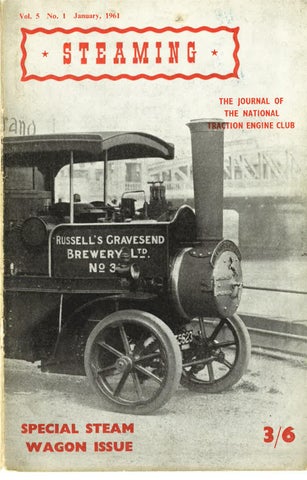
Vol. 5 No. 1 January, 1961
THE JOURNAL OF THE NATIONAL ION ENGINE CLUB
'RUSSELL'S GRAVESEND BREWERY: LT.P. N2 3-
SPECIAL STEAM WAGON ISSUE
3/6
2
STEAMING
NATIONAL TRACTION ENGINE CLUB
Chairman: THE REVD. PHILIP WRIGHT, M.B.E., Hon.C.F. The Vicarage, Woodford Bridge, Essex. Vice-Chairman and Editor: J. CRAWLEY, ESQ., Field House, Turvey, Beds Secretary, F A. FILLMORE, ESQ., 34 Northwick Park Road, Harrow, Middlesex. Membership Secretary (including Ties and Badges): J G. HUTCHENS, ESQ., A.31 Café, Tricketts Cross, Ferndown, Dorset. Treasurer: E. W. EDNEY, ESQ., 33 Portsmouth Road, Horndean, Hants. Committee : J. R. BEERY, ESQ., Wymswold, Kempstone, Nr. Loughborough, Leics. A. E. DEANS, ESQ., 1 London Road, Baldock, Herts. A. C. DURRANT, ESQ., 94 Leigh Gardens, Kensal Rise, London, N.W.10. J. T. FENSOM, ESQ., Friars Wash, Flamstead, St. Albans, Herts. A. FENsom, EsQ., Friars Wash, Flamstead, St. Albans, Herts. DR. E. ELMES, ESQ., East Waylands, Hayne End, Middlesex. H. J. GILBERT, ESQ., 33 Bournehall Road, Bushey, Herts. S. HILL, ESQ., 29 High Road, Broxbourne, Herts. J. HIRONS, EsQ., Croft Close, Hailey Road, Witney, Oxon. A. C. NAPPER, ESQ., Bridge Farm, Appleford, Berks. H. ORR-EWING, ESQ., 8 Robert Close, Randolph Avenue, London, W.9. L. C. W. PARRIS, EsQ., Paris Hall Place, Hastingwood, Harlow, Essex. F. UPTON, ESQ., The Hut, Windsor Road, Maidenhead, Berks. S. J. WHARTON, ESQ., Minster Lovell, Oxford. Boiler Records Officer: J. R. BONSOR, ESQ., 6 Rokeby Gardens, Woodford Green, Essex.
ACKNOWLEDGMENTS G. B. King, Esq. Ransomes Sims & Jefferies Ltd. W. C. Farrow. Yorkshire Steam Wagon Co. Ltd. Leyland Motor Co. Ltd. A. Wedgewood, Esq. Fodens Ltd. R. G. Adnams. COVER PICTURE:
Thorneycroft Ltd. Garretts Ltd. Aveling Barford Ltd. Nicholson & Sons Ltd. Jack Hampshire. " Neddy Down." " E.J.W.S."
Aveling & Porter Type FG4 Wagon.
STEAMING
3
EDITORIAL I WOULD like to thank all those members who so kindly sent me Christmas cards and greetings, alas far too many for me to acknowledge individually. At a recent Committee meeting it was decided that old age pensioners would be admitted to Club Rallies at half the normal price of admission upon producing their pension books at the ticket gate. Now, it is fully understood that in many cases where there are other attractions being staged on the same ground it will not always be feasible to make this concession, but I would like to think that other clubs in this country will bear this gesture in mind and perhaps join us in giving pleasure to those who might otherwise be prevented from attending. As Editor of Steaming for the last two years it has become apparent to me, judging by the letters that I receive, that there is considerable unrest amongst the public and our own members in the way that many rallies are being organised. Quite obviously anyone is entitled to run a rally, but bearing in mind that spectators and enthusiasts come in many cases a considerable distance often at great expense, the least we can do is to help clarify the type of event being staged, perhaps in the following way : TRACTION ENGINE DISPLAY Any number of engines present and in steam but static, i.e. agricultural shows, fetes, etc.
TRACTION ENGINE MEET A number of engines in steam and mobile, but not taking part in any organised ring events other than perhaps a parade. TRACTION ENGINE GYMKHANA More than four engines present but less than twelve, taking part in parades, informal events, or organised events. TRACTION ENGINE RALLY Twelve or more engines taking part in organised ring events. Full rally facilities available. Now, let me hasten to say that in advertising in this way attendances will not be affected. If it is intended to field a team of six engines, and anticipate an attendance of five or six thousand people, then it might well do- so, but this it what we are after because if we do not put our house in order now with the ever-increasing number of events being staged and the talk of summer soccer and many other attractions, we might well regret our folly in closing the door after the horse has bolted. Finally, to all of my readers, especially those doyens of the steam age who are now getting on in years, my sincere wishes for your happiness, health and prosperity during the coming year. Yours sincerely, JOHN CRAWLEY.
FROM THE CHAIRMAN (Philip Wright's Column) MAY I wish all readers a Happy New Year. It will be under way long before this is read, but I do sincerely hope that we shall have a better year regarding weather. So many of our members who farm or whom contract will have cause to look back with a poor view of 1960. The autumn issue of Smith's Automobile Review, which is a trade paper, had a first-class article by John Crawley our worthy editor entitled " Steaming Past ". It has some lovely colour pictures which have reproduced splendidly. Country Life Annual for 1961 used a three page article from myself with several black
and white photographs, some already familiar to members. Mr. George Tew of West Ealing writes to say his father still drives a Wallis & Steevens road roller built in 1916 as a tractor but later converted into a roller. He tells of an accident at Grafton, Northants., on October 9th, 1906, where an engine taking water turned completely upside down at a bridge. Mr. Tew ends by saying his father is 79 but looking forward to many years with his beloved roller. At our last Committee meeting we decided to make further donations to National Charities. As a result, receipts and thankful letters have now
4
STEAMING
been received from four societies, each of whom deal with the less fortunate, viz: Imperial Cancer Research, Polio Research Fund, Multiple Sclerosis Society and the National Spastics Society. Mr. A. Leslie Drage, of Great Chishill, near Royston, tells me he has acquired a very interesting small portable engine which he is more or less rebuilding. Mr. W. J. Baxter, who is a specialist in hand forged ironwork at Rutland Gardens, Harringay, has purchased the Burrell engine No. 3112 which was bought new by an uncle of mine John Honeywood when the Suffolk Show was at Bury St. Edmunds in 1909. She is illustrated on page 19 of my book. Agricultural Machinery Journal have given our activities good publicity from time to time. This year at their stand at the entrance to Smithfield Show they had both my model portable and traction engines exhibited.
I quote some headlines hum national papers last week. " Month old electric train service off. Transformer trouble on a line which cost sixteen million pounds." " STEAM SERVICES WILL OPERATE AGAIN FROM TODAY." I refrain from comment. Christmas week brought me a delightful surprise, an ashtray from the owner of the Soame Steam Cart (Mr. John Edwards of Norwich). with a splendidly coloured reproduction of this historic engine illustrating this china tray. We have had the pleasure of seeing our hobby commemorated in art and in literature, but this was the first time I have seen it in any china article. When I described seeing this vehicle for the first time (pages 63 and 64 of my book) I made one or two errors, and have since corrected these in the reprinted edition. Those of you who have the first printing may like to alter your copy. Page 63, the date 1902 should read 1894 of course. and on page 64 duplex should read compound and 6 inches should read 2: inches.
THE ANNUAL GENERAL MEETING THE meeting took place at Bucklersbury House in the City of London, on Saturday, 15th October, 1960, and was attended by 83 members of the Club under the chairmanship of the Rev. Philip Wright. The Chairman opened the meeting by addressing a warm welcome to all those members present. He was pleased to see so many and was particularly gratified at the increase over the previous year ; those who had travelled great distances to be present were, in his opinion, doing the Club a great service in attending. In his review of the Club activities which followed he reiterated the view of the present committee to organise only one major Rally, which this year had again been held at Appleford, near Abingdon. This had been one of the most successful to date and a profit had been made in spite of the weather. The Club had also participated in the London Easter Parade and many members had given considerable time and energy to other Rallies throughout the country, most of which were very successful in raising money for some charitable purpose.
The Press throughout the country had, he felt, been kind to the Club and had given us much valuable publicity. He closed by thanking all officers and committee for their valuable and loyal support during the year. The Treasurer submitted his report and balance sheet to the meeting. He considered the Club to be in a strong and healthy financial position—the credit balance after allowing fur some outstanding items was just over £1,600. The committee had recommended that a substantial donation could be made to charity. The accounts and the recommendation were unanimously adopted. The Treasurer concluded his remarks by stating that he was proud to be an officer of an organisation which now seemed to be so flourishing and successful. The Membership Secretary gave details of the present strength of the Club which amounted to 953 mem bers. Although only just under 500 had paid subscriptions to date he felt many more would be coming in before the end of the year. He found particularly gratifying the fact that
STEAMING 110 new members had joined during the year. Many of these had been introduced by existing members who had rendered invaluable service to the Club as, in his opinion, its continued well-being depended to a large extent on its ability to attract new blood. The Editor in his report gave details of his policy. His aim was to give as much current information as possible as to what was going on, and also to give an outline of the historical and interest background of the subject. Much assistance would be rendered by members who would send him details of events, present or past, as his greatest difficulty was always getting suitable material.
5
The election of officers and committee then took place and these were as printed on page 2 of this issue. In fact there was only one change from last year. Mr. Prior, of Maidenhead, had intimated that he did not wish to stand for re-election and in his place Mr. H. Orr-Ewing was elected. Following the election there was a period during which members were able to ask questions and to raise points regarding the running of the Club. The meeting closed with three votes of thanks to the Chairman and the Vice-Chairman for their able handling of the meeting, and to Mr. Forster, our host.
THE ANNUAL DINNER FOLLOWING the success of holding a Club Dinner after the Annual General Meeting in 1959, the committee decided to repeat this again in 1960. Proof of the popularity of this lies in the great increase in attendance this year; no less than 174 members and their guests were present. We were honoured with many guests—a list of them all would be too long, but I would like to mention just one or two that it gave me special pleasure to see, particularly in view of the great distance they had travelled to be present. First, the doyen of the " old steam men "—Mr. Alf Pepper ; also Mr. H. J. Barker of the British Fairground Society, both from Leeds ; Mr. W. M. Salmon, President of the Road Locomotive Society from Wales. Amongst the ladies I was most pleased to see Mrs. Hutchens Senior, mother of our hard-working Membership Secretary, and last, but not least, our Chairman who managed to persuade his wife, son and daughter to come. I trust that these and all our other guests had an enjoyable evening. We were most pleased to have you with us! At the end of the excellent dinner served with the usual slick precision we have come to expect from Mecca Ltd. we revived the presentation of Club 'I rophies. Preceded by a brief welcome to all present by the Chairman, the Trophies were presented to the winners, a task graciously undertaken by Mrs. Philip Wright.
At the conclusion of the presentation a surprise was in store for everyone. The chefs had made and presented a magnificent model of a traction engine in Royal icing sugar which was wheeled in with much ceremony. This was aptly termed " The Bucklersbury Trophy " and was presented by Mr. Forster, Resident Manager, to Mrs. Connie Hutchens for all the hard work she puts in on behalf of the Club. Truly a delightful and unexpected pleasure! During the course of the evening a film show was given comprising several short films featuring Rallies at Appleford, Alton Towers and Rempstone, and also some fine action pictures of steam-ploughing. This proved a most popular item and we are much indebted to Jack Wharton and John Hirons who supplied and worked the projector. An opportunity was also afforded throughout the evening by the management for the ladies to tour the kitchens. That this Dinner was so successful was due to the considerable time and thought given to it by those responsible for its organisation. Whilst it is not possible to mention them all much credit is due to Alan Martin, Charlie Durrant and also to Barry Finch for his excellent photographic display : nor must we forget Mr. R. B. Forster of Mecca Ltd. and his staff for their co-operation and assistance without which the evening would not have been possible.
6
STEAMING
EARLY STEAM WAGONS BY NEDDY DOWN THOSE now leaving school, if they know about steam wagons at all, will at best, only have heard of Fodens and possibly Sentinels. This will also be true in the case of some who may have left school a few years ago, although in their case, they may in addition remember the Garrett, Yorkshire and Robey wagons and even the Leyland, if they knew the Liverpool area well. There were, of course, many more than these few makers as one soon comes to realize when thumbing through early motoring papers. They appear in surprisingly large numbers too, although statistics cannot be quoted as, except in the case of most of the major manufacturers, the relevant work's records have been destroyed. So in this short article, I will try and indicate which wagons appeared on the roads in good numbers, rather than those only produced as an experiment or to meet the domestic requirements of the firms who built them. It may surprise some readers to know that, as early as 1898, steam wagons were not uncommon and at least three firms were producing them in competition with one another. These three were : The Lancashire Steam Motor Company (predecessors of Leyland Motors Ltd.), who had produced their first wagon the previous year and had now delivered some 72 wagons. T. Coulthard & Co. Ltd., of Preston, who at this same period were well launched into the market, and of course John I. Thornycroft, who had commenced production with their steam van in 1896, a vehicle which, is most happily still with us. Then there was the LIFU concern, building steam wagons and omnibuses on the Isle of Wight to the patent of Mr. House, but I think that it can be said, as reliable as these were, and they were well known in their clay, doing much of the pioneering and so receiving considerable publicity ; they were never produced in any great numbers. In Scotland, Alley & McLellan Ltd., of the Sentinel Works, Polmadie Road, Glasgow, were at that time producing the forerunner of all those
famous Sentinel types. So far, all the wagons mentioned, in fact all those manufactured up until the year 1900, were undertypes, that is to say, they carried their engine under the frame. The steam wagons did not evolve from the traction engine, any similarity came later when traction engine building firms took to steam wagon manufacture. Proof of this can be found in the pages of the Motor Car Journal for 1901, when E. Foden Sons & Co. brought out their first wagon, an overtype, i.e., having its engine mounted on top of the boiler. The account states : " The general design of this wagon is of a novel and original character . . . the whole construction of engine and steering arrangement is so similar to the Foden traction engine that any ordinary traction engine driver can, it is claimed, easily handle this wagon." Broadly speaking, the overtype commended itself on account of its robust construction, the fact that the• principal working parts were under the eve of the driver and easily accessible, but it had disadvantages too, namely, the area of chassis left available for pay-load was less than in the case of the undertype, also the vision of the driver and steersman was restricted, although this could also be said of some designs of undertype wagons having their boiler, and therefore the chimney, in front of the driver. Of course it also positively ruled out all possibility of a driver-steersman, which many of the early undertvpe steam wagon manufacturers claimed was sufficient. One firm, C. & A. Musker, even advertised their " automatic stoker ", but on reading further into the description, we discover that it was an oilfired wagon and the pressure at which the fuel was fed to the burner could be governed by the pressure that was in the boiler. A refinement taken further by Thomas Clarkson, with his patent burner, as fitted to the wagons produced by the Clarkson & Capel Steam Car Syndicate. The undertype wagons with whom Edwin Foden competed were many. Those made by the Lancashire Steam
STEAMING
An early Leyland wagon built for Fairrie & Company, Ltd., Sugar Refiners, of Liverpool.
A 1904 Hindley wagon photographed at Bourton, Dorset.
7
8
STEAMING
A Straker Squire built in 1904.
Ntiteithie 16%111, Dilst.,A tr6Euh1lyall
Yorkshire Wagon No. 1019 (Reg. No. U4617), new in 1918 to the Duke of Bedford.
STEAMING Motor Co., T. Coulthard & Co. Ltd., and John I. Thorneycroft, as before mentioned, were joined by others, the names of which are hardly remembered today. They included : Jesse Ellis of Maidstone, C. & A. Musker of Liverpool, E. S. Hindley & Sons of Bourton, Dorset, SimpsonBodman of Manchester, the St. Pancras Ironworks, Bayley of London, and Straker. The Mann's Patent Steam Cart & Wagon Co. Ltd., of Hunslet, Leeds, with their undertype having a locomotive type boiler, was proving very reliable, if a rather heavy wagon. This firm soon changed to an overtype but differed from Fodens in having side-firing, in an effort presumably, to save space for the carrying of goods. They were producing one vehicle a week in 1901. Strakers -also brought out an overtype about .1903, but not many were built. The Yorkshire Steam Motor Co. (later to be known as The Yorkshire Patent Steam Wagon Co. Ltd.) with their highly original boiler across the frame, was quickly stepping up production until they were producing 'four standard vehicles a week in 1905, but Manns had built over 300 steam vehicles by then and 500 had been sold by 1908. The Leyland
concern built 39 in 1903 and 33 in 1904, only it must be remembered, by that time, they were producing internal combustion engined goods vehicles as well. By November, 1905, Leylands had exported 50 of their " H " type wagon and by 1907 had 130 repeat orders. Clarkson Ltd., of Chelmsford, as Clarkson & Capel had become in 1905, were well established in the building of steam wagons, and by the following year it must have seemed that the market for them was insatiable. There was the Bristol Wagon & Carriage Works Ltd., James Robertson of Fleetwood, Beyer Peacock of Manchester, The Thames EngineerinQ Works Ltd., The Seaham Dock & Harbour Co., all of whom were building wagons, and to the list must be added firms who hitherto had been known as traction engine manufacturers, such as : Richard Garrett & Sons Ltd. of Leiston, Wm. Allchin Ltd. of Northampton, Robey
9
& Co. Ltd. of Lincoln, Savage Brothers Ltd. of Kings Lynn, Wallis & Steevens of Basingstoke, and of all these, only Wallis & Steevens commenced steam wagon manufacture with an overtype, although later, it is true, some of these and other traction engine building firms brought out overtype wagons, notably Garretts, Allchin and Robey, all of whom changed to this model and these were later still joined by Burrells, Claytons, Aveling & Porter and Taskers. Having come this far, it is time to consider when it might be said that the steam wagon enjoyed its " heyday ", and in my opinion this was about the years 1906/7 and my reason for saying so is that at about this time steam road haulage was offering tremendous prospects both for long and short hauls. Roads were improving, although solid rubber tyres for steam wagons had not yet become common and this provides the key to the position. As rubber tyres became available at a practical cost and the roads were still further improved, the tide turned in favour of the more lightly constructed internal combustion engined vehicle and the necessity for rubust construction, as in the steam wagon, lost point. Goods vehicles running on the typical roads of the period up to 1906/7 simply had to be tough, but the advantage after that was lost although this did not become apparent for many years, and can only now be appreciated in retrospect. In the next ten years, many more names can be added to the list I have given, but all the time others were dropping out until Fodens and Sentinels had it almost to themselves. Be it noted that neither of these firms had been absorbed or joined forces with others, and what can be deduced from this I will leave others to guess. Sufficient it is to say that while many firms went under because of their apparent self-satisfaction and failure to improve their design, the two biggest survivors were constantly improving, and both advertised strongly, so that when the decision to part company with steam was made both took with them into their new field of activity the good name they had so richly earned in those earlier years.
10
STEAMING
CLUB NEWS BEDFORDSHIRE Aveling & Porter Compound Roller No. 10261 (FX8794) has recently been retubed and rechimneyed at Gowers Works in Bedford. This engine hails from the St. Albans area. Albert Deans has recently purchased Burrell D.C.C. 5 n.h.p. Traction Engine No. 4037 from F. A. Smith of Girton Holme. The derelict Foster Showmans Engine which has been standing at Jack Fensom's yard at Markyate has recently been sold for preservation. There is a tremendous amount of work involved, but at least the owner has an engine with a brand new firebox that has only been steamed once since it was put in. J.C. HAMPSHIRE & DORSET Swanage (Dorset) Toc H organised a Christmas Fair and Carnival. The procession, headed by the local British Legion Band and supported by torchbearers, met Father Christmas at the railway station. The procession included Mr. Harris' Fowler Showman Tractor from Poole. This was followed by the Wantage engine from Ferndown. Further along the column was a Sentinel steam wagon with Mrs. Hutchens driving. The procession also included an illuminated 1924 Model T Ford. A very pleasant evening was spent at the "local ", Braishfield, near Romsey, recently. The occasion was the presentation of the Baker Challenge Cup to Mr. Reg (Boxer) Old, of Braishfield, winner at the recent Winchester Toc H Traction Rally. This is the second year Reg Old has held this fine cup. The trophy, in silver, has the George Baker Traction Centre engraved on it, and was given by the sons Mr. L. L. Baker and Mr. G. R. Baker for the best maintained engine at the rally. Mr. Old's engine is a fine Wallis & Steevens G.P. No. 7115 7 n.h.p. (H05815) new in 1910. It was once owned by Messrs. Smiths of Kings Somburne, Hants., and used for threshing. This engine is often at work locally and is in excellent mechanical condition. Gordon Howell of Andover is at present overhauling his Foden Tractor " D " Type No. 14078 " Mighty Atom " and repainting, probably blue. Although permission had been
granted, owing to uncertain weather we were unable to have the Organ and Fowler Tractor at our recent Exhibition in Southampton. A fresh arrival in the New Forest is a Marshall traction engine. A Wallis " Advance " roller was in Mr. Seward's yard at Petersfield in October. This came down from Surrey. At the forthcoming Andover Rally in early May I shall be having a photographic display of Wallis & Steevens engines. J.A.F. COUNTY OF SALOP Owing to the recent weather conditions outdoor work has been somewhat curtailed, but progress has been made between storms and a new smokebox will soon be in position on Burrell No. 2646. This engine has been retubed, and as soon as the front wheels are once again in place the rear end will be dismantled and renovated. This will be a long job as the bunker is in a very poor state and will have to be almost completely rebuilt. Mr. R. Wheeler has been engaged in house moving so his Burrell Tractor No. 3786 has had to stand in abeyance for the time being. However, he hopes to make a start during the next week or so. The Marshall Portable No. 8839 needs a new tube plate and Messrs. Bishop have this in hand at the time of writing. The old plate has been removed' and was found to be in a very advanced state of corrosion. Mr. C. Bishop has recently purchased Garrett Roller No. 33373 from Corfields of Abermule, and is now busily engaged in converting this back to a tractor. The original conversion was by E. Davies, of Atlas Foundry, Shrewsbury. Draining off and greasing has been carried out on all the other engines at Burley and they now stand like silent monsters awaiting the warmth of Spring, their sheeted forms casting weird shadows when the pressure lantern is lit on a dark winters night. Vin. Nash of Plealey reports that Aveling & Porter Convertible Roller No. 9181 (EP1649) of 8 tons belonging to Montgomeryshire County Council is at present in the Cambrian Foundry at Newtown having new firebox stays fitted.
STEAMING
BEAULIEU TRACTION ENGINE RALLY 21st and 22nd May Whit Sunday and Monday
A new and important event in the year's calendar will be the first Steam Traction Engine Rally ever held at Beaulieu, home of Lord Montagu and location of the famous Montagu Motor Museum. Engines will be arriving on Saturday, 20th May, and will be in steam for inspection and parade on the Sunday. Whit Monday will be the Main Day with a full programme of ring events. Whitsun has been specially chosen not ony so that many people can spend their week-end in the beautiful New Forest or at a seaside town like Bournemouth or Southsea both easy distances from Beaulieu—but also because it is only one to two weeks after the Andover Steam Traction Event, only 36 miles from Beaulieu. Visitors will be able to see not only the Steam Traction Rally, but also the Montagu Motor Museum, Palace House (home of Lord and Lady Montagu), the famous gardens and Beaulieu Abbey. There is a licensed restaurant and a special field for caravans during the week-end. Near by, there is a special beach for swimming and boat trips on the river will be available. Make sure to mark Whitsun a " must " in your diary. All further details from John Crawley, Field House, Turvey, Bedford.
It
12
STEAMING
Mr. Nash's own engines are still undergoing restoration, but like everyone else he has been hampered by the inclement weather. Ransome No. 15609 remains at Plealey and it is to be restored fully as time and circumstances permit. The Allchin Traction Engine lately belonging to Mr. Pritchard of Leominster has been purchased for preservation by Mr. N. Marshall. It is at present standing at Leominster but will shortly be driven to Burley for retubing. It is understood that this engine will eventually be stabled at Plcalcy. A 2•speed spring mounted compound of 5 n.h.p., it is numbered 1458 and was constructed in 1909. Enclosed photograph portrays Burrell Showmans Road Locomotive No. 3090 " Fermoy ", built 1909, and late of Messrs. Sheppard's, the Birmingham show people. The picture shows No. 3090 when in the ownership of Messrs. W. A. Bishop, who eventually sold it to R. M. Woolley of Buck nell. The engine changed hands again after this, Mr. Woolley finally purchasing her once again, this time for permanent preservation. D.W.S. THAMES VALLEY A number of enthusiasts in the area are hoping to form a local club, embracing Appleford, Reading, Maidenhead and surrounding districts. A meeting to discuss the formation will be held in the Shire Hall Canteen, Abbey Street (near Shire Hall), Reading, on Friday, February 10th. The discussion will be preceded at 7.30 p.m. by a film and colour transparency show of the Rempstone, Andover, Appleford, Northleach and of other traction engine events. Any steam enthusiast will be welcome. WEALD OF KENT New arrivals in the area have dropped to a very low level. In Tact the only arrival to record is Garrett Greyhound Wagon No. 35464, a sixwheeler in a derelict condition, which has been bought by Mr. J. C. Butler for eventual restoration. On the other hand there have been several changes of ownership. Mr. T. W. G. Wallis' Advance to Mr. Lillywhite of Petworth. Mr. Eastwood has retired from the roadmaking business at Horsmonden which he took over from the executors of the late Mr. C. W. Lambert.
As a consequence he has vacated the yard near Horsmonden and has sold off a number of the engines including his 4 ton Wallis Roller No. 7740 and his Foden Tractor No. 12370, both of which have been sold to Mr. Baldock of West Sussex ; and his Armstrong Whitworth Roller No. 10/R/35 which has been acquired jointly by Mr. J. C. Butler, Mr. C. M. Rostron and Mr. R. A. Whitehead. R.A.W. WEST OF ENGLAND It was announced in the last issue of Steaming that the 1961 Camborne Rally would be held on 15th July but since then we have been informed that the Naval Air Day at Culdrose, near Helston, would take place on that date. As the display of lastmoving aircraft and that of slowmoving engines are two of the most popular events in Cornwall it would seriously reduce the attendance at each event if they took place simultaneously. Our Rally will therefore be held a week later, that is on Saturday, 22nd July. In former years the Rempstone and Camborne Rallies have clashed, but owing to our change of date to the 22nd many patrons who would like to attend both events will be able to do so. The Taunton Rally will be held on the 29th, so enthusiasts visiting the West, with or without their engines, may be able to include both Taunton and Camborne. In spite of the very great expenses involved in running our rally and the reduced attendance due to the unfavourable weather in 1960, the organisers were able to donate a substantial sum to local charities. Among recent engine activities was the filming of Dr. W. R. Dyke's Foden No. 2104 " Prospector " by Pattie Pictorial. The film (Pattie Pictorial No. 308) has been seen in London and will be screened at many provincial cinemas early in the year. Those wishing to see it should contact the manager of the local A.B.C. cinema. This fine engine also provided lights for village festivities at Rilla Mill on bonfire night. Mr. K. A. Doney's Burrell No. 3903 " Excelsior " was steamed from Saltash to her owner's new address at Ilfracombe during three wet weekends. This is a 5 n.h.n. D.C.C. 2speed sprung engine with disc flywheel and belly-tanks. She was built
STEAMING in 1921 and carries the " A.G.E." plates on smoke-box door and on valve covers. She spent her working life in the Bideford district threshing, and was bought for preservation in 1955 from Mr. Moore. Marshall No. 43345 (AF3520) " Dorothy ", formerly the property of Mr. E. G. Courts of St. Blazey, now belongs to Mr. Dunstan of Truro. was towed from St. " Dorothy Blazey to Messrs. Argall's works at Truro by Mr. E. Mewton's S.C.C. Burrell " Millenium King ", formerly known as " Ponto ". The Marshall is being fitted with new smoke-box and tubes, and minor repairs are being attended to in the firebox. She is a single cylinder 6 n.h.p. general purpose engine with canopy, built in 1905. After standing in Messrs. Jewell's quarry at Sladesbridge, between Bodmin and Wadebridge, for many years, Burrell No. 3125 (AF4574) " Princess " has recently been purchased for preservation jointly by Mr. W. G. Hawkins of St. Issey and Mr. J. Deacon of Wadebridge. " Princess " is a 6 n.h.p. S.C.C. general purpose unsprung engine with canopy and has suffered from many years' exposure. She is now one of a group of four engines in a yard at St. Issey, near Wadebridge, the other three being the Fowler Tiger Tractor No. 14798 (U5313) also owned by Mr. Hawkins, Burrell No. 2651 (AY9840) " Challenger ", the 8 n.h.p. Showman's Road Locomotive belonging to Mr. W. H. Jonas, and Marshall No. 34022 (TA2876), owner Mr. H. James. The last-mentioned engine towed " Princess " from Sladesbridge Quarry to St. Issey. En route, when crossing the long and narrow 13th century bridge across the River Camel at Wadebridge, a steering chain on the Burrell broke whereupon she slewed round and demolished part of the parapet wall which fell into the river. The drivers must have been very alert to prevent " Princess " going through the gap, and if she had none the Marshall would inevitably have followed as the towing chains were very strong. No doubt the crew had a most unpleasant experience. Mr. Deacon, who is a garage proprietor, has also purchased both of the Robey Tandem Rollers which have attended our rallies. They are No. 42129 (RL75) built in 1924 and
13
until a few weeks ago the property of Messrs. R. Dingle and Sons of Stoke Climsland, and No. 48869 (ED V916) which has had three owners in Cornwall since having been bought from Devon County Council. Mr. Deacon bought No. 48869 from Mr. M. Lynne of Fraddon and she is in nice order. The older Robey will be retubed and renovated soon. Mr. Hawkins attended the 1960 Rally with his Foyler Tiger (named " Firefly ") with a pair of household bellows dangling from its canopy above the bunker. Perhaps he wanted an alternative to the Fowler's own blower, or could not wait for steam pressure to operate it! There are many remains of mine pumping engine houses still standing in Cornwall. Long ago when the mines ceased working the huge engines were removed and the old houses, very sturdily built with massive granite blocks, have been derelict and rootless for many years but appear to be capable of remaining as they are indefinitely. From one such building near Helston a lot of stone had been removed for further use elsewhere, leaving parts of two high and thick walls standing, but recently this local landmark was demolished. A chain was passed through a hole near the base of the structure attached to the wire rope from the winding drum of Ruston Hornsby No. 169167 (TL5452) " Queen Mary " which slowly pulled the rope tight, then emitted a few lusty barks and the great mass of masonry disintegrated into debris and dust. This Ruston is a 6 n.h.p. single agricultural engine owned by Mr. Bray of Helston and is believed to be the last of that famous make. It was new in 1936 and exhibited at the Royal Cornwall Show at St. Ives in that year. Mr. J. Warren, who had been without an engine since he sold Fowler No. 7942 to Mr. Jones of Cam borne last August, has now acquired another Fowler. This is No. 12693 (FJ1850) which is a 3speed sprung 5 n.h.p. compound road locomotive, Class D2, with front perch bracket protruding beyond the smokebox. It was supplied new to the City of Exeter in 1911 and for several years has been in the possession of Mr. J. P. Vines of Hardwicke, Glos., who delivered it by low-
14
STEAMING
loader to Mr. Warren early in December. Since its arrival in Cornwall, the Fowler has already been partially stripped preparatory to reconditioning. On his return trip, Mr. Vines took Fowler Roller No. 16045 (AF7501) from Hayle to a new owner in the Birmingham district. During its short stay at Hayle Mr. G. C. Clark, the vendor, had nicely painted this engine. Work is continuing on the Burrell " His Majesty " at Mr. Stenner's garage in North Devon. The original 300 amp. dynamo is to be refitted. Owing to the very wet weather the dredging of the lake at Coate Water near Swindon had to be abandoned and will not be resumed until Easter. The two engines are in working positions, one at each side of an expanse of bush and weed-covered swamp which used to be, and, when the engines have done their work will be again, part of a large lake. The engines are Fowlers No. 15182 " Mavis " and No. 15183, and belong to Messrs. J. B. Carr, Ltd., of Wolverhampton. There has been but little activity at Coombe lately. Mr. J. H. Trounson's fine 7 n.h.p. Marshall No. 62121 (TA3624) " The Whale " has suffered with temperamental clack valves, pump and injector, and each outing in the past has been an adventure. The various fittings have now received expert attention. Mr. M. Leath is fitting a pump to Aveling and Porter Roller No. 10187 (FX8131) "Highwayman ". He received immediate replies to his recent advertisement in Steaming and was soon in possession of the parts he needed. " Highwayman " has two injectors but had no pump, although provision for one had been made on the boiler barrel and an eccentric had been provided on the crank-shaft. Now the engine will have an even better appearance, for although she was beautifully painted, an Aveling does not seem to be complete without the familiar external pump. Mr. M. B. Smart, a schoolmaster by profession, has removed the motion from his Robey Tractor No. 41493 " Little Glutton " in order to do some " home-work " on it during the term. " Queenie ", Miss Rule's Garrett Tractor No. 34789 (YB784I). is now awaiting a new chimney. The old
one had been patched up and carried a Burrell copper top, spoiling the appearance of an otherwise smart engine. On the evening of December 10th between fifty and sixty members of the West of England Steam Engine Society and the Gladiator Club had a most enjoyable feast of slides and film at Messrs. Holman Bros. Works Cinema at Camborne, when Mr. John Crawley showed and commented on pictures which he had taken in many parts of the country. Quite a lot of the film was devoted to ploughers at work. Cornwall has few large fields and it is a hilly county so ploughing engines were not used here, and few of those present that evening had ever seen the big engines at work so this part of the film was of special interest. Some of us manage to visit a few distant rallies in the summer months, but to have pictures of such gatherings brought to us on a local screen in the winter is a great treat. To those who are unable to see any engines except the local ones, such an evening must surely be even more worthwhile and we are very grateful to Mr. Crawley for making such a pleasant and instructive evening possible. C.P.G. WORCESTERSHIRE The " Savage " Box Light Engine No. 537, 5 n.h.p., ex W. Taylor & Sons, Sutterton, Boston, Lincs., has now taken its place in Eric Middleton's famous stable at Hartlebury. The dynamo has been changed to something nearer the original and after a good clean up has been run several times. It proves to be an easy steamer and runs well. Mr. Tyler of Broadway Court has purchased an early Burrell, the numberof which is unknown but believed to bear ound the 1200 mark of about 1883/84. He hones to have her in order in time for the Worcester Rally in August. It is with great sorrow that I have to announce the death of Horace Bentley, well known for the amount of work that he always put into the Worcester rallies and owner of the Ruston Proctor " Lincoln Imp " tractor. This unique engine has been purchased by the Millward Bros. at Halesowen and so could not have gone to a better home. J.L.T.
STEAMING
Arthur Wedgewood, Esq.
FROM OUR MEMBERS
Straker Wagon (Reg. No. El-I5) standing in the Elder Road Works, Colbridge, Stoke-on-Trent. Circa 1909.
ARTIOVE0000.0• STEAM
HAULIER,
BURSLEN,STAFFL \‘iarmkgewsttitilldilna
15
-76
-- A Straker built in 1903 as a steam omnibus for the North Staffordshire Railway Company. Bought by Arthur Wedgewood's father in 1908 and converted into a furniture removal van. Spent its last years of existence in Abergavenny.
Burrell 6 Ton Double Crank Compound, Single Chain Wagon. No. 3953. Built at Thetford on the 13th December, 1924.
Thornycroft Steam Motor Dray.
LCRIFF1H
AY, CI fr. ro,.0 ilortnon.
•
,.....
350- Cu f." ze"ry Serranwv izac
Ransomes 6 Ton Steam Wagon.
2.3.3-
ARRANGEMENT OF ST E A M
TYPE FGPA (5 TONS)
GENERAL
Aveling & Porter 5 Ton Type " FGPA " Tipping Wagon.
MOTOR WAGON . HYDRAULIC Til>PI NC
AVE LING A PUNTER LLI, ROCHESTER SENT
20
STEAMING
AVELING & PORTER " F.G.R." MOTOR WAGON Report of road test of an Aydin'? & Porter Type " FGR" Motor Wagon under the supervision of an Inspector from The Crown Agents for the Colonies. Date of test: 12th February, 1914. TRAVELLED up Cliffe Road hill in slow speed, the steepest gradient being 1 in 71 (as measured by the Inspector's meter). The wagon was stopped on the steepest part and started again without the use of the auxiliary valve. The road at this point was in good condition. The wagon then continued along the Cliffe Road in fast gear until it reached the Mock Beggars Farm. At this point the Inspector again took readings and
down Strood Hill. The wagon steamed well and pulled well the whole journey and the inspector expressed his satisfaction with the test, especially the manner in which Cliffe Road hill was taken. The injector was then tested with the feed water at 115 degrees F. which concluded the test. Load carried-4 tons (at 12 miles per hour on level road). Cylinder bores-3f in. and 6+ in.
Aveling & Porter Type "FGR" Steam Motor Wagon. found that the steepest gradient that could be negotiated in fast gear and using the auxiliary was 1 in 20, without the auxiliary valve the steepest gradient was 1 in 24. The wagon eventually stopped dead with the regulator valve and the auxiliary valve fully open when the gradient reached 1 in 171. The road here was wet and rather heavy. Again continuing along the Cliffe Road for about another mile, turned round and went through Highan and Gadshill. The brake gear held the wagon on this gradient without the slightest trouble and also coming
Stroke-6 in. B.H.P.-15. Heating surface-52 sq. ft. Grate area-2'73 sq. ft. Boiler pressure-200 lbs. per sq. in. Fuel capacity -(coal)-21 cwts. Tank capacity (water)-150 gallons. Number of speeds-2. Weight (empty)-5 tons 12 cwts. 2 qrs. Weight (with load)-9 tons 12 cwts. 2 qrs. Note.—Although the test was carried out with a load of 4 tons, the normal maximum (on steep gradients) for this type of machine was 3 tons.
STEAMING
21
WESTWARD ROLLED THE WAGON BY JACK HAMPSHIRE A LETTER from the Aldershot Command bore no great significance. They were frequent enough at our office in the days I speak of. Since the cartage of hay, coal, timber, etc., was always being carried out for them. So when my brother handed me a letter received by the morning post I felt no cause for alarm. He merely watched my face, waited until I had read it, and then said : " What do you make of that lot ? " The letter was stamped outside and inside " Priority, Urgent ". The wording was simple, so was the request. It merely asked for the supply of suitable transport for the conveyance of some 50 cases of unspecified goods. There was no indication as to destination other than a few miles out of Bristol, and the weight we were to carry was vague—about 10 tons. More stress seemed to be laid on the fact that the vehicle must be rubber tyred and well sprung. The driver, the letter stated, must report to the Officer Commanding Heavy Artillery, Aldershot, where orders would be given in detail. My brother, who at the time was senior member and manager of the firm J. Hampshire & Sons, Haulage Contractors, Alfold, Surrey, took back the letter saying, " This looks like a chaotic mystery tour. I think you'd better do it with No. 2 Clayton and trailer." At the time I speak of-1920—we owned among other engines two 5 ton Clayton & Shuttleworth steam wagons. No. 1 was new in 1914, No. 2 in 1917. Alas, I have no record now of their maker's numbers. Both were more or less alike— compound, plus double high pressure, W.P. 200 lbs., two speeds, chain drive with differential gear in hind axle sprocket, Klinger water gauge, White's injectors, White's water lift, boiler feed pump driven from the second motion shalt. When new both engines were fitted with the Victor oil pump. The least said about them the better. They were replaced by Manzel's.
Each was left-hand drive, chain steerage, coal bunkering approx. 3 cwt., water tank approx. 85 galls. Flywheel brakes were operated by a foot pedal by the driver, and there were also band brakes with wooden blocks on a drum keyed to the back axle, operated by a hand wheel by the fireman. There was a hand wheel by the driver's position, to operate the trailer's brake by means of a wire cable. This was not a standard fitting by Clayton's, but an addition of our own. No. 1 wagon, when new, was supplied with wooden wheels and iron tyres. It had a speed limit of 5 m.p.h. but was converted by us in 1919 to pressed-on rubbers, the speed limit then being raised to 8 m.p.h. Clayton No. 2 was duly bunkered with coal and water, two extra bags of coal being placed on the rack on top of the cab, together with one gallon of cylinder oil, 11 gallons of bearing oil and a tin of grease, plus, of course, the usual clinkering tools and tube brush. The trailer was coupled up and all was ready for an early start the next morning. We left Alford soon after 5 a.m. on a beautiful morning in the June of 1920, to make the 25 mile journey to Aldershot, where we arrived without incident just after 9 a.m. I reported to the address as requested, and after waiting two or three hours, received orders to proceed to Bramley, near Basingstoke, there to report to the Officer in Charge Munitions. Bramley was reached in the late afternoon. I was then given orders to go to Shed No. — where the wagon would be loaded with straw, and that Sergeant — would go with me, and return after loading to Bay No. —. This accomplished, we returned to the bay where I was told to leave the wagon for the night. My fireman and I were then led off to the Sergeants' Mess, fed, given blankets, and allocated a place to sleep. By this time it was getting late, and bed, however Army style, was
22
STEAMING
very acceptable, but my mind would not rest. Why only a 12 in. layer of straw ? Why couldn't the sergeant tell me what our load was to be ? And where was it to go, etc.? Five a.m. came all too soon. We were brought back to life by a fearful blast on a bugle (or should I have said blasted ?), given breakfast, and I went to light up the wagon. To my astonishment I found that it had been loaded during the night, and sheeted down with what appeared to be some kind of asbestos cloth. Soon after my lighting up, a sergeant and a corporal turned up. The sergeant handed me a large red flag on a stick, saying it must be fixed to the cab. He also gave me a large board bearing the letters 0.H.M.S., which had to be fixed to our number plate on the chimney base, covering our own numbers. Seemingly 0.H.M.S. held greater powers than our own index numbers. I was informed by the sergeant that both he and the corporal were to accompany us the whole journey as " guards ". When I asked where to, he replied, " Your guess is as good as mine." Orders were finally given for us to proceed to Kingsclere, where we were duly met by a dispatch rider on a motor cycle, who instructed us to proceed to Point " A ", where we were met by another dispatch rider who guided us to Burbage, where we spent the night in a farmyard. We were coaled up and fed from an Army lorry which was waiting for us there. Naturally I asked what accommodation had been provided for us, and was ouickly told in no uncertain way that on no account were we to leave the wagon throughout the whole journey. So the night was spent in fitful half-sleep in the coal bunker. At 5.30 the next morning we pulled out of the farm, and proceeded to Market Lavington. We were met there by another dispatch rider who directed us down a road which he said would take us to Point " B ", a mile or so north of Westbury. Now there are A roads and B roads, but this was lower than C class. The military authorities may be perfect in their organisation and secrecy, but for picking a route for an overloaded wagon I give them no
marks at all. For gradients, up or down, we were given no consideration whatsoever. So we went on to Point " B overloaded as we were, changing gear at every slight incline, and then we found a real gradient. I have no official record, but my memory makes it about 1 in 6. We were in fast wheel at the time and had no idea of what lay ahead round a sharp bend, but we soon found out. The road, very narrow, just fell away, and down the hill we went. Don't ask me what speed we reached, I have no idea. All I remember is the road still going down and down and the wagon getting faster and faster. I stood on the flywheel brake pedal, steering with one hand and holding the reverse lever full back with the other. My fireman was frantically winding on both the wagon and trailer brakes, using a spanner for extra leverage on the wagon brake. Blue smoke rolled up from everywhere, so much so from the flywheel brake that I had difficulty in seeing the road. At last we reached the bottom and came sweating to a halt, only to be greeted with frantic yells from our sergeant who, with the corporal, were preparing for a hasty getaway. Smoke and flames rolled out from under the wagon, the back brake was on fire. The fire was extinguished and we proceeded once again to rendezvous with a dispatch rider at Westbury. We finished the second day at a point four miles west of Westbury, parking for the night on a small green in the open country. Here coal and food had been left for us and again the night was spent in the coal bunker. The next morning saw us en route for Norton St. Phillip. As I have said, no thought was given to our picking up water, and not being able to fill up overnight our tank was only about half-full on leaving. We travelled mile after mile with no sign of a stream or a pond. At last the injector spluttered. The tank was empty. A farm hand told us of a stream half a mile ahead, and with a heavy load and only three-quarters showing in the glass, my heart sank. Hopefully I opened the regulator to make a run for the stream, but the previous
STEAMING day's " hill do " had told its tale on the fuseable plug, and with that hissing sound (hated by all drivers) in the firebox, we came to a halt some 200 yards from our watery goal. It meant firebox " drill " : ashpan down, firebars out, unscrew plug, a three to four mile walk to the nearest blacksmith, refill the plug with lead, the walk back, replacing plug, bars, etc., and filling up with only one pail from the stream. This resulted in several hours being lost and by the time steam was raised it was getting late. We had only covered about 10 to 12 miles that day and finished about a mile or so out of Norton St. Phillip, thereby missing our rendezvous with the coal and food lorry. Once again we spent the night in the coal bunker, but this time supperless. The sergeant and the corporal, by the way, spent their nights on the boxes in the trailer, under the asbestos cloth. Soon after dawn on the following morning we were awakened by a dispatch rider saying that he had been searching for us since midnight, and having not been given our route of the previous day by his predecessor, he had covered an area for miles around. After oiling up we were on our way again making for Pensford, somewhere south-west of Bath. It was at this stage, it occurred to me, that we were carefully avoiding all towns and large villages by means of bye-roads and lanes. But I still had no idea why. The fourth day's run finished without mishap, except for the saddle brasses on the flywheel side continually heating up, due no doubt to the heavy braking during the hill episode. Rendezvous was kept this time followed by the inevitable coal bunker sleep, and in the morning we were on our way to Downend. We were met by anothed dispatch rider who this time stayed with us through Filton and down into Avonmouth Docks. Here I was amazed to find a dock completely cordoned off, in which no one except ourselves was allowed. This I proudly imagined was due to the magic 0.H.M.S. on our chimney has.. According to my fireman the
23
only thing missing was a 21-gun salute. We were guided to the edge of the quay where alongside lay an empty barge. For some reason unknown to me I was asked to draw my fire for which a tank half-filled with water 'was provided to receive it. We were then led away to another part of the docks to be fed and bedded. What heaven after five days! A real bed. A trifle hard perhaps, but miles better than the coal bunker. The next morning we found the wagon and trailer empty. The sergeant and corporal as well as the barge were gone. We were alone. Even the barricades had disappeared. The dock had resumed its everyday bustle and no one even threw a glance our way. I felt slightly wounded after our regal entry of the day before. Before we got up steam we were visited by an Army captain who informed us that the mission was complete and we were at liberty to leave. The red flag was hauled down, but permission was given to retain the magic 0.H.M.S. on our bows since it would give us the freedom of the road through towns. But we were told it must be returned to Aldershot immediately we reached our destination. By this time I was running short of money, and the return journey from Avonmouth to Alfold is another story to be told. But some two years later I met the O.C. Munitions, Bramley Depot. " By the way," I asked, " what the devil was in those cases we took to Avonmouth ? " " My dear boy," he replied, grinning, " they were very old and rusty shells, far too dangerous to be unloaded. The only thing we could do was to put them in that barge, tow it out to sea and sink the lot, barge and all. Wonderful job, my boy, wonderful job." A cold shiver ran down my spine. " Ah well, ignorance is bliss," I thought to myself. And thinking back I have an idea our sergeant had no knowledge of our cargo either, or he wouldn't have slept so peacefully . . .
24
STEAMING
THE FODEN STEAM WAGON IN 1896 the notorious " Red Flag " Act was repealed and, two years later, the first British Daimlers made their appearance in company with Lanchesters, Wolseleys, Arrol-Johnsons. By 1899, the would-be owner of a horseless carriage could also inspect the new Sunbeams, Swifts, Argylls and, in 1900, the Napiers, Singers and many other marques. The public stirred to this preview of the wonders of the Twentieth Century. Between the shafts of other horseless carriages electric motors whirred. Melba rose from her peaches at the Ritz and was propelled in silken elegance to the Albert Hall by electric landaulette. And steam ? It seemed that the day of the steam engine, by which Britain had become the world leader among manufacturing nations, was ended. In 1897 when the Royal Agricultural Society offered a prize for steam wagons, there was only one entry and its performance did not justify an award. The many makers of steam traction engines had long fretted against the restrictions which had denied other developments. Where were they at the hour of opportunity ? Looking over the records of the period it is remarkable that the potential of the steamer for heavy road transport made so limited an appeal to the imagination. Five years after the repeal of the Red Flag Act when the War ❑ffice conducted trials of self-propelled lorries only eleven entries, including two from one competitor, were listed, five of which were non-starters. From the background two facts emerge. Edwin Foden was a man of rare vision. He was also an engineer of uncommon skill and persistance. In theory, experience of steam traction should have given all the answers to problems involved in the design of steam wagons. It did not work out that way. THE FOUR PROTOTYPES Before success came, the Founder had to build four prototypes. The first made its appearance in Queen Victoria's Jubilee Year. This vehicle had a vertical engine which drove the
front axle and was steered by the rear wheels, the boiler being in front. The steel wheels were built up and fitted with solid rubber bands. It represented an advance on any contemporary type and gave adequate encouragement to . . . try again. The second model had a friction drive and was not fitted with a reversing gear —unsatisfactory. In 1900 Edwin Foden reverted to tooth gearing and chain drive with a strengthened frame and, again, he was not happy with the result. To date he had worked to theory. In 1901 he decided to mount the engine horizontally which meant that it took up half the total length. The distance from counter-shaft to the rear axle involved the use of a long and heavy chain for the drive. These changes did not fit in with the copper-plate notions of the text book but they worked. Here was the design which became known as the " Overtype " which was to satisfy Foden customers for the next thirty years. Here was a vehicle that Edwin Foden believed would emerge with credit from any test and fortune favoured him with the opportunity. The War Department announced that it would conduct trials of selfpropelled lorries for military purposes in December, 1901, and Foden Prototype Four was finalized to respond to the challenge. The vehicle was required to carry a load of three tons and to haul a trailer of two tons, road tests being over a distance of 257 miles 2 furlongs, over the routes listed below, each journey being made in reverse: Route A : Aldershot — Hale — Odiham — Blackwater — Jolly Farmer, Bagshot — Frimley — Farnborough — Aldershot. Route B: Aldershot — Farnham — Hog's Back — Guildford — Worplesdon — Bagshot — Frimley — Farnborough — Aldershot. Route C: Aldershot — Ash — Wyke — Puttenham — Compton — Godalming — Milford — Hindhead — Rilford — Farnham — Aldershot. Route D: Aldershot — Hale — Odiham — South Warnborough — Alton — Farnham — Aldershot.
STEAMING
A 1901 Foden 5 Ton War Office Trials vehicle.
Foden Wagon No. 583 (Reg. No. BL01). Built in January, 1903. Photograph taken at Sonning Mills. Circa 1912.
25
26
TIC
STEAMING
UNDERTYK RIGID-FRAME SIX•WHEELER
1:321
A 1927 Foden "M" Type Rigid 6 Wheeler with differential axles and hydraulic brakes. Only two or three of this type built.
A Foden Speed Six Undertype 6 Tonner. Built in 1930. With balloon tyres, double-drive with differential axles, Ackerman steering and hydraulic brakes.
STEAMING
27
On December 5th, a start was made over Route A, the Foden team consisting of driver, brakeman and, seated on the coal bags with the observing officer and his assistant, Mr. Edwin Foden and Mr. William Foden. The day was frosty and the roads slippery. The lorry behaved well and at the end of the day a check of fuel and water showed that the Foden had an appreciable margin in its favour. There were similar conditions on the second day and, again, the Foden lorry had it. Over the week-end the weather changed to wet and stormy, making for heavy going, and Route B, over the Hog's Back, was the proving ground. The evening check confirmed that the Foden lorry was using much less coal and water and, indeed, the contest had narrowed to the Sandbach entry and a vehicle entered by a rival of great eminence. At the end of the week this was the showing: Fuel Consumption: Foden Lorry-3108 lbs. Next Best-5016 lbs. Water Consumption: Foden Lorry-1916 galls. Next Best-3055 galls. and in other ways the Foden had demonstrated its aptitude for active service. There could be no doubt that in the speed, manocuvreability and rough country trials so high a margin of superiority would not be discounted. This was in process of being proved as Fodens led the way in the
cross-country run. This took the vehicles to Scroges Bottom, the course itself being a sandy track but over stiff hills, and patches of marshland and bog. The lorry had nearly completed the first course when the driver was instructed to turn off along a new one to bring him, and the vehicles which followed, back to the original starting point. At from five to six miles an hour, the Foden sped over the uneven ground, through tall grass. Then into a hidden ditch the front wheels sank, the energy of the impact shearing the pivot ring of the stearing gear. The safety valve was opened and the fire drawn and driver, brakeman, observing officer, assistant, Mr. Foden and his son, alighted to give varied expression of opinion on the blunder in ordering the change of course. It was an infuriating calamity, the more so because the logical sequel, that the following vehicles should be subject to a like hazard, would not have made sense, even if it proved commendable to the entrants. There was abundant compensation, however, which weighed more than the prize award of £250. The Press gave full credit to Fodens on the firm evidence of the surpassing performance figures which justified the assumption that the brilliance would have been sustained. Like a calamity of the years ahead, in which Dorando was to enrich the Olympian saga, it accrued to advantage, the stuff of which legends are made.
HENRY GEORGE BLURING was born in
Lambourn. After the Army he entered the Civil Service where he stayed until his retirement, working for the most part at the Bramley Ordnance Depot. For the last twenty-odd years of his life he had lived in Basingstoke and had been with the same landlady all that time. A bachelor all his life he leaves no family except a very distant cousin, so his death serves but to mark the passing of time to many who will remember him and miss him as an elderly gentleman with a passion for traction engines—the enthusiast par excellence.
1891 at Lambourn in Berkshire and died in his 69th year at Basingstoke in October, 1960. Many will have known Harry Blaring as he was one of our earliest members and also one of our most travelled. His ability to turn up in any part of the country was almost legendary and quite remarkable, considering he hitch-hiked most of the way. He spent his early years on his grandfather's farm working on threshing tackle. After leaving school and until he entered the Army as a regular soldier, he worked around
28
STEAMING
Foden Brewers Dray (Reg. No. !3L07) belonging to Nicholson & Sons Ltd., of Maidenhead.
The Power Packed (6.7.21 Manzel Cylinder Lubricator Ever thought of fitting a 3-point Lubricator giving a separate feed to each port face and a good oiling to the steam itself ?
Consult British Manzel Oil Pump Co. Durranhill Eng. Works CARLISLE 21418/9
STEAMING
29
FODEN BOY BY E.J.W.S. THE events set down all took place in the winter 1917-18, a bitter winter with fog in December and ice and snow in January. With a 5 ton Foden we went to Bauly's of Bow to purchase spares and as darkness fell it became very foggy. We proceeded until at last I was told to walk in front with the spare lamp in an effort to guide us home. On entering Blackwell Tunnel I turned around intending to ride upon the engine but found to my surprise that it was not a Foden but a 5 ton Clayton who had pushed his way in front of us somewhere along the road. At 11 p.m. one dark foggy night in January, and the temperature not far off freezing, we were almost out of water but believed we were near a small stream on the Blackfen Road. I had to look for it and found it alright, tripping over a piece of wire I went in head-first. All the sympathy I got was ," Suppose we was petrol ". Early in February, going to Tonbridge with an Aveling 5 ton wagon and trailer we arrived at the lop of Poll Hill, a much narrower road than today with a sharp S-bend in the centre. Our custom was to slip into neutral while rolling, rev up and into low for the hill. The Aveling was sluggish through priming and would not pick up fast enough for us to get into low gear and we ran Poll Hill free engine. The brake was a drum on the back axle with a band lined with wooden blocks which were soon well alight. The trailer swung across the road like a pendulum and the prospects of meeting anything on the hill were pretty grim for all concerned. A baker's cart
was coming up and our trailer hit it and knocked it clean off the shafts leaving horse, driver and shafts on the road and the cart and bread up the bank. The impossibility of bailing out can be realised by those familiar with the overtype wagon and there was nothing else to do but hope for the best. My driver was a good man and steered that steel-tyred Aveling round the bends and down the hill at a speed coming up to 40 m.p.h. At the bottom was a small stream and bridge, and I thought what a pile-up if we went through instead of over. She hit the bridge and jumped for above 20 feet before hitting the road again. A terrifying experience which ended my career as a Foden Boy as my parents objected. We watered at the Plough Pond at Northfleet at the same time as a Sentinel of Mann, Grossman & Paulin, and the moment our tank was full I had the hose coiled in record time, scrambled in and we were away cutting the Sentinel in as we overtook him. Unfortunately he was blowing off while we only had about 180 lbs. owing to bad coal. We went up the hill in what railway circles call " L.N.W.R. style " side by side with the Sentinel gaining, when a tram-car came down the hill. I said, " We've got him, he'll have to drop back," but he did not. He pulled right over and the tram went between us. They then put on a halfshovel of wet coal dust so that we should know we were taking their smoke. After over forty years the thrill and prestige among my friends is still remembered of being referred to as a Foden Boy.
MEMBERSHIP OF THE NATIONAL TRACTION ENGINE CLUB IS OPEN TO ALL PERSONS WITH A GENUINE INTEREST IN THE PRESERVATION AND OPERATION OF AGRICULTURAL, ROAD AND PORTABLE STEAM ENGINES. OWNERSHIP OF AN ENGINE IS NOT ESSENTIAL. SUBSCRIPTION 15s. PER ANNUM. WHICH INCLUDES THE CLUB JOURNAL STEAMING AS PUBLISHED, AND FREE ADMITTANCE TO RALLIES ORGANISED BY THE N.T.E.C.
30
STEAMING
EXTRACT FROM THE MOTOR CAR JOURNAL (3rd January, 1903) IN a description of a ride of forty
miles on a steam motor wagon, the route was Liverpool to Blackburn via Aintree, Maghull, Ormskirk, Burscough, Rufford, Tarleton, Walmer Bridge, Preston and Samelsbury. The journey starts from the Depot in Vauxhall. The writer describes it thus: It is now 5.30. Ting-ting-ting-aling go the gongs of the incoming lorries returning from their day trip to St. Helen's and back. Six arrive within thirty-five minutes. Three are to go to Blackburn tonight, but only two of these are yet in. They have on board their loads of cotton from the docks. No, neither of these is my lorry. " Where is number eleven ? " asks Mr. Rosenheim, the engineer, of Foreman Ambler. " Towing in number fourteen," comes the ominous reply, which makes the thirst for copy liven a little. Shortly after number eleven enters the depot on the low gear, both she and her helpless trailer under full loads. A small connection to one of the pumps had fractured three miles from home. Immediately comes the inspection by the running shed staff, and number eleven is pronounced fit for the night-shift trip to Blackburn. The day driver enters the office to hand in his records, and he of the night has already rung on duty. A reliable and determined-looking man is my judgment, as he goes down to the stores, in the company of his fireman, the two re-appearing almost instantly loaded with two oilskin coats and no less than six hurricane lamps. Fourteen bags of coke are certified for, one gallon of engine oil, and sundry oddments. Meantime, number eleven has been backed by one of the depot men to the end of the shed nearest to the departure gate, but without a load. I am growing impatient, two lorries having already started with their loads of cotton. Suddenly the gate is run back, and a waiting horsedrawn lorry is discerned in the street. Sheets fly off, and the vault opens simultaneous] y— Petrol, by Jove! I exclaim involuntarily, with visions of
premature cremation. Was I to ride to Blackburn without a smoke ? And what were the odds that the ashpan would not have a share in providing a healthy conflagration ? " Reject that case," shouted the foreman loader, and I returned to my wits to see a leaking tin sent back to store by the cart, case and all. Row upon row, some off the cart and some from the vault, were the cases built compactly together. "We like the load, it sits well.- was the nonchalant reply to my enquiry as to what the men thought. In half an hour all was on and double-sheeted. A spar-like pole was erected horizontally at the back, above the load, and the tail lamp secured thereto. "Petrol vapour is heavier than air, and the front lamps are never in it," was the only explanation needed or vouchsafed. Four of the hurricane lamps were suspended at the front of the lorry, and a fifth was placed on the footboard, behind the boiler, to show the gauges. Seven-thirty, and we are off! I am ensconced on a sack on the top of the tool-box, between the driver and the fireman. The novelty, not to say apprehension, of being on a vehicle carrying eight hundred gallons of petroleum spirit—for that was our load— quickly wore off. The Vauxhall Road Depot, from which we had started, lies practically in the centre of Liverpool, and it was exactly four miles to Sefton Arms, Aintree, where we plunged into darkness, leaving both tram-lines and dwellings astern. Never shall I forget that plunge. The lorry slowed down from six to about three miles an hour, and my high opinion of the driver gave place to a sense of trepidation. The man was steering by the line of the off-side kerb, or the hedge, where there was no foot-walk, the object of the extra hurricane lamps being apparent, as their beams shone out obliquely against the sides of the road. On the near side the fireman kept watch between his intervals of stoking. Ever and anon he shovelled coke
STEAMING
31
Burrell 5 Ton Double Crank 3 Speed Wagon No. 3384. Built 31st May, 1912, for Malcolm Atwell, of Churchill, Somerset.
Standard Sentinel End Tipper No. 4142. Built in 1922 for Thomasson, of Droylsden.
STEAMING
32
.11
.̀.:••••
NU U1 F i0A All PURPOSE:
ix/
--Lt.
CALLOW ROCK r .
i
ME SNiPiY comI L SINUSEt
II
41.
•-•
Sentinel No. 8784 Light Super with D.G. Engine. The last chain driven wagon built by Sentinels.
S1-LCrria t43104, L114M lkfteiC‘srti.
tn. ccttFa.
C9:
!94soor#5,ralAcit Cfpe596C,TORS
Sentinel No. 8946.
Built in 1933 for John Baxter & Co. Ltd., of Newcastle-on-Tyne.
STEAMING upon the concave top of the boiler casing, where it dried slightly before being dropped down the central shute by lifting the round lid. He was shovelling and lifting as for dear life, and the engine was pulling hard. To keep 200 lbs. of steam was evidently a tussle, whilst less than 150 meant low gear. The macadam was shocking. The mud squelched and oozed under the six-inch drivers, which had been tripping gaily when we remained on the excellent Liverpool setts. Suddenly the car jumped forward. We were on setts again, and climbing a canal bridge. Bump, bang, smack go the springs on the stopblocks, and my liver is already less sluggish. These holes in the road are anguish, but the driver apologetically assures me that he now knows most of them, and avoids them to ensure his bonus for the condition of his wagon. We are at the Old Roan Inn, five miles from the Liverpool depot and seven times that from our destination. Time occupied, one hour and three minutes. I am informed that the mud and slush on the mile of macadam just traversed is as heavy as anything until we get to Rufford. This is interesting. Perhaps we shall stick altogether or go through the crust later on. No, we had not yet been in low gear. The coke is none too good, and quickly forms heavy clinker, in consequence of which we have wasted fuel and steam by having the blast going from the instant we left the setts. I ply the driver with questions, and am quickly reassured as to his ability. The darkness is no longer so oppressive, though the rain is pitiless. The " spark arrestor ", a clumsy and cumbersome contrivance of wire gauze, having two layers of 64-mesh to the inch, is removed and stowed away, now that we are in the country. One can readily see how it interferes with the draught on the fire. Clinkering over, watering follows. The suction hose is uncoiled, a lid by the roadside lifted, and the rose dropped, to all intents and purposes, into the ground, I unhitch one of the hurricane lamps to assist inspection, the driver meantime explaining that this is one of the company's watering stations. Serious troubles and difficulties over the taking of water from canals, streams, and troughs have been solved by the putting in of large
33
tanks underground, securely lagged against frost, and kept full by ballvalve regulators. The supply is by meter, and these tanks are stationed at selected points every few miles on the roads served by the wagons. But woe betide the stranger who seeks to help himself, for the local police and residents are on the qui wive to earn the reward which is offered for the detection of any wrongful consumption of the supplies. Nine o'clock finds us on the road again, prospects being more cheery. We are averaging a mile in eleven minutes—subject to what the driver tells me as to the location of the milestones. Steam is maintained at full pressure, and sparks fly generously enough to cause me to pull down my cap. I watch these sparks ; I positively hang my vision on nothing else. Thank goodness they die at once! Two only fall on the sheet in quite a long space of time ; the rain and sheets will save my skin. I feel that I could no more get the driver to replace the spark-arrestor than I could drive the wagon myself. There is evidently an aversion to them. Leaving Aughton Church on the right, we climb a long hill, barely scraping up on the high gear, and almost run down into Ormskirk without steam. There is a reunion at the Talbot Hotel, where Nos. 1 and 8 are found watering, etc., and it is 10.40 p.m. as we bring up the rear of a miniature procession past the Clock Tower and along a dangerously narrow street. The men drive hard. It is six miles to supper. The elements appear to favour us, relatively. for the rain ceases and the roads are less heavy. The crust, may be, contains 30 per cent of water against 60 further back ; but we must be thankful for small mercies when on iron tyres carrying a total weight of over eight tons. I do not want to say that we cover a mile at eight an hour. All the same, we take only fifty-two minutes to travel the six miles to the Hesketh Arms, Rufford, where we arrive some minutes ahead of the cotton lorries. All is darkness, but the men are at home. Their baskets and cans are brought forth, as introductory to an adjournment into a comfortable stable, the key of which is discovered from some hiding-place. There is masonry in the air, but I appear to be a welcome visitor. My sandwiches and a bottle
34
STEAMING
of brandy—brought as a precaution —are partaken of. The " Pros and cons " of how far the Blackburn men will get that night are discussed, which reveals the fact that my driver alone is going through, the other two Liverpool drivers having to change when they meet their charges from the other end of the service. This system of relief at some intermediate point is being tried as an experiment, the advantage being that each set of men retraverse their own bit of road, and get back to their own homes. Here is one. A Blackburn man arrives shortly after midnight, his lorry (No. 7) snugly packed with four tons of baled cloth for shipment to Calcutta. Not a single trailer is out this weather, so the loads are small per unit, but forty tons of this shipment are coming forward, spread over three days. My trusty steed, No. 11, stands by until one o'clock, while I watch the departure of the other three—two to Blackburn, and one to Liverpool. We have been warned to " low-gear it " under the trees through Rufford Wood, and get safely through. A mile on, near Sollom, we are in difficulties. The road has become heavier and heavier, we are below the level of the surrounding country, which I am told is a moss, when, with a crunch and a knock, we stop dead. The fourway cock, plus low gear, is futile. We are going down on the near-side wheels. We are turning over, possibly. I dismount with more haste than decorum, into mud over my boot-tops, to guage the angle of inclination and to look at my watch. It is 1.28 a.m., and we are stranded in the wilderness. " Here's a pretty go, here's a how d'you do! " occurred to me as an appropriate ejaculatory comment .on the situation, which feeling was in nowise diminished by the departure of the driver and fireman, who stolidly informed me they would be back in an hour. I listened meditatively to the tramn of their feet on /he cindered sidewalk as they stalked back towards Liverpool for assistance, each swinging a hurricane lamp whose adaptations seemed universal. The lights disappearing round a bend, I turned again to my charge. " Keep an eye on the water-gauge," had been the driver's parting injunction after he had pumped the boiler nearly full and dampened the fire. Oh, but it
was cold as I clambered on to the tool-box—that " box " seat I had pictured so different from reality— and nestled close to the friendly boiler. There was no fear of capsizing now, for the heeling tendency was checked by two small bottlejacks under the axle caps, their bases resting on wooden blocks. I soliloquised upon the arrival of relief and the reasons for our apparently being unable to jack ourselves out at once. Meantime the wind soughed through the trees, the rain pelted down as it chose, and I, deserted and alone, but for the boiler, which kept my shins hot and my back, per contra, cold as ice, faithfully performed the duties of watchman. I argued the problem with myself, by way of mental gymnastics and to encourage circulation, that the stranded wagon was no longer conveying " petroleum in transit," but was now " a place of store " within the meaning of the Petroleum Act. It clearly was a case of storing without a licence, for even a hawker's cart requires one, so I must needs dissemble should a curious officer venture forth from the cover of his sheltering lintal to challenge me in the name of the law. Unfortunately, nothing so diverting happens. Instead, I discern a faint rumbling, which grows apace, and suddenly the four headlights of the last lorry from Blackburn, tooled by the homewardbound Liverpudlian, appear. I shout and wave a lamp. He stamping vigorously on his gong, pulls up. Then follows a critical pow-wow on our belated condition. These men have been there before, worse luck, they confess. Why not get out your two jacks, I ask, and lift her free ? " No use, guv'nor," they reply ; " they're too short a lift for a job o' this sort ; you must do it from the frame." Otherwise, they explain, in soft places like our present Slough of Despond—a main road, bear in mind —it is only a game of see-saw ; one point up, another down. " Goodnight, sir." as they squeeze past No. 11 tremulously, " the tackle won't be long." I take a pull at my flask, and dry myself in patches externally by surface evaporation. Another halfhour and I shall be tempted to essay a locus on the boiler top, or down the firing shute. I start the Marsh pump, to replenish the boiler, whose Klinger gauge shows one bare inch, and at least find company in the
STEAMING
35
resonant winking of the valves, proving their action by the slowly augmented level in the glass. One and a half mortal hours do I wait for the " tackle " to arrive. It comes on a spring cart at three o'clock. Out come the big lifting-jacks and packings, and out we come. All over in fitteen minutes, with the aid of a little verbal encouragement, which I need not repeat. The " tackle " is driven off by hay-motor, back to Rufford, and a delay which might easily have reached a dozen hours is overcome in less than two. We are in low gear for the next mile, then change to high and keep there, moving nicely. The road is apparently fit to admit the use of that designation, and allows our making up for evil times. We drop anchor, or rather stop to uncoil the watering hose, at the Bridge Inn, Penwortham, with the lights of Preston dancing on the waters of the Ribble, the whole forming an enticing contrast to the twenty-six miles of road through which we have toiled, at 4.47 a.m. Shall I, or shall I not ? The Park Hotel, Preston, is I know, a comfortable house, and trebly acceptable to a weary traveller with serious qualms as to the form of spinal trouble that is threatening. The temptation is strong as we mount Fishergate, and even a night on the " sleeper " back to town would be as Paradise. But no, where duty calls I must obey. We have slackened to three miles :an hour on the setts, to reduce the noise and vibration. Peace be to the slumbers of Preston's hundred -thousand odd souls. I envy them
and realise the curve of one's nervous centres at 5 a.m. With thirtyone miles behind me, why give in ? We approach Brockholes Brow, the steep descent to the Ribble on the new Preston-Blackburn road. I recollect the grade at 1 in 13, from the profiles of the Liverpool trials routes. The surface is ghastly, yet we do manage to keep moving, being down hill, by giving her full steam. They evidently believe in sand as a binding material hereabouts, without anything to bind unless it be the traffic. The road is nothing short of a crying disgrace, which would not be tolerated in the South. We jog along, notwithstanding, and reach the Five Barred Gate, Samelsbury, at 6.30 a.m., this being about five miles from home and the last watering station. The men here accept their second " refresher " at my hands, and earn my golden opinions by their abstemious conduct. Incidents cease. We reach Simmons Street, Sudell Cross, a little before eight, fit and well. The depot here is a disused tram-way shed, which the Vauxhall Road establishment could be fitted twice. No. 11 is taken over by the running-shed men, and I take my departure to the Old Bull Hotel, where the landlord, Mr. H. Burton Berry, had been notified of my requirements and prepared right royally. By nine o'clock I am snugly between the sheets, with a roaring fire and - curtains drawn, dreaming of mud, of ditches, of hedges, and of having accomplished forty miles in twelve hours.
Copy of the letter addressed to the Club Secretary from Tennant, Budd and Simpson Limited, Insurance Brokers. Saracen's Head House, 92 Fenchurch Street, London, E.C.3. 2/12/60. Dear Sir, Re : Third Party Insurance on Steam Vehicles for Members of Traction Engine Clubs. We regret that it is necessary to raise the basic Premiums for the Third Party Risks on Steam Vehicles in future. Hitherto the Premium has been
£1 10s. Od., which in future will be £2 10s. Od. The Boiler Explosion Risks which have to be added will remain at the previous rates. We are, however, pleased to say that the Policies will be extended in future to cover the following additional benefits : 1. Theft of Brass and Copper Fittings up to a value of £100. 2. Reasonable cost of recovery (i.e., removal to the nearest competent Repairer following an accident). Yours faithfully, for TENNANT, BUDD AND SIMSQN LTD. (Signed) J. A. SIMSON, Director.
36
STEAMING
BUMPING IN THE " 20's" BY JACK HAMPSHIRE THE usual Sunday morning's boiler wash-out was going on in the yard of J. Hampshire & Sons, Haulage Contractors, Alfold, Surrey, and hearing a strange voice, I looked up from my job of repacking the feed pump of No. I Clayton wagon, and saw a sparsely built, military-looking man, a complete stranger. He was directed over to me by one of our men, and as he approached me, he enquired whether it was possible, on a Sunday morning, to see the manager. I informed him that my brother, the manager, was not available, but that I was a member of the firm and could I help him ? His speech declared him to be one of the aristocracy without a doubt, but his mode of dress struck me, to say the least, a little odd. He wore a pair of heavy boots covered in mud, a suit of plus fours frayed at the elbows and cuffs, and on his head a deerstalker cap covered in fish hooks and flies. He also used a long thumb stick. Not being used to this form of attire, I had the feeling that I was dealing with a gentleman who was perhaps a little unbalanced, and when he stated his request, transport for sixty boxes of clothing, I felt that I was correct in my assumption. Upon enquiring as to whom I was addressing, he informed me that he was the Marquis of " X ". This, of course, was the end. I politely said that I was delighted to meet him and, not to be outdone, told him I was the Shah of Persia. He smiled, but said nothing, then he handed me a piece of, paper with an address, where, if we were interested, we might view the goods. My brother and I later drove out to the address given, and on ringing the bell, the door was opened by a butler. We informed him that we were expected, and when he bade us enter, saying that he would inform his lordship, the bottom fell right out of my stomach. " Great Scot," I thought, " he really is a Marquis." His lordship walked straight up to me, his hand outstretched, a broad grin on his face, saying, " Ah, my
dear friend the Shah of Persia. Do come in." The sixty boxes of clothes transpired to be the complete household to be removed from Knightons to Strathfield Saye, the family seat. The first journey was done with the Clayton No. 2, and consisted of 31 miles of wire netting. We loaded up on a Monday evening in August, 1920, and started for Strathfield Saye the following morning. All went well until we were climbing Castle Hall, Farnham, where the camber of the road encouraged about a mile of the wire netting, in rolls, to cascade down the hill. This had to be retrieved and reloaded. Roping down again, more securely, we went on our way, having lost several hours. Night was falling before we reached Odiham. A little uncertain of our way. I asked a passerby, who gave us our direction. Either he was wrong or I was too tired to count the turnings correctly, for we found ourselves in a narrow lane with a gate barring our further way. We had turned down a farm entrance and found ourselves in the farmyard with no room to turn round. After a lot of persuasion we got the farmer to harness up two horses and tow our trailer backwards into a field entrance, then reversing the wagon, we towed the trailer on the head coupling to the main road. All this in the dark before the moon rose. After one or two other mishaps we finally arrived as a crossroads, on what appeared to be a vast common. There was no signpost to indicate our way, so I decided to send my fireman down one road, our mate down another, while I took the third, in search of a house or someone to tell us where we were. After going about fifty yards down my road I saw, in the moonlight, the road stretching away in the distance, and with no sign of life anywhere decided to return to the wagon. It was by now about one o'clock in the morning, so we decided to wait till daybreak and the first passerby.
STEAMING
37
Garrett Super Heated Wagons Nos. 30936 (Left) and 31636 (Right). Owned by F. Rose, Esq., of Thwaite, Suffolk.
ahlIELM!1I,171: LiP
Ransomes No. 31301 (Reg. No. DX2864). Built November, 1920, and used as a demonstrator until December, 1921, when acquired by William Brown & Co. Ltd., of Ipswich,
38
STEAMING
Fowler Wagon No. 16501 (Reg. No. YB3493). Built in 1920 for W. Mutter, of Wedmore, Somerset.
Garrett Undertype Six Wheel End Tipper (Reg. No. MY2706). New to Sand & Shingle Ltd., of Hounslow.
STEAMING Forethought on our mate's part saved the supper situation. He had brought along with him a half-pound of sausages, which we cooked in the fire shovel over the fire in the box and shared out. The first light of dawn revealed our way. The long straight road turned out to be a tall white monument at the entrance gate to our journey's end. So much time having been lost en route, our coal bunker was empty, so we decided to use a bag from our return supply in the trailer. Alas! although there were five cwts. of the stuff, it was buried beneath the wire netting. There was nothing for it but to pick up wood from the roadside. Poor stuff for steaming, hut it enabled us to complete the last threequarters of a mile to our destination. We returned the following day to Knightons for load No. 2. Load No. 2 consisted, as indeed did Nos. 3, 4 and 5, entirely of furniture, which had in the meantime been listed and numbered, whilst on the other side of the inventory a corresponding number told our packers to which particular room the article was to be delivered. For this and further loads a lift box was placed on the wagon, and a pantechnicon in place of the trailer. Our party now consisted of myself as driver, my fireman, two packers, and one of the Marquis' old retainers as guard. Nothing of note happened on this journey. We arrived at our destination and unloaded in one day, returning to Knightons the following afternoon. Load No. 3 proved a little more exciting. My brother had decided to give a hand with the packing, incidentally making a " first class " job of it, until a large case of butterflies was brought out from the study. These, apparently. had great sentimental value, and strict instructions were given for the utmost care to be taken for their safe transit. They were laid on the floor, whilst my brother made a suitable " bed " for them on top of the stacked furniture. Stepping backwards to pick up the case, he put his foot straight through the glass. To the accompaniment of falling pieces, came the voice of his lordship, who had chosen this unfortunate moment to call on us to see what progress was being made. " Is
39
everything all right ? " he enquired. My brother, his foot still among the butterflies, replied (or perhaps I should have said " lied "), " Perfectly, your lordship, perfectly." Mercifully his lordship's quick departure enabled the transference of the butterfly case from the van to my brother's car. and off to our yard, where with the help of our carpenter and an entomologist friend, the damaged case was repaired and the mutilated flies placed once more above their respective names. By the way, if you should ever be fortunate enough to see these butterflies, please refrain from saying too much about them should you notice one or two with " odd " wings. As I have already said, load No. 3 was a little more exciting. Loading completed, we started away, covering only six miles when, to my horror, the H.P. slide valve broke. I tried the old trick of pushing the regulator on to the double high side, but with the double high valve lever still in the compound position. This enabled me to pull off the road, but the heavy blast up the chimney made it impossible to travel far. Our Burrell 6 h.p. traction was called to haul us back to the yard for repair. Since the repair was nut completed before mid-day on the Friday, it was decided to leave the load in the yard over the week-end. Soon after lunch on the Saturday following the repair a Sergeant of Police called upon us to enquire, in typical P.S. style, as to the whereabouts of a certain box, said to be marked No. — and reported to them, the police, as undelivered to its rightful owner. We were at a loss to understand what all this was about. However, the inventory was produced, and it was discovered that the said box was still on the wagon. Although numbered, no indication was given as to its contents, but a telephone call soon settled the problem. Seemingly the box contained a great part of the family plate, of no mean value, so a guard had to be put on duty over the week-end. Such were the tribulations of "Furniture Bumping ". Load No. 3 finished without further incident, as did Nos. 4 and 5. Incidentally, whenever his lordship had occasion to speak to me, which was frequent, he always referred to me as " My dear friend the Shah ".
40
STEAMING
NEWS FLASHES H. Green writes from St. Albans to say that three derelict Fowler ploughing engines still stand in a scrap-yard at the end of French's Avenue, Dunstable, off the main A5 road. The three engines, Nos. 15422/3 and 14378 have stood there for several years and originally came from a cement works at Sundon. In a haulage firm's yard opposite the aforementioned scrap-yard stood a S.C. Aveling & Porter Type A.C. roller. The roller, No. 14113 (TM8871), is in good condition and owned by G. Allen & Son (Contractors) of Luton. It is regularly employed in the Luton and Dunstable areas. Luton Corporation have now disposed of their last steam roller, Marshall S.C. No. 83901 (TM3589). This roller, which is fitted with the patent Marshall valve gear, has been acquired for preservation by Mr. F. Smith, of Kings Walden, Herts., and it attended the 1960 Woburn Park Rally. G. Doherty writes from Co. Louth that he recently came across an Aveling Porter Steam Roller No. 8563 owned by the Cistercian Monks at Collin, nr. Drogheda, Co. Louth. It is in fair condition and is used by them to make avenues, etc. at their large estate. It is an ex Louth County Council Roller. He goes on to say that in this week's (January 1st, 1961) local paper the Dundalk Co. Louth Urban District Council have an Aveling Porter Roller No. 10933 advertised for sale, also a Fowler Traction Engine and an Aveling Porter Tandem Roller of the vertical boiler pattern, but alas with the boiler missing. (Further details of this roller would be very welcome.—Ed.) Ian Fraser writes that the Angus County Council 12 ton Compound Fowler Roller No, 17273 (SR6849) was at work in early September rolling the driveway and forecourt at his new home in Arbroath. G. R. Hawthorne writes from Tilehurst, Berks., that Burrell Tractor No. 3458 belonging to Shipman & Barker, and Wallis & Steevens 7 n.h.p. Traction Engine No. 7683 belonging to Frank Upton, have both been parading through Reading in aid of charity. Wirksworth Quarries Ltd. have one
of their Robey Tri-Tandem Rollers No. 43755 (VL1412) at work resurfacing the new Maidenhead by-pass where she should be engaged until March, 1961. J. Gill writes from Tavistock, Devon, to say that Robey Tendem Roller (RE7490) owned by the Tavistock Urban District Council has been taken out of service and is to be placed in the children's playground in Meadows Pleasure Park. F. A. Smith of Kirton Holme writes to say that he has recently purchased Fowler 7 n.h.p. A9 No. 15371, built 1919, from a nursery near Rayne in Essex. 2 West Bay Road, Bridport, Dorset. I was apprenticed as fitter and turner to a small engineering works and foundry in this town where quite a lot of repairs were carried out on traction engines, steam wagons and portables. One Foden wagon which belonged to a local farmer was very often in for repairs ; in fact we used to believe that the driver who liked a glass of good cider brought the wagon to the yard as often as he could (there was a noted public house near by which sold good cider), but this was the last time the wagon was brought to the works yard. When the repair had been done (I believe it was eccentric trouble) my workmate, who by the way had always done the repairs on this wagon, said to me, " am going to try her out up the lane ". There was a good head of steam in the boiler and the driver was out of sight, so he jumped up in the wagon and opened up the regulator and away shot the wagon. Now a few yards away was a rather narrow bridge over the river surmounted by iron railings, and before my workmate could take up the slack on the steering chains the nearside wheel hub had caught the railings and squeezed them tip together. It was only that which kept the wagon from plunging twelve yards down into the river. The driver, who had heard the crash, came running up and got the wagon back in the yard, but after that the nearside front wheel always ran a bit warm and the wagon was sold! E. R. CHICK
STEAMING
GEORGE THURLOW & SONS LIMITED
STOWMARKET - SUFFOLK 'Phone : STOWMARKET 585 (3 lines)
*
Solicit enquiries for items they can supply for Steam Engines, amongst same are:— BOILER TUBES CHIMNEYS WITH OR WITHOUT BRASS OR COPPER TOPS INJECTORS, GAUGES, ETC. PACKINGS PAINTS SI JCTION HOSE ENGINE AND CYLINDER OILS
All enquiries will receive prompt and careful attention
41
42
STEAMING
RECOLLECTIONS OF YESTERYEAR BY " OLD DRIVER " Tins happened to myself on the Brighton Road about 1911 in the steel tyre days, when I was on furniture removal work with an Aveling steam wagon. I met a person on horse-back the London side of Crawley. He held up his hand for me to stop, which I did. I asked him if he could lead the horse by. He replied that he did not need help, and kept trying to get the horse up to the front of the wagon to make it look at it. I said to him will you come past as I could not stop for him to give the horse an object lesson. He said you will stop as long as I want you to. I opened the auxiliary valve and the regulator wider, the old wagon gave a bark up the chimney, the horse swung round, touched his rump on the hot smokebox door, and galloped off towards Brighton. That was the last I saw of him. This happened to a pal of mine Jim Keble. He was on the Bath Road near Maidenhead with a Clayton tractor when he met a learner cyclist wobbling about, and as he got nearly opposite the bike hit the tractor just behind the front wheel. Jim had nearly stopped, but when he got down the bike and rider were under the ash-pan. Of course the bike was, as Jim put it, like the map of Ireland, but the young man was not hurt much. While they sat on the side of the road getting over the shock, Jim's mate who was a bit of a wag asked the young fellow if there was something under there he wanted to look at. Another pal called Fred, a very competent man, had his steel-tyred Foden slip in a London street and
the tail-end pinched the trailer against a lamp-post. Of course the usual know-all crowd gathered, all giving advice on how to get out of the trouble. In the crowd was an old shopkeeper, who seemed to know all about it and was bald. He said why don't you do this, driver. Old Fred, who had had as much advice as he could stick, retorted, " Why don't you get a . . . hair cut ? " Another time a pal was coming down Childs Hill, London, with an empty wagon and trailer. As he touched the brake, round went the tail of the Foden bringing the smokebox facing a side road. The only thing to be done was to open the regulator and draw into the side of the road, but whether he gave her the lot of steam I don't know. Anyway, the sudden jerk threw the trailer on the pavement nearly into a shop window. Out came the shopkeeper and said, " Look here, I only opened this shop yesterday, and I don't want such . . . customers as you." The last one I can think of might have been terrible and yet so simply done. My old friend Ted was driving one of the old Aveling single cylinder road locomotives for a Kent firm. Going through a village a little kiddie was walking along the path. When nearly opposite the engine a big dog dashed out behind her and barked. The kiddie was so frightened she dashed between the front and back wheels of the engine. Luckily Ted had seen all that happened and he stopped, but he told me he dreaded getting down. When he did so he found her standing unhurt between the inside of the hind wheel and the fire-box. (An escape in a thousand.)
THE NATIONAL TRACTION ENGINE CLUB'S OWN RALLY
A PPLEFORD Nr. Abingdon, Berkshire SATURDAY. JUNE 17th, 1961 Further details from Club Secretary
STEAMING
43
DIARY OF EVENTS MAY 13 (Saturday).—Andover T.E. Rally. Secretary: G. Howell, Esq., 5 The Crescent. Andover. 14 (Sunday).—Birmingham Museum Traction Engine Rally. Secretary: N. W. Bertenshaw, Esq., City Museum, Newhall Street, Birmingham, 3. 20 (Saturday).—Somerset Traction Engine Rally at Shepton Mallet. Secretary: G. B. King, Esq., Blacknest Farm, Cameley, Temple Cloud, Bristol. (Whit Monday).—Skipton-by22 Benningborough (Yorks.) Traction Engine Rally. Secretary: P. Ogden, Esq., " Burtrec House," Hutton Sessay, Thirsk, Yorkshire. 22 (Whit Monday).—Woodton, Bungay (Suffolk) Traction Engine Rally. Secretary : H. P. J. Whipps, Esq., The Garage, Woodton, Nr. Bungay, Suffolk. 21 & 22 (Whit Sunday and Whit Monday).—Beaulieu Traction Engine Rally (Hampshire). Secretary: J. Crawley, Esq., Field House, Turvey, Bedfordshire. JUNE 17 (Saturday).—Appleford National Traction Engine Club Rally. Secretary: E. Fillmore, Esq., 34 Northwick Park Road, Harrow, Middlesex.
JULY 1 & 2 (Saturday and Sunday).—Alton Towers Traction Engine Rally. Secretary: S. L. Wedgewood, Esq., 58 Clough Hall Road, Kidsgrove, Stoke-on-Trent, Staffs. 15 & 16 (Saturday and Sunday).— Rempstone Traction Engine Rally. Secretary: J. Beeby, Esq., Wymeswold Road, Rempstonc, Loughborough, Leics. 22 (Saturday).—West of England Traction Engine Rally. Secretary: V. H. Carveth, Esq., " Barncoose," Redruth, Cornwall. 29 (Saturday).—Taunton Traction Engine Rally. Secretaiy . D. R. Chappell. Esq., " Lonsdale," West Buckland, Wellington, Somerset. AUGUST 5, 6 & 7 (Saturday, Sunday and Monday).—Woburn Traction Engine Rally. Secretary: J. Crawley, Esq., Field House, Turvey, Bedfordshire. OCTOBER 14 (Saturday).—National Traction Engine Club Annual General Meeting followed by Club Dinner. Please advise the Editor of any other dates and name and address of Secretary.
FOR SALE AND WANTED Wanted.—Makers' name or number plates from those engines that regretably have to he scrapped. Top prices paid. Three years' advertising and search have brought none. Where do they go ?—Thomas, The ❑rive, Rushwick, Worcs. Wanted.-4 steel wheels approx. 3 ft. dia. with solid rubbers, also axles 5 to 6 ft. between wheels, for Savage Electric Light Engine.—Dr. Middlemiss, Rcdesmouth, Bellingham, Hexham, Northumberland. Wanted.—Fowler and Foden catalogues, etc. Would exchange for similar items of other makers.— G. R. Hawthorne, 5 Wellfield Close, Tilehurst, Berks. Wanted.—Spud pan for late model Marshall Traction Engine.—
J. M. Baldock, Hallycombe, Liphook, Hants. Wanted.—Burrell D.C. Compound Spring Mounted Traction Engine or Road Locomotive. 3 speed preferred. Must be in reasonable condition. Would purchase for cash or part exchange with a Manns Steam Tractor. —F. A. Smith, Kirton Holme, Boston, Lincs. Wanted.—Aveling & Porter " L " Type Tractor. Pattern available for the final gear ring. Would hire or obtain casting from it if preferred.— J. M. Crowther, The Riddings, Long Preston, Nr. Skipton. For Sale.—Spares for the heavier type Aveling Rollers. All brand new. —William Parris, Moreton, Ongar, Essex.
D. IMI water treatment rtr.selivAintltortt-,r.
Ilr
i
• +...;.11,
11,17111111
\ 1,
*
(P
„ fai
I te
10/
113'10
Burrell 8 n.h.p. D.C.C. No. 3949 " Princess Mary", built in 1923 for W. Nichols. Whether he is nursing ' a boiler of an Ocean Liner, or a Power Station, for a living, or tending a traction engine for a hobby :
For longer life and greater efficiency Engineers all over the world recommend D.M. Water Treatment. If one is using hard or soft water, the scale or corrosion which results can only be prevented by efficient water treatment.
s„0",04, „ ,
I r
t : 4.
oc op
'gyp
Consult :
HOUSEMAN & THOMPSON LTD. THE PRIORY BURNHAM • BUCKS. Published by National Traction Engine Club for private circulation Printed by Stonebridges Printers Lid., Greyfriars Walk, Bedford
BY APPOINTMENT TO N.M. THE QUEEN SPECIALISTS IN ORGANIC WATER TREATMENT