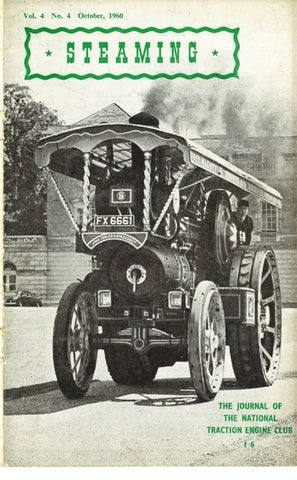
Vol. 4 No. 4 October, 1960
STEA MING *
THE JOURNAL OF THE NATIONAL TRACTION ENGINE CLUB 16
STEAMING
94
NATIONAL TRACTION ENGINE CLUB
Chairman: THE REVD. PHILIP WRIGHT, M.B.E., Hon.C.F. The Vicarage, Woodford Bridge, Essex. Vice-Chairman and Editor: J. CRAWLEY, ESQ., Field House, Turvey, Beds Secretary E A. FIL LMORE, EsQ., 34 Northwick Park Road, Harrow, Middlesex.
J
Membership Secretary (including Ties and Badges): G. HUTCHENS, ESQ., A.31 Café, Tricketts Cross, Ferndown, Dorset. Treasurer: E. W. EDNEY, ESQ., 33 Portsmouth Road, Horndean, Hants.
Boiler Records Officer: J. R. BONSER, EsQ., 6 Rokeby Gardens, Woodford Green, Essex.
MEMBERSHIP OF THE NATIONAL TRACTION ENGINE CLUB IS OPEN TO ALL PERSONS WITH A GENUINE INTEREST IN THE PRESERVATION AND OPERATION OF AGRICULTURAL, ROAD AND PORTABLE STEAM ENGINES. OWNERSHIP OF AN ENGINE IS NOT ESSENTIAL. SUBSCRIPTION 15s. PER ANNUM, WHICH INCLUDES THE CLUB JOURNAL STEAMING AS PUBLISHED, AND FREE ADMITTANCE TO RALLIES ORGANISED BY THE N.T.E.C.
BOILER RECORDS
Owners intending to enter their engines for any rally organised by the National Traction Engine Club should forward final current certificates of insurance for their boilers at least four weeks prior to the date of the rally to the Boiler Records Officer. These certificates must show that without doubt the boiler will be fully covered by insurance at the time of the rally.
STEAMING
95
EDITORIAL WITH winter almost upon us and the dark evenings with a distinct chill in the air one finds pleasure sitting in front of a good fire (the kind in a grate not the summer type), and thoughts wander to activities of the fast receding season. Most of the rallies held have been very successful, both from the point of the support of the engine owners and the public, but I do think that all clubs must now be very cautious of the rallies that they support. One such rally this year has done more harm to our movement than any half-dozen rallies that I can think of, and the number of letters that I have received as a result gives me a good indication of the general feeling. One must always bear in mind that people travel considerable distances to attend these events and therefore it is most important to have traction engines present at a traction engine rally, and it would appear that at least a dozen engines are needed to constitute the smallest rally deserving the title. Anything less should be called a " Parade," " Get Together " or a Garden Fete with traction engines present, etc., etc. As one correspondent puts it, this particular rally was approaching sharp practice and was obtaining money under false pretences. Be that as it may, I hope this word of warning will be taken in the spirit that it is given, because looking ahead one can foresee many real difficulties without starting to short change our patriotic supporters who will travel anywhere to support a rally. After the above it must be pointed out that the rally fixtures given in
Steaming are done so in good faith. and it is therefore up to the organisers to notify any cancellation in good time to avoid obvious disappointment. With this issue comes the news that the Club committee have decided that in the future Steaming will only be available to club and affiliated club members. The committee feel that as receiving Steaming is one of the main advantages of being a club member, it is not fair allowing it to be made available to any engine enthusiast. This means in hard figures instead of 9s. per year for Steaming it will be necessary to become a member of the National Traction Engine Club for which the subscription is 15s. We trust that this move will meet with general approval and at the same time will bring together more people as members who would otherwise remain unknown to us. At the time of writing the A.G.M. is a few weeks away and it may be that next year you will have a new Editor. The January special issue will feature "Steam Wagons," and the success of this special edition will depend largely upon the support you all give me. so please let me have anything, article or photograph, that you think will be of interest. Many thanks then to everyone for their support during the past year and my apologies for any indiscretion on my part that I may have inadvertently perpetrated. A Happy Christmas and Prosperous New Year to you all. JotiN CRAWLEY.
FROM THE CHAIRMAN (Philip Wright's Column) WE were all sorry to learn of the illness of our friend and committee member Mr. C. T. Prior, of Maidenhead ; and we hope and pray he will soon be his usual cheerful self once again. We congratulate another committee member, Mr. Laurence Parris, on the birth of a daughter. He already has a little son, obviously a potential engine driver.
I had an interesting letter from a New Zealand enthusiast, Mr. Harry Green, who is a hairdresser at Tinwald, South Island. He is a member of a very live traction engine club there, and tells me that during the past two years they have held successful rallies and made over £1,000 at the very first one! This was divided between funds for a War Memorial Hall and a Nurses' Swimming Pool.
96
STEAMING
He will value any steam literature which members care to send him, and offers similar records from his end of
the world.
• Rally Organisers who like myself do not like the traditional paper " Car Stickers " may like to know of something better. I got the idea from the Secretary of the Suffolk Show. It is called an " AD-STICK " label, and consists of a two-colour plastic label which needs no paste but is simply pressed on to a clean glass surface, where it remains. Tt can be just as easily peeled off and is washable. Such labels are made at Harcourt Road, Bexieyheath, _Kent.
I fulfilled a life's ambition on 11th August last. I was allowed to travel on the footplate of a steam locomotive, No. 61066, drawing the express train from Liverpool Street
station to Cambridge. My companions were Inspector Bill Redhead,
Driver J. Brown and Fireman Allison. Top speed was 63 m.p.h., and the thrill and vibration was terrific. I passed thus through my former parish of Littlebury where there are two sizeable tunnels. It was very rainy and visibility was poor, I was thus able to sense the strain felt by the driver as he constantly peers forward to watch his signals. I could only imagine how this strain is intensified
during fog ; the fireman never seemed to have a free minute and I came to the conclusion that these chaps earn their money. I returned in the driver's cab of a modern diesel, where of course the conditions are very much more comfortable and where visibility is excellent, even to windscreen wipers.
FROM THE SECRETARY OCTOBER sees the end of summer time and the virtual end of traction engine activities until next year. Engines will be either tucked up in some suitable corner and, in most cases, well sheeted against the weather. Most of us will, I suppose, meet periodically to talk about them, about the activities of the past year and perhaps to carry out the odd job of maintenance that has got left over until the winter. But discussion on
projects and plans for next summer are already in hand and you can rest
assured that your committee will not be idle during the winter. During the course of the year I have received many letters from all
sorts of people in all walks of life.
All these are most interesting and contain much information and, in some cases, helpful (I) advice. But to those whose letters might slip through unanswered, I would ask their indulgence as the calls on a
Secretary's time are legion. On several occasions I have asked for
assistance and advice from fellow members and I cannot recall an instance when this has not been readily given, some even going to great lengths to help. To them many thanks. There is one point on which I would like to comment: that is Bankers' Order. There has been a good response to their introduction which will greatly assist the Membership Secretary, and we hope more members will take advantage of this method of payment. But if you intend to use one please do advise Mr. Hutchens and write your name and address clearly. This also applies to those who send a remittance without saying who it is from. There is nothing more annoying to him than to receive a postal order with no covering note. But to end on a more cheerful note, may I take this opportunity of wishing all members and their families a Happy Christmas and a Prosperous New Year. E.A.F.
STEAMING
97
IN PRAISE OF PORTABLES BY H. BONNETT I LIKE to think of portables as the " Puffing Billies " or grandfathers of our self-propelled traction engines. As such, do they receive due mention and credit for their unique part in the history of steam engines mounted on road wheels ? Before the problems of steering and gearing were solved, engineers of the mid-19th century built and sold portables while their back-room boys thought out the traction engine. Pulled from place to place by horses, portable engines were, and still are, the simplest of steam engines: a boiler and firebox, cylinder and slide
small. Not only was there a great demand at home, the whole world was clamouring to buy them. For threshing, cable ploughing, water and oil pumping, stone crushing, wood sawing and so on they provided belt power in all five of the peopled continents. The first steam engine seen by many a man or boy of that period, whatever his colour, must often have been a portable. Kipling relates how Peroo, the Kharva Lascar from Bulsar, who, when he went for the first time into the engine room of a steamer, knelt down in front of the low pressure cylinder. Perhaps some
An early Portable Engine at work. valve, piston, connecting rod and crank, valve rod and eccentric, a large flywheel, gauge glass and water pump, steam gauge and regulator, governor, safety valve, and last but not least a very tall chimney flanged down on the top of the smokebox. Apart from the four road wheels, there was very little else. By the year 1860 many British firms were hammering out portables. They were built either by the hundred, or oddly, in workshops both large and
adoring unknown said a prayer to a portable ? Much space would be needed to describe the various types of British portables. Big firms like Clayton & Shuttleworth of Lincoln built them by the thousand, while smaller concerns turned out a dozen or so. An example of cottage engineering was the production of six + h.p. portables by G. Elston of Welby, near Grantham. One engine is still preserved a few doors away up the village street.
98
STEAMING
While the first portable was probably built in England around 1840, the last has still to be made, for Messrs. Robey & Co. of Lincoln stilt continue their manufacture, even in this age of oil and the internal corn-
bustion engine. This is a remarkable thing. Why should the portable
type have both preceded and succeeded tractioin engine construction ? Reasons may be: less weight per horse power, a large and free steaming boiler, simplicity, freedom from fault, and of course the lower initial
cost due to the absence of movement gears and water tender. Perhaps it
was never quite necessary to use traction engines for threshing in many instances. Was their extra cost justified for the few miles clanking around from stackyard to stackyard? During wet wintry weather the heavy traction was prone to dig herself into soft ground. A relative of mine tells me how at times it has taken him two days to get down a fen drove, struggling for a grip every yard of the way. A horse-drawn portable would have been on the belt while the traction remained sitting on her water tank. I well remember a Clayton & Shuttleworth portable of about 1860 vintage which for over sixty years till she was scrapped in 1922, threshed most of the corn from the 2,000 odd acres of the village of Barkston in Lincolnshire. She was a real old warrior, as will be seen from the photograph of her at work at Gipple Cottages in the year 1900. Besides threshing, in her early days she also turned the mill which ground the corn, sawed the farmers' fencing, and sometimes had spells spinning the hig screaming circular saw through heavy timber on the Belton and Syston estates. Wherever she went, bearded Georgie Watson, part owner and driver, always went with her. When his engine was worn out, so was he. While most portables had single cylinders, some were fitted with double cylinders which were each of the simple expansion type. A few portables, however, were compounds, in which the larger diameter low pressure cylinder took a bit more expansion out of the steam after it had pushed the piston one stroke in the high pressure side. Valve gears were without a second eccentric or expansion links, so it was not possible either to reverse the direction of rotation or to vary the cut-off of steam
admission to the cylinder. At least
one type, however, had a patent cutoff plate directly interposed between the slide valve and cylinder ports connected to the governor, this plate moved up and down according to engine speed and so effected, through diagonal slots, a cut-off of steam
proportional to the load on the engine. Feed water heaters were a refinement fitted to some portables, even very early ones. Usually they took the form of conveying the overflow of cold water from the boiler feed pump in a pipe which passed through the middle of the long exhaust steam pipe between the steam chest and the chimney at the other end of the engine. Waste heat was radiated to the cold water, which was then discharged back into the water
tub beside the engine at a higher temperature ready to be taken up again by the pump for delivery to the boiler. A French-built portable I saw three years ago alongside the
Dordogne river in S.W. France had this type of feed water heater. Some of the more modern portables had a superheater. This took the form of a nest of coil of tubes located in the smoke box, and through which the steam passed on its way from the regulator valve to the cylinder. The aim of the superheater was to use
smoke box waste heat to dry out the particles of moisture found in all wet steam, and at the same time increase the temperature of the steam. The higher, or superheat temperature imparted to the steam made it far more
resistant to condensation in the cylinder. Besides obtaining an increased volume of steam when the droplets of moisture were evaporated, the steam had more " kick " in it, doing additional work without any extra fuel costs. Few traction engines could
boast a superheater. When threshing, these old portables
were a joy to watch. They huffed and puffed up their long chimneys in easy modulation, quiet but firm in purpose. On cold days it was cosy to stand behind the firebox, watch-
ing flames lick round the side plates. Usually some old age pensioner or idler stood chatting with the driver, enjoying his talk and listening to the rhythm of the pulsating engine. With the passing of the portable from the farmyard went much that in former years had been of great interest and pleasure to country steam enthusiasts.
STEAMING
99
CAMBOURNE RALLY THE fifth of the West of England Steam Engine Society's rallies was held this year on July 16th at an excellent site at Mount Hawke, between Blackwater and St. Agnes, and attracted an entry of 28 engines, every one of which turned up. But for the Society's insistence on professional boiler inspection the entry would have been even larger this year, but as far as can be foreseen there are likely to be many more engines present in 1961. The weather this year was most disappointing, being cold and grey and ultimately turning to heavy rain and high winds. The bad forecast undoubtedly kept many people away, but in spite of it all over 7,000 people paid for admission and enthusiasm was at a high level. One of the advantages of this year's site is the presence of the Chacewater to Newquay branch railway alongside the field, Mount Hawke station being only a few yards from the entrance gate. As this line is still steam operated it creates the right atmosphere and the special rally trains that were running that day were filled to capacity. The Camborne rallies never fail to attract new and interesting entries, and this year was no exception, for there were nine entirely fresh engines including four that had made the long journey from Ferndown in Dorset in order to be present. The most spectacular of the long distance entries was Mr. J. Hutchens' glittering 8 h.p. Wantage No. 1389 " Constance," this being only her second public appearance. The same owner's fine S.4
Sentinel and Mr. W. D. Sparrow's two beautiful Fodens, a wagon and a tractor, were also greatly admired by the enthusiastic crowds. Of the new local entries, Mr. J. Warren's rare, small single-cylinder Fowler No. 7942 " Amy ", attracted much attention as did Messrs. Leath and Pearce's resplendent piston valve Aveling roller No. 10187 "The Highwayman ' . Other very interesting examples of restoration in evidence for the first time were Mr. N. T. Holman's 10-ton Burrell roller No. 40012, Mr. W. G. Hawkin's Fowler Tiger tractor No. 14798, and Mr. H. James' 6 h.p. Marshall No. 34022. Dr. W. R. Dyke's big Foden showman No. 2104 " Prospector ", and the famous Burrell showman No. 3159 "The Gladiator ", were again centres of interest, the latter engine driving the magnificent grand organ of Messrs. Anderton & Rowland whose fair, incidentally, was also present ; in addition there was a fine display of trade stands. Indeed, the Camborne rallies have something to suit every taste! A side show that attracted particular attention was a demonstration of steam sawing by Mr. S. Wearn Pearse's half full-size model traction engine " Specially". The miniature Pickering governor of this controls the engine very sensitively by moving the expansion link and the cower which it develops surprised the crowds. Will rally-goers please note that the next Camborne rally is due to be held on July 15th, 1961. J.H.T.
WESTON PARK RALLY THIRTY-THREE engines took part in this year's rally, most types of engines being represented. The longest journey to the rally was made by a Sentinel wagon owned by Jim Hutchens, of Ferndown, Dorset. He drove the 135 miles to Weston with Mrs. Hutchens acting as fireman. Burrell showman's engine No. 3949 " Princess Mary," owned by Arthur
Mills, was in attendance making the power for driving his very fine 87-key Gavioli fair organ. Another organ present was the very impressive 72-key by Louis Hooghuys of Crommon, Belgium. This organ is owned by John Boutwood and was being driven by an organ engine taking steam from his Savage centre engine No. 607.
100
STEAMING
CRANBORNE RALLY IN spite of heavy rain the day previous quite a good number of entries turned up for this now popular Dorset rally. The organisers are to be congratulated on putting on such a fine show. The steam entries included the Wantage from Mr. Hutchens, Showman Fowlers " Queen Mary " and " The Lion ", the Showman Burrell " Endurance " with Burrell tractors " St. Bernard " and " Furious," the Fowler plougher " Princess Mary " and Mr. Miller's " Queen of Great Britain " Garrett Showman. Other Garretts were " Earl of Eldon " from Mr. Loader, " Pioneer " from Parkstone, and R. Bailey's from Amesbury. Fodens included " Dorset Rambler," " Dorset Wanderer," and " Mighty Atom ". A new visitor was a Marshall, whilst Wallis & Steeven were well represented with six entries. These were Tractor No. 7801, Mr. Loader ; No. 2795 from Organford ; Mr. Dibbens' No. 7102 ; " The Sheaf of Arrons " No. 7294 from Cranborne Estate ; an 8-ton Roller from Mr. Loader and " Boxers Beauty " No. 7115 from Reg. Old, of Braishfield. A Sentinel
and the " [Whey Express " tractor from Mr. Hutchens made up a very nice assortment of engines. The usual events were carried out under difficulties owing to the state of the ground. One new feature this year was the " Rock 'n' Roll " item when one engine at either end of a Bailey bridge section from the R.E. detachment performed a see-saw at various times during the day. The Shand Mason horse drawn fire engine display again brought rounds of applause from the crowds which had arrived in spite of the overhead clouds. I was pleased to meet quite a number of engine enthusiasts at my tent. Several of the Showman engines were " running lights " and looked quite smart. The Burrell " Endurance looked exceptionally good. Great credit must be given to all the drivers and owners who attended under such awful conditions and in the evening the engines had to be assisted out on to the hard road by a Fordson tractor. Most of them would journey home on the Sunday.
WOBURN RALLY THEY do things big at Woburn. It starts with a big house, in a big park ; when it comes to engine rallies these are big too down Woburn way—lots of engines, lots of people. Looking back it seems impossible to write an account of the rally, so this is meant only to be an impression. If any particular side is missed out, it is only because it did not come to the writer's notice. One hears a lot of comments on well-turned out engines. Going round to different rallies there are cups and prizes for elegance, mechanical condition, etc., but at Woburn what struck me most was the immense amount of care and attention given to the engines as a whole by their owners and crews. Amongst this, the largest assembly of traction engines in Great Britain at a rally to date, were some interesting and unusual types and makes. Interest to the layman and specialist
alike and one saw many an old stalwart and younger student of steam carefully examining the Fowell to name but one, or the Mann tractor or the immense Burrell crane engine. Comparison of the various types of agricultural engine or traction was easy as most makes were present. Road engines too were well represented ; curious how these latter, once so numerous, seem to have passed quickly from the scene. Pride of place must be given to the show engines. Glamour boys (or girls) as you wish were here in abundance, some large some small, all shining and polished and moving with a grace all their own. Four organs were also present, and this gave the engines ample opportunity to show off their ability to make light and music which made them a great favourite with the spectators on all three days. But I like ploughing engines and
STEAMING these were very much in evidence too. Three great Fowler BB's, one from Boughton's and a pair from Jack Branch and a magnificent Fowler single from Jack Beeby ; these four engines gave demonstrations of ploughing and mole draining on the Sunday as well as taking part in events on the Monday. I can hear that single bark even now. But mention must also be made of John Crawley's neat and almost unique McLaren plougher. Pity it could not be in action too, but perhaps we shall see it working at some time in the future. Of the rally itself, this was nobly opened by His Grace the Duke of Bedford, who later raced against his son the Marquis of Tavistock, each steering an engine (without canopy) in pouring rain. The Grand Parade was most spectacular, the arena being
101
literally full of engines—a wonderful sight. This was followed by a programme of events, both usual and unusual, which was, unfortunately, cut short by heavy rain that made the ground impossible. A pity this, as we had seen the agricultural engines put through their paces, followed by events for the ploughers and lorries, but I am afraid some of the smaller engines were crowded out by the unkind and ill-mannered efforts of the weather which inevitably won the day. I have not listed the individual engines—there were so many of them, 66 in fact. But those who are interested may obtain a programme giving full details of this memorable event and the engines attending by sending a remittance for ls. to the Editor, Mr. John Crawley, of Field House, Turvey, Bedfordshire.
NORTHLEACH RALLY APPROX1tvIATELY 2,000 people attended this year's rally which was held on the 25th June at Upperend Farm, Northleach. The rally was opened by Michael Brockway, the Cotswold artist, who lives in Northleach. This year there was twelve engines present, which included two showman's engines, which on the previous
evening had stood in the market place generating lights until late in the evening. A pleasant surprise to everyone was the appearance of Mr. Dudman's fairground organ ; this was towed round the arena by Jack Wharton's " King George VI " whilst it played tunes that revived many a memory of yesterday.
WORCESTER RALLY ON August the 5th and 6th fourteen engines were present at the Worcester Traction Engine Rally. R. Winsford brought along his 2 in. scale model Burrell " Thetford Town " which was much admired. J. L. Thomas, of Rushwicke, drove
the Burrell traction engine No. 3399 " Pride of Hants." in place of his own Burrell No. 2147, as the former has only recently come into the district from Cornwall and was therefore a fresh engine at the rally. J.L.T.
102
STEAMING
CLUB NEWS BEDFORDSHIRE LITTLE to report from the County this issue. Our rally at Woburn went off reasonably well considering the weather on the Monday. This year's attendance was 35,000 over the three days which was lower than anticipated, but was due no doubt to the bad weather forecast on the Monday 8 o'clock news. Monthly meetings continue to be held at the " King's Arms " on the first Monday in each month, and our attendances now average 35 members per meeting. The next event on our programme will be the annual dinner, which it is hoped to hold sometime at the beginning of December. J.C. EAST ANGLIA The Ickleton Rally, held on May 21st under disappointing weather conditions, introduced a few fresh chimneys to the smokey scene. Mr. Jack Shuttlewood appeared with his freshly restored 6 n.h.p. Marshall compound " Enterprise." and Mr. S. A. Burgess brought his 1896 n.h.p. single-crank compound Burrell, since converted to a showman's engine, from Haddenham. A further newcomer was Mr. S. A. Quiver's ex Drage & Kent 7 n.h.p. Fowler road locomotive No. 14754. This was restored over the winter from a very rough condition. These engines, and some thirty others, appeared at Wimbish Rally about a month later, when the weather was more kind. What would have seemed to have been a promising display of cultivating and mole-draining was spoiled by the irresistible desire of the public to crowd over the tensioned rope. Nothing, it would appear, could have shifted them save the rope breaking, and so as to avoid that risk the display was abandoned. Several engines have changed hands since the beginning of the season. D. J. Rule, of Ickleton, has purchased a 1934 Marshall 8 n.h.p. single-cylinder traction from Messrs. Marriage, of Chelmsford. An interesting feature is the provision of two ash-pan dampers, one at each end. and a good deal of welded
fabrication. The maker's number of this engine is 87005. S. W. Neville has purchased a 1916 5-ton Foden wagon with shortened chassis from Mr. John Drew, of Redhill, Surrey. The works number of this one is 8304, and it is hoped to steam it back to the Saffron Walden area. The Foden wagon recently sold by Mr. Darby, of Sutton, was seen recently at Gordon Lugg's yard at Billingshurst, Sussex. This shows great promise of being a beauty after restoration. Work on the old pumping engine at Stretham Fen, near Ely, has been progressing slowly. A hydraulic test of 25 p.s.i. for thirty minutes has been successfully carried out by club members on one of the boilers, and the cover has been removed from the condenser air pump to attend to the cast iron valves. It is probably over a century ago since these were last exposed, but in spite of the ravages of time (and tide), they are in firstclass condition. It is not expected to publicly run the engine this year, as originally planned, but 1961, its 130th birthday year, should see the resurrection. S.W.N. COUNTY OF SALOP The Annual Carnival and Engine Meet was held at Church Stretton on August Monday, when some ten engines were present. The turn-out was 100 per cent, which was very gratifying. It is realized that space is at a premium and for this reason it does not seem practical to engage more than twelve engines, and though this is somewhat of a handicap a certain amount of satisfaction is derived from the fact that the variety of makes is rather good. Out of the ten engines present, no fewer than seven manufacturers were represented. The list was as follows: Fowler showman No. 15375 " Supremacy " and Garrett tractor " Countess ", both owned by Bishop Bros., of Burley; Tasker traction No. 1718, driven by its owner N. Wheeler, of Craven Arms ; Sentinel S.4 tar sprayer, from Mr. R. M. Woolley, of Bucknell, driven by Ted Procter. Two Ransome single engines were present No. 27524 of 7 h.p., owner
STEAMING V. Nash, of Plealey, and No. 15609 of 6 h.p. (1904), which belongs to G. Lee, of Shrewsbury. Mr. Salmon's Clayton engine No. 49008 made the journey from Bucknell, and a further Fowler was entered by R. Phillips, this being No. 15787. Two Rustons completed the entries, these being the tiny tractor owned by W. Griffiths, of Much Wenlock, and the single No. 52266 of 1918 owned by D. W. Smith. Pride of place certainly went to Messrs. Bishop's " Supremacy ", and she made a lovely pictures as she headed the procession drawing the trailer bearing the Carnival Queen, Miss Ann Donnelly, and her attendants. A very good display of models was provided by Messrs. E. Langford, R. Hopkinson, and F. Kinnaird, whose model of a former G.W.R. broad gauge locomotive has to be seen to be believed. The 3+ in. gauge Class 5 of Len Whittal did yeoman service hauling trainloads of passengers throughout the afternoon, and if proof were ever needed of the staying power and complete reliability of steam this wonderful little engine could demonstrate this beyond all doubt. Getting ready for a rally, even a small one, seems to get quite hectic however well one tries to plan, and this year's " do " was no exception. The Ransome belonging to Mr. Nash was found to require a new set of tubes, and although these were ordered about two months before the carnival date, no tubes had arrived by the week before. A search at the Atlas Foundry, Shrewsbury, located seven new tubes, so the worst seven tubes in the boiler were discarded and the rest removed, scaled, and any pit-holes built up by welding. After this job had been completed the ends were annealed and the fitting and expanding took place on the Friday evening. Tubes were still being expanded about 11 p.m.! Saturday saw the fire lighted, last adjustments made, and in the afternoon the Ransome was on its way to Church Stretton some twelve miles distant. The journey was completed without incident and the engine duly took its place in the procession on the Monday. Ruston No. 52266 was to appear at Worcester Show on August 6th, so no
103
time could be lost in driving her from Church Stretton to be there in time for the rally on the Saturday. On Tuesday, 2nd August, she was driven sixteen miles to Ludlow, and then on 3rd August the thirty miles from that town to Worcester was covered. This trip will be described at a later date. The effort was well worth while, as the engine had the good fortune to be awarded the Bob Neal Trophy for Agricultural Engines. The return trip was made in two stages, the final few miles being covered, as usual, in the dark! At the time of writing the two large Fowler ploughing engines belonging to R. M. Woolley, of Bucknell, are engaged on a dredging job near Ludlow. Activities at Burley during the winter months will include the continuation of restoration of Burrell's No. 2646 and No. 3786, which has been virtually abandoned to carry out preparation of engines for the rallies. Bishop Bros. have their hands full with the overhaul of the Marshall portable No. 8839 and, of course, the small jobs yet to be completed on " Supremacy ". Seen whilst on holiday in Norfolk a fine single-cylinder traction by Savage. No. 474. D.W.S. WILTSHIRE Mr. H. J. Lea, of Purton, Wilts., has sold his Burrell tractor No. 3626 (Reg. No. AH221) to M. B. Thexton, of Wrough ton, Wilts., for preservation. This Burrell tractor had been used regularly for sawing wood for the past ten years by Mr. Lea who has now retired from business. Carrs, of Wolverhampton, have a pair of their Fowler ploughing engines working at Coate Reservoir, Swindon, Wilts., dredging the lake there. The engines are Nos. 15182 and 15183. These engines will be working there until November. Member Joe Powell, of AshtonKeynes, Wilts., has been working his Marshall portable No. 85954 driving a saw bench. This portable is in good order and has been repainted. Also Mr. Powell's Garrett tractor No. 33738 was at the Northleach Rally on 25th June, 1960, making the journey to Northleach and back to Ashton-Keynes under her own steam. J.E.P.
104
STEAMING
WEALD OF KENT The Weald of Kent Rally was held at Penshurst on 20th August with fifteen engines present. Those entered and attending were: Burrell 3-speed G.P. No. 3559 (1915), Mr. B. Pitts ; Marshall 2-speed G.P. No. 84562 (1929), Mr. D. H. Harding ; Aveling 2-speed 5 h.p. tractor No. 11997 (1928), Mr. J. Jupp ; Allchin 2-speed G.P. No. 3251 (1925), Mr. C. M. Rostron ; McLaren 2-speed 10 h.p. R.L. No. 1652 (1919), Mr. S. W. Neville ; Foden 5-ton wagon No. 13848 (1931), Mr. J. C. Butler ; Allchin 2-speed G.P. No. 1415 (1905), Mr. M. K. Turk ; Foden 3-speed G.P. No. 4752 (1914), Mr. J. Young ; Towel] 2-speed G.P. No. 98 (1909), Mr. W. Chandler ; Fowler 2-speed G.P. No. 9924 (1904), Mr. R. A. Whitehead ; Ruston 14-ton compound roller No. 115023 (1919), Messrs. H. Woodham & Son Ltd.; Wallis 8-ton compound oil bath roller No. 7572 (1921), Messrs. Drew & Son ; Shand Mason steam fire engine (1913), Kent County Council ; whilst Messrs. T. T. Boughton - & Sons were able to send their Picton Foden wagon at the last minute and Messrs. Fordyce Bros. sent their Wallis & Steevens Advance which happened to be on a road job at Tonbridge. In addition there was a small Brown & May portable and Mr. Reg Winsford's well-known model Burrell. In deference to the wishes of owners the social rather than competitive aspect of the meeting was emphasised and no prizes were given except the Turk Cup (donated by Mrs. M. Turk, of Maidstone) and the Angell Tankard (donated by John Angell Ltd., Tonbridge). The former was won by Messrs. Drew & Son and the latter by Mr. M. K. Turk. About four thousand people, including guests, were present. Other area news in brief is that Mr. D. Eastwood has sold his Aveling 71-ton compound tractor to Mr. C. W. Walker, of Meopham. Mr. Walker has carried out quite a lot of work on it but has just disposed of it (for various reasons including placating the neighbours) to Mr. F. H. Grover, of Amersham. Farrants have sold their 8-ton Marshall No. 73900 (an ex Norfolk C.C. tractor) to Mr. Lillywhite, of Petworth, for preservation. Mr. Frank Greasley, of
South Darenth, has sold his 3-speed Marshall No. 63257 " Ben Lomond," again for preservation. Messrs. H. Mints, of Maidstone, have been working at Meopham with their Wallis Advance ; Mr. C. W. Walker has had his Advance at Maidstone ; Messrs. Arnold & Naltion have been working at Strood with their 1936 Aveling & Barford (completely recovered from its mishap at Paddock Wood last year) ; Mr. Eastwood has had his Aveling (No. 11980) out at Goudhurst ; Bensted & Son have been working their 8-ton Robey at Elham : the Mechanical Tar Spraying Cn, have been tarspraying all the summer with their 12-ton Fowler (No. 14077) on contract hire to Surrey C.C. and working along the Kent-Surrey border ; Fordyce Bros. have their Advance at Tonbridge and Mr. Frank Greasley has been on hire to Allmacadams, of Croydon, with his Advance since last winter. We have, therefore at the time of writing eight steam rollers at work in the area and seven more ready for action when a job comes along. Lastly, Mann wagon No. 1120 (new 1914) has been bought by Mr. J. C. Buller, and Mr. and Mrs. R. A. Whitehead. It is in a bad state and may not be steamable again but will be restored so that we can remember what a Mann looked like. R.A.W. WEST OF ENGLAND The West of England Rally was opened by Mr. Chris Gittins, who plays " Walter Gabriel " in " The Archers," on July 16th. After his very amusing opening remarks he was taken around the arena on the tender of the McLaren No. 547 which was preceded by Mr. G. Richards in Victorian costume carrying a large red flag—a reminder of the days when this engine was new (1894). In spite of the afternoon being windy and becoming rainy as was forecast, our Commentator, Mr. J. H. Trounson, kept a large crowd very interested throughout the proceedings. It was largely due to his tremendous efforts for weeks before the rally that every engine promised actually took part in the event. This is the second time that a 100 per cent attendance has been achieved. An account of the rally appears elsewhere in this issue. Next year our rally will be held
STEAMING on July 15th and another " Archers " favourite has been booked as opener, Mr. Bill Payne, better known to most as " Ned Larkin". The fields used this year will not be available owing to cultivation, but it is hoped to find others in the same locality as this avoids the traffic difficulties of former years in the congested roads around Camborne. Being within easy reach of the railway is also an advantage, but this asset was somewhat marred this year owing to the breakdown of a diesel locomotive on the main line near Camborne which delayed other trains from the West and caused many would-be rally-goers who were waiting at Camborne and Redruth stations to lose patience and go home. Needless to say, the steam locomotive on the branch line from Chacewater which ran a shuttle service to and from the rally field, gave no trouble. On Hayle Quay is all that remains of Fowler No. 11029. She has been cut up as was predicted in the July Steaming. The little single-cylindered Fowler No. 7942 (TA626) " Amy " made its first rally appearance this year after having undergone extensive repairs and painting by Mr. J. Warren. Now she has a new name—" Jonah "—and a new owner who is a Camborne solicitor, Mr. J. C. W. Jones. Mr. Jones has been seen steaming his engine around the town several times, and a recent newspaper picture shows him on the footplate with Richard Trevithick's statue in the background. It was on Christmas Eve, 1801, when Trevithick drove his first steam locomotive near the spot where his monument now stands. Now, 165 years later, steam traction on the nearby railway is rapidly giving way to diesel power and on our rally day many manic waited in vain for an example of ibis "improved source of power" to take them to see some of the veterans at Mount Hawke. On August Bank Holiday another village fête was held at Coads Green, near Launceston. Among a variety of attractions were several engines and models. Those attending were Foden No. 2104 " Prospector " (Dr. W. R. Dyke) ; Burrell No. 3816 " Cornish Maid " (Mr. C. H. Parsons) ; Marshall No. 34022 (Mr. H. James) ; Fowler Tiger Tractor No.
105
14798 " Firefly " (Mr. W. G. Hawkins) ; A. & P. Traction No. 9096 " Jubilee " (Messrs. R. Dingle & Sons) and a large trailer with a variety of small engines (steam car, pumping, etc.) supplied with steam by a vertical boiler also mounted on the trailer (Mr. B. Parsons). Models included Mr. S. W. Pearse's two exhibits (one of 31 ins. to the foot and the other 6 ins. to the foot scale), a Foden wagon owned by Mr. G. J. Armstrong-Evans (all in steam) and an unfinished model based en" the, , Burrell " Thetford Town " ' built by Mr. John Stevens. On the morning of August 13th Messrs. M. F. T. Leath and M. Pearce set off with their beautifully restored A. & P. Roller No. 10187 "Highwayman" to take part in a carnival at 1-layle. On arrival there they learned that, owing to a. very unfavourable weather forecast—"continuous rain spreading from West Cornwall in the evening "—the carnival had been postponed for a fortnight. Accordingly, "Highwayman " was parked beside Mr. G. Clark's Fowler Roller No. 16045, where for two weeks these two attractive examples of steam engine preservation acted as ambassadors for our movement, being seen and admired by the many passers-by on the main road through Hayle. "Queenie," Miss Rule's Garrett, had also started off for Hayle but her crew heard of the postponement and returned to Coombe. Hayle carnival was subsequently cancelled for this year. As frequently happens, the forecast for the 13th was very far from accurate —we had a fine and sunny afternoon and evening with no sign of the predicted rain. Redruth carnival went according to plan on the 20th, and five engines paraded through the town at the end of a gay and colourful procession. They were Burrell No. 3159 " Gladiator," Burrell No. unknown " Millenium King," Garrett No. 34789 " Queenie," A. & P. No. 5541 " Bo Peep " and McLaren No. 547. The two last-named returned to Coombe on the following Monday, and we were pleased to have some friends from Essex (Mr. D. Rule and his party) to share the joy of driving back. Several others whose names are familiar to readers of Steaming
106
STEAMING
have visited Cornwall this year, including Messrs. W. H. Dorman, H. P. J. Whipps, R. E. 0. Hadley, D. Creasey, N. S. Brown, F. H. Gillford, and of course those longdistance rally participants from Ferndown, J. Hutchens and W. D. Sparrow, who brought engines to our rally. Several from the West visited the mammoth rally at Woburn and a few were able to spend the whole week-end there. Among the latter were two young ladies—Miss Rule and Miss Gregory. They had both decided that they were definitely going to see the Woburn Zoo, and as they had three days there would be plenty of time. However, neither of them was able to get away from
the engines and they have still not seen the Zoo! They and some others had a complaint regarding the rally —it was all over too soon. Such an array of engines would maintain keen interest for more than three days, to say nothing of the meetings with their owners and drivers and other enthusiasts who had assembled from all parts of the country. Another item of news—it is believed that Burrell Roller No. 4040 has been sold for preservation by Messrs. R. Dingle & Sons to Mr. W. N. Thomas, of Four Lanes, Redruth. This is an interesting engine, having a differential, long canopy, raised bunker and better-than-average proportions, even for a Burrell. C.P.G.
BOOK REVIEWS " THE DEVELOPMENT OF THE ENGLISH TRACTION ENGINE," by Ronald H. Clark, A.M.I.Mech.E. Price 84s. net. Published by Messrs. Goose & Son Ltd., Norwich. This long-awaited book has now put in an appearance and it is without doubt the most comprehensive work that has ever been undertaken on this subject. It is quite impossible to go into details, as neither the time at my disposal (almost ready to go to press when it arrived) or the space that I can devote to it would do it justice. The only real criticism is that it seems a pity that after the tremendous amount of research that must have gone into a book of this kind more time could not have been spent on the final proof reading as there are so many silly errors. This is all the more the pity, as without doubt this book will become a major work of reference. The book is extremely well produced, and only the use of a new production technique " the proportional spacing typewriter " has enabled the publishers to put this out at the price, especially when you bear in mind that there are no less than 582 illustrations, many of which are quite unique. Summing up, it is my honest opinion that despite the shortcomings mentioned above this book is essential to the library enthusiast and congratulations should be offered
to the writer and publishers for undertaking such an ambitious and comprehensive work. " THE CORNISH GIANT," by L. T. C. Rolt. Price 12s. 6d. net. Published by The Lutterworth Press, London. This book, which incidentally was only seen as this issue was going to press, traces the life of Richard Trevithick. It is extremely good value for money. being well produced, and is very difficult to put down once you've started reading it. It contains a delightful number of references which enables the reader to form a firm opinion as to the man's character. It describes the first run of his steam road locomotive designed and built in 1801. " COMMERCIAL ROAD VEHICLES," by E. L. Cornwell. Price 30s. net. Published by B. T. Batsford Ltd., London, W.1. This book sets out to trace the development of commercial vehicles operated by every type of motive power. Steam vehicles are surveyed from the early passenger-carrying machines of Trevithick, Hancock and Gurney through to the post-1918 era of Fodens, Sentinels and Atkinsons. The remainder of the book goes on to deal with petrol, diesel and electric vehicles, and it is to be recommended as a worthy addition to anyone's library.
STEAMING
FROM OUR MEMBERS
107
3. F. S. LOADER, Esq.
A 3-speed Burrell Compound Road Locomotive belonging to Mr. Loader negotiating floods at Salisbury Plain in January, 1915.
Wallis & Steevens 8 h.p. Traction Engine No. 267 "Samson" pulling down trees for road making at Winton in 1905.
108
STEAMING
ON BEING A TRACTION ENGINE WIDOW By JEANNE GREENWOOD IT used to be vintage cars. Now other lumpish and obese rivals cavort before me like cyclops in Lilliput. " Leave all Saturdays free throughout the summer," he had said. " Why on earth do you want to go to a Traction Engine Rally ? " I had asked. " Nostalgia." " Nostalgia for what ? " " I like anything old." I glanced in the mirror wondering whether to be flattered or not. Realising with a sickening feeling of inadequacy that here was more opposition. He was becoming boiler conscious. It was not " would you like to go to a rally, darling ? " but : " You will pack up a large picnic. We are going to a Traction Engine Rally." He went smokey-eyed as the smell of petrol was exchanged for that of steam. We strolled around the paddock before the event to see the flatulent fire-eaters. I viewed the competitors (in both senses of the word) with jaundiced eye. " Princess." New 1910. Winecoloured body. Pale yellow shoes. " Joyce." Born 1919. A maroon chassis. Brilliant yellow shoes. " Princess Mary." She was born in 1922. Immaculate in bottle green banded with gold. " Eileen." Same age as me. British racing green. Black, yellow and redstriped shoes. " Eileen " had done war work. So had I. So what. Last year he bought a ticket in a raffle. The prize ? A Wallis & Steevens expansion engine, born 1916. She was about 10 ft. high, and the only ethereal part of her was her vapour. He didn't win. At the show I learned with sinking heart that a Fowler ploughing engine was for sale—at the right price. Immediately he was interested. Is he suffering with water up the chimney ? Or a " B " under his grease cap ? He left my side rather swiftly after
this announcement. Was he making his way to the announcer's tent ? I caught up with him. " Where are you going, darling ? " " I'm going to see them take water " (wistfully). " Did you hear the commentator say one of them did fifty miles on two hundredweights of coal ? " " You're not g-g-going to b-buy one, are you ? " " Of course, there'd be the reconnaissance for a water and coal supply beforehand." " I hate doing the grate already . ." " I'd have to get a boiler suit . . ." I tried another line of defence. " It's fast dying out, isn't it ? The sport, I mean." " And a peaked cap." " It's an expensive hobby." " I'd like to see old Jones's face," he said. I was getting desperate. " Darling. Have any conveyance—a pantechnicon, a perambulator. A growler or a drosky. A sedan-chair if you like. Only I beg you, not a traction engine." He wasn't listening. " You could go in for the ladies' steering competition." It was at that moment I became more explosive than any of my ironclad adversaries. Homeward bound he deliberately followed for many miles a trailer bearing one of them astride it. He said, just to get a last glimpse of the smoke. Now I dream at night. The same dream. Owls hoot and bats are entangled in my hair. We are stranded in a dark country lane. Without water, without coal, without steam, without everything. On waking I pray. Please, please don't let me be a Steam Traction Engine Owner's widow!
109
STEAMING
GEORGE THURLOW & SONS LIMITED
STOWMARKET -
SUFFOLK
'Phone : STOWMARKET 585 (3 lines)
Solicit enquiries for items they can supply for Steam Engines, amongst same are :— BOILER TUBES CHIMNEYS WITH OR WITHOUT BRASS OR COPPER TOPS INJECTORS, GAUGES, ETC. PACKINGS PAINTS SUCTION HOSE ENGINE AND CYLINDER OILS
All enquiries will receive prompt and careful attention
110
STEAMING
TRAGEDY IT is with regret that we learn that Aveling & Porter No. 1241 is no more. This was the oldest steam roller known to exist. It was built by Thomas Aveling less than ten years after making and selling his first production roller. When it was found eight years ago, it was not in regular use, but was in full working order, a reserve to its owner's fleet of more modern machines.
That its condition was good can be seen from the accompanying photograph taken at the time. Age alone was more than sufficient justification for retaining such a machine in some museum, but No. 1241 had another claim to preservation—it was probably the only roller in the world still fitted with the central steering post and conical front rolls that progressed with a semi-
skidding motion which was blithely alleged eighty years ago to assist compaction. Certainly we know of no other roller with this type of front end, and since most of the relatively few so built were later converted to the more modern transverse fork /cylindrical rolls arrangement it is unlikely that we shall ever hear of another.
STEAMING
111
LETTERS TO THE EDITOR Dear Sir,--Reading the pages of
S.C.C. has gone to my friend Ray
home county, namely Lancashire, has been forgotten. There is not, so far as I am aware, any club in Lancashire, which is a pity, as there are several engines preserved, and quite a number lying out of use. There is probably still one engine in commercial use, and 1 am pleased to say, there are still a number of steam rollers at work in the county. The main operators are Isaac Ball & Sons, of Wharles, and S. T. Rosbotham &
" General Buller", also a 6 h.p. S.C.C., has gone to a young motor engineer on the outskirts of Preston. William Ball of Forton, near
Steaming it would appear that my
Co., of Bickerstaffe, near Ormskirk. The latter firm at one time operated twenty-two rollers and three traction engines, but in these modern times steam operations are very much restricted as the " steam staff " has dwindled to two. The steam stud has likewise decreased, and now stands at two Fowler rollers (compounds), one Burrell S.C.C. roller
and a very fine 8 h.p. Burrell S.C.C. traction engine. This last was in
regular use until recently, but is now awaiting retubing. This engine will not be scrapped as Mr. Bimpson, manager of S. T. Rosbotham & Co., regards it as his pet. Isaac Ball & Sons are similarly blessed with staff shortages, but manage to operate about three rollers and a Burrell 5 h.p. D.C.C. traction engine. This engine is a 3-speed job, spring mounted on the hind axle. Other engines (out of use) consist of two Burrell S.C.C. 6 h.p. tractions, a Marshall 6 h.p. single cylinder traction of 1894, and a large number of rollers, mainly Burrells, but including a Ruston & Proctor, an Aveling & Porter, a Fowler, and a Mann, this last being a conversion from a Mann tractor. The old Marshall was kept in a shed, but since my last visit, the shed was severely damaged by fire and the engine came off very badly. I have not heard since what has happened to it. Three Burrell tractors have been sold for preservation, one of them journeying on a low-loader to the south of England. This was No. 3297 " Mauretania " of 1911, a very fine engine, spring mounted with 3 speeds. The other two have remained in Lancashire, No. 27116 "Admiral Togo ", a 6 h.p.
Rowcliffe of Blackburn and No. 2513
Garstang, was formerly a large operator of engines and rollers, and these stood derelict for many years in his yard. He has recently cleared out his yard and all that remained early
this year was a Burrell 6 h.p. single cylinder traction, in need of a new smokebox and chimney. All is not lost, however, as he has restored a " Devonshire," partly by cannibalisation, and has made a very fine job of
it. This engine is No. 2900 of 1907. It now carries the name " Little Mai," which came off a scrapped McLaren engine No. 1100. A 7 h.p. S.C.C. en-
gine has gone to Yorkshire for preservation and the journey was described in a recent issue of
Steaming.
Turton U.D.C. still operate an A.
Rt P. 12 ton compound roller, which is kept clean with the brasswork
polished. Although this roller is
numbered in the 14,000's, it has slide: valves. Perhaps some reader would like to comment ? In the course of several journeys into North Wales last year and this, I came across, for these days, a large
number of steam rollers. An 8 ton Clayton compound, owned by a Wrexham firm, worked for a long time on the main road at Marford, near Wrexham, and on one day a Fowler compound turned up at nearby Rossett. Merioneth produced a Clayton 8 ton compound owned by Davies Bros. of Barmouth, at work
in Towyn, and at nearby Abergynobwyn a County Council Fowler compound No. 16180 was engaged on road-widening works. The Fowler was immaculate and was fit for any rally. Cardigan produced an A. & P. compound near Bow Street. This also was a County Council engine and again was quite nicely kept. Just after Easter I called at J. E. Corfield's, of Abermule, Mont., who although now operating diesels still has eight rollers standing. Some of these were only taken off the road in
112
STEAMING
1958 and 1959. There is a varied selection comprising three Clayton's, two Garrett's, one Ruston & Hornsby, one A. & P. and one Fowler. All are single cylinder except one of the Garrett's. This one Garrett is pretty woebegone, but all the others are virtually complete except for one or two chimneys. There is one make of roller which I cannot recollect seeing mentioned in Steaming, namely T. Green of Leeds. It would be interesting to know if anyone has managed to preserve one. Clayton-le-Woods (near Preston) U.D.C. used to have one, a compound, but it is four years since I last saw it, and is probably scrapped by now. As I mentioned at the beginning of my letter, Lancashire seems to be out of the picture, so how about hearing from other Lancashire members. Yours faithfully, Geoffrey Hayes. (No. 977).
6 Glamis Avenue, Bournemouth, Hampshire. 20th April, 1960. Dear Sir,—You may like to know for the record that there is a traction engine in a scrapyard beside the railway line from Retford to Sheffield. The yard is on the left after leaving Worksop and before getting to Shire Oaks station. I was, unfortunately, unable to see very much from the train, but some other N.T.E.C. member might consider it worth investigating. Yours faithfully, Neil D. G. Mackenzie. (No. 1242). Deputy Superintendent Engineer, Stoke on-Trent Hospital Management Committee, Princes Road, Hartshill, Stoke-on-Trent.
Aveling 8 n.h.p. single-speed traction engine fitted with double flywheel. circa 1880. Owned by the late Leveson Wedgwood, a boilermaker of Co bridge, Stoke-on-Trent.
STEAMING
113
THE EFFICIENCY OF TRACTION ENGINES By JOHN F. CLAY IT is natural that interest in the various forms of steam propulsion should go forward together. There is a particular affinity between traction engine enthusiasts and those interested in industrial and narrow gauge railway locomotives. It is interesting to look at traction engines and see how their basic performance compares with other types of steam engines assuming that common yardstick can be obtained. The railway enthusiast, whose attitude is conditioned by large express engines and high speeds, visiting a traction engine rally for the first time, may be inclined to assume that the traction engine is a relatively crude machine. Such a viewpoint is, of course, far from the truth. The single cylinder agricultural engine is admittedly simple but it is simplicity due to fitness for the conditions of work and maintenance it had to face. It would be very wrong to imagine, that, because traction engines have long chimneys, they correspond to the " Rocket " period in railway development. The railway designer would fit longer chimneys to his largest locomotives had he the room to do so. Actually the designers of rail and road locomotives faced similar problems despite the disparity in size of their products. Both had to fit their engines to restrictions of weight and overall dimensions and both had to adapt their engines to meet varying conditions of fuel and labour. It may be submitted that, as far as valid test results are concerned, both sets of designers achieved roughly equal success. The basic purpose of any heat engine is to convert the highest possible percentage of the heat value, latent in the fuel, into available power. This percentage is called the " thermal efficiency " of the engine and both in the railway locomotive and the traction engine the percentage is low. Thermal efficiency figures, however, are mainly of academic interest. The overall commercial efficiency takes into account capital cost and the price of fuel and maintenance. This explains why the steam engine has been able to with-
stand the onslaught of theoretically more efficient power units for longer than the protagonists of the latter ever thought possible. Had it not been for certain powerful vested and political interests, steam might, with advantage, have lasted longer still, especially in road haulauge. Stationary steam plant and marine engines have a higher thermal efficiency- than railway or traction engines. One reason for this is that, in an advanced power station, steam may be generated at a pressure as high as 1,000 lbs. per square inch and, after expansion through a turbine, finish up in a condenser at a pressure lower than that of the atmosphere. In such conditions the expansion ratio (a limiting factor on thermal efficiency) can be as high as 200 whereas in railway or road engine practice it rarely, if ever, exceeds four. The question arises as to whether we can find a common yardstick of efficiency applicable to both the traction engine and the railway locomotive despite the difference in size. Such a yardstick can be the fuel burned per unit of work done. The amount of work done is measured in " horse-power ". The nominal horsepower of a traction engine may be rejected at once ; it is calculated from dimensions and does not measure work actually performed. The drawbar horse-power is the figure of the greatest commercial value but comparison on this basis would favour the railway engine running on smooth rails, while the traction engine suffers losses through gearing and poor road surfaces. We are left with indicated and brake horse-power. Indicated horse-power is measured in the cylinder of the engine and brake horsepower at the rim of the flywheel. There are frictional losses in the motion so, indicated horse-powers are slightly higher than brake horsepowers. Brake horse-power figures are not available for railway engines. A very similar figure known as rim horsepower can be measured on a stationary test plant but such figures have rarely been published. The differ-
114
STEAMING
ence between indicated and brake horse-powers makes exact comparison of many of the published test results of traction and railway engines, on a basis of coal burned per unit of work done, difficult but broad indications are possible. We find Fletcher giving figures between 216 lbs. of coal per brake horse-power hour for a Foden single cylinder engine and an average of 31 lbs. for a variety of British makes. Against this contemporary test results on the railways show that simple saturated British express locomotives gave results averaging 3 lbs. of coal per LH.P. hour with a best figure of 2'5 lbs. A compound Foden traction engine, tested at the same period, gave the very low result of 1134 lbs. per B.H.P. hour. It may be argued that special test conditions were set up for that test, the boiler pressure was temporarily raised to 300 lbs. per square inch, but such a figure has not been significantly beaten even by the most advanced compound railway engine. Results of tests of a very large Fowler superheated compound ploughing engine of 275 I.H.P. built for export were published in 1927. In test conditions, simulating the intermittent nature of steam ploughing, a figure of 2.14 lbs. per I.H.P. hour was obtained. This compares with 210 lbs. per 1.H.P. hour for G.W.R. " Castle" class engine, generally accepted as one of the outstanding contemporary designs, when tested in 1924. One lesson which can be taken from railway practice and applied to traction engines is that fine hairs should never be split over small differences in test results. There have been cases on the railway when the same engine and the same driver, under test conditions, have shown variations of up to 20 per cent in day to day performance. If this can
happen on a scheduled run on a railway the day to day variations of a traction engine, engaged on road haulage, could easily be greater and for a traction engine engaged on agricultural duties greater still. All steam engines, road or rail, show a fall off in efficiency as the time for overhaul draws near. Broad general trends are all that can be reliably deduced from a study of test results. Accepting all these limitations however, the general conclusion can be reached that in its basic conception as a heat engine the best of traction engine designs compared reasonably favourably with contemporary railway practice. The railway enthusiast, depressed by dieselisation of the railways, can therefore find consolation and a new interest in traction engines without any thought of patronizing a poor relation. Had it not been for the wickedly penal anti-steam taxation in the 1930's steam might well have lasted on the road as long as it has done on the railway. In its final stages the steam road engine was showing considerable vitality especially among the steam lorry manufacturers. The wiser historians of transport, writing from both the road and rail viewpoint, arc now agreed that, had steam been allowed to serve road as well as rail in the 19th century, toclay's transport problem would have been settled long ago with the proper division of function being decided on logical grounds. Instead of bankrupt railways and dangerously overcrowded roads we might have had fewer but better railways and an adequate road system. It is an intriguing pastime to envisage the advanced designs of steam road locomotive, tractor and wagon, that might have developed in such conditions.
ACKNOWLEDGMENTS F. S. Loader, Esq. Modern Motoring & Travel. Messrs. Aveling Barford Ltd. A. Wedgewood, Esq.
STEAMING
115
THE DEVELOPMENT OF THE ENGLISH TRACTION ENGINE By RONALD H. CLARK, A . M.I. Mech.E. 582 Illustrations
84s.
This is an expensive book but few would argue with our claim that it is excellent value. It is the only really comprehensive history of the subject and we feel sure that it will - remain the standard work on Traction Engines for many years and acquire considerable value as a collector's item in years to come. Available from GOOSE & SON LTD., 23 DAVEY PLACE, NORWICH (NOR 38E) or your usual Bookseller
: 5PAP 1 A sot:Warw. or ear, \t„ MASS
116
STEAMING
NEWS FLASHES Thomas Charman, of Leamington Spa, writes to say that the Leamington Spa Corporation roller Aveling & Porter No. 10905 (Reg. No. NX6366) has been retired and is now located
in the town's Victoria Park as a children's amusement. Marshall roller No. 88883 is standing derelict in Simms scrap yard at Milverton. At some time it has been converted to a traction engine and has had a 3-pulley driving shaft fitted in front of the chimney. It has been out of use for some four years. Bamford and Evershed's Aveling & Porter roller No. 10669 stands at their Salford Priors depot surrounded by diesel rollers. M. Carroll writes from Dublin to say that whilst on holiday he came across McLaren convertible compound roller No. 1645 (Reg. No. 1138985) at work at Mallgreen Upholland, Ormskirk. G. E. Arthur writes from Dorking to say that Fowler roller No. 17583 (Reg. No. P0300), owned by Kaymat Ltd., of Horsham, has been at work in Dorking. This engine is painted green and lined out in red, and appears to be well looked after. J. W. Petty writes from Berkhampstead to say that in June he saw
Marshall convertible roller No. 74872 (Reg. No. BE9003) at work at East Barkwith, near Wragby, Lines. This engine belongs to the Lincolnshire
County Council. Aveling & Porter roller No. 9093 (Reg. No. NK9344), owned by Winton Construction Company, of Louth,
was seen at work during July on the Peterborough-Market Deeping road. A. G. Coombes, of Ide, Exeter, writes that when returning from the Woburn Rally he noticed a chimney protruding from a building on the outskirts of Swindon. Upon investigation this proved to belong to a portable single-cylinder Hornsby No. 8278. Its condition was very rough.
Nor far away was another derelict portable, this time a compound Ruston Proctor No. 19511 of 1912. He goes on to say that on the Isle
of Wight there is a fine Ruston Proctor compound portable No. 51457
still at work in the Forrestside saw mills, whilst a derelict Wallis & Steevens No. 7090 (Reg. No. DL2846) stands in a disused quarry at Arreton Down.
At Messrs. Jolliffe's scrapyard at Somerton, near Cowes, there are two derelict Sentinels (Supers) Nos. 5509 and 6887.
There was also a Dodman traction engine which existed up until 1953 when it was cut up at Somerton. Eddisons have only one roller left at the Dorchester depot. Aveling No. 10510 (Reg. No. PR509), and this has been out of use since 1958.
A. R. Stone, A.I.Mech.E., who is manager of the City of Nottingham Sewage Disposal Department, writes
to say that they are about to dismantle a 4 ft. 6 in. Marshall threshing drum No. 14281, the majority of the parts being original and in excellent order, the exception being the
drum shaft and bearings. As this is a very old drum, Mr. Stone has kindly suggested that somebody might be interested in its preservation or in
acquiring parts from it to use as spares. His address is Stoke Bardolph, near Nottingham.
J. A. Figgins writes from Southampton to say that Garrett No. 33296 (Reg. No. 1315510) "The Hampshire Rose ", owned by John Denneti, was in the Eastleigh Carnival Parade. Aveling & Porter roller No. 12335 (Reg. No. YC5288) has finished its
days by being placed in a playground at Southampton after having been
made safe for the children to play on. This roller was purchased from the Devon County Council in 1940
by Eddisons, of Dorchester.
Christopher Edmonds writes from Owlswick, Bucks., to say that his •Burrell traction No. 2426 has been retubed and repainted and was in
attendance at the High Wycombe Agricultural Show on September 3rd.
George Lea, of Chelford, near Macclesfield, writes to say that Messrs. S. T. Rosbotham Ltd., of Bickerstaffe, Nr. Ormskirk, still occasionally use their 8 h.p. Burrell S.C.C. traction engine No. 3695.
STEAMING Also standing in the yard is their Burrell 10-ton S.C.C. roller No. 4043, neither of which are for sale. Messrs. Barlow Bros., of Highleigh, Nr. Warrangton, have sold the last of their engines, Foster 6 h.p. compound No. 12539, for preservation. R. G. Adams writes from Caversham to say that Fowler compound 8-ton rollers No. 15970 (Reg. No. 60092) and No. 17950 (Reg. No. CYY425), owned by the Mechanical Tar Spraying Co., of Reading, have been at work for the Berks. County Council between Blewhin-y and Wantage. W. Petty writes from Berkhampstead to say that Aveling & Porter 8-ton single cylinder roller No. 8107, ex Frome U.D.C., is standing in Asham Quarry, Chantry, Nr. Frome, Somerset. He believes this engine could be bought. Enquiries should be addressed to the quarry owners. Wallis & Steevens 10-ton Advance No. 7932 (Reg. No. YB9972), belonging to W. I. King, of Bishop Lydeard, will shortly be going to work resurfacing the Bristol-Bridgewater road (A38). D. W. Mitchell writes from Skipton, Yorks., to say that he recently saw a Garrett S-ton tractor in Belfast which might well be worth preserving. He was unable to get into the yard so was unable to see her number. The engine is standing in a disused wood yard belonging, so it is believed, to James McGregor & Sons Ltd.. Sydenham Road, Belfast. The Revd. Stebbing writes from Tacolneston, Norwich, to say that the Norfolk Steam Engine Club has just completed its first full year : with a paid up membership of 133 and some £180 available against a rainy day. Peter Gledhill writes from Paignton, Devon, to say that Paignton Corporation are still using a singlecylinder Aveling & Porter roller No. 10555 (Reg. No. YA559I). J. A. Figgins writes from Southampton that he is organising a display of fairground and circus models at the Central Hall, Southampton, on the 9th and 10th December. There will also be a photographic display of road engines and showman's engines. It is hoped that a showman's engine and organ will be present in the town on the Saturday.
117
G. Doherty writes from Co. Louth, Eire, a most interesting letter in which he mentions that he and his friend Mr. Carroll, from Dublin, recently located the following engines: Aveling & Porter convertible No. 9317, sprung and fitted with belly tank. Burrell roller No. 2896, which appears to be in the process of being ret u bed . Fowler compound convertible No. 14211, which is in good order and was at work rolling last year. Ransome No. 22648 was recently sold for scrap and cut up by a Dublin firm, the chimney being acquired by Mr. Doherty for his own Ransome No. 42012 which he has in preservation. Brian Nicholson writes from Burton-on-Trent to say that he has just acquired a Marshall 7 n.h.p. traction No. 78085, built 1923 (Reg. No. E96241. It appears to be in very good condition, having been stored since 1946. A report on boiler and firebox was very satisfactory, so that he hopes to steam her home in the near future. He then goes on to say that Fowler compound roller No. 19191, owned by Drogheda Corporation, was at work on the main street of the town and is likely to be kept working for many years to come. Clayton & Shuttleworth No. 43173 and McLaren No. 757 were owned by a man in Kells, Co. Meath, but since the last issue of Steaming the McLaren has been sold to Messrs. Curtis Bro., of Oldtown House, Gormanstown, Drogheda, for sterilizing duties, on the understanding that it will not be sold for scrap. A Garrett traction engine and a Foster tractor have also been discovered and purchased for preservation by two of his friends, and he promises to send details as soon as he can get them. A a postscript he adds that there is a Marshall traction engine at work pumping water at a mental hospital in Co. Wexford, details of which are also promised. At A. J. Ward & Son Ltd.'s auction sale recently a 1922 Aveling & Porter 10-ton compound roller No. 10172 (Reg. No. XM4036) with scarifier made £125.
118
STEAMING
A 1930 Wallis & Steevens 8-ton Advance roller No. 8033 (Reg. No. OU5181) with scarifier made £125. A 10-ton Wallis & Steevens single cylinder roller with scarifier made £125. The above were all in steam and were in reasonably good order. A 1923 Wallis & Steevens Advance 10-ton roller No. 7779 (Reg. No. M06260), not in steam, was sold for £100. They all went to Hardwick, of Ewell. Member G. R. Hawthorne has purchased Fowler 10-ton single cylinder roller No. 14674 (Reg. No. BW9937). She was new in 1922 to Henley-onThames R.D.C., in 1930 transferred to Oxford C.C., and worked in that county till 1959. On June 11th this year she was the first roller ever to attend an Appleford rally. K. M. Vigus writes from Dursley, Glos. : Fowler No. 21627 " T3A " compound roller (Reg. No. FF4911). Owner: Metioneth C.C. This engine was on duty doing road repairs between Barmouth and Harlech at Llanbedr. This engine was despatched from the works in 1937 and was painted chocolate and black with red and yellow lines. It was, however, in a dirty condition ; rusty cylinder block ; tender rusted through ; short, new, non-standard chimney, with rough extension to tube the smoke over the rotting three-quarter awning. Fowler No. 16180 " DNB " compound roller (Reg. No. FF1523). Colour as the above engine, but was kept in beautiful condition. Owner: Merioneth C.C. This was on a roadwidening scheme at Drws-Y-Nant between Bala and Dolgellau. The engine was despatched from the works in 1924. Marshall No. 87054 (Reg. No. DW 8262). This • engine was also in a dirty condition with a damaged awning. The original colour was green. I have not been able to trace the owner, but it probably belonged to Merioneth C.C. as it was at Drws-YNant together with Fowler No. 16180. Wallis & Steevens Advance type roller No. 8030 (Reg. No. 0U3787). Weight 10 tons. New 1929. This engine was fairly clean, green,' but the chimney was a little rusty. It
was standing on the roadside at Llanuwchllyn, between Bala and Dolgellau, but had obviously been doing repairs to the road. Owner : Davies Bros., of Barmouth. On our way through Wales we encountered a magnificent Ruston roller on the Radnor-Montgomeryshire border, but due to excessively heavy rain and single-line traffic we were unable to investigate further. Finally, during July, the only steam roller in use by Gloucestershire C.C. was operating on the A48 between Chepstow and Gloucester. This was Aveling & Porter 15-ton No. 3675, built in 1896! Gloucestershire C.C. have recently sold a 15-ton, a 12-ton and two 10ton rollers to a scrap firm in Gloucester, so presumably they will end their days in pieces. H. Green writes from St. Albans to say that Mr. G. Eames, of 77 High Street, London Colney, has a 10 h.p. S.C. Brown & May portable engine for sale. This engine, No. 6226, was regularly employed by Mr. Eames for driving a saw-bench. The engine itself is in very good condition but the boiler probably needs re-tubing. Mr. Eames, who has also owned engines by Tasker and Robey, says that if the engine is not sold to an enthusiast it will be cup up for scrap. Two steam rollers owned by Messrs. Wirksworth Quarries visited the St. Albans area during the middle of August. The Wallis & Steevens Advance roller No. 7863 (Reg. No. H06495) was working on roadwidening on the A5 at Ridge Hill. The Robey tri-tandem roller No. 43755 (VL1412) was working on the re-alignment of the Hemel Hempstead road, the A414. It is interesting to note that the front of this roller was damaged after it had finished its turn of duty on the new motorway. It was hit by an overhanging girder on the back of a lorry, and a new front pivot casting and a complete set of front rollers were fitted at W. H. Oldmans' works at St. Ives. Aveling & Porter S.C. roller No. 8064 (NK1102) has been rolling out a car park behind the " Chequers " public house at Redbourn. This roller was used by the St. Albans Corporation until February, 1959, when it was bought by Mr. F. Pratley, a Redbourn steam engine enthusiast.
STEAMING
119
FOR SALE AND WANTED Wanted.—Eccentric Rod and Strap for Water Pump—Aveling & Porter Model " E " Road Roller.—M. F. T. Leath, " St. Crida," Orange Lane, Carthew, St. Ives, Cornwall. For Sale.—Burrell Single Crank Compound Traction Engine, No. 3112, built 1909. in good order.— Full details from N. L. Dickson, Bradwell House, Collingwood Road, Witham, Essex. For Sale.—Set of Firing Pans, two Manzel Oil Pumps, one Foster Oil Pump, Li in., 2 in. and 2+ in. Tube Expanders, Spark Arrester, two Stay Taps, two Roof Taps. All for £15. —Box No. Oct. For Sale.-8 h.p. Ransome Compound Traction Engine, No. 38088, built 1927. Repainted and in firstclass condition. Price £275.—S. A. Guiver & Sons, Agricultural Contractors, Moor Hall, Stoke by Clare, Sudbury, Suffolk. Wanted.—Showman's Engine, Fowler Big Lion or similar.—J. M. Baldock, Hollycombe, Liphook, Hants. For Sale.—Foster 7 h.p. Traction Engine, No. 12394, built 1909. Retubed. Complete with Boiler Certi-
ficate. Illustrated in July Steaming, page 80. £300 o.n.o.—R. W. Wells, 39 Buttery Close, Doddington Road, Lincoln. For Sale.—Marshall Traction Engine, No. 69326. In good order.— Full details from E. E. Kimbell & Co., Boughton, Northampton. Wanted.—Details of Aveling & Porter Roller, No. 5867. Condition and location, and if still at work.— J. Crawley, Field House, Turvey, Beds. Wanted.—Fnr Aveling & Porter Tractor, Spur Ring, 58 teeth, and Press-on Tyre for Front Wheel, size 850 x 120.—J. M. Crowther, The Riddings, Long Preston, Nr. Skipton. For Sale.—Engine Photographs of highest quality. Rallies and rare items. Fully detailed catalogue of nearly 200 different, 6d.—A. Beaumont, " Wayne Fleet," South Wootton, King's Lynn. For Sale. Avcling & Porter 10 ton Steam Roller. Built 1921. Good condition, boiler retubed and tested January.—Offers to Dr. G. P. Flew, " Clonmel," 42 Gore Road, Burnham, Bucks.
Oil every moment— not once aweek protects the slide valve and makes it glide sweet I
MECHANICAL LUBRICATORS Consult . . . BRITISH MANZEL OIL PUMP CO. Durranhill Engineering Works Carlisle Tel. 21418
water treatment
W.N1431:10141S.AffluBenienttiontraator 115,1).,4„he,:
:
Burrell 8 n.h.p. D.C.C. No. 3949 "Princess Mary", built in 1923 for W. Nichols. Whether he is nursing' a boiler of an Ocean Liner, or a Power Station, for a living, or tending a traction engine for a hobby :
For longer life and greater efficiency Engineers all over the world recommend D.M. Water Treatment. If one is using hard or soft water, the scale of corrosion which result can only be prevented by efficient water treatment. Consult :
1 111
HOUSEMAN & THOMPSON LTD. THE PRIORY
p
BURNHAM • BUCKS. Published by National Traction Engine Club for private circulation Printed by Stonebridges Printers Ltd., Greyfriars Walk, Bedford
BY APPOINTMENT TO N.H. THE QUEEN
SPECIALISTS IN ORGANIC WATER TREATMENT