
NEWSLETTERNo.9March1981
Dear Apprentice,
I'm sitting here writing this ~ith snow falling outside - at last it has got round to being winter properly. It is a good time of year for planning what you are going to do next summer, and to start you off we in::lude full details of the SAC special event for 1981. Please remember, if you Nant to come, that you mus1 send back the form at tne back of this newsletter. We must know how many people are going to turn up.
We don't often talk about politics, but you may like to know that the Government has had to abandon its plans to tax all road vehicles, whether or not t-hey were in use. This -.vould have meant. that engine owners would have had to buy a tax disc for their engines, even if t.hey >Nere off the road for a major refit. 1'he NTEC was very active in persuading them to change their minds.
Most people think that insurance is a very boring subject -until they suddenly need it. Last year we managed to persuade one insurance company to allow 1'7-21 year-olds to be included as 'named drivers' on an existing insurance policy. This meant that someone of that age could, at last, legally drive a steam engine, if an experienced driver was with them. It seems that, so far, nobody has taken up the offer. This means that none of you ever drive engines except at SAC events, doesn't it? Otherwise, you must be driving without insurance. Please make surei if you drive an engine, that you are properly insured to do so. It wil only cost an extra £5 per year to put you on the policy, which certainly seems worth it. It might also be a good idea to think about some sort of insurance to cover any accidents to you while working with engines. No machinery is ever 100% safe, and you never know what may suddenly happen. Personal accident insurance is very cheap.
Incidentally, in case you or your ~arents are. now thoroughly worried, all steam appren~ices are covered 'third party' at SAC or NTEC events. This means that if you cause any damage to someone or something else, the insurers will pay.
Enough of such a ~loomy subject. This newcletter contains all sorts of ~oodies -an exciting day with an Av~ling, a review of the Model Engineer exhibition, tips t'rom Dick BlenKinsop (who produces all those lovely Steam Scene books) on photography, and an article about Steam Threshing which will be a useful introduction for anyone going to weeting.
With best wishes,
Margaret Joachim, Editor.
YOU WArIT OR HAVE YOU GO!'?
HOWWE MuYEDA ROLLER!
Martin Hunt, who is member no. 8, and lives near Woodbridge, in Suffolk, has sent this account of what be calls 'the highlight of this year's steaming (Minster Lovell excepted)'. He writes:
In my village there has been a derelict Aveling roller for some time. When its owner died it was left to the Leisten Long Shop Society, of which I am also a member. The society is aiming to convert the Garrett's long shop, workshop and associated buildings into a museum and workshop, principally for Garrett products although other items are always accepted.
The engine was prepared for its move by having a temporary smokebox fitted to the remains of the original, and a pair of Garrett tractor wheels fitted to it. I also cleared some of the undergrowth a.vuy, and in the process found the steering gear, the chain carriers for tne front rolls, and the ashpan.
On August 31st. the low loader arrived, complete with a very large four-whe ..e-1 Qrive tractor. This was manoevred into position at the rear of the r9ller, and was used to push it out of t~e orchard. As there was no steering gear, it was steered by a chap hanging onto one of the front wheels for dear life at the appropriate moment. She was pushed onto a road for loading, and quite a crowd gathered to watch. The fronta. rollers were rolled onto the low-loader by using a pipe .as an axle and pulling them with the tractor. The steering gear was left, along with the front forks and their bracket, all of which were too neavy to move. After a quick dash to a local farm I returned with a tractor with a fork-lift on the front, which was used to li.:ft the castings into place. The low-loader then departed for Leiston. I nipped home for a quick lunch, and the other members went to a pub conveniently located only 100 yards from where we were. We then all proceeded to Leisten to unload.
The engine joined our othei exhibits, which include:
Garrett roller 34265, 1923, dee, 10 tons.
Garrett ·tractor, number and date unknown, reg. BJ 4508
An early Aveling diesel roller, Merryweather fire engine,._ and other items. The roller we moved is Avelin~ 87?6, ~917, reg. Ew 2237, sc slide valve, 5nhp, 12 tons. A~ter restoration it will be named 'John', after the late Mr. F.J.Masterton.
Martin also says that he will have to miss Weeting, because he will be on a canal holiday at a maximum speed of 4mph. Nice to know that something is slower than enginesl And thank you very much, Martin, for a first-class account of what must have been a marvellous day.
DO YOU WANT OR HAYE YOU GOI'?
SMALLBOILER SUITS can be obtained from: The Famous, High Street, Cheltenham, Gloucestershire.
HELP AN ENGINEOWNERnear Aylesbury with engine maintenance. Contact the Membership Secretary, Pounce Hall Cottage, Sewards End, Saffron Walden, Essex.
CLUBBADGE§cost only 65p. from the Editor, 8 Newburgh Road, London W3.
QllRisrMAS COMPETITION
Vlhy did we only get two entries - was it too difficult? We have decided not to give you the answers, so that we can use the same idea again if we want to. However, we are awarding a prize to Richard Froggatt for a noble effort. His Sales Stand voucher should reach him before this newsletter does. Congratulations, Richard; it was a very good try.
STEAMING AT WEETING -THE S.A.C EVENT FOR 1981
On Sunday, April 26th., from 10 a.m. to about 6p.m., we are invited to a Steam Day at Weeting, which is near Thetford, in Suffolk. Our member, Kathryn Parrott, has arranged a whole day of steam activities for us - details below.
There will be a dry barn and straw bales in case it rains. Please note that there will ~e no refreshment stall -you MUSI'bring your own food. You are advised to wear old clothes or overalls, as there will be plenty of opportunity to get up on the engines and handle them.
There will be seven Burrellsi two Marehalls, an Aveling and Porter, a Ruston Proctor, a Ransome, a Cayton and Shut~leworth tractor and a Tasker Showman's tractor, the last two being the only surviving engines of their types. That makes fourteen engines s.o i.f we get about the same number of apprentices as last year, you wili almost have an engine each, or at least one between two!
During the day there will be opportunities to see steam thrashing, chaff cutting, and (we hope) steam rollers rolling stone into roads. There will be plenty of time to talk to the owners and drivers, and you should get some good photographs as well.
Parents and other supporting adults are welcome as spectators - but the day's activities are strictly for the apprentices.
FILL IN THE EQBMAT THE BACK OF_!HIS NEWSLETI~fl__I~YOU WA.m:_TO CQ.ME,and send it back to the Membership Secretary, Pounce Hall Cottage,-sewards End, Saffron Walden, Es~ex, as soon as possible.
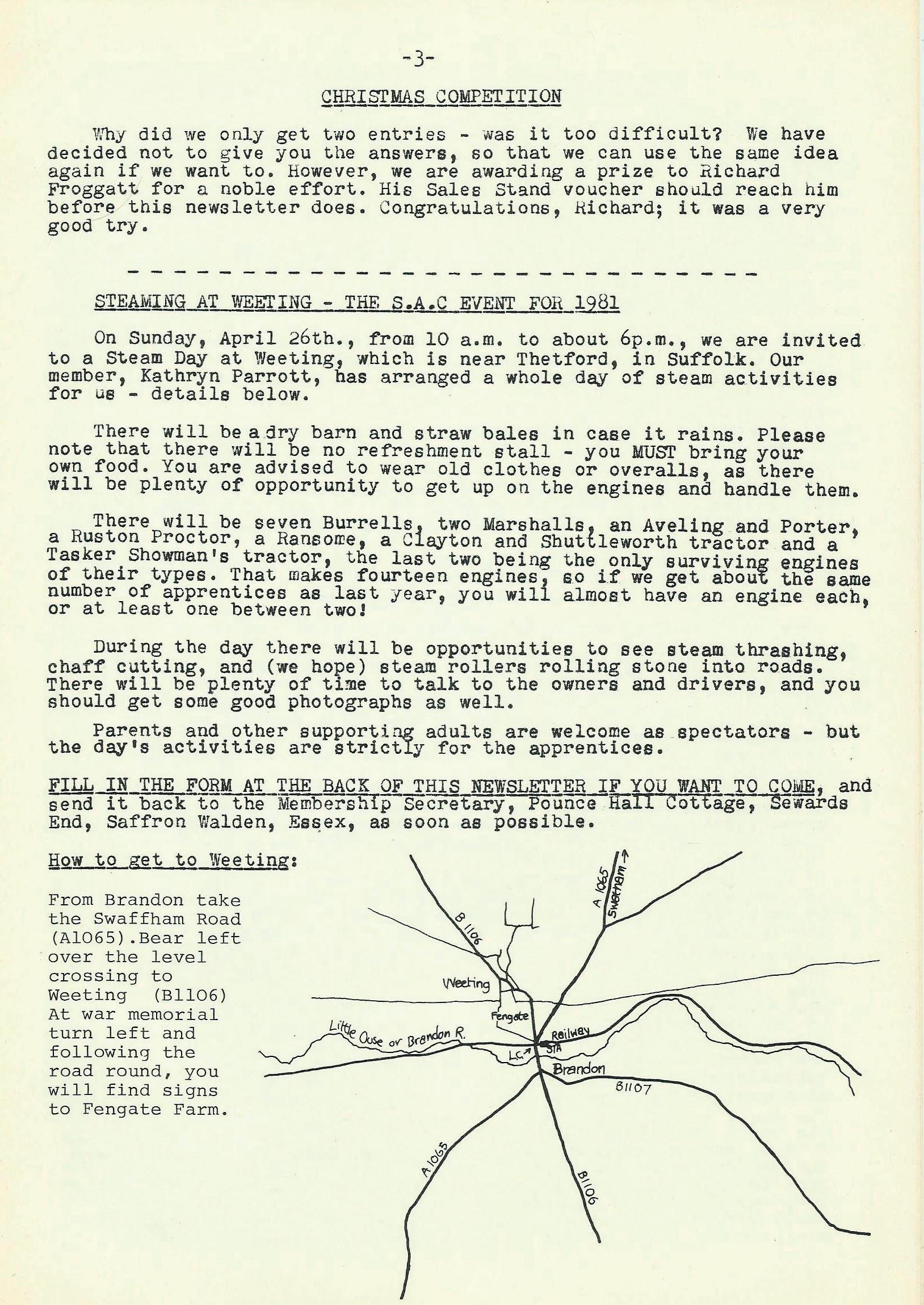
li2w tQ_gg_!t.__!& Weeting:
From Brandon take the Swaffham Road (Al065) .Bear left over the level crossing to Wee ting (B1106) At war memorial turn left and following the road round, you will find signs to Fengate Farm.
so YOU WANTTO PHOTOGRAPHTRACTION ENGINES?
The choice of cameras in the shops is friihtening, and to see all the films of different makes i~ is a wonder tnat_anyone is_good ~t taking pictures. Most of you will have a camera in the family which you can borrow and get to know. I am not going to teach you how to use it, but rather point out·some of the problems and see if we can find the solutions.
First there is the type of film you are goin$ to use, and it is my bet that you will be taking colour slides or using film from which you can get colour prints. Forget ·the black and white for che time being, as to get the best from this medium you must process it yourself.
The type of camera is not too important providing you can understand its limitations and again I should think that many of you will start with the basic kodak Instamatic or one of the smaller cameras taking 110 film and looking like a bar of chocolate.
A camera works by allowing the correct amount of light to reach the :film, and then the film is processed and back come your results. It is important then that the exposure is correct, and if your camera has any controls for shutter speed and aperture then you must use the Guide which is always enclosed with the pack of film. Now, for those of you with your Instamatic, I can help you to take better snaps.
(A 'snap' is old terminology, meaning that the picture is a snap in time of a scene which generally cannot be repeated, and so oecomes a historical document and a reminder of an occasion.;
Now to the rules, which, if obeyed, will guarantee success with an Instamatic camera:
1. Take your pictures in the Soring, summer and Autumn only, and only when ~he sun is shining well. At the height of summer when the sun is high in the sky, put your camera away in the middle of the day - but it should be O.K. for the grand parade. Early morning and late evening are not good for colour films. •
2. Always stand with your back to the sun, so that it is shining directly onto the subject.
3. Stand still and relaxed holding the camera firmly, and when you press the shutter release do so gently and without moving the camera body. More film is wasted through moving -the camera when taking the picture than for any other reason, so go out and practice without a film in the camera -that costs nothing!
4. If you have a simple camera like the Instamatic, it will Nill: be able to stop a moving object, so you must only take engines when they are at rest. Such a camera has a shutter speed of about 1/75 of a second, and this is far too slow even when they are in the parade.
5 Look out for the crowds and wait for them to clear in front of an • engine, as people at rallies will ruin your pictures. You have to be very patient.
6. Before pressing the shutter release, have a check on the background to the picture. You will be amazed now trees have a habit of sticking out of chimney tops, and how horrid modern caravans always get just where they are not wanted. This is a vital point, and if you see an engine away from the crowds sitting quietly at the corner of the field with some pleasant country in the background -off you go, quickly.
7. The angle at which you take an engine is up to you, but start with the basic front threequarter view which is normal, and then you can look at the engine from rear: threequarter, side, etc. As you are in the S~C you should be able to as~ if the owner of an engine would mind lf y9u. took a pictu:e when 1nvi ted up on the manstand, as this
8 bs ~i ixc1t1ng view look1ng_forward.at all the works going round.
• on orget the unusual - Just a picture of a brightly-coloured wheel or the shape of the cylinder block. There are plenty of
-5-
subjects all over the engine, not to mention the crew - many of them are North a picture, all covered in coal and oil.
9. If you are going to a rally, tI"'J to persuade the family to arrive early on the Saturday when the engines are coming into the field, or stay late on the Sunday evening when the engines are all going. AI;art from the crowds not being present, you can often get some good pictures away from the normal rally background.
10. And one last plea - do not get too close to the subject. Many pictures are ruined through being too close, so make sure that all the engine can be seen in the viewfinder with a nice gap all the way round - that includes the smoke coming out of the chimney.
In the next article we shall be looking at the more complicated camera and the question of taking moving engines. But remember th~s - do not be put off taking pictures just oecause you have a chea~ camera. The important thing to remember is that it is tne person behina that camera who is the clever guy, and that he understands the limitations of his instrument.
Oh, and one small point. If you see me ar6-und the rally field and you have any problems, do come up and have a chat. I shall be only too pleased to help you.
Thank you very much, Dick Blenkinsop. We look forward to the next article - and I just hope you aren't overwhelmed by a rush of members next time you go to a rally!
srEAM THRESHING
£:L~ill_Be rt h-J ones
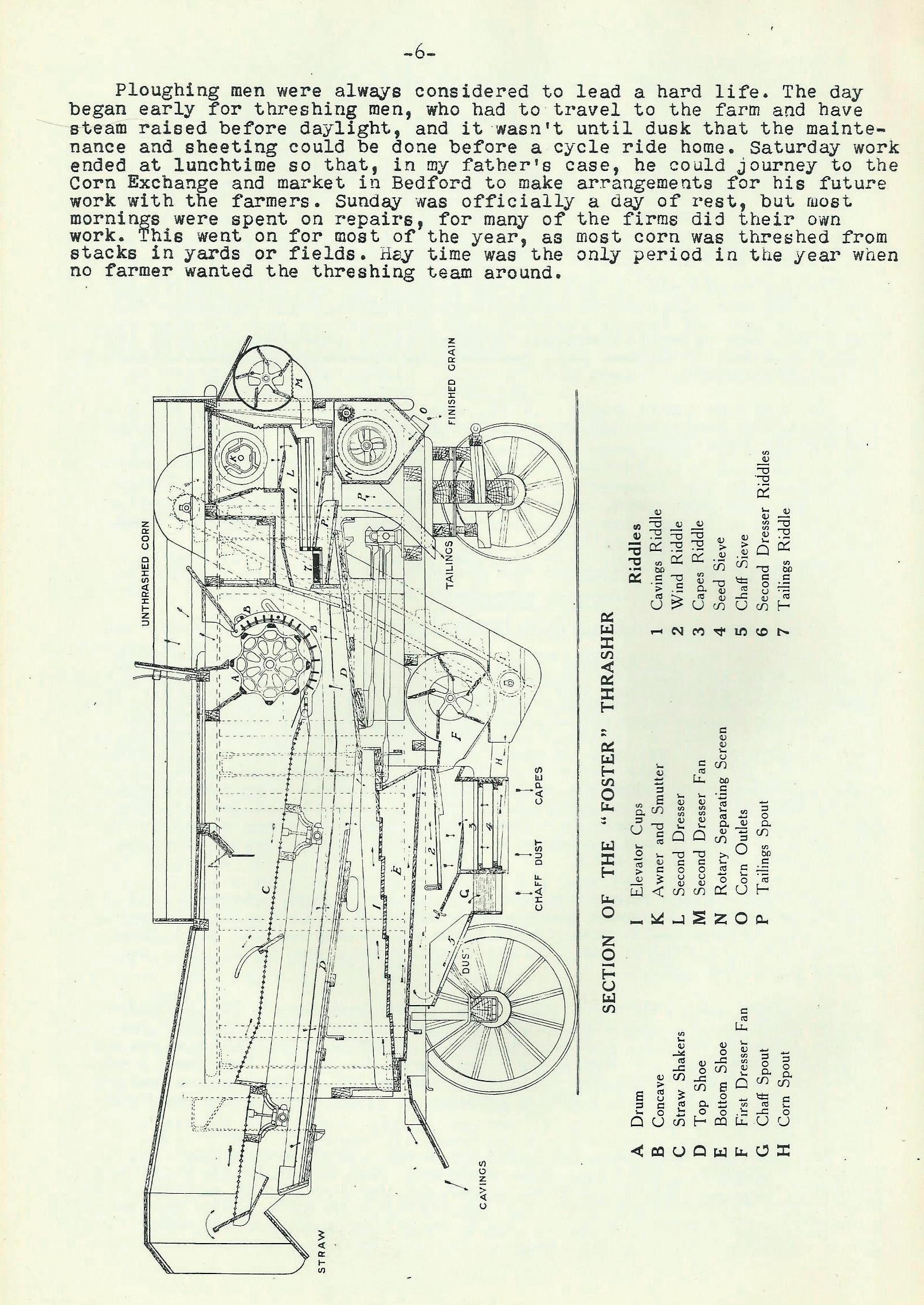
Power has been used to remove grain from cereal crops for many thousands of years. First manpower, either with trampling feet or flails, loosened the grain. Then the straw was lifted away and.the chaff or husics blown aWEzyby a draught of air, to eave the grain to be collected last of all. Later beaets horses or donkeys or even cattle were . harnessed to tramp a c1rcnlar path over the collected crop.'The golden circles are still evident on small farms in the remoter areas of the continent. By the late 1800s the crop was collected into barns, and a small, hand-powered ma.chine was being used to beat - or thresh -the grain from the straw and drop it through sieves to the groun~- The horse later provided the power, but these small machines were sl.owl and with the development of the portable steam engine it was inevitab e that steam power should be used.
The days of the threshing contractors had be$un, and they would hire one or two men to operate the engine and drum, with the farmer providing the coal, water, and horses to pull the machinery to the next farm. The self-propelling engine was a great improvement, and it is this which mainly survives today.
The drum also improved, and final forms included a 'self-feeding• device to regulate the supply of corn, so that the straw would pass out of the machine as flat and as quickly as ~ossible; it was a. valuable crop in those days and was not burned as it is today. The grain, weed seeds and chaff were passed through a series of sieves, and blown by fans so that well-dressed grain arrived at the front of the machine to be collected in bags.
The combine harvester appeared in about 1945, and carried out the task with greater speed and less manpower. Any group of ex-threshing men will tell you that combines cannot do the job nearly as w~ll, but the modern farmer disagrees - who is right? I am sure tnat, with present labour costs, the men required for a threshing team are only practical for a demonstration of past times.
Ploughing men were always considered to lead a hard life. The day began early for threshing men, who had to·travel to the farm and have steam raised before daylight, and it ·wasn't until dusk that the maintenance and sheeting could be done before a cycle ride home. Saturday work ended at lunchtime so that, in my father's case, he could journey to the Corn Exchange and market in Bedford to make arrangements :for his :future work with the :farmers. Sunday was officially a day of rest, but most mornings were spent on repairs, for many of the firms did their own work. This went on for most of the year, as most corn was threshed from stacks in yards or fields. He.y time was the only period in the year when no farmer wanted the threshing team around. 0
SALES OFFICER.The NTEC ha; appointed a new Sales Officer. If anyone is ordi::.:-inc:ranythin1r from the club will they please now send all orders to:· s.i~Gray, 60°Harbour Avenue, Comberton, Cambridgeshire, CB,3-7DD.
ENGINEVISIT. Anyone near Louishborough who woL.:d like to see the Froggatt engine is asked to send their name and address to the Membership Secretary, (address at bottom of page 2).
MEM3ERSHIPHENEWALS.We have now decided that all memberships will end at tfie eno of tne quarter (not the month) in which they were first taken out. This means that your membership ·wvill expire at the end of March, June, September or December. You will be given free membership up to the end of the appropriate quarter this time, so, for example, if you joined in April last year you will not need to renew next year until June. ~Vhenit is time to renew, send in your card and £1. 50 to the membership secretary, and your new card will have the adjusted renewal date on it. (If you don't want to send 7our card, a stamped, addressed envelope would be helpful instead.)
ROAD/HAI~~~~tl!• This will take place at Quorn, just off the A6 between Loughborough and Leicester, on Easter Sunday and Monday. It is a combined display of railway engines and road vehicles. Any SAC member 'Nill be most welcome, and is asked to introduce himself (or herself) to the organisers. So do go along if you can.
BOOKREVIEWS. If anyone wants to write a review of an interesting book on some aspect of steam -please do. Send the review to the Editor, at 8, Newburgh Road. Acton, London w3 6DQ. . Sorry - there isn't ~ocm for the article on the Model Engineer Exhib- ition this time. We've overflowed onto an extra page already. I promise to fit it into the June newsletter.
NTEC SALES STAND. When you are at a Rally with an NTEC stand they will be pleased to meet you and may offer to introduce you to some engine people. There are also some £1 and 50p bargain packs of books on sale at the stand this season.
CHILTERN TRACTION ENGINE CLUB have invited us to their ooen day on the 19th -20th April at Quinton Road.
SYLVIA hopes to include your Rally List with this and will be at Rempstone, Banbury, Bicton and Roxton Rallies with the Club Flag. If you can join her, do let her know.
WEET,INGST~AMDAX
I would like to attend the ~eeting Steam Day on April 2~th. I will be arriving at about o'clock.
Name --------------- Membership numbe.r ---Address ·---------------------
Please return this form to the Membership Secretary, Pounce Hall Cottage, Sewards Ena, Saffron Walden, Essex, as soon as possible.
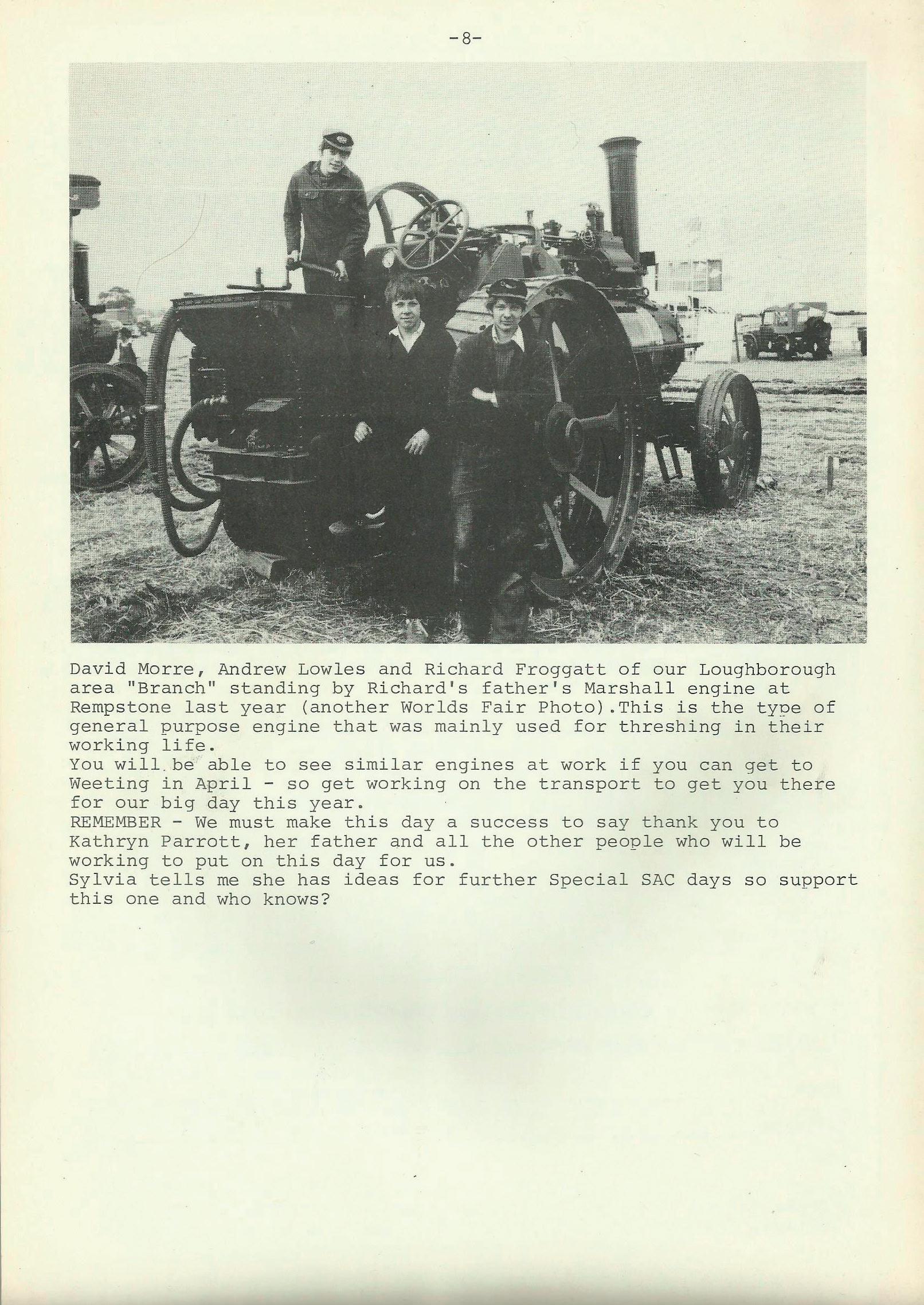
David Morre, Andrew Lowles and Richard Froggatt of our Loughborough area "Branch" standing by Richard's father's Marshall engine at Rempstone last year (another Worlds Fair Photo) .This is the type of general purpose engine that was mainly used for threshing in their working life.
You will.be able to see similar engines at work if you can get to Weeting in April -so get working on the transport to get you there for our big day this year.
REMEMBER- We must make this day a success to say thank you to Kathryn Parrott, her father and all the other people who will be working to put on this day for us.
Sylvia tells me she has ideas for further Special SAC days so support this one and who knows?