
Dear Apprentice,
There is one r-eally go&d -pl~c,e -0f news f\n• -our fir.st i-ssue in .19:Bo, and that is that t.he Steam Apprent.-ice Club now has more than one huntlr-ed members - t-here w-er1' -one hundred and sev-en -of you en Mar-eh 21st. T:hat is a re-ally good number for ·&ur first y~ar, an<l I h-ope that tho.s.e -of' y:ou wh0se -subscrip'ti~ns are now due. far 198o will renew ·tnem qui~Jdy, ..
. . Our first real t!V~nt 'for appren'tic-e'8 • takes :olac4! o,n April l.2t.~.:; yon will find m()re d~tai ls la:t'er _ in the . newsl!! tt.-er-. I .lo,e.k fi,r<aard .t-o m-e~:ting . you during the day if you are -aetuall.y ccminJ!. ·ri' ,you can~t g~t t,t:> Minster Levell 't,his time don 1 t wc,rey - we are h~ping to he .ab1>? t1;9 r,un s9me .m-ore sessions for apprerltice-s dm-ing t.:he y:ear,, in diT:f:erent. ;part.s of the c~untry. Wit.n luck., some 0f tilem will be a-t rallies. Ther'e rill be a full report. of eur first, •prefici-en:cy test.s' in the .June n.e.wsl.~t.t.e:r
Easter is usually the time when engines. start nappe.aring af'ter t.he·ir winter evernauls. So, in Ca$e •you -are 0ut ~arly with. yi,]1r camera thi~ year, I will give yc,u •advanc~ B.otic~ th8t t·here will b~ anothe-r photographic competiti,on. There will b~ classes f0r 'best engine' and 'be.st. rally' ph"G>tGs ! and .entries may be in eol~-ur or _black-and-white.,. .Again, full det.ails 1n June., but it isn 1 t ~o early t~ start taking p.ictares. (By t.be w,ay, the priz1's ~or the last cemp-e'titton sbould hav:e arriv·ed-by now; if Jenni:fer or Brian are still waiti-ng, ple.as-e would t.h~y 1-e't me mowl)
Since the last ~wslett~r there has been an import.ant chang.e in ~he list of Club o:ffic~rs,. Mr. Erie Fil.lmore is n&w ·tae Club Chairm~. Eri-c . bas been 1nv3lved rRith the Nati1:>nal Tra-ctll"Jn Engine t;lub -f:;r ·ma.n,y_years,, and is very keen to help build up the Steam Apprentice CJ..ub.• Esmond Kimbell, whose series 'Grewing Up With -St.eam' has 'bet?n running t-n t.he newsletter sine~ the first issue,· has alao jo.ined 'r,he eomm-ittee .. W.it.h so many members, we need more people to help wi tb. the c,-rganiirat.i~n-l • ~John Wharton is .stil.l Tr-easur~r, Sylvia Bt!rth-Jones is still ?in:embe:rship Secretary t and I am still t.h~ Edit.or, so t:hing.s haven'ft -changed t.Qo mu-en. Best wishes f~r a good steam seas~n,
Yours sincerely, • ~4/?~itv~
Margaret Joachim, Editor.
S.O.S. OVERALLS!
One c,f our members has written te ask where he can g(:!t overalls in small sizes. Most bGiler suits and overalls are made f'or adults enly, so it can be a preblem. If anyone knows where small ones can be bought, please let me know, so that Qur member can·get prC!)perly kitted-out.
GROWINGUP WITH srEAM ( 5J
by Esmond Kimbell
Aveling•s lead with traction engines for threshing was almost paralleled by Clayton and Shuttleworth. They both started with •tbreeshafts•. Originally there was one countershaft with'in-and-out~~f-gear, and later two speeds, outside the frame. Then both firms moved over to 1 fGurshafts•,. which had two countershafts and inside-the-frame gear movements. Although t~ere was a Clayton fourshaft 0f a sort at the very beginning. The difference between these and the ploughing engines was that the latter. were fQurshafts with outside gear movements·. Most makers started with threeshafts, but only Burrell and Wallis & Steevena remained with them; Allehins were built either way, at the customer's preference. Switching ·rrom oi:ie type t• anether c•uld someti.mes puzzle a driver. The motions went in different directions, se the cranks had to be caught in different places ( as with a portable fGr threshing· or sawing). And steering on the • left took some getting-used-to if you'd come off a right-hand steered engine; ss did a pul.l-to-start regulator, like that on a Burrell, if • you were used to a push ene (on a Foster; for example) ..
By the 1890s, when the traction engines had alm0st reached. their final designs, many ma.us were identified by the shapes Gf their copper or brass chimney tops. Governors too had changed, to the smaller, fasterrunning 1 cross-arms 1 , with here and there the still more sensitive Pickering governors. These had three balls half'way along flat-spring ar~s, with the stalk itself moving and going straight into the steam chest. There was a little brass kn0b on top. Boys of the periGd would keep a close watch Gn these engines, and would regard the portable engines as old fashiened. They would note the three notches forward and back on the reversing lever quadrant, and learn that with low steam pressure or far hard pulling tbe lever would be in the far pGsitien, but was usually one notch up, ma.king the valve travel a little shorter. This cut off steam before a full stroke, allewing its expansi5n to de the rest and quietening the exhaust. But if the driver put the lever inte the next notch, nearest the centre, she'd jerk a little. This was because, although there weuld be room for mere steam expansion, the exhaust outlet would alse be curtailed.
1'0ys might also learn that railway engines using_,JI1.Gre complicated valve gear, like Walschaerts and its derivatives, had a 'fast-then-slow• slide of valve r~d which cut off the inlet and yet allowed a non-obstr-. ueted exhaust outlet so that •notching-up• could be almos~ to the centre position. This was usually done by a wheel and screw whieh replaced the lever. Traction engines, however, kept mostly to Stevenson's gear. And, of course, there wasn't an under-boiler tub fGr the pump to draw from. Instead there was a tank under the footplate, with a rear or side pocket for bucket filling, though it was more usual t0 fill by uncoiling the wire-bound hose! or 'lifter-pipe'! screwing it into a short pipe on_ the tank side, turn ng a tap ans suck ng water in. (Steam went into a tank near it,· causing a vacuum.) The injector, fitted to many engines, was .a develepment of this but with more complicated innards. It sent water straight from tank to boiler until the steam pressure dropped towards that of the water underneath it. Sometimes after a turn-off steam woul~ hiss back through the injector. This could be caused by a particle of coal, (eften shaken into the tank while travelling), preventing the non-return valve on the boiler side fr0m closing. Just a few hammer taps on the boiler end of the pip·e would generally st0p this, as a hot· injector would not_ work pr0perly. Other causes might be the steam tap not closing fully, or hot water in the tank - brought about by allowing air to get into the lifter pipe while sucking. An injector was handy while travelling:
as a pump did not like going reund much faster than when on belt work; though for this reason many pumps·, particularly on road engines, were geared dQwn. •
LEI'TERS PAGE
Lots of letters this time - obviously Apprentices have more time to write in the winter. I've chosen three which are parti-eularly interesting. First, fr0m Paul Thurlow, whe lives in Newark, Nottinghamshire.
I would like to tell yGu about a rally I went to in August. Adam Wa:rd and myself were invited by Adam's mum and dad t.o go te the Cromford •. Rally._ We w:re·due to go·after a week's camping, and_we were both looking forward te ·1 t very much. . · • .·•
The rally field was about 12 minutes from Matlock • .Mrs. Ward picked us up at about 10 o'clock. As we drove down the sand drive there was an Aveling roller drawing water from a canal. We continued down the track until we came to the caravan that we were to stay in. It is a blue, Gld fashioned style caravan with decorated panels.
Later in• the day we walked around the ffeld until the arena events began. l\lir. Blagg,who is Adam's g~dfather, is the owner of Maclaren road locomotive n. 1424, built in 1913 and called 'Captain Scott'. He said that we could go around the arena with him. ·rt was very cold up in the· coal bunker but it was well werth it when the Musical Chair game begane I ran for Captain Scott and I won. First prize was a brass plaque of the Cromford Rally.
On our way out of the arena I tried my hand at steering Captain Scott back into position. The thing I also liked was the glorious sight of Captain Scott disappearing among the trees.
What a marvellous day, Paul. The second letter is from Martin Hunt, who lives near Woodbridge, in Suffolk.
I am writing concerning yeur note in Newsletter 4 about rare makes of engine. The rarest engine I have seen to date is a portable built by E.R.&F.Turner of Ipswich.
It is owned by Mr.J.Blake who is a good friend of mine. I have been lucky enough te see this engine in derelict and rebuilt conditi~n~ as it is sited only two miles from my house. She was built in, about 1870 as n0. 981, and is a single cylinder· expansion engine.
Before she was rest&red she was in a terrible state, with no smoke box and very rusty all c,ver .. After many hours' work at weekends from October '77 to May '78 she was totally rebuilt and painted. She attended a May Day celebration in her new ·11very of red wheels, green boiler with yellow belly bands, and the usual black smokebox and firebox. The owner has told me that the engine was last used in a small vi.llage about five miles away, and was used to power a saw bench. ·
He can remember going to a mill in Shottisham as a boy of 10 in 1914 to put a patch on the engine, when he should have been at work in school.
Further details concerning the engine are: three flywheels (one removed since rebuild), it has a hub governor bearing the inscription:. Hartnell's patent governor -maker E.R.&F.Turner, Ipswich, England. It bas a pressure gauge built by G.Thurlow and sons, Stowmarket.
And finally, from an old-enginp to an old engine family - here are the details from Barnaby Newton, of Hungerford, Berkshire.
I come from a long line of Steam Engine People. I am the 5th. generation to have steam in the blood. My great great grandfather moved to Kent from Suffolk to start a steam ploughing business wi_th one steam ploughing engine on the one engine system. It was very successful, so much so tnat he bought anoth~r Fowler and made up a pair. My great grandfather took over the firm, which boasted 4 sets of pl0ughing tackles and 4 traction engines used for threshing and other purposes. It was an one of these, the Aveling, that my Grandad l~st his thumb, which got caught in the gearing.
He moved up to Berkshire during World War II to bring my father, then a small boy, his brother and my grandmother out of the bombing w~ich was then·very heavy down on the south coast. He was the farm manager on the Hosier estate.: and drove many of the BBl ploughing engines for the estate, which he enjoyed very much. He ploughed most of the 3500 acres of the es-tate by steam. Even when the neighbouring estate had their new engines, he taught the men to drive them.
father then caught ~he 'steam bug' and in 1965 bought our firs.t engine, Ransomes Sims and Jefferies G.P. engine no.41046, 'Ivanhoe'~ He learned to d~ive on this engine and travelled many miles on her. He sold her in 197.1 to buy our present engine, a 5h.p. Burrell Road Locomotive no. 4066, 'John of Gaunt'. This was the last road loco to leave the Thetford work~ in 1927. This has now been restored to her former glory as·she left the works. •
My ~wn interest in steam was started when as a small boy I used to ride on !rvanhoe'. I first roae·on her when I was about three years old, sitting on the coal in the tender and getting very black, but as ~oon as I smelt that bewitching smell I was hooked. I first started to drive in 1975 when my father began to teach me. In 1978 at Hungerford Rally I drove 'John of Gaunt' for the whole weekend, which I really enjoyed. Since then I have been finishing the restoration of the Wallis and Steevens Showman's tractor no. 7482, 'Royal Star', owned by my uncle. This_ has taken about two ye~rs, and I am hoping to take· it out this year to some local events.
I have in the last two months given slide shows at two of my local clubs, these being the Thames Valley Traction Engine Club and the Lambourn Vintage Machinery Club, for which my father did the commentary.
I hope you find this interesting and not boring. It just gives you an insight to my hobby which I find a great pleasure, even though it is often hard work and .very exhausting.
Very interesting, Barnaby, and not at all boring. I wonder what happened to all those ploughing engines?
GOODRALLY GUIDE
Unfortunately there have been no more l_etters recommending ral.lies. Apprentices will soon be making plans for summer visits, so perha~s you would like to tell us about a rally which you particularly enjoyedbearing about it from someone who was there is much better than relyi~g on a description in the Rally List! If there are enough letters-there • will be a special Rally feature in the next newsletter.
If any of our older members would like to help the membership secretary with some of the record-keeping, we would be most grateful. It would be particularly useful if s~meone living near her (Saf:f'ron Walden) could be found. If you might be able to help, please let us know.
STEAMENGINE_PROFICIENCYTESTS.
As mentioned in the last newsletter, these are to take place on Saturday, April 12th., on private land at Minster Lovell in Oxfordshire kindly made available to us by S.J.~lhar~on,Esq., (President of the N.T.E.C.) Twenty three Apprentices have a_lready said that they will be coming, and there is plenty of room for more. It is not too late to • get someone t0 bring you along, but please remember to let John Wharton knew, by postcard or letter !f you do intend to come. The address is: Southerndown, Minster Lovell, Oxf'ord OX8 5RD. Camping and· caravan space is available, but this must be booked in advance from the same address.
How to get to Minster LQVell:
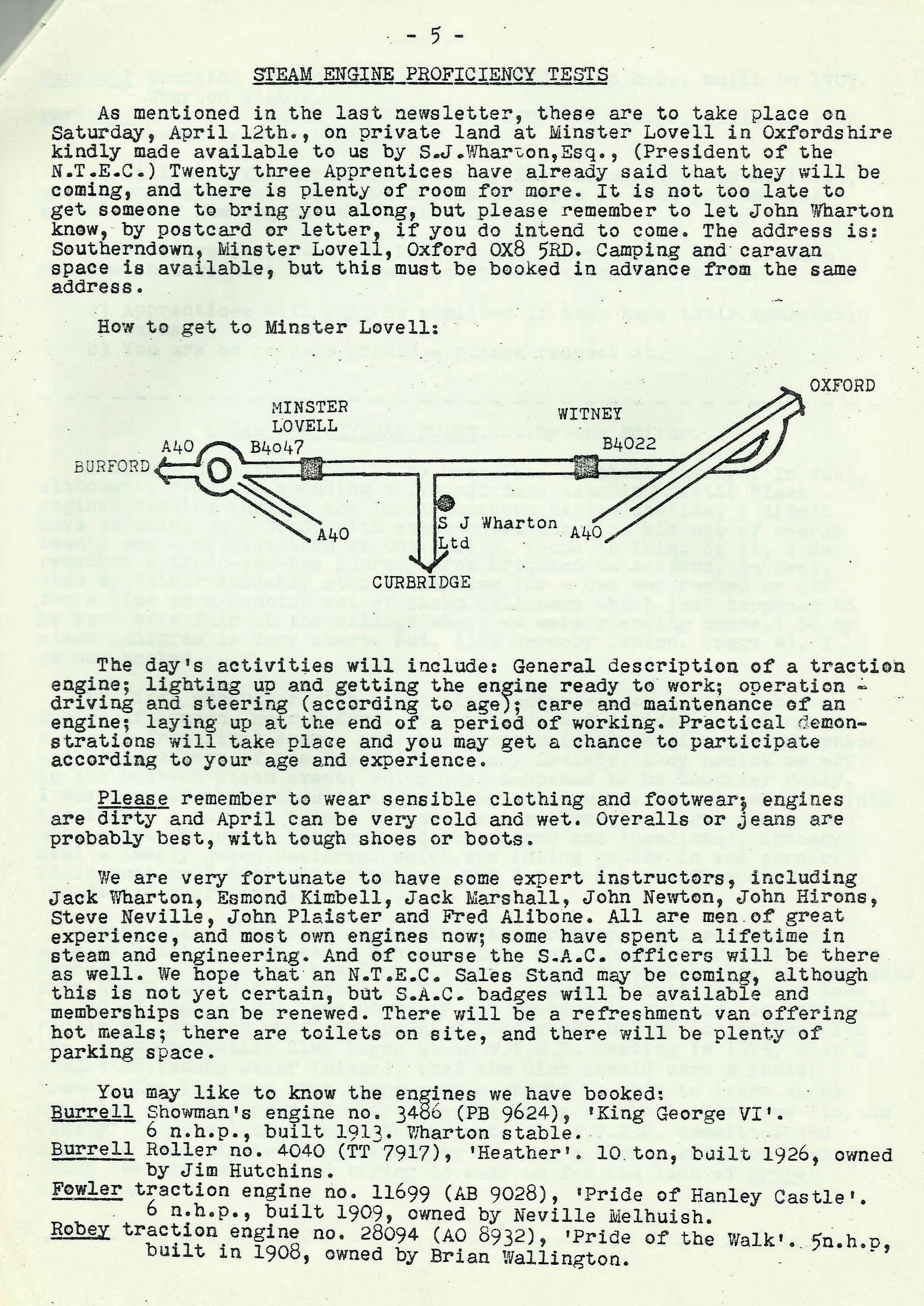
CURBRIDGE
The day's activities will include: General description of a traction engine; lighting up and gettin_g the engine ready to· work; operation~ dri~ing and steering (according tQ age); care and maintenance of an· engine; laying up at the end of a period of working. Practical demonstrations will take plaae and you may get a chance to participate according to your age and experience.
Please remember to wear sensible clothing and footwear; ·engines are dirty and April can be very cold and wet. Overalls or jeans are probably best, with teugh shoes or boots.
We are very fortunate to have some expert instructors, including Jack Wbarton, Esmond Kimbell, Jack Marshall, John Newt~n, John Hirons, Steve Neville, John Plaister and Fred Alibone. All are men.or great experience, and most own engines now; some have spent a lifetime in steam and engineering. And of course the s.A.C. officers will be there as well. We hope that an N.T.E.C. Sales Stand may be coming, although this is not yet certain, but S.A.C. badges will be available and memberships can be renewed. There will be a refreshment van offering hot meals; there are toilets on site, and there will be plenty of parking space.
You may like to know the engines we have booked; Burrell Showman's engine no. 3486 (PB 9624), 'King George VI'.
6 n.h.p., built 1913. Wharton stable .. Burrell Roller no. 4040 (TT 7917), 'Heather•. 10. ton, built 1926, owned by Jim Hutchins. F0wler traction engi~e no. 11699 (AB 9028), •Pride of Hanley Castle• . . 6 n.h.p., built 1909, owned by Neville Melhuish. Robey tract_ion_engine no. 28094 (AO 8932), 'Pride of the nr lk• h b 1 8 v~a • - ·,1n •• p, u1 tin 190, owned by Brian Wallington.
,.. b -
Marshall traction engine Wharton stable. no. 41151 (BH 7607). 7 n.h.p., built in 1905. Marshall traction engine no. 71837 (DD 2007). 6 n.h.p.,, built in 1919, owned by John Plaister ..
It will be a first-rate opportunity ~or photographyJ In addition, Mr. 'Wharton will have his engine workshop open so that you can see something of how engines are maintained.
Helpers are still wanted. Parents and other adults will be most _welcome, but we must ask eveyone to observe these t-;.vopoints:
a) Apprentices will only be admitted if they have their membership cards. •
b) You are on private ground -_please respect it.
STEAM FOR SEVERAL HOU11§....... by the Editor.
I didn't have the sense to be born into a 'steam family'. In fact, although I remember spending a few odd days watching little black engines running-through the local Southern Region station, I didn't . , have anything much to do with steam until the ripe old age of nearly twenty one - my last term at University. (Come to think of it, I do remember a train-and-bus journey from Brighton to Ashford, in Kent, when my father suddenly stopped waiting for a bus and rushed us off for a ride on a genuine set of steam gallopers which just happened to be part of a fair at the village where we were changing buses.) So my steam pedigree is very short. But, like Barnaby Newton, (page 4), I am now hooked.
My first encounter with a traction engine was on a warm June Sunday afternoon, near Oxford. Some friends had decided that.I needed a change from final exams, and, being enthusiastic engine photographers and keen members of the Festiniog Railway Society, they hauled me ot·f to the nearest steam event, which just happened to be Towersey rallye I was very scathing about this as an entertainment. But, as we went into the field, I saw two things in quick succession. The first was a man with a pet fox under his arm, and the second was 'Boadicea', Anthony Heal's lovely green Maclaren, which was idling gently in one qorner. There must have been other engines, but I have had a soft spot for 'Boadicea' ever:since.
After that, I married one of the photographers, and we went to . as many rallies as we could manage. There was a brief tour of the Welsh narrow-gauge railways, but I am pleased to report that he has now resigned from the F.R. and has become an N.T.E.C. member instead. We would love to own an engine, but have no money and nowhere to put one, so that will remain an ambition until our pre mium bond comes up. :My connection with the Steam Apprentice Club began at an N.T .E._C. meeting in 1975, when I s_uggested,(among other things), that the Club should have -a junior branch. The idea was that young people should be abl.e to learn about traction engines, even if they were not lucky enough to have one 'in the family'. A year later I was elected onto the N.ToE.C. committee and asked to investigate the possibility of.such a club -and here I am, doing the newsletter, and trying to make up for the lack of Eroper educ~tion!