"I(".J.... •
1Je ar ADpr,J r'J.!.-J. c _j •. lt is a bit' 1ate t,o wish y,J1.1 a .Ha:)py Chr-lti'"~mas~ b1..:.t there is still time to wish you a Happy Ne~ Year, and lots of st0aming in 1980. ".1 1 h"' 11 pore;1tico c--e-=>,C••'")wil~L b 0 of.C- to a' r,·ooo' r-tart "n April w1"th our -··'--- _--11: •• -· .._, ;.Jc-1.:,vL.>w'/_•...__J.......J..,0 ., • .J.....1.n •
Titeum Proficiency tests - f~rt~er deteil: lQter on ~n this newsletter.
P. number of peopJ.e wer;:; ~nte-c.estcJ in the possibili.ty of wri.ting to V•-~ung J\.[;]crican f;tca'."J en-:·husi.ast.·3. If anyr:n,~ eL::::c wcL1 ld li!ce to do thio i ;oul~ they pl~ase l~t me kn~w ar~so~D~$ possi~le? Thon I can make all the ~rrangements at once. I have already wrltteh to the American society, bu~ the Lond 1 ·n pc2t is so bed at the moment that it will probably ·::,c1.kes orne t Lme to get a reply. Po:; ting the letter just before Ch:c"':'.otmas won't have helpea, eitt1er~ The Ameri9aas wtll probably put a YJ.OtE:: :i.ri '.:,heir r:1ag:aztn-e askLng fur p,-ssible C?.rre~;pondents, and it will be 3eve~3: months b~~ure we manage tc put ceopl~ in touch w~th each othe:?'.'. Sei don't lose hcipe, th5.hgs .::i.Y'eunder v:ay,
T>::rc •Nt=ren 1 t qui-1:e o.s :n.::.r:r entrj_es fc,r the ph0tographic competition E1 S we tl''td hoped., In p~_rt.i.cr.~lar, there wer2 no blacl:..--and-•whi.tc entries -'7.t a::..l; :-:·o the.::'e are no pr1ze~=' j_r., those classes. The pictures that did come in ,'VE:'::'e ver'r good, though, 2.r:.d it was hard v:ork to pick the two prize" 0 i.n!1ers. they are~ •
½est ral1_y_photo
Jenr1iJ'er Roger·s 1 2 ivfarton HalJ.? Weot Mu:;:--t.0~1;. s:e.:ip-::.on·i•. Yor!(:shl : ~_:,
hrian Allison) "Li ncJis farne 11 ; Florance Lane; G:::--o O" 1.Jr:~dge :8astSu0scx..
,Tenn i~,.:-P.r; s photo wo.s of Burrell 391b ,,:',::bor;ah 11 , • a single-crank comp0l'!.1d 9gric~Jt'Jr'al c,v:;I.ne br..1i.lt :'..n 1922 2nd cy:ned by K.Ellwood" It was at tne Bro 1 • 1 ght0:1 :½:all G..s.meFair; havi.ng there under its own r,teorJ. J.._:ter ret1.1rning the same way. it had travelled for fourteen hours 1n a s in.gle c'lc:,y,. • •
This an excelle~t photo, with the engine well-positioned. Same of the at.her ent,r~.es h& :. p2::'t of a rear 1;-1::esl~ o: the canopy, missing, or else part of the chimney had got chopped o~r. know ho~ easy this is to do accidentally. and how infuriating it is, ~hen you have taken enormous care to ,p;et th'= • pi.cture right,, when the fij_m comes bac:-c from the developer wi-th the edges of each negat-ive not printed l Cor._'3:ratulations to Jennifer for surmount,ing all these b'osta.cles and producing a lovely photograph,
B~ian 1 s picture ~as very different. He had taken a shot of the,lineup of showman's engines at Stourpaine in 1978. Almost all of them were in steam'.. and t,here were a nµmber o:.· peo.pl_,e walki.ng aroL;nd and looking at tl.··:.T', This is another i.mportant point- people in pictures should be cioing :30m2·':-hin§;·o:c looking at the moin ob.ject of interest, _Qot staring at the camera·, ur1.less of cour:se you inten-_~ed to take a photo of auntie with c1n engine in the backgr·ound. We asked Dick Blenkinoop, editor of "Steaming" and a first-class -phc;togra.phe1- bims~lf, (many of you know his ser:'.t:s 01' books, 1=Th2 Steam Sc2ne 11 ) 1 to help with the judging, ari4 he sa:i.d that you could :r·eally smel.l the smoke i.n Brian's picture. l'..7e11 dor..e Brian!
I· 2e2m to have gone ol'! f°or rath.er a ·10~'.g time. ,ft..Jt before I finish,
- ~;~;~~:'..s2 ~c:-- ::ot signing the last editor's letter. Somehow or .:.~j:::..::c::" ::.2 s:'..g::a,:,ure got left .Qff. _Sorry; I'll ·ao·be'fter this time! :(ours sincerely,
(rtemef1?ber,_ the Editor's new address is: b Newburgh Road, Acton,· London w3.)
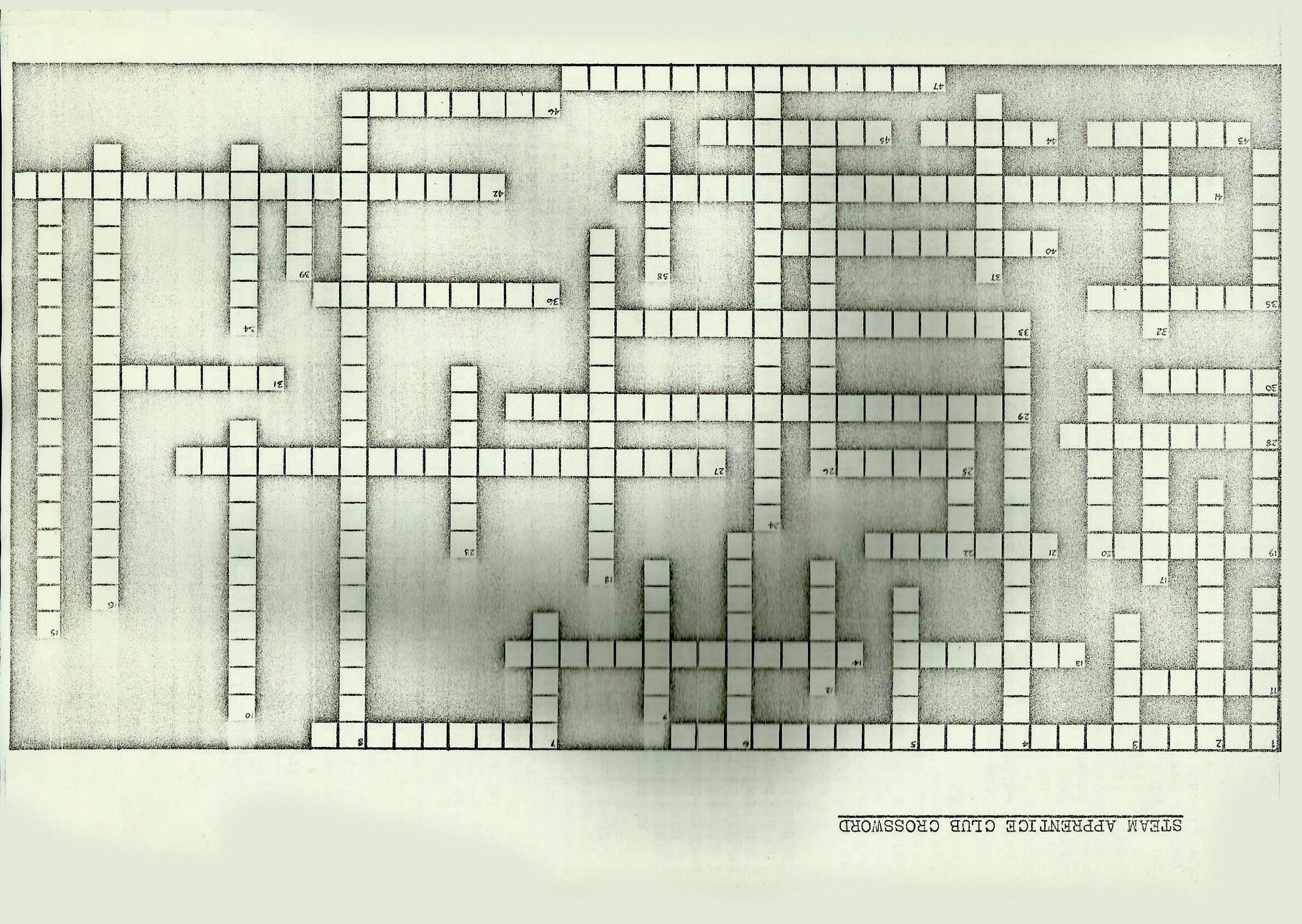
A HUGR CROSS'.':ORDFOR WINTER
Inc:::..ucec ·.,:'..:.:-: ":.:'1:s :1e'.';s:::_e1,~e::--you .. Li.::_ find a huge crossword, on a sepe:--ate e~~2:.. a~e ~:ues of the usual sort; instead we are g :'..·:i::o- --':):_: ;:,- - - ·-,:, ;::,·1,,·,·e-rc _ - - ··o·, :.,,;,•\10 -ro ,:,.·ois to work out Nhere each C
a~s~e::-- gees a:: :~Jss~ord! - r.2 2-::s·:.-e::--s2:-'t:' t.1e names of all the (British) makes of ste~QJL··,,·~ 9::~:'..::es a~ ~iic~ at least one example is still in existence today. _7,e!'e goes;
~rmstrong-Whitworth Aveling and Portet 1--,,veling Barford :Babcock and Willcox Barrows and Carmichael barrows and Stuart Brown and May Clayton and Shuttleworth Clavton WaQ'uns
Edd\ ngton and Steev.ens on Farmers Foundry aansomes Sims and Heid Ransomes Sims and Jefferies 3obins6n· and Aud en nuston Hornsby _:Wston Proctor i,'.1allis and Steevens
Allchin
Allen
Atkinson
Barrows
Burrell Collings
Davy Paxman
Deans
Elston
F'oden
Foster Fawell
Fowler
Garrett Green
Hindley Hornsby humphries •
Lampitt Leyland I11Iann 1~iarshall
McLaren Bobey Ruston Savage Sentinel Tasker Tidman Thorny croft
Turner Tuxford Walker Want.age Yorkshire Young.
We1.li put the solution in the next newsletter. fiemember, all the name goes in, but any spaces in the full name are left out.
,( Have any of our members actually seen examples of all of these makes? !t might be worth copying the list so thJt jo~ can cross them off as you see each one. v:e would be interested in hearing about any of the more unusual ones. - Editor.)
-THE SoA.C GOOD RALL£ GUIDE
The first suggestions come from Laura Kilgour, 1i'ho wri teS; 11This yee..?: I have attended rallies at Castle Eowar·d; I-anc;3.rk, l:Tamham Park, Bur-to11 Constable,. Lambeth; Witton Ca.$tle, •Alexandra Palace,. Totternhoe and Expo. The· most ·enjoyable ones from my point of vie½ were at Castle Howard iri Yorkshire ·and Alexandra· P&lace in London. I can ·recommend- these ral2.iet:i to anyyoung.erithusiasts, because the engine·drivers there were very friendly and helpful, and the spread of various types'of engines there and at Peterborough (Expo) was most impressive." •
Thank you, Laura, For sc,meone. living in Durham, you certainly travel!
About.t-his time a Kentish farmer, Thomas Aveling, decided that hiu 1..:layton-·and $huttle'.vorth pc::_-,t,able sho1:ld be a 11self-mover 11 • He arranged this :by putti~g the ~ear wheels back behind the firebox.so they could ~ave a solf~- n~l~. Be then put a large sprocket on the.axle and c~ain(~ove it from the c~ankahaft. The· small sprocket on.th~ crankshaft was f5.xed _by a tbro·u_gh-bolt, ·_z..nc3_the eng5.ne could be put 11out• of gear'' by rer11ovi.ng the .. bo"lt. • Th:is. made l:i.:f'e easier for the horse in the shafts as it only haa·.to·st~er, b~t it hadn=t to be a nervous one as there would 1:)c mu.eh e._huf:f~.<g and 'Jhc:ct5 •~g·>c,hL:d L.-J Th.i.s 7 of cour·se, vras the fore--runne::.·-. of_ the -t:'action en 6 :i.;1.2 p:i::-oper7 a'.': distinct froITJ t_he ploughing engine __whi_~h .c'J:id not bA.come cc 1::- my,r l ng 1_i.n.ti.'l • la_ter OtL Ge.;:i,rs vrere soon preferred _to ·Che.in drj_ve, and the motion \'13.S changed rouncl on the boiler, putti~g the cyliri..::er c1.c the chi.mr..ey erid. to brin·g the_ crankEJhaft nearer the rear \'Jt1ee1s. And L10rse-s teer· ing vms soon replaced ,by a man, who 8tooc1 a+_: first. r-:: t1.1e f:i: 0 ont of th0 engi.ne wi tb a shJ.p 1.s type steering ''.'heel i.n a frame. '.l'hi.s movsd the t11~ntable to lef":- or right as _he :pulle·d • hard o~_the spokes. Ags~n, tti~ ~as scan altered, to a steering wheel for the. driver, :::lop}.r:e; corm 0,0 a uor:n-d1•:i.ven roller. it. front of the firebox, from whenc~ crosse~1 chr.-inG weni.. to the front axle. Thi A steerl.ng is now seen or1 2.lr~o:::t all tr3ct.i.or.. etJg:'..t1e,,, ·although a few have 11modern 11 cartype steer:= .nt1J. arld_ 011 rome ti:i.e steering shaft meshes directly with a t 1:-othed :t.ur:r.·:.:,able • · • ·:- • • '
.As portables got bigger, and began to be used fol· other than farm requirementsi ·some were given doLlble cy~inders. It was then found th~t if the crank:3 \?e-re at right angles. it' made for easier ·starting and bet ter·-balan1'ec'i power impL~lses ,, S_ome of the_ early ploughing engines followed a~it 2nd were doubles; wii~·ttie ~dvahtage of cranks at right angles carrteo c:·.-when. in th2 1a·t2 nineteenth cen_tury, the firm of John F'owl2r cev!'.:J.c;,e,:'l th2 compound engine. In these? exhaust s.~:2:3.mfrom the high--pressu~·2 •:'•Y~~i.r:derd:.'.i.vc3 a secor.d cet of motion. vJ.a a larger (because of ~-,tec..me~::1anAion) CJl".nCer_",
So mech: then; :;:or hj_story, v,.~t~out ·vihich boys cci~la· not. have·. grown up with 3team. Th(:-.•f'irr,t portable er:ig:!.ne·'WatcherG .soon became driyers ,1:>artic ularly whc. • vrood--s n.wi.ng, • whi eh allo1ned a man to be free •for b.eavier jobs. Threshing demanded a knowle~ge of the machine, which only ~a~e af_ter· a·boy had gro~,c. up doing the other things connected with·itcarrying away chaff·, fo:::-kir..g sa'Jings into the straw elevat:::ir, helping on the straw ri~k~ lifting sheaves up to the drum, cutting bands and feeding. •
A~ the various £arms of steam ploughing came in, first m~kers._and then customers b'=gan to look aroLlnd fo:.~. boys who 11knew about portable eng.i.nes!'~ Ke'eping s,tearn 1Nas of supreme imp·ortance, giving _the feel of it; so to speak,' before learn:Lng to, get. on th~ right centre with··:. regulator in one hand and revers~ng lever .in ~he,other. They wq~ld be· fully grown up the double engine ~ystem b~came the.mo~t popula~, and they 1.vsre then greatly :f.n demand, To start a 11pull 1 1 .you got· the. engine just moving, then quickly slid-in the top bevel; and 'i.~1ith eyes on the distant anti-~alance plough or the.cultivator, be~an_to wind~fq. You kept a hand _on the reguldtor f0r a quick stop should the mati on the· plough wav:e; •or to speed up all. you could. But r:iot,- tC?o much, lest water be lifted j_nto the cylinder and cause primtng. At.the;e?d of·-~ pull:you shut off with JOU"!:' left hand and reversed with your right to take the load o~f the vertical shaft ~hich turned the _rope:drum. Ihen with your. right hand on the regul2t0r yo~ sJ.id it out of gear with the left and· gave 8. jerk tc; start. Then you changeJ hcnds again·, le·aving the right
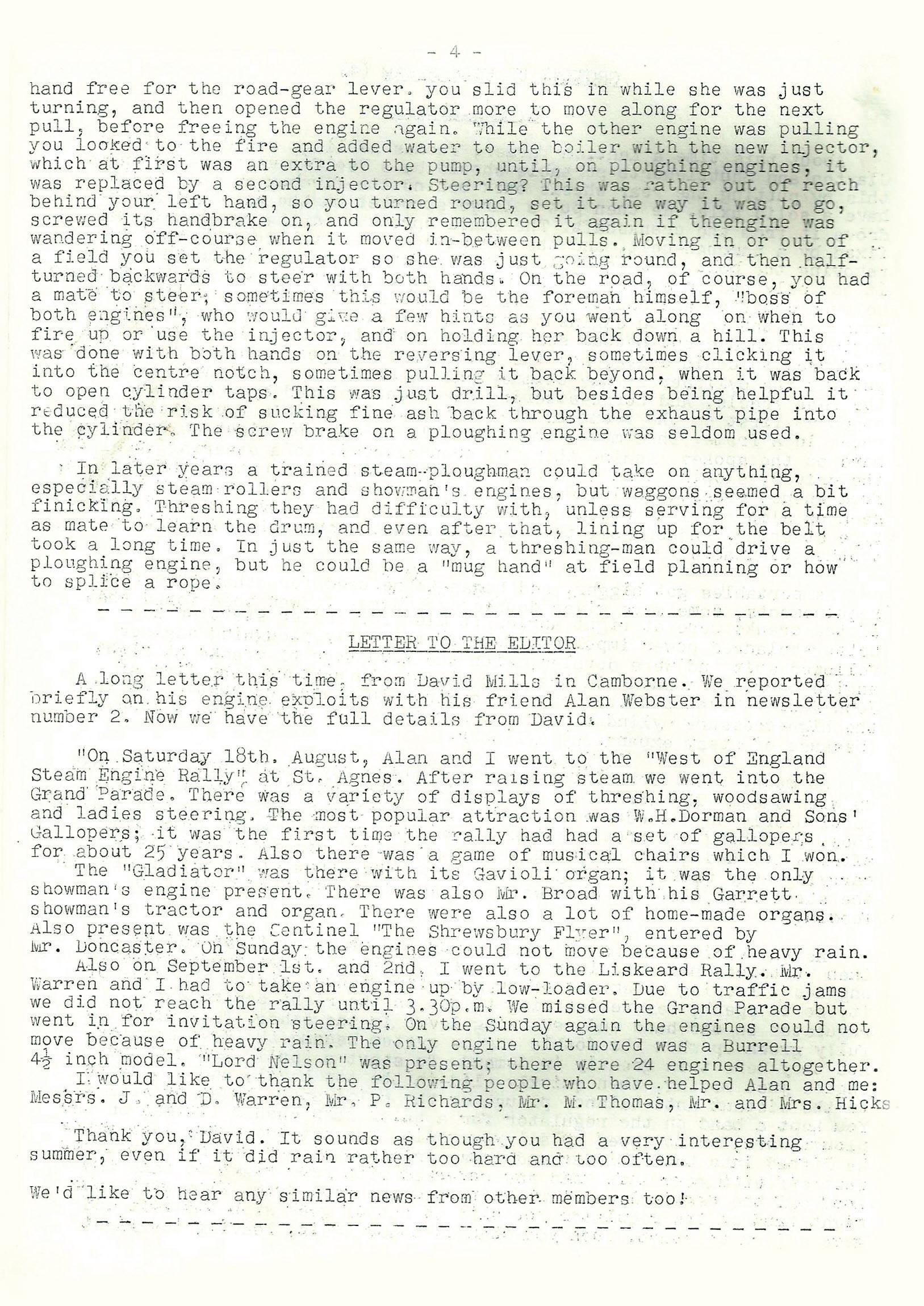
hand free for the road-gear lever, you slid this in while she was just turning, and then opened the regu~ator .more to move along for the next pull, before freeing the engi~e ,'"lgaino ''mile the other engine was pulling you loo~<ed • to the fire and added water to the coj_ ler with the new injector, whj_ch· at first was an extra to the pump, until 1 on plough:P..g engines, it was replaced by a second injeci:,or, Steering? ·rhis ·:!as !'a:.her o:i-:. o:: ~each behind· your.· left hand 1 so you turned round, set it the v.-ay : :. 7!as ~o go, s crev1ed its hand.br2..ke on, and only remembered it again if theer:gi.!1e -_,,as wandering off-cour3e when it mo~ed in-b~tween pulls.,Moving in or 9ut of a field yoG set the ~egulator so she. was just ~ound, and then _halfturned· hcickwards to stee·r with both hands. On the road, of ·course, you had a mate ·t·o s te-er~ s ome•ti mes thi.s i:rnuld be the fore mah himself, 1!bos··s of both e~1g·i.nes ii., who •.rnul1.J' g_;_,:·:.2 a few hj_ntc as you '\/Vent along ·on· when to fire up ar ·use the injector, and on holding her back do~n a hill. This was.done with b6th hands on the rever~ing lever, sometimes clicking ~t . into the centre notch, sometimes pullinz it ba.ck b.eYond~ when tt was back to open cylinder taps. This ~•.1as just dr.ill,. but besides be·in·g helpful it• rtduced • the ·risk of sucking fine ash 'back through the exhaust pipe into • the cyli rr~er-." The screw brake on a ploughing .engine rrns seldom used.
• In lai;,er year:, a t:r-airied st.eam--·pJ.oughma::. c9uld take on anything, especiaJ.ly Steam roller's and 8 hov;:nah I S engines~ but waggons: s_ee,med a bit finickin~, Threshing they had difficulty with, unless serving for a time as mate to· lea~n the dr~m, and even after.that> lining up for_the belt .. took a long time. In just the same way, a threshing-man could drive a p.loL1ghing engine, but he could he a 11mug hand 11 at field planning or how··· to spli~e a rope.
LETTER TO_TBE_El.JITOR
A .l0,1?; lette.r this· time. from David Mtlls in Camborne Vve.r_eported -1)riefly on. his engirtf. e~pl.oi ts with his fri.end Alan Webster in newsletter· number 2. No1i 1i 111e· have ·the full details from David·.
11011. s 9 turday 18th. _August, Alan ar..d I went to the 111.Nest of ~ngland Steam E;hgfne Ra:lly 1 ~. at St, Agnes. After rn 1s i ng steam. we went into the Grand' "Parade. There was a variety of displays of thres·hing~ woods awing. and ladies st~criQg. ~he most- popular attraction .Nas W.H.Dorman and Sons 1 Galloper:_s; it was the first ti!lle the ::c·ally had had a· s.et of galloper;s .. for .2bout 25 Years. Also there ·was - a game of mus,icq;l c·hairs which I won..
• The 11G.lad iator 11 :f!as there ·•.vit h its Gav i oli • organ; it was the only showman's engine present. There was also iv.fr. Broad with,his Gar:r:ett ... showman's tractor and organ. There were also a lot of home-~ade orgape .. .1-1.lsopreseµt was \he Centinel 11The Shrewsbury F'b·er 11 7 entered by • lv.ir. Doncas:ter. uh Sanday: the eng-ir:ies could not rriove because of heavy rain. Also cin Sept~mber.~st. and 2rtd~ I went to the Liskeard Rallyi Warr~iJ. and· I. had to· take··an engine ·up··by .low-:-loader. Due to traffic jams we did not· reach the ~ally unti~ 3.30~.m. We missed the Grand Parade but went i_n_.for invitati'on -steer·ing. On the Sunday again the engines could not ms)Ve bec·ause of.heavy rain·. The ·only engine that moved was a Burrel·l 4J inGh :model. '11Lord J\lelson 11 was present; there were 24 engines altogether. _ ,_r;~ould like to··t~~nk t~e followini people who have.·helped Alan an~ me: Hessrs. J , . $11d ·v. Warren 7 l\ilr, P" Richards, l'vir. .M. Thomas, Mr. and Mrs. Hicks
·.Thank.you,:·vavid. It sounds as though.you had a very·intere.sting s umYner, even if it •did rai 11 rather too •hara and l,oo ot'ten. •
We' a ··1ike to h2ar any· g-imilar news•· from· other. members. too r
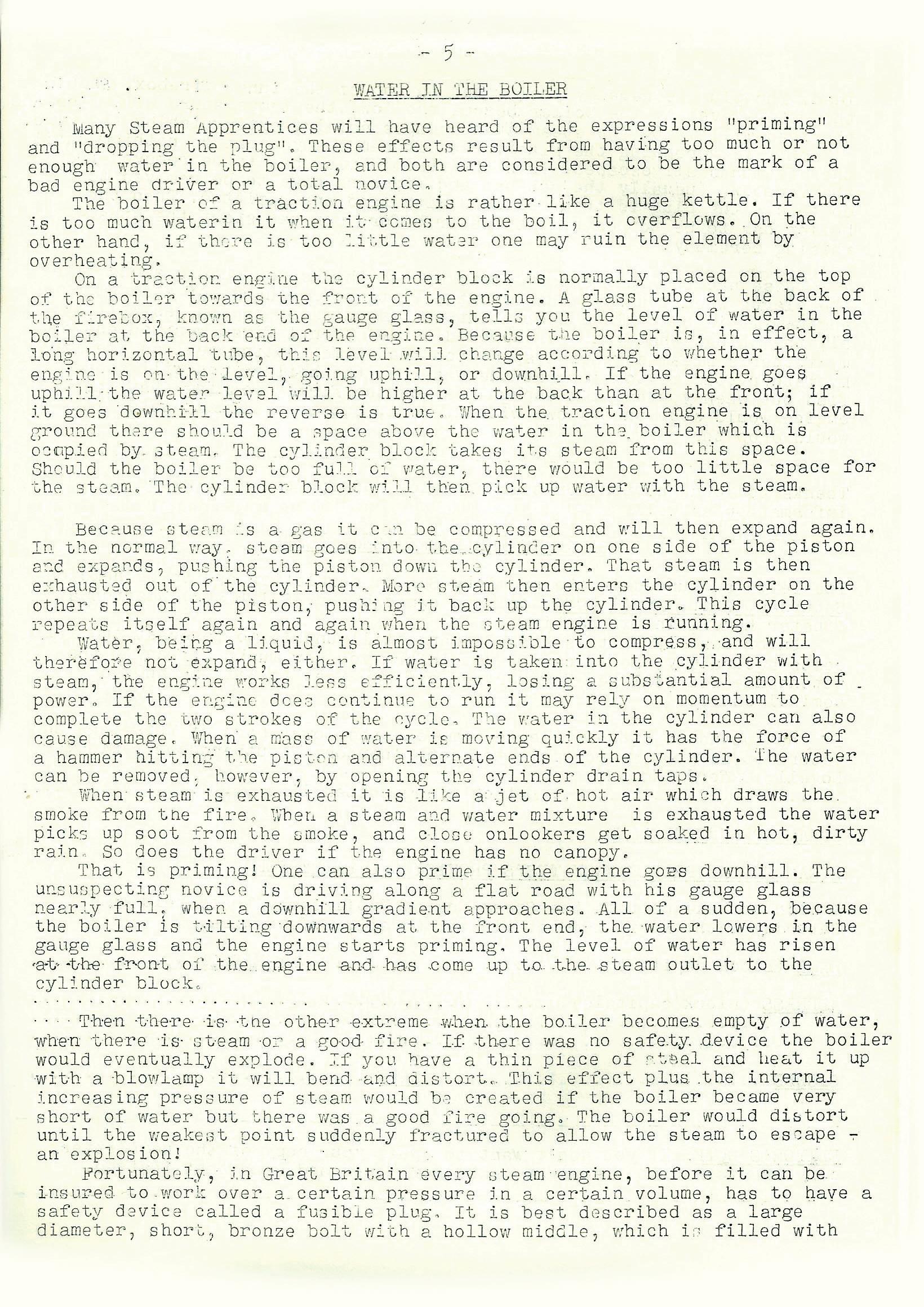
Many Steam ·Apprentices will have heard of the express ions "primi ng 11 and "dropping the ;)lug 11 • These e.ffectf3 result from having too much or not enough water in the boiler, and both are considered to be the mark of a bad engine driver or a total novice.
The boiler o~ a traction engine is rather like a huge kettle. If there is too much waterin it when i.t· ccmea to the boil, it cverflows. _On the other hand, i~ th~re is too :.i~tle wat2r one may ruin the element by overheating.
On a tractio~ eng~ne th2 cylinder block ~s normally placed on the top of the boil0r to~ard; the f~o~t of the engine. A glass tube at the back of the f:retox, tno~n as the ~auge glass, tel13 you the level of water in the bo:1er at the back ~nd a: the e~gice. Bec~~se tne boiler is, in effect, a lo"ng hor5.zontal tPbe, ttis level· .v.r!J.l cr.c1.nge acco1,dj_ng to whethe_r the engino is on the leve~,- going uphill, or downh~ll. If the engine goes uphLl_l-the water· level will be higher at the back than at the front; if 5.t goea dGwrit:i·ll the reverse is trus-. When the. tr-action engine is on level r,rounc! th2re s:J.ou7.d be a ::ipace above th8 water in th?. boiler ·whic.h is o-::1up5.enby. 3tec1rn. The cyL.nder bloclr. takes it.s stear.i from this space. Should the boiler be too ful.~ a: ~ater 7 th~re would be too little space for the st28.m. The cylinde:· b:J.ocl:: w;.LJ. then p:i.c~<::up water with the steam.
Bec?.use c-iter[Y):·.s a gas it c·.:! be compressed and 1.dll then expand again. Ir:. the normal v!ay :· steam e;oes :'.nto t.te cylincer on one side of the piston a~d expa~ds, puching the piston dowu th2 cylinder. That steam is then e:~haust2d out of the cylinder~ More' steam then eD.ters the cylinder on the other side of the pistoni push~ng jt, back up th? cylinder. Jhis cycle repeats itself again and again_when the steam engine is running.
Water, bei.r;.g a lj_quid} is almost i.::nposu;.ble·to compress,,and will thef~fo~e not _expand, either. If water is taken into the cylinder with steal:l, th:e eng;.i1e ~,·orks J.ers E:f:f"ic:i.ent.ly, losing a Gubst.antial amount of pow2r., If the er~.;:'..;.--icdee~ cc,n4:-inns to run it may rely on momentum to complete the two strokes of the r;yclc, T:1e v'ater L1. the cylinder can also cause damage, Vvhen a rr.::iss of ,_,rater j_f: moving quj.ckly it has the force of a hammer hittinJ t~e pict0n and alternate ends of the cylinder. 1he water can be removed; bow2ver, by opening tbe cylinder drain taps.
When steam is exhaus tec1 it is .1:i.1,:e a- jet of. hot air whi eh draws the ,smoke from tne fire" 1'voer.la steam a".ld vmter mixture is exhausted the water pick~ up soot from the smoke, and onlookers get soak~d in hot, dirty rain. So does the driver if thA engine has no canopy.
That is priming! One can also prime if t~e engine goes downhill. The unsuopectine novice is driving along a flat road with his gauge glass· ne2r:'...y full: when a downhill gradient approaches. All of a sudden, because the boiler is tilting downwards at the front end, tha water lowers in the gauge glass and the engine starts priming. The level of water has risen ,a-t· ·t·he fr-on-t o::Cthe .. engine and- has .come up to. .t.he.. steam outlet to the cylj_nder block"
Then ·the-re· i·s· -tne other e-xt~eme .w.hen.the bo i. le.r becomes empty of water, when there ·is· Gt·eam ·o::..-a !3'00d- fire. If .there was no safe.ty .. device the boiler would eventually explode. :::f you Ji.ave a thin piece of r-:,~al and he&t it up with a blowlamp it will bend ~nd distort. This effect plus .the internal increasing pres3ure of steam v·rould b-~ created if the boiler became very short of water but there was.a good fire going. The boiler would distort until the v.:eake,,t point suddenly fractured to allow the steam to es:;ape -:an explosion!
ii'ortunatcly:, 5.n Great Britain every f.,team engine, before it can be insured to.work over a. certain pressure in a certain volume, has to ~ave a safety d2vice called a fu3ibie plug. It is best described as a large diameter, short, bronze bolt w~~h a hollow middle, which i~ filled with
lead. The plug is usually positioned on top of the inner firebox. Should the water level in the boiler become too low, the temperature will rise and the lead will melt. The steam then escapes safely, extinguishing the fire. This :i..s ''dropping the plug 11 • Vlhen it happens you can do nothing until the steam ·has all escaped. Then the fusible plug has to be r~moved from . the fire1?ox; (usually the ash-pan and. firebars have to be removed to do this); the plug is then-refilled with.lead and refitted. Then the boil~r has·to be topped up with water before_you can start the steamraising ceremony.
Th~se are the rudimentary facts of two things you should avoid like the pl~gue when you have the cpportunity to be in charge of a steam engine, It is helpful to know about what should not happen, as well as all the things that you are supposed to do! When I first went on one of rny father 1 s steam engines ·1 spent too much time putting coal on the fire. My father told me to "look at the water in the boiler; you will soon firid out when you haven I t enough coal on: the fire. 11 1vleaning that the engine would ·stop on j_ts own without coal, but that without water it would.drop the plug.
Thanks to John Tiharton for that article, ·and for the next piece of information as well.
The T~sts announced in the previous S.A.C. Newsletter are to be held on Saturjayl 12th. A_2.ri1._l280, on land owned by ivir. S.J ~(Jack) 11Jharton at !!IEnster Lovell •in Oxfordshire.
Unfortunately at this stage we are still unabl_e to forecast the full eosts accurately, so we cannot yet info:i"m y_ou how much, ( if any), the attendance fee will be. However, we can-say that it will be only a nominal charge.,
If y6b intend to ~ttend, please complete the lower part of L~is page and return it as soon as possible to: John Wnarton, 11 :outherndown 11 , Minster Lovell, Oxford ox8 5RD.
Detach along dotted line
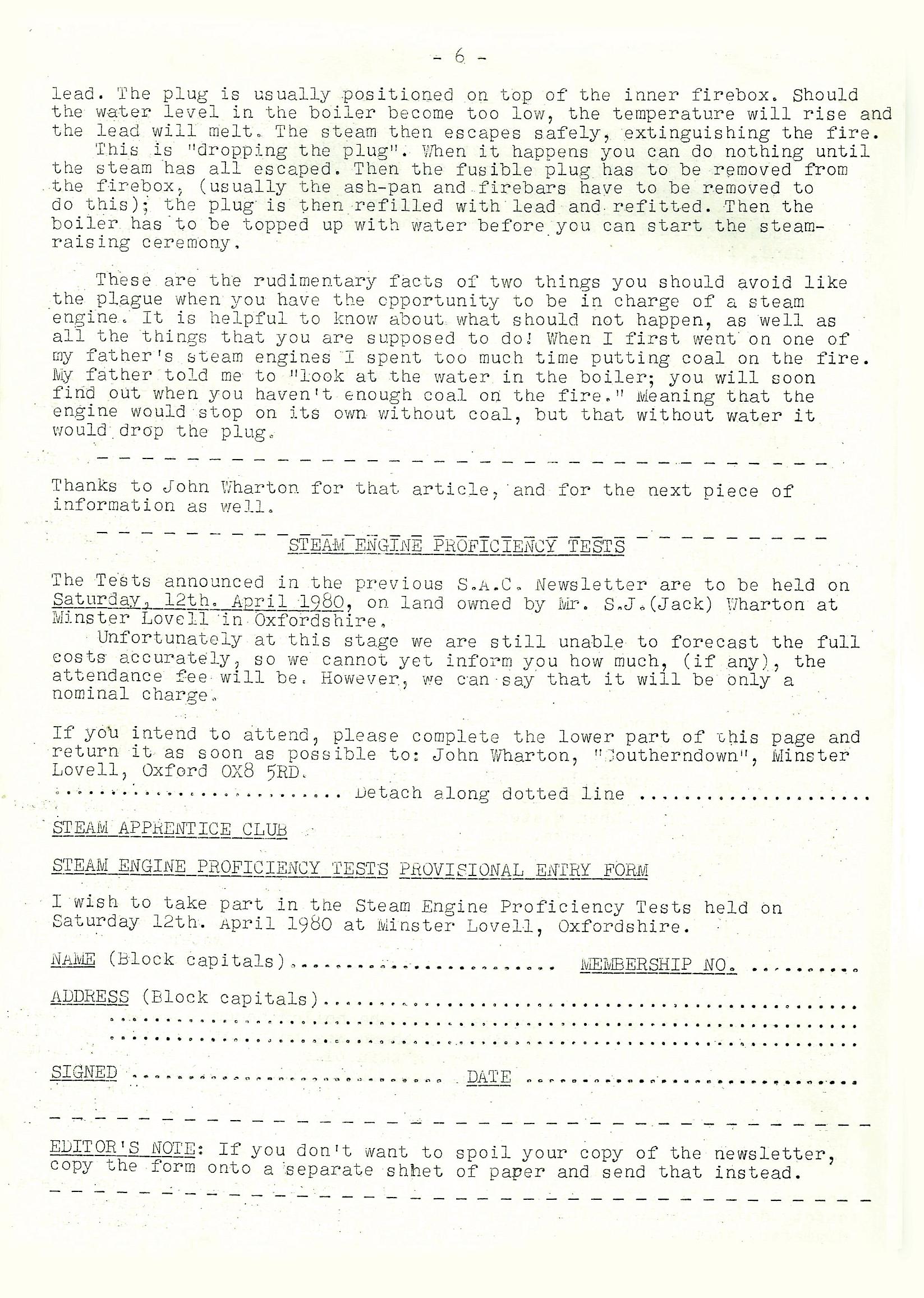
• STEAMAPPriENTICE CLU.b
STEAMENGINE PROFICIENCY TESTS PHOVIfIONAL Ei\Tl'RY FORNI . .
I·wish to take part in the Steam Engine Proficiency Tests held on Saturday 12th. April 1980 at Minster Lovel-1, Oxfordshire. !'{AllJ.I.E(Block capitals)., ....... ~............... J\JIETulBERSHIP.NO... , .. ... ., AJ1!2Irn;§§(Block capitals) ....... ,
EDITOR1 S NOTE: If you don't want to spoil your copy of the newsletter, copy the form onto a :separate shhet of paper and send that instead.
BOOKS
New - Building the Alchin
New- Kaleidoscope of Steam Wagons
New-Steam on .the Road •
Fairground Steam
Traction Engines & Steam Vehicles in Pictures
Foden Story
Scale Model TE Building
Steam Traction Engines Wagons& Rollers
Steam Power in Agriculture
Encyclopaedia of American TEs
Traction Engine Register
Steam Road Vehicles (NTEC Reprint)
Old Farm Tools and Machinery
Garrett 200
Steam in the Village
Garretts of Leisten
Savages of Kings Lynn
The Steam Scene -Val 1
Val 2
Vol 3
Val 4
Vol 5
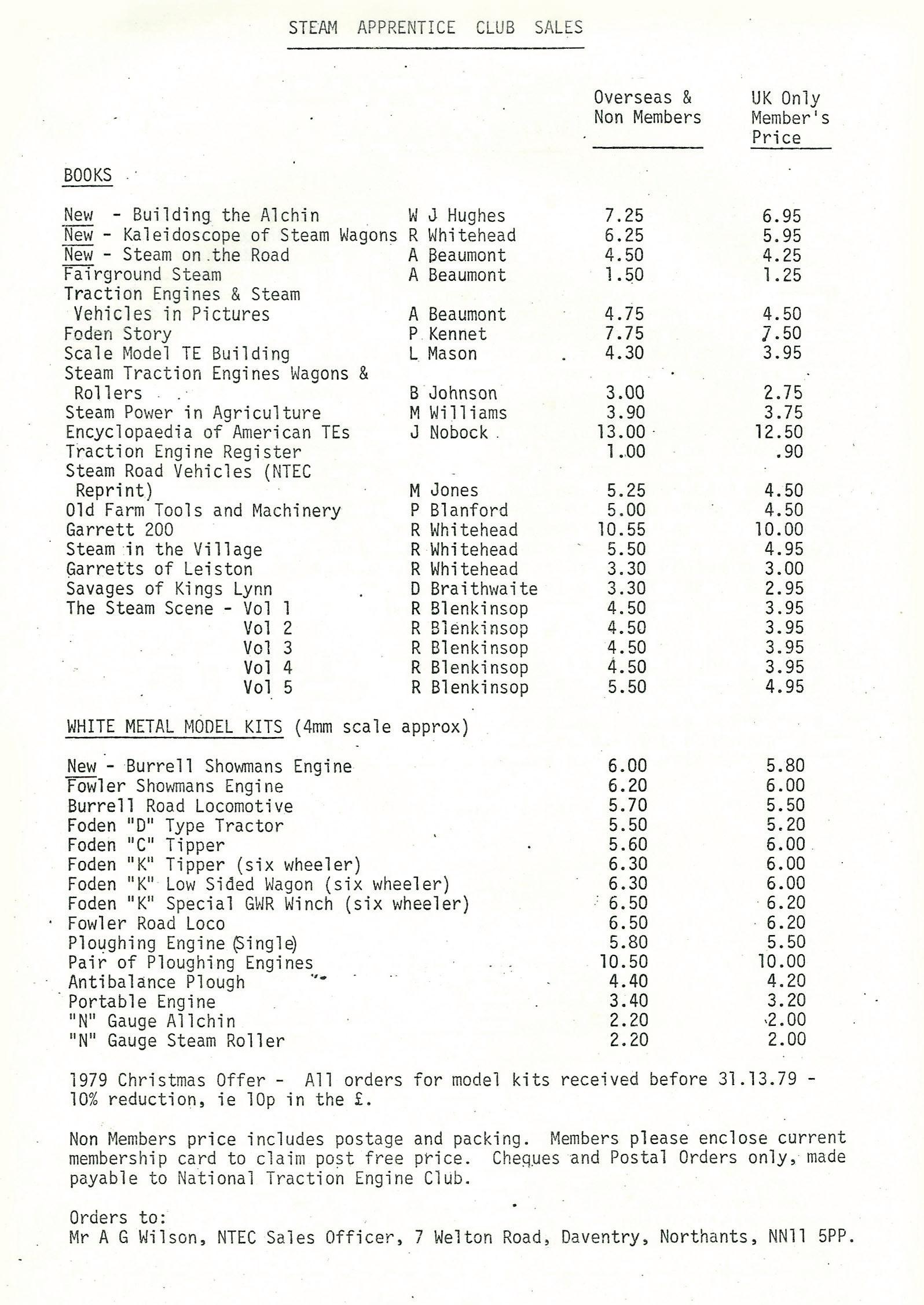
WJ Hughes
R Whitehead
A Beaumont
A Beaumont
A Beaumont
P Kennet
L_Mason
B Johnson
M Wil 1 iams
J Nobock
MJones
P Blanford
R Whitehead
R Whitehead
R Whitehead
D Braithwaite
R Blenkinsop
R Blenkinsop
R Blenkinsop
R Blenkinsop
R Blenkinsop
WHITEMETALMOOELKITS (4mmscale approx)
New-Burrell ShowmansEngine
Fowler ShowmansEngine
Burrell Road Locomotive
Faden 11D11 Type Tractor
Faden 11C" Tipper
Faden "K11 Tipper (six wheeler)
Faden 11K11 LowSided Wagon(six wheeler)
Faden 11 K11 Special Gl.iJRWinch (six wheeler)
Fowler Road Loco
Ployghing Engine ~ingl~
Pair of Ploughing Engines
Antibalance Plough ~-
Portable Engine
11N" Gauge Allchin
11W Gauge Steam Roller
1979 Christmas Offer - All orders for model kits received before 31.13.7910%reduction, ie lOp in the£.
Non Membersprice includes postage and packing. Membersplease enclose current membership card to claim post free price. Cheq~es and Postal Orders only, made payable to National Traction Engine Club. Orders