
No. 3. Cctober 19790
Dear Apprentice,
Octqber s~es the end of the rally season, but it certainly finishes with a bang! The one r2lly th2t every ste~m enthusiast must go to is Stourpaine, which takes place annually at the end of the month, usually coninciding with the h2lf--term weekend. By the time you get this newsletter, this year's Great Working of Steam-Engines will be over, but it-isn't too early to start making plans for next year. Apart from being a magnificent show, with engines doing every conceivable type of work, it is the best place I know f~r having a· real opportunity t~ talk to engine men. - Everyone seems.more relaxed at the end of the season.
Engines don't just go to sleep in the winter. If you work regularly with an owner y0u will know that winter is the time fof maintenance, for major overhauls, and repainting. This is a marvellous way-.to get to know exactly what goes on inside the engine. If you get the chance.to help, take it -even if you spend a lot of time m2king teao That is how the old apprentices started. Few uwners can resist the temptation to explain exactly what everything is, and how it works, to someone who is really keen to learn and prepared to help. We do get the occasional offer to show a stripped engine to interested apprentices; if any come through this year I will pass tnem on.
Membership has been growing steadily throughout the summer, and -there are now 82 apprentices - very good for our first year. The more members we have, the.better the club.will be, so do find out whether any of your friends. ·would like to join. It is worth pointing out that if they pay now,. they remain members right through until the end of 1980, 2111 for £.L Membership makes ;:i good Christmas present too:
Yours sincerely,
Editor.
IMPORTANT CHANGE OF ADDRESS. From 1st. NOVEMBERthe EDITOR'S ADDRESS will be: 8 Newburgh Road, Acton, London W3.
NEWS FROM AMERICA.
The July/August issue of nThe IrJn Man Album • Magazine· mentions the formation of the S.A.C. and suggests that it might be of interest to Americans as well. The American scene certainly fascinates us . they have a lot of engines out there, several makers almost entirely unknown in Britain, and some really odd looking outfitso If anyone would be interested in writing to a young American enthusiast please let the Editor know, ~nd we'll see whGt we can arrangeo
LETTERS FROM MEMBERS.
There has been quite a crop of letters this time, some with interesting idea. First~ Mark Page from Fareham, Hants:
I have enjoyed both of my newsletters so far. I liked the article C-':!lled 'All The Fun of the Fair" because I have been to an ell -ste2rn fai~ in Britain. It holds some marvellous exhibits of fairground equipment. Just to mention a couple of things:. The Steam Yacht Neptune. This ride is powered by a Burrell single·crank. The Cake Wal~. This walk ride is named after a Boston Negro· dance with a cake as the prize at the end. The Cake Walk itself is the last remaining one in existence. The Roundabout. One of the few steAm gallopers left·, or Three Abre0.sts 1 • It was built by W2lkers of Tewkesbury in 1920 for the Rogers family, showmen of Chipping • Sodbury, round a Tidman centre of about 1910.
I recommend this place to all Steam Apprentices. It is called HOLLYCOMBEs·TEAM FAIR, and it is 1-t miles from the A3 nn the. Liphook-Midhurst road, at Hollycombe, Liphook, Hants. This is a very worth• while place to go.
Thank you Mark, and thanks for the recommendation~ It sounds like a good family outing for next summer. Now, part ~f the letter from Martin Bozson who lives in Warrington, Cheshire:
In future newsletters there shL1uld be one or two reports 0n rallies, perhaps sent in by members of the S.J...C. Alsc I w0uld like to see in every newsletter how many members there are, because I am only the 29th member and I would like to see how the club is growing.
Your second r_eques t is answered this time in the Editor's letter Martin, and your first idea is a very good one. If members will send us reports or reviews of any rally that they have been to and particularly enj~yed, we will put them in the newsletter. It should help Apprentices decide where to go next year, and perhaps we can produce a •·Good R?lly Guide·. It helps the R2lly Organisers too, if they know which events and exhibits were particularly popular, so we will pass any useful comments on to them. Remember to tell us if any rally is especially friendly to Apprentices!
•·STEAM SUPREME' .
-· The Wh~rton family are holding their second Stearn Supreme•· event on 3rd and 4th November 1979. It is an end-of se~son event where the Wharton steam engines can be viewed in various stages of restoration. Engines in_ steam will include Supremen, : King George VI': and a Marshall traction engine which has never been rallied and is under restoration, plus a selection of engines invited to the event.
• ·steam Apprentices. are .welcome and can expect FREE ENTRY with a membership card.
Apart from steam engines there will be vintage tractors, barn engines, vintage vehicles, plus i3 large fuirground ride. Stalls and refreshments compiete the line ~p.
Anyone wishing to exhibit any item is welcome and should contact Mr. S.J. Wharton at "Southerndown 1 ·, •Minster Lovell, Oxford OX8 SRD.
nsteam Supreme· will take plF.1ce at Linster Lovell.
PHOTOGRAPHIC COMPETITIONo
Results will be published_ in the next (December) issue of the newslettero
When the SoA.Co was formed, we intended to arrange special events for Apprentices to help them become more familiar with engineso We are now able to announce the first event;
STEAM ENGINE PROFICIENCY TESTSo
·11e are planning to organise 1 ·Steam Engine Driving and Steering Proficiency Tests·', exclusively for the members of the SoA.Co It is hoped to hold this event in April 1980, probably on land owned by Mro SoJo (Jack) Wharton in Oxfordshire, and we hope that in time we will move around Great Britain for the convenience of all memberso
Unfortunately only those aged 17 or over can be insured to drive 2 steam engine, but we will also be running 'Steering Proficiency Tests .. and ''General and Maintenence Tutorials•· that under 17s can attend.
At all times when steam engines are moving an experienced steam engine driver will be on the footplate to give continual advice and instruc~ion. This is also A requirement of insurance.
=t is hoped to hold all the tests on one day, probably a' Saturday. Parents and friends would be welcome. Should numbers be go~d encugh, a refreshment van will be booked for the day; otherwise it wi:: have to be a picnic and sandwiches day. Costs basically will
be coal and insuranceo We are trying to get a sponsor to pay for ·this, but a ~o~inal fee may have to be charged. We do not want to use all the ~L~ited funds of the Club at such an early stage!
Y.r. Wharton has offered the use of three engines for the S.A.C. S~eam Proficiency Tests:
Marshall 7hp traction engine No. 41151, built 19050 Allen/Fowler 10 ton roller Noo 3/8111, built 19050
3urrell 6hp showman's engine King Geurge VI'' No. 3489
d~y should be in three secti0ns: 1. GE.NERJ....:....:.NOt--..AINTENANCETUTORIAL o built 19130
This is ~11 Steam Apprentices,and will be given to a series ~f small groups. =n this way Apprentices would find it easier and less embarrsss:..r.s to ask questions_o There will probably be some Apprentices p=-eser:~ .,·he have already had quite 2 lot to do with steam engines, wr.i:e ~t the same time there will be others who have only admired the e~cines 2nd went to start from scratch -and even to get on one. In consequence, small groups will encourage anyone not sure of somethin~ ~cask without feeling that it is a silly question, and everyone w~ll feel more at homeo
The tutor~al will probably follow thses lines:
a) How a ste2rn engine works, general fundamentals using diagrams and the =ull-sized engine to expl~ino
b) What to know before you drive~ steam engine; to include such items as:
i) Lubrication: what to oil or grease, what oil to use, when to oil, why you oilo
ii) Water gauges: what they do, what all those handles are for, how to blow steam through a g~uge gl~ss, why some steam engines have two water gaugeso
c) Maintenance: to include the following and more:
i) Glands: how to tighten them, how to repack them, when to repack them, why there are glands at allo
c) cont'd .. oo
ii) Gaskets: wh2t?. gasket does, why there are different types, how to make some types of g~sket, how ti fit gaskets, the sea:ing compounds to use with gasketso
d) ?ractica: experience: s short session on ''King GeorgeVI'· which will be stationary generating power for its own lights. Th1s will be for general interest and to appreciate:
1) Keeping steam pressure constnnto
ii) The level of water in the boiler.
iii) The use of an injector to put water in the boilero (Unfortunately KGVI has no pump).
iv) The use of the ~shpan damper.
v) Tending the fire. There is more to i~ than just putting coal on!
2. STEAM ENGINE STEERING PROFICIENCY TEST.
For Apprentices under the age of 170 It is proposed to take in the following:
a)···· Getting used to the fr.ict that it does not steer like a car, and why you should never let go of th2t handle on the steering wheel.
b) A comprehensive obstacle course requiring effort and con- centration not speed.
c) The pulling 2nd pushing of a trailer. This is that little something that sorts a few ;out. But do not lose faith -more, than half the car?vr1n owners of Great Britain cannot reverse a caravan-to srive their livesl
3. STEAM ENGINE DRIVING PROFICIENCY TEST.
For Apprentices aged 17 and over. It is proposed to take in the following:
a) Total familarisation of controls.
b) Driving exercises.
c) Setting 2 traction engine to a threshing machine.
d) Coupling d traction engine to~ trailer.
e) How to roll a ror.id with a road roller.
It must be stressed that this is a provisional plan. Mr.Wharton has forecast that ell steam engines and equipment will be ready by April 1980 to undertake each of the activities mentioned, and hopefully a few extra exercises as well. Should any equipment not be ready it may be necessary to alter the programme accordingly.
If everything goes according to pian, it will be a full day. The key words will be "Enjoyment' and 'Enlightenment';.
Obviously I will need someone to help me. Already I have offers of assistance from Esmond Kimbell, Ran Hawthorne and my father, Jack Wharton. I am still looking for suitably qualified people who can assist in talking to Apprentices on and off the engines, and also others to act as marshalls and carry out other duties (including keeping a coal and water supply to the engines). -,·
The insurance situation and the cost (if any) to Apprentices should be known in the near future. We emphr1sise that this event is for members of the Steam Apprentice Club only; non-members cannot participate.
In the next newsletter there will b~ an entry .form for those wishing to tr1ke part in the i•steam Engine •"Proficiency Tests i • There will be?. closing date for the return of the f0rms as information is required by the insurers before the event.
We hope the response is good, ?S this is one step towards seeing ster'lm engines preserved in the proper-.·w?y in future years.
We are grateful to John Wharton for his help in this ventureo If any of the Apprentices h~ve parents, friends or relstions who would be willing to help with this event, would they please let John·know as soon as possible (address as in 'Stenm Supreme;· article~ 0 Look out for more details next time 2nd please remember to renew your subscription.
GROWINGUP WITH STEAM
(3) by E. E. Kimbell.
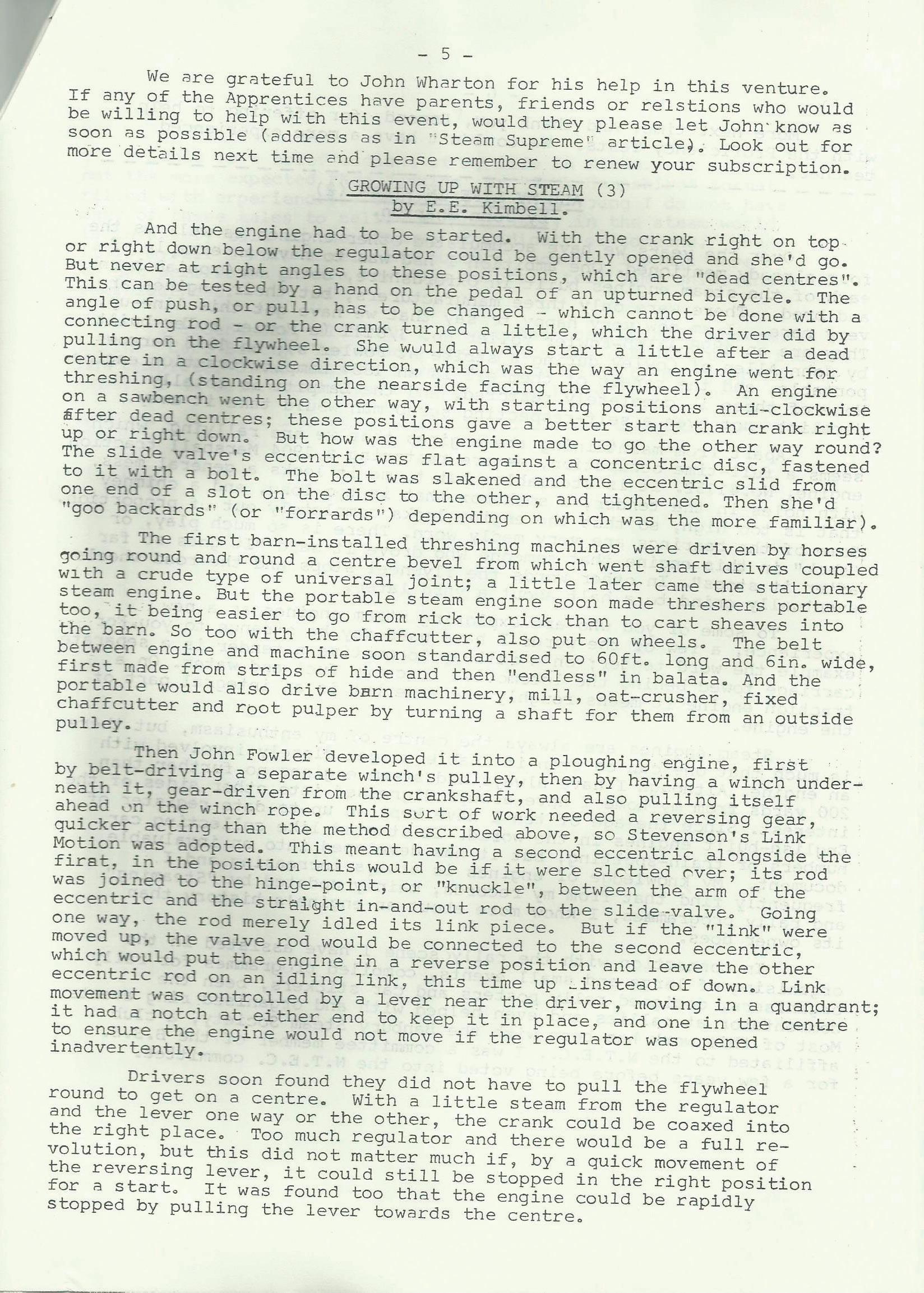
And the engine had to be started. With the crank right on topor right down below the regulator could be gently opened and she'd go. But never at right angles to these positions, which are "dead centres". This can be tested by a hand on the pedal of an upturned bicycle. The angle of push, or pu:1, has to be changed - which cannot be done with a connecting rod - or the crank turned a little, which the driver did by pulling on the flywheelo She wuuld always start a little after a dead centre in a c:ockwise direction, which was the way an engine went for threshing. (standing on the nearside facing the flywheel)o An engine on a sawbench went the other way, with starting positions anti-clockwise fifter dead centres; these positions gave a better start than crank right up or right downo But how was the engine made to go the other way round? The slide valve's eccentric was flat against a concentric disc, fastened to it witr. a bolt. The bolt was slakened and the eccentric slid from one end of a slot on the disc to the other, and tightenedo Then she'd "goo backards 1 ' ( or ''forrards") depending on which was the more familiar).
The first barn-installed threshing machines were driven by horses gcing round and round a centre bevel from which went shaft drives coupled with a crude type of universal joint; a little later came the stationary steam engineo But the portable steam engine soon made threshers portable too, it being easier to go from rick to rick than to cart sheaves into the barn. So too with the chaffcutter, also put on wheels. The belt between engine and machine soon standardised to 60ft. long and 6in. wide, first made from strips of hide and then "endless" in balata. And the portable would also drive barn machinery, mill, oat-crusher, fixed chaffcutter and root pulper by turning a shaft for them from an outside pulley.
~hen John Fowler ·developed it into a ploughing engine, first by belt-driving a separate winch's pulley, then by having a winch under- neath i~, gear-driven from the crankshaft, and also pulling itself ahead , ·n the winch rope. This svrt of work needed a reversing gear, quicker acting than the method described above, so Stevenson's Link Motio~ was ad~pted. This meant having a second eccentric alongside the firat, i~ the position this would be if it were slctted ~ver; its rod was joined to the hinge-point, or "knuckle", between the arm of the eccentric and the straight in-and-out rod to the slide-valveo Going one way, the rod merely idled its link pieceo But if the "link" were moved up, the valve rod would be connected to the second eccentric, which would put the engine in a reverse position and leave the other eccentric rod on an idling link, this time up _instead of down. Link movement was controlled by a lever near the driver, moving in a quandrant; it had a notch at either end to keep it in place, and one in the centre to ensure the engine would not move if the regulator was opened inadvertently.
Drivers soon found they did not have to pull the flywheel round to get on a centre. With a little steam from the regulator and the lever one way or the other, the crank could be coaxed into the right placeo Too much regulator and there would be a full re- volution, but this did not matter much if, by a quick movement of the reversing lever, it could still be stopped in the right position for a starto It was found too that the engine could be rapidly stopped by pulling the lever towards the centreo
- G -
More next timeo A~d thank you, Esmond, for offering to help with the Proficiency Testso We couldn't have a more experienced teachero - - - - - - -- - - -
ALL MY
LIFE IN STEAM(¾)
~-~-~Sohn -Whar-to no
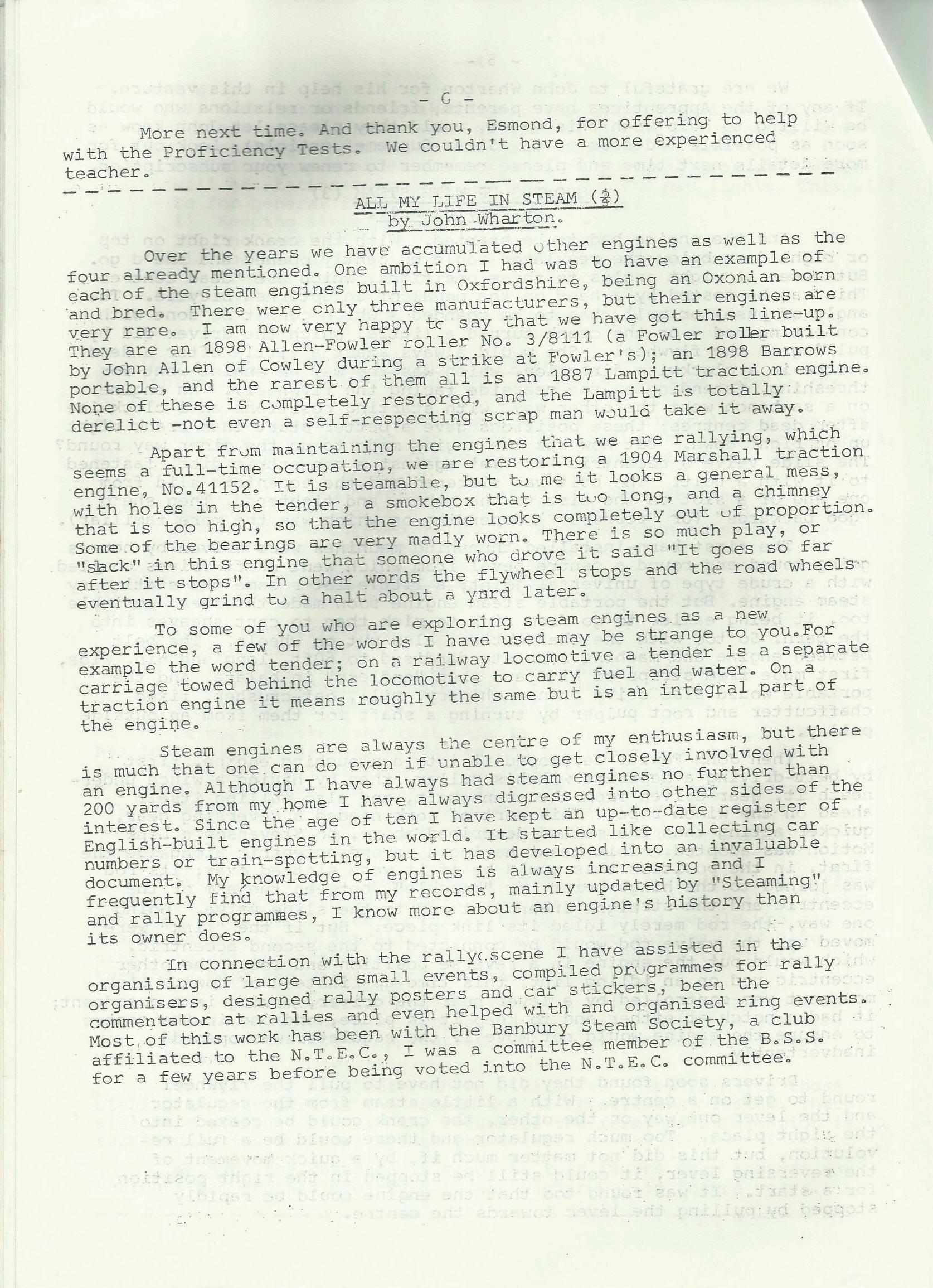
Over the years we have accumul"ated uther engines as well as the four already mentionedo One ambition I had was to have an example of each of t:he steam engines built in Oxfordshire, being an Oxonian bo·rn ·and bredo There were only three manufacturers, but their engines are ~ery rareo I am now very happy tc say that we have got this line-upo They are an 1898·Allen-Fowler roller Noo 3/8111 (a Fowler roIJer built by John Allen of Cowley during a strike at Fowler's); an 1898 Barrows portable, and the rarest of them all is an 1887 Lampitt traction engineo Nope of these is c0mpletely restored, and the Lampitt is totally· derelict -not even a self-respecting scrap man WJUld take it away.
Apart frum maintaining the engines t~at we are rallying, which seems a full-time occupation, we are restoring a 1904 Marshall traction engine, Noo41152o It is steamable, but tv me it looks a general mess, with holes in the tender, a smokebox that is tuo long, and a chimney that is too high, so that the engine looks completely out vf proport~ono Some of the bearings are very madly worn. There is so much play, or "slack" in this engine that someone who drove it said "It goes so far after it stops II o In other words the flywheel stops and the road wheels· eventually grind tv a halt about a ynrd latero
To some of you who are exploring steam engines. as a new experience, a few of the words I have used may be sq:-ange to youoFor example the word tender; on a railway locomotive a tender is a separate carriage towed behind the locomotive to carry fuel ~nd water. On a traction engine it means roughly the same but is an integral part.of the engir1eo
Steam engines a:re always the centre of my enthusiasm, but there is much that one.can do even if unable to get closely involved with an engineo Although I have always had steam engines no further than 200 yards from my home I have always digressed into other sides of the interesto Since the age of ten I have kept an up-to--d·ate register of English-built engines in the worldo It started like collecting car numbers or train-spotting, but it has developed into an inyaluable document~ My knowledge of engines is always increasing and I frequentiy find that from my records, mainly updated by "Steaming'.' and rally programmes, I know more about an engine's history than its owner does o
In connection with the rally<. scene I have assisted in the organising of large and small events, compiled pn ..,grammes for rally organisers, designed rally posters and car stickers, been the commentator at rallies and even helped with and organised ring eventso Most.of this work has been with the Banbury Steam Society, a club affiliated to the NoToEoCo, I was a committee member of the BoSoSo for a few years befor·e being voted into the NoToEoC. committeeo
This is a brief account of my life in steam. It is not the more expected "Ken Judkins•· or "Jack Hampshire" format filled with erperienceso Obviously as I am y~ung I do not have many of these tales to tello A funny story in the stEam world is invarably told at the expense or ridicule of someoneo When it is myself I will unveil the humour; however I shall have to get permission from a few folk before I tell some unfortunate reminiscenceso
Incidentally, althmugh I have owned that Burrell showman's engine "Earl Beatty" for twenty five years the restoration is still not completeo Other engines have taken the majority of my spare timeo I am determined that one day I shall see it finished.
BOOKS
New - Building the Alchin
New- Kaleidoscope of Steam Wagons
New-Steam on .the Road •
Fairground Steam
Traction Engines & Steam Vehicles in Pictures
Faden Story
Scale Model TE Building
Steam Traction Engines Wagons& Rollers
Steam Power in Agriculture
Encyclopaedia of American TEs
Traction Engine Register
Steam Road Vehicles (NTEC Reprint)
Old Farm Tools and Machinery
Garrett 200
Steam in the Village ~arretts of Leiston
Savages of Kings Lynn
The Steam Scene -Vol 1
Vol 2
Vol 3
Vol 4
Vol 5
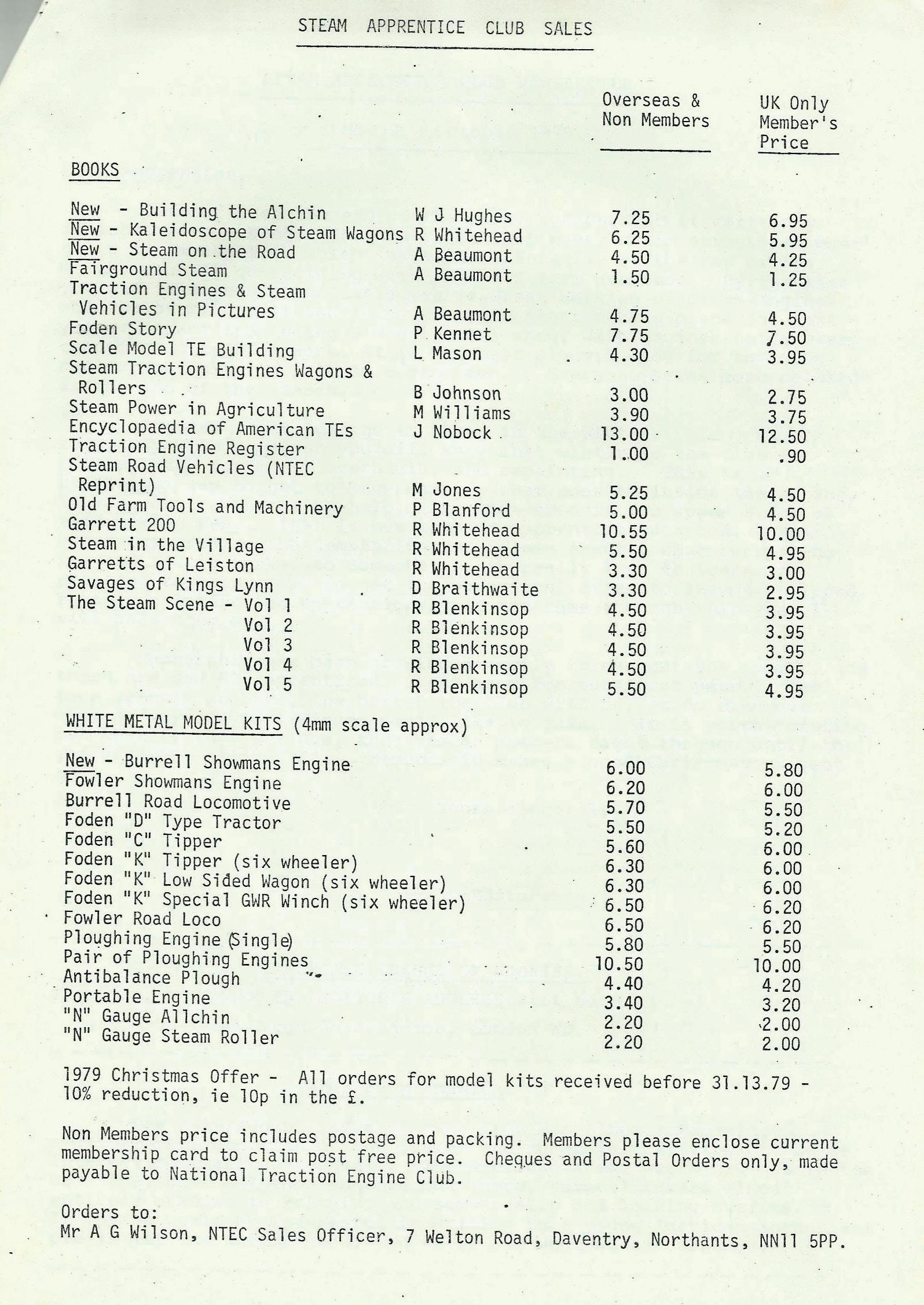
WJ Hughes
R Whitehead
A Beaumont
A Beaumont
A Beaumont
P. Kennet
L.Mason
B Johnson
M WiJ1i ams
J Nobock.
MJones
P Blanford
R Whitehead
R Whitehead
R Whitehead
D Braithwaite
R Blenkinsop
R Blenkinsop
R Blenkinsop
R Blenkinsop
R Blenkinsop
WHITEMETALMODELKITS (4mmscale approx)
New- -Burrell ShowrnansEngine
Fowler ShowrnansEngine
Burrell Road Locomotive
Faden 11011 Type Tractor
Faden "C" Tipper
Faden "K" Tipper (six wheeler)
Faden "K" LowSided Wagon(six wheeler)
Faden 11 K11 Special Gv/RWinch (six wheeler)
Fowler Road Loco
Ployghing Engine ~inglaj
Pair of Ploughing Engines
Antibalance Plough ~-
Portable Engine
11N1'Gauge Allchin
11N11
1979 Christmas Offer - All orders for model kits received before 31.13.7910%reduction, ie lOp in the£.
NonMembersprice includes postage and packing. Membersplease enclose current membership card to claim post free ptice. CheqijeSand Postal Orders only, made payable to National Traction Engine Club.
Orders to:
Mr AG Wilson, NTECSales Officer, 7 Welton Road, Daventry, Northants, NNll 5PP.