www.railpro.co.uk
THE BUSINESS RESOURCE FOR RAIL
NOVEMBER 2026 | ISSUE 327 | £7.95
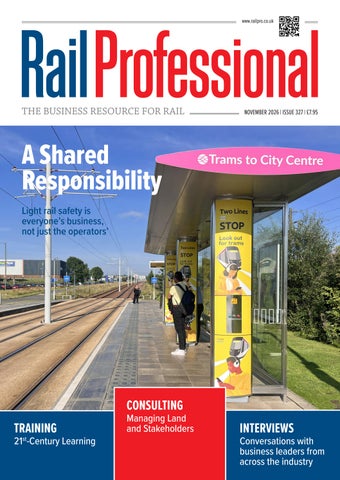
A Shared Responsibility Light rail safety is everyone’s business, not just the operators’
CONSULTING TRAINING
21st-Century Learning
Managing Land and Stakeholders
INTERVIEWS
Conversations with business leaders from across the industry
Safety tailored solutions, designed with your employees and their wellbeing in mind With over three decades of safety-critical expertise, the OPC delivers bespoke solutions that strive to improve people performance, identify talent and nurture a safer culture.
Our expert psychologists help to: Discover top talent through specialised recruitment support and role profiling.
Improve performance using Non-Technical
Skills and safety initiatives.
Develop best practices, stand-out safety
leaders, and deliver post-incident support for a safer culture. Partnering with the OPC means collaborating with a dedicated team focused on safety and people performance. Trust us for tailor-made solutions from pre-selection to employment. We prioritise safety and strive to enhance your processes to go beyond industry standards.
Email us today
to see how we can help enhance your performance
admin@theopc.co.uk 2
+44 (0)1923 234646 www.theopc.co.uk One Wellstones, Watford, WD17 2AE
www.railpro.co.uk
THE BUSINESS RESOURCE FOR RAIL
NOVEMBER 2026 | ISSUE 327 | £7.95
A Shared Responsibility Light rail safety is everyone’s business, not just the operators’
EDITOR’S NOTE
CONSULTING TRAINING
21st-Century Learning
Managing Land and Stakeholders
INTERVIEWS
Conversations with business leaders from across the industry
railprofessional @railpromag
PUBLISHER RAIL PROFESSIONAL LTD Lakes Innovation Centre, Lakes Road, Braintree, Essex, CM7 3AN
EDITORIAL EDITOR Sam Sherwood-Hale editor@railpro.co.uk DISPLAY ADVERTISING Jamie Tregarthen sales@railpro.co.uk RECRUITMENT ADVERTISING recruitment@railpro.co.uk SUBSCRIPTIONS subscriptions@railpro.co.uk ADMINISTRATION Cherie Nugent info@railpro.co.uk Lisa Etherington admin@railpro.co.uk DESIGN & PRODUCTION Lukasz Saczek production@railpro.co.uk
COVER LRSSB
Rail Professional welcomes contributions in the form of articles, photographs or letters, preferably by email. Original photographs may be submitted, but, while every care will be exercised, neither the editor nor the publisher take responsibility for loss of, or damage to,
It has long been the railway’s habit to answer every difficulty with a strategy, and every strategy with another, so it was refreshing to find A Checklist for Rail Strategies from the Railway Industry Association (RIA) on my desk this month. Developed through RIA’s Rail Strategies Working Group with input from across the industry and Government, it offers a practical sense-check for anyone commissioning, producing or updating rail strategies as Great British Railways is created. Rather than passing judgement on existing strategies, it sets out questions under six ‘lenses’, running from outcomes and the service proposition through to enablers, capabilities, accountability and the coherence of the strategy suite as a whole. RIA’s point is that the growing family of national, regional and local strategies will not automatically add up to a coherent programme, and that they need to be living plans that drive action, with responsibility matched by authority, rather than documents left on the shelf. This is also our training issue, and people run right through it. Paul Davison of PPWD Consulting looks at the shift from prescribed hours to demonstrated competence in train driver training and what the railway should take from Ladbroke Grove as it makes that change, while Aston University sets out its new MSc in Transport Leadership. We also have a bumper run of interviews this month. Laura Hedley of the Occupational Psychology Centre explains what safety culture really means and Iain Prince of Cablecraft talks about crimp training, tool calibration and being audit-ready. Leon Bowler of Qualitrain discusses embedding Lean in rail maintenance and the training pipeline the industry needs as its workforce retires, and Shane Seaton of Seaton Rail covers keeping training consistent across locations and getting possession planning right. On safety, RSSB sets out how the industry is building a clearer picture of overspeeding following the Spital Junction incident, Carl Williams of the LRSSB reports a 27 per cent fall in fatality and injury risk on UK tramways and Matt Showan of Maccaferri explains what ISO/TR 18228-8:2026 means for rail earthworks. Looking ahead to GBR, Mike Weston of EJS Consulting talks about closing the gap between strategy and delivery and Ian Jeffrey of Great British Rail Replacement argues that passengers will judge the new organisation on how it handles disruption.
material sent. Submission of material to Rail Professional will be taken as permission for it to be published in the magazine and online. ISSN 1476-2196
SAM SHERWOOD-HALE EDITOR
© All rights reserved. No part of this magazine may be reproduced or transmitted in any form or by any means, electronic or mechanical, including photocopying, recording or by any information storage and retrieval system, without prior permission in writing from the copyright owners. The views and opinions expressed in this publication are not necessarily those of the publisher, nor does it accept liability for any printing errors or otherwise which may occur.
3
RIA Innovation Conference 2027 Delivering Value from Innovation Investments 23-24 March Royal Armouries Leeds The RIA Innovation Conference returns in 2027 to focus on a critical industry priority: driving tangible financial and operational value from innovation investments. Aligned with our Unlocking Innovation Programme — Innovate | Accelerate | Deliver — the RIA Innovation Conference will this year explore how the sector transitions from early concepts to fully deployed, scalable solutions that deliver long-term benefits. Interactive sessions and structured networking will create opportunities to: Engage directly with clients, prime contractors, and supply chain partners Contribute to industry-wide discussions on removing barriers to innovation adoption Explore strategic partnerships and build new commercial relationships Invest in a sponsorship or exhibition package to ensure your business is front of mind for key-decision makers.
Scan the QR code to register today or visit 4
www.riagb.org.uk/RIC27
CONTENTS | ISSUE 327 | NOVEMBER 2026
In this issue 8
NEWS
23 VIEWPOINT
All the latest from Great British Railways, Alstom, Supertram, West Midlands Metro and more
Ian Jeffrey, Director of Great British Rail Replacement (GBRR), part of CMAC Group, on why passengers will judge Great British Railways on delivery and how disruption management can show that reform is working
INTERVIEW
10
16 19
21
Sam Sherwood-Hale spoke to Laura Hedley, Head of Consultancy and Talent Services at the Occupational Psychology Centre (OPC), about what safety culture really means, why it matters so much in rail and where psychology fits in LAYING DOWN THE LAW Understanding the Changes to Workplace Harassment Rules VIEWPOINT Hari Prasad Govindarajan, Chief of AI & Transformation at DXC UK&I, on moving AI from pilots to everyday performance on the railway SAFETY Following the Spital Junction incident, the industry is building a better understanding of where overspeeding occurs, what contributes to it and whether existing controls are enough to manage the risk
24 TRAINING
Sam Sherwood-Hale spoke to Iain Prince, Head of Sales at Cablecraft, part of Shoal Group, about crimp training, tool calibration and what audit-ready looks like for rail customers
29 TRAINING
With Great British Railways reshaping Britain’s railways, Aston University’s new MSc in Transport Leadership is designed to help transport professionals step up into leadership roles
30 TRAINING
Paul Davison, Founder of PPWD Consulting, explains why 21st-century rail requires 21st-century learning, and why the move from prescribed training hours to demonstrated competence is an opportunity to rethink how people develop throughout their careers
34 CONSULTING
Theresa Tschainer and Sam Dobney, Partners at Bruton Knowles, explain how early engagement, careful record-keeping and realistic programming cleared the land and statutory path for the UK’s first GBR-branded station
21st CENTURY SURVEYING SOLUTIONS FOR THE RAIL INDUSTRY For more information visit www.abasurveying.co.uk or call 01483 797111
5
LIFTING
SERVICING
TRAINING
RAIL INSPECTION PITS
MOBILE RAIL LIFTING JACKS
INCREASE PRODUCTIVITY SAFE
HEAVY DUTY
QUALITY LIGHTING
SYNCHRONISED RELIABLE
For more information or to request a site visit:
Elevated thinking, underground For more than 25 years, Gall Zeidler Consultants has delivered worldclass tunnel consultancy and design services. Our specialists apply state-ofthe-art construction and rehabilitation methods, combining proven technologies with innovative solutions to create exceptional results for our clients. With more than 580 kilometres of tunnels completed across the globe, we are trusted leaders in our field. We see challenges not as risks, but as opportunities — to innovate, to excel, and to redefine what’s possible underground.
London . Washington DC . New York . San Francisco . Toronto Salzburg . Santiago de Chile . New Delhi . Singapore . Adelaide
www.gzconsultants.com 6
CONTENTS | ISSUE 327 | NOVEMBER 2026
36 CONSULTING
Sam Sherwood-Hale spoke to Mike Weston, Founder of EJS Consulting, about closing the gap between strategy and delivery, preparing for the transition to Great British Railways and why lasting change depends on people
56 IN CONVERSATION
40 CONSULTING
Sam Sherwood-Hale spoke to Leon Bowler, Managing Director of Qualitrain, about embedding Lean in rail maintenance, the apprenticeship levy and the training pipeline the industry needs as its workforce retires
44 SAFETY
Carl Williams, Chief Executive of the Light Rail Safety and Standards Board (LRSSB), sets out how the organisation is delivering added value for stakeholders while driving down accident risks on UK tramways
46 TRAINING
Sam Sherwood-Hale spoke to Shane Seaton, Managing Director of Seaton Rail, about keeping training consistent across locations
49 TICKETING
200 new ticket vending machines for Southeastern
50 DIGITAL RAILWAY
Xavier Iraçabal, Li-ion Product Manager at Saft, on more than a century of Saft in rail, how the company works with customers on battery solutions and why batteries have become strategic assets in rail’s move to lowcarbon mobility
BUSINESS PROFILES
Sam Sherwood-Hale spoke to Johnny Astbury, Chief Executive Officer for Transport and Mobility at Magellan, about the rollout of more than 200 new ticket vending machines across Southeastern’s network and what station retail needs to look like as the industry moves towards Great British Railways
53 GEOTECHNICAL ENGINEERING
59 DCA Design International 62 PEOPLE Matt Showan, Managing Director at Maccaferri, on what the new ISO/TR 18228-8:2026 means for rail earthworks
Andy Lewis, Jamie Swift, Steve Staley, Verity Davidge, Jenny McMillan OBE, Ben Garratt, Katia Yakovleva, Philipp Brunner, Julian Hill
For more information visit www.abasurveying.co.uk or call 01483 797111
7
NEWS
Sir John Kingman Appointed First Chair of Great British Railways
The Government has appointed Sir John Kingman as the first Chair of Great British Railways (GBR), marking another important step towards bringing the railways back under public control. Sir John took up the position on 16 October and will play a critical role in shaping the design of the new organisation, continuing the integration of train and track operations and
driving industry readiness for transition, as the Railways Bill continues its passage through Parliament. Once GBR is formally established in 2027, Sir John will lead the third biggest public sector organisation in Britain. As Chair, he will work closely with the rail industry and devolved transport bodies with a relentless focus on improving passenger experience and services. Sir John is Chair of Barclays UK PLC and a former Chair of Legal and General Group PLC and Tesco Personal Finance. He has also served as Second Permanent Secretary at HM Treasury, where he played a central role in the UK Government’s response to the financial crisis, including the nationalisation of Northern Rock, and negotiated on Greater Manchester’s flagship devolution deal. He later became the first Chair of UK Research and Innovation, where he oversaw £8 billion in annual science funding. Transport Secretary Heidi Alexander said the appointment marked a defining moment in the Government’s mission to put passengers first and rebuild Britain’s railways, and that Sir John’s exceptional
record across government and industry made him precisely the leader needed to steer GBR through this landmark transformation. Sir John said the opportunity to lead GBR was one he could not let pass, and that it was a privilege to be involved in rail’s next chapter, making sure public ownership of the railways delivered change that people could see. He said he wanted to help build a simpler, more unified railway that put the interests of passengers and customers first, supported growth and created opportunity across the country. Richard George, Chair of Network Rail, said there was already a huge amount of work underway to bring track and train closer together and create a railway that worked better for passengers, freight customers and taxpayers. Sir Andrew Haines, Chair of DFTO, said Sir John’s extensive experience, from senior leadership roles in government to chairing some of the UK’s most significant institutions and businesses, would be invaluable as the transformation needed to establish GBR continued.
South Yorkshire Supertram won two awards and received a highly commended recognition at the 2026 Global Light Rail Awards, with its engineering talent, customer engagement and operational improvements recognised. The Sheffield operator took home the Rising Star and Best Customer Initiative awards at the event on Wednesday 7 October at Battersea Arts Centre. Supertram was also highly commended in the Most Improved System category and shortlisted in three further categories. During disruption in winter 2025, colleagues spoke with customers, offered apologies and provided free day tickets and sweets as gestures of goodwill. The approach has since been repeated during major engineering works and service changes, enabling colleagues to share updates, answer questions and provide reassurance. The initiative places personal contact at the centre of disruption management, complementing service information with a visible, approachable customer-facing presence. 8
The operator was highly commended in the Most Improved System category for its adoption of Optibus, becoming the first UK tram operator to introduce the AI-powered scheduling, rostering and operations platform. Supertram was also shortlisted for Employee of the Year (tram train driver Simon Scanes), Best Environmental & Sustainability Initiative and Team of the Year for the People & Development Team. ‘These results, on a global stage, recognise and highlight the work of our people in improving the passenger experience and supporting network performance’ said Supertram’s MD Sean English. The operator won Technical Innovation of the Year in 2025 and was shortlisted for Most Improved System and Team of the Year. West Midlands Metro’s Managing Director Sophie Allison scooped a prestigious accolade at the Global Light Rail Awards at Battersea Arts Centre this week. She was presented with the Geoffrey Claydon Judges’ Special Award for her inspiring leadership and commitment
to both colleagues and customers as the network expands. On receiving the Special Award, Sophie said: ‘This award came as a huge surprise for me personally, but it really reflects the hard work and dedication of the entire Metro team.’ Revenue Supervisor Matthew Brittain was also named Employee of the Year for his work on the introduction of the Buy Before You Board ticketing system. Sophie added: ‘The fact that Matthew also won the Employee of the Year title reflects the wealth of talent we have here in the West Midlands.’ Metro was also Highly Commended in the UK Operator of the Year category. The recognition follows the opening of the extension to Millennium Point and significant investment across the network. LRSSB was highly commended for an ambitious project exploring the potential of using track vibrations to alert pedestrians of approaching trams, and a sector-wide initiative aimed at standardising training and skills development.
IMAGE CREDIT: DEPARTMENT FOR TRANSPORT
Wins for Supertram and West Midlands Metro at the Global Light Rail Awards
NEWS
Alstom Extends Greater Anglia Class 720 Maintenance Contract for 15 years Alstom has signed a 15-year extension to its Train Services Agreement (TSA) with Greater Anglia for the operator’s Class 720 Aventra fleet. The contract, valued at approximately £800 million, provides continuity for the fleet and a long-term framework for Alstom, Greater Anglia and future Great British Railways (GBR) to collaborate on performance, reliability and the passenger experience. Under the agreement, Alstom will continue to maintain Greater Anglia’s fleet of 133 five-car Class 720 Aventra electric multiple units (EMUs) at Greater Anglia’s Seven Kings Depot until the early 2040s. The fleet, financed and owned by Angel Trains, was built at Alstom’s Derby Litchurch Lane Works. The TSA covers all planned maintenance activities, including major overhauls, as well as unplanned maintenance, fault rectification, material supply and a programme of reliability growth initiatives. The contract also includes the ongoing delivery of performance improvements aimed at maximising fleet availability, and supports around one hundred roles at Alstom. The Class 720 fleet has achieved more than 40,000 miles per technical incident (MTIN) in recent periods, significantly exceeding contractual requirements. In 2024 the trains received a Silver Spanner award at the Modern Railways Fourth Friday Club Golden Spanners Awards as the most improved train of their type, with a 98.4 per cent year-on-year improvement. The fleet was ordered in 2016, alongside the initial TSA, and all 133 units are now fully operational across the Greater Anglia network, part of GBR Anglia. Steve Harvey, Services Director UK and Ireland at Alstom, said the trains represented one of the most modern commuter fleets in the country and were already delivering excellent levels of reliability
Martin Beable, Chief Operating Officer at GBR Anglia, and Steve Harvey, Services Director UK and Ireland at Alstom, in front of a Great British Railways Anglialiveried Alstom Aventra Class 730 at London Liverpool Street railway station.
and performance. He said the contract demonstrated how the best whole-life outcomes were secured for passengers and taxpayers when owners, operators and manufacturers worked in partnership for the long term. Martin Beable, Chief Operating Officer at GBR Anglia, said Greater Anglia looked forward to working with Alstom and Angel Trains to build on the major improvements in service and reliability the trains had already delivered for its customers and communities.
IMAGE CREDIT: JAMES WHITAKER
Government Strategy Opens Door to Public Ownership of New Trains New trains could be publicly owned rather than leased, under the Government’s new Rolling Stock and Infrastructure strategy, published on 28 September. The strategy sets out a new policy for future train procurements and, for the first time, Great British Railways (GBR) will assess whether direct public ownership, leasing or other financing arrangements offer the best value for taxpayers and fare payers. For more than three decades, most passenger trains have by default been owned by rolling stock companies and leased to operators. GBR will now take a case-by-case approach to new trains. Leasing will remain in place for existing contracts but will no longer be treated as the default choice for new trains, and the Government says that in some circumstances buying trains outright could offer substantial savings for passengers and taxpayers. Leasing and maintenance costs for trains cost taxpayers and passengers more than £4 billion a year, and the Office of Rail and Road reports that yearly dividends from rolling stock companies totalled more than £2.5 billion over the last ten years. For the first time in 30 years, the railway will take a coordinated approach through GBR to decisions on trains, track, depots and maintenance, ensuring investment is planned across the entire
network instead of in isolation. The Government says passengers will benefit from improved reliability as fleets, infrastructure and maintenance are planned together, while future trains will feature enhanced passenger information systems and more consistent digital connectivity. The strategy provides further certainty for the UK rail supply chain by providing the basis for a clearer, longer-term pipeline of investment in trains and infrastructure. GBR will prioritise the social benefits of these contracts, primarily skills and jobs, and will ensure successful contracts provide jobs and opportunities to the UK workforce. The strategy follows the recent announcement of Alstom’s £1 billion contract for a new fleet of UK-built batterypowered trains for the TransPennine Route Upgrade. The strategy also includes plans for ‘fleet families’, which create a more standardised design across train types, providing more consistent and accessible trains so passengers know what to expect and trains can be used more flexibly across the network. As part of the transition to a greener railway, GBR will progressively replace diesel trains with cleaner technologies, with battery-powered trains expected to play a role alongside the continuing programme of electrification. 9
INTERVIEW
Laura Hedley Head of Consultancy and Talent Services at the Occupational Psychology Centre (OPC) Laura Hedley is a Registered Occupational Psychologist and a Chartered Psychologist.
Sam Sherwood-Hale talks to Laura Hedley, Head of Consultancy and Talent Services at the Occupational Psychology Centre (OPC), about what safety culture really means, why it matters so much in rail and where psychology fits in SSH: What do we actually mean when we talk about safety culture? LH: Safety culture is, in essence, the way an organisation thinks about and approaches safety, reflected in the behaviours it encourages, accepts and reinforces. An organisation will have its formal systems and procedures – and these are essential. They establish expectations, define safe working practices and provide mechanisms for training, monitoring and assurance. But safety culture goes beyond what is written down or functional practices. It is shaped by people – by the values, attitudes, perceptions and behaviours of people throughout the entire organisation, and by the extent to which safety is consistently prioritised in practice. From a psychological perspective, the relationship between what an organisation says about safety and what its people 10
experience day to day is particularly important. Leadership from the top down and throughout the organisation plays a significant role in establishing that connection. SSH: What does a strong safety culture look like in practice? LH: A whole host of factors contribute to a strong safety culture. That’s both the beauty and the challenge of what we do at the OPC: there is no single action an organisation can take to achieve it. Instead, we need to consider how several factors can work together for the best outcome. An important factor is the prominence given to safety throughout the organisation, not just within functions with specific safety responsibilities. Communication is key, and it needs to be two-way. Organisations with strong safety cultures will often have
mechanisms for frontline employees to raise concerns and have their voices heard at the highest levels. Equally, managers at every level need to listen, respond and engage in conversations about safety. As one client put it, communication can sometimes be ‘flood down, and trickle up!’ A strong safety culture depends on changing that dynamic, so that frontline concerns and insights travel upwards as effectively as messages and expectations about safety travel down. Leadership is also critical. Safety leaders who engage and motivate their teams, encourage ownership of safety and take a supportive, facilitative approach help create an environment where people feel able to speak up without fear of repercussions. Their behaviour plays an important role in shaping safety culture. Strong safety cultures are frequently characterised by a commitment to learning
INTERVIEW
the apprentice’s understanding of what is expected in practice, even if nobody explicitly says so. By looking beyond the immediate circumstances and examining the wider working environment, we can identify whether weaknesses in the safety culture may have contributed to what happened. SSH: Why is safety culture particularly important in rail and other safety-critical environments? LH: As explored, we know weaknesses or gaps in safety culture can contribute to things going wrong. Rail can be a hazardous environment, where mistakes have the potential to result in serious injury or loss of life. This makes it important to take a multi-pronged approach to preventing incidents, from recruiting the right people and ensuring they have the necessary competence, to designing jobs effectively and establishing robust systems and processes. A strong safety culture underpins all of these, helping to reinforce safe behaviours and reduce the likelihood of accidents and incidents.
IMAGE CREDIT: ISTOCK
SSH: Are there particular pressures in rail that influence safety behaviours?
and continuous improvement. Mistakes can and do happen, even when systems and processes are well established – our employees are not robots! What matters is how an organisation responds to an incident or near miss: whether it examines what happened, looks to find and understand the underlying causes and moves away from a culture of blame towards one of shared learning. This means being open about what went wrong and taking positive action to reduce the likelihood of similar issues arising again.
the risks involved. This illustrates how a disconnect between an organisation’s stated commitment to safety and the behaviours it actually reinforces in practice can influence safety decisions, impacting the safety culture. Systems and processes can be very explicit, but culture is implicit. It’s reflected in the less visible influences on how individuals, teams and organisations actually behave. Understanding that distinction is essential to strengthening safety culture.
SSH: Why does safety culture matter?
SSH: When something goes wrong, how do you find out whether culture played a part?
LH: We know there is a link between a strong safety culture and safety performance, with stronger safety cultures supporting safer behaviours, helping to reduce the likelihood of incidents, accidents, and mistakes. When safety is consistently valued and promoted throughout an organisation, employees are better placed to put those values into working practice on a day-to-day basis. Even where competence management, auditing and assurance systems are well established, a weaker safety culture can undermine their effectiveness. Leaders may say that safety always comes first, but if they continually press teams to work faster to meet deadlines, the implicit message may indicate that getting the job done quickly takes priority. Employees may then feel under pressure to take shortcuts or deviate from procedures without fully recognising
LH: When something goes wrong, we initially look at the systems and processes involved. Was there a problem with a procedure, or was a process in place that an individual did not follow? If the latter, we need to understand why. Exploring the reasons behind an individual’s actions may reveal contributing factors such as gaps in knowledge or training, complacency, or influences arising from the wider safety culture. For example, an individual may come to believe that following a procedure is unnecessary because the behaviours of colleagues or managers have implicitly reinforced that view. A more experienced colleague working alongside a younger apprentice may inadvertently signal that it is acceptable to skip certain steps, shaping
LH: Pressure is an important consideration, and it can arise at every level and across every part of the rail network. This might include depot teams maintaining trains, those involved in track development and maintenance, signallers managing train movements, or train operators working to keep services running on time and meet passengers’ expectations. While some pressures may be explicit, others are perceived by individuals or teams.
‘Ultimately, improving safety culture means addressing the practical, organisational and behavioural factors that influence safety. Leaders have a key role to play, but lasting change depends on everyone understanding their responsibilities, working effectively together and having the right conditions, support and resources to put safety into practice.’ 11
INTERVIEW
Even when leaders communicate strong safety messages, individuals or teams may still feel they need to work quickly to get a job done. This perceived pressure can influence decision-making and increase the potential for mistakes or errors. Sometimes, over time, small deviations from established procedures can gradually accumulate and become accepted practice. This is known as ‘normalisation of deviance’: small changes to the way a task is carried out may occur on different occasions, with each change becoming part of the way the work is done. As these changes accumulate, the way the task is carried out can gradually move further away from established procedures, without anyone necessarily recognising the extent of the shift. A strong safety culture helps organisations recognise and challenge these emerging patterns before they become embedded and begin to displace established processes and procedures. SSH: Is there greater awareness of these psychological concepts now? LH: There’s an awareness of terms such as psychological safety, safety culture, but less so around normalisation of deviance. But do people really understand what these look like in practice when they’re at work? Maybe not until they’ve experienced them or had them explained and then they may recognise them. A lot of our work is preventative, focusing on helping organisations to recognise how safety culture can influence everyday behaviours, decisions and working practices, before something goes seriously wrong. It’s about raising awareness of the factors that can strengthen or undermine safety culture, and why they matter. Once people understand these influences, they can start to identify where changes may be needed and take positive action. SSH: How do teams respond when you run workshops on this? LH: People are very open to it. The vast majority have a strong desire to understand safety culture, to get it right and to take strides to improve it. No one comes to work intending to cause an operational irregularity or injure themselves, but we’re human and we can make mistakes. Part of what we do is to help people recognise what they’re already doing well and become more consciously aware of why it works. It doesn’t replace the technical side of anyone’s job; it complements it. SSH: Has the focus on safety culture been constant over time? LH: Its prominence ebbs and flows, often in response to major incidents. One of the findings of the Ladbroke Grove inquiry, for example, was that safety culture was an issue. The safest organisations are those that don’t rest on their laurels. They recognise that their safety culture can improve or 12
‘That’s both the beauty and the challenge of what we do at the OPC: there is no single action an organisation can take to achieve it. Instead, we need to consider how several factors can work together for the best outcome.’ deteriorate over time, so they continue to monitor it and look for ways to strengthen it. An organisation that believes it has reached its peak risks allowing its safety culture to slip. There can also be pockets of safety culture within an organisation. A depot, station or site might have a different culture from another just a couple of miles down the road, influenced by the people working there and the behaviours they see modelled every day. That’s where safety leadership has real influence. Strong leaders who demonstrate positive safety behaviours can help develop and maintain a strong safety culture within their teams. SSH: Who is responsible for creating and maintaining a strong safety culture? LH: In short, everybody. It starts with the CEO or MD, and when directors, senior managers, middle managers, frontline managers and frontline teams all demonstrate strong safety behaviours and expectations, a strong safety culture is more likely to follow. It’s very difficult for someone on the frontline to maintain those standards if the people more senior to them aren’t doing the same. In the strongest organisations, even those without safety, operations or engineering in their job title understand the influence they can have. HR, finance, communications design or legal teams all make decisions and take actions that can indirectly shape safety culture. If someone from the legal team visits a site and chooses not to wear a hard hat or follow the designated walking route, what message might that send to someone in a safety-critical role? Could it lead them to think they don’t need to follow those requirements either? SSH: Where does psychology come into it? LH: As occupational psychologists, we help organisations understand how people’s behaviour is shaped, so a lot of our work is about helping people recognise how their everyday actions, including small, non-verbal ones, can influence the safety behaviours of others.
SSH: How did the OPC develop the framework behind its approach? LH: All our work is grounded in psychological theory and established research. Our team includes registered occupational psychologists and business psychologists, who draw on these foundations to inform how we assess and address organisational challenges. A lot of our work involves understanding what is happening within an organisation before recommending solutions. If an organisation believes it has a safety culture problem, rather than jumping straight to off-the-shelf solutions, we’ll investigate first. Do they have a problem, and if so, where might it lie? This could involve surveys, interviews or workshops, depending on the organisation and what we need to understand. For organisational safety culture work, we will often use OPC Assessment’s Safety Culture Questionnaire (SafeCQ). It provides a structured way to explore how safety is perceived, managed and embedded within an organisation. It examines twelve building blocks associated with a safer culture, including communication about safety, management involvement, attitudes to safety, access to safety information and learning from safety issues. The findings can help us pinpoint areas of strength and concern, identify where improvements are needed and work alongside the organisation’s teams to develop targeted actions that address the issues identified. Our approach is grounded in theory but is very often tailored to each client’s needs and specific areas of focus. SSH: What are the warning signs that a safety culture isn’t working? LH: The more tangible indicators might include high sickness absence, higher staff turnover, an increase in grievances, slips, trips and falls figures, or more operational and safety-related incidents. None of these necessarily means there is a safety culture problem, but they are signs that are worth exploring further. Other signs are less quantifiable such as, unhappy team members, someone who is usually outgoing becoming withdrawn, or a general decline in motivation and morale. Leaders who pick up on these changes can proactively help prevent underlying issues from escalating. However, this isn’t always easy. Colleagues and managers need to recognise the difference between someone having a one-off bad day and someone who is fundamentally unhappy, potentially due to concerns around safety behaviours or wider factors affecting the safety culture. Levels of safety reporting can also tell us something important. An increase in reports might indicate that people feel more comfortable speaking up, which can be a positive sign. Conversely, a lack of reporting might suggest everything is fine, but it could
INTERVIEW
Group work can help colleagues better understand each other’s behaviours, natural styles and preferences, and how these influence working relationships and team effectiveness. It’s also important to understand the pressures and challenges faced by colleagues in different roles. For example, helping a Signaller understand the pressures on a Controller of Site Safety (COSS), or a roster clerk appreciate the challenges faced by a track team working a difficult night shift, can build greater understanding of how different roles influence one another. Organisations can support this by enabling people to visit other depots, sites, stations and offices, where it’s safe to do so, to gain a better appreciation of their colleagues’ responsibilities. Ultimately, improving safety culture means addressing the practical, organisational and behavioural factors that influence safety. Leaders have a key role to play, but lasting change depends on everyone understanding their responsibilities, working effectively together and having the right conditions, support and resources to put safety into practice. SSH: What common themes come out of the OPC’s safety culture work?
also mean people don’t feel comfortable raising concerns. Many organisations have anonymous reporting processes, but what matters is whether people actually use them, whether concerns reach the right people and, crucially, whether reporting leads to meaningful action or simply becomes a tickbox exercise to meet a KPI.
IMAGE CREDIT: ISTOCK
SSH: How can organisations move from talking about safety culture to changing it? LH: The starting point is understanding the current culture, whether that’s through a survey, workshops or interviews, and assessing it against the building blocks of safety culture within the SafeCQ. Meaningful change takes time, so it’s important to understand where the issues lie before deciding what needs to change. The next step is raising awareness at every level of the organisation: what safety culture means, why it matters and how it applies to different teams and roles. From there, organisations can agree on specific actions. For example, a management team might identify changes they need to make to their own behaviours or ways of working and commit to putting those into practice.
Crucially, there needs to be a way of checking whether those commitments have been followed through and whether they’ve made a difference. This could be as straightforward as a follow-up review six months later. The important thing is to establish a baseline, agree what needs to change, take action and then measure the impact. SSH: What happens when the culture people experience isn’t the one the organisation aspires to? LH: Having clear data helps organisations understand where issues lie and finding the right actions to address them. The SafeCQ framework can highlight areas for improvement, whether that’s in safety leadership, communication, training, equipment, or the clarity and application of safety protocols. The response can then be tailored to any issues identified, whether that involves improving systems and processes or working with individuals and teams. One-to-one work can help individuals understand how their Non-Technical Skills (NTS), attitudes and values influence their behaviour and therefore the wider culture.
LH: Beyond the practical and behavioural factors that can influence safety culture, pressure is a recurring theme. People may be working under time constraints, managing competing priorities or dealing with limited resources. While pressure is part of working life, how it is managed can have a significant influence on safety behaviour, decisionmaking and therefore safety culture. Another common theme is the tension between production or performance demands and safety. Most people don’t want to put themselves or others at risk, but commercial or operational priorities can sometimes influence decisions. People may feel under pressure to keep work moving when the safest course of action is to stop or delay it. We’re never going to eliminate pressure or competing demands altogether, but strong safety leadership can make a real difference. Leaders who recognise these challenges and empower people to prioritise safety, without fear of blame or negative consequences, help create an environment where safe decisions are supported in practice. SSH: How do the people an organisation recruits shape its safety culture? LH: It’s really important. As occupational psychologists, we use psychology to help people perform at their best in work, and that starts with getting the right person into the right role. Technical skills are essential, but looking at safety attitudes, preferences and behaviours during recruitment can also make a real difference to an organisation’s safety culture. 13
INTERVIEW
For example, when recruiting train drivers or track workers, where following rules and procedures is vital, it’s important to consider characteristics such as conscientiousness and a person’s approach to rules – are they comfortable conforming to rules, or might they have a riskier approach. Personality questionnaires and situational judgement exercises can provide valuable insight into these areas, helping organisations make more informed decisions about how candidates might approach safety in the workplace. Recruitment can also help influence an existing team’s culture. If an organisation identifies areas for improvement, it can consider how the values, attitudes and behaviours of new recruits might positively influence the team. Appointing leaders who demonstrate a strong commitment to safety is also key and can also help reinforce the behaviours and attitudes an organisation wants to encourage. Ultimately, recruitment is an opportunity not just to assess whether someone can do the job, but to consider how they are likely to approach it and the contribution they could make to building a positive safety culture. SSH: In recruitment, how can organisations avoid making assumptions about candidates? LH: It comes back to being clear about the behaviours and characteristics that matter for the role. This starts with thorough job analysis, role profiling and identifying the safety-related behaviours you need. Then deciding how best to assess them using appropriate psychometric tools and a structured interview approach alongside any other selection tools that may help inform decisions. At the OPC, and OPC Assessment, we advocate evidence-based decision-making for recruitment. The right assessment approach helps organisations look beyond first impressions and focus on relevant evidence when considering a candidate’s suitability. It’s important, though, to select tools that are appropriate for the role and understand what the results can, and cannot, tell you. Assessments can provide valuable insight into a person’s potential to perform safely, but they are one part of the wider selection process. SSH: How has the growing body of evidence shaped your work? LH: We’re continually building on the evidence available to us. As our assessment tools are used, we gather more data, which our team analyses to review and refine existing tools, develop new ones, recommend appropriate norm groups and conduct validation studies. Validation studies help us understand how assessment results relate to performance in training and on the job. 14
More than three decades of experience in safety-critical environments, combined with a substantial body of data and specialist expertise, has helped us build a deeper understanding of the characteristics associated with successful performance in different roles. We’ve also learned a great deal from the nearly 1,000 Post-Incident Assessments (PIAs) we’ve conducted with employees, exploring the circumstances surrounding safety incidents and the underlying factors that may have contributed. This work has revealed recurring themes, including missed opportunities to anticipate risk, insufficient checking and prioritising time over quality. These insights help us better understand the behaviours that can contribute to incidents and inform our work in recruitment, development and targeted interventions. Bringing these different sources of evidence together helps us build a more rounded understanding of safety-related performance. It allows us to draw on research, statistical analysis and practical experience when advising clients, rather than relying on assumptions. SSH: Train operators, Network Rail and contractors often share the same working environment. How can differences in safety culture create challenges at these interfaces? LH: It’s about working together rather than in silos. The more organisations share a common understanding of what they’re doing and why, and align their safety standards and approaches, the more likely they are to develop safety cultures that complement and reinforce one another, helping to reduce the likelihood of safety incidents. There are some excellent examples of organisations working together to strengthen safety culture, and I think South Rail Systems Alliance (SRSA) is a leading example. Through OPC-led workshops and safety leadership training, SRSA demonstrates how organisations can successfully collaborate to promote a more consistent approach to safety across organisational boundaries, recognising that everyone within each organisation has a part to play. When organisations share learning, align expectations and support one another in putting a safety-first approach into practice, the benefits can extend well beyond any one organisation. I think we’re seeing a positive shift towards train operators, Network Rail and maintenance organisations working more collaboratively. The more they understand each other’s challenges, break down organisational barriers and work towards shared safety objectives, the greater the opportunity to build stronger alliances and, ultimately, a safer railway for everyone. This is of critical importance as we move to integration through the renationalisation of the railways via Great British Railways.
SSH: What is the one thing organisations should be thinking about if they want to strengthen their safety culture? LH: I’m afraid I’ve got more than one thing! Firstly, understand your safety culture: what’s working well and where there might be opportunities to improve. If you haven’t identified an issue, you can’t do anything about it. Then ask what, if anything, you want to change and remember that meaningful change takes time. It’s also important to bring people with you, so everyone understands their role in creating and maintaining a positive safety culture. For me, it also comes down to a mindset of continuous improvement. That doesn’t mean making giant leaps; it’s about asking what small things we can do today to be a little better than we were yesterday. For most organisations, there’s already a great deal that’s working well, and that’s something we should recognise and celebrate. I see so many positive examples of safety culture across the organisations I work with. The opportunity is to build on those strengths, learn from experience and consider how we can do even better. If we ever reach the point where we think we’ve got it all figured out, that’s when we risk becoming complacent. It’s about remaining open to learning and continuous improvement, always striving for the strongest possible safety culture for our organisations and our people.
WANT TO BUILD A STRONGER SAFETY CULTURE? Discover how the OPC can help you understand the behaviours shaping your organisation and turn those insights into meaningful, lasting improvements. Get in touch with the friendly team to start the conversation. Tel: 01923 234646 Email: admin@theopc.co.uk Visit: www.theopc.co.uk
OPTICAL NETWORK SOLUTIONS BUILT FOR THE DEMANDS OF 5G RAIL AND BEYOND Powering the transition to 5G FRMCS and gigabit low-latency networks
Fujikura fibre for 5G rail
With SpiderWeb Ribbon® fibre, connectivity solutions, and fusion splicers, Fujikura enables: Digital communications
VISIT OUR WEBSITE
Improved passenger experience Future-proofing Predictive maintenance Real-time signalling Increased revenue
sales@europe.fujikura.com www.europe.fujikura.com 15
VIEWPOINT
LAYING DOWN THE LAW by Martin Fleetwood
Understanding the Changes to Workplace Harassment Rules
Martin Fleetwood is a Consultant at Addleshaw Goddard’s Transport practice. The Rail Team has over 30 lawyers who advise clients in both the private and public sectors across a wide range of legal areas. As well as contractual issues, the team advises on operational matters, franchises, concessions, finance, regulatory, property, employment, environmental and procurement issues.
Disclaimer: This article is for informational purposes only and does not constitute legal advice. It is recommended that specific professional advice is sought before acting on any of the information given.
A lot is changing in the world of employee rights and 30 October 2026 sees another change to employment laws, this time with reform to the workplace harassment laws
R
ather than employers being required to take ‘reasonable steps’ to prevent sexual harassment, this is being changed to a requirement to take ‘all reasonable steps’. While to some it may appear to be an inconsequential change in wording, it has a significant effect on the level of action employers need to take. The extent of actions that constitute workplace harassment are also expanding and will see employers being liable for the harassment of employees by a third party where that harassment relates to a protected characteristic of that employee or is sexual harassment and the employer has failed to take all reasonable steps to prevent that harassment from happening.
Two main areas of change
Since October 2024, employers have been under a positive duty to take reasonable steps to prevent sexual harassment of workers by fellow workers and third parties. The focus of the legislative changes has been on how employers are acting to prevent sexual harassment and to create a wider obligation to stop the harassment of workers by third parties, such as clients and customers. For organisations whose employees regularly interact with customers, clients or members of the public, this is likely to represent the most significant change. Given the many public facing aspects of the rail sector, this is likely to be the change that has the most effect on employers in this sector. 16
Sexual Harassment Pre 30 October 2026
Post 30 October 2026
Employers required to take reasonable steps to provide preventative measures that prevent sexual harassment of their workers.
Employers required to demonstrate that all reasonable measures have been taken and that these are effective, regularly reviewed and properly enforced.
Third Party Harassment Pre 30 October 2026
Post 30 October 2026
Employers held liable for harassment committed by employees in the course of employment, unless they can establish the statutory defence that they took reasonable steps to prevent the harassment. Limited liability for harassment committed by third parties.
Employers will be liable where a third party (such as a client, customer or contractor) harasses an employee in the course of employment and the employer failed to take all reasonable steps to prevent that harassment. Liability for third-party harassment will apply to both sexual harassment and harassment related to other protected characteristics under the Equality Act 2010 including age, disability, gender reassignment, race, religion or belief, sex and sexual orientation.
The effects of requiring ‘ALL reasonable steps’
The addition of the word ‘all’ in the strengthened preventative duty may appear minor, but it reflects a higher expectation that employers will proactively identify, assess and address risks before harassment occurs. ACAS has suggested that where employers may previously have chosen to take some reasonable preventative measures, from October 2026 they will be expected to take all of the preventative measures that are reasonable in the circumstances. Although the government has the power to introduce regulations specifying steps that will be treated as ‘reasonable’,
consultation is required and the regulations are not expected to be available until 2027/28. In the meantime, the existing Equality and Human Rights Commission (EHRC) technical guidance, together with its eight-step framework for preventing sexual harassment at work, remain the most useful indicators of what good practice looks like. The EHRC technical guidance states that taking ‘all reasonable steps’ means there are no further steps that the employer could reasonably have been expected to take to prevent harassment. What is reasonable will vary from employer to employer, taking into account the size of the organisation, the nature of its operations, the resources available and the risks faced
VIEWPOINT
by its workforce. This means that each organisation needs to maintain clear records of the assessments it did, the outcomes of those assessments and the various steps it considered it could take. Employment tribunals are likely to ask whether identified risks were properly addressed, whether training programmes were refreshed and adapted over time and whether lessons were learned from complaints and workforce feedback. They may probe whether preventative measures were reviewed following incidents and whether managers were adequately trained and held accountable for implementation.
Practical steps for businesses
In order to manage the risks raised by the updated Harassment Regime, businesses are recommended to take the following actions, which are contained in the Government factsheet on Preventing Workplace Sexual Harassment.
Reassess whether existing controls remain fit for purpose
Employers should have introduced new risk assessments, policies and training when the preventative duty came into force in 2024. These should now be reviewed to ensure: • Anti-harassment policies, reporting procedures, training programmes and risk assessments reflect current workplace risks. • That they adequately address both sexual harassment and third-party harassment. Attention should be given to whether identified risks have been mitigated and whether preventative measures have been updated in response to complaints, workforce feedback or emerging trends.
Strengthen monitoring, reporting and accountability
The addition of the word ‘all’ suggests tribunals will examine whether employers have actively monitored the effectiveness of their arrangements and responded appropriately when concerns arise. Employers should review whether: • Employees have clear and accessible routes for raising concerns. • Managers are equipped to identify and address inappropriate behaviour. • Complaints, grievances, exit interview feedback and employee surveys are being used to identify patterns and areas of risk. Employers should also consider whether reporting arrangements are sufficiently independent where complaints involve clients, customers or other commercially important third parties. Employees may be reluctant to raise concerns if they believe that the manager receiving the complaint has a vested interest in preserving the underlying commercial relationship.
Providing an alternative escalation route, such as HR or another contact, may help to ensure that concerns are raised and addressed. Keeping records of preventative measures and actions taken in response to concerns to demonstrate compliance will be particularly important as it is likely that employment tribunals will take an interest in how an employer took steps to protect its workforce.
Address third-party harassment risks directly
For many employers, this is likely to be the area requiring the most attention. While it may have been considered in the context of preventing sexual harassment in 2024 the existing measures may no longer be adequate, especially in relation to other protected characteristics. Employers should: • Identify where interactions take place and whether particular roles, locations or activities present heightened risks. Customer-facing employees, staff working at client sites, those attending industry events and employees dealing with members of the public will require particular attention. • Set clear behavioural expectations. This might include incorporating standards of behaviour and anti-harassment provisions into supplier and contractor agreements, displaying notices in customer-facing environments stating that harassment of staff will not be tolerated and/or setting expectations in visitor guidance, conference materials and codes of conduct. • Consider what will happen when an incident occurs. A policy stating that third-party harassment will not be tolerated is insufficient if the organisation routinely ignores complaints, particularly those involving important clients or customers. A robust response is likely to include investigating reports promptly, documenting the steps taken, speaking directly to the offending individual or organisation, protecting employees from situations where they feel unsafe, restricting an individual’s access to premises or events, or, in serious cases, ending the client relationship altogether. Commercial considerations cannot compromise employee safety.
Not just a box ticking exercise
The October 2026 reforms raise the bar from having preventative measures in place to being able to demonstrate that they are effective. Employers will need to be able to show that they have identified risks, taken targeted action actively monitoring whether those measures were working and responded appropriately where improvements were required. Records of all actions taken should also be properly maintained for future reference.
NE WS IN BRIE F TFW SEEKS VIEWS ON ABERDARE TO HIRWAUN RAIL EXTENSION Transport for Wales (TfW), in partnership with Rhondda Cynon Taf County Borough Council, has launched public engagement on proposals to extend passenger rail services from Aberdare to Hirwaun. The scheme forms part of the future expansion phases of the South Wales Metro and could see services reintroduced along the existing, unused railway corridor, with new stations at Llwydcoed and Hirwaun. The engagement runs from 12 October to 22 November 2026, and feedback will inform future design work and business case development. More information is available at haveyoursay. tfw.wales.
RSSB AND NETWORK RAIL FUND 15 UKRRIN RESEARCH PROJECTS RSSB and Network Rail are funding 15 new projects within the UK Rail Research and Innovation Network (UKRRIN), trialling a new mechanism that involves UKRRIN industrial members from the outset. Nine universities have been awarded funding, with projects due to start from November. The projects cover three areas: electric traction power; vehicle and track interaction; and communications and positioning, with topics ranging from reducing bird strikes on pantographs to managing stress-free temperatures in rails. They have strong support and in-kind contributions from suppliers and rail industry partners.
TEN OF 14 DFT OPERATORS NOW PUBLICLY OWNED Transport Secretary Heidi Alexander has confirmed to Parliament that Chiltern Railways’ services transferred into public ownership on 20 September, and are now run by Chiltern Rail Limited, a subsidiary of DfT Operator Limited (DFTO). Ten of the 14 train operators under contract with the Department for Transport are now publicly owned. Great Western Railway’s services will follow on 13 December 2026 and Avanti West Coast’s on 7 March 2027.
17
Empowering Industry with High Quality Fluid Power Components
STAUFF Line
Pantograph systems Door operating systems, Door handles
Air horn systems, Wash wipe systems
Inter-car hose assemblies Waste disposal, Full pneumatic pipework systems Seating framework, Grab rails and luggage racks Body to bogie pipework, Levelling valve systems Braking systems, Sanding HOSES
A comprehensive range of quality products and innovative services, delivered to production line side for rolling stock OEMs. Presented in kit form, tested and ready for immediate installation, reducing logistic, production and inventory costs.
The STAUFF Line process is adopted by STAUFF Line global OEMs to successfully achieve cost savings in rolling stock manufacture. Presented in kit form, tested and ready for immediate installation, reducing logistic, production and inventory costs.
The STAUFF Line process is adopted by global OEMs to successfully achieve cost savings in rolling stock manufacture.
Sheffield Tel: 0114 251 8518 Aberdeen Tel: 01224 786166 Email: uk.sales@stauff.com Corporate Social Email: uk.absales@stauff.com
Ireland Tel: 02892 606900 Email: uk.irsales@stauff.com
A comprehensive range of quality products and innovative services, delivered to production line side for rolling stock OEMs.
www.stauff.co.uk
18
Responsibility Award Winners 2024
VIEWPOINT
Hari Prasad Govindarajan is Chief of AI & Transformation at DXC UK&I.
Making AI Work on the Railway Hari Prasad Govindarajan, Chief of AI & Transformation, DXC UK&I, on moving AI from pilots to everyday performance
T
he railway has a significant opportunity in front of it. It has access to more data, more proven technology and more experience from other industries than ever before. The challenge is turning that opportunity into improvements that can be seen in the way the railway operates. Rail has moved beyond the stage of asking whether AI has a role to play. The more pressing question is how the industry turns digital investment into measurable operational improvement. Across the sector, there are already examples of AI identifying faults faster, improving planning and supporting customer service. The challenge now is ensuring those insights consistently translate into better performance, reliability and decision-making. Without that foundation, it becomes difficult to move beyond experimentation. Building an AI application is increasingly straightforward. The harder task is embedding it into a complex, safety-critical organisation, with the right governance and the ability to use it consistently at scale. The focus, therefore, needs to shift from simply developing AI applications towards making sure they solve the right problems and produce outcomes the railway can act on.
Data is where progress begins
AI can only be as useful as the information available to it. Across the railway, important data remains divided between different parts of the industry – legacy control-room systems that don’t talk to newer cloud platforms, and signalling data that isn’t always shared consistently with customer-facing systems. These boundaries make it difficult for information to move where it is needed. The industry will continue to benefit from greater standardisation, but organisations do not need to wait for perfect alignment
before making progress. Improvements can be delivered today by focusing on the quality, accessibility and practical use of the data already available. A more practical approach is for individual organisations to get their own data into a consistent and usable form, while allowing the necessary context to move between organisations. Where data needs to be shared, ownership and commercial arrangements can be as significant as the technology itself. But better data is only part of the challenge. The railway also needs to consider what happens once that information produces a prediction or insight.
The technology needs to match the task
Success is rarely determined by adopting the latest technology. It comes from selecting tools that address a clearly defined operational challenge and integrating them into existing workflows. In many cases, relatively targeted applications can deliver greater value than large-scale transformation programmes. The focus should remain on outcomes such as reducing delays, improving asset reliability or increasing operational efficiency, rather than the technology itself. Governance needs to reflect the same principle. A signalling AI recommendation and an email-drafting copilot don’t carry the same risk, yet identical sign-off processes are often applied to both. That mismatch is the real governance problem: simple, lowrisk tools get bogged down in unnecessary approval, while the decisions that could genuinely affect safety or passengers don’t always get the scrutiny they need. Effective governance should balance oversight with agility, applying greater scrutiny where safety, passengers or operational performance could be affected.
That process also needs to involve the right people from the beginning. A governance approach designed without input from the people who’ll actually use it rarely survives contact with day-to-day work – engineers find workarounds, operational teams stop flagging exceptions, and what looked robust on paper becomes a formality. Bringing those voices in from the outset is what makes it stick.
From prediction to operational action
The real value of AI emerges when insight leads directly to action. Identifying a potential fault or operational issue is only useful if the people, processes and systems are in place to respond quickly and consistently. The railway needs to think about AI in the same way. The capability to predict and detect problems is increasingly available. The greater opportunity is to establish the processes that allow those insights to inform decisions and those decisions to result in action. As Great British Railways continues to take shape, organisations have an opportunity to establish stronger digital foundations that will support future ways of working. While the industry’s structure is evolving, operational challenges remain constant, and progress on performance improvement does not need to wait for organisational change. Successful transformation often starts with a single, clearly defined problem where measurable value can be demonstrated quickly. The important thing is to build with the wider railway in mind. Even a narrow problem will usually connect to other processes, systems and organisations, so those connections should be considered from the outset.
The next step
Moving AI into everyday railway performance will require more than successful technology demonstrations. It requires organisations to understand their data, select technology according to the problem, establish governance that reflects the level of risk and connect technological insight to the people and processes capable of responding to it. What separates the organisations pulling ahead isn’t a bigger AI budget or a cleverer model. It’s a willingness to act on an imperfect plan rather than wait for a perfect one. The next phase of digital transformation in rail is not about proving that AI works. It is about embedding technology into dayto-day operations in a way that delivers measurable performance improvements. Organisations that focus on practical outcomes, data quality and operational readiness will be best placed to translate technological capability into a safer, more reliable and more efficient railway.
19
Most carbon reporting starts with an empty spreadsheet Now, it can start with the Carbon Management Tool. Generic carbon tools do not always reflect the realities of rail infrastructure projects. Developed by RSSB specifically for rail, the Carbon Management Tool (CMT) helps organisations understand, assess and manage whole-life carbon emissions across projects, assets and programmes. Built around rail-specific requirements, it enables more informed carbon decisions from design and procurement through to construction, maintenance and renewal.
Turn carbon data into better project decisions. Free to use across Britain’s rail industry. Scan to explore the Carbon Management Tool.
20
SAFETY
Tackling Overspeed Risk Understanding the risk and strengthening the industry’s response
A
n overspeed incident at Spital Junction in 2022 raised important questions for the rail industry. A passenger train traversed a 25mph junction at 76mph. The train remained on the rails and nobody was injured, but the Rail Accident Investigation Branch (RAIB) concluded it was travelling at a speed close to overturning. It was not an isolated event. In recent years, investigations and safety reporting have identified overspeed incidents at a range of locations across the network, including junctions, curves, and areas subject to temporary speed restrictions. Most have not resulted in injury or damage, but many have had the potential to do so. For an industry committed to continuous improvement, that presents an important challenge. Do we fully understand where overspeeding occurs, what factors contribute to it, and whether existing controls are always sufficient to manage the risk? Those questions are driving a major programme of work across the railway.
Why the focus now?
Overspeeding is not a new issue. The railway has long had procedures, technology and operational controls designed to manage train speeds. What has changed is the industry’s understanding of the risk. Recent investigations have highlighted recurring themes and demonstrated that overspeeding can arise from a combination of operational, human, and engineering factors. At the same time, developments in data analysis are making it easier to identify where overspeed events occur and assess their potential consequences. That combination of operational experience and improved data has created an opportunity to take a more proactive approach. Rather than responding to individual incidents, the industry is looking at the issue systematically: understanding where risk exists, how it is changing, and where interventions will have the greatest impact. Momentum increased further following an overspeed incident on the East Coast Main Line, after which HM Chief Inspector of Railways Richard Hines brought together senior industry leaders to review progress and challenge the sector to do more. The discussions highlighted three areas where greater collective effort was needed: better
‘Overspeeding is not a challenge that can be addressed by any single organisation acting alone.’ information sharing, stronger crossindustry accountability, and improved use of data to understand risk. One outcome was the establishment of the Network Safety Board, facilitated by RSSB and bringing together industry leaders to oversee a coordinated programme of work on overspeeding and drive progress across organisational boundaries. The Board is helping to bring together work already taking place across the network, reduce duplication, and provide greater visibility of the actions being taken to manage overspeed risk. Another focus is consistency. Across the railway, organisations have developed their own approaches to managing overspeed risk. While many have delivered valuable insights, greater alignment will help ensure learning is shared more effectively, support common methodologies, and provide a more consistent approach to risk management across the network.
Building a clearer picture of the risk
One of the biggest challenges has been understanding the scale and distribution of overspeed events across the network. Historically, information has often been available at a local level but more difficult to translate into a consistent national picture. Without that evidence base, it becomes harder to identify trends, prioritise investment, and target interventions. To address this, RSSB is leading work to develop an industry Overspeed Indicator. Using train movement and signalling data, the tool is designed to help identify where overspeed events may be occurring and provide a more consistent understanding of risk across the network. The aim is simple: provide better information to support better decisions. A
key benefit of this approach is the ability to move from a largely reactive understanding of overspeeding towards a more proactive one. By bringing together operational data from across the network, the industry will be better able to identify emerging patterns, assess locations of concern, and take action before an incident occurs. The work is also expected to improve visibility of overspeed events that may not previously have been captured consistently, helping to build a more complete understanding of risk and identify locations that warrant further investigation. Alongside this work, RSSB has supported the development of improved approaches to risk assessment, helping organisations focus attention on locations where the consequences of an overspeed event could be most severe.
Turning insight into action
Understanding the problem is only part of the challenge. The industry is also developing practical tools, guidance, and interventions that can help reduce risk. One example is the Junction Overspeed Risk Assessment Tool (JORAT), which is now being used as part of an industrywide programme to assess higher-risk junctions using a consistent methodology. The approach brings together operators and infrastructure managers to review locations, understand local circumstances, assess existing controls, and identify where further action may be required. The work is helping the industry prioritise locations where the consequences of an overspeed event could be greatest, while supporting informed decisions about the most effective mitigations, from operational controls and training through to engineering interventions where appropriate. Work is also underway to examine how speed information is communicated to drivers. This includes exploring opportunities to improve access to information on permanent, temporary, and emergency speed restrictions, and assessing how digital solutions could support safer and more consistent decision-making. Alongside this, industry working groups are examining wider factors that can contribute to overspeed events, including competence management, operational processes, reporting arrangements, and human factors. 21
STATION REFURBISHMENT SAFETY
N EWS I N B R I EF KIER TO DESIGN HEATON PARK METROLINK UPGRADE Kier has been appointed by Transport for Greater Manchester (TfGM) to lead the design of improvements to Heaton Park Metrolink stop in Prestwich, as part of the Metrolink Stop Improvements Programme. The scheme includes enhanced step-free access through ramps and larger lifts, new stepped access to platforms, new waiting shelters, urban realm improvements, new signage and wayfinding, a new pedestrian track crossing and drainage works. The stop, on the Bury line, serves the largest park in Greater Manchester. The appointment builds on Kier’s accessibility work at six railway stations in the region.
GBR CONFIRMS DERBY HQ AND 600 APPRENTICESHIPS The site of Great British Railways’ (GBR) headquarters has been confirmed as Becketwell, a brownfield site in Derby city centre. Construction is expected to begin in early 2027 and be completed by spring 2029, with the site accommodating up to 450 GBR staff. Up to 600 apprentices aged 16 to 21 will also enrol on the rail foundation apprenticeship over the next four years, with the first starters based in Derby. Less than 7 per cent of the railway’s workforce is under 25. Foundation apprenticeships combine on-the-job experience with a qualification.
AVANTI WEST COAST OPENS IMMERSIVE LEARNING SPACE Avanti West Coast has opened Immerse, an immersive learning space at its Talent Academy in Crewe. The facility uses 270-degree video projections, sound, light and scent to recreate situations on the rail network, from standing on a busy platform as a train arrives to seeing a station from the perspective of a child with autism. Staff can practise responding to scenarios and receive immediate feedback before facing them in a live operational environment. The space was developed with Immersive Interactive and will also be used to test new ideas for stations and trains.
22
The work is also helping the industry consider how changes such as new rolling stock, altered service patterns, and timetable revisions may influence overspeed risk over time. This reflects a wider recognition that risk is not static and that controls need to evolve as the railway changes. Overspeed risk rarely has a single cause or a single solution. Effective management depends on a combination of engineering controls, operational processes, driver competence, technology, and organisational learning working together.
A collective challenge
Perhaps the most important lesson from our recent work is that overspeeding is not a challenge that can be addressed by any single organisation acting alone. The factors that influence risk often span infrastructure, operations, technology, standards, and competence management. Effective controls therefore depend on collaboration between operators, Network Rail, RSSB, and others. That is the thinking behind the current programme. The focus is not on attributing blame or responding to a specific event. It is on building a better understanding of a potentially high-consequence risk and acting before serious harm occurs. The railway’s strongest safety improvements have often come from organisations working together to understand emerging risks and share solutions. The current focus on overspeeding follows that tradition. Through better data, more proactive risk identification, practical tools, shared learning, and coordinated leadership, the industry is taking steps to ensure that a known risk is understood more clearly and managed more effectively.
RSSB’s training offer for the rail industry
The Rail Safety and Standards Board (RSSB) offers evidence-based training, delivered by rail industry specialists and designed for practical application, to help build the skills, knowledge and confidence needed to create a safer, more efficient and more sustainable railway. Its portfolio supports professional development across safety, sustainability, leadership, human factors, risk management and rail operations. Courses are available as open programmes, where delegates train alongside professionals from across the rail industry, or as bespoke solutions tailored to an organisation’s objectives, operational environment and workforce requirements. Training can be delivered remotely, face-toface or through blended learning. Open programmes include Accident Investigation, on conducting structured investigations into rail accidents and incidents, and Designated Competent Person, on the responsibilities involved in supporting the effective management of accident investigations. Fatigue Risk Awareness covers recognising fatigue-related risks in safetycritical environments, while Fatigue Risk Management covers implementing a practical fatigue risk management approach that goes beyond compliance.
Human factors training includes Human Factors Integration, Introduction to Human Factors and Non-Technical Skills, and Non-Technical Skills Awareness and Integration, which explores practical ways to strengthen decision-making, communication and teamwork in safetycritical roles. Operational Decision-Making focuses on making effective decisions in high-pressure operational situations, and Incident Learning Review covers leading reviews that encourage open discussion and organisational learning. On sustainability, Carbon Management Fundamentals and Whole Life Carbon Assessment both use RSSB’s Carbon Management Tool, and Sustainable Rail Leadership supports delivery of the Sustainable Rail Blueprint. Other open courses are Introduction to Rolling Stock Digital Systems, covering architectures, software, communications and cyber security; Effective Business Writing; RSSB Train Driver Selection Methods, which provides the knowledge and certification required to support train driver recruitment and assessment; and Mental Health E-Learning Courses developed with mental health specialists. Bespoke courses can be adapted to specific roles, processes and business challenges. They include Trauma Management, based on RSSB guidance, on preparing for and responding to potentially traumatic events on the railway; Mental Wellbeing for Line Managers; Mental Health Awareness; Promoting Workplace Wellbeing; Developing a Fair Culture; RiskBased Training Needs Analysis; Frontline Leadership Training, which aims to upskill operational frontline leaders so they can have a positive impact on the competence, performance and engagement of frontline staff; and Operational Decision-Making Training. RSSB’s courses are developed and delivered by specialists who work across the rail industry, with content informed by industry standards and the latest RSSB research. Training focuses on real-world challenges and scenarios so delegates can apply learning immediately to improve safety, performance and operational effectiveness. For advice on courses, training pathways or tailored solutions, get in touch via training@rssb.co.uk or on 020 3142 5418. If you have any questions about overspeed risk, please get in touch with Spence Hufton, RSSB’s Professional Head of Train Operations Safety: https://customerportal.rssb.co.uk.
VIEWPOINT
Ian Jeffrey is Director of Great British Rail Replacement (GBRR), part of CMAC Group.
Passengers Will Judge GBR on Delivery Great British Railways has an opportunity to reset expectations, says Ian Jeffrey, Director of Great British Rail Replacement (GBRR), part of CMAC Group
G
reat British Railways (GBR) marks a major change for Britain’s rail network, with the ambition of bringing services together under a single organisation. Whether that delivers a better experience for passengers is a different question. Much of the debate around renationalisation has focused on structures and governance. Passengers, however, are more interested in whether their journeys will become more reliable, particularly when disruption strikes. CMAC Group’s national customer research reveals that many are yet to be convinced. Across a survey of 1,500 people, only 36 per cent believe renationalisation will improve rail replacement services, while 22 per cent expect services to worsen. The remaining 42 per cent are unsure. This uncertainty means GBR starts this new era with cautious passenger confidence that will need to be earned through visible improvements rather than organisational change alone.
Where confidence will be won or lost
Public perception is shaped most strongly by how the railway responds when disruption occurs. Engineering works, infrastructure failures and extreme weather conditions are an unavoidable reality of operating across a busy rail network. What passengers remember is how effectively those moments are managed. The research shows that 92 per cent of respondents believe rail disruption management has either deteriorated
or failed to improve over the last year. That’s a stark reminder that disruption is a memorable moment in the customer experience.
An early test for GBR
Rail replacement is an area where tangible change can be implemented quickly. Consistent standards, better communication, clearer wayfinding, improved coordination and accessibility are all highly valuable improvements that passengers will expect. If GBR wants to demonstrate that reform is driving meaningful benefits, disruption management is one of the quickest places to prove it.
Consistency is becoming the new currency of trust
One of the recurring themes across the research is that passengers expect consistency over perfection. Experiences of disruption vary significantly depending on the operator and location. Some passengers encounter well-organised replacement services with clear information and visible staff, while others are left without information or assistance. That inconsistency highlights the opportunity for GBR to deliver on its ambition of a simpler, more unified railway with consistent national standards. Creating those standards must extend beyond operations. Rail replacement, information provision, accessibility and customer support all require the same level of consistency if public confidence is to improve.
‘If GBR wants to demonstrate that reform is driving meaningful benefits, disruption management is one of the quickest places to prove it’ Accessibility cannot remain an afterthought
The strongest message emerging from our research report, which specifically focuses on accessibility in rail disruption, is that disabled passengers experience disruption as a major barrier, preventing them from travelling with confidence and independence. Only 2.8 per cent of disabled passengers surveyed consider current rail replacement services fully accessible, while 30 per cent report having no alternative when disruption occurs. Two-thirds believe their experience has deteriorated over the past year, with just seven per cent seeing meaningful improvement. The industry cannot ignore those findings. Renationalisation offers an opportunity to simplify governance. But, vitally, it offers the chance to embed accessibility into national operating standards from the outset. The findings also highlight several areas for improvement, from staff training and communication to accessible vehicles, signage and support throughout the disruption journey. These are practical improvements that can make an immediate difference to customer confidence.
Turning uncertainty into confidence
GBR must now turn cautious expectations into visible improvements. Passengers are willing to give the new organisation a chance, but they are reserving judgement until they have better experiences. Confidence will grow when everyday journeys become more consistent and reliable, and passengers feel supported. That means coordinated planning between rail operators and replacement teams, national quality standards, better use of real-time information, accessible transport options and trained frontline colleagues who can support passengers when they need it most.
A defining moment for the industry
The railway has a chance to reshape its structure and customer proposition. GBR provides that opportunity, but expectations are realistic. Delivering a more consistent experience during disruption is the time to demonstrate that GBR is improving the railway where it matters most. 23
STATIONTRAINING REFURBISHMENT
Iain Prince Head of Sales at Cablecraft, part of Shoal Group
A part of
Cablecraft is a specialist supplier of cable termination, identification, connectivity and installation products, supporting customers across rail, infrastructure, engineering and other demanding technical environments. Part of Shoal Group, alongside FS Cables and SWA, Cablecraft combines an extensive product offering with the technical capability and practical support needed to help customers specify, install and maintain reliable cable connection systems. Its support extends beyond component supply to include specialist tooling, crimp training, tool repair and calibration, certification, traceability and project support. Within the rail sector, where reliability, consistency and compliance are critical, Cablecraft works with customers to support the complete connection process — from selecting the correct terminal and tooling through to operator competence, calibration and the records required to demonstrate that work has been carried out correctly. This combination of product knowledge, technical expertise and ongoing support reflects Cablecraft’s wider approach: not simply supplying individual components, but helping customers create reliable, repeatable and controlled processes around them. 24
Sam Sherwood-Hale spoke to Iain Prince, Head of Sales at Cablecraft, part of Shoal Group, about crimp training, tool calibration and what audit-ready looks like for rail customers SSH: Talk us through what the crimp training course actually covers, who’s it aimed at, and how is it delivered? IP: Our crimp training is designed to take delegates through the complete connection process, rather than focusing only on the act of crimping. We cover selecting the correct terminal and tool combination, preparing the conductor correctly, operating and maintaining the tooling, selecting the crimp, and then understanding gauging, calibration and how the finished joint is evaluated. The course is relevant to people developing competence from the outset, as well as experienced engineers or technicians who want to formalise, refresh or evidence good practice. Cablecraft currently delivers training at our Luton facility or on the customer’s premises, for groups of up to six delegates. Where training is held at Cablecraft, physical testing of samples can also form part of the practical learning experience. The objective is simple: to give people the knowledge, practical understanding and confidence to produce reliable, repeatable
connections using the correct process and equipment. SSH: What standard is the course built around, and why does that matter to someone commissioning rail work? IP: Cablecraft’s current training references recognised industry standards and guidance including BS EN 61238-1:2003, BS EN 60352-2:2006+A1:2013, BS 7727:1994 and London Underground Work Instruction W0185 A. For someone commissioning rail work, the importance is not simply the name of the standard. It is the discipline that sits behind it. A recognised framework provides a consistent reference for how connections should be produced, evaluated and controlled, rather than relying solely on individual experience or judgement. In a sector where reliability, traceability and compliance are fundamental, that consistency matters. It helps create confidence that the process is understood, controlled and capable of being evidenced.
TRAINING
SSH: Do most people come through it for a formal qualification, or is it more about confidence and competence on the tools they already use?
SSH: Is there a skills gap in rail specifically around crimping and cable termination, or is that a wider industry issue rail happens to share?
IP: We would describe the course as documented training supported by demonstrable practical understanding, rather than positioning it as a formal qualification. The real value is not simply the document at the end of the course. It is making sure the delegate understands why each stage of the process matters, that they can select and use the tooling correctly, and that they can apply that knowledge consistently in their working environment. For customers, that creates something more valuable than a tick-box exercise: a stronger level of competence, consistency and evidence around the way connections are produced.
IP: I would be cautious about describing this as a rail-specific ‘skills crisis’. The broader issue is consistency across engineering and electrical environments. Experience levels vary, knowledge can be passed down informally, and people may use tooling for many years without structured refresher training or a formal review of the process. Rail shares those wider challenges, but the consequences of inconsistency can be more significant because of the sector’s expectations around reliability, traceability and compliance. That is why structured training, tool selection and calibration are so important: they reduce reliance on assumption and help establish a repeatable, evidence-based way of working.
SSH: Who typically turns up, new starters, or experienced engineers who’ve never had it formalised? IP: There is a clear place for both. New starters benefit from learning good practice correctly from the outset, before shortcuts or inconsistent habits have an opportunity to become embedded. Experienced personnel bring a different perspective. They may have years of practical knowledge, but that experience may have been learned informally or may never have been formally standardised, refreshed or documented. Training gives them an opportunity to validate what they already do well, challenge assumptions and align their practical experience with a consistent process. That combination is important because competence is not only about time served; it is about understanding the process and being able to apply it consistently.
SSH: What’s the most common mistake you see in the field that proper training would prevent? IP: If I had to reduce it to one recurring theme, it would be assumption. Assuming the terminal and tooling combination is correct, assuming the conductor has been prepared properly, assuming the crimp is positioned correctly, or assuming a tool is performing correctly simply because it still operates. The preventable risks behind those assumptions can include incorrect terminal/ tool selection, poor conductor preparation or stripping, inconsistent crimp positioning and insufficient attention to tool condition or calibration. Good training replaces assumption with a controlled process. It helps the operator
understand what ‘right’ looks like, why it matters and what needs to be checked before the connection is accepted. SSH: How does the tool repair and calibration service work, and why do customers need it alongside the training? IP: Training and calibration are complementary. You can train an operator to follow the correct process, but if the tool itself is not performing within requirement, the quality of the output can still be compromised. Cablecraft calibrates new and used tools, provides certification and traceability, and supports electrical and rail standard calibration requirements. For applicable tools, we currently advertise a two-day turnaround from receipt. Repair support also helps customers keep tooling serviceable rather than treating equipment as disposable when a problem arises. Training helps ensure the person understands the correct process; calibration helps provide confidence that the equipment they are relying on is capable of performing as expected. Both elements are necessary if you want a controlled and repeatable outcome. SSH: How much of your work is about the physical product, versus proving the work meets standard? IP: The physical component is only one part of quality assurance. Supplying the correct terminal or connector matters, but it needs to be supported by the right tooling, the right process, competent people and the evidence that those controls are in place. That is where Cablecraft’s role extends beyond product supply. Our proposition brings together products with tooling, training, calibration, servicing, traceability
‘A customer should be able to demonstrate what tool was used, that it was within calibration, that the relevant process was followed and that the people carrying out the work had the appropriate training and supporting documentation.’ 25
STATIONTRAINING REFURBISHMENT
‘You can train an operator to follow the correct process, but if the tool itself SSH: What’s changed in how customers approach training and calibration over the is not performing years, are they coming to you proactively now, or still mostly reactively? within requirement, IP: There will always be reactive situations: the quality of the a tool fails, an audit highlights a gap, or a project creates an urgent requirement. output can still be However, the direction we encourage compromised.’ is increasingly preventative rather than
and project support, creating a more complete technical proposition around the connection rather than treating the component in isolation. For us, the direction is increasingly about being a technical and project support partner: helping customers not only obtain the right product, but also use it correctly, consistently and with the level of traceability their environment requires. As part of Shoal Group, that specialist Cablecraft capability contributes to a wider customer proposition built around practical support, technical knowledge and long-term partnership.
Group while keeping the proposition focused on the customer’s operational needs. That is the difference between simply supplying a component and becoming a trusted technical and commercial partner.
SSH: What does ‘audit-ready’ actually look like for a customer, and what happens if they’re not?
reactive. The strongest approach is to treat training and calibration as part of normal project and maintenance planning: making sure competence, tooling condition, records and calibration intervals are considered before they become a problem. That shift matters because prevention is not only about avoiding failure; it also supports better planning, clearer traceability and greater confidence throughout the life of the project.
IP: Audit-ready means the evidence exists as part of the normal process; it should not require a scramble to recreate information when somebody asks for it. A customer should be able to demonstrate what tool was used, that it was within calibration, that the relevant process was followed and that the people carrying out the work had the appropriate training and supporting documentation. Cablecraft’s calibration service is deliberately built around certification and traceability because those records are part of the assurance process. If those controls are not in place, the challenge is not simply the audit itself. It creates uncertainty around whether the process can be demonstrated and defended. Strong records and controls remove that uncertainty and give both the customer and the wider supply chain greater confidence. SSH: How does training and consulting fit alongside your core supply business, is it a service you offer, or increasingly part of your identity as a company? IP: We see it as a natural extension of what Cablecraft has always supplied, rather than a bolt-on service. If we supply terminals and tooling, there is real value in helping customers make sure those products are selected, used, maintained and controlled correctly throughout their working life. Our rail proposition already brings together products with training, calibration, servicing, traceability and project support. That combination allows us to support a customer beyond the point of purchase and focus on the complete application, process and outcome. As part of Shoal Group, our ambition is to create value through capability as well as product: understanding the customer’s application, supporting the process around it and helping solve supply, technical and application challenges in a more joined-up way. For rail customers in particular, that means combining Cablecraft’s specialist knowledge with the wider strength of the 26
SSH: Where do you see training and consulting for Cablecraft in five years, is it growing as a part of the business? IP: We see significant potential for it to grow as part of the wider Cablecraft and Shoal Group proposition. The opportunity is not simply to run more courses; it is to become involved earlier and support customers more proactively throughout the lifecycle of their projects and assets. That could mean training and calibration being considered alongside procurement and project planning, more preventative support, stronger competence and traceability controls, and closer technical engagement before a requirement reaches the point of urgency. The longer-term direction is clear: we want customers to see Cablecraft not only as somewhere they buy products, but as a partner that can help them create a controlled, competent and reliable process around those products. Within Shoal Group, that also gives us the opportunity to connect specialist technical capability with a broader business relationship, supporting customers earlier, more consistently and with greater continuity over time. SSH: Network Rail is putting tens of millions into a national calibration framework. Does that tell you the industry has been getting this wrong, or does it just formalise what should have been happening all along? IP: I would not interpret it as evidence that the industry has simply been ‘getting it wrong’. I think it demonstrates the scale and importance that the rail sector places on calibration, traceability and assurance.
Network Rail’s preliminary market engagement for a national Calibration Services Framework was published with an estimated value of £30.8 million excluding VAT, covering areas including calibration, certification, inspection, safety testing and authorised repair across a broad range of inspection, measuring and test equipment. The important message is that calibration should not be viewed only as something you do when equipment fails. It is a fundamental part of maintaining confidence in the measurement, tooling and processes on which engineering decisions depend. A national framework formalises that discipline and makes the importance of controlled assurance very visible. SSH: If a customer’s crimp tooling has been out of calibration and nobody caught it, who’s actually at fault, the tool, the training, or the system that let it slip? IP: The most useful answer is not to look for a single person or component to blame. A robust quality system should not depend on somebody noticing a problem by chance. Training, tool control, calibration schedules, records and management processes all have a role. If one of those controls is missing, the overall process becomes more vulnerable. We describe it as a chain of assurance: the correct product, the correct tooling, a competent person, calibrated equipment and clear traceability. All of those elements need to work together. The lesson is that quality is created by the system, not inspected in at the end.
Closing Perspective
Cablecraft’s position within Shoal Group gives us the opportunity to combine specialist technical knowledge with broader business capability while keeping the customer proposition focused on one outcome: reliable, controlled and traceable delivery. For rail, that means supporting customers with the product, process, competence and assurance needed to create confidence from specification through to application and ongoing maintenance.
Cable Connectivity Solutions
One Group. Connected Solutions for Rail. Specialist cable, connectivity, identification and protection solutions supporting infrastructure, signalling, telecoms and rolling stock across the UK, Europe and globally.
Wide Coverage
Fast Availability
Cable accessories to identify, connect, secure & protect.
cablecraft.co.uk
Reliable Supply
Flexible & specialist cable solutions & accessories.
fscables.com
Lifecycle Support
Technical Expertise
Cable terminations, glands, fixings, fastenings & tools.
swaonline.co.uk
Contact our team and we’ll connect you with the right rail specialist. sales@shoal-group.com | +44 (0) 1582 818 555 27
MSc Transport Leadership
LEAD THE TRANSITION TO SUSTAINABLE, FUTURE-READY TRANSPORT
» » » »
Flexible study options: full-time or part-time, with multiple intakes Study in Birmingham - the UK’s transport hub Build on over 50 years of Aston experience Optional postgraduate internship available Scan the QR code to learn more
Pre-fabricated Rail Pits
Transforming Rolling Stock Maintenance and Inspection. • Welded construction to ensure a water tight finish
MAINTENANCE PITS
• Quicker installation time compared to precast concrete
WASHDOWN & ASH COLLECTION PITS SAFETY COVERS PIT ACCESSORIES
• High quality finish • All internal service ducts fitted prior to installation • Easy to clean • Rail attachments fitted prior to installation
Premier Pits has led the way in pit manufacturing for over 40 years, supplying workshops worldwide. From inspection and maintenance to ATF, rail, and wash pits, we don’t just manufacture - our experienced Installations Teams handle the complete fitment, ensuring your pit is installed safely, efficiently, and with total peace of mind.
www.premierpits.com
28
+44 (0)1775 821222
info@premierpits.com
TRAINING
Leading the Railway through Change With GBR reshaping Britain’s railways, Aston University’s new MSc in Transport Leadership is designed to help transport professionals step up into leadership roles
T
he transport sector is changing rapidly; its structure is in a state of flux as more of the system comes back under public sector control. This is no more evident than on Britain’s railways, where the development of GBR is reducing operational fragmentation, bringing the system further together, and supporting the delivery of improved services for customers. In times like this, astute and quality leadership is required, to manage change and overcome challenges, to work with the stakeholders that transport systems serve, and to do this ethically and responsibly, ensuring the needs of diverse users are met. Aston University’s new MSc in Transport Leadership will therefore prepare you to face these challenges head-on. In previous generations, the thinking about what made a good leader was different. It was believed that industry leaders, including in transport, were born with inherent traits that propelled them up the hierarchy to reach an obvious career end point: to lead an organisation. It can be speculated that this perhaps made sense in the context of the railway industry; in a sector that was very hierarchical, it perhaps was obvious to observers that the individual at the top of the pyramid was the best of the best, that they had earned their place as General Manager of the Midland, South Eastern or London, Midland & Scottish Railways. Things are never, however, this straightforward. Effective senior managers drew on resources, exhibited behaviours, collaborated with colleagues and made decisions that made their leadership and their responses to changing contexts effective. They had built constructive relationships with colleagues, integrated new technologies into their operations, collaborated with different stakeholders to reach shared goals, absorbed and processed information to inform strategy, became the public faces of the railway, worked with (and
‘For over 50 years the university has trained the transport leaders of the future, and many of the current industry’s senior leaders have passed through its legendary Transport Management bachelor’s programme.’
sometimes against) lawmakers, and built relationships with their staff, although this frequently was tempestuous. They also had to endure and guide their staffs through periods of significant organisational change; the creation of the ‘Big 4’ railways in 1923, the creation of British Railways in 1948, or the privatisation of the railways in the 1990s. In short, generations of railway leaders can be seen as navigators in a sea of complex problems, many of which may resonate with current railway leaders facing similar challenges. Of course, the modern railway is very different in many ways – history can rhyme, but it doesn’t repeat. There is far more information available to decisionmakers, a greater number of contracts to manage, greater political involvement, and railway companies, and often their leaders, are expected to have a social media presence and be media personalities, in the face of a tide of praise and criticism. There is also perhaps more uncertainty, collaborative approaches to leadership permeate, and formalised staff management processes support staff in reaching their potential. There is also important focus on how transport is delivered ethically, sustainably and so
that no one is excluded from the transport system. Transport leadership is, arguably, more complex than in the past and this is where Aston University’s new Masters in Transport Leadership can support transport professionals’ career aspirations to move into leadership roles. For over 50 years the university has trained the transport leaders of the future, and many of the current industry’s senior leaders have passed through its legendary Transport Management bachelor’s programme. This new MSc, which builds on this extensive experience, and which is taught by experts using the latest research, enables students to develop their skills and knowledge in a range of areas. They will be provided with instruction on how technology, including AI, will shape transport going forward, making tomorrow’s leaders future ready. Modules on system safety and performance encompass reliability, punctuality, and network resilience, and will explore how these can be monitored and what actions can be taken to deliver improved short- and longer-term transport performance. The programme provides students with the knowledge to build strong teams, understand business practices and work with diverse stakeholders within the distinct environment of the transport sector. Learners on the programme will reflect on real-world experience and their own practice to understand how this is shaped by their contexts, and they will consider the ethical dimensions of their actions. Finally, the programme is designed to fit around busy transport professionals’ lives, as both full and part-time options are offered (over 18 and 24 months), with students being able to start in January, April or September. Whether you are starting out in transport or want to take your career to the next level, Aston University’s MSc in Transport Leadership will therefore equip you with the tools, connections and knowledge to lead in the shifting sands of the transport sector. 29
STATIONTRAINING REFURBISHMENT
Sticky Learning Paul Davison, Founder of PPWD Consulting Ltd explains why 21st-Century Rail Requires 21st-Century Learning
F
rom prescribed training hours to demonstrated competence, the railway has an opportunity to transform not simply how people are trained, but how human capability, safety and performance are developed throughout their careers.
The railway’s multi-piece learning problem
The Space Shuttle survived atmospheric re-entry because more than 24,000 individually engineered thermal protection tiles worked together, each designed for its location, accommodating different temperatures, aerodynamic forces and mechanical stresses. Each with its own position, fitment and removal strategy, yet collectively protecting a spacecraft working within an extraordinarily demanding environment. Although many tiles appeared identical, their operating contexts were not, and NASA’s engineers understood that resilience would appear not from making every part the same, but from understanding the variability each would encounter and designing accordingly. Perhaps the railway, and particularly the way we train and develop those working within it, is not so different. We operate an extraordinarily complex socio-technical system, bringing together thousands of people, hundreds of organisations, sophisticated technologies, ageing and modern infrastructure, operational pressures, customer expectations and countless interactions which change from one moment to another. Yet, for much of its history, railway training has been designed around something remarkably consistent: the standardised course, delivered over a predetermined period, containing prescribed knowledge, followed by an assessment intended to prove competence. Everybody receives broadly the same programme, irrespective of their earlier experience, learning preferences, rate of development or the challenges they meet. We readily recognise the importance of accommodating human variability when designing driving cabs, signalling systems, control rooms and workstations, yet often behave as though that variability disappears when people enter a training environment. 30
‘An apparently modest decision to reduce prescribed hours may generate significant additional demands elsewhere within the system’ The recent announcement by the Rail Delivery Group, collaborating with passenger operators, ASLEF and RSSB, of a competency-based approach to practical train driver training therefore represents a potentially significant moment for the industry. However, its greatest opportunity is not simply to replace prescribed driving hours with demonstrated competence. It is to fundamentally reconsider how the railway understands, designs, facilitates, assesses and sustains learning.
One railway, thousands of different learning journeys
Competency-based training is sometimes presented as a relatively straightforward proposition: rather than requiring everybody to complete a prescribed number of training hours, individuals progress once they can demonstrate the knowledge, skills and behaviours necessary to undertake their work safely and effectively. On the surface, the logic appears compelling. Why should somebody who has proven competence continue accumulating hours simply to satisfy an administrative requirement? Equally, why should somebody who has completed those hours be considered ready when their capability remains uncertain? Yet beneath this apparently straightforward change lies a much more profound organisational challenge.
Ladbroke Grove – when training and competence became disconnected
On 5 October 1999, two trains collided at Ladbroke Grove, killing 31 people and injuring hundreds more, a tragedy which exposed not simply weaknesses in signalling, operational arrangements and organisational oversight, but profound
shortcomings in how the railway understood and assured the competence of those entrusted to operate within it. Michael Hodder, the Thames Trains driver, had qualified just thirteen days earlier, having completed approximately 250 hours of practical instruction, exceeding the company’s minimum requirement of 200 hours, yet the subsequent Cullen Inquiry revealed significant gaps between the training he had received, the competence he was considered to possess and the operational realities he was expected to manage. Perhaps one of the most revealing findings concerned the separation of responsibilities between traction knowledge and route learning. His instructor understood his responsibility principally as teaching Hodder how to drive the train, whilst the organisation assumed that route learning was being integrated into that practical instruction. The assessment of his route knowledge did not specifically cover the critical section between Paddington and Ladbroke Grove, and he had not been taught about the particular risks associated with signals previously passed at danger. The organisational transition following British Rail’s privatisation provides an important context, but this was not simply a story of an inexperienced driver receiving inadequate instruction. It was a failure across organisational boundaries, involving the design and management of training, the clarity of instructors’ responsibilities, the quality of assessment, the communication of operational risk and the management of known signalling hazards. The Cullen Inquiry exposed precisely the dangers of assuming that completion of a training programme necessarily demonstrates readiness for the work as actually encountered. Twenty-seven years later, as the railway moves towards competency-based training, we should perhaps ask ourselves what we have genuinely learnt from that experience. For replacing prescribed hours with individual assessments will not, in isolation, resolve the underlying challenge. We must ensure that competence is demonstrated in the appropriate context, that instructors understand their broader responsibilities, that operational risks are incorporated into learning, and that organisational systems
TRAINING
can distinguish between somebody who has completed a programme and somebody who is genuinely prepared for the complexity of the railway. History does not necessarily repeat itself, but it provides us with opportunities to question the assumptions upon which our future is being designed. We are no longer designing one course for a cohort of trainee drivers. We are potentially designing a different learning journey for every individual within that cohort. One student may arrive with considerable railway experience, an established understanding of operational relationships and a familiarity with the language, practices and pressures of railway work. Whilst another may have entered from an entirely different industry, possessing strong personal and cognitive capabilities but little knowledge of the railway itself. Some will develop technical skills quickly whilst struggling with unfamiliar operational situations; others may demonstrate excellent situational awareness and judgement yet require additional opportunities to develop particular handling skills. Their development curves will not necessarily be in any way similar, linear, consistent or predictable. Consequently, a competency-based system requires much more than flexible assessment dates. It demands sufficiently sophisticated diagnostic processes, individually responsive learning plans, capable instructors, appropriate operational exposure and management systems able to recognise and accommodate these differences. Even the administrative implications are substantial. Training diagrams, instructor availability, driving opportunities, assessment scheduling, traction and route exposure, training records and competence management systems must increasingly respond to individual development rather than simply processing cohorts through a predetermined timetable. This is where secondary and tertiary consequences become important. As an apparently modest decision to reduce prescribed hours may generate significant additional demands elsewhere within the system, particularly if individual development requires more varied experiences, greater instructor flexibility or additional assessment opportunities. The financial benefits of shorter training periods are therefore not necessarily the same as the organisational benefits of more effective learning. We ought to understand those differences before assuming that one will automatically produce the other.
From instructor to facilitator – a different profession? Perhaps the most significant consequence concerns the people responsible for developing the next generation of railway professionals. Traditionally, the instructor has frequently been regarded
as an experienced practitioner whose responsibility is to transfer technical and operational knowledge, demonstrate correct methods, supervise practice and assess performance. These will remain essential capabilities. However, facilitating individual learning requires a substantially broader professional skillset. The modern learning facilitator must understand not simply the subject being taught. But how adults learn, how confidence and competence develop, how previous experiences shape interpretation, how emotion influences attention and memory, and how to recognise the difference between somebody who can repeat information and somebody who genuinely understands its safe and effective application. Malcolm Knowles’ principles of adult learning, or andragogy, remind us that adults bring existing experiences, expectations, assumptions and motivations into every learning environment. Those experiences can provide powerful foundations for new learning, but equally they can interfere with it, particularly when familiar approaches are applied to unfamiliar circumstances. Bloom’s revised taxonomy offers another useful distinction between remembering, understanding, applying, analysing, evaluating and creating. Knowing the rule is important. Understanding why it exists, recognising when it becomes relevant, applying it under changing conditions and evaluating the consequences of one’s actions require progressively deeper capabilities. The instructor’s responsibility therefore extends beyond explaining what somebody must do, towards helping them develop the judgement to understand why, when and how their actions contribute to the wider railway. I offer that to facilitate a competencybased training system, those facilitators in rail, will be required to hold three complementary responsibilities: Coach, Challenger and Creator. • To coach is to help people discover and develop their own understanding, rather than simply supplying answers. • To challenge is to question assumptions, introduce alternative perspectives and create appropriate cognitive difficulty, without humiliation or unnecessary threat. • To create is to design meaningful learning experiences in which theory informs practice, practice challenges theory, and understanding develops through reflection, experimentation and feedback. These are not simply alternative presentation techniques; this is a sophisticated multi-disciplinary approach to education. They demand knowledge of human factors, psychology, communication, adult development, group dynamics and the management of learning environments.
The distinction becomes particularly significant when learners encounter difficulty, because the response of the facilitator can either open or close the opportunity to gain experience. A learner who makes a mistake can be invited to examine their thinking, recognise the influences upon their decision and explore alternative responses, or they can be made to feel embarrassed, inadequate and reluctant to disclose uncertainty again. Both experiences may produce an immediate behavioural response. Only one is likely to nurture the curiosity and confidence required for continuing professional development.
Compassion is an operational capability
This brings us to compassionate learning, a concept which can appear somewhat removed from the apparently hard-edged world of railway operations. Yet compassion, when understood as a practical commitment to being useful, helpful, kind and caring, is neither softness nor an absence of standards. It concerns recognising the circumstances of another person and responding in ways which genuinely support their development. Sometimes that requires encouragement, reassurance and patience. At other times it requires difficult conversations, clear boundaries, robust challenge and an unwillingness to accept performance which could place people at risk. Compassionate learning does not mean passing somebody who is not competent. It means taking their development seriously enough to understand why competence has not yet emerged, what assistance may be appropriate and whether the individual can ultimately achieve the required standard. Psychological and emotional safety become important here because the willingness to disclose uncertainty is fundamental to effective learning. An instructor who approaches a student from a critical or punitive position may unintentionally invite defensiveness, compliance or concealment. Whilst an instructor who communicates from the respectful, curious and responsible position described within Transactional Analysis as the Adult ego state is more likely to encourage reflection and genuine dialogue. The standards remain unchanged. What changes is the quality of the learning relationship through which those standards are achieved.
Training for the railway that we actually operate
Another danger concerns what we choose to assess. Railway operations are frequently predictable until they are not! Most journeys take place within familiar routines, supported by established procedures, reliable equipment and wellpractised interactions between different operational groups. 31
STATIONTRAINING REFURBISHMENT
Safe railway performance cannot depend solely upon somebody being capable of undertaking the normal task under normal circumstances. Learning must deliberately encompass normal, abnormal, out-of-course and emergency situations, recognising that the cognitive demands, social interactions and operational consequences can change dramatically as familiar conditions deteriorate. A driver approaching a station during routine operations might be required to manage speed, braking, signals, platform conditions and communications through largely familiar patterns. Introduce a signalling irregularity, deteriorating weather, a passenger emergency, a train defect or conflicting operational information, and the situation changes. The technical requirements remain essential, but so too do situation awareness, workload management, diligence, decision making, communication, cooperation, selfmanagement and the capacity to recognise when an established plan is no longer appropriate. These are the social, personal and cognitive capabilities which the RSSB describes through its non-technical skills framework. A competent individual must be able not only to perform expected tasks, but also to recognise when circumstances have moved beyond expectation and respond appropriately within their authority and available support. Tabletop discussions undoubtedly have value, particularly when exploring knowledge, understanding and possible courses of action. However, they cannot adequately reproduce every demand associated with an unfolding operational event. Where practical and proportionate, learning must also include simulator experiences, realistic scenario exercises, operational rehearsals and coordinated activities involving other railway functions. The opportunity to experience uncertainty, interrupted plans, incomplete information, competing priorities and developing consequences within a supported environment is fundamentally different from explaining how one believes one would respond. We should be developing capability for the reality of work, rather than simply rehearsing our descriptions of it.
A competent driver is not the same as a competent railway
Another dimension to this discussion which could easily be overlooked, is that rail is a system. A train driver does not operate independently of the signaller, dispatcher, guard, station colleagues, controllers, maintenance teams or the customers whose behaviour can profoundly influence operational conditions. Consider a developing incident involving a train approaching a congested station. The driver may possess a technically 32
correct understanding of their immediate responsibilities, whilst the platform dispatcher has information about passenger behaviour, the signaller understands the developing train movements, control is managing service recovery, and station colleagues are responding to changing crowd conditions. Each can be competent within their own role, yet the overall situation may still become unsafe or ineffective if their understandings are incomplete, conflicting or poorly communicated. Individual competence is necessary, but collective capability is what enables the railway to function. Consequently, training should provide meaningful opportunities to understand the responsibilities, constraints and perspectives of those working across operational boundaries. It should encourage people to examine what others might know, what others might reasonably expect, and how apparently sensible actions within one part of the system can produce unintended consequences elsewhere. Jens Rasmussen’s work on organisational risk boundaries offers an important perspective, showing how everyday work is influenced by pressures associated with economic efficiency, workload and the boundaries of acceptable performance. Those pressures do not disappear when somebody completes their training. They form part of the operational context in which competence must continually be exercised. Therefore, the learning of any individual should include understanding of how the wider railway functions. Where its operational dependencies reside and how local adaptations may influence the safety and performance of others.
The inner game of railway performance
Timothy Gallwey’s The Inner Game provides another useful way of examining this challenge. Gallwey explored the relationship between external performance and the internal interference which can prevent individuals from realising their capabilities. Within railway training, the outer game might concern rules, procedures, route knowledge, traction handling, operational standards and the observable tasks against which competence is assessed. The inner game concerns attention, confidence, uncertainty, self-talk, motivation, concentration, emotional regulation and the individual’s ability to learn from experience. Of course, both the inner and outer game matter. A trainee may understand the correct action yet struggle to perform it under observation, pressure or unfamiliar conditions. Whilst another may appear highly confident without possessing the depth of understanding necessary for safe performance. Therefore, we ought to ask whether our training systems genuinely develop both dimensions, or whether they concentrate primarily upon what can be most easily observed, counted and recorded.
This is where reflection becomes essential. David Kolb’s experiential learning cycle and Donald Schön’s work on reflection-in-action and reflection-onaction help explain how experience can become deeper professional understanding. Yet experience alone is not necessarily a dependable teacher. Repeated exposure can strengthen effective judgement, but equally it can reinforce assumptions, normalise adaptations and establish habits whose limitations remain unexplored. We therefore need to develop reflective, reviewing and reflexive practitioners. People capable of examining what happened, understanding how their own thinking influenced events, questioning the assumptions underlying their actions and adapting their future practice. Within Sticky Learning methods, reflection is woven throughout rather than confined to the final evaluation sheet. Delegates continually ask themselves: What surprised me? What challenged my assumptions? How will this change my own practice? The neuroscience community suggest that memory consolidation continues long after formal teaching has finished. The most memorable learning therefore continues during conversations on the journey home, around the coffee machine or when someone unexpectedly remarks: ‘Do you remember that exercise?’. That is learning that sticks. Not because people remember the activity, but because the activity changed how they interpret future experience. Learning should not cease at the point of qualification. Indeed, qualification ought to represent the very beginning of a more sophisticated and professional learning journey.
Learning, competence management and the rear-view mirror
The railway has developed sophisticated governance, assurance, audit and competence management arrangements, many of which make essential contributions to safe operations. However, these systems inevitably draw heavily upon evidence of what has already taken place. We review assessments, analyse incidents, monitor compliance, investigate adverse events and examine performance trends to judge whether our operational arrangements remain effective. These activities are necessary, and they also present the danger that we attempt to drive the railway into the future primarily through its rear-view mirror. A learning-based organisation retains retrospective assurance whilst investing equally in developing the capacity to anticipate, interpret and respond to changing circumstances. This distinction is crucial within a competence management system that can record whether an individual has demonstrated a particular skill at a
TRAINING
‘The financial benefits of shorter training periods are not necessarily the same as the organisational benefits of more effective learning’
particular moment. However, that record alone cannot ensure the same individual will perform effectively when circumstances, equipment, colleagues, workload or organisational pressures change. This requires continuing development supported by meaningful coaching, reflective conversations, operational observation and feedback. Learning conversations should therefore have a purpose beyond explaining what somebody has done correctly or incorrectly. They should encourage curiosity, moving away from the sometimes-defensive desire to be understood towards a genuine interest in understanding the circumstances, reasoning and relationships which shaped an outcome. Cognitive psychologists, Robert and Elizabeth Bjork showed that conditions producing the strongest long-term learning often feel more difficult in the moment. Easy presentations create an illusion of learning because familiarity is mistaken for capability. The recognition of something is not recall. The superficial understanding generated during the course is not the same as deeper held performance six months later. This demands a corresponding shift in leadership and followership. Therefore, the responsibility for learning cannot reside exclusively with the training department, instructor or competence assessor. It must become a shared responsibility extending from the frontline to the boardroom, supported by individuals who recognise their continuing obligation to develop and by leaders who create the time, resources and conditions through which that development becomes possible.
Learning should behave more like Blu Tack than glue
Perhaps an unconventional analogy helps explain what the railway needs. Glue is designed to create a lasting attachment, holding components together in a relatively fixed arrangement. Blu Tack performs a different function. It enables things to connect, separate, move, reform and reconnect as circumstances require. In complex organisations, learning ought to behave rather more like Blu Tack.
It should connect people, ideas, experiences and organisational functions, fill spaces between different understandings, and enable those relationships to adapt when circumstances change. This does not imply that operational standards or safety-critical requirements should become negotiable. Rather, it recognises that the capabilities through which people apply those standards must remain sufficiently flexible to accommodate changing conditions. The railway is continually adapting to innovative technologies, working arrangements, passenger expectations, commercial pressures, environmental demands and workforce demographics. Where our collective context frequently changes faster than our formal training programmes. A learning system which depends upon relatively static courses and periodic reassessment risks struggling to keep pace. Whereas one which nurtures curiosity, shared understanding and continuing development is better positioned to respond. Learning is not the opposite of performance; any more than safety is the opposite of productivity. Instead, learning is one of the fundamental drivers of both.
The unintended consequences of efficiency
Within my military career, I observed how the initial officer training programme moved between 24 and 32 weeks and subsequently returned back to 24 weeks. This reflected a changing judgement about the time and resources required to develop junior officer capability. What interested me was never simply the number of weeks, but what those changes meant for the breadth, depth and durability of the capabilities being developed. A shorter programme is not inherently inferior, just as a longer programme is not necessarily better. The meaningful question concerns what people can actually do, understand, recognise and adapt to after completing it. The same principle applies to rail. If competency-based training produces genuinely more capable drivers through better-designed learning experiences, appropriate assessment and individually responsive development, the benefits could be considerable. But if the principal measure of success becomes a reduction in training hours, we risk recreating the very problem the reform offers an opportunity to overcome. The development of a competent railway professional involves much more than progressing efficiently through a syllabus. It requires operational experience, informed judgement, social understanding, technical knowledge, personal capability and the confidence to recognise the limits of one’s own competence. These qualities require investment, and the consequences of failing to invest may become apparent long after the apparent efficiencies have been celebrated.
Twenty-first-century rail requires twentyfirst century learning
The railway rightly invests billions of pounds in rolling stock, infrastructure, signalling, digital technologies, control systems and other sophisticated assets intended to improve safety, reliability, capacity and the customer experience. Yet these investments will always operate within the performance boundaries of the humans who design, maintain, manage and use them. If those humans remain undervalued, underdeveloped or deprived of meaningful opportunities to gain experience, the capabilities of the overall system will remain constrained, irrespective of the technological sophistication surrounding them. The transition towards competency-based training offers something considerably more valuable than a revised mechanism for qualifying train drivers. It offers an opportunity to apply the same humancentred design principles to learning that we increasingly recognise as essential when designing the railway itself. To move from instruction towards facilitation, from uniform courses towards individual development, from isolated technical competence towards collective operational capability, and from periodic assessment towards professional learning throughout an entire career. To create environments which are simultaneously compassionate and challenging, psychologically safe and operationally rigorous, responsive to individual needs whilst uncompromising about the standards required for safe performance. Most importantly, it offers an opportunity to recognise that people are not simply components to be trained before being inserted into an operational system. They are the adaptive, thinking, feeling and learning participants through whom that system continually creates its safety, performance and resilience. Just as NASA recognised that the Space Shuttle’s protection depended upon accommodating the differing conditions encountered by thousands of individual tiles, the railway must recognise that its collective capability depends upon understanding and developing the different people who contribute to its operation. Perhaps, then, the question should no longer be how quickly we can train somebody to become competent. It should be how thoughtfully we can design the conditions through which they become capable of learning, adapting and contributing safely throughout their professional lives. The twenty-first-century rail will not achieve its full potential through twentyfirst-century technology supported by twentieth-century assumptions about human learning. The future of railway performance is not simply about what our people know today, but their capacity to learn what tomorrow requires. 33
STATION REFURBISHMENT CONSULTING
Managing Land and Stakeholders Theresa Tschainer and Sam Dobney, Partners at Bruton Knowles, explain how early engagement, careful record-keeping and realistic programming cleared the land and statutory path for the UK’s first GBR-branded station
34
issues arise during the pre-application stage, long before any formal submission is made. Early stakeholder engagement and ensuring all affected parties are fully briefed on the wider public benefits of the project is critical, helping to foster positive relationships as negotiations on voluntary agreements progress. Early engagement allows concerns to be identified and addressed before positions become entrenched, whilst giving affected parties sufficient time to understand the purpose of the proposed scheme, likely impacts and available mitigation measures. Our U&I Team’s involvement in the TWAO process started as early as September 2021, issuing letters to all affected parties to invite voluntary land acquisition discussions before submission. We also supported with drafting Heads of Terms (HoTs) for any objectors as part of the voluntary agreements process during the application stage. This early engagement formed part of a wider strategy to reduce uncertainty, identify potential objections at an early stage and create a clear framework for future negotiations, thereby managing any adversarial positions later in the statutory
objections stage, where affected parties have a minimum of six weeks to file any objections or representations. Maintaining detailed and accurate records of engagements proved equally important. Detailed records of discussions, offers, agreements and outstanding issues provided an auditable record of stakeholder engagement and ensured information could be readily incorporated into inquiry and legal processes where required. Equally important was early coordination between legal, property, engineering and design teams to ensure land requirements, stakeholder commitments and scheme development remained aligned throughout the project lifecycle. Throughout the project, it was important to maintain focus on the public benefits underpinning the scheme: Cambridge South railway station not only boosts transport and connectivity to Europe’s largest biomedical campus, but it also brings wider regional economic benefits such as employment opportunities by providing a direct link to major UK cities and UK transport infrastructure, including London, Birmingham, Gatwick and Stansted
IMAGE CREDIT: NETWORK RAIL
T
he opening of the UK’s first Great British Railways (GBR) branded station in Cambridge by Network Rail in June has rightly been presented as a success story. A new £250 million station, direct access to the Cambridge Biomedical Campus and more than 110,000 journeys completed in the first month. This large footfall underscores the significance of the new busy transport hub in connecting Greater Anglia, Great Northern, Thameslink and CrossCountry train services. But for those involved in delivering rail infrastructure, the more interesting story sits behind the public opening: the land, rights, stakeholder and statutory processes that had to be managed before the first train could call at the station. Bruton Knowles’ National Utilities & Infrastructure (U&I) Team supports businesses and organisations nationwide affected by compulsory purchase projects. Our role here is to guide clients through this complex process, by preparing and managing claims for land acquisition and associated losses, ensuring fair compensation and effective resolution. Most recently, our team supported Network Rail throughout the delivery of the Cambridge South Infrastructure Enhancements (CSIE) project, advising on land acquisition, stakeholder engagement, compensation, access requirements and the implementation of Transport and Works Act Order (TWAO) powers. The project involved engagement with a range of stakeholders whose interests were directly affected by the proposed works. Navigating these relationships successfully was essential to maintaining the programme momentum while supporting delivery of the new four-platform station, which includes capacity to support future East West Rail (EWR), creating better regional connections, reducing journey times and boosting local economic growth. For rail infrastructure projects, many of the most significant land and stakeholder
CONSULTING
Airports. For promoters and advisors alike, communicating the wider purpose of a project can help provide context for negotiations and support constructive discussions with affected parties, even where agreement is not immediately achievable. Where objections are raised, land and stakeholder evidence must be capable of withstanding detailed scrutiny. Throughout the Cambridge South project, the Bruton Knowles team maintained detailed engagement records, prepared landowner engagement schedules, coordinated responses to stakeholder concerns and supported the legal team with the evidence required to demonstrate both the necessity of the proposed land acquisition and the efforts made to reach agreement wherever possible. This structured approach ensured that land and property matters could be evidenced clearly and consistently throughout the TWAO process. One of the key lessons from Cambridge South was recognising the additional programme time required when engaging with large organisations operating complex governance structures. Stakeholders associated with the Cambridge Biomedical Campus for example often required engagement across multiple teams and multi-tier decision making layers. Building
appropriate time allowances for these governance processes into programme planning can significantly reduce delivery risk later in the project. Cambridge South demonstrates that successful infrastructure delivery depends on far more than engineering and construction alone. The lessons emerging from the project are equally relevant to all infrastructure projects, not just rail: early stakeholder engagement, clear land strategies, realistic programme assumptions, robust evidence and close coordination between legal, property and technical teams all contribute to successful delivery. Embedding these disciplines from the outset can help promoters anticipate challenges, manage risk and maintain momentum as projects progress from initial concept through to implementation and operation. At Bruton Knowles, our experience consistently shows that projects which address these issues at the earliest stages are better placed to navigate complexity, manage stakeholder interests and deliver their intended public benefit. We deliver trusted, professional advice across the public and private sectors. Our experts offer deep market insight and strategic guidance to help clients navigate complex challenges with confidence.
THERESA TSCHAINER and SAM DOBNEY are Partners at Bruton Knowles, an independently owned national chartered surveyor company with 14 hubs across the UK. It provides a comprehensive range of property services to owners, occupiers, investors, lenders, and developers via a highly knowledgeable, multi-disciplinary team. This is complemented by specialist National Teams focused on Utilities & Infrastructure, Valuations, Building Consultancy and Commercial Property alongside Land & Development and Rural Services teams.
26 Cover_Layout 1 e2 26 15:02 Pag ut 1 14/04/20
26 Cover_Layo
Years s YeYearars
est.1976
est.1976
est.1976
ID:000888
7.00am - 5.30pm - 5.30pm 7.00am - 5.30pm 7.00am
7.00am - 5.00pm 0pm 7.00am - 5.0 7.00am - 5.00pm
35
Mike Weston
Founder & Chief Associate of EJS Consulting
Mike Weston founded EJS Consulting in 2011 to close the gap between strategy and delivery, working across retail, travel, transport and utilities. From 2020 he worked in rail, first on the end of the Virgin Trains franchise and the set-up of Avanti, then for around three years as Avanti’s executive projects director. After a year at Amey on rail and heavy infrastructure, he returned to EJS in mid-2024.
Sam Sherwood-Hale spoke to Mike Weston, Founder of EJS Consulting, about closing the gap between strategy and delivery, preparing for the transition to GBR and why lasting change depends on people SSH: You’ve said you noticed a persistent gap between strategy and delivery early in your career and built EJS in 2011 around closing it. What convinced you a new consultancy was the way to fix it?
36
MW: Too often, project and change delivery arrives as a by-product of a strategic decision. You decide to invest in a major transformation, project or piece of infrastructure, and only later does someone say: ‘We’d better get a team on this.’ But
benefit assurance and programme set-up need to happen much earlier. That’s where my team and I really come in. We help people set up for success from the outset, rather than being a resource added to an existing plan. People who excel at running
CONSULTING
operations, or at strategy, growth or safety, aren’t necessarily great at delivering change. Knowing what good change delivery looks like from the start takes a different set of skills. From 2011 until Covid we worked across retail, travel, transport and utilities. Then, from 2020, I spent four years working in rail, including at Avanti and Amey, before returning to EJS in mid-2024. That time working in the industry really galvanised my thinking. I became convinced there had to be a better way. Clients shouldn’t need to know everything about delivering change. They should be able to bring the right people in from the beginning and build strong, affordable partnerships that give them the best chance of success. SSH: Rail has long struggled with siloed skills. Is there a cultural reluctance, in rail or in the UK more broadly, to admit what you don’t know? MW: In rail, I don’t think it’s a culture problem. People work in the industry because they’re passionate about it. Whether they have boots on ballast or work in ticket offices, on board, in control or in safety roles, everyone wants to do a good job. The frustration is that it can feel really hard to do that at the moment. Most big businesses face the opposite challenge, which is instilling passion and linking corporate ambition to the front line. In rail, the passion is already there. The challenge is leadership, and that’s GBR’s challenge. It needs to channel those hearts and minds past change fatigue so people believe things will get better. Getting that right will also draw young people back into rail and engineering. More broadly, leadership is shaped by environment. Over the past five or ten years, with Covid and upheaval in the world economy and geopolitics, it hasn’t paid to rock the boat. People who make big decisions or challenge the norm tend not to do as well as those who hold the fort. You can end up with a senior leadership culture where keeping the lights on and putting out fires is seen as enough. GBR has a chance to change that. It can offer a single guiding mind and real expertise in change and transformation. It also needs the boldness to make ‘hockey-stick’ decisions, accepting some pain up front before the uplift, and the confidence to ride it out. SSH: Everyone I ask about GBR says the same thing: ‘We don’t know; no one’s telling us.’ How do you see it taking shape? MW: I’d expect parliamentary approval around next April. After that there’ll be six to eight months of working out what it means and building enough structure to start delivering. So GBR probably becomes a functioning entity around autumn next year. That’s at least another twelve months of uncertainty.
Expectations need managing too. I’m Welsh, from Cardiff, and when TfW was brought in the public expected everything to be better on day one. TfW has done a great job of delivering across the operation, but improvement takes time. Across the UK, you don’t fix years of underinvestment in infrastructure, decision-making, driver training and fleet care overnight. And the public’s experience of transition hasn’t been positive. RDG has commissioned us to look at asset maintenance and devolution through the transition. To their credit, they’re trying to have those conversations about a north star and keep the energy across Network Rail, the DfT, RSSB, operators and other bodies. Imagine 30 or 40 credible people coming together to say: ‘This is how we should do asset management, strategic planning, station access or safety.’ That gives everyone else something to support and deliver. The aim is joined-up thinking now. Otherwise you sprint to the finish line of today’s railway, only to start again from a standstill with GBR. Decision-making and funding have inevitably been constrained over the past few years. We have to move forward, and that needs bold decisions. SSH: Is that ultimately about confidence? MW: Change is hard, but it happens all the time, and people get change fatigue because it isn’t done properly. If you ask people for their opinion and then do nothing with it, they answer more reluctantly the next time and eventually stop engaging altogether. The industry’s challenge is to act on what it hears, starting with the passenger, working outwards and showing a clear link between cause and effect. Without a single decision-making body that can fund change, the temptation is to hold the fort and wait for someone else to move first. Other infrastructure sectors have shown how important it is to be open with the public about the scale of the challenge, what improvement will take and where the constraints lie. Rail needs to set out the route ahead, explain what the change will feel like and be honest about its shortcomings. Funding is the other part of the picture, because innovation and sustainability are usually the first things cut from a budget when operations come first. That isn’t a criticism of operators, since running safely and keeping trains on time is a vital part of the job, but there’s no line on the budget sheet for bold decisions. Good value doesn’t always mean spending less, but spending in the right areas for the long term. Working from one funding period to the next, or even quarter to quarter, makes it very hard to deliver lasting value without creating debt that someone has to unpick later. Until rail can stop simply surviving each day and has the funding for a credible ten-year strategy, progress will be really difficult. Delivering that is within GBR’s gift and, I hope, its mandate.
SSH: What does your work for RDG involve? MW: There are two pieces. The first looks at ERTMS digital signalling across the UK and Europe, and how the UK prepares drivers, infrastructure and fleet for that transition. HS1, HS2 and competition with Eurostar over the next five years are all part of the context. The second is on station assets and devolution. The question is how to get ahead. That means talking to local, combined and mayoral authorities about their challenges and managing assets well across multiple points of control. It also means preparing for an unknown future by giving the right people the right information at the right time. We presented our findings in October. The aim was to pull together a national picture using industry expertise and to revisit some of the great work the industry has already done in this space. Whatever happens in the next twelve months, a strong, unified and credible industry voice is key, and people are coming together with that mindset. SSH: You’ve described wanting transformation to be more human, transparent and effective. What does that look like in practice? MW: A lot of project methodologies can feel broadly the same. There’s a series of products in a set order, plus the collateral for managing risk, dependencies, benefits and stakeholders. But it’s really the people side that makes things easier or harder. All change is built on people, process and technology. The process and the technology don’t work if people don’t understand them and buy into them. If you don’t spend at least as much time getting the people side right, it won’t work. Benefit realisation is where this shows. In the last year, only around 36 per cent of major capital investment projects and programmes reached the full benefit they were supposed to deliver. Those benefits can be tangible, such as cost savings, revenue, customer satisfaction and safety. They can also be less tangible, such as culture, reputation, staff retention and pride in the work. Programmes run for two or three years. People get tired, lose sight of the original benefits and just want it done. A year or two later, the things the programme was meant to deliver turn up in a different business case, because the problem was never solved. That’s why benefit assurance is central to what we do. With Avis Budget Group, we replatformed their websites across multiple international markets. That meant different languages, local laws, terms and conditions, offshore teams, mobile and web. We went to the people first. Why is a customer picking up a car at Malaga airport different from someone in Brisbane, Tokyo or London? The people who understood those differences 37
STATION REFURBISHMENT CONSULTING
‘Good value doesn’t always mean spending less, but spending in the right areas for the long term.’ wrote the process, so it was driven by local requirements around a core standard. Rail will be similar, with a single guiding mind leaning on regional expertise. That links directly to devolution. Places such as Manchester have a strong identity around the local transport they run and pay for themselves. Stations need to become community hubs that integrate locally within a national system. With GTR, we’re delivering wayfinding and proactive maintenance programmes. Partway through the contract, GTR was given an earlier-than-expected date to transfer to DfT Operator. Suddenly its procurement and finance teams faced a completely different challenge. So we worked with their teams on what they could and couldn’t do. We managed expectations, kept the core targets and flexed the delivery, so it would still achieve the contract value in a way that’s meaningful for them. It’s really about recognising that there’s no one-size-fits-all approach to projects or change. You can’t just deliver, tick a box and leave. As a consultant, you’re only successful if it works, keeps working and keeps delivering benefit. For us, it’s all about the relationship with the client, and that never really ends. You do the work and you’re paid for it, but it’s in both our interests to look after each other. That credibility, trust and relationship come from being genuinely interested in how it works for people. Then clients come back and say, ‘Can we work with you again? I felt you genuinely cared about us, that you cared it was going to work and that you’re still around.’ SSH: What lesson from running a distributed, multi-market programme like Avis Budget have you carried into rail? MW: Set things up properly from the start. If you bring in specialist transformation people as a supplier after you’ve decided how it’s going to work, you’ve missed a trick. A programme like that involves contracts for offshore developers, testers, quality assurance, third-party designers, user acceptance and languages. If those contracts aren’t aligned on what success looks like, money is king. Each party delivers what it’s paid to deliver, even when that conflicts with another contract. Then you’re relying on force of personality to hold it together. So procurement strategy, contract strategy and relationships with your supply chain and decision-makers are critical. That’s GBR’s great opportunity. It can decide where accountability for decisions sits, whether with budget holders or with those responsible for passenger performance. And it can make sure decisions are made for the right reasons, not to tick off a number on 38
a spreadsheet. There have been countless studies on rail transformation over the past 20 or 30 years; the thinking has been done. But put the best idea in the world in a bad environment and it will die. You have to set up the environment first and make sure everyone is pulling in the same direction. SSH: The wayfinding project is an 18-month phased rollout engaging station staff, passenger groups and accessibility advocates. How important is bringing all those stakeholders together? MW: Wayfinding is tricky during a transition, because ultimately the guiding mind will decide what a GBR station and GBR wayfinding look like. Over the next 10 to 20 years you’ll want a single, harmonious look across the industry. So is spending heavily on something in the meantime a good use of money? GTR worked hard with Network Rail, GBR thinkers and the designers behind the Elizabeth line to create model stations. The idea was to test whether they could become the standard for the wider industry. Budgets are a real challenge right now, but there’s strong support for the model station concept. We’re in conversations about investment, looking at what it costs to bring an estate of stations up to model level, what the passenger benefit is and what the return looks like. Match funding and integrated transport planning make a rollout far more likely to succeed. Working with local councils means a station upgrade is planned as part of the wider town rather than in isolation. Many different groups currently have a stake in what happens in and around a station, from car parks to subways and lighting. They include infrastructure, project, station and facilities management teams, as well as Network Rail and the local council. GBR won’t change that overnight, but the industry can get much better at coordinating those groups now. TfW already does this well by running every station change through a single control centre. GTR took a bold approach to its wayfinding upgrade. Rather than a quick fix that would create debt needing to be unpicked in two years’ time, it wanted genuine value for money and an upgrade with a lifespan of ten years or more. That’s what bold decision-making looks like.
subject matter experts can spend their time being experts. That means thinking, learning and understanding the nuances of the industry. There are clear opportunities in infrastructure and asset monitoring, as well as in checking, ticketing and safety. On-board fleet monitoring of track, for example, gets boots off ballast and makes the railway safer. But it needs to be joined up. One of rail’s biggest problems has always been data: who owns it, where it lives and what happens to it. Private parties, Network Rail, industry bodies and operators all hold huge data lakes. Under previous operating models, people have been unwilling to share, perhaps understandably. That can’t continue. The starting point should be the problem you’re trying to solve. The data strategy and AI strategy should then develop alongside each other, rather than AI being adopted simply because the technology is available. SSH: Early on, there were warnings that AI could change workflows in ways people didn’t anticipate, until no one knew why they were doing something any more. MW: Exactly. Any change depends on understanding how things work today as well as how you want them to work in future. Without knowing why things happen the way they do now, you can’t measure the impact of a change or find the root cause when something breaks. Often the process lives only in the heads of the people who carry it out every day, so when the system changes, reports can suddenly stop arriving without anyone knowing why. The same problem becomes far greater across the whole industry. Network Rail wants every operator to manage its assets through a single system, yet the 14 operators each have very different ways of managing, verifying and maintaining those assets. If AI were simply asked to track everything and pull it all together, there would be no way of knowing where it had broken down or what was missing. AI is only as effective as the information and context around it, which is why human expertise and oversight remain so important.
SSH: The iQberry partnership focuses on data and practical AI adoption. What does a realistic near-term use of AI look like for rail?
SSH: On the proactive maintenance programme, you supported moving a client from reactive repairs to a data-led, prioritised programme of works within DfT governance, and the contract was expanded by 40 stations. What was the turning point?
MW: With AI, no one wants to be first and no one wants to be last. Everyone wants to be seen adopting it, but you’d be foolish to ignore the dangers of over-reliance. Rail involves extensive safety compliance, and lives and huge sums of money are at stake. So any AI strategy has to be built on people and expertise first. Use AI to speed up processes and automate the churn, so
MW: The context is years of pressure to reduce net subsidy. Headcount at operators has been capped every year, and a hiring freeze hasn’t meant a reduction in committed obligations. With attrition you can end up with a smaller team each year. Meanwhile, the less you invest in infrastructure and people, the more things fail, and fighting fires always takes more
CONSULTING
effort than preventing them. So there’s a widening gap between capacity and requirements, and we offered to wrap a statement of work around that gap. It began with a late injection of funding. Rail budgets are agreed in October to take effect the following April and are often reduced during the year, so when additional money becomes available in the final quarter, usually from a Network Rail underspend, operators have just three months to turn it into delivered work. One client was in that position with no spare capacity to take it on. Our understanding of how the DfT works meant we could help them plan the spending carefully, realise the benefits and show clear evidence of the results. Because the savings from proactive maintenance only arrive in years two to five, the longer-term challenge is having the patience to spend more now in order to spend less later, without being able to fast-forward and prove the case. In an environment that demands savings straight away, that takes a bold client. This one had work to deliver but not the people to do it, so we brought in specialists with 20 or 30 years’ experience to work alongside their own teams. They delivered the work costeffectively and left additional capability and structure in place, and the more of that we do, the more those contracts grow. We’re
not trying to be a Big Four consultancy. Our aim is to solve real problems by working alongside clients, which succeeds when they are willing to put some trust in us. SSH: Are clients becoming more open to that kind of approach? MW: There’s an onus on consultancies too. Around 90 per cent of our work comes through relationships rather than frameworks, because people believe we’re credible and understand their position. Instead of telling a client what they need, we ask what we can do that gives them the most value for what they can afford. We’ve delivered work at flexible margins because we’re in it for the long term, and let quality and relationships do the rest. Clients increasingly want more than recommendations or a presentation at the end of an engagement. They want partners who understand their position, work alongside their teams and stay focused on practical outcomes. SSH: Where do you hope EJS will be a year from now? MW: Around 70 per cent of our work is in rail and local authorities, and we’re only at the tip of the iceberg. Over the last year we
set out to become more strategic in rail and to be in the right rooms for conversations about the GBR transition. We also wanted to work more with local, combined and mayoral authorities. They’re all at different stages, and their accountability and funding will change over the next five years. We now have three pieces of work with local authorities across the UK. I measure success by influence as much as value. That means shaping more decisions, widening our client base, sharing best practice and staying flexible. At our core, though, we support rail clients through change and help make sure the right voices are heard early enough to do it properly. We also want to grow our partnerships. With Unipart, we’re combining their supply chain, logistics and operational improvement expertise with our project and change consultancy, and there are several opportunities in the pipeline. We also work with Method Grid, a governance platform for project and change delivery, with iQberry, and with our leadership coaching partner, who helps us coach leaders through change. The future can feel uncertain but we believe that through building strong relationships, credible partnerships and deep capability, EJS are well positioned to thrive.
Your trusted Rail Change Partner • Senior rail expertise across infrastructure, operations, stations and major programmes. • Strategy into action with practical programme and change management.
• Sustainable results that deliver lasting value and benefit. • Confident navigation of regulatory change and industry reform.
Let’s connect ejsconsulting.co.uk
39
STATION REFURBISHMENT CONSULTING
Leon Bowler Managing Director of Qualitrain Leon is Managing Director of Qualitrain and has been passionate about personal and process improvement for almost 25 years. During that time, he has helped hundreds of individuals and organisations develop the skills, knowledge, and mindset needed to improve performance and achieve lasting success.
Qualitrain is an education and training provider based in Alfreton, Derbyshire, which has delivered work-based learning for employers for over 20 years. Its services cover four areas: business improvement, engineering, powered equipment and education compliance. Its business improvement programmes cover Lean, Six Sigma, leadership, supply chain and data, delivered as funded apprenticeships from Level 2 to Level 6 and as shorter commercial courses. More recently it has added AI and data apprenticeships, including a Level 4 AI and Automation Practitioner programme. The company’s Engineering Academy
offers apprenticeships for engineering operatives, technicians, welders and fabricators, alongside Level 2 and Level 3 rail engineering apprenticeships and a Rail Academy at the Barrow Hill Roundhouse railway museum. Qualitrain also delivers forklift, IPAF and PASMA training, and supports other training providers with funding, quality assurance and compliance. The company’s trainers all worked within industry before they moved into education, and it has worked in rail since 2008 with train operating companies and rolling stock manufacturers. Qualitrain is inspected by Ofsted and holds ISO 9001, 27001, Investors in People Platinum and Matrix accreditations.
Sam Sherwood-Hale spoke to Leon Bowler, Managing Director of Qualitrain, about embedding Lean in rail maintenance, the apprenticeship levy and the training pipeline the industry needs as its workforce retires SSH: You spent years as a Senior Production Manager before moving into training. What made you make that switch? LB: It was a person: Richard Bates, who is still our CEO. About 20 years ago he was my lead tutor and mentor on a work-based Business Improvement foundation degree, a partnership between the University of Derby and West Nottinghamshire College. It was two and a half years of applying Lean and Lean Six Sigma at work, and the closest thing that existed then to today’s improvement apprenticeships. We got on really well; I often tell people he’s the soundest person I’ve ever met. When I finished the programme with a distinction, he said he wasn’t trying to poach me, but he thought I was a little wasted where I was, and asked whether I wanted to teach. The business was growing rapidly, and 40
after asking me a couple of times he sat me down and offered me a position, making it clear it was my choice. I’ve worked with him for 18 years and never looked back. He puts people first in practice, not just in words, and through the difficult times he has always brought us back to remembering our people. I wanted to give something back, and I really enjoyed seeing the change in people when it clicked: when knowledge became practice and skill, and they had the willingness to carry it forward. That cycle has continued. Shaun Stevenson, one of our tutors, came through the same route: we trained him, he became a continuous improvement manager in his organisation, and he later chose to join us. A lot of the people we train go on to become continuous improvement managers elsewhere or get promoted. Not everybody does, but there are some really good stories, and that’s why you do it.
SSH: You spent years implementing Lean before you taught it. What do people who have only ever trained others in it miss? LB: All our trainers worked in industry and did it themselves first. I led the team that wrote our curriculum from Level 2 to Level 6, and what gets missed is how much time it really takes. People tend to be too optimistic about that, and about how much time you have to spend with your people. When implementing Lean, using Hersey and Blanchard’s situational leadership approach is effective in practice. Lean is a philosophy, a way of thinking, learned by doing. It is not a transactional transfer of knowledge; treat it that way and it will fade, because it’s tough. Lean brings problems to the surface, and those problems expose an organisation’s cultural and operational weaknesses, including the dysfunctions within teams. Anyone
CONSULTING
who works in a business knows where the problems are and which characters don’t quite gel. That must be tackled, and if you’ve only trained it and never been through it, you can’t get to it. Once you’re confident and competent with Lean, you always know what to do: which tool to apply, for the right reasons, at the right time, and how to build consensus, who to speak to and how to adjust your style for people who are reluctant to change. That takes a lot of the worry out of the pressure of work. SSH: Qualitrain’s roots are in manufacturing. Rail is operationally and culturally a different world. What has embedding Lean and continuous improvement into rail maintenance environments looked like, and what has needed to adapt? LB: The tools are the tools; the difference is the people. I started working in rail with Qualitrain at Bombardier in 2008, and we’ve done a lot of work with train operating companies since. Workplace organisation, visualisation, standardisation and embedding continuous improvement in strategy and daily management all just need to be contextualised.
‘Lean is a philosophy, a way of thinking, learned by doing. It is not a transactional transfer of knowledge; treat it that way and it will fade’ There are two challenges particular to rail. For an OEM such as Alstom or Siemens, the work is project-based, with large capital investment and long cycle times. If you make a car every 86 seconds, you might make 200,000 cars a year and benefit from repetition. In rail you put in one price for one project, the capital risk is much higher, and your improvements go into the next train. In the maintenance depots, the challenges come from how routes are run, when trains are available, old and new fleets and some of the oldest rail infrastructure still in use anywhere. But above all it comes down to people. We spent a lot of time with staff and the unions to make sure we were doing the
right thing for the right reasons. Some staff dated back to British Rail days and had seen several train operating companies come in, each with its own operational excellence model. The spirit was always right, but to the person on the ground carrying out maintenance inspections, it could feel like a change of uniform: old wine in a new bottle. When the training started at one depot there was a lot of negativity, with comments such as: ‘In four or five years there’ll be another train operating company, and I’ll just change jackets.’ So, we spent more time supporting and explaining and gave people contextual examples. Most importantly, we rolled our sleeves up and did it with them. If there were improvement projects or new layouts on the depots, our team did the work alongside them, and that helped them see we really cared. It also helped to remind people that rail is one of the few industries where you can have a whole, well-paid career, often earning 20 to 30 per cent more than a maintenance technician in a food or plastics factory. That’s the best advice I can give any leader. It isn’t always a transformation; often it’s an evolution of a good business. For the first few improvements, do it with people, not to them, or it won’t stick.
TRAINING SERVICES THAT ENHANCE YOUR PEOPLE, PROCESS & PERFORMANCE Supporting your team with LEAN, Engineering and Rail apprenticeships/funded training
Professional
Supportive Over 20 years of experience HTTPS://WWW.QUALITRAIN.CO.UK
41
STATION REFURBISHMENT CONSULTING
To young people, I’d say rail is a great career to get into, and the industry is still thriving. Organisations such as Alstom, Wabtec, Siemens, Stadler and Hitachi take on apprentices every year, with whichever training provider they choose to work with; it doesn’t have to be us. They run some great programmes, and the apprentices I’ve met from them are well educated, well qualified and well rounded. SSH: Where does rail sit in Qualitrain’s ambitions, and what would a genuinely well-trained rail workforce look like compared to what the industry currently has? LB: It’s a high priority. We have a lot to be grateful for from the rail industry; it has helped build our business and our people, and we’ll keep supporting it long after I retire. A well-trained rail workforce is passionate about personal and process improvement, good at problem solving and strong in its technical competencies, including the technologies coming next. Our infrastructure is older than much of the rest of the world’s; we can’t simply lay a new high-speed line the way China has. But organisations across the whole supply chain are doing some amazing R&D to work within those constraints. If the government creates the economic environment for that to thrive, a technically competent workforce that passes its skills on to the next generation, combined with this country’s globally recognised research and development, can overcome them. Let them loose and let them get on with it. SSH: In a May 2026 article, you wrote that waste is often ‘hidden in plain sight’ and that apprentices learn to look at a production line with fresh eyes. How do you train someone to see something that experienced colleagues have stopped noticing? LB: There are two things, and a third that underpins them. The first is gamification. Once people have learned the seven forms of waste, plus the eighth, which is underutilised people, skills and creativity, we ask for examples from their own world and then play a simple 15-minute game so they can see it. The second is to go to the gemba, the real place, and look at the real work with the people who do it. We ask them to focus on the process, not the person, and to follow the flow of the work. Often, they’ll spot waiting: everybody’s being paid, but the work isn’t moving forward. Then you ask what they could do about it, and that’s the spark of kaizen: something simple you can do in 30 minutes in any organisation. Most people think better productivity means doing the value-added work faster: the machine goes faster, I assemble faster, I make more calls. In fact, it’s the things that 42
it takes support. Then it needs to be ‘Nobody will hand you and embedded in the strategy. That doesn’t writing ‘we are going to do Lean’ on a £1 million carriage to mean the strategic plan; it means the way the train on, so we’ve had business wants to compete and win, through its people or a value stream to design specialist rigs’ developing approach, aligns with Lean thinking. And
stop you doing that which are the waste. That inverse flip is what looking with fresh eyes means. The third thing is leadership support. Experienced people often stop looking because they feel they’ve stopped being listened to. If they raise something that needs help from engineering, purchasing or HR and nothing happens, they stop telling you. Encouragement and support are part of the first-line leader’s job, so in the background you must show leaders how to give it. We’re working with a rail OEM at the moment, and we haven’t started with the tools at all. We’ve started with people: are the right people in the right places with the right competencies, is continuous improvement embedded in the strategy and are leaders trained in it? Lean tools facilitate improvement, but they are not the answer; people are. SSH: In the same article you argued that the habits formed during an apprenticeship become part of a company’s DNA. What separates organisations where that actually happens from those where improvement culture fades once the programme ends? LB: First, leadership’s commitment to the Lean fundamentals. Standard work is widely misunderstood it’s not just a tool, but a way of engaging people in agreeing the best way to do something and then improving it themselves. Levelling is another. You need to understand your customer demand and smooth it, because you can’t standardise chaos. So many organisations go straight to workplace organisation or visualisation without knowing their takt time, the pace of demand, and end up trying to standardise unpredictability. This is well documented now. Mark DeLuzio’s book Flatlined: Why Lean Transformations Fail and What to Do About It shows that when a Lean evolution stalls, it’s the fundamentals that get missed, or leadership is unwilling to revisit them. Bob Emiliani’s The Triumph of Classical Management Over Lean Management deals with preconceptions. Leaders have worked long hours and found a way to succeed, and now we’re asking them to throw much of that away and do things differently. That takes courage,
it needs an infrastructure: a continuous improvement or kaizen office, with improvement built into the leadership roles at every level, in the job description, the job design and the training. That’s when it becomes the DNA, because the work of leaders is largely invisible. It’s the glue that holds it all together, and you must spend a lot of time with people to get them motivated, willing and capable. SSH: You describe Level 4 improvement practitioners as internal consultants. In your experience, how does a shop-floor organisation receive someone in that role, and what makes the difference between acceptance and resistance?
LB: There are two routes in. One is a dedicated continuous improvement or kaizen team, working on problem solving and projects alongside the teams where the work is done. If they’re authentic and genuine, they’ll win hearts and minds. The other is training your leaders. The improvement apprenticeships give leaders continuous improvement skills alongside their leadership skills. Built into the job design, it becomes part of a career path from an operative’s first day to senior management. I think we need to show young people that path from day one: in 15 or 20 years you could be the MD if you want to be. We’ve designed exactly that within our own organisation. SSH: Qualitrain cites an average saving of £142,000 per project from Level 4 and above apprentices. How do you arrive at that figure and how do you ensure it reflects lasting change rather than a pointin-time result? LB: Every apprentice who completes submits a project listing its benefits: hard benefits such as cash savings, and soft benefits such as cost avoidance and improvements to customer perception. Some savings are small and some run into the millions. Across all the projects, the average the last time we calculated it was around £142,000. On sustainability, the improvement apprenticeship standards require apprentices to demonstrate a sustained improvement, backed by data after the change and embedded as business as usual, not a point-in-time result. There are other indicators too. Customers come back for more, putting more people through Level 3 or Level 4 or moving someone from Level 4 to Level 5, which shows they’re growing their improvement infrastructure. We also track progression, such as promotions and new jobs. At our last Ofsted inspection
CONSULTING
in February 2026 the inspection team stated that ‘Most apprentices move on to positive destinations, including promotion, sustained employment or further learning’. This was also reflected in our final Ofsted report. On larger projects we also go back on site. We ask leaders what their top three problems are; if senior leaders give different answers, there’s misalignment somewhere. At process level we ask what the last problem solved was and what they learned from it. Visual management boards tell you a lot too. If a board is full of problems that are months out of date, we’ll raise it with our contact: is that the message you want to send your team? It’s a difficult conversation, but if we don’t have it, we’re not doing our job. SSH: In a December 2025 article you noted that around 50,000 rail professionals are expected to retire by 2030 and that the industry is targeting 10,000 apprentices. Is the training pipeline capable of delivering the capability that gap requires, or do the numbers obscure structural problems? LB: I don’t think the infrastructure is set up to do it now. The OEMs do some great work, but the gap is in the supply chain. We’re an SME, and that’s why we set up our Rail Academy at the Barrow Hill Roundhouse railway museum, to start addressing it and get people into the industry. I also don’t think young people are being directed to rail enough. Fewer than ten per cent of our enquiries are for rail engineering apprenticeships rather than the other engineering apprenticeships we offer. That’s why we’ve recently tendered for a project to connect local communities with rail engineering employers and recruiters, giving people the core competencies for entry-level roles that can lead on to apprenticeships. There’s plenty of training for safetycritical work such as signalling, track and overhead line safety. But for the engineering skills needed in depot maintenance and rail vehicle manufacture, there isn’t enough. It’s expensive: nobody will hand you a £1 million carriage to train on, so we’ve had to design specialist rigs. If the government wants to support this, that’s where to look, alongside creating the economic conditions for those jobs to exist. SSH: The apprenticeship levy was designed to drive employer investment in training but has attracted persistent criticism around inflexibility and standards that do not always match operational reality. What is your assessment of whether it is working? LB: I think it was a good thing. Some employers saw it as a tax at first, but it effectively mandated training and development budgets. I particularly liked that it gave SMEs access, either through levy transfers from larger employers or a co-
‘I think we need to show young people that path from day one: in 15 or 20 years you could be the MD if you want to be’
funded model where an SME paid only five per cent of the cost. The apprenticeship standards also separated training from end-point assessment. Not every employer liked that, but for the learner it meant developing the knowledge, skills and behaviours on programme and then proving them in an independent assessment. We’ve seen betterquality apprentices come through as a result. The assessment reforms are now moving away from that, so in some cases the trainer can be the assessor again, although it is still externally quality assured by the awarding organisation. I understand the spirit of it, which is flexibility. The wider problem is that the government has focused heavily on cost and completion rates, and you are what you measure. In my view, what matters is competent and confident apprentices of all ages who can do what it says on the tin, because that makes employers more competitive and facilitates growth, jobs and promotions. My view is that it should have been left alone. Apprenticeship units, a more flexible way of using the levy to upskill or reskill people for new projects and technologies, were a really positive move, although takeup has been slow so far. But the constant change is frustrating. Ironically, the Level 4 apprenticeship that delivers that average saving of £142,000 per project has been defunded. In my view, that’s because the leadership and management apprenticeships were defunded and the government didn’t want employers and providers simply moving people onto similar programmes instead. The Level 4 includes leadership, so it was caught too. I’m not sure it was the right decision, but I understand why it was done. SSH: You wrote in December 2025 that commercial training gives businesses ‘the best of both worlds’ – where does that sit relative to apprenticeships in terms of what it can and cannot deliver? LB: Commercial training is shorter and more flexible. With less bureaucracy, you can run a practical problem-solving course and have it finished within three months, covering most of the primary knowledge and skills of the
equivalent apprenticeship. The trade-off is that employers pay for it on top of the levy. A lot of employers hoped the levy would give them that flexibility: let us pay it, then spend it on whatever training we need. The government understands that, but it also has to stop people gaming the system, and auditing every levy-paying employer would be enormously complex. With commercial training you get the same trainers, the same coaches and the same level of support, delivering real benefit quickly without being bound by the funding rules. That’s the best of both worlds. SSH: Qualitrain has also moved into AI apprenticeships. How does AI fit with a people-first approach? LB: We’ve partnered with Microsoft’s Copilot training partner Peak Intelligence and embedded their programmes into ours, and we’ve been using AI ourselves for a few years. The way we see it, AI amplifies human potential; it doesn’t replace people. It takes away the mundane work, the manual repetitive work, so people can use their skills and creativity to add more value for their customers. SSH: You have personally qualified over 400 people in Lean and Six Sigma. What has changed in how organisations understand and value that methodology over your career, and what remains stubbornly misunderstood? LB: The big shift has been from tools to a people-first approach. Toyota used to say it makes people before it makes cars, and that’s true. When we started growing, much of our work was correcting the misconception that Lean was all about tools. The tools only facilitate; people are the answer. I’ve also seen it rebranded many times: just-in-time, Lean manufacturing, Lean Six Sigma, operational excellence, agile. Agile is just Lean thinking contextualised for software development. The more it changes, the more it stays the same. At times, what remains is cynicism, especially around Six Sigma, which can become data-heavy and complex. In my experience 90 to 95 per cent of real-world problems can be fixed with a pragmatic approach, the Lean fundamentals and the seven quality tools. In the late 90s and early 2000s especially, people were trained in Six Sigma for problems that didn’t need it, a sledgehammer to crack a nut, and companies lost faith in it. The improvement apprenticeships went a long way to correct this by standardising how continuous improvement is taught and assessed. Done properly, putting people first, the Lean fundamentals done well, with continuous improvement embedded in strategy, it works. The sum of the parts always outweighs individual talent, but please remember that you must support, support, support your people! 43
STATION REFURBISHMENT SAFETY
Enhancements to Light Rail Safety Following the publication of his organisation’s annual report over the summer, Carl Williams, the Chief Executive of the Light Rail Safety and Standards Board (LRSSB), sets out how it is delivering added value for stakeholders while driving down accident risks on UK tramways
D
uring another landmark year, the LRSSB has continued to grow and evolve in line with the needs of the sector and a growing understanding of the leading risks to tramway safety. Central to this approach have been outputs from our Safety Risk Model (SRM), which bear testimony to all the hard work, commitment and investment made by the sector in recent years. Conducted every three years, the latest model analysis shows overall fatality and aggregated injury risk has decreased by 27 per cent – an achievement that’s down to all the great work undertaken by the networks with the support of the LRSSB. This year has also seen a wholesale review of the seven networks’ own SRMs. Whilst for most networks this provided a third iteration of these models, for the first time the updates were primarily underpinned by data collected through the LRSSB’s upgraded Tramway Accident and Incident Reporting (TAIR) system. 44
Major software upgrades to the TAIR platform were successfully delivered over the past year, representing a significant advancement in system capability and reliability. These enhancements have also improved the user experience, with a more intuitive and streamlined interface enabling users to navigate the system more efficiently. Simplified workflows and clearer functionality have reduced complexity, allowing users to complete tasks more effectively. The system now enables more effective collaboration, allowing users to both import and export accident, incident and nearmiss data specific to their needs, via an Application Programming Interface (API). Most importantly, as well as recognising the reduction of risks across the sector, the modelling has revealed that non-controllable
risks, such as incidents arising from acts by members of the public, continue to constitute the primary threat to light rail safety. Building on the insights provided by the models and TAIR, we have been able to develop tangible interventions and innovative technology trials across the sector. Over the past year, this has included the deployment and evaluation of projects aimed at mitigating some of the most significant risks. These have included collaborations aimed at developing systems to alert pedestrians of approaching trams at non-motorised user crossings (NMUs), and the use of virtual reality (VR) headsets in schools to reduce verbal and physical attacks on tramway employees. These pioneering initiatives demonstrate how emerging technologies can be applied
The LRSSB’s successful national safety campaign has been adopted by networks across the UK.
SAFETY
Improvements to TAIR are driving more accurate risk modelling.
Illustration of the LRSSB’s current R&D investment.
practically to influence behaviours, improve situational awareness, and strengthen safety culture. In parallel, the LRSSB has maintained an active programme of technology and innovation scanning, ensuring a continuous pipeline of opportunities aligned to evolving sector needs. This includes ongoing exploration of collision avoidance technologies and other engineering-led interventions designed to mitigate risk at source, alongside early-stage consideration of automated tram operations and the safety frameworks required to support their future adoption. On a practical level, we have led a successful national pedestrian safety campaign that’s now been adopted by all seven UK systems and delivers the bold message ‘Two Lines = STOP’. Through this blend of innovation delivery and continued horizon scanning, LRSSB is not only identifying future opportunities but actively demonstrating their value in the present. This reinforces the organisation’s role as a catalyst for progressive safety improvement, ensuring the light rail sector remains adaptive, informed, and equipped to meet both current and emerging challenges. Building on the strong foundations of our data-led approach, we will continue our progress on a portfolio of targeted R&D initiatives shaped by the SRM models that focus on the most critical and highimpact risks. Such activity now accounts for approximately 33 per cent of the LRSSB’s overall budget, reflecting a deliberate and sustained commitment to driving safety improvement through evidence-based investment. Clearly, further improvements in light rail safety will require continued investment in, and standardisation of, skills and training across the sector and the LRSSB’s
commitment to this is also set out in our latest annual report. Our Skills Hub project is a new Learning Experience Platform (LXP) that has been designed to modernise how learning is accessed and shared across light rail and will act as a central point for high-quality resources, guidance, and sector knowledge. It will support organisations in building a more confident, capable and well-informed workforce and focuses on training that can deliver the greatest operational and safety benefits. As the platform evolves, it will also foster greater collaboration and shared learning, enabling the light rail community to connect, exchange good practice and collectively raise standards across the sector. While all the activities listed here are already delivering tangible benefits for operators and the travelling public, recent changes behind the scenes will also have a positive impact on our ability to help the sector meet future challenges. Now a fully independent organisation, we have a new ‘membership’ structure and board composition that allows operators and owner/authorities more direct input into LRSSB activities. Aligned with a sector Memorandum of Agreement, this restructuring of our governance reinforces the new relationship with key stakeholders, and our position has been further strengthened with the signing of a Memorandum of Understanding with the Office of Rail and Road. Just one year into our current three-year strategy, we have come a long way in a short time. Furthermore, we believe everything we do, including constant reviews of guidance covering all aspects of tramway operations
A graphic illustrating themes for LRSSB activity over the last 12 months.
and design, improves safety and delivers exceptional value for both the sector and the general public. The SRM results are testament to this, and by taking a national centralised approach to safety, we have achieved savings of more than £33 million for the UK sector when compared to the combined cost of networks acting on an individual basis. However, the LRSSB cannot deliver such results alone. It takes everyone invested in our sector to be fully behind our mission to ‘Prevent Incidents and Reduce Harm’. 45
STATIONTRAINING REFURBISHMENT
Shane Seaton Managing Director of Seaton Rail
Shane Seaton founded Seaton Rail in 2008 and is its managing director. The family-run company provides rail safety training and assessment, along with planning services and on-track personnel for clients’ projects. It has a dedicated training facility in Bridlington and works across much of England. Its training division holds a GOLD grading from NSAR, and Shane’s son Matthew is part of the management team.
Sam Sherwood-Hale spoke to Shane Seaton, Managing Director of Seaton Rail, about keeping training consistent across locations, the company’s GOLD grading from NSAR and getting possession and safe system of work planning right
‘Good planning isn’t just about producing the right documentation; it’s about ensuring that the arrangements developed on paper can be implemented safely and effectively on site.’ SSH: With training delivered at your Bridlington centre, on site and at weekends, how do you keep course quality and consistency the same however a course is delivered? SS: Whilst our main training facility is based in Bridlington, we also offer the flexibility to deliver training at our clients’ premises, allowing us to accommodate their individual operational needs. For us, maintaining quality and consistency is a priority, regardless of where the training takes place. We work to the same high standards across all our courses, 46
following established training programmes, assessment processes and internal quality assurance procedures. Our trainers and assessors bring a wealth of industry experience, and we place a strong emphasis on maintaining their competence through ongoing professional development and regular monitoring. We also believe that feedback is invaluable. By listening to both our candidates and clients, we can continually review our approach and identify opportunities to improve. Ultimately, it’s about providing a professional, reliable and flexible service without compromising on the quality of training we deliver. SSH: You mention tailoring course content to individuals while still meeting Network Rail standards. How do you strike that balance between bespoke delivery and standardised compliance? SS: At Seaton Rail, we recognise that every candidate is different. People come to us with varying levels of experience, knowledge and learning needs, so we believe it’s important to take a flexible approach to how we deliver our training. However, flexibility should never come at the expense of compliance. All our training and assessments are delivered in accordance with the relevant Network Rail standards and competency requirements, ensuring that the required learning outcomes are consistently achieved.
Where we can make a difference is in how we support individuals throughout their learning. Our trainers take the time to understand each candidate’s needs, adapting their teaching methods, providing additional guidance where necessary and drawing on real-life industry experience to make the training relevant and engaging. We believe that effective training isn’t simply about passing an assessment; it’s about ensuring candidates leave with the knowledge, understanding and confidence to apply what they’ve learned safely in a working railway environment. Our approach is straightforward: the standards remain consistent, but the support we provide is tailored to the individual. SSH: Your training division recently earned a GOLD grading from NSAR. What does that outstanding rating actually recognise in practice, and what do you think sets your approach to training apart? SS: Achieving GOLD status from NSAR is something we’re incredibly proud of as a business. It’s a fantastic recognition of the hard work, dedication and commitment our entire team puts into maintaining the highest standards of training and assessment. The grading goes beyond simply meeting industry requirements. It recognises the effectiveness of our management systems, quality assurance processes, training
TRAINING
delivery and our commitment to the development and welfare of our candidates. What I believe sets Seaton Rail apart is our personal approach. We take pride in getting to know our clients, understanding their requirements and ensuring that candidates receive the support they need to develop the knowledge and competence required to work safely on the railway. Behind the scenes, we have robust quality assurance processes in place, including internal verification, competency monitoring and regular reviews of our training delivery. These are essential in ensuring we maintain consistent standards and continually identify opportunities for improvement. For me, the GOLD grading isn’t just an achievement to celebrate; it’s a reflection of the standards we strive to maintain every day. We’re extremely proud of the recognition, but we’re equally committed to continuing to improve and build upon that success. SSH: Planning failures on the railway can have serious safety and cost consequences. Where do you see the biggest gaps between how possession and SSOW planning is done well versus how it’s often done in the industry, and how does Seaton Rail close that gap? SS: One of the biggest challenges within the railway industry is ensuring that planning is not simply treated as a paperwork exercise, but as a fundamental part of delivering work safely and efficiently. Effective possession and Safe System of Work (SSOW) planning requires a thorough understanding of the work being undertaken, the operational environment and the potential risks involved. Where problems can arise is when planning is rushed, information is incomplete or communication breaks down between those developing the plans and those responsible for delivering the work on site. We take a proactive approach to planning, working closely with our clients from the early stages of their projects. Often, clients approach us once they’ve secured a contract, allowing our dedicated planning department to take responsibility for developing the railway safety arrangements required to support their work. Our team produces Safe Work Packs (SWPs), attends planning and PICOP meetings on behalf of clients and develops suitable Safe Systems of Work, ensuring that safety requirements are considered throughout the planning process. Alongside this, we supply competent personnel to support the safe delivery of work on site. One of our greatest strengths is the combination of operational railway experience, technical knowledge and attention to detail within our team. We understand that every project presents its own challenges, and by maintaining close communication with our clients, we can
identify potential issues early and develop practical, compliant solutions. Good planning isn’t just about producing the right documentation; it’s about ensuring that the arrangements developed on paper can be implemented safely and effectively on site. SSH: Agency-supplied on-track protection staff is the industry norm, but you’ve chosen to directly employ your On Track Division. What problem were you solving by moving away from the agency model, and has that decision been tested by client demand at scale? SS: Our approach differs slightly from the traditional agency model. Rather than operating purely as a labour supplier, we focus on providing a coordinated railway safety service, combining planning and management with the provision of competent personnel to support our clients’ projects. Approximately 95 per cent of the personnel we supply are assigned to projects that Seaton Rail has either planned or is actively managing. This allows us to maintain a greater level of oversight and ensure that the planning and operational delivery work hand in hand. Our On Track Division is built around a core workforce of primary-sponsored personnel, whom we prioritise when allocating work, drawing upon our wider network of sub-sponsored personnel when additional resources are required. One of the key benefits of this approach is continuity. Wherever possible, we aim to assign the same safety-critical personnel to individual clients, allowing them to develop a strong understanding of the client’s operations, expectations and working practices. We’ve found that this helps build trust and effective working relationships, whilst supporting consistency in the delivery of our services. The repeat business we receive from our clients is something we’re particularly proud of, and we believe it reflects the value they place on having a reliable and familiar team supporting their projects. Our focus isn’t simply on filling shifts; it’s about providing a dependable, integrated service where planning, people and safety work together. SSH: This is very much a family business. How has that shaped the culture at Seaton Rail, and how do you think it comes across to clients and staff? SS: Being a family-run business has always been an important part of Seaton Rail’s identity, and I believe it’s had a significant influence on the way we’ve developed as a company. Since establishing Seaton Rail in 2008, I’ve always wanted to maintain a personal approach, where people feel valued, relationships are built on trust and everyone takes pride in the work they do. It’s been particularly rewarding to see the business develop over the years, with my
‘The standards remain consistent, but the support we provide is tailored to the individual.’ son Matthew now working alongside me as part of the management team. Having that family involvement reinforces the values we’ve always tried to maintain throughout the business. One of the advantages of being a familyrun company is that we’re able to maintain close relationships with both our team and our clients. We understand the importance of being approachable, communicating openly and taking the time to understand the individual needs of the people we work with. For our staff, I believe this creates an environment where everyone feels part of the wider business. We encourage people to share ideas, take ownership of their responsibilities and contribute to the continued development of Seaton Rail. For our clients, I think that personal approach comes across in the relationships we build. We take pride in being accessible, responsive and genuinely invested in the success of the projects we support. Being a family business isn’t just about who owns or manages the company; it’s about the values we bring to our working relationships. We want people to feel that when they work with Seaton Rail, they’re working with a team that genuinely cares about getting things right. SSH: Looking ahead, where do you see the next phase of growth for Seaton Rail, are there new service areas, regions or client sectors you’re looking to move into? SS: Looking ahead, our focus is on continuing to grow Seaton Rail sustainably, building upon the strong foundations we’ve established whilst maintaining the high standards our clients have come to expect. We’re continually looking for opportunities to strengthen and develop our existing services, particularly through investing in the ongoing professional development of our trainers and assessors. By expanding their knowledge and competencies, we can continue to respond to the evolving requirements of the railway industry and the clients we support. Whilst our dedicated training facility is based in Bridlington, we recognise the importance of flexibility and accessibility. Through delivering training at clients’ premises and providing assessment and railway safety services across much of England, we’re well positioned to support both existing and new clients across a wide geographical area. 47
STATIONTRAINING REFURBISHMENT
Growth isn’t simply about expanding into new regions or introducing additional services. It’s about strengthening what we already do well, developing long-term relationships and identifying opportunities where we can add genuine value to our clients’ operations. Our ambition is to grow at a pace that allows us to maintain the quality, safety and consistency that Seaton Rail has become known for. SSH: How would you describe Seaton Rail’s culture to someone considering joining the team? SS: At Seaton Rail, I’d describe our culture as friendly, supportive and very much built around the people who make the business what it is. We’re a close-knit team, and whilst we all have our individual responsibilities, there’s a real sense of working together and supporting one another. We maintain a professional working environment, but there’s also plenty of personality and humour within the team, which I think is important. One thing I’ve always encouraged is personal and professional development. I’m a firm believer that investing in our people benefits both the individual and the business, so we’re always open to
48
opportunities for our team to expand their knowledge, develop new skills and progress within their roles. Something else that I believe makes Seaton Rail special is the relationships we’ve built with our clients. We work closely with them, taking the time to understand their businesses and developing relationships based on mutual respect, trust and open communication. We place a lot of value on working with people who share our approach to professionalism and respect, and I think that contributes to the positive working relationships we enjoy both internally and externally. We’re a relatively small team with a strong sense of togetherness. We take our responsibilities seriously, but we also believe that enjoying the people you work with and taking pride in what you do makes a real difference. SSH: What’s been the most significant change in the rail industry over the years you’ve been running the business, and how has Seaton Rail had to adapt to it? SS: Since establishing Seaton Rail in 2008, I’ve witnessed considerable changes across the railway industry, particularly in the expectations surrounding safety,
competence and compliance. Whilst safety has always been fundamental to the railway, the way organisations demonstrate and manage their responsibilities has evolved significantly. There’s an increasing emphasis on accountability, effective planning, competency management and maintaining robust systems to ensure that work is carried out safely and efficiently. For us, adapting to these changes has been an ongoing process. We’ve continually developed our internal procedures, invested in the knowledge and competencies of our team, and strengthened the services we provide to ensure we remain aligned with industry requirements. I’ve learned over the years is that the railway industry never stands still. Standards, technology and working practices are constantly evolving, and businesses need to be prepared to adapt alongside them. We’ve always tried to approach change positively, recognising that whilst it can present challenges, it also creates opportunities to improve the way we operate and the services we deliver. After 18 years in the industry as a business owner, I believe the key to longterm success is being adaptable, maintaining strong relationships and never losing sight of the importance of safety and quality.
TICKETING
200 New Ticket Vending Machines for Southeastern New technology from Magellan will support Southeastern’s £9 million programme to make buying rail tickets simpler, more accessible and better suited to the way customers travel today
L
ondon, UK – September 14th, 2026 – Magellan, a leading international Consulting and Technology group, will deliver more than 200 new Ticket Vending Machines (TVMs) across Southeastern’s network, supporting the train operator’s major programme to modernise the way customers buy tickets at stations. Customers will be able to access a wider range of ticketing products and fulfilment options, including barcode tickets printed on paper roll. The machines will support contactless payments and Oyster top-ups, with faster, more intuitive touchscreen technology. The new TVMs will replace 20-year-old technology, with the first installations planned from early 2027. (Subject to final deployment schedules)
Magellan’s role in the programme
The rollout is a key part of Southeastern’s previously announced £9 million investment in customer experience. Alongside the new TVMs, Magellan is also delivering upgrades to ticket-office technology and new handheld devices for frontline colleagues, creating a more connected, omnichannel retail experience across Southeastern’s stations. Rail retail has changed significantly with customers now expecting greater choice in how they purchase and fulfil tickets, alongside the speed, convenience and simplicity they experience in other retail environments. Magellan’s end-to-end, fully managed solution combines established rail-retail technology with modern front-end user experience. The programme will include a combination of card-only and card-and-cash machines, designed for robust performance in busy station environments. ‘Supporting Southeastern’s digital transformation builds on our long-standing rail, mobility and e-transactional expertise in the UK, now combined with the breadth and scale of Magellan. It reflects our unique ability to cover the entire value chain – from
strategic consulting and market-leading SaaS platform integration to the custom design, implementation and secure 24/7 operation of digital solutions in highly secure and sovereign environments. It’s this combination of rail-retail heritage and end-to-end delivery capability that positions Magellan to support operators like Southeastern as they modernise for the long term’ said Caroline Jéséquel, Managing Director of Magellan.
A modernised customer experience
Accessibility has been embedded into the design. High-contrast displays, adjustableheight screens and language options will help make independent ticket purchasing easier for a wider range of customers. Built on a modular platform, the solution is designed to support future changes to fares, ticketing products, payment methods and customer-service requirements. It will integrate with Southeastern’s wider railretail, back-office and customer-service environment, while Magellan provides ongoing service management and support. ‘Southeastern’s investment is a clear commitment to making station ticket retail simpler, more inclusive and fit for the future. Ultimately, this is about giving customers a quicker, more intuitive and accessible way to buy the tickets they need, with the choice to travel in the way that suits them best. As the industry prepares for Great British Railways and its ambition for simpler, better integrated fares and ticketing, it will be increasingly important that customers can
move seamlessly between online, mobile, self-service and colleague-supported retail. We are proud to bring together established rail-retail capability, a best-in-class customer interface and a fully managed service to support a critical customer service every day. This is an important partnership for Magellan and a strong demonstration of our commitment to the UK transport market’ added Johnny Astbury, Chief Executive Officer for Transport & Mobility at Magellan.
Bridging physical & digital retail
The programme reflects a wider shift in station retail. Digital ticketing and mobile purchasing continue to grow, but ticket vending machines remain an important choice for customers who want or need to collect or buy independently at the station. Rather than treating physical and digital retail as competing channels, Magellan and Southeastern are focused on creating a more joined-up experience, enabling customers to choose the purchasing method that best suits their journey. Southeastern Railway’s Customer Experience Director David Wornham concluded: ‘Our ticket office colleagues are at the heart of the service we provide, helping customers every day with everything from buying the right ticket to planning their journeys. This £9 million will support them while also giving customers more choice in how they buy their tickets. New ticket machines will be easier to use, more accessible and more in line with how people travel today. While our ticket office colleagues will continue to offer expert advice, provide support and manage ticket sales, the new machines will offer a convenient option for customers who want to buy tickets quickly and independently. Alongside improvements to ticket office technology and handheld devices for our colleagues, Magellan’s end-to-end approach will help us deliver a more joined-up, userfriendly experience for customers across our network.’ 49
STATION REFURBISHMENT DIGITAL RAILWAY
Johnny Astbury Chief Executive Officer for Transport & Mobility at Magellan Johnny Astbury is Chief Executive Officer for Transport and Mobility at Magellan, an international consulting and technology group. He leads the company’s work in the transport sector, including its rail-retail and ticketing systems.
Sam Sherwood-Hale spoke to Johnny Astbury, Chief Executive Officer for Transport and Mobility at Magellan, about the company’s rollout of more than 200 new ticket vending machines across Southeastern’s network, and what station retail needs to look like as the industry moves towards Great British Railways SSH: Magellan is delivering more than 200 new Ticket Vending Machines (TVMs) across Southeastern’s network as part of a £9 million programme to modernise how customers buy tickets at stations, alongside upgrades to ticket-office technology and new handheld devices for frontline colleagues. Can you set out what this programme covers and where it sits within Magellan’s wider work in rail retail? JA: This programme is about giving customers a more joined-up, flexible and accessible way to buy and collect tickets across Southeastern’s network. TVMs are one channel within Magellan’s wider ticketing proposition, which spans mobile, online and physical retail, with both selfservice and customer-assisted options. The same technology connects those different channels so customers can interact with Southeastern in the way that suits
‘The role of good retail technology is to stop that complexity being passed on to the passenger.’ 50
them best and move between channels where needed. For Southeastern, that means integrating self-service TVMs with ticketoffice systems, frontline colleague tools and the wider customer-service back office, supported by a fully managed 24/7 service. Magellan has invested significantly in the APIs and back-office technology behind these platforms, allowing the same core systems to support multiple customer touchpoints and adapt as ticketing continues to evolve. SSH: You’ve linked this programme to Great British Railways and its ambition for simpler, better integrated fares and ticketing. If fares themselves are restructured under GBR, is the platform genuinely agnostic to that outcome, or does a modular design still amount to a bet on a particular version of what GBR delivers? JA: Our platform can ingest, present and retail different types of fares, fare combinations and ancillary products, so it is not dependent on one particular future fares model. The same underlying retail services can support a kiosk, staffed retail device or application, giving the industry flexibility as policy and customer behaviour evolve. The value Magellan brings is therefore not only in remaining agnostic to the underlying policy, but in making the customer search, purchase and ticketfulfilment journey work effectively whatever that future model looks like.
SSH: The rollout includes both cardonly and card-and-cash machines. What determines which stations get which, and how much of that decision is about financial inclusion versus footfall or station type? JA: Southeastern selects the type of device based on its understanding of customer need, taking into account factors such as local demographics, financial and social inclusion, footfall and the practical requirements of each station. Magellan’s role is to provide a flexible product line that keeps those options open. The machines are modular, so they can be configured for cash or cashless operation and adapted if needs change over time. We also work collaboratively on siting and deployment, drawing on our experience of different station environments. SSH: Magellan is also operating these machines under a fully managed, 24/7 service model. When something goes wrong at a station, where does the line sit between Magellan and Southeastern? JA: Like many of our systems and services, this operates on a 24/7 delivery model. Southeastern is responsible for routine frontline tasks such as keeping machines stocked and ready for day-to-day use, while Magellan is responsible for maintaining the underlying hardware and software service. If an incident occurs, the relevant parties work together to resolve it as quickly as
DIGITAL RAILWAY
to take a highly complex fares environment and translate it into a customer journey that is as simple and intuitive as possible. SSH: Southeastern is positioning these machines as an additional option alongside staffed ticket offices and new handheld devices for frontline colleagues, not a replacement for either. Is that threeway balance where the industry is settling, or still shifting?
possible, with tasks assigned according to the nature of the issue. Our engineering and support teams work to agreed service levels to restore availability and minimise disruption for passengers. SSH: You have written that LENNON’s shift to real, actual journey data is contingent on tap-on tap-off infrastructure rolling out across the network. Is a station-level investment like Southeastern’s the kind of groundwork that shift depends on, or are ticket machines and network settlement still developing separately? JA: They are part of the same ecosystem, serving different but complementary needs. Capturing tap-on tap-off activity through the gateline has the potential to give LENNON access to insights that were previously unavailable and, in turn, support a more targeted rail service for customers. Ticket machines perform a different role: they provide a way to fulfil ticketing media, whether physical or digital. So, while both sit within a broader move towards more connected retail and richer data, they remain distinct parts of that journey. SSH: If revenue allocation eventually reflects real journeys rather than modelled ones, does that change what an operator needs from a ticket machine, not just the interface, but what it captures and reports upstream? JA: Initially that is unlikely, but time will tell. Ticket machines are part of an ecosystem, the demands on these devices are impacted by various externalities, the most obvious one being ticket fulfilment preferences, so their purpose will evolve over time. It will be interesting to correlate data captured from ticket machines with data around how the network is consumed
and see what insights can be gleaned to evolve the rail network over time. SSH: The same article says the modernisation programme includes full migration and the replacement of the legacy ORCATS revenue allocation engine with a more flexible, scalable system. Ticket machines like Southeastern’s new TVMs are one of the sources feeding data into that kind of system. Was ORCATS beyond fixing because of the data it was built to handle, or because of what modern ticketing hardware now produces that it was never designed to process? JA: There are a plethora of benefits related to modernising the technology systems which underpin our rail network. It is certainly true that having a more friendly API-first platform at the centre will open up opportunities to make better use of technology, including TVMs, through the network. SSH: The new machines add accessibility features, high-contrast displays, adjustable-height screens, language options, alongside a wider range of ticket products. Which is harder to deliver well: making the technology accessible, or making the growing range of fares and products simple enough to choose from? JA: The complexity of fares and products is the harder challenge. The UK rail fares system contains a significant number of rules, products and combinations, and the role of good retail technology is to stop that complexity being passed on to the passenger. Accessibility remains fundamental, but there are established design principles, technologies and specialist partners that help us address it effectively. Magellan’s combination of technology expertise and longstanding rail-retail experience allows us
JA: These are complementary technologies, giving customers a choice of how they purchase tickets depending on their context and need. A daily commute might be completed by an experienced traveller who knows exactly what they need and prioritises speed, perhaps through a selfservice kiosk. A more complex or unfamiliar journey may benefit from the advice of a customer service representative, either at the counter or elsewhere in the station. Importantly, those channels do not have to remain fixed in their traditional form. Magellan’s staffed-retail technology can operate on a tablet, allowing colleagues to move beyond the ticket office and support customers elsewhere in the station. The precise balance will continue to evolve as customer behaviour, fares and digital channels develop, but the direction of travel is towards an integrated mix of self-service, digital retail and human support. Magellan’s technology is designed to evolve with that balance. SSH: Does an investment like this look like genuine progress towards the tap-on tapoff, data-driven railway, or a necessary but incremental upgrade that happens to use similar underlying technology? JA: It is both a practical, immediate improvement for customers and part of the broader direction of travel towards more connected, adaptable rail retail. The immediate benefits are straightforward: faster and more intuitive purchasing, modern payment options, improved accessibility, dependable 24/7 support and better integration with ticket offices and colleague handheld devices. Those are valuable in their own right. At the same time, the platform is designed so that it can adapt to future fares, products, payment methods and back-office requirements. It should not be described as delivering tap-on tap-off or actualjourney settlement on its own, but it gives Southeastern a more modern station-retail foundation that can work alongside those wider developments as they progress. Tap-on tap-off and pre-purchased ticketing are not in competition. They serve different customer needs and can operate alongside one another as complementary approaches. The new machines have been designed in a modular way, so they can adapt as fares, payment methods and customer behaviour change. 51
NEW MacMat® R - BIO For many years, MacMat® R has been the go-to solution for erosion control and slope surface stabilisation. Now MacMat® R – Bio brings all the same benefits but with a biodegradable coir erosion control mesh. Coir mesh erosion control blanket with integral BBA Certified DT mesh with PoliMac long-life coating Rapid to install – 2 products in one DT Links make panel-panel connections super-quick
Use our ECoMac erosion control design software – free, cloud access ECoMac designs in accordance with the new ISO 18228-8:2026 ECoMac Software components: ECoMac R – Soil Loss from slope design ECoMac S – Mat tensile strength and fixings design – slopes / embankments ECoMac B – Mat tensile strength and fixings design – channel banks
maccaferri.com/uk 52
tel: +44 (0) 1865 770 555 info.uk@maccaferri.com
Engineering a Better Solutions
GEOTECHNICAL ENGINEERING
Designing for Erosion on Slopes Matt Showan Managing Director at Maccaferri Ltd on what the new ISO/TR 18228-8:2026 means for rail earthworks
S
urface erosion rarely makes headlines on its own, but it is often where earthwork problems begin. Erosion rill and gully formation on a cutting, scour at the toe of an embankment, or washout of topsoil before vegetation has established can each lead to blocked drainage, loss of cover over the slope, and in time a shallow failure that closes the line. As rainfall intensity rises and more of the network’s earthworks are reprofiled or renewed, the way designers specify surface protection matters more than it used to; the choice of erosion control mat or blanket is made by habit or product marketing rather than by calculation. The publication of the new ISO/TR 18228-8:2026 offers an opportunity to designers to change that.
What the new Technical Report sets out
ISO/TR 18228-8:2026, published in June 2026 by ISO/TC 221, is the eighth part of the ISO/TR 18228 series on design using geosynthetics. It gives guidance on designing geosynthetics for surface erosion control on slopes and on river or channel banks. It deliberately excludes overall slope stability and coastal protection, which are treated elsewhere. As a Technical Report it is guidance rather than a normative standard. Its value lies in bringing together, in one internationally agreed document, a calculation-based route that many designers have known about but rarely applied. For rainfall-driven erosion on slopes, the approach is built on the Revised Universal Soil Loss Equation (RUSLE), which estimates average annual soil loss as: A = R . K . LS . C . P Here R is rainfall erosivity, K soil erodibility, LS the combined slope length and steepness factor, C the cover factor and P the support practice factor. Bare soil has C = 1; a protective cover reduces it. The report links a product’s C value to full-scale rainfall simulation testing of the type described in
ASTM D6459, so the cover factor becomes a measured product property rather than a judgement. For drainage channels, ditches and other conveyance features that carry flow intermittently, the design is checked against two limit criteria: permissible flow velocity and permissible shear stress. Erosion control geosynthetics are typically applied where velocities reach about 3 m/s for sustained periods, or up to 6 m/s for short durations.
From method to design calculation
The RUSLE approach is not new, but in practice it has been awkward to apply. Each factor draws on different data: regional rainfall records for R, particle size distribution or soil texture for K, survey geometry for LS, and test data for C. Bringing these together by hand for every cutting or embankment on a scheme is time-consuming, and it is easy to see why designers have tended to default to a familiar product. Maccaferri’s EcoMac software, available free through the company’s eDesign platform, follows the same calculation framework as the Technical Report. It has three modules, each mapped to a distinct design check: [see below table]. The value of the tool is less in any single calculation than in making the design traceable. Each input is recorded, each factor can be checked against the Technical Report, and the client’s reviewer can see why a given product was selected.
Matching the product to the site
The real benefit of a calculated approach is that it lets the designer specify enough protection, rather than the most protection. Erosion conditions vary widely along a route: a shallow cutting in sandy soil in the east of England presents a very different problem from a long, steep clay embankment in a high-rainfall area of Wales or Scotland. A single blanket specification will be over-designed on some sites and possibly inadequate on others. Working through RUSLE makes the drivers explicit. A worked example published by Maccaferri engineers considered a 100 m long clay loam slope at 33°. Unprotected, the calculated soil loss was about 506 t/ ha per year; with a reinforced geomat of C = 0.043, it fell to about 22 t/ha per year, a reduction of roughly 95 per cent (Santoli et al., 2025). On a shorter, flatter slope, or one in less erodible soil, the same target loss might be met by a lighter, cheaper mat or by a biodegradable blanket alone. The cover factor itself is also not a fixed number. Test data for one geomat show C rising from about 0.003 at 50 mm/h rainfall intensity to about 0.012 at 150 mm/h. Designing against a realistic local intensity, rather than a worst case applied everywhere, avoids paying for performance the site will not need. Installation design offers a second lever. In the same study, increasing pin spacing from 1.5 m to 2.0 m raised the required characteristic tensile strength of the geomat
Module
Design check
Typical rail application
EcoMac R
Annual soil loss on a slope by RUSLE, unprotected and protected
Regraded cuttings, new or widened embankments
EcoMac S
Required geomat tensile strength and pin spacing on slopes
Steeper or longer slopes where installation loads govern
EcoMac B
Anchorage of geomats on channel banks against flow-induced shear
Lineside drainage ditches, cess channels, culvert outfalls EcoMac Software.
53
STATION REFURBISHMENT GEOTECHNICAL ENGINEERING
from 55 kN/m to 60 kN/m, while cutting pin frequency from 0.40 to 0.30 per m². On a large earthwork that is a 25 per cent reduction in pins and the labour to install them, set against a modest increase in product strength. Which combination is cheaper depends on local material and labour rates, and EcoMac S allows those options to be compared directly. None of this produces a dramatic headline saving on every job. What it does is remove the hidden margin that comes from specifying by habit, and over a renewals programme covering many sites those margins add up.
Practical points for designers
A calculation is only as good as its inputs, and several deserve care on rail projects: • Rainfall erosivity. Many published R-factor relationships are regional and were derived outside the UK. Designers should be clear which data set they have used and whether it reflects current and projected rainfall intensity. • Soil data. Cuttings often expose variable or weathered material, and fill may differ from the site investigation. The K factor should reflect what will actually be at the surface.
• Product C values. These should come from full-scale rainfall testing, and the test intensity should be stated. A C value quoted without its test conditions is of limited use. • Scope. The Technical Report addresses surface erosion only. It does not replace a slope stability assessment, and erosion protection should not be relied upon to address deeper instability or poor drainage. • Vegetation. Most erosion control products are intended to protect the slope until vegetation establishes. Programme, seeding and access for maintenance remain part of the design. Software makes the method quicker to apply, but it does not remove the need for engineering judgement on these points.
Conclusion
ISO/TR 18228-8:2026 gives the industry a common, internationally recognised basis for designing surface erosion control, replacing rules of thumb with a calculation that can be checked. For asset owners, that means specifications that can be justified site by site; for designers, a clearer audit trail. Tools such as EcoMac lower the effort needed to follow the method, which is what will make it routine rather than occasional. The likely outcome is not a revolution in erosion control, but steadier, bettertargeted specification, with protection matched to the risk and cost matched to the protection. 54
STAY ON TRACK BY AVOIDING CRITICAL BOLTING FAILURES Norbar is a UK manufacturer of battery, electric, pneumatic and manually operated torque multipliers, wrenches, torque measurement equipment and bespoke torque control solutions specially developed for the rail industry
Contact Norbar and speak to The Voice of Torque Control
www.norbar.com rail@ rail @norbar.com 55
STATION REFURBISHMENT IN CONVERSATION
How did you get started in the industry?
XAVIER IRAÇABAL LI-ION PRODUCT MANAGER AT SAFT Xavier Iraçabal is Saft’s IMI Product Manager for Li-ion batteries. He has over 25 years of experience in vehicle electrification, spanning electric rotating machines and lithium-ion batteries. After ten years in the automotive industry, he joined Saft in 2011 as a Rail Bid & Project Manager, before focusing on product management of Li-ion battery systems for rail and stationary applications. Xavier holds a Master’s Degree in industrial systems engineering.
SAFT Saft designs and manufactures advanced battery systems for industrial applications. Founded in 1918, the company supplies nickel-based and lithium-ion batteries to the rail, aerospace, defence, telecommunications and energy sectors. Want to know more about Saft? Visit: Saft.com Tel: +33 1 58 63 16 00
56
My career has always been linked to energy management and transportation. I started out as a project engineer working on electric rotating machines in the automotive industry, where I saw early on the promise of the transport electrification we are experiencing today. I joined Saft because I was fascinated by the role lithium-ion batteries play in the transition to electric energy in industrial environments. Over the years, I have helped customers integrate lithium-ion batteries into complex applications where reliability, safety and performance are essential. Rail is a particularly rewarding sector because it combines long asset lifetimes, demanding operating conditions and a strong commitment to sustainability. Today, I am especially motivated by the industry’s transition towards cleaner and more efficient mobility, where advanced battery technologies are becoming a key enabler of decarbonisation. How has technology developed since you started in the industry? Over the 15 years I have worked at Saft, the pace of battery innovation has been remarkable. Battery chemistries have improved significantly in energy density, safety, lifecycle and cost. Compared with the evolution of combustion engines over the last one hundred years, I believe electric powertrain technologies are still at an early stage: I see constant progress not only in chemistry but in every component that makes up a complete battery system. Digitalisation has also transformed the industry, with advanced battery management systems enabling real-time monitoring, predictive maintenance and optimised fleet operations. In rail, we have moved from nickel-based batteries serving mainly auxiliary functions to lithium-ion systems capable of handling traction and enabling catenary-free operation. At the same time, sustainability expectations have increased, driving continuous improvements in efficiency, recyclability and responsible sourcing. Most impressive is how quickly batteries have evolved from supporting technologies into strategic assets for the rail industry’s transition to low-carbon mobility. How long has your company been in business? Saft has more than one hundred years of experience in advanced battery technology. Since its founding in 1918, the company has continuously developed innovative energy storage solutions for demanding applications across multiple industries. Over the decades, Saft has built a strong reputation for reliable, safe battery technologies with long-term performance. This long heritage gives customers
confidence that we understand both current operational requirements and the long service lives expected from railway assets. Did you know that Saft started out in the rail sector? It began manufacturing alkaline batteries for railway luggage carts in 1919 and for passenger train lighting in 1921. More than one hundred years later, Saft is still in the rail business – now energising rail powertrains. Which sectors do you work in? Saft serves a wide range of industries where reliable energy storage is mission critical. These include rail transportation and signalling, aerospace, defence, telecommunications, renewable energy integration, industrial backup power, oil and gas, marine applications and data centres. In the rail sector specifically, Saft supports rolling stock manufacturers, operators and infrastructure providers with battery solutions for onboard auxiliary storage and emerging traction applications, as well as trackside energy storage for railway signalling infrastructure. Our experience across multiple industries allows us to transfer proven technologies and expertise while addressing the unique requirements of each sector. What types of products and services do you offer? Saft develops and manufactures a complete range of nickel-based and lithium-ion batteries for the rail industry. Our legacy nickel-based batteries cover auxiliary, emergency backup and cranking applications, while our advanced lithiumion systems, using LFP or LTO chemistries, are offered for both auxiliary and traction applications. LTO battery systems provide ultra-high power and long cycle life, making them best suited to short-distance traction and hybrid hydrogen or diesel trains. Our LFP auxiliary range offers higher energy density and long life for all backup applications, while our LFP traction range, configurable up to 1,500 V, delivers longrange autonomy for traction. For sidetrack applications, Saft offers two types of lithium-ion LFP batteries, first one is Flex’ionTM an indoor cabinet for mission critical UPS application, it avoids blackout for signalisation infrastructure. Second one is our outdoor 20 feet container battery range directly connected to the grid optimising energy transfer management. Beyond the hardware, we offer engineering support, system integration expertise, commissioning, training, technical assistance and lifecycle services. Our approach goes beyond supplying batteries: Saft engineers can work with customers from a blank page to create a dedicated battery system or help them integrate our standard products in their train to meet their performance objectives.
IN CONVERSATION
When a client comes to you with a particular problem, what’s your process for coming up with a solution, and how closely do you work with clients throughout projects? Collaboration starts with understanding the customer’s performance objectives and technical constraints. Our battery engineering and product teams work closely with the customer to analyse requirements and identify the most suitable solution. Saft’s pre-sales team uses advanced simulation tools to size the future battery system clearing all extreme conditions usage. When starting a tailormade battery, it is an iterative process with close relationship with customer, it ends up with an agreement on all technical and commercial baseline. We then support the project throughout the design, integration, validation and commissioning phases. Because rail projects often have very long lifecycles, collaboration continues well beyond deployment through technical support, training and lifecycle management. We view our relationships as long-term partnerships where continuous dialogue helps ensure that the solution delivers value throughout its operational life. What do you have planned for the year ahead? Our focus remains on supporting the rail industry’s transition towards cleaner and more sustainable transportation. As mentioned previously, battery technologies are at boiling point, Saft continues to invest in advanced lithium-ion technologies in the quest of denser and safer products, enhanced digital monitoring capabilities for more efficient operations. We are also expanding our battery portfolio in the coming year, we expect to strengthen our position in onboard energy storage, both for auxiliary and traction application, while continuing to support the industry’s evolving decarbonisation objectives. How is your company addressing the increasing importance of cybersecurity in the rail industry? As battery systems become increasingly connected and integrated into broader train architectures, cybersecurity is becoming a critical consideration. Saft has always developed the Battery Management System in house, it is important for us to control both hardware and software internally, we can customise interfaces for each customer and integrate their own requirements. As an example, Saft has already incorporated European Cybersecurity Resilient Act standards throughout the design process to ensure that battery management systems and communication interfaces meet the highest level of protection standards. This includes secure system architectures, controlled access
to data and software, and alignment with relevant industry requirements. Cybersecurity is no longer an optional feature; it is an essential component of delivering safe and reliable energy storage solutions for modern rail networks. What would you say is the most exciting technology in the industry? The most exciting development is the increasing integration of advanced energy storage especially for traction. Batteries are creating new possibilities for catenary-free operation, regenerative energy recovery and fleet decarbonisation. Combined with digital energy management systems, they enable operators to improve efficiency while reducing emissions and infrastructure costs. What makes this particularly exciting is that battery technology is not just improving trains; it is changing the way railway systems are designed and operated. Most exciting in this industry is the technology improvements speed enlarging performance and operating possibilities year after year. What are some of the biggest challenges your sector currently faces? Decarbonisation remains a major challenge with different emerging solutions, particularly for routes where full electrification is economically difficult. Operators must balance sustainability targets with operational reliability and cost constraints. The industry is also facing increasing demands related to cybersecurity, supply-chain resilience and workforce development. At the same time, railway assets are expected to remain in service for decades, which places significant emphasis on long-term reliability and lifecycle product support. Successfully addressing these challenges will require close collaboration between manufacturers, operators, technology providers and regulators. How can a company achieve the necessary creativity to innovate without compromising its existing business? Successful innovation requires balancing short-term performance with long-term vision. Companies must remain focused on serving current customers – in our case, with legacy nickel-based batteries – while allocating resources to future technologies that will address emerging market needs. One effective approach is maintaining close engagement with customers, as many of the best innovations come from solving real operational challenges. At the same time, innovation should be supported by a disciplined process that evaluates technical feasibility, customer value and business impact. Companies that combine operational excellence with a culture of continuous improvement are best positioned to innovate without
‘Batteries have evolved from supporting technologies into strategic assets for the rail industry’s transition to lowcarbon mobility.’ compromising their existing business. This is what Saft has been doing for more than one hundred years to remain at the cutting edge of battery technology. Where do you think the industry will be in the next 10 to 15 years? The rail sector will become significantly more sustainable, digital and energy efficient. We expect widespread deployment of batterypowered trains, particularly on routes where full electrification is not practical. Advanced energy management systems onboard but also sidetrack in substation will optimise energy consumption across entire fleets and networks, while predictive maintenance technologies will improve reliability and reduce operating costs. Energy is key and I see global energy management of rail industry to be the major improvement, at Saft we will pursue our mission of providing more efficient energy storage to our customers. Sustainability requirements will continue to shape technology development, and battery systems will play a central role in achieving decarbonisation targets. Rail will strengthen its position as one of the most environmentally responsible modes of transportation. What role do you see for hydrogen and other alternative fuels in the future of rail transportation? Hydrogen could play an important role, particularly on long-distance non-electrified routes of over 200 kilometres. However, high-energy lithium-ion batteries are likely to be the preferred solution for Battery Electric Multiple Units (BEMUs), thanks to their greater maturity, lower infrastructure requirements and rapidly improving performance. Hydrogen propulsion systems also use high-power batteries to buffer the limited power of fuel cells, and Saft addresses this application too with its LTO batteries. Alternative fuels are another way to reduce fossil energy use, but on their own they have a limited impact on CO2 emissions. Combining alternative fuels with lithiumion batteries in a hybrid powertrain reduces emissions far more significantly. Rather than a single technology dominating the market, the future will likely involve a combination of solutions depending on operational requirements. The key objective is not to choose one technology over another, but to deploy the most appropriate solution to support the rail industry’s decarbonisation goals. 57
Flexible interiors for changing passenger demand Flexible interiors could provide more standing room during peak periods and comfortable seating when demand is lower
transport@dca-design.com 58
BUSINESS PROFILE
Beyond the Basics What Maslow’s hierarchy teaches us about inclusive rail travel, and why accessible train design needs to look beyond compliance
T
he publication of Great British Railways’ Rolling Stock and Infrastructure Strategy is a significant moment for accessible rail travel. It makes unassisted level boarding a baseline expectation for new fleets and commits GBR to inclusive design guidance developed with disabled passengers. It also promises clearer, more consistent expectations for toilets, wayfinding, and passenger information. For decades, accessible rail design has focused heavily on removing physical barriers. Step-free access, dedicated wheelchair spaces, compliant universal toilets, and booked passenger assistance have successfully transformed journeys for millions of people. But true accessibility isn’t simply a matter of whether a passenger can travel. It is about whether they want to. DCA’s experience in rail vehicle design has shown that bridging this gap requires looking beyond the standards. This subtle but vital distinction can be illustrated with Maslow’s Hierarchy of Needs. The core principle of Maslow’s pyramid is progressive: we satisfy our basic physiological and safety needs before we can seek belonging, confidence, and, ultimately, self-actualisation. When applied to rail design, the bottom two layers focus on the baseline of survival and mechanics: can someone use the train? The top three layers shift the focus to the human experience: does the train empower them? By designing for the entire pyramid, we can go beyond regulatory compliance and deliver transport solutions that help more people reach their full potential.
Physiological needs – the baseline of travel
At the base of the pyramid sit our fundamental physical requirements. In a rail context, this means ensuring that a passenger can physically fit within the vehicle environment and access critical information. Current rail legislation and technical standards (such as NTSN ACC or TSI PRM) provide an excellent foundation here. They prescribe minimum door widths, ramp angles, text heights, and auditory announcement frequencies. These requirements set a mandatory baseline
that dramatically reduces the physical and sensory demands that a train places on a passenger. However, while essential, meeting these standards is simply the starting point.
Safety needs – predictability and peace of mind
Once physical access is guaranteed, a passenger’s focus shifts to safety, both physical and psychological. At a physical level, the fear of slips, trips, and falls can be debilitating for passengers with limited mobility. Managing height changes and applying consistent, intuitive handholds throughout the train is crucial. At an emotional level, safety is deeply tied to predictability. Unexpected layout changes or ambiguous wayfinding introduce immediate anxiety. This can be mitigated by designing predictable spatial layouts, clear environmental zoning, and smart contrast and colour-coding strategies that reduce cognitive load and provide instant peace of mind.
Social needs (belonging) – part of the crowd
People travel together, yet traditional accessible design has a habit of isolating individuals. True inclusion means ensuring a wheelchair user feels part of the group, allowing them to board, sit, and travel effortlessly alongside friends and family.
‘For many passengers, the most frustrating part of a rail journey isn’t a tight turning circle; it’s the loss of autonomy.’ We believe inclusion shouldn’t feel like a bolt-on feature. DCA believes inclusion shouldn’t feel like a bolt-on feature, and strives to weave it directly into the fabrics. By designing flexible, integrated seating areas and social spaces, we ensure that every passenger feels like an anticipated guest, rather than an afterthought.
Esteem needs – confidence, dignity and autonomy
This level of the pyramid represents the most significant shift in design philosophy. It moves past physical metrics to focus on psychological well-being, self-worth, and dignity. For many passengers, the most frustrating part of a rail journey isn’t a tight turning circle; it’s the loss of autonomy. Dignity comes from design solutions that strip away moments of friction and elevate the aesthetic experience for everyone. DCA applies its combined industrial design and 59
STATION REFURBISHMENT BUSINESS PROFILE
ENABLING
NE WS IN BRIE F
WANT TO
travel by train
BRODIE ENGINEERING APPRENTICES BACK LEARNING ON THE JOB
CONFIDENCE
BELONGING
SAFETY
CAN
travel by train
PHYSIOLOGICAL
‘Inclusive design isn’t about creating special provisions for niche groups. It is simply good design.’ engineering expertise to create Universal Access Toilets (UATs) and interior spaces that look elegant, premium, and cohesive, while remaining flawlessly functional. There should be no trade off in quality or functionality between accessible areas and any other sections of the train. When an environment is designed this intuitively, a passenger doesn’t have to repeatedly ask for help. That independence is the very foundation of travel dignity.
Self-actualisation – spontaneous freedom
At the peak of the pyramid sits selfactualisation: the ability to act with total spontaneity, to explore, and to travel without a meticulous, anxiety-inducing military-style plan laid down in advance. Achieving this requires a deep understanding of the widest possible range of passengers, including the less obvious demands of neurodiversity. It requires us to predict where subtle points of friction might creep in before the train ever hits the tracks.
DCA’s team seamlessly combines industrial design, mechanical engineering, and human factors to close the gap between achieving compliance and a truly elevated passenger experience. DCA works with a diverse range of stakeholders to actively test and validate our concepts early in the development process using: • Detailed 3D CAD models with Digital Mannequins to explore how a diverse range of people fit within the space. • Interactive Virtual Reality (VR) and posture-tracking tools to simulate varied physical abilities and neurodiverse perspectives. • Spatially accurate, flexible ergonomic mock-ups to evaluate real-world flow, clearances and sight lines. • High-fidelity, full-scale mock-ups to assess long- and short-term responses to CMF, environments, and comfort. • Direct co-creation and testing with diverse user groups to challenge assumptions and gather evidence-based insights. Inclusive design isn’t about creating special provisions for niche groups. It is simply good design. By designing for Maslow’s entire pyramid, DCA helps rail operators create transport networks that are welcoming, resilient, and ready to take everyone where they want to go – in short making rail their mobility solution of choice.
Engineering the entire pyramid
The brutal reality of Maslow’s hierarchy is that if a lower tier fails, the entire structure above it collapses. You can design the most welcoming, brand-aligned, and socially integrated carriage in the world (Social & Esteem), but if the physical step-threshold is unmanageable, or the accessible toilet is out of service (Physiological), the journey stops dead. 60
Email: transport@dca-design.com
Kilmarnock-based Brodie Engineering, which maintains, refurbishes and overhauls passenger and freight trains, took on more apprentices in August as part of a partnership with Ayrshire College. The firm employs nearly 150 people and its apprenticeship programme has allowed it to consistently grow its own talent. Lewis Emberson recently completed a nearfive-year apprenticeship with the firm and said the hands-on approach meant he learned quicker. Office for National Statistics figures show more than one in eight (13 per cent) young people aged 16 to 24 were not in education, employment or training. EMR TO PILOT GBR RAIL FOUNDATION APPRENTICESHIP East Midlands Railway (EMR) will pilot the new GBR Rail Foundation Apprenticeship, working with industry partners including DFTO and Network Rail, with the first cohort due to start in January 2027. The 12-month programme will be open to young people aged 17 to 25 and will combine practical workplace experience with structured learning. Participants will develop skills across areas including railway operations, safety and security, customer service and performance. Successful participants will be able to progress into further rail apprenticeships or permanent employment. WOMEN IN RAIL AWARDS 2027 OPEN FOR NOMINATIONS Nominations are open for the Women in Rail Awards 2027, the awards’ tenth year, across 13 categories recognising individuals and organisations advancing gender balance, equity, diversity and inclusion across the UK railway. The categories include the newly renamed Social Mobility Award. More than 3,000 nominations have been received since the awards began in 2018, including 432 in 2026. Nominations close on 29 January 2027, and winners will be revealed at a gala dinner at Old Billingsgate, London, on 6 May. More information is available at womeninrail.org/awards.
Transport Benevolent Fund CIO
All about people...
people working in public transport
Help and support for you, your live-in partner and dependent children during times of need
A comprehensive range of health, welfare and financial support for less than 20p per day.
JOIN ONLINE TODAY www.tbf.org.uk
Registered charity: England and Wales 1160901, Scotland SC047016.
61
PEOPLE
RAIB appoints Chief Inspector of Rail Accidents The Rail Accident Investigation Branch (RAIB) has appointed Andy Lewis as Chief Inspector of Rail Accidents. He will take up the role in November 2026 when Andrew Hall retires after almost five years as Chief Inspector. Lewis joined RAIB as an Inspector in 2007 and became Deputy Chief Inspector in 2022.
Blackpool Transport appoints two Executive Directors Blackpool Transport has promoted Jamie Swift and Steve Staley from within the business to Executive Directors, as Commercial Director and Tramway Director respectively. Swift was most recently Head of Commercial and previously held senior positions at Edinburgh Trams and Tramlink Nottingham. Staley was appointed Tramway Operations and Safety Manager in June 2025. Logistics UK strengthens senior leadership team Logistics UK has appointed Verity Davidge and Jenny McMillan OBE as Executive Directors of Campaigns and Performance & Governance respectively. Both join from Make UK in midNovember. Ben Garratt, who has served as interim executive director of campaigns, takes on a new role as Chief External Affairs Officer.
Logistics UK appoints Executive Director of Membership and Engagement Logistics UK has promoted Katia Yakovleva to the new role of Executive Director of Membership and Engagement. Since joining Logistics UK in 2018, her work has included the creation and launch of the organisation’s Executive Membership programme. She was made Deputy Director of Membership and Engagement earlier this year.
Stadler appoints new Group CEO Stadler’s Board of Directors has appointed Philipp Brunner as Group CEO with effect from 1 January 2027. Brunner, who currently heads the Central Europe and Germany divisions, has been working for Stadler for over 16 years. He succeeds Markus Bernsteiner, who intends to focus on his duties on the Board of Directors. 62
AtkinsRéalis appoints Head of Rail for Asia, Middle East and Australia AtkinsRéalis has appointed Julian Hill as Head of Rail for Asia, Middle East and Australia (AMEA) & Global Rail Development Director. He joins from NEOM, where he served as Executive Director, Regional Infrastructure. Prior to this, he was Chief Operating Officer at Etihad Rail.
Asset Management Specialists Delivering innovative solutions for every asset management challenge - no matter the scale. www.geoaccess.co.uk
Asset Inspections Access Solutions Bespoke Projects Enabling Works
63
Transport’s independent, confidential safety hotline. If you work in transport, your concerns about health, wellbeing and safety need to be heard. From working environment and culture, to training, welfare and equipment concerns, you can speak up safely with CIRAS. Raise a concern online, over the phone or via the app.
64