SEPT-OCT 2026 | ISSUE 305
+
PLUS NEWS HEALTH & SAFETY TRAINING INTERVIEWS EVENTS PEOPLE CAREERS
RAILSTAFF.CO.UK
OFORWARD T K O O L O T T E WHO ECIAL EVEN THE PEOPL RY HAS A SP N T O S U Y L D M IN IR E TH OTLIGHT F UTS THE SP P T A H T E N O Y WORK. IN'S RAILWA A IT R B E K A M
Transport’s independent, confidential safety hotline. If you work in transport, your concerns about health, wellbeing and safety need to be heard. From working environment and culture, to training, welfare and equipment concerns, you can speak up safely with CIRAS. Raise a concern online, over the phone or via the app.
3
CONTENTS SEPTEMBER-OCTOBER 2026 | ISSUE 305
ON COURSE FOR A GOOD CAUSE | 14
Advance TRS raises £20,000 at its annual charity golf day.
36
RAIL SAFETY UPDATE | 20
14
Colin Wheeler brings you the latest safety developments and reporting from the Rail Accident Investigation Branch.
STRUCTURAL INSPECTIONS AND ACCOUNTABILITY | 22
Colin discusses inspection procedures and accountability following Network Rail’s £1.2 million wall collapse fine.
20
A SNAPSHOT OF RAIL SAFETY: 2025-2026 | 28
The latest ORR safety statistics highlight rising violence and increased fatalities at railway level crossings.
EXPERT COMMENTARY: ALAN RING, CEO, HALOS | 32
22
28 32
Alan discusses how the railway must take a broad approach to tackle aggression towards frontline staff.
T H G I L T O P S S TO 4 PROACHAEN AND GIRLS | tt2er protect P A L A B O e GL w to b ING WOeM plores ho rk. b rlain ex PROTECpT m rail netwo a h e th -C n g ma usin a r Daisy Ch rking on o d girls wo n a n e m wo
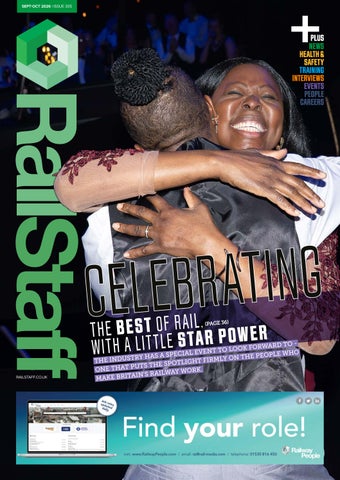
CELEBRATING THE BEST OF RAIL WITH A LITTLE STAR POWER | 36
Meet the host, judges, and sponsors for this year’s spectacular RailStaff Awards ceremony.
Staff
RAILSTAFF SEPTEMBER-OCTOBER 2026
NEWS
5
SAFETY FIRST, PEOPLE ALWAYS
Contact us: Editor:
Matt Atkins
Production and design:
Adam O’Connor
Track safety:
Colin Wheeler
Advertising:
Craig Smith
Contact email addresses News: news@rail-media.com Track safety: colin@rail-media.com Pictures: pictures@rail-media.com Subscriptions: subscribe@rail-media.com Contact details RailStaff Publications, Rail Media House, Samson Road, Coalville, Leicestershire, LE67 3FP. Tel: 01530 816 444 Fax: 01530 810 344 Web: www.railstaff.co.uk Email: hello@rail-media.com . RailStaff is published by RailStaff Publications Limited A Rail Media Publication
© All rights reserved. No part of this magazine can be reproduced in any form without the prior written permission of
© HALOS
the copyright owners.
© Network Rail
Adverts: adverts@rail-media.com
Any rail network is only as safe as the people, practices, and decisions that keep it running. From protecting frontline staff against violence and abuse to ensuring infrastructure is properly maintained, safety demands constant attention. It is a responsibility shared across the industry, and one that sits at the heart of this issue of RailStaff. The latest safety statistics from the Office of Rail and Road (ORR) provide a sobering backdrop. Its 2025-26 report highlights rising violence on trains and at stations, alongside an increase in fatalities at level crossings. These figures underline the need for continued vigilance, effective safety measures, and a willingness to learn from experience. We examine the report's findings and speak to Alan Ring, CEO of body camera specialist HALOS, about the steps needed to make the railway safer. Technology has an important role to play but, as he explains, protecting staff and passengers requires a broader approach. The same principle applies to the safety of more vulnerable sections of society. Daisy ChapmanChamberlain looks at initiatives from around the world and considers how the industry can better protect women and girls who work on and travel by rail. Learning from incidents and accidents is critically important. As usual, Colin Wheeler reviews the latest developments from the Rail Accident Investigation Branch. He also considers Network Rail's £1.2 million fine following a station wall collapse which raised questions about inspection, maintenance, and accountability. Safety cannot be taken for granted; it depends on sound processes, clear responsibilities, and action when things go wrong. Elsewhere, we explore the railway's
contribution to society beyond its operational responsibilities. Advance TRS recently raised £20,000 for charity through its annual golf day, demonstrating how industry businesses can support worthwhile causes while also bringing colleagues together. Meanwhile, Young Rail Professionals is helping to develop future leaders through international experiences, industry insight, and networking. Investing in the next generation is essential to the railway's continued success. Finally, we turn our focus to the 2026 RailStaff Awards, which are now just a few weeks away. A standout fixture in the industry calendar, the event recognises the individuals and teams whose efforts make a tangible difference to colleagues, passengers, and the wider railway. This year's ceremony will be hosted by entertainer Denise van Outen, with an expert panel of industry judges helping to select the winners. The significance of the RailStaff Awards goes beyond one evening. The event offers a chance to recognise the compassion, resilience, and professionalism that can be overlooked in the demands of everyday working life. Whether someone has supported a colleague through difficult circumstances, gone the extra mile for a passenger, or delivered an exceptional piece of work, their contribution deserves to be acknowledged. The railway faces no shortage of challenges, from keeping people safe to maintaining infrastructure, and preparing for the future. Meeting these challenges requires investment, sound decisions, and technical expertise, but it also depends on the people who put those things into practice every day. Your work is what keeps the railway moving, and it is your achievements that we are here to celebrate. Matt@rail-media.com FACEBOOK.COM/RAILSTAFF | @RAIL_STAFF | RAILSTAFF.CO.UK
6
NEWS
RAILSTAFF SEPTEMBER-OCTOBER 2026
Industry cracks down on trespass
© Network Rail
Government mulls buying trains over leasing
In response, the rail industry and British Transport Police (BTP) have launched a new campaign to crack down on trespassers committing crime on the railway. Trespass is one of the railway’s biggest causes of disruption and can have a significant impact on train performance, passengers, freight, railway staff, and local communities. It can also require a substantial industry response and come at a considerable financial cost. Network Rail, BTP, and the wider industry have been working together more closely than ever before, with the new levels of collaboration allowing for a deeper understanding and ability to tackle crime, identify offenders, and minimise the impact on the railway. Part of the enhanced collaboration will see improved evidence collection to strengthen prosecutions, as well as a greater focus on victim impact statements to help demonstrate the impact of delays caused by railway crime. The organisations have launched the new 'Crime with Consequences' campaign to make sure potential offenders are aware they will face the full force of the law if they commit crimes on the railway – including severe fines or even prison sentences. Network Rail has introduced a number of initiatives to help tackle cable theft and other crimes on its network, including the use of hidden 'trespass beads' in its cables in the North West to track down offenders, and additional funding for more patrols on the East Coast Main Line. Across the network, drones, sensors, and smart CCTV are all helping Network Rail and the BTP identify and catch offenders faster and more consistently. RAILSTAFF.CO.UK | @RAIL_STAFF | FACEBOOK.COM/RAILSTAFF
New trains could be publicly-owned rather than leased, as part of plans set out on Monday 28 September by the Government in a new strategy for trains and infrastructure. For the first time in 30 years, the railway will take a coordinated approach through Great British Railways (GBR) to decide on trains, track, depots, and maintenance, ensuring investment is planned across the entire network instead of in isolation. The Rolling Stock and Infrastructure strategy sets out a new policy for future train procurements. For the first time, GBR will assess whether direct public ownership, leasing or other financing arrangements offer the best value for taxpayers and fare payers. The Government’s decision to take back public control over the railways aims to create a more joined up system that puts passengers first, delivers better and more reliable services, and leaves the fragmentation of the past behind. For more than three decades, most passenger trains have, by default, been owned by rolling stock companies and leased to operators. Now, GBR will take a case-by-case approach to new trains and consider whether private or public ownership gives taxpayers the best overall value. Leasing and maintenance for trains costs taxpayers and passengers more than £4 billion a year, and the Office of Rail and Road (ORR) reports that yearly dividends from rolling stock companies totalled more than £2.5 billion over the last 10 years. Leasing will remain in place for existing contracts, but it will no longer be treated as the default choice for new trains. In some circumstances, buying trains outright could offer substantial savings for passengers and taxpayers.
© Network Rail
New figures show trespass-related crimes including cable theft, vandalism, and obstruction caused over 3,300 hours of delays for passengers – equivalent to nearly five months of waiting on trains or in stations – and cost the rail sector more than £10 million in delay costs during 2025/26.
This strategy follows the recent announcement that saw Alstom receive £1 billion investment for a brand-new fleet of UK-made battery-powered Great British Railways trains for the Transpennine Route Upgrade, securing hundreds of jobs in Derby and thousands more across their supply chain. The strategy provides further certainty for the rail supply chain for the UK by providing the basis for a clearer, longer-term pipeline of investment in trains and infrastructure. Alongside this, GBR will prioritise the social benefits of these contracts, primarily skills and jobs. It will ensure successful contracts, provide jobs and opportunities to the UK workforce, giving GBR a central role in supporting UK businesses, strengthening skills and capability in every postcode. Passengers will benefit from improved reliability as fleets, infrastructure and maintenance are planned together, while future trains will feature enhanced passenger information systems and more consistent digital connectivity. The strategy also includes plans for ‘fleet families’ which create a more standardised design across train types, providing more consistent and accessible trains so passengers always know what to expect and trains can be used more flexibly across the network.
RAILSTAFF SEPTEMBER-OCTOBER 2026
© HS2
HS2 completes M42 bridge lifts
NEWS
7
Northern overhauls staff disability training
HS2 engineers have lifted the last of six enormous viaduct spans that will carry high speed trains over the M42 in the West Midlands, during a weekend closure of the motorway. The complex multi-stage operation at the Water Orton viaduct site was completed in the early hours of Monday 21 September, with the motorway reopening at around 4am as planned. To take full advantage of the closure, a separate team – three miles to the south – spent the weekend lifting the last beams that will support another major HS2 bridge known as the ‘twin box’. The 300-metre-long structure near the NEC is formed of two boxes that will support the railway as it passes over the carriageways. This approach has been chosen because of the angle at which the railway must cross the motorway. The operations at both sites – which built on progress over four weekends this summer were led by HS2’s West Midlands construction partner, Balfour Beatty VINCI (BBV). Engineers can now proceed to the final stages of construction: installing the remaining parapets along the sides of the Water Orton viaducts, and the final concrete pours on the twin box ready for railway tracks to be laid.
Northern Trains has overhauled the way it manages the training of its staff to support disabled passengers following an investigation by the Office of Rail and Road (ORR), earlier this year. ORR found the train operator had failed to deliver the required disability awareness training for its passenger-facing staff, as it commits to do in its Accessible Travel Policy, and also did not have adequate oversight in place to make sure staff received the right training. Northern subsequently provided an improvement plan with 23 actions, which it has delivered on, ORR announced on 8 September. Northern has now strengthened responsibility and accountability for staff training; introduced better systems to track who needs training and whether they have completed it; addressed gaps in the training records of existing staff; and improved training for new starters and staff needing refresher training. Stephanie Tobyn, ORR’s director of strategy, policy, and reform, said: "Disabled passengers should be able to trust that staff have the knowledge and confidence to provide the support they need. “Our investigation found serious weaknesses in Northern's management and monitoring of disability awareness training. Northern has responded positively, completing all the actions we required and putting clearer accountability and stronger checks in place. We welcome these improvements and will continue to work with Northern to ensure they are sustained.” © ORR
© HS2
The construction programme was meticulously planned into four weekends, spaced across the summer months, with engineers working on all three structures at the same time to reduce the number of closures. During the September closure, a 150-strong team installed the final 44 beams over the southbound carriageway, completing the roof which will carry trains over the M42 near the NEC. The twin box roof is formed of 175 individual beams, which weigh between 56 and 92 tonnes. A 300-tonne crawler crane lifted and lowered each of the 23-metre-long beams into position, bridging the gap between the supporting walls and columns either side of the carriageway and inside the central reservation. The completed structure now stands 10 metres high, with two 145-metre-long walls and 46 internal columns supporting the 9,800-tonne beamed roof. The two Water Orton viaducts form the top of the triangular ‘delta junction’, linking Birmingham with the mainline heading north. They cross the M42, A446, the Birmingham – Peterborough railway line, and the River Tame. A separate team of 75 men and women have now installed the final two spans of Water Orton Viaduct number 2 over the southbound carriageway, replicating the successful extension of Water Orton 1 in August. Each 45-metre-long span was built using 18 pre-cast segments, which were manufactured locally at BBV’s concrete batching plant in Kingsbury. Once assembled, the 1,000-tonne spans were driven into position using self-propelled modular transporters. They were then locked in place using tensioning cables inside the hollow centre of the viaduct. The structural design was carried out by Balfour Beatty VINCI’s Design Joint Venture (DJV), made up of Mott MacDonald and SYSTRA, with WW+P Architects.
FACEBOOK.COM/RAILSTAFF | @RAIL_STAFF | RAILSTAFF.CO.UK
RAILSTAFF SEPTEMBER-OCTOBER 2026
NEWS IN BRIEF HEAT RISING Newcastle Airport firefighters have completed a series of vital training sessions on the new Metro Tyne and Wear trains – ensuring they are familiarised with them in the event of an emergency at the airport terminal. The training was delivered to all four of the airport’s fire watches, whose job it is to provide 24/7 emergency response cover, helping to keep passengers and airport operations safe. Metro operator Nexus said the aim was to familiarise the firefighters with all aspects of the new trains in line with the training it provides to other local emergency services on a regular basis.
Progress for Wendover green tunnel HS2’s ‘green tunnel’ at Wendover in Buckinghamshire took a major step forward this week with the completion of the central part of the cut-and-cover structure, which has been designed to cut noise and disturbance for people living nearby.
HEALTH CONSCIOUS To help train drivers benefit from advances in healthcare, the industry has launched a new Train Driving Medical Advisory Panel. The panel will not replace existing medical assessments. Instead, it will provide expert advice that informs those processes, improving consistency and helping ensure they continue to be underpinned by the best available medical knowledge.
Set to stretch for around a mile (1.4km), the tunnel is being built inside a cutting alongside the A413 to the west of the town. Once each section is complete, earth is being put back on top to blend the railway into the surrounding countryside. There are five green tunnels on the HS2 project between London and Birmingham with the Copthall tunnel, on the outskirts of the capital, completed in the summer. Assembled from 2,740 precast concrete segments, the Wendover green tunnel is in an ‘M’ shape, with separate halves for northbound and southbound trains. To speed up construction, the tunnel was being built in two sections to allow excavation, preparatory work, construction and backfilling to happen at different points simultaneously. These two halves met this week, with the last segment slotted into place on Monday. To mark the achievement, the team took a moment to sign their names on the segment before it was lifted into position. With the central part now finished, the focus has turned to the portals at either end, completing the floor slab and internal fitout. Ellesborough Road (which runs from the town in the direction of Princes Risborough) is currently carried over the construction site on a temporary bridge. The final stage will be to realign it over the top of the tunnel and complete the landscaping.
HEARD HERE Customers travelling with TransPennine Express (TPE) are set to hear a new sound on board, as three colleagues step into the spotlight as the voices behind journeys across the network. Following an internal competition open to colleagues across the business, conductors Daniel Burn (York), Grant Rodden (Glasgow) and Sophie Howse (Cleethorpes) have been chosen as the new ‘Voices of TPE’. Reflecting the regions and communities TPE serves, the trio bring together accents from across the North of England and Scotland. In 2025, they recorded hundreds of announcements, from station stops to essential safety messages, adding a more personal touch to every journey.
© HS2
HOT FUZZ Weardale Railway has welcomed Northumbria Police firearms recruits to its Stanhope site, where its historic carriages were transformed into a realistic training environment for officers preparing to respond to a range of potential incidents. Rather than carrying visitors through the Durham Dales, the carriages became the setting for a series of operational scenarios designed to put the recruits’ training and decision-making into practice in an unfamiliar environment. The exercise came after Northumbria Police approached Weardale Railway several months ago to explore whether the heritage attraction could support its armed response training programme.
RAILSTAFF.CO.UK | @RAIL_STAFF | FACEBOOK.COM/RAILSTAFF
HS2 Ltd Project Manager, Umesh Gorasia said: “It’s great to see the two halves of the tunnel linked up for the first time. Once complete, the green tunnel will dramatically reduce disruption from passing trains and blend the railway into the countryside. “There’s still some way to go, but we’re making good progress and I’d like to thank the team for all their hard work.” © HS2
NEWS
© HS2
8
The tunnel is being built by EKFB, HS2’s main works contractor responsible for the central section of the route through Buckinghamshire and into South Warwickshire. EKFB is a joint venture made up of Eiffage, Kier, Ferrovial Construction and Bam Nuttall. More than 1.2 million cubic metres of material – mainly chalk – was excavated to form the level base for the tunnel. This was stored on site and is now being carefully backfilled and compressed to ensure that the weight is spread equally across the structure. Wendover is one of three green tunnels being built by EKFB, with lessons learnt shared between the different teams to help improve productivity and speed up construction. This includes prefabricating reinforcement cages for the base slab, improving the delivery of concrete through the tunnels and testing to safely increase the size of machinery backfilling the tunnel. While most of the segments were lifted with a crane, the ones under the Ellesborough Road temporary bridge were lifted into position using a specialised piece of equipment called a selfpropelled modular transporter (SPMT). Supported by 16 sets of wheels, this highly manoeuvrable machine allowed engineers to lift the beams from underneath and place them precisely into position beneath the bridge.
RAILSTAFF SEPTEMBER-OCTOBER 2026
© Network Rail
Police dogs join fight
against cable theft
September is not only “back to school” time for children – as a new cohort of specialist dogs begins training to help in the battle against cable theft on the East Coast Main Line. The animals are deployed as part of a growing effort to tackle railway crime, supporting British Transport Police (BTP) officers and Network Rail teams in protecting critical railway infrastructure. The dogs are being used as part of a range of measures including targeted security patrols, CCTV, drones and forensic marking of assets to help prevent, detect and investigate offences. The latest work builds on a recent £110,000
investment announced by the East Coast Partnership – a joint initiative between Network Rail and LNER – which is funding additional security patrols at key locations along the route. Cable theft remains a significant challenge for the railway, causing delays and cancellations for passengers and freight operators while creating serious safety risks. Criminals who target railway cables can damage vital signalling and power systems, bringing trains to a halt and disrupting journeys across large parts of the network. Specialist police dogs play an important role in tackling this type of crime. Trained canine teams can search large trackside areas quickly and effectively, helping officers locate
Rail Staff Christmas Carol Service 2026
01483 763 558 www
Registered charity no. 1120447
Thursday, 17 December, 2026
[PLEASE DRESS FOR THE SEASON]
www.woking-homes.co.uk administration@woking-homes.co.uk
12:30 HOURS
9
offenders, stolen railway materials and key evidence. They are also used in realistic training exercises designed to improve the response to cable theft incidents and strengthen coordination between railway partners. Some dogs can be trained to detect scents associated with railway equipment and forensic marking products used on railway assets, helping investigators trace stolen materials and support prosecutions. The dogs, which started training at a Network Rail depot in Doncaster last week, also provide a highly visible deterrent when deployed alongside officers on patrol. John Grainger, joint head of performance for Network Rail and LNER, said: “Cable theft is not a victimless crime. It can cause significant disruption for passengers and freight operators, damage infrastructure and create serious safety risks on and around the railway. “We’re committed to working closely with British Transport Police and our industry partners to prevent, detect and prosecute offenders. Specialist police dogs are another valuable tool in that effort, helping officers search large areas quickly, locate evidence and support investigations. “Alongside other measures we’re taking, these animals help strengthen our ability to protect the railway and keep passengers moving safely and reliably.”
with London’s Transport Choir St Mary’s Somers Town Eversholt Street, London NW1
NEWS
“I’ve never found a more perfect example of how older people should be cared for than Woking Homes.” Former Chairman, Age UK, Waverley
Followed by light refreshments
Proceeds of the collection donated to charity All are welcome to join our supporters and sponsors as the Railway Family comes together to celebrate the Christmas Season
Woking Homes is a railway charity providing residential and respite care primarily for former railway employees and their close family. Our team provide outstanding care at affordable rates in a friendly, caring and homely environment.
To find out more about permanent or respite stays, visit our website or get in touch. FACEBOOK.COM/RAILSTAFF | @RAIL_STAFF | RAILSTAFF.CO.UK
NEWS
RAILSTAFF SEPTEMBER-OCTOBER 2026
© Network Rail
10
First section of Saltley Viaduct installed Construction of the new Saltley Viaduct moved a step closer on August Bank Holiday weekend, after HS2 engineers successfully installed the first section of the new bridge over the Birmingham to Derby railway lines.
New weather stations
The original Saltley Viaduct, which spanned a 183‑metre section of the B4114, closed to vehicles and pedestrians in May 2026. It was then demolished so that a new, taller structure could be built in its place, allowing high speed trains to safely pass below. The replacement viaduct is being built and installed by engineers working for HS2’s construction partner, Balfour Beatty VINCI (BBV). The construction programme is being delivered in phases to reflect the complexity of crossing the Birmingham to Derby rail lines, the Birmingham and Warwick Junction Canal, the River Rea, and ultimately the future HS2 railway line.
for Wales
The first 55-metre-long steel section was assembled on land adjacent to where the original viaduct once stood. It was then driven into place over the Birmingham to Derby railway lines during the Bank Holiday weekend - a distance of around 125 metres - using selfpropelled-modular- transporters (SPMTs). This first phase of work was delivered in conjunction with Network Rail, during a temporary closure of the railway, which reopened to passengers as planned on Tuesday, 1 September. With phase one of four complete, engineers are now assembling the second 35-metre-long span, which will cross over the new HS2 railway line. This span will be lowered into place by crane in October. Spans three and four, which cross the Birmingham and Warwick Junction Canal, will be installed later this year. Engineers will then complete the tie-in from the perimeter of the railway line to the abutment upon which the structure rests. A new bridge over the River Rea will also be constructed and will form part of the overall realigned B4114. The new viaduct is expected to open to motorists and pedestrians in November 2027 with significant safety and design enhancements. It will be four and a half metres wider, to provide additional space for cyclists and pedestrians, and the new wider walkways will feature LED lighting in the panels.
© Network Rail
© HS2
Ten stations have been installed across Wales and Borders, measuring rainfall, wind speed and direction, temperature, humidity, and atmospheric pressure directly from locations on the railway. The technology, developed by Ninehundred Communications Group, follows lessons learned from a series of severe weather events which have caused significant disruption and cost to the railway. Between February 2023 and January 2026, 25 named storms affected the Wales and Borders route. Where complete performance data is available, each storm caused an average of more than 38 hours of delays and £179,000 in train performance costs.
RAILSTAFF.CO.UK | @RAIL_STAFF | FACEBOOK.COM/RAILSTAFF
Storm Darragh was the most costly, at £1.3 million. When it hit Wales on 6 and 7 December 2024, winds reached 93mph at Capel Curig, with fallen trees and debris disrupting services across many parts of the country. © Network Rail
Network Rail’s Wales and Borders route has become the first in the organisation to install local weather stations on existing GSM-R railway communication masts, providing more accurate, real-time information to help teams respond to severe weather.
The investment comes as the Met Office forecasts an increased chance of wetter and windier than average conditions through late autumn and early winter, due to weather patterns like El Niño. The stations have been installed at Whitland, Llantwit, Cilmeri, St George’s, and Trewyn in south and mid-Wales, and Craven Arms, Gobowen, Glantwymyn, Llanrwst and Buckley across north Wales and the Borders. The locations were selected to fill gaps in existing weather monitoring and provide better information in areas vulnerable to severe weather. Network Rail already works with weather forecasting specialists MetDesk to monitor conditions and anticipate severe weather. The new stations will enhance this by providing local readings directly from the railway, giving operational teams a clearer picture of the conditions being experienced on the ground. Using existing GSM-R communication masts provides the height required for the observations while avoiding the cost and complexity of constructing separate installations.
RAILSTAFF SEPTEMBER-OCTOBER 2026
© Virgin Group
Virgin offers glimpse of cross-Channel service Virgin has offered a first glimpse of its plans to reimagine cross-Channel travel, releasing a new image of a striking black and red train and sharing some early clues about what customers can expect on board. Under a landmark agreement with French rail group Alstom, spanning the delivery of 12 trains, Virgin will operate a fleet of Avelia Stream trainsets capable of travelling at speeds of up to 300km/h, with customised interiors designed for cross-Channel travel. Virgin plans to introduce 20 daily return services between London, Paris, Brussels and Amsterdam from 2030, adding almost 7.5 million seats to the cross-Channel route per year, creating up to 1,000 new jobs, boosting
tourism and business travel, and supporting local economies. The company is promising that a trip through the Channel Tunnel will be something passengers can look forward to just as much as reaching their destination. Virgin’s ambition is to bring the outstanding customer experience it is known for around the world to cross-Channel rail. It will draw on a proven playbook shared across more than 40 Virgin businesses, which together delight 45 million customers worldwide. Virgin Atlantic’s Clubhouses will help inspire pre-departure and onboard social spaces, giving passengers more flexibility to work, relax or socialise in style. Virgin Voyages’ award-winning onboard dining will influence the food and drink offer, while Virgin Hotels’
TRU purchases biodiversity units Transpennine Route Upgrade (TRU) has completed the purchase of 26 biodiversity units from Leeds City Council to support enhancements at two woodland sites: Barnbow Woods and Barnbow Hall Woods. The project will deliver 8.32 hectares of long-term woodland habitat enhancement – equivalent to 11 football pitches – supporting the programme’s commitment to delivering 10% Biodiversity Net Gain (BNG). TRU’s target of 10% BNG is a core part of 'Our Guiding Compass' – the TRU sustainability strategy – with the aim of leaving the natural environment along the route in a measurably better state than before construction began. The programme’s approach to delivering this will also set a new standard for future Network Rail
projects nationwide. Located only 500 metres from the Transpennine route and approximately 3km east of Cross Gates - a station that will benefit from TRU’s wider rail improvement works across the region - the woodland will benefit from a 30-year habitat creation and management programme funded entirely by TRU. This will improve species richness, diversity and abundance through enrichment planting and tree veteranisation. Beyond wildlife benefits, healthy woodland helps capture and store carbon, reduces flood risk, and filters air and water pollutants naturally. Additionally, the woodland will act as a community asset – it is accessible through a series of public footpaths, providing the community with improved access to nature, educational and associated mental health benefits.
NEWS
11
focus on comfort and design will help inform the development of seating and onboard spaces. Virgin’s loyalty platform, Virgin Red, will make journeys more rewarding, allowing passengers to earn Virgin Points and spend them on future journeys, flights, hotel stays, cruises and experiences. Most importantly, Virgin’s people will be given the freedom to show passengers a great time and create memorable moments throughout the journey. Every design detail and customer touchpoint will be carefully considered and unmistakably Virgin, with accessibility built in from the outset. Virgin will also draw on its 20 years of operating Virgin Trains in the UK as it develops the new crossChannel passenger experience. Josh Bayliss, CEO of Virgin Group, said: “Virgin has a proud history in UK rail. With our latest venture we are drawing on more than four decades of experience across travel and hospitality to create something genuinely new. This time, we’ll be connecting London with some of Europe’s greatest cities and giving passengers a distinctive new choice in cross-Channel travel. “Virgin has always thrived on challenging the status quo and aimed to provide our customers with a great experience. We’ll bring the same approach to the cross-Channel route, making the journey something to look forward to as much as the destination.
© Network Rail
Simon Hughes, TRU East environment & sustainability lead, said: “This is a really exciting milestone for us in our journey to deliver Biodiversity Net Gain across our route. This significant purchase of biodiversity units from Leeds City Council, is the tenth largest biodiversity purchase to date in England. It will unlock new opportunities to enhance wildlife in the area and give local people improved access to nature. “We were pleased to welcome
our colleagues at Leeds City Council to see the progress we’re making and are looking forward to seeing how this woodland evolves. Work began in May 2025 and will continue until at least 2055. “This is the first delivery of biodiversity units across the TRU programme, which will pave the way for future biodiversity agreements, to take us closer to achieving 10% BNG as we continue to deliver against Our Guiding Compass.”
FACEBOOK.COM/RAILSTAFF | @RAIL_STAFF | RAILSTAFF.CO.UK
RAILSTAFF SEPTEMBER-OCTOBER 2026
ScotRail on track for net zero ScotRail’s investment in trains, stations, technology, and biodiversity is helping reduce the environmental impact of the railway. During Scotland’s Climate Week (28 September – 4 October), ScotRail highlighted the action being delivered through the Scotland’s Railway Climate Action Plan and its Ticket to Net Zero programme to tackle climate change and reduce the railway’s environmental impact. ScotRail has continued to reduce its carbon emissions year-on-year, with further reductions expected as more of Scotland’s Railway is decarbonised and newer, more efficient trains are introduced. The train operator expects the arrival of the Class 222 trains from 2027 to have a significant impact on emissions across its train fleet before further reductions are achieved through its wider train renewal programme, which will see a fleet of brand-new suburban trains enter service in the 2030s. Scotland’s Railway Climate Action Plan, developed jointly with Network Rail, covers the railway’s activity to address the climate crisis between 2024 and 2029, focusing on five priorities: climate readiness, net zero, environmental management, biodiversity, and social value. Graeme Baillie, ScotRail safety & sustainability director, said: “Rail has an important role to play in helping Scotland reduce its carbon emissions, both by making our own railway more sustainable and by giving people an attractive alternative to travelling by car. “Our vision is to deliver a safe, sustainable, inclusive, and accessible railway, and that means putting climate action at the heart of what we do. “We’re already making progress, with emissions continuing to reduce, more of the railway being electrified, and new technology helping us use energy more efficiently across our stations and depots. “There is much more to come. Replacing around two-thirds of our train fleet, further decarbonising Scotland’s Railway, developing net zero stations, and making it easier to combine rail with walking, cycling, and other public transport will all help us continue the journey to net zero.”
Immersive learning space brings railway to life Avanti West Coast has unveiled a cuttingedge immersive learning space to help staff put their skills to the test in a safe environment. Located in the intercity operator’s Talent Academy in Crewe, the facility called ‘Immerse’ enlists 270-degree video projections, sound, light, and scent to recreate situations on the rail network that can support with learning. Designed to be a safe and controlled environment, it allows colleagues to experience real-life situations they may encounter in their roles, from standing on a busy platform as a train arrives to observing how customers are supported at ticket gates. It also offers the opportunity to see a station from a customer’s perspective, including that of a child with autism. By bringing the railway to life in this way, colleagues can test their skills, practice responding to different situations and build confidence with the support of trainers and peers before facing them in a live operational environment. Avanti West Coast’s Learning and Development team can create content for display in the immersive space while utilising light, sound, scent and fans to simulate scenarios on platforms, concourses, and trackside during various weather types and times of day. The facility offers flexible and accessible learning by allowing colleagues to experience
© Avanti West Coast
© ScotRail
RAILSTAFF.CO.UK | @RAIL_STAFF | FACEBOOK.COM/RAILSTAFF
the realities of the job at the touch of a button and receive immediate feedback on how they respond. This helps staff to feel more prepared, gain a better understanding of customers’ needs and build confidence in dealing with challenges. Immerse is not limited to training customerfacing or operational roles, it will also be used
© Avanti West Coast
NEWS
© Avanti West Coast
12
to test new ideas and consider innovative approaches to stations or onboard trains before being introduced in a live operational environment. Avanti West Coast has worked with Immersive Interactive (the UK’s leading provider of interactive classrooms and virtual simulation spaces) to develop the learning hub as part of its commitment to improve learning experiences for its colleagues and deliver a better experience for customers.
RAILSTAFF SEPTEMBER-OCTOBER 2026
NEWS
13
© TfL
New DLR trains return to service The first of the new DLR trains has returned to customer service following the completion of modifications and a comprehensive programme of testing and assurance.
© TfL
This is the first of 54 trains which will be gradually introduced to the network, with their performance closely monitored. These state-of-the-art trains will include spacious walk-through carriages, live travel information, air conditioning, enhanced accessibility features including three multi-use areas and three dedicated wheelchair spaces, and mobile charging points. The walk-through design increases train capacity by 10%, which will also help support further growth in London, particularly in areas such as Stratford, Woolwich Arsenal, and the Isle of Dogs. The new fleet will ultimately replace the DLR's oldest trains, some of which are more than 30 years old. The new trains were withdrawn from service in November 2025 after an issue affecting train performance in low adhesion conditions was identified on one train. Safety is always TfL's top priority, and all trains were removed from service as a precaution while TfL and manufacturer CAF investigated the issue and developed a solution.
A number of enhancements have now been made to improve train performance in low adhesion conditions, following extensive testing and assurance work. These include changes to the trains' braking systems, the installation of equipment to improve grip between the wheels and the track, and additional measures to reduce the impact of low adhesion conditions in key locations across the network. Following these modifications and a comprehensive programme of testing in a range of operating conditions, the first train has now returned to customer service. The phased reintroduction of the fleet will begin on the Stratford International to Woolwich Arsenal route. The number of trains in
service will increase gradually through the carefully controlled introduction of additional trains. TfL is currently working with CAF and its suppliers to finalise the full rollout plan for the new trains, with further details to be confirmed in due course. Stuart Harvey, TfL’s chief capital officer, said: "We're pleased that the first of our new DLR trains has returned to customer service following the completion of a thorough programme of modifications, testing, and assurance. “Safety is always our top priority, and we took the decision to remove the trains from service as a precaution while we worked with CAF to investigate the issue and implement a solution. “I apologise for the delay in reintroducing the trains but am pleased this marks an important milestone in delivering a modern new fleet for the DLR. As we begin the phased reintroduction of the trains, customers will start to benefit from more spacious and accessible journeys, while we continue to monitor performance and introduce further trains into service."
RSSB tool helps industry with carbon decisions The Rail Safety and Standards Board (RSSB) has launched the Carbon Management Tool (CMT), a rail-specific platform designed to help organisations understand, manage, and reduce whole life carbon emissions from infrastructure and railway assets. Around half of the railway's greenhouse gas emissions come from the materials used to build, renew, and maintain infrastructure. But carbon is often considered too late in the development of projects, when opportunities for reduction have already been missed. The CMT helps project teams assess the carbon impact of decisions earlier, compare options, and identify lower-carbon approaches before they become locked into designs and delivery plans. Joshua Fisher, RSSB’s chief operating officer, said: "The railway has an important role to play in the transition to a lower-carbon future, but reducing emissions starts long before a project is delivered. "Too often, carbon is treated as something to measure after key decisions have already been made. By that point, many of the biggest opportunities to reduce emissions have been missed.
"The Carbon Management Tool helps organisations understand the carbon implications of different choices at the point decisions are being made. Developed with the industry, it gives project teams a practical way to compare options, reduce emissions, and make better-informed decisions throughout the lifecycle of rail assets." The CMT is available now and free to use. Organisations interested in adopting the tool can access the platform today and learn more through RSSB's webinar and training programme. © iStockPhoto.com
Rail organisations can now access a free, industry-developed tool that helps them understand and reduce carbon emissions across infrastructure projects and programmes.
FACEBOOK.COM/RAILSTAFF | @RAIL_STAFF | RAILSTAFF.CO.UK
14
NEWS
A
RAILSTAFF SEPTEMBER-OCTOBER 2026
dvance TRS raised approximately £20,000 for Little Roo Neonatal Fund and Railway Children at its sixth Annual Charity Golf Day, held at Goodwood Golf Course on Thursday 24 September.
The event brought together clients, partners and colleagues from across the rail, infrastructure and built environment sectors for a day of golf, networking, and fundraising. The latest total takes the amount raised by the event to more than £100,000 over the past six years. Funds were raised through team entries, competition entries, donations, auctions, and additional fundraising activities throughout the day and evening. The money will help both charities continue their vital work supporting vulnerable children and families both in neonatal care and within the railway community.
GOOD CAUSES Little Roo Neonatal Fund supports premature and sick newborn babies receiving neonatal care at Surrey’s St Peter’s Hospital, as well as their families, by helping to fund vital specialist equipment, improvements to care, and practical support during an extremely difficult time. The funds raised through the Golf Day will contribute to services that make a meaningful difference for babies, parents and neonatal teams. Railway Children works in the UK, India, and East Africa to protect vulnerable young people who are at risk around transport networks. Through outreach, safeguarding, education, and long-term support, the charity helps children move away from danger and towards safer, more stable futures. Support from the event will help the charity continue reaching young people when and where they need it most. Andy Ridout, managing director & founder of Advance TRS Group, has a personal connections to both charities. “Little Roo’s is a cause that is incredibly close to my heart,” he said. “My daughter was born at just 24 weeks and received the specialist care and support that Little Roo’s helps make possible. She is now eight years old, healthy, happy, and thriving at school.” “As a family, we will never forget the people who supported us through such a difficult and uncertain time, and it means so much to be able to give something back.” “I have also been proud to support Railway Children over many years through challenges including trekking to Everest Base Camp, climbing Kilimanjaro, completing Ironman events, and running marathons. Visiting the charity’s vital projects both here in the UK and overseas has shown me first-hand the difference its teams make for children facing danger and uncertainty.” “That personal connection to both charities made this year’s event especially meaningful, and I am deeply grateful to everyone whose generosity will help them continue their life-changing work.” RAILSTAFF.CO.UK | @RAIL_STAFF | FACEBOOK.COM/RAILSTAFF
RAILSTAFF SEPTEMBER-OCTOBER 2026
15
NEWS
© Alstom
It’s not too late to donate, if you would like to help Advance TRS reach its target, you can donate at the link below: JUST GIVING
RAILWAY CHILDREN
LITTLE ROO’S FOUNDATION
HEADLINE SPONSOR Turner & Townsend returned as headline sponsor for the 2026 event, continuing a valued year-on-year partnership that has helped the Golf Day grow in reach and fundraising impact. We would like to thank the Turner & Townsend team for once again getting behind the event and supporting this year’s fundraising. After the planned guest speaker was unable to attend, former footballer Jimmy Carter stepped in at short notice to address guests and help make the day a success. Jimmy enjoyed a distinguished 20year professional football career, representing clubs including Millwall, Liverpool, Arsenal, and Portsmouth. In addition to giving his time, he generously donated two exceptional items of Arsenal memorabilia to the charity auction. “It was fantastic to welcome so many of our clients, partners and friends back to the Advance TRS Executive Charity Golf Day,” said Andy. “I would like to thank Turner & Townsend, our Headline Sponsor, for their continued support, and Jimmy Carter for stepping in at short notice, sharing his time with our guests and generously supporting the auction.” The Golf Day also gave Advance TRS the opportunity to introduce guests from consulting partner Advance Infrastructure Partners (AIP), the new name for Advance TRS Management Consultancy. During the event, Managing Partner Jonathan Edwards spoke about AIP and the next stage for the business. AIP remains part of Advance TRS, with the same people, relationships and commitment at the heart of the business. Jonathan Edwards leads, working with Partners James Bowry and Andy Ridout. The launch marks a new name and continued ambition, with the same focus on supporting clients and the infrastructure they deliver.
DESERVING WINNERS
There was plenty of competition on the course, with some strong scores across the day. A highlight of the day was the presentation of the golfing awards, celebrating some impressive performances across the field. • Winning Fourball: VolkerRail Team with an outstanding team score of 88 points. • Individual Stableford Champion: Graham Shaw (VolkerRail) with an exceptional 45 Stableford points. • Nearest the Pin: James Bowry. • Longest Drive: Sam Whitehead. • Beat the Pro Challenge: David Smith, Elliott Passmore, Sam Whitehead, Scott Duncan, Mick Rayner, Clint Martin, Ed Griffiths, Louise Odham. Congratulations to all of the winners and everyone who took part.
LOOKING AHEAD The Golf Day has become an important date in the Advance TRS calendar, providing the chance to bring together members of the rail industry while raising money for a good cause. Advance TRS thanks everyone who played, sponsored, donated, bid in the auction, or supported the event. FACEBOOK.COM/RAILSTAFF | @RAIL_STAFF | RAILSTAFF.CO.UK
16
NEWS
RAILSTAFF SEPTEMBER-OCTOBER 2026
© Alstom
Alstom secures £1 billion BEMU deal © Alstom
Alstom has signed contracts worth more than £1 billion with TransPennine Express (TPE) for the supply and long-term maintenance of a new fleet of batteryelectric trains. The British-designed and built trains will transform rail travel across Northern England and support the delivery of the Transpennine Route Upgrade (TRU). The agreements combine a rolling stock contract worth approximately £800 million for 29 five-car battery-electric multiple units (BEMUs) with maintenance contracts valued at around £200 million. The fleet will be delivered from 2032 and will support the ongoing decarbonisation of one of Britain's most important rail corridors. The order represents the first deployment of Alstom’s Adessia Stream platform in the UK and will deliver Britain’s first mainline battery-electric train fleet, combining high performance, operational flexibility, and sustainable mobility. "This agreement is a landmark moment for Britain's railway, and we couldn't be prouder that the country's first mainline battery-electric trains will be designed and built in Britain,” said Rob Whyte, managing director UK at Alstom. “The fleet will transform journeys across Northern England while showcasing the very best of British engineering, innovation and advanced manufacturing,” He added: "Beyond the benefits to passengers, this investment will support more than 350 highly skilled jobs in Derby and over 5,500 roles across our UK supply chain, helping create opportunities, develop skills, and drive economic growth in communities across the country. “As momentum builds behind strengthening RAILSTAFF.CO.UK | @RAIL_STAFF | FACEBOOK.COM/RAILSTAFF
UK industry and regional prosperity, this project is a powerful example of what can be achieved by investing in British design, British manufacturing, and British talent." Devised specifically for the needs of long-distance regional travel, the 121-metrelong trains will operate at speeds of up to 110mph and provide around 300 seats per train, including a First Class area with catering facilities. As the first new-build trains to be operated by Great British Railways, they will also offer passengers modern amenities including Wi-Fi, air conditioning, power and USB-C charging at every set, enhanced luggage provision, real-time passenger information systems, CCTV, dedicated cycle storage, and quieter, more comfortable interiors. A defining feature of the fleet is its level
boarding design at every door, helping deliver a more inclusive and accessible passenger experience while reducing station dwell times. Each train will also include three dedicated wheelchair spaces, two accessible toilets, family-friendly areas, and buggy storage. Furthermore, the trains’ battery technology provides emission-free operations on nonelectrified sections of railway. Charging infrastructure will be installed by Alstom at Hull, Scarborough, and Saltburn, allowing the Adessia fleet to recharge efficiently during normal operations and supporting TPE's ambition to operate a fully decarbonised network. Installation of this infrastructure will be a UK-first on the mainline network and follows a similar successful deployment by Alstom in Ireland.
RAILSTAFF SEPTEMBER-OCTOBER 2026
The number of women applying for jobs with Northern has risen significantly, following the launch of a successful recruitment campaign. 'We’re Not Northern Without Her’ celebrates the operator’s female employees, who work hard to keep trains running for millions of passengers across the North of England, and encourages more women to pursue a career in the industry. It won the award for Best Diversity and Inclusion
Strategy at the Employer Brand Management Awards in September. The judges praised the success of the campaign. When it was launched in November last year, around 17% of people applying for jobs with Northern were women. That figure has almost doubled, rising to 33%. They said the train operator has “tackled a long-standing gender imbalance” in the rail industry with a highly effective campaign “built around the real experiences of women working in rail”.
17 © Welsh Government`
© Northern
Northern reports rise in female applicants
NEWS
Gina Edge, Northern's employer brand manager, said: “The campaign was built around a really simple ambition: to challenge perceptions of what a career in rail looks like and encourage more women to see that there is a place for them at Northern. “What makes this recognition particularly special is the impact we’ve seen since the campaign launched. “Winning this award is fantastic recognition for everyone who helped bring the campaign to life, but the work doesn’t stop here. “We want to build on that momentum and continue breaking down barriers, challenging perceptions and creating an industry where more women can see themselves building a long-term career.” The campaign also won Best Resourcing Initiative at the Chartered Institute of Personnel and Development People Management Awards, during a ceremony in London held on the same day. Northern’s traincrew training programme won Best Apprenticeship Scheme at the same ceremony. Judges praised the “highly effective” programme for drivers and conductors that has addressed the “major challenge” of “training complete novices, many without formal qualifications or sector knowledge”. The training is delivered at academies in Leeds and Manchester, combining classroom learning and hands on experience.
Digital in-cab signalling has been used by passenger trains on the East Coast Main Line for the first time. The 08:05 Great Northern service to Moorgate on Monday 31 August was the first passenger train to use the new system on the main line as it was signalled out of Welwyn Garden City station. It’s the latest milestone for the £1.4 billion Government-funded East Coast Digital Programme (ECDP), which will see traditional lineside signals replaced with a system that tells train drivers on an in-cab computer screen how far and how fast they can travel. Over the long term, digital signalling will deliver more efficient, more reliable and greener services. Once all trains operate with digital signalling, these benefits come through less reliance on trackside equipment and better ability to manage the response to disruption and delays. The system also makes the railway even safer as it supervises the train’s speed and can bring it to a stop if needed. This first stage in the use of the European Train Control System (ETCS) on the East Coast Main Line now sees Great Northern’s modern
© Network Rail
ECML enters digital era
© Network Rail
Class 717 fleet transition in and out of the system when entering and leaving the Welwyn to Hitchin area. The 15-mile section has been successfully commissioned as an ‘overlay’, meaning trains can operate through it using either conventional or digital in-cab signalling, allowing drivers to be trained in the technology. More fleets and passenger services will begin using the in-cab system from 2027. Ellie Burrows, Network Rail regional managing director, said: “This is the start of a generational change in how the East Coast Main Line, which carries more than 20 million passengers each year, is operated. “Digital signalling will give passengers and freight customers a more capable and higher performing railway, not just on the East Coast but ultimately across the country. “I’m grateful to passengers for their patience while the testing work was carried out, and I want to thank all industry colleagues involved in getting through the rigorous process of testing, assurance and approvals that has led to this milestone.” FACEBOOK.COM/RAILSTAFF | @RAIL_STAFF | RAILSTAFF.CO.UK
18
NEWS
RAILSTAFF SEPTEMBER-OCTOBER 2026
Station manager stands down after 32 years TransPennine Express (TPE) is saying a fond farewell to one of its well-known station managers as he retires this week after spending more than three decades working on the railway.
© TPE
Mike Drewery, who manages teams at Middlesbrough, Northallerton, Thirsk and Thornaby stations is retiring after 32 years on the railway, including 20 with TPE. Born in Middlesbrough and a lifelong resident of the villages around Whitby and the North York Moors, Mike has strong roots in the region. His career began as a guard at the North Yorkshire Moors Railway. Over 12 years, he progressed to traincrew inspector, helping introduce standards for mainline services to Whitby and even managed filming projects, including TV soap Heartbeat and Harry Potter. Alongside his railway duties, Mike served as an on-call firefighter, becoming officer in charge at Goathland Fire Station. His fire service
management training helped prepare him to lead station teams. Mike joined TPE as a customer service supervisor in Northallerton’s booking office before becoming station team leader at Middlesbrough. A 12-month stint covering the station manager role grew into a career managing stations across the North East, including York, Malton, Seamer, and Scarborough. For Mike, the relationships have been the most rewarding part. He still bumps into former Northallerton customers while shopping in town. He said: “The railway is ultimately about people. I’ve been blessed with wonderful colleagues across the North East. They care deeply about their stations and communities, and I’ll miss them immensely. “I’ll always be proud to have been based at Middlesbrough. The staff are one big team of passionate railway professionals.” Mike is now swapping station platforms for a narrowboat, exploring the UK’s inland waterways. He added: “A part of me will always be a station manager, but retiring feels right. I’m looking forward to remote moorings and a back-to-basics life.”
Andrew McClements, customer experience & transformation director at TPE, said: “Mike’s warmth, experience, and dedication have made a lasting difference to colleagues and communities across the North East. “He can be incredibly proud of his contribution to the railway. On behalf of everyone at TPE, I’d like to thank him for 20 years of commitment and wish him a long, happy and well-deserved retirement.”
Amey wins major Irish Rail contract Amey has been appointed to Irish Rail’s Signalling, Electrification and Telecoms (SET) Implementation Partner single party framework, marking the company’s first major contract with Iarnród Éireann and a positive step forward in Amey’s long-term growth in Ireland.
RAILSTAFF.CO.UK | @RAIL_STAFF | FACEBOOK.COM/RAILSTAFF
Amey brings strong technical capability and a collaborative approach, and we look forward to working together to deliver projects safely, efficiently and with long-term value for passengers and communities across Ireland.” The appointment establishes Amey as a strategic delivery partner to Irish Rail and builds on the company’s growing presence in Ireland following its involvement in the Luas operations and maintenance contract delivered through its joint venture with Keolis. Peter Anderson, managing director at Amey, said: “This is a defining moment for Amey in
© Amey
The high value, eight-year framework will see Amey support Irish Rail across the Republic of Ireland, providing highly skilled rail engineering resources, delivering multidisciplinary engineering services and undertaking
signalling, electrification, and telecoms works on a project-byproject basis. Covering the full project lifecycle, the framework spans early design and project management through to installation, testing and commissioning, supporting Irish Rail’s ambition to deliver a safe, resilient and future-ready railway. Tony Ennis, chief engineer signalling, electrification & telecoms at Irish Rail, said: “This framework gives Irish Rail access to specialist signalling, electrification and telecoms expertise that will support the continued development of our rail network over the years ahead.
Ireland. Being appointed as an implementation partner to Irish Rail is more than a contract win – it is the start of a long-term relationship where we can bring our full system capability to support the future of the national rail network. From early design through to commissioning, our role is about helping Irish Rail deliver a safer, more reliable and more resilient railway. We are excited about what we can achieve together and proud that Irish Rail has placed its trust in us at this scale.” The framework strengthens Amey’s rail portfolio and aligns with its purpose to deliver sustainable infrastructure solutions that enhance life and protect the future for communities across Ireland.
FACEBOOK.COM/RAILSTAFF | @RAIL_STAFF | RAILSTAFF.CO.UK
20
TRACK SAFETY
RAILSTAFF SEPTEMBER-OCTOBER 2026
REPORT BY COLIN WHEELER
WICKFORD DERAILMENT RAIB is investigating the derailment of a passenger train at Wickford. At around 14:08 on 14 August 2026, the train derailed 2.1 miles south-east of Wickford Station. It was travelling between Southend Victoria and London Liverpool Street and was made up of two Class 720 EMUs joined together; each composed of five vehicles. The rearmost vehicle derailed and ran on the ballast and sleepers for a mile and a half. The train, which was travelling at around 77mph, stayed upright. The driver reported seeing a kink in the track and forward-facing CCTV shows a track misalignment. The driver was reporting the rail kink when Control was contacted by another train travelling in the opposite direction. Both trains were damaged by flying ballast and there was significant damage to the track, signalling, and overhead line equipment.
There were no reported injuries among the train’s 62 passengers or railway staff. RAIB will publish its findings, including any recommendations to improve safety, at the conclusion of its investigation.
COLLISION AT QUEENS PARK On 3 September, RAIB released its Safety Digest into a collision near Queens Park station on 9 May 2026. At around 05:35 on that day, a passenger train travelling at 77mph collided with and destroyed two manually propelled rail handlers (MPRH) known as ‘iron men’ which had been left on the track after engineering work. The first collision was at a road access point by Canterbury Terrace followed by the second MPRH some 110 metres away. Network Rail had earlier been replacing two sections of the Down Fast. The train did not derail but its undercarriage was damaged, and it was unable to continue in service.
© RAIB
Colin Wheeler.
T
he Rail Accident Investigation Branch (RAIB) continues to investigate incidents across Britain’s railway, examining their causes and identifying lessons to improve safety. Colin Wheeler reports on the latest developments and the findings emerging from its investigations.
© RAIB
The collision occurred because the MPRHs were left on the Up Fast line (which carries trains travelling towards London) after overnight engineering work had been completed. The staff who had been using the MPRHs did not recognise that the trolleys had been left on the track before the line was reopened to trains in the morning. The train that struck the MPRHs, just after passing Queens Park station, was the first to use the Up Fast line after it had been reopened.
NEAR MISS AT LEVEL CROSSING Around 08:26 on 27 August, a passenger train was involved in a near miss with a telehandler at Hopperton Old Station userworked crossing. There were no injuries or damage, though according to RAIB this was only“narrowly avoided”. The crossing has gates and telephones either side. The signs tell users to contact the signaller and obtain permission before opening the gates and crossing the railway. The driver had telephoned and obtained permission to cross before the near miss occurred. RAILSTAFF.CO.UK | @RAIL_STAFF | FACEBOOK.COM/RAILSTAFF
RAILSTAFF SEPTEMBER-OCTOBER 2026
Network Rail’s wider strategy for assessing and mitigating risks at user worked crossings; and (iv) any relevant underlying factors.
BLUEBELL RAILWAY REPORT
RAIB has undertaken a preliminary examination into the circumstances surrounding this incident and will publish a safety digest on its website in the next few weeks.
FATAL ACCIDENT IN LANCASHIRE Details have been published of RAIB’s investigation into a fatal collision which occurred at Martin Lane user-worked level crossing on 29 August. At around 15:15 that day, a delivery van was struck by a passenger train resulting in the death of the van driver and minor injuries to two passengers onboard the train. The van was significantly damaged as were the train and lineside structures. RAIB’s investigation is underway and will determine the sequence of events that led to the accident and will consider: (i) the actions of those involved and any factors that may have influenced them; (ii) any previous incidents at this crossing, and how these may be relevant to the accident; (iii) the management of risk at this crossing and
On 8 October, RAIB published its report into an unsafe locomotive coupling incident during the Bluebell Railway’s 65th anniversary minigala event on 9 August 2025. In preparation for their return to a nearby shed, a shunter was coupling two steam locomotives (Fenchurch and Stepney) together when they unexpectedly moved around three metres. The shunter was uninjured but shaken. The movement occurred when steam entered Fenchurch’s cylinders because its regulator valve was not fully closed. Its reverser was incorrectly positioned, and the locomotive’s air brake was not fully applied. The incident highlighted weaknesses in managing the risks of coupling air-braked rolling stock. RAIB has recommended a riskbased review of the railway’s coupling and uncoupling arrangements.
TRACK SAFETY
21
Train 1H46 suffered fatal injuries. More than 160 of the estimated 257 people on board were injured, and both trains derailed, sustaining significant damage. Train 1B67 had stopped unexpectedly following an automatic emergency brake application and was stationary beneath signal gantry WH152. As it occupied the track, the preceding signal, WH154, displayed a red aspect to protect it from other movements. Forward-facing CCTV from Train 1H46 shows that signal WH154 was correctly displaying red as the train approached and passed it. Train 1H46 was travelling at approximately 58mph (93km/h) and accelerating. After passing the signal, Train 1H46 continued towards Train 1B67 on a right-hand curve. On-train data recorder (OTDR) analysis shows that its driver first applied the brakes around 10 seconds before the collision, when travelling at approximately 76mph (122km/h). The train’s speed had fallen to around 50mph (80km/h) at impact. Why Train 1H46 passed signal WH154 at danger remains under investigation.
ELSTOW COLLISION UPDATE
INVESTIGATION AND PREVENTION
RAIB has published an interim report on its ongoing investigation into the collision between two passenger trains near Elstow, Bedfordshire, on Friday 19 June 2026. At around 17:13, the 16:40 Corby to London St Pancras service (Train 1H46) collided with the rear of the stationary 15:50 Nottingham to London St Pancras service (Train 1B67). Both trains were operated by East Midlands Railway (EMR). The collision occurred on Network Rail’s Midland Main Line, approximately 2.5 miles (4km) south of Bedford station. The driver of
The incidents outlined here demonstrate the range of risks facing Britain’s railways, from track defects and unsafe working practices to collisions with potentially devastating consequences. RAIB’s investigations will be important in establishing the causes of these events and identifying measures to prevent them from happening again. Ensuring that lessons are acted upon, rather than simply recorded, is essential to improving safety for passengers, railway staff and the wider public. FACEBOOK.COM/RAILSTAFF | @RAIL_STAFF | RAILSTAFF.CO.UK
22
TRACK SAFETY
RAILSTAFF SEPTEMBER-OCTOBER 2026
OPINION PIECE BY COLIN WHEELER
STRUCTURAL INSPECTIONS AND
A
£1.2 million fine following the collapse of a wall at Rugby Station has put railway infrastructure inspections under scrutiny. Drawing on his experience of structural inspections at British Rail, Colin Wheeler reflects on the importance of practical expertise, robust examination procedures, and clear accountability in maintaining the safety of railway structures. On 1 September, the Office of Rail and Road (ORR) announced that Network Rail had been fined £1.2 million following its investigation of the collapse of a boundary wall at Rugby railway station. The incident occurred on 16 September 2022, when the boundary wall which was beside a car park collapsed onto 81-year-old pedestrian Edward Hanlon, who was using the adjacent alleyway. Mr. Hanlon suffered several fractured ribs, a punctured lung, and a blood clot in his lung, and spent two weeks in hospital. The incident had a lasting impact on him both physically and mentally, leaving him in persistent pain, restricting his mobility and preventing him from returning to many of the activities he had previously enjoyed.
Network Rail owned the wall and remained responsible for its repair and maintenance. However, undocumented redevelopment of the station car park by a previous tenant, including the installation of a fence in front of the wall at some time before 2007, led to the mistaken assumption that the fence marked the station boundary. ORR's investigation found that the wall was consequently omitted from Network Rail's inspections and that it failed over that time to identify either the discrepancy in the boundary records or the wall's deteriorating condition. These failings meant the risk the wall posed to members of the public went unidentified. On the announcement of the fine ORR HM Chief Inspector of Railways Chris Hines said: "Our thoughts remain with Mr Hanlon’s family and friends. The sentence imposed by the court reflects the seriousness of Network Rail’s failings and the devastating consequences when infrastructure is not managed effectively. “Duty holders must know which assets they are responsible for, carry out appropriate inspections, and take timely action to address defects before they pose a risk to people. This prosecution sends a clear message that the ORR will not hesitate to take enforcement action where failures to manage safety expose workers or members of the public to serious harm.”
© ORR
ACCOUNTABILITY
QUESTIONS RAISED
© ORR
RAILSTAFF.CO.UK | @RAIL_STAFF | FACEBOOK.COM/RAILSTAFF
The incident raises important questions about how railway structures are managed and how their safety is assured. As Great British Railways (GBR) takes shape, the inspection and maintenance of infrastructure must remain a priority, with clear procedures in place to identify defects and ensure that necessary work is carried out. During my time responsible for structural inspections on what was then the Sheffield Division of British Rail, I was required to countersign inspection reports covering all civil engineering structures. The system relied on the experience of inspectors, regular examinations, and a process for escalating problems that required remedial work or renewal. Nearly all the inspectors had completed apprenticeships, gained practical experience as tradespeople, and subsequently undertaken specialist training in structural inspections. This combination of practical knowledge and technical training was invaluable when identifying defects and assessing the condition of railway assets. Annual examinations were carried out by a team of examiners. As a chartered engineer, I was responsible for signing off their reports and undertaking site inspections where necessary. Continuity was important: examiners needed to recognise changes in a structure's condition since its previous examination and identify problems requiring further investigation.
RAILSTAFF SEPTEMBER-OCTOBER 2026
TRACK SAFETY
23
Following an examination, a structure might be approved for another year, require remedial work or need to be considered for renewal or replacement. The aim was to identify defects and ensure that appropriate action was taken before problems became more serious. Different structures presented different challenges. Tunnels and their shafts, station roofs and major structures often required specialist access arrangements. Large watercourses and other significant assets could also demand specific arrangements to enable safe and effective examination. Although inspection records were generally available, I encountered structures for which few, if any, reports existed, as well as cases where detailed records were out of date. These instances were unusual and were addressed quickly. They nevertheless demonstrated the importance of maintaining accurate records and ensuring that those responsible for inspecting an asset understood its history and condition. Structural examinations sometimes required specialist consulting engineers. However, some consultants had limited knowledge of Victorian railway structures, underlining the importance of relevant experience when assessing historic infrastructure. Technical expertise needs to be matched to the structures being examined, particularly where their age and construction present specific challenges.
CLEARER ACCOUNTABILITY The ORR has previously raised concerns about Network Rail's failure to complete structural examinations on schedule, with a 2022 review finding that delays in awarding new inspection contracts contributed to significant backlogs. My own responsibilities extended beyond signing off examination reports. I was directly involved in inspecting bridges, buildings, tunnels and their shafts, including both operational and redundant structures. When a report identified a structure requiring repair or renewal, I visited the site to assess the findings. If the work exceeded my delegated authority, it was referred to divisional, regional, or higher levels for approval.
This process provided a clear route from examination and assessment to decisions about the work required. It also established responsibility for reviewing findings and escalating issues that could not be resolved at divisional level. The collapse at Rugby Station underlines the consequences of failing to understand the condition of an asset and carry out the necessary inspections. As GBR takes shape, identifying the structures for which the railway is responsible, maintaining reliable records, using appropriately experienced inspectors and acting on examination findings must remain fundamental to keeping railway infrastructure safe. FACEBOOK.COM/RAILSTAFF | @RAIL_STAFF | RAILSTAFF.CO.UK
24
HEALTH+SAFETY
RAILSTAFF SEPTEMBER-OCTOBER 2026
REPORT BY DAISY CHAPMAN-CHAMBERLAIN
T
he core tenet of the railway is, immutably, safety. From trackside to stations and onboard, across staff, passengers, and communities, safety is the drumbeat which the industry moves to. In Britain, we maintain a high level of safety in rail. Indeed, ORR’s analysis (2022) found that Britain ranks first for ‘whole society’ safety risk, which combines the overall average number of fatalities and serious injuries across five risk categories for passenger, employee, level crossing user, trespasser, and other risks. However, ensuring the safety of all types, beyond injury alone, remains a crucial challenge. British Transport Police (BTP) data published in September this year shows a 36% increase in recorded assaults on passengers. Reports of harassment increased by 52% compared with the previous year and common assaults rose by 30%. The BTP has confirmed that this is due to increased use of and awareness of reporting mechanisms, such as the 61016 text line, so a considerable challenge remains: reduce incidents of harassment, assault, and intimidation, while simultaneously ensuring passengers (and staff) are empowered to report all incidents. Within this sweeping challenge, different types of incidents require a range of engagement, interventions, and victim support approaches. At the recent Labour party conference, Minister for Buses and Local Transport Simon Lightwood described violence and intimidation against women and girls (VIAWG) as a “national emergency”. The Department for Transport (DfT) said that the incidents reported are, “deeply concerning and unacceptable”, and is tackling this with a £63 million increase in BTP funding by 2028-29 to recruit more than 200 additional officers (many of whom will be specialised in addressing VIAWG), as well as ongoing investments in better CCTV and body-worn cameras for staff.
A GLOBAL ISSUE Britain is not alone in this challenge. In countries across the world, VIAWG remains a persistent and pervasive social stain; from education to transport, from working life to nightlife, and far beyond. A problem shared may be a problem halved, and ultimately eradicated, and so I was honoured to be awarded funding from the Churchill Fellowship to research safety of women and girls on rail internationally and bring lessons back to Britain to inform ongoing and potentially new initiatives. I travelled to Japan and France, meeting with rail operators, authorities, and women’s rights advocates, producing a soon-to-bepublished report covering interventions ranging from design in stations to apps, women only carriages, and even art campaigns. Each nation features a range of approaches, aligning to national culture and community needs. These approaches range from the high-tech to the more familiar. In text reporting, 61016 in the UK was a world first: a national transport system integrated into direct communications with police via text RAILSTAFF.CO.UK | @RAIL_STAFF | FACEBOOK.COM/RAILSTAFF
messaging. The Société Nationale des Chemins de fer Français (SNCF), France’s state-owned rail operator, also has a text number (31177) as well as a telephone number (3117) which can be used across the French rail network and is being expanded to include bus and other modes. However, across the globe, technology is growing at an unprecedented pace, and some nations have been adopting a technological approach for many years. Interventions for VIAWG in Japan are often more app than text-based: for example, the Digi Police app, created by the Tokyo Metropolitan Police to combat groping and harassment, and the Anmachi / Yasumachi app in Osaka, which gives real-time notifications on local crime, an interactive security map of the area, a 110 (Japan’s 999 equivalent) emergency dial button, and a ‘Molester Repelling and Security Buzzer’ that flashes the screen and sounds an alarm to ask nearby passengers for help. It can also automatically share location information to a designated contact when activated. Many other apps exist globally for both reporting and reacting. Safetipin is one app that uses a range of data sources to create a safety score for an area, allowing users to choose their preferred routes and track their location in real time with chosen contacts, as well as locate nearby support (e.g. police stations). These safety scores are built using user-led safety audits, as well as professionally collected, geo-tagged street photos which are analysed to measure nighttime safety parameters such as lighting. Interventions in the technology arena can also focus on deactivating rather than just activating. National challenges around nonconsensual photography have resulted in all mobile phones sold in Japan having an audible shutter sound permanently switched on when photos are taken, a requirement introduced in the early 2000s by mobile phone carriers and later reinforced by various regional ordinances on voyeurism and upskirting. One of the routes offenders use to circumvent this is by downloading apps that turn the shutter sound off, advertised as being sold for ‘wildlife photography’, that continuously record a video feed and extract a single high-resolution still frame when the shutter button is pressed. Technology often serves as both part of the solution and part of the problem.
AI REVOLUTION Artificial Intelligence (AI) is a prime example of this technological double-edged sword. Integration of AI into CCTV, for example, can enable proactive threat detection in unstaffed (and staffed) locations, enabling real-time alerts so that staff can intervene. This switches a
RAILSTAFF SEPTEMBER-OCTOBER 2026
CCTV system which may have hundreds of thousands of feeds from a reporting tool to a tool for prevention and intervention. However, the inherent privacy concerns with greater use of AI in CCTV cannot be ignored, and overreliance on CCTV (or indeed any technology) may result in a false sense of security, as it cannot replace holistic support systems. Overreliance on AI in CCTV may therefore create critical safety gaps in vigilance and interventions. AI itself also carries algorithmic bias, in the same way that all humans carry unconscious bias, and so can misclassify behaviours and miss contextual cues, leading to discriminatory profiling or missed incidents for marginalised groups. This does not mean AI must be eschewed, but it must be used as part of a holistic, comprehensive, human-led response system, and never as a replacement for the human in the system. AI systems themselves can vary in terms of surveillance and ‘intelligence’ levels; alternatives to video feed interpretation include use of LiDAR and voice detection software. With LiDAR, lasers detect unusual
passenger movements without recording any individual characteristics, and voice detection software passively listens for changes in voice tones without recording conversations, flagging when aggression or fear is detected. Both these solutions anonymise those being monitored until a human intervenes, removing a large element of the privacy and bias concern, and may also reduce some of the environmental impact of video AI use, but both still carry their own levels of challenge and opportunity.
PROTECTING STAFF Safety on rail impacts beyond the passengers; there were 11,289 reported assaults against members of the workforce on the railway (September 2026), up 12% compared with the previous year. Voicebased technological interventions may be a part of the solution for this particular challenge. In Riyadh, a voice-based system to ensure the safety of transit operators/ conductors has been rolled out, particularly to protect growing numbers of female staff. A covert
HEALTH+SAFETY
25
long-distance microphone array can be activated by either a driver, conductor, or passenger, triggering a silent alarm. The control centre receives this alarm and then turns on a sensitive hidden microphone that picks up ambient audio from a wide distance. Controllers can listen to the tone and context of a harasser’s voice in real time to make an assessment before broadcasting warnings or information directly through the vehicle's PA speakers or activating other safety protocols/ interventions as needed. Could this technology be used for staff in both stations and onboard, potentially even integrated into body-worn camera hardware? As with all concepts, both the technological feasibility and human impact must be carefully considered and consulted on.
VOICE AND VIDEO Voice-based security systems may also be considered for passengers. One Scream is an app designed for women and teenage girls, which passively listens to detect screams. The app listens for a ‘panic scream’ and also listens for the spoken safe phrase FACEBOOK.COM/RAILSTAFF | @RAIL_STAFF | RAILSTAFF.CO.UK
26
HEALTH+SAFETY
RAILSTAFF SEPTEMBER-OCTOBER 2026
"One Scream”. It does not record or listen to conversations and is programmed only to identify the specific acoustic signature of fear. When this is detected, a loud siren and vibration alarm are triggered on the device, giving the user a 20-second window to cancel the alert if it is a false alarm. If the alarm is not cancelled within this timeframe, the app automatically texts and calls up to three nominated emergency contacts with your precise location data. The use of audio technology does not mean video-based solutions should be deprioritised. One concept discussed during my Churchill research in France is passengers being able to use their mobile phones to securely transmit live feeds directly to police/ control rooms via a reporting app. This would theoretically enable immediate awareness of a situation, precise location data, and rapid intervention, and would also ensure video data is only saved by police or other security groups and can be deleted once legally utilised. Similar concepts already exist; Operation Snap in the UK is a national initiative allowing people to upload dashcam/ helmet cam or mobile phone footage of traffic violations and dangerous driving to police, though it does not feature a live feed option for reporting. This leads us to another area of technological growth presenting both challenge and opportunity; smart glasses. Face-worn smart glasses look much like any other pair of spectacles but can record what the wearer is looking at via a tiny camera lens. Glasses come with an LED light which turns on when filming is taking place, though the LED is easy to conceal. These new glasses have earned the unflattering nickname ‘pervert glasses’ due to their ability to enable concealed filming, which multiple exposés have reported often focusses on covert filming of women and girls. They are rapidly growing in popularity; global sales for the market leader provider surpassed 7 million pairs in the year ending 2025. Some UK organisations have already banned the wearing and use of smart glasses in their venues, including pubs, schools, and theatres. Prosecutors in France opened criminal investigations following victim reporting, and in the Netherlands the anti-cyberbullying advocacy group Offlimits is planning a lawsuit after hundreds of women and girls were secretly filmed with footage then shared online. The latter movement has led to many major retailers in the Netherlands suspending sales of the glasses. Police Scotland and police forces in other regions have also launched investigations into specific online harassers who use the glasses to create and share footage. Regulation of these glasses, as with any new technology, is crucially needed. However, there may be an opportunity for the glasses to be used for positive purposes; in the concept of potential direct video feed reporting of RAILSTAFF.CO.UK | @RAIL_STAFF | FACEBOOK.COM/RAILSTAFF
incidents to police, use of smart glasses to do so may ensure a higher level of safety for a bystander making a report. Filming directly with a mobile phone can risk escalation or violence if seen by an offender, but use of the glasses in this specific use case may be one to carefully consider. However, this must not place the blame for any intimidation, harassment, or violence on the technology itself. Technology is made dangerous by those using it. The only people to blame for crime are the criminals themselves, and this exposes the broader cultural context and scale of the challenge of VIAWG across nations.
half said that they ‘put up with it’. It is essential that we find a balance between the needs of humans (including passengers, staff, and communities) and technology, with the required connectivity to enable use of said technology ensured as a core safety enabler. Staffing, human presence, and human responses are vital to feelings of, and the reality of, safety across rail, transport, and beyond. Careful consideration must be given to ensure the right mix of solutions and interventions can be delivered and tailored to local, regional, and national needs, using lessons learned from beyond our borders.
FINDING A BALANCE
Daisy Chapman-Chamberlain is Rail Services Lead at Rail North Partnership. She focusses on improving transport systems, accessibility, safety and beyond. She is also the Chairperson of the Oxfordshire Community Rail Partnership.
A report by the National Observatory on Violence Against Women (2025) found that 70% of women in the Île-de-France (Paris and surroundings) region have been subjected to some form of sexual harassment and/or violence on public transport. A 2019 survey from #WeToo Japan (an evolution of the #MeToo movement) found that 70% of women reported being harassed in public in Japan, and of those that said they had been groped,
If you’re keen to read the full international safety of women and girls on rail report, connect with Daisy on LinkedIn, where the full project will be shared in due course.
RA ILW AYP EO PLE .CO M
TH EL AR GE ST WE DEDI BS CAT ITE E IN T D RA HE IL C UK ARE ER S
THE CHANGING FACE OF RAIL
WHETHER YOU’RE NEW TO THE INDUSTRY OR LOOKING FOR A NEW CHALLENGE
VISIT WWW.RAILWAYPEOPLE.COM TODAY
way People.com
28
HEALTH+SAFETY
RAILSTAFF SEPTEMBER-OCTOBER 2026
REPORT BY MATT ATKINS
R
ising levels of violence, increasing passenger injuries, and a sharp increase in fatalities at level crossings feature prominently in the Office of Rail and Road’s (ORR) latest rail safety statistics, released last month. Published on 24 September, the report – Rail safety: April 2025 to March 2026 – provides an overview of safety across Great Britain’s mainline railway, London Underground, and other non-mainline networks, including trams, metros, light rail, and heritage railways. It covers a period in which passenger numbers continued to rise, with more than 1.8 billion journeys recorded on the mainline network, a 6% increase on the previous year. Against this backdrop, the statistics present a mixed picture of railway safety during the period, with fewer high-risk train accidents but increases in several important measures of harm to passengers, members of the public, and railway staff. The most striking findings concern violence. Recorded assaults against members of the public on the mainline increased by 36%, while assaults against London Underground passengers and other members of the public rose by 20%. Workforce assaults also remained a significant concern, with more than 11,000 incidents recorded on the mainline – up 12% on the previous year. The report additionally highlights increases in mainline fatalities and injuries, including the highest number of level crossing deaths for more than a decade.
INJURIES AND FATALITIES There were 18 fatalities among passengers and members of the public across Great Britain’s rail networks during the reporting year, an increase of four compared with 202425. Sixteen occurred on the mainline, one at a London Underground station, and one on another non-mainline network. Of the 16 non-workforce fatalities on the mainline, 11 occurred at level crossings or on running lines, three involved the platformtrain interface, one involved a member of the RAILSTAFF.CO.UK | @RAIL_STAFF | FACEBOOK.COM/RAILSTAFF
public crashing through a bridge barrier over the railway, and one occurred at a station. Two railway workers also lost their lives on the mainline. One fatality involved a fall, while the other occurred when a track worker was struck by a train. The increase in fatalities coincided with a rise in recorded injuries. The mainline experienced 12,551 workforce and nonworkforce injuries, 6% more than the previous year. The figures continue an upward trend in reported injuries since the pandemic. Passenger and public injuries accounted for 7,610 of the mainline total, an increase of 8%. Of these, 1,294 resulted in the injured person being taken to hospital, with most occurring at stations or around the platform-train interface. Non-severe, non-workforce injuries accounted for approximately 80% of the total, rising to 6,316. Of these, 4,456 occurred at mainline stations. Severe injuries caused by slips, trips, and falls fell by 17%, although these incidents continued to account for more than two-thirds of all severe injuries in this category. The railway’s everyday environment, particularly stations and platforms, therefore remains an important consideration in efforts to reduce harm. The picture was different across other networks. London Underground recorded 5,057 workforce and non-workforce injuries, while trams, metros, and other non-mainline networks recorded 134, down from 164 in the previous year.
LEVEL CROSSING RISKS Level crossings remain a significant source of risk, with 11 fatalities recorded on the mainline during 2025-26. This was six more than the previous year and the highest annual total since 2014-15. The fatalities involved eight pedestrians and three road vehicle users. The figures underline the continuing danger where railway infrastructure intersects with roads and public rights of way. Although the report does not attribute the increase to a single cause, the annual total represents a substantial change and warrants attention. Trespass also continued to result in fatalities and serious injuries. There were 16 trespass
RAILSTAFF SEPTEMBER-OCTOBER 2026
fatalities on the mainline, excluding suicides or suspected suicides, one fewer than in the 2024-25. Thirteen people were struck by trains, two died following electrocution, and one died after a fall. There were also 48 severe injuries to trespassers on the mainline, a reduction of 37 compared with the previous year. London Underground recorded no trespass fatalities, compared with four in 2024-25. Other non-mainline networks recorded one fatality involving a person struck by a tram. There were 290 fatalities resulting from suicide or suspected suicide on the mainline and London Underground, 30 fewer than in the previous year. This included 274 fatalities on the mainline and 16 on the Underground. The report records 347 attempts on the mainline and 79 attempts on the Underground. While the reduction in fatalities is welcome, the figures highlight the continuing human impact of these incidents on the families and friends of individuals and railway staff.
ASSAULTS AND HARASSMENT Violence and abuse present one of the clearest areas of concern in the latest figures. There were 13,464 recorded assaults against passengers and members of the public on the mainline, a 36% increase compared with 2024-25, with harassment and common assaults accounting for the majority of incidents. Reported harassment increased by 52%, while common assaults rose by 30%. London Underground recorded 5,534 assaults against nonworkforce members, up 20% year on year. Harassment and common assaults accounted for more than 80% of this total. Though these figures include incidents that did not result in physical injury, they nevertheless provide an indication of the scale of the problem facing passengers and members of the public using the railway.
HEALTH+SAFETY
29
The report also presents workforce assault statistics, published for the first time in this release. On the mainline, 11,289 assaults against railway workers were recorded across physical assaults, verbal abuse, and threats, an increase of 12%. Verbal abuse accounted for more than half of the total, rising to 6,390 incidents. Physical assaults and threats also increased over the longer-term period shown in the report. London Underground recorded 3,525 workforce assaults, a 3% decrease compared with the previous year. Verbal abuse fell to 1,819 incidents. The workforce figures require some care when interpreting trends, however. Reporting practices have changed over time, and the mainline data include both injury and non-injury incidents from 2017-18 onwards. The ORR also notes that its recording method can count different types of assault within a single incident. London Underground, by contrast, records an incident according to its highest level of severity. Even with these qualifications, the volume of reported abuse and violence is substantial. The figures reinforce the importance of staff safety alongside the physical safety of passengers and the public. "The increase in reported assaults is concerning. No-one on the railway should be subjected to violence, threats or abuse,” said Richard Hines, ORR’s chief inspector of railways. "We're working with industry and our trade union colleagues to address work-related violence and harassment, including through recent guidance which sets out what we expect from rail employers. FACEBOOK.COM/RAILSTAFF | @RAIL_STAFF | RAILSTAFF.CO.UK
30
HEALTH+SAFETY
RAILSTAFF SEPTEMBER-OCTOBER 2026
SPADS UP Meanwhile, signals passed at danger (SPADs) continued to rise on the mainline. A SPAD occurs when a train passes a stop signal without authority and is one of the potential precursors to a railway accident. There were 310 SPADs in 2025-26, an increase of 11 on the previous year. The figure follows a longer-term upward trend since the early pandemic, when the annual total fell to 203 in 2020-21. Although the fall in train accidents is encouraging, the continuing rise in SPADs remains a relevant measure for the industry to monitor.
A MIXED PICTURE
“This includes understanding where the risks are, putting effective controls in place, encouraging staff to report incidents and providing appropriate support afterwards. Our inspectors will continue to check how these risks are being managed."
WORKFORCE WELLBEING Workforce injuries also increased on the mainline, with 4,941 recorded during the year, up 4% on 2024-25. This included 118 specified injuries, the most serious category of reportable workforce injury, a reduction of 15 compared with the previous year. The remaining 4,823 injuries comprised over-seven-day and nonsevere injuries, also up 4%. There were 662 shock and trauma incidents involving the mainline workforce, a decrease of approximately a quarter year on year. On London Underground, workforce injuries increased by 6% to 1,059. Specified injuries rose from nine to 18, while other injuries increased by 5%. Customer-facing staff experienced the largest number of over-seven-day and nonsevere injuries on London Underground, with 522 incidents recorded. Infrastructure workers accounted for 295, while train drivers accounted for 221. The Underground also recorded 184 workforce shock and trauma incidents, an increase of 10%. Customer-facing staff were involved in 61% of these incidents. Across trams, metros and other nonmainline networks, 87 workforce injuries were recorded, down by 19. The ORR cautions that these statistics should not be used as a measure of occupational health across the railway. They nevertheless provide an important picture of reported physical harm and shock and trauma associated with railway activities. RAILSTAFF.CO.UK | @RAIL_STAFF | FACEBOOK.COM/RAILSTAFF
ACCIDENTS DOWN Not all the report’s findings point towards a deterioration in safety. The number of mainline train accidents fell substantially during the period of reporting, with 252 recorded, a decrease of 43% compared with the previous 12 months. While the recent Elstow collision and Lewes derailment held the headlines over the summer, those incidents are not included in the ORR’s statistics, falling outside of the reporting window. Between April 2025 and March 2026, there were no train accidents resulting in workforce or non-workforce fatalities on the mainline, London Underground, or other non-mainline networks. Of the 252 mainline accidents, 16 were classified as potentially high-risk train accidents (PHRTAs), incidents considered to have the greatest potential to cause serious physical injury. Eleven involved at least one passenger train. The 16 incidents comprised nine collisions with road vehicles at level crossings, four derailments, two collisions between trains and one collision with a buffer stop. The number of PHRTAs fell from 23 in 2024-25, following increases over the preceding four years. Non-PHRTAs also declined, falling by 44% to 236. The ORR attributed much of this reduction to fewer incidents involving trains striking or running into other objects. London Underground recorded 15 train accidents, six more than the previous year. Two were potentially high-risk incidents, neither involving a passenger train. The remaining 13 involved passenger trains and were attributed to train fires. Trams, metros and other non-mainline networks recorded 166 train accidents, down by 18. Collisions with road vehicles at locations other than level crossings accounted for 118 of these incidents.
The ORR’s latest rail safety statistics offer a mixed assessment of the risks facing Britain’s railways. The reduction in train accidents, particularly potentially high-risk incidents, is a positive development. The fall in severe trespass injuries and suicide-related fatalities also provides some encouragement. However, rising passenger and public injuries, increasing workforce harm and record levels of reported assaults present clear challenges. The increase in level crossing fatalities is another concern, with 11 deaths recorded during the year. The figures should be read with an understanding of their scope and limitations. They cover different rail networks, use categories that have evolved over time and cannot, on their own, explain why particular incidents have increased or decreased. Nevertheless, the report provides a useful measure of where harm is occurring and how reported incidents are changing. With passenger journeys increasing, maintaining a safe railway means looking beyond major train accidents to the everyday risks experienced by passengers, station users and railway employees. The latest figures suggest that progress in reducing certain types of accident has not been matched by improvements across every aspect of railway safety. Tackling violence and abuse, reducing injuries at stations and platforms, and maintaining attention on level crossings and SPADs remain important priorities for the industry.
UK rail news as it happens.
Over 15,000 rail articles.
Daily email update.
Latest rail video.
www.railuk.com
32
INTERVIEWS
RAILSTAFF SEPTEMBER-OCTOBER 2026
A
buse and aggression towards frontline railway staff has increased in the past year, according to new statistics from the Office of Rail and Road (ORR). Alan Ring, CEO of HALOS, spoke to RailStaff about how the railway must take a broad approach to tackle this pressing issue, combining technology, reporting, and management support. The latest ORR figures show a 12% rise in mainline rail staff assaults between April 2025 and March 2026. What do you think is behind that increase? When I worked in healthcare, we introduced an incident reporting platform and created an open dialogue that encouraged people to report incidents whenever they saw them. As a result, reporting went up significantly, not necessarily because incidents were materially more serious, but because people were reporting what was happening. I can’t say whether the same factors explain the increase in railway assaults, but I would expect improved reporting could account for at least some of the rise. At the same time, it is difficult to ignore the wider environment, and the increasing levels of stress people are under. There are probably multiple reasons behind the increase, and it is very difficult to say definitively what is driving it. What is important is that the industry responds rather than accepting abuse as an inevitable part of working on the railway. Whether an incident is reported because reporting has improved or because there has genuinely been an increase in assaults, the response needs to be the same: protect staff, support those affected, learn from incidents, and take action to prevent them happening again.
So how should the industry approach abuse and aggression towards frontline staff – and why should it be treated as a wellbeing issue?
Staff abuse has become an increasingly significant issue and is not simply a safety problem. It is also a wellbeing issue and, importantly, a cultural issue for the industry. It should not be accepted that being abused or assaulted is simply part of the job. Everyone who works in and supports the railway needs to work together to eradicate this behaviour or at least deter it as much as possible. For operators and those responsible for frontline staff, the impact of an incident does not necessarily end when the confrontation is over. A single incident can affect an individual well beyond the workplace. They can take that experience home with them, it can affect their sleep and personal life, and they may become fearful that the same thing will happen again.
RAILSTAFF.CO.UK | @RAIL_STAFF | FACEBOOK.COM/RAILSTAFF
That can, in turn, lead to absence, distraction at work, or a reluctance to engage with members of the public. That is why the duty of care towards frontline workers sits with all of us, particularly those who employ and manage people who deal with the public every day. When I set up a healthcare business, we saw first-hand the enormous pressure that frontline workers can experience. During the pandemic emergency, for example, burnout was a huge issue. In that environment, we introduced programmes designed to help people manage stress and improve their wellbeing, including initiatives around sleep and stress relief. But there is an important difference when frontline workers are regularly dealing with members of the public and potentially abusive situations. The responsibility is on organisations to reduce and deter the threat, educate their staff about what is happening and put appropriate policies and procedures in place. The wider consequences are important, too. You cannot deliver a topclass, welcoming service if the person delivering it is fearful about what is going to happen to them during the day. That is why the industry needs to recognise the connection between staff safety, wellbeing, and customer service. A workforce that feels safe and supported is better placed to provide the service that passengers expect.
In your opinion, what role can staff training and clear procedures play in preventing and managing abusive behaviour?
Staff need to understand what they are dealing with. They need to be able to identify an incident, recognise potentially aggressive behaviour, and understand how to respond. Training should help people recognise situations that have occurred previously, remain vigilant and understand how they can de-escalate a confrontation or keep themselves safe.
RAILSTAFF SEPTEMBER-OCTOBER 2026
Just as importantly, staff need to know when to disengage. If somebody is approaching you and becoming increasingly aggressive, the priority has to be keeping yourself safe. The frontline worker needs to know that disengaging is acceptable when a situation is escalating. Training and procedures are therefore important, but there also has to be a culture of safety throughout the organisation. That means staff need to know that when they report something, it will be acted upon. They need to know they will be listened to and, crucially, that they will receive feedback. In a HALOS report we found that only 14% of staff received feedback on action taken following reports they had made. That highlights the importance of closing the loop. If a member of staff reports an incident, they need to know that it has not simply disappeared into a filing cabinet, never to be looked at again. Today, incidents can be captured in evidence management platforms and actioned, but the process does not end with recording the incident. Even if the outcome is that no further action can be taken, it is better to explain that to the member of staff than to provide no response at all.
INTERVIEWS
33
That feedback is important because it encourages people to report the next incident. Ultimately, I would put the approach down to culture, training, procedures, and technology, but with a strong emphasis on closing the loop after an incident has been reported.
How can body-worn cameras help improve safety for railway staff and passengers?
One of the challenges when looking at the evidence is that the introduction of body-worn cameras can lead to an increase in reported incidents. That does not necessarily mean that more incidents are taking place. It can mean that incidents that previously went unreported are now being captured. At the same time, body-worn cameras can provide reassurance to the person wearing them. They can give frontline staff greater confidence in their daily tasks because they know they have a tool with them that can record an incident or, where available, allow them to raise a panic alert and notify a colleague, supervisor, or whoever is part of their chain of command. FACEBOOK.COM/RAILSTAFF | @RAIL_STAFF | RAILSTAFF.CO.UK
34
INTERVIEWS
RAILSTAFF SEPTEMBER-OCTOBER 2026
There can also be a deterrent effect. If an aggressive individual sees a body-worn camera or is told that they are being recorded, their intentions can change. They know their actions are being recorded and that the footage could be used as evidence and potentially lead to further action. If an incident does occur, there is a reliable record of what happened. That evidence can potentially be used in prosecutions or whatever other action is required. Without that footage, a frontline worker may have to recall what happened while they were under enormous stress. Having to relive an incident and accurately describe what happened can add to the pressure of an already difficult experience. The technology gives frontline workers greater confidence, but it also gives organisations the ability to review incidents and understand what is happening to their teams. That means they can respond to incidents, learn from them, and improve their approach.
What must rail operators consider when introducing this technology to their teams? It is important to understand that introducing body-worn cameras is not as simple as handing someone a camera and saying “off you go”. You cannot simply explain how to turn the device on and off, tell people that incidents will be recorded and uploaded to the cloud, and assume the job is done. From what we see, rail operators are generally very good at the change-management aspect of introducing new technology. Body-worn cameras are a relatively new tool for many frontline workers, even though the technology has been used in policing for some time. For it to be effective, operators need good training programmes, and they need to communicate the benefits clearly. In fact, they need to overcommunicate the reasons why people should be wearing the cameras. I sometimes compare it to wearing a cycle helmet. You wear a helmet because it is a safety feature. On the railway, people working around tracks wear high-visibility clothing because it is part of keeping them safe. Body-worn cameras should be viewed in a similar way, as another safety tool, but one that can provide a particularly powerful additional layer of protection. There can understandably be concerns among employees that the technology is a monitoring tool. That is not the intention. Operators need to be very clear that body-worn cameras are there to protect frontline workers and support them in delivering their roles. That means having clear guidelines and policies within the organisation, as well as clear ownership of the deployment. Someone needs to be responsible for maintaining good communication with supervisors and managers at the locations where the technology is being introduced. Operators also need to allow sufficient time for implementation. It is not a case of receiving the cameras on a Monday and expecting everything to be working perfectly by Friday. The provider should work with the customer to support the implementation. From HALOS' perspective, the data belongs to the customer and we are the facilitator. We can provide advice and support, but ultimately the change management has to come from within the customer’s organisation. The message to staff should remain consistent: this technology is there to help keep you safe and make your working day better.
RAILSTAFF.CO.UK | @RAIL_STAFF | FACEBOOK.COM/RAILSTAFF
Looking at the broader issue, what do you see as an effective strategy for tackling abuse on the railway? There is no single solution. It requires a combination of different measures. Technology is a huge part of that because the capabilities available today are significantly more advanced than they were five years ago. Video is something that all of us use every day, and the ability to apply analytics creates further opportunities for operators to improve safety. But technology is only one part of the solution. It is also about giving frontline workers the confidence to report incidents because they know those reports will be logged, recorded, and acted upon. Again, closing that feedback loop is incredibly important. There also needs to be wellbeing initiatives for people who do experience abuse. Organisations need to recognise that incidents can have an impact beyond the immediate event and ensure that appropriate support is available. Technology, wellbeing initiatives, procedures, and policies are all enablers. The real objective is to create a culture in which frontline workers know that their organisation understands they are exposed to danger and abuse and is committed to protecting them. The ultimate test is quite straightforward. A member of staff wears a body-worn camera and has the ability to record an incident or flag a report. But what happens next? If that incident is taken seriously, the employee is supported and feedback is provided, the individual knows that their organisation is actively working with them to make their working environment safer. That, to me, is what creates a cohesive culture and a safer, more coherent environment for frontline workers.
PSSSST... NEW WEBSITE
COMING
SOON!
Find your new career... What is RailwayPeople.com? RailwayPeople.com is the largest dedicated rail job board in the UK. How can it help me? With the top career opportunities updated daily, your next move is a fingertip away. What should I do? Visit www.RailwayPeople.com to find your new career and become an essential part of the UK’s rail industry to help the nation build back better.
...today
36
RAILSTAFF AWARDS
RAILSTAFF SEPTEMBER-OCTOBER 2026
OUR HOST
I
n the coming month, the railway industry has a special event to look forward to – one that puts the spotlight firmly on the people who make Britain’s railways work.
That’s right, it’s time once again for the RailStaff Awards! These awards are about far more than trophies, applause, and a night of celebration. They offer a chance to recognise those whose hard work, kindness, and commitment keep the railway moving every day. From helping colleagues through challenging times to making journeys better for passengers, these are the people whose actions speak louder than words. Whether it’s an individual who always makes time for others, a team delivering outstanding results, or someone going the extra mile to support their local community, the RailStaff Awards celebrate the people behind the railway’s success. Their stories deserve to be told and their accomplishments recognised.
Exceptional as they are, our nominees and award winners aren’t the only important people critical to the night’s success. First, we’re delighted to introduce your host for the evening – allround entertainer Denise van Outen! Denise has enjoyed a varied career spanning television, theatre, music and radio, becoming one of the UK’s bestknown entertainers. Her warmth, humour and infectious energy have made her a familiar face on some of the nation’s favourite programmes. She first rose to fame presenting Channel 4’s The Big Breakfast, where her lively partnership with Johnny Vaughan made her a household name in the late 1990s. Denise went on to establish a successful acting career, with highlights including playing Roxie Hart in Chicago in London’s West End and on Broadway. Away from the stage, she has presented television and radio shows, judged Ireland’s Got Talent and reached the final of Strictly Come Dancing, finishing as runner-up. We’re delighted to welcome Denise to the NEC Birmingham on Thursday 26 November.
OUR INDEPENDENT JUDGES The RailStaff Awards celebrate talent from every corner of the industry, with individuals at all levels eligible for nomination across its 20 award categories. Choosing the winners is no easy feat, and the responsibility rests with our extraordinary panel of independent and category judges. Carefully selected from across the sector, our independent judges for 2026 include: • Adam O'Connor - Managing Director, Rail Media • Aglaja Schneider - Joint CEO & Managing Director, Rolling Stock and Customer Services, Siemens Mobility
RAILSTAFFAWARDS.COM | @RAILSTAFFAWARDS | FACEBOOK.COM/THERAILSTAFFAWARDS
Our thanks go to the following for their early support: • ABM • BTTC Infrastructure • Carlisle Support Services • Freightliner • GTR • HALOS Body Cams • Hitachi Rail • Hull Trains • Lumo • RailwayPeople.com • Readypower Group • ResponSec • Train’d Up • Transport Benevolent Fund CIO (TBF) • Telent • Vertiv
UK & Ireland • Alex Kirk - Commercial Director, GB Railfreight • Apeksha Naik - Co-chair, Rail Unites for Inclusion • Chris Leech MBE - Founder & Board Member, Rebuilding Futures Alliance • Claire Hogan - Head of HR, HS2 Ltd • Jemma Hancock - Head of Organisational Development and Culture, Great Western Railway • Kirsty Derry - People & Transformation Director, Network Rail • Maro Sakpere MCIRO - Rail Ambassador of the Year 2025 winner, GTR • Matt Atkins - Editor in Chief, Rail Media • Mike Roberts - Partnerships Manager, Lumo • Monica Barbosa - Client Account Lead, Jacobs • Paul Patrick - Managing Director & CEO, Stadler Rail Service UK; Head of Region, Transatlantic • Phil Hibberd - Group Head of Safety, Security & Sustainability, Transport UK • Sam Uren - Company Director, SLC Rail
37
If your organisation is interested in sponsoring an award or supporting the event more broadly, we’d be delighted to hear from you. Get in touch at www.railstaffawards.com/contact-us.
A NIGHT TO REMEMBER Boasting a fantastic atmosphere, top-notch entertainment, and fine dining, the RailStaff Awards provide an unforgettable night of recognition, appreciation and celebration. Join us at the NEC Birmingham on Thursday 26 November and honour the people behind the railway’s success.
Secure your place today at www.railstaffawards.com. FACEBOOK.COM/THERAILSTAFFAWARDS | @RAILSTAFFAWARDS | RAILSTAFFAWARDS.COM
38
RAILSTAFF AWARDS
RAILSTAFF SEPTEMBER-OCTOBER 2026
T
he railway’s contribution to society extends far beyond moving people and goods. From supporting local communities and protecting the environment to creating more inclusive workplaces, the industry has an important role to play in building a more sustainable and resilient future. Recognising those making a tangible difference is the focus of a new category at this year’s RailStaff Awards: The Community Impact Team or Person Award. The award celebrates an outstanding individual or team that has made a meaningful and measurable contribution to their community through initiatives aligned with Sustainability and Environmental, Social and Governance (ESG) principles. It recognises those working collaboratively with local authorities and stakeholders to deliver, while highlighting individuals and teams demonstrating leadership and accountability in tackling the challenges facing their communities.
MAKING AN IMPACT Freightliner is proud to support the new award, continuing a relationship with the RailStaff Awards that has already spanned several years. Freightliner has previously sponsored the Equality, Diversity and Inclusion Award for a number of years, helping to recognise the people and teams working to create a more inclusive railway. Its decision to support the Community Impact category reflects a broader commitment to responsible business and the positive contribution rail can make to society. Freightliner’s approach to ESG encompasses a wide range of social and environmental priorities. The company recognises the influence it has within the communities it serves and has aligned its ESG strategy with the United Nations’ Sustainable Development Goals, providing a framework for its activities. Environmental sustainability is a particularly important part of that work. Rail freight is already the most environmentally efficient form of land-based freight transport, with emissions savings of up to 76% compared with road freight per tonne carried. As the operator of the UK’s largest fleet of electric freight locomotives, Freightliner is playing a leading role in supporting the decarbonisation of freight transport. Today, around a quarter of Freightliner’s services are hauled using electric locomotives, helping customers move goods in a way that reduces carbon emissions while also improving air quality and reducing the impact of freight transport on local communities. Freightliner is also investing in new technologies and initiatives designed to reduce the carbon associated with transporting goods and materials, supporting the company and its customers on their journeys towards net zero. Its responsibilities extend beyond decarbonisation. Freightliner is committed to biodiversity and broader environmental stewardship, recognising that creating a greener future requires action across a range of areas. Freightliner’s focus on its people is equally important. Freightliner considers its workforce fundamental to its success and continues to invest in diversity and inclusion initiatives designed to ensure employees feel safe, valued and able to play a full part in the
RAILSTAFFAWARDS.COM | @RAILSTAFFAWARDS | FACEBOOK.COM/THERAILSTAFFAWARDS
39
organisation, as well as investing in community initiatives. This investment extends beyond the railway, supporting grassroots clubs and community organisations in which Freightliner employees play an active role. It also reflects Freightliner’s commitment to giving back, through financial donations, prizes and practical resources that help employees raise funds for charities and causes that matter most to them and their local communities across the UK. “At Freightliner, we believe our responsibility extends beyond transporting goods safely and sustainably”, says Freightliner HR Director, Glynis Appelbe. “As one of the UK’s leading rail freight operators, we recognise the positive impact we can have on the communities where we live and work. “Every day, our Freightliner colleagues give their time, energy and expertise to support local causes, charities and community initiatives, and we are proud to play our part in helping them make a difference. “The Community Impact Team or Person Award celebrates the individuals and teams whose commitment, leadership and passion are creating lasting social value, and we are delighted to support this important recognition.” FACEBOOK.COM/THERAILSTAFFAWARDS | @RAILSTAFFAWARDS | RAILSTAFFAWARDS.COM
40
RAILSTAFF AWARDS
RAILSTAFF SEPTEMBER-OCTOBER 2026
A
robust Equality, Diversity and Inclusion (EDI) programme is critical to creating a workplace where employees feel accepted, respected, and supported. The principles of fairness and inclusion are vital to building positive cultures, and effective programmes can bring significant benefits to both staff and businesses. The railway is no exception. With a diverse workforce performing roles across every part of the industry, creating an environment in which everyone can thrive is essential. The Equality, Diversity & Inclusion Person or Team Award celebrates the individuals and teams making a tangible contribution in this area. In 2026, this worthy award is sponsored by ResponSec Ltd, provider of a wide range of security services across numerous industries. Initially established to provide security for live music and sporting events in London, in recent years the company has brought its expertise to the rail industry. ResponSec has provided travel safe officers for Govia Thameslink Railway, as well as safety, security, and enforcement officers for London Overground. Working in these frontline roles has given the company first-hand experience of all the pressures faced by railway staff, reinforcing the importance of creating working environments where people feel encouraged and valued. “EDI is fundamental to building a strong and resilient workforce,” says ResponSec Managing Director, Daniel Blackwood. “In security, we work alongside people from incredibly diverse backgrounds, and every individual brings different experiences, perspectives, and strengths. “Creating an environment where people feel respected, listened to, and valued isn’t simply the right thing to do – it helps teams work more effectively and supports better outcomes for everyone. The railway serves communities across the country, so it’s vital that its workforce reflects those communities and feels empowered to contribute.” This isn’t the first time that ResponSec has thrown its support behind the RailStaff Awards. In previous years the company has sponsored both the Lifesaver and Health & Wellbeing Awards. Its continued support shines a light on its dedication to the employees of the railway and its commitment to all of those who use it. Like all of our sponsors, ResponSec has our utmost thanks.
EMPOWERING COMMUNITIES The Equality, Diversity & Inclusion Person or Team Award provides an opportunity to recognise people across the railway who are turning EDI principles into meaningful action. Whether through employee networks, changes to policies and practices, or initiatives that give colleagues a stronger voice, their efforts all have a lasting impact. Last year’s winner perfectly demonstrated exactly this kind of commitment. RAILSTAFFAWARDS.COM | @RAILSTAFFAWARDS | FACEBOOK.COM/THERAILSTAFFAWARDS
41
QUALITY SECURITY SERVICES
Covering all of your security needs
Proud sponsors of the RailStaff Awards
Railway Security Site Security K9 Dog Handlers Corporate Security Event Security Stadium Security & Stewarding Retail Security Door Supervision Close Protection Anti-Social Behaviour Patrols
Trained Staff – Friendly Service – Recommended – Best Results
In 2025, Alstom’s Charlotte Briers was recognised for her work with the Voices of Women network. She built an empowering community celebrating diverse voices, while her Women@Alstom Spotlight series increased visibility for female leaders. Her advocacy for femalespecific PPE, period care, and inclusive policies also helped drive cultural change within the organisation. “I am absolutely thrilled to have won the Equality, Diversity & Inclusion Award at the RailStaff Awards 2025,” said Charlotte on the night. “This recognition means so much because EDI isn’t just a workplace initiative for me – it’s a core value.” Stories such as Charlotte’s demonstrate why EDI and the people who champion it deserve much greater recognition. Progress in this essential area is driven by teams and individuals willing to speak up, listen to others, and turn good intentions into practical action. The RailStaff Awards is proud to celebrate them.
24 HOUR CONTROL ROOM
info@responsec.co.uk 020 8887 7108
FACEBOOK.COM/THERAILSTAFFAWARDS | @RAILSTAFFAWARDS | RAILSTAFFAWARDS.COM
42
I
RAILSTAFF AWARDS
RAILSTAFF SEPTEMBER-OCTOBER 2026
n 2026, the RailStaff Awards is celebrating the vital contribution of small and medium-sized enterprises (SMEs) with the introduction of the Small Business Team or Person Award, sponsored by Lumo. The award will recognise the individuals and teams whose expertise, innovation, and dedication make a significant difference to the industry, shining a spotlight on smaller organisations that often deliver major results with limited resources. Open to SMEs, specialist contractors, consultancies, suppliers, and more, the award celebrates those who demonstrate that size is no barrier to impact, innovation, or excellence. Small businesses play a crucial role in delivering the UK's major rail infrastructure projects, providing specialist expertise that complements the capabilities of larger contractors. From geotechnical engineering and environmental consultancy to surveying, digital engineering, and systems installation, SMEs tackle highly technical challenges at the heart of project delivery. Operating with leaner structures, smaller businesses can respond quickly to changing project requirements, mobilise resources efficiently, and develop solutions tailored to specific challenges. Their specialist knowledge and agility are particularly valuable in an industry facing increasingly complex technical and delivery demands.
Beyond individual projects, SMEs also generate wider economic benefits. By creating jobs, developing specialist skills and supporting regional economies, they help strengthen local supply chains and provide opportunities for people to build careers in the railway industry. The new award will recognise the people behind these businesses, celebrating the commitment, ingenuity and hard work that help keep Britain's railway moving forward.
INAUGURAL SPONSOR Lumo has stepped forward as inaugural sponsor, reflecting its own approach to doing things differently and working with businesses in the communities it serves. Launched in October 2021 and part of FirstGroup, the Newcastle-based open access operator offers affordable travel between London King’s Cross, Newcastle, Edinburgh and Glasgow, with an all-electric fleet on its East Coast route. Its support for regional suppliers brings local products to a wider audience. Partnerships with Newcastle businesses include Donzoko Brewing Company, which produces its Train Beer, and Ringtons, whose products feature in the onboard offer. These relationships give customers a taste of the places Lumo serves.
RAILSTAFFAWARDS.COM | @RAILSTAFFAWARDS | FACEBOOK.COM/THERAILSTAFFAWARDS
43
Number operator for value for money In 2026, Lumo expanded onto the West Coast Main Line, connecting London Euston with Stirling via destinations including Preston, Carlisle and Motherwell. The route opens up new opportunities for communities and businesses, including the first direct London services for Whifflet, Greenfaulds, and Larbert. Richard Salkeld, director of communications & partnerships, said: “Small businesses bring fresh thinking, specialist skills and a willingness to try something different. Those qualities matter to Lumo, and we see their value in the local suppliers and partners who help shape our customer experience. “A railway journey can introduce someone to a brilliant independent producer or help a business reach new customers. This award is a chance to celebrate the people behind smaller businesses across the industry, whose contribution can easily be overlooked. We’re proud to support a category that gives them the recognition they deserve and encourages the railway to keep opening doors to new ideas.” By supporting this new award, Lumo is helping us recognise the smaller businesses whose ideas and expertise make a difference across Britain's railway.
Source: Rail Customer Experience Survey (RCXS): October 2025 to March 2026
FACEBOOK.COM/THERAILSTAFFAWARDS | @RAILSTAFFAWARDS | RAILSTAFFAWARDS.COM
44
RAILSTAFF AWARDS
RAILSTAFF SEPTEMBER-OCTOBER 2026
E
ach and every day, railway staff across the country go beyond their job descriptions to keep the nation on the move. Often working in challenging conditions, their physical and mental health is critical, both on a personal level and in ensuring the network’s safe and timely operation.
The Health & Wellbeing Person or Team Award celebrates individuals and teams who champion outstanding practices in this area through innovative and proactive initiatives, helping colleagues to lead healthier, happier lives. At last year’s RailStaff Awards, Colleen Johnston of Arriva Rail London stood out among the nominees in her category. According to her colleagues, health and wellbeing specialist Colleen has transformed the approach to health and wellbeing at Arriva Rail London through her proactive, inclusive approach. As well as delivering heart, diabetes and nutrition screenings across the network, ensuring all colleagues benefit, Colleen’s health and wellbeing roadshows, employee walks and outreach partnerships have encouraged healthier habits and opened important conversations. As chair of the company’s wellbeing group, she has embedded support and accessibility into the workplace, inspiring staff to take ownership of their health. She represents the qualities the judges look for in a winner of this category.
CONNECTING PEOPLE This year, the Health & Wellbeing Person or Team Award is proudly supported by open access operator Hull Trains. For more than 25 years, the Hull-based company has connected East Yorkshire with London, helping people travel for work, education, leisure, and time with loved ones. Its success depends on the people behind every journey. From train drivers and onboard teams to office-based colleagues, their care and expertise shape the experience customers receive. That makes looking after colleagues central to looking after customers. Hull Trains has trained Mental Health First Aiders to recognise when someone may be struggling, start a conversation and help them find appropriate support. Every frontline manager has completed mental health and wellbeing training, and all colleagues are offered round-the-clock guidance and support. The aim is to make asking for help easier and encourage conversations before problems escalate. That commitment extends beyond the workplace. Its Moving Minds podcast, hosted by Hull actor Gemma Oaten and recorded during real train journeys, gives guests space to share personal experiences of mental health. Its colleague-chosen charity partner, P.A.U.L For Brain Recovery, also supports brain recovery and mental health in the local community. RAILSTAFFAWARDS.COM | @RAILSTAFFAWARDS | FACEBOOK.COM/THERAILSTAFFAWARDS
45
Number operator for customer satisfaction
Richard Salkeld, director of communications and partnerships, said: “A good railway depends on people who feel supported, valued and able to ask for help. At Hull Trains, we see the care colleagues put into looking after our customers every day, and we want that same care to extend to their own wellbeing. This award recognises the people who make that happen, whether by starting a difficult conversation, helping someone find support or changing how a whole team approaches health. We’re proud to celebrate their work through the RailStaff Awards and help share ideas that can make life better for colleagues across the industry.” By sponsoring the Health & Wellbeing Person or Team Award, Hull Trains helps us recognise those bringing the same care to workplaces across the railway. Their contribution deserves to be celebrated alongside the operational achievements that keep the network moving.
Source: Rail Customer Experience Survey (RCXS): October 2025 to March 2026
FACEBOOK.COM/THERAILSTAFFAWARDS | @RAILSTAFFAWARDS | RAILSTAFFAWARDS.COM
46
I
RAILSTAFF AWARDS
RAILSTAFF SEPTEMBER-OCTOBER 2026
nnovation is a key driving force behind a safer, smarter, and more efficient railway, and new technologies continue to transform the way the industry operates.
As a trusted partner to rail operators around the world, Hitachi Rail has expertise across every part of the rail ecosystem, from the manufacture and maintenance of rolling stock through to digital signalling and infrastructure, supported by its HMAX digital asset management platform. It is committed to supporting a sustainable mobility transition and helping passengers, customers, and communities enjoy more connected and sustainable transport. With a global workforce of 24,000 employees operating across more than 50 countries, Hitachi Rail combines significant international expertise with a focus on developing its diverse and talented teams. Its commitment to developing new solutions and driving progress across the industry makes it a fitting sponsor of the 2026 RailStaff Awards. The Innovation & Technology Team or Person Award celebrates the individuals and teams whose groundbreaking innovations and technological advancements are helping to push the industry forward. Our judges look
for initiatives that have delivered tangible improvements in areas such as performance, safety, efficiency, sustainability, and customer experience.
TRANSFORMATIVE IMPACT Last year’s winners provided a powerful example of the impact such ideas can have. Network Rail’s Southern Safety Isolations Team was recognised for its pioneering work introducing Negative Short Circuit Devices (NSCDs), a transformative safety advancement designed to improve working practices on thirdrail systems. The devices replace the traditional and hazardous practice of manually strapping live third-rail systems, allowing isolations to be controlled remotely from a safe location. With more than half of planned sites commissioned, the initiative had eliminated 56,000 manual isolations in just three years, protecting thousands of staff from high-risk working environments and setting a new benchmark for third-rail safety. “It’s been a long journey for us,” said the team on accepting the award. “We’ve been nervous because we know how important this innovation is for safety across the region. But to be recognised out of all the 15 strong candidates is amazing and shows that all the hard work has paid off.”
RAILSTAFFAWARDS.COM | @RAILSTAFFAWARDS | FACEBOOK.COM/THERAILSTAFFAWARDS
47
The work of the Southern Safety Isolations Team demonstrates why recognising progress matters. The railway’s future will depend not only on major technological breakthroughs, but also on people willing to challenge established practices, test new approaches, and turn good ideas into practical results. The RailStaff Awards provide an opportunity to honour those whose creativity and determination inspire others across the industry. As the railway continues to evolve, their contribution will be critical in shaping a safer, more resilient network. Celebrating these forward thinkers would not be possible without the support of our generous sponsors, and we thank Hitachi Rail for supporting the 2026 RailStaff Awards and helping us recognise the people making a difference across rail. "Technology and innovation have a vital role to play in helping the railway meet the challenges and opportunities ahead of us,” says Mark Smalley, UK sales & business development director at Hitachi Rail. “Whether that's through advanced digital solutions, more efficient ways of working, or practical improvements developed by frontline teams, lasting progress will come from those who are willing to think differently and challenge the status quo. The Innovation & Technology Award celebrates those individuals and teams who turn great ideas into practical solutions to deliver meaningful improvements in safety, performance, sustainability and customer experience. At Hitachi Rail, we're proud to support this category and recognise the talent, creativity and dedication that continues to shape the future of our railway."
What’s next for mobility? Our mission is to help every passenger, customer and community enjoy the benefits of more connected, seamless and sustainable transport. Learn more at hitachirail.com
Inspire the next
Proud to sponsor the RailStaff Awards 2026
FACEBOOK.COM/THERAILSTAFFAWARDS | @RAILSTAFFAWARDS | RAILSTAFFAWARDS.COM
48
RAILSTAFF AWARDS
RAILSTAFF SEPTEMBER-OCTOBER 2026
T
he Rail Ambassador Award celebrates the people who champion the railway. Launched in 2024, in honour of Tom O’Connor, founder of Rail Media and visionary behind the RailStaff Awards, it recognises individuals who demonstrate an unwavering commitment to advancing the industry, promoting its many opportunities, and inspiring others to play a part in its future. Rail ambassadors can come from any corner of the industry. Whether mentoring an apprentice, visiting schools to highlight career opportunities, supporting diversity initiatives, or sharing their enthusiasm for rail online, they help demonstrate what makes the sector such an exciting place to work. Meanwhile, by sharing their experiences through internal communications, professional networks, and industry events, they showcase the people, skills, and innovations that keep Britain's railway moving. These contributions help build a stronger workforce, encourage fresh talent and ensure the next generation understands the important role rail plays in connecting communities and supporting the economy.
LEADING BY EXAMPLE In 2025, Maro Sakpere, a fleet service engineer at Govia Thameslink Railway (GTR), received the Rail Ambassador Award in recognition of his outstanding contribution to the industry. Having progressed from station assistant to service engineer, Maro has built a career defined by advocacy, inclusion and mentorship. A winner of the Chartered Institution of Railway Operators' (CIRO) Multicultural Apprenticeship Award, he champions diversity through leadership, mentoring, and employee engagement. Maro’s work inspires colleagues from underrepresented backgrounds to pursue rail careers and realise their potential. By encouraging others to take advantage of opportunities, he demonstrates how one person's commitment can have a lasting impact. Recognised nationally for his contribution, he continues to help make the railway a more inclusive and empowering place to work. In 2026, the Rail Ambassador Award is sponsored by rail and infrastructure project consultancy BTTC, a long-time supporter of the RailStaff Awards. BTTC is committed to improving project delivery through collaboration, expertise, and effective leadership and believes successful outcomes are built on strong relationships. Its approach places emphasis on sharing knowledge, developing people, and creating lasting benefits wherever its teams work. RAILSTAFFAWARDS.COM | @RAILSTAFFAWARDS | FACEBOOK.COM/THERAILSTAFFAWARDS
49
Transforming
the Infrastructure Industry
These values complement the Rail Ambassador Award's focus on recognising individuals who go beyond their day-to-day responsibilities to support others and strengthen the industry. With BTTC's support, the RailStaff Awards is able to honour the individuals who share their expertise and passion for rail. While we all have the opportunity to promote our industry, only a few turn their enthusiasm into lasting change, and for this they deserve to be recognised. “The Rail Ambassador Award recognises the individuals who go above and beyond to make a positive difference across the rail industry,” said Rob Offord, BTTC managing director. “Through exceptional service, leadership and dedication, they help create a safer, more inclusive and customer-focused railway for passengers and communities alike. “BTTC is proud to sponsor this award because we believe the success of the rail industry depends on the people who drive it forward every day. By celebrating outstanding ambassadors, we recognise those who inspire excellence, raise industry standards, and deliver lasting value, helping to shape a stronger and more connected future for rail.”
Build Your Career with a Collaborative Team Delivering Exceptional Projects
Explore Opportunities
careers@bttcgroup.com
bttcgroup.com
FACEBOOK.COM/THERAILSTAFFAWARDS | @RAILSTAFFAWARDS | RAILSTAFFAWARDS.COM
50
YOUNG RAIL PROFESSIONALS
RAILSTAFF SEPTEMBER-OCTOBER 2026
S L A N IO S S E F O R P L YOUNG RAITHE NEXT INSPIRING GENERATION
A NEW FLEET OF S E M O LC E W Y A W E RAIL EVERY AUTUMN, TH R PROFESSIONALS. E E R A -C LY R A E D N NTICES, A GRADUATES, APPRE ATURALLY BEGIN N L IL W Y R ST U D IN IENCE OF THE AY IMMEDIATELY W THEIR FIRST EXPER IL A R E H T D N A , YER, THEIR TEAM WITH THEIR EMPLO ORE TO DISCOVER. M H C U M IS E R E H T T AROUND THEM, BU
Y
oung Rail Professionals (YRP) brings people together across organisations and disciplines, and our mission to inspire the next generation of railway talent is about helping our members engage with the wider industry, experience railways beyond the UK and Ireland, and understand where rail could go next.
YRP’s flagship panel series, Politics in Rail, brings big names from across the industry together to contend with the future of the sector in an ever-changing political environment. Panels are diverse, offering a real cross-section of interests in our industry. The events are under Chatham House rules, encouraging open and honest conversation. It's an unmissable, unique opportunity for tomorrow's railway leaders to put their questions and challenges to those of today. Five of our local committees are hosting the first wave of this year's Politics in Rail events this autumn: London & South East, North West, Wales, West Midlands, and Western.
INTERNATIONAL EXPERIENCE Rail has much more to teach us beyond the UK and Ireland. In September, YRP members travelled to Berlin for a subsidised visit to InnoTrans 2026, supported by Young Rail Trips sponsor, the Chartered Institution of Railway Operators (CIRO). The 30th anniversary brought together 3,190 exhibitors from 59 countries and more than 175,000 trade visitors, giving our members the opportunity to see how organisations around the world are approaching familiar railway challenges. The 180 world premieres included developments across rolling stock, infrastructure and maintenance, while artificial intelligence (AI) and robotics were increasingly being applied to real operations rather than presented as distant concepts. Members joined a guided Career Tour of selected exhibitors to learn about their work and the careers behind the technology on display, and were invited to the Young Generation-Stammtisch alongside young professionals and junior members of the RAILSTAFF.CO.UK | @RAIL_STAFF | FACEBOOK.COM/RAILSTAFF
RAILSTAFF SEPTEMBER-OCTOBER 2026
YOUNG RAIL PROFESSIONALS
51
Aaron Smith.
industry associations from around the world. InnoTrans gave them four days surrounded by different approaches to railway technology, operations, and careers, with access to organisations and people from across the international industry.
LEARNING FROM LEADERS Our local committees regularly give members the opportunity to learn about the innovations happening across the UK and Ireland through technical talks, site visits, and panel events. Last autumn, for example, our London & South East committee hosted ‘Shaping the Future of Rail’, bringing members together with senior figures involved in delivering the East Coast Digital Programme to explore digital signalling and what its introduction means for the railway. Events like this allow young professionals to hear directly from the people delivering change and understand developments they may not encounter within their everyday roles. Innovation isn't necessarily about AI, automation, or even futuristic trains. It can be new processes, a different way of working, or using existing technology differently. The best innovations solve existing railway problems, improve safety and make better use of the skills and expertise already within the industry. Railway 200 encouraged YRP to look at that much more broadly. Our first Innovation Conference formed part of our Railway 200 programme last year, bringing different ideas about the future of the railway together in one event. We are building on that in 2026 through Future Rail & Innovation, with a larger Innovation Conference dedicated to the technology, approaches, and long-term challenges shaping the industry. It gives young professionals the opportunity to learn directly from experts working across those areas and see more of the change taking place beyond their own part of the railway.
EMPOWERING YOUNG PROFESSIONALS Politics in Rail, Young Rail Trips, and Future Rail & Innovation give our young professionals different ways to learn about an industry much larger than the part they encounter at work. They can hear from the people involved in today's decisions, experience how rail works beyond the UK and Ireland, and learn about the technologies and ideas changing what the railway can do.
The people joining rail today will see considerable change during their careers, and inspiring the next generation means giving them the access, experiences, and connections to understand that industry, as well as the confidence and opportunity to play their part in shaping its future. With thanks to Oscar Khan, future rail & innovation project manager at YRP, for his contribution to this article.
FACEBOOK.COM/RAILSTAFF | @RAIL_STAFF | RAILSTAFF.CO.UK
52
PEOPLE
RAILSTAFF SEPTEMBER-OCTOBER 2026
© Bosch
Philipp Kurek has been named as head of Bosch Engineering's rail technology division. He succeeds Heiko Mangold, who is taking on a new role outside the Bosch Group. Philipp leads the rail technology activities in addition to his current role as head of the off-highway division. Holding a degree in industrial engineering and management, Philipp joined Bosch in 2003 and has held a variety of roles across the company. Since 2016, he has led the entire Off-Highway division at Bosch Engineering, which encompasses industries such as agriculture, construction, and marine. In this role, he has been responsible for the development and market launch of solutions for electrification, environmental perception, and automation for mobile machinery and boats. “I am very much looking forward to this new role and to being part of shaping the future of rail mobility,” he said. “Through closer interlinking with the Off-Highway division, we can leverage synergies in our proven system platforms even more effectively and offer our customers efficient, safe solutions.” “In both the off-highway and rail sector, environmental perception and assistance systems as well as automation play a key role.”
The Office of Rail and Road (ORR) has appointed Paul Smith as its chief executive officer (CEO), following a public competition.
Paul is a highly experienced regulatory leader whose career spans the UK's aviation, energy and payments sectors, as well as senior regulatory roles in Australia. He moves to ORR from Fingleton, the strategic regulatory and competition advisory firm, which he joined in 2024 from the Civil Aviation Authority (CAA). He was at the CAA for six years, where he was a board member, director of the consumers and markets group, and joint interim CEO. He led the economic regulation of major airports, the CAA’s consumer protection team, and was part of the executive team responsible for aviation safety and security. Paul was formerly chief executive of the Australian Energy Market Commission and has also been head of policy
© Network Rail
New head of rail named ORR appoints new CEO at Bosch Engineering
and regulatory strategy at the Payment Systems Regulator. He said: “I thank the board for its confidence in me and am excited to be taking up this role, especially at such an interesting time of change for ORR. “ORR's people are highly respected across the transport and regulatory sectors, and its work has an impact on millions of passengers, road users and businesses every day. I am excited to join the organisation to further this work and help ORR play its full role in rail reform, in the effective oversight of England's strategic roads, and in continuing ORR’s current transformation journey.”
HS2 names new chief programme officer
Neil brings more than two decades of experience in successful, complex programme delivery across defence and rail infrastructure. He joins HS2 Ltd from BAE Systems where he has most recently been in the role of chief operating officer overseeing the transformation of the shipbuilding business. His previous experience includes managing director of the multi-billionpound Transpennine Route Upgrade, where he led the project to successful approval and oversaw the mobilisation of work to begin the railway upgrade between York and Manchester.
© HS2
HS2 Ltd has appointed a new chief programme officer as part of the comprehensive reset of the project. Neil Holm will take on the role which is focused on completing the remainder of HS2's construction and preparing for the introduction of passenger services.
He will join the HS2 Ltd executive team, bringing a fresh outlook and perspective during a pivotal time for the HS2 project. HS2 Ltd Chief Executive Mark Wild said: “Neil joins HS2 Ltd as we move towards the end of our work to reset the programme, setting us up to deliver Britain’s new high-speed railway between London and the West Midlands. “His track record of successful project delivery gives me confidence that he will play a pivotal role as we continue with our mission to open the new railway by 2037 at the lowest reasonable cost.” Neil commented: “I am hugely excited to be joining HS2 at this pivotal time. “This is one of the most important infrastructure projects in the UK’s history, and it is a real honour to be part of its transformation and delivery. “I look forward to applying my experience in major infrastructure and defence to steer the project to a safe and successful completion.”
PEOPLE MOVES
WITH THOUSANDS OF JOB OPPORTUNITIES UPDATED DAILY, YOUR NEXT CAREER IS A FINGERTIP AWAY. #OURKINDOFRAILWAYPEOPLE
NEW AND IMPROVED WEBSITE LAUNCHING SOON
WWW.RAILWAYPEOPLE.COM
RAILSTAFF SEPTEMBER-OCTOBER 2026
David Muse becomes Petards CTO © Petards
Security, communication and surveillance systems tech firm, Petards Joyce-Loebl Limited (PJL), has appointed David Muse as chief technical officer. His new role in the business expands on his technical leadership responsibilities across the company’s rail and defence activities and strengthens the alignment of Petards’ future product and technology strategy.
David joined Petards in 2009 and has held increasingly senior technical roles within the business, most recently as chief technical architect for Petards Rail. During his career with the business, he has gained experience across emergency services, defence, and rail. David has played a significant role in the development and delivery of innovative, safety-critical technology solutions. In his new role, David will provide strategic technical leadership across PJL, supporting the development and alignment of product and technology roadmaps across Rail and Defence. Working closely with the wider leadership and engineering teams, he will ensure the company stays well positioned to respond to emerging customer requirements, technological developments, and future market opportunities. Commenting on his appointment, David said, “I’m delighted to take on the role of chief technical officer. It is a fantastic opportunity to bring our Rail and Defence capabilities together, combining experience in safetycritical systems, vision technology, ruggedised electronics, cyber security and intelligent edge processing to create a new generation of vision products for Defence.” Victoria Hodge, managing director of PJL, commented: “David’s appointment reflects both the breadth of his technical capability within PJL and our ambition to make greater use of that ability across our Rail and Defence activities.
© Rail Delivery Group
Rail Delivery Group announces co-CEOs
Following the departure of current chief executive Jacqueline Starr, Rail Delivery Group (RDG) has announced the appointment of Dan Mann and Ola Ogun as co-CEOs. The announcement marks an important step in RDG’s journey towards GBR in 2027. By providing consistent leadership throughout the transition, they will help guide the organisation through change while maintaining focus on making the railway simpler to understand and easier to use.
Together, Dan and Ola’s complementary expertise brings extensive operational, financial and organisational leadership experience as well as a deep understanding of RDG, its members and the wider rail industry. Their leadership will help ensure momentum is maintained as GBR comes together as one railway, connecting us and getting the country moving together. Having previously served as director of industry operations, Dan began his railway career on
DON'T MISS OUT!
Railtrack’s graduate programme in 2001. He went on to work in operational management roles across Railtrack, Network Rail, and train operating companies before joining RDG in 2012, becoming a member of the executive team in 2022. Since joining RDG in 2018, Ola has held a series of senior leadership roles, including chief financial officer and chief financial and operating officer. With responsibility for the settlement of more than £11 billion of rail revenue each year, alongside oversight of major industry programmes, technology, people, procurement, legal and governance functions, he has played a key role in modernising RDG's internal operations and financial performance. Since taking on their new roles, Dan and Ola have been working closely with outgoing Chief Executive Jacqueline Starr, helping to ensure continuity for RDG's employees, members, and delivery partners.
PEOPLE
53
Phil James joins AARC Respected railwayman Phil James is taking his expertise to AARC Professional Services (AARC) as the latest addition to the rail consultancy. A Fellow of both the Chartered Institute of Rail Operators and the Railway Engineering Institution (formerly PWI), the former route director for Network Rail North West takes almost 40 years’ experience with him to AARC, having started his career as a train recorder in his home town of Llandudno. Talking about his new role as Principal Consultant with AARC, he said: “I have a genuine passion to see the railway succeed, particularly as we move towards the introduction of Great British Railways and I was keen to find a way where I could still make a positive contribution. “AARC Professional Services ticks all of those boxes. A collective of rail professionals with a shared desire to give something back, I’m delighted to now be a part of that, particularly when the industry risks losing hard-earned knowledge as experienced people step away.”
SUPPORTED BY
54
PEOPLE
RAILSTAFF SEPTEMBER-OCTOBER 2026
Network Rail and DFTO unite communications leadership
For the first time, a single communications function will span both organisations, aligning strategic messaging across the railway system as it transitions toward Great British Railways (GBR). Molly will sit on the executive leadership teams of both Network Rail and DFTO, while serving as head of profession for corporate affairs and communications across the sector. In this expanded capacity, she will provide unified leadership across DFTO, publicly owned train operating companies, and Network Rail throughout the transition to and establishment of GBR. Molly is a highly experienced communications and corporate affairs leader with more than 20 years' experience across
© Network Rail
Molly Neal, Network Rail’s group director of communications, has been appointed integrated communications director across DFTO and Network Rail.
infrastructure, energy, property, media and financial services. At Network Rail, she has been instrumental in shaping communications for the transition to GBR. Prior to joining the railway, she held senior leadership roles at National Grid and Landsec and spent a decade in journalism, predominantly at The Wall Street Journal. She is known for building high-performing teams and leading communications through periods of significant transformation. Molly said: "This is a pivotal moment for the rail industry, and I'm focused on ensuring our customers, stakeholders and dedicated workforce are at the heart of the journey towards Great British Railways. “Creating a single communications function across the railway will enable us to speak with one voice, build deeper public trust and clearly demonstrate the tangible benefits an integrated railway can deliver for customers, communities and the wider economy."
Costain appoints new managing
Andy Lewis takes helm at RAIB The Rail Accident Investigation Branch (RAIB) has announced the appointment of Andy Lewis as chief inspector of rail accidents. Andy will take up his role in November 2026 when Andrew Hall retires after almost five years in the role.
UK infrastructure specialist Costain has appointed Rohan O’Grady into its transportation division where he will take on the leadership of the Skanska Costain STRABAG joint venture.
© Costain
As managing director of SCS JV, Rohan will be responsible for leading the delivery of the London tunnels section of HS2 during a critical phase of the programme. He will ensure SCS JV maintains the highest levels of safety and productivity, to support HS2's programme reset and play a key role in the most significant addition to the rail network in over a century. With more than 20 years’ experience in complex engineering, project execution, alliance delivery and executive leadership, Rohan brings a wealth of expertise in building and leading high-performing teams across a range of sectors, including infrastructure, energy and mining. Rohan joins Costain from CPB Contractors, the construction and infrastructure arm of Australian-based CIMIC Group, specialising in complex, large-scale, and critical infrastructure projects. Prior to this, he was chief operating officer at Mineral Resources Limited and BGC Contracting. He also spent 13 years at Leighton Contractors, where he was project director on its Gorgon project for Chevron, one of the world's largest LNG projects and the largest single resource project in Australia's history.
© RAIB
director to SCS JV
Andy started his career with the Royal Fleet Auxiliary, where he trained as a marine engineer, and served as an engineering officer. He moved to the railway industry in the mid-1990s, where he worked on projects that delivered new trains to the London Underground and mainline railway. He subsequently worked as a consultant on rail vehicle safety and managed modification projects including the fitting of on-train data recorders (sometimes called the ‘black box’) to a variety of train types. In 2007, he joined RAIB as an inspector, undertaking a wide range of safety investigations on railways and tramways. He progressed to leading a team of investigators as a Principal Inspector in 2019 and became responsible for RAIB’s operational teams as Deputy Chief Inspector in 2022, before taking up the role as chief inspector. Andy said: “It is a great privilege to
PEOPLE MOVES
WITH THOUSANDS OF JOB OPPORTUNITIES UPDATED DAILY, YOUR NEXT CAREER IS A FINGERTIP AWAY. #OURKINDOFRAILWAYPEOPLE
take on the role of Chief Inspector. I would like to thank Andrew Hall for his outstanding leadership during a highly successful period for RAIB. I look forward to building on the Branch’s widely recognised reputation for delivering highquality, independent safety investigations and to working with my exceptional colleagues as we continue to develop and strengthen RAIB for the future.”
NEW AND IMPROVED WEBSITE LAUNCHING SOON
WWW.RAILWAYPEOPLE.COM
RAILSTAFF SEPTEMBER-OCTOBER 2026
CAREERS
55
SPECIALIST RAIL RECRUITERS WE WORK WITH LEADING ENGINEERING BUSINESSES, SOURCING TALENTED STAFF FOR THE BIGGEST RAIL PROJECTS IN THE UK. HSQE | COMPLIANCE | COMMERCIAL | SIGNALLING | E&P PROCUREMENT & SUPPLY CHAIN | BIDS & TENDERING PLANNING & PROJECT CONTROLS | M&E | TEST & COMMISSIONING | INSTALLATION ENGINEERING & DESIGN INSPECTION & SUPERVISION | SITE MANAGEMENT PROGRAMME & PROJECT MANAGEMENT
Advance TRS are well networked and respected in the industry and as a result, are able to provide top-quality candidates that are the right fit for the role. They are professional and effective, enabling us to focus on our work whilst they deliver high-quality candidates that take the pain out of the hiring process.
ADVANCE-TRS.COM
01483 361 061 | info@advance-trs.com
Find your role!
Job r upda oles te daily d
What is RailwayPeople.com? RailwayPeople.com is the largest dedicated rail job board in the UK. How can it help me? With the top career opportunities updated daily, your next move is a fingertip away. What should I do? Visit RailwayPeople.com today to find your next role and become an essential part of the UK’s rail industry to help the nation build back better.
visit: www.RailwayPeople.com / email: rp@rail-media.com / telephone: 01530 816 450
FACEBOOK.COM/RAILSTAFF | @RAIL_STAFF | RAILSTAFF.CO.UK
SIEMENS MOBILITY
People you can trust with rail transformation We understand that collaboration across the rail industry is crucial for reducing cost and driving transformation. siemens.co.uk/mobility