by rail engineers for rail engineers
JUL-AUG 2026 – ISSUE 221
PG.10
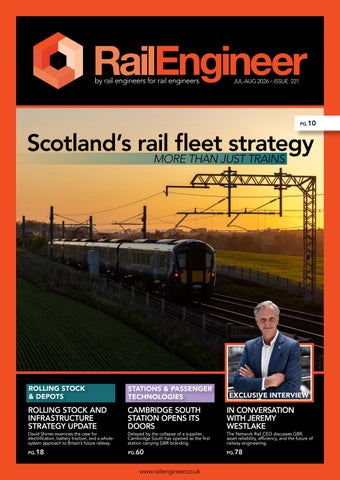
Scotland’s rail fleet strategy MORE THAN JUST TRAINS
ROLLING STOCK & DEPOTS
STATIONS & PASSENGER TECHNOLOGIES
EXCLUSIVE INTERVIEW
ROLLING STOCK AND INFRASTRUCTURE STRATEGY UPDATE
CAMBRIDGE SOUTH STATION OPENS ITS DOORS
IN CONVERSATION WITH JEREMY WESTLAKE
David Shirres examines the case for electrification, battery traction, and a wholesystem approach to Britain’s future railway.
Delayed by the collapse of a supplier, Cambridge South has opened as the first station carrying GBR branding.
The Network Rail CEO discusses GBR, asset reliability, efficiency, and the future of railway engineering.
PG.18
PG.60
PG.78
www.railengineer.co.uk
24 CONTENTS 06| 10| 14|
3
Elstow and UK passenger train safety
The recent Elstow collision reminds us that risks remain despite Britain’s improving railway safety record.
Scotland’s rail fleet strategy: more than just trains
Malcom Dobell looks at why fleet strategy matters and what it could mean for Scotland’s rail future.
Building tomorrow’s tramway today
Can a tram system designed and built today keep pace with customer expectations over the next 30 years?
68 66
18| 24| 28| 34| 40| 43| 48| 54| 60|
74
Rolling stock and infrastructure strategy update
David Shirres examines the case for electrification, battery traction, and a whole-system approach to Britain’s future railway.
Class 345 production resumes
Derby’s Litchurch Lane works restarts train production, as Alstom builds new Class 345 units for London’s Elizabeth line.
IMechE Railway Challenge 2026
Young engineers put their skills to the test, designing and building miniature locomotives for the IMechE Railway Challenge.
The Talerdigg collision: underlying factors and the role of ETCS
The RAIB’s investigation reveals how ETCS, low adhesion, and human factors combined to cause a near-fatal accident.
Overhauling the Class 57 for the 21st Century
The Class 57 G exam programme shows how thorough overhaul can extend older locomotives’ useful working lives.
The platform-train interface on Britain’s mixedtraffic railway
The platform-train interface remains a major challenge, with Britain’s varied infrastructure requiring multiple solutions.
Future-proofing Britain’s railway stations
Station technology is evolving rapidly, but investment, obsolescence, cybersecurity, and AI present new challenges for GBR.
Belfast’s impressive interchange
Belfast Grand Central doubles the number of integrated rail-bus interchanges in the British Isles, following Hull’s example.
Cambridge South station opens its doors
Delayed by the collapse of a supplier, Cambridge South has opened as the first station carrying GBR branding.
64| 66| 68| 70| 72| 74| 78|
Railway Engineer of the Year: celebrate today’s pioneers
From Brunel to today’s pioneers, engineering excellence continues to shape Britain’s railway and drive its future.
Moving what matters
Heavy Haul Rail outlines its new strategy, investing in people, operations, and growth as Britain’s infrastructure programme accelerates.
Rail Live 2026: innovation takes centre stage
From alternative traction to innovative plant, Rail Live 2026 highlighted the technology driving Britain’s railway forward.
NICS: Non-Intrusive Crossover System
NICS offers a safer, faster way to access engineering worksites, maximise possession time, and improve productivity.
Scottish supply chain turns out for RIN Glasgow Nigel Wordsworth reports from RIN Glasgow, where Scotland’s rail supply chain showcased its breadth, expertise, and innovation.
Finland: current and future signalling
Finland is modernising its railways with new signalling, smarter traffic management, and ambitious plans for automation.
In conversation with Jeremy Westlake
The Network Rail CEO discusses GBR, asset reliability, efficiency, and the future of railway engineering.
Rail Engineer | Issue 221 | Jul-Aug 2026
EDITORIAL EDITORIAL
GBR promises A BETTER
ENGINEERED RAILWAY
Great British Railways (GBR) offers significant benefits. It will bring together the control of costs and income at an operational level, remove contractual barriers, and should ensure that strategic decisions consider the whole railway system. In his interview with Rail Engineer, Network Rail’s CEO, Jeremy Westlake, explains how GBR will also benefit rail engineering. This includes better sharing of data, optimised tyre turning to increase track life, and better use of service trains for infrastructure monitoring. He also considers that the new integrated regional business units’ whole system approach is already delivering significant benefits. Creating GBR is a huge task. Its Bill is currently receiving detailed Parliamentary scrutiny and should receive Royal Asset this year. GBR is expected to be fully operational by the end of 2027. By then, two key strategies will have been published. The Long-Term Rolling Stock and Infrastructure Strategy (LTRS&IS) is to be published very soon. This will be followed a year later by the Long-Term Rail Strategy (LTRS) which will specify GBR’s strategic objectives over a 30-year period. Yet, it is curious that the LTRS was not published earlier to inform both the GBR Bill and the LTRS&IS by, for example, specifying traffic growth targets and the required increase in capacity. By now, the Government surely knows what it wants from its railways. Furthermore, in 2022, a consultation exercise was held on what was then the Whole Industry Strategic Plan. This attracted 307 responses which were summarised in a 90-page report. This exercise seemingly needs to be repeated before the LTRS can be finalised. Scotland published its fleet transition strategy in November which is its equivalent of the LTRS&IS. Malcolm Dobell’s report explains how it was developed by Transport Scotland and its engineers. This considers that routes with Inter City and Freight traffic should eventually be fully electrified. In contrast the UK Government considers that, due to advances in battery technology, each route’s optimum solution must be considered on a case-by-case basis. Hence, Westminster rejects the idea of a rolling programme of electrification while Scotland considers that such a programme is essential to maintain skills and reduce its electrification costs.
Rail Engineer | Issue 221 | Jul-Aug 2026
PHOTO: DAVID SHIRRES
4
Another difference between the Scottish and English view is the use of bi-mode traction. Various UK Government statements have advised that bi-mode trains provide passengers with the service they require without the need for electrification. It is doubtful that Midland Main Line passengers would agree. While there is certainly a role for bimode traction, using diesel engines on an electric train with sufficient power for 125-mph running adds weight, significantly increases lease and operational costs, and results in bi-mode trains suffering twice as many failures as electric trains. Scotland recognises the financial constraints that make electrification of its Inter City routes a long-term goal. Yet rather than procure bimode trains, the aging Scottish HST fleet is being replaced by more modern diesel trains as a transitional measure. Our LTRS&IS feature considers why the Westminster and Scottish Governments have such differing views. One difference is that shadow GBR seemingly has no engineering focus with the result that UK Government traction policy statements show a lack of understanding of the physics of rail traction and do not recognise the many benefits of electric traction such as increased capacity on a mixed traffic railway. Hence English traction policy would seem to be political diktat. It is to be hoped that GBR will eventually have a strong engineering focus to provide more informed decisions. Scotland’s fleet transition strategy does not mention ETCS signalling. In Scotland, it is considered that the benefits of ETCS are overstated and thus its high cost is not justified. It will be interesting to see how the LTRS&IS reconciles England and Scotland’s differing ETCS stance. Finland’s ETCS programme, however, is well underway as Clive Kessell reports in his feature about the IRSE’s internal conference in Helsinki. Among other issues, his report considers how Finland’s railway is adapted for its harsh winters.
PHOTO: DAVID SHIRRES
5
THE TEAM Editor David Shirres editor@railengineer.co.uk
Production Editor Matt Atkins matt@rail-media.com
Production and design Adam O’Connor adam@rail-media.com
Engineering writers bob.hazell@railengineer.co.uk bob.wright@railengineer.co.uk clive.kessell@railengineer.co.uk david.fenner@railengineer.co.uk graeme.bickerdike@railengineer.co.uk
Redoubling the line between Aberdeen and Inverurie. (Inset) Class 802 bi-mode MTU 1600 power pack. This system is 8% of the weight of these trains .
malcolm.dobell@railengineer.co.uk mark.phillips@railengineer.co.uk paul.darlington@railengineer.co.uk peter.stanton@railengineer.co.uk
ETCS not taking account of low adhesion is a key aspect of the Rail Accident Investigation Branch (RAIB) report on the Talerdigg collision as we explain. After the tragic accident at Elstow, we report how the risk profile of train accidents has changed over the years. This shows that key factors in the significant reduction in train crash fatalities have been the introduction of TPWS and improved train crashworthiness. As indicated, this issue has a rolling stock focus. Hence, in addition to the above, it includes features on Class 57 locomotives being overhauled and the construction of the Elizabeth Line’s Class 345 units. Our report on the IMechE’s annual Railway Challenge describes how teams of young engineers compete to have the best performing miniature locomotive. We also focus on stations with reports on two new stations. Belfast Grand Central (BGC) is both a bus and a rail station. We consider the complexities of its construction and the associated railway remodelling as well as describing the significant benefits that BGC offers Northern Ireland. The construction of Cambridge South, which opened in June, also required additional tracks. David Fenner describes this station and its significant benefits which include boosting the economic contribution of the adjacent Biomedical Campus and serving over a million passengers per annum.
DAVID SHIRRES
Many passengers at stations find it difficult to board their train. The solution is level boarding. Yet as we show, this is difficult to achieve as mixed traffic and variations in platform heights create a complex platform train interface. Hence a whole system approach is needed as low-floor trains with sliding steps are only part of the solution. Another increasingly complex aspect of stations is technology to monitor and inform passengers. Moreover, this technology can quickly become obsolete. Paul Darlington considers whether Station as a Service funding or ‘managed service’ type models might be the best way to provide this technology. The large amount plant and equipment on display at Rail Live which included a Ballast Undercutter & Trencher and Portable Sleeper Squarer are described in a report by Matt Atkins. This event took place at Porterbrook's Long Marston Rail Innovation Centre which now has a 3.5km continuous electrified test loop which carried a train for visitors. This was certainly the place to appreciate how engineers maintain and enhance the railway. It is to be hoped that GBR will be able to offer them the opportunity to do so in the most efficient and effective way possible. However GBR is organised, it will not function without competent engineers. In a feature that celebrates rail engineers past and present we ask for nominations for Railstaff’s Rail Engineer of the Year Award to help ensure that engineers receive the recognition they deserve.
Advertising craig@rail-media.com
Craig Smith
Rail Engineer Rail Media House, Samson Road, Coalville Leicestershire, LE67 3FP, UK. Switchboard: 01530 816 444 Website: www.railengineer.co.uk
Rail Engineer Videos http://rail.media/REYouTube
Editorial copy to Email: news@rail-media.com
Free controlled circulation Email: subscribe@rail-media.com
The small print Rail Engineer is published by RailStaff Publications Limited and printed by PCP Ltd. © All rights reserved. No part of this magazine may be reproduced in any form without the prior written permission of the copyright owners. Part of:
RAIL ENGINEER EDITOR www.rail-media.com
Rail Engineer | Issue 221 | Jul-Aug 2026
NOTICES
PHOTO: RAIB
6
Elstow and UK passenger train safety On 19 June, two trains collided at Elstow, south of Bedford which sadly resulted in the death of a train driver and many passengers suffering major injuries. Although the UK has one of the safest railways in Europe, this shows that there is always the potential for a serious accident. Three days after the accident, the Railway Accident Investigation Branch (RAIB) released its statement about the accident. This showed that Train 1H46, which was formed of a four-car 2003-built Class 360 unit, passed a red signal and ran into the back of Train 1B67, a brand new five-car Class 810, at a speed of around 79 km/h. Historic reports into such accidents would typically conclude that ‘the driver was driving without due attention to the signals.’ Yet it is wrong to conclude that the driver was at fault because a red signal was passed as this will be the result of various factors which will not be known until RAIB’s report into this incident is produced. This will identify the causal factors which resulted in the immediate cause and any underlying factors associated with the organisations concerned. It will also make recommendations to prevent a recurrence which will relate to the identified causal and underlying factors.
Significant risk reduction To understand the risk profile and current level of risk from train accidents, it is instructive to consider past accidents. Between 1980 and 2026 there were 34 fatal passenger train accidents as shown in Table 1. Network Rail has been in existence since October 2002 which is almost exactly half of this 46-year period, therefore a direct comparison can be made between the number of accidents between 1980 and 2002 when British Rail and Railtrack were responsible for rail infrastructure and the Network Rail era from 2003 to 2026. This shows that the number of fatal passenger train accidents and fatalities from such accidents during the Network Rail era was respectively 17% and 8% those of in the British Rail and Railtrack period. Thus, in the Network Rail era there were fewer fatalities per fatal train accident. This is due to improvements in train crashworthiness as discussed later in this feature.
Rail Engineer | Issue 221 | Jul-Aug 2026
DAVID SHIRRES
NOTICES
PHOTO: HEALTH AND SAFETY COMMISSION
Much of this reduction in fatal accidents is due to the dramatic reduction in SPADs. Indeed, prior to the Elstow accident, the last fatal SPAD accident was the 1999 Ladbroke Grove tragedy which was 27 years ago. Table 1 shows that between 1980 and 2002 there were 11 fatal SPAD and Buffer stop collision accidents, which was about one every two years.
1999 Ladbroke Grove accident.
This large reduction in the number of SPADs was due to a combination of driver training emphasising what is now termed professional driving and the Train Protection and Warning System (TPWS) programme as reported in issue 210 (Sep-Oct 2024). TPWS was mandated by the 1999 Railway Safety Regulations which required its fitment at all signals protecting a passenger line junction and buffer stops and to speed reductions where speed was reduced by 30% or more from an initial speed exceeding 60mph. When the programme was completed in 2003, more than 12,000 signals had been fitted with TPWS which was around 30% of all signals. Ongoing signal risk assessments and some resignalling projects have increased the percentage of signals now fitted to around 40%. The signal passed at danger at Elstow was not fitted with TPWS. Although TPWS is not a failsafe system and is not fitted at all signals, it has demonstrably resulted in a significant improvement in railway safety. Yet, as the Elstow accident shows, SPADs still present a risk. Hence it is likely that TPWS fitment criteria will be considered by RAIB’s investigation into this incident.
average, there were 67 train collisions with vehicles on level crossings in the 10 years to 2023. The types of accidents that have been significantly reduced are SPADs and buffer stop collisions as previously discussed, broken rails, train defects, and signaller error. Significant improvements in rail management, as described in Issue 202 (May-June 2023), reduced the number of broken rails from 952 in 2000 to 70 in 2023/24. The procurement of modern trains will have reduced the potential for train defects. The potential for unsafe signaller errors has been reduced due to the closure of an estimated 3,000 mechanical signalboxes since 1980. As a result, under 100 remain as Network Rail aspires to eventually control the entire network from 12 Regional Operating Centres.
Crashworthiness The RAIB investigation will consider the crashworthiness performance of both trains during this 79km/h collision. In this respect it is instructive to consider how rolling stock behaved in previous rear-end collisions. As such collisions are quite rare, this requires looking back to the 1970s to consider the fatal accidents at Shields Junction in 1973, Hassocks in 1978, and Clapham in 1988. These had collision speeds of respectively 82 km/h, 76 km/h and 56 km/h. In the Shields Junction crash, a three-car Class 303 EMU travelling at 104km/hr hit a train formed of 2 x three-car Class 126 DMUs which was moving at 22km/hr (i.e a closing speed of 82km/h). In this collision, the leading coach of the EMU was
Changing risk profile The risks of passenger train operations have changed over time due to action taken by the industry and changing external factors. To examine this with a larger data set than fatal train accidents, the immediate causes of 69 passenger train accidents since 1980 that resulted in major injuries were analysed to produce Table 2 (right). This shows the increase and decrease of various types of accidents before and after the creation of Network Rail. The types of incidents, together with their percentage of all accidents, for which there have been an increase since 2002 are: earthworks (15%); poor adhesion (10%); collisions during signalled moves (10%); and level crossings (25%). The impact of the changing climate on +150-year-old earthworks presents significant challenges. Climate change may also be a factor in the increase of low adhesion incidents as milder, wetter autumns and extended growing seasons increase rail corridor vegetation. Various factors have increased level crossing risk including societal changes affecting how user worked crossings are used. Rail Engineer has published various features explaining the risks associated with level crossings and the action being taken to reduce this risk, with a recent report in Issue 219 (Mar-Apr 2026). Though UK level crossing incidents are well-below the European
Rail Engineer | Issue 221 | Jul-Aug 2026
7
NOTICES Destroyed coach in the Clapham Junction crash.
Clapham Junction crash.
PHOTO: DFT
forced underneath the DMU which was forced upwards into the overhead line equipment. This crushed the cab and much of the passenger compartment of the EMU’s lead coach to solebar level. The body structure of the trailing coach of the DMU was also crushed. However, other than the DMU’s trailing coach, there was no derailment and the adjacent lines were not fouled. In the Hassocks crash, a 12-car EMU ran into the back of an eightcar EMU at an estimated 76km/hr. Both trains were formed on fourcar Class 420 and 421 units. On impact the body of the last coach of the front train was demolished as it deflected to foul the adjacent line and its next coach was thrown up against a bridge. The body of the first coach of the rear train was demolished as it passed under the last three coaches of the front train. At Clapham Junction, one train ran into the back of another train at 56 km/hr. This threw its rear coach above a three-metrehigh concrete wall while the front coach of the rear train veered into the path of an oncoming train. The high death toll in this crash was due to the passenger compartments of the Mark 1 coaches that hit other coaches being breached due to the lack structural strength. This was because, unlike the monocoque construction of the later Mark 2 and 3 coaches, the main structural member of a Mark 1 coach is its underframe. The fatalities and injuries from these three accidents were largely the result of passenger compartments being breached, the lack of overrun protection and, in the case of Clapham, coaches forced onto an adjacent line. The damage to the trains involved in the Shields Junction and Hassocks accidents indicates the energy involved in rear-end collisions at around 80 km/hr. Although this was about the same speed as the Bedford crash, it would seem that no passenger compartments were breached and both trains remained upright on the line. Although one bogie was derailed, this did not block the adjacent line but might have fouled it. Hence, in respect of crashworthiness, the trains involved in the Bedford accident performed well compared with these earlier crashes This is also indicated by the crashworthiness standard EN15227 which recognises that there are limits to what any structure can withstand. It requires main line trains to withstand a collision with another train at the low speed of 36 km/h. At 78 km/hr, the Bedford collision had four times the energy of this limit. Yet, RAIB may well find that that there are crashworthiness lessons from this accident particularly in respect of coach interiors. As far as is reasonably practical, the effects on those inside a coach of a train brought to a dead stop in a rear-end collision have to be considered.
Rail Engineer | Issue 221 | Jul-Aug 2026
PHOTO: DFT
8
Maintaining safety Throughout railway history there have been continuous safety improvements driven by learning from accidents. As a result, UK rail travel is very safe and fatal accidents such as Esltow are rare. But this accident is a stark reminder of the ever present risks associated with railway operations, and of the consequent need for constant learning and vigilance. It is also important that those who have to implement and monitor safety related processes understand the need for them. Accidents are now so rare that lessons from accidents in the distant past might be forgotten. In 1989, the multi-fatality Clapham Junction accident was a huge shock to the industry, particularly the S&T community. Yet that was almost 40 years ago and there were recently similar wrong side signalling failure incidents at Cardiff (2016), Waterloo (2017), Dalwhinnie (2021), and Wingfield (2022). A lack of learning from a previous incident was shown in the RAIB report into overspeeding at Peterborough’s Spital Junction in 2023 which noted that lessons had not been learnt from a similar previous incident in 2022. In its 2025 annual report RAIB identified such overspeeding incidents, together with asset integrity and level crossings, as themes from its investigations that put trains at risk. This report also notes that an absence of high consequence accidents is not necessarily an indication of safety as the difference between a near miss and a serious accident can be a matter of luck. Hence, while the industry’s good safety record is a credit to all concerned, there is no room for complacency.
Final positions of trains after rear end collisons in 1973, 1978 and 1988.
CIRAS reporting app
Got a health or safety concern? Report it in confidence, on the go.
CIRAS is the confidential safety hotline for transport. Download the CIRAS reporting app on Google Play or the App Store to raise your health, safety and wellbeing concerns. We protect your identity and share your concern with the right people, so they can act.
Scan me
ROLLING STOCK & DEPOTS
Scotland’s rail fleet strategy: MORE THAN JUST TRAINS
T
his article looks at why fleet strategy matters and what it could mean for Scotland’s rail future. Scotland’s Railway is a combined effort between ScotRail and Caledonian Sleeper (under Scottish Rail Holdings) and Network Rail, as organisations receiving strategy, specification, and funding from Transport Scotland, the transport agency of the Scottish Government, together with trains from English Train Operating Companies (Avanti, CrossCountry, LNER and Lumo), the freight sector in Scotland, and the Scottish rail industry supply base. For some years, the Scottish Government has recognised that ScotRail and Network Rail are funded separately but from the same pot, so the overall profit and loss account only comes together on the civil servant’s desk in Transport Scotland. Therefore, Transport Scotland has encouraged collaborative working between ScotRail and Network Rail and specifies its aligned and integrated requirements to the former through a Grant Agreement and Scotland’s own High level Output Specification to the latter. There has been consistency of strategy, and teamwork between organisations is encouraged and valued. It is reported as being as easy as A-B-C: » Alignment of objectives between operator and infrastructure manager with the strategic objective of the Scottish Government » Building the capability of the staff and the railway, and being » Competitive – attractive services delivered efficiently recognising that customers have alternatives. All of this has delivered efficiency including, for example, electrification around 30% cheaper per single track kilometre than in England, and signalling delivered more efficiently too. Scotland’s railway has some big opportunities ahead. With much of ScotRail’s fleet ageing, passenger habits changing and pressure growing to decarbonise transport, the decisions made now will shape the network for decades to come.
Above all, the different parts of the railway and government have to move in step. In Scotland, that means close alignment between ScotRail, Network Rail, suppliers, and Transport Scotland. This whole-system view is especially important because much of ScotRail’s current fleet is both old and unusually varied. That creates extra complexity in maintenance, training, depot operations, and spares. It can also produce an inconsistent passenger experience, with travellers finding that comfort, luggage space, accessibility, and layouts vary depending on which train turns up. Many trains have already had their life extended and are suffering corrosion, wiring deterioration, and parts becoming harder to source. Around 65% of ScotRail’s fleet is old enough to need replacement over the next few years, providing the opportunity to redesign the fleet in a more coherent way rather than replacing one class at a time. Such an approach will link to the aims of Scotland’s wider transport strategy which places emphasis on equality, climate action, economic growth, and health and wellbeing. Better accessibility supports equality, cleaner traction, and a shift away from car travel supports climate and health goals. Better links between communities and tourist destinations support economic growth.
Changing demand and a changing population Why this moment matters Fleet strategy is about far more than buying trains. For example, new rolling stock only works well when the rest of the system is ready for it; electrification must be in place where it is needed; and depots need the right capability, capacity, and equipment. In addition, stations and platforms may need to change and digital systems such as passenger information, reservations, and onboard connectivity must support the service being promised.
MALCOLM DOBELL
Rail Engineer | Issue 221 | Jul-Aug 2026
The strategy also will reflect the way travel has changed without preventing future further changes if habits change again. Since 2020, weekend travel has become stronger, leisure now plays a bigger role, and traditional commuting is weaker on Mondays and Fridays than it once was. In 2025, ScotRail’s busiest days coincided with major
PHOTO: ISTOCKPHOTO.COM/WCJOHNSTON
10
ROLLING STOCK & DEPOTS PHOTO: ISTOCKPHOTO.COM/JUI-CHI CHAN
sports events, concerts, the Edinburgh Festivals, and the weekend before Christmas. Also, Scotland is forecasting a demographic shift towards an older population. That has several implications. More passengers will need stepfree and level access, clear information, and spaces that work better for luggage, buggies, and wheelchairs. A smaller working-age population may also make it harder to attract maintenance and operations staff in the long term. In other words, the trains of the future must be easier both to use and to maintain.
Electrification at the centre In the long run, electric traction is the best answer for most of the network. Electric trains are cleaner at the point of use, generally cheaper to run, and usually more reliable and higher performing than diesel alternatives. Scotland’s strength in renewable electricity gives this argument extra force. Scotland has already demonstrated the benefits of a rolling programme of electrification compared with the stop-start approach seen elsewhere in Britain. A steady programme of electrification will build skills, control costs, and avoid the waste that comes from repeatedly ramping work up and down. Battery trains will probably play an important transitional role, especially on partly electrified routes, but will not be the final answer everywhere.
Although freight traction is outside the scope of this strategy, it does consider that electrification of the network remains the preferred end-state for the main Inter-City and Suburban passenger services where there is also freight traffic. Hence, in respect of electrification, it recognises the synergy between freight and passenger traffic. Diesel trains will not disappear overnight. The diesel services are the Inter-City and rural/ scenic routes as well as parts of Fife and the Borders line. This affects the order in which fleet replacement should happen. Scotland cannot replace everything at once, and nor can the wider rail supply chain deliver multiple large fleets simultaneously without risk. Sequencing is therefore crucial: the right train must arrive at the right time, on routes where the infrastructure can support it, and with depots prepared
to look after it. It is also helpful to have a stable workload, rather than peaks and troughs, which can also help to minimise disruption while infrastructure is upgraded to support new trains.
Fewer fleets, better planning One of the goals is to consolidate from today’s 11 fleets to roughly five main groups. The broad idea is to retain the existing modern classes 380 and 385 electric fleets, introduce a new suburban electric and batteryelectric family, provide an Inter-City transition fleet in the short to medium term, plan for a future intercity electric fleet, and tackle the rural fleet later as infrastructure choices become clearer. Fewer train types will reduce maintenance complexity, simplify training, improve resilience, and make the passenger offer more consistent.
Rail Engineer | Issue 221 | Jul-Aug 2026
11
ROLLING STOCK & DEPOTS Scottish Inter City Routes.
PHOTO: ISTOCKPHOTO.COM/WCJOHNSTON
12
Rail procurement is a slow process. A full cycle from early business case to fleet introduction can easily stretch over a decade. Strategic work, market engagement, formal procurement, train building, testing, and fleet rollout all take time. That is why it is important to start planning around 10 years before the trains are actually required. If planners and decision-makers wait until a fleet is already showing the effects of ageing, they are almost certainly too late. The economics of replacement can be difficult to explain politically because old trains and new trains can be expensive in different ways. Older fleets may look cheaper because their lease costs are lower, but their maintenance bills rise over time, sometimes unexpectedly, and obsolescence becomes a serious (i.e., expensive) problem. Failures become more frequent, parts are harder to find, corrosion becomes an issue, and keeping the trains in service takes more effort. New trains often have the opposite profile: they may cost more to lease, but they can be cheaper to run and maintain. The challenge is that the point where those estimate lines cross may be years away, while funding decisions must be made now. There are also practical limits on how fast change can happen. Depots are already busy, stabling space is finite, and the industry cannot absorb several major fleet introductions at the same time without creating new risks. That is why Scotland’s programme has to be phased. Some parts are already more advanced, including the Inter-City transition using five-car Class 222 trains, the procurement of a new suburban fleet, and electrification work for Fife and the Borders. Other elements, such as long-term rural fleet replacement and a future fully electric Inter-City, remain more strategic and will depend on later decisions.
Rail Engineer | Issue 221 | Jul-Aug 2026
Inter-City Inter-City services are particularly important. Although they make up a relatively small proportion of ScotRail’s overall timetable/mileage, they generate a significant share of revenue and are central to Scotland’s appeal for both business and tourism. That helps explain the urgency of replacing the much loved but life expired HSTs. At around 50 years of age, they are increasingly expensive to maintain, availability is poor, and it no longer offers the consistent experience expected on a modern Inter-City route. The immediate answer is 22, five-car Class 222 trains cascaded from East Midlands Railway (EMR). They are being leased from Beacon, will receive heavy maintenance and extensive refurbishment by Alstom and are expected to be in service from 2027. They will include the following features: » External repaint in ScotRail livery. » Interior refresh, including new carpets and full interior repaint. » A new passenger information system with multimedia displays. » WiFi with Low Earth Orbit Satellite connectivity and voice-over-internet phone capability.
» A new electronic seat reservation system. » A new CCTV system for the safety and security of customers and staff. » An intelligent engine startstop (automatically stops an engine to reduce emissions). » New First and Standard Class seats and tables, with 240 V plug sockets, and both USB-A and USB-C sockets at every seat. In addition, they will offer a family friendly area, providing space for passengers with an unfolded pushchair; one wheelchair space in First Class and two spaces in Standard Class; storage for six bikes; onboard catering facilities to support at seat and trolley service; and seat layouts arranged to maximise window alignment and luggage storage. While diesel powered, these trains are expected to be more fuel efficient than HSTs leading to lower emissions. These trains are leased until 2036, with the possibility to extend until the early 2040s, when it is expected that enough electrification will have been completed to enable Inter City BEMUs. The routes to Aberdeen and Inverness will need to be partially electrified by 2040 for battery-electric to work.
ROLLING STOCK & DEPOTS Suburban The priority for new trains is the suburban fleet where most of the fleet is approaching 40 years old or has already exceeded that. The new suburban fleet is likely to have the widest day-to-day impact because these services carry the largest share of ScotRail passengers. The procurement process has started to select builders and funders. The official notices talk of a minimum of 69 trains, with a potential option for additional orders of up to approximately 37 trains. It is intended to procure a standardised fleet of BEMUs to replace suburban Class 156 diesel units and EMUs to replace classes 318, 320, and an option to replace Class 334. The latter is only 25 years old but would be 30-35 years old by the time of replacement. The trains will be required to have improved onboard facilities including air-conditioning, greater reliability, and increased accessibility including level access boarding and alighting (in a way that minimises the need for platform adjustments). Also required are active travel provision such as improved spaces for bicycles and wheelchairs, and inclusion of family friendly areas (where families can sit with a baby in an unfolded buggy), leading to more comfortable journeys. Compared with diesel or conventional electric trains there are system challenges to be overcome when deploying BEMUs, requiring an iterative design process that considers at least the following: » Timetable/stock diagrams – to create opportunities to
07F – Scotland’s rail fleet strategy – 01 2309 words
Fife
Borders
A railway in transition
119 Single Track Kilometres of electrification, in four sections.
17 Single Track Kilometres electrification, in two sections.
Signalling modernisation where electrification is provided.
One new Feeder Station at Tweedbank.
Scotland is not simply replacing old trains with new ones. It is deciding what kind of network it wants in the future. That includes how simple or complex the fleet should be, how quickly electrification should spread, how accessible services must become, and how investment can be timed to deliver long-term value rather than short-term fixes. None of this will be easy, but there is a very clear positive message. Because so much of the fleet now needs attention at the same time, Scotland has a genuine once-in-ageneration chance to reshape its railway into something cleaner, simpler, more reliable, and more useful for the people who depend on it.
One new feeder station at Thornton. Accessibility improvements at Cardenden station, including new lift and footbridge.
charge batteries. » Topography (stations stops, gradients etc.), train speeds and battery size affecting self-powered range. » Power supply capacity – recognising it needs to have the capability to supply the whole operation through the electrified sections. » Extent of electrification – to ensure sufficient charged batteries – linked to battery capacity. » Stabling/charging (linked to power supply for depots/ stabling points) – existing electrified depots/siding might need higher capacity to allow for battery charging. » Contingency in case of disruption – e.g., line blockage just short of a charging section/location. This iterative process should be supported/informed by modelling as was seen in the development of the discontinuous electrification system for the Cardiff Valley lines.
In order to enable BEMU operation intermittent electrification will be provided on the Fife and Borders lines. The existing diesel trains on these lines will be transferred to mid-life diesel trains from F&B to rural routes, improving the passenger experience on the West Highland and Southwest Scotland routes.
Rural scenic routes Rural routes are more difficult because they serve a wider mix of purposes and often depend on infrastructure choices that have not yet been made. These lines support tourism, connect communities, and link into ferry travel, so their social and economic value goes well beyond simple passenger counts. In the shorter term, electrification elsewhere will cascade some diesel multiple units – mainly Class 158s and Class 170s – to improve these routes whilst longer term, more permanent solutions are developed. These routes need clear long-term decisions about traction and infrastructure.
This article is based on talks given by Bill Reeve and Louise Shaw from Transport Scotland and by Jon Newton from Scottish Rail Holdings to the IMechE in May 2026
1
Rail Engineer | Issue 221 | Jul-Aug 2026
13
14
ROLLING STOCK & DEPOTS
Building tomorrow's tramway today
T
he UK light rail sector finds itself at an interesting crossroads. After years of debate about the role of urban transport in supporting economic growth, decarbonisation, and regeneration, light rail is firmly back on the agenda. Combined authorities, regional mayors, and local authorities are once again exploring tram and mass transit schemes as they seek solutions to growing urban populations, changing travel patterns, and ambitious net-zero targets. But while the benefits of light rail are widely recognised, a fundamental question remains: can a tram system designed and built today keep pace with customer expectations over the next 30 years? According to industry leaders from UKTram and Siemens Mobility, the answer is yes, but only if future needs are considered from the outset. During a recent Interchange webinar, industry experts discussed the challenges and opportunities facing the next generation of tram systems, highlighting the principles that will be essential if today's schemes are to remain relevant for decades to come.
regeneration, and decarbonisation." That shift in thinking is important. Historically, transport schemes have often been assessed primarily on passenger numbers or journey time savings. Increasingly, however, authorities are taking a broader view, considering how fixed transport infrastructure can stimulate investment, improve connectivity, and transform entire urban areas. A tram network, Hammett argues, should be viewed as part of a city's long-term development strategy rather than as a standalone transport intervention.
Changing expectations Beyond transport For James Hammett, managing director of UKTram, the current political and industry environment presents a significant opportunity. "There's never been a better time to be talking about light rail," he explained. "Government and regional leaders increasingly recognise that tramways aren't simply transport systems. They're tools for placemaking, economic growth,
Rail Engineer | Issue 221 | Jul-Aug 2026
While the core purpose of a tram system remains unchanged, passenger expectations are evolving faster than ever. Consumers increasingly expect services to be available instantly and delivered seamlessly. The same expectations are now influencing public transport. Passengers want real-time information, integrated ticketing, personalised journey planning, and confidence that their connections will work when they arrive.
"In transport, we're competing against the convenience people experience in other aspects of their lives," said Hammett. "People expect information immediately. They expect journeys to be easy and intuitive." The challenge is that while digital technology evolves rapidly, trams may operate for 30 years or more. That means today's infrastructure must be designed to accommodate technologies that do not yet exist.
The passenger For Rob Thomas, head of sales at Siemens Mobility Rail Infrastructure UK, futureproofing begins with understanding customer needs rather than selecting technology. "The technology isn't the starting point," he explained. "The starting point is the passenger experience and understanding what outcomes customers actually want." While safety, reliability, and operational performance remain fundamental requirements, technology should be viewed as an enabler rather than an objective in itself. Journey planning applications, integrated ticketing systems, passenger information platforms, and future digital services can all sit on top of a robust operational core.
ROLLING STOCK & DEPOTS The key, Thomas argues, is avoiding the temptation to specify known solutions too early. "We should be focusing on the outcomes we want to achieve rather than simply repeating what was done on previous projects."
Early collaboration Both speakers highlighted early engagement between authorities, operators, maintainers, and suppliers as one of the most important factors in delivering successful schemes. Too often, key decisions are fixed before the organisations responsible for delivering and maintaining the railway have been consulted. Bringing suppliers into the conversation earlier enables stakeholders to better understand costs, explore alternatives, and identify opportunities for innovation. It also creates a more integrated approach to designing systems that can evolve over time. The principle extends beyond construction. Considering maintenance, upgrades, renewals, and future expansion during the initial design phase may increase upfront planning effort but can significantly reduce whole-life costs later.
Affordability A recurring challenge facing light rail remains cost. Questions around affordability continue to dominate transport discussions, with comparisons frequently made between UK schemes and those delivered elsewhere in Europe. However, Hammett believes those comparisons can sometimes be misleading. "What often gets included in tramway costs isn't necessarily the tramway itself," he explained. Major schemes frequently include extensive public realm improvements, utility diversions, streetscape enhancements, and wider
regeneration work. These elements are often accounted for within the overall project budget, making direct comparisons difficult. In some cases, the infrastructure supporting urban regeneration can represent a substantial proportion of total project expenditure. This reinforces the need to evaluate schemes holistically, considering the regeneration and economic benefits they deliver rather than focusing solely on the transport infrastructure.
Digital design One area where technology is already delivering significant benefits is project delivery. Modern survey techniques, digital models, and off-site testing are helping reduce risk, improve integration, and minimise disruption. Utility diversions remain one of the most significant challenges during tramway construction. Despite advances in mapping technology, unexpected buried services continue to cause delays and increase costs. However, improvements in ground scanning technologies and digital modelling are providing increasingly accurate information before construction begins. Meanwhile, digital twins and integration facilities are allowing railway systems to be tested before they ever reach site. Drawing on experience from major rail programmes, including the Elizabeth line and East Coast Digital Programme, Siemens Mobility uses off-site integration facilities to bring together signalling and control systems before deployment. These environments allow faults and compatibility issues to be identified and resolved without affecting operational railways. Problems that may take days or weeks to resolve on a live network can often be addressed rapidly within a controlled test environment.
Rail Engineer | Issue 221 | Jul-Aug 2026
15
16
ROLLING STOCK & DEPOTS Integrated mobility Perhaps the strongest theme to emerge from the discussion was the need to think beyond individual transport modes. Future passengers are unlikely to care whether their journey involves a tram, train, bus, bike, e-scooter, or demand-responsive transport service. What matters is that the journey feels seamless. That means providing consistent information, integrated ticketing, real-time updates, and intuitive passenger guidance across multiple modes. "The customer doesn't initially think in transport modes," said Hammett. "They think about getting from A to B." Accessibility forms a critical part of that experience. While modern light rail systems already score highly for accessibility through features such as level boarding and predictable stopping positions, more attention is needed on the first and last mile of journeys. The challenge is no longer simply getting passengers onto a tram. It is ensuring they can easily reach the stop in the first place and complete their journey at the other end. Looking further ahead, data and artificial intelligence could play an increasingly important role. Operators already collect large volumes of information relating to vehicle performance,
passenger numbers, and service reliability. The next step is using that data more intelligently. Real-time passenger load information, predictive maintenance, dynamic journey guidance, and automated disruption management could all help improve both customer experience and operational efficiency. Much like modern sat-nav systems reroute drivers around congestion, future mobility platforms could automatically recommend alternative routes when disruption occurs. The technology is largely available today. The challenge lies in integrating systems and ensuring information flows seamlessly between operators, assets and passengers.
The next generation While much of the discussion focused on infrastructure and technology, both speakers highlighted another critical consideration – people. Future tram networks will only be successful if there is a skilled workforce available to operate, maintain, and improve them over the coming decades. As technology evolves, attracting the next generation of engineers, technicians, operators, and innovators will become increasingly important. Because futureproofing a tramway is about more than designing adaptable
infrastructure. It's about creating a transport system – and an industry – that can continue evolving long after the ribbon has been cut.
Future-ready systems The discussion identified several key principles for building light rail systems capable of meeting future demand: » Start with passenger outcomes, not technology. » Adopt a whole-system view of mobility. » Engage operators, maintainers and suppliers early. » Design infrastructure that can be upgraded and expanded. » Use digital tools and off-site testing to reduce risk. » Standardise where possible. » Focus on whole-life value rather than upfront cost alone. » Consider workforce skills alongside technology requirements. » Enable seamless integration across transport modes. » Build flexibility into systems to accommodate future innovation. If those principles are followed, the sector appears confident that tram systems built today will remain relevant tomorrow – and for many decades beyond.
Discover more This article captures just some of the insights shared during a recent Interchange webinar featuring James Hammett, managing director of UKTram, and Rob Thomas, head of sales at Siemens Mobility Rail Infrastructure UK. To watch the discussion in full and explore the challenges and opportunities facing the next generation of tram systems, scan the QR code, or search Interchange webinar with Siemens on YouTube. For more information about Siemens Mobility's light rail and transport technology solutions, get in touch with the team: info.mobility.gb@siemens.com
Rail Engineer | Issue 221 | Jul-Aug 2026
Transport Benevolent Fund CIO
All about people...
people working in public transport
Help and support for you, your live-in partner and dependent children during times of need
A comprehensive range of health, welfare and financial support for less than 20p per day.
JOIN ONLINE TODAY www.tbf.org.uk
Registered charity: England and Wales 1160901, Scotland SC047016.
18
ROLLING STOCK & DEPOTS
Rolling stock and infrastructure
S TR ATEGY UPDATE
DAVID SHIRRES
T
he extent to which future rolling stock will be battery powered and the requirement for further electrification is to be defined by Great British Railways’ (GBR) Long Term Rolling Stock and Infrastructure Strategy (LTRS&IS). There have recently been various reports and events concerning rail electrification. Furthermore, the UK Government’s emerging stance of rail electrification is becoming clear. It therefore seems timely to provide an update on rail electrification. This includes the differing views of the Westminster and Scottish Governments. It also explains why the LTRS&IS must consider freight electrification and how this would benefit the passenger railway.
RIA freight report In July, the Railway Industry Association (RIA) published its report ‘Growing rail freight: the need for targeted electrification.’ This report concluded that electric freight haulage must be maximised to unlock the full economic and environmental value of rail freight. Hence, this should be a focus of the long-term rolling stock and infrastructure strategy for GBR which is currently under development.
(Right) Running speeds up to Shap Summit for a 1235t intermodal train. (Below) WCML Electric freight in Scotland.
PHOTO: DAVID SHIRRES
Rail Engineer | Issue 221 | Jul-Aug 2026
This report also considers that more powerful electric freight will create more capacity for both passenger and freight services. This would help achieve the rail freight growth target as, for example, West Coast Main Line (WCML) diesel hauled intermodal services can only run at night north of Preston. The graph shows if such diesel hauled freight ran during the day, there would be five timetable clashes with 125mph passenger trains between Preston and Glasgow. This is why such dieselhauled trains can generally only run at night as they can only manage speeds of 25mph over the northern fells which destroys rail capacity. Yet there would be no timetable clashes if freight trains could run at 90mph which is only possible with electric traction. In effect, a non-
ROLLING STOCK & DEPOTS
electrification, including targeted infill schemes where passenger electrification is not yet required. Given existing power supply limitations, the report also called for a crossindustry review to determine the interventions required to remove constraints on electric freight. RIA Senior Technical Advisor David Clarke noted that this report demonstrates that maximising the use of electric freight unlocks additional freight and passenger capacity, improves reliability, reduces costs and delivers great economic benefits.
2024 RIA report A previous RIA report – ‘A lower cost, higher performing net-zero railway’ – analysed 216 unelectrified passenger train routes. It found that 83 of these could be operated by Battery EMUs (BEMUs) without any additional electrification as they spent sufficient time under the wires to charge batteries for the unelectrified part of the route. However, such services may require increase in overhead line equipment (OLE) power supply. This report recommended that a fleet of BEMUs should be procured as soon as possible to deliver the earliest possible carbon reduction and air quality improvements
Scotland’s fleet transition strategy This strategy was published in Nov 2025. It reaches the same conclusions as the RIA report as it considers that electric trains are the preferred end-state for InterCity routes with freight traffic. Where a significant electrification is required on such corridors, it proposes an interim solution of replacing Scotland’s aging HST fleet with Class 222 Meridian units to take account of the availability of finance and allow flexibility in the pace of electrification delivery to reduce disruption.
Graphic of ScotRail Class 222 unit which are being procured as a transistional measure prior to electrification.
PHOTO: ALSTOM
stop 90mph freight train would then behave like a stopping 125mph passenger train. Faster freight trains also offer better crew and asset utilisation with the possibility of a train making a round trip in one day. As well as creating opportunities for premium fast freight, this further facilitates rail freight growth as more traffic carried for the same fleet size. The report therefore recommends that all industry parties work together to accelerate the current ‘Faster Freight’ initiative to increase capacity on existing electrified corridors. Research from the University of Birmingham supporting this report considered various freight routes and types of locomotives and concluded that electric locomotives are the optimum long-term solution. This concluded that although bi-mode (electric and diesel) locomotives are a practical interim solution, battery-only locomotives are not a substitute for main line electrification as they have insufficient energy storage for main line freight haulage. They could, however, be used for shunting and very short trips. The report therefore recommended that a crossindustry business case should be developed for freight
as well as improving both performance and passenger experience. Another recommendation was the eventual electrification of all main routes due to the power requirements of intercity and freight services. As a result, it concluded that 28% more of the network needed to be electrified leaving 34% of the network to be operated by battery or non diesel traction. Given the interconnected nature of the infrastructure, the report recommended the adoption of a portfolio approach with a rolling programme of electrification rather than electrifying lines on a project-by-project basis. This approach would help reduce the cost of electrification by breaking the cycle of ‘boom and bust.’ It recommended a similar approach for rolling stock.
Rail Engineer | Issue 221 | Jul-Aug 2026
19
20
ROLLING STOCK & DEPOTS It also considers that where there is no freight market, or as a transitional measure on InterCity routes, the operation of battery-electric trains can deliver the same carbon benefits as a fully electric train while significantly reducing the capital investment required in the short to medium term. Since rail powers were devolved to Scotland, the Scottish Government has delivered 587 single track kilometres (stk) of electrification in a rolling programme which has reduced the cost of electrification. This issue has a detailed report on Scotland’s strategy which explains how it considers all relevant issues.
IMechE BEMU seminar Last year’s battery traction seminar organised by the Institution of Mechanical Engineers ( IMechE) also provided useful insights. This showed that battery traction is now a mature technology by considering new trains for the Dublin DART suburban service that operate beyond the wires for at least 80km; discontinuous electrification for 170 stk of 285 stk of the Welsh Core Valley lines; and a trial to replace one generator unit (GU) on a Class 802 unit with a 575kWh battery. This showed that if batteries replaced all three GUs a return run of 135km off wire would be feasible. The seminar showed how the required battery capacity is determined by traction and auxiliaries load, safety factors, cell degradation, charging rate, and restrictions on maximum charge to maximise battery life. In addition, route specific factors must be considered, such as gradients and
Airdrie to Bathgate line being electrified as it was built. (Inset) Graph from CEBR report. Rail Engineer | Issue 221 | Jul-Aug 2026
stopping patterns. Hence, BEMUs would be route specific and so may be difficult to cascade to other services. Furthermore, it did not provide any information about the cost of battery traction. Professor Stuart Hillmansen of the University of Birmingham noted that the assessment of battery capacity requires an understanding of the physics of railway traction. He advised that the power required by a train is proportional to the cube of its speed. The seminar also considered the need for any rolling stock and infrastructure strategy to take a whole-system approach by considering freight and +100mph passenger trains as well as suburban passenger trains. The cost of batteries over the vehicle’s lifetime and all associated discontinuous electrification costs also need to be considered.
CEBR’s oil price report A recent report produced by the Campaign to Electrify Britain’s Railways (CEBR) considered how GB rail operators have been affected by the current oil price crisis. This stressed that electrification is not dependant on any particular energy source and hence offers energy resilience. The report notes that the UK Government’s Department for Energy Security and Net Zero recently announced that it has a strategic policy drive to ‘Electrify Britain’ in order to to: “get Britain off the rollercoaster of fossil fuel markets and onto the clean homegrown power.”
It is not clear whether the Department for Transport supports this policy in respect of rail electrification. The report concluded that, due to the high price of diesel, £1.35 billion would have been saved over the past 11 years had all passenger trains been electrified. It also notes that only 7% of rail freight is electrically powered in contrast to 74% for passenger trains. Although the report focuses on traction energy costs, it notes that an electrified railway delivers a wide range of cost efficiencies and operational benefits relative to diesel traction in addition to its decarbonisation benefit.
East West Rail Having worked on the 2010 Scottish project to reopen the Airdrie to Bathgate line, which was electrified as it was built, your writer knows that such electrification costs much less than that of electrifying an existing railway. Furthermore, this does not disrupt rail or road users. Yet in 2018, the Transport Minister decided that the East West Rail (EWR) line was not to be electrified. He considered that new diesel electric, battery electric, and hydrogen electric hybrids offered the required passenger benefits and so made expensive and disruptive electrification unnecessary. Hence, the opportunity for low-cost electrification of the first part of EWR as it was built was lost due to ministerial doctrine. No published analysis ever justified the decision.
ROLLING STOCK & DEPOTS It has now been found that battery technologies alone are not sufficient as EWR will have discontinuous electrification with Battery EMUs as: “…full electrification would require overhead lines to be installed along the whole length of the route and that this would be more expensive and involve more significant disruptive works to existing railway structures.”
The statement again ignores the opportunity for low-cost electrification at minimal disruption of the section of EWR that has yet to be built. On the section that must be built between Oxford and Bletchley, partial electrification is proposed between Oxford Parkway and Bicester Village. Providing a 25kV power supply to this section would either require a new power supply or a 27km long 25 kV cable to the nearest electrification at Bletchley. The cost of both these options is likely to be comparable to erecting OLE between Bicester and Bletchley. The EWR consultation document proposes a service of up to five trains an hour plus freight trains. This is an intensive service for which full electrification should be considered once the higher operation cost of BEMUs have been taken into account. For example, ScotRail considers that the operational cost of BEMUs is 23% more than EMUs. Furthermore, industry sources indicate that a BEMU vehicle’s lease cost is around £150,000 per year greater than an EMU. In addition, as freight trains cannot use discontinuous electrification, slow diesel power freight will reduce the line’s capacity. Since the GW electrification, Network Rail has done much to reduce the cost of electrification including voltage control clearance technology with Siemens surge arresters which eliminates the need for many bridge reconstructions. While EWR rejects full electrification, it is ironic that Irish Rail proposes full electrification for its Cork electrification scheme as this will take advantage of Network Rail’s electrification cost reduction technology. Of all unelectrified lines in England, EWR has perhaps the strongest case for full electrification. This is due to the reduced cost of electrifying EWR as it is built, the costs of feeding OLE not connected to electrified lines, the intensive nature of its service, and techniques that Network Rail have developed to reduce the cost of electrification. Hence, EWR’s claim that discontinuous electrification provides a lower cost solution needs to be justified. Yet when Transport Select Committee member Olly Glover MP asked for submitted a Freedom of Information request asking how discontinuous electrification was justified, this was refused. Just as in 2018, it seems decisions on EWR electrification are subject to political direction rather than informed analysis.
The UK Government view Rail Engineer asked the Department for Transport (DfT)’s press office for its view on electrification and whether the LTRS&IS will consider freight. Its response was that: “We are committed to decarbonising our railway, and electrification is the most effective way to do this” and that this strategy “will set out a coordinated and more cost-effective approach to rolling out new trains and electrification, to support better performance and passenger experience." Furthermore, the DfT “will ensure that decisions on electrification take into account the needs of freight operators. Whilst few would disagree with these statements, RIA considers that a broader view is required. Its updated Electrification Cost Challenge report, published in June, argues that: “electrification should not be viewed solely through the lens of carbon reduction. This is because they also offer a lower whole-life cost, better performance, increased capacity, improved reliability, stronger energy security and a clearer path to reducing the net subsidy required to operate the network.” In its response to the Transport Select Committee’s report – ‘Rail investment pipelines: ending boom and bust’ – the Government considers that boom and bust investment is only a supply chain perception. In respect of electrification, it considers that the objective is to “progressively decarbonise rail traction in a way that maximises emissions reduction per pound of investment,” with no mention of electrification’s wider benefits.
(Above) Boom and bust electrification delivery.
It is true that battery traction is evolving and offers significant opportunities as RIA’s 2024 report and the IMechE battery seminar show. Yet there will always be a requirement for a significant proportion of core routes to be electrified, if they are to be operated in the most efficient manner possible. However, the DfT does not share this view. Instead, it considers that: “…advances in battery and hybrid technology and discontinuous electrification approaches mean that the optimal solution will vary by corridor and network context.” Hence, it rejects the idea of a rolling programme of electrification. It considers that the lesson from previous electrification programmes is: “…not simply that continuity matters, but that whole-system integration, taking account of evolving technology is essential to achieving efficiency.” As a result, the industry is haemorrhaging electrification skills. The recent RIA report advises that there has been a 68% reduction in staff with electrification competencies between 2018 and 2025, including more than 300 redundancies after the Midland Main Line pause.
Rail Engineer | Issue 221 | Jul-Aug 2026
21
22
ROLLING STOCK & DEPOTS
PHOTO: ISTOCKPHOTO.COM/MARC SCRUTON
This begs the question of why the DfT’s view on the electrification of core routes differs to that of Scotland, Ireland, and all other major European railway administrations. Outside Europe, India now has 99.2% of its broad gauge electrified after electrifying 40,000km since 2014. One explanation is the very real affordability constraints on capital expenditure for electrification, but this should not stop future electrification. For example, the Scottish Government’s response to limited finance is to scale back its electrification programme and spend a high percentage of available enhancement expenditure on a rolling programme of electrification as it believes this will provide a better railway by any measure. Another reason seems to be faith in developing battery technology and a desire to be seen to innovate. Yet this view fails to consider the physics of rail traction. As mentioned earlier, Professor Hillmansen advised that the power needed by a train is proportional to the cube of its speed. Hence, per tonne, a 125mph train requires almost three times the power of a 90mph suburban train. A recent RIA report has shown that only electrification can replace diesel-hauled freight trains to give them to power to increase network capacity for both freight and passenger trains. This is a benefit not mentioned in any government statements. In respect of batteries, the UK Automotive Council expects battery specific energy to increase by about 60% over the next 10 years.
Rail Engineer | Issue 221 | Jul-Aug 2026
Hence, whilst this will increase a BEMU’s range increase off the wires, it is unlikely to significantly decrease the 4,400 route-km of core routes for which the 2024 RIA report considered full electrification to be the optimum solution. All of this begs the question of whether Shadow GBR has an engineering focus that informs UK Government pronouncements about fleet strategy and electrification. Rail Engineer asked the DfT press office this question and was advised that: “We are working with stakeholders and partners across the industry to ensure we have a credible and implementable strategy.” It is to be hoped that this will be the case, though for now it is difficult to escape the conclusion that the UK Government’s stance on electrification is the result of political decisions that don’t take account of the physics of railway traction or fully acknowledge the benefits of electric traction. This is certainly not the case in Scotland which has a fleet strategy for which the detailed rationale was explained by engineers from Transport Scotland and Scottish Rail Holdings in presentations which were the basis for our feature on Scotland’s fleet strategy. It is to be hoped that GBR will eventually benefit from such detailed analysis by having a whole system engineering focus that ensures the railway is engineered to provide its passengers and freight customers with a high performing, high capacity railway at lowest whole life cost. It is also to be hoped that GBR will have the authority to decide how best to engineer its railway.
Synthetic S l e e pe r Simply working & sustainable
S U S TA I N A B I L I T Y
R A I LW AY T E C H N O L O G Y
State of the Art
SEKISUI CHEMICAL GROUP: Enhancing Lives, Preserving the Planet. At Sekisui, we’re dedicated to advancing the quality of life worldwide while championing the protection of our planet.
SEKISUI CHEMICAL GmbH Patrick Childs T: +44 (0) 7966 598 055 E-Mail: childs@sekisui.de www.sekisui-rail.com
24
ROLLING STOCK & DEPOTS
Class 345 Production Resumes with First Train Completed at Derby
D
erby’s Litchurch Lane workshops have been producing railway vehicles since they opened in the mid-1870s, when the Midland Railway decided it needed a workshop to produce coaches and wagons. Since 2005, it has been the only UK facility able to design, build, engineer, and test trains.
ALL PHOTO: DAVID SHIRRES
In 2021, it was announced that the works will be part of the production line for 54 HS2 trains as part of a £2 billion order. The works also secured an order for 68 Egyptian monorail trains which was part of a £2.3 billion contract to construct and operate Egypt’s new monorail network. In January 2024, the last of these trains left Derby which is Alstom’s centre of excellence for monorails. At this time, the works was producing various classes of Aventra units for which there was a production run of 2,660 cars with the last coming off the production line in March 2024. The first Aventra to be built was a Class 345 for the Elizabeth line in July 2016. This was the first of 70 nine-car Class 345 units, the last of which was built in 2019. Yet, by September 2023, Alstom warned that 1,400 jobs at Litchurch Lane and 900 jobs in its UK supply chain were at risk as production of Aventra units was due to come to an end in March 24. Thereafter, the works had no work in the immediate future. Hence production facilities were to be mothballed, and a redundancy programme was being implemented. In June 2024, Alstom was eventually given an order for a further 10 x nine-car Class 345 units for the Elizabeth line. This was a £370 million contract which includes maintenance up to 2046. As Andy Butters, the managing director of the Litchurch Lane works, noted: “After a very, very difficult time, this contract gave us breathing space to then seek further opportunities for work.” This contract was signed very much at the eleventh hour. As the local MP noted, it required: “many meetings, letters, and challenging private conversations with the Secretary of State.”
Thus, the works were reprieved from closure but faced a long pause in production. This required diversification to undertake activities such as component overhaul. It also presented an opportunity for the works to host ‘The Greatest Gathering’ Railway 200 event in August 2025.
Resuming production Construction of the Class 345 resumed immediately after the Greatest Gathering. On 4 June, Rail Engineer and other members of the press were invited to the Litchurch Lane works to see the roll out of the first completed unit, 345071. A previous press visit in February, saw the launch of the first of 70 Class 220 units that the works are refurbishing for CrossCountry trains. Next year the works are also to start the refurbishment of 22 Class 222 units before they enter service on ScotRail’s intercity routes. Other future work is the High Speed 2 train order for 54 high-speed trains to be built in a joint venture with Hitachi. In 2023, this was work was expected to start in 2026. It is currently unclear when HS2 train production will start. Restarting the production lines seven years after the last unit was completed did present some problems. Some components on the first Class 345 build, such as the energy metering and CCTV system, were now obsolete and had to be replaced by new components that required verification by an accredited body. In some cases, new suppliers had to be found. In addition to the Derby workforce, Class 345 production sustains more than 1,000 jobs in almost 40 UK companies. For example, Time 24 of Burgess Hill has the contract to supply the wiring looms which make up to 50 miles of wiring in each train. Some large
DAVID SHIRRES
Rail Engineer | Issue 221 | Jul-Aug 2026
ROLLING STOCK & DEPOTS
TZD workshop.
components come from outside the UK. For example, the Chinese Qixing Group supplies bodyside panels and aluminium extrusions. Bogies are supplied by Alstom’s Siegen bogie plant in Germany which was described in Issue 216 (Sep-Oct 2025) as part of our report on the IMechE’s 2025 technical tour. Unlike most other rail manufacturers whose train production involves fitting out a welded bodyshell, Alstom uses a Complete Knock Down (CKD) method of rail vehicle construction which is akin to an IKEA flat pack. This fits out the roof and underframe which can then be turned upside down for ease of assembly before the car body is assembled. CKD requires the car body parts to be bolted together as the car assembly is an integral part of the fit-out process. This requires around 3,500 huck bolts for each car. The use of bolts also eliminates risk of heat distortion and reduces the risk of fatigue cracks. An essential and sometimes troublesome aspect of new trains is their software, in particular the Train Control Management System (TCMS). This controls every aspect of the train including train radio, passenger information system, brake, auto-coupler, CCTV, heating ventilation air conditioning (HVAC), doors, platform identification beacon system for selective door opening, and signalling systems. The Class 345 trains have to change between three different signalling systems: AWS/TPWS, CBTC, and ETCS. As with all software there are updates which, if not thoroughly tested before implementation, can introduce latent faults. The Litchurch Lane works manages this issue in its ‘Train Zero Deliveries’ (TZD) workshop. This has static test rigs of all the electronics and components of all types of Aventra units to simulate how the train’s software and hardware work together. This offers significant benefits for train design, software development, systems integration, and test verification as it enables more thorough testing to be done than is practicable on a train. Once trains are in service it is an essential part of the validation of the train software updates. While visiting the TZD workshop, the large volume of electronic equipment on a modern train was evident which is something that is not obvious to passengers.
Production line The five-stage assembly of the Class 345 units takes place in the 10,000 square metre U-shop which is 176-metres long and was built in 1910. This shop welds together aluminium extrusions and components to manufacture roof panels and underframes for the production line. This has a five-stage assembly process as shown below. Stage 1 - Roof sub assembly: The roof panel is mounted in a rotating jig for easy installation of cables, ceiling modules, lights, door mechanisms, pantographs, and HVAC units.
Roof in rotating jig.
Stage 2 - Underframe sub assembly: The underframe is placed upside down for the installation of traction motor ducts, brake reservoir tanks, pipework, high and low voltage cables, and bolsters.
Underframe assembly.
Rail Engineer | Issue 221 | Jul-Aug 2026
25
26
ROLLING STOCK & DEPOTS
Car body assembly. Stage 3 - Car body assembly: Roof, underframe, and bodyside panels are held in a ground-level jig where they are bolted together. Floorplates are then installed together with thermal and acoustic insulation, interior panels, doors, and windows. Driving cabs and intermediate car body ends are also bolted in place. This stage has a rig of travelling water jets to confirm that the completed car body is watertight.
Stage 4 - Underframe equipment: while the car body is on a raised stand, underframe pipework, battery rafts, power converters, couplers and energy absorption are installed. Stage 5 - Completion – the car body is lowered on its bogies and seating is installed.
Water jet rig.
Car completion.
Underframe equipment fitment.
Rail Engineer | Issue 221 | Jul-Aug 2026
Each of these stages takes 3.5 days. The completed individual cars are then transferred to V-shop where they are coupled to form a train for static testing. V-shop is a 10,000 square metre testing and commissioning facility which was opened in May 2016. At 250 metres long it can accommodate the 204-metre-long nine-car Class 345 train sets.
ROLLING STOCK & DEPOTS Test track then London On the test track the press party had the opportunity to ride on Unit 345071 which was the first completed train of the new order. The Litchurch Lane test track opened in 1989 and is 1.4km long with 25kV AC overhead line equipment and 750V DC third rail. The functionality of all train systems can be tested on this test track up to a maximum speed of 63km/h. Train testing typically requires 50km of running on the test track before units are released from the works. They are then hauled from Derby to London by Direct Rail Services using a locomotive that has a brake enabled coupler to enable the Class 345 unit’s brakes to be operational during this journey. A YouTube video shows that 345071 arrived in London on 14 July. There was something distinctly incongruous about the sight of a 60-year-old Class 37 locomotive hauling on a state-of-the-art Elizabeth line. On arrival at the Elizabeth line’s Old Oak Common depot, the unit will have to complete 2,400km of fault free running before it can enter passenger service. As the new Class 345 build units are functionally identical to the original fleet, there is no requirement for driver training or type approval.
Test track. Hence, 345071 should enter passenger service in a few months’ time. It is expected that all the new Class 345 units will have entered service by the end of 2027. By this time, it is expected that these additional units will be used to increase the frequency of Elizabeth line services. Transport for London and Network Rail are currently discussing the required timetable options for this. Since the central core of the Elizabeth line opened in May 2022, 850 million journeys have been made with many trains full and standing. A more frequent timetable, made possible by the additional 10 Class 345 units, is therefore much needed to boost capacity ahead of the opening of High Speed 2’s Old Oak
Driver's cab. Common station. With the additional trains, the 80-unit Class 345 fleet laid endto-end would be over 16km long. In this way these new trains will deliver real economic benefits by improving London’s transport while also supporting skilled jobs in Derby and its nationwide supply chain.
01483 763 558 www
www.woking-homes.co.uk administration@woking-homes.co.uk Registered charity no. 1120447
“I’ve never found a more perfect example of how older people should be cared for than Woking Homes.” Former Chairman, Age UK, Waverley
Starting a career in the mobility industry? innotrans.de/en/campus Woking Homes is a railway charity providing residential and respite care primarily for former railway employees and their close family. Our team provide outstanding care at affordable rates in a friendly, caring and homely environment.
To find out more about permanent or respite stays, visit our website or get in touch.
Rail Engineer | Issue 221 | Jul-Aug 2026
27
28
ROLLING STOCK & DEPOTS
MALCOLM DOBELL
IMechE
Railway Challenge 2026
PHOTO: MALCOLM DOBELL
O
n a very hot 25 June, vans loaded with miniature locomotives, each weighing approximately three quarters of a tonne, started arriving at the Stapleford Miniature Railway (SMR) near Melton Mowbray in Leicestershire. By the time your writer (deputy head judge and scorer for the competition) arrived on the following day, over 200 people were on site, and scrutineering was in full swing under gazebos positioned around the turntable, commissioned in 2025. The IMechE Railway Challenge, now in its 14th year on site (and online-only during the pandemic restrictions in 2020), encourages teams of young engineers, including apprentices, undergraduates, and graduate trainees, to design and construct a 1/5th scale locomotive to run on the 10¼ inch gauge railway which is nearly two miles long. Teams undertake many challenges, most of which have a paperwork as well as an operational element. Building a new locomotive from scratch in a year is, for students doing the work as a part time activity amongst other studies, rather challenging. There is now also an entry level competition which allows these teams to compete based on paperwork submissions.
Full-scale replication The competition is designed to replicate what engineers might experience if they were involved in a full-size train manufacture with each element having a full-scale equivalent. Details of the challenges are in Table 1:
Rail Engineer | Issue 221 | Jul-Aug 2026
Table 1. Full Challenge Those marked * also carried out by Entry Level teams
Auto-stop Challenge Ride Comfort Challenge
Activity Track Challenges Stop accurately in exactly 25 m from 10 km/h Journey around the balloon loop measured in accordance with EN 12299:2009 ‘Railway applications – Ride comfort for passengers – Measurement and evaluation
Points
300 150
Energy Storage Challenge
How for can the loco plus two carriages travel on energy harvested from a single stop from 15 km/h
300
Traction Challenge
Time to travel 15 m from near stationary on a 1 in 80 up gradient
150
Maintainability Challenge
Run onto challenge location. Remove and replace motored wheelset. Run out of location. Fastest wins
150
Reliability Challenge
Maximum points awarded unless there are incidents and/or delays within teams’ control Paperwork' challenges
250
Design Challenge*
Describing the design, demonstrating compliance with the technical specification and carrying out calculations and safety analyses.
200
Business Case Challenge*
Is the design of a feature thereof cost effective
150
Loco Technical Poster* and Aesthetic Challenge*
Present the loco design for spectators* and encouragement of good visual design A paper about an innovation fitted to the loco which (for full entries) has to be demonstrated for extra points A CAD demonstration of a loco feature (Entry Level only) Optional Challenges.
Innovation Challenge* CAD Challenge*
150 150 150
Teams may choose one or more. Only best scoring result counts towards the total
Time taken to shunt the loco onto a carriage, couple then drive off again
150
Suspending disbelief for a railway limited to 15 km/h – demonstrate the aerodynamics of the loco at 50 Aerodynamic optional Challenge km/h. Points awarded if the physical loco is very similar to the model assessed
150
Providing safe accommodation for the driver on the locomotive adding gauge, wheel-rail interface and vehicle dynamics issues to resolve. Bonus of 100 points for a ride-on loco used as such throughout the weekend
150 + 100
Autocoupler optional Challenge
Ride-on Locomotive optional Challenge
ROLLING STOCK & DEPOTS
Along with the challenges, teams are required to submit method statements and risk assessments for their work on the locos, especially when unloading and loading them into road transport and when lifting them for the Maintainability Challenge. This year, 12 Full and two Entry Level teams entered, although one Full Team withdrew and another was unable to complete its locomotive in time. Back to the Thursday delivery day; some teams were unloading on a new ramp/raised track leading to the turntable from the delivery area. Others were using ramps on the vans or using tail lifts for parts of the locos. This is one of the riskiest tasks of the whole challenge, hence the method statements requirement and close observation from IMechE volunteers. While the Design Challenge requires teams to demonstrate compliance with the Technical Specification, scrutineers double check compliance against the physical locomotive, checking gauge compliance, static brake performance, and various other safety requirements. Once successfully completed, the loco is coupled to two SMR carriages, for a dynamic brake test run and speed check. Locomotives that can carry a driver are subject to more scrutiny to ensure they are stable when a typically 75kg driver is on board who may alter the dynamic performance of the locomotive and will raise the centre of gravity. Once a loco has passed static and dynamic scrutineering, it can enter the Maintainability Challenge where the teams remove and replace a motored axle safely. The fastest team, at just over 38 seconds, was 20 times faster than the slowest! Saturday brings more Maintainability Challenge attempts and, often, more scrutineering. The Autocoupler Challenge (optional) takes place, and each team is given a slot to practice the track challenges that take place on Sunday. Saturday afternoon brings the three best Business Cases, previously given online, in front of the judges live. In addition, the teams with the top three Innovation papers can pitch their ideas to the panel.
» Train 1 sets off from the station and is followed by SMR’s own ‘diesel’ loco which can be used to rescue failed challenge locos. » Approaching the Haven, Train 1 performs the Autostop Challenge. A beacon on the track at Point A tells the loco that it must stop automatically within 25 metres. The best team achieved this within 45mm! » Train 1 moves onto the bridge over the stream and stops while the Ride Comfort measurement kit is fitted. The diesel follows. » The passenger train returns to the Station. » Once the passenger train has returned, Train 2 sets off from the Station. » Train 1, shadowed by the diesel, sets off for the Ride Comfort Challenge around the loop, stopping at the Spillway Bridge. The winner achieved 1.05 NMV, the best ever result. » Train 2 proceeds to the Autostop Challenge, and then onto the bridge. » Train 1 runs forward to the Energy Challenge and brakes to a stop harvesting energy. Once given permission from the judges, and the home signal is clear, the driver attempts to move using only the energy harvested in the last stop. The distance travelled is measured by the judges with the best team motoring/coasting for over 47 metres. » Train 1 proceeds to the Traction Challenge – timed over a 15-metre section from a near standing start and then travels to the station. The best loco covered 15 metres in 3.81 seconds. » Train 2 sets off on the Ride Comfort Challenge. » The diesel runs forward off the loop and reverses onto the bridge. » Train 2 completes the Ride Comfort Challenge. » Train 2 completes the Energy Challenge. » Train 2 shadowed by the diesel, sets off for the Traction Challenge and then returns to the station.
The timetable By the end of Saturday, six locos were confirmed to be working ready for the track challenges. Sunday morning was fortunately cooler, and a seventh loco, which had been repaired following an earlier mis-connected battery which damaged some electrical circuits, was added to the schedule. The outline Challenge timetable, run using the full signalling of the SMR, is as follows (see the map of the site) » A passenger train runs around the loop stopping at the home signal for Train 1 to pass prior to rejoining the single track at the Haven.
Rail Engineer | Issue 221 | Jul-Aug 2026
29
Rail Engineer | Issue 221 | Jul-Aug 2026
PHOTO: MALCOLM DOBELL
Entry Level Teams University of Lisbon ISTrain University of Huddersfield HudRail
Teams FH Aachen fh2rail The University of Sheffield Railway Challenge at Sheffield Poznan UT PUTrain Monash University Monash Railway Express TH Nürnberg EAGLE Network Rail Network Rail Transport for London Transport for London Siemens Mobility Siemens Mobility Newcastle University Newcastle Locomotive ESTACA GWRC University of Derby / Alstom The Derby Express
Table 3.
1
2
3
5
6
4
3
1
5
4
2
6 7
4
3
2
6
3
3
1
4
5
6
5
2
13
1 10
11 10 12
5 13
8 9 9
7
12
2
8
3
9
5
6
11
9
3
4
8
Business Case Challenge
9
6
4
2
1
9
7
7
Design Challenge
7
1
1
1
1
1
1
Reliability Challenge
5
6
2
4
1
5
1
Maintainability Challenge
Traction Challenge
Energy Storage Challenge
PHOTO: MALCOLM DOBELL
7
Ride Comfort Challenge
Auto-stop Challenge
11
11
7
10
6
3
8
9
1
2
4
5
Loco Aesthetic and Technical Poster Challenge
Challenge rankings
2
1
CAD Challenge
4
2
1
3
Autocoupler Challenge
1
5
6
4
1
3
Aerodynamic Challenge
* Special Award to Lisbon for excellent Innovation paper although, as Entry Level they were unable to demonstrate it
10*
10
7
8
9
4
1
2
6
5
3
Innovation Challenge
7
5
6
3
2
1
4
Ride-on Locomtive Challenge
7
8
5
1
3
2
5
4
Location Announcement Challenge
1879 1831 1583 1528 1404 1248 596 530 462 230
-5 0 25 10 15 60 0 0 150 0
646 303
0 0
750 100%
1911
2200 100%
Total
0
Penalties
PHOTO: UNIVERSITY OF LISBON
5
4
2
3
1
Remote Data Recording and Monitoring Challenge
2
1
11
10
9
8
7
6
5
4
3
2
1
Position
30 ROLLING STOCK & DEPOTS
University of Lisbon.
Monash University.
Transport for London.
ROLLING STOCK & DEPOTS
The results So how did the teams fare? Track-based challenge results are in Table 2, and team rankings for each challenge and the overall score and rankings are in Table 3. Five teams had travelled long distances with their locomotives: the university teams from ESTACA-Paris Saclay in France, Fachhochschule Aachen and Technische Hochschule Nürnberg from Germany, and Poznan University of Technology from Poland. But the prize for the longest journey went to Monash University from Melbourne, Australia whose loco was transported in a rather large crate. Great Britain was represented by Network Rail, Newcastle University, University of Sheffield, Siemens Mobility, and Transport for London.
PHOTO: MALCOLM DOBELL
This cycle is repeated as appropriate to cover all seven working locomotives. It is hoped that this detailed description gives a flavour of the complexity of the operation which is the result of detailed planning by IMechE volunteers and the professionalism of the members of the Friends of Stapleford Miniature Railway (FSMR) who are the operators of the SMR. The FSMR staff operate the passenger trains and the signals and provide a guard for each competitor’s train. More than this, the FSMR welcomes the IMechE and the competitors every year and go out of their way to help. FSMR volunteers have made, welded, or repaired many components in their on-site workshop to help a team fix a failed loco.
Poznan UT.
Table 2. Track based challenge results
Auto-stop Challenge
stopping error stopping (-ve short, time +ve long)
Teams FH Aachen fh2rail University of Derby / Alstom The Derby Express ESTACA GWRC Monash University Monash Railway Express Network Rail Network Rail Newcastle University Newcastle Locomotive TH Nürnberg EAGLE Poznan UT PUTrain The University of Sheffield Railway Challenge at Sheffield Siemens Mobility Siemens Mobility Transport for London Transport for London
Entry Level Teams University of Huddersfield HudRail University of Lisbon ISTrain
Ride Comfort Challenge
Energy Storage Challenge
comfort value
distance achieved
Traction Challenge
Maintainability Challenge
time taken
time taken
(m)
(s)
(NMV)
(m)
(s)
(s)
-1.53
10.67
1.05
47.65
5.57
38.43
Did not complete track challenges Did not complete track challenges 0.98
13.40
1.69
attempted
4.28
331.85
15.00
18.85
1.60
attempted
4.74
312.51 792.09
Did not complete these challenges -0.61
15.72
2.38
16,54
5.35
63.40
2.35
9.31
1.25
17.08
3.81
47.62
0.05
12.87
1.09
27.03
7.18
63.78
Did not complete these challenges Did not complete this challenge
3.09
24.38
attempted 22.66
180.18
Entry level - no locomotive built Entry level - no locomotive built
Rail Engineer | Issue 221 | Jul-Aug 2026
31
32
ROLLING STOCK & DEPOTS
PHOTO: MALCOLM DOBELL
ESTACA. PHOTO: ESTACA
Network Rail.
PHOTO: MALCOLM DOBELL PHOTO: ALICE CALLAGHAN
Newcastle University.
TH Nürnberg. PHOTO: MALCOLM DOBELL
Rail Engineer | Issue 221 | Jul-Aug 2026
PHOTO: TOM MOORE
Siemens Mobility.
There were casualties along the way and sadly the ESTACA, Newcastle, and Siemens Mobility locos were unable to compete on the Sunday despite the enthusiastic and professional efforts of the teams. When the competition first began, all but one of the locomotives were powered by petrol generators, the exception being University of Birmingham’s which was powered by hydrogen fuel cell. Gradually, battery power was adopted, and the organisers dropped the noise challenge after realising that the dominant noise was wheel-rail noise. Now, most of the locomotives are powered by Lithium batteries with a few retaining lead acid types. The batteries chosen are increasingly the Lithium Iron Phosphate type. One of last year’s innovation papers proposed sodium batteries, but none materialised this year. Monash University purchased a second set of batteries in the UK to avoid the restrictions around air freighting lithium batteries. A variety of electric motors were used: DC commutator, DC brushless, and AC types. Installed power is typically in the region 6kW 10kW with traction drives including gears, belts, and chains. The energy recovery challenge remains a serious challenge for teams as they have to demonstrate to the judges that only the energy generated in the stop between points F and G is used when the train motors. Some teams generate into supercapacitors and measure voltage change, others generate into the battery and use an energy meter. This works reasonably well if a suitable size supercapacitor is used but the voltage change is tiny if a large supercapacitor (e.g., 500 F) is used. Of course, the voltage difference regenerating into a battery would be negligible, hence the need for an energy meter. When the competition started, most teams’ locos looked like boxes on wheels, but over the years, with the development of social media, sponsorship, and some emphasis on looks in the competition, teams have increasingly improved the appearance of their locos. This year’s crop was particularly handsome to your writer’s eye. Notable were the sleek lines of Aachen’s and Poznan’s locos. Newcastle’s was a pretty faithful replica of North Eastern Railway’s Electric Bo-Bo Class ES1 from 1905. TH Nürnberg produced the Adler loco inspired by a 1835 steam loco of the same name. This year the team added a ride on feature by building a tender for the loco further nodding to the inspiration. Possibly the most unusual was Monash University’s loco which was made to look like a W-class Melbourne tram (built between 1923 and 1965) with cartoons of native Australian animals in the windows.
33
ROLLING STOCK & DEPOTS
PHOTO: MALCOLM DOBELL
The University of Sheffield.
FH Aachen. The winners
Thanks are due to the Friends of the Stapleford Miniature Railway and Lord Gretton, the railway’s owner, for making the whole event possible, to IMechE staff led by Olivia Evans-Walcott, and more than 30 IMechE volunteers working as controllers, scrutineers, and judges.
PHOTO: MALCOLM DOBELL
FH Aachen.
PHOTO: ANDREW SKINNER
The University of Sheffield.
Poznan UT.
PHOTO: MALCOLM DOBELL
Entry Level teams this year were Universities of Huddersfield and Lisbon. Lisbon was notable for winning places in the presentation finals for both Business Case and Innovation. The latter is a two-part Challenge – paper/presentation and quality of implementation. Without a loco, Lisbon was unable to demonstrate its innovation (carbon fibre/steel composite axles) but won an award for their presentation. Lisbon was also overall winner of the Entry Level competition. Monash came a creditable fourth with 1,583 points. Head Judge Bill Reeve said this was a very creditable first appearance with the challenge of long journeys, jet lag and, especially, as “They had to learn to walk the right way up”. The top three were separated by a mere 80 points. From a total of 2,200 points to score, Poznan came third with 1831 points, Sheffield were second with 1,879 and the winners, FH Aachen with 1911 – just 279 points short of the maximum. In time honoured fashion, the winners completed a victory trip around the track with eight carriages carrying 36 passengers. The loco’s maximum installed power was around 6kW, a most impressive performance. Your writer’s takeaway from the competition was the incredibly professional but friendly atmosphere with great cooperation between teams. This seems to have been enhanced by the working environment around the turntable. Teams were genuinely overjoyed to receive awards at the prize giving hosted by Bill Reeve, none more so than the ESTACA team whose loco was unable to run. The team was presented with a judges’ special award for their sheer determination, working together in adverse circumstances, and their esprit de corps.
Rail Engineer | Issue 221 | Jul-Aug 2026
34
ROLLING STOCK & DEPOTS
The Talerddig collision: UNDERLYING FACTORS AND
THE ROLE OF ETCS
ALL IMAGES: RAIB
(Above) Cambrian line, location of Talerddig loop marked up with 1J25’ brake applications, Talerddig loop.
MALCOLM DOBELL
O
n 21 October 2024, almost three years after the collision between two passenger trains at Salisbury Tunnel Junction, two trains collided head-on near Talerddig, Powys, Wales. At first sight, the accidents were similar. Both involved poor adhesion, both involved a train travelling beyond its permitted movement authority, and both involved almost identical Class 158 or Class 159 vehicles. However, as the 50,000-word RAIB report shows, other factors were involved at Talerdigg for which lessons need to be learned, not least in how ETCS is designed, how low adhesion is dealt with in ETCS, and how human factors impact on how drivers use ETCS information. This article summarises what happened and what might have been done to avoid the collision and how factors such as the characteristics of the site and ETCS were underlying issues. The accident happened on the west side of a passing loop at Talerddig. Train 1J25, travelling from Shrewsbury towards Aberystwyth, was intended to stop in Talerddig loop so that train 1S71, travelling in the opposite direction, could pass. Both trains were two-car Transport for Wales (TfW) Class 158 diesel trains. Instead of stopping, 1J25 passed its authorised stopping point, ran through the loop and entered the occupied single-line section beyond, where, at approximately 19:26, the two trains collided at a closing speed of approximately 50km/h. One passenger sadly died, four people were seriously injured, and 23 suffered minor injuries.
Rail Engineer | Issue 221 | Jul-Aug 2026
Investigation RAIB’s investigation found that the immediate cause of the accident was train 1J25 passing its limit of movement authority (the ETCS equivalent of a red signal). This was due to three factors: First, the wheel-rail adhesion in the area approaching the Talerddig loop was low (although not unusual for this area in October). Second, the two sanding systems fitted to train 1J25 which might have enabled the train to stop within the loop and avoided the accident, did not dispense sand. The automatic sander failed to operate, and the manually operated emergency sander was not activated by the driver. Third was that, given the low adhesion, the speed of train 1J25 approaching the entry to Talerddig loop was too high for the train to be able to be slowed sufficiently. Having passed its intended stopping position, train 1J25 entered the single line beyond the loop. The adhesion on this steep downhill gradient was exceptionally low and even though train 1J25’s emergency brakes were applied, it did not decelerate as it approached train 1S71.
ROLLING STOCK & DEPOTS
Poor adhesion in autumn conditions on rural lines is a known risk for railways that has been extensively discussed and is not repeated here. There was evidence that Network Rail had routinely operated its water jetting trains on the line and was aware of the risks. At Talerddig, the loop is on more or less level track. Train 1J25 was approaching from the east on a 1:80 up gradient, whereas train 1S71 was approaching from the west on a 1:56 up gradient. 1S71 was reported to be struggling with traction on the steep up gradient (only 50% axles powered). This area was designated a high risk of low adhesion area (HRLA), and a traction gel applicator (TCA) had been fitted on this gradient, although RAIB found that it was not working. RAIB’s description suggests that the TCS had been fitted to assist trains working up the hill towards the loop where support for traction might be required and trains might be expected to stop. It would have seemed less likely that trains leaving the loop and entering the single track would need to stop on the down gradient.
Sanders RAIB reported that 1J25’s brakes worked as intended but that the sanders did not. Soon after the accident, RAIB reported that the sander hoses on its leading car were blocked.
However, the final report showed that this was a consequence not a cause and that if the sanders had been working normally, the compressed air used to dispense sand would have dislodged the blockage. There was no sand behind the blocked hoses demonstrating that sand discharge had not been attempted since the hoses became blocked.
Location of collision and final stopping position.
RAIB found two issues: a high resistance contact in the Sander Isolation Switch and failure of Low Speed Relay to energise. Either failure would prevent the sanding system from operating. Moreover, although there is a test switch to check that the sanders work, it does not test these devices.
Blocked hose 11a & 11b.
Gradients either side of the Talerddig loop.
Rail Engineer | Issue 221 | Jul-Aug 2026
35
36
ROLLING STOCK & DEPOTS
The driver operated emergency sander was also not used. This is a one-shot device that can only operate when the emergency brakes are applied. RAIB reported: “The driver stated that it had not occurred to them to use the emergency sanders on the day of the accident. They recalled thinking that the adhesion conditions would improve, as this was their previous experience of braking in low adhesion conditions. The driver’s initial belief was that the train’s speed would reduce, in accordance with their expectation of how the train would respond in the situation. This expectation was based on previous experience which had resulted in successful outcomes. “People update their assessments and their actions in an evolving situation. Their understanding of a situation may change, and their current understanding will, in turn, affect their attentional focus. Once they made the decision to call the signaller, the driver reported that their attention became focused on this task, and using the emergency sanders at this point did not come to mind.” RAIB observed that the driver had never used the emergency sanders before and although the circumstances in which they were to be used were set out in the Rule Book and TfW’s instructions, applying those instructions in a stressful situation might not come naturally without training or practice. RAIB’s simulations showed that if the automatic sanders had been functioning or if the emergency sander had been deployed when the train moved beyond its movement authority the collision would have been avoided.
Estimated effect of a functioning sander system with two delivery rates.
Rail Engineer | Issue 221 | Jul-Aug 2026
Approach speed The approach speed of train 1J25 was also a causal factor. The speed at which it approached the eastern entry to Talerddig loop meant that the required deceleration could not be sustained with the available adhesion. RAIB did not criticise the driver. It made the point that the driver was driving to the speeds shown on the ETCS Driver Machine Interface (DMI). It was the system that allowed a situation in which the margin between routine operation and unrecoverable overrun was too narrow when adhesion degraded and sanding was unavailable. The driver of 1J25 called the signaller at Machynlleth to report that the train was sliding. The driver called on the normal channel, not an emergency call in the belief, from experience, that the train would stop soon after passing Block Marker MH1078. An emergency call would have alerted the driver of train 1S71 to stop and the signaller to take similar action for all trains. The signaller had taken 1J25’s driver’s calm communication as a sign that the situation was not serious. Although the signaller called 1S71, immediately after concluding the 1J25 conversation, there was no instruction to stop, nor was the signaller’s ETCS emergency stop feature used. In these cases, the collision would not have been prevented, but the consequences might have been reduced.
ETCS An important difference from the Salisbury accident is the signalling system. Talerddig is on the Cambrian line which saw the UK’s first ETCS level 2 installation with no signals. All commands
ROLLING STOCK & DEPOTS to the driver are provided by the DMI screen in the cab. As has been explained before in Rail Engineer, the system supervises train movement and can intervene with braking if a train is travelling too fast or is at risk of exceeding its movement authority (ETCS equivalent of passing a signal at danger). In this accident, ETCS functioned as expected. It demanded full service braking in response to exceeding a speed limit and then emergency braking when the full service brake was ineffective. The problem was that ETCS assumed that the braking would be effective; it took no account of poor adhesion. RAIB’s report discusses the issues with ETCS in poor adhesion including standards, practical implementation, and TfW’s knowledge base. It describes this as a possible underlying factor arising from a “longstanding misalignment between the safety model for the Cambrian ETCS signalling system and the safety model for the class 158 rolling stock”. The standards in force at the time required trains’ braking performance and potential to pass beyond a limit of movement authority to be assessed using a “normal adhesion level” (not defined in standards of the time) and referred to “low adhesion” (also not defined) as out of scope. A design document from 2010 stated: “Due to the impossibilities of accounting for all adhesion levels without making the system overly conservative in normal operation, very low adhesion levels would require a driver to adapt their driving style to control the speed of the train safely.” Other standards also exclude poor adhesion from scope. In reality, ETCS is fundamentally similar to all signalling systems which must be laid out based on some assumption of trains’ braking performance. Conventional signalling is generally laid out with a level of conservatism because supervision is intermittent. Because ETCS provided continuous supervision, its designers allowed reduced safety margins compared with more traditional arrangements. For example, the standard overlap beyond a signal is 180 metres whereas for Block Marker MH1078, the overlap was less than half at just 81 metres. Thus, it was even more important for the train to stop in the designed distance, but this was not recognised by the organisations involved.
PROFESSIONAL DRIVING POLICIES The industry has recognised that the implementation of ETCS affects operators’ Professional Driving Policies which, alongside the introduction of TPWS have done so much to mitigate the risks of passing signals at danger and the consequences of so doing. In February 2026, RSSB released a 55-page report titled “How do professional driving policies for passenger operators change under ETCS? Understanding the ETCS driving task and the operational risks that are controlled either by the system or the driver.”
Operational factors A further possible underlying factor was an incomplete understanding of how drivers interacted with the Cambrian signalling system. Transport for Wales (TfW) seems to have believed that drivers were driving to professional standards, varying braking depending on conditions. However, TfW might have better understood how drivers were using the speed displays if it had known the frequency that the ETCS was intervening by applying the service brake in response to small exceedances of the indicated permitted speed, known as Service Brake Interventions (SBI). SBI events are recorded in the ETCS Juridicial recorder (JRU). Cambrian Class 158 trains have two data recorders: the JRU and a conventional train data recorder known as the OTMR. TfW driver managers only had access to the OTMR and had to request Network Rail to supply information from the JRUs. The difficulty of obtaining JRU information led TfW managers to review driver performance using only OTMR data. RAIB, with access to both data sources found that SBI events were happening much more frequently than TfW had believed, indicating that drivers were driving to the ETCS profiles i.e., focussing on the DMI and so tending not to take account of adhesion. DMI speeds cannot be varied for low adhesion as this functionality was not included in the Cambrian specification. The report also observed that emergency preparedness for drivers (e.g., what to do if a train is likely to exceed its movement authority) could be improved, noting that the ETCS driving simulator built when the system was commissioned had fallen into disuse. The nature of the DMI, how indications change colour quite subtly, and that up-coming changes in speed can be masked by the current movement authority section were also discussed in some detail with RAIB suggesting that the
Rail Engineer | Issue 221 | Jul-Aug 2026
37
38
ROLLING STOCK & DEPOTS
approach speed to the loop was simply the result of following ETCS prompts. This shows that the system behaviour is not fully understood by the operator, and training, monitoring, and risk assessment are likely to lag behind operational reality.
5. 6. 7.
Recommendations Building on its recommendations from previous adhesion incidents and collisions, including the most recent Salisbury collision, RAIB made nine recommendations and proposed one learning point. These are aimed variously at RSSB, Network Rail, TfW, train owners, and other passenger operators: 1. Review and update the standards and guidance relevant to the design, maintenance, and testing of trainborne sanding equipment. 2. Review of the design and maintenance of the automatic sanding systems fitted to class 158 units and where appropriate implement changes. 3. Review the assumptions which formed the basis for the decision to undertake a simple overrun risk assessment on the Cambrian lines. 4. Consider the opportunity to protect trains approaching the location of a potential exceedance of movement authority at the
Rail Engineer | Issue 221 | Jul-Aug 2026
8.
9.
earliest opportunity as part of the specification for further ETCS schemes. Learn lessons from issues with the driver interaction with the DMI in this incident. Improved in-emergency-situation training for drivers. Continue the programme of research and testing to develop a more comprehensive understanding of the effectiveness and longevity of railhead treatments. Review structural standards for train interior fittings and when those standards should be applied to existing trains. Review the competencies required of staff whose duties require them to regularly work on trains and interact with passengers, including staff undertaking non-safety-critical duties.
Learning point: The accident underlined the importance of those with lead responsibility for safety critical conversations establishing a clear understanding with drivers so that appropriate actions can be taken to ensure the safety of the line and train operations.
Conclusion The Talerddig accident shows how modern railway safety depends on the performance of a tightly coupled system of infrastructure, rolling stock, signalling, maintenance, training, and operations. If anything, ETCS makes system coupling even tighter. ETCS enables closer supervision which has led to reduced margins, which in turn increased reliance on predictable braking and effective sanding. Clearly, slippery rails and a failed sander caused the Talerddig accident. But it has also highlighted that safety-critical systems must be assessed in an integrated way, including degraded modes. Assumptions about braking, adhesion and driver response must be tested against real operational variability. Assurance must prove that mitigations will work when demanded, not just that they can work during a test. Above all, the introduction of ETCS should not obscure the need to understand the physical limits of trains operating in adverse conditions.
www.rail-media.com
Connecting the UK rail industry for over 29 years. NEWS RECRUITMENT EVENTS NEWS RECRUITMENT EVENTS NEWS RECRUITMENT EVENTS
40
ROLLING STOCK & DEPOTS
PHOTO: JAMES GREGORY
MALCOLM DOBELL
Overhauling
THE CLASS 57 FOR THE 21ST CENTURY
K
eeping older locomotives in passenger service comes down to one simple idea: age matters less than condition. If a fleet still suits the job, the route, and the operator, a heavy overhaul can turn what looks like yesterday’s traction into a reliable asset for today’s railway.
Keeping ageing fleets Great Western Railway’s (GWR) Class 57 fleet has a very specific role: hauling the Night Riviera Sleeper between London Paddington and Penzance. That is not the sort of work that leaves much room for unreliability. Sleeper services need steady performance, dependable electric train supply, and the resilience to handle long overnight runs in all seasons.
Rail Engineer | Issue 221 | Jul-Aug 2026
There are six locomotives in the fleet, with four Class 57/6s and two Class 57/3s, all leased from Porterbrook, and one of the 57/3s sub-leased through GBRf. When numbers are that tight, every locomotive matters, especially once operational changes increase the need for availability and rescue cover in the west, having withdrawn the HSTs which could carry out a rescue. PHOTO: KARL ATKINSON
That is exactly what the Class 57 G exam programme is about. Rather than treating older locomotives as a shortterm stopgap, it shows how they can be renewed, improved, and sent back out ready for another spell of useful service. At a time when replacement often seems like the only answer, this programme is a good reminder that overhaul can still make solid technical and operational sense, especially when dealing with a small fleet.
For the Class 57s, the G exam is comprehensive. Due at around 1,000,000 miles or every 10 years, it is far more than a routine inspection; it is the point at which the locomotive is restored to a state of good repair for continued front-line use. By 2024, the 57/6 fleet G exam was almost due. Although the work could theoretically have been carried out separately for bogies, engine, and the rest of the locomotive, GWR chose to tackle all three together. That meant a true heavy overhaul, giving the team the best chance to deal
properly with wear, corrosion, ageing wiring, fatigue, and the sort of hidden defects that build up over time. The programme did not start with the assumption that the heaviest possible intervention was needed. An early study looked at whether parts of the exam could be reduced. But previous G and F exams had already been descoped, and there was not much left to cut without leaving bigger problems for later.
PHOTO: KARL ATKINSON
ROLLING STOCK & DEPOTS
Planning the overhaul motors also went to outside specialists, along with brake work and repainting. The depot handled inspection, cleaning, repair, wiring checks, and final assembly, while selected components were sent out to keep the programme moving. It was a practical and sensible split of responsibility, led by GWR.
Challenges emerge The biggest engineering question centred on the engine. Class 57s are rebuilt from Class 47s (which date from the mid1960s) but use reconditioned EMD 12-645 series engines and Class 56 alternators as part of the rebuild concept that originally improved reliability. At first, the original equipment manufacturer looked interested in taking on the overhaul work. In the end, timescales and supplier workload got in the way, and other options were not available when needed. So, GWR made a bold call to overhaul the engines in-house. That was a major step: this level of work means a full strip and rebuild to zerohours standard, with the sort of cleanliness, measurement, tooling, and process control usually associated with specialist overhaul shops. Making that possible took a lot of groundwork. Engine stands and bespoke tooling had to be designed and built, and a tented clean area was set up for precision reassembly. The paperwork was another challenge. Drawings, manuals,
and technical references were often old, complex, and not always specific to the exact engine configuration in the fleet. That meant engineering judgement and careful crosschecking were just as important as hands-on work. It is a good reminder that in heavy overhaul, the prep matters every bit as much as the rebuild itself. As work progressed, the locomotives confirmed why a full overhaul had been the right call. Corrosion varied from one locomotive machine to another and demanded a serious amount of welding and structural repair. Some engines also needed deeper intervention than expected, and one had already suffered a catastrophic failure before entering the programme.
PHOTO: KARL ATKINSON
Procuring the overhaul was unexpectedly difficult. Few approved suppliers were out there and they were busy with other work, and none could offer the full turnkey package required. That meant the locomotives needed extension work just to stay in traffic while a workable plan was put together, all while failures elsewhere in the fleet pushed up mileage and made the overhaul more urgent. The answer came from a useful overlap between operational need and engineering capability. At Laira depot in Plymouth, the earlier-than-planned withdrawal of the CrossCountry HST fleet left behind a skilled team and facilities that could have gone underused. Crucially, Laira already knew its way around heavy maintenance, with experience of F and G exams on HST power cars and major coach work. It also had the right kit for a job like this: jacks, lifting equipment, high-level access, and space that could be adapted for major strip-down and rebuild work. What started as a struggle to find a contractor ended up becoming a strong in-house opportunity. That said, not everything could sensibly be done at one depot. Bogie overhauls needed specialist tooling, frame measurement facilities, and undercover space beyond what was realistically available. Electrical machine overhauls for traction motors, alternators, compressors, and blower
Delays to bogie overhauls from external suppliers have affected progress too, underlining how even a well-planned hybrid model can be exposed to supply-chain bottlenecks. Then there was obsolescence: many parts were no longer easy to
Rail Engineer | Issue 221 | Jul-Aug 2026
41
42
PHOTO: KARL ATKINSON
PHOTO: KARL ATKINSON
ROLLING STOCK & DEPOTS
source, forcing the team to find workarounds and recover knowledge that in some cases had not been actively used for years. Once the locomotives had been stripped, assessed, and repaired, the job shifted from dismantling to renewal. Reassembly is where good planning starts to pay off: overhauled components come back in, wiring is re-established, repaired structures are
Rail Engineer | Issue 221 | Jul-Aug 2026
integrated, and the locomotive starts to look like a railway asset again rather than a workshop project. But finishing the rebuild is only part of the story. Testing is what really turns engineering confidence into service confidence. On the Class 57 programme, that takes several weeks and includes load-bank testing to prove the rebuilt power unit and its associated systems before the locomotive returns to traffic. Progress is being made. One locomotive has completed its G exam and returned to service with good reliability, while another is back in traffic with some restrictions pending final rectification and repainting. Others remain at different stages of completion, with engine repairs, corrosion work, bogie fitment, and reassembly still under way. That is fairly typical of a big overhaul programme on older locomotives – each one turns up with its own mix of wear, defects, and surprises. The important point is that the work is delivering locomotives back into service and building resilience for the fleet as a whole.
Lessons learned The wider lessons go well beyond one fleet. Older locomotives nearly always reveal more complexity than the early plan suggests, so preparation time matters. Float material helps protect both budget and timescales. Skills in areas such as welding and specialist electrical work need to be kept alive because they are not easy to rebuild once lost. Documentation also needs to be gathered early and treated as a project. Above all, the Class 57 G exam programme shows that modern railway engineering is not just about bringing in new traction. It is also about knowing when existing assets are worth backing. In the right service, and with the right overhaul behind them, older locomotives can still more than earn their keep. This article is based on a presentation to the IMechE Railway Division Rolling Stock Lifecycle Conference in May 2026 by Karl Atkinson, Class 57 Fleet Engineer GWR.
STATIONS & PASSENGER TECHNOLOGIES
MALCOLM DOBELL
The platform–train interface ON BRITAIN’S MIXED-TRAFFIC RAILWAY
PHOTO: ISTOCKPHOTO.COM/EWG3D
B
oarding or alighting from a train can still be difficult on much of the Great Britain (GB) mainline railway, even where accessibility has improved in other areas. The issue lies at the platform–train interface (PTI): the step and gap between the platform edge and the train door or footstep.
On Britain’s mixed-traffic railway, that interface is shaped by the historic network non-standard platform heights and offsets, freight train clearance needs, and high floor fleets that stay in service for decades. That means there is no single fix. Lower-floor trains can help, especially when paired with sliding steps or bridge plates, but they cannot solve every problem on their own. Platform geometry still matters, as do operations, stopping accuracy, and the needs of different passenger groups. Improvement will come from treating the PTI as a system, not as a problem for either trains or stations alone.
Problem in context
Summary distribution of platform heights and offsets.
IMAGES: BRIDGET EICKHOFF/RSSB
It is easy to talk about accessibility as if it were simply a matter of removing a step or reducing a gap. In reality, the PTI on the GB mainline is much more complicated. Britain’s railway grew over a long period and was built by many different companies, often to different local standards. As a result, platforms vary a great deal in height, distance from the
track, curvature, and surrounding clearances. Some are straight and generous; others are curved, narrow, or constrained by bridges, buildings, or track layout. Indeed, track improvements over the years have sometimes made matters worse. Those variations make it very hard to design one perfect solution. It also explains why improving the PTI across the network is such a large task. With around 2,500 stations and roughly 6,000 platforms on the mainline railway, even small improvements add up to a major long-term programme. For new and renewed platforms, the GB target is a height of 915mm above rail level and an offset of 730mm from the nearest rail. They reflect a compromise between better boarding for passengers and the need to keep enough clearance for trains, especially on routes that also carry freight. If a platform is higher, the step up into the train is often smaller, but the horizontal gap would need to be larger. That trade-off is at the heart of the PTI problem.
Rail Engineer | Issue 221 | Jul-Aug 2026
43
44
ROLLING STOCK & DEPOTS
(Above) Diagram illustrating the variety of footstep locations and implications on offset if platform height raised. (Below) A multiplicity of platform to train boarding/alighting ramps for different fleets. (Graph below) The orange bars show the distribution of platform heights based on average platform height, the blue bars show the distribution of average platform height of the highest 75% of their length. There is a reasonable fit for nominal low floor trains – certainly better than for high floor trains.
A key difficulty is that much of the existing network does not match the target geometry. Only a relatively small number of platforms are close to the target in both height and offset. Moreover, train step heights and widths vary between fleets. So, while the standards are helpful, the trains running today still have to work with a large and inconsistent legacy estate, and low floor trains of the future are not the whole fix.
No ‘one size fits all’ Another important point is that there is no single ‘accessible passenger’. Different people experience the same step and gap in very different ways, even if ‘level access’ is provided. Users of wheelchairs with small front
wheels may be especially affected by a horizontal gap that looks modest on paper. Someone with poor balance may find the vertical step more difficult. Some people can cope with steps but rely on suitable handrails. Older passengers, people using walking aids, parents with buggies, travellers with luggage, and passengers with sensory impairments may all face different barriers at the same doorway. The real question is not simply whether a PTI is accessible in theory: it is whether a particular platform and train pairing is workable, safe, and reasonably independent for the people who actually use it. This can be a complicated issue when a variety of different trains use the same platform. That thinking sits behind the boarding-category approach being developed in RSSB research project T1398. Instead of asking only whether a platform or train is compliant, the work looks
at what passengers can really do. Can most people board independently? Do some need help? Are some interfaces unsafe even with assistance? This is a useful shift because it links physical geometry to practical outcomes such as independence, continuing need for staff support, dwell time, and service reliability. It also helps the industry decide where to act first. On a network as large and varied as Britain’s, not every platform can be rebuilt quickly, so the ability to prioritise the places where improvement will make the biggest difference is essential.
Rolling stock as part of the solution From the early days of railways, passengers stepped up into trains which had the floor installed on an underframe above the wheels. As the railway developed, engineers used the space underneath for equipment, bogies, and associated systems. Newer lower-floor designs offer a better fit with a wider range of existing platforms but often have to make compromises to achieve this such as equipment in what would normally be passenger space and narrower floors. The narrower floors reduce standing area at doorways and can constrain foot space at window seats. The logic is simple though: if the train floor is closer to platform height, boarding becomes easier, and devices such as sliding steps deal with the gap more effectively.
IMAGE: BRIDGET EICKHOFF
Rail Engineer | Issue 221 | Jul-Aug 2026
45
Implications for infrastructure As stated above, some platforms are simply too low, too high, too curved, or too constrained to offer good boarding consistently, whatever train arrives. That means some physical change to platforms will still be needed. The problem is that such works are rarely straightforward. Under-track structures, bridges, overhead line equipment, drainage, station buildings, curves, switches and crossings, lifts, and other fixed features can all limit what can be changed and how much it will cost. That is why the most realistic approach is selective rather than universal. Raising very low platforms can bring immediate benefit for many trains and passengers by reducing the worst vertical steps. In some cases, overly high platforms may need to be lowered or re-profiled to support a more consistent long-term strategy, even if that creates short-term trade-offs. There may also be places where local raised sections are useful (such as are used on some Central
PHOTO: MALCOLM DOBELL
Greater Anglia (GA) and MerseyTravel were early pioneers showing what could be done, Greater Anglia’s Classes 745 and 755 trains use lower floors together with trainbased sliding steps to reduce the gap to the platform. Merseyrail has gone further. As well as providing low floor Class 777 trains with sliding-step technology, it has modified many of the platforms on its defined network to the GB standard position to match the new trains more closely. Both cases show that better boarding is possible within GB conditions. At the same time, they also show the limits of relying on trains alone. Solutions work best where the infrastructure is consistent. On the wider GB mainline, where platform conditions vary so much, it is harder to guarantee the same result everywhere. As mentioned, lower floors also come with technical trade-offs. If the floor is lower, there is less room underneath the train for equipment. That is often manageable on electric multiple units, but it can be more difficult on self-powered vehicles. If a flat floor is desired through the length of a train, then lower floors may also need smaller wheels. This can work well for typical suburban trains (with doors at one third and two thirds along the body) at many mainline speeds, and may be possible for Inter-City trains up to 200km/h. However, it becomes more challenging at higher speeds because of wheel rotation and bearing limits. Self-powered trains might be challenging too, so low floors are not a universal answer. They are a design choice with real accessibility benefits, but those benefits must be balanced against route requirements, propulsion layout, maintenance, and long-term performance.
PHOTO: BRIDGET EICKHOFF
STATIONS & PASSENGER TECHNOLOGIES
London Thameslink stations), but those tend to work only where door positions are fixed, rolling stock is consistent, and freight is not a constraint. The aim cannot be to make every platform identical overnight, but to focus effort where physical intervention will improve boarding for the widest range of passengers – and especially targeted if low floor trains are planned for the route.
(Above top) Stadler Class 755 Flirt trains. (Above bottom) Mersey Travel Class 777 trains.
Operations, risk, and limits Operations also matter. At the majority of stations, the railway relies on staff-deployed ramps for assisted boarding/alighting. But this is not the same as independent boarding. Using ramps takes time, creates handling risks for staff, and may not be practical at narrower platforms or busy locations where dispatch is already difficult. Assistance has an essential role in today’s railway and is likely to be even more important in the future with an ageing population, but it should be seen as a mitigation within an imperfect system, not as the ideal end state. For many people, the horizontal gap may present the greater risk, especially for wheelchairs, buggies, and passengers whose foot placement is uncertain. A step can often be seen and managed if it is within reason; a wide gap is less forgiving. This is one reason why sliding steps are so valuable. They cannot solve every problem because they do not remove all vertical mismatch, but they can reduce one of the most serious and least tolerable parts of the PTI. When combined with clear threshold marking, good lighting, and accurate stopping, they become part of a more effective approach to safer boarding.
Rail Engineer | Issue 221 | Jul-Aug 2026
ROLLING STOCK & DEPOTS (Right) Draft boarding categorisation which might be applied for each train/ platform combination. For example, at a given platform, a low floor train might be category A whereas a high floor train might be category C. (Below) People’s different capabilities represent different challenges for boarding and alighting.
A systems approach Returning to RSSB research: two projects treat the PTI as a whole system issue. T1398 is looking at how different platform and train combinations can be grouped into boarding categories based on geometry and passenger capability. T1399 is considering what kinds of intervention are available, including train-based, platformbased, and mixed solutions, and how these might fit into real investment opportunities such as fleet replacement and/or station upgrades. Together, these projects will hopefully shift the debate in
PHOTO: ISTOCKPHOTO.COM/KODACHROME25
46
Rail Engineer | Issue 221 | Jul-Aug 2026
the right direction. Instead of asking what the perfect PTI would be in theory, they ask which changes are most likely to improve real boarding outcomes in the actual railway. A system view matters because decisions about trains, stations, and operations are often made separately, even though passengers experience them as one journey. If the industry wants more reliable and more independent boarding, the same evidence base needs to inform vehicle specifications, platform renewals, station enhancement programmes, and assisted travel planning. Network history and fragmented decisions are reasons why the network has ended up with so much inconsistency. Better coordination will be needed if that inconsistency is to be reduced in a practical and affordable way.
mixed traffic, varied platforms, tight physical constraints, and a very diverse passenger base. Lower-floor trains, especially with sliding or retractable steps, can make a real difference and should be part of future fleet strategy, but they will not deliver independent boarding everywhere on their own. Better platform geometry, targeted physical works, improved stopping accuracy, and evidence-led prioritisation are all part of the picture as well. Full independence for every passenger at every location may not be realistic on all parts of a legacy mixed-traffic railway. Even so, there is clear scope for meaningful improvement. The challenge for the industry is to keep making practical changes that improve real journeys, rather than waiting for a perfect solution that may never arrive.
Conclusion
This article is based on a presentation given at a recent IMechE Rolling Stock Lifecycle Conference by RSSB’s Bridget Eickhoff.
Accessibility at the platform– train interface is not one problem with one answer. It is the result of an older railway,
PHOTO: ISTOCKPHOTO.COM/CLAUDIAC8
STATIONS & PASSENGER TECHNOLOGIES
The Elizabeth line – a modern challenge When the railway into Heathrow Airport was built, it was decided to provide level access between platform and train. The original Class 332 trains had a floor height that would be compatible with 1,100mm-high platforms. Two platforms were raised to suit at Paddington and dedicated to this service. Quite early on, the circa 75mm gap between platform and train footstep proved to be an issue and rubber deformable gap fillers were added. When the Crossrail project had to consider what to do, it decided on level access in the new build sections. It was recognised that low floor trains would not be acceptable (even if they had been available at the time) because: (a) stepping up onto higher platforms would be undesirable, especially at Heathrow (luggage issues); and (b) reconstructing Heathrow’s five platforms to a lower height would not be practicable. Hence the new build area has 1,100mm-high platforms and there is a step up from platform to train at all the Network Rail platforms, not all of which are at the nominal 915mm height. Some are lower. This issue has come up again in developing the PTI design for the new Old Oak Common station where there is a desire to have 1,100mmhigh platforms on the local line platforms at least to provide level access to Elizabeth line trains. Engineers seeking this solution have found that providing an acceptable gap to the Class 345 trains is challenging if clearance must be maintained for other trains to use the lines when the fast lines are closed (e.g., for engineering works). Moreover, the situation is likely to get worse in future as it is expected that future Great Western trains will be designed with lower floors to provide level access at 915mm high platforms. This will continue to be an issue for the Elizabeth line, although perhaps there is some cause for optimism. The Swiss have developed gauge changing bogies for the Montreux to Interlaken trains which have to change track gauge at Zweizimmen. This gauge change includes raising the ride height of the carriages to accommodate higher platforms on the standard gauge network compared with those on the metre gauge system. Perhaps an adjustable height train could be designed for the Elizabeth line when replacements are required in circa 2058?
(Top) Typical Elizabeth line PTI when running on Network Rail Infrastructure. (Middle) Example level boarding at Custom House (L), ‘Standard’ step at Ealing Broadway Westbound (R). (Bottom) ‘High’ step at Ealing Broadway Eastbound. Photos: ©Malcolm Dobell Rail Engineer | Issue 221 | Jul-Aug 2026
47
STATIONS & PASSENGER TECHNOLOGIES
Future-proofing BRITAIN'S RAILWAY STATIONS
PAUL DARLINGTON
A
n important part of any railway station is the technology to help and support passengers with their journey. The technology involved is becoming increasingly complex, connected, and more reliable, but certain parts can also quickly become obsolete. It is also subject to new threats such as cyber security and the opportunity to improve using Artificial Intelligence (AI). A business case to invest in the technology can be difficult, given the demands of other asset groups, but effective station and security information systems are an expectation of most train passengers. So, with the creation of Great British Railways (GBR) and railway investment facing a challenge, it is time to consider how this technology group can be better provided and supported.
What do passengers want? Transport Focus is the independent watchdog for transport users. Overwhelmingly, passengers want better journey information and a safe station environment. A recent survey included passenger satisfaction and focused on the accuracy and clarity of the information provided. When at a railway station, 51% of passengers said they were most likely to look at departure displays to find out information about their journey. A total of 25% used an app while at the station and 23% listened to announcements. However, 26% cent said they do not look for any information about their journey. Could this
Rail Engineer | Issue 221 | Jul-Aug 2026
be because they are regular train travellers or do they find the station technology systems unhelpful? Fewer passengers (9%) sought information from staff, and only 4% used the ticket machines to obtain information. Interestingly, less than 1% spoke to someone using a ‘help point’ telephone. Passengers aged 65 and over were more likely to look for information, generally. This was particularly the case for looking at departure displays (65% of this age group) and speaking to a member of staff (16%).
PHOTO: PAUL DARLINGTON
48
STATIONS & PASSENGER TECHNOLOGIES PHOTO: NATALYA
Overall, 89% of passengers were satisfied with the information they received at the station, Satisfaction with the information received on trains was slightly lower at 87%. In both cases, this was highest for Scotland (92% and 90%, respectively). Passengers travelling for leisure were slightly more likely to say they were satisfied with the information at the station (91%), than those commuting (87%). The pattern was similar on the trains (88% and 84%, respectively).
systems to support evidential requirements in terms of the quantity, quality, and ease and speed of access to the recorded CCTV data. Although much has been written around CCTV policies in and around the railway network, legacy issues around asset ownership and available funding between Network Rail and the station facility operator has resulted in some functional and operational inconsistencies with the systems used at different groups of stations.
CCTV surveillance and the evidence obtained from the systems have become increasingly vital tools in the prevention, investigation, and detection of crime and terrorism. Unfortunately, crimes on the UK railway have generally increased by 5% with spikes around attacks on station staff (up 7%) and sexually motivated attacks (up by 6%). It is therefore imperative that suitable fitfor-purpose CCTV systems are properly defined and deployed to support improved station management and crime prevention. When major incidents such as terrorist attacks occur, there can be huge demands for access to CCTV recordings as part of subsequent police and security services investigations. This can highlight not only problems in dealing with a multiplicity of different railway CCTV systems, but also in the general inadequacy of some
PHOTO: PAUL DARLINGTON
CCTV security
Proactive effective monitoring of CCTV systems is also expensive and not easy, and staff cost reductions can make the systems become simply reactive. In some operating rooms the CCTV systems are skewed to reactive operations rather than predict and prevent. It
Rail Engineer | Issue 221 | Jul-Aug 2026
49
50
STATIONS & PASSENGER TECHNOLOGIES PA Systems
Rail Engineer | Issue 221 | Jul-Aug 2026
PHOTO: GRYPHON
PHOTO: GRYPHON
is not unknown in some control facilities for two to three operators looking after very large CCTV camera estates (1,000s of cameras) and help points. AI technology can and will help with proactive and reactive CCTV monitoring, but only if it is competently specified and implemented as part of the overall system specification and requirements. CCTV technology is improving all the time with better performance in areas such as digital equipment options, data storage, component miniaturisation, wireless communications, and video image analysis. A CCTV system for a railway may be part of a multilayered security system. Undertaking a comprehensive needs assessment at the start of any project helps to ensure all required functionality is identified. Clear requirements, a comprehensive site survey, compliance with legislation, and proper equipment selection will all contribute to the design of a good CCTV system. In order to properly implement a CCTV system and to highlight any engineering, operational, management, and monitoring issues, the site-specific characteristics need to be assessed by a knowledgeable multidisciplinary team with the right level of expertise. Functional requirements will include determining the area of surveillance, together with locations or assets that will benefit from CCTV surveillance. Operational requirements will define what information and detail the system will be expected to provide. Factors to consider may include the viewing scope of the area, the ability to recognise someone walking through a barrier or door, and to read vehicle registration numbers.
Inadequate power can be a problem with CCTV equipment and can often cause interference. Proper system performance requires a clean and reliable power source. Therefore, the design may need to specify power conditioning or backups to ensure the quality of the video across the entire system is unaffected by primary power source disruption. IP CCTV solutions, while complicated, can be integrated seamlessly with other control systems to deliver integrated centralised control and monitoring. Data from other security devices and from business systems can be linked with IP CCTV images and recordings, while cameras can be easily controlled and monitored from web browsers. CCTV systems need to be checked to meet changing operational requirements and equipment obsolescence, so the ability to easily incorporate hardware and software updates should be considered. Using existing CCTV infrastructure such as cameras may reduce costs, but CCTV equipment is improving all the time, as the capabilities of CCTV components advances. Replacing old equipment and infrastructure may therefore improve system performance and be a more cost-effective solution. However, cable containment and cabling should, in general, last longer than the active camera and switching equipment. The Equality Act requires all station operators to take reasonable steps to ensure they do not discriminate against people with reduced mobility and this also needs to be complied with when designing station and passenger technology systems.
Public Address (PA) systems have always been important for communicating with customers and staff, and the systems may also be used for emergency purposes when linked to fire detection systems. A badly designed sound system will quickly annoy customers and may result in negative comments and poor publicity and, if used for emergency evacuation purposes, may fail safety standards. So, all sound systems should be designed by competent engineers. A typical railway station will need careful design of its speaker system to make the best of what can be a very challenging acoustic environment. Coverage in general should be provided in all areas where most customers stand when waiting for information. A PA system can also be used to feed directly to hearing aid users using a specially designed induction loop amplifier and associated cable system. The engineering and design of induction loops is complex and environment dependent. For example, steel-constructed buildings can make this particularly difficult. Train operators have a duty to ensure the safety of customers at all times. When an emergency such as a fire or a security threat arises or whenever there is the need to evacuate a station this can be best achieved by a speech announcement, rather than bells or sounders. The spoken word can be ‘live’ from a microphone, or pre-recorded. Stored announcements can be initiated by the station’s, or an adjacent building’s, fire alarm installation. When the alarm is activated the sound system automatically broadcasts the stored emergency message. Public Address Voice Alarm (PAVA) sound systems designed to warn of danger normally require special fire-safe wiring and complete building coverage with approved loudspeakers sited to cover all public and staff areas.
Information displays Visual PIS/CIS are now common on many railways. LED displays replaced LCD at larger ‘main board’ displays and TV type platform displays to improve both readability and reliability. It is easier to read upper- and lower-case text than all upper case, so displays should be able to display information in this manner, ideally in the train company font and with proper descenders, e.g. for ‘y’ and ‘g’.
STATIONS & PASSENGER TECHNOLOGIES Asset management
Ownership and asset management arrangements for the SISS assets at the leased stations have been complex and confusing leading to poor policies, dilapidated asset estates, questionable value for money, and, in many cases, a direct cause of poor customer experience. Within Network Rail the general approach has been a like-for-like renewal strategy of what has been there before with limited funding available.
Great Britain’s station network has, for the last 30 years, been divided into around 22 train operators each with their own station-related asset management plans for station and passenger technology systems. At privatisation the station and passenger technologies were referred to as ‘retail telecoms’ before changing to the more logical Station Security and Information Systems (SISS).
PHOTO: ISCVE
PIS/CIS systems consist of either a central or local processor and controller for the displays, together with power supplies and communication links to and from the displays. These links have migrated from RS422/RS232 to Ethernet and Wi-Fi, with systems now controlled from real time signalling control systems (usually the train describer) and linked to comprehensive train timetable systems. Systems can also provide real time train information to third party mobile applications for both railway staff and public use. When designing passenger technology at stations, the structure gauge for the railway needs to be complied with and must take into account signal sighting along with installation and maintenance access, cable containment, and power supply requirements. Listed building consent may also be required and, when replacing an existing system, feedback from users of the system should be obtained and analysed together with any customer complaints. The footfall where most people stand when waiting for a service in all weather conditions should be taken into account, together with requirements for persons with reduced mobility. Future train service changes should also be considered. Involving human factors specialists and local operators will help to identify the location of displays to maximise their effectiveness. Double-sided displays should be used wherever possible to maximise the capability of the system. Some operators use scrolling displays, but these can be difficult for people with sight and comprehension issues to read and understand. Displays which change but hold messages fixed for a short time can be better.
Historically, the systems were owned by Network Rail and leased to the train operators, with a maintenance / repair / renewal responsibility that was inappropriate for the technology involved. The exception has been the Network Rail Major Stations, such as Manchester, Birmingham, and the large London stations, with renewal and maintenance responsibility for SISS all remaining with Network Rail. PHOTO: GRYPHON
There have been some success stories, but in many cases the industry landscape for SISS is a mixture of standards, solutions, varying quality, and no apparent national strategy to deliver a positive change. In many cases the train operators and Network Rail have found it difficult to collaborate, resulting in poor, dilapidated systems, which in some cases are no longer not fit for purpose. To make matters worse there does not appear to be a comprehensive national asset list for SISS. With the creation of GBR there is now an opportunity to significantly improve the operational and technological asset management arrangements for SISS. In terms of ‘maintenance’, current SISS technology does not need physical adjustment or tasks such as lubrication. The equipment is generally reliable and, when it does go wrong, it requires a skilled person to diagnose the problem remotely from a device which can be located anywhere. Cyber security is important, but again this is best done remotely by competent technicians and not by someone with a tool bag and steps, located locally. The only physical
Rail Engineer | Issue 221 | Jul-Aug 2026
51
52
STATIONS & PASSENGER TECHNOLOGIES task is likely to be cleaning of the equipment, but this can be done as part of the station cleaning arrangements. The SISS technology and solutions are growing and improving all the time, so the industry needs to invest wisely and consistently to make rail travel safe and attractive. Rail users will need reliable and accurate journey information, whether this is at the station or via a third-party website/app with true integration and better purchasing options. However, the problem, as ever, is likely to be funding and railway investment is more challenging than ever. Data released by the Office of Rail and Road (ORR) reveals that 1.83 billon passenger rail journeys were made between April 2025 and March 2026 in Great Britain. This is the highest recorded volume of passenger traffic since 1920 and represents 6% per year-on-year growth compared to the 1.73 billion recorded the previous year. However, since the Covid-19 pandemic began travel patterns have changed with rail revenue at £12.4 billion between April 2025 and March 2026 – just over a billion pounds less than the £13.4 billion generated before the pandemic. The industry therefore needs to carry and look after more passengers than ever, but with a billion pounds less in revenue income.
Stations as a service Great British Railways may need to adopt a national policy relating to SISS aligned with the rapid improvements in technology, and which could include innovative funding techniques. This could include Station as a Service (StaaS) type models and adopt alternative funding methods using large industrial / tech companies / partners and move to a ‘managed service’ type model.
Rail Engineer | Issue 221 | Jul-Aug 2026
This can provide more certainty of expenditure, with proper Service Level Agreements (SLAs), dramatically less obsolescence risk, and a constant roadmap to new technology. Many train operators have successfully adopted this model, can GBR now do the same? For many years an often-used term in rail was “you can’t control what you don’t own”. But how many people now buy a new car outright, rather than lease one and change it every few years; often with a warranty and maintenance included? Similarly, with a smart phone the majority of users now lease one for a monthly payment and upgrade it every few years, rather than invest a large capital sum up front. Train operators also don’t own trains or stations but lease them. StaaS will need a mindset change and it may need a finance strategy change. Historically some rail asset managers were encouraged to spend capital in order to reduce operational expenditure, but if the capital expenditure is not available what then? Putting robust StaaS agreements in place can be a challenge, but there are organisations that have the ability to do this, and there are also many technology companies which also have the capability to invest in the technology for the benefit of rail. The author would like to thank Gryphon Project Services Limited for their assistance with this article.
STATIONS & PASSENGER TECHNOLOGIES
UK RAIL INDUSTRY SPECIALISTS FOR ALL STATION TECHNOLOGIES AND PROJECT SERVICES
Advisory Services
Project Services
Technology Services
Transformation Services
Get in touch to find out more: � rail@gryphonmanagement.co.uk GLOBE www.gryphonpsl.com
PHONE 07798 700 010
UK rail news as it happens.
Daily email update.
Latest rail video.
Over 15,000 rail articles.
www.railuk.com Rail Engineer | Issue 221 | Jul-Aug 2026
53
54
STATIONS & PASSENGER TECHNOLOGIES
PHOTO: DAVID SHIRRES
Belfast’s
impressive interchange
DAVID SHIRRES
T
hough the need for integrated public transport is widely accepted, the only town or city on the UK mainland with a rail-bus interchange under one roof is Hull. This was created when the station was redeveloped in 2007. However, with the opening of Belfast’s Grand Central in 2024, the number of such interchanges in the British Isles has now doubled. With 28 bus stands and eight rail platforms, Belfast Grand Central is the largest such interchange in Ireland.
Great Victoria Street station
(Right) Belfast’s railways.
Grand Central station is in Belfast’s Weavers Cross neighbourhood which is a 12-minute walk from the city hall. It replaces the Europa bus station and Belfast Great Victoria Street (GVS) railway station. There has been a station on this site since 1839. In 1962, the Ulster Transport Authority removed one platform and built a bus station under its canopy to create the city’s first rail-bus interchange. With the reduction in rail traffic the original GVS station was closed in 1976 and all rail services, including those for Dublin, were transferred to the newly built Lanyon Place station which is some distance from Belfast’s commercial centre. The station site was then cleared and, in 1991, used to build the 18-stand Europa bus station. However, with growing rail traffic and Lanyon Place’s poor location, it was decided that a new station was needed at Great Victoria Street which would also provide an easy interchange with the Europa bus station. The new GVS station opened in 1995 and had two 150-metre and two 75-metre platforms.
Rail Engineer | Issue 221 | Jul-Aug 2026
At the same time, the junction beyond GVS was made into a triangular junction by the provision of an eastern chord to enable trains from GVS to serve destinations north and west of Belfast via Lanyon Place. GVS then became the hub for all suburban services whilst trains from Dublin terminated at Lanyon Place.
When it opened in 1995, it was predicted that the GVS station would serve 800,000 passengers. When it closed on 11 May 2024, it was used by 4.9 million passengers a year.
STATIONS & PASSENGER TECHNOLOGIES A new interchange
Beyond the station
As a result of strong growth in public transport and the constraints of GVS and Europa rail and bus stations, in 2012, there were preliminary discussions about a new Belfast hub that would provide transport led regeneration in the Weavers Cross area. Northern Ireland’s public transport operator, Translink then developed proposals for a new station. In 2016, Translink launched a public consultation regarding the proposed construction of an integrated transport hub to replace the Europa bus station and GVS railway station. This new station was designed by Arup and John McAslan and Partners to cater for 20 million journeys annually. The new station has 28 bus stands and eight platforms. Platforms 1 to 4 are 153 -metres long to accommodate six-car trains whilst platforms 5 to 8 are 224-metre long and can accommodate the ninecar Dublin enterprise service which was transferred from Lanyon Place when Grand Central opened. With double the number of GVS platforms there is ample provision for a significant increase in service frequency.
To allow for this increase in traffic, the transfer of Dublin services from Lanyon Place, and to connect it to the station throat, the triangular junction outside the station had to be remodelled to incorporate bidirectional working and reduce its southern chord from double to single track. Due to space constraints, trains from platforms 7 and 8 can only be routed south through this junction. Prior to the Grand Central project, all signalling operations in Northern Ireland were controlled from three signalling centres at Belfast Central, Portadown, and Coleraine. Translink have a strategy to replace these signalling centres with a Northern Ireland Rail Operating Centre (NIROC) located at Lanyon Place station. The opportunity of installing new signals in and around Grand Central was taken to transfer their control from the southern area of Belfast Central signaller centre to become the first area controlled by the new NIROC.
Enabling works
Grand Central’s platforms as seen from new busway bridge.
PHOTO: DAVID SHIRRES
The first significant works of the Grand Central project started in 2020 with the diversion of the Blackstaff river culvert. With
rapid urbanisation, the Blackstaff and other rivers in the city became severely polluted with sewage and industrial waste and so these rivers were culverted to remove their smell and create urban space. The Blackstaff river was a two-metre-deep by four-metrewide wide culvert that passed under the station site at a level that conflicted with the station’s track design and bus stands. This culvert also had insufficient capacity for the increased run off from the large area of the new station’s hard surfaces. As a result, it was replaced by a 360-metre-long, two-metredeep, by seven-metre-wide box culvert formed from 600mmthick reinforced concrete box designed for a one-in-100year flood. This new culvert runs approximately under the new platform ends and was completed in February 2021. December 2021 saw initial site preparation which involved the demolition of old railway buildings, site clearance, remediation, and levelling. Around this time bridge 308A over the north-western chord of the triangular junction was widened by 3.5 metres with a new 22.5-metre span to accommodate reconfiguration of track at the junction.
Rail Engineer | Issue 221 | Jul-Aug 2026
55
56
STATIONS & PASSENGER TECHNOLOGIES The interchange has a busway bridge with a 51-metre span to separate heavy bus traffic from regular passenger vehicles and pedestrians on the surrounding city streets. Piling work on this bridge started in September 2021 and required heavy piling up to 28 metres deep due to challenging ground conditions. The bridge’s two 150-tonne weathering steel girders, fabricated by Thompson Project Management, were lifted in place in October 2022. The bridge was opened in August 2023. All these enabling works were undertaken by GRAHAM construction.
Station work Construction of the station building by a Farrans Sacyr joint venture started in March 2022. Due to poor ground conditions this work required over 1,400 piles which were installed by September 2022. To give the station’s 7,500 square metre concourse a column-free space, the structure spanning the main concourse is formed from long-span steel trusses that support a series of beams spanning 22 metres to support the feature saw tooth roof. The trusses vary in length from 32 metres long to 65 metres long, as the public area splays outwards on plan. The largest truss over the platform entrances is 65 metres long and 4.8 metres deep. The roof structure sits on 45 circular steel support columns covered in distinctive metal casings. The station has reinforced concrete spine walls which are designed to absorb vibrations from passing trains. Within the concourse, the steel frame also forms a two-level mezzanine. After the main structural frame was completed in July 2023, the external glazing was installed by William Cox. During the fit out mechanical, electrical, and plumbing work was done by the Dowds Group. Once this was completed the station opened to the public on 8 September 2024 with the transfer of bus services from the Europa bus station.
Track and signalling Babcock Rail undertook the design and installation of track and signalling though it contracted the design and build of the NIROC to Siemens Mobility. Complex staging arrangements were required to provide new track for the new station, remove the track for GVS, and reconfigure the triangular junction and the associated signalling alterations beyond, all while minimising impact on train services. A further constraint was limited space and other contractors working nearby which required complicated arrangements for the transport and storage of materials. The initial civil works in the existing railway corridor was for 10km of new cable routes which included 11 new Under Track Crossings as well as bases for signals and equipment housings. The first track within the new station was laid in November 2023. By Christmas 2023, all platforms had plain line track installed, and switch and crossing work at five locations had been completed. Before much further track work could be undertaken, a concrete slab had to be provided between the station throat and triangular junction. This was needed due to the Belfast Sleech below it, which is a thick, high-plasticity, organic clayey silt. This slab is 160 metres long, up to 20 metres wide, with varying thickness around 600mm, and required over 1,000 cubic metres of concrete. The first part of this slab, an isolated finger section, was poured during the 2023 Christmas blockade. The remainder of the slab could not be cast until the tracks to GVS had been dismantled in May 2024. Track work between the station throat and triangular junction was undertaken in Easter 2024. In addition, track and a new switch were laid on the north-western chord of the junction. Thereafter there were a series of blockades as shown below. This work involved laying 4.8km of new track, 19 sets of points/turnouts, 25 signals, and 50km of cabling. Driver training started immediately after the last blockade. There then followed a period of testing and regulatory safety certification before the new lines into Grand Central Station were officially opened on 13 October 2024. PHOTO: TRANSLINK
Rail Engineer | Issue 221 | Jul-Aug 2026
57
STATIONS & PASSENGER TECHNOLOGIES PHOTO: DAVID SHIRRES
Station throat trackwork with widened Bridge 308A. Inside Grand Central.
PHOTO: DAVID SHIRRES
Train departures.
PHOTO: NAVILENS
PHOTO: DAVID SHIRRES
Unlike any other
The station was designed inclusive of those with disabilities with input from organisations such as the Royal National Institute for the Blind and the Inclusive Mobility and Transport Advisory Committee. Key features include tactile paving routes, hearing loops, lowered information counters, and NaviLens codes throughout the station. On the UK mainland, NaviLens is used at Euston and some Docklands Light Railway stations. These NaviLens codes are squares of cyan, magenta, yellow, and black on a black grid with a thick white frame and can be seen in the train and bus departure photographs. In public areas they are typically 200mm
Bus departures. square. They can be detected by a phone with the NaviLens Go app. The user does not have to look out for the codes as it will detect them 30 metres from the code at an angle of 160°. Once detected, the app provides the user with visual and audible information about their location and train services.
(Above left) NaviLens codes with information from NaviLens Go app.
Rail Engineer | Issue 221 | Jul-Aug 2026
PHOTO: DAVID SHIRRES
In many ways Belfast Grand Central station is unlike any other railway station. Some have commented that its high, airy, modern look is more akin to an airport than a station. As previously mentioned, it is a rare example of a combined rail and bus station under one roof. Hence it offers excellent transfers between bus and train helped by an integrated customer service point where all rail and bus tickets can be purchased. There are also no announcements as it would be particularly intrusive if all bus and train departures were announced. Hence there are sufficient clear display boards in the concourse and at departure points.
58
STATIONS & PASSENGER TECHNOLOGIES
Enterprise service from Dublin.
In its first five months, Grand Central attracted three million rail passengers. This is equivalent to over six million a year and compares to the 4.9 million passengers a year using GVS when it closed it. Translink advises that the station welcomed over eight million rail and bus passengers in its first year when there were more than four million additional public transport journeys which is a significant modal shift. Looking to the future, it is good to note that the station was designed for 20 million passengers a year. Belfast Grand Central is now the main terminus for all rail services in Northern Ireland including the Enterprise to Dublin which now has an hourly service due to the extra platforms at the
PHOTO: DAVID SHIRRES
station. Prior to its opening there were some services that ran through Belfast such as trains from Bangor to Portadown. Northern Ireland Rail services are now operated in a ‘hub and spoke’ model centred on Belfast Grand Centre which provides an easy interchange between different rail services. The station is also the cornerstone for the 20-acre transport-led Weavers Cross urban development which will revitalise the area around Great Victoria Street. This consists of Saltwater Square which will provide 260,000 square feet of prime office space, the Flax Yards offering at least 400 residential units, and the Worx Innovation Campus which is a 635,000 square feet technology, innovation, and life sciences hub close to Queen’s University Belfast. The development has outline planning permission and is expected to have a gross development value of £500 million and stimulate more than £1 billion of additional spending in the Northern Ireland economy. Thus, the transport and development benefits offered by Belfast Grand Central station makes its £340 million cost a worthwhile investment. PHOTO: TRANSLINK
Rail Engineer | Issue 221 | Jul-Aug 2026
STATIONS & PASSENGER TECHNOLOGIES
ELIMINATING THE FLANGE GROOVE
LEVEL CROSSING SYSTEMS
eliminating the flange groove > barrier-free passing
easy passage for cyclists at any angle
flange groove free from snow and ice
for train speeds up to max. 70 mph
STRAIL (UK) Ltd. | Tannery Lane // Send / Woking // GU23 7EF // Great Britain Head Office +44 (14 83) 22 20 90 // info@strail.com
www.strail.com
@strail_official
@kraiburg strail
IRELAND €275BN OF INFRASTRUCTURE INVESTMENT. BE PART OF IT
Ireland’s biggest infrastructure programme in decades is creating long-term job opportunities across rail, water, energy, infrastructure and roads.
SCAN TO REGISTER YOUR INTEREST
CONSIDERING RELOCATING FROM THE UK? We can support with market insights, salary guidance and the latest jobs.
View live jobs Speak to a consultant
TRUSTED RECRUITMENT PARTNER ACROSS UK & IRELAND INFO@ADVANCE-TRS.COM | 01483 361 061 | WWW.ADVANCE-TRS.COM
Rail Engineer | Issue 221 | Jul-Aug 2026
59
60
STATIONS & PASSENGER TECHNOLOGIES
PHOTO: NETWORK RAIL
Cambridge South station OPENS ITS DOORS
C
ambridge South station opened to the public on 28 June, the occasion having been delayed since the New Year, due to one of the suppliers for the project going into administration late last year. The station is the first to be completed in the new Great British Railways branding. The station is located on the West Anglia Mainline about 1.5 miles south of Cambridge station and perhaps a little over half a mile north of Shepreth Branch Junction. The station is adjacent to the western edge of the Cambridge Biomedical Campus housing several research organisations as well as Addenbrookes and Papworth hospitals and other similar facilities. The station has four platforms all capable of accommodating 12-car trains. The station has been constructed with the ability to handle additional traffic from East West Rail when that comes to fruition.
A new hub
PHOTO: NETWORK RAIL
The station is managed by Greater Anglia and served by Greater Anglia trains between a range of destinations from London Liverpool Street to Norwich as well as Great Northern services between Kings Lynn and London Kings Cross, Thameslink services between Cambridge and Brighton, and Cross-Country trains between Stansted Airport and Birmingham. These provide up to 20 train services during the busiest hours of the day. It is also intended to be used by East West Rail services once the route east of Bedford is agreed and built. Thus, it is expected to become a significant hub to access the biomedical facilities. Around 1.8 million people currently visit the campus per year, typically 40,000 per day. The location of the station at the edge of the campus and the range of journey opportunities suggests a significant potential market to justify the £250 million spent on construction and associated improvements to the railway in the local area.
Rail Engineer | Issue 221 | Jul-Aug 2026
DAVID FENNER
STATIONS & PASSENGER TECHNOLOGIES PHOTO: NETWORK RAIL
Expanding and upgrading Before construction the railway consisted of two tracks, up and down. This has been expanded to four lines which have some bi-directional signalling and, to limit extended journey times, particularly for Great Northern and Thameslink trains, included remodelling and lifting the speed restriction at Shepreth Branch Junction a short distance to the south. The Cambridge signalbox area is in the process of being upgraded under the Cambridge Resignal, Relock and Recontrol (C3R) project. The second stage of this programme took place over the Christmas 2025 period and covered the area around Cambridge station and south from there. As the railway infrastructure works for Cambridge South had been completed by then, the signalling alterations associated with the new station and Shepreth Branch junction were commissioned as part of the signalling works, avoiding further disruption. The station was originally mooted in the 1990s but no progress was made until 2017 when plans for a new station first received government backing and £5 million was allocated to develop the project. The Transport and Works Order was finally approved in December 2022 with construction beginning in early 2023. Construction had significant scale because of the need to widen the formation to handle four tracks and the platforms and the work necessary to improved Shepreth Branch Junction and lift the speed limit from 40mph to 50mph. The station is fully accessible with six lifts which between them give access from roadside to all platforms. There are also ticket vending machines but no ticket office, as has been the trend with recent station openings. Other facilities include accessible toilets and baby changing areas.
PHOTO: DAVID FENNER
Rail Engineer | Issue 221 | Jul-Aug 2026
61
62
STATIONS & PASSENGER TECHNOLOGIES PHOTO: NETWORK RAIL
Sustainable growth
PHOTO: NETWORK RAIL
Rail Engineer | Issue 221 | Jul-Aug 2026
PHOTO: NETWORK RAIL
Access to the station is available from both the Hobsons Park, west side, and the Biomedical Campus, east side, of the station. There is also space for retail and catering facilities to be provided with a mobile coffee facility already present. There is a 1,000-space cycle park but no public car park as most journeys are expected to start or finish locally by foot or cycling. There is a car pick up and set down facility which includes 15 spaces, some of which can be used by blue badge holders, taxis, and so on. Bus services also operate through the campus area with stops near the main station entrance. In addition, several other initiatives were implemented as part of construction to ensure the station had excellent green credentials. These included supporting an extension to Hobsons Park to generate a biodiversity net gain and careful control of construction emissions by Murphy the main contractor. The station also has a partial green roof and solar panels to generate some of its electricity need.
It is hoped the station will contribute to the Cambridge sustainable transport strategy by reducing car use by providing a frequent service between the city and the Biomedical Campus. The station is referred to as a “destination station” as many journeys using the station will be associated with the adjacent biomedical campus. Cambridge South welcomed over 110,000 passengers in its first operational month suggesting it will quickly achieve the anticipated annual rate in excess of 1.8 million. The Cambridge Biomedical Campus is currently believed to contribute £4.7 billion to the national economy. The station is expected to boost this by offering easy access for both staff and visitors thus making further investment in the area an attractive proposition and thereby boosting the total economic value. Cambridge South is now the third station serving the Cambridge city area with Cambridge station opening with the railway in 1845 and Cambridge North opening in 2017. There are tentative plans to build a further station near Cherry Hinton if the current proposals for East West Rail come to fruition.
FEATURE
MATT ATKINS
Rail Engineer of the Year CELEBRATE TODAY'S PIONEERS
W
ho is Britain's greatest railway engineer? Ask that question and you'll probably hear the same names. George Stephenson. Robert Stephenson. Isambard Kingdom Brunel. You’re also likely to hear mention of Sir Nigel Gresley, William Stanier, and Oliver Bulleid. The achievements of these individuals, and many more like them, have become part of railway folklore with their locomotives, bridges, and tunnels celebrated as monuments to British engineering.
PHOTO: ROBERT HOWLETT
64
Shaping the railway
However, history has a habit of simplifying greatness. It remembers the names, but often forgets the thousands of engineers whose ideas, calculations, and innovations have quietly transformed the railway alongside them. That remains true today. Modern railway engineers are no longer driving tunnels through hillsides with pickaxes or designing ever larger steam locomotives. Instead, they are delivering something every bit as significant: a railway that is safer, greener, more connected, and increasingly digital. They are introducing ETCS signalling, preparing for FRMCS communications, designing intelligent infrastructure, improving cybersecurity, and helping the industry achieve net zero. The challenges have evolved significantly, but the ingenuity required has not. It is this spirit of innovation that the Rail Engineer of the Year Award, one of the most prestigious accolades presented at the RailStaff Awards, seeks to recognise. The award celebrates the exceptional expertise, vision, and leadership of the individuals whose work underpins Britain's railway and drives it confidently into the future. PHOTO: ISTOCKPHOTO.COM/ILBUSCA
Rail Engineer | Issue 221 | Jul-Aug 2026
Great Britain's railways were built by engineers willing to challenge accepted thinking. George Stephenson proved that railways could become the backbone of a modern transport system. His son Robert expanded that vision with his ‘Rocket’, which was the design template for future steam locomotives, while Brunel refused to accept that existing methods represented the limits of what was possible. William Henry Barlow created the magnificent St Pancras train shed, one of Victorian Britain's greatest engineering achievements. John Fowler and Benjamin Baker designed the Forth Bridge, still carrying trains almost 140 years after it opened and as much a symbol of engineering confidence today as it was in 1890. Elsewhere, John Saxby's development of mechanical interlocking fundamentally changed railway safety, demonstrating that engineering excellence is not always measured by size or spectacle. Sometimes, the greatest achievements are those that quietly prevent accidents before they happen. The same can be said of Britain's legendary locomotive engineers. George Jackson Churchward introduced standardisation and engineering discipline that influenced locomotive design around the world. Gresley's A4 Pacifics pushed the boundaries of steam performance. Stanier and Bulleid each developed locomotives that balanced power, efficiency, and reliability in different ways. Every one of these engineers solved the defining challenges of their generation.
Today's pioneers The railway of 2026 looks very different. Today's engineers are integrating complex software with century-old infrastructure. They are designing signalling systems that allow trains to run closer together without compromising safety. They are developing battery and hydrogen traction,
FEATURE delivering electrification programmes, and making better use of data than ever before. Artificial intelligence is beginning to support asset inspection. Digital twins are allowing infrastructure to be modelled before engineers ever set foot on site. Remote condition monitoring is predicting failures before passengers notice a problem, and cloud computing has become just as important as concrete, steel, and signalling cables. Much of this work goes unnoticed by passengers. When everything works, trains simply arrive. That is perhaps the greatest compliment an engineer can receive. The Rail Engineer of the Year Award perfectly illustrates how engineering excellence continues to evolve. In 2025, the award was presented to Mark Walsh of Hitachi Rail in recognition of his outstanding contribution to the modernisation of the UK's digital rail infrastructure. As lead engineer on the National Rail Enquiries Management project, Mark has played a pivotal role in transforming complex legacy systems into robust, scalable, cloud-native platforms capable of processing more than 2.5 million customer requests every day. It is the type of project that passengers barely notice but would quickly miss if it failed. Replacing ageing operational systems while maintaining uninterrupted service demands technical excellence, meticulous planning, and exceptional leadership. Mark's work has significantly improved reliability and reduced operational costs, while establishing a new benchmark for digital engineering across the rail industry. Just as importantly, the project demonstrates how engineering is increasingly about integrating disciplines. Software development, cloud architecture, systems engineering, cybersecurity, and
Nominate today!
operational resilience now sit alongside more traditional engineering skills to deliver the railway passengers expect. The tools may have changed since Stephenson’s day, but the objective remains remarkably familiar: solving difficult problems in ways that make the railway better.
Engineering without boundaries Perhaps the biggest difference between the railway pioneers of the nineteenth century and today's engineers is that modern engineering rarely happens in isolation. The railway has become an integrated system. Civil engineers now work alongside signalling specialists. Rolling stock engineers collaborate with software developers. Telecoms experts, cyber specialists, data scientists, and systems engineers combine their expertise to solve increasingly complex challenges. No single discipline can deliver tomorrow's railway on its own. Success depends upon collaboration as much as technical ability. The best engineers not only solve problems themselves – they enable others to do the same. They mentor graduates, challenge established thinking, share knowledge across organisations, and inspire the next generation to push engineering even further. Those qualities are every bit as important as technical excellence.
Every day, thousands of engineers across Britain's railway make decisions that improve safety, reliability, sustainability, and performance. Their work may never become as instantly recognisable as the Forth Bridge or the Flying Scotsman, but its impact is no less significant. Indeed, the future of Britain's railway depends upon engineers prepared to embrace new technology while maintaining the uncompromising safety culture that has always defined the industry. That is why recognising engineering excellence matters. The Rail Engineer of the Year Award is not simply about celebrating one outstanding individual. It is about recognising the profession itself and the people whose expertise continues to shape the railway's future. So, who deserves to stand alongside our previous winners? Perhaps it is the engineer delivering a transformational signalling renewal. It could be someone pioneering AI-driven asset management or leading an innovative decarbonisation project. Maybe it’s a colleague whose quiet determination has solved a problem that others thought impossible. Whoever they are, now is the time to recognise them. Britain's railway has always been built by engineers who looked beyond today's challenges to create tomorrow's solutions. The next great railway engineer may never become a household name but their work could define the railway for decades to come. If you know someone whose expertise, innovation, and leadership are making a lasting difference, nominate them for the RailStaff Awards' Rail Engineer of the Year Award and help ensure their contribution receives the recognition it deserves. Follow the QR code to nominate today.
Rail Engineer | Issue 221 | Jul-Aug 2026
65
66
FEATURE
MOVING WHAT MATTERS
E
arlier this year, Heavy Haul Rail launched as a new, independent business in the UK rail freight market following the sale of Freightliner UK's Intermodal Logistics division. As a standalone company, Heavy Haul Rail is now focused entirely on bulk freight, supporting the industries and infrastructure projects that keep Britain moving.
As the UK enters a decisive decade of infrastructure renewal and decarbonisation, the role of bulk rail freight has never been more important. Heavy Haul Rail moves around 17 million tonnes of freight every year, travelling three million miles across the network to support construction, energy, and industrial supply chains. Led by Chief Executive Officer Dave Penney (pictured below), the company operates 95 locomotives and more than 1,000 wagons, supported by a team of 950 colleagues. Around 250 trains run each week, serving more than 100 locations nationwide. From aggregates used in housebuilding and major infrastructure schemes, to cement, steel, biomass, and recycled materials, Heavy Haul Rail's services form an important link in supply chains across the UK.
Rail Engineer | Issue 221 | Jul-Aug 2026
Customer-focused To strengthen customer focus and improve agility, Heavy Haul Rail has reorganised into three dedicated business units: North, South, and Rail Industry Services (RIS). The North and South business units, based in Doncaster and Swindon respectively, are aligned to customers and services operating within those regions. The RIS business unit, based in Crewe and Leeds, specialises in Network Rail infrastructure support, possession work, and heavy engineering maintenance activities. The new structure is designed to bring decision-making closer to customers, improve responsiveness, and create greater accountability across the business. "Realigning the business into three business units allows us to build stronger partnerships with our customers, bring decisions closer to the frontline, and create a more agile organisation,” says Penney. "By empowering our people and reducing complexity, we can respond faster to customer needs and improve our competitiveness in the freight sector."
FEATURE The changes extend beyond management structures. Train drivers, ground staff, and engineering fitters have been aligned within the business units, while train control and rostering activities are also being regionalised to offer closer, customer-focused assistance. The move has generated new opportunities throughout the organisation, particularly in Swindon, which has become the base for the South business unit.
Investing in people Although Heavy Haul Rail has decades of experience delivering heavy haul services, becoming an independent company has created opportunities to rethink how the business operates and develops its workforce. That ambition is reflected in an active recruitment programme designed to strengthen operational capability while supporting future growth. "We want our people to feel proud of the work they do," says Penney. "Moving what matters to Britain by rail gives us a strong sense of purpose. Every train carrying building materials, steel, biomass or recycled materials helps support communities, businesses, and major infrastructure projects across the country." The company is currently recruiting for several roles, including a Health, Safety & Environment Manager, Roster Clerks, Train Controllers, Train Planners and a Planning Manager at its Swindon facility. Opportunities are also available for 10 Trainee Train Drivers at Mendip in Somerset, alongside Qualified Train Driver vacancies at Tunstead, Peterborough and Hope. Within the Rail Industry Services business unit, Heavy Haul Rail is continuing to invest in its Leeds Vehicle Maintenance Facility, where vacancies include a Wheel Lathe Operator and Materials Controllers to support a team of around 100 engineers and fitters.
In July 2026, the company also signed the Armed Forces Covenant, reinforcing its commitment to supporting members of the Armed Forces community through employment and career development opportunities.
Positioned for growth The long-term outlook for rail freight remains positive, driven by government growth targets, decarbonisation policies, and investment in national infrastructure. Rail freight can reduce carbon emissions by up to 76% compared with road transport, while a single heavy haul train can remove up to 129 HGVs from the road network. As more businesses seek to reduce emissions and congestion, rail is increasingly viewed as a key part of the logistics solution. For Heavy Haul Rail, this creates significant opportunities. Major projects such as Sizewell C, Hinkley Point C, the Transpennine Route Upgrade, and East West Rail are expected to require substantial volumes of aggregates and construction materials over the coming years. The Government's wider infrastructure programme and housing ambitions are also expected to generate further demand for bulk freight movements. The energy sector presents additional opportunities with emerging industries such as hydrogen production and carbon capture creating new rail freight requirements. In January 2026, hydrogen was transported by rail in the UK for the first time to support a net zero test
facility. The subsequent introduction of the HydroShunter also demonstrated the growing interest in low-carbon traction solutions for industrial and rail environments. Heavy Haul Rail is actively exploring opportunities to support customers involved in low-carbon technologies, including rail logistics solutions linked to carbon capture and storage projects. However, the market is not without challenges. Demand for some traditional commodities remains subdued, particularly within the steel sector, while parts of the construction materials market continue to experience economic headwinds. Capacity constraints on the rail network, uncertainty around future charging arrangements under Great British Railways and the cost of freight decarbonisation all present challenges for operators. Despite these factors, Heavy Haul Rail believes the long-term direction of travel is clear. "The opportunity for rail freight has never been greater,” Penney concludes. “As Britain invests in new homes, clean energy and national infrastructure, moving large volumes of materials safely and sustainably will be essential. Our strategy is built around helping customers make the shift from road to rail, investing in efficient and lower-carbon operations, and delivering the reliability they need to keep supply chains moving. We have the people, the assets and the expertise to play a leading role in that future, moving what matters for Britain and creating lasting value for customers, communities and the environment." Bulk rail freight will remain fundamental to Britain's economy for decades to come. With a dedicated focus on heavy haul operations and a clear growth strategy, Heavy Haul Rail is positioning itself to play an increasingly important role in supporting the nation's infrastructure, industry, and net-zero ambitions. Current vacancies can be viewed at: www.heavyhaulrail.co.uk/careers
Rail Engineer | Issue 221 | Jul-Aug 2026
67
68
PLANT & EQUIPMENT
Rail Live 2026
I N N O VAT I O N TA K E S C E N T R E S TA G E
R
ail Live returned to Porterbrook's Long Marston Rail Innovation Centre (LMIRC) on 17-18 June, once again bringing together the UK rail industry for two days of innovation, networking, and debate.
Although the exhibition felt slightly smaller than in previous years, there was no shortage of technology on display. Grey skies and occasional showers replaced the blazing sunshine that has become something of a Rail Live tradition, but the weather did little to dampen spirits as visitors explored hundreds of stands showcasing the latest products and services from across the sector. More than simply an exhibition, Rail Live remains one of the industry's most valuable meeting places. Established suppliers stood alongside ambitious SMEs, major items of rolling stock shared space with ingenious safety devices and plant, while the three conference theatres provided a forum for debate on the challenges and opportunities facing Britain's railways.
MATT ATKINS
Rail Engineer | Issue 221 | Jul-Aug 2026
Innovation in focus The LMIRC itself continues to evolve. One of the biggest developments since last year's exhibition has been the launch of Porterbrook's continuous test loop, with visitors given the opportunity to experience the UK's only continuous rail testing facility first-hand. Throughout the event, trains carried passengers around the circuit, accompanied by an audio commentary explaining the site's role in developing and testing the next generation of rolling stock. The attraction proved one of Rail Live's highlights, underlining Long Marston's growing importance as a centre for railway innovation. Across the exhibition, suppliers demonstrated practical solutions to many of the railway's familiar challenges – improving productivity, enhancing safety and supporting decarbonisation.
Rail Ability's award-winning RABUC480 Ballast Undercutter & Trencher attracted considerable attention. Having been named Innovation of the Year at the 2025 National Rail Awards, the machine is now becoming established as a strategic on-track plant asset in parts of Network Rail's network, demonstrating the increasing role of mechanisation in improving the efficiency of renewals work. Permaquip showcased an updated Portable Sleeper Squarer that can now be lifted by a pickup-mounted crane and transported in the vehicle itself, making deployment quicker and more practical for engineers working in remote locations. AP Webb and Rail Ability also unveiled plans for an upgraded ballast distributor based on the JCB 714 articulated dump truck. Increasing hopper capacity from 10 to 15 tonnes, the revised design aims to improve productivity while retaining the manoeuvrability of the existing machine. Accessibility remained another important theme. Miller Fabrications demonstrated its modular ‘plug and play’ lift shaft,
PLANT & EQUIPMENT existing relationships. In an industry facing organisational reform, financial pressures, and rapid technological change, opportunities to share knowledge and collaborate remain just as important as the products on display.
Looking ahead
designed to reduce both installation time and construction costs. By assembling the lift and associated equipment before delivery, the company estimates projects could spend up to 10 fewer weeks on site – a significant benefit for station accessibility schemes. Safety innovations included Horizon Utilities' COMPASS Pro, a helmet-mounted device that warns staff when working close to live electrical cables. Already used within the electricity sector, the technology has clear potential for future railway applications once approved for Network Rail infrastructure. Elsewhere, the Network Rail Sustainability Zone highlighted biodiversity initiatives and environmental management, while the Hitachi SME Digital & Tech Hub showcased digital innovations from smaller suppliers. Together they reflected the contribution SMEs are making to solving some of the industry's biggest engineering challenges.
Rolling stock takes centre stage Rolling stock once again proved one of Rail Live's biggest attractions, with visitors able to inspect everything from heritage vehicles to the latest freight and alternative traction technology. Among the show's headline exhibits was GB Railfreight's new Class 99 bi-mode electro-diesel locomotive. Due to enter service later this year, the Stadler-built locomotive combines electric traction beneath the wires with diesel power on non-electrified routes, reducing the need for locomotive changes during freight operations while helping lower carbon emissions. Developed in partnership with Beacon Rail, the fleet attracted considerable interest throughout the exhibition. Porterbrook's HydroFLEX hydrogenpowered train also returned to Long Marston, where much of its development has taken place, giving visitors another opportunity to see one of the UK's bestknown alternative traction demonstrators. Another eye-catching exhibit came from Heavy Haul Rail, which displayed its newly
rebranded Class 66 locomotive, No. 66537. Established earlier this year following its separation from Freightliner Intermodal, the company now operates around 250 freight services each week across the industrial, construction and infrastructure sectors. Representatives also joined conference discussions examining the future of freight traction and the role alternative fuels could play in reducing the industry's carbon footprint. Positive Traction demonstrated how existing rolling stock can be given a new lease of life with its 08e battery-electric shunting locomotive. Developed by converting the iconic Class 08, the zeroemission locomotive replaces the original diesel engine with battery technology while improving driver visibility, comfort and diagnostics. Rather than replacing proven assets outright, the project illustrates how remanufacturing can contribute towards the railway's wider decarbonisation ambitions. A very different attraction was the Railway 200 Inspiration exhibition train, which made one of the final stops on its nationwide tour at Long Marston. The travelling exhibition celebrates the past, present and future of Britain's railways through interactive displays, historic artefacts and personal stories. Co-curated with the National Railway Museum, it had already welcomed around 90,000 visitors before arriving at Rail Live, providing many attendees with one last opportunity to step aboard before the tour’s conclusion.
Although Rail Live 2026 felt slightly more compact than some previous editions, its quality remained undiminished. If anything, the smaller footprint made it easier to navigate, allowing visitors to spend more time engaging with exhibitors rather than simply moving between stands. The cooler, overcast weather was a marked contrast to the sunshine that has characterised recent Rail Live events, yet the atmosphere remained positive throughout the two days. From the debut of GB Railfreight's Class 99 and the launch of Porterbrook's continuous test loop to practical engineering innovations and thought-provoking conference sessions, the exhibition once again demonstrated the breadth of expertise across the UK rail sector. Rail Live continues to justify its reputation as the UK's premier outdoor rail exhibition. It is more than a showcase for new products; it is a place where ideas are shared, partnerships are formed, and the industry's future begins to take shape. Whether visitors came to inspect the latest equipment and rolling stock, discover innovative engineering solutions, or simply reconnect with colleagues, this year’s event once again proved why Rail Live remains an important fixture in the railway calendar.
More than an exhibition While the exhibits inevitably attract most attention, Rail Live's greatest value lies in bringing the industry together. Across the Policy & Leadership, Engineering and Safety theatres, delegates explored topics including digital signalling, decarbonisation, freight growth, workforce development and improving railway safety. Meanwhile, countless conversations continued across the exhibition itself as suppliers, contractors, infrastructure managers and operators exchanged ideas, discussed new projects and strengthened
Rail Engineer | Issue 221 | Jul-Aug 2026
69
70
FEATURE
Non-Intrusive Crossover System
T
he Railways Bill was introduced in the House of Commons on 5 November 2025 to create Great British Railways (GBR). GBR is planned to create a new, agile and commercial industry structure, and will be charged with delivering the Transport Secretary’s six objectives for a reformed railway. One that is reliable, affordable, efficient, high quality, accessible and safe. An example of one new way of working to address these core objectives for the industry is the Non-Intrusive Crossover System (NICS) to help deliver more efficient engineering possessions. The aim of an engineering possession is to provide a safe, traffic-free worksite for activities such as remedial works and planned renewals to be efficiently carried out. Possessions for engineering trains must allow them to complete work which may require multiple passes and interface with other engineering trains. However, with increasing traffic and reduced availability of possessions, being effective and efficient in accessing, setting up, and giving back access is vital. This is not only to reduce cost, but also to ensure work is completed safely and that rail traffic is not delayed.
Rail Engineer | Issue 221 | Jul-Aug 2026
Engineering possessions can result in unplanned disruption, with possession ‘over run’ one of the biggest causes of delay minutes. Getting staff and the right equipment to and from the worksite on time and efficiently giving back the worksite into service are critical requirements for efficient engineering access. So, better cost-effective engineering access is a strategic imperative and a significant business opportunity, and NICS is a welcome initiative to ensure that the machinery involved in any engineering possession is used to its maximum potential. NICS is simply a safe, temporary, portable crossover system to make best use of the engineering time and lines available.
Transforming access NICS is designed to provide access to and egress from extremely challenging worksites, and for use on projects with limited possession access. The system is also designed to be used to create a virtual siding from a few 60ft track lengths for the stabling of Road Rail Vehicles (RRVs), plant, equipment, and materials. Stabling the plant and equipment on the virtual siding also allows the trailers to be loaded prior to the possession. Once the worksite is granted the NICS is deployed by hydraulic motors and secured in place by bolts. The deployment time is around 15 minutes plus the RRV’s drive out of the virtual sidings onto the main line and to the worksite. Significant increases in actual working times are gained and the more RRVs the greater the gain compared to traditional methods of on-tracking plant. Any number of RRVs can be deployed in less time than it takes to on-track a single one.
FEATURE
The manufacturer of NICS says the time savings transfer into cost savings of 10-15% as the programme duration is reduced. In addition to providing efficiencies there are other benefits: 1. Increased Safety Performance: No more multiple lifts at night under constant time pressures to deploy equipment. The people/plant interface is reduced, and this can be done during daylight hours. Reduced risk of an overrun due to an RRV breakdown. If a stricken RRV is towed back to the access point it still has to get off the track, but with an NICS it can be towed into the virtual sidings. 2. Noise Reduction: Noise at sensitive access points is reduced to the bare minimum, as there is only one RRV movement at the start and end of the possession. There is no need for the multiple ‘horn beeps’ prior to every RRV movement and no reversing sirens. 3. Increased Access: There are multiple locations where the normal possession times are so low it is not economical to ontrack RRVs and load the trailers. Once installed, NICS only takes around 15 minutes to deploy, opening up access to previously restricted locations.
The plates were originally designed so that they could be manually lifted and turned depending on the turnout direction or moved to allow normal train working to resume.
Base Line 4 Over a number of years, NICS has been extensively developed and improved, based on the feedback received from Safety Review Panels and industry consultations. This has resulted in the current Base Line 4 product which features hydraulic operation of the plates to reduce manual handling risks, mechanical interlocking of the plates, and a robust key process linked to the signalling system. This uses a number of Castell ‘trapped’ interlocking keys to ensure that the NICS plates must be in the correct position at the end of a possession, before the signal protecting the line can ‘come off’ and allow normal working to resume. NICS enables rail vehicle and plant repositioning around a worksite to avoid ‘locked in’ scenarios of expensive equipment. It also allows engineering possessions to be shorter, as without NICS rail vehicles may have to travel some distance to reach a crossover. Temporary engineering sidings can also easily be established to enable maximum use of rail vehicles and plant.
Approval The temporary crossover can be installed without impacting existing trackwork. Once the work is completed, NICS is designed to be easily removed and moved to another worksite. The system consists of four main component parts: » Ramps to lift the rail vehicle approximately 50mm so that the wheel flanges are clear of the permanent track railhead, and to lower the rail vehicle after completing the movement. » Switch plates to support and turn out the rail vehicle. » Crossing plates to carry the rail vehicle over the existing six foot. » Gut rails to form connections between the switch and crossing plates.
Network Rail trial product approval certificate PA05/07031 has been issued for the initial use of the latest mechanical interlocked NICS, as part of the Kirton Lime Tunnel works on the Eastern Region of Network rail, with installation at Kirton Lime Sidings. A three-week trial has been planned for September 2026. Anyone wishing to view the demonstration on the operational railway should contact Donald McCallum at donald@nicsltd.com quoting their name, company, and position. With NICS offering better productivity, efficiency, safety, as well as less noise, it is just the sort of creative engineering initiative which the industry needs more of. All involved in the development of the system are to be congratulated.
Rail Engineer | Issue 221 | Jul-Aug 2026
71
72
FEATURE
Scottish supply chain turns out for
RIN Glasgow
NIGEL WORDSWORTH
R
ail Infrastructure Networking – RIN Events – is a series of trade shows that take place around the UK, showcasing the best
that the rail industry supply chain has to offer.
Organised by rail insurance broker Jobson James Rail, the events are short in duration – typically four hours on one day. Their unique features have made them very popular with a wide range of industry personnel – sales, business development, procurement, recruitment, and engineering professionals all flock to their local RIN, and even ones further afield. But what makes RIN Events so special? For a start, every exhibitor gets a table, a couple of chairs, space for two pop-up banners, and that’s it! One-man-band SMEs and major national contractors all get the same space, so no one exhibitor can ‘buy’ a larger presence. Then, the fact that the show is only open for four hours means that almost everyone can visit it in one day, though some may stay over locally the night before. This keeps the cost of both exhibiting and visiting down. Entrance for visitors is free and the cost to exhibit is currently just £485 + VAT, inexpensive compared with other rail industry exhibitions. In addition, exhibitors get the chance to ‘Meet the Buyer’ in prearranged meetings with one or more of the industry buyers that are only too keen to meet both current and potential suppliers.
Rail Engineer | Issue 221 | Jul-Aug 2026
On top of that, everyone gets a free bacon roll for breakfast, so it’s little wonder that RIN is so popular. Having run three exhibitions annually – in the South, Midlands, and North of England – for a number of years, RIN went to Scotland for the first time in 2025, organising an exhibition at Glasgow’s Hilton Hotel. It sold out, attracted hundreds of visitors and many of those involved said that it was the best RIN that year.
More space for 2026 For 2026, plans were made to expand the show. It was moved to Glasgow’s Scottish Event Campus, Hall 2, with over 2,000 square meters of floorspace. One hundred and forty-five exhibitors along with Network Rail were listed to take part, as well as the Scottish Framework Tier 1 contractors participating in the Meet the Buyer sessions.
As the doors opened, over 800 preregistered visitors, and many more who weren’t pre-registered, entered the halls to see what the exhibitors had to offer. Many of the exhibitors were serial RINers, taking stands at one or all of the English shows every year. On the other hand, some were Scottish companies, exhibiting for the first or second time. JML Contracts, based in Perthshire, is a good example. The company specialises in the supply of gabions – wire mesh baskets of around one metre cube that are filled with stone, creating blocks that are then built up into retaining walls. Often, these are delivered as empty baskets which are then filled on site. However, JML has developed an efficient and cost-effective business, supplying them pre-filled. Filling gabions takes a lot of labour, as well as needing equipment to handle the
FEATURE “Preparing for the job, clearing cables out of the way, testing afterwards, putting it back together afterward and engineering management. We supply competent, IRSElicenced senior engineers to Network Rail, Babcock, and we can do the engineering element as well as the delivery aspect of it.”
From south of the border
stone. It also has to be carried out safely, which can cause difficulties in crowded worksites on unstable terrain. All this negates the savings in transport costs from shipping empty gabions. “Handling a filled gabion, which can be lifted into place using an excavator or RRV, is up to six times quicker than filling it on site,” explained JML’s John Langley. Highland Rail Services was another Scottish exhibitor. Gary Craig commented: “We are a signalling support team in Scotland, currently supporting Network Rail, Babcock, Story Contracting, QTS, and a number of other contractors. “If they are doing any work on the infrastructure, we do the signalling installation – the SMTH (Signal Maintenance Testing Handbook) testing. We also support the permanent way with S&C renewals and other remedial and installation work. “We are here at RIN to get our name out there and promote the business so that we can support more clients. We're Scotland based, so if people need signalling support in Scotland for any of their projects, then we're here.
Of course, English firms were out in force too. Neil Cross of cable-trough manufacturer Anderton Concrete, an Ibstock company, was clear why he was exhibiting at RIN. “We are here because it is a really, really good opportunity to catch up with existing contacts in the industry,” he exclaimed. “But it's also a really good opportunity to catch up with who's new in the industry and also find out what's going to be new in the industry, because we all want to know what's happening in the future. “We're here as well to promote our new products. So, we have our Generation 3 trough that we have launched and we're continually promoting our carbon reduction efforts. Since 2023, we have reduced the carbon content of all the products we make for the rail industry.” Ray Perkins of LB Foster is often seen at RIN events but hasn’t been on an exhibition stand for a while. “It’s the first time we've been here,” he confirmed. “We've done a lot of walking around these shows and we thought that it's about time to put our name and face out to the public. We're obviously looking for leads this week – we are promoting friction-management systems, both trackside systems, and onboard systems.
“The show looks busy at the moment and hopefully it'll be even busier later.” Steve Whitmore of enGauged is another fan of RIN. “We're here to demonstrate our capabilities as enGauged Limited in civil and structural design in the rail industry,” he said. “RIN is a great opportunity to come together as a supply chain. It's good business-to-business. “It's a half-day format, which means we can turn up without much luggage and we don't need a big stand. It's nice and easy to get set up and gives us a lot of value for money.”Network Rail was also at RIN, both with a stand and as part of Meet the Buyer. “We're here to support the event, and we're here with eight of our Tier 1 suppliers,” Mark Lawson explained. “It's a tremendous event. We came up to Scotland last year – it was fairly successful, and it's even better this time round. “I've supported RIN through Network Rail down in Derby, London, York, and Harrogate over the past few years. It's the kind of rail supplier event we need in Scotland. “It's our number one event in Scotland, definitely. I think the other regions are now catching on to the fact that they should be getting more involved.” RIN Glasgow 2027 will take place on Thursday 27 May 2027 in Hall 3 of the SEC. Before then, RIN Derby is on 17 September, RIN Harrogate on 12 November, and RIN London on 18 March 2027. If you haven’t yet had the RIN experience, register for your free visitor ticket at www.rinevents.co.uk ALL PHOTOS: RIN EVENTS
Rail Engineer | Issue 221 | Jul-Aug 2026
73
74
FEATURE
FINLAND SIGNALLING
CURRENT AND FUTURE
CLIVE KESSELL
I
n May this year, the Institution of Railway Signal Engineering (IRSE) held its International Convention in Helsinki, Finland to learn of the challenges that the railways face and the country’s plans for the future.
Rail Engineer | Issue 221 | Jul-Aug 2026
gauge though such traffic is currently minimal. The network is 6,000km with 88% being single track. The main train operator is VR which provides all the longer distance service. HSL provides all local passenger transport around Helsinki that includes local trains, metro, trams, and ferries. The Helsinki Metro is 46km long and carries 78.4 million people each year. The extensive Helsinki tram lines have 123 km of route and provide for 50.3 million journeys to which is added a light rail extension of 25km that carries 12.6 million journeys each year. The local Helsinki train service shares tracks with VR, provided by the National Infrastructure Company. Helsinki is expanding, and extensions to the rail, metro, and tram networks are planned and happening. All of this represents a challenge for the rail network, and major upgrades to both signalling and operations are foreseen over a 14-year period.
Much of the current signalling dates from the 1980s with multiple aspect colour lights in the denser areas and passing loops on the single lines. The network has both free wired and geographical relay based interlockings which require regular five-year relay servicing. Point machines are traditionally Siemens products with 600V three-phase input power, adapted to deal with the harsh weather conditions in winter. Interestingly, no use is made of clamp locks which are deemed incapable of reliable operation in winter. It all works well but is ageing and precludes any significant increase in capacity with only limited opportunities for improved driver information and energy savings. It does have a nationwide Automatic Train Protection (ATP) system known as STP, introduced over a number of years following some unfortunate accidents. Having looked around Europe and elsewhere, the Finns have decided, as a broad order objective, to adopt ERTMS on a nationwide basis and to add Automatic Train Operation
PHOTO: ISTOCKPHOTO.COM/ERK SAHISTROM
Finland is a country with a large land mass but a relatively small population of around five million people. Helsinki is its capital where one million citizens reside; Tampere and Turku are big centres with other communities being significantly smaller. The weather changes dramatically over the year with heavy snow in the winter and only twilight in the daytime, especially in the north, compared to long and often hot sunny days in the summer. The country has a long land border with Russia of around 1,300km which has had a notable impact on its history. It is heavily forested and has mineral wealth. Its railway network has to provide service to many customers in often extreme conditions. Finland’s railway uses a track gauge of 1524mm which is wider than the UK standard gauge of 1435mm. This creates an interoperability problem with its near neighbour Sweden but does allow through traffic to Russia which has a 1520mm
Current and future signalling
(ATO) as an overlay to this. It is ambitious but aligns with plans in other Scandinavian countries. As well as introducing in-cab signalling, the system will improve rail safety by minimising human errors, reduce traffic control costs, increase capacity, punctuality and energy efficiency, and improve the usability of operational railway data. Equally, the Helsinki Metro signalling dates from the 1980s and has capacity limitation issues. The plan is to progress to a Communication Based Train Control (CBTC) which will include much increased CCTV coverage within the trains, better passenger applications and entertainment, plus much improved maintenance data and end-to-end security. Again, an ambitious programme that will require innovative ways to adapt the train fleet.
The ERTMS programme
PHOTO: DAVID FENNER
Work is well underway to develop the ERTMS programme now known as the DigiRail Programme. This will be based on the usual ETCS Level 2 functionality with fixed block sections, track balises for train positioning, and in cab driver interfaces. A test track has been identified from Tampere to Rauma, which will be used for developing the verification phase lasting until 2029. A test train is already available which was witnessed by the convention delegates. The programme consists of the usual stages – planning, procurement, construction, and deployment, with the first section becoming operational in 2029. Thereafter the roll out will continue with an expected completion date of 2040. ETCS Level 2 requires a radio link. The Finns abandoned GSM-R in favour of Tetra several years ago but that network is also ageing. Mindful of Future Rail Mobile Communications System (FRMCS) as its development as a 5G standard,
ERTMS test train.
PHOTO: DAVID FENNER
FEATURE
the Finns consider that the most costeffective way of achieving this is by using the public radio operators (Mobile Network Operators - MNOs) of which there are three. The nationwide coverage is good, and it is not anticipated that any significant additional coverage will be required. Negotiations are taking place as to how secure radio communication can be guaranteed within a public network, in essence by creating a virtual private network that is not put at risk by peaks of general public usage. Just how the economics of this approach will work out has still to be made known, but it is likely that a much quicker deployment of the vital radio link can be achieved. It is an interesting concept which will be watched by other countries facing the transition from GSM-R to FRMCS. Finland may be different in that the MNOs are under a legal obligation to provide similar coverage quality to all transport corridors as given to static buildings. The railways therefore have the same coverage as motorways and villages.
Connecting it all The Finns are very conscious of not being locked into a single signalling supplier. An ERTMS system requires centralised control centre(s) to which the outlying trackside equipment – points, level crossings, lineside signals, and such like – are connected by Object Controllers. These need to be capable of connecting to any type of equipment at the trackside regardless of the manufacturer. Fortunately, a pan European project known as EULYNX which is an IP-based technology, aims to achieve an open access standardised network configured in a ring formation to protect against cable cuts or transmission loss. Much was made of the progress of EULYNX at the convention with a number of suppliers promoting their designs and equipment. Among these were Frauscher, perhaps better known for axle counter equipment but now expanding into other signalling peripherals; Westermo, a Swedish company with a long tradition of supplying data links for rail applications; Voestalpine Signalling from Poland; and MIPRO, a Finnish company based in Mikkeli and other Baltic outposts. Another was Relesoft which is active in EULYNX products and protocol convertors. In particular, it provides services to enable older equipment to connect to modern interlockings using the EULYNX protocol. All of these will compete for the ongoing business but it should result in a fully open access system capable of supporting ERTMS applications and traffic management control.
Rail Engineer | Issue 221 | Jul-Aug 2026
75
FEATURE Automatic Train Protection As mentioned, the STP system is in operation nationwide and has successfully protected train services from driver errors that might have caused major accidents. The system is balise based, these being powered by induction from the train as it passes over them but with a wired connection for data input from the signalling system. With the proposal to introduce ETCS, both systems will have to operate in parallel for a period of time. This requires the development of a new balise that will facilitate both ETCS and STP operation. The new unit will be similar in size to the existing ones, so is not a standard Euro Balise product. Equally, the trains will require to be retro fitted to cover both systems with the expected cost of €1 million per train. Such are the perils of retrofit
PHOTO: CLIVE KESSELL
76
Automatic Train Operation Aligned with ERTMS are the ATO ambitions. The traditional benefits were all outlined, viz. increased capacity, improved punctuality, energy efficiency, and passenger comfort. The eventual aim is to go to GoA2 (Grade of Operation) which will retain a driver to enable trains to continue should the ATO fail. Technical challenges include optimisation of traction power and brake control, stopping accuracy, door controls and degraded situations. The use of MNOs for the radio link between track and train will have to encompass the ATO requirements and clearly ATO cannot be realised until ETCS is in place. Testing is planned for 2027 using a Stadler Flirt test train. The first
STP system test rack at Kouvola Training Centre. Traffic Control Centres
commercial operation is projected to be in 2030 with rollout following that. Final commissioning in the Helsinki suburban area is planned for 2035. The possibility of GoA4 (fully driverless trains) for freight traffic is under consideration. While ATO would yield real benefits in the dense suburban areas of Helsinki, energy efficiency elsewhere might be achieved by considering other easier, quicker, and cheaper technologies. No mention was made of the Driver Advisory System (DAS) and there are many proprietary systems around. These are non-safety systems and, at the simplest level, can be realised by an iPad or similar device in the driver’s cab. Because much of Finland’s railways are single track, a DAS indication could tell the driver the most economic speed to reach the next passing loop. Couple this with a degree of connectivity, and it could predict the optimum speed when considering the whereabouts of other trains that have to be passed. Food for thought? PHOTO: ISTOCKPHOTO.COM/ANOUCHKA
Finnish railways have four traffic control centres covering the country. The one in Helsinki is in a modern building on the city outskirts which also houses the road traffic control for the Helsinki metropolitan area. It was fascinating to watch the traffic flows, the congestion places, and the interaction with the tram network street running in the city centre. With an objective of keeping traffic flowing freely, the control can close off lanes, impose speed restrictions and initiate diversions. It is not a policing unit and incidents of speeding or driver misuse are not within its jurisdiction. Back to rail, the three control sites each have their Centralised Traffic Control (CTC) operation with limited TMS applications but do not communicate with each other except by voice calls if needed. Most information is processed manually and the existing systems are not expandable. A new project known as ATLAS will provide a fully integrated solution with automation doing all the routine tasks of rolling stock and crew utilisation, advanced traffic forecasting, conflict management, traffic optimisation, track maintenance updates and planning, all with a unified user interface. ATLAS is not dependent on ERTMS and will be developed in house making much of AI opportunities. The development team currently has 20 people, but this will increase.
Helsinki Metro upgrade
Helsinki Metro.
Rail Engineer | Issue 221 | Jul-Aug 2026
With the original parts of the Metro now over 40 years old, the time has come to replace the existing signalling and manual driving with a CBTC system. The Metro is basically one line running west to east but with the western end split into two spurs with different destinations. The central
FEATURE core is underground with the outer suburb lines being above ground. The rolling stock comprises: » M100 – 39 two car units, the oldest. » M200 – 12 two car units, repeat order. » M300 – 25 four car units, more recent order.
Cost challenges Not related to Finland in particular, a presentation to the conference from Wabtec Corporation, outlined the dilemma facing many railways about how to re-signal regional lines at an affordable cost. Various technologies of the past, with many still in use, were listed including: Train Stops, AWS / TPWS, PZB, ALSN, KVB / ATC2, LZB / TVM / ETCS L1, and ETCS L2 / PTC. Many of these relate to European countries and America and may not be recognised by UK readers. The older of these were often mandated because of accidents but as they become obsolete the way forward is a problem. ETCS L2 will never be cost effective for low density lines and the cost of retrofitting trains is prohibitive. This
causes a signalling deadlock but to move forward any new system must reduce operational expenditure (trackside equipment maintenance), increase safety and availability, increase capacity, and address obsolescence. More importantly, it must achieve interoperability and keep capital expenditure as low as possible. Wabtec has the concept of VirtuoSig which aims to maintain old legacy systems but adapt them to emulate ETCS operation. Signals would be replaced with block markers, radio connectivity would be introduced, and legacy ATP suppliers would need to develop and certify interfaces. In addition, interlocking suppliers need to adapt existing systems and signalling design companies would need to translate traditional designs. Introducing the concept on to pilot lines would require funding. The idea has to have appeal and there are other initiatives emerging elsewhere as to how this problem might be tackled.
In summary This was a fascinating convention and the delegates, who were from all parts of the globe, will have learned much from what was presented and demonstrated. Finland is to be congratulated on its ambitious plans which may well be emulated elsewhere. The cost of it all will be crucial and making new signalling plans affordable may take some convincing with the company financial masters. Congratulations to the IRSE and to its current President, Professor Rod Muttram, for having the vision to organise the visit, as well as to the Finnish authorities for their excellent organisation.
Rail Engineer | Issue 221 | Jul-Aug 2026
PHOTO: ISTOCKPHOTO.COM/ROBSONPL
These reflect the passenger usage growth and the extension of the system into the outer suburbs. The signalling uses track circuits, fixed block, trip cocks, and lineside signals. Spares are increasingly difficult to obtain. The Metro Capacity and Reliability Improvement (METKA) project will embrace the Optio CBTC system from CAF to give bi-directional continuous communication, a frequency based operating strategy and on-board safe positioning. Track circuits will be replaced with axle counters. The radio connectivity will be telecom agnostic and will use either public or private 5G links. A requirement is that no service disruption will be allowed during the installation, testing, and commissioning stages which will be something of a challenge. A new fleet of trains will be purchased – M400 – whereupon the older M100 and M200 trains will be withdrawn. The M300 fleet will be retro fitted with the CBTC equipment but the authorities were reticent about how much this would cost. The control centre is located near one of the outlying stations and has all the normal screen-based displays for controlling train movements. This will be adapted for CBTC operation in due course. A training room exists
alongside and it was interesting to watch a simulation of a failed train and the subsequent introduction of a section of single line working to get trains around the obstruction. There are crossovers at many stations that facilitate short sections of single line working. The Metro has two depots, each for both storing and cleaning trains overnight plus undertaking heavy maintenance when this becomes due. The older depot in the closer suburbs appeared very busy with all the routine tasks and spares holdings but the newer depot built underground at the eastern end was very quiet. It will no doubt become much busier as the Metro operation expands. The Metro management must be complimented on the thought that has gone into the upgrade, and one can only hope that everything will go to plan.
77
78
INTERVIEW
Jeremy Westlake In conversation with
J
eremy Westlake became the chief executive officer (CEO) of Network Rail in October 2025 having previously been the company’s chief finance officer (CFO) for nine years. Before that he had two years as CFO for Alstom and five years with Rolls Royce, with three years as executive vice president, finance of the gas turbine supply chain and two years as CFO of its energy sector.
PHOTO: NETWORK RAIL
DAVID SHIRRES
His time at Rolls Royce involved supply chain management, engineering, manufacturing, projects, and long-term product development. At Alstom he was involved in global rail projects and products. While Network Rail’s CFO he often deputised for the CEO. Thus, though Jeremy has a strong finance background, he also has significant experience of operational, engineering, and manufacturing roles. Network Rail currently faces challenging performance, engineering, and financial targets as well as the transition to Great British Railways (GBR). Although this offers significant benefits, much about GBR and its implications for engineering is unknown. Rail Engineer was therefore delighted to accept Jeremy’s kind invitation to discuss GBR and other key issues.
Joining Network Rail Before discussing specific issues, I asked Jeremy what he found to be the most surprising aspects of joining Network Rail to which the answer was stakeholders and regulation. In rail there is a need to engage with a much broader stakeholder base than the private sector which focuses on customers and stakeholders. This is because the railway’s purpose is much broader than just making money. Hence, as well as customers and government, regional and local community interests must be considered. What this shows is that the railway really does matter to a lot of people. The other aspect was regulation. With his aviation experience, Jeremy was used to safety regulation but not the economic regulation, which is another difference between rail and the private sector. Such regulatory requirements, political interests, and a heavily unionised environment can make change quite difficult. Hence changes require a lot more to stakeholder engagement and the need to take the workforce with you. In summary, Jeremy advised that: “Getting change to happen in an organisation with so many stakeholders is both the challenge and the opportunity to learn and do things differently. You have to be more acutely aware of the breadth of your stakeholder base in this role than you would in a private sector role.”
Engineering and GBR We next considered the opportunities that GBR presents for a better engineered railway. Data being integrated rather than kept in different places will offer new opportunities, was Jeremy’s first response. He was confident that sharing data more freely would reveal opportunities that weren't visible previously especially with the use of AI. We considered whether data sharing between Train Operating Companies (TOCs) had improved in recent times and if the Rail Data Marketplace had also increased data sharing. Jeremy accepted that this may well be the case but felt that, to avoid artificial separation by corporate structures, it was important to have common data ownership of data on, for example, train positioning, asset management, and asset performance. This would ensure better use of data to produce, as an example, better timetables.
Rail Engineer | Issue 221 | Jul-Aug 2026
INTERVIEW if that meant the Treasury would accept a good business case that showed an infrastructure investment which delivered significant operation cost savings and generated extra business through increased capacity. The answer was that it might, but that, however good the rate of return, pressures on other expenditures, such as defence for example, may make the proposal unaffordable.
Efficiencies Network Rail’s ‘Delivering an Efficient Railway’ report for Control Periods 6 & 7 shows that over this 10-year period it will have reduced costs by 23% to deliver £12 billions of efficiency savings. I asked Jeremy how this was done. He advised that he had developed a fishbone approach which assigns initiatives into categories to identify efficiencies and then clearly communicate these opportunities. This approach also identifies mitigating factors to combat cost drivers and provides effective governance. PHOTO: NETWORK RAIL
Jeremy also sees a world in which train operations can really serve infrastructure management through the better use of computer vision and train-mounted sensors to give a greater insight of what’s happening on the infrastructure. Optimising train tyre turning regime is another benefit. While train operators wish to minimise this cost, more frequent tyre turning could extend track life. As track renewals is Network Rail’s biggest expenditure, optimising the tyre turning regime has huge potential benefits. In respect of adhesion and fitting improved equipment, such large-scale fitment of double variable rate sanders for which GBR might be able to develop a whole system business case based, for example, on improved performance. We also considered whether there was a need for an engineering strategy that considers these various issues to ensure that they are addressed on a whole system basis. Jeremy felt that an industry forum might be needed to get this going. He advised that where track and train have been pulled together into integrated business units, smarter questions have now been asked resulting in smarter trade-off decisions. I asked whether there was a similar whole system engineering focus in shadow GBR to which the response was that it was early days yet as GBR’s engineering organisation is still being designed.
Finance To minimise the whole life cost of train operations, the initial capital cost of trains and associated infrastructure investment needs to be balanced against whole life operating costs. Yet infrastructure enhancements are funded by Treasury spending review and trains purchased with private finance. I asked Jeremy for his views on this. He considered that GBR’s funding structure will be easier to manage than before as GBR will have sight of the whole business case. However, he acknowledged that having infrastructure funded on a five-year cycle with train services and train procurement largely focused on typically a threeyear spending review cycle is not perfect. Yet he considered that this would not be impossible to manage. This arrangement meant that certain funding was ring-fenced. He felt that was important and it would be wrong to under-invest in infrastructure maintenance and renewal because of a revenue shortfall. He mentioned the consequences of German under investment in railway infrastructure and noted that some years ago a benchmarking exercise concluded that UK rail investment was much higher than other European railways. Yet those other European railways were underinvesting. Jeremy considered that the “Treasury are the smart guys” and that their ability to protect the railway should not be under estimated. I asked
He also thought that these savings showed that Network Rail is working better with its supply chain and referred me to this report which showed that CP7 efficiencies in fishbone categories were: » Engineering access – 9.4% » Delivery – 24.9% » Technology – 18.2% » Commercial – 20.8% » Design – 4.6% » Workbank planning – 6.6% » Scope efficiency – 2.0% » Other – 13.3%
Rail Engineer | Issue 221 | Jul-Aug 2026
79
80
INTERVIEW He felt that when he joined Network Rail, it was difficult to drive efficiency into their maintenance and renewals work. Yet now routine. Jeremy advised getting an organisation to have a methodology and culture to drive efficiency is one of the things he is proudest of during his time as CFO. He stressed that this discipline would need to continue under GBR. Funding will always be constrained, while the railway's ambitions and demands on investment are likely to exceed what government can provide. Efficiency, therefore, must remain part of everyday business.
Project costs Though these efficiencies are impressive, I raised my concern about project costs based on my experience of the Airdrie to Bathgate project on which I was working when I retired from Network Rail. This project transformed a 22km cycle path into a two-track electrified railway with four new stations. On the existing railway it did 12km of double tracking, rebuilt four stations and delivered 58 stk electrification into Edinburgh. All this work was done for £375 million at 2010 prices.
Engineering access Although changes in the engineering access regime have resulting in large savings, I asked how this was balanced against loss of revenue and disruption to passengers who may choose not to travel by rail in the future. Jeremy advised that the schedule four regime that compensated operators for planned engineering work had a theoretical value of revenue loss. A lot of work was done to assess this which concluded that demand elasticity was nowhere near as great as had been thought. Hence the schedule four rates were significantly reduced. He noted that travel patterns have changed with more leisure than commuter travel. As a result, instead of taking three-day blockages over bank holiday weekend, such blockages are done on different weekends as leisure travellers want to travel during bank holidays.
PHOTO: NETWORK RAIL
Airdrie Bathgate deliverables. My 2010 article on this project included a detailed list of deliverables which I asked CoPilot to price. I also sought advice from a contact who could benchmark these deliverables. This exercise concluded that, if constructed today, this project would cost between £2.2 and £3.4 billion. Applying a steel-intensive construction inflation to the Airdrie Bathgate project saw it delivered for a cost of £850 million in todays’ prices. Having previously supplied this analysis to Jeremy’s office, I asked him for his reaction. Although he did not comment specifically on the Airdrie to Bathgate project, he felt that certain aspects of rail management have got more expensive than others. One such example is uncontrollable energy prices. Another is the cost of signalling equipment which has significantly increased. He noted that different projects have different levels of complexity and that it is important to be careful when benchmarking. He felt that Network Rail achieves fantastic unit rates on certain types of projects though there were significant cost pressures. Jeremy also acknowledged the need to shorten timescales for planning, development design, approvals, and funding. He also accepted that there was a large upfront cost now before physical work can start. That's why Network Rail developed Project SPEED which is creating a process and culture to address these issues.
Rail Engineer | Issue 221 | Jul-Aug 2026
He advised that closing the railway for a period of time to avoid the need for frequent mobilisation and demobilisation enables work to be done in a shorter overall time but in a concentrated way. Network Rail has found that, provided passengers can plan around it, they prefer the railway to be closed for a shorter overall time but in a concentrated way. Hence if it’s cheaper and gives you much better customer satisfaction at the end of the day, there's every reason to do more of it. I then asked about the extent to which single line working had been considered, particularly in respect of freight traffic north of Preston on the West Coast Main Line (WCML). I advised that one of my contacts had advised Avanti that it should be possible to divide the northern part of the WCML’s single line sections to enable highoutput plant to work on the adjacent line. Jeremy stressed that this could only be done if it was safe to do so. He couldn’t comment on whether it was safe to use high-output plant in this way but was aware of the effectiveness of geofencing technology to keep personnel off adjacent live lines. He had worn, and tested, this himself.
Electrification When we discussed electrification. I mentioned that I was curious to know why the Westminster and Scottish Governments have a different view. In a recent traction policy document, Transport Scotland considers that electrification is required for routes that have freight as well as InterCity or suburban services. In contrast the Westminster view is that due the opportunities provided by batteries, all routes must be assessed on a case-by-case basis. Jeremy considered that there was an increasing opportunity to use battery electric trains that don’t require full electrification. On this we agreed, though I expressed the Scottish view that this did not apply to core routes with Inter City and freight traffic which have a very high-power requirement.
PHOTO: NETWORK RAIL
INTERVIEW
years. (Up to 2015, five-yearly average Network Rail delay minutes was 12.4 million, up to 2025 this average was 8.3 million). He was glad to have been asked this question as asset reliability is currently one of the most important things for him. He felt that Network Rail needs to reinvigorate the focus on asset reliability especially as reliable assets are safe assets. He noted that even assets that fail in a safe condition present risk. Hence, he is pushing hard on an asset reliability focus and felt it important to understand exactly why assets fail. Is it the design of the equipment? Is it the way that we maintain it? Is it the way that we protect it from heat? Jeremy considered that there is not a points or train detection systems failure mode that we do not understand so wondered why we tolerate asset failure. He noted that in aviation engines and other components are designed never to fail. On a positive note, he mentioned that Network Rail has point machines that work brilliantly. As an example, he mentioned the HPSS Mark II that has been developed and assembled by Network Rail’s Technology Development Team in Weston-super-Mare. Though this had some initial failures it has been re-engineered and designed for serviceability and is now a brilliant asset. PHOTO: NETWORK RAIL
I also suggested that the case for discontinuous electrification was not that clear cut. This is due to the recently reduced cost of electrification, not-so-obvious costs associated with discontinuous electrification, and the higher cost of battery train operation. For example, Irish Rail considers that the best whole life cost option to electrify their Cork commuter route is full electrification. This is largely due to the work done by Network Rail to reduce its cost, in particular the use of voltage-controlled clearance technology to eliminate the need for most bridge reconstructions. When we talked about that case for electric freight haulage, I referred to the recent Railway Industry Association (RIA) report ‘Growing rail freight: the need for targeted electrification’ which showed how electric haulage could grow rail freight as it would provide extra paths for both freight and passenger services. This report also demonstrated why battery-only freight locomotives are not feasible. While Jeremy agreed that electric freight trains have better acceleration, he felt that it would never make economic sense to electrify a mainline route just for freight especially as electric diesel or battery hybrid locomotives can be used. Jeremy raised the power supply limitations on the northern part of the WCML and considered that the extra train paths provided would not justify the high cost of upgrading this supply. Though our discussion did not reconcile the differing English and Scottish views on electrification, it was clear that the case for eventual full electrification of core routes needs more than the qualitive arguments that seem obvious to engineers. Hence, it would be good to see, in the public domain, the costs and benefits of both discontinuous electrification and full electric freight haulage on the WCML.
HPSS point machine.
Asset reliability I asked Jeremy why, over the past five years, there had not been much improvement on the total train delay minutes caused by infrastructure failures. He acknowledged that this was the case though pointed out that infrastructure failure rates fell dramatically over a long time and then became stubbornly stable for about five
Rail Engineer | Issue 221 | Jul-Aug 2026
81
INTERVIEW since Brexit we have lost our ability, for example, to fully participate in the Horizon programmes. Though there’s a place for experimentation, at what point should there be a decision to standardise, which brings significant benefits? One aspect of the long-term rolling stock strategy will be more standardised fleet, and this philosophy also needs to be applied to rail infrastructure assets.
Jeremy’s message
PHOTO: ONE BIG CIRCLE
Infrastructure Inspection Unit.
He also considered that there is a need to standardise with best-in-class assets which reduces the training workload if there is a very mixed portfolio of assets. Jeremy felt that the challenge was to understand what can be done system-wise to ensure we can predict and prevent failures as well as understand how to design the best asset. He suggested that this topic is worthy of an article. I responded that Rail Engineer would be glad to produce such a piece.
My last question was what message does he have for railway engineers as they are about to become part of GBR? First, think of the whole system, was his immediate response. This requires thinking that considers how service trains can monitor infrastructure and system cost optimisation across the wheel rail interface. Focus on the customer. Think about asset reliability and the data needed to run the railway better and cheaper. Bringing train operations and infrastructure management together in integrated units offers great potential benefits and should encourage such thinking. I found my hour with Jeremy Westlake to be quite thought provoking especially in respect of how GBR can benefit railway engineering. Perhaps this interview also indicates what engineers need to do to make GBR a success. At the end of the interview Jeremy recalled advice he had been given at Rolls Royce that: “An engineer is someone who can produce what the customer can afford.” This certainly seems quite relevant for GBR.
Presentation Innovation
Speaking at RIA annual conference.
On the subject of innovation, Jeremy considered that the railway was great at innovation and weak at adoption. He accepted that there had been some worthwhile innovations which, for example, have delivered efficiency savings and enabled red zone working to be all but abolished due to automated infrastructure monitoring. Yet every time he talks to supply chain partners, they tell him how difficult it is to get products approved, adopted, and deployed on the railway. Though suppliers recognise the efforts made to improve this, they advise that it has not got any easier. He advised that anyone he asks says that rail is a slower adopter of technology than other industries. Perhaps the primary reason for this is safety risk aversion. Another is how innovation is procured. Going to the market under public procurement rules makes it hard for companies to justify investment in their intellectual property with a resultant reduction in R&D expenditure. Jeremy acknowledged that there is very strong and healthy university rail research which can still connect with our European partners. However,
Rail Engineer | Issue 221 | Jul-Aug 2026
Jeremy is giving a presentation entitled ‘What engineers can do for GBR’ for the IMechE’s Railway Division in Glasgow on Wednesday 2 September. All members of the railway community are welcome to attend and can book their place using this QR code. PHOTO: DAVID SHIRRES
82
CAREERS
SPECIALIST RAIL RECRUITERS WE WORK WITH LEADING ENGINEERING BUSINESSES, SOURCING TALENTED STAFF FOR THE BIGGEST RAIL PROJECTS IN THE UK. HSQE | COMPLIANCE | COMMERCIAL | SIGNALLING | E&P PROCUREMENT & SUPPLY CHAIN | BIDS & TENDERING PLANNING & PROJECT CONTROLS | M&E | TEST & COMMISSIONING | INSTALLATION ENGINEERING & DESIGN INSPECTION & SUPERVISION | SITE MANAGEMENT PROGRAMME & PROJECT MANAGEMENT
Advance TRS are well networked and respected in the industry and as a result, are able to provide top-quality candidates that are the right fit for the role. They are professional and effective, enabling us to focus on our work whilst they deliver high-quality candidates that take the pain out of the hiring process.
ADVANCE-TRS.COM
01483 361 061 | info@advance-trs.com
Find your role!
Job r upda oles te daily d
What is RailwayPeople.com? RailwayPeople.com is the largest dedicated rail job board in the UK. How can it help me? With the top career opportunities updated daily, your next move is a fingertip away. What should I do? Visit RailwayPeople.com today to find your next role and become an essential part of the UK’s rail industry to help the nation build back better.
visit: www.RailwayPeople.com / email: rp@rail-media.com / telephone: 01530 816 450
Rail Engineer | Issue 221 | Jul-Aug 2026
83
SIEMENS MOBILITY
People you can trust with rail transformation We understand that collaboration across the rail industry is crucial for reducing cost and driving transformation. siemens.co.uk/mobility