





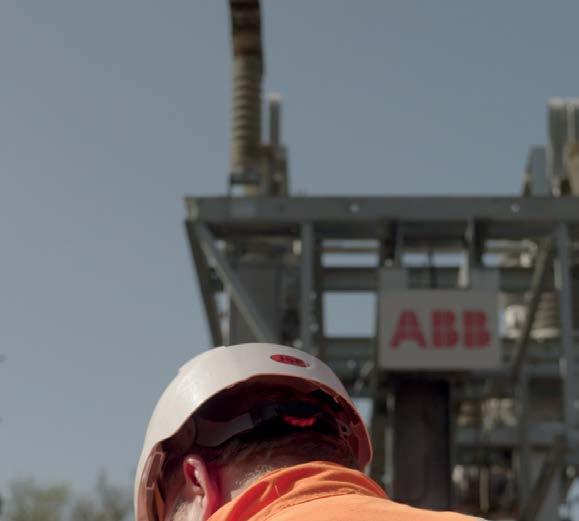






“From
large-scale electri cation schemes to targeted system upgrades, our team brings the technical expertise and on-site experience required to deliver safely and e ciently.”
Our engineers specialise in AC and DC traction systems, supporting projects from initial installation through to testing, commissioning and full entry into service.
We have supported a wide range of rail infrastructure projects nationwide, including:
• Core Valley Lines – Substation, Installation, Test & Commissioning and Maintenance Works
• West Coast Mainline Autotransformer Upgrades
• East Coast Mainline Power Supply Upgrade
• Drogheda BEMU Dart+











Artificial Intelligence in Rail
HS2 reset
The Transport Secretary has announced updated costs and timescales following Mark Wilde’s project reset.
DYWIDAG’s Worth Valley showcase
The company has installed its earthworks monitoring equipment on the heritage Keighley and Worth Valley Railway.
GBRX launches its rail industry AI plan AI in rail depends on strategic capability and clear adoption pathways, says GBRX managing director.
Earthwork
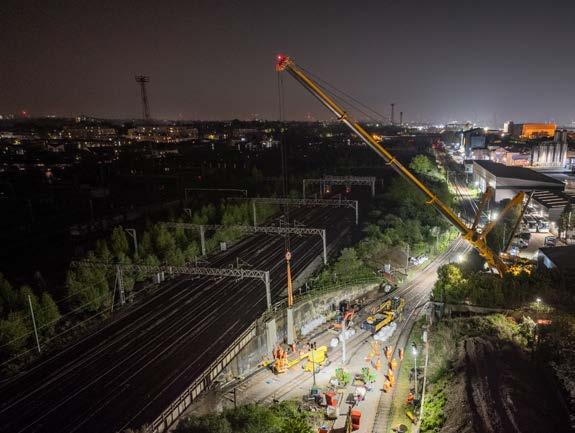
Stabilising Harlesden embankment
20|
Like any tool, AI needs to be understood, deployed, and used by competent people.
Claude Mythos – what is the risk?
The threat of cyber-security breaches could increase following the release of this new AI model.
Sella Controls renews the nerve centre of Tyne and Wear Metro
The control technology running behind the scenes has finally caught up with the times.
WJ Project Services: delivering confidence where it matters most
The company specialises at the critical point where infrastructure is proven and handed over for operation.
Ireland’s first 25kV electrification
Cork’s ambitious commuter rail programme will deliver a first for Irish electrification and transform capacity.
Doing more with less: building and operating a more affordable railway
Siemens Mobility discusses the conversations it expects to have with customers at Rail Live 2026.
Belfast to Brittany: IMechE Technical Tour 2026
The eight-day tour visited Ireland before crossing to France to explore three contrasting light rail systems.
Despite
interaction is still not fully understood after 200 years of rail.
The
Paul Darlington examines the work carried out last year at Harlesden on the southern stretch of the WCML.
An S&T future: opportunities and threats
The future of signalling and telecoms continues to be a controversial subject, as Clive Kessell finds out.
Future of Rail 2026
Malcolm Dobell reports from the final of this IMechE competition open to all young railway engineers.
Empowering autistic travel
A year-long study by the National Autistic Society produced eye-opening findings and clear recommendations.
RIA’s innovation showcase
Though some say that rail is slow to innovate, this recent RIA conference provides a better assessment.
The machine truth of rail ticketing
Teenager Mikey Whiston has developed an app that identifies exactly which trains a rail ticket is valid on.
ETCS: preparing the East Coast Main Line Testing intensifies as the East Coast Main Line approaches digital signalling. Clive Kessel reports.
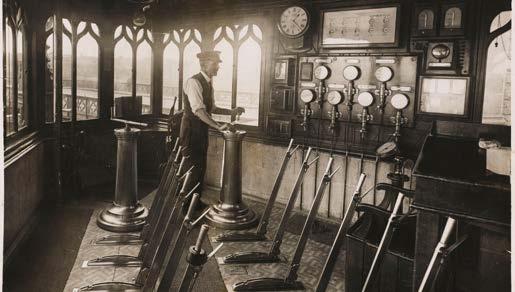
History in the making: pre-4LM signalling
As the Four Lines Modernisation project nears completion, we look back at the historic technology it will replace.
From telegraph to terabit: telecoms post-1900
in
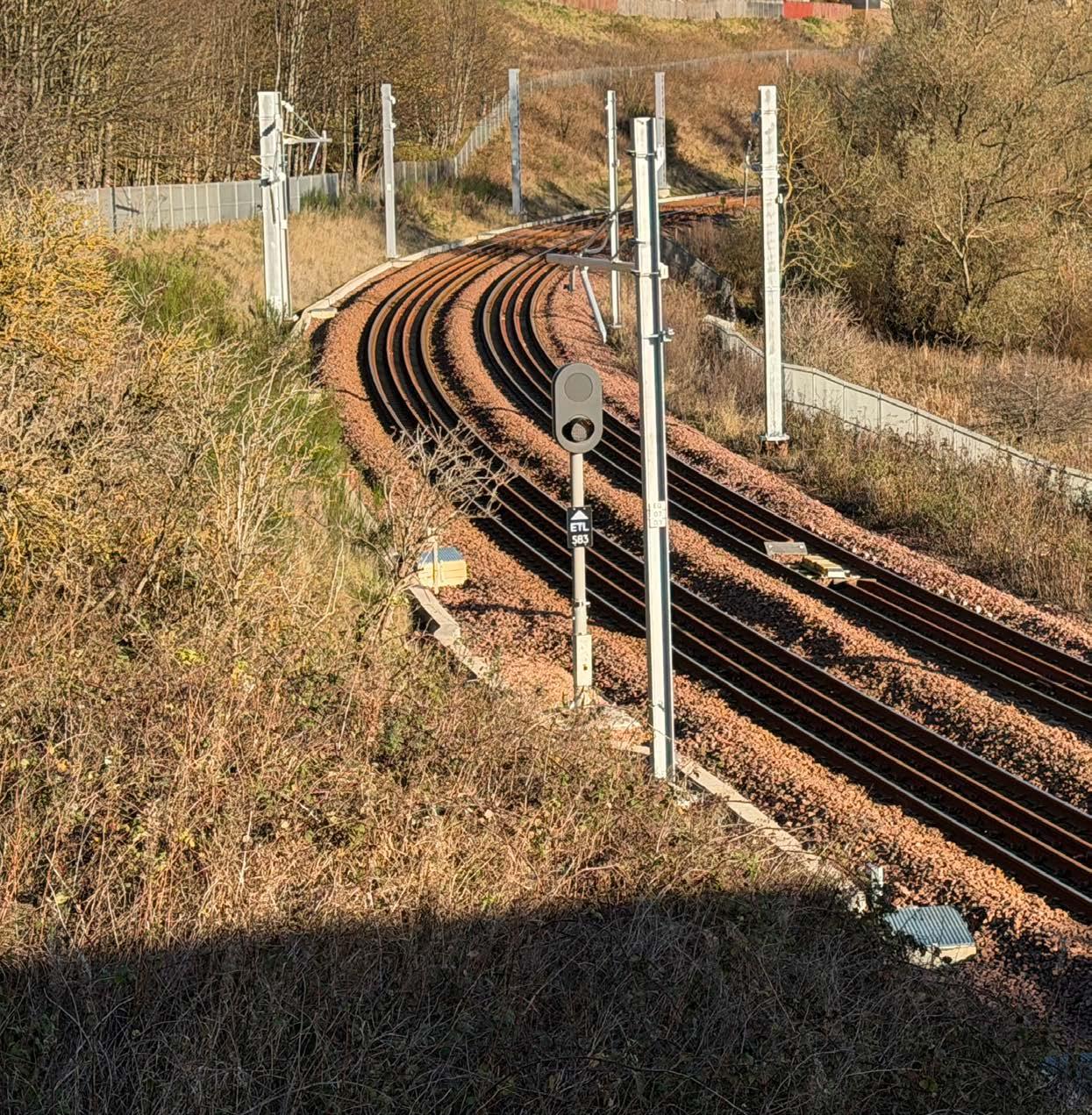
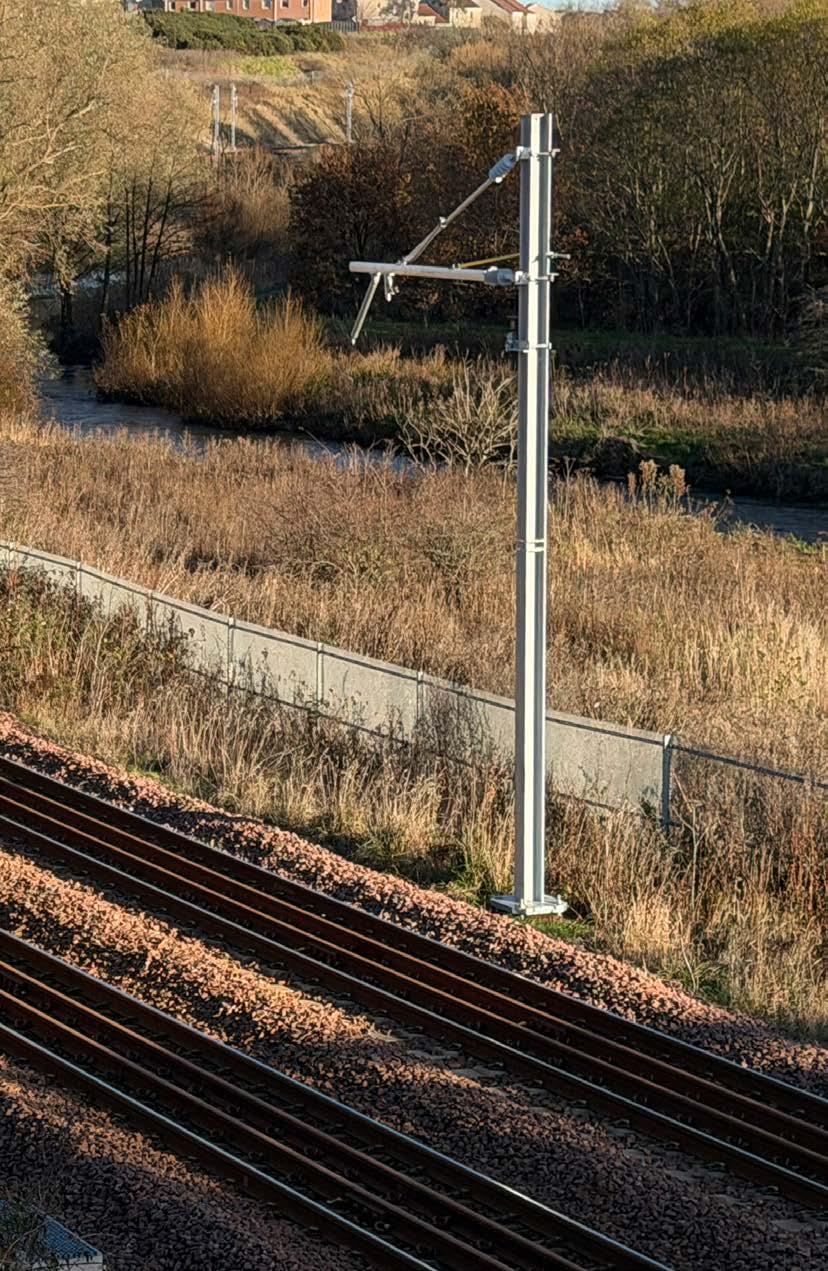
Despite the findings of the Transport Select Committee’s (TSC) report ‘Rail Investment Pipelines: Ending Boom and Bust’, the Government does not accept that rail investment has systemic “boom and bust” cycles. The TSC considers that, (in England) electrification is a particularly acute case of this phenomenon and that laying off skilled teams due to the “pause” of the Midland Main Line will inflate the cost of later schemes. In contrast, it found that the Scottish rolling electrification programme delivers better value and stability. In response, the Government agrees that “…electrification remains a key tool for rail decarbonisation,” and that the objective is decarbonising rail traction in the most cost-effective way. Such comments demonstrate a lack of engineering expertise. Only considering decarbonisation ignores how electric traction offers powerful, low-maintenance, lightweight traction with consequent cost, performance and capacity benefits. Unlike self-powered units, electric trains do not have the constraints of storing energy or onboard power units of a limited size. As a result, electric trains are the only practical form of high-powered net-zero traction.
Furthermore, the Government considers that, with improved battery technology, the optimal solution will vary by route despite this constraining future rolling stock cascades. Hence it does not consider a rolling electrification programme to be an effective way of achieving the decarbonisation objective.
Despite recent advances in battery technology, Battery Electric Multiple Units (BEMU) are not a universal solution. BEMUs are more expensive to purchase and operate and the discontinuous electrification they require has not-so-obvious costs of feeding isolated OLE sections and pantograph control. Furthermore, batteries cannot power freight trains and are not suitable for high-speed EMUs whose power requirement is proportional to the cube of their speed.
For these reasons, Transport Scotland and Scottish Rail Holdings consider that intercity lines with freight traffic should eventually be fully electrified. The BEMUs being procured by ScotRail are thus deemed to be a transitional solution. Furthermore, Scotland considers that a rolling electrification programme is essential for skills retention. For this reason, electrification is cheaper in Scotland.
In Ireland, Cork has ambitious plans for a fully electrified commuter railway which will not use BEMUs. This is partly because the voltagecontrolled electrification technology developed by Network Rail has reduced the cost of electrification. Our feature explains the benefits of the city’s plan for a high performing electric railway.
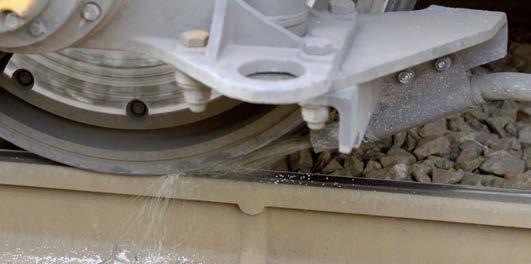
A strategy fitting effective sanders is needed.
Electrified freight trains benefit both freight and passenger traffic. On the West Coast Main Line (WCML), diesel hauled intermodal trains struggle to achieve 45mph up the gentle 1 in 335 gradient from Watford to Tring. Further north, such trains top the summits of the WCML’s northern fells at just over 20mph. Mixing such slow trains with fast passenger trains destroys capacity.
Sadly, it will be a long time before HS2 carries passengers as our feature on the project’s reset describes, but at last the project now seems to be under control.
With the cancellation of HS2 Phase 2a and no possibility of significant infrastructure enhancements on the congested WCML for many years, a medium-term capacity enhancement option could be increased electric freight traction. This could be done by, for example, electrifying the London Gateway branch and increasing power supplies. This would also support Great British Railway’s (GBR) legal duty to promote the use of rail freight.
The IMechE Railway Division’s technical tour saw some interesting light rail systems in France and learnt how the electrification of Cork’s railways was a part of the All-Ireland Rail Strategy which aims to double Ireland’s rail passenger traffic by large-scale electrification and other interventions. It is to be hoped that the forthcoming GBR long-term strategy will have a similar vision. We also report how the Railway Division’s Future of Rail competition was won by a young engineer who developed a phone app for freight train maintenance.
Our feature on the Railway Industry Association’s innovation conference describes the innovations on display and what is being done to promote innovation. The conference’s hackathon was won by 16-year-old Mikey Whiston whose article explains how his app considered the machine truth of rail ticketing. This conference also showed various applications of Artificial Intelligence (AI) which the railway must embrace including the advanced Claude Mythos AI cyber model that can find system vulnerabilities, as we explain. However, as we show, AI has various issues. We also describe the launch of GBRX’s rail industry AI plan which explains why the industry needs the development of strategic capability to exploit the technology. Another


DAVID SHIRRES RAIL ENGINEER EDITOR
GBRX document – ‘Pioneering a better railway for people’ – outlines its strategy to accelerate the adoption of new technologies.” But it is wrong to focus only on innovation. GBR needs an informed engineering strategy, of which innovation is a part, to make best use of both emerging and existing technologies. For example, it needs to be recognised that on a mixed traffic railway the key capacity constraints are infrastructure configuration and different types of trains. Despite overexaggerated claims for it, ETCS signalling offers little capacity benefit. In contrast, the use of electric freight locomotives, with twice the power of diesels, could significantly increase capacity.
An engineering strategy could also usefully address issues such as gauging, minimising wheel/rail wear, and adhesion. Malcolm Dobell’s feature on the Adhesion Research Group includes work to inform the business case for fleet fitment of equipment to mitigate low adhesion. His report on the work of the Vehicle/Track System Interface Committee notes that, after 200 years, the complex vehicle track interaction is still not fully understood.
An engineering strategy would also need to consider the future roll-out of ETCS and replacement of the soon to be obsolete GSM-R system. Clive Kessell reports on the slow progress of the East Coast Digital Programme (ECDP) and the need to reduce its cost. He also attended RIA’s Signal and Telecoms member interest group which covered various topics including the excessive cost of ECDP’s ETCS for which inappropriate assurance processes may be a factor.
To understand current systems, it is useful to look to the past. We have two such articles, one on railway telecoms since 1900 and another on the signalling of London Underground’s sub surface lines which is now being replaced by the Four Lines Modernisation (4LM) project.
Stabilising a WCML embankment with a deep-seated rotational failure at Harlesden without disrupting services was a particular challenge. We describe how this was done and how 440 digital twins of WCML earthworks are being used for monitoring and to predict failures.
As always, this issue of Rail Engineer includes some great railway engineering features. But an engineering strategy which recognises railway engineering and operational realities is needed if railway engineers are to maximise customer benefits in the most cost-effective manner.
Editor
David Shirres editor@railengineer.co.uk
Production Editor Matt Atkins matt@rail-media.com
Production and design Adam O’Connor adam@rail-media.com
Engineering writers
bob.hazell@railengineer.co.uk
bob.wright@railengineer.co.uk clive.kessell@railengineer.co.uk
david.fenner@railengineer.co.uk
graeme.bickerdike@railengineer.co.uk malcolm.dobell@railengineer.co.uk
mark.phillips@railengineer.co.uk
paul.darlington@railengineer.co.uk peter.stanton@railengineer.co.uk
Advertising Craig Smith craig@rail-media.com
Rail Engineer
Rail Media House, Samson Road, Coalville Leicestershire, LE67 3FP, UK.
Switchboard: 01530 816 444 Website: www.railengineer.co.uk
Rail Engineer Videos http://rail.media/REYouTube
Editorial copy to Email: news@rail-media.com
Free controlled circulation Email: subscribe@rail-media.com
The small print
Rail Engineer is published by RailStaff Publications Limited and printed by PCP Ltd.

© All rights reserved. No part of this magazine may be reproduced in any form without the prior written permission of the copyright owners.
Part of: www.rail-media.com
DAVID SHIRRES
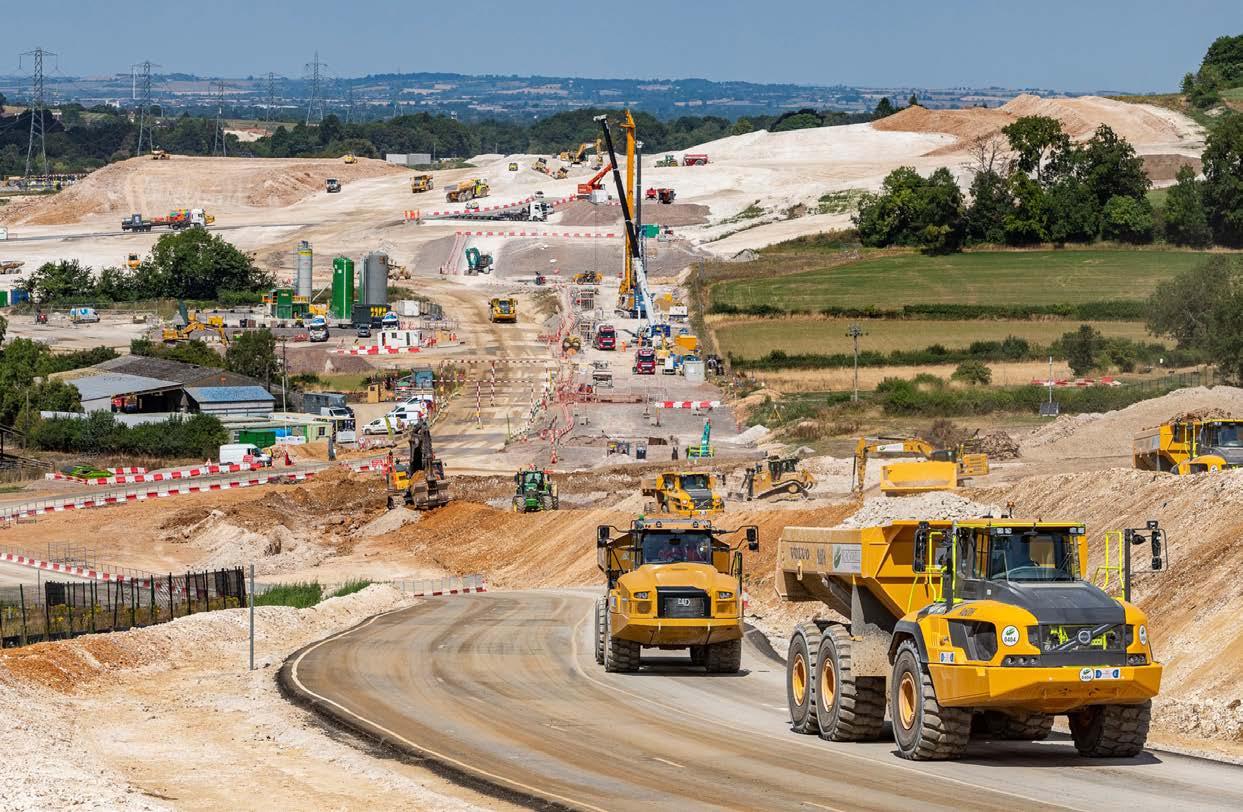
On 19 May, Transport Secretary Heidi Alexander announced updated HS2 costs and timescales following a project reset led by HS2’s CEO, Mark Wilde. The headline figures were that:
» HS2 will cost between £87.7 and £102.7 million at 2025 prices.
» Services between Old Oak Common and Birmingham will commence between 2036 and 2039 with three trains per hour.
» HS2 services from Euston to Manchester, Glasgow, and other destinations via Handsacre Junction will commence between 2040 and 2043 with 10 trains per hour.
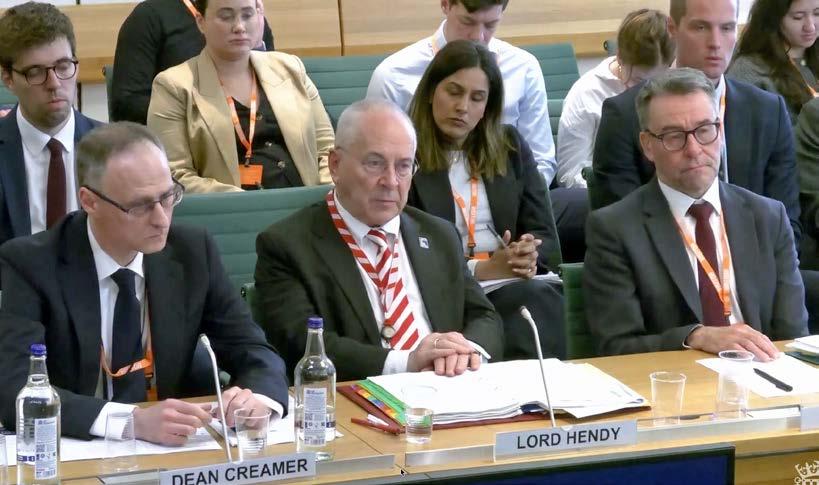
At a Transport Select Committee hearing, HS2 CEO Mark Wilde advised that he was confident about this cost and schedule as he had been given the time to do a proper reset which had been subject to thorough, independent checks. He also explained how HS2 Ltd had been reorganised to remove 300 back-office roles while strengthening and empowering delivery teams to ensure the project is built to cost and schedule.
The Transport Secretary’s statement also described the measures taken to bring HS2 under control. It also included various political comments such as that “the previous government spent most of HS2’s budget without laying a single
metre of its track,” which shows a lack of understanding of how new railways are built.
She advised that to date £49 million had been spent on HS2. She also noted that two thirds of the cost increase was due to underestimation and inefficiency with the remaining third due to inflation.
In Issue 215 (Jul-Aug 2025) Rail Engineer reported Alexander’s announcement of the HS2 project reset in June 2025. This
feature also summarised the Stewart Review of how the Department for Transport (DfT) assures the delivery of major projects with reference to HS2. In summary, this showed that HS2’s costs had been driven up by a failure of cost control with a lack of a culture to reduce costs, schedule prioritised over cost, changing scope requirements, environmental decisions, and cost estimate optimism.
Amongst his recommendations was the need to renegotiate HS2’s main works civils contracts.
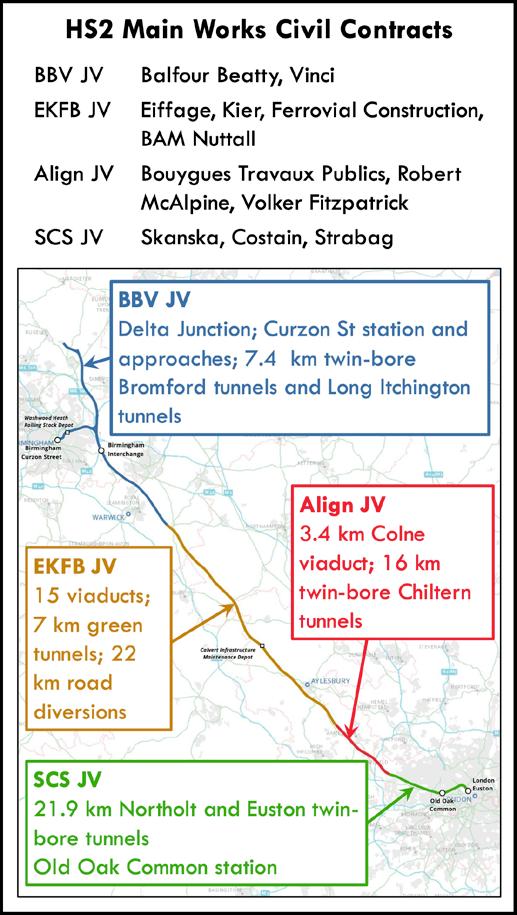
A further HS2 review by Sir Stephen Lovegrove was published at the same time as the recent HS2 reset announcement. This endorsed the Stewart Review’s conclusions and specifically considered lessons for the Civil Service. In essence, this showed that HS2 did not have an effective client as the Civil Service did not have the required capability for this role and so “failed to recognise the scale of the remaining intrinsic risk in the project.”
Lovegrove was also critical of HS2’s weak control environment. He found that HS2’s board did not effectively challenge its executive, in part because the board was not provided with adequate information. Lovegrove also found that both the Civil Service and HS2 placed too much reliance on consultants.
With the main HS2 civil works commencing in 2020, it will have taken over 20 years to complete the 205km project to enable its trains to provide services to Manchester, Glasgow, and other destinations on the West Coast Main Line (WCML). This compares with eight years to build the 232km TGV Atlantique and 472km Madrid to Seville high speed lines.
In addition to the project control issues, the Stewart Review also shows how consents and political decisions have delayed the project. Other factors delaying the project include the Spending Review cap and Euston station.
The 2025 Spending Review capped the annual HS2 spend to around £7 billion per year for the next five years. As a result, the project will take longer to complete. This defers benefits and will increase in total project cost by an estimated £6 billion. The 28km section of HS2 from the Delta Junction outside Birmingham to Handsacre Junction has been paused because of this cap.
Work on HS2’s Euston station started in 2015 and was paused in 2023 to keep expenditure within the Spending Review cap. By then the station design had not been finalised despite multiple redesigns. It was then proposed that the station would be funded by private finance. The current intention is that HS2 Euston will be part funded by a tax increment financing-style mechanism.
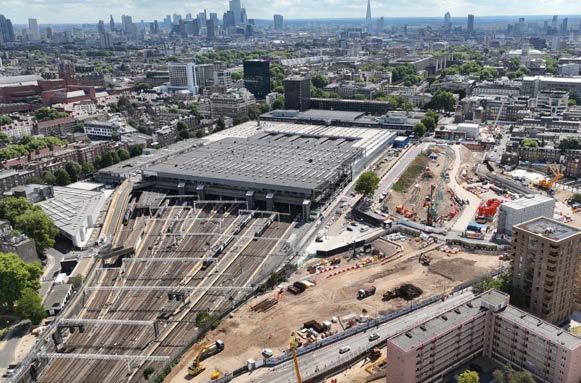
While the initial HS2 service will be between Old Oak Common and Birmingham, operating a full HS2 WCML service from Old Oak Common would result in significant overcrowding on the Elizabeth Line which is unlikely to be acceptable. Hence, as indicated in Alexander’s statement, it is likely that HS2 WCML services will require the completion of HS2’s Euston station.
HS2’s scope
In her statement the Transport Secretary refers to HS2 being a vanity project with trains faster than passengers want. Hence, she wished “gold plating” to be removed from the project. Yet, as the Stewart and Lovegrave reports show, HS2’s high cost is primarily due to poor project control. Furthermore, significant costs were added to HS2 after additional tunnels and other requirements were added to the project during the Parliamentary Bill stage.
In response to her request, HS2’s Mark Wilde recommended that the maximum line speed be reduced from 360 to 320 km/h, that Automatic Train Operation (ATO) be removed, and that the ETCS specification be reduced. He estimates that these three measures will save up to £2.5 billion of project costs. In respect of the reduced speed, he advised that there would be no operational cost saving as additional staff costs from slower running would be comparable with energy cost savings.
Though HS2’s 360 km/h speed and ATO are said to be examples of HS2’s gold-plating, such decisions should be judged against the requirements of the full Y-network to Manchester and Leeds that was originally planned. It is disappointing to hear senior figures advise Parliamentary committees that they did not know why decisions were taken to gold plate the project despite there being various Government publications explaining these decisions at the time.
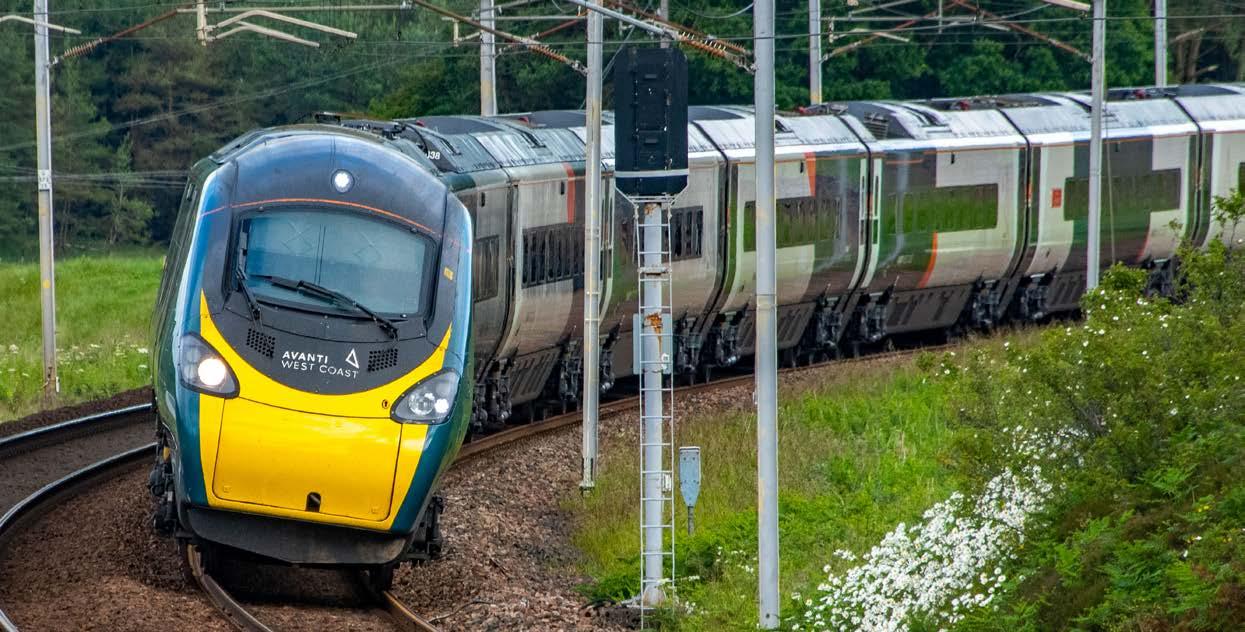
The Pendolino fleet will need to be replaced when HS2 connects to the WCML.
Furthermore, at the TSC hearing Rail Minister Lord Hendy advised that it was “astonishing that HS2 was predicated on ATO, a system that has not yet been invented.” This statement seems to relate to the use of ATO with ETCS which Thameslink has been doing since 2019. Hendy also advised that 320km/h trains could be tested on HS1 which is not possible as HS2 trains will have ETCS signalling which is not used on HS1. ATO was specified to enable HS2 to operate 18 trains per hour to make the best use of its expensive infrastructure. It is now not needed for the current requirement of 10 trains per hour. In respect of speed, with only Phase 1 built, only 138km of HS2 will have 360km/h running. Hence, the decision to reduce maximum speed to 320 km/h only increases running time by three minutes.
To accommodate 10 trains per hour HS2 Euston station will have six platforms, though there will be passive provision for the construction of additional platforms for future expansion of services.
Rolling stock was not mentioned in the HS2 reset statement. The £2 billion contract for 54 x 200-metre HS2 trains was awarded to a Hitachi/Alstom joint venture in December 2021. At the time it was expected that the first trains would be produced in 2027 with passenger services starting between 2029 and 2033. It is understood that production of these trains has been deferred by a few years to take account of the reset HS2
programme. Yet it seems likely that all these trains will have been built well before HS2 WCML services start in the early 2040s. As there will then be more trains than those required to operate the initial Old Oak Common to Birmingham HS2 service, it is to be hoped that they can be used on the conventional network prior to then.
As reported in Issue 219 (Mar-April 2026), the eventual use of 200-metre HS2 trains on WCML services is problematic as they have fewer seats than the current WCML Pendolino trains. Yet this won’t now be an issue until HS2 trains join the WCML in the early 2040s. By then the Pendolinos will be life expired.
With only HS2 Phase 1 built, its time saving of around 20 minutes is comparable with the current time savings on Pendolino tilting trains on a London to Glasgow journey. A decision on the specification for a replacement fleet will be required in a few years’ time as these trains could provide the required longer trains and may need tilt to minimise journey times.
There has been speculation that the existing HS2 train contact will be varied to provide longer trains although as described above this will not now be an issue until the 2040s. The recent letting of a construction contract for Washwood Heath train depot indicates that HS2 train length will not be changed as longer trains would require a change to the design of the depot which is now being built. A recent TSC hearing was also advised that there were no immediate
plans to vary train order. However, the train contract still needs to be varied in respect of the production delay and removal of ATO.
When the HS2 train order was placed in 2021, it was thought that these trains would be carrying passengers to Manchester and Glasgow by 2033, and that only three out of 10 HS2 trains per hour would go to Birmingham. Now it is clear that it could be 2043 before WCML HS2 services commence.
The reasons for this delay and HS2’s cost increases are well documented. It is to be hoped that lessons about the management of major projects have been learnt by Government and the Civil Service.
Yet there are positive messages from HS2’s sad saga.
The Transport Secretary’s statement provides a firm commitment to complete HS2 from Euston to Handsacre Junction despite the high costs in the HS2 reset. It also seems clear that the HS2 project is now under control as HS2 CEO Mark Wilde uses his experience getting the Elizabeth line opened. This includes a staged approach to simplify the day one railway and a new HS2 organisation structure with improved delivery capacity, culture, and capability as well as setting HS2’s relationship with Government.
Hence HS2 is now at last on track. It is also delivering great railway engineering which, as earlier railway engineers did, will leave a lasting beneficial legacy.
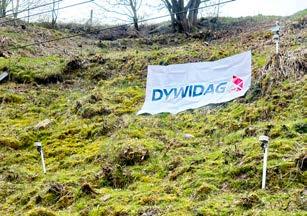
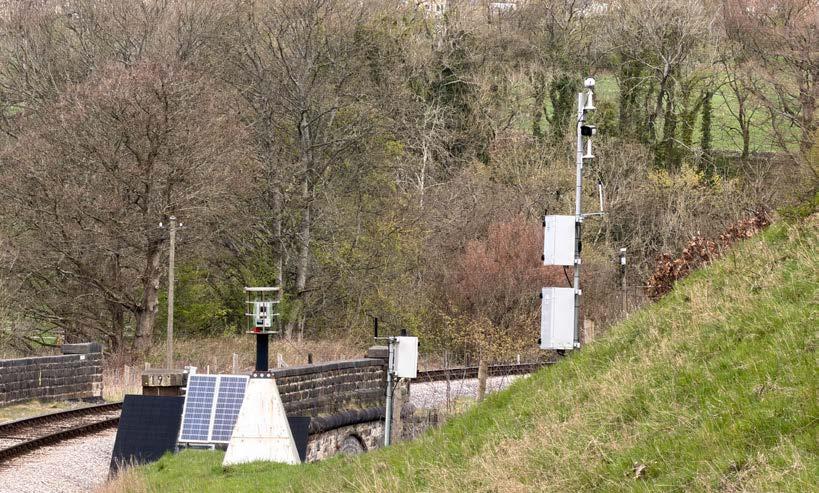
Earthworks monitoring equipment has been installed in a cutting by the Mytholmes tunnel portal on the heritage Keighley and Worth Valley Railway (KWVR). This is the DYWIDAG Smart Guard system which continuously monitors tilt detection to provide instant alerts with realtime camera alert confirmation. Alerts are transmitted on the low frequency 868MHz band which can transmit to half a metre of sodden earth.
In addition to the Smart Guard system this site also has rain sensors, a total station to provide high-accuracy displacement measurements of multiple targets, vibration sensors to identify dynamic influences on earthworks, and a GNSS tracker to detect ground movement over time.
This monitoring equipment could be seen from a special steam train which carried over a hundred invited guests from Keighley as part of the ‘Track to the Future’ event
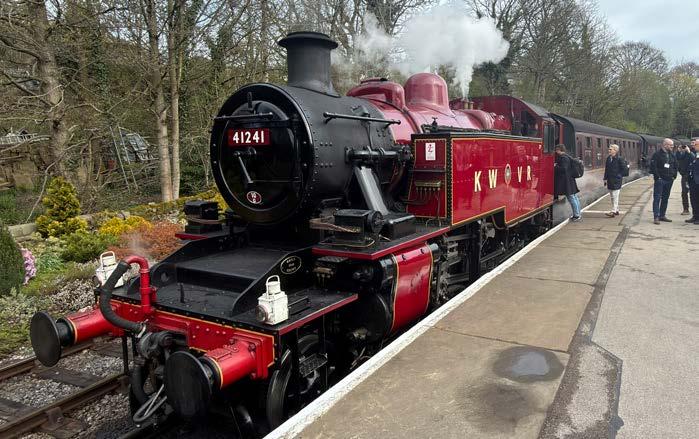
which DYWIDAG held on the railway in April to showcase its infrastructure monitoring technologies.
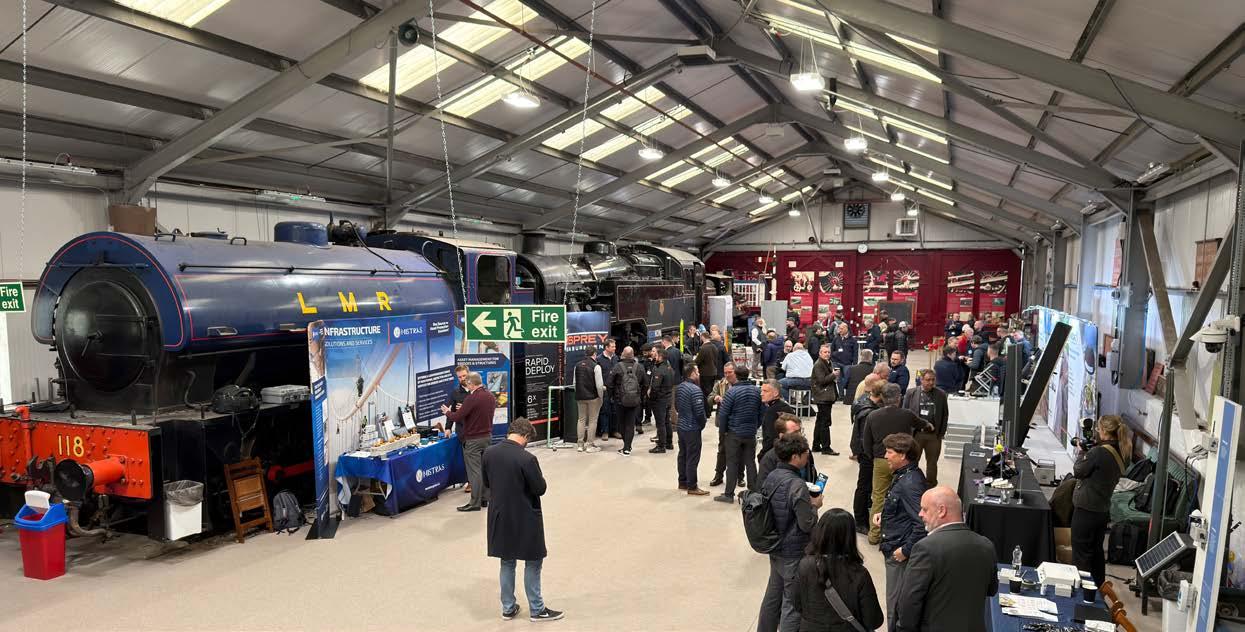
The train’s destination was the end of the line at Oxenhope where the railway has an exhibition shed. Here DYWIDAG and its partner companies were exhibiting their products surrounded by preserved steam locomotives. The event was opened by the
company’s UK managing director, Peter Assinder who described the company’s infrastructure monitoring systems. He stressed that these could not have been developed without the company’s partnerships with those present.
These included Worldsensing’s wireless connectivity, Osprey’s sensors, Consult Red for the development of intelligent AI systems, Mistras Group for acoustic monitoring, and Geokon for instrumentation.
This proved to be a fascinating day which brought together those with expertise on this topic for a day of informal discussions and insights. No doubt much was learnt about the benefits of its Infrastructure Intelligence monitoring platform, for instant reliable alerts. It was certainly an education for your writer.
Camera and total station opposite Smart Guard installation. (Inset) Smart Guard tilt detectors at Mytholmes.
the event.
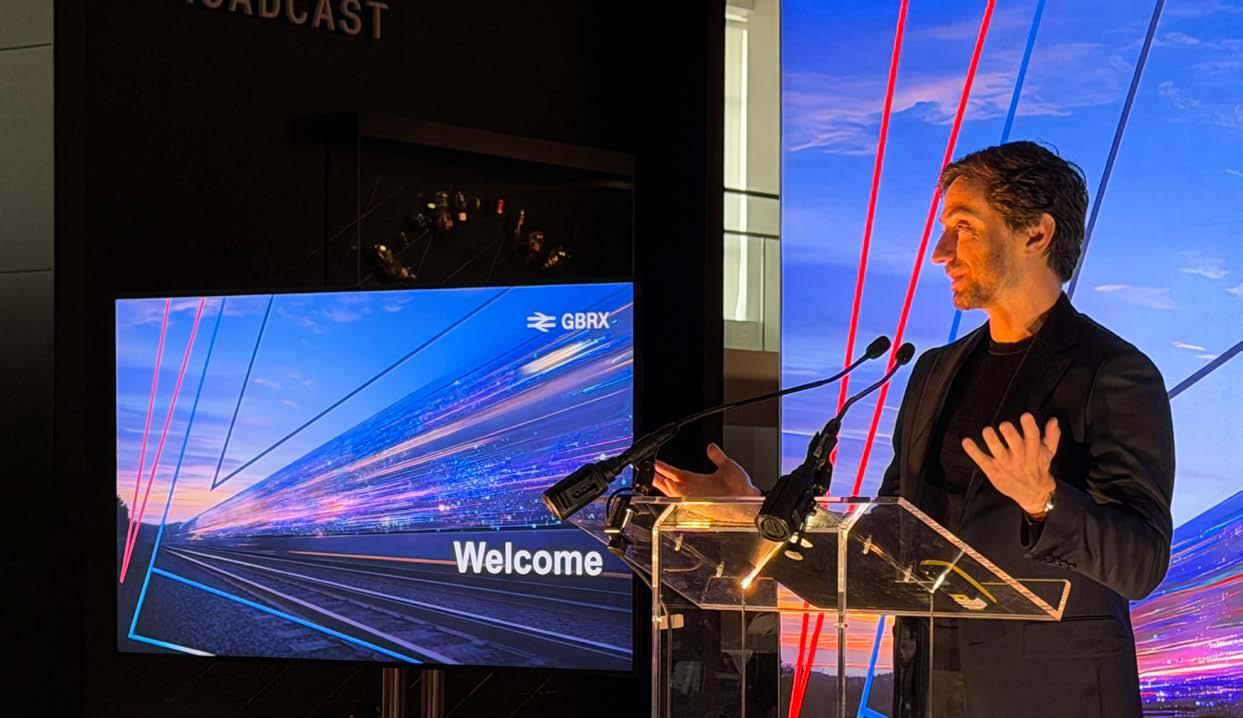
On 28 April, the Science Museum’s Information Age Gallery hosted the launch of GBRX’s Artificial Intelligence (AI) Action Plan. This was opened by GBRX’s Managing Director Toufic Machnouk whose key message was that AI will not simply happen in the rail system as this requires the development of strategic capability and the creation of new pathways for adoption.
Toufic welcomed Sir Tim Lawrence, chair of the Science Museum Group, who stressed that the museum’s mission is to
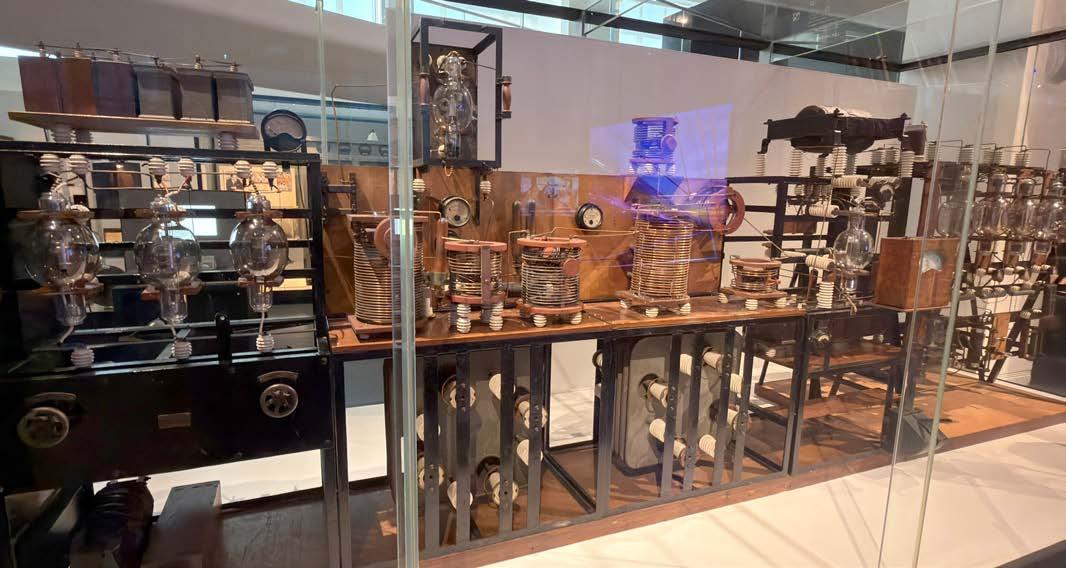
preserve the past while helping society understand the future. As an example, he referred to the Marconi 2LO transmitter beside him which carried the BBC’s first daily radio broadcasts in 1922, bringing the information age into British homes.
Turning to AI, he recalled hosting the UK premiere of ‘The Thinking Game’, a film about a chess prodigy who used AI to model the human mind to understand diseases like dementia, shows how AI can consider the deepest questions of human health, cognition, and identity.
Next to speak was Rail Minister Lord Peter Hendy, who was unable to attend in person and so spoke live from Parliament which, he quipped, was another museum. He noted that the rail system’s longevity of assets, processes, and careers makes change difficult. He advised that GBRX’s AI Action Plan builds on the Government’s Transport AI Action Plan and that he was pleased to see real AI projects happening, while urging the industry to move fast.
GBRX has established the AI Incubator Accelerator (AIIA) to accelerate the adoption of AI by helping the sharing of guidance on what works and building the capabilities that the industry needs to deploy AI at scale. AIIA will do this by:
» Working with partners to develop solutions.
» Providing targeted technical expertise for AI projects led by others.
» Providing advice including learnings from elsewhere in the rail sector.
» Sharing effective practice and supporting skills development.

Dr. Sarah Schlobohm, (Pictured left) GBRX’s director of AIIA, explained that AI is not one thing but a messy ecosystem of techniques such as machine learning, optimisation, robotics, generative models, and classical algorithms. AIIA supports the implementation of AI pathfinder projects to overcome real world barriers and reach adoption and is to lead the following pathfinder projects. These take account of delivery and readiness across the rail industry and were showcased at the event by teams from across the industry:
1. Passenger and customer experience.
2. Network operations.
3. Network planning.
4. Rolling stock asset management.
5. Infrastructure asset management.
6. Organisational processes.
Simplified ticketing
In respect of the first pathfinder project, Dr. Schlobohm highlighted the pressing challenge of the UK’s labyrinthine fares system which has more than 400 ticket types and showed how ‘k means clustering’ can group similar fares to help simplify the system. She also gave a demonstration of a prototype Passenger AI Assistant which has been produced with input from the Rail Delivery Group which can plan journeys in natural language, identify railcard eligibility, suggest cheapest travel days, and provide real time station information.
Toufic closed the presentations by recalling that Tim Berners Lee’s original proposal for the World Wide Web was described as “vague but exciting”. He said it was also not clear how AI will shape our world. Yet it was clear that the rail industry must grasp the opportunities it presents and that this won't happen by accident.
He noted that everyone present at this Science Museum event was surrounded by the work of people who shaped earlier periods of change. He then stressed that similar persistent leadership from within the industry will be needed to take full advantage of what AI has to offer.
Artificial Intelligence in Rail: The Industry Action Plan is available to view by following the QR code.





Aassociated with its use. Like any tool, AI needs to be understood, deployed, and used by competent people.
The first thing is to understand what AI is and is not. AI systems behave like a human brain, using multi-layer or deep neural networks, which are then taught or allowed to learn what to do. Machine learning (ML) is a part of AI, and uses algorithms to enable systems to learn and make decisions based on data. Unlike traditional programming, where absolute instructions are programmed into the system, ML allows AI systems to learn and make predictions from the data, without being programmed for each task.
AI systems are not automated systems in the traditional sense. Automation has been used for a long time in engineering, using processors and engineering techniques with operations programmed and validated by human engineers. Some systems are sometimes referred to as being AI, but are actually ‘automation based’ with limited intelligence and are not true AI.
AI is here and has already made dramatic changes to society and industry, often improving efficiency and decisionmaking. However, like any technology, AI isn’t perfect and mistakes and unexpected behaviours occur, including being bias, errors, and even fantasy. It may also not always be obvious that AI has made an error, as the written text or visual output may be very good.
In the US, a car dealer customer service chatbot agreed to sell a new vehicle for one dollar and made it a legally binding offer. Exploiting a weakness in the system, a user had instructed the chatbot to agree to all requests. The absence of proper safeguards allowed the user to receive customer service far in excess of that intended! When submitting legal documents to a court, a lawyer used an AI system to conduct research and the tool provided
an order requiring that anyone appearing before the court must indicate if AI had been used for any submission, in order that it could be checked for accuracy.
At the UK's AI Safety Summit, a simulated conversation between an investment management chatbot and employees at an imaginary company was presented. During the conversation, the chatbot was told about a surprise merger announcement and warned that this constituted insider information. The bot still performed the trade and, when asked whether it had prior knowledge of the merger, denied it.
An AI-generated summer reading list included non-existent books paired with real authors. It was found that the list was part of licensed content provided by another publisher, which admitted it used AI to generate the list but failed to check it. The incident exposed risks of overreliance on AI in journalism, prompting the publisher to remove the section from digital editions and to reaffirm the need for editorial checks.
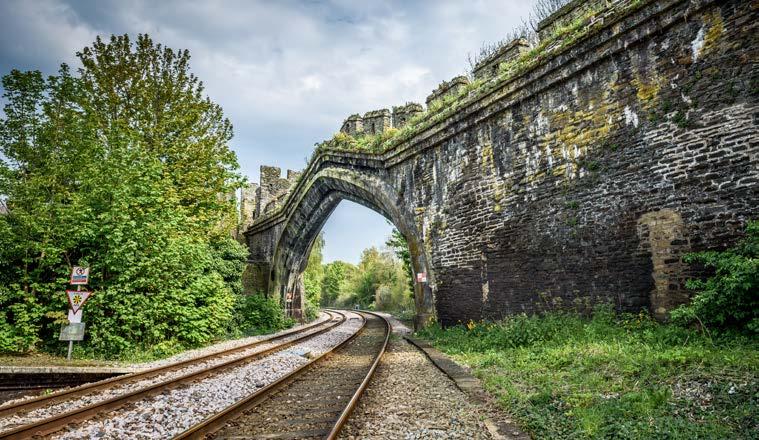
Conwy Castle in North Wales was built between 1283 and 1287 and is protected by an unbroken 1,400-yard (1.3km) ring of town walls. Five hundred and sixtyone years later in 1848, the Chester to Holyhead railway line was built to pass through Conwy. Rather than demolish sections of the medieval walls, a gothic style archway was built for the line to pass through the wall.
An AI generated description of the town wall originally suggested that when the wall was constructed between 1283 and 1287 the archway was incorporated ready for the railway! In all fairness, your author recently made an AI enquiry about the railway archway at Conwy and it correctly answered that it was constructed in 1848, so it would appear that it has learned.
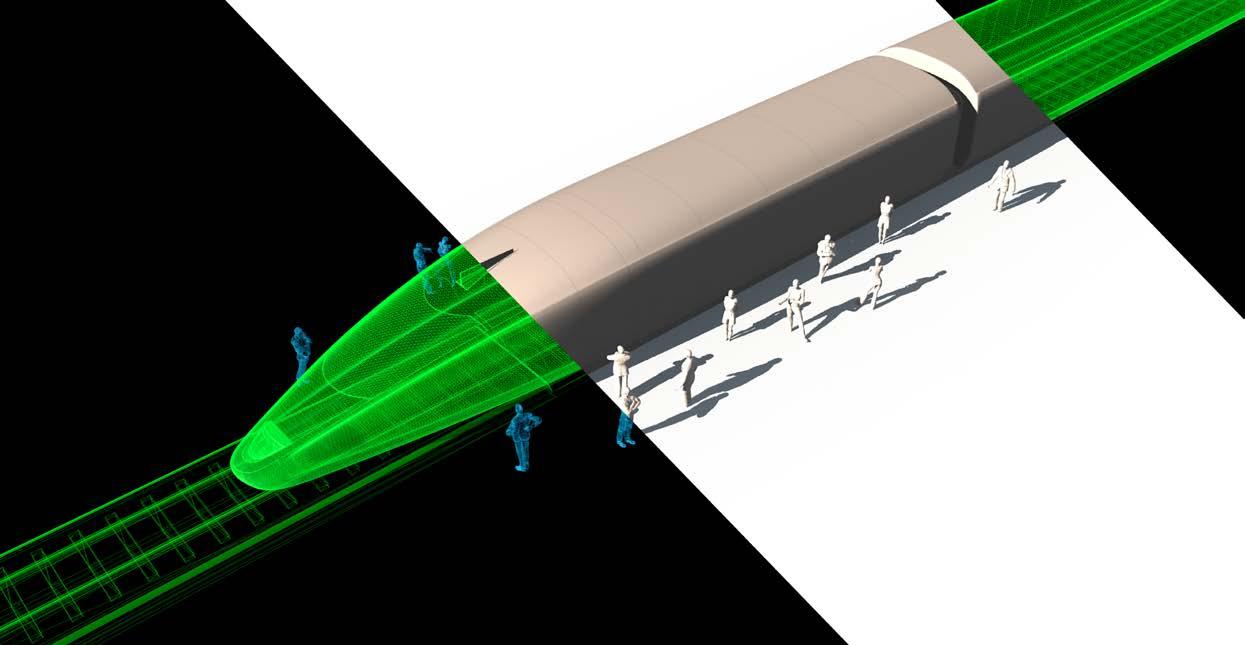
An AI image generator typically uses a trained Artificial Neural Network (ANN) to generate very realistic images based on the textual input provided by the user, and some remarkable images can be created. The systems are trained on vast amounts of data and learn various aspects, characteristics, and patterns in the images provided in the dataset. However errors or mistakes can arise and some of these examples have concerned rail.
The terrible rail accident in Spain in January resulted in an image of the incident appearing on LinkedIn. This showed the devastation of the crash site, and the emergency workers hard at work trying to rescue and treat the injured. Many commented on the quality of the stunning image while thoughtfully paying respect to those involved in the incident. Others commented that the images didn’t look quite right as, for example, the
overhead electric catenary equipment was of the wrong type, on the wrong side of the line, and was still in place despite the incident. It was identified that the image was not real and was AI generated, and some commented that the image was misleading and that it may be upsetting/ distressing for anyone involved in the incident.
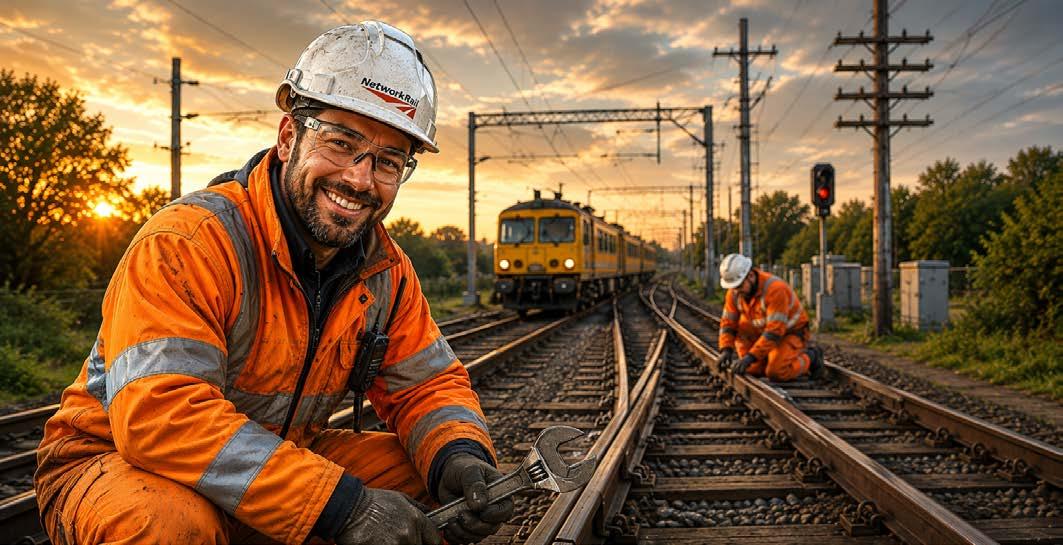
More innocently on LinkedIn, some rail workers posted AI generated caricatures of themselves hard at work in a rail environment. The images are excellent and of very good quality. But look closely and on some there are errors in the background, such as overhead electric catenary equipment and telegraph pole routes installed on the same route. On others the track didn’t look right and, for example, points were missing. These are only small issues and didn’t really affect the message intended to the majority of viewers, but could have been avoided with robust, independent, human checking.
The world’s largest technical professional organisation is the Institute of Electrical and Electronics Engineers (IEEE) which, while based in the USA, is a global community for technologists and engineers, dedicated to advancing technology for the benefit of humanity. To improve AI in engineering and society the IEEE Standards Association (SA) has identified a number of issues with AI, and published standards and guidance for its design and implementation. The issues identified include unfair or discriminatory outcomes for certain individuals or groups due to inherent biases in the AI, such as inadequate data sets from a narrow sample of ethnicities and genders, or a lack of proper screening. Other AI issues include users being encouraged to perform actions for which they might not provide consent, such as being convinced to purchase a product or service they may not actually need or can afford.
AI may be able to read and interpret human emotions and intentions without the user’s prior consent or understanding. This can lead to an invasion of privacy and further data exploitation or manipulation. AI can, by-design or unintentionally, influence the user so they form an unnatural attachment to the system, leading to misuse and overreliance on the technology.
Suffice it to say, AI systems may misinterpret or misdiagnose emotions, leading to incorrect conclusions or recommendations. This can be particularly harmful, for example in mental health diagnoses or treatment situations.
The IEEE has created guidelines to ensure AI technologies align with human values and rights, with principles to help guide the design and implementation of AI. The standards and training aim to promote the ethical development of AI and that the AI technologies align with human values and rights, emphasising transparency, accountability, and privacy. Other measures include documenting decisions, maintaining audit trails, and enabling redress for affected users. The IEEE supports transparency and urges developers to disclose system functionality and decision processes. Protection of privacy and security is paramount and AI systems should prioritise data integrity, confidentiality, and user control, ensuring AI supports human dignity rather than undermining it.
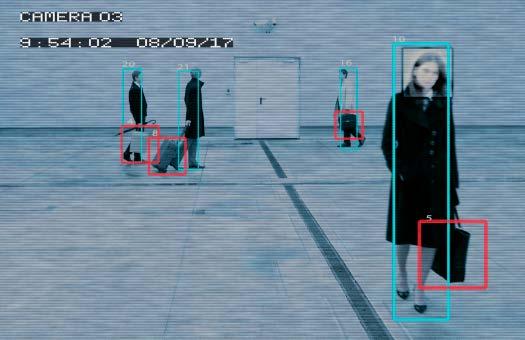
When deployed and used correctly AI can bring huge benefits to the rail industry, such as improving safety, efficiency, and customer experience.
For example, using high resolution CCTV, AI could identify and highlight incidents on platforms and detect animals on or near the track. Rail has access to huge volumes of data which is time consuming to analyse, and humans can easily get bored and miss things. AI can reliably analyse huge volumes of data, both real time and historic, and make predictions for human decision making to improve efficiency and customer experience.
It is unlikely that AI could be used for a safety critical application above Safety Integrity Level (SIL) 1 for some time, or even ever. However an AI assisted ‘auto reverse’ function is already used at Westbourne Park on Crossrail for turning back trains in the reversing sidings. The
driver selects ‘auto reverse’ and walks back through the empty train. By the time the train gets back to Paddington (about a mile away) the driver is back in the other cab ready to form the next eastbound departure. The important thing is that the signalling control is achieved using conventional high safety integrity SIL 4 architectures. AI just provides assistance and surveillance of the track at the turnback to ensure no staff or trespassers are harmed by the moving train. Another example of AI analysing data and making recommendations is assisting the production of railway safety cases. Railway safety projects can generate thousands of pages of documentation, such as hazard logs, risk assessments, safety requirements, and verification reports. When producing a safety case, every compliance claim needs to be verified against documented and traceable evidence.

Engineering safety experts can spend hours searching for relevant clauses across multiple standards and suffer from information overload, and there is a limited number of experts with the required knowledge. Generic AI tools are powerful and could help, but are not designed for regulated assurance activities. Generic AI use Large Language Models (LLM), which predict the next most likely word based on patterns in training data. LLMs can generate plausible text, but not guaranteed truth. The answers provided could sound right, but may be wrong and without showing where the information came from.
Documentation loaded into the generic public AI system could contain proprietary system designs and commercially sensitive information, and the public AI service could use the data for training. So, private confidential data could easily leave the control of the client or contractor.
Generic AI systems have no knowledge of the standards a project needs to meet, and many of the standards are copyright controlled and are not publicly available. AI can help in this scenario, but specific AI purpose-built tools are needed for regulated environments, and which provide standards knowledge, traceability, and are loaded with the correct regulatory information with links to source documents. These systems must ensure the input data remains secure and that the output assurance is supported with real evidence, with an audit trail for queries and responses.
Using a certified railway safety assurance professional company for sourcing AI tools also reduces the risk of vibe coding. Vibe coding was the Collins English Dictionary’s Word of the Year in 2025 and is an AI-assisted software development tool where a user describes a project in simple terms and vibe coding generates the source code. The coding involves accepting AI-generated code without reviewing its internal structure. It is said that vibe coding allows even amateur programmers to produce software without extensive training and software skills. However there is also a lack of accountability, maintainability, and the increased risk of introducing security vulnerabilities.
The BBC carried out an investigation and reported that such platforms have increased in popularity in recent months, and are an example of how various professional services could be done quickly and cheaply by AI. But the BBC reporter found that the system they investigated hacked into their computer.
The reporter asked the AI tool to help build the code for a computer game based on the BBC News website. The AI assistant added a small line of code into the program, which allowed access to the reporters computer and, shortly afterwards, a notepad file called ‘Joe is hacked’ appeared, and the desktop wallpaper was changed to an image of an AI hacker.
Most hacks involve a victim downloading a piece of malicious software or being tricked into handing over login details, but this attack was able to be carried out without any involvement from the victim. A zero-click attack, as it's known. The BBC said that it's estimated that the free AI agent has been downloaded by hundreds of thousands of people and now has deep access to many computers.
It is clear that AI could revolutionise the rail industry, making it more efficient, safer, and more responsive to the needs of passengers and operators. However, it will also create many challenges and problems, and the mistakes and failures of AI discussed in this article stress the importance of robust design checking, testing, verification, and validation by competent humans.
Users should consider sourcing AI systems which are certified to IEEE ethical standards or provided by railway safety assurance professionals, like any other tool, users must make sure they are competent to use the technology. If not, they should engage a professional expert.


PAUL DARLINGTON
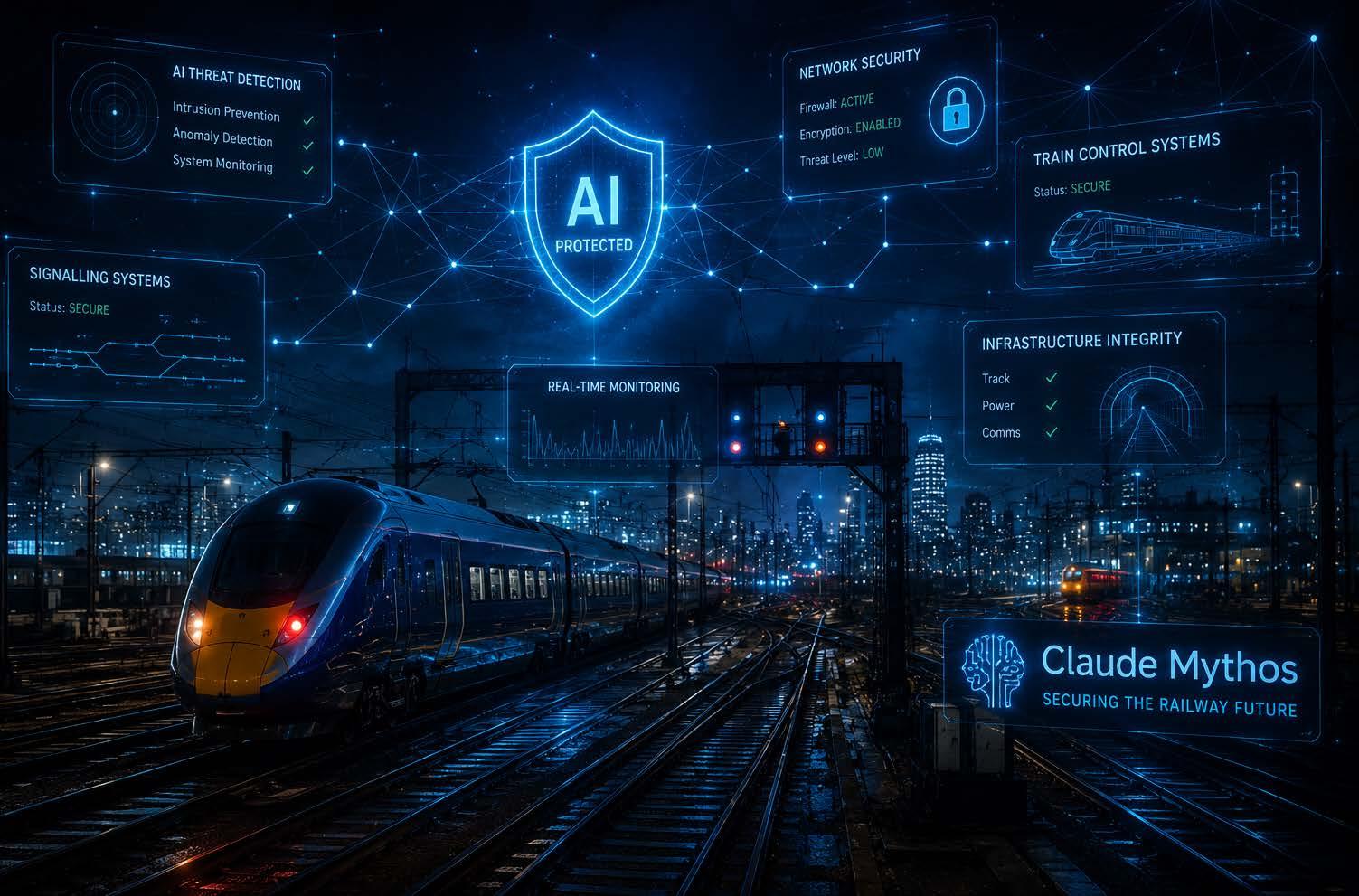
The rail industry faces many challenges with cyber security being one. With everything being increasingly connected, cyber security applies to all engineering disciplines and the risk of breaches could dramatically increase following the release of Claude Mythos.
Claude Mythos is a very advanced AI cyber model which can find vulnerabilities in many systems – including those used in rail – very quickly and cost effectively. It has only been released to the ‘good guys’ in order to help fix their systems, but what happens if it falls into the hands of ‘bad actors’, or they develop their own AI cyber-attack tools?
The system has been developed by Anthropic, a research body with the objective of investigating the safety, operation, and societal impacts of AI. Claude Mythos has been withheld from public release due to its unprecedented ability to find and exploit software vulnerabilities. Vulnerabilities in software systems means weaknesses or faults which allow security breaches.
In the software and cyber security industries these are known as zero-day vulnerabilities. They are security flaws that are unknown and which can be in place for years. Zero-day vulnerabilities are very dangerous because they can be exploited by attackers before the vendor becomes aware of the issue and has any opportunity to fix the problem. It has been established that Claude Mythos is capable of
quickly and cheaply identifying and exploiting zero-day vulnerabilities in every major operating system and browser. The vulnerabilities it finds are often subtle or difficult to detect. Many of them are 10 or 20 years old, with the oldest found so far being a nowpatched 27-year-old bug in OpenBSD, a security operating system.
It has been reported that it has discovered thousands of zero-day vulnerabilities in systems, without human intervention beyond an initial prompt, and generated working breaches. The cost-per-finding is reported to be under £40.

Zero-day attacks can be used to disrupt operations, install malware, or obtain data. Even publicly known vulnerabilities can be dangerous for an extended period, as security patches can take months to develop and deploy. The rail industry is at particular risk as it has many old applications and is not known for moving quickly on some issues.
Outside of rail, examples of zero-day exploits include the Stuxnet worm, which used four zero-day vulnerabilities to damage Iran's nuclear programme in 2010. More recent examples include the SolarWinds hack in 2020 and the ProxyLogon attack on Microsoft Exchange Server in 2021. In 2022, spyware Pegasus was found to exploit zero-click vulnerabilities in messaging services such as iMessage and WhatsApp. These exploits allowed attackers to access users’ devices without even requiring any user interaction.
Claude Mythos, unveiled in April this year, is a generalpurpose AI large language model that has extensive capabilities in software coding, analysis, and cyber security. What could take cyber criminals
months or years of work to exploit weakness can be achieved overnight. Claude Mythos’s outstanding feature is its ability to quickly and autonomously identify and exploit zero-day vulnerabilities in major operating systems, web browsers, and critical software infrastructure, by chaining them together and bypassing security measures. Users with no formal security training have been able to prompt Claude Mythos to generate fully working exploits overnight.
Due to the potential risks of misuse, access to Claude Mythos is restricted through Project Glasswing, a programme involving 12 partners and over 40 organisations responsible for critical software. Confirmed partners include Amazon Web Services, Apple, Google, Microsoft, Nvidia, CrowdStrike, Palo Alto Networks, and the Linux Foundation. Anthropic has also committed $100 million in usage credits and $4 million in donations to opensource security organisations to support defensive cyber security measures.
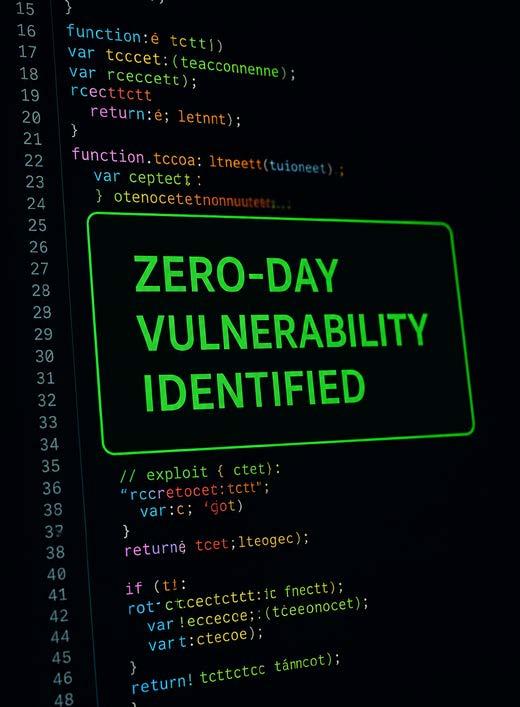
Understandably, Claude Mythos has raised global security concerns, with governments and financial institutions warning about its potential misuse. Anthropic emphasises that the model’s capabilities could be dangerous if used maliciously, and that the company is working closely with regulators and cyber security experts to ensure it is used responsibly.

In the UK, Ofcom has written to broadband providers to highlight concerns about the “rapid increase in AI ability”, specifically relating to Claude Mythos as representing a fundamental shift to security capabilities.
The AI Security Institute, a research organisation within the Department of Science, Innovation and Technology, said Claude Mythos represented “a step up over previous frontier models in a landscape where cyber performance was already rapidly improving”.
When it comes to personal use of applications, operating systems, and browsers, sometimes people do not want to upgrade to the latest release, as they are used to their existing system and do not want to learn yet another version. This can be a big mistake as very often new versions of software are released to fix security vulnerabilities. Similarly, companies and organisations need to be aware of the security risk of an employee or volunteer potentially working on sensitive information on a home IT system, which may not be secure.

Rail
George Bearfield, professor of Railway System Safety at the University of Huddersfield, Institute of Rail Research (IRR) has written a blog on the issue and says that the immediate concern for a Claude Mythos type attack against rail today is not a train accident, but a mass rail outage.
The vulnerable systems are likely to be ticketing systems, passenger information, depot and train fleet maintenance systems, traffic management, workforce management, energy billing, station retail, cloud-hosted applications, and supplier management systems. These are the systems that modern railways have come to depend on and without these the result may be stranded passengers, collapsed timetables, and disruption to maintenance and new works.
Safety signalling systems are understandably a concern, but George says if a week of timetabling is lost to a nationwide ransomware zero days event while the industry is debating exclusively about signalling, then it will have misread the threat.
Railway safety-critical systems such as signalling have structural defences which most of the Claude Mythos type attackers may not have considered. Like with any security measure, attackers will go for the weakest defence. So the safety risk sits slightly downstream of the availability concern of other railway systems. Safety-critical rail systems are built on principles of diversity, redundancy, and fail-safe design, so a vulnerability in a competently engineered interlocking or rolling stock design should not translate directly into safety risk.
George recommends that the rail industry should do three things to manage the Claude Mythos risk:
First, the GB rail sector, working through RSSB, the ORR, DfT, and the NCSC,
should be making an urgent, coordinated approach to Anthropic and its peers for defensive access to Claude Mythos. If direct access is not feasible, the next best thing is a rail-sector analogue to be established. Other industry sectors are now moving, and rail should not be debating this for months.
Second, each operator, infrastructure manager and major supplier should urgently produce a clear inventory of the third-party and cloudhosted systems on which their ability to run services depends, and establish which of those providers are inside the Glasswing programme or its successors.
Third, existing rail cyber risk assessments need to be revisited in light of what is now known about AI-accelerated adversary capability, with an honest output even if its uncomfortable. This is a properly executed risk-based
approach. Some safety cases will need supplementing, and some procurement assumptions will also need to change.
Conclusion
Claude Mythos represents a step change in AI capabilities and cyber security. It highlights the dual-use nature of advanced AI, where the same skills that allow for rapid vulnerability detection can also be exploited for attacks. Anthropic’s work and its Project Glasswing strategy aims to give defenders a ‘head start’ while mitigating risks. The rail industry needs to be part of this. Everyone is also encouraged to always ensure their applications, browsers, and operating systems are up to date with the latest releases.
Historically, security measures have benefitted defenders more than attackers. There have been examples
where new technology has enabled attackers to identify vulnerabilities at an increased rate, but defenders eventually catch up and sufficiently secure the defences. It is expected that the same will happen with Claude Mythos – eventually. Once the security landscape has caught up, AI language models should benefit defenders more than attackers, increasing the overall security of the software ecosystem. The advantage will belong to the side that can get the most out of the tools. In the short term, this could be attackers, but in the long term, it is
expected that defenders will be more efficient in directing resources, and use AI such as Claude Mythos to fix bugs before new code is deployed.
Let’s hope this is the case and that the transitional period is not too disastrous for the rail industry.
For source material, scan the QR code below.


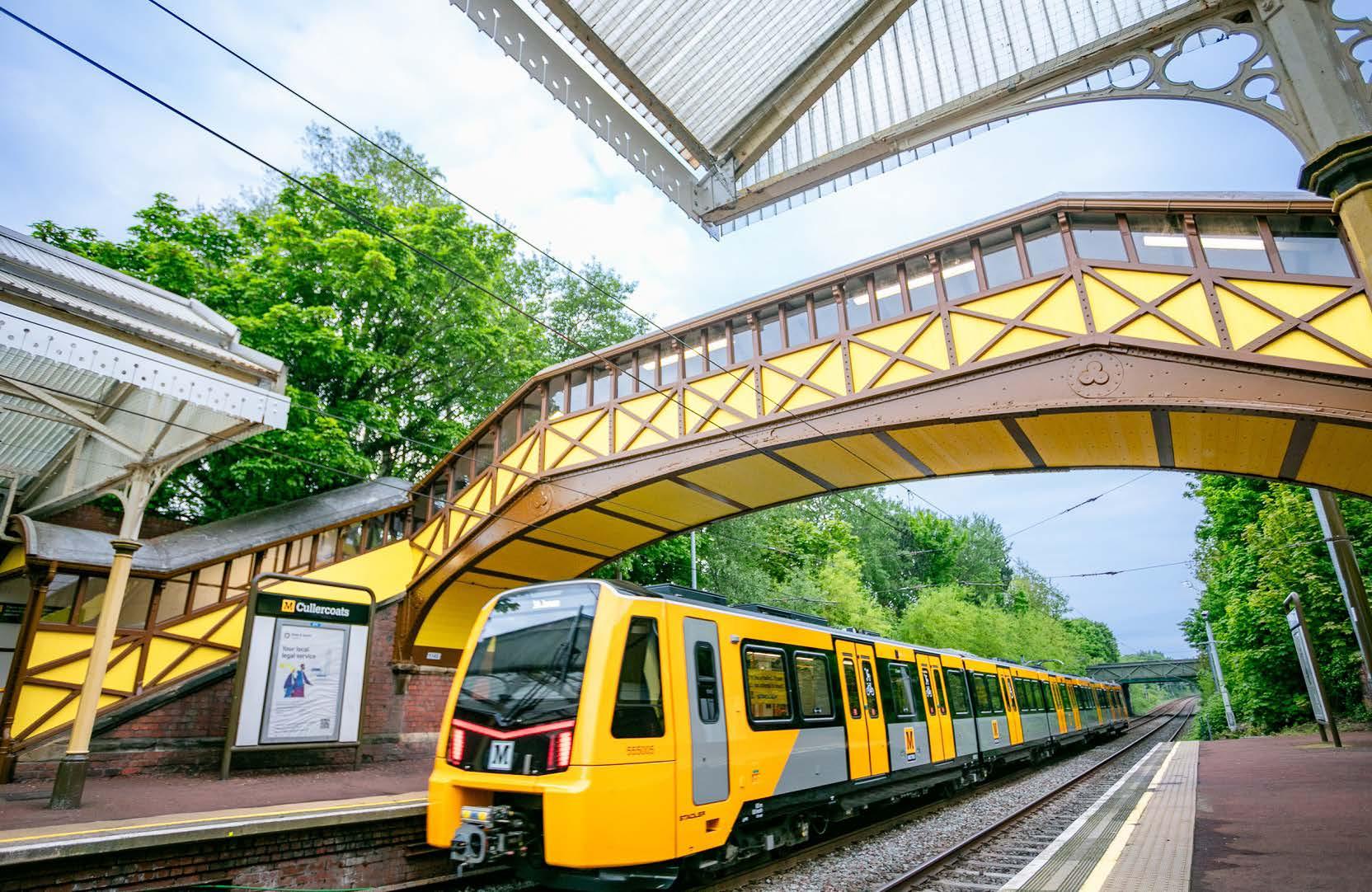
Nexus has been running the Tyne and Wear Metro for over 40 years. The trains have changed, the stations have been modernised, and passenger expectations have shifted enormously. Now, the control technology running behind the scenes has caught up.
There is a version of infrastructure renewal that gets a lot of attention. New trains, station redevelopments, electrification schemes. The kind of work that passengers notice and politicians announce. Then there is the other kind. The work that happens in control rooms, relay rooms, and equipment cabinets that most people will never see, carried out by engineers who largely prefer it that way. This is a story about the second kind.
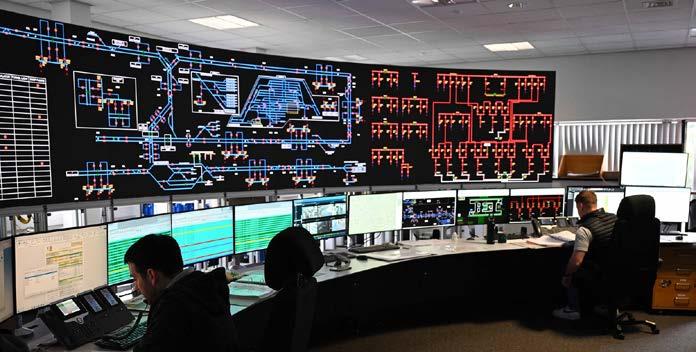
Sella Controls, a HIMA Group company, has completed the renewal of the Supervisory Control and Data Acquisition (SCADA) system for Nexus, the passenger transport executive responsible for operating the Tyne and Wear Metro. It is not a glamorous headline – but it matters considerably. The SCADA platform is the operational brain of the network. It is how control room staff see what is happening across the traction power infrastructure, how they respond to faults, and how they make the thousands of small decisions every day that keep services running on time. When that system is ageing, unsupported, and increasingly difficult to maintain, the risks compound quietly. The Nexus SCADA renewal was a considered, well-planned piece of infrastructure investment, and it has been delivered well.
The Tyne and Wear Metro has been running in some form since 1980, and over the decades its importance to the North East has only grown. Rising passenger numbers placed increasing demands on the teams responsible for keeping the network running. As journey volumes climbed, the ability to supervise and control critical operational assets became a priority, not just a convenience. However, the legacy SCADA technology was not keeping pace. Spare parts were scarce, software was no longer receiving updates, and the system simply could not give operators the real-time visibility that modern railway operations require.
Nexus went to market for a modern, flexible solution, supplied by a contractor with proven competence in SCADA, a track record in complex systems integration and migration, and a demonstrated ability to deliver programmes of this kind. Sella Controls was one of several established providers assessed. In the end, it was not just the technical capability of the TrackLink Traction Power Management System that won the contract – the approach mattered too. Nexus wanted a partner willing to work closely and openly throughout the programme, not just a supplier delivering to a specification. That commitment to genuine collaboration was central to the winning proposal.
To understand what was involved, it helps to know the network. The Tyne and Wear Metro covers five metropolitan boroughs: Newcastle upon Tyne, Gateshead, North Tyneside, South Tyneside, and the City of Sunderland. It serves 60 stations across its route and operates on a 1500VDC traction supply. A 33kV incoming feed is stepped down to 11kV, and that 11kV network distributes power across the system. Local substations contain transformer and rectifier equipment to provide the DC traction supply and an auxiliary threephase supply for station services. That includes lighting, lifts, escalators and fire alarms, meaning the scope of the system extends considerably beyond traction power alone.
Sella Controls was commissioned to replace 47 sites across this network. Each site received a TrackLink RTU panel, sized appropriately from small, medium, or large depending on the substation's requirements, and fitted with an integrated uninterruptible power supply to keep the unit available every hour of every day.
The RTUs feed live data into the TrackLink SCADA platform, which gives infrastructure controllers a continuous real-time view of the network and actively calculates the live power load. Operational staff can see the state of the network as it changes and make decisions on the basis of what is actually happening, rather than working from incomplete or delayed information.
“This project is a major investment in new technology for our Metro control room and is vital for Metro's long-term future,” says Paul Welford, major projects director at Nexus.
“It is a project which has been meticulously planned over the last two years to ensure the least possible amount of disruption to our customers. Sella Controls have provided us with amazing support during the transition to this new digital technology.
“The SCADA system is essential for the safe and effective operation of Tyne and Wear Metro. It enables us to remotely manage the high and low voltage power supplies and other key things like lighting, lifts, escalators and fire alarms. It will allow us to resolve infrastructure issues more effectively, which will mean less disruption for our customers.”
The system also does more than watch. Nexus operational staff have access to a fully equipped training simulator at the Nexus Learning Centre, where teams can get familiar with the platform and rehearse fault scenarios without any risk to live operations. For maintenance engineers, the platform provides network-wide analytics accessible from their own workstations, with the ability to filter right down to individual
device level. That changes the nature of maintenance work. Rather than responding to failures after the fact, engineers now have the tools to spot developing issues early and act before they become serviceaffecting problems.
The system architecture has also been designed with future growth in mind. The electrical live model at its core means enhancements such as remote securing can be incorporated without requiring significant rework, protecting the value of the investment as operational requirements evolve.
For Nexus, the result is a genuine step change in what the operational team can do. Control room staff have a clearer picture of the network than they have ever had, fault conditions surface faster and with more context, with the interface being built
around how operators actually work, rather than asking them to bend their processes around the system's limitations.
“We recognised very early in the pursuit process what the Nexus team wanted from a delivery partner,” says Chris Elliott, sales director, global account management rail, Sella Controls.
“We believed our strongest differentiator was our overall engineering competence, experience, and proven track record in delivering this type of project, alongside the technical capability of the TrackLink Traction Power Management System.
“I firmly believe we delivered on the commitment we made during the tender assessment process, providing a flexible approach, working in partnership with the client, and executing the project on time and to budget.”
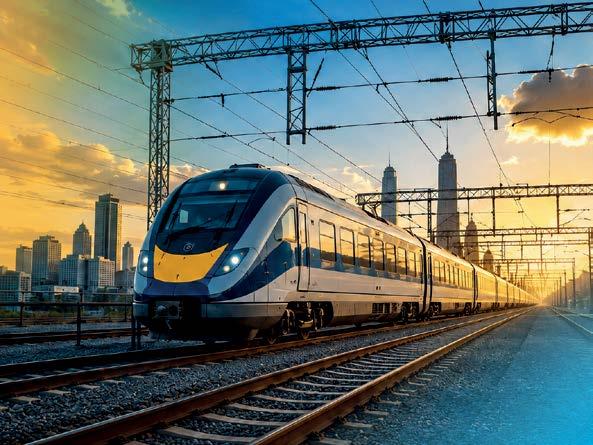
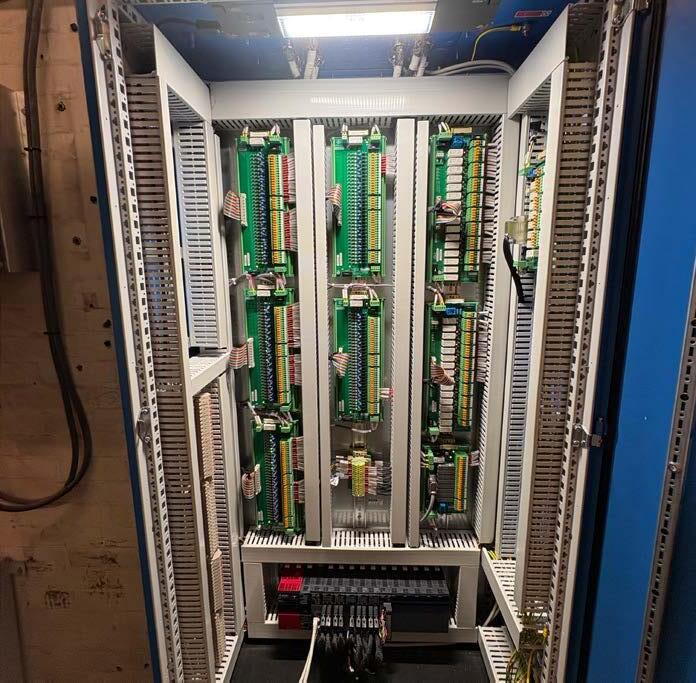
on a live railway
The hardest part of a project like this is rarely the engineering. It is the sequencing. You cannot take a live control system offline, replace it, and bring the new one up. The railway is running. Services depend on that operational visibility.
Nexus awarded the contract on the basis of an 18-month programme covering design assurance, build, test, and commission, with decommissioning of the legacy assets to follow. To meet that timetable, Sella Controls put together a dedicated delivery team and managed the programme end-to-end, working closely with all external suppliers to keep the work on track.
The system was commissioned progressively, section by section, with each stage signed off before the next began. Factory acceptance testing, site commissioning, and the final migration were all planned around the reality of a railway that could not stop running. The fact that the Metro kept running reliably throughout is a good measure of how carefully the project was managed on both sides.
Passengers will not notice the new SCADA system. What they will notice, over time, is a more reliable service and faster recovery when disruption does occur. When a fault develops on the traction power network, the speed at which operators can identify it and respond directly affects how long people wait on a platform. A well-
» 60 stations served across the network.
» 47 RTU sites commissioned.
» 30 million+ passenger journeys annually.
» 20+ years of design life.
designed SCADA system does not stop faults from happening. It gives the people managing the network the tools to deal with them quickly. On a network carrying more than 30 million journeys a year, that matters. For maintenance teams, the improved access to asset data also opens up more intelligent ways of planning work, reducing both cost and disruption over the life of the system.
Projects like this do not succeed on technical merit alone. On a live operational railway, with real consequences for disruption, what actually makes the difference is the quality of the working relationship. Sella Controls and Nexus approached this programme with a level of transparency and shared ownership that is not always seen. Problems were raised early. Decisions were taken jointly. Both teams stayed focused on what the project needed to achieve rather than what was written in the contract.
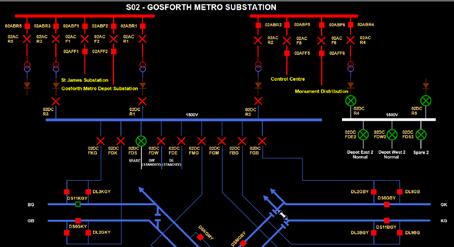
That matters because the hard moments in any complex systems integration do not follow a schedule. They turn up during testing, during commissioning, when reality diverges from the plan. When the working relationship is built on honest communication, those moments get resolved rather than escalated. The Metro got a better system for it, and both organisations came away with a clear understanding of what had been built and why it works.
Sella Controls brings over 100 years of combined expertise in Traction Power SCADA control, and that depth of knowledge is what allows us to deliver complex system renewals with confidence. As part of the HIMA Group, we can draw on safety and control systems competence from across the globe, which means clients anywhere in the world benefit from the same level of engineering rigour that we applied here on Tyne and Wear Metro.
The TrackLink Traction Power Management System is not a closed system. Its open architecture and modern interface standards mean Nexus has a platform to build on as operational requirements develop, not just a replacement that kicks the problem down the road. Projects like this rarely make the front pages. But the Nexus SCADA renewal is a good example of what infrastructure investment done well actually looks like, delivered on time, on a live railway, by people who understood what the operator needed. It is the kind of work that keeps a city moving.
“Sella Controls brings over a hundred years of combined expertise in Traction Power SCADA control, and that depth of knowledge is what allowed the delivery of complex system renewals with confidence,” says Chris.
“As part of the HIMA Group, the business drew on safety and control systems competence from across the globe, which means clients anywhere in the world benefit from the same level of engineering rigour that Sella Controls applied here on Tyne and Wear Metro.”

he drive towards electrification is creating new opportunities but also increases the complexity of infrastructure projects. New traction power systems, substations, protection equipment, and control systems must all work together seamlessly before a railway can enter service. Ensuring that happens safely and efficiently is at the heart of WJ Project Services.
Established in 2007, the company specialises in the installation, testing, commissioning, and energisation of electrical systems across the rail sector and beyond. While much of the industry's attention focuses on the design and construction phases of projects, WJ Project Services specialises at the point where infrastructure must be proven and handed over for operation.
"Our focus is on solving problems and giving clients confidence that systems will perform as expected," explains Founding Director Ashley Jordan. We're a highly skilled engineering business that can look at a problem, analyse it, develop a solution, and then implement that solution safely and efficiently."
Since becoming part of the Amcomri Group in 2023, the company has gained access to broader engineering capabilities while maintaining its specialist focus. The arrangement provides the best of both worlds, says Ashley.
"Being part of Amcomri has opened up many opportunities, while still allowing us to operate as a focused specialist business.
"We've got the security and support of a larger group, but we're still agile and able to respond quickly to our clients' needs."
Although best known for its work on rail electrification and traction power systems, WJ Project Services's expertise extends across a wide range of electrical infrastructure.
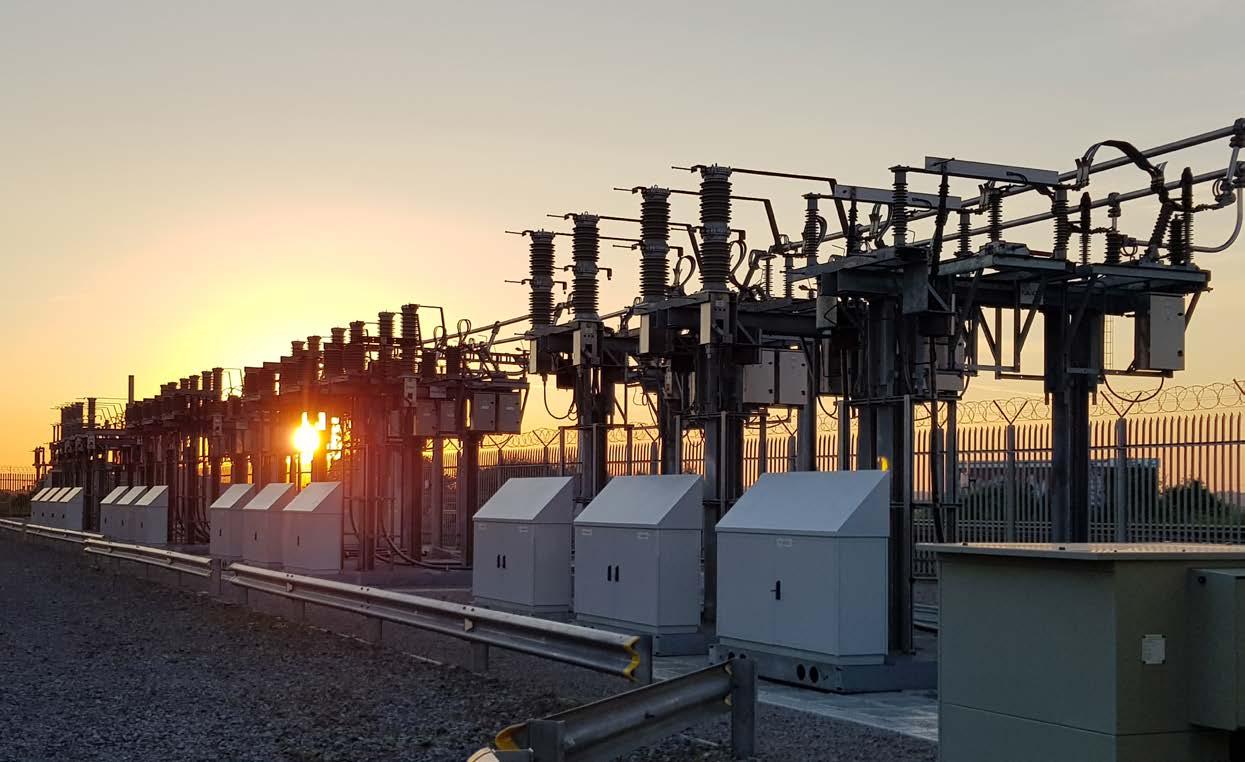
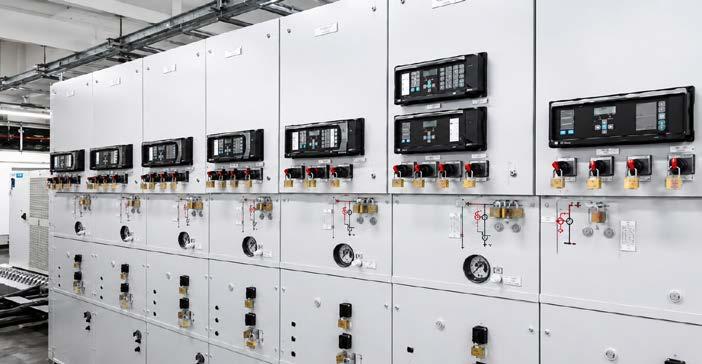
The company works on both high- and low-voltage systems, carrying out installation, retrofit modifications, testing, commissioning, protection and control upgrades, SCADA integration, and final entry-into-service activities.
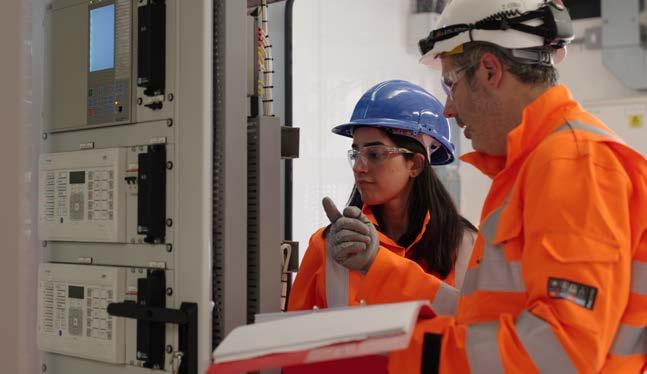
Its engineers are authorised to undertake switching operations on Network Rail infrastructure and private networks, carrying out isolation and earthing, safety documentation, energisation, and commissioning activities on some of the railway's most critical assets.
"We install, test, commission and undertake the final entry-intoservice or energisation testing associated with those circuits," Ashley explains. "We employ technically skilled and competent engineers who can support everything from installation through to the point where the equipment enters service."
The business also supports Network Rail in a less visible but equally important role, providing training, mentoring, and assessment services for maintenance teams and electrical staff.
When asked what differentiates WJ Project Services from its competitors, Ashley highlights the company's collaborative approach.
Rather than operating as a standalone contractor, WJ Project Services often embeds engineers directly within client organisations, becoming an integral part of project delivery teams.

"We tend to embed quite heavily within our clients' teams," he says. "It's much more of an ‘alongside’ relationship than simply working for somebody else."
That philosophy is reflected in the company's reputation for taking ownership of complex projects and reducing risk for clients.
"We want to be known as the company which takes away problems from the client," Ashley adds. "We're there to support first and foremost, and collaboration is absolutely integral to how we operate."
One of WJ Project Services’ greatest strengths is meticulous planning and preparation. Commissioning activities frequently take place during short possession windows where there is little room for error. Every stage of testing, switching, and energisation must be carefully planned and executed. According to Ashley, success depends on understanding every aspect of the job before arriving on site.
"Our attention to detail is one of the things we're most proud of," he says. "Every commissioning activity is planned step-by-step. We look at the job from every angle, understand the potential pitfalls, and work through them before we get to site."
That approach was recently demonstrated on the Core Valley Lines programme in South Wales, where WJ Project Services supported the commissioning of electrification infrastructure into Cardiff Bay.
"The whole commissioning was delivered successfully ahead of time," Ashley explained. "The railway was energised and trains were running on Sunday morning. That comes from understanding the infrastructure, understanding operations, and planning every stage of the work."
Over the years, WJ Project Services has contributed to many of the UK's most significant electrification and power supply
programmes. Its engineers have worked on schemes including the West Coast Main Line Power Supply Upgrade, Great Western Electrification, and the East Coast Main Line power supply works.
The company has also expanded its activities in Ireland, where it has been involved in innovative projects designed to support future railway electrification. One example is a pioneering battery storage project delivered for Drogheda, which Ashley describes as a significant milestone for the industry.
"It was a first-of-its-kind project," he said. "That battery storage system changes the way future electrification can be implemented. Projects like that demonstrate the experience we have and the value we can bring to emerging technologies."
As the company has grown, it has adapted to changing market conditions. While previous control periods were characterised by a small number of largescale programmes, today's rail industry often requires the delivery of numerous smaller projects simultaneously.
"We used to be involved in two or three major schemes at a time," Ashley explained. "Now we're often supporting 12 or 15 smaller projects. The challenge is different, but we've adapted to it."
Like many organisations across the rail sector, WJ Project Services recognises that attracting and developing skilled engineers is one of the industry's biggest challenges. The company therefore continues to invest heavily in training, mentoring, and developing the next generation of talent.
"We've got graduates in the business, we're bringing in new engineers, and we're training people to become commissioning engineers," Ashley says. "There simply aren't enough people being brought through the industry at the moment, so it's important that we invest in developing those skills ourselves."
The emphasis on training extends beyond technical competence. WJ Project Services believes that practical
experience, mentoring, and exposure to real projects are essential for creating the highly skilled engineers the industry requires.
Although rail remains at the heart of the business, WJ Project Services is increasingly applying its expertise to adjacent sectors.
The company is actively developing opportunities within energy infrastructure, renewables, private networks, data centres, and other electrical engineering environments where commissioning and power systems expertise are in demand.
Rail currently accounts for around 75-80% of the company's activities, but Ashley believes diversification will strengthen the business while continuing to support the railway.
"We'll always see rail as our core market," he said. "But we're also moving into energy, renewables, and other sectors where our skills are transferable. The experience we've developed in rail gives us a really strong foundation."
As electrification, decarbonisation, and energy transition continue to shape the future of transport infrastructure, demand for specialist engineering expertise is likely to increase.
For Ashley, the company's role remains straightforward.
"Clients bring us in when the work is complex or when they need confidence that systems will perform as expected," He says.
"That's what we provide: confidence, technical capability, and the ability to deliver."

DAVID SHIRRES
In a few years’ time, Cork’s local DMU services will be replaced by a high-frequency commuter service operated by 25 kV EMUs.
High-capacity commuter railways are only possible with the power that only electric trains can provide. The typical acceleration of an electric multiple unit (EMU) is 1 m/s2 which is over twice the typical 0.4 m/s2 acceleration of a diesel multiple unit (DMU). Hence, on a line with frequent stops, acceptable journey times are only possible with electric traction. As a result, electrifying commuter lines has always seen a high increase in ridership.
Cork, the Republic of Ireland’s second city, is expected to increase its population by 50% to 60% by 2040. With limited scope to increase road traffic, the city is planning for a sixfold increase of passengers on the city’s railways. The city’s transport strategy shows that this will bring significant benefits by, for example, better coordinating land use and transport planning such as walkable and cycleable catchment areas for existing and proposed stations.
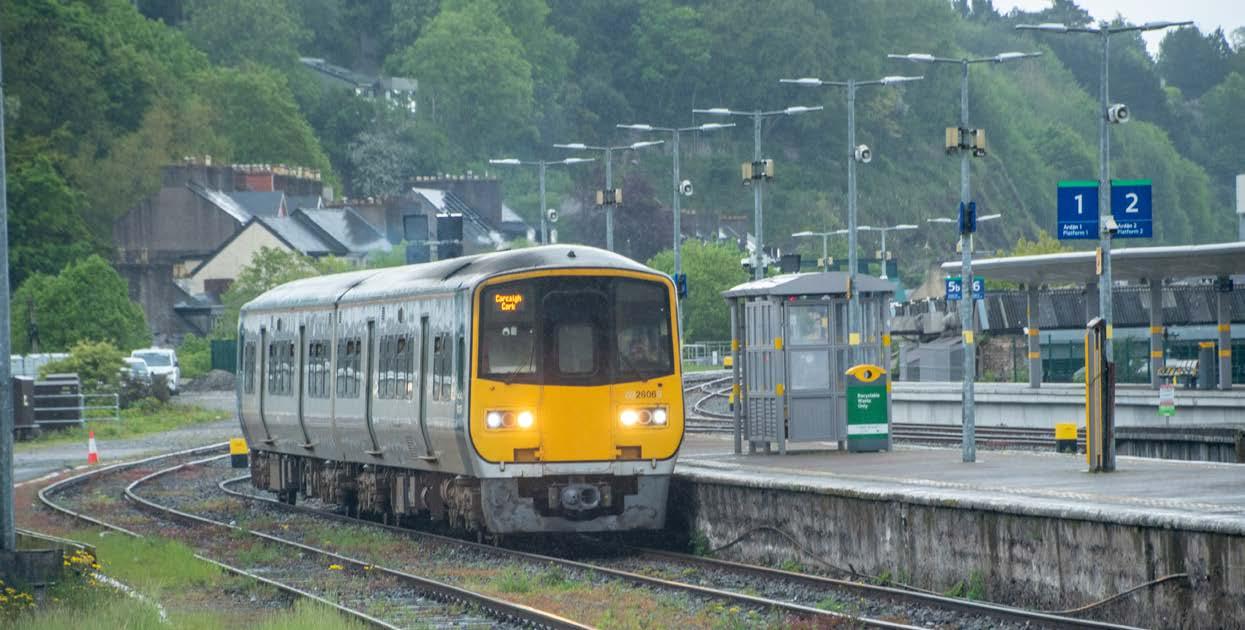
Cork’s rail network currently has 10 stations and comprises routes to Cobh (12km), Midleton (20 km), and Mallow (29km). The service frequency is every 30 minutes, though for Mallow this is only at peak times. The trains are operated by 8 x 2-car DMUs built by the Japanese Tokyu Car Corporation and introduced in 1994. Each car is powered by a 260kW Cummins diesel engine.
The Cork Area Commuter Rail (CACR) programme plans to build an additional eight stations and operate a 10-minute frequency
service on all routes. For the reasons described above, these services will be operated by electric trains. 21 x 5-car EMUs are to be ordered to provide a more than sixfold increase in passenger capacity. The power of these sets is expected to be 600kW per coach i.e. more than twice that of Cork’s existing DMUs.
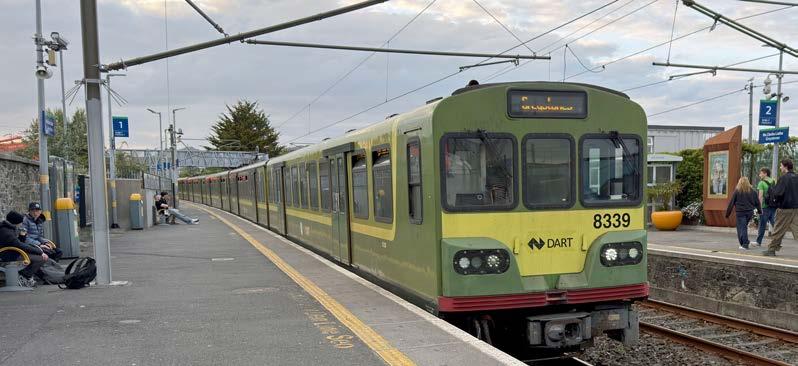
The 53 route-km of overhead electrification for Dublin’s 1.5kV DC DART network is Ireland’s only railway electrification. This makes it one of the least electrified rail networks in Europe with just 3% of its network electrified. When it was proposed to extend the DART network, a 2018 study of the respective benefits of 1.5kV DC and 25kV AC electrification was undertaken. With countries such as Slovakia and the Czech Republic replacing their 3kV DC system with 25kV AC it was felt that the 25kV option should be considered for future DART services.
This study concluded that, for unelectrified lines, only the 25kV AC should be considered as it has fewer capital and running costs than the DC system. With a much lower pantograph current, 25kV requires a lighter overhead line system and can also deliver more power per train making it better suited for Inter City services. 25kV also requires significantly fewer substations than the much lower voltage DC system.
However, for Dublin’s DART service it was concluded that the benefits of 25kV electrification were outweighed by the cost of converting the existing 1.5kV DC network.
Yet, as our report on the AllIreland Rail Summit in Issue 219 (Mar-Apr 2026) described, the All-Ireland Strategic Rail Review has recommended 850 route-km of 25kV electrification. This includes the 266km route between Dublin and Cork. As the last 29km of this route is the Cork commuter line to Mallow, the remaining Cork commuter lines are also to be electrified at 25kV AC.
Having decided on 25kV electrification, the option to use Battery EMU (BEMU)s with discontinuous electrification was considered. The CACR public consultation report explains that the BEMU option was rejected for reasons of operational costs and resilience. In addition, half the commuter network will require full electrification as it is on an Inter-City route. Furthermore, the All-Ireland Rail Summit was advised that the CACR programme will take advantage of Network Rail’s work on voltage-controlled clearances to significantly reduce the cost. As a result of the 34 structures affected by electrification work, only four will require bridge redecking.
The CACR programme is projected an investment of €1.8 billion and is being
delivered in two phases. The first phase is largely complete and consists of a new and extended platforms at the city’s main station, Cork Kent, double tracking to Midleton and signalling improvements. The second phase is for new stations, electrification, a new fleet maintenance depot and new electric trains. Work at Cork Kent station to facilitate through services between Mallow and Midleton started in 2023. It required the construction of a new 215-metre Platform 6 and the extension of Platform 5 by 50 metres, making it 215 metres long. This required the slewing of tracks 4,5, and 6 and the extension of a retaining wall. This work was completed in April 2025 at a cost of €23 million.
In 2023, Alstom was awarded a €78.5 million contract for a full signalling and telecoms renewal of the 62km Cork commuter network which is expected to be completed in 2027. This will replace two solid state interlocking and relay interlocking with Alstom’s Smartlock Computer-Based Interlocking system and provide an ETCS Level 1 overlay. This will provide headways for the required 10-minute train service frequency and a five-minute frequency between Cork Kent and Glounthaune. This work will remove the Cork East signal cabin and see the Cork network controlled from the National Control Centre in Dublin.
CACR programme phase 1 was partly funded with a €164 million grant from the European Union Recovery and Resilience Facility.
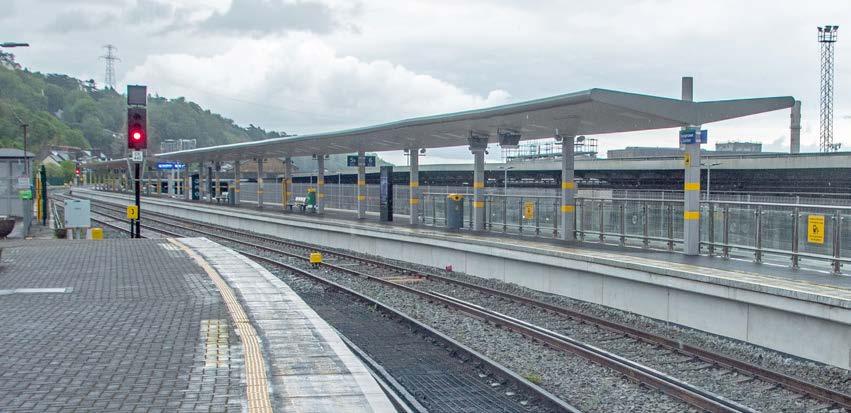
Double tracking of 10km of the line between Glounthaune to Midleton started in 2024. This required the removal of four turnouts, the installation of two new crossovers on the approach to Midleton, a turn back facility at Midleton, widening a river bridge deck, closing one level crossing, and widening another as well as the installation of new cable routes. This work took about two years to deliver at a cost of €90 million and was physically completed in late 2025 but awaits signalling commissioning before it can be brought into use.
Of the eight proposed new stations, three are on the line to Mallow where there are currently no intermediate stations. These will be at Blackpool, Monard, and Blarney. The proposed station at Blackpool is on Irish Rail’s land and so offers an opportunity for accelerated development so that it can be opened prior to completion of the CACR programme. Although Monard will have local park and ride facilities, Blarney will have a strategic Park & Ride facility off the adjacent national primary road. The
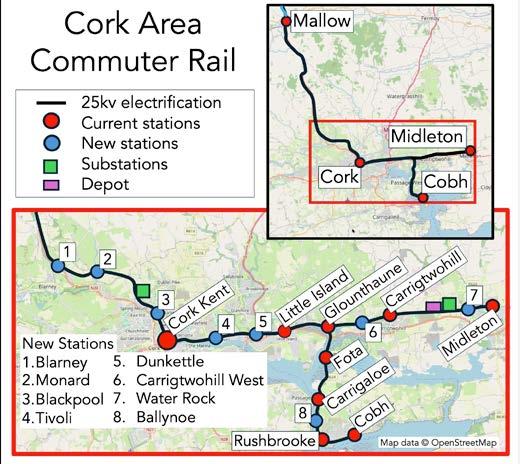
Dunkettle is another station site subject to accelerated development. It is adjacent to a major road junction and so will have a 300 space Park & Ride facility to intercept traffic before it enters the city.
On the line to Cobh there is to be a new station at Ballynow while the line to Midleton will have two new stations at Carrigtwohill and Water-Rock. As with all other stations these will have access from both sides and be integrated with access and car parking with access prioritised in this order: walking; cycling; bus; taxi; drop off/pick up; and car parking.
standards as the only experience is with 1500v DC on DART. The working group is considering lessons from the decades of delivery experience across the UK & Europe.
At the All-Ireland Rail Summit, CACR programme Delivery Manager AJ Cronin advised that being first gives the CACR programme the opportunity for an innovative approach to shape the roll out of electrification nationally. He also stated that there is also close collaboration with the Irish grid and electricity supply network.
(Below) The low Cardiff Intersection bridge was the first application of voltage-controlled clearance technology (Inset) Surge arrester.
station will have three platforms as there will be a loop here to avoid conflicts between InterCity and commuter services. A new passing loop will also be required at Rathduff between Blarney and Mallow. The busiest part of the Cork network is the line between Cork Kent and Glounthaune which carries services to both Cobh and Midleton. Two new stations are proposed for this section at Tivoli and Dunkettle. The Port of Cork is to move operations at its 65-hectare Tivoli site to new facilities downriver which will free this land for future development that will be supported by the new station at Tivoli.
Mallow station will be provided with a new two-sided platform to separate the operation of intercity and commuter trains. Cobh station is to have a second platform to improve operational resilience and accommodate special events such as cruise ship arrivals.
As the CACR programme is delivering Ireland’s first 25kV AC electrification, it will be a pathfinder for the future electrification of the country’s main routes. Hence, a working group has been established to consider key technical requirements as there are no Irish Rail 25kV electrification
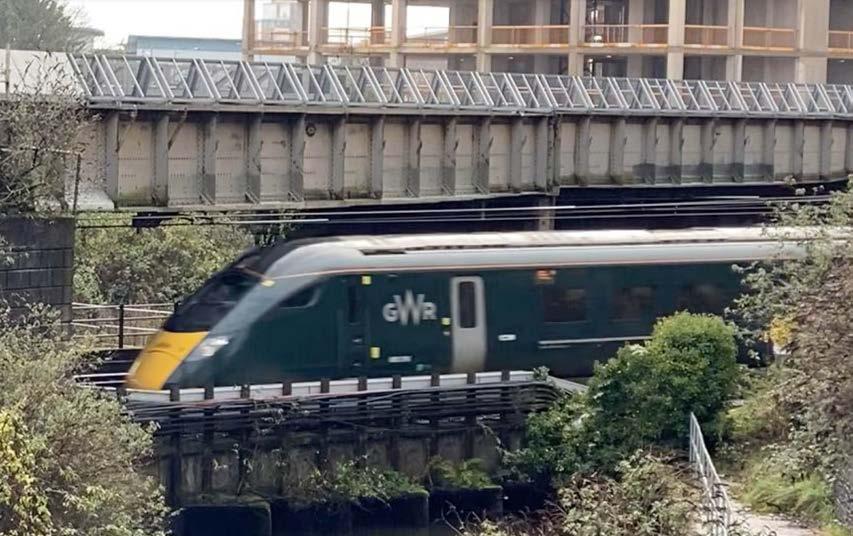
The CACR electrification will require 125 single track kilometres of 25kV AC electrification with overhead line equipment (OLE). It will have two 110kV supply and traction substations at Ballygibbon, on the Mallow line and at Ballyrichard More adjacent to the new depot. An electrification maintenance compound will also be needed adjacent to the new Dunkettle station.
Thirty-four structures have been found to have insufficient OLE clearance. Track lowering is the preferred option for 24 structures while four will require their bridge decks to be raised. Of the other structures, station canopies will need to be modified, and the Cork tunnel shaft guards will need to be replaced. Around 44 bridges will need their parapets to be raised.
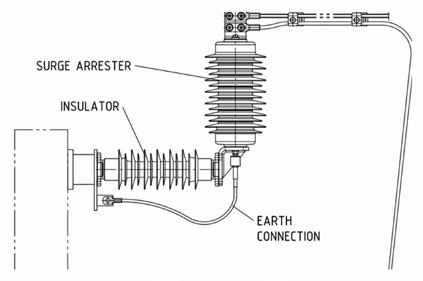
With the application of the voltage-controlled clearance technology developed by Network Rail, it is currently considered that continuous electrification is the best solution.
The new fleet maintenance depot between Carrigtwohill and Midleton will have a main building comprising a maintenance shed, wheel lathe, workshop area, storage area, offices, and a building services area. The depot will also have an Automatic Washing Plant and Automatic Vehicle Inspection. It will have the capacity to stable 16 EMUs. The depot building will be designed to achieve Nearly Zero Energy Building standards and so will have high-efficiency HVAC systems, renewable-ready technologies, heat recovery, water recycling, and intelligent building controls.
The CACR programme is to order 21 x 5-car DMUs which will provide more than six times the train seats of the existing fleet. It is expected that this order will be placed in 2028 so that they might enter service in 2031. It is understood that this fleet will be ordered under Ireland’s existing framework procurement contract with Alstom who have provided the new DART BEMUs. Therefore, it is likely that Cork’s new commuter trains will be Alstom’s X'trapolis EMUs which have an acceleration of 1 m/s2
As these will be Ireland’s first ever 25KV AC EMU fleet, testing and commissioning, for which specialised staff and facilities are required, will have to be done locally. Cork will then have to host a captive fleet until national electrification expands.
Following last year’s first public consultation on the emerging CACR preferred option, a detailed second public consultation on the preferred option was launched in May. Feedback from this consultation will be incorporated into the design development required for the submission of a Railway Order application.
Before the Railway Order application is submitted there is also a requirement for Government approval of the Preliminary Business Case (PBC). As required by Ireland’s Public Spending Code, the PBC must include the strategic case and economic case.
Although CACR will be transformational, its €1.8 billion capital cost is €3,600 per capita for Cork’s projected population in 2040. In comparison, Dublin’s proposed €8.8 billion metro, which has an approved PBC, has a €6,800 per capita cost.
The CACR programme’s PBC is expected to be published later this year and will need to demonstrate that CACR has a strong case though its cost is part of Ireland’s National Development Plan.
From published national and Cork city documentation, CACR’s strategy case is that:
» Cork’s economy and its population need to
grow as Ireland’s economy is over reliant on Dublin.
» Rail is the only mode capable of absorbing Cork’s planned 50-60% population growth by 2040 without catastrophic congestion.
» Without CACR, Cork faces a structural road network failure as the network is already at, or near, capacity.
» CACR enables high density, rail served development at its new stations which cannot be supported at scale without an electrified railway.
» CACR is an essential part of Cork city’s decarbonisation plan to reduce transport emissions.
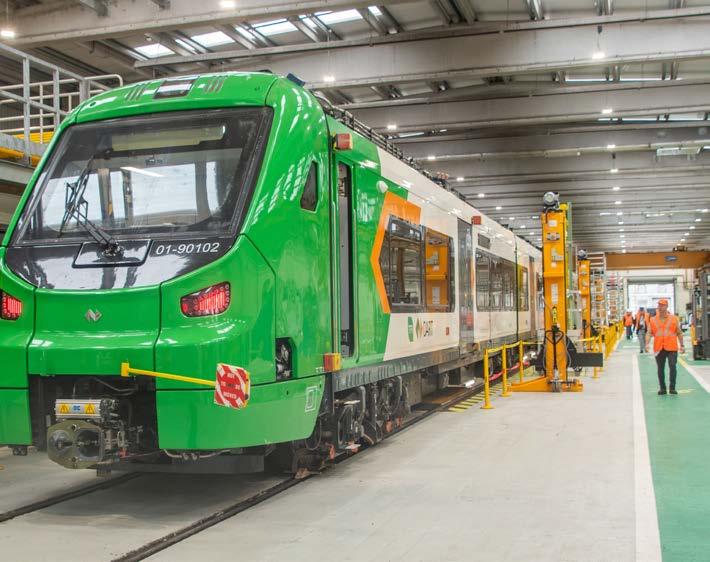
CACR’s economic case is:
» Time savings from more frequent, faster train journeys.
» Modal shift from car to rail reduces fuel consumption, road maintenance, and congestion.
» Increased productivity from improved connectivity between city businesses.
» Better access to employment, education, and healthcare.
» Reduced transport poverty in suburban and peri urban areas.
» Reduced carbon emissions and noise, improved air quality.
It is good to see how Cork is planning to dramatically increase the use of its rail network and how the Irish Government has strategies that support the required investment.
Rail Engineer wishes CACR success with its PBC and Railway Order and looks forward to reporting on the delivery of Ireland’s first 25kV electrification.
A recently-delivered 5-car Alstom X’trapolis EMU for Dublin’s DART network.
Rail Live 2026 comes at a time when the railway is under growing pressure to deliver more with less. Siemens Mobility is using this year’s event to demonstrate how technology can help create a better performing railway at a lower cost. Helen Davis, director of strategy and business development at Siemens Mobility, Rail Infrastructure, UK & Ireland, outlines how this thinking will shape the company’s conversations with customers at the show.
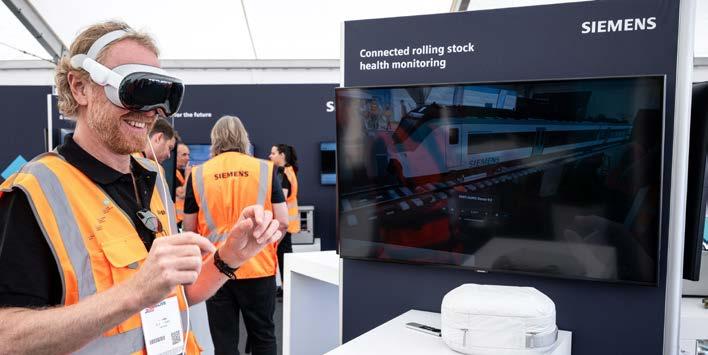
What’s keeping your customers awake at night when it comes to costs on the railway?
When I talk to customers, operational and maintenance costs are right at the top of the list. The railway is managing an enormous volume of equipment and infrastructure, much of it geographically dispersed, ageing, and increasingly complex. Keeping all of that running efficiently and reliably, while controlling costs and responding to more extreme weather conditions, gets harder every year.
A significant part of the pressure comes from labour intensive processes: manual calculations and processes to
operate the railway; regular site inspections; repeated site visits; and reactive fault response. These activities are essential, but they’re time consuming, expensive, and often inefficient. The question many customers are asking is: how do we take cost out of the system without compromising safety or performance?
What new thinking is Siemens Mobility bringing to Rail Live 2026?
We’re bringing some fresh thinking on how to reduce the cost of operating the railway, starting with re imagining how it is operated and maintained.
One of the biggest opportunities we see is using the existing asset base to enable better connected decisions at a system level.
It requires reliable cybersecure connectivity and we’ll be showcasing technology that can enable that today. Once that connection is in place, it opens the door to more intelligent monitoring of assets and better insight into what genuinely needs attention. Instead of reacting to everything, the whole cost base begins to shift: fewer unnecessary site visits, better prioritised interventions, and more productive use of skilled people.
At Rail Live, we’ll be sharing our thinking and experience from pilots we’ve run over the last few years, showing how these approaches can help create a network that is cheaper to run every day, not just marginally more efficient.
Another major opportunity is using technology to take labour intensive manual processes from people, so they can focus more of their time on making judgements and decisions. This is particularly relevant when it comes to perturbation recovery.
We’ll be sharing some of our latest innovations that can shoulder repetitive or arduous calculations, for everyone from signallers to maintainers, helping them do their jobs more efficiently and effectively.
Siemens Mobility is well known for signalling. Will you be bringing anything new in this area to Rail Live 2026?
Just last year, our ETCS Level 2 signalling system went into operation on the Northern City Line – the first ‘signals away’ railway to operate in the UK. The team which delivered that project will be at Rail Live, sharing their experiences from this cutting-edge deployment.
We’ll also be talking about how ETCS Level 2 can be deployed more flexibly in future. We know deployment can be challenging, but we have developed new solutions to enable it to be delivered more cost effectively across Britain.
What we think will surprise customers is the ability to realise benefits incrementally, rather than needing the whole of the ETCS delivered in one go before any value is seen. This approach also has the potential to shorten installation times and reduce costs.
We all recognise the potential cost saving of moving signal aspects into the cab with ETCS. Fewer signal heads and lineside cabinets mean fewer points of failure, lower maintenance demand, and reduced whole life cost. But the question we’ll be answering at Rail Live is: “How do we accelerate deployment of ETCS, so the industry can start enjoying these cost savings sooner?”
Electrification remains a challenge for the industry. How does this feature in your thinking?
This is an area where the industry has learned some hard lessons. Traditional approaches can be expensive, disruptive, and slow to deliver, yet the need to electrify the railway to improve performance, efficiency, and sustainability hasn’t gone away.
At Rail Live, we’ll be pointing towards alternative ways of thinking about electrification, for example how we can accelerate the use of electric trains without necessarily electrifying entire routes with overhead lines. This kind of thinking reduces infrastructure complexity, minimises disruption, and improves affordability, without compromising operational outcomes.
What can be done to make renewals and enhancements more affordable?
At Rail Live, we’ll be sharing ideas and solutions including on one of the biggest opportunities to reduce cost in renewals and enhancements: smarter approaches to surveying, design, and planning.
We’ll be showcasing new tools that can reduce over engineering, help avoid late surprises, and increase safety by reducing trackside exposure –all of which ultimately contribute to lower project costs.
What do you hope visitors take away from the Siemens Mobility stand?
We’ve got a lot to share about what we believe works – and what doesn’t – when it comes to optimising railway operation. Some of our ideas may surprise people when they see how much they can reduce the cost of running the railway, and how much more affordable enhancements and renewals can be thanks to technological advancements.
Our technical specialists, who have worked on these latest innovations, will be on the stand and are really looking forward to hearing about our customers’ challenges, and sharing their thinking on where the biggest opportunities lie to reduce capital and operational costs.
One thing I can guarantee is that people will leave with their heads buzzing with ideas.
To speak to Siemens Mobility’s team of experts about rail transformation, visit stand F2 on the main concourse at Rail Live 2026.
To speak to Siemens Mobility’s team of experts about rail transformation, visit stand F2 on the main concourse at Rail Live 2026.
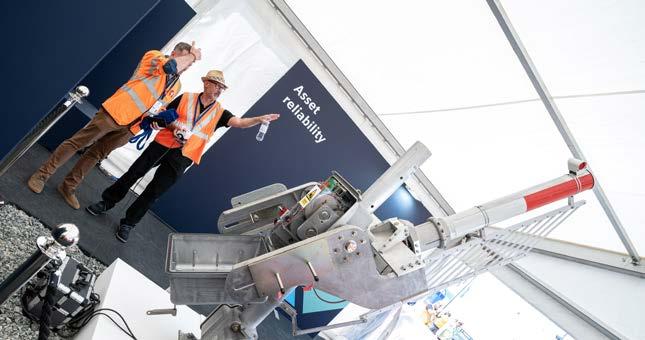
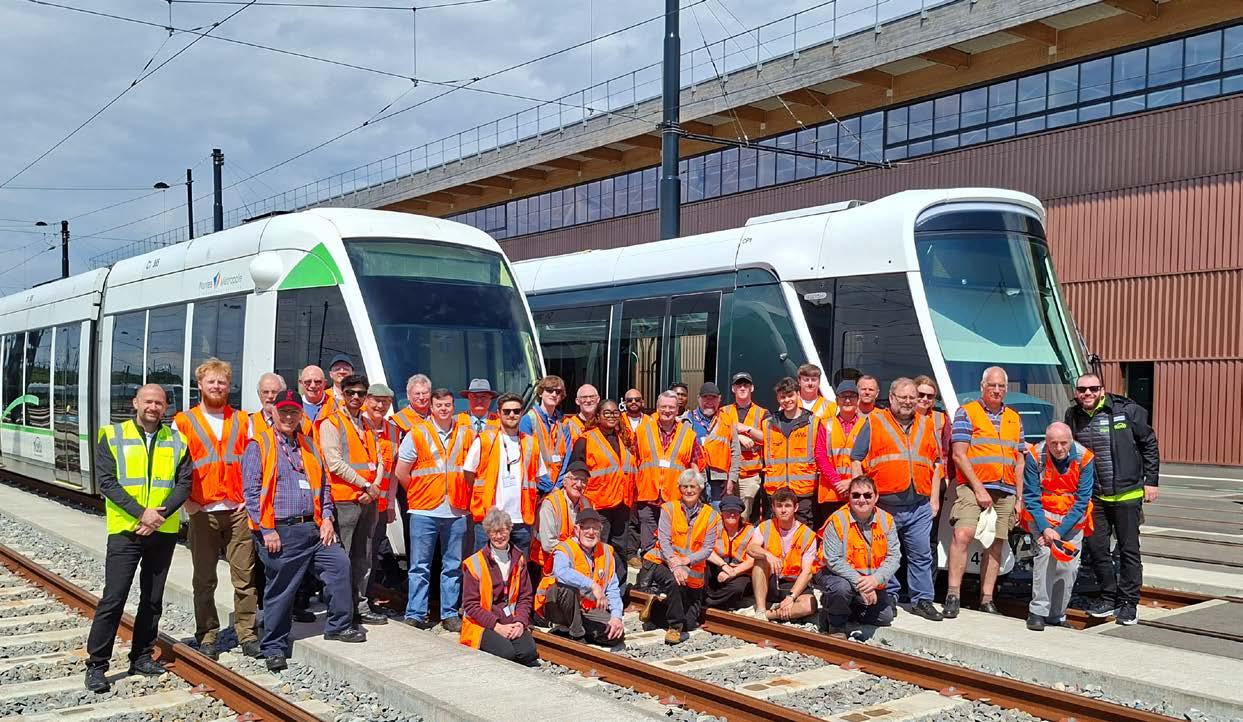
This year, the annual technical tour organised by the IMechE’s Railway Division started in Belfast on Saturday 2 May. This eight-day tour visited sites of interest in Ireland before taking a ferry from Cork to Britanny to see three quite different light rail systems in Northwest France.
Malcolm Dobell and I were on the tour which had around 40 participants of whom about half were young engineers. For them, it was particularly valuable to see how other countries engineer their railways as well as having the opportunity for informal chats with senior engineers.
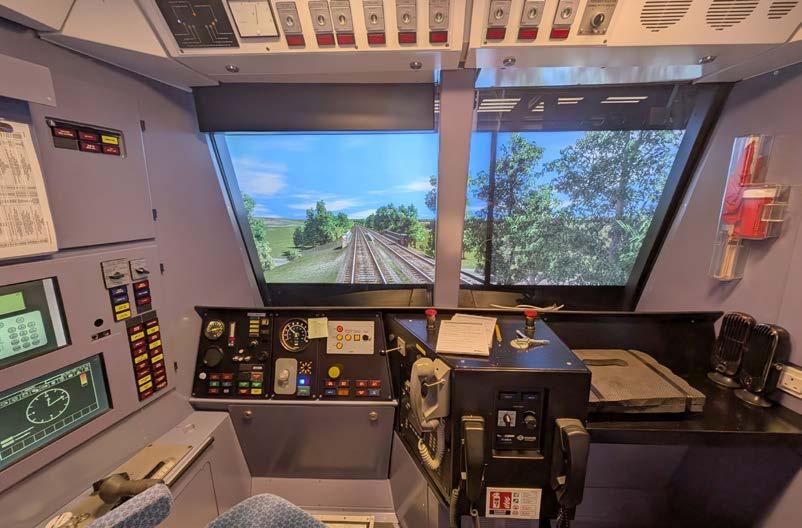
The first visit was to the Railway Preservation Society of Ireland’s museum and workshop at Whitehead to see the historic locomotives and coaches restored by the Society’s volunteers. From there a hydrogen-powered bus took the group to the new Belfast Grand Central transport interchange with 26 bus stands and eight rail platforms. This was constructed at a cost of £340 million and opened in 2024. From Grand Central a local train took us to Adelaide Depot which is a multi-modal training and engineering hub for Northern Ireland's public transport operator Translink. Its facilities include a bus and rail training centre, train driving and rail signalling simulators, and a rail vehicle maintenance shed built in 2011. The depot does all the maintenance on Translink’s CAF built diesel multiple units (DMUs). These are 23 x 3-car Class 3000 DMUs, introduced in 2004, and 13 x 3-car plus 7 x 6-car Class 4000 DMUs which were introduced in 2011.
The next day we took the loco-hauled Enterprise service from Belfast to Dublin which included a rail replacement bus service. On the tour we learnt that eight 10-car Stadler tri-mode units (diesel, 1.5kVDC, and battery) have
been ordered to operate the Enterprise service. The intention is that, once this line has been electrified at 25kV AC, the diesel power cars on these units will be replaced by 25kV power cars. On arrival in Dublin the tour visited Ireland’s National Transport Museum at Howth.
On Monday a tramreplacement bus took the group to Irish Rail’s (Iarnród Éireann - IE) Inchicore workshops. Here, IE Chief Mechanical Engineer Peter Smyth gave the group presentations on IE’s future plans and the maintenance of its rail fleet. He explained that IE is a single company split into two parts: railway undertaking and infrastructure manager. He considered that
this works well due to Ireland’s small scale and the need for tight integration.
IE’s rolling stock fleet consists of around 650 passenger vehicles and 52 diesel locomotives. The fleet is maintained at Inchicore and seven satellite depots. The Inchicore workshop was established in 1846 and is one of the few remaining in house heavy engineering rail works in Europe. The group saw its impressive facilities which include workshops for the overhaul of locomotives, including engine rebuilds, bogies, and wheelsets. They also saw the new DART+ Battery Electric Multiple Units (BEMU) as Inchicore forms the individual cars and bogies into articulated sets. The works also manages the testing and commissioning of these units.
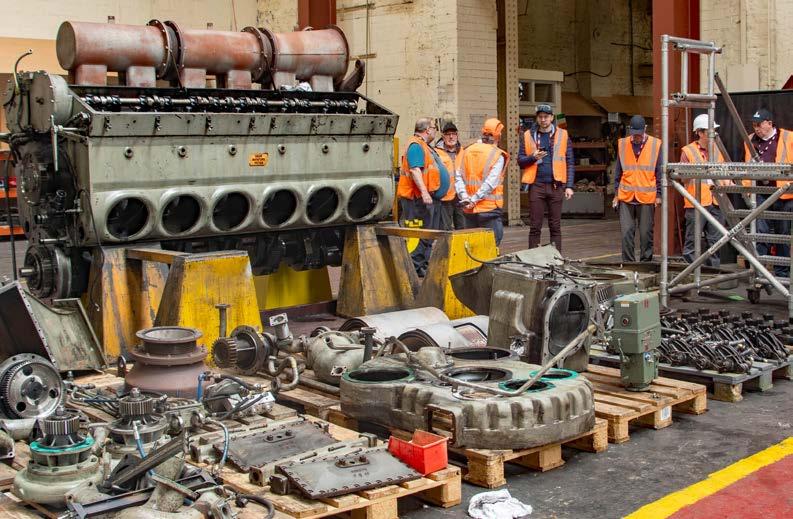
PHOTO: DAVID SHIRRES
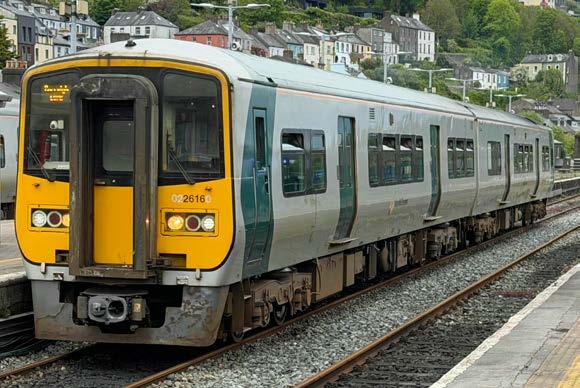
On Tuesday, two trains and a coach took the group from Dublin to the port of Foynes on the River Shannon. Here the tour learnt about the port’s recent expansion and its plans for a deep-water port and logistics park. The port is soon to benefit from a new motorway and reinstated 42km rail line built at a cost of €151.5 million and which is planned to be commissioned by the end of the year. The presentation about this new line was given in the lecture theatre of the Foynes Flying Boat Museum which, in the late 1930s, claimed to be the world’s busiest passenger airport, albeit with only one flight a week.
After spending the night in Cork, on Wednesday the group took a trip on the city’s
commuter railway to see a recent 10km redoubling project and a new through platform at Cork’s main station. These projects will eventually facilitate the introduction of the high frequency service required by the Cork Area Commuter Rail (CACR) scheme.
In a presentation it was explained that, with the city’s population expected to grow by 60% by 2040, CACR is needed to shift commuters from private cars to public transport and unlock housing and industrial developments. Cork’s current rail commuter service operates on a 63km rail network with 10 stations and has a 30-minute frequency. CACR will provide a 10-minute frequency with an additional eight stations. As explained elsewhere in this issue, it was originally considered that this service could be provided by BEMUs. However, a detailed study of the power required to operate such an intense commuter service showed that CACR requires full 25kV AC electrification.
Presentations given to the tour at Cork and Inchicore described aspects of the All Ireland Rail Strategy which is fully described in Issue 219 (Mar-Apr 2026).
The tour left Cork on an overnight ferry to Roscoff in Brittany from where a bus and TGV (Train à Grande Vitesse) took us to Rennes whose metropolitan area has a population of 500,000. This city has two metro lines A and B which opened in 2002 and 2022. Both are fully automated with platform screen doors and use the Siemens VAL system which has rubber-tyred-trains running on steel strip (line A) or concrete (line B). Line A is guided by horizontal rubber wheels on vertical rails either side of the guideway. These rails double as conductor rails. In contrast, line B is guided by rubber faced steel wheels on a central steel rail with separate conductor rails either side of the guide rail.
The tour was given a presentation on the 13km Line B which has 15 stations. This is operated by 25 two-car trainsets with provision to add a third car later. As the trains are driverless, service frequency can easily be changed to match variations in demand. Line B’s construction cost was €1.38 billion against its initial estimate of €1.20 billion. On Friday we took a train to Angers for the last hotel stay of our tour. The central section of Angers tram system has trams with no overhead wires
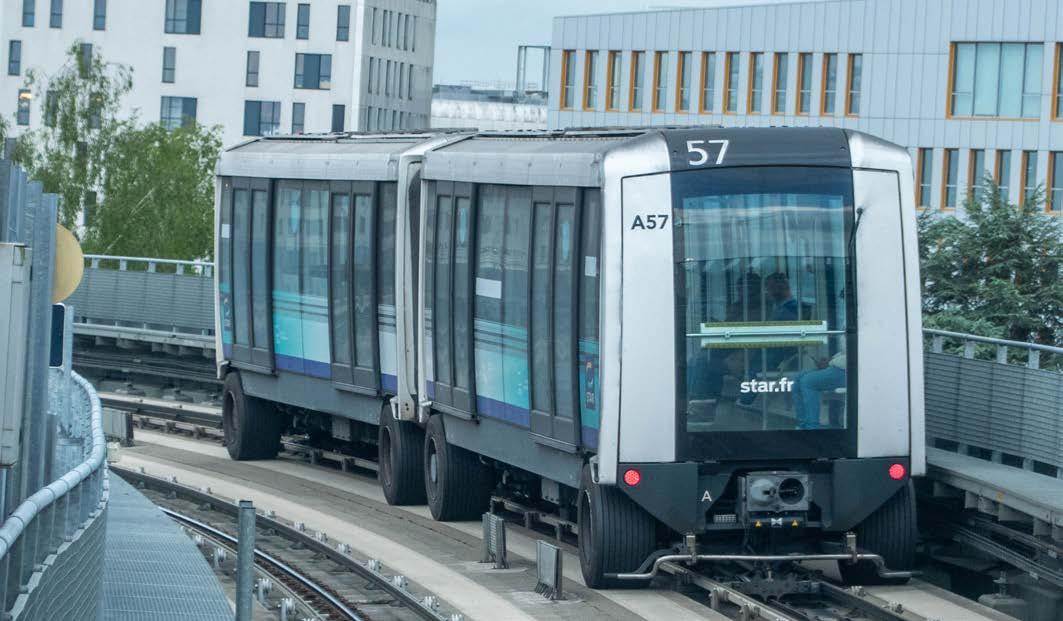
Output at full power: up to 240 hours without additional sunlight
Maximum visibility: approx. 900 m (depending on the course of the road)



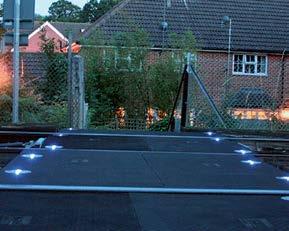
temperature range: -20 °C to 85 °C
one-side and two-side reflectors and different colours possible
STRAIL (UK) Ltd. | Tannery Lane // Send / Woking // GU23 7EF // Great Britain Head Office +44 (14 83) 22 20 90 // info@strail.com







www.strail.com







01483 763 558



www.woking-homes.co.uk

administration@woking-homes.co.uk
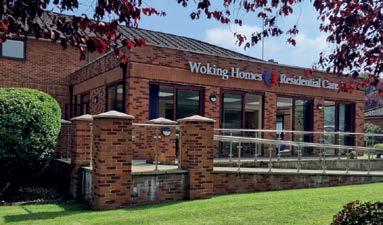
“I’ve never found a more perfect example of how older people should be cared for than Woking Homes.” Former Chairman, Age UK, Waverley



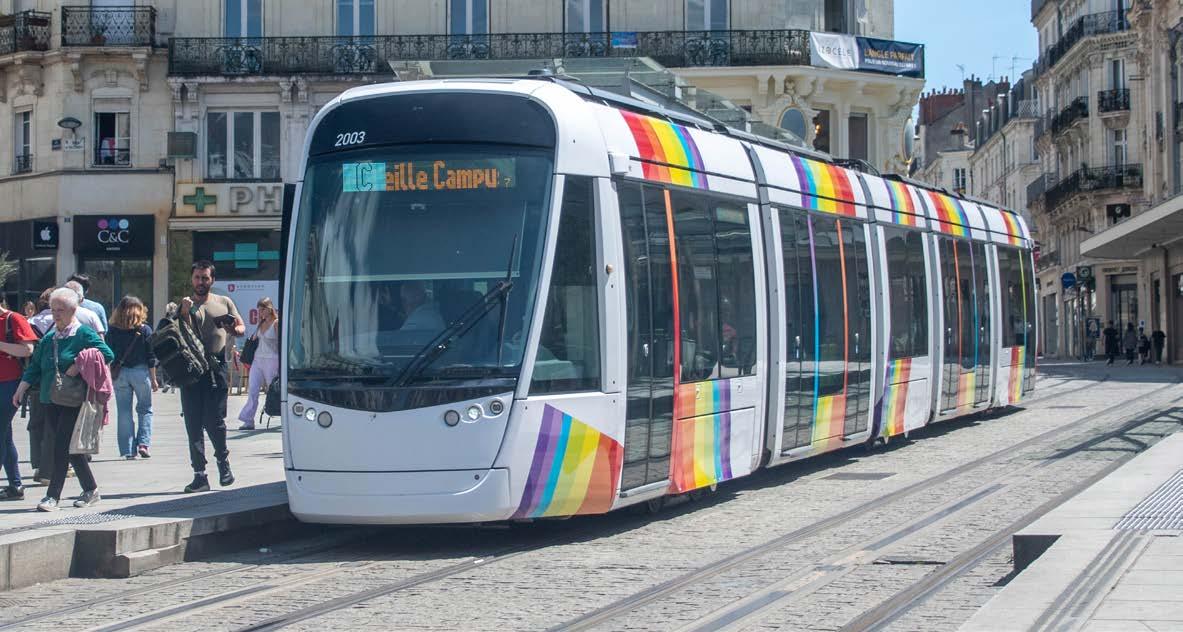
(Inset) Tour group inspects APS third rail in Angers whilst it is deenergised between trams.
(Top) APS tram without wires in Angers.
or batteries. As was explained to the group, Angers trams use APS which is an Alimentation Par le Sol (ground level power supply) system. This has a central third rail system divided into eight metre segments which are only energised when the tram is above them. These segments are controlled by local power boxes, separated by three metre neutral joints.
While in Angers, Louise Shaw, head of new fleet procurement and delivery at Transport Scotland, gave a presentation on Scotland’s fleet transition strategy. She noted how this builds on Scotland’s rolling programme of electrification which has been delivered 30% cheaper than electrification south of the border.
ScotRail currently has 11 different fleet types and needs far fewer, more standardised fleet types which are broadly inter-city, suburban, and rural/ scenic. Lousie advised that following a detailed study Transport Scotland judged that electrification has the lowest whole life cost due to its greater energy efficiency, higher reliability, lower recurring capital cost, simpler depot, and fleet operations.
Electrification has also been shown to grow both passenger and freight traffic. She advised
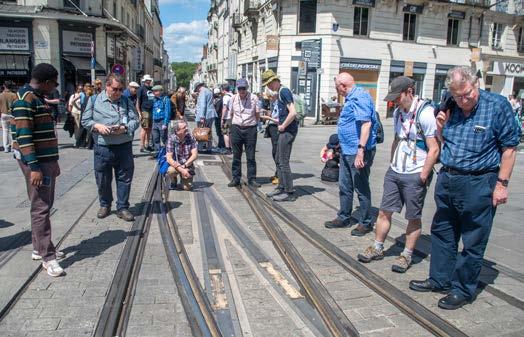
that although Battery EMUs are a useful transitional investment they have a lower energy efficiency, high battery replacement cost, and require complex state of charge management.
The last day of the tour on Saturday 8 May saw the group taking a TGV train to Nantes to learn more about the city’s trams. The city has a 44km tram network of three tram lines with two more lines being built. It also has two tramtrain systems. The tour visited the maintenance depot and control centre at Dalby as well as the new 12,000 m² facility at Babinière built at a cost of €143 million.
And so, in eight days, the group had 12 visits and presentations, 13 train journeys totalling 992 km, an overnight ferry, five different hotels, 11 bus or coach trips, five tram rides, and three metro rides. It was a fascinating
and varied tour from which much was learnt about railway engineering outside the UK. In part, this was from discussions between those on the tour.
This feature only provides an overview of the tour. Future issues of Rail Engineer will include further articles detailing particular aspects of the tour. Members of the IMechE’s Railway Division, and in particular Andrew Skinner and Professor Felix Schmid, are to be commended for organising this technical tour which was an excellent development opportunity for young engineers. Rail Engineer wonders where the 2027 annual technical tour will visit.
The Railway technical tour was sponsored by Beacon Rail, Porterbrook, Angel Trains, and the Manchester Railway Consultancy.




















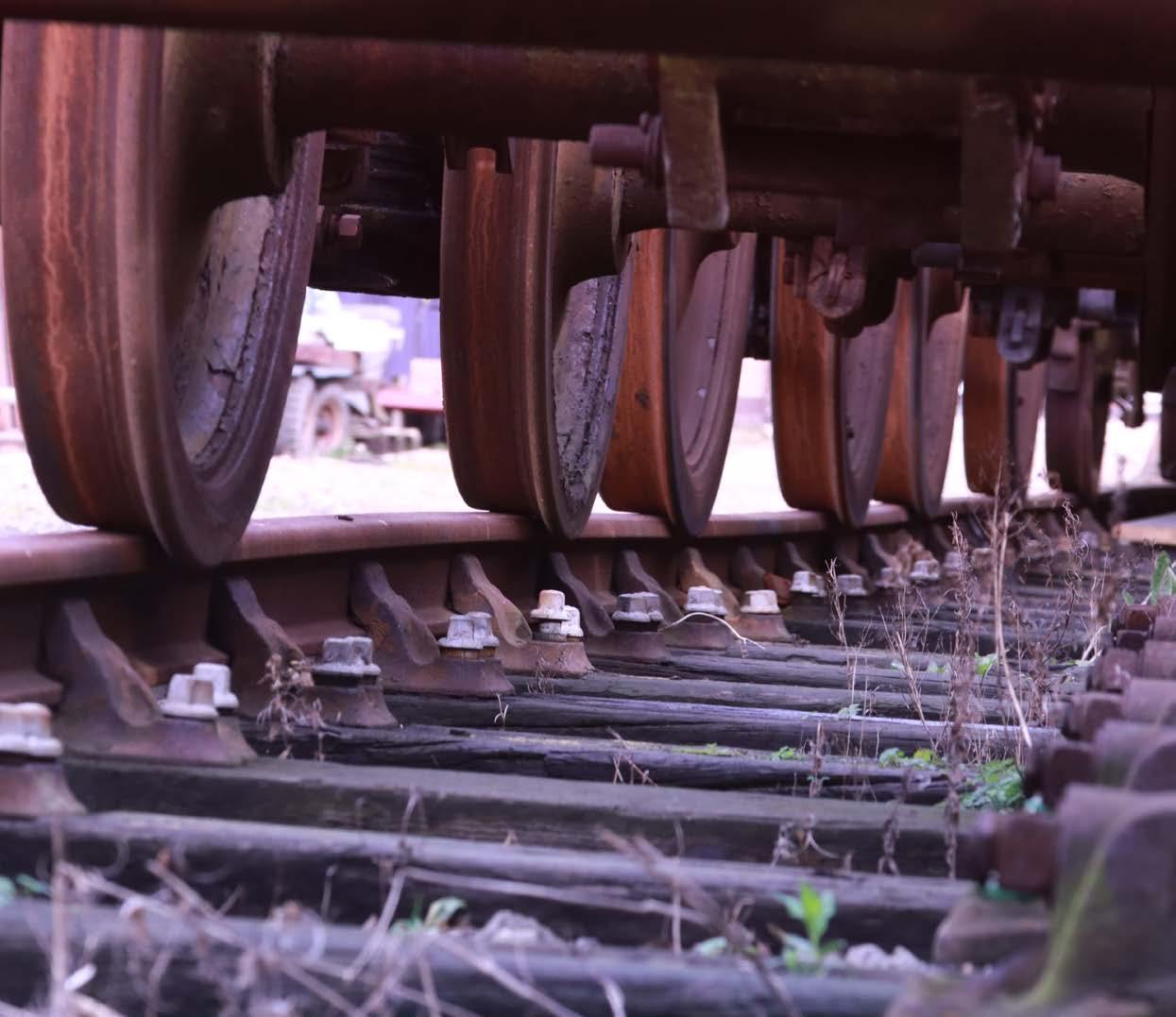


While a huge amount of progress has been made, vehicle/track interaction is still not fully understood some 200 years after the first public railway opened. For over 20 years, RSSB has sponsored a Vehicle/Track System Interface Committee (V/T SIC) to sponsor research in this area. Adhesion is part of the interface, and an offshoot of V/T SIC is the ADHEsion REsearch challenge programme (ADHERE), sponsored by the Adhesion Research Group (ARG). Each year it reports at an annual seminar which your writer has covered many times. This article presents the work of V/T SIC and ADHERE is covered in a companion piece.
This year’s seminar took place in March at the IET Austin Court conference centre in Birmingham. It was attended by attended by over 130 people – a record for the event. As ever, there was new work presented, updates on work in progress, and generational reminders about issues that may have been forgotten. A welcome trend over the years has been increasing cooperation between train operators and track engineers, and greater use of data.
Network Rail’s Brian Whitney, engineering expert for track and S&C, is a familiar face at the event. His long-term ambition has been to build enough confidence in data gathered by specialist measurement plant that repairs can be ordered immediately, without first needing ‘boots on the ground’ to verify defects identified by measurement trains.
As an example, the ultrasonic inspection units typically identify over 3,000 issues per month (more than 38,000 annually) that require action by pedestrian testers to verify the suspect. Based on typically two to two-and-a-half ‘suspects’
inspected per shift, this equated to 15,000 to 19,000 shifts per year which could be saved if repairs can confidently be ordered without verification. This requires: (i) confidence that the fault has been correctly identified which involves linking the Sperry ultrasonic test results with the One Big Circle Automated Intelligent Video Review (AIVR); and (ii) that it can be accurately located, ideally with +/- 30mm.
The latter has been achieved with a system developed by Machines With Vision (MWV) whose RailLoc Fault Navigator is a Neuromorphic Vision system which provides a single centralised map of track features, with automatically positioned condition data, from inspection and in-service trains, and meets the required accuracy of 30mm. It works everywhere on the railway, including tunnels and stations, in all conditions: light/dark, rain, wind. It works at speeds up to 125mph and provides geospatial and linear reporting. The MWV approach provides a mobile application that can be used by an operative on the track to navigate to the precise location identified previously by an inspection vehicle.
Neuromorphic Vision is based on the fact that, like the human eye, machines can operate more effectively if they only process changes in a scene instead of processing everything in a scene all the time. The result is far better performance, less bandwidth required, and much improved energy efficiency. It also lends itself to enhanced operational characteristics in challenging lighting conditions.
Each pixel acts independently to detect only changes in light intensity, not whole frames of images. When a pixel's brightness changes significantly, it sends out an ‘event’ containing the pixel's location, the time of the change, and the direction of the change (darker or brighter). RailLoc in its current guise uses the event cameras (neuromorphic), and the company is looking at introducing higher resolution cameras more akin to traditional optics which will most likely use low cost Nvidia hardware.
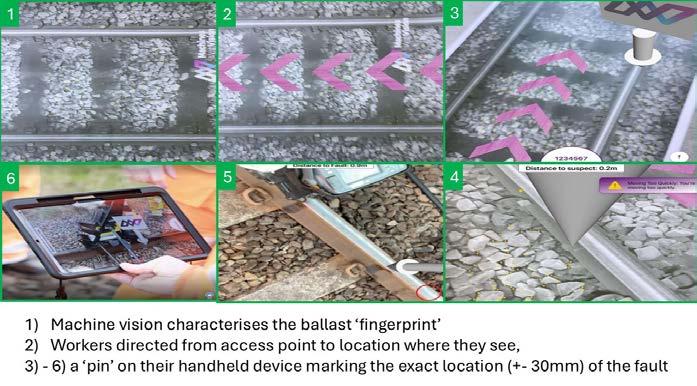
Brian referred to the tragic derailment and collision at Adamuz near Córdoba in Spain where a rail break at a weld led to a derailment where derailed vehicles were directed into the path of an approaching train at a crossover. This has led him to add weld breaks to his routinely presented broken rail chart below. Brian added that he is in close contact with colleagues in Spain so that we can learn lessons from the Spanish tragedy. While derailments from a broken rail are very rare, they continue to present a serious risk to railway safety.
At the V/T SIC seminar in 2024 (Issue 208, May-June 2024), Professor Jason Zheng Jiang from the University of Bristol & FOSTER Technology talked about developing an enhanced trailing arm bush design based on inerter technology and associated network synthesis methods. This year, he presented with Sharon Odetunde from RSSB who introduced the opportunity/benefits of improved bushes. Jason outlined the difference between conventional hydraulic damping and inerters. The former provides a force
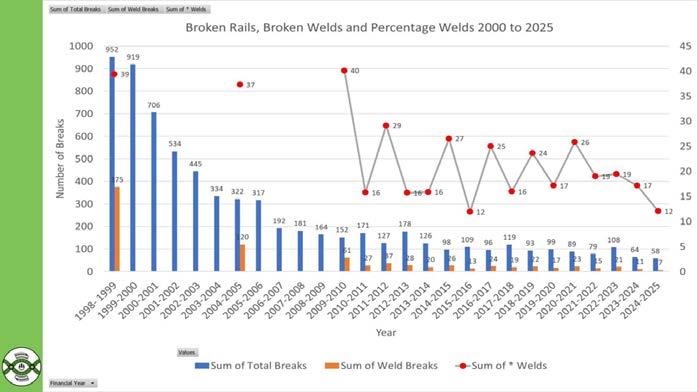
proportional to the relative velocity at the damper’s mounting points. Modern HALL or hydro bushes are this type. An inerter’s restraining force is proportional to the acceleration between the mounting points. He introduced the ETAB bush design which will be tested on a Mark 4 coach. This has a significantly lower longitudinal static stiffness than either the new GMT supplied hydro bush and even lower than the Mark 4’s current bush. It delivers all this and achieves the performance parameters for curving, stability, passenger comfort, and a nineyear life.
More modern carriages use smaller bushes, and a mini-ETAB design has been developed which has an even lower longitudinal static stiffness. Jason outlined an even better NEXATAB bush which is expected to: (i) reduce primary yaw stiffness when curving to deliver a better trade-off between wheel/rail surface damage and passenger comfort; and (ii) improve the performance of existing bush designs.
Sharon outlined the benefits of reduced longitudinal stiffness bushes for several use cases based on Variable Usage Charges designed to encourage track friendly bogies. This work suggested that more rural and suburban routes which typically have more curves will see more benefits than inter-city main line routes. The planned Cardiff-Manchester/Holyhead test route is forecast to deliver moderate savings from reduced rail surface damage and a 25% reduction in wheel maintenance cost. The plan is to fit eight ETAB bushes to one Mark 4 vehicle and retain the existing HALL bushes on the remaining carriages in the rake.
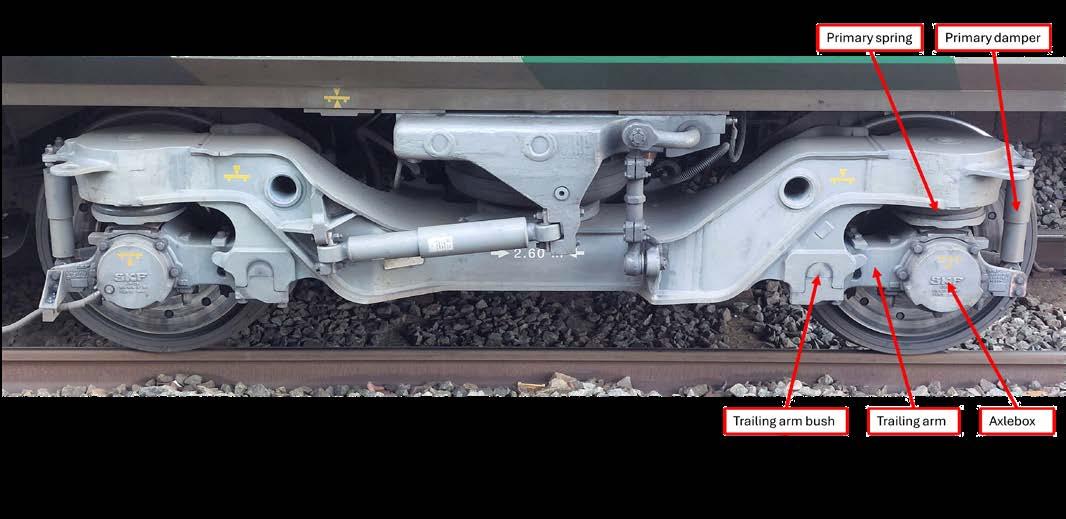
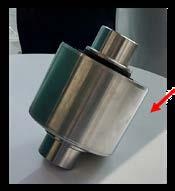
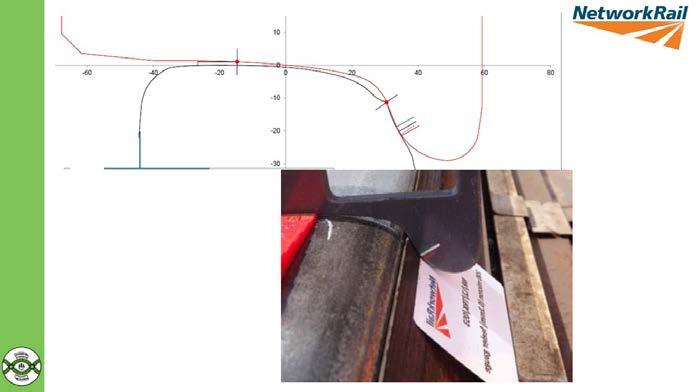
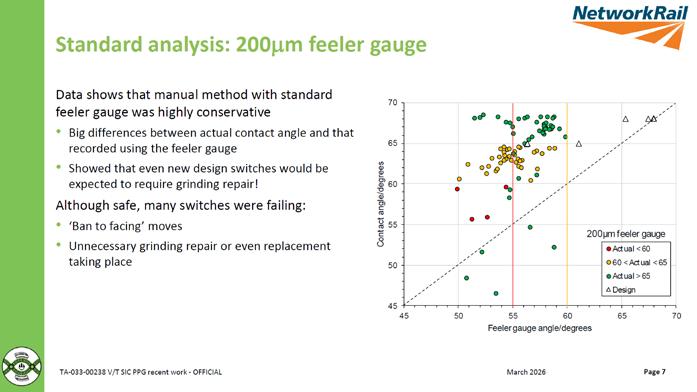
Project group
Professor Mark Burstow, Network Rail’s principal vehicle track dynamics engineer, another regular, gave an update from the V/T SIC Permanent Project Group covering two topics. The first was new methods for inspections at switches and crossings. For many including your writer, Mark’s description about current measurement standards, processes, and gauges felt something like a lecture about the dark arts in Harry Potter. Network Rail’s standard clearly outlines the key hazards, and each one has its own inspection method and tools. The challenge is applying them on site, in the dark and in bad weather. One of the gauges requires the use of a 200µm feeler gauge to assess clearances. Mark explained that because of the manual nature of the gauge, it’s possible to get different results on the same switch. New switches can also appear to fail the inspection and when grinding teams arrive to make adjustments, they sometimes cannot find a problem they are supposed to fix. Clearly there is variability between inspectors. Work has been carried out to develop software to allow use of Greenwood Engineering’s MiniProf device. This provides a detailed profile
including angles, and assesses the actual flange contact point rather than a pass/fail ‘tick box’ exercise of the manual gauge. MiniProf data show that because of the manual nature of the standard feeler gauge process, the results are highly conservative as well as providing inconsistent results. There were big differences between actual contact angles and those recorded using the feeler gauge. Although safe, many switches were failing leading to facing moves being banned and unnecessary grinding repair or even replacement taking place.
While manual gauging continues, Mark explained that using a 100µm feeler gauge gave a more consistent result and this has now been mandated. In addition, there is now a laser scanning gauge becoming available from Abtus to supplement the MiniProf. For more complex junctions where its use can be justified, there is also an automated measurement trolley called FELIX.
Mark’s second topic was vehicle track interaction at lubricators, or rather, lack of it. Lubricators are fitted at suitable locations so that wheel flanges contact the lubricant and distribute it around curves helping to reduce rail side cut and flange wear. Mark was alerted to an issue because of reports of signalling faults in locations contaminated by iron filings. This was on a route with a number of tight radius curves, running a new fleet with better curving performance than the old fleet. All this meant that the new trains’ flanges were contacting the high rail later than the old trains and thus were missing the lubricator. Although the better curving performance was generally successful this was an unintended consequence causing increased wear in tight radius curves, but it was comparatively easy to assess the right location at each curve and move the lubricators.
Next were two presentations showing the benefits of on-train monitoring equipment. First, Tom Lendhill from Hitachi Rail and Nick Swift standing in for Peter Dixon from train leasing company Beacon presented ‘Sine waves to sound decisions’. Rail Engineer has previously presented results from the Perpetuum – now Hitachi Rail – self-powered triaxial accelerometers fitted to axle bearings and other locations on trains which, following analysis can provide information about wheel wear/
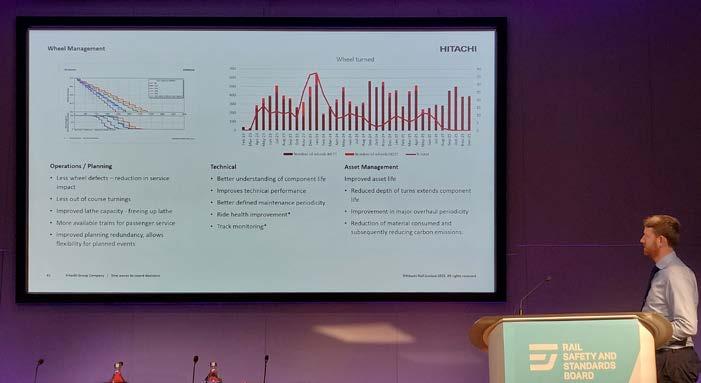
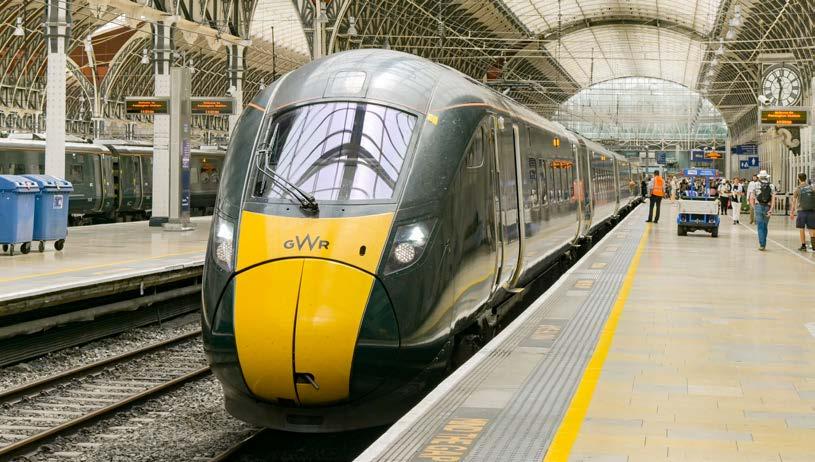
damage, poor ride, and track condition (Issue 211, Nov-Dec 2024). These articles have highlighted how using data has helped optimise wheel turning frequency to optimise ride quality and to detect wheel anomalies not visible to the naked eye. This meant turning the wheels more often but increasing wheel life as less metal is removed at each turn.
Central to this presentation was dealing with RCF on the wheels of Driving Pantograph Trailer coaches (DPT) of the Class 80X units. The routine wheel reprofiling periodicity was found to be inappropriate on these vehicles. Turning when RCF was present led, only after the first cut, to the discovery of defects under the surface, necessitating a second cut, and reducing wheel life. The vibration monitoring system was used to determine an optimum turning periodicity. The outcome was a periodicity of about 90,000 miles for DPTs to prevent RCF cracks, and around 200,000 miles for intermediate vehicles because ride quality tended to deteriorate at higher mileage.
The benefits were summarised as follows:
» Operations/Planning: fewer wheel defects, with less out of course turnings, leading to planned lathe use and hence improved lathe capacity. All this provides better fleet availability and provides planners some flexibility to briefly postpone some maintenance for events where extra trains are required.
» Technical: better understanding of component life leading to better defined maintenance periodicity and improved vehicle ride. Also, every train provides some track monitoring capability.
» Asset Management: improved asset/ component life as a result of reduced depth of cut leading to less frequent
wheel replacement. The benefit is reduced material consumption leading to reducing carbon emissions.
Dr. Mani Entezami from the University of Birmingham and MoniRail, Edwin Cornish from Eurostar, and Professor Yann Bezin from University of Huddersfield discussed in-service monitoring: passenger comfort, rough rides, and enhancing track/train interaction. It covered monitoring kit from MoniRail, applied in cooperation with the operator Eurostar, and analysis from academia. MoniRail’s kit (Rail Engineer JanFeb 2026) has been applied to many fleets and has demonstrated how the equipment fitted to a regular passenger train would show real world issues that could be missed by a dedicated measuring train whose dynamics are different from the regular fleet. Examples included:
» Long wavelength track features up to 140 metres (which can disturb ride comfort on high speed trains).
» Effect of rail grinding on axlebox vibrations.
» Axlebox vibrations as a proxy for
noise levels – good correlation was demonstrated.
» Short wavelength features such as squats.
» Rail head corrugation (another short wavelength issue), linked to cant deficiency.
» Vehicle instability such as hunting linked to evaluation of equivalent conicity.
» Many of these features were illustrated.
Many of these examples were illustrated by a case study of MoniRail equipment fitted to a Eurostar Class 374. Body, bogie, and axlebox sensors allowed monitoring and assessment of ride comfort against EN 12299, body and bogie performance against EN 14363, as well as track geometry, wheelset, and suspension performance monitoring.
It was found that long wavelength track input at 300km/h excited a secondary suspension mode which led to vertical displacement exceeding the suspension travel limit, resulting in bump stop contact. Sensors on the axlebox, bogie, and car body captured the full dynamic propagation through the vehicle which enabled quantification of severity and identification of critical speeds. The results supported the diagnosis that the cause was track induced excitation leading to corrective action.
The system was also able to help rule out a possible cause of an issue which was reported by drivers as a rough ride at speeds over 265km/h. The sensors showed conclusively that although the driver could feel vibrations at this speed, the vibrations did not appear on the bogie, suggesting that the vibrations could be from some other source such as aerodynamic forces.
Once again, the V/T SIC seminar illustrated that there is much to learn or, in a generational sense, to be reminded about. Long may it continue.
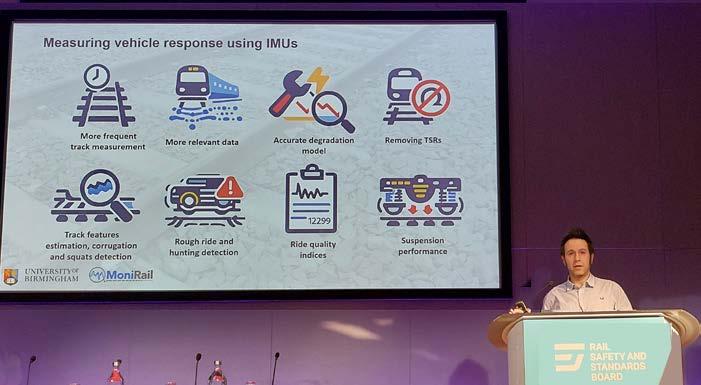
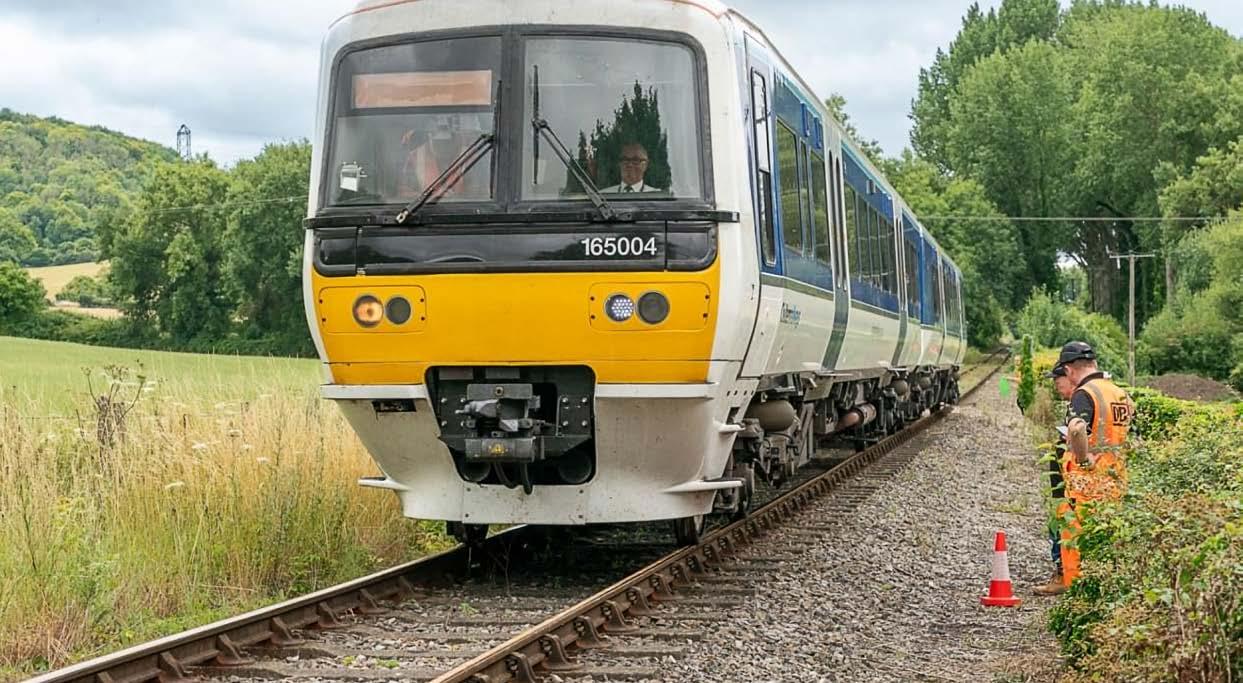
Unit 165004 used for the trial installation.
The Adhesion Research Group (ARG) is a sub-group of the Vehicle/Track System Interface Committee (V/T SIC), facilitated by RSSB. ARG sponsors the ADHEsion REsearch challenge programme (ADHERE). Both groups promote an annual seminar V/T SIC & ADHERE. The aim of ADHERE is to achieve ‘adhesion conditions that are unaffected by and independent of the weather and climate’.
Four presentations explored characterising adhesion in service, assessing applicability and business case for adhesion improving technologies and occupational health risks from sand used as an adhesion improver.
Wheel slide protection
165004 configuration and naming convention.
John May, from Knorr-Bremse Rail Systems UK and Louis Schmandt, from Chiltern Railways presented the results of tests to provide adhesion calculations from the Wheel Slide Protection (WSP) system of a Class 165 two-car unit. The question “how bad is the adhesion?” has hitherto been hard to answer. This trial sought to provide an insight into not only where and when low adhesion is occurring but also to what extent and notably, not just within the thresholds of WSP activity; a stark contrast to common, high-level reports to date.
This required information from several systems. The train sends brake demand, speed, GPS location, and an adhesion calculation to a cloud server. These data are combined with other sources (e.g., TRUST, schedules) to provide information that includes low adhesion hotspots (with alerts where necessary), precise GPS locations, infrastructure issues, braking exceptions, brake demand plotting, and speed on braking.
A year long trial has been carried out involving Knorr-Bremse, Chiltern, Angel Trains, ARG/RSSB, and the University of Huddersfield. Unit 165004 was upgraded with KB’s Electronic System for Railway Applications (ESRA) WSP system. 4G/5G was used to transmit data and GPS location to the cloud. The system was tested on the Chinnor and Princes Risborough railway in July 2025 and has been providing in service data since September 2025. From just this one unit a huge amount of information has been learned.
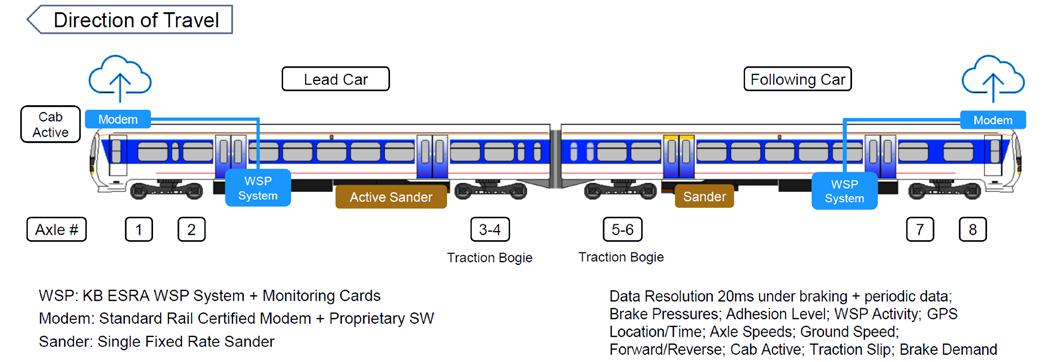
The information included:
» Wheelslide and traction slips by formation. About 75% of the unit’s mileage was in multiple with one or more other units. The unit was more prone to wheelslide and much more prone to traction slips when operating on its own.
» Adhesion by time of day. The worst adhesion times were between midnight and 09:00.
» Leaf fall/winter adhesion by day. By far the worst month for adhesion was in October, but there were hotspots which mostly coincided with named storms.
» WSP activity by axle. WSP activity was highest for the leading bogie (axles 1-2) which is in front of the single sander on the third axle. WSP activity was low on axles 3 and 4 and gradually increased on the other two bogies.
» Braking. Over 95% of brake applications were in step 1 which is in line with Chiltern’s professional driving policy especially in the autumn. 99% of brake events did NOT result in a slide.
Comparing deceleration against brake demand showed that the brake system was working well.
» Low adhesion hotspots. A list of stations by probability of wheel slide showed that some stations might experience wheelslide regularly (up to 50% of stops) whilst others experienced them rarely.
» Traction slips. Tended to mirror wheel slide activity. Only four of eight axles are powered on a Class 165 so they need more adhesion for a given acceleration.
Based on your writer’s experience, if this much knowledge is gained from a single unit, enabling more units should enable a more complete picture to be obtained and, is likely to deliver further insights as engineers gain experience and discover they can learn even more.
Louis explained that this trial is part of a greater ARG goal to develop an “adhesion expert train”, which is able to determine exactly where and when low adhesion is likely to occur as well as offer insights on what mitigating measures may be undertaken as a result (e.g. vegetation management, railhead treatment). The aim is to achieve this by fitting additional hardware on Unit 165004 to enable further validation of the low adhesion against data from other systems monitoring trackside vegetation through Light Detection and Ranging (LiDAR), and railhead condition through Automated Intelligent Video Review (AIVR).
Two presentations proposed techniques to help justify improvements, both of which were reporting on RSSB projects inspired by Recommendation 9 from the Salisbury Collision in 2021. This stated:
“The Rail Delivery Group working with the train operating companies and Rail Safety and Standards Board should create a framework and mechanism for the assessment of future technologies to enable trains to better cope with low adhesion when braking.
“The framework should set out criteria and establish the process for cost benefit analysis to apply to the assessment of future technologies as they arise.”
RAIB intended the recommendation to encourage realisation “...of potential benefits of future technologies to enable trains to better cope with low wheel/rail adhesion when braking”. Two projects were set up.
Dr. Martin Evans of University of Huddersfield and Dr. Will Skipper of University of Sheffield presented T1341 ‘Framework for assessment of technologies to deliver reliable braking in low adhesion’. The aim is to develop a technical framework which will set performance targets and assessment criteria against which low adhesion mitigations can be assessed. This will support a strategic approach to deploying existing mitigations and provide for the assessment of solutions to manage low adhesion. The project covers both infrastructure and vehicle mitigations. Two key concepts were proposed:
Signal Adhesion Class: “adhesion required to stop in time for a Danger signal from its first caution signal, with consideration of the risk and consequences of low adhesion” – expressed as %g adhesion. A series of these can be aggregated to a Route Adhesion Class.
Vehicle Adhesion Class: “the 'assured adhesion' a vehicle is able to provide during Full-Service braking, even in severe low adhesion conditions” – expressed as %g deceleration on level track.
In practice the assessments will be agnostic of gradient, so it is convenient to use % adhesion for both Signals and Vehicles. Based on minimum signalling braking distances defined in standard GKRT0075 (appendices A, B, and C) and gradients, the following Signal Adhesion Classes were defined:
» Class A, (8%). For passenger trains operating on lines signalled
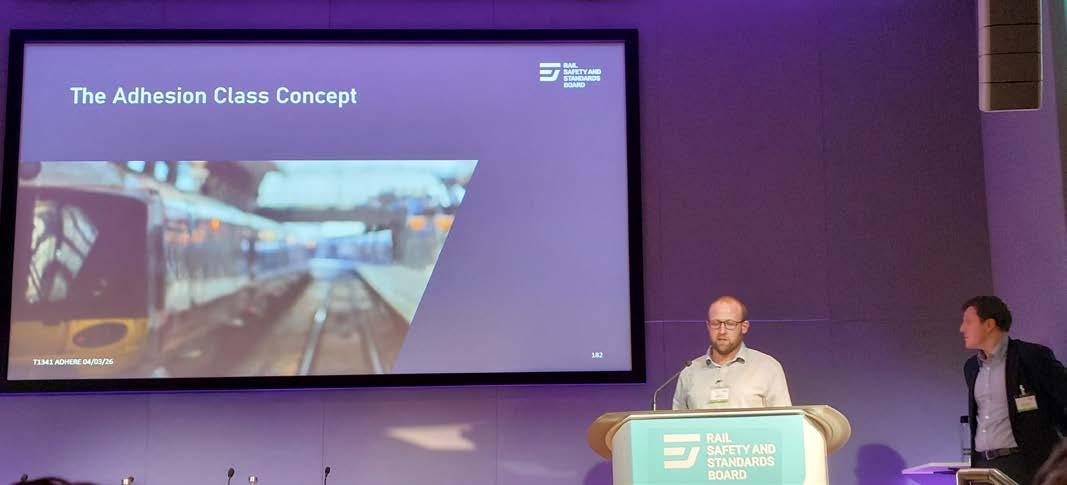
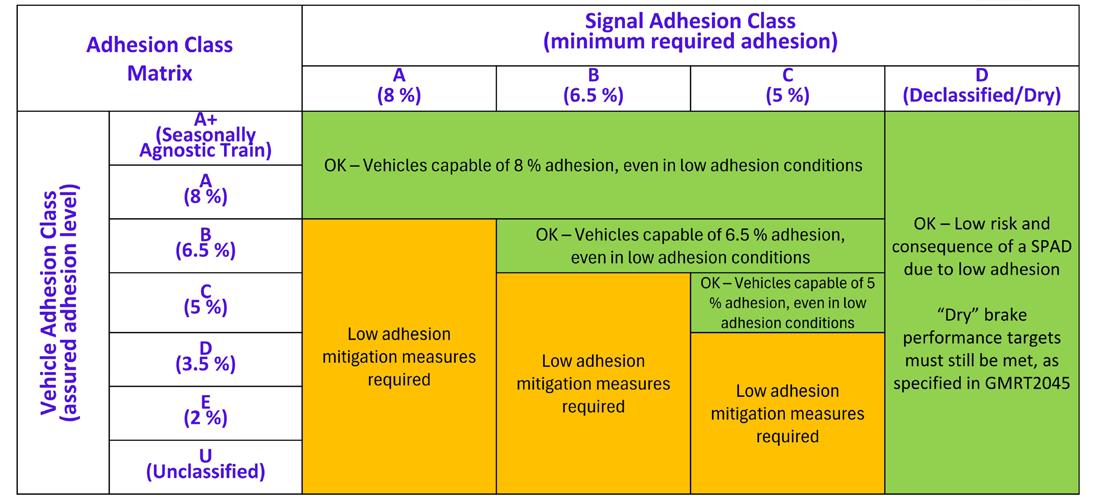
Signalling and Vehicle classification in a matrix, helping to identify when low adhesion mitigation measures would be required.
to Appendix C, or other lines where speeds exceed 110 mph.
» Class B, (6.5%). Passenger trains operating on lines signalled to Appendix B, up to 110 mph, or Appendix A between 75 mph and 110 mph.
» Class C, (5%). For passenger and freight trains operating on lines signalled to Appendix A up to 75 mph.
» Class D (Declassified - consider as “Dry”). Low risk and low consequence of low adhesion –considering Network Rail’s ‘Leaf Fall Risk Assessment’ and hazards beyond the danger signal.
Similarly, Vehicle Adhesion Class has been defined according to the level of “assured adhesion” a vehicle is able to provide during Full-Service braking, given as a percentage:
» Class A+ (Seasonally Agnostic Train). Capable of ‘dry’ braking performance (up to ≥9%), regardless of railhead adhesion conditions.
» Class A (8%). Able to restore reduced adhesion to achieve 8% adhesion, with reducing percentages for classes B, (6.5%),
Signal Adhesion Class aggregated, and the impact of Vehicle
Adhesion Class on the overall performance to help determine additional mitigations that may be required, e.g., speed restrictions.
C (5%), D (3.5%), E (2%). Finally, Class U (Unclassified) covers trains that cannot meet the requirements of Classes A to E. There will be two methods of assessment: ‘Equipment Definition’ - a conservative classification based on knowledge of the train’s braking system(s) and ‘Simulation’ which is expected to be more accurate and less conservative.
An example application of this approach was illustrated for the area between signals SY29R and Fisherton Tunnel, the location of the low adhesion that was instrumental in the Salisbury collision. The actual adhesion level/deceleration rate achieved by the collision train was 2.9% putting it in Class E (2%). This means that the assessment indicated that there was significant risk of serious consequences in poor adhesion and further mitigations are required. Potential use cases of this approach include:
» Assessing the capability of vehicles against their routes (i.e. “Service Group”).
» Prioritisation of routes for Railhead Treatment Trains.
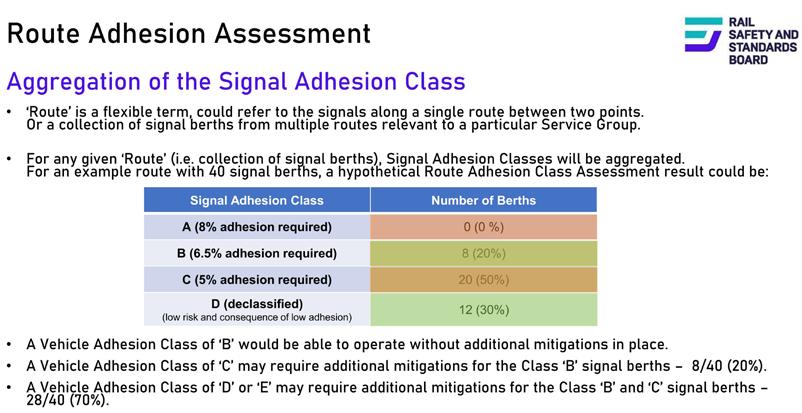
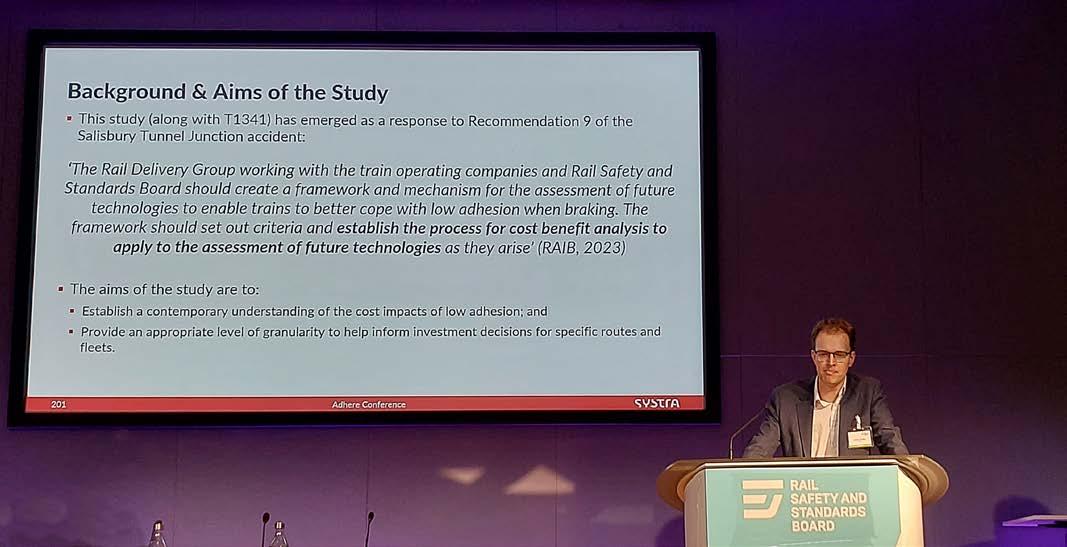
» Identifying suitable braking points for signals and/or stations, based on vehicle performance.
» Supporting the technical case for acquiring or retrofitting rolling stock with additional/future adhesion mitigation equipment.
The team proposes to carry out case studies on other sections of railway with different types of rolling stock and service patterns.
Dr. James Jackson from SYSTRA described T1340 ‘Economic evidence to underpin investment decisions for adhesion mitigations’. The study aims to establish a contemporary understanding of the cost impacts of low adhesion with enough detail to help inform investment decisions for specific routes and fleets.
The study covers both financial and socio-economic impacts i.e., people and money, safety, train performance, and cost/ savings. Cost Benefit Analysis (CBA) aims to capture all these but, inevitably, the financials are more precise than the socioeconomic benefits.
Previous work on business cases for adhesion mitigations (prior to this study) has primarily been based on network level business cases which sometimes lack focus on specific adhesion issues. Business cases have also tended to be purely financial, capturing cost savings and performance benefits estimated through Schedule 8. Socio-economic benefits tend to be excluded which means the appraisals deviate from DfT TAG good practice.
In seeking to understand the adhesion issue, James had analysed delays based on type of operation (commuter, Inter City etc.),Train Operator, and by service groups. He illustrated two case studies.
First, for the Calder Valley, the fitting of Single or Double Variable Rate Sanders (SVRS/DVRS) to classes 158 and 195 in two, three, and four-car formations demonstrated a benefit to cost ratio of 0.9 to 2.09 depending on the amount of journey time saved through use of sanders.
The second case study suggested removing Rail Head Treatment Trains from the Midland Main Line between Bedford and Kettering and using the savings to fund SVRS or DVRS on 12 units working the Matlock/Worksop/Skegness service. This produced a financially positive case, although caveated that assuming RHTTs could be removed still needed to be validated. The output is an appraisal toolkit which provides a consistent approach to the assessment of the costs and benefits associated with adhesion mitigations. The tool can deal with local, regional, or national level interventions. As always, the output is dependent on the quality of the inputs and the results sometimes need more evidence about the efficacy of some mitigations. That said, the results are promising with the scope for some financially positive outcomes and it shows the benefits of a whole industry approach.
The final presentation explored the occupational health risks in depots relating to silica dust for sanders delivered by Dave Flower from the Institute of Occupational Medicine (IOM).
Sand contains silicon dioxide (SiO2), also known as silica. The Health and Safety Executive (HSE) has noted that some silica dust is “…fine enough to get deep into…” the lungs. This fine dust is known as Respirable Crystalline Silica (RCS) (see Panel).
Prolonged and heavy exposure to RCS can lead to lung cancer and other serious lung diseases including silicosis and chronic obstructive pulmonary disease. Non-crystalline (amorphous) silica is considered less hazardous than RCS however some reports suggest that amorphous silica may potentially cause respiratory diseases.
ARG requested research (T1393) to understand the risk associated with sander replenishment, maintenance and testing, and what sufficient risk reduction or control should look like. Some sand alternatives have been trialled by other researchers and ARG also requested that IOM assess the health risks of some of these be compared with current GB rail sand products. The presentation provided the project’s emerging findings.
Data was gathered about personal exposure at five depots between November 2025 and January 2026. This included taking samples and reviewing control measures being used, including
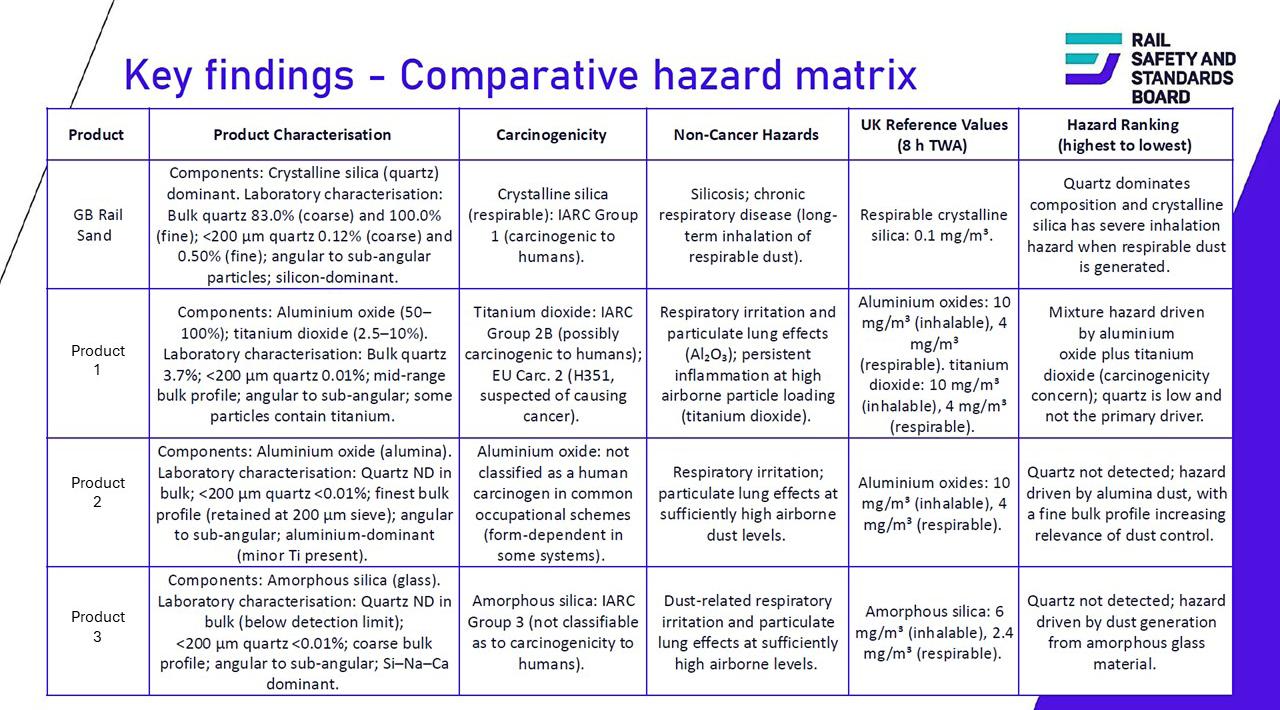
respiratory protective equipment. Typical results showed that the level of RCS was below the UK Workplace Exposure Limits (WEL) - these being legal, maximum concentrations of hazardous substances in the air, averaged over set periods, designed to protect workers' health - and in most cases, below the analytical limits of detection.
Respirable amorphous silica concentrations were below the analytical limit of detection and WELs, and respirable dust concentrations were well below the WELs. There was still ongoing assessment work to perform a more formal analysis of exposures and the needs for additional control measures to minimise worker health risks. A literature review focussed on sand handling activities (including for industries other than rail) was undertaken to identify high risk scenarios, use of control measures and their effectiveness, as well as exposure levels experienced by workers in these sectors. High risk scenarios are linked to agitation of dry sand, bulk transfer and cleaning, and confined/poorly ventilated environments.
Other key findings were that: (i) material characterisation of rail sands should be improved; (ii) there is a need to strengthen
Inhalable and respirable dust are classified by particle size and how deeply they penetrate the respiratory system. Inhalable dust (aerodynamic diameter < 100 µm) enters the nose/mouth, affecting the upper respiratory tract.
Finer respirable dust (aerodynamic diameter typically below 10 µm, with a 50% cut off of 4 µm) reaches deep into the gas-exchange region of the lungs. Respirable dust is generally more hazardous, and can cause long-term, irreversible lung damage.
Under the COSHH Regulations, any kind of dust level is hazardous to health when present in the air, and there are legal WELs whereby the concentration in air should be less than 10 mg/m³ of inhalable dust or 4 mg/m³ of respirable dust, as measured over the equivalent of an eight-hour day.
documentation of tasks and job roles; (iii) quantitative research on rail-specific engineering control performance should be improved; and (iv) the findings can be used to optimise risk management strategies for rail sand handling activities.
Toxicology assessments were carried out on GB Rail Sand (fine and coarse) and three sand alternative products using respectively aluminium oxide/titanium oxide, aluminium oxide, and crushed glass. Analysis suggested that titanium oxide is possibly a carcinogen while aluminium oxide and glass risk dust-related respiratory irritation and particulate lung effects at sufficiently high airborne levels. This compares with GB Rail Sand (fine and coarse) dust which is carcinogenic in humans (due to RCS) and also risks other diseases from long term inhalation of respirable dust.
Next steps include completing exposure and risk comparisons using data collected from depots and development of a good practice guide.
Assessing the level of adhesion directly from how trains perform has long been an ambition so that a real time picture of conditions can be built. The assessment and cost benefit work will provide tools that will help implement improvements more quickly. For example, SVRS and DVRS were demonstrated to give a significant improvement in stopping capability in 2017, yet today only a handful of trains have been equipped. Finally, it is good to see that whilst sanding improves the safety of the railway, the health and safety of the people handling and using it must not be neglected.
Synthetic Sleeper
Simply working & sustainable


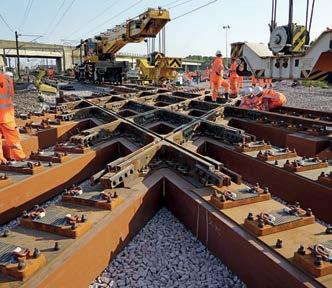
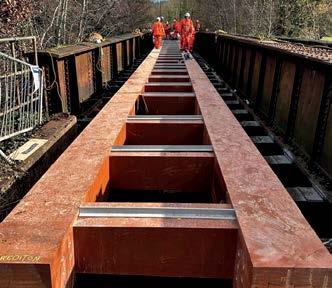
SEKISUI CHEMICAL GROUP : Enhancing Lives, Preserving the Planet. At Sekisui, we’re dedicated to advancing the quality of life worldwide while championing the protection of our planet.


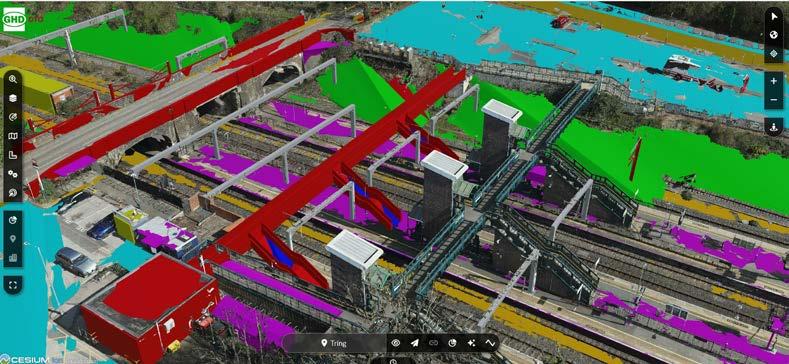
In Issue 218 (Jan-Feb 2026), an article titled ‘Managing earthworks with technology’ said that the future of geotechnic earthwork management could involve a number of technologies, and that the key will lie in the integration of multiple approaches to provide a comprehensive understanding of the assets managed by competent experienced geotechnical engineers.
Rail Engineer was delighted to meet up with the principal route engineer (geotech) at Network
Rail West Coast Main Line south to learn this is being trialled on the route in the form of a digital twin of geotechnical earthworks.
A digital twin is a virtual model of an asset, system, or process, and connected to its real-world counterpart by a flow of realtime data, so that the digital
twin mimics the real asset as much as possible. This helps with testing interventions and actions (including do nothing), and helps to understand how different actions might affect the realworld asset. Digital twins have applications across many sectors, including, water, energy, health, and of course rail.
The need for an earthworks digital twin on the route was driven by a number of factors. Earthworks are an aging asset
with many beyond their design life. They were constructed without the knowledge of modern geotechnics and soil mechanics. Many have noncompliant slope angles and were built using questionable construction methods for a railway far less busy and slower than today’s railway.
The earthwork assets face increased risk from the more variable weather patterns and potential risk from neighbours. It is no longer possible to carry out regular physical inspections of earthworks easily due to better safe systems of work and the railway faces a constrained budget.
Asset stewards need a better understanding of how their assets are performing in order to prioritise their budget, and they need to innovate in order to manage assets better, target interventions, and to maintain and improve asset safety. In simple terms they need to work smarter and make better datadriven decisions.
This was the remit which the engineering and digital consultancy GHD responded to when it created an earthworks digital twin for West Coast South, providing a comprehensive digital replica of the route’s high-risk earthworks. Data captured by drone replaces physical on-track inspections, and the system provides an accurate super highfidelity digital replica, aggregating a wide variety of information in a single platform to assist the geotechnical asset steward. A highly accessible interactive visual record of the earthwork and its surroundings is created, replacing lengthy written reports.
Sub surface information is captured from the British Geological Survey’s geology layers. This includes their analytical layers, which cover landslip, karstic and desiccation susceptibility as well as assessing impact from climate projections. In addition, the model imports borehole records geo referenced in accordance with data standards of the Association of Geotechnical Specialists. This comprehensive digital replica allows the understanding of any outside party activities and changes over time, together with physical changes to the asset such as vegetation condition or blocked crest drainage for example. Drone based Light Detection and Ranging (LiDAR) technology is used to observe surface changes and concentration features, especially in areas with dense vegetation and a history of instability. The technology enables the easy transfer of asset knowledge from engineer to engineer in a virtual, interactive way, and can reduce the need for lengthy paper-based reports.
There are 6,178 managed earthworks on West Coast South and 440 of these are now covered by a digital twin. It is planned that 1,200 of the higher risk assets will be covered by the end of Control Period 7 (March 2029), delivering a £450 average cost per inspection. This will allow the time required to produce a major earthwork management strategy to be vastly reduced, as all the data will be available interactively in one place enabling fast and reactive prioritisation. This will also help enormously with producing robust business cases for investment.
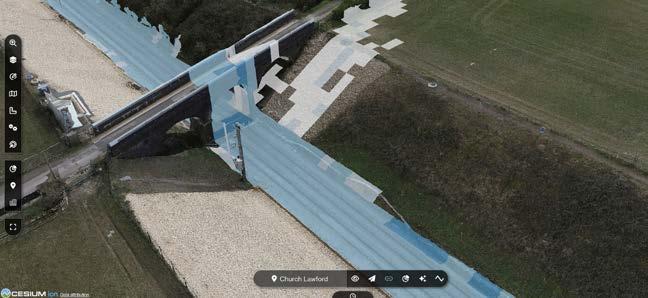
The benefits of an earthwork digital twin combining ‘mud and data bits’ are:
» Safety: Up-to-date and user-friendly asset data which allow for a better understanding of neighbouring land risk, as traditionally it has not been easy to see what is occurring over the railway boundary; quicker interventions to hazards as they arise; reduced time working on a live railway and surveying on hazardous slopes.
» Data quality: Reduction of lengthy written reports and better deterioration tracking; best use of external technical data sources; reduced reliance on unpredictable examination data; and earthwork technical risk reviews made much easier to produce.
» Efficiency: There is an operational cost efficiency with a reduced number of on-site inspections; a reduction in disruptive railway access; and quicker production of geo hazard risk assessments. The data is also immediately available and can be easily incorporated in preconstruction information packs.
An earlier version of the technology used in the Watford area won the Ground Engineering Award in 2024 for Technical Excellence. The judges said: “This is a great demonstration of a digital twin, which holds immense potential for future applications, resulting in a satisfied client. The solution effectively acknowledges the real challenges associated with data collection for site inspections.”
The system now in use has been developed even further with many enhancements.
The route is to be congratulated on using innovative digital twin technology to save costs and improve the asset stewardship of geotechnical earthwork assets.
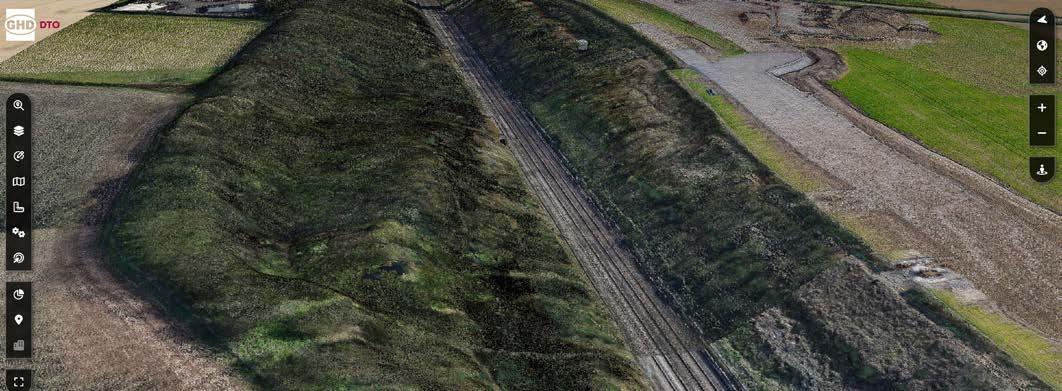
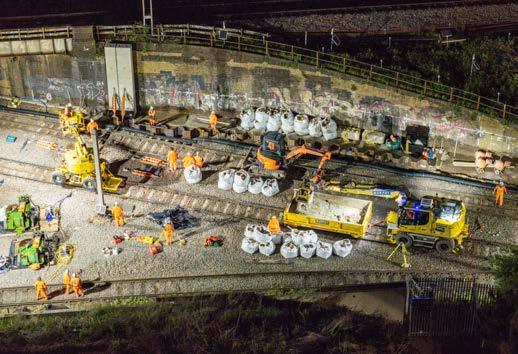
This article covers the work carried out last year on an embankment at Harlesden on the southern part of the West Coast Main Line (WCML). Rail Engineer met up with Luke Swain, principal route engineer (geotech) at Network Rail to learn more about the project.
The WCML route is extremely busy and site access at this location is also very constrained. While essentially a geotechnical ‘earthworks’ project with a deepseated rotational failure trapped between two railway lines, the work required involved every engineering discipline.
Connecting London and Glasgow, with junctions and lines to the major cities of Birmingham, Liverpool, and Manchester, the WCML is the most significant railway corridor in Great Britain. It is also one of the busiest railway routes in Europe, carrying 40% of all UK rail traffic and made up of a mixture of inter-city, regional, commuter, and rail freight traffic.
The southern part of the line was constructed by the London and Birmingham Railway (L&BR) and opened in 1838. The line was engineered by no less than Robert Stephenson. His assistant engineer was Peter Lecount, who produced a number of comparisons to demonstrate the size of the line’s construction.
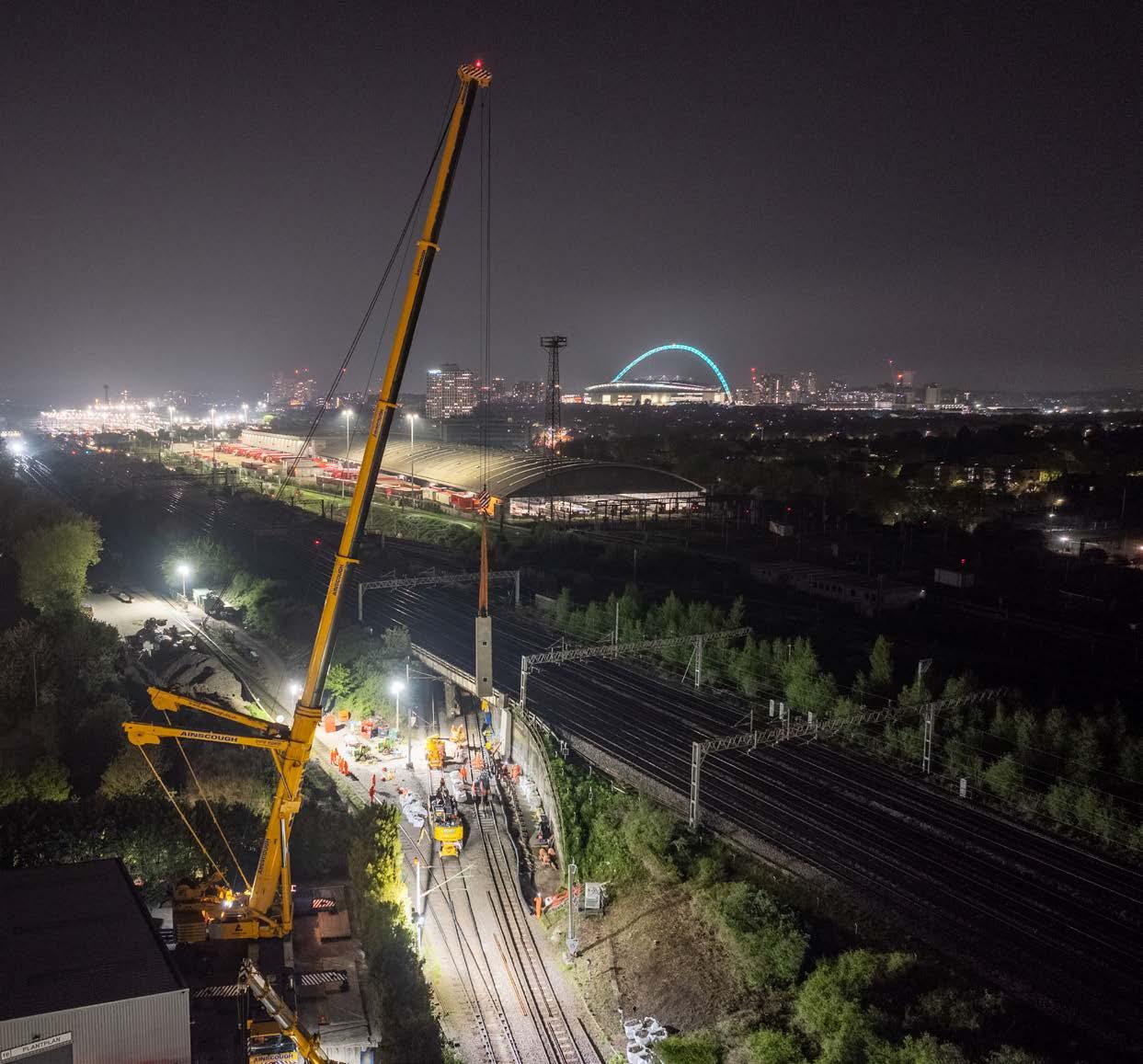
He suggested that the Great Pyramid of Giza required the lifting of 445,500,000 m3 of stone and 100,000 men working for 20 years, and the railway 710,000,000 m3 of material –similar to the weight of stone used in the pyramid – and 20,000 men for five years. While some machinery would have been used to construct the railway, the vast majority of the work would have been undertaken by manual labour.
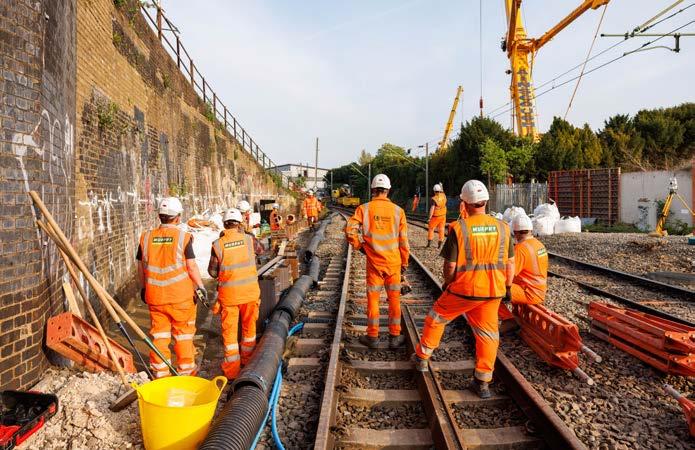
Rail Engineer has made the point many times that railway earthworks constructed in the 19th century do not comply with modern geotechnic standards. Earthwork construction when the railways were built was undertaken on huge scale in a relatively short time frame, which has left a legacy of over-steep embankments and cuttings, with many made using questionable construction techniques. This makes the asset stewardship of geotechnical earthworks very challenging, especially on a railway which is busier than ever. This was the case with Harlesden.
The problem
Luke explained that the first indication of a problem was when the track maintenance team raised concerns with the deterioration rate of the mainline track quality, at a location 6.5 miles north of London Euston. The line speed of the WCML at this point is 125mph. A desk study quickly established a basic ground model. In simple terms it was determined that the geotechnical asset showed all the characteristics of a 150-yearold reworked London Clay embankment. This type of embankment is problematic for a modern railway, due to its susceptibility to seasonal shrink swell.
Shrink swell is the volume change that occurs as a result of changes in the moisture content of clay-rich soils. Swelling pressures can cause heave, while shrinkage can cause settlement or subsidence. This shrink swell behaviour is the most damaging geohazard in Britain today, costing the economy millions and made worse by the drought and wet spells which are now common. Prior to a site inspection it was considered that the type of embankment would be a significant contributory factor to the track issues reported. What awaited on site was much more complex, said Luke. The track quality of the line, which is supported by the embankment before it crosses over an intersection bridge, showed deterioration
and loss of ballast. Ballast being critical for maintaining track geometry. When a track quality issue arises repeatedly, geotechnical engineering is likely to be a cause and during the site inspection the initial desk top ground model was verified and refined. The presence of inclinometers on site suggested ground problems had occurred in the area before. The reworked London Clay hypothesis was most likely correct. At the top of the embankment, a loss of ballast shoulder was observed in conjunction with a reduction in the crest level of the embankment. A brick-lined under track cable crossing a manhole also indicated problems. Beneath this was a wedge of shallow angled slope, with inclinometers before the coping stones at the top of a wingwall of the intersection bridge.
It was clear that the crest of the embankment had been reducing in height over time. At the base of the wall, which is between the WCML and a highly used goods line, were some interesting features
from a ground engineering perspective. An overhead line structure was leaning significantly towards the wingwall. A signal structure, which appeared to have recently been replaced, was also leaning. The wingwall had been stitched in multiple locations and the drainage system below ground level had become sheared. Finally there was a telecoms cabinet which had rotated on its foundation. In a short space of time the ground model and hazard log was updated, and the risk profile changed from a serviceability to a safety of the railway issue.
There is an asset stewardship system issue here worthy of noting. It is possible that the overhead line, signalling, and telecoms asset stewards and designers when faced with the ground issues such as Harlesden, may individually go to the trouble and expense of providing enhanced foundations for their assets so that they do not move. But having multiple indications of a problem to the geotechnical asset steward enables the root cause of the problem to be identified.
It was evident that a deep-seated landslip was present which was rotating beneath the wingwall and subjecting many of the infrastructure assets to foundation failure. A rapidly moving landslip would require speed restrictions on the affected railway lines or, in the worst case, a line closure. A slower and more gradual movement would permit normal line speed to continue, but with an increased monitoring regime.
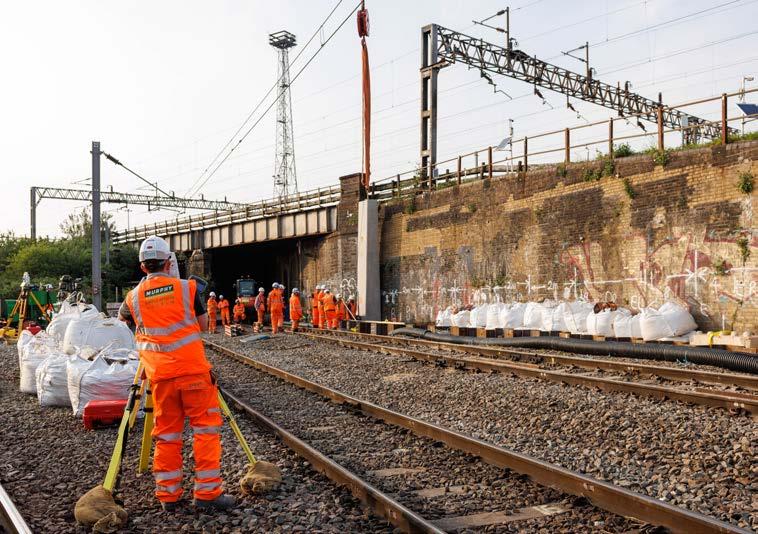
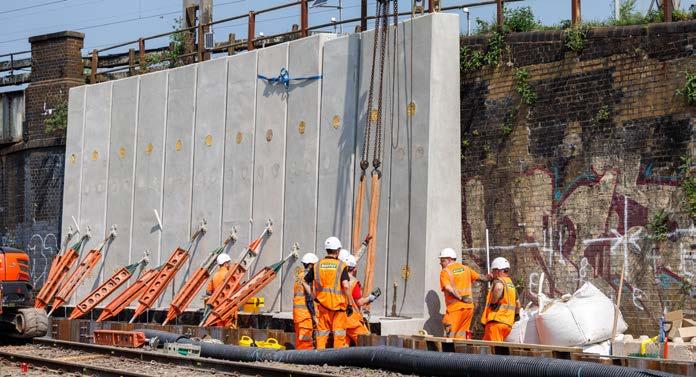
An increased monitoring regime was quickly established. Track monitoring frequency was also increased and a remote theodolite monitoring system provided. An emergency action plan was developed, which would be used in the event of a trigger breach. To obtain information on the failure surface and rate of movement, a new borehole with an inclinometer was established at the toe of the wall. The findings were conclusive. This borehole became BH01 and provided a useful dataset, with the data being very important for the next phase of works.
With many engineering disciplines at risk, stakeholder engagement was critical, Luke explained. It was important to ensure that the risk posed by the geotechnical feature was escalated appropriately, as the next few years of this asset’s life would be critical for railway safety and performance. The site constraints were obvious and most construction options were not practical. It would be a challenge to complete the design and construction, to balance the programme urgency with suitable railway access, and minimise the disruption to railway customers.
Network Rail designers produced a contingency plan, which included temporary construction options in the event of a rapid deterioration of the earthwork. The designs allow a relatively simple solution to allow railway recovery. These would have been used in the event of an increase in slope movement. They would have caused disruption, but would have also been quick to implement. Fortunately, the action plan was never required but played a significant part in allowing Network Rail to deliver a full engineering solution and keep disruption to a minimum during the works.
With the short-term risk to the operational railway controlled, the Harlesden Embankment renewal project was established, although the project development phase had already commenced in parallel with the risk mitigation works.
Optioneering began within Network Rail’s own internal design organisation. Many options were considered, however the movement being some three metres below ground level and the heavily constrained site limited the solutions available. The available options report provided a comprehensive desk study of the site, including its many constraints. As with many railway locations in London, the review of historic OS maps confirmed many changes to the railway and surrounding land since the construction of the embankment, adding to the complexity of the ground model.
There were multiple railway assets affected by the landslip, so stakeholder engagement was important throughout the design development. The stakeholders included engineers who specialise in the maintenance and management of a specific asset type, but due to the complexity of the geological failure mechanisms the project was led by geotechnical engineers.
The key areas for the designer to be concerned with were: (i) the deep-seated nature of the slip plane; (ii) the age and condition of the brick wing wall; (iii) the condition of key railway infrastructure; (iv) and the site constraints for construction equipment.
Ground engineering solutions were considered, including an embedded bored pile retaining wall, sheet pile wall, diaphragm wall, jet grouting, deep soil mixing, soil nails, anchors, and electrokinetic geosynthetic stabilisation. The advantages and disadvantages of each were explored and a recommendation identified.
After stakeholder review sessions were held, the option selected for the Approval in Principle (AiP) design was an embedded bored piled wall with associated gravity retaining wall, as this solution would provide the renewal of both the earthwork and structural assets, and provide long term asset resilience. In simple terms, a strong well anchored wall would be provided. As the project developed, Murphy was appointed as the principal contractor to support the detailed design and construction. The other contractors included BAM Richies, Sheet Piling (UK), Ainscough, MJ Hughes Ltd, and InterRail. All complex projects require great collaboration between client, principal contractor, and designer; and the principal contractor brought in AtkinsRéalis, which had the cross-asset engineering experience to undertake the detailed designs.
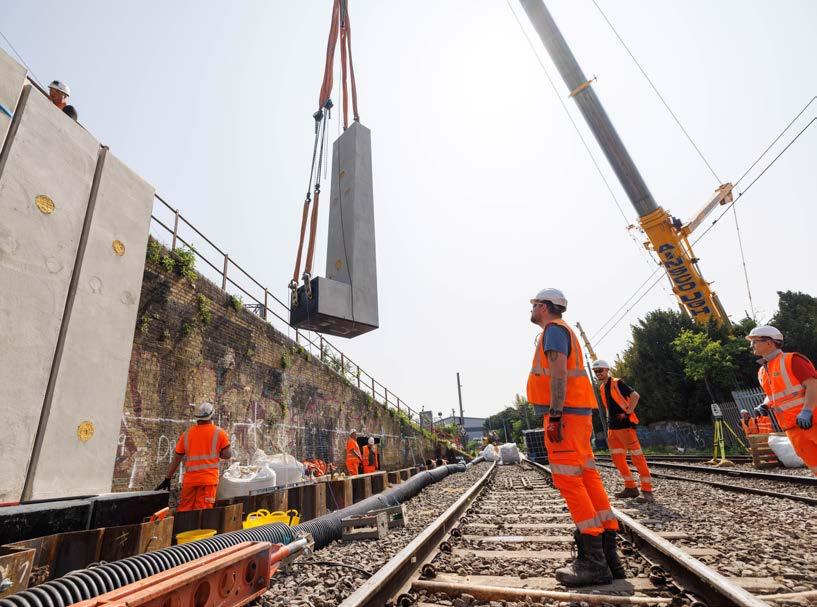
The single option design was reviewed to ensure buildability and cost efficiency. The complexity of the construction and constraints of the site meant that shutting the railway for a disruptive period would be unavoidable. It took some time, but after much work involving Network Rail and its customers, the required railway access was agreed.
The construction sequence adopted, after a great deal of consideration and industry engagement, resulted in the WCML remaining open throughout the works. This was important as trains pass every three minutes. However, one of the two tracks on the Lower-Level Goods line would need to be shut for a number of weeks. This solution ensured minimal disruption to the railway and the works were aligned with other disruptive works in the London area.
To support the construction, temporary access to non-railway land was important. Multiple sites across the area from Wembley Central through to Willesden Junction were negotiated. The landowners may not have realised the importance of their involvement in this critical UK railway infrastructure project, but their cooperation with providing land was a significant factor for the project to succeed. The sites were used for material storage, site access, and plant positioning.
With the construction access confirmed, the detailed design work could be completed. The close collaboration of client, principal contractor
and designer at this stage allowed the long-term solution to be turned into a constructable design. The window of delivery was small and if missed it would have had a long term negative operational impact to both passenger and freight customers.
The detailed design phase contributed to making cost efficiencies, while still maintaining Eurocode and Network Rail standards compliance. This reduced the budget required from £14 million to £9.9 million. The final design comprised an embedded 10-metre-long sheet pile wall along the toe of the embankment to intercept and stabilise the shear surface of the landslip. The design also provided a cable route and staging for the S&T equipment. The wingwall would be replaced with a pre-cast concrete wall, anchored to ensure long term stability. This solution making the original failing wall redundant.
As part of the project, the adjacent embankment would also be soil nailed to improve the resilience of the embankment and provide support against deteriorating soil parameters. In early April 2025, the project team – which since 2018 had included many companies and individuals –could begin the construction.
After years of development, work could now begin on site. The early works included temporary alterations to the electrification systems to enable changes to the normal
timetable and to allow for the line closure beneath the embankment. Compound and material handling areas were established at strategic locations and the physical works commenced against a well-structured and tight programme.
Even with the closure, the working area was extremely tight and instrumentation and monitoring of adjacent assets throughout the area was critical to avoiding any unplanned disruption to railway customers. The construction monitoring was assessed against years of monitoring data. This was a benefit as it provided baseline readings with seasonal variations.
All the works went to programme and now one of the railway's highest risk geotechnical assets has been stabilised for the future. With asset resilience increased, Luke said, the focus will move to other locations across the railway network, as a Victorian built railway offers a neverending challenge. He added that the Harlesden project broke through any silo working and was a truly collaborative effort involving client, stakeholders, designer, contractors, customers, and third parties. It was delivered within budget, on time, and did not significantly disrupt customers services.
Luke concluded that geotechnical asset management involves making cost effective decisions to ensure a safe status is maintained. Identifying a risk is important, but managing the risk and correctly prioritising the required interventions is also essential.
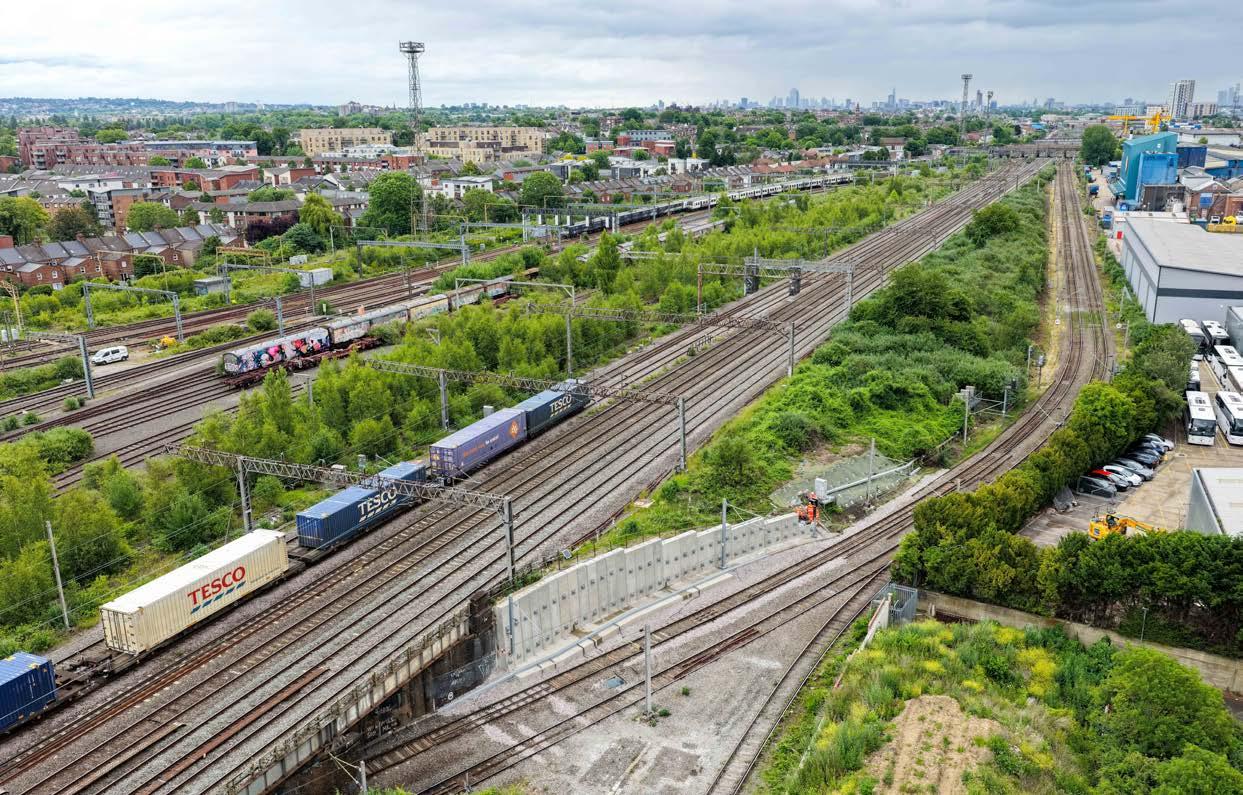


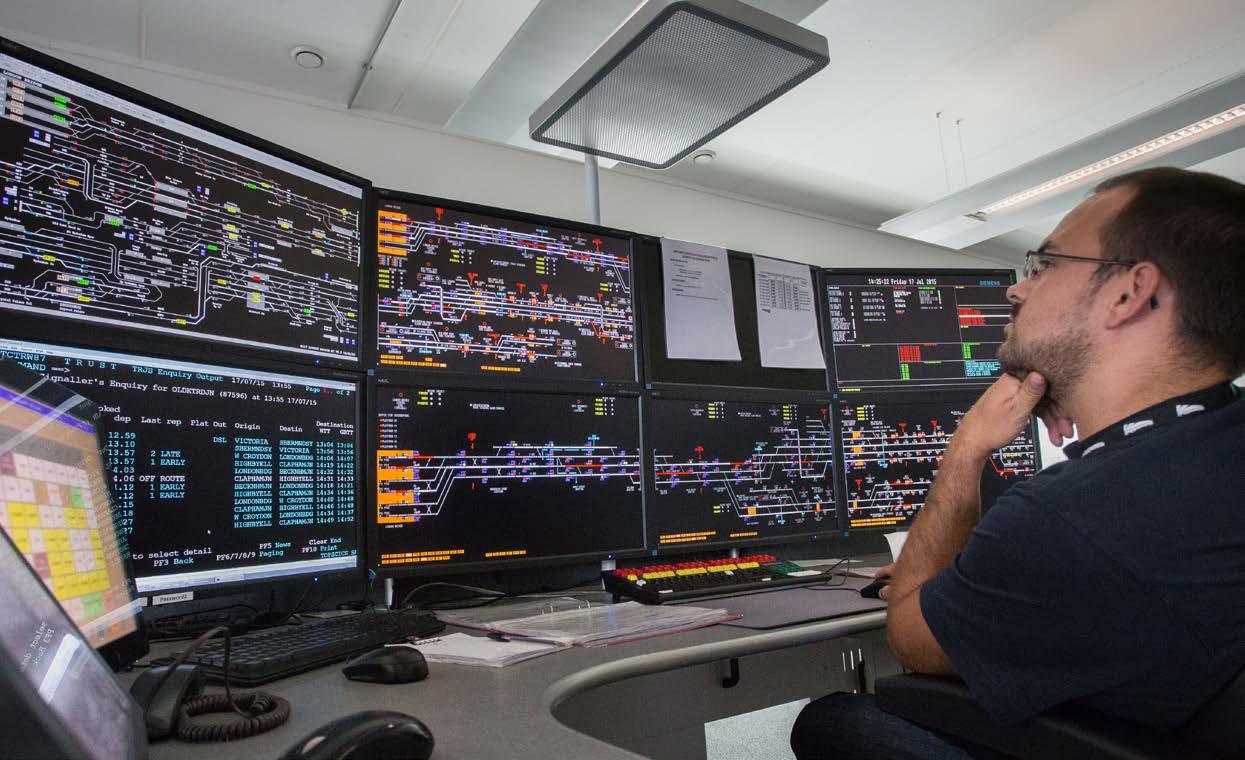
Signalling and Telecoms or, more appropriately these days, Control and Communications (C&C), continues to be a controversial subject with regard to where the future lies. Separately in this edition, the head of C&C in Network Rail gives a frank appraisal as to the way forward and the difficult choices that must be made. Many other commentators and experts have expressed views as to the options on offer and the Railway Industry Association (RIA) recently organised a gathering of its Member Interest Group to put forward various factors that might focus attention.
Network Rail considerations
Darren Jowett, Network Rail’s head of systems authority, painted a picture where S&T can no longer be considered a separate entity, but where the whole C&C scenario will be influenced by other technologies that contribute to the reliable operation of train services. Much of this will be part of the overall digital railway initiative where the body known as the Digital Railway System Authority will be working to standardise requirements and specifications. Part of this will be to produce a deployment of design that leads to a baseline of requirements that can be delivered to the real railway.
This sounds grand but in essence it will be a combination and updating of all the existing standards that are used for effective train control and operation covering the various technical disciplines that exist for infrastructure and rolling stock. This will then provide a cross-industry technical leadership for a systems approach to future C&C strategy. An enabler will be the Requirements Issue Configuration Management Group (RICMG) populated by expertise within the different disciplines. Support and communication to industry must be part of the process.
The European Train Control System (ETCS) is expected to be part of the way forward and despite the long drawn out process to get this confidently established as a mainstay of future train control, different routes were suggested as to where ETCS will be deployed after the East Coast Main Line ECDP project. The northern section of the West Coast Main Line, the Midland Main Line, and the Brighton Line are all part of the vision. However, it is admitted that ETCS is currently proving to be way too expensive and a means of reducing the cost are urgently needed.
The ultimate goal is to have no lineside signals and no traditional train detection systems. That is a tall order and impacts heavily on the continuance of safety standards so another panel – the System of Systems Safety & Security Panel (4SP) – will be there to ensure track and train equipment can be safely introduced.
Authorisation from the Office of Road & Rail (ORR) will be a necessary part of the process. While it has taken a long time to get ETCS software finalised as internationally accepted standards, no one is pretending that these will remain the same for all time, and updates to software will be an ongoing challenge. The
configuration management process for ETCS follows the pattern: Baseline – Status –Change Control – New Status. With any new software, it is expected that any existing onboard train equipment will be backward compatible to new train software; however, it is much more difficult for new infrastructure software to remain compatible with existing train software. These are challenges that must be recognised and resolved before a major deployment of ETCS can take place.
Protecting trains from occasional lapses of driver concentration has been a concern for railways for decades. Sometimes it takes a serious accident to trigger improvements, and this happened with Harrow in 1952 which, with 112 people killed, led to the adoption of AWS. More recently, accidents at Southall and Westbourne Park where many people lost their lives, prompted an enquiry into train protection systems and, from this, the go ahead was given for the adoption of the Train Protection and Warning System (TPWS). The fitment of TPWS loops at the highest risk locations has been completed, which has virtually eliminated the risk of Signal Passed At Danger (SPAD) occurring. However, TPWS was always seen as a pre-runner to ETCS which would provide complete train protection on all the routes where it exists. Perhaps inevitably, the success of TPWS
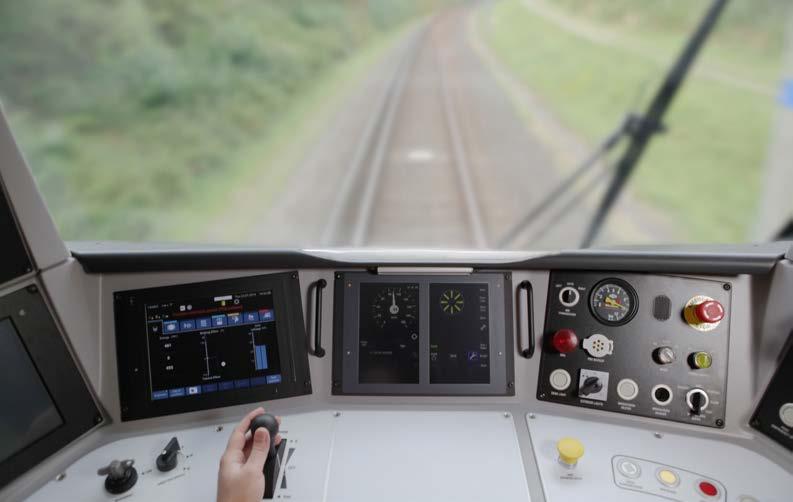
has worsened the business case for ETCS progression at least in terms of train protection, but that can sometimes happen.
More recently, a new threat has become prominent, which is over speeding. Several significant incidents have occurred where drivers have misread signals and accelerated swiftly towards a slower speed diverging route. There is no one cause for this, but two factors emerge: the sometimeslong distances between the controlling signal and the diverging points, and the high acceleration rate of modern electric trains. In one incident, the train came within a whisker of overturning.
To investigate and minimise this risk, Darren explained that this is entrusted to the Train Protection Steering Group. Informing drivers of speed restrictions is still paper based and nothing much has changed in 100 years. Being provided with a daily notice at a signing in depot or delivery of the same online, takes little
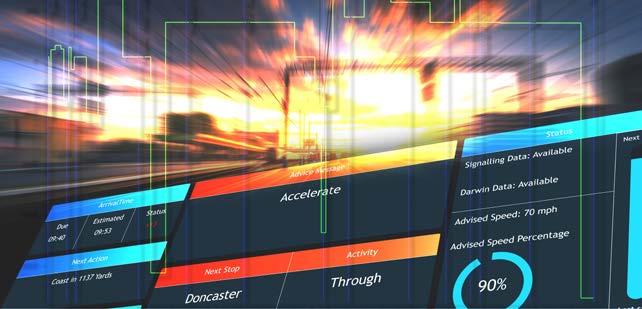
account of the ability of the human brain to remember it all.
Temporary speed restrictions are typical examples of where the information is either forgotten or mis-interpreted and instances where trains have entered a speed restriction at more than twice the required speed are not that rare.
The TPSG is progressing four phases of work:
» Understanding the problem
» Speed Management System development concept and proving it
» Design of systems recognising that no one size fits all conditions
» Operational trial
Driver advisory systems
One possible technical solution is to adapt Driver Advisory System (DAS) information to provide drivers with a near continuous update as to speed conditions. Up until now, DAS applications have primarily been aimed at energy savings by advising the driver to progress at a speed that minimises energy consumption. As such, DAS is not regarded as a safety system.
The introduction and usage of DAS and so-called Connected DAS (C-DAS) has been fragmented and different TOCs have introduced systems from different suppliers with no standardisation either in the technology or the display to the driver. The connectivity of C-DAS systems is also
New in-cab upgrades will make freight trains safer and more efficent.
C-DAS illustration.
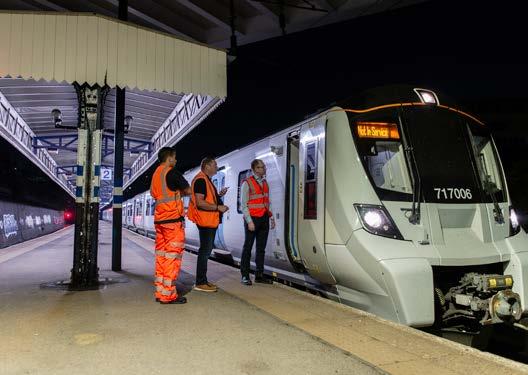
debatable, but all fall short of a total solution that would have to link with Traffic Management Systems. These too are in their infancy and again with no standardised interoperable specification.
Thus, to use DAS for giving drivers continuous speed information and to link this into some kind of interface to the braking system if over speeding occurs would almost certainly mean raising DAS up the safety level rating and producing specifications that produce a level of standardisation. That is no mean task.
Cyber security often features in Rail Engineer. Dr. Richard Thomas from AtkinsRéalis gave a generic update and explained the focus for the ECML adoption of ETCS. Safety is usually a static situation once a system is in operation, but cyber security is a dynamic process
that has to be constantly monitored during an asset life which could be 30-50 years. Cyber security has massive and growing numbers of regulations associated with it which must be followed by the supply chain, the users, and the maintainers. An article by Paul Darlington in Issue 219 (March-April 2026) described many of them. It was a six stage process to progress the Northern City Line (NCL) from Drayton Park to Moorgate to achieve cyber assurance while still retaining lineside signals: (i) define the system; (ii) risk assess the trackside, rolling stock, and dependencies; (iii) define proportionate requirements and controls; (iv) review supplier evidence and compliance; (v) build the security case; and (vi) commission the system.
It took a further four stages before signals could be removed: (i) review the risk assessment in the new context;

(ii) engage with partners to assess evidence; (iii) update the security case; and (iv) remove the signals and commission the new railway configuration. This process will be adopted as a template for the forthcoming introduction of ETCS from Welwyn to Hitchin. As such there needs to be a generic approach followed by work on any specific application. The basic rule is to assess early and build the support network around it. There is a need to demonstrate the process to the wider world where industry should have an informed position to support ongoing applications and projects. Cyber-attacks do happen and there is evidence that ETCS systems in operation have been targeted.
As a follow on from this, Andy Ward, ECDP programme engineering manager at AtkinsRéalis, informed the gathering that a different assurance framework for a railway being converted to ETCS is needed compared to how signalling projects have been assured in the past. To introduce ETCS on any route requires significant integration and continuous interactions between all organisations involved, be it operational or technical, and the duty holders. These include the Network Rail Route management, the TOCs, and the suppliers.
The apportionment of technology is changing with much more of the signalling equipment on board the trains. The process being followed for the ECDP is: (i) safety; (ii) security; (iii) reliability; (iv) capability; (v) operational readiness; and (vi) maintainability readiness. Teething problems have been experienced on the NCL, but this was a relatively simple piece of railway with only one type of train. Much more challenging is the Welwyn to Hitchin section.
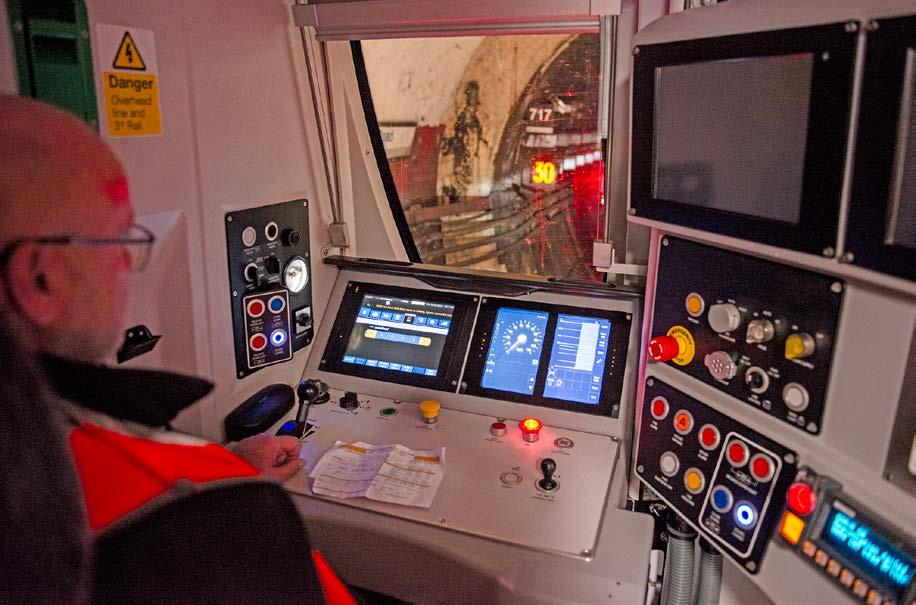
Concluding thoughts
This was an interesting session and, while intended to give an upbeat message as to ETCS progression, it is recognised that the system is currently regarded as costing too much with further deployment on suggested routes far from certain. Of the lines equipped so far – Cambrian, Thameslink central core, GW main line to Heathrow Airport – one might sense that the NCL and Thameslink are very similar railways (intense suburban service mainly in tunnels) as indeed are the GW route and Welwyn to Hitchin section, at least while lineside signals are retained. What processes were used to verify and assure the Thameslink and GW system operations? The only real difference on ECDP is the use of packet switching for the radio connection. One gets the uneasy feeling that the assurance process is being invented again for ECDP. It will be up to Network Rail to set the generic standards for ETCS introduction elsewhere and to ensure these are applied as almost a tick box exercise which could be done in house.
One must also remember that the radio connection is a vital part of successful ETCS operation. This is currently GSM-R, a 2G technology, and while Darren referred to its replacement with FRMCS, a 5G technology, this writer has serious concerns that Network Rail underestimates the scale, complexity, and cost of the upgrade and changeover.
Mention was made that negotiations are taking place for continuance of GSM-R until 2040 but this could be a dangerous premise since it needs the supply industry to guarantee equipment availability at a reasonable price. Speeding up the FRMCS roll out might be a better policy.
There could be advantages of delaying further ETCS projects until the new radio system is deployed in the projected ETCS route areas so as to have a modern and proven radio connectivity in place once ETCS is progressed.
This was a very interesting event. When coupled with other recent information from Network Rail, it is clear that many re-signalling projects in the near future will have to use traditional technology as the need for replacing worn out and obsolete equipment does not match the rate at which ETCS can be deployed.
Looking back at the articles that have been written over the past 10-15 years, the roll out of ETCS was predicted to be commissioned on many main lines by the mid-2020s. However, that has not happened and the reasons are all too obvious, many of which still require some resolution. Couple all this with FRMCS, DAS, and TMS, it is going to be interesting to see how GBR moves forward with these challenges and whether a directing mind is appointed to lead the way.
ETCS frequency test 71, GTR.
ETCS frequency testDrayton Park.
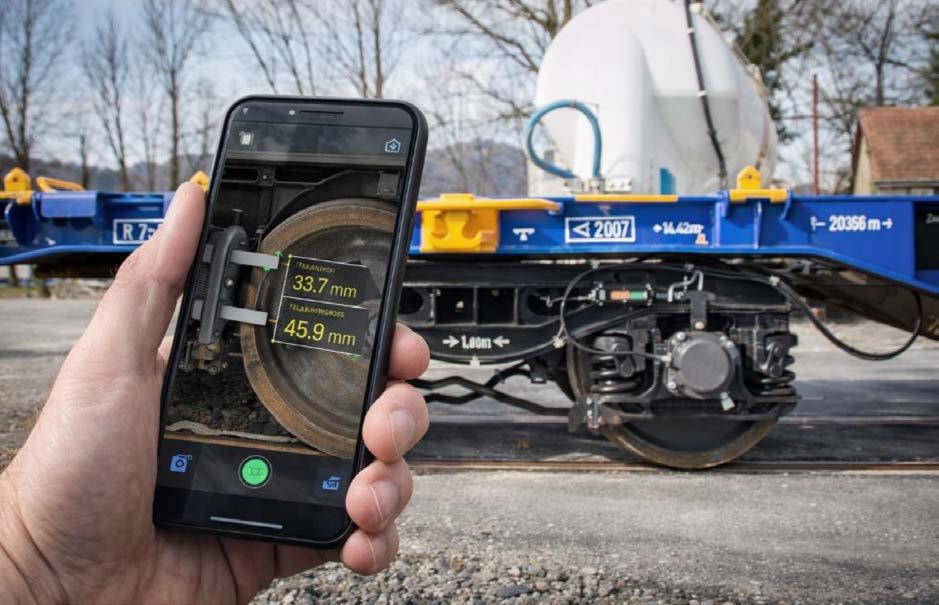
Each year, the Institution of Mechanical Engineers’ (IMechE) Railway Division holds a competition of technical presentations called Future of Rail. The competition is open to all young railway engineers including apprentices, undergraduates, and those in the early stages of their career. Entrants present to a panel of judges and other attendees in a competition format at the home of the IMechE in the heart of Westminster, with the winner taking home £1,000.
This year’s winner was Mujadded Al Rabbani Alif, a research associate (computer vision) at the Institute of Railway Research, University of Huddersfield. His topic, Automated Wheelset Inspection, involved using mobile phones for freight wagon maintenance. Rail Engineer has previously reported on the rail freight industry’s desire to improve wagon maintenance in cost effective ways, and this was one potential example.
Wheel condition is critical for safe operation and wheel wear can affect stability, ride quality, and, in extremis, derailment. Regular inspection is required but currently is often carried out using manual methods in sidings, sometimes in the dark by using handheld gauges which must be placed on the wheels. This generally involves working under the wagon with the maintainer laying on the ballast. These results are then recorded on paper.
So how could this be improved? Almost everyone carries a powerful computer, with a high-resolution camera, that can record its geo-location and has a torch. It’s called a mobile phone. Could these be used to measure wheels? Could image analysis replace manual gauging for routine inspection? And, if so, could it be done accurately in real depot and siding conditions?
The answer to all of these questions is “yes” and Mujadded described how.
The proposed process involves four steps: (i) the operator captures a short video of the wheel using a mobile phone; (ii) this image is sent to a server which automatically identifies the wheel in the video and (iii) digitally calculates the key wheel dimensions; finally, (iv) the dimensions are sent back to the mobile phone and are stored and tracked over time.
The process was tested on both loose wheelsets in depot and those under wagons with over 100 wheels being inspected for evaluation. Mujadded demonstrated a variety of video capture types including vertical and horizontal camera movement so that the wheel shape was shown.
Comparisons were made using the industry standard Miniprof tool; a time-consuming process compared with the mobile phone. Analysis of the camera and Miniprof measurement showed differences of less than one millimetre.
Video capture and analysis take place in about 10 seconds (subject to a decent 4/5G or WiFi connection). It was clear from the videos shown that there is a certain technique in capturing decent video. It is not onerous but worth talking about (see later). Moreover, the system rapidly responds if the analysis fails or gives a nonsense result, so the measurement can be repeated.
This process enables faster and simpler wheel inspections which can be carried out more frequently, and improved tracking of wheel wear over time supports condition-based maintenance decisions. If applied to rail freight there is an opportunity to extend wheel life from better monitoring
CIRAS reporting app

CIRAS is the confidential safety hotline for transport. Download the CIRAS reporting app on Google Play or the App Store to raise your health, safety and wellbeing concerns. We protect your identity and share your concern with the right people, so they can act.

Report it in confidence, on the go. Scan me

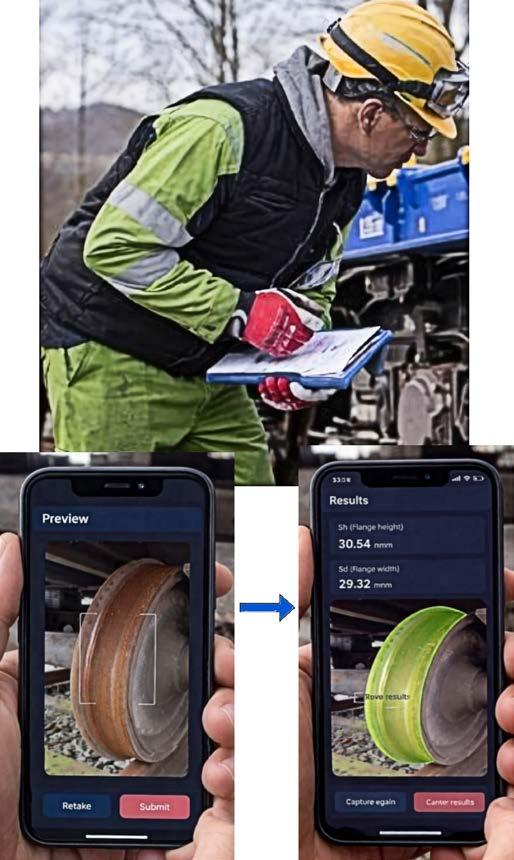
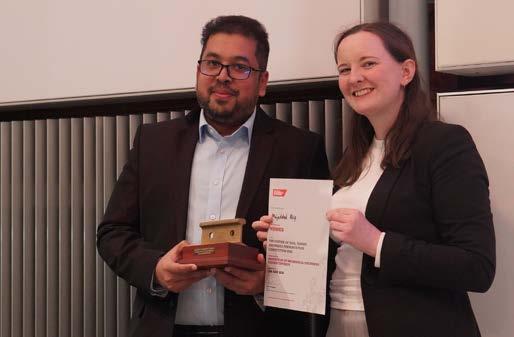
(reprofile wheels at the right time to minimise the amount of metal removed during turning). This would help reduce casualty wheel turning and help reduce the rail freight industry’s maintenance spend of approximately £60 million per annum.
Mujadded said that the learning points from the project so far include coping with real depot conditions which introduce lighting and perspective challenges to reliable wheel detection. This is essential before measurement and data collected in operational environments can be used in routine maintenance and monitoring.
The project is showing that the technique has great promise. The next phase will focus on expanding testing across a wider range of wheel types, lighting conditions, and operational railway environments to further improve system robustness and reliability. Future development will also include an image and video capture guidance system designed to help users record the wheel correctly by providing guidance on camera positioning, viewing angle, and movement during capture. This is intended to improve measurement consistency and make the system easier to use in real maintenance conditions.
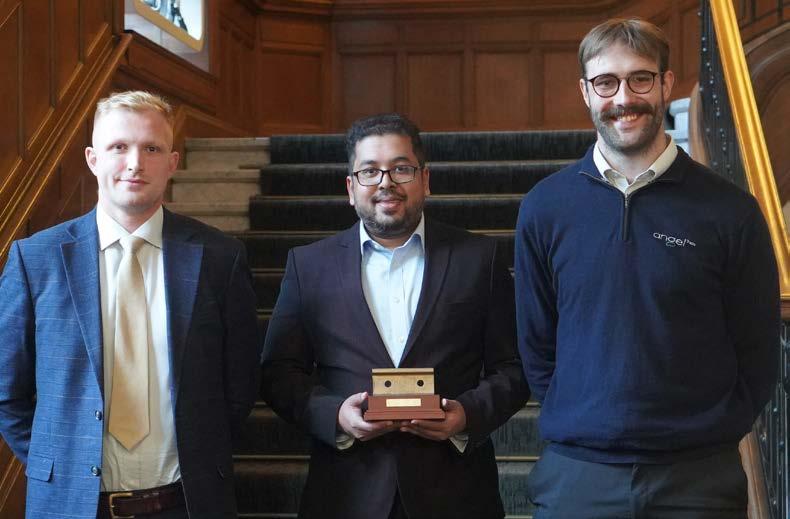
Additional work will explore integration with freight maintenance and assetmanagement systems to support digital tracking of wheel wear and condition-based maintenance strategies. The project team has also applied for further funding to progress the technology towards Technology Readiness Level (TRL) 6. TRL 6 is the stage where a concept transitions from a laboratory validation to a fully functional, high-fidelity prototype. At this level, the technology is rigorously tested in a ‘relevant’ or simulated environment to demonstrate its engineering feasibility and readiness to support larger-scale industry testing in operational railway environments.
A key objective throughout the project has been simplicity and accessibility. The intention is not to replace specialist inspection systems entirely, but to provide a low-cost and scalable solution that enables more frequent inspections using mobile devices already widely available to maintenance teams.
Second place went to Danny Evans, overhead-line asset engineer (maintenance support) at Network Rail (North East), for his presentation describing how drone-based photogrammetry and 3D point cloud data can be used to drive overhead line asset management and improve maintenance capabilities to deliver safety and performance improvements.
Third place went to James Fitzmaurice, Class 707 Fleet Engineer at Angel Trains, for his presentation about the role of an owner’s fleet engineer, including retrofitting toilets to this nearly new fleet.
The judging panel was chaired by Alice Callaghan who is chair of the Railway Division Young Members’ Committee and whose day job is with TransPennine Trains. The event was organised and compered by Ellie Smith from Transport for London.
The National Autistic Society was funded by The Motability Foundation to address the gap in research on autistic people and travel. Our year-long project produced eye-opening findings, and clear recommendations.
Our ambitious project involved autistic people, families, and supporting professionals in a high-quality piece of user research to:
» Understand the greatest barriers and challenges autistic people experience when using transport, particularly buses and trains.
» Identify evidence-based and feasible solutions to make transport more accessible to autistic people.
» Establish which changes and interventions autistic people would most like to see, and how these fit in with industry capabilities.
We captured the views and experiences of thousands of people through surveys, interviews, and workshops. Using this data, we worked with transport and accessibility experts to understand what improvements are possible, considering their industry and resource limitations.
“From a sensory point of view, there are so many sounds, the smells, the proximity of people. People aren't following rules, they’re vaping on buses. Others have got their music on and they're being so loud and inconsiderate.”
Autistic woman
Why is it important?
More than one in 100 people are autistic and there are at least 700,000 autistic adults and children in the UK. Autistic people face many barriers and inequalities in accessing school, work, healthcare and leisure which can be made worse by difficulties using transport and making journeys.
“I've arrived
at
train
stations
to find that my train has been delayed or cancelled and I have no idea what I'm supposed to do then. I've felt very lost and frightened."
Autistic woman
In a neurotypical world of overwhelming sensory environments and confusing social rules, travel can be exhausting or impossible for autistic people. We found a distinct lack of quality, UK-based research on this topic, and set out to address the evidence gap. We produced a thorough and robust piece of participatory research which was autistic-led. Overall, we found a need for:
» Support for autistic passengers.
» Accessible information.
» Sensory adaptations.
» Autism understanding.
» Reducing uncertainty.
“It's like a world of things out there which could really change someone's life, but transport could be a barrier stopping you from being able to have all this potential. It's life changing really, having access to good, safe transport and feeling confident enough to travel on your own.”
Parent
of an autistic man
These evidence-based recommendations from our project report must be actioned by transport professionals and industry leads, across the short and long term. You play a crucial role in helping to make transport accessible for autistic

people. Whatever stage you’re at in developing systems to support this, please consider how to incorporate these recommendations which are the result of thorough user-led research.
Visit our website where you can find further resources including a full project report, a short video, extended case studies and articles: http://autism.org. uk/what-we-do/who-we-are/research/ empowering-autistic-travel
Improve your autism and neurodiversity knowledge at: https://www.autism.org.uk/ what-we-do/autism-know-how
Take a look through our short guide which summarises key findings, spotlights some autistic passengers’ travel stories and outlines project recommendations for the transport industry.

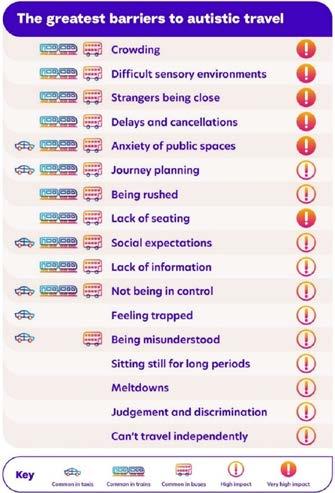

The Railway Industry Association’s (RIA) annual innovation conference showcased impressive examples of new rail industry technologies. Yet the industry is widely perceived as being slow to innovate. This paradox was highlighted at the conference which included presentations describing barriers to innovation as well as the successful adoption of new technologies.
While introducing the conference, RIA
Technical and Innovation Director Richard Carr explained that it was part of RIA’s Unlocking Innovation programme which aimed to connect suppliers and clients to accelerate innovation. He advised that he had always been struck by the sheer depth of creativity within the rail supply chain. Yet he acknowledged that it struggled to get ideas into widespread operational use.
RIA Chief Executive Darren Caplan stressed that the industry should acknowledge recent good news of continued support for East West Rail, the Transpennine Upgrade, and HS2, as well as initial funding for Northern Powerhouse Rail and the strong recovery of passenger numbers and revenue following the pandemic. With rail fare revenues growing by 8.3%, there has been a 70% reduction in state subsidy. However, he was frank about the difficulties with stop-start investment cycles and poor visibility of work, a slow start to CP7, and the pausing of the Midland Main Line electrification which resulted in job losses and a loss of expertise. Surveys of RIA members show declining confidence with 62% freezing or reducing recruitment and 34% making redundancies.
Three presentations and a panel session considered why new technologies were not being adopted.
In his presentation, Neil Drury, regional managing director for Network Rail Wales & Western, noted that data only matters if people act on it. He felt that there was so much data that people don’t know what to do with it. Other issues were projects being owned by individuals that stop when they move on, poor commercial models, and fragmented engagement.
He felt that there needed to be clear problem statements, focused innovation effort, better collaboration with suppliers, and a whole system view.
Geoff Ogden, chief transport planning & development officer at Transport for Wales, emphasised that success required organisations to learn, adapt, and scale as the biggest barrier is organisational capability.
Daryn McCombe, Great Western Railway’s train service delivery and performance director, described the following recurring issues: delays snowball because information doesn’t flow to the right people; scattered data increases the time to diagnose failed assets; decision
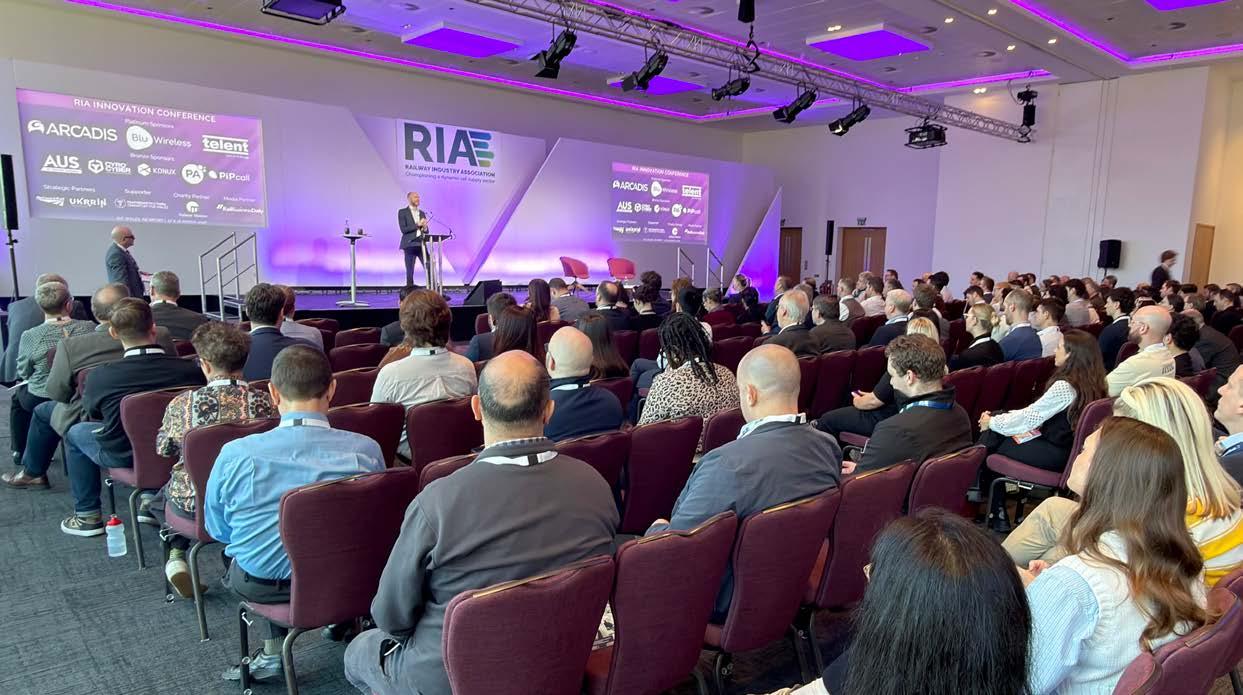
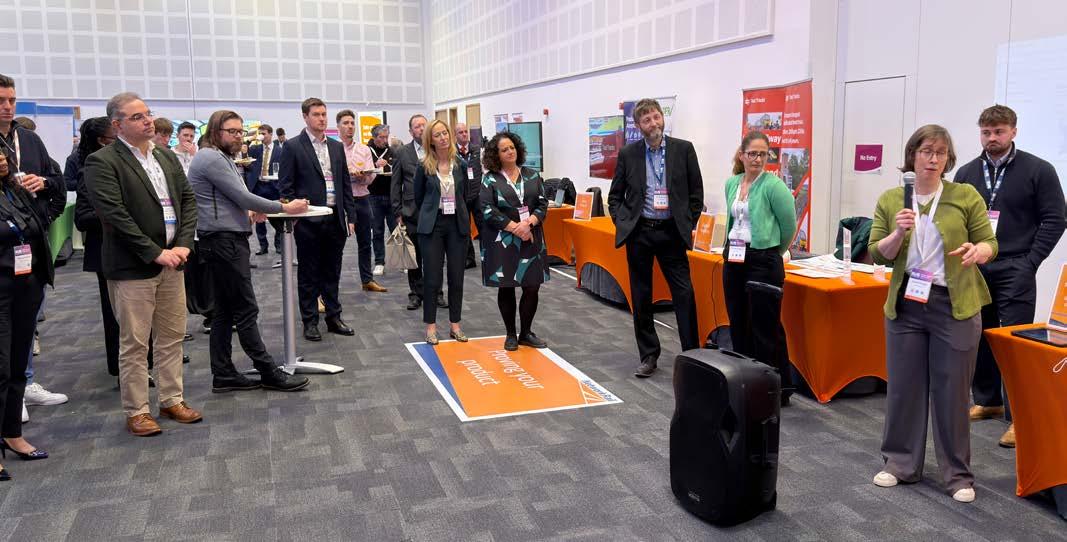
makers have different versions of the truth and processes and systems not being aligned. He considered that a shared operational picture across track, train, crew, and fleet teams is needed, especially to respond to weather events.
McCombe ended his presentation with three clear imperatives:
» Data integration is no longer optional as if our systems can’t talk to each other, our people can’t either.
» Real time, cross system situational awareness is essential.
» Predictive analytics must not replace people but support them.
Barriers to innovation, mentioned during the panel discussion on getting from research to commercialisation, included there being no clear route to market as innovators don’t know who the customer is. An example was sensors for track monitoring for which Network Rail might be thought of as the customer. However, test trains may be run by contractors.
The need for early engagement of procurement teams was also discussed. Although trials are relatively straightforward, commercialising innovation is hard. Furthermore, rolling stock innovations benefits often accrue to infrastructure managers rather than operators. In such cases, system wide benefits such as reduced track damage are hard to demonstrate.
The conference heard that innovation is being promoted by Network Rail, GBRX, UKRRIN, the National Skills Academy for Rail (NSAR), HS1, and National Highways. In addition, a Rail Data Marketplace competitive Hackathon was won by 16-year-old Mikey Whiston, as described in an accompanying feature.
At the Network Rail stands, seven employees explained the company’s full innovation lifecycle, from challenge identification to product acceptance and adoption as shown below.
» From the Wales & Western Region, Olivia Jones explained how the region has its own innovation programme to engage with local suppliers while working along the national team.
» Nicola Woodhead described the freight safety improvement programme which has funds to improve freight train safety by, for example, using AI for scrap monitoring and CCTV on freight trains to detect problems.
» Carol Lodge explained the innovation acceleration forum works with suppliers and internal teams to identify ideas with strong business cases and help secure sponsors, funding, and trials.
» Roger Moore is part of the product acceptance team. He encouraged early engagement with the team and offered to visit suppliers to demystify the process. Product acceptance requires products to be designed for reliability. Kevin Raymond explained that free training for suppliers for this is available.
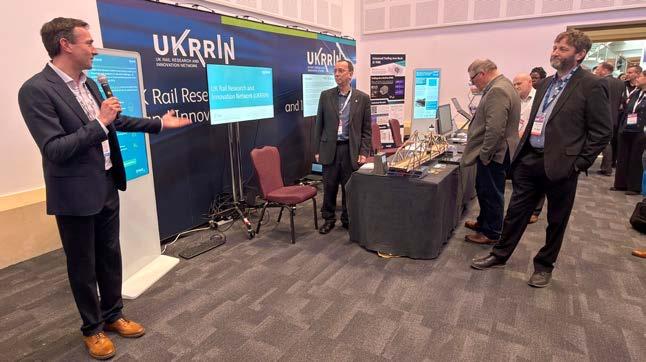
» The real world testing environments offered by Network Rail’s test tracks at Melton Mowbray and Tuxford was explained by James Lea.
» Lara Correia explained how Digital Toolkits for maintenance and asset management provide visual dashboards.
» The external partnerships supporting Network Rail’s research and development portfolio were described by Emma Donaghy and Felicity Wakefield. There are more than 30 active R&D projects including international partnerships in France, Switzerland, and Korea.
GBRX Portfolio Director Mark O'Connor explained that GBRX was created to break the pattern of slow innovation adoption that has historically held our railways back. He advised that GBRX will help modernise the railway faster by embracing new technology more effectively.
One key action is the publication of the Rail Industry AI Action Plan on which we report in an accompanying article. Another commitment is the production of an X portal for the supply chain to engage in QBRX. When asked when this will be available Mark advised that it is being worked on.
The UK Rail Research and Innovation Network (UKRRIN) is a collaboration of 20 academic institutions with major capabilities in rail research established in 2018 backed by industry investment of around £70 million. It is one of the largest coordinated rail research networks in Europe.
UKRRIN hosts test facilities worth £30–40 million, advanced simulation tools, specialist laboratories and rigs, and has four Centres of Excellence. These are Digital Systems at University of Birmingham, Infrastructure at University of Southampton, Rolling Stock at University of Huddersfield, and Railway Economics, Policy & Operations at Leeds University. UKRRIN offers long term partnerships and is a one stop shop with a single point of communication.
Neil Robertson, chief executive of the National Skills Academy for Rail (NSAR), had a key message: “You need some skilled people to do this stuff.” He presented the findings of NSAR’s modelling of the impact of digital adoption on the rail industry workforce which were:
» In the next three years nobody in the rail industry will lose their job because of AI.
» Knowledge of the working environment is essential.
» Managers lack confidence and capability in digital leadership.
» The rail industry lacks data scientists, data analysts and AI/machine learning specialists.
To address these issues, he advised that NSAR is launching AI, machine learning, and data science apprenticeships, using a shared model where companies contribute one apprentice each. In addition, NSAR has published a digital competency framework for managers in December. Rail must recruit those with digital skills. Though it cannot compete on salary, it can compete on public good, environmental impact, and apprenticeships. Neil also noted that there is strong potential to attract more women into digital roles.
Chrisma Jain, Network Rail High Speed’s head of innovation, advised that HS1 differs from the wider UK network as it has its own mini technical authority and runs its own standards and product acceptance. She explained how HS1 is moving from periodic manual inspection to automated intelligent inspection. This programme began in 2023 with trials which helped refine a technology roadmap which is being rolled out this year. It includes:
» Forward and downward facing cameras on multi purpose vehicles and passenger train roofs.
» Drones for vegetation management carrying herbicide; high level surveys to detect dead/diseased trees; ventilation shaft inspections; and acoustic sensing by mimicking traditional hammer testing to detect voids and cracks.
» Condition monitoring sensors strategically placed on critical assets or those with known problems.
» Emerging technologies such as quantum positioning, satellite imagery for vegetation and earthworks and robotics for constrained access windows.
HS1 will be running manual and automated inspections in parallel to compare results over time to gradually build confidence and maintain human oversight of automated workflows
Dr. Jo White is director of engineering for National Highways which is responsible for 24,000 structures, most of which are 50 to 70 years old and potentially subject to accelerated deterioration. The
company is now deploying advanced non-destructive testing technologies that it has trialled to inspect hidden structural elements. These are:
» Guided wave testing which is best for longitudinal tendons. It works by sending acoustic waves along a tendon in which any defects reflect signals whose time and amplitude indicates location and severity.
» Muon tomography which detects the scattering patterns of cosmic ray muons as they pass through concrete and can then be used to produce a 3D image of internal steelwork.
Various presentations described how new technologies had offered significant improvements and savings or had the potential to do so.
Arcadis Digital Intelligence Director Joe Roebuck and South Rail Systems Alliance Access Planner Chris Sayce described how Network Rail’s Intelligent Infrastructure Programme is using Scheduleit as a maintenance planning tool for improved operational planning. This ensures there are sufficient competent individuals for the work and highlights competency violations. It also takes account of constraints such as line blockage positions and safe systems of work requirements. The use of One Big Circle’s Automated Intelligent Video Review (AIVR) system to complete a 120km fibre survey and design project was described by One Big Circle Co-founder Emily Kent and Telent Chief Engineer Mark Warrender. AIVR integrated multiple video and data sources, and solved issues such as tunnel darkness through synchronised feeds. This eliminated the need for trackside survey and so enabled this project to be completed within 12 weeks instead of a year or so.
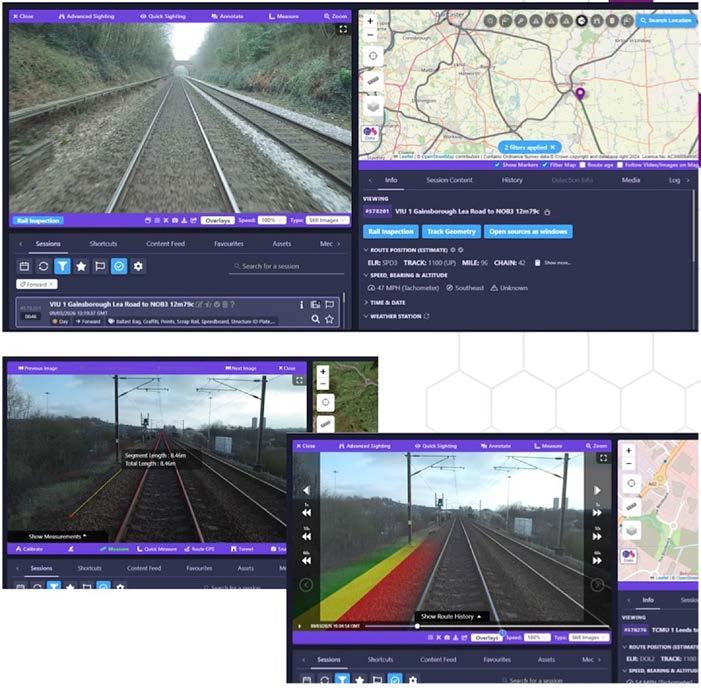
Pipcall specialises in recording and analysing safety critical communications. From June this year, all trackside safety critical communications must be recorded with thousands of calls requiring a manual review. Pipcall’s mobile app is GDPR compliant and records calls centrally. It is currently developing an automated assessment tool to transcribe calls and detect critical communication issues to improve safety and reduce review costs.
Airborne drones have demonstrated significant improvements in trespass detection, asset management, thermal imagery, graffiti detection, vegetation monitoring, and logistics support. However, their use is limited by the need for the pilot to see the drone.
As Robert Garbett of the Drone Major Group (DMG) described the “nirvana” of drone operations is Beyond Visual Line of Sight (BVLOS) which is extremely difficult to achieve due to technical and regulatory barriers.
As an alternative, DMG has developed Digital Tethering (DT) which uses Simultaneous Localisation and Mapping (SLAM) to build a 3D map to determine the drone’s position within that map. DT also uses dual protected GPS, radar, and ground beacons to achieve centimetre level positional accuracy. It thus provides a credible, certifiable pathway
to safe, repeatable, autonomous drone operations on critical national infrastructure.
Professor Jason Zheng Jiang of the University of Bristol, founder of FOSTER Technology, has been leading a project to develop an enhanced bogie trailing arm bush based on a novel mechanical design. This research is being funded by Network Rail and RSSB and to date has demonstrated a significant reduction in primary yaw stiffness which could save significant track and wheelset maintenance costs.
Leann Bliszko, programme manager for freight reform at Network Rail explained how research is benefiting rail freight and described the following initiatives:
heavy axle weight modelling; gauge enhancement for large containers; digital coupling and automation; digitisation of freight load books; improving access to freight capability data; and research that proved more capacity could be safely carried without additional testing.
The use of Initiate in Scotland to preplan possessions into the signalling system to reduce errors and dramatically reduce setup times was described in Issue 213 (Mar-Apr 2025).
In his presentation, Minister for Industry Chris MacDonald mentioned two companies that had developed successful innovations with financial support from Government. These were Universal Signalling and Furrer+Frey.
Universal Signalling has developed U-Cross which is a low cost, train localisation system which can be rapidly deployed. The system has been deployed on the Heart of Wales line to provide signallers with the exact location of trains to enhance safety at user-worked crossings. The company had a Lego demonstrator at the conference with a fully functional version of their U-Cross system, in miniature.
Furrer+Frey developed a CostReducing Electrification System (CODES) which determines the most efficient OLE incline designs to save construction costs. The company has also developed an innovative rail electrification cantilever made of composite materials. This has a lower weight and three-quarters of the embodied carbon of traditional masts with similar strength and durability.
(Below) Improved curving performance from enhanced trailing arm bush.
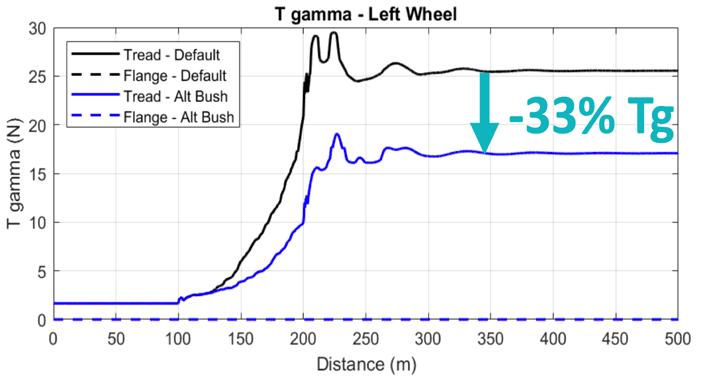
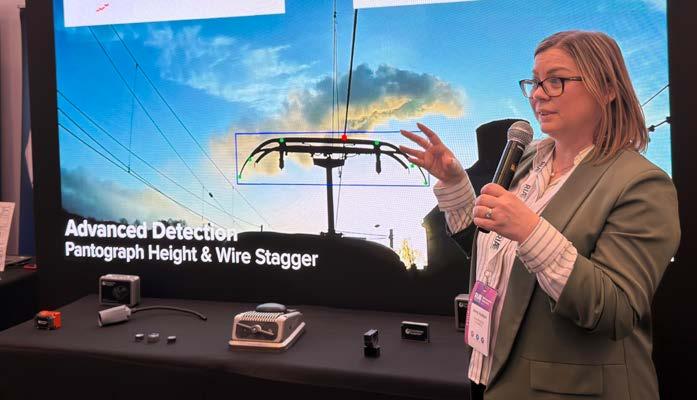
Almost 50 companies had stands at the conference at which some explained what they had on offer at the Spotlight session as shown below:
Purple Transform’s AI Driven Visibility Platform can use the 100,000+ CCTV cameras on the network with existing sensors to provide useful intelligence about issues such as trespass, flooding, and PPE compliance. As an example, its Chipping Sodbury flood monitoring saved £1.5 million in delay minutes.
Abloy has a range of digital key systems for mechanical locks such as keyless padlocks. This enables digital keys to track who accessed what, when, and with what permissions.
The clean fuel pickup system on show at the FuelActive stand showed how this avoids picking up fuel from contamination at the bottom of a tank to protect injectors, extend filter life, and save fuel. The system is currently used by Network Rail, Colas Rail, and freight operators.
Over half a million Staytite self locking vibration proof nuts have been installed on the network as its patented design prevents loosening and failures. The company also offers an intelligent bolt which sends alerts via Wi Fi.
Incremental Solutions uses real time GPS train data to analyse train performance. This identifies sub-threshold delays, detects timetable resilience issues and compares real world timings with planning assumptions.
Laing O’Rourke is transforming lift installation through modular construction. To do so it has developed a modular lift system which can be installed on site in less than an hour and then requires a further 10 days commissioning. Thus, a typical 18 month lift installation programme can be reduced to about 12 weeks.
Unipart has the capability to integrate multiple suppliers’ technologies into a single platform. As an example, its lineside Vision Insight system uses thermal
radiometry and optical systems, analysed by AI, to monitor temperatures of train wheels, axleboxes, and other components. Payment for this system is only required when it presents failures.
To enable deaf passengers to travel confidently and independently, Infotech has developed AI-driven British Sign Language (BSL) technology to provide train running information to deaf passengers.
Transmission Dynamics specialises in remote condition monitoring and presented its Panda roof mounted pantograph/overhead line monitoring system. This detects overhead line by providing 10 seconds of video recording where an accelerometer on the pantograph head detects abnormal acceleration. This has prevented dewirements on various occasions. A further development is a networked system that shares pantograph/ OHL alerts and instructs trains to drop pantographs past an obstruction.
MoniRail specialises in ride quality monitoring that determines whether rough riding is due to track, train, or wheel profile. The company has developed a web based app that uses phone vibration sensors to generate ride quality indices which shows how low cost sensing can complement professional monitoring systems.
The final keynote address was given by Network Rail Head of Programme Management, Susan Millington (pictured right) who had been delighted to see so much enthusiasm and ambition during the conference.
She also praised the industry’s willingness to openly discuss barriers of complex procurement, fragmented decision making, regional variations, and the difficulty of connecting suppliers with problem owners. She felt that recognising and addressing these barriers will move the industry forward.
Susan advised that a particularly promising development is the Evolving
Innovation Playbook. This will be a shared resource with information about the challenges and outcomes of all the innovations that Network Rail supports or knows about.
She considered her takeaway from this conference was that innovation must have a central system wide role “grounded in the needs of the frontline teams that we support”. This requires proven innovations to be scaled up quickly and consistently, collaboration with suppliers to be strengthened, innovation to be embedded in everyday delivery, and a focus on outcomes that matter.
Your writer was also impressed by the scale and variety of the new technologies on show, many of which clearly offer significant benefits. It was also good to hear how Network Rail, UKKRIN, and RIA are actively supporting innovation. RIA in particular is to be commended for organising such a worthwhile event to facilitate innovation by connecting suppliers and clients.
Although there are certainly barriers to innovation which need to be addressed, some are now less of an issue than they were. Within the past 10 years there has been a significant increase in the use of passenger trains for infrastructure monitoring as monitoring data ownership arguments have become irrelevant. Furthermore, as the new GBR organisation is implemented it is to be expected that there will be more support for innovations offering whole system benefits.
Our report on last year’s innovation conference in Issue 214 (May-Jun 2025) shows that since RIA held its first innovation conference in 2009 many innovations have transformed how the railway operates and manages its assets. For example, new trains have had a quantum leap in technical capabilities and much has been done to automate infrastructure monitoring which has almost eliminated red zone working. Does this indicate that the rail industry, which has older assets than other sectors, is slow to innovate?
Perhaps a better assessment would be ‘good but could do better’!
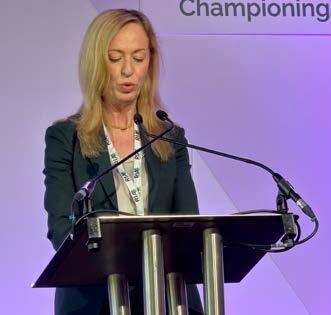
Editor’s comment: At the RIA Innovation Conference Rail Data Marketplace Hackathon, developers were challenged to create an app helping passengers understand validity of their ticket. The winning entry, Sentinel, was developed by 16-year-old Mikey Whiston. Using RSP-6 barcode standards and Rail Delivery Group fare data specifications, the app determines exactly which trains a ticket can be used on. Here he describes how this was done.
Standing on a rainy platform at Erdington station at 08:00, the barrier between a passenger’s travel intent and the machine’s enforcement logic is invisible but absolute. As the industry navigates the transition towards Great British Railways (GBR), we face a widening contractual gap – the divergence between natural language summaries presented to passengers, and the machine truth – the raw RSPS5045-02 restrictions that govern the gateline. To secure our national infrastructure, we must move beyond probabilistic estimations and into the world of deterministic validation.
I first encountered this complexity while competing in the Rail Data Marketplace challenge. What began as an exploration of rail data quickly revealed a systemic challenge: how do we ensure that a passenger's ticket (physical or digital) is validated with deterministic accuracy nationally?
Most passengers are now familiar with the Aztec code (the square barcode often called a QR code) on their phones. Under the RSP6 standard, this is more than just an image; it is a cryptographically signed envelope. Every accredited ticket issuer submits public keys to a central repository managed by the Rail Delivery Group.


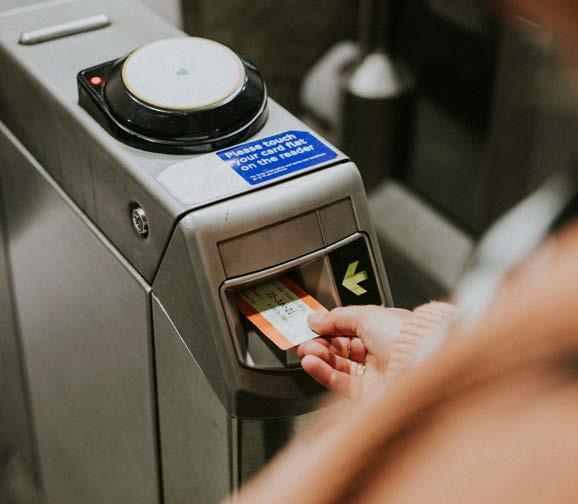
To parse an RSP6 payload, a validation engine must identify the Issuer Key within the bitstream and attempt a PKCS#1 v1.5 RSA validation. If the decrypted block matches the expected pattern, the ticket is mathematically verified. Beyond the signature, the engine must resolve specific bit-ranges for the origin, destination, and route codes. In this world of high-speed logic, even a 1-bit encoding desync can result in a passenger being incorrectly flagged for a penalty fare.
While digital tickets use clean bitstreams, physical ticket stock introduces significant signal entropy. The high-frequency security watermarks – designed for human antiforgery – act as background noise for Optical Character Recognition (OCR). To a computer, it can be difficult to distinguish station text from the ‘National Rail’ motifs printed behind it.
To achieve accuracy in my Sentinel ecosystem, I engineered an approach that moves beyond simple image processing. I utilised a homoglyph replacement matrix. By comparing scanned data against the finite dictionary of UK restriction codes and replacing visually similar characters (like a '0' for an 'O') based on the known interference pattern of the watermark, the engine reconstructs the original contractual intent from a high-entropy image.
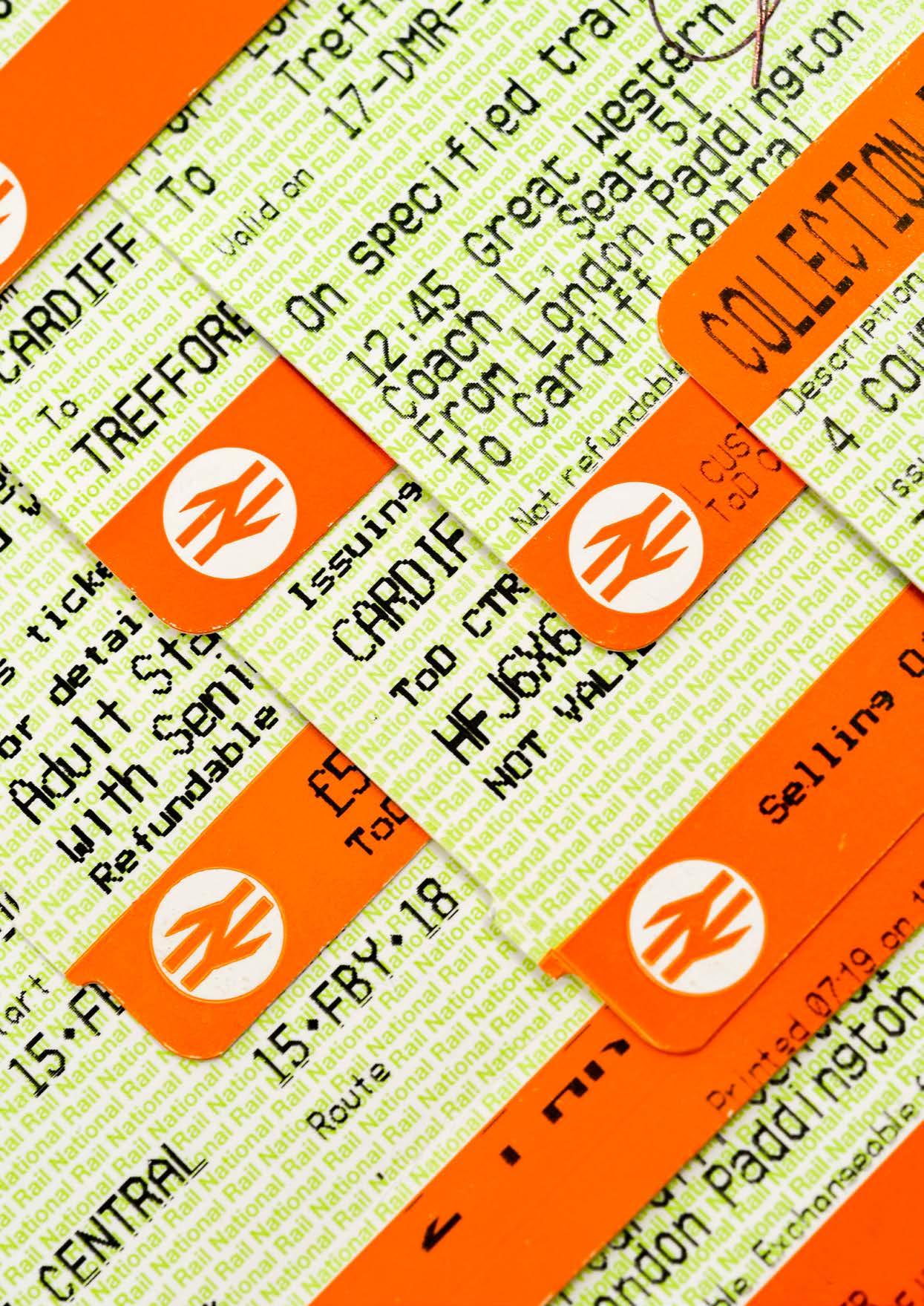
The transition to smartcard infrastructure (such as the ITSO standard) introduces a different tier of risk: symmetric cryptography. Unlike the asymmetric model of Aztec codes – where a public key can verify a ticket without being able to forge one –symmetric systems often rely on shared secrets.
The keys required to read these cards must remain strictly unavailable to the passenger, as the same secrets used to validate a journey often possess the permissions to alter the data on the card itself.
As the rail industry scales, managing these master keys remains a defining architectural challenge: balancing the demand for ‘offline-first’ validation with the absolute requirement for national network security. As we move towards GBR, we must make an effort to unify all forms of ticketing media to solve the challenges that currently plague universal ticket validation. Only by unifying these validation streams can we provide a cryptographically secure, operationally efficient service to the rail commuter.
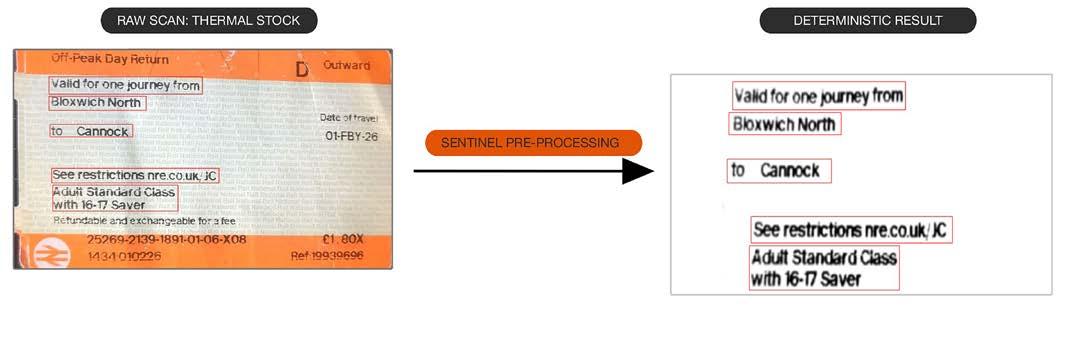
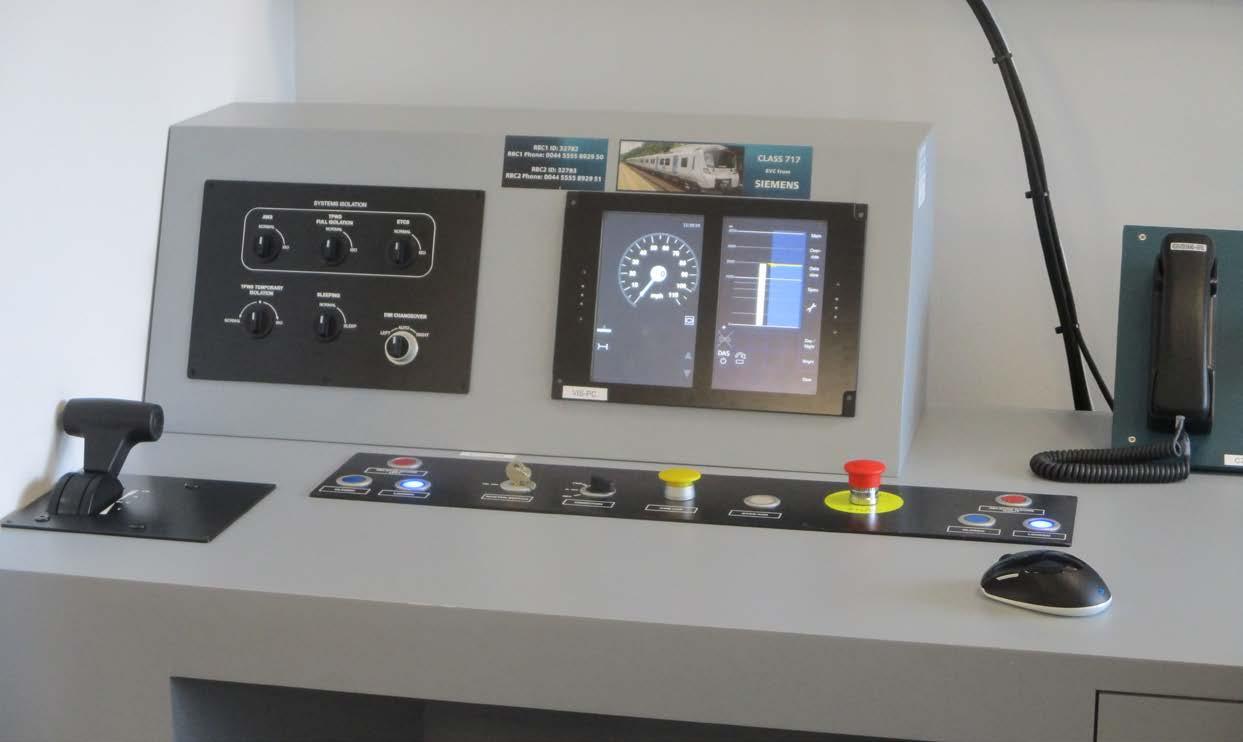
It is a salutary thought that the European Train Control System (ETCS) was first introduced into the UK in 2010, now 16 years ago. This was on the Cambrian line from Shrewsbury to Aberystwyth and Pwllheli, which acted as a proving ground.
This was to herald the start of a rolling programme where the technology would be adopted for the majority of main lines by the end of the 2030s. Sadly the rate of roll out has fallen far short of expectations and the only other routes now equipped are the central core of Thameslink that has the important add on of Automatic Train Operation (ATO), the GWR route into Heathrow Airport which is now extending back into Paddington, and the recently introduced Northern City Line (NCL) from Finsbury Park to Moorgate in London. So why the slow progress, and has it been a blessing in disguise?
Over time, the technology has developed with associated upgrades in software releases but the difficulties of fitting a complete route with a mixed fleet of trains has proved to be something of a challenge. The creation of an industrywide partnership has been necessary to move the problem forward. Two of the lines equipped so far have a single type of rolling stock that makes the logistics much simpler. The ultimate aim of dispensing with lineside signals has been achieved on the Cambrian which was easy as, being previously equipped with Radio Electronic Token Block (RETB), it did not have signals. The NCL meanwhile
is a self-contained line where traditional signals were removed in May 2025. At the two other locations, the ETCS exists as an overlay so that unfitted trains can operate.
The first big test for ‘signals away’ will be the East Coast Main Line (ECML) where the East Coast Digital Programme (ECDP) has been actively planned for some years. The initial contract which included the NCL was signed in Q1 2022. Implementation of the first main line section from Welwyn Garden City to Hitchin is almost ready for
cutover but must be rigorously assured for both safety and operational reliability before this can happen. This section was chosen because it has the biggest capture of drivers and fleets from different train companies. The main supplier of the infrastructure equipment is Chippenhambased Siemens Mobility, a company that has a long pedigree in the supply of signalling systems.
The scale of the task
To explain what is involved, Siemens invited selected members of the railway technical press to witness what is required and the progress being made. As well as the ground equipment, the section of route requires a number of train types to
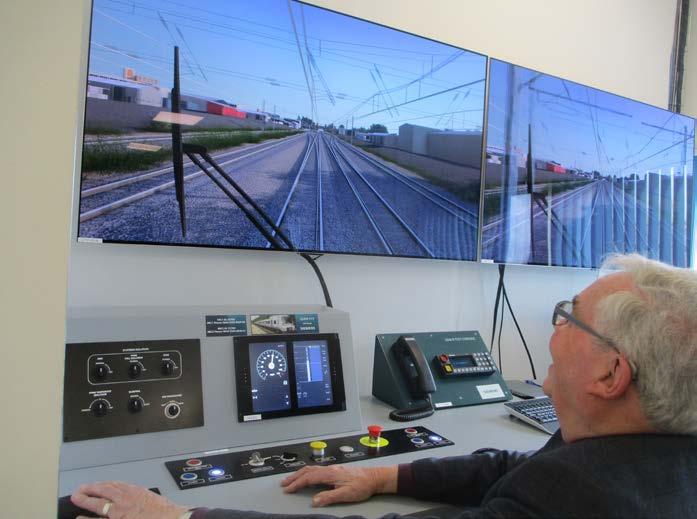
be fitted; these include classes 800 (the LNER, Hull Trains, and Lumo fleets), 700 (Thameslink), 717 (inner suburban that already operate over the NCL), 387 (outer suburban), 180 (Grand Central), plus some freight locomotives and on track plant and track measurement trains.
Testing all of this on the real railway would be very disruptive, so as much testing as possible is carried out off site. A vital element of this is the building of a digital twin that replicates in the factory what is being installed on the ground. A System Integration Laboratory has been created which is a sizeable room containing all the elements of an ETCS-controlled railway. These include:
» A replica of the signaller’s work stations that exist in York ROC that control the Welwyn Hitchin section.
» The Trackguard Westlock interlocking for that area.
» The interface between the interlocking and the work station (Controlguard Westcad).
» The Radio Block Centre (RBC).
» A driver’s ETCS on board control console including a video screen simulating the real railway from Hatfield to Arlesey.
» A Siemens train mobile kit.
» A GSM-R cell site covering the lab, connected by a leased comms link back to the Network Rail GSM-R test network in the Midlands.
As such, the link between the radio network and the interlocking is via the air gap.
To ensure interoperability and in the interest of mutual co-operation, other suppliers’ train borne equipment has been loaned to Siemens so that these can be tested to the ground equipment via the radio link. The precedent for multi-supplier testing took place at Hitchin in recent years where different suppliers installed ETCS infrastructure that connected to a test train on the Hertford loop.
Results so far
Creating the digital twin is proving its worth. Having the capability to not only test the technology but also how the system will be used operationally is of immense value. Being given the chance to ‘drive’ a train through the section proved popular with those present. The Movement Authority (MA) together with the permitted speed is shown by
Coinciding with the article on the Siemens ETCS Integration Lab, a talk on ETCS progress in the UK was given recently to the IRSE London & SE section by James Dzimba, chief control & communication engineer at Network Rail. This was a brave and honest assessment but left a lot of questions to be answered.
Signalling assets are ageing faster than the renewals that are taking place. The current actual spend in CP7 is less than £600 million per year, increased to £660 million per year when level crossing renewals and minor works are included. The expected spend was predicted to be £830 million per year, so a significant shortfall is occurring.
Where does ETCS fit in this? The use of ETCS is driven by deliverables, not the technology but concerns exist as to why it is costing so much. In Europe, the success of ETCS is driven by country mandate and a system authority which helps to create a stable ongoing work plan.
There is also the question of strategic safety versus functional safety, namely fundamental versus site specific. Over-specified ETCS undermines the strategic safety and functional over scope and so drives unaffordability since the accreditation inflates the cost.
Cost must be driven out of ETCS if it is to be the preferred system for ongoing renewals. Despite interoperability requirements, there is risk in always using the same supplier. There is no common way of delivering ETCS. Having it as an overlay system will always be expensive and not beneficial to the business case. Lessons have been learned from the application of ETCS to the Cambrian route, the Thameslink central core, and the Northern City line from Finsbury Park to Moorgate but all of these have only one type of rolling stock in day-to-day operation. Equipping a mixed traffic railway as in the ECML makes it much more difficult.
While it might be perceived that ETCS is highly desirable, it is not inevitable. Alternatives exist and others are possible:
» Modular and low-cost traditional signalling.
» Development of a low cost ETCS alternative – Regional / Lite / Sniffer.
» Only go for targeted Automatic Train Operation (ATO), not blanket deployment.
» Deliver only the core functionality, not enhancements.
ETCS pundits claim the system will be safer but are we not safe enough? From an engineering perspective, there must be a degree of realism prevailing. A one-size-fitsall situation is not deliverable or sustainable. ETCS should be regarded as an evolution, not a step change. There is a big risk of going backwards.
CP7 funding constraints are evident and unlikely to improve. While further routes have been identified, such schemes are being deferred but any extended migration erodes the business case. CP8 funding must be made to work, and for this a central system authority, a mandated fleet fitment that fits the timescale, and long term stable funding, are all essential.
James complimented the creation of a system integration lab by Siemens as very helpful to the engineering development and associated testing. He acknowledged the damage being done to rail passenger confidence by having to close the ECML for several consecutive weekends from Peterborough to London for testing purposes. New methods of carrying out testing are being developed.
This talk was remarkable in that it brought out many of the concerns voiced by professional railway engineers and operators over several years. One big question that remained unanswered is that there seems to be no ‘directing mind’ for the future of ETCS. That is a question that GBR might have to address very soon after its creation.
a grey band around the outside of the speedometer. The lineside signals will remain for a period after the cutover and are aligned with the MA. It will not be possible for an MA to go beyond a red signal as drivers in the real world would find passing a red signal very unnerving. Keeping the train speed within the limit could be challenging, not only when slowing down as needed but
to maintain the speed necessary to meet the timetable. The grey band changes to yellow if the allowed speed is exceeded firstly as a warning to slow down and then to red with the brakes being automatically applied if the required action is not taken. The console also includes details of the line characteristics such as gradients and speed restrictions.
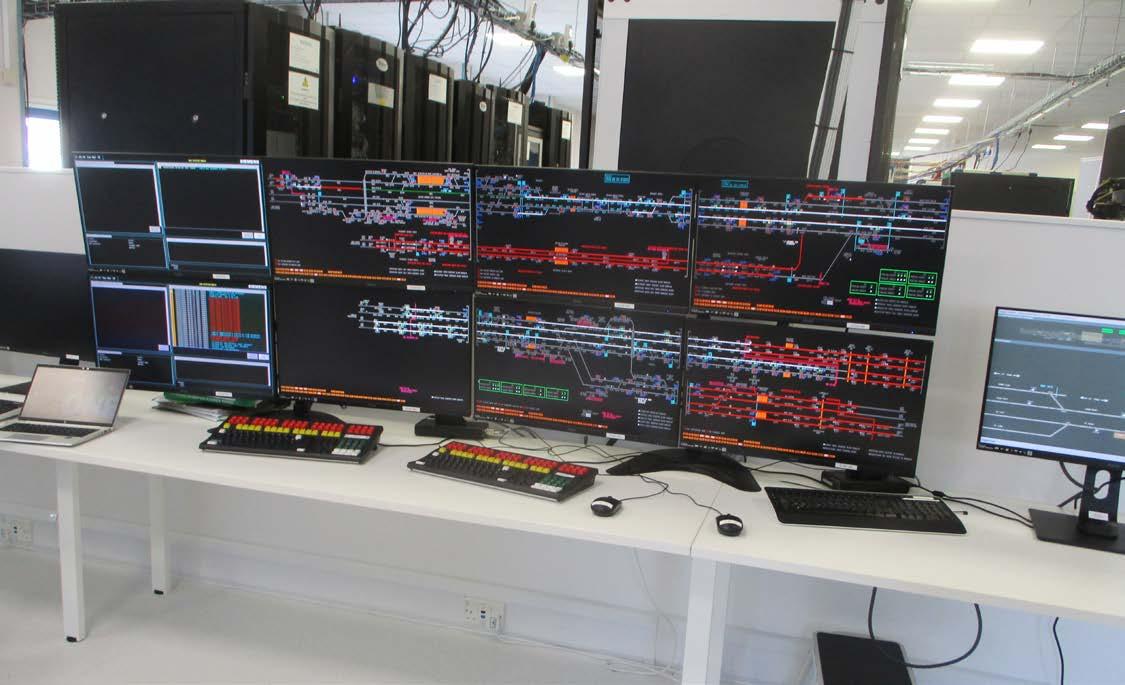
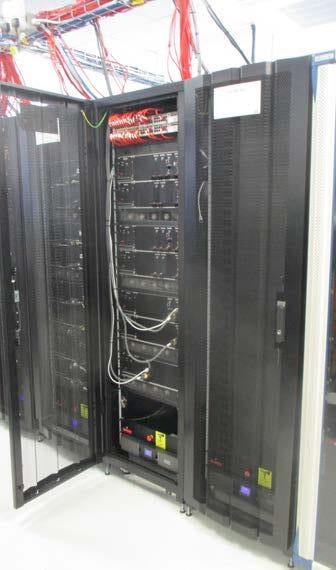
The changeover from conventional signalling to ETCS once operational will be automatic, providing the driver is trained and certified for ETCS operation. This will require the driver’s capability to be part of the sign on process for the journey, another thing that the twin can test.
The simulation of the York work station shows the traditional white lights for route availability, red lights for section occupied, but also green lights showing the extent of the MA given. The twin has also shown up some technical deficiencies needing attention, some associated with interpretation of interoperability between the different suppliers. Another challenge is backward compatibility as it is certain that the software level currently standardised at an international
level will be updated over the life of the system. The current thinking is that train equipment with an earlier version of software will work to infrastructure with the latest software. However, earlier software infrastructure will not support later versions of mobile software, which could enforce updates into the future.
While testing on the twin is invaluable, it is not sufficient to implement the system without additional onsite testing taking place. This has proved very disruptive with multiple closures of the ECML between Peterborough and Kings Cross at weekends being deemed necessary and consequential loss of revenue and passenger dissatisfaction. The disruption is acknowledged but work is being done to keep access to a minimum. This already includes action to deploy exclusion zones where quadruple lines exist such that two tracks are taken out for testing under a possession leaving the other two lines available for normal traffic.
The plan is to commission the Welwyn Hitchin section in July. Not all rolling stock will be fitted by then and thus lineside signals will need to be retained for the immediate future, which will also facilitate conversion training for drivers in ETCS operation. No date is yet set for when signals can be removed.
After this, the roll out on the ECML will continue to eventually cover the whole section from Kings Cross to Stoke tunnel just short of Grantham and is expected to be completed by 2029, still three years away.
The bigger question is which lines will be converted to ETCS after that?
Active planning is happening for further elements of the ECML, the northern section of the West Coast Main Line, the Midland Main Line, the Trans Pennine route and even the Brighton main line. It is likely to be renewal driven as replacing signalling with more ‘lights on sticks’ will fail to deliver the advantages and cost reduction that ETCS can yield. None of these are certain and it will be up to GBR to make the decisions. Funding will be crucial but equally important will be keeping the teams with the vital expertise in place. Future projects are unlikely to need the degree of assurance testing once the principles for the ECML are established. This essentially means a rolling programme that governments of whatever party can sign up to. A little like electrification where the start/stop funding situation has caused so much criticism.
Thanks are expressed to Siemens for allowing Rail Media an insight into the factors associated with ETCS roll out.









CLIVE KESSELL
T(Top) Preston Road boundary with blue signal CM.
(Below) Harrow cabin on station - PRB.
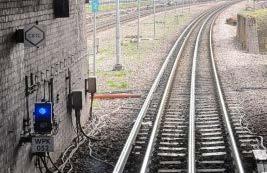
he re-signalling of London Underground’s (LU) sub surface lines under the management of Transport for London (TfL), collectively known as the 4LM (Four Lines Modernisation), has been well documented in Rail Engineer with updates regularly given as the project has progressed.
Now reaching the final stages, it is appropriate to record and remember the signalling that has or will shortly be replaced. A visit to the signal boxes at Harrow on the Hill and Rayners Lane at the northern end of the Metropolitan Line was arranged by the IRSE London & SE section and a fascinating visit this turned out to be.
The geography
Harrow on the Hill box manages the controlled signals, designated ‘JB’ in the Harrow station area by means of the main box frame and two ‘slave’ boxes which are remotely controlled, at Harrow South and Harrow North plus the area at Northwood using a push button panel. Outside of the controlled area signals, which are identified by the signal box code, there are automatic sections designated by an A prefix to the signal number, between Preston Road (the boundary to the current extent of the 4LM system) and towards Watford South Junction where the lines towards Amersham and Watford diverge, which is under the control of Rickmansworth box. Harrow is also the junction for the Uxbridge branch with its grade-separated dive-under bridge. There is a short automatic section to Rayners Lane where the signal box there controls the junction with the incoming Piccadilly Line and onwards to Uxbridge. These two boxes have been adapted to cope with a number of unique operational situations which the 4LM system will have to replicate.
Of note is the boundary between the traditional signalling and the 4LM Communication Based Train Control (CBTC) system. Up until the stage when the 4LM system reached Preston Road, the changeover always took place at a platform with passengers unaware of the change process, but this boundary was different. There are four tracks, these being the northbound and southbound fast and slow lines. On the slow lines, the boundary changeover takes place in Preston Road station, so again passengers are unaware. The fast lines however have no platforms and the changeover must take place (albeit temporarily until the stage at Harrow is commissioned) by bringing the train to a stop at a boundary signal and carrying out the changeover either by engaging the southbound train into the CBTC system or by reverting to ‘legacy’ signalling under driver control for a northbound train, whereby the train can re-start.
Harrow on the Hill
The signal floor is perched three floors above the station and dates from 1948. The heart of the signalling is a Westinghouse N frame (readers may be more familiar with the L type frame that existed on British Rail for many years with only one now left – Maidstone East – plus a few more on heritage lines). The N frame was developed with London Underground in mind and has an unusual adaption with three-position miniature levers for signals where two routes are
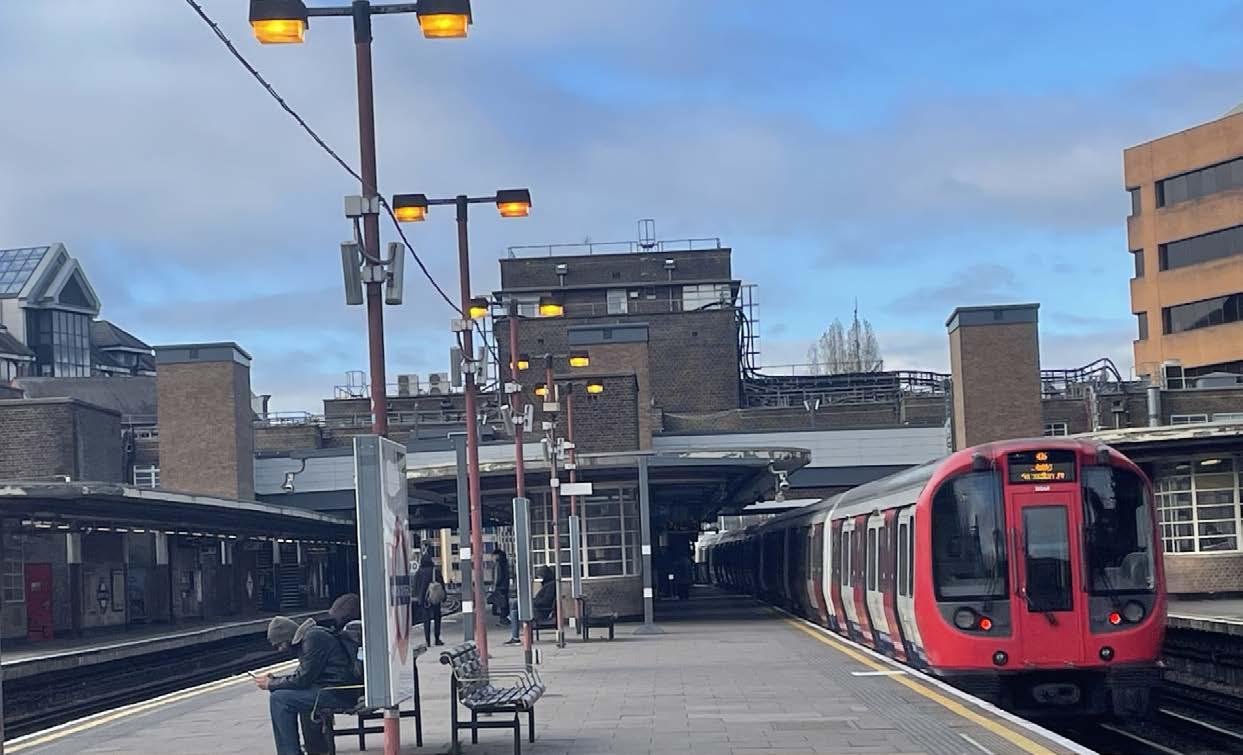
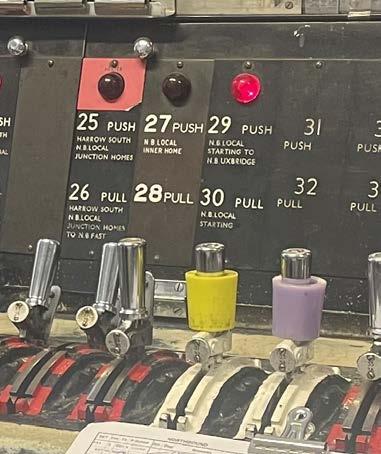
available. The centre position is the normal with push forward for one signalling function with a unique signal number and pull backwards for another function with a separate number. Not all levers operate in both pull and push functions. The frame was commissioned with the fourtracking to Moor Park in mind but did not come into service until 1962. Subsequent changes have seen the disappearance of the extensive goods yard and a loop line down to the Uxbridge branch and hence there are now many unused levers coloured white.
The Harrow frame is in two sections, the main one being on the left, manually operated with catch handle lever control, with that on the right being a ‘slave frame’ representing routes controlled by the unmanned interlockings at Harrow South and Harrow North which are linked to the main box by multi core control cables. The slave frame levers are operated by compressed air motors, electrically operated from the main frame, and replicate some of its functions. This section does not have catch handles. Mechanical locking exists right through the frame, and the two slave boxes also have mechanical locking for circumstances when local control is deemed necessary. It is somewhat strange to see these levers moving on their own when the signaller is setting routes from the left section.
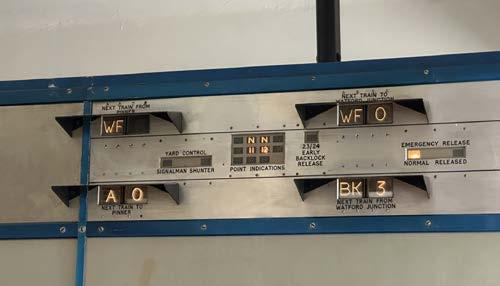
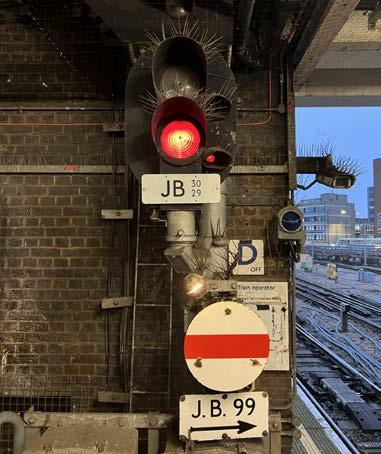
North of Harrow is Northwood where a crossover and a siding exist. These are controlled from a separate push-button route setting panel. The site is normally in automatic working requiring no action from the signaller. A remote whistle blower is used which sounds in the siding to warn staff when any train movements are to take place.
Harrow box’s illuminated diagram is unusual in that track indications in the diagram are normally lit and go dark when occupied, a sort of failsafe arrangement. There is no automatic route setting, and all routes and train movements have to be signalled on the levers.
The Underground does not use ‘main line’ train descriptions in conjunction with the signalling but just shows the train routing type, e.g. AO = Aldgate all stations. These descriptions are set up on a separate screen and are carried forward to adjacent boxes by track circuit actuation as the train progresses. The trains have train numbers, as assigned in the working timetable, and these numbers can be changed if required by operating circumstances.
The relay room below the cabin was immaculate with the wiring looms tied neatly in place – a credit to the technicians who maintain it. The signalling supply is generated at the sub stations at 600 volts, 331/3 Hz. A rarity these days is the use of AC vane relays for the track circuits and point detection to ensure immunity from the DC traction power.
(Right) JB 29 30 & Shunt 99 signals CM.
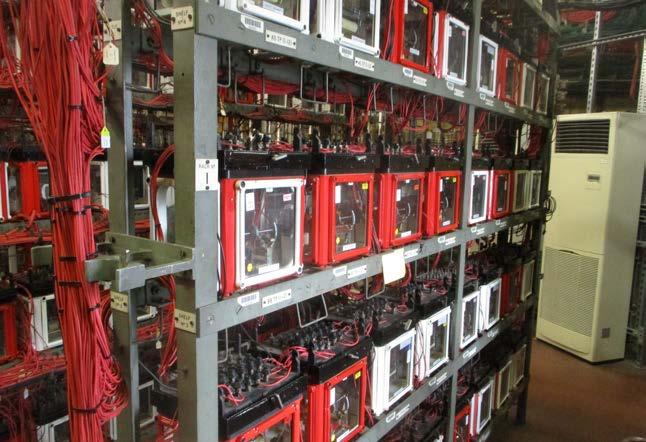
South of Harrow on the Hill, the Chiltern Line trains have a separate pair of tracks down into Marylebone station which are not electrified. From just south of Harrow station, the northbound Metropolitan line joins the Chiltern route and into Platform 6 while Metropolitan trains can reverse south to north on Platform 5. Woe betides any electric train that ventures south of Platform 5 as there are no conductor rails.
Northwards, and after the Uxbridge lines have diverged, the two adjacent fast lines up to Moor Park continue to Rickmansworth and Amersham. They are shared by both Metropolitan and Chiltern line trains. The tracks are TfL operated so the Chiltern trains have to be adapted to meet the operating conditions. There is no AWS or TPWS, but train stops are installed in line with TfL practice. Hence the Chiltern fleet that operates over this section has to be fitted with trip cock equipment.
Train descriptions are a further complication as Chiltern Line trains use the standard Network Rail alpha numeric code for their individual journeys when starting from Marylebone. These are not recognised by the TfL system. A special arrangement is in place to step the descriptions through the joint running section and re-insert these into the Network Rail signalling north of Amersham. The descriptions are shown on a separate screen in Harrow box.
Knowing the whereabouts of every train is important, and the London Underground Trackernet system is being rolled out across all lines as centralised control in introduced. This gives staff in signalling centres and control rooms, and staff with the appropriate mobile
phone, a picture of requested track layouts showing every train in that area. The system is also used to feed into passenger information systems and the displays on the Harrow platforms are driven from this source.
The interworking of Metropolitan and Chiltern Line trains can lead to interesting situations but, in an emergency, an alarm can be sent to Marylebone signalling centre with the instruction to stop all trains.
The track-to-train radio system on the London Underground has been provided under the Connect contract and uses Tetra technology. Now some +20 years old, it is being updated and modernised. The radio channels are zone related and drivers are called within that zone. A group call facility is available and can be used to stop trains in an emergency. Chiltern trains are equipped with GSM-R, so coverage with that system is also provided.
London Underground has ceased using telephones at signals other than at any location where local circumstances might require one and total reliance on the radio is assured. It was only in April that RSSB’s Industry Leadership Group eventually decided that Signal Post Telephones (SPT) could be phased out on Network Rail’s infrastructure.
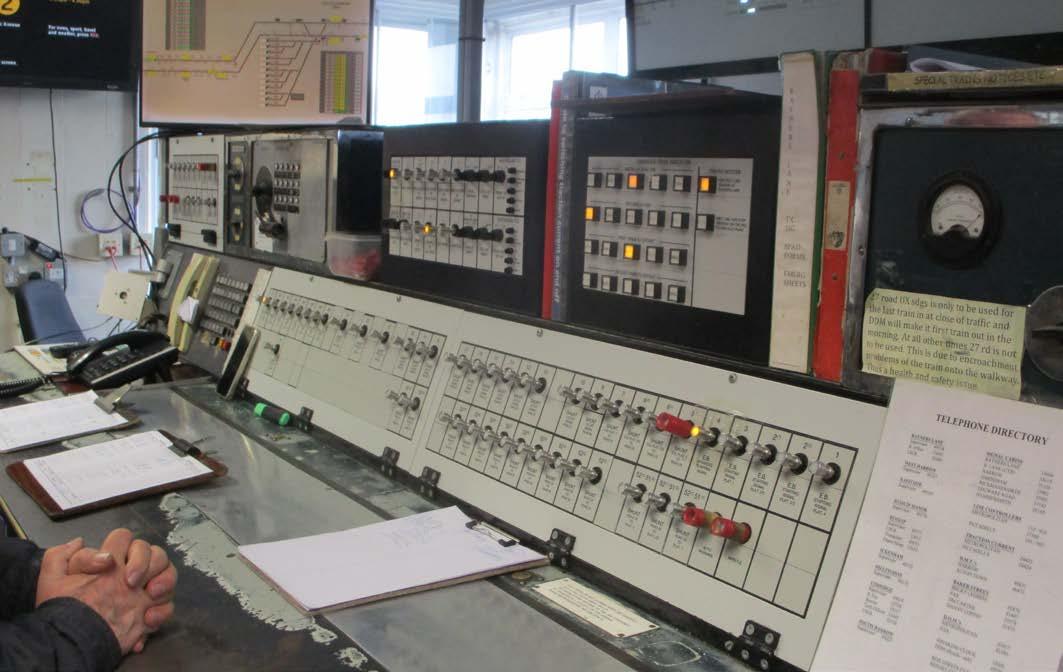
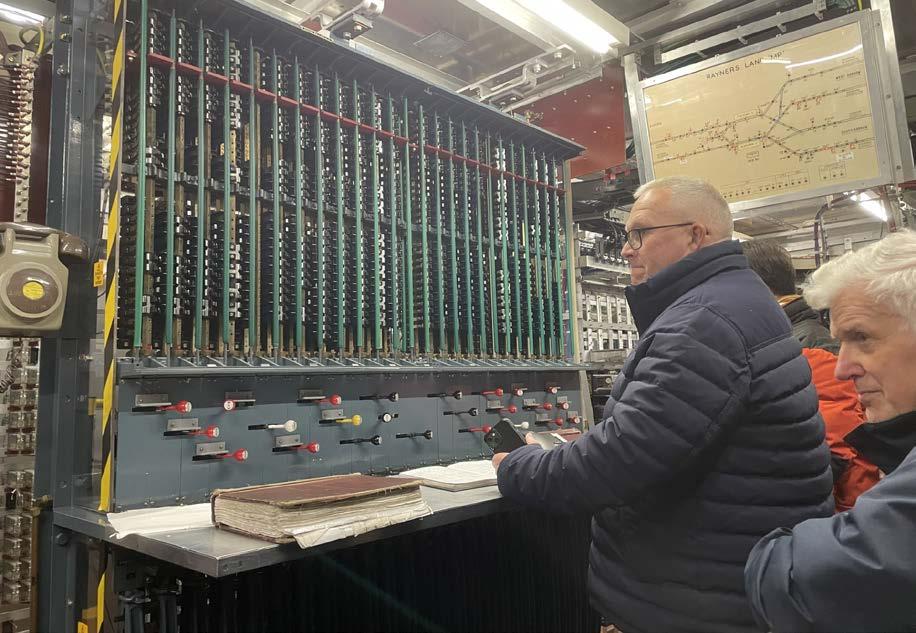
Two stations along the Uxbridge branch is Rayners Lane, where the signal box is sited just to the west of the southbound platform. The building dates from 1935 and was originally equipped with a Westinghouse push-pull N frame. This frame reached the end of its life in the late 1980s, whence it was removed and replaced by push buttons in the space previously occupied by the levers. These now control a ‘V’ –vertical frame located remotely from the box at the opposite end of the station.
The push button desk controls the line between Rayners Lane station and the junction between the Metropolitan and Piccadilly lines, the turn back siding, the link to the Central Line West Ruislip depot between Ruislip and Ickenham, and the three platforms and sidings at the Uxbridge terminus. Originally the box controlled the stabling sidings at South Harrow on the Piccadilly line route, but these are under the control of the Piccadilly line signalling centre at South Kensington.
Between these controlled areas, a number of stations exist along the route with automatic signalling controlling the Metropolitan and Piccadilly line trains. That said, there is a need for speed control approaching Uxbridge platforms as they are ‘dead end’ and the signalling automatically holds the approach signal at red necessitating a train to slow down before the signal is cleared. This is a legacy from the unfortunate Moorgate incident in 1975 when a train running under clear signals ran through a terminal platform and collided with the end tunnel wall resulting in many deaths. The stabling sidings at Uxbridge are equipped with dot matrix shunt signals. The box-illuminated diagram is conventional with track occupancy shown with red lights.
In the near future, these two boxes will be replaced by the 4LM CBTC system as that system gradually takes over. Catering for both Chiltern Line and Metropolitan trains on the line from Harrow to Amersham will involve the introduction of blue signals on the conventional three-aspect signals for Chiltern trains. This novel idea is to give Metropolitan drivers the assurance that signals can be passed at red if the train is under automatic control. Other new features will be needed on the Uxbridge branch to cater for both Metropolitan trains under CBTC and Piccadilly line trains on the existing legacy system until such time as new trains are introduced with a compatible signalling system. The old boxes have served the lines well and it is only right that some record of their operation is made.
Thanks are extended to the local TfL staff and to Paul Baker from the IRSE London & SE section for organising this fascinating visit and his ‘sanitising’ work to ensure the accuracy of the article.
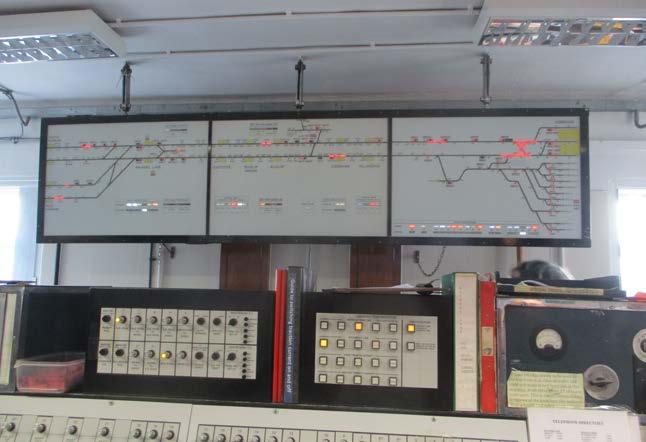
As part of the 200-year anniversary of the opening of the Stockton & Darlington on 27 September 1825, in Issue 213 (Mar-Apr 2025) we looked at the early developments of railway telecoms in the 1800s. This article now looks at developments in railway telecoms since 1900.
Post-1900, signalling control areas became larger and railway telecoms became even more important. It is possible for trains to move without signalling, but communications are essential to move and manage train services. Railway telecoms cover voice, data, and radio for rail operations, business, and passenger use. It can also cover commercial telecoms services.
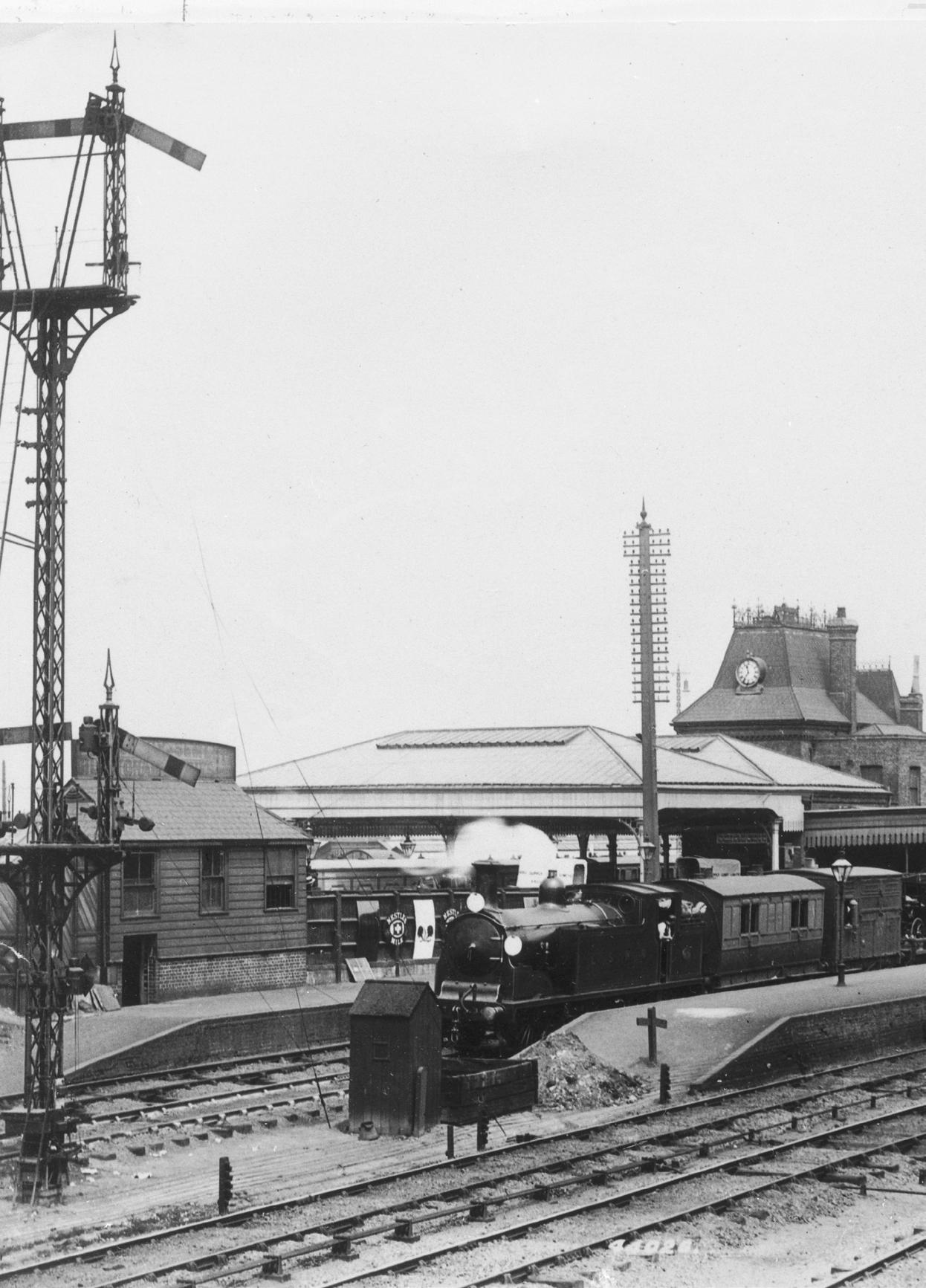
Junction Railway Station. Date: 1900.
Operational telecoms systems provide a number of key services. These include normal day-to-day voice and data communications, such as providing links to support the operation of signalling and electrification systems and to facilitate quick communications in the event
of a problem or hazard including communications for those attending an incident. Operational verbal communications include the use by signallers to give instructions to drivers of trains, and to persons wishing to use level crossings. They are also used to take and give back line possessions, grant electric traction isolations for emergencies, and to facilitate engineering works.
Consider the following quotation: “One of the most interesting developments of modern times in connection with the working of our railway systems is the use that has been made of telecoms. It has introduced a new set
of circumstances into the methods of train working and provided a much greater power of control.”
This could have been published in 2026, but in fact it appeared nearly 100 years ago in ‘Control on the Railways’ by Philip Burtt. So, the importance of telecoms in railway operations is not new.
The mid 1800s saw the introduction of telegraph communications alongside the development of railways. In 1876, the telephone was invented by Alexander Graham Bell and this revolutionised communications by allowing voice transmission over long distances. Railways were quick
to adopt the new voice technology alongside the use of the telegraph. This allowed even greater centralisation of train control into the 1900s.
A signaller controls the safe movement of individual trains using safety critical signalling equipment, but it is controllers who manage the service and supporting infrastructure at a higher level, such as ensuring trains run to the timetable, staff are available to operate trains, rolling stock is in the right place, and that faults are attended to.
The controller also manages incidents and perpetuations, and all this needs efficient reliable communications.
It was the Midland Company which pioneered railway control when it introduced a system for mineral train working at Masborough, near Rotherham, in 1907. A control was established at Newport sidings, with a control board and communication lines to regulate and control the flow of mineral traffic in the ironworks area of Middlesbrough, for a total length of about 50 miles.
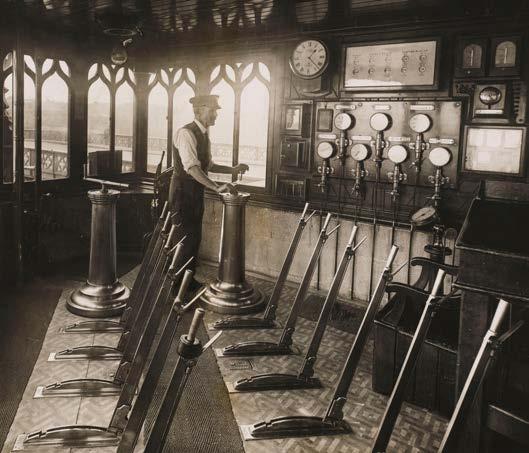
Other railway companies quickly followed and, for example, the Lancashire & Yorkshire based its system of control at Victoria station, Manchester. When completed around 1917, this consisted of a large circular office with seventeen control boards, each representing one section of the Lancashire & Yorkshire system. On the upper part of the wall, the diagrams of the seventeen boards were combined into one diagram of the whole system. There was a controller in charge of each of the 17 sectional
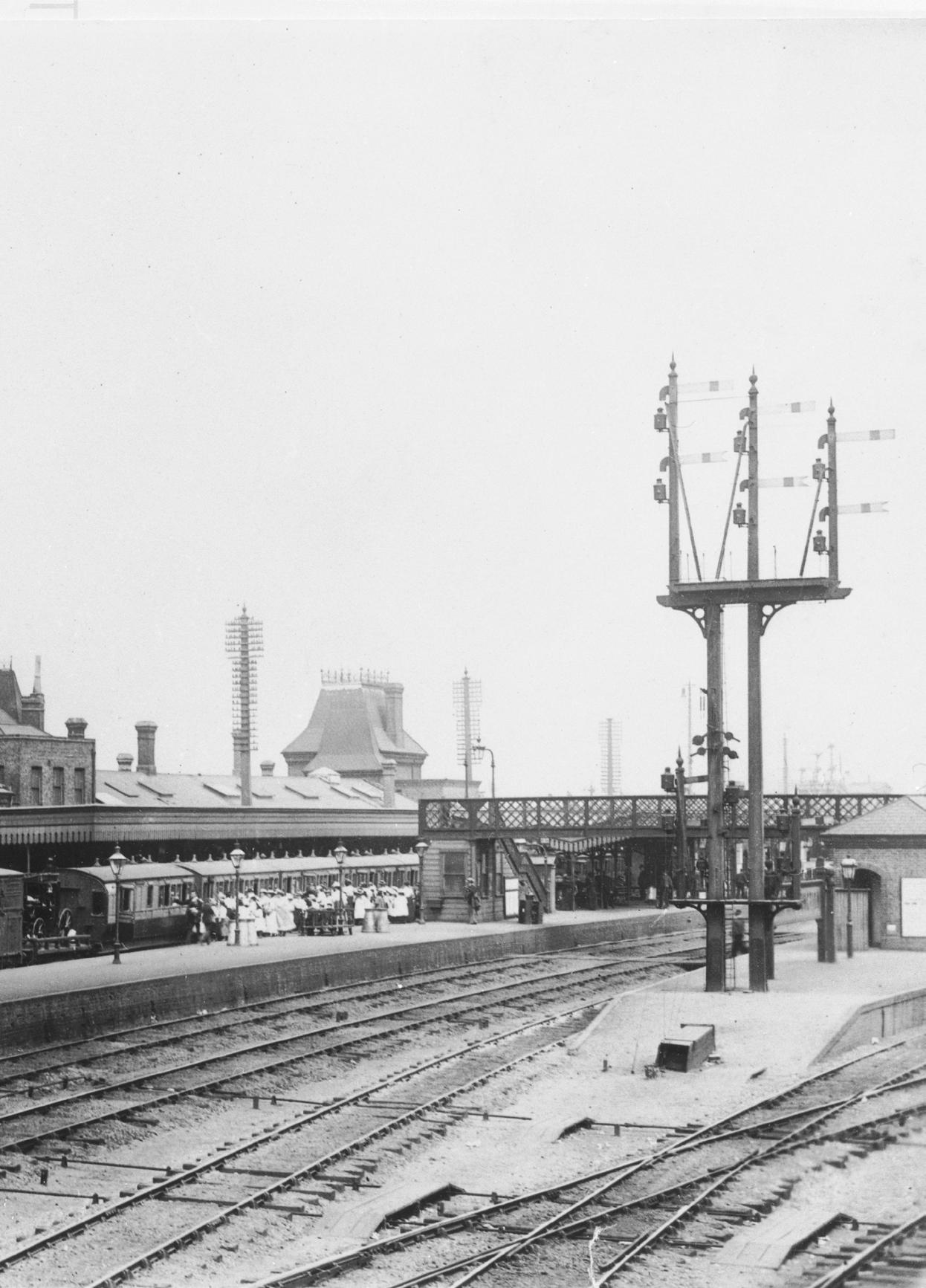
boards, and who was in telephone communication with the signallers in their area.
Soon the central control arrangements included passenger trains and rolling stock allocation as an integral part of the central control systems. As the technology evolved and improved, control locations, their size, and detailed operational practices evolved, particularly as railway organisations changed. Today, having a centralised control with telecoms connections managed by the railway infrastructure manager is as important than ever.
(Main image) Railway trains at Redhill. Date: 1909.
(Inset) Electric Signal Box. Date: circa 1948.
(Inset right) Waterloo manual switchboard in the 1950s.
(Inset top right) Omnibus telephones provided much of the early operational telphone systems.
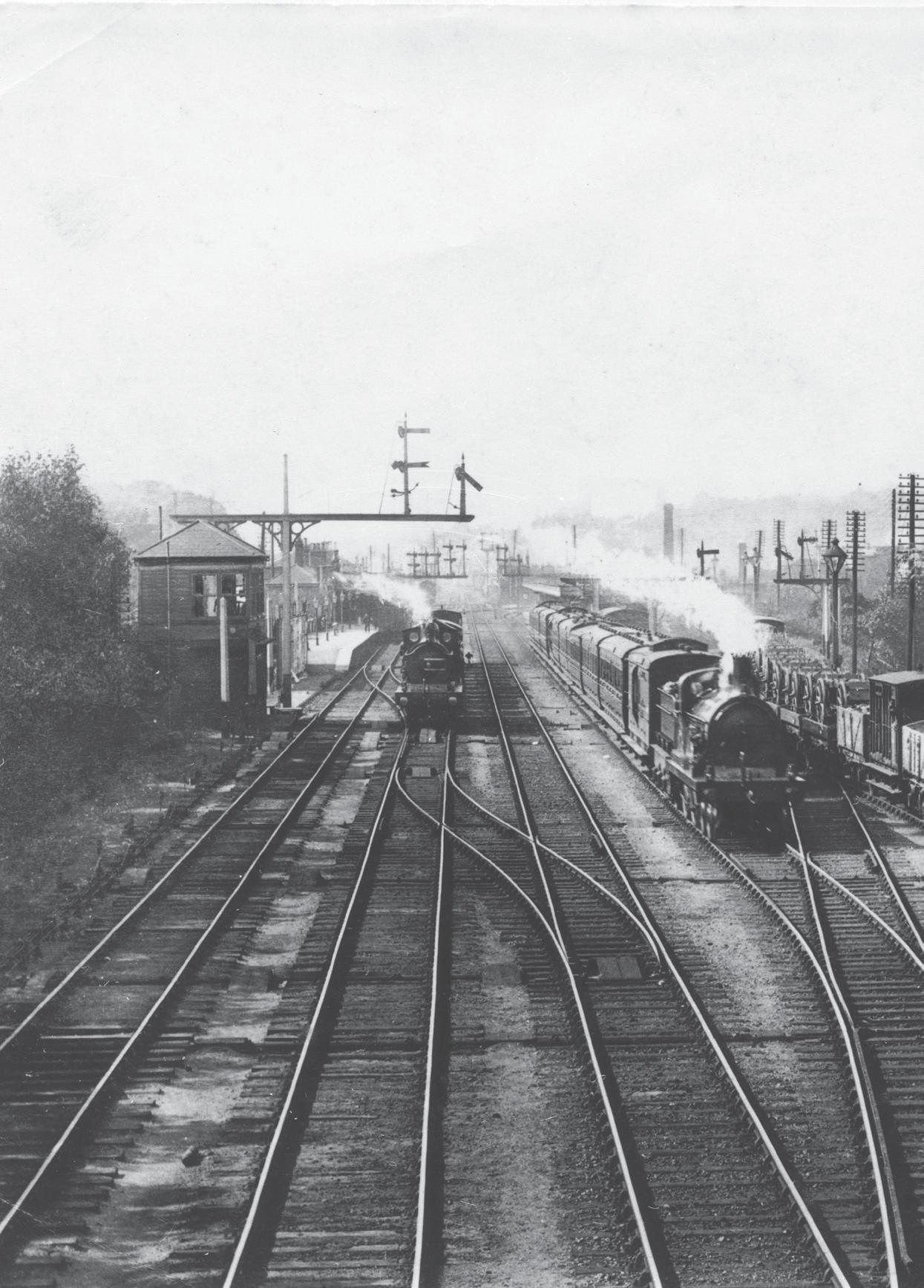
Telecoms links for the controls were initially provided using overhead pole routes with large diameter copper wires. Railways also sometimes facilitated pole routes for the Post Office (now BT). For example, The Midland Railway provided the trunk line from London to Carlisle using 800lb copper wires.
The control points consisted of keyboards and various methods of establishing calls to individual or multiple locations for group call conversations were developed. These included omnibus code-ringing battery-powered telephones, together with ‘box to box’ communication between signallers, often using only a single pair of wires. Eventually, the links were moved
to multipair cables either suspended from the pole rotes, buried in the ground, or located in troughing routes. As areas grew bigger, multi-channel transmission systems were used to cover the distances involved. Keyboards evolved to use technology developed typically for the other industries and, eventually, touch screen ‘dealer boards’ became the dominant technology for railway control rooms.
Rule 55 required that if a train was held by a signal at danger, the signaller must be informed within three minutes, or immediately in fog or falling snow. This was achieved by the driver sending the fireman to the signal
box. This was not a problem where the area controlled by each signal box was small, but as control areas became larger and signals were located further away from their controlling signal box it became necessary to provide a telephone at signals which became known as the Signal Post Telephone (SPT).
The basic principle of Rule 55 is still present in today's Rule Book. The safety requirements for an SPT are that the signaller must only be able to talk to one driver at once. The signaller must always be aware of the identity or location of the calling party, and there must be no overhearing. This is to prevent one driver obtaining instructions intended for another.
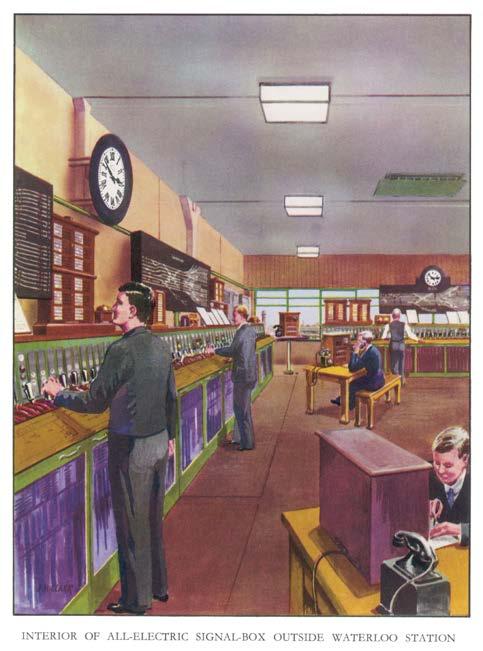
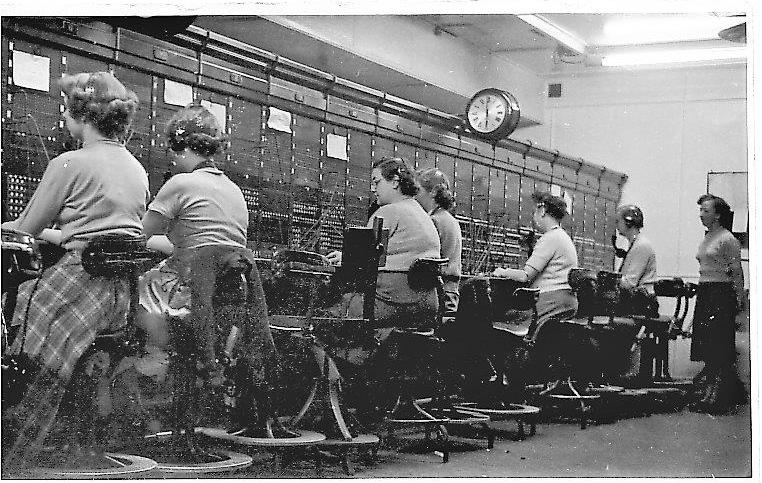
A point-to-point direct line was the simplest implementation of an SPT. This could be achieved with a local battery-powered telephone at each end of the line to meet the safety requirements. This arrangement was only suitable for very small signal boxes with a few signals and the local battery telephones also needed frequent battery changes – especially if the SPT was left ‘off-hook’.
At larger signal boxes, small switchboards were provided to answer calls. This became known as the concentrator, as they ‘concentrated’ calls from many SPTs onto one telephone for the signaller. The concentrator provided a central secure battery
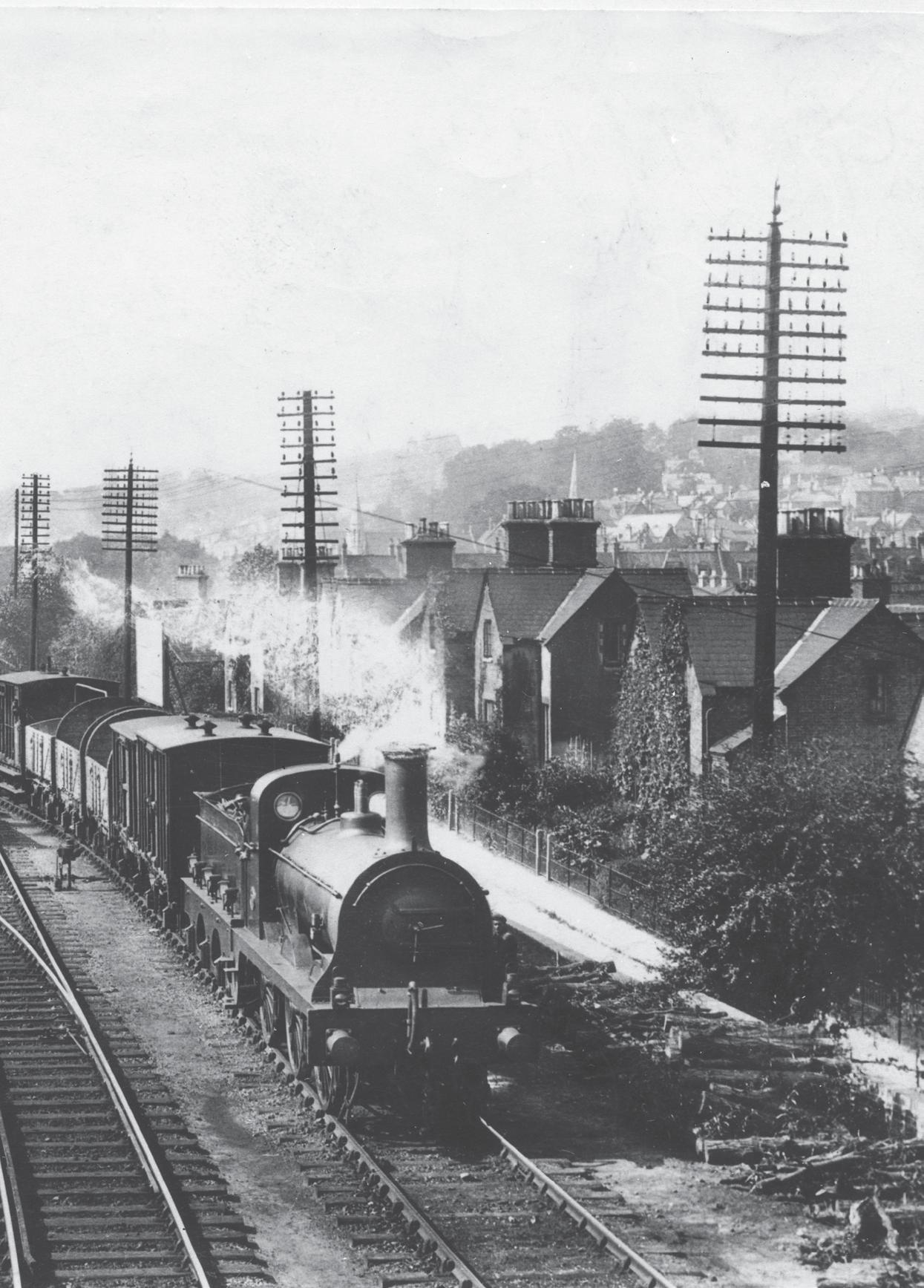
supply for the telephone and there have been many different designs of concentrator over the years.
Concentrators evolved from key and lamp technology through to processor and software-controlled touch screen systems. However, the functionality of only one train driver being able to talk securely to one signaller, with no conference facility to prevent overhearing and miscommunication, has always required ‘railway only’ software. This continues to this day with the IP systems now in use. With a very small market for SPT systems this creates additional costs.
In some cases, in terms of overall telecoms technology, railways have led the way. The use of teleprinters was a useful means of sending messages, and several regions within British Rail adopted circuit switched systems which required the sender to dial up the receiving station. A major innovation by the LM Region was an electronic message switched teleprinter network based at Crewe and known as Signal Transmit Receive and Distribute (STRAD), covering the whole of the LM Region. This permitted messages to multiple addresses to be sent to a central switch and stored until the receiving teleprinters became free.
Waterloo old exchange FDM carrier racks.
Carrier equipment providing mutliple voice channels on single pairs of wires.
Business telecoms initially consisted of manual switchboards and an interconnection to the public telephone network. Automatic electro-mechanical telephone exchanges replaced the manual switchboards, although along the North Wales Coast the manual switchboards were used until electronic exchanges were provided in the 1980s. Trunk lines were either directly on the open wires or by derived carrier circuits (1+1 or 1+4) using valve technology transmission equipment, some of which was procured from the military. These systems evolved using balanced copper pairs, then co-ax, and finally fibre to carry several, and nowadays many thousands, of individual channels.
By the mid-1960s, the National Telecommunications Plan (NTP) was introduced with Extension Truck Dialling (ETD) allowing dialled connections throughout the railway network. The electromechanical Strowger step-by-step exchanges were replaced by electronic exchanges in the 1980s. Since then, the electronic exchanges have been upgraded and replaced a number of times, and now Internet Protocol (IP) is the dominant technology. With most devices now being IP packet switch based, it makes interfacing far easier than traditional circuit switched networks.
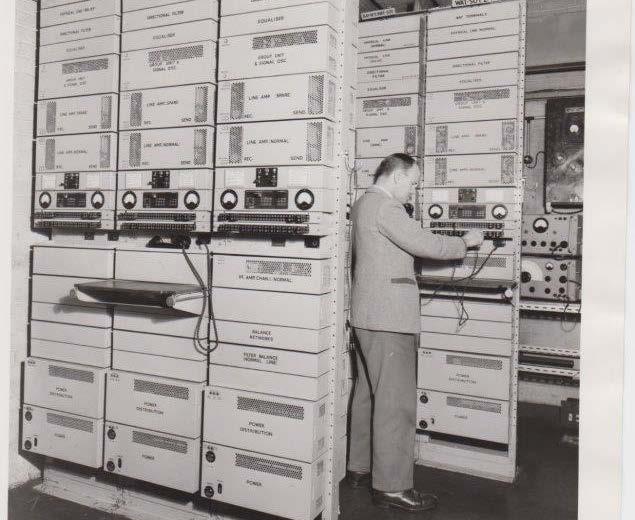
In 1970, British Rail bought Total Operations Processing System (TOPS) from the Southern Pacific in the USA. This was initially aimed at tracking freight wagon locations, but the system soon expanded into other uses including train reporting. It required high quality data lines to be provided across the country. With the large increase in bandwidth from the 4MHz 960 channel transmission systems being provided by the NTP, analogue circuits were transposed into digital transmission by means of modems.
Today we hear a lot about the ‘digital railway,’ but the move to digital telecoms transmission by the use of multi-channel Pulse Code Modulation (PCM) was introduced between Euston and Bletchley in 1968, then the longest PCM system in the country. Digital telecoms multiplexing was used in Plesiochronous Digital Hierarchy
(PDH) and Synchronous Digital Hierarchy (SDH) technology which became the standard technology in the 1980s. After PDH and SDH transmission, IP packet switching transmission was introduced. This has dramatically increased the data carrying capacity and where a hundred years ago the data rate on the copper pole routes was the equivalent of a few bits, today’s fibre optic cables can carry terabytes of data if required. A byte being eight bits and typically one character, e.g., ‘a’, is one byte, with a terabyte being 1,099,511,627,776 bytes.
A problem with long distance copper circuits was induced voltages from electrification and power cables, and the need to immunise them against dangerous high voltages. This included using, for example, booster transformers, return conductors, and isolation transformers.
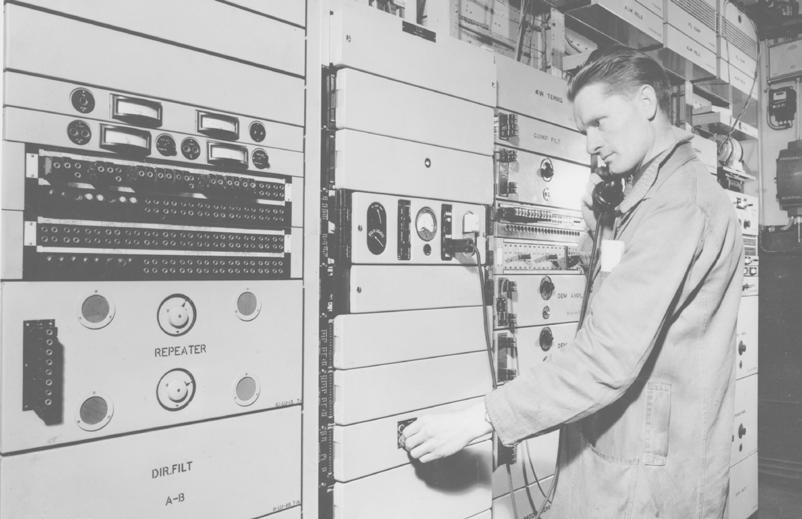
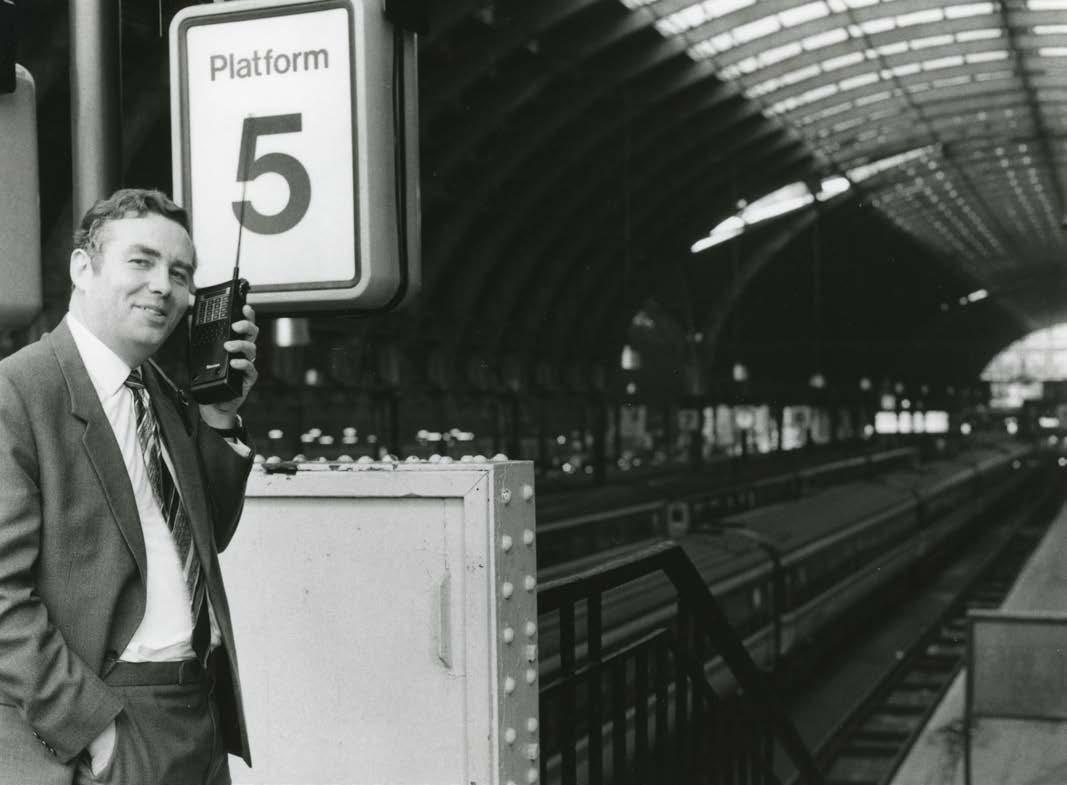
However, fibre optic cables are also immune from electromagnetic interference, and the ribbon fibre optic cables now being installed on the railway can consist of hundreds of individual fibres. Consider that just a few years ago a fibre optic cable could consist of 24 individual fibres, with an overall cable diameter similar to today’s 432 fibre cables.
Some railways had been using radio in the 1920s, but the use of radio for many was generally limited to a few local systems around major stations and freight yards. In the 1970s a nationwide system for general radio communications was developed and known as the National Radio Plan (NRP), then National Radio Network (NRN). This was initially equipped with operator-controlled switchboards to connect radios and telephones, followed by automatic calling from a key pad, and eventually with an inter-dialling interface to the voice telephone network.
While crude compared to modern mobile radio, the NRN was in advance of public mobile radio. Eventually, the NRN was adapted to form a facility for train drivers to contact a control room in an emergency, becoming the Overlay Radio Network (ORN), also known as the driver to shore system.
A secure radio system for driver to signaller communication was introduced in areas where Driver Only Operation (DOO) was provided and known as Cab Secure Radio (CSR). It had the same functionality as SPT systems, but without drivers having to leave their cabs. A form of in-cab signalling was also delivered 40 years ago by the Radio Electronic Token Block (RETB) system, further explained in Rail Engineer issue 216 .
Both NRN and CSR were replaced by Global System for Mobile Communications – Railway (GSM-R). This has been a huge success and the system is well-liked by train operators. It has been used to avoid life threatening situations on a number of occasions.
GSM-R however uses 2G
mobile technology which is fast becoming obsolete. Most mobile operators have shut down their 3G networks and todays systems are 5G. The GSM-R replacement will be Future Radio Mobile Communication System (FRMCS). This will be a huge project to ‘swap over’ from GSM-R. FRMCS is also likely to use higher frequencies and will need additional base stations. This will add an additional ‘green’ challenge, not to mention the cost involved.
Clive Kessell demonstrating one of the early NRN radios.
Omnibus telephones provided much of the early operational telphone systems.
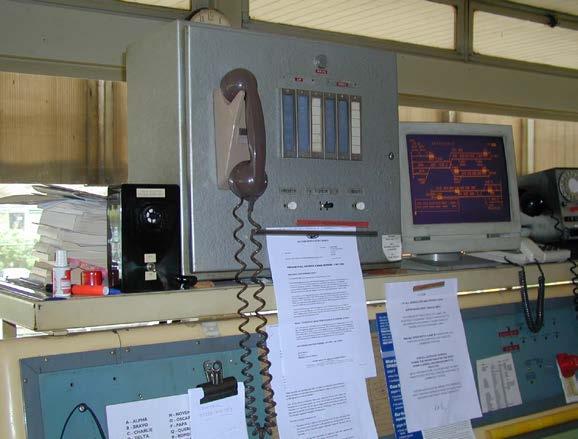
It is costing millions to renew and maintain the SPT systems, which are hardly ever used now GSM-R is in place. It is never easy to remove a safety-related system, but the removal or dramatic reduction of SPTs is something Great British Railways must consider in order to save costs.
In the 1980s, British Rail began modernising its telephone voice network with digital exchanges and replaced the, by then, ageing STRAD system with a new digital National Teleprinter Network (NTN). Data links also became vital to link Local Area Networks (LANs). Customer Information Systems (CIS) were becoming increasingly sophisticated in
the 1980s with digital displays replacing the flap indicators of the 1960s and sometimes linked to timetable and train describer systems to allow some automatic operation. Public Address (PA) systems were also provided by the telecoms function, and one development was the introduction of ‘long line’ systems. These provided the ability for remote announcements to many stations from a central control point over the telecoms network. Today, many PA systems provide high quality automatic recorded announcements, linked to CIS and timetable systems. The clock system was another important telecoms asset before Global Navigation Satellite System (GNSS) clocks were introduced. Central
master clocks controlled many slave clocks over the railway telecoms network, so that every clock showed the same time. Station CCTV, Wi-Fi, and cyber security are just three of the additional applications that railway telecoms engineers have had to learn and manage, and the technology changes so fast that there will many more applications to deal with.
The railway’s telecom networks are a core part of railway operations which cannot be outsourced with any degree of confidence or certainty. This has been attempted a number of times around the world, but often with the controlling railway company having to take back the outsourcing to ensure it keeps control of the technology. There will be commercial opportunities to generate income and share costs, but it’s important that this is achieved with the infrastructure manager retaining control.
The unnecessary costs of SPTs was mentioned by Andrew Haines at his final briefing to the railway press at which he regretted that Network Rail was unable to obtain dispensation to avoid providing SPTs on the new Leven Branch. Rail Engineer shares his view that safety authorities need to better consider the cost of risk mitigation measures that have minimal, if any, benefit.
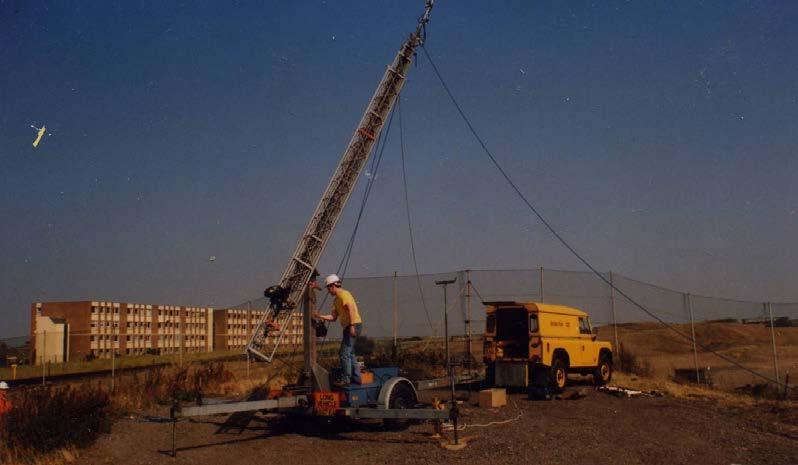



































































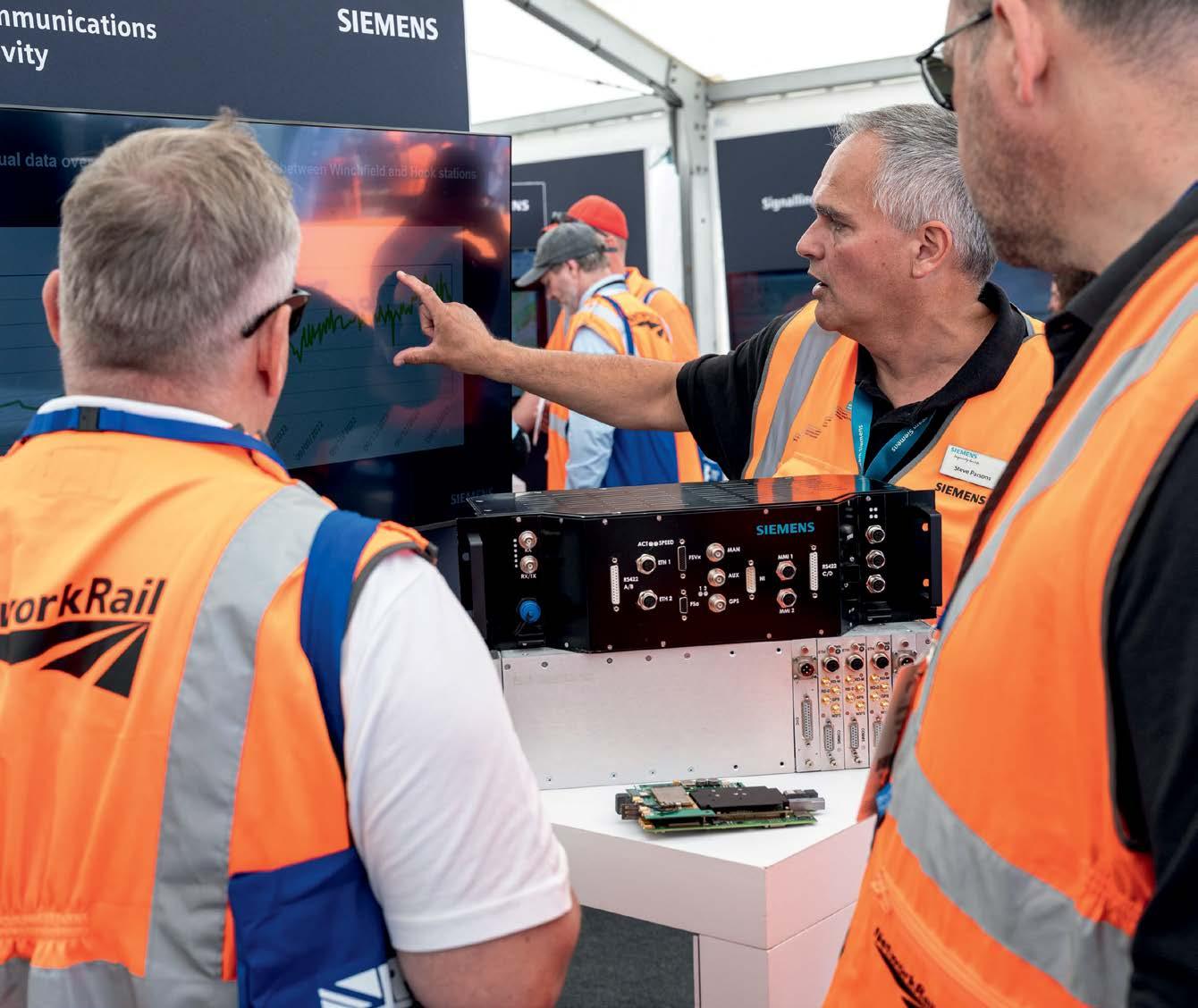
SIEMENS MOBILITY
At Rail Live 2026, we’re demonstrating how technology can reduce operational and maintenance costs, and transform the efficiency and affordability of renewals and enhancements. siemens.co.uk/mobility