
A Guide for place making and station development
A delivery-led guide to unlocking economic and social value through place making surround both in and around stations. Developed in association with the Railway Industry Association

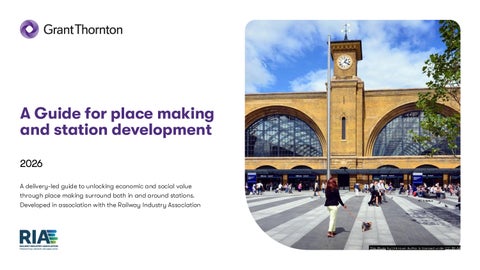
This Photo by Unknown Author is licensed under

Why Stations Matter to Placemaking
Stations act as the gateways to towns, cities and regions. Station development unlocks benefits both locally and nationally.
Stations are more than transport assets – they are place-shaping anchors.

RIA has previously explored station investment zones that builds on this further: https://www.riagb.org.uk/RIA/RIA/Newsroom/Publications%20Folder/Station-Investment-Zones.aspx
• Improved access
• Inclusion
• Safer public realm
• Creates jobs
• Increased productivity
• Increased land value
• Revenue diversification
• Asset value creation
• Reduced car dependency
• Reduced CO2
• Cleaner air
The Reality Check: Challenges to Delivery
Delivering stations is inherently complex, spanning multiple stakeholders, systems and objectives.

• Multiple sponsors
• Misaligned priorities
• Election cycles


• Viability gaps
• Inflation
• Uncertain funding
• Community buy-in
• Disruption concerns

• Land assembly
Technological Legal Environmental
• Interface with live rail operations
Who drives this forward?
• Rights
• Consents
• Planning constraints
• Heritage assets
• Biodiversity
Usually projects are driven by the public sector, individually or as a partnership. This could include Network Rail, Local Authorities, TOCs, Combined Authorities and in some instances the private sector.
A Practical Guide to Station Delivery


Successful station delivery begins with developing the following 8 key components; Getting the right stakeholders around the table. Who matters, who decide and who needs to be brought with you
Establishing the delivery vehicle and procuring partners through competition 01 05 Stakeholder Mapping Strategic Case Feasibility Funding & Finance Delivery Model Design Principles Market Testing Mobilise
Aligning objectives and demonstrating the case for collaboration through benefits assessment
High-level feasibility, costs, revenues and identification of viability gaps Assessing funding options aligned to beneficiaries and outcomes Selecting structures based on funding, risk and desired level of control
Agree Design Principles inline with RIBA stages (Royal Institute of British Architects)
Test proposals with a wider group of public, private and community stakeholders
Continuous stakeholder engagement
01) Stakeholder Mapping
Getting the right stakeholders around the table. Who matters, who decides and who needs to be brought with you.

Key questions
Who? has influence, impact, decision‐making authority and a delivery role?
Identify Early
First step is identifying who's key to transforming the idea into reality.
Map Roles & Influence
A stakeholder map showing who should be involved and to what extent.
Which? public, private and local stakeholders need to be engaged early?
Where? are land ownership, land control and investment decision points held? When? should political and senior sponsors be brought in to unlock momentum?
Build the Right Team
Strong project sponsor and PM team to deliver at pace. Use RACI Matrix to Assign Responsible, Accountable, Consulted, Informed –per phase.
What?
value could Business Improvement Districts, housing associations or business groups contribute?

02) Strategic Outline Case
The purpose of the SOC is to scope the project and to identify the preferred way forward.
Defines the rationale and objectives for the intervention – i.e. sets the case for change.
Defines the longlist and shortlist of options for achieving the objectives in the strategic case. It identifies the preferred option that delivers the best value for money.
Defines the high level the proposal affordability, how project inputs will be sourced and the practical arrangements for implementation.
The Strategic Outline Case gives Project Sponsors the opportunity to showcase to stakeholders that the strategic case for change helps to unlock benefits across board. With all stakeholders being recognised for the value they bring and the value the project will seek to deliver.
Content Guidance: Template_for_Strategic_Outline_Case__002_.odt
Key Questions
problem is the scheme solving, and what intervention is being proposed?
is there a shared narrative around public benefit, additionality and long-term value?
needs to commit land, policy support, funding or approvals for the case to progress?
03) Feasibility Study
Having set out the strategic ambitions of the project, understanding viability drives the narrative around funding, finance and delivery models.
Planning Defining Testing
Desirability Viability
Brings benefits Financially attractive
Setting the project parameters
1) Set out the development zone and mix that delivers on the strategic objectives. Considering policy and planning implications.
Key Questions
Identifying the sensitivities
2) Agree the sensitivities to explore, considering scale, cost, strategic alignment, quality and complexity of the development.
Feasibility
Able to be delivered
Shortlisting
3) Shortlist the approaches to explore further into funding, finance and delivery.
Is the development zone right for the strategic vision? Have the right sensitivities been tested? Does the shortlist hold up against funding, finance and delivery?
04) Funding
Funding and finance can often be the area that makes or breaks the project – getting the mix right is key for successful station development.
Funding sources should be mapped according to who benefits most from the project and when that funding mechanism can be applied.
Beneficiary Associated Funding method
Key Questions
funding solutions appropriately mapped according to the timing of the cashflow and the associated beneficiaries of the development?
04) Finance
Funding and finance can often be the area that makes or breaks the project – getting the mix right is key for successful station development. Key
Finance sources that leverage both the public and private sector maximise benefit realisation.
Sources of finance should be aligned to the project specifics.
Reduce risk for predevelopment and enabling works
05) Delivery Models
Delivery models need to be tailored to project specifics. The core criteria to consider includes:
Capacity
The chosen model must reflect the public sector’s in-house capability and resourcing to lead, oversee or partner in delivery effectively.



Risk
The delivery model should allocate commercial, delivery and planning risk to parties best able to manage them, while protecting critical rail operations and public outcomes.
Key Questions
Does
What


Reward
The public sector should retain influence over upside (e.g. regeneration, revenues, social value) where it is contributing land, funding or statutory powers.
Complexity
More complex stations and multi-party interfaces typically require structured vehicles (e.g. JVs or SPVs) to manage coordination and decision-making.
Control
Control should be retained where outcomes affect safety, operations, statutory duties or long-term place-making objectives.
Does To
the public sector have capacity to deliver? is the balance between risk and reward the sponsor is seeking? the public sector have the knowledge to deliver the project without support? deliver the project outcomes does this require public sector control?
05) Delivery Models
Station delivery models should be directly linked to the project challenges, risks and rewards.
Asset Owner Led
Public Sector SPV
Development Corporation
Joint Venture
Network Rail leads all development activities, retaining full oversight and strategic control. Suitable where operational alignment is critical but often limited by NR capacity.
A public-sector SPV (e.g., DevCo for development, InvestCo for asset holding) is used to manage the development and long-term income streams. Offers flexibility but demands strong internal capability.
An arms-length body with planning powers and ability to capture business rates. Suitable for transformational schemes (e.g., Piccadilly, Stockport) requiring major infrastructure coordination.
A shared-ownership vehicle between Network Rail/local authority and a developer, balancing partner objectives and commercial delivery while sharing risks/rewards.
Developer Led
Public Partnership
The private sector leads delivery, with public-sector influence limited to planning and strategic oversight. Often used by public bodies with limited capacity/risk appetite.
A Special Purpose Vehicle blends public and private financing sources to deliver station development. Used for innovative financing (farebox leverage, land value capture, grants).
A specialised model where institutions like universities join with developers/local authorities for station-adjacent regeneration.
06) RIBA 1 -3
RIBA 1–3 should run in parallel with funding, market testing and governance decisions.
• Station vision & objectives
• Constraints & red lines (rail, safety, planning)
• High-level options & costs Inputs to market testing/SOBC
• Concept layouts (station, public realm, development)
• Refined costs, risks & phasing Alignment with funding & delivery model
• Inputs to OBC & partner engagement
• Coordinated layouts & interfaces
• Planning submission
• Cost certainty & programme fix
• Ready for procurement & investment
Key Questions
the design meet the strategic objectives? the design and layout align with proposed funding? the proposed design likely to obtain planning?

07 & 08) Wider Market Testing through to Mobilisation
Testing the concept with wider public and private sector teams will support project delivery.
Key Questions
project teams ensured early and continuous engagement with public and private sectors? the information memorandums been prepared to transparent about risks, incentives and flexibility, helping to build confidence and avoid misaligned expectations later in the process? feedback been reflected to encourage future stakeholder engagement?
Conclusions
- Delivery is a Team Sport
What successful station delivery requires: