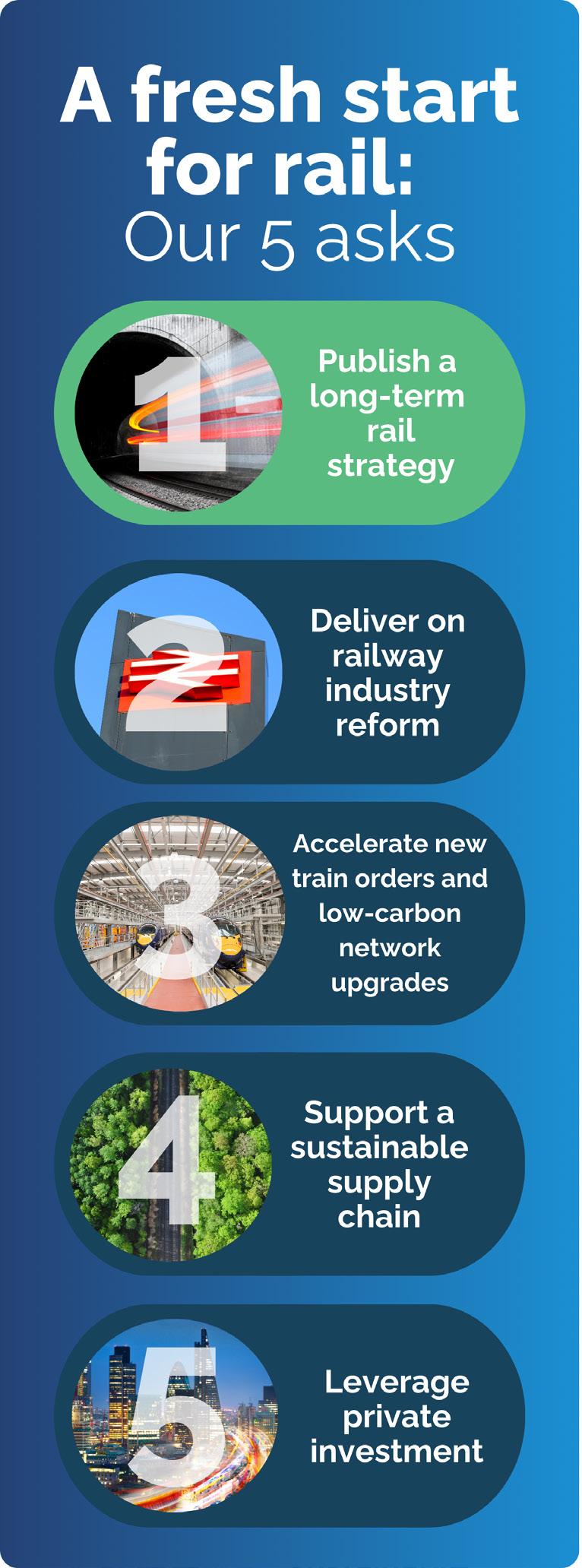
Publish a long-term rail strategythat plans for growth 1
Nearly 200 years ago, the UK led the world in developing the first railways, which powered the industrial revolution. Today, enhancing the rail connectivity of people and goods across the country is a crucial ingredient to improving prosperity across the UK.
Recent research shows that transport connectivity supports productivity growth.1 The rapid investments that other countries around the world are making in modern railway networks also underline the case for providing fast, reliable rail connections – especially between major urban centres.
In May 2024 the National Infrastructure Commission identified important rail capacity gaps between major cities such as Manchester, Birmingham, Leeds and Bristol, which risk holding back their economic growth and productivity if left unaddressed.2 We now need to develop and stick to a comprehensive long-term strategy for UK rail spanning both North-South and East-West connections. Such a strategy will provide essential context for plans developed by mayoral and other sub-national transport bodies.
The life of rail assets spans many decades, so a long-term strategy is essential for value for money and to make the right trade-offs. Making the best choices is difficult in the absence of a clear strategy. It is ultimately the strategic case for investment that should be the primary question in prioritising rail projects. Decisions should primarily be led by the need to support economic growth, connect people with jobs and essential services, and to decarbonise transport.
A clear rail strategy, beyond political cycles, is also needed to unlock the full economic and industrial potential of the supply chain. Long-term certainty encourages investment and innovation by providing confidence for businesses to invest in the skills, equipment, and innovation to meet the needs of the future railway. By planning effectively for the longer term, we reduce costs and help ensure healthy competition.
The UK has a proud history of rail exports, with many countries still looking to UK expertise to support their own networks. With a clear strategy there is significant opportunity to build on the UK’s brand, and position the UK-based rail industry for more exports. The global rolling stock market is forecast to grow from US$64bn in 2023 to US$106bn by 2031.3
A clear rail strategy, beyond political cycles is needed to unlock the full economic and industrial potential of the supply chain.

Ambition is urgently needed
With a pressing challenge to decarbonise transport networks, and a growing population, the long-term strategy needs to build on the recent Government commitment to grow freight by 75% to 2050. It should also set ambitious targets for sustained passenger growth, given passenger demand is set to grow by between 37-97% by 2050, depending on government policies.4
The potential to nearly double passenger rail travel by 2050 (compared with the pre-pandemic historic peak in rail travel) should be a clear aspiration to plan towards.
Growing rail usage is a huge opportunity to boost economic growth and productivity, but also requires significant forward planning, so that potential passengers, and freight shippers, are attracted to make full use of a modern, accessible and low-carbon public transport network.
The long-term strategy will need to be informed by, and support, wider government objectives on:
• Economic and productivity growth
• Housing development
• Low-carbon transition
• City and regional development plans, including supporting social mobility

The long-term strategy must also address the need to maintain the current network in a sustainable and high-performing condition, as well as the need to enhance rail capacity where there are pinch points or bottlenecks, such as on the West Coast Mainline.
Beyond setting out a clear vision for the future capacity and capability of the network, the strategy must also be visionary in looking at future passenger expectations, and logistics industry needs. It will need to consider technology, people, sustainability and the importance of growing revenues. The strategy therefore needs to engage and build consensus across different groups.
What is RIA doing?
RIA is actively advocating for a long-term strategy in Parliament, with Government Ministers and with the wider rail industry. This has included giving evidence at the House of Commons Transport Select Committee, voicing the view that producing a long term strategy should be made a legal requirement.
RIA has also provided cross industry thought leadership setting out important aspects of what a strategy will need to include. Our 2024 report ‘A lower cost, higher performing, net zero railway’ provides a plausible and affordable plan for rolling stock and track electrification up to 2050, with a high level of cross-industry support.5