Growing rail freight:
The need for targeted electrification
July 2026
There are many good reasons to grow rail freight – it takes pressure off the roads, boosts economic growth, ensures resilient supply chains across sectors such as food and construction, and supports energy security and decarbonisation. There now needs to be a focused plan to achieve the Government target of 75% rail freight growth by 2050.
To achieve the target, there will need to be a strategic rail freight network that is electrified. This does not mean electrifying the entire UK railway; a previous RIA report found that electrifying a further third of the network for passenger traffic would also electrify 95% of freight traffic. On these critical routes, freight trains need electric traction power to be able to carry bigger loads and reach the average speeds that avoid them getting in the way of passenger services. While electrification involves upfront investment, it will reduce the whole-life cost of the railway.
As the Government brings forward plans for rail investment, the Railway Industry Association, in conjunction with the Rail Freight Group and the Railway Engineering Institution (RailEI), with research undertaken by the University of Birmingham, has identified a number of practical proposals to maximise the potential for electric freight haulage. The research established that battery only locomotives are not a substitute for electrification but hybrid (electric and battery) locomotives have a role in specific situations.
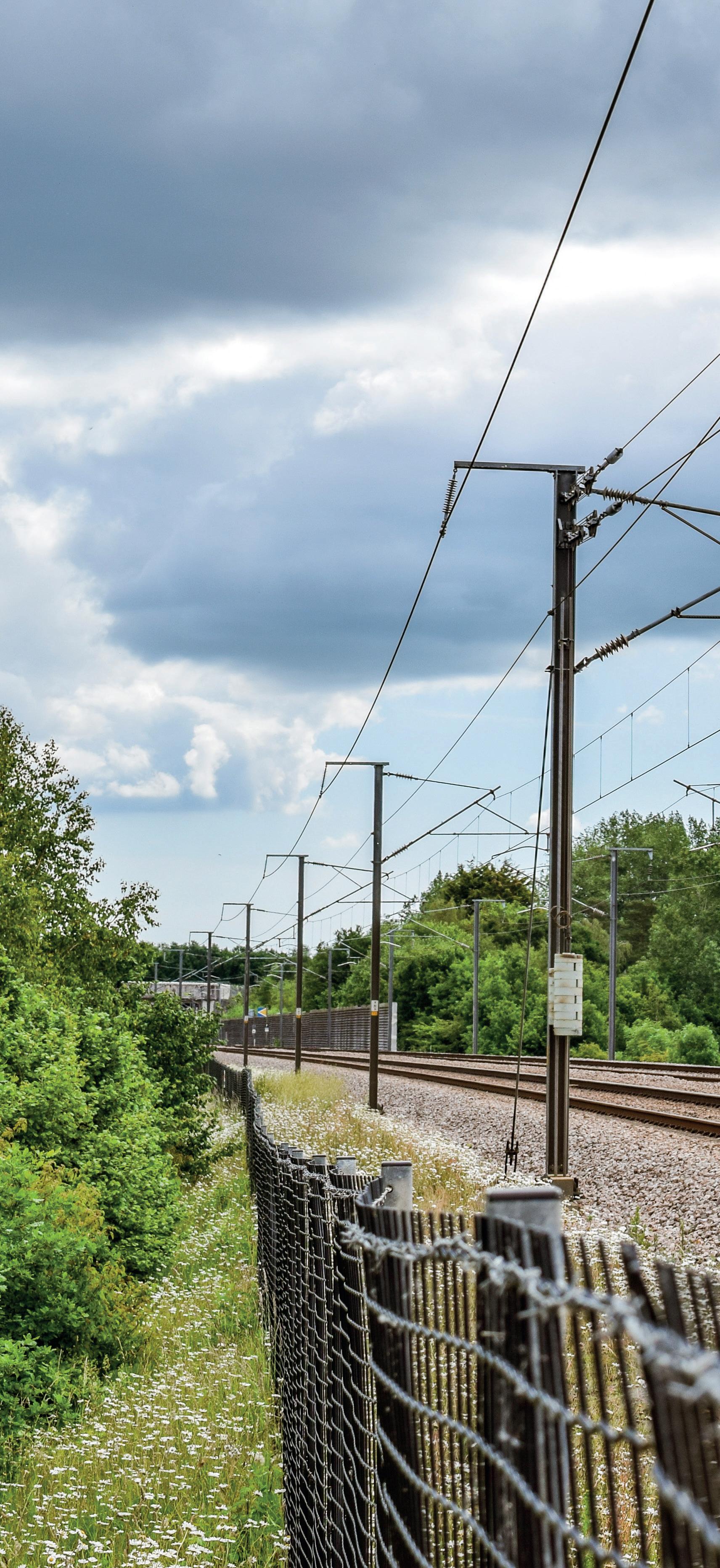
Electric railways deliver better performance and lower costs for passengers, freight, and taxpayers
Rail electrification is proven technology for high-volume passenger and freight transport. It improves performance, lowers whole-life costs, and offers strong long-term value. This is why many countries around the world have electrified their railways.
Rail freight is a strategic economic asset for the UK
Rail freight is a major but often under-recognised contributor to the UK economy. It moves a quarter of all containerised goods from the nation’s ports, delivers £2.45 billion in economic benefits, and removes 1.6 billion lorry kilometres from the road networkii
A single freight train can carry the equivalent of 76 HGVs on average and emits 76% less CO2 per tonne than road freight (diesel locomotive compared to diesel lorry, electric trains are even cleaner with zero lineside CO2 emissions).
Around 90% of rail freight’s economic benefits are felt outside London and the Southeast, supporting communities and industries across the UK.
Rail freight supports national priorities including housing, infrastructure, economic transformation, resilience, and energy security. With government aiming to grow rail freight by 75%, maximising electric freight will be essential.
Rail investment benefits both passengers and freight
Freight and passenger services share the same network, so investment for one often benefits the other. Electrification, modern signalling, and targeted infrastructure upgrades can improve speed, reliability, and capacity across the railway.
That is why freight should be fully considered in the Department for Transport Operator’s Rolling Stock and Infrastructure Strategy. Electrification can create more capacity and more train paths for both freight and passengers, offering a major opportunity for Great British Railways.
Immediate opportunities to maximise rail freight, support growth, and benefit passengers
Increasing the share of electrically hauled freight trains, using both existing electric locomotives and new bi-mode (electric and diesel) fleets, would deliver immediate operational and economic benefits.
More capacity for freight and passengers
On mixed-traffic routes, capacity is often limited by infrastructure and differences in train speed. On the West Coast Main Line, where around 90% of intermodal freight runs, diesel freight trains climb steep gradients much more slowly than passenger services. This reduces available capacity.
Electric freight locomotives, including bi-modes operating electrically under the wires, offer greater power and acceleration. That means faster climbing, higher average speeds, and more available train paths for both freight and passenger services.
Faster, longer, and more frequent services
Electric freight locomotives typically offer around twice the power of diesel. They can move longer trains, increase payloads, and have the potential to cut journey times by two to three hours on routes between England and Scotland helping operators make better use of locomotives and wagons and supporting freight growth. Research is now underway to consider how freight trains could be accelerated, and what the benefits are of doing so.
Recommendation 1
To increase the use of electric and bi-mode locomotives, GBR should:
- Consider how it can provide discounts for or incentivise the use of electric haulage or otherwise support the costs of new locomotives
- Ensure the pricing of electric haulage is competitive relative to diesel
Recommendation 2
To maximise the value of existing electrification, GBR should:
- Infill identified short sections to create more end-to-end electrified routes
- Review and improve existing power supplies to enable freight to operate wherever wires are available
Medium-term opportunities to maximise rail freight, support growth, and benefit passengers
As the Rolling Stock and Infrastructure Strategy develops, freight needs should be considered alongside passenger needs. If passenger electrification expands to cut costs, improve performance, and support decarbonisation, it should also be designed to unlock freight benefits.
Electrification infrastructure needed for passenger trains
The Chartered Institute of Logistics and Transport has identified the electrification needed to allow 95% of freight trains to run electricallyiii. Aside from a small number of infill schemes and terminal connections, most of this infrastructure is also needed for passenger services. Therefore, including freight benefits in the case for passenger electrification would strengthen the business case further.
The RIA Electrification Cost Challenge 2.0iv report also shows that costs could fall by around a third compared to a best practice project today if electrification is delivered through a rolling programme rather than the current stop-start, project-by-project approach.
Also, a clear integrated strategy from Great British Railways would give freight operators greater confidence to invest in electric and hybrid locomotives as diesel fleets approach replacement.
Recommendation 3
To ensure new electrification schemes are designed to support freight, GBR should:
- Ensure that the specification for new passenger electrification schemes (including power supply) supports freight use on any route that freight currently operates on or is likely to
- Consider the location of gaps in discontinuous electrification and discrete charging provision to support freight operations, including consideration of gradients and long-term battery hybrid potential
- Work collaboratively to identify incremental additions to passenger electrification schemes which would fill in freight electrification gaps