SP O SIG TLIG NA HT LL ON ING
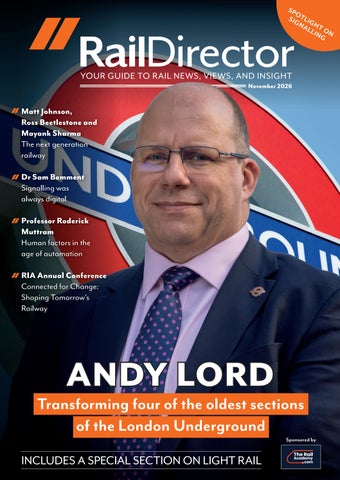
YOUR GUIDE TO RAIL NEWS, VIEWS, AND INSIGHT November 2026
Matt Johnson, Ross Beetlestone and Mayank Sharma The next generation railway Dr Sam Bemment Signalling was always digital Professor Roderick Muttram Human factors in the age of automation RIA Annual Conference Connected for Change: Shaping Tomorrow’s Railway
ANDY LORD
Transforming four of the oldest sections of the London Underground Sponsored by
INCLUDES A SPECIAL SECTION ON LIGHT RAIL
3
INTRODUCTION
Signals of progress W
elcome to the latest edition of Rail Director. I write this as we near the end of autumn and the challenges associated with falling leaves make way for colder weather and winter issues (highlighted personally to me by the need to clear my car’s windscreen of frost). This month the magazine is focused on signalling with the cover feature Andy Lord, Transport for London’s Commissioner, discussing the 4 Line Modernisation project, which is the biggest resignalling project ever undertaken on the Underground network. “Some of the best signalling engineers in the world, both in TfL and Hitachi, have been involved in this over many years,” explains Andy. “I’m not sure anybody will ever embark on something quite as big and complex in the future.” You can read more about it from page 12. Another major signalling project is the £1.4 billion Government-funded East Coast Digital Programme, which will see traditional lineside signals replaced with a system that tells train drivers on an in-cab computer screen how far and how fast they can travel. Digital in-cab signalling recently started being used by passenger trains on the East Coast Main Line. Network Rail’s Matt Johnson, GTR’s Ross Beetlestone, and Siemens Mobility’s Mayank Sharma explain more with Matt saying: “At the heart of each stage of the project is a collective passion to ensure there is no impact to passengers and minimum to no impact to signaller workload, and it is tremendously satisfying when we keep achieving that.” Read the full conversation from page 6. From page 18, Dr Sam Bemment, from Universal Signalling, writes about how implementing innovative alternatives in the interim of European Train Control System (ETCS) might accelerate ETCS adoption. Alongside the signalling focus, there is a special section on light rail. It’s been fascinating to hear about the work of UKTram and the Light Rail Safety and Standards Board, alongside conversations with Interim Managing Director of Merseyrail Suzanne Grant, and Tom Joyner, the Managing Director of KeolisAmey Luas. You can read the light rail section from page 44. This month we also feature a review of the recent Railway Industry Association Annual Conference, once again delivering a fantastic two days with some great speakers. What made this year’s event particularly interesting was the opportunity to quiz rail industry leaders and what felt like more optimism among the hundreds of attendees in the journey ahead for the sector and its suppliers. You can read the review from page 88. I hope you enjoy the latest edition. A big thank you as always to the Rail Director team for their fantastic efforts and to everyone appearing in the magazine. Next month will be a special combined December and January magazine focused on the year ahead with a special section on HS2. Stay warm and safe.
A big thank you as always to the Rail Director team for their fantastic efforts and to everyone appearing in the magazine
Danny Longhorn Editor
Rail Director magazine and Railbusinessdaily.com are assets owned by the Railway Industry Association. Railbusinessdaily.com delivers more than 70 stories a week to +50,000 rail industry professionals in our daily 7am newsletter. If you have not already subscribed, it’s free and it’s easy to do so at www.railbusinessdaily.com, please also encourage your colleagues to do the same. This is the very best way to keep abreast of what is happening on the UK’s railways. There is a digital copy of Rail Director on our website.
LIFTING
SERVICING
TRAINING
RAIL LIFTING JACKS
MOBILE RAIL LIFTING JACKS
With over 40 years’ experience of high quality, heavy duty vehicle lifting, Totalkare combines world class products with industry leading support to facilitate effective maintenance and repair.
HEAVY DUTY SYNCHRONISED
For more information or to request a site visit:
RELIABLE
November 2026
4
CONTENTS
6
6
The next generation railway
Digital in-cab signalling has recently been used by passenger trains on the East Coast Main Line for the first time. Rail Director talks to Network Rail’s Matt Johnson, GTR’s Ross Beetlestone, and Siemens Mobility’s Mayank Sharma about the milestone and the journey ahead.
12 Transforming four of the oldest sections of the London Underground
Transport for London Commissioner Andy Lord discusses the Four Lines Modernisation project, and what is to come on the network.
18 Signalling was always digital
84
Dr Sam Bemment argues if implementing innovative alternatives in the interim might accelerate ETCS adoption.
24 Human factors in the age of automation
The current President of the IRSE Professor Roderick Muttram discusses royal recognition and his focus for the year.
28 The return of SigEx
The Railway Industry Association event will take place later this month featuring conference sessions and ample networking opportunities.
36 The future of rail under one roof: Rail Innovation Exhibition 2027 A look ahead to next year’s Rail Innovation Exhibition.
88
44 Edinburgh’s integrated public transport network
Edinburgh Trams has recently been recognised among the UK’s very best public transport operators. Chief Executive Sarah Boyd reflects on the success and discusses the integration with Lothian Buses.
52 Successful first year for light rail Skills Hub
Marlene Pearson-McGrath, Head of Learning and Competency at the Light Rail Safety and Standards Board, reflects on the first 12 months of its Skills Hub.
56 Raising the bar
Merseyrail has been named Passenger Operator of the Year at the National Rail Awards. Interim Managing Director Suzanne Grant reflects on the success and says that there will be no resting on laurels.
November 2026
5
CONTENTS
62 Luas – under new management
After 22 years, operation of Dublin’s tram network was transferred to KeolisAmey at 2am on 1 September. It was a major change, yet hardly anyone noticed.
84 Rail’s integration challenge: Why digital transformation requires more than technology
Lee Ludlam, Sector Director Lead – Rail Systems, and Neil Warburton, Chief Technical Director – Rail Systems, AtkinsRéalis, write about delivering the railway of the future.
88 RIA Annual Conference 2026: Connected for Change: Shaping Tomorrow’s Railway
Industry leaders, influencers, international guests and policy makers all gathered in London for the Railway Industry Association’s Annual Conference 2026. Rail Director takes a look at some of the key speeches from this year’s event.
100 Rail Forum Annual Conference: Fuelling economic growth
Hundreds of people have attended this year’s Rail Forum Conference. Rail Director was among those in attendance, reflecting on some of the highlights.
112 Railway Mission: 145 years alongside the railway family
Liam Johnston MBE, Executive Director of the Railway Mission, reflects on the 145th anniversary of the organisation alongside Alan Thorpe, the longest-serving chaplain.
116 Playing a key role on some of the UK’s most significant rail programmes
AtkinsRéalis has appointed Justin Norman as Managing Director of its Transportation business for the UK and Ireland. He discusses the role, and getting the best out of the team.
122 And finally: Rail Safe Friendly celebrates major milestone
More than 150 organisations are supporting the programme’s mission to educate young people, prevent railway trespass and save lives.
November 2026
Image: TfL
Tel: 01132 082620 Sales: 07494 529 803 Editor Danny Longhorn Danny@railbusinessdaily.com Designer and Production Manager Debbie Nolan Writers Rosie Crampton Nigel Wordsworth Advertising Sales Christian Wiles Chrisw@railbusinessdaily.com Marketing Sales Sarah Hopton Sarah@railbusinessdaily.com Production Executive Mia Hargreaves Published by Rail Business Daily 2 Bond Court, Leeds, LS1 2JZ Printed by The Manson Group © 2026 All rights reserved. Reproduction of the contents of this magazine in any manner whatsoever is prohibited without prior consent from the publisher. For subscription enquiries and to make sure you get your copy of Rail Director please ring 01132 082620 or email info@railbusinessdaily.com. The views expressed in the articles reflect the author’s opinions and do not necessarily reflect the views of the publisher and editor. The published material, adverts, editorials and all other content is published in good faith.
6
SIGNALLING
The next generation railway
Digital in-cab signalling has recently been used by passenger trains on the East Coast Main Line (ECML) for the first time. Rail Director talks to Network Rail’s Matt Johnson, GTR’s Ross Beetlestone, and Siemens Mobility’s Mayank Sharma about the milestone and the journey ahead.
Digital signalling display in driver’s cab. Images: ECDP
W
ork is well under way on the £1.4 billion Government-funded East Coast Digital Programme (ECDP), which will see traditional lineside signals replaced with a system that tells train drivers on an in-cab computer screen how far and how fast they can travel. Over the long term, digital signalling will deliver more efficient, more reliable and greener services, which once complete will lead to less reliance on trackside equipment and better ability to manage the response to disruption and delays. Alongside this, the system also makes the railway even safer as it supervises the train’s speed and can bring it to a stop if needed. The scale of the transformation shouldn’t be underestimated, along with the number of organisations working together to ensure it’s a smooth journey. It’s a responsibility that isn’t lost
on Matt Johnson, Programme Manager, East Coast Ops at Network Rail; Ross Beetlestone, ERMTS Integration Manager; and Mayank Sharma, Engineering Manager, Delivery, Siemens Mobility – representatives from three of the organisations at the heart of the programme. “It’s incredibly satisfying to know that we’ve got a considerable part to play in thousands of runs and hundreds of trains running in European Train Control System (ETCS),” said Matt, who has been involved in the programme for more than twoand-a-half years. “From the work on the Northern City line (NCL) and progressing that success into Welwyn to Hitchin has been brilliant, also in the service delivery centre in York Rail Operating Centre (ROC) and seeing it become business as usual. “At the heart of each stage of the project is a collective passion to ensure there is no impact
November 2026
to passengers and minimum to no impact to signaller workload, and it is tremendously satisfying when we keep achieving that.” Ross shares the excitement, adding: “It’s a bit of a rock ‘n’ roll rollercoaster of emotions because it can be stressful at times and jubilant in other moments, but every day is different and there are different parts to play. “At the end of the day it’s the forerunner to the development of the network so it’s a massive opportunity and privilege to be involved.” Giving his reaction from a supply chain perspective, Mayank said: “I’ve been involved in this from day one and no two days have been the same, so that’s what excites you as an engineer. “You’ve got different problems to solve and different challenges every day. This is a transformational technology for the UK and being part of that implementation is really exciting.
7
SIGNALLING
“One in every third person in the UK lives in close proximity to an ECML station, so it feels like we’re making a true change to people’s lives, and beyond that helping shape the future of signalling in the UK and digital technology. I feel fortunate to be part of it.”
First use of digital in-cab signalling for services on ECML The ECML will become the UK’s first intercity main line to feature ‘no signals’ operations, and will lay the foundation for further improvements across the network. Three years ago digital signalling was installed on NCL, which is a short stretch of railway involving Great Northern and one set of trains. It was initially done as an ‘overlay’, meaning trains could be operated conventionally or with digital signalling. This stage formed a ‘pathfinder’ for the programme – to enable learning before digital signalling is used on the ECML. In late 2023 the first digitally signalled passenger trains began operating. With all relevant Great Northern drivers now trained on the system and all trains operating with digital signalling, the lineside signals have now been removed on the NCL, and the pathfinder stage is completed. Matt, Ross and Mayank spoke to Rail Director after the major milestone of digital in-cab signalling being used by passenger trains on
the ECML for the first time. The 08.05 Great Northern service to Moorgate on Monday 31 August this year was the first passenger train to use the new system on the main line as it was signalled out of Welwyn Garden City station. After the huge amount of work that had taken place to get the programme ready, Matt, who looks after the signallers and controllers at York ROC when it comes to ETCS, was quite comfortable on the day of the first service. “We just wanted to get going and see the trains running in Level 2 on the ECML,” he said. “And as things stand, when we’ve had incidents, the signallers have responded as they’ve been trained to and they have done a really good job in keeping trains running and the level of performance as it was prior to the overlay going live.” Despite his confidence in the work, Ross was a little more nervous. “We got to a really good place with knowing how the operation side of it would work, and we’d done a huge amount of testing, with GTR involved with Siemens Mobility, so we’d seen how the trackside works, how it was different to the NCL and what it would do,” he said. “We had a pretty positive idea of how the first day would operate and how straightforward it would be, although I still had a few nerves standing on the platform at 8am thinking ‘is this train going to have a problem pulling out of the platform?’
November 2026
Matt Johnson
Ross Beetlestone
Mayank Sharma
8
SIGNALLING
York technical support
“We were very happy, it’s all gone very smoothly, and the drivers have taken everything in their stride.” Mayank also emphasises the huge amount of work that went into the preparation leading up to the commissioning. He added: “The past experience on the NCL was important, again working with GTR, but also having that continuity and accountability across different stakeholders. “As Ross said, there’s always going to be that nervousness with the first train after
It’s a bit of a rock ‘n’ roll rollercoaster of emotions because it can be stressful at times and jubilant in other moments, but every day is different and there’ are different parts to play
commissioning but there was a lot of preparation that took place and we had enough cover. Thanks to all that hard work, everything went positively and it’s been good since.” This first stage in the use of the ETCS on the ECML now sees Great Northern’s modern Class 717 fleet transition in and out of the system when entering and leaving the Welwyn to Hitchin area. The 15-mile section has been successfully commissioned as an ‘overlay’, meaning trains can operate through it using either conventional or digital in-cab signalling, allowing drivers to be trained in the technology. More fleets and passenger services will begin using the in-cab system from 2027. “We tested through the NCL, that’s with a GTR 30mph running railway, but now we’ve come into a world where you are talking 800 trains a day in that area, including many at 125mph,” Matt said. “It’s a huge change to implement and to be able to just start that platform to put a Class A safety system on the ECML with multiple operators is brilliant. “It means we now need to focus on rolling out the upcoming fleets with multiple operators there and keep building on this success.” Ross said: “We are an ETCS operator already with the NCL and on the Thameslink ‘core’ route between London Bridge and St Pancras. The important part for us was making this more ‘business as usual’ and looking ahead to the wider impact with the ECDP, the forerunner to the rest of the country’s eventual rollout. “This is the beginning of the future, particularly
November 2026
for us as an operator as we have other routes that are going to start getting ETCS as well, so it’s going to become the norm for us and it’s another good stepping stone towards that.” Mayank said: “For us it was a huge achievement building on what we’ve done on Thameslink and NCL, but this was on a different scale. It has allowed us to build that confidence and Siemens being the technology partner for digital signalling going forward.”
Working together as one Matt, Ross and Mayank are united in the key to the success of the ECDP, all saying it’s been down to collaboration. Ahead of the latest milestone there were frequent daily calls involving multiple parties in the programme, working together to satisfy the safety cases and get the approvals. All three say it is a level of partnership they haven’t experienced before in their extensive railway careers. “There were lessons to take from Thameslink and NCL that you only get from working closely with the likes of GTR and Siemens pulling together what was needed to be incorporated into the signaller training to ensure it is aligned for the signallers and it links with the same training for the GTR team,” said Matt. “It means should we have any incidents to deal with, we know what the appropriate response should be. “Without that level of collaboration and involvement we wouldn’t be where we are today, and that needs to continue for every operator
9
SIGNALLING
going forward to keep building on the initial success as we roll out high speed services between Welwyn and Hitchin.” Ross adds that one of the key things between the operator and Network Rail particularly has been the positive relationship born out of the work on the NCL and Thameslink. “It has allowed us to be really open and honest with each other when we’ve had problems, what’s gone wrong and how we should deal with them going forward,” he said. “This has meant all the lessons that we have learned are actually being put into practice and can inform future ETCS rollouts in other areas. “The signalling training, the driver training is all much more aligned, which is what you need for this kind of system, and it has proved to be really beneficial. “We have great working relationships with the teams in York, not just on the operational side, but the technicians as well. “With all our Class 717 drivers already being trained and able to operate straight away it meant that we’re not having a slow period with a few trains a day on the Welwyn to Hitchin East Coast Main Line stretch; we are getting on with it and allowing the system to be stress-tested, so having all these drivers trained in the first place really helps.” Mayank added: “Collaboration is always the big word and it’s important in programmes
Aerial view of first ECML ETCS train leaving Welwyn Garden City
GN drivers and ECDP reps at Welwyn Garden City
Explore what it means to be a RailEI Member.
Different journeys
Explore Letters from the Line, a collection of personal stories, experiences and career journeys shared by Members from across our railway engineering community.
Vivi Mar
inou
gin oject En Senior Prtwork Rail Ne
A strong, supportive community
eer,
Neferti Siddons
mmunity d the coespecially g, also foun “I'veedibly welcomincareer. ” my incr early in
Senior Track Design Engineer, Mott MacDonald
Scan
to read letters
Alex Tomlinson
l Engineer, Graduate Civi Jacobs
Your story starts here.
Discover RailEI membership at www.railei.org
Your story could be next
rail_e_i
November 2026
rail-ei
railei.est1884
10
SIGNALLING
Collaboration is always the big word and it’s really important in big programmes like this not just specific to the commissioning, but leading up to it
like this not just specific to the commissioning, but leading up to it. “The relationship we built with GTR and Network Rail, the testing is quite intrusive. Without the support of all the stakeholders it would be near impossible to achieve what we’ve achieved.”
Next steps In the 2030s the East Coast Main Line South is expected to be fully operated using ETCSfitted vehicles. There’s still a lot of hard work to get to that stage with the coming years seeing the upgrades progressively rolled out on the southern section of the ECML and eventually all conventional lineside signals removed. As for next year, Matt says they will be looking at some of the high-speed operators, including Grand Central (whose Class 180 fleet has received authorisation for placing into service for the first in class fitment of ETCS), LNER and GTR’s Class 700 fleet. “The priorities for us in an ops function is that
In cab view
Grand Central 180 test train on Welwyn Viaduct
November 2026
the Class 717s, while they do in part cover between Welwyn through to Hitchin, they’re not covering that area as frequently as the Class 700s; they’re going from Langley Junction to Stevenage or Welwyn South to Welwyn Garden City,” Matt explained. “What we’ve got to do is manage refresher training there, and continue with the training that we’ve already developed about how you deal with incidents like point failures and axle counter failures. That will produce a slightly different process in an ETCS world that we’re not utilising right now because of it covering such a short geography along there. “We need to make sure we’re ready to respond to these types of incidents when we start bringing in the Class 700s, the Grand Central Class 180s, as well as the LNER Azuma fleet there next year.” From a GTR perspective, the big challenge will be the operator’s Class 700 operation. Ross says this will start off quite small in scale for drivers who are competent on the Class 717s before being ramped up, especially as they’ll also receive an onboard upgrade to the latest 3.6.0 baseline ETCS software used by the Class 717s. “We’ve got quite a lot of work in that space from an engineering, safety assurance perspective, but we’ll also start ramping up our training,” explained Ross. “We’ve got hundreds of drivers that are trained on the Thameslink ‘core’ section, however the ETCS is slightly different on that and they don’t have so much ETCS degraded operation. “There’s a lot of reversion to conventional signalling there if there are any issues. We will start training for that as well, so there’ll be a gradual ramp up in our trains using ETCS and we will also bring the Class 387’s first in class online. “We’ve got the testing for that coming up as well so there’s some quite big milestones for us in that sphere of things because the class 700 is a large fleet at a high speed.” Mayank adds that from a Siemens Mobility perspective, they will be supporting the operators to bring in the new classes of trains and pathways to utilise its offset capability using its digital twin labs to do the testing off site and then a level of testing on site. “That’s one sort of major multiples of milestones, getting all the operators ready for driver training,” he said. “Following that we’ll be looking at the next iteration of trackside deployment. On the next job, we’ll be looking to go straight to no signals where the true benefits of digital signalling would start appearing, reducing costs, reducing maintainable assets etc. “That’ll be a new challenge because they’ll be first of its kind to go straight to no signals on the UK railways. It should be quite exciting and challenging.” The ECML will be the UK’s first intercity main line to feature ‘no signals’ and will lay the foundation for further improvements across the network. https://eastcoastdigitalprogramme.co.uk/
11
ADVERTORIAL
Creating safer outcomes through effective rail risk management Advice from Sam Palmer, Account Executive at Jobson James Rail.
S
trong safety performance begins with understanding risk. Regular risk assessments allow organisations to identify hazards, adapt to changing site conditions and implement appropriate control measures before incidents occur. A proactive approach is essential. Equally important is investment in competence and communication. Alongside formal training and certification requirements, toolbox talks, safety briefings and lessons learned sessions play a vital role in reinforcing safe behaviours and sharing best practice across the rail supply chain. These ongoing conversations help keep safety front of mind and ensure both employees and contractors understand emerging risks and their responsibilities. Providing the correct PPE is another key consideration. Effective protection extends far beyond issuing a hi-vis jacket. Workers must be equipped with suitable rail-safe PPE that reflects the specific risks of their environment and the activities being undertaken. Supported by
regular inspection, maintenance and training, appropriate PPE remains a critical component of workplace safety. However, procedures and equipment alone do not create a safe workplace. Organisations achieve the strongest safety outcomes when they foster a culture in which employees feel confident reporting concerns, sharing near misses and contributing ideas for improvement. Open communication helps identify issues before they escalate and embeds safety into everyday operations. Regular review is equally important. Policies,
SPECIALIST INSURANCE FOR RAIL INDUSTRY SUPPLY CHAIN COMPANIES Infrastructure
Manufacturers
Rolling stock
Maintenance
Contractors
Consultants
Jobson James Rail
45 Church Street, Birmingham,B3 2RT and London One Creechurch Place, London, United Kingdom, EC3A 5AF. 07816 283949
info@jjrail.co.uk
www.jjrail.co.uk
Jobson James Rail is a trading name of Howden UK Brokers Limited, which is authorised and regulated by the Financial Conduct Authority No. 307663. Registered in England and Wales under company registration number 02831010. Registered Office: One Creechurch Place, London, EC3A 5AF. Calls may be monitored and recorded for quality assurance purposes. HUBL-CC-CS-JJR-005-1024
November 2026
procedures, and emergency plans should evolve alongside operational changes, regulatory requirements and lessons learned, helping organisations maintain compliance and drive continuous improvement. For organisations seeking to strengthen their approach to risk management, access to informed advice can be invaluable. At Jobson James Rail, we continue to invest in developing our people and strengthening our understanding of health and safety. I recently achieved the NEBOSH National General Certificate in Occupational Health and Safety, further developing the expertise available to support our rail clients. This enhanced understanding of health and safety enables us to have more informed conversations around risk, compliance and resilience. By combining effective safety practices, specialist sector knowledge and appropriate insurance protection, rail organisations can build resilience, safeguard their teams and focus on delivering a safer future for the industry. Contact Sam Palmer 07849 646689
12
SIGNALLING
Transforming four of the oldest sections of the London Underground Transport for London Commissioner Andy Lord discusses the Four Lines Modernisation project, and what is to come on the network.
L
ondon’s Circle, District, Hammersmith & City and Metropolitan lines are being transformed in what is the biggest resignalling project ever undertaken on the Underground network. The four lines, together making up around 40 per cent of the Tube network, are among some of the oldest sections of the Underground network, with parts dating back to 1863. Some equipment used on the lines is old and needs to be replaced, with the Four Lines Modernisation (4LM) project introducing new technology that is already having an impact, reducing journey times and making it possible for Transport for London (TfL) to run more trains. “I’m really proud of what we’ve achieved, It’s already making a huge difference in regards to safety, capacity and customer benefits,” Transport Commissioner Andy Lord said. “It’s probably the most complex digital resignalling of a legacy railway in the world and includes some of the most complex junctions that an underground system has. “Some of the best signalling engineers in the world, both in TfL and Hitachi, have been involved in this over many years. I’m not sure anybody will ever embark on something quite as big and complex in the future. The only other railways that probably have that sort of complexity are New York and Paris.” Work to install a new communications-based train control signalling and control system began in summer 2016, allowing the trains to be driven automatically, with a train operator in the cab to open and close the doors, provide customer service and focus on safety. The new signalling technology (similar to that introduced on the Jubilee and Northern lines) also enables trains to be run closer together, making it possible to operate 32 trains an hour in the central section. 4LM is much more than a resignalling project. The £5.4 billion investment involves the introduction of new trains that are longer, walkthrough, more spacious, have improved audio and visual information, air-conditioning and bigger doors; and the replacement of old and worn out track and points and new drainage. “People forget they were the first air-
Image: Siemens
conditioned trains on the Tube, which is even more important after the summer we’ve just had now,” said Andy, who has been involved in the project since he was appointed Managing Director of London Underground in November 2019. “The subsurface railway counts for 40 per cent of the Tube network. So having those trains is transformational and made a huge difference through the summer. The whole programme has really made a difference for London’s residents and also visitors to the capital city.” In August this year, TfL went live with signal migration areas 10 and 12, which means the District line is now finished. “So actually, 4LM is now one line modernisation because the Circle, the Hammersmith and City and the District are complete,” Andy said. “That was quite significant in that phase because it also included enhancing customer information for customers on the Wimbledon branch. “Before that, we did signal migration area 8, which is one of the most complex because it has interoperability with the Jubilee line. So between
November 2026
Finchley Road and Preston Road and also the area that includes Neasden Depot, which is the largest depot on the Tube network. “That was a really complex programme and we’ve worked incredibly collaboratively with Hitachi, who bought Thales GTS before that. So it’s progressed well. It’s delivered significant capacity benefits for us, particularly in central London. “We’re now operating 30 to 32 trains an hour in the core section. There’s journey time benefits as well for customers, which is very noticeable for customers on the Metropolitan Line.” The programme is now entering its final phases, with two more migration areas that are the last elements of the Metropolitan line. “The next one’s quite complex because that includes the area where Chiltern Railways run as well, so we’re working very closely with the train operator and Network Rail in readiness for that,” Andy said. “We’re still waiting to confirm the date for that, probably in the new year. And that will be a significant milestone for us. “It’s been a huge technical investment that has delivered real customer benefits, real
Transport Benevolent Fund CIO
All about people...
people working in public transport
Help and support for you, your live-in partner and dependent children during times of need
A comprehensive range of health, welfare and financial support for less than 20p per day.
JOIN ONLINE TODAY www.tbf.org.uk
Registered charity: England and Wales 1160901, Scotland SC047016.
14
SIGNALLING
It’s probably the most complex digital resignalling of a legacy railway in the world and includes some of the most complex junctions that an underground system has safety benefits, and really enhanced the underground network. We now have well over 60 per cent of the underground automated, which I think is a fact that not many people know.”
Jewel in the transport crown It’s one of several ambitious projects transforming transport in London. In August, TfL welcomed the first of 10 new Elizabeth line trains into passenger service, supporting increased passenger demand (including for HS2’s Old Oak Common station when it opens). “The Elizabeth line is the jewel in our transport crown, continuing to outperform expectations,” Andy said. “It has carried more than 900 million passengers since it opened and is regularly carrying more than 800,000 every day, making it the fastest growing railway in the UK, if not in Europe, delivering really high customer satisfaction and service performance.” Alongside the benefits to those travelling in London, Andy says the new trains also highlight the impact the investment has on the wider UK economy. The trains are being built at Alstom’s Derby factory, with its supply chain supporting almost 40 companies across the UK, totalling more than 1,000 employees. “It’s created a real lifeline for the historic site in Derby, the last rolling stock engineering design facility in the UK,” he said. “So I’m really proud of the fact that we’ve played a part in maintaining that. “The first two trains are now in service, performing really well and giving us much-needed capacity to enable the first of our trains to go through heavy maintenance. “They’ll play a key role in us increasing our frequency from May next year, which will see services in the central section increase from 24 trains an hour to 28 during the peak, with some additional services from the east. “Then the current plan is that from May 2028 we’ll increase services to Heathrow, enabling us to go up to four trains an hour to terminal five, which
Image: TfL
will deliver much-needed capacity to the airport as well. “Of course, this is a precursor for us to being able to provide 18 trains an hour to Old Oak Common when the Great Western platforms are available. We’re pushing hard to be able to operate services into there, ahead of HS2 completion.”
Supply chain At the heart of TfL’s success is its supply chain. The organisation spends about £6 billion in the UK with 3,172 suppliers, which supported £5.3 billion in Gross Value Added (GVA) and 92,580 jobs. The economic impact of TfL’s supply chain expenditure is widespread, with a significant portion of spending occurring outside of London, supporting jobs and economic growth across the UK. “The Elizabeth line itself has delivered huge economic benefit to the country adding an estimated £42 billion to the UK economy, 71,000 new homes within a kilometre of Elizabeth line stations, and then there is the impact on the wider supply chain,” Andy said. “Research has shown we’re accountable for about 100,000 jobs across the UK. The 10 additional Elizabeth line trains themselves secured the future of Alstom in Derby. “We’re really proud of the impact and the benefits that we deliver as a result, which reinforces that investment in TfL and by TfL benefits the entire country.” And that is something the Transport Commissioner is keen to continue in the future, backed by the recent agreement with Government of £2.2 billion over four years to modernise London’s rail network with rolling stock upgrades, signal improvements, new train fleets, and infrastructure renewal. “That gave us the ability to go to our board to receive approval for a four-year business plan,” he said. “We’ve got several ambitions in there with some
November 2026
of the most relevant including the new DLR rolling stock already being rolled out, and the Picadilly line upgrade, with new rolling stock from Siemens being assembled in Goole in East Yorkshire, which has created regeneration for that area. “On the latter we’ve got four of those trains in test now in London and are working through a few issues collaboratively with Siemens, working to get the train into passenger service as soon as we can. “They are going to be transformational for our customers – the first deep Tube trains with air conditioning, live customer information, walkthrough capacity and fully accessible. “Then we’ve got ambitions around things like our step-free programme and our wider renewals and we are making the case to get further investment from Government to renew and maintain our existing assets, which is the most critical thing that we need. “Overall there are lots of opportunities for the supply chain, with plenty in the pipeline already. We need to invest even more. There’s a lot of focus on new assets, which is exciting for growth, but alongside that we must maintain and invest more in our existing assets.” Andy highlights that some infrastructure is 160 years old, and the Bakerloo rolling stock is more than 50 years old. “We’ve got to continue to invest in those fleets while they are still in service, but we’ve got to renew and replace for the future as well,” he said. “There’s also all the infrastructure with a huge amount of track, signalling, stations and built environment, depots. We’ve got to invest in all of it, lifts and escalators, you name it. “After Network Rail, we’re the largest infrastructure manager in the country, but we have the broadest set of assets. We have more escalators than any other organisation in the UK. “We’ve got to invest a lot of money into those to replace, repair and maintain them going forward. We need additional support from the Government and for the excellent supply chain to work with us to help us make that case.”
I studied marketing but found my passion in rail. Now I’m an apprentice train engineer, helping to transform rail in Scotland. Conor, Technical Support Engineer Apprentice
siemens.co.uk/scotland
16
ADVERTORIAL
Proving dead: Why voltage detection remains a critical step in railway electrical safety For rail infrastructure operators, getting electrical isolation right is only part of the safety process. Experts at PENTA Electrical Safety Products explain how verifying the absence of voltage with suitable equipment and following approved procedures are essential to protecting the people working on the railway.
R
ailway electrification has transformed the way people and goods move across the UK, but it also presents significant electrical safety challenges for the engineers and maintenance teams responsible for keeping the network operational. Whether work involves overhead line equipment (OLE), conductor rail systems, substations or associated electrical infrastructure, the consequences of coming into contact with energised equipment can be severe. For those responsible for planning and delivering maintenance, establishing that equipment is safe to work on is therefore a fundamental priority. A critical part of this process is proving dead: verifying that the relevant electrical conductors are not energised before work begins, in accordance with the applicable railway rules and safe working procedures.
Why isolation is not enough Electrical isolation is a fundamental control, but operating an isolator or establishing that a supply has been disconnected does not, by itself, prove that equipment is safe to touch. There may be multiple sources of supply, unexpected electrical connections or other circumstances that need to be considered as part of the isolation process. Depending on the system and working environment, induced voltages or backfeed from another source may also need to be addressed. Railway infrastructure presents additional complexities because different electrification systems operate at different voltages and use different arrangements for isolation, testing and earthing. The UK’s mainline railway includes 25kV AC overhead electrification and nominal 750V DC conductor rail systems, alongside other electrical installations. Each requires equipment and procedures appropriate to the particular system. For maintenance teams the lesson is clear: electrical safety depends on following the complete approved process, not making assumptions based on the apparent status of equipment or the position of a switch.
Images: PENTA
The role of voltage detection A suitable voltage detector is an essential part of verifying the absence of voltage. However, its effectiveness depends on selecting the correct equipment for the application and using it in accordance with the manufacturer’s instructions and the relevant railway procedures. Before work begins, authorised and competent personnel must establish the correct isolation arrangements and identify the conductors to be tested. The detector must be suitable for the system’s voltage, AC or DC characteristics, and the intended method of use. Functional checks are equally important. Where required by the applicable procedure and equipment instructions, the detector should be proved to function correctly before testing; used
November 2026
to verify the absence of voltage at the prescribed test points; and proved again afterwards. This helps establish confidence that the instrument was functioning throughout the test. The precise method, approved equipment and sequence of checks must always follow the relevant railway electrical safety rules. A detector reading alone does not replace the wider isolation process or any required application of earths and short circuits.
Choosing equipment for the railway environment Selecting a voltage detector for railway applications requires more than checking its maximum voltage rating. The equipment must be appropriate for the
17
ADVERTORIAL
electrical system and the conductors being tested. Compatibility with the relevant AC or DC supply, suitable interfaces or contact arrangements, operating conditions and compliance with applicable standards all need to be considered. The practical working environment matters, too. Railway electrical work can involve restricted access, outdoor exposure, challenging weather and limited maintenance windows. Equipment must be suitable for its intended environment and maintained in accordance with manufacturer guidance. Procurement and engineering teams should therefore consider the complete application rather than treating all voltage detectors as interchangeable. A detector designed for one electrical system should never be assumed suitable for another simply because it can display a voltage reading. Clear equipment identification, appropriate inspection arrangements and access to the manufacturer’s instructions can also help personnel establish that the correct instrument is being used for the task.
Preparation before the possession Railway possessions place considerable pressure on planning and coordination. Work must be completed within an agreed window, often involving multiple teams, activities and dependencies. Electrical safety checks must never be rushed to recover lost time. However, preparation can help reduce avoidable delays while preserving the integrity of the safe working process. Before the possession begins, teams can establish whether the required voltage detection equipment is available, appropriate for the planned work and in a suitable condition. Relevant inspections, maintenance arrangements and equipment checks should be addressed in line with the applicable procedures. Responsibilities, isolation requirements and the sequence of work should also be clear to those involved. This preparation helps reduce the risk of discovering at the point of work that equipment is missing, unsuitable or requires attention. More importantly, it supports a consistent approach to electrical safety across maintenance teams and locations. Making voltage detection part of a wider safety culture Proving dead is not an isolated action. It sits within a wider framework of competent personnel, authorised isolation, appropriate testing, earthing where required and compliance with railway rules. Equipment suppliers have a role to play in supporting this framework by providing clear technical information about product capabilities, limitations, intended applications and maintenance requirements. For operators and contractors, choosing suitable voltage detection equipment and
ensuring that personnel understand its correct use are important elements of managing electrical risk. As railway infrastructure continues to evolve, maintaining these fundamentals remains essential. New projects, changing assets and increasingly complex maintenance requirements make it particularly important that equipment selection and working procedures remain aligned with the electrical systems encountered on site. Ultimately, proving dead is about replacing an assumption with a verified condition. By combining appropriate voltage detection equipment with robust procedures, competent personnel and thorough preparation, railway organisations can support safer working practices while maintaining the reliability of the infrastructure on which passengers and freight depend. PENTA Electrical Safety Products offers a range of voltage detection instruments designed to support electrical safety across demanding working environments. Selecting the correct voltage detector for the electrical system, application and working environment is an important part of an effective safe working strategy. Combined with appropriate training, inspection and established railway safety procedures, reliable voltage detection equipment plays a valuable role in supporting safer maintenance operations across the rail network.
November 2026
Combined with appropriate training, inspection and established railway safety procedures, reliable voltage detection equipment plays a valuable role in supporting safer maintenance operations across the rail network About PENTA Electrical Safety Products Based in Corsham, Wiltshire, PENTA Electrical Safety Products specialises in electrical safety solutions, including substation earthing products designed to support the safe operation and maintenance of electrical infrastructure. www.pentaesp.com
18
SIGNALLING
Signalling was always digital
Digital signalling has become a marketing label for European Train Control System (ETCS), but signalling has always been digital, and some of Britain’s rural lines have had cost-effective in-cab signalling for over four decades. Secondary routes might wait another four decades for ETCS, leaving obsolescence and performance to be managed in an increasingly funding-constrained environment. Counterintuitively, implementing innovative alternatives in the interim might accelerate ETCS adoption, argues Dr Sam Bemment.
A
sk those in rail what ‘digital signalling’ means, and the answer will likely be ETCS. In media coverage, including magazine articles (other than this one), the two terms have become synonymous. Ask most customers what ‘digital signalling’ means, and they are more likely to cite it as the reason they are taking rail replacement buses. Both responses are understandable. ETCS is the industry’s chosen long-term successor to conventional mainline signalling, a sensible position given its interoperability and capability. The East Coast Digital Programme is steadily progressing implementation on one of the country’s most complex routes. This is not a simple like-for-like system replacement; it is an entire organisational and operational change programme, and growing pains are inevitable. But railway signalling was digital long before ‘digital’ became a synonym for ‘computerised’. In its dictionary sense, ‘digital’ simply means information represented as discrete states: ones and zeros, true or false. A signal is either on or off. A track circuit reports occupied or clear. Relays pick and drop. There is nothing new about ‘digital’ in signalling. Strip away the marketing, and at its core, ‘digital signalling’ really refers to in-cab signalling: a movement authority issued over a radio link, rather than via a lineside aspect and Mk1 eyeball. In-cab signalling systems can deliver impressive performance benefits whilst driving significant cost savings. The caveat is that they will only achieve both
simultaneously if appropriately specified for the railway they serve. Requiring that rural lines prematurely adopt solutions designed for the full demands of busy mainline operations will likely achieve neither, however valuable network-wide interoperability may be. The irony is that Britain’s rural railways demonstrated benefits and savings simultaneously by adopting an appropriately specified in-cab signalling system before ETCS even existed on paper. Radio Electronic Token Block (RETB) entered service in the 1980s. It is digital in-cab signalling by any sensible definition. Roll-out followed a relatively short period of development by talented British Rail (BR) Research and private-sector staff. Their achievement is even more impressive given the railway economics of the time: an era of rationalisation and managed decline, with the ever-present threat of line closures. RETB is far from perfect; it is a compromise solution with acceptable operational drawbacks. But its deployment rescued rural railways when the choice was radical innovation or line closure. Today, the choice is rarely so stark, with line closures seldom on the table. The threats facing rural lines are slower and quieter, chief among them obsolescence. Systems are approaching, or in many cases past, life-expiry, becoming Images: Universal Signalling
November 2026
0845 838 7178 www.onebigcircle.co.uk
Critical Infrastructure Monitoring enquiries@onebigcircle.co.uk
AIVR transforms infrastructure monitoring across the UK rail network, delivering cost and time savings, safety improvements, and enhanced efficiency across all disciplines.
Ops, Safety & Performance
Lineside
Signalling
E&P: Conductor Rail
Track
E&P: OLE
Fleet & Rolling Stock
Vegetation Encroachment
Assisted Signal Sighting
Track Inspection Imagery
Rail Head Defects
Rail Defects
Track Components
Rail Profile
Track Geometry
Ballast Conditions
OLE Monitoring
OLE Height & Stagger
Conductor Rail Monitoring
Overheating Assets
OLE Seasonal Preparation
Structures Examinations
Ballast Scanning
Book a Demonstration enquiries@onebigcircle.co.uk
www.onebigcircle.co.uk
20
SIGNALLING
Top: The Universal Signalling team together in Derby after completing successful trials of low-cost rural signalling equipment in Wales and Borders Above: With portable equipment available, occasional track users such as Colas Rail’s market-leading ballast regulators (pictured) can operate freely on rural lines without expensive, type-specific cab fitments
The irony is that Britain’s rural railways demonstrated benefits and savings simultaneously by adopting an appropriately specified in-cab signalling system before ETCS even existed on paper
ever harder and more expensive to support. Failures will increase, eroding performance as equipment reaches the far end of the bathtub curve, a process that every front-line engineer knows and dreads. The Long Term Deployment Plan (LTDP) aims to align ETCS rollout with signalling renewals and new fleet introductions, avoiding the cost of retrofitting or renewing twice wherever possible. That is sensible, but the result is that many secondary routes sit at the back of a decades-long queue. If, they make the queue at all. The timing of obsolescence will vary between installations, but what is clear is that, in their current form, a large proportion of rural signalling systems are unlikely to be performing adequately right up until their scheduled ETCS replacement date, and that is before making reasonable allowance for replacement dates moving to the right. Nor is bringing ETCS forward on rural lines the answer, at least until costs are under control. The economics are sobering. The pilot ETCS fitment on the Cambrian was primarily funded to derisk more complex future projects. A contract value of £113 million fitted around 135 route-miles and 27 traction units. This is approaching £200 million in today’s money, or £1.5 million per route-mile served. It is worth stressing this was a pilot: costs are heavily influenced by rolling stock fitment
November 2026
and usually fall with experience. Rail Engineer later reported that the ETCS software made operation more constrained than under the RETB it replaced, underlining that appropriate specification is vital. More striking is that the system is already scheduled for hardware renewal during this control period, a lifespan of just 15 to 18 years. It is unlikely any rural business case could justify such investment once, let alone renewals on such a short cycle. Industry thinking holds that, with ETCS as the endgame, investment in any other system is wasteful. Running two or more systems might cost more, whilst preventing the full benefits of standardisation being realised. This is where I must disagree. The cost of running two systems is real, but it must be weighed against the cost of doing otherwise: ageing systems failing, rural line closures, or ETCS investment made before the industry, the technology and the cost base have matured. After all, the desirability of in-cab signalling arises from the benefits it brings, not the system adopted, which is merely a vehicle to achieve them. If ETCS cannot yet deliver those benefits affordably on rural lines, and existing systems are approaching obsolescence, then the conclusion now is the same one BR Research reached nearly 50 years ago: we need an alternative, specified according to the needs of the railway, not selected via solutioneering. As a minimum, such an alternative could offer a ‘temporary’ answer for the next four decades, keeping costs and performance under control until ETCS reaches all corners of the network. More significantly, it could prove the saviour of rural lines that face another ‘innovate or close’ moment, should ETCS remain unaffordable. At best, it might swing the business case for reopening lines that have already lost that argument. In any case, an appropriately specified alternative will help ensure ETCS rollout to more mainlines, faster, by enabling limited human and financial resources to be directed to where they deliver greatest value. For these reasons, I believe our industry now has little to lose, and much to gain by examining an alternative. But what properties should it have? Acknowledging that this is ultimately a business decision rather than a technical one, I see six critical requirements: 1. Reusability and forward compatibility: As many elements as possible must be reusable in future systems, reducing or eliminating parts of the cost base of whatever follows. 2. Cost: Costs must be comparable to those of operating, maintaining or incrementally upgrading existing systems, making the change broadly budget-neutral. 3. Human resources: Deployment must employ as few engineers and project staff as possible, so as not to compete with ETCS programmes for scarce skills.
21
SIGNALLING
4. Deployment speed: Signalling project lifecycles must be radically shortened. Speed is of the essence to deliver a strong benefits case; waiting decades for an interim solution means the opportunities are missed. 5. Overlay capability: Being able to overlay a new system, to test and commission it while the original still provides protection, eliminates the disruptive blockades that would disproportionately impact rural communities. 6. Incremental benefit realisation: Investment is easier to justify and secure in incremental steps, with each step proving benefits within a short timeframe, rather than one big re-signalling initiative with first outcomes decades away. Each requirement deserves an article of its own, so I shall explore only the first here. Genuine reusability is closer than ever, for two very ‘digital’ reasons: Moore’s law on the train, and EULYNX at the trackside. Moore’s law observes that the computing power available for a given cost and size doubles roughly every two years. ETCS onboards were specified when safety-critical electronics filled whole racks; yet today, a smartphone has more processing power than a typical onboard unit. Safety certification, not processing power, sets the
pace, but compact, removable and/or batterypowered equipment is now feasible in a way it was not a decade ago. Rural lines typically run the oldest rolling stock, and fleets nearing cascade or retirement are often deemed uneconomic to permanently fit. Portable equipment removes that barrier. Fit the fleet now and move the kit to a successor later. Minimising rolling stock modifications saves money, but the bigger prize is fitment options that permanent installation could never economically offer. EULYNX, an initiative of European infrastructure managers, standardises the interfaces between signalling subsystems. Its original aim was to free buyers from procuring a whole system from a single supplier. With standard interfaces, each subsystem can be bought competitively, with confidence that the parts will work together safely. Arguably, it should have preceded the European Rail Traffic Management System (ERTMS). For interim solutions, it offers a further benefit. An alternative specified with EULYNX interfaces leaves reusable assets behind: a future re-signalling scheme need not replace lineside axle counter evaluators or points controllers. Money spent now delivers benefits now, and the eventual move to ETCS costs far less, whenever the industry, or the fleet, is ready for that step. My conclusion is somewhat counterintuitive. For rural and secondary lines, we should deploy non-
The rapid, cost effective lower carbon alternative to conventional concrete
Reduce Line Possession. Protect Assets. Register For the Rail Webinar Today.
concretecanvas.com | info@concretecanvas.com | +44 (0) 345 680 1908
November 2026
ETCS digital in-cab solutions that offer a clearly defined upgrade path to full interoperability, as a matter of urgency. Crucially, this is not a call for new money: funded from budgets already committed to keeping ageing systems running, it can be broadly cost-neutral in the near term. Over the longer term, this approach could accelerate ETCS uptake elsewhere, while reducing the cost of both maintaining current systems and eventually fitting ETCS itself. In the meantime, we can deliver real improvements for the people who use those lines every day, in a regular, incremental fashion rather than waiting decades for a single leap. Every day of delay erodes the benefits case, so let’s get going. With luck, we might even do it without a single rail replacement bus.
Fit the fleet now and move the kit to a successor later
22
UK RAIL NEWS
Network Rail report predicts that major British railway stations will generate £1.5bn a year by 2036
N
etwork Rail says annual customer spending across 19 key British rail stations is forecast to reach £1.49 billion by 2036 – a 45 per cent increase. The infrastructure manager added that this increase would be driven by rising customer numbers, growing leisure travel, evolving food and beverage offers and the increasing influence of wellness, which is set to become one of the most significant growth sectors reshaping the role of Britain’s stations. The findings come from a new Network Rail report, The Future of Stations 2036: Retail, F&B, Leisure and the Wellness Dividend, which was released earlier this month. Harriet Hepburn, Corporate Finance, Partnerships and Retail Director at Network Rail said: “The next 10 years is set to be a defining decade for station retail, food and beverage (F&B), health and wellness and leisure experiences. “As Great British Railways (GBR) and our brands reimagine what’s possible and our network spreads to stations large and small across the country, we are on the journey to provide our customers with world class travel environments.” The report predicts that annual visits across its managed 19 stations, including London Waterloo, London King’s Cross, Birmingham New Street, Manchester Piccadilly and Glasgow Central are expected to exceed 870 million by 2036. It suggests that this combination of strong customer growth alongside transformational shifts in consumer behaviour, leisure travel and wellbeing will see stations evolve from places people simply pass through into destinations where customers increasingly shop, eat, socialise and spend time.
Image: Network Rail
While F&B will remain the anchor of station retail, the report identifies wellness as one of the most significant growth opportunities over the next decade. Health and wellness-related sales currently generate £95.4 million, accounting for 8.9 per cent of total station sales, and are forecast to rise to £123.6 million by 2036 – 30 per cent growth over the next 10 years. The report draws on insights from Network Rail’s retail category leaders, retailers, industry experts and forecasters to examine how the next decade will be defined by making railway stations more compelling destinations. Network Rail added that the traditional boundaries between customers, shoppers and local residents will continue to blur, with weekday commuters also travelling for leisure at the
A decade of “See it. Say it. Sorted.”
Passengers have helped the British Transport Police (BTP) record almost 83,000 crimes over the past decade, by texting 61016, according to new figures released as the “See it. Say it. Sorted.” campaign reaches its 10th anniversary. Since its launch in 2016, the campaign has become one of the most recognised public safety messages in the country, encouraging passengers to trust their instincts and report anything that doesn’t feel right to the BTP. This has led to real action – more than 200,000 texts are now sent to the British Transport Police each year using 61016, and last year saw an almost tenfold increase since the campaign was launched in 2016. These texts alone – more than 1.5 million exchanged over the last 10 years – have led to more than 175,000 police deployments across the rail network. British Transport Police Chief Constable, Lucy D’Orsi, said: “The free, discreet service allows passengers to report crime, suspicious behaviour and sexual harassment directly to us, enabling swift action to keep people safe and bring offenders to justice.”
weekend, and wellness influencing how people live. Harriet added: “For our brands, the opportunity is significant. Success will depend on understanding a range of customer needs, creating offers that complement dwell time, removing friction for customers and delivering engaging experiences that cannot be replicated online. “This evolution comes at a pivotal moment for the railway sector. As GBR takes shape, bringing track and train together under unified leadership, its future estate is expected to encompass around 2,500 stations across Britain, creating an unprecedented opportunity to reimagine the role stations play within communities and in everyday life.”
Siemens opens new state-of-the-art rail infrastructure technology and innovation centre Siemens has officially opened its new, state-of-the-art manufacturing and research facility in Chippenham, marking a £100 million investment in the UK’s rail infrastructure. The opening was attended by UK Prime Minister Andy Burnham and Secretary of State for Transport Heidi Alexander. The new site at SouthPoint Business Park serves as a global centre of excellence for signalling and control systems, replacing the historic neighbouring facility. The transition to the new facility, including the transfer of all 800 local staff, was completed without any interruption in production. This milestone highlights the critical role of advanced digital technology in creating a more resilient, efficient, and sustainable railway. The Transport Secretary said: “Siemens Mobility’s new rail technology centre is a real boost for Chippenham and a vote of confidence in Britain’s rail industry. The digital signalling produced on site will help our railways become more reliable and safer, whilst strengthening our skills base by supporting hundreds of local jobs and apprenticeships.”
November 2026
23
SAFETY
Men are being encouraged to talk. But are we ready to listen? International Men’s Day is celebrated annually on November 19, focusing on men’s contributions to society and wellbeing. To mark the occasion, Dave Brown, Head of Rail at Samaritans discusses what happens after people do open up and talk.
I
s it enough, though? That’s the question I keep returning to. As a society, we’re becoming more comfortable encouraging men to talk about what’s bothering them, share their feelings and not face their struggles alone. And that’s a good thing. I welcome it. But is it enough? The statistics tell us there is still a long way to go. Suicide rates amongst men remain high, with men more than three times as likely to die by suicide as women. That stark disparity has persisted for around three decades. That matters for rail, which remains a heavily male-dominated industry. Around 81 per cent of the workforce is male, compared with just over half of the UK workforce overall. We know that some roles involve exposure to traumatic incidents and difficult situations. Add to that everything people may be dealing with outside work – relationships, bereavement, ill-health – and conversations about wellbeing can’t sit entirely separately from working life. Encouraging someone to talk is a good start, but sharing can be difficult, especially when you’re going against a lifetime of being told how to behave – from ‘big boys don’t cry’ through to ‘just get on with it’. And this is the part where the ‘just talk’ narrative falls down. What do you do when someone does talk? How should you respond? That question sits at the heart of what we do at Samaritans. With more than 70 years’ experience of listening, we’ve learnt a few things about what helps when someone shares what’s going on for them. And for the last 11 years, alongside my day job, I’ve also been one of those volunteers, picking up the phone to people in distress at all hours of the day and night. One of the most important things I’ve learnt is that while the issues troubling someone can be incredibly complex, our response when they share them doesn’t need to be. In fact, some of the simplest responses can make the biggest difference. I remember talking to a driver at Rail Live a few years ago. He came over to the Samaritans tent and, after a bit of ordinary conversation, began talking about a difficult incident he had experienced. I didn’t have an answer for what had happened to him. I couldn’t make it unhappen and I wasn’t there to tell him how he should feel about it. What I could do was listen. Give him the space to talk
Image: Samaritans
about what it had been like for him. Ask a few simple questions. Not shy away from what he was telling me. That is often what people need from us. Not the perfect words, because the perfect words seldom exist. Not someone who can solve everything, because who can? Just someone who is prepared to listen and can stay with the conversation. It’s also about recognising when someone might need more support and knowing how to help them access it. It’s an approach we’re building into our refreshed Trauma Awareness Training course, which launches in January and is CPD-accredited. We’ve completely redesigned it to help rail colleagues understand responses to trauma and build confidence in having supportive conversations in the workplace. It also helps people understand what their role is, what it isn’t, and how to signpost someone towards further support when they need it. Because if we’re going to keep telling people that it’s good to talk, we have to think just as seriously about what happens next. We need workplaces where speaking up is met by people who are able to listen. Where managers don’t feel they need to be counsellors or have all the answers. Where colleagues have the confidence to stay with the conversation rather than back
November 2026
About
Every 10 seconds, Samaritans responds to a call for help. Samaritans volunteers are available roundthe-clock to listen and support people. They won’t judge or tell you what to do. Anyone in crisis can contact Samaritans, free, any time from any phone on 116 123, even a mobile without credit. This number won’t show up on your phone bill. Or you can visit www.samaritans.org Samaritans is a charity and it’s the public’s kind donations and around 23,000 volunteers that mean it can always be there for anyone struggling to cope.
away because they’re scared of getting it wrong. And employers have a responsibility to make sure that support is available when a conversation highlights that someone needs more help. Getting men to talk matters. Being ready when they do talk matters just as much. https://www.samaritans.org/how-we-can-help/ workplace/samaritans-network-rail-trainingcourses/
24
SIGNALLING
Human factors in the age of automation The current President of the IRSE, Professor Roderick Muttram, discusses royal recognition and his focus for the year.
H
is Majesty King Charles III has recently approved the grant of a Royal Charter of Incorporation to the Institution of Railway Signal Engineering (IRSE), recognising its longstanding contribution to railway engineering, professional competence and public safety. The international professional engineering institution represents more than 5,000 members, with activities spanning more than 50 countries and territories. Its work supports the development of professional knowledge, technical standards and competence in railway signalling, telecommunications, train control and related disciplines. “This is a tremendously significant moment in the history of the IRSE and it is a great pride to see an institution with such dedicated volunteers and such expertise recognised,” said Professor Roderick Muttram, FREng FIRSE, the organisation’s current President and Chair of the Council. “For more than a century, our members have contributed to the development of the systems, knowledge and professional standards that help keep railways safe. We are small compared with other institutions, but we punch well above our weight in terms of our technical contribution, and our contribution to the safety of the public, evidenced by this recognition.” The Royal Charter is the oldest form of incorporation, predating limited companies, and is largely reserved now for organisations which, as well as serving their membership, serve the public good - something in keeping with the IRSE’s strapline of ‘protecting the safety of all those who travel and work on railway systems worldwide’. “My first exposure to the IRSE was being taken to the 1994 launch of the licensing scheme (independent competence assurance scheme for people working on the track and doing safety critical work),” he said. “It was developed in response to the Clapham accident in 1988, which was caused by a technician not properly terminating a wire and the wire falling onto its original terminal, causing a false feed. “At the time, I was Director of Electrical Engineering at Railtrack. Having come from the defence industry where structured competence management and traceability of modifications is built into everything you do, I was quite shocked
Images: IRSE
to find how unstructured it was within the railway at that time. “The licensing scheme is vital, and it’s part of our public benefit work that we provide this independent assurance of the competence of people working on safety critical activities, not just on the track, but in design and other areas as well. “Rail is pretty unique and despite it having been around hundreds of years it is a very
November 2026
complex system of systems, and we have a unique competence challenge that is only growing with the advent of machine learning and AI. We have to maintain competence across a huge range of technologies.” With that in mind, Professor Muttram’s theme for the year is ‘human factors in the age of automation’, something he says was concisely summed up by Sarah Sharples the former Chief Scientific Advisor to the Department for
25
SIGNALLING
Transport. Presenting at his inaugural presidential lecture, she observed that ‘humans are both error prone and brilliant’. Professor Muttram added that that’s why we have ATP systems, and that’s why we have all kinds of procedural controls and technical controls on the railway to prevent disasters being caused by human errors. “Humans are error prone and that’s why we put systems in place to prevent or mitigate the consequences of those errors, but humans are also brilliant and we can solve problems in a way that even a learning machine at the moment probably can’t,” Professor Muttram said. “An example Sarah mentioned was the miracle on the Hudson River, in which the plane pilot Sully Sullenberger, having lost both engines due to bird strikes, did not obey the manual, instead using his knowledge and experience to firstly start the auxiliary power unit. By the book, that would have been done much later in the sequence which in this case would have led to the plane crashing. That’s an example of human brilliance. “He was initially criticised afterwards until people analysed the accident and realised that what he did saved the aircraft. Our job as engineers and our job as an institution is to minimise human error and maximise human brilliance and that’s the thinking behind the theme of human factors in the age of automation.” Professor Muttram says there’s confusion
around what the incoming technology really is. He believes the systems that are causing concern, these large language models, (AI that is getting close to general intelligence and almost capable of mimicking a human), are not going to be the systems the industry will be using for most of the tasks being done on the railway. That is agentic AI. “The term ‘AI’ covers a huge range of capability,” he said. “We also use the word autonomy, well, my company was developing autonomous systems in the defence industry in the 1980s and 1990s and they didn’t use machine learning and that’s why I try to encourage people to use the terminology machine learning rather than AI when talking about these new systems. “The difference with these machine learning systems is that they are not structured either in hardware or software terms, they are based on neural networks similar to a human brain and you don’t programme them, you teach them. “You have a learning programme and much of the assurance that’s being done both in these large language models and in the people who are developing the control systems in the automotive industry is based on reinforcement learning and empirical testing. “Reinforcement learning is great. It’s very powerful. But we don’t know what the internal structure of these machines is. We don’t know where the data is stored. There are also good examples of where these machines can forget.
Your Rail Data Made Better...
Humans are error prone and that’s why we put systems in place to prevent them from errors, but humans are also brilliant and we can solve problems in a way that even a learning machine at the moment probably can’t
An
solution
Combine Data from Multiple Streams View CCTV Footage Live and Review Recorded Footage View and Validate Passenger Count Data Versatile Secure Sharing to Your Stakeholders Apply y Analytics, Support Operations, Understand Demand
...In One Integrated Platform. November 2026
Get in touch today enquiry@adcomms.ltd
ADComms adcomms.ltd
26
SIGNALLING
It’s a super tool, but you’ve still got a surgeon validating whether the answer is sensible or not
We have to develop a whole new methodology for assuring systems using this kind of technology. “At the moment we must be very wary of using them in any safety critical application. There are many areas where they can be a very good analysis tool, but I’m nervous about stepping up into using them in any safety critical application because we don’t know how to predict their behaviour.” With that in mind, he is keen this year to highlight to the industry the benefits to be gained by sharing experiences instead of maintaining commercial confidentiality. “This is a whole new world and we don’t have the structures that we had to develop when we moved into computer-based interlockings,” he said. “There was the tripartite agreement in which British Rail Research had a contractual relationship with what at the time was GEC and Westinghouse and between them they developed SSI (Solid State Interlockings) concepts and validation. “They shared all the information and both the supply companies were licensed to make the hardware and maintain the software, and when I took over as Director of Electrical Engineering
November 2026
back in the early privatisation days I inherited that relationship. “There are a lot of those early computer-based systems still in service. In pure computer terms they are very old, but they are far from being our oldest systems. “They’re actually still some of the more recent hardware so we’re faced with maintaining a broad spectrum of competence, whereas the technologies that we use are moving at an enormous pace, so there’s a real dilemma there. I’m keen to open up the dialogue about how this new technology can be used, and particularly how it can be used safely because there’s a risk that someone will overstep the mark, try and use it for something it’s not suitable for without really understanding it.” Despite some reservations, Professor Muttram says machine learning systems offer huge opportunities. As a Fellow of the Royal Academy of Engineering he reflects on the Enterprise Hub at Prince Philip House and a researcher from Oxford who developed software for more accurately sizing brain stents, using an AI model for sizing them, which reduces patient risk and cost. “It’s a super tool, but you’ve still got a surgeon
27
SIGNALLING
validating whether the answer is sensible or not,” he said. “We’ll see lots of that and again this is why my theme was human factors in the age of automation. Many of these processes in the medical sector are relying on the fact that a skilled doctor, or surgeon will validate the machine’s decision. When the machine’s made 1,000 consecutive correct decisions, how much concentration is the surgeon going to have on validating the answer? “Maintaining competence then becomes an issue, not just competence but also attention, so there’s a raft of issues here that we need to address as these systems come in. “There are a lot of interesting questions about maintaining attention, about job underload as well as job overload. There are many human competence and machine competence things that we need to address. “One of the things Sarah Sharples and I are working on with several others is looking at whether some of these human factors techniques that we’ve learned over the years for managing human behaviour might translate into techniques for managing the behaviour of these learning machines. As they get more and more competent, closer to Artificial General Intelligence, maybe the way in which we manage them is to just treat them like a human and use the same kinds of monitoring and controls.” Professor Muttram became the organisation’s
LIFTING
SERVICING
TRAINING
102nd President in April this year, bringing with him nearly 50 years of experience in system and safety engineering, having worked in various industries including nuclear, defence and rail. A Fellow of the Royal Academy of Engineering and the Institution of Engineering and Technology as well as the IRSE he has held senior leadership roles in Railtrack and Bombardier Transportation, before becoming an Independent Consultant at Fourth Insight Ltd more than 14 years ago. “Working in the railways has been much more complex than I thought it would be, and because of that it’s been much more interesting,” he said. “You meet such terrific and dedicated people across the industry and it’s a joy, and not just in the UK. I’ve just been out to see our sections in Australia, Thailand, Hong Kong and Singapore, we’ve got super people all around the world. “The technology is interesting because it has such a broad span. We’ve got quite a lot of new challenges coming along in managing competence, and that’s where I think the IRSE as an institution has a really good coordinating role to play. “It’s difficult for any of the contractors to do that without getting muddied by commercial considerations. I think that independence is really important when it comes to safety and competence assurance.” https://www.irse.org/
We’ve got quite a lot of new challenges coming along in managing competence, and that’s where I think the IRSE as an institution has a really good coordinating role to play
RAIL LIFTING JACKS & PIT EXPERTS Reliable lifting and testing equipment for all rail vehicle maintenance.
MOBILE RAIL LIFTING JACKS
With over 40 years’ experience of high quality, heavy duty vehicle lifting, Totalkare combines world class products with industry leading support to facilitate effective maintenance and repair.
HEAVY DUTY SYNCHRONISED RELIABLE
RAIL INSPECTION PITS INCREASE PRODUCTIVITY SAFE QUALITY LIGHTING
For more information or to request a site visit:
November 2026
28
SIGEX
The return of SigEx The Railway Industry Association (RIA) event will take place later this month featuring conference sessions and ample networking opportunities.
Images(from last year’s event): Rob Finney, unless otherwise stated
H
undreds of people will be at York Racecourse later this month for the latest instalment of SigEx. The event will take place on Thursday, 26 November, from 9am. Among the topics of discussion this year are: How can the UK accelerate the transition to digital signalling, address the backlog, and maintain reliability when funding is likely to be static? How can delivery and reliability innovations help, and what role does AI play? Are there interim solutions that could bring the benefits of Automatic Train Protection as we migrate to digital signalling? David Clarke, Senior Technical Advisor at RIA, said: “SigEX 2026 will build on last year’s event which showcased the very best of the signalling community – collaboration, innovation and a shared drive to deliver a more efficient and resilient railway. “Building on the huge success of previous editions, SigEx 2026 is open to everyone involved
in railway signalling along with professionals from other railway disciplines and related industries, including supply chain experts, clients, and Government organisations. The event will feature a mix of informative conference sessions, exhibitors and ample networking opportunities.” Every year from 2013 Network Rail hosted a Technical Conference and exhibition, allowing representatives of the signal engineering industry to hear for themselves details of the projects that Network Rail was working on and to see the innovations that various suppliers had developed. Following the pandemic, RIA took up the mantle and staged the SigEx conference and exhibition in November 2023. Such was its success it has continued annually ever since. Event partners this year are Network Rail and the Institution of Railway Signal Engineers, and Platinum sponsors Sella Controls. Speaking last year, Amar Sansoa, Product and Portfolio Manager at Sella Controls, said: “An event like SigEx provides a unique and focused opportunity to bring the signalling community under one roof, connecting people from every corner of the industry from engineers, operators,
November 2026
maintainers, and innovators, all of whom are focused on one goal: building a safer, smarter and more sustainable railway. “The conversations we have here help shape our future technology offerings, ensuring that the solutions we develop continue to meet the evolving needs of the railway.” Reflecting on last year’s event, Amar added: “What I enjoyed most about SigEx was the energy and openness across the whole event. You could feel that everyone was genuinely wanting to learn from one another and explore new ideas. “The collaboration and curiosity were refreshing to see. It wasn’t just about showcasing products, it was about discussing real-world challenges and how we can solve them together. “For me, the most rewarding part was seeing how aligned the industry is on the importance of innovation through collaboration – something we’re really passionate about at Sella Controls.” The event includes a large exhibition space. A menu of sponsorship and exhibition opportunities is available – or for more details and tickets visit riagb.org.uk/sigex2026
16 JUNE 2027 NEWARK SHOWGROUND The Big Rail Diversity Challenge is back for its 12th year! Suitable for all abilities, the event provides participants with the opportunity to network, team build and fundraise, whilst completing a series of fun - yet challenging - team activities, promoting Women in Rail’s key message: Gender Diversity: Better for People, Better for Business, Better for Rail. Join the fun with over 600 industry personnel and promote the business benefits attained when engaging a gender diverse workforce. Get in on the action today! bigrail@nimblemedia.co.uk
01780 432930
bigraildiversity.co.uk
SCAN ME BROUGHT TO THE INDUSTRY BY
/bigraildiversity
@bigraildiversitychallenge
The Big Rail Diversity Challenge
30
SIGEX
Why SigEx 2026 matters The speakers at this year’s event include James Dzimba, Chief Control, Command and Signalling Engineer at Network Rail, who will present on ‘Accelerating signalling modernisation’. He writes about why events like this matter.
T
hroughout my career, I’ve seen that some of the biggest advances in signalling have come not from individual organisations working in isolation, but from the industry coming together to tackle common challenges. The development of the original Solid State Interlocking is a good example of what can be achieved through that kind of collaboration. For me, SigEx 2026 provides an opportunity to bring the industry together around the challenges we now collectively face. At a time when we are striving to accelerate digital signalling, improve reliability, manage ageing assets and deliver more with limited resources, collaboration across the railway has never been more critical. No single client, supplier or delivery organisation has all the answers. Progress depends on sharing experience, challenging established thinking and working together to develop practical solutions. That is what makes SigEx 2026 so important. Delivered by the Railway Industry Association in partnership with Network Rail, the Institution of Railway Signal Engineers and other industry partners, SigEx 2026 brings together engineers, infrastructure managers, suppliers, project teams and technology leaders from across the sector, with a clear focus on signalling innovation. But the real measure of its success is not simply the quality of the ideas discussed. It is whether those conversations lead to tangible outcomes that help the industry move forward. This year’s theme, ‘Accelerating signalling modernisation’, reflects one of the defining challenges facing our industry: how do we accelerate the transition to digital signalling while continuing to maintain a safe, reliable, and affordable railway? How do we manage legacy assets, improve productivity, and embrace emerging technologies that can transform the way we design, deliver and maintain railway systems?
These are not challenges that any one organisation can solve alone. They require us to combine our experience, expertise, and innovation across the industry. That is the conversation SigEx 2026 is designed to stimulate, and why I believe the event matters. SigEx 2026 will take place on Thursday 26 November at York Racecourse from 9am to 4.30pm. James is due to give his keynote presentation at 10.05am. Visit riagb.org.uk/ sigex2026
SigEx 2026 provides an opportunity to bring the industry together around the challenges we now collectively face
James Dzimba. Image: Network Rail
November 2026
31
SIGEX
Team Transport: Why rail and road have more in common than we might think Adam Simmons, Director, Strategic Planning, National Highways, is among the speakers at this year’s SigEx, looking at the topic of ‘Road and rail: parallels and common challenges’.
I
have always been a fan of classic Hollywood cartoons: Tom and Jerry, Wile E. Coyote and Road Runner, Bugs Bunny and Elmer Fudd. Fundamentally different protagonists playing out ongoing rivalries. It can sometimes feel as though rail and road are viewed in a similar way. Different networks with competing priorities but both networks are trying to achieve the same thing: connecting people, communities and businesses, and getting people and goods where they need to be. Dame Sarah Storey, Active Travel Commissioner for Greater Manchester, often talks about ‘Team Transport’. How can we work together to create a truly connected transport network? One way is to learn from each other in tackling common challenges. The most significant issue we face is our ageing infrastructure. Both rail and road assets are getting older. Many of the motorways and major A roads we manage were built around 60 years ago and now need renewing to keep people and goods moving safely and reliably, while supporting future growth. Proactive renewal and maintenance reduces future costs, minimises disruption and delivers long-term value for taxpayers. Both our sectors can be seen as traditional civil engineering industries, but our digital assets are growing rapidly. Technology evolves far more rapidly than our major infrastructure assets so it frequently needs upgrading and renewing. Rail and road need to keep on top of the old
Adam Simmons. Image: National Highways
and keep pace with the new. This means having strong long-term plans in place. Just as rail does, at National Highways, we look beyond individual five-year funding periods and plan over 15 years or more. This creates opportunities to work together. We share many of the same suppliers and, by providing greater certainty over future work, we can help create a sustainable pipeline of investment, driving efficiencies and supporting innovation across both sectors. Data and technology also give us opportunities
Working together to empower a brighter energy future for the railways
November 2026
to work together as a single ‘Team Transport’. We know that our road users plan their journeys – before and during trips – using wayfinder apps like Waze and Google Maps. Rail has a long history of providing live timetable information to customers, and at National Highways we provide live data on things like roadworks and diversion routes. Furthermore, there are evolving technologies that can help improve journeys for road users. On the road, new in-vehicle technologies make journeys safer and reduce congestion. It is our job at National Highways to embrace and guide these technologies. Wouldn’t it be great if we could roll out the benefits of communicating speed limits and traffic information directly into vehicles without the constraints of deciding which parts of the network to install roadside technology? We need to seize these opportunities to continue delivering improved services to road users. Road Runner had to dodge the Acme anvils of his nemesis Wile E. Coyote. Rail and road each face their own challenges, but many are shared. By learning from one another, collaborating with our common supply chain and embracing new technology, we have an opportunity to deliver better outcomes for road users. Ultimately, whether people travel by road, rail, bike or bus, they expect a transport network that works. That’s why the future should be less about ‘Team Road’ or ‘Team Rail’, and more about ‘Team Transport’. Adam Simmons is scheduled to speak at 12.25pm on 26 November.
32
SIGEX
Agenda PROVISIONAL PROGRAMME: 09.00 Registration, refreshments and networking Exhibition opens 10.00 Welcome from RIA David Clarke, Senior Technical Advisor Railway Industry Association (RIA) 10.05 Keynote presentation Accelerating signalling modernisation James Dzimba, Chief Control, Command & Signalling (CCS) Engineer, Network Rail 10.20 Address from Platinum Sponsor Sella Controls 10.35 Delivering digital signalling better, cheaper and faster: managing the operational change and realising the benefits Sarah-Jane Crawford, Industry Partnership Director. East Coast Digital Programme (ECDP) 10.50 What good looks like: Signalling modernisation from a TOC perspective - The opportunities digital signalling and European Train Control System (ETCS) present for train operators - The challenges of implementing major signalling change on a live railway - Lessons learned from the transition between legacy and digital systems - What infrastructure managers, suppliers and the wider industry can do differently to support a smoother and more effective transition Raj Patel, Head of European Railway Traffic Management System (ERTMS), Govia Thameslink Railway (GTR) 12.50 Lunch, networking and exhibition
11.05 Shared question and answer session Sarah-Jane Crawford and Raj Patel 11.15
14.10 Telecommunications past, present and future Graham Smith, Network Head of Telecommunications, Network Rail
Exhibitor spotlights Featuring three-minute presentations from exhibitors including AtkinsRéalis and Bender UK
14.25 Panel discussion What does the industry need to do differently in order to be successful? Phil Bennett, Commercial Director, Route Services, Network Rail James Dzimba, Chief CCS Engineer, Network Rail Raj Patel, Head of ERTMS, GTR Rob Warnes, Strategic Development Director, Northern Railway Chaired by: David Clarke, Senior Technical Advisor, RIA
11.25 Refreshments, networking and exhibition 11.55 International benchmarking of signalling costs: lessons for the GB network Bogdan Godziejewski, Immediate Past President, Institution of Railway Signal Engineering (IRSE) 12.10 Speed Management Programme: progress and next steps Darren Jowett, Head of System Authority, Network Rail 12.25 Road and rail: parallels and common challenges Adam Simmons, Director, Strategic Planning, National Highways
15.15 Afternoon session wrap-up by RIA 15.30 Networking drinks reception 16.45 Close of SigEx 2026
Please note that the programme and speakers are subject to short-notice change, due to circumstances beyond the control of the organisers.
November 2026
34
ADVERTORIAL
What If Michael O’Leary ran the railway?
James Watson, Managing Director at ticketing tech specialist OnTrack Retail, looks at what Britain’s rail industry could learn from Ryanair.
I
magine for a moment that Michael O’Leary, the famously outspoken Chief Executive of Ryanair, was appointed to run Great British Railways (GBR). Within weeks, one suspects, there would be outrage over the removal of first class, uncomfortable questions about staffing costs and suggestions that passengers should pay extra to use the toilets. The railway unions would be apoplectic. Politicians would demand his resignation. The headlines would write themselves. But beneath the controversy lies a serious question. What could Britain’s railway learn from an airline that has fundamentally changed the economics of European travel? Ryanair is not universally loved but it has made flying affordable for millions, built an enormous customer base, and developed an operating model that competitors have spent decades trying to replicate. Perhaps there are lessons worth considering.
The railway’s complex fares and reservations data alongside restrictions on accessing and using it make such experiences unnecessarily difficult to deliver. Rail retailing remains focused on answering “How much is A to B?” rather than “Where could I go?” The lesson: don’t simply sell tickets to people already planning to travel. Inspire journeys that otherwise wouldn’t happen.
Image: OnTrack Retail
Passengers don’t necessarily need to love the railway. They need Start with what passengers value Ryanair understands something many businesses a railway that struggle to accept. Customers don’t necessarily want everything a company thinks they should gives them good want. For millions of rail passengers, the priorities are straightforward. An affordable reasons to keep ticket, a convenient departure and a reasonable expectation of arriving on time. choosing it Meanwhile, the railway has accumulated layers of complexity, from bewildering fares and restrictions to retail systems seemingly designed around the industry’s internal structures rather than its customers. O’Leary might ask a brutally simple question. Why should buying a train ticket be more complicated than buying a flight? The lesson: design the railway around what passengers value, not what the industry has become accustomed to providing.
Treat cost as a competitive advantage Ryanair’s obsession with efficiency is legendary. Not because cutting costs is inherently virtuous, but because lower costs enable lower fares, greater demand and sustainable profitability. Consider rail retailing. Consolidating today’s overlapping systems presents an opportunity to reduce costs and benefit from economies of scale. But a single platform is only as efficient as its procurement, design and operation.
One suspects O’Leary would have little patience for elaborate specifications and technology programmes that take years to deliver. The lesson: efficiency isn’t simply about spending less. It’s about ensuring every pound delivers value.
Fill the empty seats An empty airline seat represents revenue that disappears forever once the aircraft departs. The same applies to rail. Ryanair stimulates demand through dynamic pricing, marketing and making travel attractive to people who might otherwise stay home. Rail already uses Advance fares but could go further. The airline industry’s approach to fares and availability data enables consumers to ask, “Where can I fly for £100?” and discover dozens of potential European getaways. Now imagine a passenger in London asking, “Where can I go by train for £50 this Saturday?”
November 2026
Make rail the obvious choice For decades, our industry has talked about the need to get people out of their cars, but rarely do I hear anyone ask a different question: “How do we make rail travel such a compelling proposition that choosing another form of transport feels foolish?” It’s a subtle but fundamental difference. Ryanair hasn’t become Europe’s largest airline by asking people to fly more often for the good of the aviation industry. It has done so by making air travel affordable and accessible to millions who might otherwise have chosen a different way to travel or not travelled at all. Imagine GBR adopting that same commercial mindset. Rather than simply encouraging people to leave their cars at home, what if we concentrated on making rail so affordable, convenient and reliable that driving became the less attractive option? The lesson: don’t ask passengers to choose rail because they should. Make rail so compelling that they choose it because they want to. The railway doesn’t need Michael O’Leary Of course, rail has wider responsibilities than Ryanair, including accessibility, regional connectivity and essential public services. But dismissing its commercial methods because the industries differ would be a mistake. Passengers complain about baggage charges, customer service and relentless upselling. Yet millions return because Ryanair delivers what they value most. And therein lies a lesson for GBR. Passengers don’t necessarily need to love the railway. They need a railway that gives them good reasons to keep choosing it. About: OnTrack Retail delivers cutting-edge ticketing technology and custom software solutions for train operators across Britain. www.ontrackretail.co.uk
35
ADVERTORIAL
Start learning from Very Light Rail innovation T
he Government’s Mass Transit Taskforce has an ambitious challenge: help Britain deliver mass transit faster, more efficiently and at lower cost. Its remit includes emerging technologies such as Very Light Rail (VLR). But while debate centres on future innovation, Charlie Merrell, PR and Marketing Consultant, asks if we are learning enough from what already works? For more than 17 years, the Stourbridge Shuttle has demonstrated VLR in daily passenger service. Connecting Stourbridge Junction and Stourbridge Town, it provides a reliable, frequent service using lightweight railcars at lower operating costs than conventional heavy rail. It is a mature public transport operation, offering evidence on passenger demand, vehicle performance, maintenance, reliability, infrastructure, resilience and customer acceptance.
Such knowledge cannot be replicated through modelling and feasibility studies alone. Rather than asking whether VLR can work, the Government’s Mass Transit Taskforce should ask what has been proven, which lessons can be applied elsewhere and what barriers remain. Stourbridge’s experience can inform realistic operating budgets, service frequencies, depot requirements and integration with the wider railway. Local proposals such as the Dudley Dasher seek to build on that knowledge, bringing affordable, scalable connectivity to places where conventional light rail may be financially challenging. The taskforce should turn this experience into practical policy. Firstly – VLR should be recognised alongside conventional tram and metro systems, helping authorities select
November 2026
technologies suited to local needs and budgets. Secondly – affordable, scalable options should be considered from the outset of rail reopenings, regeneration schemes and urban transport projects. Thirdly – approval, governance and procurement requirements should be proportionate to each scheme’s scale and complexity. Smaller projects need a realistic route from proposal to passenger service. Stourbridge offers a valuable starting point for understanding both the opportunities and limitations of VLR. Britain does not need to begin every transport conversation with a blank sheet. It should use the operational knowledge already available to make better decisions about what comes next.
36
EVENTS
The future of rail under one roof: Rail Innovation Exhibition 2027 A look ahead to next year’s Rail Innovation Exhibition.
Images: Innovate UK
N
ow in its fifth year, the Rail Innovation Exhibition 2027 is expected to welcome more than 500 delegates and 70 exhibitors from industry, Government, research organisations and trade bodies to explore emerging rail innovations. Delivered by Innovate UK in partnership with the Department for Transport, the exhibition offers a unique opportunity to discover cuttingedge innovations, hear from industry leaders, and connect with organisations driving change across the railway. The event will showcase technologies that could improve the efficiency and delivery of railway services while supporting economic growth across the sector. It will also highlight innovations designed to enhance passenger experience and rail safety, as well as decarbonisation and environmental performance.
Taking place from 9am to 5pm on 24 February 2027 at the QEII Conference Centre in London, the event will begin with a morning plenary featuring leading industry speakers. Rail Minister, Lord Peter Hendy CBE, will deliver the keynote address. Attendees will also hear from Marta Berryman, Principal Technology Systems Engineer at GBRX, Daisy ChapmanChamberlain, Rail Services Lead at Rail North Partnership, and Natasha Marsay, Accessibility and Integration Manager at Network Rail. In the afternoon, attendees will be able to explore the work of more than 70 exhibitors, including British Transport Police; Rail Forum; the UK Rail Research and Innovation Network; Rail Business Daily; the Global Centre of Rail Excellence; and London St Pancras Highspeed. The event will also showcase previous winners of the First of a Kind rail competition, who will
November 2026
present their innovations and answer attendees’ questions. Extensive networking opportunities will enable attendees to connect with key organisations and innovators from across the rail sector. Participants can also use B2Match, an online networking platform, to connect with other attendees and arrange meetings before the event. The event is aimed at people working across the rail industry, Government, research organisations and trade associations, as well as anyone interested in improving railway services and exploring how emerging technologies can support the UK’s long-term rail ambitions. Find out more and register for a free place at the Rail Innovation Exhibition 2027. https://iuk-business-connect.org.uk/events/ rail-innovation-exhibition-2027/
37
HÜBNER GANGWAY SYSTEMS:
Custom Retrofit & Refurbishment Services Maximise the lifetime and operational value of your fleet with bespoke retrofit solutions designed to enhance efficiency and sustainability.
VISIT OUR LINKEDIN PAGE AND STAY CONNECTED.
SCAN ME
Keep Railway Stations Moving with Klüber
Reliable lubrication for demanding station enviornments.
Escalator & Passenger Conveyors
Automatic Doors
Gearboxes
Kluberoil C 1-150
Barrierta L 25 DL
Specially developed for the lubrication of escalator drive chains, helping operators maintain reliable performance in outdoor and mixed indoor/ outdoor environments.
Developed for demanding railway and transport door applications. It provides dependable performance in environments exposed to frequent cleaning and washdown conditions.
Klübersynth GH 6 Series Fully synthetic gear oil designed for heavily loaded industrial gearboxes, providing reliable protection, long oil life and reduced maintenance requirements.
Visit our site to learn more. Contact: info.uk@klueber.com
November 2026
38
ADVERTORIAL
Taking aim at the multi-billion-pound rail maintenance sector
Buoyed by a recent Network Rail contract, Machines With Vision is now targeting the global rail maintenance sector with its innovative technology. Founder and Chief Executive Officer Anthony Ashbrook and Chief Technology Officer Jon Owen explain more.
Network Rail’s ultrasonic test unit fitted with Machines With Vision’s RailLoc Sensor crossing Glenfinnan Viaduct. Images: Machines With Vision
M
achines With Vision has set its sights on the global rail maintenance sector after securing a multimillion, multi-year contract with Network Rail, which could save the infrastructure manager thousands of hours and reduce its workers’ exposure to slips, trips and falls. Beyond the significant financial cost, inaccurate defect location can also create a serious safety risk, unnecessarily exposing rail workers to potentially hazardous trackside environments as they search for defects that have been identified but cannot be precisely located. “Rail networks are complicated and dangerous environments and the safety of workers and the general public is paramount,” Anthony Ashbrook, Founder and Chief Executive Officer, said. “Ensuring that track workers get to the right place first time minimises the risk of a missed defect, keeping trains running safely and efficiently while making maintenance work itself safer.” Machines With Vision has developed innovative technology that uses cameras fitted to the underside of inspection trains to build a highly accurate image-based geospatial map of any railway network, enabling higher levels
of safety, efficiency, and automation for railway infrastructure inspection and maintenance. It maps the track visually and navigates crews directly to faults with millimetre accuracy via the company’s RailLoc system and Fault Navigator mobile app. “There’s nothing really like it out there,” Jon Owen, Chief Technology Officer, explained. “The closest competition is GPS, where workers wander up and down with either a handheld receiver or a mobile phone, trying to match up the coordinates to find what can be an invisible defect, something contained within the railhead itself, for example, which is incredibly hard to find. “GPS doesn’t always work well on the railway because there’s a lot going on and a lot in the way, such as embankments and tunnels interfering with the signal. “Our technology is completely different. It builds in those tolerances, using a camera pointing down at the track and computer vision to recognise that exact piece of track, and then we take the user precisely to that point.” The journey to the solution was started by Anthony with Co-Founders Tim Lukins and Jan Wessnitzer, who either worked or studied at
November 2026
the University of Edinburgh at what was the Department of Artificial Intelligence, as well as their colleague Matt Farrugia. They all held a joint ambition to build a company underpinned by computer vision having a positive global impact. It was also inspired by colleagues who had moved to the likes of Google to work on autonomous driving systems, where everyone was using forward-facing cameras. While cycling one day, Anthony had the idea of using downward -facing cameras to map the ground and then using that data to augment the navigation system. It soon became apparent that the idea could solve a difficult problem on the railways. “If you look at how the world is moving – going back to where we started this business in autonomous driving – that is now a real thing running at scale, with something like 500 thousand journeys a week in the US. “We had insights into that technology 10 years ago, saw it coming and found an application for it with a very big impact in the railway industry,” Anthony said. “This technology goes well beyond our current position of helping on the maintenance side, it will be used in how we run signalling and autonomous
39
ADVERTORIAL
trains, which is really exciting.” The Network Rail contract win follows a successful two-year pilot, with the organisation’s Infrastructure Monitoring Programme Manager Mark Chestney praising the system and saying that finding a defect, which would normally take an hour on average once on site, now takes five minutes thanks to Machines With Vision. Mark adds that with emergency speed restrictions costing thousands of pounds a minute in certain locations, deploying people to fix things rather than find things is a much more efficient way of working. “I’m really proud of what we’ve achieved, which has been down to an enormous amount of hard work both technically and commercially, and now we’re in a position where it’s proven to work and ready to be scaled up internationally,” Anthony added.
Combining expertise in railways and technology Machines With Vision’s leadership team combines deep railway expertise with extensive experience in technology and high-growth business. Anthony pioneered Mobile Visual Search, now used in apps including Amazon Shopping and Google Lens, and Jon played a key role in digitally mapping the UK rail network and developing the sector’s first visual inspection system. Alongside them is Chief Commercial Officer Justin Stroud, the former European Managing Director of Sperry Rail; Head of Operations Russell Licence, who has spent almost two decades in senior roles at Network Rail; and Richard Lennox, who brings extensive scaleup experience from leadership positions at Skyscanner, acquired by Ctrip for $1.7 billion in 2016, and Current Health, acquired by Best Buy for $400 million in 2021. “The team’s expertise and efforts have been critical to the success, with each individual making a massive contribution,” Anthony said, with Jon adding: “Collectively, we’ve got the perfect blend of computer vision and railway background, alongside an understanding of embedded cloudbased technology, which is all coming together to make this work at scale. “What we’re doing is really complex. It would have been easy to build something clunky and hard to use. Instead, we’ve built something with a really complicated workflow behind it, but when it gets into the hands of users, they find it so easy to use. “They literally take out their phone, point it at the track, it makes a satisfying noise and they go straight to the defect with augmented reality. It’s really simple, and that’s been delivered by the whole team.” Discussing what is next for the organisation, Anthony says one priority is internationalisation, scaling across Europe, North America and Australasia, particularly as the product delivered for Network Rail is equally applicable to almost all railways.
Left to right are Matt Farrugia, Justin Stroud, Anthony Ashbrook, Richard Lennox and Jon Owen of Machines With Vision (by Stewart Attwood)
Track workers using Machines With Vision’s Fault Navigator app
It’s an aspiration being met with the appointment of Justin, who is taking all the great progress made with Network Rail and internationalising that through his experience with Sperry Rail. “Part one of the plan is to repeat what we’ve done with Network Rail and within the next three years have three to four major railways deploying Fault Navigator for People and half a dozen smaller railways,” Anthony explained. “The problem we solve is common across the industry globally and the way it works, by recognising the unique visual patterns in the fourfoot between the rails, can be adapted to almost any railway. “The second piece of the plan is embedding this technology into maintenance trains. Right now we’re supporting those teams that go out physically on track to get them to the defects, but there’s a whole industry running machines that do maintenance that can benefit from enhanced positional accuracy to get to defects. “So building the partnerships and working on projects to get this technology embedded into maintenance trains is a big part of our plan. We’re in those conversations right now.”
November 2026
Ensuring that track workers get to the right place first time minimises the risk of a missed defect, keeping trains running safely and efficiently while making maintenance work itself safer www.machineswithvision.com/
40
INNOVATION
Unlocking a new era of innovation Earlier this year, Phil Doughty was appointed Chief Technical Officer at Network Rail. Here, he reflects on his career to date, discusses his bold approach to research and development, and outlines his plans for collaborative industry programme Unlocking Innovation.
Image: Network Rail
N
etwork Rail’s Chief Technical Officer (CTO), Phil Doughty, has an unexpected message for the rail industry – don’t be afraid to fail. Sharing his thoughts on innovation, Phil stressed that real-world outcomes should remain a priority – but not at the expense of curiosity and creativity. He said: “With research and development, we need to be really ambitious. We need to be pushing boundaries, and that means sometimes a project will fail. “That’s quite a hard thing for people in the railway industry to accept, because it’s drummed into us that we don’t fail, we always succeed, and we need a level of certainty on some of our projects. But research and development, for me, is about generating a culture that allows people to be creative and curious – investigate things that are a bit different. And that means sometimes, a project might not end in the outcomes we expected. Instead, it might lead to some learnings.” Innovation is an area of particular interest
for Phil. As CTO, he manages Network Rail’s core research and development portfolio, as well as helping to lead Unlocking Innovation – a collaborative industry programme, delivered by the Railway Industry Association (RIA) with Network Rail and in partnership with UKRRIN and Telent. His appointment as CTO earlier this year was the next step in a varied rail career spanning 20 years. Phil joined Network Rail’s graduate scheme in 2006, fresh from a degree in Mechanical Systems Engineering. “I was really fortunate that the graduate scheme gave me the opportunity to spend time in projects, maintenance, engineering and asset management” he explained. “You actually spent time everywhere. And my career progressed from there.” That career has seen Phil rise steadily through the ranks at Network Rail, going from Electrification and Plant Engineer to Professional Head of Contact Systems. In 2019, he was appointed Chief Mechanical and Electrical
November 2026
Engineer – a role he “loved.” Phil added that he felt fortunate to have spent time on a range of major projects - from the remodelling project at Rugby, to the Great Western Electrification Programme. These “challenging” projects proved formative – as did the opportunity to learn from experienced rail professionals. “I was fortunate that early on in my career, I had some fantastic opportunities and worked with some great people,” he recalled. “I was able to learn from the best early on. “And I worked on some challenging projects, like Rugby, but actually, it meant I could learn from those mistakes and carry the learnings forward in my career.” In his previous role, Phil developed an interest in innovation, acting as sponsor for the Reliable and Sustainable Power R&D Programme. One project, around cost-efficient electrification, proved particularly successful. “It has saved £400m off the cost of electrification to date, and I saw the CTO role as an opportunity to take some of those
41
Qualified Train Driver Trainers and Assessors, Ready When You Need Them Experienced, Qualified and Ready to Help Qualified driver trainers and assessors who hold a current Train Driving Licence. Most still drive trains. Support or lead your in-house programmes, including all elements of Part A and Part B new driver training. Cyclical training and assessment, including rules, traction and route refreshes, on a short or long-term basis.
Short of trainers? Let’s talk about how we can help. enquiries@therailacademy.com
07776 825757
November 2026
www.therailacademy.com
42
INNOVATION
experiences and skills and apply them to other systems, challenges, and assets,” he explained. Now, he is drawing on this experience in his new role, which sees him lead Network Rail’s national research and development activity. “That could be around delivering financial efficiency, delivering safety improvements, or tackling problems of reliability,” he explained. He also oversees Network Rail’s RD&I partnerships with international infrastructure managers, and its work with universities. “At last count, I think we had around 37 live PHDs,” he said. “My team and I support the students through those PHDs and ensure that the work results in changes on the infrastructure where we can.” Finally, Phil heads up the organisation’s national delivery portfolio with a number of strategic programmes. On the latter, he commented: “We do some really interesting things – what we call emergent projects. A few years ago, my team even led on rail aid for Ukraine.” This variety suits Phil, and he’s proud of the industry’s track record in RD&I. “I think we’re better at innovation than we take credit for,” he added. “I recently attended InnoTrans, and someone asked me what I took from the event. The main thing was that we shouldn’t so hard on ourselves. No other country in the world is as far ahead as we are; innovation is just really hard. We do it well.” Still, there is room for improvement, particularly when it comes to identifying and defining the industry’s problems. He said: “One area we’re working to improve on is around being really clear on our problem statements and challenges, and where we need technology to solve those problems.” Phil explained that this challenge is twofold: it’s about understanding problems and communicating them effectively, both to the rail supply chain and other stakeholders.
With research and development, we need to be really ambitious. We need to be pushing boundaries, and that means sometimes a project will fail
Image: Rob Finney
“No one organisation can solve all these problems, many of which are now systemlevel,” he said. “We need to work together as a community and leverage the expertise of the whole industry. How can we leverage all that expertise, all our facilities, to develop the technology and solutions we need?” Phil has also turned his attention to adoption and route to scale, admitting that – while the industry produces “fantastic” solutions – implementing them can prove challenging. “Some of that’s because we’re not very good at communicating or publicising those solutions,” he said. “Some of that’s around the business change elements that go with it. Have we got the standards in place to support that change? Have we upskilled the staff to use that new piece of technology? Have we got the procurement routes sorted? Ultimately, it’s about ensuring we consider route to scale during the technologydevelopment phase.” Alongside this work, Phil and his team are urging suppliers to be ambitious – and assuring them that Network Rail’s acceptance processes have evolved. “We’ve looked to improve our commercial processes, we’ve looked to work with our regions to improve adoption,” he said. “So I’m really encouraging people to trust that we have made improvements in those areas.” Network Rail’s CTO sees the formation of Great British Railways (GBR) as an opportunity to build on these developments, taking a ‘whole system’ approach to innovation. And he’s equally optimistic about the Unlocking Innovation programme, which aims to connect industry challenges with innovative solutions. “It’s done some fantastic work, engaged a huge community of people and generated lots of interest in research and development,” he reflected. “But a priority for me is that whatever we do now is focused on outcomes and benefits. We can do that by ensuring we truly understand problem statements, clearly define challenges,
November 2026
and socialise those challenges with the industry.” Phil is keen to see the programme connect suppliers with clearly-defined challenges, both current and long term. “What I’m trying to do is say, ‘Here are our challenges, now and longer term; here’s where we’d like you to focus your efforts’,” he said. “We want to ensure that at the end of the development phase, you have someone who’s going to buy your product, because that has been a real frustration for the supply chain. “We want to make sure we can deliver innovation at pace, and de-risk deployment of any technology.” But Phil stresses that bringing the industry together is just one piece of the puzzle. Ultimately, he says, the programme will be judged on the number of projects it takes through to proof of concept – and the tangible benefits these projects deliver. In the future, he and his team hope to expand Unlocking Innovation, taking projects beyond proof of concept to proof of scale. “In the long term, there will be two elements,” he explained “We want to tackle proof of scale - that’s the ultimate goal - but because of the complexity of some of this technology and the potential level of change, we’re including proof of concept too. “We hope we will be able to take some projects all the way through, deploying nationally. For others, success will look like developing that proof of concept, while factoring in how we could scale it in future.” It’s an ambitious vision – but Phil is confident the industry can realise it. “Where I had success with electrification and cost-efficient electrification, that was about working really closely with RIA and with the supply chain. We solved the challenge around driving down costs and it has delivered huge efficiencies,” he concluded. “I see Unlocking Innovation as an opportunity to apply similar thinking, similar approaches, and hopefully deliver even wider benefits for the industry.”
Bringing it together.
WHEN OTHERS SAY
IT CANNOT BE DONE. When failure is not an option 2.5 million EJOT self-drilling screws secure the containment superstructure over Chernobyl’s ill-fated reactor #4.
When super-strong meets super-light EJOT’s unique friction-weld system has significantly advanced light-weighting of vehicle chassis design.
When bespoke makes a big difference Special EJOT mechanical undercut anchors are believed to be the largest ever used in a UK civil engineering project.
WE AIM TO PROVE
THAT IT CAN. Some engineering challenges redefine what is considered possible. From infrastructure to light-weighting, our fastening technologies have helped engineers make the seemingly impossible achievable.
ALTERNATIVE FASTENING SOLUTIONS FOR RAIL
Find out how EJOT can work for you. Visit www.ejot.co.uk
44
LIGHT RAIL
Edinburgh’s integrated public transport network Edinburgh Trams has recently been recognised among the UK’s very best public transport operators. Chief Executive Sarah Boyd reflects on the success and discusses the integration with Lothian Buses.
W
hen a fire in a building on Edinburgh’s Princes Street led to a partial road closure for several weeks over the summer, the teams of Lothian Buses and Edinburgh Trams needed to develop a closer way of working to ensure disruption was kept to a minimum. It was one of the first big challenges since the two organisations came under shared leadership. The teams worked tirelessly together to redesign services, coordinate operations across both networks, introduce ticket acceptance arrangements, provide up to date travel information and support customers throughout a complex situation. “The coming together of various people in the teams to cope with the disruption was amazing,”
said Sarah Boyd, Chief Executive of Lothian Buses and Edinburgh Trams. “It was a difficult situation to find ourselves in but the teams rolled their sleeves up, worked out the best possible plan, and still delivered a service at what is already a very busy time of the year.” Sarah was previously Managing Director of Lothian Buses, before taking on the expanded remit in October 2025. The move followed a 2020 decision by the City of Edinburgh Council to review governance of its arm’s length transport organisations to improve coordination and public transport delivery across the region. “I was one of the people who was absolutely advocating for the integration. I could see that it was what was needed in the city, that people need their journeys to be without friction,” she said.
“Having both companies working together for the benefit of the city was needed and becoming Chief Executive was something I aspired to be.” Although in its early days, Sarah is pleased with how the integration is going, saying both organisations share the same level of attention to detail – something she describes as the Lothian ethos. “The bus company is 107 years old and we’ve been evolving all of that time, but the thread through it all is the attention to detail piece so no matter what time in our history it has been, we’ve cared about what our service looks like, what it feels like, how our people are trained, how our vehicles are presented,” she said. “That is the Lothian mentality and the fact we’re 12 years old on the tram side, the culture
Images: Lothian Group
November 2026
45
LIGHT RAIL
there is very similar, caring about customers and wanting their experiences to be a good one. If we get it wrong, which does happen, we listen and look to resolve any issues.” The organisation is developing a clear set of principles to guide integration, recognising that a fully integrated approach will not be appropriate in every area. As Sarah emphasises, decisions will be based on where greater alignment can genuinely add value, while retaining distinct approaches where these remain important. “We’re here to grow passenger numbers, but not at any and at all costs,” she said. “The Integration Agreement sets out the shared framework between the bus and tram companies and the council as shareholder, centred on five strategic pillars. “One is around the customer experience, looking at what it is like to connect between buses and trams, the ticket experience and journey planning. It is a good experience already, but it is about how we make it even easier. “An example is when someone arrives at Edinburgh Airport, our people on the ground are now almost optimised to help find them the best way to get to their destination that suits their needs. “We’re just starting to scratch the surface around people who don’t know the city versus people who do, and making sure we build the infrastructure that then supports that being a positive experience.”
Having both companies working together for the benefit of the city was needed and becoming Chief Executive was something I aspired to be There is already positive learning between the two modes of transport, especially around the tram team’s expertise in planning projects and its renewals work around the life of a tram. To further strengthen the collaboration, the businesses are drawing up a three-year business strategy, bringing together the input of dozens of managers across both modes of transport.
“This is about coming together to create what we want the business to look like and the customer offering to be, identifying the key opportunities to plan things for the future in a joined-up way,” Sarah added. “Big events such as those at Murrayfield through to the Princes Street situation have been the obvious things that we can do and have
Transforming Infrastructure Delivery
Creating a better future through first-class infrastructure delivery worldwide
Specialist knowledge
Collaborative working
Get in touch
Calluson +44 7738 544703 for an informal discussion about how we can help you meet the challenges of your project.
tenbroekeco.com
Template.indd 4
November 2026 18/02/2026 13:26
46
LIGHT RAIL
The best outcomes are where the whole is greater than the sum of its parts, and that’s exactly what we’re looking to achieve through the integration of Lothian Buses and Edinburgh Trams been able to work on. This has given us a bit more of the forward-thought piece and has been interesting for everybody. The key thing for us with integration is in growing passengers across both modes. “One of the key metrics will be passenger numbers, and how they respond to future developments within Edinburgh. There’s also the passenger growth piece from tourism and where the airport goes in terms of its predictions and how bus and tram services respond to that. “There is also an opportunity to lift our gaze beyond the three-year plan and consider the longer-term opportunities ahead, including potential future development of the tram network. “Our shareholders at the City of Edinburgh Council considered the strategic business case a couple of months ago, and we expect that conversation to open up further towards the end of next year.”
National Transport Awards The continued integration has some great foundations to build on. Last month Edinburgh Trams and Lothian Buses were recognised among the UK’s very best public transport operators after securing top honours at the National Transport Awards in London. Edinburgh Trams was named Tram Operator of the Year and Lothian was named Bus Operator of the Year, while Sarah received the Woman of Year award in recognition of her leadership and contribution to the industry. She said: “It was brilliant and amazing personally to have that recognition. I have such a brilliant team and it’s great working in transport. I tell my three young girls that if I worked in this industry until I retired, I would still learn something every single day. “We’re delivering for so many people. We had
131 million customer journeys on our tram and bus network in Edinburgh last year, so that means there’s always something to do, something we can get better at, and the awards night was a chance to pause and really celebrate what we’ve achieved.” The Woman of the Year award was also a good moment for Sarah to reflect on nearly 25 years in the transport sector, including more than a decade at Stagecoach Group and more than 13 years at Lothian Buses, latterly as Managing Director, before taking up the role of Chief Executive. “It’s not always easy, particularly with the number of customers, the number of different events that can happen, the amount of reactive measures that have to be taken when you run transport services, there’s all sorts that’s not within your gift,” she said. “But it’s worthwhile, and what motivates me is that there’s always something that we can do to make it even better. “Edinburgh is such a brilliant city, and we’re incredibly proud of the role we play in keeping it moving. The city increasingly stands out in a UK and worldwide context, and there are so many aspects of what we do and the service we provide every day that are really worth celebrating.” For Edinburgh Trams it has been another record-breaking year, with passenger numbers increasing by 3.3 per cent to reach 12.5 million customer journeys, while the operator has continued to invest in industry-leading ticketing technology and maintained high standards of customer service, safety and reliability. Meanwhile, from a bus perspective there were 119 million passenger journeys, representing 36 per cent of Scotland’s passenger journeys. “The population growth around Edinburgh is predicted to be 600,000, which is another 12 per
November 2026
cent of where we are right now by 2041,” Sarah said. “Alongside the strategic business case there’s some interesting developments in terms of vehicle design and where that’s going. “Tram extension and network development are huge long-term projects and it’s great to be a part of that conversation. From an Edinburgh Trams perspective you’ve got both the original part of the line that was opened in 2014 and now the extension since 2023, with huge amounts of knowledge captured during both projects. Whatever happens we’ve got some really good, strong foundations to build on.” It’s expertise matched by passion, emphasised by Sarah’s concluding comments on her pride being involved in public transport in Edinburgh. “I always remember being told very early on in my own career the Lothian ethos of leaving it better than you find it, and I find that hugely motivating,” she said. “I share that with the team regularly. In such an amazing city, to now have both modes of transport together and to be able to facilitate 131 million plus journeys every year makes me so proud. “The best outcomes are where the whole is greater than the sum of its parts, and that’s exactly what we’re looking to achieve through the integration of Lothian Buses and Edinburgh Trams. “Integrated contactless ticketing is a brilliant example of that. Customers can travel across both bus and tram with fares automatically capped at £5.70 a day or £26.50 a week, making public transport simple, reliable and good value. “We’ll continue to look for more opportunities where bringing the two businesses closer together can deliver real benefits for our customers and the wider public transport network.”
Cable Connectivity Solutions
One Group. Connected Solutions for Rail. Specialist cable, connectivity, identification and protection solutions supporting infrastructure, signalling, telecoms and rolling stock across the UK, Europe and globally.
Wide Coverage
Fast Availability
Cable accessories to identify, connect, secure & protect.
cablecraft.co.uk
Reliable Supply
Flexible & specialist cable solutions & accessories.
fscables.com
Lifecycle Support
Technical Expertise
Cable terminations, glands, fixings, fastenings & tools.
swaonline.co.uk
Contact our team and we’ll connect you with the right rail specialist. sales@shoal-group.com | +44 (0) 1582 818 555
48
ADVERTORIAL
From shared expertise to sector impact
UKTram sets out its next phase, with Managing Director James Hammett highlighting how the knowledge in the light rail sector needs to be accessed, shared and put to use.
A
s 2026 draws towards a close, UKTram is building on a year of increased member engagement and practical delivery as it prepares for the next phase of its work supporting the light rail sector. At its Annual Summit in Birmingham, Managing Director James Hammett and Chair Stephen Edwards reviewed the year’s progress and outlined plans to transform members’ collective expertise into greater sector capability and influence. During 2025/26, UKTram recorded its highest levels of Functional Group engagement, published seven Best Practice documents and expanded how members can access and share knowledge through the launch of its Members Hub and RFI library. Functional Groups are shifting from discussion to delivery, turning member expertise into guidance, training, benchmarking, and support. Recent activities include rostering best practice, OLE competency training, rail defect research, KPI benchmarking and work around innovation. UKTram calculates that this activity generated £4.5 million in sector realisation value during 2025/26, representing a value-for-money ratio of more than 7:1. The organisation is now focusing on how its expanding knowledge base can support the sector over the long term. UKTram’s emerging strategy centres on five areas: growth and place; evidence; skills; intelligence; and sustainability. A central aim is to capture and reuse knowledge already held across light rail networks, while strengthening the evidence available to demonstrate the mode’s economic, environmental and social value. This direction has gained further significance in 2026 with the establishment of the Government’s Mass Transit Team and the national Mass Transit Call for Evidence, with UKTram’s Managing Director and Board members actively contributing to this work. UKTram has aligned aspects of its work with the national agenda while maintaining its longterm strategy. Its submission to the Government’s Mass Transit Taskforce called for a clearer national framework, sustained investment, governance matched to local capability, greater sharing of expertise, and more proportionate business cases. UKTram also aims to ensure existing sector experience informs future developments. Its response to the Call for Evidence incorporated operator and authority experience, supplier
Steve Edwards - UKTram Summit. Images: UKTram
Light Rail Engineering Group Group Photo Tour of West Midlands Metro Extension And Best Practice Day
expertise, case studies, data, lessons learned and insights from Functional Groups and technical evidence. James Hammett, Managing Director of UKTram, said: “There is a huge amount of expertise within light rail, and our role is increasingly about making sure that knowledge can be accessed, shared and put to use. “We’ve built brilliant momentum over the past year. The next phase is about turning that into
November 2026
greater capability for our members. We will also continue to provide stronger evidence for the sector and a collective voice that can support its development.” As UKTram looks towards 2027, it will continue to connect the sector while developing clearer routes to specialist expertise, better intelligence, practical support for schemes, and a stronger evidence base for light rail. www.uktram.org/
ACHIEVING MORE TOGETHER
Integrated Rail, Power, Civils, Plant & Design Solutions - Delivered With Certainty
ECS Group's one seamless delivery model. Unlocking efficiency. Driving performance. • OLE installation, foundations, vegetation management and specialist labour.
• HV/LV and integrated energy solutions that boost efficiency and cut carbon impact.
• Operated plant, Hybrid MEWPs, AC/DC isolations, POS and ALO services.
• ESG driven, sustainable delivery for stronger, future ready infrastructure.
www.ecs-ltd.uk info@ecs-ltd.uk
50
ADVERTORIAL
Disruption-free modernisation of light rail communications infrastructure
Telent, part of M Group, explores the importance of putting digital infrastructure and systems integration at the heart of light rail renewal with Manchester Metrolink providing a practical example of that approach in action.
Image: 2016 SAKhanPhotography/Shutterstock
M
anchester Metrolink demonstrates how ageing communications infrastructure can be replaced across a live transport network, creating a resilient platform for future technologies while maintaining passenger services. Light rail operators face a difficult balancing act. Critical infrastructure needs to be renewed as technology ages and operational requirements evolve, but the network still needs to operate safely and reliably while that work takes place. Telent, part of M Group, recently explored the importance of putting digital infrastructure and systems integration at the heart of light rail renewal in a thought-leadership article. Manchester Metrolink provides a practical example of that approach in action.
The Manchester challenge Manchester Metrolink is the UK’s largest light rail
network. Behind the passenger-facing network sits critical communications infrastructure supporting the systems required to operate and manage the tramway. Transport for Greater Manchester (TfGM) appointed Telent to replace the legacy Gigabit Ethernet (GbE) network supporting Metrolink’s Tram Management System (TMS) and other tram stop voice and data services. The existing network had become increasingly difficult to maintain. Its ageing architecture presented limitations around resilience, monitoring and control, while the growing use of connected systems increased operational and cyber security requirements. TfGM’s requirement therefore went beyond replacing ageing technology. It needed a modern communications network capable of supporting existing operations and the continued development of Metrolink.
November 2026
And it had to be delivered while the tram network remained operational.
Delivering at scale The resulting programme, delivered between November 2020 and October 2025, created the new Metrolink Communications Network (MCN). The programme included: Approximately 100km of fibre optic cable. 25km of new surface troughing. New cabinets and network switches across 200 locations. New infrastructure and server environments at two key control rooms. More than 150 network interfaces replaced. More than 200 physical installations across live operational environments.
51
ADVERTORIAL
Telent designed and delivered a modern IP communications backbone across the Metrolink estate, providing a standardised architecture designed to improve resilience, visibility and control while creating a scalable platform for future requirements. However, building the new infrastructure was only part of the challenge. Migrating the operational systems onto it without affecting the running tramway required a carefully engineered approach.
Changing the network while keeping the trams running Rather than relying on a single changeover, Telent developed a phased migration strategy that allowed the legacy GbE network and new MCN to operate in parallel while systems were progressively transferred. Working with TfGM and the original TMS system designer, Hitachi, Telent developed bespoke testing and migration strategies covering the TMS physical and network elements. Pilot migrations allowed the approach to be tested in the operational environment and configuration issues to be resolved before progressing to wider ring migrations. Each cutover was supported by testing, validation, stakeholder approval and rollback arrangements. Close collaboration between TfGM, Telent, Hitachi, operators, maintainers and other stakeholders ensured each stage was coordinated around operational requirements. The result was significant: the migration was completed without removing stops from service or disrupting passengers. For a programme replacing infrastructure supporting critical operational systems across a live tramway, maintaining that continuity was fundamental. Creating a platform for what comes next The value of the MCN extends beyond replacing ageing infrastructure. The new network improves operational resilience and visibility, with enhanced monitoring supporting more effective diagnosis and management of network issues. Its architecture also strengthens cyber resilience and provides greater flexibility to integrate additional systems and technologies. With the MCN established, Metrolink now has infrastructure capable of supporting future developments including digital radio, condition monitoring, smart asset management and other operational technologies. Rather than simply replacing the network that came before it, the programme has created a communications platform that can evolve as Metrolink’s operational requirements and technologies develop.
Image: Chris Russell Photography Ltd
Metrolink (KAM), the Metrolink operator. Telent provides network maintenance alongside Network Operations Centre-led monitoring and operational support, providing ongoing visibility of network health and supporting the long-term lifecycle of the infrastructure. This demonstrates another important aspect of Telent’s capability: supporting critical infrastructure beyond design and installation, through migration and commissioning and into ongoing operational support.
Applying the experience elsewhere The Metrolink programme brings together many of the challenges facing light rail owners and operators considering communications renewals, network extensions and technology upgrades: ageing infrastructure, operational dependencies, cyber security requirements and the need to deliver change within a live environment. Manchester demonstrates Telent’s capability across the technology lifecycle, from network and systems design through integration, testing, migration and commissioning to ongoing maintenance and operational support.
Communications infrastructure is mission critical; upgrading live networks without From delivery to long-term support Following completion of the upgrade, Telent disruption is continues to support the MCN through a separate maintenance agreement with KeolisAmey paramount November 2026
Mark Warrender, Telent’s Chief Engineer, Rail Engineering, summarised the approach: “Communications infrastructure is mission critical; upgrading live networks without disruption is paramount. Parallel migration reduces operational risk but key to success is good collaboration between supplier, maintainer and the key stakeholders. Post migration, long-term operational support is as important as project delivery.” For light rail authorities and operators considering how to modernise ageing communications or operational technology, Manchester demonstrates that significant infrastructure renewal can be delivered across a live network while protecting passenger services and establishing the foundations for future development. As part of M Group, Telent combines technology expertise with the scale, reach and infrastructure capabilities needed to deliver complex renewal programmes across live operational environments. Terry Cook, Head of Metrolink Engineering, Transport for Greater Manchester, said: “As owner of the Metrolink network, TfGM recognises that the successful delivery of major infrastructure renewal depends on genuine collaboration. “By working closely with Telent and our operator, KeolisAmey Metrolink, we have developed and implemented a resilient, futureready communications solution that meets today’s operational needs while providing the flexibility and capacity to support our ambitious programme of renewals and enhancements. “This collaborative approach gives us a strong platform for the continued development of Metrolink and supports the wider ambitions of TfGM’s 2040 Strategy.” To find out more about Telent’s light rail technology capabilities or to discuss an upcoming renewal, extension or technology programme, contact olivia.brown@telent.com or visit telent.com.
52
LIGHT RAIL
Successful first year for light rail Skills Hub Marlene Pearson-McGrath, Head of Learning and Competency at the Light Rail Safety and Standards Board, reflects on the first 12 months of its Skills Hub.
Images: LRSSB
C
elebrating its first anniversary, an online portal is transforming how light rail manages safety skills training, professional development and competency management. Developed by the Light Rail Safety and Standards Board (LRSSB), the Skills Hub also provides a sector-wide platform that enables operators to keep track of required certifications while helping identify the most appropriate training courses. Just a year on from its launch, it has been embraced by networks in Edinburgh, Sheffield and the West Midlands, with Blackpool Transport and London Trams in the final stages of joining the platform. More than 1,500 registered users have already benefited from the landmark initiative, and Marlene Pearson-McGrath, Head of Learning and Competency at the LRSSB, believes the level of engagement seen over the past 12 months demonstrates a strong appetite for a collaborative approach to learning and development. “Helping to build capability across a range of operational, safety-critical and leadership roles, the Skills Hub continues to evolve, expanding both its content offer and functionality,” Marlene said. “Recent enhancements have seen the platform develop beyond a traditional learning library with the introduction of a system that enables organisations to manage and track development activities, book onto events and carry out assessments.” At the same time, the Skills Hub hosts a growing portfolio of industry-relevant learning content. These include tram driver accreditation,
investigation officer and post-incident training, and courses helping organisations to understand and implement effective competence management principles. “We are incredibly proud of what has been achieved during the first year of Skills Hub,” Marlene said. “Although this demonstrates the value the platform is already bringing to the industry, we see this as the beginning of a longer journey. “Our ambition is to create a connected learning and competence ecosystem that supports individuals, organisations and the wider light rail industry through every stage of their development journey. “We have built the foundations during the first year and are excited about the opportunities ahead as we continue to grow content, capability and industry engagement.” One of the first network operators to embrace the Skills Hub concept was Edinburgh Trams, where an early version of the platform was first developed. The Skills Hub is now central to all the operator’s training and development activities and since going live in 2025, it has already registered 4,450 completions over 147 learning experiences. From new learning, assessments, on-the-job learning and recertification requirements, it has saved an estimated combined total of around 371 hours in administration time. Michael McNamee, Learning and Development Manager at Edinburgh Trams, said: “The benefits of the LRSSB’s Skills Hub go far beyond reducing the risk of accidents and other hazardous events; it has enhanced the way we approach training and development. “Streamlining the way our safety-related training is planned, delivered and monitored by
November 2026
bringing it together in a single online portal, the platform has made it much easier to keep track of employee competencies and inform learners of mandatory requirements across the business. “In turn, this has enhanced our internal process and significantly improved our audit readiness.” From the outset, the Skills Hub project aimed to develop a platform that operates on a federated model, with the LRSSB providing a primary site and responsibility for software licences, operational guardrails and ongoing support. Operators then run their own secondary websites or portals under the Skills Hub umbrella. These can be configured to meet their individual needs, learning pathways and competence cycles. These operator-specific secondary sites include five core modules supporting mandatory compliance learning that cover manual handling; display screen equipment (DSE); fire safety; an introduction to health and safety; and personal track safety. The modules sit alongside a wider competence tracking and assurance system for operational, engineering and safety-critical roles such as drivers, controllers and maintenance personnel. The platform also supports continuous professional development, wellbeing, project management and self-development learning, while enabling operators to manage competence cycles, certifications and evidence requirements through a single digital environment. “Offering the sector a standardised, onestop shop for skills and competency, the Skills Hub platform is clearly strengthening safety assurance across light rail by giving operators a single, visible view of competence status for all safety-critical and operational roles,” Marlene added.
53
Our investigation and repair services include components such as:
PRESSURISED: Air reservoirs Hydrotanks
PRESSURISED:
Fuel Tanks Water Tanks
Air reservoirs Hydrotanks Fuel Tanks
Quality You Can Rely On Water Tanks
Standards That Matter
In rail engineering, quality must be proven. Tecforce Limited operates
JESSICA BUTT
under recognised standards including
Remote CCTV Engineering Project Manager, Hitachi
ISO 9001, RISQS and EN 15085. These accreditations reflect structured processes, skilled people and rigorous
NONquality control across every project. From documentation to delivery, PRESSURISED: NONPRESSURISED: Bogies
Traction motors Yaw dampers Header beams Gangways
Bogies
Charge airpipes
Traction motors
HST lifeguards
“Tecforce was responsible for providing welding & NDT services during our project trials. Prior to the trials, Tecforce actively participated in numerous meetings and depot
traceability and compliance are built in.
visits, to ensure readiness across
For customers, that means confidence
long term services
- not just in the result, but in how it’s
multiple depots, to achieve the being contracted.”
achieved.
Yaw dampers Header beams Gangways
Contact us +44 (0) 1332 268000 | sales@tecforce.co.uk | tecforce.co.uk Charge airpipes HST lifeguards
BOGIE: Repair
BOGIE:
NDT Faro Arm Machining Investigation
Repair NDT Faro Arm Machining Investigation
What components do you need servicing? Name:*
Company:*
What components do you need servicing? Name:*
Phone Number:
Company:*
Phone Number:
Message:
Email:*
Email:*
Message:
November 2026
54
ADVERTORIAL
Keeping passengers in the loop Jonathon Hoskin, Division Sales Manager at Ampetronic, explains how the organisation is pushing boundaries in reliability, clarity and accessibility to support a better experience for all passengers.
Above left: Auracast can be controlled on smartphones at Brighton station. Above right: Leah Fishlock-Brilley’s station announcements are broadcast directly to compatible hearing aids, headphones and earbuds at Brighton station thanks to Auracast technology. Images: GTR
F
or the team at Ampetronic, the mantra is simple: to help people hear and improve access to audio for those who need a more accessible listening experience. The leading provider of hearing loop systems is already having a positive impact on the rail industry, improving the passenger experience while making the rail environment safer. “It’s a really rewarding organisation to be involved with,” Jonathon Hoskin, Division Sales Manager at Ampetronic, said. “I can’t imagine not being able to get contextual information about what my next stop is, or the next train arriving to the station in an accessible format. “I’m lucky enough that I can just hear it acoustically, but a lot of people can’t and not being able to hear that could reduce your confidence in travelling and might put you off using public transport full stop. “What we do changes that, and if we continue to innovate and develop the technology that impact will become even greater, helping a lot more people in the future.”
The technology For nearly 40 years, Ampetronic has been an innovator across the full range of induction loop
and hearing loop systems and assistive listening technologies, designing, manufacturing and promoting systems around the world. Although that initial vision of helping people to hear hasn’t changed, the way it is achieved has evolved. Jonathon, who has been at the company for 18 years, is particularly excited by Auracast technology, which the organisation uses in its Auri system. Auracast was proposed as a new audio delivery platform by the Bluetooth Special Interest Group during the development of Bluetooth Low Energy Audio, with the aim of improving device battery life and connectivity. It allows any device, regardless of manufacturer, to access this new transmission type. This differs from traditional methods, which allow one-to-one pairing, typically between a user’s hearing aid and mobile device. “Assistive listening has needed to evolve in recent years and that is happening with Auracast,” Jonathon said. “But beyond the initial aims, it has become quickly apparent that the technology could be used further to enhance assistive listening. “It’s already evolved from purely an assistive listening technology to a technology that can be used to help anyone who wants access to
November 2026
better quality audio. “We’re seeing adoption in Android devices, in lots of audio visual consumer brands like headphones and earbuds, and it has opened up lots of possibilities in what we can offer transport environments, or any environment where people want to have better access to audio.” From a rail perspective the potential of the technology includes a seamless onboard listening experience for hearing aid users, as well as support for tourist announcements, multiple languages and audio description. “Traditionally with induction loop technology, it’s been complicated and somewhat difficult to integrate loop systems in,” Jonathon said. “That’s been down to a few different factors – one of them is old legacy rail infrastructure and integrating the system being complicated. “Our system is much simpler and more akin to installing a wireless access point, as opposed to a complex array of cables that are installed into the material of the building. “The system is designed to be retrofittable, almost working as another node on the network. What we offer can tackle a lot of the accessibility challenges with one technology. “For example, there is the potential for customers who wear headphones to avoid the
55
ADVERTORIAL
stresses of a noisy rail environment to receive announcements in their noise-cancelled headphones.”
Track record The potential builds on success already being seen in railway stations. Last year, Bristol Temple Meads became the world’s first Auracast-enabled railway station. The trial involved the installation of 10 Auri transmitters, delivered through the Station Innovation Zone programme led by Connected Places Catapult in partnership with Network Rail. The solution combines AI with Auracast to translate live public announcements and deliver them directly to passengers’ compatible personal listening devices. “The feedback has been fantastic, with many people saying they can now hear announcements that they wouldn’t have otherwise heard, and that the audio is crystal clear and delivered directly to their hearing aid,” Jonathon said. “From an operational perspective, it reduces the requirement for manual support if someone misses a platform change and then has to go find a member of staff. “If you’re getting that audio directly to your hearing aid or your headphones, then you can make that change without having to go and seek someone out. So there’s been a big impact on the passengers but also from an operational standpoint, and that impact is getting even bigger.” Such has been the success of the trial, the organisation was asked by Connected Places Catapult to support one of the latest cohorts that was demonstrating AI-driven translation. “They were originally going to provide the translation via an app, but Connected Places Catapult asked if it was possible to deliver an audio translation as well, so we became the medium for delivering that too,” Jonathon said. “So not only are we providing the assistive listening, we’re using a second channel on the units that are already installed to provide another language as well.” The use of the technology has gone beyond Bristol Temple Meads. It has been installed at Brighton station and is being used as a proof of concept, with the potential for rollout at further stations.
system or any other audio delivery tool.” Looking to the future, Ampetronic is exploring how its offering can be integrated with other passenger information assets, including PA systems, display screens, building management systems and status-monitoring systems, to create one seamless technology. “That’s where the conversations are running at the moment and I think that’s where you’ll find the technology becomes even more powerful,” Jonathon explained. “If we can pull down the information from the cloud with regards to the next train or platform changes and things like that, and that’s delivered to the transmitters via a text to speech-type change, then we can provide information to the passenger that is contextual but also up to date via their own device. “This is a technology that we’ve proven works and is efficient. What we need to do is to look at the entire ecosystem to ensure that it’s integrated in an intelligent way, which can have even more of an impact on passengers using the railway. “What’s to say we can’t get to a situation where there is an audio break for those listening to music to receive an important update about the train they are travelling on.” www.ampetronic.com
The future Alongside the work at Bristol Temple Meads and Brighton stations, several conversations are taking place with transport operators about how the metadata sent in an Auracast broadcast could be used to achieve even more. “These are all conversations for years down the line, but they highlight the direction of the discussion now,” Jonathon said. “It shows that this is no longer seen as simply ticking an accessibility box, but as an opportunity to use the technology for a range of applications that previously could not have been delivered through a standard PA system, an induction loop
November 2026
The system is designed to be retrofittable, almost working as another node on the network. What we offer can tackle a lot of the accessibility challenges with one technology Below: Auri TX2N Transmitter at Bristol Temple Meads. Bottom: People experiencing Auri at Bristol Temple Meads with Auri TX2N installed on the wall. Images: Ampetronic
56
LIGHT RAIL
Raising the bar
Merseyrail has been named Passenger Operator of the Year at the National Rail Awards. Interim Managing Director Suzanne Grant reflects on the success and says that there will be no resting on laurels.
Images, unless otherwise stated: Merseyrail
P
rogressing from Marketing Manager to Interim Managing Director at Merseyrail is something Suzanne Grant could never have imagined when she joined the operator 14 years ago. It’s a success that should come as no surprise given the significant role she has played at the company, holding many senior roles including Commercial Director, before becoming Chief Commercial Officer and Deputy Managing Director in 2024. “It has been an incredible journey and one I could never have predicted when I joined Merseyrail as Marketing Manager in 2012,” Suzanne said. “Since then, I’ve had the opportunity to progress through a number of roles, each broadening my understanding of the railway and shaping the way I lead today. “Probably my biggest learning is the importance of people and relationships. Rail is a complex industry, with lots of different organisations and priorities, and you achieve the best outcomes when people work collaboratively around a shared purpose. “I’ve also learned the importance of staying curious and being prepared to step outside your comfort zone. I’ve always tried to understand more about the railway beyond my own area of
responsibility and learn from the brilliant people around me. “Now, 14 years on, I’m still learning every day and I think that’s an important part of leadership.” During that time she has helped shape the way the business delivers for passengers, with a strong focus on improving the customer experience, supporting station teams and leading the company’s commercial strategy. This has included working closely with colleagues at the Liverpool City Region Combined Authority on major customer-focused improvements, including the launch of Tap & Go across the City Region in 2025. Her efforts on delivering for passengers were recently recognised with Merseyrail named Passenger Operator of the Year at the National Rail Awards. Suzanne is quick to shift the spotlight onto the wider team, highlighting the recognition received being highly commended in both the Outstanding Teamwork Award and Outstanding Contribution to Society categories. The Outstanding Teamwork recognition celebrated the huge effort involved in delivering Grand National 2025, with colleagues from across the network working together to safely and efficiently move hundreds of thousands of racegoers to and from Aintree. The Outstanding Contribution to Society
November 2026
accolade recognised Merseyrail’s Second Chances Programme, delivered in partnership with the Rebuilding Futures Alliance, which provides employment opportunities and support for those within the scheme. “Being named Passenger Operator of the Year was a fantastic achievement, and something everyone at Merseyrail is very proud of,” she said. “To also be highly commended in both Outstanding Teamwork and Outstanding Contribution to Society makes this recognition even more special. “These achievements demonstrate the strength of our people, our culture and our shared commitment to making a positive difference for our customers, communities and each other. “For me, the key to our success is our people. Running a railway is a huge team effort, involving colleagues across operations, engineering, safety, customer service, commercial and many other areas, alongside the support of our shareholders, Serco and Transport UK. “Everyone has a part to play, and it’s that collective commitment to our customers that makes the difference. “Strong partnerships are also incredibly important. Rail is at its best when organisations work together around a shared ambition and focus on delivering the best possible experience
57
LIGHT RAIL
for customers. The challenge going forward is to keep raising the bar.” That importance around the team is highlighted by the annual Merseyrail Achievement Awards, an evening dedicated to recognising the outstanding people and teams who make a difference every day across the network. Taking place last month, this year’s event began with a special tribute to Sally Ralston BEM, who is retiring from her role as Head of Community and Engagement after 35 years in the rail industry. Another winner was Tony Hesketh, Station Retailer at New Brighton, who received the Customer Star Award, an accolade voted on by Merseyrail passengers. “This year we had just under 1,000 nominations, which is fantastic,” Suzanne said. “The majority of the categories are nominated by peers and line managers so it’s really nice to give colleagues across the business the feedback on their efforts. “For the Customer Star Award we had more than 250 entries, so it was good to see customers stopping and taking the time to nominate the person who they think goes above and beyond. It really does reinforce that it’s the people who make Merseyrail what it is.” As to where the operator goes from here, Suzanne wants to see the bar continuing to rise. There’s a strong platform to build on. Recent years have seen £500 million invested in publicly owned Class 777 battery trains that have modernised rail services across the Merseyrail network, featuring slide step technology and other smart features, as well as additional space for wheelchair users and prams. Looking to the future and plans for four new railway stations across the Liverpool City Region are moving forward with the combined authority being asked to approve the Full Business Case for the most advanced of these projects, Liverpool Baltic. Mayor Steve Rotheram made a manifesto commitment to begin work on the new stations (at Liverpool Baltic, Carr Mills in St Helens, Daresbury in Halton and Woodchurch on the Wirral) by 2030. The schemes form a central part of the Mayor’s Merseyrail for All ambition to extend the reach of the rail network and build on the opening of new stations at Headbolt Lane and Maghull North, alongside the new fleet. Merseyrail is also set to be brought into public control in 2028. “I’m really proud to be leading the business at the moment and of how I’ve progressed through the company,” Suzanne said. “When I joined rail I thought I’d be here for a couple of years and then I’d develop my career elsewhere, but it really does suck you in and it’s a great place to build a career. “There’s always been an exciting project to get involved with, such as the work in improving our retail offer by introducing smart ticketing. Now we’re working with the combined authority on how we can grow that out across multimodal.
“Once we’ve got the back office and technology in place we can make it a seamless experience for customers with regards to customer service. “Overall I’m excited about rail and the industry going forward. We’re not simply moving trains from A to B. Every day we help people get to work, education, to see family and friends, and the things that matter to them. There’s a real sense of purpose in that. “The focus is on not just ensuring we keep our standards but constantly looking for improvements to make things even better. I’m also proud of the wider role we play in our communities and our commitment to making the railway welcoming, accessible and safe for everyone. “Ultimately, though, it comes back to our people. To have the opportunity to lead colleagues who care so much about Merseyrail and the communities we serve is something I’m incredibly proud of.” Concluding the conversation with Rail Director, Suzanne explains where she would like Merseyrail to be when Managing Director Neil Grabham, who has undertaken an interim assignment as Managing Director at East Midlands Railway, returns next April. “My priority is to maintain momentum and keep Merseyrail focused on delivering for our customers,” she said. “This isn’t about changing direction. We have strong foundations, so my focus is on maintaining our standards, supporting our people and continuing to deliver a safe, reliable railway with excellent customer service. “At the same time, I want us to keep looking forward. Customer expectations are changing, particularly around technology, information and making journeys simpler, so it’s important that we continue to evolve while retaining the human side of great customer service. “For me, success will be about continuity, confidence and progress. I want us to maintain strong performance, keep listening to our customers and colleagues and continue improving the railway. Ultimately, when Neil returns, I’d like Merseyrail to be in an even stronger position for the future.”
November 2026
I want us to maintain strong performance, keep listening to our customers and colleagues, and continue improving the railway
Below: First 777 in service at Sandhills. Image: Liverpool City Region Combined Authority
58
ADVERTORIAL
Infrastructure is not enough on its own Almost two years after joining Supertram as Managing Director, Sean English reflects on the lessons of public ownership, the relationship between employee wellbeing and operational performance, and why genuinely integrated transport starts with people.
I
nvestment in public transport is often described through the things we build or buy. We talk about track, vehicles, stations and technology. Of course, these things matter enormously – without safe, reliable infrastructure and the resources to maintain it, there is no service. But infrastructure is not the whole story. A network succeeds because people choose to use it and because colleagues have the skills and support to deliver it. The network’s job is to connect the communities to the opportunities that matter to them. This relationship is central to how I think about our network’s future. More than two-anda-half years into Supertram’s return to public ownership, the biggest lesson we’ve learned is that transformation cannot be delivered solely through capital investment. Supertram is about people, whether that’s the people travelling, the people working here or the people whose lives are improved by a better transport system. Returning Supertram to public ownership created a great opportunity to align the network more closely with South Yorkshire’s wider ambitions. Our responsibility is to translate that opportunity into things passengers can recognise, such as dependable journeys, affordable fares, useful connections and a service they feel invested in. Of course, this requires strong operational leadership as well as effective governance. We hope that the recent appointments of Stéphanie Rivet as Chair of South Yorkshire Future Trams Limited and Martin Dean as a Non-Executive Director will strengthen the organisation as we move through a significant period of investment and change. Specifically, Stéphanie’s emphasis on governance, safety and financial stewardship matters to this new journey because investment needs to deliver lasting passenger benefits, not just completed projects. She shares my view that public transport is not a discretionary extra for the communities that depend on it. It connects people to work, education, healthcare and family. That purpose should remain visible in every boardroom discussion about performance, resources and priorities.
Sean - Customer engagement - Renewal works Middlewood. Images: Supertram
So, if we want people to choose public transport, we have to make it a credible choice. Supertram’s average service reliability of 99 per cent is an important foundation. Our September 2026 figures show 99.2 per cent reliability, 99.2 per cent punctuality and almost 700,000 passenger journeys. For a passenger, the question is, “Can I trust this service to get me where I need to be?” Strong performance figures matter because they provide the basis for encouraging different
A station’s value is ultimately measured in the journeys and opportunities it makes possible November 2026
travel choices. We need to make the tram a practical, attractive travel option. August’s £3.5 million Delta junction renewal programme shows why infrastructure delivery and customer care need to be planned together. This is a critical part of our network, used by every route. VolkerRail’s work included replacing the equivalent of nine point ends and 80 metres of plain line, alongside improvements to points, signalling equipment and pedestrian crossings. The project was completed five days ahead of schedule, reflecting the commitment of the teams delivering a complex programme during a summer heatwave. However, throughout this, those passengers experiencing replacement buses or altered journeys needed to understand what was happening and how to get around so we supported the programme with face-to-face engagement, including drop-in sessions at affected stops (Meadowhall Interchange and Sheffield Station). These gave customers opportunities to ask
59
ADVERTORIAL
Above left: New South Yorkshire People’s Network branding at Magna. Above: New Magna Tram Train Station
questions about replacement services, temporary timetables and their individual journeys. The lesson here is that communication is crucial and isn’t delivered after the fact, it needs to be built into the plan from the start. And this plan has people and resources allocated from the start because a technically successful project can still damage confidence if our customers feel abandoned during delivery. At the same time, approachable colleagues can help people understand the purpose of any disruptions.
The individual journey matters A station’s value is ultimately measured in the journeys and opportunities it makes possible. From 24 July to 27 September, we offered £10 group day and weekend tickets. Free travel for five to 15-year-olds throughout August, supported by South Yorkshire Mayoral Combined Authority (SYMCA), helped families with holiday travel costs. A new Student Tram 7 Day ticket followed on 7 September. These were different offers for different needs, rather than a single assumption about what every customer values. The new Magna Tram Train station, opened in April, combines accessible platforms and stepfree access with 100 free Park & Ride spaces, cycle parking and electric vehicle charging. This is more than just access to a visitor attraction, it improves connections to employment areas around Templeborough and Tinsley and supports the wider ambitions of the Don Valley Corridor. The project won the CIHT’s (Chartered Institute of Highways and Transportation), Yorkshire & Humber 2026 awards for Transport Infrastructure Project of the Year.
driver communications into one platform, reflects our commitment to the connection between workforce wellbeing and service delivery. The operational benefits sit alongside improvements in fatigue management, wellbeing and retention. Reducing the working week is part of this conversation. And it needs to be considered alongside safe staffing, service requirements and the resilience needed to manage disruption. The objective is not to ask fewer people to do more. It is to organise how we work in a way that supports both our colleagues and the network. We recognise that behind every role is a person with a family, responsibilities and commitments beyond work. Creating an environment that supports work-life balance is therefore essential, not only for wellbeing but for building a workforce that feels valued, supported and able to perform at its best. Our brilliant achievements at the recent Global Light Rail Awards brought several of these priorities together. Our Best Customer Initiative award recognised direct, face-to-face support during disruption – colleagues listening, explaining, apologising and offering reassurance. We were also highly commended for Most Improved System, recognising our adoption of Optibus; and shortlisted for Employee of the Year; Best Environmental & Sustainability Initiative; and Team of the Year for our People and Development Team.
The employee experience is an equally important operational issue The same principles of people apply inside Supertram. How can we expect colleagues to deliver a consistently good passenger experience without taking into consideration their own experience? We looked at questions like, have we provided sufficient resources? Are rosters sustainable? Are we managing fatigue effectively? Can our colleagues see opportunities to develop? Our introduction of Optibus, bringing planning, scheduling, rostering, operations and
New rail for the Delta junction
These results show the breadth of work currently taking place across our business. And awards are valuable recognition, particularly for the people doing the work, but their greater value is in identifying practices worth embedding and developing.
Integration is more than a shared identity That is the opportunity behind South Yorkshire Mayor Oliver Coppard’s transport vision and the South Yorkshire People’s Network, launched back in March. Our real ambition is a network in which different modes all work together, with clearer information, simpler fares and ticketing and connections that make sense to the person travelling. Passengers don’t need to know this – our job is to make those boundaries less visible in their experience. SYMCA’s consultations on expanding Meadowhall Park & Ride and procuring a new tram fleet have been asking people about practical priorities, from interchange access to seating, wheelchair space and onboard information. October’s Local Transport Plan engagement has extended that conversation to the wider regional network. For us, the next phase is about bringing these strands together. We’re renewing infrastructure, supporting colleagues, strengthening performance and making travel easier and more affordable.
Supertram team at Global Light Rail Awards 2026
November 2026
60
ADVERTORIAL
Building stronger railways British Steel’s Darren Cole and Dr Jacob Whittle discuss the organisation’s HP335 range, and the positive impact it is having on light rail projects such as South Yorkshire Supertram.
Images: British Steel, unless otherwise stated
B
ritish Steel has recently supplied 330 tonnes of 39E1 HP335 premiumgrade rail for rail replacement works across the South Yorkshire Supertram. This follows a similar volume supplied in 2023 and further cements a partnership ongoing for more than 15 years. For South Yorkshire Mayoral Combined Authority (SYMCA), which owns the Supertram, it is a relationship that has ensured safety and reliability for the light rail network relied on for millions of customer journeys annually. Rail is being used at locations including Crystal Peaks, Norfolk Park Viaduct, Hyde Park Road Crossing, Westfield Road Crossing, Parkway Bridge and the Meadowhall curve.
“British Steel has a long-standing relationship with Supertram technical and commercial teams, supplying several hundred tonnes every few years,” Darren Cole, UK Supply Chain Account Manager Rail at British Steel, explained. “The fact we are located nearby ensures we have flexibility when reacting to needs and making deliveries. We know the installation teams and the engineers at the coalface, they trust us and we trust them.” The success centres on British Steel HP335 premium rail, designed for use in curved track and other high duty areas where rolling contact fatigue and wear are the main degradation mechanisms. Responding to industry need for improved rail
November 2026
life with reduced maintenance requirements, HP335 offers increased rail life and lower lifecycle costs through reduced grinding frequency, compared to standard grade rails. HP335 has been independently verified to deliver lower wear rates than alternative hardness premium rail grades, and also delivers greatly improved rolling contact fatigue (RCF) performance above other ‘as-rolled’ rails. The improved RCF resistance reduces the need for rail grinding to control RCF by typically 66 per cent, increasing rail life, improving track availability and reducing maintenance costs. The performance of HP335 rail means reduced lifecycle costs for infrastructure owners/operators. Savings of more than 60 per cent have been independently quantified where HP335 has been used as a replacement for R260. Following extensive proving trials, the grade received full product approval by Network Rail in July 2012. “The development and introduction of a new rail grade does not happen often – it couldn’t be a better success story for UK-based research and development,” said Jacob Whittle, Technologist at British Steel. “HP335 was developed to combat wear as well as prevent and reduce rolling contact fatigue as a result of increasingly challenging track conditions on the UK main line – the grade has found further use in light rail, including within the South Yorkshire Supertram network, which has some very tight corners and steep gradients.
61
ADVERTORIAL
“Anecdotally, some areas on South Yorkshire Supertram were reported as being re-railed every couple of years because of wear and plastic deformation of the railhead. Using HP335 has meant some track sections have been in place for nearly 15 years with no major problems reported. “HP335 is a premium product which, when used in the right locations, can significantly reduce lifecycle costs. This has been proven with Supertram, Network Rail, and other global customers.”
Investment in South Yorkshire South Yorkshire Supertram involves four tram routes and 51 stops across Sheffield and Rotherham. This year, as part of the ongoing maintenance, VolkerRail completed essential track renewals work to restore the Delta junction, a length of track near Park Square roundabout. The works involved replacing the equivalent of nine point ends (three double junctions to form a delta) and 80 metres of plain line, along with installing and upgrading points, signalling equipment, and pedestrian crossings to improve long-term reliability. “Close business relationships mean that there is continual liaison between the client, principal contractor, hauliers and ourselves helping to ensure a controlled delivery programme into the required Sheffield and Scunthorpe storage locations,” Darren explained. “The rail has also gone into some interesting engineering applications, including a large and complex turnout manufactured using British Steel rail by VolkerRail and Vossloh Switch Systems.” Jacob added: “The Delta Junction renewal has been an interesting project to view from the sidelines, with much of the plain rail being HP335. “It’s been an enormous investment by SYMCA using components designed to improve asset life, reduce maintenance, and generally make the complex junction more reliable.” The journey ahead The success of the development and testing of the HP335 grade with the UK rail industry has allowed British Steel to enhance the HP range with HP350, a higher hardness variant, responding to the industry’s needs for improved rail life with reduced maintenance requirements. Developed to provide networks with a microstructurally engineered alternative to thermally hardened rails, it is suitable for use on heavy axle freight lines, tight curves or steep gradients in conventional track. HP350 has a running surface hardness between 350HB and 390HB across the entire section of the rail. The uniformity, combined with residual stress level equivalent to that of a standard grade R260 rail, results in a more homogenous rail with high wear-resistance. “The wide spectrum of track and traffic conditions found in the modern railway environment is matched by our comprehensive
Supertram
range of steel rail products, partnering with customers to ensure our products fulfil the demands of the railway industry,” Darren explained. “A commitment to technological innovation enables the business to offer total customer solutions built on British Steel’s core strengths of metallurgy and manufacturing excellence. In addition, our expertise in research and development is well recognised in the rail industry.” British Steel’s Research and Development team seeks to combine dedicated customer service and deep technical knowledge to help define, develop, and deliver high-quality value-added rail solutions. Jacob and the wider team regularly conduct track monitoring and inspection assessments, rail break investigations, as well as a wide range of laboratory-based testing to help ensure that customers’ current and future rails perform to the highest level.
Optimistic for the future It’s been an exciting year for all involved at British Steel. In July the organisation, including railproducing facilities at Scunthorpe, were taken into public ownership, a decision taken to secure the company’s future and protect the UK’s sovereign steelmaking capability and supply chains. The nationalisation of British Steel is aligned with the first ever Steel Strategy, published in March, which sets an ambition for up to 50 per cent of steel used in the UK to be made in the UK. This is on top of a new trade measure that limits tariff-free steel imports into the UK by reducing overall quota volumes by 51 per cent; £500 million for Tata Steel to support its Port Talbot green steel transformation; and support for steel firms’ energy costs worth hundreds of millions of pounds per year through the Supercharger and British Industrial Competitiveness Scheme. From a rail perspective, British Steel was
November 2026
British Steel has a long-standing relationship with Supertram technical and commercial teams, supplying several hundred tonnes every few years among those recently exhibiting in Germany at InnoTrans, the world-leading trade fair for transport technology, discussing challenges, opportunities and innovations shaping the future of the industry. Darren said: “The Government backing the sites at British Steel isn’t just good from an employee perspective, it is also good in keeping the steel industry, which is so critical to the nation, going. I’m much more optimistic now that British Steel has a secure future.” Jacob added: “There’s a renewed optimism about working with the Government to develop the potential of our business into one that is financially and environmentally sustainable, while continuing to deliver world-leading products like HP335 to support customers in building stronger futures.” Get in touch at: www.britishsteel.co.uk or rail@britishsteel.co.uk
62
LIGHT RAIL
Luas – under new management After 22 years, operation of Dublin’s tram network was transferred to KeolisAmey at 2am on 1 September. It was a major change, yet hardly anyone noticed.
A Luas tram on O’Connell Street, Dublin. Image: Julian Behal
D
ublin’s Luas (Irish for ‘speed’) tram network opened in 2004. The two lines – ‘Red’ and ‘Green’ – have both been extended since then and they now serve 67 stops over a total route length of 42.5km (26.4 miles). The east-west ‘Red’ line and the northsouth ‘Green’ line cross in the city centre. When it opened, the Luas system was operated by Connex. This became Veolia Transport, which merged with Transdev in 2009 to become Veolia Transdev, shortened to just Transdev in 2013. Transdev continued to operate Luas until August 2026. Then, on Tuesday 1 September 2026, at 2am, operational control transferred to KeolisAmey, operators of the Docklands Light Railway in London and Manchester Metrolink. It was a significant change. Incoming Managing Director Tom Joyner already had a wealth of experience in the rail industry, most
recently as Chief Executive Officer of Etihad Rail and, before that, Managing Director of CrossCountry Trains and of Arriva Trains Wales. However, he had not run a tram or urban light rail network before. In addition, he had not had the opportunity to shadow his Transdev predecessor for the last days and weeks of its contract. Instead, he first entered the Luas control
The passenger is the person who unites every single different form of transport November 2026
centre at Red Cow at 1.30am on handover day and took control 30 minutes later. Tom was therefore reliant on his existing management and staff, almost all of whom had transferred over to KeolisAmey Luas employment, to continue as before.
No change “The early objective of both ourselves and Transport Infrastructure Ireland was very clearly stated that, for the first couple of months, we didn’t want the customers to see any difference,” Tom explained. “You haven’t seen a launch or a huge amount of publicity because what’s important to me, and what’s important to Ireland, is that from a customer perspective they don’t really see any change in their service. And from Transport Infrastructure Ireland’s perspective, they’re really
63
LIGHT RAIL
happy that we’ve achieved that. “The commuter gets on the same tram that they always got on and it takes the same time and it looks the same and it doesn’t suddenly become a different colour or run at different times. “My role is, how can I support these skilled people and how can I support Transport Infrastructure Ireland with my knowledge and the international experience of Amey and Keolis, how can we support them in making their job easier? How can we support them by making better decisions and using experience from elsewhere? “So the first stated objective was seamless transfer, seamless handover and, so far, that’s been a real tick in the box. It’s been a real success and something that we wouldn’t have been able to do if it weren’t for Transport Infrastructure Ireland and the Government and vice versa.”
International collaboration Although Tom is new to trams, KeolisAmey is not. It runs the successful Manchester Metrolink network, while Keolis on its own runs the trams in Orléans and Bordeaux. Tom and his team are in regular contact with colleagues running those systems, and they all learn from each other. “We definitely share some of the same challenges,” Tom said. “We have already identified a power expert who’s going to be able to come over and have a look at our system. Manchester has been running some safety campaigns, which we’re having a look at.
“Already, some of the campaigns that we’re running in Dublin are being looked at by other people. “We are four different networks, but what unites all of these is the customer. The passenger is the person who unites every single different form of transport. And there’s huge value in anyone using experience about how they put the passenger first, on trams, on heavy rail or on buses. “What we have been doing in the first few months is just to try to keep bringing it back to the passenger.” As with any city-centre transport system, there are peaks and troughs in demand. Some stops at some times of day can be really congested. Tom and his KeolisAmey team are looking at how to ease this congestion as a matter of priority. “One challenge for us, which anyone would see if they visited Dublin, is Heuston station and the congestion that exists at Heuston, particularly at certain times of day. And as you would expect, the morning peak can be particularly challenging. “It’s been really positive to see that we can have open conversations already with the client to say what changes could we potentially make that would make Heuston work better in the short, medium and also in the very long term if we were to potentially make layout changes or change the nature of the service? “So, let’s look internationally at where we might have similar configurations to Heuston.
The Vo V Voice ice of Light Rail Connecting the people and technology behind light rail networks Sharing knowledge across engineering and network operations Helping members learn from each other's experience JOIN THE ORGANISAT ORGANISATIONS A IONS SHAPING THE AT FUTURE OF LIGHT RAIL: uktram.org/membership info@uktram.co.uk
November 2026
KeolisAmey Luas Managing Director Tom Joyner. Image: Luas
The first stated objective was seamless transfer
64
LIGHT RAIL
Trams are excellent in terms of clearing lots of people all at the same time
Abbey Street, Dublin, at dusk.Image: maebh/pixabay Right: A Luas tram passes Fusilier’s Arch, St. Stephen’s Green, Dublin. Image: David Field/Unsplash
Manchester Piccadilly is a good example of a place where you suddenly get large numbers of people disgorged from intercity services over quite a short space of time. For an hour it’s extremely busy and then things quieten down. “That’s one example that anyone who went to Dublin and who was around Heuston in the morning peak on a Monday to Friday would identify with and that’s going to be an area of focus to us. “But the thing with the Luas is it’s so busy almost all day. When I was in South London for Go Ahead, I would often use the Croydon tram network and sometimes that tram service had periods of the day where it maybe was less busy than others. “The Luas is not like that. The Luas is used constantly all the time. And, particularly with Dublin being a capital city, there are always events taking place. It has the 3Arena down in the docklands, and a number of international stadiums. “Very recently we had a massive event at Croke Park where Katie Taylor had her final fight with around 83,000 people gathered together, and the Dublin Transport Network did amazingly well to cope with that. “Trams are excellent in terms of clearing lots of people all at the same time. It’s something that,
internationally, we can ask where else does that happen? Let’s look at Dublin and compare it with other cities. But I have to say, I’m really impressed with the way that Dublin has performed so far.” While Tom’s first job since taking over was to make sure that passengers didn’t notice the difference, his second is to ask passengers what differences they would like to see. Dublin has been growing at an impressive rate. More capacity is likely to be one of those demands, and that could mean more trams run more frequently.
Increasing capacity The trams on the Luas network have been enhanced over the years. The first 26 Red-line Class 3000 trams were 30 metres long with a capacity of 256 passengers. The 14 Green-line Class 4000 trams were 40 metres long and could carry 358 passengers. By 2008, all the Class 3000 trams had been lengthened to 40 metres. Then 26 new 43-metre Class 5000 trams arrived in 2009. The next seven trams to be delivered were 55 metres long, and all the Class 5000 trams have now been lengthened to match them. Eight further units were delivered in 2020. To increase capacity even further, yet more units may be needed.
November 2026
“The tram offering has changed a lot over the last 25 years,” Tom stated. “What we will need is the tram that is best for Dublin. So it’s an opportunity to have a look at what’s happening but tempered with really good experience as to what works well in Dublin. “Some cities have had difficulties when it’s come to launching tram networks but Dublin’s has gone really well, so we want to capitalise on that.” Of course, Luas isn’t the only game in (Dublin) town. DART (Dublin Area Rapid Transit) is an electrified coastal and suburban rail network operated by Iarnród Éireann (Irish Rail) that connects with the Luas Red line. And there are plans for MetroLink, a heavyrail line that will run from Swords to the north of the city to Charlemont in the south. It will connect Dublin Airport with the city and run underground through the city centre. Construction is due to start in 2027 and many of MetroLink’s stations will connect with Luas, so KeolisAmey will have its part to play in the development. As Tom Joyner and his team become more settled into their new roles in Dublin, there will undoubtedly be some further changes. But the overriding message is that, whatever is decided, it will be good for Ireland’s capital.
65
Engineering the Future of Rail.
Navigation Menu Navigation Menu Navigation Menu
Transport
With more than three decades of global experience, Aarvee is a trusted partner in railway infrastructure consultancy. From
ort t
high-speed networks to urban metro systems, we bring deep
omoting motingexpertise aa across all rail formats. Driven by innovation, we deliver practical, buildable designs Promoting rld of that reduce a ld of complexity, optimise costs, and accelerate project worlddelivery. of portunity portunity Promoting a Aarvee.co.uk opportunity cessible to all. essible to all. omoting a Transport
Navigation Menu
Navigation Menu
Transport
port
Promoting a world of Promoting a opportunity world of to all. accessible
Navigation Menu
Transport
world of Promoting a all. accessible to orld of
Transport
opportunity accessible to all
opportunity world of portunity Goss Consultancy Ltd (GCL) are worki opportunity accessible to all. into project management and deliver cessible to all. to all. accessible onsultancyLtd Ltd(GCL) (GCL)are areworking workingacross acrossthe theRail RailIndustry Industrytotohardwire hardwireaccess accessand andinclusion inclusion Goss Consultancy Ltd (GCL) are wo nsultancy
GOSS
Promoting a world of opportunity accessible to all.
oject management and delivery. ectGoss management and into project management and deliv Consultancy Ltddelivery. (GCL) are working across the Rail Industry to hardwire access and inclusion Our services include: into project management and delivery.
Consultancy Ltd
Access and Inclusive Design Appraisals
Goss Consultancy Ltd (GCL) are working across the Rail Industry to hardwire access and Ourinclusion services include: Access and Inclusive Design Training
rvicesinclude: include: vices Consultancy Ltd (GCL) areinto working across the Rail Industry to hardwire access and inclusion project management and delivery.
Goss Consultancy Ltd (GCL)Ltd are working the Rail Industry to hardwire access and inclusion Our services include: Goss Consultancy (GCL) across are working across roject management and delivery. ess and Inclusive Design Appraisals s and Inclusive Appraisals intoDesign project management and delivery. Access and Inclusive Design Appraisals the Rail Industry to hardwire access and inclusion ess and Inclusive Design Training s and Inclusive Design Training Our services include: Access and Inclusive Design Training ess and Inclusion Project Management Support s and Inclusion Project Management Support into project management and delivery. ervices include: Access and Inclusion Project Management Support Access and Inclusive Design Appraisals ess and Inclusion Strategy Reviews Our services include: s and Inclusion Strategy Reviews
cess and Inclusive Appraisals Access Design and Inclusion Strategy Reviews Inclusive Design Training ess Audits/Reviews Access and InclusiveAccess Designand Appraisals s Audits/Reviews cess and Inclusive Design Training Access and Inclusion Project Management Support Access Audits/Reviews Access and Inclusive Design Appraisals Access and Inclusive Design Training tal Accessibility Reviews l Accessibility cess and InclusionReviews Project Management Support Access and Inclusion Strategy Access and Inclusion ProjectDesign Management Support Reviews Digital Accessibility Reviews Access and Inclusive Training ersity/Equality Impact Assessment Training and Development cess and Inclusion Strategy Reviews sity/Equality Impact Assessment Training and Development Access Audits/Reviews Access and Inclusion Strategy Reviews Diversity/Equality Impact Assessment Training and Development Access and Audits/Reviews Inclusion Project Management Support cess Audits/Reviews ality, Diversity and Inclusion ty, Diversity and Inclusion Audits/Reviews Digital Accessibility Reviews Access Audits/Reviews Equality, Diversity andInclusion Inclusion Audits/Reviews Access and Strategy Reviews gital Accessibility Reviews usive Customer Service TrainingReviews Diversity/Equality Impact Assessment Training and Development Digital Accessibility ive Customer Service Training ersity/Equality Impact Assessment Training and Development Inclusive Customer Service Training Access Audits/Reviews Diversity/Equality Impact Assessment and Development Equality, DiversityTraining and Inclusion Audits/Reviews cy/Practice Development /Practice Development uality, Diversity and Inclusion Audits/Reviews Digital Diversity Accessibility Reviews Policy/Practice Development Equality, and Inclusion Audits/Reviews Inclusive Customer Service Training keholder Engagement lusive Customer Service Training holder Engagement Diversity/Equality Impact Assessment Stakeholder Engagement Inclusive Customer Service Training Policy/Practice DevelopmentTraining and Development icy/Practice Development Policy/Practice Development Equality, Diversity and Inclusion Audits/Reviews Stakeholder Engagement keholder Engagement esupporting supporting thetransport transport sector future-proof theRail Rail the sector toto future-proof the Stakeholder Engagement We are supporting the transport sector to future-proof the Rail Inclusive Customer Service Training
Our services include:
• • • • • • • • • are supporting the the transport ry, forall. all.We e supporting transportWe sector to future-proof Rail sector to future-proof the Rail Policy/Practice Development , for •the Industry, for areall. supporting the transport sector to future-proof the Rail Engagement for all. try, for all. • StakeholderIndustry, Industry, for all.
AccessAccess and Inclusion Project Management and Inclusive Design Appraisals S AccessAccess and Inclusion Strategy Reviews and Inclusive Design Training
AccessAccess Audits/Reviews and Inclusion Project Managemen Access and Inclusion Strategy Reviews Digital Accessibility Reviews
Access Audits/Reviews Diversity/Equality Impact Assessment Trainin
Digital Accessibility ReviewsAudits/Revie Equality, Diversity and Inclusion
Diversity/Equality Impact Assessment Tra Inclusive Customer Service Training
Equality, Diversity and Inclusion Audits/Re
Policy/Practice Development
Inclusive Customer Service Training
Stakeholder Engagement
Policy/Practice Development Stakeholder Engagement
We are supporting the transport secto We are supporting the transport se Industry, for all. Industry, for all.
Our clients
Our clients
We are supporting the transport sector to future-proof ents Our clients nts the Rail Industry, for all. ients Our clients Our clients
Clients include:
Get in touch, email us at: info@gossconsultancy.com or call on: 01442 877117
o Home
Back to Home
Back to Home
Home ome
Back to Home
November 2026
to Home Back toBack Home
Call us on:
Call us on: +44 (0)1442 877117 +44 (0)1442 877117
Connect with u
Connect with us:
66
ADVERTORIAL
Putting light rail projects on the right track Daniel Colley, Associate Director at Waterman Aspen, discusses the organisation’s important role in light rail projects.
Images: Waterman Aspen
W
hen it comes to light rail in the UK Waterman Aspen isn’t just pivotal to design, the team uses its full suite of expertise on site to make things happen, with skills spanning project management, systems safety assurance and all related roles. “Our role is to ensure clients have the expertise they need to deliver value for money projects that achieve the intended benefits, whether they are building, maintaining or renewing,” explained Daniel Colley, Associate Director at Waterman Aspen. This is proving particularly critical when more areas in the UK are exploring or expanding networks, with ambitions backed by Government funding. At the same time, workforces are dwindling, with the National Skills Academy for Rail’s 2025 Rail Workforce Survey estimating 70,000 people could potentially leave the rail sector by 2030. Step forward Waterman Aspen, an organisation with specialisms in civil engineering, systems integration, infrastructure planning and project delivery, embedding its experts into teams to ensure projects are a success. “We sit down with the client and understand what they need, using our team of salaried staff or extensive network of people, all of whom have delivered multiple projects,” added Daniel, who is the organisation’s light rail lead. “They are then seconded onto the project, working towards the mission of ensuring projects are completed efficiently and safely.” Their work is already transforming light rail projects in the UK, including the South Yorkshire Supertram, West Midlands Metro, and Coventry Very Light Rail (CVLR), where Daniel is Delivery Manager, supporting Coventry City Council in
the delivery of the next phase of the innovative system. Waterman Aspen has seconded professionals to Coventry City Council to provide everything from vehicle engineering to track and technical project management expertise, a flexibility that has allowed the team to scale and adapt as needed without the commitment that comes with permanent employment. “The people we provide are working within Coventry, working for them, aligned to their goals,” Daniel added. “We give the council access to the technical professionals they need as and when they need them.” Daniel, who will soon be approaching four years at Waterman Aspen, has found his involvement in CVLR particularly interesting. The innovative research and development project is designed to create an affordable, very light rail-based travel system that can be delivered at less than half the cost and in half the time of conventional light rail systems, while providing the same benefits. This includes a new vehicle and track system that aims to provide a reliable, frequent, environmentally friendly, hop-on, hop-off service. “It’s pretty revolutionary, and it’s been really rewarding to be involved in CVLR, seeing it develop and knowing the impact it will have on people’s lives,” Daniel said. “It feels like we are on the edge of an innovation that has the potential to have an impact on the wider industry. “An ongoing challenge is to make sure that those benefits are explored, discussed, but then shared with people who are at the start of their mass transit system journeys, such as Leeds and Bristol. We need to make sure that VLR
November 2026
and the Universal Track system that Coventry City Council is pioneering, is up there as a credible option. “It won’t suit every case, but we need to make sure it’s there in the toolkit for the planners to think ‘that’s really suitable and it could be potentially life-changing for residents or commuters’. We need to play our role in helping someone achieve a brighter future through better transport, and that’s at the forefront of my mind every day.” As for CVLR, the team is completing the Mile Lane Test Pilot which has been constructed with the delivery partners (Colas Rail and Arup), and will be valuable in collecting data to feed back into the business case. Work is also being carried out on the wider commercialisation of the scheme. https://watermanaspen.co.uk/sectors/rail/
Our role is to ensure clients have the expertise they need to deliver value for money projects that achieve the intended benefits, whether they are building, maintaining or renewing
Transformation starts with people
From apprentices and engineers to digital specialists and leaders, we’re investing in skills that will shape the future of UK rail. New skills. New opportunities. One team.
68
LIGHT RAIL
Coventry’s novel approach Rather than build a conventional tram network, needing heavy infrastructure engineering and years of disruption, Coventry is trialling its own unique system.
Testing on the streets of Coventry. Image: Colas Rail
O
nly seven cities in the UK have a tram system. An eighth, in Cardiff, is under construction, and Dublin has a two-line system. There used to be a lot more. In the first half of the 20th century, most major cities and even some smaller ones had trams. But those have all gone, with Glasgow the last one to close in 1962. Blackpool has retained a tram fleet, a few heritage trams now joined by a modern secondgeneration fleet that is one of the seven, the others being Edinburgh, West Midlands, Manchester, Sheffield, London (Croydon) and Nottingham. Trams have advantages and disadvantages when compared with buses, the mode of transport that killed trams off the first time around. They can carry far more people, in more comfort. They are cheaper to operate and quieter in city centres. But they are enormously expensive to build. Trams run on tracks that are buried in the road. To minimise potential problems, buried services are cleared from under the road first, the tram track and systems are then buried in the road surface and overhead wires put in place to power the vehicles.
Digging up the roads to clear the services is time consuming and costly. There can be surprises too. During the construction of the Edinburgh Tram network and its later extension to Leith, a late-medieval cemetery was uncovered and a total of 750 skeletons had to be removed and reburied elsewhere.
A local solution One city that had a local transport need was Coventry. But trams weren’t originally part of the solution. Colin Knight, Director of Innovation at Coventry City Council, recalled: “If we go back nearly 10 years now, this is when the City Council was looking at options for how we might
Coventry was never going to be able to afford a conventional tram system November 2026
connect to the high-speed rail station that’s proposed at Solihull on HS2 interchange. “The options being put forward were for bus rapid transit. And at the time our members said, can’t we have something better? Can’t we have a tram or something similar? “Now, I worked previously back in the 1980s on Midland Metro. I used to work for what was then West Midlands PTE. And I was well aware of the difficulties of installing conventional tram systems – digging up the highway, the impact on utilities, stray current, so forth. Coventry was never going to be able to afford a conventional tram system. “I was also painfully aware of the time it takes to install a tram network and the disruption that it causes. And the fact that that’s quite unpopular with the public. So when the opportunity arose to think outside the box for options for Coventry, I started to think, if we could create a lightweight vehicle could we then create a lightweight track that sits in the top few hundred millimetres of the road surface and doesn’t necessarily impact on the utilities? “And that’s where we started.” The University of Warwick is in Coventry and the Warwick Manufacturing Group had been
69
““
WORLDWIDE SALES OF USED & OVERHAULED LOCOMOTIVES & ROLLING STOCK ”Yard to port to final destination, and everything in between” www.romicgroup.com sales@romic.co.uk
BEST OF THE BALKANS T H E A W A R D - W I N N I N G TO U R S P E C I A L I S T
Zagreb | Bihać | Sarajevo | Mostar | Budva | Dubrovnik | Split Zadar | Opatija
EXPERIENCE THE EXTRAORDINARY
Discover the captivating Balkans, where rugged mountains, turquoise lakes and ancient cities meet the sun-drenched shores of the Adriatic. From the historic streets of Sarajevo and Mostar, journey through Montenegro, Dubrovnik and beyond, uncovering fascinating history, timeless traditions and spectacular scenery along the way.
ON A FULLY INCLUSIVE ESCORTED GROUP TOUR
18 DAY FULLY INCLUSIVE TOUR FROM
JAPAN | CHINA | SOUTHEAST ASIA | INDIA SRI LANKA | AFRICA | CENTRAL ASIA MIDDLE EAST | EUROPE | LATIN AMERICA
EXTRA 5% OFF ANY WENDY WU TOUR Exclusive to Rail Director readers
£4,930pp
Tour includes return flights, all hotels, most meals, expert guide, all transport in destination, all sightseeing & entrance fees, authentic cultural experiences.
Use code RIA5 to claim your 5% discount at time of booking To book, call Wendy Wu Tours on 0808 239 5017 or email ruth.bruce@wendywutours.co.uk
Explore more at wendywutours.co.uk *Prices are correct as of November 2026. The discount code must be used at time of booking and cannot be added retrospectively. Membership will need to be ratified to ensure membership criteria is met. The discount is applicable to direct bookings only with Wendy Wu Tours. Please note, holidays booked more than 11 months in advance may be subject to supplement when airline fares are published. Wendy Wu Tours reserve the right to withdraw the discount at any time and without prior notice.
1876_Rail Nov Ad-132x185mm.indd 1
13/10/2026 11:00
November 2026
70
LIGHT RAIL
working with Jaguar Land Rover to reduce vehicle weight, for example using lightweighting materials to take around 100kg off the weight of a Range Rover. A research project was implemented, initially funded by the Local Enterprise Partnership and later taken up by the Department for Transport, to create a lightweight and affordable tram system for cities such as Coventry, both in the UK and abroad. From the beginning, the intention was always to develop a technology that could be both used and sold. “We wanted something that can be installed affordably and with a lot less disruption,” Colin continued. “We also looked at a vehicle that would fit into smaller towns and cities and would be capable of taking tighter corners than conventional trams. “When they go around tight corners, conventional trams can emit flange squeal – a jittering noise that is not terribly pleasant. As a result, our challenge to the mechanical engineers was, can you come up with something that can go around corners down to 15 metre radius? “We determined that was probably the minimum practical radius and it’s also a commonly used junction radius in highways so articulated lorries can get around corners. So that’s where we started. “We had two workstreams, one looking at the vehicle, one looking at the track. There is a third, looking at operating systems as well, but that’s following on behind the others. “We collaborated with Warwick Manufacturing Group on the vehicle and a French company called Ingerop to develop a lightweight track form that sits in the top 300mm of the road surface.” The end result is a lightweight slab-track system that sits in the road surface, with only shallow excavation needed. Services don’t necessarily have to be moved. However, Coventry is taking a risk-based approach, meaning cast-iron water or gas mains, for example, will be replaced with modern plastic pipes. But, in the main, utilities, and even medieval cemeteries, can be left undisturbed thanks to the shallow dig depth. Services don’t have to be moved but if they are known to be old and delicate, such as cast iron water pipes or gas mains, they are changed for modern equivalents. But, in the main, gas pipes, power cables and even medieval cemeteries can be left undisturbed. The vehicles, as well as being lightweight and autonomous, have independently powered wheels rather than an axle, so on tight corners the wheels can rotate at different speeds and will not generate squeal.
Testing, testing A prototype tramcar was built and tested at a test track in Dudley that had been specially fitted with a 15-metre radius curve. It was run at various weights, with a full load of passengers represented by sandbags, to make sure performance would be as expected in all conditions.
The concrete track slab is only 100mm thick. Image: Arup
Rounding a 15m-radius curve. Image: West Midlands Combined Authority
A length of track was laid across the entrance to a council depot, not to test it as track, but to make sure that the slab-track system wouldn’t be damaged by heavy good vehicles constantly passing over it. With everything looking good, a 220-metre test track was laid in along Queen Victoria Road in Coventry city centre over summer 2025. Infrastructure contractors and consultants Colas Rail, Arup and Tony Gee and Partners laid the track on its 100mm thick concrete slab in 10 weeks. These tests not only gave the residents of Coventry the chance to see their new tram working, they also allowed the engineering team the opportunity to try out the new technology. The track performed better than was expected, leading to the realisation that, with minor changes, the track would be capable of carrying conventional trams and not just very-light-rail vehicles. This modified track is being promoted as ‘Universal Track’ and is in the final stages of testing and assurance. Various services contractors were able to practice accessing their services while the track was in place. They tried coring, vacuum excavation and horizontal directional drilling. “In an emergency, we might have to take a
November 2026
slab out to provide access,” Colin said. “The utilities need to gain access within two hours. But we showed that we could lift a slab out in less than an hour, which more than meets the requirements. And we showed the utilities such as Severn Trent Water and the gas suppliers that we could do it, to allay their concerns.” Cllr Lynnette Kelly is the Cabinet Member for Jobs, Regeneration and Climate Change. She is fully supportive of Colin Knight and his team. “We are a very innovative authority,” she said. “We’re not taking risks or gambling, but we are saying that this is the art of the possible. We have looked at cities that have put in sections of tram track and how long they take. Edinburgh were tearing their hair out, and Broad Street in Birmingham was closed for four years, with massive disruption to business, to residents, to everybody. Using a system like ours could have avoided so much of that.” The next phase will be more testing on two further test sites: one at West Midlands Metro’s Wednesbury Depot and one to be identified – ideally on an operational system to help prove Universal Track. Then it will be time for a new tram, one integrating everything that has been learned so far and that is designed to run on city streets.
Specialising in the provision of Overhead electrification and Specialising thethe provision rail services in since company’s of Overhead electrification and formation in 2007. rail services since the company’s Specialising Specialising in in the the Specialising Specialising Specialising provision provision in in inthe the theprovision provision provision We have established ourselves in becoming a trusted supplier for of of Overhead Overhead electrification electrification of of ofOverhead Overhead Overhead and and electrification electrification electrificationand and and formation in 2007. our client base offering flexible and valued working relationships.
rail rail services services since since rail rail rail the the services services services company’s company’s since since sincethe the thecompany’s company’s company’s Krause and Hall aourselves proven record inin the industry and We have established in becoming a trusted supplier for formation formation in inhas 2007. 2007. formation formation formation in in2007. 2007. 2007.
is able to provide experienced and our client base offering flexiblemanagement and valued working relationships. delivery systems ourselves to enable our clients We We have haveestablished established ourselves We We We in have in have have becoming becoming established established established aatrusted trusted ourselves ourselves ourselves supplier supplier ininin becoming becoming for becoming for aatrusted atrusted trusted supplier supplier supplier for fof Krause and Hall has a proven record in the industry and requirements to beflexible met. our our client clientbase baseoffering offering flexible our our our client and client and client valued valued base base base offering working offering working offering flexible relationships. flexible relationships. flexible and and and valued valued valued working working working relationships. relationships relationship is able to provide experienced management and Krause Krause and andsystems Hall Hallhas hasaato proven proven Krause Krause Krause record record and and in and in the Hall the Hall Hall industry has industry has has aaproven aproven proven and and record record record ininin the the the industry industry industry and and and delivery enable our clients isis able ableto toprovide provideto experienced experienced isisis able able management able management to toto provide provide provide and experienced and experienced experienced management management management and and and requirements be met. delivery deliverysystems systemsto toenable enableour delivery our delivery delivery clients clients systems systems systems to toto enable enable enable our our our clients clients clients requirements requirementsto tobe bemet. met. requirements requirements requirements to toto be be be met. met. met.
info@krauseandhall.co.uk
www.krauseandhall.com
info@krauseandhall.co.uk www.krauseandhall.com info@krauseandhall.co.uk info@krauseandhall.co.uk info@krauseandhall.co.uk info@krauseandhall.co.uk info@krauseandhall.co.uk www.krauseandhall.com www.krauseandhall.com www.krauseandhall.com www.krauseandhall.com www.krauseandhall.com
72
LIGHT RAIL
New tram ticketing arrangement hailed a success in the West Midlands Michael Reading-Skilton, West Midlands Metro’s Head of Commercial and Customer Experience, reflects on the Buy Before You Board ticketing arrangements.
T
he introduction of new ‘Buy Before You Board’ (BBYB) ticketing arrangements on West Midlands Metro has been hailed a huge success, generating a boost to revenue for the operator and a reduction in fare evasion on the growing tram network. Customers have also welcomed the move, with the operator’s customer service team receiving plenty of positive feedback since the changes were fully implemented in September. Michael Reading-Skilton, Metro’s Head of Commercial and Customer Experience, explained: “The withdrawal of conductors, who have been replaced by a new team of Revenue Officers, marked another major step forward for the network as we look forward to the opening of an extension to Dudley and Briarly Hill. “While this brings us into line with similar networks across the country, it represents a significant cultural shift for our customers who had become used to buying their tickets from conductors while travelling on the network. “These ticketing arrangements have been in place since trams returned to the West Midlands more than 25 years ago with the opening of the first line between Wolverhampton St George’s and Birmingham Snow Hill. “Such a major change has required careful planning, and we’ve spent more than a year preparing customers for the introduction of BBYB ticketing while making it easier than ever to pay for travel before boarding the tram.” Ahead of the removal of conductors, the tram operator installed additional ticket machines at all 35 stops on the existing network, while introducing a series of enhancements to its MyMetro app that now offers customers a range of value-for-money ticketing options. A wide range of communications channels have also been utilised to get the BBYB message across, including social media and regular stories in the local press. The Metro’s own website has also played a pivotal role, hosting a page dedicated to the new ticketing arrangements as well as a payment system for penalty fares issued to anyone who is now caught travelling on the network without a valid ticket. “As part of the new system, the cost of a penalty fare has risen to £100 – an effective deterrent to
Images: West Midlands Metro
anyone thinking of avoiding paying their way on the Metro,” Michael said. “The vast majority of fare-paying passengers say that they get annoyed when they see others getting away with travelling without a ticket, and we’ve now stepped up enforcement across the network following a few weeks when we took a more educational approach.” In the month after the shift towards enforcement, more than 2,000 penalty fares were issued. More significantly, ticket sales have not declined at all, suggesting the message to buy before you board is getting across, and the travelling public has embraced the new ticketing arrangements. This is also supported by feedback received by the Metro via social media. “It’s fair to say that some initial concerns have been raised with us, specifically around the misconception that the removal of conductors would have an impact on customer safety,” Michael added. “However, the investments we’ve made in the latest CCTV and a new Operational Control Centre at our Wednesbury depot mean that emergency services and our own team can respond to any incidents more effectively than ever before. “As well as being an effective deterrent to potential fare evaders, our highly visible Revenue Officers provide additional peace of mind for customers.”
November 2026
Such a major change has required careful planning, and we’ve spent more than a year preparing customers for the introduction of BBYB ticketing while making it easier than ever to pay for travel before boarding the tram
73
Predict and Prevent Switch & Crossing and other Asset Failures with SWiX
“
It could have been really OVERWHELMING
...but you made the whole process
so much easier for me
SWIX remotely monitors track substructure and critical components to extend asset life, eliminate service affecting failures, reduce downtime and optimise maintenance activities.
- London Bridge Station team member
Epion is a people-first consultancy, enabling business change. Get in touch and let’s talk.
Head Office: Unit 19 Innovation Centre, 320 Cambridge Science Park, Cambridge CB4 0WG T: +44 (0)1223 827160 E: info@smartcomptech.co
hello@epion.co.uk
www.smartcomptech.com
0333 339 4035
Opening development opportunities next to the railway Specialist project support for developments next to the railway
Rail Interface Management Rail Interface Engineers CEM & CRE Services Find out more
November 2026
Construction Management / HSQE
”
74
ADVERTORIAL
Putting light rail on the right track
Independent consultant Lindsay Murphy, Director of LEMentary, writes about bringing operational insight into development, connecting technical and commercial priorities, and helping clients establish clear responsibilities.
M
y aim is to help clients turn urban transport ambitions into safe, reliable services people choose to use. With more than 30 years’ experience across light rail, metro and integrated transport, I offer best practice knowledge to existing and new operations, connecting project development, engineering, operations and asset management. I resolve difficult interfaces and help organisations make informed choices from concept through to operation. These skills have also allowed me to support significant international bids. Decisions endure for decades. Planning layouts shape driver behaviour and operational and maintenance workloads. Procurement specifications determine maintainability, while governance influences whether emerging concerns are addressed. Safety and good practice must run through every development stage, informed by operational realities. The strongest projects welcome constructive challenge and act on experienced practitioners’ advice before assumptions become embedded. Ten years after the Croydon tram crash at Sandilands on 9 November 2016, we remember the seven people who died, those injured and everyone whose lives changed. The anniversary demands reflection on whether painful lessons have become lasting improvements. The Office of Rail and Road recognises substantial progress, while noting that some technical protections remain under implementation across networks. The UK’s response demonstrates the value of collective action. UKTram connects organisations, shares expertise and develops good practice. The Light Rail Safety and Standards Board (LRSSB) provides dedicated safety guidance, shared risk modelling and improved accident and incident intelligence. Together, they turn individual experience into sector-wide knowledge, helping organisations identify risks and strengthen their response. There is measurable progress. LRSSB’s 2026 review reported a 27 per cent reduction in modelled collective risk since 2023, reflecting improvements including overspeed protection, driver vigilance systems, training and measures addressing pedestrian and road-user risks. This
represents assessed risk, not an equivalent fall in accidents, demonstrating the importance of evidence when targeting interventions and evaluating effectiveness. UKTram reports delivering more than £4.5 million in added value annually through its members, committees, events and technical expertise. For me, the significance extends beyond that figure. Collaboration gives projects accumulated experience, helping teams avoid repeated mistakes, test their thinking and make better decisions. Sharing knowledge is an investment in future performance. Recent international incidents reinforce the need for a stronger approach. The fatal Milan tram derailment in February 2026 and Lisbon’s Glória funicular crash in September 2025 involved different systems and circumstances. Nevertheless, they underline why the UK’s approach to shared learning, specialist guidance and systematic risk assessment deserves wider consideration, alongside our willingness to learn from others. For project promoters, this starts with recognising light rail’s particular characteristics. Street-running brings vehicles close to pedestrians, cyclists and road traffic. Line-of-sight operation, braking performance, junction design, accessibility and maintenance access create interconnected demands. Understanding these relationships early helps teams address risks while options remain open, rather than accepting avoidable constraints later. I offer practical value by bringing operational insight into development, connecting technical and commercial priorities, and helping clients establish clear responsibilities. I support proportionate decisions that protect people, strengthen delivery and sustain performance throughout a system’s life. Good advice must work for those who operate, maintain and use the network. Looking ahead, I welcome the Mass Transit Taskforce’s examination of barriers to developing and operating integrated networks, with initial recommendations expected around the end of 2026. I hope its findings strengthen specialist knowledge, continuity of expertise and shared good practice. Successful expansion means embedding safety, operational readiness and lasting public benefit in every scheme.
November 2026
I resolve difficult interfaces and help organisations make informed choices from concept through to operation
75
ADVERTORIAL
Light rail ‘Supplier of the Year’ has many strings to its bow
Krause & Hall is a major supplier of overhead electrification services to light rail, but has a portfolio of offerings from main line stations to trolley buses.
W
inning ‘Supplier of the Year’ at the 2026 Global Light Rail Awards recognised the achievements of one small company that has made a real difference to the safe operation, alteration and maintenance of overhead line equipment (OLE) on the UK’s railways. Based in Leighton Buzzard, the award nomination by Nottingham Trams (NTL) stated that Krause & Hall has been a trusted partner for more than 20 years, “providing specialist engineering expertise, turnkey project delivery and exceptional emergency response.” The company was responsible for restoring critical infrastructure following an incident on Queens Walk when a car collided with a tram, causing the tram to derail and bringing down the OLE support pole carrying power cables. A further OLE failure in Old Basford in February 2026 was quickly rectified by Krause & Hall engineers, restoring the tram service. As NTL acknowledged, “their rapid mobilisation, technical excellence and collaborative approach have minimised disruption, enhanced safety and made them an indispensable extension of NTL’s engineering team.” Krause & Hall has also worked on the tram network in London and in other locations around the country.
Main line stations But it’s not just light rail that keeps the Krause & Hall team busy. “We’re working with Spencer Rail Engineering on the new Waterbeach station project in Cambridge,” Tom Krause, Managing Director, explained. “We’re delivering a turnkey OLE build there, responsible for everything from the foundations upwards.”
as a number of other civils framework contractors with a lot of small interventions, whether that’s only minor OLE adjustments and bonding for their civils or labour supply.” The company has its own fleet of road-rail MEWPs (mobile elevating work platforms) that are used to access overhead work sites, as well as the heavy lorries that transport them, making urgent interventions simple to accommodate.
Krause & Hall has its own fleet of road-rail equipment to undertake most electrification tasks. Image: Krause & Hall
Waterbeach will be a new station, replacing the existing unstaffed platforms one-and-a-half miles away that will then be closed. The station is being built as part of a £28.5 million project on behalf of the Greater Cambridge Partnership to meet the needs of the community in Waterbeach, which is set to more than double in size with the delivery of up to 11,000 new homes already under way. Krause & Hall has also worked with QTS Group subsidiary REL, delivering works for Network Rail’s Wales and Western Region over the last two years. This includes successful interventions inside the Severn Tunnel, where the wet conditions caused by the presence of spring water as well as seepage through the tunnel lining cause ongoing challenges for the overhead lines and other railway systems. “We are working on multiple workstreams at any one time,” Tom said. “For example, we’ve supported Story Contracting over the last few years across on a number of their projects, as well
A new Waterbeach station is being built in Cambridge. Image: Spencer Group
November 2026
Transport heritage It is Krause & Hall’s versatility that makes it so attractive to major contractors with an OLE challenge. One unusual example on which the company is currently working is for the Black Country Living Museum. The heritage museum is seeking to re-energise its trolley bus system. Using equipment that was ‘rescued’ when the various UK trolley bus networks were decommissioned in the 1960s and 70s, Krause & Hall engineers are busy recommissioning a twin-wire overhead supply that has been out of service for three years. “We’ve done a lot with them over the last year to get to a point where they’re ready to re-energise,” Tom said. “And that’s culminated in the renewal of 20 poles and associated foundations that are life expired within the museum and transferred equipment.” The company worked with PBH Rail and MBH Consultants to develop the new foundations, which are both functional and have that ‘heritage’ look. In the 20 years since the company was founded in 2007, Krause & Hall has come a long way. It has established itself as a trusted supplier for its client base, offering flexible and valued working relationships, and is capable of tackling a wide range of projects. Read more at www.krauseandhall.com
Trolley buses will return to the Black Country Living Museum. Image: Black Country Living Museum
76
ADVERTORIAL
Hidden gem of UK engineering Andy Bunce and Neil Bradbury discuss more about iconsys and how the team is bringing the best of systems integration innovation into the railways.
Andy Bunce
S
ystem integrator iconsys has a proven track record in supplying complex automation, control and power systems and solutions to the transport infrastructure industry, including light rail, rail freight interchanges, and highways. “We’re an important player in multiple markets, with well-established UK engineering headquarters in Telford, the birthplace of the Industrial Revolution, where we deliver our large-scale projects,” said Neil Bradbury, the organisation’s Rail Business Development Lead. “We’re operating across multiple industries, providing innovation, advanced engineering expertise and helping drive the industry forward, making it future-proof wherever we can.” The Docklands Light Railway (DLR) and West Midlands Metro are just two examples of where the organisation has provided full lifecycle support for automation projects, from consultancy and design, system manufacture, integration and testing, through to installation, commissioning and ongoing service and maintenance support. The DLR partnership spans more than 20 years, with the Beckton and Poplar depots having undergone multiple phases of expansion, requiring the modernisation of legacy PLC, SCADA and signalling systems alongside the integration of new operational infrastructure. For more than eight years, iconsys has continued to support the ongoing evolution of the West Midlands Metro traction power network through a series of phased modernisation projects delivered as part of wider programmes. “The key to the strong partnerships we have
Neil Bradbury
built has been trust. We are trusted to ensure their systems technology is up to date, secure and to latest standards, while adding innovation – with our expertise from other sectors this provides trust and experience,” Andy Bunce, Technical Sales Director, said. “And because we’re independent although control platforms can be slightly different and possibly include legacy technology, we can bring our knowledge and experience to enable integration and enhancement for control and safety.” This expertise is something both Neil and Andy believe will lead to further success in the light rail sector in the UK and beyond, and also on the main line. “There might be a concern that it’ll cost so much to uplift the existing system to the newer version of an incumbent supplier when you don’t need to, as we proved on West Midlands Metro,” Neil said. “On a live environment we’ve upgraded and expanded the technology that’s available and made it future-proof on a live railway.” As part of its growth in the rail sector, iconsys has recently received RISQS verification, now moving on to full accreditation to enable it to be a main line supplier. “Our unique independence for upgrade projects can only be a good thing as it means organisations won’t be tied to a single supplier,” Neil said. “Things don’t need to be rushed as systems don’t need to be swapped out, they can go side by side and then migrated. “We can provide that migration, something our project teams do on a regular basis, rather than a
November 2026
Images: iconsys
wholesale swap out. We regularly do audits on the equipment so that we can provide a register and a roadmap to show how it can be done. “We don’t push it; our partnerships are based on trust utilising our decades of expertise.” Neil draws enthusiasm from recent comments by James Dzimba, Network Rail’s Chief Control Command and Signalling Engineer, who said he was looking for innovation. “That’s what we’re providing on light rail now and our unique proposition is that iconsys can provide you with that agnostic system,” he said. “That expertise sits within the UK and can be tapped, something we’re raising more awareness about.” A short conversation with Andy and Neil gives an insight into the wealth of innovation the organisation has brought to the railway in recent months, something they both take a lot of pride in. Andy highlights unique offerings on SIL4 safety systems using standard PLC platforms, high-speed data logger, battery energy storage system (BESS) for rail, and working with a train operator to turn magnetic whiteboards for where the train sits with maintenance restrictions into a digital visual solution. On the latter, Andy said: “It’s stored, you can get traceability, you get visualisation and it’s not about the magnets falling off. “iconsys is a hidden gem of British engineering in the rail industry, something that continues to grow and grow, driven by our engineering expertise and solutions across multiple sectors.” www.iconsys.co.uk
Network rail approved portable power Instagrid GO RAIL The world’s most advanced 110 V portable power station designed for professionals in the UK’s Rail Industry who need a grid-like supply in remote and off-grid locations. GO RAIL is approved for use on the UK Rail Network (PA05/08057) combining reliable performance with hand portability. Available to hire (via our rental partners) or purchase. To enquire or find out more scan the QR code.
110 V Output voltage
<3h Charging time
2,1 kWh Power your workday
21 kg Hand portable
https://instagrid.co/gb/products/go-rail
78
ADVERTORIAL
Future-proofing non-ballasted track: Pandrol’s Common Interface System Pandrol’s Common Interface System is set to revolutionise the future of non-ballasted track, providing the first ever solution to the inherent inflexibility of current systems.
I
t is widely recognised that very low maintenance requirements and long service life are major advantages of non-ballasted track (NBT) over conventional ballasted systems. NBT has a higher initial cost than ballasted track and is time-consuming to construct, but once in place it provides a stable track system that could still be in use a century later. In theory… In practice, the rigidity of NBT creates its own set of problems, particularly in urban areas. Once concrete has been installed, it is very costly to adjust or correct the track geometry. When new housing developments spring up alongside a rail system composed of NBT, residents may complain about noise and vibration. This can lead to prescribed performance requirements being increased, creating a significant challenge. Without the flexibility to adapt to these new demands, the whole track may need to be modified, lifted or rebuilt from scratch. Now, for the first time, Pandrol can offer an innovative solution to future-proof NBT. The Common Interface System gives rail infrastructure owners the reassurance that, when they install NBT, they will be able to adapt it to meet future changes in performance requirements quickly and affordably.
What is the Common Interface System? Currently, the concrete elements used for NBT have interfaces aligned to specific fastening systems and anchorages. Pandrol’s Common Interface System, as the name suggests, provides a common connection point for a range of fastening assemblies. These can be easily exchanged to tune track performance. When noise and vibration mitigation requirements change, rather than modifying or replacing the whole track, the fastening system can simply be changed to achieve the required performance level. The Common Interface System consists of two engineering plastic plates with retaining features. Reinforced plastic dowels sit underneath the plates, enabling anchor screws to be installed. The Common Interface System is compatible with Pandrol’s main screwed and non-screwed
SDA Common interface
fastening ranges, which now include its Safe Driven (SD) solution. Where project or installation requirements demand it, the system can also be deployed with a bonded baseplate.
Basic configuration Imagine that a new metro station is built in a nonresidential area of town, where few people live and work. With noise and vibration mitigation requirements low, the Common Interface System can be fitted with a simple, medium-resilience fastening solution, such as Fastclip FCA or SD. With the FCA system, the Fastclip SGI shoulders locate into the plastic construction plates and are retained using anchor screws. A plastic insulator is then added to the front face of each shoulder and the Fastclips, with integral toe insulators, are installed in a parked position. A resilient rail pad is introduced into the rail-seat area before the rail is threaded and the Fastclips are pushed into their installed positions. The Pandrol FCA system can provide vertical adjustment of up to 10mm with the standard shoulder through the addition of shims underneath the rail pad and shoulder. Further adjustment of up to 20mm is possible using a second, taller shoulder.
November 2026
Images: Pandrol
The load applied to the rail is transferred through the shoulders and dispersed into the concrete. System stiffness is limited to 40kN/mm in the standard configuration to ensure there is no detrimental effect on dynamic track gauge through excessive rail roll. Although the rail pad contributes to reducing vibration produced by irregularities on the surfaces of the wheel and rail head, the resilience limits of a single rail pad still allow some groundborne vibration to be transmitted to surrounding structures.
Intermediate configuration So, what happens 10 years down the line, when new housing estates, offices and a school spring up around the station and local residents start complaining about levels of noise and vibration? Instead of having to make costly alterations to the NBT, the FCA system can simply be removed from the Common Interface and replaced with a different, more resilient set of components. Although this looks similar to the original system, the two cast iron shoulders are now part of a linked baseplate that sits on top of a highly
79
ADVERTORIAL
FCA appitrack
Pandrol’s Common Interface System is unique, providing future-proofing for valuable, high-cost assets. It is compatible with all NBT systems
DFC appitrack 1
DSD appitrack
DSD appitrack
E760129a iso
resilient baseplate pad. Two cast iron clamps complete with nylon bushes are used to attach the system to the Common Interface. The baseplate is able to move vertically about the nylon bush as the resilient pad compresses under load. This protects the clips from excessive deflection and, crucially, ensures rail roll limits are not exceeded. This stability means that a higher degree of resilience can be utilised safely to provide greater protection against ground-borne vibration and any associated secondary noise issues. The more resilient the fastening system the less vibration travels through the track, reappearing in people’s property. A stiffness of 22.5kN/mm is typical for this set-up, but it can range from 16kN/mm to 25kN/mm.
Advanced configuration Should requirements for noise and vibration mitigation become even more extreme, for example if a hospital operating theatre is built over the metro tunnel, the existing system can simply be removed from the Common Interface and replaced with more resilient components.
E760130 ISO view with section
For maximum attenuation, the FCA or DFC system can be replaced with the Pandrol Vanguard (or Bonded Rubber DFF) system. Both systems provide a high degree of isolation of vibrations being transmitted through the rail that would otherwise be free to be transmitted to the structures surrounding the track. The Vanguard system supports the rail against the rail web and under the rail head. This allows the rail to be fully supported by resilient elements that attach to a cast iron baseplate. These resilient elements operate in shear, ensuring a high degree of gauge control as the resulting rail deflection is almost entirely vertical. Rather than sitting on a pad or the baseplate, the rail is held up by the resilient blocks, producing an air gap underneath of approximately 6mm. This system is extremely resilient, providing a stiffness of as low as 5kN/mm, and has a proven track record of reducing ground-borne vibration levels in excess of 10dB.
Summary Pandrol’s Common Interface System is set to revolutionise the future of NBT, providing the
November 2026
first ever solution to the inherent inflexibility of current systems. With the Common Interface System, rail infrastructure owners can invest in NBT with confidence, knowing that they can adapt the track to changing performance requirements, whether these emerge 10, 20 or 50 years later. The cost benefits are clear. Being able to replace or reconfigure the fastening system, rather than the whole track, can save millions in unnecessary costs. The process is also simpler and quicker, creating less disruption for the transport system and surrounding communities. With concrete carrying a high carbon footprint, extending the service life of NBT also offers significant sustainability benefits. Once removed fastening systems can be recycled or, in some instances, reused on another project. Pandrol’s Common Interface System is unique, providing future-proofing for valuable, high-cost assets. It is compatible with all NBT systems. Talk to us to find out more about its potential to futureproof your non-ballasted track. www.pandrol.com/
80
ADVERTORIAL
A step change in traction
Michael Isaac, Chief Executive Officer at Rail Operations Group, discusses the organisation’s Class 93s, changing market conditions, and a future shaped by Great British Railways.
Image: Rail Operations Group/Andrew Murdin
M
oving customers’ most valuable nonpeople assets safely and reliably is a responsibility Michael Isaac and his team at Rail Operations Group (ROG) take incredibly seriously. For more than 12 years the organisation has been trusted to deliver specialist UK-wide rail services. Whether critical, complex, new build or testing, or just routine, it is handled with precision and care. “Since 2014, we’ve supported the wider rail industry, moving rolling stock, assisting with new fleet introductions, and delivering specialist freight flows,” Michael, Chief Executive Officer (CEO), said.
“When ROG launched as an entirely new player specialising in an area not covered by other companies in a dedicated way, the market was also about to explode. And ROG was uniquely placed to grow alongside it.” Michael was appointed CEO earlier this year at a time of changing market conditions, with fewer new trains on order, being ordered or due for delivery. And with fewer new trains comes less fault-free running, fewer shakedown runs, and less cascades and scrappage, leading to a smaller market. It’s a challenge ROG still rises to with customers continuing to value its strong, specialist team’s flexible approach to planning and delivery. The
November 2026
first-class service includes operating its own control room and route planning team, as well as employing a full-time team of drivers and shunters. ROG also manages safety through a dedicated internal team, which underpins the focus on operational discipline, with Michael emphasising a commitment to “treating every customer move as its number one priority”. “The people we’ve got here are fabulous, they’re passionate about safety and delivery,” he said. “The success of ROG comes from that quality of delivery that we bring, which the organisation was founded on. “The founders saw a niche in the market
81
ADVERTORIAL
that wasn’t being looked after, or it was an afterthought. They created the business, which then grew very quickly both because they were offering a dedicated service and a wave of new trains were about to be delivered that would dramatically increase the addressable market. “The market we sit in today has softened, but people know what we offer and although there are more competitors now, we have the years of experience and pride ourselves on doing everything in-house. “Competitors don’t run in-house 24-7 control rooms like we do. They haven’t got a dedicated team of planners like us. In a week we could put more than 200 paths into the system, but only maybe run 80 of them because we’re giving customers two or three options or we’re giving them the option of different days and we are only going to run the move for them once.” The first seven months at ROG has been an eye-opener for Michael despite his vast experience in the rail supply chain, including 20 years at LH Group, a re-manufacturer of powertrain products, and more recently four years at Rolls Royce Power Systems. “Operating trains and running trains on diagrams or moving trains for people has been a different world entirely, although certain skillsets are transferable,” he said. “It has been uniquely complex because we’re a freight company that currently doesn’t move freight in the traditional sense. “What we move are passenger vehicles, whether we move them under their own power or whether we move them with locomotives, be it with the Class 37 or the Class 93. It’s very niche, but the high standards that we deliver are recognised by our industry peers. “Our unrivalled expertise is well supported by a leading vehicle fleet that boasts excellent route availability and remarkable reliability. What’s more, our new Class 93 is an innovation for the age that moves our industry forward and guarantees sustainable and efficient operations for years to come.”
‘The best locomotive anywhere’ The Class 93s that Michael refers to are ROG’s recent investment in 10 tri-mode locomotives. They can operate in battery, diesel hybrid and A/C modes, supporting the organisation’s decarbonisation efforts without impacting performance. “They are the best locomotives anywhere, an investment made to enhance the UK railway,” he said. “They are green in every direction you look in, whether it’s in electric mode, battery mode and then in diesel-hybrid mode with it’s Euro stage five engine. It’s as clean a movement as you can get with either diesel, biofuel or electric.” During trials, the Class 93 hauled increasing loads up to a maximum of 2,100 tonnes. The locomotives have impressed the industry, with several organisations testing their power, and ROG in talks with several about how they can be taken into fleets.
Michael also believes there is a strong future for them in intermodal, particularly as they can happily move up to 2,000 tonnes. “It’s not the heavy haul locomotive that has been the gift of the Class 66 if you’re diesel, or the Class 99 if you’re looking at the bi-mode,” he said. “Because of its versatility it can run to the wires in diesel hybrid mode and leave the wires for the last mile in battery mode/diesel hybrid mode and run under the wires in electric mode without the need to stop and change locomotives enabling quicker runtimes and the need for less resource. “It can also run at 110mph enabling it to move freight faster, which gives you additional opportunities – such as the trials we’ve done with Go Express running at 90mph. “It’s going to pull an extra couple of hundred tonnes compared to some of the other intermodal services. I think the Class 93s will have a massive role to play years down the line.”
The future With the Class 93s in their armour, Michael looks to the future full of confidence, vowing to ensure ROG remains the market leader in the specialist field of passenger rolling stock movement – a reputation driven by a multi-traction and multiroute competent team. “We’ve developed the right skill base, one geared towards moving trains, whatever their traction system and whatever the route,” he said. “This enables ROG to respond to customer requests not just safely, but with remarkable flexibility. If an organisation asks us to move an asset at short notice, we can develop a plan and safely deliver the service within 24 hours, something I hope will continue to set us apart in a challenging market.” Like many, Michael is keeping a close eye on reform, with a particular interest in how train operators will operate under public ownership. In regard to Great British Railways, he has this request: “We need to get rid of feast and famine and the huge number of different varieties of trains,” he said. “For me, nationalisation should also be standardisation, which would make service, maintenance, and spare parts simpler. “No feast and famine and standardisation has got to improve reliability and reduce the cost because instead of having 10 spares for 70 different units, you can have more spares for fewer. “Suddenly everything becomes a little bit cheaper and more value for money. There may be teething problems, but once you’ve solved them you will have solved them for all of that fleet. “It might reduce the number of players in the business, but it is not going to reduce the number of people required as there will still be the same number of trains and train services. Combined with a more efficient maintenance structure, it will bring a more reliable and cost effective railway. Michael also questions if the cost imbalance of electric versus diesel will be corrected; pricing of electricity overnight should be reduced or
November 2026
Image: Rail Operations Group
The success of ROG comes from that quality of delivery that we bring, which the organisation was founded on
made free, allowing electric locomotives to move freight more quickly and cheaply for the customer, thereby ultimately reducing inflationary pressures felt by consumers. Despite the questions, one thing Michael says with certainty is the important role ROG will continue to play in the railways. He said: “ROG will continue to deliver its dedicated traction and rolling stock movement services, all while maintaining the high levels of quality and safety our customers expect. “And when the market rebounds, we’ll be ready to meet its needs.” https://railopsgroup.co.uk/
82
PEOPLE
Swiping right for the perfect partnership? In his latest quarterly column Mike Roberts reflects on the start of his journey as Lumo’s Partnerships Manager.
Image: Karl Andre Photography 2026
T
he first few weeks and months in a new job are always challenging and a steep learning curve, filled with new experiences. Last time I wrote my column, I was reflecting on leaving my role as a Railway Chaplain after almost eight years. Now almost five months into a new role, I’m looking forward to the future. My new role has included that steep learning curve, as I’ve spent time from Stirling to London. As part of launching our West Coast service at Lumo, we’ve introduced a new onboard beer as part of a partnership with a brewery in Cheshire. We launched it in October at the brewery and celebrated that we weren’t just buying beer from them, but starting a partnership together. At the launch, someone asked me, “what made you partner with the brewery at Beartown, and not anywhere else?” I paused for a minute (always a good thing to do when considering an answer) and said to the person who asked, “how do you know when you’ve had a good date?” And we laughed.
For anyone who has ever been on a few first dates or scrolled through the apps for the perfect partner, you’ll know that it might take a while to work out if the other person is Mr/Miss Right, but you can know straight away if they are Mr or Miss Wrong. There is very little to let you know that you’re starting the perfect relationship, but there can be a thousand red flags to let you know you’re starting the wrong one. Red flags are familiar in relationships, and you find them in partnerships and collaborations too. They are seen when one party’s agenda dominates the other, or when the benefit to one side of the relationship severely outweighs the other. In relationships these manifest in a variety of ways as exploitation and coercion; in a partnership between two organisations, it’s important to build the shared work with a clear understanding of who both parties are. Back to the dating apps – for many people the most traumatic part is writing their own profile. Talk about yourself, your interests, hobbies and
November 2026
all the things that make you who you are, knowing that what you write is going to affect whether someone clicks that match button. Partnerships are built on time spent together, stories shared and setbacks experienced together. When I spent an hour on a Teams call with one of the directors at the brewery not long after I started, the time flew. It seemed that 60 minutes had felt like six, and the concepts and ideas went beyond the India Pale Ale that would be in the can on the train. The truth is a great partnership, like some of the ones we’re creating on the West Coast, isn’t built on contracts and balance sheets but a synergy between those involved, or a connection of vision, values and goals. Take a partnership we’ve got in Stirling. It started about whether we could create the perfect G&T and has evolved into me in a blue Santa suit trying to run uphill at the start of December. Partnerships today need transaction, KPIs, measurables and metrics, and they need success criteria but they rise and fall on relationships.
83
PEOPLE
The truth is a great partnership, like some of the ones we’re creating Is the relationship between organisations or between people? on the West Organisations need to interact; however you don’t connect and resonate with the structure of Coast, isn’t built an organisation but with the people that it is built on. Engagement, collaboration and cooperation on contracts and are based on people talking. My biggest regret about the way our working balance sheets, but patterns changed after COVID isn’t that we stopped doing face to face – going two hours How important is the when? a synergy between each way for a one-hour meeting wasn’t efficient. Sometimes you look back at people in your life What I lament from the 2019 workplace is who appeared for just a short time but had a huge those involved or the catch up over coffee in the kitchen or the influence. 10-minute break in the meeting when we talked Others are part of your life for a long time. It’s a connection of over a chocolate biscuit. not essential that every time you start engaging When I wrote my plan for the next 12 months, with someone it’s forever. Sometimes, it’s ok to vision, values and it wasn’t built in a planned meeting, but the first recognise that there’s a time and a season for draft was written with me and my boss on the things to start and for things to end. The ‘when’ goals back of a cocktail napkin. The best ideas often question matters because timing things just right Relationships enable us to get the most from our time and invested resources. So on reflection – professionally not on my dating history – here’s my top questions to ask about the partnerships and relationships we build.
a lot to share about events and activities, but if the vision and values differ then we will find collaborations in tension sooner rather than later. It’s not worth waiting years to discover whether your hopes are the same, and sometimes a tricky conversation early on enables a clearer journey ahead. If one side wants a partnership prioritising economic growth and the other wants to see increasing social value, then there’s always going to be a clash about how priorities are interpreted. Some partnerships are as much about the journey as the outcome and goal. How we get there can be as beneficial as the end, and sometimes makes the goal more fruitful.
come not from agenda structured meetings but the ad hoc encounters. Last week I was reading over a legal document for a forthcoming project I’m involved in and by page four I was losing the will to live. I finished page 19 at about 11.55am for a midday meeting and my enthusiasm for the project was on the floor. However, 10 minutes into the meeting when I’d heard stories about the project the enthusiasm came back, from connection rather than contract. Keep your relationships people-based, using process, procedure and protocol to support.
maximises how we thrive (you’re not going to make a fortune in the UK giving away ice lollies in January). Don’t start something if it feels like the wrong season. Don’t keep going when the right time has passed. ‘When’ matters. You don’t plant bulbs when you want to enjoy then, but you learn from the seasons of the garden. Partnerships don’t launch and flourish on the same day. It takes time to prepare, plant, nurture and water. It can take pruning too to keep the partnerships healthy. To have a day when we celebrate the ‘now’ takes work in the lead up. Timing can be the difference between success and failure, fruitfulness or fruitlessness. Planting your seeds and harvesting your crops at the right time is a skill learned by young farmers, not just from the books and instructions but from years of experience as apprentices to the farmer. Take the time to look at your partnerships, internally and externally to your organisation, and ask how they are working. If you are feeling brave, ask how they might not be working or even if they are working at all?
Do you know what you’re looking for? After four years a friend and their partner split up. One enjoyed a relationship that was going one day at a time, and the other wanted the conversation to be about marriage and kids. He wanted to sort everything out and have the big day, and she was quite happy with the most formal element of the relationship being the sharing of their Nectar card and a two-person Spotify account. Organisations, like people, can find they have
Be willing to ask the tough questions, be ready to look at the timescales, consider the outcomes you want and ask, “how can this be better?” I feel like someone a few months into a Duolingo streak. I’m learning the language of partnership, and in many ways it’s like learning the way to do relationships and even dating. Remember the significant, be willing to leave the mistakes behind, and have aspirations to achieve much. We’re better together, and we achieve more when we journey on with others. I’m still learning, and there is so much to learn. So, to sum up, what I’ve learned before you swipe left on this article: Mike (male, 45) WLTM people for creative, innovative partnerships between London and Stirling for supporting local business, engaging community and creating inclusive, sustainable and imaginative connections. Mike Roberts is Partnerships Manager for Lumo, and can be reached by email at mike.roberts@lumo.co.uk
Image: Lee Boswell Photography Ltd
November 2026
84
SIGNALLING
Rail’s integration challenge: Why digital transformation requires more than technology Lee Ludlam, Sector Director Lead – Rail Systems, and Neil Warburton, Chief Technical Director – Rail Systems, AtkinsRéalis, write about delivering the railway of the future.
Images: AtkinsRéalis
R
ailways have always been systems. Today, they are systems of systems. As operators and infrastructure owners pursue greater capacity, improved reliability and enhanced passenger experiences, rail networks are becoming more complex and data-driven. Signalling, telecommunications, rolling stock, operational systems, passenger information, cyber security and asset management platforms must all work together as a seamless whole. Programmes such as the East Coast Digital Programme (ECDP) illustrate both the opportunities and the complexities involved. The recent introduction of digital in-cab signalling for passenger services on the East Coast Main Line, a first for the route, marks a major milestone in the UK’s transition towards a more connected railway. It also highlights the coordination required across infrastructure, rolling stock, operations and workforce readiness to deliver change successfully. A generation ago, the priority was introducing new technology to established railway systems. Now, rail organisations have access to an evergrowing range of digital capabilities. In an era of rapid technological advancement, the focus is on how effectively those technologies are deployed, integrated into operations and adopted by the people who use them.
Lee Ludlam
Neil Warburton
November 2026
Getting the fundamentals right Technology is often viewed as the most exciting part of rail transformation, with new signalling systems, communications platforms and automation capabilities frequently attracting investment. But technology is just one piece of the puzzle. Processes need to adapt, organisations need to be ready and operational teams need confidence in new ways of working. Most importantly, people must be brought on the journey. Every significant rail transformation changes how individuals perform their roles. Train operators, signallers, maintenance teams, controllers and planners all need to understand and trust new approaches. The scale of this challenge is often underestimated. Introducing a new digital operating model across a major corridor can affect thousands of railway employees. In this context, training and competence management become just as important as the technology itself. When one element falls behind, programme delivery becomes increasingly difficult. Long-term success depends on technology, process and people evolving together. Why standardisation accelerates progress A key lesson emerging from digital railway programmes worldwide is the value of standardisation.
Tyseley Depot Enhancements Delivered
£2.5M cost savings 4 months programme reduction
Adding value through
EARLY CONTRACTOR INVOLVEMENT (ECI) For smarter, more efficient rail depot delivery BENEFITS OF ECI Depots designed around real operational constraints
Reduced disruption to live railway environments
Find out more about our ECI, Feasibility and Design capabilities, visit: spencerrailengineering.co.uk or scan the QR Code
Greater cost and programme certainty
Future-proofed facilities for evolving fleets
SPOTLIGHT RAIL AWARDS
WINNER DELIVERING FOR THE CUSTOMER
86
SIGNALLING
Many organisations naturally want access to the newest functionality available. The temptation to pursue continuous technological enhancement is understandable, particularly when digital technologies evolve rapidly. However, delivery programmes benefit from stability. The railways making the fastest progress are often those that establish a clear baseline, agree a standard solution and then focus relentlessly on deployment. Once a standard has been defined, suppliers can deliver with greater confidence. Interfaces become more predictable. Assurance activities become more efficient. Training programmes can be repeated and refined. Lessons learned become directly transferable from one deployment to the next. The cumulative impact is powerful. Instead of repeatedly solving different problems, delivery teams solve the same problem more effectively each time. Belgium’s approach to ETCS deployment provides a notable example. After defining and freezing a baseline standard, attention shifted towards implementation at scale. While newer functionality has emerged since that baseline was established, the consistency of approach has enabled deployment at a pace that has attracted attention across the industry. The lesson extends far beyond a single country or technology. Whether introducing signalling platforms, communications systems or operational technologies, consistency frequently outperforms constant reinvention.
When innovation becomes a barrier For infrastructure owners and operators, this creates a difficult choice. In some circumstances, the fastest route to transformation involves deploying a standardised solution that is not the newest version available. That does not mean ignoring innovation.
It means recognising the trade-offs between innovation and implementation. Every time a baseline changes, design activities need revisiting. Assurance programmes expand. Integration challenges increase. Training requirements evolve. Supply chains adjust. Delivery schedules move. By contrast, a proven and repeatable standard benefits from organisational familiarity and accumulated experience. For major programmes, the impact is substantial. A solution that is marginally less advanced but deployable across an entire network may generate greater operational benefits than a cutting-edge alternative that remains trapped in a cycle of redesign and revalidation. The objective is not to freeze technology indefinitely. Rather, it is to establish a stable foundation that enables meaningful progress while creating a structured pathway for future enhancements.
The role of the independent systems integrator As rail programmes become increasingly complex, the role of the independent systems integrator is growing in importance. Infrastructure owners are experts in operating railways. Technology suppliers are experts in developing products. Bridging those worlds requires a different set of capabilities. An effective systems integrator brings a wholelife perspective, helping clients understand how technology decisions affect operations, maintenance, training, safety and future investment plans. The Feltham Programme illustrates what this looks like in practice. Using AtkinsRéalis’ Advanced Signalling Methodology (ASM), the introduction of a new interlocking product to the UK rail market highlighted the value of bringing systems integration and delivery together from the outset, helping to maintain a
November 2026
coordinated pathway from concept through to implementation. It also demonstrates the benefits of repeatability. Automation tools enabled interlocking data to be produced consistently and efficiently, improving delivery certainty, reducing manual effort and supporting the production of safety-critical data. Perhaps most importantly, the programme reinforces the fact that successful integration depends on more than technology alone. Integrating a new interlocking solution into existing railway systems requires close collaboration with operational and maintenance teams, ensuring new ways of working can be adopted alongside the technology. AtkinsRéalis is applying similar principles across major rail programmes. Through initiatives such as the ECDP and collaborative delivery models including the Southern Integrated Delivery partnership, the focus extends beyond technical integration to encompass organisational readiness and long-term operational outcomes. The objective is to identify solutions that create value across the entire lifecycle, not simply during project delivery. This often means helping clients define a minimum viable solution capable of delivering immediate benefits while maintaining a clear route towards future digital ambitions. It also means bringing together operators, suppliers and infrastructure owners earlier in the process so that integration decisions are informed by operational realities rather than isolated technical requirements. Increasingly, the most successful programmes are those built on long-term collaborative relationships, where all parties share responsibility for outcomes rather than operating through purely transactional client-supplier arrangements.
Delivering the railway of the future Across the global rail industry, the conversation around digital transformation is shifting. The industry is already proving what new digital technologies can achieve. The focus now is on deploying them consistently, safely and at scale. The organisations making the strongest progress share common characteristics. They establish clear standards. They recognise the importance of people as much as technology. They focus on repeatability and long-term value. And they bring systems thinking into the heart of programme delivery. For rail leaders navigating complex modernisation programmes, the path forward may be less about pursuing every new technology that emerges and more about creating the conditions that allow innovation to be deployed consistently across an entire network. Because in railway transformation, success is rarely defined by the technology itself. It is defined by how well the whole system works together.
87
Rail. We get it. Navigating the legal and commercial complexities of any journey.
Next station: decarbonisation With electric, diesel, and battery power on board, our trimodal trains and locomotives cut emissions – not performance. When we say we want to build the best rail vehicles in the world, we mean safe, clean, smart, more durable and future-proof rolling-stock.
Contact todd.rayner@wbd-uk.com for a point of view like no other.
stadlerrail.com
Better fare collection solutions for everyone. Smart. Efficient. Reliable. www.scheidt-bachmann.com
November 2026
88
RIA ANNUAL CONFERENCE
RIA Annual Conference 2026: Connected for Change: Shaping Tomorrow’s Railway Industry leaders, influencers, international guests and policy makers all gathered in London for the Railway Industry Association’s Annual Conference 2026. Rail Director takes a look at some of the key speeches from this year’s event.
T
he Railway Industry Association’s (RIA) award-winning Annual Conference returned earlier this month bringing together clients, industry leaders, influencers, international guests and policy makers over two days. The focus of the event was Connected for Change: Shaping Tomorrow’s Railway, with the programme combining keynote speeches, panel discussions, interview sessions, spotlight exhibitor pitches and unique networking opportunities. Getting things under way on day one was the Rail Minister Lord Hendy of Richmond Hill CBE who spoke about the journey ahead, highlighting the Rolling Stock and Infrastructure Strategy, LongTerm Rail Strategy and the Railways Bill (the latter he said could get Royal Assent around Christmas). “At the end of this process, still 60 per cent of railway turnover will be in the private sector, and I believe that what we’re going to do will produce better outcomes, that will benefit passengers and freight customers better, that will reduce subsidy,” he said. “It will deliver investment for you to contribute to, and give you a better, more secure future in an industry I’m so proud to be part of.”
Images: Rob Finney
Lord Hendy said the many projects taking place, including HS2, East West Rail, Transpennine Route Upgrade and Northern Powerhouse Rail, shows the Government’s commitment to the industry. “It’s a very clear signal that the Government is serious about the future growth, we’re serious about investment, we’re serious about delivery and we’re serious about giving companies in this industry the confidence to innovate and grow,” he said. “I don’t think there’s ever been such a long-term commitment to expenditure on a better railway since the end of the Victorian era, and none of that is possible without the expertise, innovation and commitment of the rail supply chain, so I’m grateful to everybody working hard on these projects.” The Shadow Secretary of State for Transport, Rt Hon Richard Holden MP, wasn’t as optimistic. Taking to the stage after Lord Hendy he described the Railways Bill as a “bad Bill” saying it produced “more questions than answers”, adding that more clarity and certainty was needed. He said: “My party, the Conservative Party, will continue to make the case for a railway that
November 2026
grows, a railway that welcomes private investment that protects competition and open access. “It gives manufacturers the confidence to invest in their workforce and provides a credible pipeline of infrastructure improvements. “Ultimately, we are not here to provide a service for those who run the railways. We are here to provide a service for those who use the railways and we have to also be there and deliver value for the taxpayers who subsidise them. “Our focus should remain on the passengers trying to get to work on time, the families trying to see loved ones, the businesses trying to get goods to market, and the manufacturers deciding whether to invest in Britain. “Those are the people whose interests should be at the heart of our rail policy and if we want more passengers, more freight, more investment and more skilled jobs, then we have to give the industry the certainty it needs to deliver.” This year’s event at the Leonardo Royal Hotel London Tower Bridge took place during more optimistic times for the industry compared with previous years. According to a new survey : of railway business leaders delivered by an independent market research company, there
TRUSTED EUROPE-WIDE RAIL FREIGHT PARTNER
DB Cargo UK offers single-source rail logistics across Europe. We deliver door-to-door freight solutions by combining rail and road, providing flexible transport and fully multimodal services for our customers. EUROPEAN NETWORK
END-TO-END SOLUTIONS CUSTOMS-READY SERVICES
• Coverage across 18 European countries with customs-approved inland terminals • Integrated rail, terminal and materials handling services from a single partner • Customs-ready freight support including ICS2 and Destin8 • 24/7 operations with real-time reporting and responsive recovery services Avoid delays at Dover & Calais
SALES@DBCARGOUK.COM
90
RIA ANNUAL CONFERENCE
Feras Alshaker
Green Signals Podcast with Chris Gibb Richard Bowker CBE, former Chair and CEO of the Strategic Rail Authority Nigel Harris, former Managing Editor of RAIL Magazine Chris Gibb, Railwayman The second day begins with Nigel and Richard recording a live episode of their hit podcast Green Signals, with special guest Chris Gibb, who reflects on his career, retirement and his views on the future of the railway. Reflecting on the debate around West Coast Main Line capacity, he said it remained an issue he had been raising for many years, arguing that the industry should focus on delivering “faster trains, more seats” and considering all options to improve longdistance services. When asked about GBR, Chris said its future CEO should prioritise engagement with frontline staff, safety, financial transparency, strong industrial relations and effective working relationships with Government. He also stressed the value of frontline experience in developing future railway leaders and suggested the industry should remain open to talent from outside rail. During the Q&A session, Chris called for greater transparency around rail subsidy and wider recognition of the social and economic benefits rail delivers. He also highlighted the importance of minimising disruption during engineering works, keeping rail competitive with other modes of transport, and maintaining flexibility in future rolling stock procurement and maintenance decisions
Darren Caplan
Julia Prescot CBE
has been a significant improvement in business confidence going forward. Highlighting it in his speech, Darren Caplan, RIA’s Chief Executive, said: “It is an exciting time of change. By working in partnership we, the supply sector, will be able to play a strong and proactive role in shaping the railway so it is well positioned to make a vital contribution to growth and jobs in communities right across the country. “Please be assured that we at RIA will work passionately to make the case that we can achieve as an industry together.” However, that doesn’t mean the future won’t come without challenges, highlighted by Feras Alshaker, Interim CEO at the Office of Rail and Road (ORR). Feras highlighted the financial pressures facing the railway and the need to drive efficiency, innovation and private investment to support future growth. He also outlined the ORR’s expanded role under Great British Railways (GBR): “The ORR must be ready to regulate GBR from day one while continuing to operate under the existing legislative framework, ensuring accountability, transparency and effective industry oversight.” Following Feras on day one, Julia Prescot CBE, National Infrastructure and Service Transformation Authority (NISTA) Chair, took part in a fireside chat, explaining how NISTA is working to provide greater visibility of future infrastructure projects, helping suppliers plan ahead with more confidence. Julia said: “The ideal supply chain requires long-term contractual certainty and transparency between clients and suppliers.” She also highlighted major opportunities for the rail supply chain but warned that skills shortages, funding constraints and delivery capacity remain key challenges.
What was particularly interesting across the two days was the open and honest conversations between the speakers and the hundreds in attendance at the event, many of whom took up the opportunity to quiz those giving speeches. Concluding day one, the Chief Executive of HS2 Ltd Mark Wild OBE was asked about whether the project could be completed earlier than scheduled. “In April 2020 we said this would cost £40 billion and take 10 years and the civil engineering would take five years and that has been proven to be incredibly optimistic,” he said. “We’ve done 70 per cent of the civil engineering and we aim to complete the civil engineering in 2029 between Old Oak Common and Curzon Street and aim to start laying the track in April 2030, or maybe a bit earlier. “Opening in 2035 is a moonshot, 2034 completely impossible. It could be later if we don’t get the civil engineering finished. There’s no way of speeding this up without taking crazy risks. “A way to speed it up would be to start the systems without the design – something we’re not going to do.” Mark’s HS2 appointment in December 2024 was part of a series of reforms across the project aimed at bearing down on costs and safely delivering the scheme on time, in line with recent scope changes announced by the Government. He says he is nearing the end of the reset of the project. “My job is to create the conditions that start in HS2 Ltd to get the best out of the supply chain, removing the bureaucracy and stopping the second guessing,” he said. “I’ve got to say, in my two years, I have felt nothing but backing from the Government, from the Department for Transport, and the brilliant people in HS2 Ltd.
November 2026
SPSC
SCREW PILE SUPPL SUPPLY AND CONTRACTING EUROPE LTD Providing solutions for underpinning and structural foundations that can be installed quickly, efficiently and with minimum disruption to existing facilities
1 Grove Street, Wilmslow, Cheshire,SK9 1DU United Kingdom
13 Society Street, Ballinasloe Co. Galway, H53 N9X3 Ireland
info@screwpile.eu Tel: +353 (0)90 96 44392
www.screwpile.eu
92
RIA ANNUAL CONFERENCE
“But I do recognise the past still lives among us a bit, and the minute we leave reset in the spring of next year, I am determined we do this together and I do recognise the client has the primary role in that.” On day two Steve White, Managing Director South Eastern Railway and the designate Managing Director for the Integrated Greater Thameslink Railway, and Tricia Williams, Managing Director at Northern, talked about integration and devolution. Steve said: “The blame game is over for infrastructure and operator. There is a shared purpose, accountability and new ways of working.” Steve referred to the opportunities presented by integration and public ownership, arguing that public ownership is “not a panacea” but a means of enabling greater integration, longterm planning and a railway that is safer, more efficient and better able to serve passengers and communities. Steve highlighted the benefits integration has already delivered, including a shared purpose, greater accountability and new ways of working, while stressing that the industry still needs a longterm integrated business plan, adequate funding and a strong supply chain. He also highlighted South Eastern Railway’s recent 22-day closure of Charing Cross as an example of integrated decision-making, noting that while the organisation lost £4.5 million in revenue, it saved £13 million in delivery and access costs while enabling significant infrastructure upgrades with limited customer complaints. Tricia Williams focused on the opportunities and challenges of rail devolution in the North, highlighting three priorities: transforming training and performance; moving towards greater track and train integration under GBR; and strengthening partnerships with mayoral authorities.
Mark Wild OBE
Panel Discussion + Q&A: Ireland
She outlined plans to introduce driver simulators for Northern’s drivers for the first time, alongside joint performance and safety strategies across the North’s railways. Tricia also stresses the need to align rail investment with local priorities, particularly as Northern’s network will span 12 mayoral authorities, with further devolution to take place in Cheshire, Cumbria and Lancashire. During the Q&A, she highlighted the importance of involving train operators in developing Funding Period (FP1) and said that moving towards five and 10-year investment plans would provide greater visibility of opportunities for the supply chain and encourage private investment. Claire Mann, Chief Operating Officer at Transport for London, was asked by the host Natasha Kaplinsky OBE about starting her
journey in the industry as a train driver, saying it was something that just happened. “Everyone who joined Heathrow Express was sent for a railway train driving assessment, I passed it and didn’t expect to,” she said. “I debated whether I should do the course or not because I didn’t want to do train driving, I wanted to be a customer service representative. “But I took it and it was best decision I ever made because coming into the railway through a customer service lens and then becoming operationally competent gave me such an insight into what our people see and face every day.” On her current role, she praises the role of the supply chain and how that expertise will continue to be essential. “Whether that is digital innovation, asset management, maintenance, station improvement, customer information systems, accessibility enhancements, or major infrastructure delivery, we need the innovation and challenge, but your partnership as collaborators,” she said. “The best outcomes come when we bring industry expertise into the conversation early and when we work together to solve shared problems. The opportunity before us is genuinely exciting. “A more integrated reliable customer-focused railway, a railway that supports economic growth and strengthens communities, and a railway that attracts the next generation of talent. “But none of that will be delivered by organisations alone, it will be delivered by people. I’d like to see us spending less time debating boundaries and more time building connections, connections between organisations, ideas, communities, and national ambitions. And above all connections between our people and our customers that we serve. “I genuinely believe we can do this, and I believe we can create a transport system that is more integrated, more resilient, and more human than ever before.”
Panel discussion and Q&A: Industry leaders Chair: Olivia Perkins, Managing Director for Rail, Morgan Sindall Lawrence Bowman, Managing Director, South Western Railway Dave Penney, CEO, Heavy Haul Rail Alex Robertson, Chief Executive, Transport Focus Kelly Warburton, Senior Sales Director, Hitachi Rail UK John Whitehurst, CEO, Greater Thameslink Railway (GTR) Olivia Perkins chairs a discussion focused on how integration, investment, innovation and stronger collaboration can help deliver a more efficient, customer-focused and growth-oriented railway. Lawrence Bowman argues that integrating track and train can reduce complexity, improve efficiency and provide the long-term certainty needed to support better decision-making and supply chain confidence. Dave Penney welcomes the commitment to rail freight growth but stresses that it must be backed by practical action, long-term certainty and investment to ensure freight is fully integrated into future railway planning. Alex Robertson states the importance of improving customer experience, particularly during disruption, and ensuring that rail reform delivers tangible benefits for passengers, including disabled travellers. Kelly Warburton emphasises the need for greater stability and certainty for suppliers, and closer collaboration between Government, operators
and the supply chain to unlock investment. John Whitehurst stresses that the success of GBR will depend on creating a unified, customer-focused culture, stronger leadership collaboration, and embracing technologies such as AI to improve passenger experience and drive growth.
November 2026
93
WHEN EVERYONE ELSE GOES HOME WE GO TO WORK KEEPING YOUR TRAIN CLEAN AND ON TRACK
Airquick Rail has the following service sectors tailored to the needs of the rail industry: TRAINWASH CET SYSTEMS FUELLING SYSTEMS ADBLUE SYSTEMS OIL & COOLANT SYSTEMS
GET IN TOUCH W : www.airquick.co.uk T : 01636 640480 E : sales@airquick.co.uk
VIEW OUR VIDEO
Cutting-edge train wash technology proven worldwide Learn more at wilcomatic.co.uk
November 2026
94
RIA ANNUAL CONFERENCE
Panel discussion and Q&A: Nations and regions Chair: Ben Plowden, Chief Executive, Campaign for Better Transport Graeme Cook, Director of Rail Delivery, Transport Scotland Oliver Coppard, Mayor of South Yorkshire Vernon Everitt CBE, Transport Commissioner for Greater Manchester Tom Painter, Executive Director, West Midlands Rail Executive and Director of Rail, Transport for West Midlands Claire Ward, Mayor of the East Midlands Ben Plowden chairs a discussion focused on how rail reform and devolution can support economic growth, integrated transport and regional priorities, with particular emphasis on place-based decision-making, collaboration between GBR and devolved authorities, and the capability needed to deliver reform. Graeme Cook highlights Scotland’s experience of operating a more integrated railway, arguing that rail reform should strengthen accountability and support closer integration with wider transport networks. He also stresses the importance of maintaining the expertise and capability needed to act as an informed client, regardless of where responsibilities sit within the system. Mayor Coppard argues GBR should “think place first” and work in partnership with regional authorities. He stresses the need for greater local capability, resources and better use of data to deliver transport ambitions. Vernon Everitt says rail should be viewed as an enabler of wider economic and social outcomes, not an end in itself. He champions open data, integrated transport and closer cooperation between national and regional bodies. Tom Painter explains how the West Midlands has used its unique governance arrangements to coordinate rail planning and operational changes across the region. He argues there is still a role for these kinds of regional structures within a reformed railway. Mayor Ward emphasises that different regions have different needs and calls for earlier engagement between GBR and local leaders. She highlights the East Midlands’ capacity challenges and the need for more resources and stronger partnerships.
Jeremy Westlake and Alex Hynes
Following Claire on the final day there was a fireside chat and Q&A with Alex Hynes, Chief Executive of the Department for Transport Operator, and Jeremy Westlake, Chief Executive at Network Rail, during which attendees were assured there would be no hiatus as the railway transitions to GBR. When the pair were asked by an attendee about what they will define as success, Jeremy said: “Customer satisfaction, something we are measuring on a daily basis. That is what we are focusing on.” Building on that, Alex added: “We used to have 17 different ways of measuring customer satisfaction, now we have one way – the Rail Customer Experience Survey – in which we get the information in real time. That is incredible because it means daily we get the voice of the customer.” Jeremy mentioned the importance of multiyear spending settlements, a consistent pipeline of work and greater visibility to give the supply chain confidence to invest in skills and workforce capability. He also stressed the need for better asset condition monitoring, faster adoption of technology and a more systematic approach to supporting SMEs. Meanwhile, Alex highlighted the progress being made towards rail reform, with a focus on “restoring pride in service” and delivering improvements that customers can see and feel. He said new rolling stock orders and work on the first business plan already progressing are evidence of the industry not waiting for GBR to be established. At the end of the talk, the pair emphasised the importance of the supply chain. “We can’t succeed without a thriving, successful supply chain, so strategic partnerships need to be really important and therefore we need to have lots of informal interactions and talk about the future,” Alex said. “For example, we worked out it costs us 15 to 20 per cent more to buy a train in the UK. If we can make the trains cheaper, we might buy more of them and therefore there is a real opportunity to market make if we get this strategic partnership right. Jeremy added: “GBR is going to be the voice of the industry and we need to hear your voice in it loud and clear.” “They need to hear more voices about why rail
November 2026
is such a great investment.” Concluding the proceedings, Noel Travers, RIA Chair, praised the breadth of speakers across the two days and the conversations and networking taking place. “The quality of the talks across the two days have been absolutely superb,” he said. “There was a comment on day one about need for positivity, that there was perhaps a view that sometimes there is too much negativity, and I’ve been taken aback by just how much positivity there is. “We are seeing progress being made across the piece and more importantly we are seeing the results of the progress that has been made, hearing real world examples at this year’s Annual Conference.”
Panel discussion and Q&A: Ireland Chair: Tristan McMichael, RIA Northern Ireland Chair Gerard Carlin, Group Chief Executive, Translink Lorcan O’Connor, CEO, Transport Infrastructure Ireland Anne Shaw, CEO, National Transport Authority Tristan McMichael chairs a discussion on the importance of long-term investment, political stability and collaboration in supporting rail development across Ireland. Gerard Carlin highlights Northern Ireland’s economic growth, rising rail passenger numbers and investment in Belfast Grand Central Station and improved services. He notes that the hourly Belfast-Dublin service had seen 50 per cent passenger growth over two years and highlights the All-Island Strategic Rail Review as important for future planning. Lorcan O’Connor emphasises that political stability, alongside Government commitment to fair transport budgets, gives the supply chain the confidence to invest and plan for the long term. Anne Shaw welcomes the additional public transport funding announced in Budget 2027, expected to support around 140 new and improved Transport for Ireland services.
Asset Management Specialists Delivering innovative solutions for every rail asset management challenge - no matter the scale. www.geoaccess.co.uk
Asset Inspections Access Solutions Bespoke Projects Enabling Works
96
RIA ANNUAL CONFERENCE
Cyber security: Defeating the hackers
As the evening keynote speaker at this year’s Railway Industry Association Annual Conference, the Rt Hon Baroness Neville-Jones DCMG discusses the growing cyber security challenges facing the UK’s critical infrastructure.
T
he Rt Hon Baroness Neville-Jones DCMG firmly believes in the importance of turning AI into an asset rather than a threat, and is confident the country can defeat the hackers. Speaking at the networking evening and dinner at the Railway Industry Association’s (RIA) Annual Conference, she addressed the growing cyber security challenges facing the UK’s critical infrastructure, highlighting how digital threats can now cross borders with ease and increasingly target the systems on which modern society depends. The Baroness emphasises the benefits of closer collaboration across Government on security issues and warns that cyber security must be treated as a strategic priority. With transport, energy and communications systems becoming increasingly interconnected, she argues that vulnerabilities in critical infrastructure pose growing risks, making resilience and preparedness more important than ever. On AI she said: “This country’s operational base is vulnerable as a whole and because of the advent of AI capabilities the threat to them is
significantly increasing vulnerability. That is what we have to grasp. There is a step change taking place in the threat to our cyber security and we have to beat it.” Reflecting on the rail industry, Baroness Neville-Jones notes that rail is a vital part of the UK’s national infrastructure and wider economy, making it a potential target for both criminal and state-backed actors. Welcoming the forthcoming Cyber Security and Resilience Bill as an important step in strengthening national resilience, she encourages industry stakeholders to engage with the consultation process to help shape the future regulatory framework. The Bill aims to strengthen the cyber security of organisations in the UK that provide essential services, such as healthcare, drinking water and energy. The new law will also integrate additional sectors, update incident reporting duties and confer powers on the Government to instruct organisations in the interests of national security. “This is important legislation and it comes not a moment too soon,” she said. “The UK is behind some countries in extending formal
November 2026
regulatory arrangements to a broad range of critical network service providers, all of which is designed not to make life more complicated for those running businesses but to increase their security. “You do need to have an overall plan for how cyber security is going to move forward so that the industry knows what the next stages are. “Ultimately all parties have a strong interest in getting regulation right and doing it reasonably soon. The penalties for making a mistake are very high. So my advice to the industry is to get stuck into the consultation period.” Overall, although a challenging picture, Baroness Neville-Jones remains optimistic for the future. “We’re going to have to get serious about cyber security but I’m equally clear that providing we put our minds to it, we are quite capable of defeating the hackers,” she said. Stefanie Foster of Green Signals hosted the evening, which also featured entertainment from singer George Anthony Jr. Gold Dinner and Drinks Sponsor of the event was CPC Project Services.
Pre-fabricated Rail Pits
Transforming Rolling Stock Maintenance and Inspectio Inspection. MAINTENANCE PITS
• Welded construction to ensure a water tight finish • Quicker installation time compared to precast concrete
WASHDOWN & ASH COLLECTION PITS • High quality finish SAFETY COVERS PIT ACCESSORIES
• All internal service ducts fitted prior to installation • Easy to clean • Rail attachments fitted prior to installation
Premier Pits has led the way in pit manufacturing for o over 35 years, supplying workshops worldwide. From inspection and maintenance to ATF, rail, and wash pits, we don’t just manufacture - our experienced Installations Teams handle the complete fitmen fitment, ensuring your pit is installed safely, efficiently, and with total peace of mind.
www.premierpits.com
+44 (0)1775 821222
info@premierpits.com
98
ADVERTORIAL
Beyond the data: Why human insight is essential to a smarter railway Experts at Magellan explain more about the organisation’s rail technology and how it’s helping turn data into better operational insight.
R
ail technology is generating more data-led information than ever before, but how much of it is being used to its full potential? Crunching numbers without first questioning them risks painting a suboptimal picture of network capacity, says Magellan’s Dr Paul Drummond. The Settlement and Specialist Service Director is adamant that only robust interrogation of data can turn newfound knowledge into insight and better decision-making. “What really counts is how you question the data, what you learn from it and, crucially, what you do with it. To do that well you need experienced people,” he said. In an industry where operational decisions can have far-reaching consequences for all its customers and for its performance, the human element is critical. The Department for Transport’s recent State of the Nation: Digital Twins for UK Transport report highlights inconsistent data standards and limited interoperability as barriers to making better use of digital technology. Addressing both is about more than collecting information. It requires an understanding of often hidden meanings within the data structures, format and content. It’s an inherently human expertise Magellan’s railway specialists have been actively progressing alongside the development of Simulated Virtual Trains (SVT) – a system capability designed to build a clearer, more detailed picture of the movement of train services across the network. Tim James, Product Manager, explained: “More than half of all delays on the network are sub-threshold. They don’t get attributed to any cause. “These small delays can be difficult to investigate individually, but understanding patterns in their occurrence could reveal opportunities to improve performance.” Magellan’s team, many with first-hand experience at and as advisors to Network Rail and train operators, use multiple data sources to assess whether the patterns are something that can be tweaked to bring better results for customers and freight users.
Seeing the bigger picture Timetables show where services should be though only at a high level. Railway signalling and control systems interpret these at finer detail. Operational systems, either via the infrastructure
Image: Magellan
or the trains themselves, report movements of most train journeys, but not always in a way that identifies precisely which train the report relates to. SVT gathers information from different sources, processes it in real time and builds a clearer picture of individual journeys. The principle involves “sucking in all the information available about train services,” according to Magellan’s Rail Solution Architect Simon Alexander. He added: “Then it’s about questioning it and representing it so users can ask of a train service, ‘where is it now, where is it going and where has it been?’ “It’s about more than tracking trains. By bringing different information sources into a world where you can directly compare them, inconsistencies become easier to identify and investigate.” Expert analysis opens possibilities for understanding recurring delays, supporting incident management and helping controllers make more informed operational decisions. Designed to operate at national scale, SVT also offers a foundation for future applications. Although not in itself a digital twin, it’s built to provide reliable train movement information to support wider digital twin systems.
The value of asking better questions Artificial Intelligence (AI) will only be able to deliver benefits to the rail industry in enhancing
November 2026
railway operations if complemented by a detailed understanding of the data it uses – and hence the information it produces. Paul Owens, Magellan’s Enterprise Architect, said: “If you ask AI to advise on whether to cancel a train based on disruption at one location but it doesn’t know of other disruption nearby, it’s not going to give you the right answer.” That’s the strength of SVT, which draws on a wealth of reliable information to help future decision-support technologies, including AI, deliver more meaningful insights. For Paul Drummond, the wider ambition is to establish a “single version of the truth” across railway operations. “We have a history and a different perspective in interrogating the data, which has allowed us to develop something like SVT,” he said. As the industry explores how to translate digital innovation into practical improvements, collaboration between infrastructure managers, operators, technology developers and experienced railway specialists will be essential. Because having the data is only the beginning. The real progress comes from knowing which questions to ask – and having the expertise to act on the answers. To discover more about Magellan’s rail technology and how it’s helping turn data into better operational insight, speak to one of our experts. Contact paul.drummond@magellangroup.eu for more information.
99
Keeping you on track with Elite Precast interlocking blocks, barriers and walling...
Workforce protection barriers with proven ALO, avoiding all line closures and costly programme delays with the adjacent line open
Ensure that rhe rail transport networks can remain operational with embankment retention, using a choice of versatile interlocking blocks
Hoarding & fencing stabilisation, with ballast or counterweights, using above ground/no dig fencing and hoarding systems
Secure your workforce with trackside refuges built with RetainerRock®, Legato®, Duo™ or Vee-Rock™ retaining walls and interlocking blocks
Protect people, services and infrastructure with channels, troughs, cable protection covers, indicator posts and utility protection covers
Protect rail lines and stations from unwanted visitors with our bollards, Jersey-Lite™, Jersey barriers and security block solutions
Creating safer spaces with quality concrete solutions KM 642263 BS EN 1917 & BS 5911-3
KM 658166 BS 5911-6
For more information please call 01952 588 885 email sales@eliteprecast.co.uk or visit www.eliteprecast.co.uk
Delivering under pressure, above expectation.
Delivering beyond expectations
Prompt, efficient, and reliable delivery for critical works. Kaymac’s rapid-response teams plan and execute rail infrastructure works with precision, minimising downtime and keeping the network moving. On time. On budget. On point. Partnering for progress.
Ĺ Efficiency built on experience.
� 01792 301818 | � kaymacmarine.co.uk
10684_Rail_Campaign_Half_Advert.indd 9
16/01/2026 11:42
November 2026
100
EVENTS
Rail Forum Annual Conference: Fuelling economic growth Hundreds of people have attended this year’s Rail Forum Conference. Rail Director was among those in attendance, reflecting on some of the highlights.
Ellie Burrows
S
enior leaders from across rail, Government, transport authorities, the supply chain and the wider industry have come together for the Rail Forum Annual Conference, held at Doncaster Racecourse and Exhibition Centre. Delegates this year explored how rail can fuel economic growth, examining everything from the national direction of the industry and the future of Great British Railways (GBR) through to the growing influence of devolved nations and combined authorities. Opening up the event via a video message, the Rail Minister Lord Hendy spoke of his pride in the progress that has been made towards rail reform since the last conference, highlighting the Railways Bill, the Rolling Stock and Infrastructure Strategy, and the new growth targets for rail freight. On GBR he addressed those in attendance about how the organisation will rely on their expertise in delivering simpler, more reliable journeys, admitting the railway has not always been an easy partner for the private sector. “The current structure is too fragmented, engagement can be difficult, decision making slow and the course of the future unclear,” he said. “GBR will combine national coordination with local accountability, creating a simpler structure where decisions are taken at whichever level delivers the greatest value.
Images: Rail Forum
“It will also have a clear responsibility to work hand in hand with local leaders giving communities a stronger voice in how their railways run. Our partnerships practitioners’ guide provides a framework for this and will publish an updated version later this year. “The Railways Bill also preserves and extends the existing powers of devolved governments and local leaders while identifying more ways for us to work together on our common goals.”
Creating confidence through reform Ellie Burrows, Regional Managing Director and Deputy Chief Executive Officer at Network Rail, talked about visibility, clearer forward planning and better engagement and confidence. She says the organisation is “significantly more transparent” but stresses more needs to be done, saying this includes looking beyond Network Rail, with the organisation asking Tier 1 suppliers to sign up to the Rail Supply Group Pipeline Visibility Charter. In the last two financial years, around 28 per cent of Network Rail’s total spend reached SMEs against an ambition of 33 per cent. It’s a reality that Ellie says can only be achieved by working with the Tier 1 suppliers, because the organisation’s direct spend with SMEs is around 11 per cent. Discussions with Tier 1s have led to a range of initiatives, including simplified onboarding and
November 2026
pre-qualification processes to improve payment practices; supply development programmes; and greater consideration of SMEs within procurement and project delivery. “We’re working really hard with our Tier 1 suppliers to formalise commitments that will help strengthen SME participation in the industry,” Ellie said. “Because if we’re serious about economic growth, if we’re serious about innovation and social value, SMEs absolutely have to be part of that conversation. “We know the earlier that we can engage with the supply chain, the more innovation that we unlock, the better value we create and the better outcomes that we’ll deliver. And that’s potentially one of the biggest opportunities that we see being presented by reform. “A simpler railway, a more joined up railway, and a railway that can move more quickly from idea to delivery, a railway that gives industry the confidence to innovate and to invest in.” More than 300 organisations were involved at this year’s event, titled Rail: Fuelling Economic Growth, with Ellie emphasising how the success of GBR won’t be delivered by the organisation, Government or Network Rail alone. “It’s going to be delivered by all of us in this room, by the SMEs bringing forward new ideas, by the manufacturers investing in skills and in capability, and by the people who come
101
GrayBar in stock now for next day delivery
Scan the QR code to shop the range or contact rail@cef.co.uk
SPECIALIST SOLUTIONS
FOR RAIL INFRASTRUCTURE CONCRETE CONDITION SURVEYS HYDRO-DEMOLITION CONCRETE & STRUCTURAL REPAIRS STRUCTURAL STRENGTHENING RESIN INJECTION & LEAK SEALING WATERPROOFING PROTECTIVE COATINGS GROUND STABILISATION SELF-DELIVERY | MULTI-DISCIPLINARY CAPABILITY RISQS ACCREDITED
TOTAL SPECIALIST MAINTENANCE 0115 7788661 info@totalsm.co.uk totalsm.co.uk
November 2026
102
EVENTS
Ben Plowden
Neil Bowen
We don’t need legislation, we don’t need money, we just need the desire to change
Claire Mann and Marie Daly
to work every day determined to make the railway better,” she said. “Our job is to create conditions to make that possible because we know when businesses have confidence to invest, the railway grows stronger and the economy grows stronger as a result. That’s the opportunity in front of us, and it’s one that we’re really committed to delivering together with you.” Sticking on the topic of GBR, Neil Bowen, Group Commercial and Procurement Director at the Department for Transport Operator, spoke on the topic of Better Client. Better Railway, looking at three questions: will GBR behave as one intelligent client, will suppliers have enough certainty to invest, and will integration remove complexity rather than simply move it? “I think the measure of progress is not whether the railway has produced a new structure, it’s whether the market experiences a meaningful improvement and GBR becomes easier to understand, easier to engage with and easier to invest in with confidence,” Neil said. “That requires a connected view of the demand, clear category relationship, consistent commercial and a delivery at the level best placed to match the outcome. It requires a pipeline that has been challenged, it’s connected, it’s sequenced and it’s supported rather than just a long list of uncertain intentions. It also requires the use of intelligence to use it. It also requires intelligent use of scaling.
“We must pursue efficiencies without reducing competition, weakening resilience, or closing groups for specialist regional small suppliers. Some of this work is already under way through GBR design. “Other elements remain in the lower aspects of how we design GBR going forward over the next 12 months. And it will require continued supplier engagement and input into that process. “So we need to be trying to find out about that distinction and avoid pretending that the answer is already beside you. It’s up to you to be able to help us to define what looks good.”
‘Regulation and growth are not competing objectives’ Jennifer Genevieve, Deputy Director, Periodic Reviews and Competition, Office of Rail and Road (ORR), discussed regulation and growth, highlighting how it’s not as simple as less regulation always being a good thing for growth. “Regulation and growth are not competing objectives,” she said. “ORR’s role is to provide a clear, independent view across the whole railway, helping ensure that the railway delivers growth. “Done well, regulation supports growth by creating the confidence to invest, helping markets work effectively and providing trusted evidence that the railway is delivering to passengers, freight users, taxpayers and the wider economy. “So as reform progresses and GBR takes
November 2026
shape, ORR will be adapting alongside those changes, some responsibilities will move and new ones will emerge and the way we regulate will continue to evolve. “Whether we’re undertaking periodic or funding reviews, monitoring access, safety and performance or using our competition powers, we’ll continue to support growth by supporting investment, fair access, delivery of outcomes and effective markets.” Gidon Freeman, Senior Vice-President and Managing Director of UDX Development Company Ltd, discussed the Universal theme park being built in the UK, highlighting the importance of strong rail links in supporting a landmark destination project and making it accessible nationwide. Ben Plowden, Chief Executive Officer at the Campaign for Better Transport, examined what GBR can learn from British Rail, emphasising the value of accountability, adaptability and clear leadership in creating a more effective railway. Dirk-Ulrich Kruger, President of the European Railway Clusters Initiative, talked about how railway clusters work together to help SMEs develop capability, build partnerships and access new opportunities. Claire Mann, Chief Operating Officer at Transport for London, looked at rail devolution, explaining to attendees that successful change depends on engaging, supporting and
FIRST CLASS IN RAIL
A trusted multi-disciplinary team of rail experts, delivering end-to-end construction and maintenance projects, safely and efficiently, in the UK and Ireland.
Rail industry specialists: Electrification
Permanent way
Civil Engineering
Need help delivering your next project? G
TH
E RAIL IN
D
-T R A K
N
VI SER
T RY
POD
US
2007 SINCE
0845 450 4190 enquiries@pod-trak.com Offices in the UK and Ireland:
• Rivermead, Oxford Road, Denham, Uxbridge UB9 4BF • Woodrow Way, Thames Trading Estate, Irlam, Manchester M44 6NN • Apex Business Centre, 1 Watervole Way, Balby, Doncaster DN4 5JP • 38/40 Mount Street Upper, Dublin, D02 XH76 Ireland
Communications
SCAN ME
104 bringing people with you, not simply redesigning structures. It is an opinion share by Marie Daly, Chief Operating Officer at Transport for Wales, who says that bringing track, trains and partners together enables faster decisions, stronger collaboration and improved customer results. On the topic of this year’s Rail Forum Annual Conference focus, John Whitehurst, Chief Executive Officer at Greater Thameslink Railway, said: “The Greater Thameslink Railway corridor is a real catalyst for that growth through London, the South East and beyond by connecting those growth opportunities. “We need to work with the supply chain in order to deliver that and it’s absolutely critical to that success. So that is where integration for me really matters. It brings the opportunity to plan today’s railway and tomorrow invest it in one system. “Integration will enable us to deliver faster improvements, better decisions and smaller investments, all things passengers quite rightly expect. But they are sometimes harder to deliver in a fragmented system. So I think all of this coming together will help us deliver benefits for our customers in the future.” Kelly Warburton, Senior Sales Director at Hitachi, emphasised the role of digital technologies, battery solutions and data-led decision-making in improving performance and reliability. The penultimate session focused on combined authorities, with speeches from Alan Weston, Head of Transport, Tees Valley Combined Authority; Matthew Worman, Head of Rail Integration, Bee Network and Rail Reform at Transport for Greater Manchester; Tom Murphy, Transport Implementation Lead (Development and Construction) at the West Yorkshire
EVENTS
Kelly Warburton
Combined Authority; and Tom Finnegan-Smith, Director of Transport Strategy and Policy at the South Yorkshire Mayoral Combined Authority. They highlighted how devolution is creating new opportunities for rail. Alongside the conference sessions, a fully booked Expo gave attendees an opportunity to discover new ideas, technologies and capabilities from organisations across the sector. Closing proceedings, Rail Forum’s Michelle Craven-Faulkner emphasised the importance of collaboration for the supply chain, and in using the opportunities there to input into procurement processes, specifications and structure. “Those of you who are working at the coal face can offer real insight into the real-life challenges
that a new structure can and should address,” she told attendees. “But we shouldn’t sit here waiting for Great British Railways, there’s a number of process changes that have been discussed today that can and should be implemented. We don’t need legislation, we don’t need money, we just need the desire to change. “As a number of people who’ve spoken today have said, collaboration is key. Everybody’s voice is important as we approach this memorable moment in our history. Please let’s not find ourselves this time next year, any of us wishing that we’ve made that suggestion, that we’ve attended that round table, that we have provided that bit of input that was sitting in our brains. “We have so much shared experience. Whether it’s the distant memory of British Rail, whether it’s involving the devolved authorities, or working to supply to combined authorities, along with the knowledge of the good, the bad, and the ugly of what it’s like to work today, whether as a supplier, a customer, or as a passenger. “We know that rail isn’t just about passenger numbers or freight miles. It’s about economic growth, it’s about social mobility, it’s about jobs, it’s about skills, it’s about sustainability. “While it might feel like we’re in a hiatus, I’d like you all to see the next 12 months is an opportunity to influence, an opportunity to engage, and this is where the Rail Forum can help. Speak to us, engage with us, and this time next year we’ll hopefully have an industry that we can all be truly proud of.” This year’s conference headline partners were ABM UK and Netcompany; drinks reception partner was Fishbone; and lanyard partner was SET Limited. Visit www.railforum.uk/ for more details.
Alan Weston alongside combined authorities
November 2026
105 A safer alternative to rock salt
WORKS BETTER & FASTER FOR LONGER
Predict Problems. Prevent Disruption. Protect People. Supporting safer, smarter critical infrastructure with plug-and-play Intelligent Vision®.
Advanced AI Inspection, Trusted Across the Rail Network
Predictive Vegetation and Asset Inspection at Scale
Get in Touch With Us 0800 1936466 questions@ecogrit.co.uk ecogrit.co.uk
RIBA Chartered Architects to the UK Rail Industry Supporrng Principal Contractors, Engineering disciplines, Network Rail & TOCs Opron Selecron Reports, ES 4&5 design to ES 6-8 PM or support
+44(0)161 832 5750 office@seedarchitects.co.uk www.seedarchitects.co.uk
November 2026
Real Time Critical Rolling Stock Monitoring
Passenger Safety & Trespass Prevention
106
ADVERTORIAL
Pushing the boundaries Kelly Meachin has recently been appointed Commercial Director at Buckland Rail. She discusses the importance of customer partnerships, delivering value-driven solutions, and the group’s ambitions for sustainable growth.
Yellow Rail
Davis Wagon Services
WH Davis. Images: Buckland Rail
optimise performance while managing costs,” Kelly explained. “The strength of Buckland Rail lies in our ability to bring together expertise from across the group to create tailored solutions that address those challenges.” Kelly joined Buckland Rail a year ago to lead sales and bid management activities, bringing more than 27 years of experience in customer relationship management, business development and strategic commercial leadership. During that time, she has helped strengthen the group’s customer engagement approach, secure significant new business opportunities, and encourage greater collaboration across teams to develop solutions that are closely aligned to customer needs. “One of the most important lessons I’ve learned throughout my career is that successful partnerships start with listening,” she said. “When you take the time to understand what matters most to a customer, you’re in a much stronger position to deliver solutions that support
their objectives and create long-term value.” While recent contract successes have strengthened Buckland Rail’s position in the market, Kelly is quick to emphasise that growth is driven by the expertise and dedication of the people across the organisation. “What makes Buckland Rail special is the depth of knowledge within the business,” she said. “We have teams with decades of industry experience working alongside talented new colleagues, all united by a desire to deliver the best possible outcomes for our customers. “That combination of expertise, innovation and commitment gives us a strong platform for future growth.” Alongside new business opportunities, Buckland Rail continues to invest in innovation, digital technologies and maintenance solutions that will help customers achieve greater efficiency and asset reliability. Looking ahead, Kelly believes the group is exceptionally well positioned to expand its market presence and deepen its relationships with customers across the rail sector. “We have ambitious growth plans but growth must always be built on delivering value to customers,” she said. “By strengthening our partnerships, investing in our capabilities and continuing to solve complex industry challenges, we believe there is significant opportunity for Buckland Rail to expand its contribution to the UK rail industry over the coming years.” She added: “Whether through maintenance, overhaul, modification, manufacturing or new service offerings, our objective is clear: to be the partner of choice for customers who want safe, reliable and commercially effective solutions. “We have the expertise, the infrastructure and the people to achieve that, and we’re excited about what the future holds.” www.bucklandrail.co.uk/
F
or Kelly Meachin, commercial success begins with understanding customers’ challenges and building lasting partnerships that deliver meaningful results. That philosophy has been central to her career and is now shaping her approach in her new role as Commercial Director at Buckland Rail, where she is responsible for driving commercial strategy across the group’s three businesses: Davis Wagon Services, WH Davis and Yellow Rail. Her appointment reflects Buckland Rail’s commitment to strengthening customer relationships, enhancing collaboration across its businesses, and delivering innovative solutions that help customers improve asset performance, reliability and operational efficiency. “Our focus is not simply on selling services,” said Kelly. “It’s about understanding the challenges our customers face and working alongside them to develop solutions that create genuine value. The strongest relationships are built on trust, collaboration and a shared commitment to success.” Together, the three Buckland Rail businesses provide complementary capabilities that support both freight and passenger rail operators throughout the asset lifecycle. Davis Wagon Services delivers 24-hour wagon maintenance and repair services across the UK freight sector. WH Davis provides wagon design, engineering and manufacturing expertise, while Yellow Rail specialises in safety-critical engineering, overhaul, modification and fleet support services for both passenger and freight customers. This breadth of capability positions the group strongly to support an industry facing increasing pressure to maximise the value of existing assets. “Across the rail sector, operators are looking for ways to extend asset life, improve reliability and
November 2026
107
Book Now N Tim Ti im W Walden a de en
www.railforum.uk w ww.railf m.u uk
Capital C ap pital al De D Delivery e er ery ry Di D Director ire ir rect cto tor or
2027 20 02 27
FFind ind new new opportunities opportunities Meet Meet collaboration collaboration partners partners
ONLINE NETWORKING EVENT
Explore Explore new new innovations innovations
AR Refreshed efreshed Look! Look!
Engage Engage with with supply supply chain chain Uncover Uncover solutions solutions Gain Gain industry industry intelligence intelligence
| Unleashing U l hi UK railil excellence UK excellence, ll e, together. t th
November 2026
108
ADVERTORIAL
Beyond the error: Understanding the human factors behind signalling incidents An incident investigation can establish what happened. Understanding why it happened and how a recurrence might be prevented means looking beyond the operational factors. Iffath Ahmed explains how the OPC’s Psychologist Post Incident Interviews (PPIIs) help explore the individual’s experience, uncover contributing factors and identify opportunities for learning.
W
hen a signalling incident occurs, understanding the sequence of events matters. But what was the signaller noticing, thinking and prioritising at the time? What influenced their decisions? Could factors such as workload, time pressure or familiarity have shaped their response? And could a better understanding of these factors help prevent a similar incident in the future? These questions are explored through the OPC’s Psychologist Post Incident Interviews (PPIIs), used to support signallers and other safety-critical employees. “We aren’t simply looking at the error; we’re trying to understand the person, the circumstances, and the thinking behind it,” explained Iffath Ahmed, Lead Business Psychologist at the OPC. An operational investigation establishes the facts using evidence such as information from complex signalling systems, and recorded voice communications. A PPII complements this by bringing an expert psychological perspective, by exploring the employee’s experience to add a deeper understanding of how the incident unfolded and inform learning.
Looking beyond the immediate error Every incident has its own circumstances, but PPIIs can sometimes reveal recurring themes in Non-Technical Skills (NTS) shortfalls that can contribute to how events unfold. These might include key NTS like checking, risk anticipation or communication. Communication is fundamental to safe signalling, but a misunderstanding may reflect a combination of factors. For example, a signaller managing several tasks might interpret a safetycritical message in line with their expectations rather than pause to clarify an unexpected detail with a key contact such as a train driver, or electrical control room operator. Iffath said: “What we see on the surface doesn’t always tell the whole story. We need to understand what the individual noticed and
Image: The OPC
Image: iStock
experienced at the time, along with any other factors that may have influenced their response.” By exploring what shaped an individual’s actions, rather than focusing solely on where an incident became apparent, PPIIs can provide a richer picture of what happened and identify opportunities for individual development or wider organisational learning.
Understanding the person, not just the incident PPIIs provide a safe space for signallers to reflect on their incident experience through a conversation that is curious rather than judgemental. Building trust is essential, particularly when individuals may feel anxious about the incident, their accountability or any implications for their role.
November 2026
“I want the individual to feel heard and understood, but I also want them to leave with a clearer understanding of their own thinking and behaviours, and what they could do differently in the future,” said Iffath. The conversation helps identify NTS strengths and areas for development, such as checking, anticipating risk or assertiveness to challenge information. Where appropriate, follow-up recommendations may include NTS coaching, practical strategies to strengthen key NTS or signposting for other support.
From individual insight to organisational learning Every PPII is tailored to the individual and the circumstances of the incident. Not every incident has the same explanation, so there is no template outcome. The focus and recommendations depend on what emerges from the discussions. Sometimes, the PPII can also highlight wider factors, such as workload, staffing, equipment or the working environment. Where broader issues emerge, insights can inform organisational learning and help managers consider changes to working practices or other conditions that could reduce the likelihood of similar incidents. This extends the value of PPIIs beyond the individual. As Iffath said: “An incident tells us what went wrong, but understanding the human factors helps us explore why it happened and what could prevent it happening again.” The OPC brings an expert psychological perspective to the wider evidence: understanding the person behind the incident, supporting individual development and where appropriate helping organisations identify opportunities to strengthen safety performance. Get in touch with the friendly team at the OPC to find out how our PPIIs can support your signallers and strengthen safety learning. E: admin@theopc.co.uk W: www.theopc.co.uk T: 01923 234646
Safety tailored solutions, designed with your employees and their wellbeing in mind With over three decades of safety-critical expertise, the OPC delivers bespoke solutions that strive to improve people performance, identify talent and nurture a safer culture.
Our expert psychologists help to: Discover top talent through specialised recruitment support and role profiling.
Improve performance using Non-Technical Skills and safety initiatives.
Develop best practices, stand-out safety
leaders, and deliver post-incident support for a safer culture. Partnering with the OPC means collaborating with a dedicated team focused on safety and people performance. Trust us for tailor-made solutions from pre-selection to employment. We prioritise safety and strive to enhance your processes to go beyond industry standards.
Email us today
to see how we can help enhance your performance
admin@theopc.co.uk
+44 (0)1923 234646 www.theopc.co.uk One Wellstones, Watford, WD17 2AE
110
EVENTS
Rail industry comes together for inaugural LOOKOUT Awards Rail Director reflects on the first Rail Link LOOKOUT Awards with details of all the winners.
F
ew people will have been prouder than Alan McDonald at the inaugural LOOKOUT Awards, held in Ireland, earlier this month. The event was part of his Rail Link initiative, which fosters interactions among key stakeholders in the UK and Irish rail industries, offering environments ideal for networking and providing a platform for connecting with industry peers. LOOKOUT Awards saw 250 guests from across the Irish and UK rail industries come together for an evening celebrating the people, projects and achievements shaping rail across the nations. “Congratulations to all the winners and all of those people and organisations that were nominated,” Alan said. “From the reception through to the awards ceremony and celebrations afterwards, it was fantastic to see the industry come together for such a special occasion. “It was one of the proudest nights of my career and I can’t wait for the 2027 event in Dublin.” The sold-out event took place at Fota Island Resort in Cork, with Dáithí Ó Sé hosting and WSP as Main Event Sponsor. It comes at a time of great ambition and investment on the island of Ireland, highlighted by keynote speaker Sean Canney, Minister of State with responsibility for International and Road Transport, Logistics, Rail and Ports, at the Department of Transport. He said: “Thank you to Rail Link for inviting me here. Everyone in this room is invested in making rail a key driver for economic growth and sustainable travel. Here and in the UK the era of closing railways and underfunding is well and truly in the past.” During his speech Sean highlighted the AllIsland Strategic Rail Review, which sets out dozens of recommendations to transform Ireland and Northern Ireland’s rail network by 2050, including electrification, higher speeds, new routes, and major capacity upgrades. “Rail lines that were built in the 1800s are still carrying passengers today and the decisions and investments we make in this decade will similarly benefit people, the economy, the environment across these islands for generations to come,” he said.
RBD’s Sarah Hopton presenting an award to Pamela Cranford. Images: Junction+
“That is why it is very important to plan our rail network in a holistic and strategic manner looking at the impact and benefits across our regions. That is a key strength of the All-Island Strategic Rail Review published in 2024. Governments both sides of the border are working together to develop and strengthen this island’s rail network. “Transport is not just a Department of Transport issue, it’s a whole of Government issue, working together in departments making sure
November 2026
that over the next couple of years we’re not just talking about strategies and plans, we’re actually implementing them.” Rail Business Daily’s Senior Business Development Manager Sarah Hopton was among those involved at LOOKOUT, handing out the Excellence in Rail Communications and Business Engagement award to Pamela Cranford. “I was delighted to have been involved in the first LOOKOUT Awards, this year being a part of
111
EVENTS
recognising all the hard work that often goes on behind the scenes, shining a light on those that make it all possible,” Sarah said. “There was a fantastic energy and buzz throughout the event.” The event further strengthens the Rail Link brand Alan has created, taking his experience as a professional working in the industry and the unique demands of the sector alongside a passion to ensure the industry thrives, inspired by two generations of his family who have worked in the railways. Next up is Rail Link Dublin on Thursday 15 April, 2027, which will take place at the RDS, Halls 1 & 2, where there will be a full-scale rail industry expo with integrated talks programme and live rail showcase. “We’ve changed venues to significantly increase the scale of the event and position it to become the largest rail expo of its kind across the UK and Ireland,” Alan said. “Pre-orders are being taken with stand prices staying the same and admission remaining free.” https://raillinknetworking.com/
From the reception through to the awards ceremony and celebrations afterwards, it was fantastic to see the industry come together for such a special occasion List of winners Apprenticeship and Graduate Excellence in Rail Matteo Ginatta Best Rail Team of the Year Luas Cork - TII & Jacobs Best Station Revamp or Redevelopment Project Belfast Grand Central Station, Arup Digital Transformation in Rail Computer-Based Interlocking (CBI) Framework, Siemens Mobility Limited
Driver of the Year Barry Love
Excellence in Rail Operations John Collins
Excellence in Light Rail Development Edinburgh Tram, City of Edinburgh Council. Turner & Townsend – Delivery Partner, City of Edinburgh Council
Excellence in Rail Project Delivery and Design John Boyle Lifetime Achievement in Rail Éamonn Balance
Excellence in Rail Communications and Business Engagement Pamela Cranford
Outstanding Metro System Development Dublin Metrolink, WSP UK Ltd
Excellence in Rail Maintenance Rhomberg Sersa Rail Group Ireland
Outstanding Rail Leadership Wayne Brigden, Business Director at Amey Rail
November 2026
Outstanding Rail Project Loop Line Track Renewal — Survey and Permanent Way Support, Pro Rail Services (Ireland) Limited Rail Industry Sustainability Advocate Michael Reidy Rail Safety Champion Christopher McCausland Rail Workforce Development Leader Aneesh Prabhakaran
112
SAFETY
Railway Mission: 145 years alongside the railway family Liam Johnston MBE, Executive Director of the Railway Mission, reflects on the 145th anniversary of the organisation alongside Alan Thorpe, the longest-serving chaplain.
T
he 14th of November 2026 marks the 145th anniversary of the Railway Mission. Although the history and foundation of Railway Mission go back even further, with the Railway Boys Mission and other associations, it is this date, in the late 19th century, that we can truly say was the birth of the Railway Mission. It was a time when coal was king and the railway was transforming Britain; steam locomotives thundered through the countryside, linking towns and cities. Behind that achievement was a vast workforce whose jobs were physically demanding and often dangerous. Support for this workforce was far more limited than it is today, and “workplace wellbeing” was not part of corporate language. Into that world stepped the pioneers of Railway Mission. Among them was Elizabeth Gates, who organised meetings at Brighton railway station in 1876, five years before Railway Mission was formally founded in 1881. Then in 1894, on behalf of the Brighton branch of the Railway Mission, Mrs Gates purchased the existing Methodist Church on Viaduct Road and opened it as the Railway Mission Hall on the 44th July, 1894. Another pioneer was Emma Saunders, who began supporting railway workers and their families in 1878, holding Sunday Bible classes at Bristol Temple Meads and Monday meetings for mothers. She also visited railway workplaces and became affectionately known as the “Lady with the Basket”. In that basket she would carry Christian literature and small gifts for the men, as she visited depots and sidings, stations and signal boxes; she would also visit those who were ill and unable to work. It is said she carried small posies of flowers for the men to take home to their wives. Following her death in 1927, a plaque was unveiled at Temple Meads in July 1928, inscribed “The Railwaymen’s Friend,” honouring her 50 years of devoted Christian service. Of course, the railway has changed over the decades. Steam has largely given way to diesel and electric traction. The industry has passed through nationalisation and the formation of British Rail, to privatisation and now back towards nationalisation again with Great British Railways, along with major advances in digital technology and safety. Through all this change and through each generation, the Railway
Liam Johnston MBE. Images: Railway Mission
Mission has had to adapt while retaining the same fundamental purpose laid down by these amazing pioneers. Today’s Railway Mission chaplain may be supporting a member of rail staff or British Transport Police officers following a traumatic incident, or listening to somebody facing divorce, helping someone struggling with debt or bereavement, or simply drinking a cup of tea
November 2026
with someone who needs to talk. Railway Mission now describes its support as free, independent, confidential and impartial, available to railway people regardless of faith or belief. Alan Thorpe in Bristol is the Railway Mission’s longest-serving chaplain – he joined in 1982 and has served for 44 years. He remembers an organisation with only three team members and a railway still operated by British Rail.
Your managed service provider of transport data for apps,managed screens and analytics Your service
provider of transport data for apps, screens and analytics Data available
TAPI Bus Information TAPI Bus Performance TAPI Bus Disruption
TAPI Bus Fares TAPI Rail Information TAPI Rail Performance
TAPI Journey Planner TAPI Places
TAPI Bus Fares TAPI Rail Information
TAPI Journey Planner TAPI Places
Data available
TAPI Bus Information TAPI Bus Performance TAPI Bus Disruption
TAPI Rail Performance
We deliver 1bn requests for information every month. Learn more at www.transportapi.com or email info@transportapi.com ta011 full page ad copy.pdf
1
14/07/2025
17:18
114
SAFETY
Emma Saunders
Mrs Elizabeth Gates Portrait from the private collection of Chris Fry
RM start 1881c
His experience beautifully illustrates the continuity between yesterday’s Railway Mission and today’s chaplaincy. When asked ‘How do you spend a typical day in the role?’ Alan said: “I’m not sure there is a typical day as such. Chaplaincy is a bit like a doctor’s surgery as you don’t know what you will encounter. “On arrival at a station, I very often go to the front of the train to thank the driver. Invariably one of the platform staff will ‘want a chat’ – it might be a serious concern or simply to let me know their football team won and mine didn’t! “There are several ‘key’ offices I visit: managers, ticket offices, and police. Many times, it is a case of a wave and a cheery hello but very often staff will indicate, verbally or by body language, that they want a chat. These conversations are as far-reaching as ‘my dad’s just died’ to ‘will you
sign my passport please?’ The important thing is simply being there.” In 2025 alone, Railway Mission provided chaplaincy support to 9,167 railway employees. The Rail Safety and Standards Board, using its Rail Social Value Tool, has calculated that for every £1 of income into chaplaincy, it generates an estimated £3.13 in social benefit. But behind the statistics are conversations. Conversations with somebody after a fatal incident, or somebody frightened about losing their job, somebody who is grieving, or somebody who simply needed to hear the sincerity in the question “How are you really?” The railway will continue to change; technology, automation and restructuring will reshape jobs and working lives. But people will still face grief, anxiety, family difficulties, trauma and uncertainty. As Railway Mission looks
towards its next chapter, its calling remains clear: to be alongside the railway family, offering time, compassion and hope. A special moment in Railway Mission’s anniversary year took place last month, when Freightliner’s locomotive 90040 was renamed The Railway Mission at a ceremony at the company’s depot in Crewe. Having previously carried the charity’s name, its return provided a fitting tribute to 145 years of service alongside the railway family. The nameplate was unveiled jointly by Rail Minister, Lord Peter Hendy and myself. The ceremony recognised the charity’s enduring relationship with the industry and the continuing importance of compassionate, independent support for its people. Freightliner also presented Railway Mission with a cheque for £1,000 to support its work. At the same event, Freightliner unveiled its new company logo, marking its transition from its former owning group. Bringing these occasions together reflected a theme running through Railway Mission’s own history: the railway continues to change, while the need to care for the people behind its operation remains. Seeing its name carried once again by locomotive 90040 is both an honour and a reminder of the calling Railway Mission has. As the locomotive goes about its work, its nameplate offers a visible reminder of the support available to railway people through the challenges they may face in their working and home lives. The railway changes. The need to care does not. About Railway Mission: The Railway Mission is a charity providing mental health support for everyone in the railway family. Its network of Railway Mission chaplains across England, Scotland and Wales offers a shoulder to lean on and someone to chat to about issues big or small. They are confidential, independent and impartial and here for all railway staff regardless of faith, beliefs, gender, race or role. www.railwaymission.org/
Alan Thorpe
November 2026
115
Bizlink Tailor Made Cable Where possibilities connect For all of your cable and cable assembly requirements 0114 257 3500 0114 257 0909
0114 257 3500
WEB
0114 257 1414
PHONE
buk-sales@bizlinktech.com www.bizlink-tmc.co.uk 01246 558618
Standby Power Solutions Specialist DC Switch Tripping & Power Assurance for UK Rail
30 Est.
YEARS
PADS-approved solutions meeting Network Rail
requirements, with proven delivery across complex London Underground installations.
+ Proven thyristor-based technology + 20+ year operational lifespans + Battery tripping units for safe operation + Secure substation telecoms & SCADA integration + Managed battery replacement & lifecycle support Call us today: +44 1275 874411
Visit: www.pbdesign.co.uk
Send an email: sales@pbdesign.co.uk
Engineered for reliability. Delivered for live rail environments
November 2026 Template.indd 4
18/02/2026 13:25
116
MOVERS AND SHAKERS
Playing a key role on some of the UK’s most significant rail programmes AtkinsRéalis has appointed Justin Norman as Managing Director (MD) of its Transportation business for the UK and Ireland (UK&I). He discusses the role, and getting the best out of the team.
Image: AtkinsRéalis
Congratulations on being appointed MD of Transportation business – how have the first few months gone as Interim and how does it feel to have got the job permanently? Thanks! I took on the interim position back in April and I’m excited to be leading a large team that’s playing a critical role in shaping transport in the UK & Ireland. It helped that in previous roles at AtkinsRéalis I’d already collaborated with many in our transport division through projects such as DART+ and the Dublin Port Company upgrade in Ireland. The 2,000 people comprising our transport division are some of the most talented people in the industry – and it’s a privilege to lead them. My single biggest focus in the first few months has been working with the team to develop our longer-term strategy to take us up to 2035. And of course, I’ve been getting to know our clients, getting a better understanding of the challenges they’re facing and how we can best support them – including advising on business cases and investment strategy or navigating some of the changes the industry is going through at the moment. How has your time been at AtkinsRéalis and how has the organisation evolved over the 20-plus years? Twenty years might sound like a long time, but
the benefit of being in a global business like ours means I’ve been able to grow and diversify my career over that time, including internationally. For the first 15 years I was part of the team in Ireland, reporting into Transportation UK&I. After taking the helm as MD of our Irish Business, I led our European business and then worked with our Middle East business, including in the rail, ports, and aviation sectors, delivering major projects. And then onto engineering services associated with our nuclear delivery. That’s not unique – many people at AtkinsRéalis have career stories like mine, moving between sectors and across regions. We’re good at retaining talented people, and with that deep expertise. We’ve a turnover rate of just 6.7 per cent across our UK&I Transportation business, which is well below the industry average of 12.5 per cent. The business and the industry have seen a lot of change since I joined as a Chartered Structural Engineer, from how we’re supporting the diversification of our national energy infrastructure to the increasing prevalence of AI, devolution, and the need for more resilience in our ageing transport infrastructure. We’ve grown and adapted a lot as a business during that time, including bringing three brands together in 2023 to form AtkinsRéalis, and now with our more recent acquisition of Tobin in Ireland.
November 2026
Having had several months as Interim, what are your aims and aspirations in the role, especially from a rail perspective? We know that clients want and expect us to come to them with integrated expertise and strategic advice from across the business. Not just as engineers or bridge designers but as advisors who understand how transport, housing, healthcare, education and other infrastructure has to work together to support the long-term growth in our cities and regions. And of course, we all know that investment in transport infrastructure acts as a catalyst for wider investment and growth, too. The same was true in my previous role, where it wasn’t just nuclear facilities but also transport and the wider infrastructure needed to support them. From a rail perspective, AtkinsRéalis is already playing a key role on some of the UK’s most significant rail programmes, including Liverpool Central Station, where we’re supporting across strategic advisory, funding and multi-disciplinary expertise to help unlock a £5 billion regeneration programme. Similarly, we’re also delivering the Midlands Rail Hub, Northern Powerhouse Rail and the Transpennine Route Upgrade. I’m focused on building on that record, strengthening our partnerships across the industry, especially as Great British Railways (GBR) is formed and mayoral strategic
117
MOVERS AND SHAKERS
authorities have a greater say on the railway and wider transportation solutions.
Leading a team of more than 2,000 people, what is the key in getting the best out of the team? We have a diverse team of designers, engineers, project managers, transport planners, and consultants all working together to provide the technical and strategic advice that our clients expect from us. And that’s not just in rail – we also cover local transport, mass transit, strategic and regional highways. For me, the priority, as with any business or team, is making sure everyone understands where we’re heading and that we’re all pulling in the same direction. It’s important that we communicate the wider benefits of our work, showing how the projects we deliver improve people’s everyday lives, strengthen communities, support long-term growth and create job opportunities for people, including apprentices.
markets. We’ve played leading roles on High Speed 2, the Elizabeth line and East West Rail. Our track record speaks for itself and shows how we combine our global expertise and local knowledge. The change is significant and wide-ranging: asset renewal, devolution and place-led growth, GBR, digital transformation, evolving passenger expectations and climate change, with this summer serving as a reminder of its growing impact. But this also opens opportunities for the industry to step up and innovate while delivering at pace to keep the railways and people moving. Of course, there are always areas where any organisation can improve. For example, making sure AtkinsRéalis is known not just for our deep technical rail expertise, but for helping clients solve their most complex transport challenges from strategy and funding through to delivery and operations. At the same time, we are increasingly bringing our heavy rail, systems and infrastructure integration expertise to the light rail and mass transit market, helping clients de-risk delivery and realise the full benefits of urban transport investment.
the passenger experience and deliver a more integrated, resilient and sustainable network. The railway of the future will be far more connected, bringing together infrastructure, digital technology, operations and data in ways that weren’t possible even just a few years ago. And I’m fully behind it.
The 2,000 people comprising our transport division are some of the most With the railways going through a period talented people in of significant change, what is going to be the key in ensuring AtkinsRéalis remains the industry – and the go-to when it comes to the railways? Are you excited and optimistic for the As the UK’s largest rail engineering consultancy, future? it’s a privilege to we have a strong foundation to build on. Rail is Absolutely! This is an exciting time for the industry one of AtkinsRéalis’ largest and most established – the Government has set a clear goal to improve lead them
55+ years of supplying sharp talent into rail projects across the UK
In rail, there’s no room for delays. From design to delivery, the sector needs skilled people who can keep pace with rising demand, sustainability goals and complex programmes. Morson Edge connects the sharpest rail talent with the missions that matter most. Rail jobs for candidates. Workforce support for clients. www.morson-edge.com
November 2026
118
MOVERS AND SHAKERS
Jude Winstanley takes over as GB Railfreight boss Jude Winstanley has this month taken over as the new Chief Executive Officer (CEO) at GB Railfreight (GBRf), succeeding John Smith OBE who will step back after more than 25 years leading the company.
J
ude brings extensive experience across transport and freight infrastructure. He has held senior leadership roles at Swissport, IAG and British Airways, as well as an advisory position with Bain & Company. He joined GBRf from London Southend Airport, where as CEO he has been responsible for delivering significant passenger growth and driving operational excellence across the business. He said: “GBRf has built something genuinely impressive – a business that is operationally strong, commercially ambitious and increasingly central to how the UK moves goods. “I am joining at a moment when rail freight has real momentum and I am looking forward to working with colleagues, customers and industry partners to build on these strong foundations.” The appointment comes at an exciting time for GBRf. The business employs more than 1,400 people and operates a fleet of 170 locomotives and 1,800 wagons, serving customers across intermodal logistics, construction, waste, energy generation and network support sectors. Since Infracapital’s acquisition of GBRf in 2019, approximately £140 million has been invested to support growth, modernisation and innovation across the locomotive fleet, maintenance capability and depot facilities. This includes the introduction of GBRf’s Class 99 bi-mode locomotive fleet, which will support the decarbonisation and future growth of rail freight. Jude will lead GBRf through its next phase of growth, with a continued focus on delivering excellent service for customers, strengthening performance and supporting the shift of more freight from road to rail. James Cooper, Chairman of GBRf, said: “We are delighted to welcome Jude to GBRf. His experience across transport and freight infrastructure combined with a proven track record of leadership make him ideally placed to build on GBRf’s role in supporting the UK’s freight and transport ambitions.” Jude succeeds John Smith OBE, who has played an instrumental role in building GBRf into the UK’s largest rail freight operator, expanding its customer base and strengthening its operational capabilities.
Image: GB Railfreight
John said: “Leading GBRf has been the privilege of my career. Looking back, I am enormously proud of what our people have achieved and thankful to the customers and partners who have placed their trust in us over the years. “I am leaving the business in a strong position and wish Jude every success in the years ahead. He will inherit a fantastic team and a business with a great future.”
November 2026
I am joining at a moment when rail freight has real momentum
119
MOVERS AND SHAKERS
Eurostar announces new Chief Executive Officer After four years leading Eurostar, Gwendoline Cazenave has stepped down from her mandates with the company. Christophe Fanichet takes over as CEO next month, with Matthieu Quyollet, Chief Financial, Strategy and Transformation Officer and Deputy CEO at Eurostar, taking on the role in the interim. Having held senior leadership roles for nearly 20 years within the SNCF Group, Christophe brings with him a wealth of vision and experience in high-speed rail and international business, the opening of rail transport markets to competition in France and across Europe, and a focus on performance and innovation both in industrial operations and passenger services. He said: “Eurostar is a magnificent company. I know very well the talent and commitment of its staff in serving our customers, the strength of its network across Europe, and its power as a global benchmark for travel. I embrace the challenge presented by this new chapter. “We will need to implement the necessary investments and transformations to ensure Eurostar’s growth within a competitive landscape. Together with Eurostar’s 2,500 employees, with
whom I am delighted to be working, and with the trust of our shareholders and the high-quality collaboration of our partners, we have all the assets required for success.” The Board of Directors has commended the achievements and commitment of Gwendoline Cazenave who over the last four years, together with the company’s teams and partners, has steered a major phase of Eurostar’s transformation. This includes the integration of Eurostar and Thalys under a single brand; a return to sustained growth, reaching the milestone of 20 million annual passengers; and preparing key strategic investments in the fleet and customer experience. The focus now is to open the next chapter for Eurostar, ensuring its successful development within a more competitive landscape, including the delivery of the ambitious plans already set in motion with new fleet and routes. Gwendoline said: “We have strengthened the company’s competitive position and united all its stakeholders around a shared ambition. “Revenue has grown by more than 30 per cent since 2022, with an EBITDA margin of 18 per cent,
Image: Eurostar
and the company has committed a historic €2 billion investment to Eurostar Celestia – its new fleet of double-decker high-speed trains – laying the groundwork for its next phase of growth. “None of this would have been possible without the talent, commitment, and energy of the Eurostar teams. Throughout my career, I have been driven by a single ambition: to transform, create value, and rally collective energy around a common goal. It is this same ambition that will continue to guide me.”
Julie Wood begins term as President of ICE
HS2 appoints Chief Operations Officer
Mott MacDonald Fellow and major project leader Julie Wood has begun her year as President of the Institution of Civil Engineers (ICE). Julie delivered a presidential address at the ICE’s London headquarters earlier this month as part of assuming the role where she set out the priorities for her year: connected and outcomefocused thinking; smarter infrastructure delivery; and social mobility throughout people’s careers. Image: Mott MacDonald During her year in office, Julie will champion better infrastructure outcomes by encouraging stronger connections across projects, programmes and sectors. Her themes will explore how the profession can improve delivery, create enduring, adaptable infrastructure that benefits people and the planet, and support social mobility throughout people’s careers.
HS2 has appointed Howard Smith as its Interim Chief Operations Officer, a new role designed to support the future operation of HS2 and its integration into the national railway network. The role will help establish a single voice of the future operator within HS2 and will sit on the executive team to help ensure that its programme delivery meets the needs of future passengers and those running the rail network. While HS2 remains in the Image: HS2 construction phase of the programme, the appointment will support how rail systems are designed for the future railway. Howard will manage the HS2 Operations and Maintenance team and work closely with colleagues from Network Rail and West Coast Partnership Development.
November 2026
120
RAIL DIRECTORY
Discover organisations that you want to do more business with. Find new rail suppliers, buyers, partners, and investment opportunities
The UK market leader in insurance solutions for railway companies. Jobson James Rail has a rail client base, currently at 1000+, growing month by month.
keven.parker@jjrail.co.uk www.jjrail.co.uk 07816 283949
Practical Asset Management for Light Rail and Urban Transit, delivering full lifecycle solutions and improvements.
Lindsay Murphy | LinkedIn LEMurphy@LEMentary.com 07714 277696
We focus on solving real-world industry problems by fusing new technology in the field of Video, IoT, Cloud, and AI.
info@onebigcircle.co.uk www.aivr.video 08458 387178
We are here for all your signal sighting needs. We offer and deliver signal sighting forms, assessments and committee meetings. Working closely with client project teams, we provide clear, accurate and safe sighting decisions.
info@turnkeysignalsighting.com www.turnkeysignalsighting.com 07393 814780
EJS Consulting supports rail transformation. From strategy creation with industry leaders to hands-on delivery for operators and partners, we combine industry expertise, quality and value to deliver measurable, lasting results.
connect@ejsconsulting.co.uk www.ejsconsulting.co.uk 07791 458815
A people driven consultancy specialising in complex transport and infrastructure programmes. We help reduce risk and deliver safe, efficient, sustainable outcomes across the UK and internationally.
enquiries@m3consult.co.uk www.mercury3consult.com
The Railway Industry Association – Championing a dynamic rail supply sector.
ria@riagb.org.uk www.riagb.org.uk 02072 010777
We solve your energy challenges through innovative solutions, delivery resilience, cost efficiency and sustainability to deliver a bright energy future.
enquiries@ukpowernetworks.co.uk www.ukpowernetworksservices.co.uk/rail 07938 740407 November 2026
Continuous track geometry & ride quality monitoring from in-service trains
Track geometry
Ride quality
Bogie instability
Improves efficiency Fits fast, built to last Real-time data Predictive maintenance info@monirail.co.uk
MoniRail
122
AND FINALLY...
Rail Safe Friendly celebrates major milestone More than 150 organisations are supporting the programme’s mission to educate young people, prevent railway trespass and save lives.
Image: Rail Safe Friendly
R
ail Safe Friendly, the rail safety education programme delivered by Learn Live, is celebrating a significant milestone after surpassing 150 industry partners, highlighting the growing commitment of organisations working together to improve railway safety education. Since launching in March 2023, Rail Safe Friendly has united organisations from across the rail industry and wider supply chain, all sharing a common goal: to educate young people and their communities about the dangers of the railway, raise safety awareness and provide the knowledge needed to stay safe. Stuart Heaton, Founder and Managing Director of Learn Live and Rail Safe Friendly, said: “Reaching more than 150 partners is an incredible milestone for Rail Safe Friendly and one we are immensely proud of. “Since launching, our ambition has been to bring the rail industry together to deliver vital safety education directly into classrooms, helping young people understand the dangers of the
railway and how to stay safe.” The programme has already reached more than six million young people across over 18,000 schools, delivering free, engaging safety education through live and on-demand broadcasts via the Learn Live Channel. Stuart adds that the support of more than 150 partners has been instrumental in this growth, helping the programme reach more schools, raise awareness of railway dangers, and equip young people with potentially life-saving knowledge. From train operating companies and infrastructure organisations to contractors, suppliers and wider industry stakeholders, the milestone demonstrates the power of collaboration in improving railway safety. Stuart said: “Having more than 150 organisations supporting this movement demonstrates the power of industry collaboration and a shared commitment to protecting young people and their communities. “We are incredibly grateful to every partner who has supported us on this journey, as their
November 2026
involvement has been instrumental in the programme’s success.” Rail Safe Friendly provides organisations with the opportunity to make a meaningful contribution to railway safety education by supporting schools and promoting awareness within their communities. Participating schools can work towards bronze, silver and gold accreditation, recognising their engagement with the programme and commitment to promoting rail safety. Looking ahead to 2027, Stuart says that Rail Safe Friendly remains committed to building on this momentum, strengthening existing partnerships and welcoming new organisations that share its mission. “As we look ahead to the future, we are excited to build on this achievement, reach even more young people, and continue delivering potentially life-saving education across the country,” he added. To learn more about Rail Safe Friendly or become a partner, visit www.railsafefriendly.com.