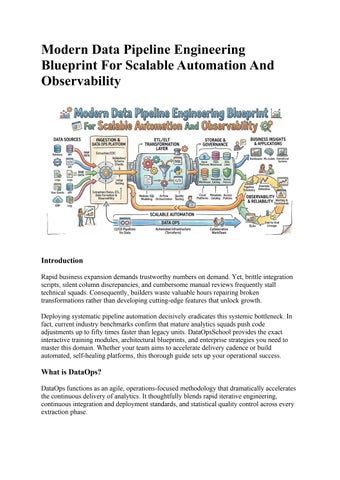
Modern Data Pipeline Engineering Blueprint For Scalable Automation And Observability
Introduction Rapid business expansion demands trustworthy numbers on demand. Yet, brittle integration scripts, silent column discrepancies, and cumbersome manual reviews frequently stall technical squads. Consequently, builders waste valuable hours repairing broken transformations rather than developing cutting-edge features that unlock growth. Deploying systematic pipeline automation decisively eradicates this systemic bottleneck. In fact, current industry benchmarks confirm that mature analytics squads push code adjustments up to fifty times faster than legacy units. DataOpsSchool provides the exact interactive training modules, architectural blueprints, and enterprise strategies you need to master this domain. Whether your team aims to accelerate delivery cadence or build automated, self-healing platforms, this thorough guide sets up your operational success.
What is DataOps? DataOps functions as an agile, operations-focused methodology that dramatically accelerates the continuous delivery of analytics. It thoughtfully blends rapid iterative engineering, continuous integration and deployment standards, and statistical quality control across every extraction phase.
Instead of handling operational pipelines through ad-hoc manual scripts, engineering squads manage analytics components like core production software. Accordingly, automated verification eliminates chronic miscommunication between platform operators, software developers, and business consumers. Top practitioners agree on this baseline truth: treating operational assets like version-controlled code guarantees uninterrupted stability.
Why DataOps Matters for Modern Data Teams Unmonitored cloud warehouses collect crushing technical debt as concurrency and incoming payload sizes grow. Industry research actually shows that analytics professionals squander nearly half their week troubleshooting malformed inputs and debugging corrupt data tables. Instituting robust, automated engineering standards remedies this productivity drain right away. First, automated deployment checks intercept flawed schemas before downstream analytical interfaces reflect them. Second, real-time alerting drops resolution windows from several days to trivial minutes. Thus, decision-makers rely on pristine metrics to steer highstakes commercial investments.
Core Components of a DataOps Environment An effective cloud platform requires seamless coordination between specialized tools and modern engineering protocols. Overlooking any central component invites catastrophic pipeline disruptions.
Automated CI/CD Delivery: Pre-configured scripts validate, assemble, and roll out pipeline updates without human intervention. Continuous Quality Assertions: Real-time tests immediately intercept schema discrepancies, invalid variables, and unexpected volume variances. Disposable Sandbox Workspaces: Short-lived staging environments allow engineers to evaluate modifications safely without impacting production assets. Lineage & Metadata Telemetry: Unified tracking panels map end-to-end data provenance, compliance checkpoints, and downstream dependencies.
Assembling these capabilities transforms brittle batch mechanisms into dependable, selfhealing cloud delivery engines.
Understanding DataOps Tools Pairing targeted operational software with standard operating procedures boosts developer productivity exponentially. Keep in mind that software alone cannot repair underlying operational flaws without firm engineering discipline. Tool Group
Leading Platforms Apache Airflow, Pipeline Schedulers Dagster, Prefect dbt (data build tool), Data Transformation SQLMesh Automated Great Expectations, Assertions Soda Core
Practical Platform Benefit Coordinates, triggers, and tracks multi-step analytical execution flows. Promotes modular modeling, version control, and automated compilation. Enforces data assertions, constraints, and column validations.
Tool Group Telemetry & Observability
Leading Platforms Practical Platform Benefit Monte Carlo, Datafold, Identifies payload anomalies, maps Acceldata dependency graphs, and tracks downtime.
Implementing these complementary technologies provides an automated safety net across your entire data infrastructure.
How DataOps Changes the Data Engineering Workflow Historically, organizations rolled out massive data modifications during dangerous, highstress maintenance intervals. Modern data practitioners now ship granular improvements continuously using protected Git branches that fire automatic test runners. Take the case of an enterprise fintech firm that eradicated eighty-five percent of downstream data incidents. In the past, internal engineers checked query logic manually on shared development clusters. Adopting isolated, dynamic staging containers empowered them to ship small code improvements numerous times every shift. Consequently, technical throughput soared while customer dashboards maintained spotless precision.
DataOps Training: What Should You Learn? Structured technical coursework sets high-performing platform specialists apart from engineers who merely write static queries. Effective DataOps Training prioritizes pipeline durability, integration testing, and autonomous deployments. +-------------------------------------------------------------------+ | Unified DataOps Learning Curriculum | +-------------------------------------------------------------------+ | Module 1: Foundational Tooling (Git, Containers, Pipeline Schedulers)| | Module 2: Data Quality Systems (Assertions, Lineage, Anomaly Alerts)| | Module 3: Continuous Automation (CI/CD, Ephemeral Schemas, Testing) | | Module 4: Cloud Reliability (Observability, SLOs, Platform Spend) | +-------------------------------------------------------------------+
A comprehensive course equips engineers to create proactive warning systems that isolate corrupted tables before downstream users notice. Furthermore, systematic instruction helps teams maintain high-throughput pipelines during severe usage spikes.
Using a DataOps Tutorial to Build Practical Skills Constructing an actual deployment pipeline converts abstract operational theory into tangible technical mastery. Walking through a guided tutorial reinforces critical testing habits that safeguard live data systems. 1. Commit Transformation Logic: Place analytical schemas, orchestration scripts, and configuration maps into a Git repository. 2. Configure Regression Assertions: Author validation rules that instantly trap duplicate primary keys, null values, and formatting discrepancies. 3. Automate Build Triggers: Link your code repository to an automated testing agent that validates models on every open pull request.
4. Provision Temporary Sandbox Schemas: Spin up isolated cloud warehouse schemas to stress-test your logic before merging code into main branches. Adopting this linear validation routine ensures faulty logic never pollutes business-critical production databases.
DataOps Certification and Professional Development Leading enterprises seek engineers who combine deep query architecture with modern systems automation. Earning a credential confirms your advanced hands-on capability to employers worldwide. These industry-standard credentials demonstrate that you construct self-correcting pipelines instead of just generating brittle SQL transformations. Moreover, certified experts secure higher compensations because their architectures eliminate operational downtime and protect critical pipelines. Validating your skills with formal credentials places you at the forefront of the modern data engineering movement.
Becoming a Certified DataOps Engineer A Certified DataOps Engineer focuses primarily on rapid integration, test automation, and real-time observability. Professionals in this role establish testing regimes that intercept faulty data records before they enter analytical warehouses.
Core Focus: Building resilient data pipelines, maintaining automated checks, and managing telemetry systems. Essential Skills: Python automation, SQL optimization, container orchestration, Git pipelines, and testing suites. Target Professionals: Analytics Engineers, DevOps Specialists, and Data Engineers upgrading their skill sets.
Engineers holding this credential ensure data transitions smoothly from raw extraction stages into accessible business views.
Becoming a Certified DataOps Architect A Certified DataOps Architect leads overarching system design, multi-cloud data governance, and long-term infrastructure health. These senior experts design resilient frameworks that process multi-terabyte data streams efficiently.
Core Focus: Platform strategy, data mesh adoption, governance standards, and operational expenditure control. Essential Skills: Distributed platform design, identity governance, enterprise networking, and cloud economics. Target Professionals: Lead Engineers, Solutions Architects, and Engineering Managers.
Architects align core infrastructure investments directly with operational KPIs to maximize business impact.
DataOps Consulting for Organizations Enterprises running legacy, friction-heavy platforms encounter stiff challenges when modernizing their release habits. Specialized consulting delivers the technical guidance required to re-engineer core architectures safely. Experienced advisors evaluate pipeline maturity, pinpoint delivery bottlenecks, and install automated validation tooling. Furthermore, they guide internal teams through cultural changes without pausing ongoing business deliverables. Organizations bypass expensive redevelopment blunders while building responsive infrastructure that scales effortlessly.
DataOps Services for Growing Teams Maintaining modern data stacks requires relentless performance optimization, active cost controls, and comprehensive telemetry. Dedicated support services oversee operational upkeep so internal engineers can build core product features. These services cover end-to-end platform surveillance, schema migrations, and rapid remediation of unexpected pipeline drops. Additionally, specialized partners enforce robust data contracts between source application teams and internal analytics consumers. Companies protect continuous revenue operations by sustaining dependable, uninterrupted analytical pipelines around the clock.
Who Can Benefit From Learning DataOps? The methodologies powering continuous operational integration benefit a wide variety of engineering practitioners.
Data Engineers: Automate mundane pipeline checks, remove manual toil, and build self-healing pipelines. DevOps Specialists: Bring container orchestration, infrastructure as code, and continuous delivery rules into data platforms. Analytics Engineers: Push transformation models safely using automated branch reviews and isolated test sandboxes. Engineering Managers: Accelerate analytical release speed while cutting operational overhead and data outages.
Mastering these concepts gives any technical builder tremendous leverage across enterprise data platforms.
A Practical DataOps Learning Roadmap Securing operational engineering expertise requires steady progression across several core technical domains. Stage 1: Core Fundamentals └── Bash Automation, Container Basics, Git Commands, Advanced SQL Stage 2: Orchestration & Data Models └── Pipeline Graphs, Cloud Platforms, Declarative Modeling Layers
Stage 3: Automated Safeguards └── Automated Validation, Schema Contracts, Pre-Merge Testing Stage 4: Platform Telemetry & Governance └── Observability Telemetry, Data Lineage, Resource Cost Controls
Advancing through this roadmap builds deep operational capability and prepares you to tackle complex platform challenges.
Common DataOps Mistakes to Avoid Many technology teams wrongly assume that purchasing new software instantly corrects deep operational flaws. Unfortunately, introducing new software without upgrading team procedures simply automates bad habits. Another common blunder involves deferring pipeline validation tests until code reaches live production environments. When engineers skip pre-merge testing, corrupted tables slip directly into downstream stakeholder views. Likewise, teams construct fragile platforms whenever they neglect anomaly tracking for volume swings and pipeline lag. You steer clear of these expensive setbacks by writing automated validation tests alongside pipeline definitions.
How DataOpsSchool Can Support Your Learning Journey DataOpsSchool operates as an advanced educational academy and enterprise advisory hub built for current data practitioners. The platform supplies practical training modules, comprehensive tutorials, and recognized credentials that help builders master platform engineering. Through immersive, real-world sandboxes, students build functional automated delivery pipelines using industry-standard open-source tools. At the same time, enterprise leaders tap specialized advisory services to modernize fragmented infrastructures into stable, automated systems. Whether you seek personal credentialing or enterprise platform acceleration, DataOpsSchool provides the complete blueprint for your success.
Frequently Asked Questions About DataOpsSchool 1. Which foundational purpose defines DataOpsSchool? DataOpsSchool prepares technical specialists and guides growing companies to build reliable, observable, and automated data architectures. 2. Which engineering professionals extract the greatest value from this content? Data engineers, DevOps engineers, systems architects, site reliability specialists, and engineering directors gain practical technical value. 3. Can students earn official industry certifications on the platform?
Yes, students can achieve formal credentials including Certified DataOps Engineer and Certified DataOps Architect. 4. Do the introductory courses welcome professionals without prior automation experience? Yes, the structured modules introduce core operational principles before guiding learners through complex orchestration and automated validation. 5. Which primary technologies power the interactive workshops? The labs deliver hands-on practice with Apache Airflow, dbt, Great Expectations, Docker, Kubernetes, and prominent cloud data warehouses. 6. Does DataOpsSchool provide advisory solutions for enterprise teams? Yes, experienced advisors assist organizations with pipeline restructuring, observability implementation, and delivery speed acceleration. 7. How does this discipline differ from traditional DevOps practices? DevOps automates static application deployments, whereas DataOps automates dynamic datasets, evolving schemas, and payload fidelity. 8. Can companies arrange private group workshops for their staff? Yes, businesses book tailored instruction that directly addresses their specific infrastructure, technology stacks, and operational roadblocks. 9. Which core proficiencies should prospective students possess? A working grasp of foundational SQL, everyday Python commands, and general data warehouse principles ensures a rewarding experience. 10. In what way does this certification boost career trajectories? Earning this credential proves you know how to build dependable, self-healing platforms, which makes you a valuable asset for top engineering organizations.
Final Thoughts Enterprises that establish automated, reliable data systems consistently outpace competitors who rely on manual interventions. Relying on fragile, untracked scripts exposes senior leadership to inaccurate metrics and costly commercial mistakes. By adopting modern DataOps methodologies, you turn unpredictable data pipelines into resilient, software-grade operational engines. Expand your operational capabilities, implement proven pipeline automation, and transform your data infrastructure today.