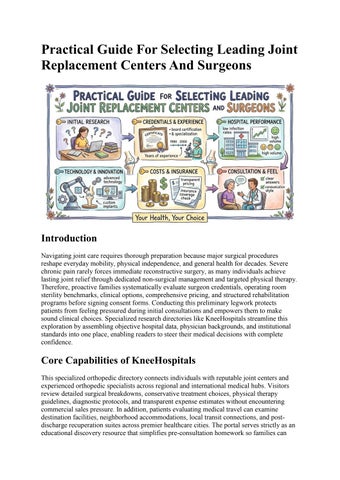
Practical Guide For Selecting Leading Joint Replacement Centers And Surgeons
Introduction Navigating joint care requires thorough preparation because major surgical procedures reshape everyday mobility, physical independence, and general health for decades. Severe chronic pain rarely forces immediate reconstructive surgery, as many individuals achieve lasting joint relief through dedicated non-surgical management and targeted physical therapy. Therefore, proactive families systematically evaluate surgeon credentials, operating room sterility benchmarks, clinical options, comprehensive pricing, and structured rehabilitation programs before signing consent forms. Conducting this preliminary legwork protects patients from feeling pressured during initial consultations and empowers them to make sound clinical choices. Specialized research directories like KneeHospitals streamline this exploration by assembling objective hospital data, physician backgrounds, and institutional standards into one place, enabling readers to steer their medical decisions with complete confidence.
Core Capabilities of KneeHospitals This specialized orthopedic directory connects individuals with reputable joint centers and experienced orthopedic specialists across regional and international medical hubs. Visitors review detailed surgical breakdowns, conservative treatment choices, physical therapy guidelines, diagnostic protocols, and transparent expense estimates without encountering commercial sales pressure. In addition, patients evaluating medical travel can examine destination facilities, neighborhood accommodations, local transit connections, and postdischarge recuperation suites across premier healthcare cities. The portal serves strictly as an educational discovery resource that simplifies pre-consultation homework so families can
craft sharp questions for their orthopedic teams. Most importantly, the platform offers educational guidance and never replaces formal diagnostic evaluations, hands-on physical exams, or personalized treatment plans from licensed medical professionals.
Strategic Benefits of KneeHospitals Hospital Discovery Families browse the directory to identify accredited orthopedic centers that align with their specific medical conditions, personal comforts, and travel capabilities. Consequently, patients bypass unverified internet advertisements and assess certified operating rooms, advanced diagnostic departments, intensive care backups, and dedicated joint wards through a single platform.
Doctor and Surgeon Research Surgical skill directly determines clinical outcomes, which makes verifying professional qualifications a vital prerequisite for every prospective patient. Hence, the portal showcases board certifications, advanced clinical training, subspecialty concentrations, and procedural volume records so individuals can select veteran doctors with complete confidence.
Procedure Education Learning about operative choices eliminates pre-surgical anxiety and prevents individuals from consenting to major treatments that they barely understand. Therefore, the directory clarifies standard reconstructions, single-compartment resurfacing, and modern computerized techniques in simple language so readers understand every relevant clinical path.
Destination Comparison Geographic selection heavily dictates total medical spending, family travel logistics, transport convenience, and the feasibility of attending required recovery checkups. Consequently, patients evaluate different metropolitan areas to decide whether traveling to a distant tertiary facility provides clear clinical advantages over local hospitals.
Cost Research Understanding prospective treatment expenses enables families to organize personal finances, secure insurance approvals, and prevent unexpected hospital billing shocks early. However, while the directory provides practical cost ranges across diverse institutions, patients must always confirm final binding estimates directly with facility finance coordinators.
Defining Knee Replacement Surgery Degenerative osteoarthritis gradually erodes protective cartilage, generating painful bone-onbone friction that disrupts ordinary walking, stair climbing, and peaceful sleep. When conservative therapies fail to restore comfortable mobility, orthopedic surgeons perform Knee Replacement Surgery to resurface damaged joint ends with durable metallic and
medical-grade polyethylene components. Doctors identify severe joint degeneration through thorough physical examinations, standing weight-bearing radiographs, and diagnostic imaging scans that reveal structural tissue erosion. Nevertheless, conscientious orthopedic practitioners exhaust lifestyle modifications, targeted muscle conditioning, and medical therapies before recommending joint resurfacing to ensure absolute necessity. Ultimately, this reconstructive procedure eliminates severe pain, corrects leg alignment deformities, restores joint function, and returns individuals to active daily routines safely.
Evaluating Total Against Partial Joint Reconstruction Surgeons propose distinct operative paths depending on the exact distribution of cartilage degradation inside the individual knee anatomy. When widespread arthritis deteriorates multiple articular compartments, a Total Knee Replacement reconstructs all three functional surfaces to restore complete joint stability. Conversely, when cartilage loss damages only the inner, outer, or patellofemoral compartment, a Partial Knee Replacement resurfaces merely that single damaged area while preserving natural bone, uninjured cartilage, and vital cruciate ligaments. Consequently, preserving healthy native structures supports a more natural-feeling joint motion and accelerates physical therapy recovery during early rehabilitation. Nevertheless, neither approach offers an absolute clinical advantage, because personal bone alignment, ligament health, and disease spread determine the appropriate surgical path. Clinical Feature Treated Zone Resurfaced Tissue Typical Presentation Patient Profile Rehabilitation Focus Decision Determinant
Total Knee Replacement Partial Knee Replacement Entire joint surface across all three Single damaged compartment anatomical compartments (medial, lateral, or patellofemoral) All worn femoral, tibial, and patellar Only the specific eroded bone and contact surfaces damaged cartilage Advanced bicompartmental or Isolated single-compartment tricompartmental joint degradation arthritis with intact ligaments Extensive cartilage erosion, angular Localized wear, stable cruciate deformity, systemic arthritis ligaments, excellent joint function Progressive strength and mobility Rapid functional recovery, reduced work across eight to twelve weeks swelling, shorter hospital stay Complete disease clearance, longBone preservation, natural joint term prosthetic durability kinematics, localized wear
The Reality of Robotic Knee Replacement Surgery Modern orthopedic units increasingly implement advanced digital platforms to optimize surgical planning and elevate bone preparation precision during complex reconstructions. Throughout Robotic Knee Replacement Surgery, the orthopedic surgeon directs every operative step, employing the robotic arm strictly as an intelligent navigational and cutting guide. The computerized system tracks live anatomical landmarks and diagnostic scans, guiding the physician to place prosthetic implants with remarkable accuracy tailored to unique joint kinematics. However, computerized technology never guarantees superior longterm clinical outcomes compared to meticulous operations executed by experienced conventional surgeons. Furthermore, these proprietary digital systems often carry
supplementary facility surcharges, prompting patients to discuss practical benefits with their physicians before deciding.
Clinical Scope of Knee Arthroscopy When individuals experience soft-tissue injuries rather than generalized joint surface wear, keyhole techniques deliver a prompt, focused solution. During a Knee Arthroscopy, the orthopedic surgeon inserts a miniature camera and thin surgical tools into the joint space through tiny keyhole incisions. Doctors use this direct visual method to inspect torn tissues, smooth damaged meniscus cartilage, reconstruct ruptured ligaments, and remove loose fragments safely. Unlike reconstructive joint operations that replace bone surfaces, arthroscopic procedures concentrate exclusively on repairing or clearing localized soft tissues. Consequently, patients undergoing keyhole operations experience minimal tissue trauma, modest post-operative swelling, minimal blood loss, and an accelerated return to light everyday activities.
Non-Surgical Knee Pain Treatment Protocols Comprehensive conservative treatment must always precede major surgical interventions whenever joint deterioration remains in early or intermediate stages of progression. Doctors structure multimodal Knee Pain Treatment programs around personalized physical therapy that strengthens supporting quadriceps and hamstrings to offload damaged joint surfaces. Furthermore, replacing high-impact exercises with low-impact swimming or cycling, using unloader braces, taking anti-inflammatory medications, and shedding excess weight alleviate joint stress significantly. Clinicians may also administer targeted corticosteroid injections to suppress acute flare-ups or hyaluronic acid preparations to lubricate worn joint spaces. Whenever structured physical therapy, weight optimization, and protective lifestyle modifications manage symptoms effectively, patients can comfortably delay or avoid joint reconstruction entirely.
Financial Dynamics of Knee Replacement Surgery Overall financial expenditures for joint operations vary considerably across different medical institutions, geographic locations, and customized patient care plans. A realistic Knee Replacement Surgery Cost covers primary surgeon fees, operating theater infrastructure, premium prosthetic implants, pre-admission diagnostic tests, and anesthesiology services. Additionally, selecting private patient rooms, using computerized robotic navigation, or requiring extended post-operative monitoring increases total hospital invoices. Families must also budget for essential post-discharge physical therapy sessions, personal walking aids, follow-up radiographs, and ongoing pain-management pharmaceuticals. Therefore, individuals should secure comprehensive, itemized written estimates directly from hospital billing coordinators to prevent unexpected financial surprises after leaving the facility. Cost Element Surgeon Fee Hospital Charges
Practical Significance Reflects individual clinical experience, operative specialization, and procedural difficulty. Covers operating theater time, surgical nursing teams, and dedicated inpatient room amenities.
Cost Element
Practical Significance Distinct manufacturing materials, modular designs, and global Prosthetic Implants brands feature varied price points. Deploying robotic cutting arms or computer-guided tracking adds Advanced Navigation distinct equipment surcharges. Complete blood panels, cardiovascular clearances, and detailed Pre-Operative imaging series establish baseline safety. Diagnostics Structured outpatient physical therapy sessions and functional home Physical gear safeguard final recovery. Rehabilitation Regional transit, local hospitality stays for companions, and Travel transport services require dedicated funds. Accommodations Unforeseen medication adjustments, extended hospital monitoring, Contingency Care or secondary diagnostics require financial buffers.
Selecting Leading Orthopedic Facilities Identifying the Best Knee Replacement Hospitals demands evaluating clinical proficiency and infection control standards rather than admiring luxurious reception spaces or slick marketing brochures. Leading surgical facilities maintain dedicated laminar-flow operating theaters alongside strict sterilization protocols that reduce infection risks significantly. Furthermore, premier centers deploy licensed physical therapists who initiate assisted walking exercises within hours of surgery to avoid circulatory problems. Honest pricing policies, fully equipped intensive care units, clear patient communication, and responsive overseas coordination desks also distinguish first-rate hospitals. Additionally, selecting accredited Knee Replacement Hospitals in India provides international patients with internationally trained surgeons, cutting-edge surgical environments, and attentive rehabilitative support at practical price levels.
Navigating the Decision Path With KneeHospitals Structuring the decision journey step by step brings profound clarity to families facing complex orthopedic interventions. Patients begin by organizing recent diagnostic images, physical therapy records, and medication histories to define the exact extent of their joint damage. Next, users explore the directory to review accredited healthcare institutions, compare surgeon case volumes, examine procedural options, and assess modern implant technologies without sales interference. After narrowing their choices to two or three centers, families request preliminary clinical assessments and comprehensive fee breakdowns to understand their total financial commitment. Finally, patients coordinate outpatient physical therapy arrangements, secure local lodging for their recovery period, and confirm postdischarge communication channels before completing hospital admission.
Decision Scenarios in Real Life
An energetic retiree suffering from sharp medial joint pain discovers that the lateral compartment and surrounding ligaments remain healthy. Following a detailed discussion with an experienced surgeon, the individual selects a partial joint replacement, enabling rapid tissue recovery while retaining natural knee kinematics.
A busy professional dealing with advanced tricompartmental osteoarthritis experiences severe pain during simple walks despite completing months of structured physical therapy, taking anti-inflammatory medication, and trying joint injections. The patient consults an orthopedic specialist and schedules a total knee reconstruction to eradicate bone friction permanently. An international medical traveler comparing accredited centers across major metropolitan destinations seeks to control out-of-pocket expenses while securing experienced care. By securing complete itemized proposals that package surgical fees, hospital stays, implants, and physical rehabilitation, the traveler completes the journey within budget. A sports enthusiast experiencing acute swelling and joint locking undergoes magnetic resonance imaging that reveals an isolated meniscal tear with preserved cartilage. Rather than discussing joint replacement, the patient chooses a minimally invasive arthroscopic repair and resumes athletic training within weeks.
Vital Questions to Ask Your Orthopedic Specialist
Which specific radiological markers and functional symptoms show that my joint deterioration demands surgery right now? Have we fully exhausted all non-operative therapies, including structured physical rehabilitation, custom bracing, activity modification, and targeted injections? Does my joint wear pattern permit a partial knee replacement, or does extensive disease require a complete total knee replacement? Which specific implant design, component materials, and fixation techniques best match my bone quality and activity expectations? Do you use robotic assistance or intraoperative navigation during this operation, and does that technology involve additional equipment expenses? What primary risks, including blood clots, joint infections, nerve trauma, or component loosening, apply to me, and how do you prevent them? How many days will I spend in the hospital ward, and what mobility milestones must I achieve before discharge? When will my outpatient physical therapy sessions start, and how many appointments should I schedule each week? How many weeks will elapse before I can safely operate a motor vehicle, resume desk employment, or complete light recreational walks? What complete, itemized financial estimate covers all surgeon charges, theater expenses, implants, diagnostic tests, and pharmaceuticals? How will your clinical team manage follow-up reviews, suture care, and subsequent imaging if I travel from another city?
Maximizing the Directory Research Framework Approaching hospital research systematically by documenting findings in an organized comparison matrix eliminates confusion before you speak with clinical teams. Evaluating facilities across a standard grid allows individuals to compare institutional safety, surgeon track records, procedural technologies, and financial proposals objectively. Consequently, family members can evaluate multiple healthcare options side by side, ensuring that critical medical requirements remain front and center. The comparison matrix below illustrates how
patients can structure their research data to create an informed, dependable shortlist of prospective hospitals. Evaluation Area Facility Benchmarks Surgeon Experience
Inspection Criteria Hospital accreditations, dedicated orthopedic surgical suites, published infection track records, and intensive care backup. Specialized fellowship training, procedure-specific operation counts, verified credentials, and professional reputation. Recommended operative technique, non-surgical alternatives, and Clinical Strategy surgical logic tailored to your diagnostic imaging. Computer navigation platforms, robotic surgical systems, advanced Technological imaging devices, and intensive post-operative wards. Tools Written itemized packages detailing prosthetic pricing, operating Financial theater charges, diagnostic fees, and therapy costs. Transparency On-site physical therapy departments, early mobilization protocols, Physical and structured home exercise regimens. Rehabilitation Remote telemedicine consultations, local physician handoffs, formal Follow-Up Support healing reviews, and suture removal planning. Distance to transportation hubs, nearby lodging options for Travel companions, and dedicated patient-support desks. Considerations Modern sterilization protocols, blood bank accessibility, continuous Safety Measures observation units, and emergency response capabilities.
Critical Pitfalls to Avoid
Prioritizing Cost Over Competence: Choosing a surgical center solely because it advertises the lowest fee often results in hidden bills, dated equipment, or junior surgical teams. Ignoring Specialist Case Numbers: Assuming that every licensed orthopedic practitioner possesses equivalent skill in complex joint reconstructions compromises alignment accuracy and long-term recovery. Abandoning Conservative Care Prematurely: Undergoing major joint reconstruction before properly trying targeted muscle conditioning, weight reduction, and anti-inflammatory strategies causes unnecessary surgeries. Viewing Digital Tools as Outcome Guarantees: Assuming that robotic guidance replaces clinical experience creates unrealistic expectations, because the surgeon's judgment determines surgical success. Neglecting Outpatient Rehabilitation Plans: Failing to organize professional physical therapy and home recovery support ahead of time delays muscle activation and impairs range of motion. Overlooking Ancillary Expenses: Forgetting to budget for pre-operative medical clearances, prolonged inpatient stays, specialized walking frames, and post-discharge pharmaceuticals strains personal finances. Overlooking Hospital Hygiene Records: Ignoring institutional infection rates, dedicated laminar airflow theaters, and strict clean-room protocols exposes patients to dangerous post-operative infections.
Dismissing Follow-Up Accessibility: Selecting a distant facility without arranging local wound dressing changes, suture removals, and recovery monitoring creates major post-discharge complications.
Frequently Asked Questions 1. What durability can recipients anticipate from contemporary prosthetic components? Modern prosthetic implants regularly deliver fifteen to twenty-five years of reliable service when patients maintain healthy body weights, complete consistent leg-strengthening exercises, and avoid high-impact jumping sports. These protective habits minimize mechanical wear between articulating metal and polyethylene surfaces. Consequently, the vast majority of older individuals enjoy lasting pain relief and restored mobility without ever requiring revision surgery during their lifetime.
2. Can surgeons safely perform joint replacement operations on elderly patients? Orthopedic surgical teams routinely perform joint replacement procedures on elderly individuals once comprehensive pre-operative evaluations confirm stable cardiovascular, pulmonary, and metabolic health. Clinicians use targeted regional nerve blocks, modern anesthesia protocols, and prompt post-operative walking routines to reduce physical strain, allowing people well into their eighties to achieve excellent functional recovery.
3. Will dedicated conservative therapy allow me to avoid surgical intervention? Targeted non-operative therapies enable individuals with mild or moderate joint wear to manage their pain for years without entering an operating room. Patients lower joint stress by completing customized physical therapy, reducing surplus body weight, wearing supportive braces, and taking prescribed anti-inflammatory medications. However, when severe arthritis destroys all protective cartilage and creates constant bone-on-bone friction, surgical replacement provides the only definitive restorative remedy.
4. How do total and partial joint replacement procedures differ structurally? A total joint reconstruction resurfaces all three compartments of the knee joint with artificial components, providing a dependable solution for widespread cartilage deterioration. In contrast, a partial procedure resurfaces only the single damaged compartment, preserving healthy bone, uninjured cartilage, and natural cruciate ligaments. Eligible patients undergoing partial replacement benefit from smaller incisions, reduced post-operative swelling, and a more rapid return to daily walking routines.
5. Does robotic surgery allow an automated machine to operate independently?
The orthopedic surgeon performs every step of the operation personally, using the robotic system strictly as an intelligent alignment and cutting guide. The digital software processes live spatial data to establish precise boundaries, helping the surgeon shape bone surfaces and position prosthetic implants with exceptional precision tailored to the patient's anatomy.
6. When can patients begin walking after joint reconstruction surgery? Physical therapists guide patients to stand and take their first steps with a sturdy walking frame within twenty-four hours of completing surgery. These early assisted movements stimulate circulation, prevent deep vein blood clots, and rebuild physical confidence immediately. Over the next two to four weeks, patients advance from frames to single-point canes before walking independently.
7. Which medical complications present the greatest concern during joint surgery? Major surgical risks include post-operative joint infections, deep vein blood clots, nerve irritation, unexpected implant loosening, and persistent joint stiffness. Modern surgical teams counter these hazards by administering prophylactic antibiotics, fitting compression stockings, prescribing blood-thinning medications, and maintaining sterile operating environments. Selecting veteran surgeons and following outpatient physical therapy protocols further diminishes these clinical risks.
8. How many weeks must employees take off work for rehabilitation? Individuals performing desk-based work generally return to professional duties within four to six weeks, provided they can elevate the operated leg periodically to control swelling. Conversely, workers whose duties demand heavy manual labor, frequent stair climbing, or prolonged standing require ten to twelve weeks of recovery before returning safely to active job sites.
9. Why must patients complete outpatient physical therapy after leaving the hospital? Dedicated physical therapy rebuilds muscular strength, restores full joint flexion, prevents dense scar tissue accumulation, and corrects compromised walking habits. While hospital staff introduce essential bedside exercises, finishing eight to twelve weeks of supervised outpatient sessions secures optimal joint mobility. Skipping these exercises risks permanent joint stiffness, persistent limping, and compromised mobility despite a well-placed implant.
10. Can individuals kneel comfortably on an artificial joint surface? Patients can kneel on soft or padded surfaces once their surgical incision heals completely and deep soft-tissue inflammation subsides over several months. However, kneeling directly against hard floors feels unusual because body weight presses the skin against metal components and sensitive nerve endings. While kneeling never damages modern prosthetic components, utilizing cushioned pads makes the position far more comfortable.
11. What causes knee replacement costs to fluctuate between institutions?
Institutional fee structures vary based on hospital accreditations, surgeon reputations, inpatient room categories, diagnostic testing equipment, and the specific implant designs chosen for the procedure. Furthermore, facilities that use robotic cutting arms or digital navigation systems often add distinct equipment fees to the bill. Families must request itemized breakdowns covering surgeon charges, operating theater time, implants, anesthesia, and rehabilitation to compare institutions accurately.
12. In what ways does KneeHospitals assist families with their research? The platform streamlines preliminary medical homework by compiling comprehensive facility profiles, doctor credentials, procedure explanations, and realistic budget considerations into a searchable directory. Patients evaluate accredited orthopedic centers, compare regional healthcare destinations, and learn about conventional, partial, and robotic surgical approaches without sales pressure. Consequently, families organize thoughtful questions, shortlist capable facilities, and approach their initial orthopedic consultations with confidence.
Concluding Guidance Careful hospital selection demands analyzing surgical track records, intensive care backup, and post-discharge physical therapy rather than chasing promotional pricing packages. Objective diagnostic findings must anchor every clinical path, helping individuals and doctors determine whether structured physical conditioning, targeted compartment resurfacing, or complete joint replacement provides the safest resolution for persistent mobility issues. Furthermore, patients should judge computerized navigation systems on clear clinical necessity, personal joint anatomy, and surgeon recommendations rather than commercial technology advertising. Dedicated discovery hubs like KneeHospitals provide an empowering starting point for healthcare research, helping families evaluate medical facilities, examine specialist qualifications, and prepare essential consultation questions methodically. Ultimately, individuals should partner with certified orthopedic surgeons, discuss their functional goals openly, and execute their medical decisions with complete confidence.