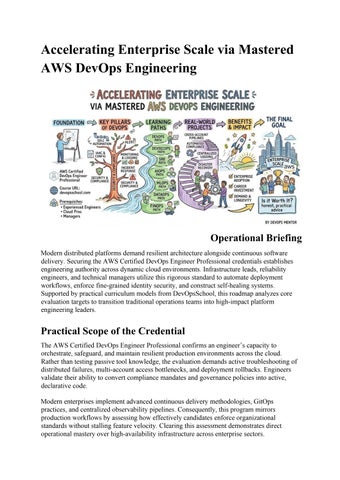
Accelerating Enterprise Scale via Mastered AWS DevOps Engineering
Operational Briefing Modern distributed platforms demand resilient architecture alongside continuous software delivery. Securing the AWS Certified DevOps Engineer Professional credentials establishes engineering authority across dynamic cloud environments. Infrastructure leads, reliability engineers, and technical managers utilize this rigorous standard to automate deployment workflows, enforce fine-grained identity security, and construct self-healing systems. Supported by practical curriculum models from DevOpsSchool, this roadmap analyzes core evaluation targets to transition traditional operations teams into high-impact platform engineering leaders.
Practical Scope of the Credential The AWS Certified DevOps Engineer Professional confirms an engineer’s capacity to orchestrate, safeguard, and maintain resilient production environments across the cloud. Rather than testing passive tool knowledge, the evaluation demands active troubleshooting of distributed failures, multi-account access bottlenecks, and deployment rollbacks. Engineers validate their ability to convert compliance mandates and governance policies into active, declarative code. Modern enterprises implement advanced continuous delivery methodologies, GitOps practices, and centralized observability pipelines. Consequently, this program mirrors production workflows by assessing how effectively candidates enforce organizational standards without stalling feature velocity. Clearing this assessment demonstrates direct operational mastery over high-availability infrastructure across enterprise sectors.
Target Audience and Industry Demand Senior system administrators, site reliability engineers, and software architects operating production infrastructure gain the largest competitive advantage from this certification. Security specialists and data platform engineers also leverage its automated governance modules to reinforce multi-account security postures. Furthermore, engineering directors and team leads utilize these principles to establish reliable architectural baselines across multiple software delivery teams. Technological hubs across North America, Europe, and India actively seek cloud engineers capable of managing large-scale, automated environments while controlling infrastructure costs. Although entry-level engineers must first establish core systems competencies, seasoned engineers use this evaluation to formally confirm their high-tier production experience.
Strategic Value and Career Longevity Organizations continually retire isolated scripting solutions in favor of automated, eventdriven infrastructure. Software frameworks evolve rapidly, yet fundamental operational principles—including immutable infrastructure, canary deployments, and automated drift correction—remain permanently relevant. Engineers who master these core patterns build resilient, long-term careers that easily navigate technological transitions. Securing this top-tier credential frequently unlocks senior, staff, and principal engineering roles across competitive enterprise sectors. Industry recruitment analytics consistently indicate that verified cloud automation specialists command top-tier compensation packages. This focused educational investment yields sustainable returns because it validates an engineer’s ability to reduce incident recovery times, protect availability, and eliminate expensive human configuration errors.
Program Architecture and Delivery Format DevOpsSchool delivers the structured curriculum for this program through rigorous, projectoriented modules designed around production scenarios. Learners tackle authentic business challenges involving multi-region data persistence, failed rollouts, and security policy violations. The assessment format prioritizes realistic trade-offs between delivery speed, operational budgets, and systemic resilience. Participants actively construct resilient deployment workflows, configure cross-account event routing, and orchestrate automated disaster recovery failovers. Detailed architectural reviews and real-time terminal exercises ensure engineers internalize the operational consequences of each design decision. This structured approach directly transforms conceptual cloud knowledge into concrete operational capability.
Platform Distinction DevOpsSchool delivers specialized training that emphasizes practical, open-source integration and cloud-native architecture over mere test preparation. Seasoned industry
practitioners lead every live cohort, bringing decades of active production design and systems recovery experience directly into the virtual classroom. Students work within live cloud terminals, gaining direct exposure to production challenges and modern platform workflows. The curriculum continuously adapts to reflect modern deployment trends, including advanced Kubernetes orchestration, infrastructure security pipelines, and observability practices. DevOpsSchool provides learners with technical code reviews, resume critiques, and continuous access to an active alumni community. This robust support system ensures that participants acquire battle-tested engineering capabilities that survive real-world production demands.
Operational Tracks and Competency Tiers Navigating modern cloud credentials requires a deliberate progression from baseline system concepts to specialized platform mastery. Foundational tracks introduce shared operational terminology, security fundamentals, and core cloud primitives. Associate certifications test practical execution within software delivery pipelines and administrative consoles. The professional tier crowns this progression by demanding full ownership over multi-tier systems architecture, compliance enforcement, and automated release cycles. Specialized disciplines extend these competencies into advanced network routing, automated threat analysis, and modern machine learning operations. Systematically advancing through these tiers protects engineers from knowledge gaps while expanding practical troubleshooting speed. Securing the professional badge establishes a dependable bridge toward enterprise architecture roles and technical leadership.
Certification Progression Matrix Track
Level
Target Role
Baseline
Core
Requirements Competencies Cloud
Business Cloud Fundamental architecture Foundation Analysts, Tech 1 Foundation IT literacy basics, Billing Leads controls Fleet Linux Cloud Systems configuration, Associate administration, Operations Administrators Monitoring, Shell scripting Basic IAM Serverless Core Application Application design, SDK Associate programming, 2 Delivery Developers integration, Source control
Recommended Order
2
CI/CD Enterprise Lead
Enterprise DevOps
production
Baseline Track
Level
Two years SREs, delivery Professional Platform 3 cloud automation, Engineers engineering Recovery Target Role
Core Recommended Requirements Competencies
Order
Threat Advanced Cloud
SecOps Specialty
Security
remediation, networking,
Engineers
KMS IAM policies
4 management,
Auditing Senior Advanced Infrastructure Specialty
Enterprise Direct Connect Network
routing, Hybrid transit, Hybrid 4
Specialists
networks
DNS resolvers
Comprehensive Credential Blueprint AWS Certified DevOps Engineer Professional – Senior Operations Tier Credential Scope This credential validates an engineer’s hands-on capacity to design, secure, and manage distributed enterprise systems across modern cloud platforms. It proves decisive mastery over continuous integration pipelines, automated policy governance, and multi-region disaster recovery systems. Candidate Profile Platform engineers, senior cloud architects, site reliability engineers, and technical leads who actively manage business-critical infrastructure. Applicants need at least two years of direct operational experience running distributed production systems.
Acquired Competencies • • • • •
Assembling multi-stage release pipelines that automate testing, container building, and deployment verification. Executing blue-green, canary, and rolling software releases that guarantee zero downtime for end users. Authoring declarative Infrastructure as Code blueprints to manage multi-account resources predictably. Constructing event-driven remediation workflows that automatically fix misconfigured services upon detection. Structuring centralized logging, auditing, and compliance frameworks across enterprise account hierarchies.
Production Project Deliverables • • •
•
Construct an enterprise CI/CD pipeline featuring automated vulnerability analysis and manual approval thresholds. Implement a continuous drift detection and remediation system using custom eventdriven compliance rules. Build a centralized telemetry engine that ingests logs across dozens of accounts into OpenSearch for immediate alerting. Configure dynamic auto-scaling rules that scale compute resources according to custom application queue depths.
Study Roadmaps • • •
Two-Week Strategy: Complete scenario-driven practice exams, review enterprise whitepapers on disaster recovery, and dissect CodeDeploy lifecycle hooks. One-Month Strategy: Analyze every exam domain blueprint, build multi-account test pipelines in sandbox environments, and practice executing automated rollbacks. Two-Month Strategy: Follow a comprehensive training curriculum, write extensive Infrastructure as Code templates, and resolve simulated production outages in handson labs.
Critical Pitfalls to Avoid • • •
Overlooking cross-account permissions, external artifact encryption policies, and finegrained IAM constraints. Memorizing native pipeline tools while neglecting Systems Manager agent configurations and CloudWatch subscription filters. Conflating lifecycle deployment events between serverless functions, container services, and virtual machine instances.
Strategic Next Steps • •
Same-Track Progression: AWS Certified Solutions Architect – Professional. Cross-Track Expansion: AWS Certified Security – Specialty.
•
Leadership Track: Certified Kubernetes Administrator (CKA) or TOGAF Enterprise Architecture certification.
Strategic Verdict Committing to this professional-level engineering certification requires an intense investment of personal time, focus, and deliberate hands-on lab experimentation. Candidates who treat the program as a superficial checklist item will struggle because the scenario-driven questions effortlessly expose shallow memorization. The testing framework purposely filters out applicants who lack genuine troubleshooting instincts. Approaching this curriculum as a rigorous blueprint to master production engineering elevates your technical acumen. It forces you to abandon brittle console tweaks in favor of declarative code, systematic automation, and resilient architectural thinking. For engineers dedicated to driving high-performance cloud operations, this credential delivers immense, lasting career value.