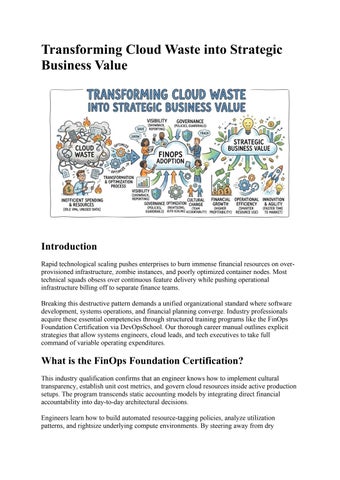
Transforming Cloud Waste into Strategic Business Value
Introduction Rapid technological scaling pushes enterprises to burn immense financial resources on overprovisioned infrastructure, zombie instances, and poorly optimized container nodes. Most technical squads obsess over continuous feature delivery while pushing operational infrastructure billing off to separate finance teams. Breaking this destructive pattern demands a unified organizational standard where software development, systems operations, and financial planning converge. Industry professionals acquire these essential competencies through structured training programs like the FinOps Foundation Certification via DevOpsSchool. Our thorough career manual outlines explicit strategies that allow systems engineers, cloud leads, and tech executives to take full command of variable operating expenditures.
What is the FinOps Foundation Certification? This industry qualification confirms that an engineer knows how to implement cultural transparency, establish unit cost metrics, and govern cloud resources inside active production setups. The program transcends static accounting models by integrating direct financial accountability into day-to-day architectural decisions. Engineers learn how to build automated resource-tagging policies, analyze utilization patterns, and rightsize underlying compute environments. By steering away from dry
accounting theories, the curriculum enables developers to see how simple infrastructure declarations influence overall company profit margins.
Who Should Pursue FinOps Foundation Certification? Platform engineers, DevOps professionals, and enterprise systems architects gain immense advantages when they can substantiate architecture upgrades using measurable business return indicators. Engineering directors, technical program leads, and financial analysts require these exact tools to forecast infrastructure needs reliably while avoiding inter-team budget conflicts. Engineers based across India and multinational enterprise teams worldwide unlock higher career plateaus through these skills. Mastering this operational paradigm enables engineers to tie everyday code releases directly to corporate financial health.
Role → Recommended FinOps Foundation Certification Role DevOps Engineer
Recommended Certifications FinOps Certified Practitioner, AWS Certified DevOps Engineer FinOps Certified Practitioner, CKA Certified Kubernetes SRE Administrator FinOps Certified Professional, HashiCorp Certified Terraform Platform Engineer Associate Cloud Engineer FinOps Certified Practitioner, Azure Solutions Architect Expert Security Engineer FinOps Certified Practitioner, Certified Cloud Security Professional Data Engineer FinOps Certified Practitioner, Google Professional Data Engineer FinOps Practitioner FinOps Certified Professional, FinOps Certified Practitioner Engineering Manager FinOps Certified Professional, Certified Agile Leadership
Next Certifications to Take After FinOps Foundation Certification Same Track Progression Passing foundational exams sets you up to tackle advanced technical optimization and corporate governance tracks. Higher-level learning focuses on complex multi-account rate optimization, container-level resource attribution, and multi-cloud architectural oversight. This focused development validates your capability to steer massive infrastructure footprints without fiscal loss.
Cross-Track Expansion Multiplying your organizational value requires combining financial stewardship with modern containerization, infrastructure automation, and cybersecurity practices. Pairing cost management credentials with technical badges like Kubernetes administration or infrastructure-as-code engineering proves you can implement the optimizations you propose.
This multi-faceted background establishes you as an elite architect who can orchestrate enterprise-level transformations.
Leadership & Management Track Progressing from direct keyboard implementation into senior technology management requires demonstrating solid business awareness alongside technical mastery. Specialized portfolio governance certifications and strategic leadership programs train you to oversee cross-functional engineering units effectively. These qualifications prove to executive leadership that you know how to synchronize infrastructure design with company-wide revenue goals.
Training & Certification Support Providers for FinOps Foundation Certification Partnering with an experienced learning organization accelerates your mastery of cloud financial management principles and boosts long-term career outcomes. Industry leaders offer comprehensive practical sandboxes, continuous expert coaching, and real-world architectures that empower candidate success.
The Core Platform Authority DevOpsSchool stands as a global leader in high-impact technical training, offering immersive courses across cloud financial governance, continuous integration platforms, container orchestration, and reliability engineering. Their comprehensive curriculum incorporates practical coursework designed and taught by experienced platform engineers with extensive industry careers. Students work through exhaustive resource optimization projects, execute scripts inside isolated enterprise sandboxes, and receive focused mentorship that simplifies complicated billing architectures. The academy prioritizes deep, production-grade problem-solving over passive conceptual memorization, making it an exceptional destination for technology professionals seeking rapid career advancement and proven systems competency. Cotocus provides targeted corporate consulting and engineering upskilling programs centered on platform resilience, system governance, and resource optimization. Scmgalaxy hosts an expansive open repository containing architectural blueprints, automation scripts, and modern development guides for engineers worldwide.
Frequently Asked Questions (General) 1. Does the entry-level cloud cost test require deep math skills? Candidates answer questions about core lifecycle phases, domain vocabulary, and organizational strategies rather than intricate mathematical equations. Anyone who reviews the framework domains thoroughly and understands basic allocation concepts will pass comfortably.
2. How many study weeks do experienced engineers usually need? Most working professionals spend between two and four weeks reviewing domain concepts and taking practice examinations. Engineers who already interact with cloud billing systems and resource provisioning daily often finish their study within two weeks. 3. Must applicants clear prerequisites before taking the assessment? The testing body sets no mandatory prerequisites before candidates attempt the foundational evaluation. Nevertheless, a working knowledge of cloud computing architecture, virtualization, and corporate budgeting models accelerates comprehension. 4. Which career gains justify the investment in this credential? Modern organizations aggressively recruit technical staff who can reduce monthly cloud waste without delaying software rollouts. Securing this credential demonstrates that you possess practical skills that elevate corporate profitability. 5. How does this program differ from vendor-specific cloud badges? Vendor certifications concentrate heavily on vendor-specific service configurations, CLI parameters, and proprietary mechanics. This credential delivers cross-platform organizational frameworks, collaborative workflows, and optimization concepts that apply across all major cloud vendors. 6. What sequence works best when pursuing cloud credentials? Engineers should complete a foundational solutions architect certification first to understand baseline compute, storage, and networking options. Taking this financial governance program right afterward gives you the fiscal strategies needed to design sustainable platforms. 7. Does this certification expire after a certain period? The foundational credential remains valid for two years from your examination date. Keeping your certification active requires passing the latest evaluation or completing advanced professional credentials. 8. Can finance professionals complete this curriculum without coding experience? Business accountants, financial controllers, and procurement specialists complete this curriculum regularly to understand modern cloud infrastructure. The training connects traditional corporate accounting procedures with dynamic modern development practices. 9. Will this material teach candidates to interpret raw billing outputs? The curriculum explores common billing records, meter structures, pricing configurations, and raw data outputs. You will learn how to extract line items from detailed statements to catch hidden financial leakage. 10. How does this training assist an engineering manager directly?
Engineering managers acquire the precise terminology and governance models necessary to defend technical budgets before executive leadership. It also delivers clear techniques to cultivate financial ownership across individual product development units. 11. Do candidates take this examination online or at testing centers? Secure proctoring systems administer the test online, enabling candidates worldwide to take the examination from home or office desks. You simply need a dependable internet connection, a functional webcam, and an uninterrupted testing room. 12. Do exam coordinators provide testing accommodations for non-native English speakers? Testing policies often provide extended time limits for test candidates whose primary language is not English. You can select these accommodations through the testing dashboard during initial registration.
FAQs on FinOps Foundation Certification 1. Which primary domains appear on the practitioner evaluation? The assessment tests an engineer's understanding of essential cost domains across the Inform, Optimize, and Operate phases. Topics include resource allocation strategies, rate optimization techniques, forecasting models, and cross-functional team enablement. Candidates must demonstrate how to align leadership, finance, and engineering squads around standardized unit metrics. 2. Does this training address multi-cloud enterprise footprints? The underlying framework establishes vendor-neutral methodologies that function identically across AWS, Azure, and Google Cloud. Engineers learn to normalize variable pricing metrics, aggregate multi-provider bills, and enforce universal tagging policies across disparate systems. This approach destroys operational silos and creates end-to-end spending transparency. 3. Does the coursework cover Kubernetes cluster cost attribution? The material tackles the exact challenge of allocating shared infrastructure costs inside multitenant container platforms. Engineers learn how to compare resource requests against actual container consumption, split shared node costs equitably, and attribute pod usage to individual teams. These methods guarantee complete financial accountability across dense container environments. 4. Which production tools do engineers utilize during their training? Students learn to leverage native provider tools alongside open-source optimization frameworks and enterprise cost management platforms. The curriculum emphasizes automated billing ingestion, event-driven anomaly alerts, and visualization dashboards.
Mastering these tools lets engineers deploy real-time spending anomaly detection directly into production environments. 5. How does this certification alter day-to-day architectural decisions? Certified professionals factor financial outcomes directly into system design, capacity planning, and deployment sizing decisions. Instead of over-provisioning infrastructure for theoretical traffic spikes, engineers deploy automated horizontal scalers, tiered storage policies, and balanced commitments. This design discipline keeps production environments resilient while cutting idle infrastructure waste. 6. How does the operational framework automate cloud cost containment? The curriculum instructs candidates on creating policy-driven workflows that automatically remove detached storage volumes, stop idle test instances, and scale down development clusters. Engineers build deployment guardrails, automated tag verification steps, and alerting policies within continuous delivery pipelines. This automated discipline ensures environments remain lean without requiring tedious manual auditing. 7. Why does unit economics hold a central position within this certification? Unit economics links infrastructure expenditure directly to measurable business deliverables, such as the operational expense per transaction or cost per active subscriber. The training shows professionals how to monitor, assess, and optimize these crucial ratios systematically. Centering engineering decisions on unit metrics ensures that expanding infrastructure expenses reflect genuine business growth rather than undisciplined waste. 8. Can completing this certification accelerate promotions into technical leadership? Achieving this credential proves that an engineer understands business profit margins, strategic budgeting, and organizational governance alongside deep technical skills. This broad commercial awareness distinguishes senior engineers when leadership selects lead platform architects, engineering managers, and technical directors. Demonstrating consistent financial stewardship alongside technical excellence positions engineers for accelerated executive recognition.
Strategic Verdict: Is FinOps Foundation Certification Worth It? Operating modern infrastructure platforms requires complete fiscal visibility, preventing teams from treating monthly cloud invoices as unavoidable corporate overhead. Contemporary systems engineering demands that software designers, platform builders, and operational leaders actively govern the financial trajectory of their deployments. Pursuing structured training in cloud financial operations confirms your capability to architect resilient, scalable systems that maximize business profitability over the long haul. This operational competence elevates technical engineers into high-value leaders who actively safeguard their company's bottom-line stability.