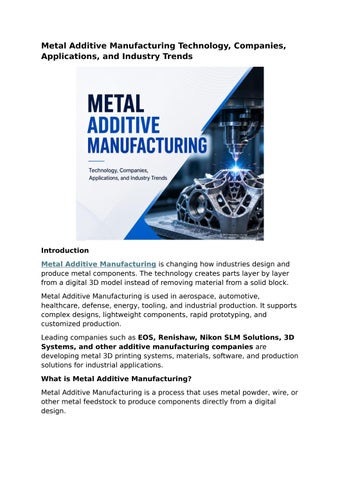
Metal Additive Manufacturing Technology, Companies, Applications, and Industry Trends
Introduction Metal Additive Manufacturing is changing how industries design and produce metal components. The technology creates parts layer by layer from a digital 3D model instead of removing material from a solid block. Metal Additive Manufacturing is used in aerospace, automotive, healthcare, defense, energy, tooling, and industrial production. It supports complex designs, lightweight components, rapid prototyping, and customized production. Leading companies such as EOS, Renishaw, Nikon SLM Solutions, 3D Systems, and other additive manufacturing companies are developing metal 3D printing systems, materials, software, and production solutions for industrial applications. What is Metal Additive Manufacturing? Metal Additive Manufacturing is a process that uses metal powder, wire, or other metal feedstock to produce components directly from a digital design.
In powder bed fusion, a laser or electron beam selectively melts areas of metal powder. New powder is then added, and the process continues until the complete component is built. Companies such as EOS use Direct Metal Laser Sintering (DMLS) technology for industrial metal 3D printing. EOS provides metal printing systems, materials, process parameters, software, consulting, and services as part of its additive manufacturing solutions. How Does Metal Additive Manufacturing Work? The Metal Additive Manufacturing process generally includes the following stages:
Digital Design: Engineers create a 3D model using CAD software.
Design Optimization: The component is optimized for additive manufacturing.
Material Selection: A suitable metal alloy is selected for the application.
Build Preparation: The model is positioned and prepared for printing.
Layer-by-Layer Production: The machine melts or deposits material according to the digital design.
Part Removal: The finished component is removed from the build platform.
Post-Processing: Heat treatment, machining, surface finishing, or other processes may be used.
Quality Inspection: The final part is inspected to meet required specifications.
Major Metal Additive Manufacturing Technologies Powder Bed Fusion Powder Bed Fusion is one of the most widely used metal additive manufacturing technologies. It uses a laser or electron beam to selectively melt metal powder. Renishaw uses metal powder bed fusion technology for producing complex metal components. Its systems are designed for applications across industries including aerospace, automotive, tooling, and healthcare. Direct Metal Laser Sintering
DMLS is a metal 3D printing process associated with EOS. The technology builds metal components layer by layer and is used for prototypes, customized components, and production parts. EOS offers industrial metal 3D printers with different build volumes, laser configurations, and material options. Its portfolio includes the EOS M 290, EOS M 300, EOS M 400, and EOS M4 ONYX series. Directed Energy Deposition Directed Energy Deposition deposits metal powder or wire while a heat source melts the material. It can be used for large components, repairs, and adding material to existing parts. Metal Binder Jetting Metal Binder Jetting uses a binding agent to join metal powder. The printed component then undergoes processes such as debinding and sintering. Leading Metal Additive Manufacturing Companies EOS EOS is a major company in industrial additive manufacturing. The company provides metal and polymer 3D printing systems, materials, software, services, and consulting. Its metal additive manufacturing portfolio includes systems designed for prototypes, industrial production, and high-volume manufacturing. EOS also focuses on integrating additive manufacturing into existing production environments. Renishaw Renishaw is a manufacturing technology company offering metal additive manufacturing systems based on laser powder bed fusion. Its RenAM 500 series includes systems designed for research, development, and volume production. The company also provides software such as QuantAM, InfiniAM, and Renishaw Central for build preparation, process monitoring, and manufacturing data management. Nikon SLM Solutions Nikon SLM Solutions provides metal additive manufacturing systems for industries including aerospace, defense, mobility, energy, tooling, and space.
The company works with materials including aluminum, cobalt, copper, nickel, steel, titanium, and niobium. Its metal AM solutions focus on complex, lightweight, and high-performance components. Applications of Metal Additive Manufacturing Aerospace and Space Aerospace manufacturers use metal 3D printing to produce lightweight and complex components. Additive manufacturing can support weight reduction, part consolidation, and designs with internal channels. Nikon SLM Solutions highlights aerospace and space applications where metal AM can be used to produce high-performance and weight-optimized components. Automotive and Mobility Automotive companies use metal additive manufacturing for prototypes, tooling, customized components, motorsport parts, and selected production applications. The ability to quickly modify digital designs makes metal 3D printing useful during product development. Healthcare Metal additive manufacturing is used for medical implants, dental components, orthopedic products, and surgical applications. Renishaw provides metal additive manufacturing solutions for healthcare applications, including dental and maxillofacial applications. Defense Defense manufacturers use metal AM for complex components, prototypes, replacement parts, and lightweight structures. Nikon SLM Solutions identifies defense as one of its key metal additive manufacturing industries. Energy Metal 3D printing is also being used in energy applications where complex, durable, and efficient components are required. Metal AM can help manufacturers produce customized parts and support the development of new component designs. Tooling and Industrial Manufacturing
Metal additive manufacturing can reduce the need for traditional tooling and support the production of complex tools, fixtures, molds, and machine components. Renishaw identifies tooling and industrial manufacturing as important application areas for its metal additive manufacturing technology. Benefits of Metal Additive Manufacturing
Complex Part Design: Metal 3D printing allows engineers to create geometries that can be difficult to produce using conventional manufacturing methods. This includes lattice structures, internal channels, and complex shapes. Lightweight Components: Design optimization can reduce the weight of components while maintaining the required performance. Reduced Material Waste: Additive manufacturing builds components layer by layer, which can reduce the material waste associated with some traditional subtractive manufacturing processes. Faster Prototyping: Manufacturers can move from digital design to physical prototypes without producing traditional tooling for every design iteration. Part Consolidation: Several individual components can sometimes be redesigned as a single printed component. This can reduce assembly requirements and simplify product design.
Metal Additive Manufacturing Materials Material selection is an important part of metal 3D printing. Common materials include:
Stainless steel
Aluminum alloys
Titanium alloys
Nickel alloys
Cobalt-chrome
Tool steel
Copper
Other specialized metal alloys
EOS currently lists more than 20 alloys and more than 70 validated processes across its systems.
The choice of material depends on factors such as strength, temperature resistance, corrosion resistance, weight, conductivity, and the intended application. Challenges in Metal Additive Manufacturing Metal additive manufacturing also has several challenges.
High Equipment Cost: Industrial metal 3D printers require significant investment. Material Cost: Specialized metal powders can be more expensive than conventional manufacturing materials. Post-Processing: Many components require machining, heat treatment, surface finishing, or other processes after printing. Process Control: Temperature, laser power, powder quality, atmosphere, and other parameters need to be controlled carefully. Quality Inspection: Industrial applications often require detailed inspection and process monitoring. Skilled Workforce: Engineers and operators need knowledge of machine operation, material behavior, design for additive manufacturing, and post-processing.
Role of Software in Metal Additive Manufacturing Software is becoming an important part of the metal additive manufacturing workflow. Manufacturers use software for:
CAD preparation
Build orientation
Support generation
Slicing
Toolpath preparation
Process monitoring
Production data management
Quality analysis
For example, Renishaw's QuantAM software helps prepare build files, position parts, create supports, and generate toolpaths for its AM systems. Metal Additive Manufacturing Market Trends
The industry is moving from prototyping toward production-focused applications. Manufacturers are looking for higher productivity, better repeatability, improved material options, automation, and stronger process monitoring. Multi-laser systems are one area of development. EOS offers systems with multiple lasers for higher productivity, while Renishaw's RenAM 500 series is available with one, two, or four high-power lasers depending on the system. Companies are also focusing on digital manufacturing, powder management, process monitoring, and integration with existing manufacturing systems. Future of Metal Additive Manufacturing The future of Metal Additive Manufacturing will depend on improvements in printing speed, materials, automation, software, quality control, and production economics. As companies gain more experience with Design for Additive Manufacturing (DfAM), metal 3D printing can become more useful for production rather than only prototyping. Leading companies including EOS, Renishaw, and Nikon SLM Solutions are continuing to develop machines, materials, software, and production solutions for industrial applications. Machinery and Equipment About Us At Precedence Research, we deliver specialized machinery and equipment market research, industrial machinery consulting, manufacturing industry intelligence, and equipment market analysis to help equipment manufacturers, industrial technology providers, automation companies, OEMs, and investors navigate an evolving industrial landscape. Our experts provide data-driven market forecasts, competitive intelligence, industrial automation insights, construction equipment analysis, material handling equipment research, robotics and smart manufacturing intelligence, heavy machinery market analysis, predictive maintenance insights, industrial equipment trends, and custom market research to identify emerging opportunities, optimize operational strategies, and drive sustainable business growth. Laxmi Narayan Author | Strategic Research Analyst Laxmi Narayan is a strategic research analyst with five years of hands-on experience in market intelligence, primary and secondary research, and
consulting engagements. His expertise covers the semiconductor, automotive, transport & logistics, and machinery & equipment industries. He specializes in analyzing emerging market trends, technological advancements, regulatory developments, competitive landscapes, and industry dynamics. Laxmi provides actionable insights that help global clients identify growth opportunities, optimize business and operational strategies, and make informed investment decisions. Known for his analytical rigor and strategic foresight, Laxmi translates complex market data into clear, practical recommendations that support business growth, strategic planning, and long-term value creation. Read more about Laxmi Narayan: https://www.precedenceresearch.com/author/118