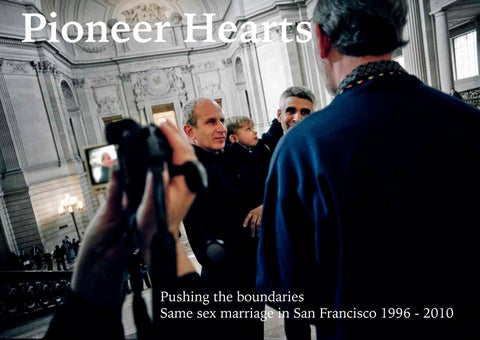
Pioneer Hearts
Pushing the boundaries Same sex marriage in San Francisco 1996 - 2010
Pioneer Hearts
The legendary California politician Willie Brown, having been “termed out” of the State Legislature, won his first stint as mayor of San Francisco in 1995, taking office on 8 January 1996. In response to a number of states passing anti-same sex marriage laws,
Brown had promised SF’s large gay community if elected, he would preside over a number of same-sex marriages. On the March 26th 1996 in SF’s War Memorial building he did just that. A 150 couples took part in symbolic but load statement of intent.
In 1912 Representative Seaborn Roddenberry proposed a constitutional amendment stating “Intermarriage between Negroes or persons of color and Caucasians… is forever prohibited.” “Exterminate now this debasing, ultra demoralizing, un-American and inhuman leprosy”, to protect the sanctity of marriage. He believed such marriage to be “abhorrent and repugnant”. January 20th, 2004, Gavin Newsom was San Francisco’s new mayor and in D.C. the Bush State of the Union speech. Bush saw same sex marriage as Rep. Roddenberry saw marriage between whites and POC and said so. Returning to SF Mayor Newsom, ordered the city registrar’s office to revamp the marriage license forms allowing same sex marriage and
on Thursday, 12 Feb. 04, the first official same sex marriages took place in the rotunda of City Hall. To some it was the beginning of the end of the world. To others it was the opening shot of a new civil rights movement. In the gay community it was the culmination of a long struggle for equality of marriage rights. On 11 March, 04, almost a month to the day of the first same sex marriages, with 2,688 couples still to be married, the California Supreme Court ordered a halt until they ruled on whether or not SF had the authority to issue marriage licenses to same sex couples. The court said a ruling would be made within 90 days after hearing the case in late May or early June. In the meantime, barring rulings on other grounds, the 4,161 marriages that had taken place were valid.
The Massachusetts’ Supreme Court ruled that same sex marriage was legal and the state’s legislature completed the first move to amend the state’s constitution to define marriage as between one man and one woman. The soonest the amendment could be placed on the ballot was 2006. By then Massachusetts same sex partners would have been getting married for two years. On Friday, 12 March 04, supporters of same sex marriage filed two suits in SF Superior Court seeking to overturn the state laws prohibiting same sex marriages. On 15th of May the court ruled in favor of legalization and weddings commenced. Opponents placed Prop 8 banning same sex marriage on the November 2008 ballot. Marriages were left in limbo.
On 4 August, 2010 US District Court ruled Prop 8 unconstitutional. June 26, 2013, the Supreme Court ruled the case had no standing and marriages resumed 2 days later. On June 26th, 2015, the Supreme Court ruled 5-4 for marriage equality. 2022 Update: The Supreme Court packed with right-wing, misogynist, Christian, white nationalists, seems bent on turning the culture clock back as far as possible. In 2022 Roe was overturned, and immediately thereafter talk turned to doing the same with marriage equality. .
What it means “In some way, shape or form being a gay man there’s always an element of being renegade, of being unaccepted, of being something odd and different. Now it’s different, now there are a lot of people who look at this and say, “Ok, there is nothing much different from my hopes and dreams that I’ve grown up with.” Galen Leung married Richard Bookwalter 19 Feb. 2004
“You can’t call grandma and say grandma we got domestic partnership because what does that mean? Marriage is something that has been around for thousands of years and people understand what that means. It’s a very different thing to say grandma we got married than to say grandma we have this weird piece of paper that California thought up.” Heidi Vance who married her partner Alison Little on 12 Feb. 2004
“I didn’t want a phony marriage. In the gay community people have these things called commitment ceremonies, (they get all dressed up in wedding gowns and tuxedos and then when one of them wants to leave they pack their bag and go. And I knew the difference, if you get married you have to get lawyer to get a divorce.) Many years ago I told Maria someday they’ll legalize it and when they do we’ll get married, but I’m not willing to do a phony marriage.” Sunny St. Pierre married her partner Maria Demetriou on 16 Feb. 2004
“We’ve come a long way. I’m a bit older than Julie and Nancy (a friend) is older than me. We’ve seen a lot of stuff, very mean things. A lot of violence, abuse, decimation, we’ve seen a lot of stuff in our years. To get to this point, it’s just phenomenal. I always hoped that I would see it but I guess there was a part of me who really thought that maybe I wouldn’t. (Legally) it may not last. I don’t know what the outcome is, that remains to be seen. But just the fact that a city and now a number of cities have opened this avenue up to us, I equate it with getting off the back of the bus.” Vaughn Bearski married Julie VanDyke 5 March 2004
“We’ve been together a long time and we’ve always felt committed to each other. Our parents have been nudging us for years to have some sort of ceremony. We wanted to publicly declare our commitment to one another but we decided we wanted to wait until marriage was legal for us.” Jim Maloney married Andrew Nance 12 Feb. 2004
“I think the law will change but I think changing people’s hearts and minds is going to take a lot longer. I think we’ve got a long road to hoe to get people to really accept it.” Jim Maloney married Andrew Nance, 12 Feb. 2004
“I’m glad it’s happening within our lifetimes. We never dreamed of this, never dreamed of this. It’s been great.” Donald Bird and David Young have been together for 37 years. They were married on Valentine’s Day 2004
“We knew we would want to if it was ever possible. We’ve done the domestic partnership already but it just happened sooner than we thought. But the love, that would be the main reason.” Bill Mitchell “Our relationships are just as valid. Just like in the 50’s when blacks and whites couldn’t be married, you have to look at it as a civil rights issue not a religious issue.” David Stocks
Bill Mitchell and David Stocks Married 26 February 2004
“We have been together as married couples are for so long (that) what was surprising to me was the incredible gratitude I felt to the people that were here that were volunteering their time; people who had gotten married and came back. People who had gone out and gotten donations and were passing out free food and making sure we had umbrellas because it was raining that day. Making sure we were warm and keeping us informed about the line moving and what we could expect when we got here (the area where weddings took place). I don’t know what I expected but it was a very heart opening experience for me. I felt love from everybody, it was truly amazing.” Tere Winters “I don’t understand what difference my marriage makes to some people when what it is really about is the relationship between Tere and myself. It has nothing to do with them. I don’t oppose their marriages, I don’t see why they should oppose mine.” Katie Hoggins Tere Winters and Katie Hoggins Married 16 February 2004
“I think it’s really important for kids to know their parents are married, it helps their sense of security.” Lyn Shimizu “I think it’s (the reasons for getting married) a combination. There were practical reasons, we have kids and we felt they are entitled to the same rights under the laws as their other little friends, whose parents happen to be straight, have.” Silvia Castellanos “How does giving our family and our children protection and rights take away from them (people who oppose same sex marriage) in anyway, shape or form?” Lyn Shimizu “There’s no difference that I can see. We’ve got a mortgage. We’ve got bills. We’ve got kids in school. We want the best for them as they want for their children. There is no difference. We are no threat. It’s the sameness that people are threatened by not our difference.” Silvia Castellanos Liana, Lyn Shimizu, Che Alejandro, Silvia Castellanos Married 13 February 2004
couldn’t necessarily show up in the room. His family couldn’t come and visit me. My family couldn’t visit him. They would have no way of recognizing the other families that are part of our family.” Galen Leung “Even something as simple as plan old Social Security or filing taxes, or pieces of paper that everyone else thinks of as nearly automatic, we have to actively take the step to engage those things. Once you get married there are a whole series of things that automatically come forward to you.” Galen Leung
“The federal Defense of Marriage Act lists more than a thousand federal rights that are reserved for married couples and married couples can only be male female couples. Those are a thousand rights that same sex
couples do not have… There are just a bunch of different eventualities that we have to be concerned about that are taken for granted by married couples.” Richard Bookwalter “If it’s (marriage) upheld
we don’t have to file more paperwork in order to enjoy some of the things that are taken for granted by people who are married. For instance (in most places) if either one of us is in an accident and is in a hospital the other one
“One of my coworkers has a friend who just died, he was one of a gay couple. It was the old story, one person dies, the partner remains with house and belongs. The family is the legal heir to the deceased and comes in and cleans out the house because they are entitled to his property and his partner’s not.” Richard Bookwalter
Left: Richard Bookwalter and Galen Leung with Galen’s mother Maria Yuen Yau Leung who lives with them. Married 19 February 2004 “When, and I’m sure it will happen, same sex marriages are accepted and legal, nothing will change. Nothing about your life, anybody’s life will change with the exception that the people around you will be happier.” David Young. “After our wedding, the next day I went down and I walked around the lines surrounding City Hall and passed out Hershey Kisses. I still had to be with that phenomenal feeling that we’ve been waiting for forever. Then the following week I went down and volunteered and helped couples get to commissioners to they could get married. And passed out flowers and made
people comfortable. Then March 2nd I was deputized a deputy marriage commissioner and I have performed 160 marriages (up until the interview) and it’s just one of the most joyous, uplifting,
exhilarating things I’ve ever done in my life for my people.” Donald Bird
Donald Bird and David Young Married 16 February 2004
“Most of our family is straight and the majority of our friends are straight. Over the last several years they’ve been getting married and now a bunch of them are starting to have kids and we see ourselves as really having the same relationship that those other people in our lives do. If they can go through the process of dating and falling in love and getting married then why can’t we?” Heidi Vance “The shortest that anyone who was in line with us had been together was three years, but everyone was older than us, everyone was over 30. I think we haven’t had the experiences that a lot of those couples have had, going through years and years of a relationship and still not being accepted by so many people. We haven’t faced a lot of discrimination. We haven’t faced a lot of hardships… We’ve gotten married after being together for 3 1/2 years; I think it’s about the time we would have gotten married if we were a straight couple... To us it’s time and we got our license.” Heidi Vance
Alison Little and Heidi Vance Married 12 February
Jeanne Marlowe and Janine Orendain with their marriage certificate. Married 13 February 2004 “We intended to have a marriage, in quotes, next summer. We wanted our family, friends, everybody to come together and sort of, I don’t know, acknowledge the relationship. We wanted everyone together to do what a marriage does, to ritualize we’re going to be together, this is the real relationship.” Jeanne Marlowe “The scene in the line was you would sort of start to chat with the people around you, find out this really might happen and you would get on your cell phone. You would start calling her sister, my sister, my friends, her friends. You’d just start calling everyone otherwise our witnesses would be people we didn’t even know. Janine had a temperature of a 102, she was going to do it or die.” Jeanne Marlowe “The piece of paper could almost
make me cry because it was something I didn’t think was possible in my lifetime. I just didn’t think that it was going to happen. It’s the most precious document I own.” Janine Orendain
“It’s this piece of paper, it’s a legal document, it’s a real thing. It’s not creating some rituals so our family and friends understand we are committed together. It says it, we’re married and here’s the
paper.” Jeanne Marlowe “It validates who you are” Janine Orendain
Ken Barr and Michael Fenter Married 13 February
“Since Michael and I have been together for 11 years there’s very little a simple piece of paper can do to justify the status of our relationship. But I think it’s very important that it makes the statement that gays and lesbians are as much a part of American society as anyone else.” Ken Barr “If he hadn’t asked me, we wouldn’t have gotten married. But he asked me and it was important to him and the civil rights aspect was important to me.” Michael Fenter “Friday was the day people were listening to the news saying they weren’t able to stop it, so we had a window. We thought it was like a 12-
hour window. We thought that by 6 o’clock they were going to stop it forever so everyone who was there was there meeting people. They didn’t come together. They meet there. They weren’t dressed, they didn’t have rings. They just came in whatever they were wearing. They ran down there (City Hall). The guys in front of us were 17 years (together); the lesbian couple in front of them was 22 years. The gentleman three up from that was 39 years and they all ran down to get married. They ran down to be a part of it, to get that little piece of paper, even if it was going to be for only 12 hours.” Michael Fenter
“It has to be said that the gay civil rights movement would have come to this point 20 years ago if it hadn’t been for AIDS. That was a tremendous set back because that allowed people to really focus in on a fear factor. People who are alarmed by gays and lesbians becoming more visible in society latched on to that as a way to stigmatize us as a class of people which of course was really unfair and unnecessary but they used it to their advantage.” Ken Barr
“We meet in a seminar. I was a seminar leader and she was an assistant. I was immediately attracted to her and she was attracted to me.” Maria Demetriou “Well actually she wasn’t. The seminar was over and everyone was leaving and I wasn’t really brave enough to say anything. So you know how at the end of seminars everybody hugs, Maria gave me this little squishy on the shoulder hug and it was a few minutes later and I was standing in front of her and she said didn’t we hug already? And I said yeah but I want a front ways hug. That kind of gave her the idea.” Sunny St. Pierre “Women don’t do that to other women” Maria Demetriou “We’ve really
been together ever since.” Sunny St. Pierre “My mother, whose 90 years old, and I were talking, she had been watching the television about everybody getting married and she says, “When are you getting married? Did you get married yet? And I said we haven’t gotten married because Sunny hasn’t asked me. She says, “What do you mean she hasn’t asked you? Ask her!” And I said no. The next day on my pillow there was a little ruby and a diamond ring and little pendant that said, “Well you marry me?” And I said yes, yes, yes.” Maria Demetriou “This is exactly who we are, which is your mothers,
brothers, cousins, uncles, aunts. We’ve got families, kids, if you looked at the line the day we got married, there were 830 couples that day, there were at least 50, 60 kids in the line. In the rain, with their parents, watching their parents get married. We’re just like everybody else.” Sunny St. Pierre “I have a personal interest in the thing. It means something to me, to my life directly. This affects my life and I am annoyed that somebody has 1500 more rights than I do.” Maria Demetriou
Sunny St. Pierre and Maria Demetriou Married 16 February 2004
Jim Maloney and Andrew Nance Married 12 February 2004
“We meet at Café Flore in San Francisco. It’s a popular place to hang out and have coffee or tea and flirt occasionally. On December 22, 1989 Jim and I were there with different friends and we saw each other across the crowded room. I went up to Jim and started chatting and the rest is history.” Andrew Nance “It was a very exciting atmosphere at City Hall that day. It was just unbelievable how excited we were. I didn’t think that marriage would be that big of a deal. We wanted to commit ourselves publicly to one another but I kind of underestimated the power of the ritual, the power of publicly declaring or love and commitment to each
other, what that would have. It was very moving. We are still trying to absorb the feeling of it with each other.” Jim Maloney “How could you even think of taking rights away from people who love each other and support each other and just want to be with each other for the rest of their lives? How could that harm marriage in any way?” Jim Maloney “Sometimes it’s a lot easier to hate an entire community than it is to hate an individual. I think if people were to get beyond the fear, the anger and the unknown, they would realize that they’re messing with peoples’ lives, with peoples’ hearts. It’s very
saddening to me that they are being that destructive to our family, to our friends’ families. Not only to Jim and I, which I consider a family, but to my mother, to my sister, to all the other people in our lives that support us and want the best for us. The people that want the Constitution to change, they’re saying to Jim and I, to my family and Jim’s family, that they do not want the best for us, they want us to be less than (they).” Andrew Nance
Tere Winters and Katie Hoggins Married 16 February 2004
“We have been together as married couples are for so long (that) what was surprising to me was the incredible gratitude I felt to the people that were here that were volunteering their time; people who had gotten married and come back. People who had gone out and gotten donations and were passing out free food and making sure we had umbrellas because it was raining that day. Making sure we were warm and keeping us informed about the line moving and what we could expect when we got here (the area where weddings took place). I don’t know what I expected but it was a very heart opening experience for me. I felt love from everybody, it was truly amazing.” Tere Winters “I don’t understand what difference my marriage makes to some people when what it is really about is the relationship between Tere and myself. It has nothing to do with them. I don’t oppose their marriages, I don’t see why they should oppose mine.” Katie Hoggins
“I was kind of numb. I still am actually. It’s still hard to believe. It’s weird because you don’t want to get overly excited because you know tomorrow they could take it away from us or nullify our marriage certificates. So it’s hard to know how to feel.” Ted Guggenheim So many people have said it’s the wrong time (to allow same sex marriage). It’s always the wrong time (politically). It’s never the right time. You have to do it because it’s the right thing to do.” Brian Davis “The love Ted and I share in our relationship is just as loving, just as giving, just as caring, just as difficult and just as frustrating at times. We have the same ups and downs, and struggles, and victories and joys as every marriage between a man and a woman. Until society acknowledges our true equality by saying we deserve the name marriage, you’re saying…our relationship is not equal to yours, is not as valuable as yours. We don’t agree. We say our relationship is just as meaningful, just as important as yours.” Brian Davis
Brian Davis and Ted Guggenheim Married 12 February
“She is someone I want to spend the rest of my life with and I want to have that recognized as everyone else’s. I want us to have the same rights as everyone else does.” Vaughn Bearski “The ceremony was very profound. It took a long time to get to this point. May not last in regards to the paperwork and legality, may end tomorrow or in an hour but we did it. We are the same as everyone else.” Julie VanDyke “People don’t have any idea what a gay and lesbian lifestyle is like. They don’t get that we’re just like everybody else. We get up in the morning and go to work. We work hard all day, we come home, we have dinner, we feed the dog. We pay taxes and we buy houses.” Vaughn Bearski “The sanctity of marriage belongs with two loving people willing to go through good and bad and stay together… That’s the sanctity of marriage. How can you define the sanctity of marriage of just the focus of heterosexual couples when there is good and bad in all relationships and couples? Julie VanDyke
Julie VanDyke and Vaughn Bearski Married 5 March 2004
San Francisco City Hall on the first business day that same sex marriage was ruled constitutional by the California Supreme Court. 200 couples applied for licenses the first day and 2303 made appointments to apply in the following 90 days. San Francisco, California. 17 June 2008
“I feel like we’ve been married for 20 years. This is just a validation of what I feel has been in place. It means that in California I’m recognized as a full citizen with the rights that I deserve.” Katherine Robertson “We’ve been hanging out together for 20 some years. We have two children together and we’re a family and I think it’s good for our children to have married parents. Plus this is the person I plan to spend the rest of my life with.” “It (the right to marry) means that maybe there’s a chance that in the United States, maybe in my life-time, that this will be recognized as full civil rights for all people.” Genie Robertson On the first business day after the California Supreme Court ruled same sex marriage legal. L-R) Claire, Katherine, Genie and Jordon Robertson of Austin, Texas, just after getting married at SF City Hall. Their marriage won’t be legal in Texas. 17 June 2008
“Pioneer Hearts” A Coffee and Donuts publication Photography, design and interviews: Robert Gumpert Copyright: Robert Gumpert