
RAGE
ABOUT
RAGE Zine is a global multidisciplinary feminist zine and platform—both print and digital—for expressing feminist rage as a force for creative change and collective action.
Non-profit and inclusive, the platform is a space where rage can be unleashed with vulnerability and dignity. We publish bold, experimental feminist work—writing, art, and more—primarily in English, with an emphasis on multidisciplinarity, harnessing feminist rage as the powerful source of creativity it can be.
Beyond the page, we also host creative feminist workshops, events and panels that amplify and platform feminist voices and themes that are too often unheard.
The project is led by the RAGE Collective: a group of feminist artists, writers, academics, creatives, and activists, based around the world, but primarily headquartered in Copenhagen, Denmark.
JUNE 2026
EDITOR 'S NOTE
We’re back with RAGE Zine Vol. 3 and we’re as angry as ever. This year, we have brought together over 60 artists, writers and activists from more than 25 countries to showcase how feminist rage can disrupt and re-define the world around us.
This volume of RAGE Zine remains a space to provoke, a platform for experimentation and release. We transform anger into form, into language, into something that creates friction. Featuring a range of voices confronting and igniting political and personal wounds, there is room to be furious, tender, feral, aching, restless, insatiable, abject, and so much more.
From the intimate to the systemic, and from the embodied to the digital, these works insist that we must creatively do justice to the profound value of this complex emotion. Contradictory, shape-shifting, and impossible to contain, we have featured poetry, painting, digital art, essays, collage, photography, video, and experimental forms we don’t yet have names for.
From Aleena’s striking oil paintings evoking rage through the flesh, to Fahmida’s powerfully allegorical letter from the perspective of Chronic Pain and Elliot’s beautiful photographs of using paint to protest, this volume, as always, holds so many forms of rage.
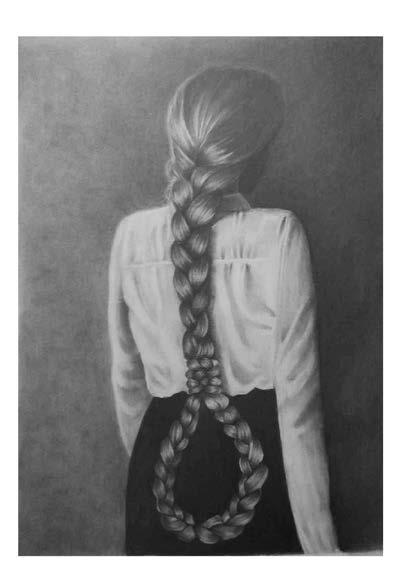
And, for the first time, we have woven the contributions into a map of rage, with chapters tracing four different spheres and forces: we start with Raging Bodies, where feminist rage is located in the body. Then, we move into Screaming Rage, where feminist rage is expressed as sound and refusal, as fire and protest, in a braided noose. In Rage Mythologies, we find feminist rage inspired by the voices that came before, and new revolutionary symbolisms, rage as world-making, a tour-de-force of imagination. And finally, we close the volume with Reclaimed Rage: rage as a generative resource for justice, joy, and taking back our power.
This political moment not only provokes, but necessitates our feminist rage. We are publishing this volume in a moment defined by backlash and by the continued violence of the patriarchy: against bodily autonomy and reproductive rights, against trans lives, migrants, and collective liberation itself. Authoritarianism, fascism and ongoing wars and conflicts continue with devastating impunity.
And more than ever, in mainstream politics, culture, everyday language and online spaces, misogyny has found life through the growth of the manosphere and reactionary digital cultures. Our collective feminist rage is being weaponised, turned into rage baiting fodder for the algorithm, used to increase engagement, visibility, and profit. Women’s rage has become part of their growth model. So we must find ways to rage together without feeding the patriarchal machine. And what better way to do so than to return to activist and analogue modes of feminist expression?
We are tired of being told, again and again, to make our anger easier to swallow for the very people causing it. Feminist rage is a refusal to disappear, to comply, to become numb. It’s the hope that imagining another world is still possible. We hope that RAGE Zine can be an antidote to the systematic repression of our rage. May our rage change the fucking world.
page 8-9 page 11 page 12-13 page 14 page 15 page 16 page 17 page 18 page 19 page 20-21 page 22-26 page 27 page 28-33 page 35-37 page 38-39 page 40-41 page 42 page 43 page 44 page 45 page 46-47 page 48 page 49 page 50 page
page
page
RAGE RESEARCH OPEN MIC by Roselil Aalund
Anemochory by Clara Josephine Lykkeberg
Fuck Healing, I Want Blood + No Longer Available by Aleena Sharif
Fist-sized by Leslie Roberts
Pity Them for They Know Not What We Can Do by Anna Onni
I love women: A Letter by Fahmida Azad
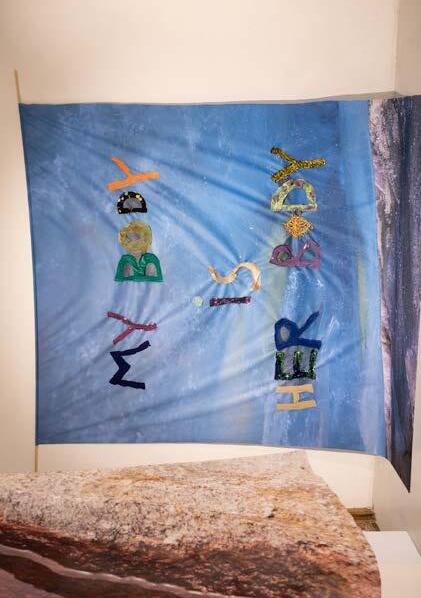
My Body is Her Body by Diewke van den Heuvel
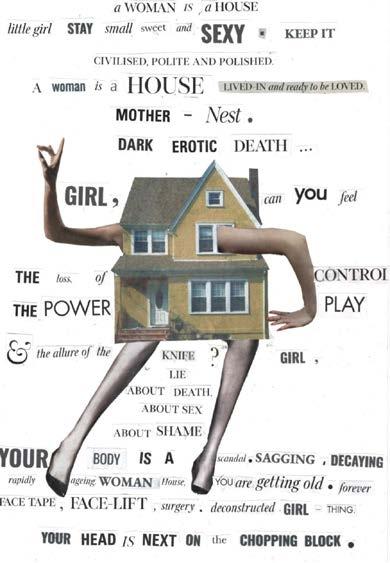
Housebound by Brody Rose
Next In Line by Amara Femia
INSIDE by Éléonore Guiraud
BLOOD IS NOT A CURSE by Elisabeth Oktimazas
Goodnight Dr. Sims by Lily Orion
Who Lit The Fuse On Your Tampon? by Tyler-Jayne Kemp
laut werden – laut bleiben (get loud – stay loud) by Ilsa Hösch & Hannah Candolini
Weather Systems by Isabella Taylor
FUEL by Charlie Montagne-Mas
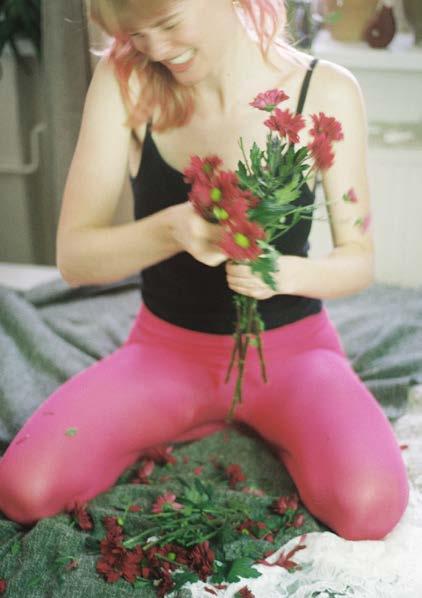
Fuck Your Flowers by Emma Sophie Weber
The Mouth of the Well by Shunanummah
Things White writers don’t have to ask themselves by Eve Xin
Name Five Players. Name Five Women Who Feel Safe. by Georgia Theodoulou
enRAGEd: a woman’s awakening by Paris Rosemont
Lightning Rod by Suzanna Fitzpatrick
RABIA (RAGE) by Isa Cruz
Statement of Editorial Vision by Galina Dukov
Say it with Flowers + The Trap by ZAKA
Pyramid by Briony O’Callaghan
Self-portrait: a forgotten nereid by Alyssa Curcio
I love your male gaze by Leo Patra a.k.a. Carl-Johan Paulsen
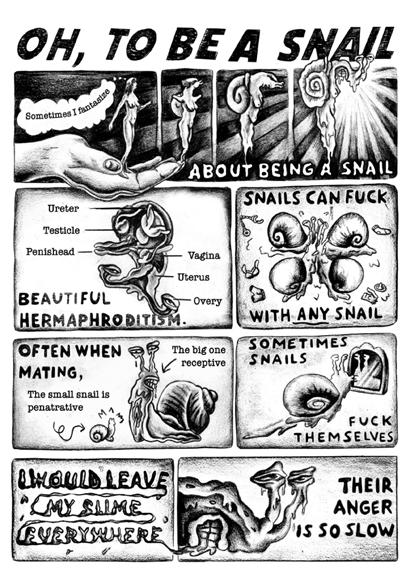
Oh, to be a snail by Lois Konijn
The HagFags by Sangría Valentino & Henna Nerg
page 64-65 page 66 page 67 page 68-70 page 71 page 72 page 73 page 74-79 page 80 page 81 page 83 page 84-85 page 86-89 page 90-91 page 92 page 93 page 94-95 page 96 page 97 page 98-99 page 100 page 101 page 102-105 page 106-109 page 110-112
Blood and guts forever: Memories of a teenage whore by Alessia Peca
Tender is the Harvest by Marie V. Recalde
Lolita Speaks + Lolita’s Axe + David Bowie is a Motherfucker by Gabrielle Everall
Pearl and the other angry girls: Feminist rage in cinema by Carlotta Centonze
MOANER LISA by Denise Page
Give uncle a kiss by Ilenia Vacca Todorova
ARTEMIS by Janet Murray
Dismantling the Power Hierarchies and Inequality of Science with Dr. Jess Wade by Lorenza Foglia
girls invented punk rock not England by Rebecca Rae
Fighters by Giulia Ratti
Gay Sex & Other Revolutionary Acts by Hillary Gonzalez
ángel + avenida by Elliot Long
A Love Story I’m Not Supposed to Grieve by Joy Léonie Sung
Rage #13 + Rage #15 by Sarah Eckstine
Is it perimenopause or is it late stage capitalism? by Rachel Swabey
Washing Out the Shame by Myrto Apostolidou
Lost & Found by Jenny Ping Lam Lin
My Inheritance, My Promise by Soha Michlawi
Sometimes Angry by Erica Engdahl
rage repertoire by Kira Hartz
We are pretty damn alive: A comrade from the Okinawan diaspora by Thatha
succumb, submit, silently, violently by Alicia Roberts a.k.a. BUMCHAIII
The Soy Boy Manifesto by Frederik Frisk Bech
YOUNG & MAD featuring Mika Zurim, Jean-Rae Annat, Faye Simpson, Cyan Rushton & Kimasia Ayers
Contributors & RAGE Collective
RAGE RESEARCH
Dearest reader,
Together, we welcome yet another volume of RAGE Zine and Rage Research. A place to experience and explore our deep emotions and oppressed feelings, all with one red hot fire of an emotion in common, RAGE.
It’s rage time, y’all!
Rage Research seeks to dive deep into understanding more about what rage is. Since 2022, I’ve interviewed the wonderful collective and other professionals, talked to many more about rage in my day-to-day life, and not least in my work as a psychologist. On this quest, I’ve learned a lot about this powerful emotion. To many people, rage is an intense and overwhelming feeling, one that grows from a place of injustice, whether on a personal and/or societal level. Some of us have been taught to suppress our rage, and that rage and her close siblings, anger, and sadness, are emotions to avoid. However, these feelings are natural and often healthy reactions to … something of meaning; injustice, unfairness. Rage is insisting and does not vanish easily. We all need an outlet, space to let ourselves feel it all, express it, and from there, we can learn to channel our rage into miracles, change, boundaries, art and much more.
In previous Rage Research, I’ve always invited you to reflect and engage in some way, because it all starts with ourselves. In this volume, I want to give you more space. From my research, I’ve found that rage is insisting, she demands to be heard and expressed.
In this volume, it’s time for you to take the stage. It is time to create space for your rage. It’s time to create space for yourself. I encourage you to explore your own rage. You are the most important source of knowledge. Get curious. Engage. Allow yourself to be … to be in rage.
OPEN MIC
Describe what rage means to you.
What do you feel in your body when you are enraged?
How can your feminist rage contribute to change (in the world)?
You’re most welcome to share any thoughts, comments or emotions that have come up while reading, reflecting and writing by DM @ragezine with the heading Rage Research. Thank you.
by Roselil Aalund
RAGING BODIES chapter I
Anemochory
When lack is heard as a plea that lack unleashes insurmountable rage however seeds of rage don’t disperse evenly in the disabled body they tear themselves loose counting on winds of change and as a wind must howl to be a wind the disabled body must howl to be rageful ablaze with delicate plumes
by Clara Josephine Lykkeberg
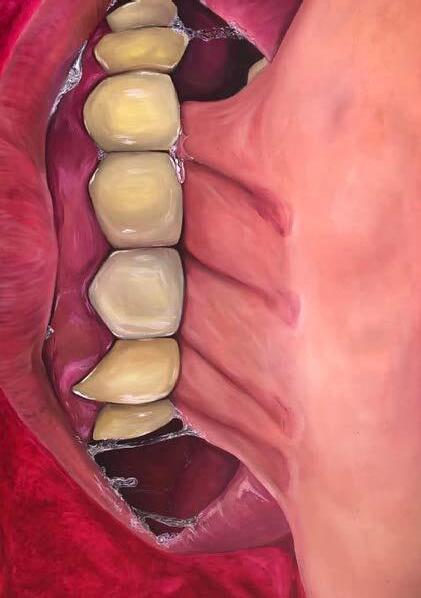
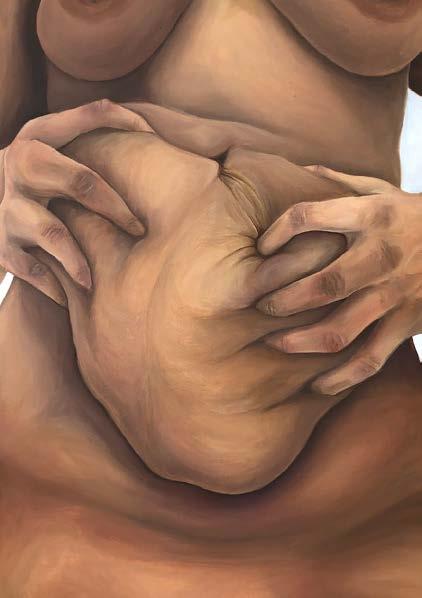
Every month you screamed, starting at age thirteen, sloughing off unused lining for two weeks at a time turned my attention inward, downward. My friend’s mom celebrated hers with cake, but your anger arrived in me the night before a swim meet and a week away at camp—unapologetic from the beginning, you reached through my veins, drained them of iron, made me dizzy, made me faint, blacked out on the kitchen floor, head smacked on the tile. You squeezed my muscles, doubled me over, heaving, incapacitated, rearranged me, pushed me, forced me to be brave like nothing happened.
They said it was normal, said your mood would even out, you’d calm down, quit protesting, that this was just how it is to be a teenage girl. I tried to medicate you away, but unlocked a door to the darkness deep and heavy over me suffocated my tired lungs. There is no counter-protest that can match your passion for taking me away from everything else, taking me into myself.
by Leslie Roberts
Eventually I gave you what I thought you wanted: conception, implantation, zygote, embryo, heartbeat—unceasing, you built another organ, another life— swelled, expanded, shoved aside whatever was in your way, claimed the entirety of my abdomen, and in the process made me sick, averse to everything except sleep, sometimes incapable of even breathing. You spent months practicing contractions without pattern or trigger, prevented me from peace, inhabited my mind, demanded my entire being conform to your needs and your timing, when at last, one week early those waters surged, but then for an entire day you merely pretended to labor, waited until the middle of the night to seize and squeeze and force open my bones so the bones of another could distort through your narrow exit.
For weeks you screeched as you shrank back into my pelvis, cursed at having to once again share the cavity of my body with pancreas and liver wailed with grief that your reign of glory and terror was over. Six weeks you bled, but on the seventh week you would not rest: without hesitation you started back determined, renewed, ready, like a raised fist.
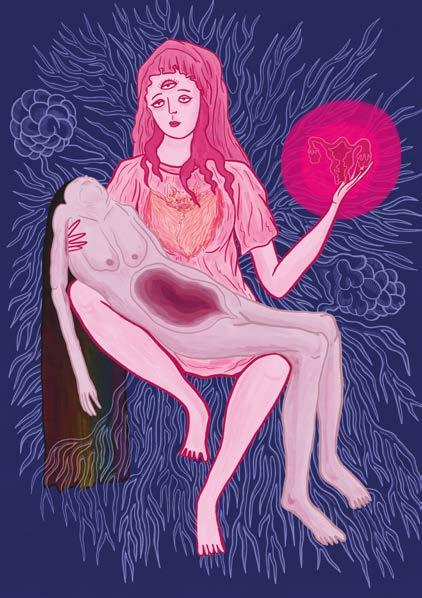
I love women: A Letter
Serve me and Feel me until I’m done She tells people that I’m real They tell her I’m not And this is all I need I need people to not believe her And this really is the easiest thing in the world I tried to love men, but They end up telling on me And you see, people believe men I am unwanted with him and seen as a problem I can’t count on him
by Fahmida Azad
I love women I love her flesh I love her skin I love her nerves I love her pulses, rhythms, and beats I scrape the walls of her body I claw at her head I seep into her limbs I tear her cells and creep inside
Devouring the in-between spaces Until she loses herself inside of me Everything disappears inside a pitch
A steady screech where nothing else exists
With her I can stay and As long as people keep telling her I’m not real I am free to grow
This is precisely why I love women Yours, Chronic Pain
And I grow And I flare And I expand
We become intertwined. I am her, and she is me. Sleepless nights, eyes wide open, her trying to get rid of me
We both know, though, It’s better if she doesn’t resist She must Host me and
Meat squeezed into near-bursting sausage skins. Rump steaks red and glistening. Chicken breasts blemish-free and spotless.
The bell on the door rings, and the butcher’s eyes cut up to me. He doesn’t meet my eyes. No, he meets my body first. A strange look takes hold of his face, his eyes squint, he sits up right.
Too fatty. A bit off the middle and she would be great smoked. Especially the thighs, those could go for a good price. We don’t need the flabby bits, just the meat and the good stuff. The breasts can go, the stomach is pretty much roadkill, but she’s not beyond saving.
I blink. It smells like disinfectant and being cornered.
I start to walk to the display cases, my mother’s list in my hands. It’s crinkling into a ball in my hands. The butcher has now turned away, busying himself with a table behind him. Stainless steel, a scratched countertop. I wonder how many times a knife has been brought down on it.
I unfurl the list, attempting to flatten it on my thigh. 14 drumsticks, full-sized because I made the mistake of not specifying that last time.
“Excuse me.” I say, and the butcher turns back around, finally meeting my eyes. He’s got sallow eyes, the kind that are earned after back-to-back 10 hour days for years on end. His stubble is patchy and scattered, and makes a grating noise as he scratches his chin before he speaks.
“What can I do for you?” His voice pulls my stomach to my feet. Crackly, gurgling. Like a music box that hasn’t been used in years. I look down and point at the drumsticks.
“14 drumsticks, please. The big ones. All in the same bag.”
He nods and busies himself. I notice he has on gloves. Under the gloves, mannish and thick fingers. I don’t like to think about how they would feel when they’re wrapped around a chicken’s neck, its body swaying like a metronome keeping time with the butcher’s steps. Left, right, left, right.
To the chicken, those footsteps would be the sound of a decided fate.
He’s portioned a few of my drumsticks now. I turn around to look outside at my mother’s car, but the windows are plastered with decals promoting the best sim card deals you can find. I instead busy myself with looking at my surroundings. There’s white tiles under my feet. Very easy to clean blood off of, I assume. Better than carpet, at least. The grout tells me this place has been here a long time, blackened and even green in some corners. Fuzzy. The shelves lining the center of the shop are adorned in essential oils, marinades, pre-done stews and incense. I walk a few paces over and pick up a small bottle of eucalyptus oil and wave it under my nose.
Next In Line
by Amara Femia
INSIDE
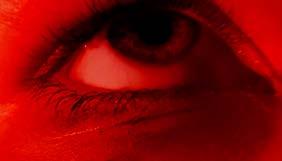
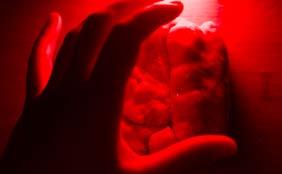
This experimental and immersive video is focused on the abject and the female body: An uneasy, immersive experience that metaphorically brings the viewer inside the female body which has been and is still often feared, rejected, abused, and objectified by men.
The title refers not only to the interior of the body, but also to the violence I (we) can feel as a woman in this patriarchal society, everything we have been raised to keep inside, to be nice and treated as hysterical if we dare speak up.
I was influenced by films such as Jennifer’s Body (as well as its association with Courtney Love’s song) and RAW by Julia Ducournau, alongside music by female artists. I took fragments taken from song lyrics and other female musicians’ writing and integrated them into the work.
CLICK HERE TO WATCH THE FULL VIDEO
by
Éléonore Guiraud
BLOOD IS NOT A CURSE: Womb Art, Menstrual Rage,
and Reclaiming the Sacred Body
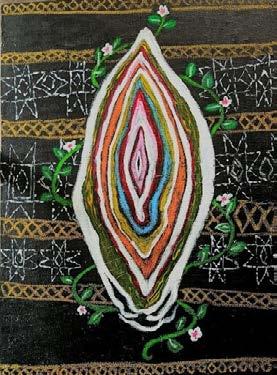
My acrylic painting on canvas called “SHAKTI”
It represents the Yoni, combined with traditional ikat weaving motifs from my homeland, Maumere–Flores, as a form of advocacy against the everyday trivialization and mockery of women’s vaginas in our social context.
I live in a society that still treats menstruation as something that must be hidden. Not merely as a private biological experience, but as a disruption to social order. Menstruation is framed through the language of impurity, illness, and inappropriateness—something that should not be seen, not spoken of, and, as much as possible, removed from public space.
This way of seeing is not neutral. It is shaped by history, norms, religion, and institutions that continually produce meanings of women’s bodies as problematic bodies.
From an early age, women are taught that their bodies are acceptable only when they are obedient: clean, controlled, non-leaking, non-disruptive. Menstruation becomes an issue not because it is painful, but because it refuses full submission to the system. It arrives cyclically, autonomously, and cannot be scheduled according to social demands.
Menstrual blood is the only blood that leaves the human body without violence, yet it carries the heaviest stigma. Blood from wounds can be heroic. Blood from sacrifice can be sacred. Menstrual blood, by contrast, is reduced to biological waste—something to be quickly disposed of, concealed, and neutralized.
This is not a matter of hygiene.
It is a matter of power.
morality, religion, medicine, and social norms.
Within this structure, women grow up inhabiting bodies that are constantly surveilled, even by themselves.
Womb art emerged for me as a direct response to these conditions. Not as an aesthetic choice, but as a political and artistic position. I chose menstrual blood as a medium not to shock or transgress norms sensationally, but to dismantle the logic that renders this blood illegitimate as part of human experience.
I do not use menstrual blood as a symbol, but as material. It is a bodily substance long defined as waste. By using it as a painting medium, I challenge the boundary between what is deemed worthy and unworthy of presence—both in art and in public discourse.
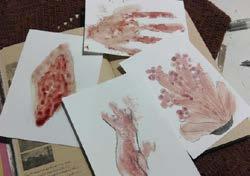
One of my menstrual blood paintings
The stigmatization of menstruation functions to distance women from their own bodies. By framing menstruation as impure and problematic, society implants disgust, shame, and alienation. Women’s bodies cease to be sites of knowledge and become objects in constant need of correction—by
The process of painting with menstrual blood is slow and precise. It demands full presence rather than emotional excess. There is no attempt at dramatization or performance. This practice resembles care more than spectacle. It is a way of listening to the body again, without disgust and
without the impulse to correct it. This is not art made for consumption. It is art made for relational repair.Through this practice, I refuse to see the womb as a site of dysfunction. I reject narratives that frame menstruation as a monthly illness. I reject logics that force women to detach from their bodily cycles for the sake of social comfort.
From womb art rooted in menstrual blood, my feminist expression expanded into another medium: digital illustration focusing on the womb, vulva, and vagina. Organs that have long been hidden, censored, or reduced to sexual symbols are reintroduced as autonomous visual subjects.
These illustrations are not decorative and not meant to soothe. They function as visual statements. I present the womb, vulva, and vagina not as erotic objects or reproductive tools, but as centers of experience, memory, pain, pleasure, and embodied knowledge.
The visual erasure of these organs is not accidental. It is part of representational politics. When women’s bodies are unseen, they are easier to control. When they are allowed to appear only in approved forms— clean, passive, and reduced—women lose the language to refuse.
Through digital illustration, I create an alternative visual archive: women’s bodies present without moral censorship, without romanticization, and without the need for legitimacy. The womb does not speak only of reproduction. The vulva and vagina do not speak only of sexuality. They are complex and political living spaces.
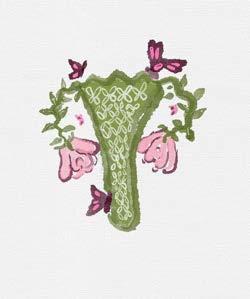
My digital artwork of The Womb. My approach to advocacy centers on encouraging women to reimagine the womb as a beautiful and meaningful site of experience, rather than one defined by stigma or fear.
The rage in my work does not manifest as shouting. It appears as firmness. As the decision to continue seeing, naming, and presenting women’s bodies as they are—without purification and without justification. Through watercolor depictions of the vulva, I advocate against the stigmatization and judgment of women’s bodily diversity.
I am not romanticizing menstrual blood or women’s bodies. I am rejecting narratives
that have long separated women from their own embodied experience. This is not about becoming sacred. It is about refusing to be labeled dirty.
This body is not broken.
This blood is not impure.
This womb is not a source of sin, illness, or disruption.
My artistic practice—through menstrual blood–based womb art and digital illustra-
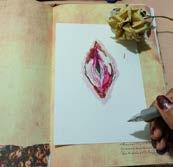
tions of women’s bodies—is an attempt to reclaim the body as a site of experience and meaning. Art, for me, becomes a medium to restore the relationship between women and their bodies, outside the intervention of moral, religious, and institutional authorities that have long claimed ownership over them.
I do not ask for acceptance.
I assert presence.
Women’s bodies do not require permission to exist.
And that existence itself is a radical feminist
act.
In societies that tie women’s value to purity, self-control, and obedience, a body that bleeds without injury is perceived as a threat. Menstruation disrupts the narrative of the ideal body: neat, productive, and non-disruptive. As a result, menstrual blood must be expelled from symbolic space, removed from language, and erased from representation. Art that uses menstrual blood or directly presents women’s reproductive organs is often rejected not because it is extreme, but because it exposes what has long been concealed.
Through this practice, I speak not only of my own body, but of women’s bodies collectively—bodies constantly negotiated by social norms, regulated by institutions, and corrected in the name of morality, health, or propriety. Womb art and feminist body illustration function as disruptions to this order. They offer no solutions, ask for no empathy, and make no effort to explain themselves in order to be accepted. They exist as interruptions.
By placing menstrual blood, the womb, the vulva, and the vagina at the center of artistic practice, I reject logics that separate women from their embodied experience. This is an effort to build a visual and artistic language that begins with the body rather than fear of it. In this context, art does not aim to soothe, but to sustain presence. And sustaining presence, for women’s bodies, is a radical political act.
This work is inseparable from a decolonial context. The stigmatization of menstruation and women’s bodies in my environment cannot be understood outside the legacy of colonial modernity—a system that imposed rigid binaries of clean/dirty, rational/irrational, civilized/primitive, and male/female. Colonial knowledge systems disciplined bodies
through moral regulation, medicalization, and religious authority, positioning women’s reproductive bodies as sites in need of control and correction.
Pre-colonial and Indigenous understandings of menstruation in many cultures recognized it as cyclical, powerful, and relational. Colonial regimes did not simply erase these knowledges; they reframed them as superstition, impurity, or backwardness. What followed was not only the loss of ritual, but the internalization of shame. Women were taught to distrust their bodies through the language of hygiene, productivity, and moral respectability.
Womb art, in this context, becomes a refusal of colonial bodily discipline. By using menstrual blood as material and centering the womb, vulva, and vagina as visual subjects, I reject Western-modern aesthetics that demand cleanliness, neutrality, and disembodiment. I also reject feminist frameworks that universalize women’s experiences while erasing local histories, spiritualities, and embodied knowledge from the Global South.
This practice does not seek validation from Western art canons or biomedical authority. It asserts that the body—specifically the menstruating body—holds its own epistemology. Decolonial feminist art, for me, is not about recovering a romanticized past, but about interrupting colonial continuities that still govern how women are allowed to exist, bleed, and be seen.
This work is grounded in a decolonial feminist position. The stigma surrounding menstruation and women’s bodies in my social context is not merely cultural or religious—it is structural, produced by colonial modernity that disciplined bodies through regimes of hygiene, morality, productivity, and respectability. Colonial power did not only occupy land; it reorganized how bodies
were perceived, valued, and controlled. Women’s reproductive bodies were recoded as unstable, excessive, and in need of regulation.
Colonial knowledge systems delegitimized embodied and cyclical forms of knowing, replacing them with biomedical authority and moral surveillance. Menstruation was stripped of its relational and cosmological meanings and reframed as biological failure, impurity, or inefficiency. This shift did not liberate women; it severed them from their bodies while demanding obedience in the name of progress and civility.
Womb art, in this context, is an act of epistemic disobedience. Using menstrual blood as material and centering the womb, vulva, and vagina refuses Western-modern aesthetic demands for cleanliness, neutrality, and abstraction. It also challenges feminist frameworks that universalize women’s experiences while remaining rooted in colonial hierarchies of knowledge.
This practice does not seek inclusion within dominant art institutions or validation from medical or moral authority. It insists that the menstruating body produces knowledge on its own terms. To bleed, to mark, and to remain visible within a system that demands erasure is not symbolic—it is political. Decolonial feminist art, here, is not reconciliation. It is interruption.
by Elisabeth Oktimazas
Goodnight
Doctor Marion Sims, the father of gynecology, experimented on enslaved Black women and girls, performing surgeries on them without local anesthesia. Anarcha, Betsy, and Lucy are among the named victims. I hear their screams. I smell their blood. I imagine the bent spoon Sims used as the first speculum opening my cervix while men held me down. I have endometriosis, a condition many Black people are not properly treated for, perhaps because we are still seen as gross anatomy practice, as experiments, as medical waste. Being a Black woman with this disease, many white hands have reached inside me and made me scream as if I were possessed by my fore-sisters who could feel the blades cutting into their skin, and I begin to wish for a little revenge. For a Black vagina to grow teeth. For my Black cervix to swallow them whole. For my Black body to be covered in blood, I did not bleed. And through the magic of centuries of Black anger, I find myself traveling through spacetime to a random night in 1846 to Montgomery, Alabama, into the bedroom of Dr. Marion Sims.
I am here to enact justice. It is 2026, and it is 1846 all at once. And I am standing over his bed with a ten-blade. Sims sleeps below me as all evil white men do; peacefully. Quick as a crack of a whip on my back, my hand comes to his face with a damning slap that wakes him and his rotted soul. He stares in horror as I float above him, my face interchanging with those of his victims. He tries to flee, as I am sure those women and girls he cut into without anesthesia did too. I grab him, hold him with the help of every Black woman on the plantation. Together we tie him to the bed, sock in his mouth, pants off, he lies there flaccid and exposed. The ten-blade gleams in the dark, as does the sweat dripping from our bodies.
A midline incision is made, opening his penis like a blooming flower. His testicles spread and stretched for our important medical research into how much pain we can inflict. No, Dr. Marion Sims never received anything resembling accountability or justice in his time. This is our way of remedying that. Other doctors who experimented on enslaved and Native people began to flee town after they heard what was done to the old boy. Castration would be an empty gesture, instead making his body into something unrecognizable, into agony we cannot quantify, of a message painted on the walls of every enslaver's eyelids at night. They no longer sleep peacefully.
It doesn’t matter what century we are in, what progress you think we have made; Black bodies will always be in danger of maniacal white hands. It is the fight against this that you must call your home, not the denial of it. Find the Dr. Sims in your profession, in your life, in your heart, and disembowel him, metaphorically, of course. To kill the killer is the only way to live. To believe the victims is the only way to heal.
All I see when gynecology holds onto his legacy is blood; perhaps they should see my rage. Fear begets fear. Eventually, all monsters become prey. For the women and girls experimented on, the names we know and the ones we don’t. We raise our rage to further our liberation. For those in antiquity and in perpetuity, I will defend my sisters. I will always tell their story, my story, our collective stories. A pen can be a knife if needed.
Dr. Sims
by Lily Orion
WHO LIT THE FUSE ON YOUR TAMPON
by Tyler-Jayne Kemp
Before I Bleed Over The Page
I use the term ‘woman’ a lot in this piece and want to clarify that I am of the clear conviction that not all women have a uterus and period, just like not all those who have periods and a uterus identify as women. Gender isn’t a neat little Venn diagram, even if our country’s Supreme Court has decided that biologically, it does. I never want to be exclusionary in my ramblings and, as a writer, understand the power of language.
I identify as a woman and write based on my own lived experience. I collectively speak about ‘women’ as a group that frequently reports on experiencing what I discuss, and on whom, the existing (mostly outdated and limited) theory and research is based. These experiences are by no means a requirement for the identity of a woman. Trans-women experience even heightened responses to what I address. But, I cannot speak on their reality for them; there are great firsthand accounts out there.
Tampons
I used to stick my mother’s tampons in my ears.
I would go “Look at me Mummy, I’m wearing your earplugs!”
Her boyfriend used to get nosebleeds often. He worked away and I would be told they were stress-induced. At the time, we didn’t know the stress had a nameTracey Kellic, his wife.
He would walk around the house with no shirt on and a tampon inserted in his left nostril. I would scold him and say he can’t wear Mummy’s earplugs, misled on the function, but knowing they were exclusive to women.
A decade later, once again, I find myself suspiciously looking at tampons. Not because I still do not know how they work. Granted, it took some trial and error. I’m sure every woman has fallen victim to the Hot Dog application. No, now I am weary because they might be poisoning me. With lead and arsenic.
The discovery of PFAs in menstrual products is the tip of the iceberg of evidence that society does not care about our reproductive health and menstruation-specific issues. The problem is not that we are inserting neurotoxins into our vaginas. Obviously, this is a problem, but it’s an area used to absorbing foreign and toxic substances.
There is no ‘safe’ exposure to these chemicals, but they’re found in soil and can creep into a lot of products. I don’t think Unilever is intentionally trying to kill us off. They are evil in a late-stage capitalism way, so could not give two fucks, but if we all died, it would mean less consumers for them and a potential fine, as a slap of the wrist, for harming millions of women.
The problem is that we have only discovered this now, in 2024. In any other case, they discover this safety issue before it is mass-manufactured and distributed worldwide. Women’s health is historically underfunded and under-researched, and this study highlights that.
Not only are our tampons poisoning us, but it’s also costing money. £3 for a pack of twelve death bullets. Menstruation is a natural biological process that is key to the entire existence of humankind, yet to manage it is considered a ‘luxury’ and taxed accordingly. Period poverty is a cycle that keeps women oppressed. Girls miss education because they’re afraid of the stigma attached to being on their period and not having access to sanitary products. They are more vulnerable to Toxic Shock Syndrome. We have free healthcare in this country, one can walk into A&E with a leg off their limbs and leave with no bill. But, need a tampon? You’re charged the price of an iced coffee.
Governments such as Kenya, New Zealand, Botswana, and recently Scotland, all provide free sanitary products, England should be next to join that list.
I first got my period in year nine. Or, as my Christian mother would say, ‘the day the Devil came to visit’. I was the last amongst my friends. I got FOMO as they would describe PMSing and would laugh along, but it was clear I wasn’t sure what was funny. Nothing apparently. My friend wouldn’t show up to History, and I would text asking why, and receive a cryptic reply: ‘the red has arrived’.
I started at my dad’s. My sister had left for university, and it was one of the brief stints in his life, I remember him single. So, when I woke up and it looked like I had sat on a ketchup bottle, I didn’t know what to do. The school nurse was a massive liar for one. This was not the equivalent to a teaspoon of blood. I had assumed it would come at my mother’s when it sensed a nurturing woman close by. But, I quickly learned that my period was not a feminist. If it was any ‘-ist’, it’s a sadist. It enjoyed catching me out at the worst of times. White linen trousers on a NYC subway. A Scout’s camping trip where we were rationed to three squares of toilet roll a day, a long-haul flight, at a funeral. It had no social cues.
I went into the bathroom, where at my mum’s, cabinets were full of the tampons her ex and I used to shove in the wrong crevices. At my dad’s, there was floss, Oral-B and snus. I resided in my room, telling my father I was ill and built makeshift pads with toilet paper. I remember he asked if I wanted a more ‘delicate’ dinner that night as he had happened to notice I used a whole roll of toilet paper in the last 24 hours. Bless, he thought I was burdened with the worst case of diarrhea. I know I could have told him that the time had come, I was a woman now, but I thought it meant I would have to start paying my own phone bill.
I think the first thing women are taught to feel is shame. My father is a nice man. He wouldn’t care about my Art Attack bedsheet. I’m sure he would have just slapped Vanish on it. He is always spilling red wine on his expensive shirts, he enjoys experimental laundry. But before I started, nobody close to me ever spoke about periods. My mother never directly said, TYLER-JAYNE, STOP PUTTING THE TAMPONS IN YOUR EARS, THEY ARE FOR YOUR VULVA! She just giggled and tittered, “You will understand when you’re older darling.”
My friends would sneak a tampon or a pad up their blazer sleeve when they went to the bathroom. As if they possessed a bomb. Nobody could see! Especially not Dr. Richardson who hated teenage girls regardless, and wouldn’t let you leave, even if you started leaking shit across his classroom.
We all know what a pad is used for, yet on advertisements, to show one’s absorbency they pour diluted mouthwash on them. For the longest time, I thought my period would arrive and be Smurf blue. The advert is usually aired after 7
pm, between an ITV showing of some action film where they don’t swap all the bloodshed in that out for Salene. But that’s because blood from murder and war is much nicer than period blood. Duh.
I grew up in a culture where the ‘devil coming to town’ did not ruin my life. I wasn’t forced out of education or into marriage or isolation like women, well, young girls, in other cultures are. So I’m not trying to sound like a prick when I say, oh no, I have ruined Dad’s best The White Company sheets.
As it happened, mine did not reveal itself every four weeks. Another lie. Some days, I would go months without a sighting and for a brief stint of the year, saw the light that men experience all year round. I can’t say the same for the tracking apps on my phone, every day a notification from Flo, ‘TEN THINGS THAT COULD BE WRONG WITH YOU!!’ I could wear my Victoria Secret panties without the fucking stick-on diaper, my white capri pants came out from the back of the closet, the wrath of the authoritarian regime was over! Then, somehow awoken by a sexual encounter or because I sneezed too hard, it came rushing back. I would wake up clutching beneath my belly button, stabbed a thousand times in the uterus. Thus became a villain reborn.
Birth control
I got a text on Monday, reminding me that this month my implant became void. It’s quite dystopian, getting a WhatsApp reminding me I am fertile again after three years of not thinking about it twice beneath a notification that an inappropriate colleague has liked my story.
I’m on Nexplanon, the teeny plastic rod that gets inserted in the fleshy beneath of your arm and freaks out everybody at the pub when you ask them to find it because it’s moved position, as if it could drop out into their vodka coke at any moment.
Before Nexplanon, I was on the pill. The pill was so normalised whilst I was growing up. As a child, I recall leaving the GP with a lollipop. Teenagers? They get Monophasic. Bad acne? Take the pill. Bad cramps? Take the pill. Feeling left out? Take the pill. A poll in 2013 revealed that 4 out of 5 sexually active women are on it. It has now fallen to 27%, so 1 in 4 sexually active women. Most of my friends started taking it at 13 or 14 and tell me their bodies know no difference. They grew up and went through puberty with these additional hormones, so they aren’t sure how they are supposed to feel without them. I, however, went on the combination pill at 18 and was hyper-aware. I was a horrible teenager, even before the dupe oestrogen, so can only apologise to those around me at the time.
It is becoming more obvious that we don’t know as much about birth control as we think we do. It doesn’t just stop ovulation, it is a hormone adjuster, so rewires your brain chemistry. 30% of women on the pill experience depression. This isn’t talked about as much as it should be. My friends and I will joke about inexplicable manic episodes we go through and conclude the conversation like, “Oh well, guess Mercury is back in retrograde.” No, it’s the hormone cocktail you’ve been marinating in since Year 9.
There is also irony in the fact that the thing designed for you to enjoy sex just for pleasure, is the reason you don’t want to have it. The libido complex is one of the most reported symptoms of hormonal contraception. Birth control also interrupts our cortisol levels, a vital hormone that alerts our body when something is wrong. All this research I have only discovered after already being on it for four years.
The reality of existing as a woman is that you have to weigh up your risk-to-benefit ratio. How high a price are you willing to pay to avoid pregnancy?
Hormonal contraception is by no means evil. Its invention has empowered and saved the lives of many women. I fear that when people question hormonal contraception, they fall into a narrative that sounds like an anti-vaxxer. That taking birth control is a way to control women, when actually, not taking it and then banning abortion is a much scarier form of control. Their reasoning can sometimes fall victim to pseudoscience. When the questions shouldn’t come from conspiracy, it should come from societal truths about a culture that once again fails women. We are the ones who have to bear the financial and physical cost of preventing pregnancy, whilst men do not think twice about it.
Science put a man on the moon before it even thought to consider, let’s put him on birth control. A recent trial by WHO tested a male hormonal contraceptive injection, which was 96% effective. Higher than the pill initially, and women died in the trials that led us to the contraception we have today. The report concluded that “the risks to the participants outweighed the potential benefits,” because of a long list of side effects: depression, muscle pain, mood swings, acne and libido alteration, to name a few - any sound familiar?
Health
“The merest schoolgirl, when she falls in love, has Shakespeare or Keats to speak her mind for her; but let a sufferer try to describe a pain in her head to a doctor and language at once runs dry.”
Virginia Woolf, On Being Ill
Every time I go in for a check-up, my doctor has changed. I have to give an elevator pitch on my pain from scratch to the new character with a receding hairline. Too emotional, and you’re being dramatic. Too calm and you’re fine.
My pain feels manageable. But that might just be the conditioning talking - the way we’re taught to swallow it and compare it to worse. And there’s always worse. Women being told they’re being ‘overthinking’ a headache that turns out to be a brain tumour, a failed epidural leading to postpartum trauma, the intense pain of the insertion of vagina meshes and IUDs, that lead to fertility issues and even in a case in Scotland, death. Punctured walls from invasive egg retrievals, terminal illnesses being written off a ‘pre-menopausal.’ It’s fucking horrific out here.
The entire system is biased. Doctors are trained from years of data that has excluded women. In particular, women from minority groups. The male body is the default, the ‘norm,’ think about how many diagrams you would see in biology textbooks of female anatomy when the module wasn’t on pregnancy. Hardly any. But, most women recognise what science doesn’t, that our bodies are different down to a cellular level, and this is why such a huge ‘gender’ gap exists in modern medicine.
So Yes, I’m Angry
Female rage is cumulative and a result of our bodies being regulated, medicated, taxed, dismissed and studied last. I don’t think I am asking for the moon. Which isn’t that far off from being owned by a Bezos or a Musk. But for the research and funding men get, for contraception to be a shared responsibility, to not be brushed off by doctors when they feel pain. To put an end to period poverty, as a period is a sign of health, like a heartbeat or bowel movement. If a man bled once a month, you bet Tampons will come with a cashback scheme and not an attempt to poison your bloodstream.
So, who lit the fuse on my tampon?
Society did. With their long, slow-burning match made of medical misogyny, hormonal guesswork, and government indifference and now everybody has to feel the burn.
SCREAMING RAGE chapter
II
CLICK HERE TO WATCH
laut werden – laut bleiben
(get loud – stay loud)
Weather
by Isabella Taylor
I have been raised to believe my feminist anger is a personality flaw. Something sharp and unbecoming that gathers at the back of my throat like a swear word you can’t say in front of respected authority. In Australia, where we’re trained to iron ourselves into “easygoing,” rage is treated like bad manners. Real, bodily, unpretty feminine rage gets filed under hysterical, dramatic, political, difficult. And yet, rage is the most honest weather system I know. But, for me what further complicates this is that I come from a long line of women who survived by burying it. Learning to read pressure changes early, to stay still when the air turned dangerous. Maternally, survival required silence. Assimilation. Endurance. Rage itself was dangerous, it could get you punished, abandoned, institutionalised or erased. Rage had to be swallowed to stay alive, fed, housed and believed. Fleeing facist Italy arriving during what is now known as the ‘White Australia Policy’ where almost immediately after achieving naturalisation facing 3 generations of conscripted war trauma each trying to prove we belonged in a nation that kept us at an arm’s length. Their wives and daughters carried a different kind of war. Strokes, stillbirths, abandonment, domestic violence and generational poverty. The constant message that independence was reckless, reliance was safer even when it wasn’t. This pressure lived in the structures set to recategorize us. Our surname shifted from Giannini to Miller, culture thinned, community ties faded. So distant I cannot look at my mother and see myself as the only trait I gained from her Sicilian aesthetic is the light curl of my dark blonde hair. Always close enough to build a country, never close enough to be fully claimed by it. My feminist rage crosses gender the way storms cross borders. A reading of who is allowed to be angry without punishment, who is permitted to inherit power rather than trauma. But this inheritance, this policing of rage is older than even my national home.
Paternally, I descend from an unnamed victim of the North Berwick Witch Trials of Scotland.
A lineage shaped by the fear of a woman’s anger, independence and knowledge. Where deviation from obedience was fatal and women were punished for what their existence threatened… Autonomy. An early technology of control and a warning reverberating through generations to bury your rage before you are destroyed by it. A lesson that travelled through Europe. Through colonisation. Through families that traded their silence for safety and their endurance was mistaken for virtue.
So, when I speak life onto my page about feminist rage, I am not describing something new I am describing an inherited contradiction that now sharpens my sword of purpose. A history where survival depended on burying anger, and yet justice now demands that I exhume it.
That is why rage feels both ancient and urgent in my body.
It rolls in when another woman is killed and the headlines use passive voice like a sedative: woman found dead, incident occurred, man known to her. Rage brews when the public conversation bends itself into sympathy for the perpetrator’s “future,” while her future is already a closed file, a memorial page, a photograph of her smiling in better light. Rage thickens the air I breathe when we’re instructed to be safe as if safety is a personal hobby something you can achieve with the correct footwear and a charged phone.
We tell ourselves we’re far from the world’s worst violences, as if oceans are a moral disinfectant.
But distance doesn’t protect you when misogyny and racism travels through language, through law, through history, through jokes, through institutions that were built long before you were born and somehow still expect you to fit their architecture. It’s the Australian habit of calling women “strong” but we give women strength the way we give them condolences, cheap and customary, a social reflex that costs the giver nothing. Feminist rage is what hangs heavy when that euphemism stops working.
I’ve been told to be “measured.” To speak in ways that won’t alienate the people who have power. But this strategy has been used against us too: weaponised patience, weaponised civility, weaponised “now is not the time.” There is always someone telling women to wait. Wait until you have the perfect data. Wait until you can frame it without emotion. Wait until you’re older. Wait until
you’re less angry. Wait until you’re more palatable. How long have we been waiting? When do you decide to stop negotiating with your own truth realising that “overreacting” is a label applied to women who react accurately. My rage is about the borders too in the literal and ideological. It’s about how compassion gets rationed. How we can talk about women’s rights in theory and then punish women in practice, especially when they are poor, queer, racialised, disabled, migrants, incarcerated, or simply inconvenient to the national narrative. I know the myth: fair go, mateship, a “laid-back” culture where rage is a vibe killer. But the vibe was built on silence and the barbeque doesn’t work if someone points out the smoke. A signal flare marking where the harm is concentrated. Because rage is costly. It makes you tired in the spiritual sense, like you’ve been carrying a heavy bag for too long and everyone keeps insisting it’s not that heavy. And the expectation to perform rage, to be angry in the right way. Becoming a consumable aesthetic filtered into slogans and merch while the structural issues remain stubbornly untrendy. But feminist rage is not a product. It’s a pulse. Rage is what happens when you’re forced to translate yourself for people who refuse to learn your language. It shows up through poetry, satire and the way women tell the truth to each other in bathrooms. The kind that shows up in the messy middle of real life: at dinner tables, in courtrooms, in hospitals, in schools, in the spaces where women live and labour. But ultimately, rage, for me, is a kind of love. Not the soft love people expect from women, but the fierce love that refuses to accept harm as inevitable. Rage is what love becomes when it hits the limits of patience That’s the thing: feminist rage is reconstruction. It can build. It can organise. It can create language where there was only shame. It can turn private pain into public demand by becoming collective and political. I think of rage as an energy source. It has to be handled carefully. If you keep it all inside, it will poison you. If you pour it out without direction, it will exhaust you. The trick, if one really exists is to turn rage into something that lasts. Because suppression is not control it is just an ignition delayed. And, in Australia, we know something about fires. We know how a spark becomes an inferno, how the wind carries it, how it can be both terrifying and cleansing, how
the land regenerates in its aftermath. So, I know suppression doesn’t work forever. If you refuse to deal with the fuel, eventually the whole thing goes up. Patriarchy is fuel. So is racism. So is poverty. So is institutional indifference. So is the way we teach boys entitlement and call it confidence.
Feminist rage is the moment we stop pretending the smoke is normal.
To an international reader, I want this to be clear: Australia’s feminist rage has its own accent, but it speaks a global language. The details shift through laws, histories and borders but the grammar is familiar. All women know what it is to be disbelieved. To be blamed. To be told to be careful instead of being cared for. Feminist rage is the translation of that shared experience into movement.
Rage is an aesthetic, yes, but only because it is a reality first. And I won’t apologise for it. I’m tired of being told anger will “turn people away,” as if the purpose of feminism is to be inviting rather than liberating. Feminist rage, to me, is a refusal and a promise. A refusal to keep absorbing harm in silence. A promise to build something better, even if I must build it with shaking hands. And if the world wants women’s rage to be quieter, more elegant, more digestible than I have this to say plainly.
We are not obliged to be palatable while we are being devoured.
We are allowed to be furious.
We are allowed to demand a world where women don’t have to be strong just to stay alive. That is what my feminist rage is made of: truth, heat, love, and the unwavering belief that we deserve more than endurance. My feminist rage is made of inheritance and refusal. Of grief and heat. Of history and possibility. It is a promise to the women who survived so I could be here and to those who should not have had to. If rage is my weather system, then let it be known I am no longer forecasting. I am reporting what is already here. I am watching the storm and refusing to pretend it’s just a little rain.
Systems
They told me to be a garden, to grow rows of quiet things lilies with their heads bowed, vines that cling but never squeeze. They gave me a teaspoon to move the ocean and a ribbon to tie back the storm. But there is a heat beneath the ribs that does not know how to be a "lady."
It is the hum of a thousand grandmothers who swallowed their tongues so I could speak, who buried their fire in the kitchen floorboards until the wood began to char.
My rage is not a tantrum; it is a ledger.
It is the ink of every "no" ignored, the weight of every shadow followed home, the cost of a smile I had to wear like a wire mask until the skin grew raw.
Do not ask me to be "articulate" while the house is still on fire.
Do not ask for a "civil" tone from a throat that has been stepped on.
This anger is the only thing I own that hasn’t been edited for your comfort. It is a wild, red bloom breaking the concrete.
It is not here to destroy the world it is here to burn away the rot so we can finally see the ground.
by Shunanummah
THE MOUTH OF THE WELL
Things White writers don’t have to ask themselves
by Eve Xin
Which poem shall I read or submit today?
What are they most likely to love understand tolerate?
How much energy do I have to be visible For my voice to represent my entire race? How angry honest do I feel safe enough to be? How much stone cold silence can I carry?
Am I the only coloured person in the room?
Did they really invite me because I was good? Are they waiting for me to teach them something, say something wise? When they look at me do they see a whole person or just my skin, my hair, my eyes?
Do they want Queer without the migrant?
My culture and our food, but not our people?
The ways I was oppressed back home but not how small I feel here in new and different forms?
Do they want to hear the ways I kiss, touch and fuck, but keep at arm’s length this body, in the same room?
Do they want a love poem that doesn’t talk power?
To hear my grief without systemic violence, or a story about motherhood without disclaimers that every child starts on a different line? Do they want poems with universal themes when what they claim as human centres their experience & emotions?
Do they want to hear about Palestine as a violence far from their shores but not the racism in their own villages?
Do they want to protest against ICE and Trump but only with the ones they call good immigrants? Do they want to talk about how the Earth is dying and all of us are fucked, without admitting that some of us are more fucked than others?
If I ask myself all these questions every time before I walk into a room, am I complicit in their comfort and therefore, their violence?
But if I really had all the answers (and sometimes I think I do) Would I still want to be in the same room?
Name Five Players.
by Georgia Theodoulou
“Oh, you’re into football? Name 5 players and explain the offside rule then!”
I would bet my house (and mortgage) that if you are a woman remotely into sport, you will have heard that comment or something very similar. Even as a fan, men feel the need to make us prove our knowledge or ability and there isn’t an aspect of my job which I feel the need to validate more.
Existing as a woman in sport isn’t for the faint-hearted, even in 2026. Last week, two vital pieces of research dropped which highlight the brutal reality of women in UK sport. From grassroots to elite level sport, women are facing systemic misogyny, harassment, and abuse. Women’s Sport Collective’s research study found that 88% of women working in elite sport have experienced sexual misconduct in the last five years and 93% said the perpetrator was always or mostly male. This study wasn’t based on just athletes, but coaches, medical staff, administrators, broadcasters, and journalists. 87% of these women had experienced sexual harassment and 40% had experienced sexual assault.
Women In Sport’s report shows women coaches were twice as likely to be bullied compared to men, with women coaches pushed out by unsafe systems, informal power networks and a lack of accountability. I’m a firm believer in ‘you can be it if you see it’. Representation matters. We won’t get more women and girls staying in sport if they don’t see themselves represented in sports. And no, the solution isn’t to just fund more pitches and equipment for girls. If we don’t fix the culture and systems that drive women out of sport, we run the risk of sending generation after generation of girls into a sporting culture that doesn’t protect or value them, like lambs to the slaughter.
Less than half the sample in the Women’s Sport Collective study felt like governing bodies and employers were doing enough to address these issues. So, when we don’t even trust the authorities and people whose literal jobs it is to keep us safe, where do we go? I have seen men accused of sexual harassment, had restraining orders taken out against them, coaches sexting their athletes, in group chats with other coaches and athletes referencing women as “cum sluts” and guess what? Not a single one of them has seen any consequence. In fact, in one case, he was promoted. Got a tip off from his pal (who happened to be the one leading the safeguarding investigation) and hey
presto. And in some of these cases, it’s the woman who was harmed or spoke up who was lumped with the consequences.
Sport is genuinely, I believe, one of the greatest things to experience and can provide such an amazing sense of community for so many of us. The mental health benefits of sport and exercise can be just as, if not more important than the physical. But there is something intrinsically rotten about the culture in sport that harms and excluded women, girls and marginalised genders. From as young as 3 years old, girls report enjoying sports less than boys. From being that young, we are told that sport isn’t for us. Or only certain sports are. And they’re only for us until period stigma, ridiculous kit or sexual harassment kicks us out of it.
And of course, like most other areas, let’s not pretend that sport is always a super safe and happy place for men and boys either. The stereotype of being a “successful sports guy” is entirely synonymous with being straight, white, 6ft, muscly as hell, brazenly sexual and dominating women, any association with something remotely feminine is branded as “gay”, and anyone who doesn’t follow the crowd will suffer the consequences. Sport has no room for men who aren’t all of those things. Just look at the sheer lack of openly gay sportsmen. Look at the way the media and fans react to a black footballer when he misses a penalty. How many young boys were told by their grassroots coaches not to “throw like a girl” or to “toughen up and plough on”?
This isn’t about one or two “bad apples” (and we all know many, even if we’re not aware of it). It’s about systems throughout sport that protect power not people. Women aren’t leaving sport because they don’t love it. They’re leaving because the cost of staying is too high. Or staying and suffering. Staying and not being believed. Staying and being silenced. If sport wants to talk about growth, performance, and legacy, it has to start with safety, accountability, and structural change. We need safeguarding systems that actually protect the right people. National Governing Bodies and organisations that take bold action to tackle these issues and a conscious effort to spotlight and celebrate the countless achievements of women in sports, especially underrepresented women, without constantly having to compare them to men.
Oh, and next time a guy asks you to name 5 players or the offside rule, ask him to name 5 women who feel emotionally and physically safe around him. That’ll shut him up.
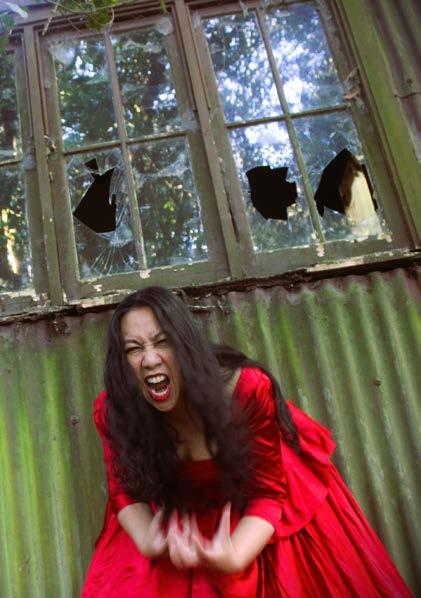
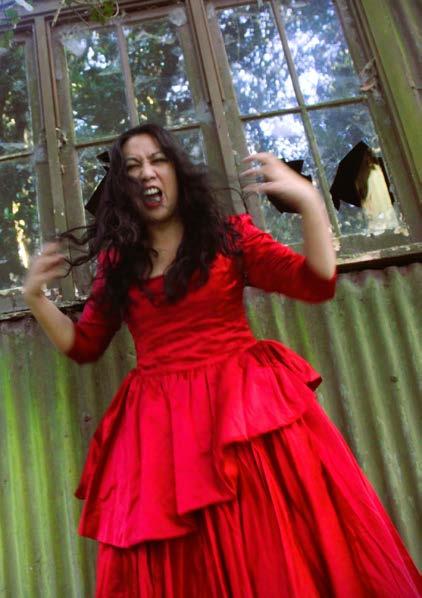
I am this tall because I am stretched I am this thin because I have been whittled eroded by expectations beaten to a strip of metal oscillating in your storms dutifully swallowing bolt after bolt earthing the emotions you can’t handle: crack there goes your stress crack your hunger crack grief crack lust crack envy crack anger sizzling from my scalp to my toes, bones singing with conductivity flesh alive with everything you want dead. Mary Shelley understood electricity rules life and this time watch the corpse of me twitch, grip your startled throat wring the last sparks from you until you’re empty and I’m full. I smile teeth humming like pylons.
Lightning Rod
by Suzanna Fitzpatrick
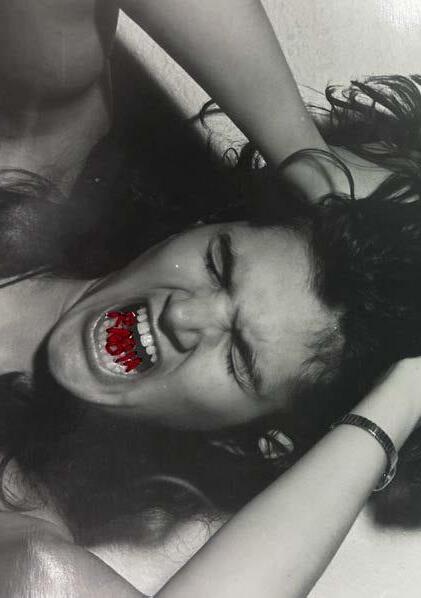
CALL FOR SUBMISSIONS! ISSUE 01: WHO CAN YELL THE LOUDEST?
UNQUESTIONING MAGAZINE IS LOOKING FOR UNIQUE AND INTERESTING NEW VOICES. READ WHAT WE ARE LOOKING FOR DOWN BELOW.
We want fearless writing. We want tough and uninhibited writing. We want writing that defies and argues and pulls no punches except to punch us in the face. We want writing that doesn’t flinch when someone raises a hand at it. We want writing that bellows from the gut. We want writing that doesn’t fidget, doesn’t bite its nails, doesn’t tug at its hair. We want writing that doesn’t have hangups. We want writing that lets it all hang out. We want writing that wasn’t socialized to be accommodating, to walk with its keys in its hand, to call someone on the way home at night, to take the inconvenient way. We want writing that didn’t learn to pull all its papers out of the glove department with only one hand. We want writing that doesn’t say, yes officer, what is the problem officer, what can I do to be helpful to you right now officer. We want writing that could crack it in jail. We want writing that challenges form, voice, tone. We want writing that didn’t talk at itself in the mirror for years, pitching high, now low, searching for the perfect frequency, the right vowels and consonants, the perfect way to convincingly say, I am no threat, I am no prey. We want writing that shouts and confronts and doesn’t let it lie. We want writing that doesn’t rehearse saying nothing from me, thank you. We want writing that doesn’t sweat through its shirt during conversation. We want writing that doesn’t text I love you, in case before takeoff. We want writing that doesn’t check the locks, the light switch, the oven, the hairdryer. We want writing that starts the revolution. We want writing that doesn’t assume responsibility for cleaning up the broken glass afterwards. We want writing that kicks and spits and fights and won’t die quietly. We want writing that has never had an office job. We want writing that didn’t listen. We want writing that barks chained up outside somebody’s house. We want writing that doesn’t think to go over there with a bowl of food. We want writing that is dark and daring. We want writing that has never counted the change in its pocket one by one. We want writing that doesn’t raise its hand to speak. We want writing that doesn’t think about who else is speaking. We want writing that experiments. We want writing that doesn’t hedge its bets. We want writing that doesn’t have an emergency fund. We want writing that doesn’t pick up the phone in the middle of the night. We want writing that doesn’t remember food allergies and doesn’t cook two different dinners. We want writing that floors it. We want writing that doesn’t stack sick bags and protein bars in the trunk. We want writing with big ideas and a bigger voice. We want writing that has never washed dishes into the night after everyone else has gone to bed. We want writing that has learned nothing. We want writing that is immune to a lifetime of fear. We want writing from someplace deep within you, except from there, or there, or here. It’s so easy. All we want is what comes from the real you. No, not that one. Peel back the layers. Keep going. Find the tough core. Everyone has one. What do you mean? Yes, everyone. We are committed to no barriers. Well, must be a mistake. No, nothing of that sort. Our sensitivity reader is very good, and she copyedited this whole thing. We look forward to hearing from you.
Yours in myopia, Unquestioning Magazine Editorial Staff
by Galina Dukov
RAGE M YTHOLOGIES chapter III
by Briony O’Callaghan
Pyramid
Un-designed. A sprawl. A conservatory in apocalypse. all light, all.
Her, mercy. Margot. Grandmother. Pyramid. She said I don’t understand them either. She died on her side. Imperfect.
shade. Her coral nail polish adorned her cold hands which clasped my ecstatic blood-filled face. Me, child.
Some mound of clever rocks, angled, fetishised for its mystery. Her name was Margot. A name self-made, after mar-gar-et proved too measured. TS Eliot under dusty lamp
is to be a tomb. A relic, a pyramid –
Her chest was broken –an old floorboard stomped on by too many partygoers. Who knows what goes on within a woman’s body. To be a woman
I am made in my father’s image— that is to say, I am made of anger.
If you look quite closely you will see that my bones and sinews are held together with stitches of “no no no” sewn over and over again.
My mouth is filled not with teeth the color of a shell’s belly, but with knives glinting the shade of the pucks in the moon. Honed to a point over a thousand, thousand years watching ships pass me by, hearing my name on the stuttering tongues of men.
What a beauty, my sisters say. They twirl the salt-spun locks of my hair around their fine fingers.
by Alyssa Curcio
Self-portrait: a forgotten nereid
They know not of the temperature of my blood. They cannot see how black rage warps my cheek, my left eye, the bones of my neck. Nor do their gazes catch the wisps of smoke that curl around my head as I speak, even as I say these words to you now.
How the prophets sing the tales of virile sons, all spines and spit and seeking out blood.
But they know nothing of the daughters Made in their fathers’ image.
I love your male gaze
Are you really gonna let the tree burn
Tear it up by its root
Leave it to die
In the fire
As fuel to your misbeliefs
The forest
A teenage girl
Snake, squirrel, deer, eagle
Teenage girls
I’m addicted to you
Don’t you know that you’re toxic
I love what you do
Don’t you know that you’re toxic
Witch hunt. Queer hunt. Trans hunt. Gay hunt. Black hunt. Brown hunt. Girl hunt. Death hunt. Palestinian Hunt. Man hunt. White hunt. North hunt. Cis hunt. This hunt. The hunt. Last hunt. Fuck hunt. No hunt. All hunt. We hunt. We want. More hunt. Hunt hunt. Drug hunt. Drag hunt. Fag hunt. Shag hunt. Mad hunt. Your hunt. Fame hunt. Cash hunt. Phone hunt. App hunt.
Say no to a man because you can
I’m addicted to you
Don’t you know that you’re toxic
I love your male gaze
Don’t you know that you’re toxic
Here I stand before you
A figure to be perceived
I mimic degrading sexualised visions of femininity
I become the obscure image of the petrified eyes
The eyes that seeks to be pleased
By shapes they define as worthy
Worthy of a look, a gaze, a slap in the ass
Talking about women behind the eyes
An inner monologue of penis erection and rape
As I seek to break the box of binaries I become a ridiculous entertainer
Appropriating holy female energy
On the verge of becoming non-binary
I gaze through the eyes of heterosexuality
Redefine my gender expression
I’m addicted to you
Don’t you know that you’re toxic
I love your male gaze
You should know that you’re toxic
I duplicate stereotypes that men created
The men I’m so desperately trying to escape
How they misgendered me as a kid
Called me fag on the hallways
Refused me to enter to toilets
Refused to shower with me
Threatened me on the train
On the station
On the road
Gave me their recognition
As I begged for attention in heels and lashes
I don’t know how to act without this gaze
How do we create a space for individuality
When the power of male eyes is ruling our perceptions of identity?
Leave the room!
If you’re a man with a dick!
Give us a century to recover from this disease
I call upon my ancestors
The Scandinavian shamans and queer witches from ancient times
You knew the power of good
Of herbs, magic and layers of consciousness
I want to meditate into the tree
visit different realms of shape
Shapeshifting from human on Earth
To storm on mars
To fairy on Jupiter
To God on mercury
Let me braid my own faith
And become the divine slut I am
With the roots of Yggdrasil.
Intoxicate me now, with your gazing now
I think I’m ready now, I think I’m ready now
Intoxicate me now, with your gazing now
I think I’m ready now, I think I’m ready now
by Leo Patra a.k.a. Carl-Johan Paulsen
The HagFags
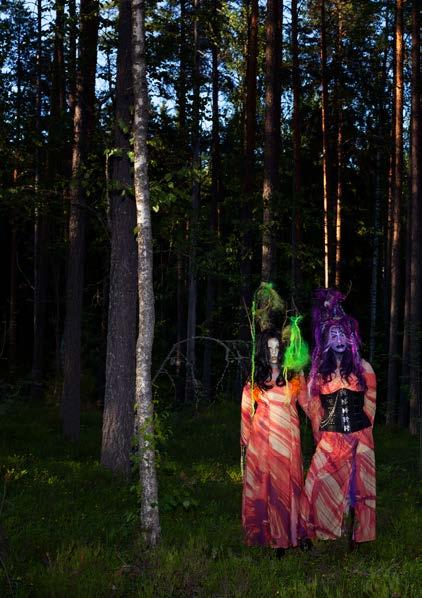
by Sangría Valentino & Henna Nerg
from the marshlands from the the salt from the smoke from names erased a flick of the wrist a spit in the fire a glance toward the pear tree do not touch the soil do not name the herbs do not speak to the wind but we remember scorched fields drowned archives, traces of others wuss witch weirdo wicked waste again the world burns more names. more whispers ash on our tongues. drag-draped mud-slicked we are not here to be clean we are here to burn the logic that chains bodies to borders desire to shame nature to profit
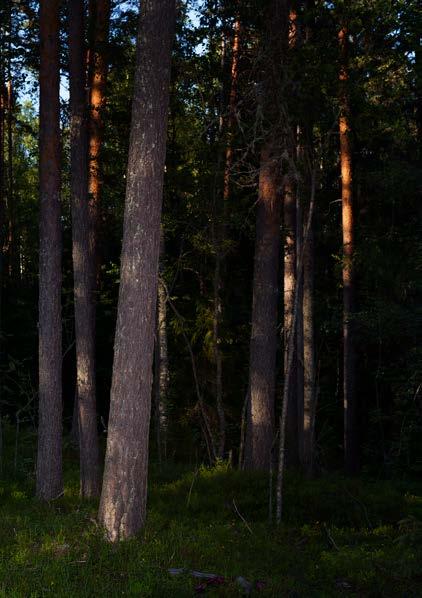
we are ritual we are flesh we are archive fantasy resistance reckoning. wicked, you called us wicked, you call us then wicked we shall be wounds warnings waves we remember land remembers the rivers hide bodies the trees know names the wind carries breaths witch, they screamed queer, they scream so we come in drag in grief in power moss between our teeth smoke in our lungs from of the archives from the forests outside the maps
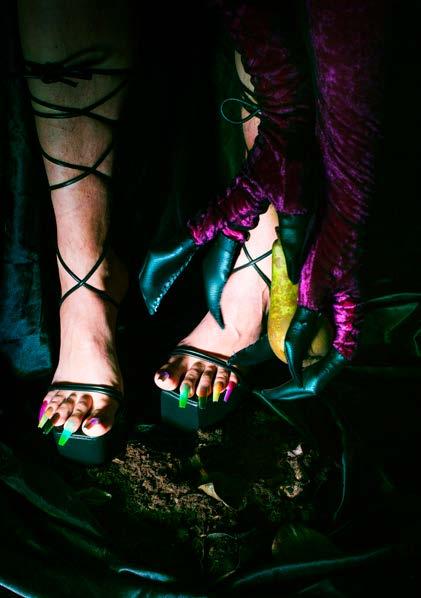
melted seas fenced bodies flamed forests
unnatural sacred perverse evil inconvenient too visible too full of hunger too hard to control
the curse is in the concrete in the oil-slicked wings
we dance in heels bare feet in smoke we summon joy as resistance fantasy as survival we gather not to escape not to disappear to remember we ask what is left when the fire dies down will it ever die what grows in the cracks of a broken world
we do not float we rot and return we bloom out of season we are here to make you tremble
the river remembers there are names in the soil there are screams in the fire stories that no archive could hold too wet too burned
too soft too queer to catalogue we know this so does the wind we walk the old paths barefoot and in heels lipsticked and mud-covered we follow the smoke that never quite cleared
witch, they screamed too loud too lustful too alone. too curious too wet to dry too wild to tame queer, they scream too much too soft too stubborn to disappear
we come with fire in our wigs smoke in our bones we come in laughter in loss
we come dragging the skirts of those who walked before us
this is a swamp story a ritual with no end a story that rots your logic and leaves your mouth full of mud
burn the witches tame the land erase the queers chain the body poison the rivers control the mind drown the future
burn tame erase chain poison control drown
the land is restless the bodies return the future refuses to behave
cracked riverbeds contaminated soil
we are not here to entertain we are here to linger to disturb and to haunt to make beauty out of ugly grief and grief out of beauty memory. rage. kisses secret gardens wicked problems wicked bodies no solutions spells no purity persistence no escape entanglement inconvenient bodies too close to the land too full of knowing we are heirs of inconvenience
we inherit the rot
and the threads we inherit the guilt woven through it. the pleasure and the questions
wicked, you call us then wicked we shall be
dirt under our nails glitter in our blood climbed out of the ash names in the soil screams trapped in stone stories that no archive could hold too wet too soft too queer to catalogue barefoot in heels lipstick mud smoke witch loud lustful alone curious wet wild soft visible wicked fire in our wigs smoke in our bones
have you seen a ghost? they say we just saw ourselves for the first time
Blood and guts forever:
The title is an homage to Kathy Acker’s Blood and Guts in High School
# Fragment 1
Old men, tall, flabby, with white hair. Not the kind of greyish white that makes you think “okay, somewhat sexy,” but the yellowish white that makes you think of nursing homes, the smell of alcohol and shit everywhere. His cheeks are red. I don’t know if he’s an alcoholic, or maybe it’s the cold, or if it’s just an old-people thing. I didn’t ask.
He’s rich, he’s gentle, he brought me flowers and champagne. The flowers were the cheap kind you buy in already premade bouquets, but hey, it’s already something. Nobody brings flowers to a whore. You’re paying her, you don’t need flowers to get her attention. My attention, specifically.
Once upon a time his cock must have been a great cock, but now it looks like a pink slug in a bush of smelly white hair. I tried to reanimate the pink slug for twenty minutes. I got cramps, my wrist hurt, but it was clinically dead. He cried.
I hugged him and listened to him for about half an hour because he paid for an hour plus flowers plus champagne. (I forgot to mention that the champagne was as cheap as the flowers, impossible to drink.) Then I left.
# Fragment 2
35, brown hair, short, athletic, but the kind of athletic that disappears in a blink when you stop spending half of your free time at the gym.
He does cocaine not because he likes the way it makes him feel, but because he likes the concept of himself as someone who does cocaine. Rich and successful. He treats sex with girls like me the same way: he doesn’t really like it, and his cock gets hard only because he thinks about how powerful he feels when he gets to fuck me. He has a regular cock, around five inches, circumcised.
When I get dressed after making him come, he always says things about wanting to buy me a new dress, a fancy and expensive one. He never does.
Interlude
Will you still love me when I’m no longer young and beautiful? Was it Lana Del Rey? I don’t know. I kind of refuse to listen to her because I don’t want to be a cliché sad whore. Never mind. The point is that I’m low-key afraid of aging.
I know I’m fucking rich people here and there because I need money to go to college, but after college there will be rent, and then insurance, and so on and so on. I’m using my body as a means of production in the capitalist system, not in the way people in charge intended (by producing tons of babies), but in my own way.
But sometimes I get sick of it. I hate all of them. At night I dream of killing them all and collecting their body parts, just like I involuntarily collect their memories
Memories of a teenage whore
now. Is there a way to use my body to disrupt the system instead of using it as a means of production within that same system?
Now I know how Joan of Arc felt. No, I’m not quoting Morrissey, that fascist pig. I dream of killing him too. I mean it for real. I’m a whore feeling unhinged like a medieval saint.
# Fragment 4
He was the worst of them all. Two years older than me, playing guitar in a band. Blonde, blue eyes, a self-destructing angel always walking on the edge that divides heaven from hell. He said he loved me, he sang for me, he played guitar for me. Did he? Or was I just playing a part in his own rotten rockstar playbook?
We drank, we fucked. He said maybe romance is a place for me and you, you became my painkiller, baby, you can change and still choose me, maybe I just wanna be yours, pretending they were all his own words.
When he fell asleep, I burned his vinyl records and his guitars
I wrote I DON’T WANT TO BE YOUR FUCKING MUSE with the ashes, and I ran away.
# Fragment 5
Producers, brokers, politicians, doctors. Cardinals, football players, musicians,
actors. Aristocracy, bourgeoisie. Tech bros, CEOs, lawyers, and journalists. Influencers. Successful men, powerful women (or, as they like to say, girlbosses). All of them at a single party on a private island.
They hired me to entertain them, to dance, to suck their fat cocks, to turn my body into a meat plate for cocaine, to be beautiful, to be discreet, an ornament, another thing they could afford (and for a lower price than half of the things they usually buy).
Hey Joan, watch me rewrite the narrative of the relationship between women and the pyre.
I burned them all, surprise, surprise! Die capitalist pigs!
If my body should be an object, then I want it to be not a luxury item but a tool for crime.
Closure
Beware. Out of the ashes I rise with my red hair, and I eat men like air. I did it, Sylvia. If you want, we can imagine together Ted Hughes revived to be among them too. I ate them. I burned them. I rose from the ashes. My hair is burned, my skin is burned. I’m ugly as fuck, a monster, a goddess, who cares! I’m alone with this mirror, reflecting my rage.
by Alessia Peca

by Gabrielle Everall
Lolita Speaks
I hate Humbert Humbert. He calls me Lolita. He calls me Lo. He calls me Lee. He calls me Ta. He calls me Dolly. Nabokov names me Dolores. I have no name of my own. I never speak as myself, only his construction. I am the image repertoire machine of Humbert Humbert of Nabokov. I am his second paedophilic fantasy after Annabel. How can I speak?
Lolita’s Axe
When she hits Humbert Humbert with her axe. She strikes right through his mind/body split. How he desires girl children with his body and punishes himself with his mind. The same mind that then tries to justify himself through referring to girl children from history who were desired by famous men. Is Humbert Humbert’s mind elite enough? Upper middle class? Jeffrey Epstein kept the novel Lolita in a cabinet made of glass. He called his private jet Lolita Express. Humbert Humbert is mind. Lolita is body. When Lolita strikes Humbert Humbert with her axe, she does it for all the girl children who came before her: King Akhnaten’s and Queen Nefertiti’s Nile daughters; Rahab; Dante’s Beatrice; Petrarch’s Laureen; Annabel; Monique and most of all for herself.
David Bowie is a Motherfucker
Must we burn Nabokov? Must we burn Sade? Yes. Yes. David Bowie is a motherfucker. He is a great artist. He is a phenomenal musician. He was a pedophile who raped thirteen-year old groupies. As did John Lennon, Bon Scott, R. Kelly, Gary Glitter, Iggy Pop, Kim Fowley, Steven Tyler, Axl Rose, Sin Quirin…
Pearl and the other angry girls: Feminist rage in cinema
“I’m not sad, I’m angry.”
Amy Dunne in David Fincher’s Gone Girl
In 2014, when David Fincher’s Gone Girl was first released in Italy, I was 21 years old. The #MeToo movement was still far off, and looking back now, the vocabulary we used to discuss certain issues reflected our limited awareness. I really liked the film, even though I lacked the words to explain why, or to articulate how a character who was clearly “toxic” – the sadistic, unhinged, brilliant, and calculating Amy Dunne –had struck such a chord with me, to the point that I found myself rooting for her and taking pleasure in the success of her diabolical plan. I brushed aside the reservations of the people who had seen it with me and had been less enthusiastic. For days afterward, the sense of pleasure sparked by the film and its unconventional heroine lingered with me.
Almost ten years after seeing Fincher’s film, when I went to see Ti West’s Pearl (2022), the city I lived in had changed, my awareness had changed, and so had my personal life. Yet once again, I left the cinema in an almost amorous state of excitement, difficult to put into words. I urged my partner to watch the film, and once more I found myself confronted with a lukewarm response on his part and an inarticulate, visceral thrill on mine.
Although my intention is to use Pearl as a pretext for laying out some reflections on the character herself and on the many “angry girls” who have, for some time now, populated my imagination before her, I cannot help but declare from the outset my involvement with with the archetype of female anger. I have always believed that Medea had her reasons, so I might as well say so immediately.
The house of psychopathic women
Following a well-established topos of horror films centered on a female protagonist – Repulsion (1965), Carrie (1976), Misery (1990), The Others (2001), and The Babadook (2014), among others – Pearl unfolds largely within the confines of the house. In “House of Psychotic Women” (2012), Kier-La Janisse explains that, in the Gothic tradition, the domestic space mirrors the psyche of its inhabitants while simultaneously serving as the quintessential site of female isolation and unhappiness.
In Pearl, we are in the United States just before the Great Depression, a period when cinema was becoming widespread. Abandoned by her husband, a war volunteer, and stifled by her mother’s puritanical rigidity, Pearl spends her days fantasizing about becoming a dancer and escaping her fate. Her mother, reminiscent of the ter-
rifying Margaret White in Brian De Palma’s Carrie, embodies the castrating mother trope, seeing her daughter’s desire for freedom as a threat to order. Resentment and pity ricochet between them, fueling mutual distrust. Pearl’s house holds no supernatural presence; it resonates instead with the oppressive weight of family life.
A monstrous need to be loved
“Please love me. Only me.” Asami Yamazaki in Audition by Takashi Miike
The true killer in Pearl is loneliness – a deep-seated force from which she cannot escape, constrained by her gender and social status. The film traces the origin of a serial killer, focusing less on murders and more on the slow buildup of repression that fuels her violence, rooted in a desperate need to be loved and recognized, akin to Asami Yamazaki in Takashi Miike’s Audition (1999).
As critic Nick Allen notes, Pearl is “a wild ride through the protagonist’s anxiety about not being loved, her fear of her true nature […] especially after someone makes her feel insignificant.” At the core of Pearl’s actions is the desire to be seen, understood, and valued – a longing that finds its most concrete expression in her dream of becoming famous. Pearl is not even certain she possesses talent, but she is convinced she is a star and worthy of adoration. Her delusions of grandeur are sustained by an insatiable need for love. As Lana Del Rey sings, “Love me until I love myself” – and when love alone is not enough, an audience, a crowd, becomes essential.
Sympathy for the devil
Returning to Gone Girl to examine the fascination exerted by rage-driven female characters, it becomes clear that Pearl has much in common with Amy Dunne. At a first, more superficial level, both characters can be read as reckless, homicidal maniacs. Yet the chords they strike, especially with a female audience, resonate on a deeper plane. When observed closely, the apparent solidity of their wickedness reveals fissures through which a violent undercurrent of resentment becomes visible.
The “cool girl” monologue – now part of the bible of references on which the identity of the sad/toxic girl is built – has become iconic for exposing the traps of constructing a self-image shaped by male desire. In Amy Dunne’s sharp and unsettling sadism, this moment of self-awareness reaches a rare intensity, leaving a lasting imprint on contemporary culture.
Similarly, Pearl and her monologues went viral on social media, earning her the nickname “the female Joker of Generation Z”. Ti West’s film concludes with an explosion that pierces the protagonist’s isolation: her fear of herself, her sexual and aggressive impulses, the sadness of knowing she is not as free as men to shape her own life, the stalemate imposed by her misery, and the simmering social envy aimed at her sister-in-law – richer, blonder, more “acceptable.”
Even more viral, however, are Pearl’s uncontrolled outbursts of anger, which have been transformed into stickers and GIFs, testifying to the lasting impression of these
scenes and their absorption into everyday digital language. TikTok is overflowing with videos reproducing her cry of “Please, I’m a star” and her disproportionate yet oddly relatable reactions to a boy who fails to give her the attention she believes she deserves. Mia Goth has been crowned scream queen not only by critics but also by social media, which, thanks in part to this character, has renewed its fascination with female rage in cinema.
Feminist anger
Why has the anger expressed by female characters attracted so much attention? In her video essay I Would Like to Rage, Chloe Galimbert Lainé examines her own difficulty in expressing anger, beginning with an analysis of the GIFs suggested by her messaging app for the word “rage”: the first twenty results feature male characters, revealing their dominance in on-screen depictions of anger. In Rage Becomes Her (2018), Soraya Chemaly explores the cultural suppression of female anger, silenced to maintain a patriarchal status quo. Parents talk to girls about emotions far more frequently than they do with boys, and the social construction of anger within what is called “emotional culture” systematically excludes women from expressing it. When women do show aggression, they are labeled as mad, hysterical, or hypersensitive, their anger pathologized and minimized. It is no coincidence that such feelings are only socially accepted when expressed within traditional female roles: mother, teacher, caregiver.
“When women are violent, it is usually only after they have been abused by men. Over the past 30 years, the dominant female violence on screen has been sexualized and hyper-personalized revenge in response to rape or the loss of a child,” Dr. Lisa Coulthard, professor of film studies at the University of British Columbia, explains to BBC Culture, citing Kill Bill (2003) as an example. The legitimacy of The Bride’s (Uma Thurman) thirst for revenge in Tarantino’s film has never been questioned. It has taken longer, however, for internet culture to help a wider audience come to terms with the violence of Amy Dunne, Pearl, and other “angry girls” on screen.
As women’s demands find expression both in real life and on screen, cinema and TV have begun to reflect this shift. Violent female characters increasingly defy the traditional representations of anger. The desire to give depth and complexity to women on screen has fostered the rise of the unlikeable female character: in a culture that expects women to be accommodating, docile, and meek, unpleasant or aggressive women become rebels. Rachel Oliver writes in Trinitonian, “With films like X and Pearl, Don’t Worry Darling, and Midsommar, contemporary cinema is finally making room in popular culture for women to vent all the anger that society has repressed for too long.” In this context, anger becomes a form of empowerment: to know how to get angry is to know how to be heard, to respond to injustice, and to compel others to confront the origins of these emotions.
Ti West’s Pearl ends with a long shot of Mia Goth offering a pained, forced smile, behind which silent tears slip away. Once again with a lump in her throat, confined by suffocating social norms, Pearl puts on a happy face and hides her true feelings, while the credits roll across her face. Perhaps it is a defeat, or perhaps it marks the beginning of a slow reclaiming of the social value of female anger.
by Carlotta Centonze

M ANER LISA
There was no mystery about it the smile.... it was painted on; she’d been framed. For years pleasing all of the people all of the time; for years the lovely gaze of a lovely woman. But then a peel in the paint a crack a twitch in the lip; some how she grew a mouth a tongue a voice she was real! I suppose you could say she let the side down When she changed shape began to move and then the GROANS reverberating down the gallery!
by Denise Page
Give uncle a kiss
Inspired by reflections on childhood obedience by
Michela Murgia, Sardinian novelist, feminist and LGBTQIA+ activist
‘Give uncle a kiss’
I was asked
So many times
As a small girl
To give kisses or hugs
To people I did not really know
To older men
That stank of cigarettes
Sometimes of alcohol
But somehow were given the title of ‘uncles’ because they knew my parents or were distantly related
‘See how cute you are when you obey’ I was told when I obliged
So I started thinking that obedience
Was synonym of goodness
And at times, synonymous of beauty
But I was not very inclined to do so
And sometimes I had the courage to refuse
So instantly I was addressed as ‘unfriendly’ ‘Disagreeable’
And I would be told ‘you make mommy sad’
Hence I started linking my behaviour
To my mother or nonna’s satisfaction so that I’d grow believing every action I took would shape the wellbeing of someone I loved.
And in this way, I, probably like many other girls, grew up with the worry
To be liked or disliked depending on my willingness to abide, And that it was better to always say yes
Even when I did not want to.
A behaviour that left me, like so many girls, vulnerable to the wants of others.
by Ilenia Vacca Todorova
After a while, I understood that my mother’s or nonna’s satisfaction and sadness were not just due to my obedience, And I decided to keep on rebelling.
Therefore, in a typical Italian Catholic fashion, I was told
‘Now you made Jesus very sad!’
And I could not understand how The son of God
The one that sacrificed himself for us, was sad, because I didn’t want to give uncle a kiss. How big of a dare was it, to affect the feelings of Jesus Christ himself?
And what a wonderful occasion that was for them To explain to me the concept of sin and guilt. So obviously, I had to confess, and redeem myself, Ask forgiveness to God himself, For my poor behaviour.
To this day, I cannot fathom, How a girl can sin, In all her actions’ purity, Because of adult discomfort.
I am aware now
That grooming behavior, Sometimes, hides behind politeness. I do not blame the women of my family For thinking I was different. They, themselves, were not allowed To think outside their mind cages. I resented their estrangement, Their judgment for my refusals, For my taste in life, For example, liking to read or Listen to a ‘witch’ like Michela Murgia.
It is also thanks to her, That now, I live in holy disobedience, Abiding only to my own rules, And I absolve myself, Entirely, For ever thinking I was wrong To say no.
She kicks the placenta aside, hauls Apollo from Leto’s belly, rides with him on white-horse-waves. His tears blaze, he was no fun. She crawls away, and roots for her mother’s nipple, but Apollo quickly supplants her.
She staggers to the horizon, pigeon-toed, sucks her thumb, drags a doll, in one hand. The moon suckles her with silvery breath, freezes her flesh, from hibiscus bloom to an arctic rose-bud, unable to open in sun.
*
In time, when Actaeon peeps through her shower-curtain, she rips his stag- skin. The bespoke one, she conjured specially for him, to kill his lust and dampen her own. She retreats to a cave, swaddles herself in pet hounds.
RT
by Janet Murray
E M I S
Dismantling the Power Hierarchies and Inequality of Science with Dr. Jess Wade
Interview by Lorenza Pia Foglia
My world – that of lasers – is full of rainbows, duality, beautiful light patterns. However, when you turn away from the optical table, you generally witness only very few ways of being: male, white, privileged, often convinced that science and technology exist outside of social injustice and political discourse.
Dr. Jess Wade is a physicist, research fellow and lecturer at Imperial College London. She is one of the most tireless advocates for gender and minority equality in STEM (Science, Technology, Engineering and Mathematics), for which she has won several awards including the British Empire Medal. She has made it her mission to “make everyone realize that there’s a space for them in science, engineering, and technology”. Not just with inspirational quotes and pink robot competitions, but small, sustained actions. In this interview, we talked about how the lack of diversity in STEM affects scientists, as well as the science, and how to use our platforms to empower others.
“I research new materials for emerging technologies, particularly the kind that absorb light, like solar panels, or that use spin rather than charge to process information. I am really interested in how we understand molecules and how we can better design them to make future technologies. And that’s really fun because it involves lots of researchers from different parts of the world in different disciplines coming together to try and solve these really big scientific problems for the benefit of society and humanity.”
“I studied art for a bit before I studied physics, and there you’re reminded all the time how important it is to have diverse and open thinking, celebrate creativity and different perspectives. Unfortunately, science and academia have for too long not seen diversity as an important thing and
have not made sure that the teams of people doing the science to create the technologies of tomorrow, reflect the societies that those technologies are trying to serve. And if I look around me, there’s too much that’s done to make people feel they don’t belong. So, something that’s really important for my scientific career is not only having fun in the lab but also putting in the work to make research culture and practices more inclusive, so that every single person who wants to become a scientist can become a scientist.”
The lack of sense of belonging is one of the major components of impostor syndrome [1]. I have witnessed it everywhere, among first-year undergraduates as well as associate professors. Dr. Jess Wade attributes it to two major causes: underrepresentation and the hidden curriculum.
“Young women, non-binary people and people of color are so underrepresented from very early. You’re always in an overwhelming minority. You look around and you don’t see anyone who looks like you, the teachers and the people who are building companies based on that discipline don’t look like you. And you’re in a culture which makes you feel you have to overperform to earn the right to be there. There’s this pressure that minorities and marginalized groups feel acutely because of their environments really early, and that impacts every way you feel this belonging throughout your degree and beyond.”
“There’s also this concept of a hidden curriculum, which means that to succeed, you’re expected to perform tasks that are never explicitly taught to you. How you network, how you interview, how you apply for a fellowship, or a grant, how you appoint a team, how you negotiate your contract. The doors to academia are massive, and they’re heavy, and they’re more often closed in your face than they are open. If you’re from an overrepresented majority, those things are handed down to you by your supervisor who looks like you, who got them from their supervisor who looks like them. But if you’re from an underrepresented group, you may never have that proper support to get into it.”
When the doors are massive, policies relying on inspiration alone are naïve. The dissonance between the proportion and depth of the problem and how individuals and institutions approach it is what made Dr. Jess Wade take action.
“I just got frustrated because so many of the initiatives were focused on inspiring people. But all young people are inspired by science. What young people don’t see is that they can have a career in it where they’ll be able
to contribute. So there needs to be a bit more than inspiration. There needs to be support to help them develop both personally, professionally, and technically. We need to support the teachers and the parents, the people who are in those young people’s lives all the time.”
“Then I got equally frustrated with inaction, with people saying like, look, there’s another list of people who have won this award, and again, they’re all men! I remember there was one year where a big physics society gave more awards to people called Brian than to women - and I thought brilliant! What we can do is sit around and get angry, or we can do something about it. I can’t hire every single woman who wants to be a physicist. I can’t change the way that societies give out awards or fellowships. But I can change the way that we support, promote and celebrate people. I can nominate people for awards. I can make sure that if people are looking for speakers for a conference, they have a good list of women and people of color. I can write scientists’ Wikipedia pages so that their profiles are on this massively important encyclopedia. These small actions, even when you’re not massively powerful, can have a big effect. Because not only do they impact that person and their career, but they also impact all the people who see who won that award, or read that book, or hear that story on the radio. I guess the rage inside me came from this inability to sit around and complain. And the mechanisms I’ve chosen are the ones where I think that you don’t need that much power to really make a difference.”
Taking action, however, is not the solution everyone arrives at. Sometimes it can isolate you. It can shift the focus; you will be known as the feminist rather than for the science you contribute to. And that can make you feel like less of a scientist. If you are lucky, you may feel like you haven’t experienced enough injustice to be able to contribute to making a change. If you belong to a marginalized group, you may not have the time or energy, because you are busy proving your worth in a culture that doesn’t welcome you.
“In university I saw how stark the contrast was between the proportions of women and men within physics departments and how much it intersected with other demographic characteristics like ethnicity or socioeconomic class. I also saw that a lot of people who had a lot of privilege were just sitting with it and not doing anything to try and change things. I’m white, and I’ve always been supported to study what I wanted. As satisfied as I could be having a career where I just shine lasers at molecules for the rest of my life, I would always want to do something that benefits society. I felt so lucky to have this world of physics open to me. I want to make sure that everyone has the opportunity to experience that. Certainly, we
can’t expect the handful of Black women academics to be the champion for Black women academics all the time, or else they wouldn’t get to do anything else. Similarly, for other underrepresented groups. But I also think it’s naïve to think any of us exist out of a political vacuum. Every time you choose to apply for money from somewhere, you’re recognizing that as a privileged white woman in a university that’s extraordinarily well supported, you have a much bigger chance than if you’re a disadvantaged Black person in a university that’s not. Not because you’re more brilliant, but because that’s the way privilege goes. So, not actively trying to dismantle the unfair power hierarchies and the inequality of academia is a privilege I’m not happy to sit with. I want to use this extra energy and resource, to make sure that in the future, those barriers are dismantled, and every woman, person of color, marginalized community can just focus on the science they were supposed to do. Because right now we know that that’s not true.”
One of the projects Dr. Jess Wade channeled her energy into is editing more than 2,000 Wikipedia biographies of women, people of color and LGBTQ+ individuals in science [2]. The English Wikipedia suffers from incredible gender disparity, both in terms of who we write about – 1 out of 4 is a woman –and in terms of who contributes to the writing – 90% of them identify as men [3]. This influences the narration of science.
“Wikipedia is a platform entirely contributed to by volunteers, so if they don’t find a topic particularly interesting or important, it’s not written about. Between 80 and 90% of Wikipedia editors are white men, mainly in North America, so they write about things they’re interested in. And unfortunately, it’s not fantastic women scientists or incredible Black mathematicians. I believe in anything that democratizes access to knowledge, so I do believe in the power of Wikipedia. It speaks to people across the partisan or age divide. So, we should make sure that it is telling the most true and balanced story about who’s contributed to our understanding of the world, or who’s made a massive impact on how we see ourselves or our universe or how we come up with new solutions for the climate catastrophe or coronavirus.”
“The other thing I love about Wikipedia is you completely understand its vision. It wants to help educate and inform the world, so they can make better informed decisions. They can decide whether they want to become a scientist, or how they want to vote on a particular issue. When I started this project, so many women scientists’ stories were left untold. So I thought, I’ve got to change that, I’ll just spend those evenings writing Wikipedia biographies. I get so excited and inspired when I write about them. And hopefully it helps the ones that are alive get the recognition they deserve. But hopefully it also means that for all of time, we’ll remember their contributions to the
world, because there are so many amazing people who work so hard, and yet we write out their contributions because we’ve decided that history is only by men for men and about other men. And that just isn’t true.”
Telling the complete story of who shapes science and technology is fundamental to understanding why they are the way they are and who they can serve. In a time where technology equips our social behavior, and tech billionaires influence our governments, we are more interested than ever in who’s behind technological solutions. Because that determines which problems get solved.
“For a long time, my argument for diversity has been around fairness and equality. But when you think about the development of technologies, we’d be really naive to think that an all-male, all-white team from Western society is going to identify solutions that benefit the whole world. The most commonly mentioned example is crash test dummies for the development of airbags. For a long time they were only modeled on the body shapes of men. So when they first rolled out airbags in cars, they disproportionately killed women because they only tested them on men, as if women never drove cars. Similarly, when Apple Health first rolled out their health monitoring apps, they didn’t have enough women on their design team, so it had nothing about women’s health. Lots of the machine learning algorithms used in police departments are extraordinarily biased towards communities of color, because they’ve been developed almost entirely by all-white teams. And that results in over-policing of Black communities. You need diverse and culturally aware teams of people to do the fundamental understanding, or come up with that translation piece. We have put, as a world, billions of dollars into the development of technologies like AI, quantum, that are not having the societal impact we thought they would. And I think in part, that’s because they don’t have the right teams of people on the development side, because you need different backgrounds, different perspectives, different lived experiences to create technologies that benefit everyone in society equally.”
“I also think we need more conversation around ethics in the development of technology. Just because you can do something, should you do it? In STEM learning, we’re starting to have conversations on the development of technologies that potentially have dual use, meaning they have civilian applications, but they could also have quite scary applications in defense. How do you approach that for people who are so scientifically and engineeringly minded? If you tell them you develop this laser, that’s great, but one day it could be used by covert operatives to strike down drones that are used for civilian defense. Would they still want to do it? Is there a way
of stopping that from happening? How do we put these ethical regulations on technology and on society? That’s a bigger philosophical and social conversation that I’m not sure our STEM universities have given us the ability to have yet.”
During our conversation, Dr. Jess Wade repeatedly justified her passion for working for a fairer and more inclusive scientific research community as something deeply rooted in her, inevitable, almost like a physical reaction. She doesn’t look angry, but her urgency suggests she once might have been.
“I want to say rage, but a lot of it is frustration. It’s like, no one’s done enough to celebrate that woman scientist. I’ve got to know enough to celebrate her. Or there’s that fantastic Black engineer who’s not getting the support they need to get to that next stage of their career. I’m going to spend time doing it. I think that kind of energy, that kind of passion, that frustration that not enough is being done drives absolutely everything that I do. But I think alongside that, there’s this overwhelming curiosity and real desire for everyone to see how extraordinary science is, to see how incredible it is to understand teeny tiny parts of the universe and be able to use that to make a technology that benefits society. Part of me also feels like I feel injustice a lot. When I see injustice, I can’t not act on it. If you have some power, use that to empower somebody else. That’s Toni Morrison, right? Whatever you do matters, and you matter. I think that the feeling that you can channel your frustration into something positive is such a powerful thing. And I wish more people felt like they could take that leap to do it.”
References
[1] J. E. L. Shin, »Impostorism: prevalence and its relationships with mental health, burnout, dropout consideration, and achievement among graduate women in STEM.,« Social Psychology of Education, 2025.
[2] W. contributors, »Jess Wade,« Wikipedia, The Free Encyclopedia., [Online]. Available: https://en.wikipedia.org/w/index.php?title=Jess_Wade&oldid=1350528896. [Date retrieved 25 April 2026].
[3] W. contributors, »Gender bias on Wikipedia,« Wikipedia, The Free Encyclopedia., [Online]. Available: https://en.wikipedia.org/w/index.php?title=Gender_bias_on_Wikipedia&oldid=1350942755. [Date retrieved 25 April 2026].
girls invented punk rock not England
“it felt like women sometimes hid behind poetry as a way to say something without actually saying it. I was on a mission to just fucking say it.”
– Kathleen Hanna, Rebel Girl
fuck the form / the villanelle / the sonnet quatrain grammar line break reign / the sitting nicely at my desk / quietly practicing my good handwriting / i’ll write like this / crouched in half like some ancient beastie / tits out / belly out / hashing out the same sentence over and over and over and over / and still not know if i am performing for the male gaze that formed the development of my body / my brain / my autonomic nervous system / who the fuck am i / i wail / who the fuck would i be without it / WHO THE FUCK ARE YOU??? she says / snaps and takes the shot of me in shiny latex / god you look so good / i love it when girls hit on me / and all these screaming bitches speak to me / princess nokia / sofia isella / st vincent / big joanie / panic shack / bikini kill / i thought i needed a quiet place to go / i thought i needed peace / oh no no no / so now you can say no? where the fuck was your no when he grabbed your hand / when your anus was penetrated by a stranger / fuck the pathetic doe-eyed hide of your fawn / i don’t need ‘quiet time’ or peace i need a fucking riot!!! bass reverbbbb / screeching whhhine / cymbal C R A S H give me a W A L L O F N O I S E give me the storm that only girls invoke with outstretched tattoed arms in the pit! their spell a microphone / pedal / amps / drum kit / fuck it! play em loud! don’t turn em down! nova twins / lambrini girls / pj / patti / the slits / the muffs / x-ray spex / spitboy and peaches! i gulp their words and quake into their mirror / held up at me like a francesca woodman photograph / yeah I like art! i read girls against god by jenny hval and her punk protagonist preaches hate / makes love to hate / prays to hate / lives to hate / and i hate and i hate and i hate...but i’m a lover girl aren’t i? i’m a lover girl no? here’s your no. here’s your big fat fuck off no. no is a complete sentence. no is my God. i was five years old when marilyn manson’s ‘smells like children’ came out / release the files! / quiet piggy / do you remember meeting her at all / no / she described meeting you she was a seventeen-year old girl / it never happened / she provided a photo of the two of you together / yes yes / your arm was around her waist / yes.* no. no. no. no. no. no. no. no. no. no. no. no. no. no. no. no. no. no. no. no. no. no. no. no. no. no. no. no. no. no. no. no. no. no. no. no. no. no. no. no. no. no. no. no. no. no. no. no. no. no. no. no. no. no. no. no. no. no. no. no. no. no. no. no. no. no. no. no. no. no. no. no. no. no. no. no. no. no. no. no. no.
*transcript of Emily Maitlis’s interview of Andrew Mountbatten-Windsor, for BBC Newsnight, 16 November 2019.
by Rebecca Rae
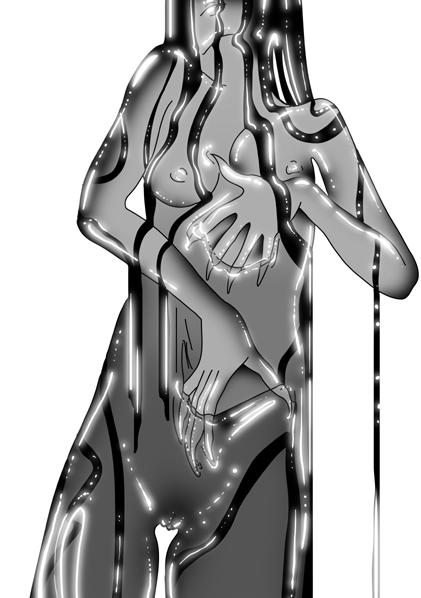
RECLAIMED RAGE chapter IV
Gay Sex
The first time my tongue tasted her, I knew I would be a revolutionary for the rest of my life.
As I traced her skin with my tongue, mapping out signs on her inner thigh I could shove in the face of the establishment— holding painted signs, with phrases like, “We’re the queers Fox News warned you about,” And—”if God hates gays, why are we so hot—” I could feel a fire burning within her like a Molotov cocktail ready to be hurled. Each arching of her back was like Moses standing on the mountain, holding forth the Ten Commandments, and a new line appeared at the bottom declaring, thou shall make her cum over, and over again, and I—a mere supplicant to the holy divinity between her legs— could only comply.
The first time he and I had sex, was during a threesome. I had never been touched by so many hands at once, but really, all I could focus on was him. Each moan, each shout, each sigh, was a vehement fuck you to fascist purity culture, while I was fucking him— while he was fucking me— while I was fucking her— while we were fucking each other. I’m not a Capitalist, but that night—I wanted to consume every beautiful inch of him— and there was more than enough to go around. So, if the state is to label me an unholy affront to strong, upright Christian values, I say, let them–As long as I can keep him upright. Let me tell you one more thing darling, from one queer to another— this regime wants you to be meek and complacent— wants you to keep your mouth and your legs closed, unless it’s to raise Aryan babies— so, be a slut, lover because it’s going to take a whole lot of sluts to fight Nazis.
by Hillary Gonzalez
& Other Revolutionary Acts
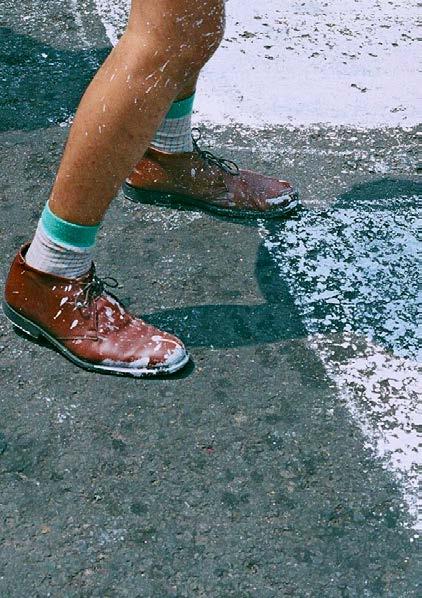
“Anarcha-feminist protests in Mexico in 2016. We’re painting ‘iglesia asesina’ on Avenida Paseo de la Reforma in Mexico City at a counter-protest against christo-fascist homophobic groups. First time I used rollers for this – 10 years later and it’s still a favourite method of mine.”
by Elliot Long
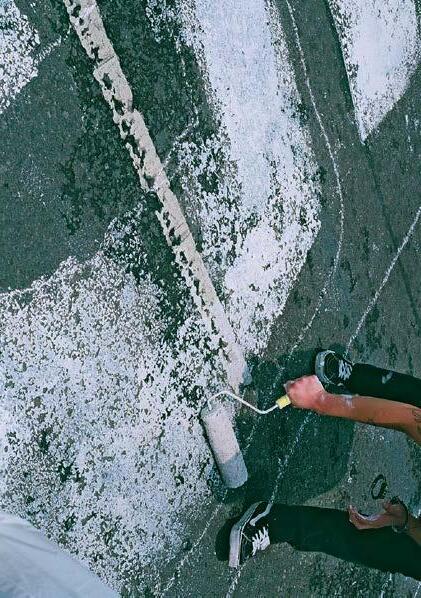
A Love Story I’m Not Supposed to Grieve
by Joy Léonie Sung
The Gap Between Theory and the Body
In my head, I am free. I can dismantle the heteronormative matrix over fadøl at the local bodega. I can articulate why romantic partnership still functions as currency for women – even in progressive spaces. I understand, intellectually, that patriarchy has taught us to measure our worth against our ability to be chosen, to be paired off like a menu suggestion – skin-contact orange wine with oysters.
But in my body, I still feel entirely abandoned.
Cognitive dissonance: the space between what you know and what you feel. My mind deconstructs heteronormativity while my nervous system hums with a terrifying, primal longing for someone. The contradiction is devastating. Because this is the part that feels like a betrayal of my own politics: the quiet certainty that I have lost the greatest love of my life.
We are taught that the ultimate romance is with the self. But how do you theorize your way out of a love
that felt like destiny?
This is what no one tells you about heartbreak: feminist theory does not work as a painkiller. You cannot dissect the patriarchal foundations of your own devastation while you are drowning in it. The intellectual scaffolding you built to understand power collapses the moment you realize you would have compromised every boundary, erased every principle to keep someone who ultimately wasn’t even good for you. That realization might be worse than the breakup itself.
My ex and I were everything but a compromise. We were not “a settling for”. We were not a patriarchal trap I fell into because I had internalized the wrong values. I loved him rawly, authentically, without the protective distance that fear usually demands. I offered him all of myself; the devotion, the vulnerability, the desperate need to be witnessed. And I was, until it became assymmetrical. The real wound lies less in the ending, and mostly in the long, disorienting stretch that followed. I found myself suspended in someone else’s ambivalence – waiting for clarity that never arrived. What had
broken between us went unnamed. And without ever quite deciding to, I became the one who managed the aftermath; that agonizing limbo, where the relationship was officially over, yet I was still left tending to his emotional debris. I told myself his challenge was depth, that his silence was processing, that his half-presence was still worth something.
I let it happen. Because that is what women are trained to do – to translate men’s emotional unavailability into something more generous, to absorb their lack of accountability as the texture of love, to mistake their avoidance for complexity rather than what it is: the profound comfort of never having to change.
The grief I am left with is not clean. It is not just the grief of losing something beautiful. It is the messy and shameful grief of realizing how long I spent making space for someone who was not making space for me. And when feminism tells me to move on, become self-sufficient, and stop needing external validation – it is asking me to absorb this particular lesson without rage. It is asking me to turn my wound into a wellness practice. To transform my heartbreak into content about my own growth.
And what if the price of that protection is the death of my capacity to love unconditionally?
The (In)visible Hierarchy
During the aftermath, I met a couple through mutual friends. They were
the kind of couple that progressive communities celebrate. They had discussed their power dynamics, deconstructed monogamy together, and framed their relationship as a choice rather than an inevitability. They seemed performatively happy to me, or maybe that’s just what I told myself as I sat across from them, while feeling very alone, and watched how the social temperature around them never cooled. What I noticed was, that even in a room full of people who intellectually reject traditional gender hierarchies, partnership still confers immunity. The coupled people held a different kind of belonging. They were not more interesting, accomplished, not even necessarily happier. But they were confirmed. They existed in a frame that our culture – even our radical, question/critique-everything, theory-praising culture – still recognizes as evidence of success.
I realized I had internalized what I thought I rejected: the belief that romantic partnership is a form of social currency that elevates women. Not because I haven’t read and studied the feminist theory. But because academic texts are written by people in rooms, while the world outside has spent centuries teaching women that our value is relational. That to be single is to be a category error, a failed state, a person whose womanhood has not been properly validated.
The cruelest part is that this hierarchy does not disappear once you become aware of it. Awareness does not immunize you. It just makes the shame sharper. I was grieving, not
just the person, but the social position we represented. I was mourning a relational status. And that grief felt like a betrayal of everything I claimed to believe.
The Neoliberal Singlehood Trap
Then came the rescue mission: the viral articles, TikToks, polished Instagram carousel of a woman alone in an impeccably decorated apartment with fresh flowers, reading a book with a knowing smile. The message was clear and intoxicating: you don’t need a man to complete you. Solo travel is enlightenment. Self-love is the highest calling. Welcome to your single era.
Pieces like Chanté Joseph’s essay in British Vogue “Is Having a Boyfriend Embarrassing Now?” told us exactly what we wanted to hear: that in 2025, our singleness was not a failure, but a radical, empowered choice.
This new mythology of the independent, self-sufficient woman; perfectly curated, perfectly unbothered is not actually less patriarchal. It is patriarchy wearing a different outfit. It has simply repackaged loneliness as liberation and called it feminism. The neoliberal idea requires women to be self-optimizing and emotionally hermetic. We must monetize our loneliness into personal branding. We must turn the absence of intimacy into an aesthetic. We must never, under any circumstances, admit that we are desperate to be held.
And that is the cruel elegance of it: we police ourselves now. Patriarchy no longer needs to shame us; feminism itself has learned to do it for us.
When I deleted my dating apps after a particularly demoralizing experience, I did not feel liberated. Instead, I felt like I was finally performing the right kind of feminist authenticity. I was supposed to feel good about rejecting the mechanism of romantic selection. But I felt ashamed – not of wanting connection, but of the fact it made me less feminist in the eyes of people I deeply respected and, most painfully, in my own. Ashamed that my longing for someone to know me, to want me, to choose me, read as a weakness – a betrayal of the hopeless romantic lover girl, I actually am – rather than a fundamental human need.
The single woman who radiates contentment has become the new aspirational feminist figure. We are measuring ourselves against an impossible metric of self-sufficiency, and we are coming up short.
The Ambivalence We’re Not Allowed to Have
Here’s what I think feminism has not made space for yet: the ambivalence. You can believe, with every fiber of your intellectual being, that heterosexual partnership has been used to control women, and still want it – even when you don’t define yourself as heterosexual. You can know the desire to be chosen
by a man is a symptom of centuries of patriarchal conditioning, and still feel the hunger for it in your chest. The deep, human need to choose and be chosen; a thirst that theorizing cannot quench.
The worst part is that the shame of this contradiction is not coming from patriarchy. It is coming from the feminism I chose. It comes from progressive spaces where emotional longing is coded as a failure of revolutionary consciousness. I have sat in rooms full of women I respect and watched myself lie, performing a scripted enthusiasm for my singleness. I built a version of myself that fit better in these spaces – self-contained, unbothered, liberated.
But that version is a fiction. And I am tired of writing her.
The Right to Want
What I am trying to claim now is the right to my own contradiction. I want to say patriarchy is real and devastating, and has shaped my longing for romantic partnership. And I still want to be desired by a particular person. I want to dismantle the systems that have taught women to measure our worth through a man’s attention. And I want that attention. I want all of these things to be true at the same time.
The most radical feminist thing I can do right now is refuse the either/ or. Refuse the demand that I perform uninterrupted empowerment. Refuse to be ashamed of the fact that my solitude, however healthy
and intentional, still sometimes feels like abandonment.
I know it’s patriarchy. I can name the mechanism. I can trace how the internalized male gaze got inside my mind, taught me that my worth is only activated by a partner’s validation, molded my desire into a tool of my own subjugation. I see it all with perfect clarity.
But it still hurts. And the pain is not a failure of feminist consciousness. It is proof that I am human. It is proof that feminism is not an anesthetic, but an ongoing, contradictory, embodied practice of trying to live truthfully in a world that was not built for our truth.
Is this what it means to be a bad feminist? Or is it simply what it means to be honestly, messily, painfully awake?
References:
https://medium.com/bitchy/confessions-of-a-lonely-feminist-2376c5adfdc9
https://www.theparisreview.org/ blog/2020/04/20/loneliness-is-other-people/
https://www.theschooloflife.com/article/ the-need-to-be-alone/
https://www.instagram.com/p/DS4GKUrjCJc/
https://www.vogue.com/article/is-having-a-boyfriend-embarrassing-now
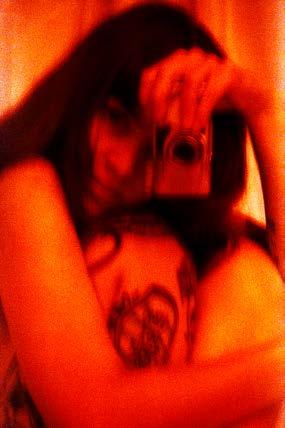
Rage #13
The Rage series is a group of self-portraits that record the emotional aftermath of a sexual assault, anger and depression, by using a red-scale film to emphasize both confrontational and dissociated body language.
by Sarah Eckstine
Rage #15
Is it perimenopause or is it late stage capitalism?
(After Casey Rand)
Is that a hot flush, or is it the atmospheric heat of wildfires ripping through old growth forests?
Is it brain fog, or does scrolling through images of genocide, next to pictures of my work friend’s trip to Lanzarote, next to the latest Strictly celebrity scandal, next to another nail in the coffin of ecological collapse, next to an ad for a protein shake... inevitably drive a person to distraction?
Is that a migraine, or did Elon Musk just try and sell me the idea of a Tesla Optimus robot by saying it would look after my children and walk my dog?
Am I irritable because of a hormone imbalance, or have I run out of patience for politicians treating unfettered capitalism as 'pragmatic' as it swallows the world whole, and laughing off any attempt to temper it in the service of a liveable planet as hopelessly idealistic?
Has my libido dipped, or is it harder to relax into the rhythm of life knowing that life itself hangs in such knife-edge peril?
Was that a palpitation, or did reading about another hospital being bombed in Gaza make my heart stutter with impotent grief and rage?
Is my disturbed sleep a hormone thing, or does it keep me awake at night to know we’ve entrusted the future of our planet to a few frat bros whose rich dads and unsupervised access to a garage in the mid-90s has rewarded them with billion dollar fortunes and the maturity and wisdom of a spoon?
Am I suffering with mood swings, or did someone just blame immigrants for their struggle to get a doctor's appointment?
Are my fluctuating hormone levels causing anxiety, or did I just see on the news that Liz Kendall is sending job coaches into psych wards to try and manoeuvre people with serious mental illness back to work?
Is my metabolism slowing down, or is my body so addled by ultra-processed junk it's forgotten how to feel full?
Do I have dry, itchy patches because of a drop in oestrogen, or are the paedophile rings at the highest levels of our society, exposed then buried under Scrooge McDuck-style piles of money, literally making my skin crawl?
Am I ‘irrationally angry’, or am I just getting into my stride?
by Rachel Swabey
I shame myself for carelessness I should have known better I trust so easily. You were a colleague so it felt all the more valid to trust you. Now I’m confused you’re a grown man with responsibilities and good appraisals— how did I let you treat me this way?
I was reckless you were careless and I allowed you to cause me harm some of it I could have objected to some of it was all you. Now I feel deeply rooted shame about what happened how it happened and for the first time in my life after all the people that have passed through my bed I slut-shame myself —how did I let this happen?
I’m a grown woman I’m not respecting myself and so no one will respect me and you this nice-looking guy
Washing Out the Shame
you left with no bruises probably even forgot about it you don’t even care to reach out but somewhere deep inside you know if you dig deep enough that this is shitty behavior. You’re a grown man with responsibilities and good appraisals.
I trust people this is my default; I wonder how this will change me in a society where trust is key in a workplace where trust is key but instead I choose to wash out shame.
I shame myself for a lot of things especially these last two weeks I wash out the shame It’ll all be ok I wash out the shame I’m not pregnant I wash out the shame I wash out the shame I wash out the shame but what if I was?
by Myrto Apostolidou
Lost & Found
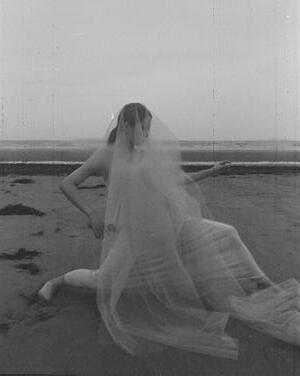
by Jenny Ping Lam Lin
This series captures the embodiment of the emotional suppression experienced by East Asian women during their growth, confined by societal norms that entrap the soul.
Through the lens, we freeze a moment in dance, mirroring the fleeting nature of a woman’s youth. We, East Asian women, find ourselves hurriedly propelled into maturity, burdened by numerous “tasks” dictated by society. We are expected to be inherently gentle and caring, responsible and obedient to the opinions of our elders. Yet, deep within, we yearn to break free, to dance with wild abandon.
Born between 1995 and 2005, we are locked between the old and the new, navigating the complexities of a shifting era.
It’s not about rejecting our femininity or denying our identity as women. It’s about dancing with the wind, letting the wildness and freedom inherent in our beings be symbolized by the winds and waves. Allow them to embrace the untamed and liberated spirit that is our birthright.
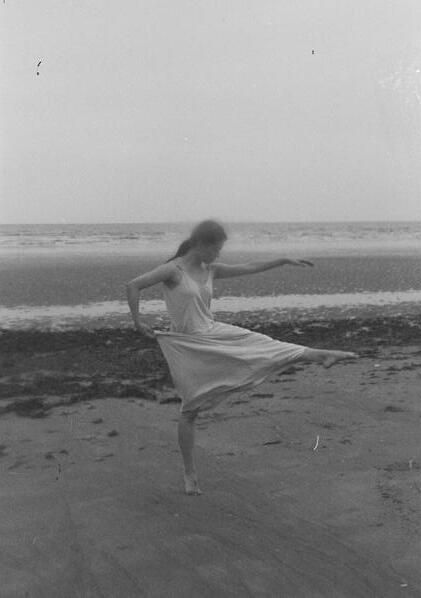
Twelve years old, far too small to imagine that Roskilde would one day chant my people’s name like a promise they never planned to keep.
That fifty voices were only the spark. The beginning of a wave, rage with wings, a grief that refuses extinction.
I am made of their blood. It has witnessed too much to stay obedient. My inheritance is ash and defiance. A voice I never asked for, but one that claimed me anyway.
Now we dance with raised fists and exposed hearts on asphalt, beneath banners that bleed truth.
And while we scream, they still sit in their sealed offices, polishing their indifference, looking away as if justice were a bargaining chip.
by Soha Michlawi
It hurts to hope loudly and watch it drop like a dove shot mid-flight. So we gather the feathers, and write history again.
Not in ink, but in blood.
Oh, my Palestine.
My Inheritance, My Promise
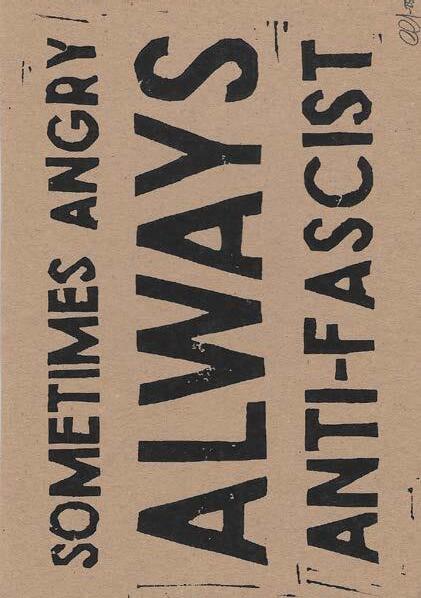
Deploy rage repertoire
¡ our rage repertoire is words and symbols, webs of meaning this is how anger leans to move shared symbolic repertoires do not just express anger; they legitimize it, circulate it, mobilize it into collective feminist struggles
these words, these symbols belong to us use them to dismantle the house let your anger create art collectives but don’t invent and impose language
cite. translate. distribute shout what has already been spoken through bodies, chants, and images they taught us to crave originality but our strength lives in community echo. repeat. chant
deploy what has already carried others through streets, fields, and worlds use the tools we have inherited trust that in referencing one another we build a collective body capable of imagining, demanding, changing
fucking everything !
My anger was always appropriate
Digna rabia names a politically charged form of anger and indignation that emerges when structural systems (read: capitalism, patriarchy, state violence, etc.) violate human rights. This rage has long been dismissed as irrational, excessive, or dangerous, yet feminist movements in Latin America have mobilized dignified rage to insist that female anger is legitimate, ethical, and oriented toward justice and transformation.
But the concept also exposes a fundamental contradiction: if rage must be declared “justified” to be heard, who holds the power to grant that legitimacy? Too often, it is the very institutions that produce harm that presume to decide whose anger is reasonable, acceptable, or civilized. Feminist rage refuses this logic. It does not ask for permission or approval from anyone. It emerges as a response to injustice and as a refusal to remain silent. My anger was always appropriate – even when no one wanted to hear it.
by Kira Hartz
fire burns, water flows
across continents, what once smouldered now ignites anger spills into streets, glowing with the heat of past uprisings flags rise like sparks, embers refuse silence stitching distant struggles into one burning horizon the time is ripe for outrage
a wave gathers, where drops once stood alone follow the rising tide that knows no borders streets become riverbeds, floods of bodies generating force as they flow the wave reaches the shore breaks the weight of everything it carried seeping through dams, cracking the foundations of power
we return – again and again – to fire and water they are not polite forces fire destroys, it clears the ground to rebuilt water falls, until the container overflows
we say we are fire because our anger burns through lies through silence, through the architectures of oppression we rekindle fire capable of turning systems to ash
we say we are water because we remember what is buried what is washed away as droplets, as currents, as floods we move and erode what claimed to be permanent
fire teaches us to refuse water teaches us to remake between flame and flow eruption and endurance our collective rage becomes a force that cannot be contained
burn like fire flow like water
A comrade from the Okinawan diaspora
by Thatha
Over 100 years ago,
The Japanese government stole our land, our lives, our dreams and our right to exist as native people of the Ryukyuan Islands.
They kidnapped thousands of girls and women and forced them into systematic sexual violence.
They kidnapped our languages, our culture, our religion, our freedom to exist and belong.
They made our land the most horrible battlefield of WWII, killing one third of our people.
‘‘
We need to remember imperialist countries for their real names: murderers. Rapists. Criminals.
Japan is not the whitest of all Asians. Japan is just as much of a murderer as its white European heroes.
An outdoor to capitalism as commanded by their north american godfather. A country dripping with the blood of all Asia in their hands, haunted by the souls of the millions who were killed and raped by their imperial system.
My ancestors left for Latin America - not because they did not love and care for their homeland - but because they refused to be ruled by murderers and rapists. My ancestors’ will and love for our homeland traveled overseas with the diaspora and has now flourished bigger than they could ever imagine.
And we are alive. We are pretty damn alive. We resisted colonialism, we refused the japanese imperial system. Your crimes have not been forgotten. We will always remember.
We are alive bearing the consequences of colonialism and the scars of the traumas that permeate all our generations. We are alive because we must make you admit and pay for everything you have taken from us.
We will never forget what you have done. And we are here to demand justice. We demand justice for all native people that are still resisting colonial violence.
We demand justice for all victims of the comfort women sexual slavery system.
We stand in solidarity with all peoples suffering the consequences and violences of neocolonialism.
We support their fights and resistance against oppression.
We demand the end of the genocide in Gaza.
The Global Majority is staring back. We are proud and more united than ever. We want to live to see the collapse of all empires.
And when it happens, we will dance fiercely on top of your dead egos.
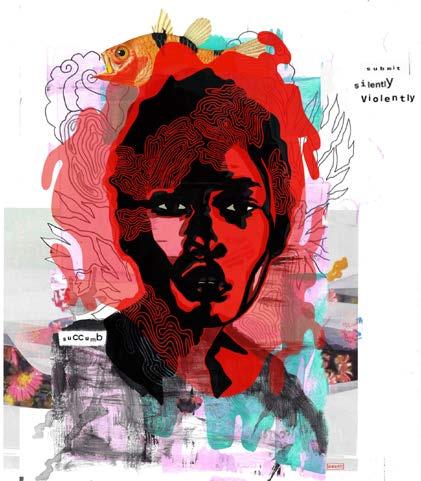
by Alicia Roberts
a.k.a. BUMCHAIII
THE
This is a manifesto for a new masculinity. For new masculinities. A showdown with the prevailing patriarchal idea of masculinity, which is characterized by dominance, authority, emotional stoicism, strength and virility. The manifesto is a feminist rage and a personal essay written by a white cis male. A manifesto primarily aimed at white, privileged men and men who want to be feminists.
SOY
But anyone can be a ‘soy boy’. The manifesto’s message is simple: Reclaim yourself as a ‘soy boy’. Reclaim what is embedded in the manosphere’s understanding of being a soy boy: Progressive, feminist, emotional, and non-conforming to traditional masculine ideals. And of course: Eat plant-based.
Being a soy boy goes beyond one’s diet. It’s about more than just soy. It is a lifestyle and a way of being in the world. It’s a feminist practice. The manifesto challenges the idea that masculinity is a single entity.
Therefore, the manifesto does not want to essentialize the male body and equate ‘man’ with ‘masculinity’. When I talk about masculinity, I am referring to the uncertainty surrounding its definition as described by Jack Halberstam in the book Female Masculinity:
If masculinity is not the social and cultural and indeed political expression of maleness, then what is it? I do not claim to have any definitive answer to this question, but … masculinity must not and cannot and should not reduce down to the male body and its effects.
I understand masculinity as both a phenomenon and a structure that transcends the expectations attributed to people who are assigned male at birth. Like Halberstam, I do not claim to have the answer to what masculinity is, but I would like to emphasize that as soy boys, we must understand masculinity as a force that transcends the male body.
BOY
To be a soy boy is a way of rethinking what masculinities are. bell hooks wrote in her book The Will to Change that feminist thinking and practice can address the problems caused by patriarchal masculinity:
MANIFESTO
To know love, men must be able to let go the will to dominate. They must be able to choose life over death. They must be willing to change.
That is the essence of being a soy boy. To shift from dominance to love. Love to other human animals, non-human animals, nature, and, not least, oneself. The will to change is important for both others and oneself, because patriarchal masculinity is destructive to those exposed to it and those who practice it. I do not provide a stepby-step guide on how to become a ‘soy boy’, because there is no single path to becoming one and no two soy boys are alike. However, one of the steps towards becoming a soy boy is to stop consuming non-human animal products. As Carol J. Adams pointed out in her book The Sexual Politics of Meat, a plantbased diet for men is a rejection of gender norms because meat-eating is so embedded in the performance of hegemonic masculinity. Therefore, meat eating is a male activity that reflects patriarchal dominance, Adams explains:
Whereas women may feel like pieces of meat, and be treated like pieces of meat –
emotionally butchered and physically battered – animals actually are made into pieces of meat.
As soy boys, we must understand that food is political. As we start to change what we eat, we can also begin to understand how different forms of oppression are connected and intertwined, and how they all stem from what bell hooks describes as the ‘white supremacist capitalist patriarchy’. The transition from steak to tofu can also be the transition to learn how to be a feminist. I’m not saying that the fight against speciesism is more important than the fights against sexism, racism, homophobia, transphobia, ableism and other forms of discrimination and oppression. However, if you are born into a privileged body and life, it can be difficult to recognize structural problems, particularly if, like me, you are born in a white cis male body in the Global North. For soy boys, a plant-based diet is the bare minimum, it’s the beginning of unraveling oneself of patriarchal masculinity. But as soy boys we must be aware that violence is embedded in all food production. Therefore, it’s important to emphasize that neither veganism nor being a soy boy represents a moral high ground or final destination, but
rather a starting point for resistance.
Five years ago, I made the decision to stop consuming products derived from non-human animals. It wasn’t a decision that came out of the blue; it was inspired by my then-partner and my sister, who had both been vegan and vegetarian for many years. To this day, I am not sure if I would have become a vegan and feminist if it had not been for them. Before that, I thought that vegetarians and vegans were strange. I remember that one of my former colleagues was vegan, and I thought he was weird. However, I also discovered that my transition from being an omnivore to being a vegan was also a transition from one form of masculinity to another. Suddenly I was met with skepticism and disgust based on my diet, especially from other men. It made me rethink my own masculinity and, at the same time, transition to becoming a feminist.
Before I became vegan, I never felt rage towards the system, because it has always given me what I needed: A strong passport, a safe childhood, free education, student grants, a university degree, and access to healthcare. But my rage towards the system has been growing exponentially since I became vegan. Suddenly, I have developed a rage towards the system to which I have contributed, from which I have benefited, and which I still maintain in many ways. At
the same time, I feel despair at my powerlessness although I have so many privileges. Sometimes, I feel angry with myself for being so ignorant for so many years. But, above all, my rage stems from the expectations of how I should behave as a ‘real man’. My rage stems from a system and violent ideology that sees some species as more valuable than others. My rage stems from a system that legitimizes genocides. My rage stems from system that is built around extraction of both human and non-human lives. Therefore, being a soy boy is about caring, which is, if anything, an anti-capitalist practice because it goes against the demands of capitalism: Exploitation, extraction, power, and economic growth. As Johanna Hedva writes in their essay Sick Woman Theory:
The most anticapitalist protest is to care for another and to care for yourself.
Being a soy boy is an anti-capitalist protest because we care about ourselves and others. We understand non-human animals as ‘companion species’, to use Donna Haraway’s beautiful term, rather than as resources.
To be a soy boy means educating yourself and beginning to understand your privileges. The more privileges you have, the greater your responsibility to educate yourself. We must unlearn the ideas about
masculinity that we have learned throughout our lives. To become a soy boy is the process of both learning and unlearning.
This manifesto would never have existed if it weren’t for feminist and eco-critical thinkers – both those quoted here and many others. Therefore, the manifesto and the concept of being a soy boy also embody great humility. To be a soy boy is to balance humility and action. A. Breeze Harper writes in her book Sistah Vegan:
All social inequities are linked … No one is on the sidelines; by our actions or inactions, by our caring or our indifference, we are either part of the problem or part of the solution.
Soy boys wish to be part of the solution, and therefore we use our privileges to take action. We turn our privileges into an intersectional feminist practice, a desire to end violence rooted in patriarchal masculinity. The Soy Boy Manifesto is therefore an extension of Sara Ahmeds A Killjoy Manifesto and the concept of the “feminist killjoy”:
Feminists are not calling for violence. We are calling for an end to the institutions that promote and naturalize violence.
naturalized by patriarchal masculinity. When you reclaim yourself as a soy boy you take the first step in resisting patriarchal masculinity, but it must be followed by self-education, an understanding of your privileges, compassion, humility, and action. Being a soy boy is not a religion or a claim to have found the truth; it is a stance of resistance and a will to change.
Soy boys are killjoys calling for an end to the violence promoted and
by Frederik Frisk Bech
YOUNG & MAD
An Adolescent New Yorker’s Guide on How to Grow Into your Woman
Growing into your teens is learning that being beautiful is a tactic for navigating life, seemingly innocent stares awaken this dormant power–at least it feels like a strength–
The ability to flirt your way to discounts or free items items you once got from your childlike charm
young girls are quick to pull their tops lower; Attempts to finesse the lines of legality And the problem with the world is that they succeed
A perfect recipe has been developed Bat your eyes, Lean against the counter, Play with your hair, Giggle your way through a conversation, It always works. it feels liberating in ways to abuse the system, to play the move, fooling ourselves to think the girl is in control.
Before you catch it
The looks become Prying
Eyes contact diminishing you to prey
Belittling you
Constricting you to the jail of their fantasy
For the first time you understand the word “Objectification”
long muttered among the women you looked up to at the dinner table or across sofas now you know what it means to exist for others pleasure now you realize you cannot win a game you were setup to lose
As you stand you can’t look up; Focus on the shoes; Try to guess the face; Observe bags on the floor; Dirt that has been collecting for years; The clock; The stops; Anything but the orbs eagerly waiting to meet yours
Now your strength is killing you, Now the construction workers whistle, Now traffic-less streets are filled with honking cars, Now windows roll down on hot summer days, Now you drown in your strength.
Their eyes are no longer innocent; almost animal as they hunt you
Once you realize the weight of your power –how it’s condemned you to cautiousness–understand the split second decision, learn the different gut feelings, –the ones you should ignore, the rare ones you allow yourself to validate–only then have you grown into your Woman.
poem by Mika Zurim collages by Jean-Rae Annat
Domesticate yourself
Are you a clean girl? A girl’s girl? A guy’s girl? A tradwife? A good Catholic woman? Cute and childlike? innocent? A trophy? An idol? A pick me bitch? A whore? A fat ugly cow? A corpse? Just another warm wet hole, In the infinite void, Where we all scream, Buy buy buy! the solutions to problems sold to you by vanity! We yell, Consume consume consume consume consume consume consume consume consume consume consume consume consume consume consume consume consume consume consume consume consume consume consume consume consume consume consume consume consume consume consume consume consume consume consume consume
poem by Faye Simpson
No, it’s empowering! to tear yourself apart and build yourself into a new softer shape, Fill your face with poisons and plastic, Pull out your canines and claws, Sew your mouth shut, Domesticate yourself! Become nothing a vapid void, Willing to absorb anything thrust inside you!
When Six Became None
My room became my cage, my tomb, Four walls that sealed my silent gloom. Messages turned to threats of death, Each line stole more of my breath.
They said they’d hurt me, make me bleed, For being honest, planting a seed. I thought if I just disappeared, The world would heal, the hate be cleared.
But one grey day, I tried to leave, To breathe the air, to just believe. A group of boys stood down the lane, Their eyes were sharp, their laughter vain.
They called me names, they swung, they spat, My body hit the dirt so flat. Each kick, each bruise, each drop of red, Spoke all the words my friends had said.
I dragged myself back home that night, Beneath the moon’s indifferent light. My mirror cracked beneath my stare— I saw the girl no longer there.
We were six once—then five, then four, Then three, then two, till none no more. They left me broken, torn apart, Their laughter still inside my heart.
“I like girls,” I said, not “go away.” But they chose fear instead of stay.
I told the truth. They chose to run. And that’s how six became just one.
poem by Cyan Rushton
poem
One day, you’ll learn how expression protects us from our mind. As the world attempts to corrode your compassion, and the fear of corruption manifests as the contortion of your flesh. That ugliness is not you...
And on the bright side You get to choose how you feel- Isn’t that exciting?! A flashbang pulling you to the present Endorphins grinding against the pain, Finally experiencing pleasure without the coercion.
Slick slippery scythes slicing through your skin, It makes me smile just thinking about it. Wet rags wiping away your worries.
One day, you’ll be lying against the operating table. Gunshots echoing as they break your bones, Finally achieving your dream of heavy metal.
It won’t be until you’re 18, then you’ll learn what PTSD looks like. It’s in your classroom. It’s in your community. It’s in the photos of xrays, embellished with a dash of suicidal mania, and all the comments about how “fat that ass is” swallowed away by your spam page.
& artwork by
Kimasia Ayers
CONTRIBUTORS
Aleena Sharif
Alessia Peca
Alicia Roberts a.k.a. BUMCHAIII
Alyssa Curcio
Amara Femia
Anna Onni
Briony O’Callaghan
Brody Rose
Carlotta Centonze
Charlie Montagne-Mas
Clara Josephine Lykkeberg
Cyan Rushton
Denise Page
Diewke van den Heuvel
Éléonore Guiraud
Elisabeth Oktimazas
Elliot Long
Emma Sophie Weber
Erica Engdahl
Eve Xin
Fahmida Azad
Faye Simpson
Frederik Frisk Bech
Gabrielle Everall
Galina Dukov
Georgia Theodoulou
Giulia Ratti
Hannah Candolini
Henna Nerg
Hillary Gonzalez
Ilenia Vacca Todorova
Ilsa Hösch
Isa Cruz
Isabella Taylor
Janet Murray
Jean-Rae Annat
Jenny Ping Lam Lin
Joy Léonie Sung
Kimasia Ayers
Kira Hartz
Leo Patra a.k.a. Carl-Johan Paulsen
Leslie Roberts
Lily Orion
Lois Konijn
Lorenza Pia Foglia
Marie V. Recalde
Mika Zurim
Myrto Apostolidou
Paris Rosemont
Rachel Swabey
Rebecca Rae
Roselil Aalund
Sangría Valentino
Sarah Eckstine
Shunanummah
Soha Michlawi
Suzanna Fitzpatrick
Thaís Omine
Tyler-Jane Kemp ZAKA

COREY she/her
SOCIAL MEDIA + YOUNG & MAD
Corey Ruzicano is a writer, educator, and creative consultant from the San Francisco Bay Area, based in NYC.
ERNESTINE she/her
CULTURE EDITOR
Ernestine Boiling is an art historian based in London.

IZZY she/her
ACADEMIC EDITOR
Izzy Blankfield is a British PhD student, writer and violinist based in NYC.

JULIE she/her
COL LEC TIVE RAGE

JOY she/her
POP CULTURE + MEDIA EDITOR
Joy Léonie Sung is a Copenhagenbased Journalist and Cultural Studies student exploring identity, power and embodiment.
GRAPHIC + WEB DESIGNER
Julie Savery is a multidisciplinary creator based in Berlin, with a background in dance and performance.

LARA she/her
QUEER CULTURE EDITOR + PHOTOGRAPHER
Lara Morello is a feminist researcher and facilitator in representation and queer studies based in CPH.

LORENZA she/her
SCIENCE EDITOR
Lorenza Foglia is an Italian Biophotonics researcher based in Copenhagen.

MATHILDE she/her POLITICS EDITOR
Mathilde Betant-Rasmussen works at the EU Commission on peace and security in sub-Saharan Africa and is based in Brussels.

MIA she/her EVENT CURATOR
Mia Hedegaard is an artist and event manager based in Copenhagen.


COL LEC TIVE

MYRTO she/her WOMEN’S HEALTH EDITOR
Myrto Apostolidou is a Greek biologist and poet based in Copenhagen pursuing a career in clinical drug development.
NADIA she/her FOUNDER + EDITOR-IN-CHIEF
Nadia Razali is an Algerian-Danish feminist activist, facilitator, and writer based in Copenhagen.

ROSA she/they PARTNERSHIPS + EVENTS
Rosa Greiffenberg is currently studying for an MA in modern culture and is based in Copenhagen.
ROSELIL she/her PSYCHOLOGY EDITOR
Roselil Aalund is a therapist based both in Copenhagen, Denmark and in San Diego, California.

ROSIE she/her LITERARY EDITOR
Rosie Walbom is a writer, activist and MA student from Aotearoa NZ, based in Aarhus, DK.

VERUSCHKA she/her COMMUNITY + ENGAGEMENT
Veruschka Haas is a writer and copywriter from Munich, Germany based in Copenhagen.