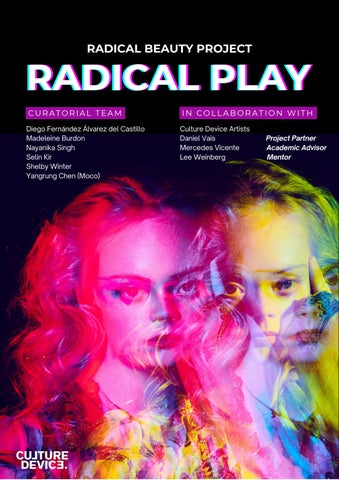
RADICAL BEAUTY PROJECT
RADICAL PLAY PLAY RADICAL CURATORIAL TEAM
IN COLLABORATION WITH
Diego Fernández Álvarez del Castillo Madeleine Burdon Nayanika Singh Selin Kir Shelby Winter Yangrung Chen (Moco)
Culture Device Artists Daniel Vais Mercedes Vicente Lee Weinberg
Project Partner Academic Advisor Mentor
PROJECT PROPOSAL: UNIT 4 MA CCC 2023, UAL
Radical Beauty (RB) is an internationally recognised art and fashion photography initiative operating under the umbrella of Cultural Device (CD). A child of CD, RB is dedicated exclusively to working with models with Down Syndrome, blurring the boundaries between art, photography and fashion, and working to provide an alternative vision for beauty today. Our aim is to challenge and shift commonly held perspectives of people with disabilities and open a conversation to celebrate their expressive and creative capabilities. By challenging conventional notions of beauty and spotlighting the voices and talents of models to showcase their talent and creativity, the RB Project has already garnered immense global recognition for its ground-breaking contributions to conceptual art and fashion photography projects. Further, RB launched the world's first photography collection exclusively featuring models with Down Syndrome. Collaborating with over 40 renowned fashion and art photographers from around the world, the project encapsulates the spirit of inclusivity.
VALUES VALUES & & VISION VISION 01 Connection that works between different levels of cognition in humanity.
04 Learning from Down Syndrome artists, and developing new understandings of the world through DS performers.
02 Care that is radical at its core and recognises the importance in how we help to frame neurodivergent narratives.
05 Challenge and refuse stereotypes, misconceptions and narrow points of view about neurodivergent and DS individuals.
03 Creativity that comes from the intrinsic diversity in human cognition, and curiosity about the world we will create when reframe the way we see these differences.
06 Celebration of DS and neurodiverse individuals, and the many heartfelt ways in which they inspire brilliance in all those around them.
CONCEPT CONCEPT "The play impulse does not aim at playing 'with' something; rather it is the play of life itself, beyond want and external compulsion--the manifestation of an existence without fear and anxiety, and thus the manifestation of freedom itself." -Herbert Marcuse, 1955 Radical can be defined as relating to or affecting the fundamental nature of something (Oxford University); far-reaching or thorough, radical is the spirit of defiance of the status quo. We can’t think of a group of individuals that embody this better than the artists and performers of CD, with their claim to creative agency and artistic expression in their vibrant performances that demand attention. Through them, we assert radicalism as a celebration of unapologetic individuality, daring to be bold, refusing to conform to reductive societal norms and expectations. As Daniel Vais, creative director of RB, stated “they have no boundaries between what’s real and possible and what’s not sometimes, their mind has no limitations.” What is so radical about a case full of wigs, sequined garments and costume jewellery? Why is it that when the body is engaged within the rhythmic beat of a song we experience a level of connection and subversive energy that fills the room? Our answer is radical play. Professor Loretta Pyles suggests that “play is a resource that strengthens and sustains social movements and fosters individual resiliency, [it is also, but not only confined to] aesthetics, rebellion, or even social change.” (Pyles, 2014) Radical play liberates the human spirit and nurtures creativity. Through this, individuals explore their identities, pushing the boundaries of self-discovery. It transcends cultural divides, promoting understanding and empathy among diverse communities. Embracing radical play empowers individuals to question established rules and envision new possibilities, leading to transformative change in both personal and collective spheres. In the spotlight, the powerhouses who are the artists and performers of Drag Syndrome (DS) inspire wonder and delight, revealing to us that there can be more to life when we allow ourselves to momentarily inhabit alternative identities, to design, to shoot, to film, to think, all within the spirit of unapologetic creativity and raw emotion; to play radically.
RATIONALE RATIONALE & & RESPONSE RESPONSE We had the opportunity of meeting some of the artists and performers that constitute DS and CD at Drag Fest, London on August 19, 2023 – an event dedicated to the celebration of drag in all its forms. The curatorial team felt grateful to witness the joy and passion that these individuals pour into their craft. We also gained vital insight into what goes into preparing for a performance and how each artist's unique personality is reflected on stage. Lady Mercury is a lightning bolt of resistance against confinements, her aura as uncontainable and fluid as the element she embodies. Davina Starr, with her indomitable queer spirit, exemplifies the power of self-ownership and the assertion of one's space in a world that often sidelines. Lady Francesca's infectious charm, whether on-stage or in life, is a celebration of human connections, reminding us of the shared experiences that bind us together. This endeavour is more than a project; we propose it as a framework for what the creative community can become when access barriers dissolve, when we take the time to listen and learn from communities, and provide tools to dismantle the preconceived notions that flatten their genius. With passion and in partnership with individuals of RB, we wish to challenge the normative conventions of desire, artistic expression, beauty, and worth, and move instead towards expansive creative horizons. Inspired by the artist's creative process of constructing and embodying these personas as well as their intoxicating interaction with the audience, Radical Play emerged in our imaginaries once again as something relevant to these individuals' lives and artistic practice. Experiencing their artistry and learning in situ truly expanded our vision as to what radical play can mean both in theory and practice. We see this as a transformative process of collaboration that will unpack itself, and reveal further meaning throughout the project as we gain insight from the artists. As a community-led project, we aim to ensure conceptual cues come from the artists themselves as we build a project that aims to speak to and serves those who are a part of this creative community. We take radical play as an umbrella concept that will be incorporated into each stage of the project, consulting directly with artists themselves to explore why they love their craft, what inspires them, and what Radical Play means to them. With the photographers, fashion designers, stylists and other stakeholders involved in the project, we aim to include them in the conversation, in order to get multiple understandings of the concept to create a synergy between the RB artists, other creatives involved in the project, and the curatorial team.
RESEARCH RESEARCH OVERVIEW OVERVIEW A report by Heart of Glass & Battersea Arts Centre highlights the rich and long history and praxis of co-creation in socially engaged arts. It places art and artists in direct interaction with community, society and social issues and cutting across art-forms and contexts in the making of shared meaning through deep connection and collaboration. Radical Play aims to achieve the same by collaborating with creative professionals including photographers, videographers, graphic designers, fashion designers in carving out the aestheticism of the concept of radical play for the respective outcomes. Many researchers have also applied methods like transcribing interviews, co-participation in creative, visual research-focused exercises as methods to gather insights from the community and individuals (Reavey, 2011). The main focus of this project is to facilitate agency of creation, and work with the CD artist community - allowing their voice in co-leading the creative direction. It has been observed in other fields for cognitive and psychological documentation that rapport building, encouraging responses and specificity, alongwith giving feedback on these responses by the researchers could be useful ways to develop insights. The initial interaction with Lady Francesca, Lady Mercury and Davina Starr – the DS performers-models – helped bring these techniques into practice. This supports the concept of play and explores how various co-creators respond to the term in and through their practices.
am a lady now. I can do "Ianything I want. " love to perform. It is also my "Iwork and I love it. It is not about -Davina Starr
me as Adam but me as Mercury, and I love her.
"
-Lady Mercury
"Dressing up is so exciting, I like playing dress-ups."
-Davina Starr
We further plan to materialise co-creation by documenting interviews, recording meetings and backstage conversations to build the concept of radical play with the artists and use it tangibly in the publication, film, and dossier. In co-creating with the community, it will allow us to ensure that the concept sits in line with their beliefs and values, and does not compromise the ethics of representation.
In Britain, the development of the social model of disability exemplifies a largely materialist reaction to the equation impairment = disability (Goodley, 2007). The term neurodiversity emerged as a challenge to prevailing views that certain neurodevelopmental disorders are inherently pathological, and instead adopts the social model of disability, in which societal barriers are the main contributing factor that disables people (Sayyad, 2022). Sayyad further states that defining the neurodiversity framework as a ‘difference, cultural identity or as identity politics’ instead of a disability, is also cited as a ‘weakness’ by many scholars (Sayyad, 2022). As harmful as discrimination, conscious or unconscious, may be in shaping social models of inclusivity, it is the institutionalisation and structural frameworks that can sometimes become prejudices; this leads to the majority othering who they perceive as others – the different, and their difference. This risks further stigmatisation of neurodivergent people. This stigmatisation and pedagogy to define ways of prioritising the needs of non-disabled people is referred to as ableism. In the process of ableism responding to social models of disability, it refuses to see disability as self-evident; normal, even. In a way, it impacts the quality of life of CD's talent by predefining the dos and don'ts as per neuro-normative understanding of their limits and expressions and not opening up to the potential possibilities.
Their life expectancy has increased, but the "detrimental effects still restrict the prime work years of their lives…They don't want to be seen as ‘torch-bearers’ [of disability] all the time. They want to enjoy, indulge, and express just like anyone else. When they perform, no one sees them as disabled person, they are free to be themselves. This is the power of art.
"
-Daniel Vais
The RB Project advocates individualism and authenticity. With their expression, RB challenges the conventional norms that often attempt to dictate the boundaries of artistic creation. They are not mere representations of a label, but testament to the boundless capacities of the human spirit. Many scholars have analysed ‘play’ as a theoretical and practical framework that helps create symbology and meaning in social movement activities against the societal constraints, differences, and prejudices (Landreth et.al, 1999, Shepard, 2011). Professor Pyles suggests that Shepard’s study of the limits and possibilities of ‘play’ as a theoretical and practical framework, in the book Play, Creativity, and Social Movements, contributes to ‘alternative culture building’ (Pyles, 2014). Building upon other scholars, Shepard suggests that “Play seems to straddle any number of the endless dualisms – inhibition and expression, pleasure and pain, repression and transgression – of the modern epoch”. RB aims to navigate these spaces and make one question what our world could look like if we were radical enough to embrace fluidity and beauty in the spectrum of human possibilities. By working ‘with the community’, and not precisely ‘for them’, we ‘wish to have more space and possibilities [for them] as individuals, to inform their… identities before social circumstances or society decides everything for them’ (Sayyad, 2022).
ACTIVIST LENS AGENCY: A key focus of the project is to look at issues of prejudice and misconceptions about why and how the RB artists do what they do. We aim to challenge notions that the performers, dancers, models, and actors of RB don't have agency as autonomous individuals capable of making their own decisions on how to live and lead their lives, and how they choose to share their creativity and artistic abilities with the world. As artists, they actively embrace, and love, their work. In the world of hyperconnectivity, CD and its sister projects often confront stigmatisation in the form of backlash on social media platforms. We identified a need to tackle preconceived infantilising notions that people with Down Syndrome are coerced or exploited into performing, as if they are not able to participate in these artistic communities of their own accord. This will be shown by consulting with the models and artists on their love for their craft, and the fulfilment it brings to their lives. This will be reflected through the project outputs with particular focus in the video essay, which will feature audio from interviews with them speaking on these subjects. When working with differently abled people, there is a tendency for the conversation to centre on perceived difficulties and challenges. We aim to reframe this narrative, moving away from portraying them solely as neurodivergent
people, but as artists in their own right. By centering their artistry and not solely as individuals with Down Sydrome, we ensure their voices lead the way in being represented the way they wish to be represented whilst igniting conversations about the motivations for making art, and the relationship between neurodivergence and art. As artists with no constraints of neurotypical norms, there is a lot we can learn from their vibrant approach to life and work which we hope will unpack itself throughout the project; their unbridled freedom of self. CLIMATE RESPONSIBILITY: The project aims to pay attention to sustainability as much as possible for all deliverables, taking into careful consideration what we produce physically and taking advantage of digital tools and outputs as much as possible. We aim to curate the exhibition in a manner that plays with, tests, and intertwines digital and physical elements at an on-site location, putting care and thought into making more sustainable decisions at every stage of the process.
" They are not disabled people, they
are artists. They want to be recognised for their work like anyone else, and not be pinned down for their challenges.
"
-Daniel Vais
OUTPUTS OUTPUTS Commission of 6 new images (triptych from 2 separate shoots) Launch event including: 1. New Photography commissions (in-print physical exhibit) 2. Online Publication. Also available as a made-to-order collector's item to be made available for advance booking prior to the event with a donation program towards the initiative. 3. Video essay: audiovisual documentation of the project and performances by CD artists to be included as a digital intervention at the event and made available online.
TIMELINE TIMELINE AUGUST 22-25: CALLOUTS FOR GRAPHIC DESIGNER, PHOTOGRAPHER, VIDEOGRAPHER, FASHION DESIGN 24: FINAL PROPOSAL DUE
SEPTEMBER 1-7: ARTIST MEETINGS 1-15: FINALISE 2 PHOTOGRAPHERS AND RESPECTIVE VENUES; FINALISE VIDEOGRAPHER AND BOOK STUDIO AT CSM
OCTOBER
18: ARCHIVAL RESEARCH DAY - TBD WITH DANIEL 15TH - 30TH: CONDUCT PHOTOSHOOTS
1-15: PUBLICATION DESIGN HAND OVER TO GRAPHIC DESIGNER 15-30: CONDUCT VIDEO SHOOT 20TH: SEND PUBLICATION TO PRINT
NOVEMBER
25-26: PROJECT LAB AND PRESENTATION
1-15: EVENT ORGANISATION
OLIVIA WILSON
10: PUBLICATION READY 20-23: LAUNCH EVENT
WORKBOOK
30: DOSSIER DUE 5PM
BUDGET Expense
Amount (£)
Graphic designer
100
Photographer x 2
200
Photographic exhibition production
500
Reserve
100 Total
900
*Under the current budget constraints, the costs to creative professionals is not a compensation, but to be presented as a token of appreciation along with a letter of recognition for their participation in collaborative practices. These may change in future depending on the flow of funds.
IN-KIND SUPPORT SUPPORT IN-KIND Requirement
In collaboration with
Status
UAL
Call outs sent by 25/08/23
Culture Device
To be taken up after Sept 15th. Need to raise funds for the limited collection alongside donation program.
UAL Infrastructure
Pre-booking the studio and loan equipment from the store
Option A: 180 Strand
Awaiting response
Option B: Film Soho
Waiting
Option C: Iklectik
Waiting
Fashion designer x 2 Videographer Photographer x 2 Makeup artist x 2
Publication printing
Shooting Equipments & Spaces
Exhibition Venue
LEGACY LEGACY work may have a more enduring purpose: to document a "Vais’s community of people who could one day no longer exist: 90% of British people choose to terminate pregnancies when they find out the child has Down syndrome.
"
-The Guardian
Within the long-term legacy of the Radical Beauty Project, Radical Play aims to emphasise the collaborative aspect of the project. It shall reflect upon its broader mission and legacy: to open a dialogue within the community that supports an exchange of ideas. This also furthers discourse around risk-taking by sharing agency in the creative industries. This project will exist as a means of preserving the voices of this unapologetic, transparent and passionate group of artists, in hopes that it will connect younger generations to the legacy of change that comes after Radical Play and beyond RB. In the praxis of cocreation, we question the preconceived notions about the relationship between art and disability, and understand the creation of intangible value in artworks which are an outcome of community-driven practices and whose legacy lies in the learning processes by those participating. To ensure the legacy of the Radical Play project, we propose to incorporate it as a dedicated page on the RB website. This page would include digital images of the commissioned artworks, as well as the video essay complete with audio transcription, accompanying epublication, and exhibition press release. We believe that this page could, in future, become a chronological archive of various exhibitions by RB; adding another diversification alongside Gallery, Film, and Press. They’re endangered people...We talk about "them as if they shouldn’t exist in this world. It’s not right. " -Daniel Vais (The Guardian)
Bibliography link