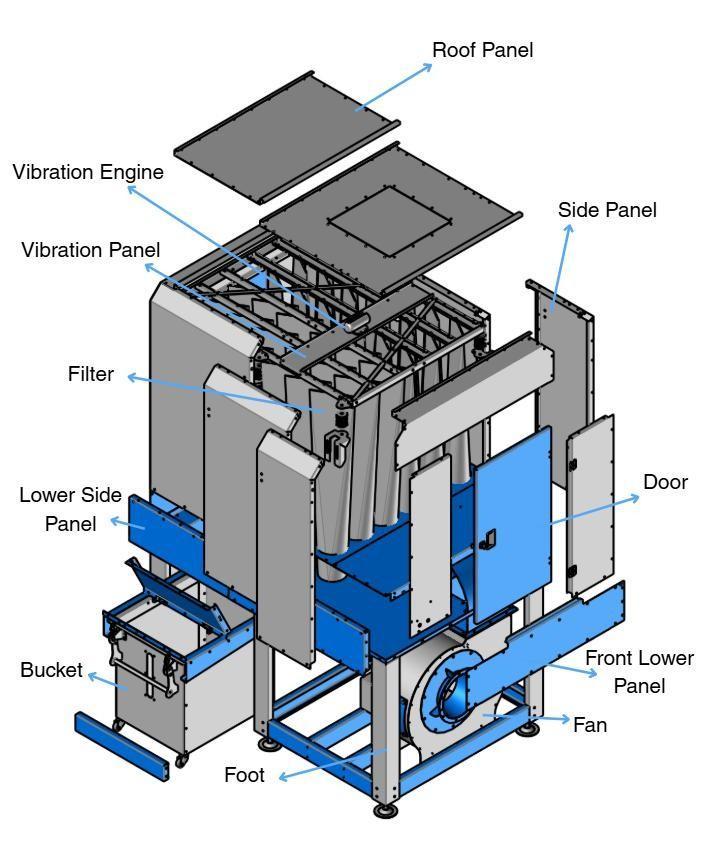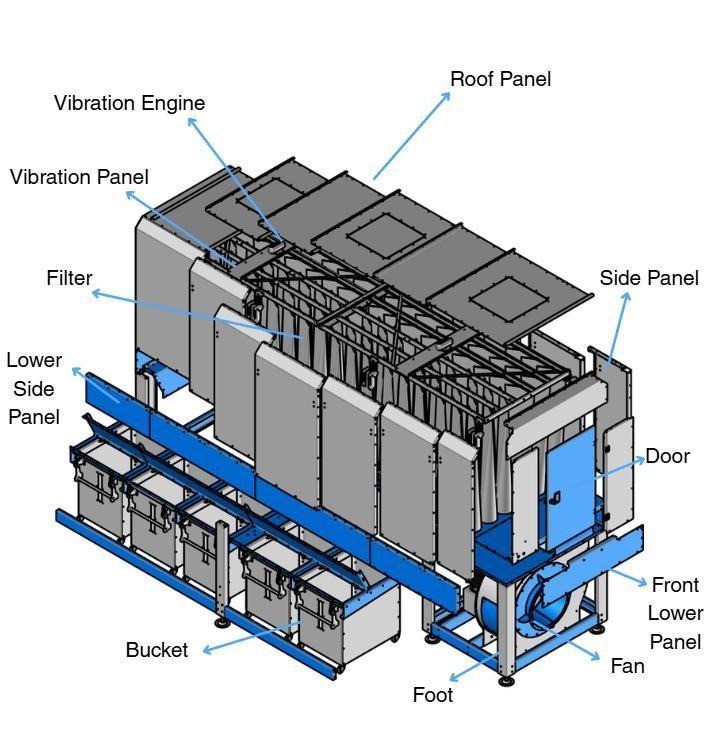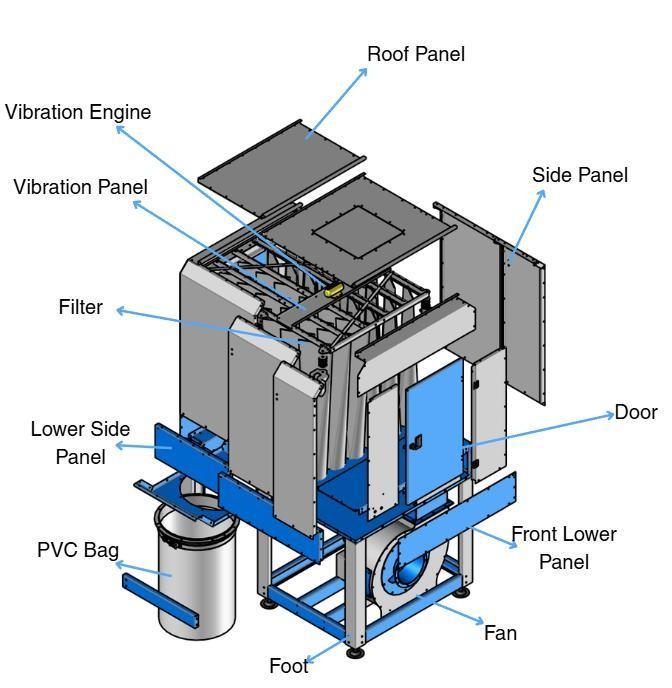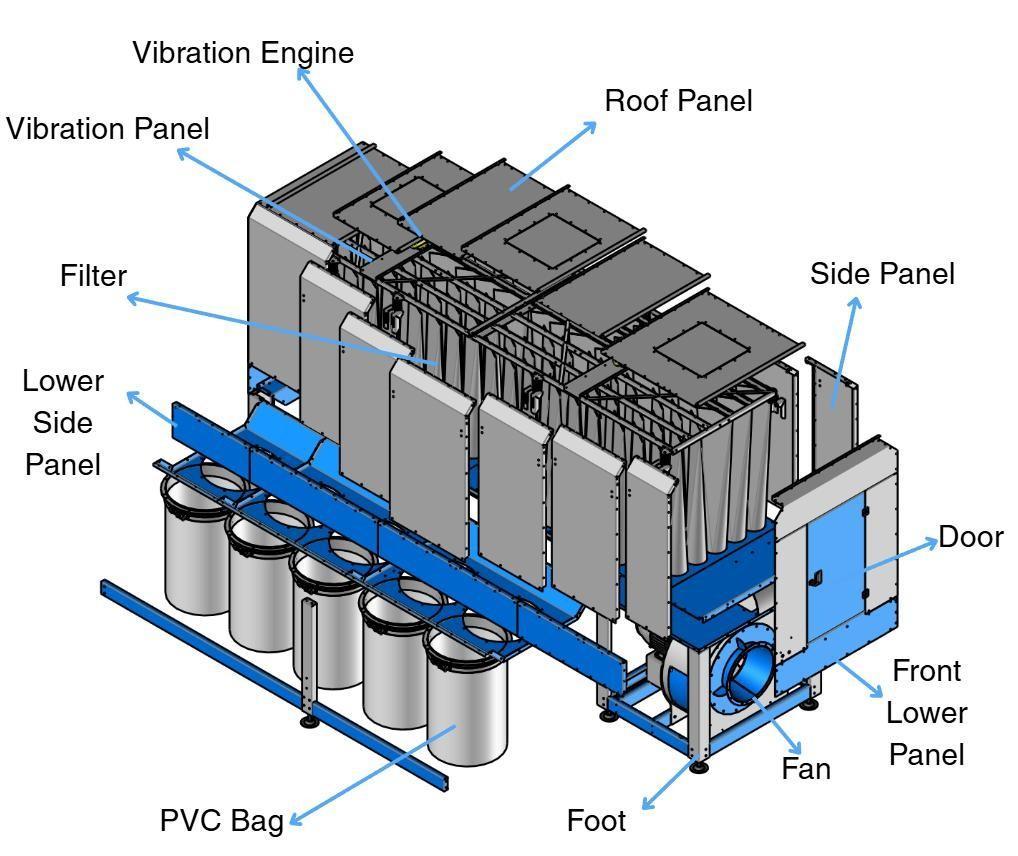

This user manual contains the operating, control, and maintenance procedures, as well as the mandatory instructions for dust collection unit.
For the safety of all personnel, please read the manual carefully before using the Dust Collection System. Keep the manual in good condition and store it near the machine so personnel can easily access it during operation, maintenance, or repair.
During the use, control, and maintenance of the Dust Collection System, it is extremely important to follow general safety precautions and comply with the rules stated in this manual. Otherwise, serious damage and accidents may occur to the user and the facility. Any damage or accidents resulting from failure to follow general safety precautions or the rules in this manual are the responsibility of the users.
Our company cannot be held responsible for hazards, damages, or accidents resulting from design modifications, incorrect part usage, unauthorized personnel intervention, improper operation, etc.
The Dust Collection System must be operated under conditions that comply with the values specified in the Technical Specifications table.
All rights of this manual are reserved. This manual and the technical information and drawings it contains may not be partially or fully reproduced without the written permission of the manufacturer.
1. System Description, General Information and Explanation
1.1. Dust Collector System Features
Dust Collector Systems provide cleaner product area and to use machine more efficient that collect dust in the product area that appear during the production. Generally, this systems include two different parts. First one is fan system that provides to vacuum dust. Second one is unit system that provides to storage dust. Dust collector systems changes according the product area and machine properties such a capacity that use for production. The most important areas that use dust collector systems are wood industry, furniture workshops and lots of places that create dust during the production.
1.2. Operation Conditions
Operating ambient temperature: Between -25 C0 and +55 C0
Ambient humidity: Maximum %95 relative humidity
Working height: Maximum 1000 metres from sea level
Transport and Storage Temperature: +70 C0 (For periods not exceeding 24 hours)
1.3. Model and Technical Properties
You can find the specifications of your dust collection system in the table below.
2. PRESERVATION OF THE MANUAL
This manual must be kept with the machine throughout its entire service life. A copy of the manual should also be stored in the office in a location where authorized personnel can easily access it.
If the manual is lost, request a new copy from the manufacturer by providing the machine model, serial number, year of manufacture, and relevant sales invoice details.
In case the machine is sold second-hand to a third party, deliver all copies of the manual to the new owner. Inform the manufacturer of the name and address of the new owner of the machine.
3. PRE-LOADING TESTS
All components of the machine were checked prior to loading by running the machine in our factory for several hours to ensure that all parts were correctly assembled and that all moving components operated properly.
The following electrical tests were performed on the machine’s electrical equipment;
- Residual current (leakage current) test
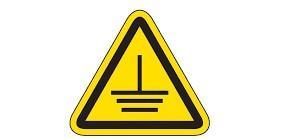
- Grounding (earth) line adequacy test
- Fan balancing test
- Functional tests
4. GENERAL WARNINGS
Operators must carefully read and review the user manual before operating the machines. All terms used in the user manual are clearly defined for easy understanding. For safe, comfortable, effective, and efficient use of the machines, it is essential that the user manual is thoroughly understood and reviewed.
The machines are designed and manufactured to perform their assigned operations within the facility, based on an easy-to-use, simple, and comprehensible design. The control panels and indicators of the machines are produced with a clear and uncomplicated layout that prevents confusion. However, throughout the entire service life of the machines, it is essential to strictly follow the instructions and warnings provided in this user manual and on the labels and indicators attached to the machines.
You may use the User Manual (Operation Manual) for the assembly, operation, maintenance, and all types of adjustments of the machines. If the machines are operated or maintained in any way that differs from the instructions stated in the user manual, the manufacturer will not be held responsible for any damages or harmful incidents that may occur.
4.1. USAGE PLAN IN ACCORDANCE WITH THE BASIC SAFETY REQUIREMENTS OF THE MACHINE:
The main purpose of the Dust Extraction Machine is to collect and store dust, debris, and wood/metal shavings generated after production processes in industrial facilities. Any application outside these primary usage areas is considered misuse. Therefore, the manufacturer does not accept responsibility for any damages that may occur. All work conducted outside the intended purpose is under the responsibility of the owner. Proper use also requires compliance with the operating, maintenance, and repair instructions provided in the user manual by the manufacturer.
The unit must only be operated, maintained, and repaired by trained personnel. Such personnel must be knowledgeable about the potential accidents and hazards associated with their profession.
General safety rules must be followed. Personnel must be informed about the risks associated with alcohol, drug use, and side effects of medications that may impair performance. In addition, the manufacturer is not responsible for any unauthorized modifications made to the machine.
If the machine is used for any purpose other than the one defined, designed, and manufactured for especially for purposes not stated or approved by the manufacturer the manufacturer will not be liable for any hazards or damages that may arise.
The machine possesses the technical and functional features described in this manual. Any modification or change to the technical specifications beyond these listed features reduces the safe operation of the machine.
If any features are added or removed outside the technical and functional structure defined, designed, and manufactured by the producer and not declared by the manufacturer the producer will not be responsible for any hazards or damages caused by such changes.
Operators must carefully read and review the user manual before operating the machine. All terms in the user manual are clearly defined. To ensure the safe, comfortable, effective, and efficient use of the machine, it is essential that the manual is fully understood and reviewed.
The initial installation, commissioning, maintenance, repair, adjustments, and disassembly of the machine must be carried out by authorized personnel. Any intervention by unauthorized individuals reduces the safety of the machine.
For the machine to be used safely, and for proper maintenance and repair, all conditions specified in the user manual must be followed.
If the machine is operated or maintained in any manner outside the instructions provided in the user manual, the manufacturer will not be held responsible for any damage or harmful incidents that may occur.
During the entire service life of the machine, compliance with all written and visual warnings is essential for safe operation. Any practices outside or contrary to these instructions must be strictly avoided. The manufacturer will not be held responsible for any risks or hazardous situations that arise from violations of this requirement.
5. SAFETY RULES
In your working environment, if there are warning signs, instructions, or workplace-specific rules, you must strictly follow them.
Even if certain rules are not mandated by your workplace management, always comply with the fundamental principles of occupational health and safety.
Equip yourself properly with the necessary personal protective equipment such as a hard hat, gloves, safety boots, protective workwear, safety glasses, and a mask before starting work.
For any situation you do not know or are not sure about, consult your immediate supervisor to ensure workplace and worker safety.
Even if you have sufficient knowledge and experience, if you are not authorized, do not intervene in any machine or machine group and equipment within the facility in matters such as installation, initial setup, commissioning, adjustment, operation, control, monitoring, or supervision.
If your knowledge and experience are insufficient, even if you are authorized, do not intervene in any machine or machine group and equipment within the facility in matters such as installation, initial setup, commissioning, adjustment, operation, control, monitoring, or supervision.
5.1. SPECIAL SAFETY INSTRUCTIONS
IMPORTANT NOTE: Make every effort to understand the safety instructions and to take the necessary precautions. While reviewing the safety principles, also refer to the product illustrations provided along with the text.
During maintenance, adjustment, or assembly of the machines, do not alter the proper connection methods. When intervening on connection components, ensure that all actions comply with the machine’s designed connection structure and operating principles.
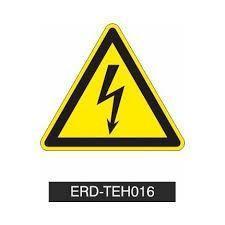
The structure and construction of the machines are designed to prevent direct or indirect contact with electrically energized parts. Do not touch electrical wiring or components. Do not attempt to make any changes or adjustments to the machine’s electrical system. Do not remove or leave open the electrical panel cover. All electrical faults and adjustments must be performed only by authorized electrical technicians.
Electrical connection points are marked with a cable coding system to indicate proper connection methods. During electrical maintenance and adjustments, interventions must comply with the machine’s electrical diagram, cable coding system, and operating principles. Any different or improper applications may create electrical hazards.
Parts and components selected for the design and manufacture of the machines comply with efficiency and safety standards. If it becomes necessary to replace faulty parts during maintenance, adjustment, or installation, always replace the component with a new original part identical to the one on the machine. Using different parts or components reduces the safety of the machines.
The noise level generated during the operation of the machines does not reduce safe usage and does not create any hazardous situations. However, to prevent friction in the fan impellers, the connections should be checked, and if necessary, the impeller or shaft bearing may be replaced. If this noise increases depending on your operating conditions, use hearing protection such as earmuffs to protect your hearing.
The operating frequency of the machines is harmless to human health and the environment, and the machines do not emit low or high frequencies, radio frequencies, or microwaves.
The machines are designed to minimize the risks and hazards that may arise from human error. In any situation, do not intervene with the machines in a manner that is illogical or inconsistent with safe operating practices, and do not use the machines for any purpose other than their intended function.
Secure connection points have been created to ensure that the machines are anchored in the working area in a way that prevents them from being affected by wind, gravity, vibration, or similar external influences. Use these connection points during the installation and anchoring of the machine.
In cases where breakages may occur during operation, any mechanical or electrical effects that could create risks are contained within the machine’s construction structure, preventing them from being released outside the machine’s cabinet. The environment and the user are isolated from such potential hazards. Do not remove the machine’s covers or protective guards. Removing these guards and covers may expose you to unexpected risks. Do not operate the machine without reinstalling all protective guards and covers.
In hazardous situations that may occur while the machines are in operation, press the Emergency Stop Button to stop the machines. The Emergency Stop Button will deactivate the machine’s existing safety and adjustment mechanisms, electrical circuit, and control system. Once the hazardous situation has been completely eliminated and all risks have been neutralized, you may reset (release) the Emergency Stop Button. When the Emergency Stop Button is reset, the electrical circuit and control system will be reactivated.
For the maintenance, repair, and adjustment of the machines, always follow the instructions and information provided in the relevant sections of this manual. Ensure that any intervention you perform is within the scope of your authority and knowledge.
Depending on your working conditions, there is a risk of inhaling dust and particles. Always use a dust mask when operating the machine.
In accordance with the functions, structure, and operation of the machines, display units and control panels have been designed. During normal operation, standby mode, or malfunction, make the necessary adjustments using the control panel according to the information and instructions shown on the display unit. Ensure that any intervention you perform is within the scope of your authority and knowledge.
The electrical panels, electrical circuits, and electrical components of the machines are designed for intervention only by authorized and knowledgeable personnel. These areas have been designed and manufactured based on the principle that you should not need to touch, inspect, or access them. The safety and protection measures in these areas remain effective only if you avoid contact and do not attempt inspection or adjustment. Any direct or indirect contact or intervention in these areas creates a serious electrical hazard. Under no circumstances should you touch electrical cables, electrical panels, electrical devices and components, or any wiring and equipment whose function you do not know. Make sure you remain sufficiently distant and properly isolated from these areas.
When selecting cables, choose ones that comply with this insulation standard.
Depending on your working conditions, always wear safety boots to protect your feet.
Due to the structure of the machine and the requirements of your working conditions, use protective gloves to ensure the safety of your hands.
Always wear a protective helmet around the machine in your working area.
Avoid accessing or approaching hazardous areas.
Do not approach the machine if you are not authorized.
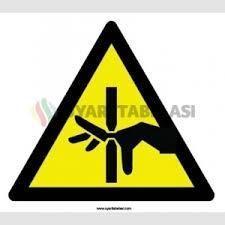
The drive and transmission groups of the machines are enclosed within the construction structure using fixed guards to isolate them from the environment and prevent mechanical risks (crushing, cutting, entanglement, trapping, snagging, shearing, etc.). Do not open the covers or guards in these areas while the machines are in operation. If they are open, be sure to close them before starting the machine. Even when the machines are not running, exercise maximum caution when touching or intervening in these areas, as the machine being stopped does not eliminate mechanical risks.
All machines have warning labels attached for issues that are already included in this manual but require repeated emphasis. If a risk is indicated in the areas where these labels are placed, avoid being near or
making contact with those areas. Always follow the instructions indicated by the labels. If the labels become worn over time to the point where they cannot be read or understood, be sure to replace them with new ones.
Operators and all other personnel must fully comply with safety rules.
5.2 INSTALLATION INSTRUCTIONS
The initial installation, commissioning, maintenance, repair, adjustment, and disassembly of the machines must be carried out by authorized personnel. Any intervention by unauthorized individuals reduces the safety of the machine. Electrical connections and any interventions in the electrical system must be performed by authorized and specialized technicians.
Each machine has its own unique installation and commissioning procedure. In addition to these, there are specific adjustment, installation, and commissioning methods required to ensure synchronized operation of the entire facility.
These adjustment, installation, and commissioning procedures are explained in detail under the relevant sections of this manual.
After the machine has been installed and commissioned by the manufacturer, if you require additional information, follow the instructions and details provided in this user manual.
For any information or technical support outside of what is provided in this manual, you must contact the manufacturer.
For any practices not declared, instructed, authorized, supported, or approved by the manufacturer, the manufacturer will not be held responsible for any damages or harmful incidents that may occur.
6. Parts of Dust Collector System
The operating principles of the other models are the same. The dimensions and capacities vary.