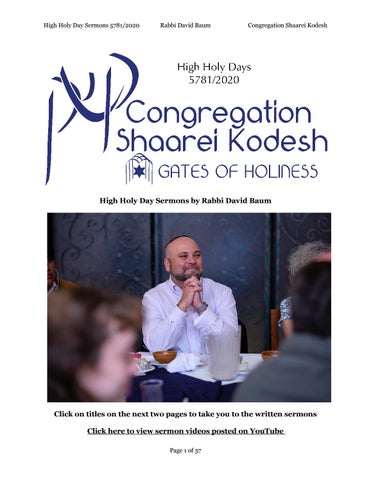
High Holy Day Sermons 5781/2020
Rabbi David Baum
Congregation Shaarei Kodesh
High Holy Day Sermons by Rabbi David Baum
Click on titles on the next two pages to take you to the written sermons Click here to view sermon videos posted on YouTube Page 1 of 37
High Holy Day Sermons 5781/2020
Rabbi David Baum
Congregation Shaarei Kodesh
Author’s Note - Rabbi David Baum
These sermons, written and delivered in the fall of 2020, the beginning of the Hebrew year 5781, are mainly written with the context of the Covid-19 pandemic. Many of our congregants have been in their homes for the since the beginning of the pandemic in March 2020. Some families have lost loved ones to Covid-19 years before they imagined. Some of our congregants are also front line workers, including grocery store workers, ICU and ER nurses and doctors, and other areas of the economy where they have been in contact with the public. Some have lost their jobs and are less financially secure than they were pre-Covid. All of us have spent a lot more time on the internet than we have in the past. During these last six months. Many have expressed fears for their lives, our country, humanity, and the world. Our congregation has held services on Zoom since the beginning of the pandemic, with a few in person, outdoor, opportunities. Please excuse any grammatical or spelling errors. On Erev Rosh Hashanah, we learned that Supreme Court Justice Ruth Bader Ginsburg lost her battle to cancer. I delivered a sermon in between Rosh Hashanah and Yom Kippur (called Shabbat Shuvah) on the lessons we learned from Ruth Bader Ginsburg z’l. Our High Holy days this year were held almost entirely on Zoom in order to ensure the health and safety of our congregants and clergy. You can read about all of our offerings by visiting www.cskboca.org. I hope you find these sermons meaningful and if you have feedback, please email me at rabbibaum@shaareikodesh.org.
• • • • • •
Here are some helpful tips to navigate this document and some background information You can view videos of the sermons by clicking on the picture at the top of the sermon page. The videos were not recorded on the holidays as they were delivered to the congregation, but before and/or after the holiday. To go directly to the sermons, go to the table of contents on pages 3 - 4 and click on highlighted link. Sermons will also be found on my blog at www.rabbidavidbaum.blogspot.com. Feel free to share them! Video clips can be found on this YouTube playlist. You can also share the clips on social media. If you see a blue underlined line or word, click on it and it will take you directly to the source, although footnotes are included.
Rabbi David Baum
Page 2 of 37
High Holy Day Sermons 5781/2020
Rabbi David Baum
Congregation Shaarei Kodesh
Table of Contents
Rosh Hashanah Sermons Erev Rosh Hashanah Jewish Treasure: The Light In Our Homes© (page 5) Rosh Hashanah Day 1 What’s In Your House?© (page 10) Rosh Hashanah Day 2 What’s In Your House - In You And What Will You Do To Repair ‘It’?© (page 15) Shabbat Shuvah Transformation and Prophecy: Holy Lessons from Justice Ruth Bader Ginsburg©
Page 3 of 37
High Holy Day Sermons 5781/2020
Rabbi David Baum
Congregation Shaarei Kodesh
Yom Kippur Evening/Kol Nidre For the Sin of the Masks We Wear© (page 20) Click here for Video
Yom Kippur Day Human-Kind: Our True Nature© (page 26)
Neilah Sermon - The Womb or The Tomb© (page 35) Page 4 of 37
High Holy Day Sermons 5781/2020
Rabbi David Baum
Congregation Shaarei Kodesh
Erev Rosh Hashanah - 5781
(Click on picture above to view video recording of the sermon)
Jewish Treasure: The Light In Our HomesŠ Rabbi David Baum Friday, September 18, 2020 Reb Nachman of Bretzlov once told the following story: A Jewish villager once dreamed about a treasure. In his dream the treasure was near a bridge in the city of Vienna. The very next morning, the villager packed his knapsack with his talit and tefillin, some clothes and a bit of food. Then he began the long, long walk to Vienna. For many days and nights he trudged through forests and fields, valleys and towns. When he arrived at last, the soldiers who guarded the city wouldn't let him near the bridge. So day after day, he stood by the side of the road, trying to think of what to do. One afternoon, a soldier walked up to him and asked, "Why are you standing here?" Page 5 of 37
High Holy Day Sermons 5781/2020
Rabbi David Baum
Congregation Shaarei Kodesh
The villager was silent for a moment. Perhaps we could be partners, he thought. After all, half a treasure is better than none! So he told the soldier about his dream. "Only a Jew cares about dreams!" he laughed. "For three nights in a row, I dreamed that in a certain village there was a certain Jew - and he named the man's village and his name - who had a treasure buried in his cellar. But do you think I believe in such foolish things?" The villager simply thanked the soldier and began the long journey home. For many days and nights he trudged through forests and fields, valleys and towns. Finally, he came to his own little house. Without even sitting down for a cup of hot tea, the man went down to his cellar and started digging. Sure enough, he uncovered a huge treasure. He was able to live comfortably and do many good deeds for the rest of his days. Later, when people asked him about his long journey, he said, "I really had the treasure all along. But to find it, I had to go to Vienna!"1 Reb Nachman famously said, we must worship God in happiness and joy, but he was also tortured by depression in his life. It was a struggle for him to see the light within him. His story, is our story: a people constantly overcoming disappointments and destruction; following our dream, digging deep, and finding light in our homes. Last year, I could not fathom a world where we would be holding our high holy day services over Zoom. That we would not be together in person, that we would be in our homes, in isolation from each other. This belief, that we have a buried treasure in our homes, has kept us going throughout the ages. Our collective home was first at Sinai, where we received the Torah. We camped there for two years, approaching God, seeing sounds and hearing colors (yes, I said that right), receiving law and purpose. They knew they could not set up camp at Sinai forever. Sinai is a stop on the journey to the Promised Land, a very important stop, but it's just a place. So God commands them: וְעָׂשּו לִי מְִקּדָׁש וְׁשָכַנְּתִי ּבְתֹוכָם׃ And let them make Me a sanctuary that I may dwell among them. (Exodus 25:8) Create a place where I will dwell in camp. 1
Rebbe Nachman of Breslov, “The Treasure” Page 6 of 37
High Holy Day Sermons 5781/2020
Rabbi David Baum
Congregation Shaarei Kodesh
The Tabernacle, in Hebrew, the Miskhan, the place where God dwelled, was supposed to be a moveable Sinai; a portable mountain. But it's even bigger than a reconceptualizing of the Sinai experience, it is also a new beginning. The Mishkan becomes the place where God dwells becomes the precursor for the Holy Temple. When the Temple was destroyed in 70 CE, we lost our treasure, we lost our home. I will never forget our honeymoon - we had been living in Israel for the year, and decided to take a trip to Rome which was just a short plane ride. We saw all the incredible sites, visited the Jewish Ghetto and ate delicious food there, stepped into the Great Synagogue, saw the Vatican, threw a quarter in the fountain. But there was one site that took my breath away, and not in a good way. The Arch of Titus - constructed in 81 CE, it memorialized the Roman general Titus’s victory over Jerusalem with his father, the emperor, but at the time of the battle, General Vespasian. The Arch depicts a scene of Jewish slaves carrying the Menorah from the destroyed Temple to Rome. The ancient world worked like this - everyone had their own gods and their own Temples to those gods. When you fought a war, the way to totally crush another people was to destroy their Temple and build a Temple to your gods over it. The first thing Vespasian did after conquering Jerusalem was to make a sacrifice using pigs to Roman gods on the site of the Holy Temple. The second thing was to steal the light from the Temple - our home. They literally turned off the lights. Of course, it was more than that - the Menorah was the symbol for Judeans in the ancient world - it was like the Magen David today. But one rabbi wouldn’t give up - Rabbi Yohanan Ben Zakkai. He escapes from a Jerusalem on the brink of destruction and creates a new center, a little town called Yavneh.2 Vespasian thought he turned off the lights, but Rabbi Yohanan actually had it. The light wasn’t just found in the Menorah - it was within him. Without Rabbi Yohanan Ben Zakkai, none of us would be here. We would have gone down in flames with the second Temple. Out of the ashes of Jerusalem came the Mikdash Me’at - our synagogues or small holy places.
2
Babylonian Talmud Gitten 56a-b Page 7 of 37
High Holy Day Sermons 5781/2020
Rabbi David Baum
Congregation Shaarei Kodesh
We are in a Yavneh moment right now - we are used to gathering in our Mikdashei Me’at, but that center has actually shifted. But it started even earlier than then. After the first exile, the prophet Jeremiah relays a message to the exiled Jews in Babylonia: ּבְנּו בָּתִים וְׁשֵבּו וְנִטְעּו גַּנֹות וְאִכְלּו אֶת־ּפְִריָן׃ Build houses and live in them, plant gardens and eat their fruit - Jeremiah 29:5 Later on, our rabbis living in the aftermath of this second exile that would not end for 2,000 years took these words to heart. Our homes became our Mikdashei Me’at - Shabbat and Yom Tov meals became the altars on which we offer our korbanot, our sacrifices, to God. Two Hallot, a festive meal, the light of the Shabbat and Yom Tov candles on the table in front of us. We have been preparing for this moment for a long time. There’s a famous phrase in the High Holy Day liturgy הֲׁשִיבֵנּו יְי אֵלֶיָ וְנָׁשּובָה חַּדֵׁש יָמֵינּו ּכְֶקֶדם׃ Take us back, God, to You, And let us come back; Renew our days as of old! (Lamentations 5:21) Bring us back to the past. But there’s one letter that is added - K’Kedem (the chaf) renew our days as if they were the days of old. We are in a new place, our homes, but holiness and God, and community, are here. Jews bring the past with us as we journey together into the future. It is that word, Hashivenu, take us back or return, that becomes one of the major themes for these holy days - Teshuvah. We translate it as repentance, but it is something more than that. It means returning - I have to be introspective, I have to look inward to see how I can improve myself, and the world. To find the treasure, to find the light, I have to dig deep in the unlikeliest of places within me; within my tradition, my community, our God. Reb Nachman tells this parable to teach us that the light we seek, the treasure we have, can be found within. The future is built upon the past; the treasure that we hold. Sometimes, we have to travel to Vienna to find it - we have to overcome obstacles, we have to take leaps of faith, but it is there. Page 8 of 37
High Holy Day Sermons 5781/2020
Rabbi David Baum
Congregation Shaarei Kodesh
לַּיְהּוִדים הָיְתָה אֹוָרה וְׂשִמְחָה וְׂשָׂשֹן וִיָקר: כן תהיה לנו: The Jews enjoyed light and gladness, happiness and honor. (Esther 8:16 and Havdalah service) So may it be for us. Today is about renewing ourselves, lifting ourselves up in holiness - going higher and higher during these 10 days of Teshuvah, of returning. This is the beginning of the journey we are taking - during these two days, let us dig deep to find the hidden light. Share it with those around you, whether in person or over Zoom. The light was never stolen, it was never lost - the light never went out. It was there for our ancestors, so may it be for us.
Page 9 of 37
High Holy Day Sermons 5781/2020
Rabbi David Baum
Congregation Shaarei Kodesh
Rosh Hashanah Day 1 - 5781
(Click on picture above to view video recording of the sermon)
What’s In Your House?© Rabbi David Baum Saturday, September 19, 2020 Since it is the High Holy Day season, I have some confessions to make - during this pandemic, I 'slipped’ on a very important mitzvah, some say it is the most important mitzvah: It’s actually one of the Big 10! The last one -ֶָֹלא תַחְמֹד ּבֵית ֵרע You shall not covet your neighbor’s house (Exodus 20:14) It’s the last of the Ten Commandments - it’s a very interesting commandment because it legislates our feelings. There’s been a lot of coveting during the pandemic.
Page 10 of 37
High Holy Day Sermons 5781/2020
Rabbi David Baum
Congregation Shaarei Kodesh
Many of us cannot help but post pictures of our lives in our homes, and we are seeing things in other people’s homes that we have never seen before. For example, I felt blessed not to have a pool before the pandemic. We have two beautiful community pools in our neighborhood - all the benefits of the pool without the pool cleaning or chemicals, or the danger of Gosh forbid a child falling in. But when they closed our pools down, Oy, did I look with envy at our neighbors. Look at these empty pools that they never use! If only we had one! I’m sure some may sympathize with me. Of course, rabbis can covet other rabbi’s homes. I fessed up to my sin to a rabbi friend who is in a different part of his life and career: “Rabbi, I have to say, I’m very jealous of you. I see you working from your home office in peace and solitude. You don’t have small kids around asking you to open this and that, crying because this one hit that one And all the while you are trying to run an online class or service. The solitude you have must be incredible - sometimes, I wish I had just a day of your wonderful life during this pandemic.” He paused, and said, “It’s funny because I was going to say the same thing to you. I see the pictures of you with your children at your home, playing games, spending so much time with them, more time than I ever did when I was a young rabbi. I’m a grandfather now and I haven’t seen my grandchildren in person in months. I haven’t had one hug from them - sometimes I wish that I could just receive one hug from my grandkids like I’m sure you get multiple times a day.” These last six months have been something that has truly been historic. I cannot think of a time in human history when the whole world experienced the same thing; some for weeks, and some for months. We’ve been huddled in our homes. In the past, we craved that physical connection with others - now we run away if someone puts out their hand for a shake or their arms out for a hug. Who would imagine that we would be together, but you would be in your homes, and despite this Zoom background, I’m also in mine. I have to admit, at the beginning of the pandemic, I cherished my time at home. I didn’t have to wear a suit or tie - hey, I was lucky if I put on a pair of long pants in a week! But after a few weeks, that novelty at home wore off. And then, we buried people, and then people lost their jobs. And on a personal note, I’ve really struggled with writing these words, to give a message that is going to be hard for some of you to hear - a message of hope despite the losses you have experienced. So where do we find it? Page 11 of 37
High Holy Day Sermons 5781/2020
Rabbi David Baum
Congregation Shaarei Kodesh
For a minute, take your eyes off the screen and look around you, look at the people next to you, look outside your window - this is where you’ll find it. There is a part of our Torah reading today that is painful to read. Hagar and Ishmael are thrown out of the home. Abraham banishes his first-born child. He gives them a skin of water, some bread, and he sends them off. The water runs out, the bread is long gone, and Hagar and Ishmael are near death. Hagar can’t look at her son die - she screams out, “Let me not see the death of my child.” She cries and so does Ishmael. God hears their cries and sends an angel - I want to read this to you again: קּומִי ׂשְאִי אֶת־הַּנַעַר וְהַחֲזִיִקי אֶת־יֵָדְ ּבֹו ּכִי־לְגֹוי ּגָדֹול אֲׂשִימֶּנּו׃ Come, lift up the boy and hold him by the hand, for I will make a great nation of him.” וַּיִפְַקח אֱֹלהִים אֶת־עֵינֶיהָ וַּתֵֶרא ּבְאֵר מָיִם וַּתֵלְֶ וַּתְמַּלֵא אֶת־הַחֵמֶת מַיִם וַּתַׁשְְק אֶת־הַּנָעַר׃ Then God opened her eyes and she saw a well of water. She went and filled the skin with water, and let the boy drink. (Genesis 21: 18 - 19) God saves the boy and his mother, but it wasn’t a miracle. God opens her eyes, and she sees a well of water. It wasn’t a magic well - the well was there all along, she just couldn’t see it. In the book of II Kings, we read about the prophet Elisha who is confronted by the widow of another prophet. She cries to him, “Your servant my husband is dead, and you know how your servant revered the LORD. And now a creditor is coming to seize my two children as slaves.” Here’s how he answers her: מָה אֶעֱׂשֶה־ּלְָ הַּגִיִדי לִי מַה־ּיֶׁש־לכי ]לְָ[ ּבַּבָיִת וַּתֹאמֶר אֵין לְׁשִפְחָתְָ כֹלּבַּבַיִת ּכִי אִם־אָסּוְ ׁשָמֶן׃ ב,ד:מלכים ב II Kings 4:2 Elisha said to her, “What can I do for you? Tell me, what have you in the house?” She replied, “Your maidservant has nothing at all in the house, except a jug of oil.” With that jug of oil, Elisha performs a miracle of sorts. He tells her to go to her neighbors and borrow empty jugs of oil. She starts pouring the oil from her jug into the other jugs, and they miraculously fill up. She sells the oil for money, and her family is saved. But what do we learn from this story? Elisha asks her a question - מַה־ּיֶׁש־לכי ]לְָ[ ּבַּבָיִת What do you have in your home? She answers, I have nothing but a jug of oil. Page 12 of 37
High Holy Day Sermons 5781/2020
Rabbi David Baum
Congregation Shaarei Kodesh
Nothing but a jug of oil?!? That’s all you need! But there’s another miracle - her neighbors help her. She thought she was alone, but she wasn’t. Robert Louis Stevenson, a 19th-century Scottish Novelist, once told a story young boys who form a secret club called the “lantern bearers”. They hid small tin lanterns under their heavy coats as a secret emblem of participation. From the outside they look just like anyone else hurrying by in the cold night. But when they meet one another, they lift the edge of their coats to reveal a hot burning light hanging from a belt loop.3 When we are in a dark place, it is hard for us to see what is in our home, it’s hard for us to see our neighbors who are there for us. It’s why being part of a holy community like Shaarei Kodesh is so important - we are like this special club of lantern bearers. When someone needs light, like when they lose someone, when they are lonely and scared, someone is there to open their coat and show them the light. Sometimes, the things we are looking for BaBayit are actually hidden. Like today. When Rosh Hashanah falls on Shabbat, something is missing: the shofar. Due to rules of Jewish law, we do not blow the shofar on Shabbat; instead we sound the shofar tomorrow. But think about this - imagine if this was your first Rosh Hashanah, and all you knew about the holiday was today. The Shofar is a sound of hope - hope for the future. You’re not going to hear it today, but you will tomorrow. That’s what today is about - it is about having the faith that we will hear the sound of hope tomorrow. There’s a famous story about the first man, Adam. At the end of the sixth day of creation, today, Rosh Hashanah, he saw that the sun was going down, and the world was becoming dark, and he starts crying. Frankly, he’s scared. “When it becomes dark, I won’t be able to see my partner Eve; I’ll be alone. And what about the Nachash, the serpent?!? What if it bites me and I die?” So God intervenes - he gives Adam two flints to make his own fire to give him light. Note what God doesn’t do - God doesn’t make fire for Adam. I like to imagine that the flints were right there in front of him, but Adam couldn't see them, and God says, ‘Adam, look at your house - the light is there - I can’t make it for you, you have to see it and use it.’ This act, these two lights that Adam creates, becomes the inspiration for the Havdalah ceremony - when we bless the flame. The Havdalah ceremony did not begin at the synagogue - when Jewish men would go to the Beit Knesset for the evening 3
The Lantern-Bearers and Other Essays by Robert Louis Stevenson
Page 13 of 37
High Holy Day Sermons 5781/2020
Rabbi David Baum
Congregation Shaarei Kodesh
prayers, the women would stay home with the children. Remember, these are the days before alarm systems and security cameras - it was scary. So Jewish women started putting the candlesticks together and they brought even more light into their home. The Havdalah candle only has one requirement - it must have at least two wicks. One wick for God, and one for you - but it’s up to you to light it. What a powerful message for our homes, for our lives. I have been thinking about these words for a long time. I’ve seen in many of your homes - some of you have been lonely, some of you have lost relatives to Covid-19 decades before you thought you would; some of you have lost your livelihoods; many of you have lost hope. I can look into your homes, I can see the light in it, but your challenge is for you to see the light inside your homes, despite the darkness you may feel, despite how hard these months have been. ?מַה־ּיֶׁש־לְָ ּבַּבָיִת What’s in your house? It’s time to stop coveting what’s outside and focus on what’s inside Stop staring at the screen - look around you, look to see what is there but maybe you’ve missed during all these months. During this week, I want you to search your home for the things that give you light and share them with the world. May we soon return to a day when we are in a room together, but until then, may God open your eyes to the light of the world, and may the beautiful sound of the shofar give you hope for the New Year.
Page 14 of 37
High Holy Day Sermons 5781/2020
Rabbi David Baum
Congregation Shaarei Kodesh
Rosh Hashanah Day 2 - 5781 Click on picture below for video sermon
(Click on picture above to view video recording of the sermon)
What’s In Your House - In You And What Will You Do To Repair ‘It’?© Rabbi David Baum Sunday, September 20, 2020 Have you ever had a day or two during these last months when you just couldn’t get out of bed in the morning? Maybe you felt you were even tied down, bound by a force you couldn’t control. I want to tell you a story of one of our congregants who was also bound to his bed - Joe Schwartz of blessed memory. Joe was a Holocaust survivor and his experiences of survival became a touchstone for his life. Every year, he would recite a special El Maleh Rachamim (the traditional Jewish memorial prayer) composed for the six million Jews who were murdered during the Shoah/Holocaust. He chanted it with passion, with pain, with tears every time. Anyone who witnessed his rendition of that prayer was changed for the better, even if they did not know his story. Page 15 of 37
High Holy Day Sermons 5781/2020
Rabbi David Baum
Congregation Shaarei Kodesh
A number of years ago, I visited him in his hospital bed, his second time bound to the bed that month. We both knew that he did not have that much time left. The hospital stays were becoming more frequent, closer together. The future wasn’t bright. We prayed together. I took out my prayer book and read Psalm 30, A Song of David, A song for the dedication of the Temple, but it’s known as Mizmor Shir Hanukat HaBayit L’David - the dedication of David’s home, a Psalm we say every morning in our prayers. But, if we look at it from the perspective of David, an individual, it is a song of dedicating his ‘home’; his body -his soul. The Psalm is deeply personal full of ups and downs: "God, you raised me up, you did not permit my enemies to rejoice over me, I cried out and You healed me. You saved me from the pit of death. When I said these words in Hebrew, Joe did something no other person I’ve ever visited did: he mouthed each word with me: “Tears may linger for a night; joy comes with the dawn.”the Psalmist says. How was he able to survive this hospital stay? To have hope to make it through the upcoming evening? Because he was able to see what was in ‘his house’. His house was full of memories of the past, when he could have given up. When he could have stayed in the barrack, in his bed, before roll call in the concentration camps. When he could have thrown himself on the electric fence, ending it all. The joy he forced himself to feel, the purpose he held onto during those days; I imagine that’s what helped him face another evening bound on that hospital bed. Yesterday, I asked you a question, what’s in your home? You looked around your home to see what may have be hiding in plain sight - the things or people that give you the power to move forward. I wanted to share a story of a different way of looking at the concept of home - and that home is you. We just read the story of the Akeidah, the binding of Isaac. I don’t know about you, but I’ve always wondered, why this story today? If it is to give us the imagery of the Shofar, there are plenty of instances in the Torah when the shofar was used in a less complicated way. Do we need a story of a man who listens to a voice that tells him to sacrifice his only child immediately after he banishes his first child to a possible death? But maybe that’s the problem - we tend to look at it from the father’s view, from Abraham, but we should be looking at this story from different eyes - from Isaac’s. How many of us felt like Isaac over these last six months. Bound on the altar, bound to our homes. We were safe, we were doing the right things, but there was so much out of control. We learned that no matter what we did - we are bound. We are Isaac
Page 16 of 37
High Holy Day Sermons 5781/2020
Rabbi David Baum
Congregation Shaarei Kodesh
Rabbi Abraham Joshua Heschel shared a story of how he studied the Akeidah as a child with his Rebbe in Poland. He writes, “Isaac was on the way to Mt. Moriah with his father. There he lay on the altar, bound, waiting to be sacrificed. My heart began to beat very fast. It actually sobbed with pity for Isaac. Behold, Avraham now lifted the knife and how my heart froze within me with fright. Suddenly the voice of the angel was heard, “Abraham, lay not thine hand upon the lad for now I know that you fear God.” And here I broke into tears and wept aloud. “Why are you crying,” asked my rebbe? “You know that Isaac was not killed.” I said to him, still weeping, “But Rebbe, suppose the angel had come a second too late?” The Rebbe comforted me and calmed me by telling me that an angel cannot ever come too late.” Heschel concluded: “Yes an angel cannot come too late but we, we made of flesh and blood, we can come too late.” We can come too late, especially when the days run into each other. It reminds me of the last six months and the passage of time. There is a new word that has entered our lexicon during these months of the pandemic: ‘blursday’ a term that you use when you don't know what day of the week it is. Many of us are feeling blursday, especially those who are working from home during this pandemic physically isolated from others, perhaps with children who have little to no structure like camp and school that we took for granted pre-pandemic. Days are seeping into each other; weeks are flying by without notice. The condition of ‘blursday’ is brought on by something we took for granted before: temporal cues. Temporal cues or temporal anchors are regularly occurring events, like weekends, which would normally break up the workweek. These anchors help us orient in time. What has saved us as a people has been our weekly temporal cue - Shabbat, the day of rest. But every year, the Jewish people have a shared temporal cue to help us distinguish between years - today, Rosh Hashanah, but Rosh Hashanah is also an Akeidah moment, a moment where we are saved from death. Think back to the words of David in that Psalm, “Adonai, I cried out and You healed me. You saved me from the pit of death.” But what happens when you know you aren’t leaving the altar Authors Chip and Dan Heath share a story of this type of moment in their book, The Power of Moments. They tell the story of Eugene O’Kelly and how he came to write his moving memoir, Chasing Daylight. The memoir is a response to an Akeidah moment he had: “I was blessed. I was told I had three months to live.” O’Kelly was a 53 year old CEO of a $4 billion company with 20,000 employees. He was married with two teenage daughters. All the plans they had for their lives were scrapped
Page 17 of 37
High Holy Day Sermons 5781/2020
Rabbi David Baum
Congregation Shaarei Kodesh
when his doctors told him that he had three golf sized malignant brain tumors, and there was no cure. He developed a new plan: he drew five concentric circles on a piece of paper. He mapped out all of his relationships. His family was the center circle, the outer ring was more distant relationships, like business partners. He resolved to unwind his relationships - to “beautifully resolve” Them - to work from the outer circle to the middle. He spent less time on the outer circles, and more and more time on the inner circles as they came to him. He met his friends in person - some times they shared an exquisite meal, other times they would sit together on a park bench. He came to think of these moments as Perfect Moments and his mission was to create as many of them as he could in his dwindling time. In the shadow of his final days, he wrote the following: “I experienced more Perfect Moments and Perfect Days in two weeks than I had in the last five years, or than I probably would have in the next five years, had my life continued the way it was going before my diagnosis. Look at your own calendar. Do you see Perfect Days ahead? Or could they be hidden and you have to find a way to unlock them? If I told you to aim to create to 30 Perfect Days, could you? How long would it take? Thirty days? Six months? Ten years? Never? I felt like I was living a week in a day, a month in a week, a year in a month.” The Heaths asked the reader to remember how O’Kelly began his memoir: ‘I was blessed. I was told I had three months to live.” The Talmud (Sanhedrin 38b) imagines what happened on the sixth day of creation, from sunrise to sunset: In the first hour of the day, Adam’s dust was gathered. In the second, an undefined figure was fashioned. In the third, his limbs were extended. In the fourth, a soul was cast into him. In the fifth, he stood on his legs. In the sixth, he called the creatures by the names he gave them. In the seventh, Eve was paired with him. In the eighth, they arose to the bed two, and twins, Cain and Abel were immediately born. In the ninth, Adam was commanded not to eat of the Tree of Knowledge. In the tenth, he sinned. In the eleventh, he was judged. In the twelfth, he was expelled and left the Garden of Eden. Look at it deeper though - we are born, we learn to walk, we discover the wonder of the world, we find partners, we create families, we make choices - we make mistakes, we die. The Rabbi’s were giving us a message - every day has the potential to be a perfect hour where something incredible happens, but are you awake and open to it - can you embrace that perfect moment? Rosh Hashanah, that Akeidah experience, is a reminder of what’s in our house, and what we can do to help us truly live - to help the years from running into each other - to make sure that we do not come too late. Page 18 of 37
High Holy Day Sermons 5781/2020
Rabbi David Baum
Congregation Shaarei Kodesh
We have an incredible opportunity over these next 7 days, from tomorrow until Yom Kippur. The period from Rosh Hashanah to Yom Kippur are called the Aseret Yemei Teshuvah - the 10 days of Tesuvah. 10 days of returning, of growth and healing, of repairing and deepening your relationships. The technology that shackled us from experiencing life can now breathe new life into us. You can see anyone you want to see in the world and talk with them. You can enjoy a meal together over video, have a drink with them - talk with them. You survived, you were able to find something in your house, or maybe it was just luck, or maybe part of some greater plan - now you have a challenge - what do you need to fix in your home before it is too late? Our homes are built in an interesting way - since the destruction of the Temple, we are supposed to leave one part of home unfinished. For us, it is a part in our closet that we had to repair after some water damage. We replaced the dry wall, but I never painted over it. In reminds me that I am never finished and complete - there is always a part of my home that needs to be fixed in order I can invite others in. What’s waiting for you to fix? What perfect moments and perfect days can you create in this week, these seven days from tomorrow until Yom Kippur? ?מַה־ּיֶׁש־לְָ ּבַּבָיִת What’s in your house? Remember, an angel cannot come too late but we, but we can. In these next seven days, may you seek out those whom you have wanted to call, but just couldn’t because you said, I’ll call them next week, next month, next year. In these next seven days, may you find the strength in your house to make the easy calls, and the difficult calls. My blessing for you is that you have more perfect moments and perfect days in this week than you have had in the last six months, and may they fill you up for the year ahead.
Page 19 of 37
High Holy Day Sermons 5781/2020
Rabbi David Baum
Congregation Shaarei Kodesh
Transformation and Prophecy: Holy Lessons from Justice Ruth Bader Ginsburg© Rabbi David Baum (This sermon is published on The Times of Israel) Shabbat Shuvah 5781/2020 It’s hard for us to know when we are in a big moment. We remember where we were when JFK was assassinated, we remember where we were at 9 am on 9/11/2001. But most of the time, the really important and transformative moments, are more than just one moment. Take, for example, today, yesterday, or, frankly any day of these last six months. Years from now, when there is a vaccine, we are going to tell stories of what it was like during Covid-19. How we had services on Zoom, how our kids did virtual school, how our little ones learned how to wear masks properly, how we lost 200,000 Americans in such a short amount of time. But, there was a big moment this week which had so many small important moments that led up to it – the memorial service for Supreme Court Justice Ruth Bader Ginsburg. Friday marked the first time a woman and Jew lay in state at the Capital. Poppy Harlow of CNN said the following immediately after the service: “This was a big moment for Jewish-Americans has to be deeply meaningful, to hear that Hebrew prayer in the Halls in Congress that has not been heard in a moment like this before.” On Friday, Rabbi Lauren Holtzblatt led a service in our Capitol, singing Min HaMeitzar, reciting the El Maleh Rachamim, a eulogy packed with Jewish teachings. But, through Rabbi Holtzblatt’s words, I also learned something else: big moments come from a series of smaller moments. Today is Shabbat Shuvah. It is the Shabbat during the Aseret Yemei Teshuvah, a day, I think, when we have to reflect upon what Teshuvah really means.
Page 20 of 37
High Holy Day Sermons 5781/2020
Rabbi David Baum
Congregation Shaarei Kodesh
And here’s what I learned on Friday – how we transform ourselves, and society; and the definition of what it means to be a prophet and a Judge. Teshuvah = Transformation When we think of change, we think of aha moments. We are inspired by a lightning bolt, and then, we change. But this isn’t the Jewish way. We are changed not by one moment, but a series of moments – and no one knew that more than Supreme Court Justice Ruth Bader Ginsberg. Rabbi Holtzblatt quoted Deuteronomy, the famous line from parashat Shoftim – Tzedek Tzedek Tirdoff – Justice Justice, you shall pursue. This pasuk was framed as a piece of art in Justice Ginsburg’s chambers. And then, she taught another layer of Torah: “The rabbinic tradition assigns meaning to every single word in the Torah, so there must be a reason why tzedek, ‘justice,’ is written twice. Ibn Ezra, a medieval rabbi, teaches that the word tzedek is repeated here in order to teach that time and time again, all of the days of your life you must pursue justice.” The Notorious RBG, as she became known for a new generation, lived her life talking small, but powerful, important steps. “Her life was a life of persistence, resilience, and a commitment to never stop.” But, does Judaism also believe this? Thinking back to the stories of the Torah, we see that the biggest moments were quick and strong – the Ten Plagues, the splitting of the Sea of Reeds, and receiving the Torah at Sinai. But, in these weeks, we actually learn what the Torah has to say about transformation – teshuvah. In Rabbi Alan Lew’s book, This Is Real, And You Are Completely Unprepared, he quotes psukim from last week’s parashah, Nitzavim And it shall come to pass when all these things have come upon you, The blessings and the curses that I have set before you, And they will rise up again [ha-shev-ota] in your heart Among the nations to whom the Lord your God has driven you And you will return [v-shav-ta] to the Lord your God and listen to God’s voice.… Then the Lord your God will turn [v-shav] your captivity And have compassion on you and turn [v-shav] And gather you in from all the nations where you have been scattered.… And God will circumcise the foreskin of your heart So that you can love God with all your heart and with all your soul.… And you will turn [ta-shuv] and you will hear the voice of God And do all the commandments which I have commanded you this day.… Deuteronomy 30:11-14
Page 21 of 37
High Holy Day Sermons 5781/2020
Rabbi David Baum
Congregation Shaarei Kodesh
The root of the word shuv is repeated seven times. Seven is an important number. When we see seven, we think of being whole – seven days of the week, seven flames on the menorah. Think about how seven is used in our tradition, especially weddings. When we get married in Judaism, Kidushin, we are transformed from one single individual to a couple that is like one. Rabbi Lew comments on the repetition of Teshuvah, as he calls it, transformation: “This passage shows us the complexity of transformation. Transformation is not something that happens once and for all time. The people turn three different times in this passage, and as it closes, they are promised a great blessing, but only if they continue to turn in the future. Transformation does not have a beginning, a middle, or an end. We never reach the end of Teshuvah. It is always going on. We are awake for a moment, and then we are asleep again. Teshuvah seems to proceed in a circular motion. Every step away is also a step toward home. And it may never be clear to us that the work of transformation has borne fruit. This is usually the case in the realm of spiritual practice. Real spiritual transformation invariably takes a long time to manifest itself in our lives. Spectacular, immediate results—sudden changes in aspect or in the way we see the world—are always suspect, and usually suggest a superficial rather than a profound transformation. Profound transformation only manifests itself over time. When Jacob has his great vision of the ladder and realizes he has been visited by God, he exclaims out loud, “My God! God has been in this place all along and I never knew it!” From this moment of epiphany, we expect he will be changed. We are disappointed when he continues to behave like the same manipulative schmo he has always been. But when we look at the larger arc of Jacob’s life, we see that this vision really does effect a profound change in him. It’s just that this change isn’t evident right away. It takes more than twenty years for it to take root.” When we look at this moment on Friday, you think, how did we get to it? Justice Ginsburg graduated at the top of her class at Columbia law school, but she didn’t get one job offer in New York. Many would have given up, and I wouldn’t blame them, but not Justice Ginsburg. She once commented: “I get out of law school with top grades, and no law firm would hire me. I end up teaching and it gave me the time to devote myself to the movement to evening the rights of women and men.” As a lawyer, she won equality for women and men not as one swift victory, as Rabbi Holtzblatt put it – brick by brick, case by case, through meticulous careful lawyering. Through this, she changed the course of American law. Think back our journey as a people – we had Sinai, when we had the laser light show, but we were only truly transformed after parashaht Mishpatim, the very next parashah when we receive law after law. What it means to be a Jew is to take these small, purposeful and powerful steps. Halachah, Jewish law, comes from that root Holech, to walk, to take steps. Performing mitzvah after mitzvah means we walk the path. You must watch over the widow, orphan and stranger – over and over again. Page 22 of 37
High Holy Day Sermons 5781/2020
Rabbi David Baum
Congregation Shaarei Kodesh
Rabbi Holtzblatt ended her eulogy by saying: she was our prophet, our north star, our strength. Rabbi Holtzblatt wasn’t speaking in platitudes. She got to the essence of what prophesy really is. Prophets are not prophets because they talk to God; they are prophets because they tell the people difficult truths that challenge us. In his book, HumanKind: A Hopeful History, author Rutger Bregman says that we humans have a problem – we are too polite. I know, it sounds pretty unbelievable if you are on social media, but here’s how he explains it. He said, “Sometimes our societal instinct get in the way of truth and of equity. Because consider: haven’t we all seen someone treated unfairly yet kept silent to avoid being disagreeable? Haven’t we all swallowed our words just to keep the peace? Haven’t we all accused those who fight for their rights of rocking the boat?… History teaches that progress often begins with people…whom others feel to be preachy or even unfriendly. People with the nerve to get on their soapbox at social occasions. Who raise unpleasant subjects that may you uneasy. Cherish these people, because they’re the key to progress.” Rabbi Holtzblatt shared, “Even when her views did not prevail, she still fought. In recent years, she became famous for dissents, despair was not an option. RBG said, “Dissents are for a future age; it’s not simply to say my colleagues are wrong and I would do it this way, but the greatest dissents do become court opinions and gradually over time their views become the dominant view. So that the dissenters hope that they are writing not for today, but for tomorrow. Her dissents were not cries of defeat, but blueprints for the future.” The Talmud is famous for this – all minority opinions are recorded, and sometimes they become the majority. How do we transform ourselves and our world? As the ‘Glorious’ RBG taught us, one step at a time. What does it mean to be a prophet? To pursue justice, especially when it is not popular. When we see inequity, we challenge it because there are some things that are more important than not rocking the boat. Let’s remember that we are living in big moments – Justice Justice You Shall Pursue – one moment at a time. Baruch Dayan HaEmet – Blessed be the True Judge Amen.
Page 23 of 37
High Holy Day Sermons 5781/2020
Rabbi David Baum
Congregation Shaarei Kodesh
(Click on picture above to view video recording of the sermon)
For the Sin of the Masks We Wear© Yom Kippur Evening/Kol Nidre Rabbi David Baum Kol Nidre 5781/2020 Sending our daughter to pre-school during this pandemic was one of the most difficult decisions we had to make as parents, but we felt it was the right thing to do for us. So we prepared - to ensure utmost safety, children were instructed to bring a clean mask each day. So we bought her many pink princess masks and we said that would wash them together when she came home. We told her to be careful along, to keep her mask on along with the other lessons of preschool, like waiting your turn, and sharing is caring. She came home that first day so happy. She told us about all the new friends she made, and how much she loved her teachers. When she came home, she handed us her mask to wash. My wife’s eyes opened up in horror. “Where did you get this mask?” “Imma, I traded masks with my friend, remember: sharing is caring!”
Page 24 of 37
High Holy Day Sermons 5781/2020
Rabbi David Baum
Congregation Shaarei Kodesh
Speaking about masks, I’m reminded of the last time we were together in person inside our sanctuary: Purim, when social distancing was not part of our vocabulary. After Purim, we put our costumes away and put on a different costume: our face masks. When we think of masks, we think about super heroes, and there’s something very Jewish about this. Most of the superheroes, we know and love, Superman, Batman, Captain America, Spiderman, were created by Jews. When we put the masks on, we believe we can perform superhuman acts. This year though, there was an underreported story about Superman - he took off his mask and revealed to the world that he was Clark Kent all along. But what was the mask - was it Superman, or was it Clark Kent? And what about the masks we wear? Our virtual masks - our online identities. A couple of years ago, I was about to go to a rabbinic learning retreat. I looked at the class lists, and one rabbi’s name came up over and over again. It sounded very familiar. I realized why: it was a rabbi who oftentimes posted inflammatory things online. He caused many fights on our listserves and on Facebook. “Oh great,” I thought, “he’s bad enough online, now I’m going to have to listen to him in real life.” And then, the kicker - guess who I was going to room with for four days? You guessed it: Rabbi ‘Gaslighter’. A funny thing happened though, after days of being together and getting to know him, I learned that his online persona was nothing like he was in real life. He was kind, thoughtful, open to listening to new ideas, but at the same time strong in his principles. On the last day of our retreat, I told him how I felt when I saw his name. I asked him why he acts like this online. He said, “When I’m online, I can say whatever I want to say, and I get to let off some steam. It’s much cheaper than therapy!” I was left even more confused, who was he really? The kind and thoughtful rabbi who I got to know, or the cruel Rabbi Gaslighter? It’s a question we have to ask ourselves - who are we? Are we our online avatars, is that who we are, or is it the person who lives in our face to face lives?
Page 25 of 37
High Holy Day Sermons 5781/2020
Rabbi David Baum
Congregation Shaarei Kodesh
Today is Yom Kippur, but there’s a wonderful way of looking at this day in a different. Today is Yom HaKippurim - a day that is like Purim. Believe it or not, there are many similarities - on the day before Purim, we fast and then rejoice, and although we fast today, it is a joyous day. The Mishnah says there were no more joyous days than Yom HaKippurim - the day of atonement. On Purim, we wear masks. On Yom Kippur, we wear a simple kittle, a completely white garment. But this too is a costume, this too is a mask - they are the clothes of the High Priest. But, in a sense, every day online is like Purim. We wear a mask, the question is, who are we really? The mask we wear, the costumes we don, can teach us about our authentic selves, or better yet, who we strive to be. Are we the court jester on Purim, or are we the High Priest on Yom Kippur? We live in a society that constantly drives home the message - be authentic, in other words, be your true, unfiltered self. But is that really the right way to act? Adam Grant, a well known Industrial Organizational Psychologist and author, gave different advice: Unless You’re Oprah, ‘Be Yourself’ Is Terrible Advice. He said, “We are in the Age of Authenticity, where “be yourself” is the defining advice in life, love and career. Authenticity means erasing the gap between what you firmly believe inside and what you reveal to the outside world. As Brené Brown, a research professor at the University of Houston, defines it, authenticity is “the choice to let our true selves be seen.” We want to live authentic lives, marry authentic partners, work for an authentic boss, vote for an authentic president. In university commencement speeches, “Be true to yourself” is one of the most common themes (behind “Expand your horizons,” and just ahead of “Never give up”). “I certainly had no idea that being your authentic self could get you as rich as I have become,” Oprah Winfrey said jokingly a few years ago. “If I’d known that, I’d have tried it a lot earlier.”4 But for most people, “be yourself” is actually terrible advice. He gives an example from author A.J. Jacobs, an author, who spent a few weeks trying to be totally authentic. Here’s what he did - he announced to an editor that he would try to sleep with her if he were single and informed his nanny that he would like to go on a date with her if his wife left him. He informed a friend’s 5-year-old daughter that the
http://www.nytimes.com/2016/06/05/opinion/sunday/unless-youre-oprah-be-yourself-isterrible-advice.html?smprod=nytcore-iphone&smid=nytcore-iphone-share 4
Page 26 of 37
High Holy Day Sermons 5781/2020
Rabbi David Baum
Congregation Shaarei Kodesh
beetle in her hands was not napping but dead. He told his in-laws that their conversation was boring. You can imagine how his experiment worked out. So if we shouldn’t be our authentic selves, what should we do? Who are we really, the voice telling you to say what you think is the truth no matter who it hurts, or the person who lies to people’s faces? Neither sounds Jewish, but here is where the kittel that we wear today can teach us some valuable lessons. How did Aaron change from Moses’s older brother to High Priest? The answer - God clothed him. The garments that he wore embodied the essence of the Divine. The white color symbolized purity, innocence, light, and life. The clothes of the priest transferred their sanctity to the person. Before Aaron dies, God instructs Moses to take his clothes off him and given to his son, the next High Priest. Only then does Aaron die. The garments Aaron wore were imbued with meaning. We read about the breastplate which contained stones, each one representing each of the tribes of Israel. “…attach the two stones to the shoulder-pieces of the ephod, as stones for remembrance of the Israelite people, whose names Aaron shall carry upon his two shoulder-pieces for remembrance before the Lord.” (Exodus 28:29-30) Gersonides, a well known French Medieval commentator explains why the Torah brings up the idea of remembrance – so that Aaron should always keep them, the people, in mind. When he wore those stones, he knew he represented everyone. You might wonder, was Aaron really like this on the inside though? Is wearing a uniform and not being your authentic self really what God wants from us? There’s a powerful lesson that we can learn from the Ark of the Covenant. It is on this day, Yom Kippur, when the High Priest was allowed in its presence. God instructs the people on what the ark should look like: “And you shall overlay it with pure gold, inside and outside shall you overlay it, and shall make upon it a rim of gold around it.” (Exodus 25:11) The rabbis asked an important question - if gold is so valuable, why would you put gold on the inside of the ark where no one will see it? Our Sages concluded that it was built
Page 27 of 37
High Holy Day Sermons 5781/2020
Rabbi David Baum
Congregation Shaarei Kodesh
like this for a reason - to teach us tocho k’baro damei, “the inside of a person should match their outside.” At the beginning of the pandemic, I received some sage advice. Dress up for work. We know that you can be in your PJs all day, and even if you have a video call, you don’t need to wear pants, but your clothes will help you be the person you want to be. And it will help you act like your truly authentic self - the person you strive to be. Kol Nidre emphasizes the power of words, both verbalized and now typed. Words can create, and they can destroy. The overwhelming majority of the sins we will say out loud on this day are sins of the tongue or the word. Imagine if we looked at our typed words in the context of today’s confessional. Al Het Shehatanu Lifanecha - For the Sins We have Committed Before You, and the Virtual World Online For the sin of destroying our so called ‘Friends' on that Facebook post For the sin of posting our most disturbing thoughts and hurtful words anonymously. For the sin of posting our most disturbing thoughts and hurtful words with our own names. For the sin of “shmirat ha-etzbaot,” for failing to control our fingers - for the sins of sharing For the sin that we have committed before You by using the forward key much too often and the delete key much less often than we should. For the sin of sharing those article that proved our point…even though we know it was written by a 40 year old man with no credentials who is still living on his mother’s couch For the sin of airing our dirty laundry in public when it should have been kept private, for sending a message in anger and not waiting until we cool down For the sin of calling someone out publicly when we should have just picked up the phone For the sin of deceiving others about the perfection of our lives And the sin of placing stumbling blocks before the blind who would believe it. Ve-Al Kulam Elohai Selichot, S’lach Lanu, M’chal Lanu, Kaper Lanu For all of these ever forgiving God, Forgive Us, Pardon Us, Grant Us Atonement5 We must all consider, when I post something on my social media page, when I tweet something, when I make a video clip, what message am I sending about my values? What message am I sending to the people that I represent? What am I wearing on my breastplate? Kol Israel Areivim Zeh BaZeh - All Israel is responsible for one another - we are a nation of priests - all of us wear that breastplate.
5
Thank you to Rabbi Daniel Dorsch for writing a number of these modern sins Page 28 of 37
High Holy Day Sermons 5781/2020
Rabbi David Baum
Congregation Shaarei Kodesh
Judaism is a faith that makes us think – we pause before we eat food and say a blessing, we have kavanah, intention in our actions, the same should be said for how we act online. Being a Jew means that we answer to a higher authority, and what we say in public affects how we are on the inside. What we verbalize or write matters; we must use our words to create, not destroy, to live by them and up to them. What do we want to adorn ourselves with? These are the pressing questions of our time are what will be on our digital breastplate this year; how our words help us become the people we want to be. We must look at our avatars as opportunities to bring people together, to unify us, to be our breastplates, and our kittels. Let us see ourselves not as the only individuals willing to speak the truth out loud no matter how hurtful it is, but part of something larger, representing not just ourselves, but those who came before us, those whom we share our lives with, and those who will come after us.
Page 29 of 37
High Holy Day Sermons 5781/2020
Rabbi David Baum
Congregation Shaarei Kodesh
(Click on picture above to view video recording of the sermon)
Human-Kind: Our True NatureŠ Yom Kippur 2020/5781 Rabbi David Baum Congregation Shaarei Kodesh Mount Everest is the tallest place on earth, 29,029 feet above sea level. Reaching its summit is an almost divine feeling. Every year, thousands of people climb to the top of this famous mountain. A climber described the ascent the following way: "I feel like a zombie who has stumbled into heaven. At the summit, I truly feel on top of the world. A euphoria I cannot find anywhere else.� There's a famous line in the Talmud: where heaven and earth touch.6 I believe this is why people want to go to the top of Everest, to see where heaven and earth touch; to be alone with the Divine. But the reality of climbing Everest is not so euphoric.
6
BT Bava Batra 74a Page 30 of 37
High Holy Day Sermons 5781/2020
Rabbi David Baum
Congregation Shaarei Kodesh
It is reported that climbers actually have to step over dead bodies as they try to reach the top. Climbers complain of theft and heaps of trash on the mountain. An young climber from Kashmir, Rizza Alee commented that he was stunned by how little empathy people had for those who were struggling. “I saw some people like they had no emotions. I asked people for water and no one gave me any. People are really obsessed with the summit. They are ready to kill themselves for the summit.”7 The more I think about it, the less climbing Everest is like being in heaven, it actually sounds quite the opposite. You might wonder why I’m talking about mountain climbing on Yom Kippur. Yom Kippur, this moment, is a moment where Moses and Aaron were alone with God in the places where heaven and earth touch, but this moment is not without tension. In the month leading up to Yom Kippur, Moses was on top of Mount Sinai, alone with God. He was there because our ancestors sinned - they lost faith and created a golden calf to worship. Moses smashed the set of tablets that God created by Godself, and went back up to the mountain to carve a new set of tablets for another 40 days and 40 nights. Aaron, the High Priest and every High Priest after him, also had a similar experience of being alone with God. On this day, Yom Kippur, Aaron went into the Holy of Holies, to commune with God. I wonder what Moses and God talked about for 40 days and 40 nights, or Aaron the High Priest and God on Yom Kippur in the Kodesh HaKodashim (the Holy of Holies), the room only he could visit one day a year? Unfortunately… No one else was in The room where it happened The room where it happened The room where it happened No one else was in The room where it happened The room where it happened The room where it happened8 But I imagine, somewhere in their conversations, that they talked about us - humanity. It was on Mount Sinai, in a cave, where Moses and God probably debated - is humanity saving? The Torah talks about that conversation a little bit in the book of Exodus. Let me 7
https://www.nytimes.com/2019/05/26/world/asia/mount-everest-deaths.html
8
The Room Where it Happens - Hamilton the Musical Page 31 of 37
High Holy Day Sermons 5781/2020
Rabbi David Baum
Congregation Shaarei Kodesh
paraphrase - God says to Moses, “Wow, this whole incident with the golden calf is really forcing me to reconsider this whole chosen people thing. Moshe, let's start over, remember, this isn’t My first rodeo.” It was in another room, where Aaron, and every other High Priest after him, would be our defense attorney. If they walked out alive, so did we, the collective human race. On Rosh Hashanah and Yom Kippur, the world becomes a court room. The shofar blast means court is in session. Humanity is on trial. This story of this group of people climbing Mt. Everest goes around every couple of years, because it’s a story about what we think is the true nature of humanity. The students of our greatest sages, Shammai and Hillel, had a debate. Would it have been better for humankind never to have been created than to have been created? The debate went on for two and half years. Hillel claimed the world was better off, Shammai the opposite. It’s a mysterious section in the Talmud, and surprisingly almost nothing is recorded about this two and half year debate. Beit Shammai wins in the end.9 (BT Eruvin 13b) Even in our tradition, we struggle with the idea of the nature of humankind. The Everest story confirms what believe - we believe individual human beings are inherently good and kind; but as a group, we are inherently evil. But I need to be honest with you this assumption is not true. I’m here today to remind you all of something very important: humanity has the potential to be good - it is baked in our genes. I wasn’t in the room where it happened, but I imagine that Moses and Aaron remind God of our greatest qualities - our Hesed/Kindness, and our potential for Rachamim/compassion. In his book, Humankind: A Hopeful History, author Rutger Bregman attacks the beliefs that we hold about ourselves, mainly, that we are our selfishness and violence was the key to our species survival. He argues that the opposite is true - humans survived because we are inherently friendly. We are one of the only member of the animal kingdom that actually blushes which is a ‘tell’ that we feel love and shame; and our eyes, which have whites in them, do not allow us to hide emotions; they force us to show our true feelings to others. This is not exactly a good trait for a cruel dog eat dog world.
9
Babylonian Talmud, Eruvin 13b Page 32 of 37
High Holy Day Sermons 5781/2020
Rabbi David Baum
Congregation Shaarei Kodesh
During this pandemic, we have been bombarded by stories of human cruelty. Police officers prey on people of color, bands of rioters looting stores, people hoarding toilet paper and trying to sell it at a premium. But we have also seen doctors and nurses, grocery store employees and factory workers, essential employees of all types who have gone above and beyond the call of duty in caring for other people. When patients suffer from Covid, they are in isolation; they are allowed no visitors. There have been numerous stories told of loved ones dying alone, but, I heard different stories. Those who died of Covid weren’t alone - their hands were held by nurses. I have heard numerous stories of nurses, who did not know the sick person dying of Covid-19, hold that patient’s hand as they took their last breaths; they held their cell phones up so loved ones could say their final goodbyes, and cried with the patients’ families. Over 1,000 health workers in the U.S. alone have lost their lives, contracting the disease themselves.10 The story of these six months is their story - a story of almost unbelievable love and kindness. But, that’s not our whole story. I haven't forgotten about the people walking over dead bodies on Everest. I’m sure, in the room where it happened, Moses and Aaron and God talked about the worst parts of humanity. Jews know this more than just about any other people. We have an entire service on Yom Kippur dedicated to remembering victims of genocide. The methods of genocide are not as complicated as we think. When we distance ourselves from the other, when we say that some humans aren’t actually humans, then humans are capable of almost unbelievable acts of atrocities. Remember, Jews were given numbers instead of names when they arrived at the concentration camps. The solution to human cruelty is Rachamim, compassion. The word “ ”רחמיםshares the same root as the word “ ”רחםor “womb.” ( רחמיםRachamim) also challenges us to treat the other as if they were our own. How do we act with more Rachamim, compassion, in this world? Byran Stevenson, the acclaimed author of the book Just Mercy, lawyer and human rights activist, gives a two word answer: Get Proximate. He said the following: https://www.forbes.com/sites/niallmccarthy/2020/09/03/report-7000-health-workers-havedied-from-covid-19-around-the-world-so-far-infographic/#12c6361e2bb6 10
Page 33 of 37
High Holy Day Sermons 5781/2020
Rabbi David Baum
Congregation Shaarei Kodesh
“Only through proximity can we begin to see the things that we need to see… [I]t will teach us things that we need to know, but more than that, it will teach us that we have more power than we think we have.” We’ve got to find ways to get closer to the poor, the neglected, the abused, the excluded, the marginalized, because it’s in proximity to these communities that we hear things that we will not otherwise hear; we will see things that we will not otherwise see.”11 It sounds strange to hear that we need more proximity in the age of Covid, but I wanted to share a story of how Israel did just this. Israel set up “corona hotels” for people who had tested positive for the disease and could not go back to their homes without potentially infecting other people. The corona hotel at the Dan Hotel in Jerusalem stood out in particular. At the start, the manager of the hotel was asking people about their backgrounds to understand who to pair together as roommates: Orthodox Jews with other Orthodox Jews, secular Jews with other secular Jews, and Arabs with other Arabs. The first day in the corona hotel looked as one might expect: people ate their meals and generally spent time with people from their own “group.” But one day, a young Muslim woman, Aysha Abu Shhab, noticed this and decided to break the trend: she sat with Amram and Gina Maman, visibly observant Israeli Jews. In an interview she later said, “they were laughing all the time, so I chose them.” Over the next few days, the group at the corona hotel started bonding and crossing unexpected barriers. Aysha, the Muslim Bedouin woman, helped an Orthodox Jew while he was having an asthma attack (paramedics were not able to access him easily as they spent several minutes putting on protective gear). She wondered afterward whether she was allowed to touch him, causing her to ask her new friends about Jewish customs and laws in a way that she never had before. An Israeli couple provided a young Bedouin woman with some life advice and counseling as she was contemplating her next steps and wondering whether or not she wanted to study to become a nurse. Both admitted that they previously had limited interactions with a person of the other group until that moment, and it opened their eyes up respectively to Jewish and Bedouin culture. Noam Shuster-Eliassi, an Israeli comedian, performed a stand-up comedy show in both Arabic and Hebrew, surprising both audiences and poking fun at both societies along the way. A few days into her time at the corona hotel, she said, “Where’s all the problems? Where’s all the prejudice? Everybody’s getting along here in this hotel. What is happening here?” Life in the Jerusalem corona hotel provided an escape, in which people were treating each other with compassion as if they were from their own group and going above and beyond in maintaining health and sanity during their time together.
11
https://qcitymetro.com/2020/01/29/bryan-stevenson-4-steps-to-change-the-world/ Page 34 of 37
High Holy Day Sermons 5781/2020
Rabbi David Baum
Congregation Shaarei Kodesh
The ultimate test for the corona hotel came on Passover, as the guests prepared for a seder. The hotel had divided the group into two seders: one for the Orthodox Jews and one for everyone else. The comedian Noam said, “It reminded me of the world that I’m used to before the coronavirus. It reminded me of our default—that we prefer separation rather than the compromise that comes with uniting.” Then, together, the Orthodox community removed the barrier and all 180 guests sat together for a seder evening together: Jews and Arabs, secular and religious, bonded by the shared experience of being in the corona hotel.12 These last months have been tumultuous here in America, and we thought we were divided before this. But the cruelty we see in the news and online is not really who we were meant to be. At the end of the two and half year debate between Hillel relented to Shammai. Maybe it would have been better that we weren’t created, but since we have been created, we have to examine our actions. When we articulate our sins out loud, we do not do it as individuals, we do it as a community - if one of us is guilty, we all are. But we can change - we can be better - the goodness really is within us, but it takes work to let it out. There’s a famous story floating around on the internet, “An old man says to his grandson: ‘There’s a fight going on inside me. It’s a terrible fight between two wolves. One is evil - angry, greedy, jealous, arrogant, and cowardly. The other is good - peaceful, loving, modest, generous, honest, and trustworthy. These two wolves are also fighting within you, and inside every other person too.’ After a moment, the boy asks, ‘Which wolf will win?’ The old man smiles. ‘The one you feed.’ When Yom Kippur ends, we will break the fast, we will feed. It is up to us as to what we will feed ourselves with - let’s take a bit of Yom Kippur with us during this New Year. Let’s feed ourselves with Hesed, love and Rachamim, compassion, and share it with others, so we can come closer to those whom we are distant from.
12
Thank you to AIPAC for sharing this story in their High Holiday resource for rabbis Page 35 of 37
High Holy Day Sermons 5781/2020
Rabbi David Baum
Congregation Shaarei Kodesh
The Womb or the Tomb© Neilah Sermon - End of Yom Kippur 2020/5781 Rabbi David Baum A number of years ago, I visited a shiva home mourning the loss of a young man who had passed away - a tragedy that hurts not just a family, but also that young person’s circle of friends. I met many college students at the Shiva, and I sat down with one of them who asked me a question. She asked: “Rabbi, what do you think happens after you die?” Like a good rabbi, I answered with a question, “Well, what do you think happens?” She said, “You know, no one has any memories from before they were born. It’s just dark in there right? But eventually, there is light, and you are born. So maybe the same thing happens? Maybe there’s a light that leads us to another reality we can’t even fathom!” I said to her, “I’m going to be honest with you - our tradition has many different theories as to what happens when we die, but no one’s come back to let us know. But I have to say, I may like your answer the best.” Yom Kippur, and Neilah in particular, is an interesting moment where we stand in two extremes, and we ask ourselves, are we in the womb or the tomb? On the one hand, Yom Kippur is a dress rehearsal for our deaths. We wear the kittle, a white pocketless garment that resembles the Tachrichin, the white shroud, we wear when we are buried. On the other hand, the Mishnah states that Yom Kippur was one of the two happiest days of the year. During the afternoon of Yom Kippur, the young Jews of Jerusalem would go out in the fields and find each other - they would start to build the foundation for new relationships where they would eventually, hopefully, build new families with each other. Yom Kippur is a story of isolation on the one hand and the messiness of community, on the other hand. On Yom Kippur, we read about the High Priest on his only annual trip to the Holy of Holies. At Mincha (the afternoon service), we read the story of Jonah who was ‘sheltering in place’ in the belly of a large fish. But this day is also the story of the High Priest being alone for the sake of the life of his people; he was alone with God in order to confess his and their sins and ensure that they have another year of life. We are about to begin the Neilah service, a special service which is a play on the word Na-ul/lock. As the sun sets, the gates of heaven begin to close, so we take these opportunity to offer our last prayers before this holy day ends. But is the door of the gate really locked? Or can it be opened again.
Page 36 of 37
High Holy Day Sermons 5781/2020
Rabbi David Baum
Congregation Shaarei Kodesh
After Yom Kippur, we remember all the things that got us to this point - the High Holy Day season begins with Tisha B’av, when we mourn the destruction of the Holy Temple, our collective home. But that wasn’t the end - it was a new beginning; the tomb became the womb. When the gates of heaven close on Yom Kippur, another door opens - the doors of our Sukkot. Tonight, there is a special custom to start building our Sukkot. Even if we just put up on wall, that is enough. It is a reminder of what this moment means - when one gate closes, another opens. Yom Kippur can be a new beginning, not the end, birth, not death. As is necessary through labor - we need to keep breathing and pushing with faith that there will be sweet new life birthed on the other side… To my Shaarei Kodesh family, my dear friends, do not forget to breathe and push. We’ve got our ancestors at our back and we are brave. Do not forget to build, to create in this New Year.
Page 37 of 37