Official Publication of Recreational Aviation Australia Ltd.
RRP $9.95 inc GST / ISSUE 114
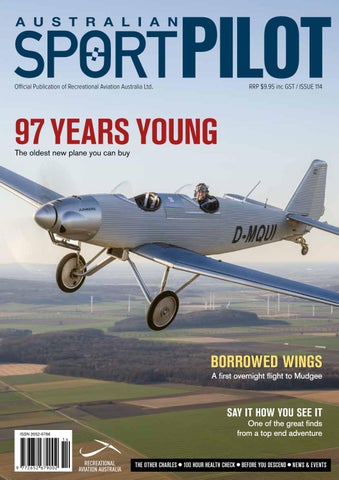
97 YEARS YOUNG The oldest new plane you can buy
BORROWED WINGS A first overnight flight to Mudgee
SAY IT HOW YOU SEE IT ISSN 2652-6786
One of the great finds from a top end adventure
THE OTHER CHARLES 100 HOUR HEALTH CHECK BEFORE YOU DESCEND NEWS & EVENTS
EDITOR’S WELCOME
FOR THE LOVE OF PILOTS I don’t know about you, but despite the cost of fuel – don’t get me started – I’ve been getting a few flying hours in lately. If it wasn’t for the weather down south where I live – again, don’t get me started – I’d be getting in a few more. I do notice that our northern and central brethren have been experiencing huge rainfall. I don’t know if you’ve flown to the top end or the centre after rain, but if you can, beg, borrow or steal (actually, maybe don’t steal) an aircraft and try to get there. During this winter period we are going to witness the greening of much of the center and possibly filling of Lake Eyre. I was there last year and while not completely full, it was stunning. 5 stars. Can recommend. While on the subject of fuel prices, I am once again very pleased that my aircraft consumes a modest 10.2 litres per hundred kilometres at cruise. And that’s fast cruise. I’m sure some of you do a lot better. Makes you glad we emphasised the light in light aircraft, huh? Can you imagine topping up the
Flying across South Alligator River.
tanks on a passenger jet like a 737 that chews 3200 litres per hour? As I sit and write this, bombs are falling on Iran and we don’t know when that will stop. So, I can’t see fuel prices improving for a while. There are some really good articles on safety and awareness in this edition – plus the usual sprinkle of plane reviews and stories that struck as interesting. If we think its interesting, we figure other pilots might too. If there’s something you’d like to see, drop us a line and let us know. Better still write something. Pilots love to hear other pilots’ stories.
NICHOLAS HEATH Editor editor@sportpilot.net.au
The aviation events scene is busy and aside from our own Anzac Airshow coming up on the 18th –19th April and the recent Fly’n For Fun, there’s a whole bunch of good airshows and fly-ins coming up and I encourage you to visit or if possible, fly in. It adds to the show and it is a hell of a way to arrive. I will be attending as many as I can and writing about them and I hope to see you there. Come and say hello!
3
EDITORIAL
RECREATIONAL AVIATION AUSTRALIA
(03) 5273 4777 editor@sportpilot.net.au
HEAD OFFICE PO Box 1265 Fyshwick, ACT, 2609
EDITOR Nicholas Heath
Unit 3, 1 Pirie Street Fyshwick, ACT, 2609 International: +61 (2) 6280 4700 National: (02) 6280 4700 Email: admin@raaus.com.au www.raaus.com.au ACN: 070 931 645
DEPUTY EDITOR Sam McMillan STORY CO-ORDINATOR Nick Jones Ruby Rawlins
ADVERTISING (03) 5273 4777 advertising@sportpilot.net.au ADVERTISING CO-ORDINATOR Camille Wagner FINANCE Christine Heath
PRODUCTION SENIOR DESIGNER Regina Mari DESIGNERS James Conte Steven Hedley
CHIEF OF AVIATION Cody Calder cody.calder@raaus.com.au HEAD OF SAFETY Chris Windle chris.windle@raaus.com.au HEAD OF FLIGHT OPERATIONS Marty Peters marty.peters@raaus.com.au HEAD OF AIRWORTHINESS AND MAINTENANCE Jared Smith jared.smith@raaus.com.au ASSISTANT HEAD OF AIRWORTHINESS AND MAINTENANCE Darren Barnfield darren.barnfield@raaus.com.au HEAD OF TRAINING DEVELOPMENT Neil Schaefer neil.schaefer@raaus.com.au GENERAL ENQUIRIES admin@raaus.com.au PILOT AND MEMBERSHIP ENQUIRIES members@raaus.com.au AIRCRAFT AND MAINTENANCE ENQUIRIES tech@raaus.com.au
DIGITAL Budda Pile Nic Emanuele
SAFETY ENQUIRIES safety@raaus.com.au
SportPilot Magazine is an official publication of Recreational Aviation Australia and is published by Pace Marketing Pty Ltd. ABN 33 052 999 925. 6 Brougham Street Geelong VIC 3220. As part of their RAAus financial membership, all members, flight training schools and clubs will receive each issue of SportPilot free of charge. Alternatively, readers are welcome to undertake an Affiliate Membership with RAAus with an annual charge of $39.95*. To subscribe visit
raaus.com.au APRIL 2026
4
CEO Maxine Milera ceo@raaus.com.au
PROOFING Christine Heath
SUBSCRIPTION INFORMATION
CONTENTS
DIRECTORS Simon Ozanne (Chair) simon.ozanne@raaus.com.au 0409 327 695 Michael Monck (Deputy Chair) michael.monck@raaus.com.au
32 3500 FEET AND CLIMBING
FEATURES 16
Luke Bayly luke.bayly@raaus.com.au Jim Tatlock jim.tatlock@raaus.com.au Jennifer Laird jennifer.laird@raaus.com.au
22
Andrew Scheiffers andrew.scheiffers@raaus.com.au
TERMS AND CONDITIONS All content published within this magazine is the property of Pace Marketing Pty Ltd. ABN 33 052 999 925. It is protected by Australian and International Copyright and Intellectual Property legislation. You are unable to interfere or breach any of the legislation or intellectual property rights that protect this publication. All rights not expressly granted under these terms of use are reserved by Pace Marketing Pty Ltd. Unless stated otherwise, you are forbidden to copy or republish any content or property within this magazine without the copyright or trademark owners’ permission. The magazine title, as well as the associated logo of Recreational Aviation Australia Ltd, are the property of Recreational Aviation Australia. Pace Marketing Pty Ltd reserve the right to be acknowledged as the magazine’s designers. While every reasonable effort has been made to ensure the accuracy of content within this magazine, no warrant is given or implied. Content within this magazine is available to you on the condition that you undertake full responsibility for assessing the accuracy of the content and rely on it at your own risk. Opinions expressed are not necessarily those of the individuals named or referenced within this magazine. Recreational Aviation Australia Ltd in conjunction with Pace Marketing Pty Ltd reserve the right to decline any article, letter or comment deemed unacceptable for any given reason. No endorsement or responsibility is implied or accepted for any product advertised within this magazine. Advertisers and buyers within this magazine are responsible for ensuring that all products advertised and/or purchased via this magazine meet all appropriate Australian Certification and Registration requirements, particularly those pertaining to Civil Aviation Safety Authority (CASA) and Recreational Aviation Australia. Please note that all aircraft featured within this publication are registered and legally permitted to fly. Please be advised that photographs of aircraft within this publication may be altered without notice for editorial purposes.
BORROWED WINGS A FIRST OVERNIGHT FLIGHT TO MUDGEE
Paul Reddish paul.reddish@raaus.com.au Stephen Limkin stephen.limkin@raaus.com.au
97 YEARS YOUNG THE OLDEST NEW PLANE YOU CAN BUY
32
3500 FEET AND CLIMBING ASHTON NELSON’S UPDATE ON HIS LATEST AVIATION EXPERIENCES
40
RELIVING THE MEMORY PHILLIP WARE’S NEPTUNE FLIGHT
48
THE OTHER CHARLES THE STORY OF THE FIRST TRANSPACIFIC FLIGHT
56
THE FLEDGLING FLIGHT NAVIGATE SOLO FOR THE FIRST TIME
62
FLIGHT SPOTLIGHT EXPERIENCE A GETAWAY CLOSE TO HOME
FLIGHT SPOTLIGHT 62
16
97 YEARS YOUNG Image Credit: Philipp Prinzing
THE FLEDGLING FLIGHT 56
THE OTHER CHARLES 48
BORROWED WINGS 22
REGULARS 06 08 12 14 28
LETTERS FROM THE CEO NEWS FROM THE CHAIR WHO HAS CONTROL NEIL SCHAEFER: TRAINING DEVELOPMENT
38
BEFORE YOU DESCEND
78
MARTY PETERS: FLIGHT OPERATIONS
80
SAFETY SUMMARY NOV 2025 - JAN 2026 SAFETY DATA
58
AIRWORTHINESS IS NOT A FORM, IT’S A CULTURE JARED SMITH: AIRWORTHINESS AND MAINTENANCE
66
FLYING IN PICTURES
SAY IT HOW YOU SEE IT ONE OF THE GREAT FINDS FROM A TOP END ADVENTURE
84 86
CHRIS WINDLE: SAFETY
44
THIS AIRCRAFT STOPS HERE
EVENTS A GLARING ISSUE CLEARING THE SKIES FOR PHOTOGRAPHERS
90 92
CLUBS & RUNWAYS WHAT’S HOT PRODUCT REVIEWS FOR FLYERS
94 98
AVIATION MARKETPLACE FINAL APPROACH
THIS EDITION’S BEST SNAPS FROM THE RAAUS COMMUNITY
70 74
THE 100 HOUR HEALTH CHECK CORNER OF THE ENVELOPE
5
SPORTPILOT
LETTERS
WRITE IN:
We love to hear from you! Get in touch with us at editor@sportpilot.net.au
Hello Nicholas, Just wanted to express my final build of a Tinnie 2 Light Aircraft I have built here in WA. We had numerous adjustments and inventiveness to balance the aircraft and custom fuselage nose took me a heap of time out of fibreglass. My background is in engineering and custom paint for hot rods etc. Now retired I’m looking forward to taking this baby up into the blue shortly. Would you be interested in my journey and we believe it’s one of the best finished T2 to there.
thing”, (the X-Air which appears in the book BTW), he was impressed. He will now use the term Sport Aircraft, instead of Ultralight... There should be a copy on every coffee table! Clive Cunningham Member 12740 Editor: Thanks Clive, we agree – every coffee table should have one. A great publication and available in the RAAus online store for just $60...
Enough from me! Cheers Greg Editor: Absolutely! Send it on in and we will publish it and for any of you out there with a story to tell, drop it on us. A picture is worth a thousand words (especially with the rates photographers charge) so send any and all pics of interest too.
Dear Editor, I received my “Year in Flight” book. In a word, fantastic! Such an amazing array of quality pictures, showing all aspects of the things we love in aviation. A colleague opened it, and said, “Oh, they look like real aeroplanes!” Being familiar with my “little yellow
6
Hi Nicholas, I am an avid reader of Australian Sport Pilot, despite not actually being a pilot and thus not a member of RAAus. Why I have failed to get my licence so far is not relevant, but I’m only 61, so there’s still time. In this digital age I am well aware of the move to being online, but as someone who works at a computer, the last thing I want to do is read an electronic screen when I am relaxing. Yes, I use my phone, but I’d rather not, despite the options it offers for video that print does not. After reading the story on your internal discussion about whether to continue the hard copy magazine or not I did the survey monkey thing, but realised afterward that it did not ask a key question: Where do you actually get
the magazine from? Not being a member, I buy it at the local newsagent in Highton. In New Zealand last year I bought their local equivalent, which while not as polished as your magazine, contained a huge amount of information in what seemed like a cheap publication. Your most recent edition contained a commentary on the need to introduce young people to flying. I am doing my best with my grandchildren and one of my tools is your magazine. It (along with others) sits on the table. When the next one is available, the previous edition is gifted to the young son of a work colleague, thus spreading the interest further. As more and more things go digital, one way to stand out from the crowd is to still have the tactile option. Be both perhaps? Keep up the good work. Regards, Ian Desborough (Edited for length) Editor: Thanks Ian, nice to hear from another Geelong local! You’re right – nothing replaces a print magazine. Unfortunately, the economic realities are that print is just so much more expensive than digital that it is becoming prohibitive and changes will inevitably occur. We will keep producing SportPilot – in one form or another – as long and as well as we can. If you’re not already an affiliate member, it’s well worth considering – you’ll receive SportPilot in the mail!
Dear Editor, I was reading about things to do in March and saw right near me “Airshows Downunder Shellharbour March 13 to 15”. I got excited to plan a trip to go and went on the website only to find out.. you got everything wrong? Not only is it not happening in March, the name isn’t even Airshows Downunder. It really upset me and my sister, who was also going to go with me. David Editor: SportPilot writers and editors put out information to the best of our knowledge at the time of publication, but the world – and events most of all – are subject to change at a moment’s notice. Often after publication. Wings Over Shellharbour (now planned for 16-17 May 2026) changed their event back from a previous change they made. First it was Wings, then Airshows Downunder, and now it’s Wings again. Apologies for any misunderstanding and it’s always wise to check the relevant website for updates.
7
SPORTPILOT
FROM THE CEO
A FRESH START FOR 2026
I hope 2026 has been treating you well so far. As this is my first magazine article for the year, I’d like to take the opportunity to say hello and sincerely thank you for your continued support and engagement. Our community is what makes RAAus strong, and it’s always encouraging to begin a new year knowing we have such passionate and dedicated members behind us.
A New Approach to E-News and Social Media in 2026 MAXINE MILERA CEO For nearly two decades, Maxine has been part of RAAus. As the organisation transitions, she is honoured to have stepped into the role of RAAus’ first female CEO, supported by an exceptional team. Together, Maxine looks forward to continuing RAAus’ legacy of safety, community, and innovation, inspiring aviators for generations to come. ceo@raaus.com.au
Over the past year, we’ve listened carefully to your feedback about how and when you receive updates from us. One consistent theme stood out — our e-news has been arriving a little too frequently. So, in 2026, we’re changing our approach. We’ll be moving to a monthly e-news format rather than fortnightly. This will allow us to streamline our communications and ensure that each edition delivers meaningful, relevant updates without overwhelming your inbox. Alongside this, we’ve taken a close look at how we use social media. To simplify our communications and
8
ensure consistency across platforms, we’ve made the decision to trim back our social media presence. As part of this change, the SportPilot website, Facebook page and Instagram account will be retired, with their content and updates being integrated into our main RAAus channels. This approach allows us to focus our efforts on fewer platforms, provide clearer messaging, and make it easier for members to find accurate and upto-date information in one place. Of course, these changes don’t mean you’ll only hear from us once a month. If there is urgent news, an important update, or something we believe you need to know sooner, we will absolutely continue to communicate as required.
Looking Ahead 2026 is already shaping up to be another busy and exciting year for RAAus. By the time you read this, Fly’n For Fun 2026 will have wrapped up, and I hope many of you were able to attend and enjoy the weekend. Events like Fly’n For Fun are always a highlight on our calendar, an opportunity to reconnect with old friends, build new relationships, and celebrate everything we love about recreational aviation. These gatherings remind us just how strong and passionate our community is. Thank you to everyone who attended, volunteered, exhibited, or supported the event in any way. Your involvement is what makes it such a success each year. Beyond our traditional aviation events, we are continuing to explore ways to broaden our community reach through involvement in non-aviation events, just as we did with Fly. Ride. Remember. By stepping outside our usual circles and introducing new audiences to recreational flying, we can help grow awareness, enthusiasm, and participation well into the future. Our community is at its best when we work together. If you have ideas about how we can continue to grow and strengthen RAAus, I encourage you to share them.
...in 2026, we’re changing our approach. We’ll be moving to a monthly e-news format rather than fortnightly. Magazine Survey Results At the end of 2025, we asked members to complete a survey about your magazine. We received 679 responses, representing approximately 7% of our total membership. Among those who responded, engagement was strong: • 603 respondents (88.8%) reported reading the magazine cover to cover • 75 respondents (11.0%) said they rarely read it • 1 respondent (0.1%) said they never read it These results demonstrate a high level of interest among those who choose to participate. However, the overall response rate raises an important question. If 7% of members responded, what about the remaining 92%? Interestingly, the participation level mirrors what we see in our Board elections.
New from E-Props:
AVAILABLE SOON!
Fixed Drive Propellers Precision-engineered for performance and reliability, the new fixed drive props ‘Ascalon’ and ‘Vorpaline’ from E-Props are purpose-built to suit Lycoming O-360 and Jabiru engines.
Contact Australian Distributor Rob 0428 527 200 Rob@aeroedge.com.au
9
SPORTPILOT
This suggests that the broader challenge may not be satisfactory with the magazine itself, but rather how we engage and connect with the wider membership. How can we encourage more members to have their say? How do we make it easier and more appealing to stay involved? These are questions we will continue to consider carefully as we review and refine our communication and engagement strategies moving forward. The changes to our e-news and social media platforms are part of this broader effort, ensuring we connect with members in clearer, more effective ways and make it easier for everyone to stay informed and involved.
What’s Next for the Magazine We are continuing to explore the best way to deliver your magazine in a format that meets your expectations while also ensuring long-term sustainability and cost effectiveness. Your feedback plays an essential role in shaping these decisions, and I want to sincerely thank everyone who took the time to respond to the survey. Your input is invaluable as we plan the next steps.
Change in Board Leadership I would also like to acknowledge an important change within our Board. After 12 years as Chair, Michael Monck has stepped down from this role. By the time he completes his term in November, Michael will have served a total of 13 years as a Board member. The position of Chair is a volunteer role, yet it carries
10
significant responsibility, and Michael has dedicated an enormous amount of time, energy and commitment to RAAus throughout his tenure. Michael has guided the organisation through periods of change and growth with professionalism, steady leadership and a strong commitment to our members and the future of recreational aviation. On behalf of RAAus, I would like to sincerely thank him for everything he has contributed over years. We are grateful that he will remain on the Board until November, supporting a smooth transition during this period. I am also pleased to welcome Simon Ozanne, who has stepped into the role of Chair. We look forward to working with Simon as he takes on this responsibility and continues to support the Board and the organisation into the future.
Closing As we move further into 2026, I would like to again thank you for being part of the RAAus community and for the role you play in supporting recreational aviation across Australia. Whether you participate in our events, contribute feedback, volunteer your time, or stay engaged through our communications, your involvement makes a difference. The strength of RAAus lies in its members, and it is your shared passion that continues to drive our community forward. We look forward to keeping you updated throughout the year and to connecting with many of you at events and activities across 2026.
ESTABLISHED 2012
A RANGE OF AIRCRAFT FOR EVERY MISSION
SLING 2
ULTIMATE TRAINER
BUSHCAT
ADVENTURE FLYER
SLING HW
GO EVERYWHERE, TAKE EVERYTHING
SLING 4 & TSI
EXCEPTIONAL 4 SEAT PERFORMANCE
FACTORY OR KIT BUILT, TALK TO US! 0415 072 498
www.gapaero.com
sales@gapaero.com
SPORTPILOT
NEWS
STAY UP-TO-DATE
Jennifer Hunt Receives Ross Vinning Exceptional Achievement Award Jennifer Hunt – celebrated in our previous edition of SportPilot for being the youngest woman to circumnavigate Australia by plane, and the youngest overall pilot to circumnavigate by seaplane – has been recognised for her efforts by the Seaplane Pilots Association Australia. At just 15 years old, Jennifer was breaking records all through 2025, including her 24day circumnavigation of Australia in a Super Petrel LS aircraft – a feat of over 17,000 km. She accepted her award in Brisbane from SPAA Queensland State Coordinator, David Geers. The SPAA said that the decision to award her was unanimous. She made good use of the travel time and did some sight-seeing along the eastern states before returning to home in Darwin. Jennifer also obtained her RPL on her 16th birthday later in February. Jennifer with David Geers.
RAAus Membership Benefits Increasing RAAus continues to expand membership benefits partnering with AvTraffic and sleep health company Ultramatic. AeroSense Australia, creators of AvTraffic, will now offer Flying, Junior Flying, and Non-Flying members a free 4-month AvTraffic Premium trial (3 more months than normally offered). A powerful, trusted tool amongst pilots of all levels of operation, AvTraffic enhances traffic awareness by monitoring and alerting with multiple data sources. AvTraffic can integrate into existing EFB map displays to provide a seamless visual and audial alerts about the air space around you. RAAus and Ultramatic have also formed a partnership to provide discounts on a range of Ultramatic products. Flying can be uncomfortable for long distances, but
12
sleeping doesn’t have to be. RAAus members can benefit from up to 45% off a range of Ultramatic sleep health products. This comes after a successful partnership with The Flyer Watch Company, a family-owned timepiece company deeply ingrained in the aviation industry. RAAus members continue to receive a 20% discount on purchases, plus 20% of profits go directly towards supporting the RAAus Scholarship program.
Light Aircraft Championships come to Bendigo
On 24th May the Bendigo Flying Club will host the Victorian Light Aircraft Championships, trials designed to test pilots’ abilities in various categories. Categories tested during the championships will include Spot Landing, Glide Approach, Flapless Approach, Simulator Exercise, and a Ground Quiz. An overall champion will be named during the event based on the result of the aforementioned categories.
Registration is limited to 24 total competitors. Pilots can hire an aircraft to use during the event or bring their own. Victorian Light Aircraft Championships main event runs 9am-3pm, 24th May, at 35 Victa Rd, East Bendigo, 3550, YBDG. More information and how to register can be found at the Bendigo Flying Club website.
Orion Cub
ADVENTURE AWAITS Group G Ready 24kt Stall speed 100kt+ Cruise
0415 072 498
www.gapaero.com
sales@gapaero.com 13
SPORTPILOT
FROM THE CHAIR
From left to right: Jim Tatlock, Andrew Sheiffers, Simon Ozanne, Michael Monck, Trevor Bange, Luke Bayly, Jennifer Laird and Paul Reddish.
It’s time for me to hand over. It is with a genuine sense of pride and, I’ll admit, a bit of a lump in my throat that I’m writing my final address as your Chair.
MICHAEL MONCK Chairman Michael is the Chair of the Board of RAAus and has held this position for over 10 years. He holds flying qualifications from RAAus and CASA and advocates for the broader industry in a number of different forums. Michael is an active pilot and owns a CTLS aircraft which he regularly flies throughout Australia. michael.monck@raaus.com.au
14
At the November 2025 board meeting I raised the topic of me moving on at the end of 2026 and we discussed the process of transitioning to a new Chair. In response to me bringing up the subject, the board collectively agreed to a succession plan that will see me serve out the remainder of my current term as an ordinary director of the company and have someone else to take over the controls. When I look back at where we were in 2013 when I first got involved with the board, it feels like an entirely different era. We were an organisation essentially “growing up,” moving away from the old-school ultralight image and at the time we faced some serious regulatory hurdles that had seen us effectively grounded for a period of time. We had to work hard to prove to the rest of the aviation world that we weren’t just a hobby group consisting of enthusiastic amateurs, we were a
serious, professional, and safe aviation body. Today, RAAus stands as a powerhouse of self-administration, and I truly believe we’ve kept the soul of recreational flying alive while doing it. We’ve certainly had our share of “rough air” over the last decade. I’m sure many of you remember the long, often exhausting slog through the CASR Part 149 transition. There were days when the paperwork felt heavier than the aircraft we were trying to fly. We’ve faced shifting regulations, a tough insurance market, and the constant pressure of keeping flying affordable in an increasingly expensive world. In more recent times we have had some relatively high-profile incidents that have attracted the wrong type of attention and even caused people in some circles to make public statements that harm our organisation for reasons I am yet to understand.
But looking back, those challenges didn’t break us; they made us professional. We didn’t just survive, we evolved. We brought in expert staff, tightened our safety systems, and became a voice in Canberra that actually gets listened to. We moved from a rag tag board of enthusiasts to a 10,000-strong membership flying some of the most advanced Light Sport Aircraft in the country while still holding on to our core of rag and tube flyers. A couple of those incidents I mentioned earlier have garnered attention from Australia’s premier investigation agency and although some have seen this as cause to launch attacks on us, we have proudly responded in a more measured way. While others may view it as a reason to slander us we welcome the independent views and use the new knowledge learned to further evolve and strengthen our organisation. It’s just one example of how we have matured over the years. It hasn’t all been about regulatory hurdles, though. The wins have been spectacular. Seeing our scholarship programs take off (pun intended) has been a personal highlight. There is nothing quite like seeing a teenager go from their first trial flight to their first solo, knowing that we, as a collective, helped put them there. From the successful rollout of Group G (allowing for those heavier, more capable machines many of you were waiting for) to our 40th-anniversary celebrations at the Australian War Memorial, we’ve proven that our community is resilient and deeply connected. Whether it was an organised fly in event or a quiet chat over a thermos at a regional strip, the passion I’ve seen from you all has been inspiring.
As I step down, I’m not just leaving you in good hands, I’m leaving you in great hands. I am incredibly pleased to announce that Simon Ozanne is taking over as your new Chair. Many of you already know Simon. He isn’t just a “boardroom guy”, he’s a true aviator who understands exactly what it’s like when you’re checking the weather at 6:00 AM, hoping for a glasssmooth morning. Simon has been a vital part of our recent strategic wins and brings a fresh energy that the organisation needs as we look toward the future — things like electric propulsion and the exciting world of new aircraft that MOSAIC brings. I have total faith in Simon’s vision and his steady hand. He knows that at the end of the day, RAAus exists for one reason – to keep you in the air with as little fuss and as much safety as possible. I know you’ll give him the same support and (occasionally colourful!) feedback that you’ve given me over the years. Serving as your Chair has been a privilege. The strength of RAAus isn’t in a head office or a rulebook, it’s in the hangars, the clubs, and the shared joy of a perfect three-pointer. I have had more interactions with members than I can remember and each one of them has always left me understanding more about why I put my hand up to help shape aviation in Australia. I’m looking forward to being a regular director and ultimately “just another member” again, catching up with you at a fly-in or hearing you on the radio. Thank you for the memories, the hard work, and the incredible journey. And if you see me or hear me out there, please come and say hello, I’d love to hear from you.
15
SPORTPILOT
Credit: Philipp Prinzing
16
THE OLDEST NEW PLANE YOU CAN BUY Words Nicholas Heath
17
SPORTPILOT
This edition’s cover features the relatively new Junkers A50 Junior which is available to order and buy and register under RAAus. Except it’s not new at all. That isn’t just a retro look, this little beast is rocking a design that is just three years short of 100 years old. The name Junkers is as old as aviation itself. Hugo Junkers was a manufacturer. He employed aircraft designers to come up with the aircraft and the A50 Junior was designed in 1929 by Hermann Pohlmann, probably best known for the later JU87 “Stuka” dive bomber. It incorporated several of the Junkers trademarks – all metal, mostly duralumin construction and corrugated skins for strength, flexibility and rigidity. The streamlining and tapered wing is classic Junkers – and remember this is the 1920’s – when wire-rigged biplanes were the norm. These things were popular and set a lot of records. In 1931 Marga von Etzdorf flew one from Berlin to Tokyo.
That isn’t just a retro look, this little beast is rocking a design that is just three years short of 100 years old. Punt forward to 2016 and German businessman and pilot Dieter Morszeck had a dream and the money to realise that dream (you kind of need both) which resulted in the first of the new breed A50. There are two models – the A50 Junior and the A50 Heritage. The Heritage runs a Verner Scarlett 7-cylinder radial, which is probably a little more in keeping with the original Armstrong Siddeley Genet. But the new version has 124hp against the original’s 80hp. The A50 Junior on the other hand runs the very familiar and completely modern (at least by aviation standards) Rotax 912, which promises a likely easier path for maintenance and still looks great. Either way, if speed is your thing, look elsewhere. The A50 is all about style. Some people get there and some people arrive. In the A50 you will be arriving. At a gentle 70knots ish cruise. But you will look fabulous when you get there. The numbers are surprisingly good for an aircraft that is knocking on the door of a hundred-year-old design.
18
The view from up top isn’t bad either. Credit: Junkers Aircraft.
Bottom left to right: All the mod cons, wrapped in something your grandfather would have recognised. Credit: Junkers Aircraft. Phare d’Antifer, Normandy. Not a bad waypoint on a 14,000 kilometre commute. Credit: Claus Cordes. On the ground it’s even prettier. Somehow. Credit: Junkers Aircraft
19
SPORTPILOT
Empty weight is 375kg’s and MTOW is set to the RAAus limit of 600kg. So, 225kg useful load, allowing for two 90kg people and 60 litres of fuel. Or leave your friend behind, fill the tank and you’ve got over 60kg of capacity for luggage and necessary comestibles. Which is just as well, because according to the original marketing blurb from the 1920’s you could store a steamer trunk behind the front passenger. I haven’t weighed my steamer trunk recently, but I’m guessing it’s a bit on the heavy side for aviation under normal circumstances. I’m not going to lie to you. Looking this good doesn’t come cheap and you’re going to want mid 300 thousands to fly away in one of these things. And that’s before you take a deep dive into the options list and buy the official watch. Yes, seriously, there’s an official watch. No word on matching steamer trunk yet. But for that kind of coin you get to look... Fabulous.
The A50 is all about style. Some people get there and some people arrive. In the A50 you will be arriving. So, picture the scene – you leap from the cockpit of your Junkers A50 Junior, wearing your fur lined leather flying coat, jodhpurs, cap and googles, grab your steamer trunk and proceed to the bar as you are swooned in adoration. Ok, maybe not. But you could feel a bit like that. For a moment. Possibly. Now, we don’t usually go in for regurgitating press releases around here. But Junkers did something worth mentioning when they launched this aircraft. Rather than hand out a glossy brochure and call it a day, they had President of the German Aero Club, Claus Cordes — flying his own personal A50 Junior, D-MQUI — complete a 14,000 kilometre, 42-day solo tour across Europe. Open cockpit. Twelve countries. Germany to the Arctic Circle and back, via Finland (where the A50 parked next to F-35s at an airshow), across the North Sea to Scotland and England, down through France, over the Pyrenees in 45-degree heat to Spain and Portugal, across the Mediterranean to Mallorca and From top: The trusty pilot for the tour, Claus Cordes. Credit: David Symank Each stop meant another sticked to add to the collection. Credit: Philipp Prinzing Refuelling in Spain. Credit: Philipp Prinzing
20
Junkers A50 Junior — Specifications DIMENSIONS & WEIGHTS Flying over the Elbe river in Dessau, Germany. Credit: Philipp Prinzing
Sardinia, around the flanks of Etna at nearly 10,000 feet, and home. At one point his electronic navigation system failed over the North Sea. He used a compass, his watch, and made one 10-degree course correction. He arrived on track. At another point Norwegian air traffic controllers couldn’t quite believe what was checking in on frequency — they passed word ahead to the next airfield down the line so everyone could get a look. It’s a genuinely brilliant piece of flying, and a clever way to show what a new aircraft can do. The full tour diary — with stop-by-stop write-ups and some pretty spectacular photography — is on the Junkers website.
Wingspan
9.84 m / 32 ft 3 in
Length
7.41 m / 24 ft 4 in
Height
2.89 m / 9 ft 6 in
MTOW
600 kg / 1,323 lbs
Empty Weight
375 kg / 827 lbs
Payload
225 kg / 496 lbs
PERFORMANCE Stall Speed
83 km/h / 45 kts
Top Speed
208 km/h / 112 kts
Cruise Speed
155 km/h / 84 kts
ENGINE Engine
Rotax 912iS — 100 hp / 73 kW
Fuel Consumption
~15 L/hr
Fuel Capacity
105 L / 27 US gal
EQUIPMENT
Scan the QR code for the full story.
Seating
Tandem two-seat open cockpit
Brakes
Beringer
Propeller
Fixed wooden propeller
Avionics
Garmin G3X Touch 10.6" (pilot cockpit)
Safety
Galaxy rescue parachute system
21
SPORTPILOT
BORROWED WINGS
A FIRST OVERNIGHT FLIGHT REVEALS THAT THE REAL JOURNEY ISN’T MEASURED IN KILOMETRES, BUT IN TRUST, CONNECTION, AND SHARED MOMENTS. Words & Images Haydon Gray
22
Flying planes is something most people don’t get to experience in life. To be a passenger is one thing but to fly it yourself is something very different. I am a very novice pilot and asking someone to come on an overnight trip flying out west maybe wasn’t such a gift as a question of trust. My sister Jenna took this opportunity with open arms and jumped at the chance. We planned to leave Newcastle in the afternoon at 3pm to drive to Cessnock. I spent the day worrying about what I didn’t know or doubting my skills. I had planned the route, checked all the weather forecasts, calculated all the fuel requirements and planned the
different runway approaches, but I felt something was missing. I find self-doubt is a tricky spiral to exit from as it slowly erodes confidence and reduces clarity. So instead, I disconnected from the worry and sat outside in the sun chair and waited for Jenna to arrive. She rolled in on time, in her hand-me-down silver station wagon with snacks, new aviator sunnies for both of us and a $13 tent from Big W. It felt like a dream coming together but I still couldn’t put the question out of my mind, ‘is someone really going to let us rent a plane and just fly away?’ Although I felt doubt on the surface, deep down I trusted the adventure was going to work out.
Overnight at Mudgee airfield
23
SPORTPILOT
We arrived at PUA flight school but the plane I had booked, a Cessna 172-DOL, wasn’t on the tarmac. Alarm bells started ringing. I walked inside and met one of the instructors, Alex, who told me that the DOL had just left Dubbo with a student and wouldn’t be back for at least 1.5 hours. Luckily there was another Cessna, MCJ available. It’s a strange process taking a plane flying solo as a student, let alone on private hire. Something that my brain still didn’t quite understand because hiring a car on holiday is ten times more intimidating. The normal credit card checks, car inspections and explanations of contracts, insurance and deductibles don’t exist. It’s basically: ‘here’s the keys, bring her back in one piece and pay after’.
We arrived at the flight school but the plane I had booked, a Cessna 172-DOL, wasn’t on the tarmac. Alarm bells started ringing. I introduced Jenna to Phil, the owner, and we sat down so I could show Jenna how to use the tablet for navigation while flying. It felt a bit unfair to overwhelm her with so much information, but I was explaining it as much for my benefit as for hers. We grabbed a tiedown kit, headsets and the maintenance schedule and headed out to the plane. To say it inspires confidence to fly a plane built in the 70’s would be a half lie. MCJ is not a new plane, and apart from the radio and transponder, it’s basically all analogue – but she is reliable. As I walked around checking the flaps, lights and everything else I could remember to check, I felt at peace with the fact that this 50+ year-old piece of pop riveted technology was going to carry us safely through the air 160 km to Mudgee. After loading our bags, sleeping mats and snacks, I needed another five minutes to find the plugs for our headsets. I felt embarrassed, like someone trusting an uber driver who didn’t know where the ignition was. We taxied the plane over to the fuel bowser and filled the tanks in the wings full to 190 L. Enough fuel to get us easily to Mudgee and back plus reserve in case we had to divert to another airport. From top: Gazing over the mountains of northern Wollemi National park. A post flight swim in the Cudgegong river that flows through Mudgee.
24
Contemplating the surreality of life.
We made our way back down the taxiway to the threshold of runway 35, facing north. Jenna still seemed relaxed. I pushed the power to full and we accelerated down the runway and easily took to the skies. The process of leaving the ground always seems quite easy compared to that of returning to it and I’m sure there’s something philosophical in it somewhere. I radioed our upwind departure from Cessnock and we tracked north towards Singleton. The air was mostly smooth, and the skies were clear as we passed overhead and entered mining country, the earth scarred with huge, gaping wounds of the coal pit mines. It made me sad to see the size of destruction humans were capable of, let alone the effects of all that dug up coal being shipped around the world and burnt. But who was I to be sanctimoniously rambling as I crossed the skies in a metal can on a pleasure-seeking trip polluting the skies also burning fossil fuel? In less than an hour, we crested over Mt Buckaroo and we could see Mudgee airstrip laid out in front of us. I had landed there once before but I am always surprised how difficult it is to identify the airstrips as you approach low to join the circuit or fly overhead. They kind of pop up pretty quick when flying at 200
kmph and the difference between a highway and airstrip is sometimes difficult to initially identify. The wind was light from the NW which meant I could land on the long runway 22. As we made our final turn to base I realised I had flown a long downwind, but it gave me time to set up nicely on final. We flew over the threshold and as the ‘piano keys’ disappeared underneath us I cut the power and we floated down the runway. The rear wheels touched softly and I kept the nose high until we dropped down onto the front wheel. We high fived each other and taxied off the runway to the guest parking on the apron and shut the plane down. I had ticked a big personal goal, to fly a plane somewhere on an adventure! And to do it with my sister as copilot was even better. The plane was parked alone on the apron with only the vast Australian sky dappled with small, puffy clouds as the backdrop. The air was still warm and the light was softening with the sinking sun. We pulled our bags out of the luggage compartment and grabbed the tie-down kit for securing the plane to the tarmac overnight. The kit had one strap instead of three. It wasn’t a danger as there were no winds forecast overnight but it reminded me of the cascade of errors that come with
25
SPORTPILOT
Left: Landscape transitions from rugged mountains to flat plains. Right: The lovely view out of Mike-Charlie-Juliet.
lazy thinking and the huge risks created by mixtures of complacency and assumptions. One of my favourite books is by a guy called Don Miguel Ruiz. It talks about four agreements rooted in ancient Toltec wisdom. The third agreement is ‘don’t make assumptions — ask questions, communicate clearly, assumptions are basically drama factories’. That simple idea or challenge was something that constantly bubbles through my life, learning to make good decisions and reduce risk. Before we left the plane, I got my camera out and took a few pictures of my sister. There was something about her happiness that was a mixture of calm, peacefulness and serenity that I wanted to capture. A certain Vogueness to her beauty, posture and expression and a sense of surreality leaning against a small plane on an empty tarmac. Mudgee airport has a clubhouse with a courtesy car for rent. I’d been there before on a student navigation exercise and dropped in for a coffee and Tim-Tam but hadn’t met a soul. This time we walked in and were welcomed by the Mudgee knitters’ club, busy creating pieces for the Mudgee hospital. After some country chit chat and recommendations for places to eat, we drove to the river, had a swim and then sat outside the Mudgee Brewery for a beer and dinner. We drove back to the airport to see the knitting ladies leave and after a hot chocolate on the balcony we put out our camping mats and drifted off to sleep.
26
As we slowly woke up, the first rays of the sun began slicing along the horizon and illuminating the clouds with a beautiful pink hue. We sat outside eating breakfast as the sun spilled over the rest of the rugged landscape to the east. Jenna seemed pretty relaxed as we sat drinking our tea. I felt we were both excited to get back into the air. The second take-off process was much more efficient than the first. We didn’t need to get fuel, and the startup checks and procedures felt a lot less clunky. The wind was almost nil so we could choose our runway as desired, so we taxied to the threshold of runway 04, turned the plane around, and smoothly took to the skies once more. Although I had forgotten to clean the front window, I didn’t need it to see Jenna’s smile which made me happy. The flight back to Cessnock was easy and rebuilt my confidence. We flew over the first mountains checking out hiking trails in the canyons between the cliffs and admiring the stunning landscape of the northern part of Wollemi National Park. Instead of flying via Bylong we flew the direct line over the mountains back to Singleton and the last southerly leg around the military airspace to Cessnock. I had told Jenna to feel free to ask as many questions as she wanted because explaining things often helped me understand things better. As we joined the circuit she asked me if I had the right radio frequency set and thanks to her, I noticed I had entered it slightly
The plane was parked alone on the apron with only the vast Australian sky dappled with small, puffy clouds as the backdrop. The air was still warm and the light was softening with the sinking sun. wrong. Not necessarily lifesaving, but communication in the circuit was pretty crucial for when there are other aircraft around. We touched down on runway 35 with another soft landing. I taxied the plane over to the western apron and shut it down. We unpacked the plane and returned the keys and equipment and paid for the rental. We sat for 5 minutes and savoured the moment and end of the adventure. It still seemed a bit unreal and fast, but it was done.
I spend a lot of my life adventuring, whether it’s sailing, paragliding, hiking or mountaineering, but they are all just ways to explore both the world and life, learning about responsibility, self-trust, direction, intention, anxiety, stress and the list goes on. By learning to fly planes I was again putting myself in the beginner space, proving to myself I could do it. I overcame the doubt, anxiety and stress to gain self-trust, direction and confidence. I also brought my sister back safely which was a huge bonus. Jenna drove us home to Newcastle so we could pick up her son Angus and go for a swim. We sat on the edge of the pool under the shade cloth, dangling our legs in the cool water as we watched Angus splash around. As we talked, I realised the real value of sharing moments and adventures like we just had is to foster stronger connections, create trust and love. The big tick box wasn’t flying the plane; it was simply spending time with my sister and being grateful for life.
SPORTPILOT
WHO HAS CONTROL? There is a big expectation when flying an aeroplane that the pilot will always be in control of the flight outcomes. Unfortunately, and as we see too often, this is not always the case. Sometimes, who is actually controlling the aircraft and making critical decisions, may not be so clear. Let’s take flight into this area of training and private operations and as you will see the answer is not aways clear cut.
NEIL SCHAEFER Head of Training Development Neil Schaefer has been involved in General and Sport Aviation for over 45 years. A qualified instructor, examiner, accident investigator, auditor and SAFA Senior Safety Officer, Neil has had a vast range of experience in the aviation world. Currently serving as the Head of Training Development, Neil previously spent 4 years running an RAAus flight school and worked 7 years as Assistant Operations Manager at RAAus. neil.schaefer@raaus.com.au
One of the first questions we have to ask ourselves is who is the pilot in command? First up let’s go to the RAAus Flight Operations Manual and other regulatory references for a definition. The RAAus Flight Operations Manual defines Pilot in Command (PIC) as follows. For RAAus student and pilot purposes is the person in control of the aircraft when not in the company of an Instructor and referred to as solo flight time. (RAAus Definitions – Flight Operations Manual v 7.1.2) The CASA Part 91 definition is more confusing; you can either be a pilot, the pilot or just you — CASR 91.215 states the authority and responsibilities of the Pilot in Command (PIC); you must ensure the safety of persons and cargo and the safe operation of the aircraft during flight. Further, You have the final authority over the operation of the aircraft and the maintenance of discipline by all persons onboard. It goes on to state the time of responsibility is between doors closure and doors open at the end of the flight. Well, are you confused yet? At least there are some common threads in both definitions, the PIC is the one in control and is also responsible for safe flight outcomes and control of the passenger/s, or student in the case of a training operation.
28
There is a big difference between who is in command versus who is in control in training operations.
29
SPORTPILOT
Generally, in single pilot operations there is only one pilot, but there can be a number of variations in flying activities besides student training. Two friends sharing a flight, leg swapping on a long cross-country flight, and flight reviews or assessments are just some examples. It is critical that these roles are defined and carried out with discipline to ensure safety of flight outcomes, and this applies not just to control manipulation but decision making as well.
Management in our operations. The most fundamental example of this is the ‘handover technique’ — a clear discipline that annunciates who has responsibility for control manipulation at any instant in a flight. This verbal handshake originated from early tandem seating aircraft where there were no visual cues as to which pilot was handling the controls and has served the industry well to ensure there is no confusion over who is flying the plane.
Dualling Banjos
Whatever the split in crew functions may be, there are two key elements to ensuring effective CRM; a thorough preflight briefing of what elements will be performed by each pilot and concise communications during the flight at all times.
Some time back I was the PIC on the last leg of a fourday trip to Longreach and back with a mate and fellow pilot who was the aircraft owner, it had been a great trip, but the weather was worsening as we were almost within spitting distance of home. As we progressed, all the indicators were looking like non VMC for the last 20 miles. Based on this, I had decided earlier to park it up at a nearby airfield. It had already been a long day. As I was on short final, my mate called for a go ‘round. Without any solid reasoning, and against my better judgement, I obliged. He wanted one more look for a way through the murk until I intervened and firmly said “No!”. Sometimes the right decisions can be hard to swallow at the time, especially with two qualified pilots on board. Right from your first introductory flight you should have been briefed and trained in how to manage control operations in flight environments. At the big end of town, it’s called Crew Resource Management or CRM, and this can also be known as Cockpit Resource
30
When it comes to training, the airborne classroom is a very dynamic environment to both teach and learn in. Any pilot or Instructor can attest to this, but the sanctity of who has control should never be in dispute. Many years ago, a young pilot came forward as part of an RAAus amnesty program, he had done substantial training and even soloed but never completed his training after an unfortunate first solo accident. He had bought an ultralight and was flying it on his own property when he came forward. While finishing off his training with another school, he confessed that he thought the Drifter always landed itself — it turned out the original Instructor was really on the stick the whole time! Covert control intervention might seem like a good idea, but not at the expense of the students true learning and understanding.
Command versus control There is a big difference between who is in command versus who is in control in training operations. The transfer of control does not infer the transfer of command. Where a pilot is under training or assessment in RAAus activities, there are only two flight types — dual and command, and the instructor or examiner is always in command when on board. Why is this? Because whether under ab-initio, converting, or renewal, the direction of actions and the associated responsibilities always rest with the instructor or the examiner. They have been granted their instructor authorisations based on a demonstrated high level of situational awareness, decision-making, and control proficiency. These competencies are regularly assessed and maintained through standards and proficiency checks, along with ongoing development overseen by the CFI and RAAus. None of the above is to suggest that in dual operations that ‘command thinking’ is not required by the student. On the contrary, your instructor will be assessing both your technical and non-technical skills as you develop. Nothing puts a smile on an instructors face more than seeing a student making command decisions and then the explanation for that decision, whether it be a go around or managing a simulated emergency, this is why air exercises are heavily biased towards decision making and planning in the later flights; it provides opportunities to observe not just skill, but the required disciplines needed by a pilot and staying ahead of the plane at all times.
Our goal should always be that training flights have a one hundred percent safety record. We also covered this important topic in a professional development series some years back called Control Management for Instructors. The workshop sessions looked closely at graded intervention practices, where safety needs to take priority over learning opportunities and the human factors that need to be considered. This is an ongoing focus in instructor training and assessment and critical to ensuring that our training operations remain robust with effective safety margins. Our goal should always be that training flights have a one hundred percent safety record. One of the underpinning privileges of RAAus operations is the ability to train pilots. This implies that the safety of every training flight is paramount and that the instructor, through both developed skills, command management, and sound judgement provides the assurance they will take all the actions necessary to ensure safe flight outcomes. So, whether going out with a fellow pilot to share the joys together or buckling up for your next lesson, make sure you fully understand both the shared and command responsibilities required of you. It’s part of a fundamental safety framework that means you can look across the cockpit with a smile and confidence every time. You have control.
31
SPORTPILOT
Caption. Credit: Xxxxxxxxx
32
FEET
AND CLIMBING YOUTH AMBASSADOR ASHTON NELSON GIVES US AN UPDATE ON HIS LATEST AVIATION EXPERIENCES Words & Images Ashton Nelson
33
SPORTPILOT
I’m flying solo at 3,500 feet along the Great Ocean Road. The aircraft is loud, yet at the same time it feels incredibly peaceful. The sun is shining down on the water, lighting up the beautiful coastline below and I can see small swell lines continuing to roll through. It’s a part of the world I know very well, somewhere I’ve spent a lot of time, but from up here it looks completely different. From the air, the ocean feels bigger. The cars along the Great Ocean Road are smaller. Sitting alone in the plane, I feel completely present, no distractions, just flying. In moments like this I feel a great sense of gratitude. Gratitude for the opportunities, support, and training that got me this far since I started learning to fly. Moments like this remind me exactly why I started. I can’t pinpoint one exact moment that made me realise flying was exactly what I wanted to pursue. It wasn’t a single lightbulb moment. But for as long as I can remember, I’ve always been interested in how things work and being hands-on in my learning. I enjoy understanding systems, mechanics and problemsolving. And honestly, who doesn’t think planes are awesome? Aviation felt like a natural fit. It combined responsibility, technical skill and the excitement of doing something that not many people my age get the chance to experience. Everything really clicked after I took a Trial Instructional Flight for my 15th birthday in August 2023. From that first flight, I was hooked. For as long as I can remember I’ve had a goal to become a commercial pilot. I didn’t start regular flying lessons until early the following year, but once I did, I was all in. Each lesson built on the last and the more I learned, the more motivated I became to keep going. Each new aircraft I fly gives me more confidence. I can’t wait until the day I can step into a commercial aircraft and feel the responsibility and privilege of flying it. In flying, just like in life, there are always lessons to be learned. You make mistakes, you reflect on them and you learn from them. Every flight teaches me something and I walk away a better pilot because of it. My experiences from real life also make me a better pilot.
34
“...flying constantly puts you in new situations and the key is applying what you’ve already learned to different environments.”
Great ocean views over the Great Ocean Road.
35
SPORTPILOT
The ever-reliable Tecnam P92 Eaglet.
My casual job at Kmart gives me lots of responsibilities and interactions with new people, which helps give me even greater confidence in the air. Looking back on that Great Ocean Road flight, there were new experiences involved that I hadn’t done before. But flying constantly puts you in new situations and the key is applying what you’ve already learned to different environments. That flight included landing at Apollo Bay Airport (YAPO), which was very different to what I was used to. It has one sealed runway, 09/27, approximately 740 metres long and just six metres wide, with a two percent incline to the west. That’s a big difference when compared to landing on a 1,200-metre-long, 18-metre-wide runway. It required careful planning, precision and confidence in my training. Experiences like this reinforce how important preparation is and how aviation continually pushes you to adapt, stay focused and grow. For some pilots these challenges could be stressful but I’m always looking for new opportunities to learn and improve.
36
“[flying] comes with a huge amount of responsibility. Learning to fly is a privilege and you feel that every time you step into the cockpit.” As a young person, I can honestly say that flying is fun. But beyond that, it comes with a huge amount of responsibility. Learning to fly is a privilege and you feel that every time you step into the cockpit. I started flying at 15, flew solo at 16 and now I’m flying by myself at 17, before I can even legally drive myself to the airport. Aviation has given me independence, discipline and confidence that I can apply in all aspects of my life. I know I’m only scratching the surface of what aviation has to offer and I already love it. There are so many pathways within aviation and I’m excited to continue learning and building experience. If there’s ever a good time to start, it’s now.
My advice is simple, give it a go. You really won’t know if flying is for you until you try it. If you’re curious, I’d definitely recommend booking a Trial Instructional Flight at your nearest RAAus flight school. It’s the easiest way to experience what flying is actually like and to see if it’s something you want to pursue. And if you enjoy it, stick with it. Progress takes time and there will be flights that feel challenging or frustrating. Showing up consistently and trusting the process makes all the difference. Since the last time SportPilot caught up with me, things have progressed quickly. When I first started flying, I had more hours in the plane than I did in the car, although that didn’t last long. After my first solo, flying alone became more common, until it eventually felt normal. Most flights were solo, then that progressed to leaving the local area, and eventually to flying cross-country on my own. What once felt like
let OzRunways do the hard work, so you can focus on the fun stuff OzRunways
RWY
Try OzRunways on iOS or RWY on Android today! Download from the App Store or Google Play for a FREE 30 day trial.
ozrunways.com
a milestone gradually became routine, and now flying solo is simply part of how I build experience. Aviation has already given me experiences I never imagined having at this age. From flying solo at 16, to being able to fly alone along the Great Ocean Road and landing at airports beside stunning coastlines! I’m still at the beginning of my aviation journey, but I’m grateful for every one of the 50+ hours I’ve spent learning so far. Flying has taught me patience, responsibility and how to see the world from a completely different perspective. I’m excited to keep moving forward, one flight at a time.
Follow Ash’s Journey @AviatorAsh on YouTube
SPORTPILOT
BEFORE YOU DESCEND
CHRIS WINDLE Head of Safety Chris has been with RAAus for 4 years, initially as the Audit Coordinator before taking on the role of Head of Safety. He has a Bachelor of Psychology, Diploma of Aviation and is currently completing a Master of Aviation Management. Chris holds a Commercial Pilot Licence and both RAAus and CASA Instructor Ratings. chris.windle@raaus.com.au
“Dear Members, it is with great sadness that I share news of a fatal accident involving an RAAus member.”
Close to terrain. Close to wires. Close to having no margin.
For years, when a fatal accident occurred, that is how we would begin.
At altitude, you have time. Time to manage a problem. Time to choose a landing area. Time to think clearly.
You opened that email. You paused before reading further. You wondered who it was this time. Last year, 3 out of the 5 RAAus fatal accidents involved low level flying. Sixty percent. Not extreme weather. Not complex airspace. Not engine failure. Low.
38
Low level flying removes protection.
Near the ground, time disappears. An engine hesitation becomes critical. A distraction becomes impact. A shallow turn becomes unrecoverable. When the accidents are examined, the pattern is consistent. The pilot was qualified to operate the aircraft, but not to operate low level.
The aircraft was serviceable. The weather was suitable. The descent was a choice. Often it was not operationally required. Low level operations are not simply flying lower. They are a specialised environment that demands training, structured planning, and disciplined limits. If you intend to operate at low level, complete the required low level training. Not as a formality. Not to tick a box. But to understand how quickly energy margin tightens, how visual perception changes, how wires disappear into background terrain, and how rapidly escape options vanish.
A better view is not worth survivability. Familiarity is not protection. Confidence is not margin. In the airspace we operate, there may be no one around to question your height. The responsibility rests entirely with the pilot in command. Before you descend, pause. Is it necessary? Have I conducted a risk assessment? Am I compliant with the regulations? Am I trained for this environment? What is my exit plan? If there is uncertainty, climb.
Training and preparation create margin.
Sixty percent is not just a number.
Descending without necessity removes it.
It is a warning.
For most recreational flying, low level capability is not required.
Let it change your next decision.
39
SPORTPILOT
Phillip reliving his memories on board the Neptune.
40
RELIVING THE MEMORY PHILLIP WARE’S NEPTUNE FLIGHT
Words Ruby Rawlins | Images Phillip Ware
At 87 years of age, Phillip Ware has been an RAAus member for 30 years. Phillip’s journey to RAAus may look different to many of today’s modern members. His path wound through the RAAF, and the Department of Civil Aviation before he found his joy in recreational flying. But whatever the aircraft, whatever the era, his passion for aviation has always been the same. Every pilot has an aircraft that lives eternally in their memory, one that shaped who they became in the air. For Phillip, that aircraft is the Lockheed P2V-5 Neptune. Recently, thanks to Bob and Matt de la Hunty of the Historical Aircraft Restoration Society in Albion Park, NSW, he got to meet it again. Vintage aircraft in flying condition, including the SP-2H Neptune, are in abundance at the Historical Aircraft Restoration Society. Bob and Matt don’t just take care of the aircraft, they fly them. For Phillip, this was an opportunity to return to a snapshot of his own history in aviation.
The first time Phillip saw a Neptune was at boarding school in 1954 – three Neptunes flew overhead in striking formation. It was at that moment he became awestruck and resolved that he would one day be part of that exciting world, setting career aspirations he would soon fulfil. He joined the RAAF in 1955 and was an Aircrew Member of the No 11 Squadron based in Richmond, NSW, until 1968. During his Air Force time he spent approximately 2,500 hours flying in aircraft, most of it in the P2V-5 Neptune, taking on the role of HF Morse Code Radio Operator, Electronic Counter Measures and Radar Operator. The radar Phillip operated had a peak power of 2 Megawatts – cutting-edge for the time. The radar refreshed 400 times per second and could pick up anything at sea, including periscopes, lost small vessels, yachtsmen in distress, whales breaching, plus every ship within range. It was a very comfortable aircraft, particularly in turbulence, where the wing design would absorb the choppy wind.
41
SPORTPILOT
Phillip conducted detection and surveillance of Australia’s coastline, he also helped with AntiSubmarine Warfare and participated in many overseas tasks. He flew with the RAF at Singapore and the US Navy at Hawaii and Manila in the Philippines. An interesting quirk about the Neptune, it was too heavy to fly on one engine, so Lockheed fitted the wings with auxiliary turbojets. These weren’t there for normal operations, they were essentially a get-out-of-jail card. If a piston engine had to be shut down, the jets would be lit up to compensate for the lost power and used to climb to 10,000 feet. The aircraft would then be flown at minimum descent rate with the jets back to idle, essentially gliding down as slowly as possible to stretch out every bit of distance.
Phillip’s last flight on a Neptune was December 1966; it had been 59 years since he had flown in the aircraft where he had spent so much of his youth ‘Yo-Yo-ing’ the skies. At 500 feet the jets would be restarted, the pilots would climb back to 10,000 feet, and the whole process would begin again — repeating the cycle until they could reach land or a divert airfield. It was never level flight, just a constant trade of altitude for distance, clawing it back when needed. This was called the ‘Yo-Yo’ Procedure, because you were up and down like a Yo-Yo. Phillip’s last flight on a Neptune was December 1966; it had been 59 years since he had flown in the aircraft where he had spent so much of his youth ‘Yo-Yo-ing’ the skies. So, when the chance came to visit Bob and Matt in Albion Park, there was never a doubt it would be worth the trip. Getting to hear Bob fire up those big Wright Cyclone R3350 18-cylinder engines, with the Westinghouse J34 jet engines at take-off power was music to Phillip’s ears. Bob took the role of Pilot in Command alongside his co-pilot, Matt, and the two lifted Phillip up to the skies From top: Cockpit view of the SP-2H Neptune. Phillip getting ready to take to the skies
42
One of the exact Neptune’s Phillip flew on back in his RAAF days. Credit: Wal Nelowkin
in the Neptune. It stirred memories that stretched back decades and reminded him that he had been fortunate enough to live a life most people only read about in books, especially those tense, extraordinary years flying during the Cold War. Phillip’s nostalgic flight lasted about an hour, though an hour was never going to be enough to do justice to everything that aircraft represented to him. It was a fitting moment for a man whose life had been shaped by aviation in more ways than one, though the Neptune was just one chapter in a remarkable story. Upon leaving the RAAF as a Flight Lieutenant, Phillip joined the Department of Civil Aviation and trained as an Air Traffic Controller, working sectors in Brisbane, En Route Check Controller, Training Annexe Supervisor,
Control Towers at Brisbane, Coolangatta, and Mackay, he was even a college instructor. He then learnt to fly GA Cessnas in 1982, gaining Multi engine, Command Instrument Rating, Night VFR, Constant Speed propellor, Retractable Undercarriage, plus Tailwheel endorsements. RAAus aircraft fit Phillip like a glove, so he learnt to fly Texan, Sportstar, and Tecnam aircraft from October 2006 and has never looked back. The passion for being in the sky remains strong, Phillip is still flying every week out of Redcliffe to Caloundra, where he attends the Queensland Air Museum for an hour in their B737 Simulator. But that Neptune – that Yo-Yoing aircraft – still carries his memories and his dreams of the skies.
NEW AI WRITING TOOL! List your aircraft in < 3 minutes AI writes your listing description! Why pay others big bucks? LIST 100% FREE! Create your FREE LISTING www.lightaircraftsales.com.au
43
SPORTPILOT
SAFETY SUMMARY
NOV 2025 - JAN 2026 SAFETY DATA
1
FATAL ACCIDENT
44
3
AIRCRAFT DESTROYED
18 3 29 AIRCRAFT DAMAGED
INJURIES
FLIGHT TRAINING OCCURRENCES
30
PRIVATE OPERATION OCCURRENCES
MOST COMMON OCCURRENCES BY PRIMARY CAUSE Operational Non-compliance Engine Failure or Malfunction Airspace Infringements Near Collision Loss of Control
Number of Occurrences
0
1
2
3
4
5
6
7
8
Operational Non-compliance
Engine Failure or Malfunction
RAAus has recently been made aware of seven operational non-compliance incidents involving pilots not following ATC instructions as issued. Most have occurred during dual training flights. Instructors operating in ab-initio environments are often managing instructional patter, lookout, aircraft control and radio communications simultaneously, with often an increase level of communication in controlled environments. Under this level of task saturation, it is not uncommon for confirmation bias to emerge. Pilots may believe they have received a standard or expected clearance when it was not actually given. As RAAus continues its work with stakeholders on controlled airspace endorsements for RPC holders, consistent and demonstrable compliance with ATC procedures will be essential in supporting confidence in expanded privileges for our members.
Engine failures and malfunctions are largely attributed to inadequate maintenance practices. These events generally occur due to deferred servicing and poor adherence to maintenance schedules. Common component failures including worn spark plugs, failed fuel pumps, and cracked hoses typically result from lapsed maintenance and infrequent inspection practices. Compliance with the manufacturers’ maintenance manuals and service bulletins is imperative for preventing such failures and maintaining an airworthy aircraft. Regular maintenance schedules, including timely part replacement and systematic checks, are critical to avoiding these occurrences. Proper adherence to maintenance programs ensures early detection of wear and prevents the progression to in-flight engine failures.
Airspace Infringements It’s not all negative. There has been a decrease in the number of reported airspace infringements. The change in seasons have resulted in better flying conditions, leading to reduced workload and better situational awareness. It is important that we continue to keep our wits about us, as we move into the autumn/winter seasons.
Compliance The following non-compliances are commonly identified within RAAus Operations: Member Non-Compliances 1. Conduct of flight without a current BFR 2. Operation of an aircraft without holding appropriate certificate, rating or endorsement 3. Flight conducted without holding current RAAus membership
45
SPORTPILOT
Maintenance Non-Compliances 1. Maintenance of an aircraft without a current maintenance authority/outside of the maintainers limitations 2. Failure to complete biennial instrument and transponder calibration requirements 3. Unapproved modification carried out on aircraft
Occurrence Summaries Occurrence Classification: Turbulence / windshear / microburst Operation Type: Private Injuries: Nil Damage: Substantial The pilot was attempting to land on a short dirt strip during gusty conditions with a strong crosswind. On touchdown, the aircraft was struck by a dust devil, providing a quartering tailwind. The aircraft continued to be propelled forward due to the dust devil, with the aircraft “wheelbarrowing” down the runway. Due to the limited runway length remaining, the PIC continued to attempt to slow the aircraft down but quickly realised that they would not be able to stop the aircraft on the runway. The PIC was able to manoeuvre the aircraft to avoid a gate/fenceline and ended up on an adjacent road. Had it not been for the soft edges of the dirt road there would have been no damage to the aircraft, but
46
the soft dusty shoulder resulted in a wheel catching and a collision with a tree. Fortunately, the pilot and their passenger sustained no injuries. Occurrence Classification: Fuel Exhaustion Operation Type: Flight Training — Dual Injuries: Nil Damage: Nil During a navigation training exercise, the crew experienced fuel starvation despite believing they had sufficient fuel on board. Shortly after departure they returned to confirm the fuel quantity following low fuel indications, then continued the flight. In cruise, a combination of over-reading wooden dipsticks, inadequate rudder inputs, and an incorrectly calibrated slip ball resulted in fuel being drained from one side and the remainder became unusable. After diverting, there was no ability to obtain additional fuel. When the engine began running rough, the instructor took control and, together with the student, conducted a successful landing at an ALA they were passing. The outcome was uneventful, but the occurrence highlights how small maintenance and operational factors can align. It also reinforces the importance of maintaining situational awareness and disciplined coordination, particularly in stressful moments when margins are already reduced.
NSW INTERNATIONAL AIRSHOW
16 + 17 MAY 2026 SHELLHARBOUR AIRPORT NSW
TICKETS/EVENT INFO - WINGSOVERSHELLHARBOUR.COM.AU
SCAN FOR TICKETS
SPORTPILOT
Credit: State Library of Queensland
48
THE OTHER
CHARLES
THE STORY OF THE FIRST TRANSPACIFIC FLIGHT Words Ruby Rawlins
49
SPORTPILOT
Southern Cross at Kingsford Smith Memorial Brisbane. Credit: FiggyBee
When the first transpacific flight is remembered, two names tend to be spoken together — as they should be. You may be familiar with one of them; Charles Kingsford Smith. Smith became one of Australia’s most notable aviators, his face found its way onto the old twenty dollar note and then a commemorative one dollar coin. More notably, Sydney’s airport is even named after him. But there’s another Charles in this story, one whose fingerprints are all over the expedition from the very beginning, who doesn’t always get the same light shone on him. Charles Thomas Philippe Ulm was born in Melbourne on 18th October 1898, the third son of a Parisianborn artist father and a Victorian mother. His family eventually moved to Mosman in Sydney, where Charles attended state school and began work as a clerk in a stockbroking office – quite the conventional start for a man who would go on to reshape Australian aviation. At fifteen years old, that conventional life came to an abrupt end. Ulm enlisted in the Australian Imperial Force under the false name “Charles Jackson,” adding five years to his age. His near-six-foot frame helped him get away with it. He embarked for Egypt in December 1914 and was among the first troops to land at
50
Gallipoli on 25 April 1915. Wounded that same month, he was sent home and discharged from the AIF at his parents’ request — a minor, caught out. His time back home didn’t stick. In January 1917 he re-enlisted under his own name, this time serving with the 45th Infantry Battalion on the Western Front, where he was badly wounded again in July 1918 before being demobilised in 1919. It was during his time in Europe that Ulm developed a fascination with aviation — the new technology that was beginning to shrink the world. He returned home to Sydney with ambition, an entrepreneurial streak, and a vision that most people would have called impossible. He wanted to be the first to cross the Pacific Ocean by plane. It was a bold dream, one that many deemed an impossible feat, no plane was yet to exist with that sort of range. But Ulm was clear-eyed about what it would take. He wasn’t a natural-born pilot — that would come later. What he was, according to those who knew him, was a practical visionary: precise in thought, extraordinary in organisation, and a savvy fundraiser. He understood that to cross the Pacific, he would need the best pilot he could find.
How Brisbane welcomed the aviators at the end of their great journey from California in 1928. Credit: State Library of Queensland
That pilot was Charles Kingsford Smith. Smithy, as he was commonly known, had also served in the Australian Imperial Force before transferring to the Royal Flying Corps, earning the Military Cross for bravery after being badly wounded in a dogfight. Throughout the 1920s he had worked as a bush pilot, and his reputation as one of the finest aviators alive was well established. Fellow Australian aviator Patrick Gordon Taylor described him as having both the imagination and the steadiness of nerve needed to deal with any situation. He was exactly the kind of pilot a transpacific mission demanded. The idea of crossing the Pacific had struck Smithy not long after the war, but it wasn’t until he met Ulm that he began to take it seriously. The partnership clicked immediately — Smithy was the brilliant pilot, Ulm was the man who would make it happen. Together, they set out to prove themselves. In 1927, the Australian circumnavigation record by air stood at 22 days. Backed by Sun Newspapers Ltd, Smithy and Ulm flew a Bristol Tourer around the continent in 10 days and 5 hours — more than halving the record. The feat earned them enough publicity and funding to travel to the United States in search of the right aircraft for their real ambition.
‘[Charles] Ulm... had similar ideas to mine. He was ambitious; he wanted to do something which would make the world sit up... We began to talk of some Big Feat which would bring us what we wanted, fame, money, status.’ - Charles Kingsford Smith, My Flying Life
They found it in California, in the form of a battered but formidable Fokker F.VIIb/3m — a three-engine monoplane that had begun its life as a polar exploration aircraft. Its owner was Sir Hubert Wilkins, a South Australian-born polar explorer who had no further use for it. Wilkins arranged to sell the aircraft to the pair without engines or instruments, and they set about fitting it out to make it suitable for their long-distance mission. The three Wright Whirlwind engines were funded by Melbourne businessman Sidney Myer, and new fuel tanks fitted to extend the range.
51
SPORTPILOT
SIBERIA Before long, a battered polar exploration aircraft had been transformed into something with a name — the Southern Cross. Then the money ran out. The New South Wales government withdrew its sponsorship, and the dream suddenly looked fragile. It was here that American aviator and philanthropist George Allan Hancock stepped in — buying the Southern Cross outright, then loaning it straight back to Smithy and Ulm so they had the cashflow to see the mission through. It was a remarkable act of generosity, and without it the dream would have ended in California.
MANCHURIA
JAPAN
With the plane secured, Ulm assembled the rest of the crew. American Harry Lyon would serve as chief navigator; fellow American James Warner operated the radio. On 31 May 1928, the four men climbed into an aircraft with wicker chairs for seats, no seatbelts, and almost no insulation from the elements, and lifted off from Oakland, California, bound for Brisbane, Queensland — 11,670 kilometres away. What followed was 83 hours and 38 minutes of flight time that none of them would ever forget. The experience was no first-class flight - every kilogram counted; So, the Southern Cross was stripped back to the bare minimum. There were no seatbelts, and the fuselage had minimum insulation from the outside world. The engines roared so loudly that the crew communicated by passing handwritten notes to one another. During turbulence, the seats could launch toward the ceiling. Ulm’s logbook captured the conditions on one particularly brutal night. ‘Terrific rainstorms, with very violent bumps, sometimes dropping four hundred feet in one bump, and incessant rain’. While the crew were trading scraps of paper inside the cabin, Warner was doing something remarkable from his radio equipment at the rear of the aircraft — tapping out Morse code transmissions to the outside world. Back in Australia, those messages were being read aloud to the public over the radio. The country was following along in real time, holding its breath across the Pacific, waiting for the next signal to crackle through.
52
NEW GUINEA
AUSTRALIA
Brisbane
ALASKA CANADA
ALEUTIAN ISLANDS
UNITED STATES SAN FRANCISCO
OA
KL
AN
O DT
HO
NO
L LU
U2
40
8
U AT ST
TE
M
S ILE
Oakland
KAUAI
PACI F IC O CE A N
KA
UA
IT
O
SU
VA
51
16
ST
AT
UE
MI
LE
S
HAWAIIAN ISLANDS
SUVA
SU 1
VA
B TO
S 726
RIS
U TAT
BA
TE
NE
E MIL
S
FIJI ISLANDS
Smithy and Ulm flew a Bristol Tourer around the continent in 10 days and 5 hours — more than halving the record.
A simplified map of the first transpacific flight.
53
SPORTPILOT
Australian aviators Charles Kingsford Smith (left) and Charles Ulm in RAAF uniform. Credit: National Library of Australia
Ulm managed the co-pilot duties and took the controls for roughly 30 hours of the journey. Beyond flying, it was his role — as it had always been — to manage the logistics, hold the mission together, and keep the crew focused. The journey stopped twice. First in Hawaii, to refuel and restock. Then in Fiji — making the Southern Cross the first aircraft ever to land there, touching down at Albert Park in Suva to a large and astonished crowd. From Fiji, they pushed on through severe tropical storms, at times forced to descend to just two hundred feet above the ocean to stay beneath the clouds and preserve fuel. On 9 June 1928, the Southern Cross touched down at Eagle Farm Airport in Brisbane after 83 hours in the air. A crowd of 25,000 people was waiting for them. The four men were carried from the plane to waiting cars. Both Ulm and Kingsford Smith were awarded the Air Force Cross and given honorary commissions in the Royal Australian Air Force. The Southern Cross became their property. The world had, indeed, sat up. The two Charleses would go on to further firsts — including the first trans-Tasman flight from Sydney
54
to Christchurch in September 1928, battling more extreme weather across 2,670 kilometres of open ocean. Believe it or not, it wasn’t until now that Ulm officially obtained his pilot’s licence. With it, he went on to fly the Tasman eight times. He carried the first official airmail from Australia to New Zealand, and from Australia to New Guinea. To round out their eventful year, in December 1928, Smithy and Ulm formed Australian National Airways, an ambitious attempt to build a commercial airline connecting the country. It was yet another bold vision — passenger services, mail, freight — driven largely by Ulm’s organisational mind and his belief that aviation’s future was commercial, not just adventurous. ANA’s chief rival was a young airline called Qantas, which already had quite the stronghold on the market. The Depression, combined with the loss of aircraft, hit ANA hard, and the company went into liquidation in February 1933. It is worth pausing on what that might have meant. The first commercial nonstop flight between the United States and Australia didn’t happen until 1965 — thirty-seven years after the Southern Cross crossed the Pacific — when a Qantas Boeing 707 finally made the journey as a passenger service. The airline that
The country was following along in real time, holding its breath across the Pacific, waiting for the next signal to crackle through. completed it was the very one that had competed with Ulm’s dream. Australian National Airways, had it survived, might have one day operated that route itself. In December 1934, Ulm departed Oakland for Hawaii in a new aircraft — the Stella Australis — hoping to establish a trans-Pacific passenger route between Australia, Canada and the United States. The plane never arrived. Despite an extensive search, no trace of Ulm, his crew, or the Stella Australis was ever found. He was 36 years old.
Kingsford Smith died less than a year later, in November 1935, when his aircraft disappeared off the coast of Burma during a record attempt from England to Australia. He was 38. Two men, two disappearances, within a year of each other. The same sky that had made them legends had the final word. The Southern Cross still rests at Eagle Farm Airport in Brisbane, preserved in a glass hangar memorial near the international terminal — the same ground where 25,000 people once erupted in celebration for a crew that had done what no one had done before. Smithy’s name is on the airport, and his face on the money. But the next time you find yourself looking up at that constellation on a clear night, spare a thought for the other Charles — the Melbourne boy with a French name and an impossible dream, who quietly made the whole thing possible.
HARS Aviation Museum Step back in time and experience the golden age of aviation at our aircraft museum, home to over 50 vintage aircraft, we are just an hour or so south of Sydney NSW. Café open 7 days 9.30am to 2pm – perfect for an excuse to fly-in. Parkes Airport site open Thursday & Sunday.
A: Shellharbour Airport, Albion Park Rail P: 02 4257 4333 E: harsinfo@hars.org.au W: www.hars.org.au
SPORTPILOT
THE FLEDGLING
FLIGHT
56
LEARN WHAT IT FEELS LIKE TO NAVIGATE SOLO FOR THE FIRST TIME Words & Images Olivia Daniel
Olivia Daniel is exactly the kind of person the recreational aviation community loves to celebrate — young, enthusiastic, and not afraid to back herself in the cockpit. The nineteen year old has been training out at Rotor-Sport in Pallamana, South Australia under chief flying instructor Gary Williams, and recently hit a major milestone with her first solo navigation flight. What makes her story even better is that it’s a family affair. Both Olivia and her father completed their Recreational Pilot Certificate together, and the two already have their sights set on their Cross-Country Rating. As part of her training, Gary asked her to write up her own pilot notes alongside his instructor observations, what follows are her own words from that milestone flight. We think you’ll enjoy them. It was a cool, cloudy day — the kind that feels calm but a little dramatic — and I already knew what was coming. Today was the day I’d be flying my first navigation solo... to Truro Flats.
Somewhere along the way, I flew through what I can only describe as cloud sneeze — just a sprinkle of light rain on the windscreen. It honestly made me laugh. When I was about 10 miles out from Truro Flats, I made my radio call. Soon after, the little runway appeared ahead. I crossed over the road to join midfield crosswind, dropped the second stage of flaps, and repeated my usual mantra: airspeed, runway... airspeed, runway... The landing? Smooth... ish. Not terrible, not perfect. But I was down, safe, and proud. I taxied off, parked to the side, and of course took a selfie— first nav solo deserves proof.
...some light rain, one helicopter, one wrong runway, a lot of learning... and one very proud pilot at the end of it.
Before that though, I headed out for a quick test flight to Murray Bridge. Everything went smoothly, landed, and taxied in. Then came the moment: “Alright, you’re good to go solo to Truro Flats.”
When it was time to head back to Rollos, I started taxiing and... yeah... went onto the wrong runway. Quick spin around, pretend like it never happened. All good.
Even though I knew that was the plan, hearing it out loud still sent a jolt through me. This was really happening.
I lined up on the correct runway, made my call, and took off again. I circled overhead, pointed the nose south, and climbed to 2500 feet. Just like earlier, I found myself drifting off my heading, so I adjusted from about 183 up to around 185–190 and held it steady.
I lined up on the runway at Rollos, heart thumping away, and just as I was about to go, a helicopter casually drifted right over me. Of course. So I sat there, waiting for it to pass, trying to look chill even though my brain was doing cartwheels. Once it cleared, I powered up, took off, and climbed overhead to 3500 feet before turning north toward Truro. I settled onto my heading of 008... or at least I tried to. A few minutes in, I noticed I was drifting left. So I corrected, re-trimmed, and everything snapped back into place. Little victories.
The flight home was peaceful and familiar. At 10 miles out, I made my Rollos radio call and joined midfield crosswind for my final landing of the day. This time? Honestly, I think it was pretty smooth. And that’s how my first navigation solo went — some light rain, one helicopter, one wrong runway, a lot of learning... and one very proud pilot at the end of it.
Olivia feeling proud about her first solo nav.
57
SPORTPILOT
58
AIRWORTHINESS IS NOT A FORM,
IT’S A CULTURE There’s a tendency in aviation to equate paperwork with safety. If the form is signed, the logbook is stamped, and the registration certificate is current, we tell ourselves the aircraft is airworthy. That mindset is comfortable. It’s neat. It fits into a filing cabinet. It is also incomplete.
JARED SMITH Head of Airworthiness and Maintenance Jared Smith is Head of Airworthiness and Maintenance at RAAus. He holds a Graduate Certificate of Aviation, Bachelor of Technology (Aviation) and Business Management, a CPL, an instructor rating and L2 maintenance authority. Jared has been with RAAus for the past five years, initially working as the Assistant Technical Manager for three years. jared.smith@raaus.com.au
Airworthiness has never been about forms. Forms are evidence. They are artefacts of a decision already made. The real question is this: was the decision sound? As an organisation, and as individual maintainers and owners, we need to be clear about what we are actually certifying when we sign a return to service. We are not certifying that the paperwork exists. We are certifying that the aircraft is safe to fly. That distinction matters.
Compliance Is the Baseline, Not the Standard Compliance with the Technical Manual, manufacturer data and safety bulletins is non-negotiable. It is the floor. It is not the ceiling. A compliant logbook entry can still reflect poor judgement. A neat entry can still hide a rushed inspection. A current registration does not mean a well-maintained aircraft. In recent months, we’ve reviewed aircraft with immaculate documentation and questionable technical decisions. We’ve also seen aircraft with average paperwork but exceptional airworthiness discipline behind the scenes. The safest aircraft are not the ones with the most stamps. They are the ones maintained by people who understand the system, respect it, and take ownership of the outcome. That is culture.
59
SPORTPILOT
Airworthiness decisions should be defensible, not just convenient.
The Owner Maintainer Model Only Works If We Guard It RAAus has a strong tradition of owner involvement. That is one of our strengths. It builds understanding. It builds pride. It keeps costs realistic and aviation accessible. But let’s be candid. The owner-maintainer model only works if it is exercised responsibly. It requires honesty, technical humility and discipline. It requires asking hard questions: • Am I truly competent to make this decision? • Am I following manufacturer data, or interpreting it to suit my schedule? • Am I inspecting, or am I looking? There is a difference. We cannot afford to let the privilege of owner maintenance drift into convenience maintenance. The regulatory framework gives us flexibility because we have demonstrated maturity over time. That trust must be protected.
Logbooks Are a Window Into Decision-Making When we review logbooks, we are not just checking for signatures. We are assessing judgement. A quality entry tells a story. It explains what was inspected, what
60
was found, what was measured, and what action was taken. It references the data used. It reflects method, not assumption. A poor entry often tells us just enough to tick a box. If we ever have to defend a decision — to CASA, to a coroner, or to a family — the logbook will be one of the first documents examined. It should reflect professionalism. Airworthiness decisions should be defensible, not just convenient.
Airworthiness Judgement Matters More Than Ever Our fleet is not static. We are seeing increasing complexity — modern avionics, alternative engines, experimental configurations, performance modifications. With complexity comes risk. Airworthiness judgement becomes more important, not less. A rigid checklist mentality does not manage emerging risk effectively. Nor does casual interpretation. We must balance innovation with discipline. Experimental does not mean exempt from airworthiness principles. On-condition does not mean optional oversight. Flexibility does not mean absence of standards. If anything, the increasing complexity of the fleet demands a higher level of technical literacy from all of us.
The Role of L1s and L2s Is Leadership Maintenance authorities are not administrative titles. They are leadership positions within our aircraft fleet. An L2 who challenges a questionable repair is demonstrating leadership. An L1 who refuses to sign off work outside their competence is demonstrating leadership. An owner who seeks advice before modifying an aircraft is demonstrating leadership. We need more of that. The future credibility of RAAus depends not just on systems and manuals, but on the behaviour of individuals exercising delegated authority. Every signature carries weight.
What Good Looks Like Good looks like: • Inspections conducted methodically, not hurriedly. • Decisions supported by manufacturer data. • Clear, descriptive logbook entries. • Conservative judgement where doubt exists. • Willingness to seek technical advice. • Saying “no” when something is not right.
It also looks like peer accountability. If we see poor practice, we address it constructively. Silence is not professionalism.
The Bottom Line Airworthiness is not a document. It is not a certificate. It is not a sticker on the side of an aircraft. It is a decision made by a competent person who understands the consequences. If we maintain that mindset, as owners, maintainers and as an organisation we will protect what makes RAAus strong: accessibility, flexibility and stable safety performance. If we reduce airworthiness to form completion, we erode that foundation. The standard we walk past is the standard we accept. Let’s ensure the standard we accept reflects the responsibility we carry.
AeroKits Australia Savannah and Ventura
• All Metal Multipurpose Aircraft • Taildragger or Tricycle • Easy to Build, Beautiful to Fly • Extensive range of Savannah parts Stocked in Aust. • Factory Built or Complete Quick Build kits • Build assistance programs available
www.aerokits.com.au
MTOW Empty Weight
600kg 290kg
Cruise Stall Take off/land
94knots 26knots 45m
(@basic config)
Agent Peter 0408 376 540 61
SPORTPILOT
EXPERIENCE A GETAWAY CLOSE TO HOME AT KING ISLAND Words Ruby Rawlins
Imagine yourself on an oceanside retreat, enjoying the cool ocean winds and a pint of your favourite beverage. Now imagine you flew to this beachside resort in an aircraft you own yourself. Sounds like heaven, right? It’s King Island. Situated right between Victoria and Tasmania (technically it’s part of Tassie but let’s not sweat the little stuff), King Island is a brilliant getaway if you’re looking to take it easy, play a bit of golf, or just enjoy the best nature Australia has to offer. King Island Airport (YKII) welcomes visitors, though as with any flight preparation is key to a safe and headache-free trip. Crossing the Bass Strait from either direction means ocean flying, which means no land to park your wings on should there be any trouble. From Torquay or Warrnambool airports you’re looking at around 150-200 km of sea beneath you before King Island calls to you. From Smithton Airport in Tasmania, it’s not much different, and either way you’ll also be fighting crosswinds. Make sure to check the wind conditions thoroughly as you plan your trip. King Island is situated right in the middle of the Roaring Forties, an area known for having powerful westerly winds. Its location gives it a few unique properties, such as very fertile soil for agriculture, but also comes with big risks for pilots and sailors alike. The island’s shores are notoriously
62
dangerous, single-handedly causing several shipwrecks throughout the 19th and 20th centuries. When landing at YKII you will need to keep in mind that there is a landing and aircraft parking charge ($19 and $23/day respectively at time of writing) plus other miscellaneous charges depending on when you decide to drop in, how many people you’re bringing, et cetera. In the interest of good planning and good information, please check the kingisland.tas.gov.au/live/airport/ website for the most up-to-date information. As always the golden rule is be prepared, be respectful of the staff, and be vigilant.
The 16th hole at Cape Wickham, the hardest hole on the course. Credit: King Island Official
Food & Culture King Island has had settlements on it since the late 19th century, so naturally it has a unique culture and art scene. There are three major settlements: Currie, Grassy, and Naracoopa, each with their own identity. Currie is likely where you’ll first see yourself, as the airport is just outside of the town – it’s also the hub for golfing and lighthouses (you’ll find out why shortly). Just 20 minutes out of Currie is the King Island Brewhouse. Not only do they brew all their own beer, cider, and more, but they also cook wood-fired pizza every Friday. Imagine the sun setting on a warm Like most places on the island, Wild Harvest restaurant also comes with a spectacular view. Credit: Wild Harvest King Island
63
SPORTPILOT
summer evening, a fine cider and pizza in hand and the cool, salty ocean breeze to top it off.
no better time to pay your respects to the service its provided mariners in the last two centuries.
If you want one place to experience all the food King Island has to offer, the Wild Harvest over in Grassy has you covered. They specialise in using local ingredients from all over the island, from shellfish, to lamb, to fresh fruit, vegetables, and dairy sourced around the area. Of course, no location on King Island is just a location, it’s a whole experience to enjoy the beautiful sights and smells while you enjoy the cuisine expertly prepared.
There’s an interesting history to the Cape Wickham Lighthouse. Since the waters around the Roaring Forties are so treacherous, sailors would only travel through them in order to save time at greater risk to the ship and crew. The lighthouse was built in response to high profile shipwrecks, however unlike a conventional lighthouse built to guide sailors, its purpose was to warn ships away from the unsafe waters it watched over.
Several festivals and events are held throughout the year, including the Festival of King Island, King Island Agricultural, Horticultural & Pastoral Society Show, and even the Queenscliff to Grassy Yacht Race. Of course, there are several accommodation options available throughout the island whether you’re looking for a short or long stay, near the beach or away from it all.
History At King Island, you can follow the Maritime Trails to explore the island’s history at your own pace. From Cape Wickham Lighthouse, down to Currie, and all the way around to Grassy Harbour, the trail guides you along a view of pristine nature. Memorial cairns placed along the trail tell tales of the island’s past, the lives lost to its rough and rocky shores, and those who survived, who went on to become famous (or infamous) in their own right. At the island’s northern tip you’ll find Australia’s largest light house, the Cape Wickham Lighthouse. Cape Wickham Lighthouse will celebrate its 165th birthday this year and it’s still going strong, so there really is
Credit: National Library of Australia
64
Leisure If there’s one activity King Island is known for, it’s golf. There are three golf courses on the island: Ocean Dunes, Cape Wickham Golf Links, and King Island Golf Course each provide a unique experience that makes each worth a visit while you’re here. What connects all of these courses is the same things that make King Island so unique: the Roaring Forties winds and the salty soils. When it comes to piloting and golfing, wind is the natural force that you can’t ignore – you either pack up or play through it. Thankfully performance in golfing isn’t quite as serious as performance in the air, so the challenging winds are just a bit of fun in this regard. At the north end of the island is Cape Wickham Golf Links. This course is consistently one of the highest rated in the country, and there’s no surprise why. An 18hole links style course where every single hole has a picturesque view of the ocean. Each hole is part of an undulating, staggered, piece of land that must be experienced to be believed.
King Island ERSA info (YKII)
10 192° 3.75NM Currie
E
GA Parking
C
D
B
Air Transport Apron
A
Terminal
ELEV: 132ft
GA Parking
28
On the west side of the island are King Island Golf Club and the Ocean Dunes Golf Course. King Island is situated a bit closer to Currie, the major hub on the west end. It is the original golf course on the island, and arguably one of the best 9-hole courses in the world. It’s well worth a visit even if you aren’t a golfer, lawn bowls and good food attract locals, making it a great way to get a real King Island experience.
158 5
1105
The Cape Wickham lighthouse even backdrops hole 15, so you can get a two-for-one history and golf headed up this way.
RWY: 17/35 1105m unsealed 10/28 1585m sealed
Ocean Dunes, as the name suggests, is right along the western coast, just north of Currie. It too is ranked as one of the best public access golf courses in Australia. Some say it’s a little more challenging than Cape Wickham, but the views alone are enough to make any double bogey worthwhile. No matter which course you pick – or even if you choose to try all three while you’re there – King Island’s golf is world class and not to be missed. Best of all, because the islands remoteness, getting a tee time is usually no hassle.
CTAF: 126.85
We’ve only just scratched the surface of everything King Island has to offer. As pilots, we have a unique accessibility to this often-secluded island with so much to give, from history to leisure to a break from the fastpaced mainland. It’s a reminder of the freedom being a pilot affords us, and that privilege and responsibility we must respect to enjoy so much.
GA PRKG provided within defined APN at W end of TWY E. No tie-downs provided.
RWY LIGHTING: Available on 10/28 AD OPR: King Island Council ARO 03 6462 1499 REMARKS: Parking fees apply. See council fees and charges schedule for information. Wildlife hazards exist. Species specific NOTAM will be raised.
FUEL: Fuel supplied by IOR Aviation Pty LTd. JET A1 H24. Payment via IOR Aviation tag or Fuelcharge APP. (Phone 1300 457 467) Not for operational use.
See and be Seen • Monitors traffic from multiple sources (including portable ADS-B receivers)
avtraffic.com
• Provides visual and audible traffic alerts • Works standalone or with your EFB FREE 30-day trial (*extended for RA-Aus members)
65
SPORTPILOT
That was the week that was, and it was FULL. Credit: @WingsOutWest Glenmaggie Dam, framed in the door of my Skyfox Gazelle. Credit: Jaeuilherade
THIS EDITION
IN PICTURES
TAKE A LOOK AT SOME OF THE AMAZING IMAGES CAPTURED BY THE RAAUS COMMUNITY! SOME SHARED WITH US IN THE PAST FEW MONTHS, OTHERS DUG UP FROM THE ARCHIVES.
Submit your photos to editor@sportpilot.net.au
Nice afternoon for a blast. Credit: @bra83d
66
If you’ve wanted to learn to fly, now is the time! Credit: @smartair_albury
Flight over my house, Lake Eppalock & new VCC Epsom Campus. Credit: @Tim Dubé Foxbat cruising over our stunning Lake Hume! Credit: @foxbataustralia
This is what tailwheel flying is all about! Credit: @flysticknrudder Flight over my house, Lake Eppalock and new VCC Epsom Campus. Credit: @Tim Dubé
67
Exclusive Australian, New Zealand and Asia Pacific Dealer of FK Aircraft. Unique Designs Tailored for Every Mission Brett +61 428 355 266 | brett@andersonaviation.com.au
andersonaviation.com.au
Bristell
Premium recreational and general aviation at an affordable price.
Fast. Comfortable. Efficient.
Choose between the Classic 600 kg fixed gear, retract gear, tail tragger option the B8 High wing or the New Fully Certified, 750 kg B23.
SPORTPILOT
Words Ben Lambon
Flying his Foxbat from Coldstream to Canberra, Huy Nguyen combined a scheduled 100-hour service with the opportunity to build practical, hands-on maintenance skills.
manufacturers’ approved maintenance schedules. For the Foxbat A-22LS, this means compliance with the Aeroprakt airframe maintenance program and the ROTAX engine maintenance manual.
Huy Nguyen, Chairman of With Wings, recently set out on a purposeful journey from Coldstream Airport (YCEM) in Victoria, departing in an Aeroprakt A-22LS Foxbat bound for Canberra.
If the 100-hour service is performed to the scope of an annual inspection and certified accordingly, it also satisfies the aircraft’s annual inspection requirement. After completion, the next scheduled maintenance becomes due at 100 hours time-in-service or 12 months, whichever comes earlier.
But this wasn’t just another cross-country flight. His main mission was to spend time with the maintenance team at Learn 2 Fly, gaining hands-on exposure to what goes into one of the most important checkpoints in aircraft ownership — the 100-hour service. The 100-hour service is a utilisation-based inspection carried out in accordance with the aircraft and engine
70
For aircraft owners and operators, the 100-hour service is a critical part of staying safe, legal, and reliable in the air. It’s more than a scheduled inspection, it’s a chance to catch wear early, confirm systems are operating correctly, and ensure the aircraft remains in top condition for the next stretch of flying.
For pilots, it’s often surprising how much detail is involved, even on aircraft designed for simplicity and ease of operation. A Flight with a Purpose Flying from Coldstream to Canberra, Huy’s trip highlighted a mindset shared by many responsible aircraft owners: understanding your aircraft isn’t optional, it’s part of the job. Rather than treating maintenance as something that happens “behind the scenes,” Huy wanted to see the process up close, ask questions, and learn directly
from the people who keep aircraft safe and airworthy every day. At Learn 2 Fly, he joined the team to observe the service process and build practical familiarity with: • inspection routines • wear points and common findings • documentation and compliance checks • how small issues are detected before they become bigger ones For Huy, choosing Learn 2 Fly for the Foxbat’s 100-hour service wasn’t just about location, it was about working alongside a team recognised for professionalism and strong operational standards. As an RAAus flight school and ROTAX service centre, Learn 2 Fly has built its reputation on delivering
71
SPORTPILOT
high-quality flight training supported by a strong maintenance culture. In recreational aviation, aircraft care and training go hand-in-hand, and Learn 2 Fly’s operation reflects that connection every day. In a busy training environment, aircraft are flown frequently, making consistent maintenance planning and inspection discipline essential. Learn 2 Fly’s ability to balance training activity with a safety-first approach is a key part of what makes it a trusted name in the RAAus community. For pilots, it’s often surprising how much detail is involved, even on aircraft designed for simplicity and ease of operation. Where the 100-hour service is carried out to annual inspection scope and signed off as an annual, it resets the 12-month inspection interval. As previously mentioned, the next due point is then the earlier of 100 hours or 12 months.
Airframe and Structure Checks In accordance with the Aeroprakt airframe maintenance schedule, the service begins with a careful look over the aircraft’s overall condition. Panels are removed, access points opened, and the aircraft is examined for: • signs of fatigue, cracking, or corrosion • loose fittings and hardware • wear within high-movement areas • security of mounts and attachments Even minor changes in vibration, handling, or sound can often be traced back to something discovered during these inspections.
72
Flight Controls and Linkages Control integrity is non-negotiable. During the inspection, the maintenance team checks for: • correct travel and smooth movement • proper tension and security of cables/rods • wear in hinges, pulleys, and joints • any signs of friction, binding, or looseness A Foxbat may feel light and responsive in the air, but that feel depends on everything being rigged and operating correctly.
Engine and Propeller Inspection These inspections are carried out in accordance with the ROTAX engine maintenance manual and applicable service instructions, ensuring time-based and condition-based items are addressed at the correct intervals. The engine bay is where time and heat leave their mark. The 100-hour service includes checks such as: • oil condition and potential leaks • coolant hoses, clamps, and routing • filters, spark plugs, and ignition condition • engine mounts and vibration points • propeller condition and security Even small seepage or chafing can be an early warning sign, and the 100-hour inspection is where those clues are often caught.
Fuel, Electrical, and Safety Systems System checks help ensure reliability and confidence in flight. These inspections may include: • fuel lines, fittings, and contamination checks • battery condition and charging health • wiring security and signs of heat damage • lighting, radio systems, and switches • safety equipment condition and compliance
Learning by Getting Involved For Huy, the most valuable part of the visit wasn’t just watching, it was being able to engage with the maintenance process and understand how the team works through a service systematically. It also reinforced a powerful point: maintenance isn’t separate from flying; it’s part of flying. When owners understand what technicians look for, they become better at noticing early symptoms during day-to-day operations, such as: • new vibrations • unusual smells • changes in engine temperature trends • handling differences • small leaks or marks after shutdown That awareness improves safety, reduces downtime, and strengthens the relationship between pilots and maintenance teams.
A Foxbat may feel light and responsive in the air, but that feel depends on everything being rigged and operating correctly.
Despite the Foxbat often being described as a practical, forgiving aircraft suited to both training and recreational touring, Huy’s trip demonstrated that aircraft ownership also comes with a lot of responsibility. Owners must stay informed and engaged and respect the systems that keep us flying. Huy’s Canberra trip set an example of proactive aviation leadership, combining real-world flying with real-world learning. From Coldstream (YCEM) to Canberra (YSCB), this was a journey built on curiosity and professionalism. A 100-hour service might be routine on the calendar, but in practice, it’s one of the most important safety nets in recreational aviation. And thanks to the team at Learn 2 Fly, Huy was able to see first-hand what that service really involves. In aviation, the best pilots never stop learning. On the ground or in the air.
STARAIR 60L
Innovation That Soars Experience agile flight with the SA60L’s Rotax engine, Garmin Avionics, and cutting-edge carbon fibre design.
M 0405 339 858
E info@phoenixaircraft.com.au
phoenixaircraft.com.au
73
SPORTPILOT
74
us AA
R rds
Wo
Flying is a blend of freedom and responsibility. It feels effortless when everything is going right — cruising along in straight and level flight with the world stretched out below. But the real demonstration of a pilot’s abilities comes not from cruising, it comes from knowing where in the flight envelope you should be and knowing when the aircraft is moving towards the edges. Bank too steep, pull too far, or get sloppy with rudder coordination, and suddenly the aircraft isn’t as forgiving. Understanding how these factors nudge you closer to a stall isn’t just theory; it’s the key to maintaining control when it matters most.
75
SPORTPILOT 9 8
LOAD FACTOR
7 6
INCREASE LOAD FACTOR
5 4 3 2 1
BANK ANGLE IN DEGREES
0°
Weight and its effects There are two types of weight to consider when flying. The first is static weight, the weight of the aircraft when stationary prior to flight. The other is dynamic weight or G-loading. This is the one element we have control over during flight and the one that can get us into trouble. While stall speed has an important relationship to weight, it’s the relationship to angle of attack that becomes significant as you increase G-load. Pulling back on the yoke or stick will always move us closer to the stall. For any given configuration and aircraft there will be a stall – stick position. The control column is directly connected to the elevator and accordingly controls the angle of attack. Asking the elevator to change the flight path has a direct effect on the airflow meeting the wing. The key takeaway? When you add weight, you are asking the wing to produce more lift to maintain a given performance, moving it closer to that ever-critical stalling angle.
Bank Angle and its effects Turning the aircraft can be one of the most satisfying parts of flying, but it can be deceptively dangerous if not handled carefully, especially at low altitudes. When you bank the aircraft, the vertical component of lift, which counteracts weight is reduced. As a result, your
76
10°
20°
30°
40°
50°
60°
70°
80°
90°
wings need to generate more lift to maintain altitude. To maintain height in a turn, we must apply that third ingredient – backpressure to maintain both the attitude in the turn and also the extra lift, thereby increasing the angle of attack. The trouble now is we’ve introduced g-load, so our elevator is performing three different tasks: maintaining height, increasing angle of attack, and increasing g-load making the aircraft heavier. The greater the bank angle, the greater all these elements increase. Unfortunately, the relationship is not linear – far from it – and our kinaesthetic movement of the controls and our sensory receptors are not designed to feel this effectively. Imagine if you will, a paper envelope, now close your eyes, move your hand along the seal area getting closer to the edge, you feel the soft gummy edge and as you get closer – ouch you just got that dreaded paper cut! We need to know when we are getting close to the edges, and just as importantly as the real scenarios that get us there and learn to limit our manoeuvring accordingly. The important thing here is that the elevator is our pitch, angle of attack and load control, and it doesn’t matter whether we are rolling or pitching or any path change through 360 degrees. Understanding the elevator and mastering its use should be our prime and constant priority and fortunately we have trim systems to help us.
This is particularly hazardous during the base-to-final turn, where you’re already low, slower, and focused on lining up with the runway. If you overshoot the centreline, the temptation to crank the bank angle and pull tighter into the turn can be overwhelming. It seems like the right move — until the aircraft starts to feel mushy losing its pitch authority. At that point, you’re dangerously close to stalling, with precious little altitude to recover. The safer choice? Unload the wing, roll wings level, stabilise, and go around. It’s a hard decision in the moment, but it’s always better than risking an unexpected stall that close to the ground.
The Risks of Uncoordinated Flight One of the simplest yet most overlooked skills in flying is keeping turns coordinated. Proper rudder input keeps the aircraft balanced. When coordination wavers, things can get messy — and dangerous. A skidding turn, where there’s too much rudder input, can be particularly hazardous. The classic base-to-final skidding turn is a textbook example. Imagine being slightly off target as you line up for final approach. Instead of rolling wings level and resetting, you apply more rudder in the direction of the turn to tighten the turn. The ball on the slip/ skid indicator slides dramatically off-centre, but you’re focused on the runway. Suddenly, the aircraft lurches as the inside wing stalls — it’s abrupt, disorienting, and often unrecoverable that low to the ground. On the flip side, an unintentional slipping turn (too little rudder) isn’t as immediately dangerous but can still lead to problems. Any uncoordinated state must
be recognised first from reference to the horizon identifying the pause in the rate of turn, confirmed if needed by reference to the balance ball. Why? Why just not step on the ball? Because understanding balance needs to come from honing your visual referencing, that is where you should be looking as opposed to chasing a ball inside the cockpit.
Staying Clear of the Danger Zone Avoiding the dangerous corners of the flight envelope requires more than just technical knowledge — it demands good habits, aircraft familiarity, and disciplined control management. 1. Reference the altitude in front of you as your primary reference for what the aircraft is trying to tell you for pitch, roll and yaw in a turn. Instruments matter but only to confirm what you should already know. 2. Respect Bank Angle: Use gentle turns lavishly but greater angles of bank only when needed. Remember, it’s not the bank angle that is the culprit, but the need for increasing elevator that brings you closer to the stall. 3. Understand Weight: There is loading the aircraft on the ground and loading it in the air – understand the difference and what G-load does to move you close to the edges of the flight envelope when manoeuvring. 4. Prioritise Coordination: Keeping the ball centred ensures stable handling and reduces the risk of aerodynamic imbalances. Proper rudder use is a habit worth cultivating. Ultimately, flying near the edges of the envelope demands respect and punishes complacency. Understanding how bank angle, weight, and coordination affect stall onset gives you the insight to recognise when you’re getting close to trouble. By staying ahead of these factors, you can keep your flying safe, stable, and enjoyable.
RAAus training footnote: This article was presented for publication previously and has been extensively edited to ensure the accuracy of information and key messages are transmitted clearly. RAAus recommends all pilots should undertake advanced and refresher training where possible to ensure stall and upset awareness skills are developed, embedded and maintained.
77
SPORTPILOT
THIS AIRCRAFT STOPS HERE During a recent routine audit, I had one of those moments that lingers long after the engine noise fades. An aircraft arrived unexpectedly at the field — nothing unusual in that. What was unusual was the silence. No calls had been heard on the VHF frequency monitored in the FTS office.
MARTY PETERS Head of Flight Operations From a young age, Marty soared the skies with model aircraft, sparking a lifelong passion for aviation. Over two decades in the industry, he has amassed a wealth of knowledge and expertise. Marty is a qualified RAAus Instructor and Commercial Pilot with several ratings, previously working as a CFI. His journey continues, learning new skills and inspiring fellow aviators. marty.peters@raaus.com.au
Assuming it was a simple oversight or radio issue, I stepped outside to offer assistance. What followed began as a friendly conversation with the pilot in command... but it didn’t stay that way. Explanations quickly shifted to defensiveness. The pilot pointed out that the radio had already consumed more than $2,000 in repairs, yet still transmitted only intermittently or with poor range. But the radio wasn’t the real problem that day.
Normalisation of Deviance In aviation, we often talk about normalisation of deviance — the slow, almost imperceptible slide from strict compliance into “near enough is good enough.”
78
It starts small... A pilot gets away with something once. Then twice. Then three times. Nothing bad happens, so the deviation becomes acceptable. • Flying with a radio that works “most of the time.” • Operating with damage that’s “been there for ages.” • Making modifications that “seem fine.” Little by little, risk becomes normal. Until—inevitably—it isn’t.
The Aircraft Told a Story When I inspected the aircraft more closely, my heart sank. The upper surface of the wing showed clear surface degradation — an issue we
have repeatedly emphasised across the RAAus fleet. Wing condition is not cosmetic. It is critical. As an instructor, I’ve demonstrated to countless students how something as simple as overnight frost can significantly reduce lift and climb performance. The aerodynamic principles are the same here: surface roughness increases parasite drag, disrupts airflow, and erodes performance margins. Would you fly this?
This was not a “minor” issue. And unfortunately, it wasn’t the only one.
More Than One Concern The aircraft presented multiple airworthiness problems, including: • Modifications to the fuel system • Unserviceable tyre • Maintenance actions carried out by a pilot without L1 approval, removal of seats These are not paperwork errors; they directly affect structural integrity, fuel safety, weight and balance, and compliance with RAAus technical standards. Airworthiness is not negotiable. An aircraft is either airworthy — or it’s not.
Fit to Fly: It’s Not Just the Pilot We encourage every pilot to run the IMSAFE checklist before flying: • Illness
• Medication
• Stress
• Alcohol
• Fatigue
• Eating/Emotion
That is where discussion ends and professional obligation begins. I had to say the words no one ever wants to say, unfortunately it fell on deaf ears: “This aircraft stops here.” The aircraft was officially grounded. Grounding an aircraft is never taken lightly — but allowing it to continue operating outside safe and legal limits is simply not an option.
A Message for All Members This article is not about one pilot. It’s about culture. It’s about recognising the subtle creep of “almost safe.” It’s about catching ourselves when we begin justifying what we once would have rejected without hesitation. Normalisation of deviance rarely feels dangerous in the moment. It often begins with inconvenience, cost, or frustration. But aviation does not negotiate with physics. Safety margins exist for a reason, and once eroded, they may not protect you when you need them most.
But personal fitness is only half the equation. The aircraft must also be fit to fly.
If you catch yourself thinking:
The RAAus Flight Operations Manual (7.1.2, Section 4.07 — Pre Flight Planning) makes it clear: pre flight planning and inspection are the pilot’s responsibility. That includes ensuring the aircraft is airworthy before every flight — not just “good enough,” not “fine yesterday,” and not “I’ve already spent money on it.”
• “It’s only a small issue.”
The Moment It Crossed the Line The defining moment came when the pilot elected to depart, fully aware that the aircraft was not airworthy.
• “It’ll be fine.” • “I’ve done it before.” Pause. Reassess. Because the routine flight you’re about to take might be the one that exposes every compromise you’ve made up to now. Let’s protect our aircraft. Let’s protect our passengers. Let’s protect our community. Most importantly — let’s protect each other. Fly safe.
79
SPORTPILOT
SAY IT
HOW YOU SEE IT
ONE OF THE GREAT FINDS FROM MY TOP END ADVENTURE Words Nicholas Heath
Some days you’re really happy to see the airstrip on the horizon. This was just such a day. I had left Gove Airport in Arnhem land after waiting for heavy showers to clear and then had about two and a half hours of dodging thunderheads and weaving through scattered cloud. This was day 3 of the trip and the next stop was Darwin for a couple of nights, with a rest day (read: laundry day) planned. So how was Darwin Airport you ask? Don’t know. Didn’t go there. Why not? Because it’s controlled
80
airspace and full of large, shiny planes, all of which come with their own anxieties. Besides, Darwin has an airstrip that is the home for recreational aviators: YMKT. Its name is Emkaytee, which is literally a spelling out of its code. Emkaytee has several aspects I like in an airport. Firstly, it has a nice long 1100 metre sealed runway (tick) and fuel (tick) and a toilet and shower (tick, tick) and an open clubroom that you can sit in and
Credit: Nicholas Heath
even buy drinks from (tick, tick). Finally, it’s an uber ride – albeit a longish one – from Darwin CBD, but still far enough out that you can scooch (that’s the official aviation term) along under controlled airspace at below 2500 ft (more ticks). As the strip is only 80 feet above sea level, that gives you plenty of wriggle room – unlike some others I could name (I’m looking at you here, West Sale Airport). One caveat, there is disused dirt airstrip running almost parallel to 25/07 that, if say you were arriving late afternoon and it was misty with patch rainstorms, you could line-up on from a few miles out before realising your mistake at the last minute and adjusting accordingly. Just sayin’... For a friend... There’s also a disused and unsealed cross strip. So, just the one strip, but it’s a good one. The airfield was built in 1980 by Kath Meyering — and if you haven’t heard of her, well, you have now. Kath didn’t take up flying until she was 46, when she walked into an airport and asked if she was too old to learn. They said “never”. Good answer. She went on to become one of the Territory’s first female pilots, clocked around 15,000 hours over her flying life, became the go-to matriarch of ultralight aviation up here, and — oh yes — built her own airfield. She
also successfully lobbied to rezone the airspace around MKT for greater recreational aircraft access, which, if you just scooted in here under controlled airspace at 2500 ft, is probably something you should be quietly grateful for. Not bad for a late starter. She passed away in 2017, aged 88, and the place still carries her spirit. So next time you’re tying down and grumbling about the heat, maybe spare a thought for Kath. She earned the ticks. As for the name — we scoured the internet and came up mostly empty-handed, so we went straight to the source. A quick phone call with Kath’s son Fred solved the mystery. Fred told us the letters MKT came from the family’s cattle brand. Kath and Ralph had raised their family while working a dairy farm, so a cattle brand was very much part of the furniture. In the Northern Territory, all cattle brands must be three letters with a T included, a nod to the Territory itself. So they went with M for Meyering, K for Kath, and T because, well, they didn’t have much choice. Someone then spelt it out phonetically, and Emkaytee, as it now sits on the map, was born. All the research took me down a trail of literature on the area.
81
SPORTPILOT
I don’t often sit down and think, “Gee, I’d really like to read a PHD Thesis cover to cover for fun.” In fact, the number of times this had happened was exactly zero until recently. However, that has now changed. In doing my research (and trust me, it’s never normally this good) I came across a thesis entitled Bush Pilots, Ultralights and Flying Padres in Australia’s Northern Territory by Fiona Shanahan. Now, if you like a bit of history – and I do – then this is an enjoyable read and free to download. Look it up with the title above or scan the QR code to go right to it. Well worth a read to get history of MKT and the area. Just skip past the academic stuff to the meat of it and you will get a history of ultralight development and light aviation in the north, based on interviews with the people who made that history. Fiona is an archaeologist. Given that I can remember most of the stuff she is talking about, I’m not entirely happy with that fact, but there it is. Anyhoo, history buffs and survivors of those days like me, get on it.
Far above: Kath during an interview in her later years. Credit: ABC News Above: Kath as a young girl with her mother and brother. Credit: Kath Meyering
82
Like every airport in the Australian coastal tropics, it comes with more bird hazard warnings than a Hitchcock film. So be warned. Actually, I don’t remember it being too bad – not after the likes of Karumba, Boigu Island and Brisbane’s very own Redcliffs. But still. Duly noted.
Right opposite is a large hangar with the sign “The Toy Box” on it. Now you have my attention. It was filled with a lot of good old rag and tube type RAAus aircraft. Just a bit further down is the aforementioned waiting area and training facility. Top End flyers are based here and hold a regular meeting on the last Sunday of every month. Darwin Flight Training are there too. When I dropped in the whole thing was a hive of activity with aircraft coming and going, and some pretty extensive maintenance being undertaken. YMKT is the kind of place that makes you glad you fly. It’s not flashy, it’s not trying to be. It’s just a good, honest strip full of people who love being in the air. Chuck it on the list. You won’t regret it.
One close call , many lifesaving lessons. 8 in 10 pilots say they learn best from other pilots and your narrow escape can be a valuable lesson. We’re looking for firsthand accounts of close calls. Share what happened and what you learnt.
2602.5346
Get $500 if we publish your story.
Submit your story at flightsafetyaustralia.com/submit
07
YMKT is thriving, so getting a park in the little parking bay on the south side of the strip opposite the hangars might not be a thing, but I notice they just extend a line facing the runway. You’ll need your own tie down pegs if that’s where you go.
ELEV: 80ft RWY: 07/25 1060m (13M sealed, 32M unsealed shoulders) CTAF 127.1 RWY LIGHTING: Emergency only AD OPR: Kath J Meyering ARO 08 8988 2194 REMARKS: Cross strip not AVBL for fixed wing. Tie-downs AVBL $7/day or $42/week. Private airstrip N of AD not associated with YMKT. FUEL: AVGas, Jet A1 24/7 access with credit card Not for operational use.
25
EMKAYTEE (YMKT)
SPORTPILOT
EVENTS
CHECK OUT WHAT’S HAPPENING AROUND THE COUNTRY
If you or your club have an event you would like to advertise, please send the relevant information to editor@sportpilot.net.au
BEVERLEY AIRSHOW 11 April 2026 Beverley Airfield, WA
WA’s only airshow takes off April 11. This is the sole airshow in WA, so for our western brothers and sisters it’s a great opportunity to get involved without a lot of travel. A full day of spectacular aerial performances, static aircraft displays, and family-friendly activities. Whether you’re an aviation enthusiast, a lover of local history, or just looking for a great day out, the Beverley Airshow has something for everyone. www.beverleyairshow.com.au
ANZAC WEEK AIRSHOW 18-19 April 2026 West Sale, Gippsland Victoria
Presented by Wellington Shire Council and Pace Events, the ANZAC Week Airshow returns in 2026 with an action-packed lineup of aircraft displays and aerobatic performances. Attendance and overnight stay are free for fly-ins, so read the information on the website to confirm the most current details. See a huge variety of RAAF aircraft from their spiritual home base in East Sale plus commercial, recreational, and stunt aircraft up close. Up in the air, there will be thrilling aerial demonstrations all weekend. Beyond the runway, enjoy vintage car and motorcycle displays, vintage fashion, live music, career expo, plus local food and wine — A fun weekend out for the whole family. saleairshow.com.au
84
UPDATED
WINGS OVER SHELLHARBOUR 16-17 May 2026 Shellharbour, New South Wales
Shellharbour’s airshow is reigniting this May. Wings Over Shellharbour is a two-day carnival of aviation. This airshow has been active since 2007 and has built a reputation as an unmissable demonstration of the Australian aviation industry. This year you can look forward to performances by aerobatics aircraft, modern defence force aircraft, and historic aircraft in addition to an equally diverse lineup of aircraft on the ground. The event will feature a robust careers day for aspiring aviators, so it may be the birthplace of the next elite aviator or aeronautical engineer. While you’re in Shellharbour you can also visit the Historical Aircraft Restoration Society Museum. You may even see an SP-2H Neptune. wingsovershellharbour.com.au
PACIFIC AIRSHOW GOLD COAST 14-16 August 2026 Surfers Paradise, Queensland
The Australian half of a two-fold airshow which takes place both in Huntington Beach, California, and Surfers Paradise, Queensland. It’s a pure airshow experience, with over 4 hours of action each day, from military formations, aerobatics, and new aeronautical engineering showcases. There are also musical performances, family activities, and bars, so there’s something for everyone. You couldn’t pick a better location. Taking place directly on Surfers Paradise, you can enjoy the spring surf, sand, and sky. pacificairshowaus.com
85
SPORTPILOT
A GLARING ISSUE
CLEARING THE SKIES FOR PHOTOGRAPHERS Words Jakob Rivers
Glare. Sucks. If you’ve ever been soaring through the clouds and thought ‘this would be a great moment to snap a shot’ before optimistically reaching for the camera and attempting to capture the glorious moment outside the cockpit, you know this issue all too well… While it’s already a challenge to try and encapsulate the feeling of seeing the world from such altitudes, it’s made worse by the defeating feeling of returning home only to share half-viewable memories and the accidental reflection selfie rather than the stunning view intended. But fret no longer! I present to you the finest solutions for all levels of photographers, from those just wanting to quickly snap a shot on their phone, to
86
those whose camera bag takes up half of the aircraft’s carry weight. Collected here are a few easy tips, tricks, pieces of gear and wisdom to nail the next shot. Just make sure your priority is safely piloting the aircraft... Or better yet, being a wonderful passenger! First, a little bit about digital cameras. The glare reflected off your cockpit’s glass or reflective surfaces like water often blow out your camera’s sensor making it difficult to keep details in your photo. Many modern cameras will automatically adjust themselves to brighten or darken the image to balance, often causing extremely dark photos with reduced highlights, or reasonably bright images with blown out glare. The difficulty is finding the middle. This comes from the two T’s, technique and technology.
Glare and reflections are annoying but preventable with a bit of planning.
The Right Perspective Starting with your photography form, set yourself up for success! The best way to hide that inconsiderate sun is to turn the other cheek (literally) and face away (yeah this one’s real technical). Of course, this won’t always be possible because, let’s face it, if the view you want to capture has the sun behind it, there’s not much you can do to change it in the moment. The only thing you can do is try to angle your camera to reduce as much of the reflection as possible. If you’ve got the time, you can even think about where the sun will be on your flights. Plan for the sun so you can keep it away from any landmarks or sights you might want to capture.
A Polarising Difference If you’ve been up in a plane then you’re already best friends with this piece of gear. Your camera, much like your eyes, sometimes just needs a bit of cover from the bright sky and reflections that burn your retinas. So how do you fix this? The same way, with a pair of trusty sunnies! For those using their modern pocket supercomputer, your phone’s cameras can do a great job without any specialised equipment. If you’re wanting to take a photo, you can plop your sunglasses in front of your camera and rotate them until the glare is reduced to its minimum. And just like that! You’ve helped keep the details in the shot and remove some of the unwanted reflections. Or if you’re wanting to step it up a notch or plan on using a larger camera like a DSLR, buy yourself a Circular Polarizer Filter and make your job as easy as twisting the front until the glare fades. You can get some snazzy ones from makers like Urth (Australian brand too!) or pick a cheap one up from a local camera shop. Most people will struggle to notice the difference (myself included).
87
SPORTPILOT
Flying above the Kimberleys, one of NT’s most picturesque locations.
88
...angling your camera and polariser can help reduce or prevent this so play around until you find an angle that works.
Above: There’s nothing more to this shot than the two T’s: technique and technology. Below: A strong rainbow effect makes this beautiful shot unusable.
Skittle Vision Be warned! Much like your sunnies these filters can create a different problem — a pretty and painfully distracting rainbow refraction across your glass (see to the right). Again, angling your camera and polariser can help reduce or prevent this, so play around until you find an angle that works. And if you’re really going all out, a silicone blackout cone can cover your camera lens from catching the reflections inside the cockpit to give you the ultimate clarity. Or a suitably large, dark jacket can also help shield the majority of light from bouncing off the glass while you take a quick shot. And that’s 80% of the work in 2 minutes. Of course, there’s always more advanced skills you can learn and apply, so if you want to learn more, I can certainly recommend hopping online to research further. So get out there and take some photos! We love seeing what you guys get up to so feel free to email them to editor@sportpilot.net.au and we’ll try and share it in the next edition! Otherwise, I’m wishing you the best of weather for your next pic and safe flying!
Easy Hood Lens Hood
89
SPORTPILOT
CLUBS & RUNWAYS
TUMUT (YTMU) Tumut Aerodrome sits in the western foothills of the Snowy Mountains, just five minutes from the heart of town. Freshly upgraded with extensions to the main runway, a resurfacing, plus new taxiways and improved facilities, it’s a welcoming destination for pilots looking to explore one of regional NSW’s most picturesque river valleys.
FACILITIES The aerodrome is home to the Tumut Aero Club, a volunteer-run, not-for-profit club that warmly welcomes visiting pilots. The club offers hangar rental, a Jabiru aircraft for hire and flight training in general aviation and recreational aviation. The club holds a Happy Hour at the Clubhouse every Friday at 5pm and a casual gathering on Saturday mornings, so time your arrival well! The social calendar is rounded out by Regular flyin breakfasts and a Sunday Brunch on the third Sunday of each month. Pilots should also be aware that hang gliders operate by day at the aerodrome and within 5nm, below 5,000ft AMSL.
90
EXPLORE Tumut is the northern gateway to Kosciuszko National Park and the broader Snowy Mountains region. Just a short drive from town, the Blowering Dam is perfect for all things water sports, including fishing. The top of the dam wall also offers some nice views! The Tumut River itself winds along the edge of town, offering quiet walks, trout fishing and kayaking. History buffs should head to the nearby Adelong Falls Gold Mill Ruins, a state-listed heritage site. Closer to town, the famous Tumut Broom Factory has been crafting handmade millet brooms since 1946. The annual Falling Leaf Festival (next one 1–3 May 2026) is a local favourite, where you’ll catch live entertainment roaming the main streets, creative workshops, plenty of food and drinks, there’s even a comedy gala!
EAT & DRINK The Tumut River Brewing Co is a standout — a multiaward-winning craft brewery housed in a former tyre shop on Tumut’s main corner, pouring a wide range of
Images credit: Tumut Aero Club
From the Aerodrome it’s just a five-minute drive to the Tumut township. Taxis will come to and from the aerodrome, and limited car hire can be arranged locally. The Aero Club can also assist visiting pilots with ground transport.
STAY Tumut has a good range of accommodation to suit most budgets and styles, from motels and caravan parks to holiday cottages and boutique stays. For pilots, the obvious first choice is the Tumut Airport Lodge right on the aerodrome. It’s run by the Aero Club and is a convenient, affordable option if you want to make the most of an early morning departure.
ELEV: 863ft RWY: 17/35 1060m sealed CTAF 126.7 RWY LIGHTING: Emergency only
B1
AD OPR: Snowy Valleys Council ARO 0429 814 400 REMARKS: Parking fees apply. See council fees and charges schedule for information. Hang gliders share airspace. Radio CTAF for advice. Stay alert for multiple tall trees during approach.
A3 1060
GETTING AROUND
TUMUT AERODROME (YTMU)
17
taps including their award-winning brews. The Coffee Pedaler is a popular spot for a quality breakfast or lunch. Pub meals are available at several of Tumut’s historic hotels, and the town has a good range of restaurants including Thai, Chinese and Indian options.
A2
FUEL: AVGas, Jet A1 24/7 access with credit card Not for operational use.
35
91
SPORTPILOT
WHAT’S HOT
COOL PRODUCTS & REVIEWS FOR FLYERS
2025 Year In Flight Photo Album The 2025 Year in Flight Photo Album is a gorgeous hardback keepsake packed with over 150 member-submitted shots — first solos, sunlit runways, cockpit views and everything in between. 142 pages of the moments that made last year worth remembering, finished with gold foil lettering and a ribbon bookmark. A must for any aviation enthusiast’s shelf.
$60.00 at raaus.com.au
Retractable Marker
Blackroll Duoball Many pilots know the old tennis ball trick for helping get some creases out of your back while your cramped in the cockpit. This, is the next step. Throw this little tool in your bag and the next time your back starts reminding you of years of bad lifting habits or poor sleeping positions, use it to forget it all!
$39.90 at blackroll.com.au
92
Handy, Reliable, everything it seems. Notes, marking and everything you need to scribble down doesn’t get simpler than with the trusty sharpie. Now requiring less lid chewing/ double handling! It’s the little things that make big differences. The retractable sharpy is the king of slim improvement; you’ll never want to go back to the old ones.
$2.49 at seniorstyle.com.au
The Dashed TravelPod The ultimate saviour when you rock up to an airport where the electrical ports leave much to be desired. This compact gadget is made to save room in your bag, and sanity when you remember how many electronic devices you own. Features dual discreet cords, wireless charging and 10,000 mAh of power, there’s few that do it all like the Dashed Travelpod.
$154.90 at godashed.com
The Pee Factor Nomex Touch Screen Compatible Flying Gloves A classic gets an upgrade. The iconic military aviator gloves trusted since the 1960s, now with touchscreen-compatible fingertips. Soft capeskin palms, fire-resistant aramid knit back, and they wash with just soap and water. Same great glove, just smarter.
From $58.03 at aircraftspruce.com.au
There’s nothing fun about sitting in the sky and realising your next chance for relief is maybe that bit too far for comfort. It makes the small top of your finished water bottle a big opportunity to prevent yourself from making rash decisions. While it’s not a particularly flattering topic, this item brings sophistication to an urgent matter. It’s not always as simple as making a quick pit stop, so having this as a break glass measure will make future you thank you.
$52.25 at aircraftspruce.com.au
Prices are correct at time of publication.
93
SPORTPILOT
AVIATION MARKETPLACE
aviationclassifieds.com.au
AIRCRAFT RECOVERY SYSTEMS Supply, Repacks, Exchange Units
2n
d h We bu an y du nit s
Savannah VG
Savannah VG 2006, Rotax 912ULS 465 hours on airframe and engine, new Tundra tires and tubes fitted, aircraft in good flying condition, very easy to fly short takeoff and landing, aircraft located on farm north of Dubbo with a 1000m ALA and it is kept in a closed shed. New VG’s fitted. Bolly propeller. Contact Jon — 0410 264 702 or Noel — 0414 919 275 $55,500
P : 0 2 8 3 5 5 7 0 0 9 • E m a i l : i n f o @ L E A V 8 . c o m • w w w. L E A V 8 . c o m
Maxair 503 Drifter
Pipistrel Alpha
Brumby 610
Air Creation Tanarg
Jabiru 3J
Zenair STOL CH 701
Rego 19-1378 current. Good condition, last flown Casino to Clifton Dec 2022. Less than 350 hours frame/engine. Full annual inspection and service completed Nov 2022. Pull start. Full Logbooks. Hangered at Clifton, QLD. Contact Bradley — 0417 959 682 $14,000
Air Creation Tanarg 912S 100hp with 380hrs, located in Teewah near Noosa QLD. In as new condition well maintained and always hangered. Comes with three flying suits, two helmets, full wing and trike base covers, registered trailer and spares. Contact Robert — 0428 767 800 $42,000
94
Very well maintained and always hangared. Flown regularly. Very economical performance with genuine110 knot cruise and 11 litres per hour. Garmin GPS, dual channel VHF , transponder mode C, electric trim. In very good condition and all maintenance up to date and will come with fresh 100hrly. Contact Nigel online. $99,000
Jabiru 3J, 55-1834 factory built. Airframe and engine hours 428. Owned since Oct 1996. Always hangered, location Bendigo, Victoria. Maintained by L2, Fresh annual, VGC. Contact Peter — 0421 807 566 $25,000
Save over $100,000 on a well kept Brumby 610 highwing in 24 rego. It’s always been hangared, always maintained by a LAME, and has accurate logbooks with every MR included. Yes, I have used it for some RAAus training, but I know it has never been hard landed or mistreated. (I’m a fastidious and pedantic old CFI). Enquire Online. $118,000
Registered but no longer airworthy due to being in hangar storage and not flown frequently. Made by plans from current owner. 348 hours for engine and frame. Suzuki G 13 BA engine. Warp Drive Propeller. Hirth G40 Gearbox. 150 ltr fuel tanks. Selling due to ill health. email contact preferred. Contact Roger — 0455 287 628 $30,000
See the full listing & images online at aviationclassifieds.com.au
Jabiru SP470
Cessna 162 Skycatcher
Sky Ranger V Max
AEROPUP
Jabiru J160
Rans S12 Airaile
RANS S6S Coyote II
Jabiru J230
For sale 1/4 share in a Fly Synthesis Texan Club 550 LSA
Kit built first reg July 2000. 750 Airframe hrs, 105 eng hrs. New APP prop fitted @ 85 eng hrs on new eng, cruise speed 100 kt. Shedded since purchase. Jabiru brake upgrade & new master cyl @ 95 hrs. Upgrade to 12 pole alternator @ 105 hrs, test run but not flown since. Selling due to ill health. Located in rural SA. Contact Keith — 0428 645 806 $25,000
This well-proven, Australian designed bush plane has been very well maintained and has good tailwheel manners. Excellent 2-seat touring plane with 42” wide cockpit, room for long legs and luggage. Reliable low-time Rotax 912ULS 100HP gives 90 kt cruise and 4.5 hr range. Conventional analogue panel. Folding wings simplify storage and transport. Contact Geoff — 0429 810 008 $46,000
Designed by Rans owner Randy Schlitter, a proven Aircraft for cross country or local flight, the Coyote is fast, economical and spacious with lots of baggage space. Contact Ross on listing. $50,000
Cessna 162, 2011 Glass cockpit, Garmin G300 on dual screens. GPS synthetic vision of terrain with visual & aural proximity warnings. Cabin 10cm wider than C172. Easy access with vertical lift cabin doors. Continental O-200D (not A) with 550 hrs from new. Next Annual 29 October 2026. Contact Bill — 0419 704 328 $90,000
First Registered June 2005 amateur built. Registration number: 19-4359 New Jabiru 2200 Gen 4 engine, composite propellor and mounts fitted. Time: 19 hours on new engine. Airframe 1203 hours new interior. Leather new tyres, brakes and bearings. Always kept in hangar. Located at Lethbridge Airport, Victoria. Contact Dean — 0423 351 345 $55,000
Factory built 2007, total time 2023 hours, engine 1012 hours, 63 hours since overhaul, Dynon D100 EFIS plus steam gauges, glider tow release fitted, maintained by L2, fresh annual. Contact Marc — 0408 819 998 $70,000
My beloved Skyranger V Max is for sale to make room for a new aircraft. L2 maintained, always hangared, registered since 2020 with only 130 hours. Many upgrades — Tundra tyres, 4 blade E-Prop, large 90ltr metal fuel tank. Flies beautifully with the longer style wings, perfect for the low hour pilot or a seasoned pilot wanting to cruise at 78 knots. Contact Ivan — 0409 660 716 $40,000
Rans S12 Airaile 19-1969, Natfly Amateur Build Grand Champion, performs beautifully and meticulously maintained. Fitted with lots of extras. Check listing for more info. Contact David — 0434 795 109 $19,000
For sale 1/4 share in a well run syndicate for a Fly Synthesis Texan Club 550 LSA. An Italian factory built low wing composite light sport aircraft with crisp handling, strong visibility, and reassuring low-speed manners for short strips. Contact Mark — 0418 345 464 $23,000
95
SPORTPILOT See the full listing & images online at aviationclassifieds.com.au
Cheetah XLS – Price dropped
Airstrip, 40 acres, 4 bedroom house
Flight Training Facility
Piper PA23-250F Aztec, 1981
Jabiru SP-470 with Rotec Liquid Cooled Head
Jabiru J230
This beautifully maintained Jabiru SP-470 is ready to impress. Packed with upgrades and serviced to perfection, this aircraft is built for performance and reliability. Contact Peter — 0427 424 018 $45,500
Factory built 2009, engine hours 738, airframe 990. Always hangered at YBLT Fully maintained by L2. A very well cared for aircraft. Hangar also available for lease for this aircraft. Contact Robert — 0402 127 100 $75,000
Bantam B22 J
Skyfox Gazelle
The Cheetah XLS (precursor to the BushCat) is a very versatile aircraft. Well built and strong enough to handle almost anything. STOL capabilities. Cruise up to 90kts. Very comfortable to fly. Forgiving enough for the beginner and capable enough for the experienced pilot alike. LAME maintained. Recent engine rebuild. Will be sold with fresh MR. Needs a new home. Contact Mustafa — 0408 516 816 (evenings) $68,000
Location: Tauranga, New Zealand. Immaculate condition. Original paint and interior. Legendary payload capability. Can fly 900 nm + IFR reserves @ 160kts TAS. Fuel consumption: 100L/hr. Can operate off 700m runways. Contact Beverly — +64274945758 $290,000
Kitfox 3
Selling my amateur built Kitfox 3. Air frame has 0 hours and the Engine has 2 hours. Project completed pending registration. Regretful sale as I can no longer fly. Contact Ross — 0419 900 723 $35,000
40 acres, 4 bed / 2 bathroom fully renovated house in Seymour, VIC 3660. Large double carport, ample shedding for machinery / storage / stables. 340m airstrip suitable for STOL / Ultralight type aircraft (I comfortably fly my Savannah in & out). Fantastic neighbours, quiet locality. 10 mins from Seymour township & Hume Hwy. Contact Lucas — 0490 059 472 $1,050,000
Great project, great machine and flys very well. Been sitting for a while, will need some TLC. Contact Alfred — 0428 735 294 $10,000
2020 EUROFOX 3K Rotax 912ULS
Based at the Jindabyne Airfield in the Snowy Mountains, this RAAus FTF is seeking suitably qualified person(s) to take over the operation of the Flight School and its enrolled students. Currently operating 3 training aircraft, the FTF has steadily grown since its inception in 2011. Current CFI / Owner is looking to retire in December 2026. Contact Martin — 0405 209 685
CA-25N Skyfox Gazelle in good condition. Currently registered, Rotax 912A engine. Selling as is where is. Reluctant sale due to health reasons. Contact Ronald — 0409 959 032 $22,000
Up for immediate sale is our Aeropro Eurofox 3K LSA Aircraft Dynon Skyview Suite with Trig 96A vhf COMM, Dynon GPS & Dynon Transponder Aircraft is equipped with Folding wings and comes with Complete LAME / L2 Maintenance. Contact Gary — 0439 526 261 $99,000
96
See the full listing & images online at aviationclassifieds.com.au
Thruster T300 Parts
3,470 m² block in the exclusive Aquila Flying Estate
Vans RV-12is tail and fastener kit
Jabiru 430 Rotax 914 Turbo
Steel Breeze Powered Parachute
RANS S7 COURIER
Jabiru LSA with gen 4 engine Price massively reduced (again)
Jabiru J230
Wanted to buy nose wheel assembly suit Lightwing SP-2000
Brand new factory sourced Thruster T300 parts for sale. Enclosed cabin & doors, almost complete airframe, wings, elevators, rudder and ailerons, wheels with brakes & spats, and streamlined lift struts. Includes manuals, instructions & diagrams etc. Will not separate. Paid $14,000 selling for $9000. Contact Maarten — 03 5196 6121 $9,000
288 hrs TTIS, 8/10 inside, 8/10 outside, 10/10 mechanically. Reconditioned Rotax 914 Turbo Contact David — 0419 132 777 $98,000
Gen 4 engine, with composite prop. 100 kts ISA (105 k TAS) Fresh paint work. 65 liter tank with 15 liter per hour efficiency. Nice plane to fly. $29,000
HEAVILY DISCOUNTED LAND — To build house & hangar. Lot 5, Aquila Estate, 45 Watson Road, Yengarie QLD. A prime 3,470 m² block in the exclusive Aquila Flying Estate. This is a nomination/ novation sale. The title to be issued and transferred to your name in mid-February 2026. Contact Geert — 0429 883 122 $375,000
Registered, Factory built by Summit Aerosports. Strong, safe and comfortable. Contact Brett — 0417 986 269
Factory built 2009, Engine hours 738, Airframe 990. Always hangered at YBLT Fully maintained by L2. Asking $75k negotiable. Contact Robert — 0402 127 100 $75,000
Van’s RV-12is tail kit, complete, with fastener kit. In crate, purchased 2022. Opened only for inventory count. Comes with all paperwork and instructions, all Van’s correspondence, and the Van’s modified spar kit, recently freighted (box left unopened). Stored indoors Melbourne. Contact Chris — 0403 686 481 $9,000
Rotax 912 motor 80 hp. 110hrs Always hangered. Self-built kit plane. Contact Lex McKenzie — 0427 654 476 $50,000
I am after a full nose wheel assembly, housing and shaft to suit a Lightwing SP-2000 (low wing model). Contact Ian — 0417 685 919
SportPilot cannot endorse any aircraft for sale in classified advertisements and recommends that you meet the vendor and are satisfied with the aircraft before parting with any money.
97
SPORTPILOT
FINAL APPROACH
BY NICHOLAS HEATH
FOR THE LOVE OF PLANES Plane ownership – for me – was always the pinnacle of flying. I always saw myself as getting my license and owning a plane. I’m never going to be a multithousand-hour pilot. I won’t ever fly a heavy jet. Or a fast jet for that matter. But owning an aircraft has given me entry into an exceedingly small club. If you are a pilot or becoming a pilot, you are already a member of an exclusive club. You are part of the less than 0.2 % of the population with the authority to fly an aircraft. Plane owners make up less than half of that number. There’s plenty of pilots who will never want to own a plane. They will fly their whole life without feeling the need to buy. For many it’s just a question of money and priorities. And from several aspects they are right. There’s an adage about “if it flies or floats, rent it.” (I may have slightly modified that for a general audience). From a cost benefit point of view, they are invariably correct. But owning an aircraft is a lot more than a financial case. It’s about fulfilling a dream and having the freedom to fly as and
98
Rans S6S Coyote II that's for sale on Aviation Classifieds right now.
when you choose. Now, the reason I’m bringing this up is because, like many, I enjoy perusing the RAAus Aviation Classifieds and the other online offerings. What I’m seeing is an impressive range of aircraft. They aren’t selling quickly and prices are being reduced in the hope of selling them. This contrasts with the post-covid era when prices boomed. So, if you’re thinking about buying, this could be an exceptionally good time to get in. There are quite a few pilots who have reached the age when running a plane is no longer practical and their much loved and cherished aircraft is being sold. In my experience they want their aircraft to go to a loving home and will sell it very reasonably to do so. It’s going to be tough for me when that day comes. I think I’ll just opt to be buried in the plane. I am prepared to confess that sometimes I talk to my plane. That’s the sort of attachment a plane owner gets. Pilots think “someday I’ll buy a plane.” Just remember, as a wise man once told me, someday there won’t be any more somedays.
Aircraft Spruce is pleased to announce that our newest branch is now open for business in Melbourne, Australia. We are bringing our 60 years of parts distribution experience and industry-best customer support system directly to the local Australian aviation market. We thank our Australia and New Zealand customers that have supported us from our USA facilities for decades and we look forward to your next order!
ORDER YOUR FREE 2025-2026 CATALOG! 1000+ PAGES OF PRODUCTS!
www.aircraftspruce.com.au Call Toll Free (1800) 953522
THIS ONE IS ON US
Fly into Anzac Week Airshow, April 18-19 at West Sale Airport (YWSL). Gate entry and stay are free for RAAus and GA Fly-ins. Calling all pilots. Controlled airspace will be open at West Sale Airport during Anzac Week Airshow. Arrival and Departure times are flexible during the event and a free shuttle will take visitors to town. There’ll be great activities, aviation displays, delicious food and drinks, and camping available. We want you to join us on the flight line! Check out the website for full fly-in and event details, so be sure to plan ahead.
Scan the QR Code for more information and flly-in details or visit
saleairshow.com.au