The Quid Novi MONTREAL, QC
MCGILL UNIVERSITY FACULTY OF LAW - FACULTÉ DE DROIT DE L’UNIVERSITÉ MCGILL
46 04 29 OCT 2024
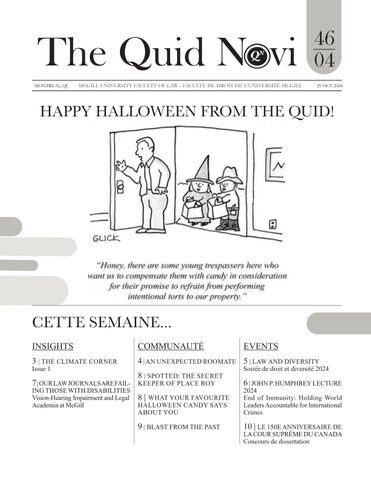
HAPPY HALLOWEEN FROM THE QUID!
CETTE SEMAINE... INSIGHTS
COMMUNAUTÉ
3 | THE CLIMATE CORNER
4 | AN UNEXPECTED ROOMATE 5 | LAW AND DIVERSITY
Issue 1
7 | OUR LAW JOURNALSARE FAILING THOSE WITH DISABILITIES Vision-Hearing Impairment and Legal Academia at McGill
8 | SPOTTED: THE SECRET KEEPER OF PLACE ROY
EVENTS Soirée de droit et diversité 2024
6 | JOHN P. HUMPHREY LECTURE
HALLOWEEN CANDY SAYS ABOUT YOU
2024 End of Immunity: Holding World Leaders Accountable for International Crimes
9 | BLAST FROM THE PAST
10 | LE 150E ANNIVERSAIRE DE
8 | WHAT YOUR FAVOURITE
LA COUR SUPRÊME DU CANADA Concours de dissertation
Vol 46 ● No 04
Benjamin Foster and Adele Weschler for the MJSDL | 2L
Issue 1 Presented by the McGill Journal of Sustainable Development Law, the Climate Corner is a new biweekly column in the Quid focusing on the intersection of climate and the law, highlighting news, cases, and stories from campus to COPs.
QUID NOVI • 29 OCT 2024
Climate news and research are uniquely hard to engage with. The sheer existential weight of the deluge of bad news overwhelms and causes us to panic, disengage, or rationalize. Staying up to date requires that we have finely tuned information filters that can sift through the heaps of well-funded disinformation and let in just enough doomerism to stay informed without becoming emotionally disaffected. Active engagement with the climate crisis is hard, but without it, our environmental literacy suffers, meaningful conversations falter, and we continue to normalize and entrench untenable systems. In this column, we will provide law students with an accessible space to engage with the climate crisis, through which we hope to spark further interest and action. It can often feel like individual actions are fruitless, and it’s largely true that efforts to reduce our personal carbon footprints won’t move the needle. But as future jurists at a truly critical point in the deteriorating health of our planet, with its innumerable cascading implications, we are uniquely positioned to effect real, meaningful change and reshape narrative and policy. At the very least, we have a responsibility to stay informed and environmentally conscious. In the Climate Corner, you can look forward to reading about recent environmental cases and legislation; climate news, initiatives, and events; human rights issues and eco-justice campaigns; local volunteer and career oppor2
tunities; and ways that you can begin to take action and hold those in power accountable. With these lofty ideals in mind, the MJSDL proudly presents our inaugural issue, written by Climate Corner editor Adele Wechsler. Another Cover-Up? The Chipewyan Dock and Environmental Racism in Canada Two weeks ago, the Chiefs of Athabascan Chipewyan First Nation alerted news outlets to an alleged cover-up by the federal government of carcinogenic contaminants above legal levels at the Fort Chipewyan dock. The community is isolated with no permanent road, and considering wildfires burning close to their two airports, the chiefs requested to dredge the Chipewyan canal so that evacuation might be possible by boat. The dock is owned and operated by Transport Canada, and the canal’s waters are central to the fishing and hunting practices of the community. It was only through Transport Canada’s refusal to dredge the canal that the Chiefs gained access to a 2017 governmental report which found the waters and sediment to be contaminated. The community was never made aware of the instance of this report, nor of its findings. This is in spite of the fact that Transport Canada has been in negotiations to sell the site to the community since 2013. While the government has since insisted that the levels discovered in the report did not pose a significant threat to human health, the community’s leaders have conducted their own studies and are concerned about the connection between their water use and historical cancer rates. Another Chief notes that the health of the water is extremely important to the values and practices of the community and is outraged that the government
did not see fit to inform the study’s leaders. The leaders of Chipewyan First Nation say they are prepared to take legal action against the federal government. In June of 2024, Canada passed bill C-226, An Act Respecting the Development of a National Strategy to Assess, Prevent and Address Environmental Racism and to Advance Environmental Justice. The purpose of the act is to recognize a reality which might already be intuitive to most readers: the impacts of pollution and climate change disproportionately fall (and by fall, we mean, are made to fall) on marginalized and racialized communities. There are a plethora of cases in Canada in which the government has directed pollutants to Indigenous and Black communities while withholding information about the extent and risk of environmental contaminants. The story of mercury poisoning in Grassy Narrows First Nation, only recently entering litigation in 2024, is a poignant example. These groups are historically excluded from environmental decision-making that directly impacts their well-being. In response, Bill C-226 obligates the Minister of the Environment to develop a national strategy to address environmental racism, which includes meaningful engagement with the affected communities, and possible amendments to existing environmental policy. However, Chipewyan First Nation is raising the alarm that even in the years following the TRC, the Federal Government is not committed to including Indigenous voices and knowledge in the fight against climate change. Instead, they remain locked in a paternalistic colonial narrative of environmental engagement. Bill C-226 is part of a larger framework of environmental legislation passed in Canada over the last 5 years. Bill S-5 recently amended the Canadian Environmental Protection Act (or CEPA) to include, among other things, the right to a healthy environment. How might this act, combined with Bill C-226, oblige the government to recognize their current environmental violations and give weight to Indigenous voices and knowledge in the pursuit of justice? Communities fighting against these issues are doing the heavy lifting, and we need to support them. Although the impact falls the hardest on those who have been historically marginalized, it will inevitably reach all of us. The Chipewyan First Nation is alerting us to the fact that colonialism and environmental devastation are inextricable from one another. As future jurists, we need to ask: what does the dialogue of environmental justice look like in Canada? When the crisis becomes dire for all of us, who will get a seat at the table? Rats in the Student Ghetto and Waste Management in Montreal: We made the rats, the rats made us Have you seen the rats? If you, too, have decided to sacrifice peace and quietude for proximity to NCDH, you will surely have received a white notice on your door alerting you to the presence of rats in the area. Looking around at
the trash-strewn streets, this news should come as a shock to no one. Plastic garbage bags full of half-eaten, or sometimes barely touched, food items (I saw a whole rotisserie chicken in the street the other day) are easily chewed through by rats and spread out in a perfect rodent’s smorgasbord. If you, as I do, walk around the student ghetto at night contemplating our climate, you will likely hear the pitter-patter of tiny rat feet, or even catch a glimpse of a beady-eyed snout. Culturally, rats are a symbol of urban decay and neglect, but they are also an unsquashable reality for those living in big cities (that is unless you live in Alberta, the largest human-populated rat-less area on earth). This column asks us to reflect on the nature of environmental issues, and the power structures (legal or otherwise) that underlie them. Rats are, in their essence, a product of imperialism. Originating in Southeast Asia, rats arrived with humans on ships to North America around 1776. They multiplied with humans and their waste, and by the 19th century, cities like New York had developed infestations that threatened public health. Poor urban waste management and overproduction of trash destined for landfills encouraged the growth of rat populations. The nail in the coffin was arguably hammered in the 1970s, when chemical companies sponsored the change from metal trash cans to black plastic bags, creating effective fast food for our rodent cohabitants. Supported by the plastics industry, other cities followed suit, including Montreal, where much of waste management still consists of plastic bags piled in the street. Rat infestations in cities today are a symptom of over-consumption and poor waste management under capitalism. Returning to the streets of the McGill student ghetto, landlords frequently fail to provide proper garbage bins, and students exacerbate the issue with poor trash management and excessive food waste. The city of Montreal has implemented several initiatives to reduce waste in the city streets, including less frequent garbage collection in some areas. In 2022, Montreal agreed to outsource all recycling services to a private, not-for-profit company, Éco Entreprises Québec, which will take effect in January 2025. The company promises to improve efficiency and ensure that less recyclable materials end up as litter. The war on rats continues, but, as my roommate Megan Campbell suggests, might this be a war against our very nature? As humans, we are responsible for the existence of today’s rats, and as citizens of Montreal, we are communally responsible for the state of our immediate environment. Next time you encounter a rat scampering in the streets of Montreal, consider the multitude of social and political forces that brought you together at this moment and your own waste management practices. Environmental engagement means we should be aware of grand narratives of Nature (capital N), misinformation campaigns, and legal reform, but it also means looking closer at the rats around us. As Zizek once said, “The path to love is through garbage.” 3
Vol 46 ● No 04
AN UNEXPECTED ROOMATE
QUID NOVI • 29 OCT 2024
Heeva Chavoshi | 1L
Searching for an apartment in Montreal all the way from Vancouver was no easy feat— especially with the laundry list of requirements I had. I wanted to live alone, preferably in a furnished place, with a balcony, big windows, hardwood floors, on the top floor, in a nice neighbourhood, and, of course, with a rent that wouldn’t make me cry. Against all odds, I found it. One FaceTime call with the landlord later, I signed the lease.
parents were leaving and I had a mouse in my apartment. How was I supposed to catch it? What would I even do if I managed to catch it?
There was a nagging thought that I might have been scammed. I imagined myself arriving in Montreal to find nothing but an empty parking lot. But I had a good feeling. With my fingers crossed during the Uber ride from the airport, my parents and I pulled up to my apartment building. There she was: 99 years old and beautiful.
As I sat on the kitchen floor having a mild anxiety attack, my mother laughed and said, “Well, you were
My parents stayed with me during the first few weeks and, together, we filled the space with my mother’s cooking, wine-induced giggles on my balcony, and a portable air conditioner. But as their departure loomed, I could not help but ask them, “What am I going to do when you leave? Who will I spend my time with?” School would not start for weeks, and I did not know anyone in the city. A few hours before they had to head to the airport, my question was answered. A tiny mouse darted across the kitchen floor and disappeared under the fridge. Immediately, I began panicking. My 4
To some, this might seem like an incredibly trivial problem. It’s a mouse. Big whoop. But, I am admittedly a bit of a wuss – I don’t even swat flies because touching them grosses me out. So, to me, a mouse in my house really was a big whoop.
worried about being lonely. Now you’ve got a roommate to keep you company!” I spent three sleepless nights before I found the critter again, hiding behind a curtain. As soon as I spotted it, it sprinted down my hallway and into the bathroom. Knowing I had a trap set up under the tub, I locked the door and waited. I’ll spare you the details, but I’m sure you can piece together what happened next. After googling “How to get rid of mouse in trap without looking”, I put on my big girl
pants and did what had to be done. And then, I disinfected my entire apartment. While it’s a funny little tale I now tell about my Montreal adventures, I really do look upon this memory fondly. It tested a level of strength I didn’t know I had. And the truth is, this is precisely the kind of experience I was yearning for when I chose to move from Vancouver to Montreal. I was looking to be pushed out of my comfort zone, and, boy, did I get what I wished for. Even so, I’m excited to see what the next few years have in store for me, how they will push me and make me stronger. I just hope my future adventures don’t require an exterminator.
To register scan here or click the link https://forms.gle/ZUSSNiY3uQXTS 23T6
THE UNIVERSITÉ DE MONTRÉAL AND MCGILL UNIVERSITY
Monday, 11 November 2024
LAW AND DIVERSITY
6:00 - 9:00 PM
PM
Hôtel Omni MontRoyal 1050 Sherbrooke St Ouest, Montreal, QC, H3A 2R6
PRESENTED BY
SOIRÉEE DE DROIT ET DIVERSITÉ 2024
Come ask questions and network ! Join us for a keynote speech and question and answer period with our speaker the Honorouble Aline UK Quach, and an evening of networking and catering!
About Judge Aline UK Quach Justice Aline UK Quach is a Superior Court of Quebec judge with a remarkable career that reflects her deep commitment to diversity, equity, and inclusion in the legal profession. She has been a driving force in promoting DEI within the legal field.
The Honorouble Aline UK Quach
5
QUID NOVI • 29 OCT 2024
Vol 46 ● No 04
6
OUR LAW JOURNALS ARE FAILING THOSE WITH DISABILITIES Vision-Hearing Impariment and Legal Academia at McGill Anonymous | 2L
The television is a little louder than it needs to be, even with closed captions on, whenever I visit a certain relative as her hearing isn’t perfect. I don’t mind it. I also use closed captions and wear glasses; a disability device once socially ridiculed that’s now a fashion accessory. This opener isn’t unique, which is the point—these types of disabilities are seen everywhere and are known by everyone. Over 38% of Canadian adults have experienced hearing loss, and 30% of males and 40% of females aged 40– 44 reportedly have visual problems.1
A 2016 study of major Canadian companies found that only 4% of their diversity initiatives properly took disability into account.3 The McGill Law Journal (“MLJ”) published a statement this term to reaffirm its commitments to EDI which appropriately recognized its historic lack of inclusion of people with disabilities.4 The MLJ deserves sincere praise for its initiative to introduce plain-language summaries, an important step for increasing accessibility that all of our journals should adopt, but is this enough?
I’ll admit it: I love legal academia. I currently edit for two of our faculty’s law journals. Yet if my vision degrades with age, would I no longer be able to access this area of law? Is this fear even far-fetched? And please don’t tell me I could just listen to the podcasts when we all know they’re not the same quality as the articles (sorry 1Ls).2 While my example is a hypothetical, there’s no doubting the reality that the journals already have readers with disabilities.
Most journals have attempted podcasts at some point, with the MLJ citing it as part of its own accessibility initiative. But isn’t the irony that this “accessibility initiative” isn’t accessible to deaf readers apparent enough? Journals should recognize this audience and must publish transcripts for their podcast.5 Journals should also take advantage of the closed captions features on Spotify and Apple Podcasts, another tool used for expanding accessibility.6 Podcasts could be accompanied by a short summary, both in text and audio, as well.
The McGill Faculty of Law has six law journals: the “big four” (McGill Law Journal, Journal of Sustainable Development Law, Journal of Law and Health, and Journal of Dispute Resolution) and two others whose editors don’t receive academic credit for their work (Inter Gentes and Rooted). The faculty also publishes the Quid Novi newspaper and Contours magazine. Statistics Canada, “Hearing Health of Canadian Adults” (20 October 2021); Philippe Finés, “Self-Reported Eye Health in Canada: 20 Years of Data” (2022) 33:4 Health Reports 14. 1
Audio recordings of articles could Rich Donovan, 2016 Annual Report: The Global Economics of Disability (Toronto: Return on Disability, 2016) at 44. 3
McGill Law Journal, “The McGill Law Journal’s Equity Statement” (26 October 2024). 4
The MLJ previously published transcripts with their podcasts, though these have been notably absent for over a year. 5
Shawn Lawton Henry, “Captions/Subtitles”, W3C (17 September 2024); Nicco Pandolfi, “Podcasting and Audio Storytelling”, University of Michigan Library (10 October 2024). 6
Not to name names, but some of these podcasts have easily-fixable audio issues that make for an uncomfortable listen. 2
provide access to audiences with visual impairments. I’d suggest voice recordings (similar to audiobooks) over text-to-speech tools, as those face limitations with recognizing emotions, pronouncing foreign words, and presenting themselves as natural voices.7 If it’s too large of a task, perhaps audio recordings of the plain-language summaries might be a nice start. My final proposal is increased cooperation between all of the faculty’s law journals. The MLJ has an EDI committee, and there’s no reason why it can’t use its clout to take the lead and invite other journals to the conversation. A conference between journals to develop inclusion-related goals would foster an esprit de corps. Editors, managers, and advisors with disabilities could lead this conversation on accessibility, with a possible goal being the adoption of the internationally-recognized Web Content Accessibility Guidelines.8 Legal academia should be accessible to all Canadians. These proposals aren’t intended to be a ground-breaking gospel or laundry list, but I remain disappointed because many of them could be swiftly implemented. I do, however, recognize that issues arise from a lack of resources (and motivation). Ultimately, I believe that better initiatives will inevitably be proposed by more appropriate voices. I look forward to seeing which initiatives our journals will take next to expand accessibility for their readers. Karolina Kulogowska & Pawl Kisielewicz, “Speech Synthesis Systems: Disadvantages and Limitations” (2018) 7:2 Intl J Engineering & Tech 234 at 236–38. 7
See Web Content Accessibility Guidelines 2.2, WC3 2023. 8
7
Vol 46 ● No 04
SPOTTED: THE SECRET KEEPER OF PLACE ROY Sébastien Offredo, Catehrine Zhang | 2L
Just south of Parc La Fontaine is a quiet square on the corner of Roy Est and St Andre. This square, Place Roy, is unique for its wide arrangement of awkward seat sculptures that can’t be sat on. For this article, we will be revealing Place Roy’s best-kept secret — the existence of its mysterious keeper, one who emerges from the shadows at night to conduct his inspections.
QUID NOVI • 29 OCT 2024
We first met the keeper on a September evening when a neighbour was holding a conversation with him. After brief introductions, the neighbour informed us that the keeper had been spotted surveying the block as of late. This keeper, however, is no human, but a well-fed tuxedo cat dubbed “Socks”. If you’re lucky, you can find Socks lounging on fallen leaves as he keeps a suspicious eye on any dog passing through Place Roy.
he prefers to be summoned via “pspspspsp” rather than via clucking. He was once seen during the day while greeting merchants at a neighbourhood market, ruling out any possibility of a vampiric nature. Further testing will likely require the use of a spreadsheet, statistical software, and more free time than we currently have. For the time being, it seems as though Socks’ secrets will remain hidden from human eyes.
Questions arise: Where does Socks go during the day? Does he have a human familiar who feeds him, or is he free? Why does he fancy Place Roy in particular? And most importantly, how does he manage to be so damn cute?
Over the past few weeks, we have tested various hypotheses on the answers to the above questions. We discovered that Socks, in his benevolence, answers to “Socky Socks Snookum Wookums”; that he does not like his tail touched; that
To be blessed by Socks’ appearance can make an entire night. He now recognizes and comes over to us to receive the pets and belly rubs he’s entitled to. If you’re ever by Roy past sunset, be on the lookout for Socks lest the impending Canadian winter bring about his hibernation.
WHAT YOUR FAVOURITE HALLOWEEN CANDY SAYS ABOUT YOU Smarties
Mars Bar
You probably like smarties because you can eat them slowly, like as a reward every time you finish reading ten pages of a case. You also still call your parents every night and have a great shot at Dean List.
You shoot for the stars in everything you do and like your favourite chocolate bar, you often produce out of this world results. You’re a classic that everyone is happy to have on their team.
Tootsie Rolls
KitKat
You likely grew up with siblings and had to learn to like the candy left at the bottom of the bag once it had already been picked over. You certainly know how to ‘roll’ with the punches and your flexibility will take you far in life.
If you find yourself craving a KitKat this Halloween, you likely spent your Fall Break in the library and are in desperate need of a ‘break’. On the bright side, you will graduate on time.
8
BLAST FROM THE PAST A poem from 1997 to assure 1Ls that confusion after the first month of classes is a rite of passage at McGill Law (so is writing for the Quid ;) )
Reese You are probably going dressed up with a partner or best friend this Halloween as some kind of dynamic duo/classic movie reference. Just like your favourite candy, you know what goes together and stick to it. Oh, also, you likely don’t have a peanut allergy. Candy Corn Your obsession with the classics can lead you to miss the big picture. Your favourite class is Legal Foundations and you still think there is value in reading Neitzchze and Locke. Your friends humour you, but you should probably try watching reality TV and eating a different candy. Wine You have cracked the code on this whole Halloween thing and are a highly evolved person. You tell people that your favourite wine is an oaky chardonnay or a sweet cabernet sauvignon, but that is mostly because you heard someone order it at a restaurant once and it sounded professional. Skittles Your taste for the sweetest things in life makes you full of optimism, but this can sometimes lead to naivety. If a Nigerian Prince emails you asking for money to unlock your inheritance, delete the email. Also, your credit card information was not stolen. Candy Apple You are a mature student who longs for the days of bobbing for apples and writing exams by hand. While candy apples are an iconic choice and emblematic of the holiday, you should step outside of your comfort zone this Halloween and try something new. 9
Vol 46 ● No 04
La Cour suprême du Canada est heureuse d'annoncer la tenue d'un concours de dissertation pour les étudiantes et étudiants en droit du Canada. Ce concours est organisé dans le cadre du 150e anniversaire de la Cour suprême en 2025. Diverses activités se dérouleront tout au long de l'année pour souligner cet anniversaire, lequel sera l'occasion pour la communauté juridique et le grand public de se pencher sur le rôle de la Cour dans la société canadienne. La Cour souhaite par le lancement de ce concours offrir à la communauté étudiante la possibilité de participer elle aussi à cette réflexion. Les personnes qui participeront au concours devront choisir l'un des arrêts phares de la Cour suprême du Canada et discuter de ses répercussions actuelles et surtout futures sur le droit canadien pertinent, en faisant valoir l'opportunité de faire évoluer ce droit davantage. La personne ayant rédigé la dissertation gagnante sera invitée à participer à un symposium qui sera organisé par la Cour suprême en coopération avec l'Institut national de la magistrature à Ottawa les 10 et 11 avril 2025. (Les frais de déplacement de cette personne seront pris en charge.) De plus, il est probable qu'au terme du concours des extraits des meilleures dissertations soumises seront publiés dans la Rétrospective annuelle 2025 de la Cour suprême du Canada. CONDITIONS ET MODALITÉS DE PARTICIPATION AU CONCOURS Admissibilité : Peuvent participer au concours les personnes qui, pendant la durée du concours, poursuivent des études de premier, deuxième ou troisième cycle dans une faculté de droit au Canada, ainsi que les Canadiens et Canadiennes qui étudient dans une faculté de droit à l'étranger.
QUID NOVI • 29 OCT 2024
Règles techniques: Les dissertations doivent • être rédigées en français ou en anglais; • compter au plus 8 000 mots (notes de bas de page comprises) dans le cas des textes soumis en anglais et 8 800 mots (notes de bas de page comprises) dans le cas de ceux soumis en français; • respecter les règles énoncées dans le Canadian Guide to Legat Citation/Manuel canadien de la référence juridique (https://lawjournal.mcgill.ca/fr/manuel-de-reference/); • ne pas avoir été publiées (ou acceptées pour publication) au 1er juin 2024; • être imprimées dans une police de 12 points, à doubles interlignes, avec des marges de 2,5cm sur tous les côtés; • être paginées dans le coin supérieur droit; • être soumises en format MS Word; • être accompagnées d’un document distinct indiquant le titre du texte, le nom de la personne qui l’a rédigé, ses coordonnées (y compris une adresse courriel), ainsi qu’une déclaration dans laquelle elle atteste qu’elle respecte les conditions d’admissibilité et que son texte n’a pas été publié; et • être accompagnées d’un résumé d’au plus 200 mots résumant l’essence du texte et ses conclusions. Bien que les personnes participantes conservent les droits d’auteur sur leur dissertation, en participant au concours elles accordent au Bureau du registraire de la Cour suprême du Canada le droit de reproduire, de publier et d’utiliser leur dissertation ou des extraits de celle-ci dans toute publication de la Cour ou méthode de communication ou diffusion utilisée par celle-ci. Date limite de présentation des dissertations: Le 10 janvier 2025 à 13 heures (heure d’Ottawa). Les dissertations devront être soumises par courriel à 150@scc-csc.ca. Les questions et demandes de renseignement concernant le concours peuvent être transmises à la même adresse électronique. Critères d’évaluation des dissertations: Les dissertations seront évaluées par un jury composé de juges de la Cour suprême du Canada sur la base de leur conformité aux règles du concours, de la rigueur de l’analyse juridique et de l’originalité de celle-ci. Dévoilement de la dissertation gagnante: L’identité de la dissertation gagnante et de son auteur sera dévoilée en février 2025. 10
The Supreme Court of Canada is pleased to announce an essay competition for Canada's law students. The competition is being organized in connection with the Supreme Court's 150th anniversary in 2025. Various activities will be held throughout the year to mark this anniversary, which will be an opportunity for the legal community and the general public to reflect on the Court's role in Canadian society. By launching this competition, the Court would like to make it possible for the student community to participate in this reflection as well. Participants in the competition must choose one of the Supreme Court of Canada's leading decisions and discuss its current and especially its future implications for the relevant area of Canadian law, including any opportunities for further development of the law. The author of the winning essay will be invited to attend a symposium organized by the Supreme Court in cooperation with the National Judicial lnstitute in Ottawa on April 10-11, 2025 (and their related travel expenses will be covered). ln addition, excerpts from the top essays submitted will likely be published in the Supreme Court of Canada's 2025 Year in Review following the competition. TERMS AND CONDITIONS FOR PARTICIPATING IN THE COMPETITION Eligibility: The competition is open to persons who are undergraduate or graduate students at a law school in Canada during the competition and to Canadians studying at a law school outside Canada. Technical rules: Essays must be • in English or French; • no longer than 8,000 words (including footnotes) for texts submitted in English or 8,800 words (including footnotes) for texts submitted in French; • prepared according to the Canadian Guide to Legal Citation/Manuel canadien de la référence juridique (https://lawjournal.mcgill.ca/cite-guide/); • unpublished (and not yet accepted for publication) as of June 1, 2024; • in 12 point font and double-spaced, with a 2.5 cm margin on ail sides; • page-numbered in the upper right corner; • submitted in MS Word format; • introduced by a separate document indicating the title of the essay and the author’s name and contact information (including email address), together with a statement attesting that the author meets the eligibility criteria and that the essay is unpublished; and • accompanied by an abstract of no more than 200 words summarizing the argument and conclusions. While participants retain copyright in their essay, by ta king part in the competition they grant the Office of the Registrar of the Supreme Court of Canada the right to reproduce, publish and use their essay or excerpts therefrom in any of the Court’s publications or any means of communication or dissemination used by the Court. Essay submission deadline: January 10, 2025, at 1:00 p.m. (Ottawa time). Essays are to be emailed to 150@scc-csc.ca. Ali questions and requests for information about the competition can be sent to the same email address. Essay evaluation criteria: Essays will be evaluated by a jury composed of judges of the Supreme Court of Canada on the basis of their compliance with the competition rules and the rigour and originality of the legal analysis. Announcement of the winning essay: The winning essay and its author will be announced in February 2025.
11
EDITOR-IN-CHIEFS RÉDACTEURS EN CHEF Anna McAllister Jessica Keer Li Pablo Mhanna-Sandoval SOCIAL MEDIA DIRECTOR DIRECTRICE DES RÉSEAUX SOCIAUX Gabrielle Torrealba ART DIRECTOR AND LAYOUT EDITOR DIRECTRICE ARTISTIQUE ET ÉDITRICE DE MISE EN PAGE Souang Wu COPY EDITORS SECRÉTAIRES DE RÉDACTION Despina Tritos Paul Ye Kimberley Baronet Brandon Grimaldi COLUMNISTS CHRONIQUEURES ET CHRONIQUEUSES Benjamin Foster and Adele Weschler for the MJSDL Heeva Chavoshi Sébastien Offredo CONTRIBUTORS CONTRIBUTEURS Catherine Zhang Special thanks to Prairie Koo for designing the layout. ~ The Quid Novi is published weekly by the students of the Faculty of Law at McGill University. Production is made possible through the direct support of students. All contents copyright © 2024 Quid Novi.
Les opinions exprimées sont propres aux auteurs et ne réflètent pas nécessairement celles de l’équipe du Quid Novi. The content of this publication does not necessarily reflect the views of the McGill Law Students’ Association or of McGill University. Envoyez vos commentaires ou articles avant jeudi 17h00 à quid.law@mcgill.ca. Toute contribution doit indiquer le nom de l’auteur, son année d’étude ainsi qu’un titre et un sous -titre pour l’article. Les images doivent être soumises séparément. L’article ne sera publié qu’à la discrétion du comité de rédaction, qui basera sa décision sur la politique de rédaction disponible sur notre Facebook @quidnovi.mcgill.