The Quid Novi MONTREAL, QC
MCGILL UNIVERSITY FACULTY OF LAW - FACULTÉ DE DROIT DE L’UNIVERSITÉ MCGILL
46 01 10 SEPT 2024
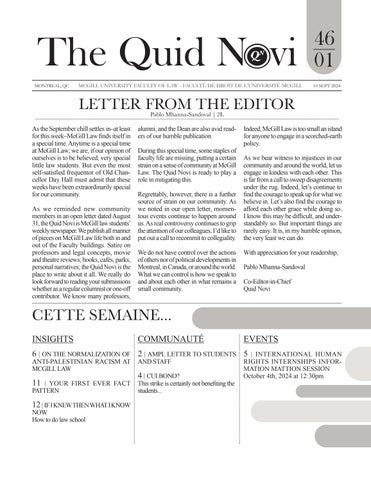
LETTER FROM THE EDITOR Pablo Mhanna-Sandoval | 2L
As the September chill settles in–at least for this week–McGill Law finds itself in a special time. Anytime is a special time at McGill Law; we are, if our opinion of ourselves is to be believed, very special little law students. But even the most self-satisfied frequentor of Old Chancellor Day Hall must admit that these weeks have been extraordinarily special for our community. As we reminded new community members in an open letter dated August 31, the Quid Novi is McGill law students’ weekly newspaper. We publish all manner of pieces on McGill Law life both in and out of the Faculty buildings. Satire on professors and legal concepts, movie and theatre reviews; books, cafés, parks, personal narratives; the Quid Novi is the place to write about it all. We really do look forward to reading your submissions whether as a regular columnist or one-off contributor. We know many professors,
alumni, and the Dean are also avid readers of our humble publication. During this special time, some staples of faculty life are missing, putting a certain strain on a sense of community at McGill Law. The Quid Novi is ready to play a role in mitigating this. Regrettably, however, there is a further source of strain on our community. As we noted in our open letter, momentous events continue to happen around us. As real controversy continues to grip the attention of our colleagues, I’d like to put out a call to recommit to collegiality. We do not have control over the actions of others nor of political developments in Montreal, in Canada, or around the world. What we can control is how we speak to and about each other in what remains a small community.
Indeed, McGill Law is too small an island for anyone to engage in a scorched-earth policy. As we bear witness to injustices in our community and around the world, let us engage in kindess with each other. This is far from a call to sweep disagreements under the rug. Indeed, let’s continue to find the courage to speak up for what we believe in. Let’s also find the courage to afford each other grace while doing so. I know this may be difficult, and understandably so. But important things are rarely easy. It is, in my humble opinion, the very least we can do. With appreciation for your readership, Pablo Mhanna-Sandoval Co-Editor-in-Chief Quid Novi
CETTE SEMAINE... INSIGHTS
COMMUNAUTÉ
EVENTS
6 | ON THE NORMALIZATION OF 2 | AMPL LETTER TO STUDENTS 5 | INTERNATIONAL HUMAN ANTI-PALESTINIAN RACISM AT MCGILL LAW
AND STAFF
11 | YOUR FIRST EVER FACT
This strike is certainly not benefiting the students...
PATTERN
12 | IF I KNEW THEN WHAT I KNOW NOW How to do law school
4 | CUI BONO?
RIGHTS INTERNSHIPS INFORMATION MATTION SESSION October 4th, 2024 at 12:30pm
Vol 46 ● No 1
LETTER TO STUDENTS AND STAFF
Association of McGill Professors of Law (AMPL) | Association mcgillienne de professeur.e.s de droit (AMPD)
break down, the Supreme Court of Canada in Saskatchewan Federation of Labour v. Saskatchewan noted at paragraph 75, the expected method to attain a contract is the union’s “ability to engage in the collective withdrawal of services is a necessary component of the process through which workers can continue to participate meaningfully in the pursuit of their collective workplace goals.” With this background in mind, we respond to some critical issues. Dear students and staff colleagues, We write to share with you information on some of the questions you have asked about the strike and the pathways to resolution. We start with the simple proposition that full-time Law professors and their union of choice, AMPL, have a constitutional right to associate and that their employer, McGill University, has an obligation to bargain in good faith.
QUID NOVI • 10 SEPT 2024
The nature of the constitutional right is uncontroversial. The Supreme Court of Canada in Ontario (Attorney General) v. Fraser, described, at paragraph 28, the expansive nature of section 2(d) of the Charter: Section 2(d), interpreted purposively and in light of Canada’s values and commitments, protects associational collective activity in furtherance of workplace goals. The right is not merely a paper right, but a right to a process that permits meaningful pursuit of those goals. The Court expanded, in paragraph 41, that: “Section 2(d) requires the parties to meet and engage in meaningful dialogue. They must avoid unnecessary delays and make a reasonable effort to arrive at an acceptable contract.” (emphasis added). Where negotiations 2
Union accreditation As the Supreme Court of Canada has held, unions are designed to protect employees in furthering their workplace goals. In our case, these include ensuring that professors have a meaningful voice in critical decisions concerning our workplace. The judge at the Tribunal adminstratif du travail (TAT) who determined that AMPL was a proper union representing full-time professors in McGill’s Faculty of Law, undertook a painstaking analysis of the law, the arguments presented, and the facts. In particular the judge investigated the criteria that courts had long developed in determining whether a particular group of employees ought to be recognized as a bargaining unit. Where there are no existing unions in place (a ‘champ libre’ or ‘greenfields’ context), the judge noted at paragraph 21 that caselaw gives pride of place to the employees’ choice of bargaining unit: En somme, en champ libre, l’unité de négociation recherchée doit simplement être appropriée pour être un groupe distinct au sens du Code, sans être « la plus appropriée », et ce, même si elle présente des inconvénients pour l’employeur ou nécessite des adaptations de sa part.
That is, while McGill may prefer a larger bargaining unit (or a smaller one, as it has claimed against other unions), the union is entitled to be certified as the exclusive bargaining agent as long as it is viable and represents a community of interest. Thus, for example, the professors at Osgoode Hall Law School were certified for their own faculty union as were engineering professors at both the University of Sherbrooke and at Polytechnique. The judge carefully examined the testimony presented about the Faculty of Law in paragraph 30 of the decision, concluding that the group of employees represented by AMPL were distinct and appropriate: “En l’espèce, le simple bon sens veut que le groupe des professeur(e)s de droit de la faculté de droit de l’Employeur présente une communauté d’intérêts.” (paragraph 32). Further, the judge noted that even McGill accepted the distinctive nature of the full-time professors in the Faculty of Law: “[L]’Université écrit tout de même que les « professeurs de la Faculté de Droit forment possiblement un groupe distinct ». Une telle affirmation n’est pas anodine.” (paragraph 32) The judge carefully considered, and rejected, McGill’s argument that faculty-by-faculty unionization would be untenable or ungovernable: [65] Premièrement, le Tribunal a déjà constaté les faiblesses de la prétention centrale de l’Employeur que sa structure organisationnelle est extrêmement centralisée. Il n’est donc pas ici en présence d’une intégration « à l’intérieur d’un ensemble décidé par les hautes autorités de l’Université ». [66] Deuxièmement, comme abordé précédemment, il existe une culture particulière à la Faculté de droit de l’Employeur. Le Provost résume cet état de fait lorsqu’il affirme que chaque
faculté a sa propre réalité (« has it’s own reality »). Venant d’un des plus hauts dirigeants de l’Université, une telle affirmation ne peut être prise à la légère. D’ailleurs, elle conforte le Tribunal dans ses propres constats. [67] Troisièmement, contrairement aux autres universités québécoises, l’Employeur est, cinquante ans plus tard, dans la situation unique où ses professeur(e)s ne sont pas syndiqués et où la vaste majorité de ses employés l’est. On the basis of the distinct character of the group of full-time professors of Law as recognized by McGill senior administrators, the will of those professors in forming a union of that group, and the absence of any existing faculty union at McGill, the judge determined that AMPL ought to be certified as the exclusive bargaining agents of full-time professors of Law. Later, McGill agreed with AMPL that cross-appointed professors fall within this group. Will Faculty level unionization make the University ungovernable and costly? McGill’s administration has communicated that the main reason for opposing AMPL’s certification is that it would make the University ungovernable. As noted above, the Tribunal administratif du travail carefully reviewed these contentions and rejected them, not least because those same administrators testified under oath that the Faculty of Law was, in fact, distinct with a reality of its own. McGill now warns that the number of bargaining units could multiply to include academic departments and other sub-Faculty units. For now, two other McGill Faculties have sought accreditation, both of which have multiple departments not seeking individual unions. There are a total of 7 other Faculties that could potentially unionize. There are also 14 existing non-Faculty unions at McGill representing everyone from teaching assistants and course lectur-
ers to maintenance workers and printing services. In the TAT’s accreditation decision, the judge noted that McGill has in the past found ways to reduce the complications of dealing with its multiplicity of unions, including by grouping negotiations at times. McGill asserts that collective bargaining with more than one faculty union would be costly. Yet, McGill has not revealed how much it is spending in resisting not only AMPL’s accreditation but that of professors in the Faculty of Education and in the Faculty of Arts. Further, McGill spent more money in resisting a new bargaining unit in the Association of Graduate Students Employed at McGill (AGSEM), litigation that McGill eventually lost. If McGill were truly interested in cost and efficiency, it would drop its litigation against its unions. McGill’s request for arbitration As described above, AMPL has a right to expect McGill to bargain in good faith, which the Supreme Court of Canada defined as engaging “in meaningful dialogue,” avoiding “unnecessary delays,” and making “a reasonable effort.” McGill has resisted all of these obligations. McGill has met with AMPL only 24 times (approximately 22 full days) over nearly two years, has cancelled over half a dozen scheduled days of bargaining, has arrived unprepared for negotiations necessitating delays while the McGill team caucused, and has wasted countless hours challenging such matters as whether our collective agreement should have a “definitions” section (a section common to collective agreements). Nevertheless, AMPL negotiators came prepared with text and justifications, and ultimately the AMPL bargaining team was able to reach important agreements with McGill on many provisions. In fact, McGill had no serious disagreement with the substance of most proposals but, instead, insisted that McGill retain the right to unilaterally alter the contract once it is formed without AMPL’s consent. Rather than codify in a collective agree-
ment the provisions to which both parties have agreed already, McGill insists on sending all provisions to the arbitrator, and leaving it to the arbitrator to write the entire collective agreement. This will result in significant delays and very high costs as both parties would be represented by lawyers rather than their own staff. And, perhaps more important still, if the entire agreement is established by the arbitrator, McGill can subsequently challenge the arbitrator’s ruling on judicial review, just as McGill went to the TAT to challenge our certification, lost, and now is challenging the TAT decision on judicial review. If McGill and AMPL agree to a collective agreement over the matters on which we have agreed already, McGill could not challenge the existence of that collective agreement on judicial review. AMPL and McGill would have at least a partial collective agreement insulated from further legal challenge. McGill has yet to provide an explanation for its refusal to agree to put the provisions on which we have agreed already into a collective agreement. The evident explanation is that McGill wishes to avoid any collective agreement with AMPL, and retain the possibility of further costly and toxic legal action challenging an eventual arbitral ruling. Arbitration in the manner McGill envisions and subsequent judicial review could easily drag on for more than three years. Contingency planning The University administration has within its power the ability to end the strike. AMPL’s offer remains the best path to end the strike and rebuild our beloved Faculty. Our offer is to refer all monetary matters to expedited arbitration, put all matters to which we have agreed already and a few non-monetary governance provisions into a collective agreement, and McGill agrees to drop its attempt to decertify AMPL through judicial review. Only McGill’s wish to forever destroy and silence our collective voice stands in the way. In solidarity, AMPL Executive 3
Vol 46 ● No 1
C ui bono ?
This strike is certainly not benefiting the students… Anonymous
Last week, we were asked to reflect upon the “start of our legal education” and to “practice concise writing” (something the university has mastered when it comes to providing students with answers to their concerns about the strike). Feel free to disagree, but this strikes me as premature. Despite speeches from the administration, a library information session, and being called up one by one to receive a Civil Code of Québec, I hardly feel that my legal education has begun.
QUID NOVI • 10 SEPT 2024
Students at other faculties are experiencing their first classes, meeting their professors, and starting their readings and assignments. Meanwhile, at the McGill Faculty of Law, first year students are drafting their concise reflections, trying to hold on to any sense of normalcy, unaware of when their classes will start and if their semester will be cancelled. From the very first day of “class”, a large number of students formed a group in favour of the professors’ union, went to their unofficial teachins, brought them coffee and baked goods, made posters and joined the picket line, choosing to not attend the Dean’s presentations in support of AMPL. Others, not wanting to take a stance, walked quietly past the profs and into Old Chancellor Day Hall to receive another speech on how difficult this whole situation must be for us and on how the start of this year is “unusual.” As if we hadn’t noticed already…
4
And what about the students who don’t support AMPL’s strike? I haven’t heard of any, although I can’t say that I am surprised. The profs proudly advertise on social media and on their website that their students support them, but these are the profs that will eventually be grading our papers and assignments, which makes criticising their actions and not supporting their union a risky proposition. I know what you’re thinking: you don’t really expect me to believe that the profs would be so petty as to retaliate against students who don’t support them, right? Although I don’t know them personally, these are the same profs who waited outside the window of the Moot Court to make noise with megaphones and ring bells for the entirety of the Dean’s Welcome Speech on our first day. Realistically, what did they think this would achieve but ruin a moment that students will remember for years to come, that they have studied and worked hard for? These are the same profs who post memes of the McGill administrators on Instagram and bring birthday cakes to their offices to facetiously thank them for their cooperation. And then they wonder why McGill is so reluctant to give them a say in who should be the next dean… My criticism of the profs’ behaviour does not mean that I reject all of their concerns and claims about the way they are being treated by McGill. In fact, I think that many of their demands seem reasonable, based on the limited informa-
tion that we have been given. But what I will not accept is that they are doing this for the students. Both sides say that they have the students’ best interests at heart and that they are doing their best to keep the strike as short as possible, something I find very hard to believe. The profs say that they are ready to stop the strike and go back to teaching if McGill abandons its legal proceedings to decertify their union, which strikes me as very unlikely since the consequences of having a union for such a small faculty would be far worse for McGill than delaying their students’ education by a semester. In a recent email, Dean Leckey asks students to “consider the bigger picture,” arguing very reasonably that if AMPL is certified, over a dozen new unions could join the current 16, which would make labour relations at McGill “unmanageably complex, cumbersome, and costly.” Funny, I could use those same three adjectives to describe the situation we are in right now. And as for considering the bigger picture, I hope that McGill is taking its own advice: a few first-year students are seriously considering dropping out and applying to other law schools before the end of the add/drop period. I just thought that the administration should know, since we students know how horrible it feels to be kept in the dark. As for AMPL, please stop pretending that you couldn’t stop the strike if you really wanted to. I understand that
McGill’s judicial review is a direct attack to your union, but there are hearings set for December, where you will get the opportunity to present your case. If there is a legitimate reason for you to be unionized, then you will win in court, and McGill will have to admit defeat. Instead, you are determined to use the students as bargaining chips to get McGill to fold. You say that going on strike again was such a hard decision, that you are sympathetic towards the students receiving financial aid who will need to seek arrangements if their schooling is extended by a semester. You say that you feel for the international students who have paid a lot of money for a semester that might not happen. You say that you sympathize with those coming from out-of-province who have just moved here, don’t have a job to fall back on and can’t go home because they don’t know if they will have class on the following day. I’m sorry, but I simply don’t believe you. I urge you, members of the McGill administration and AMPL, to seriously consider the consequences of your actions on the students you claim to care for so much. We should not be your pawns in this labour dispute, but aspiring young professionals who have worked hard to get where we are today, eager to start our legal education and learn at a faculty in which we saw great merit. Please don’t prove us wrong. A first-year BCL/JD student at the McGill Faculty of Law
INTERNATIONAL HUMAN RIGHTS INTERNSHIPS INFORMATION SESSIONS Join us for an International Human Rights Internships Info Session hosted by the McGill Centre for Human Rights and Legal Pluralism! This event is a great opportunity to hear directly from previous program participants about their experiences and insights. Mark your calendars for Friday, October 4th, 2024, at 12:30 PM in NCDH Room 102. Learn more about how these internships offer practical experience in the field of human rights and gain valuable global perspectives. For further details, please reach out to hrinternships. law@mcgill.ca.
5
Vol 46 ● No 1
ON THE NORMALIZATION OF ANTI-PALESTINIAN RACISM AT MCGILL LAW Law Students for Palestine at McGill (LS4PM)
Introduction Law Students for Palestine at McGill (“LS4PM”) is deeply concerned by a public statement made by the Jewish Law Student Association (“JLSA”) on July 10, 2024.1 We are also troubled by the McGill Law Students Association’s (“LSA”) failure to hold the JLSA accountable and to be transparent with the law student community about the reasons for this persistent reticence.
act of flagrant disregard for the judicial process4 – the JLSA took to social media and published an explicitly racist and discriminatory statement targeting members of the McGill and Montreal communities. Specifically: •
Following the McGill administration’s decision to violently2 dismantle the non-violent3, pro-Palestinian student encampment – an
QUID NOVI • 10 SEPT 2024
1 McGill Jewish Law Students’ Association, The StartUp Nation @ McGill University, & Students Supporting Israel at McGill University, “Our statement on dismantlement of the McGill Encampment” (10 July 2024), online: <instagram.com/p/ C9PmKGbOaYz/?igsh=eDV1aHhudzZvMGM=> (instagram post). 2 Many videos and testimonies have circulated online demonstrating the violent nature of the action taken by McGill. For contemporaneous reporting on the dismantling of the encampment see Savanna Craig, “McGill’s #Gaza Solidarity Encampment is currently being dismantled” (10 July 2024), online: <x.com/savannacraig/ status/1811037773756764358>. The act is also symbolically violent as it represents McGill’s belief that it is above the law, the judicial process, and the Charter. 3 The peaceful nature of the encampment has been affirmed by the Quebec Superior Court on two occasions (see Medvedovsky c Solidarity for Palestinian Human Rights McGill, 2024 QCCS 1518 at para 13, 14, 17, 28, 42 and 43; McGill University c. Association McGillienne des Professeur.e.s. de droit (AMPD) / Association of McGill Professors of Law (AMPL), 2024 QCCS 1761 at para 25).
6
•
•
the JLSA falsely claimed to represent the “Jewish students throughout McGill”, consequently reducing Jewish identity to a monolith and dismissing the diverse members of McGill’s Jewish community who have consistently played a central role within the encampment and engaged in broader efforts to organize against anti-Palestinian racism on campus; the JLSA deployed explicitlyanti-poor language typically used to stigmatize, oppress, and dehumanize people who use drugs and experience the structural conditions of settler colonialism and state-manufactured poverty; the JLSA used language that definitively dehumanizes Palestinians and Palestinian supporters by falsely labelling the encampment as “toxic, violent, and antisemitic”, and as a “terrorist” space.
the JLSA falsely claimed to represent the “Jewish students throughout McGill.”6 Here, LS4PM defers to McGill’s many anti- and non-Zionist Jewish students and broader community members who have not only been central to pro-Palestinian activism on campus, but were also key organizers of the encampment.7 We join groups like Independent Jewish Voices McGill8 in rejecting the idea that Jewish students at McGill (and in the wider Montreal community) are a monolith.9 By claiming to represent the views of Jewish students, the JLSA is contributing to the erasure of diverse Jewish identities, experiences and histories,10 the conflaciation, supra note 1. 6 McGill Jewish Law Students’ Association, supra note 1. 7 Independent Jewish Voices McGill, “Coming away from our camp, we are grateful for reminders of the gift of new beginnings” (15 July 2024), online: <instagram.com/p/C9c6OeHRncw/?igsh=ZXNsNmowZ2o1N28x> (instagram post). 8 See e.g. Independent Jewish Voices McGill, “Who are we?” (12 November 2023), online: <instagram.com/p/ CzkHuLCO8T6/?igsh=MW15b2Y2ZDF0YmF5Yw== > (instagram post).
In describing the encampment as “toxic, violent and antisemitic”5
9 See e.g. Independent Jewish Voices McGill, “Message from your Jewish Campers” (15 July 2024), online: https://www.instagram.com/p/C9c6OeHRncw/?utm_source=ig_web_copy_ link&igsh=MzRlODBiNWFlZA==
4 Verity Stevenson, “McGill moving forward with injunction request against pro-Palestinian encampment”, CBC News (17 May 2024), online: <cbc.ca/news/ canada/montreal/mcgill-interlocutory-injunction-request-1.7208149>. 5 McGill Jewish Law Students’ Asso-
10 See e.g. “Three Worlds Memoirs of an Arab-Jew” by Avi Shlaim.” and “The History of Arab-Jews Can Change Our Understanding of The World”, online: https://www.currentaffairs.org/ news/2023/09/the-history-of-arab-jews-canchange-our-understanding-of-the-world
Why this is so harmful
tion of anti-Zionism with antisemitism within Canadian society,11 as well as fostering an environment where violence and antisemitism are wielded against Jewish peoples who reject the dehumanization of Palestinians and who recognize their rights to life and liberation.12 We also condemn the JLSA’s accusation that the City of Montreal and the SPVM “provided political cover for the continuation of the unsafe and narcotics-filled encampment”.13 This is unequivocally anti-poor, colonial, oppressive language being wielded against those within our society who exist most at the margins.14 In using this language, the JLSA is enacting racist and colonial ideologies that facilitate state-sanctioned violence under the pretense of ‘upholding health and safety’ and ‘protecting private property interests’ in order to suppress communities resisting systemic oppression.15 Indeed, in a subsequent Instagram post, the JLSA pursued this line of reasoning by expressing concern that pro-Palestinian students had allegedly damaged the grass on campus.16 That the JLSA thought it 11 See e.g. “Lobby group pushes Canada to conflate anti-Zionism with antisemitism”, online: https://breachmedia. ca/anti-zionism-semitism-canada-lobbying/ 12 See e.g. “IJV Calls on Canada to Officially Recognize the Palestinian Nakba”, online: https://www.youtube.com/ watch?v=yR9Vme6zv58 13 McGill Jewish Law Students’ Association, supra note 1. 14 See e.g. “Why small changes to the language around addiction are so enormously”, online: https://www.cbc. ca/news/opinion/opinion-addict-language-stigma-1.5417988 15 See e.g. “‘Somebody’s street’: Eviction of Homeless Encampments as a Reflection of Interlocking Colonial and Class Relations”, online: https://digitalcommons.osgoode.yorku.ca/cgi/viewcontent. cgi?article=1449&context=jlsp 16 McGill Jewish Law Students’ Association, “Joint statement on the events that took place at McGill University on
appropriate to instrumentalize the plight and traumas of communities facing marginalization as a means to delegitimize the encampment is indicative of the deeply discriminatory underpinnings of its public statement. As future lawyers, we are taught that access to justice remains a yet-to-be-reached ideal within Canada’s judicial system, a reality exacerbated by the structural conditions of poverty that continue to plague many. The explicit stigmatization of those facing hardship reflects discriminatory tendencies that go against the high standards of professional conduct expected of those being trained to serve members of the public. Notably, integrity is considered a fundamental quality for anyone choosing to practice law. Statements like the one in question fail to demonstrate such integrity, jeopardize public confidence in the administration of justice, and reflect adversely on the legal profession.17 Such behaviour has no place within a law school environment. And of particular concern is the JLSA’s use of racist tropes and language. By using the word “terrorist”18 to describe the encampment, the JLSA is employing racist, white supremacist, and colonial narratives that are based in Islamophobic, anti-Arab and anti-Palestinian bigotry.19 LS4PM rejects the JLSA’s accusations of violence and antisemitism and is appalled by the racist rhetoric used to describe the August 30, 2024”, (5 September 2024), online: https://www.instagram.com/p/C_ gnG_1vC9A/?utm_source=ig_web_copy_ link&igsh=MzRlODBiNWFlZA== 17 See e.g. Law Society of Ontario, Rules of Professional Conduct s. 2.1. 18 McGill Jewish Law Students’ Association, supra note 1. 19 See e.g. Edward Said, “Islam Through Western Eyes”, The Nation (26 April 1980), online: <thenation.com/article/ archive/islam-through-western-eyes/> .
encampment community. Equating Palestinian advocacy with antisemitism is an old and tired tactic used for decades to delegitimize the Palestinian cause,20 and has been widely refuted by numerous respected scholars.21 Relatedly, depicting Palestinians as terrorists has been used for over 76 years to justify ethnic cleansing, daily violence and murder, and the total disregard for Palestinian human rights and dignity.22 Wielding this language in a post-9/11 world is patently racist. By using this terminology, the JLSA is implying that Arabs, Muslims, Palestinians, and their allies are only interested in harming others, perpetuating a long and well-documented orientalist tradition of depicting Arab people as savages in mainstream media, movies and political discourse.23 Indeed, over the last 11 months, such rhetoric has found disturbing momentum with Canadian society. As legal academic and journalist 20 See e.g. Noam Chomsky & Ilan Pappé, On Palestine (Chicago: Haymarket Books, 2015) at 23 [Chomsky & Pappé, On Palestine]. 21 See e.g. “Presumptively Antisemitic: Islamophobic Tropes in the Palestine– Israel Discourse”, online: https://csrr.rutgers. edu/issues/presumptively-antisemitic/ 22 See e.g. Noam Chomsky & Ilan Pappé, On Palestine (Chicago: Haymarket Books, 2015) at 23 [Chomsky & Pappé, On Palestine]. 23 See e.g. Susan M Akram & Kevin R Johnson, “Race, Civil Rights, and Immigration Law After September 11, 2001: The Targeting of Arabs and Muslims” (2002) 58:295 NYU Ann Surv Am L 295 at 309; Erin M Kearns, Allison E Betus & Anthony F Lemieux, “Why Do Some Terrorist Attacks Receive More Media Attention Than Others?” (2019) 36 :1 Justice Q 985 at 985; Caroline Mala Corbin, “Terrorists Are Always Muslim but Never White: At the Intersection of Critical Race Theory and Propaganda” (2017) 86:2 Fordham L Rev 455.
7
Vol 46 ● No 1 Azeezah Kanji reports:
QUID NOVI • 10 SEPT 2024
“On October 17, just hours after the Al-Ahli hospital bombing, all four Canadian federal party leaders spoke at a conference alongside a “leading human rights attorney” who had posted a cartoon depicting Palestinians as cockroaches. When Israeli political and military leaders describe Palestinians as “vermin,” a “cancer - ous manifestation,” “roaches,” “grasshoppers” to be “crushed,” “little snakes,” and now “human animals,” extermination becomes a logical “solution.”24 While the word “terrorist” can connote many things in the public imagination, the range of its semantic values has become laden with racist, orientalist, and colonialist tropes that dehumanize Arabs, Muslims, and brown people. The usage of the word is never apolitical. Within legal contexts, the word has much narrower definitions. One such context is the Canadian Criminal Code which defines terrorism as an act committed “in whole or in part for a political, religious or ideological purpose, objective or cause […] with the intention of intimidating the public […] and that intentionally causes death or serious bodily harm to a person by the use of violence.”25 By accusing the encampment of being a “terrorist” space, the JLSA is using inflammatory language and making false claims that have been expressly rejected by Canadian courts.26 Such mischaracteri24 Azeezah Kanji, “The Architecture of Anti-Palestinian Elimination: Legal Fallacies, False Analogies, and Inverted Realities” (25 October 2023), online: <yellowheadinstitute.org/2023/10/25/architecture-of-anti-palestinian-elimination/>. 25 Criminal Code, RSC 1985, c C-46, s. 83.01(b). 26 U of T Gov Council v Doe et al 2024 ONSC 3755, (see paras 74, 106 and
8
zations also disregard the fact that it has been Palestinians and their allies who are the ones facing documented instances of harm and anti-Palestinian racism.27
and law enforcement, including at McGill and in Montreal, are engaging in a pattern of misinformation targeting pro-Palestinian encampments and advocacy.30
A key purpose of pro-Palestinian advocacy is to elevate the decades-long struggle for Palestinian self-determination (a legally recognized right) against apartheid, occupation, and now genocide. As emerging legal scholars and practitioners, we use these terms deliberately. As legal professionals in Canada and globally remind us, “terms such as ‘occupation’, ‘apartheid’, and ‘genocide’ have established legal meanings, applicable to Israel’s actions and practices towards Palestinians.”28 It is therefore appropriate and imperative29 for students to engage critically with this subject matter, including through campus-based advocacy, without being falsely labelled as violent, toxic, antisemitic terrorists. Such efforts are especially important in a context whereby Canadian universities
The JLSA’s use of racist language and orientalist tropes has real-world, material impacts that adversely affect the safety and lives of Arab, Muslim and brown people. Not only does the deployment of this rhetoric manufacture the rationalization and normalization of the killing and the mass displacement and dispossession of Palestinians, it also imperils those who voice their opposition to these injustices. This is not hyperbolic. As the recorded number of Palestinians killed by Israel tops 40,000 – with the actual number conservatively estimated to be at least 186,00031 – legal professionals have compiled a database of 500+ publicly available Israeli incitements to genocide coming from decision-makers, army personnel, legislators, journalists, influencers, former government officials, and public expression.32 In other words, language matters. Relatedly, students across Canada (and law students in particular) have faced institutionalized discrimination for expressing support and compassion
107). 27 See e.g. Canadians for Justice and Peace in the Middle East, “Anti-Palestinian Racism in Canada: CJPME’s 2022 Report” (December 2023), online: <cjpme. org/apr_report_2022>; Mouhamad Rachini, “Some Palestinian and Muslim Canadians fearful ‘simply for existing’ as Israel-Hamas war continues”, CBC Radio (24 November 2023), online:<cbc.ca/radio/ thecurrent/some-palestinian-and-muslim-canadians-fearful-simply-for-existing-as-israel-hamas-war-continues-1.7039380>; Jasmin Zine, “Anti-Palestinian racism needs to be included in Canada’s Anti-Racism Strategy”, The Conversation (21 May 2024), online: <theconversation.com/anti-palestinian-racism-needs-to-be-included-in-canadas-anti-racism-strategy-230207>. 28 Alex Neve, “Palestinian Rights Advocacy and International Law” (15 December 2023), online (blog): <alexneve. ca/blog/palestinian-rights-advocacy-international-law>. 29
Ibid.
30 Brishti Basu, Savanna Craig & Athina Khalid, “Universities, police spread ‘jaw-dropping’ misinformation about encampments”, The Breach (19 July 2024), online: <breachmedia.ca/universities-police-spread-jaw-dropping-misinformation-about-encampments/>. 31 Rasha Khatid, Martin McKee & Salim Yusuf, “Counting the dead in Gaza: difficult but essential” (2024) 404: 10449 The Lancet 215. 32 Law for Palestine, “Law for Palestine Releases Database with 500+ Instances of Israeli Incitement to Genocide – Continuously Updated” (4 January 2024), online: <law4palestine.org/law-for-palestine-releases-database-with-500-instances-of-israeli-incitement-to-genocide-continuously-updated/>.
towards the Palestinian people. The Ontario Ministry of the Attorney General (MAG) recently screened law students from Toronto Metropolitan University (TMU) – with current or upcoming employment opportunities – who openly expressed solidarity with Palestine, demonstrative of a broader dynamic of institutional censorship within Canadian society.33 Of similar concern is the recent revelation of a secretive committee within the MAG, known as the ‘Hate Crime Working Group’, which provides ‘politically-motivated’ backing to the Toronto police’s targeting of pro-Palestine activism.34 As law students, we take note of the harmful and chilling effect of such measures, and we are sustained by the fact that our non-violent, thoughtful, and intellectually rigorous pro-Palestinian advocacy actively seeks to confront this troubling trend. That such actions should be falsely equated as violent, toxic, antisemitic and terroristic is, quite frankly, absurd. The JLSA’s refusal to engage meaningfully with legal definitions and eschewal of relevant discourse fosters anti-intellectualism, and is indicative of its spokespersons’ apparent hostile and reactionary approach to the pursuit of knowledge. The JLSA’s statement spreads misinformation and registers an ethic rooted in selective moral outrage. Not only does this dynamic con33 Kunal Chaudhary, “Ontario government screened law students who signed pro-Palestine letter”, The Breach (21 December 2023), online: <breachmedia.ca/ ontario-government-screened-law-studentswho-signed-pro-palestine-letter/>. 34 Martin Lukacs, “Secretive committee in Ontario ministry pushed crackdown on pro-Palestine activism”, The Breach (27 June 2024), online: <breachmedia.ca/secretive-committee-in-ontario-ministry-pushed-crackdown-on-pro-palestine-activism/#:~:text=Known%20as%20the%20 Hate%20Crime,Israel%20and%20anti%2DPalestinian%20bias>.
tribute to adverse impacts for the JLSA members’ peers, it is a demonstrable violation of the LSA constitution, as shown below. The Need for Transparency and Accountability Following the receipt of several complaints from McGill law students, the LSA held an emergency Executive Council meeting on July 10th (the same day the JLSA statement was released) to discuss the matter. The LSA determined that the JLSA’s statement contravened the bounds of the latter group’s own constitution, specifically section 2.5.2, which binds the JLSA to maintain civility, collegiality, and respectful relationships with independent student groups. Further, as per article 4(6) of its constitution, the LSA has a duty to ensure that members of diverse groups feel welcome at the Faculty. Article 4(7) also states that “The LSA has a responsibility to ensure that the content it is promoting does not foster or perpetuate any stereotypes.” The LSA constitution makes clear that racism and discrimination have no place in a student association. Under article 36(9), the LSA has a responsibility to exercise a supervisory function over LSA groups to ensure they abide by constitutional commitments and principles. Acting on its mandate, the LSA reached out to the JLSA with this information and, having found clear constitutional breaches, asked that the JLSA either take down its statement or revise it accordingly. The LSA also engaged LS4PM in discussions regarding this incident. We were asked to provide analysis and to explain why the JLSA statement was racist and discriminatory. While we did so, we should note that too often, it is members of conventionally marginalized communities (to which many LS4PM members belong) who are called upon to articulate and justify their hu-
manity even in the face of clear instances of discrimination. The disproportionate labour demanded of structurally oppressed communities within the academy should not be underestimated. Through this exchange, the LSA informed LS4PM members that due to what it claims is the absence of a direct enforcement mechanism, it could not forcibly compel the JLSA to act. We find this to be perplexing especially given that the LSA has previously taken public action against overtly racist behaviour concerning the law student community. Following our discussions, the LSA communicated to several complainants its intention to put out a statement of condemnation that explained how the JLSA’s statement had violated numerous clauses of the LSA constitution, aiming to respond to the many students harmed as a result. We are extremely concerned by the LSA’s decision to reverse course and retreat from this proposed course of action, a decision to which it came after informing the JLSA of its planned statement. We call on LSA execs to recognize that lawfare and threats of legal action against Palestinians and their allies are well-worn tactics deployed against those who dare to recognize the legitimate rights of the Palestinian people.35 Such efforts are explicitly designed to deter expressions of Palestinian solidarity and the recognition of Palestinian humanity. We recognize that such tactics have been commonly used at McGill, resulting in a chilling effect on student governance. We appreciate the discomfort involved in taking a principled stance against racism 35 See e.g. “Anti-Foodbenders Campaign Shows Political Double Standard On Hate”, online: https://www. readthemaple.com/anti-foodbenders-campaign-shows-political-double-standard-on-hate/
9
Vol 46 ● No 1 and discrimination– especially in a law school environment where such ideology has historically been endemic– but we nonetheless implore the LSA to uphold its constitutional obligations. As of the submission of this piece, the LSA has still not issued a public statement condemning this incident, despite promises to individual students regarding transparency and accountability. Two months on, the JLSA statement is still public. It continues to perpetuate harm that becomes increasingly difficult to remedy the longer the statement remains posted. Conclusion
QUID NOVI • 10 SEPT 2024
By not dealing immediately and proactively with the JLSA’s statement–despite finding clear constitutional violations– the LSA has risked setting a precedent of allowing groups under its supervision to violate constitutional norms with impunity, a practice that breeds systemic discrimination. Indeed, in light of the July 19, 2024 ICJ advisory opinion (the Court’s third concerning Israeli crimes in Palestine) that unequivocally recognized the illegality of
Israeli occupation and apartheid in Palestine,36 lawyer and international law expert Noura Erakat noted that “it is precisely the failure to adhere to the rule of law and the illusion of equitable negotiations that have led us to the current state of genocide.”37 If no action is taken, the JLSA will continue to be complicit in advancing the harmful characterization of Arabs, Muslims and Palestinians as lesser humans. Lack of remedial action thus far by both the LSA and JLSA reflects the broader societal injustices already faced by conventionally marginalized communities whereby they are routinely expected to justify their humanity, including through lengthy and arduous legal battles, in order to defend their legal rights and receive equal consideration. As law students, we are taught and 36 Legal Consequences arising from the Policies and Practices of Israel in the Occupied Palestinian Territory, including East Jerusalem, Advisory Opinion, [2024] ICJ. 37 Noura Erakat, “This is the 3rd #ICJ decision re Palestine since 2001…” (19 July 2024), online: <x.com/4noura/ status/1814322989258707343>.
expected to engage analytically, thoroughly and with precision. The lack of moral and intellectual integrity expressed through the JLSA’s statement is an affront to the ideals of the law and the profession for which we are preparing ourselves. Therefore, we call on the LSA to act in accordance with its own constitution by publicly condemning the JLSA’s statement and calling for its swift removal from all public and social media platforms. Moreover, the LSA must communicate to the LSA membership the nature of the JLSA’s constitutional violations, explaining how the latter group’s messaging contributes to the perpetuation of racism and discrimination. Lastly, we call on the LSA to share publicly the reasons motivating its reversal following the courtesy communication to the JLSA about the planned statement of condemnation. These demands are fair and reasonable considering the harm suffered by a large number of community members, and which will continue to be suffered should the JLSA be permitted to violate both its own constitution and that of the LSA without any meaningful recourse. LS4PM reiterates that the behaviour exhibited and the language utilized by the JLSA has no place in a law school. While a university environment should facilitate debate and engage a broad range of views, the dehumanization of already systematically oppressed people provides no utility. As James Baldwin noted: “We can disagree and still love each other unless your disagreement is rooted in my oppression and denial of my humanity and right to exist.” Onwards Until a Free Palestine, Law Students for Palestine at McGill (LS4PM)
10
YOUR FIRST EVER FACT PATTERN Anonymous
Law students! As we are left to (and with) ourselves in what will be the third week of the strike, many of us are beginning to forget what makes, at its core, a McGill law student. I am here to remind you. As I remember my beginnings in 1L, I hadn’t yet a clue what a fact pattern could look like, or how difficult they would be to complete from front to back. It was upperyear students that showed me how to navigate them, how to break them down into pieces, and how to avoid ‘traps’ that are sometimes much too easy to fall into. Because what makes a McGill Law student is the overwhelming feeling we all have to help each other, and, most crucially, to uplift one another. And so, with this in mind, I present to you your first ever fact-pattern! Have fun with it. As you will learn, there are no wrong answers. Because when the world pauses, constitutional questions do not. Fact Pattern Following decades of colonial conquest by the illegitimate State of israel onto Palestinian territory, with the help, though not exclusively, of investments by McGill University (‘The University’) in companies that provide communication equipment and fuel to the israeli military, McGill students decided, in April of 2024, to exercise their constitutional right to protest by setting up a peaceful encampment on university grounds.
Though The University alleges that the encampment prompted the destruction of campus property, scholars remind The University that “plateglass windows don’t bleed. They don’t die and leave loved ones grieving. They don’t contribute to the collective trauma and terror experienced by their communities. They just break, and then, at some point, they are replaced by identical sheets of glass” (Property Law, Coursepack of Professors Gupta, Emerich & Moyse, p.182). As one Protestor clarifies: Onlookers may think that we are breaking things because we are angry and irrational. I know it is easy to ascribe these patinas to people of colour, but what if our breaking is not a frustrated, emotional reaction but a reasonable and articulate expression in itself? What if it is an articulation of a keen understanding of a political economy organized around repression, exploitation, and disenfranchisement. As Martin Luther King Jr explains: “Alienated from society and knowing that this society cherishes property above people, [we are] shocking it by abusing property rights.” The University, also demonstrating a keen understanding of the role they play in
sustaining this political economy, went to the courts for an emergency injunction to have the encampment removed. The court, recognizing that the encampment “is part of a North American movement present in several dozen universities in the United States in connection with the ongoing events in the Gaza Strip, where tens of thousands of Palestinians have been killed, injured or dispossessed by the [i]sraeli army,” refused to grant the University’s injunction due to their failure to demonstrate any legal basis to the claim. Having exhausted its legal recourse, the colonial institution then proceeded to do what colonizers do best: forcibly remove the people occupying its campus despite the Kanienkehka First Nation of Kahnawake supporting the encampment and its occupation of, in McGill own words, “unceded land” they have true title to.
ation(‘LSA’), under which the JLSA is registered, to signal what they claim is “the blatant and overt racism” inherent in the employment, by the JLSA, of the word “terrorist” in their statement. You have been hired by the Legal Equity Coalition for Knowledge, Ethics, and Empowerment (‘LECKEE’) to establish whether the JLSA’s statement breaches s.15 of the Canadian Charter, using the Supreme Court of Canada’s substantive equality framework. You can assume that the Charter applies to the JLSA and that Charter purview is not at issue here. Write your answer below this line “Hello LECKEE,
Once the protesters were forcibly removed from the Kanienkehka’s land, the Jewish Law Students’ Association (‘JLSA’) released a statement touting the encampment’s dismantling as a victory, albeit a bitter one: they postulated that the “terrorist” encampment took much too long to be removed. They tell their colleagues and peers that McGill’s violence was not violent enoughit was not at the pace they would have desired.
I understand that you are inquiring as to whether the JLSA’s publicizing of the word ‘terrorist’ to designate the encampment and the students found within it is discriminatory. To do so, we will employ the two-part discrimination test developed by the court since Andrews. First, we will determine whether the statement, through its objective or its effects, targets a group protected by the Charter’s enumerated or analogous grounds. Then, we will venture into whether the statement perpetuates, reinforces, or accentuates disadvantage.”
Law students contacted the association they give money to, the Law Students’Associ-
The rest of the answer key will be published in a forthcoming edition of the Quid. 11
Vol 46 ● No 1
IF I KNEW THEN WHAT I KNOW NOW How to do law school Joseph Ho | 4L
QUID NOVI • 10 SEPT 2024
As I approach the end of my time at McGill Law, I follow the footsteps of many wise Quid Novi contributors who have shared their tips about how to succeed in law school. I write this article with our new incoming 1L peers in mind, but hopefully some elements will be equally useful for 2Ls and 3Ls. The article’s title is perhaps slightly misleading: I had benefited enormously from many generous upperyears who shared their wisdom from the start of my 1L and cannot claim to have been entirely clueless. What I share below, however, is the result of learning what works for me over the past three years through trial and error. I emphasize here that these are things that worked for me — they may not work for you.
12
This disclaimer, therefore, seems appropriate: Take everything below with a grain of salt. Talk to upperyears, graduates, and professors to get a variety of advice. Incorporate what works for you into your law school journey. Most importantly, what helped you succeed before (e.g., during your undergraduate studies) will continue to work for you, with some adaptation — there is no need to reinvent everything. Planning your degree I believe one of the most pressing questions you should try to answer is the length of time you would like to spend at McGill to complete your degree. Whether you graduate in 3 years or 3.5 years (or more) will change how you distribute your
courseload, when you need to apply for certain types of employment opportunities, among other issues. Those planning to graduate in 3 years may need to be attentive to application timelines starting in 1L, while those finishing later have more time to explore their career options. Of course, nothing is irreversible, and you can certainly change your mind as you learn more about your career interests. However, making the decision sooner rather than later, especially if you intend to graduate in 3 years, will maximize the number of opportunities that remains open to you. I am partial to completing it in 3.5 years — after all, the degree is designed to be completed in
3.5 years. This length gives you more room to explore different interests and to keep up with your coursework without feeling like you are constantly chasing your tail. Above all, it allows you to focus on academics in 1L and not have to worry about applying for jobs. University is a precious environment where you can exclusively focus on your own intellectual growth — you have the rest of your lives to work. That said, many outstanding students opt for 3 years. This is a personal decision made based on your circumstances, including financial considerations. Finally, keep a degree plan to help decide how you distribute your courseload and to stay on track. In 1L summer before 2L course selection began, I made a spreadsheet mapping out all my remaining semesters. Discipline & organization What makes law school challenging is its rigour and the volume of materials you must learn, especially
in 1L. Thus, discipline and organization are key to success. Discipline means staying on top of your readings and attending class (more below); organization translates to having a good system to keep all your notes, course materials, application materials for employment opportunities, extra-curricular records, etc. Good habits go a long way. Specifically, figure out what notetaking method works best for you (computer? handwriting?), where you keep your reading and class lecture notes (Google Drive? One Drive? Notion?), and how you do your readings best (print-outs? on your tablet or laptop?). At the start of every semester, I set up folders for all my courses and templates for notetaking. I also make slight adjustments every semester, tweaking what did not work for me previously. Time is at a premium in law school. The sooner you sort out your organizational system, the more time you can devote to studying (or relaxing!). Read your course syllabi carefully and map out all the assignments due
throughout the semester. Check off readings you have completed and notes you have organized. Come crunch-time during exam period, you won’t be wasting time figuring out where your notes are and what readings you missed. Reading cases Do your readings. There is no way around it if you want to excel. Yes, PubDocs exists and you should use them — albeit sparingly (more on that later). Yes, the B curve exists (fine, it’s an “enforced B average”), but the “everyone gets a B” narrative is defeatist and untrue. You can certainly edge above a B — it requires discipline and diligence, and of course, some luck. It also requires you to hone certain core skills: reading, writing (see Professor Christians’s piece “Really Basic Rules for Writing Good Papers in Law School”), and legal research. I share three reasons why doing your readings will help you in the long run. First, the best way to fully grasp judges’ reasoning in cases is 13
Vol 46 ● No 1 to read them yourself. No PubDocs will help you when you eventually practice as a lawyer, so treat every reading as an opportunity to hone your craft of reading fast and strategically. Second, 1L courses are foundational. What you learn in your upper-years build on the 1L content. You may come across the same cases multiple times throughout law school. Each time you re-read them, you will uncover further nuances — that is, only if you have read them closely the first time. Last, court decisions are written by judges who have practiced their craft for decades. The more you read them, the more you learn how to mimic their style, reasoning, and logic. Of course, poorly written decisions exist, but you can only properly critique them if you have read them.
QUID NOVI • 10 SEPT 2024
Class attendance, studying & course selection Familiarizing yourself with course materials requires repetition. I view class attendance as part of this exercise. Your first encounter with the materials is reading them before class. Class lectures and discussion serve to highlight the key takeaways from the materials — the first filter and first repetition. The second repetition comes when you comb through your notes and consolidate them — some people do that weekly (I have never been able to do that), some mid-semester, some before finals. The third repetition comes when you scan through your summaries. At some point in this sequence, you should
14
be able to explain the key cases in 2-3 sentences. You might also want to look at a reference textbook to clarify key concepts. This exercise funnels the materials at each repetition, leaving you with a crystallized understanding of the key ideas. When it comes to participating in class, I see several advantages. First, it keeps you alert and awake. Second, it reinforces your understanding of the materials. If you answer a question wrong, then you will forever remember the right answer. If you answer it correctly, you will have just cemented that understanding in your brain. It goes into that repetition sequence I just mentioned. If you are sharing your opinion, you learn to develop and express your ideas coherently. Of course, be mindful of the space and time you take up: don’t be that person who goes on about a tangent, and certainly don’t be that person who keeps everyone from leaving class on time. Third, you leave an impression with your professors that may open up doors in the future. Also—as a side note—as someone who has conducted one too many training sessions, no one likes speaking in front of a bored, silent crowd. I use PubDocs for two main purposes. First, life happens, and you might run out of time to do all your readings. Look at PubDocs so you have some understanding of the material and do not enter the classroom clueless — it is a poor use of your time. Second, every PubDoc
is a “map” of how that student sees the concepts come together. There is no alternative to fully grasping the material than building your own summary but use PubDocs to help you structure yours. Only when you understand the basics of a course will you start seeing the bigger thematic picture. Each area of law tells you something about how our judicial system works and the role of the law in society. Finally, for upper-years selecting courses, I share two thoughts. First, choose those that build your foundational knowledge of the law. Opinions vary, but my selection includes Business Associations, Private International Law, Judicial Review of Administrative Action, and Evidence. Regardless of what you end up doing, these courses cut across legal practices. For example, while Evidence is important for the litigation-inclined, it also reveals the logic behind our adversarial system (not to mention you learn what “objection, relevance!” in court dramas mean). Second, take courses outside your comfort zone and interests. Those interested in environmental issues may find administrative law useful for understanding how our regulatory state works. International human rights law has relevance to those keen to pursue corporate law, in a world where claimants are increasingly using private law tools to bring human rights claims against corporations. Those passionate about equality and justice will find that family law and tax law deal with these issues.
Extra-curriculars I have little to add regarding extra-curriculars apart from the familiar “less is more” principle. Explore the options available to you but don’t spread yourself too thin. Invest in a curated set of activities that helps you grow professionally. While your grades can improve over time, strong 1L grades open more doors to you sooner. You should make time to participate in extra-curriculars, but prioritizing academics go a long way. Beyond clubs, you may also want to explore opportunities to work as research assistants for professors to deepen your interests in particular areas of law after 1L. Career-planning Career advice is an entirely different article, so I will only share one thing: If you are graduating in 3.5 years or more, don’t worry about it in your first year. Learn about the types of career paths and opportunities that exist, understand the
general application timeline so you don’t miss anything, and leave the networking to after 1L. Stay focused on your academics, do your best, and you will find doors opened to you. Mental health, friends, and humility Law school can be gruelling. Take good care of yourself, develop good sleep habits and exercise routines, and find healthy stress outlets — these things will keep your mind sharp. Even if you study better alone, don’t be a lone wolf. Make friends — they will share law school’s trials and tribulations with you and keep you sane. You don’t need to be friends with everyone, but certainly don’t make enemies — the world is small, and the legal community even smaller. Help others and thank those who help you along the way. Open your mind to different points of views and learn to disagree respectfully — persuasive reasoning is one of the most important tools you will
learn, but it doesn’t mean you need to have the upper hand in every debate. Lastly, humility will make you more receptive to learning and help you become a more effective advocate. Law is a discipline that sits among many others: sociology, anthropology, economics, political science, psychology, etc. It is but one way of understanding the world and effecting change — a powerful one, but sometimes also overly narrow. I will never quite forget a lawyer-academic, speaking on business and human rights, who said that one cannot “have a conversation about human rights without lawyers in the room”. God knows what those frontline, grassroots human rights defenders are doing without lawyers helping them! Recognize that while there are certainly many smart law students and jurists out there (you are one of them!), plenty of incredibly intelligent people exist in all disciplines.
15
EDITOR-IN-CHIEFS RÉDACTEURS EN CHEF Anna McAllister Pablo Mhanna-Sandoval Jessica Keer Li SOCIAL MEDIA DIRECTOR DIRECTRICE DES RÉSEAUX SOCIAUX Gabrielle Torrealba DIRECTOR OF DISTRIBUTION DIRECTEUR DE DISTRIBUTION Kamil Chaoui ART DIRECTOR AND LAYOUT EDITOR DIRECTRICE ARTISTIQUE ET ÉDITRICE DE MISE EN PAGE Souang Wu Camille Duhaime CONTRIBUTORS | CONTRIBUTEURS Joseph Ho Association of McGill Professors of Law (AMPL) Law Students for Palestine at McGill (LS4PM)
Special thanks to Prairie Koo for designing the layout. ~ The Quid Novi is published weekly by the students of the Faculty of Law at McGill University. Production is made possible through the direct support of students. All contents copyright © 2023 Quid Novi.
Les opinions exprimées sont propres aux auteurs et ne réflètent pas nécessairement celles de l’équipe du Quid Novi. The content of this publication does not necessarily reflect the views of the McGill Law Students’ Association or of McGill University. Envoyez vos commentaires ou articles avant jeudi 17h00 à quid.law@mcgill.ca. Toute contribution doit indiquer le nom de l’auteur, son année d’étude ainsi qu’un titre et un sous -titre pour l’article. Les images doivent être soumises séparément. L’article ne sera publié qu’à la discrétion du comité de rédaction, qui basera sa décision sur la politique de rédaction disponible sur notre Facebook @quidnovi.mcgill.