The Quid Novi MONTREAL, QC
MCGILL UNIVERSITY FACULTY OF LAW - FACULTÉ DE DROIT DE L’UNIVERSITÉ MCGILL
45 09 05 DEC 2023
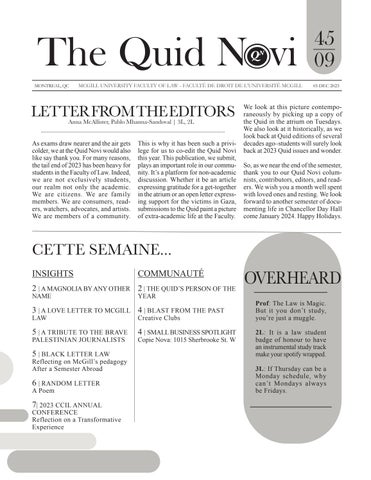
look at this picture contempoLETTER FROM THE EDITORS We raneously by picking up a copy of the Quid in the atrium on Tuesdays. Anna McAllister, Pablo Mhanna-Sandoval | 3L, 2L
As exams draw nearer and the air gets colder, we at the Quid Novi would also like say thank you. For many reasons, the tail end of 2023 has been heavy for students in the Faculty of Law. Indeed, we are not exclusively students, our realm not only the academic. We are citizens. We are family members. We are consumers, readers, watchers, advocates, and artists. We are members of a community.
This is why it has been such a privilege for us to co-edit the Quid Novi this year. This publication, we submit, plays an important role in our community. It’s a platform for non-academic discussion. Whether it be an article expressing gratitude for a get-together in the atrium or an open letter expressing support for the victims in Gaza, submissions to the Quid paint a picture of extra-academic life at the Faculty.
We also look at it historically, as we look back at Quid editions of several decades ago–students will surely look back at 2023 Quid issues and wonder. So, as we near the end of the semester, thank you to our Quid Novi columnists, contributors, editors, and readers. We wish you a month well spent with loved ones and resting. We look forward to another semester of documenting life in Chancellor Day Hall come January 2024. Happy Holidays.
CETTE SEMAINE... INSIGHTS
COMMUNAUTÉ
2 | A MAGNOLIA BY ANY OTHER 2 | THE QUID’S PERSON OF THE NAME
YEAR
3 | A LOVE LETTER TO MCGILL 4 | BLAST FROM THE PAST LAW
Creative Clubs
5 | A TRIBUTE TO THE BRAVE
4 | SMALL BUSINESS SPOTLIGHT
PALESTINIAN JOURNALISTS
5 | BLACK LETTER LAW
Reflecting on McGill’s pedagogy After a Semester Abroad
6 | RANDOM LETTER A Poem
7| 2023 CCIL ANNUAL
CONFERENCE Reflection on a Transformative Experience
Copie Nova: 1015 Sherbrooke St. W
OVERHEARD Prof: The Law is Magic. But it you don’t study, you’re just a muggle. 2L: It is a law student badge of honour to have an instrumental study track make your spotify wrapped. 3L: If Thursday can be a Monday schedule, why can’t Mondays always be Fridays.
Vol 45 ● No 09
A MAGNOLIA BY ANY OTHER NAME Carla Arbelaez| 4L
The sienna hue of my mom’s skin conjures in the Canadian imagination visions of a tropical paradise where clouds never mask the sun’s luminance, and weather never dampens the people’s mood. “Colombia’s on the equator, right? You must hate all the rain here”; a common remark that I have seen my mom struggle to answer to this day. Her manner of speaking, rather than the content of her words, equally appears to bestow images of an uncivilized jungle, where people are content with the most basic technologies and survival is at the forefront of their day-to-day pursuits. “Did you have air conditioning in your country?” “Wow, I did not expect your house to be this nice.” “I’m sure you’re much happier here than where you’re from.”
QUID NOVI • 05 DEC 2023
The academic rhetoric concerning migrants may have progressed, but my lifetime has seen little shift in the array of conversational slights that my mom is consistently forced to navigate with grace and patience. She is “one of the good ones,” and snappiness will do little to keep her in the good graces of her Canadian-born counterparts. This struggle is not my own. Maybe my mom would not perceive it as her own either. Yet, while my past Immigration and Refugee Law class discussed the belittling Global North narratives on the topic of migrant workers, I could not help but think of all the little quips that my mom has received throughout her 20 years of life in this country. The narrative of the migrant worker as essential for the functioning of certain industries is reflected in memories of employers applauding my mom’s particular warmth and dedication as a caretaker, while her pay failed to reflect the extent of her efforts. The tale of migrant workers as habitual recipients of foreign aid draws me to recall when her employers were astonished to see the quality of my family’s living conditions as “nicer than they imagined.” To be clear: my mom is a Canadian citizen. Her status here 2
is as permanent and legitimate in the eyes of the state as any other Canadian. If my mom were to correct or reprimand an employer or a public servant, there is far less at stake for her than for many of those who speak with her same accent or portray her same image in this country. Still, her legal status is not visual or sensorial, and Canadians do not internalize her legal equality as to born citizens at first glance. My mom’s name is Magnolia. This fact, when shared, makes the faces of Canadians beam and removes the air of trepidation that marked their initial interactions with this curious Colombian lady for whom they may have felt little affinity. “That’s a gorgeous name. What inspired your parents to call you that?” “It suits you well. I would’ve loved a name as beautiful as yours.” Before moments like these, my mom would carry the reputation of her native country on her skin – however misguided, however accurate. Her name gives her individuality in the eyes of others, arguably later than deserved. To Canadians, my mom will often be an immigrant first, a goodhearted Colombian when acquainted, and a flower last. As a Colombian Canadian student who attends a higher education institution, who does not share my mom’s accent, and who portrays more racial ambiguity, I have been able to avoid this experience much more often than my mom, through no effort of my own. Far more frequently, I am treated as an individual first and a representative of a Global South country second. Far less often, I feel compelled to explain that many Colombians do, in fact, have air conditioning; that it rains much more often in Bogotá, Colombia than in Toronto, Ontario; and that my country’s history of civil unrest did not begin nor end with the rise and fall of drug trafficking. One of my life’s missions is to always see and describe my mom as a flower first. I strive to speak of her distinct capacities, her kindness, and her ways of being as embodiments of not only where she came from but also what she has experienced, seen, and learned in her lifetime as Magnolia Arbelaez Arenas. I wish for the world to know of a woman who painted the entirety of her home with her own two hands; who measures the proportions of cheese, flour, and sugar in the most heart-warming pastries you can imagine by “feeling”; and whose carefully crafted works continue to adorn the bodies and homes of people around the world to this day. Perhaps most admirably, I wish for people to learn of a woman who has dedicated her adult years to being a mother who has never failed to be there for her children, and who has inspired her children to consistently pursue kindness despite adversity. Had it not been for this flower, I would not have had the privilege of people learning about me as an individual by default, rather than as an earned reward bestowed upon me, if, or when I am accepted as a Canadian.
THE QUID’S PERSON OF THE YEAR Pablo Mhanna-Sandoval | 2L
Last week, we asked you to nominate people for person of the year inspired by the annual Time’s Person of the Year edition. Here is what you had to say: Nominee: Taylor Swift With a global tour grossing over $2 billion and millions of fans filling stadiums from Toronto to Buenos Aires, it is difficult to contest Taylor Swift’s iconicity in 2023. Nominee: Margaret Baratta Whether by her helpful administrative reminders or her Faculty furniture giveaways, Margaret Baratta
has continued to be is a staple of Chancellor Day Hall in 2023. Nominee: Justine Blanchette-Sirois Elected to the LSA presidency in March 2023, Justine has already righted the government’s finances and spearheaded another successful semester of events and services for the student body. Nominee: Elon Musk A cautionary tale to business law students everywhere, in 2023 Elon Musk has reaffirmed the futility of being immensely wealthy and powerful if you’re also deeply
A LOVE LETTER TO MCGILL LAW Sara Raquel Sanabria Alarcon | 4L
In life, we have a few defining moments, such as our birthday, our wedding day, the day we become parents and more. The day I got my acceptance letter from the McGill Faculty of Law was one of those moments. I was at the UBC Life Building gym on a static bike. I was scrolling mindlessly through my phone and then a banner notification from McGill appeared. With a pit in my stomach, I clicked on it. It opened to an email of six fresh-faced youthful students smiling at me. “Dear Sara, I write from McGill Faculty of Law with exciting news!” it read. Without even reading the rest of the email, I knew I would be accepting my offer.
unfunny and desperate to be liked by internet strangers. Nominee: Integration Tutorial Group 13 The Quid has received consistent and unbiased reports on the excellence displayed by members of Integration Tutorial Group 13. This is particularly true when stacked up against other tutorial groups of 2023. Way to go, 13! Nominee: The Unionizing Professors In 2023, the McGill Faculty of Law was no stranger to the spectre that once haunted Europe. Its unionizing professors and their musical heralds the Sandy Cats band rocked the Faculty and the world in their quest for justice in the workplace.
have I ever been so intellectually stimulated. My professors and colleagues have pushed me to think critically, to question everything, and above all to consider where law meets real life. Professor Sheppard’s constitutional law class forever redefined “Canada” for me. I’ve carried the discussion and lessons regarding the value of diversity we learned in Professor Rosenblum’s Corporate Governance class. In fact, I’ve made it a personal goal of mine to strive to “lower the ladder behind me” for other students from equity-seeking groups as I advance in my career. My student-initiated seminar on municipal politics led by two incredible students has fostered my commitment to not just care for my community, but to actively participate in it. While in many ways I’ve reached a point where I am looking forward to no longer being a student, I am so grateful for the learning I’ve experienced in the last 42 months.
Now in my last week of law school, I think back to that moment with so much fondness and gratitude for the experience I’ve had in the last three and a half years. In this letter, I will attempt to distill all the love and gratitude for this institution and the people within it -- no small feat. I do this not because this is a perfect institution needing to be showered in praise, indeed this is far from a perfect place, but because I’ve always believed the world could always use a bit more love in it.
I also want to take a few words to acknowledge the people who made all this learning and growth possible. I frequently think about those who have kept me together all the times I was falling apart. Though he is gone now, Nabil fielded the calls of an anxious first-year crying because she was not sure if she uploaded her exam properly and how it was two minutes late with an infectious calmness I will always be grateful for. The custodial staff happily gave me extra garbage bags every time one of my events required one. Staci and Ennae at the CDO believed in me when I had lost hope, and I will always be grateful to them.
When non-law friends and loved ones ask me about how I’ve enjoyed law school, I always respond in the same highpitched manner, “it’s been tough, but fun!”. I always speak in a high-pitched tone when I try to make something sound lighter than it is. Indeed, it has been tough. Never in my life
Now, at this point, I am sure you know where I am going with this last one. And yes, I too have had my moments of exasperation with the SAO, but then I remember the times when I am sure I have been the source of their exasperation. This morning I sent them an email asking if I need to 3
Vol 45 ● No 09 apply to graduate (the answer is yes), even though just last week they emailed us with very specific instructions on how to apply to graduate. It’s not easy taking care of hundreds of high-strung, type A, ready-to-write-a-ten-page-counterargument-about-anything law students, but they – just like all of us – do the best they can with the resources they have. Coming into law school, especially this law school, I was so scared that everyone was going to be smarter than me. I was so right. But rather than feeling insecure or small or less than, the students around me inspire me every day to work harder, to think creatively and to redefine concepts we take for granted. Just this past week I watched a student presentation on Fetal Alcohol Spectrum Disorder that gave me goosebumps because of how deeply it rocked my understanding of how we criminalize disability in this country. Similarly, I often think back on the time my moot team and I locked ourselves in the moot rooms for 23 straight hours to do a line-by-line reading of our first written submission. While a gruelling experience, especially being reminded at 4 in the morning that the period goes before the footnote number, my teammates made me a better writer. So, while it sounds cheesy (I’m just leaning into it at this point), being surrounded by brilliant people many leagues brighter than me has been one of the best things that’s ever happened to me. I will never truly be able to describe how utterly amazed I am by the students of this faculty. There are students here who are
contributing to research to combat climate change, redefine sexual violence laws in Canada, and address systemic racism in the criminal justice system. Some students also manage law school while working full-time or taking care of children. Some students dedicate countless hours to providing legal information at McGill and around Montreal. Every year there is a group of 10 crazy students who commit countless hours to unpaid, uncredited, and frankly unthanked work to make sure our community is thriving while having fun. Other students essentially run small businesses as part of their Journal duties. Some dedicate what little free time they have to running equity-seeking student associations. Others quietly resist the spirit of Bill 21 by organizing events and gatherings for people of faith at the faculty. Even though I may be too shy to vocalize it at times, I see you, and I’m cheering for you. With a heart full of gratitude and a brain full of transystemia, I give thanks to the people with whom I’ve crossed paths at 3644 Peel Street. I look forward to the day I get to say, “I went to law school with that [Minister, CEO, Managing Partner, Supreme Court Judge, Activist, Academic, Caretaker, Artist, etc!”. I hope, if anything, I’ve managed to express the love I feel for this community throughout my time here. If not, I’ll try again during that LLM I promised myself I’d never do. Con todo mi corazon, Sara Raquel Sanabria Alarcon
SMALL BUSINESS SPOTLIGHT Copie Nova: 1015 Sherbrooke St W
QUID NOVI • 05 DEC 2023
Anna McAllister| 3L
The Quid would be remiss if we did not take advantage of the small business spotlight to highlight honourary member of the Quid tema, Copie Nova. Located at the corner of Peel and Sherbrooke, Copie Nova is a one-stop shop for your printing needs. Copie Nova has been printing the Quid for decades, and has been incredibly accommodating and reliable in their printing services.
BLAST FROM THE PAST Creative Clubs The variety of clubs at the Faculty are part of what makes life in law school such a special experience. While the Faculty has no shortage of clubs to to support your niche interests, the Quid archives are a great place to see what clubs cohorts-passed have dreamed up to get inspiration for future year. Check out this 2007 update from the Wine Appreciation Club - I know I’d be interested to join! 4
Whether you are looking to print bar materials, a bound copy of your thesis, a standing poster for a club event or a poster for your room, Copie Nova will work with you to make it happen.
A TRIBUTE TO THE BRAVE PALESTINIAN JOURNALISTS Anonymous Student
As privileged law students, we learn about the importance of verifiable facts, the process for ascertaining credibility, and the ways in which we can use our knowledge and legal tools to advocate for justice.
his life to reveal to the world the reality of the genocidal aggression in Gaza. Armed with a phone and camera, he has shown us the love of his people, their land, and their faith. We bear witness. Palestinian journalists have been relentlessly targeted, despite article 79 of the Additional Protocol I of the Geneva Conventions, which protects journalists during armed conflicts. Since Oct 7, 2023, at least 57 journalists and media workers have been martyred. Most were killed in their homes, with their families, by targeted Israeli airstrikes. According to the Committee to Protect Journalists, this is the deadliest conflict for media workers they have ever recorded. Buried with their blue Press vests, they are part of a long tradition of martyred journalists covering the Palestinian struggle, including the honourable Shireen Abu Akleh, who was killed by an Israeli soldier on May 11, 2022. We bear witness.
We learn about the importance of the truth.
But he is not just a photographer. Motaz Azaiza is one of the brave Palestinian journalists who continues to risk
does it mean to have access to the current devastating realities of the Palestinian people? What responsibilities come with this privilege?
His latest Instagram story, a video of a man feeding cats aside the rubble of a bombarded building, at this moment, outlives him. Let us all bear witness.
BLACK LETTER LAW Reflecting on McGill’s Pedagogy
edge of the working body of positive rules forming the legal system. I would be the first to admit to having engaged in some of this grumbling myself at various points throughout my degree.
professor speaks and the students listen. Efficient and concise, cours magistraux conform to every expectation that 0L me had about what a law school class would look like. A three-hour lecture with little dialogue between teachers and students, where concepts are succinctly (and authoritatively) explained, relevant statutes and code articles are given, followed by a detailed description of how the law is to be applied. High-level concepts and fundamental premises are described, but little time is available to question their legitimacy. In essential contrast to a McGill lecture, audience participation occurs on an as-needed basis only.
The sacrifices of these brave Palestinian journalists should be honoured. We should say their names. We should amplify their truths. We should advocate for a world in which indiscriminate killing would not continue to devastate the lives of innocent people for more than 50 days. A world in which even the thought of this would be inconceivable. We bear witness. If Motaz is a threat, he is a threat to our collective apathy. Plestia Alaqad, Ahmad Hijazi, Bisan Owda, and the hundreds of brave Palestinian journalists, are liberating us from our ignorance; from our complacency; from our belief that we do not have a role to play in the liberation of the oppressed – in Palestine and across the globe. And we bear witness.
“He is just a photographer who dreamed to travel the world and share the stories…the dream What does it mean to risk your life At the time of writing this article, could not come true.” telling the truth at a time when the Montaser Al-Sawaf, another Palestin- Motaz Azaiza. Age: 24. truth is systemically obscured? What ian journalist in Gaza, was martyred.
After a Semester Abroad
Matthew Gallagher| 4L
A common refrain heard at the Faculty is that McGill’s pedagogic approach to legal education is unique, emphasizing critical reflection on the law itself and focusing on legal theory. Sometimes accompanying this idea is grumbling that the McGill approach comes at the expense of a practical understanding of the law and its students’ in-depth knowl-
Yet, being on the precipice of completing the last semester of my McGill law degree while on exchange in France has made me remember what I value about McGill’s approach to legal education. My introduction to France’s legal education was through the cours magistraux – lectures of several hundred students, where, as the taxonomy magistraux might suggest, the
5
Vol 45 ● No 09 The primary pedagogic pursuit seems to be to teach students what the rules are and how to apply them. And this system undeniably accomplishes its objectives – the professors are meticulous, clear, and detailed. By the end of my first class, which happened to be droit international pénal, I felt like I could have walked into the International Criminal Court to file a pre-trial motion to contest the jurisdiction of an arrest warrant. While my 1L self would have felt vindicated by this style of education, whose students will never have to know what a Zoom breakout session is, at the end of the semester, my 4L self is left wondering how McGill’s professors might have approached the classes I have taken. When our droit international pénal class reviewed France’s principle of
non-extradition of French nationals, the discussion was focused on the applicable provisions of the Code de procédure pénale and relevant articles of extradition treaties to which France is a signatory. There was a conspicuous silence on the question of whether such a principle is just in the first place. I wondered about what premises and assumptions would underly the idea that a country should virtually never extradite its own nationals? An example underscoring the importance of asking these kinds of questions was on display just last September when a delegation of Inuit leaders travelled to France to petition government officials - unsuccessfully - to grant Canada’s request to extradite a French priest accused of sexually abusing children while posted in residential schools in Nunavut throughout the 1960s and 70s.
It would be difficult to imagine a classroom at the McGill Faculty of Law not pausing a lecture on a topic like the principle of non-extradition of nationals to grapple with the fundamental legitimacy of such a doctrine and interrogate its theoretical underpinnings. This is not to generalize French academia, with many French law faculties belonging to a deeply radical tradition; it is to simply underline that there are divergent approaches to teaching law among universities. These distinctions raise the question of what the purpose of a legal education is. Surely, it is to best prepare future members of the legal profession for their careers. But that necessarily involves empowering law students to become future jurists who will challenge and change the legal system, not just exist within it.
RANDOM LETTER A Poem
QUID NOVI • 05 DEC 2023
Anonymous Student
I am conflicted. As I walk the halls of this institution and hear what the halls speak to me, the feeling weighs heavy on my heart. The feeling grows heavier. I walk with sadness, anger, even shame; why is it all on me? I already grew up poor, now I need to change the future Are you sure that it’s me? I now need to provide for the same group I’m trying to break free from Are you sure that it’s me? No one understand my pain, but wants to influence my journey Are you sure that it’s me? I walk this path alone, yet we act as a group Are you sure that it’s me? The elite. The judgment. The class. It’s all a facade. Those above, want to act like commoners - when the garments are never the same material. Those beside, want to change the world - when we operate with a different reality. Those below, forever forgotten because this world doesn’t care about them. The weight I bear for the future is heavy, and I never consented to it. I was thrown into this reality; I never asked for it, and yet it’s me that must correct the direction. The higher we go, the more we must carry on this journey, yet the path towards the top is strained with indifference of the pathfinders. Who are you to judge me if you don’t know my pain. Who are you to tell me how to understand my pain. Who are you to moderate the way I feel. This space feels like a community, but it’s a glasshouse that is built on unstable grounds. We judge, but can’t judge ourselves without blinding ourselves to our own realities. We speak, without understanding where someone has actually come from. We listen, without being able to hear the story of others. Yet, I still walk alone - like I always have. I will carry on. 6
2023 CCIL ANNUAL CONFERENCE Reflection on a Transformative Experience
ening other countries into economic submission, therefore advancing the interest of the Western hegemony.
On November 2nd and 3rd, the McGill International Law Society (MILS) collaborated with the Inter Gentes to send a joint delegation of students to the Canadian Council of International Law (CCIL) annual conference in Ottawa. We wish to express our deepest gratitude to the McGill Alumni Engagement Fund (ASEF) for generously supporting our participation in this enriching event.
But these are only my views as a Burundian national.
Yves-Jusslin Maniratanga, Tara Osler on behalf of the MILS | 2L
Every member of our delegation had the unique opportunity to build a more complete understanding of different areas of international law, moulded by the expertise of leading Canadian scholars and experts in the field. In fact, across the different panels, CCIL facilitated complex discussions which showcased the Canadian perspective through the challenges of our multipolar world, plagued with crises of all kinds. One of the panels we attended addressed criticisms towards the WTO Multi-Party Interim Appeal Arbitration Arrangement (MPIA), mainly arguing that investors were largely favored in dispute settlement involving states. Another panel discussed the unique role played by the International Red Cross/ Red Crescent Society in war zones, highlighting their neutrality as a key factor enabling access to conflict areas for emergency aid.
And the following panel centered the discussion on navigating the interplay between sovereign jurisdiction and international human rights law. It also explored the challenges posed by overlapping legal regimes and the scope of a state’s legal authority over its citizens abroad. On a more personal note, the different panels along with the discussions with scholars, lawyers and current Canadian diplomats contributed to reform my vision of the country’s promoted value on the international stage. As a Burundian national, I have grown and was raised to be skeptical of the potentially hidden agenda behind the Western promotion of human rights, especially when it involves the imposition of sanctions on developing countries. This feeling has often pushed me to question the good will of individuals engaged in human rights organizations or others who exploit the power imbalances to promote policy changes in developing countries. After several discussions, I arrived at one conclusion: they are individuals and that is all they are. They are individuals who grew up with the ideal of a more just world. They are people who were able to reach the pinnacle of Canadian diplomacy in one field or another. And from that position,
their ideal for a more just world has not disappeared. Now, they have the tools (the Canadian state apparatus), and the legitimacy (advanced degrees from recognized institutions and years of experience) to meaningfully enact positive change in the world. The more I think about it, the more I can relate to their experience. I was educated in Canada from a young age and went through schooling in Cégep until university. In all these instances, the several teachers I had reminded us to not underestimate our ability to promote social justice and fight back against all the injustices of our current world. If I continue my path, I will certainly become them. But I cannot. Because international law is deeply rooted in colonialism, strongly legitimates neocolonialism and the continued dispossession of my people’s dignity. The individuals are thus forced to use instruments, built, and reinforced to protect Western powers’ interests, and apply their judgment and good will to limit the inherent damage they afflict to developing countries. In this entire process, the individuals behind the instruments can sometimes misunderstand the particular context behind the ‘visibly’ unjust order of distinct societies. Thus, in the pursuit of the Western moral righteousness, the individuals end up, unwillingly so, weak-
During the trip to Ottawa, our joint delegation was able to reflect on the current state of the world. It did sound depressing in certain instances as a viable solution to the several crises we are facing is unachievable in a multipolar world, where each state pursues its national interests. However, the perspective brought forward by the members of different background and even certain scholars and diplomats we had the chance to meet at the conference indicated that there was an understanding and acknowledgement of the issues addressed earlier. Maybe within our generation we will be able to rebuild the institutions and systems that push the world towards its own doom. Maybe, just maybe, this acknowledgement will contribute to the building of the just world we were taught to fight for since elementary school. All in all, attending the conference was truly an enlightening experience. MILS can only advocate for the further support to student participation to related events as it contributes to ground our understanding of international law with the practical experience of professionals, formerly in our shoes. We look forward to getting the opportunity to attend similar conferences and events in the future and continue engaging in these important conversations. 7
EDITOR-IN-CHIEFS RÉDACTEURS EN CHEF Anna McAllister Pablo Mhanna-Sandoval SOCIAL MEDIA DIRECTOR DIRECTRICE DES RÉSEAUX SOCIAUX Gabrielle Torrealba DIRECTOR OF DISTRIBUTION DIRECTEUR DE DISTRIBUTION Kamil Chaoui ART DIRECTOR AND LAYOUT E DITOR DIRECTRICE ARTISTIQUE ET ÉDITRICE DE MISE EN PAGE Souang Wu Julius Grippo COPY EDITORS SECRÉTAIRES DE RÉDACTION Faith Dehghan Muna Tojiboeva Paul Ye Thomas Power CONTRIBUTORS CONTRIBUTEURS Carla Arbelaez Matthew Gallagher Sara Raquel Sanabria Alarcon Tara Osler Yves-Jusslin Maniratanga Special thanks to Prairie Koo for designing the layout. ~ The Quid Novi is published weekly by the students of the Faculty of Law at McGill University. Production is made possible through the direct support of students. All contents copyright © 2023 Quid Novi.
Les opinions exprimées sont propres aux auteurs et ne réflètent pas nécessairement celles de l’équipe du Quid Novi. The content of this publication does not necessarily reflect the views of the McGill Law Students’ Association or of McGill University. Envoyez vos commentaires ou articles avant jeudi 17h00 à quid.law@mcgill.ca. Toute contribution doit indiquer le nom de l’auteur, son année d’étude ainsi qu’un titre et un sous -titre pour l’article. Les images doivent être soumises séparément. L’article ne sera publié qu’à la discrétion du comité de rédaction, qui basera sa décision sur la politique de rédaction disponible sur notre Facebook @quidnovi.mcgill.