The Quid Novi MONTREAL, QC
MCGILL UNIVERSITY FACULTY OF LAW - FACULTÉ DE DROIT DE L’UNIVERSITÉ MCGILL
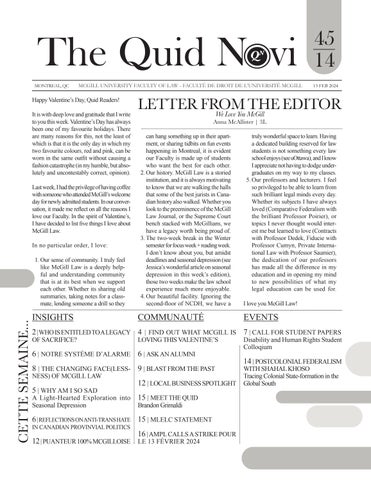
Happy Valentine’s Day, Quid Readers! It is with deep love and gratitude that I write to you this week. Valentine’s Day has always been one of my favourite holidays. There are many reasons for this, not the least of which is that it is the only day in which my two favourite colours, red and pink, can be worn in the same outfit without causing a fashion catastrophe (in my humble, but absolutely and uncontestably correct, opinion).
Anna McAllister | 3L
1. Our sense of community. I truly feel like McGill Law is a deeply helpful and understanding community that is at its best when we support each other. Whether its sharing old summaries, taking notes for a classmate, lending someone a drill so they
I love you McGill Law!
INSIGHTS
COMMUNAUTÉ
EVENTS
CETTE SEMAINE...
In no particular order, I love:
13 FEB 2024
LETTER FROM THE EDITOR We Love You McGill can hang something up in their apartment, or sharing tidbits on fun events happening in Montreal, it is evident our Faculty is made up of students who want the best for each other. 2. Our history. McGill Law is a storied institution, and it is always motivating to know that we are walking the halls that some of the best jurists in Canadian history also walked. Whether you look to the preeminence of the McGill Law Journal, or the Supreme Court bench stacked with McGillians, we have a legacy worth being proud of. 3. The two-week break in the Winter semester for focus week + reading week. I don’t know about you, but amidst deadlines and seasonal depression (see Jessica’s wonderful article on seasonal depression in this week’s edition), those two weeks make the law school experience much more enjoyable. 4. Our beautiful facility. Ignoring the second-floor of NCDH, we have a
Last week, I had the privilege of having coffee with someone who attended McGill’s welcome day for newly admitted students. In our conversation, it made me reflect on all the reasons I love our Faculty. In the spirit of Valentine’s, I have decided to list five things I love about McGill Law.
45 14
truly wonderful space to learn. Having a dedicated building reserved for law students is not something every law school enjoys (see uOttawa), and I know I appreciate not having to dodge undergraduates on my way to my classes. 5. Our professors and lecturers. I feel so privileged to be able to learn from such brilliant legal minds every day. Whether its subjects I have always loved (Comparative Federalism with the brilliant Professor Poirier), or topics I never thought would interest me but learned to love (Contracts with Professor Dedek, Fiducie with Professor Cumyn, Private International Law with Professor Saumier), the dedication of our professors has made all the difference in my education and in opening my mind to new possibilities of what my legal education can be used for.
2 | WHO IS ENTITLED TO A LEGACY 4 | FIND OUT WHAT MCGILL IS 7 | CALL FOR STUDENT PAPERS OF SACRIFICE?
LOVING THIS VALENTINE’S
6 | NOTRE SYSTÈME D’ALARME 6 | ASK AN ALUMNI 8 | THE CHANGING FACE(LESS- 9 | BLAST FROM THE PAST NESS) OF MCGILL LAW
5 | WHY AM I SO SAD
A Light-Hearted Exploration into Seasonal Depression
12 | LOCAL BUSINESS SPOTLIGHT 15 | MEET THE QUID Brandon Grimaldi
6 | REFLECTIONS ON ANTI-TRANS HATE 15 | MLELC STATEMENT IN CANADIAN PROVINVIAL POLITICS
16 | AMPL CALLS A STRIKE POUR 12 | PUANTEUR 100% MCGILLOISE LE 13 FÉVRIER 2024
Disability and Human Rights Student Colloqium
14 | POSTCOLONIAL FEDERALISM WITH SHAHAL KHOSO Tracing Colonial State-formation in the Global South
Vol 45 ● No 14
WHO IS ENTITLED TO A LEGACY OF SACRIFICE? Written for Focus Week Class 2023 - Disobedience and the Law with Lex Gill Dana-Kaye Matthews | 3L
1. Resenting a Legacy I hate when people say shit like, we should thank Black people for not treating us as we have treated them. Juliet Hooker articulated well the seemingly endless frustration of Black people being forced to endure racial trauma, humiliation and dehumanization over and over throughout history. For the good of progress. For the good of the progress of a country who despises them. Black people again and again must be the democratic losers (Hooker, 2016, p. 451) - and graceful losers at that.
QUID NOVI • 13 FEB 2024
Civil disobedience is often idealized according to the legacy of the Civil Rights Movement. Resistance is part of the fabric of Black identity. It is taken for granted that Black people should and will be on the frontlines of activist movements. Enduring violence, pain and humiliation for the greater good. When non-Black people offer well-intentioned thank yous, it feels like they’re suggesting that Black pain is a necessary evil that they’re glad Black people have to endure. Not them. Never them – thank God. And it makes me angry. Civil disobedience isn’t just beautiful, principled protest. It’s pepper spray, and handcuffs and blood. Critiques of state violence met with more violence. 2
Why is it always us? No reciprocity (Hooker, 2016, p. 449), no reprieve.
Suddenly, their race became an obvious, unavoidable Thing with tangible effects.
“What are you doing here?” “I’m in I.B” “Really?”
Us.
They knew Blackness was an obstacle in this country. But it was an obstacle that could be managed. Militant Blackness on the other hand, that was dangerous. And must be avoided at all costs.
My parents knew that we didn’t automatically belong in places. Especially professional spaces. They wanted me to be smart. Respectable and smart. People couldn’t deny numbers. People couldn’t deny grades. Black respectability meant entry. It meant belonging.
That’s the problem though. I’m not sure if I have the right to say, “Us”. I feel viscerally connected to that legacy of activism. But, it isn’t mine. Not really. African Americans, Black Canadians, my fellow Jamaicans, Black people across the diaspora all have histories of resistance: Labour organizing amongst Black porters, Marcus Garvey, Viola Desmond and so on and so on and so on. It is assumed that part of the Black condition will include a fight against the system. My relationship with civil disobedience is deeply tied to my resentment for the expectation that I always must be willing to fight and throw down to correct for a legacy of unfairly distributed democratic loss (Hooker, 2016, p. 454). But I’ve never really fought anyone, so I’m not even sure that resentment is mine to claim. 2. The Cost of a Legacy My parents are apprehensive about me associating too closely with the legacy of Black activism. My parents were plunged into Otherness when they came to Canada. In Jamaica, they were Horace and Nicole. Here, they are ‘visible minorities’. My dad always sneers when he hears that term.
My parents knew that non-Black people do not differentiate. My hair and my skin were symbolic. No matter my heritage, I was connected to a legacy of the ‘wrong way’ to fight for change. The Angry way, the Scary and Unruly way. 3. The Armour of Respectability Most of my middle and high school experiences were spent running away from being branded: Angry, Scary, Unruly. In 7th grade, I switched from the majority Black, French Immersion program to the nearby International Baccalaureate (IB) school. It was packaged as a school for academically gifted students. I was one of 2 Black Girls. By high school, it was just me. “My brother told me that they only let Black people in so IB doesn’t seem racist” My friends and I were sitting in a circle in the gym, when one leaned in and whispered that statement conspiratorially. I always wondered if she’d simply forgotten I was still there.
4. The Cost of Respectability “You’re really good with white people”. A black friend said that to me when I was in my 3rd year of University. She said it with a slight sneer. It was not a compliment. Black respectability always has a cost. Investment in Black respectability creates a Good Black Person/ Bad Black Person dichotomy. It claims Blackness is only salvageable, only worthy – based on proximity to respectability as defined by whiteness. In her book, Policing Black Lives: State Violence in Canada from Slavery to the Present, Robyn Maynard asks who is left behind when we apply the Good/ Bad Dichotomy framework to condemnations of state violence (2019, p. 42). What happens when we dismiss the victimhood of the young person involved in gang activities and instead only mourn the promising univer-
sity student with a non-threatening smile? Are only the legally innocent deserving of mercy? Do we write off criminalized Black bodies as deservingly discarded by the State – “legitimate targets of [state] violence” (Osterweil, 2019, p. 8)? Are we more loyal to the “justice of law and order” than the treatment demanded by our innate humanity (p. 3)? These authors’ words feel like an accusation. I have run from criminalization my whole life. My fear of criminalization has been informed by police brutality and a mistrust of the police taught by family, peers and media. Above all, however, I am scared of criminalization because of the damage it would do to my image as the Respectable Black Girl. Criminalization for any reason felt like proving the biases around me right and that was insupportable. “Yeah, we were at Shopper’s World during the black out. It was wild. My mom was, like, ‘hold onto your purses or the Black people will come steal from you’! Lol…….Sorry Dana-Kaye” I was most concerned with my peers having more evidence to back up their stereotypes. I didn’t question the fairness of criminalization. I did not question the racialized social and economic circumstances that led to it. I dismissed criminalized Black people as disappointments – letting the rest of us down. In the Good/Bad dichotomy I had deemed them, “Bad’. Therefore, they must be discarded and dismissed in order to maintain an image of Blackness
that I liked and could be proud of. Robyn Maynard would probably shake her head. 5. Respectability and the Legacy of Black Civil Disobedience Civil disobedience was similarly threatening. Though important and admired, it was Angry, Scary and Unruly. Whether borne of criminalization or impassioned resistance, the armour of respectability has little patience for unruliness. And unruliness scared me. In the wake of the worldwide protests following George Floyd’s murder, I heard about the arrests and the tear gas and the chaos. And I was petrified. A protest in solidarity was coming up where I lived. So I laid in my bed and I agonized. Should I go? Would I go? Who would go with me? I thought about being maced. I thought about being arrested. I felt like I was choking. And then, a post from a local black organizer. She was warning would-be black protesters about going alone. She was warning about the threat of Covid-19 in the likely crowded place. And I cried. I cried with relief because I had permission not to face my fears. I posted on Instagram instead, from my prone position in bed. Something short, about how overwhelming it all was. How the collective grief threatened to choke me. Was choking me. I wasn’t lying but I still felt
dirty. I knew that no one would call me out for being performative. I knew I could hide behind the legacy of Black activism while sitting safely in my bed, and I would be lauded all the same. I felt broken and deceitful and disgusting. Lying in my bed grieving a man in a country I am not from. Who felt so far and yet an arm’s reach away. I am of two minds: Non-Black people do not differentiate. I know the legacy of Black Americans informs how people treat me, how Canadian society treats me. Slavery is my history too. Non-Black people constantly ask me to educate; rip myself open and place my trauma in their hands, explain and explain and explain. And I am tired. And hurting. Do I have to submit to Black martyrdom too, to be deemed worthy of the legacy of Black Civil Disobedience? And yet. I know I haven’t risked anything. I have never risked the Respectable Black Girl. I have never felt safe to risk her. My parents sacrificed so much to give me access to her. In some ways, she felt like resistance. She felt like revenge against my classmates and their biases. But she appeals to standards of merit and behaviour informed by white supremacy. An individual victory won’t beget a systemic one. But God, I am so scared. Civil disobedience doesn’t feel like an option for me. I don’t feel hopeless enough nor hopeful enough to justify it to myself. The potentially fatal
stakes are never far from my mind. Non-Black people do not differentiate. I’d still be a black body. I think of what a wonderful victim they’d fashion me into. How much I would symbolize – with my grades and my ‘good with white people’-ness. And then, all that work to be the Respectable Black Girl would be used to speak of progress, a safe sort of progress that didn’t threaten the ‘almost just system’ (Rawls, 1991, p. 106). I have no interest in being a martyr that the system can use to prop up its own progress and continue to justify itself. I don’t know if there are only 2 choices: civilly disobedient or a traitor to the cause. The armour of respectability has never silenced me. I have used the Respectable Black Girl to be loud and obstinate and skeptical in spaces that expect acquiescence. I refuse to be the safe minority who is willing to negotiate with an oppressive system on its terms (Manuel, 2017, p. 29). I don the armour of the Respectable Black Girl that my parents so lovingly provided me. It gets me closer to authority figures and lowers their defences (Good with white people, remember?). With poems and speeches and meetings, I ask them to their face to look me in the eye and listen to me. And I’m not sure if it’s doing anything. Or if it means anything. But, it’s how I’m disobedient. At least it’s not silence. It feels like honouring the individual sacrifices of my parents and the legacy of my diasporic community in my own small way, however inadequate. 3
Vol 45 ● No 14 References John Rawls, excerpts from Chapter VI (“Duty and Obligation”) in A Theory of Justice (1971) in Hugo Adam Bedau’s Civil Disobedience in Focus (1991) Juliet Hooker, “Black Lives Matter and the Paradoxes of U.S. Black Politics: From Democratic Sacrifice to Democratic Repair” in Political Theory, Vol. 44(4) 448–469 (2016) Vicky Osterweil, “Introduction”, from In Defense of Looting, Bold Type Books (New York), 2019 Art Manuel, “The Grassroots Struggle: Defenders of the Land and Idle No More” in In Whose Land is it Anyway? A Manuel for Decolonization (2017)
QUID NOVI • 13 FEB 2024
Robyn Maynard, “ On State - Violence and Black Lives” in Policing Black Lives: State Violence in Canada from Slavery to the Present (2019), pp. 20-49
4
FIND OUT WAS MCGILL IS LOOOVING THIS VALENTINE’S
WHY AM I FEELING SO SAD? A Light-Hearted Exploration into Seasonal Depression Jessica Keer Li | 2L
Please read the following two sentences in the exaggerated intonation of an overenthusiastic radio host/salesman: “Have you been struggling with winter blues, February funk, seasonal melancholy or cold-weather slump? Well then, my friend, I have the perfect solution for you: a new, sleek, functional, and LED energy-efficient lamp is now on sale at 3644 Peel Street! Call now at 111-1111111 before quantities run out.” Please go back to reading the rest of this column in your normal, internal-monologue voice: When I tell people that I’ve been feeling down lately, a lot of the advice I’ve been getting in return has felt as disconnected as a radio ad pushing capitalistic, retailer interests in response to depression. Seasonal winter depression, or more scientifically, winter-pattern seasonal affective disorder (SAD), is a type of depression characterized by a recurrent seasonal pattern, with symptoms lasting about 2-3 months out of the year. Often used colloquially to describe feeling ‘down’ in the cold, long months of Montreal winter (although this year’s winter’s been a little all over the place in terms of weather…), I think most everyone has felt to some extent and to some degree the effects typical of SAD. Indeed, these symptoms can manifest as feelings of numbness, pessimism, irritability, guilt, worthlessness, loss of interest in hobbies, fatigue, difficulty concentrating, oversleeping and social withdrawal. Studies indicate that people with winter-pattern SAD have reduced levels of the brain chemical serotonin, which helps regulate mood. This can be caused by reduced exposure to
sunlight, and with less daylight in the winter, people with SAD may have lower vitamin D levels, further reducing serotonin activity. For some, it’s been a big SAD; for others, it’s been a smaller SAD this winter. Personally, I have been struggling with bigger SAD effects than usual. I don’t know if it’s the lingering holiday fatigue (can we talk about how short the McGill holiday break felt?!) or an imbuement of the anxiety of Course aux stages rolling off the faculty halls, the overall political state of our world, or even just burnout from taking on far too many commitments; but it’s been a difficult start to 2024. Amongst what’s been keeping me afloat is the occasional couch-rot weekend where the computer remains closed and wherein the academic brain indulges in silly sitcom TV (I recommend Abbott Elementary on Disney+). Other coping mechanisms for me have been ski runs down the mountain and moments passed in silence with a book in hand and my dog at my feet. Most importantly, the ultimate anchor throughout all this has been the community of people I’ve chosen to surround myself with. While this may sound corny, seeing the people I love come together, seeing them dance, sing, laugh, (aggressively) play flip-pong and just let loose in a small, over-heated apartment has been a marking moment where I’ve felt my heart heal a bit. While I don’t have the perfect solution, answer or “new, sleek, functional, and LED energy-efficient lamp” to offer in response to grappling with these feelings, if there’s one thing to take away from this read, it would be the reassurance
that feeling sad or feeling the effects of SAD is not an individual experience. So many others are also working through such feelings. If navigating it alone is what works best for you, then, by all means, couchrot away. But there’s also an abundance of resources and people that can be of help, especially as we sit in the midst of February gloom. In terms of law school resources, our Local Wellness Advisors, Heleen and Shrabani, are trained mental health clinicians and can be of invaluable help by being resource persons to turn to in times of need and in times of not-need for continuing well-being reasons. They also organize a ton of wellness workshops throughout the semester. Moreover, the Student Wellness Hub provides a range of services to support the well-being of McGill Students, focusing on awareness, prevention, and early intervention. Their website lists all of their services. Lastly, although I previously stated that lamps might be an inappropriate response to seasonal depression, the Gelber Library actually has light therapy lamps, which have been scientifically proven to ease symptoms of SAD by mimicking outdoor light. Students can borrow these for up to two weeks. In conclusion, be extra gentle and attentive to your friends and loved ones during this period of winter blues, February funk, seasonal melancholy or cold-weather slump. Feeling small-sad, big-SAD, and everything in between is okay and will pass. After all, there are less than 40 days until we reach spring, warmer weather, burgeoning flowers and temperatures that call for light cardigans instead of lined parkas. Hang in there, I promise there’s ‘light’ at the end of the tunnel. 5
Vol 45 ● No 14
NOTRE SYSTÈME D’ALARME La normalisation de la culture du viol Pénélope Beauchemin | 2L
Nous vivons dans un système d’urgence. Je ne mâcherai pas mes mots, la société a normalisé la culture du viol. Qu’est-ce la culture du viol? Les petits actes perçus comme étant triviaux: insister dans un bar, toucher sans le consentement, le catcalling, etc. D’un côté, force est d’avouer qu’on ne peut pas criminaliser tous les gestes déplacés de ce monde. Nous sommes bien placés pour savoir que le système de justice (déjà engorgé) ne serait pas prêt à recevoir une plus grande quantité de plaintes. La Charte serait probablement aussi invoquée; la Cour n’étant pas la voie la plus adaptée. Cela ne rend certainement pas le comportement plus acceptable. Mais, un geste interdit sans conséquences, demeure-t-il vraiment interdit? Sans contraintes, ne reposonsnous pas uniquement sur la bonne foi en demandant poliment de ne pas être problématique pour le bien collectif? Alors, nous ne faisons rien. Je ne crie pas ici à l’inaction personnelle, parce que même si on le voulait, aucune option
valide n’existe. Nous ne porterons pas plainte à la police pour tous les individus qui nous touchent dans un club. Sur l’échelle objective de la gravité des infractions, il existe pire et la justice doit prioriser et trier. Les délais judiciaires sont déjà trop longs. Il faut vivre le pire pour mériter la mobilisation des ressources. En dessous du seuil abstrait de la grande violence, nos expériences n’en valent pas suffisamment la peine. Alors, nous ne faisons rien. Ces petites agressions sont des bombes à retardement, qui un jour exploseront quand l’individu qui avait d’abord commencé par des gestes banalisés commettra un geste qui ne l’est pas. En attendant, nous servons un comportement problématique sur un plateau d’argent à la prochaine victime en lui souhaitant de ne pas être celle qui tiendra la bombe quand cette dernière explosera. On promettra alors que cette fois la situation sera prise au sérieux. On dira qu’on « l’avait vu venir » et qu’on « n’est
pas surpris.e ». Et à ce moment, il sera trop tard. Il en restera une victime avec la lourde tâche de porter plainte et de multiples « petites » victimes à qui on a dit que leur expérience ne valait pas le temps et la mobilisation du système. Notre système réagit après coup. Il s’excuse et il regrette. Outre une révolution complète, je n’ai pas de solution réaliste à offrir. Peut-être que l’aspect préventif ne relève pas du système juridique. Peut-être que la solution réside dans une décentralisation, une justice alternative ou un meilleur accès à la justice. J’espère qu’un jour quelqu’un qui étudie dans notre faculté trouvera une solution. D’ici là, nous avons l’option de soutenir nos proches et de valider leur ressenti. Nous avons l’option de vivre chaque jour avec respect, parce que chaque personne, surtout nous, les femmes, nos sœurs, nos mères et nos amies, vit avec des expériences qui n’ont pas pu être entendues.
ASK AN ALUMNI QUID NOVI • 13 FEB 2024
McGill Law Alumni are here to answer your pressing questions! We asked: If you have continued to practice, what has kept you interested in the law? What keeps you excited about working in the legal profession?
Steven P. Hinkley - LLB ‘99 Justice of the Alberta Court of Justice, Judicial District of High Prairie What I love about the profession after 24 plus years, and particularly in my role as a Judge, is how the law is living and changes with its practical application to the everyday lives of the people it touches. It’s the human element which keeps the law dynamic and interesting every day!
6
Amee Sandhu - LLB ‘98
Stephen Fisher - BCL ‘72, LLB ‘75 Retirement.
Excitement: always learning and growing and doing new things. Seeing also that the older I get, I see that the solution is always to simplify the problem as much as possible. This makes connecting with non-lawyers easier and more beneficial to us both, and thus work becomes more meaningful.
Disability and Human Rights Student Colloquium
CALL FOR STUDENT PAPERS The Disability Initiative of the Center for Human Rights and Legal Pluralism invites the submission of student papers related to disability and human rights. Selected student papers will then be invited to do an 8-minute presentation of their work at the 2024 Disability Initiative’s Student Colloquium. Paper submissions will be accepted from McGill University and other law schools in Canada and can be written in French and English. Cet événement sera bilingue et sera en format hybride, permettant ainsi aux étudiants de partout au Canada de présenter leurs essais. Le Colloque aura lieu le 22 mars 2024 à 13h à la Faculté de droit de l’Université McGill et en ligne (Zoom). Deadline for submission: February 23, 2024, at 5 pm. Submission: Please submit your paper to chrlp.law@mcgill.ca, with the subject line “Submission for the Disability and Human Rights Colloquium”. Please contact the Center for Human Rights and Legal Pluralism for any accessibility accommodations.
7
Vol 45 ● No 14
THE CHANGING FACE(LESNESS) OF MCGILL LAW Orden Deko | 3L
I am interrupting your regularly scheduled programming on language and law to raise awareness about a recent trend permeating our online community. I am specifically talking about the use of anonymity within the general Facebook group. Ever since last summer— or if, I am wrong, perhaps even earlier—a multiplication of posts have emerged, not all of which merit facelessness. Perhaps I am one of few that is bothered by such a shift, but I am not alone in detecting it.
QUID NOVI • 13 FEB 2024
Before I begin what some might perceive as a rant, I think it’s necessary to contextualize this particular form of anonymity. Of course, the evident ramifications of digital anonymity include increased cyber-bullying and harassment, but it serves equally as a tool for good; protecting political dissidents, for example, or providing a sense of comfort to discuss intimate details of one’s life. For this latter purpose, the feature of anonymity in Facebook groups was created. Although groups were introduced to the social media in 2010, it was around a decade later that we could start interacting without divulging our identities. The feature first materialized in health support groups where members congregated to seek information about their health conditions, special disease, or substance use disorders. The nature of such information and potential stigma makes the need for confidentiality quite obvious. If you’re going to share certain information that is directly linked to your lived experience, you should enjoy the privilege of anonymity. Details like mental health, sexual orientation, gender identity, familial situation, past criminal record, experiences with assault, socioeconomic status, academic progress, to name some, are often difficult to disclose. This means that the only way to seek guidance relating to these issues would be to do so anonymously. The problem arises when people hide their identity for questions that are more mundane, for lack of a better word. This is the trend that I have witnessed and that I think we should investigate. Asking about a syllabus, notes for a missed class, instructions on accessing a textbook, recruitment information, how to use a printer, lost items, among other simple inquiries, do not reflect the intimate nature of the more serious aforementioned examples. Neither does their reoccurrence convey a positive message. In writing about one’s experience of harassment or asking where to seek financial assistance, for example, the anonymous user is improving our digital community. In “breaking the ice”, they are assuring readers, some of whom may have a similar story, that they are not alone in whatever they are dealing with. This sense of acknowledgement can encourage others to either publish follow-up posts or also speak up in an effort to share resources. Anonymizing simple questions does not impart a similar sense 8
of validation. Instead, it has two unintended effects. First, it maintains a feeling of embarrassment or shame. Second, it erodes the sense of community central to our law school. Concerning this first point, one must ask, why are students asking for a syllabus anonymously? Maybe it comes from a place of embarrassment that they don’t know or anxiety of “putting” themselves out there? These are the only reasons I could conceive of regarding this development. It is necessary therefore to reassure students that you do not need to feel this way. No one will think poorly of you for asking simple questions. In this case, it is not the content of your question that raises eyebrows but that you are concealing your identity. Oftentimes your queries are useful, and anonymity eliminates the potential for future readers to message you directly if they have identical concerns. This practice also projects the idea onto onlookers that it is necessary to ask anonymously, or they’ll incur some social cost. This subsequently impacts the dynamic of our social spaces. Unjustified anonymity thus carries the secondary repercussion of eroding the faculty’s sense of community. It makes no sense that one user can anonymously benefit from the non-anonymous assistance of a fellow student. While our group partly operates as an information centre, it should not be dwarfed into a customer service chat box. Ultimately, it is important to recall the words of Facebook’s guidelines themselves, which point to a ‘moderate usage’ of anonymous posting.1 Even closer to home, we can look to the anonymous posting policy of The Canadian Law Forum, the successor of lawstudents.ca, at one point the preeminent internet space for lawyers and law students across Canada. Their rules indicate a justifiably cautionary approach to anonymity which excludes “anything about your LSAT score or GPA, your failure to find a job, your law school grades, failing the bar exam, failing to secure articles, or generally anything that may be seen as personally embarrassing but is of otherwise little consequence to anyone but you.”2 The operative word here appears to be “consequence.” While there are potential consequences of speaking candidly about your mental health journey, none arise from asking about a professor’s office hours, for example. This delineation is likewise applicable to our faculty; you are not just a student but part and parcel of a larger group. This does not mean that everyone needs to know everything about your life, but it does mean that, sometimes, you ought to participate openly. See “Facebook Group Members Now Have the Option to Post Anonymously” (20 June 2022), online (blog): < www.facebook.com/community/whats-new/ facebook-group-members-now-have-the-option-to-post-anonymously>. 1
See “Introducing Limited Anonymous Posting“ (12 November 2021) online (forum): The Canadian Law Forum <canlawforum.com/topic/1490-introducing-limited-anonymous-posting>. 2
BLAST FROM THE PAST When love knew no bound(arie)s at McGill Law Historically, the Quid’s Valentine issue has been, as the kids of 2024 say, completely unhinged. With levels of romantic debauchery similar to those of Frosh Week or Medlaw, this special holiday allowed Quid readers the chance to attempt to make up for missed connections by publishing a message addressed to a Faculty crush. Valentines messages published in the Quid from February 1990 range from sweet to downright dirty. Would you be brave enough to publish something like this in 2024? P.S. There are 5 complete pages of Valentine messages in the 1990 edition. I have tried my best to pick a sample representative of the audacity exhibited by the 1990 Faculty of Law, but there are plenty more for next year’s Valentine Blast from the Past.
9
Vol 45 ● No 14
REFLECTIONS ON ANTI-TRANS HATE IN CANADIAN PROVINCIAL POLITICS
QUID NOVI • 13 FEB 2024
Gillian Smith | 2L
The global wave of transphobia has officially hit Canada, and it’s hitting us hard. The policies announced by Alberta Premier Danielle Smith at the end of January followed legislation implemented in Saskatchewan and New Brunswick last year which required teachers to obtain parental permission in order to use a different name or pronoun for students under the age of 16. That legislation effectively requires teachers to “out” students to their parents, telling parents that the child may be trans when the parent may not already know and the child may not be ready to tell them, or may have legitimate fears for their safety if their parent finds out. Alberta’s policy is adding onto this approach by requiring parents be informed if a student under 18 requests to use a different name or pronoun, [which has the effect of] outing students to their parents. This will seriously harm an already vulnerable minority group. TransPulse Canada found in 2021 that 1 in 5 trans youth already avoided school in the past 5 years for fear of 10
harassment or outing, and 72% had been verbally harassed.1 Only half of trans youth surveyed were called by the correct name, pronouns, and gendered language by their parents, and only 58% of parents supported their choice. 2 in 5 trans youth had considered suicide in the past year, 1 in 10 had attempted suicide, and nearly 1 in 5 had insecure housing. 1 in 4 youth had a family member who had stopped speaking to them when they came out as trans, and 1 in 5 had family that did not let them dress in a way reflecting their gender. Given these statistics, outing trans kids presents a material danger to their safety. Parents will also be required to opt-in in order for their children to attend any For the statistics provided in this paragraph, see TransPulse Canada’s report “Health and Wellbeing Among Trans and Non-Binary Youth: Health disparities and the importance of social support” found at https://transpulsecanada.ca/wp-content/uploads/2021/06/ Youth-PPCT-Report-vFINAL_EN-ua.pdf. 1
lesson at school concerning gender identity, sexual orientation, or human sexuality. This opt-in requirement for sex education will simultaneously deny 2SLGBTQ+ students the chance to better understand themselves, while putting cisgender (non-trans) students at increased risk of pregnancy and disease. It also limits a crucial opportunity for students to be taught about boundaries, healthy relationships, and consent. Trans women will also be banned from participating in women’s sports, a move that stems from the fear mongering of the American far-right but has little basis in reality. Many organizations have broken down the misinformation concerning transgender athletes, including the ACLU, the HRC, and the Canadian Centre for Ethics in Sport. Trans people vary in athletic ability just like everyone else, and assumptions (not backed in research) that trans women have an inherent biological advantage need to be weighed against the (clearly proven) social disadvantages of transphobia and transmi-
sogyny that also impact their access to and performance in sports. The actual implementation of these policies is also highly influenced by antiBlack racism, as can be seen in how these policies have been used against Black cisgender women in sports.2
tions or breast cancer. In light of these circumstances, many Albertan organizations have spoken out against the policy, including pride organizations, 2SLGBTQ+ service organizations, and non-profits operating in other sectors such as social work, sports, and law.
Alberta’s policy also includes provisions relating to trans healthcare that are equal parts harmful and nonsensical. It bans all gender affirming surgery for youth under 18, and puberty blockers and hormones for youth 15 and under. For anyone 16 or older who does want to start receiving gender affirming care, parental consent is required.
Here in Québec, any progress on trans rights is on pause as we wait for a “comité de sages” composed of three cisgender people to “study issues of gender identity.” The committee has been denounced by many 2SLGBTQ+ organizations as the government capitulating to the demands of transphobes.5 While the Québec government has been ordered to provide non-binary people with an X gender marker on birth certificates,6 they refuse to do so on other identity documents until the committee finishes their work in 2025.
Trans healthcare is lifesaving.3 Puberty blockers allow trans youth to delay the onset of puberty while they come to terms with their gender identity. They can later choose to either go off blockers and undergo the puberty of the sex they were assigned at birth, or commence hormone therapy and undergo another form of puberty. By being able to delay puberty, blockers save trans youth an unquantifiable amount of misery in what is already a difficult time. They also save trans youth from further difficulties later in life from undoing an unwanted puberty. The impact of these blockers is useless if they cannot be used before someone is 16; this policy will inflict unneeded stress and misery onto trans youth. Other parts of Alberta’s policy respond to a “problem” that does not exist. The required age for genital reconstructive surgery in Canada is 18. While those 16 and older can receive mastectomies or “top surgery,” only 23 Albertans did so in 2023.4 There is no data on how many of these mastectomies were for reasons other than gender affirming care, such as breast reducSee the treatment of Beatrice Masilingi, Christine Mboma, and Caster Semenya by World Athletics. 3 See studies from the Endocrine Society, the World Professional Association for Transgender Health, the American Academy of Pediatrics, the Trevor Project, among others. 2
This information comes directly from the reporting of the Alberta Medical Association. 4
The Commission des droits de la personne et des droits de la jeunesse ordered the Société de l’assurance automobile du Québec to issue one person a driver’s license corresponding to their gender marker, but in the meantime, the rights violations detailed in the Centre for Gender Advocacy v Attorney General of Québec case will continue. The Superior Court of Quebec stated that it is unconstitutional to force non-binary people to be identified by a sex that does not correspond to their gender identity. This ruling drew on expert evidence which showed that transgender people avoid seeking medical attention when they are at risk of being misgendered due to the gender marker on their health card. In most situations in which an identity document is used, that document is a health card or a driver’s license, not an act of birth. Thus, in practice, the government is still failing to abide by the spirit of the court’s ruling. There is a profound fear that the Quebec government’s committee on gender identity will be used to institute a Québecois version of the policies seen in Alberta, You can read and sign a Call to Action against the committee at www.pas-sages.info. 5
See Centre for Gender Advocacy c. Attorney General of Quebec, 2021 QCCS 191. 6
Saskatchewan, and New Brunswick. While the CAQ has stated that the committee would not be used to roll back trans rights, none of the governments who have implemented these policies would admit that their policies amount to a “roll back” of trans rights. Instead, they pitch these policies as “preserving children’s choices in the future”7 and as “supporting parental rights.”8 Politicians enacting these policies claim that they mean to be inclusive,9 that they aim to protect trans rights,10 and that trans people are supported and cared for by their governments.11 They know that outright attacking trans rights would be unpopular, so they hide policies that do just that in the language of acceptance. Trans people are scared right now, and we need allies. At protests this past autumn children called me slurs. My community and I can feel the increase in stares and negative attention we receive for being gender non-conforming in public, something I thought I had left behind when I moved to Montréal. That’s just my experience as a sometimes cis-passing white transmasculine person. From talking with my community, this discomfort is particularly strong for trans women and non-binary people impacted by transmisogyny, and for Black, Indigenous, and otherwise racialized Two Spirit and trans people. We no longer feel as safe here as we once did, and we need help from everyone to stand against transphobic rhetoric and policies so that trans people can reclaim our safety. See Danielle Smith’s video on X/Twitter announcing the policy, found at https://twitter.com/ ABDanielleSmith/status/1752814944716734935. 8 See the title of Scott Moe’s bill discussed above, the “Parent’s Bill of Rights. 7
See commentary from Scott Moe during a press conference regarding the policy his government introduced, found at https:// www.cbc.ca/news/canada/saskatchewan/ moe-pronoun-policy-1.6973346. 10 Another line from Danielle Smith’s announcement video. 9
Also said in Danielle Smith’s policy announcement video. 11
11
Vol 45 ● No 14
PUANTEUR 100% MCGILLOISE Julien Bérubé | 1L
À peine entré.e, une odeur putride vous étrangle. Vous faites un pas de plus, incertain.e. Vous voyez sur les murs des graffitis et des traces de mobilier arraché, en continuant à marcher de peine et de misère. Plus loin, les néons crus clignotent pour vous révéler des sacs à ordures noirs en pleine vue et une peinture beige écaillée qui rendrait jalouses les pires polyvalentes. Une chaise en cuir incongrue se tient au milieu de la pièce. Sommes-nous dans un film d’horreur? Dans une morgue? Non, bien pire : nous sommes dans la toilette des hommes du sous-sol de la faculté de droit de l’université McGill. Lavabos étrangement fragiles, nettoyage aléatoire, odeurs nauséabondes, serrures cassées, distributeurs
à papiers antiques… Comparé à la digne allure de nos autres bâtiments, le niveau de négligence qui afflige nos toilettes est tout simplement stupéfiant. Ce n’est pas compliqué : comme je l’ai entendu dans un corridor, « ici, chier fait chier. » Et c’est lorsque des toilettes existent : on m’a rapporté, à ma grande surprise, que pour l’équivalent des 10 urinoirs et 6 cabines qui occupent la toilette des hommes, un grand total de 2 (!) cabines est disponible dans la toilette des femmes au sous-sol. C’est quelque chose d’avoir des toilettes médiocres, c’est autre chose de ne pas en avoir du tout. Dans une faculté où plus de la moitié de la population étudiante s’identifie à une femme, c’est incompréhensible d’avoir un déséquilibre
si grand. Notre faculté mérite d’être un endroit où on se sent bien, ce qui a été remarquablement réussi grâce au soin architectural qui a été donné aux étages supérieurs. Mais compte tenu du temps que nous y passons chaque jour et de leur nécessité, je trouve particulier que les toilettes des étudiant.e.s aient été les grandes oubliées. J’aimerais conclure en proposant un scénario des plus effrayants : imaginez un.e invité.e de marque ayant la grande malchance de mettre les pieds (devrais-je dire les fesses?) dans les toilettes du sous-sol. Nous pourrions être certain. es de perdre notre crédit auprès d’eux pour toujours. Devrons-nous attendre de se faire boycotter par la Cour suprême avant d’agir? Pour
qu’un besoin essentiel cesse d’être une tâche répugnante et un risque pour la réputation de l’université, il est grand temps selon moi de porter une attention bien méritée aux pauvres toilettes de notre faculté. Quelques statistiques sur les toilettes du sous-sol :
4 toilettes bouchées par des sacs de plastique noirs pendant des mois
8x le nombre de toilettes
pour hommes comparées à celles pour femmes
1 chaise à la fonction
inconnue au milieu de la salle de bain
3 portes non-fonction-
nelles chez les hommes mettant notre vie privée en péril
on wholesale prices to students in LOCAL BUSINESS SPOTLIGHT: passes order to provide them with at-cost sexual health products. The Shag Shop closed A SEX STORE ON CAMPUS? for the pandemic, but recently reopened The Shag Shop - Brown Student Services Building, Floor 3 in the Healthy Living Annex in June 2023. Presently, The Shag Shop
QUID NOVI • 13 FEB 2024
Anna McAllister | 3L
Have you ever been in the library and thought, “Man, if only there was some place on campus to buy fuzzy handcuffs, lube, and an anal plug” ? If you have, boy, do I have good news for you. In the spirit of Valentine’s, I conquered one of the sexiest (and oddest) places on McGill Campus to bring to you a spicy small business spotlight - let me introduce you to The Shag Shop. Located in the Brown Student Services Building, The Shag Shop is a not-for-profit sex store run as part of the McGill Wellness Hub. Inside, you can find a plethora of X-rated toys, as well as menstrual products and sexual health information. Established in what the manager of The Shag Shop thinks was 2006, this store 12
is only open from 11-3 Monday through Friday, so plan ahead if you want to pick up a dildo on your way to class. While in the world of Amazon and online shopping I can’t quite understand what would possess someone to buy a strap-on on campus, I am happy this service exists for those bold enough to freely embody their sexuality. Perhaps you can pick up a last-minute Valentine’s gift?
13
QUID NOVI • 13 FEB 2024
Vol 45 ● No 14
14
MEET Copy THE QUID Editor Brandon Grimaldi | 3L
Where are you from/ where have you lived? I was born in Montreal and lived my whole life in the eastend borough of Saint-Leonard. What drew you to the Quid? I was always interested in journalism, particularly those run by students, so I was very excited to learn McGill had the Quid to offer. The fact that the Quid is able to combine, strong researched works, opinion pieces and some more laid-back articles all in one is something that I enjoy reading and contributing to.
Was law school a dream come true or happy accident? Do you want to be a lawyer? I’m not the “I’ve wanted to be a lawyer since I was 2” type of person but attending law school, was a goal of mine for quite some time. That being said, I was very happy that my midnight frantic caffein-fueled essay writing all these years prior paid off and I am where I want to be. As for wanting to become a lawyer, I do. I thought I knew what I wanted to practice but just in my first year I’ve been introduced so many areas of law that my answer to that question is now easily summed up as: TBD. What do you enjoy doing when you’re not studying? Depends on the time of year. In the winter I am a huge Netflix-Prime-Disney+ binger, I will go to bed at 3am if it means that I would finish the season. Otherwise, in the summer I’m usually out and about with friends, taking advantage of the city’s great restaurant seen or finding quiet places along the river to enjoy the weather. As for fall and spring, I guess it would a healthy mix of everything I’ve mentioned.
Where would you like to travel in the next five years? I hope that in the next five years I’d have to opporWhat did you do before McGill Law? tunity to go to Europe, not necessarily as a vacation Just a few Metro stops away, I completed my undergrad in Polit- but more of an excursion. I’d like to be able to spend ical Science and Public Policy at Concordia (they had a tunnel, good amounts of time in each of the places I visit and but I got over it, walking up Peel in the winter is way more fun) experience the most of what Europe has to offer.
MLELC STATEMENT The McGill Labour and Employment Law club would like to bring the following information to student’s attention. Following the email sent Monday, February 12th, 2024 from Francis Desjardins, the Director of McGill’s Human Resources department, counsel for the Association of McGill Professors of Law released the following statement clarifying important information regarding picketing rights during today’s strike. Mr. Desjardins, We have been mandated to write to you concerning the message you sent to the Law Faculty this morning (seen below). In this message you write “McGill recognizes the right to labour action within the parameters of the law and hopes that impacts on students and colleagues will be kept to a minimum”. We wish to
remind you that the point of a strike that is exercised within the parameters of the law is that it be impactful, so as to favour the conclusion of a collective agreement. As such, your message can lead colleagues and students to be misled as to whether or not the strike is lawful, should it be impactful. We trust however that this is simply an oversight on your part. Furthermore, and more importantly, you write: “We expect to see picket lines on public property around the downtown campus, as is within the rights of striking employees. However, they may not picket on University grounds (…)”. The underlined portion is incorrect and misleading. As you must surely know, employees have the right to peacefully picket and this right can extend to University grounds. We are enclosing a link to a recent decision from the Tribunal administra-
tif du travail that states that a blanket prohibition similar to the one you just announced, issued by McGill University Health Centre is a violation of section 12 of the Quebec Labour Code and does not respect freedom of association or expression under section 3 of the Quebec Charter of Human Rights. The Tribunal also orders punitive damages against the MUHC. Therefore, we trust that this sentence was also a mistake and given its importance, that will be corrected immediately by a subsequent e-mail. Please note that our client intends to exercise its fundamental freedoms as permitted by the law, especially the Quebec Labour Code and the Quebec Charter and trusts McGill University will respect those freedoms. Also note that our client can and will exercise any and all necessary recourses in that regard. Cordially, Me Sibel Ataogul 15
Vol 45 ● No 14
AMPL CALLS A STRIKE FOR FEBRUARY 13, 2024 FAQ for Students The Association of McGill Professors of Law (AMPL) has called a one-day strike Tuesday February 13. We owe you, our students, an explanation of why we made this decision. We regret that the work stoppage, which will affect all of our teaching, research and administrative duties, inevitably has consequences for our students. But we have come to the conclusion that without strike action, the University will not bargain in good faith. The University’s pattern in collective bargaining is well known: to refuse to meet with our bargaining team on a frequent and regular basis and, when we do meet, to arrive unprepared, and proceed at a snail’s pace. We know this is their pattern because the University dragged out first-contract negotiations with the course lecturers’ union (MCLIU) for three years. The pattern is repeated with us. The University has granted us only two and a half days of negotiation between now and the end of semester. We have offered to work early, through evenings and on weekends if necessary to make progress, but the University has refused. All the while, the University continues to challenge before the courts our very right to exist despite a resounding decision of the Tribunal du travail certifying the union. We strive to teach you, our students and future colleagues, the importance of measured disagreement, fairness in judgment, and good faith in negotiation. We expect you to demand it from us and from your peers. We demand it as well from the University.
QUID NOVI • 13 FEB 2024
As the first faculty union in the history of McGill, we know that any negotiated change that constrains the discretion of the administration paves the way for improvements in working conditions not just for us, but for the entire campus. We are compelled to use the one method at our disposal – the right to strike – to change the dynamics of the bargaining process. The strike affects your education. We understand. But what is at stake is the need to resolve basic working conditions, including a guarantee of a minimum number of professors on the Faculty in order to maintain an adequate student-professor ratio given the recent hiring freeze and discussion of increased enrolment levels. The conditions for your education are at stake and we strongly believe that the interests of students and professors are aligned. Our working conditions are your learning conditions. We created these Frequently Asked Questions so that students can better understand the context of these negotiations, the tactics deployed, and the possible consequences of the actions of the Association. 16
1. What are the issues behind AMPL's bargaining position? This is AMPL’s first collective agreement. As such, after extensive consultation with all of its members, AMPL prepared a comprehensive proposal containing thirty-two articles that lay out our monetary and non-proposals. Over the past year of negotiations, we have settled 17 of those articles, but crucial dimensions of the collective agreement remain unresolved. Some of them pertain to faculty working conditions: • appointments and reappointments • promotions and tenure • terms and conditions of employment • duties and responsibilities of faculty members • faculty research support • working environment and administrative support • leaves of absence (including sabbatical leaves) • response to financial exigencies Other pertain to the governance of the Faculty: • the rights and privileges of the Association • the term of the agreement • the appointment and reappointment of the Dean And of course, other pertain to monetary proposals: • salaries • employee benefits • merit pay. In many of the issues pertaining to working conditions, AMPL’s approach has been to propose that the current regulations be adopted, provided that the areas where the University now has unbridled discretion be curtailed, and that AMPL be consulted on future changes to the policies. A central reason for having a collective agreement is to specify the rules governing the relationship between the parties over the period of its application. Yet we have not even managed to get the University to acknowledge that during the collective agreement, the rules we agree upon cannot be unilaterally changed by the University and applied to our members without our consent. There is an unbroken line of cases establishing that employers cannot maintain discretion to change the terms of a collective agreement over its lifetime. The University simply refuses to accept that it is subject to Labour Law. The mere fact that we have to negotiate this basic point is a
source of considerable frustration for your law professors! We want the University to come to the table in good faith to discuss our proposals and reach a collective agreement that is fair and equitable and complies with Labour Law. 2. Can professors work during the strike? No, this is prohibited by the Québec Labour Code. Otherwise, they will be considered strike-breakers and could be fined up to $1,000 per day. All professorial functions (teaching, research, internal and external participation) are affected. This means that the entirety of a professor’s work must be interrupted. Virtual or on-line work must also be interrupted. 3. Can GAs and RAs work during the strike? Insofar as the supervision of the professor is necessary for Gas and Ras to do their work, it should be interrupted during a strike. However, as long as the work is not assigned to them during the strike and can be carried out without the direct intervention of the teacher in charge, it seems desirable to us that they should be able to continue to do their work. 4. Will Library Services be maintained during the strike? As these services are not normally provided by professors, they should not be affected by the strike. However, on strike days, there may be a picket line in front of the library. If you are just seeking to use the library, we will not consider that you are crossing the picket line. . 5. Will courses offered by Faculty Lecturers be cancelled?
the strike. The supervision of graduate students is part of professorial duties. This includes virtual meetings on Zoom. 9. How can we follow the evolution of the negotiations? AMPL will provide updates its web page (ampl-ampd.ca) and Twitter/X (@ampl_ampd). For the student community, we will continue to communicate with student associations and through the Quid Novi. 10. I support the teachers' demands. Can I get involved? Students who wish to support their professors can do so in various ways, individually and collectively: • Do not cross a picket line! • Let your professors know that you support their actions; • Have your student association vote on a declaration of support; • Make your network aware of the demands made by the professors and the problems they are addressing; • Follow AMPL on social networks and share our posts; • Join the teachers' demonstrations and other activities taking place during the strike. A strike is an important learning moment. We would be thrilled to see you on the picket line to discuss the issues behind the strike.
We have received the support of McGill Course Lecturers and Instructors Union (MCLIU), which has asked its members not to cross our picket line. However, because MCLIU is not on strike, this is a matter for the individual conscience of the lecturer. 6.Will cancelled classes be made up? The Employer cannot, on its own initiative, force the resumption of work activities that have been cancelled due to a strike. However, following the strike, the terms of the return to work and the reorganization of the session will be the subject of an agreement negotiated between AMPL and the University. 7. I have work due on the day of the strike. What should I do? Assignments that do not require the professor’s intervention for submission can be turned in (for example on MyCourses). 8. I’m a graduate student. Can I meet my supervisor in person or virtually during the strike? No. Professors cannot carry out their teaching duties during 17
Vol 45 ● No 14
L’AMPD APPELLE À LA GRÈVE POUR LE 13 FÉVRIER 2024 FAQ pour les étudiant.e.s
L'Association mcgillienne des professeur.e.s de droit (AMPD) a appelé à une grève d'une journée le mardi 13 février. Nous vous devons, à vous étudiant.e.s, une explication des raisons qui nous ont poussés à prendre cette décision.
Nous avons créé cette foire aux questions afin que les étudiant.e.s puissent mieux comprendre le contexte de ces négociations, les tactiques déployées et les conséquences possibles des actions de l'Association.
Nous regrettons que l'arrêt de travail, qui affectera toutes nos tâches d'enseignement, de recherche et d'administration, ait inévitablement des conséquences pour nos étudiant.e.s. Mais nous sommes arrivés à la conclusion que sans une grève, l'université ne négociera pas de bonne foi.
1. Quels sont les enjeux de la position de négociation de l'AMPD ?
L’approche de l'Université en matière de négociation collective est bien connue : refuser de rencontrer notre équipe de négociation de manière fréquente et régulière et, lorsque nous nous rencontrons, arriver sans préparation et procéder à un rythme d'escargot. Nous savons qu'il s'agit là de leur habitude, car l'université a fait traîner pendant trois ans les négociations du premier contrat avec le syndicat des chargés de cours (SCCIM). Le même schéma se répète avec nous. L'université ne nous a accordé que deux jours et demi de négociation d'ici la fin du semestre. Nous avons proposé de travailler plus tôt, le soir et les week-ends si nécessaire pour progresser, mais l'Université a refusé. Pendant ce temps, l'Université continue de contester devant les tribunaux même notre droit d'exister malgré une décision retentissante du Tribunal du travail accréditant le syndicat.
QUID NOVI • 13 FEB 2024
Nous nous efforçons de vous enseigner, à vous étudiant.e.s et futurs collègues, l'importance de la mesure dans le désaccord, de l’exercice d’un jugement équitable et de la bonne foi dans les négociations. Nous attendons de vous que vous exigiez cela de nous et de vos pairs. Nous l'exigeons également de l'Université. En tant que premier syndicat de professeur.e.s dans l'histoire de McGill, nous savons que tout changement négocié qui limite le pouvoir discrétionnaire de l'administration ouvre la voie à l'amélioration des conditions de travail, non seulement pour nous, mais aussi pour l'ensemble des professeur.e.s sur le campus. Nous sommes contraints d'utiliser la seule méthode à notre disposition - le droit de grève - pour changer la dynamique des négociations. La grève affecte votre éducation. Nous le comprenons. Mais ce qui est en jeu, c'est la nécessité de résoudre les conditions de travail de base, y compris la garantie d'un nombre minimum de professeur.e.s à la Faculté afin de maintenir un ratio étudiant.e-professeur.e adéquat compte tenu du récent gel des embauches et de la discussion sur l'augmentation des niveaux d'inscription. Les conditions de votre éducation sont en jeu et nous croyons fermement que les intérêts des étudiant.e.s et des professeur.e.s sont alignés. Nos conditions de travail sont vos conditions d'apprentissage. 18
Il s'agit de la première convention collective de l'AMPD. En tant que telle, après une consultation approfondie de tous ses membres, l'AMPD a préparé une proposition complète contenant trente-deux articles qui exposent nos propositions non-monétaires et monétaires. Au cours de l'année de négociations écoulée, nous avons réglé 18 de ces articles, mais des aspects cruciaux de la convention collective restent en suspens. Certaines d'entre elles concernent les conditions de travail des enseignants: - les nominations et les renouvellements de mandat - promotions et titularisation - conditions d'emploi - les devoirs et responsabilités des membres du corps enseignant - soutien à la recherche - environnement de travail et soutien administratif - les congés (y compris les congés sabbatiques) - réponse aux exigences financières D'autres éléments se rapportent à la gouvernance de la faculté : - les droits et privilèges de l'association - la durée de l'accord - la nomination et la reconduction du doyen Et bien sûr, d'autres concernent les propositions monétaires : - les salaires - avantages sociaux - rémunération au mérite. Pour de nombreuses questions relatives aux conditions de travail, l'approche de l'AMPD a été de proposer que les règlements actuels soient adoptés, à condition que les domaines dans lesquels l'Université dispose actuellement d'une discrétion débridée soient réduits, et que l'AMPD soit consultée sur les changements futurs des politiques. L'une des principales raisons d'être d'une convention collective est de spécifier les règles régissant les relations entre les parties pendant la durée de son application. Pourtant, nous
n'avons même pas réussi à obtenir de l'Université qu'elle reconnaisse que, pendant la durée de la convention collective, les règles sur lesquelles nous nous sommes mis d'accord ne peuvent pas être modifiées unilatéralement par l'Université et appliquées à nos membres sans notre consentement. Il existe une jurisprudence ininterrompue établissant que les employeurs ne peuvent pas conserver le pouvoir discrétionnaire de modifier les termes d'une convention collective pendant toute sa durée. L'Université refuse tout simplement d'accepter qu'elle est soumise au Code du travail. Le simple fait que nous devions négocier ce point fondamental est une source de frustration considérable pour vos professeur.e.s de droit ! Nous voulons que l'Université vienne à la table de bonne foi pour discuter de nos propositions et parvenir à une convention collective qui soit juste et équitable et conforme au droit du travail. 2. Les professeur.e.s peuvent-ils travailler pendant la grève? Non, c'est interdit par le Code du travail du Québec. Dans le cas contraire, ils seront considérés comme des briseurs de grève et pourraient se voir imposer une amende pouvant aller jusqu'à 1 000 $ par jour. Toutes les fonctions professorales (enseignement, recherche, participation interne et externe) sont touchées. Cela signifie que l'ensemble du travail des professeur.e.s doit être interrompu. Le travail virtuel ou en ligne doit également être interrompu. 3. Les AG et les AR peuvent-ils travailler pendant la grève? Dans la mesure où la supervision des professeur.e.s est nécessaire pour que AGs et ARs puissent faire leur travail, elle doit être interrompue pendant la grève. Cependant, dans la mesure où le travail ne leur est pas assigné pendant la grève et qu'il peut être effectué sans l'intervention directe des professeur.e.s responsables, il nous semble souhaitable qu'ils puissent continuer à faire leur travail. 4. Les services de bibliothèque seront-ils maintenus pendant la grève ? Ces services n'étant pas normalement assurés par les professeur.e.s, ils ne devraient pas être affectés par la grève. Toutefois, les jours de grève, il se peut qu'il y ait un piquet de grève devant la bibliothèque. Si vous souhaitez simplement utiliser la bibliothèque, nous ne considérerons pas que vous franchissez le piquet de grève. . 5. Les cours offerts par les professeur.e.s de la faculté seront-ils annulés ? Nous avons reçu le soutien du Syndicat des chargé(e)s de cours et d’instructeurs(trices) de McGill (SCCIM), qui a demandé à ses membres de ne pas franchir notre piquet de grève. Toutefois, comme le SCCIM n'est pas en grève, cette ques-
tion relève de la conscience individuelle du chargé de cours. 6. Les cours annulés seront-ils rattrapés? L'employeur ne peut, de sa propre initiative, forcer la reprise des activités de travail qui ont été annulées en raison d'une grève. Toutefois, à la suite de la grève, les modalités de la reprise du travail et la réorganisation de la session feront l'objet d'un accord négocié entre AMPD et l'Université. 7. J'ai un travail à rendre le jour de la grève. Que dois-je faire? Les travaux qui ne nécessitent pas l'intervention du professeur.e pour être remis peuvent être rendus (par exemple sur MyCourses). 8. Je suis un.e étudiant.e diplômé. Puis-je rencontrer mon superviseur.e en personne ou virtuellement pendant la grève? Non. Les professeur.e.s ne peuvent pas exercer leurs fonctions d'enseignement pendant la grève. L'encadrement des étudiant.e.s diplômés fait partie des tâches professorales. Cela inclut les réunions virtuelles sur Zoom. 9. Comment pouvons-nous suivre l'évolution des négociations? L'AMPD fournira des mises à jour sur sa page web (AMPD-ampd.ca) et sur Twitter/X (@AMPD_ampd). Pour la communauté étudiante, nous continuerons à communiquer avec les associations étudiantes et par le biais du Quid Novi. 10. Je soutiens les revendications des enseignants. Puis-je m'impliquer? Les étudiant.e.s qui souhaitent soutenir leurs professeur.e.s peuvent le faire de différentes manières, individuellement et collectivement : - Ne franchissez pas un piquet de grève ! - Faites savoir à vos professeur.e.s que vous soutenez leurs actions ; - Faites voter une déclaration d'appui par votre association étudiante ; - Sensibilisez votre réseau aux revendications des professeur.e.s et aux problèmes qu'ils abordent ; - Suivez l'AMPD sur les réseaux sociaux et partagez nos messages ; - Rejoignez les manifestations des professeur.e.s et les autres activités qui se déroulent pendant la grève. Une grève est un moment d'apprentissage important. Nous serions ravis de vous voir sur le piquet de grève pour discuter des enjeux de la grève. 19
EDITOR-IN-CHIEFS RÉDACTEURS EN CHEF Anna McAllister Pablo Mhanna-Sandoval SOCIAL MEDIA DIRECTOR DIRECTRICE DES RÉSEAUX SOCIAUX Gabrielle Torrealba DIRECTOR OF DISTRIBUTION | DIRECTEUR DE DISTRIBUTION Kamil Chaoui ART DIRECTOR AND LAYOUT EDITOR DIRECTRICE ARTISTIQUE ET ÉDITRICE DE MISE EN PAGE Souang Wu Camille Duhaime COPY EDITORS | SECRÉTAIRES DE RÉDACTION Ben Foster Brandon Grimaldi Despina Tritos Giuseppe Sutera Sardo Jerod Miksza COLUMNISTS | CHRONIQUEURES ET CHRONIQUEUSES Jessica Keer Li Ordren Deko CONTRIBUTORS | CONTRIBUTEURS Dana-Kaye Matthews Gillian Smith Julien Bérubé Pénélope Beauchemin Special thanks to Prairie Koo for designing the layout. ~ The Quid Novi is published weekly by the students of the Faculty of Law at McGill University. Production is made possible through the direct support of students. All contents copyright © 2024 Quid Novi.
Les opinions exprimées sont propres aux auteurs et ne réflètent pas nécessairement celles de l’équipe du Quid Novi. The content of this publication does not necessarily reflect the views of the McGill Law Students’ Association or of McGill University. Envoyez vos commentaires ou articles avant jeudi 17h00 à quid.law@mcgill.ca. Toute contribution doit indiquer le nom de l’auteur, son année d’étude ainsi qu’un titre et un sous -titre pour l’article. Les images doivent être soumises séparément. L’article ne sera publié qu’à la discrétion du comité de rédaction, qui basera sa décision sur la politique de rédaction disponible sur notre Facebook @quidnovi.mcgill.