The Quid Novi MONTREAL, QC
MCGILL UNIVERSITY FACULTY OF LAW - FACULTÉ DE DROIT DE L’UNIVERSITÉ MCGILL
45 13 6 FEB 2024
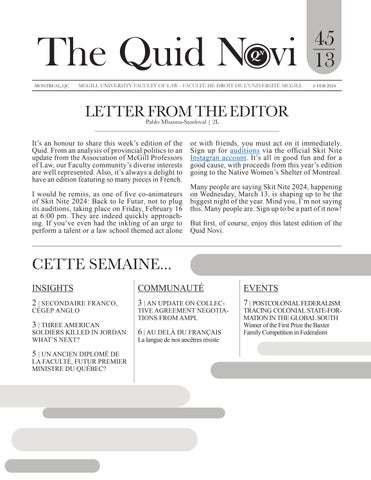
LETTER FROM THE EDITOR Pablo Mhanna-Sandoval | 2L
It’s an honour to share this week’s edition of the Quid. From an analysis of provincial politics to an update from the Association of McGill Professors of Law, our Faculty community’s diverse interests are well represented. Also, it’s always a delight to have an edition featuring so many pieces in French. I would be remiss, as one of five co-animateurs of Skit Nite 2024: Back to le Futur, not to plug its auditions, taking place on Friday, February 16 at 6:00 pm. They are indeed quickly approaching. If you’ve even had the inkling of an urge to perform a talent or a law school themed act alone
or with friends, you must act on it immediately. Sign up for auditions via the official Skit Nite Instagran account. It’s all in good fun and for a good cause, with proceeds from this year’s edition going to the Native Women’s Shelter of Montreal. Many people are saying Skit Nite 2024, happening on Wednesday, March 13, is shaping up to be the biggest night of the year. Mind you, I’m not saying this. Many people are. Sign up to be a part of it now! But first, of course, enjoy this latest edition of the Quid Novi.
CETTE SEMAINE... INSIGHTS
COMMUNAUTÉ
EVENTS
2 | SECONDAIRE FRANCO,
3 | AN UPDATE ON COLLEC-
7 | POSTCOLONIAL FEDERALISM:
CÉGEP ANGLO
3 | THREE AMERICAN
SOLDIERS KILLED IN JORDAN: WHAT’S NEXT?
5 | UN ANCIEN DIPLOMÉ DE
LA FACULTÉ, FUTUR PREMIER MINISTRE DU QUÉBEC?
TIVE AGREEMENT NEGOTIATIONS FROM AMPL
6 | AU DELÀ DU FRANÇAIS La langue de nos ancêtres résiste
TRACING COLONIAL STATE-FORMATION IN THE GLOBAL SOUTH Winner of the First Prize the Baxter Family Competition in Federalism
Vol 45 ● No 13
SECONDAIRE FRANCO, CÉGEP ANGLO Tim Gulliver| 1L
J’ai trouvé intéressant l’article « Université anglo, CÉGEP franco » qui est apparu dans le Quid du 16 janvier. En résumé, l’auteur décrit comment, bien qu’il ne soit pas en accord avec la décision du gouvernement Legault de diminuer le financement des universités anglophones, il comprend d’où vient la grogne qui anime cette décision. Il décrit aussi de façon éloquente une certaine mélancolie linguistique qu’il ressent, comme étudiant francophone, à la faculté.
QUID NOVI • 6 FEB 2024
Thomas’ article made me reflect on the nature of language politics in Quebec, and how it impacts our daily lives. Like him, I grew up in Québec, and have done much of my post-secondary education here. Unlike him, I come from the anglophone community. And yet, contrary to what many provincial politicians would have you think, I am left with the indelible impression that we might actually have a lot in common. Une petite histoire Je me reconnais dans la mélancolie que Thomas décrit, car je ressentais quelque chose un peu semblable dans les corridors de mon école secondaire francophone. J’avais fait le choix, bon immigrant modèle que je voulais être, du français. Il y avait, bien sûr, les “tu viens d’ou, vraiment ?” et les “tokébec icitte, parle en français !” Ça faisait mal. Mais ce qui faisait encore plus mal était l’impression que mes amis francophones pouvaient plus facilement se tisser des liens entre eux. Ils avaient accès à une culture 2
commune, mais aussi des blagues et des expressions familiers qui m’étaient complètement étrangères.1 Ils se comprenaient. Bref, je n’aurais jamais accès à une partie de l’expérience secondaire. Quel soulagement de retrouver mes amis anglophones à la récréation, où je pouvais m’exprimer avec confiance et clarté, sans chercher mes mots, sans bégayer. Malgré mon parcours fort enrichissant au secondaire, je n’ai jamais regretté mon choix d’un cégep anglophone. Celui-ci m’a donné accès à de nouvelles expériences également enrichissantes : My first drink, my first smoke,2 my first party. Again, at last, I belonged. Abdul Abdul drives an Uber in Ottawa. He immigrated from Somalia, has three kids, and a blue-collar day job. We made half-hearted small talk (I hate talking in Ubers), until he asked me where I lived. “Montréal.” He basically leapt out of his seat.3 “I lived in Longueuil for 20 years!” We chat some more, and then I ask him why he left. Abdul shrugs. “Same reason as everyone,” he says. “The 1
You should have seen the look on my friend’s face the first time I tried to swear in French. The proper pronunciation of tabarnak is misleadingly tricky. Please don’t send this to my mother 3 A reaction of great personal concern to me as we were going 110 on the highway. 2
politicians kicked me out. They didn’t want me.” René et Jacques When ex-Premier René Lévesque exclaimed, “And some of those [anglophones] should leave!” in a widely-viewed YouTube video of his address to Scarborough College students in 1968, he was referring to wealthy anglophone oligarchs, not Abdul.4 And yet, when, on the night of the 1995 referendum, then-Premier Jacques Parizeau blamed “the ethnic vote” for the separatist defeat, different forces altogether were unleashed. Abdul drops me off at my mother’s place. (She is also an ex-Quebecker.) Before leaving, I ask him if he would ever go back. He quickly shakes his head. “Never.” He pauses. “Jamais !” At what cost? I want to be clear. The general issue of inclusivity and societal integration are not unique to Québec. And the least helpful thing non-Quebeckers can do to help build a more inclusive society in Québec is to lecture us about the virtues of life in downtown Vancouver5 or Alberta6. 4
I’m a nerd, so I’ve watched the whole thing. René Lévesque is a mesmerizingly good public speaker. See “Réné Lévesque speaks with students of Scarborough College (25 Mar. 1968)”, YouTube, https:// youtu.be/ga-T1WT7qmE?si=mX4YKmgYv_Vn7ETt at 46:40. 5 “Attacks make Vancouver ‘anti-Asian hate crime capital of North America’”, The Guardian, May 23rd, 2021. https://www. theguardian.com/world/2021/may/23/ vancoucer-anti-asian-hate-crimes-increase 6 (Do I need to cite this one?) (This is a joke.)
What is unique is the French-English dimension. Legault’s policies speaks to a valid emotional dissonance within the Francophone community, one deeply rooted in the suppression of the French-speaking working class and prejudicial attitudes towards Québec. You cannot understand Québec without understanding this history. Mais, tout en reconnaissant cette réalité, je dois avouer que les actions du gouvernement Legault suscitent une réaction fort différente en moi. C’est un sentiment que je connais bien – quoi que je fasse, peu importe le nombre de chansons des Cowboys fringants (RIP Karl) que j’apprendrai, peu importe le nombre de fois que je répondrai en français à un « hello, bonjour ! », peu importe le nombre d’années ou je me prêterai à l’exercice de remplir deux déclarations d’impôts,7 ça ne sera jamais assez. On va continuer à me taper dessous. Je ne serai jamais assez québécois. Language politics is like running on a treadmill without no end, with a trigger-happy politician pushing the incline button. So Abdul left. So my mother left. They weren’t trying to get in the way. They were just trying to live their lives. But one can only be told to go back to where they came from (though not always in as few words), before, eventually, they comply. Se reconnaître While provincial politicians 7
<Ahem.> Tabarnak !
of all stripes obsess over Quebec’s capacité d’acceuil, nobody is talking about a more fundamental question – le vivre-ensemble.
THREE AMERICAN SOLDIERS KILLED IN JORDAN. WHAT’S NEXT?
It is such cheap politics to divide us into anglophone and francophone boxes. Thomas’ experience and my own are distinct. I don’t want to co-opt his story for mine. Yet, our experiences are similar in so many ways.
The recent tragic incident involving the killing of three American soldiers by an Iranian-made drone in Jordan has sparked significant concern and attention from both the U.S. government and the international community. This incident not only highlights the ongoing tensions in the Middle East, but also raises questions about the implications for U.S. foreign policy and security measures in the region. President Joe Biden is expected to bear witness to the solemn return of the remains of these soldiers.
The constant reverberation between mother tongue and langue commune or langue d’ouverture. Being simultaneously very good at trigonometry and very bad in comedy in the same language.8 The feeling that there is some invisible barrier that you can’t fully grasp between yourself and the other. And, at the counter in the dépanneur or when a stranger comes up to you in the metro, the choosing. Si nous affirmons qu’il n’y ait pas (et qu’il ne doit pas avoir) « deux Québec »,9 il nous faut des milieux de rencontre. Là où les “deux solitudes”10 apprennent à se connaître. Et peut-être même, je l’espère, à se reconnaître dans les histoires, quoique différentes, de chacun. Or in my case, being very bad at both in either language 9 Le chef du Bloc québécois, YvesFrançois Blanchet, a récemment affirmé qu’il y avait « deux Québec ». Il a fait campagne en 2019 avec le slogan « Le Québec, c’est nous ». For many, he might as well have been saying there’s “good” (francophone, nationalist) Quebeckers and “bad” (anglophone, immigrant, or otherwise cosmopolitan) Quebeckers 10 Originating in a 1945 novel by Hugh McLennan, the relationship (or lack thereof) between English- and French-speaking Canadians has historically been described as the “Two Solitudes”. 8
Kamil Chaoui | 2L
The attack represents a critical flashpoint that could
have broader consequences for U.S.-Iran relations and the stability of the Middle East. The use of Iranian-made drones in the attack suggests a direct or indirect involvement by Tehran, which could exacerbate already high tensions between Iran and the United States. The incident may prompt the U.S. to reconsider its military and diplomatic strategies in the region, including measures to protect its forces and counteract Iranian influence and capabilities. The Biden administration’s response to this incident will be closely watched by the international commu-
nity, as it may signal a shift in U.S. policy towards Iran and its proxies in the region. The administration may face pressure to take decisive action to prevent such attacks in the future, possibly including diplomatic initiatives or military responses aimed at deterring Iranian aggression. Nikki Haley, Republican candidate for the general elections, has called for the United States to “take out” the Iranian leaders behind the attack as a retaliation1. Iran denies any role in the deadly attack. https://www.politico.com/ news/2024/01/29/nikki-haleydrone-strike-iran-00138419 1
AN UPDATE ON COLLECTIVE AGREEMENT NEGOTIATIONS FROM AMPL Brette Thomson | 3L - President, McGill Labour and Employment Law Club
I had the pleasure of sitting down with Professors Fox-Decent and Janda, who are part of the executive of the Association of McGill Professors of Law (AMPL), to discuss the current state of negotiations between AMPL and McGill. As many of you are aware, McGill has engaged in a tireless fight to oppose the certification of the Professor’s union before the Tribunal administratif du travail and, failing there, now before the Superior Court of Quebec. This behaviour has carried over into nego-
tiations for AMPL’s first collective agreement, which have stretched over a year due to McGill’s refusal to negotiate in good faith. With negotiations being consistently pushed back, and key elements of the collective agreement remaining outstanding, AMPL is considering exercising their legal right to strike in the coming days. In December, the membership of AMPL overwhelmingly voted to provide the executive with a strike mandate, with 90% of members taking part in the vote and
85% voting in favour. If exercised, this mandate provides up to a 5-day strike for AMPL members. The AMPL executive communicated that a pivotal meeting is to be held this Thursday, after which time they may decide to exercise the strike mandate. Given the possibility of this happening in the coming days, the AMPL exec asked me to pass on some information to our student body about collective agreement negotiations, the strike mandate, and what these developments mean for our faculty. 3
Vol 45 ● No 13
QUID NOVI • 6 FEB 2024
What is a strike mandate, and what might that mean for the faculty? The strike mandate is currently for a 5-day action. This doesn’t necessarily mean AMPL will strike for 5 days in a row; they may choose to exercise the mandate for 3 days in one week, and a subsequent 2 days in the next week – it will depend on the membership’s goals and decisions. This would result in AMPL members suspending teaching activities, in addition to suspending other responsibilities related to their employment at the Law Faculty. The AMPL executive detailed to me that they intend to have their members picketing in the morning on the Law Faculty premises, as well as on the main campus. AMPL has received consistent support from other trade associations across the province and the rest of the country who will be supporting their efforts. Additionally, the McGill Association of University Teachers (MAUT), which informally represents all other non-unionized professors at McGill, voted last week for a resolution calling on McGill “to respect the decision taken by professors in the faculties of Law and Education, and any others that may seek certification, and to suspend litigation against certification and negotiate in good faith with all faculty colleagues.” This resolution was premised not only on respect for collective bargaining, but also on concerns over wasting University funds on needless litigation. Although the support of other professional colleagues is important, student support within the Faculty is essential as this collective agreement affects not only our professors but also our learning conditions. While some students may be apprehensive about a prospective strike that would disrupt our classes, I would urge everyone to remember that a strike is an opportunity to learn what the law looks like in action. There are lessons to be learned on a picket line that classroom learning cannot provide.
What is the strike about? In considering exercising their strike mandate, AMPL has prioritized a few key issues that require concrete progress to avoid strike action. Equity issues are at the forefront of their decision, as these issues test McGill’s good faith in negotiating. In particular, AMPL is concerned with solidifying the collective agreement provisions relating to recognizing the contributions of Black and Indigenous colleagues, provisions providing for accommodation measures for professors with disabilities, and provisions relating to leaves – whether it be sabbatical, maternity leave, or other absences. These issues provide insight into McGill’s willingness to bargain with AMPL seriously, as McGill already has established university-wide policies on most of these matters, and AMPL’s proposals generally aim to implement those policies (with minor amendments) into a collective agreement. Reaffirming these policies within the collective agreement would signal McGill’s commitment to their substance, as a collective agreement would create legal consequences for existing equity and leave policies. Despite the existence of internal policies and in effect significant agreement on substance, McGill has rejected AMPL’s attempts at including within the collective agreement equity provisions on employment equity and valuing contributions of Black and Indigenous professors. 4
As I emphasized, this strike is about equity issues. However, compensation provisions have not yet been confirmed during negotiations either. Compensation matters are not informing AMPL’s decision to strike at this time, but given McGill’s positions on compensation during negotiations, I think it is useful to provide students with some details. McGill has suggested that the collective agreement include a provision that subjects members to the University’s salary policy, which provides for complete administrative discretion and no union input, along with a potential yearly 1% increase over which the university would also retain discretionary authority. This provision is in direct contradiction to the idea of a collective agreement that sets out employer obligations for the life of the collective agreement. In fact, the proposition of this provision to AMPL members by its bargaining team and executive would constitute a breach of AMPL’s duty of representation to its members. AMPL is hoping to secure a minimum salary for professors to help McGill retain excellent educators. Professors at our faculty currently earn, on average, $100,000 less per year than professors at UofT, Osgoode, and UBC. Further, AMPL is hoping to achieve a workplace wherein the Dean’s salary and professors’ salaries are more comparable. The current situation is more reflective of an employee-CEO fiscal relationship than a collegial relationship. While the Dean at institutions like UofT and Osgoode makes around 38% more than their professorial colleagues, our Dean makes 62% more. AMPL wants to see numbers closer to other faculties to reinstate a more collegial atmosphere. Again, while compensation issues are important, it is crucial to remember that negotiations are not even about that right now! Rather, McGill is still stuck at the stage of endlessly rejecting proposals centred on recognizing the contributions of our Black and Indigenous professors and matters of employment equity. How did we get here? AMPL has been driven to the point of potentially striking due to McGill’s behaviour during both the certification and collective bargaining phase. A large element of this is related to McGill’s tendency to repeatedly delay meetings, and their failure to provide counter proposals when they do show up to meetings. McGill has insisted on having four representatives present at each meeting: Deputy Provost Fabrice Labeau, Dean Leckey, Director of McGill Labour and Employee Relations Francis Desjardins, and Corrado De Stefano, who is a Partner at BLG with a history of defending workplaces like Walmart in unfair labour practice proceedings. Insisting on having four representatives makes scheduling incredibly difficult and renders cancellations inevitable. At one point, AMPL waited 52 days just to receive an answer regarding its compensation proposal. The answer was a complete rejection of their proposals without meaningful counter-proposals. This example is illustrative of McGill’s behaviour throughout the collective bargaining process. Stretching negotiations over a year for a collective agreement with 32 articles, when the union has been actively providing proposals and flexibility in meeting times, displays bad faith behaviour on McGill’s part. Without strike action, this behaviour will likely continue, further delaying the completion of a collective agreement.
Wider reflections As I have been reflecting on the potential strike, the first thing that came to my mind was the hypocrisy of these actions. We attend a faculty where we learn about the importance of constitutional rights like freedom of association, yet our own Dean has been involved in vehemently opposing his colleague’s fight to exercise that right. We should expect more from our faculty. As current students and the donors of tomorrow, we need to make our stance on this issue known.
McGill cares about what we think, if for no other reason than our potential to give money to this place someday. We need to stand up for a better environment where our professors can freely exercise their constitutional rights, and in return receive respect from their employer and our Dean. Our professors have been fighting tirelessly for better working conditions and better learning conditions for us. If things come to a strike, I encourage all my fellow students to respect the strike. Do not cross the picket line; join the picket line.
UN ANCIEN DIPLÔMÉ DE LA FACULTÉ, FUTUR PREMIER MINISTRE DU QUÉBEC? Félix Desrochers| 2L
Mise en contexte Il y a deux ans, au moment où je rédigeais mon premier article destiné au Quid, intitulé « Pourquoi la CAQ l’a emporté... encore une fois? », la formation politique dirigée par François Legault semblait indéfectible. Comme je l’avançais alors, la CAQ représentait un nationalisme et un compromis idéologique capables de rallier à la fois les autonomistes fédéralistes et les souverainistes déçus. De plus, elle incarnait une gestion étatique responsable en période de crise. En somme, pour l’électeur moyen, la CAQ s’imposait comme le choix pragmatique, l’option par défaut. Tel que je le développais, « l’étoile de François Legault continu[ait] de briller ». Cependant, la politique demeure une réalité dynamique. Il suffit d’un changement de circonstances, de quelques erreurs de gestion, qu’elles soient mineures ou majeures, ou de l’émergence d’un nouveau leader charismatique aux yeux de l’électorat - ou des trois! -, pour que le vent qui propulse le navire se retourne contre lui. À l’heure actuelle, le vaisseau de la CAQ traverse des eaux agitées. Le plus récent sondage (datant du 31 janvier 2024) prévoit un gouvernement majoritaire... du Parti Québécois! Changement de circonstances À l’approche des élections d’octobre 2022, la CAQ bénéficiait d’un soutien populaire indéniable, en grande partie attribuable à sa gestion proactive de la pandémie, saluée par une vaste portion de la population. Sur le
plan identitaire, une majorité de Québécois s’étaient prononcés en faveur de la loi 21 et de la loi 96. Sur le front économique, le gouvernement Legault était perçu comme responsable et favorable à la croissance économique. Cependant, après sa réélection et la fin de la pandémie, la CAQ, qui avait remporté 16 sièges de plus depuis 2018, était tenue de produire des résultats concrets. Malheureusement, en raison de son inaction ou de son manque de sérieux dans des dossiers de gouvernance provinciale classiques, tels que la gestion des systèmes de santé et d’éducation, elle a été vivement critiquée. De plus, son refus de reconnaître la crise du logement à Montréal et l’incohérence de son offre politique à l’égard de la population de la région de Québec lui ont coûté de nombreux soutiens au fil des sondages. Gaffes Dans les médias, on attribue la chute récente de la CAQ à une série de maladresses facilement évitables: 1. En juin 2023, le gouvernement Legault a décidé d’augmenter la rémunération des députés de 30%, sans passer par une consultation en commission parlementaire. Cette initiative a été perçue comme arbitraire par de nombreux commentateurs politiques et au sein de l’électorat. En signe de protestation, les élus du Parti Québécois et la majorité des élus de Québec solidaire ont décidé de refuser cette hausse et de rediriger les fonds
vers des œuvres de bienfaisance. 2. Suite à sa réélection, François Legault a abandonné le projet du 3e lien entre Québec et Lévis. Cependant, après avoir perdu la circonscription de Jean-Talon au profit du Parti Québécois lors des élections partielles d’octobre 2023, il a réintroduit le projet dans une tentative maladroite de prendre en considération les préoccupations citoyennes. 3. En novembre dernier, tout en indiquant dans sa mise à jour économique que les Québécois devraient se « serrer la ceinture » dans les mois à venir, le ministre des Finances, Éric Girard, a annoncé son intention de dépenser entre 5 et 7 millions de dollars en fonds publics pour accueillir deux matchs des Kings de Los Angeles au Centre Vidéotron de Québec. 4. La décision d’augmenter les frais de scolarité pour les étudiants hors Québec dans les universités anglophones québécoises a été critiquée par plusieurs commentateurs, dont le chef du Parti Québécois, considérant cela comme une solution bâclée pour un problème réel: le déclin du français au Québec. 5. Actuellement, six députés caquistes font face à la controverse, soupçonnés d’avoir rencontré des maires en échange d’un don de 100 $ à la cagnotte caquiste. Cela irait à l’encontre de la Loi électorale, suscitant ainsi une vague de critiques et d’interrogations. 6. etc. 5
Vol 45 ● No 13
La CAQ en déroute
Paul St-Pierre Plamondon L’émergence d’un nouveau leader politique charismatique vient maintenant couronner le tout. Paul St-Pierre
Plamondon, un ancien de notre Faculté (B.C.L., L.L.B., 1997-2001), suscite actuellement beaucoup d’engouement. En dépit de sa petite équipe, composée de seulement 4 députés, sa manière réfléchie de s’exprimer, sa franchise et la clarté de ses discours lui confèrent une notoriété considérable dans les médias. Les Québécois le découvrent davantage jour après jour, et il gagne rapidement en popularité. D’après le dernier sondage daté du 31 janvier 2024, sa formation politique (le Parti Québécois) recueillerait 32% des votes, ce qui le placerait potentiellement en position de former un gouvernement majoritaire si une élection générale avait lieu demain matin. La semaine dernière, Paul St-Pierre Plamondon a accordé une longue entre-
vue en anglais aux journalistes de la Montreal Gazette dans un épisode de balado intitulé « Could anglos wary of separatism vote for the PQ ». C’est un entretien à ne pas manquer pour tous ceux qui s’intéressent à la politique québécoise! En conclusion de cet article, j’aimerais faire une proposition à l’administration de notre Faculté si cela n’a pas été déjà fait. Ne serait-il pas fascinant d’inviter formellement Paul St-Pierre Plamondon à la Faculté, afin de pouvoir explorer et questionner ses positions politiques au cours d’une conférence, suivie d’une séance de questions-réponses? Cela offrirait une occasion unique de mieux comprendre la vision politique d’un ancien étudiant devenu une personnalité politique incontournable et d’engager un dialogue constructif.
AU-DELÀ DU FRANÇAIS: LA LANGUE DE NOS ANCÊTRES RÉSISTE
QUID NOVI • 6 FEB 2024
Carina Harb | 1L
Quand on est jeune, et qu’on est né ici, ce n’est pas évident de continuer à parler la langue de nos parents. Cela sert à quoi? Au Canada tout le monde parle anglais ou français. Mais ma mère avait insisté que moi et ma sœur prenions des cours d’arabe chaque fin de semaine dès l’âge de 6 ans.1 C’était devenu une partie de notre quotidien, et nous faisions tout pour éviter les devoirs ou faire les dictées qu’on nous assignait. Tant que l’on savait tenir une conversation avec la famille de l’autre côté de l’océan, c’était facile de ne pas voir l’importance de faire des cours de grammaire et littérature arabe. À l’âge de 16 ans, quand tu dois non seulement survivre tes cours au secondaire et que tes parents te forcent à prendre un cours de 4 heures le samedi, ça ne donne pas envie. Mais aujourd’hui je les remercie énormément de m’avoir appris le français et l’arabe, mes deux langues maternelles qui sont une partie intégrale de qui je suis et permettent de réaffirmer mon identité multiculturelle.
Nos pays, qu’ils soient au Moyen-Orient, en Afrique ou en Amérique, ont un passé et présent colonial qui ont un profond impact sur nos systèmes socio-politiques. La colonisation a cherché et continue de vouloir effacer nos liens avec notre culture et identité. Garder sa langue en tant que diaspora ou population autochtone devient un acte de résistance face à l’occidentalisation. La mort de nombreuses langues s’accélère dans le cadre de la globalisation et les taux élevés d’émigration partout dans le
monde.2 Ce phénomène de perte linguistique a lieu de génération en génération: la langue d’origine est remplacée par la langue dominante, pour mieux s’intégrer dans la société, jusqu’à ne plus faire partie de l’univers quotidien.3 La langue permet de tisser des liens, et permet de souder des relations familiales. Je vois souvent mes cousins et des amis qui ne sont pas capable d’avoir une conversation avec leurs grands-parents ou leurs tantes dans leur langue natale. Ne pas parler la langue de ses ancêtres c’est perdre une connexion avec une partie de son identité. Je ne blâme aucunement les familles immigrantes qui n’ont pas eu l’opportunité d’apprendre à leurs enfants leur langue, au contraire, je crois que cela revient aussi à nos institutions de promouvoir les langues minoritaires au-delà du français. En effet, le recensement fédéral de 2021 révèle que « 4,6 millions de Canadiennes et Canadiens parlent une langue autre que le français ou l’anglais de façon prédominante à la maison ». 4Que ce soit par l’allocation de plus de financement pour des organismes éducatifs ou offrir des cours de langues internationales dans des écoles publiques, nos gouvernements provinciaux et fédéraux doivent faire un plus grand effort pour valoriser et soutenir la préservation de nos héritages linguistiques: pour nous et les générations futures. 2
Jean-François Le Goff, « Editorial. La perte de la langue d’origine : un processus
systémique intergénérationnel » (2014) 35:2 Thérapie Familiale 113-117. 3
Sarah Boumedda et Sandrine Vieira, « Au Québec, les langues maternelles d’immi-
grants de seconde génération en péril », (2023), en ligne: Le Devoir . 1
Sous le programme de langues internationales en Ontario, les salles de classe des
4
Statistics Canada- Government of Canada, « Le Quotidien — Alors que le français
écoles publiques laissent place aux cours de langues internationales les fins de semaine.
et l’anglais demeurent les principales langues parlées au Canada, la diversité linguis-
D’après ma connaissance, je ne crois pas qu’il existe un tel programme au Québec.
tique continue de s’accroître au pays », (17 août 2022), en ligne: Gov. Can.
6
7
EDITOR-IN-CHIEFS RÉDACTEURS EN CHEF Anna McAllister Pablo Mhanna-Sandoval SOCIAL MEDIA DIRECTOR DIRECTRICE DES RÉSEAUX SOCIAUX Gabrielle Torrealba DIRECTOR OF DISTRIBUTION DIRECTEUR DE DISTRIBUTION Kamil Chaoui ART DIRECTOR AND LAYOUT EDITOR DIRECTRICE ARTISTIQUE ET ÉDITRICE DE MISE EN PAGE Souang Wu Julius Grippo COPY EDITORS SECRÉTAIRES DE RÉDACTION Muna Tojiboeva Thomas Power COLUMNISTS CHRONIQUEURES ET CHRONIQUEUSES Félix Desrochers Kamil Chaoui Tim Gulliver CONTRIBUTORS CONTRIBUTEURS Brette Thomson Carina Harb Special thanks to Prairie Koo for designing the layout. ~ The Quid Novi is published weekly by the students of the Faculty of Law at McGill University. Production is made possible through the direct support of students. All contents copyright © 2023 Quid Novi.
Les opinions exprimées sont propres aux auteurs et ne réflètent pas nécessairement celles de l’équipe du Quid Novi. The content of this publication does not necessarily reflect the views of the McGill Law Students’ Association or of McGill University. Envoyez vos commentaires ou articles avant jeudi 17h00 à quid.law@mcgill.ca. Toute contribution doit indiquer le nom de l’auteur, son année d’étude ainsi qu’un titre et un sous -titre pour l’article. Les images doivent être soumises séparément. L’article ne sera publié qu’à la discrétion du comité de rédaction, qui basera sa décision sur la politique de rédaction disponible sur notre Facebook @quidnovi.mcgill.