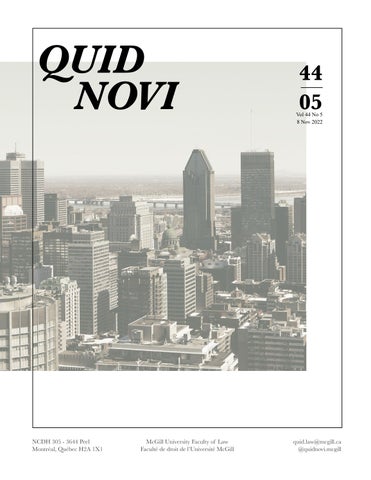
QUID NOVI
Vol 44 No 5 8 Nov 2022
NCDH 305 - 3644 Peel Montréal, Québec H2A 1X1
quid.law@mcgill.ca @quidnovi.mcgill
McGill University Faculty of Law Faculté de droit de l’Université McGill
44 05
EDITOR-IN-CHIEF RÉDACTRICE EN CHEF Anna McAllister ART DIRECTOR DIRECTRICE ARTISTIQUE Hanna Rioseco LAYOUT EDITOR ÉDITRICE DE MISE EN PAGE Souang Wu COPY EDITORS SECRÉTAIRES DE RÉDACTION Muna Tojiboeva COLOUMNISTS CHRONIQUEURES ET CHRONIQUEUSES Ali Hachem Sofia Watt Sjostrom Priti Majumdar CONTRIBUTORS TO THIS ISSUE COLLABORATEURS ET COLLABORATRICES Ordren Deko Special thanks to Prairie Koo for designing the layout.
~ The Quid Novi is published weekly by the students of the Faculty of Law at McGill University. Production is made possible through the direct support of students. All contents copyright ©2022 Quid Novi.
Les opinions exprimées sont propres aux auteurs et ne réflètent pas nécessairement celles de l’équipe du Quid Novi. The content of this publication does not necessarily reflect the views of the McGill Law Students’ Association or of McGill University. Envoyez vos commentaires ou articles avant jeudi 17h00 à quid.law@mcgill.ca. Toute contribution doit indiquer le nom de l’auteur, son année d’étude ainsi qu’un titre et un sous -titre pour l’article. Les images doivent être soumises séparément. L’article ne sera publié qu’à la discrétion du comité de rédaction, qui basera sa décision sur la politique de rédaction disponible sur notre Facebook @quidnovi.mcgill.
1
1 QUID NOVI
CETTE SEMAINE...
INSIGHTS
COMMUNAUTÉ
3 | GRATITUDE
2 | LETTER FROM THE EDITOR
Reflecting as a Bengali Daughter and Sister in McGill Law
4 | LIFE LESSONS FROM A
SUPREME COURT JUDGE Spotlighting Professor Van Praagh’s New Book
9 | THOMAS SANKARA
Modèle d’une politique progressiste endémique à l’Afrique
44 05
Vol 44 No 5 8 Nov 2022
A Remedy for the November Blues
2 | MEET THE QUID
Sofia Watt Sjöström, Columnist
3 | OVERHEARDS 6 | INSTITTUT CANADIEN
D’ÉTUDES JURIDIQUES SUPÉRIEURES Bourse Paul-André Crépeau 2023-2024
11 | THE GENDERED EPIDERMIS 7 | BLAST FROM THE PAST Gender Division in Skincare
SNAILs at coffehouse?
8 | #COFFEPOTGATE The Curious Case of the Missing Coffee Pot 8 | LET THEM EAT BREAK-
FAST Law School Adivce You Can Count On
1
Vol 44 ● No 5
LETTER FROM THE EDITOR A Remedy for the November Blues Anna McAllister | 2L
Hello dear Quid readers, We have officially entered the worst month to be a law student - November - . While you haven’t quite hit the adrenaline of exam season, the dreary weather and still painfully long wait for Winter Break can leave us all feeling drab. While I am sure Taylor Swift’s record breaking album Midnights has helped, I am happy to report that this Quid is here to be the remedy for the November blues. In this edition, everything I love about the Faculty is present. Poignant academic insights from Sofia, Ordren, and Ali are peppered with heartfelt personal stories from Priti. Priti’s article in particular feels like
a warm hug from family (that I am sure is already hounding you for when you will be returning home for Christmas) and a reminder of the bigger picture of what brought us all here to study law. All of this, of course, is surrounded by Faculty lore and absurd meme culture, well-represented by Misty Meaner, the Blast from the Past, and our brief report on #CoffeePotGate. I hope this edition brightens your day as much as it did mine. Keep your head up everyone! Five weeks to the finish line. Cheers, Anna
MEET THE QUID Columnist
Sofia Watt Sjöström | 2L
What did you do before McGill Law? I studied Liberal Arts at Marianopolis College!
QUID NOVI • 8 NOV 2022
Was law school a dream come true or a happy accident? Do you want to be a lawyer?
What drew you (back) to the Quid? I loved writing for the Quid last year! I have always loved writing for fun, but I used to mostly write fiction so this is both comfortable and a bit new. Although I also occasionally write for the Montreal Swedish newspaper, this is technically my first time writing a column in English. I also love being part of this little (but growing!) community. 2
Short-term dream come true, longterm happy accident! I did not really think about law school until a few years ago, and sometimes I still cannot quite believe that I am here. Yet I do not think it counts as an accident; I do not think I could have done that application just by accident.
times recently. That probably says something about me, although I do not know what it could possibly be. Anyway, I like reading and writing, and have recently started singing in the Montreal Swedish choir. As-tu un quartier préféré à Montréal? I love living right by McGill! Where are you from / where have you lived?
I may or may not want to be a lawyer. I am still figuring that one out.
Born in the United States to a Canadian mother and Swedish father, I grew up in London, England, before moving to Montreal at age 9. I also spent a year in Stockholm, Sweden, at 16!
Qu'aimes-tu faire quand tu n'étudies pas ?
Où aimerais-tu travailler dans cinq ans?
This is a difficult question that I have unfortunately been stumped on a few
Perhaps British Columbia? Or, wherever I can do work that feels impactful.
GRATITUDE
Reflecting as a Bengali Daughter and Sister in McGill Law Priti Majumdar | 2L
Growing up with SouthAsian immigrant parents, you may tend to miss the little things they do for you, only noticing them when you’re older. For instance, parents coming into your bedroom with cut-up fruit while you’re studying for a math test. Or, carrying loads of groceries home after an 8-hour shift next to a burning stovetop, all the while making sure you’re safe and sleeping at night. Growing up with siblings that took care of you in the same way those parents did, you may, again, tend to miss the little things they do for you, only noticing them when you’re older, like teaching you how to write your name so you’re ready for your first day of kindergarten. Or, bringing you to paediatrician appointments when mom and dad are busy, all the while making sure to spend time with their little sister doing the fun things. Unconditional love exists in many Bengali families,
like mine, in a multitude of ways, and in ways so deep, that now, you find yourself in law school, writing about it in the Quid, because verbal communication in South-Asian families is by far one of the best in society. *Sarcasm fully intended. * Immigration works in interesting ways, both for immigrants, and for their children. My father had completed his MA LLB at the University of Dhaka, ready to become a lawyer in Bangladesh. However, post-war consequences triggered a deeply profound responsibility to protect family, pushing my parents to quickly immigrate to Montreal and to leave behind their loving parents, sisters, brothers, nieces, and nephews. Quiet comfort now came from building a Bengali community in Canada, enjoying traffic in Montreal’s booming construction landscape, and compiling a list of the best local South-Asian markets.
*Helpful tip: A market is only legit when you notice an unrecognizable item-shelving pattern where the household items are placed next to the flour, a tiny temple glimmers in the front entrance, and you continue to smell of cumin even hours after leaving the store. If you’re on the hunt, here are some of my family’s favorites: Marche Bengal, Marche Victoria, and Marche Meghna. What about that law degree that we all know is *so easy* to study for? My father’s endeavors in a legal career were also left behind, as the same credentials were incredibly difficult to have recognized in Canada. I remember in my first year of law school, Baba would tell me why he wanted to become a lawyerthe excitement of spending his days litigating in the courtroom, reading piles of cases in criminal and civil matters, and using his passion for learning to decipher the facts and loopholes of a complex case. I now know that something else was
pursued instead- a safer, more opportunistic life for his three children, with one turning out to live that special, much anticipated part of his life that was left in Bangladesh - me! Thus, markets filled with overflowing mangoes, piping hot chai in metal cups served by smiling shop owners, rickshaws hobbling off the side roads, our bhoro mami (maternal aunt) kneading roti at 8:00am in the brick lined kitchen, and traffic flowing in whichever way feels safest to the driver, the atmosphere of a Bangladesh city are now only things my parents see every couple of years. So, as it turns out, even after you appreciate the small things your parents and siblings do for you, you realize that you also missed recognizing the biggest sacrifices they made for you, like leaving a legal career so that you could pursue one, instead. I guess that’s why people say the youngest sibling is the most useless one.
OVERHEARD 1L : “I need to rush home; just ordered a pizza to my place.” 2L : “Unfortunately, the only thing I’ve overheard recently is civil procedure.”
3
Vol 44 ● No 5
LIFE LESSONS FROM A SUPREME COURT JUDGE Spotlighting Professor Van Praagh’s New Book Sofia Watt Sjöström | 2L
I hope you enjoy this article, loosely based on a conversation I had with Professor Van Praagh—and feel encouraged to enjoy the book! It is available to borrow at the McGill Law library as well as to buy via Paragraph bookstore or UTP 1. And it is worth reading all the way until the end—my favourite sections on mentorship, reconciliation, and identity are in Part III! You may know Justice Frank Iacobucci as the judge who wrote Amselem, Gladue, or Waldick. He was on the Supreme Court for fifteen years—but is that his most meaningful achievement? What does it actually mean to achieve something, or have an impact on the world? Professor Van Praagh experienced Justice Iacobucci’s most significant impact in his capacity not as judge but as mentor. She writes about this in her new book, Building Justice: Frank Iacobucci and the Life Cycles of Law 2. By thinking about Iacobucci in different roles, Professor Van Praagh reflects on questions pertaining to law and life more generally—how to be a mentor, how to pursue justice, and how to figure out where you belong.
QUID NOVI • 8 NOV 2022
Iacobucci was first and foremost Professor Van Praagh’s mentor. He suggested that she attend law school—he gave her advice at a critical juncture in her life—and she remembered his advice despite the fact that he was not her Prof or an official supervisor. He was a busy high-level university administrator, yet he took the time to help her. That first encounter stuck with her, ultimately leading to a valuable informal mentorship relationship. Iacobucci’s generosity and kindness marked her as it marks many others. In one of my favourite chapters, “Mentorship and the Extended Family” 3, Iacobucci’s former law clerks describe what they remembered the most from clerking for him. Each one emphaSee “Building Justice: Frank Iacobucci and the Life Cycles of Law” (2022), online: UTP <utorontopress.com/9781487566289/building-justice/>. See also “Building Justice: Frank Iacobucci and the Life Cycles of Law” (2022), online: McGill <mcgill.on.worldcat.org/oclc/1302579226>. 2 Shauna Van Praagh, Building Justice: Frank Iacobucci and the Life Cycles of Law (Toronto: University of Toronto Press, 2022). 1
3
4
Ibid at Part III, Chapter 4.
sizes something different—no two clerks took the same things away; each mentorship experience was unique—but every story glows. This speaks to the kind of person Iacobucci is. Iacobucci has an impact on others because he takes the time to connect with everybody he meets. This is evident in the clerkship context but applies well beyond that. Throughout his life, he has gone the extra mile to make sure that people are included in conversations. People remember the things Iacobucci says because he listens thoughtfully before offering them advice. Although she respects Iacobucci, Van Praagh does not wish to herald him as a great hero. She does not consider him special because of his titles or achievements. His time on the Supreme Court was just one way of making a living, which he did for a time. In Iacobucci’s own words, there is not “anything omnipotent or magical about courts.” 4 To Van Praagh, “our biggest impact, the way in which we leave a footprint in the world, is through others.” If that is true, then Iacobucci might as well have been her piano teacher or friend. His most special impact required no special training—it was undertaken simply as an ordinary human being. Each of us can and do do the same thing. We have mentors and mentees whether we realize it or not. As students, our most obvious mentors are Professors or alumni from mentorship programs. Yet many of us also have mentors outside this formal context. Ultimately, mentors are almost always chosen, more or less explicitly, by their mentees. Perhaps, you remember feeling drawn to someone for guidance. Perhaps, this person seemed kind of magical to you. Does it matter who they were beyond that? Each of us has known an Iacobucci figure; at the same time, each of us can be an Iacobucci figure. Professor Van Praagh invites us to think not only about our mentors but our mentees. Even as students, we are constantly given opportunities to listen, share, and support other people. By taking the time to recognize these opportunities, we make law school a better
4
Ibid at 207.
community. Personally, I received so much more support from upper-year students during my first year than I expected. This definitely set the tone for the way I perceive my own role this year. And the opportunities for similar relationships also exist beyond law, in every facet of our lives. The emotional intelligence that served Iacobucci as a mentor also fuelled his impact in other contexts. After his time on the Supreme Court, Iacobucci represented the Crown during negotiations for the residential schools settlement agreement. Although it was not a perfect settlement, Van Praagh does not invoke it to see Iacobucci as a hero or a saviour. Rather, she reveals him as someone who worked hard and genuinely cared—someone without whom, this deal may not have occurred at all. To Van Praagh, Iacobucci’s endeavour in this settlement agreement provides a broader lesson. Reconciliation is not accomplished just by taking one course in Indigenous knowledge. Although such courses are valuable, Iacobucci never took one. However, what he lacked in relevant background knowledge, he made up for with attitude. First, he had the humility to recognize the limits of his own perspective. Second, he was aware of the ways in which his own emotions came into play. Third, he recognized that he had a responsibility to pursue reconciliation, and really learn from history, not only in this but throughout his life. Even after having served on the land’s highest court, he remained open-minded, curious, and ready to learn more. We too can keep this attitude in mind when we face challenges related to reconciliation and justice. As jurists, and no matter what we do in our lives, such challenges will come up. We just have to remember the three prongs: humility, self-knowledge, and responsibility. These help us respond to challenges in new contexts. Iacobucci’s trajectory can serve as inspiration for our own paths—not to be daunted by his achievements but to realize that he too faced barriers which
he overcame. Because of his Italian name and immigrant background, Iacobucci must have struggled with imposter syndrome when he started law school in 1955. He also faced discrimination. A Professor explicitly discouraged him from attending! However, Iacobucci was undeterred. Although he faced obstacles due to his unique identity, his lived experience also helped shape him into the memorable, magical human being he is now. Iacobucci thrived in the study of law, but his subsequent path was not linear. After completing an LLM at Cambridge in international law, he switched to the corporate scene, working at a New York firm for several years. It was not easy for him to land the job—but he did well there too. Then, he went back to Canada to become a professor at the University of Toronto. He rose in the administrative ranks to become University of Toronto’s Provost—and was then recruited to be the Canadian Deputy Minister of Justice. After some time in politics, he entered the judiciary—but even that was not his final destination. He retired early from the Supreme Court to briefly return to the University of Toronto—and take on some novel, different roles, notably as crown representative in the residential schools settlement agreement. It is hard not to be a little daunted by Iacobucci’s successes, but that is not how Van Praagh frames them. When I asked her why law students should read this book, she told me it was an opportunity for each of us to reflect on why we are in law school—and to realize that whatever path brought us here is the right path. I think it is also good to remember that we do not have to figure out the rest of our lives just yet. It is more than okay to get started somewhere interesting, connect with people where you can, and see what opportunities arise. So, if you needed to hear this, remember that you too belong in law school, no matter where you are coming from. You do not need to know exactly where you are going, and it is never too late to shift gears. I personally find it important to recall these messages from time to time.
5
Vol 44 ● No 5
BOURSE PAUL-ANDRÉ CRÉPEAU 2023 – 2024 La Bourse d'études en langue française de l'Institut canadien d'études juridiques supérieures permet d'acquitter les droits de scolarité payables à une université à l’extérieur du Canada dans un programme d’études dispensé en langue française et une partie des coûts de subsistance et de déplacement, sous réserve de tout autre octroi monétaire que reçoit le ou la bénéficiaire. L'Institut canadien d'études juridiques supérieures détermine annuellement le montant de la bourse, jusqu'à concurrence de 20 000 $ pour l'année 2023-2024, en tenant compte notamment des droits de scolarité et des autres coûts de subsistance et de déplacement prévus. CRITÈRES D'ADMISSIBILITÉ Cette bourse a pour objet de financer des études supérieures en droit visant l'obtention d'un diplôme de deuxième cycle ou de troisième cycle (l'équivalent d'une maîtrise ou d'un doctorat en droit dans une université canadienne), dans un programme dispensé en langue française dans une université à l’extérieur du Canada ou encore de permettre d’effectuer un séjour d’une année dans le cadre d’un programme doctoral en cotutelle avec une université à l’extérieur du Canada de langue française. Le ou la récipiendaire doit avoir obtenu son baccalauréat ou une maîtrise en droit d'une université canadienne dans les quatre ans précédant l’année d’études projetée. Pour pouvoir bénéficier de cette bourse, il faut avoir été accepté par une université à l’extérieur du Canada dans un programme d’études dispensé en langue française en vue de poursuivre des études supérieures en droit ou être déjà inscrit et engagé dans un programme doctoral en cotutelle. Les candidats ne sont pas obligés d’avoir une confirmation de leur admission au moment de la soumission de leur dossier ou de la sélection du récipiendaire de la bourse. CANDIDATURES Les candidatures doivent inclure : 1. un curriculum vitæ; 2. une déclaration écrite de la personne intéressée expliquant son projet d’études supérieures ou, s’il y a lieu, l’état d’avancement de son doctorat en cotutelle; 3. une copie de ses relevés de notes d'études de premier et de second cycles, d'études de droit ou d'un cours de formation professionnelle du Barreau, selon le cas; 4. un maximum de trois lettres de recommandation; et 5. un état des droits de scolarité et des coûts de subsistance et de déplacement prévus. Les candidatures doivent parvenir, par la poste ou par courrier électronique, AU PLUS TARD LE 31 DÉCEMBRE 2022, à :
QUID NOVI • 8 NOV 2022
Anne Thomas, Vice-présidente et Secrétaire Institut canadien d'études juridiques supérieures C.P. 43538, Bureau de poste de Leaside 1601, avenue Bayview Toronto (Ontario) M4G 4G8 Téléphone : 416 429 3292 Courriel : info@canadian-institute.com Site Web : www.canadian-institute.com EXAMEN DES CANDIDATURES Un comité de sélection, constitué à cette fin annuellement par l’Institut, examine les candidatures en fonction notamment de la qualité du dossier académique et du projet d’études. L’octroi d’une bourse est soumis à la vérification par le comité que les différents critères d’admissibilité sont satisfaits. Le comité de sélection se réserve le droit de ne pas octroyer la bourse en l’absence de candidatures qu’il estime qualifiées. Les décisions du comité de sélection sont sans appel. SÉLECTION DE LA PERSONNE RÉCIPENDIAIRE DE LA BOURSE L'Institut communiquera d'ici le 15 avril 2023 avec l'éventuelle personne récipiendaire de la bourse.
_____________________________________________________________________________________
6
BLAST FROM THE PAST Before the Quid’s cover boasted a gorgeous view of Montreal from Mount Royal, students would contribute DIY comics. With the return of coffehouse, I am wondering if the LSA has ran into any S.N.A.I.L.s (student not already in law school) trying to sneak in?
7
Vol 44 ● No 5
LET THEM EAT BREAKFAST #COFFEPOTGATE Law School Advice You Can Count On The Curious Case of the Missing Coffee Pot Misty Meanor | Not a Lawyer
If you follow along with Faculty lore on McGill Law Memes, you’ll know that this week was taken over by #CoffeePotGate.
I graduated from one of Canada's top law schools with really good grades. Now, I'm using my knowledge to help struggling law students make it in this competitive world. Dear readers, it has come to my attention that the faculty has decided to begin classes at disturbingly early hours this semester. I simply cannot comprehend why the SAO thinks that students have the mental awareness to think about cuttingedge labour issues at 8:30 a.m., or God forbid, transystemic civil procedure at 9:30 a.m. Readers, I would like to assure you that the real world is not like this. As a practicing lawyer, I began each workday no earlier than 10:15 a.m. and did just fine.
As people rejoiced that the coffee pot, which went missing under mysterious circumstances and resulted in the temporary cancellation of the beloved Mardi Mocha, was returned, the thieves have now published a manifesto.
Following my professional misconduct charges, I began copiously cooking breakfast food while awaiting my fate. Like Barbra Streisand, with whom I share the experience of a short but passionate love affair with a one Prime Minister Trudeau, I also recently discovered a strong passion for oatmeal. In the interest of helping students be well fed before class, I want everyone to know my favourite recipe: chocolate peanut butter banana oatmeal. Chocolate Peanut Butter Banana Oatmeal
QUID NOVI • 8 NOV 2022
Ingredients: - Oats - Banana - Chocolate chips OR cocoa powder
Over on the Quid Instagram (@quidlaw) we asked you who you thought was responsible for #CoffeePotGate. Please note that we have not reached out to Dean Leckey for comment on these allegations. Be sure to give the Quid Instagram a follow as we continue to explore options as to who the culprit might be, and report on just how far the thieves’s demands will go.
Directions: 1. Cook your oats. If using brown sugar and cocoa powder, add them before cooking the oats. 2. Once your oats are cooked, add chocolate chips and honey (if you’re using them) and a few spoonfuls of peanut butter. Stir. 3. Slice a banana and place the slices on top of your oatmeal. 4. Add milk.
It is super easy, cheap, and delicious to make. However, like most law students, I have a deep fear of numbers and thus will be providing a paired-down recipe that you can purposively interpret to your liking. Readers, the “most important meal of the day” may just be a Kellogg’s marketing ploy, but until the SAO’s draconian reign of schedule terror ends, I can promise you that learning the Code of Civil Procedure at 9:30 a.m. will be far more palatable after a delectable morning oatmeal. Bon appétit! Misty xx
8
- Honey OR brown sugar - Peanut butter - Milk
THOMAS SANKARA Modèle d’une politique progressiste endémique à l’Afrique Ali Hachem | 3L
Introduction : En 2022, l’ancien président du Burkina Faso, Blaise Compaoré, a été condamné à la prison à perpétuité par contumace pour l’assassinat de Thomas Sankara lors du coup d’état du 15 octobre 1987.1 Sankara qui est devenu président du Burkina Faso entre 1983 et 1987 à la suite d’un putsch militaire non-violent ayant durablement marqué les esprits en Afrique.2 Jusqu'à aujourd'hui, il demeure un modèle de gouvernance révolutionnaire d’inspiration marxiste-léniniste, et sa politique reste une source d’inspiration pour de nombreux groupes de gauche luttant contre le néo-colonialisme sur le continent et à travers le monde. Malgré sa popularité sur le continent Africain, la figure du Capitaine Sankara reste méconnue du grand public en Amérique du Nord. À travers cet article, j’aimerai explorer les différents accomplissements de la politique Sankariste, qui à bien des égards peut être qualifiée d’avant-gardiste pas seulement en Afrique mais également à travers le monde. I) Biographie - Sankara le Chef Africain : Thomas Sankara est né le 21 décembre 1949 à Yako, en HauteVolta (ancien nom du Burkina Faso).3 Après ses études secondaires, il décide de poursuivre une formation au Cameroun et à Madagascar.4 Là-bas, il étudie les sciences politiques, l'économie politique, le français et les sciences agricoles.5 En 1972, lors de son séjour à Madagascar, il assiste à une révolution chassant du pouvoir le président malgache.6 Cet évènement l’amènera a théorisé le concept de « révolution démocratique et populaire ».7 En 1973, à son retour de Madagascar, il est affecté à la formation des recrues. Il se fait remarquer par sa méthode d’enseignement alliant étude militaire avec formation civique et politique.8 En 1974, il acquiert une grande popularité au sein de la population voltaïque pour son rôle lors de la Guerre de la Bande d’Agacher opposant la Haute-Volta au Mali.9 Al Jazeera, « Life sentence for Burkinabe ex-leader Compaoré for Sankara murder » (6 Avril 2022), en ligne : Aljazeera <www.aljazeera.com/ news/2022/4/6/hold-burkina-faso-sankara-trial> 2 Ibid. 3 Wikipedia, « Thomas Sankara » (29 octobre 2022), en ligne : Wikipedia : <en.wikipedia.org/wiki/Thomas_Sankara> 4 Ibid. 5 Ibid. 6 Ibid. 7 Ibid. 8 Ibid. 9 Ibid.
En 1983, Sankara devient chef de l’état à la suite d’un coup d’état organisé par le médecin militaire Jean-Baptiste Ouédraogo.10 En 1984, il rebaptise la Haute-Volta en Burkina Faso signifiant « le pays des hommes intègres ».11 Lors de ses 4 ans au pouvoir, il poursuit une politique intérieure progressiste et révolutionnaire. À l'international, il deviendra une figure de proue du mouvement anti-impérialiste critiquant ouvertement la politique africaine de la France. Pour sa politique progressiste et anti-impérialiste, il sera surnommé le « Che Guevara africain». II) Une politique intérieure progressiste, féministe et écologique a) Une planification de l’économie au service du peuple Lors de son arrivé au pouvoir, Sankara décide de mettre en place un plan quinquennal afin de créer une « économie nationale planifiée, indépendante, auto-suffisante au service de la démocratie et de la société ».12 L’état se devait de jouer un rôle central afin d’atteindre ses objectifs à cause de la quasi-inexistence du secteur privé.13 La part du budget étatique alloué aux secteurs de la santé et de l’éducation augmente drastiquement.14 De plus, l'état burkinabè commence à financer de nombreux programmes d’infrastructure ainsi que des programmes sociaux afin de moderniser et de supporter le secteur agricole qui représente la majorité de l’économie nationale.15 Soixante-et-onze pour cent des investissements fait dans le secteur productif ont été alloués à l’agriculture, l’élevage, la pêche et les forêts.16 Cela a permis aux paysans de moderniser leurs outils de production et de vendre de meilleurs produits sur le marché international.17 Entre 1983 et 1987, le budget de la santé augmente de vingt-sept pour cent et les dépenses en matière d’éducation augmentent de quarante-deux pour cent.18 Cela se traduit par un accroissement du secteur de la santé et de l’éducation: en 1986, plus de 7460 postes de santé primaire ont été construits, soit quasiment un pour chaque village.19 Deux millions d’enfants ont été vaccinés
1
Ibid. Ibid. 12 Ernest Harsch, « The legacies of Thomas Sankara: a revolutionary experience in retrospect » 40 :137 Review of African Political Economy at 364, 13 Ibid. 14 Ibid. 15 Ibid. 16 Ibid at 365. 17 Ibid. 18 Ibid. 19 Ibid. 10 11
9
Vol 44 ● No 5 contre les principales maladies infantiles. Enfin, 36 000 villageois ont atteint un niveau d’alphabétisation de base.20 Afin d’atteindre ces formidables résultats, le gouvernement réduit drastiquement le salaire et le train de vie des fonctionnaires et des ministres. Par exemple, le gouvernement décide d’interdire l’usage de chauffeurs par les membres du gouvernement, remplaçant la flotte de Mercedes qui servent de voiture de fonctions, par des Renault 5, la voiture la moins cher vendue à l’époque au Burkina.21 Sankara diminua drastiquement son salaire (équivalant à quatre cent cinquante dollars par mois) et celui de ses ministres.22 À la fin de sa vie, Sankara ne possède qu'une voiture, quatre vélos, trois guitares, un réfrigérateur et un congélateur ne fonctionnant pas.23 b) Une politique écologique avant-gardiste Avant la conférence de Rio sur le climat (1992) et le premier rapport du GIEC (1990) Sankara fut l’un des premiers haut-responsables politiques à réaliser l’importance de l’action humaine pour limiter le réchauffement climatique.24 Cette prise de conscience se retrouve à travers ses différentes prises de paroles. S’adressant à son gouvernement, il déclare : « Je ne suis ici que l’humble porte-parole d’un peuple qui refuse de se regarder mourir pour avoir regardé passivement mourir son environnement naturel. Depuis le 4 Août 1983, l’eau, l’arbre et la vie pour ne pas dire la survie sont des données fondamentales et sacrées de toute l’action du CNR qui dirige le Burkina Faso. »25
QUID NOVI • 8 NOV 2022
En 1986 il reconnaît l’impact de l’homme sur son environnement en expliquant que « nous sommes responsables, mais n’en prenons pas conscience de façon collective ».26 La politique environnementale sankariste tourne autour de trois axes appelés les trois luttes : « la lutte contre la coupe abusive du bois, la lutte contre la divagation des animaux et la lutte contre les feux de brousse ».27 Ces trois luttes ont pour objectif de limiter l’avancée du désert menaçant l’agriculture Burkinabé. Par exemple, du 10 au 20 mai 1986, plus de deux millions d’arbres ont été plantés afin de lutter contre l’avancée du désert. Au-delà de ces campagnes de mobilisation populaire, le gouvernement burkinabè décida de mettre en place des mesures coercitives interdisant la coupe abusive
de bois, la divagation des animaux et les feux de brousses. Les mesures coercitives du gouvernement sont couplées à des mesures plus symboliques afin de sensibiliser et d’éduquer la population aux enjeux environnementaux. L’arbre joue un rôle essentiel dans cette politique. Ainsi, Sankara déclare que : « L’accès à la propriété ou la simple location des centaines de logements sociaux construits depuis le 4 août 1983 est strictement conditionné par l’engagement du bénéficiaire à planter un nombre minimum d’arbres et à les entretenir comme la prunelle de ses yeux. »28 Les événements heureux : baptêmes, mariages, visite de personnalités étaient célébrés par des séances de plantation d’arbres afin d'ancrer cette pratique dans la culture.Cette combinaison de mesures : symboliques, coercitives et collectives se retrouve aujourd’hui dans l’arsenal politique de lutte contre le réchauffement climatique dans de nombreux pays à travers le monde. c) Les femmes, actrices de la révolution Pour Sankara, le combat pour le droit des femmes est le deuxième objectif le plus important de sa liste des priorités nationales (le premier étant la réforme de l’armée).29 Le gouvernement lance une réforme du code de la famille établissant : un âge minimum pour le mariage, le divorce par consentement mutuel, la reconnaissance du droit des veuves à l’héritage.30 S’ajoutant à ces réformes du droit de la famille, de vigoureuses campagne de sensibilisation ont été lancé contre l’excision, les mariages forcés et la polygamie.31 Une réforme qui avait déferlé la chronique à l’époque est la journée au marché sans femme.32 Le 8 mars, jour de la fête de la femme, Sankara a demandé aux hommes de faire le marché et de cuisiner pour qu’ils se mettent à la place de leurs épouses.33 L’objectif du président a été de montrer aux hommes la réalité que les femmes vivaient chaque jour. D’ailleurs, ces derniers avaient souvent du mal à négocier avec les commerçantes qui avaient gonflé leurs prix exprès pour les hommes.34 En plus de ces réformes du système judiciaire, de nombreuses femmes ont fait partie du cabinet ministériel de Sankara. Ses ministres du budget, de la famille, de lasanté et de la culture étaient toutes des femmes.35 Même Ibid at 5. Ernest Harsch, « The legacies of Thomas Sankara: a revolutionary experience in retrospect » 40 :137 Review of African Political Economy at 366. 30 Ibid. 31 Ibid. 32 Isabelle Mourgere, « Thomas Sankara, féministe avant-gardiste » (28 octobre 2021), en ligne : TV5 Monde <information.tv5monde. com/terriennes/thomas-sankara-feministe-avant-gardiste-428163 > 33 Ibid. 34 Ibid. 28
Ibid. 21 Wikipedia, « Thomas Sankara » (29 octobre 2022), en ligne : Wikipedia : <en.wikipedia.org/wiki/Thomas_Sankara> 22 Ibid. 23 Ibid. 24 Mahamady Ouedraogo, « Sankara et le climat : un exemple pour la mémoire et la conscience de la politique environnementale d’aujourd’hui et de demain, » (Liaison Energie Francophone, 2021) at 3. 25 Ibid at 4. 26 Ibid. 20
27
Ibid.
10
29
35 Ernest Harsch, « The legacies of Thomas Sankara: a revolutionary experience in retrospect » 40 :137 Review of African Political Economy at 366.
si ces nominations restent avant tout symboliques, elles envoient un signal fort à la société burkinabé dénotant avec la politique des gouvernements africains contemporains considérant la politique comme une affaire d’homme.36 À partir de 1985, le Comité de défense de la Révolution (CDR) met en place l’Union des femmes du Burkina (UFB).37 Les membres des bureaux locaux de l’UFB étaient élus par des assemblées de femmes.38 Ces bureaux ont été responsables de la mobilisation des femmes au service de la révolution. L’UFB représente la première étape du transfert de pouvoir entre les chefs féodaux traditionnels utilisant leur pouvoir pour oppresser les femmes vers le CDR qui tentaient de les libérées de ce dernier.39 Conclusion : Il m’est impossible de résumer la politique Sankariste en 1500 mots. J’aurais aimé parler de sa politique extérieure mais ce sera sûrement dans un prochain article… Néanmoins j’espère que je vous aurai fait découvrir la politique fascinante et avant-gardiste de Thomas Sankara. Trop souvent l’Afrique est perçue depuis l’Amérique comme un continent mystérieux et lointain aux mœurs rétrogrades et maudit par le marasme économique et les conflits. La figure de Sankara montre que l’Afrique, comme n’importe quel endroit sur terre, est capable de développer des modèles endogènes pour répondre à ses propres problématiques sans l’appui de puissances étrangères. Au-delà de créer ses propres solutions ces dernières peuvent également servir de modèle en étant en avance sur leur temps telle que la politique écologique de Sankara. À McGill, lorsque l’on cherche des solutions à nos problèmes légaux, on regarde souvent de l’autre côté de la frontière ou en Europe (France, Royaume-Unis). Cela peut s’expliquer par la similarité de nos sociétés tant au niveau du développement économique que de la culture. Mais les modèles écologiques et féministes sankaristes montrent que de bonnes idées peuvent également émerger d’Afrique. De plus, une grande partie de ces pays partage la tradition civiliste et francophone que l’on a au Québec, rendant la comparaison entre nos sociétés encore plus légitime et à propos.
Ibid. Ibid. 38 Ibid. 39 Ibid. 36 37
THE GENDERED EPIDERMIS Gender Division in Skincare Ordren Deko | 2L
Boys wear blue and girls wear pink. This is a hackneyed and ubiquitous modus vivendi that is, unfortunately, far too resilient to exit our current world view. In fact, it has refashioned and repurposed itself, when economically necessary, and purports to be a litmus test on whether or not a man can or should be interested in a product. This is exactly the case of the absurd presence of male skincare, i.e., skincare specifically for men. Have you ever walked down the aisles of any supermarket or drugstore? You will notice that women’s skin care and men’s skincare are partitioned on separate sides of the store, with the latter being relegated to a small pathetic corner. Moreover, you will notice that while a woman’s skincare product can take multiple shapes or forms, it is the men’s skincare line that must not depart from the strict confines of a gendered perspective. What does this mean? Well, men’s skincare ought to be neutral in colour, e.g. white or “masculine” in colour, e.g. green or blue. Oftentimes it will come in black packaging and the content is either unscented or, in the case that it is scented, it must harken back to the woods, forestry or nature, such as Innisfree’s “forest for men” line. Frankly I do not understand why men’s typical fragrances must be musky or forest related. Perhaps it has something to do with the hunter-gatherer trope (although that is unconfirmed, and I need not rationalize something so absurd). Lastly, and what is far more defining than the packaging, is the labelling “for men.” Common perpetrators of this marketing practice include Clinique, L’Oréal, Nivea, Avène, Clarins, and even what has previously been perceived as a progressive brand, the Body Shop. This list could, of course, be far more extensive, but I hope the idea has come across clearly that this problem of sorts is widespread. Furthermore, you will notice that a woman’s skincare is simply referred to as skincare. Thus, it is really a (women’s) skincare, with the title women’s being in brackets as it is assumed but not marketed in that way. If a skincare line is for men, however, it ought to be defined as such, or else men would not be interested. It proposes a skewed, though not novel, image of gender and masculinity. In fact, masculinity and its fragility have always found themselves a home in many practices including that of clothing. However, it is the most absurd, in my opinion, when it comes to skincare, and that is solely because men and women share practically the same skin. 11
Vol 44 ● No 5 The few differences between men and women do not justify a wholly separate section for men’s skincare. One could argue that because men generally have more facial hair, they have specific needs to be met. But if the problem in relation to hair is that a skincare product could dry out one’s face for which dryness had already been aggravated by shaving, then couldn’t a moisturizer that promises to boost moisture and calm down irritated skin do the trick? Because if this is the case, then there are multiple creams, serums, and emulsions that could do such a thing, though they would be found in the skincare section “for” women. All genders face (pun intended) the same skincare concerns, namely acne, oily or dry skin, irritated skin, and redness. One should shop for their skin concern and not for the gender with which they identify.
QUID NOVI • 8 NOV 2022
Previously in this article, I purposefully described this problem as a marketing practice. Indeed, it is a marketing practice and not a medical or health practice. It does not concern health or medicine. Rather, it concerns itself with getting men interested in something without offending their masculinity, as well as regulating and maintaining antiquated gender stereotypes such as the aforementioned maxim that boys wear blue and girls wear pink. In reality, you will find that products across the board contain the same ingredients which do not magically transform on the skin after identifying the gender of one’s skin. This marketing practice hides itself behind the unscientific mystique of the gendered epidermis. Let us take a look at, for example, a notable and cult classic skincare brand, Clinique. On one hand, Clinique ought to be lauded for removing fragrances from skincare because scientific research within the scope of dermatology explains that fragrance is a highly irritant ingredient or could develop into one through repeated contact with the skin. On the other hand, Clinique is guilty of playing the gender game. How so? Well, the Moisture Surge™ 72-Hour Auto-Replenishing Hydrator has proven to be a best-selling favourite, and for good reason. It applies well to the skin, is not sticky, and feels light, almost like water. The catch? Well…it's pink. So, Clinique decided men could safely enjoy the same benefits of the pink hydrator by introducing the Clinique For Men™ Maximum Hydrator 72-Hour Auto-Replenishing Hydrator. What is the difference? One is pink and the other is blue. In addition, it seems that Clinique is not even trying to hide the absurdity of this ploy because the names of both products are identical and the “key ingredients” in both products are Hyaluronic Acid (a substance that is already present in all human bodies) and activated aloe water. If you decide to look at the full ingredient list of both items, you will further note that they are quite literally the same product but in different colours.
12
This problem is not simply one of aesthetics but about gender perceptions. It may seem innocent at first, but it upholds the proposition that men can only enjoy something if it has become masculinized for them. If not, then it is outside of their gender perspective and must be an activity reserved for others. Emerging brands like Bruvy and HETIME (notice the gendered language) might appear to be innocent and perhaps even noble in their pursuit of introducing men to skincare. Yet they are as equally guilty as other well-established brands of reminding men of their gender when it is absolutely not necessary to do so. Conversely, their products could theoretically, if designed with the proper ingredients, work efficiently for women. Though some women may never know, because the product in question has already declared it prioritizes another gender that is not their own. Nonetheless, as we know, skincare, self-care, and hygiene do not fall within any one single gender’s authority or interest. Now, how can this problem be resolved? Well, if these brands are guilty of using marketing practices to foster this false and ignorant gender division in the first place, then it is these same brands that must employ new marketing practices to represent gender diversity in their products. Men ought to know there exists a world outside of 3-in-1: shampoo, conditioner, and body wash or the much more sinister 5-in-1: shampoo, conditioner, body wash, face, and 24h deodorizer.
SUBMIT TO THE QUID
NOVI
EMAIL SUBMISSIONS BY 5PM EACH THURSDAY quid.law@mcgill.ca
13
QUID NOVI • 8 NOV 2022
Vol 44 ● No 5
14