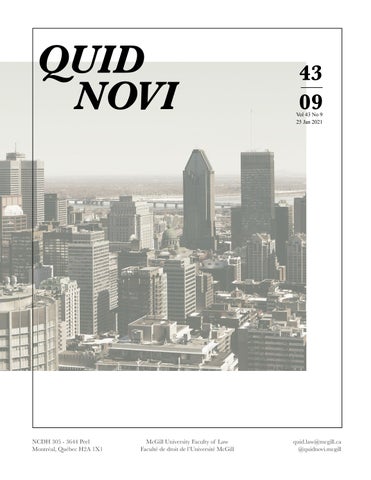
QUID NOVI
Vol 43 No 9 25 Jan 2021
NCDH 305 - 3644 Peel Montréal, Québec H2A 1X1
quid.law@mcgill.ca @quidnovi.mcgill
McGill University Faculty of Law Faculté de droit de l’Université McGill
43 09
EDITOR-IN-CHIEF RÉDACTEUR EN CHEF Mark Townsend ART DIRECTOR DIRECTRICE ARTISTIQUE Hanna Rioseco LAYOUT EDITOR ÉDITRICE DE MISE EN PAGE Jamey Irwin COPY EDITORS SECRÉTAIRES DE RÉDACTION Marie-Ève Ouellet Muna Tojiboeva Raina Young COLOUMNISTS CHRONIQUEURES ET CHRONIQUEUSES Preksha Mehta Gary Preteau Sofia Watt Sjöström CONTRIBUTORS TO THIS ISSUE COLLABORATEURS ET COLLABORATRICES Omar Aggad Mario Michas Muna Tojiboeva Special thanks to Prairie Koo for designing the layout. ~ The Quid Novi is published weekly by the students of the Faculty of Law at McGill University. Production is made possible through the direct support of students. All contents copyright © 2021 Quid Novi.
Les opinions exprimées sont propres aux auteurs et ne réflètent pas nécessairement celles de l’équipe du Quid Novi. The content of this publication does not necessarily reflect the views of the McGill Law Students’ Association or of McGill University. Envoyez vos commentaires ou articles avant jeudi 17h00 à quid.law@mcgill.ca. Toute contribution doit indiquer le nom de l’auteur, son année d’étude ainsi qu’un titre et un sous -titre pour l’article. Les images doivent être soumises séparément. L’article ne sera publié qu’à la discrétion du comité de rédaction, qui basera sa décision sur la politique de rédaction disponible sur notre Facebook @quidnovi.mcgill.
1
1
QUID NOVI
CETTE SEMAINE...
INSIGHTS
COMMUNAUTÉ
2 | LETTER FROM THE EDITOR 2 | FROM THE GELBER Friends don’t let friends buy telescopes
Getting Started: International Legal Research
4 | WHY GRADES AREN’T ALL - BUT CAN STILL MEAN SOMETHING Reflections after the Grade Release
3 | MEET THE TEAM Muna Tojiboeva, Copy Editor
43 09
Vol 43 No 9 25 Jan 2021
EVENTS 6 | BLACK HISTORY MONTH
Events and more
5 | CALL FOR STUDENT
7 | 2022: THE YEAR OF
SPORTSWASHING
PAPERS Martine Roy Student Colloquium and Prize
9 | STUDY SPOTS IN MONTREAL
8 | STAGES PARLEMENTAIRES Fondation Jean-Charles-Bonenfant
11 | THE RULE OF LAW AND ARBITRARY STATE ACTION IN RONCARELLI V. DUPLESSIS
10 | CALL FOR SUBMISSIONS Trinity College Law Review 12 | COURS INTENSIF SUR LE FÉDÉRALISME Chaire Peter MacKell sur le fédéralisme
1
Vol 43 ● No 9
LETTER FROM THE EDITOR Friends don’t let friends buy telescopes Mark Townsend | 3L
When I first met you, I told you, shovel in hand, I was digging to hell. You told me in no uncertain terms that I was an idiot. You were right and that was who you are The ghost car’s lights are on, covered in berries. It’s so funny How’d you get here and how’d you get out of there This is all a dream this is all a business park, get out of this room before the sickness. Sets in, 12 hours of VISION Where’d he go. An N,N-funeral. you scared me, I’m not kidding You were my guide. lmprint The last time I saw you, I made a dark joke. You laughed but I knew right away by the look on your face The moon is a natural satellite
FROM THE GELBER Getting Started: International Legal Research
QUID NOVI • 25 JAN 2021
Ana Rogers-Butterworth | Liaison Librarian
As the semester ramps up there has been an increase in research questions related to International Law. If you simply don’t know where to start, you are not alone! Many students have come to me at a loss, so I thought it would be helpful to run through some basic strategies and where to start when researching this very particular domain. Not to start off too basic, but it is important not to confuse “international”, which is the study of law without borders - particularly as related to the United Nations or other international organizations; whereas “foreign and comparative” relates to the laws of a particular country. More than ever, I urge you to start with our Library Guide on this topic. What I have consistently seen as a research dilemma among students is difficulty restricting their research topic to the international scope. When searching for international laws on something like citizenship, it is difficult to specify via keywords that you are not looking at a specific jurisdiction; adding “international” or even “international law” to your search does not necessarily eliminate place-specific materials which often overwhelm your results page. Also, most of our go-to databases are automatically organized by jurisdiction; if you don’t take this into account when searching WestLaw you will by default be searching Canadian content. 2
This is why it helps to start with collections that specify in international law; so that you do not need to worry about sifting through irrelevant material or coming up with an impossible search strategy to weed it out. To that end I’m going to give you a few quick tips for searching some of our top international law resources for secondary materials. Legal encyclopedias are a great place to start any research, and to refer back to when needed. For international law, a particularly good one is the Max Planck Encyclopedia of Public International Law (Oxford). You can, of course, find this on our LibGuide. The homepage makes it look as though you need to click into the resource you want to search, but you actually need to use the top level search bar and then narrow your selection using filters.
Brill International Law offers an extensive collection of e-books. I’ve found this to be one of the best resources for
more difficult search topics - with the specificity of their titles and the scope of coverage you often find that perfect book that gets your research rolling. In terms of navigation just make sure you click “International Law” on the right screen menu.
Kluwer Law Journals includes subscription to 30 international law journals; to restrict your search to subscribed content just click “view all” after “your subscriptions”. From here it is simple to enter your search topic and use the filters on the left to further narrow down your topic.
MEET THE TEAM Muna Tojiboeva | 1L Copy Editor
Where are you from/where have you lived? I was born and raised in Tashkent, Uzbekistan. I moved to Montreal with my mum about ten years ago and now call this place home! I also lived in Paris, Boston, and Ottawa. What drew you to the Quid? I used to shamelessly pick up the Quid as a SNAIL enjoying the quiet of the law library. What did you do before McGill Law? I spent the last three years working as a political staffer on Parliament Hill, in Ottawa. Before that, I did my BA, with a double major in political science and sociology, at McGill.
Lastly, I can’t talk about international legal research without mentioning Elgar Advanced Introductions. Books in this collection provide concise and accessible overviews of various legal topics. There aren’t too many (36 at the moment) so I recommend browsing the collection for relevant titles - or scroll down the homepage to browse the “International Law” carrousel.
These are just a few go-to resources to get your research started; top level doctrine like this will lead you to relevant case law from international courts, legislation, treaties as well as more in-depth commentary and analysis. Et comme toujours...N’hésitez pas à nous contacter si la bibliothèque peut mieux vous soutenir dans vos études. Pour céduler des consultations, ou si vous avez des questions de référence, veuillez contacter : Sonia : sonia.smith@mcgill.ca Ana : ana.rogers-butterworth@mcgill.ca Nos assistant.e.s de recherche : law.library@mcgill.ca
Quel était ton cours préféré avant de commencer à la faculté de droit? J’ai adoré tous mes cours de sociologie et de relations internationales. Was law school a dream come true or a happy accident? Do you want to be a lawyer? La faculté de droit était définitivement un rêve devenu réalité ! J’ai toutefois reporté ce rêve après le cégep, puis après avoir obtenu mon baccalauréat, car je voulais passer plus de temps à explorer mes intérêts en dehors du droit. Je suis maintenant extrêmement heureuse d’être de retour à McGill pour étudier le droit. Qu’aimes-tu faire quand tu n’étudies pas? J’adore les langues et j’espère donc pratiquer et développer davantage mes compétences linguistiques cette année. As-tu un quartier préféré à Montréal? Cote des Neiges. J’ai passé mes six premières années au Canada en habitant dans ce quartier et je m’y sens toujours comme chez moi. Où aimerais-tu travailler dans cinq ans? Je ne suis pas encore sûre ! Mais je m’intéresse à la création de politiques, en particulier la politique fiscale et environnementale, et j’espère donc pouvoir combiner mes compétences juridiques et politiques à l’avenir. . 3
Vol 43 ● No 9
WHY GRADES AREN’T ALL – BUT CAN STILL MEAN SOMETHING Reflections after the Grade Release
QUID NOVI • 25 JAN 2021
Sofia Watt Sjöström | 1L
In the aftermath of the grade release, I think a lot of us are feeling disappointed and mediocre, if not downright unsuccessful. We were warned, but in my case, knowing what was coming did little to prevent the ensuing feelings. Since I think it’s important to stay motivated in the present semester, I’ve been reflecting on ways to reframe the situation. That’s why I want to talk about why grades aren’t everything but might also represent an opportunity for positive change.
Similarly, hard grades may import worthwhile lessons if we have the humility to listen. At this level, isn’t failure a good thing? It’s emotionally charged but can represent an opportunity. It certainly makes us think harder than after a pat on the back. Academically, it might be the chance to learn better ways of notetaking, studying, or exam-taking. Perhaps it signals confusion with material in a particular subject, or law and legalese.
Why are we here? Why do we go to school? For some, law school is a means to an end; no one will deny that law degrees are useful. However, I don’t believe that anyone went to McGill law solely for material self-enrichment. Everyone brought at least a smidge of intellectual curiosity, a willingness to learn. After all, our learning goes above and beyond mere preparation for the Bar.
On a personal level, I think this can be an interesting opportunity to stop, think and re-evaluate. Frankly, I’ve been trying to stop deriving my self-worth from external validation for years. I think this could be a step in the right direction. Affirming and reaffirming internal motivators is important for focus and drive. I want to make sure that I take classes I care about, pursue jobs I am interested in, and end up where I want to be. It is easy to get swept up in other people’s definitions of ‘success.’ Finding your own life’s meaning is crucial. Then, not only do you know what you want, but you know your own self-worth. This gives you space to think sincerely about others, too. Relying on internal motivators can thus make you both stronger and kinder.
Law school is hard. To get through the readings and lectures and work, you need to love it, at least a little. I’ve met people for whom law school wasn’t right. They were miserable throughout these years. Yet for me, and hopefully for you too, I think the good outweighs the bad. Although I cannot pretend to enjoy every moment, I love law school. Even the most boring readings have hidden gems. Furthermore, it’s teaching me to think about the world totally differently. Looking back on myself six months ago, I feel like another version of myself: sharper, less fumbling and naive. And this is just the beginning. Whenever I feel daunted by my looming workload, I try to remember that law school is magical, in both its substance, and its subtly transformative effects. Getting average grades as a long-standing star student might come as a shock. Really, though, it’s great to be average at McGill law. Not only is the material challenging and deep, but the people are incredible. In my previous schooling, notwithstanding some outstanding teachers and friends, most people seemed indifferent to the things I cared about. Here, it’s different. To start with, everyone cares about class. And they have other passions, too: from athletics to poetry, environment to business relations… Everyone is both interesting and interested. Being somewhat outdone by these esteemed peers is hardly shameful; if anything, it’s an honour. 4
Life is full of hurdles that serve a purpose. Only recently did I realize how many people fail the Quebec Bar Exam. But isn’t that the very point? Would becoming a lawyer be an accomplishment if it didn’t entail hard work and stress? What makes something an accomplishment, if not that? Although this might sound rather hopeless, I don’t think it has to be. I think we should stop being so afraid. We should think of hard things not as terrible hurdles, but as inevitable, necessary, and even valuable steps. One way or another, we will face obstacles. Because it’s hard to conceive of success without them, these might enhance, if not define, our achievements. Since we presumably value those achievements, why don’t we also value the obstacles, or even ‘failures,’ that get us there? In brief, school is about a lot more than just grades, and at the same time, it’s possible to take grades seriously without letting them control our lives. You’ve probably heard a lot of this from Professors, friends, and family. I thought it might be helpful to share thoughts amongst peers, too.
5
QUID NOVI • 25 JAN 2021
Vol 43 ● No 9
Black History Month aims to celebrate and center Blackness throughout the history, the present, and the future of McGill and beyond.
6
2022: THE YEAR OF SPORTSWASHING Gary Preteau | 2L
Sports rule. Even after watching my Dallas Cowboys rip out my heart with another playoff loss, I stand by that statement. Few things elicit the emotions of a late game comeback or a twelfth round of boxing. Equally, it is awe-inspiring to witness the limits of human ability being pushed by athletes like Simone Biles and Usain Bolt. Sports, however, can be much more than just the game being played. They have historically provided a stage for social movements and protests. Muhammad Ali used his status as heavyweight champion to resist the Vietnam War and to advocate for Black Americans. Tommie Smith and John Carlos used the literal stage of an Olympic medal ceremony to raise a fist against the suffering of Black people in America and beyond. Colin Kaepernick took a knee to protest police violence and racial inequality, causing an uproar that continues to echo in the public discourse. Today, it is increasingly common and accepted that athletes use their platforms to advocate for causes in and outside of their sport. However, the limelight of sports is a double-edged sword. The attention and positive press of major sporting events can be used to gloss over more problematic realities. This glossing-over process is called sportswashing, which Amnesty International defines as “the process whereby a country or regime with a particularly poor human rights record uses sport as a way of creating positive headlines, positive spin about their countries.”1 Sportswashing is no new phenomenon. The 1936 Olympics hosted in Nazi Germany are likely the most obvious and famous example of sportswashing in history. Muhammad Ali’s two biggest fights, the Rumble in the Jungle and the Thrilla in Manila, were held in and partially funded by dictators in Zaire and the Philippines, both to distract from their poor human rights records.2 More recently, Lewis Hamilton criticized Formula 1 for holding an event in Saudi Arabia despite its antiLGBTQ+ laws.3 These examples are inexhaustive but show that sportswashing is ingrained in the fabric of sports history. Yet, for as long as the historical record is, 2022 is shaping up to be a banner year for sportswashing. First, billions of eyes will turn to China to watch the 2022 Beijing Olympics next month. The Olympics bring with it the oppor1 https://www.npr.org/2021/11/29/1058048696/saudi-arabia-formula-1-china-olympics-human-rights-sports 2 https://www.newsweek.com/boxers-dictators-zair-saudi-arabia-sportswashing-1456808 3 https://www.skysports.com/f1/news/12433/12484718/lewis-hamilton-not-comfortable-racing-in-saudi-arabia-for-first-time-amid-human-rights-concerns
tunity for the host country to show its best side for the world to see. Despite reports of horrific human rights abuses against its Uyghur Muslim population,4 China will still get this chance to show its best side to the world. In the fall, billions of eyes will turn to Qatar, the hosts of the 2022 FIFA World Cup. The soccer will likely be great and exciting. The cost of seeing this soccer is much grimmer. Reports vary wildly on how many migrant workers have died since Qatar was awarded the tournament. Some reports claim deaths near 7000 while Qatari officials claim there have only been 3 deaths related to world Cup construction.5 A consistent critique from human rights organizations has focused on worker rights. Human Rights Watch reports that migrant workers are subject to exploitative practices, including passport confiscation and forced labour.6 Qatar notably also lists homosexuality as illegal and punishable with prison time.7 Given the two biggest global sporting events of the year are sportswashing fronts, this could be a sign of things to come. Or it could be a cue to do something about it. The good news is that many countries are taking steps to at least protest their problematic hosts. Several countries, including Canada, have announced diplomatic boycotts of the 2022 Olympics.8 Denmark will also be adding messages highlighting human rights issues to their kits for the World Cup.9 It’s fair to see these measures as toothless and having little impact because they frankly do lack the consequences of a strong and bold stance. In an ideal world, stronger counter-protests, like full-on boycotts and the loss of major sponsors, would be on the table. Given how much money is at stake, I doubt we see those larger ambitions met. Despite this, even smaller efforts can achieve something. They do manage to thwart the sportswashing ambitions of these events though. If a country is hosting a major sporting event to polish up its global brand, messages protesting its human rights record impede that goal. With a critical media and fan base, these events can end up shining a light on rather than obscuring these issues. This requires a media force willing to ignore the pageantry and discuss unpopular issues. Institutional barriers, like broadcast partner dissatisfaction and revoked access, impede this important work. It thus also requires that fans be ready to hear and share coverage of these issues. Far too often serious discussions of human rights and sport drown amidst cries to “stick to sports”. Even if sports will never be the apolitical utopia some believe it to have been, sports can at the very least avoid being a force for oppression. 4 https://www.bbc.com/news/world-asia-china-59595952 5 https://www.cnn.com/2021/11/30/football/qatar-2020-world-cup-nasser-al-khater-spt-intl/ index.html 6 https://www.hrw.org/news/2021/12/18/qa-migrant-worker-abuses-qatar-and-fifa-worldcup-2022 7 Supra note 6. 8 https://globalnews.ca/news/8433493/canada-beijing-diplomatic-boycott-announcement/ 9 Supra note 6.
7
QUID NOVI • 25 JAN 2021
Vol 43 ● No 9
8
STUDY SPOTS IN MONTREAL Preksha Mehta | 2L
Hello fellow Quid Readers. These are trying times that we are living through, especially this semester with having to start online. However, many of us, including me, really enjoy having an in-person semester. The highlight of my Montreal experience thus far has been trying to get motivated by finding new study spots. As such, I present to you a few of the closest coffee shops to the Faculty and my ratings of them. These ratings are based on the following categories: ambience/décor, affordability, and “Is this a good place to study?”. Please keep in mind that these ratings are based on my personal preferences; please do not come for me with any misinformation claims if you don’t end up enjoying them in the same way I did. Also, I would like to give a shout out to my friends for accompanying me to these shops and sharing their brutally honest opinions about these cafés. So, without further ado, here is the list: LiVia- Peel Street – 4/5 At this café, we ordered a bowl, some coffee, and a salmon toast dish. Initially, the breakfast/brunch bowl that we ordered looked great, however, we asked for peanut butter on top of the said bowl and this request was left unfulfilled. After asking kindly, we got the peanut butter – a simple mistake they called it. Furthermore, the food took a while to arrive, and the music was rather loud to get any work done. However, the food looked extremely aesthetically pleasing. The café itself is also very cute and quaint. A great date spot, but another café might be better suited for studying and getting things done. Cafféteria- Rue Stanley – 3/5 This café is very aesthetic and very Italian! The café bar and the décor are impeccable. However, there is no wifi at this place so it is not a great spot if you’re trying to get work done online. If you want a cute spot to read textbooks and enjoy a latté, this is your place! The servers are nice and welcoming and are happy to explain Italian coffees to uncultured people (like me). Thank you to the server for explaining what a corretto is to my friend and me. P.S. If you do not enjoy a licorice flavour, do not get the Sambuca. Pigeon Espresso Bar – Rue Maisonneuve- 2.5/5 This is a coffee shop that is attached to a pizza place. The music at this place is loud and it can be hard to concentrate on getting some work done. Furthermore, the smell of grease coming from the pizza place can be quite distracting, But, at least if you get hungry, there’s a convenient spot right beside you. The coffee shop itself seems more
Picture courtesy of Humble Lion’s Facebook Page
like a place for you to grab your coffee to-go as there is not too much of a sitting area. Café Castel – Peel Street – 4/5 This is a place that has many mixed reviews… some like it, others, not so much. Personally, I feel this place is a classic. Everyone and their friends and probably their moms have been to this café – at least at McGill Law. I am a big fan of studying in a well-lighted place, so I enjoy the big windows facing the street at this spot. My roommate and I find this place super cozy and homey - also it does help that I’m a rewards member for this café (buy 9 coffees and get the 10th free!!). Humble Lion Café – Sherbrooke Street – 4.5/5 This is a super cute place, with delicious coffee and many affordable coffee choices. The only downside is that this café can get packed quickly considering that it has free wifi and many students like this “hipster vibes” place. The best spot in this shop is by the windows in the front with the high stools. When we went they had run out of scones, but I’ve heard that they are also very delicious. Milton B – Milton Street – 3/5 This is a good space to get some work done: there are a lot of big tables and there is a umblgood study ambience. They have good wifi, a good selection of food and biscotti. Their coffee is basic and somehow the time we were there, the coffee place smelled like burnt toast. One slightly scary part about this place is the signs they have on the walls explaining the amount of purchase required to be able to stay a certain number of hours at this shop – pretty aggressive, but I suppose understandable during COVID-19 times. Overall, not a terrible spot. So there you have it. I hope to explore this semester and add to this list when I get the chance and when restrictions have been lifted. Please let me know if you agree or disagree, I would love your inputs and suggestions. 9
Vol 43 ● No 9 The Trinity College Law Review (TCLR) is Ireland’s oldest and leading student law journal. The TCLR is now accepting submissions for Volume XXV of the print edition and the TCLR Online, our new online companion to the print edition. The Editorial Board accepts papers in English, French, German or Irish. Publication in the Trinity College Law Review represents the culmination of valuable legal research and writing and is widely recognised as a significant achievement. We gladly accept articles and case notes from undergraduates, postgraduates and graduates, on all areas of law. Numerous prizes are available for successful authors: see our website for further details. The submission deadline for Volume XXV is the 7th February 2022 at 17:00. Submissions for publication in the TCLR Online will be accepted throughout the year. Submission Guidelines: English articles should be no longer than 10,000 words excluding footnotes. French, German and Irish articles should be no longer than 5,000 words. Case notes should be a maximum of 3,000 words. The Editorial Board may however consider longer scripts. TCLR Online: papers should be no longer than 5,000 words excluding footnotes. Authors are required to prepare their submissions in the OSCOLA style which can be found in the Authors’ Guide. The Authors’ Guide also contains a summary of all selection and editing procedures. Papers should be submitted by email in .doc/.docx format to: submissions@trinitycollegelawreview.org or lawreview.trinitycollege@gmail.com The e-mail should contain the author’s name, year of study, course and contact details (e-mail, phone number and postal address) in the main body of the e-mail with the article attached. The selection process is entirely anonymous. Do not include any indications of your identity in your submission. Prizes: •
• • QUID NOVI • 25 JAN 2021
• • • • •
*Gernot Biehler Casenote Competition:*This competition was founded in honour of Dr. Gernot Biehler, a young but distinguished fellow of Trinity College, Dublin and lecturer in international law and conflicts of laws, who died aged 48. Dr. Biehler was a keen supporter of the work of the Law Review. The competition is open to first and second year undergraduate students from all universities who submit a case note of 3,000 words or less and is subject to all other submission and deadline requirements mentioned above. The prize shall be €250. Reddy Charlton Prize for the Best Article: The author of the best article will receive a cash prize of €500 from Reddy Charlton solicitors. The Matheson Prize for Best Commercial Law Article: The author of the best article on a topic of commercial or company law will win a €250 cash prize sponsored by Matheson. The A&L Goodbody Prize for Best IT/IP Law Article: The author of the best article on a topic of Intellectual Property or IT law will receive a cash prize of €250 sponsored by A&L Goodbody. The Conor Ringland Prize for Best Social Justice Article: The author of the best article on a topic of human rights or social justice will receive a cash prize of €250 from the Trinity Free Legal Advice Centre and the TCLR. The Best French Language Article: The author of the best article written in French will win an internship in the Conseil Constitutionnel. Runner-up internships in the Cour de Cassation and Conseil d’Etat are available. Please note that only non-native French speakers are eligible to win these prizes. The Arthur Cox Foundation Irish Language Prize: The author of the best article written in Irish will win a €250 cash prize sponsored by the Arthur Cox Foundation. The David Altaras SC Best Planning & Environmental Law Article: The author of the best article written on Planning or Environmental Law will receive €500 prize courtesy of David Altaras SC.
We look forward to working with you. The Editorial Board
10
Roncarelli’s activities did not hinder the administration of justice; they bolstered it, and it was his right to post bail.
THE RULE OF LAW & Duplessis then orderedArchambault to revoke Roncarelli’s license in ARBITRARY STATE ACTION 1946 and boasted about it to the press. Roncarelli tried suingArchambault as the Head of the Liquor Commission, but the Alcoholic IN RONCARELLI V. DUPLESSIS LiquorActrequiredtheprovincialChiefJustice’sauthorizationbefore Mario Michas and Omar Aggad | 1Ls
The rule of law, similar to other Canadian constitutional doctrines, stems from British constitutional law. The famous British jurist, Sir Frederick Pollock, said, “Law is enforced by the State because it is law; it is not law merely because the State enforces it”. Government actions must have their source in law: if the law does not permit a certain action, it is unlawful. Government officials are legally responsible for their unlawful actions. The rule of law conveys “a sense of orderliness, of subjection to known legal rules and of executive accountability to legal authority”. The rule of law is a guarantee, a form of protection that “provides a shield for individuals from arbitrary state action”. In Canada, the rule of law is a “foundational constitutional principle” that is “clearly implicit in the very nature of a Constitution”. While the rule of law has a long history in Canadian constitutional law, Roncarelli v. Duplessis is often cited to explain this principle. Roncarelli concerns procedural justice and administrative law, but it also shaped the rule of law. Roncarelli consolidated the notion that “no one is above the law” and remains a foundational case in constitutional law. Frank Roncarelli was a successful Canadian-Italian businessman who owned a restaurant, the Quaff Cafe, in Montreal on Crescent street. He was a Jehovah’s Witness and while he did not partake in their activities, he posted bail for Witnesses who were arrested for distributing pamphlets and he would allow the Witnesses to keep their pamphlets in his buildings. Roncarelli had posted hundreds of bail bonds at the Montreal Courthouse to the point where city authorities would automatically liberate Witnesses carrying a paper signed by Roncarelli. Edouard Archambault, the head of the Quebec Liquor Commission, informed Maurice Duplessis, the Premier of Quebec and Attorney General, that Roncarelli was posting bail. Archambault advised that Roncarelli should lose his liquor license. Duplessis was keen on harming Roncarelli because the former viewed the Witnesses’ activities as seditious and against public order given their attacks on the Quebec Catholic Church. Duplessis believed that if he removed Roncarelli’s liquor license, Roncarelli’s fortune would suffer, incapacitating him from posting bail for the Witnesses. Duplessis accused Roncarelli of ruining the administration of justice and of being “audacious” in assisting the Witnesses. However, as F.R. Scott, former Dean of the McGill Faculty of Law, and one of Roncarelli’s lawyers, said, “bail is the security given by or on behalf of an accused person to ensure that he will appear to stand trial. Bail aids the administration of justice and is a traditional part of it.” Scott noted that every bail bond that was posted was done so with a judge’s approval. Thus,
commencing a lawsuit. Roncarelli’s leave to sue was refused twice. F.R. Scott then thought of suing Duplessis in his personal capacity, and thereby did so. This constituted the first time a Premier in the Commonwealth had been sued in a personal capacity.
After being in Quebec courts for 13 years, the case reached the Supreme Court of Canada and in a 6-3 decision, awarded Roncarelli 33 123, 53$ in damages. While the justices in the majority raised similar points, Mr. Justice Ivan C. Rand’s decision stands out as “one of the classic judgments in Canadian public law” and serves as a “judicial commitment to the rule of law”. Rand J. noted that an “administration according to law” cannot be “superseded” by the “arbitrary likes, dislikes and irrelevant purposes of public officers acting beyond their duty”. Essentially, government officials must have legal authority to act in a certain capacity; they cannot do as they please. Rand J. stipulated that Roncarelli was exercising his constitutional right in posting bail, which had no bearing on how he managed his restaurant. Duplessis argued that he had the authority to cancel Roncarelli’s license under the Attorney General’s Act and the Executive Power Act. However, the majority of the Court noted that nothing in those acts authorized Duplessis’ actions, because the Attorney General’s office had an advisory role, and because the Liquor Commission was an independent body whose discretion could not be interfered with. Mr. Justice Douglas Abbott believed that Roncarelli lost his license solely because of his support for the Witnesses.Abbott J. was correct: Duplessis conspired that hindering Roncarelli’s ability to assist the Witnesses would cease their activities. Duplessis believed that failing to end Roncarelli’s activities, would, asAttorney General, render him an accomplice in outlawry, an assertion F.R. Scott mocked in an article. The dissenting justices: Taschereau J., Cartwright J., and Fauteux J., while differing somewhat, all believed that article 88 of the Quebec Code of Civil Procedure, which held that a public official acting in their official functions could not be sued unless they were notified beforehand, barred Roncarelli’s lawsuit as he had not notified Duplessis. However, the majority of the Court found that article 88 did not apply because Duplessis did not have the authority to cancel the license and was therefore acting outside his functions. In conclusion, Roncarelli affirmed the importance of the rule of law. As Rand J. said, the rule of law is “a fundamental postulate of our constitutional structure”. The case confirmed the “Diceyan Gospel” whereby all government officials are subjected to the rule of law. Roncarelli solidified the indispensable notion that all individuals, from the ordinary person to the head of a government, must be held liable for their illegalities. Thus, Roncarelli v. Duplessis serves as a warning to government officials harassing citizens without any legal authority merely because they are displeased with their activities. If government officials can behave as they please, tyranny will be ubiquitous. 11
Vol 43 ● No 9
Chaire Peter MacKell sur le fédéralisme / Peter MacKell Chair in Federalism COURS INTENSIF SUR LE FÉDÉRALISME INTENSIVE COURSE ON FEDERALISM Aide financière / Grant La Chaire Peter MacKell sur le fédéralisme a le plaisir d’introduire une nouvelle allocation, visant à soutenir financièrement un.e. étudiant.e de la Faculté de droit de McGill souhaitant participer au programme suivant : •
L’Université d’été sur le fédéralisme de l’Institut du fédéralisme de Fribourg qui aura lieu du 15 août au 2 septembre 2022 (délai pour les demandes = 28 février 2022) o https://www.unifr.ch/federalism/en/capacitybuilding/summeruniversity.html
Les étudiant.e.s intéressé.e.s doivent postuler selon les règles du programme auprès de l’Université de Fribourg. Une fois accepté.e.s, ils ou elles pourront postuler pour l’allocation, en transmettant leur dossier à la Prof. Johanne Poirier à l’adresse suivante : johanne.poirier3@mcgill.ca, en mettant « MACKELL Grant/allocation » en objet. QUID NOVI • 25 JAN 2021
Allocation maximale : 2 000 $ cnd (visant à couvrir les frais d’inscriptions, de voyage et d’hébergement) Si plusieurs étudiant.e.s de la Faculté étaient sélectionnés par ce programme, un processus de sélection permettra d’attribuer l’allocation. Il est également possible que celle-ci soit scindée, afin de permettre la participation de plusieurs étudiant.e.s. Pour plus d’information, merci de communiquer avec la professeure Johanne POIRIER, au johanne.poirier3@mcgill.ca.
12
Chaire Peter MacKell sur le fédéralisme / Peter MacKell Chair in Federalism COURS INTENSIF SUR LE FÉDÉRALISME INTENSIVE COURSE ON FEDERALISM Aide financière / Grant The Peter MacKell Chair on Federalism is pleased to introduce a new stipend, aimed at financially supporting one McGill Faculty of Law student wishing to participate in the following program: •
The Summer University of the Federalism Institute of the University of Fribourg, to be held from August 15th to September 2nd, 2022 (deadline for applications: February 28th, 2022) o https://www.unifr.ch/federalism/en/capacitybuilding/summeruniversity.html
Interested students must apply to the University of Fribourg by following the rules set out for the program. Upon receiving their acceptance, students will be able to apply for the stipend by sending their file to the Prof. Johanne Poirier at the following email address: johanne.poirier3@mcgill.ca, including "MACKELL Grant / stipend" in the subject line. Maximum allowance: $ 2,000 CND (to cover registration, travel and accommodation costs). If several students within the Faculty were to be selected by the program, a selection process will be used to allocate the stipend. It is also possible that the stipend will be split up, to allow several students to participate. For more information, please johanne.poirier3@mcgill.ca.
contact
Professor
Johanne
POIRIER,
at
13
QUID NOVI • 25 JAN 2021
Vol 43 ● No 9
14