MCGILL UNIVERSITY FACULTY OF LAW | FACULTÉ DE DROIT DE L’UNIVERSITÉ MCGILL
QUID NOVI The
volume 48
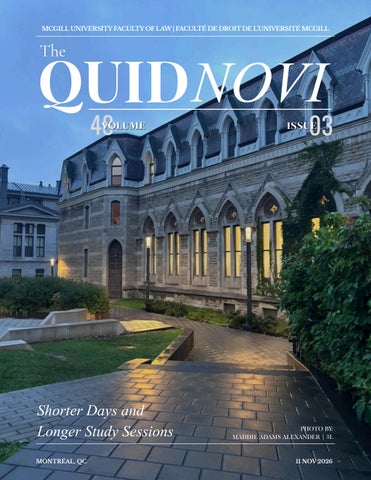
Shorter Days and Longer Study Sessions MONTRÉAL, QC
03
issue
PHOTO BY: MADDIE ADAMS ALEXANDER | 3L
11 NOV 2026
Cette Semaine INSIGHTS 3 | LETTER FROM THE EDITOR On Leadership 5 | WHERE LAW LEARNS TO SING What Music Teaches Us About Dialogue and Making Room for One Another 6 | KEEPING YOUR OPTIONS OPEN. BUT FOR WHAT? 7 | CLIMATE CORNER We Will Always Be Capable of Change 9 | STAYING 9 | TODAY IN HISTORY 3:01 PM: An Act of Resistance?
COMMUNAUTÉ 4 | SLANDER AND THE CITY Judgment Rendered: Siamo Noi 8 | UNBILLABLE HOURS Rise of The Weird Kids: And why is everyone suddenly a fanfiction enjoyer?
QUID.LAW@MCGILL.CA
QUIDLAW
Vol 48
No 3
QUID NOVI
11 NOV 2026
Letter from the Editor On Leadership Despite contributing to the Quid religiously since I arrived at McGill Law in 2024, I was not planning on applying to be CoEditor-in-Chief when the time came for applications last Winter. It was not until I was encouraged to apply by a peer I greatly admired that I actually filled out the application (and I submitted it down to the wire, too). My hesitation in applying was certainly not for a lack of interest in the Quid; I simply did not see myself as leadership material. Not even for something I loved so dearly as the Quid. I suppose I knew on some level that I could “rise to the occasion” and do enough to sustain the operation and keep from disappointing anyone too profoundly, but I assumed that the Quid would only survive under my leadership, rather than thrive. Also significant, I assumed that it would require me to pull out all the stops and use all of my historically effective coping mechanisms that I have adopted throughout my life to cover up my chronic forgetfulness, inattentiveness, and inability to plan ahead. I knew I had great ideas for the Quid, I knew I had demonstrated my commitment to the Quid, I even knew that some of the work required to be done to keep the Quid running would be the exact kind of work I actually enjoy and therefore do a better job of. I could understand why I was being encouraged to apply on paper, but I had a pretty strong fear that I was only being encouraged to apply because the person encouraging me didn’t actually “know” me and that she couldn’t see my weaknesses as plainly as I could. Luckily, I did apply, despite my fears. When I found out that I had been selected, I remember feeling a somewhat selfish wave of relief when I was informed that Erin would be editor alongside me. While I would never plan to intentionally exploit her brilliance and hard work, and while I knew this would of course still be a big undertaking, I thought that at least if I fail the way I could foresee myself possibly failing, at least the Quid wouldn’t suffer, because it would have Erin. Last week, while preparing for this issue of the Quid, I was replying to an email from one of our columnists when it suddenly occurred to me that I actually hadn’t screwed any of this up yet. No deadlines had been irrevocably missed. Our annual budget was approved. I learned how to use Canva during layout editing and didn’t royally screw up the formatting of our first issue (I definitely screwed it up a little though... thank you to our Art Director, Katya, for being patient with me!). Our schedule was (and is!) still running smoothly. Early issues we had with reconciling last year’s finances have been totally resolved.
Our plan to print the covers of the Quid in colour for the first time actually proved to be an achievable little creative dream. The point of all of this is that I have, in the past few years, selfselected out of different leadership opportunities in my life, coming to believe and accept that I am just not naturally equipped to be a good leader. I figured I could force it and fake it until I“made it”, maybe, if it was for something I really cared about. But even then, I shied away, and I certainly had no desire to be a leader for the sake of being one. For a while now, I simply have been much more comfortable always being a contributor and a follower, rather than the one executing the big tasks and making the decisions. What I have taken away from this recent realization, and what I would like to invite you, dear Quid readers, to take away from it as well, is that I think the most underrated yet most critical feature of being a good leader is care. Groundbreaking, I know! And yet, while I may have already“known”that in a superficial sense, I hadn’t come to really take it seriously until now. Maybe some people are born with a generally higher degree of confidence, or maybe some are born with a natural eloquence, and maybe some people really are just born to be followed. That is all fine and good, and I don’t deny that these characteristics matter, but maybe these are not necessarily or automatically predictive features of good leadership. Maybe being terrified of screwing up and wondering if you are the best person for the job are better predictive markers for good leadership, because to be a little scared and a little doubtful are actually just proof that you really, really care about what you are doing. I really, really, care about the Quid, and I think that that care is precisely what makes me most equipped to lead it (alongside Erin!). It’s becoming more and more clear to me that the best leader for any project, any club, any journal, any movement, any anything really is almost always the person who cares the most about it. So, maybe you shouldn’t self-select yourself out of leadership positions or management opportunities for the exclusive reason that you are scared of possibly being a disappointment to something you care so deeply about. That fear, and that care, are quite possibly the very things making you the person most equipped to lead.
Maddie Maddie Adams Alexander | 3L
3
Vol 48
No 3
QUID NOVI
11 NOV 2026
COURT OF QUID NOVI
No 02-11-2026
Judgement Rendered: Siamo Noi
Alexander Ginnetti Plaintiff v. Siamo Noi Defendant
EDITORIAL NOTE Did anyone else barely survive the week back from Fall break? Unsurprisingly, my standards are lower than ever, and my appetite is higher than my GPA. This week, instead of a Michelin-starred restaurant, we are heading to Italy…Siamo Noi at Royalmount, to be exact. Buckle up is all I have to say…let's get to slandering! FACTS I had the privilege of dining at Siamo Noi, a fine-dining Italian restaurant at Royalmount. I ordered the rigatoni amatriciana, and instead of being fiscally responsible, we opted for the tiramisù. We waited one-and-a-half hours to get our food, which you will be hearing a lot about because I am still baffled by how pasta takes so long to come out. I even asked them if they needed me in the back! APPLICABLE TEST We put this hotspot through our rigorous (and completely subjective) Slander and the City Scoring System, which evaluates the flavour and texture, value, service, setting, and the “ring by spring”factor of the restaurant. ANALYSIS Flavour and texture (50/60): The amatriciana was genuinely excellent. The guanciale had a crispy exterior that then melted in your mouth. Now, that could actually be what happened, or my mind was playing tricks on me and decided to give me a positive experience. It would not be the first time. As for the tiramisù… once it arrived (of course), it was great! They made it tableside, and because I was dining with a Karenfor-good©, we got it for free! By the way, a Karen-for-good© is someone who is a Karen but uses it for good causes. That night, food was a good cause. Value (6/10): The rigatoni came out to $31, while the tiramisu (shareable between 2-4 people) was 39$. While the prices were not exorbitant, I am back to where we started…the one-and-a-half-hour wait! I don’t think I have ever waited for food that long without having to take a Xanax as an appetizer. That being said, I did not leave the restaurant hungry, thanks to my superior schcoffing (if you do not know what this is… I truly cannot help you). Service and setting (3/5): The room is beautiful; the staff was lovely, but I do not have any more synonyms to say that the one-and-a-half-hour wait was killing me. After this meal, I have decided that litigation is truly not for me! If I cannot survive waiting for pasta, I certainly refuse to wait for an event I do not even want to be part of ! Ring by spring factor (3/5): The room was candlelit, romantic, and the one-and-a-half-hour wait will actually help you weed out the people who are only there for the food. One-and-a-half hours is way too long to pretend to like someone, even if you are waiting for pasta. FOR THESE REASONS, MAY IT PLEASE THE COURT TO: APPROVE the cumulative score of 62/80. RECOMMEND for: Dinner with a date you actually like, because the wait doubles as a compatibility test; Anyone who believes waiting an hour for pasta is character development…I am still foaming at the mouth! ORDER everyone to eat beforehand, and might I suggest bringing a pack of trail mix just in case the wait is long again!
4
Vol 48
No 3
WHERE LAW LEARNS TO SING What Music Teches Us About Dialogue and Making Room for One Another Iris Gauthier | 1L
I truly believe that humans were meant to connect through music. There is something beautiful in sharing sounds that scratch your brain in ways you cannot quite explain. For me, music has always been an escape from the world, and an integral part of who I am. I even think in it: a thirty minute drive is five or six songs. My first month of law school was Éternité by Nekfeu and Jazzy Bazz. My summers are Souvenirs by Vacra and Nemir. My winter 2025 was Le remède by Luidji. Each song marks who I was in that moment, and sharing one feels like giving someone access to my soul. Over time, my taste has widened. I make it a goal to discover new music every week, and I have never believed that one genre is objectively better than another. Every genre carries different experiences, cultures, emotions and histories, and what I enjoy is comparing perspectives rather than confining myself to one style. You can even train your ears to like something, which makes music a beautiful way to track my own evolution. This is where music and law meet for me. A legal text is a lot like a score. It is written down, fixed on the page, and yet it only comes alive when someone interprets it. Two performers can read the same notes and give them diff erent meanings, and two jurists can read the same provision and draw out diff erent nuances from it.. Neither reading is meaningless. A good interpretation, in law as in music, is one that is rigorous, that listens to the text, and that remains open to the possibility that someone else hears something we missed. Precedent works like a refrain, carrying what came before into what comes next. Dissent works like a counter melody, something that may not resolve the way the main theme does but that gives the whole piece its depth. That is also what drew me to McGill’s transsystemic approach. We study civil law and common law, and many other legal traditions, such as indigenous legal traditions, in conversation with one another rather than in isolation. We are trained not to ask which system “wins,” but to ask what each one reveals about people, about society, and about what justice can mean. It is the same way I approach music: with curiosity first, judgment second. A lot of my own thinking happens while I listen, because music creates space for introspection and creativity, two qualities that I believe are essential to the practice of law.
QUID NOVI
11 NOV 2026
I raise all this because our faculty is going through a difficult moment. Serious and upsetting things are unfolding around us, and they are affecting many of us in different ways. In moments like these, the temptation is to retreat into what is familiar, to listen only to the voices that sound like our own, or to stay silent altogether. But if we hope to become jurists, then this is exactly the moment to practice what the profession will demand of us. Law is long hours of dialogue, disagreement, complexity and diversity. It is learning to hear a perspective we are not used to without dismissing it, the way we learn to appreciate a new genre. It is also knowing when to hold on to our convictions while still respecting what others value. There is a song for everyone, and our ears evolve as we do. That process never stops, and neither should our willingness to listen. I know this can feel like a lot. We are all overwhelmed. Many of us feel out of place, a little off, a little different from everyone around us. Some of us feel that our voices do not matter when such serious things are happening, or that there is no point in sharing because others already have. Some of us quietly wonder whether we deserve to be here. We all do. Every one of us deserves to live the story we are in, strange chapters included. And that story will not always be easy. We will stumble, we will doubt ourselves, and some days we will feel a little out of step. But failing, and failing again, is not the opposite of belonging. It is proof that we are showing up. The ones I worry about are not those who stumble, but those who never risk anything and so never learn what a defeat or a victory feels like. So let us live with our eyes open to the moment we are standing in, as if tomorrow might not come and yesterday is already behind us. Let us do our best, and let no one dictate how we should be ourselves. After all, when we were running toward something we could not even name, most of the people who judge us were nowhere to be found. None of this makes us any less deserving of our place here. One song that echoes all of this is Léo by Wallace Cleaver. It feels like a conversation with a friend, and here is a passage I would like to share: Et même si t'es comme moi, un peu sans vie, un peu bizarre On mérite de la vivre, cette belle histoire Donc échoue, échoue encore Mais ne sois pas parmi les âmes vides qui ne connaissent ni défaite, ni victoire Et vis comme si demain, c'était plus rien, comme si hier, c'était trop tard Comme si tu v'nais d'croiser l'moment présent dans l'regard Et fais d'ton mieux et ne laisse jamais personne juger la façon qu'tu as d'être toi Parce qu'au moment où tu courais comme un fou vers je-ne-sais-quoi, ils étaient où ? Parce c'est con, mais entre l'rêve et la réalité, y a pas grand-chose, y a l'action, y a l'parcours Entre la tristesse et l'bonheur, y a la mer et entre la vie et la mort, y a l'amour
5
Vol 48
No 3
QUID NOVI
Those lines end on love, and I think that is where we belong too. Between sadness and happiness lies an entire sea, and every one of us will have to cross it at some point, some more than once. What carries us across is not talent, or grades, or certainty that we are on the right path. It is each other. It is the patience we show a classmate who reads the world differently, the respect we give an opinion we do not share, and the quiet kindness of making room for someone who feels like they have no place. That is the real work of a legal community, and it is what the law, at its best, is meant to protect.
11 NOV 2026
So let us not dwell on the what ifs, like “what if I were better in another program.” Those worries are part of what builds us. Let us listen to one another the way we listen to a brand new song, with curiosity, with patience, and with the willingness to be changed by it. And let us not forget, as naïve as it may sound, that le but de la vie, c’est d’aimer. Whatever shape that love takes for you. Love of music, of people, of the law, of a long road still ahead. In the end, it is what stands between us and everything else.
KEEPING YOUR OPTIONS OPEN. BUT FOR WHAT? Casra Labelle | 1L
One piece of advice I often hear at law school is “keep your options open.” Many of us are still early in law school, and most of us do not yet know enough about the law to have a fixed idea of what we want to do. So we attend events, join clubs and journals, think about clinics, firms, clerkships, research positions, and diff erent areas of practice. I have started to wonder... is there a diff erence between exploring our options and preserving them? To me, exploration is about trying something because we want to learn more about it. Preserving options f eels diff erent. It tends more toward avoiding closing a door. The distinction between the two has escaped me many times before. In either case, we might attend the same event or apply for the same position for diff erent reasons. I think law school makes preserving optionality so tempting because there are so many worthwhile opportunities available. A moot might be a great way to learn advocacy. A journal might improve our writing. A clinic might introduce us to a kind of practice we had not considered. A firm event might off er some battle-earned perspective on an area of law. A research position might lead to an original contribution. Eventually there is a cost to all of this. The obvious one is time—there are only so many classes, readings, clubs, applications, events, and friends one can manage. I have noticed a less obvious downside too. We can become so focused on keeping future possibilities alive that we lose sight of what we actually want to develop in the first place. That got me thinking about our North Star.
6
Not necessarily a specific career or a five-year plan. More broadly: what problems am I drawn toward? Who do I want to work with? What topics do I keep deep-diving into? What skills do I want to become really good at? Say your moot gives you those public-speaking skills you've always wanted, and a certain clinic puts you closer to a community that f eels close to heart. Maybe a research or litigation internship gives you a—paid—reason to spend hours reading up on a topic you would have read about anyway. And maybe another perf ectly respectable opportunity—that your friends and/or f amily think is totally incredible—simply does not fit. And for those of us who haven't quite found our North Star just yet, maybe the answer is simply to return to the distinction between an exploration mindset and an optionality mindset. Try things that draw you in, keep you thinking about them afterwards, and leave you wanting to explore more. Not simply because of what they could lead you to. You never know when that something will click! Finding a sense of direction doesn't mean the end of exploration, either. Pursuing the questions, skills, and communities we care about can deepen our interests, introduce new ones, and change where we want to go. Even the North Star moves, after all.
Vol 48
No 3
QUID NOVI
The Climate Corner
Maddie Adams Alexander, 3L
We Will Always Be Capable of Change A Reflection on Climate Disappointments and Climate Hope I recently read an article published by CBC on November 4th discussing how developed nations are falling ridiculously short of the USD$330 billion that would meet the COP29 pledge they made in order to help “poorer nations” cope with the consequences of climate change (the article referred to this as“climate finance”).1
11 NOV 2026
Comparatively, in 2008, President Obama won the 18-29 year old vote by 34 points.5 Exiting polling conducted by NBC News in 45 states indicated that 73% of voters aged 18-29 voted Democrat.6 Democrats also flipped historically Republican states in the Senate election, with Texas having had its last Democratic win in 1988 and with Kansas having had its last Democrat win in 1932.7 Young people are already tired of being lied to and disappointed, and even long-standing Republicans have become disenchanted with the current American political administration to the point of abandoning the party.
This change is hope inducing to me not because I believe American Democrats will deliver us from the worst of climate change, but rather this is hope inducing to me because people are demonstrating just how In a similar vein, I watched a video posted by CBC on October 22nd badly they want change, and because it’s a reminder that people, with the headline “The global dream of 1.5 C is dead, but hope isn’t collectively, really can enact change and hold leaders accountable. lost”.2 The very short written summary of the video stated that“the UN This has also been hope-inducing to me because it has demonstrated just released another report saying global efforts are not enough to limit that nobody ever has to be stuck or committed to a particular outlook climate change to 1.5 C above pre-industrial averages. But even if we on the world, or to a particular side of any given issue. Anybody who is 3 overshoot, aggressive emissions reductions could bring us back down”. still resistant to believing in climate change could finally be persuaded I stumbled across these news pieces one after the other, almost tomorrow. Anybody who at one time favoured environmentally immediately, and it made me think about an elective class I took in harmful policies can donate their time to grassroots environmental high school, called “World Issues”. The teacher framed the entire protection organizations today. If the US midterm election results in course around the United Nations Sustainable Development Goals, no other change, it has at least demonstrated that people can change which had just been adopted by all United Nations members in 2015. and that we are never obligated to double-down on decisions that harm The goals were part of the 2030 Agenda for Sustainable us or those we love. Development. We also discussed the Paris Agreement, as it had just been signed in 2016, and there had been a lot of hope and hype While our planet comes with some inescapable, hard, environmental around it since the 2015 United Nations Climate Change Conference. limits that we still must account for, humanity’s capacity for change is unlimited. We may not be able to change the fact that we have passed The reason these two only tangentially-related CBC articles brought 1.5C, but we are able to change our ideas, our worldviews, and the me back to that high school class is because I still remember how political movements we support. And in doing that, we may have a shot hopeful that class had made me feel about the world’s capacity for at staying under 2.0C and mitigating the worst outcomes of change and nations’desire to stop or at least mitigate climate change, surpassing 1.5C. and every year since that class, I have watched all of these promises As with any problem we all collectively share, there will always be some continuously fail to be kept. unfortunate facts of reality that we do not have the power to change. I still have hope for climate change mitigation, though. Part of what We always will, however, have the power to change our minds and our has increased my hope lately is seeing the results of the American goals, and while this power is not enough to be able to save the world midterm elections. Let me be clear that the midterms did not from the worst of climate change in a single day, it may be enough for necessarily inspire hope because I think Democrats will expeditiously us to preserve our world if we work together over many days. implement sufficient and effective climate change policies. The 1 midterms brought me hope because they demonstrated to me two CBC/Radio Canada. (November 4, 2026). World is hundreds of billions short of funds to adapt to climate change, UN finds CBCnews, online: https://www.cbc.ca/news/science/un-adaptationvery important things: gap-report-2026-9.7401510. 2
1) Young people in America (and globally) are mad; and 2) For better or worse, sometimes people have to see how bad things can get before they are motivated to change their behaviour. Democrats won the 18-29 year old vote by 48 points; 48 points is a 34 point swing from just two years ago.4
CBC/Radio Canada. (October 26, 2026). The global dream of 1.5 C is dead, but Hope isn’t lost CBCnews, online: https://www.cbc.ca/player/play/video/9.7392203. 3 Ibid. 4 Montanaro, D., Conley, J., & Jin, C. H. (November 5, 2026). See how latinos, young voters and other demographic groups fueled Democrats’ big wins NPR, online: https://www.npr.org/2026/11/04/nx-s1-6028080/voter-polls-midterms-demographics. 5 Ibid. 6 NBC Universal News Group. (November 5, 2026). National Exit Polls: Election 2026 results NBCNews, online: https://www.nbcnews.com/politics/2026-elections/exit-polls. 7 New York Times. (November 4, 2026). The 7 states that flipped and broke Republican control of the Senate New York Times, online: https://www.nytimes.com/interactive/2026/11/04/us/elections/midterms-senate-states.html.
7
Vol 48
No 3
QUID NOVI
11 NOV 2026
Unbillable Hour$ Rise of the Weird Kids: And Why is Everyone Suddenly a Fanfiction Enjoyer? Silvia Crac | 4L
I don’t know about you, but I loved being the “weird kid”growing up. When I use that term, I’m not talking about casually enjoying Harry Potter, The Hunger Games, Marvel, and other popular mainstream media. I’m talking about binge-watching anime in a time when it was violently uncool to watch anime, engaging in shipping wars online, and spending more time surfing SuperWhoLock Tumblr than studying. Online fandom spaces were sanctuaries for me in my childhood. I spent my after-school evenings watching episodes of Naruto cut into 16 parts at 360fps, crammed into the upper-right-hand corner of the video, flipped, and with Spanish subtitles. I would look for fan-made AMVs of the characters drawn in the DeviantArt style that was popular with the emo teenagers I looked up to, which eventually became a pipeline to fanfiction. I didn’t really care that most of my peers didn’t relate to me, because I got all the socialization I needed on Tumblr. Fandom eventually bled into my real life, where my primary school friends and I would discuss the latest episode of Detentionaire that aired on Teletoon and spend our lunch breaks nerding out over Naruto, Tokyo Ghoul and Fairy Tail. In those years, and generally before the COVID-19 pandemic, admitting that you read fanfiction was extremely embarrassing. Committing this social faux pas would earn you awkward stares, confusion, and even disgust depending on the person’s preconceived notions. No one would log onto their Instagram and post recommendations for Destiel fanfiction or share their fanart under their real name. Being engaged in fandom culture in any way felt like being in on some sort of dark secret, kept safe purely by the anonymity of the Internet. Additionally, excessive behaviour by a loud minority in certain fandoms pushed many into closely guarding their identities… The phrase “Let me tell you about Homestuck”sends eerie chills down my spine to this day. 1
CREDIT: Wikipedia Commons
Exceptions existed, and many people did not always respect the unwritten social rule of keeping your online life online. I was one of those people as a teenager, and I paid the social price for it. Anyone who knew me personally knew about my obsession with Voltron: Legendary Defender (2016) regardless of whether or not they wanted to hear about it. I’m not proud of how publically annoying I was about a cartoon, but in my defence, I was an awkward fourteenyear-old. Recently, though, it seems that more and more people are talking about fanfiction without attaching it to negative stereotypes. The names of popular tags like enemies to lovers, friends to lovers, Y/N, and CEO boyfriend are used in day-to-day conversations, often when someone speaks on their dream relationships. Many prominent fandom creators, especially on TikTok, attribute this normalization of fandom culture to the COVID-19 lockdown, which saw many people engaging in fandom spaces when they otherwise never would’ve been in that situation. It has become something of a copypasta to say that the people who made fun of the weird kids found the pockets of the Internet where the weird kids hang out, and were shocked to find the weird kids. A true manifestation of Dead Dove: Do Not Eat.1 The feeling of “othering”the so-called “normies” in saying this is no coincidence; hostility and infighting in fandom is apparently at an all-time high according to many prominent creators across a variety of fandoms. But toxicity within fandoms is not unheard of, nor is it that exceptional. Platforms like Archive of Our Own, Tumblr, and Wattpad have never been more popular. In fact, so popular have they become that Wattpad introduced monetization, to many users’chagrin. With the popularity of shows like Heated Rivalry and The Pitt, a whole new generation of fanfiction consumers are born out of a desire for more Hollanov and Hucklerobby. However, the simple popularity of new media has never created such a marked increase in fanfiction consumption, and it still does not explain why people are now so open about their reading habits.
This is a popular tag on AO3, and a reference to an episode of Arrested Development where a character finds a paper bag in an office fridge labelled “Dead dove: do not eat”. He opens the bag regardless of the warning, finds the dead dove, and says “I don’t know what I expected.”
8
Vol 48
No 3
QUID NOVI
We’re living in scary times, with tensions at an all-time high in recent memory. In times of growing uncertainty, as much economic as sociopolitical, low-stakes forms of entertainment like fandom and fanfiction are welcome sources of comfort. Even as an adult, I find comfort and joy in fandom spaces through admiring gorgeous fanart and reading feel-good fanfiction. Through the stresses and uncertainties of the busy and chaotic lives we often find in adulthood, fandom is a precious low-stakes constant for me, as it has become for many others. Finding common ground with people over a low-stakes enjoyment of fanfiction creates a sense of closeness and camaraderie that many of us are craving, now more than ever. It takes courage to break unwritten social rules in this way, but it only takes one person whose openness is not met with hostility to create a domino effect, and to eventually change the broader culture. It’s truly wonderful to see how the prejudice and negative stereotypes associated with fanfiction seem to be vanishing gradually. Despite a few instances of poor online etiquette, the veteran fandom members who’ve been here for near-decades often take them as teaching moments. Our online communities are growing, and we don’t feel the need to live double-lives if we don’t want to. What we’re witnessing is a true triumph for fan culture, and I’m so here for it.
11 NOV 2026
STAYING Leyla Bilgli-Bérard | 2L
In the beginning, I brushed your hair, kissed your cheek, and promised to stay. You slipped once, then twice, our hands holding. In the end, I took you in, lulled you into peace. I wish I could be angrier, instead of this quiet trembling.
Long Live the Weird Kids. In 1967, historian E. P. Thompson published an essay titled Time, Work-Discipline, and Industrial Capitalism, in which he examined how industrialization changed how people understood time.1
Today in history Micha Kasongo | 3L
3:01 PM: AN ACT OF RESISTANCE? At 3:00 p.m., a law student is a diligent member of the academic community. At 3:01 p.m. (with somewhat of a grace period), that same student may find themselves in violation of an institutional deadline. I have encountered deadlines at midnight, at the end of the working day, and at 11:59 p.m., a time that seems almost specifically designed for university students. But 3:00 p.m. has always struck me as a rather strange choice. It is late enough to give the impression that you have the whole day to finish your assignment, but early enough to make that impression entirely misleading. Why three? What makes this particular hour so important? I tried to find an explanation and, finding very little, ended up looking into something far more interesting: the history of our obsession with being on time.
Before industrialization, farmers and craftspeople often organized their days around the work that needed doing rather than fixed working hours. A farmer's day, for instance, depended more on the season and the demands of the harvest than on what the clock said. People still had schedules to keep, of course, but finishing a task often mattered more than finishing it at a particular hour. Industrialization gradually changed this. Factories ran on fixed schedules, so workers had to show up at a certain time and stay for a set number of hours. Employers became increasingly concerned with how long people spent working, even when the work itself hadn't changed. Thompson even recounts complaints about employers manipulating workplace clocks to extend the working day. Apparently, disagreements about what time it is have a longer and more contentious history than I imagined. Over time, people were expected to take “being on time” seriously, whether they liked it or not. People had to learn to organize their lives around the clock, and those who failed to do so could expect consequences. 1
McGill University, Faculty of Law, Student Affairs Office, “Late Penalties,”online: <mcgill.ca/law-studies/courses/policies/latepenalties>.
9
Vol 48
No 3
Historians have since complicated parts of Thompson's account, particularly the idea that industrialization marked a sudden break from earlier ways of organizing time.2 Still, his essay raises an interesting question about how arrangements that now seem perfectly ordinary became so deeply embedded in everyday life. Eventually, it wasn't enough to get the work done. When you finished, it started to matter just as much. The history of the word deadline is no less interesting, although considerably less pleasant. During the American Civil War, the term was used to describe a boundary within certain military prisons, including Andersonville, that prisoners could not cross without risking being shot. Its association with time limits came later, particularly through newspaper publishing. By the early twentieth century, newspapers used deadline to describe the final moment when material could be submitted for publication. A story published in 1904, for instance, describes a one o'clock deadline, leaving its characters frantically calculating how much time they had left to prepare their copy.3 In that context, the urgency makes sense. Newspapers had printing schedules to meet. The presses could not simply remain idle while a reporter decided whether their conclusion needed another paragraph. I understand that. I am less certain why my essay requires the same urgency (yes, it is due today). The newspapers, at least, had a printing press to catch. Of course, universities eventually developed their own elaborate systems for collecting written work. This brings me back to McGill. I have been unable to establish when the Faculty adopted its 3:00 p.m. deadline, or why that particular hour was chosen. Perhaps it dates back to when assignments had to be collected and processed manually. Perhaps three o'clock gave administrative staff enough time to organize submissions before the end of the day. Or perhaps someone suggested it during a meeting, everyone agreed three seemed reasonable, and nobody has questioned it since. I find this last possibility especially entertaining.
QUID NOVI
It would mean that generations of law students have carefully organized their assignments, their schedules, and occasionally their entire emotional well-being around a decision that may have taken approximately thirty seconds to make. And perhaps that is how these things happen. An arrangement is introduced because it seems convenient, repeated until everyone becomes accustomed to it, and eventually treated as though it could never have been otherwise. I understand why deadlines exist. Professors need time to grade, and students need to know when their work is due. After all, even when we submit our assignments on time, professors still need a reasonable window to return our grades, preferably sometime between the end of first year and graduation (with no actual written feedback, of course). I would just like to know why that moment must arrive at three in the afternoon. I suppose there is something admirable about the consistency. What interests me most, though, is how rarely we question the ordinary rules that organize our lives. We tend to accept them because they have always been there, or at least because they have been there for as long as we can remember. Their origins are often less important to us than the inconvenience of failing to comply with them. And so, after several centuries of increasingly sophisticated methods for organizing human activity, we have arrived at a system in which the difference between an acceptable submission and a late one can be measured in minutes. Thompson's factory workers might have recognized something familiar in this arrangement. The newspaper editors, too, would probably have understood the importance of getting things in on time. I wonder what either group would have made of a university student receiving a grading penalty because their PDF or Word document arrived a few minutes late. As for submitting an assignment at 3:01 p.m. as an act of resistance, as my title suggests, I have given the matter some thought. One could certainly make the argument. A deliberate refusal to comply with an arbitrary institutional deadline might be understood as a small protest against the clock's regulation of intellectual work. With enough historical references, it might even become a reasonably convincing political statement. I suspect, however, that the Faculty would regard it as something considerably less interesting. A late assignment. One grading unit deducted. So much for the revolution.
2 3
10
11 NOV 2026
E. P. Thompson, “Time, Work-Discipline, and Industrial Capitalism”(1967) 38 Past & Present 56–97. See Mark Hailwood, “Time and Work in Rural England, 1500–1700”(2020) 248 Past & Present 87–121.
EDITORS-IN-CHIEF RÉDACTRICES EN CHEF Maddie Adams Alexander Erin Porter SOCIAL MEDIA MANAGER DIRECTRICE DES RÉSEAUX SOCIAUX Miri Benedikt ART DIRECTOR DIRECTRICE ARTISTIQUE Katya Tavitian LAYOUT EDITORS ÉDITEUR.ICES DE MISE EN PAGE Maddie Adams Alexander Cedar MacDonald-You COPY EDITORS SECRÉTAIRES DE RÉDACTION Qi Rong Chen Nick Mohammadpour Jagnoor Saran
The Quid Novi is published bi-weekly by the students of the Faculty of Law at McGill University. Production is made possible through the direct support of students and the McGill Law Students’Association of McGill University (LSA). Every item appearing in the Quid Novi is an opinion piece that reflects only the views of the person(s) submitting the item. Neither the Quid Novi, the LSA, nor the Faculty of Law endorse any of the material or views contained therein. Given the nature of the publication and its limited resources, the Quid will not undertake to evaluate the factual accuracy of submissions. Submissions are presumptively publishable unless they do not conform to the guidelines contained in the Quid constitution.
COLUMNISTS CHRONIQUEUR.EUSES Maddie Adams Alexander Silvia Crac Iris Gauthier Alexander Ginetti Micha Kasongo Casra Labelle CONTRIBUTORS CONTRIBUTEUR.ICES Leyla Bilgi-Bérard Special thanks to Katya Tavitian for the updated layout design.
Envoyez vos commentaires ou articles avant mercredi 17h00 à quid.law@mcgill.ca. Toute contribution doit indiquer le nom de l’auteur, son année d’étude ainsi qu’un titre et un sous -titre pour l’article. L’article ne sera publié qu’à la discrétion du comité de rédaction, qui basera sa décision sur la politique de rédaction disponible sur notre Instagram @quidlaw.
All contents copyright © 2026 Quid Novi.