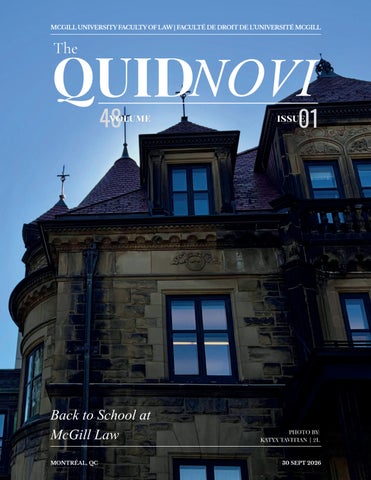
MCGILL UNIVERSITY FACULTY OF LAW | FACULTÉ DE DROIT DE L’UNIVERSITÉ MCGILL
QUIDNOVI The
volume 48
Back to School at McGill Law MONTRÉAL, QC
01
issue
PHOTO BY: KATYA TAVITIAN | 2L
30 SEPT 2026
Vol 48
No 1
QUID NOVI
LETTER FROM THE EDITOR
Different Dreams and The Dynamic Life Maddie Adams Alexander | 3L
Prior to beginning my undergraduate degree, I hadn’t really wanted to go to university. I wanted to move far away and become a musician. A true bohemian. But I was 18 at this time and dumb and terrified and broke. The “compromise”, in my stubborn and naïve mind was to go to university to study Music Therapy. This would have required to go to an out-of-province university, and my dad was not convinced this music therapy business would be sustainable. The final (and far more realistic compromise) ended up being that I would go to university near home and study English. I chose English because becoming a writer felt like a solid consolation prize for not committing to my music dreams, and because my dad thought that an English degree would make me somewhat employable one day. There are many things that occurred in between starting university and ending up here, in law school, that I don’t think are necessary to get into. What matters is that my dreams evolved so much during those years. When I began my undergraduate degree studying English, I felt like I had abandoned my music dreams. Later, when I began studying Political Science instead, I felt like I had abandoned my creative writing dreams. By the time I was applying to law schools, I genuinely wondered if I was at that point abandoning all of my creative dreams forever. I now no longer feel as though I abandoned other dreams. Instead, I now feel like I was just lucky to have been able to discover new ones that actually became just as important and just as meaningful to me. Having said that, I must still admit that I never grew up dreaming of being an academic or a lawyer. I grew up dreaming of a life of passionate artistic expression and creation. That is precisely why I am so fond of the Quid, and so honoured to be Co-Editor-InChief (alongside the brilliant Erin Porter) this year.
30 SEPT 2026
The beauty of the Quid is that I get to remain tethered to my dreams from a past version of my life while working toward newer dreams. The Quid has been a stabilizing force for me since the very beginning of law school. Whenever I have felt stupid and inept, I have been able to cling to something that still made me feel interesting and capable and talented. I have been able to express things to an audience of my peers that are not typically academic, nor particularly polished. There are countless experiences in life that change us and that inspire us to let our dreams evolve. This is almost always a good thing, and the experience of these evolutions is arguably what gives meaning to our lives. It was Oscar Wilde who cautioned us that knowing what we want to be means that we will indeed become it, but that becoming it will also be our “punishment;” to never know what we want to be permits us the freedom to instead “never become anything” and to live the “dynamic life,” which he (I think rightfully) claimed is the true reward. It is so special, then, to have opportunities to remain connected (even if weakly or intermittently!) to the earlier versions of ourselves and the earlier versions of our dreams. The Quid has been that opportunity for me throughout law school. It is my greatest hope as CoEditor-in-Chief this year that it will be that same opportunity for new and returning law students this year, and for many other law students in the years to come. If the unique beast that is law school ever leaves you feeling defeated, know that you are always welcome to temporarily return to other, different dreams through the Quid. “And medicine, law, business, engineering, these are noble pursuits and necessary to sustain life. But poetry, beauty, romance, love, these are what we stay alive for […] the powerful play goes on and you may contribute a verse. What will your verse be?” – Dead Poets Society, 1989.
Cette semaine INSIGHTS
COMMUNAUTÉ
GAMES
4 | NO GOOD VIBES ONLY
2 | UNBILLABLE HOURS Dany Chakra: “Immortal Until Proven Otherwise”
9 | CROSSWORD
5 | FROSH IS OVER. LET’S KEEP TALKING TO STRANGERS. 6 | TODAY IN HISTORY 8:30 AM
QUID.LAW@MCGILL.CA
11 | CROSSWORD SOLUTIONS
8 | SLANDER AND THE CITY Judgment Rendered: Gibbys 10 | CLIMATE CORNER We Need To Talk About Limits QUIDLAW
Vol 48
No 1
QUID NOVI
Unbillable Hour$ Dany Chakra: “Immortal Until Proven Otherwise” Liam Hunt | 2L
30 SEPT 2026
LIAM: And that’s the consequence of what? From what I understood, you've barely trained. When did you start training? DANY: Start of August. I signed up during exam season and wanted to start then, but then I went to Europe unexpectedly for two months. No pool, no bikes, no nothing. And I was busy drinking, so I didn't do much running. When I came back, I was like, okay, I’m gonna start biking. I bought this bike from Decathlon for $400, and didn’t even know if it was a good bike or not. I was going to do it with a mountain bike until I asked ChatGPT. Then as soon as I started biking, my knee popped. I was like, shit, because I knew nothing about bikes. I was out for two weeks. I tried swimming. Did 25 metres, came back, and was like…“Swimming is impossible.” LIAM: I feel you might be bluffing. In the last few weeks, you ran 20K on a whim. The next day you rode 130K around the island of Montreal with me. And Suzanne says you swam 2.4K in Meech Lake with no wetsuit. Did all that happen? Are you just a natural beast? DANY: They happened. I think endurance sports are more of a mentality. If you believe you can do it, you probably can. I've been training all my lif e: rugby, basketball, pickleball, the gym. My joints were conditioned for high stress. What was lacking was the push in my mind. So as soon as I set my mind to it, I was basically able to just do it.
Dany Chakra, 2L. 3 days before his first Ironman. | PHOTO BY LIAM HUNT
Three days before the Ironman 70.3 in New York, I sit down across from Dany Chakra (2L) at his kitchen table in a whitewalled apartment. The next day, we’ll drive 7 hours to Long Island with our classmate Suzanne Gruz for a 1.9K swim, 90K bike, and 21K run. And from what I’ve heard, Dany has barely prepared at all. Between us are two bowls of deep red beetroot soup LIAM: Reminds me of Ukrainian borscht. DANY: I eat this for rugby. Broccoli, carrots, potatoes for fibre. Beetroot for anti-inflammation. LIAM: Where's the protein? Or is this just pure salad in soup form? DANY: Pure salad. He tells me it’s been almost two months of eating squeaky clean, with zero alcohol. I ask where his head's at now that we’re less than three days out. DANY: I've never been more in-shape in my life.
2
For example, I’d only ridden a bike once before for 40 km. Then I did the bike ride with you guys for what, 130 km? I just kept going. You know, there’s no need to stop. A lot of doubt comes in the training. I did the first 25 metres of swimming and I’m like, shit, I probably can’t even swim 1.9 km. How the fuck am I gonna get all the way there? So I tried making the swimming harder. Whenever I’d go and come back, I wouldn’t touch the wall, and I’d hold my breath underwater while I’m switching directions. I tried to make everything a bit more difficult. Then, for the open water swim at Meech Lake, I thought, “You know what, this is my test.”And I did it. LIAM: It’s just sheer will. DANY: Yeah. LIAM: You’re propelled by will alone. And, well, prior baseline fitness. You were a varsity athlete as recently as last year. DANY: Yeah, rugby. But for running, the most I’d done was 5 km before. LIAM: Before when, exactly?
Vol 48
No 1
DANY: Before I did my 10 km two weeks ago. I almost gave up at five, but I kept going. Then a few days after, I did a 20-km with Marie. And that felt really easy. Somehow. One thing that really helped me is that I decided to go on a strict diet the past two months. I’m like, if I can’t get a bike that weighs less, I might as well just lose weight. It’s the swim, though, that’s the most challenging part. LIAM: Agreed. We’re three days out, and that’s all I’m really thinking about. I know we can do the run. I know we can do the bike, even if there’s 70 kilometer-perhour gale-force winds, which is currently what they’re forecasting. I know we can push through it. But the swim is a different beast entirely. It’s much more skill-based. The mental game is paramount, and neither you nor I have any experience in that. I’m kind of tripping about it. What if I panic in the water? What if the kayaks have to come and scoop my body out of the water? DANY: No, I think you just have to swim.
QUID NOVI
30 SEPT 2026
LIAM: When it comes to biking, it’s you against the weather. It’s you against the elements. That’s what endurance sports are to me. That’s how I’m feeling about the weather forecast for Saturday, because it’s going to be gnarly. It’s kind of a positive outcome, because it shifts your mentality from “I’m trying to beat a certain time” to “I’m trying to survive.” Survive, and, you know, not let the elements win. DANY: At the end of the day, you can only do what you can. No matter the weather, if I can swim 1.9 km, I’m gonna swim my 1.9-km. No matter what. Lock in, focus, and breathe properly. Whether there’s currents, there’s wind, there are people drowning—I’m just gonna go. LIAM: You are literally locked in. DANY: That’s all you have to do. LIAM: What a lot of people don’t know about you is that you were a mechanical engineer before law school. You’re currently taking a quantum physics elective.
LIAM: You don’t even have a wetsuit, right?
Can you explain quantum physics to, like, a mouthbreathing meathead like myself ?
DANY: I got one and I tried it once but it’s too tight on the shoulders. So I decided not to use a wetsuit. I think I’m going with that strategy. No wetsuit.
DANY: If I knew exactly what it was, I wouldn't have taken the class. But everything around you is built on it. If you slap your hand on that table, there's a slight chance it goes straight through.
LIAM: I don’t want you to die, man.
LIAM: So there's a reality where my hand goes through the table, and one where you get out of the water in half an hour and win the New York Ironman Triathlon?
DANY: The swim is only 40 minutes. You can thug it out for 40 minutes and just keep going. LIAM: If you’re as f ast as you are, maybe. But for me it’ll be longer. DANY: Okay, let’s say 50 minutes. Just keep your head down and take 50 minutes to swim. Breathe. Focus on your breath and your strokes. LIAM: That’s the right approach. Swimming is an exercise in breathing. It’s an exercise in learning how to exhale. That was my thing. I would hold my breath underwater and the CO2 would accumulate and trigger fight-orflight. As long as you’re constantly exhaling and breathing in rhythm, I think you can swim pretty far with your heart rate low. You’ll end up on the other side. DANY: The trick is to forget where you are. It’s you and your technique. That’s it. LIAM: And some sharks. It’s you, your technique, and sharks. DANY: Forget about all that. Just zone out everything. It’s just you and yourself. Forget you’re at a race.
DANY: A big one, actually. LIAM: Engineers are trained to find efficient solutions. I know that there’s this idea of the principle of least action. When something in nature moves between two points, it follows the most economical path. There’s a poetic irony there, between the efficiency logic of engineering and the approach you took to this triathlon. DANY: I do think it’s really similar. Engineering is all about problem-solving. Basically, that’s what Ironman is. Who can make the best decisions to optimize your time and be the most efficient? My problem is that I had two months to train for a triathlon. How do I solve it? No chatbot can make that plan, and no coach knows how your body reacts. So I built my own program. My resources were the people around me. For example, if I had questions, I’d ask you. Suzanne was also really helpful. Marie helped me through the run, and let me know what I needed for the bike ride. So you have to utilize your resources to your best advantage under limited time. It’s like: do what you can and solve what you can.
3
Vol 48
No 1
LIAM: I’m not sure if I have that same degree of selfbelief. Props to you for having that, it’s enviable. I don’t think everyone’s got it. Are you 100 percent confident you’ve got this? DANY: One hundred percent. I’m confident in my ability. It was two months of training. It may not be very long, but I gave it my all. I taught myself to never stop, and never give up and keep pushing because I know the race will be tough on the mind. I'd be 200 metres in the pool and be like, I'm leaving. Then I'd look at myself and say, of course I can do it. I want to succeed. LIAM: You sound like David Goggins. The guy who’s like, “Who’s gonna carry the boats?” DANY: Who is gonna carry the boats if it’s not you, you know? Genuinely, just keep pushing.
NO GOOD VIBES ONLY Leyla Bilgli-Bérard | 2L
Oh, hey! What are you doing here? Is everything okay? Please come in. Don’t stand there. Here, let me take your coat. Come sit with me. What happened? Oh. It’s fine, love, take your time. Let me put the kettle on. Let me grab a blanket. There. No, no need to be sorry. You know there is none of that nonsense here. No good vibes only. I am grateful you came. Start when you can.
4
QUID NOVI
30 SEPT 2026
Keep going until you see f actual proof you can't. Humans are immortal until proven otherwise. You can't prove I can't do it unless I actually can't. LIAM: We can't prove the sun will come up tomorrow either. But I believe it will, and govern myself accordingly. Belief dictates how we move through the world. DANY: Completely agree. As our soup goes cold, I ask Dany for his closing thoughts. DANY: Find yourself a team. Doing it alone would have been ten times harder. Be grateful for the people around you.
Vol 48
No 1
FROSH IS OVER. LET’S KEEP TALKING TO STRANGERS Casra Labelle | 1L
There was a peculiar social rule in force during Frosh: you were allowed to talk to absolutely anyone. Actually, you were almost expected to. Sit beside someone you've never met? Obviously. Walk up to a group of six people having a conversation you weren't part of ? Sure. Forget someone's name four minutes after learning it? Ask again. Invite twelve people you met yesterday somewhere tonight? Completely normal. For a few days, the usual social rules were suspended. Nobody needed a reason to introduce themselves. Nobody needed to wonder whether an invitation was weird. Nobody had an established group they were visibly interrupting. And then Frosh ended. I have a modest proposal: we should refuse to reinstate those rules. Not the Frosh activities themselves, necessarily. Your sleep schedule may have its own views on that. I mean the assumption that you can still walk up and talk to anyone. Because the best part of Frosh, I think, wasn't actually Frosh. It was social permission. There is nothing particularly mysterious about why two hundred or so law students suddenly became very friendly. We were repeatedly in the same places, nobody knew anybody, and approaching someone new carried almost no social risk. Now that begins to change. Schedules diverge. Readings multiply. Clubs begin. People find the three seats they like in class and the four people they like sitting beside. Soon there are moots, applications, recruitment, journals, interviews, internships, networking events, and some still-unknown point in the semester when the phrase “I actually can't tonight, I have to catch up on…” becomes entirely reasonable. This is inevitable. But there’s a difference between becoming close to people and becoming closed to people.
QUID NOVI
30 SEPT 2026
The first is one of the best things that can happen in law school. Becoming closed can happen almost invisibly. You stop introducing yourself because surely you've met everyone by now. You stop sending the invitation to the larger group because you already know who will probably come. You enter Coff eehouse looking for the people you came with. Someone becomes “that person from my Integration group” despite having sat a f ew f eet from you for weeks. A class that spent September constantly mixing can start to feel surprisingly settled. Maybe that is simply what happens everywhere. But law school gives us an additional reason to resist it. We're going to spend the next few years being sorted constantly. Sorted into classes. Clubs. Journals. Clinics. Friend groups. Practice interests. Summer jobs. Cities. Firms. Clerkships. People we “should connect with” and people we already know. Some sorting is useful. Some is unavoidable. But there’s no need to rush the process in our social lives. The nice thing about the first f ew weeks of 1L is that the person beside you might eventually practise tax law, def end refugees, prosecute crimes, start a company, become a prof essor, or flee the prof ession entirely to open a bakery in the Laurentians. For now, we’re peers, still curious about each other. That seems worth preserving. So let's keep introducing people who don't know each other. Let’s add the extra person to dinner. Occasionally sit somewhere else. Go to the event where we won't know everybody. Talk to the 2L at Coff eehouse rather than assuming they are an advanced species with their own customs. If somebody you only vaguely know says “we're going to ___,” take it as an invitation once in a while. It might make other people comfortable extending the same invitation. And, crucially, let’s keep inviting after people say no. Law students are busy. A declined invitation is usually a scheduling conflict, not an appellate judgment. During Frosh, talking to strangers required no justification. Law school will give us plenty of reasons to sort ourselves soon enough. Let's keep that rule live.
5
Vol 48
No 1
QUID NOVI
30 SEPT 2026
This discovery forced me to reconsider several things. First, the medieval student experience was evidently even less appealing than previously advertised. Second, for perhaps the first and last time in this article, I must acknowledge that an 8:30 lecture represents progress.
Today in history Micha Kasongo | 3L
8:30 AM /ˌeɪt ˈθɜːrti eɪ ˈɛm/ · noun 1. A form of scholastic torture with roots in the medieval university. 2. The earliest hour at which an institution may legally expect coherent thought from a law student. See also: cruelty; sleep deprivation; course registration.
Why were they doing this? Medieval university lif e developed in a world organized very diff erently from ours, where daylight, religious routines, and longestablished daily schedules allegedly had a much stronger influence on when work began. The early lecture therefore has a pedigree stretching much further back than fluorescent lighting or PowerPoint presentations. One might reasonably assume, however, that several centuries of human advancement would eventually have freed us from this arrangement. We discovered electricity. We invented the alarm clock. The city of Montréal has more coff ee shops than people. Human beings went to the Moon. And yet, the 8:30 am lecture survived.
I write this article while sitting in an 8:30 a.m. lecture. Appalled by the start time of this class, despite the fact that this threat reappears every semester during course registration, my fatigue and forced separation from my bed have led me to one simple question: who set this system up? Perhaps an unusually cruel administrator. An educational reformer with very strong opinions about waking up early. Maybe James McGill himself. I was prepared to find a name, identify the responsible party and, depending on how long they had been dead, demand an apology from their estate. Unfortunately, the problem appears to be much older. My investigation led me to the medieval university, where I discovered that students have apparently suffered through morning lectures for centuries. At medieval Cambridge, what were known as “ordinary lectures” (important lectures delivered by senior masters) were given between approximately 6 and 9 in the morning.1 Six. In. The.
University scheduling has an admittedly boring logic behind it: thousands of students, hundreds of courses, limited classrooms, prof essors with competing schedules and only so many hours in a week. Someone, somewhere, must be assigned the first slot. This is reasonable. Buildings are expensive. Students, apparently, are renewable. There is, however, one small problem with the centuriesold tradition of making students learn things immediately after waking them up: evidence increasingly suggests that we are not especially good at it. A 2023 study published in Nature Human Behaviour examined tens of thousands of university students and found that attendance at 8 a.m. lectures was roughly ten percentage points lower than at classes beginning later in the day. Students also slept about an hour less when they had early classes. Researchers even found that students frequently slept through them entirely and that having morning classes on more days of the week was associated with lower GPAs. 2 I would like the record to show that science has now become involved.
Morning. 1
See G.R. Evans, The University of Cambridge: A New History (New York: L.B. Taurus & Co Ltd, 2010). See Sing Chen Yeo et al, “Early morning university classes are associated with impaired sleep and academic performance”(2023) 7 Natural Human Behaviour 502. 2
6
Vol 48
No 1
Of course, this does not establish that every 8:30 lecture is an assault on academic achievement. Nor does it solve the rather inconvenient problem of fitting every university course into a finite number of classrooms. Abolishing the 8:30 slot would presumably create another undesirable time somewhere else, at which point a diff erent student would write this article about their 5:30 p.m. class. Still, it is comforting to learn that my objections have at least some empirical support. So, after beginning this investigation in search of the person responsible for my suff ering, I have arrived at an unsatisfying conclusion. No single villain stands behind the 8:30 lecture. There is instead a combination of centuries of university tradition, institutional scheduling, limited space and the stubborn requirement that a day must begin at some point.
QUID NOVI
30 SEPT 2026
Submit to the Overheards! SHARE WHAT YOU’VE HEARD AROUND THE FACULTY!
The medieval scholars started their serious lectures at six in the morning. McGill waits until 8:30. By this measure, we have achieved roughly two and a half hours of progress in several hundred years. At the present rate, the 10 a.m. lecture should become standard sometime around the year 2400. Until then, I have another 8:30 on Friday.
7
Vol 48
No 1
QUID NOVI
30 SEPT 2026
COURT OF QUID NOVI NO
30-09-2026
Judgement Rendered: Gibbys
Alexander Ginnetti & Eveline Liu Plaintiff v. Gibbys Defendant
EDITORIAL NOTE Welcome back to the city, everyone! We hope your summer was relaxing and productive. For all those rising1 3L’s,Eveline and I have a serious question. Is anyone 3LOL-ing? I am asking because I have yet to laugh or do a single reading! Eveline and I both worked at the Legal Information Clinic at McGill this summer, but I think we saw each other for a total of 5 hours because we were knuckle-deep in our work. Eveline did make time to travel, specifically to Alaska! I was able to visit Maddie, our wonderful co-editor-in-Chief, in Saint John on her estate in fee simple.2 Without further ado, let's get to slandering! FACTS Anika, an immigration law student extraordinaire, and I chose to have a fabulous long lunch on some random day because we wanted to pretend we had our life together. Gibby's offers a 3-course lunch special that comes out to $52 excluding tip and tax.3 Lunch begins with fresh baked bread and pickles, which Anika loves, although she isn’t pregnant. So, yeah…sorry for the lack of tea. The lunch then continues with an appetizer, a main course, lemon sorbet (palate cleanser), and a dessert. I ordered the Gibbys salad and the Youville rack of lamb, which was served with asparagus and a baked potato! I skipped dessert, of course. APPLICABLE TEST We put this hotspot through our rigorous (and completely subjective) Slander and the City Scoring System, which evaluates the flavour and texture, value, service, setting, and the “ring by spring” factor. ANALYSIS Flavour and texture (55/60): The salad was absolutely refreshing and quite hearty to be an appetizer! It contained mixed greens, bacon slices and the Gibbys salad dressing, which was perfectly tangy. The rack of lamb was cooked to a perfect medium rare. The asparagus was nice and al dente, but the baked potato was a bore. It was my first time eating a baked potato, and I honestly was not living my best life. Lemon sorbet runs through my blood, on account of my being Italian, so it was perfect! Value (9/10): Compared to other similarly styled restaurants, 52$ for a lunch special is very fair, and you get wonderful quality with a great portion size. Service and Setting (5/5): Everyone we talked to was extremely friendly and always anticipated our needs. Further, the service was efficient and friendly. We decided to sit on the terrace, which overlooked a beautiful courtyard amongst the Old Port’s buildings. Ring by Spring Factor (4/5): This restaurant is beautiful, the service is excellent, and the food is the bomb.com (I do not suggest you put that in a search engine; the police will be all over you). Therefore, we believe this restaurant is perfect for those special moments. FOR THESE REASONS, MAY IT PLEASE THE COURT TO: APPROVE the cumulative score of 73/80. RECOMMEND for: Wanting to pretend you’re a bougie housewife with your friends. ORDER all McGill Law students to walk over from the faculty. 1
This term makes my skin crawl. 2 Trigger warning: les biens/Property. 3 Dear daddy Carney, since we are now part of the Eufresh-bakedropean Union, please get rid of tipping! K. Thx!
8
Ginnetti Liu LLP Contributors | 3Ls
Vol 48
No 1
Quid
QUID NOVI
Gillian Hunnisett | 3L
G A M E S
Across
[1] Impulsive. [5] Trendy NYC neighbourhood. [9] Mars or Neptune. [12] Ancient natives of South America. [13] Straddles both banks of the Dnieper River. [14] Leave out. [16] Polaris, e.g. [17] Prohibition on convoluted juridical jargon? [20] Sorta. [22] Normandy or Manitoba. [23] When Elphaba and Glinda meet. [26] "Pure" subject of Kant's magnum opus. [27] Tidy (up). [30] Ontario equivalent of auth. in Québec for class actions. [31] Signature facial hair for Magnum P.I.. [33] Rock-musical of the 1960s. [37] SMS agreement. [38] This might be grounds to break your lease.
[40] U.S. intelligence agency. [41] Vibe. [43] Clumsy, legally speaking? Ou, une indice aux réponses 61 et 17. [46] ___ of Skye. [49] Gets one's bearings. [50] Street of the Prime Minister's official residence. [53] What one holds to keep wine cold. [54] Minor third, e.g.. [57] Word with pool or spoon. [61] Legal risk of fibbing? [64] Négligée item. [65] Designer Michael. [66] L x W x H [67] Green smoothie ingredient, perhaps. [68] Opposite of SSW. [69] What Justin Timberlake brought back? [70] ____ horn.
30 SEPT 2026
Down
[1] What security mitigates. [2] Rihanna's best album, arguably. [3] X-Ray or MRI. [4] Professor who's a pain in the butt, perhaps. [5] One of a necessary set in Whistler. [6] Major export of Alberta and source of several Supreme Court disputes. [7] What one sending an SOS needs. [8] Finished. [9] Target of David's slingshot. [10] Signs. [11] Music genre in Saturday Night Fever. [15] A&W burger choice. [18] What might warrant an M rating. [19] State positively, as a fact. [21] Eight, in Munich. [24] Follower of A- or B-. [25] Subject of Box 14 on a T4. [27] Wave adj. settings on a radio. [28] Caramel filled cylinder. [29] Currency of Finland. [30] Rare sales for Stradivarius. [32] Actress who played Kerry Chu in Crazy Rich Asians. [34] At once, to Rosencrantz or Guildenstern. [35] "Really?" [36] Animals not found in Edmonton. [39] Cigarette to an Ontario, slangily. [42] Ailment. [44] ___ of Worms. [45] What one does after dinner on an airplane in 2021. [47] Who you might find in the Republika Srpska. [48] 33 + 33, to Ovid. [50] Excretion of certain worms. [51] Topic for labour law. [52] Boat's aft. [55] Alack's partner. [56] Ce qu'il faut faire avant nos cours? [58] How one might describe a boring movie. [59] Stitch's counterpart. [60] L'arme de choix du chevalier. [62] ___-Mex. [63] Exclamation of joy! See page 11 for solution.
9
Vol 48
No 1
QUID NOVI
30 SEPT 2026
The Climate Corner Maddie Adams Alexander | 3L
We Need To Talk About Limits Thoughts on How We Discuss Climate Change and Sustainability Inspired by Wendell Berry’s “Faustian Economics”
Donald Trump took to Truth Social this week to not only re-affirm that he believes climate change is a hoax, but also to declare the potential environmental dangers of AI a hoax as well. 1 Taking a slightly diff erent approach, many corporations being represented at Climate Week in New York City have claimed that AI could be the tool that saves us from climate change. 2 Lately, I f eel as though the loudest perspectives I encounter on climate change (and broader environmental and sustainability concerns) are either denialism or techno-optimism. What I believe these two approaches share is that they both reject that the earth and its ecosystems have any true, hard limits. One approach denies the limits altogether, while the other believes they can be manipulated, but neither approach deals well with limits. Perhaps you think a difficulty with limits is understandable, as when we think of the word “limits”, generally, we often have a negative connotation. But what if we could instead understand limits as a gift? As Wendell Berry suggests in his article, “Faustian Economics”, our presumptions are often our greatest problem; “the problem with us is not only prodigal extravagance but also an assumed limitlessness.” 3 The solutions often proposed to deal with our environmental problems, like techno-optimism, are kind of inevitably doomed, because, in a way, by presuming limitlessness in a world that is observably limited, we have accepted that we are inevitably doomed ourselves. Our environmental solutions, to me, often f eel like a form of palliative care. We are not even trying to cure the “disease” anymore. We are tragically doing our best to provide this sort of patchwork comfort before an unavoidable end, all while framing it within a delusional optimism. We have no intention to cure, we are only managing pain, and yet we are telling the metaphorical patient (ourselves) that they will be just fine. This is happening because so many people take the socioeconomic foundations of our world for granted, and if you presume that a foundation of endless consumption and insatiability is impossible to change, you will never be able to achieve true sustainability in that context. As Berry states, “the doctrine of limitlessness has produced a sort of moral minimalism: the desire to be efficient at any cost, to be unencumbered by complexity.” 4 Everyone keeps looking to technology to save us. People speak of initiatives for environmental protection as opportunities for profit-making, as though those are the only kinds that will work. Looking at environmental protection measures as business ventures primarily is the exact problem, though, I think. If the search for endless profit brought us to this point of necessary reckoning, how can one possibly believe it will also be the miraculous key to our escape, our salvation? Berry talks about how we need a “homecoming” with self-imposed limits. He speaks of Faustus, who had no limits, and in the end was a man “supremely lonely and finally doomed.”5 I f eel like I have always encountered people insisting that humanity is insatiable, and that we are all collectively and individually irrevocably greedy. What if that’s not true? And what if limits do not have to feel like a cage, or a punishment, but instead actually a gateway to freedom? Berry notes that we equate limits with confinement, but we are wrong to do so: “If the idea of appropriate limitations seems unacceptable to us, that may be because, like Marlowe’s Faustus and Milton’s Satan, we confuse limits with confinement. But that, as Milton and others were trying to tell us, is a great and potentially fatal mistake. Satan’s fault, as Milton understood it and perhaps with some sympathy, was precisely that he could not tolerate his proper limitation; he could not subordinate himself to anything whatever.”6 1
Dan Gearino, “AI’s Meet-Cute with Climate Denial”, (25 September 2026), online: <Inside Climate News>. Ibid. 3 Wendell Berry, “Faustian Economics”, (16 May 2008), online: <Harper’s Magazine>. 4 Ibid. 5 Ibid. 6 Ibid. 2
10
Vol 48
No 1
QUID NOVI
30 SEPT 2026
Some limits in lif e are still inexhaustible, and that is kind of the whole miracle and magic of being alive: “our human and earthly limits, properly understood, are not confinements but rather inducements to formal elaboration and elegance, to fullness of relationship and meaning. Perhaps our most serious cultural loss in recent centuries is the knowledge that some things, though limited, are inexhaustible […] A small place, as I know from my own experience, can provide opportunities of work and learning, and a fund of beauty, solace, and pleasure – in addition to its difficulties – that cannot be exhausted in a lif etime or in generations.” 7 Berry’s final point to make is that we must learn to embrace limits, and we must do it soon with what we have left before it’s no longer an option, reminding us that “in the art of living we can only start again with what remains”, and that “where this is no more, our one choice is to make the most and the best of what we have.” 8 I suppose my intention in looking at Berry’s article here is to say that, when discussing climate news and sustainability initiatives, we absolutely must move away from questions of “what can we get away with?”, “how f ar can we push the limit?”, “for how long can we stay as we are without changing?” The only way sustainability initiatives work is if the very first question is “what do we really need?” No one is necessarily asking anybody to live lives in which we all must reduce ourselves to subsistence f arming and begin hand-sewing all of our clothes and never watch a movie again. We should be asking each other, however, to problematize our desires for things like big cars, multiple houses, constant travel, an everchanging wardrobe. Why do we want these things? Who is telling us to want them? We should be looking to make our “internal” lives limitless, via our enjoyment of art, our relationships with others, and other inexhaustible engagement within our “external” limits. External limitlessness, i.e., the limitless consumption of the world’s resources, will lead us to doom and despair. Internal limitlessness is where we should be directing our desire; it should be the new goal against which we re-evaluate what we really need.
Faust und Mephisto Anton Kaulbach, 1864-1934
7 8
Quid
Ibid. Ibid.
Gillian Hunnisett | 3L
G A M E S
Crossword solution
11
EDITORS-IN-CHIEF RÉDACTRICES EN CHEF Maddie Adams Alexander Erin Porter SOCIAL MEDIA MANAGER DIRECTRICE DES RÉSEAUX SOCIAUX Miri Benedikt ART DIRECTOR DIRECTRICE ARTISTIQUE Katya Tavitian LAYOUT EDITORS ÉDITEUR.ICES DE MISE EN PAGE Maddie Adams Alexander Cedar MacDonald You COPY EDITORS SECRÉTAIRES DE RÉDACTION Qi Rong Chen Nick Mohammadpour Jagnoor Saran
The Quid Novi is published bi-weekly by the students of the Faculty of Law at McGill University. Production is made possible through the direct support of students and the McGill Law Students’Association of McGill University (LSA). Every item appearing in the Quid Novi is an opinion piece that reflects only the views of the person(s) submitting the item. Neither the Quid Novi, the LSA, nor the Faculty of Law endorse any of the material or views contained therein. Given the nature of the publication and its limited resources, the Quid will not undertake to evaluate the factual accuracy of submissions. Submissions are presumptively publishable unless they do not conform to the guidelines contained in the Quid constitution.
COLUMNISTS CHRONIQUEUR.EUSES Maddie Adams Alexander Alexander Ginnetti Liam Hunt Micha Kasongo Casra Labelle Eveline Liu Gillian Hunnisett CONTRIBUTORS CONTRIBUTEUR.ICES Leyla Bilgi-Bérard Special thanks to Rae Aquino and Souang Wu for the original layout design, and Katya Tavitian for updating it and designing the new cover layout.
Envoyez vos commentaires ou articles avant mercredi 17h00 à quid.law@mcgill.ca. Toute contribution doit indiquer le nom de l’auteur, son année d’étude ainsi qu’un titre et un sous -titre pour l’article. L’article ne sera publié qu’à la discrétion du comité de rédaction, qui basera sa décision sur la politique de rédaction disponible sur notre Instagram @quidlaw.
All contents copyright © 2026 Quid Novi.