QLaw Research Review FALL 2026 • VOLUME 2
QLaw Faculty Retreat
Events • Page 12
CONTENTS Research Activities January 1 – June 30, 2026 3
Message from the Dean
4
Recognition / Awards
5
Appointments
6
Funding
8
Spotlight: Global Engagement at Queen’s Law
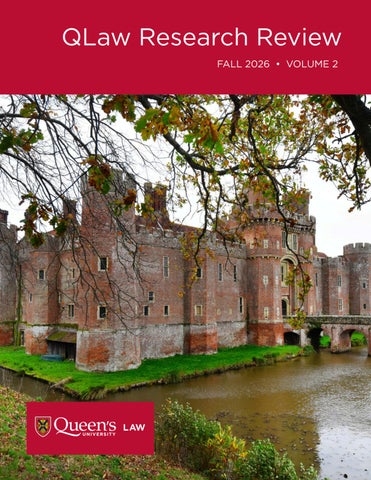
11 Events 13 Presentations / Engagements 20 Journals / Books 22 Court Citations 23 In the News / Opinion 25 Visiting Scholars / Research Fellows 26 LLM / PhD / Postdoctoral Research On the Covers: Bader College at Herstmonceux Castle Estate in East Sussex, England, home to the Queen’s Law International Law Program. Above: From left, Professor Lisa Kerr, Dean Colleen M. Flood, and Professor Preston Jordan Lim chat with Professor Grégoire Webber (back to camera).
The QLaw Research Review recognizes research excellence at the Queen’s Faculty of Law. It is published twice annually.
MESSAGE FROM THE DEAN
Q
ueen’s Bicentennial Vision establishes our roadmap toward the university’s 200th anniversary in 2041, anchored in a distinctive ambition: to combine “personal scale and global reach.” It calls on Queen’s to build on the strength of our close-knit community while focusing research and teaching where we can make a profound contribution nationally and globally. Queen’s Law embodies that vision.
Darryl Robinson is at the forefront of international criminal law, including emerging debates over ecocide; Associate Dean Cherie Metcalf leads international research on climate law and policy. Nicolas Lamp is one of the world’s leading scholars of international trade law; Ardi Imseis, international humanitarian and public international law; Bita Amani, international intellectual property and its disparate impacts among states; Associate Dean Joshua Karton, international commercial arbitration; and Preston Jordan Lim, China’s relationship with the international economic order. Sharry Aiken works on immigration, refugee law, and border security; Stanley Nweke-Eze on how the rules governing crossborder trade and foreign investment interact with inclusive development and states’ regulatory autonomy; Associate Dean Kevin Banks on international labour standards; and Ashwini Vasanthakumar, Queen’s National Scholar, on questions including transitional justice and the legal mobilization of refugee law. They are among many Queen’s Law scholars whose research reaches across borders and engages directly with a rapidly changing world. That scholarship also reaches directly into our classrooms. Professors Imseis and Lamp, together with Program Director Gillian Ready, lead our International Law Program, based in part at Bader College at Herstmonceux Castle in East Sussex, pictured on this issue’s cover.
Dean Colleen M. Flood
Students can pursue streams in public international law, international business law, and, most recently, international environmental law, learning not only from leading scholars but through engagement with international institutions and practitioners. This integration of research, teaching, and student experience is precisely what the Bicentennial Vision asks of us. And it has rarely been more important. War and geopolitical instability, climate change, resurgent authoritarianism, pervasive misinformation, and the uncertain trajectory of artificial intelligence present challenges that no country — and no discipline — can address alone. We need legal scholars, practitioners, and thinkers who can work across borders and disciplines: connecting law with political philosophy, economics, public policy, and history; collaborating internationally; and bringing students into the creation of new knowledge. Our scale allows scholars and students to know and learn from one another. Our ambition requires their ideas to travel much further. That is the promise of “personal scale and global reach” — and it is what Queen’s Law research brings to the world.
3 | January 1 – June 30, 2026 | law.queensu.ca
RECOGNITION / AWARDS Professor Nicholas Bala received the 2025 David Walter Mundell Medal for excellence in legal writing, one of Ontario’s most prestigious legal honours. Bala’s work has shaped the law and advanced justice for children and families for nearly five decades. Read more in this Queen’s Law article. Photo: The Honourable Doug Downey, Attorney General of Ontario, left, congratulates Bala on his award. Photo courtesy Ministry of the Attorney General, Government of Ontario.
Professor Lindsay Borrows, Queen's Law Professor, Indigenous Law & Governance, was among 15 early‑career researchers worldwide selected as a Canadian Institute for Advanced Research (CIFAR) Global Scholar (2026–2028). The selection recognizes Borrows’ innovative, community-engaged work at the intersection of Indigenous law and environmental governance. Read more in this Queen’s Gazette article. Professor Joshua Karton was awarded the 2026 Professor Les Green Award for Research Excellence. An internationally recognized scholar, Karton’s work has made a sustained and influential contribution to international and domestic arbitration, transnational contract law, and comparative law. Read more in this Queen’s Law article. Karton was also admitted as a fellow of the Chartered Institute of Arbitrators. Professors Lisa Kerr and Erik Knutsen each received a Stanley M. Corbett Award for Excellence in Teaching, a joint initiative of the Faculty of Law and the Law Students’ Society to recognize teaching excellence by instructors in the Faculty of Law. The award recognizes Kerr and Knutsen’s abilities to translate their research and practical engagement with the criminal justice system and injury and insurance litigation, respectively, into impactful and engaging teaching. Photo: Professor Erik Knutsen, Professor Lisa Kerr, and Dean Colleen M. Flood.
4 | January 1 – June 30, 2026 | law.queensu.ca
APPOINTMENTS
Professor Gail Henderson was appointed visiting Estey Chair in Business Law at the University of Saskatchewan College of Law, Saskatoon, from January 1 to June 30, 2026.
Professor Alyssa King was appointed a visiting scholar of the Alexander von Humboldt Chair of Human Rights at Friedrich-Alexander University, Erlangen, Germany, from June 29 to July 24, 2026.
Professor Darryl Robinson was appointed a visiting fellow at the Grotius Centre for International Legal Studies, Leiden University, The Hague, the Netherlands, from February to March 2026.
Professor Grégoire Webber was appointed to the board of directors of the Pierre Elliott Trudeau Foundation. In addition, his appointment as visiting professor at the Université Paris-Panthéon-Assas was renewed for the 2026–2027 academic year.
5 | January 1 – June 30, 2026 | law.queensu.ca
FUNDING Professor Lindsay Borrows, Queen's Law Professor, Indigenous Law & Governance, received $100,000 as one of 15 early‑career researchers worldwide selected as a Canadian Institute for Advanced Research (CIFAR) Global Scholar (2026–2028). The selection recognizes Borrows’ innovative, community-engaged work at the intersection of Indigenous law and environmental governance. Read more in this Queen’s Gazette article.
Professor Samuel Dahan, Director, Conflict Analytics Lab, received $498,885 from the Natural Sciences and Engineering Research Council of Canada (NSERC) to lead a global, interdisciplinary research project intended to transform how courts use artificial intelligence. “Courtroom Intelligence: Co-Designing AI for Courts” is being funded through NSERC’s Discovery Horizons program over five years. Read more in this Queen’s Law article. Dean Colleen M. Flood received $355,724 from the Canadian Institutes of Health Research (CIHR) for a global project examining how medical device regulation can better support the safe and effective use of artificial intelligence (AI) in health care. Titled “Optimizing Medical Device Regulation of Artificial Intelligence,” the four-year study focuses on how Canada’s medical device framework can continue to evolve to respond to rapidly advancing technologies, particularly machine learning and generative AI. Read more in this Queen’s Law article.
Top row: Professors Bethany Hastie and Cherie Metcalf; bottom row: Professors Ivan Ozai and Darryl Robinson.
Professors Bethany Hastie, Cherie Metcalf, Ivan Ozai, and Darryl Robinson received funding to pursue research in their areas of expertise: Hastie on labour rights and access to justice (“The Use of Section 33 to Override Charter Rights and Its Implications for Access to Justice: A Case Study of Labour Laws”); Metcalf on public trust in the courts (“The Rule of Law & Public Perception of the Courts”); Ozai on tax avoidance (“Judicial Construction and the General Anti-Avoidance Rule”); and Robinson on accountability for serious environmental harm (“Solving the Last Puzzle of Ecocide: Enabling a Transnational Wave of Environmental Enforcement Laws”). Hastie’s and Metcalf’s work was funded by The Canadian Foundation for Legal Research (CFLR), while Ozai and Robinson received support through Social Sciences and Humanities Research Council (SSHRC) Institutional Grants. Read more in this Queen’s Law article.
Hastie is also co-PI on “Brimer les droits du travail, ébranler l’État de droit” (“Undermining Labour Rights, Overriding the Rule of Law”), which was funded through a Barreau du Quebec research grant.
Professors Bethany Hastie and Alyssa King were named Queen’s Law’s 2026–2027 Research Excellence Scholars, receiving internal funding to advance their research on workplace technology and offshore legal zones, respectively. Read more in this Queen’s Law article.
Professors Lisa Kerr and Kimberly Murray received SSHRC Insight Grants to advance their research. Kerr’s project, “Appeals from Inside: How Prisoners Access Justice at the Ontario Court of Appeal,” will offer the first examination of Ontario’s unique Probono Inmate Appeal Program and its role in expanding access to justice for incarcerated individuals. Murray is co-leading research on an initiative aimed at collecting and protecting documented truths of Canada’s Indian Residential School system. The project, titled “The Indian Residential School Records Project: Legal and Investigative Research for Justice,” responds to the scheduled destruction of tens of thousands of Survivor testimonies in 2027. Read more in this Queen’s Law article. Professors Nicolas Lamp and Cherie Metcalf received funding through the Queen’s Undergraduate Student Summer Research Fellowship (USSRF) program, which combines central university support with faculty members’ own research funds to hire students over 16 weeks during the summer. Mevini Kavisinghe, Law’28, worked with Metcalf on her project “Private Rights of Action and the Enforcement of Public Regulation In Canada,” funded by a SSHRC Insight Development Grant. Sierra Wild, Law’27, worked with Lamp on his project “Trading in (Dis)Order: The Crisis of Globalization and the Future of International Trade Law and Policy,” funded through a SSHRC Insight Grant. Read more in this Queen’s Law article. Top row: Mevini Kavisinghe and Professor Cherie Metcalf; bottom row: Sierra Wild and Professor Nicolas Lamp.
Professor Mark Walters joined a project funded by CY Cergy Paris Université on “Constitutional Culture and the Conservative Disposition,” which will examine critically the rule of law in light of political traditions and the rise of authoritarian populism.
7 | January 1 – June 30, 2026 | law.queensu.ca
SPOTLIGHT Global Engagement at Queen’s Law
Professor Nicolas Lamp, left, Academic Co-Director, International Law Program, with Professor Darryl Robinson.
Q
ueen’s Law’s researchers contribute to legal issues close to home, helping to critically examine our criminal and family justice systems, business and labour laws, and public and constitutional law, and to advance Indigenous rights and Reconciliation. But their impact does not stop at Canada’s border. Our faculty members work with scholars, courts, and institutional partners around the world on some of the most pressing global legal challenges. International research collaboration and global challenges It is easy to think of current global issues with legal dimensions: the rapid advance of AI, including its integration into the law; international migration and diasporas; access to justice, dispute resolution, and the rule of law; the international economic order and rules of trade; climate change and its attendant risks; and humanitarian and criminal laws of armed conflict are a few that readily come to mind.
Our researchers are partnering with leading international scholars, supported by national and international grant funding to address these issues and more. Samuel Dahan’s work on designing legal AI has him working with academic partners from the U.S. and E.U., courts in Canada and the E.U., and international industry with support from the Social Sciences and Humanities Research Council (SSHRC) and the Natural Sciences and Engineering Research Council of Canada (NSERC). Nicolas Lamp and U.S., German, and Brazilian partners are focused on shifts in the multilateral trade regime with SSHRC funding. Ashwini Vasanthakumar’s work explores political authority, membership, and obligation through a partnership funded by the European Research Council. Alyssa King and her U.S. co-author are probing the ethics of the global movement of high court judges to sit outside their home jurisdictions with SSHRC support, while Associate Dean Joshua Karton is helping lead a large team investigating international commercial arbitration under a £1-million U.K. Economic and Social Research Council grant.
Cherie Metcalf’s SSHRC-funded work engages scholars from the U.S. and E.U. on climate law and policy, while Darryl Robinson’s SSHRCsupported research engages international partners on the crime of ecocide. Debra Haak and Beverley Baines are participating in separate international collaborations focused on women’s rights in the U.K. and Brazil / Canada respectively. Influencing ideas, laws, and policy internationally Our faculty members regularly publish with journals and presses that reach global audiences. Their monographs and edited collections appear with leading international presses including Harvard, Cambridge, Oxford, Hart, and Edward Elgar. Articles appear in top field journals and flagship U.S. law reviews, such as The Modern Law Review, Oxford Journal of Legal Studies, Leiden and European journals of international law, International Journal of Comparative Law and Legal Philosophy, Northwestern University Law Review, Indiana Law Journal, and Harvard and Stanford journals of international law, to name just a few.
Professors Sharry Aiken, left, and Debra Haak.
Professor Ardi Imseis at the International Court of Justice.
Interdisciplinary work on legal AI has been featured in prestigious peer-reviewed international AI forums such as the Association for Computational Linguistics, International Conference on Machine Learning, and Association for the Advancement of Artificial Intelligence. Faculty are invited visitors and affiliates with leading academic institutions around the world, including The London School of Economics, Université Paris-Panthéon-Assas, Oxford, the University of Sydney, National Taiwan University, Boston College, Harvard's Berkman Klein Center, and the Centre for International Governance Innovation. Our faculty members gave more than 80 international paper presentations in the past year alone. This reflects an extraordinary reach for the ideas of our faculty. Many of our researchers are actively engaged in shaping law and policy internationally. Ardi Imseis has appeared multiple times as counsel to states before the International Court of Justice, building on his expertise in international humanitarian law, prior work with the U.N., and his recent book, The United Nations and the Question of Palestine. 9 | January 1 – June 30, 2026 | law.queensu.ca
Darryl Robinson is consulting with states bringing climate change cases to the International Court of Justice and has previously led interventions before the International Criminal Court Appeals Chamber and the Extraordinary Chambers in the Courts of Cambodia. Sharry Aiken recently contributed to a submission to the U.N. Human Rights Committee on Canada's human-rights record; Ivan Ozai contributed to an amicus brief to the Court of Justice of the European Union defending the E.U.'s global minimum tax. Stanley Nweke-Eze has represented sovereign states, state-owned entities, and multinational corporations in commercial and investment arbitrations across jurisdictions and advised governments and investors on international investment law. Maroussia Lévesque led AI and human rights work at Global Affairs Canada, helping establish the Global Partnership on AI, and collaborating with Amnesty International's Algorithmic Accountability Lab. Sharing expertise on a global stage Many of our faculty members sit on international advisory boards and task forces, where their expertise provides valued input into the development of law and policy on a global stage. Joshua Karton serves on the International Bar Association's Task Force on Privilege in International Arbitration; Erik Knutsen is an elected member of the American Law Institute and the European Law Institute; Alyssa King is an observer for the U.S. Uniform Law Commission's Conflict of Laws Group; Ivan Ozai is a member of the International Law Association's Committee for International Tax Law; Jacob Weinrib sits on the board of Dignity Rights International; Preston Jordan Lim is a fellow of the National Institute of Military Justice; Bita Amani participates in the Global Expert Network on Copyright User Rights and the Geneva Centre on Knowledge Governance; and Robert Yalden is an observer for a global working group drafting a UNIDROIT/FAO/IFAD Guide on Legal Structures for Agricultural Enterprises.
International excellence and recognition The quality of our faculty members’ work is not only reflected in their activities but in numerous international awards. Among them, Darryl Robinson received the Antonio Cassese Prize; Joshua Karton both the James Crawford Prize and BIICL/ICLQ Young Scholar Prize; and Ivan Ozai's work was shortlisted for the International Bureau of Fiscal Documentation’s Frans Vanistendael Award. Faculty have won multiple best-paper awards — Erik Knutsen from the International Association of Procedural Law and Samuel Dahan and his collaborators have received multiple best-paper awards for their innovative interdisciplinary work on designing legal AI systems. Most recently, Lindsay Borrows was named a 2026-2028 CIFAR Global Scholar, selected from a record international pool of more than 450 applicants from 41 countries. She joins CIFAR's Future Flourishing collaborative research network, pursuing work on Indigenous law and environmental governance with scholars from around the world. You’ll see evidence of Queen’s Law’s influence both at home and abroad in this issue of the QLaw Research Review. Our researchers are working hard to find ways law can help address the many pressing challenges we face.
Professor Lindsay Borrows, Queen's Law Professor, Indigenous Law & Governance.
EVENTS Technology, Labour and Industry 5.0
Above: Professors Samuel Dahan and Kevin Banks present at the event.
The Centre for Law in the Contemporary Workplace (CLCW), together with Queen’s Law and Conflict Analytics, hosted Technology, Labour and Industry 5.0: What Kind of Future(s) for Work and its Legal Regulation? in Toronto May 28–29. The conference explored emerging challenges for legal regulation and possibilities for law reform that will better respond to new realities of work in the digital age. Keynote speaker was Ifeoma Ajunwa, Asa Griggs Candler Professor of Law and Founding Director, AI and the Future of Work program at Emory Law School. Panelists from around the globe shared their expertise, including Queen’s Law professors Kevin Banks (“Reflections on Ontario’s Digital Platform Workers’ Rights Act”) and Samuel Dahan (“The Infrastructure of Global Hiring: Employers of Record and the Future of Work”). In this Queen’s Law article, CLCW Director Professor Bethany Hastie discussed the genesis behind the event.
Queen’s Institute on Trade Policy Professor Nicolas Lamp convened leading experts for “Trading in Disorder: A Trade Strategy for Navigating U.S. Protectionism and Chinese Industrial Policy,” the 2026 edition of the Queen’s Institute on Trade Policy, April 13–15 in Kingston. The Institute examined the impact of U.S. trade policy and China’s industrial strategy on Canada’s economy, explored major policy challenges, and considered their implications for Canada’s future trade strategy. Keynote speaker was Aaron Fowler, Associate Assistant Deputy Minister and Chief Trade Negotiator at Global Affairs Canada. Read more in this Queen’s Law article.
Dean Colleen M. Flood, Aaron Fowler (also below, presenting), and Professor Nicolas Lamp.
11 | January 1 – June 30, 2026 | law.queensu.ca
FLSQ Conference As co-directors of Feminist Legal Studies Queen’s (FLSQ), Professors Bita Amani and Debra Haak co-hosted the annual FLSQ International Women’s Day Conference at Queen’s March 13–14. This year’s theme was “Women, Disability, and Intersectionality: Designing for Equality and Leaving No One Behind.” Keynote speaker was Dr. Anna Lawson, Professor of Law, University of Leeds, who spoke on “Women and Disability: Critical Reflections on Designing for Equality and (Mobility) Justice,” introduced by Stephanie Simpson, Queen’s Vice Principal (Culture, Equity, and Inclusion). Papers were presented by Professors Sharry Aiken and Bita Amani and PhD candidate Deepti Panda. Professor Cherie Metcalf and Visiting Scholar Michele Leering also participated as panel chairs. For the program and a full list of panelists and abstracts, visit the FLSQ Conference 2026 website.
Clockwise from top left, Professors Anna Lawson, Debra Haak, and Bita Amani (with Professor Lynne Hanson in right background).
Queen’s Law Faculty Retreat
Clockwise from top left, Professors Larry McEnerney, Stanley NwekeEze, Cherie Metcalf, and Lisa Kelly (with Professor Lindsay Borrows).
Queen’s Faculty of Law hosted its annual faculty retreat May 6–7 at the Donald Gordon Conference Centre. The event’s highlight was a writing workshop with Professor Larry McEnerney, director emeritus of the University of Chicago Writing Program, who presented on “Writing & Impact.” Other sessions included academic integrity discussions and planning to address the challenges related to AI (led by Professors Sharry Aiken and Nicolas Lamp and moderated by Professor Kevin Banks). The retreat also offered presentations by the Faculty’s research theme leaders. These professors shared future directions for strengthening research in the areas of labour law and policy (Kevin Banks), business law (Gail Henderson), criminal law (Lisa Kerr), international law (Nicolas Lamp), and public law (Grégoire Webber).
International Symposium Series Professor Sharry Aiken and Visiting Scholar Michele Leering, PhD’23, co-organized the International Symposium Series: Reflective Practice for Legal Professionals, which included a virtual symposium June 22–24 with welcoming remarks from Dean Colleen M. Flood. Hosted by Queen’s Law, the Series brought together scholars, educators, regulators, and practitioners to explore how disciplined reflection can strengthen the legal profession's response to contemporary challenges and advance reflective practice across the legal educational spectrum and beyond. More than 150 speakers from 12 countries participated in the Series, including Queen’s Law professors Lindsay Borrows, Christa Bracci, and Debra Haak, and educational developer Dr. Andrea Speltz.
In-person events were also organized by collaborating law teacher associations including the Association of Law Teachers UK, the Canadian Association of Law Teachers, Nottingham-Trent Centre for Legal Education, and Australian Law Academics Association. To read more about the Series, including abstracts and the full program, visit its dedicated website.
PRESENTATIONS / ENGAGEMENTS Professor Sharry Aiken co-organized, with Visiting Scholar Michele Leering, the International Symposium Series: Reflective Practice for Legal Professionals (See Events, above). She was also editor and co-author for a new Canadian Council for Refugees (CCR) report submitted to the UN Human Rights Committee on Canada’s compliance with the International Covenant on Civil and Political Rights. Among other engagements, Aiken presented at the Annual Conference of the Berkley Center on Comparative Equality & AntiDiscrimination Law, University of Tuscia, Viterbo, Italy. Professor Bita Amani was part of a panel, "Fair AI," at the Creation, Research and Social Justice in the Age of Artificial Intelligence symposium at the Brazilian College of Higher Studies and participated in a Copyright and Just AI workshop hosted by the Geneva Centre on Knowledge Governance, Rio de Janeiro, Brazil. She also presented a co-authored work in progress, “Branding Inequality in Trademark Law: Immoral Marks, Expressive Freedoms, and the Politics of Prohibited Use” in São Paulo, Brazil, for the International Association for the Advancement of Teaching and Research in IP (ATRIP) Annual Congress. Amani served as a consultant to the Government of Canada providing technical assessment of CAN-ASC-6.2:2025 Accessible and Equitable Artificial Intelligence Systems. As Co-director, Feminist Legal Studies Queen’s (FLSQ), Amani co-hosted (with FLSQ Co-director Professor Debra Haak) the annual FLSQ International Women’s Day Conference at Queen’s with the theme “Women, Disability, and Intersectionality: Designing for Equality and Leaving No One Behind.” (See Events, previous page.) 13 | January 1 – June 30, 2026 | law.queensu.ca
Professor Beverley Baines delivered two presentations and chaired a book roundtable at the ICON-S 2026: Reimagining Public Law for a Fractured World: Technology, Identity & Truth conference, University College Dublin, Ireland. Her presentations were titled “The Primacy of Section 28 of the Canadian Charter of Rights and Freedoms” and “Institutionalized Political Disadvantage: A Democracy Reinforcing and Participation Judicial Review Theory” (co-presenter). The book roundtable was “Human Rights, Constitutional Law and Belonging. The Right to Equal Belonging in a Democratic Society” (Elena Drymiotou, Routledge, 2018).
Professor Nicholas Bala presented a paper on shared parenting at the Family Law Summit of the Law Society of Ontario and a paper on litigation abuse at the Carleton County Law Association. He also gave presentations on child witnesses, domestic violence, high-conflict separations, and the Supreme Court Ahluwalia v. Ahluwalia, 2026 SCC 16 decision for various other programs and webinars. Bala was also a witness for two Senate Committee on Justice and Legal Affairs parliamentary hearings: Bill C-15 (Unified Family Court) and Bill C-16 (coercive control). Bala is also serving as chair of a multidisciplinary task force that is revising the Parenting Plan Guide and Template for AFCC (Association of Family and Conciliation Courts) Ontario.
14 | January 1 – June 30, 2026 | law.queensu.ca
Professor Lindsay Borrows presented on her collaboration with the Kingston Native Centre and Language Nest on research supporting the development of the Kingston Indigenous Legal Centre at the Ontario Federation of Indigenous Friendship Centres Justice Gathering, Toronto. She also presented on Indigenous legal revitalization at the University of Oxford Faculty of Law, England, as well as research from the Anishinaabe Law Field School course to Chippewas of Rama First Nation chief and council, and in-house counsel.
Professor Samuel Dahan presented “OpenJustice — reasoning infrastructure that encodes firms' settlement experience” at the Where Next Showcase at #DiscoveryX, Ontario Centre for Innovation. He also presented “The Infrastructure of Global Hiring: Employers of Record and the Future of Work” at Queen’s Law’s Technology, Labour and Industry 5.0: What Kind of Future(s) for Work and its Legal Regulation? conference in Toronto. (See Events, page 11.)
Dean Colleen M. Flood was a panelist for “From Models to Mandates: Governing DataDriven Healthcare Transformation” at the Canadian Healthcare Operations Research Workshop (CHOW) 2026, Smith School of Business, Kingston, and for “The Protections for AI” at the Information and Privacy Commission workshop Trustworthy AI in Health: The Promise, Perils, and Protections, in Toronto. She also presented “Regulation of AI in Canadian Healthcare” at Artificial Intelligence (AI) in Healthcare: Understanding and Managing the Legal and Ethical Risks, York University, Toronto; “Machine MD, The Law & Health-AI,” Monash University, Melbourne, Australia; and “Machine MD: The Governance of Health-Related AI,” Queen’s School of Policy Studies, Policy Matters: Beyond the Brief Speaker Series, Kingston. Flood was also the organizer for “Data Governance for AI and Health in Canada: Sovereignty, Access, and Accountability,” Toronto.
Professor Debra Haak presented “Sex and Women’s Equality Rights in International and Canadian Human Rights Law” at the Christian Legal Fellowship (CLF) Annual Symposium on Religion, Law and Human Rights, Robson Hall Law School, University of Manitoba. She also presented “The Critical Case Comment: Integrating Reflective Practice in a Substantive Upper-Year Course” at the Canadian Association of Law Teachers Annual Conference, Western University, and “Equality Unspoken: Judicial Response to Equality Arguments in Constitutional Cases about Criminal Prostitution Laws” at the 13th Annual Conference of the Berkeley Center on Comparative Equality & AntiDiscrimination Law, University of Tuscia, Italy. As Co-director, Feminist Legal Studies Queen’s (FLSQ), Haak co-hosted (with FLSQ Co-director Professor Bita Amani) the annual FLSQ International Women’s Day Conference at Queen’s with the theme “Women, Disability, and Intersectionality: Designing for Equality and Leaving No One Behind.” (See Events, page 12.)
Professor Bethany Hastie presented “Systemic Remedies for Sexual Harassment: A Feminist Approach?” at Imagining Feminist Dispute Resolution, Toronto Metropolitan University. She also presented “Working in Extreme Heat: A Global Scan of Legal Regulations to Protect Agricultural Workers in a Warmer World” at Rethinking Work and Legal Regulation for the Anthropocene, University of British Columbia, Vancouver.
During her time as visiting Estey Chair in Business Law at the University of Saskatchewan College of Law, Saskatoon, Professor Gail Henderson organized the Estey Symposium on Consumer Debt. The symposium engaged leading scholars and practitioners for an interdisciplinary dialogue on this pressing issue for many Canadian households. She also presented her research on community economic development investment funds at the UBC Centre for Business Law Corporate Scholarship Workshop and guest lectured on payday loans, University of Calgary Faculty of Law.
Professor Ardi Imseis was hosted at University College Dublin School of Law, which convened a panel on his book The United Nations and the Question of Palestine (Cambridge University Press), Dublin, Ireland. He presented “International Law in a Time of Monsters: On UN Security Council Resolution 2803 and the So-Called ‘Board of Peace’” at La Sorbonne (Paris I), Faculty of Law, Paris, France; and “Is the Security Council Bound by International Law?” at the University of Ottawa Faculty of Law. Imseis continued to address various governmental fora, including on the “International Law Governing the U.S./Israeli War against Iran” at the Assemblée Nationale, Paris, France, and on prolonged refugee problems to the Canadian House of Commons Standing Committee on Foreign Affairs and International Development.
Professor Joshua Karton gave a lecture on “Appeals from Arbitral Awards” for the British Columbia Court of Appeal and spoke on “Ethical and Responsible Use of AI in Arbitration Practice” for a webinar organized by the Organization of Islamic Cooperation Arbitration Centre.
Professor Lisa M. Kelly presented a public lecture, “The Unfinished Revolution in Youth Justice,” as part of the Compassionate Justice Speaker Series, Toronto. She also presented “Children of Genocide” (based on a coauthored chapter, with Nadeen Awad, Law’25, to be published in the book Gaza, Genocide and Gender Governance: Feminist Conversations on the Limits of Law) at the 2026 Law and Society conference in San Francisco, CA. The presentation was part of a panel entitled Law’s Violence: Empire, Genocide, and the Racial Governance of Life.
16 | January 1 – June 30, 2026 | law.queensu.ca
Professor Lisa Kerr presented to judges at the National Criminal Law Seminar, Vancouver, and to the National Judicial Institute program "Judges and Jails," Vancouver. She also presented to an Ontario Court of Justice conference in Kingston.
Professor Alyssa King presented “Comparing the Commercial Courts” at the International Law in Domestic Courts Workshop at Fordham University School of Law, New York, and at a Boston College Law School faculty workshop. She also participated in the Fordham Legal Ethics colloquium Fresh Perspectives on the Legal Profession, Fordham Law School, and presented a precis for “Self Represented Litigants Use Summary Judgment” at the 11th Annual Civil Procedure Workshop, hosted by Fordham Law.
Professor Nicolas Lamp chaired a panel at the annual meeting of the American Society of International Law and spoke at the annual meeting of the Canadian Association of Business Economists. He also presented his work-in-progress entitled “The Debate about China’s ‘Overcapacity’ as a Struggle over the International Division of Labour: Four Futures for International Economic Law” at the International Economic Law and Policy Workshop, online; at the Department of Politics and International Relations Colloquium at the University of Oxford, England; and at a workshop on steel overcapacity, in Brussels. Lamp also convened leading experts for “Trading in Disorder: A Trade Strategy for Navigating U.S. Protectionism and Chinese Industrial Policy,” the 2026 edition of the Queen’s Institute on Trade Policy. Read more in this Queen’s Law article. (See Events, page 11.)
Professor Mary-Jo Maur presented to Atlantic Coast judges on the topic of the new tort of intimate partner violence (Ahluwalia v. Ahluwalia, 2026 SCC 16). She also presented “Evidence in Family Law Proceedings” at the Law Society of Ontario’s Family Law Summit, Toronto.
Professor Cherie Metcalf presented “Communicating risk across the political divide: Assessing Institutional Trust over Time” at the Society for Environmental Law & Economics Conference, King’s College London, U.K. Co-authors presented two of her other works in progress at that conference, “Culture & Private Enforcement of Public Law” and “Framing Liability.” Metcalf also presented “Communicating risk across the political divide: Assessing Institutional Trust over Time” at the Sustainability Conference of American Legal Educators, Arizona State University, and at the hybrid Midwest Political Science Association Annual Conference, Chicago, IL. She also presented “Judicial Fact-Finding, Persuasion & Institutional Trust in Polarizing Cases” at the Law and Social Change: Empirical Methods and Law colloquium at Osgoode Hall Law School, Toronto.
17 | January 1 – June 30, 2026 | law.queensu.ca
Professor Kimberly Murray, along with Manitoba Keewatinowi Okimakanak, presented to the Provincial Territorial Governments’ Working Group on Indian Residential Schools their work to draft a provincial law to protect First Nation burials and to repatriate First Nation ancestors and cultural belongings to communities. She also participated in a roundtable summit entitled “Orchestrating Restorative Listening Situations in a Transitional Justice Context: Colombia and Canada in Dialogue” at United College, University of Waterloo. Murray also testified as an expert witness at the Permanent Peoples’ Tribunal’s 57th session on Missing and Disappeared Indigenous Children and Unmarked Graves in Canada. The Tribunal’s Preliminary Statement was issued on May 29, 2026, with the final report and findings scheduled for release on September 30, 2026.
Professor Darryl Robinson presented “Humans Matter Too: An Inclusive, Ecocentric, Evidence-Based Account of Environmental Crimes” at Leiden University, The Hague, the Netherlands. He also delivered a guest lecture at the University of Amsterdam and delivered a paper, “No Island is An Island Unto Itself,” at a Cornell University workshop on The Sovereign Other in Ithaca, NY. Robinson also gave a presentation on “The Case for a Crime of Ecocide” at Sant’Anna School for Advanced Legal Studies in a program on Criminal Law and the Anthropocene in Pisa, Italy.
18| January 1 – June 30, 2026 | law.queensu.ca
Professor Ashwini Vasanthakumar presented a chapter on gratitude and immigration from her forthcoming book at a Harney Lecture, Toronto; at the Annual Legal Philosophy Lecture, Western University; and at the University of Oxford, England. She also presented results from her SSHRC-funded Insight Development Grant research on transitional justice and diasporas at a workshop on diaspora politics at the University of Ottawa and presented research from her SSHRC-funded Insight Grant on victims’ agency at the Irish Jurisprudence Society and UCLA Law. Vasanthakumar also led a methods masterclass at University College Dublin, Ireland, drawing on her research on privatizing border control, and provided expert witness testimony at the Ontario Human Rights Tribunal.
Professor Mark Walters participated in workshops on administrative law at McGill University and Aboriginal Title at Wolastoqey First Nation, Fredericton, N.B.
Professor Grégoire Webber presented his research project on “Circumstances of Law” at the John Austin Seminar series at UCL (University College London) Faculty of Laws.
Professor Jacob Weinrib presented “Beyond the Baker Balance” at the Administrative Law Workshop, McGill Faculty of Law, Montreal, Que.
Professor Robert Yalden presented a draft article based on his SSHRC-funded study on securities commission rule-making at the UBC Centre for Business Law’s Corporate Scholarship Workshop titled Rule Making, Structures of Deliberation, and Democratic Legitimation: From Theory to Practice in Canadian Securities Law, in Vancouver. He also participated in the proceedings of the ninth session of the UNIDROIT Working Group in Rome, preparing a Legal Guide for Collaborative Legal Structures for Agricultural Enterprises. Yalden was integrally involved in the development and delivery of Queen’s Law’s new Professional Intensive Course of Mergers & Acquisitions, Kingston. He was also a participant in the University of Oxford Commercial Law Centre’s Digital Assets Conference, Oxford, England, and in a roundtable on Proxy Advisors in 2026: Upcoming Changes and Implications for Canadian Capital Markets at the Johnston Centre for Corporate Governance Innovation, Toronto.
Professor Robert Yalden, third from right, at the ninth session of the Working Group on Collaborative Legal Structures for Agricultural Enterprises (CLSAE) Project at UNIDROIT headquarters, Rome.
19 | January 1 – June 30, 2026 | law.queensu.ca
JOURNALS / BOOKS
Professor Nicholas Bala co-authored “Child-Inclusive Mediation in Canada” in Canadian Family Law Quarterly and “Shaping the Future of Child-Inclusive Mediation in Canada: A Discussion Paper for Family Mediation Canada.”
Dean Colleen M. Flood co-authored (with Bryan Thomas, Senior Research Fellow) “Rethinking the objectives of a pan-Canadian immunization information system” in the Canadian Journal of Public Health. Professor Colin Grey published “Persecuted but Undeserving” in the Refugee Survey Quarterly as part of a special issue on exclusion from refugee status based on past criminality. Professor Debra Haak published “R v Kloubakov: Three Significant Clarifications about Canada’s Criminal Prostitution Laws” in The Supreme Court Law Review. Professor Bethany Hastie co-authored "Fit for the Task? Assessing the Suitability of Canadian Labour Law to Respond to New Forms of Technology in the Workplace" in the UBC Law Review and “Serious Enough? Troubling Civil Courts’ Assessments of the Seriousness of Sexual Harassment in Wrongful Dismissal Cases” in the Canadian Journal of Human Rights.
20 | January 1 – June 30, 2026 | law.queensu.ca
Professor Erik Knutsen published “Rules by Consequence” in the International Journal of Procedural Law. He presented the paper at the International Association of Procedural Law Colloquium, University of Zagreb, Croatia, where it earned one of the top awards from the International Association of Procedural Law. Knutsen also published the co-authored text “Civil Litigation, Second Edition,” University of Toronto Press.
Professor Nicolas Lamp published “Trading in Disorder: The Crisis of Globalization and the Future of Trade Policy” in the Journal of International Business Policy. Professor Cherie Metcalf co-authored “Rise of the Machines: Algorithmic Zoning for Climate Risk” in the Maryland Law Review (lead article in volume). Professor Kimberly Murray submitted to the Law Society of Ontario (LSO) a commissioned research paper entitled “Leaving Footprints: Lawyering for Reconciliation in Canada’s Colonial Legal System” as part of the LSO’s 2025 Equity Summit. Professor Ivan Ozai’s article “Beyond Economic Allegiance” (University of Toronto Law Journal) was shortlisted for the 12th Frans Vanistendael Award of the International Bureau of Fiscal Documentation, which recognizes outstanding publications in international tax law. Professor Darryl Robinson published “Humans Matter Too: A Misanthropic Misunderstanding of Ecocentrism is Derailing the Ecocide Debate” and “A Challenge for Ecocide Scholarship: Engaging with Science, Survival, and the Scope of the Criminal Sanction” in the International Journal of Human Rights. He also published a short contribution on “Unwritten Books: Against Criminal Abolition” in the Journal of International Criminal Justice.
Professor Mark Walters published “Swearing Allegiance to King Charles in the Salon Bleu (or not): The Constitutionality of Quebec’s Abolition of the Oath of Allegiance” in From Multilateral Failures to Unilateral Successes? New Trends in Formal Constitutional Amendments (McGill-Queen’s University Press). Professor Grégoire Webber published “Les droits et les mesures progressives du droit” (“Rights and the Progressive Development of Law”) in 20 Revue de droit parlementaire et politique 85–94 and “Liberalism as good ways of life” in 51 Journal of Legal Philosophy 82–89. In his capacity as co-editor in chief of the Canadian Business Law Journal (CBLJ), Professor Robert Yalden co-authored an introduction to a special issue of the journal comprising papers presented at the CBLJ’s 50th Anniversary Conference: Business Law in Canada — The Next 50 Years (Vol. 71-1), March 2026. The issue contains remarks from Justice Mahmud Jamal of the Supreme Court of Canada and articles from leading Canadian academics discussing the future of corporate law, securities law, banking law, bankruptcy law, and the law governing secured transactions.
21 | January 1 – June 30, 2026 | law.queensu.ca
COURT CITATIONS Professor Nicholas Bala and Mary-Jo Maur’s work was cited 22 times in the landmark Supreme Court decision in Ahluwalia v. Ahluwalia, 2026 SCC 16, which establishes a new common-law tort of intimate partner violence that legally recognizes coercive and controlling behaviour within an intimate relationship as its own compensable civil wrong and creates a pathway to sue for intimate partner violence. Bala’s work was also cited by the Supreme Court in R. v. Hussein, 2026 SCC 2 on the use of youth court records. His paper “Litigation Abuse in Ontario Family Law Cases” (2025 CanLIIDocs 1843) was quoted at length in the recent Ontario Anyanwu v Anyanwu, 2026 ONSC 980 decision on the meaning of the concept of litigation abuse and possible responses to it. Professor Colin Grey co-authored a factum that was cited three times in a concurring opinion by the Supreme Court of Canada in Quebec (Attorney General) v. Kanyinda, 2026 SCC 7, a case involving an equality rights claim to the exclusion of refugee claimants from access to government-subsidized educational childcare in Quebec.
Professor Erik Knutsen’s work was cited in the Court of Appeal for Ontario in Green Rise Foods Inc. v N.V. Hagelunie, 2026 ONCA 334, an insurance case that relied on sections in his Halsbury’s Laws of Canada — Insurance treatise in making new, precedent-setting law about insurance causation. His co-authored national torts treatise was also cited in the British Columbia Supreme Court in Glanz v Hooker, 2026 BCSC 697 (a case about battery) and Bonnis v Clark, 2026 BCSC 425 (a defamation case).
Professor Darryl Robinson was cited by the International Criminal Court Appeals Chamber in Prosecutor v. Rodrigo Roa Duterte, a case rejecting a jurisdictional challenge by former Philippine President Rodrigo Roa Dutere. The case concerned alleged killings by death squads. The cited work addressed the jurisdictional reach of the International Criminal Court. The Supreme Court of Canada cited Professor Grégoire Webber’s research in its Société de l’Acadie du Nouveau‑Brunswick v. Canada (Prime Minister) decision that New Brunswick’s lieutenant governor must be bilingual. In its decision, the Court drew on Webber’s chapter “The Promise of Canada’s Official‑Languages Declaration” (in Official Languages of Canada: New Essays, 2008) in interpreting the scope and constitutional significance of language rights. In upholding Newfoundland and Labrador’s interprovincial travel restrictions adopted during COVID-19, the Supreme Court of Canada cited Professor Jacob Weinrib’s article “What is Purposive Interpretation?” (2024) 74:1 UTLJ 74108 in its account of the methodology of Charter interpretation. Read the Taylor v. Newfoundland and Labrador, 2026 SCC 5 decision.
IN THE NEWS / OPINION
Professor Nicolas Lamp (centre, shown here at the recent launch of his book “Reckoning and Renewal”) was featured in the Queen’s Law article “A milestone look at the WTO’s future.” (Photo Patrick Anderseck)
Professor Sharry Aiken was a featured guest on the Borderlines Podcast “Stop Bill C-12!” and was quoted in “Audit flags gap in Ottawa’s fraudulent student visa reform,” iPolitics. She was also quoted in “Canadian detained by ICE for 6 months says he's an 'indefinite' prisoner, has no idea when he'll get out,” CBC; “Those fleeing Venezuela struggle to find legal pathway to Canada,” The Globe and Mail; and “’Everyday justice’ at stake in Supreme Court hearing over WE Charity Scandal,” CP24. Professor Nicholas Bala discussed the evolution of children’s law, and receiving the David Walter Mundell Medal for excellence in legal writing, on CBC’s Ontario Morning. (See also this Queen’s Law article.) He also commented on the Supreme Court of Canada’s landmark ruling that creates a pathway to sue for intimate partner violence (Ahluwalia v. Ahluwalia, 2026 SCC 16) for the CBC’s The National (minute 8:05) and the Toronto Star. Bala also co-authored “Ahluwalia: Understanding, identifying and proving coercive control,” which was published in Law 360 Canada and Toronto Lawyers News. The article discusses the significance of the Ahulwalia decision and its recognition of the tort of intimate partner violence and the need to set boundaries for the concept of coercive control.
Professor Kevin Banks was featured in a Queen’s Law article about his recent appointment to the International Labour Organization’s Committee of Experts, which examines how global standards related to work are applied. Professor Lindsay Borrows published “The Rights of Nature movement is great, but we also need a Responsibility to Nature movement” in The Globe and Mail. Dean Colleen M. Flood was featured in “The Public vs. Private Discussion,” Health Policy Off Script! Unfiltered Conversations about the Canadian Health System, Longwoods Publishing podcast. She was also quoted in “Health P.E.I. 'handcuffed' by provincial government, former board member says,” CBC News. Professor Lisa Kerr published two editorials in The Globe and Mail: “What should Canada do with rehabilitated offenders?” and “Ontario’s Premier and police are undermining the legitimacy of the court process.” She was also quoted in “N.L. chief justice was wrong to sentence grandparent scammer to house arrest, experts say,” CBC News.
Professor Erik Knutsen was quoted in “Ontario is making some auto insurance optional. The savings may be small – and temporary” in The Globe and Mail and “Paid out of pocket for a fender-bender? Fine, but the law says you have to tell your insurer,” CBC News. Professor Nicolas Lamp published an op-ed, “Will Preferential Access for Foreign Automakers Really Work?” in The Globe and Mail and was interviewed about layoffs at Kingston’s Invista plant for CBC Ontario Morning. Lamp was also featured in a Queen’s Law article as the catalyst and editor of the recently published Reckoning and Renewal: The World Trade Organization and Its Dispute Settlement System at 30. Professor Mary-Jo Maur commented on the Supreme Court of Canada’s decision that created a new legal basis for seeking damages for intimate partner violence (Ahluwalia v. Ahluwalia, 2026 SCC 16) in The Globe and Mail and the Canadian Bar Association’s National magazine.
Professor Kimberly Murray discussed her work on residential schools, unmarked graves, and reconciliation, and how she is bringing those experiences into legal education, in interviews with news agencies including CBC Radio Canada, CBC News, the Montreal Gazette, The Tyee, The Guardian, the Toronto Star, and APTN News. APTN also produced a feature article and video about Murray and her career seeking Truth and Reconciliation. Murray also spoke to CBC about her thoughts on the defeat of the proposed Indian Residential School denialism clause to Bill C-9. Professor Ivan Ozai commented in “Meeting the demands of a changing tax landscape,” a Queen’s Law article about the Faculty’s plan to establish a dedicated Tax Law and Policy Professorship. Professor Grégoire Webber was featured in a Queen’s Law article about how his rethinking of the notwithstanding clause is shaping the Supreme Court debate on Bill 21.
Professor Kimberly Murray, seated at left table, testifies at the Permanent Peoples’ Tribunal’s 57th session on Missing and Disappeared Indigenous Children and Unmarked Graves in Canada, in Montreal. (Photo: Jesse Staniforth / APTN) 24 | January 1 – June 30, 2026 | law.queensu.ca
VISITING SCHOLARS / RESEARCH FELLOWS Appointments Effective April 2026, Michele Leering, PhD’23, was appointed a Queen’s Institute for Educational Scholarship and Research (QIESR) Scholar for a three-year term. She was also appointed a research fellow at the University of Ottawa Faculty of Law, effective May 1, 2026. Presentations / Engagements Michele Leering Visiting Scholar
Leering co-organized, with Professor Sharry Aiken, the International Symposium Series: Reflective Practice for Legal Professionals. (See Events, page 13.) She spoke at the Association of Law Teachers conference on promising developments for reflective practice in England & Wales and at the Canadian Association of Law Teachers’ conference on factors influencing its acceptance as a core professional competency. Leering delivered a keynote on reflective practice and its transformative potential at Nottingham Trent Centre for Legal Education’s conference. She also spoke at the international Pracademia in Law Schools virtual initiative and to Toronto Metropolitan University students. She presented on health justice partnerships as a peoplecentred access to justice intervention to a Japanese medical-legal delegation, and to Windsor Law’s SSHRC-funded mental health symposium. Journals / Books Leering co-authored “Joys & Terrors of Legal Education Research” in the 2026 Canadian Legal Education Annual Review. She also published “Knowledge for Implementing People-Centered Justice: The Promise of Medical-Legal/Health Justice Partnerships” for the Justice Data Observatory’s (American Bar Association) compendium Global Perspectives on People-Centered Justice: Exploring the Evidence. Presentations / Engagements Professor Virginia Torrie served as a judge for the inaugural Canadian Insolvency Awards in February, Toronto. Journals / Books
Virginia Torrie Business Law Research Fellow / Law’80 Visiting Lecturer
Torrie co-authored “Debt and Federalism (Volume 2): Provincial Efforts to Protect Insolvent Debtors in Canada, 1939-1960" (CanLII Author’s Program) and served as editor-in-chief for the Banking & Finance Law Review, Vol. 42 No. 2 (Thomson Reuters).
25 | January 1 – June 30, 2026 | law.queensu.ca
LLM / PHD / POSTDOCTORAL RESEARCH DEFENCES LLM student Abdullahi Abdulquadir (supervisor Professor Nicolas Lamp) successfully defended his thesis, “Cross-border data flows and digital trade integration: Legal interoperability and domestic alignment under the AfCFTA.” The thesis explores the legal governance of cross-border data flows under the African Continental Free Trade Area (AfCFTA) Digital Trade Protocol and its annex on cross-border data transfers.
PhD candidate Christopher Donaldson (supervisor Professor Lisa Kerr) successfully defended his dissertation, “Maintaining the Weary Gears of the Canadian Criminal Justice System.” The dissertation is a novel study of the pretrial system of case management in Canadian criminal courts.
APPOINTMENTS PhD candidate Aileen Editha (supervisor Professor Lisa Kelly) was appointed a lecturer in law at Oxford Brookes Law School, Oxford, England, in January 2026. Editha’s research interests are in health law, medical ethics, and critical legal theory. In particular, she is passionate about exploring how current and future health policies affect racialized and ethnic minority communities. Editha is teaching in the Foundation Year and LLB programs. She presented “Body Fragmentation as Ontological Harm in Human Genetic Patenting” at the Women and Intellectual Property Conference at the University of Wolverhampton, UK.
PRESENTATIONS PhD candidate Zain Mookhi (supervisor Professor Michael Pratt) presented his paper "Too final to fail? Judicial deference and the limits of arbitral legitimacy" at McGill University’s A Glitch in the Law conference. Mookhi also participated in Queen's University's PhD-Community Initiative, where he was part of an interdisciplinary team of PhD students working with All-Together Housing (ATH) — a Belleville NGO that provides affordable housing — to survey ATH's model and provide recommendations to improve its operational efficiency and future scalability. 26 | January 1 – June 30, 2026 | law.queensu.ca
Recent LLM graduate Agnes Okpeku (supervisor Professor Lisa Kelly) presented her paper “Colonial Legal Legacies as Glitches: The Impact of Outdated Abortion Laws on Reproductive Rights in Africa” at McGill University’s A Glitch in the Law conference and at the Dalhousie Law Graduate Society Research Transition Conference, Schulich School of Law, Halifax, Nova Scotia.
PhD candidate Deepti Panda (supervisor Professor Joshua Karton) presented her paper “The ‘Excuse’ of Necessity: Economic Crisis, Investor-State Arbitrations and the Classification of Defences under the Articles on State Responsibility” at the International Law Workshop in Honour of Sir Ian Brownlie QC at All Souls College, Oxford / Wadham College, Oxford. Deepti also presented her paper “DEI in the ‘Shrimp Salad’ Bowl of Rights & Privileges: A Hohfeldian Critique of Corporate Inclusion” at the UBC Interdisciplinary Legal Studies Graduate Conference, University of British Columbia, Vancouver.
Deepti Panda (on screen) at the International Law Workshop in Honour of Sir Ian Brownlie QC at All Souls College, Oxford / Wadham College, Oxford. From left: Federica Paddeu, University of Cambridge (Panda’s reviewer); Malcolm Shaw KC, Essex Court Chambers; Joshua Kriesmann, Johannes Gutenberg University of Mainz; and Pierre d’Argent, UCLouvain.
27 | January 1 – June 30, 2026 | law.queensu.ca
Professor Cherie Metcalf Associate Dean Research Tracy Weaver Faculty Research Coordinator lawresearch@queensu.ca law.queensu.ca/research