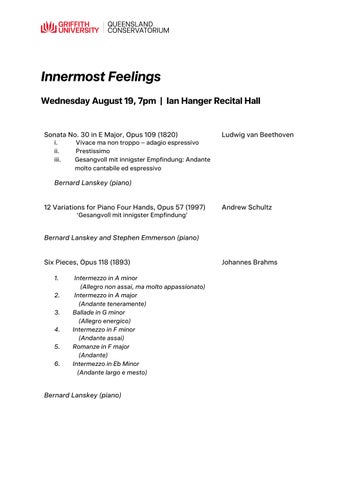
Innermost Feelings Wednesday August 19, 7pm | Ian Hanger Recital Hall
Sonata No. 30 in E Major, Opus 109 (1820) i. ii. iii.
Ludwig van Beethoven
Vivace ma non troppo – adagio espressivo Prestissimo Gesangvoll mit innigster Empfindung: Andante molto cantabile ed espressivo
Bernard Lanskey (piano) 12 Variations for Piano Four Hands, Opus 57 (1997)
Andrew Schultz
‘Gesangvoll mit innigster Empfindung’
Bernard Lanskey and Stephen Emmerson (piano) Six Pieces, Opus 118 (1893) 1. 2. 3. 4. 5. 6.
Intermezzo in A minor (Allegro non assai, ma molto appassionato) Intermezzo in A major (Andante teneramente) Ballade in G minor (Allegro energico) Intermezzo in F minor (Andante assai) Romanze in F major (Andante) Intermezzo in Eb Minor (Andante largo e mesto)
Bernard Lanskey (piano)
Johannes Brahms
Tonight’s program Tonight’s program pairs two intimate but profound works from late in the lives of Beethoven and Brahms with a piece by Andrew Schultz which offers overt acknowledgement to both composers. The title of the concert derives from the performance indication at the opening of the final and most substantial movement of the Beethoven, a set of variations, which Andrew takes forward as the subtitle for his work. The Brahms pieces are also clearly inspired by ‘songfulness’ and a quest for expressing ‘the deepest, most intimate feeling.’ Preceding the Beethoven variation movement are two contrasting short movements, both bagatelle in nature – the first (originally intended as a standalone work) offering a gentle flowing initial idea which is interrupted twice by a more unstable plea for resolution of the initial interruption; the second in the tonic minor, an anxious outburst, also interrupted momentarily, but this time by material of quieter searching. In relation to tonight’s second piece, Andrew writes: ‘12 Variations takes as its subtitle the expression marking from the Variations movement of Beethoven’s Piano Sonata No. 30 in E Major, Opus 109: “Gesangvoll, mit innigster Empfindung.” The subtitle suggests an internalised depth and calmness of expression as well as the presence of an ‘inner line’ in the musical texture. This idea of ‘the inner’ is also captured visually in my work by the ways the four hands of the performers often overlap and reach over each other. Variation form has continually attracted me as it seems to offer an imaginative way to interpret and develop an idea within a listener-attuned sound world. The idea in 12 Variations is the gradual expansion of the music from a spacious, gentle melody to richer and more textured worlds drawing on an ambiguity of structure where the discontinuity of variation form is offset by a larger dramatic shape. The brief quote from the Beethoven fragment, with its perpetually hovering harmony and unresolvable trills, is not heard clearly until the climax of the work. The idea, as in other of my works, was to attempt to find a seamless way to incorporate this fragment so that it appears naturally as both a new expression and something familiar.’ The Brahms set also involves contrasting minor-major pairings – Nos. 1 & 2 in A, and 4 & 5 in F, with the third and sixth also sitting a major third apart but in G Minor and Eb Minor respectively. The descending tonalities (A – G – F -Eb) offer an overarching sense of the direction of the set, though the overall impact is of a more complex emotional journey through time. Throughout the three pieces, the sense is of journeys which spiral ever deeper, creating a sense of timelessness and of consolation. These are deeply human works where the depth of feeling appears to aspire to reflect the spiritual side of our shared humanity.
Tonight’s Musicians Bernard Lanskey, Stephen Emmerson and Andrew Schultz (https://andrewschultz.net/ ) all undertook undergraduate studies at the same time at the University of Queensland, with each graduating with First Class Honours. This initial connection proved to be the starting point for a shared relationship which has now spanned almost a half century, involving multiple commissions leading to performances in Australia, France (La Loingtaine), the United Kingdom, New Zealand, Singapore, Thailand and the USA (Harvard). All three musicians hold full professorships, with Stephen’s primary work undertaken here at the Conservatorium, Andrew’s at the Universities of Wollongong and New South Wales, and Bernard’s at London’s Guildhall School (where Andrew also held a senior leadership position), the Yong Siew Toh Conservatory of Music, National University of Singapore, and the Queensland Conservatorium Griffith University. Stephen and Bernard both studied with Peter Wallfisch in London, while Andrew postgraduate days involved interactions with Luciano Berio (Italy), George Crumb (USA) and David Lumsdaine (UK).