Autumn 2026
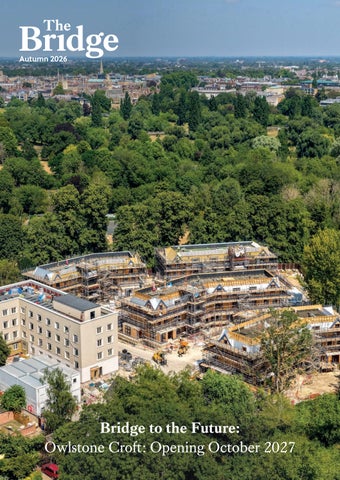
Bridge to the Future: Owlstone Croft: Opening October 2027
VIEW FROM THE LODGE
View from the Lodge As I write, autumn is finally arriving in Cambridge. Temperatures are cooling, and the leaves in the Grove are beginning to turn. New students are clattering across the Mathematical Bridge under my kitchen window, and our Fellows are gearing up for another academic year. Queens’ is buzzing again. It’s a joy to see our community in action. Since the last edition of The Bridge, I have met alumni at home and abroad, including in Washington DC and New York. Your ongoing commitment to Queens’ was reflected in the excellent response to our alumni survey, with more than 2,300 responses. You can explore the results in the accompanying edition of Floreat Domus. A major focus continues to be the “Bridge to the Future” campaign and the transformation of Owlstone Croft. Last week, I attended the ‘topping-out ceremony’ to mark the halfway point of that project, which involved standing on a rooftop in a hard hat and pouring beer over the building to bring good fortune! On site, you can start to see the huge benefits that will flow to future generations, with inspiring spaces for study, accessible rooms and a much greener 2 THE BRIDGE
Dame Menna with Alexander Crummell Scholar Joan Ogiugo (2025)
VIEW FROM THE LODGE
Left: Dame Menna with postgraduates at Matriculation Right: Campaign Board Ambassadors and donors at a dinner at the Oxford & Cambridge Club.
estate (in terms of reductions in energy consumption and greater biodiversity). Of course, all this does not come cheap, hence the early focus within our Campaign on raising money for Owlstone: we still have a significant funding gap. But it’s great to see the momentum: we have already raised £6 million, or 10% of our target (by 2035). Thank you to everyone who is choosing to invest in the College’s long-term future. There is much to look forward to in the months ahead. This term, I will host distinguished visitors including a certain Mohamed ElErian (1977), and will visit the IntoUniversity outreach centre in Bradford as it marks its fifth anniversary. There has been much to celebrate already: Marie Edmonds’s appointment as Head of the School of Physical Sciences; our strong undergraduate academic performance; and the continuing success of the Choir, including on tour in Barcelona. This summer has also prompted reflection across the University following the tragic death of Jason Arday. Queens’ will always strive for academic excellence. But we are also committed to widening opportunity and ensuring that talented people from every background have the chance to fulfil their potential. Intellectual ambition and inclusion are not competing values. Queens’ is built on both. Finally, many alumni will be startled to see the state of the mulberry tree in Cripps Court, which suffered a major natural break this summer and has been heavily cut back. We are hopeful that it can be saved. After all, when the original mulberry was removed to make way for Cripps Court in 1971, gardeners took cuttings and replanted them. One survived. This tree has a habit of confounding expectations. Thank you, as ever, for your support of the College. I look forward to welcoming many of you back in the months ahead. Menna Rawlings President
Undergraduate ‘freshers’ taking part in a treasure hunt outside the President’s Lodge ISSUE 25 | AUTUMN 2026 3
FROM OUR ALUMNI
Please send your news & photos to thebridge@queens.cam.ac.uk
From our Alumni
To keep up to date with alumni news and events, and what the Alumni and Development Office is currently up to, follow our account on Instagram @queens.alumni
David Gapes turns 100! On 6th August 2026, David Gapes (1944) turned 100! Development Director Rowan Kitt visited him in Southport to deliver a gift from the Fellowship. David served in the RAF during WWII and taught at Wigan Grammar for thirty years.
Rodrigo Ibata has been awarded the Kavli Prize Professor Rodrigo Ibata (1989) has been awarded the Kavli Prize in Astrophysics which recognises scientists whose discoveries have transformed our understanding of the universe. Professor Ibata provided the first clear observational proof that the Milky Way is still growing today with his detection of the Sagittarius Dward Spheroidal Galaxy. His mapping of its vast tidal stream, and his work on the asymmetric halo of the Andromeda galaxy, gave astronomers visual proof of how galaxies are surrounded by sprawling debris fields, evidence that galactic formation is an ongoing process. “My years at Queens’ were among the most formative of my life. I have such fond memories of dinner in Hall (especially Old Hall) followed by wonderful discussions with friends about anything and everything until the small hours of the morning. And then waking up bleary-eyed and cycling through the mist to go work on the workings of the Milky Way and what it’s currently digesting. It was such an exciting time!”
4 THE BRIDGE
Appointment of High Court Judge We’re pleased to share that David Pievsky KC (1994) has been appointed to the High Court by His Majesty the King. David was the first in his family to go to university, completing a degree in History at Queens’, followed by an MPhil in Political Thought & Intellectual History. He won the Hughes Prize and was a member of MagSoc.
FROM OUR ALUMNI
James Maynard assigned as Regius Professor of Mathematics Chloë Starr nominated as International Fellow of the British Academy Chloë Starr (1991) has been elected as International Fellow of the British Academy for her contribution to the study of Chinese Christianity. Her scholarship has shed light on the connection between Chinese theology and literature and she has written articles on courtesan novels to post-denominational theology. Chloë is Professor of Asian Christianity and Theology at Yale University and a member of the Advisory Committee of the Cambridge Centre of Chinese Theology.
Honorary Fellow Professor James Maynard (2005) was appointed as Regius Professor of Mathematics at the University of Oxford, in succession to Professor Andrew Wiles. James is known for his research into analytic number theory, chiefly the distribution of prime numbers. Professor Maynard has also signed a declaration, alongside other Fields Medal-winning mathematicians, calling for human understanding and insight to remain at the heart of mathematics. This comes amid a growing discussion about AI’s ability to tackle major mathematical problems. You can read the declaration at mathandai.org
1968-2026 Nicholas Nugent, Peter Fanning, and Chris Curling (all 1968) recently met up again, 58 years after matriculating together at Queens’. They sent us these photos – all instantly recognisable despite Nicholas and Chris swapping facial hair! ISSUE 25 | AUTUMN 2026 5
FELLOW’S INSIGHT
Nicholas Morris (2011) Director of Music & Bye-Fellow When Nick Morris walks into the Chapel at Queens’, there is a reassuring sense that very little has changed.
later took up the organ at senior school before arriving at Queens’ as an organ scholar in 2011.
Queens’. Returning as Director of Music, Morris is now on the other side of the relationship he once experienced as a student.
“It feels like you haven’t been away,” he says. “There’s a sort of continuity in the little things. It still smells the same; I remember where the double-width stair is on the spiral staircase up to the organ loft. The organ sounds the same.”
“At the time, I thought I’d do the organ scholarship to get music out of my system,” he explains. “It was going to be the last musical thing that I did.”
From student to mentor
As it happened, this wasn’t the case. It is a fitting place for Morris to have returned to. His own musical education has been rooted in choral and organ music since childhood. He became a chorister at seven, attending a specialist school at Westminster Abbey, and 6 THE BRIDGE
After Queens’, he worked at Birmingham Cathedral, studied at the Conservatoire and held posts at Clare College and St George’s, Hanover Square, before eventually returning to
“It definitely helped,” he says when asked whether his time as a student influences how he works now. Things he remembers being done particularly well, he tries to do more of. Challenges he remembers have become opportunities to find different solutions. One example is something as apparently small as pitch. The Chapel organ sits around
FELLOW’S INSIGHT
a quarter of a tone sharper than standard concert pitch. When Morris was a student, rehearsals were often accompanied by an upright piano at standard pitch, meaning singers had to move between the two. Now, a digital keyboard can be tuned to the organ, allowing rehearsals and performances to remain consistently at Chapel pitch.
Finding time for music His firsthand experience also means that he understands the demands placed on students at Cambridge. Having been through three Easter Terms and finals, he knows that being part of a choir alongside a demanding degree is no small commitment. But for Morris, that commitment is precisely what makes the choir at Queens’ so special. Unlike a conservatoire or specialist music course, the Chapel Choir is made up largely of non-music students. “It’s a group of people who are there because they choose to be,” he explains. “I think that really contributes to a really supportive and enjoyable atmosphere, because it’s the thing they do that’s not their degree.” Morris also spends a lot of time with the organ scholars. Queens’ has the advantage of having a Director of Music who is an organist, which he describes as a particular benefit. “When that training needs to be outsourced, the organists are not on call,” he says. “Whereas
I’m around. I can see them for a quarter of an hour without it involving a trip up from London.”
The joy of discovery Morris finds joy in introducing students to music they might otherwise never encounter. He recalls introducing Parry’s Songs of Farewell to students who had never heard it before. For him it was familiar repertoire; for them, a discovery. The hope is that the experience lasts beyond university. Morris wants students to leave Queens’ still singing, even if they never pursue music professionally. “If it’s not enjoyable, then I don’t think it’s worth doing,” he explains. It’s not all having fun and listening to new music for the choir; they also put in lots of hard work. Annual tours involve an intensive period of rehearsing, sometimes for up to six hours per day. The reward is that once the group travels, rehearsals can be more relaxed, leaving time to experience the places they visit. For Morris, the intensity works because there is trust within the group. A good choir is not simply about individual voices; it’s about how those voices interact. “It’s a group of people who get on very well, working towards the same end,” he says of the choir. The singers celebrate one another rather than competing for attention. He makes a deliberate effort to share opportunities across
the choir, including giving less experienced or less confident singers the chance to take on solos where they are comfortable doing so. “It’s never the X, Y, or Z person show.” Morris is keen to keep tradition moving rather than simply reproducing it. The Chapel could, he points out, fill every service with music that has already been written. But a university should also be a place where new music is encouraged and performed. One recent example came from within the choir itself. For the 2025 alumni carol service, music student Caleb Richards wrote a new setting of Silent Night. Morris had commissioned it a year in advance, and the resulting piece was treated with the same seriousness as the established works in the service. It has since entered the Chapel library.
The sound of Chapel For Morris, choral music cannot be separated from the Chapel itself. At services such as Compline, low lighting and candlelight transform the space, offering students something increasingly rare: time without obligations. Friday Compline has consequently attracted the Chapel’s largest congregation, drawing a particularly student-focused audience. It also provides an opportunity to hear one of Queens’ greatest musical assets: its Binns organ. Installed in 1892, when the Chapel was built, the organ is unusually well preserved. Bodley, the Chapel’s architect, designed its casework, and an instrument that might once have seemed unfashionable has come to be increasingly appreciated for its warmth, subtlety, and power. For Morris, it is notably effective at supporting the choir and filling the building when necessary. Its survival has given Queens’ an instrument that feels both historically rooted and remarkably suited to the music being made today. That combination of tradition and change seems to capture Morris’s approach to Queens’ itself. He has returned to a Chapel that feels almost exactly as he remembers it, but he is not simply recreating his student experience. Instead, he is introducing students to unfamiliar music, commissioning new work and making small changes where they matter, while preserving the sense of community that makes the choir special. ISSUE 25 | AUTUMN 2026 7
SUSTAINABILITY & ACCESSIBILITY
Sustainability & Accessibility At Owlstone Croft, the future of student living is being designed around people, planet and place. Now over halfway through the re-development, a new community is taking shape with ambitious environmental and accessibility goals at its heart. From thoughtfully designed homes and renewable energy to new wildlife habitats, Owlstone Croft is designed to make sustainable living part of everyday life.
8 THE BRIDGE
Where people and nature live side by side The project at Owlstone is targeting an impressive 51% Biodiversity Net Gain in land habitats, alongside a 73% net gain in hedgerows. New native trees, biodiverse green roofs, rain gardens, and integrated nesting boxes for birds and bats will help strengthen wildlife corridors around the site. Traditional lawns will make way for pollinatorfriendly “bee lawns” and species-rich damp neutral grasslands. These spaces will also play a practical role: designed as part of a Sustainable Drainage System, they will naturally filter
SUSTAINABILITY & ACCESSIBILITY
Left: The timber frame of our Study Centre, an extension of Block-A (Owlstone House), taken from the roof of the new terrace.
Smart student living The technology behind Owlstone Croft is designed to work with its residents, too. Electricity and heat use will be monitored at both house and bedroom level, giving residents clear information about their consumption and carbon footprint. Every new resident will also receive an online guide explaining how to make the most of the home’s environmental technologies.
Designed for everyone
rainwater runoff before it reaches the site’s waterbody.
The result is a home that needs far less energy for heating than a conventional student residence, reducing energy demand and the carbon emissions associated with it.
Homes designed to use less At the centre of the development are 13 new student houses, arranged across four terrace blocks and designed to the demanding Passivhaus Classic standard.
A site powered by electricity
Each house will bring together 4–5 postgraduate student suites, with private bedrooms, integrated open-plan study areas, and en-suite bathrooms, arranged around shared kitchens and social spaces.
Existing properties at Owlstone Croft are also being upgraded as part of a complete move away from fossil fuels. Historically, natural gas used for heating and hot water accounted for more than 80% of the site’s carbon footprint.
Passivhaus design means putting energy efficiency into the building itself. Highperformance insulation, careful detailing to minimise cold bridging and exceptional airtightness help keep warmth inside. Mechanical Ventilation with Heat Recovery then provides fresh air while recovering heat that would otherwise be lost.
51% Biodiversity Net Gain target
The environmental transformation doesn’t stop with the new buildings.
Gas boilers are being replaced with air source heat pumps, which extract heat from the outside air to provide heating and hot water. The development will also be supported by a substantial solar photovoltaic panel array on the roof of Block B, helping move the site towards operational net zero.
73% Hedgerow Net Gain target
13
Sustainability is only one part of creating a community fit for the future. Accessibility is built into the Owlstone Croft development from the outset. The site is fully wheelchair-accessible, helping ensure that the new community can be comfortably and independently enjoyed by everyone. Importantly, each of the 13 new houses will include an accessible lift, providing step-free access between floors and making accessibility an integral part of the homes’ design.
Building for the future Owlstone Croft brings together energy efficiency, renewable technology, biodiversity and inclusive design in one ambitious development. It is a vision of student living where a comfortable home can use less energy; where rainwater can help sustain new habitats; where wildlife has space to flourish; and where accessibility is considered from the beginning.
new houses, each with an accessible lift
100% wheelchairaccessible site
ISSUE 25 | AUTUMN 2026 9
CRUMMELL SCHOLARS
Alexander Crummell Scholars
Where are they now? In the Autumn 2021 edition of The Bridge, we first introduced you to Chloe Sainsbury, who was beginning her journey at Queens’ College, thanks to an Alexander Crummell Scholarship. We wanted to check in with Chloe now to see what life after the scholarship has in store for her.
When we first spoke to Chloe, she was beginning her MPhil in Psychology. Since then, she was accepted into the PhD programme in Autumn 2022, and was awarded an Alexander Crummell PhD Scholarship to fund her studies. She has recently submitted her thesis and is going on to start a position in her supervisor’s laboratory as a Postdoctoral Research Associate (PDRA). “I’m really excited about this next step,” she told us. “The research applies the concepts I was looking into for my PhD in a practical setting, to help us understand if we can train people and machines to spot certain behaviours in real-life social settings.”
10 THE BRIDGE
THE ARCHIVES
The Queens’ Archive Project Plans to care for Queens’ College Archive have rapidly developed since our previous Bridge article in October 2024 when proposals to bring our historic archives into one secure space had been announced. Since then, a new Archive Centre has been established in the old chapel at Queens’ House on Grange Road. Archival storage racking previously located at Owlstone Croft has been positioned in the centre of the former chapel, while a dedicated reading room has been setup in an office. Records were steadily transported to the new storage unit from Owlstone Croft and buildings across the college. Queens’ College Archivist Neomi OrtegaRaventos has begun the extensive process of cataloguing, shelving and organising the archive. This fundamental work will improve our understanding of the collection, increase public access and ultimately allow researchers to study the material. Neomi has started carefully packaging each item in acid-free boxes to support the long-term preservation of the collection.
Above left: The Archive Centre in Summer 2024 Above right: The Archive Centre now
Below: Rolling archive shelves help to keep the archive materials organised
The archive contains a range of materials including letters, manuscripts, photographs, books and records, many of which hold exceptional historical value. Items of note include governance documents dating from the college’s foundation in 1448, academic and tutorial records as well as series of bursars’ and cooks’ accounts. A large collection of medieval and early modern archives are currently on loan to Cambridge University Library due to lack of storage space and adequate facilities at Queens’. The next steps involve installing environmental control systems to ensure that the relative humidity and temperature remain consistent. We plan to bring our archives back to Queens’, including medieval charters relating to the College’s foundation, currently held at the University Library. This vital work will make our collections more accessible. ISSUE 25 | AUTUMN 2026 11
ALEX STEEPLES
up on the Wirral, she had links to the Navy through youth and cadet organisations. Initially, these offered a chance to learn skills such as sailing and powerboating, but her involvement continued into university, when she joined the reserves. A conversation with her Commanding Officer eventually changed the direction of her career. Having been nominated for the Admiralty Interview Board as a reservist, Alex was encouraged to consider applying for regular service instead. “I was grumbling about my job at the time, and my XO (Executive Officer) suggested I try to go as a regular,” she recalls. She took the advice. Alex transferred her application to regular service, began training at Dartmouth in September 2016 and has been in the Navy ever since.
Science at sea
Research Science to Royal Navy: Warfare Officer Alex Steeples When Alex Steeples (2012) arrived at Queens’, she thought she knew where her career was heading. Research science seemed the natural choice, having been an ambition since her school days, but it did not take long for her to discover that the career she had imagined was not quite the one she wanted. “I’d always envisaged a career probably in research and research science,” she says. “But I like change, and I like to get really stuck in.” Her university experience allowed her to test that ambition for herself. During her second year, she spent time working on a research project in a laboratory as well as getting practical experience in botany and ecology. Combined with her undergraduate research project, the experience proved unexpectedly decisive. 12 THE BRIDGE
“It really cemented the idea in my head that research science wasn’t for me,” she admits. “I just had that realisation that what I’d always planned on doing was something that I didn’t want to do.”
Today, she works as an officer within the Meteorology and Oceanography Information Warfare Group, supporting the provision of specialist meteorological and oceanographic expertise to military operations around the world. It is a role that sits at an unusual intersection of science, technology, and military operations. Earlier in her career, Alex specialised in hydrography and meteorology before moving into oceanography and underwater acoustics. Her work has included surveying around the UK, providing aviation forecasts and supporting anti-submarine warfare operations in the North Atlantic. The scientific work is highly practical. At sea, Alex can find herself analysing weather data, assessing sea conditions and atmospheric pressure, or studying underwater acoustic models to understand how sound behaves beneath the surface. That information is then used to provide specialist advice to commanders. “It’s a very technical and scientific application in a very different context to how people think science may be used,” she says.
So, what next?
Thinking under pressure
A change of course
Her university education has continued to influence the way she approaches that work. While she jokes that the biology she studied has not necessarily been particularly relevant,
For Alex, the answer was already closer to home than she perhaps realised. Growing
ALEX STEEPLES
the analytical and learning skills she developed have proved invaluable.
dynamics and really how to manage people,” Alex says.
The Navy demands an ability to absorb large amounts of information and communicate it clearly, often under considerable time pressure. Alex says her time at Queens’ helped prepare her for that environment, particularly through its emphasis on questioning and verbal examinations through the supervision system.
That experience has also changed the way she thinks about leadership. For her, the people are ultimately the most important part of any ship.
There is also an important lesson in knowing when to stop searching for the perfect solution. For Alex, an answer that arrives too late is of little use. “A perfect answer that’s three days late isn’t useful,” she says. “If it’s 75% but within the timescale that you’re needed, it’s much better.”
Learning to lead If university taught her how to process information, life in the Navy has taught her a great deal about people, and about herself. Living and working alongside the same group of people at sea means there is little opportunity to simply walk away from a difficult day. The crew eat, rest, and work together, sometimes for long periods away from home. “It makes you much more aware of social
“A ship is a big metal box without any people,” she says. “Weapons and sensors don’t find submarines themselves. Every single thing needs people.”
Proudest achievements It is a philosophy reflected in what Alex considers her proudest achievements. Rather than focusing solely on her own accomplishments, she is particularly proud of the people who work for her and what they have achieved as a team. One recent achievement saw her team complete the Navy’s longest autonomous deployment of oceanographic collection equipment. Alex describes the work of bringing the capability from development into frontline operations as “phenomenal”, particularly the effort put in by those working under her. She is equally proud of her own operational work in the North Atlantic, where the specialist advice she provided contributed to the success of an operation.
New horizons For all the responsibility and hard work, however, Alex describes her career as an enjoyable one, and one that has taken her to places she never expected to see. She has spent significant periods in the Middle East and travelled to the Arctic Circle, experiencing both its complete darkness and its continuous summer daylight. She has visited Iceland and even had the opportunity to march at the Tower of London. “There are whole heaps of opportunities and things we can see,” she says. Her career has also continued to evolve. This year, Alex returned to university to begin a master’s degree, something she admits she never expected to do.
Finding your way For students considering a career in the military, her advice is simple: do your research, understand the career path and find out what opportunities are available. She also points to the growing range of specialist reserve roles, particularly for people with skills in areas such as computer science and languages. But perhaps her most important piece of advice is even simpler. “Be yourself,” she says. Looking back, Alex’s career bears little resemblance to the research path she originally imagined. Instead, she has found herself combining science with leadership, technical expertise and operational work, while travelling to places most people will never experience. For someone looking for a career that offers something different, she believes the Navy is worth considering. “I’ve loved it,” she says, simply. “If you’re after something a bit different, it’s definitely something to consider.”
All views expressed are those of Alex Steeples, speaking in a personal capacity and not on behalf of the Ministry of Defence.
Left: HMS Bangor (M109), one of seven Sandown Class Mine Counter-Measures Vessels (MCMV) in the Royal Navy. ISSUE 25 | AUTUMN 2026 13
TRIPOS AND ACADEMIC SUCCESS
Tripos and Academic Success Queens’ College academic success continued this year with Queens’ students achieving the third-highest number of Firsts across the University. Excellent results were seen throughout all three years, and some received prizes for their attainments. For the second time in a row, the top Foundation Year student, Matthew Kirkham, was a Queens’ student.
Isabel Chua Isabel Chua (2024) came second out of 38 students in the AMES Tripos to win the Hughes Prize. She thoroughly enjoyed the syllabus which included Arabic Literature, Pre-modern Islamic History and the Modern History and Politics of the Middle East. Isabel was inspired to honour the value of the course in her examinations. Isabel is starting her year abroad this September and will be studying in Armenia, Tajikistan, and Egypt.
Other Prize winners Venn Prize winners (1st year exams) Aron Barsam – 3rd in 1A Engineering Tripos
Hughes Prize (2nd year exams) Nathan Croasdale – 3rd in Engineering Sasha Djuric-Fraser – top of MML Maisie Howard – 6th in NatSci Rishik Vishwanathan – top of Law Tripos
Joshua King Prize (3rd year exams) Erin Keeling – 2nd in Pt II Maths Benedetta Radice Fossati – top of Part 2B Manufacturing Engineering
14 THE BRIDGE
Oscar Collin Oscar Collin (2023) was thrilled to receive the Joshua King prize, coming second in his Tripos for Architecture. In the last academic year, Oscar was tasked with a small intervention within Queens’ grounds which relied on a comprehensive site survey and interviews with college staff. He designed in a small hideaway at the top of the grove containing two saunas and a bird watching tower above. Oscar also created a design for a new Cambridge college which received two nation-wide architecture undergraduate nominations and won the
RIBA (Royal Institute of British Architects) Eastern prize. Oscar said, “I find it difficult to pinpoint what exactly inspires me, I simply love the craft of designing and through it imagining an optimistic future. To see what I almost think of as my passion projects being recognised by both Queens’ and the department of Architecture brings me a deep joy.” Oscar will be staying in Cambridge to work for a year as a junior architect before continuing his master’s in architecture.
TRIPOS AND ACADEMIC SUCCESS
Anoushka Sood Anoushka Sood (2025) came second in the University in History Part I, earning her the Venn Prize. Anoushka attributes her achievement to the deep interest she had in the papers she took. “I particularly enjoyed my paper ‘Ancient and Medieval Societies and States over the First Millennium’. I also became fascinated in the Mughal Empire through my source paper on early modern Asian empires. For this piece of coursework, as well as lectures, I was inspired by a V and A exhibition I attended some years earlier on ‘The Great Mughals: Art, Architecture and Opulence’. I feel very honoured to receive this prize.”
Louis Driver
Kevin Liu
Louis Driver (2023) was delighted to win the Joshua King prize, coming first in his third year Zoology cohort.
Kevin Liu (2023) was also awarded the Joshua King Prize, coming third in 2A Engineering this year.
Louis said, “My interest [in Zoology] comes from a general passion for nature which materialised mostly through my engagement with bird ringing, tagging birds to track individuals and monitor populations, since I was 12. The opportunity to develop this skill opened many doors for me and has allowed me to engage with very interesting conservation and ecology projects in amazing places. My plans next are to work for a few years in the sector, ideally in various parts of the world and in roles capturing different components of conservation and research, to find a niche that suits me before looking into a PhD. I plan to use my prize money to explore new parts of the world and hopefully see some fantastic bird species.”
“It’s pretty difficult to get most of my non-Cambridge friends to understand why I’m not complaining every day about the amount of maths and physics I had to learn over the past three years,” he joked, “but genuinely, the learning has been so exciting that it’s always kept me motivated. I chose Engineering because I have always been fascinated by large and complex systems, like the power grid, railway networks, and logistics. I think it is therefore fitting that, after graduating, I have started working at Apple in London on GPU design: computer chips are in some ways both the smallest and most complex systems humanity has ever created, so I don’t expect my excitement and motivation to fade.” Speaking about his time at Queens’, Kevin told us, “I’m very proud to be part of the friendliest College in Cambridge, and this pride is partly reflected in my efforts to maintain Queens’ strong reputation in Engineering. It also has led me to want to contribute to the College as much as possible: I spent a year as the JCR Accommodation and Facilities officer, during which time I helped with the accommodation allocation ballot while also helping to organise improvements to College facilities that students will actually feel, like new bike racks, additional Easterterm study space options, new egg-chairs, and better lighting in the Fitzpatrick Gallery study space. I would definitely recommend anyone who feels similarly about Queens’ to consider taking on a similar role - it is truly very rewarding.” ISSUE 25 | AUTUMN 2026 15
COLLEGE NEWS
College News Alexandre Pauwels wins Silvia Breu Prize Alexandre Pauwels (2024) has won the Silvia Breu Prize which recognises exceptional teaching of Computer Science at Queens’. The Prize was endowed in 2019 in memory of the late Dr Silvia Breu (1976 – 2018) who was a Queens’ teaching associate. Alexandre researches privacy-enhancing technologies and practical methods to implement traffic analysis resistant metadata protections to large-scale messaging services. He supervises the Computer Networking and Cryptography undergraduate courses at the University of Cambridge.
Mulberry Tree The Mulberry tree situated in Cripps Court suffered a major natural break in July during the extreme dry weather. Even though the Garden Team had propped and strapped the tree over the years, the sheer weight of the mulberry fruit caused the branches to break. Sadly this is a common occurrence for mulberry trees which often split under stress. The Garden Team was quick to pollard the tree back to its stump and remove the damaged branches. The team hopes to
Take it to the Bridge The Take it to the Bridge competition run by the Centre for Music Performance took place at the Cambridge Junction in early March. Congratulations to the winning band, Pulsar, which includes Queens’ student Alex Jones (2022). Photo credit: William Blakesley-Herbert
16 THE BRIDGE
revive the remaining trunk and see the tree flourish once again. Mulberry trees have existed at Queens’ for decades. A tree was noted in the Watford 1825 plan of the College as a notable feature of the gardens. In 1971, two branches were removed from a well-established mulberry tree in the old Fellows’ Garden (now Cripps Court). One cutting survived and is the tree that we see today.
COLLEGE NEWS
Queens’ Choir tour to Spain Staff tea in the President’s Garden Staff were invited to enjoy tea, cake and sausage rolls in the sunny President’s Garden to thank them for their hard work throughout the year. We are grateful to our fantastic staff team for their tremendous work.
Queens’ College Choir completed their annual tour in July, performing at a series of inspiring venues across Catalonia. Under the direction of Nicholas Morris (2011), the choir presented a programme of German choral music at the Church of the Oratory of Sant Felip Neri in Barcelona, Església de Santa Susanna in Girona, Montserrat Abbey and Terrassa Cathedral. A particular highlight was singing Mass at Montserrat Abbey alongside the resident monks, priests and Abbot.
Bats May Week Production Queens’ College Amateur Dramatics Society (Bats) staged their annual openair Shakespeare production during May week. The students performed a modern version of Love’s Labour’s Lost by William Shakespeare in Cloister Court which served as an atmospheric setting for the performances. Bats also held their Inaugural Alumni Dinner in May which saw 17 alumni and 13 students come together to enjoy a production called ‘[BLANK]’ by Alice Birch. We look forward to seeing what Bats has in store this academic year!
ISSUE 25 | AUTUMN 2026 17
INTELLECTUAL SOCIETY
Intellectual Society New Honorary Fellows Queens’ has welcomed the following new Honorary Fellows: Lucy Caldwell (2000) is an award-winning playwright and novelist. She won the 2021 BBC National Short Story Award and has written several stage plays and radio dramas. Corin Robertson (1990) was appointed as His Majesty’s Ambassador to Japan in February 2026. She is the Director General, Finance and Corporate at the Foreign, Commonwealth and Development Office. Chris Rokos, a Fellow Benefactor of Queens’, and an alumnus of Pembroke College, Oxford, is donating £190m to Cambridge University to create a School of Government. This is the largest donation to Oxbridge in modern history.
Professor Diggle on the location of Ithaca
Professor Marie Edmonds appointed as next Head of the School of the Physical Sciences Many congratulations to Queens’ Fellow and Vice-President, Professor Marie Edmonds, on her appointment as the next Head of the School of the Physical Sciences. Currently Vice-President of Queens’ and Head of the Department of Earth Sciences. Professor Edmonds began her four-year term on 1 October, taking over from Nigel Peake who will be stepping down to become Master of Darwin. Commenting on the news, President of Queens’ Dame Menna Rawlings said: ‘I am sure you will all join me in congratulating Marie, who will bring all her expertise and leadership skills to the role. We can be very proud’ Marie is Professor of Volcanology and Petrology in the Department of Earth Sciences at the University of Cambridge. Her research spans the fields of volcanology, igneous petrology, tectonics, atmospheric science and economic geology.
18 THE BRIDGE
Professor James Diggle (Life Fellow) has published an article entitled ‘Was Homer’s Ithaca an Island?’ in the online Journal Antigone. As a result of a twenty-year long collaboration with geologist Professor John Underhill, he argues that Ithaca was not itself an island, as has usually been supposed, but was the western peninsula of the island of Kefalonia. This is a significant refinement of the theory first published by him and colleagues in the book Odysseus Unbound: The Search for Homer’s Ithaca (2005).
You can read the article by scanning the QR code.
INTELLECTUAL SOCIETY
Hannah Fry wins the Leelavati prize Professorial Fellow Professor Hannah Fry has been awarded the Leelavati Prize at the International Congress of Mathematicians for her exceptional work increasing public knowledge and understanding of mathematics. Hannah’s inspiring series of podcasts, television programmes, social media posts and publications have widened accessibility to mathematics and science. She is hugely popular and has succeeded in engaging a range of age groups across the globe. Hannah is Professor of the Public Understanding of Mathematics in the Department of Applied Mathematics and Theoretical Physics at the University of Cambridge. “Hannah Fry is one of the foremost global ambassadors for mathematical thinking,” the prize citation says. “She has become a voice for mathematics that resonates far beyond the public audience normally interested in science communication.”
Research into the harsh realities for disabled War Veterans Former Queens’ Fellow Dr Eamonn O’Keeffe has published research on the harsh realities of life as a disabled veteran of the War in 1812. O’Keeffe discovered what is believed to be the only surviving copy of Shadrack Byfield’s autobiography, who buried his own amputated arm and designed a custom prosthesis. The autobiography “provides remarkable insight into the suffering and resilience of Britain’s homecoming soldiers,” said Dr O’Keeffe. Eamonn O’Keeffe is the Ewart A. Pratt Fellow in Military, Naval, and Maritime History at Memorial University of Newfoundland, Canada. From 2022 – September 2025, he was National Army Museum Fellow at Queens’ College, Cambridge.
Bye-Fellow Dr Joana Nascimento’s new book is out in paperback Dr Joana Nascimento’s first book, entitled “Working the Fabric”, originally published in 2023, on work and life in the Harris Tweed industry, was informed by thirteen months of ethnographic fieldwork in the Outer Hebrides of Scotland. Commenting on the paperback release and how Queens’ has been part of this journey, Joana said: “Thank you to friends at Queens’College, Cambridge for their encouragement and for making the arrival of the first copies to the SCR feel so special”
Christopher Clark – King Charles III opening Whittle Laboratory The New Whittle Laboratory at the University of Cambridge was formally opened by His Majesty King Charles III on 20 July 2026. This new facility is designed to be the leading global hub for aviation and power generation. It will enable advanced prototyping and testing which will shorten the process of converting scientific research into everyday use. Queens’ College Fellow and Whittle Lecturer Dr Christopher Clark (2007) was among the team who hosted His Majesty during his visit. He guided the King through the laboratory and demonstrated research aimed at improving the proficiency and sustainability of momentum systems. Chris commented ‘it was a pleasure to show the pace of innovation we have achieved within the Whittle Laboratory to both his Majesty and the other 80 distinguished guests from across the sector’. ISSUE 25 | AUTUMN 2026 19
EVENTS & REUNIONS
Events & Reunions Tenth Annual Blues Dinner Current and former Blues and Half Blues were invited to the Tenth Annual Blues Dinner in May with President Dame Menna Rawlings and Fellow and QCRFC Patron Rowan Kitt. 16 alumni joined 21 students for the event, which fostered a special opportunity to mark sporting achievements and exchange valuable insights.
Reunions
30th Anniversary Reunion Dinner
Michaelmas Drinks at the Oxford & Cambridge Club Alumni gathered in London this October for our annual Michaelmas Drinks. The sold-out event, attended by over 100 alumni, provided an opportunity to reconnect with old friends and hear about our Bridge to the Future campaign from the President and Development Director. 20 THE BRIDGE
10th Anniversary Reunion Dinner
EVENTS & REUNIONS
Alumni Garden Party Alumni were invited back to Queens’ with their family and friends for the annual Garden Party in June. We were delighted that almost 400 guests joined us for the occasion. Madrigals were sung by the choir and delicious food and drinks served by our catering team. Children enjoyed a bouncy castle, face painting and games on Erasmus Lawn. Speeches by Queens’ President Dame Menna Rawlings and Development Director Rowan Kitt rounded off a memorable day. The Garden Party also offered a wonderful opportunity to thank members of The 1448 Society and The Sundial Circle with a private event in the President’s Garden. The 1448 Society is formed of regular givers to the College and The Sundial Circle is dedicated to alumni who choose to remember Queens’ in their Will.
Alumni events in the United States President Dame Menna Rawlings with Rowan Kitt and Louisa Trivett from the Alumni and Development Team had the pleasure of meeting members of the Queens’ community in New York and Washington, D.C. At drinks receptions, Dame Menna shared her vision for the future of Queens’ and we were delighted to launch our ten-year campaign, Bridge to the Future. Alumni of the Oxford and Cambridge Boat Race gathered for a dinner in Washington D.C. Queens’ College had the largest alumni turnout of any Cambridge College, demonstrating the strength and engagement of our community in the United States. Whilst in Washington, Dame Menna and Rowan Kitt took the opportunity to visit St Luke’s Church, founded by Alexander Crummell, the first Black graduate of the University of Cambridge and a Queens’ alumnus.
Save the date 14th December 2026 Alumni Carol Service, St George’s, Hanover Square
28th February 2027 100th Anniversary of the Medical Society
23rd April 2027 Benefactors’ Feast
27th June 2027 Alumni Garden Party
3rd July 2027 10th Anniversary Reunion Dinner (2017 matric)
ISSUE 25 | AUTUMN 2026 21
FROM THE CONFERENCING TEAM
As Events Coordinator, Janine Brace is part of the team responsible for making that happen. Whether it’s a formal hall, an alumni reunion or a wedding, her role involves bringing together the many different elements – and people – that turn an event into an occasion. We caught up with Janine to find out more about her role and the work of the Conferences & Events team. Tell us a bit about your role and how you got here. I’ve been at Queens’ since January 2017, so I’ve been here for nearly ten years now, and over the years my role has developed quite a lot. I look after a really varied range of events, from conferences and residential summer schools to dinners, meetings, and events for different areas of the College. A big part of my role is coordinating everything from the initial enquiry through to the event itself, making sure all the different elements come together. What I really enjoy about events is that no two days are the same. You can spend weeks planning something and then suddenly have to think on your feet on the day, which keeps it interesting! What does a typical event day look like for you?
From the Conferencing Team Janine Brace, Events Coordinator For guests at a Queens’ event, the finished result can look effortless: a beautifully prepared Old Hall, dinner arriving at just the right moment, or a wedding celebration unfolding against the backdrop of our incredible College. But making an event feel effortless takes a great deal of work behind the scenes. 22 THE BRIDGE
It usually starts well before the guests arrive! I’ll check that everything is in place for the day, make sure the rooms are set up correctly, check timings and liaise with the different teams involved. Once the event is underway, a lot of my role is making sure everything runs smoothly and dealing with anything unexpected that comes up. That could be something as simple as a room change or a dietary requirement, through to a last-minute change to the programme. I’m also a point of contact for the organiser, so they know they have someone they can come to if they need anything. The aim is for the organiser and guests to feel that everything is effortless, even though a lot is happening behind the scenes. What does your team do to keep things running that guests don’t necessarily see? There is actually a huge amount that guests don’t see! There’s all the planning beforehand, room layouts, catering, dietary requirements, accommodation, timings, and making sure all the different teams know what is happening and when. On the day, it could be making sure rooms are turned around quickly, checking that catering is ready, dealing with last-minute requests, making sure equipment is where it needs to be, or simply noticing that something isn’t quite right before it becomes a problem. I think a really important part of events is being proactive rather than reactive. If we can spot a potential problem
FROM THE CONFERENCING TEAM
before the organiser or guest notices it, then we’ve done our job properly. How does your team work with other departments across College to bring an event together? Events are definitely a team effort at Queens’. Conferences & Events is really the link between the organiser and lots of different teams across College. We work closely with areas such as Catering, Housekeeping, Maintenance, Porters and IT, as well as other teams depending on the type of event. Everyone has their own part to play, so communication is really important. I think one of the things that makes Queens’ special is that we’re bringing together lots of different parts of the College to create one experience for the guest. The organiser might only see one person from Conferences & Events, but there can be a huge number of people working to make that event happen. What kinds of events can alumni organise at the College? There are lots of different possibilities, depending on the type and size of event. Alumni can organise things such as dinners, receptions, lunches, meetings, and private events, and we can look at different spaces around College depending on what they’re hoping to achieve.
We could then look at availability and talk them through the different spaces and options available. From there, we would work with them on things like catering, timings, room layouts, and all the practical arrangements. Weddings obviously involve a lot of detail, so we would work closely with the couple throughout the planning process and then make sure everything is coordinated on the day. One of the lovely things about having a wedding at Queens’ is that it can be a really meaningful way of coming back to a place that was such an important part of their life. Is there a particular event you’ve worked on here that stands out to you, or a moment that captures what you enjoy about your job? One event that really stands out to me was in 2019, when I had the opportunity to organise a lunch for Her Majesty Queen Elizabeth II. It was obviously a very special occasion, and there was a huge amount of planning and attention to detail involved. There were lots of different teams across College working together to make sure everything was just right, and it was a real privilege to be involved in organising it. What I remember most is the level of detail and preparation that went into making sure
everything ran smoothly on the day. It really demonstrated to me how much happens behind the scenes when you’re organising an important event. It’s definitely one of those events that has stayed with me throughout my time at Queens’, and it’s a lovely reminder of why I enjoy working in Conferences & Events. You can put so much planning into an event, and then you see it all come together on the day. Is there anything else you’d like alumni to know about organising an event at Queens’? I’d say just get in touch! Even if you’re not completely sure what you want your event to look like, we can have a conversation and work through the options with you. We’re used to dealing with lots of different types of events, so we can help turn an idea into something practical. I’d definitely recommend giving us as much notice as possible, especially for larger events, as it gives us the best opportunity to find the right date and space for you. Ultimately, we’re always really pleased to welcome alumni back to Queens’. It’s lovely when people return to somewhere that has been such an important part of their lives and create new memories here.
The best thing to do is contact us as early as possible. The more notice we have, the more options we have in terms of dates, rooms and catering, particularly if it’s a larger event or something that involves a number of different requirements. And if someone isn’t quite sure what would work for their event, that’s absolutely fine – that’s what we’re here for. We can talk through what they have in mind and see what we can offer. If an alum wanted to have their wedding reception at Queens’, what would that process look like? The first step would be to get in touch with the Conferences & Events team and tell us a little bit about what they’re looking for – their preferred date, numbers, and the type of wedding they have in mind.
If you would like to host an event at Queens’, contact Conferences and Events at conferences@queens.cam.ac.uk
ISSUE 25 | AUTUMN 2026 23
Hannah Fry (page 19) is a Professorial Fellow at Queens’ and Professor of the Public Understanding of Mathematics at Cambridge University. She is also the second Queens’ Fellow to appear in the BBC’s Celebrity Traitors, following on from Sir Stephen Fry (1978, Honorary Fellow) The Bridge: produced by the Alumni & Development Office at Queens’ thebridge@queens.cam.ac.uk Alumni & Development Office T7 Fisher Building Queens’ College Cambridge CB3 9ET
Follow us on Facebook: QueensCollegeCambridge Follow us on LinkedIn: Queens’ College Alumni Office Follow us on Instagram: @queens.alumni
The Queens’ College of Saint Margaret and Saint Bernard in the University of Cambridge is registered with The Charity Commission for England and Wales, number 1137495.
Find out more about the latest alumni events at Queens’ being held throughout the year: