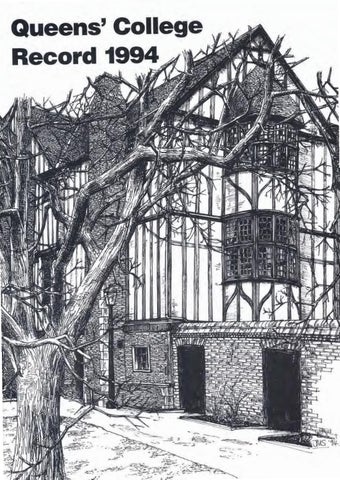
Queens'College Record 1994
Queens' College, March 1994 Visitor THE CROWN Patroness HER MAJESTY QUEEN ELIZABETH THE QUEEN MOTHER President The Revd John Charlton Polklnghorne, M.A., Sc.D., F.R.S.
Honorary Fellows: The Revd Henry Chadwick, K.8.E., M.A., Mus.B., D.D., D.D.h.c. (Glasgow, Yale, Leeds, and Manchester), Teol.Dr. 11.c.(Uppsala), F.B.A. Emeritus Regius Professor of Divinity. Sir Thomas Padmore, G.C.8 ., M.A., F.C.l.T. Sir Harold Walter Bailey, M.A., D.Litt.h.c.(W.Australia, Australian National University, and Oxford), D.D.h.c.(Manchester), P.B.A. Emeritus Professor of SanskriL Lord Allen of Abbeydale, G.C.B., M.A. Alfred C harles Tomlinson, M.A., M.A.(London), D.Lin./1.c.(Keele, Colegate and New Mexico), F.R.S.L. Professor of English in the University of Bristol. The Rt. Hon. Sir George Stanley Waller, O.B.E., M.A., P.C. Robert Neville Haszeldine, M.A., Sc.D., F.R.S., F.R.S.C., C.Chem. Sir Humphrey Cripps, D.L., M.A., LL.D.h.c., D.Sc.h.c.(Nott.ingham), C.Chem., F.R.S.C. The Rt. Hon. Sir Stephen Brown, M.A., LL.D./1.c.(Birmingham), P.C. President of the Family Division of the High Court. Sir Ronald Halstead, C.B.E., M.A., D.Sc.h.c.(Reading and Lancaster), Hon.F.I.F.S.T., F.R.S.C. Peter Mathias, C.B.E., M.A.. Litt.D, D.Litt.h.c.(Buckingham and Birmingham), F.B.A., F.R.H.S. Master of Downing College. Sir John Michael Middlecott Banham, M.A., LL.D.h.c.(Bath), D.Sc.h.c.(Loughborough). Sir David Alan Walker, M.A., F.R.S.A. Bernardo Sepulveda Amor, LL.B., Hon.G.C.M.G., LL.D.h.c.(San Diego and Leningrad). Nicholas Kenneth Spencer Wills, M.A., F.C.A. Kenneth Kweku Sinaman Dadzie. 8.A. Secretary General of UNCTAD. The Rt Revd Mark Santer, M.A. Bishop of Birmingham. Derek WilliamBowett, C.8.E., Q.C., M.A., LL.D., Ph.D.(Manchester), F.B.A. Emeritus Whewell Professor of lnteroational Law. Sir Ernest Ronald Oxburgb. M.A., Ph.D.(Princeton), D.Sc.h.c.(Paris, Leicester, and Loughborough), K.B.E., F.R.S. Emeritus Professor of Mineralogy and Petrology. Rector of Imperial College, London. Martin Best Harris, C.B.E .. M.A., Ph.D.(London). Vice-Chancellor of the University of Manchester.
A view of the reco11st1¡11cud War Memorial libmry facing East.
Photo: Brinn Calli11g/10111
COVER IUUSTRATION: The Presidem 's Lodge tlrro11gh the branches of the Wa/11111 Tree. Drawing by Jo11 Sewell.
Fellows: The Revd Henry St John Hart, M.A., B.D. Life Fellow and Hebrew Lecturer; formerly Vice-President and Dean. Sir Harold Walter Bailey, M.A., D.Litt.h.c.(W. Australia), D.Litt.h.c.(Australian National University), D.Litt.h.c.(Oxon.), D.D.h.c (Manchester), F.B.A. Life Fellow; Emeritus Professor of Sanskrit. Douglas Parmee, M.A. Life Fellow; formerly Tutor. John Holloway, M.A., Litt.D., D.Phil.(Oxon), D.Litt.(Aberdeen), F.R.S.L. Life Fellow; Emeritus Professor of Modern English. Derek William Bowett, C.8.E., Q.C., M.A., LL.D., Ph.D.(Manchester), F.B.A. Life Fellow; formerly President; Emeritus Whewell Professor of International Law. Anthony Colin Spearing, M.A. Life Fellow. William R. Kenan Professor of English, University of Virginia. Sir James William Longman Beament, M.A., Sc.D., Ph.D.(London), F.R.S., F.R.S.A. Life Fellow, Safety Officer; formerly VicePresident; Emeritus Drapers Professor of Agriculture. James Martin Prentis, M.A., M.Sc.(Eng), Ph.D.(London). Life Fellow; formerly Vice-President and Senior Bursar. Norman Francis Hughes, M.A., Sc.D. Life Fellow, Keeper of the Records; formerly Steward. Ajit Singh. M.A., B.A.(Punjab, Chandigarh), M.A.(Howard, Washington), Ph.D.(Berkeley, California). Director of Studies in Economics. Brian Albert Callingham, M.A., B.Pbarm., Ph.D.(London), F.R.Pharm.S., F.I.Biol. Librarian and Director of Studies in Medical and Veterinary Sciences. James Diggle, M.A., Litt.D., F.B.A. Praelector and Director of Studies in Classics. Peter Jaffrey Wheatley, M.A., Ph.D. Life Fellow; formerly Senior Bursar. John Tiley, M.A., B.C.L.(Oxon). Vice-President; Professor of the Law of Taxation. John Edward Carroll, M.A., Sc.D., F.Eng. Professor of Engineering. Peter Gonville Stein, M.A., LL.B., Ph.D.(Aberdeen), Dr.iuris h.c.(Gottingen), Dr.iuris h.c.(Ferrara), Q.C. h.c., F.B.A. Life Fellow; Eme,itus Regius Professor of Civil Law. The Revd Canon Brian Leslie Hebblethwaite, M.A., B.D. Dean of Chapel and Director of Studies in Theology and Religious Studies. lain Richard Wright, M.A. Life Fellow; formerly Tutor. Professor of English at the Australian National University. John Timothy Green, M.A., Ph.D. Life Fellow; formerly Senior Tutor. Chief Executive of the Royal Society of Medicine. Thomas Henry Coaker, M.A., Ph.D., B.Sc.(London). Steward, Garden Steward and College Lecturer in Natural Sciences (Biology). William Andrew Phillips, M.A., Ph.D. Life Fellow; formerly Tutor. Robin Douglas Howard Walker, M.A., Ph.D. Junior Bursar, Director of Studies in Computer Science and Assistant Director of Studies in Natural Sciences (Mathematics). Andrew Duncan Cosh, B.A., Ph.D. Senior Bursar and College Lecturer in Economics. The Revd Brendan Ignatius Bradshaw, M.A., Ph.D. Director of Studies in History. Richard Robert Weber, M.A., Ph.D. Director of Studies in Mathematics, in Management Studies and in Manufacturing Engineering. Allan Nuttall Hayhurst, M.A., Sc.D. Director of Studies in Natural Sciences and in Chemical Engineering. Peter Spufford, M.A., Litt.D. Assistant Director of Studies in History, Keeper of Pictures. James Anthony Jackson, M.A., Ph.D. College Lecturer in Natural Sciences (Earth Sciences). Christopher John Pountain, M.A., Ph.D. Tutor and Director of Studies in Modern and Medieval Languages. Philip Anthony Towle, M.A., Ph.D.(London). College Lecturer in Histo1y. Richard Griffith Fentiman, M.A., B.C.L.(Oxon). Director of Studies in Law. Sir Ernest Ronald Oxburgh, M.A., Ph.D.(Princeton), D.Sc.h.c.(Paris), D.Sc.h.c.(Leicester), D.Sc.h.c.(Loughborougb), K.B.E., F.R.S. Life Fellow; formerly President; Emeritus Professor of Mineralogy and Petrology. Rector of Imperial College, London. The Revd Jonathan Michael Holmes, M.A., Vet.M.B., Ph.D., M.R.C.V.S. Bye-Fellow (Veterinary Sciences); Chaplain. Peter Howard Haynes, M.A., Ph.D. Tutor and Assistant Director of Studies in Mathematics. Malcolm David Macleod, M.A., Ph.D. Director of Studies in Electrical and Information Sciences. Keith Johnstone, B.Sc.(Leeds), Ph.D. Admissions Tutor and College Lecturer in Natural Sciences (Biochemistry). David Cebon, B.E.(Melboume), Ph.D., C.Eng., M.I.Mech.E. Director of Studies in Engineering. Hugh John Field, M.A., B.Sc.(London), Pb.D.(Bristol), M.R.C.Path. Tutor and Assistant Director of Studies in Medical and Veterinary Sciences. Nigel James Leask, B.A.(Oxon), Ph.D. Director of Studies in English. Wendy Margaret Bennett, M.A., Ph.D. Assistant Director of Studies in Modern and Medieval Languages. Kevin Charles Lee, B.A.(Sheffield), M.Sc.(Bristo)), Ph.D.(London). Assistant Director of Studies in Economics. Howard Richard Neil Jones, M.A., Ph.D. Rooms Fellow and College Lecturer in Natural Sciences (Chemistry). Stewart Onan Sage, M.A., Ph.D. Tutor for Research Students and Assistant Director of Studies in Natural Sciences (Biology). Elizabeth Anne Howlett Hall, B.Sc., Ph.D.(London). Tutor and College Lecturer in Natural Sciences (Biotechnology). Richard William Prager, M.A., Ph.D. Binnie Fellow, Tutor for Research Students and Assistant Director of Studies in Engineering. John Evan Baldwin, M.A., Ph.D., F.R.S. Professor of Radioastronomy. Stuart Nigel Bridge, M.A. Tutor and As.sistant Director of Studies in Law. Philip Scott Marshall, M.A., LL.M.(Harvard). Bye-Fellow (Law). Roderic Lewis Jones, M.A., D.Phil.(Oxon). Assistant Director of Studies in Natural Sciences (Chemistry). Warren Vincent Boutcher, B.A., Ph.D. Archivist, Keeper of the Old Library and College Lecturer in English. Anthony Norden Lasenby, M.A.. M.Sc.(London ), Ph.D.(Manchester). Assistant Director of Studies in Natural Sciences (Physics). Keith Ferrin Priestley, M.S.(Washington), Ph.D.(Nevada). Bye-Fellow (Earth Sciences). John Wflliam Allison, B.A., LL.8.(Stellenbosch), LL.M., Ph.D. Research Fellow (Law); Paterson Award Holder. Joan-Pao Rubies i Mirabet, Llic.en Hist.(Barcelona), Ph.D. Research Fellow (History); Fabian Coleoutt Scholar. Christos Nicolas Pitelis, B.A.(Athens), M.A., Ph.D.(Warwick). Assistant Director of Studies ln Economics. Andrew William Michael Reynolds, B.A.(Oxon). Osaka Gakuin Research Fellow (Russian). Eivind Georg Kahrs, M.A., Ph.D.(Oslo). Director of Studies in Oriental Studies. Ignatius John Keown, M.A., D.Phil.(Oxon). Tutor for Graduate Students and College Lecttu¡er in Law. Hansjorg Curd Geiges, B.A.(Gottingen), Ph.D. William Colton Research Fellow (Pure Mathematics). Andrew Howard Gee, M.A., Ph.D. Research Fellow (Engineering), Melsome Research Scholar. Kareen Jennifer Innes Thorne, M.A., Ph.D. Senior Tutor. David Robert Ward, M.A. Ph.D. College Lecrw¡er in Natural Sciences (Physics). Richard Gilmour Eric Pinch, M.A., D.Phil.(Oxon). College Lecturer in Pure Mathematics. Niall James MacKay, B.A., Ph.D.(Dunelm). Bye-Fell.ow (Applied Mathematics). 2
From the President In my letter last year I said that these are difficult and uncertain times in the academic world. Nothing that has happened in the interim has resolved that difficulty or removed that uncertainty. The fee levels we are permitted to charge to public authorities faJI significantly short of the level necessary to help maintain College teaching and Lutorial support. lt would be sad if Oxbridge Colleges were driven to charge 'top-up' fees direct to students, since this would surely prejudice the balance and social mix of able students drawn from all backgrounds, which has been so notable and welcome a development in recent times. Yet we cannot sustain a run-down of permitted fees in real terms for very much longer. Meanwhile we have to avail ourselves of any opportunities that are presented to us for the strengthening of our modest financial base. The Bus iness Expansion Scheme, details of which were sent to all Old Members, was an undertaking of this kind which we could not afford to neglect. Careful thought was given to the matter by the Governing Body, the scheme was explained to the Junior Members of the College and their willing cooperation elicited, and an enormous amount of extra work was undertaken by the Rooms Fellows, the Junior Bursar, and especially by the Senior Bursar, to make it the success it has proved to be. Our thanks are due to all concerned. The financial attractiveness of the Scheme depended upon a sharing of tax advantage between the College and subscribers of a kind broadly similar to that resulting from the many covenants or donations under Gift Aid which we continue gratefulJy to receive. If times are hard, hearts are also high. The ideal of a College as a community of Senior and Junior Members, living and studying together, providing a setting in which all contribute to the common life and in which intimate and individual teaching can take place, remains as valuable and relevant as it ever was. Queens' is such a community and we intend that it should remain so. JOHN POLKTNOHORNE
The Society The Fellows in 1993 This has been a year with many comings and goings in the Fellowship. Professor Stein retired from the Regius Professorship of Civil Law, which he had held with distinction for twenty-five years, and consequently from his Professorial Fellowship. Dr Green resigned the Senior Tutorship after thirteen highly successful years in office, culminating in a record crop of 107 firsts in the tripos by Queens' undergraduates. He has taken up the position of Chief Executive of the Roya] Society of Medicine. Both Professor Stein and Dr Green remain in the Society as Life Fel1ows. Ms Crum-Jones resigned her Fel1owship and Tutorship to return to the United States. Dr Inglis's ByeFellowship expired, as did Dr Richer' s Research Fellowship. Dr Sattelle resigned his Bye-Fellowship because of pressure of work involved in running his large research group, and be has been appointed a FellowCommoner. Dr Mair resigned his Octel Research Fellowship to take up a lectureship in Chemistry at Trinity College, Dublin. We thank all the departing Fellows for 3
their many and valuable contributions to the life of the College, and wish them every success in the future. Dr Thome became our first woman Senior Tutor when she joined Queens' after holding a similar position at Trinity Hall. Two other new Official Fellows are Dr Ward in physics and Dr Pinch in pure mathematics. Dr MacKay has become a Bye-Fellow in applied mathematics. Three new Research Fellows have joined the Society: Dr Gee (electrical engineering), Dr Geiges (pure mathematics) and Mr Tanner (classics), but Mr Tanner left Queens' in January 1994 to take up an appointment as a University Lecturer at the Institute of Archaeology at University College, London. Dr Keown has been appointed a Tutor. The President gave the McNair Lecture at the University of North Carolina, the ldreos Lecture at Manchester College, Oxford, and the Gifford Lectures in the University of Edinburgh. Mr Hart's paper Hosanna in the Highest, has appeared in the Scottish Journal of Theology. Professor Sir Harold Bailey was the first recipient of the Royal Asiatic Society's Sinor Medal. Now in his ninety-fifth year, he continues active in scholarly research. Professor Holloway's remarkable narrative poem about Cambridge, Civitatula, has been published and received notable critical acclaim. Dr Ca11ingham has been involved in the launch of a new drug, moclobemide, for the treatment of depression and has taught an international course in Siena. Dr Diggle has retired from the office of University Orator, after a distinguished tenure of eleven years and 102 speeches. Cambridge University Press has published fifty of these orations (with convenient translations). Professor Stein has become a Q.C. honoris causa (an unusual honour for a solicitor) and his retirement was marked by a Festschrift presented to him at an international meeting in his honour held in Naples. Professor Tiley has become an Honorary Bencher of the Inner Temple. Dr Cosh is one of the Assistant Directors of the Centre for Business Research, set up in Cambridge by a grant of ÂŁ1.7m from the Economic and Social Science Research Council (Professor Tiley is also associated with this important new interdisciplinary development as a member of its Advisory Board). Dr Weber has been elected Churchill Professor of Mathematics for Operational Research from October 1994. Dr Spufford spent his leave as a Visiting Fellow at the Netherlands Institute for Advanced Study and as a Visiting Professor in the University of Leuven, working on the history of credit and capital in Europe. Dr Jackson has been appointed a member of a smalJ group set up by the Royal Society to review the programme on sites for the subterranean storage of nuclear waste. Dr Towle continues to publish on international relations and has contributed to two volumes of essays on defence themes. Dr Cebon became the firstnonAmerican, in the award's 39-year history, to receive the LR Buchendale award from the Society of Automotive Engineers. He is Research Director of the Cambridge Vehicle Dynamics Consortium and a Director of Granta Design Ltd. Dr Sage has been appointed a University Lecturer in Physiology and has lectured in Munich and Kiev. Dr Prager organized and ran the 3rd Cambridge Neural Nets Summer School, at which Dr Gee also delivered a lecture. Mr Bridge is in part-time practice in landlord and tenant law. Dr Allison was awarded the Yorke Prize by the University for his Ph.D. dissertation in Jaw. Dr Pite lis's continuing work in economics bas included work on European Community Programmes in Eastern Europe. Dr Rubies is spending his last year as a Research Fellow working in
Florence. He has been appointed a Lecturer in Modem History at Reading University. Among the Honorary Fellows, Professor Chadwick has received the award Pour le merite from the German Federal Government. JOHN POLKINGHORNE
Thomae Smithi Academia The Thomae Smit hi Academia, a discussion group for FeJlows and Fellow Commoners, continues to meet on Monday evenings in the Old Combination Room. The following topics were discussed: Lent Term, 'University Research Selectivity', introduced by Professor Carroll, and ·What is Karma?' introduced by Dr Kahrs; Easter Term, ·Erasmus and Montaigne, or how do we justify literary study?', introduced by Dr Boutcher; Michaelmas Term, ·B irdsong and Doubletalk' , introduced by Professor Holloway, and ' Variety in White Wines' , introduced by Dr Hughes. JAMES DIGGLE
John Green and the Senior Tutorship John Green was appointed Senior Tutor in 1980 in the same year that women were first admitted to Queens ' . Of the two events, it is difficult to know which had the greatest immediate impact on the College, and of course they were not independent. A major reason for the timing of the appointment was the perceived need for a fresh enthusiastic administrator to deal with the anticipated problems (Governing Bodies are usually better at anticipating problems than solving them). The fact that very few
Cloister Coun.
problems did arise is testimony to the efficient way that John operates: he analyses carefully and thoroughly, and takes action quickly and effectively. His accurate feel for undergraduate opinions and moods, developed during almost ten years a.s a Tutor and Dean of College, together with his easy and informal relationships with most of the student body, gave him a major advantage in persuading the College into the correct course of action on innumerable occasions. There were times when not everyone agreed that the correct choice bad been made. The BBC Televi sion programme divided the Governing Body, if not the undergraduates. Some offered to interview for the first time on condition it was in front of the cameras, while others insisted that all glimpses of their retreating backs be removed from the finished programme. John played a dominant role in the project, not only by appearing (Green's College was suggested as an alternative programme title), but in initiating, organising, encouraging and influencing the content and style of the series. 1n spite of the sour comments made elsewhere in Cambridge, there can be no doubt that Queens' benefited from the publicity. On a wider scale. John played a large part in establishing a fairer and more broadly based admissions procedure for Cambridge in the mid 1980s. With a small group of senior and admissions tutors, he was instrumental in persuading Cambridge to abolish the special scholarship examination. Wide-ranging consultation with schools in both the state and p1ivate sectors formed the basis for a system much more in tune with the procedures and routines of the majority. Subsequently, a significant part of his time was spent in explaining the procedures, and encouraging applications to Cambridge from schools that had not seriously considered the possibility.
Photo: She1yl Fiso11
4
\
John bas been criticised for not being as tactful as he could bave been with the more sensitive of his colleagues in the College and the University. He could be impatient with those who were not as quick or perceptive as he was in seeing the way the outside world was going, and it was a frequent source of amusement to watch the entirely predictable confrontations develop in response to one of his characteristically abrupt notes. If I had to identify two qualities which characterise his success as Senior Tutor they would be his rapport with the undergraduates in the College, and the efficiency of his administration. Both were important as John played a dominant part in determining the present style of the College as a balanced, friendly and successful place. He stated that a major ambition was to put Queens' at the top of the academic league table. It is a tribute to him that Queens' occupied that position when he left. ANDREW PHILLIPS
Retirement of Ptofessor P.G. Stein In September J993 Peter Stein retired from the Regius Professorship of C ivil Law and so also from his Professorial Fellowship; fortunately he remains with us as a Life Fellow. Peter was appointed to the Regius chair with effect from October 1968 and it was one of Arthur Armitage's famous coups that he was able to persuade Peter to accept a Fellowship with us. A member of Caius, Peter had no links with Queens'. We have all been the gainers from his twentyfive years with us. His career has been, to say the least, a distinguished one as part of what follows will show - but what has it been like having him around the place? First and foremost Peter is a scholar with a pleasantly formidable international reputation. Whether one is visiting friends and colleagues in other European universities or those in the U.S.A. Peter's is one of the first names to come up in conversation. He loves travel and intellectual scholarship and discourse. He is horribly well read and ¡ fluent in most major European languages but he combines all this with joyful enthusiasm. He cares about law and values its intellectual traditions, traditions which he likes to remind us are more generally accepted in continental Europe than in common law England. He is quite willing to talk about ideas in the SCR after lunch (or anywhere) and he is perhaps one of the few Fellows whom one can easily imagine fitting in with the College when Erasmus was here (and not just because he can speak Latin). He is a true European - a good model for the Cambridge of the next century. His journeys round Europe lately seem to have been a procession from one honorary degree to the next. Rarely was a man so feted - or so deservedly. As a Professorial Fellow Peter may have seemed rather a remote figure to some undergraduates, at least those who were not lawyers. There he was in his room at the bottom of C staircase occasionally venturing out to give lectures or rushing out to catch the post. As a professor he was barred from traditional college offices such as Tutor or Bursar and, for many years, even from giving supervisions. Fortunately that bar was eventually relaxed and Peter gave first year lawyers a sympathetic introduction to Roman law, an introduction that was highly s uccessful in terms of examination results. Peter never wished to be a remote professorial figure and bis affection for students was shown also to generations of LL.M. and research sn1dents, some from Queens' itself attracted here by his reputation, to whom 5
and to whose interests be devoted so much energy and intellectual power. This capacity for devotion was also lavished on his family. Perhaps the important thing about major figures such as Peter is their sense of values. I have already talked about bis commitment to his subject and to scholarship, but there has been much more. First there is a commitment to duty. Within the College he served not only as Vice-President from 1974 to 1981 but also as Acting President while Derek Bowen was on leave in 1980-81. ln the University be served on the General Board and was a most successful chairman of the Faculty Board; his judgement and skill were rightly respected. He also served four years as a member of the University Grants Committee from 1971-75. Secondly there is his integrity - recognised both in the University where he was often asked to help on committees considering really difficult issues (such as chairing that on the future of the Department of Applied Economics) and outside as shown by bis many years of service as a J.P. and by the decision of the Lord Chancellor to recommend that he be made an Honorary Q.C. last year. Thirdly there is his cow¡age - finnly committed to what was right he would not shrink from saying what he thought whether or not it was unpopular with the College or University establishment. He also managed to do this with much political skill so that animosity resulted very rarely and never lingered. Finally since this piece must be brief there is his capacity for friendship, which one could a]ways tum to for support (no matter how much of a pain one was being). That friendship revealed a special man with an appreciation of wit; that wit could be laced with a little schadenfreude, but always there was a twinkle in his eye. JOHN TILEY
Professor Perer Stein in his robes c,s an Honorary Queen 's Co1111se/.
The Staff The College continues to expand the scale and scope of its activities. It is the College Staff who bave to bear the brunt of this and they do so with an impressive fortitude and cheerfulness. This year a good example of this was the extra wor~ associated with the Business Expansion Scheme which was handled with no additional staffing. The College is fortunate to have such dedicated people working for it. There were some notable retirements this year. Gordon Webb retired after 38 years with the College, having served as Head Porter since Sid Pinner's retirement in 1969. He is replaced by Jim Coulter who looks forward to meeting you when you next visit College. Barbara Banks had served the College as Bedmaker for nearly twenty years and Mrs Cynthia Smale-Adams retired after fifteen years as Clerk to the Tutors. We wish them each a long and happy retirement. [n addition, Manuel Soares returned to Portugal after several years service as Butler and Food Service Manager. It is with regret that [ report the deaths of five of our pensioners: Ernie Cundell (Butler, 1957-77); Mrs Mary Dunn ington (Bursary , I 969-83); Miss Helen Patten (President' s Lodge , 1949-70) ; Mrs Joyce Powell (President' s Secretary, 1961-84 ); and Mrs Anna Shutcovskey (Bedmaker, 1972-86). ANDYCOSH
~
A ~o.o<--..;;n,,;;,-
Gordo11 Webb (left) 011 his retiremelll as Head Porter, with his predecessor Sid Pinner, now aged 90. Photo: Brian Callingham
Some of the Catering Staff at the Christmas Pa11y. Phou,: Brian Callingham
Housekeeping The Housekeeping Department of the College has changed in many respects over the years, but the most needed and impo11ant people of the Department have not changed - the Bedders, the mainstay of the College. The actual duties they perform are very different from the days of arriving at 6.30 a.m. to make up the fires in the sitting rooms for their students, making their beds and doing their washing-up every day. College accommodation is used nowadays in the vacations for conferences, not only a great financial help to the College but also a major change to the bedders' duties. It's like having two types of job. In term-time the bedders are in the front line of communication with the students. They now clean rooms on their staircase (anything up to 24
rooms), change linen once a week, and clean all communal areas every day. The vacation comes and the students say good-bye, wishing us a restful holiday. Little do they know that when they leave life becomes very busy and hectic spring cleaning all their rooms, getting rid of their rubbish, producing a room to a high standard for conference use, putting in extra facilities for conference delegates (towels, tea/coffee, bathroom sundries, etc.). Conference numbers vary from 50 to 300 people, staying for an average of two nights, using Cripps, Fisher and Erasmus Buildings. We are continually trying to improve our services and increase OUJ Standards and therefore Queeus' reputation. The Department is run as a team with suggestions at meetings from everyone - the 28 bedders, 'two outside porters, three general cleaners and one cleaner for ow- main outside properties. In the vacations the other areas of College are not empty as the bedders on these staircases have long-stay students, visiting academics and a good turnover of guests for weddings. As a whole the Housekeeping Department communicates and gets involved with all tbe other Departments of the College, notably Catering and Conference, Maintenance, the Porters' Lodge and the Tutorial and Bursary Departments. The College is on a continuous redecoration programme which means stripping rooms for the decorators then putting everything back: curtains, linen, furniture, etc. Housekeeping is not only responsible for cleaning staircases but for moving furniture, setting up conference meeting rooms and cleaning other areas of College, including the JCR bar, MCR, the Lyon Court complex, Old Han, the Old 6
Kitchens and the Chapel. Then there are the outside properties: the Boathouse flats, Panton Street houses, Maids Causeway, Eltisley and Marlowe Road houses and support for the Wardens in Owlstone Croft. Everyday in Housekeeping is interesting and different, no two days are the same. ln the office we are responsible for the upkeep of furnishings, upholstery, curtains, carpets and the buying of many odd items that are needed to keep things going, from ironing board covers to candles for the Chapel. We show conference organisers around, deal with the allocating of the conference rooms, and assist organisers in many ways to help make a conference successful. We deal with excess residence requests from students and organise the allocation of all rooms in College during vacations. The Department looks forward to the future and hopes it will keep up the high standards and original values of college life. JANE PEARSON
Nursery 1993 has seen the Nursery achieve its full potential - by September our register was full and we now have a waiting list. As one might imagine, amongst the children we have some interesting characters! What is also remarkable is the truly international collection they represent. We have children from Italy, Brazil, Finland, Norway, Canada, Poland and even Australia. Language is no barrier, we are just one happy family. The year has been full of excitement, discovery, laughter and fun. We are often to be seen walking through the College grounds and beyond - there is much to interest the children. The Grove, in particular, is a source of many wonders all year round from the abundant conker harvest, to squirrels building their dreys, to bird-spotting (we even managed to spot a Tree Creeper and a Black Cap). We have found frogspawn in College waterways; and, of course, feeding the ducks and seagulls is an almost daily ritual. Our thanks to the two law students, Michelle and Rachael, who came and helped. If anyone else, staff or student, would like to come and see us either to help or just to visit, you would be most welcome. SANDY BULLETT
The Fabric The reconstruction of the War Memorial Library uncovered two major structural problems. The ceiling of the library lobby (formerly the ante-chapel) carries the weight of part of the Old Library _a bove and the spiral staircase to the Law Library. The Old Library had been extended into this area, fonnerly residential sets, in 1772. When we stripped the lobby ceiling and removed the staircases, it could be seen that the structural integrity of the lobby ceiling and Old Library floor depended on an east-west spine beam down the centre of the lobby. This medieval beam had originally been longer, but was truncated by the lengthening of the chapel westwards, probably ju 1773, and its east end was not bedded on solid wall, but was resting on the midpoint of the oak frame entry into the chapel itself. This frame was showing signs of distress at the load on its midpoint, and was severely distorted, allowing the spine beam to drop below its intended height. Even worse, the spine beam itself was cracked and bowed under the weight of the Old Library above. These defects must have been apparent during the 1772/73 alterations, because there was evidence that the east 7
Some of the Cliildre11from the N11rse1y 011 the Mathematical Bridge. Photo: Richard Prager
end wall of the Old Library at first floor level had been built to be self-supporting and there were iron straps between the medieval beams and the 1772/73 studwork above to hold the spine beam up. It was clear that the spine beam now needed extra support. The possibility of propping the beam from below by means of new pillars in the library lobby was rejected, not least because there was no real strength to the lobby floor, it being simply flagstones over a crypt. Fortunately, when the former Oriental Library (now Law Library) was created in 1925 in the attics over the Old Library, a new floor was put in, laid on steel joists. We were able to insert two steel rods secured at their tops to one of these steel joists above the east end wall of the Old Library running down within the studwork framing of the Old Library east end wall to support two medieval cross beams of the lobby ceiling. The load of the spine beam was transferred to the two cross beams by new steel saddles. Now that the work is finished, the strengthening works are quite invisible, as they are wholly embedded within the Old Library east wall. The second problem was found in the window of the firstfloor lobby looking south into O ld Court, directly beside the sundial. This had originally been a two-light arched window of the same style as those elsewhere in Old Court. When the chapel was extended westwards in J773, one light of this window was partially obscured by the new west end wall of the chapel, and so blocked by inserting a dry lining internally to make the window look as if it were a single light. So for more than two centuries O ld Coutt has had a half-blocked window beside the sundial, though few noticed it as the external glazing of the blocked light was still in place. When we took down the dry lining surrounding the single light, we received two shocks. The first was that the original wall under the dry lining was covered in ancient wall painting. The second was that the arch of the window was cracked and collapsing, and it became clear that one reason for blocking half the window in 1773 had been to prop up the failing arch. We therefore made an in-situ cast reinforced concrete lintel over the failing arch to distribute the roof load away from the centre of the arch, and then drilled stainless steel rods into the stone arch to bond its fragments together again. Elsewhere in Old Comt, Room C2 attracted much interest. It is part of the original College buildings of 1449, but it had been altered over the centuries: all the medieval studwork and ceiling beams had been plastered over. The entire room was stripped back to its original medieval timber framing.
The ceiling was then restored so that all the details of the origi nal beams remain on view. The great studwork d ividing wall between C2 and BI had been filled with original brick. which was unstable. The bricks were removed and replaced by a modern fireproof material, and the wall replastered in half-timbered style, its original form. The Victorian fireplace was stripped out, as were yet more earlier fireplaces behind, until the original medieval fireplace was uncovered, with its characteristic herring-bone brick backing. A plain stone mantel surround was left in place. as the original medieval four centred arch fireplace had been destroyed beyond hope of restoration. A small blocked window onto Silver Street is also being re-opened. The first student accommodation in Q ueens' to be centrally heated was the Erasmus Building. Heat for this Building was supplied by hot pipes under Friars' Building from the boi lerhouse in Dokett basement, which was converted from coal to oil-burning for this purpose. It proved convenient to continue to enlarge Dokett boilerhouse to feed hot water to the rest of College east of the river, and, by tbe ntid-1970s, it was supplying beat for central heating and domestic hot water as far away as the Essex Building. The beat was distributed by means of super-heated pressurised water in underground pipes under the lawns of Friars, Walnut-Tree and Old Cou1ts. This was apparent in the winter, when the snow never stayed unmelted above the line of the pipes, and in the summer, when the grass was scorched brown. It was obvious that much heat was never reaching its intended destination. The boilerhouse was converted from oil to gas in stages during the 1980s, thereby gaining efficiency and reducing running costs, but the distribution network remained unchanged. Problems began to appear with the underground pipes: many of them sprang leaks, and required expensive repairs involving digging up the lawns and paths to replace the pipes and rebuild the ducts. The logic of a central distribution system had been lost when we converted from oil to gas as a fuel: it is more efficient to pipe gas around and burn it in local boilers than it is to pump hot water around. Thus the redevelopment of the Old Kitchens included a local gas boiler for the Old Kitchens and Essex Building as the first step in the gradual shift towards decentralised heating. When we planned the redevelopment of the Library, we realised that some of the heating apparatus for Old Court, located in the crypt under the library, would have to be removed. This forced us to reconsider the heating of Old Court in general. It was decided to remove the whole of Old Court from the old system. and substitute local boilers. For the libraries, the Munro Room, and the Old Hall. a gas boilerhouse was created in the shell of a long abandoned underground coalfired boilerhouse beside the Munro Room in Walnut-Tree Court. For the student staircases, small boilers were positioned in various nooks and crannies on the staircases themselves (the real challenge being to find a route for a flue which was acceptable in a historic building). The changeover to the new system was planned for the Long Vacation 1993, but unfortunately the works were delayed by the unforeseen complexities of working in medieval buildings, and, for part of the Michaelmas Term, anothe1¡ generation of undergraduates rediscovered what it was like living in Cambridge before the advent of piped hot water. However, as we were in the middle of the heating works, the underground hot pipes feeding Walnut Tree Court sprang another leak. and the Walnut-Tree Building lost all
heating and hot-water too. So we opted to install local boilers there also. At the height of this crisis, we had three independent beating contractors installing boilers for us: one for the Library, a second for Old Court staircases, and a third for Walnut-Tree Building. In the Erasmus B uilding, all the batlu-ooms have been renovated and the staircase treads have been made good. In the President's Lodge, the staircase and entrance hall have been redecorated as has the exterior of the Lodge over the River. In the Fisher Building, the small areas of flat roof at the top of each staiJcase have been re-asphalted to suppress leaks which bad developed. At Owlstone Croft, a collapse of part of the plaster ceiling of the Common Room revealed structural weaknesses in the floor above. New steel joists were inserted to strengthen the floor, and the ceiling was remade. The ground floor flat at 20 Eltisley A venue and the basement rooms at 75 Panton Street have been stripped out, damp-proofed, and redecorated. ROBIN WALKER
The College's Collection of Clocks Amongst the many noteworthy and ancient aspects of the College is a collection of almost a dozen eighteenth century clocks, mostly situated in the President's Lodge, though one or two are to be found lurking in various rooms occupied by the Fellows. It is not ce1tain where the clocks came from, but they were probably given or bequeathed over the years by benefactors. They are a good representation of the styles and technological advances of English clockmaking of the eighteenth century. There are two fine long case clocks with marquetry cases. The one in the Lodge has a month going movement. The earlier of the two stands in the Munro Room and is dated about I720- quite early for a long case clock. Unfortunately there is something wrong with both these fine clocks. The one in the Lodge has a much later hood in plain wood and the one in the Munro Room has had about a foot sawn off the bottom of its case at some time to reduce its height! Another London-made long case clock stands in the President's study and incorporates a device known as 'Hanisoo's going barrel' which means that it continues to go while in the process of being wound up. It also has a wooden pendulum shaft and a 'dead-beat' escapement These three features make for greater accuracy in time-keeping. The crowning glory of the long case clocks, and indeed of the whole collection, stands in the Long Gallery and was presented to the College in 1664 by Edward East, clockmaker to Charles II. It is the earliest example in existence of a long case clock and shows clearly the transition in styles from the lantern clock - a brass wall clock shaped like a lantern (hence the name) - to the long case style which began life as a lantern clock simply encased in a long plain case of wood. Ornamentation followed later and the movement also changed shape as it was no longer visible. Two other long case clocks stand in Fellows' rooms. One clock was given by Miss Binney and has an automaton worked by the pendulum in the broken arch about the figure twelve. The automaton shows signs of being an addition and it may be that the face. works, and case did not actually start life together although they are all eighteenth century. The other is a pleasing, but unremarkable, late eighteenth century clock on 1 staircase. 8
The 1664 Lo11g C{lse Clock i11 1he Lo11g Gnlle,y. Ph010: Brian Cnl/i11gha111
Finally, and also in the Lodge, in the Audit Room, is a bracket clock of walnut, made locally in Ely. The 'bracket' clock is a very endui-ing design running for about two hundred years and taking on various forms from the highly elaborate and complex to the very simple. The one in the Lodge js of the most common type and graces many a mantelpiece in many a stately home. I should not neglect to mention also a late nineteenth century mantelpiece edition of the popular wall clock lantern design of earlier centuries. The Victorians introduced this and regreuably proceeded to convert many wall clocks by putting in spring driven movements. It improved time keeping, but was vandalism I'm afraid. All the College's clocks are in working order and the current President sees to it that the ones in the Lodge at any rate are kept wound up and working. JAMES ALEXANDER, KEEPER OF THE CLOCKS
The Chapel The President, the Dean of Chapel. and the Chaplain continue to take it in turns to preside and preach at the 9 a.m. College Communion services on Sundays and to preach termly at one of the Sunday Evensongs. Dr Holmes acted as Dean of Chapel while Canon Hebblethwaite was on leave during the Long Vacation and the Michaelmas Term. Visiting preachers during the year have included: Dr Robert Gordon, University Lecturer in rnvinity; the Revd Dr David Hoyle, Dean of Magdalene College; the Revd Pam Hoyle, Curate of Holy Trinity, Cambridge; the Revd Graham Carter ( 1962), Minister of El vet Methodist Church, Dui-ham; the Revd David Casson (1961), Vicar of Holy Trinity, Sheen Park, Richmond; the Revd Julian Barker, Vicar of Repton; 9
the Revd Christopher Rowley, Vicar of Stoke St Gregory, near Taunton; the Rcvd Stephen Bowen (1965), Vicar of St John's, Redbridge; the Revd Jim Mynors, Vice-Principal of the East Anglian Ministerial Training Course; the Revd Jane Charman, Chaplain of Clare College; and Dr Bradshaw. The preachers at the Commemoration of Benefactors services in May and at the Visit of the Queens' College Club in June were the Revd David Cockerell ( 1973), Adult Education and Training Officer, Diocese of Ely, and the Revd Dr Brian Stevenson (1965), Vicar of West Malling and Oftbam. A wide variety of other services continue to attract varied congregations. The informal communions on alternate Tuesday evenings and the Choral Evensongs on Wednesdays in Full Term cater to different tastes in music and liturgy, but each has its place in the public worship of the College. The Church of England has long included a wide spectrum of tradition and churchmanship, but increac;ingly this spectrum is reflected in the Chw-ch at large by an equally wide variety of services and liturgies. A college chapel endeavouring to be a focus of worship within the community needs increasingly to provide different types of worship so that all Christians in the college can feel happy to join from time to time in worship in the chapel in a form which they find conducive. Although it would be rare to attract as many as twenty Queens¡ students to any one service (bar the everpopular Advent Carol Service), perhaps four or five times that number attend Chapel worship at one time or another in a typical term. To emphasise our essential unity in diversity we have been experimenting with College Corporate Communions, attempting to gather together Christians of all shades of opinion once a term. So far two have been held on Ascension Day and on All Saines¡ Day - with moderate success. They take the fonn of a straight-forward modem communion service with appropriate hymns and a short sermon. ln addition the College Christian Council organises occasional 'bread and cheese' lunches on Sundays for all Christians to meet informally. Other occasional services continue to flourish. Dr Holmes preached at the Act of Remembrance and Choral Matins this year. A group of students led by Robert Hall organised a most imaginative and thought-provoking informal Service at which Robert, a third year undergraduate, preached. The annual 'Music and Readings for Passiontide' service was held at the end of the Lent Term. We have weicomed two choirs to sing Choral Evensong - the ConQordia Choir from Winchester, under the direction of Michael Abrams (1966), came in January and the London University Chamber Choir in November. Compline was sung in Chapel on Wednesdays in Lent. The University Confirmation Service was held in Queens' in March. The Rt Revd Leslie Brown, formerly Archbishop of Uganda and Bishop of St Edmundsbury and Ipswich, stepped into the breach at less than twenty-four hours notice to conduct the service and preach when the Bishop of Huntingdon was taken ill. Bishop Brown is in his eighties and has lost all central vision, but he conducted the litui-gy mainly from memory with great dignity and humanity, and the service, which blended modern and traditional music and liturgy, has left a deep impression on all who attended. Sixteen members of the University were confirmed and four baptised. There have also been three other baptisms and eight weddings in Chapel this year. The Dean of Chapel has continued bis occasional series of discussion evenings and the President spoke at the annual staff carol service in December.
Emma Halliwell took over as Chapel Clerk at Easter and Howard Stone became Sacristan. The Ryle Reading Prize for reading in Chapel was awarded to Andrew Thorlby. For many years the College Chapel has suffered from petty pilfering. Only a dozen or so of the smaller prayer books in use in the Chapel since 1961 remain (fortunately the larger ones from the back rows have survived). Hymn books and psalters regularly go missing and the book stall had to be discontinued several years ago. Most seriously, music copies of hymn books and choir anthem books have been steadily disappearing. On one occasion aU the music from the carol service, left out overnight. to be sorted, was stolen. on another all the Anglican Chant Books were missed (we have had to borrow the Round Church's copies). One Cluistmas it was found that all but two of the 'Carols for Choirs L• had gone. All the music for the choir is purchased from the Chapel Fund whose principal supply of money is the Old Members Weekend collection, and so it has not been possible to replace many of these books from our rather meagre funds. However, during the summer, Suffolk Police arrested a man who proved to have a horde of almost 50,000 stolen books in his home. Most had been pilfered from churches, chapels, and libraries all over the country over a period of twenty years. The man has been co-operating with the police and identifying the source of many of the books. Our 'Carols for Choirs l' and Anglican Chant Books have rurned up together with over 45 other books of anthems, 30 odd hymn books, and some psalters, including music editions, but sadly none of the prayer books. The books have been damaged with all identifying marks removed, but all are usable, and it will be a great boon to the choir to be properly equipped with anthem books again. The choir continues to go from strength to strength - a fuller report appears elsewhere in the Record. They have just produced a C.D. which includes a Magnificat and Nunc Dimittis written by C .V. Stanford (1870) when an undergraduate at Queens' recently discovered by the Organ Scholar in the Fitzwilliam Museum. The first twentieth century performance of this lost work, at a Wednesday Choral Evensong, was one of the highlights of a memorable Michaelmas Term for choral music at Queens' as was the second petformance at Evensong in Durham Cathedral. JONATHAN HOLMES
The Library Librarian: Dr Callingham Keeper of the Old Library: Dr Boutcber Assistant Librarian: Mrs C. Sargent Library Assistants: Adriaan Basson, Kaushik Bose, Susan Cook, Jean Davison, Dean Kolbas, Helen Lewis and Damian Nussbaum
War Memorial Library By the time The Record reaches you, the newly constructed War Memorial Library will be stJucturally complete and in full use. I hope that all who visit and use the Library will be delighted. I am sure that you will be thriUed by the sensitive and imaginative reconstruction that has taken place with materials and workmanship of the highest order. The discovery of a medieval wall painting and of a substantial crack in the wall of the Library were the main reasons why we could not quite achieve our ambition to be open for business on the first day of Lent FulJ Term. To stand on the
highest level of the Library at the east window is an exciting experience enhanced by a sense of scale and proportion. Looking down and along the new mezzanine floor with its ordered reading desks is reminiscent of the view along the deck of a wooden ship; only the oars are missing! I am delighted to say that Lady Armitage has kindly agreed formally to open the new Library towards the end of the Lent Tenn. The timing of the reconstiuction was critical in order to keep disruption of the academic work of College members to a minimum. Thus, after two terms only slightly disrupted by essential preparatory work and characterised, in the weeks leading up to the examinations, by incredible overcrowding and 'close-proximity hysteria', the Library ceased to function in July. The College bad no proper library facilities for the rest of the year except that, with the cooperation of Directors of Studies and students, the A.D. Browne Room was stocked with key books and arrangements made in some subjects for undergraduates to use other libraries in Cambridge. I am grateful to all who have put up with the upheaval and disruption of their access to the Library over the past months and particularly to the lawyers, whose section was least affected. They were the last to be allowed back because access to the Law Library was totally prevented by the replacement of the old spiral staircase by one that leads from the original ante-chapel. It must have been tantalising for the lawyers to know that their books were i11 situ but cut off and gathering dust until the very end. Indeed, when access was finally restored I felt as Howard Carter must have done. You may be wondering what the Library staff were doing to pass the time with no Library to run. In July, there was frenzied activity to prepare the books for their hibernation in the new wine cellars under Cripps Court, where they were transported, with great efficiency and good humour, by Prentice Commercial Removals. Then the Library was mothballed and bands laid off. Life returned during the Christmas Vacation when, in truly appalling weather and in spite of competition for access from Anglia Television, Prentice disintered the bulk of the books and transported them back to the new shelves so the task of putting them in the right places could begin. During the Michaelmas Term opportunity was taken to place more than twenty thousand of the War Memorial Library books on the College section of the University Library catalogue. This extremely demanding and responsible task was unde1taken by Susan Cook who canied out this task under less than ideal conditions as ber terminal was next to the building site. By the year end it was possible to access the new Queens' College Library catalogue from any terminal with access to the University Library system, including a dedicated terminal in the College Computer Room. We hope that, by the beginning of the Michaelmas Term 1994, all important library transactions, including the borrowing and returning of books, will have been 'computerised' . Special thanks are due to Kaushik Bose, Helen Lewis, Damian Nussbaum and Susan Cook (again!) for the truly heroic work they undertook on the Cohen Collection, stock checking and preparing the Library for closw¡e as well as for the many long hours they put in on tedious checking and re-checking. During all this excitement, other Library activities continued. Conferences were attended and papers presented, queries answered and advice given. Indeed, we could operate a good side-line as a library consultancy and 10
really join the "brave new world". We received many generous donations, to increase and enhance our book stock, from the President, Profs Spearing and Stein, Ors Diggle and Leask, Prof. Riley-Smith as well as A. Basson, C. Beckingham, W. Beams, D. Cannell, N. Dunbar, R. Hart, D. Karlin, E. Kendall, R. Jackson, V. Merron, N. Miller, E. Orr, S. Robinson and K. Whinney together with the Fine Art Society, the Hellenic Foundation and Varsity. I must convey my personal thanks, as Librarian, to all those involved in bringing this Library reconstruction project to such a tremendously successful conclusion. The list would be too long to include everyone in the limited space available, but the vital and generous financial help from the Franklen-Evans bequest, the Colton Foundation and the Esmee Fairbairn Educational Trust must be acknowledged. Finally, I am sure that the outcome would not have been so superb without the skill, dedication and librarianship of Clare Sargent. Come and see the War Memorial Library for yourselves. BRIAN CALLINGHAM
The Old Library This has been a relatively quiet year in the Old Library. Major renovations undertaken in the adjacent undergraduate library have often made access very difficult or impractical. Nevertheless, materials from the Library were on prominent show in the Fitzwilliam Museum's 'Splendours of Flanders: Medieval Treasures from East Anglian Collections' exhibition, open from 12th July to 19th September in the Adeane Gallery. Taking pride of place was the magnificent binding by Jan Guillebert de Meese of a copy (c. 1473) of Josephus ' Antiquitates judeorum de be/lo judaico.
War Memorial library - the srai1way from the 111ezz.a11i11e.
11
The attention focussed on this incunable, when the request for a loan came tbrough, naturally led us to concenu¡ate the efforts of Nick Hadgraft' s Cambridge Colleges Library Conservation Consortium (see last year's report) in the area of our fifteenth century printed and manuscript materials. Meanwhile, Dr Hilary Wayment bas written an article on the ten Carmelite Roundels in the Old Library, which is shortly to be published in the Proceedings of the Cambridge Antiquarian Society, and which includes photographs of the windows. Despite her workload in supervising the Jenovations in the new library, Clare Sargent must once again receive a vote of thanks for not taking her eye off the Old. WARREN BOUTCHER
Reconstruction of the War Memorial Library The scene: six treads on an unfinished staircase and a landing. On the sixth tread and a scaffold stands a conservator working on the restoration of a sixteenthcentury wall painting. Below him on treads four and three stand the College Clerk of Works and the building site manager for Morris Preston - discussing plumbing systems in general and particular. On step two are carpenters, engaged in encasing parts of the metal stair in oak. On step one stands Mrs Sargent, wbo is directing the activities of four removal men carrying crates full of books from the Old Library into the new one across the landing. Ou the landing are two workmen, constructing the floor for evetyone to stand on and walk across, the architect who is measuring the gap between the staircase and the wall, and an electrician's apprentice who has no business being there at all and is busy denying responsibility for the latest excitement in the electrical fittings to anyone who happens to be listening.
Photo: Brian Callingham
The War Memorial Library is situated in the Old Chapel, constructed with the rest of Old Court in 1448/49. Externally Old Court is close to its original form. The brickwork is original, although most of the stonework has been patched. InternaJly, the Old Chapel was re-modelled at least twice, and suffered various minor changes throughout its life according to aesthetic or theological taste. In 1773 James Esse:x inse1ted a classic flat ceiling, removed in J 845, a pew on a gallery for the President's family, and a brick burial vault. In 1858-61 G.F. Bodley refitted the chapel, shortening the East window to make way for a raised altar, and inserting a large organ loft. After Bodley' s New Chapel came into use in 1891, the Old Chapel fell into disuse, being used as an occasional lecture or store room, and its fittings were dispersed to various parish churches of which the College is patron. A scheme to convert part of the building into residential sets in 1935 came to nothing. In 1948 an appeal was launched to convert the building into a library and reading room for undergraduate use as a war memorial to those who fell in the Second World War. The new library, designed by A.E. Richardson, opened in 1951, but the design was severnly truncated and suffered from the rationing of wood and steel. Since 1951 the style of undergraduate study and student numbers have changed beyond recognition. The library no longer fulfilled its task. Detailed planning to reconstruct the library began at least three years ago, although aspects of the re-construction were first mooted in the 1970s. The overall scheme comprised two main structural elements: to insert a mezzanine floor in the main body of the chapel at the balustrade level of Richardson ' s 1948 gallery, whilst keeping Richardson' s own ground floor gtid and gallery structure; to replace the two staircases with one; and two environmental elements: to renew heating and lighting systems and to update furnishings. A college library needs to be robust, to be ergonomically efficient, to encourage concentration whilst not stifling imagination, to be a common prope1ty for all members of the College, and to be the academic flagship of the College. In the 1990s we also have to consider the future of the printed book and the role of electronic publishing, particularly for academic journals, and computerised finding aids. The brief for the Library Reconstruction Committee and the architects, Julian Bland and John Bailey, was to interpret all of these elements into a building which could be constructed and open to undergraduates within six months of its initial closure, and which would deal sympathetically with its past as a chapel and its role as a war memorial. Versatility of all spaces and furniture was a key design brief. The heating system, for example, was inherited from the 1858 re-modelling and consisted of two lines of hot pipes ]aid under a decorative iron grid in front of the then choir stalls. As part of the new furnishings we planned fully adjustable wheeled, office-style chairs, The metal heating grids were exactly positioned to make such chairs useless. The solution was to replace the anachronistic pipes and grid with an underfloor heating system, which allows free movement of furniture and an unbroken carpet: it also frees wall space for bookshelves. Placing the mezzanine study area at the balustrade level of the existing gallery has allowed us to create a clerestory: natural light from the windows still reaches the ground floor, and entering through the main door one is faced with multiple levels of light and of books. On the mezzanine itself desks look out of the windows onto Old Court and
Walnut Tree Court, and are still surrounded by levels of bookshelves so that at all points there is an integration of books and study areas, but the two do not impede each other. Materials have been chosen to emphasise light and create a welcoming atmosphere. All swfaces are of American white oak, which encases fully adjustable bookcases. All floors are carpeted, with the exception of the entrance area which has been repaired in York stone and retains the monumental slabs as a reminder of the building's past. Reconstruction of the building allowed close study of that past, which has been recorded photographicalJy at every stage. As the metal bookcases were stripped out and the gallery reduced to its metal skeleton the beautiful lines of the chapel reappeared. The arch of the organ loft and a carved doorway into it emerged from behind bookcases which had simply been placed in front of them. We decided to re-open part of a window to maximise light for the main staircase. This involved the removal of panelling which revealed the most exciting find: a late sixteenth-century wall-painting. The antiquarian William Cole recorded a visit to Queens' College: [Tuesday 30th March 1773]. .. The West End [of the Chapel] was enlarged and a curious painted Room above the Entrance into it converted into a Gallery for the Master's Family ... when the Wainscote was pulled down, they found the sides all covered with Coats of Arms on the Wall in Water Colours, as I apprehend, for I did not much observe them, being the Arms of all the Sees in England and of all the Colleges in both Universities, except Sidney College. Emmanuel was there: so I suppose it was painted between the years 1584 and 1596. [MSS Cole, ii, 13-18, quoted by Willis & Clark) As the panelling was lifted away in 1993 part of the 'curious painting' came to light: a series of arabesques in red ochre on a yellow ochre ground, and, just disappearing behind the wall into the Old Library, part of a shield displaying (probably) a spread eagle. The painting was in a remarkable state of preservation and the conservator atTived on site within days of its discovery. We await a full report of chemical analysis of the pigments and dating of the work. The wall-painting will be placed behind a glass shutter to protect it, and to allow all users of the library to see it. Reactions to the new library from undergraduates have been approving, with one or two notable exceptions. One complained that it didn't look old. Another, wandering disconsolately along the library passage suddenly spotted the open door and the new library through it and, with a look compounded of suspicion and incredulity, exclaimed 'that wasn't there last term!' ...
CLARE SARGENT
The Faculties in the 1990s The Faculty of Law A crane swings loftily above on the Sidgwick site. A solid green fence two and a bit metres high runs around a building site without work-watchers' windows, leaving an area of delight to poster hangers. To see within you have to go to a neighbouring building and find a suitable window; there at your feet stretches the vast footprint of a new building. This is no ordinary building. Designed by Sir Norman Foster and his team, who have given us amongst other things Stansted Airport and the extension to the Royal Academy, this is the 12
1 I I
I I
I '
Architect's drawing ofa Cross-See1io11 through the new LAw Faculty B11ildi11g.
new Law Building which promises to be both controversial and exciting - and to work. So why do the lawyers need a new building? Years ago, as older generations of Queensmen will recall, all Jaw lectures happened in the Old Schools in rooms grouped alongside the Law Faculty's library- the Squire- which was one of the country's great law libraries. Unhappily that is all too many years ago. Today the Library, which is the heart of the Faculty, is overcrowded. Space for new books is hard to find, yet year by year library collections grow as existing periodicals must be maintained and new developments taken into account. Reading spaces are too few for a faculty with more than a thousand students. The lectures are now given on five different sites around the University - not to mention the classes given in various colleges. The result of all this has been an unacceptable decline in the quality of what can be offered and a certain loss of cohesion. Of course the core essentials - the quality of the people and all the things which colleges can offer - have not declined but the plant clearly has. The new building addresses these problems. Stretching over five and a half floors and providing nearly 6,000m2 of usable space the new building will bring together in one place once more the library, the lecture rooms, the administrative offices of the Faculty and combination rooms for senior and junior members alike. The library will provide 200 more reading spaces than the old; the shelving should be enough to enable us to repair gaps which have appeared in the collection as well as providing us with space which should last well into the next century; new technology will enable readers to use the various electronic databases as well as allowing instant communication (for those attracted to these things - I dread the thought of the first supervision essay arriving by e.mail). Bright lecture rooms will be equipped with audio-visual aids. Seminar rooms will be supplemented by supervision rooms (perhaps also for use by recruitment partners visiting Cambridge on their rounds). And once more the lawyers will have a home. The building itself is a fairly simple shape but with an emphasis on light. The upper floors are given over to the library; the ground floor to offices, teaching rooms and the SCR while the lower ground floor has three large lecture rooms, one smaller one and a substantial JCR area. These floors are fitted into a building with a circular cross-section. 13
The east and south walls are conventional but the north wall is an immense spread of curved glass while the north-west is sheer glass with a spectacular atrium from the top of the building down to the JCR coffee area at the bottom. Yet the building is not the only change in the Faculty. First there have been major changes in personnel. Between October 1990 and October 1993 seven new professors took up office. Between October 1987 and now there have been thirteen appointments to established University lectureships (seven of whom were women) and five short term appointments supported by outside funds (of whom two were women). Some of these appointments were due to retirements; others have been new posts as the University came to acknowledge the scarcity of the resources it was providing to one of its largest faculties (in terms of numbers of students). Retirements are sad occasions and one wonders bow anyone can replace departing friends; in Queens' alone we have see the retirements of Derek Bowell from the Whewell chair and Peter Stein from the Regius chafr - not to mention the departure of Brian Napier for things in London. However all is not too bad - among those returning to chairs is Kevin Gray. Secondly there are changes in curriculum and research reflecting the nature of the raw material we are presented with. Law does not stand still. We now have professors in Intellectual Property and in Corporate Law and even in Taxation, and the University has just agreed to establish a Professorship in European Law. The tripos has courses not only in staple subjects, in the teaching of which most of the law Fellows of Queens' can be found, but also leading edge areas such as housing law (Stuart Bridge's speciality), law and ethics of medicine (in which our leading light is John Keown), insurance law and intellectual property. The LL.M. programme includes more options both exotic and exciting - by far the most popular this year is a brand new course on International Commercial Litigation run by Richard Fentiman. Law seems to be spreading into more and more areas of social activity; rolling back the frontiers of the state seems to mean more regulation not less as legal rules take over from political controls; science seems to throw up more and more problems for which the immediate solution is regulation while we stop to search for a better one. Behind all this is the fact that many areas of research now have a European dimension with convergence of legal rules as a long term objective and the e limination of discrimination as an immediate task. Judges too have played their part as they have tried to shape new solutions to problems old and new. The overall result is that while the name of the Faculty consists simply of three letters its remit has changed more quickly than one can have imagined. Before leaving all this exhilaration and activity however let us not forget that the greatest contribution we can make usually lies in a very old fashioned notion - thought. Much of this change has been supported (both financially and intellectually ) by friends of Cambridge in London and elsewhere. The Law Faculty is one of the original six key projects of the University Appeal and is symbolic of the way in which the University is necessarily but also properly more outward looking. We have to find ways of using the many talents of our friends. I have been privileged to have been able to watch many of these changes through my membership, and now chairmanship, of the Faculty Board. As a member of the University's General Board I have also been able to look at other faculties. I have been deeply impressed with the
quality of what is achieved in the University as a whole but especially by my own faculty. I have been all the more pleased to find my impression shared by those who have come to inspect us. In 1992 we were placed in the top rank by those who assess research achievement. In October 1993 we were visited by a group looking at the quality of the student experience in Cambridge - primarily teaching but also support agencies. We in the Law Faculty decided to emphasise the role of the colleges and of the supervision and tutorial systems; we received as complete a vindication as one can hope for. This was important to us but we felt it was also important for Cambridge since the college system is all too easily derided by those who do not stop to undei;stand it. The new building will enhance the provision made at the University end of things but it will not (and cannot) change the role of the colleges. Nor is it intended to; college and University are symbiotic. Overall whether I think of myself as a Pellow of Queens' or as a member of the Law Faculty I count myself truly fortunate to be here at such a time. JOHN TILEY
The Department of Chemistry The structure of chemistry teaching and research in Cambridge bas evolved enormously since the 1900s. In the early part of the century, individual colleges had separate laboratories, and it was only when Sir William Pope was appointed Professor of Chemistry in 1908 that the last college laboratory (in Downing College) was closed, and the separate laboratories were consolidated within the University. In those days, both teaching and research emphasis was towards the organic and inorganic disciplines, and those interested in physical chemistry tended to be directed towards the Cavendish Laboratory and physics. A separate Physical Chemistry Laboratory was finally opened under Professor T. M. Lowry in 1922. It might then be thought that the culmination of the gradual shift from the individual college laboratories of the early part of the century to a fully integrated single Laboratory occurred when the chemical laboratories moved from Pembroke Street and Free School Lane next to the old Cavendish Laboratory to their present site in Lensfield Road. The new laboratory was formally opened in late 1958. However, within the single building on the Lensfield Road site, the distinction between the Department of Organic and Inorganic Chemistry and the Department of Physical Chemistry still persisted under Professors Todd and Norrish. The divisions between the two Departments were numerous and profound: there were separate tea rooms (Physical Chemistry did not even have a staff tea room), and it was even said that in the early days, despite tbe common foyer at the west end of the building, members of Physical Chemistry would enter using the left hand doors while those in the Chemistry Depa1tment would use the right - woe. betide those who did not conform! Things have changed markedly since then. In 1988 the Departments of Chemistry and Physical Chemistry were finally amalgamated into a single Department of Chemistry under a single Deprutmeutal Head. Teaching staff numbers have continued to rise, and there are now over 45 members of teaching staff and professors in the Depaitment. Pressure on space for research and teaching is now severe, and there are a number of possibiJities for further expansion under active consideration.
The undergraduate lecture courses have changed too. Thirty years ago the Natural Science Tripos Preliminary Examination at Part I was replaced by Parts IA and IB. While some of you would still recognise pruts of the courses given today, there have been major changes in both structure and content in recent years, and there are significant changes in prospect. At IA level, the content of the chemistry course has not changed greatly, although in the place of entire terms of inorganic, organic and physical lectures there are now shorter courses in the different disciplines, each term aimed more at crossing the traditional subject divide and creating an integrated whole. Many of you may remember the separate Chemistry and Advanced Chemistry courses in the IB Natural Sciences Tripos. There were no options, and those expecting to take Part II Chemistry were obliged to take the double course. In the academic year 1987/8 the structure changed, and in place of Chemistry and Advanced Chemistry there are now two new courses at the 1B level: Chemistry A and B. These are each equivalent to a single 1B option, and while those intending to take Chemistry at Prut II are encouraged to take both, and most do, it is not obligatory. This revised structure allowed options to be included for the first time, although there is still a core component in each course. Chemistry A is in general weighted towards physical and theoretical chemistry, while Chemistry B jncludes a wider range of organic and inorganic options. These changes have proved popular with students, allowing them a degree of specialisation before Part II. The structw¡e of the chemistry Part TI course remains largely unchanged, although the detailed content of the core and option courses changes from time to time. The end of year practical examination has now disappeared (the last being that at lA in 1982) although practical work still contributes to tripos results in each of the three years. However, in the third year, it is now possible to substitute a single research project supervised by a member of staff for a number of individual experiments. In the second year Long Vacation, research projects can also be aITanged with suitable industrial partners in lieu of practical work during the following year. With these changes, the student numbers have remained high, with, in 1993, over 500 students taking Chemistry at lA across the University, around 150 taking both options at IB, and around 80-90 students taking Part II. The content and structure of the Chemistry cow¡se is under constant scrutiny, both internally via the Teaching Committee, and by outside bodies. The Department of Chemistry was one of three Cambridge departments whose teaching (lecturing and supervising) was assessed in 1993 by the Higher Education Funding Council for England. Gratifyingly, it was assessed as excellent. However, despite this welcome recognition of the quality of Chemistry teaching at Cambridge, staff are far from complacent. A number of significant changes to the undergraduate Chemistry course at Cambridge are now under active co11sideration, the most major being further changes to the IB courses, and the possible extension of the course to 4 years to accommodate recent and anticipated changes to 'A' level courses (the Natural Science Tripos Physics course was extended to 4 years in 1993). Influences are also coming from other directions. The recent Government White Paper, amongst other things, placed particular emphasis on increasing the numbers of students taking one year MSc courses, and indeed on making 14
a taught MSc or equivalent a pre-requisite for the three year PhD. It is clear that this will force major changes on the structure of post-graduate level teaching within the Department which may also feed back on the structure and content of the undergraduate course. lt seems that far from gradually reaching a 'steady state', chemistry in Cambridge is changing as rapidJy as it ever was. RODERIC JONES
T'1e Grove in A1111111111.
Photo: Bria11 Cal/ingham
The Historical Record A Tale of Two Tragic Queens Although frequently toasted and annually commemorated, Margaret of Anjou (1430-1482) and Elizabeth Woodville (c.1437-1492) are, perhaps, the least familiar to us of the early College worthies. They play a diminutive second fiddle to Andrew Doket - rightly, no doubt - in the standard accounts of the College's foundation. The pattern is set in W G Searle's History (1867). He devotes 55 pages to the presidency of Andrew Doket while the Foundresses receive no more than passing references. The most recent historian of the College, John Twigg (1987), gives them somewhat more generous coverage. Yet he confines himself to the part played by the two queens directly in the College's foundation. This raises a problem. In so far as most of us have formed any impression of Margaret and Elizabeth as Jiving historical figures it is likely to derive from the propagandistic history plays of Shakespeare of 'popuJar' accounts of the so-called Wars of the Roses. In these the two queens emerge as siren figures, in the mould of Lady Macbeth: ruthless, ambitious, vengeful, cruel, each afemme fatale who brings destruction upon herself and upon her royal house. One thinks, for instance, of Shakespeare's Henry VI in which Margaret taunts the captured Richard of York as he is being led out to execution in a chilling scene reminiscent of the mocking of Christ by the Roman soldiers. The point is that no such incident couJd have occurred in fact because at the time of York's capture and execution, after the Battle of Wakefield (1460), Margaret was in Scotland. On the other hand, a less familiar 'popular' tradition, represented by Michael Drayton's Miseries of Queen Margaret, Meerbeyer's opera on the same theme, and St Thomas More's depiction of Queen Elizabeth in his Historie of Richard III, portrays the two queens as pathetic and tragic figures, struggling heroically but unsuccessfully in the cause 15
of justice against the greed and malice of poweFful rivals. The question arises, therefore, do we do well to treat Margaret and Elizabeth in the manner of skeletons in the College's historical cupboard or do their lives stand up to inspection as the honoured foundresses of our House? How do the two queens fare at the bar of history "as it really was", to borrow Ranke's famous phrase? In assessing Margaret of Anjou's relle as queen conso1t to the ill-fated Henry VI (1421-1471) the date and place of her birth are of crucial importance. Born on 23 March 1430, the fourth surviving child of Rene, Duke of Anjou, it was Margaret's misfortune to become the bride of the English king in 1445 at a moment of particularly intense Francophobia in England. lt was just as the tide in the Hundred Years War had begun to turn against the English. Her situation was made all the more difficult by the circumstance that the marriage made her, in fact, a diplomatic pawn in the quest for a peacefuJ resolution to a war which the English crown was no longer capable of sustaining, but which its bellicose and plunder-hungry knights were reluctant to abandon. Thus, from the outset, Margaret became identified with, and a scapegoat for, a highly unpopular peace policy. It was her further misfortune in such circumstances that in this 'age of ambition' and of 'overmighty subjects', the issue of war or peace became inextricably entangled in a ruthless power-struggle around the throne between the rival factions of the Duke of Somerset at the bead of the ¡peace party' and Richard of York who championed war. The third of Margaret's misfortunes in those circumstances was, quite simply, her husband. Henry VI was the stuff of which one son of saint is made, the 'holy fool' in the tradition, for instance, of St Francis. Apart from Edward the Confessor, he is the onJy English monarch to have been a serious candidate for canonisation. The difficulty was that the qualities which commended him for canonisation made him quite the wrong person to cope with the political hornets' nest which he inherited with the crown of England. Politically naive, administratively inept, and overflowing with the milk of human kindness, Henry proved quite incapable of controlling the ambitious nobles who vied for power. And to compound the problem there was the king's mental fragility: he broke under the strain in periods of crisis; he suffered a total mental collapse between 1460 and 1466. Thus the task of preserving the interests of the dynasty in this world of jungle politics fell increasingly on the slender shoulders of the unpopular foreign Queen, a task for which her own provincial upbringing in France did little to equip her. How did she fare? In so far as Margaret may be blamed for the catastrophes of one of the most catastrophic reigns in all of English history her first contribution was, as has often been pointed out, to take eight and a half years to produce an heir. Whether, in the circumstances, that failure is to be attributed to her or whether it reflects yet another of her husband's ineptitudes must remain a matter for speculation. Be that as it may, the effect of the long wait was to exacerbate political tension, not least in raising Yorkist hopes of the succession, and to increase Margaret's personal unpopularity. Where she is undoubtedly to blame, however, is for her in1placable hostility to the Yorkists. In contrast to her naively trusting and forgiving husband - all too much the merciful Christian prince of the conventional 'mirror for magistrates' handbooks - Margaret was obsessed by fear of a Yorkist coup. She devoted herself accordingly to a relentless policy
The Queens our Fo,mdresses: Tiles 011 the Old Hal/fireplace desig11ed by Ford Madox Brown. Left: Queen Margaret ofA11jo11; Right: Queen Elizabe1h Woodville.
of undermining their political power and status by cutting one of the necessary arteries of both: access to the royal presence and, thereby, to crown patronage. Fatally, therefore, Margaret identified the dynasty exclusively with the pro-peace and Francophile faction headed by the Duke of Somerset whereas ' divide and rule' was the key to successful political management so far as the crown was concerned. Historians now agree that it was fear of losing their share of the patronage cake with all that would entail in an age when power and status depended on 'good lordship' , i.e. a capacity to bestow favours, that drove the Yorkists into rebellion in 1455: ambition for the crown itself was not the issue. The rest, as the phrase goes, is history: the long, vicious and debilitating 'War of the Roses' , ending in victory for the Yorkists; the coronation of Edward of York as king in 1461, and the final installation of the Yorkist dynasty (after a brief re-adeption of Henry VI in 1471); the death of the Lancastrian heir in a desperate bid to turn the tables (Tewkesbury, 1471); the murder of the hapless Henry VI, imprisoned in the Tower (1472); the long imprisonment of Margaret herself; the forfeiture of her estates in France, effectively to compensate Louis XI for securing her ransom in 1475; her impoverished last years wandering listlessly in Northern France; and finally death, a broken and prematurely aged woman in 1482. That in other circumstances the story of Margaret's reign would have been very different there can be no doubt. Her virtues and the positive contributions she made as Queen have been obscured by the dark shadow of the Lancastrian debacle. Yet, as a recent biographer of Henry VI has pointed out, a study of Margaret's estate management reveals competence, firm control, and determination in shielding her tenants against the harassment of lordly bully-boys: the other side of the coin to the ferocity with which she strove to protect the rights of her pathetic husband and her son. How, in more propitious times, Margaret might have fulfilled her role as queen, is suggested above all by the imaginative and generous gesture of the young consort in 1448 in making herself foundress of Queens'. Her innovativeness deserves to be stressed. More conventionally her charity would have
taken the form of a chantry foundation - a chapel for the daily celebration of mass to the memory of the ' faithful departed' . However, her decision to emulate her husband in fou nding King' s in 1441 gave a lead that produced the second phase of collegiate foundations at Cambridge which, in turn, ensured the University's development as an academic centre of European renown in the early modern period. And what today strikes a special resonance is the feminist note struck by the young Queen in 1448 in wishing her philanthropy to serve not only for 'the conservation of our faith' and for 'the augmentation of pure clergy' but also to redound 'to the laud and honour of sex feminine' . In view of the liabilities that proved fatal to Margaret it might seem that Elizabeth Woodville began her reign at a decided advantage. Firstly, sbe came of sound English st0ck. Born around 1437, the daughter of S ir Richard Woodville, she was not a.target for the xenophobia endured by her predecessor. Nor was she forced to ' play the man's part' by reason of the shortcomings of her husband. Edward IV was no fool, least of all a holy one. A hard-headed administrator, an outstanding war-leader, and, it must be added, an indefatigable womaniser: just the kind of chivalric figure to gain the respect and obedience of his turbulent nobility. B esides, Elizabeth herself was no teenage ' innocent abroad' on becoming queen. She was a mature dame of 27, already widowed, who had the good sense to withstand Edward's importunate advances in the calculating manner of Anne Boleyn later, until the King, at his wits end, finally agreed to marriage - at first by means of a clandestine service on May Day 1464. For all that, in hindsight it can be seen that the seeds of later tragedy were already sown in Edward' s love-match with Elizabeth. Firstly, there was the Queen's lowly birth. This elicited almost as much resentment as Margaret' s French identity. As the contemporary chronicle has it, "she was no match for a prince, however good and however fair she might be, for her mother bad married but a simple knight". Secondly, like Margaret also, though for quite different reasons, Elizabeth found herself propelled into the centre of a vicious power struggle. She came to her royal groom lumbered with a horde of needy and greedy relatives 16
whose 'great expectations' she was, in honour bound, to fulfil, by the conventions of bastard-feudal kin piety. To extend no further than the immediate family circle, the list included two sons by her first marriage, five brothers and seven unmarried sisters. The inevitable outcome was political tension as the Woodville 'cormorants' gobbled up the royal patronage which, given the constraints of bastardfeudal court politics, ought to bave been evenly distributed among the leading nobility. The Woodville clan, for instance, practically cornered the aristocratic marriage market, to the bizarre extreme of Elizabeth's 20 year old brother snapping up the 67 year old and twice widowed Duchess of Norfolk - who, as it happened, contrived to outlive her third husband by 17 years. Thus a grim re-run of the earlier power struggle around the throne came to be conducted, now between the Yorl<lsts themselves and their pushy in-laws, the Woodvilles. And once again also in this situation a fatal personality flaw revealed itself in the Queen consort. It took the form of over-weaning ambition for her Woodville kindred and a well-nigh infinite capacity to resent those who thwarted her efforts, most especially her Yorkist relatives. Nemesis struck on this occasion on the premature and unanticipated death of Edward JV in 1483, leaving a thirteen year old boy next in line of succession - Edward V - and the rival factions at daggers drawn in the most literal sense of the term. As in the case of Margaret, what ensued is so familiar as not to require rehearsing in detail: the interception of the young king and his Woodville escort on their way to London by the supporters of Richard of Gloucester; his confinement in the Tower for 'safe-keeping' and his subsequent 'disappearance' together with his younger brother and potential successor; the assertion of the claims of Richard III and the outbreak of bloody internecine warfare; Henry Tudor's daring opportunistic bid for power at the expense alike of Yorkists and Lancastrians; finally, the consequent invalidation of the marriage of Edward and Elizabeth. True, Henry VII took to wife Elizabeth's eldest daughter and namesake, thus, as the Tudor Rose proclaimed, blending the white of York and the red of Lancaster. But the outcome for the Queen dowager was penury and obscurity until her death in 1492 when, as her will reproachfully explained, "having no worldly goods to bequeath to the Queen, her daughter, or her other children, she left them merely her blessing". In this case also, as with Margaret, closer scrutiny of the records reveals another side to the apparent virago who emerges in the maelstrom of factional politics: Elizabeth on pious pilgrimage to the shrine of St Thomas at Canterbury; on pilgrimage likewise to the shrine of learning at Oxford where her brother was Chancellor. And again, nothing adds as much lustre to the image of Elizabeth Woodville as the intervention by which she claims the title of Foundress of Queens' in succession to her ousted rival, Margaret. It was that enlightened and timely intervention in 1465, consolidated by the grant of new statutes in 1475, which ensured the continuity of the project set on foot by her predecessor, a project so fraught with consequences for the development of the University generally. The benevolence of Elizabeth in choosing so to act, it should be pointed out, stands out all the more clearly by contrast with the vindictiveness of her husband who clawed back the generous endowments of Henry VJ to King's and Eton. In that respect Elizabeth's light shines like Margaret's in a naughty world: a woman in the words of the College's 17
statutes of "piety", "natural reason", and queenly dutifulness, "specially solicitous concerning those matters whereby the safety of souls and the public good are promoted, and poor scholars, desirous of advancing themselves in the knowledge of letters, are assisted in their need". In short, Margaret and Elizabeth reflect the kind of concern for the common weal and the advancement of learning which constitutes the more attractive side of that turbulent and in many respects dark 'age of ambition' in which they had the misfortune to become consorts of English l<lngs. Happ ii y the memory of that better side of the 'virago queens' is perpetuated by the honoured title of Foundress accorded to both alike by Queens' College. BRENDAN BRADSHAW
Isaac Milner: all warts? Justice demands some reply to the article in the 1993 Record - Isaac Milner: a time-serving reptile? The phrase 'timeserving reptile' is, it appears, a quote from Joseph Priestley, and the question mark could imply doubt of its accuracy, but the fact remains that the whole article is ambivalent and the entire picture overladen with warts. The writer states that it is "time to reassess the scientific role" of Queens' one-time President, and J am entirely unqualified to question the scientific reassessment. The article, however, quickly goes beyond the scientific to "see how science, religion and politics were ineluctably interweaved in his life". Soon we learn that Milner was "steeped in corruption and opium addiction" and that his "decadent lifestyle exposed him to censure". At the end Mr Knox does return to the scientific and declares that it is "no longer tenable to write Milner off as a drug-addicted fanatic", but by now the damage has been done. Milner was, doubtless, "an eccentric" and of "extreme girth". Bot was he, characterwise, ill warts? He is described as "evangelical" and it would be very unfair if it were deduced by superficial readers that evangelicals must therefore be avoided. My purpose in writing is not to glamorize Isaac Milner but simply to suggest that there is another side to the story, and that if President Milner was sometimes 'a time-serving reptile' he was also an eternity-aware man who sought, however stumblingly, to walk with God. After all, he too was a child of Adam, as we all are, and there is a good deal of ambivalence in the best of us! Let me make two points which are brought out in the writings of the established biographer John Pollock: (a) Over a period throughout 1784/5 Isaac Milner pointed a then reluctant William Wilberforce, M.P., to personal faith in Christ. This, and his consultations with John Newton, gave Wilberforce the strength and tenacity to launch and maintain his ultimately successful campaign for the abolition of the slave trade. Should they have known about him, surely many a terrified West African would have thanked God for Isaac Milner! (Pollock has written four biographies of Wilberforce, published 1977-86 by Constable and by Lion.) (b) In his A Cambridge Movement (John Murray, 1953) Pollock tells the background and history of the Cambridge Inter-Collegiate Christian Union. The first chapter is Stubborn Soil, describing the spiritual lethargy of Cambridge in the late 18th Century and the opposition to religious 'enthusiasm'. He indicates the influences which
slowly made it possible for evangelicals to witness and to become accepted. The chief was Charles Simeon, Fellow of King's, and for fifty-four years the remarkable Vjcar of Holy Trinity. Eventually the at first critical Isaac Milner "became a staunch friend to Simeon". With Simeon, "Milner, Jowett [Professor of Civil Laws, 1782] .. . played their part .. . in transforming Cambridge religion and setting the scene for the future". It would be a J?ity if today's evangelicals, and others. did not know something of the debt they owe to Isaac Milner, in difficult times, despite 'warts and all'. A.G. POUNCY (1934)
Preston, Pupil-Mongering and the Walnut Tree Court Among the treasures of Queens' College, Cambridge, probably no guide - living or printed - will point modern tourists to the historical treasure which is the subject of this note. Few today realize that the most enduring material monument to one of the most influential members of the English Puritan movement is to be found in a quiet court of Queens' . It is the east range of what is today the Walnut Tree Court. Though this range may not seem impressive at first sight, it is worthy of note as the only substantial building at Queens' from the si.xteenth century until the building of the Essex Building in the mid-18th century and as some of the most substantial building in any of the colleges of Cambridge during the early Stuart period. And the story of how it came to be is also worthy of note. John Preston (1587-1628) is more usually associated with Emmanuel College, where he served as its second Master from I6:22 until his death. Why is it then that his most enduring material monument is to be found at Queens'? Who was John Preston? And what does be have to do with these buildings? John Preston was born in 1587, at Upper Heyford, Northamptonshire. He came up to Cambridge as an undergraduate at King's, matriculating in 1604, before migrating to Queens' in 1606. He was either singularly fo1tunate or unfortunate in his choice of tutors: twice he had to change tutors because of preferments taken by them (Busse of King's left to be Master of Eton; Bowles of Queens' went to Sutton, Bedfordshire, the seat of Sir John Burgoyne). He was an industrious student, with a particular love of natural philosophy. His legendary industry evidenced itself in his reluctance to give time from his studies to sleep. One contemporary commented about Preston's sleep, "he made it sho.rt; and whereas notwithstanding all ¡endeavours, there was one in college that would always be up before him, he would let the bed cloths hang down, so that in the night they might fall off, and so the cold awaken him". Preston commenced B.A. in 1607 and was made a Fellow of Queens' in 1609, a fellowship which he held for thirteen years. Not long after being made a feJlow, Preston heard a sermon by John Cotton, a young Fellow of Emmanuel College, which left a deep impression on him. It was to this sermon that Preston later attributed his conversion under God. After this point, Preston altered his studies from philosophy, medicine and astronomy to divinity. He gave particular attention to Aquinas, " whose sums he would sometimes read as the barber cut his hair, and when it fell upon the place he read, he would not lay down his book but blow it off'.
Hard working, politically sensitive - even ambitious Preston was naturally active in College life. When Humphrey Tyndall died in 1614 after a Presidency ofthirtyfive years, Preston's perceptive planning and quick actions were reputed to have been crucial in securing the Presidency of Queens' for John Davenant instead of George Montaigne, who had been seeking to secure the position for some time, and whose patron was the royal favourite Robert Carr Viscount Rochester. Preston effectively secured Davenant'~ election simply by getting to Rochester at court early in the morning, before anyone had heard of Tyndall's death, and securing -permission for a free election. Preston then hurried back to the College, Davenant's election essentially secured. Montaigne, Rochester' s own chaplain, was furious when he found out, but was unable to reverse the election, and so Davenant, Lady Margaret Professor of Divinity, and. friend of Preston, became the President of the College. For the last decade of his life, John Preston was the most politically prominent Calvinist divine not on the episcopal bench, distinguishing himself as a disputant and preacher before James I, and as College Dean and Catechist, whose lectures in chapel were so popular that townspeople often threatened to crowd out the members of the College. The apogee of bis career came in the early 1620s when, for a space of several years, he enjoyed the patronage of the Duke of Buckingham. At least partly through this patronage (or being known to enjoy this patronage), Preston became a chaplain-in-ordinary to Prince Charles in 1621, Lecturer at Lincoln's Inn, Master of Emmanuel College in 1622, and Lecturer at Holy Trinity Church, Cambridge, in 1624 (choosing this popular Lectureship over an offer of the See of Gloucester). Preston's importance is indicated by his presence, on March 27th 1625, at the death of King James at Theobold' s, and his accompanying Charles and Buckingham to Whitehall for the formal proclamation. Though Preston was nominated as Lord Keeper in October 1625, it was clear only a few months later, at the conference at •York House, that Buckingham was decidinoto e, concentrate hts patronage upon the circle of divines more sympathetic to Richard Montagu's work. Though his career was comparatively brief, during those crucial final years of James I and beginning years of Charles I, Preston clearly served as one of the major links between godly clergy and gentry. The Earls of Warwick, Pembroke, Lincoln and Bedford, Lord Saye & Sele and numerous godly families found in Preston an object of their favour and a favourable introduction, no doubt, to others. So much for the significance of Preston, but what of that range in the Walnut Tree Court?
Seve111ee11th-ce111111:v wall pai111i11gs i11 Walnut Tree Court. Photo: Bria11 Cal/ingham
18
Soon after Davenant's election, Preston began making a name for himself beyond tbe confines of Cambridge. When King James visited the University the following spring (1615), Preston distinguished himself in his oration, and gained a growing reputation both at court and among godly ministers. Some of these ministers (like John Dod and Arthur Hildersham) would come and visit him in his chambers in Queens'. But Preston's most enduring legacy to Queens' may not have been the ministers he drew to the College, but the students. ln the autumn following the royal visitation, Oliver St John matriculated at Queens', under Preston's tutelage. For the next few years, Preston was unusually successful at drawing students to the College. Some, like St John, James Fiennes, Theophilus Fiennes, or Clinton (who became Earl of Lincoln upon his father's death in 1619) later became leaders in the Parliament; others were later noted royalists (e.g. Sir Christopher Yelverton). But regardless of political inclination, they were almost all well-to-do. Noting the wealth and influence of his students, it was joked that Preston had two requirements for those who would study with him: that they be of sober carriage, and eldest sons. lt has been estimated that during the time of Preston's fellowship at Queens' almost one quarter of the students entering the College were his pupils; hence the comment reported by Searle, historian of the College, that "every time when Master Preston plucked off his hat to Doctor Davenant, the College Master, he gained a chamber or study for one of his pupils". No wonder Thomas Fuller later described Preston famously as "the greatest pupil-monger in England". It was in large part because of his success in "pupilmongering" that new buildings bad to be built for the College. The east range of the Walnut Tree Court, built to accommodate this influx of students, is 106 feet long. The present top storey is eighteenth century, built on the seventeenth century first two st0ries after a fire. Plans for eventually building there, along with some funds for it, had been accumulating for some time. As far back as 1580 money had been collecting for the day when the College would be able to build on the land. Finally in November 1616 the purchase of building materials began, and in 1617 the actual building commenced. The brickwork was evidently done by the same men who had been employed fifteen years earlier in the building of the Second Court at St John's College. The work seems to have been finished by the end of 1618, and cost the College in total ÂŁ886 9s. One contemporary of Preston's records that at the time the College "was well paid, and grew in reputation very much; and because they wanted room to entertain the numbers that flocked to them, built the goodly Fabrick that contains many fair Lodgings both for Schollars and Fellows". It seems that the pressure of student enrollment has always edified colleges, and that necessity has always been the mother of extension. MARKE DEVER
John Francis Vigani and the Invention of University Chemistry In this age of Ecstasy and Nutrasweet few Cambridge 'NatScis' conceive just how unusual it would have been three centuries ago to overhear an Italian chemist 'talking shop' in Pump Court. It was in about 1685 that John Francis Vigani, a curious mixture of pharmacist, mineralogist, colour analyst, and (probably) sorcerous conjuror, first 19
inhabited Queens'. If we travel back to the late seventeenth century, when the r6le of the chemistry don had yet to be created, we can glimpse the University culture which made it possible to enable a Veronese apothecary to become Cambridge's first Professor of Chymistry. At the turn of that century the creation of such a position at Cambridge was by no means an essential ingredient for the overwhelmingly clerical institution. To be a 'chymist' in this epoch connected three possible activities - a practical druggist , a metallurgist, or a secretive alchemist. Association with either the practical arts or mysterious alchemy was to be avoided by most Cantabrigians; they would do no good to a pious trainee priest or a wealthy gentleman preparing for hjs station in public life. Richard Bentley, Master of Trinity and patron of the sciences, believed otherwise. Bentley wanted to change the direction of University teaching. To mix metaphors, in Francis Vigani he beheld a catalyst with which to catapult the new experimental chemistry into the realm of social respectability. Nevertheless, smuggling chemistry onto the curriculum was no mean task; even after be mustered his fierce troop of Newtonians, Bentley needed a panoply of defences to protect him from the vicious attacks of the learned, but antagonistic, classicists. Only because of Viganj's unblemished reputation were the 'moderns' able to accomplish this coup. What Vigani did prior to his Cambridge days is a matter of speculation. Born sometime before 1650, he quit the Italian countryside in 1682 and, forsaking pasta, the Mediterranean sun, and Catholicism, called Newark-on-Trent his home. This year also saw the publication of his Medulla Chymicce, a treatise which clearly evinced his chemical prowess. At this point he donned the apothecary's cap in Cambridge, prescribing preparations for students, notably at St Catharine's. Despite the low social status of an apothecary, his scholarly publication helped him to befriend several masters and even the antisocial genius, Isaac Newton. From the late 1680s Vigani became attached to Queens'. Here he managed his Pump Court laboratory with great efficacy and delivered lectures to fee-paying students, until Bentley, with the promi se of a purpose-built laboratory upon the (extremely irked) fellows' bowling green, wooed him to Trinity in 1706. By 1713 he was dead. This career does not seem extraordinary until thrust into the context of the political foment and the problem of 'safe knowledge' in Restoration England. English men of letters agreed that the decades of political upheaval had been precipitated by the problem of knowledge - the key to political order was to satisfy questions about how knowledge was formed and to decide whence rational authority emanated. Such eminent members of the Royal Society as Robert Boyle and Isaac Newton reckoned English philosophers needed to eschew the 'dark and dubious ' Aristotle and make important matters of fact with experimental machines and British reason. For example, Boyle's celebrated pneumatic machines were constructed to prove the existence of immaterial spirit in sublunary climes. These facts about God's Universe would settle the controversies which raged throughout the country; by understanding the order of nature, humans could mimic the intrinsic hierarchy of the Deity's creation. Meanwhile, the humanists and classicists which pervaded the universities decried the novelty of the new natural philosophy (and especially chemistry), which threatened to usurp the diviner subjects like logic and theology. William Temple, no friend
of Bentley, grumbled that he could not "conceive well how chymistry can be brought into the number of sciences". The danger to which Temple alluded was twofold: he admitted that the pragmatic enterprises of druggists and miners were praiseworthy, but argued nonetheless that they should be the reserve of lower class artisans. However, the real pitfall lay in chymistry's links with the enigmatic and occult alchemy. Alongside their more public investigations, it was well known that Sir Isaac Newton and Sir Robert Boyle were deeply involved in alchemical enquiry. It is remembered that 'the fire in the Laboratory scarcely went out' during Newton's indefatigable quest to regain the alchymical wisdom of the ancients. Newton and Boyle realised that this work with its overtones of black art needed to be disciplined in much the same way as religion in England since both were potential bombshells - hence Temple's caustic remark: "For my part I have always looked on alchemy in natural philosophy to be like enthusiasm in divinity and to have troubled the world to much the same purpose". As low churchmen, Newton, Boyle, and Vigani agreed with Temple that enthusiasm had afflicted England and they distanced themselves from the 'inspired' religious sects and Catholics. They also decided that their alchemical pursuits were not for public consumption since the 'vulgar masses' were prone to misapprehend the secrets of the privileged few. How much Vigani shared in Newton's momentous alchemical secrets is conjectural , but we know that he supplied Newton with various chemical preparations and Newton discussed chemical matters with him on a regular basis. One of Newton's disciples noted that Isaac bad but "few Visiters, excepting 2 or 3 Persons, including Mr Vigani, a Chymist in whose Company he took much Delight and Pleasure at an Evening". Unfortunately, ¡a loose story about a nun' secured the ruin of their friendship. Before the unforgiving Newton broke with our Queensman, he wrote to Boyle that Vigani bad "been performing a course ofChymistry to several of or University much to their satisfaction". Vigani became one of the three most popular chemistry lecturers in England. One of his satisfied customers was Stephen Hales, whose vastly influential and wonderfully titled Vegetable Staticks of 1727 took the Newtonian project to new heights in chemistry. Along with_ the medics which Bentley and Vigani helped to nurture, Hales¡ work was an effective way to Newtonianise the University and wrest it from the grasp of the (for Bentley, evil) High Church. In the highly charged political climate of Cambridge it is difficult to ascertain the precise reasons why Vigani was rewarded the Foundation Professorship: the Senate Grace simply states it was for twenty years service of 'teaching the art of cbemi.stry'. However, though the Professorship was simply a title - no stipends were attached to the post - it carved an 'official' niche for chemical pursuits at the University. Vigani's wonderful medical and chemical 'cabinet' complete with most of its contents now stands in the President's Long Gallery. It epitomises the transmutation of chemistry into the public domain of the University. It is a purpose-built showcase, its contents ranging from the mundane to the fantastic. Along with sundry herbs, stones and seeds, one also discovers arsenic, a scorpion, 'violent emeticks' and (no cabinet would be complete without it) 'dragon's blood'. Enough to capture the imagination of many Queens' chemists to come. KEVlN C. KNOX & JULIAN DEEKS
The Sporting Record Queensman at the European Games The initial proposal for the organisation of the European Championships was made in 1926 but its adoption by the International Amateur Athletic Federation was delayed until 1933 when the J.A.A.F. approved rules for a trial meeting in Turin in J934. There the interest and support was such that, after further consultation with its European members, the I.A.A.F. agreed in 1936 that the Championships should be held every four years, authorised definitive rules for the meetings, and accepted a French offer to host the second Championships in 1938. I have been asked to recall something of my participation, as a member of the British Athletic Team, in those Championships held in the Stade Olympique de Colombes on the 3rd, 4th and 5th of September. It is difficult to remember with any clarity an event which took place considerably more than 50 years ago. but there is evidence to substantiate the following account. The team left Victoria Station at 2pm on the 1st September, each member having been admonished inter alia to bring his international track suit in clean condition, and arrived at their small hotel late that night. The official opening of the Games was performed on the first day by the President of the French Republic fo!Jowed by a march past of 365 athletes representing 24 nations. The 4 x JOO metres relay, in which I was involved, took place on the afternoon of the third and final day. The team consisted of myself, A.G.K. Brown, A.W. Sweeney and E.L. Page. There were two beats and we coasted through ours in second place to Germany in 41.4 seconds to qualify for a place in the Final which took place 70 minutes later. It was then that, to quote the Manchester Guardian of the day, "we almost brought off a brilliant and utterly unexpected win". We were level with the Germans at the end of the first 100 metres and a good yard ahead of them and well clear of the other teams when Brown reached Sweeney, but g round was lost at the changeover (actually Brown overran Sweeney and they had to check to make sure of the baton). The damage was done and despite splendid sprinting by Sweeney to make up some of the leeway, Page was left with too much to do and we had to settle for third place in a time of 41.2 seconds and a bronze medal each. Wing Commander Arthur Sweeney was a gifted and prominent pre-war sprinter who competed in the 100 metres and 200 metres in the 1936 Olympics: he was only 32 when he was killed in action in 1940. Godfrey Brown (Peterhouse) was an outstandingly versatile athlete best remembered for his great achievements as a record-breaking quarter-miler and his Olympic silver medal in the 400 metres and gold medal in the 4 x 400 metres in 1936. He also excelled in a range of events from the 100 yards to the half-mile and was a more than competent performer over the mile and cross-country. Em ie Page represented Great Britain in both the 100 metres and the 4 x 100 metres in the 1932 Olympics. It is perhaps worth noting that, in those days, tracks were slower; starting blocks were not in use (every sprinter was equipped with a trowel with which boles were dug in the track in an endeavour to provide a good foothold at the start); and training was confined to leisure time, though there
20
was occasional speculation as to whether some form of sponsorship perhaps occurred abroad. Little opportunity existed for members of international relay teams to get together for baton practice. But athletic meetings were fun and well supported by a public which enjoyed competition for its own sake, not at all motivated by the expectation of outstanding performances. MM SCARR (1933)
Q.C.R.F.C. - 100 years ago In I 893, Charles Bowen Nicho11 captained the Light Blues in the Varsity match. This was the first time a Queens' undergraduate had filled so prestigious a post. Born in 1870, he was educated at Llandovery College before coming to Queens'. He was awarded his Blue four times over the years 1890-93 and while at Cambridge he also played for Llanelli and Blackheath Rugby Clubs. Six foot two inches tall and weighing 14 stone, he was regarded as one of the greatest forwards of his time. He gained his first cap for Wales in their victory over Ireland in 1891. Fourteen more caps were to follow between 1891 and 1896. He is most fondly remembered in Welsh rugby history for his play in a hotly contested match against England in 1893; his break set up a try for Atthur Gould allowing Wales to win 12-11. In 1891 Nicholl also joined the Barbarians Club for their first season, later becoming a committee member. An article in the 1892 Universit-y magazine, The Granto, described him as " ... very good tempered and deservedly popular with all who know him ...", although it went on to say that he had, " ... on occasions found great difficulty in locating his hotel." 'Boomer' Nicholl was a hard player and a tough scrummager. While at Queens' he was also an athletics Blue. After graduating he became a schoolmaster,
Tire Cam at Q11ee11s¡ i11 S11111111er.
21
but was ordained in 1902. He was Headmaster of Grantham School from 1910-17. He died in 1939, Rector of Clayhidon in Somerset, where he had served for 22 years. JUSTIN STRAIN
International Basketball During May Week, I received a telephone call from Peter Mintoft calling me up to play for the England Under 23 Basketball team in a series of matches against France. Our squad of 30 members had started playing together six months previously, with long training weekends at various locations around the country. There were places for only twelve players on the France tour, of which only three were university students - one from Loughborough, one from Oxford and myself from Cambridge. We were in France for a week, during which we played four matches against their national side. France are commonly considered to be the best team in Europe; basketball is a popular and well funded sport there. Despite the fact that we had done some intensive training and worked well as a team, we were comprehensively beaten each time! (We later found out that three of the starting five were regulars in the full French team). It was an interesting and thoroughly enjoyable experience, in which I was very honoured to be able to take part. However, it is a shame that basketball in England has not yet reached the highest levels of the sport, especially as there are a considerable nmnber of talented players in this country. This year the U23 league has been replaced by an U2 l competition which deems me one month too old to play. My immediate basketballing ambitions. therefore, lie with the College team in Cuppers and the University team in the national Varsity competitions as well as trying for a place on the Inter-University team with a view to playing in the Student Games in 1995 in Hong Kong. ADAM PRESTON
Plro10: MmthenrTipple
Officers of the Clubs 1993-94 Association Football Badminton Basketball Boat Club Bridge Chess Cricket Croquet Cross Country/Athletics Golf Hockey Lacrosse Lawn Tennis Netball Pool Rugby Un.ion Squash
(Mens) (Ladies) (Mens) (Ladies) (Ladies) (Mens)
(Mens) (Ladies)
(Mens) (Ladies) (Mens) (Ladies) (Mens) (Ladies) (Mens) (Ladies)
TabJe Tennis Tiddlywinks Water Polo
Captain/President
Seeretary
Treasurer
Nick Staples Suzie Jenkins Julian Cberryman Munna Choudhury Henk Jan Rikkerink Lucy Cogswell Jack Mellor Adam Khan Andrew Jones Simon Cooke Karen Page Alex Marcuson Michael Teall Gavin Aiken Stephen Whitbread Michelle Lancefield Siobhan Pointer Tim Brown Amanda Hobman Amanda Hobman Matthew Carmody Sarah Martin Justin Strain Simon Cooke Helen Smithson Paul Collins Andrew Young Toby King
Dan Holloway Julie Stewa1t John Davie Karen Spenley
Nick Gealy
Association Football The Michaelmas Term saw an excellent tum out to preseason trials, and competition for places in the men's 1st XI has been tough. Early friendly matches against 1st Division opposition heralded the rebirth of 'total' football at Queens', and outstanding performances from Webster in goal and HoJloway in defence made vital contributions to early successes in the league and Cuppers, notably a gutsy 3-2 victory against Magdalene, clinched in the dying minutes of extra-time. Despite positive results and periods of outstanding football, however, the reliability of the back four was taken for granted all too often by a midfield that, whilst obviously talented, lacked the cohesion to maintain possession in the opposition's half and successfully to dominate matches. A heavy fixture list has taken its toll , resulting in numerous injuries and the need to draft in players from lower teams. Games lost to mediocre opposition cost Queens' the 2nd Division leadership, and morale Temained low as injuries lingered through to a 2nd round exit from Cuppers against St Catharine's. Nevertheless, a difficulty in scoring goals up front has been rescued -almost singlehandedly by Raup running through from midfield, and, with the squad back to full strength and four matches remaining, Queens' ai¡e still within striking distance of promotion. The ebullient 2nd XI has capped last season's Division 5 Championship-winning success by ending 1993 top of their qualifying group in the Shield. The demand for College football has also seen the resurrection of a 3rd XI, a team that
Daniel Bonnett
Joseph Maher
Tim Brown
Giles Thompson Paul Howarth
Simon Anthony James Stevens Ellie Bowker
Andrew Matthews Amanda Hobman
Paul Mills Lizzie Woolf Nyla Mabro
Nick Clements Paul Collins Suzie Jenkins Matthew Halsey David Carslake Iain Galloway
Maitin Nuttall
John Davie David Clarkson Nick Dodson
has enjoyed an erratic string of performances, including a 93 trouncing of Girton 3rd's. This depth of talent is essential if Queens' is to continue the excellent progress of the 2nd Xl and fulfil the potential of the 1st XI in future seasons. This year two enthusiastic women' s teams, consisting mainly of newcomers to the sport, have taJ<:en to the football pitch. Our main aim has been to have fun, even if that involves losing in style! The first team began the season lacking the goalscoring touch, preferring 0-0 draws for consistency, but nevertheless finished third in Division 2. The brilliance of our second team soon became common knowledge. The more games it won the fewer matches it played. Colleges mysteriously cancelling at the last minute. The highlight of our season was the long-awaited arrival of our new football kit, ready to wear just in time for Cuppers. The first team was cruelly defeated in the first round by Downing, probably because all the players tried too hai¡d to keep their tops whiter than white. The final score was 4-0 but without our star, if somewhat reluctant, Canadian goalkeeper, Wendy McEachern, it would have been in double figures. Our hearts are now set on winning the losers' competition, the Plate, and we have beaten Emmanuel (3-0) and Cluist's (5-1).
Badminton This year the club has seen further growth to one of the largest in College. Many of the first ladies' team left in June, but their places were rapidly filled by players from all three years. So many in fact that a new third team had to be formed! 22
ln the Lent Term the men reached the semi-finals stage of Cuppers and were only narrowly defeated by Churchill. New freshers have added breadth to the men's team helping them to keep on moving up, whilst three team members, Neil Cantle, Julian Cherryman, and Stuait Raynor, have been invited to join the 'Blues Squad'. The men's first team has ended up second in the First Division twice during the year and the second team are now into the Second Division having moved up steadily from the Sixth! The club now boasts a new ' polo-style' shirt and during the year we have purchased two club rackets.
Basketball The 1993 season was a rebuilding year for the Basketball Club. Although there were many new players, the departure of some of last year's most experienced members hurl. From being invincible we became merely a very good league team! Cuppers proved to be the highlight of the season. A severely depleted Queens' team (ably suppo1ted by a silent Darin Jewell who had a broken jaw) had a great match with League champions Fitzwilliam. At the end, the score-board showed that we had lost by only one point, but that does not do justice to our mammoth achievement. The new season looks like being a great one. We have had an influx of good players from ' over there' (Michael Jordan country) and are cun-ently in second place in the League. A full strength team in Cuppers should see Queens' College return to totally unstoppable form!
Boat Club 1993 has proved to be a very exciting year for QCBC as a whole, with successes at all levels within the club. We started the year strongly in the Lent Term, the men's 1st Vlll going up into the top half of the 1st Division in the Bumps. They were very unlucky not to go up four places, missing Trinity by half a length on the third day. The women's 1st VIII, which contained five novices, did admirably only to drop two places. The May Term was highly successful for the men 's 1st VIII. The crew won all but one of the regattas they entered, winning the Senior 3 Divisions at the Cam Sprints and Bedford and also the college invitation event at Bedford. They were unlucky to lose to London rowing club at Docklands at the Senior 2 level. The culmination of a victorious term was going up three in the May Bumps, again being very unlucky not to get blades, and ending up sandwich boat at the bottom of the 1st Divis ion. The women's !st boat went down four places in the Mays from 4th to 8th, putting up a gutsy fight against crews with far more experience than themselves. Other notable results were the men's 2nd VIII rowing over seven times as sandwich boat at the bottom of the 2nd Di vision, and the 3rd men's VIII getting blades while going up into the 3rd Division. At Women's Henley, Queens' were knocked out in the first round by a strong Magdalene crew. The men's VIII were the fastest qualifiers and went on to beat Edinburgh University and Pembroke College, Cambridge before being beaten by Oxford Brookes University by one and a baJf lengths. Michaelmas Tetm was surely one of the most successful QCBC has ever had. The men¡ s Novice Fairbairns was won by Queens', with all the other novice crews coming in the top half of their races (the Isl Ladies came third). Queens' 1st Ladies also won the plate for the Clare novice regatta and the 2nd Ladies got into the semi-finals. In the Senior Fairbairn Cup, a year's experience finally paid off for the 1st Ladies, who managed to come second out of the college crews, the men¡ s 1st VIII coming a strong tenth. Queens' has three triallists for places in University crews this year: Susie Henstridge, Miles Barnett, and Tim Rollingson. All of them have excellent chances of racing against Oxford.
Bridge
Tire Ladies First Boat.
23
Photo: Tj1m Ta11g
The Bridge Club has continued to hold regular Sunday afternoon sessions throughout the year thanks to the enthusiasm of the committee, but once again has had little success in attracting new members. This decline in popularity is not restricted to Queens' - the University Bridge Club has also suffered a dramatic drop in attendance. Adam Khan is a member of the UBC committee and as such has been able to provide sets of boards at short notice. We still tend to leave Cuppers prematurely - last year we were disqualified following a dispute concerning a late match cancellation with St John's II - a shame after we started the competition with three crushing victories. This year appears more promising with a second team, and a notably stronger first team including Adam Khan and Giles Thompson, both University players. Our only match so far this year proved quite straightforward and despite some clear defensive errors by Queens' l , Clare IV emerged well behind after the
first half, and subsequently colJapsed early on in the second. Several of the hands in the match allowed considerable opportunities for unseasoned parmerships to run aground holding +AKQ, •AKJ72, +K. +AQ85 one opponent, after his right hand opponent opened l ~ . chose the atrocious bid of 2•. Everyone else passed, and a cold 6• was missed. At the other table Adam Khan and Robin Tyson duJy bid and made the slam. The second team has not yet played any matches, but we hope they would not make such mistakes.
Chess Queens' Chess team has been strengthened this year with freshers Geoffrey Bache, David Goulding and Colin Singleton scoring well on the lower boards. As a result we are comfortably placed in Division l of the five division inter-college league, and wins against Pembroke and Sidney Sussex mean that we are already in the quarter-finals of Cuppers. On an individual level, Ed Holland, Andrew Jones and Carl Spencer have all been selected to play for the County team in the Michaelmas Term, and once again there is a strong likelihood that Queens' will provide two members of the Varsity team next March. Geoff Bache was the sole victor in the Cambridge University Freshers 'simultaneous' versus Grand Master Jan Mestel. With the addition of improving first years to the strong top three boards, Queens' has a good chance of major success this season.
Cricket Unfortunately 1993 was not a good year for QCCC. A dearth of players was the major problem; there were occasions when we could not even field a full team. To add to this several games were cancelled because of adverse weather conditions and one friendly fixture was called off after a misunderstanding over dates and venue. We did our best in adverse circumstances, but sadly this was not good enough to win any matches. A loss early on at St Catharine's did not augur well and a first round exit from Cuppers against Sidney Sussex compounded our disappointment and frustration. Michael Warner, so prolific last season, could not find form with the bat, and it was general ly left to captain Mike Dodson and wicket-keeper Paul Howarth to grab what runs they could. We also lacked a genuine bowling attack; Matt James bowled consistently, yet lacking real penetration; Simon Cooke, carrying an injury to hjs foot, could not give fully of himself; yet Warner, seemingly converted from openfog batsman to opening bowler, filled in admirably, putting in some good performances until he strained his back towards the end of the season. Having said all this we drew more games than we lost, so it could have been worse. Enough of this doom and gloom, here's to a new season, hopefully some new cricketing talent, and success for QCCC!
Croquet The 1993 croquet season was always going to be a tough one - the College had lost its Varsity stars Ballinger: and Davis. Nevertheless, John Casson and Alex Marcuson got to the quarter-finals of Cuppers with one win and two sterling walkovers. They then succumbed to an unfairly good Peterhouse pair.
With Casson's defection to Christ's (where he doublless is being paid more for his croquet skills) and the equipment in a very poor state, morale amongst the society's sole active member is not good. Hopefully plans to relaunch as the Croquet and Bollinger Society will overcome this.
Cross Country Despite vigorous hectoring by Martin Prickett and strong individual performances by Chloe Starr and Michael Byers, Queens' were unable to put together a team for many of the 1992-93 cross-country league event<; and were consequently relegated to the Second Division. However, the resulting freedom from competitive pressure did, if anything, increase the enjoyment of those who did tum out. Michael Byers won the 1500 metres event in the 1993 Varsity Athletics Match helping Cambridge to victory. The only Queens' Cross-Country team entry in the first half of the 1993-94 season was in the Madingley Relays. The team of Mike Teall, Guy Banim, Fedor Schulten and Dan Webb finished a proud eighth in the Division Two race, notable 'scalps' being Trinity Hall and Clare '·A".
Hockey The weather became kinder to the men's first team in Lent 1993, enabling them to play more than a bare handful of matches. After an encouraging victory over Selwyn their fortunes faltered with defeats at the hands of King's and Churchill (in conditions resembling a mudbath), leaving them in a mid-table position. A new committee was elected at the AGM in May, which began with hustings and drinks in the Old Kitchens. This was followed by a meal at Wolfson College and more socialising. The men's teams would at this point like to thanks last year's officers, Dan Webb, Adrian Bell, and Sam Kay, for all their hard work. The Michaelmas Term witnessed a fresh intake of players plus the renaissance of some of those already here. Competition has now become fierce for first and second team places with noticeable commitment shown by freshers Fedor Schulten, Richard Hodgson, Colin Singleton. and Justin Jones. Queensmen in the University teams include Fedor Schulten playing for both the Blues and Wanderers, and Dan Webb, James Stevens, and Richard Hodgson playing for the Under-2 1s. Despite losing their first match to Downing, the firsts have gone on to claim victories over Caius Il, Pembroke 11, and Churchill, a draw with Selwyn completing the Term' s results. If this continues they may be challenging for promotion to Division 1. The seconds, under the leadership of Ben Martin, have found a renewed zeal and have produced some respectable results and a great deal of team spirit, showing that true second teams can play good hockey. The Michaelmas Term ended with a joint rugby and hockey club party at the Barton Road club house. Both clubs savoured the festive cheer. We would like to extend special thanks to Keith the Groundsman for the superb evening. 1993 has been a year of Cuppers success for Queens' Women's hockey. After a solid performance in the league we bad an unlucky first draw against Newnham in Cuppers. A strong Queens' side was narrowly beaten 1-0 but we went from strength to strength in the I st round losers competition, going on to win the Plate in a thrilling match against Christ's.
24
Our consistently good performance in the 1993-4 academic year is no doubt due to strong community spirit in the side: Michelle Lancefield remains captain, our forwards, especially Suzie Jenkins and Clare Sander, continue to shine, and newcomer Magda Davies has proven to be invaluable in mid-field. Most of all the team has retained commitment and enthusiasm. We are now through to the quarter-finals in Cuppers and sights are set firmly on the elusive cup this year!
Lacrosse Despite beginning the season without star blues players Sarah Walters and Rick Wilcock. the much depleted Queens' ColJege lacrosse team entered the Cuppers tournament in grand spirits to face a far more experienced team from Corpus. John Hodge and Siobhan Pointer were tireless in their positions of attack but failed al first to maximise on their clear territorial supremacy. However it was a game of two halves and with goals from both the attackers later on, spirited play from Helen Smithson at centre and support from determined defender Tracey Irvine and Paul Turfrey in goal, the situation was revived. But somehow when the final whistle blew, despite David Clarkson's valiant efforts to play every position on the pitch at least once, owing to his never-ending energy, Queens' found themselves somewhat short of victory. But all was not lost ... Corpus recognised Queens' supe1ior talent on the field and let us go through to the next round where we met St Catharine's I (or was it the Blues squad?). Queens' continued to show great team spirit but were no match for so strong a team, and lost narrowly.
Netball The first team bad a successful Lent Te1m beating both Christ's, who are always a strong netball team, and T1inity. This meant Queens' I ended the season with 16 points putting us in seventh position in the First Division of ten teams. Lent Term was not quite so successful for the second team who onJy managed to score three points all term - by losing to Corpus Christi, Churchill and Newnham II but scoring greater than 50% of the winning number of goals. The second team thus ended the season with 17 points, just managing to avoid relegation. The netball Cuppers and mixed Cuppers tournaments were held on consecutive Saturdays at the end of the Lent Term. Despite injuries on and before the day, Queens' managed to enter three teams for normal Cuppers and one for mixed Cuppers. Both days were thoroughly enjoyed by all involved, though none of the teams advanced beyond the round-robin stages of the event. The Michaelmas Term saw an influx of much new potential amongst the first years (fortunate, as many of last season's teams had left). Unfortunately a lack of practice during the term prevented Queens' netball talents being fully realised. The first team were unlucky to Jose to some of the best teams this season, putting up a strong defence. The second team had a good victory against Cambridge Arts and won two more matches by walkovers.
Pool Overall it was a better than average, though not brilliant, year for the six pool teams, five male, one female, that make
25
up the Queens' Pool Cohort. No competition prizes or league cups were won, but it was not for want of trying. It was more a case of tactical asymmetry between ourselves and all the other teams, certainly for the Men's Jsts, who came close to winning both the League and Cuppers, but not close enough. Under the guidance of Paul Howa11h, they maintained a rigorous training routine of at least a game or two every now and then, finely crafting a myriad range of complex potting skills. This year we have woven this with the strategic element that was lacking, and so far have blazed a trail through five out of the nine colleges in our group. Our other teams are comfortably holding their own, and it looks at the time of writing to be a rather promising year.
Rugby After a reasonable 1992-93 league season, Queens' were narrowly defeated in a tight match in the first round of Cuppers by Homerton. The season ended with a (very) sociable Old Boys match, giving the ' lads' a chance both to see faces from the recent past and to u¡y to drop goals, a practice strongly cliscouraged during the normal season. The start of the 1993-94 season saw the team depleted by the loss of last year's very strong third year. Nevertheless a number of good freshers have stepped into their shoes and hidden rugby talent has been unearthed in the most unlikely places. Results this season have reflected this lack of depth. We were defeated by strong sides from Magdalene and Churchill and lost narrowly in a tough match against St John's II. A 14 man scratch team managed to beat Jesus Il and we made up for our Magdalene defeat by putting 30 points on their second team. Undoubtedly the high point of the season so far was routing Selwyn 38 points to 6 with some magnificent play by the pack. The Old Boys match in late November produced a 10-8 victory for an unprecedented 20 strong Old Boys squad. A close and exciting match. it was only superseded later that afternoon in the elation of watching England beat the All Blacks. Given the current membership problems, Thomas Viner, 2nd XV captain, has done a remarkable job raising a team each week. It is surprising who can be persuaded to play as Thomas stalks the bar at lunch time looking for unsuspecting athletes. Finally, congratulations go to Peter Maxmim who played on the wing in Cambridge Under 21 's victory over Oxford this year.
Squash The College was so well blessed with talented graduates and fellows in the first half of the year that mere undergraduates had trouble getting anywhere near the men's first team. This strength in depth was reflected in the performances of all the teams; thanks to promotion all three finished the season in the top half of the league. We approached Cuppers with great confidence, and swiftly dispatched our early opponents. The only side to upset us, in the semi-finals, were the eventual winners Corpus Christi, who fielded a surprisingly large number of Blues players. The social highlight of the year was a joint garden party with the Tennis Club, under the main May Ball marquee owing to bad weather. As well as the usual Pimms and strawberries, this event boasted live jazz! Unfortunately this term we have lost more good players
than we gained. Michael Reynolds bas arrived to occupy the now traditional graduate position of top player, but elsewhere the huge exodus has been reflected in difficult times for the lower teams. The Michaelmas Term saw the formation of a second ladies squash team due to an increased interest among the third year members of the College. They successfully maintained their position in the 3rd Division with the help of Clare Sander, Jane Ferguson , Helen Garforth, H elen Edwards and Hannah Nixon. After winning all their matches in the Michaelmas Term the 1st team were promoted to the 2nd Division. A new addition to the team was fresher Jo McAllister; other members of the team included Susie Jenkins, Lucia Birch, making a successful come-back after her knee operation in the summer, Emma Revill and Helen Smithson.
Swimming and Water Polo Queens' swimmers performed superbly in the Cuppers competition, finishing fornth thanks in partkular to great teamwork among the women, led by Hilary Irvine. They reached four individual finals and both relay final s, despite having no Blues swimmers. The water polo team were less successful, finishing in the middle of the Second Division of the league, and falling at an early hurdle in Cuppers. However, Queens' was well represented in the University teams with Nick Dodson captaining the Barracudas, the University men's second team, and Toby King. Pal Northover and Lisa Thomas playing for the first teams. The new academic year has been promising so far, with some new experienced players and a good crop of keen novices. We currently lie second in our division.
Table Tennis The past year has been another one of solid performances in the Table Tennis Club. In the League, the 1992-3 season finished uninspiringly; no teams went down, and only the third team gained promotion, into Division Two. We did, however, raise enough money to pay for a table, which now makes us the envy of the other colleges. Cuppers brought all manner of previously undiscovered players out of the woodwork. though the University Club seemed to know about them and seeded us third. We actually lived up to this confidence in our ability and reached the semi-finals, losing to second seeds (and eventual winners) Churchill. With the Joss of some good players over the summer it looked as if we would be snuggling to repeat this year's Cuppers performance. This seems to have spurred everyone into real fighting form. The fi rst team of Martin Ruehl, Ramzi Gedeon and fresher Dave Clark was unbeaten before meeting jts old bugbears ChurchiIJ again. The fourth team, under the continuing leadership of Dave Rudkin, has stormed into a huge lead in their division. We all hope that they won't do the same as last year and collapse from there into obscurity!
Tennis Last year was a slightly disappointing one for the men's Tennis Club. We started the season full of potential with most of the previous year's indisputable talent still at Queens'. Unfortunately some of our best players managed
to injure themselves early in the season (in particular Tom Brunt, Vikas Agrawal and our Captain, Gareth James). Other potential great team players, notably Martin Ruehl and Henk Rikkerink, were not always available to play owing to other commitments. This left Gareth James, himself out of action, with the difficult job of putting out consistent teams for each match, often requiring him to hunt around desperately for players at the last minute. Against all odds we did however manage to get two league tean1s out twice a week all through the summer term. The core of the first team was made up of Tim Brown, Paul Mills, Rupert Shiers, Eric Pette rsen, Noel Patterson , Betsy Schumann (poached from the women's team) and Amanda Hobman who managed to play for both men's and women's teams. We had a few good league wins but much of the time, sadly, we suffered disappointing losses and we struggled to hold onto our league positions. For the Cuppers Match we managed to put together the very respectable team of Ali Mills from the Blues, Betsy, Martin, Henk. Tim and Rupert. We won the first round convincingly against Anglia Polytechnic University 8-1, only to lose 6-3 in the second round, after a very hard fought match, to the defending champions and eventual winners, Trinity. The great plans for the May Week events were washed out by terrible weather. The customary Pimms and strawberries mixed doubles tournament was postponed twice and was eventually cancelled. However a superb Garden Party was organised in conjunction with the Squash Club, with a Jazz band playing, and, of course, copious quantities of Pimms and strawberries! Queens' Ladies tennis went into the 1993 season with its first team promoted into the Second Division and the second team in the Fifth Division , having narrowly missed promotion. The tennis season is very short since matches are only played in the Easter Term, and the last few weeks are usually Jost to exams. However, the L993 season was fairly lucky with the weather and we made good use of the excellent grass and hard courts at the Barton Road sportsground. The season was characterised by some very good individual and doubles performances but these were unfortunately not consolidated into team wins. The Tenni s Club squash at the beginning of the Michaelmas Term was a great success with many new members recruited.
Tiddlywinks QuCTwC has had another very successful year of winks, confirming its dominance at every level of the game. Within the University, the two Queens' Cuppers teams effortlessly took first and second places. We also continue to make up the majority of the Quarter Blue Varsity match team, whfoh again beat Oxford. The winning team in the National Teams of Four included three current Queens' members, David Carslake, Dave Clark, a novice to the game, and Jason Westley. Old Queensmen continue to set the pace at both national and world level. Geoff Myers has survived two challenges to his world singles title, and, at the national level, the Scottish Pairs was won by Richard Moore and Julian Wiseman, and the Oxford Open pairs by Matthew Rose and Geoff Myers. The Queens' College tournament, the Michael Jackson Memorial Fiddled Handicap, was awarded lo Stuart Park.er, after a stewards' inquiry.
26
Fairbaims l993 - Queens' /st Novice &>ar.
Photo: Simon Birkenhead
The Students It gives me particular pleasure as incoming Senior Tutor to report on the remarkable academic achievements of Queens' students during John Green's final year as Senior Tutor. The undergraduates recorded the highest number of Firsts ever in the history of the College. Twenty-eight research students were awarded their Ph.D.s with theses ranging widely, from Problem solving with optimization networks to The Day of the Dead in Oaxanca City, Mexico. An ever increasing number of graduate students graduated M.Phil., sixteen of them in International Relations, or were awarded postgraduate Diplomas. The outstanding performances of the undergraduates merit particular attention. Of a total of 417 students taking examinations, 107 achieved a First Class. This exceeds the 1989 record of 105, which was in itself regarded as very impressive. lt is something of a disappointment to me, as a woman, that of these I 07 First Class results only 21.5 went to Queens' female students, although the College had 129 women taking University examinations. The alert among the readers wj]( note that only 31 % of the total Queens' undergraduate population is female, a figure somewhat lower than the University average of 33% for co-residential Colleges. Before criticising the performance of Queens' women in examinations two points should be noted. The first is that women in the University as a whole pe1form less well than men in the number of First Class results which they achieve. The University figures for 1993 show that only 11.7% of women were awarded Firsts, in comparison with 20.4% of men. When compared with women from other Colleges, Queens' women ranked fourth in the University, a very respectable result. The second point is that at the level of Upper Seconds women tend to outperform men. Again Queens' women did well and exceeded the University average. While we can be moderately proud of the academic achievements of our own female students it is a matter of concern in the University as a whole that women are 'playing safe' with Upper Seconds and seem to lack the self-confidence to go for Firsts. T he University is conducting an in-depth investigation of this problem. The Queens' graduate population continues to grow. This year we have 142 Ph.D. students, 58 M.Phil. students, 19 LL.M. students, 20 students working for the P.G.C.E. and a total of 2 1 clinical students in medicine and veterinary medicine. This has led to a very active and interesting M.C.R. The College is aware of the growing needs of its 27
graduates and attaches high priority to provision of accommodation for them, particularly as so many of them come from overseas and are new to Cambridge. While the College takes great pride in the academic achievements of its students, it also gains immense pleasure from seeing Queens' men and women making their marks in other ways. Many of these non-academic achievements are described elsewhere in the Record. On a personal note I have selected a few events at which I was present and enjoyed seeing students from Queens¡ produce some outstanding performances. At the top of my list must come the remarkable achievement of the Boat Club at Henley, where the QCBC VID reached the third round oftbe Temple Challenge Cup, out-performing all other Oxford and Cambridge College crews . On the athletics track two Queens' men, Mike Byers and Andy Lill, helped the combined Oxford and Cambridge Athletics team, Achilles, to its first win against Harvard and Yale since 1963. On stage undergraduate Darren Royston continues to enjoy an impressive career in the theatrical limelight, culminating last year with direction of Hay Fever and choreography and direction of Grease at the A.D.C. Finally a major event for Queens' last year was the Bats' May Week production of A Midsummer Night's Dream. This was highly acclaimed for its liveliness and joie de vivre and was generally acknowledged to be the best show on in May Week. It is a delight to see that Queens' men and women excel in so many fields. KAREEN THORNE
Admissions During the past few years, Queens' has had an enviable record of academic success. This has been due. at least in part, to attracting the right number of able applicants to the College. It is however extremely difficult to say what the ideal number of applicants should be. lf the number is too large, we are inevitably forced to turn away extremely good applicants. Although the Inter-collegiate Pool allows some of these applicants to be accepted by other colleges, the message which goes back to schools (and future applicants!) is that it is extremely difficult to get into Queens'. At the other extreme, too few applicants might mean that our academic standards would fall.
The chart shows the percentage of Cambridge undergraduate applicants who put Queens' as their first choice college for each of the past eleven years. During this period the total number of applicants to the University varied between eight and ten thousand. The number of Queens' applicants appears to show peaks and troughs, in approximately a six-year cycle. This cycle has been the subject of much discussion and the reasons for it are not clear. The perceived popularity of the College is certainly one factor. As well as considering academic performance and popularity, potential applicants also take account of other factors before deciding upon a co11ege, including educational resources and social atmosphere as well as sports and other facilities. Such analysis is however complicated by the decision in 1991 of the University Admissions Forum to publish in the University Admissions Prospectus details of the number of applicants per place, by college, in major subjects. In 199 l Queens' was one of the most popular colleges and the release of these statistics has undoubtedly had an adverse effect on our number of applicants in the past three years. At the present time Queens' has just above the average number of applicants per place. It does however appear that we are now on an upward trend again! The new developments in the College which have been described in the Record during the past few years will undoubtedly help us to maintain this position. KEITH JOHNSTONE
Distinctions and Awards
Eamon J McCrory (De La Salle Boys' School, Belfast): Part IA Natural Sciences Tripos; College Exhibition. Joseph M Maher (City of London School): Part lA Mathematics Tripos; College Exhibition. Jack R Mellor (Latymer Upper School, London): Part IA Natural Sciences Tripos; College Exhibition. E Oliver T Morris (Madras College, St. Andrews) Part lA Natural Sciences Tripos; College Exhibition. Stephen J Muir (Franklin VT Form College, Grimsby): Part JA Computer Science Tripos; College Exhibition. Biplab P Nandi (City of London School): Part IA Medical and Veterinary Sciences Tripos; College Exhibition. Karen M Page (South Bromsgrove High School): Part IA Mathematics Tripos; College Exhibition. Helen C Pearson (Colae High School. Colchester) Part 1A Natural Sciences Tripos; College Exhibition. Patrick A Puhani, (Werner-Heisenberg Gymnasium, Bad Durkheim): Pait I Economics Tripos: College Exhibition. Matthew 1 Reed (llford County High School): Part IA Medical and Veterinary Sciences Tripos; College Exhibition. Shantha C Shanmugaljngam (City of London School) Part IA Natural Sciences Tripos; College Exhibition. Howard J Stone (St John' s College, Southsea): Part IA Natural Sciences Tripos; College Exhibition. Yih-Choung Teh (George Watson ' s College, Edinburgh): Part IA Mathematics Tripos; College Exhibition. Matthew H Todd (Manchester Grammai: School): Pait IA Natural Sciences Tlipos; College Exhibition. Karen L F Watson (Skipton Girls High School): Part IA Engineering Tripos; College Exhibition. Christopher R Watts (Horndean Community School, Portsmouth): Part IA NatuJal Sciences Tripos; College Exhibition. Thomas E White (Abraham Darby School. Telford): Pait IA Mathematics Tripos; College Exhibition. Kerstin M-L Williams (Headington School, Oxford): Prut l Modern and Medieval Languages Tripos, (German). Elizabeth L Woolf (Sutton High School) Part IA Law Tripos; College Exhibition.
First Year First classes and Awards: Gillian E Atkins (Carmel College, St flelens): Part [ Modern and Medieval Li\Jlguages Tripos, (French). Simon P .Brooks (Devonport High School for Boys, Plymouth): Pan lA Engineering Tripos; College Exhibition. Harriet A Bulkeley (Cherwell School, Oxford): Part IA Geography Tripos; College Exhibition. Andrew J Busby (Haileybury): Pait IA Medical and Veterinary Sciences Tripos; College Exhibition. Anthony D Challinor (Codsall High School, Wolve1:hampton): Part IA Natural Sciences Tripos; College Exhibition. Richard M H Entress (Leeds Grammar School): Part JA Natural Sciences Tripos; College Exhibition. Mandy J Ford (Manshead School, Luton) Part IA Law Tripos; College Exhibition. Lisa A Giani Contini (Dame Allan 's Girls' School, Newcas tle): Part r Modem and Medieval Languages Tiipos, (French and German); College Exhibition Daniel P Godfrey (Tiverton School): Part IA Engineering Tripos; College Exhjbition. Duncan P Grisby (Culford. School, Bury St Edmunds): Parr IA Computer Science Tripos; College Exhfbition. Marino G Guida (John Henry Newman School, Stevenage): Prut I Modem and Medieval Langagues Tripos, (French). Andrew L Hazel (Hills Road VJ Form College, Cambridge): Part IA Mathematics Tripos; College Exhibition. Michael J Hogg (King's School, .Peterborough): Part JA Engineering T1ipos; College Exhibition. Ian H Holmes (Netherhall School, Cambridge) Part lA Natural Sciences Tripos; College Exhibition. Alexander E Holroyd ( Yateley Scbool, Camberley): Part IA Mathematics Tripos. Timothy J Hunt (Rickmansworth School): Part IA Mathematics Tripos; College Exhibition. Susannah R Jenkins (Hymers College, Hull): Part lA Engineering Tripos; College Exhibition. Oliver T Johnson (King Edward ' s School, Birmingham): Part IA Mathematics Tripos; College Exhibition. Gillian E Kenyon (Woodbridge Scbool): Part I Modern and Medieval Languages Tripos, (German).
Second Year First Classes a11d Foundation Scholarships: Vikas Agrawal: Pan IB Mathematics Tripos. Thomas A Brunt: PattIB Nantral Sciences Tripos. Paul G Carter: Preliminary Examination for Part II Modern and Medieval Languages Tripos (French). Michael J Clarke: Part lB Enginee ring Tripos. Benjamin R Collins: Part 1 Modern and Medieval Languages Tripos (German). Paul R Collins: Prut IB Mathematics Tripos. Michael Csorba: Pa.rt IB Engineering Tripos. Benjan:J.in J Davies: Part IB Natural Sciences Tripos. lan S Galloway: Part IB Natural Sciences Tripos. Daniel J Horrobin: Part IB Natural Sciences Tripos. Louise Y Jolly: l'art I Modem and Medieval Languages Tripos (French and Spanish). Jonathan H L Khang: Part IB Engineering Tripos. T Alexander G Marcuson: Part 1B Mathematics Tripos. Udvitha C Nandasoma: Part lB Medical and Veterinary Sciences Tripos. Matthew J Radley: Part 1B Law Tripos Henk J Rikkeritik: Part IB Engineering Tripos. Martin A RueW: Part I English Tripos. Adam P Sllepherd: Part IB Mathematics Tripos. Chloe F Starr: Part J Oriental Studies Tripos. Tjun H Tang: Part IB Mathematics Tripos. Giles WP Thompsoa: Part IB Mathematics Tripos. Hugh A Unwin: Part IB Engineering Tripos. Thomas G Viner: Part I Histo1ical Tripos. Paul M Ward: Part 1B Computer Science Tripos. Lucy Webster: Part I English Tripos. Stephen P Wilcox: PartIB Mathematics Tripos.
Third Year Firs, Classes and Awards: Sanjay K Aggarwal.: Part IA Medical and Veterinary Scjeoces Tripos; Foundation Scholarship. Andrew C Baker: Part Il Natural Sciences Tripos. Antranig M Basman: Part U Mathematical Tripos; Bachelor Scholarship. Catherine A Brunt: Part 1B Medical aod Veterinary Sciences Tripos.
28
James L Campbell: Part 1 Chemical Engineering Tripos; Foundation Scholarship, Bachelor Scholarship. John D Casson: Part II Historical Tripos. Spike L Charlwood: Part IT Law Tripos. Clennell D Collingwood: Part I Chemical Engineering Tripos; Bachelor Scholarship. Leo M Dee: Part I Chemical Engineering Tripos; Bachelor Scholarship. Martin Dennett: Pa11 Il Computer Science Tripos. Claire J Eaton: Pan I Chemical Engineering Tripos. David TE Ely: Electrical and lnfonnation Sciences Tripos. Adrian N Foster: Part U Natural Sciences Tripos; Foundation Scholarship, Bachelor Scholarship. Andrew O Fraser: Part II Natural Sciences Tripos. Joanna V Gcden: Part II Natu ral Sciences Tripos; Bachelor Scholarship. George F Harpur: Part Il Computer Science Tripos: Bachelor Scholarship. Samuel R Haward: Part ll Natural Sciences Tripos; Foundation Scholarship, Bachelor Scholarship. Stephen F Hewson: Pan II Mathematical Tripos; Bachelor Scholarship. Gabrielle S Hinsliff: Pan ll English Tripos; Foundation Scholarship. Edward N Holland: Part U Mathematical Tripos; Bachelor Scholarship. Eleanor M Hutchinson: Part II Natural Sciences Tripos. Bachelor Scholarship. Christopher I Y Ip Too-Yu: Part II Computer Science Tripos. G James Irvine: Electrical and Information Sciences Tripos. Samuel D Kay: Part ll Natural Sciences Tripos. Elizabeth L KendaJJ: Part Il Historical Tripos; Foundation Scholarsnip. Michael J Lawn: Part 11 Engineering Tripos. John Paul McGrath: Part 11 Law Tripos; Foundation Scholarship. Emma J Major: Part Il English Tripos; Foundation Scholarship. Luke G F March: Social and Political Sciences Tripos; Foundation Scholarship. Jonathan S Marchant: Part II Natural Sciences Tripos; Bachelor Scholarship. Martin J Prickett Part ll Mathematical Tripos; Bachelor Scholarship. Simon E Prochnik: Part 11 Natural Sciences Tripos; Foundation Scholarship. Fergus J Robertson : Part II Natural Sciences Tripos; Foundation Scholarship. Aveni S Shah: Part IT Natural Sciences Tripos; Bachelor Scholarship. Mark D Todd: Part II Economics Tripos; Foundation Scholarship. Rupert J 8 Thompson: Part U Classical Tripos; Bachelor Scholarship. Andrew E Thorlby: Part IT Historial Tripos; Foundation Scholarship. Simon D Vincent: Part II Natural Sciences Tripos. Edward M Westhead: Part IL Engineering Tripos.
Fourth Year First Classes and Awards Liam A Grenon: Part Il Modern and Medieval Languages Tripos, (French and Genuan); Foundation Scholarship.
College Awards Year Prizes Joshua Kin g Prizes: A C Baker; S L Charlwood; M Dennett; S R Haward; L G F March ; J S Marchant; S E. Prochnik; F I Robenson Hughes Prizes: P G Carter. P R Collins; DJ Horrobin; L Y Jolly Venn Prlzes: HA Bulkeley; AD Challinor: A E Holroyd
College Subject Prizes Braithwaite Prize: A D Challinor Max Bull Prize: F J Robertson Chalmers Prize: D J Horrobin Chase Prize: T A Summers Clayton Prize: Nor awarded Colton Prize: D G Crowdy AB Cook Prize: L Y Jolly Lucas-Smith Memorial Prize: S L Chari wood Melsome Memorial Pr ize: F J Roberts0n Henry Mosseri Prize: A G Fraser Northam Memorial Prize: Nol awarded Lawrence Peel Prize: D P Godfrey Penny White Prize: R J E Thompson Phillips Prize: J D Casson Prigmore Prize: E. M Westhead Chemical Engineering: C J Eaton Computer Science: M Dennett; Electrical and fnformation Sciences: D T E Ely Engineering: H A Unwin English: G S Hinsliff Geography: H A Bulkeley Law: A J Basson Mathematics: M J Prickett: G W P Thompson ; S P Wilcox; A E Holroyd; T J Hunt; 0 T Johnson; KM Page Medical Sciences: A J Busby Modern Languages: P G Caner: B R Collins Natu ral Sciences: A C Baker: J V Geden: S R Haward; J S Marchant; S E Prochnik: I S Galloway: E O T Morris; H J Stone; CR Watts Social and Political Sciences: L G F March
Other Prizes Cyril Bibby Prize: C 1-Y lp Too-Yu Dajani Prize: Nor awarded
Farr Poetry Prize: C P Fem) hough Openshaw Pri.ze: P R Collins Ryle Reading Prize: A E Tborlby
Graduate Students Firs, Classes and Awards: Adriaan J Sasson: LLM; Foundation Scholarship. Darren G Crowdy: Part ID Mathematical Tripos. John H Currie: LLM: Foundation Scholarship. Eamonn A Gaffney: Part III Mathematical Tripos. Neil P H Hudson: Part 11 Final Veterin.iry Examination Pass with Special Merit: Foundation Scholarship. Bachelor Scholarship.
University Awards B.P. Chemicals Prize: DJ Horrobin The Chancellor's Medal for Classical Learning: R J E Thompson Craven Studentship: R J E Thompson Oauckwer ts-Maxwell Prize 1992: aeq E Alpay, PhD Andrew HaU Prize Cor Geography: H A Bulkeley C.J. Hamson Prize for Law: S L Chari wood William Harvey Studentship 1993-94: AS Shah, BA Jebb Studentship 1993-94: CW Han. BA Olivetti Prize: M Dennen Prendergast Studentship 1993-4: J B Turner, BA Frank Smart Prize for Zoology: A C Baker James William Squire Scholarships: V R March, BA; M J Radley: EL Woolf Rebecca Flower Squire Scholarship: M J Ford William Barclay Squire Essay Prize: A Rehding J.M. Thoday Prize for Genetics: S E Prochnik George Williams Prize 1992: D K Falk T.B. Wood Prize for Plant Seiences: SR Haward Yorke Prize for 1993: J W F Allison. LLM, PhD
Ph.D
General Admissions Da')•, 1993. 29
Photo: Jo11111/Ja11 Hulmes
R M Booth (Zoology); K A Brush (Archaeology); E T Burr (History of Art): T W-H Chia (Chemistry); K Chiabale (Chemistry); SM Dunkley {Physics): L Fedder (Computer Science) D J Freeman (Chemical Engineering); A H Gee (Engineering); T J Henstock (Earth Sciences); A Holt {Pharmacology): M L Hutton (Biochemistry): U S
Kambharnpati (Economics); SW Kim (History); TN MM Konyimbih (Land Economy); H Kwon (Social Anthropol.ogy); L R Lazarus (Biochemistry); S Y M Lee (Criminology); J E Lewis (History); K Norget (Social Anthropology); S M Paton (Earth Sciences); S J Ryder (Veterinary Sciences); TC Savidge (Physiology); A C Thornton (Engineering); N P Waegner (Engineering); G Walford (Chemistry); JV Walker (Chemistry); MR Warner (Computer Science).
Summer in Calcutta "Eve1y step I take will be an act oflove.for Jesus" , words of sincere devotion by Mother Teresa, and it is with such devotion that she and her sisters, 'the Missionaries of Charity', care for the needy in locations across the world. I had the privilege of working with them for seven weeks last summer, in two of the homes for destitutes in Calcutta. Prem Dan ('gift of love'), once an ICI factory, is home for about 150 women who are brought off the street if thought to be close to death. The work is practical and physical: washing and dressing patients, cleaning floors and walls, and washing dresses and bed linen. Kalighat, a smaller home, is for the sickest patients. It is a peaceful and dignified place, the attitude to death one of gracious acceptance. If a patient dies, then at least she knew that she was loved and cared for in her moment of greatest need. To provide a place for people to die with dignity is a central aim of the Missionaries of Charity. Though it is tragic that such homes have to exist, and distressing to see people suffering and humiliated, I was surprised by the cbee1ful and hopeful atmospheres of both of the homes, and at how enjoyable the work was. As a Christian, I was grateful for the opportunity to encounter Christ in such special people, who have been rejected, as he was. And it was a further challenge to try to convey his love to them through the work we did. KATHRYN CLARKE
Birth of a Salesman Memphis, Tennessee. That's where J spent the summer of 1993, filling the long summer days with rather less leisure than many of my contemporaries: I was leading the Jife of a door to door salesman, US style! In fact, I worked the whole summer, along with a team of 25 other students from Cambridge, under the auspices of a publishing company based in Nashville which has given summer jobs selling educational books to students for the past 125 years. After flying to New York, 1 took a pleasant 24 hour Greyhound ride to Nashville for a week of the best known sales training in the States. I then set out with the rest of the Cambridge crew to 'hit the bookfield' and get my summer off to a start. Armed with a bag of samples, a great deal of enthusiasm, a little knowledge, but no real experience, I began the most rewarding summer of my life. They were long days, sometimes lasting 13 hours, and long weeks of75 hours, starting early and finishing late. Saturday was no day off, but instead the best of the week, when all the family is home just waiting for you to "stop by" ! Sundays were busy too, as there were meetings to attend in Memphis (usually in an 'All You Can Eat' steak house!). Working this hard, I was able to visit more than 30 families every day of the summer, of all social and cultural backgrounds - from plush millionaires to the most underprivileged of Welfare claimants. As you can imagine, the view I had into the lives of real Americans, behind the stereotypes, was the best.
Cultural insights were not the only ones to be bad. Three thousand miles from home, I was running my own business, and experiencing all the responsibilities, heartaches, and triumphs that accompany such a venture. Transport sometimes failed, roommates quarrelled (with me!), and the humidity was far too high! Enormous support from the management team both in Memphis and in Nashville helped me through the hardest times, and it is the triumphs I will always remember. The thrill of meeting my sales goal at 8.30 p.m. on the last day of the summer(!), and the warmth of the many Americans who befi.iended me, are my most poignant memories. The lady who asked me, "Did you ride your bike all the way from England?" has a special place in my heart. ANDREW BRERETON
Turkwel River Expedition, Kenya Digging holes in the sand at midday in 40 degrees of heat wasn't exactly what we had in mind when this environmentally related expedition was suggested in a chilly Cambridge November. Helen Preston, Katie Cowley, John Murton (of Sidney Sussex) and I spent seven weeks in the summer studying the vegetation along the Tnrkwel River in the semi-arid north of Kenya in order to determine the likely effects of the recent building of a dam on the local people. This is an area with extremely low rainfall, and in recent drought years Red Cross relief food has been needed to support the people. Conditions are now improving, although this recent crisis emphasises the precarious nature of Ufe in the area and the reliance of the people on the floodplain vegetation which is used in particular as cattle fodder, building material and firewood. The effect on this valuable vegetation, which depended partly on regular flooding, of damming the river was never considered in the planning or construction stages of the dam. We aimed to produce a systematic study of the floodplain vegetation in this remote area of Kenya, and to provide a basis for work to assist the Turkana people, a small and tmprominent tribe in Kenya, in their worsened conditions. About a week before the expedition proper started, we met Dr Zadok Ogutu, a lecturer at Kenyatta University, who had agreed to come with us for the .first two weeks to help us anange things in Lodwar (the administrative centre of the Turkana region). It would also have been impossible to get a research permit without rum. Kenyatta University was most helpful in loaning us equipment for the expedition. We spent a day at the Herbarium of Kenya learning to identify the species of vegetation we'd see in Turkana, then headed off in our Isuzu Trooper to our first stop, Eldoret, where we bought food and provisions. D1iving in Kenya is quite an experience, especially since we arrived in Eldoret after dark ... and the headli'ghts didn't work! Before reachlng Lodwar we visited the dam itself, having gained permission in Eldoret. The dam is undeniably a very impressive structure, and a very beautiful lal(ehas formed in the hills behind it. One can look out from the dam over the Turkana plains which stretch away into the distance. The importance of the floodplain was immediately and strikingly obvious: a narrow green band either side of the river provided a vivid contrast with the sand around it. We were not allowed to stay, so we drove on to Lodwar. The first stage of our project was to be an intensive survey of vegetation at one point on the river. For this we chose a site near the settlement of Nadapal, about 15kms west of 30
Lodwar, where human influence was minimal. The actual work involved surveying along 'transects' and recording various characteristics of the vegetation in !Om x I Om 'quadrants' laid out at random positions along the transect. Prac tically, thi s meant forming a sight-line through sometimes very dense vegetation so we could survey to find the height above the river bed. We very soon learnt to bate Hyphae11a compressa - or Doum palm - which has extremely vicious thorns. It was very hot. Thi s is probably my most vivid impression of the whole expedition, s ince it so totally affected us and the work. Lodwar has an average daily maximum temperature of 37°C, and we worked in direct sunlight for most of the day. To try to avoid the unbearable afternoons, we got up at 5 a.m., to be on site and start work by 7 a.m. Even so, by the time we finished, we were invariably dripping with sweat and exhausted by the heat. Each of us drank over five litres of water a day. Stage Two had more potential for disaste r s ince it involved driving along the river to predetermined study sites in order to gain an overview of vegetation changes. This meant staying in remote villages with very few (or no) facHities where the local people spoke neither English nor Swahili. Fortunately Pauline Eckeran, a Turkana speaker and local forester, was able to join us for this stage. She was an invaluable source of knowledge on the region, the people, and the vegetation. TREK '93 was very s uccessful , and a memorable e xperience for all of us. We would like to thank our sponsors, including Queens', and all our advisers, coworkers and assistants in England and Kenya who were essential to the success of the expedition. The results are still being analysed. Whilst in the field the effects of the dam were extremely noticeable, both from the appearance and amount of vegetation, and also from the unprompted comments of local people who watched us work. Pauline, our interpreter, was herself surprised by the feelings of the people regarding the effects that they believe the dam has already had. ALISON GODBOLT
Turkish Tremors From the towering minarets of Istanbul to the idyllic Mediterranean coast in the south, Turkey rewards travellers with a rich blend of hospitality, rugged landscapes, and a chance to observe a rapidly developing state. The changes occurring in Turkey today are not without problems, though. P ers istently hig h inflation causes the fru its of rapid eco nomic growth to be scattered unevenly through the population, and the nation's integrity is also under threat from the Kurdish separatists. Indications are, however, that progress is positive. Last year saw the election of a dynamic female Prime Minister, Tansu Ciller, demonstrating the extent of Ankara's desire for change within. Rapid change is not confined to the political arena, however. Western Turkey is one of the fastest physically deforming regions on the continent today. The Earth's crust is stretching rapidly (geologically speaking) leading to a high level of seismicity as this movement is accommodated on many geological faults. In fact, the entire landscape of Western Turkey is controlled by this motion, which makes it an extremely interesting area to study. My own work involves the running of an array of six seismometers in the mountains of Western Turkey. These 31
have been recording earthquakes happening all over the world, for the last year. I will analyse this data in an attempt to model the complex structure of the Earth's crust in this region. Such a study will allow us to understand better the natural processes which have created the country we see today. Conducting such an experiment in an area as remote as this isn't all plain sailing, though. It is all too easy to s)jde a hire car off the edge of a small mountain track (fortunately resulting in only minor damage), or get stuck in feet of mud. And even if you can cope with sharing a small but with snakes, scorpions and a nest of hornets, arrest at gunpoint by two local Army officers for not looking T urkish enough is more than a little unsettling. Working in T urkey is an experience. and the rewards are certainly varied, but if dodging tremors is what you enjoy, there is nothing better! PAUL SAUNDERS
Council of the Union 1993 should perhaps be remembered as the year in which the myth of Queens' political apathy was finally dispelled. For the greater part of the Michaelmas Tenn the College Union and the JCR's attentions were, as a matter of urgency, focused on the contentious issue of student union reforms. The Government made an announcement, carefully timed for the Long Vacation, outlining their long-anticipated proposals on this issue. These proposals were primarily concerned with defining which student union services were essential or core and which were not. Those activities unfortunate enough to be judged as 'non-core' would cease to be funded by public money and many might cease to exist. In the event only welfare, internal representation, catering, and sport were considered valid activities by the Education Minister, whilst external representation, entertainments, Rag, community action groups, cultural, academic, musical, dramatic, indeed all non-sporting soc ieties were not. Cambridge colleges stand to lose not only their right to national representation but also their co-ordinating body, CUSU (Cambridge University Students Union). This threat, of course, required immediate action on our return to College at the beginning of the new academic year. A campaign was launched to make students aware of the drastic implications of these proposed changes and to encourage them to write to their MPs voicing their concern/outrage. Queens' students managed to churn out a greater number of letters t han any other college in Cambridge stretching impressively into the hundreds. Unanimous rejection of the proposals across Cambridge by Senior and Junior Members alike seems to have had considerable impact, and the Education Bill received a very negative response in Parliament. The outcome of this issue will be of great concern in 1994 and the campaign continues. On a lighter note we have endeavoured to make College a less serious and more frivolous place, having voted to introduce satellite TV to the JCR. Its arrival is imminent. Queens ' Entertainments have g one from s trength to strength, not only getting bigger, better a nd probably funkier, but seeing more live bands in the bar and the introduction of popular pub quizzes. Free enterprise reigns with the advent of the new Bop Allocation Scheme. Almost every club now runs its own bop at some point in the year and makes money for itself, thus supplementing the financial support given annually by the College Union. The Union continues to e.xist on a
financially sound basis, partly because almost every club underspent its budget in 1993. So much for the irresponsible frittering of student union money. The JCR barbecue at the end of the Easter Term was, as ever, a raging success, supported by two new College bands. It was possibly the first in the history of Queens' to have ' refreshments' left over at the end of the night. On the food front, the JCR has continued to work closely with the Catering Department th.inking of ways in which to make eating in Hall a more inspiring experience. Candlelit, music-filled theme nights on Saturdays, 'superhalls' and brunch for half an how¡ longer on a Sunday (don't laugh, it's important) have all resulted from consumer feedback via questionnaires and the Stewards Committee. The JCR Committee continues to provide an effective welfare service and campaigns on welfare issues such as AIDS awareness, student debt, disabled access, and secudty. As relations between the JCR, MCR and the Fellows become increasingly co-operative in their nature, we find ourselves able to work more effectively on all these issues and hope that this is a spirit which will continue to prevail. 1993-94 President: Angela Chan Secretary: Rupert Shiers Vice-President: Professor Baldwin Senior Treasurer: Dr Jackson Junior Treasurer: Scott Robinson Fellows: Dr Field, Dr Weber Graduates: Costi Perricos, Helen Toole JCR Committee: President: Angela Chan Secretary: Rupert Shiers Steward: James Godbee Treasurer: Scott Robinson Welfare Officer: Guy Banim Entertainments: Colin Sills External Officer: Made-Claire Diskin Women's Officer: Claire Burrows Publicity and Drain: Ian Holmes First Year Reps: Jane HowelJ, Nick Jankell-Elliott Governing Body Observers: Siobhan Kelly, Richard Charley
The MCR Change is afoot in the graduate community: the coffee and tea available in the MCR used to be charged for (at I Op and Sp respectively), now they are free. Payment was patchy and so the system was changed; the drawback is that we no longer have a tin full of change for phone calls. Noting such a trifle being brought to your attention, you may correctly deduce that the MC~ is going along fairly well and fairly much as usual. We have had the ever popular start-of-year pub-crawl, a Feast each term, cocktail parties, exchange Formal halls with other colleges ' graduates, and so on. Satellite TV has proved disturbingly popular: the audience for the cartoon series The Simpsons begins to rival the lunchtime Neighbours crowd. A final mention should go to Eirek Pettersen, for raising the graduate profile through his exposure in The Drain. 1993-94 President: Ed Wynn Secretary: Gary Cook Vice-President: Dr Bradshaw Treasurer: Simon Vessey Steward: Kath Sang Committee Members: Eirek Pettersen, Zdenka Kuncic, Alex Hacking, Martin Prickett
The Mathematical Bridge.
Photo: Matthew Tipple
The Clubs and Societies The E Society Three meetings of the Society were held in the Lent Term and three in the Michaelmas Term. The speakers were Mr Fentiman on 'One Law for Europe?'; Ms Mary Mtmson of Greenpeace on 'Wildlife Conservation and Oil Tankers' ; Dr Callingham on ' Cheese and Wine: the Depressing Facts - A Pharmacologist's View'; Dr Cebon on ' A brief history of ... trucks androads'; Dr Jonathan Dowson, Fellow Commoner and University Lecturer in Psychiatry, on 'Psychopaths criminals, victims or patients?'; and Dr Diggle on 'Confessions of an Orator'. JONATHAN HOLMES
History Society The History Society has had a full year. Our topics for speaker meetings ranged from landscape history to the Holocaust, and much in between. As well as the speaker meetings, which have always been a staple of the History Society, two innovations have been introduced over the last year: the first a series of debates, involving several guest historians, which have attracted interest from both inside and outside College and which have proved to be a stimulating alternative format; the second a g reatly enhanced social calendar, which has improved contact 32
between historians of different years and alleviated the occasional dreariness of libraiies and books which are the historians' usual fare.
1993-94 President: Thomas Viner Secreta,y: Lucy Grig Social: Anna Gregory Catering Officer: Clareine Cronin
Computer Club The Computer Club has continued over the last year to maintain and expand its own network called PoemNet, which provides access to the electronic outside world for students from their own rooms in College. The whole sys.tern was 01iginally designed and built as a project by a computer science undergraduate, Brian Candler, in 1989, and is still running Ieliably today. Increasing numbers of students are having to use computers at some stage for their work, and consequently demand for oar 'black boxes' which interface to the network is always rising. Thus we have been building more as fast as we are able. The pressure has been taken off us to some degree with the rapid and very welcome improvement of computing facilities in College for all students, not just those owning computers. Thanks are due to Dr Walker for his continued support, without which our task would be impossible, and our apologies go to all those innocent people whose rooms we have invaded over the past year to install wiring for adjacent rooms.
19.93-4 Secretary: Richard Parker President: Paul Ward Senior Treasurer: Dr Walker
Economics Society 1993 bas seen the dawning of a new era for Queens' economists. No longer do they have to be relegated to the ranks of spectator whilst lawyers, historians, medics and the like have a good time. No longer will they be the ones left sitting in the bar whilst everyone else beads off to formal hall. It was time for the economists to have some collective fun for a change. This is the first year of the Queens' College Economics Society, something which it had been felt, for some time, that the College lacked. Our first event was a Freshers' Dinner to let everyone know that a society actually existed and to decide the other posts on the committee. The seating
The Computer Room 011 rite gro1111djloor of Esse.\: Phoro: Richard Prager
33
plan was arranged to integrate the three years. Although seating plans can never please everyone the advantage of being President again became apparent! The other social event of the Term was a Christmas Dinner. Unfortunately the economists' turnout was low as the formal hall signingin book was removed early owing to excessive numbers. The Annual Dinner promises to be the highlight of next Term. Attempts to invite Sir David Walker of the Bank of England have been unsuccessful, and some may say an invitation to Neil Kinnock lies in the realms of fantasy, but who knows? Watch this space next year to find out ... !
1993-94 President: Michael Rocha Treasurer: Stephen Field Secretary: Siobhan Pointer Social Secreta,y: Steven Poulter
Engineering Society (QED) Once again, the Queens' engineers have had a full calendar of events to attend. The 1993 annual dinner, this year held in Old Hall, was a highly enjoyable, if slightly raucous, event. First class entertainment was provided from within the rattles of the unusually talented committee, including some originaJ Australian jokes (quite a rarity nowadays) and the year's Q.E.D. awards ceremony. The May Week 'barby' was once again organised by Dr Cebon, Director of Studies in Engineeiing. The event was well attended, helped by glorious weather and the smell of burgers and hot dogs wafting across the Cam in the sweet June breeze. The rec;ent tradition of the President taking a bath in the Cam was sadly discontinued, largely because Miles Barnett is stronger than all the rest of us put together. After the summer vacation. a healthy bunch of twenty freshers was admitted to the Q.E.D. ranks with drinks in the Old Kitchens followed by a serene formal ball (serene by last year's standards anyway). Towards the end of term, Dr Cebon hosted another fonual hall, once again preceded by drinks in his room.
1993-94 Secretary: Danny Godfrey President: Miles Barnett Vice-President: Suzie Jenkins Treasurer: Charlie Statham
Medical Society After a quiet Lent Tenn, the Medical Society entered the after-exam spirit with a gai¡den party and bop in May Week. After finally managing to evict the previous revellers from the Grove, the garden party was a success - assisted by the engineers who appeared to celebrate the success of the sell out joint bop we'd held with them the previous week. We welcomed the first years at the squash and booksale at the beginning of the Michaelmas Term and shortly afterwards had another 'money raising' bop, whlcb this time made the grand sum of three pounds. The Term also saw three speaker meetings, all very well attended, with aftermeeting drinks giving an opportunity further to quiz the speakers and generally to socialise. Dr Gupta, a consultant in genito-urinary medicine and father of a second year student, spoke in October on 'Promoting Sexual Health in the Nineties' which considered some delicate subjects in a thought-provoking, but good humoured manner. The other two talks were given by Fellow Commoners of Queens'. Dr Jonathan Dowson , a psychiatrist at
Addenbrooke ' s , addressed the is sue of ' Does the Community Care?' , giving us a practitioner's insight into the implications of the new policies for care of the mentally ill. Then Mr George Cormack, also of Addenbrooke's, gave us a vivid and sometimes grisly view of 'The Scope of Plastic Surgery', rounding off the term with a Teminder that we will actually need to know some anatomy in the future.
1993-94 President: Alison Godbolt Secretary: Bip Nandj Treasurer: Adam Rumian Vet. Rep: Sondhya Gupta Second Year Rep: Julia Donaldson
Queens' Bench Queens' Bench in the first half of 1993 opted for being a 'fun' society rather than an academically-based one. This worked to a certain degree, but the complete lack of speaker meetings was mourned by a few. Disorganised organisation led to a series of mishaps before the 1993 Annual Dinner (including booking the catering department, the Old Hall and the speaker on different dates!). However, once the dinner was put back to the beginning of the Easter Term, it ran smoothly. Lord Williams of Mostyn, QC addressed the society after dinner and he dealt easily and amusingly with the occasional welloiled heckler. The outgoing committee held the hustings and vote for the new committee at the dinner - a plan which worked well as it was most amusing and led to a much larger vote than is normally achieved. The new committee ran a very successful garden party on the Erasmus Lawn in May Week. This year' s committee wished to add a few more academic and career-nurturing events to the calendar and have organised a series of speakei: meetings and trips to City law firms and hopes to organise a visit to Parliament and the House of Lords before the end of the year. Due to the additional appointment of a graduate representative on the committee~ there seems to be a much higher graduate interest in the Society - something which was long overdue. Having already secured weighty sponsorship for the annual dinner, the garden party and events throughout the academic year, Q ueens' Bench is preparing for a full and successful year.
1993-94 . President: Siobhan Kelly Treasurer: Julie Stewart Jst Yr Rep: Neil Bisarya
Secretary: Gareth Branston Social Secretary: Lizzy Woolf Graduate Rep: David Tollen
Quintics Throughout 1993, the Quintic Society has contjnued to provide entertaining talks on many areas of mathematics and related subjects. Chris Jagger opened our Lent Term programme with 'The Graph Spree', a 'merry frolic' through some of the history of Graph Theory, starting with the famous Konigsberg bridge problem : on Sunday afternoons, the gentlefolk of Konigsberg would try to walk over every bridge in the town in such a way that they only crossed each bridge once. Other talks included Dr Nick Manton discussing Skyrmions, and Dr Tom Ransford on Bernoulli numbers.
Professor Crighton, Head of the Applied Maths Department, entertained us during the Easter Term with a talk on Solitons - an interesting type of non-linear wave. They were first observed by the Victorian engineer John Scott Russell who followed a large-amplitude wave of fixed shape and speed along a canal for several miles. Because solitons do not dissipate as quickly as more familiar waveforms, tbey are now being used in fibre-optic communications, with the need for fewer booster stations than before. Our squash at the beginning of the Michaelmas T erm was given by Professor Moffatt who claimed a world record for the smallest number to arise from experimental data. During his years experimenting with large quantities of golden syrup (as¡ a good example of a viscous fluid), Professor Moffatt has solved the age-old problem of how quickly to rotate your knife so as to lift the maximum amount of syrup from the pot (too slowly and it falls off; too quickly and it flies off). He has also designed apparatus to produce a cusp on the surface of a tank of syrup with an almost infinitesimally small radius of curvature (his world record). Other talks included Dr Tom Faber on 'Superfluid Helium' and Dr D 'eatb on ' A Quantum Theory of Gravity' .
1993-94 President: Michael Rutter Publicity: Matthew Tipple Vice-President: Giles Thompson Secretary: Paul Collins
Bats 1992 was the 50th anniversary of the foundation of Bats. Last year' s report omitted to describe the special dinner and revue pe1formance in the Fitzpatrick Hall that marked the anniversary. The event was attended both by current and exBats, many from the early years. The guest-of-honour was the Revd Henry St/J Hart, ' the Inventor of the Bats', who was the founding Fellow (at the age of 30). Henry delighted the gathered Bats with an after-dinner speech recalling aspects of the foundation . The Cambridge drama scene can often appear quite intimidating, so this year Bats were pleased to support several new directors. Our first shows of 1993, Pinter' s The Homecoming and Low Level Panic, were both directed by first year students. In the sixth week, Shaffer's Equus left audiences reeling from the dramatic technical effects, whilst Can You Tell What It Is Yet?, a topical comedy revue, provided far lighter entertainment. The May Week performance of A Midsummer Night's Dream was, as predicted, an overwhelming success. Queues for the last performance stretched down King's Lane and we were forced to tum away crowds of people. Special mention must be given to the technical crew who moved all of the scenery back across the river in pouring rain the day after the College Ball, having had very little sleep! During the Long Vacation, an intrepid group took Low Level Panic to the Edinburgh Fringe Festival. Here, the ageold problem of "how to persuade an audience to watch a midnight show" was coupled with a more unusual difficulty: "how to carry a bath up and down a narrow fire escape every night". The first two Michaelmas shows were Antigone by Jean Anouilh and the student-written comedy A Boy Called Jasmine. The large profits made from their successes will be put towards purchase of a DAT player. Blues in the Night was perhaps the most innovative production of the year. By 34
only extending the seating halfway and using free-standing tables and chairs, the Fitzpatrick Theatre was transformed into a club for an evening of jazzy blues. The latenight, Public Eye, provided another chance to see the work of Peter Shaffer at Queens'. In all, 1993 was a particularly successful year for Bats, both financially and artistically. This is wholly due to the dedication of those involved with the society. 1993-94 President: Paula Gould Executive Producer: Kate Bell Technical Director: Daniel Horrobin Treasurer: Paul Turfrey Senior Treasurer: Dr Cebon Secreta,y: Andrew Marshall Entertainments Officer: Andrew Booth Publicity Officers: Thomas Viner/Duncan Grisby Artistic Director: Laura Harvey Properties Manager: Karen Spenley
The Summex Tenn climaxed in our May Week concert at which we charmed the masses with Blest pair of sirens by Parry, Lo, the full final sacrifice by Finzi and St Nicholas by Benjamin Britten. Over the Long Vacation the choir holidayed in Windermere and in Bristol where we formed part of a joint universities' chamber choir, set up by Ralph Woodward, which sang Evensong in Bristol Cathedral for a week. Within fourteen days of retul"ning to College in October, the choir, complete with new members, mounted its first concert including the world premiere of Two Prayers by William Todd and the Handel Coronation Anthems with the St Margaret Society Orchestra. During this Term we have also performed the 20th Century Premiere of Stanford's Queens' Service. A concert to mark St Cecilia's Day comprised works by Purcell and Britten honouring Britten' s 80th birthday, only a week before the Advent Carol Service which this year was desciibed as being the best in living memory. The Term ended with a choir tour to Hickling to sing services and concerts, and to Durham where we presented a concert in St Nicholas' Church and sang Evensong in the Cathedral. Whilst we have bad a hugely profitable year we are looking forward to even greater things next year starting with the recording of a CD in January and a European Tour next summer for which we are busy raising funds at present. SAMANTHA BEAMS
Christian Union
Blues in the Night - Bms most innovative production of the year. Photo: Mauhew Tipple
The Chapel Choir 1993 has been an extremely busy and successful year for the choir. Our first concert was held in February with a programme of Evening Service music. This was closely followed by a St Valentine's Day performance of Howells' Requiem by candlelight. On a lighter note the choir also performed in Sexpo at the Corn Exchange compered by our very own Stephen Fry. The end of the Lent Term saw the choir appearing as the semi-chorus in the St Margaret Society's Carmina Burana and journeying to Wisbech for a concert which was much appreciated by audience and press alike.
35
The last year has seen the C.U. remaining reasonably stable in terms of numbers and growing in the sense of unity and friendship within the group. Weekly meetings continue: Prayer and Praise, Prayer breakfasts, Bible Study Groups and a Discussion Group, with a few 'special' items each term, e.g. 'Africa Night', at the end of the Lent Term, when we ate African food and thought and prayed about African issues. Various speakers have talked about world mission, and, in the Michaelmas Term, we joined with other colleges for a tmee-week 'evangelism training course'. During the year, we have also organised events in College. In the Lent Term, the President spoke to a packed Old Hall on 'Can a Scientist be a Christian?'. Despite fusing someone's electricity trying to boil water for so many cups of coffee, the evening was a great success. The C.I.C.C.U. mini-mission also took place in the Lent Term, alongside a College 'Grill a Christian' question and answer panel. Summer term ended with a barbeque brunch, and in Michaelmas a 'Mulled Wine and Mince Pies' party before the C.I.C.C.U. carol service proved popular. Freshers' Week was hectic as we visited every fresher with an invitation to a lunch - over LOO came. The year was rounded off with a return to Lilac Cottage in the Suffolk countryside, where twenty-two of us went away for the C.U. houseparty. Apart from relaxing in front of the open fires, playing cricket (or falling asleep) on a windy beach, pursuing Trivia until 2.30 a.m., etc., we studied the "Beatitudes" from Matthew 5. The talks, prayer and worship times gave us the opp01tunity to reflect on our lives and commit ourselves to becoming more like Jesus. 1993-94 College Rep,-esentatives: Matthew Pritchard,
Kerstin Williams Treasurer: Rob Lake
Queens' Films
LesBiGay Society
Over the past year the Film Club has successfully continued to provide a wide range of films for all Camb1idge students, with performances of classics such as Casablanca and Delicatessen through to the entertaining Strictly Ballroom and Leon the Pig Fanner. The breadth of film selection combined with the continued technical excellence in our use of the Fitzpatrick Hall has enabled many people to enjoy watching films they would otherwise not have had a chance to see. The undoubted highlight of the year was the outdoor showing of The Rocky Horror Picture Show in May Week. Unfortunately the weather was against us this time and it rapidly turned into the indoor showing. With only a couple of hours to go before the show was due to start, the entire sound and projection system was hauled across the river from the Erasmus Lawn back into the Fitzpatrick Hall. It is a credit to all involved that we managed to put on any show at all and several hundred people still bad a hugely enjoyable evening. In keeping with the tradition of Rocky Horror, many people turned up in various costumes and drag to watch the film, including our assistant technical director in fishnets. We stili have the negatives! Thanks are due to all those on the committee who give their valuable time to running the club. At a time when competition is rapidly increasing from other college societies, Queens' Films has rightly maintained its reputation as one of the best.
Michaelmas l 993 saw the establishment of a formal LesBiGay society in Queens' . The University LesBiGay campaign has been very active - and successful - in countering homophobia in Cambridge, but it was thought an additional society at College level was important both to raise general awareness of homosexuality within Queens' and to provide an initial point of contact for gay, lesbian and bisexual students in the College. In this respect Queens' LesBiGay Soc is more of a service than a society, with the primary aim of helping those in the College who are just coming to terms with their sexuality. During the Term we held regular socials, for those just 'coming out' and those who are open and confident about their sexuality. We also had a speaker to visit- Paul Barnes, from TORCHE, the Tory Campaign for Homosexual Equality - who spoke about the age of consent for gay men and current parliamentary plans for its reduction. We have had the full support of the Queens' Student Union and in February next Term we will be working in conjunction with the University LesBiGay Society to provide events at Queens' during the Cambridge 'LesBiGay Awareness Week'.
1993-94 President: Paul Ward Secreta1y: Tjun Tang Senior Treasurer: Dr Johnstone Publicity: Julian Bishop Junior Treasurer: Alex Marcuson Technical Director: Matthew Tipple Assistant Technical Director: Marcus Beattie FOH Officer: Anne Lankester Film Selection: Faye Medler
Green Committee Queens' doesn't yet have a JCR Environment Officer, but there is an Environmental Committee supported by the JCR. This is an informal group which acts to raise awareness on e nvironmental i ssoes and to help College become ·environment friendlier'. There are many groups working at a University level on such issues and we publicise their activities within Queens·. In June, for example, several Queens' members went on a sponsored walk organised by Greenpeace to protest against Norwegian whaling. Within College we've been making improvements to the undergraduate paper recycling scheme, and. thanks to a generous conference guest, we are the proud owners of a drinks can crusher, so that we now collect and recycle aluminium and steel drinks cans. Each year Cambridge University Students' Union organise an Environment Action Week. As part of this week Queens' will be having a 'Green Theme Night' with organic food and an environment display. We also hope to run our Traidcraft stall selling Fair Trade and environmentally low impact goods every day (the yoghurt-coated raisins are an old favourite). GUY BANfM
SIMON BIRKENHEAD
May Ball The 1993 May Ball took place on 15th June. This marked the 80th anniversary of the first Queens' May Week Dance, the predecessor of the Ball. Although retaining all the traditional elements of the Ball, the 1993 Committee decided to maximise the use of the buildings as a setting, rather than obscuring them with large marquees. Old Court was decked out with flags and banners, which, with suits of armour and small pavilions, gave the air of a medieval tournament. Although real jousting was beyond us, an approximation was possible with guests armed with pillows sitting astride a slippery pole. Minstrels, jesters and other entertainers strolled around whilst buxom serving wenches distributed flagons of wine. Cloister Court was more opulent, with guests indulging in strawberries and cream washed down with champagne, or sampliog seafood and exotic fruits from spectacular, mountainous displays. Walnut Tree Court was occupied by a large sideless marquee and provided the main focus of the Ball, with a varied cabaret, cocktails, patisserie, and ice cream. A Victorian Fair was set iJ1 Friars Court, with beer, spit roasts, doughnuts aod candyfloss for those watching the Punch and Judy show or on the tides. The main band marquee was as usual on the Erasmus Lawn, together with a Laser Quest for guests wishing to shoot each other. A laser show was projected onto the Erasmus building. These and other entertainments ensured Queens' Ball lived up to its reputation. Even the rain couldn't spoil things and the Committee felt that its 15 months' work had been well worthwhile. A souvenir programme was produced and the sale of adve1tising in this raised over £4000 for Papworth Hospital, adding to the £3000 raised for them in this way in 199 l. We hope that the next Ball will be in June J 995. Old Members are always welcome and should write to the May Ball Secretary in January 1995 if they would like a ticket application form.
36
May Ball Committee 1993 President: S.H. Fo.x Secretaty: A. Marven Junior Treasurer: T. St.J. King Senior Treasurer: Dr Sage Committee: E.McA. Armstrong, S.A. Beams, S.M. Frost, C.F. Hutchinson, T.E. Irvine, A.M. Knight, T.A.G. Marcuson, L E. Shaw, C.J. Small, C.J. Wadsworth, Dr Hall, Dr Prager.
Photographic Society The Photographic Society has continued to thrive this year. Our members have been involved in many of the events taking place both in Queens' and in the University. As ever, the Bumps .h ave been popular. In addition, this year in particular has seen an upsurge in interest in drama, with opportunities being taken at the ADC, with Bats, and with the Gilbert and Sullivan Society. An open exhibition bas been planned for late in the Lent Term, when a coJlection of very different portfolios will be displayed for viewing. For the last few years, the society has had to contend with damp and peeling paint in Dokett basement. However, with work taking place over the Christmas Vacation, 1994 should welcome us back with a newly refurbished darkroom.
1993-94 President: Tjun Tang Treasurer: Matthew Tipple
Secretaiy: Jonathan Khang
Queens'Rag Once again Queens' students managed to raise over ÂŁ7000 which, together with the University total, was disuibuted to thirty local and national charities at a dinner held in Queens' Old Hall. We started the bal l rolling early with a bop in the Michaelmas Term, a karaoke evening and fortnightly pub quizzes in the bar. For the latter, a numbeT of undergraduates volunteered their services as star comperes and prizes were kindly donated by Des the barman. The majority of events were concentrated within Rag Week itself - the seventh week of the Lent Term. This began with the procession of college floats through the streets of Cambridge for which a group of First Years became the Muppets, thanks to some highly effective masks. They were brought to life by endless energetic renditions of the theme tune, courtesy of Queens' jazz musicians. Another live band graced the stage of Old Hall later in the week in a joint venture with Newnham Rag. It was difficult to enjoy a quiet drink in the bar that week what with the pancake-eating competition (for which the committee slaved oveT a hot stove to produce piles of pancakes!), the Slave Auction, and the Celebrity Auction, when our resident eloquent auctioneers, Drs Stew Sage and Nick Inglis, managed to procure inordinate amounts of money for items such as a set of photographs of the entire cast of Coronation Street. The week ended with the staging of Queens' own version of the Rocky Horror Picture Show, presenting a humorous view of college life. Rag always provides a unique opportunity to bring all parts of College together and is thus one of the few activities to which everyone can contlibute. It is a vital component of student life which enables students to give something back. However, the Government's proposals for student union 37
reform are threatening the survival of this activity, amongst others. It is only to be hoped that Rag will continue to make its appearance in the College Record in future years. The committee would Jike to thank a]J those innumerable people who helped to keep Queens' in the top five of the fundraising colleges.
1993 Co-Presidents: Marie-Claire Disken, Dan Atkinson Treasurer: Ian Galloway Publicity: Clare Seddon, Michael Clarke Entertainments Officer: Colin Sills JCR Rep: Helen Pearson 1st Year Rep: Bip Nandi
St Margaret Society MaoSoc has this year continued to organize a huge variety 0 . of musical activities in College. The orchestral concert m January was held, unusually, in the Fitzpatlick Hall, whose proximity, it was hoped, would persuade more College members to attend. Following this we have decided to use this ball more regularly, and are hoping to come to some anangement with the College in the future to adapt the hall's somewhat unsatisfactory acoustics to suit orchestral playing. At the end of the Lent Term there was a hugely successful performance of Carmina Burana, with a chorus and orchestra numbering over 350. Less financially successful, but just as enjoyable, was the May Week concert, with a programme including B1itten's St Nicholas. A new event for the society during May Week was the MagSoc garden patty at which the newly formed wind band, organized to utilize the extensive number of College wind players, played a selection of pieces rounded off by a 'stomling' rendition of the Thunder and Lightning Polka , accompanied, unfortunately for the merrymakers, by the real thing. Barely a week into the beginning of the Michaelmas Term, MagSoc, together with the chapel choir, kicked off with a concert whose programme incl uded Handel's Coronation Anthems. Continuing this flurry of activity there was a Freshers' Conceit, and then two events quite alien to MagSoc - bops. Although not part of its musical programme as such, these have raised a considerable sum of money which we hope will provide a down payment on a new piano for Old Hall, and our thanks go to Queens' Ents for providing us with this money-raising opportunity. The year ended with a rousing performance of Elgar's The Kingdom which was generally agreed to have contained some of the highest standards yet from MagSoc players, singers and soloists alike. Thus MagSoc thrives still, despite the best attempts of the Government to thwart it, and the President wishes to thank specially the committee without whose continued bard work MagSoc would be unable to keep up such a varied and extensive programme.
1993-94 President: Lucy Shaw Secretary: Kate Wandless Junior Treasurer: Ben Davies Organ Scholar: Ralph Woodward Committee: Lindi Botha, T im Brown, Mark Etherington, Andrew Gibson, Emma Halliwell, Fran Harper, Stephen Hewson, L ynette Makins, Martin Rich, Mikey Teall, Jo McAllister
Women 's Group A s JCR Womeo' Officer, Claire Burrows has launcbed weekl y aerobic da ses in the Fitzpatrick Hall and organised a car maintenance cour e. Di cussion groups have proved more difficult to get going. but interest during 'No means no week' was huge. Many recent report in the papers concerning 'date rape' sparked off much discussion on the i ssue. Pollowing this, a speaker meeting at Trinity Hall presented by WAR "Women .. Against Rape . a London based group, was organised. Aims of the society are to pro v ide better resources, decent policies, and better responses towards rape documentation. [t is believed that those women more vulnerable to sexual vi olence because of tbeir financial dependence are under more pressure. It is estimated that only one half of women who are raped report the case, and onJy a quarter of cases reported actually reach trial. Out of these only one half
re ult in conv ictions. The 'W AR' group appreciate the vulnerab i l it y of s i ngle parents in particul ar, and are attempting to aboli h the 'Child Support Act' which cuts benefits to such women. Another memorable week during the Michael mas Term was 'Safety Awareness Week' w hen Quee n s students joined a torchlit march around Cambridge to 'light up' dark areas. In the Lent Term there is to be a 'Body Awareness' campaign, attempting to reduce alcoholism and to promote healthy eati ng and the general welfare of Cambridge students. This Tenn there are are also to be fu rther discu s sion g roup s , a bicycl e mai nten ance comse, the publ icising of asserti veness trai n i ng, and di splay for International Women s Day. 1993-94 President: Claire Bun-ows
Queens' College Club President: Secretary: Treasw¡er:
J.C. Polkinghome, F.R. S . A.N. Hayhurst T.H. Coaker
Until 1 994 R.G. Jones 1 956 J .T.H. Pick 1 946 R. King 1 940 H.A. Pil ley 1984
Until 1 995 P.N. Blackaby B .F.F. Crane R. Hewitt N. Taberner
Committee Vice-Presidents : 1 949 1 957 1 970
1946 1932 1 956 1 963
L . V . Chilton D . W . Bowett, C.B.E., Q.C. The Rt Hon. Sir Stephen Brown M.M. Scarr, G.M. N.F. Hughes
Until 1996 D.W. S winhoe-Standen B .J.W. Winterbotham D.M.A. Hook P.R. Trigg
1947 1 940 1 95 1 1948
Until 1 997 E Be1toya H R Nye N K S Wills J A V Richard
1 923 1 948 1 942 1 933 1 937 1 980 1 957 1 960 1 947
The Annual Meeting was held on Saturday 19th June 1 993. The Trea urer reponed that 259 new members had joined. Over 200 people were present at the Dinner, at which Canon Eric Jarvis ( 1 943) wittily p.roposed a toast to the College and the Club. ln his reply the President reported on the past year in College. The date of the next meeting will be 1 8th June 1 994. The next annual Club Dinners wĂŽll be held on 1 8th June 1 994 and 24th June 1 995 .
38
Business Expansion Scheme Members will be aware that the College has been involved with a Business Expansion Scheme dw:ing the latter half of 1993. Careful consideration was given to the question of whether it was both prudent and appropriate for the College to enter jnto this arrangement. It was decided that the potential rewards and the uses to which these would be put by the College were sufficient to justify om·participation. It is gratifying to record that the wholehearted suppo1t for the scheme from the Fellows and students has been reinforced by the warm response given to it by members of the CoUege. The College sought to raise £17m through the Business Expansion Scheme and issued prospectuses in September and November. In the end £16.9m was raised, of which £3.3m was invested by members of the Col1ege. Whilst the surplus generated for the Co!Jege cannot be known with certainty until the end of the scheme in five years' time, it is likely to be about £1.5m. The surplus will be used to support capital projects and the funding of scholarships and studentships. l would like to take this opportunity to record my appreciation of the way in which the students have put up with the inconvenience caused in the early stages of the scheme. I would also like to thank all those members who supported the College scheme, and, in particular, Sir John Banham and Sir David Walker for their active support and for agreeing to serve as Directors of the BES companies. ANDYCOSH
The College Appeals
The Screens Bell.
The Development Appeal was launched in the early 1970s to support new developments in the College. Over the past two decades it has raised over £500,000 and this money and income from its investment has financed several projects as reported over the years in the Record. The Development Fund is currently meeting the cost of refurbishing the War MemoriaJ Library. It will cost about £500,000 and is partially funded by grants of £100,000 from the Colton Foundation (W.H. Colton, 1919), £10,000 from the Esmee Fairbairn Charitable Trust and £100,000 from the bequest of Dr John Frank.ten-Evans (1924). It is hoped that contint1ed supp011 for the Developinent Appeal from members of the College will meet the balance of the cost. The Heritage Appeal was launched in 1984 to support the maintenance and restoration of the historic fabric of the College. It has raised more than £670,000 since its inception and has financed three major projects - the restoration of the President's Lodge; the re-roofing of the Essex Building; and the cleaning and restoration of the Silver Street elevation of Old Court. This latter project was completed in 1990 and represented the first phase of the restoration of the external and internal elevations of Old Court. Other future projects include the releathering of the organ, the re-tiling of the floor of Old Hall and the re-painting of the Sun Dial. The total cost of these projects is substantially in excess of the present balance of the Heritage Fund which stands at £165,000. If any member would like further information about either of the projects described above, or the means by which they can be supported by members of the College, please write to the Senior Bursar. ANDYCOSH 43
Photo: Brian Calfingham.
Deaths We regret to record the following deaths: Lt Col P.S. Gurney (19 14) H.R.P. Boorman, D.L., F.J.T.. C.B.E. (1919) in 1992 N.F. Parker. F.RJ.C. ( 1919) A.R.D. Thomson (1921) F. Hughes (1924) in 1992 J. Strong ( I924) F.H. Culpin ( 1925) in 1992 W.H. Webb. F.I.C.E. (1925)
R.l-1. Flemming ( 1926) R. Grevtlle-Heygate, LL.B. ( 1926) in 1992 J.B. Twemlow. M.A. (Dunelm, h. c.), M.B.E. ( 1926) J. Warburton (1927)in 1992 A.M. Lester, M.D, B.Chir. ( 1928) Professor G.E. Kirk ( 1929) T.H. Bell, F.C.A. (1930) in 1992 A.L. Clarke (1930) in 1992 The Revd D.T. Casson ( 1931) J. Westhead (1931 ) N.K. Rardenbergh, Dip.Agric. (1932) J.W.F. Day ( l933) M.A. Dimmer. J.P. ·(1933) in 1989 R.A.F. WalJis, O.B.E. (1933) R.W. Chapman (1934) in 1992 The Revd A.G. Pouncy (1934) Ven. R. Daunton-Fear, DO(Regina) (1935) L.E.C. Bruce, T.D. ( 1936) G.B. Jay, LL.B. ( 1936) in 1992
W. Durham (1938) RD. Lloyd (1938) A.N. Pearson. M.B .. B.C hir. ( 1938) D.B. Wallace (1938)
S. Powell, M.B., B.Chir. (1943) in 1989 S.W.G. Trigg ( 1943L) in 1992 R. Coar (I 944) R.H. Davies (1946) J.R.P. Line (1948) F. Swallow (1948) D.A. Pitt (1948) R.D. Harris (1949) Professor R. StJ. Lambert, Ph.D. (1949) in 1992 D.P. Wallace, F.I.A. (1949) in 1991 J .C. Brice. Ph.D .• F.Inst.P. (1953) Professor F.W. Campbell, Ph.D., M.B., Ch.B. (Glasgow), F.R.S. (1953) B .W. Davy, M.D, (London), F.R.C. Psych. ( 1953) R.I. Cooper-Driver (1958) J.A. Hudson (1959) in 1992 P.J. Webb (1960) S.J. Edwards, M.Sc. (Warwick) (1963) in 1978 A.J. Morphew (1964) J. Spentzas (1964) in 1992 R.G. Cogliatti (1972) in 1991 J.M.W. Simpson M.B, B.Chir. (1980) 2 years ago M.J. Smith (1985)
We publish short summary obituaries in the Record of Queens' members who have died where information is available to us. P.S. (Val) GURNEY ( 1914) came to Queens' from Dean Close School intending to read Classics, but on his remrn from war service in 1919 he chose to read Economics and then follow a career in the steel industry from which he retired in 1968. He served as a Royal Artillery subaltern on the Western Front in the First World War until his capture at Cambrai in 1917. From 1939 to 1948 Gomey was engaged on general support duties which took him to all the major European theatres of the Second World War. He rose to the rank of Lt. Col. with the Allied Commission for the Rehabilitation of Austria in 1946-48. An inveterate traveller, he wrote and photographed wherever he went. He died in J992 aged 97.
NORMAN F. PARKER (1919), who died early in 1994aged 93, came up from the City of London School, took a first in Natural Sciences Pt II (Chemistry) and then joined Stewart & Company as technical assistant. A year later he moved to Humphreys & Glasgow and became directly concerned with the development of large water and gas producing plants and the supply of hydrogen for lbe Air Ministry. By 1938 be was a Director, but resigned to rejoin , as Manag ing Director, Stewart & Company which subsequently became the amalgamated firm of Stewart and Gray Ltd., now active in all aspects of Vitreous E namelling. Parker was Chairman of the Company from 1954 until his retirement last year. He held high office in the Vitreous Enamel Development Council and the Institute of Vitreou¡s Enamellers and, fo 1988, received the rare distinction of honorary membership of the VEDC in recognition of his contribution to the industry. The death of G. RIDSDILL SMITH, T.D. ( 1919) was reported in last year' s Record. From Rossall, Ridsdill Smith won an exhibition to Queens' in J 9 16 then joined the Royal Flying Corps. He was severely burnt in a flying accident and spent two years in hospital. At Queens' be read History - a lifelong enthusiasm: he wrote three books on the English Civil War - and captained the College cricket and rugby teams. He was a master at Raileybury for 30 years from 1927 on his own terms that be be allowed to ride to hounds at least once a week. A respected and imaginative teacher, he was amongst the first in public schools to offer boys community service as an alternative to the O.T.C. On retirement to Cambridge he became assistant librarian at Churchill.
A.R. DOUGLAS THOMSON (1921) read Agriculture at Queens ' and then had a brief career in land agency before accepting a junior partnership in Staveley Taylor and Company, a ship broking film in Liverpool. He remained with the Company for the rest of his working
life and eventually succeeded his father as chairman. During the War, Thomson worked for the Ministry of Shipping and held senior appointments directing port operations in Liverpool and London and, in the later war years, in ports in North Af1ica and the Mediterranean. He enjoyed shooting and pure fly fishing and had a lifelong interest in the Stockmarket.
JOHN STRONG (1924) came up from Oundle, took a degree in Engineering and, after apprenticeships in heavy engineering and experience in gas production, joined British Oxygen in 1935. Strong was recalled from charge of the Indian Oxygen subsidiary of BOC in 1940 to take over Quasi-Arc Ltd. which, under his management, made major contributions to the development of techruques in the welding of am10ur-plating and of ships' huJls and towards resolving the problerns of hull fractures in Liberty ships. Appointed a member of the Board of BOC in 1955, he was ManagingD.irector of British Oxygen Gasses from 1958. He retired in 1965. Strong was President of the British Institute of Welding and Eritisb representative on international committees concerned with welding. He was a keen gardener and horticulturist and a life-long friend of the late A.O. Browne. Bishop 'Laurie' BROWN (1928) came to Queens' from Luton Grammar School and read history and theology, before going on to Cuddesdon Theological College. He was ordained in 1932 and served in several parishes in and around London before becoming Archdeacon of Lewisham and Vice-Provost of Southwark Cathedral. After several years as.Suffragan Bishop of Warrington, he became a diocesan bishop at the relatively late ageof62-he was Bishop ofBinningbam 1969-77. A patient, kind, and friendly man and always at heart a parish priest, he took charge of two parishes near Salisbury in retirement. He was a lifelong supporter, encourager, and leader of the Boy Scout movement - .it is on record that he once attended a civic reception in Birmingham when Bishop in full scout uniform (complete with shorts) having had no ti me to change after a rally.
Dr A. M. LESTER, M.B.E.(Mil.) ( 1928) came up from Sedbergh to read Medicine and then trained at King's College Hospital London. He entered General Practice i.n Eastbourne in 1937 and was appointed Anaesthetist to the Princess AliceRospital in 1938. During the war he served overseas in the R.A.M.C. and was awarded the M.B.E. On his return, Lester was appointed Physician to St Mary's Hospital in 1946 and then Consultant Physician to the Eastbourne Group of Hospitals in 1950. One-time secretary of the Eastbourne B.M.A., he was active in the foundation of the St Wilfred ' s Hospice in Eastbourne. He enjoyed gardening, walking, and sailing and was a devout Christian.
N.K. 'Nap' HARDENBERGH ( 1934) was born in Wisconsin, went to school in Johannesburg and came late to Queens' . He was proud to be a Kangaroo. He attended three other universities - Harvard, the Sorbonne and Heidelberg - beforeenlisting in the U.S. Cavalry in 1940. He served in the Philippines and then with SHAEF and was a major with an array of service medals on discharge in 1947. One time Public Relations Manager for Fords in South Africa he was, in later life, a successful Real Estate Appraiser and Realtor in Hawaii, and held office on representative bodies. Nap twice made the long jo.urney from Hawaii to attend the 1982 Golden and then the 1992 Diamond Jubilee celebrations of his matriculation year.
J.W.F. DAY (1933) came up from Clifton College to read Economics and went on to be Managing Director of the family business, Dayton Cycles,
in West Acton until this was taken over in the late fifties. Two serious illnesses in his early teens left him with a twisted spine and a collapsed lung. His deep Christian conviction enabled him to accept and surmount his handicaps which did not deter him from playing hockey and squash until quite late in life though, eventually, they became factors in his decision to retire early. He was a keen and talented bridge player.
M.A. DIMMER, J.P. (1933) came to Queens ' from Dean Close School to which he was devoted and with which there exists a long family connection. After the Wai-, in which he served in the Royal Norfolk Regiment and then with the R.A.F. in Burma, he becrune Director of the family firm of jewellers in Cheltenham and was a Freeman of the Worshipful. Company of Goldsmiths. Dimmer had a long record of public service as a magistrate for 25 years (five as Chairman of the Bench) and as an urban district councillor. He was a President of Cheltenham Rotary Club and a Past Master of the Royal Union Lodge. His younger brother, Kenneth S. DIMMER (1938), was killed on the bridge at Arnhem in 1944.
R.A.F. WALLIS, O.B.E. (1933). After leaving Cheltenham College, Dick Wallis spent a year at Grenoble University before coming to Queens ' to
44
read History prior to his Colonial Office appointment as a district officer in Fiji. After the War, spent in the S.W. Pacific under constant threat from the Japanese, he transferred to the Foreign Office and was posted successive! y to Prague as press attache, to Peru as press secretary at the Embassy, to Berlin and then lo Dusseldorf as Consul, and finally to Mexico. An accomplished linguist (in retirement he was for a time Deputy Secretary of the Institute of Linguists), Wallis was an enterprising man who enjoyed the challenges afforded by his career. He was awarded the QBE in 1952. The Ven. R. DAUNTON-FEAR ( 1935) was appointed curate at St John's Deptford following ordination in 1932 and subsequently held a number of livings in the course of which he lectured in Physics at Bristol University, was chaplain of Malvern Girls' College, and undertook a successful preaching tour in America to raise funds to preserve St George's, Gravesend. In 1959 he went overseas to hold important posts in South Africa and Australia. At the time of his retirement in 1970 he was Archdeacon of Gawler and Organising Chaplain of the Bishop's Home Mission Society in the Diocese of Adelaide. Daunton-Fear matriculated in 1935 but never came into residence though he held the College in loyal affection throughout his life. An honorary D.D. of St Chad's, Regina, he is remembered as a man of action, a fine preacher, a writer and a compassionate pastor tbcough whose influence many sought ordination.
LIONEL E.C. BRUCE, T.D. (1936) was born in China. A pupil at Greshams. Holt, he came to Queens' in 1936 to read English. Though initially registered as a conscientious objector, he enlisted in September 1940 and was commissioned as a tank commander. It is on record that be walked tbrough a snow-covered minefield to rescue a comrade from an exploded tank. On demobilization, Bruce took up teaching and in a short time was appointed a master at Sherborne where he remained until bis retirement as housemaster in 1977. He is remembered as an inspiring teacher and a caring counsellor whose sparkle and zest carried over to the advantage of his pupils.
DAVID B. WALLA CE (1938) was born in Toronto and came up from Marlborough ColJege. He took a first in Agriculture in 1947 after War service mostly in India and Burma. He attained the rank of major and a mention in despatches. He then read Pan II Economics and, in 1948, was appointed a Junior Research Officer in the Fam1 Economics Branch of the Cambridge School of Agriculture and subsequently the first Farm Management Liaison Officer - a post newly created at Camb1idge in 1951 to assist the National Agricultural Advisory Service. His system of measurement of efficiency of resource use on farms, now officiaJJy accepted by the Ministry of Agriculture is in world-wide use. From 1962 to 1982 Wallace was G ilbey Lecturer in the Hi s tory aod Econom ics of Agciculttrre and. subsequent to his transfer to the Department of Land Economy, became Secretary of its Faculty Board. He was a foundation Fellow of St Edmund's College, Vice-Master from
The old Fitzpatrick Hall and the Round from the Fisher Building, 1969.
45
1969 and a Life Fellow in retirement. Wallace enthusiastica!Jy contributed to the development of advisory bodies concerned with conservation and the preservation of byways and bridleways.
Dr S. POWELL (1943) came up from St George's, Harpenden, to read Medicine. At Queens' he coxed the College eight After completing bis clinical training at St Thomas's Hospital, he was for many years a G.P. in Bath before retiring to ComwaJI. A lively companion with a drolJ sense of humour and wide interests, he was in particular a successful grower and exhibitor of begonias and orchids. His chief commitment and concern outside medicine was in the care of unwanted animals and he and his wife t0ok in countless homeless strays. He was honorary secretary of Claverton Cats and Dogs Home.
RON COAR (1944) came up to Queens' from Blackburn Grammar School to read Engineering. He then took up an appointment with British Northrop Loom Company Ltd. and later was for a time with British Leyland before moving to Wallsend in 1951 as a research engineer working on gas turbines. From 1955 unti I his retirement in 1982, Coar was employed by Spooner (later Sandvik) and worked on a variety of projects which enabled the company to become established in the field of industrial drying.
DAVID A. PITT ( 1948) came up fcom St Edward's School, Oxford to read Histo.ry. After two years with the Credit Insurance Association he joined Henry Cooke Lumsden pie and was Deputy Chairman for some time before retiring in 1989. An Associate of the Society of Investment Analysts, a Vice-President of both the Gentlemen of Cheshire Cricket Club and the Northern Nomads Cricket Club, he was also a member of the Lord 's Tavemers N.W. Committee and associated with the Prince' s Trust. Pres ident of an historic Manchester dining club, his other interests were real and lawn tennis and sailing. Pitt wrote the comprehensive revjews of College sport for the Lent and the Easter Term issues of the.Dial in 1951.
FRANK SWALLOW (1948) left Holme Valley Grammar School in 1944. Army service rn India preceded Queens', where he read Natural Sciences, specialising in Zoology. After obtaining a post-graduate Certificate in Education in 1952, he was appointed to the staff of Liverpool College where he taught Biology until his retirement as Head of Science in 1990. Swallow was chairman of the O-Jevel Biology Panel of the J.M.B. for many years and also examined at A-level. He was interested in athletics, tennis, climbing and potholing and gave freely of his time to support the handicapped and disadvantaged.
Professor RJCHARD ST JOHN LAMBERT, Ph.D., F.R.S.C. (1949) did his national service before tiling up bis exhibition at Queens' where he was in the choir, gained hockey colours and continued his flute playing. A first in Natural Sciences Pt II was followed by a PhD in 1955, an assistant lectureship at Leeds and, in 1956, appointment to the Depru1ment of Geology and Mineralogy, Oxford - Sir Ronald Oxburgh
Phoro: Jo11a1han Holmes
was one of his research students. Active in the Association of University Teachers and a leader in the establishment of two new graduate colleges. Lambert became secretary of the Governing Body of Ifftey, now Wolfson, College and played an influential r6le in its design and building. He moved to Alberta in 1970 as Chairman of the University Department of Geology and served on tmiversity committees and on Canadian provincial and national bodies concerned with research and teaching. Lambert published many papers including an assessment of the petroleum reserves of Canada and a thermal hist9ry of the earth. Professor FERGUS CAMPBELL, F.R.S. (1953) became a member of Queens' when he came to Cambridge as a University Lecturer in Physiology in 1953. He qualified as a doctor from Glasgow at the end of the War and did a Ph.D. in the lnstirute of Physiology there, lecturing from 1949-52. After a year at the Nuffield Laboratory of Ophthalmology in Oxford, he moved to Cambridge and spent the rest of his career in the Physiological Laboratory as a popular lecturer, a Reader from 1973, and Professor of Neurosensory Physiology 1983-91. He made many important contributions to knowledge in the field of neurophysiology and in particular in the psychophysics of vision. He was elected a Fellow of St John's in 1955. He will best be remembered in Queens' for his celebrated lectures on and demonstratio ns of hypnotism.
several years, The Dowson Silver Sculls were awarded to P.J. Webb for services to the Boat Club over many years. Unfortunately, Peter was unable to attend the dinner because of illness. The Williams Cup was presented to Dominic Jepbcott and Simon Hartley who won the tub pair races held in the afternoon. The eighth Annual Din.ner will be held in Old Hall on Saturday, 9th April 1994, to which all known Ist May and Ist Lent colours and those who have represented Queens' at the Henley Royal Regatta have been invited.
Queens' Members in Victoria, Australia The fourth Dinner for Queens' members in Victoria was held in the Hall at Queen's College, University of Melbourne. The President and Mrs Polkinghome and the Master of Queen's, the Revd Dr John Henley, and Mrs Henley were guests-of-honour. They were entertained by twenty-five members and partners. We a im to hold our fifth Dinner around August 1994, timing to be confirmed at a date to snit a visiting Fellow - or student or member of staff or Patroness - who can bring us first hand news of the College. Members interested in this event should contact Alan Reddrop, 50 Golden Way, Bulleen, Victoria 3105, tel.: (03) 850 7603.
Queens' Members in the Cambridge Area
DrB.W. DAVV,F.R.C.Psch. (1953) qualified as a doctor in 1941 and then served as a Surgeon-Lieutenant on convoy duties. He was mentioned in despatches after narrowly surviving the Battle of Bear Island. Following service in India and at the invasion of Malaya he was invalided out and became MOH for South Oxfordshire. His appointment with the Cambridge Student Health Unil led to his matriculation as a member of Queens'. He founded the Student Mental Health Unit in Cambndge and travelled widely for the World Health Organisation to promote the foundation of similar units abroad. A life-Jong lover of music and namre, Davy was a lso an active member of the Camb1idge Camera C lub and latterly a keen amateur radio operator.
The fourth Annual Dinner for Queens' members in the Cambridge area was held on 28th April 1993. Our guest was Dr Andy Cosh, Senior Bursar; about forty people attended. We were fortunate once again to have the dinner in the attractive surroundings of the Old Kitchens, following drinks in the Old S.C.R. The 1994 dinner will be held on 27th April, when the guest-of-honour will be Dr Robin Walker, Junior Bursar. The 1995 dinner is planned for Wednesday 26th April 1995. Enquiries would be welcomed by the organiser - John Sutherland, 69 Stow Road, Stow-cum-Quy, Cambridge CB5 9AD: tel: 0223 812394.
Regional Dinners
Mailing of the Record to Old Members Abroad
Queens' Members in the North-West The forty-third Annual Dinner was held at the Par)< Royal Hotel, Stretton, near Warrington on F1iday, 7th May I 993. The Revd Bryant FF Crane presided and twenty members of the College were present Our guest-ofhonour was Dr James Jackson, who replied to the toast of the College, proposed by William Rhodes. The next dinner will be on Friday, 6th May 1994. when we look forward to welcoming as our guest-of-honour Dr Brian Callingham We hope that members of the College living in the area wiJl make an effort co attend. Please address any enquiries to the Revd B F F Crane, 6 Ridgefields, Biddulph Moor, Stoke-on-Trent, ST8 7JE; tel: 0782 513752.
Queens' Members in the South-West The twenty-first Annual Dinner took place at the County Hotel. Taunton on Friday, April 23rd 1993, twenty-two members being present. We were pleased 10 welcome John Carroll. ProfessorofEngineeling, a~ ow· guest-ofhonour. Besides bringing us up to date with events at the College he responded admirably to a long chain of questions. The next dinner will beheld atthe same hotel on Fiiday, 22nd April 1994, when we are expecting the President to be our guest. Enquiries concerning this or the 1995 dinner (likely to be on a similar date) should be addressed to: E W Chancer, Malsover, Calverleigh, Tiverton, Devon EX16 8BA: tel: 0884 253315.
Queens' Members in the West Midlands The Eighth Annual Dinner was held on Friday 4th February 1994 at the Edgbaston Golf Club, Birmingham. Bob King presided and there were 30 d.iners. The guest-of-honour was Dr James Diggle who spoke very entertainingly of College affairs. in particular he told us about the recently completed refurbishment of the library. 1L gives us special pleasure that Lady Armitage was with us and continues to be able to accept our invitation. The next dinner will be held at Edgbaston on Friday. 3rd February 1995. Those wishing to attend who were not circulated this year should telephone or write to Philip Cox (021 440 0278) 9 Sir Harry's Roat!, Edgbaston, Birmingham. B 15 2UY.
Boar's Head Dining Club The seventh Annual Dinner held in Old Hall on Saturday, 3rd April 1993 was attended by forty-two members. The guest of honour was Dr John Adamson, a Fellow of Peterhouse, who has coached the May Boat for
Notices For economy reasons the Record is now sent abroad by surface mail, but the College will be pleased 10 send it by Airmail to any member who wishes so to receive it. It is not required or expected that any reason be given, but such a request should reach either the Editor, or the Keeper of the Records, by 1st March of the year concerned.
Old Members Visiting the College For some years now the College has controlled the influx of visitors within acceptable limits between March and October by making a charge for admission (now ?Op) in return for an attractive desc,iptive pamphlet. A small shop is also open in the Porters' Lodge at the Old Main Gate. The control scheme is not intended in any way to inhibit entry of Old Members who are customarily welcomed by the Head Porter, Mr Coulter. and his staff al the Main Po1ters' Lodge. This is in the Round by the Riverside Gate in S.ilver Street and the pamphlet may also be pltrchased at a concessionary rate there. Old Members wishing to enter by the Old Main Gate during the control period are asked to identify themselves to the Gate Staff on duty and may introduce guests with them by either route. However, any Member wishing to bring a party of more than six people should please write in advance to the Visitors· Liaison Officer at the College to arrange a suitable time for the visit.
THE QUEENS' SERVICE
Copies of the Mirabilis recording of Queens' College Chapel Choir
on compact disc are available from the Organ Scholar (Ralph Woodward), c/o Queens' College. Price: £10.99 + p&p.
The recording is of English choral works including: 'Blest pair of sirens' by C.H. Parry and the recently rediscovered 'Queens' Service' by C.V. Stanford.
46
Typesetting and photography scanning by Cambridge Desktop Bureau. Printed by Call Printers Ltd. Cambridge.