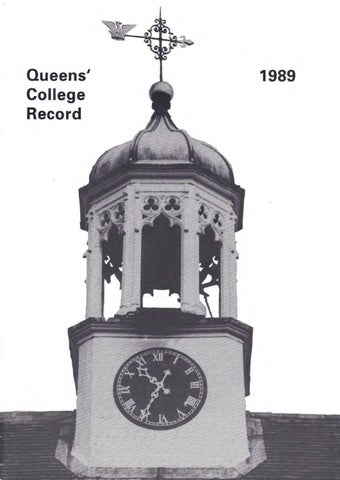
Queens College Record
1
1989
Forty years On The Idol of Paris, from the Bats first post-war Revue Now We are Eight, shows just how tiny was the stage of the Old Fitzpatrick Hall in which the Bats established their reputation. It is in marked contrast to the New Fitzpatrick Hall which is described in this issue of the Record, in which they have just performed for the first time.
The New Fi1zpatrick Hall. Architects: Bland, Brown & Cole, Cam/Jridge
Cover picture. Look up in Cambridge. Photo: Srian Callingham
Queens' College Visitor THE CROWN
Patroness HER MAJESTY QUEEN ELIZABETH THE QUEEN MOTHER
Honorary Fellows The Revd Henry Chadwick, M.A., Mus.B., D.D. h.c.(Glasgow), F.B.A. Master of Peterhouse, Cambiidge; Emeritus Regius Professor of Divinity. Sir Thomas Padmore, G.C.B., M.A. Sir Harold Bailey, M.A., D.Litt. h.c.(Australian National University), D .Litt. h.c.(Oxon), D.D. h.c.(Manchester), F.B.A. Emeritus Professor of Sanskrit. Lord Allen of Abbeydale, G.C.B., M.A. Alfred Charles Tomlinson, M.A., D.Litt. h.c.(Keele), D.Litt. h.c.(Colegate), D.Litt. h.c.(New Mexico), F.R.S.L. Professor of English in the University of Bristol. The Rt Hon. Sir George Waller, O.B.E ., M.A. Lord Justice of Appeal. Robert Neville Haszeldine, M.A., Sc.D., F.R.S. Sir Humphrey Cripps, M.A., LLD. h.c ., D.Sc. h.c.(Nottingham). The Rt Hon. Sir Stephen Brown, M.A., LLD. h.c.(Binningham). Lord Justice of Appeal. Sir Ronald Halstead, C.B.E. , M.A., Hon.D.Sc.(Reading), Hon.F.I.F.S.T., F.R.S.C. Peter Mathias, C.B.E., M.A., F.B.A., Litt.D.(Oxon). Master of Downing College, Cambridge.
The President The Governing Body is pleased to announce that they have elected The Revd Dr John Charlton Polkinghome, M .A., Ph.D., Sc.D., F.R.S., to be President of Queens' in succession to Professor Ox burgh. John Polkinghorne was educated at the Perse School and Trinity College, Cambridge. After a djstingushed student career and a Fellowship at the California Institute of Technology, he became a Lecturer at the University of Edinburgh. He returned to a Fellowship at Trinity and a University Lectureship in 1958, and was subsequently Reader and, in 1968, elected Professor of Mathematical Physics. He became a Fellow of the Royal Society m 1974. During that time he was a member of the General Board of the University and served on a number of national committees, becoming Chairman of the Science Board of the Science and Engineering Research Council. In 1979 he resigned his Chair to enter Westcott House and was ordained priest in 1982. After three years as Vicar of the Parish of St Cosmus and St Damjan, Blean, Canturbury, he returned to Cambridge as Dean of Trinity Hall. He thus bas that rare combination of expertise and experience both of advanced science and of theology and philosophy, which will give him a ready appreciation of such a wide range of the College's activities. Mrs Polk:inghorne is a Girtonian mathematician who subsequently trained as a nurse at about the time when her husband decided to switch careers, and now specialises in geriatric work. They have three children. They hope to take up residence in the President's Lodge in July and we wish them every success in the special role they will have in our College.
As many readers will already know, ProfessorOxburgh retired from the Presidency on 6 January 1989 as a result of his being appointed Chief Scientific Adviser to the Ministry of Defence for a period of three years. He is going to maintain a close connection with us by becoming a Professorial Fellow. We look forward to his return when bis Whitehall appointment expires. Although Ron is going to remain part of our Society in this way, it is appropriate to try to express our thanks to him - and to Ursula - for the contribution they have made to the College since October 1982 when he took up his office. When the Fellows had to find a new President following the resignation ofDerek Bowett, there was a general wish to see someone from outside the College who would build on the successes which it had achieved. Ron offered us energy, vision, leadership and an incisive inte llect; he was going to keep us on our toes. The one thing Ron found hard to find was time. He had hoped to be able to give up the post of Head of Department in Earth Sciences but this proved impossible. Moreover the very qualities we admired made him irresistible to those outside the University who demand that universities should become commercial institutions and then expect its leading academics to give freely of their time on administrative matters. This led to the Oxburgh Report on the organisation of teaching and research of Earth Sciences in UK universities. No doubt the rigour of the argument in that report attracted others in Whitehall when they came to look for a new Chief Scientific Adviser - and so to our loss. As we look back, the first thing we see is the extent to which we are the creation of his era - in our community of Fellows no fewer than 2 I of our present 54 joined us during this time. This 2
recruitment has owed much to his energy and leadership. Our drive towards excellence in terms of the number and qua! ity of applicantsforplacesandTriposresultshasbeenrelentless. But Ron - and Ursula - were concerned with more than just academic successes. Perhaps because they had children of their own who were going through university at that time, they took great pleasure in the company of undergraduates at teas and that most famous of innovations - breakfasts. They were also concerned with graduate students - the increase in whose numbers and in whose contribution to the life of the College has been so marked. The purchase of Owlstone Croft in the final yearofhis time as President is an appropriate monument. There are other tangible signs to his Presidency. After the possible collapse of the Lodge had been diagnosed, he set about organising the enormously successful Heritage Appeal, crowned by the visit of our Patroness in the summer of 1987. Like us he has watched the further spread of the buildings on the other side of the river as our indebtedness to the munificence of Sir Humphrey Cripps and the Cripps Foundation has assumed ever more tangible form. However I suspect that the feature of Ron¡s Presidency which a future college historian will pick out is likely to be his attitude towards Old Members. He always enjoyed the Club Dinners in June and inaugurated the Invitation Dinners just before the start ofMichaelmas Terms. It was natural to him that we should decide to write to all our Old Members about the Education Bill and what it meant to the College. He made us realise not only that we had to justify ourselves to the society in which we live and move but that we had a good case and the means of putting it across in the goodwill ofourOld Members. Perhaps we can best summarise his achievements by saying that he sets his successor that same high standard we have come to expect from our Presidents and which we have been so fortunate to see fulfilled. JOHN TILEY
The Society The year ended with the splendid news that our Honorary Fellow and benefactor Humphrey Cripps had been awardecfa knighthood in the New Year's Honours List. It is hard to imagine an honour that has been more richly deserved. It helped to redress a year which otherwise has been dominated by loss in its most tragic form. You will be able to read ' elsewhere m the Record of the individual contributions of Professor Ramsay, Dr Cohen and Dr Machin. Most of you will have known at least one of these people and some will have had, as have I, the privilege of knowmg all three of them. In a Fellowship as small as Queens' their loss is severe and all the more so for the sudden natures of their deaths. Arthur Ramsay had retired to Scotland some years ago leaving us many memories of his kindness and the shrewdness of his judgement. Henry Cohen would entertain us at and after lunch with his stories while Ken Machin would contribute his slightly breathless outlook on life. The Combination Room misses the laughter that the wit of all three engendered. Both Dr Prentis and Dr Wheatley retired from their Official Fellowships but, to our great good fortLme, both remain active members of the Society as Life Fellows resident in Cambridge. Jim Prentis has been a Fellow since 1962 and has served the college in many offices - Director of Studies in Engineering, Tutor, Senior Bursar and Vice-President; he was Acting President in 1985-86. Peter Wheatley has been a Fellow since 1967. He also has served thecollege in numerous ways - Director of Studies in Natural Sciences, Junior Bursar
and Senior Bursar. The mere recitation of these offices is impressive but fails to show the countless ways in which they contributed to the well being of the College in general and the Fellowship in particular. Dr Quie and Dr Wade reached the end of the tenure of their Research Fellowships. Marissa is doing some teaching for the Department of Social and Political Science. Stephen has been appointed to a Lectureship in the University of Liverpool. Another notable departure was that of Dr Smith who has been an Offical Fellow since 1978. Rod was Director of Studies in Engineering and leaves us to take up a Chair of Engineering in the University of Sheffield. We shall miss him and the constructive way in which he would take up the cudgel in a good cause. The departure of Dr Smith led to a major teaching need in Engineering. We were therefore delighted when Dr Malcolm Macleod, who had been a Bye-Fellow of the College for four years, combining teaching for the college with a full time post with Cambridge Consultants Ltd., decided to become a full time academic. He was appointed to a University Lectureship in the Department of Engineering and became an Official Fellow. He is currently pursuing research in Digital Signal Processing and Image Processing, looking into the problems of high accuracy estimation of multiple sinusoids in noise. Ms Ginny Crum-Jones became an Offical Fellow. She is Personal Workstations Support Manager in the University Computing Service beading a group which serves as in-house consultants on small computer issues in the rest of the University. Her expertise is such that her advice is constantly sought by other Fellows; one day she will be able to have a lunchtime uninterrupted by pleas for help from the inexpert. She has already assumed the onerous job of Rooms Fellow. Another arrivalis Dr Lisa Hall who is an Official Fellow and holds a Lectureship in the Institute of Biotechnology. She is an expert on sensors and is studying the development of optical and electrochemical technology for enzyme coupled substrates and immunological applications. DrBarbaraJohnjoined us as a Bye-Fellow. She works in the Earth Sciences Department, focusing on the use of geologic field projects in conjunction with geochemical and isotopical studies to test theoretical and experimental studies in petrology, structural geology and regional tectonics. Her projects I take her across the Atlantic and to the Spanish Pyrenees where she is working with the Survei geologic de Catalunya in Barcelona. Both our new Research Fellows are involved in Computer Science. Dr Thomas Clark has spent 1988 looking into the fundamentally new type of architecture for CPUs (central processing units) which he had discovered in the course of the work leading to his successful Ph.D. thesis. He has been looking around to see whether the investigation should be continued at the theoretical level or move to the practical CPU design. The latter option requires considerable facilities which he hopes to get from industry. Dr Richard Prager was awarded his Ph.D. and published an abbreviated version of his thesis in "Computer Speech and Language." He has presented a paper to a workshop on speech recognition organised by I.E.E.E. in -upstate New York. He also attended meetings in Paris and Oxford as part of the European cognitive research and "stimulation" initiative. (This was renamed the "science" initiative when it was found that stimulation had undesirable meanings in Dutch!) Richard is a devotee of opera.
Thelastarrivalis Professor Bruni Celli. Blas is a pathologist from Caracas, Venezuela and Simon Bolivar Professor. Our connection with Venezuela is a warm one and owes much to the continuing interest of the Venezuelan Ambassador to London, H.E. Dr Francisco Kerdel-Vegas. While here Blas spends his time in the Classics Faculty Library where he is working on the editions of Hippocrates. Dr Spufford had a most important year. The University Press published his Money and its Use in Medieval Europe which is the culmination of 20 years work. We are not sure whether he has yet presented a copy to the Senior Bursar. In addition he was co-founder of newly launched international Medieval and Early Modern Data Bank, a projectfinanced by the Research Libraries Group in the United States with a European headquarters in Brussels. Dr Callingham has been able to watch the construction of the new Pharmacology building in Tennis Court Road at the back of the Old Addenbrooke's site which the University acquired some years ago. He was admitted as a Yeoman of the Worshipful Society of Apothecaries and received the freedom of the City of London. Professor Beament gave a review lecture at the Royal Army Medical College in London and was presented by the Surgeon-General with the Grundy Medal to recognise his many contributions to medical and veterinary entomology. Professor Holloway completed his third round-the-world trip, lecturing this time in Delhi and California, with a holiday in New Zealand in between. Dr Diggle has lectured in Ioannina and Thessalonike in Greece and has become the Chairman of the Faculty of Classics. He also made his contribution to Anglo-Spanish relations when, as University Orator, he presented the King and Queen of Spain for Honorary Degrees. Mr Wright was on sabbatical leave. He was elected a Visiting Scholar in the Faculty of Arts of the University of Melbourne; he was Visitor in English at the University of Sydney and gave visiting lectures at the University of Adelaide, where he saw Douglas Parmee, Monash University and the University of New South Wales. Dr Napier completed a Labour Law code for Tanzania; he now turns his attention to Uganda and we look forward to having him safely l;>ack among us. He seems to have spent much of the year getting injections. Mr Fentiman was on leave for the first part of the year getting the bulk of the work done for a new book on the theory of the Conflict of Laws. Dr Sage has been awarded the Gedge Prize. He spent three months working at the University of Miami Medical School and presented bis work both there and in WashingtonD.C. Dr Richard Lewis has been awarded his Ph.D., has published four academic papers and bas addressed meetings in London and San Francisco. Dr Cebon was invited to Washington DC by the Federal Highway Administration to present a paper at a conference on road damage by heavy vehicles. This is a traditional Queens' topic - some will recall Sir Arthur Armitage' s chairmanship of a government committee on raising the limits ofaxle loads for heavy lorries. Overall this year has been a productive one. This review suggests an active Fellowship that is carrying out its scholarly and pedagogic functions fully and playing an active part in maintaining the position of the College as a strong contributor to the life of a University which is trying to remain a world class institution. JOHNTILEY
3
James Arthur Ramsay
Arthur Ramsay was born in 1909 at Maybole in Ayrshire; from Fettes College he came up to Gonville and Caius where a distinguished student career led to a Ph.D. and appointment in 1934 to a University Dernonstratorship in Zoology. He was promoted to Lecturer in 1939, became a Reader in 1959 and Professor of Comparative Physiology ad hominem in 1969 which post he held until he retired in 1976. Arthur was elected a Fellow in 1934. He therefore just overlapped Fitzpatrick with whom he shared a passion for mountaineering: inde.ed the official record book shows that J.A.Ramsay led the first successful ascent of Cir Mhor on Arran, the climb classed as 'severe'. He also enjoyed ski-ing and mountaineering in Scandinavia through which he met his Swedish wife Helen whom he married in 1939. He often spoke of the strained relationship between the elders and the little group of young Fellows to whom he then belonged, and who dared to have opinions of their own. This came to a head when the Governing Body reached stalemate over two designs for the Fisher Building. And even then Arthur demonstrated the pragmatism which was so characteristic of him; he changed sides and voted for the building of which there are such mixed opinions, simply because he believed war was inevitable and if decision was delayed any longer nothing would be built at all. When war was declared Arthur was directed to operational research and became a Major in the Royal Artillery Defence Experimental Establishment, receiving the M.B.E. Of his service, the best known stOry is that he went to the beach one morning and shot a seagull - the only shot fired by his unit throughout the hostilities - to suspend it from an aeroplane and prove that a bird could produce a blip on radar. That typifies his approach in his substantial later contribution to biology, in which there was no substimte for the direct experiment, however technically difficult it might be to carry out. On his return he was for many years Steward starting with the long and difficult post-war period when food rationing continued, often going into lower Hall and eating the food 4
which was the subject of complaint - and then complaining in no uncertain terms in private to the kitchens. In the 1960s he became Vice-President to Arthur Armitage and coined the expression that 'if the President is here the Vice-President does not exist'. Nothing could have been further from the truth, for an enormous number of the College's problems were threshed out between groups of Fellows with the inevitable help of gin in his spartanly furnished rooms at the top of the Essex building. He was thus enormously generous to the College with his time and to his colleagues with his hospitality, while saying regularly that it was not worthwhile to engage in very many activities if you compared the pleasure they gave with that obtainable from the number of bottles of gin you could purchase with what they would cost. His equally thrifty attitude towards teaching was revealed during his many years as supervisor and Director of Studies. There was the machine he made which dropped coins into a glass dish at regular intervals, to remind supervisees that they were paying him at that rate and should therefore use the time profitably by asking questions. There was the electricallyheated war-surplus flying suit which enabled him to supervise without the gas fire (which made students sleepy) and which caught fire when he has switched it on before going to lunch, leading to the briefreportin the local paper that the Fire Brigade had been called to Queens' College: 'a sofa had caught fire' . The major contribution to science which led to his election to Fellowship of the Royal Society in 1955 was the invention of novel techniques which for the first time provided analyses of minute amounts of fluid from within cells and tissues of insects and similarly small animals. This was characterised by extraordinary skill and ingenuity as an instrument maker, though the scrap box in the Zoology Department's workshops bore testimony to his habit of trying to make the machines work as fast as he himself did, which all too frequently ended in disaster. But his research inspired a generation of biologists to use invertebrate animals in elucidating many of the fundamental problems of biology. He was at the same time the administrator of the Department under James Gray, organising the entire teaching programme and setting example by the huge amount of demonstrating he did himself (until it was discovered that this was achieved by putting himself down as teaching two classes simultaneously). He was also for many years press editor of the Journal of Experimental Biology • through which he acquired the subconscious habit of taking pen from pocket and correcting the English of any document he was asked to read - occasionally invoking the wrath of his Head of Department for the uninvited criticism. But he would not be a Tutor, nor would he accept corresponding responsibility in his Department, despite many people's view that he would have made a superb Head. Arthur openly declared that he would never take on any job whic,h made him responsible for people's lives; he would lie awake at night wondering whether he had given them the 1ight advice. But it was not to be: he took his first, and last, sabbatical leave the year before he retired, in order to try out the croft he had bought in Scotland for his retirement, returned to Cambridge with the intention of a final quiet year - and because of a near-fatal accident to his Head of Department, found himself doing that job he most wished to avoid! Arthur was the youngest of the quartet of Scots with Bull, Kirkaldy and Maxwell, who ensured that St Andrew's Day was properly celebrated; and when a piper could not be obtained, he stepped into the breach, demonstrating that the many hours which he spent at meetings apparently indicating
his boredom by playing with a pencil, was no undisciplined fiddling. After he retired to the north of Scotland his moming exercise was to play marching round his croft - piper and pipes enshrouded in a mosquito net. And well into bis seventies he ski-ed five miles to the nearest open road in order to visit his mother who was still living in Cambridge. It was visits to her which enabled us to see him all too frequently, when he was avid for news (and scandal) about any of his former associates. but as far as science was concerned, it was as though he shut the book the day he retired never to open it again. This was the more remarkable, considering the meticulous distillation wehich went into his two classical textbooks: A Physiological Approach to the Lower Animals and Th e Experimental Basis of Modern Biology, and his endJess effons to apply non-equilibrium the1modynamics to biological systems. Arthur's life was ruled by a very personal philosophy; he would not have the bigoted morality of others imposed on him, and likewise he would never seek to impose his views on others - and this was as firmly demonstrated by his end as by his life. He often said that there were no characters left in Cambridge, oblivious to the fact that he was himself one of the most original characters the College has been proud to count amongst its Fellows JAMES BEAMENT
Henry Cohen One of my earliest memo1ies of Henry Cohen is at a staff dance in the University Engineering Department, giving an impromptu lesson in dancing the cha-cha. Henry always liked things to be done properly. Not only that, he reckoned rightly that more fun could be had that way. He liked things to be done with style. Henry was born in Swansea in 1921. He attended Swansea Grammar School and in 1939 he came up to St Catharine's with a State Scholarship and an Exhibition to read Mechanical Sciences. Due to the exigencies of war the Tripos was compressed into two years. and Henry graduated in 1942. His first appointment was as a Junior Scientific Officer at the Royal Aircraft Establishment, Farnborough, where he was engaged to do research on gas turbines. It was an exciting time and in later years Henry would talk enthusiastically of his early involvement with the work that was to lead quite soon to the successful application of jet-propuJsion to aircraft. Later he took charge of the engine test section at Power Jets, which was to become the National Gas Turbine Establishment. Henry was therefore well prepared for his appointment in 1947 to a Lectureship in Gas Turbines and allied topics at King.'s College in the University of Durham. There, with the support of a Turner and Newall Research Fellowship, he worked on problems in heat transfer that arose from his earlier research on gas turbines, and gained his Ph.D. In 1954 he returned to Can1bridge, to a University Lectureship in Engineering. He was immediately invited to supervise by Queens' and other colleges. In conformity with the general pattern at that time, a Fellowship was not something that came very quickly. But Henry was well thought of at Queens' and he was elected to bis Fellowship and appointed Director of Studies in Engineering in 1959. He was later to serve the College in turn as Tutor for Graduate Students, Junior Bursar and Garden Steward. He continued to supervise, and remained Director of Studies in Engineering until he retired in 1984.
Whatever the capacity in which Henry was engaged he always brought to it good sense, enthusiasm and energy. He felt that if a job needed to be done then it was best to get on with it. One of the episodes some Fellows will remember concerned a chandelier. After the Old Hall had been redecorated there was much fruitless discussion in the Governing Body on what so1t of lighting fitment should be installed. Tired of getting no useful advice Henry, then Junior Bursar, decided to purchase a modern style chandelier as a temporary measure. Not everybody liked it, but nobody could suggest anything better and it stayed in use for about twenty years. Not that any comers were cut in the way that Henry's jobs were carried out. Everything down to the last detail had to be right. He always brought considerable concentration to bear on any matter in hand, and this he did to great effect in games. Before the construction of Cripps Court, Fellows were occasionally seduced on a fine sunny afternoon to play croquet in the old Fellows' Garden. One of Henry's first acts when he started to take an interest in the game was to buy a set of the official rules, which were to be properly observed thereafter. He was a fo1midable opponent who often ran up very large breaks. He always concentrated on getting his balls through the hoops rather than impeding his opponent. In fact, he was so successful that there was no need for him to try deliberately to make things difficult for the other chap. later, for a short period, some Fellows had an enthusiasm for snooker. In that, too, the rest of us had little chance. Henry had a great sense ofbumour too, allied with keen observation both of his fellow-men and situations. He had a seemingly endJess fund of anecdotes, and he would tell them with great relish, particularly if they were against himself. 5
He was, nevertheless, inclined to be morose at times and early in the 1970's he fell prey to depression. Fortunately, he recovered quite quickly and appeared to be contented from thereon. He enjoyed teaching very much and was an excellent lecturer. But he found the administrative accompaniments increasingly irksome, and he wanted more time to do other things, so in 1981 he took early retirement from his University Lectureship. But he continued to supervise and to direct studies in Engineering. As an Official Fellow, his contributions to debates in the Governing Body were rarely long or frequent, but if he had an observation to make or a question to put, he always went straigbtto the heart of the matter. He was never afraid of asking the apparently simp1e question. As Senior Fellow he played an important role in the election process of the new President in 1980. He had a great affection for Queens'. He liked to make his mark in individualistic ways, as when he felt that more dignity would be lent to the proceedings of the Governing Body if the President were furnished with a silver bell with wbich to call it to order; Henry's way of dealing with the matter was to present such a bell, which has been used ever since.
In 1984 he decided to celebrate his 25 years as a Fellow with a party to which all the Fellows and their spouses, and a few of Henry's particular friends were invited. It was a wonderful occasion, held in the Old Hall and enriched, I remember, by a musical tribute on Dr Henry Cohen's Jubilee, composed and presented by Edwin Maxwell and Chris Pountain. Although we continued to enjoy Henry's presence, as a Life Fellow, in the Combination Room, the Governing Body was impoverished later that year when he decided to take early retirement from his Official Fellowship. In the early 1960's Henry spent one summer teaching at the Massachusetts Institute of Technology. Later on he spent a year at Armadu Bello University in Nigeria, at the time when it was a new Institute and still under development. Except for a period when all his spare energy was devoted to the construction, from a kit and using direct labour, of the bungalow into which he and Betty subsequently moved, and after that, the construction of a swimming pool in his garden, Henry travelled regularly. He would be missing for a few days and then he would relate over lunch or in the Combination Room what he had seen: on one occasion the Thames Barrage, on another the mechanism of the Tower Bridge. It was never an entirely simple tale, always one or two particular details or personalities would have excited his interest. About once a year Henry would embark on something more ambitious. A trip to Egypt including a visit to the Aswan dam was a journey of which he had many traveller's tales to tell. It was no surprise when he announced his decision to take a trip to Australia to see something of its Bicentenary celebrations this year: not only the celebrations, of course, but a grand tour. Sadly, that tour came to a sudden and shocking end when Henry died as the result of a road accident in Canberra in March of last year. JIM PRENTIS
6
Kenneth Ewart Machin
Ken Machin was born in 1924; he entered Queens ' in 1942 and became a Foundation Scholar. He belonged to that select wartime band who obtained a degree without ever taking a Tripos Examination, going straight from Prelim. to Part INST to Prelim. to Part II Physics, and was then directed in 1944 to the Telecommunications Research Establishment, Malvern which was developing Radar. There he joined a company of subsequently distinguished scientists under the command of the great Ratcliffe. Ken had already been a founder member of the Bats, lighting their very first play, and it is not altogether surprising that at T.R.E. he was involved in a unique modification of defence regulations: arranging that while their lecture room was inside the security perimeter by day, the 1 boundary was moved at night to put it outside the limits, so that they could use it as a theatre of which he was technical manager. For many years after the war, he invoked his M.I.E.E. to certify the Bats electrical instaUations, and rescued them from catastrophes - including for example that evening when the overloaded supply to the old Fitzpatrick Hall failed entirely, half-way through the revue overture and in the six minutes which seemed like an hour to the pianist who kept playing in pitch darkness, ran the Mayweek cable across to Fisher and clipped it onto the main intake busbars - which explains why for years afterwards the box was sealed with a North Staffordshire Electricity Board seal! Ken returned to Cambridge in 1946 as one of the team who developed radio-astronomy, holding both the Monroe and Isaac Newton Studentships. At their 40th anniversary dinner last year, they recalled that he was the first person to carry out radio-astronomy calculations on a computer - Edsac I- a vast engine though no more powerful than things we carry in our waistcoat pocket today. It was entirely in character that Ken produced the original print-out. For it was well known, loved
and occasionally feared in College and University not only that be could recall the content of documents - whether it was of college committees, club constitutions, building plans or tutorial notes - but that he could produce them at twenty-four hours notice to confirm his phenomenal memory. He held the position of Chief Instructor of the Cambridge Gliding Club for a record number of years - it fascinated him scientifically as much as recreationally, but revealed a curious paradox - for though he was in ltis element when playing against the elements in the sky, he was quite unable to take more than six steps up a ladder against his house. It was one of the few occasions when he was happier not to have his feet on the ground. Gliding played a part in bis meeting his wife Elisabeth, who subsequently was Assistant Librarian for many years, and so ably supported him in the generous hospitality he offeJed to generations of his pupils. But it was also through gliding that he met Pringle, then a lecturer in Zoology, and that led in 1953 to a turning point in Ken's career. For both Pringle andltis colleague Llssmann needed a physicist to help with their research. Lissmann was working on the blind electric fish who find their way - and prey - by sensing the electric field they radiate from their tails. Lissmann and Ken produced a classic paper, of which his special delight was adding a term to the scientific vocabulary: 'impremance '. With Piingle he worked on the mechanism of insect flight muscle, an ideal problem to which Ken could apply his remarkable ingenuity in electronics and engineering. He was elected Balfour Student, a post held over past years by a most distinguished array of biologists - about which he would delight to point out that he was the only Balfour Student of Zoology who wasn't a student of zoology. Ken made himself so indispensable in this period of the rapid development of biophysics that in 1964 he became an Assistant Director of Research. He collaborated with biologists wherever physics was required, solving problems by methods always ingenious, often unorthodox but never dubious. To any method or device which was unreliable or inelegant Ken applied his own interpretation of one of Edward Lear's invented words - it was runcible; it was the most critical thing he could say of anyone else's invention. Dozens of publications over the next 20 years contained acknowledgement of his help in saving people from a runcible fate. That was Ken's chosen role: he did not seek problems - he collected them, because everyone¡ brought them to him, and it was his delight to solve them for others. He was instrumental in setting up Cambridge's first closedcircuit TV teaching system, in the Zoology Department, and was one of the little team who acted as clients for the New Museums Site Arup Building, taking charge of the whole of the services side. That experience was later to serve Queens' in remarkably good stead in the enormous contribution Ken made to the Cripps' Development Committee. He was elected a Fellow in 1963 and became a Tutor the following year. Perhaps more significantly, he was one of the Fellows who played a key role in that troubled period, and was particularly concerned with drawing up the first constitution of the Union and JCR. This was the apprenticeship which allowed him to succeed Max Bull as Senior Tutor in 1971, and to modernise the tutorial system of the College. His reign as Senior Tutor saw a real rise in the academic achievements of our students, and the restoration of a relaxed relationship between dons and students. It was not completely relaxed. There was the Saturday morning when I rang Ken at home and asked him ifhe knew a member of the Air Council. "What's this in aid of?"
"Well the two Bats here apparently need the signature of a member of the Air Council to keep the machine gun they've borrowed from a local air base as a prop for their play". Ken made Girton to Queens' in seven minutes. They had already been photographed with it for Varsity. All he said was, "You '11 make a good enough copy of it so as no one will know the difference, and then you 'U flannel your way back with it as you flannelled it out - and if you have an accident on the way, you won't be members of Queens'." The strain of Senior Tutorship combined with a heavy load of University and College teaching undoubtedly contributed to a serious illness towards the end of his period as Senior Tutor, but when he recovered he once again threw himself unstintingly into teaching and administration, and especially to ensuring that the Multi-Purpose Hall of Cripps Phase Ill would be free ofall thoseruncible mistakes that he so despised in other such halls. Over the years, Ken had amassed an unrivalled knowledge of theatre machinery and electrics, and one may be sure that at Covent Garden or Glyndboume which be and Elisabeth so regularly attended, he enjoyed working out how stage effects had been achieved almost as much as the performances. All this experience was poured into the planning of the new Fitzpatrick Hall, which will certainly be the most sophisticated little theatre in Cambridge, and in token of which the Governing Body have named the large control and projection room overlooking the auditorium, the Machin Room. Ken Machin could have filled high office with distinction, but he often said he had 'no ambhion to be the boss and the world needs Number One Dickies as well'. In that role he made an enonnous contribution over a wide range of activities, but above all he believed that science was meant to be enjoyed, and as so many of bis grateful pupils remember, he showed them that it could be. JAMES BEAMENT
Cripps Court Phase Ill Development Although we had hoped that we might have possession of the new buildings in September 1988, it was not in fact until the latter half of the Lent Full Term 1989 that parts of Phase m were handed over to the College by the contractors. The new buildings may best be viewed from Queens' Green, from where a wide set of steps can be seen ascending into a new small courtyard between two new buildings. We hope one day to have a bridge across the drain to Queens' Green from the new steps so that a new gate from College to the west is created. The larger of the two new buildings is a multi-purpose hall, which I am pleased to announce that the Governing Body has agreed to call the Fitzpatrick Hall, the name lost when the old Fitzpatrick Hal] was demolished to make way for Phase II of Cripps Court. The new Fitzpatrick Hall is something of an improvement on its predecessor, however. It may be used in a theatre configuration with raked seating for 208, or in a flatfloor configuration as a sports hall, for receptions or parties. There is in addition a large stage area at one end which can be isolated from the main hall for rehearsals, or even as a minitheatre in its own right. The floor ofthe stage is motorised in sections and can be adjusted to various positions for lectures or drama. Above the stage is a proper stage grid from which
7
curtains and lighting can be suspended on winch lines. In the body of the Hall, a LightingB1idgecan be winched down from the otherwise flat ceiling needed for other uses of the Hall. To support the theatre uses of the Hall, there is a Green Room beside the stage, with two Dressing Rooms which have to be seen to be believed. At the back of the Hall, there is a large Control Room from where the lighting and sound equipment may be controlJed, and from where films and slides may be projected. This room wilJ be known as the Machin Room in memory of Dr Machin, who was almost single-handedly responsible for the technical specification of the Hall and its equipment. The Fitzpatrick Hall is intended to be a new home base for the Bats, and a venue for the Film Club and Video Club. It is hoped also to start a new Badminton Club, and encourage other indoor spo1ts. It will also be invaluable as a lecture theatre and for large meetings. In the basement under the Fitzpatrick Hall are two sound-proofed music practice rooms for the St Margaret Society. The smaller of the two new buildings comprises three new courts for the Squash Club (two with glass backs, which will be visible from the new courtyard outside the JCR), a new room for the Table-Tennis Club, and a further room which may serve as a multi-gym. Two changing and shower rooms are provided in this area. Underneath the whole development is an underground carpark which will relieve some of the pressure currently being felt for parking space, and may enable us to tidy up the area by the river now being used for parking. In the space between Fisher Building and Cripps Court, further cycle stores have been erected. It is already clear that the Fitzpatrick Hall will be the finest theatre for drama in any Cambridge college, and that Phase Ill as a whole will make Queens' one of the best provided with on-site recreational facilities. This cannot but help maintain the popularity of Queens' amongst those choosing colleges at Cambridge. We remain indebted to Sir Humphrey Cripps for his continued attention to the project and to the Cripps Foundation for their generosity in funding the fabric of the new buildings. We also thank the many members of College who subscribed to the Development Appeal, now being used to furnish and fit out the Fitzpatrick Hall and other new rooms. ROBIN WALKER
Owlstone Croft One of the notable changes of the past few years has been the development of Cambridge as a booming centre of light industry and commerce: the so-called Cambridge Phenomenon. Some of the companies are natural spin-offs from university research and development, some have been actively encouraged to start up or move here by developments such as the Trinity Col1ege Science Park and St John's College Innovation Centre, and others have just been attracted here by the increased pace of commercial life in the city and the improved communications brought about by the arrival of the Ml 1 motorway and the electrification of the railways to London. Cambridgeshire bas one of the most rapidly expanding populations in the UK, and Cambridge city one of the lowest unemployment rates.
8
There is a p1ice to be paid for this success. The demand from the increasing population for housing has far outstripped the capacity within the area for building. The result has been soaring house prices; well above the already high average for East Anglia. Couple this with the steady erosion of the privately rented sector and the near-terminal decline of the traditional University Lodging Houses, and one can easily understand that students can no longer afford rented accommodation in the city, and are increasingly looking to the col)eges to provide rooms. Queens ' has been proud to claim since the advent of Cripps Court in 1974 that we could guarantee rooms in College to all three undergraduate years. Most colleges cannot claim this even now: they rely on hostels around the city to house some undergraduates forpait of their cai¡eer. But Queens' has never been able¡ to provide as much by way of accommodation for its post-graduate students. Indeed, fifteen years ago, postgraduates on the whole did not want to jjve in college, and sought to distance themselves somewhat from the distractions of the undergraduate social and political scene . preferring a more independent life based outside college. Much has now changed: not only have post-graduates been priced out of the local rented market, but also they now actively desire to participate more fully in college activities. Indeed, many post-graduates applying from overseas do so mainly because they want to experience Cambridge collegiate life for themselves, and this necessarily requires living in college. As these pressures developed over the past ten years or so Queens' responded by pressing into service such few houses as it bad in Cambridge for use by post-graduates, and indeed also purchased further ones. We ensured that, when owboathouse was rebuilt, the scheme also provided accommodation for post-graduates. But still demand outstripped supply, and it was clear that a more radical approach was needed. The main college site was by now very highly developed, and it was unthinkable that room could be found for further building of the size required. So it was that, when Owlstone Croft came on to the market in 1988, Queens' was extremely interested. Owlstone Croft comprises 2Y2 acres of land in Newnham village adjacent to the River Granta, only slightly over half a mile from College itself - it is possible to walk there alongside the 1iver most of the way. On this site in the late 18th or early 19th century was built a large house, which we ' understand at one stage to have been the residence of the High Sheriff of Cambridgeshire. When the National.Health Service came into being, Addenbrooke's Hospital purchased the site and developed it into a Nurse's Hostel and a training school for nurses. The original house was expanded to provide central kitchens and dining rooms, and around 1952 a four-storey block was built comprising 75 bedrooms, and the stables were enlarged to form the school buildings. Further development occurred in 1963 with the erection of a prefabricated single storey building providing another 48 bedrooms. But Addenbrooke's Hospital itself had meanwhile run out of space at its site on Trumpington Street, and the hospital began to move to a new site on Hills Road on the outskirts of the city. A few years ago, the move was complete and the Old Addenbrooke's Hospital site was sold to the University. Owlstone Croft was too far from the New Hospital. The nurses' school closed, and the hostel buildings fell into disuse. After one or two attempts to find alternative uses for the site, the Cambridge Health Authority placed it on the market.
The combination of a large site so close to College complete with existing hostel buildings was just what was needed to solve the College 's accommodation problems. The site was purchased in July 1988 and the College immediately set about adapting the buildings for occupation by our students, whose expectations were unlikely to be satisfied with what the nurses had previously endured! Apan from the 1963 extension. which we shall probably demolish, the buildings were structurally sound. bur somew hat spartan in their internal furnishings and fittings. We have had to upgrade many parts of the buildings to modern standards of fire precaution, a campaign which meant having to replace almost every bedroom door. We have installed an entirely new smoke detection and fire alann system, and upgraded much of the electrical system. The heating and plumbing required a complete overhaul, as much of it had been allowed to decay through lack of use. We have set up the old house and the 1952 extension as a hostel for about 83 students with selfcatering facilities rather than central kitchens. The first 30 or so rooms were available to meet the demand of the October 1988 post-graduate entry; and at the time of writing most of the remainder are now complete. One of the former dining rooms has been converted to a Common Room which has rapidly become a focus for social life, events there attracting even College residents to explore their way to Owlstone Croft. What of the future? It is our hope that Owlstone Croft will be the same, yet different: different in the sense that it will develop its own identity and a social life of its own, as it has already started to do; the same in the sense that it will be close enough to College for residents of Owlstone Croft to participate in College life, and to feel themselves to be full members of Queens'. Although we shall continue to offer a guarantee of three years .in College to our undergraduates, we shall permit them to take rooms at Owlstone Ci:oft if they prefer, thus permitting more post-graduates to take rooms in College itself. The increased total number of rooms at both sites will enable us to accommodate more post-graduates overall, thus strengthening the increasingly important post-graduate community in our College. One question must be in the reader's mind: how has Queens', known to be poorly endowed, managed to make such a large land purchase? The answer is threefold. First: we have borrowed capital from our own endowment, and aim to repay it over a number of years to come (this was how the College financed its parts of the costs of Fisher and Erasmus Buildings, which have only just recently been fully paid back). Second: the College is now selling some of its assorted houses in Cambridge, until last year used for post-graduate housing, in favour of centralising such accommodation at Owlstone Croft. Third, and most important: we would not have been able to contemplate such a large purchase had it not been for some recent large bequests (one, the Binnie Bequest, was reported in the Record last year). Lest there be any worries, let it be said that not one penny of the Development Appeal and Heritage Appeal monies have been diverted into Owlstone Croft. But the central lesson remains: Queens' would not have been able to take such an important step had it not been for major bequests from its former members. Owlstone Croft stands as a reminder to what is possible, given the support and encouragement of our alumni, which is gratefully acknowledged.
The Appeals The College has benefined enormously from the generous response Old Members have made to the major Appeals launched over the past two decades. The DevelopmentAppeal concentrates on providing for new facilities in the developments which the College has been so fortunate to obtain. It helped to furnish Cripps Court, and the new calls upon it comprise equipping Phase III of the Cripps Development and the refurbishment of Owlstone Croft; these major additions to the College are descnoed elsewhere in the Record. The availability of the splendid Fitzpatrick Hall in Phase Ill will release pressures on the Old Kitchens buildings, and plans are now being made to renovate that area. The work will ce1tainly need the support of the Development Fund. Although the initial projects cauied out with the support of the Heritage Appeal: the restoration of the President's Lodge and of theslateroof of the Essex Builcling, have been completed - and the College could not possibly have discharged its responsibility towards the preservation and restoration of the historic properties without the Appeal 's support - much still needs to be done. We now have to turn our attention to the Silver Street elevation of Old Court, and to the tiled floor of Old Hall. The College is therefor anxious that the generosity of Old Members towards these two appeals will be sustained, and we are writing to those whose convenants are expiring to seek their continued support. The Club Weekend and the Invitation Dinners provide a particular opportunity for Members to see. the many developments and works which have been made possible, but visits are very welcome at any time. Also in future we intend to provide more .information about the appeals and the financial position of the College as well as reporting regularly on the progress of the various projects. If any Old Member wishes to discuss either Appeal, or the purposes of a particular donation, I would be -very happy to answer enquiries. ANDYCOSH
ROBIN WALKER
"You can get connected and learn computing at an:y age!" 9
The Fabric
The Library
When the Old Hall was last completely redecorated in the early 1960s, for some reason the Screens Passage past the Hall was not included. In 1988 we put that right, matching the colour scheme of the Hall itself in the decorations around the panelling, which include a ceratin amount of pure gold leaf. The wrought iron screens, dating from the 1730s, were stripped and repainted to match. The worst parts of the floor of the Old Hall have been patched, pending a more thorough restoration in the future. A gyp-room in Fisher building has been modernised as a pilot scheme for all the others. It bas been converted from gas to electric cooking, and modern fitted kitchen units installed on a new tiled floor. We plan to modernise the remainder of the gyp-rooms in Fisher as soon as practicably possible. The whole of Fisher building has been carpeted in an attempt to make it easier to keep clean, the old wooden floors having needed to be regularly scrubbed with bleach! All the underground gas mains in Old Court and Cloister Court have been renewed in yellow plastic pipes instead of (leaking) cast iron ones. A side-effect of this work has been that an important area of the Old Kitchens has been freed of gas meter and piping. Planning still continues concerning redevelopment of the Old Kitchen area after we have moved into Phase III of Cripps Court. Routine redecoration work in 1988 included Cloister 2, H5, TI, the Librarian's Office outside the Old Library, Q and R staircases, and the complete interior of Owlstone Croft. ROBIN WALKER
Bequests and Benefactions Apart from the generous contributions which have been made to the Development and Heritage Appeals, the College has received the following major bequests: The Campbell Fund has been established through the bequest of Dr Derek John Campbell (1929) who died in November 1987. Whilst at Queens' he will be remembered as Campbell DJ.Gamble, but he subsequently adopted the stage name by which his father was known. The Norris Fund has been established from the bequest of James Cecil Norris (1920) who died in March 1988. The Fund bas subsequently been augmented by further generous donations from his widow, Dr Joan Harcourt Norris, and his brother, T.St.M.Norris (1921). The income from this Fund will be used to support Fellowships. The C.W.Phillips Fund and Prize have been established with a bequest from Mrs Beti Phillips in memory of her husband, Christopher William Phillips (1933), who died in April 1987. Both of their sons came to Queens': John (1968) and Andrew (1962) who is a Fellow of the College. The income from this Fund will be used to provide the C. W.Phillips Piize in History and to support the cost of academic travel. The creation of these Funds in perpetuity will serve as a reminder of the warm support which the College receives from its Members. ANDY COSH
LO
1987-88 Librarian: Dr Callingham Keeper of the Old Library: Mr Wright (On leave, Easter Term 1988) Assistant Librarian: Mrs E.Machin (and Mrs M.P.Bishop) Undergraduate Assistant Librarians: T.B .Appleton, J.M.Kent, D.O'Brien, J.P.Williams, M.J.R.Burgess, D..C.Kirk, S.M.Lowry, DJ.Ross.
War Memorial Library In this account of the Library it is proper to begin in the middle for here occurred an important event tinged with sadness. It was the retirement in the summer of Elisabeth Machin after eighteen years as Assistant Librarian. There is much to thank her for. Librarians, myself more than most, claim heavy duties elsewhere as the reason for spasmodic attendance in the Library. It was Elisabeth who saved us. She was almost always in residence and everyone was welcome in her atmospheric office. This was in spite of officially being "part-time". Her idea of such a term was based on a length of working day somewhat in excess of the norm. What a boon this freestyle concept of time proved to be. A Cambridge Natural Scientist, Elisabeth applied a pragmatic approach to the Library and to the aquisition and classification of books. Not everyone was overjoyed but they must admit that Elisabeth positively encouraged them to borrow the books. This final year was to have been like all the others that had gone before; building, developing, planning and, above all, running a vital part of the life of Queens' In the event, the year ended as noone could have foretold. Even immediately after the tragedy that befell her, Elisabeth was hard at work, making sure that her successor could take over with the minimum ofupheaval. She was tremendously successful in this regard and the only change that needed to take place by the beginning of the Michaelmas Term was for the office to be re-painted! Everything else could follow in the fullness of time. I am sure that I speak on behalf of all the Librarians of the past eighteen years when I use this space to record our gratitude to Elisabeth for support second to none. 1 also wish to thank Mrs Paula Bishop, who, in addition to her work in the Computer Science ' Library, helped to lighten the load for Elisabeth and to prepare for the changes to come. Last year, I promised that I would say something about plans for the future. While plans for physical alterations in the Library to accommodate more reading places and to provide better facilities are still at the preliminary stage, an important decision was taken. The Governing Body agreed to appoint a full-time Assistant Librarian from the beginning of the 1988 Academic Year. The financial implications of such a decision are quite far-reaching. There is no doubt that, in addition to the substantial costs of physical refurbishment of the Library, there will be an obligation to underwrite the future security of the Library through the ability to attract and keep Assistant Librarians of the calibre needed to meet the demands over the coming decades. It is a pleasure to welcome Mrs. Clare Sargent, like Elisabeth, a Girtonian graduate but in Archeology and Anthropology, as Assistant Librarian. She comes to us following seven years in King's College Library. It is a testimonial to her and to her predecessor that few detected the join in the service provided. However, evolution, or mutation, is apparent, which is most evident in upheavel
generated by the introduction of a new classification and arrangement of books. Some have said that the Library bas taken a leaf out of Sainsbury's book! Once again, I thank the large number of individuals who have given books to the Library. Among the Fellows, Professors Beament and Stein need special mention, the former who has donated a large number of books across a wide range of subjects and the latter who has given books in Roman Law by himself and by other authors to build our collection in this discipline into one of distinction. However, perhaps the most noteworthy of the benefactions this year and one which gives me much pleasure to acknowledge publicly has been the donation of books by graduating lawyers to enhance the Law Library and to increase our previously rather meagre collection of textbooks in this subject. In particular, I wish to thank Dominic Vickers who appears to have been the prime instigator in this enterprise as well as RC.Reuland who made a parallel donation. I very much hope that this is the start of a tradition, which will not be limited to Law.
The Old Library In the Old Library, Mrs Joan Holloway continued with her work on the new catalogue, now well advanced, and numerous scholarly visitors came to consult the College's collections. In the Easter Term, there were visits from the Veterinary History and Ecclesiastical History Societies. It was the former visit that provided the excuse for the Summer Exhibition to be concerned with some of our veterinary and natural history books and called "Horses, Hippos and Divers Animals" . The selection and display were undertaken with the advice and collaboration of the Chaplain his alter ego as a veterinary anatomist. One volume on display was A System of Comparative Anatomy (1796) by Sir Busick Harwood, one of the first Fellows of Downing College and Professor of Anatomy. The book was resplendent in its new binding by another professor of anatomy, Frank Goldby. Towards the end of the year, the ancient calm of the Old Library was suddenly broken by larger-scale activities. A bulky and sophisticated photo-copying machine, complete with an hydraulic cradle and with a lens system which enables 1 photocopies to be taken without opening aged bindings more than a few inches, was installed in the lobby. Research assistants were to be seen clambering up and down ladders to the highest shelves of the Library, and trudging up and down the Library stairs with items for the copier. The Cambridge part of the Eighteenth Century Short Title Catalogue (ESTC) had reached Queens' . The ESTC is an international project which was established at the British Library in 1977. It is the largest computerised cataloguing project of its kind in the world. Its aim is to create an estimated half a million records ofeighteenth century books, pamphlets and other ephemeral material contained in the collections of over700 libraries world-wide. The resulting database will in the end form a comprehensive catalogue of eighteenth century printing, and will be a research resource of great significance. The College's collections will make an important contribution to this project, since our eighteenth century holdings are particularly extensive, varied and unusual. This is largely due to the great generosity of a former Vice President, David Hughes (Fellow 1727-1777), who left the College his entire library at his death. Hughes was a great collector, and obviously had a particular fondness
for tracts and pahphlets, possessing several thousand of such items. His collection was so extensive, in fact, that for the first time since the fifteenth century the Old Library itself had to be physically extended to house them, and what is now its raised east end, immediately adjacent to the Old Chapel and previously a Fellow's room, was then taken in. The cataloguing work will, in its tum, be of immense value to the College, and will greatly ease the task of Mrs Holloway as she reaches the Hughes holdings, since the project will by then have given us a complete set of photocopies of the relevant works. At the same time, the ESTC work is throwing a great deal of new light on the details of our holdings, and even leading to some entirely new discoveries: a fragment discovered in the binding of one work, for example, appears to be one of the very earliest pieces of printing carried out by the University Press, in the sixteenth century, and may be of considerable significance for the history of the Press itself. A report of this and other findings will appear, after the ESTC work is complete, in the next issue of the Record. In conclusion, mention should be made of an event, which brings home the vulnerability of the Library and the need for vigilance. One night, towards the end of the Long Vacation, a previously unsuspected water tank in the loft above the Library overflowed. Luck was with us and the ensuing deluge ran down the wall between the War Memorial and Old Libraries causing little lasting damage. Important pictures had been removed from the wall just a short time before. It does not pay to be complacent!
1988-89 Librarian: Dr Callingham Keeper of the Old Library: Mr Wright Assistant Librarian: Mrs C. Sargent Undergraduate Assistant Librarians: M.J.R.Burgess, D.C.Kirk, S.M.Lowry, DJ.Ross, J.Graham, J.S.Richards
Thomae Smithi Academia The Thomae SmithiAcademia, a discussion group for Fellows and Fellow Commoners, has continued to meet in the Old Combination Room on Monday evenings. Discussions were held on the following subjects: in the Lent Term, 'Ethnic minorities: strategies for survival', introduced by Dr Wade, and ' Administering education', introduced by Dr Green; in the Easter Term, 'Can Universities survive without growth?', introduced by the President; in the Michaelmas Term, 'Monitoring a nuclear test-ban treaty', introduced by Dr Jackson, and 'Red wines from Eastern France', introduced by Dr Hughes. JAMES DIGGLE
11
The Chapel The following visiting preachers came to the College Chapel in the course of the year: the Revd Prof. George Newlands, Glasgow University; the Revd Dr Jeremy Begbie, Ridley Hall; the Rt Revd Peter Nott, Bishop of Norwich; Prof. Dietrich Ritschl, University of Heidelberg; the Revd Prof. Keith Ward, King's College, London; The Ven. John Long, formerly Archdeacon of Ely; the Revd Dr David Brown, Oriel College, Oxford; the Revd John Par.r, Ridley Hall; and the Revd Brian Cooper, Vicar of Chesterfield. The Dean of Chapel, the Chaplain, Dr Bradshaw and Mr Clive Gregory of Westcott House also preached. In the Michaelmas Term there was a course of seven sermons on the 'I am' sayings of the Fourth Gospel. The preacher at the Commem-oration of Benefactors in Full Term was the Revd Michael Edge ( 1968), Rural Dean of Abbeydore, and at the visit of the Graduates Club in June, the Revd Dr Christopher Tuckett (1966), Lecturer in Biblical Studies, University of Manchester, formerly Chaplain. A notable event took p1ace in the College Chapel on the first Sunday of the Michaelmas Term. Dr Jonathan Holmes, who for some years has been Lay Chaplain and is now training for the Priesthood at Ridley Hall, was ordained Deacon by the Lord Bishop of Ely. He remains part-time Chaplain while completing his training, and after his ordination as Priest in Ely Cathedxal next summer, he will return to us as Chaplain full-time. Jacqui Mitchell was succeeded as Chapel Clerk by Ben Kiggell and Anne McGown as Sacristan by Philip Belben in the Lent Term. The Ryle Prize for reading in the College Chapel was awarded to the Organ Scholar, Philip Walsh. In the Michaelmas Term, Mark Forkgen took over as our sole Organ Scholar for the academical year.
•
The ordination of Jonathan Holmes. Photo: Cyrus Daboo 12
The Chapel Choir sang Choral Evensong in Stondon Massey Church, Essex, in February, and gave a recital in Wetherden Church, Suffolk, in May. At the end of the Lent Term they went on a short tour of Hampshire, and in June and July went on tour in the eastern States of America. The American tour is described below. At the end of the Michaelmas Term the Choir revisited one of the Queens' livings, St Luke's, Hickling, Nottinghamshire. They gave a recital at.Kinoulton, sang for the Eucharist at Upper Broughton, and for Evensong at Hickling. BRIAN HEBBLETHWAITE
The Chapel Choir Another successful year for the Chapel Choir was brought to an exciting climax with a tour of the United States, organised by the senior organ scholar, Philip Walsh. Twenty-five singers, drawn from Queens' and other colleges, spent three weeks giving concerts to very appreciative American audiences. The itinerary was quite demanding and the Choir covered several thousand miles by mini-bus. However, the trip provided a unique opportunity for many of the students who had previously never had the chance of crossing the Atlantic - even if this time it was by Kuwaiti Airlines. The tour started at the Roman Catholic Church of St Catherine of Siena at Riverside, Connecticut, with an evening concert. This gave us our first taste of the atmosphere inside an American church - so very different from the Victorian chapel back home at Queens'. Then we headed south to sing at the Theological Institute of Princeton University, in its colonial-style, white-washed chapel. We had plenty of time between rehearsals to take a look around the University campus with its beautiful gardens, but I am sure that Princeton will be best remembered for its delightful, mouth-watering ice-cream shop. Our next stop at Sparta, New Jersey, where we sang a service for the Methodist Church, was a convenient base from which to visit New York. Some took a boat trip round Manhattan Island, while others viewed the city from the top of the Empire State Building. July 4th, American Independence Day, was also spent at ' Sparta, and the Choir was invited to take part in the town parade. In fact, we won the trophy for best float! Our next concert was held at Leesburg, Virginia. Our warmest thanks and appreciation must go to Stephen Price, President of the American Friends of Cambridge University, and an old Queensman, for the success of our visit to Leesburg. We also had the unique privilege of giving a lunchtime recital in the National Cathedral in Washington D.C., which certainly was one of the highlights of the tour. Prior to its visit to the United States, the Choir received an invitation to take part in the prestigious Newport Music Festival, an internationally acclaimed series of events held in Rhode Island. One of our contributions to the Festival was recorded by Boston Radio, and has since been released to the American networks for broadcast nationwide. The tour was brought to an end with two concerts in Massachusetts, one in Springfield Cathedral, and the other at Lexington, the site of the first action in the War of Independence of 1776. By this time the American heatwave of '88 was at its blistering worst, and singing for an hour and a half in full black tie became very uncomfo1table to say the least.
After a day's sightseeing in Boston, and of course a riproaring party to round off the tour, we returned to New York for our flight home . The tour would not have been possible without the wonderful hospitality of our American hosts. Not only did they provide us with lashings of American food, and somewhere to sleep. but also they took the trouble to entertain us and show us the sights. The Ugly Duckling Hire Company may have caused us a few problems with stubborn mini-buses that broke down in the middle of the highway, but we all admired the way in which Dr Jonathan Holmes, Paul Bruce and Richard Kamm drove so valiantly throughout the three weeks. The tour was an undoubted success for participants and listeners and the most adventw¡ous yet undertaken. Sadly, all attempts at finding significant sponsorship to help with expenses were unsuccessful, so, despite generous support from the College and from individual choir members, the tour account is rather in the red! Such tours are not only important to maintain the near-professional quality of the choir, butalso for creating goodwill towards the College and University abroad. If such valuable experience is to continue, sponsors must be found. That's all, Folks! Have a nice day! ROBIN ARWEL LEWIS
The E Society Three meetings of the Society were held in the Lent Term and three in the Michaelmas Term. The speakers were Dr Eamon Duffy, Fellow of Magdalene and University Lecturer in Divinity, on 'Seamus Heany and Ireland'; Dr Coaker on ' Biological Control in Africa'; Dr Quie on 'Canadian Identity '; Professor J.M. Glyn, Fellow of Trinity and Professor of Physiology, on ' Elegance in Science'; Ms Crum-Jones on 'The Rise of Personal Computing and its Consequences' ; and Dr Leask on ' Coleridge jn Cambridge'. The E Society Dinner was held in the Munro Room on Saturday 7 May. BRIAN HEBBLETHWAITE
College Invitation Dinners for Old Members For the past three years, the Governing Body has organised this series of invitation dinners which are held in College, normalJy in late September, and they have proved very popular with Old Members. Each time the members of a selected group of years are invited. The dinners are separate from the Queens' Club functions and are intended to be complementary to the annual Club Weekends held in June which.are open to all years. On Saturday l October 1988 all members of the 1940-48 entry were invited to the Fourth Dinner; 180 members attended. In addition, on Wednesday 6 July 1988 all members of the matriculation years 1939 and earlier were invited to a Lunch; 160 members attended. The Fifth Dinner will be for members of the matriculation years 1953-57 and is planned for Saturday 30 September 1989. In June or July all those for whom we have current addresses will receive invitations. It is planned to invite those who matriculated between 1958 and 1962 to a Dinner in 1990 and if the cycle can be completed in seven years it will commence again from 1992. NORMAN HUGHES
John Lambert 22 November 1988 was the 450th anniversary of the martyrdom of John Lambert. He was burnt at the stake for his Protestant beliefs after a trial presided over personally by Henry VIII. His association with Queens' was brief - it would appear he held a Fellowship for only a few months in 15212 - but of all the Protestant reformers connected with the College he was the only one to go to the stake. The circumstances of his election as a Pellow were, it would seem, very controversial. Ironically, in view of his subsequent career, it was Catherine of Aragon who recommended him to Queens' for a Fellowship shortly after she stayed at the College early in 1521. The College authorities asked his friends and tutors to vouch for his learning, but they would not, then they suggested an examination but he refused the request. This left them in a dilemma, for they were not permitted under the College statutes to admit anyone to a Fellowship unless they were satisfied about his learning and virtue. In their letter to the Queen decUning to accede to her request for his election, they say that they had even proposed to take him on probation, offering a small salary and a room for a year, but this too was turned down. Nevertheless, it appears that he was finally elected, though he did not stay at Queens' for long. John Lambert was a native of Norwich and his family name was Nicholson. It seems he assumed the name Lambert around the time of his ordination. He was educated at Cambridge and seems to have been a good scholar; he translated some of Erasmus ' works into English. He served for a while as a ' mass-priest', but was converted to Lutheran views by Thomas Bilney of Trinity Hall, one of the great foundingfathers of English Protestantism. It seems Lambert soon found England too dangerous and travelled to the Continent. He became associated with William Tyndale who was preparing his translation of the Bible into EngUsh and became for a time chaplain to the British merchant community at Antwerp. In 1532, however, shortly after the martyrdom of his mentor Bilney, Lambert was seized at the instigation of Sir Thomas More and brought to Englandfor examination. He was charged with heretical opinions, and was questioned closely by Archbishop Warham, but was released following the death of the Archbishop. He remained in London, teaching Latin and Greek to children, but was again in trouble with the authorities over his views in 1536 and was briefly imprisoned. By 1538 Lambert was a convinced sacrarnentary, that is, someone who denies the Real Presence of Christ in the eucharist, holding that the words ' the body and blood of Christ' are meant only in a sacramental or symbolic sense. He was persuaded to put his views into writing, but the document found its way into the hands of Archbishop Cranmer, at that time still a believer in the Real Presence, for Lambert's views were very radical for his time. Lambert was summoned to appear before Cranmer on heresy charges, but fatally made the mistake of appealing to Henry VIll. He picked the wrong moment. By late 1538 Henry had gained all he wanted from supporting the Reformation, he had obtained his divorce from Catherine of Aragon, he had become supreme head of the church, and he had the money from the dissolved monasteries and the shrines. He judged that the time had come to show that his quarrel was with the Pope and not with orthodox Catholicism. He knew that an anti-Protestant, pro-Catholic policy would be popular with many of his subjects and might even win him friends abroad. The case of John Lambert gave him an opportunity to present himself as the defender of 13
orthodoxy, Defender of the Faith. He therefore determined on a show trial. The King in person, dressed all in white as appropriate for the Supreme Head of the Church, presided from the throne at the trial in Whitehall. The bishops, clergy, and lawyers sat to his right, the temporal Lords to his left. Lambert had been required to set out his objections to the doctrine of the Real Presence in advance in writing. Henry appointed a different bishop or learned divine to answer each of Lambert's ten points. According to Foxe' s Book of Martyrs, Henry himself bullied and overawed Lambert to impress his subjects with his hatred of heresy. Lambert stood for five hours without a break, disputing first with one man then with another, boldly maintaining his opinions. The proceedings were conducted entirely in Latin and everyone else was seated. Finally Lambert was so intimidated and exhausted that he lapsed into silence. Henry then commanded Thomas Cromwell to pronounce sentence of excommunication and death upon him as a heretic. Six days later, John Lambert was burnt at Smithfield under circumstances of extreme cruelty. Apparently his body was raised and lowered in and out of the flames on a pike in order to prolong his suffering. News of the trial had the desired effect; both at home and abroad Henry was hailed as a champion of orthodoxy. Lambert was undoubtedly a victim of the politics of his time, yet within fifteen years of his death many of his views were the official policy of the Church of England. JONATHAN HOLMES
Smelly Gases pie 8 a.m. in an undergraduate room. The stakes are ÂŁ1500 a player: ÂŁ5000 in the kitty for the College. The ultimate hand in an all-night poker session? It was certainly gambling which brought people together at an hour which normally doesn't exist: a breakfast meeting of the Board of Directors of Smelly Gases plc, a Division of Wind Inc., the prodigious gas producers. Under the illustrious chairmanship of Elaine Chapelhow, also chief tea maker, Paul Redman's 'market share doesn't equal profit' parries Tim Wright's 'don't lose market share'; Nigel Lake is for hammering the small customers, and Dave Plowman strikes a solid note with 'Here are the figures'. We strive to make maximum profit in a market where price wars are commonplace and optimal production schedules imperative. Perhaps we'll be doing it for real in a couple of year's time, but this was the nation-wide British Oxygen Company Undergraduate Challenge. The initial stage was a postal round lasting six weeks with decisions on company policy, production and pricing expected every week. We reached the final! It was held in a London luxury hotel, providing opportunity for gluttony and high-living - as well as a hard fought battle for industrial supremacy. Pocket calculators in hand we took on teams from nine other universities with their mainframes and although leading at the half-way stage, were caught unawares by rapid market expansion, eventually finishing fourth. While the big money was not destined to come our way, both the qualifying and the final rounds were enjoyable and instructive, and we would certainly recommend Queens' teams to enter next year. THE BOARD
14
Butch Cassidy and the Sundance Kid?
London to Frankfurt to Bogota (via Madrid and Caracas) to Lima to La Paz: possibly not the easiest way to reach Bolivia but probably the cheapest! We were heading for Tiahuanaco,just south of Lake Titicaca, to carry out a mapping project as part ofour Final Year Geology Course. The Project was supported by the University Travellers and Explorers Society and the Royal Geographical Society. We would like to thank Queens' very much for their financial support too. We were based in the village for about eight weeks which was an excellent opportunity to get to know the locals. To begin with we were often treated in a rather off-hand manner, perhaps because practically every tourist visits Bolivia's prime archaeological site, which is just outside the village. However, we managed to pick up quite a lot of the language: Spanish as well as a little of the local Indian language, Aymara. We were very lucky in having the use of a jeep from a mining company in La Paz, for whom we also did some work. The jeep was supplied complete with driver, Guillermo who was an excellent driver, a surprisingly good cook, spoke the local Indian language and also saved us from some nasty situations. Some of the locals were not averse to threatening, "Mataya Gringo!" - literally, "Decapitate the White Man!". After finishing our projects we had a couple of weeks travelling and managed to go from high mountain passes to the jungle. We also visited the beautiful Lake Titicaca and some of its islands as well as Arequipa and the deepest (well, reputedly) canyon in the world. Bolivia is possibly the poorest country in South America bur we found it very beautiful and the people lively, especially at the fiestas, and friendly once you get over the initial communication barriers. The economy is relatively stable and the country much safer and more welcoming than neighbouring Peru which we visitied for about a week. The political and economic situation there, with Maoist guerrillas and 2000% inflation, makes Bolivia a much better country to visit. We would both return given half a chancel STUART PATON SARAH ACLAND
Rempstone Adventure Camp For many years now, groups of students from Queens' have travelled down to Dorset every August to spend two weeks under canvas helping at a camp for boys aged 11-15 held a couple of miles from Corfe Castle. This summer a party of five Tent Officers (male) and three Cooks (female- surprise, surprise!) from Queens¡ joined Dr. Jonathan Holmes, the College Chaplain, alias Docco the camp medical officer and several Old Queensmen, at Rempstone for a busy but enjoyable camp. The programme was very varied, with abseiling, riding, fishing, and several watersports on offer as well as trips to local places of interest. World War Three took place among the sand dunes in Studland Bay (a Wide-game, that is) and the ancient battle of Majden Castle was re-enacted by teams of Romans and Britons in the annual Iron Age Ball Game on the rampai.ts. Another popular game was that of Hunt the Officer played in the small town of Wareham; officers and cooks disguised as workmen, old ladies, a punk, and even a couple in drag had to escape the notice of teams of prowling boys. There was an It's a Knockout competition and a wide variety of games played on the field or at the local Sports Centre. A revue near the end of the camp gave everyone a chance to display their dramatic skills (or lack of them), and the traditional six mile relay race along the Purbecks tested the fitness of keen sportsmen. The cooks' team, however, was the first to the finishing post (albeit with the help of a long head-start and far more than the allowed number of runners!). The other teams also ran well, but the best time was recorded by the first member of the Queens' team (now a Dorset teacher and county runner) who completed the entire course by himself. The outings and activities are not the only thing that goes on at Rempstone. It is a Christain camp and one of the aims is to help the boys to find out more about Jesus Christ and to think about their response to his claims. To this end the boys and officers in each tent spent some time each morning reading and discussing a passage from the Bible, and each evening all campers meet to sing choruses and listen to a talk on a passage from a Gospel, sometimes illustrated by drama or a filmstrip. It was great to see a number of boys coming to a greater understanding of Christianity and deepening their own commitment to Christ. The can1p provides us, as students, with the great challenge of presenting and communicating our faith to teenagers as well as giving us a really enjoyable holiday. To conclude: it was a great camp and one I hope I can go on again. HAZEL SUTHERLAND
More or Less An American in Cambridge finds 20 ounces to the piJJt, five meals a day, and no central beating. As a poor graduate student, I can't object to four ounces of beer that would have been 'extra' in America, and I certainly don't object to elevenses and tea. As for the heat, even Americans can manage donning jumpers (though we might insist on calling them sweaters).
In fact, coming to Queens' has meant mastering the idea that 'less is more' or that ¡ more is less'. The real difficulty lies in deciding when to apply each stricture. More brussels sprouts, less ice cream. More scheduled train service, less scheduled televi:,ion. It seems simple enough, but when the 'more is Jess' principle is applied to matters academic, it can
become confusing to those of us who have transatlantic existences. Is there more formality? Gowns, Latin Graces and Exeats would suggest there is, but I've been asked to call a great many Fellows by their first names. Is there more work? All these meals can be deceptive; students at Queens', even those from abroad, do seem to spend a fair amount of their time ensconced in ancient libraries. Of course, the most impolitic of these questions is the one everyone wants to ask: are the students more clever, but less educated; or vice versa; or even the same? With the current crisis in British science and education, and well documented 'brain drain', this seems the most important quandary. Certainly, the first year economists I supervise come to Queens' knowing far more about their subject than I did when I arrived at University. At the same time, however, economics touches on a great many other subjects, and I've found it necessary to assume my students know nothing of these. By the end of their time here, and by the end of mine, I expect much of the balance will be rectified. For the time being, it might best be seen as the same .... yet different. And I do have the best of both worlds: a Cambridge education and a Harvard degree? Or is it the other way around? ELIZABETH CARLO
Two Cultures My PhD research is in English Literature. My first degree was in Electrical Engineering at Imperial College. People, gazing at me with amusement as if I've two noses and just robbed a bank, ask, "How did you manage (read: get away with) it?" The following story may suggest some reasons. Imperial was a commuter's university, hard-working, driven. Most undergraduates felt outsiders there; perhaps because their work wasn't yet a strong component of their identity. My part-time literary interests and research were a form of escape into an alternative means of self-recognition. But when I came to Queens' I still thought of myself as an engineer who dabbled in writing. My new studies have made me acutely aware of how language and community mould our sense of ourselves. My engineer friends now seem umbillically plugged into their computers. They go-to-work every morning. They go drinking together and publish multi-authored papers at frequent intervals. From my side of the fence that world can seem warm and inviting. My research is usually solitary work. Living out of college like most Queens' postgraduates, I have remained a commuter. The Cambridge myth has peeled back to reveal an intellectual environment where few networks of support or advice exist. Eq_uipment or photocopying funding is rare, as is the chance to teach supervisions. ButI've had a marvellous opportunity to read widely in many disciplines. Is it self-indulgent? Possibly. A series of blind alleys? Possible again. But true to my excessively individualistic self-image, I see such failings are not those of 'artists' or 'scientists', but of people. The ability to juggle self-discipline, planning, Iigorous thought and intuition to do good research is really the same whatever your culture. What matters is not who you are, but how you do it. Cambridge's offer surprised me, challenged me. Such an opportunity is fleeting, it comes once a lifetime. So I took it. ANTONY ATKINS
15
Justifying Religious Studies Every publicly funded institution is required to justify its use of tax-payers' monies. For some departments in the modern university this is easy. The legal profession needs lawyers, hospitals need doctors; and the construction industry needs engineers. But apart from a small minority of men who decide to enter the priesthood, Theology and Religous Studies cannot justify themselves in such a direct way. Along with the rest ofthe humanities, itis forced to appeal to the old adage - 'truth for truth's sake'. And the problem this creates is that 'truth for the sake of truth' is the first thing which can go when it comes to Government cuts. The iJ:ony in all this is that I cannot imagine a better education. It is an exceptionally demanding degree. To critically examine the religious world view in a largely unsympathetic secular environment is very difficult. It requires the study of ancient texts, which in tum requires the learning of the original languages - Greek, Hebrew or Sanskrit. The use of these texts amongst religious communities becomes a study in Church/Religious history. And religious history is almost all history up until very recently in the west. The reasons for and against belief requires an understanding of the history of ideas, an engagement with philosophical texts. The rise of the secular society was in part generated by the secular interpretations of religion in anthropology, sociology and natural science. So these areas require the attention for the religious studies student. It is my contention that Theology and Religious Studies holds a unique place amongst university degrees. The student of these subjects will become a linguist, historian, philosopher, anthropologist, sociologist and scientist. Far from being narrow, itis the only interdisciplinary subject. Far from being a poor education, it is one of the greatest.
Drawing by Anne Maddison 16
I am in the process of trying to get a teaching post in a university. As a result I am very sensitive to the fact that in many ways we are a country which is closing down on the humanities. The cost will be felt. We will become a less balanced society. For a short- term saving, it is a high price to pay. IAN MARKHAM
Yukon/Alaska '88 It is four o'clock in the morning, the temperature is minus twenty and it's still dark. We scramble out of our snowholes in the glacier and, after a hurried brew, begin the ascent. After four homs climbing on the crisp morning snow we reached the top and were rewarded with a spectacular view across the mountains and icefields of the KJuane National Park. For six weeks over the summer this park was the focus of om expedition. During this time we climbed, canoed, whitewater rafted and cycled along with seventy other young people from the U.K. Botanical and glaciological studies were also carried out, and we learnt to cope with the large grizzly bear population of the park. The whole expedition was exciting and worthwhile but the vivid memories of our dawn ascent of the 10,000 ft Mount Cairns will be the most treasured. Thanks must go to the College for the kind donation towards our trip. MIKE YORWERTH AMANDA LIVESEY
The Students Last year I was able to write about the outstanding success which Queens' had in the 1987 University examinations. Happily, I have been able to write about our successes over a number of years, but 1987 was quite exceptional. Inevitably the 1988 results were not as good as in the previous year; however, compared with the University as a whole and with earlier years, 1988 was still excellent Just under 64 per cent of Queens' students gained either First or Upper Second Classes in the examinations; this compares with 57 per cent. in the University as a whole. 19 per cent. of our students gained First Classes compared with 14 per cent. in the University overall. So we are still well ahead of the average college and indeed, in the various league tables we still remain one of the top five, in whatever way the results are analysed. Academically then it has been a pleasing year. I can also record once again that Queens' remains extremely popular as an undergraduate college. We have a high number of applicants per place. For entry in October 1989, our ratio of applicants to places is second highest amongst all the colleges. This gives us every opportunity to choose the best students - and that means the best academically. Of course we take into account other aspects of an applicant's personality as well as their potential to contribute to the extTaacademic life of the College. It is clear from the activities within College that the very brightest students whom we are now able to admit bring with them many other attributes. The students have achieved success in many ways. In all, twelve members of the College have received Blues in University sports. Many College teams have done well in their competitions with other colleges. In particular, the tabletennis and badminton teams have achieved high positions in university leagues, and this is all the more impressive when both have had to play under difficult conditions: table-tennis in the middle of the rubble which was once the Old Kitchens and badminton in strange courts. They can now look forward to the splendid facilities which Phase m of the Cripps Development will provide. The Bats have had an active year and they too are looking forward to the exceptional facilities which the new Fitzpatrick Hall will give them. But of course it is not just sporting and cultural activities which promote the community of student life within the College. As you may read elsewhere, the students are active in many directions, such as raising money for charities through the Rag where this year Queens' was particularly successful. Turning to the size of the College, undergraduate numbers are subject to certain restrictions because government gives universities targets for the size of their EEC students (for these, the University receives the block grant from the University Grants Committee). In contrast, the University can admit however many overseas students it wishes; they are accordingly charged significantly higher fees in order to compensate for the absence of any corresponding block grant element. Actually, the total number of undergraduates at Queens' has not changed much over the past ten or more years. In the current academic year we have 427 undergraduates in residence, of whom 24 are overseas students: in 1978 there were 422 of whom only seven were from overseas. So there has been a little growth in overseas admissions but because of the externally imposed targets this has had little impact on our undergraduate numbers.
The situation about postgraduate students is altogether different. This year we have 190 postgraduates of whom 75 are from overseas. By comparison, in 1978 the College had only a hundred of whom less than twenty were overseas students. The significant increase in their numbers is in large measure due to our intake from overseas. Of course one of the main reasons for the attraction of Queens' to applicants is the offer that everyone can Ii ve in the College for all three undergraduate years. Last year I said that we aimed to increase the amount of accommodation available to postgraduates for only half of them were then in collegeprovided accommodation. Because of acquisitions during 1988 this position has improved very significantly. Already we are housing 60 per cent. and we expect the proportion to increase much further as more rooms in our new graduate hostel Owlstone Croft become available. This will make us very attractive as a college for postgraduates too. In this and other ways Queens' has gained a particularly important position as a college which looks after its students - at a time when any accommodation in the town is becoming very scarce indeed - and very expensive. All these things add up to make Queens' specially attractive and able to choose the best of those who apply. Thus the College is consolidating its position from which to plan its future as an academic institution, at a time when the pressures on higher education come from many directions. In an increasingly competitive world, it requires a significant effort to attract funds to finance Fellowships for teaching and research. Simultaneously we have to respond to continuous government pressures, and we are now waiting to see what the impact of the threatened student loan procedures may prove to be. All such changes burden the College Officers and distract the Fellows from their prime responsibilities for teaching and research. But we have got to adapt to all the changes imposed upon us and ensure that Queens' continues to be a successful College into the next century. JOHN GREEN
The College History Many Old Members have taken advantage of the offer, first made two years ago, to purchase a copy of Dr Twigg's A History of Queens' College, Ca_mbridge 1448-1986 through the College at a reduced price. This handsome hardback volume of 533 pages with 24 plates is on sale to the general public atÂŁ19.50, but Old Members may still purchase a copy for ÂŁLO.SO. It may be collected from tbe College in person, but if you wish it to be posted, please send your cheque (payable to Queens' College) to the Bursary, addingÂŁ2.50 for postage and packing.
Queens' May Ball 1989 The 1989 May Ball will take place on Tuesday 20 June. To judge by recent years it is Likely to be well subscribed but a small number of tickets have been reserved for Old Members of the College. Anyone wishing to attend should write to the Secretary, Queens' May Ball Committee as soon as the Record is received.
17
DISTINCTIONS AND AWARDS The following obtained Class I in University Examinations:
First Year M.W.Beale (New College, Swindon): Part IA, Engineering Tripos; College Exhibition. J.P.0.Benz (OundJe School): Part IA, Engineering Tripos; College Exhibition. M.G.Brown (Dane Court Grammar School, Broadstairs): Preliminary Examination for Part I of the Oriel,ltal Studies Tripos; College Exhibition. SJ.Gay (City of Stoke-on-Trent Sixth Form College): Part IA, Mathematical Tripos; College Exhibition. A.H.Gee (City of London School): Part IA, Engineering Tripos; College Exhibition. AK.Gourlay (Peter Symonds' College, Winchester): Part 1 (French) Modem and Medieval Languages Tripos. T.J.Henstock (Aylesbury Grammar School): Part IA, Natural Sciences Tripos; College Exhibition. PAM.Howe (St George's School for Girls, Edinburgh): Part IA, Law Tripos; College Exhibition. A.I.Kennedy (Friends' School, Lisburn): Part IA, Mathematical Tripos; College Exhibition. C.Y.Khoo (Hwa Chong Junior College, Singapore): Part JA, Natural Sciences Tripos; College Exhibition. Y.A.Malhi (Southend High School): Part IA, Natural Sciences Tripos; College Exhibition. C.Q.Mason (University School, Hunting Valley, Ohio): Preliminary Examination for Part I of the Oriental Studies Tripos; College Exhibition. P.G.Phillips (Truro School): Part IA, Medical Sciences Tripos; College Exhibition. J.R.Sherriff (Dr Challoner's Grammar School, Amersham): Part IA, Natural Sciences Tripos; College Exhibition. D.l.Spence (Nottingham High School): Part IA, Engineering Tripos; College Exhibition. KK.Thomas (Dr Challoner's Grammar School, Little Chalfont): Part IA, Natural Sciences Tripos; College Exhibition. M.T.Towns (Woldingham School): Part IA, Medical Sciences Tripos; College Exhibition. RE.Tyson (St Columba's College, St Albans): Part IA, Natural Sciences Tripos; College Exhibition. M.A.Walmsley (Royal Grammar School, High Wycombe): Part IA, Mathematical Tripos; College Exhibition. R.M.Willings (Epsom College): Part IA, Engineering Tripos; College Exhibtion. P.J.Wyatt (Bishop Wordsworth's School, Salisbury): Part JA, Natural Sciences Tripos; College Exhibition.
Second Year The following were awarded Foundation Scholarships S.L.Allford: Part IB, Medical Sciences Tripos. MJ.R.Burgess: Part lB, Law Tripos. M.E.Davies: Part. lB, Engineering Tripos. M.C.Dolding: Part IB, Mathematical Tripos. CJ.Evers: Part IB, Natural Sciences Tripos. C.P.femyhough: Part lB, Natural Sciences Tripos. A.0.Grant: Preliminary E xamination for the Computer Sciences Tripos. S.A.Harper: Part IB, Natural Sciences Tripos. G.M.Heywood: Part IB, Mathematical Tripos. T.flolland: Part lB, English Tripos. T.MJobson: Part IB, Natural Sciences Tripos. D.B.I<iggell: Part lB, Natural Sciences Tri pos. D.C.Kirk: Part lB, Engineering Tripos. E.Koury: Part lB, Engineering Tripos. S.K.Moo.r: Part IB, Law Tripos. R.J.Moore: Part IB, Historical Tripos. M.J.Muir: Part IB, Mathematical Tripos. C.W.Mulatero: Part J;B, Medical Sciences Tripos. A.I.Neophytou: Part IB, Engineering Tripos. C.J.Owen: Part IB, Natw-al Sciences Tripos.
18
S.M.Paton: Part IB, Natural Sciences Tripos. D.A.Plowman: Part lB, Mathematical Tripos. P.R.Redman: Part IB, Mathematical Tripos. A.P.Tonks: Part IB, Mathematical Tripos. S.W-J. Wang: Part IB, Preliminary Examination for Part U of the Theological and Religious Studies Tri_pos. M.Webb: Part lB, Natural Sciences Tripos. T.J.Wright: Part IB, Engineering Tripos.
Third Year D.Ali: Part II, Natural Sciences Tripos; Bachelor Scholarship. T.B.Appleton: Part II, Medical Sciences (Veterinary) Tripos; Bachelor Scholarship. W.K.Chan: Part TI, Electrical and Information Sciences Tripos. J.L.K.Cheah: Part II, Economics Tripos; Foundation Scholarship. S.L.E.Crampton; Part II, Natural Sciences Tripos. R.S.Dighero: Part II, Production Engineering Tripos; Bachelor Scholarship. R.J.Haddow: Part II, Mathematical Tripos. V .J.Harris: Part II, Management Studies Tripos; Foundation Scholarship. A.C.K.Hsieh: Part II, Mathematical Tripos. N.J.Mackay: Part U, Mathematical Tripos, Bachelor Scholarship. D.K.Messem: Part Il, Geograhpy Tripos. M.P.Murray Tbreipland: Part Il, Natural Sciences Tripos. N.D.Portwood: Part 11, Production Engineering Tripos; Foundation Scholarship. R.Pye: Part II, Historical Tripos; Bachelor Scholarship. J .A.Sherratt: Part Il, Mathematical Tripos. A.M.Simson: Part II, Natural Sciences Tripos; Foundation Scholarship, Bachelor Scholarship. 1.D.B.Stark: Part II, Mathematical Tripos. BJ.Timmons: Part Il, Economics Tripos; Foundation Scholarship. J.M.Van Reenen: Part II, Social and Political Sciences Tripos; foundation Scholarship. J.P.Williams: Part II, Mathematical Tripos.
Graduate Students P.B.Ashwin: Part ill, Mathematical Tripos S.A.Higgins: Pass with Distinction, P.G.C.E. S.Hoddy: LL.M.; Foundation Scholarship. J.H.Inns: Special Merit in Veterinary Medicine, Part Ill, Final Veterinary Examination. R.A.Keiller: Part m, Mathematical Tripos; Bachelor Scholarship. L.J.Owen: Pass with Distinction, P.G.C.E. R.Sinrunamby: Passes with Distinctions in Obstetrics, Part Il, and in Medicine and Surgery, Part m, Final M.B. A.L.Teoh: LL.M.; Foundation Scholarship.
Diploma AG.Calleja, R.D.Chaitoo (Development Studies). M.Yoshino (International Law).
M.Phil. J.B.Bell (Architecture). E.N.Carlo, KW.Ferguson-Brown, H.Fukuzawa, R.Gruber, J.S.Jones, R.G.Smith, J.P.Tuke, A.G.B.Vallance (International Relations). J.Dye (Computer Speech and Language Processing). KC.Hanson (Politics and Development). U.S.Kambhampati (Economics). A.S.Mackintosh, P.E.Settles (Criminology). J.M.Mardou (History of Medicine). K.Norget (Social Anthropology). C.A.Perez Davila (Economics and Politics of Development).
M.Sc. C.W. de Silva (Engineering). D.J.P.Morel (Mathematics).
Ph.D. P.N.H.Davies (Physics); L.Ghivelder (Physics); W.B.Harro~d (Engineering); D.M.Hudson (Metallurgy); N.F.J.Ingbs (Mathematics) ; A.T.Jewett (Social Ant_hropol?gy); K.P.N.Jones (Earth Sciences); R.M.Lane (B1ochem1stry); M.E.Lesser (Computer Science); R.A.Lewis (Pharmaco~ogy); N.M.McDougall (Engineering); D.C.McFarlane (Engineering); M.R.Molitor (Law); A.Moser (Linguistics); M.~.Orr (French); J.E.Prince (Chemistry); ~.R.R~say (En~neering); S.O.Sage (Physiology); E.D.S1mandrras (Chem1s~); D.W.Sorenson (History); M.J.Thompsoo (Mathematics); W.Zhou (Chemistry).
M.D.
Bartle Frere Exhibitions: T.N.M.M.Konyimbih, E.C.Macoloo, M.M.Omirin The Gedge Prize, 1988: S.O.Sage, M.A., Ph.D. Harkness Scholarship, 1988: aeq. S.L.E.Crampton The Jeremie Hellenistic Prize, 1988: J.N.B.Carleton Paget W.Vaughan Lewis Prize: D.K.Messem George Long Prize for Roman Law: S.Hoddy Rayleigh Prize: R.G.Kenny Junior Scholefield Prize for New Testament: J.N.B.Carleton Paget The Sedgwick Prize: aeq. J.A.Jackson, M.A., Ph.D.
Council of the Union
G.M.Watson 1987-88
College Subject Prizes
I
The Braithwaite Prize: NJ.Mackay The Max Bull Prize: S.L.Allford The Chalmers Prize: D.Ali The Chase Prize: J.N.B.Carleton Paget The Clayton Prize: S.W-J.Wang The Colton Prize: I.D.B.Stark The AB.Cook Prize: T.Holland The Lucas Memorial Prize: M.J.R.Burgess The Melsome Memorial Prize: not awarded The Henry Mosseri Prize: M.T.Towns The Northam Memorial Prize: BJ.Timmons The Lawrence Peel Prize: A.H.Gee The Penny White Prize: not awarded The Prigmore Prize: R.S.Dighero Computer Science: AO.Grant Engineering: A.H.Gee, E.Koury, A.I.Neophytou, D.I.Spence Geography: D.K.Messem History: J.E.Harrison Law: S.Hoddy, AL.Teoh Mathematics: A .C.K.Hsieh, R.A.Keiller, M.J.Muir, J.A.Sherratt, J.:p.Williams Medical Sciences: S.L.Al1ford, M.T.Towns NatLtral Sciences: S.L.E.Crampton, CJ.Evers, C.J.Femyhough, S.A.Harper, T.J.Henstock, T.M.Jobson, M.P.Murray Threipland Oriental Studies: C.Q.Mason Production Engineering: N.D.Portwood Social and Political Sciences: J.M.Van Reenen The Cyril Bibby Prize: not awarded The Farr Poetry Prize: A.Ali The Openshaw Prize: S.M.Paton The Ryle Reading Prize: P.J.Walsh Year Prizes
Joshua Kinab Prizes: S.L.E.Crampton, NJ.Mackay, . D.K.Messem, J.M.Van Reenen Hughes Prize: C.P.Femyhough Venn Prizes: AH.Gee, T.J.Henstock, C.Q.Mason, M.T.Towns
UNIVERSITY AWARDS Allen Scholarship, 1988-89: K.Norget Dennis Dooley Prize in Clinical Anatomy, 1988: E.R.Goodman, B.A. John Fawcett Prize, 1988: R.Sinnatamby, B.A.
President: S.H. Paton Vice-President: Dr Johnstone Senior Treasurer: Dr Jackson Secretary: S.K. Moor Junior Treasurer: S.L.E. Crampton Fellows: Professor•Beament, Dr Lee United Clubs: M.D. Bryant, S. Acland
JCR Committee President: S.H. Paton Secretary: S.K. Moor Treasurer: S.L.E. Crampton External Officer: J.M. Kent Bar Steward: G.C. Pope Governing Body Observers: H.E. Marshall, S.G. Sequiera 3rd Year Reps: I.D. Chisholm, D.T. Sayer 2nd Year Reps: N.J. Losse, C.J. Owen 1st Year Reps: D.J. Ross, A.C. Wilson Graduates: N. Vaughan-Thomas, D. Scott, H.N. Feldman
In this year the Union welcomed on board three new or reactivated United Clubs: Economics, Computing and Golf. The efficient financial management of Dr Jackson and Gordon Hull meant the high level of support to the established clubs could be maintained as well as the JCR receiving a new pool table (amid much debate!). After some mud-slinging the Union, JCR and MCR Committees managed to sit down and sort out a workable system on which to run the College punts. These have been run down in recent years due to bad financing, management and organisation. It is hoped that, with the implementation of this new scheme, Queens' can continue to offer its members a much loved facility , in a better state of repair. The JCR Committee itself has been reorganised and its constitution changed to ensure a fairer division of labour and create a more accountable committee. The ad hoc posts of Women's and Welfare Officers have been upgraded to permanent positions along with the time consuming jobs of Shop Manager, Publicity, and Entertainments. Over the past year the JCR has tackled such issues as party extensions, examination stress, and political affiliation, both of the Cambridae University Students' Union• and. of the JCR b . itself. It has provided the undergraduates with gigs, partJes, discos, barbeques, a dart board, a watchable television set, more seating in the Bar and football on Queens' Green during the exams. The JCR has also continued to provide the excellent facilities of the shop and College Newsletter, The Drain, both now revitalised and under new management. All this is,
19
of course, also open to the graduates with whom theJCR have forged closer links over the past year. With more and better attended Open Meetings than ever the Committee have found more student issues to bring before the Union. Such things as room-balloting and sharing procedures, and College security have been discussed and will continue to be.
1988-89 President: A.C. Wilson Vice-President: Dr Johnstone Senior Treasurer: Dr Jackson Secretary: H.E. Marshall Junior Treasurer: G.R. Hull Fellows: Professor Beament, Dr Hall United Clubs: R.J. Lubienski
JCR Committee President: A.C. Wilson Secreta1y: H.B. Marshall Treasurer: G.R. Hull External Officer: s¡. Jones Welfare Officer: R.J.T. Butterworth Publicity: D.J. Ross Women' s Officer: J. Godley Entertainments: J.M. Hoare Shop Manager: T.M. Jobson Governing Body Observers: M-C. Bleasdale, E.A. Birchenough 1st Year Reps: A. Bhattagharyya, E.A. Curtis Graduates: A.R. Atkins, R.A. Keiller, K. Norget
The MCR's constitution was updated to take account of an increasingly diverse graduate membership, and the modern expectation for non-gender-specific language in college documents. The Committee produced a report which drew attention to the severe lack of accommodation for graduates associated with the Housing Bill and continuing reductions in Housing Benefit: to the imposition of a poll tax in the near future, in the light of the real value of graduate grants. This situation has however now changed substantially for the better with the College' s timely purchase of Owlstone Croft. Queens' will be able to house a very high proportion of all its students in College or the Croft, and also improve its provision for couples and married graduates. MCR social life in the past has been inhibited by the necessity for graduates to live out of College. The network of activities and facilities that have developed over these past two years should encourage the further integration of graduates into college life. Graduate numbers increased again in the Michaelmas Term to over 200 members. All overseas first-years have been housed in College, and thirty brave graduates are currently pioneering a student community at Owlstone Croft amidst the builders' and plumbers' renovation work. Attendance at social events has been high with over 70 people regularly attending Graduate Formal Hall on Tuesdays. This probably reflects the numbers and vitality of the new intake and the success of the graduate contact scheme. The contact scheme is now in its second year and is increasingly mirroring the social opportunities offered to newly-arrived first-year undergraduates. The Fellows and Tutors have generously put on drinks parties and a buffet lunch, and continue to offer graduates the chance to dine at High Table. Other social events have included the Woodville Feast, a Disco in the MCR, assorted parties, a wine-tasting, a Cheese-and-Wine with the Fellows and an Exchange Dinner which saw a major invasion of over forty Queens' graduates into the hallowed cloisters of New Hall.
The MCR
1988-89 1987-88
President: N. Vaugbam-Thomas Vice-President: Dr Bradshaw Secreta,y: H.N. Feldman Treasurer: D. Scott Stewards: K. Lunde, C.S. Bellis Committee Members: I.S. Markham, J.S. Richer 1988 has been a year of variety in the MCR, with increasing numbers and several events which contributed to the sense of a new era beginning for Queens' postgraduates. The saddest event was the death of Dr Ken Machin. As the MCR's President for many years he was a major figure in setting up the MCR in its present fonn. The experience and continuity he offered successive MCR Committees will be sorely missed. A number of successful Feasts and Parties were held over the Lent and Spring Terms. The Mardi Gras party saw graduates throwing away their computers and manuscripts and scrambling to take up limbo-dancing and do themselves an injury. Other activities included wine-tastings, an Easter Egg hunt and attempts at Exchange Dinners which unfortunately failed due to lack of enthusiasm from other colleges. May Week saw a Jazz-and-Cocktails Party and a Garden Party where graduates (to their cost) tempted Providence by taking bets on when the summer's impersonation of Niagara Falls would resume.
20
President: K. Norget Vice-President: Dr Bradshaw Secretary: A.R. Atkins Treasurer: R.A. Keiller Stewards: K.A. Brush, J.E. Lewis, R.B. Cooperstein Committee Members: N.M. Anthony, G.M.J. Davis
The Bats 1987-88 President: B. Timmons Senior Treasurer: Dr Cebon Junior Treasurer: R. Dighero Equipment: R. Gooch
Secreta,y: N. Arora
The past year has been notable for both financial and critical success, a timely recognition of the high standards expected of Queens' drama. Three productions were staged in the Lent Term. The power ofthe Dog by Howard Barker was presented at the ADC Theatre to smaJl butappreciative audiences, while The Changeling, a revenge tragedy by Middleton and the Ayckbourn comedy Between Mouthfuls directed by S.Sidhu, were staged in the Old Hall and were well received. Following the recently established custom, the Bats Rag Panto took place during this Term, written, directed, produced and acted by members of the College, and it included an encouraging body of keen first-years.
Forty Years Back. It is indeed forty years since the first Bats Open Air production in Cloister Court, and considering that the College was then about half its present size, trus picture of the 1948-49 membership shows bow thriving it was. Many Old Members will remember the bearded figure of James Potts, the Bats first Senior Treasurer, and his wife Mary who taught us authentic Elizabethan dances for As You Like It and Much Ado About Nothing. The founder is missing, for the simple reason that he took the photograph.
The annual Mayweek performance in Cloister Court was co-produced with the ADC. Due to its high standard, and certain]y to the remarkable absence throughout the run of the precipitation regularly forecast, The Meny Wives ofWindsor not only received a favourable review in The Guardian but also made a substantial profit. From that success, the new Academic Year began promisingly. Bats produced three shows and provided partial backing for another, The Children's Hour by Lillian Helman. The main production was Red Noses by Peter Barnes, directed at the ADC Theatre by T.Holland and N.Arora. High box office returns proved that once again we had produced an enjoyable show. A Doll's House by Ibsen, directed by S.Sidhu, and a late-night show: The Royal Pardon by Arden & D'Arcy, directed by M.Pugh, were presented in the Old Hall.
And what of the future? At Easter we launched an appeal to purchase lighting and sound equipment, to use in the wonderful new Theatre in the Cripps Development. We still have along way to go but so far we have received about a third of our target of ÂŁ21,000, and we are most grateful to all exBats who have subscribed so generously. Donations from other Old Members would be most welcome. By the time the Record reaches you, the College will have a theatre to rival the ADC and the Bats will at last have a venue to equal the reputation which they have established over many years. Without doubt 1989 will be the year of the bat!
1988-89 President:T. Holland Senior Treasurer: Dr Cebon Junior Treasurer: D. Kirk Equipment: G. Pickering
Secretary: M. Pugh
21
Christian Union
ment staff, and Mr Cox of the University Computing Service for all their help, together with the many members of the College who allowed the wiring team access to their rooms.
1987-88 College Representatives: C.R.Sparks, R.J.T.Butterworth The Christian Union is unlike most other College societies in that the members are linked not only by common interests but by a shared call to serve both the community here and the world at large. The Lent Term began early for six members of the group with the C.LC.C.U. houseparty, where we learnt more about the significance of Jesus Christ's life and work. from a series of talks based on the Epistle to the Ephesians, and also enjoyed sports and a barn dance. Paul Weston, the main speaker, returned to Cambridge later in the tem1 to give three interesting and challenging talks based on John's Gospel. Several people gave serious thought to their response to Christ and his claims as a result of this "mini-mission". The Bible Study groups continue to be very popular with over seventy students regularly attending. Commitment to prayer meetings and central University activities is, however, much lower. Over the summer many members took part in social and missionary work in Britain and abroad; for example, Queens ' students were involved in development work in Bolivia, helping at coffee bars for international students in Cambridge, working in a Belfast community centre, mission work in North Africa and Eastern Europe and children's camps throughout Britain. The Michaelmas Term was preceded by the annual College houseparty, this year held jointly with Downing College Christian Union at ''The Master" in Christchurch near Wisbech. A dozen from each College attended, and we all enjoyed getting to know each other, and appreciated the chance to think and pray together about the term ahead. The Revd Tim Mullins led us in Bible studies on prayer, and we phnned the annual Freshers' Buffet Lunch. This was as usual well attended and many of those who came went on either to get involved in our activities or to join a discussion group to find out more about our beliefs.
1988-89 College Representatives: T.J.Wright, H.A.Sutherland
Computer Club Queens' Alternative Computer Club (Quacc) was formed in the Michaelmas Term, and arose from an initiative by Brian Candler the previous year when ten students designed and installed 'PoemNet' connecting ten rooms. It aims to help the development of computer skills and facilities for students in College, as well as possibly in the purchase of equipment. First-years in Computer Science have been allocated rooms with terminals, and 26 rooms are now on the network; the University Computing Service has alJocated some terminals for those not owning their own computer. It is hoped in due course that PoemNet might be connected to the new University data network. A Nine men's Morris tournament has been organised and members have written several useful software items. Events of more 0 eneral interest are planned for the future. The Club wish to thank Dr Walker and the College maintenance depart-
22
1988-89 President: B. Calder Senior Treasurer: Dr Walker Junior Treasurer: M. Campbell
Secretary: I. Sharp
Discussion Society 1987-88 Presidem: J.E.Montgomery Vice-President: Mr Wright Secretary: J.H.Batchelor Social Secretary: K.M.Alder I st Year Rep: J.Ferris
Treasurer: A.P.McQuillan
The lecture on 'Morals and Abortion' by Mrs Victoria Gillick was almost certainly the highlight of Lent 1988. Her strong convictions on this sensitive topic provoked an extremely heated discussion, after which any of the audience who had considered themselves 'pro abortion' agreed that their views had been stirred. The Lent Tenn programme included an interesting meeting led by a representative of The Three Hundred Group, a pressure group campaigning for greater representation of women in Parliament. We also held a well-attended debate on Animal Rights - Ben Baldelli, a Queens' student and President of the University Animal Rights Group, argued particularly persuasively. With the gloomy prospect of exam& in the Easter Term, no meetings or debates were held, but joyous May Week brought with it the election of the new Committee and the annual garden party in the Grove. A Freshers' Squash at the start of Michaelmas 1988 attracted a number of new first year and graduate members. The debate on elitism as a maintainer of society's standards developed into a lengthy discussion ofcomplex philosophical definitions which exhausted both speakers and listeners! Once the membership had recovered from this, we held a debate which tumed out to be a highly successful mixture of levity and seriousness: 'This house would legalise cannabis'. The year has seen increasing interest in Q.C.D.S. by college members, and the committee extend their thanks to all those who have participated as main speakers in the debates.
1988-89 President: K.M.Alder Vice-President: Mr Wright Secretary: A.P.McQuillan Social Secretary: B.R.McKeown Treasurer: J.Ferris
Economics Society During the Michaelmas Term a Queens' Economics Society was formed to hold speaker and discussion meetings each Term. Amongst future activities it is intended to invite an economist from Lloyds Bank to speak on the implications of the single European Market in 1992.
Engineering Society
The thanks of the Society go to Dr Bradshaw, Dr Spufford and Dr Towle for their contributions and assistance to what has been a most successful year.
1987-88 1988-89
President: M.S.Cummings Vice-President: J.E.Borrett Secretary: J.S.Franklin
Treasurer: DJ.Spence
It was another extremely successful year for the Queens' engineers, with well attended formal Halls, culminating in the annual dinner in February. After his long association with the Society Dr Prentis has retired, and Dr Smith has left us to take up the Professorship of Mechanical Engineering at the University of Sheffield. We are grateful ro them and to Dr Cebon for their support throughout the year. 1988-89
President: A.J.R. Heading Secretary: D. Kumar
Vice-President: S.J. Kirk Treasurer: D.I. Spence
History Society 1987-88
President: M.J. Ryan Treasurer: H.E. Marshall
Secretary: R.J. Butterwick
This year the History Society enjoyed a variety of distinguished speakers, covering a diverse range of topics. The year began with a well-attended talk by Professor Martin Carver on Recent Research at Sutton Hoo, which was followed by some energetic questioning. In February Professor Michael Novak presented a paper on The Intellectual Underpinnings of the Spirit of Democratic Capitalism in which he expounded on the benefits capitalism can bring when coupled with democratic political structures and moral cultural structures. The ensuing discussion was particularly challenging, especially from our local Marxist contingent. The customary excellence of the annual dinner was complemented by the presence of Mr Peter Mathias, a former Director of Studies 1 at Queens' who has returned to Cambridge as Master of Downing. His speech encompassed the 'alcoholic interpretation of history' which proved to be both amusing and enlightening. Dr Bradshaw then gave a poignant reminder to all present that awareness of the value of history ought never to be taken for granted. In addition to the new intake of enthusiastic historians, the first meeting of the Michaelmas Term was attended by half of the town's Polish Club. Professor No1man Davies offered a hard hitting interpretation of British Attitudes to Poland and a lively debate ensued. Less controversially perhaps, on the eve of the American Presidential Election, Dr Mike Sewell gave a most interesting illustration of how mud-slinging is certainly nothing new to Presidential campaigns. The last meeting of the year was addressed by the new Professor of Mediaeval History at Cambridge, Barrie Dobson. Summarising recent research into the origins of the Robin Hood Legend, he concluded with the revelation that Robberhood was already an alias for outlaws by the mid-thirteenth century. This raised the jnteresting possibility that a historical Robin Hood may indeed have existed in the times of Good King Richard and Wicked Prince John.
President: R.J. Butterwick Treasurer: H.E. Marshall
Secretary: M. Parkhill
Hungry for Change Group 1987-88
Co-ordinator: R.J.T.Butterwortb Schools Work: S.T.Compton Treasurer: E.J.Donaldson 1988 was a very active year for the Queens' Hungry for Change (Oxfam) campaigning group. The year began with several letter-writing campaigns concerning the international Sugar Trade and the Debt Crisis. In the Easter Term we coordinated with national Oxfam in a campaign about government policy towards Kampuchea and collected a petition with over 200 signatures. There was also a popular fund-raising meal and educational simulation game in Old Hall. In November the annual Oxfam Fast raised ÂŁ550 from College members for aid to Kampuchea. Recently the group has broken new ground by adopting its own project concerned with the protection of the Brazilian rain forest and its inhabitants. In the future all money raised by the group will go directly to this project. At the beginning of December a fund-raising Sunday lunch raised ÂŁ100 for the project. With a fresh influx of keen first years, Hungry for Change looks forward to a healthy future, its specific aims being to increase awareness and support of the Brazil project and to introduce a comprehensive paper-recycling scheme into the College. 1988-89
Co-ordinators: Y.S. Malhi, M.R.E. Gomme Publicity: M.G. Brown
Medical Society 1987-88
President: P. Choi Treasurer: E.J. Wheeler
Secretary: A.T.J. O'Brien
Queens' College Medical Society in 1988 expe1ienced a change in emphasis, under the auspices of the incoming committee, from a calendar consisting largely of speaker meetings to one with more social events and opportunities for medics from all three years to mix with one another and meet Fellows informally. The Lent Tenn kicked off with the annual dinner, addressed by Professor Patrick D' Arey, a visitor from Queen's College, Belfast. A week later we had a more sober gathering when Dr A.P.J.Lawson from British Nuclear Fuels discussed the Low Level Radiation Controversy and tried to convince us that living in Windscale was not a health hazard. Sadly, however,
23
our last meeting of the term was cancelled due to the ill-health and subsequent death of I. V .P. pioneer Patrick Steptoe. Term finished with the annual election lunch. Having consumed vast quantities of Sainsbury's delicacies the members saw fit to allow Anthony O'Brien's uncontested rise to the Presidency. First of Mr O 'Brien's reforms was the wildly successful barbecue in the Grove with both students and Fellows enjoying the food, beer and hot June sun. After the perennial Booksale and Squasl1 at the beginning of the Michaelmas Term, an inexpensive informal dinner was held in the Monro Room which gave the new first years a chance to discover, in slightly less cramped conditions, that their colleagues and supervisors are only human too. A couple of weeks later Dr Lachmann of the Disablement Services Authority introduced us to the problems - and achievements - of the physically handicapped in her wellillustrated talk, The Treatment and Rehabilitation of Amputees. To round off the Term and the Year, another first for Medsoc: Formal Hall followed by a Balloon Debate, featuring students as an entrepreneur, eminent physician, nun, medical researcher and alternative practitioner doing battle to stay in the ill-fated craft. Ironically, Sophie Watson's nun won hands down and saved the day for altruism. The members and committee of Medsoc would like to thank Fellows and everyone else who helped to make the year such a success, especially Drs Callingham, Holmes, Field and Hastings - and all those who risked being thrown from the balloon.
1988-89
President: A.T.J. O'Brien Treasurer: E.C. Pugh
Secretary: A.J.J. McNeil
room, so that we can make colour prints from transparencies; its a rather expensive novelty and more difficult than Black and White processing but its quite exciting. Cyrus Daboo is still taking sports pictures for Varsity with regular success. After a Term as that newspaper's photoeditor, Ian Barraclough is now doing a variety of free-lance work around the University.
1988-89 President: R.Hadden Treasurer: A.Cofler Secreta,y: I.Barraclough
Queens' Bench 1987-88 President: J .C.M.Gray Treasurer: A.P.McQuillan
1988 has proved an eventful year for Queens' Bench. During the Lent Term Mr Dias gave an inuiguing discourse on The Day I met Jesus Christ. A visit to Bedford Prison was a thought-provoking insight into the problem of overcrowding in remand prisons, and was so popular that another visit is being arranged. The Easter Term provided the ritual of the annual dinner, at which Mr Fentiman gave a humorous yet perhaps rather alarmingly accurate speech about the do' s and don't's of being a City Solicitor. The imminent visits of the Chief Constable of Sussex Police and the Governor of Grendan Prison, combined with the overwhelming enthusiasm of the first year should mean that the Society will continue to flourish in 1989.
Bones or the lack of them! Last year I appealed for unwanted skeletons to enable the CoJlege to build up a collection for loan to medical undergraduates of Queens'. Such items are now in very short supply as a result of changes in legislation. So far our stock has increased by three through donations and purchase. lf there is anyone willing to donate or sell a skeleton for which they have no need, it would help greatly to alleviate our problem. If there is any difficulty in transpo1ting skeletons to Queens' , we will make suitable arrangements. Now for an apology: last year I received a generous offer of a skeleton and in making arrangements to collect it, I lost the address of the donor. Please make contact again! BRIAN CALLINGHAM
Photographic Society 1987-88 President: A.Ajibula
Treasurer: M.Benoett
Membership swelled to no less than fortyfour, with the addition of twentyone newcommers this year. Many of these are learning the a11 of getting great results for the first time. So its not bad going for a Club whose headquarters and activity are is little larger than a telephone kiosk! B ut we've managed (just) to squeeze some citachrome equipment into the dark-
24
Secretary: J.T.Saunders Social Secretary: A.J.Bmt
1988-89
President: J.T.Saunders Treasurer: A.J.Burt
Secretary: A.P.McQuillan Social Secreta1y: A.E.Livesey
Queens' Rag 1987-88
President: N .J.Cumberland
Treasurer: RM.Gooch
What a successful year. Queens' raised over ÂŁ5,000, which placed us second bnly to Sidney Sussex (we can beat them this year!) in the College Rag totals. Both the range of events and the number of students actively involved exceeded all expectations. At one point we had nearly foriy people on Queens' Rag Committee. Rag began on a romantic note, with a Valentine Roses delivery service. Then foJlowed a Chariots of Fire style Pancake Race around Cripps Court. Queens' students tllen took part in the Paris Hitch, before continuing the French theme in the Rag Procession. Following a highly successful Queens ' sponsored Hitch, everybody boogied down to the annual Rag Disco. Rag Week proper saw the traditional Pantomime, Jazz and Cocktails, Bed Race, Rag Fair and Birdman competition off Silver Street Bridge. However three events stood out to make
Rag more exciting (and profitable!) than ever before. People let their hair down in more ways than one. First came a sponsored headshaving, then a Slave Auction, and finally the whole of Cambridge was the scene for Queens' own Dateline evening. Thanks to all involved, especially to Rachel Gooch as Treasurer. Special thanks must go to our sponsors who included Lloyds Bank and the Body Shop.
1988-89
Thanks must go to all performers for their hard work and enthusiasm, and also to the Dean for pennission for our frequent use of the Chapel.
1988-89
President: T.D.Gee Secretary: G.M.Wade Senior Treasurer: Dr Fountain Junior Treasurer: G.E.Jarvis Ex-officio: M.A.Forkgen Committee: D.A.Plowman, C.J. Evers, S.C.Marshall, S.A.Holloway, Dr Sage, D.J.Nussbaum
Joint Presidents: C.S.Ambler, Y.S.Malhi Treasurer: A.I.Kennedy
Record Library President: I.H. Reed
Wine Society
The library continues to be popular with a core of lovers of both pop and classical music, ranging from the most up-todate sounds to the real classics of jazz and soul. Indeed every taste is catered for and with an improvement in the efficiency of the librarians there is no reason why there should not be another year of prosperity ahead.
The College has been aware of meetings of the Wine Society, but its officers have been unable to recall sufficient of its proceedings to offer a coherent account.
Women's Group
St Margaret Society
1987-88
Officers: J .M.Kent, S.G.Sequeira, A.I.Burt 1987-88
President: P.J.Walsh Secretary: S.Rimmington Senior Treasurer: Dr Field Ex-officio: M.A.Forkgen Junior Treasurer: T.D.Gee Committee: G.E.Jarvis, M.S.L.Lee, D.A.Plowman, A.A.Saer, Mr Sage, G.M.Wade The Society's concerts have continued to be popular and of a nigh standard this year, the chorus remaining at about 200 strong, with more College instrumentalists than ever playing in the orchestra. 1988 began with a performance of Stravinsky's Symphonies of Wind Instruments and Rachmaninov 's Second Symphony, both ambitious works, conducted by Philip Walsh. The concert in January at the West Road Concert Hall, was 1 generalJy regarded to have been one of the most exciting of the season. At the end of term Mark Forkgen, the Junior Organ Scholar, made his conducting debut with the Society with Mendelssohn' s Elijah, the most successful Lent Term Magsoc choral concert for several years. The May Week Concert this year started with Schubert's Mass in G, the little-known The Unanswered Question by Ives, and Bottesini's virtuosic and entertaining Gran Duo for Clarinet and Double Bass, in which Chris West ( who has also orchestrated the piece) and Emma Johnson were the soloists. Prokoviev' s Peter and the Wolf, dynamically narrated by Angus Saer, ended the concert, heralding a return from the sombre tone of last year's Fame Requiem to more lighthearted May Week programmes. To end 1988, MarkForkgen conducted the Tragic Overture and the immensely popular German Requiem of Brahms. This concert augured well for 1989. The year also included the traditional lunchtime recitals, an excellent Annual Dinner, a less subdued Smoking Concert, and a promisingly high standard in the Freshers' Concert. One sometimes wishes, however, that Queens' had more than one undergraduate reading Music.
The year was an active one for the Women's Group which had a broad range of members, both undergraduate and postgraduate. In the Lent Tenn, a Channel 4 film Desperately Seeking Nannies proved thought-provoking; this term also had Judith Kent speaking on Working Mothers and the Law, and James Carleton Paget speaking on Modern Feminist Approaches to the Bible. The Group welcomed the addition of the post of Women's Officer to the J.C.R. Committee and in the Easter Term a successful Women' s Day was undertaken with J.C.R. support. In May Week the small group who turned up on Sheep's Green enjoyed a relaxed picnic. Michaelmas Term 1988 began with a well attended squash and a party at which students and female Fellows could meet each other. There has been a talk by Anne Marie Goetz on Women's Co-operatives in Africa, followed by a group discussion. The final event of 1988 was a showing of the film
Dese,1 Bloom. 1988-89
Officers: S.G.Sequeira, A.J.Burt, J.Godley, R.Watson
The Sports Ground In 1988 a rrew set of all-weather hard courts were completed, adjacent to the entrance to the ground from Barton Road. They comprise three tennis courts, the centre of which doubles as netball. A fast growing evergreen screen bas been planted around the courts as a wind break. Planning is in hand to extend the Groundsman's Bungalow in order to improve his accommodation. ROBIN WALKER
25
Officers of the Club 1988 - 89 Association Football Badminton BoatOub (Vice-Captain) (Ladies) (Ladies Vice-Captian) Bridge Chess Cricket Croquet Cross Country Golf Hockey (Ladies)
Captain/President
Secretary
Treasurer
T.K. Cassels C.A. Green A.A. Dodd A.J. Spellor A.E. Livesey R.A. Lucas
S.M. Hesslop T.A. Spurgeon H.J. MeJJor
S.T. Evans M.Y.K. Lee E.J. Wilson
G.R.P. Myers
M.A. Walmsley M. Muir J.J.G. Roberts
G.B. Standen
D. Singh P.E. Unwin G.M.J. Davies A.E. Livesey S. Scott A.M.C. Feltham J.R. Harbinson
D.B. Kiggell
Lawn Tennis Netball Rugby Union Squash (Ladies) Swimming and Water Polo Table Tennis Tiddlywinks Unicycles
S.L. Allford W.N. Bentley J.E. Borrett A.K. Bolz A.A. Pilbeam R.J. Lubienski T. Roscoe A.P. Tonks
S.M. Dobson
M.A. Walsley C.S. Ambler S.J. Brittan S. Jones P.M. Crean
R.M. Willings S.J. Britain
P.A.T. Mulligan J.C.M. Gray
S.C. Parry-Wingfield
E. Koury G. Pickering J.D.A. Wiseman
R.D. Griffiths
P.W. Hinder A.J. Edwards
Association Football
Badminton
The Michaelmas Term proved that Queens' footbal l is an incomprehensible paradox. After a disappointing exit from the first round of last year's Cuppers, Captain Cassels led his team into their second successive season in Division Two. Despite two promising pre-season friendlies , a string of five defeats consigned the team to a year of relentless struggle. lnjury, illness and unavailability drastically reduced selection options. Indeed, Cassels and Mike Yorweth were the only ever-presents. Midway through the season things picked up: more players became available, we changed our shirts (that is, got a new silky strip) and the goals flowed. Jon Strong scored 7 of the te1m's 14 goals. However, despite an impressive performance against champions Emmanuel and miraculously-improving individual performances - particulary from goalkeeper Phillips - Queens' were doomed to relegation, even though we were the smartest club in the League. On a happier note the 2nd XI ('Singhy's Babes') finished an impressive season as runners-up in Section C of Division Five. The 3rd XI, under Jeremy Hunt's captaincy, proved that exciting, thrilling and committed football can be played at this standard ('Hope that changes next year' - D Sayer). Similarly, the Ladies team grew from strength to strength, reaching the semi-finals of last year's Plate and finishing mid-table in the First Division this year. Also Julian Rimmer won his second successive Blue in the Varsity match, selling up one of the goals and getting his picture in The Independent. Hopefully Cuppers will show Queens' striding for new, unimaginable feats of achievement. Even Shakespeare acknowledges this new ascendancy: Away, away to meet the Queens' great power (Henry VI, part 3)
Following very creditable performances during 1987-88 the new season has seen Queens' going from strength to strength. At the end of the 1987-88 season the men's first team gained promotion from Division Two. The ladies' first team ended up in strong position in Division 1. Commendable efforts saw the men's second team well up in Division Three; however, the men's third team were narrowly relegated. Cuppers was a disappointment with both teams drawn against strong opposition and only the men making it through to the second round. The new season has seen the men's first and second team storming away, both ending the Michaelmas Term unbeaten. They are set to reap the benefit of the League reorganisation. There are now numerous, but shorter, Divisions to enable a 'season' of badminton each term, and hence rapid promotion. The men's first and second teams are certain to be promoted into Divisions One and Five, respectively. Their success has been achieved through strong performances by everyone; welcome new talent includes Charles Li and Roy Maslen, as weU as graduate newcomer Adrian Teh. The ladies must await Division Two results with confidence, having lost only in their final match to Clare. Unfortunately, a shortage ofregular players has left the men 's third team in danger of relegation. Once again members of the men's first team are involved with the Cockerels, (from whom the University squads are chosen). Finally, roll on the completion of Queens' new badminton court!
26
I
Boat Club
Boar's Head Dining Club
The men's Boat Club bas continued to make steady progress over the past year; the 1st VIlI has now gone five consecutive Bumps without losing an overall place. The Lent Bumps in 1988 saw the first boat bump Peterhouse on the first day, row over within inches of Fitzwilliam on Thursday and Friday, and then get bumped by a blades-wining St Catharine's on Saturday. The May Bumps was an endurance test- one bump and six row overs as sandwich boat- for the 1st VIIl. Clearly we are quite capable at surviving in the First Division; it needs just one good crew and a bit of luck to put us clear of the sandwich position and make matters easier for future boats. The new academic year started with an inexperienced but keen squad who trained hard and were weU coached for the Fairbairn Races. It was thus all the more unfortunate that a broken collar at Chesterton should relegate a potential 'top ten' crew to twenty-first position. The Club as a whole still lacks strength in depth, with the 2nd and lower boats never showing any consistency from year to year; this is clearly something to aim for, with the 2nd vm proving adequate substitutes in the 1st vm and contrib1 uting the basis of next year's top boat. Lastly mention must be made of the 2nd novice boat who carried all before them to reach the final of the Clare Novice Regatta - a very fine achievement, which surely bodes well for the future. Also it is good to see continuing representation in the University squads: C.U.B.C, C.U.L.R.C and indeed C.U.W.B.C, all of wbjcb have seen members of Q.C.B.C doing extremely well. It was another good year for women's rowing in Queens', with successes almost too numerous to list. In the Lent Bumps the 1st boat moved up two places, and the Mays saw both 1st and 2nd IVs getting blades - the 2nd IV moving up into the 3rd division. For th.e first time ever, Queens' raced three ladies' novice Vllls and three inexperienced IVs in the Michaelmas Term. Particularly notable in theFairbairns were the I st novice VUI in sixth position (ahead of Churchill) and the 3rd IV who beat all but one of the 2nd Ns. On the University front, Queens' once more fulfilled its reputation for being the 'spare' college, with Helen Mellor and Marie-Clare Bleasdale being selected as lightweight ' reserves, and Caroline Owen as reserve cox. Our congratulations also to Helen Saunders who was selected to row in the blue boat.
The Boathouse The new boathouse has completed two seasons of service, and activity there is high. Our tenants Magdelene, having become coresidential, have increased the number of racks they rent from us in order to store more boats. The construction of the new boathouse was partly paid for by allowing a development of town houses on the adjacent site - but we retained a strip of land alongside the river to extend the possible length of mooring, and it was thus that one Fellow was pleased to report that he had seen four Queens' eights simultaneously drawn up beside our boathouse early one morning before lectures! The houses on the adjacent site have been delayed, but are expected to be on the market in Spring 1989, after which we may hope that the site can be tidied up and handed back to the College. ROBIN WALKER
The second annual dinner was held in Old Hall on Friday 8 April 1988. Thirty four old 1st May Colours attended. The guests were Dr. T.H.Coaker, Dr. R.D.H.Walker, and Professor Sir James Beament who responded to the toast to the guests with an interesting and informative perspective on the contribution members of the Boat Club have made to the College. At the dinner a committee was elected to ensure the continuity of the club and to pursue the important objectives of encouraging and promoting rowing in Queens'. The committee is J.E.Gordon (Chairman), P.M.R.Thiemann (Secretary), l.M.Henderson, A.E.Salisbury and P.J.Webb. The committee had decided to extend the membership of the club to include 1st Lent Colours and those who have represented the College at Henley. Those new members of whom we have details have been invited to the third dinner which is to be held in Old Hall on Saturday 8 April 1989, but anybody qualifying for membership who did not receive an invitation should contact A.E.Salisbury, 20 Faircross Way, St Albans, Herts ALI 4SD (Tel: 54994).
Bridge 1987-88 was a very successful year for the Bridge Club with six teams entering for Cuppers. Several of these got through the first round but most impressive were the First Four of Chris Andrew and Geoff Myers; Alex Hsieh and Mark Walmsley, who progressed through five rounds to the final where they were defeated by King's. T his year has seen many keen first years join the Club and so the weekly bar meetings are always well attended. Both the first and second teams have won their first matches in Cuppers and so we hope for another successful year in 1989.
Chess The end of last season saw mixed fortunes befall the Chess Club as the first team were controversially defaulted from the Cuppers quarter-finals but secured second place in Division One of the League. The second team had meanwhile just missed promotion into Division Two and the third team decided to enjoy the social life instead and found their way to the bottom of Division Six. The summer then saw a successful Chess Club Disco followed by an even stranger event; the Chess Club garden party promoting strange drinks. At university level Hon Tsang performed well whlle Dave Singh gained his second half-blue and won the best game prize in the Varsity match. The present season sees the first team sitting proudly on the top of Division One and the second team leading Division Three. Unfortunately old habits die hard and the third team are still at the wrong end of the bottom Division despite numerous tactical changes. At least their social1ife flourishes.
Cricket The 1988 season was greeted with optimism: several promising first years joined the college, and a substantial part of the previous year's team remained. This optimism seemed to be confirmed by the fu-st match against Sidney Sussex - the opposition was bowled out for 86, and only rain prevented an easy victory. It soon became apparent, however, that the team was weaker than this performance suggested. After three 27
successive draws (against Camden, Corpus and West Norfolk) we faced Downing in Cuppers, and received a sound thrashing. An inept batting perforrnam:e (70 all out) gave our bowlers little chance, and although Mcfarlane opened with a spell of fiery bowling, Downing reached their target with overs and wickets to spare. The term ended on a high note, with a victory over a rather weak Artists and Apothecaries team and a good draw against Jesus. All in all, though, it was a disappointing season - won one, lost one, drawn four, abandoned one, cancelled five. Julian Rimmer captained enthusiastically, although occasionally over-bowling himself; du1ing cricket teas he set an inspirational, if revolting, example as the team battled to clear the table of food in under two minutes (a feat which was successfully accomplished against West Norfolk!). David Sayer was once again the best of our bowlers, taking 15 wickets with his tricky off-spin; only Richard Haddow approached 200 runs in the season, a fact which emphasises the fragility of our batting. Steve Dobson performed well with both bat and ball, and promises much for the new season; Phil Unwin, perhaps burdened by his lofty reputation, struggled to find bis form, but nevertheless was elected captain for 1989 and will bring some welcome experience to the job. Sadly, we have had to say farewell to Duncan McFarlane, our Australian Crocodile Dundee, who looked like a duck-billed platypus. Both Queens' and the University Second XI will miss his presence, and we wish him the best of luck. The Second XI enjoyed an exciting incident-packed term, winning three out of five matches. It was good to see a large number of players becoming involved, many no doubt being attracted by the swashbuckling leadership of the sartorially extravagant Tom Holland. Finally, thanks are due to Keith, the groundsman, for working so hard to produce good pitches during a very wet and frustrating Summer.
Croquet Last year, Queens' produced the highest standard of play for some years, although new talent was hard to find. Proceedings began on a damp afternoon when the wine seemed to go down better than the croquet. Cuppers was entered by seven pairs. Gavin Davies and David Forbes were the most successful Queens' pair. They powered their way to the fifth round, humiliating Fitzwilliam I along the way, before being knocked out by Corpus I, the eventual runners-up of the competition. The new mallets are standing up well. The Centre peg was mysteriously repJaced by a stick at one point. Equally mysterious was its return a week later. The Club is hoping for an influx of new players in 1989.
Cross Country Queens' men proved again in 1987-88 that terun packing is more important than individual runs, by finishing third in the League despite being unable to get any runners in the first 40 in Cuppers. ln fact, in the last League race, the Selwyn relay, just ten seconds would have seen us overtake Magdalene and claim second place in the League. Meanwhile the ladies once again won their League convincingly, perhaps due to having no opposition in most races. Our First Division place thus maintained, it remained to be seen whether 1988's first year intake would keep tradition
28
going. We need not have worried. In the 'Freshers versus the Rest' race, Colin Scott came second and new post-graduate Todd Willmert was welJ placed. In the first League race these two were placed 3rd and 5th and the usual solid packing further down the field enabled Queens' to win. Unfortunately in the second League race, the Madingley Relay, neither Colin or Todd were running, and ourthird place l.e ft us second in the League, one point behind Jesus. We hope the top spot can be reclaimed in 1989. The ladies have recovered well from the shock of having opposition in the form of Magdalene's new ladies, and are again leading the League at present. Due to excellent runs in Cuppers, both Colin and captain Amanda Livesey were selected for the blues team in the Varsity match.
Golf The Michaelmas Term marked the re-formation of Queens' Golf Club and two Stableford competitions held at nearby Bar Hill Golf Club. The winner on both occasions was Simon Scott, the runners-up Rhett Griffiths (is there no end to his talents?), Desmond Daisb and James Borrett. Although valuable (alcoholic) prizes were on offer cou1tesy of Messrs Bollom and Daish, response to the competitions was Limited to a loyal few. The Club intends to continue holding competitions every term for players of all or no ability. Transport is provided and efforts will be made to secure a grant from the College Union to help subsidise green fees.
Hockey Andy Feltham took over as the new captain and with an influx of hockey players was able to putout a team that on paper had more nicknames than skill, but proved to be very difficult to beat, finishing third in the First Division. The Christmas holidays gave six members of the team a chance to go to Amsterdam on a tour arranged by St John's College. Whilst not especially successful, this was excellent experience and those players involved are all very keen to return there shortly. Cuppers was the usual saga: our League team versus other colleges' stiffened sides. Despite this the team pulled together, leading to a place in the quarter-finals only to be knocked out by Pembroke on penalty flicks. At the AGM, Feltham was re-elected unopposed and the team decided Steve Britain was the man for the Secretary's position. The fondly remembered Mike Counsel] was awarded the Larry Peel Cup for best club member and also the honorary position of Clacton Tour Captain. (Bis Formal Hall antics will frequently be re-lived.) The Oacton Hockey Festival is difficult to describe to anyone unless they have been! Queens' arguably gave their best ever performance leaving us second in our Djvision, against quality oppostion, just failing to make a place in the semi-finals but fortunately timed with the opening of the beer tent's evening festivities . The first term of 1988-89 has led to several new players in the 1st XI and made selection, rather than availability, the deciding factor in the team which Queens' fields. The best new recruit Trevor Castledine (with the possible exception of Simon Gandy!) was selected for the Blues in his first term at coJlege. The team expected this of an England Under-19 goalkeeper, but were obviously disappointed by his unavailability.
So far the League is going very well despite a crop of injuries and once more our Cuppers performance was beyond our expectations being knocked out by St John's, the eventual winners, in the quarter-finals. The 2nd XI did well last year despite the many casualties and team selection difficulties! Daffyd Rickard was always enthusiastic and thanks must go to him and all those who played for the 2nd XI throughout the year. His successor Richard Butterworth has a hard example to follow. The Ladies, despite a frequent shortage of players in Lent 1988, nevertheless reached the final of the Plate in Cuppers, where the best game of the season was played .against Jesus. An excelJent perfotmance by the te_n (!) Queens' Ladies left the match at a no-score draw at the final whistle, which forced the game to sudden death penalty flicks, eventually won by Jesus. In the League Queens ' finished fifth in Division Two. The new season brought a large influx of enthusiasm and skill including Pam Marlow who was successful in being selected as a member of the University squad. With considerably improved team performance, including beating League leaders, the team is looking to a higher position in the Division. Fund-raising, including a Club Disco, meant a new set of shirts for the Ladies. With Coppers ahead this term, a good team spirit on and off the pitch, the Ladies are looking forward to a promising run, hoping to improve on last year's finishing position.
Lawn Tennis This season is best described as one of mixed fortunes for the men's team. An injury deprived us of our captain for half of our fixtuTes, and clashing commitments meant that other leading players were often missing too. Enthusiasm, determination and even the odd touch of skill, however, meant that the first VI recorded three thoroughly satisfying wins in the middle of the term to finish halfway up the second division. Credit is due to Mark Webb, Paul Crean, Ben Kiggell and Rhett Griffiths for forming the core of the side, and to the latter in particular for a memorable, match-saving victory against Christ's. With these and other experienced players all ,remaining in college for 1989, we can look forward to next season's league with some confidence. Cuppers saw university stars of both sexes making a welcome appearance for the College - we won in the first round, but the next round clashed with the Varsity Match, and our weakened team lost to Magdalene. The men's second VI had a hard season after winning promotion last year - they played some strong teams and suffered as more and more players were needed for the first VI. Those who played enjoyed themselves though, and the season ended with a pleasing victory over Emma IL The ladies' team suffered from a lack of regular commitment and the resultant variability of line-up. For those who did play, however, enjoyment was the key, even if the results were not outstanding. The new hard courts at Barton Road are now completed and open, and will be most welcome when the seemingly inevitable summer downpoms arrive. As well as making the fixture secretary's job easier, they can only help increase the appeal of tennis in the college.
Rugby Football Having achieved a well-earned third place in the League, the 1st XV were unlucky in Cuppers. A good victory over a stronger Fitzwilliam side than had beaten us in the League, raised hopes of an exciting run. These were to be dashed by Churchill in a tough quarter-final nail-biter, that just went the other way in the closing minutes. J.McQuoid emerged as the top try-scorer in Cuppers and also as Player of the Year, while Captain M.Bryant travelled with the University on a Rugby League Tour of Australia after gaining bis half-blue. An A.G.M., held jointly at Downing, elected a new committee of W.Bentley, P.Muiljgan and S .Parry-Wingfield for the 1988-89 season. The arrival of many enthusiastic and skilful players (mainly from north of the Border) at the st.art of the Michaelmas Term led to expectations of success. However, due to a cruel run of injuries and the University commitments of C.Witton (LX II pack leader) and C.Pring (XL II Captain) our full potential was not fulfilled, leaving the 1st XV in the awkward situation of requiring victory in at least one of the three difficult matches remaining to avoid relegation. J.Strong has led the 2nd XV to a more successful season, with some useful players pushing for places in the 1st XV. The retwn of the wounded soldier J.Hobday proved as great an asset for the Club as ever, while S.Dobson is leading the battle for top points scorer this season. R.Waddington, the new Anglo-Australian-Scotsman's fitness has been outstanding and an inspiration to the rest of the Club. At present morale is being kept high with a tour to Amsterdam due at the end of the season. The Club offers its best wishes to P.Chilcott who retired this year from The Mill.
Squash The success of the men's teams in Lent 1988 was not outstanding, doubtless due to the distance of the courts we had to use from the College. However this often worked to our advantage when opponents failed to find the courts at aU! A strong first team reached the quarter-finals in Cuppers and the teams managed to retain their average positions in the University League. The influx of some talented first-years in the Michaelmas Tenn strengthened the teams considerably; the first team came third in the League and the second team achieved promotion. With the advent of three new courts on site in the Cripps Development, enthusiasm is rising, for who can resist the opportunity of playing in glass-backed courts and the help this will offer to coaches. Things certainly look encouraging for the future. Ladies' squash started the 1988/9 season with the First Team at the top of the First Division and the Second Team newly promoted to join the Seconds. The First Team benefitted from having a strong team of keen and committed players (A.Bolz, A.Gourlay, K.Alder, F.Labrun and R.Holmes) who managed to retain the leading position with convincing victories against the two main rivals Emmanuel 1 and New HaU I. The Second Team consisted mainly of new players with only Emma Pugh having played competitive squash before. However, it did very well and avoided relegation proving that enthusiasm can overcome the skill of far more experienced teams. We are now looking forward to a professional coaching session for both teams in the Lent Term.
29
Swimming and Water Polo
Tiddlywinks
This year we had a better run in Cuppers for the water polo team, losing only to Peterhouse in the final, 5-3. A good start, in this match, was marred by the loss of Andy Pilbeam through injury. This left Julian Halcox and veteran Andy Tiller to fight on. The swimming was no better than last year with Queens¡ finishing well down. The new academic year brought a few new players to the polo team, particularly Toby King; Toby along with Jim Sherriff are regular players in the University second team, and hopefuls for the Varsity match squad. In the league, Queens' was as successful as last year, finishing behind Peterhouse. University honours went to Andy Pilbeam, Julian Halcox and Andy TilJer for their part in a convincing 26-7 defeat of Oxford. Julian and Andy Tiller went on to win Gold Medals at BUSF, playing for the victorious Oxbridge team. Julian also gained University honours for his part in the swimming.
1988 proved to be another successful year for QuCTwC. The college singles tournament, the Fergus Memorial Trophy, was very popular with eighteen players in all. At the end of the tournament Richard Moore won by a narrow margin over Geoff Myers, Chris Andrew came third. As usual, Cambridge beat Oxford in the varsity match. Geoff Myers, Richard Moore, Chris Andrew and Gary Shrimpton all gained the Quarter Blue. Indeed the prowess of Queens' players was again proved as the Cuppers trophy was regained. Four Queens' teams entered, with the final between Queens' and Magdalene. During the summer the Cambridge University club toured the United States, where Queens' men triumphed again. In the American singles Geoff Myers came second by half a point and teamed up with Richard Moore in the pairs to come third. The new academic year saw the annual novices Welsh Challenge Trophy where Savige Alcock emerged victorious. This was quickly followed by the teams of four in Southampton where an all Queens' team of Dr Stewart Sage, Richard Moore, Tony Heading and Savige Alcock trounced the I opposition to emerge the winners. The year was rounded off, in typical bad taste, with the fiddled handicap; this year named after another fallen sportsman, Ben Johnson. As usual the result was truly random with Rachel Gooch coming in first. It is only to be hoped that 1989 will prove as successful and amusing.
Table Tennis For the second successive year, Queens' has emerged winners of Division 1 in the University League. The season, however, began with very average performances and average results. By the end of the first term, Queens' held a slender one point lead having played one more match than the pursuing teams. It looked at that point that a repeat of our 1987/8 results was doubtful. Revitalised by the Christmas vacation, the team of Tun Claridge, Eddie Koury and Richard Lubienski played with determination and talent dropping only two out of the 54 games played. Victory was secured. As with previous years, Queens' entered a team in each of the five divisions. None of the lower division teams finished in the top half of their division. This occurred, not because of lack of talent or enthusiasm, but through the quality of the teams playing in the league. History also repeated itself in Cuppers in which we were defeated by Sidney Sussex - the same team that knocked us out the year before. This is the farewell year to the Old Kitchens as Cripps Phase Ill nears completion. Attention will next be focused on acquiring funds for a new Table Tennis table - the current one has been used as a workbench with inevitable consequences!
Unicycling The Society has had a successful ninth year, with many freshers taking up the sport with great skill and enthusiasm. A shortage of unicycles at meetings prevents everybody being able to ride all the time, but an outpost of the Cambridge Jugglers Association provides alternative entertainment, and instruction in all juggling matters, even the fiendishly difficult five clubs. Many of the cycles are showing their age, some being almost unridable - hence the shortage. The 5 foot Giraffe unicycle, still in top condition, is very popular, both with the unicyclists and the tourists. Meetings continue to be held in King's Lane, despite the obstruction caused by the large f pedestrian population. Alternative venues that are convenient to Queens' are being sought - all ideas welcomed.
Queens' College Club President: Secretary: Treasurer:
Vice Presidems:
Until 1990
Uruil 1989 M.J.D. Brown J.E. Gordon N.R. Nye N.K.S. Wills
1957 1937
A.N. Hayhurst N.F. Hughes
1951 1958 1957 1960
R.G. Jones D.C. Horton,
Until 1991
1956
D.S.C., SS., K.Y.T. 1933 1947 1946
D.K. Prosser J.T.H.Pick
The Rt Revd C.R. Claxton H.C. Belk L.Y. Chilton D.W. Bowett, C.B.E.• Q.C. The Rt Hon. Sir Stephen Brown
B.F.F. Crane N. de B. Corbin P.A. Kitchin N. Taberner
1923 1921 1923 1948 1942
Until 1992
1932 1942 1962 1963
O.D.H. Cox 1951 J.W. Sutherland, C.B.E.1941 D.M.A. Hook 1951 P. Trigg 1948
The Annual Meeting was held on Saturday 18 June 1988. The Treasurer's report that 200 new members had joined. Over 200 people were present at the Dinner. The date of the next meeting will be 24 June 1989. The next annual Club Dinners will be held on 24 June 1989 and 23 June 1990.
30
DEATHS We regret to record the foJlowing deaths: Canon L.M. Andrews C.V.O., M.C. ( 1 906 ) aged 1 02 S .R. Gibson ( 1 909) in 1 987 Professor H. Sandon , Ph.D. ( Rutger's) F.I.Biol. ( 1 9 1 3 ) The Revd A.N. Phmi ps ( 1 9 14) some years ago The Revd W.H. Oswald ( 1 9 1 9) in 1987 R.E. Wilson, M.B., B .Chir. ( 1 9 1 9) M.G. de Courcy Treland ( 1 920) in 1 987 J.C. Norris ( 1 920) Wing -Cdr. R.F. Pemberton, M.C. , T.D. , R.A.F. (Retd) ( 1 920) P.C. B lackden ( 1921 ) A.F. Bendall, Di p .Ed. ( Oxon ) ( 1 922 ) G.A. Richmond ( 1 924) Sir Ranulph Bacon ( 1 925 ) T.F.S. Brass ( 1925 ) about 1 979 F.W. Mil lar ( 1 925 ) B . A. Roberts ( 1 925 ) L.P. Wal ls , Ph.D.(London) ( 1 925 ) in 1 987 R.J. Thoma on ( 1 925 ) Professor M. Black, Pb.D. ( London) , D. Litt. ( London ) ( 1 927 ) D.E. Roberts ( 1 927 ) Professor R.E. Wycherley ( 1 927 ) in 1 986 The Revd E.W.R. Guymer ( 1 928 ) in 1 987 Professor J.A. Ramsay, Ph.D., F.R. S . ( 1 928 ) D.J . Ca mpbell ( 1 929) in 1 987 M.T. Terry, F.I.E.E. ( 1 929) in 1 987 Air Chief Marshall Sir John Davies G.C.B. , O.B .E. ( 1 930) J.F. Friend, B .Sc. (London ) ( 1 93 1 ) The Revd H.R. Carter ( 1 932) The Revd A.B. Collishaw ( 1 932) C. Shaw ( 1 932 ) M.W.W. Aitken ( 1934 ) in 1 985 J.W. Powell , M.Ed. ( Dunelm ) , T.D. (formerl y Tucbschmid ) ( 1 934) in 1 987 F.W. Elford ( 1 935 ) The Revd E.T. Al len ( 1 936 ) S.J.D. Dej ani ( 1 936) J.H. Hames , LL.B. , Q .C. (fonnerly J . Hamawi ) ( 1 937 ) H. Cohen, Ph.D. ( 1 939 ) J. Parker ( 1 939) A.H. Scott ( 1 939 ) C.H. Thomas ( 1 939 ) S . Seed, M.R.C.S. M.R.C.P. ( 1 940) W.A. Barker ( 1 942) J.M. Cumming s ( 1 942 ) K.E. Machin , Ph.D. ( 1 942 ) D.F. Harvey , F.S .V.A. ( 1 943 ) in 1 986 G.D. Sharpe ( 1 943 ) F. Heyes M.B. , B.Chir. ( 1 944) R.A. B iddu.lpb ( 1 948 ) J.O. Mulvany ( 1 948 ) A.M. Coomaraswamy , LL.B . ( 1 949) M.H. Aun g , LL.D. ( Dublin) ( 1954) in 1 978 M.C. Irw in , Pb.D. ( 1 954) M.T. A ye , M.B . , B.Chir. ( 1 960) J.A. Goodwin ( 1 960) in 1986 J .L. Reide LL.B. ( 1 960) in 1 987 B. Jennings ( 1 966 ) in 1 975 A.P. Durber, M.B . , B.Chir. ( 1 968 ) J.W. Renshaw ( 1 98 1 ) 35
Queens' Members in the NorthWest The thirty-eighth Annual Dinner was held at the Old Vicarage Hotel, Stretton, near Warrington on Friday 25 March 1988. The Revd Bryant F.F.Crane presided and twenty members of the College were present. The guest of honour was Canon Hebblethwaite who replied to the toast of The College by the Rt Revd C.J.F.Scott, Bishop of Hulme. The next dinner will be on Friday, 17 March 1989 at the same hotel when the Guest of Honour will be Dr Green. Enquiries should be addressed to the Revd B.F.F.Crane, 6, Ridgefields, Biddulph Moor, Stoke-on-Trent, Staffs. ST8 7JE. Tel: 0782 513752.
Queens' Men in the South-West The sixteenth Annual Dinner was held as on previous occasions at the County Hotel, Taunton on Friday 29 April 1988, the number present being 24 which was close to our record. Professor Sir James Beament, a West-countryman by birth, was our Guest of Honour and he gave us up-to-date news of the College in his usual brisk, humorous manner. He brought with him numerous photographs of the Queen Mother's visit to the Garden Paity in 1987 which was most appreciated. We were pleased to have with us our Founder, Bishop Charles Claxton. The 1989 Dinner will be on Friday 28 April at the County Hotel, Taunton when we hope to welcome Mr Tiley as our guest. Arrangements will again be in the hands ofE.W.Chanter of Malsover, Calverliegh, Tiverton, Devon, EX16 8BA; Tel: 0884 25331.5.
Queens' Men in the West Midlands The second annual dinner for Queens' Members in the West Midlands was held on Friday 29 January 1988 at the Golf Club, Edgbaston, Birmingham. The dinner was again organised by Mr Philip Cox D.S.C., Q.C., and Sir Stephen Brown presided. The Guest of Honour was Professor P.G.Stein, who replied to the toast of The College. Thirty diners attended, including spouses. Mr Cox (tel: 021-440-0278) would like to hear of other Old Members in the area who wish to be notified of future dinners.
Mailing of the Record to Old Members Abroad For economy reasons the Record is now sent abroad by surface mail, but the College will be pleased to send it by Airmail to any member who wishes to receive it. It is not required or expected that any reason be given but such a request should reach either the Editor, or the Keeper of the Records, by l March of the year concerned.
36
Old Members Visiting the College For the last ten years the College has ope,ated a control system for visitors to the College in the months March to October. The visitors pay a small charge (at present 40p) and are given an attractive pamphlet about the College. The effect of this scheme has been to reduce the total number of visitors in the courts from an estimated 60,000 a year in 1977 to a regular average of about 25,000; this has made the College a much more pleasant and quiet place to live and work in and is also appreciated by the visitors themselves. We have installed a small shop, open to visitors, in the Old Porters' Lodge in Queens' Lane. The Visitors Control Scheme is not intended in any way to inhibit entry of Old Members of the College. T.he Main Porters ' Lodge is now situated in the Round immediately west of the 1iver in Silver Street, and Old Members are customarily welcomed there by the Head Porter Mr Webb and his staff, from whom the pamphlet may also be purchased. Old Members wishing to enter the College from Queens' Lane by the Old Court Gate are asked to identify themselves to the Gate Staff who operate the Control System there in the summer months. Old Members may also introduce guests with them by either route. Any 01d Member wbo proposes to bring a party of more than six people should please write in advance to the Visitors' Liaison Officer at the College to an-ange a suitable time.
Addresses of Old Members The address list of Old Members is now held on computer, which makes it possible to produce print-outs of particular matriculation years, or of members located in certain geographical regions. It may be possible to satisfy some other specific requests. Will any Old Members who seek such selected information please enquire of the Keeper of the Records, enclosing a payment of ÂŁLOO to cover expenses. It should normally be possible to reply in about a week. Members are reminded that such lists are provided for personal use only and that it is in the interests of all that they remain confidential to members of the College. ,
The Cambridge Society T~e Society aims to provide Old Members of the University with news of developments in Cambridge, information about the University's achievements and the many contributions it ~akes to the national and international community. It provides a fuller understanding of the problems facing the University as a whole. Thus the Society complements the efforts of the individual Colleges, enabling members to speak in an informed way about the University and, indirectly, to mobilize suppo1t for Cambridge. Members have access to the University Centre, and in many areas there are local group meetings. Subscriptions, ÂŁ5 per year, should be sent to The Secretary, The Camb1idge Society, 4 Parson' s Court, Cambridge CB2 3QE.
The Fellowship at March 1989 The Revd Henry St John Hart, M.A., B.D. Life Fellow and Hebrew Lecturer; formerly Vice-President, Dean and Director of Studies in Divinity. Sir Harold Walter Bailey, M.A., D.Litt. h.c.(W. Australia), D.Litt. h.c.(Australian National University), D.Litt. h.c.(Oxon), D.D. h .c.(Manchester), F.B.A. Life Fellow; Emeritus Professor of Sanskrit. Douglas Parmee, M.A. Life Fellow; formerly Tutor and Director of Studies in Modern and Medieval Languages. John Holloway, M.A., Litt.D., D.Phil.(Oxon), D.Litt.(Aberdeen), F.R.S.L. Life Fellow; formerly Director of Studies in English, Emeritus Professor of Modem Engli,<;h. Derek WiDiam Bowett, C.B.E., Q.C., M.A., LL.D., Ph.D.(Manchester), F.B.A. Formerly President; Whewell Professoroflnternational Law. Anthony Colin Spearing, M.A. Life Fellow; former1y Director of Studies in English. Sir James William Longman Beament, M.A., Sc.D., Ph.D.(London), F.R.S., F.R.S.A. Drapers Professor of Agriculture. James Martin Prentis, M.A., M.Sc.(Eng), Ph.D.(London). Life Fellow; formerly Vice-President, Senior Bursar and College Lecturer in Engineering. Norman Francis H ughes, M.A., Sc.D. Life Fellow, Keeper of the Records; formerly Steward and College Lecturer in Natural Sciences. Ajit Singh, M.A., B.A.(Punjab, Chandigarh), M.A.(Howard, Washington), Ph.D.(Berkeley, California). Director of Studies in Economics. Brian Albert Callingham, M.A., B.Pharm., Ph.D.(London), F.P.S. Librarian and Director of Studies in Medical Sciences and in Veterinary Sciences. James Diggle, M.A., Litt.D.. F.B.A. Praelector and Director of Studies in Classics. Peter Jaffrey Wheatley, M.A., Ph.D. Life Fellow; fonnerly Senior Bursar and Director of Studies in Natural Sciences. John Tiley, M.A., B.C.L.(Oxon). Acting President; Assistant Director of Studies in Law. John Edward Carroll, M.A., Sc.D., F.Eng. Professor of Engineering. Peter Gonville Stein, M.A., LL.B., Ph.D.(Aberdeen), Dr. iuris h.c.(Gottingen), F.B.A. Regius Professor of Civil Law. The Revd Canon Brian Leslie Hebblethwaite, M.A., B.D. Dean of Chapel and Director of Studies in Theology and Religious Studies. ' Iain Richard Wright, M.A. Tutor, Archivist, Keeper of the Old Library and Director of Studies in English. John Timothy Green, M.A., Ph.D. Senior Tutor and College .Lecturer in Mathematics. David Barry Sattelle, M.A., Ph.D. Assistant Director of Studies in Natural Sciences (Biology). Thomas Henry Coaker, M.A., Ph.D., B.Sc.(London). Steward; College Lecturer in Natural Sciences (Applied Biology). William Andrew Phillips, M.A., Ph.D. Admissions Tutor; Assistant Director of Studies in Natural Sciences (Physics). Brian William Napier, M.A., Ph.D., LL.B.(Edinburgh). Assistant Director of Studies in Law. Robin Douglas Howard Walker, M.A., Ph.D. Junior Bursar, Director of Studies in Computer Science and Assistant Director of Studies in Natural Sciences (Mathematics). Andrew Duncan Cosh, B.A., Ph.D. Senior Bursar and Assistant Director of Studies in Economics. The Revd Brendan Ignatius Bradshaw, M.A., Ph.D. Director of Studies in History. Richard Robert Weber, M.A., Ph.D. Tutor for Research Students and Director of Studies in Mathematics, in Management Studies and in Manufacturing Enginering. Allan Nuttall Hayhurst, M.A., Ph.D. Director of Studies in Natural Sciences and in Chemical Engineering. Peter Spufford, M.A., Ph.D. Assistant Director of Studies in History. James Anthony Jackson, M.A., Ph.D. College Lecturer in Natural Sciences (Earth Sciences). Christopher John Pountain, M.A., Ph.D. Tutor and Director of Studies in Modem and Medieval Languages. Philip Anthony Towle, M.A., Ph.D.(London). Tutor for Graduate Students and College Lecturer in History. Richard Griffith Fentiman, M.A., B.C.L.(Oxon). Di.rector of Stu.dies in Law. Ernest Ronald Oxburgh, M.A., Ph.D.(Princeton), D.Sc. h.c.(Paris), F.R.S. Formerly President; Professorial Fellow. Charles Russell Matthews, B.A., Ph.D. Assistant Director of Studies in Mathematics. The Revd .Jonathan Michael Holmes, M.A. VetM.B., Ph.D., M.R.C.V.S. Bye-Fellow; Chaplain. Peter Howard Haynes, M.A., Ph.D. Bye-Fellow (Mathematics). Malcolm David Macleod, M.A., Ph.D. Director of Studies in Electrical and Information Sciences. Keith Johnstone, Ph.D., B.Sc.(Leeds). Tutor and College Lecturer in Natural Sciences (Biochemistry). David Cebon, Ph.D., B.E.(Melboume), C.Eng.• M.I.Mech.E. Director of Studies in Engineering. Hugh John Field, M.A., B.Sc.(London), Ph.D.(Bristol), M.R.C.Path. Tutor and Assistant Director of Studies in Medical Sciences and in Veterinary Sciences. Stephen Barry Murphy, B.A.(Oxon), Ph.D.(Kent). Assistant Director of Studies in Modern and Medieval Languages. Nigel James Leask, Ph.b., B.A.(Oxon). Osaka Gakuin Research Fellow (English). Adrian Stephen Lewis, M.A., Ph.D. Research Fellow (Mathematics). Wendy Margaret Bennett, M.A., Ph.D. Tutor and College Lecturer in Modem and Medieval Languages. Kevin Charles Lee, B.A.(Sheffield), M.Sc.(Bristol). Assistant Director of Studies in Economics. Michael Harvey Hastings, B.Sc., Ph.D.(LiverpooJ). College Lectltrer in Medical and Veterinary Sciences. Howard Richard Neil Jones, M.A., Ph.D. Bye-Fellow (Chemical Engineering). Richard Alan Lewis, M.A., Ph.D. William Colton Research Fellow (Pharmacology). Stewart Onan Sage, M.A., Ph.D. Melsome Research Fellow (Physiology). Wuzong Zhou, Ph.D., B.Sc.(Fudan, Shanghai). Research Fellow (Chemistry). Virginia Higbee Crum-Jones, M.A., B.A.(Cornell). Rooms Fellow and College Lecturer in Computer Science. Barbara Elizabeth John, A.B.(Berkeley, California), Ph.D.(Santa Barbara, California). Bye-Fellow (Earth Sciences). Elizabeth Anne Howlett Hall, B.Sc., Ph.D.(London). College Lecturer in Natural Sciences (Biotechnology). Blas Bruni Celli, Lie. en Fil., M.D.(Central University of Venezuela). Bye-Fellow. Thomas James Woodcburch Clarke, M.A. Research Fellow, Fabian Colenutt Scholar (Computer Science). Richard William Prager, M.A., Ph.D. Binnie Research Fellow (Engineering).
Typeset and Linotronic 300' output by Cambridge Desktop Bureau Printed by Call Printing Group • CaJTJbridge and St Ives