Queens' College as at March 1988 Visitor Patroness President
THE CROWN
HER MAJESTY QUEEN ELIZABETH THE QUEEN MOTHER
ERNEST RONALD OXBURGH, M.A., Ph.D. (Princeton) F.R.S., D.Sc. (h.c.) (Paris) Professor of Mineralogy and Petrology
Honorary Fellows: The Revd Henry Chadwick, M.A., Mus.a., o.o., D.D.(h.c.) (Glasgow), F.B.A., Master of Peterhouse, Cambridge, Emeritus Regius Professor of Divinity. Sir Thomas Padmore, G.C.B., M .A. Sir Harold Walter Bailey, M.A., D.Litt. (h.c.) (W.Australia), O.Litt. (h.c.) (Australian National University), D.Litt. (h.c.) (Oxon),1 o.o. (h.c.) (Manchester), F.B.A .. Life Fellow, Emeritus Professor of Sanskrit. Lord Allen of Abbeydale, G.C.B., M.A. Alfred Charles Tomlinson, M.A., O.Litt. (h.c.) (Keele), D.Litt. (h.c.) (Colegate), O.Litt. (h.c.) (New Mexico), F.R.S.L, Professor of English in the University of Bristol. The Rt Hon. Sir George Stanley Waller, o.B.E., M .A., Lord Justice of Appeal. Robert Neville Haszeldine, M.A., Sc.D., F.R.S. Cyril Humphrey Cripps, M.A., LLD. (h.c.), D.Sc. (h.c.) (Nottingham). The Rt Hon. Sir Stephen Brown, M.A., Lord Justice of Appeal. Sir Ronald Halstead, C.B.E., M.A., Hon. D.Sc. (Reading), Hon.F.I.F.S.T., F.R.S.G. Professor Peter Matthias, c.B.E., M.A., F.B.A., Litt.o. (Oxon), Master of Downing College, Cambridge. Fellows The Revd Henry St John Hart, M.A., a.o., Life Fellow and Hebrew Lecturer, formerly Vice-President, Dean and Director of Studies in Divinity. Sir Harold Walter Bailey, M.A., O.Litt. (h.c.) (W.Australia), D.Litt. (h.c.) (Australian National University), D.Litt. (h.c.) (Oxon), o.o. (h.c.) (Manchester), F.B.A., Life Fellow, Emeritus Professor of Sanskrit. Douglas Parmee, M.A., Life Fellow, formerly Tutor and Director of Studies in Modern and Medieval Languages. John Holloway, M.A., Litt.D., D.Phil. (Oxon) D.Litt. (Aberdeen), F.R.S.L, Life Fellow, formerly Director of Studies in English, Emeritus Professor of Modern English. Derek William Bowett, C.B.E., o.c, M.A., LLD., Ph.D. (Manchester), F.B.A., Whewell Professor of International Law, formerly President.
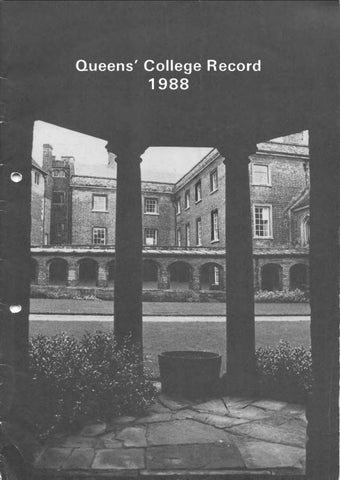
Anthony Colin Spearing, M .A., Life Fellow, formerly Director of Studies in English. Sir James W illiam Longman Beament, M .A., sc.D., Ph.D. (Lond on), F.R.S., F.R. S.A ., Drapers Professor of Agriculture. James Martin Prentis, M.A., M.Sc. (Eng). Ph .D. (London), Vice-President and College Lecturer in Engineering. Norman Frances Hughes, M .A., Sc.D .. Life Fellow, formerly Steward and College Lecturer in Natural Sciences (Earth Sciences). Kenneth Ewart Machin, M.A., Ph.D., College Lecturer in Natu ral Sciences (Physics). Ajit Singh, M .A., B.A. (Punj ab, Chan digarh). M.A. (Howard, Washington). Ph .D. (Berkeley, California), Director of Studies in Economics. Brian Albert Callingham, M.A., B.Pharm., Ph.D. (London), F.P.S., Librarian and Director of Studies in Medical Sciences and Veterinary Sciences. James Diggle, M .A .. Litt.D., F.B.A., Praelector and Director of Studies in Classics. Peter Jaffrey Wheatley, M.A., Ph.D .• Assistant Director of Studies in Natural Sciences (Chemistry). John Tiley, M.A., B.C.L (Oxon). College Lecturer in Law. John Edward Carroll, M.A .. Sc.D .. F.Eng .• Professor of Engineering. Peter Gonville Stein, M.A., LLB .• Ph.D. (Aberdeen), Dr. iuris (h.c.) (Gottingen). F.B.A., Regius Professor of Civil Law. The Revd Canon Brian Leslie Hebblethwaite. M.A., B.D ., Dean and Director of Studies in Theological and Religious Studies and in Philosophy. · lain Richard Wright, M.A., Tutor, Archivist, Keeper of the Old Library and Director of Studies in Engl ish. John Timothy Green, M.A.• Ph.D .• Senior Tutor and College Lecturer in Mathematics. David Barry Sattelle, M.A .. Ph.D .• Assistant Director of Studies in Natural Sciences (Biology). Thomas Henry Coaker, M.A., Ph.D., B.Sc. (London). Steward and College Lecturer in Natural Sciences (Applied Biology). William Andrew Phillips, M.A., Ph.D., Admissions Tutor and Assistant Director of Studies in Natural Sciences (Physics). Brian William Napier, M.A., Ph.D .• LLB. (Edinburgh), Assistant Director of Studies in Law. Robin Douglas Howard Walker, M.A .. Ph.D .• Junior Bursar, Director of Studies in Computer Science and Assistant Director of Studies in Natural Sciences (Mathematics). Roderick Arthur Smith, M.A.. Ph.D .• D .Eng .• M.I.M .• Director of Studies in Engineering and in Electrical and Information Sciences. Andrew Duncan Cosh, B.A .• Ph.D .• Senior Bursar and Assistant Director of Studies in Economics. The Revd Brendan Ignatius Bradshaw , M .A ., Ph.D ., Director of Studies in History. Richard Robert Weber, M .A.. Ph.D .• Tutor for Research Students and Director of Studies in Mathematics, in M anagement Studies and in Production Engineering. Allan Nuttall Hayhurst, M.A .• Ph.D., Director of Studies in Natural Sciences and Chemical Engineering. Peter Spufford, M.A., Ph.D., Assistant Director of Studies in History. James Anthony Jackson, M.A .• Ph.D .• College Lecturer in Natural Sciences (Earth Sciences). Christopher John Pountain, M.A .• Ph.D .• Tutor and Director of Studies in Modern and Medieval Languages. Philip Anthony Towle, M.A.. Ph.D. (London). Tutor for Graduate Students and College Lecturer in History. Richard Griffith Fentiman. M.A., B.C.L. (Oxon). Tutor and Director of Studies in Law. Charles Russell Matthews, B.A., Ph.D ., Assistant Director of Studies in Mathematics. Jonathan Michael Holmes, M.A., VetM.B .• Ph.D .• M .R .c . v .s .• Bye-Fellow, Lay Chaplain. Peter Howard Haynes, M .A., Ph.D., Bye-Fellow (Mathematics). Malcolm David Macleod, M.A., Ph.D., Bye-Fellow (Engineering). Keith Johnstone, Ph.D., B.Sc. (Leeds). Tutor and College Lecturer in Natural Sciences (Biochem istry). David Cebon, Ph.D., B.E. (Melbourne), C.Eng., M.I.Mech.E, College Lecturer in Engineering. Marissa Virginia Quie, Ph.D., M.A. (McGill). Research Fellow (Paterson Award Holder) and Director of Studies (Social and Political Sciences). Stephen Peter Wade, M.A., Ph.D., Osaka Gakuin Research Fellow (Social Anthropology). Hugh John Field, M.A.• B.Sc. (London). Ph.D . (Bristol), M.R .C.Path .• Tutor and College Lecturer in Pathology. Stephen Barry Murphy, B.A. (Oxon), Ph.D. (Kent). Assistant Director of Studies in Modern and Medieval Languages. Nigel James Leask, B.A. (Oxon). Research Fellow (English). Adrian Stephen Lewis, M.A .. Ph.D .• Research Fellow (Fabian Colenutt Scholar, Mathematics). Wendy Margaret Bennett, M.A .• Ph.D., Tutor and College Lecturer in Modern and Medieval Languages. Kevin Charles Lee, B.A. (Sheffield). M.Sc. (Bristol), College Lecturer in Economics. Michael Harvey Hastings, B.Sc., Ph.D. (Liverpool), College Lecturer in Medical and Veterinary Sciences. Howard Richard Neil Jones, M.A .. Ph.D .• Bye-Fellow (Chemical Engineering). Richard Alan Lewis, M.A.. M.Phil., William Colton Research Fellow (Pharmacology). Stewart Onan Sage, M.A., Research Fellow (Melton Research Scholar, Physiology). Wuzong Zhou, B.Sc. (Fudan, Shanghai), Research Fellow (Chemistry). Virginia Higbee Crum-Jones, B.A. (Cornell). College Lecturer in Computer Science. Barbara Elizabeth John, A.B. (Berkeley, California). Ph.D. (Santa Barbara, California), Bye-Fellow (Earth Sciences). Cm•er : Cloister Court fi'om he11ea1'1 the Oriel Window. Photo: C. Dahoo.
From the President As I look back over the last twelve months, they represent another eventful and successful year in the life of the College. Without question, the highlight of the year was the visit of our Patroness, Her Majesty Queen Elizabeth The Queen Mother. She graciously agreed to attend a Garden Party in July held to mark the success of the Heritage Appeal - to which she had herself made the opening donation. Her Majesty was in sparkling form and spoke to many of the guests as she toured the College gardens. The weather both before and after the party was wretched but the rain held back for the morning before the party and during the afternoon just long enough for Her Majesty to complete her tour without needing her umbrella. Fortunately, awnings had been put up over the Wooden Bridge so that she was able to leave in the dry and wave to the cheering but dripping occupants of the punts beneath. A very happy and memorable occasion. The most conspicuous new development is the steady rise of the new buildings between Cripps Court and Queens' ditch. Given by Dr Humphrey Cripps and the Cripps Foundation, these buildings represent the final phase of a building programme that was first discussed over 18 years ago during Arthur Armitage's last years at the College. This most recent addition will enormously improve the College facilities. On a more modest scale it is pleasing to be able to report that Queens' now boasts a boathouse that is as good as any in Cambridge. This has been accomplished without great expense to the College by redeveloping the boathouse site and using part of it to build private houses. The new boathouse has space for two colleges' boats and our present tenant is Magdalene College. On top of the boathouse are a
number of flatlets occupied by graduate members of the College selected, I hope, for their insensitivity to noise at six in the morning when the day's boating activities get underway! This year the junior members of the College have given an impressive demonstration of the diversity of their abilities. An outstanding performance in the Tripos, when twothirds of those taking classified examinations obtained upper second classes or better, was achieved at the same time as excellent productions by both the Bats and the St Margaret Society, along with participation in very large numbers in the various College sporting teams. These achievements are reported in more detail elsewhere, The College is in good health.
The Society
The• President c!(Osaka Gakuin U11irersir_,. and his parry were
presenred 10 Hi!I" Maje.1·1_,·.
2
As the Record was going to press last year we were able to include news that two former teaching Fellows of Queens' were to be installed as Masters of Colleges. The Revd Henry Chadwick, who has held Regius Chairs at both Oxford and Cambridge, became Master of Peterhouse, and in so doing becomes one of the very few who have been Head of House at both Universities too. He was already an Honorary Fellow. Dr Peter Mathias left the Chichele Chair of Economic History at Oxford to become Master of Downing College. We are pleased to report his election to an Honorary Fellowship. The Society has suffered serious losses during the year. Sadly, Dr Maxwell, who taught mathematics to generations of students over more than 50 years died in August. There is an account of his great contribution to the College on
another page. Mr Spearing resigned his Fellowship to take up a professorship in English at the Center for Advanced Studies in the University of Virginia. He was elected in December L960 and becomes a Life Fellow. During his Cambridge years he became one of the most distinguished scholars of medieval English literature and a world authority on Chaucer. The University recognised his distinction by a Readership, and in recent years he carried onerous responsibility as Chairman of the English Faculty. Our best wishes go with him and his wife Elizabeth for their new life in the United States. Dr Durlach also departed to North America, for a post in the Department of Psychology of MacMaster University, Ontario. We shall miss her wry wit! Early in 1987 Dr Borooah was elected to the Chair of Economics at the University of Ulster. He had been a Fellow for eight years and apart from his teaching he had particularly encouraged several of the sports activities of the College. We were fortunately able to replace Dr Borooah 's teaching through the election of Mr Kevin Lee. He is a member of the Department of Applied Economics and has special interest in the inter-relationship of fiscal policies with unemployment. In October we welcomed five further new Fellows. Dr Michael Hastings, a graduate of Liverpool University, was elected to an Official Fellowship to teach Anatomy. He is a Demonstrator in the Department of Anatomy, and an expert on natural rhythms of organisms and biological 'clocks'. Our new Bye-Fellow was a Queens' student some years ago: Dr Howard Jones who has returned to work in the Departments of Engineering and Chemical Engineering after five years of research with British Gas. All three of the new Research Fellows were previously students of the College. Mr Richard Lewis and Mr Stewart Sage, who are completing their Ph.D. theses respectively in pharmacology and in physiology, wjlJ be knpwn through their activities as undergraduates. Mr Wuzong Zhou from the University of Fudan came to Queens' as a research student and has devised a technique for controlling oxidation which has considerable economic importance. He is the first citizen of the Peoples Republic of China to become a Fellow. At the end of the year, the Governing Body resolved to elect two further Fellows during the Lent Term 1988; both are women so that there are now four amongst the Fellowship. Several of the Fellows have received honours or have had significant involvement in activities outside the College. They are, however, all too often bashful in revealing their distinctions to their colleagues, and this account is therefore almost certainly incomplete. It is a pleasure to report the election of Professor Stein as a Foreign Fellow of the Italian Academia Nazionale dei Lincei. Canon Hebblethwaite represented the College at the enthronement in Binningharn Cathedral of a Queensrriari, the Rt Reverend Mark Santer. Dr Diggle was given sabbatical leave for the Lent Term, part of which he spent investigating manuscripts of Euripides in Italy and giving lectures at the Universities of Milan and Genova. Dr Pountain also travelled during his sabbatical leave in the Michaelmas Term, carrying out research and also lecturing at the University of Oviedo in Spain. Dr Napier was invited to write a Labour Law Constitution for Tanzania. The Lay Chaplain, Dr Holmes, resigned from his University Lectureship in Veterinary Anatomy so that he could train in Cambridge for ordination in the Church of
England. He will continue his chaplaincy duties in College and also do some veterinary teaching. We congratulate Dr Bennett, Dr Cebon and Dr Jackson, all of whom have been promoted from University Assistant Lecturers to University Lecturers. Dr Bennett has unfortunately had to take extended sick leave but we are happy to say that she is making a steady recovery. Dr Cebon was invited by the Department of Transport in Australia to present his research there on how road damage is caused by heavy goods vehicles. Dr Jackson has been involved in providing courses for the oil industry on the sub-surface structure of the North Sea. But I have to end with some distressing recent news. As some of you will already have read elsewhere, Professor Ramsay died io February of this year. It was only a few weeks later that we were saddened to learn of the death in Australia of Dr Cohen following a traffic accident. In the 1989 Record there will be full appreciations of the long service which both these Life Fellows gave to the College. RONALD OXBURGH
The A.ppeal Funds Since the opening of the Heritage Appeal, two major restoration projects have been completed. Both sides of Cloister Court comprisfog the President's Lodge have been re-roofed; timbers have been replaced and the whole made structurally secure, and the cement rendering of the Long Gallery has been renewed. Secondly, the slate. roof of the Essex Building has been replaced; it is now restored to its former glory and above all it is water-tight! Together, these works have cost over £400,000 which is much more than was originally anticipated, in part through inflation but also because additional problems were uncovered during both projects. Unfortunately these were only two of the projects which we had hoped to achieve within the target of that Appeal. There remain the re-roofing of the Dokett Building, the restoration of the tile floor of Old Hall and of stonework in Old Court. Other needs are now emerging, so that although the target for the Heritage Appeal has been attained, the Fund will remain open for those who wish to contribute to the further restoration of the ancient parts of the College. I do hope, therefore, that when Members' present covenants expire they may be willing to continue¡to help by renewing them. Should Members wish to contribute for other purposes. whether specific or general, there are other College Funds. We still have many important objectives ahead. Despite the huge development made possible through the Cripps benefactions , too many students have to live in private accommodation outside the College. The Old Kitchen buildings must be re-developed and, as the Librarian has reported, the Library is no longer adequate for our needs. I may perhaps remind Members that one of the most taxefficient ways of supporting the College is by making provision in a will, for any part of an estate which is left to a charitable im;titution does not attract inheritance tax. The Senior Bursar is always glad to discuss these matters and give advice; he can be reached by telephone
(0223 335605). RONALD OXBURGH
3
The Boathouse The old boathouse was demolished in 1986. The Boat Club were able to move into the newly completed boathouse in February/March 1987. The adjacent land, between Queens' and Caius boathouses, was then handed over to the contractor for him to put up a small development of private houses. The proceeds from that development will partially finance the new boathouse, but the remainder of the cost has been borne by the College. This is a sign of our commitment to the Boat Club. Queens' is now the proud possessor of the most modem boathouse on the Cam. The new boathouse on the ground floor is divided into four bays. Magdalene College Boat Club rent one bay from Queens' . The second bay is a properly equipped workshop, something we previously lacked. The remaining two bays are occupied by QCBC, and incorporate a weight training room. These bays were built at a greater height than the old boathouse, and we were pleased to see that in the spate of 30 !anuary l988 the water stayed well clear of our doors, whilst other boatmen were sploshing around in wellingtons. On the first floor there are three buildings. The middle one consists of separate male and female changing rooms and showers plus a Coaching Room intended for exclusive First Boat use. The outer two buildings are made up of six single-bedroom flats, intended for occupation by married graduate students. However, the College Boatman has elected to live in one and we are sure that his presence on site will enhance still further the improvements in facilities made available to the Boat Club. The College hopes that the new Boathouse will usher in a new era of success and achievement for the Boat Club, and we wish them all good fortune in their use of it. ROBIN WALKER
Cripps Court Phase Ill Development When I reported last year, the Phase III development consisted of the largest hole in West Cambridge. Since then, the main building contract has been awarded to Sir Robert McAlpine & Sons Ltd, and we have watched the hole transformed rapidly into magnificent new buildings. At the time of writing, the roofs are being erected and internal works are beginning. The contractors are also about to tum their attention to the area between Fisher Building and the unfinished southern edge of Cripps Court, where it is planned to erect a single storey extension comprising further cycle stores. This will harmonise with the curved outline of Fisher Building, and will generally tidy up what has become a very unsightly area of College. The architecture of Phase 111 is consciously consistent with -that of Phases I and II: on such a restricted site it would not have made sense to have introduced an entirely new style. There is, however, one exception: the roofs are pitched instead of being flat, and are intended to echo the pi~ch~d roofs of Fisher Building behind. The new buildings will incorporate three new Squash Courts, a Table-Tennis Room, a Games/fraining Room, two Music Practice Rooms, and a multi-purpose Hall seating just short of 200 for theatre, cinema and lecture use, or, with the seating retracted, serving as a venue for receptions and the playing of badminton. There is Jittle doubt that the addition of these facilities will make Queens' one of the best served central coUeges for recreational activities, and will enhance our already_ high reputation as a conference venue during the vacations. The architects for Phase III are Bland, Brown & Cole, of Cambridge. The Cambridge office of Ove Arup & Partners
Phoro: A.D. Coslt
4
has provided both the Structural Engineers and the Mechanical & Electrical Engineers. The Cambridge office of Davis, Belfield and Everest are the Quantity Surveyors. Having the entire design team based in Cambridge has greatly facilitated the planning and advancement of the project. Not all, however, has been plain sailing: the spate of tbe 1 River Cam on 30 January 1988 flooded the basement of the new buildings to a depth of five feet! We are acutely aware that one cannot put up a building without generating much noise and disturbance. The student intake of both 1986 and 1987 have had to endure these works just outside their windows, and it looks as if the 1988 intake will as well. Future generations of Queens' students will be for ever indebted to the present students for their forebearance in this matter. The College hopes to furnish and equip the development using the residue of the Development Appeal to which many members contributed during the 1970s. We remain indebted to the Cripps Foundation for the fabric of the building, and in particular to Dr Cripps himself, whose meticulous attention to detail has often prevented us from straying into error. ROBIN WALKER
The Fabric In Cloister Court, we have been troubled for some years by the rendering breaking away from the wall upon which the Screens notice-boards are hung. Finally, we were driven to strip the wall of all its rendering, all the way from the Old Hall to Essex Building, and to re-render with the benefits of modem materials for better adhesion. Once the rendering was off, an interesting patchwork of brjck and stone was revealed, betraying the histories of different parts of this wall which varies in period from the 15th to 18th centuries. Much of the underlying fabric had been damaged by previous applications of rendering, but sorne thought it sufficiently interesting that it ought not to be covered up again. Nevertheless, it has been restored into rendered condition, the state in which it has been for at least 225 years. The college painters moved on to re-paint the Library Passage connecting Old Court with Walnut-Tree Court, and to restore some of the painted plaster decorative reljef patterns along the cornices. Rain-water had been finding its way into the new Dining Hall of Cripps Court, running down and staining the sweet chestnut panelling. A major investigation failed to find any leaks in the roof itself, nor were the down-pipes blocked or cracked. Eventually, the problem was found to be in the
downpipes from the upper flat roof, which descend behina the triangular decorative wood panels on the underside of the sloping lower roof, before piercing the roof horizontally to discharge into the gutter outside. The water had been running back on the underside of the horizontal pipe, into the building and thence down the inside walls. All that was needed to rectify the problem was a small downwards lip on the end of the horizontal discharge. We are now left with the not inconsiderable task of sanding down and resealing all the panelling of the new Dining Hall to remove the unsightly scars and stains left by the water. All in all, an interesting lesson in how the very tiniest design detail can have far-reaching maintenance implications. On the ground floor of the riverside range of the President's Lodge lies the Lodge Kitchen, which had been passed by in the major renovations of the Lodge a few years ago, for it was not in the same state of disrepair as the half-timbered Long Gallery. Much of the equipment in the kitchen was aged and beyond its useful working life. The maintenance staff returned to the Lodge in the Michaelmas Term 1987 to refit this kitchen and re-decorate throughout. The restored doorway onto the bridge passage from the kitchen was also proper-ly finished and brought into use. The internal half-timbering of this room is interesting as it reveals that the Lodge Kitchen once had windows facing into the cloisters at high level. These windows have long since been blocked, but the iron glazing bars remain inside as a reminder. The apparent half-timbering e.xhibited by this range in the cloister running to the front door of the Lodge is false; the timbers are modem cappings screwed to the original studs behind. The cappings date from around 1923 or so, before when this wall had been plain rendered, as the original studs were badly rotted at their lower ends. The mQdern cappings obscure not only the blocked windows but also a former doorway at the south end of the kitchen. The boilerhouse in the basement of Dokett Building, which provides a centralised heating and hot-water service for all of the College east of the river except the Lodge, has been the subject of considerable improvements in 1987/88. The basic layout of the boilerhouse dates from 1960, when central heating was first introduced into College for Erasmus Building. In 1979/80, two of the then three oil-fired boilers were removed and replaced with gas-fired boilers. Ever since then, the two gas boilers have been troublesome, fracturing about once a year each. Investigation suggested that this unacceptably high rate of fracture might be due to the 1960 pipe layout. This, coupled with the need to replace the third oil boiler with a gas one, led to a thorough internal replumbing of the boilerhouse. Although this work proceeds largely out of sight and out of mind, the costs nave been high. and will probably exceed ÂŁ40,000. Services which are commonly taken for granted can be devilishly expensive to maintain. Routine redecorations this year include: completion of tbe Cripps Court corridors and gyp rooms, and the external redecoration of Friars' Building first reported last year; the bathrooms of Dokett Building and B staircase Old Court; L staircase; and rooms C4, 05 and L2. Looking to the future, we are becoming concerned at the state of the medieval brickwork of Old Court on its Silver Street elevation, where traffic fumes and dirt have taken their toll, and there is evidence of decay of both mortar and brickwork. If we are to undertake restoration of this elevation, it will be one of the largest restoration projects on Old
5
Court since before the War, and will undoubtedly be very expensive. Another area of concern is the tile and stone floor of the Old Hall. The decay of this floor has accelerated since the transfer of dining to the new hall, and it has become quite dangerous in places. We would very much like to restore this floor, but feel unable to close the Old Hall for the length of time needed until there is an alternative venue available for the very many functions which now take place there. The restoration of the Old Kitchens might provide one such alternative venue, but work here was deliberately postponed until we had evaluated what facilities would become available in the new multi-purpose hall being erected as part of Phase llI of the Cripps Court development. It has now become clear what activities can be accommodated in the new multi-purpose hall, so planning of the Old Kitchen restoration ought now to proceed. Meanwhile, the floor of the Old Hall is being repaired on a make-do-and-mend basis. ROBIN WALKER
Bequests and Benefactions The College was the principal beneficiary of the will of Alfred Mauric.e Binnie who died in 1987 at the age of 85. Mr Binnie won an Engineering Scholarship to Queens' in 1918 and was in residence 1919-22. He subsequently became an extremely distinguished civil engineer and was a Fellow of Trinity College. This is one of the largest legacies the College has received. The President of Osaka Gakuin University in Japan, with which Queens' has had an informal academic relationship for a number of years, has informed us that Osaka Gakuin is willing to fund an Osaka Gakuin Research Fellowship at Queens' for a further three years. Mr and Mrs. Donald Clough have given a sum to the College to establish a Fund to be known as the Clough Memorial Fund, the purpose of which is to promote the musical life of the College. The Fund is in memory of their son John (Organ Scholar 1970-73) who died in 1977. The College is deeply grateful for all of these expressions of generosity and goodwill towards Queens' . It is gifts such as these, along with the support provided by so many old members through their response to specific appeals, that allow the College to maintain its position among Cambridge Colleges and to play its role in higher education in the country as a whole. RONALD OXBURGH
The E Society Three meetings of the Society were held in the Lent Term and three in the Michaelmas Term. The speakers were Prof. Marilyn Butler, Fellow of King's and Regius Professor of English, on 'Changing Perspectives on Jane Austen'; Dr Johnstone on 'Bacterial Spores: a unique biological lifeform'; Dr Green on 'An Eastern Education'; Prof. L.C. Knights, formerly Fellow of Queens' and Professor of English. on 'The Shakespearean Energy'; Canon Hebblethwaite on 'Religion, Ethics and Genetic Engineering'; and Dr Field on 'Keeping Herpes in Mind'. The E Society Dinner was held in the Munro Room on Saturday 25 April. BRIAN HEBBLETHWAITE
6
Dr E.A. Maxwell Edwin Arthur Maxwell was a Fellow of the College for 54 years. His retirement from his Official Fellowship was but a technicality, for he continued to teach with hardly a change in his modest life-style almost until his sudden death on 27 August 1987 at the age of 80, while visiting his beloved Scotland. Because of his soft Aberdonian accent in which he recited the Ode ro the Haggis on St. Andrew's Night, his knowledge of Scottish dancing and folk music and his dry canny wit, it is difficult to realise that he was born of English parents, and after starting his education in Aberdeen, came to Cambridge where he read Mathematics, took his Ph.D., and remained for the rest of his days. Edwin's special contribution to mathematics was as a teacher in the broadest sense, with the gift of adapting his approach to a wide range of audiences. He taught generations of mathematicians and natural scientists and was a dedicated supervisor. He also professed to enjoy the challenge of devising examination questions for the Cambridge Local Examinations Syndicate 'A' and 'S' papers and perhaps more remarkably, marking the answers! Yet amongst the many textbooks he wrote, the four volumes of An Analytical Calculus were reviewed as 'a masterpiece of lucidity' while his Geometry for Advanced Pupils was called 'an original presentation', written with love and a 'rare lightness of touch'. Edwin played a substantial role in the major revision of mathematics teaching of the post-war period. For example, he served for many years on the Executive Committee of the International Commission on Mathematical Instruction and was its Secretary from 1971 to 1974. He gave valuable
support to the School Mathematical Project and later wrote the SMP handbook on Geometry by Transformations, and the undergraduate text Algebraic Structure and Matrices. For eight years he was editor of the Mathematical Ga:eue and subsequently Treasurer and then President of the Mathematical Association. For the whole of his life he lectured widely to teachers and others and was the strongest advocate of the worth and dignity of teaching as a profession. He came to know literally thousands of students over his long life of teaching in the University and in College. But generations of other undergraduates will remember how he put the Bats on a firm financial footing as their Senior Treasurer in those formative years following the second World War when they established themselves as the outstanding College dramatic society in Cambridge. Of his period in this office he confessed to me that he had secretly established two deposit accounts, but only told the Bats committee of the existence of one, 'so that there's a wee nest-egg for their successors if they go mad one year'. Those too were the days when the Fellow on the Bats committee had to censor the home-written revue scripts, which he did with astonishing broad-mindedness - or innol cence. But when the Revd Charlie Wood was bent on asking the Governing Body to ban the Bats for presenting a blasphemous piece (Fry's The Lady's not for Burning!) he dissuaded and smoothed the ruffled feathers in the most diplomatic of ways. As President of the St Margaret Society, he admitted to suffering agony every year over arranging the reserved seats for the Fellows at the May Week concert, and was so relieved when that archaic custom was abandoned. But he never once intruded in the artistic affairs of either society; his only concern was that each enterprise should 'at least break even and preferably make a little'. He talked frequently about playing the violin at home, and I did once persuade him to play in a Magsoc orchestra, but he insisted that he was a fiddler, not a violinist, and in that capacity not only played regularly with the Cambridge Fiddle and Accordion Society but wrote music for them. His 'Mr Paterson's Birthday' was included when that Society husked in memory in the Lion Yard, collecting ÂŁ90 for the hospice for which his daughter works. Few of us knew that he had also written and composed several hymns, one of which was sung at the Memorial Service on 21 November in the Chapel. He wrote other music too: a talent which he kept very much to himself. But there was a remarkable occasion in Dundee three years ago when he was able to demonstrate the combination of different sides of his expertise. After an evening exposition to the Mathematical Association describing the movements in Scottish country dancing in terms of matrices, he took his wife Greta onto the floor and they led the company in a display of gyrations the more remarkable because they had celebrated their golden wedding the year before. He was a devoted member of Holy Trinity Church and of the College Chapel where he preached from time to time himself. Henry Hart recalls that Edwin was a shrewd commentator on college sermons: more merciful than A.B. Cook who issued sotto voce comments while the sermon was in progress (such as Rot! Bravo! Get on man! Rubbish!). Edwin listened; if after some 17 years you repeated yourself he would say, "I thought some of that seemed rather familiar". He also served for twenty years on the Ely
Diocesan Board of Finance, as treasurer for 15 years and its chairman for four. Early in his Fellowship he was Junior Bursar, then for many years Keeper of the Records and Editor of this journal followed by a period as Senior Bursar of the College. But the unofficial position he held was as a kind of heroic link between senior and junior Fellows across the period of dramatic change from the tiny pre-war Fellowship to the expansion post-war. For Edwin had known Fitzpatrick, Kennett and above all, the legendary Bursar Munro, and was full of anecdotes of those past giants of our Society: the days when junior Fellows were not expected to have, let alone voice, an opinion at a Governing Body Meeting, and the inadvertent use of 'damn' adjectivally in Combination Room conversation caused consternation, even thought of expulsion. Edwin Maxwell was a man of extraordinariJy even temperament: he saw good in everyone. He was never heard to complain about any of his pupils but was the first to tell us if one had excelled. He was devoted to his family, his College, his church and his subject, and he was generous with his time, with gifts to appeals, and tl}rough the royalties from his books. And when Greta died two years ago, he established in her memory a College fund to help undergraduates who wished to develop crafts. He is survived by four children, each, as he liked to point out, born in a different reign. JAMES BEAMENT
F.R.D. Goodyear Prof. F.R.D. (Frank) Goodyear, who died in July 1987 at the age of 51, was a Fellow of Queens' and Director of Studies in Classics from 1960-66, and for a part of that time was also Librarian. He came to Queens' from St John's and he left to take up the Chair of Latin at Bedford College, London, at the early age of 30. He was among the leading Latin scholars of his generation. Posterity will remember him above all for his edition, with commentary, in two volumes, of the first two books of the Annals of Tacitus ( I972 and 198 I). Among his other publications were two written in collaboration with his successor at Queens', a critical edition of a late epic poem, the lohannis of Corippus (1970), and an edition in three volumes of The Classical Papers of A.E.Housman (1972), an indispensable work of reference. He was a scholar formed in a mould now unfashionable, who believed that progress in Latin scholarship was inseparable from an intimate familiarity with the Latin language. He demanded the highest standards of excellence in himself and in others. Generations of undergraduates and graduate students, both in Cambridge and in London, acknowledge a deep indebtedness to him, for he gave unstintingly of his knowledge and guidance. He retained a close attachment to Queens', and was a regular guest at dinners of the Classical Society, which he had refounded. The force and exuberance of his personality, and the trenchancy with which he expressed his views, left a lasting impression on all who met him. And there are those among us who remember the evenings when, like Heraclitus in the epigram of Callimachus, he sank the sun in talk or wine, or at the poker table, and saw it rise again at dawn, and emerged, fresh as ever, to play croquet in the Fellows' garden. JAMES DIGGLE
7
real and lasting interest in the welfare of all aspects of the Library. The Bibby prize for award to an undergradute assistant librarian is a fitting memorial.
The Library 1986-87
Librarian: Dr Callingham Keeper of the Old library: Mr Wright Assistant Librarian: Mrs. E. Machin Undergraduate Assistant Librarians: G.R.M. Burgess, R.F. Coombe, C. Daboo, A. Gigante, T.B. Appleton, J.M. Kent, D. O'Brien, J.P. Williams. War Memorial Library At last it is pleasing to report that the wind of change is felt in the War Memorial Library. At present jt is the merest breeze but gales are forecast. After my outburst in last year' s Record and an excellent survey of opinion undertaken by the J.C.R. Committee, a clearer picture is emerging of what is needed if the Library is to respond more effectively to the needs of the present and of the foreseeable future. One deeply felt need is that for more reading space within the Library itself. This together with better access to the books on the shelves received high priority and indeed took precedence over a great increase in the total number of books. Indeed it is becoming apparent that the requirement for substantial expansion of the space that the Library occupies could be reduced if most of the less frequently consulted books were removed and placed in a store with restricted access. It is most encouraging to find such constructive interest in the fortunes of the Library among Senior and Junior Members alike. In the Lent Term 1988 the Library Committee will attempt to draw up plans for the future of both facilities and staffing. In my next report 1 hope to be able to say something about my plans and any possible progress. It is clear there could be a considerable cost impUcation, but I hope that the Library development will not be hampered by financial stringency. Additions to the Library stock have been housed entirely through the removal of older volumes. The work has steadily increased and at the end of the year Mrs. Paola Bishop joined Mrs. Machin, on an even more part-time basis. Yet again, it is a great pleasure to acknowledge the trojan efforts of Professor Frank Goldby, who by now has bound several hundred books for no financial reward. His skill and patience are exemplary and must reflect the benefits of a lifetime as an anatomist. Over the year the Library has received many generous donations of books from Fellows and from Old Members. Of these, I feel that I must mention Professor Riley-Smith. It is particularly gratifying to me to receive bis many donations, since he was Librarian himself. There was also a marvellous donation of many new books and fine facsimile editions froni Mr N .A.E. Farrow ( 1958) of the Gower Publishing Group. Many of the new books were soon on the shelves and off them again due to their popularity! T he Library received books a5 part of the A.M. Binnie bequest and from a host of benefactors too numerous to mention by name. Perhaps I may express my gratitude to all those who have donated books to the Library. All are recorded and an extensive and illuminating list is kept in the Library Office for all to see. I must however end on a sad note: a grateful acknowledgement of the outstanding support that both the War Memorial Library and the Old Library have received from the late Dr Cyril Bibby. He was a benefactor who took a
8
BRIAN CALLlNGHAM
The Old Library In the Old Library, Mrs Joan Holloway's work on the new catalogue, and the Keeper of the Old Library's programme of renovating and restoring damaged bindings, continued to make good progress. An exhibition of 'Incunabula' (that is, books printed before the year 1500) was on display during the Easter Term, on Degree Day, and at the Club Weekend. It included such great College treasures as Omnibonus 4onicenus, Commentum in Lucannum, printed in Venice in 1475, the oldest printed book in the Library; a Latin Bible printed in Naples by Matthias of Olmutz in 1476; the first vot.ume of the collected works of Aristotle, printed in Venice by the celebrated Aldine Press in 1495; and the Nuremberg Chronicle (1493), one of the great works of graphic art of the 15th century. Although it is not strictly a printed book, the exhibition also contained one of the Old Library 's rarest items, a Papal Indulgence, printed by WilHam Caxton in 1489, which was discovered some years ago within another volume, and is probably one of the earliest pieces of English printing. IAlNWRIGHT
1987-88
Librarian: Dr Callingham Keeper of the Old Library : Mr Wright Assistant librarian: Mrs. E. Machin (and Mrs. M.P. Bishop) Undergraduate Assistant Librarians: T.B. Appleton, J.M. Kent, D. O 'Brien, J.P. Williams, M.J.R. Burgess, D.C. Kirk, S.M. Lowry.
The Chapel The following visiting preachers came to the College Chapel in the course of the year: the Revd Don Humphries, Vicar of Holy Trinity; the Revd Martin Hunt, Vicar of St Luke's, Liverpool; the Revd Mark Jones, Chaplain of St John 's College; Dom Christopher Jenkins, Chaplain, Fisher House; Bishop Michael, S.S.F., Minister General, Society of St Francis; the Revd John Beer, Vicar of Hardwick; the Revd James Owen, Vicar of Little St Mary's; the Revd Sister Rosemary Dawn; the Revd Dr Lionel Wickham, University Lecturer in Divinity; the Revd David Sanders, O.P.• Blackfriars; and the Revd David Isitt, formerly Canon of Bristol Cathedral. The Dean of Chapel, the Lay Chaplain and Mr Matthew Baynes of Westcott House also preached. In the Michaelmas Term there was a course of seven sermons on the Lord's prayer. The preacher at the Commemoration of Benefactors in Full Term was the Revd Canon Eric Jarvis (1943), Rector of St Olave, Hart St., and at the visit of the Graduates Club in June, the Rt Revd Colin Scott (1953), Bishop of Hulme. Queens' and Queens ' Chapel suffered a grevious loss in the summer of 1987 in the death from cancer of our new Chapel Sacristan, Crispin Brown, after only one term in office. Crispin also sang in the Chapel Choir. A Memorial
1
Service for Crispin was held in the ColJege Chapel on Saturday 24 October. Hilary Haines was succeeded as Chapel Clerk by Jacqui Mitchell in the Easter Tenn. The Ryle Prize for reading in the College Chapel was awarded to Victoria Nott. In the Michaelmas Tenn the Organ Scholar, Philip Walsh, was joined by a second Organ Scholar, Mark Forkgen, and in future Queens' Organ Scholars will overlap in this way. With two Organ Scholars, the College now needs two pianos for their rooms and if any old member has a good upright piano languishing for a pianist. for which he would like us to find a welcome home in Queens' , this would be greatly appreciated. The Chapel Choir sang Choral Evensong in Ely Cathedral in February and in St Mary's, Wetherden, Suffolk, in May. In November they gave a concert in St Mary 's, Woolpit, Suffolk. A new Chapel Choir record has appeared, entitled ' Jubilate' and consisting of twentieth century choral music. The Chapel Choir's summer tour of France is described by the Lay Chaplain. The Lay Chaplain, while continuing in that post here at Queens', is now training for the priesthood at Ridley Hall. Our prayers go with him in his new vocation, and we look forward to welcoming him as Chaplain before long. BRIAN HEBBLETHWAITE
Photo: C. Daboo.
The Chapel Choir Tour After the success of the 1985 tour based in Heidelberg, the Choir once more ventured onto the continent to sing in some of the great cathedrals of France. The tour was organised by the Organ Scholar, Philip Walsh, and we were accompanied by the five members of the Cambridge University Brass Ensemble (CUBE). Crossing the Channel, we were confronted by sweltering weather with which our 'luxury' coach's ventilation system completely failed to cope. Despite some rather eccentric navigation by the driver, we made it to Blois in the Loire Valley to rendezvous with our first hosts, the members of a local choir. The Blois choir proved to be extraordinarily hospitable. not only providing accommodation in their homes, but also entertaining us with a series of barbecues and parties, not to mention copious quantities of local wine. There was a little space in the programme for sight-seeing; much of our time was spent in rehearsal in an oven-like portacabin in a school playground. The concert in the small but charming Blois Cathedral was a great success, judging from the effusive praise of our hosts and the sale of ÂŁ140 worth of records. Our programme consisted entirely of English choral work, ranging from Weelkes to Stanford and Parry to Howells and Lennox Berkeley and including Robert Walker's 'Jubilate' for 4 part choir and 5 part brass ensemble especially written for Queens'. CUBE also performed arrangements of works by Purcell, Famaby, Bourgeois, and Elgar. Indeed for many of us their beautiful rendition of Elgar's 'Chanson de Matin' will be an enduring musical memory. We moved on to Orleans for a concert in the mainly seventeenth-century cathedral with its famous 'wedding-cake' towers. The cathedral authorities had charged us ÂŁ120 in advance for the use of the organ, but on arrival the choir organ proved not only to be out of tune but also to be missing many of its stops. It seemed there had been a break-in and a lot of the pipes had been stolen. Despite the obvious competence of our organist, Nicholas White, the Grande Orgue was off limits (French cathedral organists are noted, apparently, for their folie-de-grandeur), so we had to make do with the hastily tuned half-organ and an equally hastily rearranged programme. At least there was no built-in vibrato, an unexpected hazard encountered by our organist at Moulin when the choir visited France in 1979. Nevertheless the concert received highly favourable notices in the local press. The next stop was Chartres. The authorities, no doubt very used to an unending succession of choirs, were not especially helpful, and it was distracting to sing while hundreds of tourists were allowed to come in and out and mill about throughout the concert. The acoustic was surprisingly poor, but it was a great privilege to sing in so magnificent a setting. We proceeded to Paris for the final concert, in the Cathedral of Notre Dame. Even the rehearsal attracted several hundred people, and the concert the following day was attended by an audience estimated at well over two thousand. Sadly for the choir's finances, the concert was free. After a day's sight-seeing the choir and CUBE returned to Cambridge to make a record of some of the music performed on the tour. The record, under the Abbey label, is available from record shops or from the College. JONATHAN HOLMES
9
Katemi-sama: The statue of
Erasmus in the Imperial Museum, Tokyo
The story goes that Adams' ship was the only survivor of a fleet of five which had set out from Ho11and. The ship was named Liefde (Charity), but had originally been called Erasmus, before being renamed for unknown reasons. The ship continued to carry a wooden statue of Erasmus on her stern, and on arrival in Japan this statue was either given as a present or forcibly removed (the latter being more likely, given the poor physical state of the surviving crew and their immediate imprisonment), then placed in a temple because it was thought to be a god. Indeed, the name given to the statue, Katemi-sama, means the god of ships. The temple, Ryuko-in, of Sano in Saitama still owns the statue and it is with the permission of the priests there that the photograph was obtained. The figure is just higher than one metre and represents Erasmus holding a scroll in his right hand. Most of the paint is missing, but fragments on the scroll clearly show the date 1598, which was probably the date of renaming the ship and known to be the year in which the fleet left Rotterdam. The right lower arm has been sawn off; this may have been where the figure was attached to the ship. The importance of this story can be judged from the fact that this statue is the only piece of Western art in the Imperial Museum. We can be confident that in this curious way, Erasmus was the first Queensman to arrive on the shores of Japan! RODERICK SMITH
Thomae Smithi Academia The Thomae Smithi Academia, a discussion group for Fellows and Fellow Commoners, has continued to meet in the Old Combination Room on Monday evenings. Discussions were held on the following subjects: in the Lent Tenn, 'Why should I be moral? ' , introduced by Mr Hebblethwaite, and 'The War Memorial Library: a cuckoo in the nest?', introduced by Dr Callingham; in the Easter Term, ' Lies, damned lies, and opinion polls', introduced by Dr Weber; in the Michaelmas Term, 'Psychiatry: matter over mind?', introduced by Dr Dowson, and 'Taste in white wines', introduced by Dr Hughes. Photo: Imperial Museum. Tokyo.
The story of William Adams, the first Englishman to reach Japan, is well known amongst the Japanese. A dramatised and popularised version of his story has been told in the bestseller Shogun. Briefly, Adams, or Miura Anjin (Miura, the part of Japan where he first lived; Anjin, a pilot) was pilot of a Dutch ship wrecked on the N-E coast of Kyushu, the southern island of Japan, in 1600. After a period of imprisonment, Adams became an adviser to Ieyasu, the first Tokugawa Shogun, on the subjects of gunnery, geography and mathematics. He supervised the building of several European style ships and married a Japanese girl, Magome Kageyu, despite having a wife and family in his home town of Gillingham. Adams died in 1620 in Japan where his service to the Shogun is celebrated in several memorials. However, the most interesting surviving artifact of his career is a wooden statue of Erasmus which can now be seen in the National Imperial Museum in Tokyo.
IO
JAMES DIGGLE
College Invitation Dinners for Old Members In 1985, the Governing Body initiated a series of invitation dinners in College to be held in late September for members of selected groups of years in rotation. These dinners are separate from the Queens' Club functions and are planned to be complementary to the annual Club Weekends held in June. On Saturday 26 September 1987, all members of the matriculation years 1967 to 1970 were invited to the Third Invitation dinner; 160 members attended. The Fourth Dinner is planned for Saturday 1 October 1988, and in June/July of this year all members of the matriculation years 1940 to 1948 for whom we have current addresses will be invited. It is currently intended that members of the matriculation years 1953 to 1957 should be invited in 1989.It is hoped that the cycle will have been completed in seven years, and will thus commence again from 1992.
John Twigg: A History of Queens' College, Cambridge 1448-1986 Queens' was fortunate enough in having an expert on seventeenth-century Cambridge to whom it could entrust its history. The result has exceeded all expectations. This is easily the best history of a Cambridge college that I have read. It is well-written, scholarly and carefully argued and it will set a standard for all future studies of this type. John Twigg is at his best on the 16th and 17th centuries, which is not surprising, although I believe as an ex-librarian that more use could have been made of the library collection as a source for the intellectual interests of the Fellows. His treatment of the 18th and 19th centuries is also full of interest and surprises. For instance, although I had always considered Isaac Milner's long presidency (1788-1820) to have been a wretched affair - and Milner proves to have been even more dreadful than I thought - his influence on the composition of the body of Fellows seems to have been Jess baneful than I had imagined. The eight chapters on the 20th century must have been very difficult to write. John Twigg has been quite courageous, but there were obviously limits to what he could say. The College' s history presents us with a real problem. How could an institution, which was relatively rich in the 16th • 17th and early 18th centuries, have become so poor by the 20th, a process of impoverishment which clearly had effects on its academic standing around 1900? All Cambridge colleges went into decline in the 18th century as numbers and reputation dwindled, but Queens ' seems to have been injured more than most. It is a pity that the statistical information presented in the appendices tails off in the 18th century - I suppose this is to do with the state of research - but it looks as though two major blunders contributed to the deterioration of the college's position. The first reflected a consistent strand in the college' s history which John Twigg brings out well - the desire to house as many members as possible on site - but in this case the result was pure folly , a grandiose scheme to rebuild the river front in a modern style. Thank goodness only one wing, the present Essex Building, was constructed, but even that Jed to a massive increase in annual expenditure and debt; the 1750s seem to mark a sharp break with the past. It is ironic that such a boring structure would have done so much damage. Colleges need generous benefactors like Dr Cripps; they ought not to indulge in grandiloquent building projects funded out of their own resources. The second howler was the absurd mismanagement of enclosures under the ghastly Milner. Enclosing one's estates was a profitable; business, but it had to be carefully managed and the attendant costs were considerable. Milner and his Fellows bungled it and by the mid-1830s Queens' was again very heavily in debt. It never seems to have recovered, although it may be that some of its 20th century investment policies will come under scrutiny from a future historian. John Twigg makes the point that Queens' had a low academic reputation by the middle of the 19th century. In fact, although there were Fellows of distinction, the College was still regarded as one of the 'dimmer' ones well into the 20th century. The improvement in its standing over the last fifty years has been due not so much to the charism of an individual, as occurred at Corpus, but to policies pursued through several presidencies, policies that can first be discerned under Venn, with the pace quickening under Ar-
mitage and Bowett. Fortunately by the 1970s there were few Fellows who could be considered the heirs of the hearty, philistine, anti-intellectuals of the late 19th century. The problem about dealing with the revival, however, is that it entails making judgements on the living or the recently dead. It seems that John Twigg denied himself the luxury of mentioning members of the present Fellowship in any detail. This is justifiable, but, being a more irresponsible position, I would like to put on record my appreciation of the team in the 1970s of Bowett as President and Machin as Senior Tutor, who really were transforming the College's intellectual life. I hope that when another history is written in a few centuries' time they will be given the prominence they deserve. John Twigg was one of my last pupils in my time as Director of Studies in History. I am naturally very proud of him, but I must also say that Queens' in the 1970s was not really as staid, high-minded and serious as the bare minutes of Governing Body meetings have led him to believe. Did no Fellow tell him of the gatherings and ' clubs ' of these" nior members like the Thomae Srnithi Academia and the splendid Seviri, whose motto was 'He that eats well and drinks well should do his duty well'? By 1972 the period of student unrest was coming to an end far more rapidly than anyone could have imagined, as the new generation of undergraduates reacted against the postures of their predecessors and adopted older, more romantically traditional, postures of their own. The first clear sign of this for me was the revival in 1972-3 of the History Society, which like all such irrelevant and elitist bodies had died in the 1960s. The academic year culminated in a small but very convivial dinner, after which a noisy group retired for 'nightcaps' to the room of one of the undergraduates. At about 1.30 in the morning one of his neighbours came along to complain about the din, to be confronted by the sight of the President, the Dean of Chapel and Sir Geoffrey Elton enjoying their final drink. Thereafter the History Society dinners became larger and more formal , with an extraordinary range of the great and good (including the Prime Minister) being invited as guest speakers, not in the expectation that they would accept the invitations - very few of them did - but in order to swell the secretary's collection of autographs. As passions calmed hair-styles became shorter. I remember my undergraduates telling me in 1974 that very long hair was now thoroughly unfashionable; 'only scientists wear it'. The most significant result of the unrest was the appearance of student observers or participants on the Governing Body and college committees. This did nothing but good. On the whole, they raised no issue of substance - their chief concern seemed to be the quality of the food - but their presence did wonders for the standards of debate, because a Jot of the nonsense spoken before was now left unsaid. In their obsession with the cooking, of course, they were simply reflecting the predispositions of the senior members. On the Governing Body quite serious matters would go through with relatively little discussion, but I remember hours of debate on the price of breakfast. The sixties had brought to the fore a group of youngish, high-minded Fellows who were always trying to get tradeunionists appointed to honorary fellowships or to engage us in radical causes. The early discussions on women, which centred on the question whether wives could be invited to lunch or dinner at the high table and to feasts, were hilarious and ended with a Governing Body minute, referred to II
by John Twigg, which was so offensive that many wives swore never to accept such invitations. The most interesting thing about the debates on the admission of women was that for most of the time the Governing Body was not divided along political Jines at all, but between Arts and Sciences: most of the Fellows in Arts thought that the standards in their own subjects would be improved by the admission of women; most of the scientists seemed to feel that there was no need of them. These debates brought out the worst in everyone, until it was suddenly realised that admissions in general were, or might well be, affected. As John Twigg implies, the chief emotion impelling the male colleges in Cambridge to take women was not a desire for equity, but fear, as the reahsation dawned that the young did not want to go to single-sex colleges. Queens' in the 1970s was a lovely place and I miss it still. On the whole, relations within the Society and the College at large were good and we all seemed to have the feeling that we were getting better at our jobs. The College deserved to have a really good history and John Twigg, a product of that time, has provided it. JONATHAN RILEY-SMITH
Queens' 1960-1980: some personal recollections I have been asked how closely Dr Twigg's account of these twenty years accords with my own recollections as a Fellbw ( 1960-70) and as President (1970-82). The student agitation of the l 960's and 1970's is described by Dr Twigg as "one of the single most important social and ideological changes in (the College's) history" (p.404) and "arguably one of the most significant historical phenomena of modern times". (p.406). Its motivation is sympathetically described: "Young people looked for alternative spiritual values to counter what were seen as the materialistic, hypocritical social and political order built up by older generations, and questioned the whole framework of advanced industrial society... they were scornful of a university system which purported to train their critical. faculties but would not allow these to be applied to its own institutional regulations and values." (p.406).
Indeed the chapter on "The Modern College" ends with these words: "It is a tribute to the students' detennination and deep sense of the injustice of the old order that they were able to achieve so much against the great weight of the tradition, hostility and incomprehension among elements of the governing body, and the superior tactical awareness of many of the Fellows over inexperienced and transient studerit bodies. The 'revolution' is not complete, but even as it stands it is a great achievement, which has not received due recognition." (p.433).
The Fellows of the College, against whom these young paragons struggled so mightily, were a poor lot, so it seems. They ignored the feelings of the students (p.404), they "had done nothing to remove the grievances" (p.419), they failed to heed clear warnings (p.419), they " misjudged the mood of the College" (p.419), they demonstrated "classic Governing Body intransigence" (p.419), "hypocrisy" and "intransigence" (p.420. reporting the Shilling Newspaper). They were "complacent" (p.42 I) and "stalled for time" (p.43 I) or "dragged their feet" (p.439). Even allowing for my own personal bias as someone very much involved in these events, I find the picture which Dr Twigg portrays to be a travesty of the truth. The truth is 12
that the key agitators were not paragons of principle at all. They were extremely unpleasant young men who revelled in the chaos they brought about, and were not above resorting to criminal damage, lies and personal vilification to achieve their ends. We see no mention by Dr Twigg of the campaigns of personal vilification directed against men like Max Bull, Henry Hart and Arthur Armitage - men who had spent a quarter of a century dedicating their lives to the well-being of Queens' undergraduates. Whether their views were outdated or "paternalistic" is beside the point. Disagreement with their views was tolerable, but the deeply hurtful personal attacks made on them were intolerable by the standards of any civilised community. The ultimate achievements of this ''revolution" were a new Constitution for the College Union, student membership of certain Governing Body Committees, Observer status on the Governing Body for non-reserved business, improvements in the catering facilities, changes in guest rules and gate hours, the disuse of gowns for appointments with Fellows and of neckwear for dining in Han, some revision of College Regulations, the provision of a second launderette, and co-residence. It did not seem like much of a "revolution" at the time, and appears even less today. In any event it would be wrong to assume that none of these changes would have occurred but for student agitation. In fact Cambridge, and Queens', is constantly changing and there was no uniform, absolute opposition in the Governing Body to the views of the students on most of these issues. Regarding co-residence, for example, few Fellows doubted that, ultimately, Queens' would admit women. The question was one of timing, for if it were to avoid a mere token admission of women (and given that it was illegal to have a quota), we had to be sure that we would get at least one-third of our annual intake from women applicants on merit alone. Certainly a few of the less well-conceived "reforms" were opposed to the end, and Queens' is the better for it. I recall, by way of example, the proposal to remove all gates, railings and other restrictions so as to allow open access to the College to persons wishing to visit students. The good sense of the Governing Body's resistance to this rather silly proposal quickly became apparent when the 'Cambridge Rapist' was at large a few years later. The fact was that many Fellows did not (and perhaps still do not) regard these particular reforms as a "significant historical phenomenon", or even as the most urgent. Many Fellows felt more sympathy for proposals to improve academic standards, or plans to place the College's finances on a surer footing, or to move forward with the planning and erection of Cripps Court. It is at least arguable that the building of Cripps Court (occupying many thousands of hours of the time of these same "complacent" Fellows, serving on the Building Committee) did more to improve the quality of life for students in Queens' than the entire student "revolution". If this is right, then the question arises of how Dr Twigg could get it so wrong. Perhaps part of the explanation lies in his choice of sources. He relies extensively on the Shilling Newspaper, the weekly publication of the student radical Left. It is from this source that he repeats the unfortunate statements attributed to the then Senior Tutor (Max Bull) and the incident in which one Fellow (in fact myself) organised a group of "vigilantes" or "Cambridge Rowdies'' and "plied them with beer" for the purpose of defending the College when a demonstration was being planned to pull
down the College's gates and railings (pp. 407.416). He adopts these reports quite uncritically, treating them as sources of equal reliability to Governing Body Minutes. During his three years of research in Queens' he appears not to have talked to the people involved, so as to check the accuracy of these reports; certainly he never spoke to me d uring those three years except on one occasion to get permission to reproduce Appendix 19. He seems not to know that it was this same Shilling Newspaper which the College threatened with a libel action after a particularly vicious attack on the Governing Body, accusing them untruthfully and deliberately of endangering the lives of our undergraduates by creating fire hazards (i.e. fixing bars to windows). Elsewhere he cites at some length Mr Caird (one of the Queens' undergraduates sent to prison by Mr Justice Melford Stevenson after the Garden House riot - "a judge known ro give severe sentences" (p.425)). It does strike one as a curious selection of sources. Or perhaps the explanation is that Dr Twigg brought to his writing some preconceived political ideas which have both dictated his selection of sources and coloured his judgement Be that as it may, I do not find his portrayal of Queens' during these twenty years a very accurate one, nor one which, in th1:1 reading, affords me any personal pleasure. DEREK BOWETT
The Students Last year Mr Wright predicted that the 1987 examination results would be as distinguished academically as in previous years. When they were announced they surpassed everyone's hopes. Many different ways of comparing the college's performances are used: in all of them we were highly placed and in The Times analysis we were at the top of the list. First classes were gained by 23.3% of Queens' students compared with 14.6% in the University as a whole. Whereas 71 % of Queens' undergraduates obtained either first or upper second classes, the figure was 58% for the University overall; indeed this order of achievement has been consistent for the past few years. It is always pleasing to see our individual students gaining particular distinction, and no fewer than twenty were amongst the top five places in the order of merit of their University class-list in 1987; many gained University prizes. It is particularly encouraging to find such depth of quality in the results. And po.ssibly for the first time ever, a student in residence received an O.B.E. It can be seen from the reports elsewhere in The Record that these results have not been obtained at the expense of other achievements. Seven members of the College gained FuJI Blues and seventeen obtained Half Blues: of these twenty-four, eleven were women. Many other activities have been prominent; the Bats have been as busy as ever and the St Margaret Society has mounted several concerts under Philip Walsh, some of which have been of nearprofessional standard. These outstanding achievements were obtained in a year which saw a decrease in the number of applicants both for Queens' and for the University as a whole. Despite this, Queens' continues to have a high number of applicants per place, and for the October 1988 entry that ratio is the second highest amongst the colleges. But there is no reason to be complacent Despite the recent modification of admission procedures, applications
to Cambridge are decreasing. In essence all entry to Cambridge is now by conditional offer. Colleges may make offers at any level they wish. Queens' takes especial care to tailor an offer to the particular background of each candidate. Unfortunately, in my view, some colleges have not operated such a realistic approach and seem detennined to make very fierce offers, sometimes involving one or two distinctions in 'S' level or STEP papers even to those from schools which have little experience of these examinations. Our procedures are actually more straightforward than those at Oxford, which still uses two modes of entry conditional offer and an internal examination in November like our old scholarship examination. We are much more in line with other universities. However because of the variety of college offers and the spectrum of offers made by different colleges within one subject, it may be that Cambridge procedures are perceived to be more complex. The University is now addressing such matters. and Queens' continues to play a major role in the discussions on this. For many years the University Admissions Prospectus has remained in a rather solid format but a new, much more lively short prospectus will soon be published. Many years ago the Cambridge University Students Union recognised the limitations of the official prospectus and started to produce annually their very useful 'Alternative Prospectus' . This year the Union has commissioned and produced - entirely by students - an 'alternative• videorecording about Cambridge. I believe it will serve us well. The colleges themselves are now producing a prospectus on video-tape which will legitimise the Union 's description of their compilation. Such steps are essential if we are to ensure that Cambridge continues to attract the very best applicants. Today, graduate students form an important part of collegiate life. Whereas Queens' undergraduate numbers have remained constant at about 420 for some ten years under the explicit direction of Government, our graduate numbers have increased by 50% in the same period; there are now around 150 registered graduate students of whom two-thirds are seeking an M.Phil. or Ph.D. by research. About a third of the graduate students are from overseas. Schemes set up by the Government, by the University and indeed by this College have played an important part in attracting students from abroad. The Queens' Overseas Bursary Fund continues to help support students from Third World countries for it can cost between £7,000 and £11 ,000 a year to study here because of very high University fees. The expansion in graduate numbers has not been without it'> problems and various resources of the College have been stretched. It is particularly difficult for students from overseas to find accommodation in Cambridge. The College tries to accommodate as many as it can, either within College or in College-owned houses. All those undergraduates who wish to do so - and that comprises all but a handful - live in College. The provision for graduates is now steadily improving and with the development of several flats over the new boathouse and rhe acquisition of other houses, we have trebled the accommodation available to them over the past eight years, so that half the graduates are now in College-provided accommodation. We hope that these and other steps we have taken, will serve to promote our collegiate community. But the pressures on everyone seem to increase relentlessly. Senior members are burdened more and more through the con-
13
straints which Government is placing on higher education. Graduate students are under severe financial and other pressures to complete their research within the specified funded period, though research is by its very nature unpredictable. Undergraduate courses become more and more demanding as knowledge expands and subjects become more complex. In such circumstances it is all too easy to lose sight of the. reasons for an academic community. We must continue to ensure interaction between the different years, between graduate and undergraduate, between students and Fellows. We must try to promote exchange between those studying different disciplines. And we must be always mindful of the need to integrate those who come from different backgrounds and different cultures. JOHN T. GREEN
Turkey Trot Turkey is well known for its plethora of archaeological sites and natural wonders, from the splendour of the ancient port of Ephesus to the bewildering labyrinth of the underground city of Kaymakli, and from the 'fairy-tale' cal.cium waterfalls of Pamukkale to the lunar landscape of Goreme. Such sites were a memorable part of our tour of Turkey last summer, but even more fascinating were the people and their culture. We found little difficulty in leaving the tourist track and meeting the inhabitants of rural villages. The friendliness of the Turks was overwhelming; we were always warmly welcomed, seats were given up for us on crowded buses and we were endlessly invited to join the locals for cups of Turkish tea. ln one mountain village we spent several enjoyable hours with the local fire brigade, were taken round the lake in a small fishing boat and met many interesting characters; it eventually became impossible to walk through the village without being greeted by an acquaintance. Dancing bears in the street, monkeys confined in tiny cages and live sheep being stored with luggage on longdistance bus journeys illustrate the primitive side of the country. This provided a stark contrast with the increasing influence of the West and its rich tourists. We wonder for how long it will still be possible to find Turkish taxi drivers who actually refuse tips.
the National Park authorities, shovelling sand on a building site to help build a community hall for the aborigines, and surviving for three weeks on only fish and coconuts in a shark and crocodile infested mangrove swamp. ft was certainly the experience of a lifetime for me, as I think it was for the other venturers, and provided a unique opportunity for me to help the problems of a less privileged part of the world actively. AMANDA LIVESEY
I love England • and Japan I am from Tokyo in Japan and am in Cambridge studying English and Common Market business-related-Law. I am a lawyer by profession. I was sent by my law firm in the lt6pe of developing a greater understanding between Japanese and English Lawyers. Since my arrival in this counti:y my life has changed dramatically. l think it is not only due to the change of my status and the nature of my work, but also a change in my social and cultural environments. There are three aspects I would like particularly to mention. Firstly, I have experienced the individualism which, I believe, is the basis of English life. It is my impression that the Japanese are more conformist because of the importance of the group (family, company, organisation or society) which determines their attitudes and standards. English people seem to prefer freedom and independence rather than the support ofa group. Secondly, the English seem to be more expressive than we are and also seem to express their opinions more often than the Japanese. This attitude includes the way in which they use "Yes" and "No". In Japan, silence is sometimes a virtue and people often 'just smile enigmatically'. Thirdly, and finally, I have experienced the importance of tradition here, which I am interested by. Japan has been modernised or westernised very rapidly in the past hundred years. 1 think this has been a way of rationalising and improving the efficiency of our society, but unfortunately rationalisation and efficiency are sometimes opposed to traditton. I believe that Japan needs to develop, in some sense, without sacrificing all of the good Japanese tradition. The intention of this article is neither to criticise Japan or England. I wished to focus on several distinctive features of England and Japan which I have noticed because I love England, and I also love Japan! KOICHIRO NAKADA
RACHEL WOOD JAMES LOVE
Operation Raleigh in Australia Operation Raleigh is a round the world expedition lasting four years involving groups of young people for three months at a time. The aim is to involve them in community welfare and conservation work in remote areas. My involvement with Operation Raleigh began with an interview followed by a selection weekend - all I remember about this is being very muddy and sleeping out in the rain. At that stage I had my doubts about whether it was the thing for me, but a year later after doing numerous sponsored activities and raising the ÂŁ2000 necessary to go, I'd decided whatever it was, I was going to make it worth it. And it was - three months on the Cape York peninsula of Queensland, Australia, doing activities as varied as tramping through the bush collecting plant specimens for use by 14
The Other Cambridge Cambridge is not unique, at least not in name. On the other side of the Atlantic, in the American state of Massachusetts, lies another Cambridge. It, too, is home to a large and famous University, this one founded by a certain John Harvard in 1636. This summer I was fortunate in being able to see this Cambridge at first hand when I worked for just under three months at the Harvard-Smithsonian Center for Astrophysics, with Professor Pat Thaddens and his group, on a paper detailing the results and initial analysis of a large scale survey of the nearest galaxy to our own (the Large Magellanic Cloud) r~cently completed by a radio telescope in Chile. The result was a map of clouds of molecular gas; the birthplace of stars. My main project was to correlate features on this map with evidence of violent stellar out-
bursts, characteristic of regions of intense s tar formation , as observed in maps of the sky at different wavelengths by other radio telescopes and infra-red satellite data from the European Space Agency's IRAS project. The positive results are important for testing theories of galaxy formation and evolution. Living within the University for that length of time naturally led to comparisons between the two places. Cambridge, Massachusetts like Cambridge, England is a very beautiful city, both contain some lovely buildings, and both are wonderful places for a student to live. There are differences, however; in the other Cambridge squads of university police in patrol cars substitute bowler-hatted porters, the average student may not know how to tie a bow-tie or even which way to pass the port! But whilst meeting faculty and students throughout the University I was very impressed by the tremendous motivation and genuine enthusiasm in them all that percolated from the heads of departments all the way to the students. There really is a fantastic sense of ongoing success - it is easy to become caught up in such a powerful wave of exuberance. Certainly this Cambridge offers a fine education, this summer convinced me that the other Cambridge, too, has a great deal to offer. .J.P. WILLIAMS
A Quebecan Student at Queens' Life in Cambridge shows plenty of contrasts with that in Quebec: language, climate and general historical environment are some of the things which are different for a Quebecan. But from the po.int of view of the ' student' the outstanding divergence is college life. In Quebec, as in most of Canada, colleges do not exist. Universities play a single role, that of giving adequate teaching. There is no individual supervision, though the great participation solicited by the teachers from the students during lectures, or the frequent examinations which take place throughout the year, play a quite similar role. Social life is undertaken by the students themselves and is usually very exciting and intense. These activities rally people of the same faculty and take place in the faculty's buildings most of the time. Generally speaking sports facilities are concentrated in the physical education's department and are more modest than in Cambridge. The College is an institution which brings other dimensions to a student's life. In addition to having access to many sports facilities (like sports grounds and boathouses), a student can take part in social activities in areas other than those of study. Although the College' s community is much more hierarchic than that found with Quebecan Universities, a student can enjoy interesting contacts with Fellows, who all seem concerned with the success of the student members. The College system provides a 'home port' for a foreign student and makes him feel a part of a special community. But most of all, a student gets the chance of meeting people from all areas of study and from all parts of the World, thus completing his education. I've found all that in Queens'. Living with my husband over the new boathouse (which is a lovely place) I have probably not known all the aspects of life in College. But as a whole, this year in Queens' will give me a great deal of knowledge and experience, both of which l will take back to Quebec. GENEV1EVE CARTIER
From our RAF Correspondent ..... . By way of introduction I am one of two serving RAF officers currently at Cambridge, and both of us have the good fortune to be members of Queens' College. My colleague, Squadron Leader Ron Smith is a member of the RAF Regiment, and 1 (for my sins) am a pilot; we are both reading for an M.Phil. degree in International Relations. A question that we frequently encounter is, "Don't you find life at Queens' very different from the RAF?". The answer of course is yes, but perhaps not as different as one might think. Ron came to Cambridge after commanding an RAF Regiment field squadron (light tanks) in Germany; I arrived here after completing a staff job in the Ministry of Defence, but before that I commanded a flying squadron not far from here at Marham in Norfolk. In such jobs life is one long round of hectic activity. Changed plans, short deadlines and a constantly ringing telephone (or radio) are the order of the day - and frequently of the night as well! All this allows one precious little time to think seriously, and therefore the contrast which Cambridge has provided could hardly be more marked. During the first few days here we wandered around in 'culture shock' convinced that we should be busying ourselves producing something tangible. Having long since adjusted I can say what a pleasurable change it all is. There are of course many other differences, but most are ones of detail. Queens' goes back somewhat farther than the RAF, and consequently some things are done differently. Standards of dress are naturally dissimilar but not so different as I had expected (I was particularly relieved to discover that short hair now seems de rigueur). Life in the College and University is lightly structured but follows a fairly fixed weekly and term1y routine. In the Air Force life is necessarily more structured, but no two days are ever the same - a fact brought home to me on Christmas day 1982 when I dined on a cheese sandwich in the cockpit of my Victor at 40,000 feet over the South Atlantic! However, what really surprises me is not so much the differences between life at Queens' and in the RAF, but the similarities. Both are hierarchical - Queens' (I would suggest) rather more so than the RAF, although for perfectly understandable reasons. To function effectively, both depend on self discipline and an accepted code of conduct. But most importantly, both bestow on their members a special camaraderie and sense of identity that is all too rare in modem society. That alone should ensure some fond memories when we return to the hurly-burly of the Air Force at the end of the academic year. ANDREW VALLANCE
Careers Contacts W.P. Kirkman ( 1955) is Secretary of the Cambridge University Careers Service which has established an extensive network of graduates in a wide variety of occupations who are willing to offer advice to current undergraduates. If any Old Member would be prepared to be on the contact list, he would much appreciate it. No individual is likely to be approached too often, and names can always be withdrawn. Anyone willing to help with this valuable service is asked to write to him at Stuart House, Mill Lane, Cambridge CB2 IXE (0223-338288). 15
Distinctions and Awards. The following obtained Class I in University Examinations.
FIRST YEAR A.A. Bolz (Roedean School): Part J (German). Modern and Medieval Languages Tripos. M.J.R. Burgess (Brighton College): Part IA, Law Tripos; College Exhibition. B.T.P. Candler (Trent College, Nottingham): Part IA, Natural Sciences Tripos; College Exhibition. R.W. Chote (St. Mary's CoHege, Southampton): Part I, Economics Tripos; College Exhibition. M.E. Davies (Bloxham School): Part IA, Engineering Tripos; College Exhibition. M.C. Dolding (Totton College, Southampton): Part IA Mathematical Tripos; College Exhibition. C.J. Evers (Portsmouth High School): Part IA, Natural Sciences Tripos; College Exhibition. J.S. Franklin (Nottingham High School): Part IA, Engineering Tripos; College Exhibition. R.M. Gooch (St.Anne's Convent School, Southampton): Part I, Archaeological and Anthropological Tripos; College Exhibition. A.O. Grant (Melbourne Church of England Grammar School, Melbourne, Australia): Part IA, Mathematical Tripos; College Exhibition. R.D.M. Hadden (Fettes College): Part IA, Medical Sciences Tripos; College Exhibition. G.M. Heywood (Dunfermline High School): Part IA, Mathematical Tripos; College Exhibition. G.E. Jarvis (St.Mary's College, Liverpool): Part IA, Medical Sciences (Veterinary) Tripos; College Exhibition. T.M. Jobson (Aylesbury Grammar School): Part IA. Natural Sciences Tripos; College Exhibition. D.C. Kirk (Harrogate Grammar School): Part IA, Engineering Tripos; College Exhibition. E. Koury (Queen's Royal College, Port of Spain, West Indies): Part IA, Engineering Tripos; College Exhibition. S.K. Moor (Central Newcastle High School): Part IA, Law Tripos; College Exnibition. M.J. Muir (Europaische Schule, Munich): Part IA, Mathematical Tripos; College Exhibition. C.W. Mulatero (King's School, Macclesfield): Part IA, Medical Sciences Tripos; College Exhibition. G.R.P. Myers (Merchant Taylors' School, Middlesex): Part I, Economics Tripos; College Exhibition. A.I. Neophytou (A ' kykko Gymnasium, Nicosia): Part IA, Engineering Tripos; College Exhibition. D.A. Plowman (Cheltenham College): Part IA, Mathematical Tripos; College Exhibition. P.R. Redman (Magdalen College School): Part IA, Mathematical Tripos; College Exhibition. A.A. Saer (Westminster School): Part l (Spanish), Modern and Medieval Languages Tripos. A.P. Tonks (Portsmouth Grammar School): Part IA, Mathematical Tripos; College Exhibition. S. W-J. Wang (St.Albans School): Part 1, Theological and Religious Studies Tripos; College Exhibition. M. Webb (King Edward VI School, Chelmsford): Part IA, Natural Sciences Tripos; College Exhibition.
SECOND YEAR D. Ali: Part 18, Natural Sciences Tripos: Foundation Scholarship. T.B. Appleton: Part IB. Medical Sciences (Veterinary) Tripos; Foundation Scholarship. G.J. Attwater: Part IB , Mathematical Tripos; Foundation Scholarship. M.G. Bennett: Part 18, Natural Sciences Tripos; Foundation Scholarship.
16
J.N.B. Carleton Paget: Preliminary Examination for Part II, Theo.logical and Religious Studies Tripos; Foundation Scholarship. W.K. Chan: Part IB, Engineering Tripos; Foundation Scholarship. J.M. Clementson: Part IB, Engineering Tripos; Foundation Scholarship. S.L.E. Crampton: Part IB, Natural Sciences Tripos; Foundation Scholarship. G.M.J. Davies: Part IB, Mathematical Tripos; Foundation Scholarship. R.S. Dighero: Part IB. Engineering Tripos; Foundation Scholarship. S.J. Dootson: Part 1B, Mathematical Tripos; Foundati.on Scliolarship. D.M. Evers: Part IB, Natural Sciences Tripos; Foundation Scholarship. E.M. Gosling: Part 1, Modem and Medieval Languages Tripos; Foundation Scholarship. R.J. Haddow: Part IB, Mathematical Tripos; Foundation Scholarship. A.C.K. Hsieh: Part IB, Mathematical Tripos; Foundation Scholarship. T.H. Jenkins: Part IB, Engineering Tripos; Foundation Scholarship. N.J. Mackay: Part IB, Mathematical Tripos; Foundation Scholarship. A.G. Malloy: Part IB, Natural Sciences Tripos; Foundation Scholarship. R.L.H. Mason: Part IB, Mathematical Tripos; Foundation Scholarship. A.O. McGown: Part IB, Medical Sciences Tripos; Foundation Scholarship. D.K. Messem: Part IB, Geographical Tripos; Foundation Scholarship. M.P. Murray Threipland: Part 1B, Natural Sciences Tripos; Foundation Scholarship. R.J. Neather: Part I, Oriental Studies Tripos; Foundation Scholarship. D. O'Brien: Part I, Classical Tripos; Foundation Scholarship. P.M. Owen: Part IB. Natural Sciences Tripos; Foundation Scholarship. D.A. Rickard: Part IB, Engineering Tripos; Foundation Scholarship. M.J. Ryan: Part I, Historical Tripos; Foundation Scholarship. J.A. Sherratt: Part IB, Mathematical Tripos; Foundation Scholarship. D.J. Shipp: Part IB, Mathematical Tripos; Foundation Scholarship. I.D.B. Stark: Part IB, Mathematical Tripos; Foundation Scholarship. J. Strong: Part I (Spanish), Modem and Medieval Languages Tripos. J.P. Williams: Part IB, Mathematical Tripos; Foundation Scholarship. A.C.A. Woode: Preliminary Examination for Part II, Modem and Medieval Languages Tripos; Foundation Scholarship.
THIRD YEAR T.J. Adams: Part II, English Tripos; Foundation Scholarship. C.M. Armstrong: Part U , Mathematical Tripos; Foundation Scholarship. P.B. Ashwin: Part II, Mathematical Tripos; Bachelor Scholarship. D.I. Bendor: Part 11, Economics Tripos; Foundation Scholarship. R.P. Caton: Electrical and Information Sciences Tripos; Foundation Scholarship. C. Chakravarty: Part II, Natural Sciences Tripos (Chemistry).. I.D. Chapman: Electrical and Information Sciences Tripos; Foundation Scholarship. K-L. Chau: Electrical and Information Sciences Tripos; Foundation Scholarship.
N. Fredericks: Part II, Engineering Tripos; Foundation Scholarship. A.P. Goldstone: Part TI, Natural Sciences Tripos (Anatomy). S.J.W. Hamilton: Part ll, Mathematical Tripos. P.R. Head: Part II, Social and Political Sciences Tripos; Foundation Scholarship. R.A. Keiller: Part II. Mathematical Tripos; Bachelor Scholarship. I.J. Mason: Part II, Law Tripos; Foundation Scholarship. P.S. Mills: Part 11, Economics Tripos; Foundation Scholarship. I.J. Morrison: Electrical and Information Sciences Tripos; Bachelor Scholarship. E.B. Nasatyr: Part II, Mathematical Tripos. R.A. Ogden: Part ll, Modem and Medieval Languages Tripos; Foundation Scholarship: Pass with Distinction, Advanced Oral Examination (Swedish). J.K. Osbourn: Part II, Natural Sciences Tripos (Biochemistry); Foundation Scholarship. S.J. Prichard: Pass with Distinction, Advanced Oral Examination (Spanish). S.P. Quadrio Curzio: Part 11, Economics T ripos; Foundation Scholarship. D.M.B. Reed: Part II. Modem and Medieval Languages Tripos. Pass with Distinction, Advanced Oral Examination (Russian). J.S. Richer: Part II, Natural Sciences Tripos (Phys ics and Theoretical Physics); Bachelor Scholarship. A. Roberts: Part 11, Natural Sciences T ripos (Pathology). W.T.P. Shieh: Part 11, Law Tripos. I.S. Turner: Electrical and Informat ion Sciences Tri pos; Foundation Scholarship. G.S. Watson: Pass with Distinction. Advanced Oral Examination (German).
FOURTH VEAR AND GRADUATE STUDENTS T.I. Shuttleworth: Part 11, English T ripos; Bachelor Scholarship. J.J. Tanner: Part n, Classical Tripos. R.C. Bloom: Class I in LLM. K.E. Brookes: Pass with Distinction, Post- graduate Certificate of Education. C.M. Edwards: Pass with Distinction in Part III. Mathematical Tripos. J.E. Gregory: Special Merit in Animal Surgery. Part III. Final Veterinary Examination. I.J. Hayley: Special Merit in Animal Health and Production. Part I. Final Veterinary Examination. M.G. Holley: Class I in Part II, Chem ical Engineering Tripos; Foundation Scholarship. D. Scott: Pass with Distinction in Part III, Mathematical Tripos; Foundation Scholarship; Bachelor Scholarship. H.J. Stanley: Class I in LLM.
M.Phil M. Albl (International Relations); U.S.E. Alexander (International Relations); K.A. Brush (Archaeology); L. Chi (Architecture); J.K. Edwards (Economics and Politics of Development); S.I. Fairgrieve (Biological Anthropology); K.A. Harding (Computer Speech and Language Processing); A.C. Herle (Social Anthropology): J.M. Hines (Criminology); S.D. Keen (Plant Breeding); M.E. Lowthian (Polar Studies); C.L. Mann (International Relations); M.E. Plessas (Plant Breeding); R.C.F. Reul and (International Relations); A. Sattar (Economics); J.D. Schwanz (International Relations): P.W. Stevenson (Linguistics); E. Takahashi (International Relations).
Diploma K. Lerch (Legal Studies); S.N. Loeper (International Law); P.A. Svoboda (International Law); R. Suzuki (Intern at ional Law); T.J.S. Tuovinen (International Law).
Ph.D. J. Austin (Applied Mathematics): D.E. Acevedo (Law); H.L. Adey (Modem and Medieval Languages); D.L.L. Barrett (English); P. Caunt (Engi neering ); G.F. Costa (History): S.R. Drake (Chemistry); E.J. Ferguson (Chemistry); N.T. Giilec (Earth Sciences and Geography): 1.P. Hayward (Physics); R.M. Kamm (History); A. Kapoor (Engineering); A.S. Lewis (Engineering); S.N. Mentha (Physics): R.M. Nix (Chemistry); T.A. Odumlami ( Land Economy); P. Phaal (Engineering); P.C. Popat (Mathematics); A.R. Sargent (Archaeology); N.A. Straw (Applied Biology).
M.D. S.P. Lock. R. Wilson
College Subject Prizes
The Braithwaite Prize: I.D.B. Stark The Max Bull Prize: A.P. Goldstone The Chalmers Prize: J .S. Richer The Chase Prize: S.W-J. Wang The Clayton Prize: J.N.B. Carleton Paget The Colton Prize: J.P. Williams The A.B.Cook Prize: D.M.B. Reed The Lucas-Smith Memorial Prize: R.C. Bloom The Melsome Memorial Prize: A. Roberts The Henry Mosseri Prize: J.K. O sbourn The Northam Memorial Prize: S.P. Quadrio Curzio The Lawrence Peel Prize: E. Koury The Penny White Prize: J.J. Tanner The Prigmore Prize: R.P. Caton, l.J. Morrison Chemistry: C. Chakravaity Chemical Engineering: M.G. Holley Economics: G.R.P. Myers Geography: D.K. M essem History: M.J. Ryan Oriental Studies: R.J. Neather Social and Political Sciences: P.R. Head The Cyril Bibby Prize: J.P. Williams The Openshaw Prize: J.A. Sherratt The Ryle Reading Prize: V.R. Nott Year Prizes Joshua King Prizes: P.R. Head, D.M.B. Reed, J.S. Richer Hughes Prizes: D.K. Messem, M.J. Ry an Venn Prizes: G.R.P. Myers, S.W-J. Wang University Awards Clerk Maxwell Studentship, 1987-88: A. Sharma Hartree and Clerk Maxwell Prizes: J .S. Riche r Philip Lake Prize: D.K. Messem Clive Parry Prize for International Law: R.C. Bloom The Royal Aeronautical Society Prize in Aeronautics: N. Fredericks Smith's Prize: P.M. Bruce Rebecca Flower Squire Scholarships: M.J.R. Burgess, S.K. Moor Wace Medal J.J. Tanner Wiltshire Pri1.e: S.L.E. Crampton Wrenbury Scholarships: DJ. Bendor, P.S. Mills, S.P. Quadrio Curzio Olga Youhotsky Prize: D.M.B. Reed 17
The Union After several years of austerity, this year's committee was blessed with a slightly less tight budget. This enabled the United Clubs to be given capital for much needed equipment, and a longer term strategy on the Boat Club facilities and Barton Road Grounds could be developed. The situation is still far from perfect, but with continued efficient management the financial future is less. bleak than it has been for many years. The JCR continued in its main task of providing social activities and other facilities for its members. The Caribbean Barbeque with a Steel Band in June was particularly successful as have been the various discos, band nights and cocktail parties. The shop, punts and bar machines continue to be much used facilities as well as providing a useful source of income. Crockery and glasses for loan have been increased and a portable oven purchased. The creation of the post of Women 's Officer this year has highlighted an area of responsibility ignored by previous committees. A closer liaison with Cambridge University Students' Union has also been achieved. The weekly newsletter, the ' Drain', and Open Meetings attempt to keep undergraduates and postgraduates informed of the work done by the committee. The Open Meetings continue. generally, to be well attended and as well as dealing with parochial matters, a wide range of other student issues are earnestly discussed.
1986-87 Council of College Union President: G.R.M. Burgess Vice-President: Dr K. Johnstone Senior Treasurer: Dr J.A. Jackson Fellows: Dr D.B. Sattelle, Dr C.R. Matthews United Clubs Representatives: S.O. Sage, J. Davis, C.R. Simms
The J.C.R. Committee President: G.R.M. Burgess Treasurer: A.P. Goldstone Secretary: K.J. Richardson External Officer: E.M. Gosling Bar Steward: A.J.A. Watson Governing Body Observers: S.L.E. Crampton, J. Strong Third Year Representatives: R.W.S. Weir, LG. Beveridge Second Year Representarives: D.A. Vickers, N.G. Portwood First Year Representatives: S.M. Paton, C.J. Owen Graduates: S.O. Sage, D.K. Waymont, P.A. Svoboda, G.L. Skidmore.
The MCA 1986-87 President: Dr Machin Chairman: S.O. Sage Secrerary: P.A. Svoboda Treasurer: G.L. Skidmore Stewards:. J.C. Harding, H.N. Feldman Committee Members: M. Lefebvre, E.M. Orr The MCR had an enthusiastic Lent Term. The now-traditional Boar' s Feast was a huge success, and was followed by a Medieval Feast in Old Hall, complete with authentic menu and costumed participants. The second wine-tasting, of German whites, was very popular. Easter Tenn saw the second annual Spring Dinner, with a live revue that drew thunderous applause. May Week was filled by the Cocktail Party on the roof of Erasmus, and a deliciously supplied Garden Party. Over the summer, the -postgraduates enjoyed continued garden parties, a wealth of punt trips, and some vigorous cricket and croquet matches (sometimes against the few remaining undergraduates). The MCR social calendar has been full of events for Michaelmas Term. It started with a well-attended Tutor's Party and the newly-introduced Contact Scheme for new postgraduates. Then followed an MCR Party, a Cheese and Wine Evening with the Fellows (in the Munro Room), and the Hallowe'en Party. The Woodville Feast was a superb evening, with nearly one hundred people enjoying its lavish offerings. Other events included several Afternoon Teas, a "Blind Date" exchange with Hughes Hall, and the less formal MCR Dinner. In the last days before Christmas, there was a trip to Stratford to see "The Merchant of Venice" , and the Christmas Party. The MCR has managed to increase postgraduate participation in the JCR "Drain", thus broadcasting its events more generally. It has been a good year so far, in that many postgraduates have been fortunate enough to get rooms in College. We hope this trend will continue next year. The Committee is pursuing proposals made to the Governing Body about other issues concerning postgraduates at Queens' . We would like to thank Dr Machin as the retiring President, and offer our welcome and gratitude to Dr Bradshaw.
1987-88 President: Dr Bradshaw Chairman: N. Vaughan-Thomas Secretary: H.N. Feldman Treasurer: D. Scott Stewards: K. Lunde, C.S. Bellis Commirtee Members: I.S. Markham, J.S. Richer
1987-88 Council of College Union President: S.M. Pat0n Vice-President: Dr K. Johnstone Senior Treasurer: Dr J.A. Jackson Fellows: Mr K.C. Lee, Prof. Sir James Beament Unired Clubs Reps: M.D. Bryant, S. Acland
The J.C.R. Committee Presidenr: S.M. Paton Secretary: S.K. Moor Treasurer: S.L.E. Crampton Exrernal Officer: J.M. Kent Bar Sreward: G.C. Pope Governing Body Observers: H.E. Marshall, S.G. Sequiera Third Year Representatives: I.D. Chisholm, D.T. Sayer Second Year Representatives: N.J. Losse, CJ. Owen First Year RepresentaTil•es: D.J. Ross, A.C. Wilson Graduares: N. Vaughan-Thomas, D. Scott, H.N. Feldman 18
The Bats 1986-87 President: C. Geelan Senior Treasurer: Dr Cebon Equipment: D. Betts
Secrerary: F. Cubitt Junior Treasurer: C. Britten
1987 has been a year of success and variety for the Bats and has achieved financ-ial stability if not profitability. In true Bats style we have presented home-grown and cooperative productions. The year opened with Maclune's Guevara in Old Hall, directed by Tom Barnes. This was a powerful and amusing production. It was followed by a college revue: Gag and Wretch in Sunspots, which found
an enthusiastic audience. In the same term there was an exciting and innovative production of Moliere's Sganarel!e and Bulgakov's Moliere directed by Ben Timmons in Christ's New Court Theatre, in conjunction with CADS. A highly successful pantomime was presented at the end of the Lent Term. It was written, directed and performed by members of the College and raised a large sum of money for Rag Week. The May Week production in Cloister Court suffered more than usually from the traditionally unpredictable weather; the rain set in whenever the Bats President took the stage. Despite this, Chris Geelan's direction of Volpone was well received. Some fine individual performances contributed to an amusing if damp entertainment. Part of the financial problem of putting on such a large production was resolved by joint financing with the ADC, thus providing free access to their technical resources. In the summer, there were presentations of The Tempest and Hamlet at the Avignon Festival. This was well received both there and again in Cambridge on our return. The Winter of our Discontent, which is adapted from Shakespeare's Wars of the Roses plays, was produced during the Michaelmas Term, directed by Tom Holland. The portrayal of the foundresses of Queens' in the Old Hall created a most impressive atmosphere. Later in the Tenn, Maria Marten or Murder in the Red Barn, directed by Ben Timmons, was a late night production in Old Hall, subsequently presented at the Garrick Club in London. We are grateful to Mr Damant whose kind support made this unusual experience possible. The Committee are surprised that forty years of drama in Queens' received such scant mention in the recently published history of the College. The coming year promises a wide variety of productions, but also the need to raise some funds for lighting in the new auditorium in Cripps Phase m. However with the prospect of this new facility, the future for the Bats seems bright.
1987-88 President: B. Timmons Senior Treasurer: Dr Cebon Junior Treasurer: R. Dighero Equipment: R. Gooch
Secretary: N. Arora
Christian Union 1986-87 College Reprsentatives: J.T. Hobday, H.E. Evans, C.R. Sparks As usual activities in the Lent Term were concentrated around the C.l.C.C.U. 'mini-mission' in February. Those who went along to the three meetings heard Nigel Lee give lively, thought-provoking talks based on St Mark's Gospel, which caused several people to give serious thought to the claims of Jesus Christ and their own response to them. One of our most committed first year members of the C.U. was Crispin Brown. After struggling with ill health throughout his time at Queens', especially during the Easter Term, he died from cancer in July. The example of his courage and above all his deep and steadfast faith have had a profound effect on his friends, leading many to deepen their commitment.
Before the Michaelmas Tenn twenty of us attended our annual houseparty, which this year took place at Hengrave Hall in Suffolk, and was led by an Old Queensman, the Revd John Wood. The traditional 'friendly' football match landed one player, Sarah Acland, in hospital for a knee cartilage operation; nevertheless an enjoyable and fruitful time was had by all. The term itself began in an encouraging fashion, as we were joined by several keen first year Christians and a number of others have shown an interest in our discussion group.
1987-88 College Representatives: R.J.T. Butterworth, T.J. Wright
Discussion Society 1986-87 President: G.St. J.R. Williams Secretary: R.K. Morgan Vice-President: Mr Wright Social Secretary: G.R.McD. Burgess Treasurer: R.J. Blackwell Queens' College Discussion Society enjoyed an active year in 1987: meetings were generally well supported and always ably chaired by Gavin Burgess whose experience as JCR President had served him well. The Rt Hon. Mrs. Shirley Williams drew the largest audience in the first half of 1987 with a lecture focusing on the suitability of the present education system to life and work in British Society. The Easter Term saw the election of a new committee, but no meetings were organised as impending Tripos was likely to make them ill-attended. In June though, exams over, the academic year was concluded in customary societies' manner with a garden party in the Grove, one of the few for which the weather was reasonably benign. Michaelmas '87 began with a squash to introduce Freshers to the Society, and indeed there was considerable first year interest in our opening debate on the abolition of private schooling. This, and the second meeting which questioned the right to free speech, produced spirited responses from the audience, and suggestions for further motions flowed in steadily. The highlight of this term though was undoubtedly the meeting led by Mr Andreas Whittome-Smith, editor of 'The Independent', entitled "Responsibilities of the Press". This meeting was open to non-members, and attracted a number of students from outside Queens'. Our Michaelmas programme ended with a presentation on racism by BBC producer John Twitchin. This provoked a complex but fascinating discussion and the meeting lasted 3 hours; twice its scheduled length. The committee would like to thank their predecessors for their endeavours which established QCDS as a viable college society.
1987-88 President: J.E. Montgomery Secretary: J. Batchelor Vice-President: Mr Wright Treasurer: T. Barnes (Michaelmas) A. McQuillen (Lent+ Easter) Social Secretary: K. Alder I st Year Rep: J. Ferris 19
Engineering Society
Hungry for Change Group
1986-87 President: T.J. Willink Secreta,y: M.P. Counsel(
1986-87
Vice-President: N.D. Portwood Treasurer: J.M. Clementson
Co-ordinators: J.M. Pryke, R.K. Eastman, S.T. Compton Treasurer: E.J. Donaldson Publicity: S.G. Sequiera
Undoubtedly the highlight of the year was the Annual Dinner, held in the Lent Term - the amount of enjoyment at which prompted many non-engineers to consider Engineering Society membership. Our thanks must go to Mr Bruce Devlin (President of the Society 1984-85), for a very instructive talk entitled 'thirty minutes of television' . This dinner also performed the election of the present committee which has been responsible for some well-attended Formal Halls. Many thanks to Drs Cebon and Smith for their support.
The Oxfam Hungry for Change Group began the Lent Term with a variety of speaker and discussion meetings, including talks by two academic experts on Development Economics: Dr John Sender and Dr John Wells. Some members attended a regional training day in Letchworth, and at the end of term two groups went to local primary schools to take classes for a morning of 'Development Studies'. At the beginning of the Easter Term Rachel Eastman and Jenny Pryke, who had been instrumental in setting up the campaign within the University, bowed to the demands of the History Tripos, and passed the leadership on. There were two successful fund-raising events: a jazz evening in the J.C.R. and a buffet meal in the Armitage Room, combined with an Oxfam video on Central America. There was also a pre-election forum, to which all the Prospective Parliamentary Candidates for Cambridge were invited to present their policies on Third World issues. In the Michaelmas Term, Queens' played host to a series of open meetings which were addressed by campaigners from Oxfam and similar organisations, covering some of the central issues of Hungry For Change. Many Queens ' students were present, some of whom then concentrated on letter writing, campaigning and fund-raising. But the main event of the term came at the end of October when the College's participation in the annual Oxfam Fast raised about ÂŁ600, much of this collected by a few keen (and hungry) First Years.
1987-88 President: M.S. Cummings Secretary: J.S. Franklin
Vice-President: J.E. Borrett Treasurer: A.M. Cofler
History Society 1986-1987 President: I.A. Dickson Treasurer: R.W.S. Weir
Secretary: M.J. Ryan Ex officio: H.E. Marshall
1987 proved a successful year for the History Society, with well attended speaker meetings and a lively and sumptuous annual dinner. The Lent term began with a talk by John Guy: ' Council and conceit in Tudor policy making' . He stressed the increasing importance of belonging to the 'charmed circle'. Jonathan Riley-Smith, a former Director of Studies at Queens', gave a masterly exposition of the motives of the early crusaders; basically religious, but, despite a heavy clerical presence, he ventured into the sexual frustrations of bored young knights faced with a shortage of marriageable or available young ladies. At the dinner, Sir David Wilson, curator of the British Museum, spoke evocatively of the pleasure of visitors discovering works of art for the first time, and reinforced the audience's approval of civilised values in general. When we reconvened in this Michaelmas Term, with an interested clutch of first year historians, the meeting was addressed by Peter Carey, who in an account of the recent history of Indonesia, expressed his own personal hopes for, and also his disappointment at, the current Republic of Indonesia. The next talk, enthusiastically given by Mivi Rubin (although unfortunately without the planned slides) was of a theological nature: 'Mastering the mystery - the power of the eucharist in the late middle ages'. It prompted what appeared to be a very advanced discussion with Dr Bradshaw. The term was concluded by Martin Dean presenting the bones of his forthcoming thesis in "The choice between War and Peace: the Austrian political crisis of August 1796". The accompanying evidence included copies of original accounts and minutes and the object for the audience, he told us, was to find the German placenames on the maps provided. Our thanks go to Dr Bradshaw and Dr Spufford for their help over the past year.
1987-1988 President: M.J. Ryan Treasurer: H.E. Marshall 20
Secretary: R.J. Butterwick
1987-88 Co-ordinator: R.J.T. Butterworth Treasurer: E.J. Donaldson Schools work: S.T. Compton
Medical Society 1986-87 President: J.E. Montgomery Treasurer: E.J. Wheeler
Secretary: P. Choi
Broadcasting, Politics, Pharmacology and Cornflakes have aU been encompassed in a varied and successful year for the society. The annual dinner was held early in the Lent term and was addressed by Sir Douglas Black, former President of the Royal College of Physicians and one of the most respected figures in British Medicine. He spoke of his considerable experience in various branches of Medicine, offering advice to us all as well as some amusing anecdotes. Jo Montgomery also had us laughing with her Presidential Speech which she delivered in verse. Humour was certainly in evidence again, at the first speaker meeting when Dr Rtehard Smith, deputy editor of the British Medical Journal came to talk about 'Medicine and the Media'. Introducing himself as 'Dr Kelloggs' due to his frequent appearances on Breakfast Television, he went on to describe the difficulties involved in being a television doctor, and several of the funnier aspects of broadcasting. Discussion became more serious in the two meetings in the latter part of this
term; an aspect of the History of the Medical Profession was described by Mr A. Green in his talk on the 'Barber Surgeons of Norwich', while the tragic consequences of a nuclear war were outlined by Dr Monica Shutter. Peter Choi was elected President at the end of the Lent Term; his first official duty was at the Garden Party. This was combined with a lunch and relaxation on Erasmus Lawn after the pressures of Tripos. Michaelmas Term started with a combined Squash and Booksale which introduced freshers to the Society. The Development of Anaesthetics was the subject of a talk by Dr D. Hatch, a consultant anaesthetist at Great Ormond Street Hospital, in the first meeting of term. This included an account of the experimental technique employed in the discovery of anaesthetics - basically people shut themselves in a room and continued to sniff chemicals until they observed an effe.ct! Several topical issues were raised when Mr R. Jefford, the Manager of Cambridge District Health Authority attempted to answer the question ' Does the NHS work?' A stimulating discussion followed , provoking many thoughts about the problems of financing the Health Service. In the last meeting of term Professor P. D ' Arey illustrated some , very important facts about the grave dangers of combined drug treatment and how easily this can occur unintentionally. We would like to thank Drs Callingham, Field and Holmes for aU their help and support throughout the past year. 1987-88 President: P. Choi Treasurer: E.J. Wheeler
Secretary: A.T.J. O'Brien
Queens' has also dominated the sports pages of Varsity, for Cyrus Daboo, David Forbes, Darren Messem and Ade Ajibulu have virtually a monopoly of sports photography for the newspaper. It was indeed a successful year and we look forward to a colourful future. 1987-88 President: A.A.A. Ajibulu Treasurer: M.G. Bennett
Queens' Bench 1986-87 Presidents: R.E. Collard, E.M. Tait Secretary: D.T. Sayer Treasurer: L.R. Blyth Social Secretary: R.J. Holmes
It is inevitable that when two or three lawyers are gathered together, they discuss law. The society aims not only to put such occasions on a semi-regular basis, but also to broaden the range of topics of conversation. And if such discussions can take place during an excellent annual dinner, as held in the Lent term, over a glass or two of port, then so much the better. Professor Bowett, holder of the Whewell Chair of International Law, was the guest of honour at our annual dinner; and he was generous enough also to address the first meeting of this academic year, on the subject of International Litigation. Mr Dias, President of Magdalene College, entertained us both with a talk entitled, 'The day I shook hands with Jesus', and a spell entitled, 'To cause love between two people' ! Our thanks go to both speakers, and also to Dr Napier for all the help and advice he bas given the present Committee. May 1988 be even more successful! 1987-88
A Skeleton in your Cupboard? As a result of changes in legislation there is now a very serious shortage of human skeletons for our medical undergraduates. If you have a skeleton surplus to your current needs, would you be prepared to donate it to the College? This would be of enormous benefit to our medical students; we hope you too might think of this as a tangible tribute to Max Bull for his outstanding contribution to the teaching of Anatomy. Dr Hastings, College Lecturer in Anatomy, and I would be delighted to hear from you. We can then make arrangements for collection and for any costs that may be involved. BRIAN CALLINGHAM
Photographic, Society 1986-87 President: M.G. Holley Treasurer: C. Daboo
Secretary: A.A.A. Ajibulu
The membership of Q.C.P.S. increases annually, attracting both beginners and experienced photographers. Eighteen people joined this year bringing our active membership up to 52. One can accommodate only a limited number of bodies at a time in the Dokett basement darkroom, so that repeated demonstration of the facilities has taken up a lot of committee members' time. In addition to replacing old equipment, we are adding colour printing facilities. A Cibachrome developing tank and chemicals should be ready for use in the near future.
Secreta,y: D.G. Forbes
President: J.C.M. Gray Treasurer: J.T Saunders
Secretary: M.J.R. Burgess Social Secretary: A.J. Burt
Record Library Presidem: J. Halcox The Record Library has continued to enjoy great popularity. It boasts an impressive collection of classical, jazz and rock music. With keen officers, a 'hip' committee and most important - a large budget, 1988 seems likely to be another fruitful year.
St Margaret Society 1986-87 President: C.S.M. Lawrence Secretary: T.D. Gee Senior Treasurer: Dr Pountain Junior Treasurer: S.O. Sage Ex-officio: P.J. Walsh Committee: M.J.R. Burgess, M.S.L. Lee, R.A. Lewis, A.A. Saer, P.S. Wells, K.R. Wood, P.M. Woodrow. Despite the low profile accorded it by the recently published History of Queens' College. the St Margaret Society has maintained its ever active traditions of music-making this past year. In what was generally considered by those present to be one of the most exciting orchestral concerts in Cambridge, Philip Walsh conducted Haydn's 39th Symphony and 21
Mahler's Ist in the West Road Concert Hall on January 19th. An all Beethoven concert marked the end of the Lent term, with the Mass in C and the 8th Symphony being directed by Matthew Taylor, who returned from London for the occasion. The May Week Concert this year featured Wagner's Siegfried Idyll and Vaughan Williams' Flos Campi Suite, followed by the first performance of Robert Walker's Jubilate (a work written for the Chapel Choir and the Cambridge University Brass Ensemble) and Faure's Requiem. 1987 was brought to a close by a performance of Elgar's Dream of Gerontius conducted by Philip Walsh (who is also Conductor of CUMS) in the new Cambridge Com Exchange. MagSoc is the first student music society to perform in this auditorium, and an efficient and dedicated incoming committee made this prestigious event an enormous success. Continuance of other MagSoc traditions this year have included the weekly lunchtime recitals, the Smoking Concert, Freshers' Concert and the annual dinner. Special thanks go to the Dean for his support and cooperation in allowing the Chapel to be used so frequently for rehearsals and recitals.
Dr Wendy Bennett as Fellow and Tutor, and a party in the Lent Term gave ¡ her an opportunity to meet members. During that Term, Dr Tess Atkins, Senior Tutor of King's spoke on the problems facing women in education, and there were also meetings on Women in Literature, and Women and Crime. ln the Easter Tenn, a well-attended meeting discussed Women and Rape. The squash starting the new academic year was packed. There has been a talk by Esme Madill from Women's Aid on the Women's Refuge in Cambridge and domestic violence, followed by a discussion meeting on to the policies of the CUSU Women's Council. Term ended by showing the film Personal Services.
1987-88
Reports of the Clubs
President: P.J. Walsh Secretary: S. Rimmington Senior Treasurer: Dr Field Junior Treasurer: T.D. Gee Ex-officio: M.A. Forkgen Committee: G.E. Jarvis, M.S.L. Lee, D.A. Plowman, A.A. Saer, Mr Sage
Wine Society 1986-87 President: T. Harvey-Samuel The year 1987 was a relatively quiet one for the Society. Still under the sturdy guidance of Dr Hughes, the society held just a single tasting in the Lent Term. The President organised this event with as much efficiency as is seen in his quite remarkable bowling action. A number of very fine clarets were tasted on this occasion, including a Chateau Peconnet ( 1982) and an excellent Chateau Fonbadet ( 1980). The evening ended, predictably, in complete disarray but not before Dr Hughes had imparted a wealth of knowledge and a very generous supply of wine. The Society, now reformed under Rob Dighero, anticipate a very fulLyear in 1988
1987-88 Officers: J.M. Kent, S.G. Sequiera, J.M. Pryke
The Sports Ground In 1987 the Sports Ground at Barton Road was extended by leasing 4.5 acres of adjacent agricultural land, and incorporating it with our present ground. The old and derelict hard tennis courts were removed. The combined extended area from these changes enables us to have two further pitches for field sports, giving us a total complement of two pitches each for rugby, soccer; and hockey. We are also at present planning to install an all-weather surface for three new hard tennis courts, possibly shared with other hard-surface sports such as netball. The costs of these improvements have been shared with Robinson College, who are now our tenants at Barton Road. It is increasingly common for colleges to share sports grounds (just as we already rent part of our boathouse to Magdalene), and we were pleased to be able to reach an arrangement with Robinson which enables both colleges to share the increasing costs of running a full-size sports ground. ROBIN WALKER
1987-88 Secrera,y: D.L. Mcfarlane
President: R.S. Dighero Treasurer: H.F. Morse
Women's Group 1986-87 Co-Presidents: E. Tait, R. Collard The Women's Group has become increasingly active during the past year and to obtain a higher profile, women from each year were brought onto the Committee. Publicity was increased. There was also the welcome appointment of
22
Boar's Head Dining Club The inaugural Dinner held on 11 April 1987 in Old Hall was attended by more than sixty old 1st May Colours. Professor Alastair Cameron of Pembroke College and Dr R.D.H. Walker were guests. The arrangements made by the College ensured that the dinner was a great success. The second annual Dinner will be held in Old Hall on Friday, 8 April 1988 when Professor Sir James Beament will be Guest of Honour. Invitations have been sent to all 1st May Colours whose names and addresses are known. The 1989 Dinner will again be held in College on Saturday 8 April.
Officers of the Clubs 1987-8 Captain/ President
Association Football Athletics and Cross Country (Ladies) Badminton Basketball Boats (Vice-President) (Ladies) (Vice-President) Bridge
I.W. Waters O.J.O. MacDougall A. E. Livesey G. Yeung J.M Hoare R.J. Holmes M. Webb 1.0. Chisholm A.E. Livesey C.H. Andrew Chess S.D. Singh J.C. Rimmer Cricket Croquet D.G. Forbes G.M.J. Davies Hockey A.M.C. Feltman (Ladies) S.L. Allford D.C. McFarlane Lawn Tennis (Ladies) J.H. Batchelor J.M. Head Netball Rugby M.D. Bryant Squash R.J. Haddow Swimming and Water Polo J.P.J. Halcox Table Tennis T.J. Claridge Tiddlywinks G.R.P. Myers J.A. Sherratt Unicykes (Vice-President) M. Campbell
Association Football After the success of promotion in 1986, much was expected of 1987. The Cuppers draw brought the first of three confrontations with St Cats. A weakened side lost and entered the Plate, meeting CCAT, where a Bryant volley brought a well-earned victory and a 2nd-round match against St Cats, again. This time we fought through to a replay, and on the verge of success, victory - or rather the ball - slipped from our grasp, and the game was lost. The Michaelmas Term brought new expectations, but the loss of seven of the team to pastures new, meant hopes lay with the officers to hold the team together. Freshmen Cassels and Staples joined Yorwerth to form a creative midfield , while Barraclough joined Waters at the heart of the defence, in front of the ever-improving Kiggell. A striking partner for Barrett was Lacking: four were tried, but goals didn't come. This predicament left us needing to win our final game to avoid relegation. Here at last everything went right and the match was won 3-0, leaving us hopeful for Cuppers next term. Back on the pitch, Rimmer was enthusiastically playing his way into the Varsity Match, helping Cambridge to a 2-1 victory (wearing Yorwerth's boots!); as they say, "the boy done well". The 2nd XI, again led by Nicolle, had a disappointing season after early promise. Strong perfonnances all term came from Singh and Harrison amongst others, but the clash of 1st and 2nd team matches meant key players were often poached. There is hope for improved fortunes next year. The 3rd XI, led by Hunt, were a more professional team than of recent years. This has enabled them to maintain a good position in their division throughout the term. The ladies' team, in the 1st Division of their new league, played with enthusiasm, enjoyment, and not a little skill,
Secretary
Treasurer
M.D. Yorwerth T. W. Morrish
M. Darrat J.A. Purves Smith
C.A. Green G.H. Thom T.W. Morrish
C.Y.Ng
R.J. Butterwick
I.W. Waters
M.P. Counsell R.A. Nutter
P.J. Cantrell
C.J. Owen A.A.A. Ajibulu S. Acland E.Koury R. W. McLellan A.P. Tonks
E.J. Wilson
J.T. Hobday
M.S. Rose C.L. Monk
notably from Allford, Jones and captain Nutter. In a season of mixed results, notable victories were scored against arch-rivals St Cats, and a strong Newnham side.
Badminton The 1987/88 badminton season has proved to be one of mixed fortunes. At the end of the 1986n season the mens' first team gained promotion to Division 2. Commendable final positions were also obtained by the Mens' second and third teams in divisions 3 and 4 respectively, and by the ladies' first team in the first division. In the Cuppers, Queens' went down to Downing eventual overall league Champions. The Ladies were defeated by a much stronger New Hall team. The new season has proved to be most successful for the mens' first team who, by the end of the Michaelmas Tenn, were 2nd in Division 2, with good prospects of promotion to Division I . The team were unbeaten for the whole term. Their success has been achieved through strong performances by everyone - established players such as George Yeung and Claire Johnson, as well as graduate newcomers Mike Hamilton and Knud Lunde, and Freshman Tom Spurgeon. The mens' second team have retained a good position in Division 3, but the season has been rather unfortunate for the mens' third team who, at the end of the Michaelmas tenn, were in danger of relegation. The Ladies' first team, despite an initial shortage of players, were mid-league by the end of term, with prospects looking far better. On an individual front, most members of the mens ' first team have been involved with either the Cockerels (from whom the University squads are drawn), or with the University squads themselves. 23
Basketball Basketball is rapidly growing in popularity, both within College and throughout the University. This is despite the chronic shortage of facilities: just one court freely available to university members. With the game still very much in its infancy in this country, the experience (and sheer size) of North Americans tends to dominate; hence Queens' , with its large annual influx of overseas graduates, and indeed notable contributions from undergraduates Tim Pritchard and Gordon Pope, has a 'tradition' of excellence in the three years of college competition. Last year we reached play-offs in the league, and after some thrilling matches, with spectacular shooting by Michael Lefebvre and Jon Schwartz, became league champions. Sadly, the team did not live up to its true potential in Cuppers next term (due, in large part, to a trip to an American Air Force base by several members of the squad!) and were eliminated in the very first round. Few of the last year's team remain, but the new team is playing well and should reach play-offs in a very strong division, helped in no small way by tall guy Mark 'Mojo' Wheeler. As for Cuppers, we should certainly do better than last year!
Boat Club We came back from the excesses of the Christmas Vacation to find that once again the Cam was covered in ice. This meant only land training for the first week of term. When rowing eventually got underway the four men's and two ladies' VJIIs trained hard and enthusiastically for the Lent Bumps. The men 's 1st VIII entered Norwich Head Race beating several top college crews to come second to the University Lightweights. In the Bumps we rowed over as sandwich boat at the top of the second division before getting an easy bump on St Catharine's to put Queens' back in the first division. The 2nd VIII, practically all novices, rowed very well to go up one place at t!'te expense of Girton I. The 3rd Vlll went down one place and the 4th VIII failed to qualify for the Bumps but managed to develop a lively crew spirit! The ladies 1st VIII were bumped by a fast Downing crew while the 2nd VIII produced the best Queens' result, going up three places. At the beginning of the May term we were able to move into the new boathouse making life a lot easier. After a good term 's rowing, and winning the Senior C section at Peterborough Regatta, the 1st VIII went into Bumps with a good deal of confidence. Unfortunately we had Pembroke II behind us and became the first of their five victims! We improved consistently, rowing over on the second day and bumping Peterhouse and Downing Il. The 2nd VIII suffered from irregular training and went down three places. The 3rd Vlll were very unlucky, going up two places and looking well placed to win their oars when they were bumped due to equipment failure. The gents' VIIIs were notable only for the damage done to their boats, their notoriety reaching as far as The Times; the 6th VIII, though keen, went down four places. The ladies part of the club were highly -successful. The I st IV, clearly a very good crew from the start of term, still trained hard to become one of the fastest IVs on the Cam. 24
They won the Novice section at the Cam Sprint Regatta and the Senior C section at Peterborough Regatta. In the Bumps they won their oars easily in four very short races. Both the 2nd and 3rd IVs also won their oars, deserving to be placed considerably higher than their 4th division positions. The 4th IV went up three places, unlucky not to make it a clean sweep for the ladies. Michaelmas Term brought a new set of novices. We had three men's and two ladies' crews entered for the Clare Novice Regatta winning a total of eight races. Hopefully their enthusiasm will continue and lead to success next term. ln the Fairbaims a relatively inexperienced 1st VIIl came a disappointing 21st position. However, considerable progress was made through the term and with three 1st VIII colours returning next term we look forward to success in the Lent Bumps. The ladies Jst fV rowed well, coming 7th in the Fairbaims and the 1st VIII are placed to do well next term. Queens' had two representatives in C.U.W.B.C. crews last year. Martha Plessas was in the Blue Boat and Jo Hunter was in Blondie, both beating their O xford opposition. This year we have three rowers and two coxes in the final stages of men' s and women's Blues trials. The Lent Bumps are due to take place on 24 to 27 February and the May Bumps on 8 to 11 June. Any support from old Boat Club members would be very welcome.
Chess The 1986n campaign proved ro be one of the most frustrating near misses for Queens'. The first team finished a close second to Trinity in the League and were narrowly defeated in the Cuppers semi-finals. The second team just missed promotion into Division Two. The success of the first team was founded on Richard Selway's excellent record of eight points from nine games while the rest of the team (Dave Singh, Skipper Nick Savage, Hon Tsang and Steve Goringe) all performed consistently well. The first team has again begun well in the league this season. A rejuvenated third team, despite the astute captaincy of Mick Harrison, has demonstrated that enthusiasm doesn' t make up for lack of ability; .they have lost all but one of their matches so far. They have, however, shown such other qualities tha't it is planned to have a Club Dinner for the first time next term.
Cricket The driest April that anyone could remember meant, incredibly, that not a single match was interrupted until midMay. Thereafter the rain was almost incessant, and very few of our subsequent fixtures were unaffected. This was a little unfortunate as we lost the first three games. From that Jow point, form improved steadily, and our final record was Played 11 , Won 3, Lost 3, Drawn 3, Abandoned 2. The Cuppers first round tie was our third match of the season, and having struggled to 144 a]) out against strong St Cats bowling, we went down to a 90 n.o. from Blues player Mike Tremellen, as St Cats raced to the target in 32 overs. Richard Haddow led the side intelligently and skilfully, although his own best batting form was delayed by injury
until later in the season. Simon EtcheU was the most successful batsman - he played several stylish innings during the season (including a not out century against Romford Prims) for an aggregate of 400 runs. Simon Hamilton also had a very good season, in his very different style of batting, amassing nearly 300 runs, and kept wicket neatly and reliably. Dave Sayer was the most consistent bowler, while Duncan Mcfarlane with his searing Aussie pace took some initial early wickets. Julian Rimmer added a measure of aggression to the attack, and his dynamism won him the Captaincy for 1988. The Second XI had a mixed, but nonetheless enjoyable season that included thrashing Corpus by 86 runs. More players are sought for 1988. On the representative front, A. Scott was Secretary of the Blues and led them on several occasions, while Duncan Mcfarlane again appeared for the University 2nd XI.
Croquet In 1987, Q.C.C.C. successfully mixed pleasure with a little business on the lawn. The squash in the Easter Term drew many beginners and about 40 pairs put their names down for Cuppers. Unfortunately for some, Queens' was limited to 12 pairs for the competition and a ladder system reduced the numbers accordingly. The previous year's semi-finalists Paul Clarkson and Mike Green lost in the fourth round leaving Gavin Davies and David Forbes as the sole Queens' pair in the last 16. They lost to the eventual winners of the competition, Corpus I, 10-7, in a very tight match. A second set of balls allowed two games to be played simultaneously. This was confusing at times! Another purchase was a pair of metal-shafted mallets which have, so far, proved indestructible even to the most careless sportsman! This year we hope to attract many more would-be players to try their luck, either in Cuppers or simply to have more fun.
Cross Country Club The euphoria of 1985-86, when we returned to Division One, evaporated abruptly after Christmas in a mass of injuries and cold weather. These combined to send us perilously close to the ignominy of the Second Division again: yet some accurate arithmetic by the League S.ecretary meant that Queens' stayed up (and sent St Catharine's down) by a solitary point. Thfa 'success' was largely due to strong running by Dave Belbin, supported by Diannuid MacDougaU, who puJled out all stops to finish second in the boundary run. 1987-88 has been the year of the ladies. Leading the table by many points, the team has been ably led by Amanda Livesey who missed selection for the University First Team against Oxford by the smallest of margins. The men are keen to emulate their achievement and we must lead for the number of runners turning out. Hence we made second place in October at the Grange Road League Race, (Oh, Emma! five runners will never make a team of six!), and turned out eight runners in Cuppers. But no-one revealed that the course would be a muddy, hilly eight miles until five minutes before the race. The results augur well for 1988.
Hockey The atrocious conditions in which every 1st XI fixture in the Lent Term was played called sanity into doubt. Nevertheless, to our surprise, five of the eleven games played were won and the team finished fifth in the League. lri the new season, the team actually won a Cuppers game - the first in four years - by defeating Churchill 1-0 but in the following round Pembroke won 8-7 after extra time and penalty flicks which were conducted in the dark. The 2nd XI achieved fourth place in a strongly contested third division. But their strength was revealed in Cuppers; a semi-final hat-trick from D.A.Rickard was followed by the comprehensive defear of St Johns 3-0 to clinch the trophy. In that light, it is a pity that there have been problems this Michaelmas in raising enthusiasm to be able to field a full team. For the first time, the annual dinner was held at the Lensfield Hotel where the Larry Peel cup was awarded to Simon Head. Our tour of Clacton took place in excellent weather and atmosphere where the team won some matches against strong league sides. The Ladies XI ended last season with a disappointing run in Cuppers, losing in the second round to a clearly weaker Corpus side. Despite the introduction of new talent, they continued to be outnumbered rather than outclassed on the pitch. However, with the enthusiasm and skill which is certainly there, together with coaching from their lone supporter Andy Feltham, it is hoped that 1988 will bring more success.
Lawn Tennis The 1987 tennis season will not be remembered as one of the more successful in the College's history. The team was depleted by losing five out of six first team players from the previous year and it proved difficult to find replacements of a similar calibre - in fact at times it proved difficult to find replacements at all! The state of the I st team hit an all time low when only three men and Nato Fredericks managed to tum out for the final match against Caius. This was the more surprising when it was revealed that the Mens 2nd Team had fielded a full complement for their match on the same afternoon! The second team are to be praised for their excellent performances during the season, and their understanding of the priorities of College sport. The new academic year sees a number of promising freshmen in College, and it is hoped that they will considerably strengthen the team. The introduction of hardcourt facilities at Queens' sportsground will also be greatly welcomed. It would have been remarkable if the ladies had not experienced the same thundery skies and wet weather as their male colleagues so that several of their matches were cancelled. However their spirits were not dampened and there was enthusiastic participation even if it was not possible to field consistent teams. It has to be admitted that Queens' ladies play for the fun of it. They were knocked out in the first round of Cuppers by Trinity Hall. But, quite incredibly, it was announced at the end of the season that the ladies had moved up a Division; the reason remains a mystery because no-one can remember winning a single match! It only goes to show that enthusiasm counts for something. 25
Netball This year has been an extremely successful one for Queens' Netball Teams. We consistently produced a 1st & 2nd team for League & Cuppers matches. The I st Team won all their league matches but were placed 2nd on goal difference in the 1st Division. They also stunned all opposition (except the winners!) to come runners up in Cuppers - loosing narrowly to Trinity Hall. We were lucky to have the skills of our GA Jane Osborne who played for the University throughout the year. We look forward to another successful year; with a very enthusiastic new 1st year.
Rugby Club Having slumped to 9th place in the league and followed this with immediate defeat in Cuppers, a rousing tour was very much needed to raise spirits, and through a lot of organisational work by G. Pope and G. Watson and the very generous hospitality of Heidelberg University, its rugby clubs and the city, this was just what we enjoyed. The tour was over the long Easter :weekend and limited success on the pitch did nothing to dampen our enjoyment, with German national radio commenting on the capacity of British rugby players for 'entertainment'. The new committee of M. Bryant, J. Hobday. and A. Ajibulu (last season's 'player of the year') were most encouraged by the arrival of a surge of new talent, and four good wins followed. However an unnecessary draw and several postponements contributed to a very disappointing defeat by a weak opponent, though the term ended with a good win over Jesus. There are four difficult matches to come, including St John's, Magdalene and the undefeated champions Downing, but we have firm hope of ending in one of the top three places in the league. The old band M. Brader on the wing, the centre M. Dean who has returned, and a new graduate hooker D. Cooke, have been particularly impressive, as likewise the leadership of the Captain on the pitch. There are strong second and first year players, including some at present restricted to the second XV, so that the coming year holds promise of success similar to this year's achievements.
Squash Despite a small intake of squash players amongst first year men, the teams have performed creditably. It is to be hoped that with the completion of the courts in the Phase III buildings, two of them with glass backs which will raise Queens' facilities to a level of 'street credibility', more people will be encouraged to play. The men's team have won five out of seven matches and look likely to return to the first division with the return of Sarah ('men were made to be beaten ') Acland. Rick Kenny remains the college No.1. But the accolade of the season must go to the ladies' first team, with such strong players as Anja Bolz, Pippa Cantrell and Claire Johnson, who finished unbeaten at the top of the first division. Well done, ladies! They look forward to Cuppers success in the Lent Term. Rhett (I'm so unfit) Griffiths and Rick Hardy Haddow hope to continue the popular regular coaching sessions,
26
with a further much-appreciated appearance of Coach Griffiths Snr. So with the prospect of our own new courts for at least part of the 1988-9 season there is much to which to look forward.
Swimming and Water Polo The year started well for the polo team with a good run in Cuppers, brought to a halt by Christ's. In a closely fought semi-final, our better organised opponents frustrated the majority of our efforts up front to defeat us 4-2. By Queens¡ standards the performance in the Easter Term was poor. Few made the finals, save Helen Mellor, and the men's freestyle and medley relays. So Queens' finished well down in the list at the end of the day. But in the new academic year the polo team welcomed thr~e new players: Sherril, Fowler and Pilbeam; Pilbeam has been a great asset to the University team as well as Queens', not least because of his remarkable choice of headgear. Our team are unbeaten thus far in the league, scoring 37 goals while conceding only four. Only one match remains, against Peterhouse (who are also unbeaten) so that we have the best chance of winning the league for several years. Three individuals won university honours. Jane Owen, the ladies captain, won a half blue for water polo, though unfortunately Cambridge lost to Oxford in a very tough game. Andy Fitter and Julian Halcox were both re-awarded half blues for their performances when Cambridge trounced Oxford 19-3, and scored four goals apiece. As a competitive swimmer, Julian Halcox has won eight medals in the British Students and the BUSF championships, and broke university records ¡over 200m individual medley, 200m breaststroke, and 1331/3m individual medley. He was awarded his second half blue.
Table Tennis The 1986/87 season saw Queens' College emerge as the winners of Division I in the League. With Ian Turner at the helm, consistent performances by Tim Claridge and supported by newcomer Eddie Koury, Queens' i st team finished the season with 74 pts out of a possible 99. We had an unfortunate quarter final draw in Cuppers and lost to a very strong Sidney-Sussex team. The second team finished well in the top half of Division 2. The other teams finished in the bottom half of their respective divisions but this was not a reflection on the enthusiasm or effort on the part of the players. The results reflected the determination of Q.C.T.T.C. despite the problems experienced with freezing temperatures, lost balls and deteriorating equipment in the Old Kitchens. With the building of Cripps Phase III it is hoped that this year will see the last of the Old Kitchens.
Tiddlywinks 1987 was the most successful year ever for the QuCTwC, with the largest singles league in the world being played within the club and several members distinguishing themselves at national level. The Fergus Memorial Trophy (College Singles) was won by Gary Shrimpton narrowly from Stew Sage and Chris Andrew, and all three went on to earn Quarter Blues as the
University team beat Oxford 77-35 . Cuppers was again a disappointment, with Magdalene retaining the title despite the challenge of five Queens' teams. The autumn saw another infl ux of new talent and another Welsh Challenge Trophy, from which Geoff Myers, Tony Heading and Dave Spence emerged victorious . The other trophy of the term, the Lester Piggott Fiddled Handicap, was won in suitabl y random fashion by Ian Sharp. Good performances in national toumaments came from Gary, second in the Cambridge Open, and in the National Singles where Richard Moore was 1 1 th, Stew 9th and Geoff 7th, the highest place ever by a Queensman. Three Queens ' players were also in the winn ing team in the National Fours: Alastair Grant, novice Ph il Hinder and the unstoppable Geoff. Such was QuCTwC's arrogance after this year of success that it chaJlenged and beat the best eight players that the rest of Cambridge could muster. This, with the keen interest of the new players, gives hope that we shall soon regain the Cuppers trophy and continue to influence both University and National winking.
Unicycling Th e 'traditional' Queens' sport of unicycling has continued to be healthy and active into 1 988, and the enthusiasm shown by our new freshers bodes well for the future of the Club. Although Queens ' is the on ly College with its own Uni cycling Society, we do have formai and informai links with the Cambridge Jugglers Association. Di scussion between the two clubs can be very fruitful and has recently Jed to plans for a Unicycling Basketball match against Oxford. In order to provide a high standard of equi pment for our members we have now purchased a 28-i nch-wheel unicycle and have plans to buy a 5 foot high ' giraffe ' unicycle later. The only problem the society bas had over the last year has been of where to hold the weekly meetings. First the old car park was taken over by Cripps Phase III, then Fisher Drive became the domain of builders ' Portakabin. Meetings are now taking place, each Saturday, in IGng's Lane/Queen 's Lane - much to the astonishment of the tourists !
Queens' Col lege Club President:
Secreta,y: Treasurer:
Cornmittee
E.R. Oxburgh, F.R.S A.N. Hayhurst N.F. Hughes
Until 1 988 O.D.H. Cox J.W. S utherland, C.B.E. D.M.A. Hook M.M. Scarr
1 95 l 1 94 1 1 95 1 1 933
Umil 1989 M.J.D. Bown J.E. Gordon H.R. Nye N . K.S. Wills
1 982 1 95 7 1 937
195 1 1 958 1 957 1 960
Vice Presidents:
Until 1 990 R.G. Jones D.C. Horton, D.S.C., SS .. K . Y .T.
D.K. Prosser J.T.H. Pick
The Rt Revd C.R. Claxton H.C. Belk L.V . Chilton D.W.Bowett, C.B.E., Q.C. The Rt Hon . Sir Stephen Brown 1 956 1 933 1 947 1 946
Until 1991 B .F.F. Crane N. de B. Corbin P.A. Kitchin N. Tabemer
1 923 1 92 1 1 923 1 948 1 942 1 932 1 942 1 962 1 963
The Annual Meeting was held on Saturday 20 J une 1 987. The Treasurer reported that 209 new members had joined.Over 200 people were present at the Dinner. The date of the next meeting will be 1 8 June 1 988. The next annual Club Dinners will be held on 1 8 June 1 988 and 24 June 1 989.
27
Deaths We regret to record the fol lowing deaths : W.F. Jary ( 1 9 1 2) S.G. Jary ( 1 9 1 9) in 1 974 D. Pemberton ( 1 9 1 9) in 1 986 G.W. Clarke, LL.B., J.P. ( 1 92 1 ) Lieut.Col. G.E.H. Hunt, T.D. ( 1 922) Sir Thomas Shankland, Kt, C.M.G., J.P. ( 1 924) in 1 986 P.G.C. Martin, M.B., M.Chir., F.R.C. S . ( 1 925) The Revd A. H . Head ( 1 927) in 1 976 K.C. Bai ley, M.D. , B.Chir., F.R .C.Psych . M.R.C.S., L.R.C.P. (l 928) E.A. Maxwell, Ph.D. ( 1 929) E.N. Bays, M . B .E. ( 1 932) in 1 985 C. Bibby, M .Sc. Ph.D. ( 1 932) E. Mercer ( 1 932) in 1 986 A.J . Taylor ( 1 932) C.W. Phi l l ips ( 1 933) J.B. Brass ( 1 934) G. Fingland ( 1 934) l. Macdonald, M . B . , B.Chir. ( 1 936) J .A. Church i l l ( 1 937) in 1 975 B. Samways ( 1 937) D.R.A. Heming ( 1 942) J. Jackson, LL.B., Q.C. ( 1 942) D.R. Cawston ( 1 947) C.J. Cross ( 1 947) J .W. Ford, A.C.P. ( 1 947) K.A. Herring ( 1 947 ) M.V. Wigg ( 1 947 ) J.R.V. McAulay, Q.C. ( 1 95 3 ) Professor F.R.D. Goodyear, Ph.D. ( 1 954) G.M. Griffin ( 1 984) D.C.W. Brown ( 1 986) We apologise for an error i n the Record for 1 979, in which W.G . Fulford ( 1 970) was wrongly incl uded amongst the deaths.
Addresses of Old Members The address list of Old Members is now held on computer which makes it possi ble to produce pri nt-outs of particular matriculation years, or of members located in certain geographical regions. It may be possi ble to satisfy some other specific requests. W i l l any Old Members who seeks sucb selected i nformation please enquire of the Keeper of the Records, enclosing a payment of f l .00 to cover expenses. lt should normally be pos s ible to reply in about a week. Members are reminded that such lists are provided for personal use only and that it is in the interests of ail tbat they remain confidential to members of the Col lege.
Mailing of 'The Record' to Old Members Abroad For economy reasons the Record is now sent abroad by surface mail but the Col lege will be pleased to send it by Airma i l to any member who wishes to rece i ve i t. It is not required or expected that any reason be given but such a request should reach either the Editor, or the Keeper of the Records, by 1 March of the year concemed.
33
The Heritage Appeal Early in July, donations and pledges to the Heritage Appeal passed the target of ÂŁ500,000 which we set when the Appeal was opened in 1984. On behalf of the College I most earnestly thank everyone who has contributed to this achievement. Appeals launched by Colleges are often planned well in advance for some long-term objective, and their launch can be delayed until major donations have been secured to give the enterprise a flying start. But the Heritage Appeal arose from an emergency: there was a serious risk that the Long Gallery in Cloister Court would collapse. Work had to be started at once and somehow its cost had to be raised. For a new President, the most encouraging aspect of the Appeal was the very large number of old members who were prepared to help their College when a serious situation arose. In addition to making generous donations, so many helped ensure the success of the Appeal by giving unstintingly of their time. Our thanks are due to the Chairman, Vice-Chairman and members of the Appeal Committee, and to all those who arranged and hosted Appeal Receptions in different parts of the country. When so many have done so much, it is invidious to single out individuals but perhaps I may be forgiven for acknowledging in particular, the efforts of Mr Fentiman who was secretary of the Appeal Committee, Mrs. Rands who was my secretary for most of the period of the Appeal, and Mr Scarr who attended nearly every reception and gave unstintingly of his time to run the Appeal office. The splendid Heritage Appeal Garden Party described elsewhere was a fitting culmination to our efforts.
Arrival.
RONALD OXBURGH
The College is most grateful to the following individuals who have contributed to the Queens' Heritage Appeal since its inception. The list includes those in whose memory gifts have been made.
F. Aanesen A. D. W. Abbot-Anderson J. Abbott
A. R. Abraham G. L. Abraham P. Abraham M. J. Abrams B. Abramson D. E. Acevedo J. 0 . Ackroyd W. B.Adam T. S. Adams A. J. Addlesee R. E. Adeney P. M. Adorian H.J. Agnew D.J. Aidley W.M.Ainley A. J. Ainsworth J. A. Airey M. M. W. Aitken R. C. Aitken A. T. Al-Khalil A.H. Alexander H. C. Alexander J. H. P. Allan Lord Allen M.D.Allen B. T. Allison R.E. Allsop M. P. Anderson N. A. S. Andrew M. D. Anson A. J. Arlidge S. R. Armstrong C.J. Arnold
34
D. W. H. Ashton A. Atkins G. W. T. Atkins D. I. Atkinson E. B. Atkinson R. E. Austin B.J. Aylett D. W. Backhouse R.R. M. Bacon C. H. Bailey L. Bailey R. J. Bailey D. K. Baines J.P. Baker J. E. Baldwin M. P. B. Bale M. R. Baliman M.T,Ball P. J. Ball F. R. Bamforth P.A. Bancroft G. C. Band J.M. M. Banham T. M.Banham W. H. Banks P. G. Barber P. J. Bareau M. G. Barham N. M. Bark R. M. Bark D. L. Barker G. V. Barker P. G. Barker T. R. Barker D. P. Barnard J.P. L. Barnes
C. A. J. Barrington R. A. Barron M. S. Bartlett G. P. Barwood S. L. Batiste J. W. D. Baugh J.M. W. Baynham A.G. Bazeley H.J. Beach J. W. L. Beament A.G. M. Bean D.R. Beatty N. C. Beck M. H.13eckeu C. F. Beckingham A. H. Bedford C. E. Beer H. C. Belk B. E. Bennett E. Bennell D. G. Benson R. L. Behl P. F. Benton R. Bettley-Smith A. B. Bevan-Jones J. S. Beverly J.C. Bevington C. Bibby C. Bicknell N.13idder M. D. Biddiss M. B. Binney H. A. Bird G. Biron C. L. Black M. Black
D. Blackaby P. N. Blackaby C. N. Blackbum T. M. Blackbum D. L. Blackhurst B. Blackwell J. Blake J.E. Blake L. D. Blathwayt M. D. Blencowe A. M.J. Blow J.M. Blum P. L. Boardman M. I. Bochenski J. G. Boddy B. B. Bolton M.A.Bond E. R. P. Boorman J. A. Booth A. M. Booth 0. J.P. Bott S. Bostock S. N. BotteriU P. D. W. Bottomley P. W. Boult T.R. Bowen C.M.Bowman A.T.Bownas L. C. Bowser D. G. B.Boyd R. H. Bradbury A. N. Bradshaw B. L Bradshaw P. J. Bradshaw C.J. Brady V. Brailovsky
J.C. Braithwaite R. S. Branch J. R. Branston C. D.Brant P. T. Brass B. C. Brazier R. E. Bream J. D. Bre11 D.R. Briggs A. J. Bristow J.E. Brodrick J. Broomhead D. Broome W. H. Broughton C. M. Brown M. J. D. Brown G. H. Brown H. T. Brown L.A. Brown M. E. Brown M. W.Brown R. V. Brown S. Brown J.B. Browne M. C. R. Browne T. G. Browne K. F. Bruce R. N. Brummitt D. Bryant A. G. Buchanan W. H. Buchanan F.J. Buck G. L. Bucknell S.K. Bull
H. C. Burke J. A. Burness J. D. Bunon M. H. Bushby A. S. F. Butcher A.J. Butler P. J. G. Butler N. McL. Buller J. D. Butterwonh J. A. Cabranes D.P.G.Cade B. A. Callingham D. J. Campbell F. C. Campbell W. A. Campbell T. W. B. Camps N. D. Q. Candler D.R. Candlin G. R. Canner D. J. Canning J.P. Canning N. B.Capeci E. S. Capstick P. M.Carew N. J. Carr R. G. Caner R. J. Caner L. I. Canier A.Casells G. C.Casey B. R. Cassell D. C.Casson D. T. Casson J. T. Cast J. K. Cavel! C. M. Chabrel H.Chadwick S. F. Chadwick A. H. Chalmers D. A. Chamberlain P. L. Chambers R. E. J. Chambers N. A. Channing E. W. Chanter W. 0. Chantler J.B. Chaplin F. G. Chapman J. A. Charles H. A. K. Charlesworth D. W. F. Charlton T. R. Charlton H. D.Chase J. Chatbum J. L. Chater D. J. Chennells L. V. Chilton S. R. Chipping C. D. Chitty P. J. Christian W. J. Church J. H. R. Churchill C. M. Clapham M. H. Clark M. T.Clark N. I. K. Clark G. W.Clarkt N. D. Clarke P. B. S. Clarke C. R. Claxton D. J. Claxton r. F. C. S. Clayre J. D. Clayton W. L.Clough P. N.Coad R. A. Cochrane P. J. Cockroft G. R.Cohan J. Cohen E.G. Coleman J. S. Coleman N. V. S. Coleman P. G. Coleman K. H. A. Colenutt R. Colenutt D.A.Collin M. A. Collings C.D.Collins J. M. Collinson P. J. Collinson
F. M. G. Combs W.G.Combs P. E. M. Conant T. A. C. Coningsby M.A.Conlon M.C. Connell D.M. E.Cook J.B. Cooke J. F. Cooke J. H. S. Cooke N. J. Cooksley J. F. Cooper K.C. Cooper N. S. Cooper D. N.Copp J. T. Coppock N. de B. Corbin A.O. Cosh N. J. Cosh H. E. M. Conon A. S. Coulson M. P. Coultas R.Cowan J. V. Cowen J. W. Cowland P.G. Cox P. J. Cox A. Coxon M. G. Craddock J.C. A. Craik G. P. Crawley D. H. Crawshaw P. E. Crawshaw A. L. N. Creed A. G. Crocker R. A. Croft J. Crosse S. M. Crosse L. H. Crowther M. L. K. Crowther G. T.Cubitt F. H. Culpin R. A. Cumming A. J. Cupples O.J. Curl C. J. Curling D. Cunis G. C. Cutcher D. N. Cuthbert M. J. Cuthbenson E. C. Czepulkowski P. R. M. Dachowski A. A. D. Dajani 1. P. Dale P. F. Dale H.G. Dales D. C. Damant M. J. A. Daniels R. L. Daniels D. H. Darling E. L. Darton A. Daunton-Fear R. Daunton-Fear G. Davidson C.H. V. Davies H. S. Davies M.E. Davies S. T. Davies E. M. J. K. Davis H. S. Davis J.M. Davis J. S. Dawes R. T.G.Day M. G. de Courcy-Ireland J. R. G. Dean T.E. Dean P. A.Dean R. 0. Del Strother J. L. M. Denham I. H. Dennis 0. J. Dickins R. C. Dickinson J. Diggle N. Digney H. R. Dixon T. S. Doggett A. P. Dohrenburg G. F. S. Dolman J. R. Doubcll
H.G. Dowler H.J. Downton R. H. Dowsett J. H. Dowson P. J. Doyle A. Dryden W. E. Duckwonh L. A. Duffield S. L. Duffield W. G. Dufton W. M. Duggan J.P. C. Dumont K. N. B. Dunlop B. S. Dunn P. J. Dunnell R. M. Dunnett P. M. Duplock G. G. S. Dutton R.M. Dyer C. W. Dyment C. Dymoke-Marr D.C. Dyson J.C. Eagle A.J. Earl J. V. Earle D. B. Easter H. A. Easton J. H. Eaton C. T. Eddy C. M. Edgar M . M.Edge M.C. Edmond F. F. C. Edmonds D. T. Edwards J. F. R. Edwards J. H. Edwards J. I< Edwards P. J. Edwards H. B. Egerton G. J. Elliott I.D.Ellion L.A. Elliott 8 . S. Ellis D. N. Emley R.E. Emms S. P. Emson G. R. Enever J. F. Epps S. P. E. Erskine C. C. Evans D. W.Evans E. J. S. Evans J. B. 0. Evans R.N.Evans R. V. G. Evans W.E. Evans D. 0. Ewart-James R. D. Eyre A. P.Fage C. F. Fahy P. I. Fairbotham J. M. Fall S. W. H. W. Falloon P. A. Fanning F.G. Farman R. A. Farquharson C. B. Farr H.F. Farr S. Farr S. G. B. Farrant N. A. E. Farrow M. D. P. Fasey J.B. Feehan S. K. Feldman 0. G. Fellingham M. J. Fellingham G. J. Fellows J. R. L. Fellows T.G. Fellows D. R. Fentiman R. G. Fentiman E. Fiddy J. W. Findlay G. Findley J. 0 . Finnerty R. K. Finnimore J. R. H. Fisher I. C. Fletcher R. Fletcher
c. M. Foale
G. F. Grobecker
R. C. L. Footman F. K. Forrester I. J. Forsyth M. C. Foster P. W. Foster R.H. Foster R. R. Foulkes A.C.Fowler H.E. Fowler J. A. Fowler J. S. Fowlie J. R. Fowling J. M.Fox L. E. Fraenkel J. I. Fr.incis A. C. Franks J. F. Friend A. J. Q, Frith P. J. B. Frith D. J. Fry K. P. Fullbrook J. N. Fuller-Shupcon W. H. Fullerton I. Fyfe R. C. Gabriel P. D. Gadgil P. S. Gale W.G.Gale J. A. Galletly G.C.Galley D.N.Gallon N.A.Ganly C.Oannon M. J. Gardiner J. W. Gardner C. J. Garfonh F. W. Garfonh D. J. C. Garnett G. S. Garnett J. R. Garnham J. S. Gaskell J.M. Gaskell G. B. Gasson T. H. T. Oautby M. 8. Geach D. K. Geddes C. F. George A. F. B. Gibson J. A. C. Gibson P. R. Gibson S. R. Gibson R. D. Gilbey G. E. Gilchrist D. C. Gladwell N. J. Glakas J. S. Glass M.J. Gleed F.L.Glimp G.Gneditch W. E. M. Godfrey F. Goldby A. M. Golding H. Goldwhite S. J. Gomersall F. R. C. Goodall E. G. Goodrich E. Gordon J.E. Gordon W. P. Gonnan G. B. Gosney T. H. Gossling J. R. Gourlay D. Gowler D.R. Graebe T. C.Graham D. D. Grant J.M. Grant B. D. Graver H.P. Gray E. M. B. Green J. T. Green S. L. Green R. A. Greene G. B. Greenough A. I. Gregory D. A. Grcville-Heygate I. W. Griffiths W.R. Griffiths
S. P. L. Groves M. J. Grylls C. M. Guilford E. J. W. Gumpert
J. R. W. Gumpert P.A. Gurbutt T.M.Guy E. W. R. Guymer R. J. Guymer P. Hagenbuch J. W. Haig-Ferguson J. R. Haigh D.J.Hall D.W.Hall F.L.Hall R.J. Hall R. Halstead N. J.M. Hamilton R. N. L. Hamm G. T. Hancock J. M. Hancock K. J. Hard M. C. Hardiman C. G. Hardman D. R. w. Hares R. P. Harker G.D. B. Harkness A.C.Harper A. Harries M. C. Harries M. B. Harris R. Harris 0. B. Harrison J. Harrison J. L. S. Harrison R. A. P. Harrison A. W. Hart J.C. W. Han W. M. Hanley J. Hanstonc R. J. Hartzig J. M. Hatherly J. N. Hattersley R.A.C. Hay A.C. Hayday A. W. Hayday G. A. Hayter C. J. Hayward G. W. Hayward R. J. Heanley D. C. Heap W.A. Heap M. Heath K. W. Heaton A. C. Heeler A. K. Hellier G. E. Hemmings I. M. Henderson T. W. D. Hendry G. J. Henley-Price A.H. Henson D. P. Herbert J. R. Heritage J. Hertzberg R. Hewitt F. Heyes A. D. Hibbert-Hingston J. W. Hickman B. L. Higgins J. W. Higgins E.J. Higham 8.A.Hill J. M. Hill R. 0. Hillard J. N. Hillgarth R. Hills S.J. Hills C. C. Hird E. S. Hoare J. F. Hobbs P. Holdstock H. 0. Holland W. P. Holland G. A. M. Hollis V. H. Holloway P. F. Holman J.M. Holmes P. 8 . Holmes
35
P. J. Holmes D.R.Holt D. M.A. Hook P. G. Hooker C. J. D. Hooper J.B. Hooper J. H. L. Hopkin A.G. W. Hopkinson D.C. Honon J. R. S. Hoult 0. H. Houseman R.S.Howard T.0.Howard J. Howgego M. J. Hoy J. W. P. Hubbard K. F. Huckemann C. J. Huckstep R. L. Huckstep J. A. Hudson F.M. Hughes N. F. Hughes A.P.Hulme G. M. Hunter C.H. Hurst D. E. Hutchinson M. Hynett G. B. lbberson R. L. Ibbotson R. P. lmr.1y F. M. Inns J. H. lnskjp E. H. Isaac D. R. E. Jackson F. 0. N. Jackson G. B. Jackson G. W. S. Jackson J. A. Jackson M. R. Jackson R. 0. Jackson T. A. Jackson J. Jacobsen N.Jakeman O. K. M. James N. M.James N. T. James N. F. Jamieson J. D. Jawues A. C. Jarrold P. J. larrold R. E. Jarrold E.T. N. Jarvis V. Jayaram F. P. Jenkin 0. N. Jenkins A. E. Jephcon E. F. N. Jephcott C. G. lesudason J. J. Jewett
D. A. Johnson G. L. Johnson M. I. Johnson I. H. D. Johnston F. G. B. Jones H. R. N. Jones M. V. Jones R. D. Jones R. G. Jones N. Joseph L. H.Jowctt D. Kalyanvala A. Kamaludin 0. R. Karlin C. Q. Keiller J. P. B. Keith C.H.Kemp C.R. F.Kemp A. C. E. Kempson R. A. Kendall N. M. Kennaby H. Kenney C. A. Kenyon 0. T. Kenyon R.D.Kerr J.S. Kershaw M. P. Kershaw P. J. H. Kershaw B. J. Kell A. J. Keys
36
R. G. Keywonh J. Kiddle J. W. Kidner R.A.Kilbom 8. Kileff N. D. Kilpatrick C. P. Kimbell C. D. King P. F. King R. King R. P. King D. G. I. Kingston B. W. Kington G. E. Kirk S. R. Kirk P. C. Kirkpatrick C.J. Kirwin J. c. Kitcan E. H. Kitchen G. D. Kitchener A. P. Kitchin J. Kitchin P.A. Kitchin M. R. Klaber R. J. Knell 0. A. Knight R. J. Knight J. L. 8. Knott G. P. Knowles F-W Ko J. A. Koskinen R. A. Kottler J. Kovanda J.M. Labrum R.R. Lack J.B. Lamb R St J Lamben B. K. Lambkin R. C. Langford D. R. Langslow K. G. Larkin D. S. Latchman D. N. R. Latham J. G. Latimer J.M.l..aw M. F. l..aw P. G. l..aw C. J. l..awn I. B. Lawrence J. H. Lazarus C. Leach D.G. Lean 1. A. Leather 1. A. Lebovitz P. C. W. Ledger A. W. Lee D.S. W. Lee M. P. W. Lee N. H. W.Lee P.E.Lee P. W.Lee S. M. Lees I. Lennox-Smith H. Lesser A. M. Lesser D. A. Lester A. C. Lewis C. E. Lewis C. T. Lewis D.C. Lewis D. J. D' A Lewis E. J. Lewis R. E. Lewis S. J. Ling J. Linney S. W. Lister S. G. Lock R. W. Lockhan M . A. N. Loewe W. M. Lomer C. J. Long J. S. Long 0. R. Losse J. R. Lowes E. P. P. Lowinger N. A. Lyndon A. L. Lyster G. F. M. Lyster L MacDonald
0. Macfarlane J. F. MacFarlane
K. E. Machin C. 0. Mackay I. 0. M. Mackenzie K. Mackenzie I. G. M. Mackley M. B. Maclean R. W. J. Maclure G. W. Macmahon N. J. Macnaughton E. C. S. Macpherson 0. J. N. Maddock R. T.Magson 8. J. Main H. Mainwaring $. H. Mainwaring J. E. Mallinson A. C. J. Manley J. G. Manners L. Manns J.C. Mantell K. H. Mantell K. C. Manterfield J. M. Marcoux A.H. Marks G. W.W. Markwick J.M. Marley R. W. 0. Marques E.G. Marquis H. 0. Marquis D. J. W. Marsh R. M. Marsh W. J. D. Marshall-Gratrix C. H. Marshall D. B. Marshall D.LManin J. D. C. Manin M. G. Manindale G. D. H. E. Massy B. I. Masters P. Mathias R. R. Matthews J. K.Maude G. V. J. Maxted P. C. D. May B. A. A. Maynard C. J. Maynard J. R. V. McAulay N. P. 0. McC1ea I. McCombe R. S. McConnell T. F. McDermon A. McDonald A. McDonald R. A. W. McOowall J.C. McEntegan W. M. McKerracher N. H. P. McKinnel R. F. McKnight D. J. McLaren M. I. McNamara K. B. J. Meaby S. L. C. Medrington A. F. Mellows 0. R. Melville J. S. Meny R. A. Meredjth R. G. Meredith A. P. Miller C. Miller D. J. T. Miller D. P. Miller J. W. Miller N. A. L. Miller R. K. Miller R. M. Miller A.G.Mills A. J. Mills B. H.O. Mills J. Milnes-Gaskell J. A. Milson G. H. Mitchell J.M. Mitchell N. E. Mitchell P.R. Minon G. F. Modlen R. A. Molyneux-Johnson R. L. Moorby
D. R. Moore-Crispin P.J. Morgan W.S. Morgan J. M. Morgans M. H. F. Morley R. E. Morphet A. R. Morris D.R. Morris R. D. Morrish E. N. A. Monon W. s. Moss R. V. Mosseri R. Moulton I . A. S. Mowat R. T. L.Mowll J.M. Muldoon D. M. Mulhaupt T.O.Mulrey J. D. Mulvany D. N. E. Myers H. S. Nagpal P.H. Nash J. H. Nebelsick G. K. Needham J. F. Neil D. A. S. Neill J.M. Newbery L. A. Newbery J. E. L. Newbigin G. R. Newey I. K. M. Newey I. H. R. Newey R. H. I. Newey A.M.Newman M. R.Newman P. E.Newman J.E. Newsome F. H. Newth P. D. Newth E. R. Niblett f. J. Nichol G. R. Nicholas E. H. Nichols P.R. Noakes A. P. R. Noble S. M. G. Norcross J. L. Norden J.C. Norris R. M. Norris P.H.Nonh R.A.Nonh W. R.S. Nonh N. G. 0. Nigent 0. Nugent W. A. C. Nurden A.H. Nutter J. Nuuer E. W.Nye H.R.Nye P. W. O'Brien T. O'Keeffe T. M. Rorke B.M.Oman J. L. Oppenheimer H. B. Orchard J.E. H. Orr-Ewing R. S. Orr D.J. Osler W. H.Oswald D. $. Owen E. W.Owen L. W. Owens E. R. Oxburgh T. Padmore M. R. Page S. A. Pai S. W. Pakenham M. L. Palin D.S. Palmer M. J. F. Palmer J. A. C. K. Pang G. R. Parish M. R. Park N. F. Parker J. D. Parkin G. H. Parkinson 0. N. Parkes O.R.Parry J. G. Parry
C. M. Parsons
D. Parsons J. G. D. Parsons M. Parsons
R. M. Parsons L. C. Panridge I.E. Pater J.M. A. Paterson H. Panison D. I. Pearce H. T. Pearce T. G. Pearce J. D. Pearson T. M. Pearson R. C. Peatfield R. L. Peel W. J. Peel 0. Pembenon J.M. Pendlebury C. D. StJ. Penney P. R. Percival F. H. Perring F.S.Perry R. ~1. Peskin P. Peterzan M. T. Pheils P. M. Phibbs C. W. Phillips G. J. Phillips J.C. Phillips V. R. Phillips P. M. Phlbbs M. V. Phythian-Adams J. T. H. Pick S. Pickard K. G. Pickles K. H. Pillar R. K.Pinhey O.A.Pin E. I . Pitt M. L. V. Pitteway W. I. 0. Plaistowe D. C. St M. Platt D. C. E. Pockney J.M. Pocock P. G. Pointer E. Polden J.M. Polden P.A. Pool J. D. Poner W. 0. B. Poner W. H. L. Poner C. D. B. Poller G. P. Poirer J. A. Poner D. D. R. Pouncey P. M. R. Pouncey A.G. Pouncy J. W.Powell K. T. Powell N. R. D. Powell T. G. Pratt I. M. Priestley G. Prescott I. O'D. Preston 0. G. Price H. M. C. Price R. M. Price S. C. Price M. J. Pritchard R.H. Priest A. J. Pritchard T. J. Proctor M.J. Pugh A. C. Purches I. W. Purvis A. E. Pusey G. Pyper J.C. Pyper A. C.Quale N. P.Quenby M. H.Qumlan C. E. Quinney W. J. Quinney R.C.Quirk R. J. Rackham N. McK. Rae J. J. Raper J.E. F. Rawlins
R.R. Raymo K. L. Q. Read A. 0. Reddrop J. Redfern J. Reece W.O.C.Rees A. C. Reid D. L. Reid I. J. M.Reid J. L. Reide T. H. Reisman J. A. Revill C. H. Reynolds E. Reynolds T. H. B. Reynolds W. J. Rhodes J. A. V. Richard P. R. Richards T. E. Richardson P. P. Richbell J. W. Ridgway R. M. Ridgwell T. Ridsclill Smilh J. K. F. Rigby Q. A. Rigby J. M.Riley G. H. L. Rimbault M. P. Ripley J.M. G. Rirchie C. R. Rivers-Moore J.E. Robbs B. A. Roberts ~ 0. E. Roberts J. A. Roberts M. B. V. Roberts R. F. Roberts P. T. Robertshaw D. G. Robertson H. T. Robins R. H. C. Robins E. Robson J. Roche C. G. H. Rodgers I. W. Rogers C. M. Rogers I. F. H. Rogers R. C. Rogers A. J. Rooth J. R. Rose M. B. Rose T. D. Ross J.P. R. Roth M. J. Rowland J. S.S. Rowlands C. J. Rowlinson G.C. Roy J.C. Royds D.G. Royle R.G. Rumary A. A. Rumbelow T.V.Ross W. F. Russell R. A. Russian J. H. Ruston G. H. Rutherford P.C. Ryal! R. S. Ryder J. S. Ryland A. C. Sabourin M. R. de C. Sadler C. D. Saitch T. C.H. Sale A. E. Salisbury J. D. Salmon A. Salton V.P. Sams J.E. A. Samuels B. Samways J. M. Sanderson D. B. Sattelle H. M. Saunders
N. J. Saunders J. D. Scarr M. M. Scarr S. M. Schaefer J. D. Schlichting R. D. Scholes C. J. F. Scon C. S. M. Scott F. A. H. Scovell R. A. Scudamore K. Seacrof1 M. F. Seddon S. Seed M. F. G. Selby J. F. H. Sergeant V. K. N. Shah K. Shakir-Khalil S. R. Shane T. M. Shankland N. G. P. Sharp R. F. H. Sharpley B. C.Shaw D. I. Shaw G. H. Shaw M.J. Shaw W.M.Shaw M. Shein G. C. Shephard J. 8. M. Shephard P. D. Shilston P. G. Shilston R. H. Shingles M. Shirley J. Short R. J. Short K-H.Shum J. H. D. Sibree w. J. Sibree S. F. Sidebotham D.J. Silk C. F. Simeons J. D. Simmonds M.J. Simon S. G.Simons D. A. Simpson D. A. Sinclair A. Singh D. V. Skeet S. St.P. Slatter E. S. Sloan A.H. Slyper D. C. Small J. L. Smeall A. E. Smirh B.Smith 8. P.Smith C. W.Smith b.D.Smith E.A.Smith E. J. G. Smith F.C. Smith J. R. Smith K. D.Smith K. J. Smith L. H. Smith M. H.Smith M.R. Smith N. V. Smith P. E. Smith P. F. Smith P.G.Smith R. l. Smith J. R. Sneyd R.Snell D.C. Snow H.C. Snow D. H. K. Soltau E. D. Sopher P. J. R. Souster P.H. D. Sparling C. E. H. Sparrow
G. E. Spear P. R. J. Spear R. D. Spear K. A. Spearing R. B. Speirs S. J. Speirs A. J.M. Spencer R. G. Spencer-Jones P. H. Springford S. B. Squire G. A. Starr D.J. Steel R. H. E. Steele P. G. Stein C. Stephens R. Stephens R. J. Stephens P. H.Stem M. V. Sternberg R. B. Stevenson B. C. Stiles L. W. Stiles A.W.Still M. R. Stone J.C. Stott 0. Stratford G. J. Streetly J. Strong R. F. C. Struben H. N. S1urcke M.C. E. Sturt N. S. Suffield-Jones W. Sumner J. R. Sutcliffe F. M. Sutherland J. W. Sutherland R. D. Sutton F.Swallow P.O. Swan R. H. Swanton D. A. Swinhoc-Standen A.H. Sykes J. Sykes A. F. Syme J. G.Syme J. P. Taberner N. Tabemer J.C. Talbot I. F. Tannock G. H. Tatham G. H. Taylor G. K. Taylor J.C. Taylor J. F. M. Taylor J. T. W. Taylor M. R. Taylor N.J. Taylor P.J. Taylor S. Taylor W.R. A. Taylor G. H. Tee S. C. Telford R.H. Temple P. F. D. Tennant M. T. Terry A. C. Thacktay D. F. E. Thallon P. .M. R. Thiemann C.H. Thom.1s D. G. Thomas R. F. Thomas S. H. Thomas D. M. Thompson J. D. Thompson J. R. Thompson S. J. Thompson T. J. Thompson A.J. W. Thom D.J. Thome D. Thorp R.B.Thorpe
J. G. Thurlow G. R. Thwaites R. D. Tidey G. M. Tingle W. Tipler J. R. Todd S.H. Todd K. R. Tomkins W. M. G. Tonbridge G. W. Tory 8.0.Trehame J. R. Trevaskis P. G. Treven P.R. Trigg A. J. Tron C. R. D. Tuckey G. R. D. Tudhope L. C. Tuerk A.J. M. Tuke D. A. Turner D.M. Turner H.B. Turner P. J. Turner S. C. 0. Turner S.R.Tumer B. V. W. Tyler B. W. A . Tyrrell F. Upton W.R. F. Urquhart C. 1. Vallance J. H. Vallar . C. J. Van der Lande R. A. Vander Steen R. W. Vaughan-Williams M. Vavrinek J. E. Vinelott R. S. Viner C. N. Vokins D. J.P. Wade T. B. Wadsworth M. P. Wakem J.M. Wales J de G. Walford C. B. Walker J. G. Walker P. J. Walker T. Walker G. Waller 8. J. Walmsley R. Walmsley C. V. T. Walne D. Walser L. J. Walsh A. L. Walters C. F. Walters D. M. I. Walters E. E. F. Walters H. M. Walton I. V. Warburton J. Warburton F. R. Ward R. G. Ward R. G.J. Ward E. A.G. Warlow O. A. Warmington M. H. C. Warner C. P. Warren P. T. Warren E. S. Washington M. J. G. Watkins C. P. Watkinson J. N. Watson P.G. Watson R. M. Watson J. R. Wan C.J. F. Wans G. F. T. Watts G. G. C. Weaks J. W. Weatherley B. A. Webb I.J. Webber
R.R. Weber J. A. Wedgewood R. W. Weiss R. W. Welboum R de B. Welchman R. J. Wellings J. R. Wells I. W. Welsh T. D. West M. R. B. Wethen11l A. Whaley D. 0. Wharton E. C. Wharton P. J. Wheatley R. H. Wheeler W. F. Whimster B. R. White O.J. White G. J. A. White T.H. White T. J. White J. E. A. Whiteaway A. A. K. Whitehouse H. L. K. Whitehouse F. A. Whitlock R. W. Whitworth J. G. Wibberley J. J. W. Wienert A. $.Wigfield F. M. Wigfield H. S. Wigfield G.D. N. Wilcock G. W. Wilde J.R. Willett D. C. H. Williams J. J. Williams J. R. Williams R. M. Williamson N. K.S. Wills A. N. Wilson C. E. Wilson E. C. H. Wilson F. Wilson J. H. Wilson R. B. Wilson R. E. Wilson R. N. Wilson M. W. Windsor C. E. M. Winn J.M. Winn J.P. Winn E. A. N. Winship F. D. D. Winston B. J. W. Winterbotham M. 0. J. G. Woitrin H. G. Wolske! C.M. Wong 0. A. Wood D.J. Wood M.A. P. Wood W.M. Wood H. G. Woodhouse F. J. Woodley D.J. Woods A. Woodward R. J. Woodward G. R. Woolhouse M. Woolveridge A. 0. Wright B. J. Wright J. K. Wright N.C. Wright S. H. Wright A. W. Wyatt J. A. Wygard A. Yates A.P-C. Yim K.S. Young K. M. Younger H. R. Youngman J. J. Zwolenik
/11 order to pmduce lists as C'omplete and as acrnrale as possible. we ha\'f? omilled styles and titles. We hope that ('tmtrihuror will he offended and 110 disrespeC't is imended.
110
37
And to the following organisations: American Friends of Cambridge University Arthur Anderson & Company The Baring Foundation S.J.Berwin & Company CertainTeed Corporation Foundation Combined Buyers Association of Builders Merchants
Davis Polle & Wardell The Ely Webster T rust Esmee Fairbairn Charitable Trust The Garrett Corporation George Wimpey Charitable Trust Greig Fester Ltd Heritage Crystal Ltd John Jarrold Trust T he Mercers Company
The Mobil Foundation The Morgan Bank The National Trust (Cambridge) National Westminster Bank pie Norton Company Foundation Inc. Samuel Montagu & Company Ltd The Spencer Wills Trust St Mark's School, Hounslow The Tudor Trust
T he College further wishes to express its gratitude to the following who are continuing to support the College through covenants made to earlier Appeals and subsequently renewed: W. 8 . Adam Lord Allen R. E. Allsop N. K. Alston N. A. S. Andrew A. L. Angel M. D. Anson C. Archard E. C. Ashby D. W. H. Ashton E. B. Atkinson J. Austin B. J. Aylett D. W. Backhouse R. M. Bacon S. H. Bailey A. Baines D. K. Baines M. P. B. Bale
R. S. Balme G. C. Band J.M. M. Banham W. H. Banks D. L. Barker W. A. Barker D. P. Barnard D. G. A. Bateson C. D. Bayles R. C. W. Baynham B. P. Bazell J. W. L. Beament G. Bean D. D. Belchamber H. C. Belk J. P. Belousis P. F. Benton J. S. Beverly N. Bidder H. A. Bird P. N. Blackaby T. M. Blackburn M. D. Blencowe D. W. Bowell C. M. Bown M.J. D. Bown G. M. Bowstead T. Bracewell D. Bradshaw H. Bradshaw J. R. Branston P. T. Bras.s D.R. Briggs C. M. Broadbent P. A. Brocklehurst S. Brooks H. T. Brown M. W. Brown P. W. A. Brown &. A. G. Brown S. Brown S. S, Brown T. G. Brown G. L. Bucknell E.B.Bull M.M.Bull J. N. Bulmer A. S. F. Butcher D. P.G. Cade B. A. Callingham P. M. Carew
38
J. T. Cast D. A . Chamberlain H. B. Champion E.W. Chanter F. G. Chapman J. A. Charles H. D. Chase A. E. Checksfield L. V. Chilton W. J. Church A. Clark G. W. Claxton B. R. Cleave R. G. Cogliatti A. A.Cole J. A. Coleman D. A. Collin J.M. Collinson P. J. Collinson M.A. Conlon N. S. Cooper J. W. Cowland P.G. Cox P. J. Cox M. Craddock G.W.Craig G. P. Crawley P. J. CressweU M. J. Cuthbertson D. C. Daman! N. S. Davidson P. J. Dennis J. Downs J. H. Dowson P. J. Doyle P. L. Doyle D. L. Duffett L. A. Duffield W. M. Duggan A. J. Earl I. D. Earl D. T. Edwards S. F.Eliot G. J. Elliott I. D.Elliott M. Emerson S. Erskine D. W. Evans P. Evans H. M. C. Every J.M. Fall M. D. P. Fasey G.Find ley J. R. H. Fisher R. H. Flemming W. Foster J. I. Francis M. T. Frank J. N. Fuller-Shapcott R. C. Gabriel M. Gardiner R. G. Garfield J, R.Gamham P.E.'Gawne C.Gent B. R. C. Gibson A. S. Giles R. J.C. Gilson D. C. Gladwell F. Goldby
D. Graebe D.D.Gr,mt A. D. C. Grassie C. J.M. Graves A. R. Green J. T. Freen G. B. Greenough D. Griffiths I. W. Griffiths W.R. Griffiths M. R. Gritten P. Hagenbuch J. W. Haig-Ferguson S. Hall R. Halstead J. E. Hanson K. J. Hard M. Harmer M. C. Harries R. Harrison A. W. Hart W. M. Hartley R. E. D. Harvey-Samuel M. Harvey J. N. Hattersley R. A.C. Hay C. J. Hayward C. D. Heath A. C. Heeler D. P. Herbert J. D. Hewitt A. D. H. Hibbert-Hingston B. L. Higgins E. H. Higham B.A.Hill R. L. Hills E. S. Hoare J. F. Hobbs D. M.A. Hook P. G. Hooker J. H. L. Hopkin R. Hopkin G. Horrocks D. C. Horton N. F. Hughes D. R.G. Hunt J.C. Hunter D. E. Hutchinson E. D.Jackson J. A. Jackso.n R. 0. Jackson N. Jakeman D. K. M. James H. James N. M.Jarnes P. V. Jameson N. F. Jamieson J. D.Jaques J. R. Jebb C. J. A. JephCOII D.R. Karlin G. K. Kay G. H. Kearley C. R.F.Kemp C. A. Kenyon G. T. Kenyon P. King P. F. King J. G. Kirtley J. E. Kitcatt
R. Kitchen D. A. Kni'ght R. J. Knight M. H. Knott H. R. Lambert M. F. M. Lawfield F. W. Lawn C. Leach K. F. M. Leadbeater l. M. Ledingham G. W. Lee N. H. W.Lee P. W.Lee D. A. Lester D. J. D. Lewis G. A. H. Lewis G.M.Lilly S. G. Loch F.R.Love J. R. Lowes I. J. Luxton A.H. Lyons A. L. Lyster K. E. Machin K. Mackenzie A. D. Macnair B.J. Main J. G. Manners D. J. W. Marsh C. H. Marshall D. L. Martin J. D. C. Martin M. H. Massy R. R. Matthews C. J. Maynard R. F. McBride R. S. McConnell A. P. Miller D. P. Miller B. J. Mitchell N. E. Mitchell W. S. Monkhouse R. D. Morrish C. W.R. D. Moseley R. V. Mosseri J. A. S. Mowat B. W. Napier J. M. Newbery J. H. R. Newey R. A. Newley A. Newman A. M. Newman I. J. Nichol S. M. G. Norcross W.R.. North A.H. Nutter P. W. O"Brien T. D. O'Donoghue T. M. o ¡Rorke P. A. Owen T.Padmore J. Pang K. S. Parmar D.R. Parry J. D. Pearson R. L. Peel A. R. Pender F. S. Perry G. P. Phillips M. V. Phythian-Adams
J. T. H. Pick K. G. Pickles G. E. Pipe M. Pitteway D. C. M. Platt J.M. Polden W. H. L. Porter C. J. Poumain N. R. D. Powell A. C.R. Price. D. G. Price T. J. Proctor D. K. H. Prosser R. J. Rackham D. E. Radley P.A. Randall A. D. Redd rop C. M. Rees A. T. Reid J. L. Reide T. Reynolds J. A. V. Richard J. S. C. Riley-Smith J.M. Ri ley J.E. Robbs J. 0. Roberts M. B. V. Roberts H. T. Robins C. A. R. Robinson M. C. Robinson P. K. Robinson R. P. Robinson 0. K. Rochester I. W. Rodgers R. C. Rodgers A.J. Rooth M. 8. Rose S. D. Rose H. E. V. Ross J. S. S. Rowlands G.C.Roy J.C. Royds A. A. Rumbelow W. F. Russell R. A. Russian A. Sabourin I.Salkeld J.E. A. Samuels J. P. Sanders H.Savill M. M. Scarr R. J. Seath V. K. N. Shah J. A. 0. Shand T. M. Shankland R. F. H. Sharpley J. M. Shapherd P. D. Shilston J. Silverlight S. G. Simons J. L. Smeal! E. J. 0. Smiih P. G. Smith A. P. Southern C. E. H. Sparrow G. E. Spear A. J.M. Spencer J. Spencer P. D. Spencer M. C. Spink
P. G. Stein R. J. Stephens B. J. Stoodley A. Stoll D. T, Sutcliffe J. W. Sutherland R. T . Sutherland R. D. Sutton A.G. Swales
N.S. G.Swan A.H. Sykes J.C. Talbot J. G. Talbot R. M.J. Tank
K. R. Tatchell J. W. Tate
R. W. Tolson K. Tomkins
G. Tee S. C. Te lford M. T. Terry D. F. E. Thallon D. A. Thomas
R. P. Tuckett G. R. D. Tudhope A. J.M. Tuke W. M. G. Tunbridge
D. E. Thomas
D. M. Turner
D. G. Thomas R. L. Thom D.R. Tilley G. M . Tingle W. Tipler
R. S. Tuson J. L. L. Underhill
G. H. Tolson
A. S. Turner
F. Upton M. Vavrinek
R. S. Viner G. S. Waller
R. A. F. Wallis B. J. Walmsley G. N. Ward R. G. Ward A. Watkins C. P. Warkin!ion P.O. Watson P. J. Wheatley W. F. Whimster B. H. White D. Williams D. C. H. Williams M. Williams F. Wilson
R. W. Wilson B. J. W. Wintecbotham
J. R. Wood B. J. Wright I. R. Wright N. C. Wright R. A. Wyke K. S, YOUJlg H. R. Youngman
P. F. Zagalsky
Queens' Men in the West Midlands The second annual dinner for Queens ' Members in the West Midlands was held on Friday 29 January 1988 at the Golf Club, Edgbaston, Birmingham. The dinner was again organised by Mr Philip Cox D.S.C., Q.C .. and Sir Stephen Brown presided. The Guest of Honour was Professor P.G. Stein, who replied to the toast of The College. Thirty diners attended, including .spouses. Mr Cox (tel: 021-440-0278) would like to hear of other Old Members in the area who wish to be notified of future dinners.
Old Members Visiting the College
Farewell. (f)hotos: M. Manni)
Queens' Members in the NorthWest The thirty-seventh Annual Dinner was held at the Old Vicarage Hotel, Stretton, near Warrington on Friday JO April 1987. The Revd Bryant F.F. Crane presided and twenty members of the College were present. The guest of honour was Mr R.G. Fentiman who replied to the toast of The College by Professor R.N. Haward. The next dinner will be on Friday 25 March 1988 at the same hotel when the Guest of Honour will be Canon Hebblethwaite. Enquiries should be addressed to the Revd B.F.F. Crane, 6 Ridgefields, Biddulph Moor, Stoke-onTrent, Staffs. ST8 7EJ. Tel: 0782 513752.
Queens' Men in the South-West The fifteenth Annual Dinner was held on Friday 24 April 1987 at the County Hotel, Taunton. Fifteen members of the College were present including Dr John Tiley who was our Guest of Honour. After his absence last year we were pleased to see Bishop Charles Claxton again, but we missed several of our 'regulars'. The 1988 Dinner will again be held at the County Hotel, on Friday, 29 April, when we hope to welcome Professor Sir James Beament as our guest. The arrangements will again be made by E.W. Chanter, of Malsover, Calverleigh, Tiverton, Devon, EXl6 SBA; Tel: 0884 253315.
For the last nine years the College has operated a control system for visitors to the College in the months March to October. The visitors pay a small charge (at present 40p) and are to be given an attractive pamphlet about the College. The effect of this scheme has been to reduce the total number of visitors in the courts from an estimated 60,000 a year in 1977 to a regular average of about 25,000; this has made the College a mÂľch more pleasant and quiet place to live and work in and is also appreciated by the visitors themselves. We have installed a small shop, open to visitors, in the Old Porters' Lodge in Queens' Lane. The Visitors Control Scheme is not intended in any way to inhibit entry of Old Members of the College. The Main Porters' Lodge is now situated in the Round immediately west of the river in Silver Street, and Old Members are customarily welcomed there by the Head Porter Mr Webb and his staff, from whom the pamphlet may also be purchased. Old Members wishing to enter the College from Queens ' Lane by the Old Court Gate are asked to identify themselves to the Gate Staff who operate the Control System there in the summer months. Old Members may also introduce guests with them by either route. Any Old Member who proposes to bring a party of more than six people should please write in advance to the Visitors' Liaison Officer at the College to arrange a suitable time.
Queens' May¡Ball 1989 If the College follows its custom of holding a May Ball every other year, it is expected that the next Ball will take place on Tuesday 20 June I989. Io a 'May Ball' year, the Record is not normally circulated until after tickets are on sale. It is therefore suggested that Old Members who wish to attend should request an application form from the Secretary of the Queens' May Ball Committee, in January 1989.
39
• • PRJNTING GROUP · CAMBRIDGE ANO ST. IVES