Queens' College Record 1987
Queens' College as at March 1987 Visitor Patroness President
HER MAJESTY THE QUEEN
HER MAJESTY QUEEN ELIZABETH THE QUEEN MOTHER
ERNEST RONALD OXBURGH, M .A.• Ph.D. (Princeton). F.R.S .• D .Sc. (h.c.) (Paris) Professor of Mineralogy and Petrology
Honorary Fellows: The Revd Henry Chadwick, M.A .. Mus.B .. D.D .• D .D . (h.c.) (Glasgow). F.B.A. Emeritus Regius Professor of Divinity. Sir Thomas Padmore, G.C. B .• M .A. Sir Harold Walter Bailey, M.A .. D.Litt. (h.c.) (Australian National University), D.Litt. (h.c.) (Oxon), D.D. (h.c.) (Manchester). F.B.A. Emeritus Professor of Sanskrit. Lord Allen of Abbeydale, G.C.B.• M.A. Alfred Charles Tomlinson, M.A .• D.Litt. (h.c.) (Keele), D.Litt. (h.c.) (Colegate), D.Litt. (h.c.) (New Mexico), F.R.S.L.. Professor of English in the University of Bristol. The Rt Hon. Sir George Stanley Waller, O.B.E .• M.A.• Lord Justice of Appeal. Robert Neville Haszeldine, M.A.• sc.D .• F.R.S. James Arthur Ramsay. M.B.E .• M.A.• Ph.D .• F.R.s. Emeritus Professor of Comparative Physiology. Cyril Humphrey Cripps, M .A .• LLD. (h.c.), D.Sc. (h.c.) (Nottingham). The Rt Hon. Sir Stephen Brown, M.A.• Lord Justice of Appeal. Sir Ronald Halstead, C.B.E .• M .A .• Hon. D .Sc. (Reading). Hon. F.I.F.S.T., F.R.S.C.
Fellows Edwin Arthur Maxwell, M.A.• Ph.D .• Life Fellow. formerly Senior Bursar and Director of Studies in Mathematics. James Arthur Ramsay, M.B.E., M.A., Ph.D .• F.R.s .• Life Fellow, formerly Vice-President and Director of Studies in Natural Sciences, Emeritus Professor of Comparative Physiology. The Revd Henry St John Hart, M.A., B.D ., Life Fellow and Hebrew Lecturer, formerly Vice-President, Dean and Director of Studies in Divinity. Sir Harold Walter Bailey, M.A., D .Litt. (h.c.) (W. Australia), O.Litt. (h.c.) (Australian National University), O.Litt. (h.c.) (Oxon). D.D. (h.c.J (Manchester), F.B.A .• Life Fellow, Emeritus Professor of Sanskrit.
Douglas Parmee, M.A.• Life Fellow, formerly Tutor and Director of Studies in Modern Languages. John Holloway, M.A., Litt.D., D.Phil. (OxonJ, D .Litt. (Aberdeen), F.R.S.L, Life Fellow, formerly Director of Studies in English, Emeritus Professor of Modern English. Henry Cohen, M.A .• Ph.D. (Dunelm), Life Fellow, formerly Junior Bursar and College Lecturer in Engineering. Derek William Bowett, C.B.E .• a.c .. M.A .. LL.D., Ph.D. (Manchester), F.B.A .. Whewell Professor of International Law, formerly President. Anthony Colin Spearing, M.A .• College Lecturer in English. Sir James William Longman Beament, M.A .• sc.D .. F.R.S .. F.R.S.A., Drapers Professor of Agriculture. James Martin Prentis, M .A .• M.Sc. (Eng). Ph.D. (London). Vice-President and College Lecturer in Engineering. Norman Francis Hughes, M.A., sc.D., Life Fellow; formerly Steward and College Lecturer in Natural Sciences (Earth Sciences). Kenneth Ewart Machin, M.A., Ph.D .• Assistant Director of Studies in Natural Sciences (Physics). Ajit Singh, M.A., B.A. (Punjab, Chandigarh), M.A. (Howard, Washington). Ph.D. (Berkeley, California), Director of Studies in Economics. Brian Albert Callingham, M.A .. B.Pharm., Ph.D. (London), F.P.S .. Librarian and Director of Studies in Medical Sciences James Diggle, M .A .. Litt.D .. F.B.A.• Praelector and Director of Studies in Classics. Peter Jaffrey Wheatley, M.A., Ph.D., Assistant Director of Studies in Natural Sciences (Chemistry). John Tiley, M.A.• B.C.L (Oxon). Assistant Director of Studies in Law. John Edward Carroll, M.A.• Sc.D .• F.Eng., Professor of Engineering. Peter Gonville Stein, M.A., LLB., Ph.D. (Aberdeen). Dr. iuris (h.c.) (Gottingen), F.B.A.• Regius Professor of Civil Law. The Revd Canon Brian Leslie Hebblethwaite, M.A., e.o., Dean and Director of Studies in Theological and Religious Studies and in Philosophy. lain Richard Wright, M.A., Acting Senior Tutor, Archivist, Keeper of the Old Library and Director of Studies in English. John Timothy Green, M.A., Ph.D ., Senior Tutor and College Lecturer in Mathematics. David Barry Sattelle, M.A .. Ph.D .• Assistant Director of Studies in Natural Sciences (Biology). Thomas Henry Coaker, M.A., Ph.D .• B.Sc. (London), Steward and College Lecturer in Natural Sciences. William Andrew Phillips, M.A .. Ph.D .• Admissions Tutor and College Lecturer in Physics. Brian William Napier, M.A .. Ph.D .. LLB. (Edinburgh). College Lecturer in Law. Robin Douglas Howard Walker, M.A .. Ph.D .• Junior Bursar, Director of Studies in Computer Science and Assistant Director of Studies in Natural Sciences (Mathematics). Roderick Arthur Smith, M.A .. Ph.D .• D.Eng.• M.I.M., Director of Studies in Engineering and in Electrical and Information Sciences. Andrew Duncan Cosh, B.A.. Ph.D .. Senior Bursar and Assistant Director of Studies in Economics. The Revd Brendan Ignatius Bradshaw, M.A .. Ph.D .. Director of Studies in History. Richard Robert Weber, M.A., Ph.D., Tutor for Research Students and Director of Studies in Mathematics, in Management Studies and in Production Engineering. Allan Nuttall Hayhurst, M.A .. Ph.D .. Director of Studies in Natural Sciences and in Chemical Engineering. Peter Spufford, M.A .. Ph.D., Assistant Director of Studies in History. James Anthony Jackson, M.A., Ph.D., College Lecturer in Natural Sciences (Earth Sciences). Christopher John Pountain, M.A., Ph.D., Tutor and Director of Studies in Modern and Medieval Languages. Philip Anthony Towle, M.A .. Ph.D. (London). Tutor for Graduate Students and College Lecturer in History. Richard Griffith Fentiman, M.A .. B.C.L (Oxon), Tutor and Director of Studies in Law. · Charles Russell Matthews, B.A.. Ph.D., Assistant Director of Studies in Mathemat ics. Jonathan Michael Holmes, M.A.• Vet M .B., Ph.D., M.R.c.v.s .• Bye-Fellow (Veterinary Sciences), Lay Chaplain, and Assistant Director of Studies in Medical Sciences. Paula Jeanne Durlach, B.A. (Swarthmore). Ph.D. (Yale), Research Fellow (Experimental Psychology). Peter Howard Haynes, M.A .• Ph.D .• Research Fellow (Mathematics). Malcolm David Macleod, M.A.• Ph.D .• Bye-Fellow (Engineering). Keith Johnstone, Ph.D .. B.Sc. (Leeds), Tutor and College Lecturer in Biochemistry. David Cebon, Ph.D .• B.E. (Melbourne), C.Eng .• M .I. Mech. E, College Lecturer in Engineering. Marissa Virginia Quie, Ph.D .• M.A. (McGill), Research Fellow (Social and Political Sciences). Stephen Peter Wade, M.A.• Ph.D .. Research Fellow (Social Anthropology). Hugh John Field, B.Sc. (London). Ph.D. (Bristol). M .R.C. Path., Tutor and College Lecturer in Pathology. Stephen Barry Murphy, B.A. (Oxon). College Lecturer in Modern and Medieval Languages. Nigel James Leask, B.A. (Oxon). Research Fellow (English). Adrian Stephen Lewis, M.A .• Research Fellow (Mathematics). Wendy Margaret Bennett, M.A.. D .Phil. (Oxon). College Lecturer in Modern and Medieval Languages.
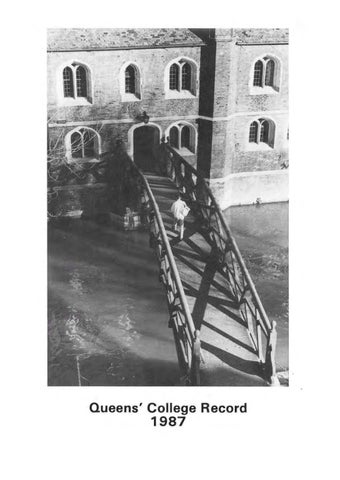
A new angle on the Mathematical Bridge (taken by Martin Holly, Q. C. Photo. Soc.).
From the President The major event of this academic year is without doubt Dr Humphrey Cripps' decision to begin work on the third and final phase of the new buildings. As was reported last year, the local architectural practice of Bland and Brown have prepared plans for a new court to occupy the space between Queens' ditch and the Cripps Court building. The court will be flanked on the north side by a new squash court block and on the south by a splendid hall that will serve both as an auditorium and for many other indoor activities. The west side against the ditch will be an open cloister. Under the court will be a capacious car park. As is well known to many, the College Boathouse has been giving structural problems for some years and recently had become virtually unusable and irreparable. By undertaking a joint development of the existing site, the College has acquired a handsome new boathouse the cost being largely met by building housing on part of the land. I am delighted to report that by the time that you read this the Boat Club should be better housed than they have been for many years. It is a matter of great regret to have to follow these two welcome developments with a note of grave concern, but old members must be made aware that the steady withdrawal of Government funding from Higher Educationis now having profound effects on the University of Cambridge as a whole as well as on its component colleges such as Queens'. Urgent efforts are being made both to mitigate the effects of these changes and to secure alternative sources of financial support. Unless they are successful, it seems inevitable that there will be substantial and damaging changes affecting every side of Cambridge life as we and our students know it today.
Cripps Court Phase Ill Development In July 1986, the Squash Courts, after exactly 50 years of service, were demolished to make way for the new development. They had been in a state of disrepair for some years, their flat roof being the first, but by no means the last, such roof to give the College good reasons to distrust that style of building. The superstructure toppled easily to the demolition contractor's machines, but the foundations proved more resistant, and several weeks of tough drilling followed. Some of the bricks, and roof tiles from the former garages behind the courts, were saved as spares for future repairs of Fisher Building. Demolished at the same time were the Gardeners' Buildings put up around 1974, these having been replaced by somewhat more modest and less unsightly buildings just to the north. The electricity substation feeding Cripps Court and Fisher Building was then relocated closer to the edge of our site, at the end of Queens' Ditch, taking due¡ care not to disturb the underground conduit feeding the Ditch from the Millpool. This relocation makes for easier vehicular access to the site, where an underground car park is planned beneath the new Squash Courts. 2
The drilling of the foundation piles followed, each of the 55 piles consisting of26 metres of reinforced concrete. This very noisy operation unfortunately overspilled into the beginning of the Michaelmas Term 1986, and the forbearance of many students whose rooms overlook the site was much appreciated by the College. The site was then excavated to the level required by the underground car park and ventilation machinery under the MultiPurpose Hall. The contractors, Stent Foundations Ltd, finished their work and left the site at Christmas 1986. At the time of writing, tenders for the rest of the project are being evaluated. Work will restart in the late spring or early summer of 1987, with a completion target date of late 1988. The development will comprise three new Squash Courts, a Table-Tennis Room, Games Room, two Music Practice Rooms and a Multi-Purpose Hall seating around 200 for theatre, cinema and lecture-room use, or, with the seating retracted, serving as a venue for parties, receptions and the playing of badminton. The College hopes to furnish and equip the development using the residue of the Development Appeal, to which many members contributed during the 1970s. We remain indebted to the Cripps Foundation for the fabric of the building itself. R.D.H. WALKER
The Boathouse Many generations of oarsmen will recall the College's former Boathouse, an attractive enough building, but one which concealed a wealth of structural problems, not the least of which was its predilection for shedding roof tiles every time the wind blew. It was also becoming apparent that it would be difficult to provide the working conditions appropriate for proper maintenance of the boats and application of modern varnishes within the ramshackle old building. Things had reached the stage where the cost of bringing the existing building properly up to standard was estimated to be not so very different from demolition and rebuilding. The latter was seen to be the better long-term option, but neither the Boat Club nor the College could afford such a venture. So a scheme was devised with a developer for a new boathouse to be built on the site of the old one, the major part of the cost to be borne by the developer in exchange for the College allowing a development of seven houses on vacant land adjacent to the boathouse, which the College purchased in 1979. Accordingly, the old boathouse was demolished immediately after the 1986 May Bumps, the boats having been removed to safe storage in a large shed, temporarily fitted out for boat storage, on the adjacent vacant land. Building of the new boathouse proceeded apace and, at the time of writing, it is hoped that the Boat Club will move into their new boathouse just before the Lent Bumps. The new boathouse will incorporate, at first floor level, not only changing rooms and showers, but also six single bedroom flats, to provide additional accommodation for married postgraduate students. R.D.H.WALKER
The Society
Michaelmas Term 1986 marked the 50th anniversaries of the elections to Fellowship of Henry Hart and Harold Bailey. The photograph was taken at the Fellowship Dinner on 6 October when the occasion was celebrated. Mr Hart now lives at Felbrigg Hall, Norfolk, where he continues to write and prepare lectures. Sir Harold is in Brookland Avenue with the archives of his Ancient India and Iran Trust, retired in the most nominal way, walking to lunch in College regularly. When they were elected in 1936 Mr Hart assumed major College offices in which he continued almost without break until he retired, while Sir Harold was already Professor of Sanskrit. They join Professor Ramsay and Dr Maxwell, all of whom have held Fellowship of the College for over half a century. Nominal retirement does not mean that Fellows become less active. Professor Holloway spent the Michaelmas Term lecturing on English Literature at the University of Kyoto, and by the time this is published will be lecturing in New York, whilst Dr Hughes is now able to devote his attention to full-time research and has been awarded a Leverhulme Research Fellowship. In December he was honoured by a Festschrift from his colleagues and former pupils in recognition of his long and distinguished contribution to palaeontology. At the other end of the spectrum the College has a very active group of Research Fellows. Dr Wade, a social anthropologist has continued working in South America. Dr Durlach, an experimental psychologist, has addressed international and national meetings in Marseilles, Durham and Cambridge and continues publishing vigorously, Dr Quie (formerly McEvoy) has spent the Michaelmas Term working in Canada. They have been joined by two new .Research Fellows, Mr Lewis, a mathematician and Mr Leask, who is researching on the relationship between literature and politics in the working of the English Romantics. He comes to us after a year in the University of Bologna. His Ph.D. on Coleridge is about to be published as a book. They replace Dr Bott-erill, who went to lecture at Berkeley on the expiry of his Research Fellowship, and Miss Bewick, who has moved to London. Among the rest of the Fellowship we have only lost Dr Segal, who has migrated to St John's. For modem languages she has been replaced by Mr Murphy and Dr Bennett. As a Tutor she has been replaced by Dr Field. Mr Murphy works in 19th century French Poetry and Dr Bennett on the history of linguistic thought in early modern France
The rest of us have tried to keep up with the vigorous examples of the newly retired and the newly appointed. The President and Mr Tiley have both spent sabbatical years in the United States, the former at a variety of institutions and the latter at the Law School of Case Western Reserve University, working on limiting the avoidance of tax! Dr Bradshaw spent parts of his sabbatical in Australia and Ireland, whilst Dr Smith spent his, in Pakistan, Japan and China. Dr Green is also spending his sabbatical in the Far East, and is being temporarily replaced as Senior Tutor by Mr Wright. Mr Wright has himself been replaced as Librarian by Dr Callingham, although he is keeping charge of the Old Library and College Archives. Many of those who have not been on sabbatical have travelled widely, Dr Phillips found himself on the same plane as Dr Smith on the way to Pakistan, although he was travelling totally independently at t he same time. Dr Singh went to China. Several Fellows have crossed the Atlantic once in the course of the year, including Mr Spearing who addressed three universities in the United States, and Dr Spufford an international congress there, but Mr Hebblethwaite has done so no fewer than three times during the year. As well as the prestigious international visits, Fellows have criss-crossed this country on innumerable occasions for academic purposes . For example, Dr Diggle has, on the one hand, lectured on Greek Tragedy at Delphi ( what better place to do so), and on the other has more mundanely acted as Question Master in the final of Brain of Rochdale competition. Fellows also of course serve widely in various capacities outside the College, among the new duties that have been taken on during the year, Professor Stein has become a member of the Fulbright Commission, Mr Tiley has become an Assistant Recorder on the South Eastern Circuit and Dr Napier has been called to the Scottish Bar. During the year we have been able to congratulate the President on his honorary doctorate from the University of Paris and Dr Cripps (Honorary Fellow) on becoming Deputy Lieutenant of Northamptonshire. PETER SPURFORD
The Fabric In Walnut-Tree building, two rooms, G3 and H6, were selected for major redecoration in the Long Vacation 1986. In H6 a window onto Queens' Lane, blocked for perhaps over a century, was re-opened and restored, so adding some light to the room. The original window frame and glass were still in position - indeed from the outside of the building there was no indication that the window had been blocked up inside. A similar blocked window exists in HS next door, to which we may turn our attention one day. Your author notes that G3 had not been repainted since before he himself had lived there as a student - quite which of us has better survived the passage of time we must leave others to judge. In Fisher Building the bath-tubs celebrated their 50th anniversary by passing into honourable retirement. One does not suppose that their steel successors will last as long. It is an interesting reflection on changing tastes and attitudes that, when Fisher Building was first opened, someone observed that it gave the appearance of having been "designed by a sanitary engineer" so novel was the 3
appearance of bathrooms and toilets on the staircase landings. Prior to that, when Dokett Building introduced the first baths to Queens' in 1912, decency required that they be consigned to the basement. Nowadays the College is hard put to keep up with the rising expectations of the modern student in this and other areas. At Easter 1986 tbe College changed to a new telephone system. As a result of the rewiring that this entailed, it was possible to strip off all the old cables which had so disfigured the outside of many of our historic buildings. In addition room VI , which had for many years accommodated the old mechanical exchange, was refitted and restored to student use in time for the present academic year.
The development of Phase III of Cripps Court, reported elsewhere, made necessary the closure for a few years of the kitchen delivery yard. The former Porters' Lodge on W staircase of Fisher Building was therefore refitted as a store-keeper's office and a reception point for the delivery of goods. The maintenance staff thus displaced from W were re-accommodated by a reorganisation of the workshop buildings behind Friars' Building. At the same time the opportunity was taken to install doors at the bottom of W staircase which for many years had been the only staircase in College open to the elements. Spiralling property prices in Cambridge city have made it difficult for postgraduate students to find affordable lodgings. They have become increasingly reliant upon College to provide them with housing, and the College has therefore once again found itself in the position of being short of accommodation for students, something which we thought we would be unlikely to experience again after Cripps Court was opened. Over the past few years the College has therefore pressed into service such few properties in the city as it owned for the accommodation of postgraduate students. Some carefully considered purchases have supplemented the stock. Inevitably several of our external properties have required major renovations. In 1986, number 65 Panton Street, where Mrs Thompson has been landlady to successive generations of students for over 50 years, received considerable attention to its exterior, its roof, and a rising-damp problem in the basement was rectified. The building was also redecorated both inside and out. Next door, at number 63, the ground floor had to be practically rebuilt owing to dry rot spreading up through the brickwork from the basement. The entire building was refitted and modernised. The great sums expended on these and other properties account for the lack of major works in College itself to report this year. Routine redecorations this year include: sanding and re-sealing of stairtreads and painting of walls of Cripps Court staircases; repainting of about half of Cripps Court corridors, bathrooms, toilets, and gyp-rooms; repainting of gyp-rooms on W , X, Y staircases; repainting of the iron railings on the river bank of the President's Lodge garden and some of the outbuildings ofThe Lodge. At the time of writing, a complete external redecoration ¡ of Friars' Building has been interrupted by the winter. R.D.H. WALKER
4
The Library 1985-86
Librarian: Dr Callingham (Michaelmas) Acting Librarian: Dr Sattelle (Lent and Easter) Keeper of the Old Library: Mr Wright Assistant Librarian: Mrs E. Machin Undergraduate assistant librarians:NichoJas Booth, Helen Busby, Susan Hill, Nigel Stockes, Gavin Burgess, Ruth Coombe and Annalisa Gigante.
AT the beginning of the academic year, responsibility for the Library was hurriedly divided in two. This decision, forced upon the Governing Body !Jy the exigencies of the time, may turn out to be a crucial milestone. Now there are two of us (and a third with experience under fire!) , it may be possible to begin a drive to modernise the War Memorial Library so that it can fulfill its proper function in the College. For too long, the Library, because it has always been there since the College began, has been taken for granted. The Library is a treasure house within the College; an encyclopaedia of our best natural resource. Of course, we know that the Old Library is our heritage, to be admired, shown off and ignored in turns. But what of the War Memorial Library? War Memorial Library.
This, the working library, had a difficult year, caused to some extent by the newly-appointed Librarian taking leave after just one term! In his defence it had already been arranged when he was inveigled into office. Our heartfelt thanks are due to Dr Sattelle for standing in so ably. He was not just a caretaker, content to keep a watching brief, but took an active interest in all aspects of the Library and was instrumental in coping with difficulties and criticism. For the most part, the running of Library rests in the capable hands of Mrs Machin and her band of undergraduate librarians without whom it would stop. Some aspects however must be the responsibility of the Librarian and especially those that may influence policy for the future. During the year complaints that there was an inadequate range of modern books were becoming numerous: that the shelves were too crowded, and that there were not enough reading places. What is to be done? Can the present building be altered and adapted yet again to meet our needs without encroaching into adjacent staircases? Can some proper provision be made for the Assistant Librarians to be able to do their jobs efficiently and to maintain some proper oversight of the Library itself? In an ideal world we, like some colleges, should be planning an entirely new structure. Another building project we hear you cry! But what is the alternative? Perhaps an intermediate library with books retrieved by library staff? This might be the answer, if only those books, little read but too important to hide away were lodged there. Modern book stacks, modern catalogues and sophisticated control systems are all possible. Then there is the march of science. Do we need a library in this world of electronic books? Of course we do, or at least until computers come in paperback. However, the Library must be the place where computer access to the written word is available. With all our undergraduates in residence, the need is even more acute. More space, more facilities and thus more money are
needed. The Library and its problems will not go away. It is impossible to keep track of lending when the system does not even provide adquatelyfor the supervision of the borrowing register. Anyone with ideas, suggestions and expecially expertise is invited to get in touch with either of us. On the brighter side, yet again the generosity of Members of the College and others in their donations was most gratifying: Some are mentioned below. We hope that those whose names have not been mentioned forgive us. But we plan to make good these omissions as soon as possible. Also on the credit side, many found our Library met all their needs. Perhaps it is to them that we should appeal for help. Among those making donations of books and papers to the Library were: Prof. Beament, Dr Botterill , Prof. Chadwick, Dr Cohen, Dr Ellory, Dr Field, Mr Hebblet_hwaite, Dr Hughes, Dr Pountain, Dr Sattelle, Dr Segal, Dr Smith, Dr Spufford, Dr C. Bibby, Prof. J. Riley-Smith, Dr P. Sims-Williams, Dr J. Twigg and G.M. Henderson (legavit).
will
BRIAN CALLlNGHAM
The Old Library Mrs .Joan Holloway continued with her work on the catalogue throughout the year, and substantial progress was made. As well as cataloguing the main collection itself, she did important work on some of the Co1lege's manuscripts (including the Gorham Papers, which record an historically important theological controversy of the 19th century, when ~n irascible member of Queens' took his Bishop to court), and was getting the Members' Archive into good order. Members of the College are reminded that the Keeper of the Old Library is always delighted to receive additional items for this Archive, and that shorter items, such as off-prints, are as welcome as full-length published works. An exhibition of Fine Bindings in the Old Library was on display in the Easter Term and for the Club Weekend. Exhibits included a 1522 edition of Erasmus's New Testament in a rare Polish binding; a beautifully decorated edition of Theophrastus, De Historia Plantarium (Basie, L534), executed for the great Parisian collector of the mid-16th century, Jean Grolier; a 12th. century manuscript commentary on the Psalms, the oldest volume in the library, in a remarkable binding of seal skin, with the hair still on it; and an example of the work of Professor Frank Gold by, formerly Fellow of the College and Professor of Anatomy in the University of London, who in retirement has done much fine voluntary repair and re-binding work in our Library. A catalogue of the exhibition is available, and the Keeper of the Old Library will be glad to send a copy to any Member on request. JAIN WRIGHT
1986-87 Librarian: Dr Callingham Keeper of The Old Library: Mr Wright Assistant Librarian: Mrs E. Machin Undergraduate assistant librarians: Gavin Burgess, Ruth Coombe, Cyrus Daboo, Annalisa Gigante, Timothy Appleton, Judith Kent; Dominic O'Brien and Jonathan Williams.
The Chapel The following visiting preachers came to the College Chapel in the course of the year: the Very Revd Oliver Twisleton-Wykeham-Fiennes, Dean of Lincoln: Dr David Thompson (1961), Fellow of Fitzwilliam College, University Lecturer in Divinity: Mr Phil Parker, Assistant Missioner, CICCU Mission; the Revd Dr Michael Winter, Dean of St Edmund's House; The Revd Giles Ecclestone, Curate of Great St Mary's, Lecturer, Westcott House; the Revd Canon Brian Phillips, Rector of Oaksey, Wiltshire; the Revd Canon Brian Smith, Director of Ministerial Training, Diocese of Wakefield; the Revd Derek Little, Church Pastoral Aid Society; the Revd Dr Geoffrey Rowell, Chaplain of Keble College, Oxford; Mr John Foster, Founder of the Goodwill Children's Village, India; The Very Revd John Moses, Provost of Chelmsford; the Revd Prof. Stephen Sykes, Regius Professor of Divinity; the Revd Christopher Lamb, CMS Other Faiths Theological Project; the Revd Prof. John Emerton, Regius Professor of Hebrew. The Dean of Chapel and the Lay Chaplain also preached. The preacher at the ComQiemoration of Benefactors in Full Term was the Revd Dr Leslie Francis {1970), Research Officer, Culham College Institute, and at the ¡visit of the Graduates Club in June, the Rt Revd Maurice Wood ( l 935), formerly Bishop of Norwich. R Sinnatamby was succeeded as Chapel Clerk by H. F. Haines and J. R. W. Young as Sacristan by A. D. McGown, both in the Easter Term. The Ryle Prize for reading in the College Chapel was awarded to L. J. Hewitt. The Chapel Choir sang Choral Even¡song in Peterborough Cathedral in February and in Norwich Cathedral in November. They visited one of the College Livings, St Luke's, Hickling, for the weekend in March, and gave a recital at St Mary's, Wetherden, in May. After Graduation, they went on a very successful tour of Hampshire. The Chapel has received a most splendid gift, from Mr and Mrs Hart, of two Kneelers, embroidered by Mrs Hart, for use at weddings in the College Chapel. They were used for the first time at the marriage of Jane Newey (1981) and Tony Simon in December. B.L. H EBBLETHWAITE
The E Society Three meetings of the Society were held in the Lent Term and three in the Michaelmas Term. The speakers were Mr P.A. Swaab, now Fellow of Corpus Christi College and Director of Studies in English there, on 'Philip Larkin and Post-War England'; Dr Bradshaw on 'The Historians' John Fisher'; Dr Walker on 'The Architectural History of Queens' College' (with slides); Lord Dacre, Master of Peterhouse, on 'The Intelligence War against Germany 1939-45'; Dr Haynes on 'Fluid Flow in the Atmosphere'; and Dr Cebon on 'Five Mile Tailbacks on the Ml'. The E Society Dinner was held in the Armitage Room on Saturday 3 May. B.L. HEBBLETHWAITE
5
Thomae Smithi Academia
The Students Academically, the College continued to go from strength to strength in 1986. In the June lists we gained the highest number of Firsts ever achieved, with a considerable increase over the previous record. Queens' students gained 79 Firsts overall and many of our candidates were exceptionally high on the University lists and were awarded special University prizes as a result. Students of the College topped the Finals list in Modern and Medieval Languages, and the Part I Theology list, and for the second year running Queens' took the best First in Part I of the English Tripos. In Mathematics, the College gained a dazzling number of Firsts, several of them very good indeed and there were some exceptional Firsts in Natural Sciences, including the best performance in Advanced Physics in Part IB. Queens' also harvested several special merit awards in the Final Veterinary Exam, and a special prize in the Geographical Tripos. The number of II.ls was also especially pleasing, and in the various league tables ofTripos performance, Queens' was placed very high indeed in the University and improved its standing in comparison with the 1985 tables rather dramatically. All this is of course most gratifying, particularly when the extra-curricular and social life of the College continues to be diverse, creative and lively. The College's postgraduate students recorded achievements at least as impressive as the undergraduates'. Queens' took the top First in the LL. M. examination. P.I. Hornick took both the Glennie Prize in Child Psychiatry and the Department of Surgery Prize. J.M.R. Reay won the Kermode Essay Prize, D.S. Hyatt shared the Henry Roy Dean Prize, M.J. Thompson won a Rayleigh Prize and G.F. Holmes won the Stevenson Prize. The academic calibre of our Research Students is shown by the fact that, although the Research Fellowships competitions are still in progress in a good number of Colleges, four Queens' students have already been elected to Research Fellowships: S.R. Drake and R.M. Nix are going to Downing and Sidney Sussex respectively, while R.A. Lewis and S.O. Sage have been elected to Queens' Research Fellowships. B.H. Butterworth has recently been appointed to a Lectureship at the University of Edinburgh. The striking expansion of the postgraduate side of the College continues. As in the case of our undergraduates, what is particularly pleasing is to see the energetic and varied contribution our postgraduates continue to make to all the other aspects of the College as well, cultural, sporting and social. On the admissions side, I have to report that Queens' applications are somewhat down this year, but this seems to be a pattern in the University (and indeed in the country) as a whole, and the College continues to be high up the University list in terms of the ratio of applicants to places. It is clear that we continue to be an attractive institution to school leavers and, although it is a little early in the day to make firm predictions about next October's entry, I am cautiously confident that the class of 1987 will be as academically distinguished, and as impressive in its non-academic pursuits and talents, as those which have preceded it. 1.R. WRIGHT
6
The Thomae Smithi Academia; a discussion group for Fellows and Fellow Commoners, celebrated its tenth anniversary on 27 October 1986, and in honour of the occasion Professor J.S. Riley-Smith of Royal Holloway CoUege, London, formerly a Fellow of Queens', was invited to lead the evening's discussion. It was he who had inaugurated the Society's activities in October 1976 with a talk entitled 'The Justification of Wars and Rebellions'. On this occasion he posed the question 'Can we maintain our system of Higher Education'. The Society is named after Sir Thomas Smith, Regius Professor of Civil Law, and Fellow of Queens', to whom ritual homage is paid at each meeting, when the Secretary selects for display two volumes from the collection of books belonging to Sir Thomas which are now housed in the Old Library. The records of the Society are silent on the choice of books for that first meeting, though they do record that the company drank Chateau de Pez 1967. When they break silence in 1978, they reveal that Sir Thomas' own The Commonwealth of England (London 1601) was one of the books displayed; and that thereafter the assembly has inspected such works as Aesop's Fables (Venice 1505), the Instituriones Juris Civilis of Justinian (Basel 1534), the De Materia Medica of Dioscorides (Cologne 1529), the Chirurgia Magna of Paracelsus (Strasburg 1573), and the De recto Latini Graecique Sermonis Pronuntiatione of Erasmus (Basel J530). Only once have books other than Sir Thomas' own been exhibited: when Mr Spearing's talk 'On losing touch with Shakespeare' (with whom Sir Thomas, by an accident of time, was unhappily not acquainted) was accompanied by a Hamlet of 1637 and a Third Folio of 1664, both from the Old Library. For ten years the Society has maintained an unbroken tradition of five or six meetings each year. Fifty five meetings have been held, and have been addressed by forty one different speakers, all of them Fellows or Honorary Fellows, or Fellow Commoners. By tradition one meeting each year is reserved for the Wine Secretary, Dr Hughes. who leads a discussion on wine, under the disguise of a wine-tasting. This unconventional meeting apart, the proceedings conform to a sober pattern: a fifteen-minute talk, on a subject connected perhaps with the speaker's own work, perhaps with a subject of current controversy, followed by an hour of discussion, often lively, also genial, as the candles flicker and the wine is passed on the polished oak table of the Old Combination Room.
The topics discussed in the past year were: 'Cellar wines from Bordeaux', introduced by Dr Hughes, 'Science and Morality', introduced by Dr Johnstone, 'A view from the Court of Appeal', introduced by the Rt Hon. Sir Stephen Brown, and 'The best of the fortified wines', introduced by Dr Hughes, through whose husbandry the company which assembled to hear Prof. Riley-Smith was enabled to drink the health of the Society, on its tenth birthday, with Cbateau de Pez 1966. J. DIGGLE
College Invitation Dinners for Old Members The Governing Body has initiated a series of invitation dinners in College to be held in late September for members of selected groups of years in rotation. These dinners are separate from the Queens' Club functions and are planned to be complementary to the annual Club Weekends held in June. In 1985, all members of the matriculation years 1963 to 1966 were invited. On Saturday 20 September 1986, all members of the matriculation years 1949 to 1952 were similarly invited. The third dinner is planned for Saturday 26 September this year all members of the 1987, and in June/ July matriculation years 196/ to 1970 for whom we have current addresses will be invited. It is currently intended that members of matriculation years before 1944 should be invited in 1988, and it is hoped that the cycle will have been completed in ten years.
oJ
Benefactions and Bequests The College is very pleased to report a number of generous gifts from Old Members. They are recorded in the order in which they were received. His Honour Judge Dajani (1934-37) has endowed a Dajani Prize to be awarded annually for academic distinction in studies that have been relevant to the promotion of a better understanding and awareness of the cultural and economic relationship between Great Britain and the Arab world. Dr Winston Oh (1961-64) has endowed a Prize Fund in memory of Max Bull. The prize is to be awarded annually for academic distinction in anatomy. Mr & Mrs P.B. Bi,mn (parents of N.P. Bunn 1983-86) have made a donation to the College Expedition Fund. The College has received a sum from the estate of Cyril Montagu Sleeman. Mr Sleeman was a Fellow of Queens' from 1912-1946and held the offices of Tutor and Director of Studies in Natural Sciences. The bequest comes to the College on the death of his widow and, following the wishes of Mr Sleeman, is designated for library purposes. Dr Edwin Maxwell has endowed a fund in memory of his wife Greta. The fund is 'intended to support and promote Arts and Crafts among the junior members of the College. These were activities of which Greta Maxwell was particularly fond and which do not receive direct encoÂľragement from any other source. For all these gifts the college wishes to record its deep gratitude.
The new History of Queens' 'Both Henry VI and his queen, Margaret of Anjou, had to send proxies to lay foundation stones at their new colleges in Cambridge. In September 1444 the King's chief minister, the Marquess of Suffolk, laid the foundation stone of the first chapel at King's College, "the aier and the Pestilence" having frightened Henry into staying away. Four years later Margaret despatched her chamberlain, Sir John Wenlock, to lay the foundation stone for her college of St Margaret and St Bernard.' So begins John Twigg's new history of the college. Twenty eight chapters later he records 'In March 1976 it was decided that Queens' should become co-residential as soon as possible after 1980'. In between he gives us an extraordinary variety of information, some familiar but much quite new. For example many will know that the College had no baths until the Doket building was constructed in 19 I 2, but how many will know that water closets were only introduced three years earlier, or that the College chose to have electric light and telephones well before it got rid of earth closets, or that until 1883 undergraduates were expected entirely to furnish their own room?. Ignorance of the College's past is not surprising since a history has only once before been properly attempted, by William Searle well over a hundred years ago and he stopped short in the mid-17th century. The first twothirds of J .H. Gray's brief history, rapidly written in 1898, was virtually a precis of Searle, and the remaining third is very inferior. A.D. Browne and C.T. Seltman's elegant pictorial history of College produced for the Quincentenary added an admirable iconographic record. In 1983 the College approached John Twigg, who had just completed a Ph.D. on the history of this University in the 17th century. On his return from India in 1984, he began work in College's voluminous archives and has now just completed his history for us Dr Twigg has produced much surprising information. He has shown that although there were 211 undergraduates in the College in 1621, the number matriculating between 1740 and 1770 was usually well below ten each year. The number of the early 17th century were not surpassed until the expansion after the First World War. The size of the Fellowship took even longer to exceed its 17th century numbers. In 1644 there were 22 Fellows, all of whom were ejected by the parliamentary commander of East Anglia, the Earl of Manchester. The Fellows were given three days to leave the University, or face imprisonment and sequestration of their possessions. This was no idle threat, for the President was already in the Tower. The College had to certify within one day that it had struck the names of ejected Fellows from its buttery list. In 1925 the College still had only ten Fellows, and it was not until the early 1960's that it again had as many as in 1644. Dr Twigg has also dispelled some of the myths about the poverty of the College. Although it is true that after the battle of Bosworth, the College had to give up those parts of the land of the earldoms of Oxford and Warwick with which Richard III had endowed it, it was still the third richest college in the University in 1535. It may have lost its President and its Fellows and its plate in 1640, but its endowments were virtually untouched and it was still among the richer colleges at the end of the 17th century. It 7
seems that it was the construction of the Essex building which really began the slide into poverty. The College regularly ran large deficits in its accounts from the 1750s and, despite extensive borrowing, building had to stop in 1760. The early 19th century enclosures of its farmland plunged the College, as landlord, further into debt, and these debts were still not all liquidated by the 1880s. In the 20th century, as in the 19th the College is among the poorest, but not from backing Richard III and Charles I. Doket's new college was founded in the context of late medieval scholasticism, yet within a few years of his death, John Fawne of Queens' was appointed to one of the University's first lectureships in the humanities created in 1488. It was the humanists already at Queens' who may have encouraged Erasmus to remain in the College. On his arrival, at Fisher's invitation, he wrote 'I expect I shall stay in this college for several days.' In the end he stayed several years and made at least four close friends among the Fellows who were responsible for the humanist tradition living in Queens'. The 'humanist revolution' was not, of course, the exclusive property of any one college, but Queens' was in the intellectual forefront. In parallel with humanism there was a new interet in mathematics, the first know lecturer in mathematics in the University was Roger Collyngwood of Queens' who began lecturing in 1500. In the 17th century mathematics came to dominate the curriculum to the exclusion of other subjects and went on doing so right through the 18th century. Edward Davenant, Fellow 1615-25, was later described by Sir Christopher Wren as the best mathematician in the world and the mathematical tradition continued to Isaac Milner, who was senior wrangler in 1774 and mathematics tutor at Queens' until his election as the Lucasian Professor of Mathematics in 1798. Despite all the emphasis on mathematics, Cambridge, apart from Barrow and Newton, did not produce any really great mathematicians in this long period. The problem seems to have been that brilliant young men such as Joshua King early in the 19th century, who 'might have been one of the first mathematicians of Europe' were swallowed up by College administration 'wholly employed in making up College bills, arranging College squabbles and looking after the morals of Freshmen'. The conflicting demands of teaching and College administration and of original work are not new During that period the seeds of Cambridge's later dominance in science were sown. The University's first Professor of Chemistry was Francis Vigani of Queens', whose extensive collection of drugs, assembled in 1704, remains in the College's possession to this day. Queens' also produced John Michell who began the modern study of earthquakes with a paper to the Royal Society in 1760 and became Professor of Geology two years later. The emphasis on the classics from which the College only moved away in the 20th century does not go back continuously to the humanists, but only to when the Classics Tripos was founded in 1824, in reaction to the overwhelming dominance of mathematics. Queens' became a very classical college in the second half of the 19th century when the growth of science so greatly changed the face of other parts of the University. So subjects rise and fall. A few strands seem, however, to run on for a long time. The interest in oriental languages in the College has a continuous history from -the 17th century, when a bequest to found a Hebrew lectureship went to pay for t~e 8
new building in Walnut Tree Court, the lecturer to paid out of room rents from the building. But curriculum is only one thread. Dr Twigg has explored the life and activities of undergraduates. He bas written about the College plays in the 16th and 17th centuries and again in the 20th, the College brewhouse, the College real tennis court, the founding of the Kangaroos, the addiction of students to horseplay in the College and horseracing at Newmarket, the evangelical fervour of the College in the early 19th century and its antipathy towards sport, and the eventual fusion of the opposites in the mid-century in muscular christianity, the centuries long fears of the ill effects of prostitutes on undergraduates or, even worse, of marriage to town girls. In the long 20th century section (eight chapters since the First World War) he bas written about the First World War itself, about participation in breaking the General Strike, which according to Gilbert Harding, 'came as a great boon to a large number of rather stupid undergraduates who were viewing th~ coming examinations with misgiving and alarm', about the Second World War, and about the brief violently radical student agitation of 1968-9, which so alarmed College authorities, but was followed by political apathy by 1973. This appears never to have been fully written up before. He recalls the apocryphal intransigence of the then Senior Tutor which so inflamed undergraduates with reactionary remarks attributed to him like 'If you want freedom - you go to a provincial university - where you can sleep with 20 black women every night, and nobody gives a damn' and the J/ - Paper whipping up the revolutionaries with 'Gates of colleges all over Cambridge are locked and guarded, rusty firearms are produced and some porters are armed with axes'. The life of the Fellows too come under scrutiny, from the earliest days when the College was governed by Doket's whim, until the first statutes of 1475. These did not make things much better. Conversation at table for Fellows, as for students, was of course to be in Latin, and even Fellows were not to be outside the College gates after 8pm (9pm in summer). A visitation oft he College in 1557 found that some Fellows did stay out late at nights, that long hair was prevalent among them and that there were often women within the precincts. Fellows were not allowed to marry until the 19th century. When the idea was proposed in the previous century Robert Plumtree (President 1760-88) thought the proposal "so very absurd that I have been, and still am, much in doubt whether it was ever seriously intended". Dr Twigg has produced a large book: 29 chapters and 19 fascinating appendices ranging from lists of Presidents and College finances to the subjects for debate in the St Bernard Society in the 19th century. It will be about 400 pages of print, and 24 pages of plates, eight of them in colour. It is to be published for the College by the Boydell Press, handsomely bound with the Logan print, and a plan of the College as end papers. It will be offered to the general public at ÂŁ19.50, however before publication at a special price of only ÂŁ9.75. An order form will be found inside the Record. Please return it as soon as possible so that we know how many to have printed. PETER SPUFFORD
The Friars' Building
1886 -1986 1986 saw the centenary of Friars' Building. It had been in October 1886 that the first students moved into their new rooms in Friars' Building, so called because it was erected on the site of a Carmelite Monastery acquired by the College in 1538 upon the dissolution of the monasteries by Henry VIII. The new building was designed by W.M. Fawcett and built by Rattee and Kett for the sum of ÂŁ8,200. Fawcett was a local architect who had earlier, in 1875, superintended the restoration of the east frontage of Old Court and designed the Master's Lodge of St Catharine's College immediately opposite.It was also in 1875 that the College first resolved to put up a new building, at a time when its agricultural investments were, just for once, producing a good income. However, in the ten years it took for the project to materialise, agriculture went into depression and the College's revenues diminished. The building could only be afforded by borrowing from capital and repaying from the room-rent revenue. This arrangement still survives today - the College is paying, out of room rent receipts, annual premiums on I 10-year endowment policies due to mature in I 996. The style adopted by Fawcett was unrepentantly neoGothic: many details, such as the windows, being modelled closely on those in Old Court, which at that time the new building faced across Walnut-Tree Court. Friars' Building, however, was a storey higher than Old Court, and the extra height was partly balanced by the architect inserting string courses of stone to emphasise the horizontal. Nevertheless the building was criticised for its height, especially compared against its slight depth when seen end-on from the river - a weakness now concealed by Erasmus Building. As built, Friars' Building consisted of 32 two-room sets. During the Second World War it became necessary for two students to share each set and this practice continued afterwards as the size of the College gradually increased. This was an unsatisfactory state of affairs, and during the early 1950s the building was converted, one staircase at a time, so that each staircase floor had four study-bedrooms instead of two two-room sets. (The attic storey, having less headroom, was left unchanged.) The entry lobby to each set was removed and the former bedroom was enlarged at the expense of the living room. The resulting strange gaps where the fireplaces had originally been in the corners of the bedrooms were concealed by built-'.in wardrobes, shelves, desks and washbasins which made the most of what would otherwise have been a small room if conventionally furnished. All these works were managed at a time when building materials were still rationed, and special licences had to be obtained to permit the conversions to proceed. The building now accommodated 56 undergraduates - but only 4 baths and toilets, all on the top floor. The planned admission of women in 1980 precipitated what was already seen to be necessary, and 4 study-bedrooms were converted to enlarge the bath, toilet and shower facilities. In many ways the arrival of Friars' Building marks a turning point in the College's history. It was the first residential building to be put up for over 130 years: the
previous one, the Essex Building, having been left only one-third complete after bringing ruination to the finances of the College. Yet Friars' Building was also the first of four buildings which were to follow at roughly 25-year intervals as the College expanded into the 20th century. The 1880s also ¡saw the first College Statutes in English and the reform of the College's accounts into a form which is still recognisable today. The College was stirring after a long period of stagnation; student numbers were increasing. Barely had the new building been occupied when the College perceived that its mediaeval chapel in Old Court was too small for the increased numbers ... but that's another story. R.D.H. WALKER
Park Bench In recent years the Edin burgh Fringe has begun to eclipse the legitimate Festival, if not in prestige, at' least in terms of theatrical worth (pace Bergman). After all, with around a thousand shows crammed into three weeks, the law of averages dictates that there must be more than a handful of sizzlers on display. I like to think that the Park Bench Theatre Company's dramatic offerings contributed to that category. Park Bench (named after a prop in its first-ever production "Zoo Story"), having grown both in stature and financial power since its formation in 198 1, was able to promote five shows on their 1986 Cambridge-OxfordEdinburgh tour. I was involved in three of these, including "Waiting for Godot" {as Pozzo) and "Accidental Death of an Anarchist", in which I was given for a second year the charmingly-named role of the Maniac. Please allow me to disabuse readers of the notion that fringe theatre is on principle shoddy, humourless and relentlessly didactic: the Park Bench schedule of rehearsing morning, noon and night for a month before the Fringe run, placed full emphasis upon the company's watchwords of showmanship and entertainment. After such a regimen a cast can take everything in its stride from the simplest prop malfunction to (on the 1985 tour) an onstage col}cussion. Following runs on the Cambridge and Oxford Festival Fringes, the company moved lock, stock, police office and withered tree, overnight to the Athens of the North, taking up theatrical residence in a major central venue and domestic residence in the flat of a former punk singer (now eminently respectable but still with a nice line in leopardskin brogues). Oh, the rigours of the Thespian lifestyle! .. the showtimes twelve hours apart, the persistent hounding of potential audients both in the Fringe Club and on the streets, the ceaseless striving for perfection ... all right then, 1''11 come clean. Those are my memories of the 1985 tour; three-quarters of the way through rehearsals last year I broke my hand and had to withdraw from the company. But that wouldn't have made much of an article, would it? IAN SHUTTLEWORTH
9
International Law
Mexico 1986
The supposed dichotomy between the 'academic' and the 'practical' has never made much sense to international lawyers. Certainly in Cambridge the tradition has been to reject this dichotomy. The three last holders of the Whewell Chair of International Law - Lord McNair, Sir Hersch Lauterpacht and Sir Robert Jennings - all combined formidable academic reputations with practice of the law, leading ultimately to a Judgeship at the International Court of Justice at the Hague.
My first ten hours on Mexican soil were spent convincing the customs officials that my tin of Lyles Golden Syrup was not unrefined cocaine. My next ten months were spent coming to terms with a country in the aftermath of an earthquake and a population mourning its dead. Most Mexican familities lost a friend or relative on the nineteenth of September. I lost three companions. Mexico City recovered amazingly quickly from the tragedy. The world's biggest urban chaos seems to have a vehement energy that has assured its survival over six centuries of dramatic change from its days as Tenochtitlan, capital of the Aztec Empire, to its more recent capacity as centre stage for the 1986 World Cup. Many thought that the decision to host the World Cup had been a Government ploy to keep the public's eye off the huge National Debt. In fact the occasion became a necessary tonic for a population that was still obsessed with the events of nine months earlier. My job as a language assistant over, I obtained a post working for the British Consulate in Monterrey where they were expecting the arrival of some 10,000 English fans. The trouble began when Mexican girls, interviewed by the local paper, claimed that the English have 'mas sex appeal que los mexicanos'. I spent the first few days explaining to Mexican men that this attraction for peeling shoulders and fat white beer bellies, was a passing infatuation. England lost to Portugal a nd I have the dubious pleasure of placating irate bar owners, visiting incarcerated Britons, and seeing Ted Croker in his underpants. England beat Poland and the local police asked me very courteously ifl would go and tell those 14 stone, six-footthree, inebriated Englishmen if they would get out of the fountains and put their clothes back on.
Part of the reason for this is that most of international law develops from the practice of States, so that an 'ivorytower' isolation from p ractice is impracticable. It is often extremely difficult to understand what has happened , or to perceive the motivations behind a practice, without some experience with the actual case in question, or similar cases. Another important reason for involvement in the practical application of the law is that most of one's students (and at Cambridge we have a large postgraduate school) will end up .as practitioners rather than academics. So their interest lies as much in the ptactice oflaw as in its theoretical exposition. And the idea that practice does not pose the same intellectual challenge is absurd; it is sheer academic conceit. In my own experience the demands on one's intellectual powers are greatest when one is faced with the range of highly complex issues which arise so often in litigation or actual problems. Frequently, of course, the practical experience has an academic 'spin-off. The materials one uses can be passed on to research students or used as the basis for the writing of one's own articles or books. Even in terms of selfeducation t he experience is worthwhile, for one is constantly forced to acquire new knowledge - about geology, or geography, or history, or economics or even (to my personal dismay) mathemat ics. Fortunately, as a member of a Cambridge College one has an enormous advantage, for there are within the FeJlowship experts on all those disciplines who will readily help with advice and clarification i n these strange areas of knowledge. So life is rarely dull for the international lawyer, and the issues change all the time. Within just one year I can recall issues over land boundaries, maritime boundaries, treaty interpretation, fishery disputes, expropriation claims, nationality, trade boycotts, pirating of computer software and revision of judicial awards. True, the travelling can be excessive and tedious, but there are always new places.to be seen, new people to meet, and new problems. One week may be spent amongst the skyscrapers in New YOrk, the next in the deserts of the Persian Gulf, the next in the mountains and forests of Central America, and the next in the gothic splendour of the International Court at the Hague. The exhilaration of actually arguing a case before the bench offifteen judges in the International Court is undeniable: the issues are big, the stakes are high, and the responsibility is correspondingly heavy. Curiously, it is that contrast which makes Cambridge so enjoyable. One of the best pleasures, after a liard, tiring trial is to return to the familiar surroundings of one's own rooms, in the peace and tranquillity of Queens'. DEREK BOWETT
IO
TIM PRITCHARD
Culture Shock! 1 had never felt so cold and lonely in my life. Home, which
had seemed stiflingly hot when I departed now appeared to me as a mirage of exotic palms, warm white beaches and dazzling blue seas. At Drummer bus station, I was temporarily relieved of my homesickness when I was met by an extremely pleasent member of the Christian Graduate Society who more or less shepherded me around for the next two days. I did not sleep for a straight forty-eight hours. When I did wake up, my body protested at the time difference. I was awake during the night rather than the day! It took me some time to get over the jct lag and during the first
week, it seemed that I moved around in a state of semisleep and semi-wakefulness. On a cold, bui sunny day, I was first able to appreciate the beauty of my surroundings. Prior to that, the days bad been damp and threatening. However, on that day, when Cambridge was bathed in sunlight, I got my first glimpses of Gothic buildings, towering spires and brick structures. I bad never been so overwhelmed with such a sense of history. The wide, sprawling expanses of green grass, the Great Court of Trinity evoke emotions of grandeur and spaciousness. The medieval First Court of Queens' inspire a sense intimacy and tradition.
During my first few weeks here, the theme of tradition cropped up consistently. The formal dinners, the Latin interpretation of the Grace, the wearing of gowns were traditions I regarded with a certain amount of amusement, disbelief and a curious sense of excitement. Having never been exposed to such, I thought of the stories I'd have to teJl on returning home. Attending social functions was at first painful for me. A vague notion persisted in the back of my mind that somewhere, there was an unwritten law prohibiting excessive consumption of alcohol in the university notion fed no doubt by a preconceived idea that alcohol consumption could not happen so openly in a place like Cambridge! I was therefore taken aback to discover that wine-drinking was something of the tradition here. Back at home and at the University of the West Indies, drinking wine was seen as rather bourgeois. People stuck to lively, rum laced punches - wine-drinking evoked visions of boring cocktail parties. Secondly, it was a surprise to me to find that people here were not as open or approachable as West Indians. I suppose we assume that people are just like us the world over. This difference between people is the most fundamental distinction I have discovered. SHERY ALEXANDER
I went to Peru for Christmas "I went to Peru for Christmas", I say, and one of two questfons often follows. If it is "Why Peru?", then my answer sometimes throws people - my parents are missionaries there. The other question is "What is it like in Peru?", and that throws me. Peru is not very like England ... Well, it is true that in Lima thousands drive around in Mercedez-Benz, live in big houses with burglar alarms, and work for multinationals; we had turkey for Christmas and went to midnight mass. But for two million people shanty towns are home. On the sandhills outside Lima the roads are unpaved - dusty and bumpy as the ramshackle bus clatters by. Houses begin with reed matting for walls, gradually added to over the years. Large families share the space with their animals: a few scraggy chickens and perhaps a cageful of guinea-pigs. The surrounding desert is more like the Middle East than like England. And as for the sierra highlands, life there sometimes seems a couple of thousand years behind ... Donkeys are a common means of transport; Peruvians travel for days from the city to reach their parental village up in the remote mountain valleys, maybe for a festival or to see the harvest. The campesinos are farmers or shepherds, watching flocks high on steep Andean slopes. The women spin the wool by hand as they walk along the road or sit on their doorsteps to chat - as naturally as Westerners might light up a cigarette. Donkeys, sheep, shepherds, mothers and children, lots of children; born in such unhygienic places: hospitals are too far away, and there would not be room for everyone anyway ... I went to Peru for Christmas, and realised how different it is; realised also that every time I go, I hope it will not be the last. There is something about Peru which has got a grip on me -and it is not the bits like England. HILARY EVANS
Chernobyl The entry in my diary for 29 April reads: 'Hot afternoon. Went to the football -pitch and threw a ball about with Christopher and sunbathed. Nuclear accident near Kiev.' The football pitch in question was next to the Pushkin Institute in Moscow where we - we being 500 foreign students, including 25 from Britain - lived and went to classes. The nuclear accident was Chernobyl. Ignorance, first blissful, then alarmed, then frustrated, characterized our knowledge of the incident. Not surprisingly, I feel as ignorant now as I did then for if a few paltry facts have come to light aboui Chernobyl, there is still disagreement on the long-term effects of low-level radiation. It was ignorance that allowed the peasants of Chernobyl (a Ukrainian word meaning Wormwood - for those of you with an interest in the Book of Revelations) to walk out of their homes to view the spectacle of a nuclear reactor on fire; I cannot help thinking that I might instinctively have done the same, for there is no motivation to take precautions when the danger is invisible - and readily played down. As we were situated, the accident was as irresponsibly hushed up in the Soviet Union as it was irresponsibly politicized by the Western media. Even the BBC World Service joined in the fun with wildly inaccurate figures of 2000 dead on the spot. Moscow radio sulked. The billiondollar question was: will reactor No 2 explode? The Brits huddled together in room 824, home of five most beautiful women in the group. The Americans joined us, distributing emergency Heineken. All looked for dark radiation-clouds on the horizon. None came, so, not having any Iodine tablets or gamma-proof macs, we sort of .. . forgot about it! DANIEL REED
The restored Cloister under the Lodge.
11
Distinctions and Awards FIRST YEAR
D. Ali (Purley High School for Boys): Class I in PartIA, Natural Sciences Tripos; College Exhibition. T. B. Appleton (Bishop Vesey's Grammar School, Sutton Coldfield): Class I in Part IA, Medical Sciences Tripos (Veterinary); College Exhibition. M. G. Bennett (Clifton College): Class I in Part IA, Natural Sciences Tripos; College Exhibition. D. A. Betts (Enfield Grammar School): Class I in Part IA, Engineering Tripos; College Exhibition. J. N. B. Carleton Paget (Eton College): Class I in Part I, Theological and Religious Studies Tripos; College Exhibition. W. K. Chan (United World College of the Atlantic): Class I in Part IA, Engineering Tripos; College Exhibition. J. M. Clementson (Hills Road VI Form College, Cambridge): Class I in Part IA, Engineering Tripos; College Exhibition. G. M. J. Davies (Verulam School): Class I in Part IA, Mathematical Tripos; College Exhibition. H. E. Evans (St. Brandon's School, Avon): Class I in Part I (French and German), Modern and Medieval Languages Tripos; College Exhibition. D. M. Evers (Portsmouth Grammar School): ,Class 1 in Part IA, Natural Sciences Tripos; College Exhibition. T. D. Gee (Marlborough College): Class I in Part IA, Mathematical Tripos; College Exhibition. E. M. Gosling (Our Lady's Convent, Alnwick): Class I in Part I (German), Modern and Medieval Languages Tripos. A. C. K. Hsieh (Haberdashers' Aske's Boys School): Class I in Part IA, Mathematical Tripos; College Exhibition. T. H. Jenkins (Solihull School): Class I in Part IA, Engineering Tripos; College Exhibition. N. R. B. Johnson (Lycee Francais Charles de Gaulle): Class I in Part IA, Mathematical Tripos; College Exhibition. C. S. Knecht (lngatestone Anglo-European School): Class I in Part I (French), Modern and Medieval Languages Tripos. L. R. Lazarus (South Hampstead High School): Class I in Part ]A, Natural Sciences Tripos; College Exhibition. R. C. C. Lord (Eltham College): Class I in Part IA, Medical Sciences Tripos; College Exhibition. D. J. D. MacDougall (Marlborough College): Class I in Part IA, Natural Sciences Tripos; College Exhibition. C. M. McGahey .(Howell's School, Cardiff): Class I in Part IA, Law Tripos; College Exhibition. N. J. MacKay (St. Peter's School, Bournemouth): Class I in Part IA, Mathematical Tripos; College Exhibition. R. L. H. Mason (Sherbourne School): Class I in Part IA, Mathematical Tripos; College Exhibition. D. K. Messem (King Edward VI School, Bury St. Edmunds): Class I in Part IA, Geographical Tripos; CoHege Exhibition. M. P. Murray Threipland (University College School): Class I in Part IA, Natural Sciences Tripos; College Exhibition. R. J. Neather (Exeter College): Class I in Preliminary Examination for Part I, Oriental Studies Tripos; College Exhibition. 12
P. M. Owen (Winchester College): Class I in Part IA,
Engineering Tripos; College Exhibition. A. P. A. Pearce (University College School): Class I in Part I, Economics Tripos; College Exhibition. R. Pye (Olchfa Comprehensive School): Class I in Part IA, Natural Sciences Tripos; College Exhibition. J. A. Sherratt (Tiffin School, Kingston upon Thames): Class I in Part IA, Mathematical Tripos; College Exhibition. D. J. Shipp (Bishop Wordsworth's School, Salisbury): Class I in Part IA, Mathematical Tripos; College Exhibition. R.L. Smith (Alleyn's School): Class I in Part IA, Medical Sciences Tripos (Veterinary); College Exhibition. 1.D.B. Stark (Winchester College): Class I in Part IA, Mathematical Tripos; College Exhibition. M.B. Whitworth (King Edward's School, Birmingham): Class I in Part IA, Natural Science Tripos; College Exhibition. J.P. Williams (Aylesbury Grammar School): Class I in Part IA, Mathematical Tripos; College Exhibition. AC.A. Woode (Shrewbury School): Class 1 in Part I (German & Spanish), Modern and Medieval Languages Tripos; College Exhibition.
SECOND YEAR
P. B. Ashwin: Class I in Part IB, Mathematical Tripos; Foundation Scholarship. C. Chakravarty: Class I in Part JB, Natural Sciences Tripos; Foundation Scholarship. K. S. Cheng: Class I in Part IB, Medical Sciences Tripos; Foundation Scholarship. J. E. F. Eliot: Class I in Part IB, Mathematical Tripos; Foundation Scholarship. A. P. Goldstone: Class I in Part 1B, Medical Sciences Tripos; Foundation Scholarship. S. J. Goringe: Class I in Part IB, Natural Sciences Tripos; Foundation Scholarship. S. J. W. Hamilton: Class I in Part IB, Mathematical Tripos; Foundation Scholarship. S. J. Head: Class I in Part IB, Mathematical Tripos; Foundation Scholarship. R. A. Keiller: Class I in Part IB, Mathematical Tripos; Foundation Scholarship. 1. J. Morrison: Class I in Part IB, Engineering Tripos; Foundation Scholarship. E. B. Nasatyr: Class I in Part IB, Mathematical Tripos; Foundation Scholarship. R. A. Ogden: Class I in Part I, Modern and Medieval Languages. N. J. R. O'Gorman Lalor: Class I in Part IB, Mathematical Tripos; Foundation Scholarship. D. J. Oldham: Class I in Part IB, Engineering Tripos; Foundation Scholarship. J. S. Rieber: Class I in Part IB, Natural Sciences Tripos; Foundation Scholarship. A. Roberts: Class I in Part IB, Medical Sciences Tripos; Foundation Scholarship. W. T. P. Shieh: Class I Part IB, Law Tripos; Foundation Scholarship. P. J. L. Strafford: Class I in Part IB, Mathematical Tripos; Foundation Scholarship. J. A. Viner: Class I in Part IB, Mathematical Tripos; Foundation Scholarship.
THIRD YEAR N. J. Booth: Class I in Part II, Law Tripos. S. N. Brown: Class I in Part II, Modern and Medieval Languages Tripos; Foundation Scholarship. D. Christensen: Class I in Computer Science Tripos; Foundation Scholarship. H. A. Collins: Class I in Part II, Modern and Medieval Languages Tripos; Foundation Scholarship. C. M. Edwards: Class I in Part II, Mathematical Tripos; Bachelor Scholarship. S. P. Every: Class I in Part II, Natural Sciences Tripos (Metallurgy and Materials Science); Foundation Scholarship. D. M. A. Hendicott: Class I in Part II, Natural Sciences Tripos (Physics and Theoretical Physics); Foundation Scholarship. M. C. Hudson: Class I in Part II, English Tripos. S. Kheterpal: Class I in Part 11, Oriental Studies Tripos; Foundation Scholarship. M. J. Liley: Class I in Part II, Natural Sciences Tripos (Physics and Theoretical Physics); Bachelor Scholarship. S. C. Lockwood: Class I in Part II, Historical Tripos; Foundation Scholarship and Bachelor Scholarship. R. K. Lowes: Class I in Part II, Mathematical Tripos; Bachelor Scholarship. P. S. Marshall: qass I in Part JI, Law Tripos. T. I. Shuttleworth: Class I in Part IB, English Tripos; Foundation ¡Scholarship. A. K. Thiemann: Class I in Part II, Natural Sciences Tripos (Applied Biology); Foundation Scholarship. A. R. Tiller: Class I .in Part II, Natural Sciences Tripos (ChernistryJ; Foundation Scholarship and Bachelor Scholarship. A. R. Trisoglio: Class I in Part 11, Natural Sciences Tripos (Physics and Theoretical Physics); Foundation Scholarship. P. S. Wells: Class I in Part II, Natural Sciences T ripos (Physics and Theoretical Physics); Bachelor Scholarship. N. Wood: Class I in Part II, Mathematical Tripos. J .R. W. Young: Class I in Part II, English Tripos; Foundation Scholarship.
M.D.
B. M. Farage. Ph.D. H. M. Allison (Geography); J. M. G. Barclay (New Testament Studies); N. C. Beck (Chemical Engineering); B. H. Butterworth (Pathology); P. N. Coad (Music); J. Davis (Geography); J. L. Gould (Biochemistry); I. C. Harding (Earth Sciences); J. A. Hargreaves (Botany); W. J. McCarry (Pharmacology); T. R. Marsh (Astronomy); P. P. Mercer (Law); S. A. T. Mzembe (Veterinary Medicine); D. C. Parker (Chemistry); J. H. J. Penny (Earth Sciences); J. J. M. Risi Carbone (Plant Breeding); K. Somasundram (Chemistry); C-C. Su (Engineering); I. Upton (Veterinary M¡e dicine); N. G. Walker (Engineering).
M.Sc.
J. A. Parry (Physics). M.Litt. L. M. Loeb (History).
M.Phil. S. M. S. Burn (Quaternary Research); W. J. Griffiths (Linguistics); S. M. Gunasena(Economics and Politics of Development); A. H. K. Hainsworth (International Relations); R. P. Hammes (Criminology); G. F. Holmes (Economics and Politics of Development); R. M. Kaysen (Control Engineering and Operational Research); J. L. Oppenheimer (International Relations); L. Nehru (Economics and Politics of Development); M. Reyes (International Relations); S. Shariff (Social Anthropology); P. S. Sylvestre (International Relations); J. D. Trevelyan (Social Anthropology). Diploma D. A. Austin (Economics); T. Krause (Historical Studies); J. Okuyama (International Law); K. Steinacker (International Law). CPGS S. J. Finch (Biochemistry).
GRADUATE STUDENTS A. E. Buscall: Class I in LLM. J. J. 0. Cameron: Class I in LLM. L. de La Fayette: Class I in LLM. S. J. T. Gilbert: Special Merit in Animal Pathology and Microbiology and in Veterinary Parasitology for Part I, Final Veterinary Examination. S. R. B. Green: Special Merit in Animal Surgery in Part U, Final Veterinary Examination. L. A. Hammond: Pass with Distinction, Postgraduate Certificate of Education. J. H. Inns: Special Merit in Animal Health and Production in Part l, Final Veterinary Examination. A. J. Maund: Pass with Distinction, Postgraduate Certificate of Education. M. McKee: Class I in LLM. D. G. Petrie: Pass with Distinction in Part II, Final Veterinary Examination. Y. K. Tay: Class I in LLM.
University Prizes
Mrs Oaude Beddington Prize: H.A. Collins, aeq. Corbett Prize 1986: H.K.Smith proxime accesit Henry Roy Dean Prize: D.S. Hyatt, aeq. Glennie Prize in Child Psychiatry 1986: P.I. Hornick Andrew Hall prize: D.K. Messem, aeq. William Harvey Studentship: J .R. Petter T.R. Henn Prize: T.I Shuttleworth Kermode Essay Prize: J.M.R. Reay Rayleigh Prize 1986: M.J. Thompson Betha Wolferstan Rylands Prize: T .I. Shuttleworth, aeq. Marmaduke Shield Scholarship: A.P. Goldstone Stevenson Prize: G.F. Holmes The Department of Surgery Prize 1986: P.I. Hornick 13
The Union During the past year, the Union has maintained a stringent financial policy in order to rebuild its Capital Equipment Fund. This will help to strengthen its position in relation to the new facilities including the boathouse, re-developed sportsground, multi-purpose hall and squash courts which will soon become available to the College. The College Union has continued to act as a forum for debate of many issues and has sucessfully put forward ideas concerning accommodation and facilities for graduate members. It has also liaised closely with the Junior Bursar to minimize disturbance associated with the building of Cripps Phase III. The punts and shop have been reorganised and are now operating successfully. The JCR Committee has concentrated its efforts in its role as an organising body for undergraduates in Queens': less emphasis has been placed on external political issues. Open meetings have been very well attended and JCR entertainments have proved extremely popular, with discos, cocktail evenings, concerts and a barbeque. The JCR newsletter, known affectionately as the "Queens' Drain", is now published weekly and along with articles, contains news of future Queens' societies' meetings.
1985-86 Council of College Union
President: W. H. Stoddart Vice-President: Mr I. R. Wright Senior Treasurer: Dr J. A. Jackson Fellows: Dr B. W. Napier, Dr C. R. Matthews, Dr N. D. Segal United Clubs Representatives: S. 0. Sage, J. Davis The J.C.R. Committee
President: W. H. Stoddart Treasurer: S. C. Bowater Secretary: S. J. Forster External Officer: C. Mortimore Bar Steward: J. H. S. Denham Governing Body Observers: P.A. J Watson, N. Fredericks Third Year Representatives: S. Holland, J. R. Liver Second Year Representatives: S. Ed kins, A. P. Goldstone First Year Representatives: N. D. Portwood, D. A. Vickers Graduates: S. 0. Sage, D. K. Waymont, J.E. Prince 1986-8? Council of College Union
President: G. R. M. Burgess Vice-President: Dr K. Johnstone Senior Treasurer: Dr J. A. Jackson Fellows: Dr D. B. Sattelle, Dr C. R. Matthews United Clubs Representatives: S. 0. Sage, J. Davis, C.R. Simms
Third Year Representatives: R. W. S. Weir, I. G. Beveridge Second Year Representatives: D. A. Vickers, N. G. Portwood First Year Representatives: S . M. Paton, C. J. Owen Graduates: S. 0. Sage, D. K. Waymount, P.A. Svoboda, G. L. Skidmore.
The MCR 1985-86 President: Dr Machin Chairman: S. 0. Sage Secretary: J.E. Prince Treasurer: D. K. Waymont Stewards: R. A. Lewis, N. Vaughan-Thomas Committee Members: M. Lefebvre, L. de La Fayette
The MCR experienced an active year in 1986. On the social front, attendance at most events was quite heavy. Highlights of Lent Term were th.e Boar's Feast in Old and New Halls, and a Russian evening complete with costumes, special food and music. Easter Term events included a formal spring dinner as well as the more traditional cocktail and garden parties during May Week. Michaelmas Term began with a party hosted by the Tutors to introduce new graduates to College. There followed during the term a cheese and wine party with the Fellows, parties at Hallowe'en and before Christmas, and the Woodville Feast. The MCR has benefitted greatly from the expansion and redecoration of the Woodville Room during the summer. The expansion has allowed more space for MCR parties and provides an additional area for reading and conversation. A major project for the Committee during Michaelmas was the production of a report to the Governing Body on various issues faced by incoming postgraduate students to Queens', in particular the shortage of accommodation in Cambridge and problems with assimilation into University academic and social life. The report made a number of proposals by which the College might help alleviate these problems. Many of these proposals have received serious consideration by the Governing Body. The Committee looks forward to another eventful year in 1987. 1986-87 President: Dr Machin Chairman: S. 0. Sage Secretary: P.A. Svoboda Treasurer: G. L. Skidmore Stewards: I. C. Harding, H. N. Feldman Committee Members: M Lefebvre, E. M. Orr
The Bats President: T.J. Hopkins Senior Treasurer: Mr Wright Junior Treasurer: N.C.A. Evans Equipment: J.W. Nicholls
Secretary: K.L. White
The J.C.R. Committee
President; G. R. M. Burgess Treasurer: A. P. Goldstone Secretary: K. J. Richardson External Officer: E. M. Gosling Bar Steward: A. J. A. Watson Governing Body Observers: S. L. E. Crampton, J. Strong 14
The early months of 1986 were overshadowed by financial difficulties. As a University Society, the BATS receives no Union funding. Non-commercial ventures such as new writing, experimental theatre and Edinburgh projects must be subsidized by safe bankers. And, since no show is guaranteed an audience, BATS must tread carefully.
Lent Term should have proved a model of artistic and fiscal balance. In Old Hall BATS combined once more with the "Trouble and Strife" group to sponsor "Sylvia Plath", directed by Fiona Hamor, together with a late night pastiche, "U.S. Shorts." Both shows were an artistic success on a very modest budget. At the ADC BATS co-sponsored a lavish production of Ford's "Tis Pity She's a Whore,". T'was pity indeed for the show boasted the finest set and costumes seen at the ADC thIS year, resulting in very heavy losses. With Mayweek approaching, BATS faced a crisis. The committee felt that the tradition of a Mayweek Shakespeare should be maintained yet nothing less than a roaring success would. save us from bankruptcy. In the event two parties came to our rescue. Nick Hedges, who had directed "Tis Pity", nobly made amends by producing an excellant promenade performance of "Romeo and Juliet" in Trinity Gardens, and the National Trust offered a handsome sum to perform the Cloister Court play at Wimpole Hall, a stately home near Cambridge. ''The Taming of the Shrew", directed by Andrew Maund, was very well received and, as usual. saw the committee humping scaffolding poles around in their best garden party outfits. In the summer BATS sponsored Lexi Dodds-Pryce to take her own¡work, "Ourself Behind Ourself Concealed" to the Edinburgh Fringe Festival where the Scotsman acclaimed it as "a small, precise theatrical event of great beauty." First seen in Old Hall, this show has since been performed in the United States. This Michaelmas Term Mal Sutherland directed two plays by the dissident Unter Amalrik. They were presented in experimental fashion in Old Hall as 'Free Theatre' and a collection was taken on the door for Amnesty International. At the ADC Chris Geelan directed Buchner's "Woyzeek", a thoroughbred BATS show involving many College members. To end the year we joined the Shirley Society in sponsoring Ted Hughs' translation of "Oedipus" in the Catz Octagon. 1986 saw increased University interest in BATS, reflected by directors applying from other Colleges and constructive financial collaborations with other societies. But it remains a source of regret that some talented Queens' actors, directors and production staff are involved in the Cambridge drama world, yet have no association with BATS. 1986-87
President: C.P. Geelan
Secretaries; S.L. Dobbyn F.J. Cubitt
Senior Treasurer: Dr Cebon Junior Treasurer: C.P. Britten Equipment: R.S. Dighero, D.A. Betts
Christian Union 1985-86
College Representatives:
L.J. Hewett, H.E. Evans
The main event of 1986 was the C.I.C.C.U. Mission in February, led by David Jackman from Southampton. The week aimed to encourage and p.rovoke discussion of the Gospel and was a time when several committed their lives to Christ and many Christians were challenged afresh about their commitment.
The Michaelmas Term started with a Houseparty at Hergrave Hall led by Tim and Lucy Mullins from Greyfriars, Reading, which was a good time offellowship and learning. We w~repleased to welcome new Christians in October, although there was a disappointing Jack of girls. Please contact one of us if you wish to receive our prayer letter, or if you no longer wish to be on our mailing list. 1986-87
College Representatives:
H.E. Evans, J.T. Hobday
Contact Queens'is a very active supporter of Contact, a universitywide scheme which organises student visitors to the elderly in and around Cambridge. It is one of those invisible bridges between the university and townspeople: in this case some of the disadvantaged residents. Every Term also, a party is organised, attended by about 150 elderly people and the students who visit them. These parties are happy events for everyone and the effort of organising them, which includes the provision of transport, is certainly worthwhile; the appreciation is visible in the delight of those elderly people who are unable normally to go far from their homes. JULIA BRAY
Classical Society 1985-86
President: H. K. Smith
Secretary: J. J. Tanner
Five meetings of the Classical Society have been held since the last report, including the annual dinner. In the Lent Term Dr Robin Osborne discussed methodological problems in the interpretation of Greek vase paintings in a paper entitled 'Not waving but drowning - Pictures as History or the History of Pictures', and Henry Hurst talked about 'Urban Archaeology in Rome and the Excavations at Santa Maria Antiqua'. At the final meeting proper of the academic year Ms Helen King revealed hitherto decently obscure parts of the Ancient World, with a paper on 'Female Flashers in Antiquity'. A record number of present and former members of the Society attended a splendid annual dinner at the end of the Summer Term, when we were entertained with speeches by our guests, Professor M. K. Hopkins, Dr. R. Osborne and Ms Helen King. Just one meeting was held in the Michaelmas Term 1986, when Dr. Wardy reassured some and worried others about their existential status with a paper on • Dr. Rerum Natura contra Anaxagoram or Lucretius on what atoms are not'. Our thanks as always to Dr. Diggle for his hospitality as patron of the Society.
1986-87
President: J. J. Tanner
Secretary: M. H. Reuter 15
Discussion Society 1985-86
President: G. St J. R. Williams Vice-President: Mr Wright Secretaries: R. K. Morgan and H. V. Stokes Social Secretary: G. R. McD. Burgess Treasurer: R. J. Blackwell
The enthusiasm for this new society was indicated by its initial membership of90 members, so it was at once one of the larger societies of the College. It became affiliated to the Union at the end of the Easter Term. Speakers at the society included Michael Waldman, the producer of 'Queens', a Cambridge College', and the recently appointed Chairman of Marconi Plc. A number of successful debates were held; in some of these, we became a forum to bring the views of other societies in College to a wider audience. The society also holds an annual garden party. In 1987, the society is proud to announce that Mrs Shirley Williams will be a speaker.
Engineering Society 1985-86
President: D. J. Oldham Secretary: P. P. Kluth
Vice-President: R. P. Caton Treasurer: P. M. Clarkson
The first Q.E. D. event of the year was a fascinating visit to T he Thames Barrier. Unfortunately, the conditions did not warrant a full-scale demonstration. The Annual Dinner was held in the Easter Term, with a talk on Telecommunications by Dr D. Cleevely. Officers for 1986-87 were elected unopposed. In the Michaelmas Term the new members were keen to participate and all events were very well attended. We again appreciated the hospitality of The Greene King Brewery. The visit to Cannon Screen Entertainment was deservedly over-subscribed ; did you know that Superman conquers Nuclearman on the Great Wall of China? This was one of the many special effects we were shown. The last function of the year was a popular Formal Hall and video. We would like to thank Dr D. Cebon for his help through the year. 1986-87
President; T. J. Willink Vice-President: N. D. Portwood Secretary; M. P. Counsell Treasurer: J. M. Clementson
History Society 1985-86
President: S. C. Lockwood Secretary; I. A. Dickson
Treasurer; J. Phillips
The Lent Term began with Janet Nelson's talk enigmatically called '886: The Other Centenary'. Those whose curiosity prompted them tq attend were treated to a documentary, numismatic and archaeological account of Alfred's conquest of London. 16
Despite an exacting audience, Chris Haign produced a controversial reappraisal of the origins of the English civil war, undaunted by exasperated criticisms from John Morrill. Arguments apparently continued until well after the audience had departed, and rumours that resultant high blood-pressure caused Dr Morrill to crash his car the next day are probably true! Our last meeting of the Lent Term was addressed by John Rohl, who put forward some unpublished material from the hitherto-suppressed diary of a German official, written in 1913. Modernlinguists and historians alike were struck by the resemblance of Professor Rohl's lecture to the work of John Le-Carre, as he described the efforts of WestGerman scholars to 'edit' the documents, which make clear the German role in bringing about World War One. In the Michaelmas Term we moved on to the Second World War, guided by Corelli Barrett as he investigated 'The British Disease'. Sub-titled 'Is There A Cure' his lecture was sure to provoke varied reactions; one senior member was even moved to ask Dr Barrett if he was at all concerned for civilised values! Chris Andrew's amusing presentation of his research on the Cambridge spy-ring (Burgess, Blunt et al) was made yet more lively by his use of tape-recordings. We were consequently able to hear a K.G.B. advertisement on B.B.C. radio, and this largely made up for the fact that those present at the lecture are now liable to prosecution under the terms of the Official Secrets Act! 1986-87
President: I. A. Dickson Secretary: M . J. Ryan
Treasurer: R. W. S. Weir Ex Officio; H. E. Marshall
Hungry f or C hange Group Treasurer: E. J. Donaldson Co-ordinators: J.M. Pryke, R. K. Eastman Publicity: M. R. Pugh
Having been involved in the town Oxfam 'Hungry for Change' Campaign Group, Jenny Pryke and Rachel Eastman decided to start a College group in the Lent Term. Joe Human, the Oxfam Area Organiser addressed the first meeting (in February). He outlined the aims of the campaign, which include self education and educating a wider public on the issues. Speaker meetings on the various campaign issues were held in the summer term. The Hon. Oliver Wolston who started 'Send a Tonne to Africa' during the Ethiopian famine appeal, spoke on the EEC agricultural policy and its effects on the Third World. Fund raising is an integral part of the work of any Hungry for Change group. A cake stall at the Student Community Action Summer Fete and a 'Rich Man Poor Man' meal were organised to raise funds. At the Rich-Poor Meal, lots were drawn and six people won a meal, while the rest ate rice, resulting in mixed feelings on both sides! Students from Christ's and Newnham attended the Queens' meetings and decided to begin groups in their own colleges.
In the Michaelmas Term 1987, the group was affiliated to the Queens' College Union and was awarded a budget to cover expenses. The group considered two issues; South Africa - an area adopted by Oxfam for special campaign's work, while Mario Onesas, a Chilean exile in Cambridge spoke movingly of the effects of the International arms trade in Chile. The main event of the Michaelmas Term was the annual Oxfam Fast, on 7-9th November. The Queens' group co-ordinated publicity in other colleges. A street collection boosted the total which Queens' raised to over ÂŁ500! We finished the term with hoarse voices after two hours of carol singing, raising ÂŁ56 for our project.
Photography Society 1985-86
Secretary:M.G. Holley
Chairman: R.H. Bland Treasurer :C. Da boo
The Photographic Society has continued to provide darkroom facilities for black and white processing. In addition tuition has been given to new members in developing and printing films. Members of the Society have been involved in activities ranging from taking photographs for "Stop Press' to making posters for dramatic productions and election campaigns. 1986-87
Chairman: M.G.Holley Treasurer:C. Daboo
Secretary:A.A.A. Ajibulu
Medical Society 1985-86
President: R. Sinnatamby Secretary: J. E. Montgomery Treasurer: S. Kheterpal 1986 has been another eventful and successful year for the society. It began with the celebrated annual dinner, at which Professor E. J . L. Soulsby, head of Clinical Veterinary Medicine in Cambridge, was guest of honour. He provided us with some very amuzing veterinary anecdotes from his own experience, as well as touching on matters of somewhat greater importance. Lent Term also saw a talk by Professor Miles Irving of Manchester University and a presentation by Dr Andrew F(exheimer about the marketing of drugs in the third world. Some of the methods that Dr Hexheimer highlighted were, as the title suggested, hard to swallow. Easter Term came and with it, a new presidency, another round of Tripos - and the Society's garden party. In the end , all three were successful: Jo Montgomery has proved to be an able President: Queens' Tripos results were celebratable, for no-one failed to achieve exemptions, so the Garden Party on the Erasmus Lawn allowed everyone to enjoy the fine weather and relax after their exertions. In the Michaelmas Term a new first year was introduced to the Society at the combined Squash and Booksale. This was followed a few weeks later by a talk given by Dr Laurence Weaver of the Dunn _Nutriti~n Laboratory in Cambridge. His account ofthe1r work m Paediatrics in West Africa proved interesting and stimulating. It once again highlighted the need for medical professionals in less privileged places as well as in the industrialized world. Dr Chris Carne of Middlesex Hospital spoke about his work on the disease AIDS, a very topical and grave subject. However Dr Carne presented an unsensational account, from years of experience, and his clear presentation of the facts was greatly appreciated. This meeting was marked by the highest attendance in recent memory. We look forward to 1987 and wish to express our gratitude to Drs Callingham, Field and Holmes for their continuing support. 1986-87
President: J.E. Montgomery Treasurer: E. J. Wheeler
Secretary: P. Choi
Queens' Bench 1985-86
President: A. C. K. Griffiths Secretary: E. M. Tait Treasurer: R. E. CollardSocial Secretary: G. R. Burgess At the start of this academic year most first year lawyers again joined the Queens' Bench Society, together with a number of graduates. The Society aims to cater for the interests of all lawyers in (:ollege, both by keeping them in touch with the 'real' world of legal practice and inviting outside speakers, and by organising a number of social events. The Lent Term began with a talk by Mr John Griffiths QC, an ex-Attorney General of Hong Kong, entitled ' Confessions of a Bencher', a highly entertaining and (for those considering the profession) valuable insight into the life of a barrister. Towards the end of term the Annual Dinner was held, with the recently appointed Law Lord, Lord Griffiths, attending as guest of honour. A great success, the dinner will not be forgotten by either those who attended - or those who organised it. In the Michaelmas Term Dr Roderick Munday, of Peterhouse College, came to speak on the subject of'T~e Law of Names'. Subtitled 'A Diversion for Lawyers' this was a fascinating and not too serious investigation of a . legal byway. We finished the term with a purely social event a showing of 'The Paper Chase', the film about Ame;ican students at Harvard Law School, watched with interest by their English equivalents. Our thanks go to Mr Tiley, Dr Napier, and Mr Fentiman for all their help over the past year. 1986-87
Presidents: R . E . Collard, E. M. Tait Secretary: D. T. Sayer Treasurer: L. R. Blyth Social Secretary: R. J. Holmes 17
Rag Week 1986 Committee 1986: Rep: E.D. Tealby Treasurer: S.M. Pearson Rag week 1986 was 1-9 March, with preparations throughout Lent Term. Queens' participated in various events organised by the University committee including a sponsored parachute jump, the Rag Day parade and Sheep's Green Fair. We had a winner in the sponsored crumble-eating contest. 1986 also saw our Bed resurrected by an enthusiastic team from bits in dark corners all over College. The Bed actually finished the race! Our own traditional even.ts raised a great deal of money; £426 from foam-fla n hits, and £220 from the custard vote. Sales of mugs, mags and sweatshirts in Cambridge and other places were exptionally good, raising £908 ..There was· a disco, a three-legged pub crawl race, and an attempt to drink "The Mill" dry. The most successful new event was a jazz and cocktails evening in Old Hall. There were helpers too many to mention by name, and Queens' finished about 11th on the Rag Table, raising £2,130, as far as we know our best result to date. Charities selected: Arthritis Care, Cheshire Homes, Mencap, Shelter, S.O.S. Children's Village.
Record Library 1985-86 President: J . C. M. Bates Secretary: C. P. Britten
With still only a handful of Compact Disc players in College, we look set to remain very much a Record Library (with varying degrees of crackle) for some time to co me. Many new records have been purchased in the last twelve months, a ided by the new fining system (instigated over the summer for absent mind ed 3rd years who have been neglecting to return records on a permanent basis). We hope this will result in increasing the variety of music available. 1986-87
President: C. P. Britten
Secretary: P. B. Ashwio
St Margaret Society 1985-86
President; P . S. Wells Secretary; K. R. Wood Senior Treasurer:· Dr Pountain Junior Treasurer; S. 0. Sage Ex-officio: P. J. Walsh Committee: T. D. Gee, K. P. Jenkins, C. S. M . Lawrence, S. Rimmington, M. J. Taylor. The first major concert was Bach's St.John Passion in the West Road concert hall on March 6th, conducted by the Organ Scholar, Philip Walsh; it was an exciting and impressive performance of a demanding work. The Chapel was packed for the Mayweek Concert on June 14th. The Organ Scholar conducted works for choir and brass, performed by the Chapel Choir and CUBE (Ca!llbridge University Brass Ensemble); in the second half Matthew Taylor conducted Sibelius' Romance in C 18
and the Nielsen Clarinet Concerto, with Emma J ohnson as soloist. The abundant refreshments were as usual enjoyed by everyone. But the finest achievement of the year was the performance of Verdi's Requiem, conducted by Philip Walsh to a full house at the West Road concert hall on December 1st. It can justifiably be said that this was a performance rarely bettered by any college music society. The weekly lunchtime recitals .have continued, a.long with the annual 'Face the Music' competition and the extremely popular Smoking Concert. An engraved plaque has now been fixed to the Bechstein grand piano generously donated to the Society by Mrs Constance Leigh in I 984. This piano is situated in the Chapel and is used extensively by members of the College for practice and for concerts. Those in residence 1966/7 will be sad at the death of Bob Allen, who· was on study leave as Professor of Biology at New York State University and a member of the Combination Room. He was Kousevitsky's favourite 'cellist before he turned to science and gave Magsoc great support. . 1986-87
President: C. S. M. Lawrence Secretary: T. D . Gee Senior Treasurer: D r Pountain Junior Treasurer: $ . 0. Sage Ex-officio: P . J. Walsh Committee: M. J. R. Burgess, M. S. L. Lee, R. A. Lewis, A. A. Saer, P. S. Wells, K. R. Wood, P. M. Woodrow.
Women 's Group President: S. M. Hill Treasurer: M . J . Liley
1985-86 Secretary: S. E. Charron
Following an informative and enjoyable programme of events during the Lent and Easter Terms 1986 which included a video on Women in China and a speaker meeting on the need for Women Pyschologists, Queens' Women's Group made a very encouraging start to this accademic year. A well-attended squash at the beginning of the Michaelmas Term was followed by a buffet supper at which a committee was chosen to help the co-presidents formulate a programme of events for this year. With a small profit made from the supper the committee decided to join the Women's Press Book Co-operative enabling members of College to buy literature of particular interest to women ata discount. The committee also decided to become more closely associated with C. U.S. U. Women's Group which co-ordinates events and meetings throughout the University. This term several members are participating in a Self-Assertion Training Weekend and it has been suggested that Queens', having one of the la rgest Women's Groups in the University, be used as a base for the regular showing of feminist videos. The programme continued with a discussion about Women's Health issues led by Sue Paulson, Nursing Sister at St Catherines, and concluded with a purely social event, the film ' Yentl'. 1986-98 Co-Presidents: E. M. Tait and R. E. Collard
Reports of the Clubs Officers of the Clubs 1986-7
Secretary
Captain/ President
Association Football Athletics and Cross Country Badminton Basketball Boats (Vice-President) (Ladies) Bridge Chess Cricket Croquet Hockey (Ladies) Lawn Tennis
T. J. Adams P. W. Stone K-S. Cheng G. C. Pope M. J . Green R. J. Holmes J. G. Hunter C.H. Andrew H. K. Tsang/ N. W. Savage R. J . Haddow R. D. Lowe J.M. Davis C. A. Beath C.R. Simms F. J. Cubitt Netball P. J. Owen Rugby G. C. Pope Squash P. J. R. Ward Swimming and Water Polo J.P. J. Halcox Table Tennis I. S. Turner Tiddlywinks D. M. Evers Unicycles R. P. Caton (Vice-President) P. B. Ashwin
Association Football 1986 will be remembered as a 'year of two halves, Brian' for Queens' F.C. The Cuppers draw paired a weakened Queens' side with Magdalene; the team played with spirit, leading for much of the game through a goal by Captain Moore, before eventually losing 2-1. This was followed by a disappointing defeat at the hands of Clare and relegation. However the side recovered well in the second half of the year - after a summer of parrot-sickness - to bounce straight back up. T he tum around was due in large part to the introduction of freshmen Yorwerth, Waters, Rimmer and Barrett and the return of Prichard. Many of the battles were won in midfield, most notably by Scott who maintained vocal supremacy despite strong challenges from Rimmer and goalkeeper Betts. Up front Bryant and Strong combined well to convert Barrett's purposeful running into goals. Gallic midfield inspiration Morel left for his native land at the turn of the year, confessing to being ' au-dessus de la lune' at the side's progress. The 2nd XI under the enthusiastic leadership of Nicolle performed well, again strengthened by freshmen and with stalwarts Hamilton, Warren and Eliot consistently among the goals. Victory in a rearranged match this team wi11 ensure promotion. Sayer, 3rd XI captain, was often forced into the unprecedented duty of team selection, which saw the team begin to string results together, including a draw with Magdalene 2nd XI. Third team purists were shocked by such breaks with tradition, marring for some the otherwise successful year for the Club.
Treasurer
L. Strong A. M. G. Scott D. J. D. MacDougall T. W. Morrish G. Yeung R. D. Lowe
M. A. van Weede
A. E. Lawson-Smith
N. W. Savage D. T. Sayer
H.K. Tsang I. D. Chisholm
S. J. Head S. M. Pearson
M. P. Counsell
C. A. Beath G. S. Watson R. D. Lowe
T. J. Claridge G. P. Shrimpton R. P. Selway
A. J. A. Watson
R. S. Dunn J. A. Sherratt
The ladies team entered its second year, guided vociferously by Carole 'blue' Britten and continued to play with a mixture of skill and enthusiasm to more than hold its own, often against more experienced opposition.
Athletics C lub Athletics Cuppers took place early in the Michaelmas Term. The injury-hit Queens' team finished fourth in its heat, thanks to stirling performances against all odds. Especially notable were David Belbin in the 200m (2nd) and Angus Saer in the2km walk (2nd). Alas, however, the early promise in training shown by the legs of Miles, Nutter and Livesey was not fulfilled. A sight sorely missed.
Badminton Looking back through the whole of 1986, the Queens' College Badminton team probably reached its best ever performance. Although we were knocked out of the Cuppers in the first round by Fitzwilliam, which is now playing in Division One, our record in the League was more than satisfactory. Both our second and third team won the respective Division Four and Five Leagues convincingly. By the end of Michaelmas Term, the men's first team was already the run-away leader in Division Three, and promotion is virtually within grasp. However, the second team is, as expected, struggling in this same division, though the third team thrives in Division Four. As for the ladies, both teams are currently in the middle of their respective First and Third Divisions. 19
The long-term prospect is not so good. Only the First team and ladies team have recruited .enough new players, while the lower teams are mainly composed of third years and graduates. We do hope that there will be a large influx of keen players from next year's freshers. Finally, we are greatly encouraged by the effort and keen participation of our graduate students.
Boat Club Perhaps the most lasting memory of this year's activities will be that of Mike •Streetly visibly ageing behind the wheel of a 7½ ton truck towing the trailer with our brand new boat on board. Survivors of that frozen weekend at Walton-on-Thames have to admit it was memorable at least. The Lent Term is best forgotten on the whole, men's l st and 2nd VIIrs both plunged four places. This was due mainly to lack of commitment in certain quarters, but this saps morale throughout the whole boat. The 3rd Vlll were highly committed and were rewarded with 3 bumps. The 4th VIII were only bumped once; but then they were Foot of the River for the last three days. The delay (due to a frozen Cam) of the Bumps, posed seemingly terminal problems for the Ladies with two of the 1st VIII being prevented at the last minute from rowing in the Bumps due to University Lightweight commitments. Despite this, both I st and 2nd Vill's made 3 bumps and were unlucky not to win their oars.
The May Term saw our first full term on our new boat (at last!). This, and largely the enthusiasm and drive of David Langer, led to the 1st VIII making 2 bumps putting us well in reach of the first division in Lents and Mays for 1987. The 2nd VIII consisted largely of novices but they worked hard and were unlucky to go down three (equipment failure) especially after rowing over head of Girton l despite being overlapped at several points. Many experienced oarsmen, as always, chose to row for gents VIII's so the selected 3rd YID actually rowed as the 4th VIII where they rallied well, after being bumped on the first day, to make 2 bumps on later days. The gents VIIl's were the victims of a vitriolic, and in part at least, unfair verbal broadside from the Captain during his Bumps Supper Speech and between them went down 5 places. The Ladies all did well - 1st IV won their oars despite losing their stroke for a week just before the Bumps; 2nd and 3rd IV's both went up 3 places and the 4th IV went up 2. It seems as though the men could learn a thing or two here. A crew was entered for the Thames Cup at Henley but failed to qualify by 6 seconds. The experience gained, however, will undoubtedly benefit the present year's rowing. The old boathouse was demolished in June and so for the Michaelmas Term we have boated from the shed adjacent to the incomplete new boathouse. This has been very trying at times but dodging JCB's with a boat on
r
Green giants Return to Water On I I May a reunion of the 1961-62 crew was held at Henley. These were the not-so-old men who took us to 4th, then, by 4 unforgettable bumps, to head the river for the first time. The twenty-five years might never have been as the Regatta course was steadily rowed, ending with two racing starts. Number 6 (here from New Zealand for a week) was enviably brown and below his I 962 weight. Some others were rather heavier! The cox maintained naval authority. It was a happy occasion. Bow: Peter Webb 2: Peter Brass 3: John Gordon 4: Ian Mccallum 5: George Hayter 6: John Maasland 7: Michael Morley Stroke: John Sergeant Cox: Rob Walmsley Bank-Bound: Martin Beckett. JOHN SERGEANT
20
your shoulders is different if nothing else! May is forecast as the overall completion date. The end result should be a considerable improvement. The novices were as enthusiastic as ever and in the Clare Novices we put out 3 men's and 2 ladies' Vlll's. Every crew won at least one race, which is superb, and one men's crew reached the quarter-finals of the Plate. All credit to Rob Holmes and Claire Johnson for organising everything, including some rather noisy circuit training under Erasmus on Sunday mornings. In the Fairbairn's the 1st VIII had a good row finishing in 15th place; an improvement of 5 places on last year and well above our competition in the Mays. The Ladies 1st IV came a pleasing 8th place. At a University level it is again the Ladies who took the laurels. Last year, Kemlin Furley and Jenny Halbert both rowed for the Ladies Lightweights crew, Karina McMahon rowed for Blondie. This year, Jo Hunter and Martha Plessas have been selected for the 1987 Ladies Blues squad. In April there was a small but successful Boar's Head Dinner for ex-oarsmen. It is hoped to make this an annual event (see page 24).
Basketball In the last two years it would be a no over estimate to say the Q.C.B.B.C. has become one of the most successful clubs within Queens'. In the 84/ 85 season we achieved an unprecedented white wash of the League and Cuppers competitions being undefeated in both. Following on from this, the squad was increased and with an active participation of some 20 students we were ready to continue from where we left off. However due to a 'minor' administrative nightmare the league went ahead without the current champions being able to defend their trophy. This is not to say that the morale of the Club was disturbed and we looked forward to the Cuppers competition in the Lent Term with even more anticipation. The new team comprising of the brilliance of Half Blues Ulmer and Lefebvre and the more modest talents of some old favourites such as Wolffe and Pope, mixing well with the newcomers Maliepaard and Langer. The team swung into action with a bye through the first round, which of course, had nothing to do with Mr Ulmer's organisation of the competition and with a newly found confidence we went on, well, confidently to the final where we met Emma. The particular match proved to be quite a disappointing affair. The.three Half Blues which made up the Emma team see!Jled to rise to the magnitude of the task facing them and proceeded to thrash us. It was our first defeat for two years, yet I guess, 'someone must lose.'
Bridge Although last year was slightly disappointing, under new management for 1986-7 the Bridge Club is thriving. The regular weekly meetings in the Bar are well attended and enjoyed by players ofall standards. All the large Cuppers entry have competed with enthusiasm, though some more consistently than others, resulting in some memorable, though perhaps best forgotten auctions. However, with four teams still in the competition, and with a First Four with considerable
experience in University matches, combined with significant strength in the other teams. ( notably Richard Lewis, valiantly captaining the Second Four for the fourth successive year) prospects appear good for the coming year.
Chess Underdog champions! That's the most concise way to describe our result in 1986. The Queens' first team boasted an unbeaten record in the year and won both Cuppers and the second division in the league. Our campaign for the cup shocked all observers with the ease with which the much under-rated Queens' side consistently outplayed the 'stronger' first division teams. The toughest challenge encountered was mounted by Trinity whose team included some of the highest rated players (including candidate International Masters) in Cambridge. However fine performances by Richard 'Stonewall' Selway (unbeaten last season - but the quickest with the draws), Nick Savage (living up to his name and launching savage attacks to salvage the match against Trinity), Richard Blackwell, Hon Tsang (honestly conning wins from nothing),and Simon Douglas ensured that Queens' gained the well deserved title of Cuppers champions. The other two Queens' teams had a less successful season. Queens' II finished fourth in division 3, and Queens' III dropped to division 6. Needless to say, in the current (1987) season, Queens' I are playing in the first division. With the bolstering strength of new arrival Dave Singh, we have now reached the quarter-final stage in defending Cuppers, and are challenging Trinity (2 points behind them) for the league championship.
Cricket Once again the season g9t off to its habitual soggy start with rain taking a heavy toll of the early fixtures. Indeed, the first few abortive weeks of the season were epitomised by the scene of the tea-interval in the game against Gents of Suffolk when, in the space of ten minutes, the April showers turned the square into something more suitable for a water-polo match. When the rain finally relented the results were slightly disappointing as the playing record shows: played 13: won 3: lost 6: drawn 3: abandoned I. Cuppers in particular was a damp squib as we were beaten heavily by a typically strong Magdalene side after repeated washouts saw Darwin concede the first-round tie. Consistent batting all down the order saw the opposition to 214 in their allotted 40 overs, a solid but not unassailable score. It took on mammoth proportions, however, as the Magdalene bowlers exploited the Queens' batsmen's lack of match-practice to reduce us to 4-4. Lacking a player in the Botham mould, we predictably never recovered from this desperate position with only two players reaching double figures in our final total of 67 all out. Despite the comparative Jack of success, the season proved an enjoyable one. Skipper Simon Etchell batted with great style, his willingness to play his strokes bringing him the season's only hundred in an honourable draw with Robinson. He also led the side in an attractive manner, always wanting to keep a game alive and look for a positive result. Good early season form saw Simon Hamilton boasting an average of Bradmenesque propor21
tions until he became the v1ct1m of some umpiring decisions that were almost Australian-like in their ineptitude. Richard Haddow also made several useful scores to make him the obvious choice for the captaincy in 1987. Finally, on the representative front, Ally Scott was a ¡ regular member of the University side and won his second successive Blue in helping his team to their exciting last-ball Varsity match win, whilst Duncan McFarlane made frequent appearances for the D niversity 2nd XI.
Croquet Last year was a very successful one for Q.C.C.C., with a record entry of croquet Cuppers: Queens' put forward 30 pairs for the competition, four of whom made the quarter finals. Paul Clarkson and Mike Green, two of the many representatives from the Boat Club, reached the semifinals before losing lo the eventual winners. True commitment to the game was shown by Gavin Davies, who was compelled to employ a unique one-armed technique due to a dislocated shoulder. Unfortunately it was not a great success. The only hiccup in an otherwise enjoyable season was the mysterious disappearance of the hoops from the lawn. After a week of frustration they were discovered in a nearly tree. We are looking forward to another action packed season on the lawns.
Cross Country Following the successes of the previous Lent Term, it was only necessary to maintain form to ensure promotion, but there was no stopping the club, now fired by strong internal competition. Who can forget the awe in which we held Neil Watson, who only had to jump out of his College eight to be leading the field, and who so nearly won the Barton Road race in freezing conditions -or the amazing dash by Pete Stone to take the best time of the day in the Hare & Hounds relay? What other College can boast three teams in the Selwyn relays or a connoisseur of tea to match the distinguished John Richer, to whom the credit for such enthusiasm must surely go? Needless to say, this Lent Term Queens' was again back in the first division. Pete Stone has been showing us all his paws, and all too often the back of his shorts. His impressive run against Oxford proved that he should have had the second team place that his Cuppers run deserved. Talent and determination were also displayed by the ladies who have never before been quite as impressive. Indeed, 1987 should be an excellent year.
Hockey The elements were again not in our favour at the start of 1986. The 1st XI performed superbly whenever they could and convincingly won every match that they played. They can count themselves unlucky to be placed only fourth in the final first division table on a rather suspect percentage system, having ended the season with a record of played 10, won 7, drawn 1, lost 2. The 2nd XI league and Cuppers were respectively butchered and abandoned due to the February Ice Age. The ladies also rarely took the field but when they did, performed admirably, reaching the semi22
final of a Cuppers competition reduced to one day. In the end fatigue seemed to get the better of them and they bowed out gracefully to a star-studded Catz team. The Larry Peel Cup was given its annual polish and presented to Simon Head before the annual dinner at the Blue Boar Hotel, which promptly closed down the following day (it wasn't us honest!). Easter weekend saw the Clacton Hockey Festival again severely disrupted by the rain but with Cambridge winning the Boat Race, the purchase of an American football and an adequately stocked beer tent, the trip was definitely a success! The Michaelmas Term saw the departure of all our University representatives but the arrival of some youth in the first year, plus some experiece in the postgraduate department left captain Jon Davis with a very strong squad to choose from. As a result he decided to injure himself and pass th~ task on to someone else for the term. After some significant victories, Queens' 1st XI now find themselves well in the championship battle. One memorable event was Queens' first appearance in the second round of Cuppers for four years (admittedly with a bye!) but then coming up against the eventual winners - the Blues team cleverly masquerading Magdalene. The 2nd XI are also performing well and have high hopes that this year's Cuppers will actually occur, and the ladies, after a slow start, finished high in the league.
Lawn Tennis The men's League team had a fairly successful season winning five out of their eight matches, but unfortunately failing to gain promotion. The men's (!) Cuppers team, strengthened by three Blues - Grant Petrie, David Ondaatje and Philippa Cantrell - and also including Adrian Legs Lewis, Richard (I'm writing this so I'm not inserting a name here) Simms and Oliver Enthusiasm Burton, fared much better. They overcame strong Christ's and Sidney Sussex teams to reach the semi-finals, only to have to default from the match at the end of term due to lack of availability of players. The ladies 1st team fared slightly less successfully partly due to the weather and the fact that more time was spent arranging and re-arranging matches than actually playing, and partly due to the distinct lack of tennis players (hint, hint Mr Admissions Tutor). The team was held up valiantly by Nate Fredericks, Kym Silove and Fiona Cubitt and we managed to reach the quarter-finals of Cuppers without playing a single match. The 2nd team fared much better considering the same people never played twice. Thanks must go to Fred Tealby, the only consistent member of the team. The annual mixed tournament was the usual alcoholic affair and probably the only play the courts had seen all season!.
Netball Queens' netball teams have had another successful year such that in Cuppers, where three Queens' teams competed, Queens' I were unlucky not to qualify for the final rounds and were eliminated on goal difference. Queens' I gained promotion again this year, having won Division Illast season, and as yet remain undefeated in Division I. Queens' II have enj eyed moderate success in Division III with victories over Jesus II and Catz.
College colours were awarded to Jane Ryland, Christine Beath, Lisa Hammond, Jackie Head, Jane Owen, Jane Osbourn, Kathryn Richardson, Rowena Macaulay and Sarah Boylin.
Rugby Club 1986 began promisingly for the 1st XV with a good performance against the eventual league winners, Pembroke, losing by only a couple of points. Therefore there was some optimism as Cuppers approached; however this was dampened by the weather which resulted in a five-week freeze up. During this period strenuous efforts were made to maintain fitness but obviously match practice was in short supply. When Cuppers was eventually played, it took place in the last week of term under the constraint of reducing the matches in the earlier rounds to half their length. Under this unusual system, the l st XV lost narrowly to Fitzwilliam. The season culminated with an excellent A.G.M. and Dinner. The 1986-87 season began well with a convincing victory over Clare with good performances by first years Will Bentley, Phil Crispin and Chris Witton (the latter going on to represent the University during the Michaelmas Term). Then injuries began to take their toll, and in every match the team was weakened. It was evident that the I st XV squad did not have the strength in depth to cope with losses and, combined with the team not playing its full potential, it resulted in .a disappointing term ce-wise. The best performance of the term was
a victory over Caius but for the rest of the time the 1st XV were on the receiving end of several narrow defeats. Looking forward to 1987 the l st XV has two outstanding League fixtures to complete where victory is important and Cuppers can be looked forward to with some degree of confidence if the injury situation improves. The 2nd XV had a successful term participating in several enjoyable matches under the leadership of John Jenkins.
Squash Lying on their backs, exhausted, in the middle of the court and the score only at 2-1 , Adrian Lewis and the Captain decided not for the first time that they hated squash. 'God why do I do this to myself?' muttered Adrian who, alas, after being later briefly toppled from his peak as College number one, is Canada bound and will be greatly missed. The Mens Club welcomes back Sarah Acland and extends hope that Rhett (lovely mover) Griffiths will introduce regular coaching sessions at the Pembroke courts where the home courts now reside. The Lent Term '86 saw good team performances and the 1st team finished iri the middle of the top division. In Cuppers we were unlucky to lose 3-2 in the first round as we could have gone far. Finally thanks to all the first years for keeping the ladder running.
Queens' College Squash Club. A.A. Gudka. G. Yeung, A.P. Hall, M.G. Holley, G.J. Al/water, R.J. Nicolle, N.P. Warren, P. Chol, T.D. Gee. C.RL. Langham, /'.D. Vecchione, C.R. Simms, K.S. Cheng, N.A.D. Stokes, J.M. Vanreenan, D.G. Forbes. R.D. Lowe T.B. Appleton.
23
Swimming and Water Polo
Tiddlywinks
After winning the 2nd division emphatically, the Queens' polo team were confident for a successful run in Cuppers. However these hopes were dashed at the beginning of February, in the second round by a strong team from Emmanuel. In the Easter Term came Cuppers swimming with a surprisingly enthusiastic Queens' team hoping to retain our title. Despite good performances by Louise Semple, Andy Moncrieff, Neil Watson and the Mens' Relay Teams, we finished a few points adrift in fourth place. To round off, the season, a memorable team photograph was taken in Cloister Court.
1986 has seen once again Queens' Winking dominate the University Club by sheer weight of numbers (and indeed sheer weight). We provided three members of the Varsity Team which crushed Oxford 98-14, and QuCTwC teams took three of the four semi-final places in Cuppers. Queens' A lost to a powerful Magdalene team in the final , but it was their match against the renegades from CC staircase which proved to be most exciting, with Dave Evers (President) and Phil Rodgers potting out 7-0 against Bruce Devlin (ex-President) and Simon Every to come within a point of overall victory. Phil also came out on top in a tightly contested Fergus (College singles) competition, with only three points separating the top four places. Michaelmas Term featured the traditional Welsh Challenge Trophy, won by Stew Sage and John Bayldon from Richard Dunn and Ros McLellan despite (or perhaps because of) the equally traditional and highly potent punch. A n~w trophy, the Jeffrey Archer Invitation Open, was instigated just before Christmas and was won by Gary Shrimpton only a quarter of a point clear of novice Tim Roscoe. The enthusiasm and rapidly-developing skill demonstrated by the freshers should ensure a healthy future for the world's largest tiddlywinks club.
The new polo season started in the Michaelmas Term. The search for new blood was on, to build a team around the nucleus of James Viner, Andy Moncrieff, Guy Attwater, Andy Tiller and Julian Halcox. After a hesitant start the new players on the team, Barry Bell, Rik Caesar, Charles Hodgkinson and Eric Orr, have made considerable progress. The team has gradually knit together enabling Roy 'Hit Man' Head to make his presence felt more with each game. Queens' finished runners up in the first division, with Emma, behind last year's league and Cuppers champions Peterhouse. On the individual front Queens' saw three people awarded University colours. Karina McMahon won another Half Blue for swimming. Andy Tiller gained his third Half Blue for water polo. As he bas just started a Ph.D. this academic year, Queens' and Cambridge polo will benefit from his experience for a further three years. Freshman Julian Halcox received a Full Blue for swimming and a Half Blue for water polo. Also during the year he swam to four new Cambridge University records, on the I 00 and 200 metres breaststroke, and 100 and 1331/3 metres Individual Medley. Liz Tait and Jane Owen are also playing regularly for the University ladies water polo team.
Table Tennis
Unicycling Now in it's seventh year, the Unicycling Society continues to be active in College. About half of the freshers showing enthusiasm at the beginning of the year succeeded in learning to unicycle forwards , and to begin to master 'hovering', at the regular Sunday afternoon meetings. The excellent post-exam weather, enabled us to do much unicycling around 'The Backs' in the summer much to the surprise of tourists, especially when we had a five foot high 'giraffe' unicycle, of which two are currently owned by students. In July, a number of University unicyclists, though none from Queens' broke the record for speed-unicycling from Land's End to John o'Groat's. This has proved a considerable . asset in persuading freshers to join in the current academic year, and the immediate future promises much for the Society.
The 1985 / 6 season proved to be one of the most successful yet for Queens' College Table Tennis Club. The first team, having just been promoted the previous season, played consistently well to finish as runners-up in Division I to a strong Selwyn ~ide. When asked to comment on his team's success, elated Captain Martin Holley, put the achievement down to an injection of fresh blood and the
The Captain of the Boat Club organised a dinner in College on 26 April 1986 at which it was agreed to form the Boar's Head Dining Club. All old lsL May Colours would be members. The purposes of the club would be to
enthusiasm shown by the whole team.
enable members of past years' boats to re-establish and
The second team gave many fine performances against College first teams to miss promotion to Division 1 by a single place. The 3rd, 4th and 5th teams all achieved satisfactory middle of the table positions in their respective divisions and can feel well pleased by their efforts. Given only the Old Kitchens in which to play, all the Queens' table tennis teams have been particularly long suffering throughout the I 985 / 6 season and eagerly await the new facilities which will be part of the Cripps Phase 111 extention. 24
Boar's Head Dining Club.
maintain contact with each other annually, and to promote and encourage rowing in Queens'. All known 1st. May colours have been invited to the first annual dinner in Old Hall on 11 April 1987. However there are years for which a crew list has not yet been traced in the boat club records, and the addresses of some members of the crews are unknown. It is proposed to hold the second annual dinner on 8 April 1988 and enquiries from eligible members who did not receive an invitation to the first dinner should be addressed to A.E. Salisbury, 20 Faircross Way, St Albans, Herts ALl 4SD; telephone 0727 54994.
Queens' College C l u b President: Secretary: Treasurer:
E.R. Oxburgh, F.R.S. A . N . Hayhurst N . F. Hughes
1 928 1 942 1 962 1 950
O . D . H. Cox J . W. Sutherland, c.B.E. D . M . A . H ook M . M . Scarr, G . M .
The Rt Revd C.R. Claxton H . C. Belk L. V. Chilton D . W . Bowett, C.B.E., Q.C. The Rt H on. Sir Stephen Brown
Until 1 989
Until 1 988
Until 1 98 7 K.C. Bailey N . De B . Corbin P.A. K.itchin J. M . Riley
Committee Vice Presidents:
1 982 1 957 1 937
1 95 1 1 94 1 1 95 1 1 93 3
M . J . D . Brown J.E. Gordon H . R . Nye N. K . S . Willis
1 923 1921 1 923 1 948 1 942
Until 1990 1 95 1 1 958 1 957 1 960
1 956 R.G. Jones D . C. Horton, 1 933 D.S.C., S.S., K.Y.T. D.K. Prosser 1 947 J.T. H . Pick 1 946
The Annual Meeting was held on Saturday 2 1 June 1 986. The Treasurer reported that 206 new members had joined. Over 200 people were present at the Dinner. The date of the next meeting will be 20 June 1987. The next annual Club Dinners will be held on 20 June 1 987 and 1 8 June 1 98 8 . Members living abroad normally receive the booking form with their copy of the Record, sent by surface-mail. If any member would like a booking form sent by air-mail, the College Office will be happy to do so on request.
25
Deaths We regret to record the following deaths: W.N. Craigs, M.C. ( 1 9 10) in 1 978 C. H . Whittle, M . D., F. R.C. P. ( 1 9 1 5) A. Bruce Todd (formerly Tod d) ( 1 9 1 8 ) in 1 985 Professor D.R. Gadgil, M . Litr. ( 1 9 1 8) A . M . Binnie ( 1 9 1 9) J. W. Cowland ( 1 9 1 9) D.C. Eider ( 19 1 9) J.E. Humphries ( 1 9 1 9) about 1 966 Sir Wi lton Lee ( 1 922) Professor J. T orbarina ( 1 923) The Revd A. Scott ( 1 926) G. H. Bonser ( 1 927) W.S. Morgan, Ph. O., C.M.G. ( 1 927) Group Captain R.J. Rackham M. Sc. , R.A.F. ( 1 928 ) D.0. Wharton, M . B., B. Chir. M.R.C.S .• L. R.C. P ( 1 928 ) E . F. Waters ( 1 930) The Hon. L. H . E . Bury, F.A.S.A., A.B.I .A. ( 1 93 1 ) Wing Commander J. F.L. Long, F. R .S.A., R . A . F. ( Retd). ( 1 936) C.N. Macintosh, o.s.o. ( 1 936) several years ago C . G.L. Shankland, A.R .l.B.A., Dist.T. P., M .T.P.I. ( 1 936) in 1 984 K . Pramod S ingh ( 1 937) A . H ill, M.B., B.Chir. ( 1 939) R . K . Finch ( 1 942) several years ago H . H . B road head, M . B., B. Chir. M. R .C. S., L.R.C. P. ( 1 943) G.N. Randall ( 1 943) in 1 985 R.F. McKnight M . R.C.S., L.R.C. P. ( 1 944) C.A. Rogerson, M . B., B.Chir. D.Obst. R. C.O.G. ( 1 944) L. Blond ( 1 946) M . A . R. Lockett ( 1 946) in 1 980 P. R .J . Ballinger, O.S.B. ( 1 95 1 ) Professor K . F.J .M. H uckemann ( 1 952) R . H . Lewes ( 1 952) about 1 965 A . Mayadas ( 1 953) several years ago D . W . H awk i ns ( 1 96 1 ) D . Lancaster ( 1 962) in 1 985 R.W. Alexand er, Vet.M.B., M.R.C.V.S. ( 1 965) R.P.D. Chatterj ie ( 1 969) G. M . Henderson, Vet.M.B. ( 1 976)
M ailing of 'The R ecord ' to O ld M em bers Abroad For economy reasons the Record is now sent abroad by surface mail, but the CoUege wiU be pleased to send it by Airmail to any member who wishes so to receive it. It is not required or expected that any reason be given but such a request should reach either the Ed it or . or the Keeper of the Reco rds, by I March of the yea r concerned .
30
Ad dresses of O ld M em bers The address list of Old Members is now held on co mputer, which makes it possible to produce print-outs of particular matriculation years, or of members located in certain geographical regions. It may be possible to satisfy some other specific requests. Will any Old Me mber who seeks such selected information please enquire of the Keeper of the Record s, enclosing a payment of f i .00 to cover expenses. It should normally be possible to reply in about a week. Members are reminded that such lists are provided for persona! use only and that it is in the interests of all that they remain entirely confidential to mem bers of the College.
Queens' M em bers i n the N orth-West The Thirty-sixth Annual Dinner was held at the Old Vicarage Hotel, Stretton, near Warrington on Friday 1 4 March 1 986. The Revd Bryant F.F. Crane presided and twenty members of the College were present. The Gu est of Honour was Dr R.A. S mith who replied to the toast of the College, proposed by N.J.D. Compton. The next dinner will be on Friday 1 0 April 1 987, 7.00 for 7 . 30 p.m. at th same hotel when the Guest of H onour will be Mr R.G. Fentiman. Enquiries should be addressed to Revd B.E.F. Crane, 6 Ridgefields, Biddulph M oor, Stoke-on-Trent, Staffs . ST8 7JE (Tel: 0782 5 1 3752).
Queens' M en in the South-West The fourteent h Annual Dinner of Queens' Men in the S outh-West was held on 25 April 1 986 at the County Hotel, Taunton. Twenty attended including the Acting President, Dr J . M . Prentis as guest. Bis hop Charles Claxton who started this dinner as he had the Nort h W est Dinner some twenty years earlier was unfort u nately out of the cou ntry and therefore a bsent. Dr Prentis spoke particularly about the fabric, the Reritage A ppeal and reactions to the television program me on Queens'. The 1 987 D inner will again be held at the County H otel, on 25 Apri l when Dr Tiley is expected as guest of honour. The arra ngements will again be made by E. W . Chanter of Malsover, Calverleigh, Tiverton EX l 6 8BA; telephone 0884 2533 I 5
Queens' Men in the West Midlands
Old Members Visiting the College
A dinner for Queens' Men (and their guests) in the West Midlands region was held on 30th January 1987 in the Golf Club, Edgbaston, Birmingham. The dinner was organised by Philip Cox D.S.C.,Q.C., (9 Sir Harry's Road, Edgbaston, Birmingham, Bl5 2UY.) and some 35 were present. The Guest of Honour was Dr B.W. Napier, who replied to the toast to the College proposed by Mr. Bob King. It is hoped to organise a similar event next year, and all persons interested in attending should contact Philip Cox. (tel: 021-440-0278)
For the last eight years the College has operated a control system for visitors to the College in the months March to October. The visitors pay a small charge (at present 40p) and are given an attractive pamphlet about the College. The effect of this scheme has been to reduce the total numbers of visitors in the courts from an estimated 60,000 a year in 1977 to a regular average of about 25,000; this has made the College a much more pleasant and quiet place to live and work in and is also appreciated by the visitors themselves. We have installed a small shop, open to visitors, in the Old Porters' Lodge in Queens' Lane. The Visitors Control Scheme is not intended in any way to inhibit entry of old members to the College. The Main Porters' Lodge is now situated in the Round immediately west of the river in Silver Street, and Old Members are customarily welcomed there by the Head Porter Mr Webb and his staff, from whom the pamphlet may also be purchased. Old Members wishing to enter the College from Queens' Lane by the Old Court Gate are asked simply to identify themselves to the Gate Staff who operate the Control System there in the summer months. Old Members may also introduce guests with them by either route. Any Old Member who proposes to bring a party of more than six people should please write in advance to the Visitors' Liaison Officer at the College to arrange a suitable time.
Notice to holders of the B.A. Degree Bachelors are reminded that, at any time after ten terms have elapsed since their attainment of B.A. , they may apply to proceed to the degree of M.A. Many graduates, for one reason or another, miss the opportunity to take their M.A. on the occasion organised by the College for their graduation year. This notice is a reminder that it is quite possible to apply to proceed to t he degree of M.A. later in life. Anyone wishing to do so should write to The Praelector, c/ o The Tutorial Office, Queens' College, Cambridge CB3 9ET.
Notice to holders of the LL. B. Degree
STOP PRESS
The University has announced that holders of the LL.B. degree who took the LL.B. examination before I October 1982 may apply for the redesignation of their degree as Master of Law (LL.M.). This announcement follows the change whereby the course which formerly led to the LLB. degree now leads to the LL.M. degree. Those holders of the LL.B. who wish to apply for redesignation as LL.M. should write to The Praelector, c/ o The T utorial Office, Queens' CoJlege, Cambridge CB3 9ET. In due course a certificate of redesignation wiIJ be issued by the University and posted to the applicant, who may thenceforth assume the degree of LL.M.
During the course of printing the Record, we have received news of the election of two former Fellows of the College to the Masterships of Cambridge Colleges. The Revd Professor Henry Chadwick is to be Master of Peterhouse. He alternated with Mr Hart as Dean or Chaplain while a fellow between 1946 and 1958, and became an Honorary Fellow of the College on election to the Regius Chair of Divinity at Oxford, subsequently becoming Dean of Christ Church. In 1979 he returned to Cambridge as Regius Professor of Divinity until he retired in 1983.
Queens' May Ball 1987
Professor Peter Mathias has been pre-elected to the Mastership of Downing College. He was a Fellow and Director of Studies in History from 1955 to 1968, for much of that time a Tutor and for two years he held the arduous office of Senior Proctor. He also moved to Oxford, on his election in 1969 to the Chichele Chair of Economic History, and Fellowship of All Souls.
The May Ball Committee would like to inform readers of the Record that Queens' May Ball will take place on Tuesday 16th June 1987. The Ball has already been oversubscribed but a small number of tickets has been reserved for Old Members of the College and will be held for two weeks after the despatch of the Record.Requests for application forms should therefore be sent to The Secretary, Queens' May Ball Committee, Queens' College, Cambridge CB3 9ET as soon as possible.
Whether it is unique for anyone to have held Regius Chairs and Headships at both Oxford and Cambridge will have to researched, but it appears certain that never before have two former Fellows of the Co.liege been elected to Cambridge Masterships in one year. The Governing Body offers its sincere congratulations to both. 31
HERITAGE APPEAL I am delighted to be able to announce that the Heritage Appeal Garden Party that was postponed from last year has now been arranged for the afternoon of July 22nd and that Her Majesty Queen Elizabeth The Queen Mother, our Patroness, has graciously agreed to be with us on that occasion. Invitations will be sent out in May and we hope to invite all those who have helped in the present Appeal and those who are continuing to help the College as a result of earlier Appe,als. The Heritage Appeal itself now stands at approximately £470,000, only £30,000 short of our half million target. Contributions continue to come in although
naturally, at a slower rate than earlier. What distinguishes our Appeal from almost every other comparable Appeal of which we know, and what must be an enormous source of pleasure and satisfaction to us all, is that this total has been achieved through the contributions of an extremely high proportion of old members. It would bea magnificent finale ifwe were able to reach our final target by the time of the Garden Party. If you come across old members who have not yet contributed please encourage them to do so without delay. I look forward to seeing you on July 22nd. ERO
The College ia most grateful to the following additional contributors to the Queens' Heritage Appeal. The list does not include those who have given their support through the American Friends of Cambridge University (listed separately below) or those who have contributed after January 1987. An asterisk denotes. friends of the College or relatives of members. Brackets denote a gift in memory. Mr A.J. Addlesee Mr R.G. Aitken Mr A.J. Arlidge • Arthur Anderson & Co. Mr W.H. Banks Mr M.G. Barham Mr J.M. W. Baynham Dr A.B. Bevan-Jones Prof. M.D. Biddiss Dr C.M. Bowman Mr A.G. Buchanan Mr A.S.F. Butcher Mr J.D. Butterworth Mr D.P.G. Cade Dr G.C. Casey The Revd D.C. Casson Mr J.T. Cast Mr D.J. Channels Mr D.J. Claxton Mr P .J. Collinson Mr A.G. Crocker Mr D.C. Croft Mr R.A. Cumming Mr D.C. Damant Mr M.E. Davies Mr R.O. Del Strother Mr I.H. Dennis Dr G.J. Dickins Mr P.J. Doyle Dr W .E. Duckworth *Esmee Fairbairn Charitable Trust Mr A.P. Fage Mr M.D.P. Fasey Dr E. Fiddy Mr J. Fothergill-Cooke Mr J .F. Friend Mr D .J. Fry The Revd G.C. Galley The Revd M.B. Geach Mr C.F. George Mr R.D. Gilbey Mr G.E. Gilchrist Mr D.C. Gladwell Mr D. Gowler
Mr D.A. Greville- Heygate Mr I.W. Griffiths Mr S.P .L. Groves Sir Ronald HiiJstead Mr G.T. Hancock Dr J.M. Hancock Mr M.C. Hardiman Mr A.C. Harper Mr J. Harrison Mr J.C.W. Hart Mr W .M. Hartley Mr J .N. Hattersley *Mr A. W. Hayday Mr G.W. Hayward Mr D.P. Herbert *Heritage Crystal Ltd Mr A.C.H. Hibbert- Hingston Mr E.J. Higham Mr B.A. Hill Mr E.S. Hoare Mr P. Holdstock Mr V .H. Holloway Dr J.R.S. Hoult Dr N.F. Hughes Mr G.M. Hunter Dr G.B. Ibberson (Mr A.F.Syme) Mr R.L. Ibbotson Dr J.A. Jackson Mr N. Jakeman The Revd E.T.N. Jarvis Mr M.V. Jones Mr C.A. Kenyon Mr G.T. Kenyon Mr M.P. Kershaw Mr R.A. Kilborn Mr P.F. King Kirk Manghold 1.0.M. (Dr W.S. Morgan) Mr J.E. Kitcatt Mr G.P. Knowles MrF-W. Ko Mr J.M. Labrum Mr D.N.R. Latham Mr P.C.W. Ledger
Dr I. Lennox-Smith Mr D .A. Lester Mr C.E. Lewis The Revd R. W. Lockhart Mr C.J. Long Mr E.P .P. Lowinger Mr A.L. Lyster The Revd D .J .N. Maddock MrB.J. Main Mr D .L. Martin Mr R.S. McConnell Dr M.J. McNamara Mr R.G. Meredith Mr R.M.Miller The Revd Preb R.K. Miller Mr P.R. Mitton Mr D.R. Morris Mr J.A.S. Mowat Mr J.E. Newsome Dr R.M. Norris Mr E.N. Norton Mr N.G.L. Nugent Mr A.H. Nutter MrH.R. Nye The Revd B.M. Oman Mr E.W. Owen Mr N.F. Parker Mr D. Parsons Mr L.C. Partridge Dr J.D. Pearson Mr T .M. Pearson Dr J.H.T. Pick Mr K.G. Pickles Mr R.W.I.D. Plaistowe Mr D.C.E Pockney Mr D.G. Price Mr H.M.C. Price Mr I. W. Purvis Mrs W.J. Quinney Mr R.J. Rackham Mr J .L. Reide Mr P .P. Richbell Mr R.M. Ridgwe)l Dr J.M.G. Rit.chie Mr J.A. Roberts
Mr C.G.H. Rodgers Mr I.W. Rodgers Mr R.C. Rogers Mr R.G. Rumary Mr A.E. Salisbury Dr J.M. Sanderson Dr D.B. Sattelle Mr F .A. Scovell Mr J .F .H. Sergeant Mr D.I. Shaw Mr P.D. Shilston Mr R.H. Shingles Mr K-H. Shum Mr C.F.C. Simeona Mr S.G. Simons Mr A.E. Smith Mr F.G. Smith Mr K.D. Smith Dr G .E. Spear Mr R.J. Stephens Mr F. Swallow The Revd Canon D.G. Thomas Mr J .R. Thompson Mr W. Tipter Mr G.R.D. Tudhope Mr A.J.M. Tuke Mr T.B. Wadsworth Mr J. Warburton Mr C.O. Watkinson Mr P.G. Watson Mr I.W. Welsh Dr J.R. Wells Mrs E.C. Wharton (Dr D.O.Wharton) Dr W.F . Whimstet Dr B.R. White Mr A.A.K. Whitehouse Mr F .M. Wigfield The Revd J .J. Williams Mr C.E. Wilson Mr F. Wilson Mr P.J. Wood Mr B.J. Wright
The following have generously supported the College through donations to the American Friends to Cambridge University since the last edition of the Record was published: Prof. Charles L. Black Jnr. Mr Keith F. Bruce Mr Frank J. Buck Mr Sandy K. Feldman (direct) MR William J .D. Marshall-Gratrix
32
*Mobil Foundation lnc. Mr James H. Nebelsick Mr & Mrs Lawrence W. Owens Mr William D.B. Porter Mr James D. Schlichting
Mr Brian C Shaw Ms Susan H. Thomas Prof. Roger W. Weiss Mr Geoffrey R. Woolhouse
@II PRINTINC CROUP · CAMBRIDGE AND ST; (VES